Learn More | www.creative-biolabs.com | Confidential
The Science Behind Humanized Mouse Models
Email
info@ creative-biolabs.com
Address
SUITE 203, 17 RAMSEY ROAD
SHIRLEY, NY 11967, USA
Website
www.creative-biolabs.com
Learn More | www.creative-biolabs.com | Confidential
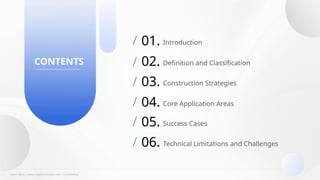
01. Introduction
CONTENTS 02. Definition and Classification
03. Construction Strategies
04. Core Application Areas
05. Success Cases
06. Technical Limitations and Challenges
Learn More | www.creative-biolabs.com | Confidential
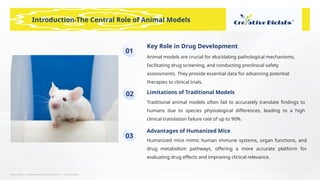
Key Role in Drug Development
Animal models are crucial for elucidating pathological mechanisms,
facilitating drug screening, and conducting preclinical safety
assessments. They provide essential data for advancing potential
therapies to clinical trials.
Limitations of Traditional Models
Traditional animal models often fail to accurately translate findings to
humans due to species physiological differences, leading to a high
clinical translation failure rate of up to 90%.
Advantages of Humanized Mice
Humanized mice mimic human immune systems, organ functions, and
drug metabolism pathways, offering a more accurate platform for
evaluating drug effects and improving clinical relevance.
01
02
03
Introduction-The Central Role of Animal Models
Learn More | www.creative-biolabs.com | Confidential
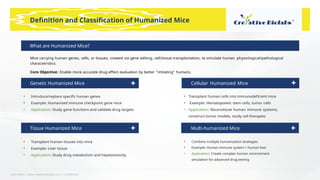
Definition and Classification of Humanized Mice
• Introduce/replace specific human genes
• Example: Humanized immune checkpoint gene mice
• Application: Study gene functions and validate drug targets
Mice carrying human genes, cells, or tissues, created via gene editing, cell/tissue transplantation, to simulate human physiological/pathological
characteristics.
Core Objective: Enable more accurate drug effect evaluation by better "imitating" humans.
• Transplant human cells into immunodeficient mice
• Example: Hematopoietic stem cells, tumor cells
• Application: Reconstitute human immune systems,
construct tumor models, study cell therapies
• Transplant human tissues into mice
• Example: Liver tissue
• Application: Study drug metabolism and hepatotoxicity
• Combine multiple humanization strategies
• Example: Human immune system + human liver
• Application: Create complex human environment
simulation for advanced drug testing
What are Humanized Mice?
Genetic Humanized Mice Cellular Humanized Mice
Tissue Humanized Mice Multi-humanized Mice
Learn More | www.creative-biolabs.com | Confidential
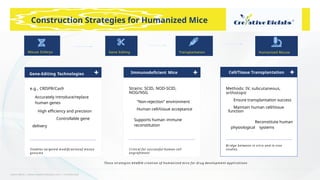
Construction Strategies for Humanized Mice
Transplantation
Mouse Embryo Humanized Mouse
Gene Editing
e.g., CRISPR/Cas9
Accurately introduce/replace
human genes
High efficiency and precision
Controllable gene
delivery
Methods: IV, subcutaneous,
orthotopic
Ensure transplantation success
Maintain human cell/tissue
function
Reconstitute human
physiological systems
Strains: SCID, NOD-SCID,
NOG/NSG
"Non-rejection" environment
Human cell/tissue acceptance
Supports human immune
reconstitution
Enables targeted modificationof mouse
ge no m e
These strategies enable creation of humanized mice for drug development applications
Critical for successful human cell
engraftment
Bridge between in vitro and in vivo
studies
Gene-Editing Technologies Immunodeficient Mice Cell/Tissue Transplantation
Learn More | www.creative-biolabs.com | Confidential
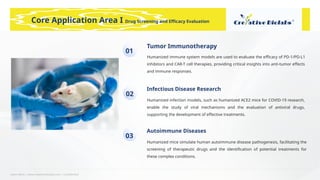
Core Application Area I Drug Screening and Efficacy Evaluation
Tumor Immunotherapy
Humanized immune system models are used to evaluate the efficacy of PD-1/PD-L1
inhibitors and CAR-T cell therapies, providing critical insights into anti-tumor effects
and immune responses.
Infectious Disease Research
Humanized infection models, such as humanized ACE2 mice for COVID-19 research,
enable the study of viral mechanisms and the evaluation of antiviral drugs,
supporting the development of effective treatments.
Autoimmune Diseases
Humanized mice simulate human autoimmune disease pathogenesis, facilitating the
screening of therapeutic drugs and the identification of potential treatments for
these complex conditions.
01
02
03
Learn More | www.creative-biolabs.com | Confidential
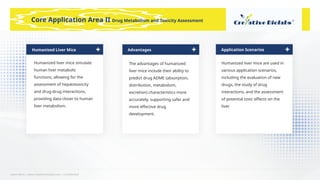
The advantages of humanized
liver mice include their ability to
predict drug ADME (absorption,
distribution, metabolism,
excretion) characteristics more
accurately, supporting safer and
more effective drug
development.
Core Application Area II Drug Metabolism and Toxicity Assessment
Humanized Liver Mice
Humanized liver mice simulate
human liver metabolic
functions, allowing for the
assessment of hepatotoxicity
and drug-drug interactions,
providing data closer to human
liver metabolism.
Advantages Application Scenarios
Humanized liver mice are used in
various application scenarios,
including the evaluation of new
drugs, the study of drug
interactions, and the assessment
of potential toxic effects on the
liver.
Learn More | www.creative-biolabs.com | Confidential
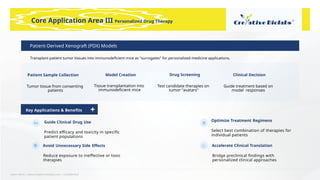
Accelerate Clinical Translation
Bridge preclinical findings with
personalized clinical approaches
Optimize Treatment Regimens
Select best combination of therapies for
individual patients
Guide Clinical Drug Use
Predict efficacy and toxicity in specific
patient populations
Avoid Unnecessary Side Effects
Reduce exposure to ineffective or toxic
therapies
Core Application Area III Personalized Drug Therapy
Patient-Derived Xenograft (PDX) Models
Transplant patient tumor tissues into immunodeficient mice as "surrogates" for personalized medicine applications.
Patient Sample Collection
Tumor tissue from consenting
patients
Model Creation
Tissue transplantation into
immunodeficient mice
Drug Screening
Test candidate therapies on
tumor "avatars"
Clinical Decision
Guide treatment based on
model responses
Key Applications & Benefits
Learn More | www.creative-biolabs.com | Confidential
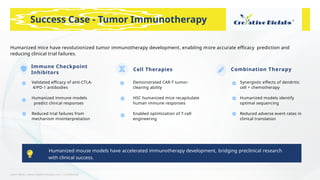
Success Case - Tumor Immunotherapy
Humanized mice have revolutionized tumor immunotherapy development, enabling more accurate efficacy prediction and
reducing clinical trial failures.
Synergistic effects of dendritic
cell + chemotherapy
Humanized models identify
optimal sequencing
Reduced adverse event rates in
clinical translation
Combination Therapy
Immune Checkpoint
Inhibitors
Cell Therapies
Validated efficacy of anti-CTLA-
4/PD-1 antibodies
Humanized immune models
predict clinical responses
Reduced trial failures from
mechanism misinterpretation
Demonstrated CAR-T tumor-
clearing ability
HSC humanized mice recapitulate
human immune responses
Enabled optimization of T-cell
engineering
Humanized mouse models have accelerated immunotherapy development, bridging preclinical research
with clinical success.
Learn More | www.creative-biolabs.com | Confidential
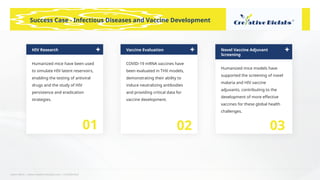
Success Case - Infectious Diseases and Vaccine Development
HIV Research
Humanized mice have been used
to simulate HIV latent reservoirs,
enabling the testing of antiviral
drugs and the study of HIV
persistence and eradication
strategies.
01
Vaccine Evaluation
COVID-19 mRNA vaccines have
been evaluated in THX models,
demonstrating their ability to
induce neutralizing antibodies
and providing critical data for
vaccine development.
02
Novel Vaccine Adjuvant
Screening
Humanized mice models have
supported the screening of novel
malaria and HIV vaccine
adjuvants, contributing to the
development of more effective
vaccines for these global health
challenges.
03
Learn More | www.creative-biolabs.com | Confidential
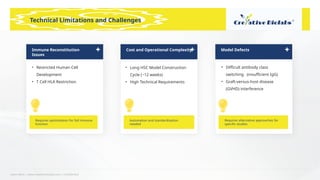
Technical Limitations and Challenges
Immune Reconstitution
Issues
• Restricted Human Cell
Development
• T Cell HLA Restriction
Cost and Operational Complexity
• Long HSC Model Construction
Cycle (~12 weeks)
• High Technical Requirements
Model Defects
• Difficult antibody class
switching (insufficient IgG)
• Graft-versus-host disease
(GVHD) interference
Requires optimization for full immune
function
Automation and standardization
needed
Requires alternative approaches for
specific studies
Learn More | www.creative-biolabs.com | Confidential
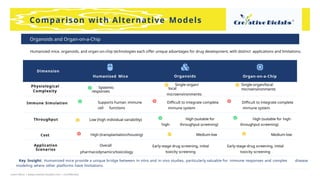
Immune Simulation Supports human immune
cell functions
Difficult to integrate complete
immune system
Difficult to integrate complete
immune system
Throughput Low (high individual variability) High (suitable for
high- throughput screening)
High (suitable for high-
throughput screening)
Cost High (transplantation/housing) Medium-low Medium-low
Application
Scenarios
Overall
pharmacodynamics/toxicology
Early-stage drug screening, initial
toxicity screening
Early-stage drug screening, initial
toxicity screening
Comparison with Alternative Models
Key Insight: Humanized mice provide a unique bridge between in vitro and in vivo studies, particularly valuable for immune responses and complex disease
modeling where other platforms have limitations.
Single-organ/
local
microenvironments
Physiological
Complexity
Systemic
responses
Organ-on-a-Chip
Humanized Mice Organoids
Dimension
Organoids and Organ-on-a-Chip
Humanized mice, organoids, and organ-on-chip technologies each offer unique advantages for drug development, with distinct applications and limitations.
Single-organ/local
microenvironments
Learn More | www.creative-biolabs.com | Confidential
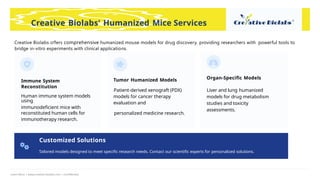
Creative Biolabs o ers
ff comprehensive humanized mouse models for drug discovery, providing researchers with powerful tools to
bridge in-vitro experiments with clinical applications.
Immune System
Reconstitution
Human immune system models
using
immunodeficient mice with
reconstituted human cells for
immunotherapy research.
Tumor Humanized Models
Patient-derived xenograft (PDX)
models for cancer therapy
evaluation and
personalized medicine research.
Organ-Specific Models
Liver and lung humanized
models for drug metabolism
studies and toxicity
assessments.
Creative Biolabs' Humanized Mice Services
Customized Solutions
Tailored models designed to meet specific research needs. Contact our scientific experts for personalized solutions.
Learn More | www.creative-biolabs.com | Confidential
For more information on humanized mice models
and services, please contact us:
Thank you for your attention!
Email
info@ creative- biolabs.com
Address
SUITE 203, 17 RAMSEY ROAD
SHIRLEY, NY 11967, USA
Website
www.creative-biolabs.com

The Science Behind Humanized Mouse Models - Creative Biolabs

  • 1.
    Learn More |www.creative-biolabs.com | Confidential The Science Behind Humanized Mouse Models Email info@ creative-biolabs.com Address SUITE 203, 17 RAMSEY ROAD SHIRLEY, NY 11967, USA Website www.creative-biolabs.com
  • 2.
    Learn More |www.creative-biolabs.com | Confidential 01. Introduction CONTENTS 02. Definition and Classification 03. Construction Strategies 04. Core Application Areas 05. Success Cases 06. Technical Limitations and Challenges
  • 3.
    Learn More |www.creative-biolabs.com | Confidential Key Role in Drug Development Animal models are crucial for elucidating pathological mechanisms, facilitating drug screening, and conducting preclinical safety assessments. They provide essential data for advancing potential therapies to clinical trials. Limitations of Traditional Models Traditional animal models often fail to accurately translate findings to humans due to species physiological differences, leading to a high clinical translation failure rate of up to 90%. Advantages of Humanized Mice Humanized mice mimic human immune systems, organ functions, and drug metabolism pathways, offering a more accurate platform for evaluating drug effects and improving clinical relevance. 01 02 03 Introduction-The Central Role of Animal Models
  • 4.
    Learn More |www.creative-biolabs.com | Confidential Definition and Classification of Humanized Mice • Introduce/replace specific human genes • Example: Humanized immune checkpoint gene mice • Application: Study gene functions and validate drug targets Mice carrying human genes, cells, or tissues, created via gene editing, cell/tissue transplantation, to simulate human physiological/pathological characteristics. Core Objective: Enable more accurate drug effect evaluation by better "imitating" humans. • Transplant human cells into immunodeficient mice • Example: Hematopoietic stem cells, tumor cells • Application: Reconstitute human immune systems, construct tumor models, study cell therapies • Transplant human tissues into mice • Example: Liver tissue • Application: Study drug metabolism and hepatotoxicity • Combine multiple humanization strategies • Example: Human immune system + human liver • Application: Create complex human environment simulation for advanced drug testing What are Humanized Mice? Genetic Humanized Mice Cellular Humanized Mice Tissue Humanized Mice Multi-humanized Mice
  • 5.
    Learn More |www.creative-biolabs.com | Confidential Construction Strategies for Humanized Mice Transplantation Mouse Embryo Humanized Mouse Gene Editing e.g., CRISPR/Cas9 Accurately introduce/replace human genes High efficiency and precision Controllable gene delivery Methods: IV, subcutaneous, orthotopic Ensure transplantation success Maintain human cell/tissue function Reconstitute human physiological systems Strains: SCID, NOD-SCID, NOG/NSG "Non-rejection" environment Human cell/tissue acceptance Supports human immune reconstitution Enables targeted modificationof mouse ge no m e These strategies enable creation of humanized mice for drug development applications Critical for successful human cell engraftment Bridge between in vitro and in vivo studies Gene-Editing Technologies Immunodeficient Mice Cell/Tissue Transplantation
  • 6.
    Learn More |www.creative-biolabs.com | Confidential Core Application Area I Drug Screening and Efficacy Evaluation Tumor Immunotherapy Humanized immune system models are used to evaluate the efficacy of PD-1/PD-L1 inhibitors and CAR-T cell therapies, providing critical insights into anti-tumor effects and immune responses. Infectious Disease Research Humanized infection models, such as humanized ACE2 mice for COVID-19 research, enable the study of viral mechanisms and the evaluation of antiviral drugs, supporting the development of effective treatments. Autoimmune Diseases Humanized mice simulate human autoimmune disease pathogenesis, facilitating the screening of therapeutic drugs and the identification of potential treatments for these complex conditions. 01 02 03
  • 7.
    Learn More |www.creative-biolabs.com | Confidential The advantages of humanized liver mice include their ability to predict drug ADME (absorption, distribution, metabolism, excretion) characteristics more accurately, supporting safer and more effective drug development. Core Application Area II Drug Metabolism and Toxicity Assessment Humanized Liver Mice Humanized liver mice simulate human liver metabolic functions, allowing for the assessment of hepatotoxicity and drug-drug interactions, providing data closer to human liver metabolism. Advantages Application Scenarios Humanized liver mice are used in various application scenarios, including the evaluation of new drugs, the study of drug interactions, and the assessment of potential toxic effects on the liver.
  • 8.
    Learn More |www.creative-biolabs.com | Confidential Accelerate Clinical Translation Bridge preclinical findings with personalized clinical approaches Optimize Treatment Regimens Select best combination of therapies for individual patients Guide Clinical Drug Use Predict efficacy and toxicity in specific patient populations Avoid Unnecessary Side Effects Reduce exposure to ineffective or toxic therapies Core Application Area III Personalized Drug Therapy Patient-Derived Xenograft (PDX) Models Transplant patient tumor tissues into immunodeficient mice as "surrogates" for personalized medicine applications. Patient Sample Collection Tumor tissue from consenting patients Model Creation Tissue transplantation into immunodeficient mice Drug Screening Test candidate therapies on tumor "avatars" Clinical Decision Guide treatment based on model responses Key Applications & Benefits
  • 9.
    Learn More |www.creative-biolabs.com | Confidential Success Case - Tumor Immunotherapy Humanized mice have revolutionized tumor immunotherapy development, enabling more accurate efficacy prediction and reducing clinical trial failures. Synergistic effects of dendritic cell + chemotherapy Humanized models identify optimal sequencing Reduced adverse event rates in clinical translation Combination Therapy Immune Checkpoint Inhibitors Cell Therapies Validated efficacy of anti-CTLA- 4/PD-1 antibodies Humanized immune models predict clinical responses Reduced trial failures from mechanism misinterpretation Demonstrated CAR-T tumor- clearing ability HSC humanized mice recapitulate human immune responses Enabled optimization of T-cell engineering Humanized mouse models have accelerated immunotherapy development, bridging preclinical research with clinical success.
  • 10.
    Learn More |www.creative-biolabs.com | Confidential Success Case - Infectious Diseases and Vaccine Development HIV Research Humanized mice have been used to simulate HIV latent reservoirs, enabling the testing of antiviral drugs and the study of HIV persistence and eradication strategies. 01 Vaccine Evaluation COVID-19 mRNA vaccines have been evaluated in THX models, demonstrating their ability to induce neutralizing antibodies and providing critical data for vaccine development. 02 Novel Vaccine Adjuvant Screening Humanized mice models have supported the screening of novel malaria and HIV vaccine adjuvants, contributing to the development of more effective vaccines for these global health challenges. 03
  • 11.
    Learn More |www.creative-biolabs.com | Confidential Technical Limitations and Challenges Immune Reconstitution Issues • Restricted Human Cell Development • T Cell HLA Restriction Cost and Operational Complexity • Long HSC Model Construction Cycle (~12 weeks) • High Technical Requirements Model Defects • Difficult antibody class switching (insufficient IgG) • Graft-versus-host disease (GVHD) interference Requires optimization for full immune function Automation and standardization needed Requires alternative approaches for specific studies
  • 12.
    Learn More |www.creative-biolabs.com | Confidential Immune Simulation Supports human immune cell functions Difficult to integrate complete immune system Difficult to integrate complete immune system Throughput Low (high individual variability) High (suitable for high- throughput screening) High (suitable for high- throughput screening) Cost High (transplantation/housing) Medium-low Medium-low Application Scenarios Overall pharmacodynamics/toxicology Early-stage drug screening, initial toxicity screening Early-stage drug screening, initial toxicity screening Comparison with Alternative Models Key Insight: Humanized mice provide a unique bridge between in vitro and in vivo studies, particularly valuable for immune responses and complex disease modeling where other platforms have limitations. Single-organ/ local microenvironments Physiological Complexity Systemic responses Organ-on-a-Chip Humanized Mice Organoids Dimension Organoids and Organ-on-a-Chip Humanized mice, organoids, and organ-on-chip technologies each offer unique advantages for drug development, with distinct applications and limitations. Single-organ/local microenvironments
  • 13.
    Learn More |www.creative-biolabs.com | Confidential Creative Biolabs o ers ff comprehensive humanized mouse models for drug discovery, providing researchers with powerful tools to bridge in-vitro experiments with clinical applications. Immune System Reconstitution Human immune system models using immunodeficient mice with reconstituted human cells for immunotherapy research. Tumor Humanized Models Patient-derived xenograft (PDX) models for cancer therapy evaluation and personalized medicine research. Organ-Specific Models Liver and lung humanized models for drug metabolism studies and toxicity assessments. Creative Biolabs' Humanized Mice Services Customized Solutions Tailored models designed to meet specific research needs. Contact our scientific experts for personalized solutions.
  • 14.
    Learn More |www.creative-biolabs.com | Confidential For more information on humanized mice models and services, please contact us: Thank you for your attention! Email info@ creative- biolabs.com Address SUITE 203, 17 RAMSEY ROAD SHIRLEY, NY 11967, USA Website www.creative-biolabs.com