RSA
ALGORITHM
Private-Key Cryptography
 traditional private/secret/single key
cryptography uses one key
 shared by both sender and receiver
 if this key is disclosed communications are
compromised
 also is symmetric, parties are equal
 hence does not protect sender from receiver
forging a message & claiming is sent by sender
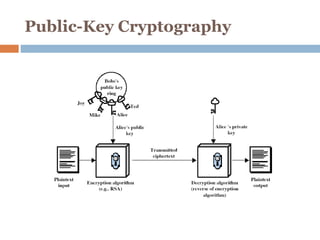
Public-Key Cryptography
 probably most significant advance in the 3000
year history of cryptography
 uses two keys – a public & a private key
 asymmetric since parties are not equal
 uses clever application of number theoretic
concepts to function
 complements rather than replaces private
key crypto
Public-Key Cryptography
 public-key/two-key/asymmetric
cryptography involves the use of two keys:
 a public-key, which may be known by anybody, and
can be used to encrypt messages, and verify
signatures
 a private-key, known only to the recipient, used to
decrypt messages, and sign (create) signatures
 is asymmetric because
 those who encrypt messages or verify signatures
cannot decrypt messages or create signatures
Public-Key Cryptography
Why Public-Key Cryptography?
 developed to address two key issues:
 key distribution – how to have secure
communications in general without having to trust
a KDC with your key
 digital signatures – how to verify a message
comes intact from the claimed sender
 public invention due to Whitfield Diffie &
Martin Hellman at Stanford Uni in 1976
 known earlier in classified community
Public-Key Characteristics
 Public-Key algorithms rely on two keys with
the characteristics that it is:
 computationally infeasible to find decryption key
knowing only algorithm & encryption key
 computationally easy to en/decrypt messages
when the relevant (en/decrypt) key is known
 either of the two related keys can be used for
encryption, with the other used for decryption (in
some schemes)
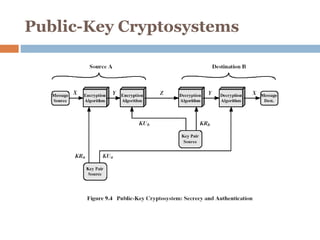
Public-Key Cryptosystems
Public-Key Applications
 can classify uses into 3 categories:
 encryption/decryption (provide secrecy)
 digital signatures (provide authentication)
 key exchange (of session keys)
 some algorithms are suitable for all uses,
others are specific to one
Security of Public Key Schemes
 like private key schemes brute force exhaustive
search attack is always theoretically possible
 but keys used are too large (>512bits)
 security relies on a large enough difference in
difficulty between easy (en/decrypt) and hard
(cryptanalyse) problems
 more generally the hard problem is known, its
just made too hard to do in practise
 requires the use of very large numbers
 hence is slow compared to private key schemes
RSA
 by Rivest, Shamir & Adleman of MIT in 1977
 best known & widely used public-key scheme
 based on exponentiation in a finite (Galois) field
over integers modulo a prime
 nb. exponentiation takes O((log n)3
) operations (easy)
 uses large integers (eg. 1024 bits)
 security due to cost of factoring large numbers
 nb. factorization takes O(e log n log log n
) operations (hard)
RSA Key Setup
 each user generates a public/private key pair by:
 selecting two large primes at random - p, q
 computing their system modulus N=p.q
 note ø(N)=(p-1)(q-1)
 selecting at random the encryption key e
 where 1<e<ø(N), gcd(e,ø(N))=1
 solve following equation to find decryption key d
 e.d=1 mod ø(N) and 0≤d≤N
 publish their public encryption key: KU={e,N}
 keep secret private decryption key: KR={d,p,q}
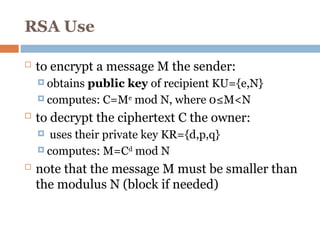
RSA Use
 to encrypt a message M the sender:
 obtains public key of recipient KU={e,N}
 computes: C=Me
mod N, where 0≤M<N
 to decrypt the ciphertext C the owner:
 uses their private key KR={d,p,q}
 computes: M=Cd
mod N
 note that the message M must be smaller than
the modulus N (block if needed)
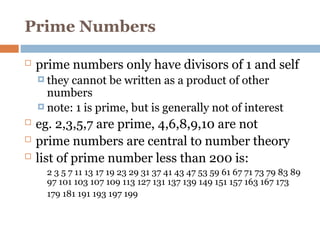
Prime Numbers
 prime numbers only have divisors of 1 and self
 they cannot be written as a product of other
numbers
 note: 1 is prime, but is generally not of interest
 eg. 2,3,5,7 are prime, 4,6,8,9,10 are not
 prime numbers are central to number theory
 list of prime number less than 200 is:
2 3 5 7 11 13 17 19 23 29 31 37 41 43 47 53 59 61 67 71 73 79 83 89
97 101 103 107 109 113 127 131 137 139 149 151 157 163 167 173
179 181 191 193 197 199
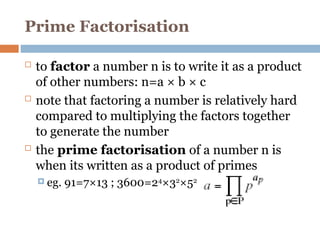
Prime Factorisation
 to factor a number n is to write it as a product
of other numbers: n=a × b × c
 note that factoring a number is relatively hard
compared to multiplying the factors together
to generate the number
 the prime factorisation of a number n is
when its written as a product of primes
 eg. 91=7×13 ; 3600=24
×32
×52
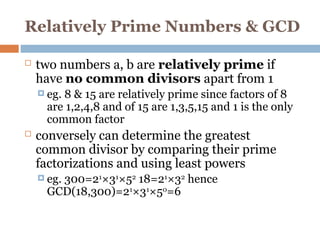
Relatively Prime Numbers & GCD
 two numbers a, b are relatively prime if
have no common divisors apart from 1
 eg. 8 & 15 are relatively prime since factors of 8
are 1,2,4,8 and of 15 are 1,3,5,15 and 1 is the only
common factor
 conversely can determine the greatest
common divisor by comparing their prime
factorizations and using least powers
 eg. 300=21
×31
×52
18=21
×32
hence
GCD(18,300)=21
×31
×50
=6
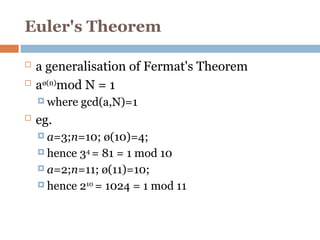
Euler's Theorem
 a generalisation of Fermat's Theorem
 aø(n)
mod N = 1
 where gcd(a,N)=1
 eg.
 a=3;n=10; ø(10)=4;
 hence 34
= 81 = 1 mod 10
 a=2;n=11; ø(11)=10;
 hence 210
= 1024 = 1 mod 11
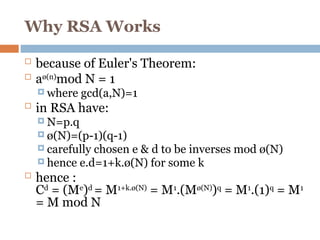
Why RSA Works
 because of Euler's Theorem:
 aø(n)
mod N = 1
 where gcd(a,N)=1
 in RSA have:
 N=p.q
 ø(N)=(p-1)(q-1)
 carefully chosen e & d to be inverses mod ø(N)
 hence e.d=1+k.ø(N) for some k
 hence :
Cd
= (Me
)d
= M1+k.ø(N)
= M1
.(Mø(N)
)q
= M1
.(1)q
= M1
= M mod N
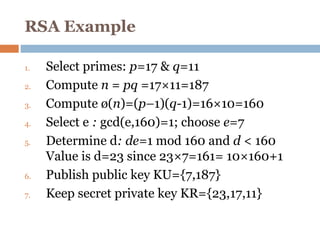
RSA Example
1. Select primes: p=17 & q=11
2. Compute n = pq =17×11=187
3. Compute ø(n)=(p–1)(q-1)=16×10=160
4. Select e : gcd(e,160)=1; choose e=7
5. Determine d: de=1 mod 160 and d < 160
Value is d=23 since 23×7=161= 10×160+1
6. Publish public key KU={7,187}
7. Keep secret private key KR={23,17,11}
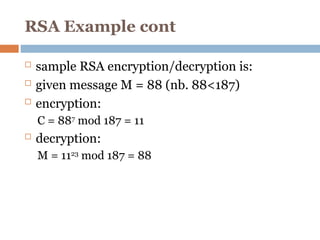
RSA Example cont
 sample RSA encryption/decryption is:
 given message M = 88 (nb. 88<187)
 encryption:
C = 887
mod 187 = 11
 decryption:
M = 1123
mod 187 = 88
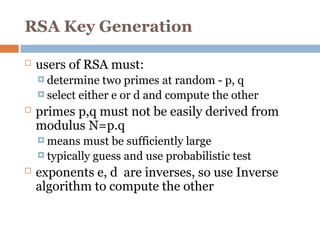
RSA Key Generation
 users of RSA must:
 determine two primes at random - p, q
 select either e or d and compute the other
 primes p,q must not be easily derived from
modulus N=p.q
 means must be sufficiently large
 typically guess and use probabilistic test
 exponents e, d are inverses, so use Inverse
algorithm to compute the other
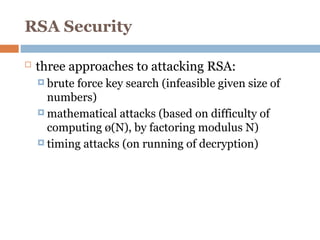
RSA Security
 three approaches to attacking RSA:
 brute force key search (infeasible given size of
numbers)
 mathematical attacks (based on difficulty of
computing ø(N), by factoring modulus N)
 timing attacks (on running of decryption)

The RSA (Rivest, Shamir & Adleman ) Algorithm

  • 1.
  • 2.
    Private-Key Cryptography  traditionalprivate/secret/single key cryptography uses one key  shared by both sender and receiver  if this key is disclosed communications are compromised  also is symmetric, parties are equal  hence does not protect sender from receiver forging a message & claiming is sent by sender
  • 3.
    Public-Key Cryptography  probablymost significant advance in the 3000 year history of cryptography  uses two keys – a public & a private key  asymmetric since parties are not equal  uses clever application of number theoretic concepts to function  complements rather than replaces private key crypto
  • 4.
    Public-Key Cryptography  public-key/two-key/asymmetric cryptographyinvolves the use of two keys:  a public-key, which may be known by anybody, and can be used to encrypt messages, and verify signatures  a private-key, known only to the recipient, used to decrypt messages, and sign (create) signatures  is asymmetric because  those who encrypt messages or verify signatures cannot decrypt messages or create signatures
  • 5.
  • 6.
    Why Public-Key Cryptography? developed to address two key issues:  key distribution – how to have secure communications in general without having to trust a KDC with your key  digital signatures – how to verify a message comes intact from the claimed sender  public invention due to Whitfield Diffie & Martin Hellman at Stanford Uni in 1976  known earlier in classified community
  • 7.
    Public-Key Characteristics  Public-Keyalgorithms rely on two keys with the characteristics that it is:  computationally infeasible to find decryption key knowing only algorithm & encryption key  computationally easy to en/decrypt messages when the relevant (en/decrypt) key is known  either of the two related keys can be used for encryption, with the other used for decryption (in some schemes)
  • 8.
  • 9.
    Public-Key Applications  canclassify uses into 3 categories:  encryption/decryption (provide secrecy)  digital signatures (provide authentication)  key exchange (of session keys)  some algorithms are suitable for all uses, others are specific to one
  • 10.
    Security of PublicKey Schemes  like private key schemes brute force exhaustive search attack is always theoretically possible  but keys used are too large (>512bits)  security relies on a large enough difference in difficulty between easy (en/decrypt) and hard (cryptanalyse) problems  more generally the hard problem is known, its just made too hard to do in practise  requires the use of very large numbers  hence is slow compared to private key schemes
  • 11.
    RSA  by Rivest,Shamir & Adleman of MIT in 1977  best known & widely used public-key scheme  based on exponentiation in a finite (Galois) field over integers modulo a prime  nb. exponentiation takes O((log n)3 ) operations (easy)  uses large integers (eg. 1024 bits)  security due to cost of factoring large numbers  nb. factorization takes O(e log n log log n ) operations (hard)
  • 12.
    RSA Key Setup each user generates a public/private key pair by:  selecting two large primes at random - p, q  computing their system modulus N=p.q  note ø(N)=(p-1)(q-1)  selecting at random the encryption key e  where 1<e<ø(N), gcd(e,ø(N))=1  solve following equation to find decryption key d  e.d=1 mod ø(N) and 0≤d≤N  publish their public encryption key: KU={e,N}  keep secret private decryption key: KR={d,p,q}
  • 13.
    RSA Use  toencrypt a message M the sender:  obtains public key of recipient KU={e,N}  computes: C=Me mod N, where 0≤M<N  to decrypt the ciphertext C the owner:  uses their private key KR={d,p,q}  computes: M=Cd mod N  note that the message M must be smaller than the modulus N (block if needed)
  • 14.
    Prime Numbers  primenumbers only have divisors of 1 and self  they cannot be written as a product of other numbers  note: 1 is prime, but is generally not of interest  eg. 2,3,5,7 are prime, 4,6,8,9,10 are not  prime numbers are central to number theory  list of prime number less than 200 is: 2 3 5 7 11 13 17 19 23 29 31 37 41 43 47 53 59 61 67 71 73 79 83 89 97 101 103 107 109 113 127 131 137 139 149 151 157 163 167 173 179 181 191 193 197 199
  • 15.
    Prime Factorisation  tofactor a number n is to write it as a product of other numbers: n=a × b × c  note that factoring a number is relatively hard compared to multiplying the factors together to generate the number  the prime factorisation of a number n is when its written as a product of primes  eg. 91=7×13 ; 3600=24 ×32 ×52
  • 16.
    Relatively Prime Numbers& GCD  two numbers a, b are relatively prime if have no common divisors apart from 1  eg. 8 & 15 are relatively prime since factors of 8 are 1,2,4,8 and of 15 are 1,3,5,15 and 1 is the only common factor  conversely can determine the greatest common divisor by comparing their prime factorizations and using least powers  eg. 300=21 ×31 ×52 18=21 ×32 hence GCD(18,300)=21 ×31 ×50 =6
  • 17.
    Euler's Theorem  ageneralisation of Fermat's Theorem  aø(n) mod N = 1  where gcd(a,N)=1  eg.  a=3;n=10; ø(10)=4;  hence 34 = 81 = 1 mod 10  a=2;n=11; ø(11)=10;  hence 210 = 1024 = 1 mod 11
  • 18.
    Why RSA Works because of Euler's Theorem:  aø(n) mod N = 1  where gcd(a,N)=1  in RSA have:  N=p.q  ø(N)=(p-1)(q-1)  carefully chosen e & d to be inverses mod ø(N)  hence e.d=1+k.ø(N) for some k  hence : Cd = (Me )d = M1+k.ø(N) = M1 .(Mø(N) )q = M1 .(1)q = M1 = M mod N
  • 19.
    RSA Example 1. Selectprimes: p=17 & q=11 2. Compute n = pq =17×11=187 3. Compute ø(n)=(p–1)(q-1)=16×10=160 4. Select e : gcd(e,160)=1; choose e=7 5. Determine d: de=1 mod 160 and d < 160 Value is d=23 since 23×7=161= 10×160+1 6. Publish public key KU={7,187} 7. Keep secret private key KR={23,17,11}
  • 20.
    RSA Example cont sample RSA encryption/decryption is:  given message M = 88 (nb. 88<187)  encryption: C = 887 mod 187 = 11  decryption: M = 1123 mod 187 = 88
  • 21.
    RSA Key Generation users of RSA must:  determine two primes at random - p, q  select either e or d and compute the other  primes p,q must not be easily derived from modulus N=p.q  means must be sufficiently large  typically guess and use probabilistic test  exponents e, d are inverses, so use Inverse algorithm to compute the other
  • 22.
    RSA Security  threeapproaches to attacking RSA:  brute force key search (infeasible given size of numbers)  mathematical attacks (based on difficulty of computing ø(N), by factoring modulus N)  timing attacks (on running of decryption)