THE PUSHING OF PROGRAMS
 AND OPERATING SYSTEMS: THE
 GOOD THE BAD AND THE UGLY
FOR THE USER AND MICROSOFT


          Howard Community College
                           7/4/12
Objectives
• Why does Microsoft produce unfinished
  products that are updated over the internet?
• How does the process work?
• What is the advantage of using this process?
• What are the economic consequences to
  market share?
Why does Microsoft
produce unfinished
products that are
updated over the
internet?
History prior to
internet updates
• Before internet updates,
  programs were purchased
  and the majority of support
  came in the box. If you
  registered your product,
  when and if there was an
  update CDs would be sent
  out or need to be
  purchased to provide the
  updates. Time from idea to
  product release was
  extremely long and testing
  was intensive and costly.
Reasons for product updates

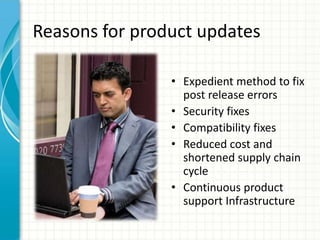
                • Expedient method to fix
                  post release errors
                • Security fixes
                • Compatibility fixes
                • Reduced cost and
                  shortened supply chain
                  cycle
                • Continuous product
                  support Infrastructure
Pros for product updates

                • Enhanced compatibility
                  and security support
                • On going product
                  management support
Cons for product updates

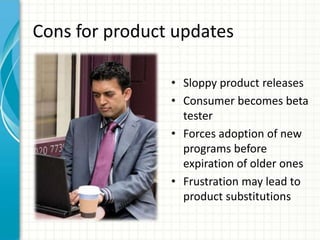
                • Sloppy product releases
                • Consumer becomes beta
                  tester
                • Forces adoption of new
                  programs before
                  expiration of older ones
                • Frustration may lead to
                  product substitutions
How does the
process work?
How updates work.
What is the
advantage of
using this
process?
Advantages of pushing product
updates

                 • Reduced cost due to
                   internet based transport
                   system vice disks
                 • This reduced cost can be
                   used to initially
                   introduce program at
                   lower pricing
                 • Flexibility to change
                   program at anytime at
                   any level and complexity
What are the
economic
consequences to
market share?
Google Analytics
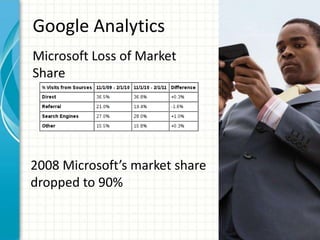
Microsoft Loss of Market
Share


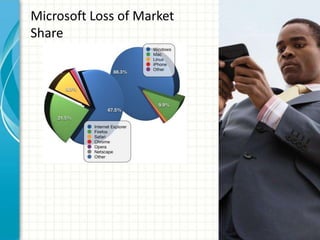
2008 Microsoft’s market share
dropped to 90%
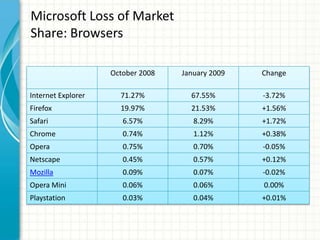
Microsoft Loss of Market
Share: Browsers

                    October 2008   January 2009   Change

Internet Explorer     71.27%         67.55%       -3.72%
Firefox               19.97%         21.53%       +1.56%
Safari                 6.57%          8.29%       +1.72%
Chrome                 0.74%          1.12%       +0.38%
Opera                  0.75%          0.70%       -0.05%
Netscape               0.45%          0.57%       +0.12%
Mozilla                0.09%          0.07%       -0.02%
Opera Mini             0.06%          0.06%       0.00%
Playstation            0.03%          0.04%       +0.01%
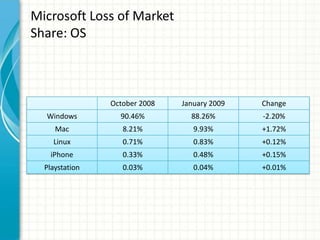
Microsoft Loss of Market
Share: OS


                October 2008   January 2009   Change
  Windows         90.46%         88.26%       -2.20%
     Mac           8.21%          9.93%       +1.72%
    Linux          0.71%          0.83%       +0.12%
    iPhone         0.33%          0.48%       +0.15%
  Playstation      0.03%          0.04%       +0.01%
Microsoft Loss of Market
Share
Discussion
• Although the loss in
  market share is not
  significant, frustration
  with sloppy software and
  competitors developing
  innovative products
  slowly are nipping at the
  heels of Microsoft.
  Hopefully this
  competition will improve
  the market production
  and quality assurance.
Summary
• Like it or not this method is here to stay and
  has good in the forms of product support and
  internet security. The bad is that programs
  seem unfinished and are not as polished as
  they were pre internet updates. The method
  has become an industry standard.
Resources
•   Brodkin, Jon. Windows drops below 90% market share. 2 Feburary 2011. Internet. 10 June 2012.
•   Dignan, Larry. Buggy software: Why do we put up with it? 16 July 2010. Internet. 10 June 2012.
•   Gruener, Wolfgang. How serious is the market share loss of Microsoft’s Internet Explorer? 23
    December 2008. Internet. 10 June 2012.
•   Mann, Charles C. "Why Software is so Bad." Technology Review July/August 2002: 33-38.
    Academic Database / Journal.
•   Numenware. Why Microsoft creates buggy software inefficiently. 2 August 2004. Blog. 10 June
    2012.
•   Petersen, Alan. Microsoft Buggy Software Release It Anyway Syndrome. 9 July 2007. Internet
    Marketing & Infopreneur Blog. 9 June 2012.
•   Sams, Brad. Six reasons Microsoft will continue to lose market share. 21 November 2008.
    Internet. 9 June 2012.
•   Spagnuolo, Chris. Releasing buggy software intentionally. 20 November 2008. Blog. 9 June 2012.
•   Thomas, Trisha. Google Analytics data shows Microsoft Windows losing market-share due to
    phones & tablets. 2 July 2011. Internet. 10 June 2012.
QUESTIONS?

The pushing of programs and operating systems

  • 1.
    THE PUSHING OFPROGRAMS AND OPERATING SYSTEMS: THE GOOD THE BAD AND THE UGLY FOR THE USER AND MICROSOFT Howard Community College 7/4/12
  • 2.
    Objectives • Why doesMicrosoft produce unfinished products that are updated over the internet? • How does the process work? • What is the advantage of using this process? • What are the economic consequences to market share?
  • 3.
    Why does Microsoft produceunfinished products that are updated over the internet?
  • 4.
    History prior to internetupdates • Before internet updates, programs were purchased and the majority of support came in the box. If you registered your product, when and if there was an update CDs would be sent out or need to be purchased to provide the updates. Time from idea to product release was extremely long and testing was intensive and costly.
  • 5.
    Reasons for productupdates • Expedient method to fix post release errors • Security fixes • Compatibility fixes • Reduced cost and shortened supply chain cycle • Continuous product support Infrastructure
  • 6.
    Pros for productupdates • Enhanced compatibility and security support • On going product management support
  • 7.
    Cons for productupdates • Sloppy product releases • Consumer becomes beta tester • Forces adoption of new programs before expiration of older ones • Frustration may lead to product substitutions
  • 8.
  • 9.
  • 10.
    What is the advantageof using this process?
  • 11.
    Advantages of pushingproduct updates • Reduced cost due to internet based transport system vice disks • This reduced cost can be used to initially introduce program at lower pricing • Flexibility to change program at anytime at any level and complexity
  • 12.
  • 13.
    Google Analytics Microsoft Lossof Market Share 2008 Microsoft’s market share dropped to 90%
  • 14.
    Microsoft Loss ofMarket Share: Browsers October 2008 January 2009 Change Internet Explorer 71.27% 67.55% -3.72% Firefox 19.97% 21.53% +1.56% Safari 6.57% 8.29% +1.72% Chrome 0.74% 1.12% +0.38% Opera 0.75% 0.70% -0.05% Netscape 0.45% 0.57% +0.12% Mozilla 0.09% 0.07% -0.02% Opera Mini 0.06% 0.06% 0.00% Playstation 0.03% 0.04% +0.01%
  • 15.
    Microsoft Loss ofMarket Share: OS October 2008 January 2009 Change Windows 90.46% 88.26% -2.20% Mac 8.21% 9.93% +1.72% Linux 0.71% 0.83% +0.12% iPhone 0.33% 0.48% +0.15% Playstation 0.03% 0.04% +0.01%
  • 16.
    Microsoft Loss ofMarket Share
  • 17.
    Discussion • Although theloss in market share is not significant, frustration with sloppy software and competitors developing innovative products slowly are nipping at the heels of Microsoft. Hopefully this competition will improve the market production and quality assurance.
  • 18.
    Summary • Like itor not this method is here to stay and has good in the forms of product support and internet security. The bad is that programs seem unfinished and are not as polished as they were pre internet updates. The method has become an industry standard.
  • 19.
    Resources • Brodkin, Jon. Windows drops below 90% market share. 2 Feburary 2011. Internet. 10 June 2012. • Dignan, Larry. Buggy software: Why do we put up with it? 16 July 2010. Internet. 10 June 2012. • Gruener, Wolfgang. How serious is the market share loss of Microsoft’s Internet Explorer? 23 December 2008. Internet. 10 June 2012. • Mann, Charles C. "Why Software is so Bad." Technology Review July/August 2002: 33-38. Academic Database / Journal. • Numenware. Why Microsoft creates buggy software inefficiently. 2 August 2004. Blog. 10 June 2012. • Petersen, Alan. Microsoft Buggy Software Release It Anyway Syndrome. 9 July 2007. Internet Marketing & Infopreneur Blog. 9 June 2012. • Sams, Brad. Six reasons Microsoft will continue to lose market share. 21 November 2008. Internet. 9 June 2012. • Spagnuolo, Chris. Releasing buggy software intentionally. 20 November 2008. Blog. 9 June 2012. • Thomas, Trisha. Google Analytics data shows Microsoft Windows losing market-share due to phones & tablets. 2 July 2011. Internet. 10 June 2012.
  • 20.

Editor's Notes

  • #4 This is another option for an Overview slides using transitions.
  • #5 Discuss outcomes of the case study or class simulation.Cover best practices.
  • #10 Keep it brief. Make your text as brief as possible to maintain a larger font size.