TEAM-BUILDINGANAGEMENT


      THE
      PROFESSIONAL EDGE
      Entrepreneurs find it hard to develop an organisation of professionals.
      Four practices that can help them make the leap


102    INDIAN MANAGEMENT — MARCH 2010
TEAM-BUILDING


                                                                                                                BS FILE PHOTO


AMIT GARG AND VINEESH CHADHA                           are generally good man-managers. Yet, very few
                                                       entrepreneurs are able to attract the right talent


M
        ost entrepreneurs are inherently smart         and build the right kind of organisation.
        people. They recognise that creating               Management literature provides few insights
        a high-performance organisation in             into this issue and does little to help the entrepre-
        today’s environment will require them to       neur cross this chasm. It is easy to say that a com-
build additional competencies. They also               pany needs to develop a people perspective — but
understand that talent acquisition requires            difficult to say how one starts. In our interactions
investment in people and formal processes and          with several family-run and entrepreneur-driven
systems. They have built their businesses by dint      organisations, we find that there are four practices
of hard work and relationship management, and          that can help companies make this leap.


TO SUBSCRIBE TO INDIAN MANAGEMENT-SMS ‘IMM’ TO 57007                                INDIAN MANAGEMENT — MARCH 2010              103
TEAM-BUILDING


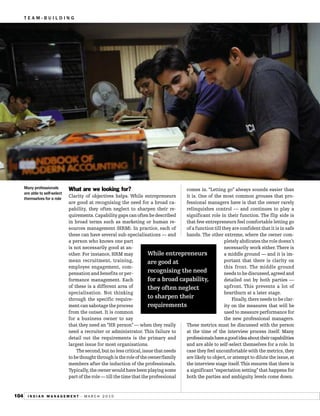
      Many professionals
      are able to self-select
                                What are we looking for?                               comes in. “Letting go” always sounds easier than
      themselves for a role
                                Clarity of objectives helps. While entrepreneurs       it is. One of the most common grouses that pro-
                                are good at recognising the need for a broad ca-       fessional managers have is that the owner rarely
                                pability, they often neglect to sharpen their re-      relinquishes control — and continues to play a
                                quirements. Capability gaps can often be described     significant role in their function. The flip side is
                                in broad terms such as marketing or human re-          that few entrepreneurs feel comfortable letting go
                                sources management (HRM). In practice, each of         of a function till they are confident that it is in safe
                                these can have several sub-specialisations — and       hands. The other extreme, where the owner com-
                                a person who knows one part                                                pletely abdicates the role doesn’t
                                is not necessarily good at an-                                             necessarily work either. There is
                                other. For instance, HRM may             While entrepreneurs               a middle ground — and it is im-
                                mean recruitment, training,              are good at                       portant that there is clarity on
                                employee engagement, com-                                                  this front. The middle ground
                                pensation and benefits or per-           recognising the need              needs to be discussed,agreed and
                                formance management. Each                for a broad capability,           detailed out by both parties —
                                of these is a different area of          they often neglect                upfront. This prevents a lot of
                                specialisation. Not thinking                                               heartburn at a later stage.
                                through the specific require-            to sharpen their                      Finally, there needs to be clar-
                                ment can sabotage the process            requirements                      ity on the measures that will be
                                from the outset. It is common                                              used to measure performance for
                                for a business owner to say                                                the new professional managers.
                                that they need an “HR person” — when they really       These metrics must be discussed with the person
                                need a recruiter or administrator. This failure to     at the time of the interview process itself. Many
                                detail out the requirements is the primary and         professionals have a good idea about their capabilities
                                largest issue for most organisations.                  and are able to self-select themselves for a role. In
                                    The second,but no less critical,issue that needs   case they feel uncomfortable with the metrics, they
                                to be thought through is the role of the owner/family  are likely to object, or attempt to dilute the issue, at
                                members after the induction of the professionals.      the interview stage itself.This ensures that there is
                                Typically, the owner would have been playing some      a significant “expectation setting” that happens for
                                part of the role — till the time that the professional both the parties and ambiguity levels come down.


104     INDIAN MANAGEMENT - MARCH 2010
TEAM-BUILDING


Set the stage internally                                pears suitable” for the job, it is critical to conduct
In family-run organisations, the hiring of profes-      a systematic search process. A simple thumb rule
sionals has multiple implications. It often means       is to interview at least five people for every senior
a subtle shift of roles from family members to em-      manager hired into the company. By doing so, one
ployees. This can be a delicate issue at the best of    gains a better understanding of the options avail-
times — and needs to be handled as such.Also, the       able and the suitability to the organisation’s re-
induction of professionals often leads to an in-        quirements. Secondly, one must move towards a
crease in the cost structure, while the revenue im-     multi-interview process — with a minimum of four
pact takes a longer time. The concurrence of the        interviews for senior roles.The owner group should
family members cannot therefore be taken for            be active participants in this process.A recruitment
granted. It is critical that the family members are     error takes anywhere between six months to two
aligned to the objectives of the leader and put their   years to be resolved — so it is better to invest the
support behind the professional managers. With-         time up-front and try to maximise the possibility
out this support, the out-
sider will be doomed to fail-
ure. Otherwise, the person
finds that he has multiple
dotted-line reporting rela-
tionships. Some profession-
als start adopting a safety-
first approach towards
everything — making sure
that the family is happy,
whether or not they them-
selves believe in the deci-
sion. Others get frustrated
and get into a negative loop
of cynicism and under-per-
formance. Very few are able
to manage well in such an
environment.
    It is also important that
many “hygiene” issues need
to be addressed before in-
ducting senior talent. The
informal mechanisms that
have become ingrained into
an entrepreneurial organi-
sation can become a nui-
sance to the seasoned man-
ager who has become used
                                                                                                                       Detailing the
                                                                                                                       requirements is
to certain things being “taken care of”. Simple is-     of success. All of this is a divergence from exist-

                                                                                                                       one of the largest
sues around HR policies, reporting relationships        ing practices for most entrepreneurs — who often
                                                                                                                       issues for most
and office infrastructure can become irritants.         hire on the basis of their existing relationship with
Many professionals talk wistfully about how things      a person and the quality of references or recom-               organisations
were in their old company, and how different (read      mendations from other people in their network.This
difficult) it is in their current environment.          is a useful practice, but inadequate when trying to
                                                        change the DNA of an organisation. Devoting ex-
Hire what you want, not what you get                    tra time on the interview process has other bene-
When looking out for fresh talent, it is important      fits. It allows the entrepreneur to spend time co-
to expand beyond the traditional recruitment            creating the agenda for a candidate.We have found
sources. Instead of hiring the first person who“ap-     this to be an especially useful practice. It allows


TO SUBSCRIBE TO INDIAN MANAGEMENT-SMS ‘IMM’ TO 57007                                   I N D I A N M A N A G E M E N T -- M A R C H 2 0 1 0   105
TEAM-BUILDING


                    the entrepreneur to understand the candidate’s ca-      moured) compensation. As a result, many man-
                    pabilities a whole lot better, and gives the candi-     agers are quick to abandon the long-term objec-
                    date a realistic assessment of the organisation he      tives that they were brought in for. Instead, they
                    is looking to enter and the expectations from him.      focus on justifying their inclusion and producing
                                                                            some short-term operational results. This has its
                    Ensure success                                          merits — but is often misaligned with the entre-
                    It may seem contradictory, but an entrepreneur          preneur’s objectives. The professional is brought
                    must find ways to ensure initial success for the per-   in to create new machinery, not become a cog in
                    sons they hire. For organisations that are making       the existing one. One of the most effective ways to
                    their first steps towards professionalisation, this     resolve this is to create some short-term “wins”for
                    becomes even more critical. There often tends to        the newcomer — allowing the person to strengthen
                    be scepticism on the value of an outsider in the se-    their internal position while taking on more mean-
                    nior role, and at least some envy over the (ru-         ingful long-term objectives. At the same time, the


106   INDIAN MANAGEMENT - MARCH 2010
TEAM-BUILDING


entrepreneur must take time to talk to the exist-      nificant challenge — and most entrepreneurs have
ing team and clarify the role of the new managers.     struggled to make the leap. But for those who have
It must be clear how the newcomer’s role is dif-       managed this transition, the rewards more than
ferent from the existing team’s roles and how that     justify the effort.                             IM
role fits in with the future direction of the com-
pany. A frank discussion around the imperatives
                                                       Amit Garg (amit_garg@mxv.in) and Vineesh Chadha
                                                       ABOUT THE AUTHORS
and challenges of professionalisation can help cre-
ate organisational buy-in and support. This sup-       (vineesh_chadha@mxv.in) are directors at
port may prove to be the critical success factor in    MXV Consulting.
the eventual analysis.                                 MXV Consulting is a strategy and management consulting
    The important thing is to stay committed to the    firm with a focus on building sustainable competitive
path even if the first effort does not succeed. Cre-   advantage and helping clients become industry leaders.
ating a professionally driven organisation is a sig-   www.mxv.in


TO SUBSCRIBE TO INDIAN MANAGEMENT-SMS ‘IMM’ TO 57007                                    I N D I A N M A N A G E M E N T -- M A R C H 2 0 1 0   107

The Professional Edge MXV

  • 1.
    TEAM-BUILDINGANAGEMENT THE PROFESSIONAL EDGE Entrepreneurs find it hard to develop an organisation of professionals. Four practices that can help them make the leap 102 INDIAN MANAGEMENT — MARCH 2010
  • 2.
    TEAM-BUILDING BS FILE PHOTO AMIT GARG AND VINEESH CHADHA are generally good man-managers. Yet, very few entrepreneurs are able to attract the right talent M ost entrepreneurs are inherently smart and build the right kind of organisation. people. They recognise that creating Management literature provides few insights a high-performance organisation in into this issue and does little to help the entrepre- today’s environment will require them to neur cross this chasm. It is easy to say that a com- build additional competencies. They also pany needs to develop a people perspective — but understand that talent acquisition requires difficult to say how one starts. In our interactions investment in people and formal processes and with several family-run and entrepreneur-driven systems. They have built their businesses by dint organisations, we find that there are four practices of hard work and relationship management, and that can help companies make this leap. TO SUBSCRIBE TO INDIAN MANAGEMENT-SMS ‘IMM’ TO 57007 INDIAN MANAGEMENT — MARCH 2010 103
  • 3.
    TEAM-BUILDING Many professionals are able to self-select What are we looking for? comes in. “Letting go” always sounds easier than themselves for a role Clarity of objectives helps. While entrepreneurs it is. One of the most common grouses that pro- are good at recognising the need for a broad ca- fessional managers have is that the owner rarely pability, they often neglect to sharpen their re- relinquishes control — and continues to play a quirements. Capability gaps can often be described significant role in their function. The flip side is in broad terms such as marketing or human re- that few entrepreneurs feel comfortable letting go sources management (HRM). In practice, each of of a function till they are confident that it is in safe these can have several sub-specialisations — and hands. The other extreme, where the owner com- a person who knows one part pletely abdicates the role doesn’t is not necessarily good at an- necessarily work either. There is other. For instance, HRM may While entrepreneurs a middle ground — and it is im- mean recruitment, training, are good at portant that there is clarity on employee engagement, com- this front. The middle ground pensation and benefits or per- recognising the need needs to be discussed,agreed and formance management. Each for a broad capability, detailed out by both parties — of these is a different area of they often neglect upfront. This prevents a lot of specialisation. Not thinking heartburn at a later stage. through the specific require- to sharpen their Finally, there needs to be clar- ment can sabotage the process requirements ity on the measures that will be from the outset. It is common used to measure performance for for a business owner to say the new professional managers. that they need an “HR person” — when they really These metrics must be discussed with the person need a recruiter or administrator. This failure to at the time of the interview process itself. Many detail out the requirements is the primary and professionals have a good idea about their capabilities largest issue for most organisations. and are able to self-select themselves for a role. In The second,but no less critical,issue that needs case they feel uncomfortable with the metrics, they to be thought through is the role of the owner/family are likely to object, or attempt to dilute the issue, at members after the induction of the professionals. the interview stage itself.This ensures that there is Typically, the owner would have been playing some a significant “expectation setting” that happens for part of the role — till the time that the professional both the parties and ambiguity levels come down. 104 INDIAN MANAGEMENT - MARCH 2010
  • 4.
    TEAM-BUILDING Set the stageinternally pears suitable” for the job, it is critical to conduct In family-run organisations, the hiring of profes- a systematic search process. A simple thumb rule sionals has multiple implications. It often means is to interview at least five people for every senior a subtle shift of roles from family members to em- manager hired into the company. By doing so, one ployees. This can be a delicate issue at the best of gains a better understanding of the options avail- times — and needs to be handled as such.Also, the able and the suitability to the organisation’s re- induction of professionals often leads to an in- quirements. Secondly, one must move towards a crease in the cost structure, while the revenue im- multi-interview process — with a minimum of four pact takes a longer time. The concurrence of the interviews for senior roles.The owner group should family members cannot therefore be taken for be active participants in this process.A recruitment granted. It is critical that the family members are error takes anywhere between six months to two aligned to the objectives of the leader and put their years to be resolved — so it is better to invest the support behind the professional managers. With- time up-front and try to maximise the possibility out this support, the out- sider will be doomed to fail- ure. Otherwise, the person finds that he has multiple dotted-line reporting rela- tionships. Some profession- als start adopting a safety- first approach towards everything — making sure that the family is happy, whether or not they them- selves believe in the deci- sion. Others get frustrated and get into a negative loop of cynicism and under-per- formance. Very few are able to manage well in such an environment. It is also important that many “hygiene” issues need to be addressed before in- ducting senior talent. The informal mechanisms that have become ingrained into an entrepreneurial organi- sation can become a nui- sance to the seasoned man- ager who has become used Detailing the requirements is to certain things being “taken care of”. Simple is- of success. All of this is a divergence from exist- one of the largest sues around HR policies, reporting relationships ing practices for most entrepreneurs — who often issues for most and office infrastructure can become irritants. hire on the basis of their existing relationship with Many professionals talk wistfully about how things a person and the quality of references or recom- organisations were in their old company, and how different (read mendations from other people in their network.This difficult) it is in their current environment. is a useful practice, but inadequate when trying to change the DNA of an organisation. Devoting ex- Hire what you want, not what you get tra time on the interview process has other bene- When looking out for fresh talent, it is important fits. It allows the entrepreneur to spend time co- to expand beyond the traditional recruitment creating the agenda for a candidate.We have found sources. Instead of hiring the first person who“ap- this to be an especially useful practice. It allows TO SUBSCRIBE TO INDIAN MANAGEMENT-SMS ‘IMM’ TO 57007 I N D I A N M A N A G E M E N T -- M A R C H 2 0 1 0 105
  • 5.
    TEAM-BUILDING the entrepreneur to understand the candidate’s ca- moured) compensation. As a result, many man- pabilities a whole lot better, and gives the candi- agers are quick to abandon the long-term objec- date a realistic assessment of the organisation he tives that they were brought in for. Instead, they is looking to enter and the expectations from him. focus on justifying their inclusion and producing some short-term operational results. This has its Ensure success merits — but is often misaligned with the entre- It may seem contradictory, but an entrepreneur preneur’s objectives. The professional is brought must find ways to ensure initial success for the per- in to create new machinery, not become a cog in sons they hire. For organisations that are making the existing one. One of the most effective ways to their first steps towards professionalisation, this resolve this is to create some short-term “wins”for becomes even more critical. There often tends to the newcomer — allowing the person to strengthen be scepticism on the value of an outsider in the se- their internal position while taking on more mean- nior role, and at least some envy over the (ru- ingful long-term objectives. At the same time, the 106 INDIAN MANAGEMENT - MARCH 2010
  • 6.
    TEAM-BUILDING entrepreneur must taketime to talk to the exist- nificant challenge — and most entrepreneurs have ing team and clarify the role of the new managers. struggled to make the leap. But for those who have It must be clear how the newcomer’s role is dif- managed this transition, the rewards more than ferent from the existing team’s roles and how that justify the effort. IM role fits in with the future direction of the com- pany. A frank discussion around the imperatives Amit Garg (amit_garg@mxv.in) and Vineesh Chadha ABOUT THE AUTHORS and challenges of professionalisation can help cre- ate organisational buy-in and support. This sup- (vineesh_chadha@mxv.in) are directors at port may prove to be the critical success factor in MXV Consulting. the eventual analysis. MXV Consulting is a strategy and management consulting The important thing is to stay committed to the firm with a focus on building sustainable competitive path even if the first effort does not succeed. Cre- advantage and helping clients become industry leaders. ating a professionally driven organisation is a sig- www.mxv.in TO SUBSCRIBE TO INDIAN MANAGEMENT-SMS ‘IMM’ TO 57007 I N D I A N M A N A G E M E N T -- M A R C H 2 0 1 0 107