U.S. Department of Housing and Urban Development
      Office of Policy Development and Research


    The Practice of
Low Impact Development
PATH (Partnership for Advancing Technology in Housing) is a private/public effort to develop, demonstrate, and
gain widespread market acceptance for the “Next Generation” of American housing. Through the use of new or
innovative technologies, the goal of PATH is to improve the quality, durability, environmental efficiency, and
affordability of tomorrow’s homes.

PATH is managed and supported by the U.S. Department of Housing and Urban Development (HUD). In addition,
all federal agencies that engage in housing research and technology development are PATH Partners, including the
Departments of Energy, Commerce, and Agriculture, as well as the Environmental Protection Agency (EPA) and the
Federal Emergency Management Agency (FEMA). State and local governments and other participants from the
public sector are also partners in PATH. Product manufacturers, home builders, insurance companies, and lenders
represent private industry in the PATH Partnership.

To learn more about PATH, please contact


451 7th Street, SW
Washington, DC 20410
202-708-4277 (phone)
202-708-5873 (fax)
e-mail: pathnet@pathnet.org
website: www.pathnet.org


Visit PD&R's website
www.huduser.org
to find this report and others sponsored by
HUD's Office of Policy Development and Research (PD&R).

Other services of HUD USER, PD&R's Research Information Service, include listservs; special interest, bimonthly
publications (best practices, significant studies from other sources); access to public use databases; and a hotline
1-800-245-2691 for help accessing the information you need.
The Practice of
Low Impact Development

                     Prepared for:

   U.S. Department of Housing and Urban Development
        Office of Policy Development and Research
                     Washington, D.C.


                         By:

             NAHB Research Center, Inc.
              Upper Marlboro, Maryland

               Contract No. H-21314CA


                      July 2003
ACKNOWLEDGEMENTS
This report was prepared by the NAHB Research Center, Inc. under sponsorship of the U.S.
Department of Housing and Urban Development (HUD). The principal authors are Douglas M.
Nataluk and Richard Dooley. The authors would like to express gratitude to Carol Soble, Donna
Woodhurst, Jeannie Leggett Sikora, Michael Grothe, Sabra Harvey, Vicki Gaines (NAHB Research
Center), Ed Tombari, Marolyn Parson, and Susan Asmus (NAHB) for their significant contribution
to this work, and Jay Crandell (Applied Residential Engineering Services) for his technical review.
Special appreciation is extended to Edwin Stromberg and William Freeborne of HUD for their
guidance and assistance throughout the project.

Special recognition is extended to our Expert Review Group for providing input to the authors at
the beginning of the project. The group members include:

Don Alexander        Virginia Department of Health

Debbie Bassert       National Association of Home Builders

Anthony Giancola National Association County Engineers

Robert Goo           U.S. Environmental Protection Agency

Mark Hinshaw         LMN Architects

John McHenry         National Association of Home Builders

Joe Molinaro         National Association of Realtors

David O'Neill        Urban Land Institute

Mike Sands           Prairie Crossing

Jim Smalley          National Fire Protection Association

Bill Warkentin       Warkentin Associates

Neil Weinstein       Low Impact Development Center


DISCLAIMER

While the information in this document is believed to be accurate, neither the authors, nor
reviewers, nor the U.S. Department of Housing and Urban Development of the U.S.
Government, nor the National Association of Home Builders, nor the NAHB Research
Center, Inc., nor any of their employees or representatives make any warranty, guarantee,
or representation, expressed or implied, with respect to the accuracy, effectiveness, or
usefulness of any information, method, or material in this document, nor assumes any
liability for the use of any information, methods, or materials, disclosed herein, or for
damages arising from such use. The U.S. Government does not endorse any producers or
manufacturers represented within this document. Trade and manufacturers’ names appear
herein solely because they are considered essential to the contents of this report.
                              THE PRACTICE OF LOW IMPACT DEVELOPMENT (LID)
                                                    ii
TABLE OF CONTENTS

PREFACE ......................................................................................................................... vii
EXECUTIVE SUMMARY ............................................................................................... ix
INTRODUCTION ...............................................................................................................1
SCOPE .................................................................................................................................3
HOW TO USE THIS DOCUMENT....................................................................................5
AUDIENCE .........................................................................................................................7
PART I: PROJECT PLANNING AND DESIGN ...............................................................9
Section 1 – Low Impact Development (LID) Primer ........................................................11
   1.1 Overview................................................................................................................13
   1.2 Benefits of Low Impact Development...................................................................13
   1.3 Goals of Low Impact Development.......................................................................13
   1.4 Challenges to Using Low Impact Development ....................................................15
   1.5 Planning for Low Impact Development.................................................................16
       1.5.1 Collaboration.................................................................................................17
       1.5.2 Ordinance Review/Outreach.........................................................................18
       1.5.3 Site Analysis .................................................................................................19
   1.6 Site Design for Low Impact Development ............................................................21
       1.6.1 Site Area Classification.................................................................................23
       1.6.2 Circulation Design ........................................................................................23
       1.6.3 Infrastructure and Natural Resources Design ...............................................24
PART II: PROJECT TOOLS /REFERENCES .................................................................25
Section 2 – Storm Water Management ..............................................................................27
   2.1 Introduction............................................................................................................29
   2.2 Conventional Approaches to Storm Water Management ......................................31
   2.3 Alternatives to Conventional Systems ...................................................................32
       2.3.1 Infiltration Systems.......................................................................................33
       2.3.2 Filtering Systems ..........................................................................................39
       2.3.3 Conveyance Systems ....................................................................................43
       2.3.4 Other Systems ...............................................................................................43
   2.4 Additional Resources .............................................................................................44


                                         THE PRACTICE OF LOW IMPACT DEVELOPMENT (LID)
                                                               iii
Section 3 – Wastewater Treatment ....................................................................................51
   3.1 Introduction............................................................................................................53
       3.1.1 Environmental Issues ....................................................................................55
       3.1.2 Cost Issues ....................................................................................................56
       3.1.3 Regulatory Issues ..........................................................................................57
       3.1.4 General Performance Standards....................................................................57
   3.2 Conventional Approaches to Wastewater Treatment ............................................58
   3.3 Alternatives to Conventional Systems ...................................................................61
       3.3.1 Process for Identifying Potential On-site Wastewater Treatment
       System Alternatives ...............................................................................................62
       3.3.2 Sand Filters ...................................................................................................66
       3.3.3 Mound ...........................................................................................................67
       3.3.4 Trickling Filter ..............................................................................................68
       3.3.5 Evapotranspiration ........................................................................................69
       3.3.6 Low-Pressure ................................................................................................70
       3.3.7 Aerobic Systems ...........................................................................................71
       3.3.8 Proprietary Systems ......................................................................................72
   3.4 Additional Resources .............................................................................................73

Section 4 – Circulation and Design ...................................................................................77
   4.1 Introduction............................................................................................................79
       4.1.1 Environmental Benefits ................................................................................80
       4.1.2 Economic Benefits ........................................................................................81
   4.2 Conventional Approaches to Circulation and Design............................................81
       4.2.1 Rights-of-Way...............................................................................................81
       4.2.2 Streets............................................................................................................82
       4.2.3 Intersections ..................................................................................................83
       4.2.4 Cul-de-sacs....................................................................................................84
       4.2.5 Parking ..........................................................................................................85
   4.3 Alternative Approaches to Circulation and Design ...............................................86
       4.3.1 Alternative Design Considerations ...............................................................86
       4.3.2 Alternative Street Types ...............................................................................89
       4.3.3 Shared Driveways .........................................................................................91
       4.3.4 Sidewalks and Paths......................................................................................91
       4.3.5 Alternative Pavements ..................................................................................92
       4.3.6 Alternative Lot Shapes..................................................................................93
   4.4 Additional Resources .............................................................................................95
APPENDIX A - Glossary ..................................................................................................99
APPENDIX B – Case Studies..........................................................................................103
APPENDIX C - References .............................................................................................113
APPENDIX D – 1993 Publication’s Table of Contents ..................................................119


                                       THE PRACTICE OF LOW IMPACT DEVELOPMENT (LID)
                                                             iv
LIST OF TABLES

TABLE 1.    Overview of Document................................................................................5
TABLE 2.    Benefits to Stakeholders ............................................................................14
TABLE 3.    Comparison Between Low Impact Development and Traditional Land
            Development Processes .............................................................................17
TABLE 4.    Items to Consider .......................................................................................18
TABLE 5.    Site Analysis Considerations for Technologies Discussed in Part I ..........19
TABLE 6.    Sources of Information ..............................................................................20
TABLE 7.    Storm Water Management Options ...........................................................31
TABLE 8.    Types of Ponds Currently Used in Residential Developments..................32
TABLE 9.    Cost Comparison: Closed (Conventional) System Versus Bioretention ...33
TABLE 10.   Reported Pollutant Removal Efficiency of Best Management
            Practice (BMP)...........................................................................................34
TABLE 11.   Wastewater Management Options .............................................................53
TABLE 12.   Wastewater Management Objectives.........................................................54
TABLE 13.   Common Reasons for Septic System Failure.............................................55
TABLE 14.   On-site Wastewater Treatment System Alternatives .................................61
TABLE 15.   Factors to Consider when Evaluating On-site Wastewater Treatment
            Systems ......................................................................................................63
TABLE 16.   Secondary Treatment .................................................................................67
TABLE 17.   Typical Street Construction Costs .............................................................80
TABLE 18.   Circulation and Design Objectives ............................................................80
TABLE 19.   Unit Costs Estimates of Typical Subdivision Development......................81
TABLE 20.   Minimum Street Widths for Fire Vehicles.................................................82
TABLE 21.   Suggested Pavement Widths......................................................................83
TABLE 22.   Recommended Ranges for Curb Radii ......................................................83
TABLE 23.   Driveway Considerations for Reducing Impervious Area.........................91
TABLE 24.   Sidewalk Considerations for Impervious Area ..........................................92
TABLE 25.   Functional Comparison of Various Types of Alternative Pavements .......93
TABLE 26.   Cost Comparison of Conventional Storm Water System versus
            Bioretention..............................................................................................112


                              THE PRACTICE OF LOW IMPACT DEVELOPMENT (LID)
                                                    v
LIST OF FIGURES

FIGURE 1.          Low Impact Development Site Design ......................................................22
FIGURE 2.          Infiltration Trench......................................................................................35
FIGURE 3.          Dry Well.....................................................................................................36
FIGURE 4.          Typical Bioretention Area..........................................................................38
FIGURE 5.          Level Spreader ...........................................................................................39
FIGURE 6.          Typical Grass Filter Strip...........................................................................40
FIGURE 7.          Exfiltration Trench/Dry Swales .................................................................41
FIGURE 8.          Storm Water Wetlands...............................................................................42
FIGURE 9.          Rain Barrels ...............................................................................................44
FIGURE 10. How Homes Handle Wastewater ...............................................................54
FIGURE 11. Overview of Parties Interested in Wastewater Treatment
           Decision Making........................................................................................65
FIGURE 12. Typical Cross-section of an Intermittent Sand Filter.................................66
FIGURE 13. Typical Recirculating Sand Filter System .................................................67
FIGURE 14. Schematic of a Wisconsin Mound System.................................................68
FIGURE 15. Schematic of a Trickling Filter ..................................................................69
FIGURE 16. Cross-section of a Typical Evapotranspiration Bed...................................70
FIGURE 17. Low-pressure Pipe System.........................................................................71
FIGURE 18. Standard Cul-de-sac ...................................................................................84
FIGURE 19. Standard Bioretention Cul-de-sac ..............................................................84
FIGURE 20. Standard “T” Turnaround ..........................................................................85
FIGURE 21. Standard Loop Turnaround ........................................................................85
FIGURE 22. Street Layout Examples .............................................................................87
FIGURE 23. A Comparison of Queuing Streets versus Traditional Streets ...................90
FIGURE 24. Alternative Lot Designs .............................................................................94
FIGURE 25. Evaluation Process for Comparing Collection and On-site Wastewater
           Treatment System Alternatives................................................................109


                                     THE PRACTICE OF LOW IMPACT DEVELOPMENT (LID)
                                                           vi
PREFACE

This U.S. Department of Housing and Urban Development (HUD) document, The
Practice of Low Impact Development (LID), is intended to assist the housing industry
during the land development process. It complements the 1993 HUD publication Model
Land Development Standards and Accompanying Model State Enabling Legislation,
which simultaneously promoted safe, high-quality housing and eliminated needless
requirements that add to a home’s final cost.

The HUD Office of Policy Development and Research (PD&R) supports the
Department's overall mission of helping to create affordable housing and assisting
communities with meeting their development needs. In particular, PD&R is responsible
for monitoring the nation's housing needs, conducting research on significant community
development issues, and providing reliable and objective analysis to our nation's
policymakers. This publication underscores PD&R's commitment to delivering timely
and accurate research to our nation's housing professionals.

The document focuses specifically on technologies that affect both the cost impacts and
environmental issues associated with land development. It provides a brief introduction
to low impact development and discusses conventional and alternative techniques and
technologies that developers can integrate into their existing land development practices.
By continually examining the land development process, the home building industry can
continue to provide America with built environments that enhance the natural
environment.


                           THE PRACTICE OF LOW IMPACT DEVELOPMENT (LID)
                                                vii
THE PRACTICE OF LOW IMPACT DEVELOPMENT (LID)
                     viii
EXECUTIVE SUMMARY

Building professionals and municipal planning officials each have numerous goals and
try to satisfy many needs during land development. Private developers are interested in
profitable business ventures that also effectively address environmental concerns and
meet regulatory requirements. Public sector officials ensure that development projects
mesh with applicable zoning ordinances and help improve the surrounding community.
This publication is intended to assist these groups by 1) providing basic conventional and
innovative land development technology information, and 2) encouraging the amendment
of existing development codes to facilitate the use of those technologies.

In an effort to help meet both groups’ needs, the publication provides ways to
simultaneously incorporate economic and environmental considerations into the land
development process. This approach to land development, called Low Impact
Development (LID), uses various land planning and design practices and technologies to
simultaneously conserve and protect natural resource systems and reduce infrastructure
costs. LID still allows land to be developed, but in a cost-effective manner that helps
mitigate potential environmental impacts. LID is best suited for new, suburban
development.

Some developers are already using some LID technologies in their projects, however this
publication can help building professionals and municipal officials who are interested in
learning more about LID. Lastly, developers do not have to incorporate all of the LID
technologies noted herein into every development, rather, it is suggested developers
carefully select the technologies appropriate to a site’s unique regulatory, climatic, and
topographic conditions. Some of the key LID recommendations are presented below.

Project Planning & Design

While the LID approach can result in a myriad of benefits for the developer, the
municipality, and the environment, the proposed use of LID is likely to spawn questions
during the development process. However, careful project planning, close collaboration
with the local municipality, and education programs can minimize the challenges and
effectively answer the questions.

Developers who have used LID practices and technologies have indicated that one of the
keys to a successful project is to invest additional time and money in the initial planning
stages of development. While this idea may be unpopular because of increased up-front
costs, the expenditures are often recouped in the form of rapid home sales, enhanced
community marketability, and higher lot yields.

Storm Water Management

Conventional storm water management systems rely on collection and conveyance
systems to remove water safely from developed areas and to protect life, property, and
health. The systems are engineered and designed according to estimates of post-
development storm water flows and volumes from pervious and impervious areas.


                           THE PRACTICE OF LOW IMPACT DEVELOPMENT (LID)
                                                 ix
Low impact development storm water management systems can reduce development
costs through the reduction or elimination of conventional storm water conveyance and
collection systems. LID systems can reduce the need for paving, curb and gutter, piping,
inlet structures, and storm water ponds by treating water at its source instead of at the end
of the pipe. However, developers are not the only parties to benefit from the use of LID
storm water management techniques. Municipalities also benefit in the long term
through reduced maintenance costs.

Wastewater Management

Wastewater can affect natural resources; all wastewater coming from a home must be
sent to an effective treatment site or public treatment system in order to limit adverse
environmental and health impacts. Nitrogen and phosphorus are two nutrients in
wastewater that, either in excess or through cumulative effect, can adversely affect
receiving waterbodies. When septic systems fail to operate as designed, excess nutrients
in untreated wastewater can enter the environment.

In most cases, either municipal sewer or private on-site wastewater treatment systems
(i.e., septic systems) can handle wastewater treatment needs. However, there are
exceptions. For instance, in some circumstances, sewer systems cannot be used because
of cost considerations; it might be too costly to run pipes long distances to link a
proposed development’s wastewater system to existing municipal sewer connections. In
other cases, a municipality might have specific health or environmental concerns that
make the use of septic systems unacceptable. Via the LID approach, developers can
consider a variety of on-site wastewater treatment system options either as alternatives or
enhancements to conventional septic systems. Some on-site treatment alternatives to
conventional systems, such as recirculating sand filters and evapotranspiration systems,
are “add-ons” to a traditional septic tank system. The additional treatment unit is
connected in-line with the septic tank and provides an extra level of treatment.

Circulation & Design

As the struggle to decrease nonpoint source pollution in our nation’s waters continues,
municipalities have begun to reexamine the connection between circulation design and
storm water management practices. New designs for streets, sidewalks, and driveways
can maintain the functions of circulation while helping to reduce expanses of impervious
surfaces that can alter local hydrology and degrade water quality. In turn, new street
designs can influence the layout of lots and help to increase the volume of open space in
new residential developments.

When coupled with narrower, open-section streets, a well-designed street layout can
eliminate hundreds of square feet of impervious surface. Depending on the density,
location, and type of subdivision, different types of street layouts may easily lend
themselves to a cluster arrangement, conserving natural features, maintaining open space,
and protecting water quality.


                            THE PRACTICE OF LOW IMPACT DEVELOPMENT (LID)
                                                  x
INTRODUCTION

What if you could simultaneously reduce your residential development and infrastructure
costs, conserve and protect the environment, increase the marketability of your projects,
and improve housing affordability? It may sound too good to be true, but many
developers throughout the nation have been able to meet these ambitious goals. How?
By incorporating a growing collection of innovative practices and technologies into their
existing land development processes and practices.

Low Impact Development (LID) is an approach to land development that uses various
land planning and design practices and technologies to simultaneously conserve and
protect natural resource systems and reduce infrastructure costs. LID still allows land to
be developed, but in a cost-effective manner that helps mitigate potential environmental
impacts.

There are numerous design practices and technologies developers can use through the
LID approach. For instance, developers can work together with municipal officials and
the general public during the initial planning stages of development to identify
environmental protection opportunities. Examples of opportunities include saving trees
on the site, not building on designated sensitive areas, orienting roads and lots to allow
for passive solar orientation of homes, and enhancing the effectiveness of on-site
wastewater treatment systems. Such efforts have resulted in rapid home sales, enhanced
community marketability, and higher-than-average lot yields.

This publication often refers to “technologies.” For the purposes of the discussion, an
LID technology can be structural or nonstructural. Equipment such as a sand filter is an
example of a structural technology used to treat wastewater. Nonstructural LID
technologies often use natural features or are land use strategies. An example of a
nonstructural technology is the disconnection of rain gutters from storm water drains and
redirection of rainwater toward rain gardens or
grass swales.
                                                                      Definition of LID
To developers, LID can offer both
                                                             Low Impact Development (LID) is an
infrastructure savings and a way to respond to              approach to land development that uses
increasingly stringent environmental                      various land planning and design practices
regulations. For municipalities, LID can help           and technologies to simultaneously conserve
contain burgeoning street and storm water                  and protect natural resource systems and
management costs. For community residents,                reduce infrastructure costs. LID still allows
LID can encourage local environmental                    land to be developed, but in a cost-effective
stewardship. And, for the environment, the                    manner that helps mitigate potential
                                                                    environmental impacts.
benefits speak for themselves.


                           THE PRACTICE OF LOW IMPACT DEVELOPMENT (LID)
                                                 1
SCOPE

In 1993, the U.S. Department of Housing and Urban Development published Proposed
Model Land Development Standards and Accompanying Model State Enabling
Legislation to support its mission of providing decent, safe, and suitable living
environments for all Americans. This important publication focused on the identification
and elimination of unnecessary land development practices that add to a home’s final
cost. Many of the standards also offered ancillary environmental benefits. As an
indication of the publication’s impact on land development, the volume led many states
and municipalities to consider, and in the case of New Jersey directly adopt, some of the
standards. Indeed, the publication’s recommendations are as applicable today as they
were in 1993. Appendix D contains the 1993
publication’s Table of Contents. HUD USER                      1993 HUD Publication
(Telephone: 800-245-2691) can provide the
                                                    In 1993, the U.S. Department of Housing and
entire 1993 publication to anyone interested in        Urban Development published Proposed
obtaining it.                                         Model Land Development Standards and
                                                                Accompanying Model State Enabling
This current effort by HUD’s Office of Policy      Legislation to support its mission of providing
Development and Research is intended to                     decent, safe, and suitable living
complement and build on the information                 environments for all Americans. This
presented in the 1993 HUD document. It                  important publication focused on the
provides users with state-of-the-art information    identification and elimination of unnecessary
                                                      land development practices that add to a
on relevant technologies that can help address
                                                                   home’s final cost.
both economic and environmental issues
related to land development. Specifically, this document is designed to:

    •   Increase developer and public official awareness of LID opportunities;
    •   Discuss the alternative technologies available to developers;
    •   Encourage flexibility in local development codes;
    •   Continue to promote housing affordability; and
    •   Reduce land development’s environmental impacts.

While LID may benefit all types of development, it is best suited for new, suburban
residential development. Moreover, the LID practices and technologies are best
integrated into a developer's existing land development process and practices. With some
planning, the technologies described in this document can be integrated into today’s land
development projects. Based on a comprehensive site analysis (see Section 1.5.3),
developers can decide which technology or combination of technologies will offer the
best cost and environmental benefits taking into account the local ordinances. Developers
do not have to incorporate all of the LID technologies noted herein into every
development, rather, it is suggested developers carefully select the technologies
appropriate to a site’s unique regulatory, climatic, and topographic conditions.


                               THE PRACTICE OF LOW IMPACT DEVELOPMENT (LID)
                                                     3
HOW TO USE THIS DOCUMENT

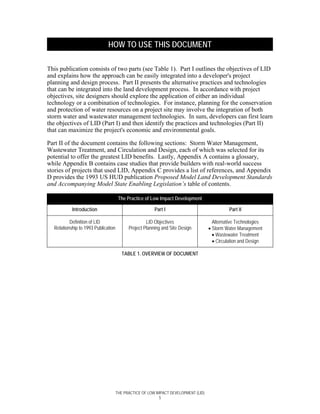
This publication consists of two parts (see Table 1). Part I outlines the objectives of LID
and explains how the approach can be easily integrated into a developer's project
planning and design process. Part II presents the alternative practices and technologies
that can be integrated into the land development process. In accordance with project
objectives, site designers should explore the application of either an individual
technology or a combination of technologies. For instance, planning for the conservation
and protection of water resources on a project site may involve the integration of both
storm water and wastewater management technologies. In sum, developers can first learn
the objectives of LID (Part I) and then identify the practices and technologies (Part II)
that can maximize the project's economic and environmental goals.

Part II of the document contains the following sections: Storm Water Management,
Wastewater Treatment, and Circulation and Design, each of which was selected for its
potential to offer the greatest LID benefits. Lastly, Appendix A contains a glossary,
while Appendix B contains case studies that provide builders with real-world success
stories of projects that used LID, Appendix C provides a list of references, and Appendix
D provides the 1993 US HUD publication Proposed Model Land Development Standards
and Accompanying Model State Enabling Legislation’s table of contents.

                                      The Practice of Low Impact Development

           Introduction                                 Part I                                Part II

          Definition of LID                         LID Objectives                    Alternative Technologies
  Relationship to 1993 Publication         Project Planning and Site Design         • Storm Water Management
                                                                                      • Wastewater Treatment
                                                                                      • Circulation and Design

                                        TABLE 1. OVERVIEW OF DOCUMENT


                                     THE PRACTICE OF LOW IMPACT DEVELOPMENT (LID)
                                                           5
AUDIENCE

This document is intended primarily for residential building professionals as they work
through the initial stages of project planning and design. In addition, municipal planning
officials benefit as the document can help them during various stages of the project
development process.

Building professionals such as builders/developers, engineers, planners, and landscape
architects using the LID approach indicate that successful projects require meticulous
planning and design. Consulting this document before initiating the planning process can
help building professionals identify and implement a range of LID practices and
technologies and thus maximize a project's potential.

Municipal planning officials can also benefit from the use of this document. Reference to
the document during the review and permitting stages of development can help officials
understand the use of LID practices and technologies. Municipal planning officials are
often responsible for drafting and enforcing local development codes and reviewing and
approving preliminary site plans. Therefore, in addition to helping to educate municipal
officials on the LID approach, the document can help encourage the amendment of
existing development codes to facilitate the use of LID practices and technologies.

Section 1.4 discusses the challenges involved in implementing LID. The success of
developments such as the Somerset community in Prince George’s County, Maryland,
and the Kensington Estates community in Pierce County, Washington, proves that
developers and public officials can work together to integrate LID practices and
technologies into today’s projects. These communities have received praise for reducing
strains on land, water, air, and soil resources.


                           THE PRACTICE OF LOW IMPACT DEVELOPMENT (LID)
                                                 7
PART I:
PROJECT PLANNING AND DESIGN
SECTION 1. LOW IMPACT DEVELOPMENT (LID) PRIMER


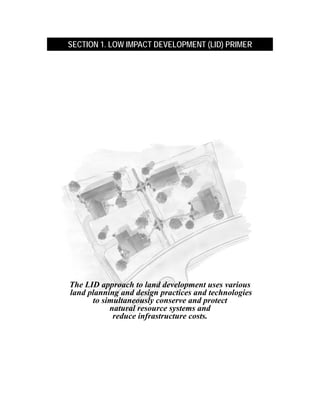
The LID approach to land development uses various
land planning and design practices and technologies
      to simultaneously conserve and protect
           natural resource systems and
            reduce infrastructure costs.
1.1      OVERVIEW
In the mid 1990s, the Prince George's County, Maryland, Department of Environmental
Resources outlined an approach for addressing suburban storm water management. That
approach, termed Low Impact Development (LID), uses certain technology-based
practices to ensure that a site's post-development hydrologic functions mimic those in its
pre-development state. These functions include groundwater recharge, infiltration, and
frequency and volume of discharges.

For the purposes of this document, we have expanded the concept of LID to include site
planning and design considerations as well as wastewater management considerations.

1.2    BENEFITS OF LOW IMPACT DEVELOPMENT
LID reexamines traditional development practices and technologies and focuses on
identifying project-specific site solutions that benefit the municipality, the developer, the
home buyer, and the environment. Elements of the approach are also known by other
names, such as conservation design, environmentally friendly design, resource-efficient
design, and better site design. In addition to the fact that LID makes good sense, low
impact development techniques can offer many benefits to a variety of stakeholders (see
Table 2).

1.3    GOALS OF LOW IMPACT DEVELOPMENT
Many developers are aware that incorporating low impact development into their existing
practices helps them systematically balance environmental and cost issues. In particular,
residential building professionals using the LID approach seek to do the following:

Preserve Open Space and Minimize Land Disturbances
Successful LID communities recognize the value of open space, mature landscapes, and
native vegetation. Open-space tracts incorporated into community designs and planned
as components of larger, contiguous areas are highly desirable; in fact, homeowners
frequently seek assurances that their community enjoys easy access to undeveloped areas
located nearby. Minimizing land disturbance helps dampen the impacts to ecological and
biological processes both on and off the site.

Protect Sensitive Natural Features and Natural Processes
Protection of a site’s sensitive natural features and natural processes is paramount to
planning for LID. Judicious application of information gained in a site analysis can help
identify developable and nondevelopable areas of a site and minimize impacts to air,
water, soil, and vegetation (see Section 1.5.3).

Identify and Link On- and Off-Site “Green Infrastructure”
Green infrastructure represents the planned and managed network of wilderness, parks,
greenways, conservation easements, and working lands with conservation value that
support native species, maintain natural ecological processes, and sustain air and water


                            THE PRACTICE OF LOW IMPACT DEVELOPMENT (LID)
                                                 13
resources. Site planners should strive to identify on-site opportunities to support and
expand regional green infrastructure.

                                                     Developers

 •   Reduces land clearing and grading costs
 •   Reduces infrastructure costs (streets, curbs, gutters, sidewalk)
 •   Reduces storm water management costs
 •   Increases lot yields and reduces impact fees
 •   Increases lot and community marketability
                                                    Municipalities

 •   Protects regional flora and fauna
 •   Balances growth needs with environmental protection
 •   Reduces municipal infrastructure and utility maintenance costs (streets, curbs, gutters, sidewalks, storm
     sewers)
 •   Fosters public/private partnerships
                                                    Home Buyer

 •   Protects site and regional water quality by reducing sediment, nutrient, and toxic loads to waterbodies
 •   Preserves and protects amenities that can translate into more salable homes and communities
 •   Provides shading for homes and properly orients homes to help decrease monthly utility bills
                                                    Environment

 •   Preserves integrity of ecological and biological systems
 •   Protects site and regional water quality by reducing sediment, nutrient, and toxic loads to waterbodies
 •   Reduces impacts to local terrestrial and aquatic plants and animals
 •   Preserves trees and natural vegetation

                                    TABLE 2. BENEFITS TO STAKEHOLDERS

Incorporate Natural Features (Wetlands, Riparian Corridors, Mature Forests) into
Site Designs
LID takes advantage of natural resources for both their functional and aesthetic qualities.
For instance, when designed correctly, wetlands and pond systems can provide storm
water management solutions as well as aesthetic and recreational benefits for the entire
community, thus increasing lot and community marketability.

Customize Site Design According to the Site Analysis
Planning for LID communities relies on the performance of a thorough site analysis.
Site planners can use the information gathered during the site analysis to create the best
balance between development and the conservation of natural resources. By identifying
buildable and nonbuildable areas of a site, planners can direct development into areas that
will experience the least impacts on air, soil, and water.


                                   THE PRACTICE OF LOW IMPACT DEVELOPMENT (LID)
                                                        14
Decentralize and Micromanage Storm Water at Its Source
Understanding the difference between pre- and
                                                          Associated Benefits of LID
post-development hydrologic patterns is
critical to LID. The use of best management                Protection of Water Quality
practices to reduce the amount of impervious            Reduction of Impervious Surfaces
                                                             Increased Open Space
surfaces, disconnect flow paths (i.e.,                         Protection of Trees
downspouts connected to storm sewers), and                 Reduced Land Disturbance
treat storm water at its source all help minimize        Decrease in Infrastructure Costs
the impacts to local hydrology. Attainment of           Reduced Homeowner Energy Bills
these goals can lead to the protection of water
quality, reduction of impervious surfaces, increased open space, protection of trees,
reduced land disturbance, decrease in infrastructure costs, and reduced homeowner
energy bills.

1.4    CHALLENGES TO USING LOW IMPACT DEVELOPMENT
While the LID approach can result in a myriad of benefits for the developer, the
municipality, and the environment, the proposed use of LID is likely to spawn questions
during the development process. Two of the most frequent challenges facing developers
who contemplate the use of LID center around restrictive local ordinances and local
officials’ and citizens’ opposition to the approach. However, careful project planning,
close collaboration with the local municipality, and education programs can reduce the
challenges. Appendix B includes several case studies that developers can use to support
their decisions to use LID.

Local ordinances guide the design and construction of new development. Often, a
community drafted and adopted its ordinances years ago such that the regulations no
longer reflect today’s development practices, especially those of LID. In many cases,
developers wishing to use LID may have to obtain some type of variance or waiver from
their local planning agency until local codes are updated to reflect current practice.
Unfortunately, variances can create delays in the approval and permitting process, and
those delays often translate into more debt service on the loans secured for the original
land purchase.
                                                          Helping Communities Permit the Use of LID
As a pure business decision, it usually does
                                                        Developers work within the local land
not make sense for a developer to go through
                                                        development regulations. If a municipality would
the potentially time consuming steps of the             like developers use the LID approach in future
variance process. One way to address this               projects, then the zoning ordinances should
issue is to have municipalities reword their            encourage such a change. However, municipal
zoning ordinances in order to allow LID in              officials are looking for information on how to best
residential land development projects. One              provide flexibility in the local development
thing that would help facilitate the ordinance          regulations. Municipal officials have asked for a
revision process is the development of a                nationwide database containing information on
                                                        sample zoning ordinances that support the use of
nationwide database containing information              LID. Since such a database does not currently
on ordinances supporting the use of LID.                exist, creating and updating an information
This database would provide the entire                  clearinghouse would address one of the
development industry, including local                   significant challenges in front of people interested
planning officials, with a centralized resource         in using the LID approach.
that would provide examples of ordinances


                             THE PRACTICE OF LOW IMPACT DEVELOPMENT (LID)
                                                  15
that encourage the LID approach.

Ideally, the time to obtain permit approval for an innovative land design should be at least
equal to the time needed to develop that same parcel of land under the provisions of
existing regulations. Developers incorporating LID practices and technologies into their
projects should ask for expedited permitting or pre-development assurances that review
and permitting times will not be extended. In fact, public officials that want developers
to use LID technologies can tie incentives, such as expedited permitting process times, to
developments incorporating those technologies. Until development ordinances are
amended to allow innovative practices and technologies by-right, other incentives, such
as density bonuses and reduced impact, application, or development fees can also be
negotiated between developers and municipal officials to help offset additional costs. .

Local citizens may also show resistance to accepting the proposed use of LID within their
communities. Misconceptions and minimal data regarding the safety and long-term
viability of LID systems have led to questions concerning the practices’ and
technologies’ efficacy, particularly in terms of flood control and public health and safety.
To help homeowners, and sometimes even municipal officials, understand the benefits of
LID techniques, developers may find it helpful to prepare brief educational presentations
or publications on LID for both the general public and municipal officials. Studies have
shown that once residents understand the benefits to local water quality, they are more
likely to support and accept alternative technologies. Often, homeowners view practices
such as bioretention cells as extra builder landscaping.

1.5    PLANNING FOR LOW IMPACT DEVELOPMENT
Proper team development and collaboration, (see Section 1.5.1), careful coordination
with the public reviewing agency (see Section 1.5.2), and the performance of a thorough
site analysis (see Section 1.5.3) are essential ingredients for successfully incorporating
LID concepts into development plans.

Table 3 highlights some of the ways in which LID differs from conventional
development. Developers who have used LID practices and technologies have indicated
that one of the keys to a successful project is to invest additional time and money in the
initial planning stages of development. While this idea may be unpopular, the
expenditures are often recouped in the form of rapid home sales, enhanced community
marketability, and higher lot yields.

Due to the iterative and phased nature of construction, both the collaboration and
ordinance review/outreach phases should be conducted continuously from project
commencement through completion. For example, changes to one aspect of the project
(e.g., lot layout) can affect other aspects of the project (e.g., storm water management).
During site construction, the site should be continuously monitored for potential impacts
to vegetation, soils, or sensitive water features such that appropriate protective measures
can be implemented.


                           THE PRACTICE OF LOW IMPACT DEVELOPMENT (LID)
                                                16
Collaboration                 Ordinance Review/Outreach             Site Review and
                                                                                                                    Analysis

                                       •   Often uses an                  •   Limits interaction with       •     Analyzes the
                                           engineering team and               public officials to                 land use
                                           one or two other                   permitting meetings.                ordinances to
                                           experts.                                                               identify
                                                                          •   Does not actively seek out
 Traditional Practice


                                                                                                                  regulatory
                                       •   Uses experts                       public’s input on design            barriers.
                                           sequentially, i.e.,                options.
                                           conducts one phase                                               •     Conducts review
                                           of development                 •   Meets existing                      with the goal of
                                           process and then                   ordinances.                         developing one
                                           passes project details         •   Uses pre-development                design plan.
                                           to the next expert.                meetings to review            •     Meets the
                                                                              preliminary site plans.             regulatory
                                                                                                                  requirements.
                                       •   Uses experts such as           •   Proactively seeks public      •     Analyzes the
                                           landscape architects,              officials’ input in pre-            land and
                                           engineers,                         development meetings to             ordinances to
                                           hydrologists,                      identify project                    identify resource
 Low Impact Development Practice


                                           geologists, and                    opportunities.                      opportunities and
                                           biologists to                                                          constraints.
                                           collaborate, perform           •   Works with the community
                                           site analysis, and                 to include its interests in   •     Reviews all
                                           identify innovative                project design.                     inputs to create
                                           solutions.                                                             multiple land
                                                                          •   Conducts resource                   design options
                                       •   Encourages                         analysis first to determine         for consideration.
                                           collaborative effort               what the site offers.
                                           among all site design              Reviews the ordinances to     •     Works together
                                           professionals to                   determine potential                 with public
                                           maximize natural                   barriers to proposed                officials to gain
                                           resource benefits.                 designs. Design must                flexibility in the
                                                                              meet ordinances or                  design phase.
                                                                              developer obtains a
                                                                              variance.

                                   TABLE 3. COMPARISON BETWEEN LOW IMPACT DEVELOPMENT AND TRADITIONAL LAND
                                                           DEVELOPMENT PROCESSES

1.5.1                              COLLABORATION
Historically, engineers have assumed primary responsibility for identifying a site’s
natural resources and integrating them into project designs. These professionals,
however, may or may not have undergone the specialized training necessary to carry out
their assigned tasks in the context of the LID approach. Engineers working on LID
projects have benefited from the input of a variety of natural resource and land
development professionals, including planners, architects, landscape architects,
biologists, ecologists, and hydrologists.

Conducting the site planning process with the assistance of the above professionals
increases the likelihood that the design process will disclose all opportunities for low


                                                          THE PRACTICE OF LOW IMPACT DEVELOPMENT (LID)
                                                                               17
impact development. For instance, a site located in a headwaters area for sensitive
wetlands may need the assistance of a hydrologist to identify strategies to protect local
water resources. A landscape architect could help orient houses and lots to take advantage
of passive solar heating. Section 1.6 discusses the process of incorporating these
opportunities into project goals during the project design phase.

Developers’ use of these professionals should obviously reflect a project’s size and
budget. In fact, the expertise offered by the above professionals may be available from
several sources other than the professionals themselves. For instance, project engineers
can consult the Internet, periodicals, and local governments to gain insights into efficient
natural resource use and land planning practices.1

1.5.2      ORDINANCE REVIEW/OUTREACH
Before commencing work on any site design, developers committed to integrating LID
practices and technologies into their designs should meet with local officials to review
current development ordinances. Ordinance review meetings between developers and
planning staff can help identify ways in which the public and private sectors can work
together to build communities that minimize development impacts. Similar to the pre-
development meetings that are now required in many municipalities throughout the
country, ordinance review meetings should focus on the ways in which LID practices and
technologies can further the intent of current ordinances. Developers should not view the
meetings as opportunities for local municipalities to exert added regulatory control, but
rather as forums in which the two parties can work together to identify mutually
beneficial solutions.

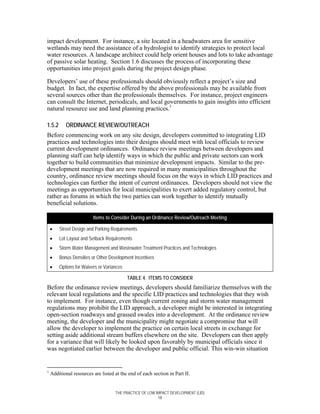
                         Items to Consider During an Ordinance Review/Outreach Meeting

    •   Street Design and Parking Requirements
    •   Lot Layout and Setback Requirements
    •   Storm Water Management and Wastewater Treatment Practices and Technologies
    •   Bonus Densities or Other Development Incentives
    •   Options for Waivers or Variances

                                           TABLE 4. ITEMS TO CONSIDER
Before the ordinance review meetings, developers should familiarize themselves with the
relevant local regulations and the specific LID practices and technologies that they wish
to implement. For instance, even though current zoning and storm water management
regulations may prohibit the LID approach, a developer might be interested in integrating
open-section roadways and grassed swales into a development. At the ordinance review
meeting, the developer and the municipality might negotiate a compromise that will
allow the developer to implement the practice on certain local streets in exchange for
setting aside additional stream buffers elsewhere on the site. Developers can then apply
for a variance that will likely be looked upon favorably by municipal officials since it
was negotiated earlier between the developer and public official. This win-win situation


1
    Additional resources are listed at the end of each section in Part II.


                                    THE PRACTICE OF LOW IMPACT DEVELOPMENT (LID)
                                                         18
reduces the developer’s street construction costs and storm water management burden
and increases municipal protections for riparian systems.

1.5.3      SITE ANALYSIS
Highly attractive and marketable developments begin with a thorough site analysis that
takes into consideration a site’s natural features. A site analysis is a process by which a
developer or one or more members of the development team inventories a site’s natural
features and attributes to identify development opportunities and constraints. Soils, water
resources, vegetative patterns, topography, microclimate, solar orientation, viewsheds,
and access are just a few of the site attributes that go into a thorough analysis. Many may
view the site analysis as a way to identify and plan for potential constraints that can
sideline a project or increase development time or costs. However, as environmental
awareness continues to increase, developers have realized that identifying and
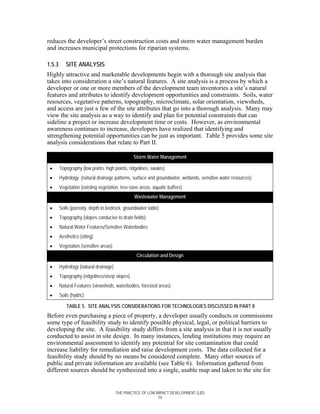
strengthening potential opportunities can be just as important. Table 5 provides some site
analysis considerations that relate to Part II.

                                               Storm Water Management

 •      Topography (low points, high points, ridgelines, swales)
 •      Hydrology (natural drainage patterns, surface and groundwater, wetlands, sensitive water resources)
 •      Vegetation (existing vegetation, tree-save areas, aquatic buffers)
                                                Wastewater Management

 •      Soils (porosity, depth to bedrock, groundwater table)
 •      Topography (slopes conducive to drain fields)
 •      Natural Water Features/Sensitive Waterbodies
 •      Aesthetics (siting)
 •      Vegetation (sensitive areas)
                                                 Circulation and Design

 •      Hydrology (natural drainage)
 •      Topography (ridgelines/steep slopes)
 •      Natural Features (viewsheds, waterbodies, forested areas)
 •      Soils (hydric)

            TABLE 5. SITE ANALYSIS CONSIDERATIONS FOR TECHNOLOGIES DISCUSSED IN PART II
Before even purchasing a piece of property, a developer usually conducts or commissions
some type of feasibility study to identify possible physical, legal, or political barriers to
developing the site. A feasibility study differs from a site analysis in that it is not usually
conducted to assist in site design. In many instances, lending institutions may require an
environmental assessment to identify any potential for site contamination that could
increase liability for remediation and raise development costs. The data collected for a
feasibility study should by no means be considered complete. Many other sources of
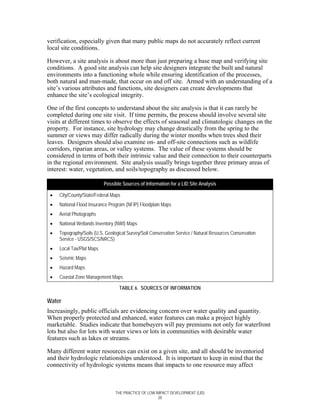
public and private information are available (see Table 6). Information gathered from
different sources should be synthesized into a single, usable map and taken to the site for


                                       THE PRACTICE OF LOW IMPACT DEVELOPMENT (LID)
                                                            19
verification, especially given that many public maps do not accurately reflect current
local site conditions.

However, a site analysis is about more than just preparing a base map and verifying site
conditions. A good site analysis can help site designers integrate the built and natural
environments into a functioning whole while ensuring identification of the processes,
both natural and man-made, that occur on and off site. Armed with an understanding of a
site’s various attributes and functions, site designers can create developments that
enhance the site’s ecological integrity.

One of the first concepts to understand about the site analysis is that it can rarely be
completed during one site visit. If time permits, the process should involve several site
visits at different times to observe the effects of seasonal and climatologic changes on the
property. For instance, site hydrology may change drastically from the spring to the
summer or views may differ radically during the winter months when trees shed their
leaves. Designers should also examine on- and off-site connections such as wildlife
corridors, riparian areas, or valley systems. The value of these systems should be
considered in terms of both their intrinsic value and their connection to their counterparts
in the regional environment. Site analysis usually brings together three primary areas of
interest: water, vegetation, and soils/topography as discussed below.

                           Possible Sources of Information for a LID Site Analysis

 •   City/County/State/Federal Maps
 •   National Flood Insurance Program (NFIP) Floodplain Maps
 •   Aerial Photographs
 •   National Wetlands Inventory (NWI) Maps
 •   Topography/Soils (U.S. Geological Survey/Soil Conservation Service / Natural Resources Conservation
     Service - USGS/SCS/NRCS)
 •   Local Tax/Plat Maps
 •   Seismic Maps
 •   Hazard Maps
 •   Coastal Zone Management Maps

                                   TABLE 6. SOURCES OF INFORMATION

Water
Increasingly, public officials are evidencing concern over water quality and quantity.
When properly protected and enhanced, water features can make a project highly
marketable. Studies indicate that homebuyers will pay premiums not only for waterfront
lots but also for lots with water views or lots in communities with desirable water
features such as lakes or streams.

Many different water resources can exist on a given site, and all should be inventoried
and their hydrologic relationships understood. It is important to keep in mind that the
connectivity of hydrologic systems means that impacts to one resource may affect


                                 THE PRACTICE OF LOW IMPACT DEVELOPMENT (LID)
                                                      20
another. For instance, sheetflow regime changes may affect a wetlands system, which
may in turn affect both groundwater recharge rates and baseflows to streams.

In addition to surface water sources such as streams, rivers, and lakes, other less evident
sources of water are equally important and must be identified and protected. Wetlands,
seeps, and springs are groundwater-based sources that in most instances fall under the
jurisdiction of the federal Clean Water Act. Since they are fed by groundwater, these
features may ultimately determine the location of roads, lots, structures, and on-site storm
water management or wastewater treatment systems.

Site designers should consider sheetflow characteristics and seasonally inundated areas.
Sheetflow is the movement of rainwater across the surface of landscape or, in other
words, how the site drains. Flow paths should be identified and natural channels
inventoried and protected. Seasonally inundated areas, which are temporarily ponded
shallow depressions that exist during rainy seasons, provide habitat for aquatic and
migratory species and should be protected.

Vegetation                                                             Tree-save areas are areas
                                                                      preserved on a development
Trees can be valuable resources on project sites. They                tract to meet tree ordinance
can significantly increase the value of individual lots by           requirements and/or to protect
moderating temperatures within and outside structures,                healthy vegetation from site
acting as wind buffers, and benefiting water quality.                    development activities.
Vegetated riparian buffers and forested areas have the
capacity to reduce storm water volumes, remove pollutants, and slow erosive flows.
Current national trends indicate that buyers seek lots with mature vegetation. Builders
now realize that the preservation of mature trees and stands of trees can mean more
attractive communities. Viable tree areas should be inventoried and protected by a
comprehensive tree preservation plan implemented before site clearing and grading.
Most municipalities now mandate some form of tree protection and may offer credits for
preservation of existing stands. Tree-save areas should be incorporated into both
buildable and nonbuildable areas of a site.

Soils/Topography
Soils and topographic studies can help determine the placement of streets, lots, buildings,
wells, drainfields, and other site amenities. A thorough analysis of all related soils
information, including percolation and other geotechnical studies, is an essential
component of the site analysis. Given that federal government soil surveys are highly
generalized, planners should not rely on them for site-specific soils information. Hydric,
or wetland soils, should be delineated by a certified wetlands professional and verified by
the local U.S. Army Corps of Engineers field office.

1.6    SITE DESIGN FOR LOW IMPACT DEVELOPMENT
Once the planning phase is complete, the resultant information can be used in the
formulation of the final site design. Often, standardized residential templates are overlaid
on a site without regard to a site’s natural features and environmental sensitivities. These
“forced” patterns cause unnecessary impacts to local water, vegetation, and soils and can
artificially inflate the infrastructure costs associated with clearing and grading.


                           THE PRACTICE OF LOW IMPACT DEVELOPMENT (LID)
                                                21
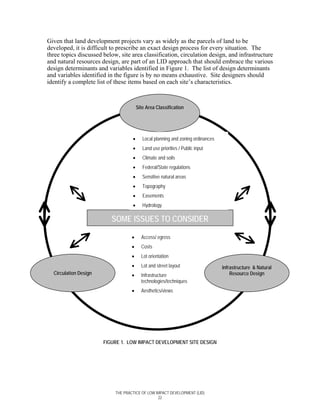
Given that land development projects vary as widely as the parcels of land to be
developed, it is difficult to prescribe an exact design process for every situation. The
three topics discussed below, site area classification, circulation design, and infrastructure
and natural resources design, are part of an LID approach that should embrace the various
design determinants and variables identified in Figure 1. The list of design determinants
and variables identified in the figure is by no means exhaustive. Site designers should
identify a complete list of these items based on each site’s characteristics.


                                        Site Area Classification


                                    •      Local planning and zoning ordinances
                                    •      Land use priorities / Public input
                                    •      Climate and soils
                                    •      Federal/State regulations
                                    •      Sensitive natural areas
                                    •      Topography
                                    •      Easements
                                    •      Hydrology

                          SOME ISSUES TO CONSIDER

                                    •     Access/ egress
                                    •     Costs
                                    •     Lot orientation
                                    •     Lot and street layout                   Infrastructure & Natural
  Circulation Design                •     Infrastructure                              Resource Design
                                          technologies/techniques
                                    •     Aesthetics/views


                       FIGURE 1. LOW IMPACT DEVELOPMENT SITE DESIGN


                            THE PRACTICE OF LOW IMPACT DEVELOPMENT (LID)
                                                 22
1.6.1   SITE AREA CLASSIFICATION
Once the site analysis is complete, site designers should analyze and classify areas of the
site by suitability of use. During the process of site area classification, it is important to
keep in mind that maximizing a site’s development potential does not necessarily mean
that the entire site needs to be developed. Compact forms of development make it
possible to conserve open space and protect habitat and water quality while promoting
housing affordability and a sense of community.

Even though open, nonvegetated areas are usually seen as prime development areas, site
designers should remain flexible and take into account all natural resource information
collected during the site analysis. For instance, a field might serve as a headwaters area
for sensitive wetlands or be better developed into recreational fields for a park system.

Buildable Areas
Buildable areas of a site are the areas that are optimal for conversion into finished lots.
Buildable areas usually have the fewest limitations in terms of access, regulatory
restrictions, sensitive natural features, and zoning concerns. The process of identifying a
site’s buildable areas may point to the advisability of clustering development into several
small areas rather than spreading it throughout one large area. While clustering can
protect sensitive site features, it can contribute to infrastructure costs by increasing the
excavation and construction costs for streets and utility lines. Yet, narrower streets and
rights-of-way and smaller lot sizes mean that less land needs to be developed, permitting
the achievement of lower development costs.

Nonbuildable Areas
Nonbuildable areas of a site should remain undeveloped in response to regulatory, natural
resource, planning, or other development concerns. These areas can easily be
incorporated into either community open space or larger regional systems. During site
construction, nonbuildable areas should be protected with silt or tree protection fences,
and equipment and materials should not be stored in them. Even though the areas are
intended to remain undeveloped, site designers should examine opportunities to use the
areas to accommodate the innovative technologies discussed in Part II (see Section 1.5.3
for additional information on the integration of infrastructure and natural resources).

1.6.2   CIRCULATION DESIGN
As discussed in Section 4 - Circulation and Design, a well-designed pedestrian and
vehicular circulation system is critical to the success of a development project. The
construction of roads is typically one of the largest infrastructure expenses for land
development projects. It is estimated that the cost of paving a road averages $15 per
square yard (The Center for Watershed Protection, 1999). The use of efficient road
layouts, street types, and pavement treatments can significantly reduce the cost of
roadway construction, decrease the quantity of runoff from a site, potentially increase lot
yield and open space amounts, and protect natural resources.

After identifying buildable and nonbuildable areas, site designers should lay out an
efficient circulation system that provides for access, parking, and circulation. To


                            THE PRACTICE OF LOW IMPACT DEVELOPMENT (LID)
                                                 23
minimize the amount of impervious surfaces, plans should maximize lot frontages and
minimize pavement widths.

To minimize grading and to protect riparian channels, roadways should be located on
topographic high points and should follow the natural contours of the land, within safe
grade tolerances. Grade changes and curves in roadways can add visual interest to streets
and communities and to help slow traffic. For additional road design standards, refer to
AASHTO’s Green Book (AASHTO, 1994).

1.6.3   INFRASTRUCTURE AND NATURAL RESOURCES DESIGN
The efficient blending of infrastructure and natural resources on a development site
requires a thorough understanding of the natural processes that characterize the site and
the infrastructure practices and technologies proposed as part of the land development
process. Use of many of the practices and technologies discussed in Part II may allow for
an entirely different set of site planning and design considerations. For instance,
alternative wastewater treatment systems that use smaller drainfields may permit smaller
lot sizes, which in turn can affect lot, road, and open-space layouts. All of the alternative
practices and technologies discussed in this publication, whether related to storm water,
wastewater, or circulation, affect water, soils, and vegetation. Site designers should use
the best combination of systems based on individualized natural resource objectives for a
given site.


                            THE PRACTICE OF LOW IMPACT DEVELOPMENT (LID)
                                                 24
PART II:
PROJECT TOOLS/REFERENCES
SECTION 2: STORM WATER MANAGEMENT


   Implementing nontraditional, decentralized methods for
handling storm water can significantly reduce site development
  costs, regional expenditures for storm water and planning,
   construction, and maintenance outlays while protecting
                       the environment.
2.1       INTRODUCTION
Planning for storm water management in the initial stages of land development can yield
significant cost and environmental benefits for developers, municipalities, and residents.
Traditionally approached during site development as an obligation to satisfy state and
federal regulatory requirements, storm water management has increasingly come under
reexamination in light of its potential to function as a project opportunity and site design
element. When correctly planned for and accommodated, storm water management
systems can simultaneously satisfy regulatory requirements, act as site design elements,
protect the environment, and reduce infrastructure costs—all the attributes of low-impact
development.

The development of land, whenever and
wherever it occurs, affects soils, vegetation, and                    Definition of LID
water. After land is developed, rainwater that            Low Impact Development (LID) is an
would have infiltrated into the ground, been            approach to land development that uses
absorbed by plant roots and transpired, or             various land planning and design practices
evaporated into the air instead becomes surface            and technologies to simultaneously
runoff. Runoff often picks up urban pollutants           conserve and protect natural resource
                                                        systems and reduce infrastructure costs.
such as grease, oil, nutrients, metals, and debris
                                                       LID still allows land to be developed, but in
and deposits them into local waterbodies. In           a cost-effective manner that helps mitigate
addition to water quality impacts, post-                    potential environmental impacts.
development storm water runoff has other
impacts, including changes to the peak flow characteristics of streams, degradation of
habitat and aquatic species, and fluctuations in local groundwater tables.

Stricter federal water quality requirements under the Clean Water Act have caused both
municipalities and developers to seek out more environmentally efficient, cost-effective
storm water management alternatives that are compatible with hydrologic and watershed
objectives. At the same time, traditional methods for addressing storm water
management have brought to the fore other considerations such as cost and maintenance
issues, liability issues, and the need for education and outreach programs for local
officials and residents.
                                                                 Prince George’s County, Maryland has
                                                               pioneered several new tools and practices
History of Low Impact Development                                  in LID. The Prince George's County
Initially developed and implemented by Prince                    Maryland Department of Environmental
George’s County, Maryland, in the early 1990s                       Resources Programs and Planning
                                                                      Division (PGDER) created two
as an innovative way to handle storm water                     publications: 1) Low-Impact Development
runoff, LID techniques have rapidly spread                       Design Strategies An Integrated Design
across the country. The overall goal of LID                      Approach (EPA 841-B-00-003), and 2)
storm water treatment is to mimic pre-                            Low-Impact Development Hydrologic
development hydrologic conditions through the                     Analysis (EPA 841-B-00-002). These
use of a variety of structural and nonstructural               publications describe how LID can achieve
practices that detain, retain, percolate, and                           storm water control through
                                                                the creation of a hydrologically functional
evaporate storm water. This publication is not                      landscape that mimics the natural
intended as a comprehensive guide to LID storm                              hydrologic regime.
water treatment strategies but merely aims at
providing an overview of alternative storm water


                               THE PRACTICE OF LOW IMPACT DEVELOPMENT (LID)
                                                    29
management practices and technologies. For a comprehensive look at the LID process,
readers should consult the Prince George’s County, Maryland, Department of
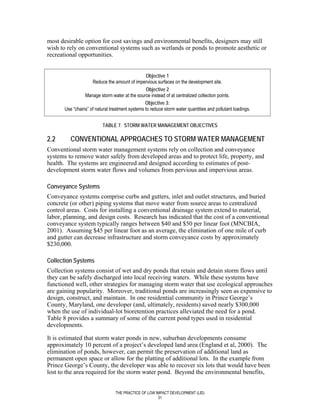
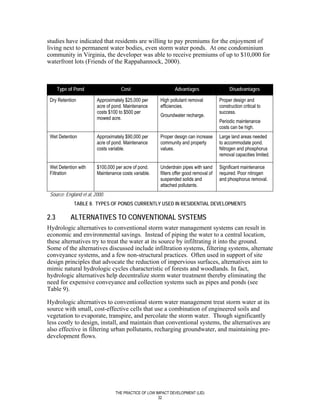
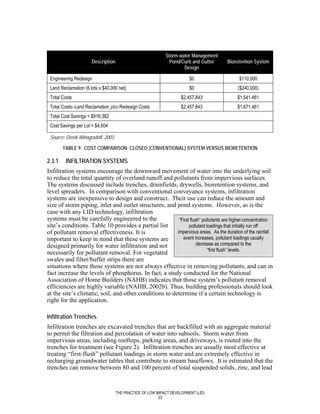
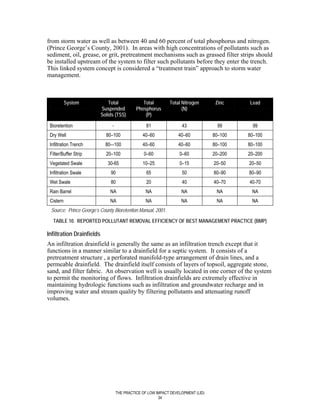
Environmental Resources for copies of its LID publications (Telephone: 301-883-5810).

Cost Benefits
Low impact development storm water management systems can reduce development
costs through the reduction or elimination of conventional storm water conveyance and
collection systems. LID systems can reduce the need for paving, curb and gutter, piping,
inlet structures, and storm water ponds by treating water at its source instead of at the end
of the pipe. However, developers are not the only parties to benefit from the use of LID
storm water management techniques. Although more data is needed on the maintenance
of LID technologies, recent history has indicated that municipalities may also benefit in
the long term through reduced maintenance costs.

Environmental Benefits
As storm water drains from urban areas, it picks up nutrients and pollutants such as
nitrogen, phosphorus, oil, grease, heavy metals, and trash. These pollutants impair water
quality and degrade the riparian systems that many plant and animal species depend on
for survival. LID practices remove pollutants from storm water naturally and restore a
site’s pre-development hydrology. The alternative practices discussed later can recharge
local groundwater tables, reduce domestic water use for lawns and vegetation, and
provide habitat for a variety of species.

Storm Water Management Techniques
This section briefly discusses
the different conventional and              LID Practices can Reduce Development Costs by:
alternative storm water                 Reducing the use of roadways, curbs and gutters, and sidewalks
management techniques                    Decreasing the use of traditional storm sewer appurtenances
available to site designers,               Eliminating the use of or downsizing storm water ponds
briefly highlighting the
environmental and economic benefits that each can offer. It is important to keep in mind
that regional differences in land characteristics, climatologic conditions, soils, and local
ordinances will dictate the availability, type, and effectiveness of options for a given site.
Regardless of the practices and technologies ultimately chosen, developers should ensure
that they are consistent with the goals of regional storm water management plans. Table
7 lists objectives for alternative storm water management techniques.

Finally, designers should remember that an integrated site storm water management
system can use several combinations of conventional and alternative techniques to meet
site environmental and watershed objectives. Given that each development site has its
own characteristics and
constraints, the value of a               Decentralizing Storm Water Management Involves:
thorough site analysis and                           Reducing storm water quantities
conceptual design phase should           Disconnecting hydrologic elements, such as downspouts
not be underestimated. While                                  and storm drains
the complete decentralization of     Treating storm water at its source by using alternative techniques
storm water operations is the


                               THE PRACTICE OF LOW IMPACT DEVELOPMENT (LID)
                                                    30
most desirable option for cost savings and environmental benefits, designers may still
wish to rely on conventional systems such as wetlands or ponds to promote aesthetic or
recreational opportunities.


                                                  Objective 1
                     Reduce the amount of impervious surfaces on the development site.
                                                  Objective 2
                 Manage storm water at the source instead of at centralized collection points.
                                                 Objective 3:
       Use “chains” of natural treatment systems to reduce storm water quantities and pollutant loadings.


                           TABLE 7. STORM WATER MANAGEMENT OBJECTIVES

2.2       CONVENTIONAL APPROACHES TO STORM WATER MANAGEMENT
Conventional storm water management systems rely on collection and conveyance
systems to remove water safely from developed areas and to protect life, property, and
health. The systems are engineered and designed according to estimates of post-
development storm water flows and volumes from pervious and impervious areas.

Conveyance Systems
Conveyance systems comprise curbs and gutters, inlet and outlet structures, and buried
concrete (or other) piping systems that move water from source areas to centralized
control areas. Costs for installing a conventional drainage system extend to material,
labor, planning, and design costs. Research has indicated that the cost of a conventional
conveyance system typically ranges between $40 and $50 per linear foot (MNCBIA,
2001). Assuming $45 per linear foot as an average, the elimination of one mile of curb
and gutter can decrease infrastructure and storm conveyance costs by approximately
$230,000.

Collection Systems
Collection systems consist of wet and dry ponds that retain and detain storm flows until
they can be safely discharged into local receiving waters. While these systems have
functioned well, other strategies for managing storm water that use ecological approaches
are gaining popularity. Moreover, traditional ponds are increasingly seen as expensive to
design, construct, and maintain. In one residential community in Prince George’s
County, Maryland, one developer (and, ultimately, residents) saved nearly $300,000
when the use of individual-lot bioretention practices alleviated the need for a pond.
Table 8 provides a summary of some of the current pond types used in residential
developments.

It is estimated that storm water ponds in new, suburban developments consume
approximately 10 percent of a project’s developed land area (England et al, 2000). The
elimination of ponds, however, can permit the preservation of additional land as
permanent open space or allow for the platting of additional lots. In the example from
Prince George’s County, the developer was able to recover six lots that would have been
lost to the area required for the storm water pond. Beyond the environmental benefits,


                                 THE PRACTICE OF LOW IMPACT DEVELOPMENT (LID)
                                                      31
studies have indicated that residents are willing to pay premiums for the enjoyment of
living next to permanent water bodies, even storm water ponds. At one condominium
community in Virginia, the developer was able to receive premiums of up to $10,000 for
waterfront lots (Friends of the Rappahannock, 2000).


      Type of Pond                   Cost                       Advantages                   Disadvantages

 Dry Retention           Approximately $25,000 per      High pollutant removal          Proper design and
                         acre of pond. Maintenance      efficiencies.                   construction critical to
                         costs $100 to $500 per                                         success.
                                                        Groundwater recharge.
                         mowed acre.
                                                                                        Periodic maintenance
                                                                                        costs can be high.
 Wet Detention           Approximately $90,000 per      Proper design can increase      Large land areas needed
                         acre of pond. Maintenance      community and property          to accommodate pond.
                         costs variable.                values.                         Nitrogen and phosphorus
                                                                                        removal capacities limited.

 Wet Detention with      $100,000 per acre of pond.     Underdrain pipes with sand      Significant maintenance
 Filtration              Maintenance costs variable.    filters offer good removal of   required. Poor nitrogen
                                                        suspended solids and            and phosphorus removal.
                                                        attached pollutants.
 Source: England et al, 2000.
             TABLE 8. TYPES OF PONDS CURRENTLY USED IN RESIDENTIAL DEVELOPMENTS

2.3         ALTERNATIVES TO CONVENTIONAL SYSTEMS
Hydrologic alternatives to conventional storm water management systems can result in
economic and environmental savings. Instead of piping the water to a central location,
these alternatives try to treat the water at its source by infiltrating it into the ground.
Some of the alternatives discussed include infiltration systems, filtering systems, alternate
conveyance systems, and a few non-structural practices. Often used in support of site
design principles that advocate the reduction of impervious surfaces, alternatives aim to
mimic natural hydrologic cycles characteristic of forests and woodlands. In fact,
hydrologic alternatives help decentralize storm water treatment thereby eliminating the
need for expensive conveyance and collection systems such as pipes and ponds (see
Table 9).

Hydrologic alternatives to conventional storm water management treat storm water at its
source with small, cost-effective cells that use a combination of engineered soils and
vegetation to evaporate, transpire, and percolate the storm water. Though significantly
less costly to design, install, and maintain than conventional systems, the alternatives are
also effective in filtering urban pollutants, recharging groundwater, and maintaining pre-
development flows.


                                  THE PRACTICE OF LOW IMPACT DEVELOPMENT (LID)
                                                       32
Storm water Management
                      Description                             Pond/Curb and Gutter   Bioretention System
                                                                    Design

 Engineering Redesign                                                   $0                $110,000
 Land Reclamation (6 lots x $40,000 net)                                $0               ($240,000)
 Total Costs                                                        $2,457,843           $1,541,461
 Total Costs--Land Reclamation plus Redesign Costs                  $2,457,843           $1,671,461
 Total Cost Savings = $916,382
 Cost Savings per Lot = $4,604

 Source: Derek Winogradoff, 2003.

        TABLE 9. COST COMPARISON: CLOSED (CONVENTIONAL) SYSTEM VERSUS BIORETENTION

2.3.1    INFILTRATION SYSTEMS
Infiltration systems encourage the downward movement of water into the underlying soil
to reduce the total quantity of overland runoff and pollutants from impervious surfaces.
The systems discussed include trenches, drainfields, drywells, bioretention systems, and
level spreaders. In comparison with conventional conveyance systems, infiltration
systems are inexpensive to design and construct. Their use can reduce the amount and
size of storm piping, inlet and outlet structures, and pond systems. However, as is the
case with any LID technology, infiltration
systems must be carefully engineered to the              “First flush” pollutants are higher-concentration
site’s conditions. Table 10 provides a partial list            pollutant loadings that initially run off
of pollutant removal effectiveness. It is               impervious areas. As the duration of the rainfall
important to keep in mind that these systems are           event increases, pollutant loadings usually
designed primarily for water infiltration and not                   decrease as compared to the
                                                                          “first flush” levels.
necessarily for pollutant removal. For vegetated
swales and filter/buffer strips there are
situations where those systems are not always effective in removing pollutants, and can in
fact increase the levels of phosphorus. In fact, a study conducted for the National
Association of Home Builders (NAHB) indicates that those system’s pollutant removal
efficiencies are highly variable (NAHB, 2002b). Thus, building professionals should look
at the site’s climatic, soil, and other conditions to determine if a certain technology is
right for the application.

Infiltration Trenches
Infiltration trenches are excavated trenches that are backfilled with an aggregate material
to permit the filtration and percolation of water into subsoils. Storm water from
impervious areas, including rooftops, parking areas, and driveways, is routed into the
trenches for treatment (see Figure 2). Infiltration trenches are usually most effective at
treating “first-flush” pollutant loadings in storm water and are extremely effective in
recharging groundwater tables that contribute to stream baseflows. It is estimated that the
trenches can remove between 80 and 100 percent of total suspended solids, zinc, and lead


                                    THE PRACTICE OF LOW IMPACT DEVELOPMENT (LID)
                                                         33
from storm water as well as between 40 and 60 percent of total phosphorus and nitrogen.
(Prince George’s County, 2001). In areas with high concentrations of pollutants such as
sediment, oil, grease, or grit, pretreatment mechanisms such as grassed filter strips should
be installed upstream of the system to filter such pollutants before they enter the trench.
This linked system concept is considered a “treatment train” approach to storm water
management.


           System              Total             Total        Total Nitrogen        Zinc    Lead
                           Suspended          Phosphorus            (N)
                           Solids (TSS)           (P)

 Bioretention                   -                  81               43               99       99
 Dry Well                    80–100              40–60             40–60           80–100   80–100
 Infiltration Trench         80–-100             40–60             40–60           80–100   80–100
 Filter/Buffer Strip         20–100               0–60             0–60            20–200   20–200
 Vegetated Swale              30-65              10–25             0–15            20–50    20–50
 Infiltration Swale            90                  65               50             80–90    80–90
 Wet Swale                     80                  20               40             40–70    40-70
 Rain Barrel                   NA                 NA                NA              NA       NA
 Cistern                       NA                 NA                NA              NA       NA
 Source: Prince George’s County Bioretention Manual, 2001.

  TABLE 10. REPORTED POLLUTANT REMOVAL EFFICIENCY OF BEST MANAGEMENT PRACTICE (BMP)

Infiltration Drainfields
An infiltration drainfield is generally the same as an infiltration trench except that it
functions in a manner similar to a drainfield for a septic system. It consists of a
pretreatment structure , a perforated manifold-type arrangement of drain lines, and a
permeable drainfield. The drainfield itself consists of layers of topsoil, aggregate stone,
sand, and filter fabric. An observation well is usually located in one corner of the system
to permit the monitoring of flows. Infiltration drainfields are extremely effective in
maintaining hydrologic functions such as infiltration and groundwater recharge and in
improving water and stream quality by filtering pollutants and attenuating runoff
volumes.


                                    THE PRACTICE OF LOW IMPACT DEVELOPMENT (LID)
                                                         34
FIGURE 2. INFILTRATION TRENCH

Dry Wells
In residential communities, rooftops account for a significant source of runoff from
impervious surfaces. Dry wells, sometimes referred to as “French drains,” are usually
sited near downspouts to manage rooftop runoff by infiltrating it into the ground (see
Figure 3). Dry wells are excavated pits filled with aggregate stone to hold water until it
can infiltrate into the ground. Similar to infiltration trenches, dry wells should be
designed with emergency overflow structures that drain to public storm water
conveyances to accommodate runoff from major storms. The drainage pathways should
be well maintained and stabilized to prevent erosion.


                           THE PRACTICE OF LOW IMPACT DEVELOPMENT (LID)
                                                35
Dry wells are extremely effective in removing sediment, zinc, and lead from storm water
and mildly effective in reducing quantities of nitrogen and phosphorus. During
construction, developers should take care to avoid excessive compaction of soils around
the trenches and the accumulation of silt around the drainfield. Depending on the type of
pollutants filtered, drainfields need to be maintained regularly for optimum performance.


                                      FIGURE 3. DRY WELL

Bioretention
Bioretention is possibly one of the most recognized alternative storm water management
practices. Used in residential, commercial, and certain industrial settings, bioretention
has the potential to offer developers significant cost savings and environmental benefits
over conventional storm water management systems. Bioretention areas are shallow,
topographic depressions filled with engineered soils and vegetation that retain, treat, and
infiltrate water. Figure 4 depicts a typical bioretention area.

Bioretention systems are designed for the temporary storage of rainwater. They
successfully remove pollutants through increased contact time with soils and plant
materials. As compared with conventional storm water management systems,
bioretention areas more closely mimic the natural hydrologic cycle, allowing soils and
plants to filter pollutants from storm water and permitting the processes of infiltration,
evaporation, and transpiration to occur. The systems can also create wildlife habitat,
minimize erosion, and recharge local groundwater supplies.


                            THE PRACTICE OF LOW IMPACT DEVELOPMENT (LID)
                                                 36
In parking lots, storm water should be conveyed directly to the bioretention area through
a system of grassed swales. For residential applications, treatment areas are generally
located some distance away from houses to increase flow paths and treat runoff from
rooftops and driveways. In either case, bioretention systems route storm water to
bioretention areas that are designed to accumulate water to depths not exceeding six to12
inches. In the event that storm water volumes exceed treatment capacities, bioretention
areas are usually equipped with overflow drop inlets routed to municipal storm water
systems. In certain industrial and commercial areas, pollutant loadings may be too
concentrated for the successful use of bioretention areas. In such areas, termed
“hotspots,” the use of structural practices to infiltrate storm water may be deleterious to
groundwater supplies. In these instances, designers are advised to use alternative
practices, such as exfiltration trenches, to convey filtered water into a conventional storm
water management system for proper treatment.

On average, bioretention costs approximately $3 to $4 per square foot of size, depending
on the quantity of water to be treated and excavation costs. Plant materials are
approximately $6.40 per cubic foot of storm water treated.


                            THE PRACTICE OF LOW IMPACT DEVELOPMENT (LID)
                                                 37
Source: Prince George’s County Bioretention Manual, 2001.
                                  FIGURE 4. TYPICAL BIORETENTION AREA

Level Spreaders
Level spreaders are mechanisms that convert concentrated runoff into sheetflow and slow
the erosive velocities of storm water. Constructed by excavating a wide, shallow trench
and filling it with crushed stone, a level spreader must be built with its lower edge


                                  THE PRACTICE OF LOW IMPACT DEVELOPMENT (LID)
                                                       38
completely flat to ensure the even disbursement of water. Level spreaders are most
effective in helping to convey sheetflow to bioretention areas. While not typically
viewed as treatment mechanisms, level spreaders can help increase detention storage and
time of concentrations and thus assist with pollutant and sediment removal functions.
They should be used as part of an integrated, decentralized storm water management
system.


                                 FIGURE 5. LEVEL SPREADER

2.3.2   FILTERING SYSTEMS
Filtering systems use soils and vegetation to remove pollutants from storm water. They
function mainly as pre-treatment devices to remove sediment before water enters
infiltration devices such as bioretention areas.

Filter Strips
Filter strips are low-grade vegetated areas that permit sediment deposition during
sheetflow (see Figure 6). Usually used as one component of a storm water management
system, filter strips are considered pre-treatment devices, meaning that water is routed
through them before entering systems such as bioretention areas. For the systems to be
fully effective, slopes should be minimal (0 to 2 percent), with channelized flows
eliminated. Pollutant removal efficiency depends largely on the quantity of water treated,
flow path and length, type of vegetation, and the soil infiltration rate. Depending on the
amount and type of vegetation planted and the need for replacement or amendment of
soils, filter strips can be inexpensive to construct and maintain.


                           THE PRACTICE OF LOW IMPACT DEVELOPMENT (LID)
                                                39
Source: Prince George’s County Bioretention Manual, 2001.
                                  FIGURE 6. TYPICAL GRASS FILTER STRIP

Exfiltration Trench/Dry Swale
Exfiltration trenches function in a manner similar to infiltration trenches except for an
underdrain system built into the bottom of the trench (see Figure 7). After water has
percolated through the soil media and pollutants have been removed, the water enters
perforated drain tile and is conveyed to a local storm water drain system.


                                  THE PRACTICE OF LOW IMPACT DEVELOPMENT (LID)
                                                       40
Exfiltration trenches are low-cost, low-maintenance systems that are highly effective in
removing pollutants, especially sediment, from storm water. The perforated underdrain
in the system protects groundwater supplies from contamination in areas with high
pollutant loadings. These areas, usually termed “storm water hotspots,” are usually
located in industrial or commercial areas dominated by vehicular traffic.


                         FIGURE 7. EXFILTRATION TRENCH/DRY SWALES

Wetlands
Constructed wetlands systems use soils, vegetation, and hydrology to remove pollutants
from storm water. The systems are effective in attenuating flood flows, reducing
pollutant loadings, and providing wildlife habitat (see Figure 8). From a community
design standpoint, wetlands systems can create open space, offer improved aesthetics
over traditional treatment systems, and provide recreational and educational
opportunities.

Most natural and artificial wetlands systems are regulated by the Clean Water Act and
fall under the jurisdictional authority of the U.S. Army Corps of Engineers (Corps). A
recent U.S. Supreme Court decision concerning isolated wetlands has limited the
jurisdiction of the Corps to navigable waters, their tributaries, and wetlands adjacent to
these navigable waters and their tributaries.


                            THE PRACTICE OF LOW IMPACT DEVELOPMENT (LID)
                                                 41
Similar to their natural counterparts, constructed wetlands types can vary from seasonally
inundated to year-round, open-water systems. To optimize pollutant removal capacities,
design engineers usually aim to maximize flow paths through wetlands systems to
prolong exposure to soils and vegetation, thereby facilitating nutrient and pollutant
uptake, retention, and settling. Given the delicate hydrologic balance of wetlands
systems, unmanaged storm water should never be discharged into jurisdictional wetlands,
or wetlands under the direct control of the Corps. Therefore, constructed wetlands should
be designed with water quality and quantity pre-treatment mechanisms, such as sediment
forebays or gabion walls, which attenuate storm flows and protect sensitive wetlands
vegetation.


                            FIGURE 8. STORM WATER WETLANDS
As compared with other alternative systems, construction costs for wetlands systems may
be high. The cost of a constructed storm water wetlands can exceed $300,000 per acre
(JSPPOH, 2001), although shallow groundwater levels, shallow depth to bedrock, and


                           THE PRACTICE OF LOW IMPACT DEVELOPMENT (LID)
                                                42
sloping topography can drive up construction costs further. In instances where the depth
to groundwater is shallow, a clay liner should be used to prevent contamination of local
aquifers. The quality and quantity of imported soils and plant material are also a factor
when considering the total cost of built systems. However, while construction costs may
be higher for constructed wetlands than for other BMP systems, operation and
maintenance costs may be relatively low.

2.3.3   CONVEYANCE SYSTEMS
Alternate conveyance systems, such as vegetated channels and grassed swales, carry
water to areas for treatment. Unlike conventional conveyance systems, such as curbs and
gutters, these systems slow the erosive velocity of storm water, increase time of
concentrating, and filter pollutants such as sediment.

Vegetated Channels/Grassed Swales
                                                              Curb and gutter can cost upwards of
Vegetated channel systems and grassed                        $12.50 per linear foot.
swales are low-cost alternatives for         Source: Friends of the Rappahannock Study, 2000.
conveying water away from streets,
downspouts, and structures. They are low-cost alternatives to conventional conveyance
systems, such as curbs or concrete channels. These alternatives reduce storm water
velocities and allow sediment and pollutants contained within storm water to be filtered.

In residential settings, swales are an effective way to convey water to bioretention areas
sited a short distance away from structures and foundations. When used in conjunction
with bioretention areas, swales function as pre-treatment mechanisms that filter
sediments from storm water. For health, safety, and maintenance reasons, minimum
longitudinal slopes on swales should be 1 percent to avoid stagnation of water and to
ensure proper drainage.

Wet swale systems are variants of dry swales and function similarly to a wetlands system.
Slightly more expensive to construct than a vegetated channel or dry swale, wet swales
are designed with a permanent pool structure and planted with wetlands vegetation for
pollutant treatment. Due to health and safety concerns over potential mosquito breeding,
wet swales have limited applicability in residential or commercial settings.

2.3.4   OTHER SYSTEMS

Rain Barrels
Rain barrels are low-cost retention devices placed below roof downspouts to collect water
during storms (see Figure 9). Although rain barrels offer no primary pollutant removal
benefits during collection times, they act as quantity controls and can help reduce the
cumulative effects of storm water on downstream systems. As an example, one 42-gallon
rain barrel can provide storage for 0.5 inch
of runoff from a rooftop measuring 133            One inch of rain on a 1,000-square-foot roof yields
square feet (Prince George’s County,                     approximately 623 gallons of water.
2001).


                              THE PRACTICE OF LOW IMPACT DEVELOPMENT (LID)
                                                   43
During dry periods, water from the barrels can be used to irrigate lawns and vegetation.
Rain barrels should be equipped with some type of overflow device that routes overflow
to a bioretention area for treatment during major storms. Rain barrels can be purchased
online from a variety of municipal natural resources departments and environmental
organizations. They are available in a variety of colors and sizes to match architectural
styles.


                                   FIGURE 9. RAIN BARRELS

Cisterns
Cisterns are premolded plastic storage devices that are usually sited underground in
proximity to rooftop downspouts. They function in a manner similar to rain barrels but
offer storage capacities from 100 to 1,400 gallons. Water from cisterns is stored and
released during dry periods, promoting water conservation for lawn and garden irrigation.

2.4        ADDITIONAL RESOURCES
Additional resources that provide detail on individual storm water management topics are
listed below. The resources are not provided as endorsements, merely as educational and
reference tools. Given regional variations in climate and land development needs, we
have tried to include region- specific resources. It is important to note, however, that
addresses, especially Internet links, are subject to change. This list contains the latest
links and addresses as of the date of this publication.

Storm Water Management Manuals and Best Management Practices
City of Alexandria, Virginia
http://ci.alexandria.va.us/solidwaste/stormwater.html
Information on Virginia storm water ordinances and directions on acquiring publications
such as The Alexandria Supplement to the Northern Virginia BMP Handbook and The
Virginia Storm Water Management Manual.


                           THE PRACTICE OF LOW IMPACT DEVELOPMENT (LID)
                                                44
City of Austin, Texas
http://www.ci.austin.tx.us/watercon/default.htm
Details of the city of Austin's Water Conservation Program as well as information about
the city's rain barrel program (follow links to Single-family, Multi-family, and
Commercial).

Friends of Bassett Creek, Minnesota
http://www.mninter.net/~stack/bassett/gardens.html
A comprehensive guide to the creation of rain gardens for runoff management, habitat
creation, and aesthetic value is provided with design and construction information and
recommendations on plant material.

F.X. Browne, Inc.
http://www.fxbrowne.com/html/gs-facts/gs_primers.htm
A fact sheet entitled Bioretention Systems for Storm Water Management is available for
downloading at the homepage of the F.X. Browne environmental consulting firm.

National Association of Home Builders
http://www.toolbase.org/tertiaryT.asp?TrackID=&CategoryID=1438&
DocumentID=2007
An online report from the association's Technology Inventory entitled Bioretention Sites
for Storm Water Management includes installation details, a short benefit/cost analysis,
and a short list of bioretention links.

Pennsylvania Association of Conservation Districts
http://www.pacd.org/products/bmp/bioretention.htm
A Web site devoted to providing information on the bioretention BMPs for storm water
pollution prevention.

Prince George's County, Maryland
http://www.epa.gov/nps/lid/index.html
The Prince George's County Maryland Department of Environmental Resources
Programs and Planning Division (PGDER) created two publications with assistance from
the U.S. Environmental Protection Agency (EPA): 1) Low-Impact Development Design
Strategies An Integrated Design Approach (EPA 841-B-00-003), and 2) Low-Impact
Development Hydrologic Analysis (EPA 841-B-00-002).

State of Maryland Department of Environment
http://www.mde.state.md.us/environment/wma/stormwatermanual/
This link provides updates on Maryland's Storm Water Management Program, including
information on obtaining copies of The 2000 Maryland Storm Water Design Manual
(Vols. I & II).

State of Massachusetts Bureau of Resource Protection
http://www.state.ma.us/dep/brp/ww/wwpubs.htm#storm
Downloadable versions of Massachusetts Storm Water Policy Handbook, Storm Water
Technical Handbook, and Storm water Management Policy.

Storm Water Center
http://www.stormwatercenter.net/Assorted%20Fact%20Sheets/Tool6_Storm


                           THE PRACTICE OF LOW IMPACT DEVELOPMENT (LID)
                                                45
water_Practices/Filtering%20Practice/Bioretention.htm
A comprehensive document entitled Storm Water Management Fact Sheet: Bioretention
provides detailed information on bioretention practices, including applicability, design
considerations, and benefit/cost analysis.

Texas Natural Resources Conservation Service
http://www.txnpsbook.org
Texas Nonpoint Sourcebook, a site designed to provide storm water management
information to public works professionals and other interested parties both in Texas and
elsewhere, provides information ranging from basic to technical.

University of Washington Center for Urban Water Resources Management
http://depts.washington.edu/cuwrm/
A downloadable version of a publication from a research project investigating the use of
permeable pavement entitled The University of Washington Permeable Pavement
Demonstration Project--Background and First-Year Results is available under the Land
Cover and Imperviousness section of the research link at the center's homepage.

U.S. Environmental Protection Agency
http://www.epa.gov/owm/mtbfact.htm
The Office of Wastewater Management in the Office of Water provides downloadable
fact sheets on BMPs for urban storm water management, including bioretention, porous
pavement, wet detention ponds, and more.

Washington State Department of Ecology
http://www.ecy.wa.gov/biblio/9911.html
The Storm Water Management Manual for Western Washington describes the storm
water management standard for all new development and redevelopment projects in the
Puget Sound area.

Organizations and Internet Resources
American Forests
http://www.americanforests.org/
The American Forests home page includes news, links, publications, and information on
the use of trees to protect the environment. Included in the site is a link to the Trees,
Cities and Sprawl section, which contains information and resources on urban forestry
and resource protection.

American Society of Civil Engineers
http://www.bmpdatabase.org
The society and the U.S. Environmental Protection Agency provide an online, searchable
database of over 90 studies evaluating the effectiveness of various storm water BMPs for
surface water quality protection.

Center for Watershed Protection's Storm Water Center
http://www.stormwatercenter.net/
The Storm Water Center offers resources to assist decision makers and the public on
storm water management issues. Resources include publications and manuals, slide
shows, ordinance information, monitoring and assessment methods, and BMP fact sheets.


                           THE PRACTICE OF LOW IMPACT DEVELOPMENT (LID)
                                                46
One publication, Better Site Design: A Handbook for Changing Development Rules in
Your Community, could prove useful to municipal officials interested in revising their
zoning ordinances.

Friends of the Rappahannock
http://for.communitypoint.org/pages/LID.htm
Friends of the Rappahannock, a nonprofit organization, highlights five existing
commercial projects in the Fredericksburg, Virginia, area that were redesigned on paper
to incorporate LID practices.
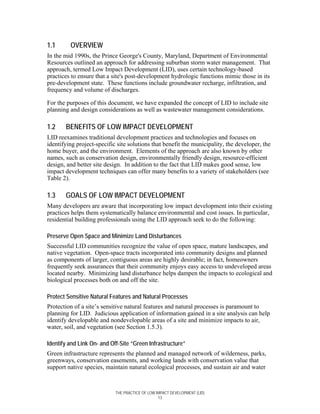
Low Impact Development Center, Inc.
http://www.lowimpactdevelopment.org
The Low Impact Development Center is a nonprofit water resources research group with
a mission of conducting research and training on low impact development and sustainable
storm water management. Publications, pictures, and other resources are available on the
site.

Pennsylvania Housing Research/Resource Center
http://www.engr.psu.edu/phrc
Part of the Resource Center’s work is in conducting research related to “smart growth”
and sustainable site design. A workshop conducted March 2003 by Scott Brown entitled,
“Understanding Management Practices for Post Construction Storm Water Control”
provided information on the impact of development on runoff response.

Urban Land Institute
http://www.uli.org
The home page of the Urban Land Institute, an organization committed to providing
responsible leadership in the use of land toward enhancing the environment, offers design
resources for housing, retail, office, and transportation development.

U.S. Department of the Navy, Environmental Department
http://www.nfesc.navy.mil
A list of links to the Navy's pollution prevention program includes information about
equipment, implementation, and planning. Also included is the Joint Service Pollution
Prevention Library, a searchable database of prevention documents.

U.S. Environmental Protection Agency
http://www.epa.gov/OW/index.html
The Office of Water provides an immense amount of information on the protection and
conservation of our nation’s water resources.

Regional-Specific Resources
Northeastern United States

Cornell Cooperative Extension of Onondaga County
http://www.cce.cornell.edu/onondaga/fingerlakeslan/default.htm
The Web site presents information and design suggestions for landscaping property in a
manner that reduces the risk of pollution to surface waters. The information is oriented to
the Finger Lakes, New York region but is applicable to many other areas.


                             THE PRACTICE OF LOW IMPACT DEVELOPMENT (LID)
                                                  47
Minnesota Pollution Control Agency
http://www.mnerosion.org/tools.html
A comprehensive manual available online entitled Protecting Water Quality in Urban
Areas highlights technical information about BMPs for protecting lakes, streams, and
groundwater from storm water-related pollution.

New York State Department of Environmental Conservation
http://www.dec.state.ny.us/website/dow/swmanual/swmanual.html
The New York State Storm Water Management Design Manual provides designers with a
general overview on how to size, design, select, and locate storm water management
practices at a development site in compliance with state storm water performance
standards.

Southeastern United States

Mississippi State University Agricultural and Biological Engineering Department
http://abe.msstate.edu/csd/NRCS-BMPs/pdf/water/quality/bioretentsys.pdf
A downloadable, two-page fact sheet providing descriptions and diagrams of a shallow-
depression bioretention system.

Northern Virginia Regional Commission
http://www.novaregion.org/es_pubs.htm
A list of publications for purchase and downloading, including documents on BMPs such
as The Northern Virginia BMP Handbook and Nonstructural Urban BMP Handbook and
publications on Virginia's watersheds.

NRDC’s Storm Water Strategies: Strategies in the Southeast
http://www.main.nc.us/riverlink/content/07chap/chap07.htm
Case studies for addressing storm water management techniques in new development and
redevelopment.

Western United States

Built Green Colorado
http://www.builtgreen.org/sites/green.htm
The Built Green Colorado Web page with links to many green building resources. Built
Green Colorado is a public/private partnership created to encourage home builders to use
technologies, products, and practices that enhance energy efficiency, reduce pollution,
provide healthier indoor air, reduce water usage, preserve natural resources, improve
durability, and reduce maintenance.

Caltrans Storm Water Management Program
http://www.dot.ca.gov/hq/env/stormwater/index.htm
Information on current monitoring studies, publications, conferences, and links are
presented in the context of California’s Storm Water Management Program. The site is
oriented to reducing the impact of California roadways on aquatic resources.

City of Seattle
http://www.ci.seattle.wa.us/util/surfacewater/bmp/default.htm
Information on simple and effective BMPs for homeowners and businesses provided by


                             THE PRACTICE OF LOW IMPACT DEVELOPMENT (LID)
                                                  48
Seattle Public Utilities. The information includes everyday tips for protecting surface
water.

U.S. Environmental Protection Agency Region 10
http://www.epa.gov/region10
The Region 10 home page provides general information on the region’s resources as well
as links to its programs. This site also includes regularly updated information on
environmental issues in the local news.

Utah Association of Conservation Districts
http://www.ci.north-
logan.ut.us/Information/Low%20Impact%20Report/Low%20Impact%20Report.html
The community of North Logan developed LID roadway design standards. The site
includes documentation of the process, exhibits, standards, and specifications.

Southwestern United States

Arizona Department of Water Resources
http://www.adwr.state.az.us/
A variety of information on all aspects of water resources for the state of Arizona.

Pima County Department of Environmental Quality
http://www.deq.co.pima.az.us/water/storm.htm

Provides information on Tucson and the surrounding area’s storm water management
program and components.

Pima County Flood Control District
http://www.dot.co.pima.az.us/flood/wh/index.html
Methods for collecting, storing, and distributing rainwater to reduce residential runoff
loads as well as information on harvesting system maintenance.


                           THE PRACTICE OF LOW IMPACT DEVELOPMENT (LID)
                                                49
.
SECTION 3: WASTEWATER TREATMENT


 Properly designed, installed, and maintained
     on-site wastewater treatment systems
   can cost effectively treat wastewater and
protect the watershed from pollutant overloads.
3.1      INTRODUCTION
Section 2 addressed storm water management issues and explained how rainwater could
be used as an asset instead of viewed as a liability in new developments. As we
mentioned in Part I, we have expanded LID to include wastewater management. We now
turn to the methods and systems that developers can use for effectively treating
wastewater generated at residential sites.

It is becoming increasingly popular to protect the nation’s surface water and groundwater
and prevent further stress from a variety of pollution sources. Approximately 300,000
miles of rivers and shorelines and approximately 5 million acres of lakes are polluted by
harmful microorganisms, sediment, and excess nutrients.
(http://www.epa.gov/owow/tmdl/overviewfs.html). Wastewater can contain nutrients
(e.g., nitrogen, phosphorus), pathogens (e.g., disease organisms), and chemicals (e.g.,
ammonia, medical byproducts). Thus, developers must ensure that equipment and
management methods effectively treat wastewater before it is released into the
environment.

Table 11 lists current conventional wastewater management practices and technologies
and the alternative systems discussed in this chapter. The 1993 HUD Proposed Model
Land Development Standards and Accompanying Model State Enabling Legislation
publication addressed some of the conventional technologies, which are briefly noted
below. To put current technology use into perspective, Figure 10 shows that a vast
majority of homes in the United States rely on municipal sewer systems.

                       Wastewater Management Options Discussed in Chapter

                     Conventional                                 Alternative
                    Municipal Sewer                                 Aerobic
                      Single Septic                               Sand Filters
                   Community Septic                                  Mound
           Combined On-Site Systems and Sewer                    Trickling Filter
                  Storage and Removal                          Evapotranspiration
                                                               Low-Pressure Pipe

                        TABLE 11. WASTEWATER MANAGEMENT OPTIONS
Although only 23 percent of homes in the United States are on individual septic systems,
such systems can be a significant source of water pollution. Moreover, the average age
of a home with a septic system exceeds 30 years. Further, of those homes on septic
systems, an estimated 403,000 experienced system breakdowns in a three-month period
in 1997 ( Bureau of the Census, 1999).


                             THE PRACTICE OF LOW IMPACT DEVELOPMENT (LID)
                                                  53
Septic
                                                            23%


                                                  77%
                               Sewer


                             FIGURE 10. HOW HOMES HANDLE WASTEWATER
The management of residential wastewater is a process fraught with technological and
regulatory issues. For instance, some communities limit the use of traditional septic
systems because improperly maintained systems can release untreated effluent into the
soils; in other instances, communities have experienced a number of system
malfunctions. Effluent contains excess nutrients and harmful organisms that can
adversely affect water quality. Regulatory officials respond to the need to protect our
water by adopting progressively stringent wastewater treatment regulations. More
specifically, in some cases, communities turn to rigorous regulation of conventional
systems as a means of curtailing development, yet they fail to recognize that water
quality issues can be addressed by using alternative wastewater management systems.

It is important to keep in mind that septic systems are still used effectively and approved
throughout the country. However, in response to the problems noted above, private
industry continues to develop alternative systems designed to overcome some of the
issues that can plague the performance of conventional septic systems.

This chapter briefly describes the environmental, cost, and regulatory issues associated
with wastewater treatment. It then explains how conventional residential developments
deal with wastewater management. The last part of the chapter discusses some of the
more common alternative means of wastewater management. Table 12 presents the
chapter’s overall objectives.


                                                  Objective 1:
  Explain how the use of alternative systems and combinations of systems can reduce on-site infrastructure costs
                                     and loadings to municipal sewer systems.
                                                   Objective 2:
              Demonstrate alternative lot and site layouts to accommodate a variety of system types.
                                                    Objective 3:
      Show how the use of alternative systems and combinations of systems can reduce pollutant loadings to
                                                  waterways.

                          TABLE 12. WASTEWATER MANAGEMENT OBJECTIVES


                                 THE PRACTICE OF LOW IMPACT DEVELOPMENT (LID)
                                                      54
3.1.1    ENVIRONMENTAL ISSUES
LID is an approach that
uses technologies to           • Heavy Equipment--Heavy-duty trucks and other equipment passing
simultaneously conserve           over a septic system or drainfield may damage the pipes or system
and protect natural               parts.
resource systems and           • Clogging--Systems are designed to keep solids, e.g., sludge and
reduce infrastructure             scum, out of the final effluent. However, if those elements make it to
costs. Wastewater can             the drainage field, they can cause premature soil clogging such that the
affect natural resources;         effluent from the septic tank has trouble percolating into the soil and
all wastewater coming             can pond.
from a home must be sent       • Roots--Tree and bush roots can enter the system. It is essential to
to an effective treatment         keep large plants away from the septic system.
site or public treatment       • Improper Sizing/Design--The system must be large enough for the
system in order to limit          load and installed in suitable soils as well as in as shallow a trench as
adverse environmental             possible so that it does not interfere with groundwater.
and health impacts. One
of the reasons that public     • Improper/Lack of Maintenance--Septic systems need routine
                                  maintenance, including tank pumping and cleaning and inspection by a
officials prefer to rely on       licensed professional. Properly maintaining a tank keeps solids from
municipal sewer systems           accumulating and clogging the leach field.
for wastewater treatment
is that many of the systems
are operated by trained          TABLE 13. COMMON REASONS FOR SEPTIC SYSTEM FAILURE
technicians who
continuously monitor the treatment process to ensure that discharge waters meet local
permit or other regulatory requirements.

In most cases, wastewater treatment can be handled by one of the four conventional
methods noted in Table 11. However, there are exceptions. For instance, in some
circumstances, sewer systems cannot be used because of cost considerations; it might be
too costly to run pipes long distances to link a proposed development’s wastewater
system to existing municipal sewer connections. In other cases, a municipality might
have specific health or environmental concerns that make the use of septic systems
unacceptable.

Nitrogen and phosphorus are two nutrients in wastewater that, either in excess or through
cumulative effect, can adversely affect receiving waterbodies. When septic systems fail
to operate as designed, excess nutrients in untreated wastewater can enter the
environment. Excess nitrogen in streams, lakes, and estuaries stimulates the growth of
plants (algae and phytoplankton). Algae in turn consume oxygen, and the decomposition
of dense algal blooms leads to anoxia (no oxygen) and hypoxia (low oxygen).
Eventually, the aging process of the waterbody is accelerated through a complex chain of
events known as eutrophication. Indicators of eutrophic conditions include odors, poor
water clarity, stressed marine organisms, and, in severe cases, dead fish.

From a public health point of view, conventional septic system failure is one of the main
reasons for increased interest in alternative on-site wastewater treatment systems. Table
13 lists some common causes of septic system failure. Conventional septic system
failures potentially can contaminate groundwater and surface water with bacteria harmful


                                 THE PRACTICE OF LOW IMPACT DEVELOPMENT (LID)
                                                      55
to humans. Further, septic systems with poor nitrogen removal can overload nearby
waterways, resulting in algal blooms and adverse impacts on aquatic life.

Numerous communities nationwide are attempting to address general water
contamination and, in particular, nitrogen loading. For instance, when studies showed
that septic systems were threatening groundwater supplies in the Los Angeles area, the
Los Angeles Regional Water Quality Control Board voted in 1999 to prohibit the
installation of any new septic systems in Ventura County and required the use of septic
systems to cease by January 1, 2008 (California EPA Press Release, August 17, 1999).
Studies showed that the prohibition was necessary to safeguard the public health and
protect the local water supply; community drinking water is pumped from groundwater
beneath the discharge area of the septic systems. As part of its overall water conservation
plan, Milford, New Hampshire, prohibits septic system use near waterbodies
(http://www.ci.milford.nh.us/conservation/streams.html). The Chesapeake Bay
watershed is an area greatly affected by water pollutants. The Chesapeake Bay Program,
which is designed to protect the bay, determined that between 55 and 85 percent of the
nitrogen entering an on-site wastewater treatment system could be discharged into
groundwater (U.S. Environmental Protection Agency, 1993). As noted in a U.S.
Environmental Protection Agency (EPA) report, “Hydraulically functioning systems can
create health and ecological risks when multiple treatment units are installed at densities
that exceed the capacity of local soils to assimilate pollutant loads” (U.S. Environmental
Protection Agency, 2002). Thus, the concern over septic systems extends to both the
inability of septic systems to remove nitrogen and the increased number of septic tanks
installed in any one area.

Phosphorus is another nutrient that, if discharged from septic systems, can lead to
eutrophication of nearby waterbodies, although it is considered less of a threat than
nitrogen to groundwater and surface contamination via conventional septic systems.
Septic systems are generally effective in adequately removing phosphorus; furthermore,
soil particles adequately adsorb soluble phosphorus and extract soluble phosphorus
compounds from septic tank effluent as it leaches through the soil profile, thus limiting
the movement of phosphorus through the soil.

3.1.2   COST ISSUES

Municipal Sewer Connection Fees
In addition to environmental issues, economic factors play a role in the selection of an
appropriate wastewater treatment system. To connect a home or community to a
municipal sewer system, developers must pay certain fees. A community that operates a
municipal sewer system often combines the potable water tap fee with the sewer
connection fee. In addition, communities sometimes charge developers impact fees to
help offset new homeowner impacts on community resources.

Impact fees are not new; they have existed since enactment of the Standard Planning
Enabling Act of 1922. However, both the number and dollar amount of impact and
connection fees have risen dramatically since the early 1900s. In some communities,
sewer connection fees have risen to help municipalities pay for system operation and
maintenance costs and system expansions. Fees can range from $1,500 per house to over
$14,000 per house. Fee increases have exacerbated the affordable housing problem

                           THE PRACTICE OF LOW IMPACT DEVELOPMENT (LID)
                                                56
currently plaguing portions of the United States. In a related matter, some communities
report that their wastewater treatment facility is at or near capacity, hindering further
residential development until facility expansion can accommodate additional growth. In
response, HUD's Office of Policy Development and Research created the Regulatory
Barriers Clearinghouse to examine how impact fees and other issues affect the creation
and maintenance of affordable housing (http://www.huduser.org/rbc/).

Conventional Septic Installation and Maintenance Costs
The cost of installing septic systems depends on system size, treatment capacity,
occupancy, and land issues such as the type of on-site soil. For example, in Minnesota,
the costs of installing a septic system can range from $2,000 to $7,000. The average cost
to pump the tank’s sludge ranges from $75 to $150. Pumping the tank at the appropriate
frequency is less costly than replacing the system’s leach field, which would be needed if
solids enter the field from an overloaded septic tank. If a septic system and
corresponding leach field need to be replaced in Minnesota, the costs are equal to that of
installing a new system -
http://www.extension.unm.edu/distribution/naturalresources/components/DD6946c.html.

3.1.3   REGULATORY ISSUES
Currently, most local regulations are prescriptive and limit the introduction and use of
alternative on-site wastewater treatment systems (OWTS). Public health officials,
however, can facilitate the use of alternative OWTSs by revising the applicable codes.

The use of alternative systems can reduce the capacity strain on an existing wastewater
treatment facility. In fact, some local officials may be willing to allow alternative
OWTSs on some but not all lots within a parcel. For instance, some lots may have the
appropriate soil composition for the use of conventional septic systems while the soils on
other lots in the development may not lend themselves to such systems. Thus, a
community that needs to increase the capacity of the local wastewater treatment system
could allow a mix of alternative and traditional OWTSs on a single site instead of relying
exclusively on alternative systems. This is an example of how LID is flexible in its
application.

3.1.4   GENERAL PERFORMANCE STANDARDS
In general, wastewater treatment systems take in wastewater, treat it, and release it to the
environment. It is difficult, however, for prescriptive codes to specify the full range of
technological options appropriate for a given site and anticipate the different sensitivities
of the site’s water and land resources. Although the topic is beyond the scope of this
publication, public officials could use performance codes to address site-specific natural
resource needs while meeting health requirements.

In 2002, the National On-Site Wastewater Recycling Association (NOWRA) received a
grant to develop draft national on-site performance standards
(http://www.nowra.org/model_code.html). The underlying issue and impetus for the
project is that local wastewater regulations are usually prescriptive. Although alternative
OWTSs have worked elsewhere in the country, local code officials are often reluctant to
approve the use of these systems in their jurisdiction when a site does not meet the

                            THE PRACTICE OF LOW IMPACT DEVELOPMENT (LID)
                                                 57
prescriptive requirements. The goal of the NOWRA project is to create a set of national
OWTS standards that local officials could use for approving the use of innovative
systems (Small Flows Quarterly, Winter 2002).

The U.S. EPA states in a March 28, 2003 Federal Register notice regarding Voluntary
National Guidelines for Management of On-site and Cluster (Decentralized) Wastewater
Treatment Systems, “State agencies report that some of these systems have failed because
of inappropriate siting or design or inadequate long-term maintenance. Historically high
failure rates in some areas indicate a need for better management of these systems to
protect public health and water quality.” U.S. EPA has thus developed the Management
Guidelines that are designed to enhance system performance through improving the
quality of management programs (Federal Register, 2003). You may access this Federal
Register notice electronically through the EPA Internet under the Federal Register
listings at http://www.epa.gov/fedrgstr/T.

3.2    CONVENTIONAL APPROACHES TO WASTEWATER TREATMENT
Developers typically have four options regarding residential wastewater treatment
systems: tying into a municipal or public sewer system, providing homeowners with an
on-site septic system, using a community septic system, or using a combination of on-site
systems and tying into the municipal system. Centralized municipal systems, often
available in urban and many suburban areas, are often the most cost-effective option
when municipal system connections are proximate to the land to be developed.
Municipal systems consist of a series of pipes and pump stations leading to a wastewater
treatment facility. The facility treats the water before releasing it to a body of water. In
many instances, however, homes in a development cannot connect to a municipal
treatment system. It may be cost-prohibitive to connect to a municipal system because of
distance to conveyance pipes, or a municipal system already at capacity cannot treat
additional effluent. In these cases, developers have traditionally turned to septic systems.

A conventional septic system normally treats a home’s wastewater in an underground
septic tank located on the property. The life of septic systems depends on the quality of
the installation, correct usage, and the frequency of maintenance. With appropriate
maintenance, many systems can last for 20 years or more.

Two primary factors in a septic system’s successful operation include proper installation
and appropriate operation and maintenance. Assuming proper installation, homeowners
must ensure that the tank is pumped out as frequently as needed. In addition, given that
the bacteria within the tank are sensitive to the wastewater inputs, homeowners should
not use the system for the disposal of chemicals such as turpentine, alcohol, and bleach as
well as for large volumes of grease and animal fats; such items can clog the system.
Developers should provide homeowners with a list of “things to do and not to do”. The
National Small Flows Clearinghouse sells The Homeowner On-Site System
Recordkeeping Folder (Item #WWBLPE37) and the Homeowner Septic Tank
Information Package (Item #WWPKPE28) to help homeowners record and store
information about their septic system and to educate homeowners on system care and
system (http://www.nesc.wvu.edu/nsfc/nsfc_septicnews.htm#septic). In addition, the U.S.
EPA has created a free, one-page Homeowner Septic System Checklist to highlight the
homeowner’s septic system maintenance needs (U.S. EPA, 2003).


                           THE PRACTICE OF LOW IMPACT DEVELOPMENT (LID)
                                                58
Another wastewater management option sometimes used by developers is a
communitywide wastewater treatment system. Although the vast majority of today’s
homes either use single septic systems or are connected to public sewer, some developers
have installed communitywide septic systems. The systems treat wastewater for a group
of homes in a manner similar to a septic system for a single home. Small community
cluster systems often try to take the best attributes of municipal sewers and septic systems
and use them to reduce wastewater treatment system installation costs while meeting
environmental goals. The systems transport wastewater from homes via sewer pipes to
either a conventional treatment plant or a pre-treatment facility. The effluent is then
discharged to soils similar to those required in the last stage of a single septic system’s
treatment process.

Some communities install a centrally located package wastewater treatment plant that
connects each home in that community to the plant. The package system is similar to
public wastewater treatment facility except that the effluent from the homes travels to a
privately owned and operated treatment plant located in the community (sometimes
referred to as “small community sewer” or “distributed sewer”).

A small number of jurisdictions are using natural open spaces, golf courses, and soccer
fields as areas for drip irrigation of semitreated effluent. Such uses of open space allow
effluent to be effectively disposed of across large areas. Another benefit of is that the
systems can be created as needed. The developer can calculate how much effluent the
entire development will likely generate and then phase in the system as homes are built.
The system’s potential drawbacks include a perception that odor will be a problem or that
public health will be compromised.

In several communities, community systems have proven themselves a feasible
alternative. For example, in Warren Village, Vermont, nearby streams had become
polluted in part because of a combination of dense development, small lot sizes, and
failed single septic systems. When residents determined that a municipal sewer system
was too expensive, the town used two parcels--a soccer field and a vacant lot-- as
common leaching fields with a total capacity of 30,000 gallons per day. Homeowners
whose lots lacked adequate wastewater disposal capacity could pay the newly formed
wastewater management district $250 per user per year to discharge to the community
system (http://www.daylor.com/projects/Gloucester/CommunityWastwater.htm).

Community systems can also facilitate the use of smaller house lots. Single septic
systems need an adequate land area for the leach field. With community systems, the
final treatment location is consolidated into one large leach field instead of relegated to
several individual fields. Allowing for smaller lots can help the developer preserve open
space, furthering the goals of low-impact development.

Some instances warrant a combination of sewer hook-up and septic system installation. .
For example, a municipal sewer system may be able to serve only an additional 50
homes, yet a proposed development calls for 200 homes. Public officials and the
developer might agree to hook up 50 of the new homes to the public system and serve the
rest of the homes with an on-site septic tank system.

A combination system might also be warranted when soils on part of the development are
not suitable for septic tank installation. In this instance, the lots that cannot accommodate

                            THE PRACTICE OF LOW IMPACT DEVELOPMENT (LID)
                                                 59
septic systems could be connected to the municipal system while the rest of the lots could
be served by septic systems or municipal connections.

Clearly, each parcel of land is often suited to a variety of options available to the
developer. Developers can help create cost-effective developments by weighing all the
wastewater management options and determining which will yield the best performance
at the least cost. The LID approach helps increase the number of wastewater
management system options available to the developer.


                           THE PRACTICE OF LOW IMPACT DEVELOPMENT (LID)
                                                60
3.3    ALTERNATIVES TO CONVENTIONAL SYSTEMS
Table 14 contains a brief description of the OWTSs highlighted in this chapter. Listed
below are expanded explanations of the alternative systems that provide secondary
treatment and that might allow for on-site wastewater treatment (U.S. Environmental
Protection Agency, 2002).

         OWTS Type                    Key Components                Situations Where Its Use Might Be
                                                                               Appropriate

                              •   Septic tank, sand filter, and     • Where soil conditions do not allow
         Sand Filters             sometimes a recirculation           for percolative beds/trenches
                                  tank                              • High groundwater
                                                                    • Slow- or fast-permeability soils
                              •   Pre-treatment unit(s), dosing
            Mound                 (pumping) chamber, and            • Shallow rock cover over creviced or
                                  elevated mound                      porous bedrock
                                                                    • High groundwater
                              •   Circular bed of coarse or
        Trickling Filter          plastic material and rotating     • High concentrations of organic
                                  distributor                         material in wastewater

                              •   Pre-treatment unit,
                                  evapotranspiration sand bed,      • Annual evaporation rate exceeds
      Evapotranspiration          bed liner, fill material,           annual rate of precipitation and
                                  monitoring, overflow                wastewater applied
                                  protection, and surface cover
                                                                    • Where soils would become clogged
                              •   Septic tank, pumping (dosing)       as a result of localized overloading
      Low-Pressure Pipe           chamber, and small-diameter       • High groundwater
                                  pipes                             • Anaerobic conditions due to
                                                                      continuous saturation
                              •   Aeration compartment,             • Where septic systems have failed
           Aerobic
                                  settling chamber, pre-            • Where lot size is not sufficiently
                                  treatment compartment               large to accommodate a standard
                                  (optional)                          septic system drainfield
      Proprietary Systems     •   Varied                            • Where conventional septic systems
                                                                      or sewer hook-ups are not feasible
                TABLE 14. ON-SITE WASTEWATER TREATMENT SYSTEM ALTERNATIVES
Alternative systems can use anaerobic bacterial action, i.e., the bacteria decomposes
waste in the absence of oxygen, while other systems need oxygen (i.e., aerobic) to
operate properly. In addition, hybrid systems use a combination of aerobic and anaerobic
processes.

Developers can consider a variety of on-site wastewater treatment system options either
as alternatives or enhancements to conventional septic systems. By using the LID
approach, developers often uncover information and options that can help facilitate the
development approval process.


                            THE PRACTICE OF LOW IMPACT DEVELOPMENT (LID)
                                                 61
While municipal sewer or on-site septic systems may be the most recognized wastewater
treatment options, some sites might lack both sewer access and the ability to
accommodate a septic system. Some of the limiting factors for septic systems include lot
size (an ample soil absorption field is necessary), groundwater level, depth of bedrock,
and on-site soil types. For example, dense clay or rocky soils can inhibit the use of septic
systems. Recognition of various limitations has led to increased interest in and the
development of alternative on-site wastewater treatment systems.

Alternative on-site wastewater treatment
systems range from adding treatment steps                   Examples Where a Septic System May
(e.g., intermittent sand filter) to a conventional               Not Be Allowed on a Lot
septic system to the reliance on proprietary                           Lot size too small
systems that omit the use of traditional septic                       Wrong types of soils
tanks. In fact, as technology grows more                            High groundwater level
sophisticated, , it is often more important to                   Shallow soils/Depth of bedrock
establish an operation and maintenance plan                              Steep slopes
for an alternative OWTSs than for an ordinary                       Soil does not percolate
septic system.

When lots cannot be developed to take advantage of conventional wastewater
management techniques (e.g., municipal sewer or on-site septic systems), the use of
alternative OWTSs (discussed below) can make those lots suitable for development.
Before using an alternative OWTS, however, developers are advised to familiarize
themselves with the local public health criteria related to wastewater effluent and to
recognize that, as opposed to municipal sewer systems, which are usually regulated by
codes at the state level, local public health officials regulate on-site systems. The lack of
information on the systems and absence of third-party verification of alternative system
performance make public health officials reluctant to alternative OWTS. In general,
public officials are most concerned with ensuring a certain level of public health, not with
facilitating land development; therefore, officials often need to be educated about the
efficacy of alternative systems.

On a related note, some public officials and environmental groups have expressed
concern that the use of septic and/or alternative OWTSs will foster sprawl. The use of
OWTSs by themselves does not lead to unchecked growth; indeed, the best way to
manage growth effectively is through prudent zoning, not by eliminating potential
wastewater treatment solutions or creating barriers for the adoption of alternative
technologies related to development.

3.3.1 PROCESS FOR IDENTIFYING POTENTIAL ON-SITE WASTEWATER TREATMENT
SYSTEM ALTERNATIVES
Each parcel of land is unique in terms of its size, shape, and soil types. If public health
officials indicate that an alternative OWTS is a feasible option, then developers should
consider several factors to identify the types of systems that might be used. For instance,
OWTSs are more complex than septic systems and thus require a higher level of
maintenance and supervision and may need additional excavation during installation to
accommodate the various systems’ several components. Table 15 briefly describes the
various factors to be considered.


                             THE PRACTICE OF LOW IMPACT DEVELOPMENT (LID)
                                                  62
Costs can vary for different OWTS options. For instance, community wastewater
treatment systems that rely on gravity to transport wastewater can require deep and thus
costly excavations, but the use of pressurized systems with small-diameter plastic pipes
can minimize excavation costs.

Some OWTS alternatives to conventional systems, such as recirculating sand filters and
evapotranspiration systems, are “add-ons” to a traditional septic tank system. The
additional treatment unit is connected in-line with the septic tank and provides an extra
level of treatment. Although it may seem more costly to add another layer of treatment,
alternative treatment systems may be less costly if conventional wastewater management
methods require the hauling of extra fill material or the construction of a retaining wall.

As for other cost issues, alternative OWTSs may need electricity to operate the pumps
that are sometimes required as part of the treatment system itself and that are sometimes
needed to move wastewater from the house to the treatment area. In addition, the
inclusion of other features such as recirculation piping, aeration, and an increased need
for cleaning/pumping may increase an alternative system’s operation and maintenance
costs.

Another economic issue associated with the use of an alternative OWTS is the long-term
operation and maintenance (O&M) costs and related organizational framework required

•    Aesthetics--Both the general public and public officials will be most aware of aesthetic concerns. In short,
     potential insect problems and odor issues must be addressed and mitigated.
•    Capacity--The system must be able to handle the home’s capacity; the approval process will consider both
     rate and volume of sewage flow. In addition, public officials may want the system to be able to handle more
     than the current load to accommodate changing uses of the home.
•    Cost--The upfront costs of alternative OWTSs can often be higher than the costs of traditional septic systems.
     In addition, the complexity of alternative systems yield somewhat higher operation and maintenance costs
     (e.g., the alternative systems usually need electricity to treat waste).
•    Efficiency and Reliability--The community at large will be interested in any third-party reports and data
     indicating how well the proposed systems treat or remove potentially harmful wastewater components. In
     addition, the system must have adequate safeguards to warn the occupant of system failure.
•    Environmental and Public Health--A system must maintain or improve environmental quality and
     adequately address public health issues.
•    Operation and Maintenance (O&M)--As an emerging issue in the on-site wastewater treatment field,
     OWTSs require more monitoring than standard septic systems; thus, the local jurisdiction or a third party must
     ensure the proper maintenance of equipment.
•   Siting--Soil type and lot size are often determining factors when siting OWTSs. For instance, only about one-
    third of the land area in the United States has soils suitable for conventional subsurface soil absorption fields.
Source: U.S. EPA, 2002.


TABLE 15. FACTORS TO CONSIDER WHEN EVALUATING ON-SITE WASTEWATER TREATMENT SYSTEMS

with the systems. Given that innovative systems usually require more frequent and
ongoing O&M than conventional systems, developers, public officials, and communities
must work together to develop an O&M plan and establish an entity that will ensure


                                    THE PRACTICE OF LOW IMPACT DEVELOPMENT (LID)
                                                         63
effective system performance. Such an entity can oversee O&M activities, reduce
liabilities, and establish service boundaries (Jones et al., 2001).

The following list offers criteria for determining situations in which an alternative OWTS
could be most helpful:

•   When sewer is not located nearby. If a given plot of land is not located close to
    existing infrastructure, thus making it costly to establish public sewer connections,
    then OWTS might be an effective option.
•   When the wastewater treatment facility is at capacity. In some locales, the
    wastewater treatment facility is at capacity and cannot accept any more connections.
    In these instances, either a new facility will have to be built or the existing facility
    will have to be expanded. Either option will require the public’s investment and time
    and will potentially delay land development.
•   When a lot is too small. If local ordinances dictate that a lot is too small to
    accommodate a septic field, an alternative OWTS might help reduce the size of the
    required absorption field.
•   When a watershed requires higher-quality effluent. In some instances, a watershed
    has effluent requirements that exceed the effluent characteristics normally produced
    by septic systems. Once again, the enhanced wastewater treatment available with
    some alternative OWTSs may help provide a solution.
•   When groundwater supply is limited. Instead of pumping water off site through a
    sewer, an OWTS keeps water on the site; properly treated effluent from an alternative
    OWTS can help recharge the local groundwater aquifer.
•   When deep excavation is needed for a septic system. Some alternative systems do
    not require as much excavation as septic systems, thus reducing initial costs.
Another way to look at the system selection process is through a variety of stakeholders’
lenses. Figure 11 provides an overview of some of the groups interested in the process of
selecting an appropriate OWTS and their relevant concerns (U.S. Environmental
Protection Agency, 1997).


                            THE PRACTICE OF LOW IMPACT DEVELOPMENT (LID)
                                                 64
Legislative Concerns
                                                                        ▪ Adequacy of Existing
                                                                          Institutional            Economic Concerns
                                                                          Arrangements             ▪ Fiscal Equity
                                                                        ▪ Legal Requirements       ▪ Ability to Pay
                                                                          (Federal/State)          ▪ Ability to Generate
                                                                        ▪ Relationships Among        Necessary
                            Environmental Concerns                        Affected Agencies
                            ▪ Physical Conditions                                                    Revenue
                                                                        ▪ Planning/Enforcement/    ▪ Grant/Loan Availability
                            ▪ Climatic Conditions                         Operating Capabilities   ▪ Accountability
                            ▪ Water Quality
                            ▪ Adequacy of Treatment                                                ▪ Borrowing Capacity
                                                                                                   ▪ Future Growth Potential


                                                                                                   Administrative Concerns
Engineering Concerns                                                                               ▪ Record-keeping
▪ Suitable Design                                                                                  Practices
▪ Appropriate Technology                TECHNICAL ISSUES               INSTITUTIONAL ISSUES        ▪ Decision-making Process
▪ Operating Condition                                                                              ▪ Staffing Capability
▪ Performance/Reliability                                                                          ▪ Regulatory Requirements
▪ Residuals Volume/                                                                                ▪ Formal and Informal
  Characteristics                                                                                     Interagency
                                                                                                      Relationships


                                                                                                   Social Concerns
                                                                                                   ▪ Willingness to Assume
                                                                                                   Responsibility
                                                                                                   ▪ Public Support
                                                                                                   ▪ Educational Program
                                                      Maintenance Requirements
                                                       Improvements/Repairs
                                                         Surveillance Needs


                                                         Ownership Status
                                                       Operational Procedures
                                                        Regulatory Provisions
                                                         Financial Planning


  Source: Response to Congress On Use of Decentralized Wastewater Treatment Systems,
  http://www.epa.gov/owm/decent/response.
       FIGURE 11. OVERVIEW OF PARTIES INTERESTED IN WASTEWATER TREATMENT DECISION MAKING
  In some situations, conditions do not permit the installation of septic systems, particularly
  if soils are not appropriate or lot sizes are not sufficiently large to support a leach field.
  For example, the Floyd County, Kentucky, Plan Commission recently proposed a zoning
  ordinance amendment that would use soil conditions to dictate how many homes could be
  built per acre with septic systems (The Courier-Journal, Louisville, KY, May, 2002). In
  the worst soil and topographic conditions, the proposed amendment would limit
  development to one house with a septic system per 20 acres.

  As previously noted, there are a variety of alternative systems available to developers.
  Below are descriptions of the different systems. Also included are considerations
  developers can take into account when deciding which systems to include in a new
  development.


                                            THE PRACTICE OF LOW IMPACT DEVELOPMENT (LID)
                                                                 65
3.3.2    SAND FILTERS

Intermittent Sand Filters
Sand filter systems treat the effluent downstream from a conventional septic tank. Two
of the more common sand filter systems are the single-pass system (i.e., intermittent) and
the recirculating system. In the single-pass system, the wastewater first undergoes
primary treatment in a septic tank. The effluent is then applied intermittently to the top
of a bed of sand (or other suitable media) that sits on an impermeable liner and percolates
through the sand into drains located at the bottom of the bed (see Figure 12). As the
wastewater passes through the sand filter, both physical and chemical processes treat the
effluent, although microorganisms attached to the fixed media primarily treat the effluent.
The effluent is then piped to the leach field for further treatment and disposal.
Bottomless systems have no impermeable liner and do not discharge to a drainfield but
rather to the soil below the filter.


Source: National Small Flows Clearinghouse Fact Sheet, 1998.
                FIGURE 12. TYPICAL CROSS-SECTION OF AN INTERMITTENT SAND FILTER
Intermittent sand filters produce a high-quality effluent by removing a high percentage of
contaminants. The filter’s ability to perform adequately depends on the filter’s design
and composition and, hence, the biodegradability of the wastewater and the
environmental factors within the filter. The most important environmental factors
include media re-aeration and temperature. Re-aeration makes oxygen available for the
wastewater’s aerobic decomposition. Temperature directly affects the rate of microbial
growth, chemical reactions, and other factors that contribute to the stabilization of
wastewater within the system.

System pumps and controls should be checked every three months while the sludge
build-up in the septic tank should be checked as needed. Installation costs of intermittent
sand filters, including labor and materials, generally range from $7,000 to $10,000. Daily
energy costs for pumping the wastewater onto the filter bed run between $0.03 and $0.06.

Recirculating Sand Filters
In situations without sufficient land area for a single-pass filter system, recirculating sand
filter systems are an option. In a recirculating system, wastewater first undergoes
treatment in a septic tank. The pre-treated effluent then flows into a recirculation tank


                                 THE PRACTICE OF LOW IMPACT DEVELOPMENT (LID)
                                                      66
along with some of the water that has already passed through the sand filter. A pump
transports the wastewater mixture from the tank to the sand filter, where microorganisms
attached to the filter media carry out treatment. The treated effluent collects at the
bottom of the filter; some of the effluent is sent back to the recirculation tank for further
treatment and some is sent out for disposal or another type of treatment disinfection. In
this type of system, the sand is periodically changed (see Figure 13).


Source: National Small Flows Clearinghouse Fact Sheet, 1998.
                       FIGURE 13. TYPICAL RECIRCULATING SAND FILTER SYSTEM
Recirculating sand filters are relatively low-maintenance systems whose operating costs
are generally modest. Operation and
maintenance costs were under $5,000 for a          • Peat Filters--Organic particles and suspended
135-home septic tank system in Elkton,               solids are removed by passing wastewater
Oregon, including $780 for electricity and 25        through a peat bed.
to 30 labor hours per month. The                   • Batch Reactors--To increase nitrogen-removal
replacement of the media represents one of           efficacy, batch reactors alternate between
the system’s most expensive maintenance              oxygen-rich and oxygen-poor cycles and treat
items. Thus, it is prudent to use locally            one batch of wastewater at a time.
available materials. For example, the capital      • Activated Sludge Systems and Aerobic
cost (land not included) for a 5,000 gallon per      Treatment--Biooxidation (aerating wastewater)
day system with black beauty™ sand media             and oxygen-poor settling areas improve
that was not locally available totaled about         treatment.
$68,600. That same system cost $36,000
with standard sand media.
                                                               TABLE 16. SECONDARY TREATMENT
Other types of filters provide secondary wastewater treatment (see Table 16).

3.3.3    MOUND
On lots with high water tables or soils unsuited to septic systems, a mound of suitable
soils is placed on top of the soils that do not permit the use of a septic system. The
primary treatment takes place in the septic tank. The wastewater from the tank passes

                                 THE PRACTICE OF LOW IMPACT DEVELOPMENT (LID)
                                                      67
through a filter (to eliminate additional solids) and discharges to a dosing chamber. The
effluent is then spread uniformly on the mound, which acts as an elevated or above-
ground drain field. Typically, a mound system requires a pump that sends the effluent
from the septic tank upward into perforated pipes that are located in the mound within a
layer of fabric-covered coarse-gravel aggregate. The mound is often a soil cover that can
support vegetation (see Figure 14).


Source: National Small Flows Clearinghouse Fact Sheet, 1998.
                        FIGURE 14. SCHEMATIC OF A WISCONSIN MOUND SYSTEM
The mound’s height should be sufficient to treat the effluent effectively before it reaches
the limiting soils, bedrock, or high water table. In general, codes require a mound height
between one and four feet. Mound slopes can be up to 25 percent. Mounds should be
sited well away from flood plains, drainage ways, or depressions unless flood protection
is provided.

Sand suitable for a mound system should contain 20 percent or less material greater than
2.0 mm and 5 percent or less finer than 0.053 mm. Mound design depends on several
additional factors, including the number of rooms in a home; up to 150 gallons per day
per bedroom are allowed. In addition, to minimize the number of solids entering the
mound filter, the septic tank and dosing chamber must be watertight. In Wisconsin, the
mound system success rate is more than 95 percent.

A typical mound system in Wisconsin costs approximately $9,000 to construct, with
another $750 in site evaluation, design, and permitting costs. The operation and
maintenance costs range from $125 to $200 per year.

3.3.4    TRICKLING FILTER
Trickling filters are effective in removing nitrogen from wastewater. They trickle
wastewater over a fixed medium (coarse stones or plastic material) covered with a
bacterial mat that removes nitrogen from the effluent. A rotating distributor, which is a
rotating pipe containing several holes, evenly distributes the wastewater from above the
filter medium. Microorganisms on the medium break down the organic materials in the
wastewater as it passes through the medium (see Figure 15).


                                 THE PRACTICE OF LOW IMPACT DEVELOPMENT (LID)
                                                      68
Source: National Small Flows Clearinghouse Fact Sheet, 1998.
                              FIGURE 15. SCHEMATIC OF A TRICKLING FILTER
Trickling filter systems are especially effective when the receiving waterbodies are
highly sensitive to nitrogen loading. The filters successfully remove ammonia nitrogen
by oxidizing it to nitrate nitrogen. The nitrate nitrogen is then converted into nitrogen gas
that is vented to the atmosphere. The filters can accomplish ammonia nitrogen removal
in one- or two-stage systems. In a single-stage unit, carbon oxidation (removal of organic
material) and nitrification occur in the same unit. In two-stage systems, separate stages
operate independently to complete the organic removal and nitrification steps. Trickling
filters are highly sensitive to how much oxygen is available and to nitrogen loading rates.

3.3.5    EVAPOTRANSPIRATION
The two primary types of evapotranspiration (ET) systems are the standard ET system
and an ET/absorption system (ETA). The more common is the ET system, which
comprises a septic tank, an ET sand bed with wastewater distribution piping, a bed liner,
fill material, monitoring wells, overflow protection, and a surface cover. Vegetation
grows on the cover to facilitate the transpiration process.

Evapotranspiration systems are especially important on sites in need of surface and
groundwater protection. An ET system can operate solely as a system that disposes of
wastewater into the atmosphere through evaporation from the soil surface and/or
transpiration by plants, or it can combine such treatment with seepage.


                                 THE PRACTICE OF LOW IMPACT DEVELOPMENT (LID)
                                                      69
Source: National Small Flows Clearinghouse Fact Sheet, 1998.
                 FIGURE 16. CROSS-SECTION OF A TYPICAL EVAPOTRANSPIRATION BED
In a system that does not seep, the effluent flows from the septic tank into the lower
portion of the sealed ET bed, which contains continuous impermeable liners and sand.
Capillary action in the fine sand causes the wastewater to rise to the surface and escape
into the atmosphere via evaporation. At the same time, vegetation brings wastewater
from plant roots to the leaves, where it is transpired. An ET incorporates an unsealed
bed, which allows for evaporation, transpiration, and percolation (see Figure 16).

To prevent overloading (with undersized systems) or excessive capital costs (with
oversized systems), the design of ET systems requires accurate estimates of wastewater
flow rates. The availability of land can limit the size of ET systems: up to 4,000 to 6,000
square feet of area is typically needed for a single-family home. However, the most
important factor for ET systems is climate. Precipitation, humidity, wind speed,
temperature, and the amount of solar radiation must are important considerations. For
instance, system overloading can occur if large amounts of rainfall enter the system over
a short period of time. Thus, ET systems are most suitable for use in arid to semi-arid
locations such as the western and southwestern parts of the United States. The typical
minimum cost for an ET system for a three-bedroom residence is $10,000.

3.3.6    LOW-PRESSURE PIPE
A low-pressure pipe (LPP) system is a shallow, pressure-dosed soil absorption system
with a network of small-diameter perforated pipes placed in narrow trenches (see Figure


                                 THE PRACTICE OF LOW IMPACT DEVELOPMENT (LID)
                                                      70
17). LPP systems can be used to address septic system issues such as soil clogging from
localized overloading, mechanical sealing of the soil trench during construction,
anaerobic conditions resulting from continuous saturation, and a high water table.

A typical LPP system consists of a septic tank for primary treatment. Partially treated
effluent then flows by gravity to a pumping chamber, where it is stored until it reaches
the level of the upper float control. Once the water reaches that level, the pump turns on
and usually sends one to two batches of wastewater per day to the trenches via the
distribution pipes. During each dosing cycle, the depth of wastewater in the trenches
does not exceed two to three inches of the total trench depth.


Source: National Small Flows Clearinghouse Fact Sheet, 1998.
                                 FIGURE 17. LOW-PRESSURE PIPE SYSTEM
Two critical factors affecting LLP system performance are the dosing and distribution of
the effluent. The dosing must be correct to maintain aerobic conditions in the trench, and
effluent must be evenly distributed to avoid localized overloading.

A properly designed and installed LPP system needs little maintenance. For instance,
North Carolina requires LPP systems to be inspected at least once every six months. The
septic tank and pumping chamber should be checked periodically for sludge and scum
build-up as needed. Watertight pumping tanks are necessary to ensure that drainfields do
not inadvertently become hydraulically overloaded.

In a 1989 study of LPP use in North Carolina, the average cost to install an LPP system
for a three-bedroom home was $2,600. The more LPP systems used in a county, the less
is the average cost per system. In counties with several systems, the cost was
approximately $1,500 per system as compared with $5,000 per system in counties with
few LPP systems.

3.3.7    AEROBIC SYSTEMS
Similar to conventional septic systems, aerobic systems also use natural processes to treat
wastewater. However, septic treatment does not require oxygen (anaerobic), whereas
aerobic treatment does need oxygen. Thus, aerobic units include a device that injects air
into and circulates it inside the treatment tank.

According to U.S Environmental Protection Agency, aerobic treatment units can range in
size from 400 to 1,500 gallons and usually include an aeration compartment and a settling

                                 THE PRACTICE OF LOW IMPACT DEVELOPMENT (LID)
                                                      71
chamber. Some units also include a pre-treatment compartment to remove garbage and
grease (U.S. Environmental Protection Agency, 2000b). In addition, electrical service is
required for the aeration equipment and pumps.

The two types of aerobic systems most often used for single-family homes are fixed-film
and suspended-growth systems. Fixed-film systems are not available commercially and,
as proprietary devices, are not described in detail here. Suspended-growth systems use
microorganisms suspended in the waste stream to break down the wastes.

An aerobic system’s application is limited primarily by soil conditions and topography.
A site should have a percolation rate of less than 60 minutes per inch, its depth to the
water table or bedrock should be two to four feet, and it should have level or slightly
sloping topography.

Aerobic systems vary in cost, from $2,500 to $9,000 installed. In addition, the units must
be maintained more frequently than a septic system. The recommended quarterly
servicing costs about $350 per year.

3.3.8   PROPRIETARY SYSTEMS
Proprietary technologies are designed to provide turnkey solutions to developers’
wastewater treatment needs.

Below are brief descriptions of the proprietary systems available today as well as the
latest Web sites containing more information on the systems.

•   Alascan--http://www.alascanofmn.com/
Alascan offers a variety of wastewater treatment options and systems to meet different
needs, including source separation systems that separate blackwater from greywater and
low-flush toilets that, according to the manufacturer, can reduce a home’s water usage by
40 to 80 percent.

•   Bio-Microbics, Inc.--http://www.biomicrobics.com/
Bio-Microbics, Inc., has created a Fixed Activated Sludge Treatment (FAST®) process.
suited for use in single-family dwellings, clustered residential developments, and
subdivisions. It can also be used to retrofit a failed conventional septic system.
•   Cromaglass-- http://www.americanpump.com/croma3.htm
One of the more notable Cromaglass systems is the Cromaglass Batch Treat Process.
The manufacturer claims that biological oxygen demand (BOD) and total suspended solid
(TSS) removal rates exceed 90 percent and that independent laboratory research verifies
system efficacy.

•   E/One Sewer Systems--http://www.eone.com/sewer/intro/index.html
E/One offers several wastewater treatment systems sized to meet a customer’s unique
conditions. For instance, the GP 2010 is designed for single-family homes, whereas the
GP 2016 is suited for multiple dwellings. The Web site provides brief case studies.


                           THE PRACTICE OF LOW IMPACT DEVELOPMENT (LID)
                                                72
•     Global Water Systems-- http://www.globalwater.com/encampment.htm
Global’s source separation systems treat greywater for reuse in toilet flushing or
irrigation.

•     MicroSepTec, Inc.--                                • Blackwater-- Toilet wastes in wastewater
      http://www.microseptec.com/                        • Greywater--Washwater excluding toilet
                                                           wastes
The MicroSepTec (MST) system is an on-site
wastewater treatment system that can be used
for residential applications. In addition, MicroSepTec, Inc., is a full-service septic
solution provider and will assist with permits, engineering, project management,
maintenance, and monitoring.

•     Orenco Systems, Inc.--http://www.orenco.com/
Orenco Systems® offers on-site (decentralized) treatment solutions for many types of
residential properties for small flows and large flows, household-strength waste and high-
strength waste, poor soils, and high groundwater. The company provides a variety of
package solutions.

•     Waterloo Biofilter Systems, Inc.--http://www.waterloo-biofilter.com/
The Waterloo Biofilter ® is a patented trickle-filter–type treatment system that uses a
filter medium to treat residential and industrial wastewater. Wastewater is sprayed
intermittently onto the medium and allowed to drain through by gravity.

3.4        ADDITIONAL RESOURCES
Additional resources with more detail on wastewater treatment are included below. They
are not provided as endorsements, merely as educational and reference tools. Given
regional variations in climate and land development needs, we have tried to include
region-specific resources. It is important to note, however, that addresses, especially
Internet links, are subject to change. This list contains the latest links and addresses as of
the printing of this publication.

Wastewater Manuals and Best Management Practices
National On-Site Demonstration Program
http://www.nesc.wvu.edu/nodp/nodp_index.htm
The National On-Site Demonstration Program (NODP), established in 1993, was
developed to encourage the use of alternative on-site wastewater treatment technologies
to protect the public health, ensure water quality, and sustain the environment in small
and rural communities. Funded through the U.S. Environmental Protection Agency
(EPA) and directed by the National Environmental Services Center of the National
Research Center for Coal and Energy at West Virginia University, the NODP provides
communities throughout the country with information on cost-effective alternatives to
centralized wastewater treatment systems.

U.S. Environmental Protection Agency
http://www.epa.gov/ORD/NRMRL/Pubs/625R00008/625R00008.htm


                             THE PRACTICE OF LOW IMPACT DEVELOPMENT (LID)
                                                  73
The 2002 On-site Wastewater Treatment Systems Manual is the U.S. Environmental
Protection Agency’s latest publication covering on-site wastewater technologies. As an
update of the 1980 On-Site Wastewater Treatment and Disposal Systems, it provides
supplemental and new information for wastewater treatment professionals in the public
and private sectors. This manual is not intended to replace the previous manual but rather
to explore further and discuss recent developments in treatment technologies, system
design, and long-term system management.

Washington State Department of Ecology
http://www.ecy.wa.gov/biblio/9911.html
Washington's Storm Water Management Manual for Western Washington describes the
storm water management standard for all new development and redevelopment projects
in the Puget Sound region.

Organizations and Internet Resources
Canadian Housing Information Center (CHIC)
http://www.cmhc-schl.gc.ca/publications/en/rh-pr/tech/01-138-E.htm
Innovative On-Site Wastewater Treatment
The Canadian Housing Information Center has researched problems with residential
septic systems across Canada and found surface breakouts, back-ups into houses, and
contamination of groundwater supplies as evidence of system failures. Such problems
arise from excessive water usage and lack of maintenance; inadequate site assessment,
especially in marginal soils; outdated design practices; or poor construction.
http://www.cmhc-schl.gc.ca/en/imquaf/himu/wacon/wacon_001.cfm
Water conservation has been at the forefront of resource efficiency issues in Canada. In
an effort to reduce water consumption, CMHC has conducted research into residential
water reuse and innovative wastewater treatment technologies. Case Study of the Month
presents water projects either supported by CMHC or undertaken by the private sector.

Hazen and Sawyer
http://www.co.sarasota.fl.us/environmental_services/pcssrp/pdfs/40075r048.pdf
Evaluation of On-site Wastewater Treatment and Wastewater Collection System
Alternatives (TM No.7)
An assessment of available and applicable OWTS and collection system technologies
determines the technologies’ ability to improve current wastewater treatment and disposal
practices in the Sarasota, Florida area.

NAHB Research Center
http://www.toolbase.org/tertiaryT.asp?TrackID=&DocumentID=3789&CategoryID=
1843
On-site wastewater treatment systems can allow the construction of new homes on
otherwise vacant infill lots in neighborhoods whose centralized wastewater treatment
systems are beyond capacity. To find the best and most cost-effective aerobic treatment
system, the Research Center is working with Anne Arundel County, Maryland, and will
monitor the installation of several innovative on-site aerobic wastewater treatment
systems on residential field sites. Approximately 25 percent of all homes in the county
use on-site wastewater treatment systems, most of which are septic tanks.


                           THE PRACTICE OF LOW IMPACT DEVELOPMENT (LID)
                                                74
Rocky Mountain Institute
http://www.rmi.org/images/other/W-ComDecMakWstwtrSys.pdf
Case Studies of Economic Analysis and Community Decision Making for Decentralized
Wastewater Systems
The Rocky Mountain Institute is conducting an 18-month project to increase
understanding of how communities consider and value the benefits and costs of different-
scale wastewater facility options (on-site, cluster, and centralized options) in dollar or
other terms. The project also is examining the driving issues, motivations, thought
processes, and decision-making methods of stakeholders relative to choices of
wastewater system scale.

Small Flows Quarterly
http://www.nesc.wvu.edu/nsfc/nsfc_index.htm
The National Small Flows Clearinghouse (NSFC), funded by the U.S. Environmental
Protection Agency, helps America's small communities and homeowners solve their
wastewater problems and thereby protect the public health and the environment. The
successful long-term operation of wastewater systems protects drinking water sources
from contaminants and natural systems from pollutants. The NSFC assists in planning,
operating, financing, and managing new or existing sewage systems, both for individual
households and communities of less than 10,000 people. One of the Small Flows
Quarterly’s most recent peer-reviewed articles, “Proposed National On-Site Standards:
A Broad Assessment of Their Relative Benefits to Industry,” proposes ideas about on-site
wastewater treatment management in small communities. In most states, regulatory
systems dominated by prescriptive codes restrict the activities of on-site wastewater
treatment system manufacturers and suppliers.

The Home Inspection and Construction Information Website
http://www.inspect-ny.com/septic/lockwood.htm
Septic Systems--An Engineer’s View
The Home Inspection and Construction Information Web site describes septic systems,
their operation, and the reasons for system failure. Contributed by Lockwood,
Dietershagen Associates Licensed Professional Engineers, Clifton Park, New York.

U.S. Environmental Protection Agency
http://www.epa.gov/OW/index.html
The Office of Water provides an immense amount of information on the protection and
conservation of our nation’s water resources.

Regional-Specific Resources

Northeastern United States
Cornell Local Government Program
http://www.cardi.cornell.edu/clgp/septics/Exec_Summ.PDF
Increasingly, rural communities, unsewered subdivisions, and responsible agencies are
aware of issues and concerns associated with treating and managing human waste
products with on-site wastewater treatment systems (OWTSs or septic systems). This
guide provides an information framework for those seeking change.


                             THE PRACTICE OF LOW IMPACT DEVELOPMENT (LID)
                                                  75
The New England Interstate Water Pollution Control Commission Regulatory
Cooperation Project
http://www.neiwpcc.org/iatech.html
An interstate effort to evaluate innovative/alternative (I/A) on-site technologies capable
of protecting the public health and the environment. The project provides states with an
efficient review process for I/A technologies. By bringing together the interests of
regulators and end users, the effort facilitates independent evaluation of environmental
technology performance.

Southeastern United States
Commonwealth of Virginia State Board of Health
http://www.vdh.state.va.us/formfeed/VDH88.PDF
Regulations Governing Application Fees for Construction Permits for On-Site
Sewage Disposal Systems and Private Wells

Western United States

City of Oregon City--Development Services Department Engineering Division
http://www.orcity.org/public-works/design-standards/sewer/index.html
Sanitary Sewer Design Standards
Oregon City Development Services (Oregon) created sewer design standards to provide a
consistent policy under which certain physical aspects of sanitary sewer design will be
implemented.

Orenco Systems Incorporated
http://www.orenco.com/ccs/ccs_caseStudy.asp
Orenco Case Study--Diamond Lake, Washington: 12-Year-Old Effluent Sewer
Requires Little Maintenance
The community of Diamond Lake, in northeast Washington, protected an 800-acre lake
by replacing all the community’s old, leaking septic tanks and inadequate disposal
systems with watertight tanks and an Orenco effluent sewer system.


                             THE PRACTICE OF LOW IMPACT DEVELOPMENT (LID)
                                                  76
.
                SECTION 4: CIRCULATION AND DESIGN


         Reconsidering traditional methods for planning and
    accommodating pedestrian and vehicular circulation is part of
    a cadre of better site design techniques that can simultaneously
    reduce development costs, protect the environment, and create
     win-win situations for builders, municipalities, and residents.
.
4.1       INTRODUCTION
As the struggle to decrease nonpoint source pollution in our nation’s waters continues,
municipalities have begun to reexamine the connection between circulation design and
storm water management practices. New designs for streets, sidewalks, and driveways
can maintain the functions of circulation while helping to reduce expanses of impervious
surfaces that can alter local hydrology and degrade water quality. In turn, new street
designs can influence the layout of lots and help to increase the volume of open space in
new residential developments. These considerations all contribute to creating low impact
developments. This section examines alternative street and lot layouts and their
associated environmental and cost benefits.

Vehicular and pedestrian circulation systems have always played an important role in
organizing and defining residential communities. Traditionally, residential or local
streets have been designed with a focus on accommodating community access,
circulation, and parking. In the years before World War II, older, close-in suburban
neighborhoods were designed with narrow streets that were wide enough for one travel
lane and parking on one side of the street.
                                                                 •    Mobility--A measure of long-distance
In the years after World War II, suburbanization             travel at relatively higher speeds.
and highway construction grew at a rapid pace. As            Mobility usually characterizes
reliance on the automobile increased, transportation         highways.
planners identified the need for a hierarchy of safe     • Access--A measure of service to
and efficient transportation routes linking suburban         origins and destinations. Access
residences with urban employment centers, retail             usually relates to local streets.
concentrations, and recreation opportunities. They
developed a hierarchy of highways, arterials, collectors, and local streets. The
classification system sought to strike a balance between providing mobility and access.

Unfortunately, at some point during post-war suburban expansion, the classes within the
hierarchy blurred. Communities started to design local streets according to standards
more appropriate to arterial road and highway construction. Many areas of the country
saw pavement widths widened to accommodate increased vehicle trips, ensure access for
larger emergency vehicles, and provide parking spaces on both sides of the street (even
though most neighborhoods accommodate off-street parking in driveways). The larger
impervious areas created by wide streets have led to increased storm water runoff,
reduced water quality, and riparian habitat and species degradation. They have also
translated into increased design, construction, and maintenance costs for both developers
and municipalities. Low impact development practices can help to alleviate these
concerns.


                              THE PRACTICE OF LOW IMPACT DEVELOPMENT (LID)
                                                   79
What is the cost of an excessively wide street?

 Not only do excessive street widths affect the livability of a community, but they also give rise to additional costs that
  must be paid by homeowners. The figures cited here are for 2001 based on unit costs of contractor services for a
 project in northern California. For this project, a section of street 100 feet long would cost about $9,500 to build to a
       width of 24 feet compared with $13,500 for a 36-foot-wide street. Paving widths are 20 feet and 32 feet,
  respectively, with an additional two-foot gutter on each side. Moreover, in this area where lots sell for $300,00 per
 acre, land costs exceed street construction costs, even for narrower streets. Total land and construction costs for a
      100-foot section of a 36-foot-wide street amount to almost $40,000 compared with $26,000 for a narrower
                                                    24-foot-wide street.
                                              Cost per 100 Feet of Street

                                                                       24 Feet                          36 Feet
 5-Inch Asphalt Paving/6-Inch Base                                      $6,800                          $10,880
 6-Inch Curb and Gutter                                                 $1,265                          $1,265
 4-Inch Sidewalk                                                        $1,400                          $1,400
 Total Construction Costs                                               $9,465                          $13,545
 Land (at $300,000 per acre)                                           $16,800                          $25,200
 Total Cost                                                            $26,265                          $38,745

                               TABLE 17. TYPICAL STREET CONSTRUCTION COSTS
This chapter begins by providing a brief overview of the environmental and economic
benefits of LID circulation and design. It briefly discusses conventional approaches to
circulation and design and then concludes by considering some alternatives to
conventional approaches. Table 18 provides some overall objectives of community
circulation and design systems.

                                                       Objective 1:
                            Maximize open space by using alternative street and lot layouts.
                                                   Objective 2:
              Reduce impervious surfaces by considering alternative street widths, types, and amenities.
                                                  Objective 3:
     Site lots and houses to maximize solar orientation, reduce vehicular trips, and create a sense of community.

                               TABLE 18. CIRCULATION AND DESIGN OBJECTIVES

4.1.1    ENVIRONMENTAL BENEFITS
Properly designed and sited streets and street systems can conserve and protect site and
regional environmental systems and resources. Most street standards are the result of
compromises among engineers, planning staffs, and local emergency management
professionals (police and fire and rescue services). To provide two travel lanes, access
for emergency vehicles, and parking on both sides of the street, communities have long
required streets that are much wider than necessary. However, research and experience
show that compact street layouts, narrower street widths, and alternative pavement edge
treatments can minimize clearing and grading, reduce storm water runoff, and protect


                                     THE PRACTICE OF LOW IMPACT DEVELOPMENT (LID)
                                                          80
water quality while providing ample access for emergency vehicles, residential vehicles,
and parking.

Paved streets create impervious surfaces that prevent storm water from infiltrating into
the ground. As storm water travels across streets and other impervious areas, it picks up
motor oils, grease, fuel residues, nutrients, and sediment, all of which are then carried to
local receiving waterbodies where they adversely affect aquatic species and their habitats.
Impervious areas are major contributors to the urban nonpoint source pollution problems
that impair the nation’s water quality.

4.1.2    ECONOMIC BENEFITS
Where density and zoning allow, redesigned vehicular and pedestrian circulation routes
can reduce final infrastructure and development costs by limiting street lengths and the
expanse of pavement. At the same time, reworked street types and layouts can mean
reduced costs associated with planning and design, clearing and grading, and storm water
management. Table 4-3 provides information on various subdivision development costs.

              Subdivision Improvement                                              Unit Cost

                    Roads, Grading                                         $22.00 per linear foot
             Roads, Paving (26-foot width)                                 $71.50 per linear foot
                Roads, Curb and Gutter                                     $12.50 per linear foot
                 Total Cost of Road                                       $106.00 per linear foot
                      Sidewalks                                            $10.00 per linear foot
               Storm Sewer (24 inches)                                     $23.50 per linear foot
                   Driveway Aprons                                            $500 per apron
                    Parking Spaces                            $1,100 per parking space ($2.75 per square foot)
                   Clearing (forest)                                          $4,000 per acre
                   Sediment Control                                               $800 per acre
               Storm water Management                              $5,000 to $60,000 per impervious acre
                     Water/Sewer                                          $5,000 per lot (variable)
                     Well/Septic                                          $5,000 per lot (variable)
Source: Center for Watershed Protection, 1998.
               TABLE 19. UNIT COST ESTIMATES OF TYPICAL SUBDIVISION DEVELOPMENT

4.2        CONVENTIONAL APPROACHES TO CIRCULATION AND DESIGN
4.2.1    RIGHTS-OF-WAY
A street right-of-way is a measure of the total width needed to accommodate the street
pavement, sidewalk(s), drainage, street trees, and utility easements. Current street rights-
of-way range from 30 feet to over of 60 feet to accommodate parking and sidewalks on
both sides of the street. Excessive rights-of-way create wide and often visually
uninteresting streets that promote speeding and undermine safety. Wider street rights-of-


                                   THE PRACTICE OF LOW IMPACT DEVELOPMENT (LID)
                                                        81
way require land to be set aside to accommodate street systems, leaving less land
available for lots and community open space. At the same time, given that safety and
maintenance concerns require the removal of vegetation and trees within the right-of-
way, road construction results in the removal of many mature trees and vegetation,
potentially leading to soil erosion and siltation problems in local waterways.

Street rights-of-way should be the minimum width necessary to accommodate the
pavement, sidewalk(s), street trees, and utilities. Where zoning and density allow,
communities should permit open-section roadways with sidewalks on one side of the
roadway only. Open-section roadways consist of a variable-width gravel shoulder,
usually wide enough to accommodate a parked car, and an adjoining grassed swale that
conveys storm water. Street pavements should be adjusted accordingly depending on off-
street parking availability and shoulder requirements. To encourage the preservation of
existing vegetation, only those trees within approximately five feet of the pavement edge
should be cleared. Utilities should be located under street pavements to eliminate
conflicts with tree roots, grassed swales, and bioretention areas. In northern climates, the
right-of-way should be wide enough to accommodate snow storage.

4.2.2    STREETS
Besides rooftops and driveways, residential streets account for an enormous share of a
community’s impervious surfaces. A reevaluation of residential street standards to
address the expanse of impervious surfaces and enhance the environment can also reduce
infrastructure costs, improve pedestrian and vehicular safety, and increase community
aesthetics. Many municipalities have already begun the difficult process of reevaluating
their residential street standards. The process requires the involvement of many different
stakeholders, including emergency personnel (police and fire and rescue services)(See
Table 20), public works departments, school boards, homeowner associations, and safety
advocates. Indeed, disagreements can be easily resolved by examining the current
research on the use of narrower streets.

                      Width (feet)                                                  Source

                        18 to 20                                           U.S. Fire Administration
                 24 (on-street parking)
                                                                         Baltimore County, Maryland
                16 (no on-street parking)
                     18 (minimum)                                         Virginia State Fire Marshal
                           20                                         Prince George’s County, Maryland
           18 (on-street parking on one side)
                                                                              Portland, Oregon
                 26 (parking both sides)
 Source: Center for Watershed Protection, 1998.
                         TABLE 20. MINIMUM STREET WIDTHS FOR FIRE VEHICLES
Most municipalities’ standards for street pavement widths usually specify streets at least
36 feet wide—a width that usually accommodates two travel lanes and parking on both
sides of the street (see Table 21). Given that most homes are built with either garages
and/or driveways that accommodate up to three cars, municipalities should consider
eliminating one or both of a street’s seven-foot-wide parking lanes. Even a new street
width of 22 feet can still accommodate parking on one side of the roadway and leave


                                     THE PRACTICE OF LOW IMPACT DEVELOPMENT (LID)
                                                          82
ample room for a safe travel lane that is generous enough to accommodate most fire
trucks, school buses, and garbage trucks. Consistent with low impact development
practices, the new standards reduce infrastructure construction and maintenance costs
while reducing impervious surfaces within the community (See Section 4.3.2 on queuing
streets for additional information).

                                                   Local Streets

                   No On-Street Parking                                              18 feet
                   Parking on One Side                                             22 to 24 feet
                   Parking on Both Sides                                           24 to 26 feet
                                                 Collector Streets

                                                                                   32 to 36 feet
 Source: Residential Streets, NAHB, 2001.
                                 TABLE 21. SUGGESTED PAVEMENT WIDTHS
Where density and zoning allow, open-section roadways can reduce the need for costly
curb and gutter sections and encourage the filtering and infiltration of storm water.
Open-section roadways consist of a variable-width gravel shoulder, usually wide enough
to accommodate a parked car, and an adjoining grassed swale that conveys storm water.
The grassed swales are usually pitched at a minimum of 1 percent to prevent standing
water and end at a drop-inlet storm structure or waterbody. Historically, improperly
designed swales posed health concerns because they served as breeding areas for insects
and caused flooding. However, if communities follow current engineering standards for
the design of swales, they no longer have to concern themselves with the associated
health and flooding issues (see Section 2.3.3.1 for additional information on grassed
swales).

                                                                             A curb radius is the radius of the
4.2.3   INTERSECTIONS                                                        circle formed by the curve of the
Intersections create large areas of impervious surface                       curb at the intersection corners.
within residential subdivisions. Reducing the overall
size and width of intersections can decrease the volume of storm water runoff.
Depending on the class of street entering the intersection, the number of travel lanes, and
the dimensions of the curb radii, intersection diameters can become overly wide. The
larger the curb radii, the larger the intersection. Recommended ranges for curb radii are
contained in Table 22. Smaller, tighter radii can slow turning traffic and make the
intersection safer for pedestrians while limiting the expanse of impervious surface.


                Type of Intersections                                      Curb Radius (in feet)

                      Local/Local                                                    10 to15
                     Local/Collector                                                 15 to 20
                   Collector/Collector                                               15 to 25
 Source: AASHTO.
                           TABLE 22: RECOMMENDED RANGES FOR CURB RADII


                                    THE PRACTICE OF LOW IMPACT DEVELOPMENT (LID)
                                                         83
One of the best ways to reduce the impacts of impervious areas within intersections is to
incorporate a traffic circle into the middle of the intersection. A traffic circle in the
center of an intersection serves a variety of functions. First, it can slow traffic through
the intersection and community, making the area safer for pedestrians and vehicles.
Second, storm water generated by the impervious areas of the intersection can be routed
to a bioretention area sited in the center of the traffic circle where it is detained and
treated. Finally, traffic circles can add character to a neighborhood and create visual
interest along the streetscape.

Traffic circles are usually smaller than their counterparts, the traffic roundabout. While
traffic circles are more appropriate for lower-speed, smaller-volume residential
intersections, roundabouts are better suited for collector streets that serve higher traffic
volumes. Generally, traffic circles are 15 to 20 feet in diameter and require no additional
street space than standard intersections. The center can be planted with a variety of
native plants that are well suited for harsher street conditions and whose root structures
will tolerate periodic inundation with water and provide superior nutrient uptake.

4.2.4   CUL-DE-SACS
Cul-de-sacs are dead-end streets that terminate in bulb-shaped paved areas, with lots cited
around the perimeter of the street (see Figure 18). Given homebuyer preferences for
residential cul-de-sac properties, many developers try to incorporate as many cul-de-sacs
as possible into new developments. Depending on a subdivision’s lot size and street
frontage requirements, five to ten houses can usually be located around a standard cul-de-
sac perimeter. The bulb shape allows vehicles up to a certain turning radius to navigate
the circle. To allow emergency vehicles to turn around, cul-de-sac radii can vary from as
narrow as 30 feet to upwards of 60 feet, with right-of-way widths usually extending ten
feet beyond these lengths.


        FIGURE 18. STANDARD CUL-DE-SAC            FIGURE 19. STANDARD BIORETENTION CUL-DE-SAC
Unfortunately, cul-de-sacs create excessive amounts of pavement that generate large
volumes of storm water runoff. However, to reduce the expanse of paved surface and
treat the runoff from the remaining pavement, cul-de-sacs can be designed with center
vegetated islands (see Figure 19). As with intersections, the islands can be constructed as
bioretention areas that detain storm water and filter urban pollutants such as grease, oils,
hydrocarbons, and nutrients. For safety reasons, bioretention areas should be designed
with underdrain and emergency overflow systems that safely convey peak flows into
conventional storm drains.


                            THE PRACTICE OF LOW IMPACT DEVELOPMENT (LID)
                                                 84
Cul-de-sac designs with center bioretention islands should, at a minimum, retain 18-foot
pavement widths around the island. To accommodate emergency vehicles, school buses,
and sport utility vehicles, the portion of the travel way at the top of the island, which is
directly opposite the entry, may be widened by several feet. Curb aprons can replace
curb and gutter systems for the islands and allow water from the street to enter the system
easily.

For dead-end streets serving fewer than ten houses, another option for reducing the
expanse of impervious surface is "T-" or "Y-"turnarounds or auto courts (see Figure 20).
These designs function much as cul-de-sacs but, due to a reduction in the area of paved
surface, cannot accommodate bioretention areas in their centers. However, given that a
standard 60-foot by 20-foot T- or Y-turnaround yields a paved area only 43 percent as
large as the smallest (30-foot radius) circular turnaround, the turnaround generates much
less storm water runoff (National Association of Home Builders, 2001) than that
associated with traditional cul-de-sacs. Runoff could even undergo treatment in curbside
swales located within the right-of-way.


FIGURE 20. STANDARD “T-”TURNAROUND                       FIGURE 21. STANDARD LOOP TURNAROUND
An auto court is a functional automobile and pedestrian area that is surrounded by a
cluster of homes and usually paved with decorative brick or stone pavers. Individual
shortened driveways or garages are located immediately off the court. Auto courts use
permeable paving systems, allowing runoff to percolate into and undergo filtration by the
subsoil underlying the pavers. The systems help recharge local groundwater tables and
reduce the need for conventional storm water management improvements. It should be
noted, however, that the labor and material costs associated with the individually placed
pavers exceed the cost of conventional asphalt paving. Costs may also be incurred for
regular maintenance to remove any sediment and silt that accumulate in spaces between
the pavers.

Looped turnarounds (see Figure 21) are another option for providing access to a small
number of lots while limiting the expanse of impervious surface. Looped roads offer the
same private and emergency vehicle access as standard cul-de-sacs, but without the
added asphalt and construction costs. Similar to cul-de-sacs with center bioretention
areas, the pavement width on a loop road should be no less than 18 feet to accommodate
buses, emergency vehicles, and sport utility vehicles.

4.2.5   PARKING
No other decision can affect the final width of streets and ultimately the generation of
storm water runoff as much as parking requirements. Most local ordinances require at


                           THE PRACTICE OF LOW IMPACT DEVELOPMENT (LID)
                                                85
least 2 to 2.5 parking spaces per residence, either accommodated in a garage, in a
driveway, or on the street. Current residential street standards tend to accommodate
street parking on both sides of the street when in fact, the houses served by the street
usually provide ample parking either in a driveway or garage. Most on-street parking
spaces are 8 feet by 20 feet, resulting in long, underused street sections outside the
general path of travel and excessively wide streets that are both expensive to construct
and generate considerable quantities of storm water runoff. It is estimated that each
seven- to eight-foot on-street parking lane can increase a street’s impervious cover by 25
percent (Sykes, 1989). Given that most municipalities require post-development
stormflows not to exceed pre-development flows, compliance with parking standards can
translate into added costs for storm inlets, piping, and detention basin sizing.

From a water quality standpoint, water temperature can increase as storm water runoff
moves across heated asphalt. As elevated-temperature water flows to a waterbody, it can
damage sensitive aquatic environments, especially cold-water fisheries. The reduction of
on-street parking, however, allows for narrower streets that can take advantage of the
cooling effects of shade trees.

4.3          ALTERNATIVE APPROACHES TO CIRCULATION AND DESIGN
4.3.1     ALTERNATIVE DESIGN CONSIDERATIONS
Just as alternative street types and pavements can reduce infrastructure costs and
environmental impacts, so, too, can alternative residential street layouts. When coupled
with narrower, open-section streets, a well-designed street layout can eliminate hundreds
of square feet of impervious surface. Depending on the density, location, and type of
subdivision, different types of street layouts may easily lend themselves to a cluster
arrangement, conserving natural features, maintaining open space, and protecting water
quality.


             Rethinking traditional circulation designs within residential subdivisions can result in:

 •      Decreased storm water quantities and nonpoint source pollution;
 •      Increased groundwater recharge; and
 •      Increases in community open space.


Traditional grid, curvilinear, and hybrid street patterns each have different characteristics
that affect traffic movement, environmental values, and community aesthetics (see Figure
22). Grid patterns are typical of older, densely settled urban areas and are particularly
effective in expediting traffic flow. Yet, research has indicated that they require 20 to 25
percent greater total street length than traditional, suburban curvilinear patterns and are
most appropriate for flat sites with several access points. Given that densities in grid
areas are often high, parking is generally needed on at least one side of the street.


                                    THE PRACTICE OF LOW IMPACT DEVELOPMENT (LID)
                                                         86
FIGURE 22. STREET LAYOUT EXAMPLES


Curvilinear patterns are best suited for larger-lot communities or communities with
undulating topography. They are most popular in suburban settings and usually
maximize the use of long cul-de-sacs that concentrate clusters of houses around natural
resource areas, such as waterbodies. While the use of longer, winding streets and cul-de-
sacs translates into greater expanses of impervious surface, communities can narrow their
streets by limiting parking to only on one side of the street.

Possibly the best choice for suburban systems are hybrid layouts. Hybrid systems
provide a balance between conventional grid and curvilinear patterns and are well suited
to developments characterized by a mix of housing types and styles. They also permit the
creation of open space. Hybrid systems can minimize the need for clearing and grading
and help protect forests, wetlands, and trees.

Traffic Calming
Traffic calming refers to a set of measures designed to mitigate the effects of unmanaged
traffic on urban and suburban roadways. While the use of traffic calming as a traffic
mitigation strategy is beyond the scope of this publication, the practice is discussed here
in terms of its relationship to low impact development and storm water management.

Certain traffic-calming measures, such as roundabouts or traffic islands, can be designed
as vegetated bioretention islands that retain and treat street runoff. A traffic roundabout
is a circle centered in an intersection; it slows traffic entering the intersection and directs
it to exit points around the circle. Usually, a roundabout is raised and includes curbs and
areas planted with grass or vegetation. Where street grades allow, roundabouts can be
converted into bioretention areas.

Bioretention areas can be bordered by either curb cuts or flush-mount curbs that allow
water to exit an intersection efficiently and enter the treatment system. Either treatment
method allows for a transition between the street pavement and vegetated and mulched
areas. As storm water enters the system, specially selected vegetation and engineered


                             THE PRACTICE OF LOW IMPACT DEVELOPMENT (LID)
                                                  87
soils retain and treat it. For reasons of safety, roundabouts designed for bioretention
should incorporate underdrains and/or emergency overflow areas to prevent excessive
ponding or flooding.

Clustering
With respect to lot layout, developers can turn to methods such as clustering to preserve
open space, reduce infrastructure costs, and accommodate growth. This strategy
concentrates small pockets of homes around the site in the least environmentally sensitive
areas. In a clustered community, homes may be
built on lots as small as 8,000 square feet,          More than half of the 1,350 real estate agents
allowing developers to preserve unique land          surveyed by Bank of America thought that trees
forms, trees, and vistas. Developers may need           have a positive impact on potential buyers’
to work with local zoning officials to allow the      impressions of homes and neighborhoods. In
use of clustering, if current zoning ordinances       addition, 84 percent of agents indicated that a
                                                         home with trees would be as much as 20
do not allow it. In addition, potential
                                                                percent more salable than
homeowners may need to be persuaded that                           a home without trees.
cluster development creates a community that         Source: Building Greener Neighborhoods.
offers ample amounts of open space within
walking distance of their homes.

Tree-Save Areas
Many parcels of land offer an array of            Native trees should be identified during a project’s
natural resources that ingenious developers         planning stage. The Building With Trees (BWT)
can capitalize on and transform into             program offers more details on how best to preserve
desirable design features. While most of               appropriate trees. The National Arbor Day
this section of the publication has focused            Foundation, with support from the National
on ways to protect the water supply and             Association of Home Builders, created the BWT
                                                program to help developers streamline the process of
thus enhance the environment, trees are a         saving natural resources during land development.
feature that homeowners value for their                     Program details can be found at
aesthetic and environmental benefits.            http://www.arborday.org/programs/buildingwithtrees/
Trees can shade homes, streets, parking
areas, sidewalks, and paths, adding to the
visual appeal of communities and helping to reduce heat island effects. Developers are
beginning to recognize that lots with mature trees often sell for more than comparable
lots without such trees.

Solar Orientation
In an effort to maximize energy efficiency for homeowners, some developers are building
resource-efficient communities by orienting streets and lots to take advantage of passive
solar design. Passive solar design optimally uses the sun’s energy for heating and
cooling. During the design process, builders aim to orient as many lots as possible to
take advantage of solar benefits. The optimum position for maximum passive solar
orientation is to orient the façade of the house directly south, however, the axis can vary
within 20 degrees of true south with minimal detrimental effect on solor gain. Streets
should be oriented on an east-west axis.


                               THE PRACTICE OF LOW IMPACT DEVELOPMENT (LID)
                                                    88
4.3.2   ALTERNATIVE STREET TYPES
To meet the multiple and sometimes competing goals of creating affordable,
environmentally friendly, and aesthetically pleasing communities, developers are
incorporating alternative street designs into their plans. Each alternative street and path
type has unique characteristics that help it fit into one part of the community, but not the
other. One street type does not fit all situations.

Queuing Streets                                            Prairie Crossing, a development near Chicago,
                                                                focused on creating a community that
Queuing streets are narrower street types that             embraces environmental protection, a sense of
contain one parallel parking lane and a travel              place, and resource conservation. Sales for
lane sufficiently wide to accommodate the                    Prairie Crossing homes are at a 40 percent
passage of larger emergency and service                      premium over comparable homes nearby.
vehicles. In instances where cars park along the
roadway, queuing streets require one car to wait temporarily in “queue” until the
oncoming car passes (see Figure 23). Traditionally used in older, closer-in suburban
neighborhoods, queuing streets are enjoying a renaissance

Typically, queuing streets range between 20 and 26 feet wide, with a 12- to 13-foot travel
lane and a seven-foot parallel parking lane. Compared to a typical 36-foot-wide street,
queuing streets can reduce planning and design costs as well as other infrastructure costs,
such as those associated with storm water management. It has been estimated that the
elimination of parking on one side of the street can reduce storm water runoff by 25
percent (Center for Watershed Protection, 1998).


                            THE PRACTICE OF LOW IMPACT DEVELOPMENT (LID)
                                                 89
Source: Portland (OR) Office of Transportation, 1994.
            FIGURE 23. A COMPARISON OF QUEUING STREETS VERSUS TRADITIONAL STREETS
From an environmental standpoint, narrower street rights-of-way can limit the amount of
land areas subject to clearing and grading, make more land available for open space, and
protect natural resource areas. Smaller streets also provide safer environments for
pedestrians, which encourages walking and reduces dependence on the automobile.

Alleys
Alleys are considered a neotraditional design element that can be incorporated into
residential designs to provide garage access and parking while accommodating functions
such as utility maintenance and refuse collection. Alleys can also alleviate the need for
on-street parking, which can increase street widths and the expanse of impervious
surface. To limit the expanse of impervious surface, alleys should be no wider than 12
feet and constructed without curbs. An inverted crown that channels water to the center
of the alley and then to either a storm drain or bioretention area can accommodate
drainage.

Open-Section Streets
Instead of sending storm water to curbs and gutters, open-section roads drain storm water
into grassed swales, where vegetation and soils treat pollutants. It has been estimated
that, compared with any other residential design feature, streets contribute the highest
volume of pollutants to urban storm water (Bannerman et al., 1993). Accordingly, where


                                   THE PRACTICE OF LOW IMPACT DEVELOPMENT (LID)
                                                        90
density and traffic flow allow, streets with curb and gutter sections should be designed as
open-section roadways.

For public works departments in most communities, maintenance concerns dictate a
preference for curb and gutter roads in place of grassed swales. Grassed swales are more
likely to be damaged by cars, erosion, and so forth while curb and gutter streets are easier
to clean and provide a clear transition between pavement and lawn. However, in many
localities, curbs and gutters drain directly to streams, lakes, and rivers, where they deposit
harmful urban pollutants.

Open-section streets are less expensive to construct than curb and gutter systems. One
study for a project in northern California in 2001 suggested that each linear foot of six-
inch curb and gutter added approximately $12.65 to street construction costs (NAHB
Residential Streets, 2001).

4.3.3     SHARED DRIVEWAYS
Shared driveways, sometimes referred to as pipestems, are another design tool that can
help reduce the expanse of impervious surfaces. Driveways account for as much as 20
percent of the impervious cover in a residential subdivision (Center for Watershed
Protection, 1995). Similar to a cul-de-sac, a shared driveway provides access to several
houses from a single egress point off the local street. However, unlike cul-de-sacs,
shared driveways terminate at the last house served instead of at a large impervious
turnaround area. Table 23 provides several objectives for reducing impervious areas in
driveways.

 •      Shorten driveway length through reduced front yard setback requirements.
 •      Reduce driveway widths or encourage driveway sharing between two or more homes.
 •      Use permeable pavements or a two-track surface with grass in between to facilitate water infiltration.

                 TABLE 23. DRIVEWAY CONSIDERATIONS FOR REDUCING IMPERVIOUS AREA
Where used in the appropriate situation and correctly designed, shared driveways can be
functional, attractive, and environmentally friendly. In fact, alternative pavement
materials such as bricks or pavers can further reduce a shared driveway’s storm water
runoff.

4.3.4     SIDEWALKS AND PATHS
While sidewalks and paths are an integral part of a community’s transportation and
circulation design, their impervious surface nonetheless contributes to the community’s
overall volume of storm water runoff (see Table 24). Depending on the density of the
community and the type of street classification, sidewalks on only one side of the street
might be appropriate; in the case of rural residential streets (250 average daily trips,
sidewalks might not be needed at all. In rural residential instances, rights-of-way with a
sufficiently wide gravel path can accommodate pedestrian and bicycle travel. Where
used in combination with open-section roadways, sidewalks should be located several
feet back from the outside crest of the grassed swale to allow for maintenance of the


                                     THE PRACTICE OF LOW IMPACT DEVELOPMENT (LID)
                                                          91
swale and snow storage. Sidewalks should be horizontally sloped to drain toward
roadside grassed swales and away from front yards.

 •      Shorten sidewalk length from the house to the street by reducing front yard setback requirements.
 •      Maximize sidewalk widths at four feet, depending on density.
 •      Increase the distance between the street and sidewalk to increase the likelihood that the grassy strip will be
        able to capture and absorb sheetflow from the sidewalk. Similarly, grade the sidewalk such that runoff drains
        toward the front yard and not the street.
 •      Place sidewalks in areas with pedestrian traffic.


                       TABLE 24. SIDEWALK CONSIDERATIONS FOR IMPERVIOUS AREAS
To reduce further the total expanse of a site’s impervious surface, the use of pervious
materials for sidewalks and paths might be considered in place of traditional concrete or
asphalt. When properly maintained, alternative materials such as brick, compacted stone
dust, and wood chips all accommodate safe passage of pedestrians and bicycles and, in
most cases, still meet Americans with Disabilities Act (ADA) requirements. Permeable
materials reduce the volume of slow runoff, allowing it to recharge groundwater.

4.3.5     ALTERNATIVE PAVEMENTS
Alternative pavements for streets, alleys, sidewalks, paths, and driveways should be
considered along with traditional asphalt and concrete. Brick, block, concrete, and stone
pavers reduce the percentage of site’s impervious surface as well as the demand for
conventional storm water management facilities. Unlike conventional pavements, pavers
encourage groundwater recharge and reduce the runoff of pollutants such as oil, grease,
hydrocarbons, and nutrients. A variety of alternative pavements can also meet different
traffic, regulatory, climatologic, and aesthetic concerns. In addition to their
environmental benefits, alternative pavements such as brick can add visual appeal and
character to residential properties.


                                      THE PRACTICE OF LOW IMPACT DEVELOPMENT (LID)
                                                           92
Material               Initial Cost           Maintenance Cost         Water Quality Benefits

    Asphalt/Concrete               Medium                       Low                         Low
    Pervious Concrete                High                      High                        High
        Porous Asphalt               High                      High                        High
          Turf Block               Medium                      High                        High
            Brick                    High                     Medium                      Medium
        Natural Stone                High                     Medium                      Medium
   Concrete Unit Paver             Medium                     Medium                      Medium
           Gravel                    Low                      Medium                       High
         Wood Mulch                  Low                      Medium                       High
          Cobbles                    Low                        Medium                    Medium
 Source: Bay Area Storm Water Management Agencies Association (BASMAA), Start at the Source: Residential
 Site Planning & Design Guidance Manual for Storm Water Quality Protection, 1997.
         TABLE 25. FUNCTIONAL COMPARISON OF VARIOUS TYPES OF ALTERNATIVE PAVEMENTS
Compared with conventional paving systems, material and installation costs can be
higher for alternative paving systems (see Table 25). It is estimated that, while asphalt
paving costs between $0.50 and $1.00 per square foot installed, interlocking concrete
paving blocks can range anywhere from $5.00 to $10.00 per square foot. However, given
that porous asphalts can help reduce overall storm water infrastructure costs, the total
costs of site development can be significantly reduced, especially when considering the
savings associated with potentially eliminating storm water management ponds. Clearly,
any comparison of the costs of alternative versus traditional pavements should factor in
total land development costs.

Some manufacturers are now producing pervious concrete products that decrease runoff
and encourage infiltration. Pervious pavement such as porous asphalt or concrete can
also decrease storm water conveyance costs and increase environmental quality. It is
estimated that pervious pavements such as porous asphalt cost approximately 10 percent
more that conventional nonporous asphalts. To maintain their efficiency and porosity,
pervious pavements and pavers require regular maintenance to remove accumulated
sediment and dirt.

4.3.6     ALTERNATIVE LOT SHAPES
Individual house lots are usually regularly shaped, that is, rectangular or square, and each
lot has direct access to the street. In their attempt to conserve open space and reduce
developed areas, low impact developments sometimes call for alternative lot shapes,
including flag, zero-lot-line, Z- and angled Z-, or zipper lots. Figure 24 provides basic
diagrams of alternative lot designs.

Flag lots, sometimes referred to as pipestem lots, mesh well with the concept of shared
driveways. They accommodate a house or houses built behind another house, with one
common driveway leading to the street. Flag lots are sometimes used to give developers


                                THE PRACTICE OF LOW IMPACT DEVELOPMENT (LID)
                                                     93
access to unused, landlocked spaces that are not preferred agricultural or conservation
areas. The Center for Urban Policy Research defines a flag lot as a large lot not meeting
minimum road frontage requirements and where access to the public road is by a narrow,
private right-of-way or driveway. Zero-lot-line lots provide for greater usable yard space
on each lot. The lots locate one side of the house on the lot line while the other side of
the house faces the usable space. Interspersing various innovative lot types in a
community can help developers incorporate passive solar design into house designs.

Z- or angled Z-lots are similar to zero-lot-line lots except that they are angled by about 30
to 40 degrees, allowing developers to alternate side- and front-loaded garages. In a
zipper lot, the minimum rear setback is zero, and the rear yard depth varies to concentrate
usable space on the side of the lot.


                                                                       Z- OR ANGLED Z-LOT


               FLAG LOT


            ZERO-LOT-LINE LOT                                              ZIPPER LOT

                            FIGURE 24. ALTERNATIVE LOT DESIGNS


                            THE PRACTICE OF LOW IMPACT DEVELOPMENT (LID)
                                                 94
4.4      ADDITIONAL RESOURCES
Additional resources that provide more detail on circulation and design are listed below.
The resources are not provided as endorsements, merely as educational and reference
tools. Given regional variations in climate and land development needs, we have
included regional-specific resources. It is important to note, however, that addresses,
especially Internet links, are subject to change. This list contains the latest links and
addresses as of the printing of this publication.

Circulation Design and Resources
City of Portland Department of Transportation
http://www.trans.ci.portland.or.us/trafficcalming/devices/skinnystreets.
Information on Portland’s Skinny Streets Program, including local traffic streets, queuing
streets, and traffic-calming measures.

Geometric Design Practices for European Roads
http://international.fhwa.dot.gov/Pdfs/Geometric_Design.pdf
Practices and procedures in roadway geometric design and contextual design that seek a
balance among safety, mobility, and community interests.

Sierra Club
http://www.sierraclub.org/sprawl/articles/narrow.asp
Web site discusses the value of narrow streets for slowing traffic, reducing vehicular
crashes, and increasing neighborhood safety.

Organizations and Internet Resources
Center for Livable Communities
http://lgc.org/clc
Guidebook on how to implement designs for safe, efficient, and aesthetically pleasing
streets.

Institute of Transportation Engineers
http://www.ite.org
Publications focusing on traditional neighborhood design and circulation patterns,
including street space, connectivity, emergency access, parking, safety, and geometric
design.

Local Government Commission
http://lgc.org/clc/
Publication on local communities’ insight into how to implement local street.initiatives.

The Conservation Fund
http://www.conservationfund.org/
In partnership with the Urban Land Institute (http://www.uli.org), a workshop entitled
“The Practice of Environmentally Sensitive Development” covers the full range of
project planning, design, and construction.


                           THE PRACTICE OF LOW IMPACT DEVELOPMENT (LID)
                                                95
Walkable Communities, Inc.
http://walkable.org
A nonprofit group that helps Florida communities become more walkable and pedestrian-
friendly.

Publications
Longmont, Colorado, Street Study
A study by Swift and Associates correlating 20,000 accident reports over an eight-year
period with 13 variables associated with the street. http://members.aol.com/phswi/swift-
street.html

Residential Streets
A comprehensive design publication for residential streets published jointly by the
National Association of Home Builders (NAHB), American Society of Civil Engineers
(ASCE), and the Urban Land Institute (ULI). (800) 321-8050.
http://www.builderbooks.com

Roundabouts: An Informational Guide
A comprehensive source of information on modern roundabouts and their uses. (301)
577-0818.

Street Design Guidelines for Healthy Neighborhoods
http://lgc.org/clc
A publication of the Center for Liveable Communities to help communities implement
guidelines for safe, efficient, and aesthetically pleasing streets for vehicular and
pedestrian traffic.

Traditional Neighborhood Development Design Guidelines: Recommended Practice
A publication of the Institute of Transportation Engineers on neighborhood and street
design, including sections on street space, connectivity, emergency access, parking,
safety, and geometric design.

Regional-Specific Resources
Northeastern United States

Conservation Law Foundation
“Take Back Your Streets” focuses on the history of road design and its legal aspects in
New England. (617) 350-0990.

Southeastern United States

Montgomery County, Maryland
Residential traffic-calming program to help reduce speeding and improve the residential
environment.
http://www.dpwt.com/TraffPkgDiv/triage.htm

Walkable Communities
A 12-step program by the Florida Department of Transportation to encourage safe travel


                             THE PRACTICE OF LOW IMPACT DEVELOPMENT (LID)
                                                  96
for pedestrians and vehicles.
http://www.sustainable.doe.gov/pdf/walkable.pdf

Western United States

Citizens for Sensible Transportation
http://cfst.org/
A nonprofit group in Oregon that offers several publications on traffic calming and
neighborhood livability.

Reclaiming Our Streets Task Force
http://www.trans.ci.portland.or.us/trafficcalming/reports/ArterialProgram/cover.htm
Community action plan to implement neighborhood transportation- calming techniques in
the Portland, Oregon, area.


                           THE PRACTICE OF LOW IMPACT DEVELOPMENT (LID)
                                                97
.
APPENDIX A - GLOSSARY
Aerobic--Having molecular oxygen as a part of the environment or growing or occurring
only in the presence of molecular oxygen, as in aerobic microorganisms.
Anaerobic--Characterized by the absence of molecular oxygen or growing in the absence
of molecular oxygen (as in anaerobic bacteria).
Best Management Practice (BMP)--A structural device or practice designed to mitigate
the effects of storm water runoff to attenuate flooding, reduce erosion, and reduce
pollution. BMPs include a variety of Low impact development practices such as
bioretention, sand filters, and infiltration trenches.
Bioretention--A structural storm water practice that uses soils and vegetation to treat
pollutants in urban runoff and to encourage infiltration of storm water into the ground.
Buffer--Area in its natural state left between development and a shoreline, wetlands, or
stream to protect water quality. Development is restricted in a buffer zone.
Community Wastewater Treatment System--Term commonly used to describe an
aerobic treatment unit serving multiple dwellings or an education, health care, or other
large facility.
Cul-de-Sac--A residential street terminating in a closed, circular dead end that allows
vehicles to turn around.
Curvilinear Street Pattern--A street layout that follows the natural contours of the site
and relies on curving roadways and cul-de-sacs to reduce vehicle speeds and cut-through
traffic.
Environmentally Sensitive Development--Development intended to conserve, protect,
and enhance a site’s natural resource systems through careful planning and design of site
elements.
Eutrophication--A phenomenon caused by excessive plant nutrients in which
waterbodies are deprived of oxygen and become uninhabitable for aquatic life. Streams
and lakes receive excessive amounts of plant nutrients (primarily phosphorus, nitrogen,
and carbon) in various ways. Runoff from agricultural fields, field lots, urban lawns, and
golf courses are common sources of the nutrients. Untreated or partially treated domestic
sewage is another major source.
Green Infrastructure--A strategically planned and managed network of wilderness,
parks, greenways, conservation easements, and working lands with conservation value
that supports native species, maintains natural ecological processes, sustains air and water
resources, and contributes to the health and quality of life for America's communities and
people (see http://www.greeninfrastructure.net/Intro/Definition.htm).
Groundwater--Water that is underground in cracks and spaces in soil, sand, and rocks.
The layers of soil, sand, and rocks are also known as aquifers. Groundwater is used for
drinking water by more than 50 percent of the U.S. population, including almost all
residents of rural areas.
Hybrid Street Network--A street layout that is a mix between a traditional grid pattern
and a curvilinear pattern. It can reduce a community’s overall street length while still
providing the functions of access, circulation, and parking.


                           THE PRACTICE OF LOW IMPACT DEVELOPMENT (LID)
                                                99
Impervious Area--Any area in the landscape that cannot effectively allow the absorption
and infiltration of rainwater into the ground.
Impervious Cover--Any surface in the built environment that prohibits the percolation
and infiltration of rainwater into the ground.
Jurisdictional Wetlands--A wetlands or other water of the United States regulated under
the Clean Water Act.
Low Impact Development (LID)--An approach to land development that uses various
land planning and design practices and technologies for simultaneously conserving and
protecting natural resource systems and reducing infrastructure costs.
Nonpoint Source Pollution--Water pollution caused by rainfall washing over and
through land surfaces and carrying with it pollutants from the human environment. The
Clean Water Act regulates nonpoint source pollution, which differs from point-source
pollution.
Open-Section Roadway--A roadway that is constructed with gravel shoulders and
grassed swale systems, instead of with curb and gutter systems, to convey storm water.
Open Space--Land set aside to remain undeveloped for a community’s public use and
enjoyment.
On-Site Wastewater Treatment System (OWTS)--A system that relies on natural
processes and/or mechanical components to collect, treat, and disperse/discharge
wastewater from individual dwellings or buildings.
Queuing Street--A street sufficiently wide for one travel lane and one parking lane that
forces one of two passing automobiles to yield temporarily. These streets accommodate
all the functions of normal streets, including emergency access, and reduce impervious
areas and therefore storm water runoff.
Resource-Efficient Development (RED)--An innovative land development approach
that incorporates environmental considerations into the land planning and design process
to minimize impacts on local resources.
Right-of-Way--The width of the total land area required for street paving, curb and
gutter, utilities, sidewalks, and street trees. Right-of-way widths should be the smallest
measurement possible that accommodates these uses.
Riparian--Of or pertaining to stream systems or stream corridors. Riparian areas usually
include a stream channel, its banks, the floodplain, and associated vegetated buffers.
Sand Filter--A packed-bed filter of sand or other granular material used to provide
advanced secondary treatment of settled wastewater or septic tank effluent. Sand/media
filters consist of a lined (e.g., impervious PVC liner on sand bedding) excavation or
structure filled with uniform washed sand that is placed over an underdrain system. The
wastewater is dosed onto the surface of the sand through a distribution network and
allowed to percolate through the sand to the underdrain system, which collects the filter
effluent for further processing or discharge.
Sedimentation--The transport, deposit, and accumulation of soil material by wind and
water. Sedimentation is usually associated with the accumulation of soil material in
waterbodies.


                            THE PRACTICE OF LOW IMPACT DEVELOPMENT (LID)
                                                 100
Septic Tank--A buried tank, designed to be watertight, that is constructed to receive and
partially treat raw wastewater. The tank separates and retains settleable and floatable
solids suspended in the raw wastewater. Settleable solids form a sludge layer at the tank
bottom. Grease and other light materials float to the top to form a scum layer. The
removed solids are stored in the tank, where they undergo liquefaction, which partially
breaks down organic solids into dissolved fatty acids and gases. Gases generated during
liquefaction are normally vented through a building’s plumbing stack vent.
Setback--The minimum distance that design elements must be placed from other
elements. For example, houses usually have front, side, and rear yard setbacks from
streets and other buildings.
Sheetflow--The movement of rainwater across the surface of the landscape in response to
topographic conditions.
Storm water Management--An integrated system of practices and techniques for
managing the safe and efficient handling of post-development rainwater.
Subdivision--The process of dividing land into smaller parcels to accommodate housing,
roads, open spaces, and utilities.
Swale--A small, linear topographic depression used to move water from one location to
another.
Variance--A request to a zoning authority to deviate from the approved development
ordinances of a particular area. For instance, a variance might be requested to waive a
40-foot front yard setback so that houses might be sited closer to the street.
Wastewater Treatment Facility--A wastewater treatment facility collects waste streams
from residential, commercial, and industrial sources through sewer systems and treats the
water to prescribed levels before release into a waterbody.
Zoning--Regulations governing the use, placement, spacing, and size of land and
structures within a specific area.


                           THE PRACTICE OF LOW IMPACT DEVELOPMENT (LID)
                                                101
APPENDIX B—CASE STUDIES

Appendix B contains the following case studies:

   Chancery on the Lake

   Duke Street Square

   Kensington Estates

   Phillippi Creek Septic System Replacement Program

   Ron Tyne and Associates

   Somerset Community


                          THE PRACTICE OF LOW IMPACT DEVELOPMENT (LID)
                                               103
CHANCERY ON THE LAKE
Chancery on the Lake is a condominium development centered around a 14-acre wet
pond. The lake is marketed as a feature of the development, resulting in an increased
sales pace relative to that of competitors. In fact, the developer realizes a premium of
$7,000 to $10,000per lakefront unit.


                        VIEW OF THE WALKWAY, PICNIC AREA, AND LAKE

Specifics
•   Seven-acre, 170-unit condominium development in Alexandria, Virginia, centered
    around a large urban runoff pond.
•   Prices for the condominiums range from $129,990 to $139,990 (Frederick et al.,
    1995).
•   14-acre pond surrounded by picnic tables, a gazebo, and a walking trail, with a
    fishing pier planned for construction (Frederick et al., 1995).
•   $7,000 to $10,000 premium for condominiums fronting on the lake (Flora, 1997).
•   Above-average sales pace for the area and the condominium market; a significant
    number of sales from buyers who shopped around and then were attracted to
    Chancery because of the lake (Flora, 1997).
•   Pond marketed as a selling point (Flora, 1997).
•   Lake constructed by damming an existing creek, with some excavation of the
    surrounding area to achieve the desired shape and volume.
•   No maintenance required other than mowing grassed areas, visual inspections of the
    dam and lake, and sediment removal from the rip-rap outfall structure (Scalia, 1997).


                           THE PRACTICE OF LOW IMPACT DEVELOPMENT (LID)
                                                104
References
•   Debora Flora, Sales Manager, Chancery Associates Limited Partnership. Alexandria,
    VA. (703) 922-7171, personal communication.
•   Vic Scalia, Halle Enterprises. Silver Spring, MD. (301) 495-1520, personal
    communication.


                           THE PRACTICE OF LOW IMPACT DEVELOPMENT (LID)
                                                105
DUKE STREET SQUARE
Duke Street Square uses a sand filter, which is a best management practice, to filter
pollutants out of storm water runoff. At this urban site, buildable land was at a premium.
An underground sand filter satisfied storm water management requirements without
consuming buildable land area. The developer was able to add five to seven townhomes
that would have been lost to land for a pond.


                   VIEW OF THE INSIDE OF A SAND FILTER SIMILAR TO THE ONE
                             INSTALLED AT DUKE STREET SQUARE

Specifics
•   40-unit townhouse development in Alexandria, Virginia.
•   Off-line sand filter system serves 1.38 impervious acres.
•   Parking lot designed with grate inlets connected to underground pipes that carry
    storm water to the sand filter. Flows in excess of 0.5 inches of rainfall in a single
    event are diverted to the city sewer system.
•   The filter's concrete chamber was cast in place (Keller, 1997).
•   Underdrains transport filtered water to the city storm sewer system (Keller, 1997).
•   Northern Virginia land prices of approximately $40 per square foot make it costly to
    install dry ponds, wet ponds, or storm water wetlands (Bell, 1997); the sand filter
    system uses no buildable area.
•   Townhouse total includes between five and seven townhouses that normally would
    have been lost to land needed for a dry pond (Teets, 1997).

Cost Data
•   Construction of the sand filter totaled $41,030, including the dry vault sand filter, two
    monitoring manholes, pipes with connections, and the sand filter itself ($35,197).
    The entire system cost $29,732 per impervious acre while the sand filter alone cost
    $25,505 per impervious acre.


                            THE PRACTICE OF LOW IMPACT DEVELOPMENT (LID)
                                                 106
•   Filter's sand bed will need replacement approximately every five years.
•   System will need periodic inspection and removal of accumulated trash from grate
    inlets, pre-treatment structure, and filter bed.

Community Acceptance
•   The homeowner association has set aside money for routine and nonroutine
    maintenance.

References
•   Glenn Teets, Project Manager, Wills Company. Vienna, VA. (703) 760-9600.
•   R.J. Keller, L.S. Project Manager, R.C. Fields, Jr., and Associates, P.C. Alexandria,
    VA. (703) 549-6422.
•   Warren Bell, City Engineer, City of Alexandria. Alexandria, VA. (703) 838-4327.


                           THE PRACTICE OF LOW IMPACT DEVELOPMENT (LID)
                                                107
KENSINGTON ESTATES
At Kensington Estates the use of LID technologies in a conventional, 103-lot single-
family development planned on 24 acres in unincorporated Pierce County were
evaluated. The site was characterized by poor soils. The development took advantage of
the new Western Washington Storm Hydrology Model (WWHM) to illustrate the full
range of LID technologies in the site’s redesign.

Specifics
•   Maintained lot yield of 103 lots.
•   Designed a roadway system adequate for emergency vehicles.
•   Achieved "zero" effective impervious surfaces.
•   Incorporated full range of LID techniques, including soil rehabilitation, rain gardens,
    bioretention, and pervious pavement;
•   Provided adequate off-street parking.
•   Reduced total project impervious pavement.
•   Minimized piped conveyance.

Cost Data
A cost evaluation of the redesign further illustrated the potential benefits of LID.
Overall, the LID project permitted construction cost savings of over 20 percent over the
conventional project. It achieved the largest share of savings by reducing the size of the
storm pond structures and eliminating catchments and piped storm conveyance.
Excavation and erosion control costs were also significantly reduced.

Even though the LID design called for a roadway width of 20 feet, the proposed use of
porous paving material and of "looped" cul-de-sac clusters designed for emergency
vehicle access made the costs associated with roadways and utilities roughly equal to or
slightly higher than the costs for conventional materials and design.


                            THE PRACTICE OF LOW IMPACT DEVELOPMENT (LID)
                                                 108
PHILLIPPI CREEK SEPTIC SYSTEM REPLACEMENT PROGRAM
In Sarasota, Florida, available and applicable on-site wastewater treatment and collection
technologies were evaluated (see Figure 25) to determine their potential for improving
current wastewater treatment and disposal practices in Phillippi Creek.

Specifics
•   Available technologies were grouped into three major categories for evaluation:
    natural systems (e.g., conventional septic tank and subsurface wastewater infiltration
    systems [SWIS] and septic tank and subsurface drip irrigation [SDI] systems);
    engineered biological systems (e.g., suspended growth systems, submerged biofilters,
    and unsaturated biofilters); and waste segregation systems (e.g., nonwater carriage
    toilets and on-site greywater treatment systems).
•   Based on the number of connections, total flow, and available treatment plant and
    transmission capacities, the project area was previously divided into sixteen (16)
    manageable areas referred to as Wastewater Project Improvement Areas (WPIA).
•   The cost analysis addressed natural systems and engineered biological systems but,
    because of a variety of implementation problems, including community acceptance,
    did not address waste segregation systems.


    FIGURE 25. EVALUATION PROCESS FOR COMPARING COLLECTION AND ON-SITE WASTEWATER
                             TREATMENT SYSTEM ALTERNATIVES

Cost Data
•   The capital cost of a septic tank with a mound with 12-inch fill was $6,000.
•   The capital cost of a septic tank with subsurface drip irrigation with 12-inch fill was
    $7,900.
•   In terms of uniform annual cost, the septic tank with SWIS mound was the most cost-
    effective alternative in a low-density area. In medium- and high- density areas, the
    vacuum sewer system was the most cost-effective alternative.


                            THE PRACTICE OF LOW IMPACT DEVELOPMENT (LID)
                                                 109
RON TYNE AND ASSOCIATES
Terry Paff, president of Metropolitan Realty and Development in Sherwood, Arkansas,
wanted to create a development that appealed to both the general public and permitting
and review officials. He approached Ron Tyne of Tyne & Associates with his idea and
hired the consultant to redesign a conventional site plan developed for a 130-acre parcel.
The case study underscores two important points. First, at project inception, developers
must formulate a vision of what they want to achieve. They then need to communicate
that vision to everyone involved in and affected by the project. Second, by reducing
infrastructure costs and collaborating with public officials, a developer can realize a net
increase in a project’s lot yield.

Specifics
•   The new design worked with the land’s features. For instance, streets flowed with the
    terrain, minimizing excavation needs; drainage areas were preserved and buffered by
    greenbelts.
•   Existing drainage courses form a network of green spaces called greenbelts that are
    connected by neighborhood hiking trails.
•   Maximizing the number of lots that backed up to the greenbelts addressed concerns
    about privacy.
•   The original plan’s collector street was changed to include green space buffers and
    traffic-calming circles, thus allowing the developer to reduce street widths from 36 to
    27 feet. In addition, trees were allowed to stay close to the curb line.
•   The site uses native vegetation such as buffalo grass. Cleared trees were transformed
    into mulch.
•   The original plan preserved 1.5 acres of green space while the revised plan saved 23.5
    acres.
•   Some of the development cost savings went to fund a neighborhood park with picnic
    facilities, a pavilion, and ball fields.

Cost Data
•   Overall, the developer made an additional profit of $2.2 million on the project by
    using the practices above.

References:
•   “Bridging the Gap: Developers Can See Green,” Land Development Magazine,
    Spring/Summer 2000, pp. 27-31.
•   The ToolBase PATH Technology Inventory provides information on low impact
    development:
    http://www.toolbase.org/tertiaryT.asp?CategoryID=1008&DocumentID=2007


                           THE PRACTICE OF LOW IMPACT DEVELOPMENT (LID)
                                                110
SOMERSET COMMUNITY
In a typical suburban development in Prince George’s County, MD, the developer
incorporated shallow landscaped depressions called bioretention areas, also known as
rain gardens (see Figure 26), into each lot to control storm water quantity and quality.
The bioretention areas eliminated the need for a storm water pond, allowed the
development of six extra lots, and resulted in a cost savings of more than $4,000 per lot.


                          A TYPICAL BIORETENTION AREAIN SOMERSET

Specifics
•   80-acre site in Prince George's County, Maryland, undergoing development into 199
    homes on 10,000-square-foot lots.
•   Prices begin at $160,000.
•   Bioretention areas range between 300 and 400 square feet, with one to two
    bioretention areas per lot (Daniels, 1995).
•   Bioretention areas located at low points on lots (see Figure 27).
•   Water allowed to pool to a depth of six inches in the bioretention areas after each rain
    event; complete infiltration of ponded water achieved within 48 hours (Daniels,
    1995).
•   Bioretention areas combined with grassed swales to replace curbs and-gutters.
    Marketing Be
•   Total cost approximately $100,000 compared with nearly $400,000 for the storm
    water ponds originally planned (Daniels, 1995).
•   Six more lots added to the development, thus increasing revenue (Daniels, 1995).
•   Eliminated traditional curbs and gutters and storm water pond by using the less
    expensive alternative of bioretention areas and grassed swales.
•   Development marketed as environmentally friendly. When told that they were
    helping preserve the Chesapeake Bay, homeowners and potential buyers became
    excited and interested in helping (Coffman, 1997).
•   Bioretention areas perceived by homeowners as free landscaping (Coffman, 1997).
•   Total cost for each bioretention area is $500 ($150 for excavation and $350 for
    plants) (Daniels, 1995).
INDIVIDUAL BIORETENTION AREA

Cost Data
               Description                    Storm water Management           Bioretention System
                                                Pond/Curb and Gutter
                                                      Design
             Engineering Redesign                              $0                    $110,000
    Land Reclamation (6 lots x $40,000 net)                    $0                   <$240,000>
                  Total Costs                              $2,457,843               $1,541,461
 Total Costs--Land Reclamation plus Redesign               $2,457,843               $1,671,461
                    Costs
                                          Total Cost Savings = $916,382
                                          Cost Savings per Lot = $4,604
 Source: Winogradoff, 1997.
             Table 26. Cost Comparison of Conventional Storm Water System versus Bioretention

Community Acceptance
Somerset residents have enthusiastically accepted their bioretention areas. Homeowners
are actively maintaining them and have lodged few complaints. Only one bioretention
area has experienced functional problems, which probably resulted from the diversion of
too much water. Safety issues or mosquitoes have not been a problem.

References
•   Ayres Associates. “Evaluation of On-Site Wastewater Treatment and Wastewater
    Collection System Alternatives.” TM No. 7 report.
    http://www.co.sarasota.fl.us/environmental_services/pcssrp/pdfs/40075r048.pdf
•   Larry Coffman, Department of Environmental Resources. Prince George's County,
    MD. (301) 883-5834.
•   L. Daniels. “Maryland Developer Grows ‘Rain Gardens’ to Control Residential
    Runoff,” Nonpoint Source News-Notes, 42 (August/September) 1995.
•   W.K. Curry. and S.E. Wynkoop, eds. How Does Your Garden Grow?: A Reference
    Guide to Enhancing Your Rain Garden. Landover, MD: Prince George's County
    Department of Environmental Resources, 1995.
APPENDIX C - REFERENCES
American Association of State Highway & Transportation Officials (AASHTO), Green
Book, American Association of State Highway & Transportation Officials, 1994.

American Planning Association, Growing Smart Legislative Guidebook: Model Statues
for Planning and the Management of Change, 2002 ed., American Planning Association,
2002.

Arendt, Randall G., Conservation Design for Subdivisions: A Practical Guide to Creating
Open Space Networks, Island Press, 1996.

Argonne National Laboratory, Peconic River Remedial Alternatives--Wetlands
Restoration/Constructed Wetlands, Argonne National Laboratory, June 2001.

Beneficial Designs, Inc., Julie B. Kirschbaum et al., Designing Sidewalks and Trails for
Access Part II of II: Best Practices Design Guide, U.S. Department of Transportation,
Federal Highway Administration, 2001.

Burden, Dan and Paul Zykofsky, Emergency Response: Traffic Calming and Traditional
Neighborhood Streets, Local Government Commission Center for Livable Communities,
2001.

California EPA Press Release, August 17, 1999.

CART, Traffic Calming: The Solution to Urban Traffic and a New Vision for
Neighborhood Livability, CART, 1989.

Center for Watershed Protection, Better Site Design: A Handbook for Changing
Development Rules in Your Community, Maryland, 1998.

Center for Watershed Protection, Site Planning for Urban Stream Protection, Ellicott
City, MD, Prepared for the Metropolitan Council of Government, Washington, DC, 1995.

Chesapeake Bay Program, Storm Water Management and the Chesapeake Bay, Fact
Sheet, September 9, 2001.

Curry, W.K. and S.E. Wynkoop, eds., How Does Your Garden Grow? A Reference
Guide to Enhancing Your Rain Garden, Prince George’s County, Maryland, Department
of Environmental Resources, 1995.

-----, Department of Natural Resources, Small Site Erosion and Sediment Control
Guidance, October 27, 1999, www.epa.gov/owow/nps/ordinance/indiana.htm.

Derek Winogradoff, PMP, Prince George’s County Programs and Planning Division,
Personal Communication, 2003.

-----, The Do-It-Yourself Local Site Planning Roundtable Kit, Center for Watershed
Protection, 1999.


                           THE PRACTICE OF LOW IMPACT DEVELOPMENT (LID)
                                                113
England, Gordon, P.E., Brevard County Surface Water; David Dee, P.E., Parsons,
Brinkerhoff, Inc.; and Stuart Stein, P.E., GKY and Associates, Inc., Storm Water
Retrofitting Techniques for Existing Development, March 2000.

Ewing, Reid, Best Development Practices: A Primer for Smart Growth, Smart Growth
Network, 1998.

Fairfax County Department of Public Works and Environmental Services, Guidelines for
the Use of Innovative BMPS in Fairfax County, Virginia, Fairfax County, Virginia,
Department of Public Works and Environmental Services, 2001.

Federal Register Notice, March 28, 2003 (Volume 68, Number 60) Pages 15172 – 15173,
http://www.epa.gov/fedrgstr/.

Forester Communications, Inc., Storm water, Forester Communications, Inc., 2000–2002.

Friends of the Rappahannock (FOR), Growing Greener in Your Rappahannock River
Watershed, FOR, 2002.

Jarvis, Frederick D., Site Planning and Community Design for Great Neighborhoods,
Home Builder Press of the National Association of Home Builders, 1993.

Johnston, David, Building Green in a Black and White World: A Guide to Selling the
Homes Your Customers Want, Home Builder Press of the National Association of Home
Builders, 2000.

Jones, D., J. Bauer, R. Wise, and A. Dunn, Small Community Wastewater Cluster
Systems; Purdue University Cooperative Extension Service, July 2001.
www.ces.purdue.edu/extmedia/AE/ID-265.pdf).

Kone, D. Linda, Land Development, 8th ed., Home Builder Press of the National
Association of Home Builders, 1994.

Kulash, Walter M. and National Association of Home Builders, Urban Land Institute,
American Society of Civil Engineers, and the Institute of Transportation Engineers,
Residential Streets, 3rd ed., Urban Land Institute, American Society of Civil Engineers,
and the Institute of Transportation Engineers, 2001.

Low Impact Development Center, Inc., Bioretention Cell Costs, Low Impact
Development Center, Inc., http://www.lid-stormwater.net/biorention/bio_costs.htm.

------, Low Impact Development Design Strategies--An Integrated Design Approach,
Prince George’s County, Maryland, Department of Environmental Resources, Programs
and Planning Division, 1999.

------, Low Impact Development Hydrologic Analysis, Prince George’s County,
Maryland, Department of Environmental Resources, 1999 and 2000.

Marsh, William M., Environmental Analysis: For Land Use and Site Planning,
McGraw-Hill, Inc., 1978.


                           THE PRACTICE OF LOW IMPACT DEVELOPMENT (LID)
                                                114
Maryland Department of the Environment, 2000 Maryland Storm Water Design Manual-
-Volume I--Storm Water Management Criteria, Maryland Department of the
Environment, 2000.

Maryland National Capital Builders Industry Association (MNCBIA), unpublished
research, 2001.

National Association of County Engineers and U.S. Department of Transportation,
Training Guide Series and Action Guide Series [CD-Rom], National Association of
County Engineers and U.S. Department of Transportation, 1997.

National Association of Home Builders, 56th Annual Builders’ Show--Building inside
Nature’s Envelope [Tapes 1 and 2], Chesapeake Audio/Video Comm., Inc., 2000.

National Association of Home Builders and NAHB Research Center, Building Greener,
Building Better--The Quiet Revolution, National Association of Home Builders and
NAHB Research Center, 2002.

National Association of Home Builders, Erosion and Sediment Control Best Management
Practices (BMPs) Research Report – Second Edition, Prepared for NAHB, Washington,
DC by PBS&J, Beltsville, MD, p. 51, 2002b.

National Fire Protection Association, NFPA 1141: Standard for Fire Protection in
Planned Building Groups, 1998 Edition, National Fire Protection Association, 1998.

National Fire Protection Association, NFPA 299: Standard for Protection of Life and
Property from Wildfire, 1997 Edition, National Fire Protection Association, 1997.

National Institute of Building Sciences, Land-Use Regulations Handbook, National
Institute of Building Sciences, 1990.

National Urban NPS Management Measures Guidance [CD-Rom], U.S. Environmental
Protection Agency, 2002.

New Urban News, New Urbanism and Traditional Neighborhood Development, New
Urban News, 2000.

North Central Texas Council of Governments, Guide to Developing Naturally, North
Central Texas Council of Governments, 2001.

------, The Oakland/Berkeley Hills Fire, National Wildland/Urban Information Fire
Program.

-----, Office of Water, Decentralized Systems Technology Fact Sheet-- Aerobic
Treatment, EPA 832-F-00-031, September 2000b.-----, Office of Water, Guidance
Specifying Management Measures for Sources of Nonpoint Pollution in Coastal Waters,
1993.

------, Office of Water, Post-Construction Storm water Management in New Development
& Redevelopment (Part of the National Menu of Best Management Practices for NPDES


                          THE PRACTICE OF LOW IMPACT DEVELOPMENT (LID)
                                               115
Storm water Phase II), U.S. Environmental Protection Agency, Office of Water, October
27, 2000.

------, Office of Water, Protecting Natural Wetlands: A Guide to Storm water Best
Management Practices, U.S. Environmental Protection Agency, Office of Water, 1996.

------, Office of Water, Office of Wastewater Management, Response to Congress on Use
of Decentralized Wastewater Treatment Systems, U.S. Environmental Protection Agency,
Office of Water, Office of Wastewater Management, 1997.

----, Office of Wetlands, Oceans and Watersheds, Office of Research and Development,
On-Site Wastewater Treatment Systems Manual [CD-Rom], U.S. Environmental
Protection Agency, Office of Wetlands, Oceans and Watersheds, Office of Research and
Development, 2000.

Petit, Jack, Debra L. Bassert et al., Building Greener Neighborhoods: Trees as Part of
the Plan, 2nd ed., American Forest and Paper Association and Home Builder Press of the
National Association of Home Builders, Washington, DC, 1998.

Prince George’s County Department of Environmental Resources, The Bioretention
Manual, Prince George’s County, Maryland, Department of Environmental Resources,
2001.

------, Residential Drainage: A Homeowner’s Guide to Drainage Problems and
Solutions, Prince George’s County, Maryland, Department of Environmental Resources,
1998.

Rocky Mountain Institute, Green Development: Integrating Ecology and Real Estate,
John Wiley & Sons, Inc., 1998.

Sikora, Jeannie Leggett, Profit from Building Green: Award Winning Tips to Build
Energy Efficient Homes, BuilderBooks of the National Association of Home Builders,
2002.

Site Work & Landscape Cost Data, R.S. Means, 2002.

Small Flows Quarterly, Winter 2002.

------, Storm Water Management for Construction Activities: Developing Pollution
Prevention Plans and Best Management Practices, U.S. Environmental Protection
Agency, 1992.

Storm Water Technology Fact Sheet--Bioretention, U.S. Environmental Protection
Agency, 1999.

Sykes, R.D., Chapter 31 – Site Planning, UMN Press, St. Paul, 1989.

Treadway, Elizabeth and Andrew L. Reese, Financial Strategies for Storm water
Management, Ogden Environmental and Engineering Services, Inc., 2000.


                          THE PRACTICE OF LOW IMPACT DEVELOPMENT (LID)
                                               116
U.S. Environmental Protection Agency, Erosion and Sediment Control Ordinance, June
15, 1996, www.epa.gov/owow/nps/ordinance/escontrol.htm

Urban Drainage and Flood District, Urban Storm Drainage--Criteria Manual Vols. 1 and
2 [CD-ROM], Urban Drainage and Flood District, 2001.

Virginia Department of Conservation and Recreation Division of Soil and Water
Conservation, Virginia’s Erosion and Sediment Control Law, Regulations, and
Certification Regulations, Virginia Department of Conservation and Research, 2001.

Washington State Community Trade and Economic Development and Building
Foundations for the Future, Model Code Provisions--Urban Streets & Subdivisions,
Washington State Community Trade and Economic Development and Building
Foundations for the Future, 1998.

Watershed Management Institute, Inc., Operation, Maintenance, and Management of
Storm water Management Systems, Watershed Management Institute, Inc., 1997.

Wieske, Derek and Lisa M. Penna, Storm-Water Strategy, Civil Engineering, 2002, p. 62.


                          THE PRACTICE OF LOW IMPACT DEVELOPMENT (LID)
                                               117
APPENDIX D – 1993 PUBLICATION’S TABLE OF CONTENTS


Foreword ..............................................................................................................................v

INTRODUCTION ...............................................................................................................1


PART I - STANDARDS

Street Standards ...................................................................................................................7

Storm Water Management Standards ................................................................................29

Temporary Sediment and Erosion Control Standards .......................................................65

Site Utilities Standards.......................................................................................................89

Sanitary Sewage Systems Standards..................................................................................93

Water Supply Standards...................................................................................................115

Miscellaneous Standards..................................................................................................135


PART II - MODEL STATE ENABLING LEGISLATION

State Preemptive Standards for Land Development and Site Improvement....................139

State Land Development and Site Improvement Standards for Voluntary Adoption by
Political Subdivisions.......................................................................................................143

Land Development and Site Improvement Standards for Adoption by
Local Governments..........................................................................................................147


BIBLIOGRAPHY............................................................................................................151


APPENDIX: Land Development Approval Process........................................................A1


                                         THE PRACTICE OF LOW IMPACT DEVELOPMENT (LID)
                                                              119

The Practice of Low Impact Development -PATH

  • 1.
    U.S. Department ofHousing and Urban Development Office of Policy Development and Research The Practice of Low Impact Development
  • 2.
    PATH (Partnership forAdvancing Technology in Housing) is a private/public effort to develop, demonstrate, and gain widespread market acceptance for the “Next Generation” of American housing. Through the use of new or innovative technologies, the goal of PATH is to improve the quality, durability, environmental efficiency, and affordability of tomorrow’s homes. PATH is managed and supported by the U.S. Department of Housing and Urban Development (HUD). In addition, all federal agencies that engage in housing research and technology development are PATH Partners, including the Departments of Energy, Commerce, and Agriculture, as well as the Environmental Protection Agency (EPA) and the Federal Emergency Management Agency (FEMA). State and local governments and other participants from the public sector are also partners in PATH. Product manufacturers, home builders, insurance companies, and lenders represent private industry in the PATH Partnership. To learn more about PATH, please contact 451 7th Street, SW Washington, DC 20410 202-708-4277 (phone) 202-708-5873 (fax) e-mail: pathnet@pathnet.org website: www.pathnet.org Visit PD&R's website www.huduser.org to find this report and others sponsored by HUD's Office of Policy Development and Research (PD&R). Other services of HUD USER, PD&R's Research Information Service, include listservs; special interest, bimonthly publications (best practices, significant studies from other sources); access to public use databases; and a hotline 1-800-245-2691 for help accessing the information you need.
  • 3.
    The Practice of LowImpact Development Prepared for: U.S. Department of Housing and Urban Development Office of Policy Development and Research Washington, D.C. By: NAHB Research Center, Inc. Upper Marlboro, Maryland Contract No. H-21314CA July 2003
  • 4.
    ACKNOWLEDGEMENTS This report wasprepared by the NAHB Research Center, Inc. under sponsorship of the U.S. Department of Housing and Urban Development (HUD). The principal authors are Douglas M. Nataluk and Richard Dooley. The authors would like to express gratitude to Carol Soble, Donna Woodhurst, Jeannie Leggett Sikora, Michael Grothe, Sabra Harvey, Vicki Gaines (NAHB Research Center), Ed Tombari, Marolyn Parson, and Susan Asmus (NAHB) for their significant contribution to this work, and Jay Crandell (Applied Residential Engineering Services) for his technical review. Special appreciation is extended to Edwin Stromberg and William Freeborne of HUD for their guidance and assistance throughout the project. Special recognition is extended to our Expert Review Group for providing input to the authors at the beginning of the project. The group members include: Don Alexander Virginia Department of Health Debbie Bassert National Association of Home Builders Anthony Giancola National Association County Engineers Robert Goo U.S. Environmental Protection Agency Mark Hinshaw LMN Architects John McHenry National Association of Home Builders Joe Molinaro National Association of Realtors David O'Neill Urban Land Institute Mike Sands Prairie Crossing Jim Smalley National Fire Protection Association Bill Warkentin Warkentin Associates Neil Weinstein Low Impact Development Center DISCLAIMER While the information in this document is believed to be accurate, neither the authors, nor reviewers, nor the U.S. Department of Housing and Urban Development of the U.S. Government, nor the National Association of Home Builders, nor the NAHB Research Center, Inc., nor any of their employees or representatives make any warranty, guarantee, or representation, expressed or implied, with respect to the accuracy, effectiveness, or usefulness of any information, method, or material in this document, nor assumes any liability for the use of any information, methods, or materials, disclosed herein, or for damages arising from such use. The U.S. Government does not endorse any producers or manufacturers represented within this document. Trade and manufacturers’ names appear herein solely because they are considered essential to the contents of this report. THE PRACTICE OF LOW IMPACT DEVELOPMENT (LID) ii
  • 5.
    TABLE OF CONTENTS PREFACE......................................................................................................................... vii EXECUTIVE SUMMARY ............................................................................................... ix INTRODUCTION ...............................................................................................................1 SCOPE .................................................................................................................................3 HOW TO USE THIS DOCUMENT....................................................................................5 AUDIENCE .........................................................................................................................7 PART I: PROJECT PLANNING AND DESIGN ...............................................................9 Section 1 – Low Impact Development (LID) Primer ........................................................11 1.1 Overview................................................................................................................13 1.2 Benefits of Low Impact Development...................................................................13 1.3 Goals of Low Impact Development.......................................................................13 1.4 Challenges to Using Low Impact Development ....................................................15 1.5 Planning for Low Impact Development.................................................................16 1.5.1 Collaboration.................................................................................................17 1.5.2 Ordinance Review/Outreach.........................................................................18 1.5.3 Site Analysis .................................................................................................19 1.6 Site Design for Low Impact Development ............................................................21 1.6.1 Site Area Classification.................................................................................23 1.6.2 Circulation Design ........................................................................................23 1.6.3 Infrastructure and Natural Resources Design ...............................................24 PART II: PROJECT TOOLS /REFERENCES .................................................................25 Section 2 – Storm Water Management ..............................................................................27 2.1 Introduction............................................................................................................29 2.2 Conventional Approaches to Storm Water Management ......................................31 2.3 Alternatives to Conventional Systems ...................................................................32 2.3.1 Infiltration Systems.......................................................................................33 2.3.2 Filtering Systems ..........................................................................................39 2.3.3 Conveyance Systems ....................................................................................43 2.3.4 Other Systems ...............................................................................................43 2.4 Additional Resources .............................................................................................44 THE PRACTICE OF LOW IMPACT DEVELOPMENT (LID) iii
  • 6.
    Section 3 –Wastewater Treatment ....................................................................................51 3.1 Introduction............................................................................................................53 3.1.1 Environmental Issues ....................................................................................55 3.1.2 Cost Issues ....................................................................................................56 3.1.3 Regulatory Issues ..........................................................................................57 3.1.4 General Performance Standards....................................................................57 3.2 Conventional Approaches to Wastewater Treatment ............................................58 3.3 Alternatives to Conventional Systems ...................................................................61 3.3.1 Process for Identifying Potential On-site Wastewater Treatment System Alternatives ...............................................................................................62 3.3.2 Sand Filters ...................................................................................................66 3.3.3 Mound ...........................................................................................................67 3.3.4 Trickling Filter ..............................................................................................68 3.3.5 Evapotranspiration ........................................................................................69 3.3.6 Low-Pressure ................................................................................................70 3.3.7 Aerobic Systems ...........................................................................................71 3.3.8 Proprietary Systems ......................................................................................72 3.4 Additional Resources .............................................................................................73 Section 4 – Circulation and Design ...................................................................................77 4.1 Introduction............................................................................................................79 4.1.1 Environmental Benefits ................................................................................80 4.1.2 Economic Benefits ........................................................................................81 4.2 Conventional Approaches to Circulation and Design............................................81 4.2.1 Rights-of-Way...............................................................................................81 4.2.2 Streets............................................................................................................82 4.2.3 Intersections ..................................................................................................83 4.2.4 Cul-de-sacs....................................................................................................84 4.2.5 Parking ..........................................................................................................85 4.3 Alternative Approaches to Circulation and Design ...............................................86 4.3.1 Alternative Design Considerations ...............................................................86 4.3.2 Alternative Street Types ...............................................................................89 4.3.3 Shared Driveways .........................................................................................91 4.3.4 Sidewalks and Paths......................................................................................91 4.3.5 Alternative Pavements ..................................................................................92 4.3.6 Alternative Lot Shapes..................................................................................93 4.4 Additional Resources .............................................................................................95 APPENDIX A - Glossary ..................................................................................................99 APPENDIX B – Case Studies..........................................................................................103 APPENDIX C - References .............................................................................................113 APPENDIX D – 1993 Publication’s Table of Contents ..................................................119 THE PRACTICE OF LOW IMPACT DEVELOPMENT (LID) iv
  • 7.
    LIST OF TABLES TABLE1. Overview of Document................................................................................5 TABLE 2. Benefits to Stakeholders ............................................................................14 TABLE 3. Comparison Between Low Impact Development and Traditional Land Development Processes .............................................................................17 TABLE 4. Items to Consider .......................................................................................18 TABLE 5. Site Analysis Considerations for Technologies Discussed in Part I ..........19 TABLE 6. Sources of Information ..............................................................................20 TABLE 7. Storm Water Management Options ...........................................................31 TABLE 8. Types of Ponds Currently Used in Residential Developments..................32 TABLE 9. Cost Comparison: Closed (Conventional) System Versus Bioretention ...33 TABLE 10. Reported Pollutant Removal Efficiency of Best Management Practice (BMP)...........................................................................................34 TABLE 11. Wastewater Management Options .............................................................53 TABLE 12. Wastewater Management Objectives.........................................................54 TABLE 13. Common Reasons for Septic System Failure.............................................55 TABLE 14. On-site Wastewater Treatment System Alternatives .................................61 TABLE 15. Factors to Consider when Evaluating On-site Wastewater Treatment Systems ......................................................................................................63 TABLE 16. Secondary Treatment .................................................................................67 TABLE 17. Typical Street Construction Costs .............................................................80 TABLE 18. Circulation and Design Objectives ............................................................80 TABLE 19. Unit Costs Estimates of Typical Subdivision Development......................81 TABLE 20. Minimum Street Widths for Fire Vehicles.................................................82 TABLE 21. Suggested Pavement Widths......................................................................83 TABLE 22. Recommended Ranges for Curb Radii ......................................................83 TABLE 23. Driveway Considerations for Reducing Impervious Area.........................91 TABLE 24. Sidewalk Considerations for Impervious Area ..........................................92 TABLE 25. Functional Comparison of Various Types of Alternative Pavements .......93 TABLE 26. Cost Comparison of Conventional Storm Water System versus Bioretention..............................................................................................112 THE PRACTICE OF LOW IMPACT DEVELOPMENT (LID) v
  • 8.
    LIST OF FIGURES FIGURE1. Low Impact Development Site Design ......................................................22 FIGURE 2. Infiltration Trench......................................................................................35 FIGURE 3. Dry Well.....................................................................................................36 FIGURE 4. Typical Bioretention Area..........................................................................38 FIGURE 5. Level Spreader ...........................................................................................39 FIGURE 6. Typical Grass Filter Strip...........................................................................40 FIGURE 7. Exfiltration Trench/Dry Swales .................................................................41 FIGURE 8. Storm Water Wetlands...............................................................................42 FIGURE 9. Rain Barrels ...............................................................................................44 FIGURE 10. How Homes Handle Wastewater ...............................................................54 FIGURE 11. Overview of Parties Interested in Wastewater Treatment Decision Making........................................................................................65 FIGURE 12. Typical Cross-section of an Intermittent Sand Filter.................................66 FIGURE 13. Typical Recirculating Sand Filter System .................................................67 FIGURE 14. Schematic of a Wisconsin Mound System.................................................68 FIGURE 15. Schematic of a Trickling Filter ..................................................................69 FIGURE 16. Cross-section of a Typical Evapotranspiration Bed...................................70 FIGURE 17. Low-pressure Pipe System.........................................................................71 FIGURE 18. Standard Cul-de-sac ...................................................................................84 FIGURE 19. Standard Bioretention Cul-de-sac ..............................................................84 FIGURE 20. Standard “T” Turnaround ..........................................................................85 FIGURE 21. Standard Loop Turnaround ........................................................................85 FIGURE 22. Street Layout Examples .............................................................................87 FIGURE 23. A Comparison of Queuing Streets versus Traditional Streets ...................90 FIGURE 24. Alternative Lot Designs .............................................................................94 FIGURE 25. Evaluation Process for Comparing Collection and On-site Wastewater Treatment System Alternatives................................................................109 THE PRACTICE OF LOW IMPACT DEVELOPMENT (LID) vi
  • 9.
    PREFACE This U.S. Departmentof Housing and Urban Development (HUD) document, The Practice of Low Impact Development (LID), is intended to assist the housing industry during the land development process. It complements the 1993 HUD publication Model Land Development Standards and Accompanying Model State Enabling Legislation, which simultaneously promoted safe, high-quality housing and eliminated needless requirements that add to a home’s final cost. The HUD Office of Policy Development and Research (PD&R) supports the Department's overall mission of helping to create affordable housing and assisting communities with meeting their development needs. In particular, PD&R is responsible for monitoring the nation's housing needs, conducting research on significant community development issues, and providing reliable and objective analysis to our nation's policymakers. This publication underscores PD&R's commitment to delivering timely and accurate research to our nation's housing professionals. The document focuses specifically on technologies that affect both the cost impacts and environmental issues associated with land development. It provides a brief introduction to low impact development and discusses conventional and alternative techniques and technologies that developers can integrate into their existing land development practices. By continually examining the land development process, the home building industry can continue to provide America with built environments that enhance the natural environment. THE PRACTICE OF LOW IMPACT DEVELOPMENT (LID) vii
  • 10.
    THE PRACTICE OFLOW IMPACT DEVELOPMENT (LID) viii
  • 11.
    EXECUTIVE SUMMARY Building professionalsand municipal planning officials each have numerous goals and try to satisfy many needs during land development. Private developers are interested in profitable business ventures that also effectively address environmental concerns and meet regulatory requirements. Public sector officials ensure that development projects mesh with applicable zoning ordinances and help improve the surrounding community. This publication is intended to assist these groups by 1) providing basic conventional and innovative land development technology information, and 2) encouraging the amendment of existing development codes to facilitate the use of those technologies. In an effort to help meet both groups’ needs, the publication provides ways to simultaneously incorporate economic and environmental considerations into the land development process. This approach to land development, called Low Impact Development (LID), uses various land planning and design practices and technologies to simultaneously conserve and protect natural resource systems and reduce infrastructure costs. LID still allows land to be developed, but in a cost-effective manner that helps mitigate potential environmental impacts. LID is best suited for new, suburban development. Some developers are already using some LID technologies in their projects, however this publication can help building professionals and municipal officials who are interested in learning more about LID. Lastly, developers do not have to incorporate all of the LID technologies noted herein into every development, rather, it is suggested developers carefully select the technologies appropriate to a site’s unique regulatory, climatic, and topographic conditions. Some of the key LID recommendations are presented below. Project Planning & Design While the LID approach can result in a myriad of benefits for the developer, the municipality, and the environment, the proposed use of LID is likely to spawn questions during the development process. However, careful project planning, close collaboration with the local municipality, and education programs can minimize the challenges and effectively answer the questions. Developers who have used LID practices and technologies have indicated that one of the keys to a successful project is to invest additional time and money in the initial planning stages of development. While this idea may be unpopular because of increased up-front costs, the expenditures are often recouped in the form of rapid home sales, enhanced community marketability, and higher lot yields. Storm Water Management Conventional storm water management systems rely on collection and conveyance systems to remove water safely from developed areas and to protect life, property, and health. The systems are engineered and designed according to estimates of post- development storm water flows and volumes from pervious and impervious areas. THE PRACTICE OF LOW IMPACT DEVELOPMENT (LID) ix
  • 12.
    Low impact developmentstorm water management systems can reduce development costs through the reduction or elimination of conventional storm water conveyance and collection systems. LID systems can reduce the need for paving, curb and gutter, piping, inlet structures, and storm water ponds by treating water at its source instead of at the end of the pipe. However, developers are not the only parties to benefit from the use of LID storm water management techniques. Municipalities also benefit in the long term through reduced maintenance costs. Wastewater Management Wastewater can affect natural resources; all wastewater coming from a home must be sent to an effective treatment site or public treatment system in order to limit adverse environmental and health impacts. Nitrogen and phosphorus are two nutrients in wastewater that, either in excess or through cumulative effect, can adversely affect receiving waterbodies. When septic systems fail to operate as designed, excess nutrients in untreated wastewater can enter the environment. In most cases, either municipal sewer or private on-site wastewater treatment systems (i.e., septic systems) can handle wastewater treatment needs. However, there are exceptions. For instance, in some circumstances, sewer systems cannot be used because of cost considerations; it might be too costly to run pipes long distances to link a proposed development’s wastewater system to existing municipal sewer connections. In other cases, a municipality might have specific health or environmental concerns that make the use of septic systems unacceptable. Via the LID approach, developers can consider a variety of on-site wastewater treatment system options either as alternatives or enhancements to conventional septic systems. Some on-site treatment alternatives to conventional systems, such as recirculating sand filters and evapotranspiration systems, are “add-ons” to a traditional septic tank system. The additional treatment unit is connected in-line with the septic tank and provides an extra level of treatment. Circulation & Design As the struggle to decrease nonpoint source pollution in our nation’s waters continues, municipalities have begun to reexamine the connection between circulation design and storm water management practices. New designs for streets, sidewalks, and driveways can maintain the functions of circulation while helping to reduce expanses of impervious surfaces that can alter local hydrology and degrade water quality. In turn, new street designs can influence the layout of lots and help to increase the volume of open space in new residential developments. When coupled with narrower, open-section streets, a well-designed street layout can eliminate hundreds of square feet of impervious surface. Depending on the density, location, and type of subdivision, different types of street layouts may easily lend themselves to a cluster arrangement, conserving natural features, maintaining open space, and protecting water quality. THE PRACTICE OF LOW IMPACT DEVELOPMENT (LID) x
  • 13.
    INTRODUCTION What if youcould simultaneously reduce your residential development and infrastructure costs, conserve and protect the environment, increase the marketability of your projects, and improve housing affordability? It may sound too good to be true, but many developers throughout the nation have been able to meet these ambitious goals. How? By incorporating a growing collection of innovative practices and technologies into their existing land development processes and practices. Low Impact Development (LID) is an approach to land development that uses various land planning and design practices and technologies to simultaneously conserve and protect natural resource systems and reduce infrastructure costs. LID still allows land to be developed, but in a cost-effective manner that helps mitigate potential environmental impacts. There are numerous design practices and technologies developers can use through the LID approach. For instance, developers can work together with municipal officials and the general public during the initial planning stages of development to identify environmental protection opportunities. Examples of opportunities include saving trees on the site, not building on designated sensitive areas, orienting roads and lots to allow for passive solar orientation of homes, and enhancing the effectiveness of on-site wastewater treatment systems. Such efforts have resulted in rapid home sales, enhanced community marketability, and higher-than-average lot yields. This publication often refers to “technologies.” For the purposes of the discussion, an LID technology can be structural or nonstructural. Equipment such as a sand filter is an example of a structural technology used to treat wastewater. Nonstructural LID technologies often use natural features or are land use strategies. An example of a nonstructural technology is the disconnection of rain gutters from storm water drains and redirection of rainwater toward rain gardens or grass swales. Definition of LID To developers, LID can offer both Low Impact Development (LID) is an infrastructure savings and a way to respond to approach to land development that uses increasingly stringent environmental various land planning and design practices regulations. For municipalities, LID can help and technologies to simultaneously conserve contain burgeoning street and storm water and protect natural resource systems and management costs. For community residents, reduce infrastructure costs. LID still allows LID can encourage local environmental land to be developed, but in a cost-effective stewardship. And, for the environment, the manner that helps mitigate potential environmental impacts. benefits speak for themselves. THE PRACTICE OF LOW IMPACT DEVELOPMENT (LID) 1
  • 15.
    SCOPE In 1993, theU.S. Department of Housing and Urban Development published Proposed Model Land Development Standards and Accompanying Model State Enabling Legislation to support its mission of providing decent, safe, and suitable living environments for all Americans. This important publication focused on the identification and elimination of unnecessary land development practices that add to a home’s final cost. Many of the standards also offered ancillary environmental benefits. As an indication of the publication’s impact on land development, the volume led many states and municipalities to consider, and in the case of New Jersey directly adopt, some of the standards. Indeed, the publication’s recommendations are as applicable today as they were in 1993. Appendix D contains the 1993 publication’s Table of Contents. HUD USER 1993 HUD Publication (Telephone: 800-245-2691) can provide the In 1993, the U.S. Department of Housing and entire 1993 publication to anyone interested in Urban Development published Proposed obtaining it. Model Land Development Standards and Accompanying Model State Enabling This current effort by HUD’s Office of Policy Legislation to support its mission of providing Development and Research is intended to decent, safe, and suitable living complement and build on the information environments for all Americans. This presented in the 1993 HUD document. It important publication focused on the provides users with state-of-the-art information identification and elimination of unnecessary land development practices that add to a on relevant technologies that can help address home’s final cost. both economic and environmental issues related to land development. Specifically, this document is designed to: • Increase developer and public official awareness of LID opportunities; • Discuss the alternative technologies available to developers; • Encourage flexibility in local development codes; • Continue to promote housing affordability; and • Reduce land development’s environmental impacts. While LID may benefit all types of development, it is best suited for new, suburban residential development. Moreover, the LID practices and technologies are best integrated into a developer's existing land development process and practices. With some planning, the technologies described in this document can be integrated into today’s land development projects. Based on a comprehensive site analysis (see Section 1.5.3), developers can decide which technology or combination of technologies will offer the best cost and environmental benefits taking into account the local ordinances. Developers do not have to incorporate all of the LID technologies noted herein into every development, rather, it is suggested developers carefully select the technologies appropriate to a site’s unique regulatory, climatic, and topographic conditions. THE PRACTICE OF LOW IMPACT DEVELOPMENT (LID) 3
  • 17.
    HOW TO USETHIS DOCUMENT This publication consists of two parts (see Table 1). Part I outlines the objectives of LID and explains how the approach can be easily integrated into a developer's project planning and design process. Part II presents the alternative practices and technologies that can be integrated into the land development process. In accordance with project objectives, site designers should explore the application of either an individual technology or a combination of technologies. For instance, planning for the conservation and protection of water resources on a project site may involve the integration of both storm water and wastewater management technologies. In sum, developers can first learn the objectives of LID (Part I) and then identify the practices and technologies (Part II) that can maximize the project's economic and environmental goals. Part II of the document contains the following sections: Storm Water Management, Wastewater Treatment, and Circulation and Design, each of which was selected for its potential to offer the greatest LID benefits. Lastly, Appendix A contains a glossary, while Appendix B contains case studies that provide builders with real-world success stories of projects that used LID, Appendix C provides a list of references, and Appendix D provides the 1993 US HUD publication Proposed Model Land Development Standards and Accompanying Model State Enabling Legislation’s table of contents. The Practice of Low Impact Development Introduction Part I Part II Definition of LID LID Objectives Alternative Technologies Relationship to 1993 Publication Project Planning and Site Design • Storm Water Management • Wastewater Treatment • Circulation and Design TABLE 1. OVERVIEW OF DOCUMENT THE PRACTICE OF LOW IMPACT DEVELOPMENT (LID) 5
  • 19.
    AUDIENCE This document isintended primarily for residential building professionals as they work through the initial stages of project planning and design. In addition, municipal planning officials benefit as the document can help them during various stages of the project development process. Building professionals such as builders/developers, engineers, planners, and landscape architects using the LID approach indicate that successful projects require meticulous planning and design. Consulting this document before initiating the planning process can help building professionals identify and implement a range of LID practices and technologies and thus maximize a project's potential. Municipal planning officials can also benefit from the use of this document. Reference to the document during the review and permitting stages of development can help officials understand the use of LID practices and technologies. Municipal planning officials are often responsible for drafting and enforcing local development codes and reviewing and approving preliminary site plans. Therefore, in addition to helping to educate municipal officials on the LID approach, the document can help encourage the amendment of existing development codes to facilitate the use of LID practices and technologies. Section 1.4 discusses the challenges involved in implementing LID. The success of developments such as the Somerset community in Prince George’s County, Maryland, and the Kensington Estates community in Pierce County, Washington, proves that developers and public officials can work together to integrate LID practices and technologies into today’s projects. These communities have received praise for reducing strains on land, water, air, and soil resources. THE PRACTICE OF LOW IMPACT DEVELOPMENT (LID) 7
  • 21.
  • 23.
    SECTION 1. LOWIMPACT DEVELOPMENT (LID) PRIMER The LID approach to land development uses various land planning and design practices and technologies to simultaneously conserve and protect natural resource systems and reduce infrastructure costs.
  • 25.
    1.1 OVERVIEW In the mid 1990s, the Prince George's County, Maryland, Department of Environmental Resources outlined an approach for addressing suburban storm water management. That approach, termed Low Impact Development (LID), uses certain technology-based practices to ensure that a site's post-development hydrologic functions mimic those in its pre-development state. These functions include groundwater recharge, infiltration, and frequency and volume of discharges. For the purposes of this document, we have expanded the concept of LID to include site planning and design considerations as well as wastewater management considerations. 1.2 BENEFITS OF LOW IMPACT DEVELOPMENT LID reexamines traditional development practices and technologies and focuses on identifying project-specific site solutions that benefit the municipality, the developer, the home buyer, and the environment. Elements of the approach are also known by other names, such as conservation design, environmentally friendly design, resource-efficient design, and better site design. In addition to the fact that LID makes good sense, low impact development techniques can offer many benefits to a variety of stakeholders (see Table 2). 1.3 GOALS OF LOW IMPACT DEVELOPMENT Many developers are aware that incorporating low impact development into their existing practices helps them systematically balance environmental and cost issues. In particular, residential building professionals using the LID approach seek to do the following: Preserve Open Space and Minimize Land Disturbances Successful LID communities recognize the value of open space, mature landscapes, and native vegetation. Open-space tracts incorporated into community designs and planned as components of larger, contiguous areas are highly desirable; in fact, homeowners frequently seek assurances that their community enjoys easy access to undeveloped areas located nearby. Minimizing land disturbance helps dampen the impacts to ecological and biological processes both on and off the site. Protect Sensitive Natural Features and Natural Processes Protection of a site’s sensitive natural features and natural processes is paramount to planning for LID. Judicious application of information gained in a site analysis can help identify developable and nondevelopable areas of a site and minimize impacts to air, water, soil, and vegetation (see Section 1.5.3). Identify and Link On- and Off-Site “Green Infrastructure” Green infrastructure represents the planned and managed network of wilderness, parks, greenways, conservation easements, and working lands with conservation value that support native species, maintain natural ecological processes, and sustain air and water THE PRACTICE OF LOW IMPACT DEVELOPMENT (LID) 13
  • 26.
    resources. Site plannersshould strive to identify on-site opportunities to support and expand regional green infrastructure. Developers • Reduces land clearing and grading costs • Reduces infrastructure costs (streets, curbs, gutters, sidewalk) • Reduces storm water management costs • Increases lot yields and reduces impact fees • Increases lot and community marketability Municipalities • Protects regional flora and fauna • Balances growth needs with environmental protection • Reduces municipal infrastructure and utility maintenance costs (streets, curbs, gutters, sidewalks, storm sewers) • Fosters public/private partnerships Home Buyer • Protects site and regional water quality by reducing sediment, nutrient, and toxic loads to waterbodies • Preserves and protects amenities that can translate into more salable homes and communities • Provides shading for homes and properly orients homes to help decrease monthly utility bills Environment • Preserves integrity of ecological and biological systems • Protects site and regional water quality by reducing sediment, nutrient, and toxic loads to waterbodies • Reduces impacts to local terrestrial and aquatic plants and animals • Preserves trees and natural vegetation TABLE 2. BENEFITS TO STAKEHOLDERS Incorporate Natural Features (Wetlands, Riparian Corridors, Mature Forests) into Site Designs LID takes advantage of natural resources for both their functional and aesthetic qualities. For instance, when designed correctly, wetlands and pond systems can provide storm water management solutions as well as aesthetic and recreational benefits for the entire community, thus increasing lot and community marketability. Customize Site Design According to the Site Analysis Planning for LID communities relies on the performance of a thorough site analysis. Site planners can use the information gathered during the site analysis to create the best balance between development and the conservation of natural resources. By identifying buildable and nonbuildable areas of a site, planners can direct development into areas that will experience the least impacts on air, soil, and water. THE PRACTICE OF LOW IMPACT DEVELOPMENT (LID) 14
  • 27.
    Decentralize and MicromanageStorm Water at Its Source Understanding the difference between pre- and Associated Benefits of LID post-development hydrologic patterns is critical to LID. The use of best management Protection of Water Quality practices to reduce the amount of impervious Reduction of Impervious Surfaces Increased Open Space surfaces, disconnect flow paths (i.e., Protection of Trees downspouts connected to storm sewers), and Reduced Land Disturbance treat storm water at its source all help minimize Decrease in Infrastructure Costs the impacts to local hydrology. Attainment of Reduced Homeowner Energy Bills these goals can lead to the protection of water quality, reduction of impervious surfaces, increased open space, protection of trees, reduced land disturbance, decrease in infrastructure costs, and reduced homeowner energy bills. 1.4 CHALLENGES TO USING LOW IMPACT DEVELOPMENT While the LID approach can result in a myriad of benefits for the developer, the municipality, and the environment, the proposed use of LID is likely to spawn questions during the development process. Two of the most frequent challenges facing developers who contemplate the use of LID center around restrictive local ordinances and local officials’ and citizens’ opposition to the approach. However, careful project planning, close collaboration with the local municipality, and education programs can reduce the challenges. Appendix B includes several case studies that developers can use to support their decisions to use LID. Local ordinances guide the design and construction of new development. Often, a community drafted and adopted its ordinances years ago such that the regulations no longer reflect today’s development practices, especially those of LID. In many cases, developers wishing to use LID may have to obtain some type of variance or waiver from their local planning agency until local codes are updated to reflect current practice. Unfortunately, variances can create delays in the approval and permitting process, and those delays often translate into more debt service on the loans secured for the original land purchase. Helping Communities Permit the Use of LID As a pure business decision, it usually does Developers work within the local land not make sense for a developer to go through development regulations. If a municipality would the potentially time consuming steps of the like developers use the LID approach in future variance process. One way to address this projects, then the zoning ordinances should issue is to have municipalities reword their encourage such a change. However, municipal zoning ordinances in order to allow LID in officials are looking for information on how to best residential land development projects. One provide flexibility in the local development thing that would help facilitate the ordinance regulations. Municipal officials have asked for a revision process is the development of a nationwide database containing information on sample zoning ordinances that support the use of nationwide database containing information LID. Since such a database does not currently on ordinances supporting the use of LID. exist, creating and updating an information This database would provide the entire clearinghouse would address one of the development industry, including local significant challenges in front of people interested planning officials, with a centralized resource in using the LID approach. that would provide examples of ordinances THE PRACTICE OF LOW IMPACT DEVELOPMENT (LID) 15
  • 28.
    that encourage theLID approach. Ideally, the time to obtain permit approval for an innovative land design should be at least equal to the time needed to develop that same parcel of land under the provisions of existing regulations. Developers incorporating LID practices and technologies into their projects should ask for expedited permitting or pre-development assurances that review and permitting times will not be extended. In fact, public officials that want developers to use LID technologies can tie incentives, such as expedited permitting process times, to developments incorporating those technologies. Until development ordinances are amended to allow innovative practices and technologies by-right, other incentives, such as density bonuses and reduced impact, application, or development fees can also be negotiated between developers and municipal officials to help offset additional costs. . Local citizens may also show resistance to accepting the proposed use of LID within their communities. Misconceptions and minimal data regarding the safety and long-term viability of LID systems have led to questions concerning the practices’ and technologies’ efficacy, particularly in terms of flood control and public health and safety. To help homeowners, and sometimes even municipal officials, understand the benefits of LID techniques, developers may find it helpful to prepare brief educational presentations or publications on LID for both the general public and municipal officials. Studies have shown that once residents understand the benefits to local water quality, they are more likely to support and accept alternative technologies. Often, homeowners view practices such as bioretention cells as extra builder landscaping. 1.5 PLANNING FOR LOW IMPACT DEVELOPMENT Proper team development and collaboration, (see Section 1.5.1), careful coordination with the public reviewing agency (see Section 1.5.2), and the performance of a thorough site analysis (see Section 1.5.3) are essential ingredients for successfully incorporating LID concepts into development plans. Table 3 highlights some of the ways in which LID differs from conventional development. Developers who have used LID practices and technologies have indicated that one of the keys to a successful project is to invest additional time and money in the initial planning stages of development. While this idea may be unpopular, the expenditures are often recouped in the form of rapid home sales, enhanced community marketability, and higher lot yields. Due to the iterative and phased nature of construction, both the collaboration and ordinance review/outreach phases should be conducted continuously from project commencement through completion. For example, changes to one aspect of the project (e.g., lot layout) can affect other aspects of the project (e.g., storm water management). During site construction, the site should be continuously monitored for potential impacts to vegetation, soils, or sensitive water features such that appropriate protective measures can be implemented. THE PRACTICE OF LOW IMPACT DEVELOPMENT (LID) 16
  • 29.
    Collaboration Ordinance Review/Outreach Site Review and Analysis • Often uses an • Limits interaction with • Analyzes the engineering team and public officials to land use one or two other permitting meetings. ordinances to experts. identify • Does not actively seek out Traditional Practice regulatory • Uses experts public’s input on design barriers. sequentially, i.e., options. conducts one phase • Conducts review of development • Meets existing with the goal of process and then ordinances. developing one passes project details • Uses pre-development design plan. to the next expert. meetings to review • Meets the preliminary site plans. regulatory requirements. • Uses experts such as • Proactively seeks public • Analyzes the landscape architects, officials’ input in pre- land and engineers, development meetings to ordinances to hydrologists, identify project identify resource Low Impact Development Practice geologists, and opportunities. opportunities and biologists to constraints. collaborate, perform • Works with the community site analysis, and to include its interests in • Reviews all identify innovative project design. inputs to create solutions. multiple land • Conducts resource design options • Encourages analysis first to determine for consideration. collaborative effort what the site offers. among all site design Reviews the ordinances to • Works together professionals to determine potential with public maximize natural barriers to proposed officials to gain resource benefits. designs. Design must flexibility in the meet ordinances or design phase. developer obtains a variance. TABLE 3. COMPARISON BETWEEN LOW IMPACT DEVELOPMENT AND TRADITIONAL LAND DEVELOPMENT PROCESSES 1.5.1 COLLABORATION Historically, engineers have assumed primary responsibility for identifying a site’s natural resources and integrating them into project designs. These professionals, however, may or may not have undergone the specialized training necessary to carry out their assigned tasks in the context of the LID approach. Engineers working on LID projects have benefited from the input of a variety of natural resource and land development professionals, including planners, architects, landscape architects, biologists, ecologists, and hydrologists. Conducting the site planning process with the assistance of the above professionals increases the likelihood that the design process will disclose all opportunities for low THE PRACTICE OF LOW IMPACT DEVELOPMENT (LID) 17
  • 30.
    impact development. Forinstance, a site located in a headwaters area for sensitive wetlands may need the assistance of a hydrologist to identify strategies to protect local water resources. A landscape architect could help orient houses and lots to take advantage of passive solar heating. Section 1.6 discusses the process of incorporating these opportunities into project goals during the project design phase. Developers’ use of these professionals should obviously reflect a project’s size and budget. In fact, the expertise offered by the above professionals may be available from several sources other than the professionals themselves. For instance, project engineers can consult the Internet, periodicals, and local governments to gain insights into efficient natural resource use and land planning practices.1 1.5.2 ORDINANCE REVIEW/OUTREACH Before commencing work on any site design, developers committed to integrating LID practices and technologies into their designs should meet with local officials to review current development ordinances. Ordinance review meetings between developers and planning staff can help identify ways in which the public and private sectors can work together to build communities that minimize development impacts. Similar to the pre- development meetings that are now required in many municipalities throughout the country, ordinance review meetings should focus on the ways in which LID practices and technologies can further the intent of current ordinances. Developers should not view the meetings as opportunities for local municipalities to exert added regulatory control, but rather as forums in which the two parties can work together to identify mutually beneficial solutions. Items to Consider During an Ordinance Review/Outreach Meeting • Street Design and Parking Requirements • Lot Layout and Setback Requirements • Storm Water Management and Wastewater Treatment Practices and Technologies • Bonus Densities or Other Development Incentives • Options for Waivers or Variances TABLE 4. ITEMS TO CONSIDER Before the ordinance review meetings, developers should familiarize themselves with the relevant local regulations and the specific LID practices and technologies that they wish to implement. For instance, even though current zoning and storm water management regulations may prohibit the LID approach, a developer might be interested in integrating open-section roadways and grassed swales into a development. At the ordinance review meeting, the developer and the municipality might negotiate a compromise that will allow the developer to implement the practice on certain local streets in exchange for setting aside additional stream buffers elsewhere on the site. Developers can then apply for a variance that will likely be looked upon favorably by municipal officials since it was negotiated earlier between the developer and public official. This win-win situation 1 Additional resources are listed at the end of each section in Part II. THE PRACTICE OF LOW IMPACT DEVELOPMENT (LID) 18
  • 31.
    reduces the developer’sstreet construction costs and storm water management burden and increases municipal protections for riparian systems. 1.5.3 SITE ANALYSIS Highly attractive and marketable developments begin with a thorough site analysis that takes into consideration a site’s natural features. A site analysis is a process by which a developer or one or more members of the development team inventories a site’s natural features and attributes to identify development opportunities and constraints. Soils, water resources, vegetative patterns, topography, microclimate, solar orientation, viewsheds, and access are just a few of the site attributes that go into a thorough analysis. Many may view the site analysis as a way to identify and plan for potential constraints that can sideline a project or increase development time or costs. However, as environmental awareness continues to increase, developers have realized that identifying and strengthening potential opportunities can be just as important. Table 5 provides some site analysis considerations that relate to Part II. Storm Water Management • Topography (low points, high points, ridgelines, swales) • Hydrology (natural drainage patterns, surface and groundwater, wetlands, sensitive water resources) • Vegetation (existing vegetation, tree-save areas, aquatic buffers) Wastewater Management • Soils (porosity, depth to bedrock, groundwater table) • Topography (slopes conducive to drain fields) • Natural Water Features/Sensitive Waterbodies • Aesthetics (siting) • Vegetation (sensitive areas) Circulation and Design • Hydrology (natural drainage) • Topography (ridgelines/steep slopes) • Natural Features (viewsheds, waterbodies, forested areas) • Soils (hydric) TABLE 5. SITE ANALYSIS CONSIDERATIONS FOR TECHNOLOGIES DISCUSSED IN PART II Before even purchasing a piece of property, a developer usually conducts or commissions some type of feasibility study to identify possible physical, legal, or political barriers to developing the site. A feasibility study differs from a site analysis in that it is not usually conducted to assist in site design. In many instances, lending institutions may require an environmental assessment to identify any potential for site contamination that could increase liability for remediation and raise development costs. The data collected for a feasibility study should by no means be considered complete. Many other sources of public and private information are available (see Table 6). Information gathered from different sources should be synthesized into a single, usable map and taken to the site for THE PRACTICE OF LOW IMPACT DEVELOPMENT (LID) 19
  • 32.
    verification, especially giventhat many public maps do not accurately reflect current local site conditions. However, a site analysis is about more than just preparing a base map and verifying site conditions. A good site analysis can help site designers integrate the built and natural environments into a functioning whole while ensuring identification of the processes, both natural and man-made, that occur on and off site. Armed with an understanding of a site’s various attributes and functions, site designers can create developments that enhance the site’s ecological integrity. One of the first concepts to understand about the site analysis is that it can rarely be completed during one site visit. If time permits, the process should involve several site visits at different times to observe the effects of seasonal and climatologic changes on the property. For instance, site hydrology may change drastically from the spring to the summer or views may differ radically during the winter months when trees shed their leaves. Designers should also examine on- and off-site connections such as wildlife corridors, riparian areas, or valley systems. The value of these systems should be considered in terms of both their intrinsic value and their connection to their counterparts in the regional environment. Site analysis usually brings together three primary areas of interest: water, vegetation, and soils/topography as discussed below. Possible Sources of Information for a LID Site Analysis • City/County/State/Federal Maps • National Flood Insurance Program (NFIP) Floodplain Maps • Aerial Photographs • National Wetlands Inventory (NWI) Maps • Topography/Soils (U.S. Geological Survey/Soil Conservation Service / Natural Resources Conservation Service - USGS/SCS/NRCS) • Local Tax/Plat Maps • Seismic Maps • Hazard Maps • Coastal Zone Management Maps TABLE 6. SOURCES OF INFORMATION Water Increasingly, public officials are evidencing concern over water quality and quantity. When properly protected and enhanced, water features can make a project highly marketable. Studies indicate that homebuyers will pay premiums not only for waterfront lots but also for lots with water views or lots in communities with desirable water features such as lakes or streams. Many different water resources can exist on a given site, and all should be inventoried and their hydrologic relationships understood. It is important to keep in mind that the connectivity of hydrologic systems means that impacts to one resource may affect THE PRACTICE OF LOW IMPACT DEVELOPMENT (LID) 20
  • 33.
    another. For instance,sheetflow regime changes may affect a wetlands system, which may in turn affect both groundwater recharge rates and baseflows to streams. In addition to surface water sources such as streams, rivers, and lakes, other less evident sources of water are equally important and must be identified and protected. Wetlands, seeps, and springs are groundwater-based sources that in most instances fall under the jurisdiction of the federal Clean Water Act. Since they are fed by groundwater, these features may ultimately determine the location of roads, lots, structures, and on-site storm water management or wastewater treatment systems. Site designers should consider sheetflow characteristics and seasonally inundated areas. Sheetflow is the movement of rainwater across the surface of landscape or, in other words, how the site drains. Flow paths should be identified and natural channels inventoried and protected. Seasonally inundated areas, which are temporarily ponded shallow depressions that exist during rainy seasons, provide habitat for aquatic and migratory species and should be protected. Vegetation Tree-save areas are areas preserved on a development Trees can be valuable resources on project sites. They tract to meet tree ordinance can significantly increase the value of individual lots by requirements and/or to protect moderating temperatures within and outside structures, healthy vegetation from site acting as wind buffers, and benefiting water quality. development activities. Vegetated riparian buffers and forested areas have the capacity to reduce storm water volumes, remove pollutants, and slow erosive flows. Current national trends indicate that buyers seek lots with mature vegetation. Builders now realize that the preservation of mature trees and stands of trees can mean more attractive communities. Viable tree areas should be inventoried and protected by a comprehensive tree preservation plan implemented before site clearing and grading. Most municipalities now mandate some form of tree protection and may offer credits for preservation of existing stands. Tree-save areas should be incorporated into both buildable and nonbuildable areas of a site. Soils/Topography Soils and topographic studies can help determine the placement of streets, lots, buildings, wells, drainfields, and other site amenities. A thorough analysis of all related soils information, including percolation and other geotechnical studies, is an essential component of the site analysis. Given that federal government soil surveys are highly generalized, planners should not rely on them for site-specific soils information. Hydric, or wetland soils, should be delineated by a certified wetlands professional and verified by the local U.S. Army Corps of Engineers field office. 1.6 SITE DESIGN FOR LOW IMPACT DEVELOPMENT Once the planning phase is complete, the resultant information can be used in the formulation of the final site design. Often, standardized residential templates are overlaid on a site without regard to a site’s natural features and environmental sensitivities. These “forced” patterns cause unnecessary impacts to local water, vegetation, and soils and can artificially inflate the infrastructure costs associated with clearing and grading. THE PRACTICE OF LOW IMPACT DEVELOPMENT (LID) 21
  • 34.
    Given that landdevelopment projects vary as widely as the parcels of land to be developed, it is difficult to prescribe an exact design process for every situation. The three topics discussed below, site area classification, circulation design, and infrastructure and natural resources design, are part of an LID approach that should embrace the various design determinants and variables identified in Figure 1. The list of design determinants and variables identified in the figure is by no means exhaustive. Site designers should identify a complete list of these items based on each site’s characteristics. Site Area Classification • Local planning and zoning ordinances • Land use priorities / Public input • Climate and soils • Federal/State regulations • Sensitive natural areas • Topography • Easements • Hydrology SOME ISSUES TO CONSIDER • Access/ egress • Costs • Lot orientation • Lot and street layout Infrastructure & Natural Circulation Design • Infrastructure Resource Design technologies/techniques • Aesthetics/views FIGURE 1. LOW IMPACT DEVELOPMENT SITE DESIGN THE PRACTICE OF LOW IMPACT DEVELOPMENT (LID) 22
  • 35.
    1.6.1 SITE AREA CLASSIFICATION Once the site analysis is complete, site designers should analyze and classify areas of the site by suitability of use. During the process of site area classification, it is important to keep in mind that maximizing a site’s development potential does not necessarily mean that the entire site needs to be developed. Compact forms of development make it possible to conserve open space and protect habitat and water quality while promoting housing affordability and a sense of community. Even though open, nonvegetated areas are usually seen as prime development areas, site designers should remain flexible and take into account all natural resource information collected during the site analysis. For instance, a field might serve as a headwaters area for sensitive wetlands or be better developed into recreational fields for a park system. Buildable Areas Buildable areas of a site are the areas that are optimal for conversion into finished lots. Buildable areas usually have the fewest limitations in terms of access, regulatory restrictions, sensitive natural features, and zoning concerns. The process of identifying a site’s buildable areas may point to the advisability of clustering development into several small areas rather than spreading it throughout one large area. While clustering can protect sensitive site features, it can contribute to infrastructure costs by increasing the excavation and construction costs for streets and utility lines. Yet, narrower streets and rights-of-way and smaller lot sizes mean that less land needs to be developed, permitting the achievement of lower development costs. Nonbuildable Areas Nonbuildable areas of a site should remain undeveloped in response to regulatory, natural resource, planning, or other development concerns. These areas can easily be incorporated into either community open space or larger regional systems. During site construction, nonbuildable areas should be protected with silt or tree protection fences, and equipment and materials should not be stored in them. Even though the areas are intended to remain undeveloped, site designers should examine opportunities to use the areas to accommodate the innovative technologies discussed in Part II (see Section 1.5.3 for additional information on the integration of infrastructure and natural resources). 1.6.2 CIRCULATION DESIGN As discussed in Section 4 - Circulation and Design, a well-designed pedestrian and vehicular circulation system is critical to the success of a development project. The construction of roads is typically one of the largest infrastructure expenses for land development projects. It is estimated that the cost of paving a road averages $15 per square yard (The Center for Watershed Protection, 1999). The use of efficient road layouts, street types, and pavement treatments can significantly reduce the cost of roadway construction, decrease the quantity of runoff from a site, potentially increase lot yield and open space amounts, and protect natural resources. After identifying buildable and nonbuildable areas, site designers should lay out an efficient circulation system that provides for access, parking, and circulation. To THE PRACTICE OF LOW IMPACT DEVELOPMENT (LID) 23
  • 36.
    minimize the amountof impervious surfaces, plans should maximize lot frontages and minimize pavement widths. To minimize grading and to protect riparian channels, roadways should be located on topographic high points and should follow the natural contours of the land, within safe grade tolerances. Grade changes and curves in roadways can add visual interest to streets and communities and to help slow traffic. For additional road design standards, refer to AASHTO’s Green Book (AASHTO, 1994). 1.6.3 INFRASTRUCTURE AND NATURAL RESOURCES DESIGN The efficient blending of infrastructure and natural resources on a development site requires a thorough understanding of the natural processes that characterize the site and the infrastructure practices and technologies proposed as part of the land development process. Use of many of the practices and technologies discussed in Part II may allow for an entirely different set of site planning and design considerations. For instance, alternative wastewater treatment systems that use smaller drainfields may permit smaller lot sizes, which in turn can affect lot, road, and open-space layouts. All of the alternative practices and technologies discussed in this publication, whether related to storm water, wastewater, or circulation, affect water, soils, and vegetation. Site designers should use the best combination of systems based on individualized natural resource objectives for a given site. THE PRACTICE OF LOW IMPACT DEVELOPMENT (LID) 24
  • 37.
  • 39.
    SECTION 2: STORMWATER MANAGEMENT Implementing nontraditional, decentralized methods for handling storm water can significantly reduce site development costs, regional expenditures for storm water and planning, construction, and maintenance outlays while protecting the environment.
  • 41.
    2.1 INTRODUCTION Planning for storm water management in the initial stages of land development can yield significant cost and environmental benefits for developers, municipalities, and residents. Traditionally approached during site development as an obligation to satisfy state and federal regulatory requirements, storm water management has increasingly come under reexamination in light of its potential to function as a project opportunity and site design element. When correctly planned for and accommodated, storm water management systems can simultaneously satisfy regulatory requirements, act as site design elements, protect the environment, and reduce infrastructure costs—all the attributes of low-impact development. The development of land, whenever and wherever it occurs, affects soils, vegetation, and Definition of LID water. After land is developed, rainwater that Low Impact Development (LID) is an would have infiltrated into the ground, been approach to land development that uses absorbed by plant roots and transpired, or various land planning and design practices evaporated into the air instead becomes surface and technologies to simultaneously runoff. Runoff often picks up urban pollutants conserve and protect natural resource systems and reduce infrastructure costs. such as grease, oil, nutrients, metals, and debris LID still allows land to be developed, but in and deposits them into local waterbodies. In a cost-effective manner that helps mitigate addition to water quality impacts, post- potential environmental impacts. development storm water runoff has other impacts, including changes to the peak flow characteristics of streams, degradation of habitat and aquatic species, and fluctuations in local groundwater tables. Stricter federal water quality requirements under the Clean Water Act have caused both municipalities and developers to seek out more environmentally efficient, cost-effective storm water management alternatives that are compatible with hydrologic and watershed objectives. At the same time, traditional methods for addressing storm water management have brought to the fore other considerations such as cost and maintenance issues, liability issues, and the need for education and outreach programs for local officials and residents. Prince George’s County, Maryland has pioneered several new tools and practices History of Low Impact Development in LID. The Prince George's County Initially developed and implemented by Prince Maryland Department of Environmental George’s County, Maryland, in the early 1990s Resources Programs and Planning Division (PGDER) created two as an innovative way to handle storm water publications: 1) Low-Impact Development runoff, LID techniques have rapidly spread Design Strategies An Integrated Design across the country. The overall goal of LID Approach (EPA 841-B-00-003), and 2) storm water treatment is to mimic pre- Low-Impact Development Hydrologic development hydrologic conditions through the Analysis (EPA 841-B-00-002). These use of a variety of structural and nonstructural publications describe how LID can achieve practices that detain, retain, percolate, and storm water control through the creation of a hydrologically functional evaporate storm water. This publication is not landscape that mimics the natural intended as a comprehensive guide to LID storm hydrologic regime. water treatment strategies but merely aims at providing an overview of alternative storm water THE PRACTICE OF LOW IMPACT DEVELOPMENT (LID) 29
  • 42.
    management practices andtechnologies. For a comprehensive look at the LID process, readers should consult the Prince George’s County, Maryland, Department of Environmental Resources for copies of its LID publications (Telephone: 301-883-5810). Cost Benefits Low impact development storm water management systems can reduce development costs through the reduction or elimination of conventional storm water conveyance and collection systems. LID systems can reduce the need for paving, curb and gutter, piping, inlet structures, and storm water ponds by treating water at its source instead of at the end of the pipe. However, developers are not the only parties to benefit from the use of LID storm water management techniques. Although more data is needed on the maintenance of LID technologies, recent history has indicated that municipalities may also benefit in the long term through reduced maintenance costs. Environmental Benefits As storm water drains from urban areas, it picks up nutrients and pollutants such as nitrogen, phosphorus, oil, grease, heavy metals, and trash. These pollutants impair water quality and degrade the riparian systems that many plant and animal species depend on for survival. LID practices remove pollutants from storm water naturally and restore a site’s pre-development hydrology. The alternative practices discussed later can recharge local groundwater tables, reduce domestic water use for lawns and vegetation, and provide habitat for a variety of species. Storm Water Management Techniques This section briefly discusses the different conventional and LID Practices can Reduce Development Costs by: alternative storm water Reducing the use of roadways, curbs and gutters, and sidewalks management techniques Decreasing the use of traditional storm sewer appurtenances available to site designers, Eliminating the use of or downsizing storm water ponds briefly highlighting the environmental and economic benefits that each can offer. It is important to keep in mind that regional differences in land characteristics, climatologic conditions, soils, and local ordinances will dictate the availability, type, and effectiveness of options for a given site. Regardless of the practices and technologies ultimately chosen, developers should ensure that they are consistent with the goals of regional storm water management plans. Table 7 lists objectives for alternative storm water management techniques. Finally, designers should remember that an integrated site storm water management system can use several combinations of conventional and alternative techniques to meet site environmental and watershed objectives. Given that each development site has its own characteristics and constraints, the value of a Decentralizing Storm Water Management Involves: thorough site analysis and Reducing storm water quantities conceptual design phase should Disconnecting hydrologic elements, such as downspouts not be underestimated. While and storm drains the complete decentralization of Treating storm water at its source by using alternative techniques storm water operations is the THE PRACTICE OF LOW IMPACT DEVELOPMENT (LID) 30
  • 43.
    most desirable optionfor cost savings and environmental benefits, designers may still wish to rely on conventional systems such as wetlands or ponds to promote aesthetic or recreational opportunities. Objective 1 Reduce the amount of impervious surfaces on the development site. Objective 2 Manage storm water at the source instead of at centralized collection points. Objective 3: Use “chains” of natural treatment systems to reduce storm water quantities and pollutant loadings. TABLE 7. STORM WATER MANAGEMENT OBJECTIVES 2.2 CONVENTIONAL APPROACHES TO STORM WATER MANAGEMENT Conventional storm water management systems rely on collection and conveyance systems to remove water safely from developed areas and to protect life, property, and health. The systems are engineered and designed according to estimates of post- development storm water flows and volumes from pervious and impervious areas. Conveyance Systems Conveyance systems comprise curbs and gutters, inlet and outlet structures, and buried concrete (or other) piping systems that move water from source areas to centralized control areas. Costs for installing a conventional drainage system extend to material, labor, planning, and design costs. Research has indicated that the cost of a conventional conveyance system typically ranges between $40 and $50 per linear foot (MNCBIA, 2001). Assuming $45 per linear foot as an average, the elimination of one mile of curb and gutter can decrease infrastructure and storm conveyance costs by approximately $230,000. Collection Systems Collection systems consist of wet and dry ponds that retain and detain storm flows until they can be safely discharged into local receiving waters. While these systems have functioned well, other strategies for managing storm water that use ecological approaches are gaining popularity. Moreover, traditional ponds are increasingly seen as expensive to design, construct, and maintain. In one residential community in Prince George’s County, Maryland, one developer (and, ultimately, residents) saved nearly $300,000 when the use of individual-lot bioretention practices alleviated the need for a pond. Table 8 provides a summary of some of the current pond types used in residential developments. It is estimated that storm water ponds in new, suburban developments consume approximately 10 percent of a project’s developed land area (England et al, 2000). The elimination of ponds, however, can permit the preservation of additional land as permanent open space or allow for the platting of additional lots. In the example from Prince George’s County, the developer was able to recover six lots that would have been lost to the area required for the storm water pond. Beyond the environmental benefits, THE PRACTICE OF LOW IMPACT DEVELOPMENT (LID) 31
  • 44.
    studies have indicatedthat residents are willing to pay premiums for the enjoyment of living next to permanent water bodies, even storm water ponds. At one condominium community in Virginia, the developer was able to receive premiums of up to $10,000 for waterfront lots (Friends of the Rappahannock, 2000). Type of Pond Cost Advantages Disadvantages Dry Retention Approximately $25,000 per High pollutant removal Proper design and acre of pond. Maintenance efficiencies. construction critical to costs $100 to $500 per success. Groundwater recharge. mowed acre. Periodic maintenance costs can be high. Wet Detention Approximately $90,000 per Proper design can increase Large land areas needed acre of pond. Maintenance community and property to accommodate pond. costs variable. values. Nitrogen and phosphorus removal capacities limited. Wet Detention with $100,000 per acre of pond. Underdrain pipes with sand Significant maintenance Filtration Maintenance costs variable. filters offer good removal of required. Poor nitrogen suspended solids and and phosphorus removal. attached pollutants. Source: England et al, 2000. TABLE 8. TYPES OF PONDS CURRENTLY USED IN RESIDENTIAL DEVELOPMENTS 2.3 ALTERNATIVES TO CONVENTIONAL SYSTEMS Hydrologic alternatives to conventional storm water management systems can result in economic and environmental savings. Instead of piping the water to a central location, these alternatives try to treat the water at its source by infiltrating it into the ground. Some of the alternatives discussed include infiltration systems, filtering systems, alternate conveyance systems, and a few non-structural practices. Often used in support of site design principles that advocate the reduction of impervious surfaces, alternatives aim to mimic natural hydrologic cycles characteristic of forests and woodlands. In fact, hydrologic alternatives help decentralize storm water treatment thereby eliminating the need for expensive conveyance and collection systems such as pipes and ponds (see Table 9). Hydrologic alternatives to conventional storm water management treat storm water at its source with small, cost-effective cells that use a combination of engineered soils and vegetation to evaporate, transpire, and percolate the storm water. Though significantly less costly to design, install, and maintain than conventional systems, the alternatives are also effective in filtering urban pollutants, recharging groundwater, and maintaining pre- development flows. THE PRACTICE OF LOW IMPACT DEVELOPMENT (LID) 32
  • 45.
    Storm water Management Description Pond/Curb and Gutter Bioretention System Design Engineering Redesign $0 $110,000 Land Reclamation (6 lots x $40,000 net) $0 ($240,000) Total Costs $2,457,843 $1,541,461 Total Costs--Land Reclamation plus Redesign Costs $2,457,843 $1,671,461 Total Cost Savings = $916,382 Cost Savings per Lot = $4,604 Source: Derek Winogradoff, 2003. TABLE 9. COST COMPARISON: CLOSED (CONVENTIONAL) SYSTEM VERSUS BIORETENTION 2.3.1 INFILTRATION SYSTEMS Infiltration systems encourage the downward movement of water into the underlying soil to reduce the total quantity of overland runoff and pollutants from impervious surfaces. The systems discussed include trenches, drainfields, drywells, bioretention systems, and level spreaders. In comparison with conventional conveyance systems, infiltration systems are inexpensive to design and construct. Their use can reduce the amount and size of storm piping, inlet and outlet structures, and pond systems. However, as is the case with any LID technology, infiltration systems must be carefully engineered to the “First flush” pollutants are higher-concentration site’s conditions. Table 10 provides a partial list pollutant loadings that initially run off of pollutant removal effectiveness. It is impervious areas. As the duration of the rainfall important to keep in mind that these systems are event increases, pollutant loadings usually designed primarily for water infiltration and not decrease as compared to the “first flush” levels. necessarily for pollutant removal. For vegetated swales and filter/buffer strips there are situations where those systems are not always effective in removing pollutants, and can in fact increase the levels of phosphorus. In fact, a study conducted for the National Association of Home Builders (NAHB) indicates that those system’s pollutant removal efficiencies are highly variable (NAHB, 2002b). Thus, building professionals should look at the site’s climatic, soil, and other conditions to determine if a certain technology is right for the application. Infiltration Trenches Infiltration trenches are excavated trenches that are backfilled with an aggregate material to permit the filtration and percolation of water into subsoils. Storm water from impervious areas, including rooftops, parking areas, and driveways, is routed into the trenches for treatment (see Figure 2). Infiltration trenches are usually most effective at treating “first-flush” pollutant loadings in storm water and are extremely effective in recharging groundwater tables that contribute to stream baseflows. It is estimated that the trenches can remove between 80 and 100 percent of total suspended solids, zinc, and lead THE PRACTICE OF LOW IMPACT DEVELOPMENT (LID) 33
  • 46.
    from storm wateras well as between 40 and 60 percent of total phosphorus and nitrogen. (Prince George’s County, 2001). In areas with high concentrations of pollutants such as sediment, oil, grease, or grit, pretreatment mechanisms such as grassed filter strips should be installed upstream of the system to filter such pollutants before they enter the trench. This linked system concept is considered a “treatment train” approach to storm water management. System Total Total Total Nitrogen Zinc Lead Suspended Phosphorus (N) Solids (TSS) (P) Bioretention - 81 43 99 99 Dry Well 80–100 40–60 40–60 80–100 80–100 Infiltration Trench 80–-100 40–60 40–60 80–100 80–100 Filter/Buffer Strip 20–100 0–60 0–60 20–200 20–200 Vegetated Swale 30-65 10–25 0–15 20–50 20–50 Infiltration Swale 90 65 50 80–90 80–90 Wet Swale 80 20 40 40–70 40-70 Rain Barrel NA NA NA NA NA Cistern NA NA NA NA NA Source: Prince George’s County Bioretention Manual, 2001. TABLE 10. REPORTED POLLUTANT REMOVAL EFFICIENCY OF BEST MANAGEMENT PRACTICE (BMP) Infiltration Drainfields An infiltration drainfield is generally the same as an infiltration trench except that it functions in a manner similar to a drainfield for a septic system. It consists of a pretreatment structure , a perforated manifold-type arrangement of drain lines, and a permeable drainfield. The drainfield itself consists of layers of topsoil, aggregate stone, sand, and filter fabric. An observation well is usually located in one corner of the system to permit the monitoring of flows. Infiltration drainfields are extremely effective in maintaining hydrologic functions such as infiltration and groundwater recharge and in improving water and stream quality by filtering pollutants and attenuating runoff volumes. THE PRACTICE OF LOW IMPACT DEVELOPMENT (LID) 34
  • 47.
    FIGURE 2. INFILTRATIONTRENCH Dry Wells In residential communities, rooftops account for a significant source of runoff from impervious surfaces. Dry wells, sometimes referred to as “French drains,” are usually sited near downspouts to manage rooftop runoff by infiltrating it into the ground (see Figure 3). Dry wells are excavated pits filled with aggregate stone to hold water until it can infiltrate into the ground. Similar to infiltration trenches, dry wells should be designed with emergency overflow structures that drain to public storm water conveyances to accommodate runoff from major storms. The drainage pathways should be well maintained and stabilized to prevent erosion. THE PRACTICE OF LOW IMPACT DEVELOPMENT (LID) 35
  • 48.
    Dry wells areextremely effective in removing sediment, zinc, and lead from storm water and mildly effective in reducing quantities of nitrogen and phosphorus. During construction, developers should take care to avoid excessive compaction of soils around the trenches and the accumulation of silt around the drainfield. Depending on the type of pollutants filtered, drainfields need to be maintained regularly for optimum performance. FIGURE 3. DRY WELL Bioretention Bioretention is possibly one of the most recognized alternative storm water management practices. Used in residential, commercial, and certain industrial settings, bioretention has the potential to offer developers significant cost savings and environmental benefits over conventional storm water management systems. Bioretention areas are shallow, topographic depressions filled with engineered soils and vegetation that retain, treat, and infiltrate water. Figure 4 depicts a typical bioretention area. Bioretention systems are designed for the temporary storage of rainwater. They successfully remove pollutants through increased contact time with soils and plant materials. As compared with conventional storm water management systems, bioretention areas more closely mimic the natural hydrologic cycle, allowing soils and plants to filter pollutants from storm water and permitting the processes of infiltration, evaporation, and transpiration to occur. The systems can also create wildlife habitat, minimize erosion, and recharge local groundwater supplies. THE PRACTICE OF LOW IMPACT DEVELOPMENT (LID) 36
  • 49.
    In parking lots,storm water should be conveyed directly to the bioretention area through a system of grassed swales. For residential applications, treatment areas are generally located some distance away from houses to increase flow paths and treat runoff from rooftops and driveways. In either case, bioretention systems route storm water to bioretention areas that are designed to accumulate water to depths not exceeding six to12 inches. In the event that storm water volumes exceed treatment capacities, bioretention areas are usually equipped with overflow drop inlets routed to municipal storm water systems. In certain industrial and commercial areas, pollutant loadings may be too concentrated for the successful use of bioretention areas. In such areas, termed “hotspots,” the use of structural practices to infiltrate storm water may be deleterious to groundwater supplies. In these instances, designers are advised to use alternative practices, such as exfiltration trenches, to convey filtered water into a conventional storm water management system for proper treatment. On average, bioretention costs approximately $3 to $4 per square foot of size, depending on the quantity of water to be treated and excavation costs. Plant materials are approximately $6.40 per cubic foot of storm water treated. THE PRACTICE OF LOW IMPACT DEVELOPMENT (LID) 37
  • 50.
    Source: Prince George’sCounty Bioretention Manual, 2001. FIGURE 4. TYPICAL BIORETENTION AREA Level Spreaders Level spreaders are mechanisms that convert concentrated runoff into sheetflow and slow the erosive velocities of storm water. Constructed by excavating a wide, shallow trench and filling it with crushed stone, a level spreader must be built with its lower edge THE PRACTICE OF LOW IMPACT DEVELOPMENT (LID) 38
  • 51.
    completely flat toensure the even disbursement of water. Level spreaders are most effective in helping to convey sheetflow to bioretention areas. While not typically viewed as treatment mechanisms, level spreaders can help increase detention storage and time of concentrations and thus assist with pollutant and sediment removal functions. They should be used as part of an integrated, decentralized storm water management system. FIGURE 5. LEVEL SPREADER 2.3.2 FILTERING SYSTEMS Filtering systems use soils and vegetation to remove pollutants from storm water. They function mainly as pre-treatment devices to remove sediment before water enters infiltration devices such as bioretention areas. Filter Strips Filter strips are low-grade vegetated areas that permit sediment deposition during sheetflow (see Figure 6). Usually used as one component of a storm water management system, filter strips are considered pre-treatment devices, meaning that water is routed through them before entering systems such as bioretention areas. For the systems to be fully effective, slopes should be minimal (0 to 2 percent), with channelized flows eliminated. Pollutant removal efficiency depends largely on the quantity of water treated, flow path and length, type of vegetation, and the soil infiltration rate. Depending on the amount and type of vegetation planted and the need for replacement or amendment of soils, filter strips can be inexpensive to construct and maintain. THE PRACTICE OF LOW IMPACT DEVELOPMENT (LID) 39
  • 52.
    Source: Prince George’sCounty Bioretention Manual, 2001. FIGURE 6. TYPICAL GRASS FILTER STRIP Exfiltration Trench/Dry Swale Exfiltration trenches function in a manner similar to infiltration trenches except for an underdrain system built into the bottom of the trench (see Figure 7). After water has percolated through the soil media and pollutants have been removed, the water enters perforated drain tile and is conveyed to a local storm water drain system. THE PRACTICE OF LOW IMPACT DEVELOPMENT (LID) 40
  • 53.
    Exfiltration trenches arelow-cost, low-maintenance systems that are highly effective in removing pollutants, especially sediment, from storm water. The perforated underdrain in the system protects groundwater supplies from contamination in areas with high pollutant loadings. These areas, usually termed “storm water hotspots,” are usually located in industrial or commercial areas dominated by vehicular traffic. FIGURE 7. EXFILTRATION TRENCH/DRY SWALES Wetlands Constructed wetlands systems use soils, vegetation, and hydrology to remove pollutants from storm water. The systems are effective in attenuating flood flows, reducing pollutant loadings, and providing wildlife habitat (see Figure 8). From a community design standpoint, wetlands systems can create open space, offer improved aesthetics over traditional treatment systems, and provide recreational and educational opportunities. Most natural and artificial wetlands systems are regulated by the Clean Water Act and fall under the jurisdictional authority of the U.S. Army Corps of Engineers (Corps). A recent U.S. Supreme Court decision concerning isolated wetlands has limited the jurisdiction of the Corps to navigable waters, their tributaries, and wetlands adjacent to these navigable waters and their tributaries. THE PRACTICE OF LOW IMPACT DEVELOPMENT (LID) 41
  • 54.
    Similar to theirnatural counterparts, constructed wetlands types can vary from seasonally inundated to year-round, open-water systems. To optimize pollutant removal capacities, design engineers usually aim to maximize flow paths through wetlands systems to prolong exposure to soils and vegetation, thereby facilitating nutrient and pollutant uptake, retention, and settling. Given the delicate hydrologic balance of wetlands systems, unmanaged storm water should never be discharged into jurisdictional wetlands, or wetlands under the direct control of the Corps. Therefore, constructed wetlands should be designed with water quality and quantity pre-treatment mechanisms, such as sediment forebays or gabion walls, which attenuate storm flows and protect sensitive wetlands vegetation. FIGURE 8. STORM WATER WETLANDS As compared with other alternative systems, construction costs for wetlands systems may be high. The cost of a constructed storm water wetlands can exceed $300,000 per acre (JSPPOH, 2001), although shallow groundwater levels, shallow depth to bedrock, and THE PRACTICE OF LOW IMPACT DEVELOPMENT (LID) 42
  • 55.
    sloping topography candrive up construction costs further. In instances where the depth to groundwater is shallow, a clay liner should be used to prevent contamination of local aquifers. The quality and quantity of imported soils and plant material are also a factor when considering the total cost of built systems. However, while construction costs may be higher for constructed wetlands than for other BMP systems, operation and maintenance costs may be relatively low. 2.3.3 CONVEYANCE SYSTEMS Alternate conveyance systems, such as vegetated channels and grassed swales, carry water to areas for treatment. Unlike conventional conveyance systems, such as curbs and gutters, these systems slow the erosive velocity of storm water, increase time of concentrating, and filter pollutants such as sediment. Vegetated Channels/Grassed Swales Curb and gutter can cost upwards of Vegetated channel systems and grassed $12.50 per linear foot. swales are low-cost alternatives for Source: Friends of the Rappahannock Study, 2000. conveying water away from streets, downspouts, and structures. They are low-cost alternatives to conventional conveyance systems, such as curbs or concrete channels. These alternatives reduce storm water velocities and allow sediment and pollutants contained within storm water to be filtered. In residential settings, swales are an effective way to convey water to bioretention areas sited a short distance away from structures and foundations. When used in conjunction with bioretention areas, swales function as pre-treatment mechanisms that filter sediments from storm water. For health, safety, and maintenance reasons, minimum longitudinal slopes on swales should be 1 percent to avoid stagnation of water and to ensure proper drainage. Wet swale systems are variants of dry swales and function similarly to a wetlands system. Slightly more expensive to construct than a vegetated channel or dry swale, wet swales are designed with a permanent pool structure and planted with wetlands vegetation for pollutant treatment. Due to health and safety concerns over potential mosquito breeding, wet swales have limited applicability in residential or commercial settings. 2.3.4 OTHER SYSTEMS Rain Barrels Rain barrels are low-cost retention devices placed below roof downspouts to collect water during storms (see Figure 9). Although rain barrels offer no primary pollutant removal benefits during collection times, they act as quantity controls and can help reduce the cumulative effects of storm water on downstream systems. As an example, one 42-gallon rain barrel can provide storage for 0.5 inch of runoff from a rooftop measuring 133 One inch of rain on a 1,000-square-foot roof yields square feet (Prince George’s County, approximately 623 gallons of water. 2001). THE PRACTICE OF LOW IMPACT DEVELOPMENT (LID) 43
  • 56.
    During dry periods,water from the barrels can be used to irrigate lawns and vegetation. Rain barrels should be equipped with some type of overflow device that routes overflow to a bioretention area for treatment during major storms. Rain barrels can be purchased online from a variety of municipal natural resources departments and environmental organizations. They are available in a variety of colors and sizes to match architectural styles. FIGURE 9. RAIN BARRELS Cisterns Cisterns are premolded plastic storage devices that are usually sited underground in proximity to rooftop downspouts. They function in a manner similar to rain barrels but offer storage capacities from 100 to 1,400 gallons. Water from cisterns is stored and released during dry periods, promoting water conservation for lawn and garden irrigation. 2.4 ADDITIONAL RESOURCES Additional resources that provide detail on individual storm water management topics are listed below. The resources are not provided as endorsements, merely as educational and reference tools. Given regional variations in climate and land development needs, we have tried to include region- specific resources. It is important to note, however, that addresses, especially Internet links, are subject to change. This list contains the latest links and addresses as of the date of this publication. Storm Water Management Manuals and Best Management Practices City of Alexandria, Virginia http://ci.alexandria.va.us/solidwaste/stormwater.html Information on Virginia storm water ordinances and directions on acquiring publications such as The Alexandria Supplement to the Northern Virginia BMP Handbook and The Virginia Storm Water Management Manual. THE PRACTICE OF LOW IMPACT DEVELOPMENT (LID) 44
  • 57.
    City of Austin,Texas http://www.ci.austin.tx.us/watercon/default.htm Details of the city of Austin's Water Conservation Program as well as information about the city's rain barrel program (follow links to Single-family, Multi-family, and Commercial). Friends of Bassett Creek, Minnesota http://www.mninter.net/~stack/bassett/gardens.html A comprehensive guide to the creation of rain gardens for runoff management, habitat creation, and aesthetic value is provided with design and construction information and recommendations on plant material. F.X. Browne, Inc. http://www.fxbrowne.com/html/gs-facts/gs_primers.htm A fact sheet entitled Bioretention Systems for Storm Water Management is available for downloading at the homepage of the F.X. Browne environmental consulting firm. National Association of Home Builders http://www.toolbase.org/tertiaryT.asp?TrackID=&CategoryID=1438& DocumentID=2007 An online report from the association's Technology Inventory entitled Bioretention Sites for Storm Water Management includes installation details, a short benefit/cost analysis, and a short list of bioretention links. Pennsylvania Association of Conservation Districts http://www.pacd.org/products/bmp/bioretention.htm A Web site devoted to providing information on the bioretention BMPs for storm water pollution prevention. Prince George's County, Maryland http://www.epa.gov/nps/lid/index.html The Prince George's County Maryland Department of Environmental Resources Programs and Planning Division (PGDER) created two publications with assistance from the U.S. Environmental Protection Agency (EPA): 1) Low-Impact Development Design Strategies An Integrated Design Approach (EPA 841-B-00-003), and 2) Low-Impact Development Hydrologic Analysis (EPA 841-B-00-002). State of Maryland Department of Environment http://www.mde.state.md.us/environment/wma/stormwatermanual/ This link provides updates on Maryland's Storm Water Management Program, including information on obtaining copies of The 2000 Maryland Storm Water Design Manual (Vols. I & II). State of Massachusetts Bureau of Resource Protection http://www.state.ma.us/dep/brp/ww/wwpubs.htm#storm Downloadable versions of Massachusetts Storm Water Policy Handbook, Storm Water Technical Handbook, and Storm water Management Policy. Storm Water Center http://www.stormwatercenter.net/Assorted%20Fact%20Sheets/Tool6_Storm THE PRACTICE OF LOW IMPACT DEVELOPMENT (LID) 45
  • 58.
    water_Practices/Filtering%20Practice/Bioretention.htm A comprehensive documententitled Storm Water Management Fact Sheet: Bioretention provides detailed information on bioretention practices, including applicability, design considerations, and benefit/cost analysis. Texas Natural Resources Conservation Service http://www.txnpsbook.org Texas Nonpoint Sourcebook, a site designed to provide storm water management information to public works professionals and other interested parties both in Texas and elsewhere, provides information ranging from basic to technical. University of Washington Center for Urban Water Resources Management http://depts.washington.edu/cuwrm/ A downloadable version of a publication from a research project investigating the use of permeable pavement entitled The University of Washington Permeable Pavement Demonstration Project--Background and First-Year Results is available under the Land Cover and Imperviousness section of the research link at the center's homepage. U.S. Environmental Protection Agency http://www.epa.gov/owm/mtbfact.htm The Office of Wastewater Management in the Office of Water provides downloadable fact sheets on BMPs for urban storm water management, including bioretention, porous pavement, wet detention ponds, and more. Washington State Department of Ecology http://www.ecy.wa.gov/biblio/9911.html The Storm Water Management Manual for Western Washington describes the storm water management standard for all new development and redevelopment projects in the Puget Sound area. Organizations and Internet Resources American Forests http://www.americanforests.org/ The American Forests home page includes news, links, publications, and information on the use of trees to protect the environment. Included in the site is a link to the Trees, Cities and Sprawl section, which contains information and resources on urban forestry and resource protection. American Society of Civil Engineers http://www.bmpdatabase.org The society and the U.S. Environmental Protection Agency provide an online, searchable database of over 90 studies evaluating the effectiveness of various storm water BMPs for surface water quality protection. Center for Watershed Protection's Storm Water Center http://www.stormwatercenter.net/ The Storm Water Center offers resources to assist decision makers and the public on storm water management issues. Resources include publications and manuals, slide shows, ordinance information, monitoring and assessment methods, and BMP fact sheets. THE PRACTICE OF LOW IMPACT DEVELOPMENT (LID) 46
  • 59.
    One publication, BetterSite Design: A Handbook for Changing Development Rules in Your Community, could prove useful to municipal officials interested in revising their zoning ordinances. Friends of the Rappahannock http://for.communitypoint.org/pages/LID.htm Friends of the Rappahannock, a nonprofit organization, highlights five existing commercial projects in the Fredericksburg, Virginia, area that were redesigned on paper to incorporate LID practices. Low Impact Development Center, Inc. http://www.lowimpactdevelopment.org The Low Impact Development Center is a nonprofit water resources research group with a mission of conducting research and training on low impact development and sustainable storm water management. Publications, pictures, and other resources are available on the site. Pennsylvania Housing Research/Resource Center http://www.engr.psu.edu/phrc Part of the Resource Center’s work is in conducting research related to “smart growth” and sustainable site design. A workshop conducted March 2003 by Scott Brown entitled, “Understanding Management Practices for Post Construction Storm Water Control” provided information on the impact of development on runoff response. Urban Land Institute http://www.uli.org The home page of the Urban Land Institute, an organization committed to providing responsible leadership in the use of land toward enhancing the environment, offers design resources for housing, retail, office, and transportation development. U.S. Department of the Navy, Environmental Department http://www.nfesc.navy.mil A list of links to the Navy's pollution prevention program includes information about equipment, implementation, and planning. Also included is the Joint Service Pollution Prevention Library, a searchable database of prevention documents. U.S. Environmental Protection Agency http://www.epa.gov/OW/index.html The Office of Water provides an immense amount of information on the protection and conservation of our nation’s water resources. Regional-Specific Resources Northeastern United States Cornell Cooperative Extension of Onondaga County http://www.cce.cornell.edu/onondaga/fingerlakeslan/default.htm The Web site presents information and design suggestions for landscaping property in a manner that reduces the risk of pollution to surface waters. The information is oriented to the Finger Lakes, New York region but is applicable to many other areas. THE PRACTICE OF LOW IMPACT DEVELOPMENT (LID) 47
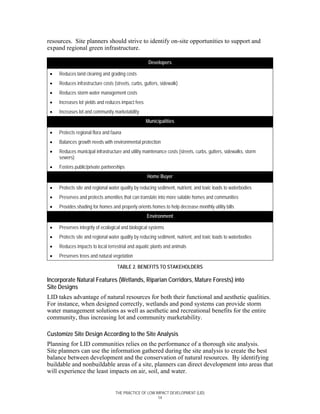
  • 60.
    Minnesota Pollution ControlAgency http://www.mnerosion.org/tools.html A comprehensive manual available online entitled Protecting Water Quality in Urban Areas highlights technical information about BMPs for protecting lakes, streams, and groundwater from storm water-related pollution. New York State Department of Environmental Conservation http://www.dec.state.ny.us/website/dow/swmanual/swmanual.html The New York State Storm Water Management Design Manual provides designers with a general overview on how to size, design, select, and locate storm water management practices at a development site in compliance with state storm water performance standards. Southeastern United States Mississippi State University Agricultural and Biological Engineering Department http://abe.msstate.edu/csd/NRCS-BMPs/pdf/water/quality/bioretentsys.pdf A downloadable, two-page fact sheet providing descriptions and diagrams of a shallow- depression bioretention system. Northern Virginia Regional Commission http://www.novaregion.org/es_pubs.htm A list of publications for purchase and downloading, including documents on BMPs such as The Northern Virginia BMP Handbook and Nonstructural Urban BMP Handbook and publications on Virginia's watersheds. NRDC’s Storm Water Strategies: Strategies in the Southeast http://www.main.nc.us/riverlink/content/07chap/chap07.htm Case studies for addressing storm water management techniques in new development and redevelopment. Western United States Built Green Colorado http://www.builtgreen.org/sites/green.htm The Built Green Colorado Web page with links to many green building resources. Built Green Colorado is a public/private partnership created to encourage home builders to use technologies, products, and practices that enhance energy efficiency, reduce pollution, provide healthier indoor air, reduce water usage, preserve natural resources, improve durability, and reduce maintenance. Caltrans Storm Water Management Program http://www.dot.ca.gov/hq/env/stormwater/index.htm Information on current monitoring studies, publications, conferences, and links are presented in the context of California’s Storm Water Management Program. The site is oriented to reducing the impact of California roadways on aquatic resources. City of Seattle http://www.ci.seattle.wa.us/util/surfacewater/bmp/default.htm Information on simple and effective BMPs for homeowners and businesses provided by THE PRACTICE OF LOW IMPACT DEVELOPMENT (LID) 48
  • 61.
    Seattle Public Utilities.The information includes everyday tips for protecting surface water. U.S. Environmental Protection Agency Region 10 http://www.epa.gov/region10 The Region 10 home page provides general information on the region’s resources as well as links to its programs. This site also includes regularly updated information on environmental issues in the local news. Utah Association of Conservation Districts http://www.ci.north- logan.ut.us/Information/Low%20Impact%20Report/Low%20Impact%20Report.html The community of North Logan developed LID roadway design standards. The site includes documentation of the process, exhibits, standards, and specifications. Southwestern United States Arizona Department of Water Resources http://www.adwr.state.az.us/ A variety of information on all aspects of water resources for the state of Arizona. Pima County Department of Environmental Quality http://www.deq.co.pima.az.us/water/storm.htm Provides information on Tucson and the surrounding area’s storm water management program and components. Pima County Flood Control District http://www.dot.co.pima.az.us/flood/wh/index.html Methods for collecting, storing, and distributing rainwater to reduce residential runoff loads as well as information on harvesting system maintenance. THE PRACTICE OF LOW IMPACT DEVELOPMENT (LID) 49
  • 62.
  • 63.
    SECTION 3: WASTEWATERTREATMENT Properly designed, installed, and maintained on-site wastewater treatment systems can cost effectively treat wastewater and protect the watershed from pollutant overloads.
  • 65.
    3.1 INTRODUCTION Section 2 addressed storm water management issues and explained how rainwater could be used as an asset instead of viewed as a liability in new developments. As we mentioned in Part I, we have expanded LID to include wastewater management. We now turn to the methods and systems that developers can use for effectively treating wastewater generated at residential sites. It is becoming increasingly popular to protect the nation’s surface water and groundwater and prevent further stress from a variety of pollution sources. Approximately 300,000 miles of rivers and shorelines and approximately 5 million acres of lakes are polluted by harmful microorganisms, sediment, and excess nutrients. (http://www.epa.gov/owow/tmdl/overviewfs.html). Wastewater can contain nutrients (e.g., nitrogen, phosphorus), pathogens (e.g., disease organisms), and chemicals (e.g., ammonia, medical byproducts). Thus, developers must ensure that equipment and management methods effectively treat wastewater before it is released into the environment. Table 11 lists current conventional wastewater management practices and technologies and the alternative systems discussed in this chapter. The 1993 HUD Proposed Model Land Development Standards and Accompanying Model State Enabling Legislation publication addressed some of the conventional technologies, which are briefly noted below. To put current technology use into perspective, Figure 10 shows that a vast majority of homes in the United States rely on municipal sewer systems. Wastewater Management Options Discussed in Chapter Conventional Alternative Municipal Sewer Aerobic Single Septic Sand Filters Community Septic Mound Combined On-Site Systems and Sewer Trickling Filter Storage and Removal Evapotranspiration Low-Pressure Pipe TABLE 11. WASTEWATER MANAGEMENT OPTIONS Although only 23 percent of homes in the United States are on individual septic systems, such systems can be a significant source of water pollution. Moreover, the average age of a home with a septic system exceeds 30 years. Further, of those homes on septic systems, an estimated 403,000 experienced system breakdowns in a three-month period in 1997 ( Bureau of the Census, 1999). THE PRACTICE OF LOW IMPACT DEVELOPMENT (LID) 53
  • 66.
    Septic 23% 77% Sewer FIGURE 10. HOW HOMES HANDLE WASTEWATER The management of residential wastewater is a process fraught with technological and regulatory issues. For instance, some communities limit the use of traditional septic systems because improperly maintained systems can release untreated effluent into the soils; in other instances, communities have experienced a number of system malfunctions. Effluent contains excess nutrients and harmful organisms that can adversely affect water quality. Regulatory officials respond to the need to protect our water by adopting progressively stringent wastewater treatment regulations. More specifically, in some cases, communities turn to rigorous regulation of conventional systems as a means of curtailing development, yet they fail to recognize that water quality issues can be addressed by using alternative wastewater management systems. It is important to keep in mind that septic systems are still used effectively and approved throughout the country. However, in response to the problems noted above, private industry continues to develop alternative systems designed to overcome some of the issues that can plague the performance of conventional septic systems. This chapter briefly describes the environmental, cost, and regulatory issues associated with wastewater treatment. It then explains how conventional residential developments deal with wastewater management. The last part of the chapter discusses some of the more common alternative means of wastewater management. Table 12 presents the chapter’s overall objectives. Objective 1: Explain how the use of alternative systems and combinations of systems can reduce on-site infrastructure costs and loadings to municipal sewer systems. Objective 2: Demonstrate alternative lot and site layouts to accommodate a variety of system types. Objective 3: Show how the use of alternative systems and combinations of systems can reduce pollutant loadings to waterways. TABLE 12. WASTEWATER MANAGEMENT OBJECTIVES THE PRACTICE OF LOW IMPACT DEVELOPMENT (LID) 54
  • 67.
    3.1.1 ENVIRONMENTAL ISSUES LID is an approach that uses technologies to • Heavy Equipment--Heavy-duty trucks and other equipment passing simultaneously conserve over a septic system or drainfield may damage the pipes or system and protect natural parts. resource systems and • Clogging--Systems are designed to keep solids, e.g., sludge and reduce infrastructure scum, out of the final effluent. However, if those elements make it to costs. Wastewater can the drainage field, they can cause premature soil clogging such that the affect natural resources; effluent from the septic tank has trouble percolating into the soil and all wastewater coming can pond. from a home must be sent • Roots--Tree and bush roots can enter the system. It is essential to to an effective treatment keep large plants away from the septic system. site or public treatment • Improper Sizing/Design--The system must be large enough for the system in order to limit load and installed in suitable soils as well as in as shallow a trench as adverse environmental possible so that it does not interfere with groundwater. and health impacts. One of the reasons that public • Improper/Lack of Maintenance--Septic systems need routine maintenance, including tank pumping and cleaning and inspection by a officials prefer to rely on licensed professional. Properly maintaining a tank keeps solids from municipal sewer systems accumulating and clogging the leach field. for wastewater treatment is that many of the systems are operated by trained TABLE 13. COMMON REASONS FOR SEPTIC SYSTEM FAILURE technicians who continuously monitor the treatment process to ensure that discharge waters meet local permit or other regulatory requirements. In most cases, wastewater treatment can be handled by one of the four conventional methods noted in Table 11. However, there are exceptions. For instance, in some circumstances, sewer systems cannot be used because of cost considerations; it might be too costly to run pipes long distances to link a proposed development’s wastewater system to existing municipal sewer connections. In other cases, a municipality might have specific health or environmental concerns that make the use of septic systems unacceptable. Nitrogen and phosphorus are two nutrients in wastewater that, either in excess or through cumulative effect, can adversely affect receiving waterbodies. When septic systems fail to operate as designed, excess nutrients in untreated wastewater can enter the environment. Excess nitrogen in streams, lakes, and estuaries stimulates the growth of plants (algae and phytoplankton). Algae in turn consume oxygen, and the decomposition of dense algal blooms leads to anoxia (no oxygen) and hypoxia (low oxygen). Eventually, the aging process of the waterbody is accelerated through a complex chain of events known as eutrophication. Indicators of eutrophic conditions include odors, poor water clarity, stressed marine organisms, and, in severe cases, dead fish. From a public health point of view, conventional septic system failure is one of the main reasons for increased interest in alternative on-site wastewater treatment systems. Table 13 lists some common causes of septic system failure. Conventional septic system failures potentially can contaminate groundwater and surface water with bacteria harmful THE PRACTICE OF LOW IMPACT DEVELOPMENT (LID) 55
  • 68.
    to humans. Further,septic systems with poor nitrogen removal can overload nearby waterways, resulting in algal blooms and adverse impacts on aquatic life. Numerous communities nationwide are attempting to address general water contamination and, in particular, nitrogen loading. For instance, when studies showed that septic systems were threatening groundwater supplies in the Los Angeles area, the Los Angeles Regional Water Quality Control Board voted in 1999 to prohibit the installation of any new septic systems in Ventura County and required the use of septic systems to cease by January 1, 2008 (California EPA Press Release, August 17, 1999). Studies showed that the prohibition was necessary to safeguard the public health and protect the local water supply; community drinking water is pumped from groundwater beneath the discharge area of the septic systems. As part of its overall water conservation plan, Milford, New Hampshire, prohibits septic system use near waterbodies (http://www.ci.milford.nh.us/conservation/streams.html). The Chesapeake Bay watershed is an area greatly affected by water pollutants. The Chesapeake Bay Program, which is designed to protect the bay, determined that between 55 and 85 percent of the nitrogen entering an on-site wastewater treatment system could be discharged into groundwater (U.S. Environmental Protection Agency, 1993). As noted in a U.S. Environmental Protection Agency (EPA) report, “Hydraulically functioning systems can create health and ecological risks when multiple treatment units are installed at densities that exceed the capacity of local soils to assimilate pollutant loads” (U.S. Environmental Protection Agency, 2002). Thus, the concern over septic systems extends to both the inability of septic systems to remove nitrogen and the increased number of septic tanks installed in any one area. Phosphorus is another nutrient that, if discharged from septic systems, can lead to eutrophication of nearby waterbodies, although it is considered less of a threat than nitrogen to groundwater and surface contamination via conventional septic systems. Septic systems are generally effective in adequately removing phosphorus; furthermore, soil particles adequately adsorb soluble phosphorus and extract soluble phosphorus compounds from septic tank effluent as it leaches through the soil profile, thus limiting the movement of phosphorus through the soil. 3.1.2 COST ISSUES Municipal Sewer Connection Fees In addition to environmental issues, economic factors play a role in the selection of an appropriate wastewater treatment system. To connect a home or community to a municipal sewer system, developers must pay certain fees. A community that operates a municipal sewer system often combines the potable water tap fee with the sewer connection fee. In addition, communities sometimes charge developers impact fees to help offset new homeowner impacts on community resources. Impact fees are not new; they have existed since enactment of the Standard Planning Enabling Act of 1922. However, both the number and dollar amount of impact and connection fees have risen dramatically since the early 1900s. In some communities, sewer connection fees have risen to help municipalities pay for system operation and maintenance costs and system expansions. Fees can range from $1,500 per house to over $14,000 per house. Fee increases have exacerbated the affordable housing problem THE PRACTICE OF LOW IMPACT DEVELOPMENT (LID) 56
  • 69.
    currently plaguing portionsof the United States. In a related matter, some communities report that their wastewater treatment facility is at or near capacity, hindering further residential development until facility expansion can accommodate additional growth. In response, HUD's Office of Policy Development and Research created the Regulatory Barriers Clearinghouse to examine how impact fees and other issues affect the creation and maintenance of affordable housing (http://www.huduser.org/rbc/). Conventional Septic Installation and Maintenance Costs The cost of installing septic systems depends on system size, treatment capacity, occupancy, and land issues such as the type of on-site soil. For example, in Minnesota, the costs of installing a septic system can range from $2,000 to $7,000. The average cost to pump the tank’s sludge ranges from $75 to $150. Pumping the tank at the appropriate frequency is less costly than replacing the system’s leach field, which would be needed if solids enter the field from an overloaded septic tank. If a septic system and corresponding leach field need to be replaced in Minnesota, the costs are equal to that of installing a new system - http://www.extension.unm.edu/distribution/naturalresources/components/DD6946c.html. 3.1.3 REGULATORY ISSUES Currently, most local regulations are prescriptive and limit the introduction and use of alternative on-site wastewater treatment systems (OWTS). Public health officials, however, can facilitate the use of alternative OWTSs by revising the applicable codes. The use of alternative systems can reduce the capacity strain on an existing wastewater treatment facility. In fact, some local officials may be willing to allow alternative OWTSs on some but not all lots within a parcel. For instance, some lots may have the appropriate soil composition for the use of conventional septic systems while the soils on other lots in the development may not lend themselves to such systems. Thus, a community that needs to increase the capacity of the local wastewater treatment system could allow a mix of alternative and traditional OWTSs on a single site instead of relying exclusively on alternative systems. This is an example of how LID is flexible in its application. 3.1.4 GENERAL PERFORMANCE STANDARDS In general, wastewater treatment systems take in wastewater, treat it, and release it to the environment. It is difficult, however, for prescriptive codes to specify the full range of technological options appropriate for a given site and anticipate the different sensitivities of the site’s water and land resources. Although the topic is beyond the scope of this publication, public officials could use performance codes to address site-specific natural resource needs while meeting health requirements. In 2002, the National On-Site Wastewater Recycling Association (NOWRA) received a grant to develop draft national on-site performance standards (http://www.nowra.org/model_code.html). The underlying issue and impetus for the project is that local wastewater regulations are usually prescriptive. Although alternative OWTSs have worked elsewhere in the country, local code officials are often reluctant to approve the use of these systems in their jurisdiction when a site does not meet the THE PRACTICE OF LOW IMPACT DEVELOPMENT (LID) 57
  • 70.
    prescriptive requirements. Thegoal of the NOWRA project is to create a set of national OWTS standards that local officials could use for approving the use of innovative systems (Small Flows Quarterly, Winter 2002). The U.S. EPA states in a March 28, 2003 Federal Register notice regarding Voluntary National Guidelines for Management of On-site and Cluster (Decentralized) Wastewater Treatment Systems, “State agencies report that some of these systems have failed because of inappropriate siting or design or inadequate long-term maintenance. Historically high failure rates in some areas indicate a need for better management of these systems to protect public health and water quality.” U.S. EPA has thus developed the Management Guidelines that are designed to enhance system performance through improving the quality of management programs (Federal Register, 2003). You may access this Federal Register notice electronically through the EPA Internet under the Federal Register listings at http://www.epa.gov/fedrgstr/T. 3.2 CONVENTIONAL APPROACHES TO WASTEWATER TREATMENT Developers typically have four options regarding residential wastewater treatment systems: tying into a municipal or public sewer system, providing homeowners with an on-site septic system, using a community septic system, or using a combination of on-site systems and tying into the municipal system. Centralized municipal systems, often available in urban and many suburban areas, are often the most cost-effective option when municipal system connections are proximate to the land to be developed. Municipal systems consist of a series of pipes and pump stations leading to a wastewater treatment facility. The facility treats the water before releasing it to a body of water. In many instances, however, homes in a development cannot connect to a municipal treatment system. It may be cost-prohibitive to connect to a municipal system because of distance to conveyance pipes, or a municipal system already at capacity cannot treat additional effluent. In these cases, developers have traditionally turned to septic systems. A conventional septic system normally treats a home’s wastewater in an underground septic tank located on the property. The life of septic systems depends on the quality of the installation, correct usage, and the frequency of maintenance. With appropriate maintenance, many systems can last for 20 years or more. Two primary factors in a septic system’s successful operation include proper installation and appropriate operation and maintenance. Assuming proper installation, homeowners must ensure that the tank is pumped out as frequently as needed. In addition, given that the bacteria within the tank are sensitive to the wastewater inputs, homeowners should not use the system for the disposal of chemicals such as turpentine, alcohol, and bleach as well as for large volumes of grease and animal fats; such items can clog the system. Developers should provide homeowners with a list of “things to do and not to do”. The National Small Flows Clearinghouse sells The Homeowner On-Site System Recordkeeping Folder (Item #WWBLPE37) and the Homeowner Septic Tank Information Package (Item #WWPKPE28) to help homeowners record and store information about their septic system and to educate homeowners on system care and system (http://www.nesc.wvu.edu/nsfc/nsfc_septicnews.htm#septic). In addition, the U.S. EPA has created a free, one-page Homeowner Septic System Checklist to highlight the homeowner’s septic system maintenance needs (U.S. EPA, 2003). THE PRACTICE OF LOW IMPACT DEVELOPMENT (LID) 58
  • 71.
    Another wastewater managementoption sometimes used by developers is a communitywide wastewater treatment system. Although the vast majority of today’s homes either use single septic systems or are connected to public sewer, some developers have installed communitywide septic systems. The systems treat wastewater for a group of homes in a manner similar to a septic system for a single home. Small community cluster systems often try to take the best attributes of municipal sewers and septic systems and use them to reduce wastewater treatment system installation costs while meeting environmental goals. The systems transport wastewater from homes via sewer pipes to either a conventional treatment plant or a pre-treatment facility. The effluent is then discharged to soils similar to those required in the last stage of a single septic system’s treatment process. Some communities install a centrally located package wastewater treatment plant that connects each home in that community to the plant. The package system is similar to public wastewater treatment facility except that the effluent from the homes travels to a privately owned and operated treatment plant located in the community (sometimes referred to as “small community sewer” or “distributed sewer”). A small number of jurisdictions are using natural open spaces, golf courses, and soccer fields as areas for drip irrigation of semitreated effluent. Such uses of open space allow effluent to be effectively disposed of across large areas. Another benefit of is that the systems can be created as needed. The developer can calculate how much effluent the entire development will likely generate and then phase in the system as homes are built. The system’s potential drawbacks include a perception that odor will be a problem or that public health will be compromised. In several communities, community systems have proven themselves a feasible alternative. For example, in Warren Village, Vermont, nearby streams had become polluted in part because of a combination of dense development, small lot sizes, and failed single septic systems. When residents determined that a municipal sewer system was too expensive, the town used two parcels--a soccer field and a vacant lot-- as common leaching fields with a total capacity of 30,000 gallons per day. Homeowners whose lots lacked adequate wastewater disposal capacity could pay the newly formed wastewater management district $250 per user per year to discharge to the community system (http://www.daylor.com/projects/Gloucester/CommunityWastwater.htm). Community systems can also facilitate the use of smaller house lots. Single septic systems need an adequate land area for the leach field. With community systems, the final treatment location is consolidated into one large leach field instead of relegated to several individual fields. Allowing for smaller lots can help the developer preserve open space, furthering the goals of low-impact development. Some instances warrant a combination of sewer hook-up and septic system installation. . For example, a municipal sewer system may be able to serve only an additional 50 homes, yet a proposed development calls for 200 homes. Public officials and the developer might agree to hook up 50 of the new homes to the public system and serve the rest of the homes with an on-site septic tank system. A combination system might also be warranted when soils on part of the development are not suitable for septic tank installation. In this instance, the lots that cannot accommodate THE PRACTICE OF LOW IMPACT DEVELOPMENT (LID) 59
  • 72.
    septic systems couldbe connected to the municipal system while the rest of the lots could be served by septic systems or municipal connections. Clearly, each parcel of land is often suited to a variety of options available to the developer. Developers can help create cost-effective developments by weighing all the wastewater management options and determining which will yield the best performance at the least cost. The LID approach helps increase the number of wastewater management system options available to the developer. THE PRACTICE OF LOW IMPACT DEVELOPMENT (LID) 60
  • 73.
    3.3 ALTERNATIVES TO CONVENTIONAL SYSTEMS Table 14 contains a brief description of the OWTSs highlighted in this chapter. Listed below are expanded explanations of the alternative systems that provide secondary treatment and that might allow for on-site wastewater treatment (U.S. Environmental Protection Agency, 2002). OWTS Type Key Components Situations Where Its Use Might Be Appropriate • Septic tank, sand filter, and • Where soil conditions do not allow Sand Filters sometimes a recirculation for percolative beds/trenches tank • High groundwater • Slow- or fast-permeability soils • Pre-treatment unit(s), dosing Mound (pumping) chamber, and • Shallow rock cover over creviced or elevated mound porous bedrock • High groundwater • Circular bed of coarse or Trickling Filter plastic material and rotating • High concentrations of organic distributor material in wastewater • Pre-treatment unit, evapotranspiration sand bed, • Annual evaporation rate exceeds Evapotranspiration bed liner, fill material, annual rate of precipitation and monitoring, overflow wastewater applied protection, and surface cover • Where soils would become clogged • Septic tank, pumping (dosing) as a result of localized overloading Low-Pressure Pipe chamber, and small-diameter • High groundwater pipes • Anaerobic conditions due to continuous saturation • Aeration compartment, • Where septic systems have failed Aerobic settling chamber, pre- • Where lot size is not sufficiently treatment compartment large to accommodate a standard (optional) septic system drainfield Proprietary Systems • Varied • Where conventional septic systems or sewer hook-ups are not feasible TABLE 14. ON-SITE WASTEWATER TREATMENT SYSTEM ALTERNATIVES Alternative systems can use anaerobic bacterial action, i.e., the bacteria decomposes waste in the absence of oxygen, while other systems need oxygen (i.e., aerobic) to operate properly. In addition, hybrid systems use a combination of aerobic and anaerobic processes. Developers can consider a variety of on-site wastewater treatment system options either as alternatives or enhancements to conventional septic systems. By using the LID approach, developers often uncover information and options that can help facilitate the development approval process. THE PRACTICE OF LOW IMPACT DEVELOPMENT (LID) 61
  • 74.
    While municipal seweror on-site septic systems may be the most recognized wastewater treatment options, some sites might lack both sewer access and the ability to accommodate a septic system. Some of the limiting factors for septic systems include lot size (an ample soil absorption field is necessary), groundwater level, depth of bedrock, and on-site soil types. For example, dense clay or rocky soils can inhibit the use of septic systems. Recognition of various limitations has led to increased interest in and the development of alternative on-site wastewater treatment systems. Alternative on-site wastewater treatment systems range from adding treatment steps Examples Where a Septic System May (e.g., intermittent sand filter) to a conventional Not Be Allowed on a Lot septic system to the reliance on proprietary Lot size too small systems that omit the use of traditional septic Wrong types of soils tanks. In fact, as technology grows more High groundwater level sophisticated, , it is often more important to Shallow soils/Depth of bedrock establish an operation and maintenance plan Steep slopes for an alternative OWTSs than for an ordinary Soil does not percolate septic system. When lots cannot be developed to take advantage of conventional wastewater management techniques (e.g., municipal sewer or on-site septic systems), the use of alternative OWTSs (discussed below) can make those lots suitable for development. Before using an alternative OWTS, however, developers are advised to familiarize themselves with the local public health criteria related to wastewater effluent and to recognize that, as opposed to municipal sewer systems, which are usually regulated by codes at the state level, local public health officials regulate on-site systems. The lack of information on the systems and absence of third-party verification of alternative system performance make public health officials reluctant to alternative OWTS. In general, public officials are most concerned with ensuring a certain level of public health, not with facilitating land development; therefore, officials often need to be educated about the efficacy of alternative systems. On a related note, some public officials and environmental groups have expressed concern that the use of septic and/or alternative OWTSs will foster sprawl. The use of OWTSs by themselves does not lead to unchecked growth; indeed, the best way to manage growth effectively is through prudent zoning, not by eliminating potential wastewater treatment solutions or creating barriers for the adoption of alternative technologies related to development. 3.3.1 PROCESS FOR IDENTIFYING POTENTIAL ON-SITE WASTEWATER TREATMENT SYSTEM ALTERNATIVES Each parcel of land is unique in terms of its size, shape, and soil types. If public health officials indicate that an alternative OWTS is a feasible option, then developers should consider several factors to identify the types of systems that might be used. For instance, OWTSs are more complex than septic systems and thus require a higher level of maintenance and supervision and may need additional excavation during installation to accommodate the various systems’ several components. Table 15 briefly describes the various factors to be considered. THE PRACTICE OF LOW IMPACT DEVELOPMENT (LID) 62
  • 75.
    Costs can varyfor different OWTS options. For instance, community wastewater treatment systems that rely on gravity to transport wastewater can require deep and thus costly excavations, but the use of pressurized systems with small-diameter plastic pipes can minimize excavation costs. Some OWTS alternatives to conventional systems, such as recirculating sand filters and evapotranspiration systems, are “add-ons” to a traditional septic tank system. The additional treatment unit is connected in-line with the septic tank and provides an extra level of treatment. Although it may seem more costly to add another layer of treatment, alternative treatment systems may be less costly if conventional wastewater management methods require the hauling of extra fill material or the construction of a retaining wall. As for other cost issues, alternative OWTSs may need electricity to operate the pumps that are sometimes required as part of the treatment system itself and that are sometimes needed to move wastewater from the house to the treatment area. In addition, the inclusion of other features such as recirculation piping, aeration, and an increased need for cleaning/pumping may increase an alternative system’s operation and maintenance costs. Another economic issue associated with the use of an alternative OWTS is the long-term operation and maintenance (O&M) costs and related organizational framework required • Aesthetics--Both the general public and public officials will be most aware of aesthetic concerns. In short, potential insect problems and odor issues must be addressed and mitigated. • Capacity--The system must be able to handle the home’s capacity; the approval process will consider both rate and volume of sewage flow. In addition, public officials may want the system to be able to handle more than the current load to accommodate changing uses of the home. • Cost--The upfront costs of alternative OWTSs can often be higher than the costs of traditional septic systems. In addition, the complexity of alternative systems yield somewhat higher operation and maintenance costs (e.g., the alternative systems usually need electricity to treat waste). • Efficiency and Reliability--The community at large will be interested in any third-party reports and data indicating how well the proposed systems treat or remove potentially harmful wastewater components. In addition, the system must have adequate safeguards to warn the occupant of system failure. • Environmental and Public Health--A system must maintain or improve environmental quality and adequately address public health issues. • Operation and Maintenance (O&M)--As an emerging issue in the on-site wastewater treatment field, OWTSs require more monitoring than standard septic systems; thus, the local jurisdiction or a third party must ensure the proper maintenance of equipment. • Siting--Soil type and lot size are often determining factors when siting OWTSs. For instance, only about one- third of the land area in the United States has soils suitable for conventional subsurface soil absorption fields. Source: U.S. EPA, 2002. TABLE 15. FACTORS TO CONSIDER WHEN EVALUATING ON-SITE WASTEWATER TREATMENT SYSTEMS with the systems. Given that innovative systems usually require more frequent and ongoing O&M than conventional systems, developers, public officials, and communities must work together to develop an O&M plan and establish an entity that will ensure THE PRACTICE OF LOW IMPACT DEVELOPMENT (LID) 63
  • 76.
    effective system performance.Such an entity can oversee O&M activities, reduce liabilities, and establish service boundaries (Jones et al., 2001). The following list offers criteria for determining situations in which an alternative OWTS could be most helpful: • When sewer is not located nearby. If a given plot of land is not located close to existing infrastructure, thus making it costly to establish public sewer connections, then OWTS might be an effective option. • When the wastewater treatment facility is at capacity. In some locales, the wastewater treatment facility is at capacity and cannot accept any more connections. In these instances, either a new facility will have to be built or the existing facility will have to be expanded. Either option will require the public’s investment and time and will potentially delay land development. • When a lot is too small. If local ordinances dictate that a lot is too small to accommodate a septic field, an alternative OWTS might help reduce the size of the required absorption field. • When a watershed requires higher-quality effluent. In some instances, a watershed has effluent requirements that exceed the effluent characteristics normally produced by septic systems. Once again, the enhanced wastewater treatment available with some alternative OWTSs may help provide a solution. • When groundwater supply is limited. Instead of pumping water off site through a sewer, an OWTS keeps water on the site; properly treated effluent from an alternative OWTS can help recharge the local groundwater aquifer. • When deep excavation is needed for a septic system. Some alternative systems do not require as much excavation as septic systems, thus reducing initial costs. Another way to look at the system selection process is through a variety of stakeholders’ lenses. Figure 11 provides an overview of some of the groups interested in the process of selecting an appropriate OWTS and their relevant concerns (U.S. Environmental Protection Agency, 1997). THE PRACTICE OF LOW IMPACT DEVELOPMENT (LID) 64
  • 77.
    Legislative Concerns ▪ Adequacy of Existing Institutional Economic Concerns Arrangements ▪ Fiscal Equity ▪ Legal Requirements ▪ Ability to Pay (Federal/State) ▪ Ability to Generate ▪ Relationships Among Necessary Environmental Concerns Affected Agencies ▪ Physical Conditions Revenue ▪ Planning/Enforcement/ ▪ Grant/Loan Availability ▪ Climatic Conditions Operating Capabilities ▪ Accountability ▪ Water Quality ▪ Adequacy of Treatment ▪ Borrowing Capacity ▪ Future Growth Potential Administrative Concerns Engineering Concerns ▪ Record-keeping ▪ Suitable Design Practices ▪ Appropriate Technology TECHNICAL ISSUES INSTITUTIONAL ISSUES ▪ Decision-making Process ▪ Operating Condition ▪ Staffing Capability ▪ Performance/Reliability ▪ Regulatory Requirements ▪ Residuals Volume/ ▪ Formal and Informal Characteristics Interagency Relationships Social Concerns ▪ Willingness to Assume Responsibility ▪ Public Support ▪ Educational Program Maintenance Requirements Improvements/Repairs Surveillance Needs Ownership Status Operational Procedures Regulatory Provisions Financial Planning Source: Response to Congress On Use of Decentralized Wastewater Treatment Systems, http://www.epa.gov/owm/decent/response. FIGURE 11. OVERVIEW OF PARTIES INTERESTED IN WASTEWATER TREATMENT DECISION MAKING In some situations, conditions do not permit the installation of septic systems, particularly if soils are not appropriate or lot sizes are not sufficiently large to support a leach field. For example, the Floyd County, Kentucky, Plan Commission recently proposed a zoning ordinance amendment that would use soil conditions to dictate how many homes could be built per acre with septic systems (The Courier-Journal, Louisville, KY, May, 2002). In the worst soil and topographic conditions, the proposed amendment would limit development to one house with a septic system per 20 acres. As previously noted, there are a variety of alternative systems available to developers. Below are descriptions of the different systems. Also included are considerations developers can take into account when deciding which systems to include in a new development. THE PRACTICE OF LOW IMPACT DEVELOPMENT (LID) 65
  • 78.
    3.3.2 SAND FILTERS Intermittent Sand Filters Sand filter systems treat the effluent downstream from a conventional septic tank. Two of the more common sand filter systems are the single-pass system (i.e., intermittent) and the recirculating system. In the single-pass system, the wastewater first undergoes primary treatment in a septic tank. The effluent is then applied intermittently to the top of a bed of sand (or other suitable media) that sits on an impermeable liner and percolates through the sand into drains located at the bottom of the bed (see Figure 12). As the wastewater passes through the sand filter, both physical and chemical processes treat the effluent, although microorganisms attached to the fixed media primarily treat the effluent. The effluent is then piped to the leach field for further treatment and disposal. Bottomless systems have no impermeable liner and do not discharge to a drainfield but rather to the soil below the filter. Source: National Small Flows Clearinghouse Fact Sheet, 1998. FIGURE 12. TYPICAL CROSS-SECTION OF AN INTERMITTENT SAND FILTER Intermittent sand filters produce a high-quality effluent by removing a high percentage of contaminants. The filter’s ability to perform adequately depends on the filter’s design and composition and, hence, the biodegradability of the wastewater and the environmental factors within the filter. The most important environmental factors include media re-aeration and temperature. Re-aeration makes oxygen available for the wastewater’s aerobic decomposition. Temperature directly affects the rate of microbial growth, chemical reactions, and other factors that contribute to the stabilization of wastewater within the system. System pumps and controls should be checked every three months while the sludge build-up in the septic tank should be checked as needed. Installation costs of intermittent sand filters, including labor and materials, generally range from $7,000 to $10,000. Daily energy costs for pumping the wastewater onto the filter bed run between $0.03 and $0.06. Recirculating Sand Filters In situations without sufficient land area for a single-pass filter system, recirculating sand filter systems are an option. In a recirculating system, wastewater first undergoes treatment in a septic tank. The pre-treated effluent then flows into a recirculation tank THE PRACTICE OF LOW IMPACT DEVELOPMENT (LID) 66
  • 79.
    along with someof the water that has already passed through the sand filter. A pump transports the wastewater mixture from the tank to the sand filter, where microorganisms attached to the filter media carry out treatment. The treated effluent collects at the bottom of the filter; some of the effluent is sent back to the recirculation tank for further treatment and some is sent out for disposal or another type of treatment disinfection. In this type of system, the sand is periodically changed (see Figure 13). Source: National Small Flows Clearinghouse Fact Sheet, 1998. FIGURE 13. TYPICAL RECIRCULATING SAND FILTER SYSTEM Recirculating sand filters are relatively low-maintenance systems whose operating costs are generally modest. Operation and maintenance costs were under $5,000 for a • Peat Filters--Organic particles and suspended 135-home septic tank system in Elkton, solids are removed by passing wastewater Oregon, including $780 for electricity and 25 through a peat bed. to 30 labor hours per month. The • Batch Reactors--To increase nitrogen-removal replacement of the media represents one of efficacy, batch reactors alternate between the system’s most expensive maintenance oxygen-rich and oxygen-poor cycles and treat items. Thus, it is prudent to use locally one batch of wastewater at a time. available materials. For example, the capital • Activated Sludge Systems and Aerobic cost (land not included) for a 5,000 gallon per Treatment--Biooxidation (aerating wastewater) day system with black beauty™ sand media and oxygen-poor settling areas improve that was not locally available totaled about treatment. $68,600. That same system cost $36,000 with standard sand media. TABLE 16. SECONDARY TREATMENT Other types of filters provide secondary wastewater treatment (see Table 16). 3.3.3 MOUND On lots with high water tables or soils unsuited to septic systems, a mound of suitable soils is placed on top of the soils that do not permit the use of a septic system. The primary treatment takes place in the septic tank. The wastewater from the tank passes THE PRACTICE OF LOW IMPACT DEVELOPMENT (LID) 67
  • 80.
    through a filter(to eliminate additional solids) and discharges to a dosing chamber. The effluent is then spread uniformly on the mound, which acts as an elevated or above- ground drain field. Typically, a mound system requires a pump that sends the effluent from the septic tank upward into perforated pipes that are located in the mound within a layer of fabric-covered coarse-gravel aggregate. The mound is often a soil cover that can support vegetation (see Figure 14). Source: National Small Flows Clearinghouse Fact Sheet, 1998. FIGURE 14. SCHEMATIC OF A WISCONSIN MOUND SYSTEM The mound’s height should be sufficient to treat the effluent effectively before it reaches the limiting soils, bedrock, or high water table. In general, codes require a mound height between one and four feet. Mound slopes can be up to 25 percent. Mounds should be sited well away from flood plains, drainage ways, or depressions unless flood protection is provided. Sand suitable for a mound system should contain 20 percent or less material greater than 2.0 mm and 5 percent or less finer than 0.053 mm. Mound design depends on several additional factors, including the number of rooms in a home; up to 150 gallons per day per bedroom are allowed. In addition, to minimize the number of solids entering the mound filter, the septic tank and dosing chamber must be watertight. In Wisconsin, the mound system success rate is more than 95 percent. A typical mound system in Wisconsin costs approximately $9,000 to construct, with another $750 in site evaluation, design, and permitting costs. The operation and maintenance costs range from $125 to $200 per year. 3.3.4 TRICKLING FILTER Trickling filters are effective in removing nitrogen from wastewater. They trickle wastewater over a fixed medium (coarse stones or plastic material) covered with a bacterial mat that removes nitrogen from the effluent. A rotating distributor, which is a rotating pipe containing several holes, evenly distributes the wastewater from above the filter medium. Microorganisms on the medium break down the organic materials in the wastewater as it passes through the medium (see Figure 15). THE PRACTICE OF LOW IMPACT DEVELOPMENT (LID) 68
  • 81.
    Source: National SmallFlows Clearinghouse Fact Sheet, 1998. FIGURE 15. SCHEMATIC OF A TRICKLING FILTER Trickling filter systems are especially effective when the receiving waterbodies are highly sensitive to nitrogen loading. The filters successfully remove ammonia nitrogen by oxidizing it to nitrate nitrogen. The nitrate nitrogen is then converted into nitrogen gas that is vented to the atmosphere. The filters can accomplish ammonia nitrogen removal in one- or two-stage systems. In a single-stage unit, carbon oxidation (removal of organic material) and nitrification occur in the same unit. In two-stage systems, separate stages operate independently to complete the organic removal and nitrification steps. Trickling filters are highly sensitive to how much oxygen is available and to nitrogen loading rates. 3.3.5 EVAPOTRANSPIRATION The two primary types of evapotranspiration (ET) systems are the standard ET system and an ET/absorption system (ETA). The more common is the ET system, which comprises a septic tank, an ET sand bed with wastewater distribution piping, a bed liner, fill material, monitoring wells, overflow protection, and a surface cover. Vegetation grows on the cover to facilitate the transpiration process. Evapotranspiration systems are especially important on sites in need of surface and groundwater protection. An ET system can operate solely as a system that disposes of wastewater into the atmosphere through evaporation from the soil surface and/or transpiration by plants, or it can combine such treatment with seepage. THE PRACTICE OF LOW IMPACT DEVELOPMENT (LID) 69
  • 82.
    Source: National SmallFlows Clearinghouse Fact Sheet, 1998. FIGURE 16. CROSS-SECTION OF A TYPICAL EVAPOTRANSPIRATION BED In a system that does not seep, the effluent flows from the septic tank into the lower portion of the sealed ET bed, which contains continuous impermeable liners and sand. Capillary action in the fine sand causes the wastewater to rise to the surface and escape into the atmosphere via evaporation. At the same time, vegetation brings wastewater from plant roots to the leaves, where it is transpired. An ET incorporates an unsealed bed, which allows for evaporation, transpiration, and percolation (see Figure 16). To prevent overloading (with undersized systems) or excessive capital costs (with oversized systems), the design of ET systems requires accurate estimates of wastewater flow rates. The availability of land can limit the size of ET systems: up to 4,000 to 6,000 square feet of area is typically needed for a single-family home. However, the most important factor for ET systems is climate. Precipitation, humidity, wind speed, temperature, and the amount of solar radiation must are important considerations. For instance, system overloading can occur if large amounts of rainfall enter the system over a short period of time. Thus, ET systems are most suitable for use in arid to semi-arid locations such as the western and southwestern parts of the United States. The typical minimum cost for an ET system for a three-bedroom residence is $10,000. 3.3.6 LOW-PRESSURE PIPE A low-pressure pipe (LPP) system is a shallow, pressure-dosed soil absorption system with a network of small-diameter perforated pipes placed in narrow trenches (see Figure THE PRACTICE OF LOW IMPACT DEVELOPMENT (LID) 70
  • 83.
    17). LPP systemscan be used to address septic system issues such as soil clogging from localized overloading, mechanical sealing of the soil trench during construction, anaerobic conditions resulting from continuous saturation, and a high water table. A typical LPP system consists of a septic tank for primary treatment. Partially treated effluent then flows by gravity to a pumping chamber, where it is stored until it reaches the level of the upper float control. Once the water reaches that level, the pump turns on and usually sends one to two batches of wastewater per day to the trenches via the distribution pipes. During each dosing cycle, the depth of wastewater in the trenches does not exceed two to three inches of the total trench depth. Source: National Small Flows Clearinghouse Fact Sheet, 1998. FIGURE 17. LOW-PRESSURE PIPE SYSTEM Two critical factors affecting LLP system performance are the dosing and distribution of the effluent. The dosing must be correct to maintain aerobic conditions in the trench, and effluent must be evenly distributed to avoid localized overloading. A properly designed and installed LPP system needs little maintenance. For instance, North Carolina requires LPP systems to be inspected at least once every six months. The septic tank and pumping chamber should be checked periodically for sludge and scum build-up as needed. Watertight pumping tanks are necessary to ensure that drainfields do not inadvertently become hydraulically overloaded. In a 1989 study of LPP use in North Carolina, the average cost to install an LPP system for a three-bedroom home was $2,600. The more LPP systems used in a county, the less is the average cost per system. In counties with several systems, the cost was approximately $1,500 per system as compared with $5,000 per system in counties with few LPP systems. 3.3.7 AEROBIC SYSTEMS Similar to conventional septic systems, aerobic systems also use natural processes to treat wastewater. However, septic treatment does not require oxygen (anaerobic), whereas aerobic treatment does need oxygen. Thus, aerobic units include a device that injects air into and circulates it inside the treatment tank. According to U.S Environmental Protection Agency, aerobic treatment units can range in size from 400 to 1,500 gallons and usually include an aeration compartment and a settling THE PRACTICE OF LOW IMPACT DEVELOPMENT (LID) 71
  • 84.
    chamber. Some unitsalso include a pre-treatment compartment to remove garbage and grease (U.S. Environmental Protection Agency, 2000b). In addition, electrical service is required for the aeration equipment and pumps. The two types of aerobic systems most often used for single-family homes are fixed-film and suspended-growth systems. Fixed-film systems are not available commercially and, as proprietary devices, are not described in detail here. Suspended-growth systems use microorganisms suspended in the waste stream to break down the wastes. An aerobic system’s application is limited primarily by soil conditions and topography. A site should have a percolation rate of less than 60 minutes per inch, its depth to the water table or bedrock should be two to four feet, and it should have level or slightly sloping topography. Aerobic systems vary in cost, from $2,500 to $9,000 installed. In addition, the units must be maintained more frequently than a septic system. The recommended quarterly servicing costs about $350 per year. 3.3.8 PROPRIETARY SYSTEMS Proprietary technologies are designed to provide turnkey solutions to developers’ wastewater treatment needs. Below are brief descriptions of the proprietary systems available today as well as the latest Web sites containing more information on the systems. • Alascan--http://www.alascanofmn.com/ Alascan offers a variety of wastewater treatment options and systems to meet different needs, including source separation systems that separate blackwater from greywater and low-flush toilets that, according to the manufacturer, can reduce a home’s water usage by 40 to 80 percent. • Bio-Microbics, Inc.--http://www.biomicrobics.com/ Bio-Microbics, Inc., has created a Fixed Activated Sludge Treatment (FAST®) process. suited for use in single-family dwellings, clustered residential developments, and subdivisions. It can also be used to retrofit a failed conventional septic system. • Cromaglass-- http://www.americanpump.com/croma3.htm One of the more notable Cromaglass systems is the Cromaglass Batch Treat Process. The manufacturer claims that biological oxygen demand (BOD) and total suspended solid (TSS) removal rates exceed 90 percent and that independent laboratory research verifies system efficacy. • E/One Sewer Systems--http://www.eone.com/sewer/intro/index.html E/One offers several wastewater treatment systems sized to meet a customer’s unique conditions. For instance, the GP 2010 is designed for single-family homes, whereas the GP 2016 is suited for multiple dwellings. The Web site provides brief case studies. THE PRACTICE OF LOW IMPACT DEVELOPMENT (LID) 72
  • 85.
    Global Water Systems-- http://www.globalwater.com/encampment.htm Global’s source separation systems treat greywater for reuse in toilet flushing or irrigation. • MicroSepTec, Inc.-- • Blackwater-- Toilet wastes in wastewater http://www.microseptec.com/ • Greywater--Washwater excluding toilet wastes The MicroSepTec (MST) system is an on-site wastewater treatment system that can be used for residential applications. In addition, MicroSepTec, Inc., is a full-service septic solution provider and will assist with permits, engineering, project management, maintenance, and monitoring. • Orenco Systems, Inc.--http://www.orenco.com/ Orenco Systems® offers on-site (decentralized) treatment solutions for many types of residential properties for small flows and large flows, household-strength waste and high- strength waste, poor soils, and high groundwater. The company provides a variety of package solutions. • Waterloo Biofilter Systems, Inc.--http://www.waterloo-biofilter.com/ The Waterloo Biofilter ® is a patented trickle-filter–type treatment system that uses a filter medium to treat residential and industrial wastewater. Wastewater is sprayed intermittently onto the medium and allowed to drain through by gravity. 3.4 ADDITIONAL RESOURCES Additional resources with more detail on wastewater treatment are included below. They are not provided as endorsements, merely as educational and reference tools. Given regional variations in climate and land development needs, we have tried to include region-specific resources. It is important to note, however, that addresses, especially Internet links, are subject to change. This list contains the latest links and addresses as of the printing of this publication. Wastewater Manuals and Best Management Practices National On-Site Demonstration Program http://www.nesc.wvu.edu/nodp/nodp_index.htm The National On-Site Demonstration Program (NODP), established in 1993, was developed to encourage the use of alternative on-site wastewater treatment technologies to protect the public health, ensure water quality, and sustain the environment in small and rural communities. Funded through the U.S. Environmental Protection Agency (EPA) and directed by the National Environmental Services Center of the National Research Center for Coal and Energy at West Virginia University, the NODP provides communities throughout the country with information on cost-effective alternatives to centralized wastewater treatment systems. U.S. Environmental Protection Agency http://www.epa.gov/ORD/NRMRL/Pubs/625R00008/625R00008.htm THE PRACTICE OF LOW IMPACT DEVELOPMENT (LID) 73
  • 86.
    The 2002 On-siteWastewater Treatment Systems Manual is the U.S. Environmental Protection Agency’s latest publication covering on-site wastewater technologies. As an update of the 1980 On-Site Wastewater Treatment and Disposal Systems, it provides supplemental and new information for wastewater treatment professionals in the public and private sectors. This manual is not intended to replace the previous manual but rather to explore further and discuss recent developments in treatment technologies, system design, and long-term system management. Washington State Department of Ecology http://www.ecy.wa.gov/biblio/9911.html Washington's Storm Water Management Manual for Western Washington describes the storm water management standard for all new development and redevelopment projects in the Puget Sound region. Organizations and Internet Resources Canadian Housing Information Center (CHIC) http://www.cmhc-schl.gc.ca/publications/en/rh-pr/tech/01-138-E.htm Innovative On-Site Wastewater Treatment The Canadian Housing Information Center has researched problems with residential septic systems across Canada and found surface breakouts, back-ups into houses, and contamination of groundwater supplies as evidence of system failures. Such problems arise from excessive water usage and lack of maintenance; inadequate site assessment, especially in marginal soils; outdated design practices; or poor construction. http://www.cmhc-schl.gc.ca/en/imquaf/himu/wacon/wacon_001.cfm Water conservation has been at the forefront of resource efficiency issues in Canada. In an effort to reduce water consumption, CMHC has conducted research into residential water reuse and innovative wastewater treatment technologies. Case Study of the Month presents water projects either supported by CMHC or undertaken by the private sector. Hazen and Sawyer http://www.co.sarasota.fl.us/environmental_services/pcssrp/pdfs/40075r048.pdf Evaluation of On-site Wastewater Treatment and Wastewater Collection System Alternatives (TM No.7) An assessment of available and applicable OWTS and collection system technologies determines the technologies’ ability to improve current wastewater treatment and disposal practices in the Sarasota, Florida area. NAHB Research Center http://www.toolbase.org/tertiaryT.asp?TrackID=&DocumentID=3789&CategoryID= 1843 On-site wastewater treatment systems can allow the construction of new homes on otherwise vacant infill lots in neighborhoods whose centralized wastewater treatment systems are beyond capacity. To find the best and most cost-effective aerobic treatment system, the Research Center is working with Anne Arundel County, Maryland, and will monitor the installation of several innovative on-site aerobic wastewater treatment systems on residential field sites. Approximately 25 percent of all homes in the county use on-site wastewater treatment systems, most of which are septic tanks. THE PRACTICE OF LOW IMPACT DEVELOPMENT (LID) 74
  • 87.
    Rocky Mountain Institute http://www.rmi.org/images/other/W-ComDecMakWstwtrSys.pdf CaseStudies of Economic Analysis and Community Decision Making for Decentralized Wastewater Systems The Rocky Mountain Institute is conducting an 18-month project to increase understanding of how communities consider and value the benefits and costs of different- scale wastewater facility options (on-site, cluster, and centralized options) in dollar or other terms. The project also is examining the driving issues, motivations, thought processes, and decision-making methods of stakeholders relative to choices of wastewater system scale. Small Flows Quarterly http://www.nesc.wvu.edu/nsfc/nsfc_index.htm The National Small Flows Clearinghouse (NSFC), funded by the U.S. Environmental Protection Agency, helps America's small communities and homeowners solve their wastewater problems and thereby protect the public health and the environment. The successful long-term operation of wastewater systems protects drinking water sources from contaminants and natural systems from pollutants. The NSFC assists in planning, operating, financing, and managing new or existing sewage systems, both for individual households and communities of less than 10,000 people. One of the Small Flows Quarterly’s most recent peer-reviewed articles, “Proposed National On-Site Standards: A Broad Assessment of Their Relative Benefits to Industry,” proposes ideas about on-site wastewater treatment management in small communities. In most states, regulatory systems dominated by prescriptive codes restrict the activities of on-site wastewater treatment system manufacturers and suppliers. The Home Inspection and Construction Information Website http://www.inspect-ny.com/septic/lockwood.htm Septic Systems--An Engineer’s View The Home Inspection and Construction Information Web site describes septic systems, their operation, and the reasons for system failure. Contributed by Lockwood, Dietershagen Associates Licensed Professional Engineers, Clifton Park, New York. U.S. Environmental Protection Agency http://www.epa.gov/OW/index.html The Office of Water provides an immense amount of information on the protection and conservation of our nation’s water resources. Regional-Specific Resources Northeastern United States Cornell Local Government Program http://www.cardi.cornell.edu/clgp/septics/Exec_Summ.PDF Increasingly, rural communities, unsewered subdivisions, and responsible agencies are aware of issues and concerns associated with treating and managing human waste products with on-site wastewater treatment systems (OWTSs or septic systems). This guide provides an information framework for those seeking change. THE PRACTICE OF LOW IMPACT DEVELOPMENT (LID) 75
  • 88.
    The New EnglandInterstate Water Pollution Control Commission Regulatory Cooperation Project http://www.neiwpcc.org/iatech.html An interstate effort to evaluate innovative/alternative (I/A) on-site technologies capable of protecting the public health and the environment. The project provides states with an efficient review process for I/A technologies. By bringing together the interests of regulators and end users, the effort facilitates independent evaluation of environmental technology performance. Southeastern United States Commonwealth of Virginia State Board of Health http://www.vdh.state.va.us/formfeed/VDH88.PDF Regulations Governing Application Fees for Construction Permits for On-Site Sewage Disposal Systems and Private Wells Western United States City of Oregon City--Development Services Department Engineering Division http://www.orcity.org/public-works/design-standards/sewer/index.html Sanitary Sewer Design Standards Oregon City Development Services (Oregon) created sewer design standards to provide a consistent policy under which certain physical aspects of sanitary sewer design will be implemented. Orenco Systems Incorporated http://www.orenco.com/ccs/ccs_caseStudy.asp Orenco Case Study--Diamond Lake, Washington: 12-Year-Old Effluent Sewer Requires Little Maintenance The community of Diamond Lake, in northeast Washington, protected an 800-acre lake by replacing all the community’s old, leaking septic tanks and inadequate disposal systems with watertight tanks and an Orenco effluent sewer system. THE PRACTICE OF LOW IMPACT DEVELOPMENT (LID) 76
  • 89.
    . SECTION 4: CIRCULATION AND DESIGN Reconsidering traditional methods for planning and accommodating pedestrian and vehicular circulation is part of a cadre of better site design techniques that can simultaneously reduce development costs, protect the environment, and create win-win situations for builders, municipalities, and residents.
  • 90.
  • 91.
    4.1 INTRODUCTION As the struggle to decrease nonpoint source pollution in our nation’s waters continues, municipalities have begun to reexamine the connection between circulation design and storm water management practices. New designs for streets, sidewalks, and driveways can maintain the functions of circulation while helping to reduce expanses of impervious surfaces that can alter local hydrology and degrade water quality. In turn, new street designs can influence the layout of lots and help to increase the volume of open space in new residential developments. These considerations all contribute to creating low impact developments. This section examines alternative street and lot layouts and their associated environmental and cost benefits. Vehicular and pedestrian circulation systems have always played an important role in organizing and defining residential communities. Traditionally, residential or local streets have been designed with a focus on accommodating community access, circulation, and parking. In the years before World War II, older, close-in suburban neighborhoods were designed with narrow streets that were wide enough for one travel lane and parking on one side of the street. • Mobility--A measure of long-distance In the years after World War II, suburbanization travel at relatively higher speeds. and highway construction grew at a rapid pace. As Mobility usually characterizes reliance on the automobile increased, transportation highways. planners identified the need for a hierarchy of safe • Access--A measure of service to and efficient transportation routes linking suburban origins and destinations. Access residences with urban employment centers, retail usually relates to local streets. concentrations, and recreation opportunities. They developed a hierarchy of highways, arterials, collectors, and local streets. The classification system sought to strike a balance between providing mobility and access. Unfortunately, at some point during post-war suburban expansion, the classes within the hierarchy blurred. Communities started to design local streets according to standards more appropriate to arterial road and highway construction. Many areas of the country saw pavement widths widened to accommodate increased vehicle trips, ensure access for larger emergency vehicles, and provide parking spaces on both sides of the street (even though most neighborhoods accommodate off-street parking in driveways). The larger impervious areas created by wide streets have led to increased storm water runoff, reduced water quality, and riparian habitat and species degradation. They have also translated into increased design, construction, and maintenance costs for both developers and municipalities. Low impact development practices can help to alleviate these concerns. THE PRACTICE OF LOW IMPACT DEVELOPMENT (LID) 79
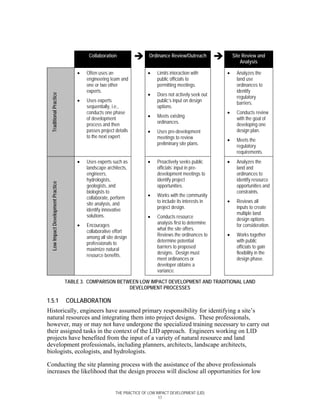
  • 92.
    What is thecost of an excessively wide street? Not only do excessive street widths affect the livability of a community, but they also give rise to additional costs that must be paid by homeowners. The figures cited here are for 2001 based on unit costs of contractor services for a project in northern California. For this project, a section of street 100 feet long would cost about $9,500 to build to a width of 24 feet compared with $13,500 for a 36-foot-wide street. Paving widths are 20 feet and 32 feet, respectively, with an additional two-foot gutter on each side. Moreover, in this area where lots sell for $300,00 per acre, land costs exceed street construction costs, even for narrower streets. Total land and construction costs for a 100-foot section of a 36-foot-wide street amount to almost $40,000 compared with $26,000 for a narrower 24-foot-wide street. Cost per 100 Feet of Street 24 Feet 36 Feet 5-Inch Asphalt Paving/6-Inch Base $6,800 $10,880 6-Inch Curb and Gutter $1,265 $1,265 4-Inch Sidewalk $1,400 $1,400 Total Construction Costs $9,465 $13,545 Land (at $300,000 per acre) $16,800 $25,200 Total Cost $26,265 $38,745 TABLE 17. TYPICAL STREET CONSTRUCTION COSTS This chapter begins by providing a brief overview of the environmental and economic benefits of LID circulation and design. It briefly discusses conventional approaches to circulation and design and then concludes by considering some alternatives to conventional approaches. Table 18 provides some overall objectives of community circulation and design systems. Objective 1: Maximize open space by using alternative street and lot layouts. Objective 2: Reduce impervious surfaces by considering alternative street widths, types, and amenities. Objective 3: Site lots and houses to maximize solar orientation, reduce vehicular trips, and create a sense of community. TABLE 18. CIRCULATION AND DESIGN OBJECTIVES 4.1.1 ENVIRONMENTAL BENEFITS Properly designed and sited streets and street systems can conserve and protect site and regional environmental systems and resources. Most street standards are the result of compromises among engineers, planning staffs, and local emergency management professionals (police and fire and rescue services). To provide two travel lanes, access for emergency vehicles, and parking on both sides of the street, communities have long required streets that are much wider than necessary. However, research and experience show that compact street layouts, narrower street widths, and alternative pavement edge treatments can minimize clearing and grading, reduce storm water runoff, and protect THE PRACTICE OF LOW IMPACT DEVELOPMENT (LID) 80

  • 93.
    water quality whileproviding ample access for emergency vehicles, residential vehicles, and parking. Paved streets create impervious surfaces that prevent storm water from infiltrating into the ground. As storm water travels across streets and other impervious areas, it picks up motor oils, grease, fuel residues, nutrients, and sediment, all of which are then carried to local receiving waterbodies where they adversely affect aquatic species and their habitats. Impervious areas are major contributors to the urban nonpoint source pollution problems that impair the nation’s water quality. 4.1.2 ECONOMIC BENEFITS Where density and zoning allow, redesigned vehicular and pedestrian circulation routes can reduce final infrastructure and development costs by limiting street lengths and the expanse of pavement. At the same time, reworked street types and layouts can mean reduced costs associated with planning and design, clearing and grading, and storm water management. Table 4-3 provides information on various subdivision development costs. Subdivision Improvement Unit Cost Roads, Grading $22.00 per linear foot Roads, Paving (26-foot width) $71.50 per linear foot Roads, Curb and Gutter $12.50 per linear foot Total Cost of Road $106.00 per linear foot Sidewalks $10.00 per linear foot Storm Sewer (24 inches) $23.50 per linear foot Driveway Aprons $500 per apron Parking Spaces $1,100 per parking space ($2.75 per square foot) Clearing (forest) $4,000 per acre Sediment Control $800 per acre Storm water Management $5,000 to $60,000 per impervious acre Water/Sewer $5,000 per lot (variable) Well/Septic $5,000 per lot (variable) Source: Center for Watershed Protection, 1998. TABLE 19. UNIT COST ESTIMATES OF TYPICAL SUBDIVISION DEVELOPMENT 4.2 CONVENTIONAL APPROACHES TO CIRCULATION AND DESIGN 4.2.1 RIGHTS-OF-WAY A street right-of-way is a measure of the total width needed to accommodate the street pavement, sidewalk(s), drainage, street trees, and utility easements. Current street rights- of-way range from 30 feet to over of 60 feet to accommodate parking and sidewalks on both sides of the street. Excessive rights-of-way create wide and often visually uninteresting streets that promote speeding and undermine safety. Wider street rights-of- THE PRACTICE OF LOW IMPACT DEVELOPMENT (LID) 81
  • 94.
    way require landto be set aside to accommodate street systems, leaving less land available for lots and community open space. At the same time, given that safety and maintenance concerns require the removal of vegetation and trees within the right-of- way, road construction results in the removal of many mature trees and vegetation, potentially leading to soil erosion and siltation problems in local waterways. Street rights-of-way should be the minimum width necessary to accommodate the pavement, sidewalk(s), street trees, and utilities. Where zoning and density allow, communities should permit open-section roadways with sidewalks on one side of the roadway only. Open-section roadways consist of a variable-width gravel shoulder, usually wide enough to accommodate a parked car, and an adjoining grassed swale that conveys storm water. Street pavements should be adjusted accordingly depending on off- street parking availability and shoulder requirements. To encourage the preservation of existing vegetation, only those trees within approximately five feet of the pavement edge should be cleared. Utilities should be located under street pavements to eliminate conflicts with tree roots, grassed swales, and bioretention areas. In northern climates, the right-of-way should be wide enough to accommodate snow storage. 4.2.2 STREETS Besides rooftops and driveways, residential streets account for an enormous share of a community’s impervious surfaces. A reevaluation of residential street standards to address the expanse of impervious surfaces and enhance the environment can also reduce infrastructure costs, improve pedestrian and vehicular safety, and increase community aesthetics. Many municipalities have already begun the difficult process of reevaluating their residential street standards. The process requires the involvement of many different stakeholders, including emergency personnel (police and fire and rescue services)(See Table 20), public works departments, school boards, homeowner associations, and safety advocates. Indeed, disagreements can be easily resolved by examining the current research on the use of narrower streets. Width (feet) Source 18 to 20 U.S. Fire Administration 24 (on-street parking) Baltimore County, Maryland 16 (no on-street parking) 18 (minimum) Virginia State Fire Marshal 20 Prince George’s County, Maryland 18 (on-street parking on one side) Portland, Oregon 26 (parking both sides) Source: Center for Watershed Protection, 1998. TABLE 20. MINIMUM STREET WIDTHS FOR FIRE VEHICLES Most municipalities’ standards for street pavement widths usually specify streets at least 36 feet wide—a width that usually accommodates two travel lanes and parking on both sides of the street (see Table 21). Given that most homes are built with either garages and/or driveways that accommodate up to three cars, municipalities should consider eliminating one or both of a street’s seven-foot-wide parking lanes. Even a new street width of 22 feet can still accommodate parking on one side of the roadway and leave THE PRACTICE OF LOW IMPACT DEVELOPMENT (LID) 82


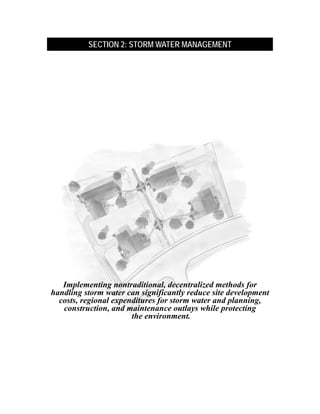
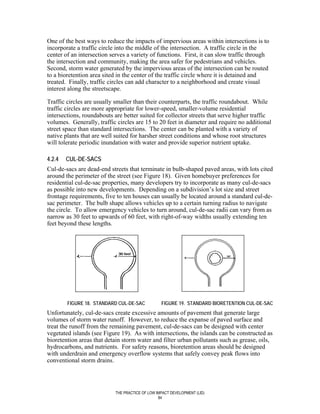
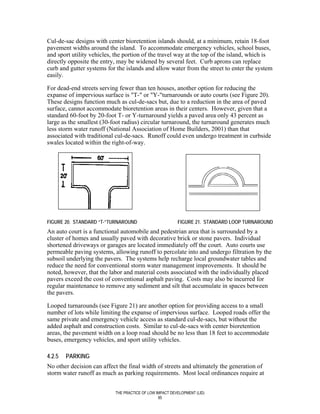

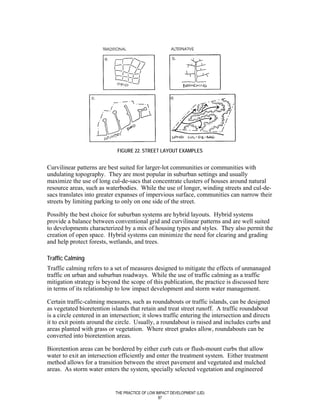
  • 95.
    ample room fora safe travel lane that is generous enough to accommodate most fire trucks, school buses, and garbage trucks. Consistent with low impact development practices, the new standards reduce infrastructure construction and maintenance costs while reducing impervious surfaces within the community (See Section 4.3.2 on queuing streets for additional information). Local Streets No On-Street Parking 18 feet Parking on One Side 22 to 24 feet Parking on Both Sides 24 to 26 feet Collector Streets 32 to 36 feet Source: Residential Streets, NAHB, 2001. TABLE 21. SUGGESTED PAVEMENT WIDTHS Where density and zoning allow, open-section roadways can reduce the need for costly curb and gutter sections and encourage the filtering and infiltration of storm water. Open-section roadways consist of a variable-width gravel shoulder, usually wide enough to accommodate a parked car, and an adjoining grassed swale that conveys storm water. The grassed swales are usually pitched at a minimum of 1 percent to prevent standing water and end at a drop-inlet storm structure or waterbody. Historically, improperly designed swales posed health concerns because they served as breeding areas for insects and caused flooding. However, if communities follow current engineering standards for the design of swales, they no longer have to concern themselves with the associated health and flooding issues (see Section 2.3.3.1 for additional information on grassed swales). A curb radius is the radius of the 4.2.3 INTERSECTIONS circle formed by the curve of the Intersections create large areas of impervious surface curb at the intersection corners. within residential subdivisions. Reducing the overall size and width of intersections can decrease the volume of storm water runoff. Depending on the class of street entering the intersection, the number of travel lanes, and the dimensions of the curb radii, intersection diameters can become overly wide. The larger the curb radii, the larger the intersection. Recommended ranges for curb radii are contained in Table 22. Smaller, tighter radii can slow turning traffic and make the intersection safer for pedestrians while limiting the expanse of impervious surface. Type of Intersections Curb Radius (in feet) Local/Local 10 to15 Local/Collector 15 to 20 Collector/Collector 15 to 25 Source: AASHTO. TABLE 22: RECOMMENDED RANGES FOR CURB RADII THE PRACTICE OF LOW IMPACT DEVELOPMENT (LID) 83
  • 96.
    One of thebest ways to reduce the impacts of impervious areas within intersections is to incorporate a traffic circle into the middle of the intersection. A traffic circle in the center of an intersection serves a variety of functions. First, it can slow traffic through the intersection and community, making the area safer for pedestrians and vehicles. Second, storm water generated by the impervious areas of the intersection can be routed to a bioretention area sited in the center of the traffic circle where it is detained and treated. Finally, traffic circles can add character to a neighborhood and create visual interest along the streetscape. Traffic circles are usually smaller than their counterparts, the traffic roundabout. While traffic circles are more appropriate for lower-speed, smaller-volume residential intersections, roundabouts are better suited for collector streets that serve higher traffic volumes. Generally, traffic circles are 15 to 20 feet in diameter and require no additional street space than standard intersections. The center can be planted with a variety of native plants that are well suited for harsher street conditions and whose root structures will tolerate periodic inundation with water and provide superior nutrient uptake. 4.2.4 CUL-DE-SACS Cul-de-sacs are dead-end streets that terminate in bulb-shaped paved areas, with lots cited around the perimeter of the street (see Figure 18). Given homebuyer preferences for residential cul-de-sac properties, many developers try to incorporate as many cul-de-sacs as possible into new developments. Depending on a subdivision’s lot size and street frontage requirements, five to ten houses can usually be located around a standard cul-de- sac perimeter. The bulb shape allows vehicles up to a certain turning radius to navigate the circle. To allow emergency vehicles to turn around, cul-de-sac radii can vary from as narrow as 30 feet to upwards of 60 feet, with right-of-way widths usually extending ten feet beyond these lengths. FIGURE 18. STANDARD CUL-DE-SAC FIGURE 19. STANDARD BIORETENTION CUL-DE-SAC Unfortunately, cul-de-sacs create excessive amounts of pavement that generate large volumes of storm water runoff. However, to reduce the expanse of paved surface and treat the runoff from the remaining pavement, cul-de-sacs can be designed with center vegetated islands (see Figure 19). As with intersections, the islands can be constructed as bioretention areas that detain storm water and filter urban pollutants such as grease, oils, hydrocarbons, and nutrients. For safety reasons, bioretention areas should be designed with underdrain and emergency overflow systems that safely convey peak flows into conventional storm drains. THE PRACTICE OF LOW IMPACT DEVELOPMENT (LID) 84
  • 97.
    Cul-de-sac designs withcenter bioretention islands should, at a minimum, retain 18-foot pavement widths around the island. To accommodate emergency vehicles, school buses, and sport utility vehicles, the portion of the travel way at the top of the island, which is directly opposite the entry, may be widened by several feet. Curb aprons can replace curb and gutter systems for the islands and allow water from the street to enter the system easily. For dead-end streets serving fewer than ten houses, another option for reducing the expanse of impervious surface is "T-" or "Y-"turnarounds or auto courts (see Figure 20). These designs function much as cul-de-sacs but, due to a reduction in the area of paved surface, cannot accommodate bioretention areas in their centers. However, given that a standard 60-foot by 20-foot T- or Y-turnaround yields a paved area only 43 percent as large as the smallest (30-foot radius) circular turnaround, the turnaround generates much less storm water runoff (National Association of Home Builders, 2001) than that associated with traditional cul-de-sacs. Runoff could even undergo treatment in curbside swales located within the right-of-way. FIGURE 20. STANDARD “T-”TURNAROUND FIGURE 21. STANDARD LOOP TURNAROUND An auto court is a functional automobile and pedestrian area that is surrounded by a cluster of homes and usually paved with decorative brick or stone pavers. Individual shortened driveways or garages are located immediately off the court. Auto courts use permeable paving systems, allowing runoff to percolate into and undergo filtration by the subsoil underlying the pavers. The systems help recharge local groundwater tables and reduce the need for conventional storm water management improvements. It should be noted, however, that the labor and material costs associated with the individually placed pavers exceed the cost of conventional asphalt paving. Costs may also be incurred for regular maintenance to remove any sediment and silt that accumulate in spaces between the pavers. Looped turnarounds (see Figure 21) are another option for providing access to a small number of lots while limiting the expanse of impervious surface. Looped roads offer the same private and emergency vehicle access as standard cul-de-sacs, but without the added asphalt and construction costs. Similar to cul-de-sacs with center bioretention areas, the pavement width on a loop road should be no less than 18 feet to accommodate buses, emergency vehicles, and sport utility vehicles. 4.2.5 PARKING No other decision can affect the final width of streets and ultimately the generation of storm water runoff as much as parking requirements. Most local ordinances require at THE PRACTICE OF LOW IMPACT DEVELOPMENT (LID) 85
  • 98.
    least 2 to2.5 parking spaces per residence, either accommodated in a garage, in a driveway, or on the street. Current residential street standards tend to accommodate street parking on both sides of the street when in fact, the houses served by the street usually provide ample parking either in a driveway or garage. Most on-street parking spaces are 8 feet by 20 feet, resulting in long, underused street sections outside the general path of travel and excessively wide streets that are both expensive to construct and generate considerable quantities of storm water runoff. It is estimated that each seven- to eight-foot on-street parking lane can increase a street’s impervious cover by 25 percent (Sykes, 1989). Given that most municipalities require post-development stormflows not to exceed pre-development flows, compliance with parking standards can translate into added costs for storm inlets, piping, and detention basin sizing. From a water quality standpoint, water temperature can increase as storm water runoff moves across heated asphalt. As elevated-temperature water flows to a waterbody, it can damage sensitive aquatic environments, especially cold-water fisheries. The reduction of on-street parking, however, allows for narrower streets that can take advantage of the cooling effects of shade trees. 4.3 ALTERNATIVE APPROACHES TO CIRCULATION AND DESIGN 4.3.1 ALTERNATIVE DESIGN CONSIDERATIONS Just as alternative street types and pavements can reduce infrastructure costs and environmental impacts, so, too, can alternative residential street layouts. When coupled with narrower, open-section streets, a well-designed street layout can eliminate hundreds of square feet of impervious surface. Depending on the density, location, and type of subdivision, different types of street layouts may easily lend themselves to a cluster arrangement, conserving natural features, maintaining open space, and protecting water quality. Rethinking traditional circulation designs within residential subdivisions can result in: • Decreased storm water quantities and nonpoint source pollution; • Increased groundwater recharge; and • Increases in community open space. Traditional grid, curvilinear, and hybrid street patterns each have different characteristics that affect traffic movement, environmental values, and community aesthetics (see Figure 22). Grid patterns are typical of older, densely settled urban areas and are particularly effective in expediting traffic flow. Yet, research has indicated that they require 20 to 25 percent greater total street length than traditional, suburban curvilinear patterns and are most appropriate for flat sites with several access points. Given that densities in grid areas are often high, parking is generally needed on at least one side of the street. THE PRACTICE OF LOW IMPACT DEVELOPMENT (LID) 86
  • 99.
    FIGURE 22. STREETLAYOUT EXAMPLES Curvilinear patterns are best suited for larger-lot communities or communities with undulating topography. They are most popular in suburban settings and usually maximize the use of long cul-de-sacs that concentrate clusters of houses around natural resource areas, such as waterbodies. While the use of longer, winding streets and cul-de- sacs translates into greater expanses of impervious surface, communities can narrow their streets by limiting parking to only on one side of the street. Possibly the best choice for suburban systems are hybrid layouts. Hybrid systems provide a balance between conventional grid and curvilinear patterns and are well suited to developments characterized by a mix of housing types and styles. They also permit the creation of open space. Hybrid systems can minimize the need for clearing and grading and help protect forests, wetlands, and trees. Traffic Calming Traffic calming refers to a set of measures designed to mitigate the effects of unmanaged traffic on urban and suburban roadways. While the use of traffic calming as a traffic mitigation strategy is beyond the scope of this publication, the practice is discussed here in terms of its relationship to low impact development and storm water management. Certain traffic-calming measures, such as roundabouts or traffic islands, can be designed as vegetated bioretention islands that retain and treat street runoff. A traffic roundabout is a circle centered in an intersection; it slows traffic entering the intersection and directs it to exit points around the circle. Usually, a roundabout is raised and includes curbs and areas planted with grass or vegetation. Where street grades allow, roundabouts can be converted into bioretention areas. Bioretention areas can be bordered by either curb cuts or flush-mount curbs that allow water to exit an intersection efficiently and enter the treatment system. Either treatment method allows for a transition between the street pavement and vegetated and mulched areas. As storm water enters the system, specially selected vegetation and engineered THE PRACTICE OF LOW IMPACT DEVELOPMENT (LID) 87
  • 100.
    soils retain andtreat it. For reasons of safety, roundabouts designed for bioretention should incorporate underdrains and/or emergency overflow areas to prevent excessive ponding or flooding. Clustering With respect to lot layout, developers can turn to methods such as clustering to preserve open space, reduce infrastructure costs, and accommodate growth. This strategy concentrates small pockets of homes around the site in the least environmentally sensitive areas. In a clustered community, homes may be built on lots as small as 8,000 square feet, More than half of the 1,350 real estate agents allowing developers to preserve unique land surveyed by Bank of America thought that trees forms, trees, and vistas. Developers may need have a positive impact on potential buyers’ to work with local zoning officials to allow the impressions of homes and neighborhoods. In use of clustering, if current zoning ordinances addition, 84 percent of agents indicated that a home with trees would be as much as 20 do not allow it. In addition, potential percent more salable than homeowners may need to be persuaded that a home without trees. cluster development creates a community that Source: Building Greener Neighborhoods. offers ample amounts of open space within walking distance of their homes. Tree-Save Areas Many parcels of land offer an array of Native trees should be identified during a project’s natural resources that ingenious developers planning stage. The Building With Trees (BWT) can capitalize on and transform into program offers more details on how best to preserve desirable design features. While most of appropriate trees. The National Arbor Day this section of the publication has focused Foundation, with support from the National on ways to protect the water supply and Association of Home Builders, created the BWT program to help developers streamline the process of thus enhance the environment, trees are a saving natural resources during land development. feature that homeowners value for their Program details can be found at aesthetic and environmental benefits. http://www.arborday.org/programs/buildingwithtrees/ Trees can shade homes, streets, parking areas, sidewalks, and paths, adding to the visual appeal of communities and helping to reduce heat island effects. Developers are beginning to recognize that lots with mature trees often sell for more than comparable lots without such trees. Solar Orientation In an effort to maximize energy efficiency for homeowners, some developers are building resource-efficient communities by orienting streets and lots to take advantage of passive solar design. Passive solar design optimally uses the sun’s energy for heating and cooling. During the design process, builders aim to orient as many lots as possible to take advantage of solar benefits. The optimum position for maximum passive solar orientation is to orient the façade of the house directly south, however, the axis can vary within 20 degrees of true south with minimal detrimental effect on solor gain. Streets should be oriented on an east-west axis. THE PRACTICE OF LOW IMPACT DEVELOPMENT (LID) 88
  • 101.
    4.3.2 ALTERNATIVE STREET TYPES To meet the multiple and sometimes competing goals of creating affordable, environmentally friendly, and aesthetically pleasing communities, developers are incorporating alternative street designs into their plans. Each alternative street and path type has unique characteristics that help it fit into one part of the community, but not the other. One street type does not fit all situations. Queuing Streets Prairie Crossing, a development near Chicago, focused on creating a community that Queuing streets are narrower street types that embraces environmental protection, a sense of contain one parallel parking lane and a travel place, and resource conservation. Sales for lane sufficiently wide to accommodate the Prairie Crossing homes are at a 40 percent passage of larger emergency and service premium over comparable homes nearby. vehicles. In instances where cars park along the roadway, queuing streets require one car to wait temporarily in “queue” until the oncoming car passes (see Figure 23). Traditionally used in older, closer-in suburban neighborhoods, queuing streets are enjoying a renaissance Typically, queuing streets range between 20 and 26 feet wide, with a 12- to 13-foot travel lane and a seven-foot parallel parking lane. Compared to a typical 36-foot-wide street, queuing streets can reduce planning and design costs as well as other infrastructure costs, such as those associated with storm water management. It has been estimated that the elimination of parking on one side of the street can reduce storm water runoff by 25 percent (Center for Watershed Protection, 1998). THE PRACTICE OF LOW IMPACT DEVELOPMENT (LID) 89
  • 102.
    Source: Portland (OR)Office of Transportation, 1994. FIGURE 23. A COMPARISON OF QUEUING STREETS VERSUS TRADITIONAL STREETS From an environmental standpoint, narrower street rights-of-way can limit the amount of land areas subject to clearing and grading, make more land available for open space, and protect natural resource areas. Smaller streets also provide safer environments for pedestrians, which encourages walking and reduces dependence on the automobile. Alleys Alleys are considered a neotraditional design element that can be incorporated into residential designs to provide garage access and parking while accommodating functions such as utility maintenance and refuse collection. Alleys can also alleviate the need for on-street parking, which can increase street widths and the expanse of impervious surface. To limit the expanse of impervious surface, alleys should be no wider than 12 feet and constructed without curbs. An inverted crown that channels water to the center of the alley and then to either a storm drain or bioretention area can accommodate drainage. Open-Section Streets Instead of sending storm water to curbs and gutters, open-section roads drain storm water into grassed swales, where vegetation and soils treat pollutants. It has been estimated that, compared with any other residential design feature, streets contribute the highest volume of pollutants to urban storm water (Bannerman et al., 1993). Accordingly, where THE PRACTICE OF LOW IMPACT DEVELOPMENT (LID) 90
  • 103.
    density and trafficflow allow, streets with curb and gutter sections should be designed as open-section roadways. For public works departments in most communities, maintenance concerns dictate a preference for curb and gutter roads in place of grassed swales. Grassed swales are more likely to be damaged by cars, erosion, and so forth while curb and gutter streets are easier to clean and provide a clear transition between pavement and lawn. However, in many localities, curbs and gutters drain directly to streams, lakes, and rivers, where they deposit harmful urban pollutants. Open-section streets are less expensive to construct than curb and gutter systems. One study for a project in northern California in 2001 suggested that each linear foot of six- inch curb and gutter added approximately $12.65 to street construction costs (NAHB Residential Streets, 2001). 4.3.3 SHARED DRIVEWAYS Shared driveways, sometimes referred to as pipestems, are another design tool that can help reduce the expanse of impervious surfaces. Driveways account for as much as 20 percent of the impervious cover in a residential subdivision (Center for Watershed Protection, 1995). Similar to a cul-de-sac, a shared driveway provides access to several houses from a single egress point off the local street. However, unlike cul-de-sacs, shared driveways terminate at the last house served instead of at a large impervious turnaround area. Table 23 provides several objectives for reducing impervious areas in driveways. • Shorten driveway length through reduced front yard setback requirements. • Reduce driveway widths or encourage driveway sharing between two or more homes. • Use permeable pavements or a two-track surface with grass in between to facilitate water infiltration. TABLE 23. DRIVEWAY CONSIDERATIONS FOR REDUCING IMPERVIOUS AREA Where used in the appropriate situation and correctly designed, shared driveways can be functional, attractive, and environmentally friendly. In fact, alternative pavement materials such as bricks or pavers can further reduce a shared driveway’s storm water runoff. 4.3.4 SIDEWALKS AND PATHS While sidewalks and paths are an integral part of a community’s transportation and circulation design, their impervious surface nonetheless contributes to the community’s overall volume of storm water runoff (see Table 24). Depending on the density of the community and the type of street classification, sidewalks on only one side of the street might be appropriate; in the case of rural residential streets (250 average daily trips, sidewalks might not be needed at all. In rural residential instances, rights-of-way with a sufficiently wide gravel path can accommodate pedestrian and bicycle travel. Where used in combination with open-section roadways, sidewalks should be located several feet back from the outside crest of the grassed swale to allow for maintenance of the THE PRACTICE OF LOW IMPACT DEVELOPMENT (LID) 91
  • 104.
    swale and snowstorage. Sidewalks should be horizontally sloped to drain toward roadside grassed swales and away from front yards. • Shorten sidewalk length from the house to the street by reducing front yard setback requirements. • Maximize sidewalk widths at four feet, depending on density. • Increase the distance between the street and sidewalk to increase the likelihood that the grassy strip will be able to capture and absorb sheetflow from the sidewalk. Similarly, grade the sidewalk such that runoff drains toward the front yard and not the street. • Place sidewalks in areas with pedestrian traffic. TABLE 24. SIDEWALK CONSIDERATIONS FOR IMPERVIOUS AREAS To reduce further the total expanse of a site’s impervious surface, the use of pervious materials for sidewalks and paths might be considered in place of traditional concrete or asphalt. When properly maintained, alternative materials such as brick, compacted stone dust, and wood chips all accommodate safe passage of pedestrians and bicycles and, in most cases, still meet Americans with Disabilities Act (ADA) requirements. Permeable materials reduce the volume of slow runoff, allowing it to recharge groundwater. 4.3.5 ALTERNATIVE PAVEMENTS Alternative pavements for streets, alleys, sidewalks, paths, and driveways should be considered along with traditional asphalt and concrete. Brick, block, concrete, and stone pavers reduce the percentage of site’s impervious surface as well as the demand for conventional storm water management facilities. Unlike conventional pavements, pavers encourage groundwater recharge and reduce the runoff of pollutants such as oil, grease, hydrocarbons, and nutrients. A variety of alternative pavements can also meet different traffic, regulatory, climatologic, and aesthetic concerns. In addition to their environmental benefits, alternative pavements such as brick can add visual appeal and character to residential properties. THE PRACTICE OF LOW IMPACT DEVELOPMENT (LID) 92
  • 105.
    Material Initial Cost Maintenance Cost Water Quality Benefits Asphalt/Concrete Medium Low Low Pervious Concrete High High High Porous Asphalt High High High Turf Block Medium High High Brick High Medium Medium Natural Stone High Medium Medium Concrete Unit Paver Medium Medium Medium Gravel Low Medium High Wood Mulch Low Medium High Cobbles Low Medium Medium Source: Bay Area Storm Water Management Agencies Association (BASMAA), Start at the Source: Residential Site Planning & Design Guidance Manual for Storm Water Quality Protection, 1997. TABLE 25. FUNCTIONAL COMPARISON OF VARIOUS TYPES OF ALTERNATIVE PAVEMENTS Compared with conventional paving systems, material and installation costs can be higher for alternative paving systems (see Table 25). It is estimated that, while asphalt paving costs between $0.50 and $1.00 per square foot installed, interlocking concrete paving blocks can range anywhere from $5.00 to $10.00 per square foot. However, given that porous asphalts can help reduce overall storm water infrastructure costs, the total costs of site development can be significantly reduced, especially when considering the savings associated with potentially eliminating storm water management ponds. Clearly, any comparison of the costs of alternative versus traditional pavements should factor in total land development costs. Some manufacturers are now producing pervious concrete products that decrease runoff and encourage infiltration. Pervious pavement such as porous asphalt or concrete can also decrease storm water conveyance costs and increase environmental quality. It is estimated that pervious pavements such as porous asphalt cost approximately 10 percent more that conventional nonporous asphalts. To maintain their efficiency and porosity, pervious pavements and pavers require regular maintenance to remove accumulated sediment and dirt. 4.3.6 ALTERNATIVE LOT SHAPES Individual house lots are usually regularly shaped, that is, rectangular or square, and each lot has direct access to the street. In their attempt to conserve open space and reduce developed areas, low impact developments sometimes call for alternative lot shapes, including flag, zero-lot-line, Z- and angled Z-, or zipper lots. Figure 24 provides basic diagrams of alternative lot designs. Flag lots, sometimes referred to as pipestem lots, mesh well with the concept of shared driveways. They accommodate a house or houses built behind another house, with one common driveway leading to the street. Flag lots are sometimes used to give developers THE PRACTICE OF LOW IMPACT DEVELOPMENT (LID) 93
  • 106.
    access to unused,landlocked spaces that are not preferred agricultural or conservation areas. The Center for Urban Policy Research defines a flag lot as a large lot not meeting minimum road frontage requirements and where access to the public road is by a narrow, private right-of-way or driveway. Zero-lot-line lots provide for greater usable yard space on each lot. The lots locate one side of the house on the lot line while the other side of the house faces the usable space. Interspersing various innovative lot types in a community can help developers incorporate passive solar design into house designs. Z- or angled Z-lots are similar to zero-lot-line lots except that they are angled by about 30 to 40 degrees, allowing developers to alternate side- and front-loaded garages. In a zipper lot, the minimum rear setback is zero, and the rear yard depth varies to concentrate usable space on the side of the lot. Z- OR ANGLED Z-LOT FLAG LOT ZERO-LOT-LINE LOT ZIPPER LOT FIGURE 24. ALTERNATIVE LOT DESIGNS THE PRACTICE OF LOW IMPACT DEVELOPMENT (LID) 94
  • 107.
    4.4 ADDITIONAL RESOURCES Additional resources that provide more detail on circulation and design are listed below. The resources are not provided as endorsements, merely as educational and reference tools. Given regional variations in climate and land development needs, we have included regional-specific resources. It is important to note, however, that addresses, especially Internet links, are subject to change. This list contains the latest links and addresses as of the printing of this publication. Circulation Design and Resources City of Portland Department of Transportation http://www.trans.ci.portland.or.us/trafficcalming/devices/skinnystreets. Information on Portland’s Skinny Streets Program, including local traffic streets, queuing streets, and traffic-calming measures. Geometric Design Practices for European Roads http://international.fhwa.dot.gov/Pdfs/Geometric_Design.pdf Practices and procedures in roadway geometric design and contextual design that seek a balance among safety, mobility, and community interests. Sierra Club http://www.sierraclub.org/sprawl/articles/narrow.asp Web site discusses the value of narrow streets for slowing traffic, reducing vehicular crashes, and increasing neighborhood safety. Organizations and Internet Resources Center for Livable Communities http://lgc.org/clc Guidebook on how to implement designs for safe, efficient, and aesthetically pleasing streets. Institute of Transportation Engineers http://www.ite.org Publications focusing on traditional neighborhood design and circulation patterns, including street space, connectivity, emergency access, parking, safety, and geometric design. Local Government Commission http://lgc.org/clc/ Publication on local communities’ insight into how to implement local street.initiatives. The Conservation Fund http://www.conservationfund.org/ In partnership with the Urban Land Institute (http://www.uli.org), a workshop entitled “The Practice of Environmentally Sensitive Development” covers the full range of project planning, design, and construction. THE PRACTICE OF LOW IMPACT DEVELOPMENT (LID) 95
  • 108.
    Walkable Communities, Inc. http://walkable.org Anonprofit group that helps Florida communities become more walkable and pedestrian- friendly. Publications Longmont, Colorado, Street Study A study by Swift and Associates correlating 20,000 accident reports over an eight-year period with 13 variables associated with the street. http://members.aol.com/phswi/swift- street.html Residential Streets A comprehensive design publication for residential streets published jointly by the National Association of Home Builders (NAHB), American Society of Civil Engineers (ASCE), and the Urban Land Institute (ULI). (800) 321-8050. http://www.builderbooks.com Roundabouts: An Informational Guide A comprehensive source of information on modern roundabouts and their uses. (301) 577-0818. Street Design Guidelines for Healthy Neighborhoods http://lgc.org/clc A publication of the Center for Liveable Communities to help communities implement guidelines for safe, efficient, and aesthetically pleasing streets for vehicular and pedestrian traffic. Traditional Neighborhood Development Design Guidelines: Recommended Practice A publication of the Institute of Transportation Engineers on neighborhood and street design, including sections on street space, connectivity, emergency access, parking, safety, and geometric design. Regional-Specific Resources Northeastern United States Conservation Law Foundation “Take Back Your Streets” focuses on the history of road design and its legal aspects in New England. (617) 350-0990. Southeastern United States Montgomery County, Maryland Residential traffic-calming program to help reduce speeding and improve the residential environment. http://www.dpwt.com/TraffPkgDiv/triage.htm Walkable Communities A 12-step program by the Florida Department of Transportation to encourage safe travel THE PRACTICE OF LOW IMPACT DEVELOPMENT (LID) 96
  • 109.
    for pedestrians andvehicles. http://www.sustainable.doe.gov/pdf/walkable.pdf Western United States Citizens for Sensible Transportation http://cfst.org/ A nonprofit group in Oregon that offers several publications on traffic calming and neighborhood livability. Reclaiming Our Streets Task Force http://www.trans.ci.portland.or.us/trafficcalming/reports/ArterialProgram/cover.htm Community action plan to implement neighborhood transportation- calming techniques in the Portland, Oregon, area. THE PRACTICE OF LOW IMPACT DEVELOPMENT (LID) 97
  • 110.
  • 111.
    APPENDIX A -GLOSSARY Aerobic--Having molecular oxygen as a part of the environment or growing or occurring only in the presence of molecular oxygen, as in aerobic microorganisms. Anaerobic--Characterized by the absence of molecular oxygen or growing in the absence of molecular oxygen (as in anaerobic bacteria). Best Management Practice (BMP)--A structural device or practice designed to mitigate the effects of storm water runoff to attenuate flooding, reduce erosion, and reduce pollution. BMPs include a variety of Low impact development practices such as bioretention, sand filters, and infiltration trenches. Bioretention--A structural storm water practice that uses soils and vegetation to treat pollutants in urban runoff and to encourage infiltration of storm water into the ground. Buffer--Area in its natural state left between development and a shoreline, wetlands, or stream to protect water quality. Development is restricted in a buffer zone. Community Wastewater Treatment System--Term commonly used to describe an aerobic treatment unit serving multiple dwellings or an education, health care, or other large facility. Cul-de-Sac--A residential street terminating in a closed, circular dead end that allows vehicles to turn around. Curvilinear Street Pattern--A street layout that follows the natural contours of the site and relies on curving roadways and cul-de-sacs to reduce vehicle speeds and cut-through traffic. Environmentally Sensitive Development--Development intended to conserve, protect, and enhance a site’s natural resource systems through careful planning and design of site elements. Eutrophication--A phenomenon caused by excessive plant nutrients in which waterbodies are deprived of oxygen and become uninhabitable for aquatic life. Streams and lakes receive excessive amounts of plant nutrients (primarily phosphorus, nitrogen, and carbon) in various ways. Runoff from agricultural fields, field lots, urban lawns, and golf courses are common sources of the nutrients. Untreated or partially treated domestic sewage is another major source. Green Infrastructure--A strategically planned and managed network of wilderness, parks, greenways, conservation easements, and working lands with conservation value that supports native species, maintains natural ecological processes, sustains air and water resources, and contributes to the health and quality of life for America's communities and people (see http://www.greeninfrastructure.net/Intro/Definition.htm). Groundwater--Water that is underground in cracks and spaces in soil, sand, and rocks. The layers of soil, sand, and rocks are also known as aquifers. Groundwater is used for drinking water by more than 50 percent of the U.S. population, including almost all residents of rural areas. Hybrid Street Network--A street layout that is a mix between a traditional grid pattern and a curvilinear pattern. It can reduce a community’s overall street length while still providing the functions of access, circulation, and parking. THE PRACTICE OF LOW IMPACT DEVELOPMENT (LID) 99
  • 112.
    Impervious Area--Any areain the landscape that cannot effectively allow the absorption and infiltration of rainwater into the ground. Impervious Cover--Any surface in the built environment that prohibits the percolation and infiltration of rainwater into the ground. Jurisdictional Wetlands--A wetlands or other water of the United States regulated under the Clean Water Act. Low Impact Development (LID)--An approach to land development that uses various land planning and design practices and technologies for simultaneously conserving and protecting natural resource systems and reducing infrastructure costs. Nonpoint Source Pollution--Water pollution caused by rainfall washing over and through land surfaces and carrying with it pollutants from the human environment. The Clean Water Act regulates nonpoint source pollution, which differs from point-source pollution. Open-Section Roadway--A roadway that is constructed with gravel shoulders and grassed swale systems, instead of with curb and gutter systems, to convey storm water. Open Space--Land set aside to remain undeveloped for a community’s public use and enjoyment. On-Site Wastewater Treatment System (OWTS)--A system that relies on natural processes and/or mechanical components to collect, treat, and disperse/discharge wastewater from individual dwellings or buildings. Queuing Street--A street sufficiently wide for one travel lane and one parking lane that forces one of two passing automobiles to yield temporarily. These streets accommodate all the functions of normal streets, including emergency access, and reduce impervious areas and therefore storm water runoff. Resource-Efficient Development (RED)--An innovative land development approach that incorporates environmental considerations into the land planning and design process to minimize impacts on local resources. Right-of-Way--The width of the total land area required for street paving, curb and gutter, utilities, sidewalks, and street trees. Right-of-way widths should be the smallest measurement possible that accommodates these uses. Riparian--Of or pertaining to stream systems or stream corridors. Riparian areas usually include a stream channel, its banks, the floodplain, and associated vegetated buffers. Sand Filter--A packed-bed filter of sand or other granular material used to provide advanced secondary treatment of settled wastewater or septic tank effluent. Sand/media filters consist of a lined (e.g., impervious PVC liner on sand bedding) excavation or structure filled with uniform washed sand that is placed over an underdrain system. The wastewater is dosed onto the surface of the sand through a distribution network and allowed to percolate through the sand to the underdrain system, which collects the filter effluent for further processing or discharge. Sedimentation--The transport, deposit, and accumulation of soil material by wind and water. Sedimentation is usually associated with the accumulation of soil material in waterbodies. THE PRACTICE OF LOW IMPACT DEVELOPMENT (LID) 100
  • 113.
    Septic Tank--A buriedtank, designed to be watertight, that is constructed to receive and partially treat raw wastewater. The tank separates and retains settleable and floatable solids suspended in the raw wastewater. Settleable solids form a sludge layer at the tank bottom. Grease and other light materials float to the top to form a scum layer. The removed solids are stored in the tank, where they undergo liquefaction, which partially breaks down organic solids into dissolved fatty acids and gases. Gases generated during liquefaction are normally vented through a building’s plumbing stack vent. Setback--The minimum distance that design elements must be placed from other elements. For example, houses usually have front, side, and rear yard setbacks from streets and other buildings. Sheetflow--The movement of rainwater across the surface of the landscape in response to topographic conditions. Storm water Management--An integrated system of practices and techniques for managing the safe and efficient handling of post-development rainwater. Subdivision--The process of dividing land into smaller parcels to accommodate housing, roads, open spaces, and utilities. Swale--A small, linear topographic depression used to move water from one location to another. Variance--A request to a zoning authority to deviate from the approved development ordinances of a particular area. For instance, a variance might be requested to waive a 40-foot front yard setback so that houses might be sited closer to the street. Wastewater Treatment Facility--A wastewater treatment facility collects waste streams from residential, commercial, and industrial sources through sewer systems and treats the water to prescribed levels before release into a waterbody. Zoning--Regulations governing the use, placement, spacing, and size of land and structures within a specific area. THE PRACTICE OF LOW IMPACT DEVELOPMENT (LID) 101
  • 115.
    APPENDIX B—CASE STUDIES AppendixB contains the following case studies: Chancery on the Lake Duke Street Square Kensington Estates Phillippi Creek Septic System Replacement Program Ron Tyne and Associates Somerset Community THE PRACTICE OF LOW IMPACT DEVELOPMENT (LID) 103
  • 116.
    CHANCERY ON THELAKE Chancery on the Lake is a condominium development centered around a 14-acre wet pond. The lake is marketed as a feature of the development, resulting in an increased sales pace relative to that of competitors. In fact, the developer realizes a premium of $7,000 to $10,000per lakefront unit. VIEW OF THE WALKWAY, PICNIC AREA, AND LAKE Specifics • Seven-acre, 170-unit condominium development in Alexandria, Virginia, centered around a large urban runoff pond. • Prices for the condominiums range from $129,990 to $139,990 (Frederick et al., 1995). • 14-acre pond surrounded by picnic tables, a gazebo, and a walking trail, with a fishing pier planned for construction (Frederick et al., 1995). • $7,000 to $10,000 premium for condominiums fronting on the lake (Flora, 1997). • Above-average sales pace for the area and the condominium market; a significant number of sales from buyers who shopped around and then were attracted to Chancery because of the lake (Flora, 1997). • Pond marketed as a selling point (Flora, 1997). • Lake constructed by damming an existing creek, with some excavation of the surrounding area to achieve the desired shape and volume. • No maintenance required other than mowing grassed areas, visual inspections of the dam and lake, and sediment removal from the rip-rap outfall structure (Scalia, 1997). THE PRACTICE OF LOW IMPACT DEVELOPMENT (LID) 104
  • 117.
    References • Debora Flora, Sales Manager, Chancery Associates Limited Partnership. Alexandria, VA. (703) 922-7171, personal communication. • Vic Scalia, Halle Enterprises. Silver Spring, MD. (301) 495-1520, personal communication. THE PRACTICE OF LOW IMPACT DEVELOPMENT (LID) 105
  • 118.
    DUKE STREET SQUARE DukeStreet Square uses a sand filter, which is a best management practice, to filter pollutants out of storm water runoff. At this urban site, buildable land was at a premium. An underground sand filter satisfied storm water management requirements without consuming buildable land area. The developer was able to add five to seven townhomes that would have been lost to land for a pond. VIEW OF THE INSIDE OF A SAND FILTER SIMILAR TO THE ONE INSTALLED AT DUKE STREET SQUARE Specifics • 40-unit townhouse development in Alexandria, Virginia. • Off-line sand filter system serves 1.38 impervious acres. • Parking lot designed with grate inlets connected to underground pipes that carry storm water to the sand filter. Flows in excess of 0.5 inches of rainfall in a single event are diverted to the city sewer system. • The filter's concrete chamber was cast in place (Keller, 1997). • Underdrains transport filtered water to the city storm sewer system (Keller, 1997). • Northern Virginia land prices of approximately $40 per square foot make it costly to install dry ponds, wet ponds, or storm water wetlands (Bell, 1997); the sand filter system uses no buildable area. • Townhouse total includes between five and seven townhouses that normally would have been lost to land needed for a dry pond (Teets, 1997). Cost Data • Construction of the sand filter totaled $41,030, including the dry vault sand filter, two monitoring manholes, pipes with connections, and the sand filter itself ($35,197). The entire system cost $29,732 per impervious acre while the sand filter alone cost $25,505 per impervious acre. THE PRACTICE OF LOW IMPACT DEVELOPMENT (LID) 106
  • 119.
    Filter's sand bed will need replacement approximately every five years. • System will need periodic inspection and removal of accumulated trash from grate inlets, pre-treatment structure, and filter bed. Community Acceptance • The homeowner association has set aside money for routine and nonroutine maintenance. References • Glenn Teets, Project Manager, Wills Company. Vienna, VA. (703) 760-9600. • R.J. Keller, L.S. Project Manager, R.C. Fields, Jr., and Associates, P.C. Alexandria, VA. (703) 549-6422. • Warren Bell, City Engineer, City of Alexandria. Alexandria, VA. (703) 838-4327. THE PRACTICE OF LOW IMPACT DEVELOPMENT (LID) 107
  • 120.
    KENSINGTON ESTATES At KensingtonEstates the use of LID technologies in a conventional, 103-lot single- family development planned on 24 acres in unincorporated Pierce County were evaluated. The site was characterized by poor soils. The development took advantage of the new Western Washington Storm Hydrology Model (WWHM) to illustrate the full range of LID technologies in the site’s redesign. Specifics • Maintained lot yield of 103 lots. • Designed a roadway system adequate for emergency vehicles. • Achieved "zero" effective impervious surfaces. • Incorporated full range of LID techniques, including soil rehabilitation, rain gardens, bioretention, and pervious pavement; • Provided adequate off-street parking. • Reduced total project impervious pavement. • Minimized piped conveyance. Cost Data A cost evaluation of the redesign further illustrated the potential benefits of LID. Overall, the LID project permitted construction cost savings of over 20 percent over the conventional project. It achieved the largest share of savings by reducing the size of the storm pond structures and eliminating catchments and piped storm conveyance. Excavation and erosion control costs were also significantly reduced. Even though the LID design called for a roadway width of 20 feet, the proposed use of porous paving material and of "looped" cul-de-sac clusters designed for emergency vehicle access made the costs associated with roadways and utilities roughly equal to or slightly higher than the costs for conventional materials and design. THE PRACTICE OF LOW IMPACT DEVELOPMENT (LID) 108
  • 121.
    PHILLIPPI CREEK SEPTICSYSTEM REPLACEMENT PROGRAM In Sarasota, Florida, available and applicable on-site wastewater treatment and collection technologies were evaluated (see Figure 25) to determine their potential for improving current wastewater treatment and disposal practices in Phillippi Creek. Specifics • Available technologies were grouped into three major categories for evaluation: natural systems (e.g., conventional septic tank and subsurface wastewater infiltration systems [SWIS] and septic tank and subsurface drip irrigation [SDI] systems); engineered biological systems (e.g., suspended growth systems, submerged biofilters, and unsaturated biofilters); and waste segregation systems (e.g., nonwater carriage toilets and on-site greywater treatment systems). • Based on the number of connections, total flow, and available treatment plant and transmission capacities, the project area was previously divided into sixteen (16) manageable areas referred to as Wastewater Project Improvement Areas (WPIA). • The cost analysis addressed natural systems and engineered biological systems but, because of a variety of implementation problems, including community acceptance, did not address waste segregation systems. FIGURE 25. EVALUATION PROCESS FOR COMPARING COLLECTION AND ON-SITE WASTEWATER TREATMENT SYSTEM ALTERNATIVES Cost Data • The capital cost of a septic tank with a mound with 12-inch fill was $6,000. • The capital cost of a septic tank with subsurface drip irrigation with 12-inch fill was $7,900. • In terms of uniform annual cost, the septic tank with SWIS mound was the most cost- effective alternative in a low-density area. In medium- and high- density areas, the vacuum sewer system was the most cost-effective alternative. THE PRACTICE OF LOW IMPACT DEVELOPMENT (LID) 109
  • 122.
    RON TYNE ANDASSOCIATES Terry Paff, president of Metropolitan Realty and Development in Sherwood, Arkansas, wanted to create a development that appealed to both the general public and permitting and review officials. He approached Ron Tyne of Tyne & Associates with his idea and hired the consultant to redesign a conventional site plan developed for a 130-acre parcel. The case study underscores two important points. First, at project inception, developers must formulate a vision of what they want to achieve. They then need to communicate that vision to everyone involved in and affected by the project. Second, by reducing infrastructure costs and collaborating with public officials, a developer can realize a net increase in a project’s lot yield. Specifics • The new design worked with the land’s features. For instance, streets flowed with the terrain, minimizing excavation needs; drainage areas were preserved and buffered by greenbelts. • Existing drainage courses form a network of green spaces called greenbelts that are connected by neighborhood hiking trails. • Maximizing the number of lots that backed up to the greenbelts addressed concerns about privacy. • The original plan’s collector street was changed to include green space buffers and traffic-calming circles, thus allowing the developer to reduce street widths from 36 to 27 feet. In addition, trees were allowed to stay close to the curb line. • The site uses native vegetation such as buffalo grass. Cleared trees were transformed into mulch. • The original plan preserved 1.5 acres of green space while the revised plan saved 23.5 acres. • Some of the development cost savings went to fund a neighborhood park with picnic facilities, a pavilion, and ball fields. Cost Data • Overall, the developer made an additional profit of $2.2 million on the project by using the practices above. References: • “Bridging the Gap: Developers Can See Green,” Land Development Magazine, Spring/Summer 2000, pp. 27-31. • The ToolBase PATH Technology Inventory provides information on low impact development: http://www.toolbase.org/tertiaryT.asp?CategoryID=1008&DocumentID=2007 THE PRACTICE OF LOW IMPACT DEVELOPMENT (LID) 110
  • 123.
    SOMERSET COMMUNITY In atypical suburban development in Prince George’s County, MD, the developer incorporated shallow landscaped depressions called bioretention areas, also known as rain gardens (see Figure 26), into each lot to control storm water quantity and quality. The bioretention areas eliminated the need for a storm water pond, allowed the development of six extra lots, and resulted in a cost savings of more than $4,000 per lot. A TYPICAL BIORETENTION AREAIN SOMERSET Specifics • 80-acre site in Prince George's County, Maryland, undergoing development into 199 homes on 10,000-square-foot lots. • Prices begin at $160,000. • Bioretention areas range between 300 and 400 square feet, with one to two bioretention areas per lot (Daniels, 1995). • Bioretention areas located at low points on lots (see Figure 27). • Water allowed to pool to a depth of six inches in the bioretention areas after each rain event; complete infiltration of ponded water achieved within 48 hours (Daniels, 1995). • Bioretention areas combined with grassed swales to replace curbs and-gutters. Marketing Be • Total cost approximately $100,000 compared with nearly $400,000 for the storm water ponds originally planned (Daniels, 1995). • Six more lots added to the development, thus increasing revenue (Daniels, 1995). • Eliminated traditional curbs and gutters and storm water pond by using the less expensive alternative of bioretention areas and grassed swales. • Development marketed as environmentally friendly. When told that they were helping preserve the Chesapeake Bay, homeowners and potential buyers became excited and interested in helping (Coffman, 1997). • Bioretention areas perceived by homeowners as free landscaping (Coffman, 1997). • Total cost for each bioretention area is $500 ($150 for excavation and $350 for plants) (Daniels, 1995).
  • 124.
    INDIVIDUAL BIORETENTION AREA CostData Description Storm water Management Bioretention System Pond/Curb and Gutter Design Engineering Redesign $0 $110,000 Land Reclamation (6 lots x $40,000 net) $0 <$240,000> Total Costs $2,457,843 $1,541,461 Total Costs--Land Reclamation plus Redesign $2,457,843 $1,671,461 Costs Total Cost Savings = $916,382 Cost Savings per Lot = $4,604 Source: Winogradoff, 1997. Table 26. Cost Comparison of Conventional Storm Water System versus Bioretention Community Acceptance Somerset residents have enthusiastically accepted their bioretention areas. Homeowners are actively maintaining them and have lodged few complaints. Only one bioretention area has experienced functional problems, which probably resulted from the diversion of too much water. Safety issues or mosquitoes have not been a problem. References • Ayres Associates. “Evaluation of On-Site Wastewater Treatment and Wastewater Collection System Alternatives.” TM No. 7 report. http://www.co.sarasota.fl.us/environmental_services/pcssrp/pdfs/40075r048.pdf • Larry Coffman, Department of Environmental Resources. Prince George's County, MD. (301) 883-5834. • L. Daniels. “Maryland Developer Grows ‘Rain Gardens’ to Control Residential Runoff,” Nonpoint Source News-Notes, 42 (August/September) 1995. • W.K. Curry. and S.E. Wynkoop, eds. How Does Your Garden Grow?: A Reference Guide to Enhancing Your Rain Garden. Landover, MD: Prince George's County Department of Environmental Resources, 1995.
  • 125.
    APPENDIX C -REFERENCES American Association of State Highway & Transportation Officials (AASHTO), Green Book, American Association of State Highway & Transportation Officials, 1994. American Planning Association, Growing Smart Legislative Guidebook: Model Statues for Planning and the Management of Change, 2002 ed., American Planning Association, 2002. Arendt, Randall G., Conservation Design for Subdivisions: A Practical Guide to Creating Open Space Networks, Island Press, 1996. Argonne National Laboratory, Peconic River Remedial Alternatives--Wetlands Restoration/Constructed Wetlands, Argonne National Laboratory, June 2001. Beneficial Designs, Inc., Julie B. Kirschbaum et al., Designing Sidewalks and Trails for Access Part II of II: Best Practices Design Guide, U.S. Department of Transportation, Federal Highway Administration, 2001. Burden, Dan and Paul Zykofsky, Emergency Response: Traffic Calming and Traditional Neighborhood Streets, Local Government Commission Center for Livable Communities, 2001. California EPA Press Release, August 17, 1999. CART, Traffic Calming: The Solution to Urban Traffic and a New Vision for Neighborhood Livability, CART, 1989. Center for Watershed Protection, Better Site Design: A Handbook for Changing Development Rules in Your Community, Maryland, 1998. Center for Watershed Protection, Site Planning for Urban Stream Protection, Ellicott City, MD, Prepared for the Metropolitan Council of Government, Washington, DC, 1995. Chesapeake Bay Program, Storm Water Management and the Chesapeake Bay, Fact Sheet, September 9, 2001. Curry, W.K. and S.E. Wynkoop, eds., How Does Your Garden Grow? A Reference Guide to Enhancing Your Rain Garden, Prince George’s County, Maryland, Department of Environmental Resources, 1995. -----, Department of Natural Resources, Small Site Erosion and Sediment Control Guidance, October 27, 1999, www.epa.gov/owow/nps/ordinance/indiana.htm. Derek Winogradoff, PMP, Prince George’s County Programs and Planning Division, Personal Communication, 2003. -----, The Do-It-Yourself Local Site Planning Roundtable Kit, Center for Watershed Protection, 1999. THE PRACTICE OF LOW IMPACT DEVELOPMENT (LID) 113
  • 126.
    England, Gordon, P.E.,Brevard County Surface Water; David Dee, P.E., Parsons, Brinkerhoff, Inc.; and Stuart Stein, P.E., GKY and Associates, Inc., Storm Water Retrofitting Techniques for Existing Development, March 2000. Ewing, Reid, Best Development Practices: A Primer for Smart Growth, Smart Growth Network, 1998. Fairfax County Department of Public Works and Environmental Services, Guidelines for the Use of Innovative BMPS in Fairfax County, Virginia, Fairfax County, Virginia, Department of Public Works and Environmental Services, 2001. Federal Register Notice, March 28, 2003 (Volume 68, Number 60) Pages 15172 – 15173, http://www.epa.gov/fedrgstr/. Forester Communications, Inc., Storm water, Forester Communications, Inc., 2000–2002. Friends of the Rappahannock (FOR), Growing Greener in Your Rappahannock River Watershed, FOR, 2002. Jarvis, Frederick D., Site Planning and Community Design for Great Neighborhoods, Home Builder Press of the National Association of Home Builders, 1993. Johnston, David, Building Green in a Black and White World: A Guide to Selling the Homes Your Customers Want, Home Builder Press of the National Association of Home Builders, 2000. Jones, D., J. Bauer, R. Wise, and A. Dunn, Small Community Wastewater Cluster Systems; Purdue University Cooperative Extension Service, July 2001. www.ces.purdue.edu/extmedia/AE/ID-265.pdf). Kone, D. Linda, Land Development, 8th ed., Home Builder Press of the National Association of Home Builders, 1994. Kulash, Walter M. and National Association of Home Builders, Urban Land Institute, American Society of Civil Engineers, and the Institute of Transportation Engineers, Residential Streets, 3rd ed., Urban Land Institute, American Society of Civil Engineers, and the Institute of Transportation Engineers, 2001. Low Impact Development Center, Inc., Bioretention Cell Costs, Low Impact Development Center, Inc., http://www.lid-stormwater.net/biorention/bio_costs.htm. ------, Low Impact Development Design Strategies--An Integrated Design Approach, Prince George’s County, Maryland, Department of Environmental Resources, Programs and Planning Division, 1999. ------, Low Impact Development Hydrologic Analysis, Prince George’s County, Maryland, Department of Environmental Resources, 1999 and 2000. Marsh, William M., Environmental Analysis: For Land Use and Site Planning, McGraw-Hill, Inc., 1978. THE PRACTICE OF LOW IMPACT DEVELOPMENT (LID) 114
  • 127.
    Maryland Department ofthe Environment, 2000 Maryland Storm Water Design Manual- -Volume I--Storm Water Management Criteria, Maryland Department of the Environment, 2000. Maryland National Capital Builders Industry Association (MNCBIA), unpublished research, 2001. National Association of County Engineers and U.S. Department of Transportation, Training Guide Series and Action Guide Series [CD-Rom], National Association of County Engineers and U.S. Department of Transportation, 1997. National Association of Home Builders, 56th Annual Builders’ Show--Building inside Nature’s Envelope [Tapes 1 and 2], Chesapeake Audio/Video Comm., Inc., 2000. National Association of Home Builders and NAHB Research Center, Building Greener, Building Better--The Quiet Revolution, National Association of Home Builders and NAHB Research Center, 2002. National Association of Home Builders, Erosion and Sediment Control Best Management Practices (BMPs) Research Report – Second Edition, Prepared for NAHB, Washington, DC by PBS&J, Beltsville, MD, p. 51, 2002b. National Fire Protection Association, NFPA 1141: Standard for Fire Protection in Planned Building Groups, 1998 Edition, National Fire Protection Association, 1998. National Fire Protection Association, NFPA 299: Standard for Protection of Life and Property from Wildfire, 1997 Edition, National Fire Protection Association, 1997. National Institute of Building Sciences, Land-Use Regulations Handbook, National Institute of Building Sciences, 1990. National Urban NPS Management Measures Guidance [CD-Rom], U.S. Environmental Protection Agency, 2002. New Urban News, New Urbanism and Traditional Neighborhood Development, New Urban News, 2000. North Central Texas Council of Governments, Guide to Developing Naturally, North Central Texas Council of Governments, 2001. ------, The Oakland/Berkeley Hills Fire, National Wildland/Urban Information Fire Program. -----, Office of Water, Decentralized Systems Technology Fact Sheet-- Aerobic Treatment, EPA 832-F-00-031, September 2000b.-----, Office of Water, Guidance Specifying Management Measures for Sources of Nonpoint Pollution in Coastal Waters, 1993. ------, Office of Water, Post-Construction Storm water Management in New Development & Redevelopment (Part of the National Menu of Best Management Practices for NPDES THE PRACTICE OF LOW IMPACT DEVELOPMENT (LID) 115
  • 128.
    Storm water PhaseII), U.S. Environmental Protection Agency, Office of Water, October 27, 2000. ------, Office of Water, Protecting Natural Wetlands: A Guide to Storm water Best Management Practices, U.S. Environmental Protection Agency, Office of Water, 1996. ------, Office of Water, Office of Wastewater Management, Response to Congress on Use of Decentralized Wastewater Treatment Systems, U.S. Environmental Protection Agency, Office of Water, Office of Wastewater Management, 1997. ----, Office of Wetlands, Oceans and Watersheds, Office of Research and Development, On-Site Wastewater Treatment Systems Manual [CD-Rom], U.S. Environmental Protection Agency, Office of Wetlands, Oceans and Watersheds, Office of Research and Development, 2000. Petit, Jack, Debra L. Bassert et al., Building Greener Neighborhoods: Trees as Part of the Plan, 2nd ed., American Forest and Paper Association and Home Builder Press of the National Association of Home Builders, Washington, DC, 1998. Prince George’s County Department of Environmental Resources, The Bioretention Manual, Prince George’s County, Maryland, Department of Environmental Resources, 2001. ------, Residential Drainage: A Homeowner’s Guide to Drainage Problems and Solutions, Prince George’s County, Maryland, Department of Environmental Resources, 1998. Rocky Mountain Institute, Green Development: Integrating Ecology and Real Estate, John Wiley & Sons, Inc., 1998. Sikora, Jeannie Leggett, Profit from Building Green: Award Winning Tips to Build Energy Efficient Homes, BuilderBooks of the National Association of Home Builders, 2002. Site Work & Landscape Cost Data, R.S. Means, 2002. Small Flows Quarterly, Winter 2002. ------, Storm Water Management for Construction Activities: Developing Pollution Prevention Plans and Best Management Practices, U.S. Environmental Protection Agency, 1992. Storm Water Technology Fact Sheet--Bioretention, U.S. Environmental Protection Agency, 1999. Sykes, R.D., Chapter 31 – Site Planning, UMN Press, St. Paul, 1989. Treadway, Elizabeth and Andrew L. Reese, Financial Strategies for Storm water Management, Ogden Environmental and Engineering Services, Inc., 2000. THE PRACTICE OF LOW IMPACT DEVELOPMENT (LID) 116
  • 129.
    U.S. Environmental ProtectionAgency, Erosion and Sediment Control Ordinance, June 15, 1996, www.epa.gov/owow/nps/ordinance/escontrol.htm Urban Drainage and Flood District, Urban Storm Drainage--Criteria Manual Vols. 1 and 2 [CD-ROM], Urban Drainage and Flood District, 2001. Virginia Department of Conservation and Recreation Division of Soil and Water Conservation, Virginia’s Erosion and Sediment Control Law, Regulations, and Certification Regulations, Virginia Department of Conservation and Research, 2001. Washington State Community Trade and Economic Development and Building Foundations for the Future, Model Code Provisions--Urban Streets & Subdivisions, Washington State Community Trade and Economic Development and Building Foundations for the Future, 1998. Watershed Management Institute, Inc., Operation, Maintenance, and Management of Storm water Management Systems, Watershed Management Institute, Inc., 1997. Wieske, Derek and Lisa M. Penna, Storm-Water Strategy, Civil Engineering, 2002, p. 62. THE PRACTICE OF LOW IMPACT DEVELOPMENT (LID) 117
  • 131.
    APPENDIX D –1993 PUBLICATION’S TABLE OF CONTENTS Foreword ..............................................................................................................................v INTRODUCTION ...............................................................................................................1 PART I - STANDARDS Street Standards ...................................................................................................................7 Storm Water Management Standards ................................................................................29 Temporary Sediment and Erosion Control Standards .......................................................65 Site Utilities Standards.......................................................................................................89 Sanitary Sewage Systems Standards..................................................................................93 Water Supply Standards...................................................................................................115 Miscellaneous Standards..................................................................................................135 PART II - MODEL STATE ENABLING LEGISLATION State Preemptive Standards for Land Development and Site Improvement....................139 State Land Development and Site Improvement Standards for Voluntary Adoption by Political Subdivisions.......................................................................................................143 Land Development and Site Improvement Standards for Adoption by Local Governments..........................................................................................................147 BIBLIOGRAPHY............................................................................................................151 APPENDIX: Land Development Approval Process........................................................A1 THE PRACTICE OF LOW IMPACT DEVELOPMENT (LID) 119