The Postcolonial Science And Technology Studies Reader Sandra Harding Editor
The Postcolonial Science And Technology Studies Reader Sandra Harding Editor
The Postcolonial Science And Technology Studies Reader Sandra Harding Editor
The Postcolonial Science And Technology Studies Reader Sandra Harding Editor
The Postcolonial Science And Technology Studies Reader Sandra Harding Editor
1.
The Postcolonial ScienceAnd Technology Studies
Reader Sandra Harding Editor download
https://ebookbell.com/product/the-postcolonial-science-and-
technology-studies-reader-sandra-harding-editor-51888148
Explore and download more ebooks at ebookbell.com
2.
Here are somerecommended products that we believe you will be
interested in. You can click the link to download.
The Postcolonial Science And Technology Studies Reader Sandra G
Harding
https://ebookbell.com/product/the-postcolonial-science-and-technology-
studies-reader-sandra-g-harding-4922346
Science Fiction Imperialism And The Third World Essays On Postcolonial
Literature And Film Ericka Hoagland
https://ebookbell.com/product/science-fiction-imperialism-and-the-
third-world-essays-on-postcolonial-literature-and-film-ericka-
hoagland-5279970
Edward Said And The Postcolonial Bill Ashcroft Hussein Kadhim
https://ebookbell.com/product/edward-said-and-the-postcolonial-bill-
ashcroft-hussein-kadhim-2013348
Beyond Reason Postcolonial Theory And The Social Sciences Sanjay Seth
https://ebookbell.com/product/beyond-reason-postcolonial-theory-and-
the-social-sciences-sanjay-seth-23686564
3.
The Postcolonial MomentIn South And Southeast Asia Gyan Prakash
Michael Laffan Nikhil Menon Editors
https://ebookbell.com/product/the-postcolonial-moment-in-south-and-
southeast-asia-gyan-prakash-michael-laffan-nikhil-menon-
editors-50226960
The Postcolonial State And Civil War In Sudan The Origins Of Conflict
In Darfur Noah R Bassil
https://ebookbell.com/product/the-postcolonial-state-and-civil-war-in-
sudan-the-origins-of-conflict-in-darfur-noah-r-bassil-50671692
The Postcolonial Condition Of Names And Naming Practices In Southern
Africa 1st Edition Oliver Nyambi Tendai Mangena Charles Pfukwa
https://ebookbell.com/product/the-postcolonial-condition-of-names-and-
naming-practices-in-southern-africa-1st-edition-oliver-nyambi-tendai-
mangena-charles-pfukwa-51590922
The Postcolonial Subject Claiming Politicsgoverning Others In Late
Modernity 1st Edition Vivienne Jabri
https://ebookbell.com/product/the-postcolonial-subject-claiming-
politicsgoverning-others-in-late-modernity-1st-edition-vivienne-
jabri-51793242
The Postcolonial Careers Of Santha Rama Rau Antoinette Burton Editor
Inderpal Grewal Editor Caren Kaplan Editor Robyn Wiegman Editor
https://ebookbell.com/product/the-postcolonial-careers-of-santha-rama-
rau-antoinette-burton-editor-inderpal-grewal-editor-caren-kaplan-
editor-robyn-wiegman-editor-51888158
Contents
Preface ix
Acknowledgments xv
IntroductionBeyond Postcolonial Theory:
Two Undertheorized Perspectives on Science and Technology 1
I. Counterhistories 33
1. Discovering the Oriental West
John M. Hobson 39
2. Long-Distance Corporations, Big Sciences, and
the Geography of Knowledge
Steven J. Harris 61
3. Heroic Narratives of Quest and Discovery
Mary Terrall 84
4. Maria Sibylla Merian: A Woman of Art and Science
Ella Reitsma 103
5. Prospecting for Drugs: European Naturalists in the West Indies
Londa Schiebinger 110
6. Science and Colonial Expansion:
The Role of the British Royal Botanic Gardens
Lucile H. Brockway 127
7. Out of Africa: Colonial Rice History in the Black Atlantic
Judith Carney 140
II. Other Cultures’ Sciences 151
8. Navigation in the Western Carolines: A Traditional Science
Ward H. Goodenough 159
9. Science for the West, Myth for the Rest? The Case of James Bay
Cree Knowledge Construction
Colin Scott 175
10. Ecolinguistics, Linguistic Diversity, Ecological Diversity
Peter Mühlhäusler 198
10.
vi Contents
11. Gender andIndigenous Knowledge
Helen Appleton, Maria E. Fernandez, Catherine L. M. Hill,
and Consuelo Quiroz 211
12. Whose Knowledge, Whose Genes, Whose Rights?
Stephen B. Brush 225
13. The Role of the Global Network of Indigenous
Knowledge Resource Centers in the Conservation
of Cultural and Biological Diversity
D. Michael Warren 247
III. Residues and Reinventions 263
14. Development and the Anthropology of Modernity
Arturo Escobar 269
15. Tradition and Gender in Modernization Theory
Catherine V. Scott 290
16. Security and Survival:
Why Do Poor People Have Many Children?
Betsy Hartmann 310
17. Call for a New Approach
Committee on Women, Population, and the Environment 318
18. The Human Genome Diversity Project: What Went Wrong?
Jenny Reardon 321
19. Bioprospecting’s Representational Dilemma
Cori Hayden 343
IV. Moving Forward: Possible Pathways 365
20. Islamic Science: The Contemporary Debate
Ziauddin Sardar 373
21. Mining Civilizational Knowledge
Susantha Goonatilake 380
22. Towards the Integration of Knowledge Systems:
Challenges to Thought and Practice
Catherine A. Odora Hoppers 388
11.
Contents vii
23. Human Well-Beingand Federal Science:
What’s the Connection?
Daniel Sarewitz 403
24. Science in an Era of Globalization: Alternative Pathways
David J. Hess 419
25. Civic Science for Sustainability: Reframing the Role of Experts,
Policy-Makers, and Citizens in Environmental Governance
Karin Bäckstrand 439
Copyright Acknowledgments 459
Index 463
13.
Preface
Critical discussions ofWestern colonialism and imperialism and of what
the term postcolonialism could mean, require, and enable first became
acceptable in literature and cultural studies departments in the United
States some three decades ago. Yet it has been much harder to create such
discussions of sciences and technologies. Especially resistant are those
departments where the West’s scientific rationality and technical exper-
tise have long been lovingly explained and “served up” for use in corpo-
rate and nationalist policies: sociology, philosophy, economics, and inter-
national relations, as well as the natural sciences themselves. Now such
discussions are beginning to arise here and there in government depart-
ments, international agencies, and research disciplines. The introduction
of postcolonial issues in Western universities is a powerful political and
intellectual move, contrary to the view of some skeptics. As the historian
Robert Young points out in the epigraph that begins this volume’s intro-
duction, the institutionalization of postcolonialism in higher education
marks “the first time . . . [that] the power of western academic institu-
tions has been deployed against the west.” To focus these kinds of critical
perspectives on sciences, technologies, and their philosophies is to direct
them to the most fundamental rationale invoked by the West in support
of its claims to unique, universally valid achievements and, consequently,
political entitlement.
A number of circumstances have conjoined to increase the possibility
of such discussions. The West’s so-called development programs for the
Third World have been recognized as failures for some time now, even
in the West. Those programs largely created de-development and malde-
velopment for the majority of the world’s most vulnerable citizens while
further enriching already advantaged elites in the West and their allies
around the globe. Western scientific rationality and technical expertise
have been perceived as the motor of progress for these development proj-
ects from the beginning, so the failures of development raise questions
about the value of Western rationality and expertise. Another influence
has been the recent outpouring of empirically and theoretically well-
grounded postcolonial analyses in English (as well as in other languages)
on scientific and technological issues. Much of this work has arisen from
the intellectual arms of activist groups seeking to serve local needs and
interests rather than those of transnational corporations and foreign gov-
ernments and investors. Two central focuses have been the development
of anti-Eurocentric primary, secondary, and university curricula, and of
appropriate and sustainable forms of development.
14.
x Preface
Equally important, inthe last three decades, many U.S. campuses have
been transformed into sites of global education in several senses of the
term. They have experienced a huge increase in the numbers of students
who either come from around the globe or are U.S. citizens interested
in the cultural legacies and current situations of the homelands of their
foreign-born parents or partners. Moreover, researchers and scholars
born or with roots in the Third World have joined the most prestigious
faculties. They have produced flourishing literatures on the nature and ef-
fects on science agendas of colonialism, postcoloniality, postcolonialism,
Western neocolonialism, the new global empire, nationalisms, and in-
digenous knowledge, and also on the effects of Western sciences on such
phenomena. Furthermore, U.S.-born students and faculty travel in the
Third World more often than was the case even one generation ago. They
often return with more realistic understandings of how global economic,
political, and social relations work than can easily be gathered at home.
They also bring back networks of friends and intellectual colleagues from
other countries. Obviously these trends are more visible on some cam-
puses than on others. Yet across the country and around the globe there is
increasing interest in providing the kinds of education that young people
will need to make intelligent decisions in their lives and work. This col-
lection intends to contribute to such projects.
Additionally, the United Nations Educational, Scientific, and Cultural
Organization (UNESCO), as well as other international and national agen-
cies and institutions, has sponsored conferences around the world on the
topics of this volume. By now a number of special issues of journals in the
fields of science studies and postcolonial studies have attempted to inte-
grate the literary-cultural, political, and science-technology sets of con-
cerns, and several journals devoted to such topics have appeared. They
join an older array of journals and books on topics such as ethnobota-
nies and ethnomathematics produced by anthropologists, botanists, and
historians. Gone are the days when it could appear uncontroversial to
assume that Western sciences are or ever have been autonomous from so-
ciety, value free, and maximally objective, or that their standard for ratio-
nality is universally valid. To be sure, there is much in this Enlightenment
legacy to be cherished today, as many authors here will argue in different
ways. Yet it remains as much a challenge to separate the still valuable
and useful from the archaic and dangerous in these Western traditions
as it does in other cultures’ traditions. There are still many scientists and
citizens who have never heard of postcolonial issues, or at least not ones
focused on sciences and technologies. And there are others who have
heard of them but cling to the illusion that conventional Western views
of our sciences and technologies might turn out after all to be viable. But
15.
Preface xi
their numbers haveradically dwindled. Their articulation of such views
is increasingly regarded as revealing more about them and the unfortu-
nate limitations of their intellectual worlds than about the sciences they
practice and value.
This new outpouring of research and scholarship, conferences and cur-
ricula, underlines the significance of older philosophical questions and
generates new ones. As readers will see, it is not easy to provide satisfying
answers to such questions. What are the best alternatives to the impos
sible choice of absolutism or relativism for our knowledge claims? Must
the standard regulative ideals of Western scientific research, such as ob-
jectivity, rationality, and good method, be abandoned? Or can and should
they be transformed and made useful in the environment of both these
new historical and social studies of the sciences and activist attempts
around the globe to transform our sciences and their philosophies in
ways called for by postcolonial criticisms? Is it only a romantic view to
claim that other cultures’ knowledge systems offer serious challenges to
how the West conceptualizes the value of its own sciences and technolo-
gies? Or could it be a realistic recognition of desirable—to “us” as well as
to “them”—ongoing projects around the globe? What could and should
be the relation between other cultures’ still-useful knowledge systems
and modern Western sciences? Who should determine the best answers
to such questions? This collection is intended to respond to such con-
cerns from many global standpoints.
For many years I have wanted to be able to assign students a book such
as this one. Yet that splendidly flourishing literature on the topics in focus
here has been scattered across many disciplines, languages, and regional
publications. Important parts of it speak primarily to disciplinary spe-
cialists, especially in the history of science and medical anthropology. I
kept hoping that someone else would produce a reader like this one.
I have worked in this field for two decades. In the early 1990s, I pub-
lished a reader intended to make it easier to teach courses that addressed
a number of issues about race and science that had at that point been
located primarily in particular disciplinary literatures (The “Racial” Econ-
omy of Science). Later I attempted to provide for upper-level undergradu-
ate and graduate students in the United States an account of how Western
sciences and their philosophies were implicated in the ways in which the
so-called voyages of discovery and the emergence of modern sciences in
Europe (rather than elsewhere) each needed the success of the other for its
own successes (Is Science Multicultural?). With Rob Figueroa I codirected
a National Science Foundation grant to the American Philosophical As-
sociation that addressed issues of diversity in the philosophy of science.
This resulted in a dozen or so programs at APA conferences and an edited
16.
xii Preface
collection (Figueroa andHarding, Science and Other Cultures). Because
I am trained as a philosopher, my own contribution to such projects has
been to ask what implications the new economic, political, historical, and
social accounts of the origins, successes, and practices of modern West-
ern sciences have for the powerful Western philosophies of science. And
I had begun to try to perceive the links between postcolonial and gender
issues—to bring each to bear on the other. With Uma Narayan I coedited
a double issue of a philosophy journal on such topics (Decentering the
Center). My horizons were broadened also by consultations on gender,
science, and technology issues to several United Nations organizations,
such as the Pan American Health Organization, the United Nations De-
velopment Fund for Women, the United Nations Committee on Science
and Technology for Development, and UNESCO (Harding and McGregor,
Science and Technology: The Gender Dimension). I also learned a lot from
colleagues and students through visiting professorships, conferences, and
lectures on six continents.
This collection draws together recent publications with materials I have
been teaching for a decade or more, though the emphasis is on the new
work. As is usual for such volumes, it has been painful to have to restrict
the readings to such a small number. There are at least another dozen for
each section that would add additional valuable perspectives. (Some of
these are indicated in the introductions to each section.) And there are
many more that are probably favorites of the increasing numbers of re-
searchers and scholars working in these areas. But we must find ways to
invite students and colleagues to start in on these issues in a manageable
way. I hope that the particular kind of map of the field provided here will
be supplemented by additional materials with which each teacher will be
familiar—different materials for each of the relevant disciplines and parts
of the world that are of interest. Many faculty have great depth of exper-
tise in one or another area of postcolonial science and technology issues,
but little in other relevant areas. This collection intends to emphasize the
importance of each of those research, scholarly, and policy expertises
by setting them in broader contexts. For example, in my own (quarter-
system) classes, I add more material from science studies, epistemology,
philosophy of science, gender studies, postcolonial theory, and science
education. In graduate seminars, this added material amounts to about
one-third of the course materials (readings and lectures). In undergradu-
ate classes, such additions are made primarily through lectures.
In important respects, the content of this book takes readers beyond
existing postcolonial theory. Readers can ask how the issues raised in
these essays have implications for each and every nook and cranny in
every research discipline. Moreover, I have tried to signal a greater mul-
17.
Preface xiii
tiplicity of sitesaround the globe where colonial and postcolonial issues
arise. Yet I must admit that there is little here specifically on important
parts of the world such as Eastern Europe, China, Japan, Australia, or the
Middle East. Readers will recognize that the British and American colo-
nialisms and imperialisms receive the most attention. This collection has
focused on presenting as broad and deep as possible a range of issues, but
at the cost of lacking equal representation to different areas of the globe,
which is in itself an important issue with implications for the histories of
science and technology outside missing areas.
Chapters have been selected for their accessibility to general readers
while retaining the freshness, complexity, and sophistication in the ways
these works pose relevant challenges. They have also been selected for
the diversity of issues that they collectively address, and the interesting
ways in which they raise the philosophical issues mentioned earlier. The
epigraphs that begin each of the book’s four parts alert readers to rel-
evant influential earlier insights, as well as to significant issues that could
not be represented by full texts. My introduction to the book identifies a
number of issues and challenges that readers can pursue through the four
parts, and the part introductions set each part in relevant contexts.
This is an especially auspicious time to be considering these fascinating
but often perplexing issues. Yearnings for equitable social transformation
have been arising with increasing force around the globe and within vir-
tually every society. In each case they are met with resistance—sometimes
well intentioned, alas. Recognition of the challenges that such issues raise
for different groups, as well as of the array of strategies already in use to
meet them, can contribute to more thoughtful discussions of where “we”
are (whosoever you readers may be). They can also help us think more
clearly about where we could and should be headed, and which actions
we must pursue to see beyond the next few steps. I hope readers enjoy
reflecting on these challenges as much as I have.
19.
Acknowledgments
Comments from manypeople have strengthened this collection. For re-
views of earlier drafts of the introductions, I am grateful to Suman Seth,
Sharon Traweek, Nancy Tuana, Marguerite Waller, and the anonymous
reviewers for Duke University Press. For illuminating responses to the
book’s themes and many of the chapters, I thank the students in my grad-
uate seminars and undergraduate classes on science and technology in a
multicultural, postcolonial, and gendered world in the Departments of
Education, Women’s Studies, and Philosophy at the University of Califor-
nia, Los Angeles, from 2000 to 2009. I am indebted to seminar partici-
pants and lecture audiences on many university campuses for illuminat-
ing discussions of this project, especially at the University of Wisconsin
and University of California, Riverside.
For provocative conversations and for their own pathbreaking work,
I am grateful to many courageous and brilliant scholars and activists,
especially to Warwick Anderson, Cynthia Enloe, Ulrich Beck, Susan-
tha Goonatilake, David Hess, Françoise Lionnet, Jim Maffie, Ziauddin
Sardar, Suman Seth, Shu-mei Shih, and Ann Tickner, as well as to all the
contributors to this collection.
For his wise, patient, and gentle guidance, I thank Ken Wissoker at
Duke University Press. Neva Pemberton provided superb assistance in
the permissions process and in preparing the manuscript.
For nourishing my soul throughout this project, I thank Emily Abel,
Françoise Lionnet, Gail Kligman, Sara Melzer, Marguerite Waller, Alice
Wexler, and the many other friends in Los Angeles who have listened to
my woes and pleasures on mountain hikes, over dinner, and in chance
encounters. My deepest gratitude for the delights of daily life goes to my
dear housemates Emily and Eva.
21.
Introduction
Beyond Postcolonial Theory:
TwoUndertheorized Perspectives on
Science and Technology
Orientalismdependsforitsstrategyonthisflexiblepositionalsuperiority,which
puts the Westerner in a whole series of possible relationships with the Orient
without ever losing him the relative upper hand. And why should it have been
otherwise, especially during the period of extraordinary European ascendancy
from the late Renaissance to the present? . . . There emerged a complex Orient
suitableforstudyintheAcademy,fordisplayinthemuseum,forreconstruction
in the colonial office, for theoretical illustration in anthropological, biological,
linguistic, racial, and historical theses about mankind and the universe, for in-
stances of economic and sociological theories of development, revolution, cul-
tural personality, national or religious character.—Edward Said, Orientalism
Resistance to the critique of Eurocentrism is always extreme, for we are here
entering the realm of the taboo. The calling into question of the Eurocentric di-
mensionofthedominantideologyismoredifficulttoaccepteventhanacritical
challenge to its economic dimension. For the critique of Eurocentrism directly
calls into question the position of the comfortable classes of this world.
—Samir Amin, Eurocentrism
Historically it was activists and intellectuals in or from the colonies and newly
decolonized nations that most effectively articulated the opposition to co-
lonialism, imperialism, and eurocentrism; these critiques were allied to those
developed in the west. What is so striking in retrospect is the sheer energy, vol-
ume, and heroic commitment of the intellectual as well as political opposition
to colonialism, and that productively continued into the postcolonial period.
Postcolonial studies has developed that work to give it a disciplinary focus, and
foregrounds its significance. For the first time, in a move that was the very re-
verse to that which Said describes in Orientalism (1978), the power of western
academic institutions has been deployed against the west. For the first time, in
the western academy, postcolonial subjects become subjects rather than the
objects of knowledge. For the first time, tricontinental knowledge, cultural and
political practices have asserted and achieved more or less equal institutional
status with any other.—Robert J. Young, Postcolonialism
According to Western policymakers after World War II, the world
peace that so many desired required greater investment in scientific and
technical research.1
World peace could not occur without democratic
22.
2 Introduction
social relations, andthis in turn required economic prosperity for all so-
cieties. Poverty drove desperate peoples to support irrational beliefs of
the sort that had led to World War II. It was only Western scientific ratio-
nality and technical expertise that could boost economic prosperity for
poor societies, thereby attracting people to rational forms of political par-
ticipation. Consequently, it was the duty of Western societies to increase
their scientific and technical research and to disseminate the results to poor
societies. The newly established United Nations, joined by many Western
countries, moved quickly to set up agencies to deliver economic develop-
ment to poor societies around the globe. The green revolution in agricul-
ture was just one of the results of such research projects.
This way of looking at science and social progress is grounded in mod-
ernization theory, which is itself rooted in the Enlightenment belief in the
beneficial powers of scientific rationality. The West’s sciences and tech-
nologies were supposed to be the jewels in the crown of modernity. To
achieve social progress, value-neutral scientific rationality and technical
expertise must replace traditional religious beliefs, myths, and supersti-
tions about nature and social relations. To be sure, valuable aspects of this
legacy endure. Some have said that we need much more rationality and
modernity to engage in realistic and democratic ways with global chal-
lenges today (Harding 2008).
Yet the way this view is articulated in the preceding two paragraphs
obscures perhaps as much as it reveals about science and society in his-
tory. Indeed, at the very moment that leaders of U.S. scientific institutions
were proclaiming the autonomy of science from society as a reason to
support increased funding for scientific and technical research, both the
United States and its allies as well as the Soviet Union were vigorously di-
recting research toward projects intended to win superiority in the Cold
War arms race. Would this arms race bring world peace? Many believed it
would. At any rate, at the time it seemed preferable to another “hot war,”
this time with nuclear weapons.
Moreover, the U.S. Congress noticed that it had been permitted no
oversight over the huge expenditure of taxpayer funds in the Manhattan
Project, which had created the atomic bomb. Nor would Congress get to
have such oversight in how the newly established National Science Foun-
dation would be distributing federal funds. As one historian notes, the
“autonomy of science” rhetoric from leaders of the scientific community
was specifically intended to forestall government “meddling” in the agen-
das and practices of the scientific community. Science was already a “little
democracy,” proclaimed spokesmen for the scientific community, so it
needed no government oversight of the sort taxpayers usually expected
(Hollinger 1996). Most of the time, this is widely regarded as a sensible
23.
Beyond Postcolonial Theory 3
precautionto protect research from the shifting winds of political whim.
However, skeptics could well wonder if all this research directly spon-
sored and directed by government interests, in addition to corporate in-
terests, should still be regarded as economically, politically, socially, and
culturally value neutral.
Soon the “unaligned nations,” as they were named by the Cold War
participants, transformed themselves into the Third World. Many Third
World intellectuals began strategizing about what should be the science
and technology policies of their own newly independent countries, since
these countries were no longer under formal Western rule. As part of this
project, they analyzed the contributions that Western sciences had pro-
vided to colonialism and that colonialism, in turn, had provided to West-
ern sciences. These new histories began to appear as early as 1959. In that
year an influential essay by Frantz Fanon was published, which dem-
onstrated that under colonialism, just as under Nazi rule, doctors were
complicit with “state-sanctioned barbarism” (Fanon 2002). Philip Cur-
tin’s analysis of how Western medical achievements made it possible for
Europeans to colonize the interior of Africa appeared two years later. One
of his examples was the development of quinine for use against malaria
(Curtin 1961). More counterhistories to the standard Western accounts of
the history of science followed, alongside analyses by anthropologists and
biologists of the strengths of traditional health, agriculture, and environ-
mental practices. These produced additional reasons to question central
assumptions of modernization theory and its Enlightenment-grounded
philosophy of science.2
Now, five decades later, a good-sized literature has further developed
a postcolonial framework for thinking about sciences and technologies.3
It has produced startling insights about how sciences function in the
everyday push and pull of local and global political, economic, social,
and cultural relations. These intellectuals have argued from the begin-
ning that modern Western sciences have been “epistemologically under-
developed”; they lacked the resources necessary to recognize their own
locations in social relations and history. It is the agendas of this work,
including the policy debates, that lie behind most of the essays in this
collection.4
It remains puzzling that the issues raised in this literature are only now
beginning to attract the attention of broader audiences in the West. One
can find relatively little engagement with these postcolonial science and
technology writings in university curricula or in relevant research fields
such as the sciences themselves or the philosophy and social studies of
science. (Histories of non-Western sciences and the anthropology of
medicine provide important exceptions here.) The postcolonial writings
24.
4 Introduction
mostly seem tobe over the horizon and out of view of other kinds of
lively discussions of science and technology issues in our universities and
research fields. However, in the last few years, promising signs of more
robust encounters with issues raised in the postcolonial writings have be-
gun to appear. A few journals in the field of science and technology stud-
ies have published special issues devoted to such topics.5
The third edition
of a prominent science and technology studies handbook included a pro-
vocative review article (Anderson and Adams 2007). A leading journal
in postcolonial studies published its first issue devoted to the topic (Seth
2009a). Yet in 2009 one of the authors of that review article could still say
that “most STS scholars have not seen the point of postcolonial theory. . . .
and most postcolonial theorists . . . have flocked instead to the analysis of
literary texts” (Anderson 2009, 390).
We could probably identify many causes of this history of disinterest
in the West in postcolonial issues about science and technology. This is
so even though these issues are about us in the West and our sciences
and technologies and not just about distant others who are “out there”
in the Third World. Western self-interest, Eurocentrism, racism, and a
fascination with globalization theory have been mentioned as possible
causes. Perhaps another cause worth considering is the preoccupation
with Cold War agendas. From the end of World War II until the fall of the
Soviet Union in 1989, such preoccupations made it difficult for Western-
ers to become interested in thinking about the tension between, on the
one hand, assumptions that the value neutrality of modern sciences was
both desirable and possible and, on the other hand, the clearly political
and economic missions to which so much scientific research was dedi-
cated.6
Sympathetic attention to the science and technology concerns of
these First World and Third World intellectuals would have seemed not
only unrealistic but, more importantly, deeply unpatriotic. The Cold War
was not a good time to articulate for Western ears skepticism about the
empirical and theoretical adequacy or the political desirability of modern
Western sciences and technologies. Perhaps today, two decades after the
end of such relations between the First and Second Worlds, we are ready
to move beyond a Cold War mentality.
To be sure, the antimilitarist and radical science movements that
emerged in the United States and Europe during the Vietnam War did
attract widespread attention, especially among the young in the 1960s.
And ecology movements began to raise troubling questions about how
Western sciences and technologies were affecting the environment. By
the early 1970s, feminist movements were questioning the sexist biases
of some of the most widely disseminated scientific theories, such as so-
25.
Beyond Postcolonial Theory 5
ciobiology,biological and medical theories about reproduction, and the
assumptions about the environment that were the target of ecofeminists.
Yet the message that most scientists, engineers, the educated public, and
even university researchers and scholars took away from these claims and
analyses was about the uses and abuses of scientific research. According
to this view, these kinds of criticisms should focus on the politics in so-
ciety, not on scientific and technical research itself. Such research could
itself still be defended as value-free and committed to supposedly pure
science and its basic research.
In the next section, I pave the way for many of the essays in this col-
lection by briefly describing this science-focused kind of postcolonial
theory, or “postcolonial science theory,” as I refer to it. The third section
takes up another challenge for those who would create more reliable sci-
ences that have the resources to advance democratic social relations in
today’s world. That challenge is the continuing persistence of damaging
gender stereotypes that guide science policies and practices around the
globe, including those of many advocates of postcolonial science theory.
These gender criticisms, too, first emerged during the Cold War.7
The
third section looks at both the important assumptions that postcolonial
and gender science and technology studies share, and the conflicting as-
sumptions that prevent them from making good use of each other’s most
valuable insights. Now to the two main focuses of postcolonial science
theory.
A Postcolonial Theory for Science
and Technology Studies
As noted earlier, two issues were the focus of especially provocative ques-
tions from the beginnings of postcolonial science theory a half century
ago. One was a historical question: what roles had Western sciences and
technologies played in colonial histories, and what role had colonialism
played in the histories of Western sciences and technologies? The other
asked what the focus and character of science and technology policy
should be in the newly independent Third World states. Attention to the
second question had to focus also on aligning the policies and practices of
the international and national aid agencies with the interests and desires
of the poor people of the world rather than with only the interests and
desires of the formerly colonial powers that now were the major funders
of these programs. Many Western activists and researchers joined their
Third World colleagues in working on this issue. As we shall see, the his-
tory and policy questions were linked. Their conjunction enables us to
26.
6 Introduction
grasp the importanceof thinking in terms of multiple modernities with
their multiple sciences. Yet this recognition deeply challenges conven-
tional Western epistemologies and philosophies of science, which have
deep commitments to the existence of only one modernity and one real
science.
History
Third World theorists found especially problematic the exceptionalist and
triumphalist assumptions of the conventional Western views of science
and technology in history. Exceptionalism assumes that the West alone is
capable of accurate understandings of the regularities of nature and so-
cial relations and their underlying causal tendencies. There is one world,
and it has a single internal order. One and only one science is capable
of understanding that order. And one and only one society is capable of
producing that science: our Western society! This was the logic of the
exceptionalist view. It has reigned in philosophy of science as the unity-
of-science thesis.8
Triumphalism assumes that the history of Western
scientific and technological work consists only of a parade of admirable
discoveries and inventions. Any harmful events or processes in which
scientific or technical achievements are accused of playing a role—such
as Hiroshima, environmental destruction, global warming, militarism, or
colonialism itself—were said to be caused by the ignorance and bad poli-
tics of political leaders and the public that they court. That is, such events
or processes cannot be attributed to any features of modern Western sci-
ences and technologies themselves. Those who make these assumptions
find it unintelligible to claim that other societies can and have produced
competent sciences or that it is reasonable to think that certain attributes
of modern sciences themselves have made contributions to natural and
social disasters.
Of course, ignorance and bad politics have all too often left their marks
on history. But critics of exceptionalism and triumphalism think that ig-
norance and bad politics cannot be the end of the story. They have argued
that a consequence of such assumptions is that Western sciences and
technologies have seemed legitimately to escape the kind of postcolonial
analyses and criticisms that have been so insightful about other Western
institutions and practices. The postcolonial writings that became famil-
iar in Western universities in the 1980s had little effect on such attitudes
about sciences and technologies. This is so even though Edward Said,
members of the Indian Subaltern Studies group, and other early post-
colonial theorists clearly pointed to the role of Western sciences, tech-
27.
Beyond Postcolonial Theory 7
nologies,and their philosophies in colonial projects.9
This work also did
not address the Cold War politics that had helped to put the very nature
of modern Western sciences outside the range of reasonable criticism in
university classrooms as well as by media in the West.
To be sure, a few scholars in the early days of the new social histories of
science did use a postcolonial lens to produce counterhistories of West-
ern sciences and technologies and their interactions with colonized so-
cieties.10
However, as the field of social studies of science and technology
began to develop during the Cold War, its historians, sociologists, and
ethnographers tended to focus on how scientific facts were socially con-
structed in laboratories, and on how knowledge travels from one place to
another. As Warwick Anderson points out, this interest in how knowl-
edge travels aligns with globalization theory, not postcolonial theory. It
makes issues about the past and present of colonial relations no longer
relevant or even comprehensible.11
Consequently issues about relations
between sciences and technologies, on the one hand, and colonialism,
imperialism, and their recent residues and resurrections, on the other
hand, have until recently remained largely unaddressed in science and
technology studies, as well as in academic postcolonial studies.12
History and Policy
By the mid-1980s, UNESCO and other international agencies, as well as
regional institutes in the Third World, were sponsoring large multina-
tional conferences on the issues raised by postcolonial science theorists,
mostly but not entirely from the Third World. From the perspective of
North American science and technology theory writings, it is hard to
get a sense of the huge number of scholars, policymakers, and activists
who participated in such projects, the rich institutional networks and re-
sources that supported them, or the thoughtful and provocative character
of their concerns. In the United States at least, the occasional appearance
of activists in these debates, such as Vandana Shiva or Ashis Nandy, could
not convey the extensive global networks and institutional supports for
this kind of postcolonial science theory.
One can get a quick grasp of the nature and range of these inquiries
and debates by examining the proceedings of three international confer-
ences that were published from the mid-1980s to the mid-1990s. Here I
can only briefly describe them. The Revenge of Athena: Science, Exploita-
tion, and the Third World, edited by Ziauddin Sardar, published twenty-
one of the many dozens of conference presentations given in November
1986 at a seminar titled “The Crisis in Modern Science” sponsored by the
28.
8 Introduction
Consumer Association ofPenang, Malaysia. The book is divided into
three parts: “What’s Wrong with Science?,” “Science and Third World
Domination,” and “Third World Possibilities.” Contributors to the col-
lection include figures—now well known in the field—such as Vandana
Shiva, Claude Alvares, Susantha Goonatilake, Seyyed Hossein Nasr, and
Jerome Ravetz, as well as Sardar himself. In this volume as in the other
two, many of the contributors are themselves scientists, engineers, or
mathematicians. The conference’s “Declaration on Science and Technol-
ogy,” subsequently republished as The Crisis in Modern Science: A Third
World Perspective, by the Third World Network,13
provides an extensive
agenda for redirecting Third World science and technology projects to
Third World needs and desires. As the authors argue, “Only when sci-
ence and technology evolve from the ethos and cultural milieu of Third
World societies will they become meaningful for our needs and require-
ments, and express our true creativity and genius. Third World science
and technology can evolve only through a reliance on indigenous catego-
ries, idioms and traditions in all spheres of thought and action” (Third
World Network 1993, 487).
A second example is the proceedings of an international colloquium
titled “Science and Empires—a Comparative History of Scientific Ex-
changes: European Expansion and Scientific Development in Asian, Af-
rican, American, and Oceanian Countries,” which was held in 1990 in the
UNESCO building in Paris. The colloquium was organized by the REHSEIS
(Research on Epistemology and History of Exact Sciences and Scientific
Institutions) group of the French National Center for Scientific Research
(CNRS). The proceedings were published as Science and Empires, edited
by Patrick Petitjean, Catherine Jami, and Anne Marie Moulin. The thirty-
five essays are organized into two parts, “Problems about the Integration
of Classical and Modern Science” and “European Scientific Expansion
and Political Strategies.” A number of First World scholars contribute
papers, including the three editors, as well as Nancy Leys Stepan, Lewis
Pyenson, and Michael A. Osborne.
Finally, another set of proceedings contains papers presented at a con-
ference sponsored by ORSTOM, the French science institute for research
outside France, and UNESCO. The conference took place in Paris in 1994.
Its theme was “Twentieth Century Sciences: Beyond the Metropolis.” It
featured presentations by a large number (perhaps more than half) of
the approximately two thousand participants from the Third World and
Europe: researchers and scholars, scientists and engineers, policymak-
ers and activists.14
Seven volumes, edited by Roland Waast, of about 150
of the many conference papers were subsequently published. They ad-
dress a wide range of topics. For example, volume 6, Sciences in the South:
29.
Beyond Postcolonial Theory 9
CurrentIssues, has book parts titled “Sciences on the Periphery: Assess-
ments,” “Privatisation and Globalization,” and “The Western Character
of Science.”
A World of Sciences
The postcolonial science and technology perspectives provided by the es-
says in this collection provide distinctive arguments for recognizing the
nature and value of “a world of sciences”—that is, multiple scientific and
technological traditions, each relatively well adapted to regional needs
and interests, though never perfectly so. They are joined in this project by
work in modernity studies and by minority tendencies in Western science
and technology studies itself, as indicated earlier.15
Here the central argu-
ment is that modernization is not identical to Westernization, contrary
to Western exceptionalist and triumphalist assumptions. Rather, most
peoples around the world now live in societies that have separated from
hunter-gatherer economic and political relations and from the feudal po-
litical economies from which the modern West slowly emerged. More-
over, the global reach of Western modernity’s corporations, environmen-
tal destruction, and arms industries, not to mention its contributions to
the production of pandemics, financial disasters, immigration, and refu-
gees, permeates even societies that have received few or no benefits from
Western modernity. Today every society lives in global modernity, even
if only in the darkest corners of its most hideous effects. To be sure, dis-
semination from the West and from other societies also plays significant
roles in creating all societies today, but so too do processes internal to
each society, as was the case in the West. Moreover, the recipient society
always changes what it borrows so that the new ideas, processes, or goods
fit into the existing social order with minimum disruption.
Thus modernity is not only disseminated from the West to other so-
cieties. It is also produced independently within each and every soci-
ety. Whether arriving from outside or inside a society—or, more likely,
through negotiations between inside and outside—it must be “sutured”
into existing economic, political, cultural, psychic, and material worlds.
Thus modernity will always take on distinctive local features in its multiple
regional appearances. Its epistemologies will be to some extent local.16
And it always tends to appropriate and reshape to its own ends the social
hierarchies that it finds. Feminist and postcolonial projects will always
have to be multiple and distinctively local if they are to serve those escap-
ing male-supremacist and Western-supremacist histories.
A number of the authors here think in terms of a world of sciences,
each serving the economic, political, cultural, and psychic needs of its
30.
10 Introduction
peoples. And allthese sciences are in many kinds of interactions with
each other: conflicts, negotiations, coalitions, appropriations, integrations
of parts of one with the other, disseminations, and more.17
The urge to in-
tegrate or assimilate other knowledge systems completely into modern
Western sciences, leaving just one global knowledge system, should
vig
orously be resisted. This would continue the tragic destruction and
suppression of fruitful cultural diversity in knowledge systems that has
characterized Western colonialism and imperialism. Fortunately such
tendencies toward a monological knowledge system are widely resisted
at least in practice these days, as many of the essays will demonstrate.
Developing epistemologies adequate to a world of sciences is at this point
an uncompleted project.
Such theories of knowledge must confront the reality that the contrast
between modernity and tradition that has been so important to modern-
izationtheoristsisneitherasclearnorasusefulasmodernizationtheorists
imagined. In the postcolonial literatures, one can see the contrast blurred,
undermined, or “worked”—manipulated and destabilized—in historical
practices of Third World societies and in the West. For example, the mod-
ernization theorists argued that the policies they recommended would
replace supposedly backward traditions with modern beliefs and prac-
tices. Yet modernization, whether in the hands of the neoliberal World
Bank or of post-Marxian dependencia theory, simply appropriated and
subjugated to its own ends traditional households, women’s work, and
traditional family relations in its nation-building practices (Catherine
Scott). Essays on the importance of so-called indigenous knowledge to
indigenous societies and to ours, as well as the complexity and sophisti-
cation of indigenous knowledge, undermine modernity’s intellectual and
pragmatic devaluation of such knowledge systems. The essays here about
South Pacific navigation (Goodenough) and Cree hunting practices (Co-
lin Scott) provide good examples of such knowledge systems. Today ad-
vocates for traditional knowledge systems defend them by using modern
electronic technologies (Warren) and legal contracts (Brush, Hayden).
Some do insist on the importance of further integrating such systems into
modern Western sciences (Goonatilake), and others advocate integrating
selected elements of Western sciences and technologies into them (Hop-
pers, Sardar). Readers can identify additional ways in which both sup-
posedly traditional and supposedly modern societies work the boundar-
ies between the two categories.
I have mentioned women here and there. Yet it would be a mistake
to think that gender refers only to women. What is gender? How have
gender issues shaped sciences and technologies in colonial, imperial, and
31.
Beyond Postcolonial Theory 11
postcolonialcontexts? What resources can feminist (or gender) studies of
science and technology provide for improving research and democratiz-
ing global social relations?18
Gender and Postcolonial Science and Technology Studies:
Separate, Conjoined, or Coconstituted Paths?
No Women, So No Gender Issues?
The conquistadors, explorers, missionaries, merchants, indigenous rulers,
scientists, historians, anthropologists and their informants, and theorists
of modernity and development, as well as the leading scholars who con-
tribute to postcolonial science and technology studies—these have been
mostly men. Consequently some scholars seem to think there is little rea-
son to raise gender issues in addressing topics in this field. Many assume
that gender issues are relevant only if women are in sight, or perhaps even
only if one is actually studying women. Yet the assumption that gender
refers exclusively to women is false. It undermines the reliability as well
as the legitimacy of accounts guided by it. In contrast, recent studies have
found ways to ask how the very absence of women has influenced the se-
lection of scientific problems, the methods of research and the regulatory
ideals that guide them, what count as scientific communities, conceptions
of natural processes, the interpretation of data, the results of research,
and the dissemination of scientific applications and technologies, as well
as at least some prevailing understandings of nature’s order. In societies
organized by male-supremacist gender hierarchies, men, their ideas and
practices, cannot be unique models of the human. They can only mark
historically specific masculine examples of the human.
The field of feminist science and technology studies has been devel-
oping in the global North and South since the 1970s. Yet this work and
postcolonial science and technology studies too often ignore each other.
The assumption that gender and postcolonial paths are separate damages
the reliability and progressive promise of each.19
Arguments for their “in-
tersection” are preferable, and they have been useful in confronting the
race and gender blindness of U.S. law (Crenshaw et al. 1995). However,
this metaphor retains the false idea that somehow gender relations and
colonial relations were at one time both functioning, and yet were sepa-
rate from each other before they “intersected.” That assumption could be
made only by people privileged by their position in gender and colonial
hierarchies. For colonized women, differences in their lives from the con-
ditions of men, as well as from the conditions of their colonial rulers, are
32.
12 Introduction
part of theireveryday lived experiences. Here the argument will be that
gender and colonial relations have coconstituted each other.
Gender and Postcolonial Science and Technology Studies:
Weak and Strong Complementarity
The agendas of feminist and postcolonial science and technology studies
are similar in important respects and thus would seem to be complemen-
tary.20
For example, both argue that the perspectives and interests of their
particular constituencies are not well served by modern Western science
and technology policies, practices, or philosophies. To be sure, modern
Western policies, practices, and philosophies of science and technology
have delivered some benefits to some women in the West. Yet these sci-
ences and technologies were not designed to respond to any group of
women’s needs and desires in the West, let alone to the distinctive needs
and desires of women in different classes, races, ethnicities, and cultural
groups around the globe. They have been designed to respond primarily
to the needs of states, militaries, and corporations, from the design and
management of which women have systematically been excluded. Women
(as well as most men) around the globe have borne disproportionate
shares of the costs and received relatively fewer of the benefits of modern
Western sciences and technologies.
Moreover, both offer alternatives that they claim are grounded in
more realistic understandings of knowledge production processes, are
more comprehensive, and can better serve the peoples for whom each
speaks. Thus the agendas of each are always explicitly political as well as
intellectual.
Additional reasons for each to be interested in the projects of the other
can come from recognition that their constituencies are overlapping and
their discourses are interlocked. More than half of the formerly colonized
and those still under the control of neocolonialism and neoimperialism
are women. Additionally, children and the elderly, disabled, and sick de-
pend on women for their daily survival. To put the point the other way, a
huge majority of the world’s women and their dependents are among for-
merly colonized peoples and those now negatively impacted by residues
and resurrections of colonialism and imperialism.
Furthermore, the dominant discourses that these social movements
criticize, as well as the ones they themselves use, are deeply imbricated
or locked into each other: colonialism, imperialism, and male supremacy
have persistently represented gender in racial or colonial terms, and ra-
cial and colonial relations in gender terms (e.g., Stepan 1986). Women
supposedly are not fully civilized, and non-Western men are supposedly
33.
Beyond Postcolonial Theory 13
notas manly as are men of European descent. Nor are women and non-
Western men regarded as capable of managing their own lives as well as
are men of European descent, according to such views.
Gender and racial-colonial categories still coconstitute each other today
(Catherine Scott). Thus, because of their overlapping constituencies and
interlocking discourses, each of these science and technology movements
would seem to have to depend on the successes of the other to achieve its
own professed goals. In this sense, they are strongly complementary.
Yet these two science and technology movements often seem com-
mitted to conflicting assumptions about the relevant social relations, the
relevant sciences, and questions of who can and should be agents of the
kinds of radical social and scientific change for which each calls. (There
are important exceptions to this charge, as we will see.) Under such cir-
cumstances, neither social movement can deliver the benefits it envisions
to the majority of those to whom it has professed accountability. So what
are the contributions that gender and postcolonial studies of science and
technology can make to each other’s projects? Before we turn to this is-
sue, it is worthwhile to recollect just what gender is and is not. In feminist
work, the term gender is used in ways that may not be obvious.
What Is Gender?
Gender is not another word for women, as noted earlier. Rather, like class
and race, it designates particular kinds of social relations, here between
men and women as well as between men and between women. These
relations are “made, not born,” to borrow from Simone de Beauvoir’s fa-
mous observation. Moreover, gender relations are manifested not only
by individuals but also in the structures and systematic practices of in-
stitutions (e.g., job classifications, legal regulations). They also appear in
our symbolic systems, our meanings, as when nations are represented
as women (Liberty, Columbia, Marianne) or when regulative ideals of
research, such as objectivity and rationality, are represented as requir-
ing a distinctively masculine character. Furthermore, gender relations
organize hierarchical institutional structures of economic, political, and
social power. However, gender never functions alone; it always interacts
with other powerful social relations, such as race and class. Whether one
conceptualizes such interactions as intersections or as processes of co-
constitution, gender relations are always historically dynamic. Finally,
like race and class, gender is both a descriptive and an analytic term. It
designates both something “out there” in social relations and also a kind
of analytic framework invoked to explain diverse manifestations of such
social relations.21
34.
14 Introduction
Gender and ScienceStudies
This field is by now four decades old. I will not review that history here
except to name five focuses of ongoing concern in the North, as well
as everywhere that Northern sciences have found a home in the South
(though there are additional gender issues in the South, as we shall see).
Such projects have been initiated by groups with different kinds of disci-
plinary, political, and institutional interests in scientific and technologi-
cal research. One such question is where women in the social structures
of modern sciences are (and have been), and why there have been so
few of them in the arenas of the design and management of research.
Another is how and why “sexist sciences” have provided empirical sup-
port for the claimed inferiority of women. A third asks how technologies
and the applications of the results of scientific research have been used
against women’s equality. Women’s health, reproductive, and environ-
mental concerns were among the earliest such focuses here. Fourth, how
do scientific and technical education—pedagogy and curricula—restrict
girls’ and women’s (and boys’) development as scientists and engineers?22
Finally, what is problematic about the epistemologies, methodologies,
and philosophies of science that produce and support such sexist and
androcentric practices?23
Such issues all remain important almost four decades after they were
first posed—unfortunately. Some areas show significant progress—for ex
ample, in increasing access for women to scientific educations, publica
tions, organizations, and lab and classroom jobs, and in establishing at
least token presences of women in policy contexts. Moreover, significant
changes in health and reproductive policies have occurred for women in
already advantaged groups. As we will see, some feminist epistemological
and methodological work has enabled new kinds of increasingly wide-
spread debates about the relation of different human experiences to the
production of knowledge. Yet women in Africa, Asia, and other places
around the globe, as well as poor women in the West, have not much
benefited from these kinds of progress.
However, neither postcolonial nor Northern feminist science and tech-
nology studies are likely to improve women’s conditions as long as their
fundamental assumptions conflict. From the perspective of Northern
labs, science curricula, and federal policy, it is all too easy to be unaware
of how Northern sciences and technologies function globally. In none
of such contexts can one easily focus on postcolonial or gendered social
relations, indigenous knowledge or feminist research innovations, or the
possibility that Northern residents, men or women, will probably not be
the most valuable agents of democratic social change in science and tech-
35.
Beyond Postcolonial Theory 15
nologyworlds. What are these conflicting assumptions made by feminist
and postcolonial science and technology studies?
Theoretical and Methodological Sites of Dissonance
First, what are the relevant social relations to be examined for these two
kinds of science and technology studies? Postcolonial science and tech-
nology scholars who are men rarely see gender relations as relevant either
to the situations they observe or to their own theoretical or empirical
concerns. Similarly, far too few Western feminists have focused on post-
colonial science and technology relations, as indicated earlier. The ex-
ceptions here are to be found primarily in the long history of criticisms
of science and technology aspects of development policies and practices
and in environmental studies, as several essays in this collection show.
More than three decades ago, historians pointed out that recognizing
women to be fully human—as fully human as their brothers—under-
mines traditional theoretical and methodological assumptions about so-
cial relations. This recognition raises provocative questions. For example,
how should we account for the fact that women’s conditions have tended
to regress at precisely the moments marked in conventional histories
as high points of human progress, such as the Renaissance, or the state
formation resulting in Athenian democracy and, more than two millen-
nia later, the United States? Even worse, it turns out that it was precisely
because of the features identified as progressive that women’s lives re-
gressed. This is because whatever is extolled as progressive tends to be
symbolized as virile and manly in societies structured by gender hierar-
chy. For example, it was not an accident that in the Renaissance women
lost rights and opportunities that they had earlier possessed. Moreover, in
state formation, women have invariably lost legal and political rights they
had possessed in earlier periods, including the democratic revolutions of
eighteenth-century Europe and the independence movements of newly
postcolonial states after World War II (Kelly-Gadol 1976; Pateman 1988;
Catherine Scott). Apparently conventional theories of social change have
failed to account for the transformations they intend to chart insofar as
they ignore women’s role and fate in such processes. It has become clear
that chronologies grounded only in what happens in men’s lives, whether
about the North or the South, leave no conceptual space for significant
changes in women’s lives or for examining the effects that the conditions
of women’s and men’s lives have had on each other.
Yet postcolonial science and technology studies seem to assume that
women and men benefit equally from men’s progress, and that gender
relations are irrelevant to the most adequate theories of social change.
36.
16 Introduction
With important exceptions,the relevant social relations in the accounts
of postcolonial science and technology studies are those of presumably
gender-free imperialism, colonialism, nation building, and the local, ap-
parently gender-free acquiescences or resistances to such processes. Oc-
casional references to “women’s concerns” do not address gendered so-
cial structures or symbolic practices, let alone feminist epistemological,
methodological, or philosophy of science issues. Consequently postcolo-
nial theory cannot understand colonial, imperial, postcolonial, or today’s
neocolonial and neoimperial processes as long as its assumptions obscure
women’s realities and experiences, their standpoints on dominant social
relations, and the gender relations that structure and give meaning to
social institutions and the men’s and women’s lives lived within them. Im-
portant exceptions here that are focused on science and technology issues
include the work of Anne Fausto-Sterling (1994, 2005), Donna Haraway
(1989, 1991), and Vandana Shiva (1989).
It is encouraging to see that a few historians and ethnographers have
begun to identify the gendered symbolic meanings and accompanying
practices that have shaped Western sciences and technologies in colo-
nial and imperial projects. For example, they have focused on scien-
tists’ claims that the greatest scientific value should go to the discoveries
and inventions produced though the manly heroism of scientific quests
(Terrall); on the gender, class, and colonial structure of Jesuit scientific
communities in their overseas missions (Harris 2005; Rhodes 2005);
on the masculine chivalric values of the knowledge gathering by Span-
ish conquistadors as well as British and French colonialists (Canizares-
Esguerra 2005); and on the application of gender stereotypes to colonial
relations in typical British representations of fitness and disease in the
colonies (Harrison 2005). This is an area ripe for further exploration.
In a parallel way, much Western feminist work only rarely sees the so-
cial relations of colonialism and imperialism as having anything to do
with women’s or men’s experiences of Western scientific and technologi-
cal work. These scholars seem to think that as long as they are focused
only on Western women and gender relations, social relations of colonial-
ism and imperialism are irrelevant to the sciences and technologies they
observe. Such assumptions leave us all ignorant both of the history and
practices of sciences and technologies around the globe and of women’s
and men’s variable participation in, and experiences of, such histories and
practices. Thus similar arguments about treating non-Westerners as fully
human reveal the limitations of traditional Eurocentric methodology in
Western feminist science and technology studies—one that is shared, for
the most part, with the larger field of science studies. Each field ignores
37.
Beyond Postcolonial Theory 17
powerfulkinds of social relations that have shaped the content of sciences
and technologies.
A second site of dissonance is the question of what the relevant sci-
ences are for these two kinds of studies. For Western feminists (like
Western science studies more generally), these have been almost entirely
modern Western ones.24
Courageous and brilliant work has been accom-
plished here in addressing the gender dimensions even of the sciences
thought least susceptible to social fingerprints, such as physics and chem-
istry (Keller 1984; Potter 2001; Traweek 1988). Yet the history of modern
Western sciences and analyses of their practices today are almost never
set in the context of the history of Western appropriation of significant
achievements of other cultures’ sciences and technologies, or of Western
destruction of them. Indigenous knowledge traditions, whether in the
West or elsewhere, seem for the most part to be beyond the horizons of
most of this work. Western feminist work, like much of the larger science
studies movement in which it is embedded, is unaware of the counter-
histories, the successes of indigenous knowledge, or the arguments for
valuing multiple science traditions—a world of sciences. These kinds of
studies call for radically rethinking conventional Western assumptions
about scientific rationality and technical expertise. Consequently, the view
of modern Western sciences and technologies from the standpoint of non-
Western societies is also missing from Western feminist science and tech-
nology studies.25
Indigenous traditions, critical perspectives on modern Western sci-
ences, and the design of science and technology policies and practices
that integrate the best of both worlds are central projects for postcolonial
scholars. They have produced diverse evaluations of these different tradi-
tions and accounts of possible future relations between indigenous and
modern Western scientific knowledge systems.26
Yet there has been little
focus on women’s domains of producing knowledge in these accounts of
indigenous knowledge, and little awareness of the different kinds of expe-
riences women have (different in different cultural contexts, but also dif-
ferentfrommen’sinsuchcontexts)thathaveinformedWesternfeminism’s
innovative methodological and epistemological strategies. Nor have post-
colonial science and technology scholars grasped the limitations of their
own analyses and recommendations from the standpoint of women’s in-
terests. They have not treated women, their needs, interests, and insights,
as fully human, nor have they considered them as equally crucial to so-
cial progress as they consider their own. Often feminism is perceived by
men in formerly colonized societies as a Western import. In these cases,
resistance to feminism is perceived to be an important part of resistance
38.
18 Introduction
to Western imperialism.And this is so in spite of often vigorous and in-
novative feminist movements created locally by their female colleagues
and compatriots. Evidently these otherwise brilliant intellectuals and ac-
tivists take women to be more easily duped by the West than are men.27
Finally, the feminist and postcolonial accounts disagree on questions
of who can and should be the agents of progressive transformations of
societies and their sciences. Neither movement seems to think it neces-
sary to center members of the other group in the envisioned design and
management of its projects. Only a few women, such as Donna Haraway
and Vandana Shiva, appear in the citations of contemporary postcolonial
science studies scholars, and these are mostly the same few who appear
occasionally in the feminist work.28
The standpoint of women only rarely
makes an appearance in this postcolonial work. Similarly, the stand-
point of poor people in the Third World is missing from many Northern
feminist analyses. Moreover, non-Western peoples do not appear as the
designers or leaders of radical political and intellectual transformation
in most Western feminist work. Other voices are hardly ever heard or
reported except occasionally as special interests. That is, the others are
never represented as being at the forefront in conceptualizing or leading
social action toward goals and strategies that will produce widespread
benefits, including but not limited to those purportedly special-interest
groups themselves.29
Neither movement can deliver social progress to its professed constitu-
encies without attending to the full range of issues addressed by both
post
colonial and feminist science and technology studies. The existing
separation of these two powerful conceptual frameworks must be ended.
The preceding section focused on one especially challenging contri-
bution that postcolonial science theorists have made to global thinking
about sciences and technologies. This is the conception of a world of sci-
ences; that is, a world of multiple modern sciences, each with distinctive
achievements, and each often in conflict with other scientific traditions.
As noted earlier, Western science studies itself has recently produced a
similar account focused entirely on modern Western sciences (Galison
and Stump 1996; Kellert, Longino, and Waters 2006). Here we turn to just
one of the compelling and yet provocative contributions to rethinking
regulative ideals of scientific research made by feminist science studies.
Standpoint Methodology
This way of designing and conducting research projects has been theo-
rized most extensively with respect to gender issues, though its logic is
also usually invoked in postcolonial accounts, as it is in many other social
39.
Beyond Postcolonial Theory 19
justiceresearch projects (Harding 2004b). The concept of a methodologi-
cal standpoint arose in Marxian writings about the importance of taking
the “standpoint of the proletariat” to understand how capitalism actually
worked, contrary to the bourgeoisie’s continual justification of the neces-
sity of exploiting manual laborers. So this geographical metaphor directs
attention to a location, a site in social relations, from which a disadvan-
taged group learns to observe and speak for itself and to the advantaged
group about how unjust and oppressive social relations affect their lives.
By starting off thought from the daily lives of workers, one could explain
the otherwise mysterious phenomenon of how wealth accumulated in
the lives of the already advantaged while misery accumulated in the lives
of the workers. One could do so without appealing to the typical biologi-
cal, religious, social, or political justifications for such inequalities that
were promoted by the ruling groups of the day (and still in our neolib
eral days).
Of course there are many problems with using such Marxian theory
today. Nevertheless the basic insight of this research methodology—its
logic—has remained useful to many disadvantaged groups around the
globe. In feminist hands, the standpoint strategy directed researchers
to begin thinking about any and every project from the standpoint of
women’s lives instead of from the conceptual frameworks of research dis-
ciplines or of the social institutions that such disciplines serve. Women
had been excluded from the design and management of these disciplines
and institutions. Those frameworks had been designed to answer ques-
tions that were for the dominant social groups, not for women or other
exploited groups. The dominant institutions sponsored, funded, and
monitored research in the natural and social sciences; their policies were
grounded in gender stereotypes. They promoted the “conceptual prac-
tices of power,” in the words of Dorothy Smith (1990).
Standpoint projects “studied up” (as the Marxists put it). They began
by thinking about the dominant institutions, their practices and cultures,
from the standpoint of the women’s lives affected by them. Their goal was
not to produce ethnographies of women’s worlds, valuable as those can
be. Rather, they intended to explain the high-level institutional decisions
and practices responsible for initiating and maintaining such situations.
In this respect, they differed from the ethnographies that were frequently
parts of such projects and with which they were often mistakenly con-
flated.30
Standpoints are not to be conceptualized only as perspectives.
Everyone has perspectives on the world, but standpoints are intellectual
and political achievements in that a group has to work together to figure
out how to arrive at them. They require critical, scientific study to see
beneath the everyday social relations in which all have been forced to
40.
20 Introduction
live. They alsorequire political struggles to gain access to the sites (the
boardrooms, the command centers, the policy circles) where one could
see how decisions have been made that directed and maintained sexist
and androcentric social relations (Hartsock [1983] 2003).
Standpoint theory produced stronger standards for good method in
the natural as well as the social sciences. Similarly, it produced revisions
of other regulative ideals of the sciences, including “strong objectivity”
and “robust reflexivity,” and produced more rigorous and comprehensive
standards for rationality (Haraway 1991; Harding 2004a, 2004b). Stand-
pointmethodologieshavebynowexplicitlybeenadoptedacrossthesocial
sciences, in some mixed social and natural sciences such as environmen-
tal and health studies, in several areas of biology, and in some technology
studies. Moreover, the logic of such methodologies has an organic quality
in that it seems to appear whenever a disadvantaged group tries to articu-
late the legitimacy of its own knowledge needs against the research prac-
tices that serve powerful groups. Thus the logic of standpoint epistemol-
ogy and methodology is routinely evoked in postcolonial writings that
start off from the lives of Third World peoples to think about Western
assumptions, policies and practices, and indigenous knowledge systems;
or about encounters with European voyagers, botanists, and physicians;
or about modernization or development theory. In many of the essays in
this collection, one can detect an appeal to a standpoint logic, whether or
not it is explicitly articulated as such.
One can still ask, however, if standpoint methodology and epistemol-
ogy are too Western to be fully useful elsewhere. Standpoint theory was
initially formulated within the Marxian and Enlightenment philosophical
and methodological traditions, even as it protests significant aspects of
such legacies. Although it is positioned against both positivist regulatory
ideals and practices in Western-origin natural and social sciences, posi-
tivism is not, to take just one case, one of the most problematic aspects of
Indian society for women, as the philosopher Uma Narayan pointed out
several decades ago. Moreover, standpoint theory’s appeal to the value of
women’s experience can lose its critical edge in societies that conceptual-
ize sex and gender differences as fundamentally complementary rather
than hierarchical, and this is so regardless of whether such differences are
in fact treated as hierarchical (Narayan 1989). There are other ways, with
significant relations to standpoint theory, to articulate research method-
ologies that can distribute their benefits more effectively to the least ad-
vantaged groups.31
Yet standpoint theory remains a valuable strategy to articulate the logic
of “a space of a different kind for polemics about the epistemological
priority of the experience of various groups or collectivities,” as Fredric
41.
Beyond Postcolonial Theory 21
Jamesonput the point. “The presupposition is that, owing to its struc-
tural situation in the social order and to the specific forms of oppression
and exploitation unique to that situation, each group lives in the world
in a phenomenologically specific way that allows it to see, or better still,
that makes it unavoidable for that group to see and know, features of the
world that remain obscure, invisible, or merely occasional and secondary
for other groups” (Jameson 2004).32
Standpoint approaches can recognize
the positive scientific and political value of local knowledge without fall-
ing into claims either of its absolute, universal validity and applicability
or of its legitimacy by only local standards. That is, standpoint approaches
do not commit their users either to problematic older positivist regulative
ideals or to a mere relativism of claims valid only in their local context. It
is a symptom of the originality of this approach that so many readers can’t
resist interpreting it only as either absolutist or relativist in a damaging
way. Yet, it is only from the perspective of the absolutist’s exceptionalist
position that these do appear to be the only choices.
Provocations and Illuminations
This introduction has explored two theoretical frameworks that can illu-
minate some of the most puzzling and provocative intellectual and politi-
cal challenges of the day. Sciences (and technologies) and their societies
coconstitute each other. Each provides resources for the development of
the other—and this can occur whether such development is politically
and intellectually progressive or regressive. This insight supports postco-
lonial and feminist arguments that sciences and technologies are never
completely value-free. How should we think about the virtues of modern
Western sciences and technologies in light of these challenging views of
them? How should we think about the knowledge systems of other cul-
tures? How should we think about many non-Western sciences and tech-
nologies that today function effectively for cognitively valuable and po-
litically admirable projects in their own world and yet still do not address
women’s needs where these differ from men’s? What about those that do
and must function in a modern world but find themselves in some of the
most deprived locations in that world?
By now it should be clear that there cannot be a single recipe for science
and technology research projects that are desirable from feminist and
postcolonial standpoints. We can at least agree that we should not sup-
port one that conforms to the traditional Western conception of progress
and how to achieve it. Women and men in different eras and places expe-
rience differently the nature and effects of colonialism, imperialism, post-
colonialism, neocolonialism, and the sciences and technologies that these
42.
22 Introduction
social relations create.Cultures have their own distinctive histories, lega-
cies, resources, values, and interests, and it is the cultures themselves that
must create discussions of how best to plot their own futures (with cer-
tain caveats about harming others and their own most vulnerable mem
bers, of course). Thus it would be arrogant and ineffective for any one
culture to take it upon itself to determine what will be best for all, and
especially for Western researchers and scholars to do so for non-Western
societies. There already are and must be many different kinds of epis-
temological, scientific, and technological struggles over priorities, goals,
and strategies.
Meanwhile our natural and social environments themselves constantly
change. They continually produce unexpected phenomena such as retro-
viruses, ozone holes, and global warming, as well as deadly financial cri-
ses, hurricanes, fires, and mudslides. Our daily environments now seem
crowded with risks to life and health that were not imagined even one
generation ago (Beck 1992). Westerners have to learn how to live with not
knowing how such relations between knowledge systems and with natu-
ral and social orders will turn out. The vitality of both nature and global
tendencies toward democracy in all their local varieties depends on our
learning to tolerate—even thrive—in the face of continually appearing
uncertainties (Sarewitz). In this kind of world, postcolonial and feminist
science and technology studies can help us locate innovative strategies
for moving forward, not only by considering their illuminating but pro-
vocative challenges to conventional assumptions but also by exploring
the alternatives that they are debating.
Notes
1. The language I use here of West and non-West is problematic. It echoes the
discredited Orientalism that makes the West the center of geography, history,
and critical analyses and is one of the founding targets of postcolonial criticism.
It obscures the fact, addressed in many essays here, that the West consistently
appropriated scientific and technological insights and achievements of other
societies for its own projects, to this day almost always without acknowledg-
ment. It occludes the difficulty of fitting into this binary the science and tech-
nologies of many societies around the world that have developed their own
forms of modernity. See, e.g., Eisenstadt 2000; Mignolo 2000; Rofel 1999.
Moreover, all the available alternative contrasts are also problematic: First
World–Third World (an artifact of the Cold War), “developed-underdeveloped”
(who defines this difference?), and more. Furthermore, any such contrast inac-
curately homogenizes the two groups and obscures the more complex social
relations that exist between and among various global groupings in the past and
today, reifying a preoccupation with differences that hides shared interests and
43.
Beyond Postcolonial Theory 23
practicesbetween peoples in very different social circumstances. Some authors
prefer to discuss today’s global social relations in supposedly more politically
neutral language such as “globalization” or “transnationalism.” Such terms can
be useful in some contexts. They are not politically neutral, however, for they
hide power relations that are the focus of this book’s contributors. In light of
such difficulties with alternatives, I continue here to use primarily “West–non-
West” and, where appropriate, shift to “First World–Third World” or “North–
South” when those terms better indicate the relevant context.
2. See Seth 2009b for these and many more citations to the rich history of
anticolonial counterhistories of science to the standard Western ones.
3. The term postcolonial is highly contested, even within the field of post-
colonial studies. Who and what is, and should be, included or left out of its
domain? Is it by now archaic—an artifact of the 1980s that is no longer useful?
I do not take the space to review such issues here. My own view is that the term
has by no means exhausted its progressive possibilities, though its limitations,
addressed in a number of the essays here, are important to ponder. For just
three of the many illuminating discussions about the usefulness and desirable
domains of the concept of postcolonialism, see Goldberg and Quayson 2002;
Loomba et al. 2005; and early issues of the journal Postcolonial Studies.
4. For fuller discussions of these histories, see Seth 2009b; Anderson 2009;
Anderson and Adams 2007.
5. Anderson 2002; McNeil 2005; Schiebinger 1989.
6. Discussions with Gail Kligman helped me see the importance of the Cold
War in masking for Westerners the work of Third World science and technol-
ogy intellectuals.
7. This may suggest some reasons in addition to sexism for the hysterical de-
monization the feminist theorists frequently encountered. However, one could
argue that the manliness of the militaries certainly was at issue in the Cold War,
as it is in every war. Readers “of a certain age” will remember how the newspa-
pers’ front pages regularly featured charts depicting two piles of missiles. Repre-
senting the West’s arms capabilities would be a large pile of big, white missiles;
representing the Soviet capabilities would be a small pile of little black ones. The
apparent innocence of bygone eras can be startling.
8. The unity-of-science thesis persists today in spite of such philosophers’
criticisms, e.g., Dupre 1993; Galison and Stump 1996.
9. Ashcroft, Griffiths, and Tiffin 1989, 1995; Williams and Chrisman 1994.
10. See, e.g., Adas 1989; Blaut 1993; Brockway 1979; Headrick 1981; McClellan
1992.
11. Anderson 2009. An exception to this judgment is the work of Helen
Watson-Verran and David Turnbull (1995).
12. As noted earlier, historians of science and medical anthropologists have
long examined the knowledge systems of other cultures, though much of this
work does not deserve to be called postcolonial. The postcolonial work in these
fields has tended to be written for, and to remain primarily the concern of,
specialists.
44.
24 Introduction
13. Excerpted inHarding 1993.
14. I could identify only a dozen presenters from North America.
15. See, e.g., Eisenstadt 2000; Maffie 2009; Galison and Stump 1996.
16. Several contributors to this collection discuss “polycentric” or “polyvo-
cal” epistemologies. For just a few of the many new explorations of distinctive
non-Western modernities, see also Mignolo 2000; Ong and Nonini 1997; Shih,
forthcoming; Lionnet and Shih 2005; Rofel 1999; Chakrabarty 2000; Eisenstadt
2000; Harding 2008; Prakash 1999.
17. See, e.g., many of the chapters in parts II and IV of this collection.
18. There is no uncontroversial term to refer to this kind of research. Feminist
is too radical a term for many Westerners who, assisted by persistent media
demonization of women’s movements, associate the term only with the most
ambitious and theatrical parts of the Western women’s movements of the 1970s.
On the other hand, feminist is a conservative term for many people in the United
States and around the world who associate it with bourgeois women’s rights
movements that have had little concern for the lot of poor women, African
American women, and other women of color. However, so-called gender stud-
ies can seem to lack any awareness of inequalities between men and women,
or even between men or between women. I shall alternate between these two
inadequate terms, hoping to offend only half of the readers at any given time.
19. This is not to deny either that gender relations vary immensely from one
culture to another, as do colonial relations, or that in some colonial contexts
gender may not always be the most important variable on which to focus.
20. An early form of the rest of this section appears in Harding 2009.
21. Two comments. First, the insistence on separating the social gender dif-
ferences so firmly from the biological relations of sex differences may well be on
shaky ground. This is not because biological reductionism was right (it wasn’t)
but because the binary of gender versus sex is a form of the culture-versus-
nature binary that has come under severe criticism in several branches of bi-
ology (Fausto-Sterling 1994; Keller 1984). Moreover, the culture-versus-nature
binary is no longer legitimate in science studies where cultures and their con-
cepts of nature are seen as coconstituting each other. Nor do other cultures’
knowledge systems tend to find it appropriate. The solution is to be found in
inventing a new kind of biology that does not depend on such a severe separa-
tion between the social and the natural, but this we do not yet have. Second, it is
also worth thinking about the effects of transgender and transsexuality theories
and practices on ways of analyzing gender differences (Valentine 2007).
22. These studies can appear to focus only on women, but they have always
been concerned with how economic, political, and social gender inequality
unfairly limited women’s interactions with sciences and technologies while
overadvantaging men’s interactions, and with how women resisted such dis-
crimination. It is not so much that men are perceived to be the problem for
women. Rather, the social institutions that exclusively men have designed and
managed do not serve women’s interests and desires well.
45.
Beyond Postcolonial Theory 25
23.Examples of this relatively early work include Boston Women’s Health
Collective 1970; Fausto-Sterling 1994; Haraway 1989; Harding 1986, 1991; Hard-
ing and Hintikka [1983] 2003; Hubbard, Henifin, and Fried 1982; Keller 1984;
Longino 1990; Merchant 1980; Rossiter 1982–95; Schiebinger 1989, 1993; Tobach
and Rosoff 1978–84; Wajcman 1991. The medical establishment’s disparaging
and often erroneous opinions about women’s bodies were the object of much
early gender and science work. For recent reviews of these issues, see Harding
2008, chap. 4; and Subramaniam 2009.
24. See, e.g., the otherwise excellent, widely used reader for gender and sci-
ence studies courses, Wyer et al. 2001.
25. My argument is not that the feminist theorists themselves are unaware of
these matters but that the theoretical and methodological frameworks that they
deploy obscure or marginalize such issues.
26. See, e.g., Denzin, Lincoln, and Smith 2008; Goonatilake 1984; Hess 1995;
Hoppers 2002; Nader 1996; Third World Network 1993; Turnbull 2000; Watson-
Verran and Turnbull 1995.
27. I am being a bit disingenuous here. Men in every society have resisted
giving up their gender privileges. They usually mask their interests in male
supremacy with arguments about the trivial or dangerous nature of any chal-
lenges to their control over women’s lives. This is so even when they have good
reasons to resist continued Western intrusions in their societies. Arriving at
the best strategies for overcoming inequalities at least requires a lot of public
dialogue between all the relevant stakeholders.
28. Many more appear in the larger field of postcolonial studies. Moreover,
many additional significant postcolonial feminist science and technology schol-
ars are working in the West and around the world. See those included in this
collection, and the many citations throughout this book.
29. Poor people and grassroots activists from around the globe tend to have
what they understandably see as more urgent projects than to write essays or
books to be published in the West. But there are many other ways for their
voices to be heard in the West, as many of the essays here demonstrate.
30. But see D. Smith 2005 for a critical institutional ethnography.
31. See, e.g., Anzaldúa 1981; and Walter Mignolo’s articulation of the “colonial
difference” (2000).
32. For a highly visible polemic about a standpoint claim, see the discussion
of the U.S. Supreme Court (at that time) candidate Sonia Sotomayor’s state-
ment in a speech some years earlier that she hoped a wise Latina would make
better decisions in some cases than a wise white man (Los Angeles Times 2009a,
2009b, 2009c).
References
Adas, Michael. 1989. Machines as the Measure of Man. Ithaca: Cornell Univer-
sity Press.
46.
26 Introduction
Amin, Samir. 1989.Eurocentrism. New York: Monthly Review Press.
Anderson, Warwick. 2002. “Postcolonial Technoscience.” Special issue, Social
Studies of Science 32.
———. 2009. “From Subjugated Knowledge to Conjugated Subjects: Science
and Globalisation, or Postcolonial Studies of Science?” In “Colonialism,
Postcolonialism, and Science,” ed. Suman Seth, special issue, Postcolonial
Studies 12 (4).
Anderson, Warwick, and Vincanne Adams. 2007. “Pramoedya’s Chickens: Post-
colonial Studies of Technoscience.” In The Handbook of Science and Technol-
ogy Studies, 3rd ed., ed. Edward J. Hackett et al. Cambridge: MIT Press.
Anzaldúa, Gloria. 1981. Borderlands/La Frontera. San Francisco: Spinsters/Aunt
Lute.
Ashcroft, Bill, Gareth Griffiths, and Helen Tiffin, eds. 1989. The Empire Writes
Back. London: Routledge.
———, eds. 1995. The Post-colonial Studies Reader. New York: Routledge.
Beck, Ulrich. 1992. Risk Society: Towards a New Modernity. London: Sage.
Biagioli, Mario, ed. 1999. The Science Studies Reader. New York: Routledge.
Blaut, J. M. 1993. The Colonizer’s Model of the World: Geographical Diffusionism
and Eurocentric History. New York: Guilford Press.
Boston Women’s Health Collective. 1970. Our Bodies, Ourselves. Boston: New
England Free Press.
Brockway, Lucille H. 1979. Science and Colonial Expansion: The Role of the Brit-
ish Royal Botanical Gardens. New York: Academic Press.
Canizares-Esguerra, Jorge. 2005. “Iberian Colonial Science.” Isis 96:64–70.
Chakrabarty, Dipesh. 2000. Provincializing Europe: Postcolonial Thought and
Historical Difference. Princeton: Princeton University Press.
Crenshaw, Kimberlé, et al. 1995. Critical Race Theory. Philadelphia: Temple Uni-
versity Press.
Curtin, Philip. 1961. “‘The White Man’s Grave’: Image and Reality, 1780–1850.”
Journal of British Studies 1:94–110.
Denzin, Norman K., Yvonna S. Lincoln, and Linda Tuhiwai Smith, eds. 2008.
Handbook of Critical and Indigenous Methodologies. Los Angeles: Sage.
Dupre, John. 1993. The Disorder of Things. Cambridge: Harvard University
Press.
Eisenstadt, S. N., ed. 2000. “Multiple Modernities.” Special issue, Daedalus
129 (1).
Fanon, Frantz. 2002. “Medicine and Colonialism.” In A Dying Colonialism,
121–45. New York: Grove Press.
Fausto-Sterling, Anne. 1994. Myths of Gender: Biological Theories about Women
and Men. New York: Basic Books.
———. 2005. “The Bare Bones of Sex: Sex and Gender.” Signs: Journal of Women
in Culture and Society 30 (2): 1491–528.
Galison, Peter, and David J. Stump, eds. 1996. The Disunity of Science. Stanford:
Stanford University Press.
Gibbons, Michael, et al. 1994. The New Production of Knowledge: The Dynamics
47.
Beyond Postcolonial Theory 27
ofScience and Research in Contemporary Societies. Thousand Oaks, Calif.:
Sage.
Goldberg, David Theo, and Ato Quayson, eds. 2002. Relocating Postcolonialism.
New York: Blackwell.
Goonatilake, Susantha. 1984. Aborted Discovery: Science and Creativity in the
Third World. London: Zed.
Gupta, Akhil. 1998. Postcolonial Developments: Agriculture in the Making of
Modern India. Durham: Duke University Press.
Hackett, Edward J., et al. 2007. The Handbook of Science and Technology Studies.
3rd ed. Cambridge: MIT Press.
Haraway, Donna. 1989. Primate Visions: Gender, Race, and Nature in the World
of Modern Science. New York: Routledge.
———. 1991. “Situated Knowledges: The Science Question in Feminism and
the Privilege of Partial Perspectives.” In Simians, Cyborgs, and Women. New
York: Routledge.
Harding, Sandra. 1986. The Science Question in Feminism. Ithaca: Cornell Uni-
versity Press.
———. 1991. Whose Science? Whose Knowledge? Ithaca: Cornell University
Press.
———, ed. 1993. The “Racial” Economy of Science: Toward a Democratic Future.
Bloomington: Indiana University Press.
———. 1998. Is Science Multicultural? Postcolonialisms, Feminisms, and Episte-
mologies. Bloomington: Indiana University Press.
———. 2004a. “Rethinking Standpoint Epistemology: What Is ‘Strong Objec-
tivity’?” In The Feminist Standpoint Theory Reader, ed. Sandra Harding. New
York: Routledge.
———, ed. 2004b. The Feminist Standpoint Theory Reader. New York:
Routledge.
———. 2008. Sciences from Below: Feminisms, Postcolonialities, and Moderni-
ties. Durham: Duke University Press.
———. 2009. “Postcolonial and Feminist Philosophies of Science and Technol-
ogy.” In “Colonialism, Postcolonialism, and Science,” ed. Suman Seth, spe-
cial issue, Postcolonial Studies 12 (4): 401–21.
Harding, Sandra, and Merrill Hintikka, eds. [1983] 2003. Discovering Reality:
Feminist Perspectives on Epistemology, Metaphysics, Methodology, and Phi-
losophy of Science. 2nd ed. Dordrecht: Reidel/Kluwer.
Harding, Sandra, and Elizabeth McGregor. 1996. “The Gender Dimension of
Science and Technology.” In UNESCO World Science Report, ed. Howard J.
Moore. Paris: UNESCO.
Harris, Steven J. 2005. “Jesuit Scientific Activity in the Overseas Missions,
1540–1773.” Isis 96:71–79.
Harrison, Mark. 2005. “Science and the British Empire.” Isis 96:56–63.
Hartsock, Nancy. [1983] 2003. “The Feminist Standpoint: Developing the
Ground for a Specifically Feminist Historical Materialism.” In Discovering
Reality: Feminist Perspectives on Epistemology, Metaphysics, Methodology,
48.
28 Introduction
and Philosophy ofScience, 2nd ed., ed. Sandra Harding and Merrill Hintikka.
Dordrecht: Reidel/Kluwer.
Headrick, Daniel R., ed. 1981. The Tools of Empire: Technology and European
Imperialism in the Nineteenth Century. New York: Oxford University Press.
Heilbrun, Johan, Lars Magnusson, and Bjorn Wittrock, eds. 1998. The Rise of the
Social Sciences and the Formation of Modernity. Dordrecht: Kluwer.
Hess, David. 1995. Science and Technology in a Multicultural World: The Cultural
Politics of Facts and Artifacts. New York: Columbia University Press.
———. 2007. Alternative Pathways in Science and Industry: Activism, Innovation,
and the Environment in an Era of Globalization. Cambridge: MIT Press.
Hollinger, David. 1996. Science, Jews, and Secular Culture. Princeton: Princeton
University Press.
Hoppers, Catherine A. Odora, ed. 2002. Indigenous Knowledge and the Integra-
tion of Knowledge Systems. Claremont, South Africa: New Africa Books.
Hubbard, Ruth, M. S. Henifin, and Barbara Fried, eds. 1982. Biological Woman:
The Convenient Myth. Cambridge: Schenkman.
Jameson, Fredric. 2004. “History and Class Consciousness as an ‘Unfinished
Project.’” Excerpted and revised in The Feminist Standpoint Theory Reader,
ed. Sandra Harding. New York: Routledge.
Jasanoff, Sheila, ed. 2004. States of Knowledge: The Co-production of Science and
Social Order. New York: Routledge.
Keller, Evelyn Fox. 1984. Reflections on Gender and Science. New Haven: Yale
University Press.
———. 2010. The Gap between Nature and Culture. Durham: Duke University
Press.
Kellert, Stephen H., Helen E. Longino, and C. Kenneth Waters, eds. 2006. Scien-
tific Pluralism. Minneapolis: University of Minnesota Press.
Kelly-Gadol, Joan. 1976. “The Social Relations of the Sexes: Methodological Im-
plications of a Women’s History.” Signs: Journal of Women in Culture and
Society 1 (4): 810–23.
Knorr-Cetina, Karin. 1981. The Manufacture of Knowledge. New York: Pergamon.
Kuhn, Thomas S. 1970. The Structure of Scientific Revolutions. 2nd ed. Chicago:
University of Chicago Press.
Latour, Bruno. 1987. Science in Action. Cambridge: Harvard University Press.
Latour, Bruno, and Steve Woolgar. 1979. Laboratory Life: The Social Construc-
tion of Scientific Facts. Beverly Hills: Sage.
Lionnet, Françoise, and Shu-mei Shih, eds. 2005. Minor Transnationalism. Dur-
ham: Duke University Press.
Longino, Helen. 1990. Science as Social Knowledge. Princeton: Princeton Uni-
versity Press.
Loomba, Ania, et al., eds. 2005. Postcolonial Studies and Beyond. Durham: Duke
University Press.
Los Angeles Times. 2009a. “Judging from a Personal History.” June 4, B1.
———. 2009b. “Sotomayor Speeches Reveal More on Race.” June 5, A14.
———. 2009c. “Words of Wisdom.” July 17, A29.
49.
Beyond Postcolonial Theory 29
Maffie,James, ed. 2001. “Truth from the Perspective of Comparative World Phi-
losophy.” Social Epistemology 15:4.
———. 2009. “‘In the end, we have the Gatling Gun, and they have not’: Future
Prospects of Indigenous Knowledges.” Futures 41:53–65.
McClellan, James E. 1992. Colonialism and Science: St. Domingue in the Old
Regime. Baltimore: Johns Hopkins University Press.
McClintock, Anne. 1995. Imperial Leather. New York: Routledge.
McNeil, Maureen. 2005. “Postcolonial Technoscience.” Special issue, Science as
Culture 14 (2).
Merchant, Carolyn. 1980. The Death of Nature: Women, Ecology, and the Scien-
tific Revolution. New York: Harper and Row.
Mignolo, Walter D. 2000. Local Histories/Global Designs. Princeton: Princeton
University Press.
Nader, Laura. 1996. Naked Science: Anthropological Inquiry into Boundaries,
Power, and Knowledge. New York: Routledge.
Nandy, Ashis. 1983. The Intimate Enemy: Loss and Recovery of Self under Colo-
nialism. Delhi: Oxford University Press.
———, ed. 1990. Science, Hegemony, and Violence: A Requiem for Modernity.
Delhi: Oxford University Press.
Narayan, Uma. 1989. “The Project of a Feminist Epistemology: Perspectives
from a Non-Western Feminist.” In Gender/Body/Knowledge, ed. Susan Bordo
and Alison Jaggar. New Brunswick, N.J.: Rutgers University Press.
Needham, Joseph. 1956–2004. Science and Civilisation in China. 7 vols. Cam-
bridge: Cambridge University Press.
Ong, Aihwa, and Donald Nonini, eds. 1997. Ungrounded Empires: The Cultural
Politics of Modern Chinese Transnationalism. New York: Routledge.
Pateman, Carole. 1988. The Sexual Contract. Palo Alto: Stanford University
Press.
Petitjean, Patrick, et al. 1992. Science and Empires: Historical Studies about Sci-
entific Development and European Expansion. Dordrecht: Kluwer.
Potter, Elizabeth. 2001. Gender and Boyle’s Law of Gases. Bloomington: Indiana
University Press.
Prakash, Gyan. 1999. Another Reason: Science and the Imagination of Modern
India. Princeton: Princeton University Press.
Rhodes, Elizabeth. 2005. “Join the Jesuits, See the World: Early Modern Women
in Spain and the Society of Jesus.” In The Jesuits, vol. 2, Cultures, Sciences,
and the Arts, 1540–1773, ed. John W. O’Malley et al. Toronto: University of
Toronto Press.
Rofel, Lisa. 1999. Other Modernities: Gendered Yearnings in China after Social-
ism. Berkeley: University of California Press.
Rossiter, Margaret. 1982–95. Women Scientists in America. Vols. 1–2. Baltimore:
Johns Hopkins University Press.
Sachs, Wolfgang, ed. 1992. The Development Dictionary: A Guide to Knowledge
as Power. Atlantic Highlands, N.J.: Zed.
Said, Edward. 1978. Orientalism. New York: Pantheon.
50.
30 Introduction
Sardar, Ziauddin, ed.1988. The Revenge of Athena: Science, Exploitation, and the
Third World. London: Mansell.
Schiebinger, Londa. 1989. The Mind Has No Sex: Women in the Origins of Mod-
ern Science. Cambridge: Harvard University Press.
———. 1993. Nature’s Body: Gender in the Making of Modern Science. Boston:
Beacon Press.
———, ed. 2005. “Colonial Science.” Special issue, Isis 96:52–87.
Selin, Helaine, ed. 2008. Encyclopaedia of the History of Science, Technology, and
Medicine in Non-Western Cultures. 2nd ed. 2 vols. Dordrecht: Springer.
Seth, Suman, ed. 2009a. “Colonialism, Postcolonialism, and Science.” Special
issue, Postcolonial Studies 12 (4).
———. 2009b. “Putting Knowledge in Its Place: Science, Colonialism, and the
Postcolonial.” Postcolonial Studies 12 (4): 373–88.
Shih, Shu-mei. Forthcoming. Sinophone Studies: A Critical Reader. New York:
Columbia University Press.
Shiva, Vandana. 1989. Staying Alive: Women, Ecology, and Development. Lon-
don: Zed.
———. 1993. Monocultures of the Mind: Perspectives on Biodiversity and Biotech-
nology. New York: Zed.
Smith, Dorothy E. 1990. The Conceptual Practices of Power: A Feminist Sociology
of Knowledge. Boston: Northeastern University Press.
———. 2005. Institutional Ethnography: A Sociology for People. Lanham, Md.:
Rowman and Littlefield.
Smith, Linda Tuhiwai. 1999. Decolonizing Methodology: Research and Indig-
enous Peoples. New York: St. Martin’s Press.
Spivak, Gayatri. 1987. “French Feminism in an International Frame.” In In Other
Worlds. New York: Routledge.
———. 1988. “Can the Subaltern Speak?” In Marxism and the Interpretation of
Culture, ed. Cary Nelson and Lawrence Grossberg. Urbana: University of
Illinois Press.
Stepan, Nancy. 1986. “Race and Gender.” Isis 77.
Subramaniam, Banu. 2009. “Moored Metamorphoses: A Retrospective Essay
on Feminist Science Studies.” Signs: Journal of Women in Culture and Society
34 (4).
Third World Network. 1993. “Modern Science in Crisis: A Third World Re-
sponse.” In The Racial Economy of Science, ed. Sandra Harding. Blooming-
ton: Indiana University Press. (Orig. pub. Penang, Malaysia: Third World
Network and Consumers’ Association of Penang, 1988.)
Tobach, Ethel, and Betty Rosoff, eds. 1978–84. Genes and Gender. 4 vols. New
York: Gordian Press.
Traweek, Sharon. 1988. Beamtimes and Lifetimes: The World of High Energy
Physicists. Cambridge: MIT Press.
Turnbull, David. 2000. Masons, Tricksters, and Cartographers: Comparative
Studies in the Sociology of Science and Indigenous Knowledge. New York:
Harwood Academic Publishers.
51.
Beyond Postcolonial Theory 31
Valentine,David. 2007. Imagining Transgender: An Ethnography of a Category.
Durham: Duke University Press.
Waast, Roland, ed. 1996. Sciences in the South: Current Issues. Paris: ORSTOM
Éditions.
Wajcman, Judy. 1991. Feminism Confronts Technology. University Park: Penn
State University Press.
Watson-Verran, Helen, and David Turnbull. 1995. “Science and Other Indig-
enous Knowledge Systems.” In Handbook of Science and Technology Studies,
ed. Sheila Jasanoff, G. Markle, T. Pinch, and J. Petersen, 115–39. Thousand
Oaks, Calif.: Sage.
Williams, Patrick, and Laura Chrisman. 1994. Colonial Discourse and Post-
colonial Theory. New York: Columbia University Press.
Wyer, Mary, et al. 2001. Women, Science, and Technology: A Reader in Feminist
Science Studies. New York: Routledge.
Yanagisako, Sylvia, and Carol Delaney. 1995. Naturalizing Power: Essays in Fem-
inist Cultural Analysis. New York: Routledge.
Young, Robert J. C. 2001. Postcolonialism: An Historical Introduction. Oxford:
Blackwell.
53.
I. Counterhistories
The story[of science and colonialism] is a dual one. One of its aspects concerns
how science and the scientific enterprise formed part of and facilitated colo-
nial development. The other deals with how the colonial experience affected
science and the contemporary scientific enterprise. . . . Science and organized
knowledge did not come to Saint Domingue as something separate from the
rest of the colonizing process but, rather, formed an inherent part of French co-
lonialism from the beginning. In other words, the French did not colonize Saint
Domingue and then import science and medicine as cultural afterthoughts.
French science and learning came part and parcel with French colonialism, vir-
tually as a “productive force.”—James E. McClellan III,
Colonialism and Science
Consider . . . the formation of Western modernity, for which the benefit of em-
pire was crucial; its identity and authority were forged on the stage of colonial
and imperial domination. . . . The disciplines did not simply depend upon Eu-
rope’s prior self-generated cultural and political resources, rather their develop-
ment in the course of trade, exploration, conquest, and domination instanti-
ated Western modernity.—Gyan Prakash,
Another Reason: Science and the Imagination of Modern India
Modernity and coloniality are two sides of the same coin. . . . The discourse of
modernity has embedded in it, as Las Casas and Locke illustrate, the logic of
coloniality. . . . Between the triumphant rhetoric of modernity and that which
remains beyond its frontiers (tradition, underdevelopment, barbarism, and the
like) there is a difference. That difference . . . is colonial, that is, a difference that
is constantly built and rebuilt assuming the necessary values implied in moder-
nity and the values to be displaced or replaced when they are different.
—Walter Mignolo, The Darker Side of the Renaissance
Among the many important events of the nineteenth century, two were of mo-
mentous consequence for the entire world. One was the progress and power of
industrial technology; the other was the domination and exploitation of Africa
and much of Asia by Europeans. Historians have carefully described and ana-
lyzed these two phenomena, but separately, as though they had little bearing
on each other. It is the aim of this book to trace the connections between these
great events.—Daniel R. Headrick, The Tools of Empire: Technology and Euro-
pean Imperialism in the Nineteenth Century
Peoples of European descent have been schooled to think of our-
selves as uniquely responsible for most of humanity’s finest intellectual,
political, ethical, and economic achievements. It is our civilization and
54.
34 Part I
our uniquecharacters, abilities, and skills from which emerged modern
scientific rationality and technical innovation. These also produced the
democratic political processes and capitalist relations of economic pro-
duction, both dependent on scientific rationality and technical expertise,
that together replaced feudalism’s oppressive forms of governance and
economic provision. Yet recent historical accounts provide compelling
evidence that this is not an objective-enough account of how our scien-
tific and technological achievements came about.
Modern European sciences began to emerge in the sixteenth century.
Yet some of the older traditions of China, India, and other cultures in Asia
and the Middle East were far more sophisticated than European ones un-
til Europe’s industrial revolution in the nineteenth century (Blaut 1993;
Hobson; Needham 1956–2004). Moreover, Europeans had encountered
and learned from these older traditions at least since Marco Polo’s day.
The Islamic world, with its rich scientific and technological traditions,
had a visible presence in southern Europe at least until the Muslims were
expelled from Spain in 1492. How much did European sciences and tech-
nologies borrow from these older traditions? John Hobson proposes that
there has been such an explosion of historical scholarship documenting
the extensive importation of elements of Eastern traditions into Europe
that we should consider thinking in terms of our currently ongoing “dis-
covery” of the “Oriental West.”
Critics argue that it takes a lot of work to create and nourish such Eu-
rocentric ignorance (Schiebinger and Proctor 2008). The geographer
J. M. Blaut (1993) pointed out that scientists, historians, and philosophers
have been beguiled by the image of a mythical “tunnel of time” that en-
ables peoples of European descent to trace their lineage back to ancient
Greece while conveniently ignoring the scientific and technological
achievements of Asian cultures, many of which European sciences bor-
rowed. Moreover, concepts such as the Dark Ages, the European scien-
tific revolution, and the so-called Renaissance miracle also contribute to
Western ignorance. It is Europeans who have been “dark” (blind) to the
many achievements of the Middle Ages made by people today counted
as non-European. As for the supposed European scientific revolution, it
was not a revolution but a slow and steady process over many centuries.
Furthermore, science then did not look much like today’s science, since
it was overtly infused with Christian and Islamic elements (Jacob 1988;
Needham 1969; Hobson). Additionally, it is misleading to refer to either
science or the scientific revolution as European, since they owed great
debts to the Asian cultures that nourished them, especially Arabic and
Islamic cultures. Additionally, Europe was not a functioning economic
or political unit until later than the early modern period. However, this
THE INNERMOST
Transcriber's Notes:
Thecover image was created by the transcriber, and is in the public domain.
Uncertain or antiquated spellings or ancient words were not corrected.
The illustrations have been moved so that they do not break up paragraphs and so
that they are next to the text they illustrate.
Errors in punctuation and inconsistent hyphenation were not corrected unless
otherwise noted.
Typographical errors have been silently corrected but other variations in spelling and
punctuation remain unaltered.
Where double quotes have been repeated at the beginnings of consecutive stanzas,
they have been omitted for clarity.
The images in the document are linked to high resolution images. Click on the image
to enlarge.
76.
*** END OFTHE PROJECT GUTENBERG EBOOK TWENTY
DRAWINGS ***
Updated editions will replace the previous one—the old editions will
be renamed.
Creating the works from print editions not protected by U.S.
copyright law means that no one owns a United States copyright in
these works, so the Foundation (and you!) can copy and distribute it
in the United States without permission and without paying
copyright royalties. Special rules, set forth in the General Terms of
Use part of this license, apply to copying and distributing Project
Gutenberg™ electronic works to protect the PROJECT GUTENBERG™
concept and trademark. Project Gutenberg is a registered trademark,
and may not be used if you charge for an eBook, except by following
the terms of the trademark license, including paying royalties for use
of the Project Gutenberg trademark. If you do not charge anything
for copies of this eBook, complying with the trademark license is
very easy. You may use this eBook for nearly any purpose such as
creation of derivative works, reports, performances and research.
Project Gutenberg eBooks may be modified and printed and given
away—you may do practically ANYTHING in the United States with
eBooks not protected by U.S. copyright law. Redistribution is subject
to the trademark license, especially commercial redistribution.
START: FULL LICENSE
PLEASE READ THISBEFORE YOU DISTRIBUTE OR USE THIS WORK
To protect the Project Gutenberg™ mission of promoting the free
distribution of electronic works, by using or distributing this work (or
any other work associated in any way with the phrase “Project
Gutenberg”), you agree to comply with all the terms of the Full
Project Gutenberg™ License available with this file or online at
www.gutenberg.org/license.
Section 1. General Terms of Use and
Redistributing Project Gutenberg™
electronic works
1.A. By reading or using any part of this Project Gutenberg™
electronic work, you indicate that you have read, understand, agree
to and accept all the terms of this license and intellectual property
(trademark/copyright) agreement. If you do not agree to abide by all
the terms of this agreement, you must cease using and return or
destroy all copies of Project Gutenberg™ electronic works in your
possession. If you paid a fee for obtaining a copy of or access to a
Project Gutenberg™ electronic work and you do not agree to be
bound by the terms of this agreement, you may obtain a refund
from the person or entity to whom you paid the fee as set forth in
paragraph 1.E.8.
1.B. “Project Gutenberg” is a registered trademark. It may only be
used on or associated in any way with an electronic work by people
who agree to be bound by the terms of this agreement. There are a
few things that you can do with most Project Gutenberg™ electronic
works even without complying with the full terms of this agreement.
See paragraph 1.C below. There are a lot of things you can do with
Project Gutenberg™ electronic works if you follow the terms of this
agreement and help preserve free future access to Project
Gutenberg™ electronic works. See paragraph 1.E below.
79.
1.C. The ProjectGutenberg Literary Archive Foundation (“the
Foundation” or PGLAF), owns a compilation copyright in the
collection of Project Gutenberg™ electronic works. Nearly all the
individual works in the collection are in the public domain in the
United States. If an individual work is unprotected by copyright law
in the United States and you are located in the United States, we do
not claim a right to prevent you from copying, distributing,
performing, displaying or creating derivative works based on the
work as long as all references to Project Gutenberg are removed. Of
course, we hope that you will support the Project Gutenberg™
mission of promoting free access to electronic works by freely
sharing Project Gutenberg™ works in compliance with the terms of
this agreement for keeping the Project Gutenberg™ name associated
with the work. You can easily comply with the terms of this
agreement by keeping this work in the same format with its attached
full Project Gutenberg™ License when you share it without charge
with others.
1.D. The copyright laws of the place where you are located also
govern what you can do with this work. Copyright laws in most
countries are in a constant state of change. If you are outside the
United States, check the laws of your country in addition to the
terms of this agreement before downloading, copying, displaying,
performing, distributing or creating derivative works based on this
work or any other Project Gutenberg™ work. The Foundation makes
no representations concerning the copyright status of any work in
any country other than the United States.
1.E. Unless you have removed all references to Project Gutenberg:
1.E.1. The following sentence, with active links to, or other
immediate access to, the full Project Gutenberg™ License must
appear prominently whenever any copy of a Project Gutenberg™
work (any work on which the phrase “Project Gutenberg” appears,
or with which the phrase “Project Gutenberg” is associated) is
accessed, displayed, performed, viewed, copied or distributed:
80.
This eBook isfor the use of anyone anywhere in the United
States and most other parts of the world at no cost and with
almost no restrictions whatsoever. You may copy it, give it away
or re-use it under the terms of the Project Gutenberg License
included with this eBook or online at www.gutenberg.org. If you
are not located in the United States, you will have to check the
laws of the country where you are located before using this
eBook.
1.E.2. If an individual Project Gutenberg™ electronic work is derived
from texts not protected by U.S. copyright law (does not contain a
notice indicating that it is posted with permission of the copyright
holder), the work can be copied and distributed to anyone in the
United States without paying any fees or charges. If you are
redistributing or providing access to a work with the phrase “Project
Gutenberg” associated with or appearing on the work, you must
comply either with the requirements of paragraphs 1.E.1 through
1.E.7 or obtain permission for the use of the work and the Project
Gutenberg™ trademark as set forth in paragraphs 1.E.8 or 1.E.9.
1.E.3. If an individual Project Gutenberg™ electronic work is posted
with the permission of the copyright holder, your use and distribution
must comply with both paragraphs 1.E.1 through 1.E.7 and any
additional terms imposed by the copyright holder. Additional terms
will be linked to the Project Gutenberg™ License for all works posted
with the permission of the copyright holder found at the beginning
of this work.
1.E.4. Do not unlink or detach or remove the full Project
Gutenberg™ License terms from this work, or any files containing a
part of this work or any other work associated with Project
Gutenberg™.
1.E.5. Do not copy, display, perform, distribute or redistribute this
electronic work, or any part of this electronic work, without
prominently displaying the sentence set forth in paragraph 1.E.1
81.
with active linksor immediate access to the full terms of the Project
Gutenberg™ License.
1.E.6. You may convert to and distribute this work in any binary,
compressed, marked up, nonproprietary or proprietary form,
including any word processing or hypertext form. However, if you
provide access to or distribute copies of a Project Gutenberg™ work
in a format other than “Plain Vanilla ASCII” or other format used in
the official version posted on the official Project Gutenberg™ website
(www.gutenberg.org), you must, at no additional cost, fee or
expense to the user, provide a copy, a means of exporting a copy, or
a means of obtaining a copy upon request, of the work in its original
“Plain Vanilla ASCII” or other form. Any alternate format must
include the full Project Gutenberg™ License as specified in
paragraph 1.E.1.
1.E.7. Do not charge a fee for access to, viewing, displaying,
performing, copying or distributing any Project Gutenberg™ works
unless you comply with paragraph 1.E.8 or 1.E.9.
1.E.8. You may charge a reasonable fee for copies of or providing
access to or distributing Project Gutenberg™ electronic works
provided that:
• You pay a royalty fee of 20% of the gross profits you derive
from the use of Project Gutenberg™ works calculated using the
method you already use to calculate your applicable taxes. The
fee is owed to the owner of the Project Gutenberg™ trademark,
but he has agreed to donate royalties under this paragraph to
the Project Gutenberg Literary Archive Foundation. Royalty
payments must be paid within 60 days following each date on
which you prepare (or are legally required to prepare) your
periodic tax returns. Royalty payments should be clearly marked
as such and sent to the Project Gutenberg Literary Archive
Foundation at the address specified in Section 4, “Information
82.
about donations tothe Project Gutenberg Literary Archive
Foundation.”
• You provide a full refund of any money paid by a user who
notifies you in writing (or by e-mail) within 30 days of receipt
that s/he does not agree to the terms of the full Project
Gutenberg™ License. You must require such a user to return or
destroy all copies of the works possessed in a physical medium
and discontinue all use of and all access to other copies of
Project Gutenberg™ works.
• You provide, in accordance with paragraph 1.F.3, a full refund of
any money paid for a work or a replacement copy, if a defect in
the electronic work is discovered and reported to you within 90
days of receipt of the work.
• You comply with all other terms of this agreement for free
distribution of Project Gutenberg™ works.
1.E.9. If you wish to charge a fee or distribute a Project Gutenberg™
electronic work or group of works on different terms than are set
forth in this agreement, you must obtain permission in writing from
the Project Gutenberg Literary Archive Foundation, the manager of
the Project Gutenberg™ trademark. Contact the Foundation as set
forth in Section 3 below.
1.F.
1.F.1. Project Gutenberg volunteers and employees expend
considerable effort to identify, do copyright research on, transcribe
and proofread works not protected by U.S. copyright law in creating
the Project Gutenberg™ collection. Despite these efforts, Project
Gutenberg™ electronic works, and the medium on which they may
be stored, may contain “Defects,” such as, but not limited to,
incomplete, inaccurate or corrupt data, transcription errors, a
copyright or other intellectual property infringement, a defective or
83.
damaged disk orother medium, a computer virus, or computer
codes that damage or cannot be read by your equipment.
1.F.2. LIMITED WARRANTY, DISCLAIMER OF DAMAGES - Except for
the “Right of Replacement or Refund” described in paragraph 1.F.3,
the Project Gutenberg Literary Archive Foundation, the owner of the
Project Gutenberg™ trademark, and any other party distributing a
Project Gutenberg™ electronic work under this agreement, disclaim
all liability to you for damages, costs and expenses, including legal
fees. YOU AGREE THAT YOU HAVE NO REMEDIES FOR
NEGLIGENCE, STRICT LIABILITY, BREACH OF WARRANTY OR
BREACH OF CONTRACT EXCEPT THOSE PROVIDED IN PARAGRAPH
1.F.3. YOU AGREE THAT THE FOUNDATION, THE TRADEMARK
OWNER, AND ANY DISTRIBUTOR UNDER THIS AGREEMENT WILL
NOT BE LIABLE TO YOU FOR ACTUAL, DIRECT, INDIRECT,
CONSEQUENTIAL, PUNITIVE OR INCIDENTAL DAMAGES EVEN IF
YOU GIVE NOTICE OF THE POSSIBILITY OF SUCH DAMAGE.
1.F.3. LIMITED RIGHT OF REPLACEMENT OR REFUND - If you
discover a defect in this electronic work within 90 days of receiving
it, you can receive a refund of the money (if any) you paid for it by
sending a written explanation to the person you received the work
from. If you received the work on a physical medium, you must
return the medium with your written explanation. The person or
entity that provided you with the defective work may elect to provide
a replacement copy in lieu of a refund. If you received the work
electronically, the person or entity providing it to you may choose to
give you a second opportunity to receive the work electronically in
lieu of a refund. If the second copy is also defective, you may
demand a refund in writing without further opportunities to fix the
problem.
1.F.4. Except for the limited right of replacement or refund set forth
in paragraph 1.F.3, this work is provided to you ‘AS-IS’, WITH NO
OTHER WARRANTIES OF ANY KIND, EXPRESS OR IMPLIED,
84.
INCLUDING BUT NOTLIMITED TO WARRANTIES OF
MERCHANTABILITY OR FITNESS FOR ANY PURPOSE.
1.F.5. Some states do not allow disclaimers of certain implied
warranties or the exclusion or limitation of certain types of damages.
If any disclaimer or limitation set forth in this agreement violates the
law of the state applicable to this agreement, the agreement shall be
interpreted to make the maximum disclaimer or limitation permitted
by the applicable state law. The invalidity or unenforceability of any
provision of this agreement shall not void the remaining provisions.
1.F.6. INDEMNITY - You agree to indemnify and hold the Foundation,
the trademark owner, any agent or employee of the Foundation,
anyone providing copies of Project Gutenberg™ electronic works in
accordance with this agreement, and any volunteers associated with
the production, promotion and distribution of Project Gutenberg™
electronic works, harmless from all liability, costs and expenses,
including legal fees, that arise directly or indirectly from any of the
following which you do or cause to occur: (a) distribution of this or
any Project Gutenberg™ work, (b) alteration, modification, or
additions or deletions to any Project Gutenberg™ work, and (c) any
Defect you cause.
Section 2. Information about the Mission
of Project Gutenberg™
Project Gutenberg™ is synonymous with the free distribution of
electronic works in formats readable by the widest variety of
computers including obsolete, old, middle-aged and new computers.
It exists because of the efforts of hundreds of volunteers and
donations from people in all walks of life.
Volunteers and financial support to provide volunteers with the
assistance they need are critical to reaching Project Gutenberg™’s
goals and ensuring that the Project Gutenberg™ collection will
85.
remain freely availablefor generations to come. In 2001, the Project
Gutenberg Literary Archive Foundation was created to provide a
secure and permanent future for Project Gutenberg™ and future
generations. To learn more about the Project Gutenberg Literary
Archive Foundation and how your efforts and donations can help,
see Sections 3 and 4 and the Foundation information page at
www.gutenberg.org.
Section 3. Information about the Project
Gutenberg Literary Archive Foundation
The Project Gutenberg Literary Archive Foundation is a non-profit
501(c)(3) educational corporation organized under the laws of the
state of Mississippi and granted tax exempt status by the Internal
Revenue Service. The Foundation’s EIN or federal tax identification
number is 64-6221541. Contributions to the Project Gutenberg
Literary Archive Foundation are tax deductible to the full extent
permitted by U.S. federal laws and your state’s laws.
The Foundation’s business office is located at 809 North 1500 West,
Salt Lake City, UT 84116, (801) 596-1887. Email contact links and up
to date contact information can be found at the Foundation’s website
and official page at www.gutenberg.org/contact
Section 4. Information about Donations to
the Project Gutenberg Literary Archive
Foundation
Project Gutenberg™ depends upon and cannot survive without
widespread public support and donations to carry out its mission of
increasing the number of public domain and licensed works that can
be freely distributed in machine-readable form accessible by the
widest array of equipment including outdated equipment. Many
86.
small donations ($1to $5,000) are particularly important to
maintaining tax exempt status with the IRS.
The Foundation is committed to complying with the laws regulating
charities and charitable donations in all 50 states of the United
States. Compliance requirements are not uniform and it takes a
considerable effort, much paperwork and many fees to meet and
keep up with these requirements. We do not solicit donations in
locations where we have not received written confirmation of
compliance. To SEND DONATIONS or determine the status of
compliance for any particular state visit www.gutenberg.org/donate.
While we cannot and do not solicit contributions from states where
we have not met the solicitation requirements, we know of no
prohibition against accepting unsolicited donations from donors in
such states who approach us with offers to donate.
International donations are gratefully accepted, but we cannot make
any statements concerning tax treatment of donations received from
outside the United States. U.S. laws alone swamp our small staff.
Please check the Project Gutenberg web pages for current donation
methods and addresses. Donations are accepted in a number of
other ways including checks, online payments and credit card
donations. To donate, please visit: www.gutenberg.org/donate.
Section 5. General Information About
Project Gutenberg™ electronic works
Professor Michael S. Hart was the originator of the Project
Gutenberg™ concept of a library of electronic works that could be
freely shared with anyone. For forty years, he produced and
distributed Project Gutenberg™ eBooks with only a loose network of
volunteer support.
87.
Project Gutenberg™ eBooksare often created from several printed
editions, all of which are confirmed as not protected by copyright in
the U.S. unless a copyright notice is included. Thus, we do not
necessarily keep eBooks in compliance with any particular paper
edition.
Most people start at our website which has the main PG search
facility: www.gutenberg.org.
This website includes information about Project Gutenberg™,
including how to make donations to the Project Gutenberg Literary
Archive Foundation, how to help produce our new eBooks, and how
to subscribe to our email newsletter to hear about new eBooks.
Welcome to ourwebsite – the perfect destination for book lovers and
knowledge seekers. We believe that every book holds a new world,
offering opportunities for learning, discovery, and personal growth.
That’s why we are dedicated to bringing you a diverse collection of
books, ranging from classic literature and specialized publications to
self-development guides and children's books.
More than just a book-buying platform, we strive to be a bridge
connecting you with timeless cultural and intellectual values. With an
elegant, user-friendly interface and a smart search system, you can
quickly find the books that best suit your interests. Additionally,
our special promotions and home delivery services help you save time
and fully enjoy the joy of reading.
Join us on a journey of knowledge exploration, passion nurturing, and
personal growth every day!
ebookbell.com
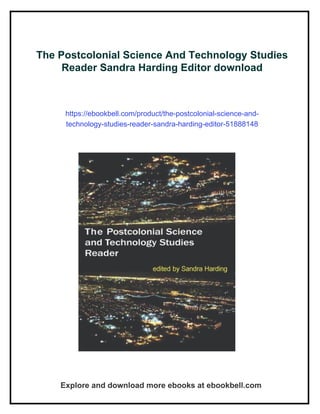





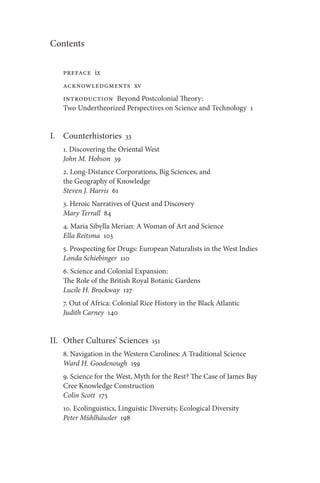
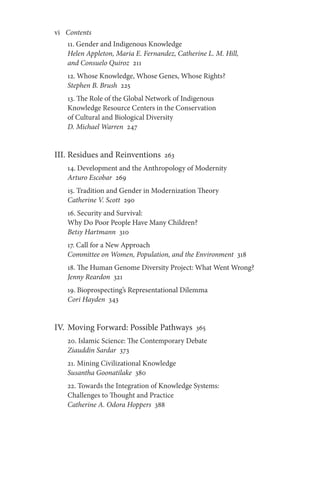


![Preface
Critical discussions of Western colonialism and imperialism and of what
the term postcolonialism could mean, require, and enable first became
acceptable in literature and cultural studies departments in the United
States some three decades ago. Yet it has been much harder to create such
discussions of sciences and technologies. Especially resistant are those
departments where the West’s scientific rationality and technical exper-
tise have long been lovingly explained and “served up” for use in corpo-
rate and nationalist policies: sociology, philosophy, economics, and inter-
national relations, as well as the natural sciences themselves. Now such
discussions are beginning to arise here and there in government depart-
ments, international agencies, and research disciplines. The introduction
of postcolonial issues in Western universities is a powerful political and
intellectual move, contrary to the view of some skeptics. As the historian
Robert Young points out in the epigraph that begins this volume’s intro-
duction, the institutionalization of postcolonialism in higher education
marks “the first time . . . [that] the power of western academic institu-
tions has been deployed against the west.” To focus these kinds of critical
perspectives on sciences, technologies, and their philosophies is to direct
them to the most fundamental rationale invoked by the West in support
of its claims to unique, universally valid achievements and, consequently,
political entitlement.
A number of circumstances have conjoined to increase the possibility
of such discussions. The West’s so-called development programs for the
Third World have been recognized as failures for some time now, even
in the West. Those programs largely created de-development and malde-
velopment for the majority of the world’s most vulnerable citizens while
further enriching already advantaged elites in the West and their allies
around the globe. Western scientific rationality and technical expertise
have been perceived as the motor of progress for these development proj-
ects from the beginning, so the failures of development raise questions
about the value of Western rationality and expertise. Another influence
has been the recent outpouring of empirically and theoretically well-
grounded postcolonial analyses in English (as well as in other languages)
on scientific and technological issues. Much of this work has arisen from
the intellectual arms of activist groups seeking to serve local needs and
interests rather than those of transnational corporations and foreign gov-
ernments and investors. Two central focuses have been the development
of anti-Eurocentric primary, secondary, and university curricula, and of
appropriate and sustainable forms of development.](https://image.slidesharecdn.com/25944074-250514233339-bcc21d2c/85/The-Postcolonial-Science-And-Technology-Studies-Reader-Sandra-Harding-Editor-13-320.jpg)


![20 Introduction
live. They also require political struggles to gain access to the sites (the
boardrooms, the command centers, the policy circles) where one could
see how decisions have been made that directed and maintained sexist
and androcentric social relations (Hartsock [1983] 2003).
Standpoint theory produced stronger standards for good method in
the natural as well as the social sciences. Similarly, it produced revisions
of other regulative ideals of the sciences, including “strong objectivity”
and “robust reflexivity,” and produced more rigorous and comprehensive
standards for rationality (Haraway 1991; Harding 2004a, 2004b). Stand-
pointmethodologieshavebynowexplicitlybeenadoptedacrossthesocial
sciences, in some mixed social and natural sciences such as environmen-
tal and health studies, in several areas of biology, and in some technology
studies. Moreover, the logic of such methodologies has an organic quality
in that it seems to appear whenever a disadvantaged group tries to articu-
late the legitimacy of its own knowledge needs against the research prac-
tices that serve powerful groups. Thus the logic of standpoint epistemol-
ogy and methodology is routinely evoked in postcolonial writings that
start off from the lives of Third World peoples to think about Western
assumptions, policies and practices, and indigenous knowledge systems;
or about encounters with European voyagers, botanists, and physicians;
or about modernization or development theory. In many of the essays in
this collection, one can detect an appeal to a standpoint logic, whether or
not it is explicitly articulated as such.
One can still ask, however, if standpoint methodology and epistemol-
ogy are too Western to be fully useful elsewhere. Standpoint theory was
initially formulated within the Marxian and Enlightenment philosophical
and methodological traditions, even as it protests significant aspects of
such legacies. Although it is positioned against both positivist regulatory
ideals and practices in Western-origin natural and social sciences, posi-
tivism is not, to take just one case, one of the most problematic aspects of
Indian society for women, as the philosopher Uma Narayan pointed out
several decades ago. Moreover, standpoint theory’s appeal to the value of
women’s experience can lose its critical edge in societies that conceptual-
ize sex and gender differences as fundamentally complementary rather
than hierarchical, and this is so regardless of whether such differences are
in fact treated as hierarchical (Narayan 1989). There are other ways, with
significant relations to standpoint theory, to articulate research method-
ologies that can distribute their benefits more effectively to the least ad-
vantaged groups.31
Yet standpoint theory remains a valuable strategy to articulate the logic
of “a space of a different kind for polemics about the epistemological
priority of the experience of various groups or collectivities,” as Fredric](https://image.slidesharecdn.com/25944074-250514233339-bcc21d2c/85/The-Postcolonial-Science-And-Technology-Studies-Reader-Sandra-Harding-Editor-40-320.jpg)
![Beyond Postcolonial Theory 25
23. Examples of this relatively early work include Boston Women’s Health
Collective 1970; Fausto-Sterling 1994; Haraway 1989; Harding 1986, 1991; Hard-
ing and Hintikka [1983] 2003; Hubbard, Henifin, and Fried 1982; Keller 1984;
Longino 1990; Merchant 1980; Rossiter 1982–95; Schiebinger 1989, 1993; Tobach
and Rosoff 1978–84; Wajcman 1991. The medical establishment’s disparaging
and often erroneous opinions about women’s bodies were the object of much
early gender and science work. For recent reviews of these issues, see Harding
2008, chap. 4; and Subramaniam 2009.
24. See, e.g., the otherwise excellent, widely used reader for gender and sci-
ence studies courses, Wyer et al. 2001.
25. My argument is not that the feminist theorists themselves are unaware of
these matters but that the theoretical and methodological frameworks that they
deploy obscure or marginalize such issues.
26. See, e.g., Denzin, Lincoln, and Smith 2008; Goonatilake 1984; Hess 1995;
Hoppers 2002; Nader 1996; Third World Network 1993; Turnbull 2000; Watson-
Verran and Turnbull 1995.
27. I am being a bit disingenuous here. Men in every society have resisted
giving up their gender privileges. They usually mask their interests in male
supremacy with arguments about the trivial or dangerous nature of any chal-
lenges to their control over women’s lives. This is so even when they have good
reasons to resist continued Western intrusions in their societies. Arriving at
the best strategies for overcoming inequalities at least requires a lot of public
dialogue between all the relevant stakeholders.
28. Many more appear in the larger field of postcolonial studies. Moreover,
many additional significant postcolonial feminist science and technology schol-
ars are working in the West and around the world. See those included in this
collection, and the many citations throughout this book.
29. Poor people and grassroots activists from around the globe tend to have
what they understandably see as more urgent projects than to write essays or
books to be published in the West. But there are many other ways for their
voices to be heard in the West, as many of the essays here demonstrate.
30. But see D. Smith 2005 for a critical institutional ethnography.
31. See, e.g., Anzaldúa 1981; and Walter Mignolo’s articulation of the “colonial
difference” (2000).
32. For a highly visible polemic about a standpoint claim, see the discussion
of the U.S. Supreme Court (at that time) candidate Sonia Sotomayor’s state-
ment in a speech some years earlier that she hoped a wise Latina would make
better decisions in some cases than a wise white man (Los Angeles Times 2009a,
2009b, 2009c).
References
Adas, Michael. 1989. Machines as the Measure of Man. Ithaca: Cornell Univer-
sity Press.](https://image.slidesharecdn.com/25944074-250514233339-bcc21d2c/85/The-Postcolonial-Science-And-Technology-Studies-Reader-Sandra-Harding-Editor-45-320.jpg)
![Beyond Postcolonial Theory 27
of Science and Research in Contemporary Societies. Thousand Oaks, Calif.:
Sage.
Goldberg, David Theo, and Ato Quayson, eds. 2002. Relocating Postcolonialism.
New York: Blackwell.
Goonatilake, Susantha. 1984. Aborted Discovery: Science and Creativity in the
Third World. London: Zed.
Gupta, Akhil. 1998. Postcolonial Developments: Agriculture in the Making of
Modern India. Durham: Duke University Press.
Hackett, Edward J., et al. 2007. The Handbook of Science and Technology Studies.
3rd ed. Cambridge: MIT Press.
Haraway, Donna. 1989. Primate Visions: Gender, Race, and Nature in the World
of Modern Science. New York: Routledge.
———. 1991. “Situated Knowledges: The Science Question in Feminism and
the Privilege of Partial Perspectives.” In Simians, Cyborgs, and Women. New
York: Routledge.
Harding, Sandra. 1986. The Science Question in Feminism. Ithaca: Cornell Uni-
versity Press.
———. 1991. Whose Science? Whose Knowledge? Ithaca: Cornell University
Press.
———, ed. 1993. The “Racial” Economy of Science: Toward a Democratic Future.
Bloomington: Indiana University Press.
———. 1998. Is Science Multicultural? Postcolonialisms, Feminisms, and Episte-
mologies. Bloomington: Indiana University Press.
———. 2004a. “Rethinking Standpoint Epistemology: What Is ‘Strong Objec-
tivity’?” In The Feminist Standpoint Theory Reader, ed. Sandra Harding. New
York: Routledge.
———, ed. 2004b. The Feminist Standpoint Theory Reader. New York:
Routledge.
———. 2008. Sciences from Below: Feminisms, Postcolonialities, and Moderni-
ties. Durham: Duke University Press.
———. 2009. “Postcolonial and Feminist Philosophies of Science and Technol-
ogy.” In “Colonialism, Postcolonialism, and Science,” ed. Suman Seth, spe-
cial issue, Postcolonial Studies 12 (4): 401–21.
Harding, Sandra, and Merrill Hintikka, eds. [1983] 2003. Discovering Reality:
Feminist Perspectives on Epistemology, Metaphysics, Methodology, and Phi-
losophy of Science. 2nd ed. Dordrecht: Reidel/Kluwer.
Harding, Sandra, and Elizabeth McGregor. 1996. “The Gender Dimension of
Science and Technology.” In UNESCO World Science Report, ed. Howard J.
Moore. Paris: UNESCO.
Harris, Steven J. 2005. “Jesuit Scientific Activity in the Overseas Missions,
1540–1773.” Isis 96:71–79.
Harrison, Mark. 2005. “Science and the British Empire.” Isis 96:56–63.
Hartsock, Nancy. [1983] 2003. “The Feminist Standpoint: Developing the
Ground for a Specifically Feminist Historical Materialism.” In Discovering
Reality: Feminist Perspectives on Epistemology, Metaphysics, Methodology,](https://image.slidesharecdn.com/25944074-250514233339-bcc21d2c/85/The-Postcolonial-Science-And-Technology-Studies-Reader-Sandra-Harding-Editor-47-320.jpg)

![I. Counterhistories
The story [of science and colonialism] is a dual one. One of its aspects concerns
how science and the scientific enterprise formed part of and facilitated colo-
nial development. The other deals with how the colonial experience affected
science and the contemporary scientific enterprise. . . . Science and organized
knowledge did not come to Saint Domingue as something separate from the
rest of the colonizing process but, rather, formed an inherent part of French co-
lonialism from the beginning. In other words, the French did not colonize Saint
Domingue and then import science and medicine as cultural afterthoughts.
French science and learning came part and parcel with French colonialism, vir-
tually as a “productive force.”—James E. McClellan III,
Colonialism and Science
Consider . . . the formation of Western modernity, for which the benefit of em-
pire was crucial; its identity and authority were forged on the stage of colonial
and imperial domination. . . . The disciplines did not simply depend upon Eu-
rope’s prior self-generated cultural and political resources, rather their develop-
ment in the course of trade, exploration, conquest, and domination instanti-
ated Western modernity.—Gyan Prakash,
Another Reason: Science and the Imagination of Modern India
Modernity and coloniality are two sides of the same coin. . . . The discourse of
modernity has embedded in it, as Las Casas and Locke illustrate, the logic of
coloniality. . . . Between the triumphant rhetoric of modernity and that which
remains beyond its frontiers (tradition, underdevelopment, barbarism, and the
like) there is a difference. That difference . . . is colonial, that is, a difference that
is constantly built and rebuilt assuming the necessary values implied in moder-
nity and the values to be displaced or replaced when they are different.
—Walter Mignolo, The Darker Side of the Renaissance
Among the many important events of the nineteenth century, two were of mo-
mentous consequence for the entire world. One was the progress and power of
industrial technology; the other was the domination and exploitation of Africa
and much of Asia by Europeans. Historians have carefully described and ana-
lyzed these two phenomena, but separately, as though they had little bearing
on each other. It is the aim of this book to trace the connections between these
great events.—Daniel R. Headrick, The Tools of Empire: Technology and Euro-
pean Imperialism in the Nineteenth Century
Peoples of European descent have been schooled to think of our-
selves as uniquely responsible for most of humanity’s finest intellectual,
political, ethical, and economic achievements. It is our civilization and](https://image.slidesharecdn.com/25944074-250514233339-bcc21d2c/85/The-Postcolonial-Science-And-Technology-Studies-Reader-Sandra-Harding-Editor-53-320.jpg)