Intersocietal Dynamics Toward A General Theory
Jonathan H Turner download
https://ebookbell.com/product/intersocietal-dynamics-toward-a-
general-theory-jonathan-h-turner-48067176
Explore and download more ebooks at ebookbell.com
Here are some recommended products that we believe you will be
interested in. You can click the link to download.
Language Learning And Teaching As Social Interaction Zhu Hua
https://ebookbell.com/product/language-learning-and-teaching-as-
social-interaction-zhu-hua-5369240
Edemocracy Toward A New Model Of Interactive Society Alfredo M Ronchi
https://ebookbell.com/product/edemocracy-toward-a-new-model-of-
interactive-society-alfredo-m-ronchi-9958816
Architecture And The Social Sciences Inter And Multidisciplinary
Approaches Between Society And Space 1st Edition Maria Manuela Mendes
https://ebookbell.com/product/architecture-and-the-social-sciences-
inter-and-multidisciplinary-approaches-between-society-and-space-1st-
edition-maria-manuela-mendes-5882934
Hegemony And Domination Civil Society And Regime Variation In Interwar
Europe Dylan John Riley
https://ebookbell.com/product/hegemony-and-domination-civil-society-
and-regime-variation-in-interwar-europe-dylan-john-riley-4738498
Performative Interactions In African Theatre 2 Innovation Creativity
And Social Change 1st Kene Igweonu
https://ebookbell.com/product/performative-interactions-in-african-
theatre-2-innovation-creativity-and-social-change-1st-kene-
igweonu-5703474
Education Social Justice And Interagency Working Joined Up Or
Fractured Policy Routledge Research In Education Series 4 1st Edition
Sheila Riddell
https://ebookbell.com/product/education-social-justice-and-
interagency-working-joined-up-or-fractured-policy-routledge-research-
in-education-series-4-1st-edition-sheila-riddell-1987710
Blood Is Thicker Than Water Amerindian Intra And Interinsular
Relationships And Social Organization In The Precolonial Windward
Islands 1st Edition Alistair J Bright
https://ebookbell.com/product/blood-is-thicker-than-water-amerindian-
intra-and-interinsular-relationships-and-social-organization-in-the-
precolonial-windward-islands-1st-edition-alistair-j-bright-51710688
Void And Fullness In The Buddhist Hindu And Christian Traditions Sunya
Purna Pleroma Papers Presented At An Interreligious Retreat Seminar
Organized By The Abhishiktananda Society Delhi Held In Sarnath
Varanasi From December 11 To 16 19 Ed By Bettina Baumer
https://ebookbell.com/product/void-and-fullness-in-the-buddhist-hindu-
and-christian-traditions-sunya-purna-pleroma-papers-presented-at-an-
interreligious-retreat-seminar-organized-by-the-abhishiktananda-
society-delhi-held-in-sarnath-varanasi-from-december-11-to-16-19-ed-
by-bettina-baumer-4704216
World Eparliament Report 2008 United Nationsdepartment Of Economic And
Social Affairs
https://ebookbell.com/product/world-eparliament-report-2008-united-
nationsdepartment-of-economic-and-social-affairs-2020614
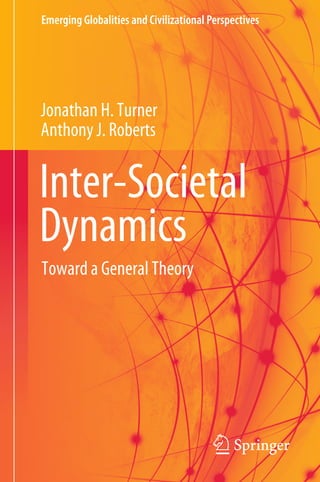
Inter-Societal
Dynamics
Jonathan H. Turner
Anthony J. Roberts
Toward a General Theory
Emerging Globalities and Civilizational Perspectives
Emerging Globalities and Civilizational
Perspectives
Series Editor
Ino Rossi, Saint John’s University, Great Neck, NY, USA
This series documents the range of emerging globalities in the 21st century at the
national, transnational and trans-civilizational levels of analysis. “Globality” refers
to a global condition where people located at any point on Earth are aware of being
part of the world as a whole—the world as a single interacting entity. Social
interactions occur among actors belonging to different societies, different social
strata and different cultural traditions so that the condition of “globality” is
experienced in many different ways.
Examples of emerging globalities are social movements generated from the
unfulfilled promises of neoliberalism and feelings of discrimination and marginal-
ization of lower social strata; cultural otherization or the blaming of economic
problems of certain geographical areas on a low level of cultural development;
insecurities generated by technological risks, epidemics, and global terrorism;
uncertainties generated by processes of transnational governance, outsourcing,
unbalanced trade and massive migrations; biology-machine interfaces and impacts
of non-human organisms and technologies on human consciousness and action;
long-term threats of global warming, climate change and depletion of bio-diversity;
increasing exploitation and marginalization of less industrialized regions.
We state that globalization entails encounters and often clashes among people
and nations of different civilizational traditions. Hence, one of the exploratory
questions of these volumes will be the extent to which negative or problematic
globalities are reactions to failed promises and unrealized ideals of civilizational
and national traditions and/or perhaps attempts to revive those traditions. Our
notion of civilizational tradition takes inspiration from the classical works of
Spengler and Toynbee, Benjamin Nelson, Vytautas Kavolis, Roland Robertson,
Johann P. Arnason, Jeremy Smith, and others; a tradition which is in sharp contrast
with the civilizationism recently promoted by authoritarian leaders with hegemonic
ambitions. The volumes in this series aim to extend the inter-civilizational focus of
classical civilizational thinkers from the analysis of the origins and development of
civilizations to the fostering of contemporary inter-civilizational dialogues; the
intent is to facilitate an international rapprochement in the contemporary
atmosphere of global conflicts.
The volumes will reflect the diversity of theoretical perspectives and captures
some of the novel thinking in social sciences, economics and humanities on intra-
and inter-societal processes; the attention to novel thinking will extend to emerging
policy formulations in dealing with threats, risks, insecurities and inequities and to
strategic thinking for a sustainable global future. The historical perspective will also
be an important component of analysis together with the avoidance of West-centric
perspectives. The intended readership of this series is not just an academic audience
but also policy decision-makers and the public at large; accessibility of language
and clarity of discourse will be a key concern in the preparation of these volumes.
Jonathan H. Turner • Anthony J. Roberts
Inter-Societal Dynamics
Toward a General Theory
123
Jonathan H. Turner
Department of Sociology
University of California
Riverside, CA, USA
Anthony J. Roberts
Department of Sociology
Colorado State University
Fort Collins, CO, USA
ISSN 2731-0620 ISSN 2731-0639 (electronic)
Emerging Globalities and Civilizational Perspectives
ISBN 978-3-031-12447-1 ISBN 978-3-031-12448-8 (eBook)
https://doi.org/10.1007/978-3-031-12448-8
© The Editor(s) (if applicable) and The Author(s), under exclusive license to Springer Nature
Switzerland AG 2023
This work is subject to copyright. All rights are solely and exclusively licensed by the Publisher, whether
the whole or part of the material is concerned, specifically the rights of translation, reprinting, reuse of
illustrations, recitation, broadcasting, reproduction on microfilms or in any other physical way, and
transmission or information storage and retrieval, electronic adaptation, computer software, or by similar
or dissimilar methodology now known or hereafter developed.
The use of general descriptive names, registered names, trademarks, service marks, etc. in this
publication does not imply, even in the absence of a specific statement, that such names are exempt from
the relevant protective laws and regulations and therefore free for general use.
The publisher, the authors, and the editors are safe to assume that the advice and information in this
book are believed to be true and accurate at the date of publication. Neither the publisher nor the
authors or the editors give a warranty, expressed or implied, with respect to the material contained
herein or for any errors or omissions that may have been made. The publisher remains neutral with regard
to jurisdictional claims in published maps and institutional affiliations.
This Springer imprint is published by the registered company Springer Nature Switzerland AG
The registered company address is: Gewerbestrasse 11, 6330 Cham, Switzerland
Randall Collins
&
Christopher Chase-Dunn
In appreciation for their efforts to expand
the reach of inter-societal theorizing
and to inspire out effort, for better or worse,
to make this approach more scientific
and theoretical
Preface
Sociology from its beginning addressed inter-societal dynamics, although these
early efforts typically emphasized their effects on internal societal development than
inter-societal evolution. More generally, historians and social scientists have been
engaged in studying the ebb and flow of empires and other forms of inter-societal
relations. Still, it was not until the second half of the twentieth century that
inter-societal formations were taken as distinctive level of social reality that, in
essence, determined many of the internal structures and dynamics of human soci-
eties and their other institutional domains. However, this shift in theorizing initially
emphasized how inter-societal systems were often highly exploitive. Starting with
dependency theory, and then world-systems analysis (WSA), these perspectives
challenged the dominant “modernization theory” and policies of the 1950s and
1960s by emphasizing how inter-societal relations reproduced conditions of
underdevelopment and international stratification among societies. Nonetheless,
these perspectives identified inter-societal systems as a macro-unit of social orga-
nization that needs more study and theorizing.
At the same time, these perspectives gave new life to Marxist arguments about
the “contradictions of capitalism” becoming evident as world-level capitalism
spread across the globe, leading somehow to the collapse of capitalism and the rise
of socialism and a new world order. This always struck us as rather unlikely and,
like all “end of history” arguments, has more hope and bluster than predictable
outcome derived from a general theory. It was, as has always been the case in
sociology, giving unjustified credence to ideologies about what should occur, as
opposed to what can and does occur, in human societies, and now inter-societal
systems.
As authors, we are a couple of sociological generations apart, with J. H. T.
receiving his Ph.D. in the 1960s and A. J. R. receiving his in the twenty-first
century. Not only age but our respective knowledge bases are somewhat different.
J. H. T. is a general theorist, who is not bothered, by the epithet “grand theory” as
long it is actual theory rather than grand illusions, as is much of the ideology that
penetrates the world-systems tradition today. A. J. R. is trained in world-systems
theory and research, as a former student of Christopher Chase-Dunn who has been
vii
one of the most important scholars in this tradition. The book could not have been
written without our respective skills, and as will become evident, this book will
look very different from other works in the world-systems tradition over the last 50
years. This is a theory book rather than an empirical book—although empirical
reality is not ignored since, after all, this is what we are trying to explain.
We accept the view that inter-societal systems are an emergent level of social
reality that has been universal since the beginning of human societies at least
400,000 years ago. Thus, inter-societal systems and their dynamics are an appro-
priate and, indeed, a necessary subject for abstract sociological theory. For all the
good work in WSA, it has been too narrow in its focus on the last 500 years as
capitalism arose. In our view, humans have been creating geo-economic systems for
hundreds of thousands of years and, hence, should be a set of data points for the
other 399,500 years that humans have organized into societies, granted very small
and simple societies, but nonetheless societies that have likely (given the data on
pre-literate societies) formed geo-economic and geo-political inter-societal systems.
This book is, in part, dedicated to Christopher Chase-Dunn in recognition for his
effort to push this simple point, even if he would not necessarily agree to our
hard-nosed positivism emphasizing the possibility of generating, as the subtitle for
this book proclaims, a more general theory of inter-societal dynamics—a theory
that covers from the very beginning of such formations to the present and, perhaps,
into the future. This is an effort to move toward a general theory rather than a set of
historical descriptions, classification of societies in inter-societal formations, and
weak ideological arguments expressing hope for a certain form of inter-societal
societal governance—socialism.
For J. H. T., writing general theories of all layers and levels of human social
organization has basically been a 60-year project dedicated to making sociology a
theoretical and explanatory science. Indeed, J. H. T. would prefer that sociology go
by its original, but short-lived name, Social Physics—a label that might be available
if sociology, and especially American sociology continues its evolution into a
cheerleader for social justice—a worthy thing to cheer for but not a very useful way
to develop knowledge about the dynamics of human societies and inter-societal
systems. Social Physics might be a good name for the refugees of American
sociology, seeking a label for what they do: value-free (as much as is possible,
given that we are all human) analysis of the socio-cultural universe.
The book is also dedicated to Randall Collins who produced a series of articles
that inspired J. H. T. to begin studying geo-economic and geo-political formations
and their dynamics, and this book is, except for three articles, is the outcome of
decades of reading about inter-societal systems. Collins’ articles and what they
inspired motivated J. H. T. to push hard for Christopher Chase-Dunn’s appointment
at the University of California Riverside to build a strong graduate specialization
populated by a constant flow of very good young scholars to their Ph.D.s, such as
A. J. R., who would also take J. H. T.’s theory courses. Our zoom dialogues and
exchanges of drafts over the last year have allowed us to write this book, drawing
upon our respective knowledge bases and analytical skills.
viii Preface
What we present is only tentative; it simply is our best effort, at this point in
time. Our hope is that other scholars working in the world-systems tradition will
join us in trying to make WSA less ideological, less descriptive, and less con-
strained by the emphasis on the last 500 years of history. Instead, WSA should draw
upon, as we do, the very large databases, and analyses of these bases, now accu-
mulated on all types of societies that have existed over the last 400,000 years. These
offer the information needed to begin developing more abstract theoretical models
and inventories of abstract principles. What we offer is not a complete, and perhaps
not even an accurate theory, but we hope to convince at least some that this kind of
effort at developing general, and highly abstract, theory is useful.
Murrieta and Santa Barbara, CA, USA Jonathan H. Turner
Fort Collins, CO, USA Anthony J. Roberts
Preface ix
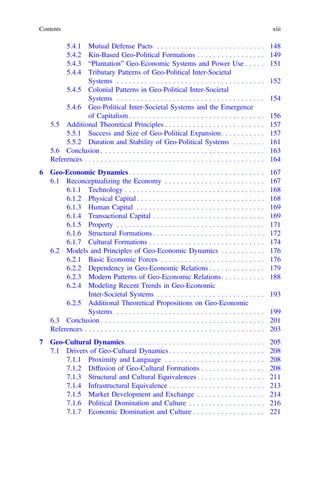
Contents
1 Fundamental Properties of Societies . . . . . . . . . . . . . . . . . . . . . . . . . 1
1.1 The Fundamental Properties of Human Societies . . . . . . . . . . . . . 2
1.2 Social Structures in Societies. . . . . . . . . . . . . . . . . . . . . . . . . . . . 3
1.2.1 Institutional Domains in Human Societies . . . . . . . . . . . . . 3
1.2.2 Stratification Systems in Human Societies . . . . . . . . . . . . . 7
1.3 Cultural Structures in Societies . . . . . . . . . . . . . . . . . . . . . . . . . . 11
1.4 Infrastructures in Societies . . . . . . . . . . . . . . . . . . . . . . . . . . . . . 15
1.4.1 A Model of Infrastructural Dynamics . . . . . . . . . . . . . . . . 15
1.4.2 Impacts of Infrastructure on Societal and Inter-societal
Dynamics . . . . . . . . . . . . . . . . . . . . . . . . . . . . . . . . . . . . 22
1.5 Societal and Inter-Societal Systems . . . . . . . . . . . . . . . . . . . . . . . 23
References . . . . . . . . . . . . . . . . . . . . . . . . . . . . . . . . . . . . . . . . . . . . . 25
2 Current Theorizing of Inter-Societal Dynamics: Origins
and Critiques . . . . . . . . . . . . . . . . . . . . . . . . . . . . . . . . . . . . . . . . . . 27
2.1 Immanuel Wallerstein’s and World-Systems Analysis . . . . . . . . . . 29
2.2 The Evolution of the Modern World-System . . . . . . . . . . . . . . . . 31
2.3 The Theoretical Roots of World-System Analysis . . . . . . . . . . . . . 33
2.3.1 Imperialism and Capitalism as a Global System . . . . . . . . 33
2.3.2 Dependency Theory and Unequal Exchange . . . . . . . . . . . 35
2.3.3 Exchange Theorizing in Sociology . . . . . . . . . . . . . . . . . . 38
2.4 The Limitations of World-Systems Analysis. . . . . . . . . . . . . . . . . 41
2.4.1 Descriptive Theorizing . . . . . . . . . . . . . . . . . . . . . . . . . . . 41
2.4.2 The Marxist Ideology of World-Systems Analysis . . . . . . . 43
2.4.3 The Return to Marxism: William Robison’s Critique
of World-Systems Analysis . . . . . . . . . . . . . . . . . . . . . . . 45
2.4.4 The Absence of Geo-Cultural Dynamics . . . . . . . . . . . . . . 47
2.4.5 Scope Conditions and Pre-modern Inter-Societal
Systems . . . . . . . . . . . . . . . . . . . . . . . . . . . . . . . . . . . . . 47
2.4.6 The Predictive Power of World-Systems Analysis . . . . . . . 49
xi
2.5 From the Beginning: The Pervasiveness of Inter-Societal
Relations . . . . . . . . . . . . . . . . . . . . . . . . . . . . . . . . . . . . . . . . . . 49
2.5.1 The Beginnings of Geo-Economic Relations . . . . . . . . . . . 49
2.5.2 The Evolution of Markets and Money. . . . . . . . . . . . . . . . 52
2.5.3 The Beginnings of Geo-Political Relations . . . . . . . . . . . . 55
2.5.4 The Basis of Power . . . . . . . . . . . . . . . . . . . . . . . . . . . . . 56
2.6 Conclusion . . . . . . . . . . . . . . . . . . . . . . . . . . . . . . . . . . . . . . . . . 58
References . . . . . . . . . . . . . . . . . . . . . . . . . . . . . . . . . . . . . . . . . . . . . 58
3 Key Ideas for Building a Scientific Theory of Inter-Societal
Dynamics . . . . . . . . . . . . . . . . . . . . . . . . . . . . . . . . . . . . . . . . . . . . . 63
3.1 Two Early Theoretical Approaches . . . . . . . . . . . . . . . . . . . . . . . 64
3.1.1 Herbert Spencer . . . . . . . . . . . . . . . . . . . . . . . . . . . . . . . . 64
3.1.2 Ibin Khaldun . . . . . . . . . . . . . . . . . . . . . . . . . . . . . . . . . . 72
3.2 Contemporary Theoretical Approaches . . . . . . . . . . . . . . . . . . . . . 73
3.2.1 Peter Turchin. . . . . . . . . . . . . . . . . . . . . . . . . . . . . . . . . . 73
3.2.2 Christopher Chase-Dunn and Colleagues . . . . . . . . . . . . . . 79
3.2.3 Randall Collins on the Dynamics of Geo-Political
Inter-Societal Systems . . . . . . . . . . . . . . . . . . . . . . . . . . . 86
3.2.4 Fernand Braudel and Randall Collins on Markets . . . . . . . 91
3.2.5 Jack Goldstone on State Breakdown . . . . . . . . . . . . . . . . . 96
3.2.6 Ecological Theories and Inter-Societal Dynamics . . . . . . . . 99
3.2.7 World Society Theory and Geo-Cultural Dynamics . . . . . . 101
3.3 Conclusion . . . . . . . . . . . . . . . . . . . . . . . . . . . . . . . . . . . . . . . . . 104
References . . . . . . . . . . . . . . . . . . . . . . . . . . . . . . . . . . . . . . . . . . . . . 105
4 Scientific Theorizing of Inter-Societal Dynamics . . . . . . . . . . . . . . . . 109
4.1 Developing Scientific Explanations of Inter-Societal Systems . . . . 110
4.1.1 Fundamental Properties of Inter-Societal Dynamics . . . . . . 110
4.1.2 A Typology of Inter-Societal Patterns . . . . . . . . . . . . . . . . 111
4.1.3 A Strategy for Developing Scientific Theories . . . . . . . . . . 117
4.2 Conclusion . . . . . . . . . . . . . . . . . . . . . . . . . . . . . . . . . . . . . . . . . 119
References . . . . . . . . . . . . . . . . . . . . . . . . . . . . . . . . . . . . . . . . . . . . . 119
5 Geo-Political Dynamics . . . . . . . . . . . . . . . . . . . . . . . . . . . . . . . . . . . 123
5.1 The Evolution of Polity . . . . . . . . . . . . . . . . . . . . . . . . . . . . . . . 124
5.1.1 Consolidating Bases of Power . . . . . . . . . . . . . . . . . . . . . 126
5.1.2 Centralizing Bases of Power. . . . . . . . . . . . . . . . . . . . . . . 127
5.1.3 Bases of Power in Geo-Political Dynamics . . . . . . . . . . . . 128
5.1.4 A Model of Power Consolidation and Centralization . . . . . 130
5.2 Expansion Through Warfare: The Intersection
of Geo-Economic and Geo-Political Dynamics . . . . . . . . . . . . . . . 136
5.3 Success and Failure in Geo-Political Actions . . . . . . . . . . . . . . . . 142
5.3.1 A Model of Geo-Political Dynamics . . . . . . . . . . . . . . . . . 144
5.4 Strategies of Domination, Point of Over-Extension,
and Collapse of Geo-Political Systems . . . . . . . . . . . . . . . . . . . . . 148
xii Contents
5.4.1 Mutual Defense Pacts . . . . . . . . . . . . . . . . . . . . . . . . . . . 148
5.4.2 Kin-Based Geo-Political Formations . . . . . . . . . . . . . . . . . 149
5.4.3 “Plantation” Geo-Economic Systems and Power Use . . . . . 151
5.4.4 Tributary Patterns of Geo-Political Inter-Societal
Systems . . . . . . . . . . . . . . . . . . . . . . . . . . . . . . . . . . . . . 152
5.4.5 Colonial Patterns in Geo-Political Inter-Societal
Systems . . . . . . . . . . . . . . . . . . . . . . . . . . . . . . . . . . . . . 154
5.4.6 Geo-Political Inter-Societal Systems and the Emergence
of Capitalism . . . . . . . . . . . . . . . . . . . . . . . . . . . . . . . . . . 156
5.5 Additional Theoretical Principles . . . . . . . . . . . . . . . . . . . . . . . . . 157
5.5.1 Success and Size of Geo-Political Expansion. . . . . . . . . . . 157
5.5.2 Duration and Stability of Geo-Political Systems . . . . . . . . 161
5.6 Conclusion . . . . . . . . . . . . . . . . . . . . . . . . . . . . . . . . . . . . . . . . . 163
References . . . . . . . . . . . . . . . . . . . . . . . . . . . . . . . . . . . . . . . . . . . . . 164
6 Geo-Economic Dynamics. . . . . . . . . . . . . . . . . . . . . . . . . . . . . . . . . . 167
6.1 Reconceptualizing the Economy . . . . . . . . . . . . . . . . . . . . . . . . . 167
6.1.1 Technology . . . . . . . . . . . . . . . . . . . . . . . . . . . . . . . . . . . 168
6.1.2 Physical Capital . . . . . . . . . . . . . . . . . . . . . . . . . . . . . . . . 168
6.1.3 Human Capital . . . . . . . . . . . . . . . . . . . . . . . . . . . . . . . . 169
6.1.4 Transactional Capital . . . . . . . . . . . . . . . . . . . . . . . . . . . . 169
6.1.5 Property . . . . . . . . . . . . . . . . . . . . . . . . . . . . . . . . . . . . . 171
6.1.6 Structural Formations . . . . . . . . . . . . . . . . . . . . . . . . . . . . 172
6.1.7 Cultural Formations . . . . . . . . . . . . . . . . . . . . . . . . . . . . . 174
6.2 Models and Principles of Geo-Economic Dynamics . . . . . . . . . . . 176
6.2.1 Basic Economic Forces . . . . . . . . . . . . . . . . . . . . . . . . . . 176
6.2.2 Dependency in Geo-Economic Relations . . . . . . . . . . . . . . 179
6.2.3 Modern Patterns of Geo-Economic Relations. . . . . . . . . . . 188
6.2.4 Modeling Recent Trends in Geo-Economic
Inter-Societal Systems . . . . . . . . . . . . . . . . . . . . . . . . . . . 193
6.2.5 Additional Theoretical Propositions on Geo-Economic
Systems . . . . . . . . . . . . . . . . . . . . . . . . . . . . . . . . . . . . . 199
6.3 Conclusion . . . . . . . . . . . . . . . . . . . . . . . . . . . . . . . . . . . . . . . . . 201
References . . . . . . . . . . . . . . . . . . . . . . . . . . . . . . . . . . . . . . . . . . . . . 203
7 Geo-Cultural Dynamics. . . . . . . . . . . . . . . . . . . . . . . . . . . . . . . . . . . 205
7.1 Drivers of Geo-Cultural Dynamics. . . . . . . . . . . . . . . . . . . . . . . . 208
7.1.1 Proximity and Language . . . . . . . . . . . . . . . . . . . . . . . . . 208
7.1.2 Diffusion of Geo-Cultural Formations . . . . . . . . . . . . . . . . 208
7.1.3 Structural and Cultural Equivalences . . . . . . . . . . . . . . . . . 211
7.1.4 Infrastructural Equivalence . . . . . . . . . . . . . . . . . . . . . . . . 213
7.1.5 Market Development and Exchange . . . . . . . . . . . . . . . . . 214
7.1.6 Political Domination and Culture . . . . . . . . . . . . . . . . . . . 216
7.1.7 Economic Domination and Culture . . . . . . . . . . . . . . . . . . 221
Contents xiii
7.2 A General Model of Geo-Cultural Dynamics . . . . . . . . . . . . . . . . 224
7.2.1 Explanatory Principles on Geo-Cultural Inter-societal
Systems . . . . . . . . . . . . . . . . . . . . . . . . . . . . . . . . . . . . . 228
7.3 The Interplay of Geo-Cultural, Political, and Economic
Dynamics . . . . . . . . . . . . . . . . . . . . . . . . . . . . . . . . . . . . . . . . . . 231
7.3.1 Geo-Political Strategies of Domination and Institutional
Change . . . . . . . . . . . . . . . . . . . . . . . . . . . . . . . . . . . . . . 232
7.3.2 Geo-Economic Strategies of Domination and Institutional
Change . . . . . . . . . . . . . . . . . . . . . . . . . . . . . . . . . . . . . . 233
7.3.3 Structural and Cultural Equivalences . . . . . . . . . . . . . . . . . 235
7.4 Conclusions . . . . . . . . . . . . . . . . . . . . . . . . . . . . . . . . . . . . . . . . 236
References . . . . . . . . . . . . . . . . . . . . . . . . . . . . . . . . . . . . . . . . . . . . . 237
Epilogue. . . . . . . . . . . . . . . . . . . . . . . . . . . . . . . . . . . . . . . . . . . . . . . . . . . . 239
Bibliography . . . . . . . . . . . . . . . . . . . . . . . . . . . . . . . . . . . . . . . . . . . . . . . . 247
xiv Contents
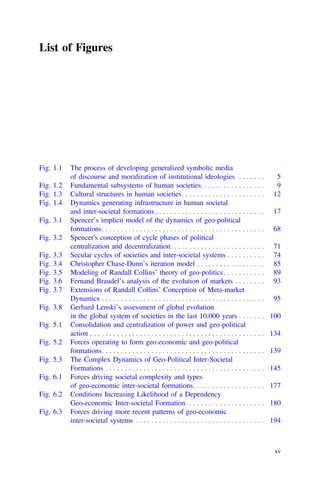
List of Figures
Fig. 1.1 The process of developing generalized symbolic media
of discourse and moralization of institutional ideologies . . . . . . . 5
Fig. 1.2 Fundamental subsystems of human societies. . . . . . . . . . . . . . . . . 9
Fig. 1.3 Cultural structures in human societies. . . . . . . . . . . . . . . . . . . . . . 12
Fig. 1.4 Dynamics generating infrastructure in human societal
and inter-societal formations . . . . . . . . . . . . . . . . . . . . . . . . . . . . . 17
Fig. 3.1 Spencer’s implicit model of the dynamics of geo-political
formations. . . . . . . . . . . . . . . . . . . . . . . . . . . . . . . . . . . . . . . . . . . 68
Fig. 3.2 Spencer's conception of cycle phases of political
centralization and decentralization. . . . . . . . . . . . . . . . . . . . . . . . . 71
Fig. 3.3 Secular cycles of societies and inter-societal systems . . . . . . . . . . 74
Fig. 3.4 Christopher Chase-Dunn’s iteration model . . . . . . . . . . . . . . . . . . 85
Fig. 3.5 Modeling of Randall Collins’ theory of geo-politics . . . . . . . . . . . 89
Fig. 3.6 Fernand Braudel’s analysis of the evolution of markets . . . . . . . . 93
Fig. 3.7 Extensions of Randall Collins’ Conception of Meta-market
Dynamics . . . . . . . . . . . . . . . . . . . . . . . . . . . . . . . . . . . . . . . . . . . 95
Fig. 3.8 Gerhard Lenski’s assessment of global evolution
in the global system of societies in the last 10,000 years . . . . . . . 100
Fig. 5.1 Consolidation and centralization of power and geo-political
action . . . . . . . . . . . . . . . . . . . . . . . . . . . . . . . . . . . . . . . . . . . . . . 134
Fig. 5.2 Forces operating to form geo-economic and geo-political
formations. . . . . . . . . . . . . . . . . . . . . . . . . . . . . . . . . . . . . . . . . . . 139
Fig. 5.3 The Complex Dynamics of Geo-Political Inter-Societal
Formations . . . . . . . . . . . . . . . . . . . . . . . . . . . . . . . . . . . . . . . . . . 145
Fig. 6.1 Forces driving societal complexity and types
of geo-economic inter-societal formations. . . . . . . . . . . . . . . . . . . 177
Fig. 6.2 Conditions Increasing Likelihood of a Dependency
Geo-economic Inter-societal Formation. . . . . . . . . . . . . . . . . . . . . 180
Fig. 6.3 Forces driving more recent patterns of geo-economic
inter-societal systems . . . . . . . . . . . . . . . . . . . . . . . . . . . . . . . . . . 194
xv
Fig. 7.1 Conceptualizing culture at a high level of abstraction
in geo-cultural inter-societal systems. . . . . . . . . . . . . . . . . . . . . . . 225
Fig. 7.2 The dynamics of geo-cultural formations and geo-cultural
inter-societal systems . . . . . . . . . . . . . . . . . . . . . . . . . . . . . . . . . . 229
xvi List of Figures
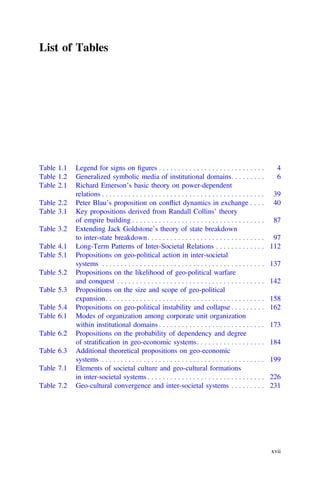
List of Tables
Table 1.1 Legend for signs on figures . . . . . . . . . . . . . . . . . . . . . . . . . . . . 4
Table 1.2 Generalized symbolic media of institutional domains. . . . . . . . . 6
Table 2.1 Richard Emerson’s basic theory on power-dependent
relations . . . . . . . . . . . . . . . . . . . . . . . . . . . . . . . . . . . . . . . . . . . 39
Table 2.2 Peter Blau’s proposition on conflict dynamics in exchange . . . . 40
Table 3.1 Key propositions derived from Randall Collins’ theory
of empire building . . . . . . . . . . . . . . . . . . . . . . . . . . . . . . . . . . . 87
Table 3.2 Extending Jack Goldstone’s theory of state breakdown
to inter-state breakdown. . . . . . . . . . . . . . . . . . . . . . . . . . . . . . . 97
Table 4.1 Long-Term Patterns of Inter-Societal Relations . . . . . . . . . . . . . 112
Table 5.1 Propositions on geo-political action in inter-societal
systems . . . . . . . . . . . . . . . . . . . . . . . . . . . . . . . . . . . . . . . . . . . 137
Table 5.2 Propositions on the likelihood of geo-political warfare
and conquest . . . . . . . . . . . . . . . . . . . . . . . . . . . . . . . . . . . . . . . 142
Table 5.3 Propositions on the size and scope of geo-political
expansion. . . . . . . . . . . . . . . . . . . . . . . . . . . . . . . . . . . . . . . . . . 158
Table 5.4 Propositions on geo-political instability and collapse . . . . . . . . . 162
Table 6.1 Modes of organization among corporate unit organization
within institutional domains . . . . . . . . . . . . . . . . . . . . . . . . . . . . 173
Table 6.2 Propositions on the probability of dependency and degree
of stratification in geo-economic systems. . . . . . . . . . . . . . . . . . 184
Table 6.3 Additional theoretical propositions on geo-economic
systems . . . . . . . . . . . . . . . . . . . . . . . . . . . . . . . . . . . . . . . . . . . 199
Table 7.1 Elements of societal culture and geo-cultural formations
in inter-societal systems . . . . . . . . . . . . . . . . . . . . . . . . . . . . . . . 226
Table 7.2 Geo-cultural convergence and inter-societal systems . . . . . . . . . 231
xvii
Chapter 1
Fundamental Properties of Societies
Over the last half-century, the revival of inter-societal analysis in the form of
World-Systems Analysis (hereafter, WSA) has been one of the most important
empirical and theoretical developments within sociology. As we will emphasize in
this book, human societies have almost always formed inter-societal systems,
although most world-systems analysts have emphasized only the last five hundred
years as world-level capitalism began to emerge. Still, historians, political scientists,
and anthropologists have long studied inter-societal relations among all types of
societies—beginning with hunting and gathering and moving through horticulture
then agrarianism, industrialism, and post-industrialism. This emphasis has, we feel,
led to analysis of the evolution in the present at the expense of analyzing the full
range of inter-societal systems. In our view, inter-societal systems have exist since
the beginning of human societies and have episodically existed for many thousands
of years right up to the present. In contrast, WSA has generally focused on the
evolution of capitalism over a very short historical period of human societies. The
result is that “theories” are time-bound and often more descriptive of the last
500 years of history rather than the actual theoretical explanation of the funda-
mental dynamics of all inter-societal systems.
We emphasize this point as a mild critique of current WSA because a general
theory of such a universal form of human social organization as inter-societal
formations should include all types in all times and in all places where
inter-societal have emerged and evolved. The emphasis on the rise of capitalism
captures only a 500-year slice of a phenomenon that has existed for at least 800
five-hundred-year spans (400,000 years of human societies divided by 500). The
result is that this conceptualization of societies and inter-societal systems is often
skewed, which is understandable because the recent history of inter-societal sys-
tems is of most interest. Yet, the emphasis on the evolution of capitalism is a very
limiting case for a phenomenon that has existed for so many hundreds of thousands
of years before capitalism. A general theoretical approach should explain all forms
of inter-societal organization, from the simplest to the most complex.
© The Author(s), under exclusive license to Springer Nature Switzerland AG 2023
J. H. Turner and A. J. Roberts, Inter-Societal Dynamics, Emerging Globalities
and Civilizational Perspectives, https://doi.org/10.1007/978-3-031-12448-8_1
1
This means that the conceptualization of the phenomenon to be explained—
inter-societal dynamics—must begin with a conceptualization of the fundamental
properties of societies in general and then, the properties and dynamics of
inter-relations among all types of societies. As will become evident, our analysis
will be more inclusive of the full range of societal and inter-societal formations than
most current theories. And, to engage in this kind of analysis, we should begin with
a very abstract and general conceptualization of the fundamental properties of all
societal systems.
1.1 The Fundamental Properties of Human Societies
All societies are built from three fundamental elements: (1) social structures,
(2) cultural structures, and (3) infrastructures. These vary enormously from the
very simple structural, cultural, and infrastructural formations organizing hunting
and gathering societies of a few dozen to several hundred individuals to the very
complex structures organizing societies numbering many millions and even billions
of persons. Yet, in imposing a much longer time frame in conceptualizing societal
and inter-societal formations, we can gain greater theoretical purchase on their
generic dynamics. And so, we begin our theoretical analysis of inter-societal
dynamics by outlining, first, the fundamental properties of social structures and
then, move on to the analysis of cultural structures, and finally, infrastructures. For
in the end, the properties of social structures, cultural structures, and infrastructures
together help explain societal and inter-societal formations for all times and places
that humans have lived. The result is that theoretical analysis will thus look different
than many contemporary WSA analyses, while at the same time explaining the
most recent world-system formations. Indeed, a great deal of WSA analysis can be
viewed constructing a classification system for analyzing the evolution of the
capitalist world-system as much as an explanation of the operative dynamics of
inter-societal systems in general.
A theory of inter-societal dynamics must explain the processes operating within
and between societies. A system for categorizing societies into roles within inter-
national division of labor, such as the WSA’s emphasis on core, peripheral, and
semi-peripheral societies in the “modern world-system” was a useful beginning
point (Wallerstein 1974). However, this created two fundamental problems: First,
how are the dynamics of modern world-systems to be explained by a typology of
three types when one of these three types, most typically the semi-periphery, is
often missing empirically? And second, and perhaps a more fundamental problem,
how does a typology that only classifies phenomena explain the dynamic processes
driving these phenomena? Many WSA theoretical approaches have been able to
create dynamic models, but some of these have suffered from the problem of not
having a sufficiently robust conception of the elements of societies that are involved
in inter-societal formations. Often, this problem stems from a weak conception of
the internal dynamics of the societies forming inter-societal systems. In this chapter,
2 1 Fundamental Properties of Societies
we address this underlying problem by outlining, in detail, the full range of social
structures, cultural structures, and infrastructures that are involved in creating
inter-societal formations.
More will be needed, however, because an outline of the properties of social
structures, cultural structures, and infrastructures is only a beginning point of the-
orizing. We will also need to specify the dynamic processes operating within and
between these structures in the formation of inter-societal systems. Still, for the
moment, let us simply outline the fundamental societal-level structures that drive
the formation of societal and inter-societal systems. We will touch on some
dynamic processes, but theoretical models and propositions to be presented in later
chapters will delineate a more robust picture of the dynamics driving these struc-
tures of social life.
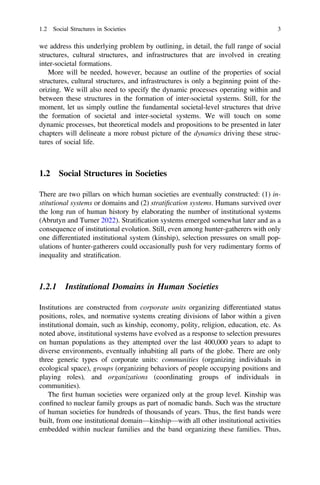
1.2 Social Structures in Societies
There are two pillars on which human societies are eventually constructed: (1) in-
stitutional systems or domains and (2) stratification systems. Humans survived over
the long run of human history by elaborating the number of institutional systems
(Abrutyn and Turner 2022). Stratification systems emerged somewhat later and as a
consequence of institutional evolution. Still, even among hunter-gatherers with only
one differentiated institutional system (kinship), selection pressures on small pop-
ulations of hunter-gatherers could occasionally push for very rudimentary forms of
inequality and stratification.
1.2.1 Institutional Domains in Human Societies
Institutions are constructed from corporate units organizing differentiated status
positions, roles, and normative systems creating divisions of labor within a given
institutional domain, such as kinship, economy, polity, religion, education, etc. As
noted above, institutional systems have evolved as a response to selection pressures
on human populations as they attempted over the last 400,000 years to adapt to
diverse environments, eventually inhabiting all parts of the globe. There are only
three generic types of corporate units: communities (organizing individuals in
ecological space), groups (organizing behaviors of people occupying positions and
playing roles), and organizations (coordinating groups of individuals in
communities).
The first human societies were organized only at the group level. Kinship was
confined to nuclear family groups as part of nomadic bands. Such was the structure
of human societies for hundreds of thousands of years. Thus, the first bands were
built, from one institutional domain—kinship—with all other institutional activities
embedded within nuclear families and the band organizing these families. Thus,
1.2 Social Structures in Societies 3
economic, religious, educational, political, and legal activities were not yet struc-
tured as distinctive institutional systems but, rather, were embedded in the nor-
mative systems of kinship and band, with the band constituting a simple
organization of nuclear kin units, although if bands settled down, they could and did
morph into a second type of corporate unit, community. And, as populations settled
down into more permanent communities, they grew larger and increasingly faced
selection pressures that, over time, led to the evolution of the diverse institutional
domains listed in Table 1.2. And, in turn, as each institutional domain emerged with
its own generalized media of exchange as outlined in Fig. 1.1 on page 5, these
media and other generalized forms of value (e.g., prestige, honor, positive emo-
tions) were increasingly distributed unequally to members of bands that became
communities, thus introducing the first signs of stratification, and hence, the second
pillar of to human societies.
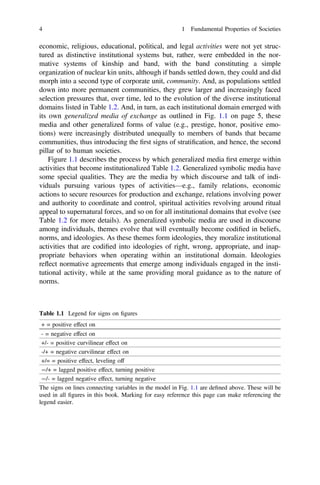
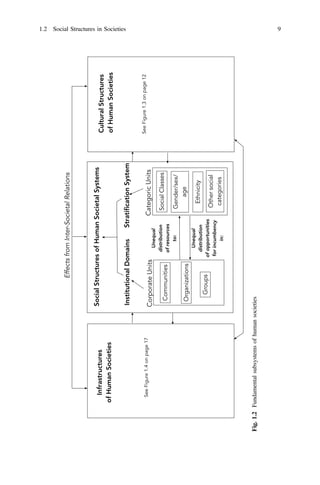
Figure 1.1 describes the process by which generalized media first emerge within
activities that become institutionalized Table 1.2. Generalized symbolic media have
some special qualities. They are the media by which discourse and talk of indi-
viduals pursuing various types of activities—e.g., family relations, economic
actions to secure resources for production and exchange, relations involving power
and authority to coordinate and control, spiritual activities revolving around ritual
appeal to supernatural forces, and so on for all institutional domains that evolve (see
Table 1.2 for more details). As generalized symbolic media are used in discourse
among individuals, themes evolve that will eventually become codified in beliefs,
norms, and ideologies. As these themes form ideologies, they moralize institutional
activities that are codified into ideologies of right, wrong, appropriate, and inap-
propriate behaviors when operating within an institutional domain. Ideologies
reflect normative agreements that emerge among individuals engaged in the insti-
tutional activity, while at the same providing moral guidance as to the nature of
norms.
Table 1.1 Legend for signs on figures
+ = positive effect on
- = negative effect on
+/- = positive curvilinear effect on
-/+ = negative curvilinear effect on
+/= = positive effect, leveling off
¼/+ = lagged positive effect, turning positive
¼/- = lagged negative effect, turning negative
The signs on lines connecting variables in the model in Fig. 1.1 are defined above. These will be
used in all figures in this book. Marking for easy reference this page can make referencing the
legend easier.
4 1 Fundamental Properties of Societies
Efforts
by
individuals
and
actors
to
build
up
corporate
units
in
an
domain
of
activity
Talk
and
discourse
among
individuals
Emergence
of
a
generalized
symbolic
medium
of
discourse
Moralized
themes
of
discourse
Formation
of
an
intra-
institutional
ideology
of
what
is
right,
wrong,
appropriate
Use
of
of
ideology
to
moralize
institutional
norms
Moralized
institutional
norms
become
part
of
corporate-unit
cultures
+
+
+
+
+
+
+
+
+
+
+
+
+
+
Formation
of
networks
Leadership
emerges
Central
core
in
networks
emerges
+
New
adaptive
problems
emerge
+
+
+
+
+
+
+
+
+
+
+
Norms
of
division
of
labor
in
corporate
units
operating
in
an
institutional
domain
+
+
+
Fig.
1.1
The
process
of
developing
generalized
symbolic
media
of
discourse
and
moralization
of
institutional
ideologies
1.2 Social Structures in Societies 5
In turn, institutional norms are used to regulate the formation of corporate units,
revealing a division of labor regulated by specific norms and roles within different
institutional domains. Accordingly, the terms of discourse that rise when engaged in
activities—economic, political, religious, family, artistic, educational, etc.—even-
tually are codified into a generalized medium for engaging in not only discourse but
in exchanges among individuals. Moreover, generalized media moralize human
action and interaction by generating conceptions of right and proper behavior
within the corporate units that make up an institutional domain.
Generalized symbolic media not only provide symbolic tools for discourse and
moral guidance in the formation of ideologies and normative systems guiding
conduct, but they also become valued resources in their own right, as is outlined in
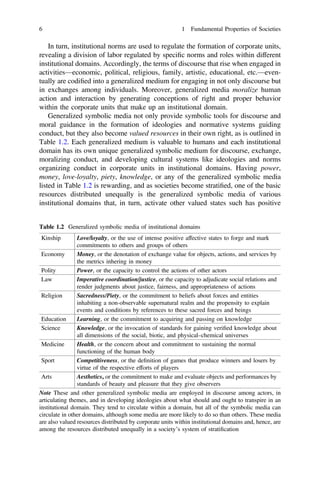
Table 1.2. Each generalized medium is valuable to humans and each institutional
domain has its own unique generalized symbolic medium for discourse, exchange,
moralizing conduct, and developing cultural systems like ideologies and norms
organizing conduct in corporate units in institutional domains. Having power,
money, love-loyalty, piety, knowledge, or any of the generalized symbolic media
listed in Table 1.2 is rewarding, and as societies become stratified, one of the basic
resources distributed unequally is the generalized symbolic media of various
institutional domains that, in turn, activate other valued states such has positive
Table 1.2 Generalized symbolic media of institutional domains
Kinship Love/loyalty, or the use of intense positive affective states to forge and mark
commitments to others and groups of others
Economy Money, or the denotation of exchange value for objects, actions, and services by
the metrics inhering in money
Polity Power, or the capacity to control the actions of other actors
Law Imperative coordination/justice, or the capacity to adjudicate social relations and
render judgments about justice, fairness, and appropriateness of actions
Religion Sacredness/Piety, or the commitment to beliefs about forces and entities
inhabiting a non-observable supernatural realm and the propensity to explain
events and conditions by references to these sacred forces and beings
Education Learning, or the commitment to acquiring and passing on knowledge
Science Knowledge, or the invocation of standards for gaining verified knowledge about
all dimensions of the social, biotic, and physical–chemical universes
Medicine Health, or the concern about and commitment to sustaining the normal
functioning of the human body
Sport Competitiveness, or the definition of games that produce winners and losers by
virtue of the respective efforts of players
Arts Aesthetics, or the commitment to make and evaluate objects and performances by
standards of beauty and pleasure that they give observers
Note These and other generalized symbolic media are employed in discourse among actors, in
articulating themes, and in developing ideologies about what should and ought to transpire in an
institutional domain. They tend to circulate within a domain, but all of the symbolic media can
circulate in other domains, although some media are more likely to do so than others. These media
are also valued resources distributed by corporate units within institutional domains and, hence, are
among the resources distributed unequally in a society’s system of stratification
6 1 Fundamental Properties of Societies
emotions, prestige, and a sense of well-being in general. As will become evident,
the culture of a society and geo-cultural formations across societies are all built
from institutional ideologies which emerge from the moralizing effects of gener-
alized symbolic media.
Yet, even when periodically settled, early societies of humans were quite simple,
revealing only one institutional system or domain (nuclear families as the basis of
kinship), one generalized symbolic medium (love-loyalty), and very little, if any,
forms of stratification unless a population was under stress. Thus, the nature of
inter-societal systems among these early forms of societies was limited by their
simplicity of the structure and, as we will see, by the nature of their cultures (with
limited generalized symbolic media to develop ideologies and norms) and little
technology to build up infrastructures. Still, inter-societal contact among hunter-
gatherers would be a force that could push populations to begin developing other
institutional systems, such as religion, economy, and polity which are somewhat
differentiated from kinship and, hence, different from the generalized symbolic
medium of kinship. And once the number of generalized symbolic media began to
increase, so did the number of valued resources that can be distributed unequally, thus
marking the beginnings of inequality and stratification among categories of persons.
The evolution of human societies from simple to more complex formations
revolving around institutional differentiation and increased levels of inequality and
stratification were often the result of problematic inter-societal relations. Indeed,
early sociologists like Herbert Spencer (1874–96) argued that circumscription of
societies in the same territory could lead to competition and warfare that would
cause the emergence of polity as an institutional system as well as stratification built
around inequalities in the distribution of power and authority to certain social
categories (e.g., male adult leaders) marking the beginnings of a stratification
system. Spencer argued that warfare between societies had been a powerful force in
the evolution of human societies from simple forms to ever-more complex forms.
He also recognized, as have many anthropologists, that expanded trade between
populations can make economic activity more prominent, thus marking the very
beginnings of the economy as a differentiated institutional system as well as the
beginnings of stratification around unequal distributions of valued resources from
the trade of bulk and prestige goods with other populations, as well as unequal
distribution of prestige and authority inhering in the inequality of valued goods
acquired in exchanges with other small societies.
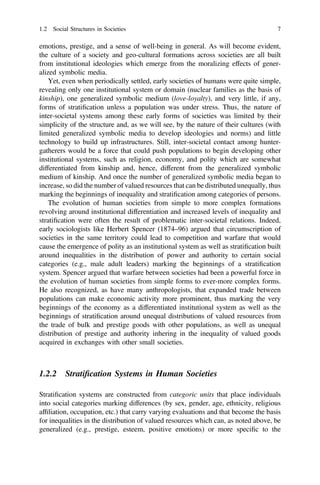
1.2.2 Stratification Systems in Human Societies
Stratification systems are constructed from categoric units that place individuals
into social categories marking differences (by sex, gender, age, ethnicity, religious
affiliation, occupation, etc.) that carry varying evaluations and that become the basis
for inequalities in the distribution of valued resources which can, as noted above, be
generalized (e.g., prestige, esteem, positive emotions) or more specific to the
1.2 Social Structures in Societies 7
generalized symbolic media distributed within and between institutional domains
(e.g., money, power and authority, piety, love-loyalty, knowledge, etc.).
As institutional systems evolve and, eventually, differentiate into specific
domains, they develop generalized symbolic media as part of the cultural structure
of a society (see next section) that are used as resources for building cultural and
social structures (and infrastructures). For example, money is a symbol of value and
emerged in a primitive form quite early in human societal evolution to operate as a
mechanism for conducting exchanges within the economy of a society, as well as a
mechanism for intra-societal exchanges between the economy and other institu-
tional domains and, of course, for inter-societal exchanges among societies.
At the same time, money as a valued resource is increasingly distributed
unequally by the corporate units of the economy, with all other institutions using
money in some way, thus initiating stratification or the unequal distribution of
valued resources to categories of individuals and subpopulations. The structural
formations and, in the case of generalized media, cultural formations that humans
use to adapt to environments also generate inequality and stratification that often
work against the integration of societies and inter-societal systems.
While the most fundamental categoric units—i.e., sex, gender, and age—were
not initially used to stratify people by differential evaluations of their worth and by
inequalities in the distribution of resource shares, the very beginnings of stratifi-
cation would sometimes emerge, as noted earlier, when bands settled into com-
munities (even if only temporarily), when engaged in warfare with neighbors, or
when bands faced environmental crises requiring leadership, or when some other
force generated selection pressures on a simple band of hunter-gatherers. Under
these conditions leadership would evolve into authority and power, marking the
very beginnings of stratification.
Still, societies with distinctive classes and ranked social strata would not emerge
for many thousands of years, although precursors to full-blown stratification would
periodically emerge when populations were under stress. Indeed, one source of
stress was the conflict between populations, which would push even simple
hunter-gatherers to organize leadership systems that, in turn, led to differential
evaluations of leaders who would be given more prestige and authority—two
highly valued resources that are unequally distributed in all developed stratification
systems. At other times, religious leaders would emerge (i.e., shaman) and gain
prestige, thus again marking early “differences” (in prestige and influence) within
bands that otherwise were mostly egalitarian. Thus, human societies were, in their
beginnings, not stratified to any great extent, but eventually they would become
stratified as they grew, as they came into conflict with other bands of
hunter-gatherers, as they were under ecological stress, and any condition putting
pressure on bands of kin units. But for most nomadic hunter-gathering populations,
there were powerful cultural ideologies (see next section) against differential
evaluations of categories of person and inequality in the distribution of resources.
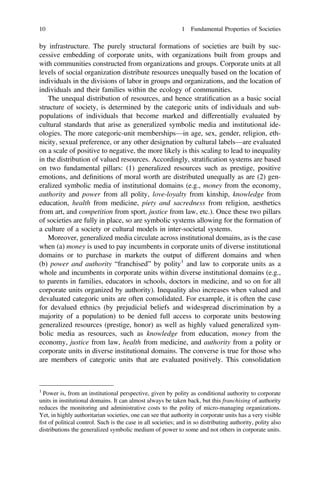
As discussed above, we can conceive of societies as composed of three sub-
systems. The first subsystem is a social structure, with the basic skeleton of a
societal social structure modeled in Fig. 1.2. We will turn to culture next, followed
8 1 Fundamental Properties of Societies
Social
Structures
of
Human
Societal
Systems
Institutional
Domains
Corporate
Units
Groups
Organizations
Communities
Categoric
Units
Social
Classes
Gender/sex/
age
Ethnicity
Other
social
categories
Unequal
distribution
of
resources
to:
Unequal
distribution
of
opportunities
for
incumbency
in:
Cultural
Structures
of
Human
Societies
See
Figure
1.3
on
page
12
Infrastructures
of
Human
Societies
See
Figure
1.4
on
page
17
Effects
from
Inter-Societal
Relations
Fig.
1.2
Fundamental
subsystems
of
human
societies
1.2 Social Structures in Societies 9
by infrastructure. The purely structural formations of societies are built by suc-
cessive embedding of corporate units, with organizations built from groups and
with communities constructed from organizations and groups. Corporate units at all
levels of social organization distribute resources unequally based on the location of
individuals in the divisions of labor in groups and organizations, and the location of
individuals and their families within the ecology of communities.
The unequal distribution of resources, and hence stratification as a basic social
structure of society, is determined by the categoric units of individuals and sub-
populations of individuals that become marked and differentially evaluated by
cultural standards that arise as generalized symbolic media and institutional ide-
ologies. The more categoric-unit memberships—in age, sex, gender, religion, eth-
nicity, sexual preference, or any other designation by cultural labels—are evaluated
on a scale of positive to negative, the more likely is this scaling to lead to inequality
in the distribution of valued resources. Accordingly, stratification systems are based
on two fundamental pillars: (1) generalized resources such as prestige, positive
emotions, and definitions of moral worth are distributed unequally as are (2) gen-
eralized symbolic media of institutional domains (e.g., money from the economy,
authority and power from all polity, love-loyalty from kinship, knowledge from
education, health from medicine, piety and sacredness from religion, aesthetics
from art, and competition from sport, justice from law, etc.). Once these two pillars
of societies are fully in place, so are symbolic systems allowing for the formation of
a culture of a society or cultural models in inter-societal systems.
Moreover, generalized media circulate across institutional domains, as is the case
when (a) money is used to pay incumbents in corporate units of diverse institutional
domains or to purchase in markets the output of different domains and when
(b) power and authority “franchised” by polity1
and law to corporate units as a
whole and incumbents in corporate units within diverse institutional domains (e.g.,
to parents in families, educators in schools, doctors in medicine, and so on for all
corporate units organized by authority). Inequality also increases when valued and
devaluated categoric units are often consolidated. For example, it is often the case
for devalued ethnics (by prejudicial beliefs and widespread discrimination by a
majority of a population) to be denied full access to corporate units bestowing
generalized resources (prestige, honor) as well as highly valued generalized sym-
bolic media as resources, such as knowledge from education, money from the
economy, justice from law, health from medicine, and authority from a polity or
corporate units in diverse institutional domains. The converse is true for those who
are members of categoric units that are evaluated positively. This consolidation
1
Power is, from an institutional perspective, given by polity as conditional authority to corporate
units in institutional domains. It can almost always be taken back, but this franchising of authority
reduces the monitoring and administrative costs to the polity of micro-managing organizations.
Yet, in highly authoritarian societies, one can see that authority in corporate units has a very visible
fist of political control. Such is the case in all societies; and in so distributing authority, polity also
distributions the generalized symbolic medium of power to some and not others in corporate units.
10 1 Fundamental Properties of Societies
ramps up the degree of inequality between members of valued and devalued cat-
egoric units.
It is clear, then, that structural position in corporate and categoric units are
dramatically affected by cultural beliefs, ideologies, traditions, and normative
systems. Indeed, culture provides the “instructions” for how individuals and groups
in organizations and communities are to act as well as the worth and value of
individuals, families, and subpopulations revealing distinctive characteristics. Every
type of social structure—i.e., groups, organizations, communities, and institutional
domains as well as for categoric units such as classes, ethnics, gender, religion, and
other designations of a categoric-unit membership—are ultimately the building
blocks of stratification systems. And for each element in the structure of institu-
tional domains and stratification systems, there are corresponding symbol systems
or cultures. And while these systems of culture are embedded in these structural
formations, they reveal unique dynamics that can and should be analyzed as a
distinct property of societies.
Figure 1.2 on page 9 outlines the key dimensions of societal structures that are
affected by cultural structures, as well as infrastructures, but the boxes representing
these two additional subsystems—that is, culture and infrastructures—of the human
societal organization are empty, thus necessitating that they are filled in. Without
culture and the infrastructures in which social structures are grounded, and by
which they operate, the properties and dynamics of societies and, potentially, of
inter-societal systems cannot be known. And, to some extent, WSA has not fully
integrated them in their conceptualizations of inter-societal systems, with the result
that theorizing on inter-societal systems has not realized its full potential.
1.3 Cultural Structures in Societies
The term, “culture,” has many connotations in general discourse and the social
sciences. For our purposes, the term culture denotes systems of symbols generating
common meanings that humans share and use to regulate and organize behaviors
of individuals and subpopulations in societal and, at times, inter-societal forma-
tions. Social structures are the skeletal system of human societies, but it is the
culture that gives these structures meaning and that directs individual and collective
behaviors that occur within and between social structures. From our perspective,
there are relatively few forms and dimensions of culture that bring life to behaviors
and interactions in social structures from which societies, and to an extent,
inter-societal structures are created and sustained.
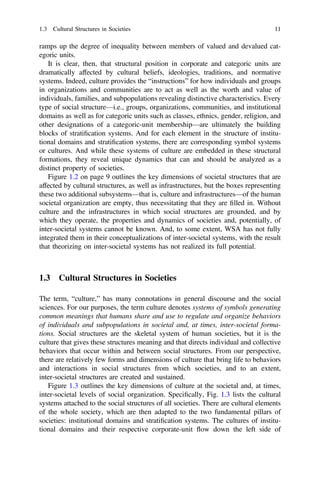
Figure 1.3 outlines the key dimensions of culture at the societal and, at times,
inter-societal levels of social organization. Specifically, Fig. 1.3 lists the cultural
systems attached to the social structures of all societies. There are cultural elements
of the whole society, which are then adapted to the two fundamental pillars of
societies: institutional domains and stratification systems. The cultures of institu-
tional domains and their respective corporate-unit flow down the left side of
1.3 Cultural Structures in Societies 11
Technologies Traditions Texts
Values
Generalized
ideologies
Use of
generalized
Symbolic media
in talk and
theme building
Formation of
ideologies
within
differentiated
institutional
domains
Formation of
institutional
norms in
differentiated
domains
Formation of
meta-ideologies
Macro-level of Societal Organization and Culture
Moral
evaluations of
members of
categoric units
Formation of
status beliefs
about
members of
categoric units
Formation of
expectation
states for
members of
categoric units
Culture of
Stratification
System
Culture of
institutional
domains
Basic Elements of Societal-level Culture
Meso-level of Societal
Organization and Culture
Application of institutional
ideologies to corporate units within
institutional domains
Creation of moralized normative
structure of corporatie units within
institutional domains
Application of status beliefs to
members of differentiated
categoric units
Expectations states for members of
categoric units within divisions of
labor of corporate units
Focused
encounters
within
corporate
units
Focused
encounters
in public
spaces
Unfocused
encounters
within
corporate
units
Micro-level Interactions
in Encounters
Unfocused
encounters
in public
spaces
Fig. 1.3 Cultural structures in human societies
12 1 Fundamental Properties of Societies
Fig. 1.3, while the right side of the figure denotes the culture attached to the
categoric units from which stratification systems and their cultures are built. As is
evident, there is a constant exchange of cultural elements back and forth between
the cultures driving institutional domains and stratification systems. Figure 1.3
emphasizes the cultural elements operating at the macro level of social organization
—that is, societies and their institutional and stratification systems—which are
built, respectively, from corporate and categoric units. The figure also emphasizes
that these elements are drawn from systems of symbols that embrace the entire
society, while at the same time, often providing new cultural elements for the
societal culture. Thus, as designated by the arrows in Fig. 1.3, there is a constant
flow of culture from the micro to macro, and vice versa, as well across any given
level of social structure.
From our perspective, culture works at all levels of social organization—macro,
meso, and micro—flowing down and then back up these levels of structural and
cultural organization. Probably the most controversial part of Fig. 1.3 is the
seemingly limited list of elements of society-wide culture as (a) technologies
(knowledge of how to manipulate the environment), (b) traditions (conceptions,
beliefs, narratives, etc.) on the past and how this past is relevant in the present and
future), (c) texts (any and all symbolic systems codified in as collective memories or
as information coded a formal “language” including speech, written language, and
many other forms of symbolic communication spoken or written down), (d) value
premises (or abstract standards of what is correct and morally right and what is
morally wrong and incorrect), and (e) generalized ideologies (or moral codes drawn
from values applied to macro social structures and large segments of the population
in a society and from the ideologies of dominant institutional domains). Obviously,
culture is more complex than implied by these simple labels, but we contend that
most symbol systems in the simplest and most complex societies can be described
by this basic scheme. We are not interested in the details, per se, of a culture; but,
rather, our concern is with how generic forms of culture are critical to the orga-
nization of societies, and at times, the operation of inter-societal systems at different
structural levels and across different levels of human social organization.
At the macro level, the respective cultures of diverse institutional domains are
generated by existing technologies (or knowledge about how to manipulate the
environment), applications of value premises arising from the other societal-level
elements of cultures, and generalized ideologies that, in the past, have been codified
by existing institutional domains (e.g., economy, polity, kinship, religion, law, etc.)
in a society and the emergence of generalized symbolic media of exchange, as
outlined in Table 1.2. The respective cultures of institutional domains and strati-
fication systems, as well as the cultures of each of these two pillars of societies and
their constituent corporate and categoric units, all flow from these often-moralized
elements of a society’s general culture.
The moral systems of culture are used to classify individuals and subpopulations
in a society in terms of their worth, value, and other evaluative criteria. Each of the
generalized symbolic media evolves moral evaluations, as do institutional ideolo-
gies, which are combined (typically with the ideologies emerging in dominant
1.3 Cultural Structures in Societies 13
domain institutions) into a meta-ideology that dominates other evaluative symbol
systems operating on corporate and categoric units forming institutional domains
and stratification systems. Such meta-ideologies, when they arise, feedback and
shape the content of the generalized ideologies that affect all structures within a
society.
The moralized symbol systems become the basis for creating what many social
psychologists label as status beliefs (Berger and Zelditch 1985; Ridgeway 2001),
which are evaluative beliefs about the character and nature of individuals in diverse
categoric units and in diverse locations in the divisions of labor in corporate units.
This moral coding, in turn, also drives the formation of normative systems oper-
ating on individuals in status locations in the division of labor in corporate units and
for the behaviors of individuals who are members of variously evaluated categoric
units.
Social structures are almost always “moralized” from the macro-level, but as
changes occur in macro-, meso- and micro-level cultures, feedbacks from micro-
and meso-levels of social structure can alter macro-level elements of cultures—i.e.,
technology, texts, traditions, value premises, generalized ideologies operating at the
societal-level of organization, and ideologies and normative systems operating
within and between institutional domains and stratification system. Change in
cultures at any level can come from many sources: other societies, environmental
pressures on a population, evolution of new institutional systems, changing beliefs
about the nature of incumbents in categoric and/or corporate units, creation of new
kinds of corporate units, and interpersonal experiences with incumbents in corpo-
rate and categoric units. And, as feedback from micro- and meso-levels of
socio-cultural organizations gain traction, they can begin to alter general
macro-level cultural formations.
Culture exerts its power by virtue of being vertically integrated across structures
operating at the macro-, meso-, and micro-levels of social structural organization,
moving up, down, and across types of corporate and categoric units making up,
respectively, institutional domains and stratification systems. Such vertical moral-
ization across levels of socio-cultural reality work, on the one side, to constrain and
control individuals at all levels of social organization: face-to-face interpersonal
behavior, incumbency in groups, organizations, communities that are located within
differentiated institutional domains whose culture creates meta ideologies and status
beliefs regulating individuals in diverse categoric units within a system of strati-
fication. On the other side, this layering of socio-cultural reality allows for changes
at lower levels of organization, from interpersonal experience through various types
of corporate and categoric units to filter up to the macro level culture of a society.
It is in this context that the structure and culture (and infrastructure as well) can
be forces in the creation or, alternatively, collapse of inter-societal systems.
Depending on the strategies of dominating dependent societies inter-societal for-
mations, varying elements of social structure, cultural structures, and infrastructures
can become the basis of whatever form of inter-societal relations evolves. This
reality should alert us to the fact that inter-societal dynamics are very complex
depending upon which institutional domains and their ideologies (e.g., economy,
14 1 Fundamental Properties of Societies
religion, polity) and which generalized symbolic media of these domains are the
conduits of relations with other societies.
The same is true of the respective stratification systems and the status beliefs
about categories of persons that make up this system. Over time the nature of
institutional and stratification systems can change, thereby forcing, the evolution of
new types of inter-societal formations. Moreover, cultural structures and even social
structures can circulate among societies, especially when developed infrastructures
are in place so that organizing elements of one society can diffuse to other societies.
Such is particularly evident in the contemporary world where highly developed
infrastructures facilitate the movement of information, people, culture, and
resources about the globe, even at the speed of sound and light or at the compar-
atively more “leisurely movement” pace of air, ground, and ocean travel. And the
evolution of world markets and attendant infrastructure has made such diffusion of
elements of societies across geo-economic inter-societal systems even more likely.
It is also the case that geo-political activities can also carry many elements of social
structures, cultural structures, and infrastructures rapidly around the globe—a fact
that contemporary world-systems theorizing clearly recognizes but often
underemphasizes. But, as we will emphasize, these dynamics have also been
operating even in lower technology eras of human organization.
1.4 Infrastructures in Societies
1.4.1 A Model of Infrastructural Dynamics
The scale of social and cultural structures has large effects on the capacity of a
population to develop infrastructures for generating and distributing energy and
material resources to members of a population and the corporate units organizing
their activities. For most of human history, the capacity to gain access energy and to
distribute this energy was very limited. Indeed, the basic source of energy driving
human patterns of societal and inter-societal organization was the consumption of
calories to drive the human body for hunting, gathering, exchanging, and other
activities. The reasons for this limited access to energy were a very minimal social
structure built from two groups—nuclear family and band—and very low levels of
technology. The energy needed to sustain these structures and minimal culture was
not great, consisting of perhaps 15–20 h of work to gather food by women (often
assisted by children) and to hunt-down animal protein by men. This original
“Garden of Eden,” portrayed by Marshall Shalins (1968), was highly gratifying
and, thus, probably did not provide much motivational push for seeking more
sources of energy that would eventually change the nature of societies and human
culture. Yet, it is inter-societal relations that may have been the first force driving
modest increases in infrastructure, such as the wearing down pathways connecting
populations with resources to exchange. A pathway is probably infrastructure in its
1.4 Infrastructures in Societies 15
simplest form, creating a means for humans to expend less energy walking to secure
resources in exchanges that are not otherwise available in a population’s particular
ecology.
As populations settled near water, sometimes episodically and eventually per-
manently, new infrastructures appeared, such as the addition of more pathways and
trails between populations. Fishing, for example, requires “tools” to catch fish, and
while the energy driving fishing was human calories, additional tools often began to
look like an infrastructure increasing access to fish at less energy costs in human
power. For example, rafts and maybe even canoes, or any structure increasing access
to protein and calorie-laden fish, can be seen as a proto infrastructure. Yet, even as
horticultural populations began to settle down and engage in gardening, it was still
human power that drove the economy, as women gardened and as men often helped
in heavy tasks such as using digging sticks (a tool) to loosen the soil for plantings.
Again, it may have been inter-societal processes that worked to expand infras-
tructure among early horticulturalists as well, because of the development of
pathways across larger territories in highly diverse habitats—from jungles to more
open country lands—or the invention of watercraft for movement along rivers and
streams extended relations among members of a given population as well as
exchange relations with more distant populations. Moreover, as warfare between
horticultural societies increasingly became typical, and indeed, as men’s energy was
often spent in warfare as much as economic production, observation towers were
constructed from the ground or in trees became a form of infrastructure for warfare.
Thus, early hunting and gathering societies may also have participated in
geo-economics (exchange) and even geo-political activities (warfare), but once
populations began to settle down in semi-permanent locations, these became
increasingly typical of human societies and, simple horticulture in communities
began to spread across the globe. Still, it was probably hundreds of thousands of
years before such settlements were prevalent among human populations.
Simple tools for economic activities (e.g., spears, crude axes, bow-and-arrows,
and boomerangs), were supplemented by (or converted into) weapons for
geo-political activities revolving around warfare. Both would begin to increase
selection pressures for not only tools and weapons but also for expanded infras-
tructures that would increase the movements at less calorie cost as more goods were
exchanged and as more warriors moved into a neighboring society’s territory.
We can conceptualize these processes with a parsimonious model that can
describe both the infrastructural dynamics of the simplest to most complex soci-
eties. We can do so because the dynamics of infrastructure in small and large
societies are essentially the same and, thus, can be theorized. Indeed, the only
difference between the two is the scale of the values of the variables interacting in
the pattern outlined in Fig. 1.4.
The fundamental force behind infrastructural dynamics and the increasing level
of organization and culture in a society is population growth. Related to population
growth is immigration from other societies that not only increases the size of
population, as is emphasized in the directional arrows indicated, it also will bring
culture from other populations, or perhaps even new schemes for organizing a
16 1 Fundamental Properties of Societies
Size/rate
of
growth
of
population
Rate
of
immigration
Level
of
accumulated
culture
(symbols
systems)
Level
of
social
structural
differentiation
Level/rate
of
accumulation
of
technology
Level
of
access
to
energy
and
it
distribution
Level
of
development
of
tools
Level
and
scale
of
development
of
physical
structures
Level,
rate,
and
scale
of
infrastructural
development
Potential
capacity
for
building
inter-
societal
formations
=/+
=/+
=/+
=/+
=/+
=/+
=/+
+/=
+
+
+
+
+
+
+
=/+
+
=/+
+
=/+
+
+
+
+
+
+
+
+
+
=/+
+
Fig.
1.4
Dynamics
generating
infrastructure
in
human
societal
and
inter-societal
formations
1.4 Infrastructures in Societies 17
growing population. And, as we will see, it marks a form of geo-demography that
often becomes part of geo-economic, geo-political, and geo-cultural dynamics, as
we see in later chapters. The positive signs of arrows in Fig. 1.4 suggest that once
the process of population growth begins, it increases all the other forces moving
from left to right in the model. Some of the causal arrows on signed with a “=/+”
which, as noted in Fig. 1.4, denotes a lagged positive effect. Since the model is
intended to explain infrastructural dynamics in all types of human societies, this
lagged effect surely operated because it took many thousands of years for human
populations to grow to the where the rest of the forces in the figure had high values.
Indeed, there were regimes and then sudden take-offs with population growth,
enhanced culture, and more complex structures evolved with settled
hunter-gatherers, simple horticulturalists (without the use of animal power),
advanced horticulturalists (often using animal and even wind or water power) to
simple and then advanced agrarian societies that were larger and more complex in
culture, social structures, and infrastructure, and then to industrial and
post-industrial societies where many new forms of power and energy evolved in
now large, complex, and culturally advanced societies.
As the differentiation of social structures and the accumulation of more
knowledge in general increased with human societal evolution, the level of tech-
nology also increased, which in turn, increased access to new sources of energy,
and dramatically accelerated societal evolution, especially over the last 500 years.
This knowledge allowed for the use of ever-more efficient tools, eventually pow-
ered by new sources of energy—initially animals, wind, and water, and then
eventually petroleum, gas, nuclear, solar, and now new forms of wind power from
the blades of ocean windmills with blades the length of football fields and even
parachute-like sails that are beginning to supplement the petroleum power of
container ships circling the globe. And, with new sources of energy, tools could be
huge and powerful, whether boring tunnels through the earth to moving massive
amounts of materials the buckets of huge bulldozers, trucks, and tankers. And as
tools are used in this way, they can also be used to build infrastructures from
highways to ports for airplanes or ships. And, as the positive arrows connecting the
forces in the middle of Fig. 1.4 emphasize, these dynamics begin to rapidly escalate.
Energy, tools, and infrastructures have large effects on the structure and culture
of a society; and as they build out, this impact on the scale of physical structures
used to house and organize larger, more differentiated populations in all their
institutional activities increases dramatically. In so doing, infrastructures directly or
indirectly change the culture of a society. Indeed, institutional evolution in human
societies was very much related to not only technologies but to their application in
building up infrastructures (Turner 1972, 1998, 2002; Abrutyn and Turner 2022;
Lenski 1964, 2005; Nolan and Lenski 2021; Turner and Maryanski 2008). And
these same processes would inevitably build up inter-societal systems.
New sources of energy, more powerful tools, and the building of physical
structures created demands for more infrastructures and vice versa. Thus, once this
set of variables feeds off each other, infrastructures develop rapidly, and then
feedbacks to accelerate the development of tools and new forms of efficient energy.
18 1 Fundamental Properties of Societies
In so doing, these forces leading to development of physical structures to enclose all
institutional activity that, in turn, leads to further development of infrastructures
between communities of a society and, eventually, between societies. The mutually
escalating effects that the forces in the middle of Fig. 1.4 emphasize also feedback
and escalate population growth, human migration, cultural and social structural
development, and even more dramatic technological development that then feed
forward to escalate the search for new sources of energy, new more efficient and
powerful tools driven by this energy, new physical structures, and then new
infrastructures that allow inter-society relations to operate on a truly global scale.
Rapid alteration of physical structures that house, organize, and connect human
activities inevitably increases the level of technology that alters key cultural ele-
ments, such as values, beliefs, and ideologies that, in turn, eventually pushed
humans and their corporate units to “modernity.” And even counter movements to
this incessant growth (e.g., environmentalism in all its manifestations) will, them-
selves, be housed in a physical structures utilizing the infrastructure—roads, air-
ports, ports, airwaves and satellites, roads, trains, cars, etc. of the modern world—to
connect ever more of the world’s population.
Moreover, as we will see in later chapters, infrastructural development is not
only what connects societies in inter-societal systems, it has often been a point of
contention among societies, especially when more developed societies seek
resources of less developed societies while failing to help develop the infrastruc-
tures of these dependent societies, thus trapping them into giving up their highly
valued basic resources or narrow range of products for low prices and little tech-
nological and engineering assistance in building up their physical structures and,
more critically, their infrastructures.
It is important to remember that these escalating dynamics started very modestly
in the evolution of human societies, but they are fundamentally the same processes,
just on a dramatically smaller scale and a slower rate of movement. Thus, the number
and scale of physical structures housing and organizing small numbers of nomadic
hunter-gatherers into two types of groups (e.g., nuclear family and band among
nomadic hunter-gatherers) is on a very modest scale, at best pathways through a
territory and the construction of huts. Later, among simple horticulturalists, physical
structures such as huts housing families could become more permanent, as could
paths to the water, neighboring communities, and even other populations. If the
conflict was common, then weapons would become more diverse and deadly, and
infrastructural structures like observation towers or platforms in trees could be built
to serve as monitoring movements of potential adversaries and as warning signals to
the general population. But, even in pre-literate societies, the increasing tool (and
weapon) use, the scale of the physical structures built to house and organize groups
would increase the scale of infrastructural development, and vice versa.
Increases in the scale of physical structure and infrastructure will feed off each
other, escalating the scale of both. And as these increase, they will feedback and
heighten the valences for all of the other variables in the model. As a result, these
forces will feedforward and generate selection pressures for higher levels of tech-
nology that increases energy use, tool (and weapon) development, building of
1.4 Infrastructures in Societies 19
physical structures, and expansion of infrastructures for distributing energy across a
larger number of individuals organized into new types of corporate units.
As we have emphasized, every variable in the model outlined in Fig. 1.4 is
positively signed, and so it can be asked: why did it take so long—hundreds of
thousands of years, in fact—for the potential dynamism of these forces to take off?
The answer resides in the variables on the left side of the model—the beginning
points of the chain reaction that would accelerate development. As long as popu-
lations remain small, there were no intense selection pressures to expand culture,
particularly technologies, nor was there a powerful need to expand the knowledge
or the number and scale of corporate units organizing the activities of small pop-
ulations engaged in hunting and gathering or simple horticulture. Moreover, to
increase the amount of energy to build up a society was limited by the lack of
technologies for harnessing energy and by knowledge of materials to build physical
structures, much less infrastructures.
Indeed, through most of the agrarian era, human power was only supplemented
by animal, wind, and waterpower. Furthermore, the materials available for building
physical structures were for most of the human history sticks of wood and piles of
rocks, which still could create spectacular edifices like pyramids, castles, roads,
canals, aqueducts, etc. And these only came rather late in human societal evolution
—at best the last 8000 years of the 400,000 years of human societal and
inter-societal organization.
Thus, a knowledge barrier existed with respect to technologies and access to not
only materials for building physical structures but also infrastructures. Only under
increasing population growth, exchanges of resources, and warfare were their
sufficient selection pressures to increase access to sources of energy and materials
for building up physical structures for organizing increasing numbers of different
types of corporate units and for building infrastructures for gathering and dis-
tributing energy that could be used to connect this more complex systems of
corporate units. And the knowledge necessary for this development required the
evolution of new institutional domains, such as science and education.
Religion and polity, under growing populations and/or warfare between soci-
eties, were perhaps the prime forces driving the creation of new technologies for
building up the social and physical structures of societies. However, these forces
tend to generate ideologies, values, beliefs, and knowledge that is limited to reg-
ulating access to the supernatural and/or controlling of actions of members of larger
populations. They are inherently conservative and generally do not drive the
expansion of technology and infrastructures, except those related to worshiping the
supernatural and political leaders who are often seen as demi-gods, or the military
geared to warfare with other societies and/or suppression of dissent of members of a
population, or members of an inter-societal system. Still, once these institutional
systems begin to increase the scale of societies, expand their cultures, and generate
new physical means for organizing corporate units, they begin the process of
expanding infrastructures.
Much of social development during the agrarian era was driven by these forces,
by episodic expansions and contractions, but alongside these forces driving
20 1 Fundamental Properties of Societies
infrastructural development were economic forces. A productive economy and
system of market distribution generate wealth that can be taxed by church and state,
and moreover, used to expand human inquiry, thereby allowing science and edu-
cation to begin to evolve and expand the storehouse of cultural knowledge. And as
ever-more diverse sources of energy were discovered beyond animal, wind, and
waterpower, infrastructural development was more than a response to
geo-economic and geo-political activities; infrastructural development became a
driving force, per se, accelerating all the dynamics outlined in Fig. 1.4. And as
noted above, the development of new technologies also began to alter value pre-
mises, institutional ideologies, meta-ideologies, and normative systems to be
compatible with institutional growth and differentiation within and between soci-
eties that was made possible by new technologies. And, as the ideologies of
emerging institutional domains beyond kinship, religion, polity, and economy were
codified, they too would support the expansion of physical structures and related
infrastructures for linkages among corporate units within and between institutions
within, and moreover, between societies. And later, as dramatically increased
capacities to capture and distribute many forms of energy, infrastructure develop-
ment could be developed to expand the reach of inter-societal systems.
The result has been world-level markets, complex systems of inter-societal
trading and investment, and as noted earlier in the chapter, potentially new patterns
of geo-political conflict and organization. Thus, what is often considered to be an
entirely new world-system is, in fact, just a world-system operating on a larger
scale, but the underlying dynamics outlined in Fig. 1.4 which have always existed
on a dramatically smaller scale, of course, but even so, these dynamics involve the
same fundamentals across all forms of human society. Scale makes a difference, but
this difference is not as fundamental as is often claimed by world-systems theorists.
And the presumption that the societies on earth are moving toward some form of
world-level governance is, we feel, rather exaggerated. Markets can still collapse,
resources can become scarce, technologically systems can be sabotaged, and
geo-political warfare that destroys infrastructures can raise its ugly head and destroy
societies and inter-societal systems.
Indeed, we could posit with some justification that the current world-system may
be moving toward a new era of geo-political conflict. And, the notion of a coming
world-level socialism is inevitable as the contradictions of capitalism are finally
understood, as many in world-systems theory hope or even predict, is far from
inevitable. The vulnerability of modern infrastructures, especially the electronic
infrastructures that run just about everything in post-industrial societies, make
societies highly vulnerable to geo-political intrusion without firing a shot or
dropping a bomb (see Collins 2022).
In fact, the dynamics in Fig. 1.4 can work against a world-system because if, for
example, markets collapse, warfare breaks out, access to energy decreases, pro-
duction decreases, and the world economy collapses. This kind of scenario shows
that any events decreasing the forces driving infrastructural development carries
forward in the model because of the positively signed linkages between the vari-
ables in the model. As a result, these forces would reduce the values of any of the
1.4 Infrastructures in Societies 21
variables; and once this process is initiated, it can work to reduce all other variables
in the model. Thus, what has been built up can rapidly decline, even though
infrastructures have a certain level of longevity, but as the remains of past “civi-
lizations” dug up by archeologists suggest, infrastructures and what they integrate
—societies and systems of societies—depend upon the arrows in Fig. 1.4 consis-
tently carrying positive valences. Overall, the positive signs in the model suggest
that growth in one variable affects growth or higher values in the other variables,
but these same signs also carry reductions in the values of forces across the model.
Accordingly, in assessing inter-societal dynamics, we need to know the valence of
any of the variables in the model. Those that might turn negative or even stall and
flatten out can cascade across the model, decreasing, or dramatically changing, the
scale and profile of the world-system in a way not easily predicted.
1.4.2 Impacts of Infrastructure on Societal
and Inter-societal Dynamics
Earlier infrastructural systems provide the base for later development of not only
infrastructural systems, but also the physical base for the organization of
corporate-unit structures. For example, basic infrastructural systems such as irri-
gation, waste management, and electrical systems create the basis for secondary
forms of infrastructure, such as grain storehouses, stable business storefronts,
schools, parks, public services (police, fire) hospitals, subways, and other forms of
corporate-unit organization requiring physical structures to operate effectively.
Indeed, infrastructure allows for higher levels of cooperation among larger numbers
of individuals in diverse corporate units that ultimately are the building blocks of
institutional systems (McCaffree 2022).
Institutional differentiation during human evolution requires ever-more sophis-
ticated tools to build both the infrastructure and physical structures and the paths
connecting these physical structures. Thus, infrastructures encourage increased
cooperative behavior in more diverse and differentiated corporate units in an
increased number of relatively autonomous institutional domains. Moreover,
infrastructures reduce incentives for mutual destruction of two or more societies’
infrastructures, even as they are more vulnerable. And so, it is not out of the
question that the destruction of a society’s infrastructure can become a goal in
all-out wars of attrition. Missiles and bombs often target the infrastructures of
enemies for the simple reason that damage to infrastructures makes it difficult
producing the instruments of war, while demoralizing populations under siege. As
noted above, much of the post-industrial infrastructure within and between societies
is electronic, composed of networks of computers and their vulnerable programs, all
of which can eventually be “hacked” by other polities, or even non-political
mercenaries in other societies.
As we will come to see, infrastructure is often the basis for inter-societal rela-
tions. Such was the case when the first pathway to another population was cut, but
22 1 Fundamental Properties of Societies
in societies where there are high levels of inequality in terms of their resources,
political power, economic development, institutional bases, physical structures, and
infrastructures, the effects of the dominant society on the subordinate can vary. If,
as noted above, a dominant society seeks to extract resources from a dependent
society, it may do so with selective infrastructural investments, perhaps just enough
to secure large quantities of resources and move them to the dominant society.
Indeed, maintaining dependence on the dominant society can be a secondary goal of
a hegemonic society, which may resist broader infrastructural development in order
to sustain the dependence of the poorer society. Yet, there are always pressures
from dependent societies for technology, tools, and engineering expertise to
develop infrastructure as a means for the polity in a dependent society to sustain its
legitimacy.
The general population can usually recognize that primary infrastructures will
generate secondary infrastructures which, in turn, will allow for the building up of
the physical structures of a society and, hence, its social structures and cultures in
an increasing number of autonomous institutional domains. Thus, many of the
dynamics between societies revolve around exchanges of resources for technologies
and resources to build up less developed societies. And if this becomes possible,
dependence will in the long run be reduced, and a society can establish less
exploitive relationships with dominant societies.
For example, the British Empire in its relatively short existence extracted
resources from colonies across the globe—India, Middle East, Africa (Kenya), and
South Africa. In so doing, it often built-up infrastructure—e.g., roads, oil wells,
pipelines, ports for export of resources—and secondary infrastructures that led to
the expansion corporate units within economy, polity, and education that, in turn,
would allow its “colonies” to develop and, eventually, throw the British out of the
society. Indeed, a century earlier when infrastructures were less developed and
indeed rather minimal (networks of roads, ports, schools, local governments, etc.),
the British did the same in the Americas, thus inviting the Americans to success-
fully revolt. Hence, everything about a society is related to its infrastructures (and
the underlining technologies used in the design and build them). And, as we will
outline, they have been a very important part of inter-societal systems, from the
very beginnings of human societies.
1.5 Societal and Inter-Societal Systems
The goal of this chapter has been to lay out in the most parsimonious perspective of
the three structures—social, cultural, and infra—of human societies that are central
in theorizing inter-societal dynamics. We have stayed away from the label
“world-system” because it assumes that the world is now, or at least will soon be,
one system. And for many, the goal is a world-system that has rediscovered
socialism as the most viable form of organization. In reality, we think that the globe
is filled with what will nine billion inhabitants distributed across over 100 societies,
1.5 Societal and Inter-Societal Systems 23
some of them small and undeveloped, others still small but developed, and two that
have over a billion inhabitants and others in-between small and large, developed
and less developed. While capitalist markets have certainly connected more of the
globe than any other mechanisms, there is still the enormous number of people to
coordinate across very long distances, with varying cultures and levels of devel-
opment in their social structures and infrastructures. A one-world polity is not
likely. More likely, because it almost exists today, is a world-system that evidences
global trade, to be sure, but this trade is not likely to integrate the globe, nor is it
likely to slay the dragon that warring and competing polities can become. But our
goal in this book is not to make confident predictions. Rather we aim to lay out
abstract models and propositions that can be used to account for the various patterns
of inter-societal systems and, if possible, to make calculated predictions based on
the theory rather than ideology and hopes for the future. For us, inter-societal
systems are one of the fundamental and generic forms of social organization,
evident from the very beginnings of human society. Therefore, if there is to be a
science of human patterns of social organization, there must be a set of models and
principles that explain the operative dynamics of inter-societal systems.
There can be many directions that inter-societal systems have taken. The most
visible and most studied directions are geo-economic and geo-political
inter-societal systems. These are not wholly discrete because inter-societal sys-
tems generally involve both economies and polities in asymmetrical relations in
terms of relative power or economic production and distribution. We will empha-
size these two forms of inter-societal systems, developing models and propositions
to explain the dynamics of both. We will also address the notion of geo-cultural
inter-societal systems. This form of inter-societal system can be layered over
geo-political or geo-economic systems, or it can evolve by other means, such as
heavy migrations of persons and families from one culture into another, the dif-
fusion of key cultural structures, such as religion, across a large territory. Indeed,
the Islamic states of the Middle East or even Eastern Eurasia are one example of a
cultural system as much as geo-political and geo-economic system; the Catholic
church in the Holy Roman Empire is another example of a geo-cultural
inter-societal system, especially after the collapse of Rome, and the breakup of
what became Europe into a series of feudal systems that would take a thousand
years to become geo-political and geo-economic systems.
The theoretical ideas that we develop will focus on three forms of inter-societal
systems. Again, there can be other bases for inter-societal systems to evolve but
these three have been the most common. By developing models and theoretical
principles on these three types of inter-societal system, we can make progress in
developing a general theory of inter-societal systems. In the next two chapters, we
review some of the important contributions from existing WSA, as well as others
doing historical/sociological work that can contribute to our efforts at developing a
more abstract and general theory of inter-societal systems. Then, in Chaps. 5, 6 and
7 we will begin to introduce our theoretical ideas. In the Epilogue, we will offer
some closing remarks to make WSA more theoretical and capable of predicting and
explaining inter-societal dynamics.
24 1 Fundamental Properties of Societies
References
Abrutyn, Seth, and Jonathan H. Turner. 2022. The First Institutional Spheres in Human Societies:
Evolution and Adaptations from Foraging to the Threshold of Modernity. New York:
Routledge.
Berger, Joseph, and Morris Zelditch, Jr. (eds.). 1985. Status, Rewards, and Influence. Jossey-Bass.
Collins, Randall. 2022. Explosive Conflict: Time-Dynamics of Violence. New York and London:
Routledge.
Lenski, Gerhard. 1964. Power and Privilege: A Theory of Stratification. New York: McGraw-Hill.
Lenski, Gerhard. 2005. Ecological-Evolutionary Theory: Principles & Applications. New York:
Routledge.
McCaffree, Kevin. 2022. The Dance of Innovation: Infrastructure, Social Oscillation, and the
Evolution of Societies. New York: Routledge.
Nolan, Patrick, and Gerhard Lenski. 2021. Human Societies: An Introduction to Macrosociology.
New York: Oxford University Press.
Ridgeway, Cecilia. 2001. Inequality, status, and the construct of status beliefs. In: Handbook of
Sociological Theory, ed. Johnathan H. Turner. Boston: Springer.
Spencer, Herbert. 1874. The Study of Sociology. New York: D. Appleton.
Turner, Jonathan. H. 1972. Patterns of Social Organization: A Survey of Social Institutions. New
York: McGraw-Hill.
Turner, Jonathan. H. 1998. Some elementary principles of geo-politics and geo-economics.
EuraAmerican: Journal of European and American Studies 28: 41–71.
Turner, Jonathan. H. 2002. Face-to-Face: Toward a Sociological Theory of Interpersonal
Behavior. Stanford CA: Stanford University Press.
Turner, Johnathan H. and Alexandra Maryanski. 2008. On the Origins of Societies by Natural
Selection. Boulder: Paradigm.
Wallerstein, Immanuel. The Modern World-System: Capitalist Agriculture and the Origins of the
European World-Economy in the Sixteenth Century. New York: Academic Press.
References 25
Chapter 2
Current Theorizing of Inter-Societal
Dynamics: Origins and Critiques
The revival in theorizing inter-societal dynamics and formations in the 1960s and
1970s has stressed that a world-system emerged during the fifteenth and sixteenth
centuries with (1) the intensification of power and resource differentials between
societies and (2) the emergence of markets and money as the primary medium of
economic exchange. The geo-political formations of the modern world-system are
thus built from patterns of domination of the polities of one society over other
societies, often forming empires in which a central polity exploits through tribute
and other means for extracting resources from less powerful societies. Similarly,
geo-economic formations have emerged when exchanges of resources among
societies are regularized through markets in a pattern where dominant economies
and polities can use markets, often coupled with political coercion, to extract valued
resources from more dependent societies. Accordingly, this conceptualization of
inter-societal formations led to a dramatic upsurge in both empirical and theoretical
work on the modern world-system in the social sciences, especially in sociology.
Yet, as we noted in Chap. 1, the resurgence of work on geo-political and
geo-economic dynamics in inter-societal systems has often been more descriptive
rather than explanatory. And, more importantly, contemporary theorizing of
inter-societal systems has been biased toward geo-political and geo-economic
dynamics over the last five hundred years with the emergence of capitalism and the
unequal exchanges among dominant and dependent societies. While such an
emphasis is historically and theoretically important, it tends to ignore or underem-
phasize the fact that similar dynamics have existed, albeit on a much smaller scale,
among human societies since the beginning of human societies 400,000 years ago
(c.f. Chase-Dunn and Hall 1993; Chase-Dunn et al. 2015). Thus, contemporary
world-systems analysis imposes an unnecessary scope condition—variations in
economic and political power of dominant over weaker societies via markets and
coercion in the contemporary capitalist world economy. If a more general
explanatory theory of inter-social systems is to be developed, then we need to create
generalized models of inter-societal systems explaining all types and forms of
inter-societal dynamics that have existed among modern and pre-modern societies.
© The Author(s), under exclusive license to Springer Nature Switzerland AG 2023
J. H. Turner and A. J. Roberts, Inter-Societal Dynamics, Emerging Globalities
and Civilizational Perspectives, https://doi.org/10.1007/978-3-031-12448-8_2
27
The last five hundred years is a special, but a limited case of what has been
occurring for hundreds of thousands of years. In many ways, current world-system
analysis tends to posit a “theory” of the evolution of capitalism over the last five
hundred years which, when examined closely, is more of a historical description
than an explanatory theory. For us, this perspective of inter-societal systems is too
time-bounded. Additionally, contemporary world-systems theorizing explicitly
draws on a Marxian model of inter-societal stratification and inequality which
introduces a degree of ideological bias toward assumptions about the nature of
inter-societal exchange, the direction evolution of inter-societal systems, and the
nature of the world-system in the future.
For the present, we will begin by outlining the contours of contemporary
world-systems theory by some of its early founders. Later, we can examine variants
of these foundational approaches, especially since they will provide a means for
expanding the scope of contemporary world-systems analysis. Our goal is not to
reject current conceptualizations of inter-societal dynamics but, instead, to incor-
porate key insights evident in this now very large literature into a different kind of
theorizing couched at a much higher level of abstraction than is normally the case
with the current world-systems analysis (WSA).
Overall, the main purpose of this book is to develop a more abstract and general
theory of inter-societal systems for explaining relations between societies since the
inception of human societies. To do so, we need to critique existing approaches
with an eye to reformulating the insights of contemporary world-systems theoriz-
ing. In the next chapter, we revisit early foundational sociologists who had more
general theories of inter-societal dynamics than most contemporary theorists.
Moreover, we will highlight those contemporary sociologists who have begun to
break away from the orthodoxy of much of present-day world-systems and who
have developed important insights that can be integrated into a new kind of theo-
rizing on inter-societal dynamics that avoids some of the problems that we will
outline later in this chapter.
Accordingly, we address the implicit ideological bias in much of this theorizing
that quietly but persistently views the modern world-system as revealing the con-
tradictions emphasized by Marx that will lead to a new promised land: world-level
socialism. Our view is that this is an implicit, and often explicit over-reach, that is
not supported by data or more general theories of inter-societal dynamics. Thus,
while we believe that the last decades of world-systems analysis have been enor-
mously important, it is time to re-assess many of the assumptions and biases
inhering in theorizing and research with an eye to moving toward a more
value-neutral effort at developing a more general theory of inter-societal relations,
for all times and all places. In so doing, we can develop a more robust theory while,
at the same time, incorporating the many important insights on inter-societal sys-
tems which have been developed over the last 50 years in the social sciences.
28 2 Current Theorizing of Inter-Societal Dynamics: Origins and Critiques
2.1 Immanuel Wallerstein’s and World-Systems Analysis
Although Immanuel Wallerstein was not the first scholar to develop a theory of
inter-societal relations, he was the most influential in shaping the direction of
contemporary approaches to conceptualizing and analyzing inter-societal systems.
Drawing on the early work on dependency theory (e.g., Frank 1969, 1978, 1979a,
b), Wallerstein’s (1974a, b) perspective begins with a fundamental critique of early
theories and conceptions of “modernization” that had dominated both scholarly and
applied work on economic development and democratization in developing soci-
eties during the middle decades of the twentieth century. Specifically, moderniza-
tion theories offered a model of social progress where societies evolved along a
unilineal path from “traditional” to “modern” and became socially differentiated,
economically advanced, and democratic. Therefore, societies should converge
toward a common socio-economic and socio-political model as seen in the United
States and Western Europe.
Wallerstein (1974a, b, 1980, 1988) contended that the modernization of “tra-
ditional” societies was not possible because of the emergence of a modern
world-system. In this modern world-system, traditional societies are too dependent
on exploitive relations of developed societies, with this dependence leading to the
reproduction of the internal conditions of underdevelopment in “traditional” soci-
eties and perpetuating the international stratification among societies. From this
perspective, international stratification among societies is as important as the
stratification systems within societies for social development. Overcoming
inter-societal stratification was to be the key to the widespread development and
perpetuation of “traditional” societies.
In many ways, WSA simply shifted the unit of Marxist analysis of revolutions
within societies as being contingent on a “revolution” in which the path to socialism
rested on exposing the “contradictions” of capitalism but is now conceived as a
capitalist world-system filled with contradictions that would ignite the revolution to
world-level socialism. Put simply, Wallerstein’s perspective identified the structure
of international stratification as the most important driver of inter-societal
inequalities and stratification; and by the 1980s, sociologists had abandoned
“modernization theories” that had rested on extending the benefits of capitalism and
democracy to the rest of the underdeveloped world. Such would not be possible
with world-level capitalism as a driving force of stratification both within and
between societies.
According to Wallerstein, a central proposition of WSA is societies are
embedded in a dense network of economic relations defined by the unequal
exchange of commodities, services, and investment. Moreover, the development of
societies within the world-system is contingent on their relative position in these
networks of economic exchange where the patterns of domination and exploitation
among societies are as important to their development as the internal characteristics
of each society. Thus, WSA identifies the world-system as the primary unit of
analysis which is organized into a tripartite stratification system in which societies
2.1 Immanuel Wallerstein’s and World-Systems Analysis 29
are classified by one of the following structural positions: the dominant core, the
peripheral societies dominated by the core, and the semi-periphery societies that
operate as an intermediary between the core and periphery. Based on this tripartite
structure of the capitalist world economy in WSA, inter-societal systems are defined
as a hierarchy of societies that are reproduced by asymmetrical and exploitative
exchanges among core, semi-peripheral, and peripheral societies.
Societies in the core are economically developed with high levels of technology,
capital formation, production, and political power. These societies contain large and
sophisticated economies with strong consumer markets, skilled labor forces,
advanced technology for leading manufacturing and service sectors, and elaborate
infrastructures. Additionally, core societies contain strong states with highly
advanced militaries. In contrast, peripheral societies are defined by weak states and
small and traditional economies with weak consumer markets, unskilled labor
forces, specialization in resource extraction and agricultural production, and poorly
developed infrastructures. As a result, societies in the periphery are underdeveloped
with low levels of capital formation, technology, labor skills, and infrastructure
development; and as a result, they are exploited by actors in the core (and
semi-periphery) who seek cheap resources and labor, the result of which is to put
these societies in a perpetual state of exploitation and, hence, underdevelopment.
The semi-periphery is composed of industrializing and transitioning societies that
exhibit a mixture of core and peripheral characteristics, and in fact, often eventually
evolve into core societies (e.g., the United States and China) evidencing dramatic
infrastructural development, complex social structural differentiation, and cultures
driven by high technologies. Thus, semi-peripheral societies contain economies
with a mixture of core and peripheral features with emerging consumer markets,
semi-skilled labor forces, technology for light manufacturing, routine services, and
resource extraction. What they need is more capital, technology, and more exten-
sive infrastructures to spawn further development to core status in the world-system
of stratified societies.
For Wallerstein and WSA, however, economic trade and investment relations
among the core, semi-periphery, and periphery are perpetually exploitative and
reproduce international stratification among contemporary societies, thereby
blocking the mobility of most peripheral societies to semi-periphery and then to core.
Specifically, WSA draws on the concept of unequal exchange from dependency
theory (e.g., Frank 1966) to conceptualize how trade and investment among the core,
semi-periphery, and periphery reproduce the underdevelopment of the periphery
while advancing the core through re-appropriating surplus capital from the periphery
to the core. However, a critical distinction between world-systems and dependency
perspective is the intermediation of core–peripheral relations by semi-peripheral
societies. The semi-periphery performs an important function in the modern
world-system in mediating the exploitive relationship between core and periphery
which creates a degree of stability in the international stratification system.
Despite an overt emphasis on the capitalist world economy in Wallerstein’s
WSA, we argue, along with others, that inter-societal systems have existed since the
inception of human societies beginning with bands of hunter-gathers interacting
30 2 Current Theorizing of Inter-Societal Dynamics: Origins and Critiques
with each other through exchange and, less frequently, warfare (e.g., Turner 2010a,
b: 289; Chase-Dunn and Hall 1997; Abrutyn and Turner 2022). However, for
Wallerstein (1974b: 390), these early inter-societal systems were not
world-systems, but rather “mini inter-societal systems”—a small-scale social sys-
tem encompassed a set of societies in an inter-societal division of labor often within
a single cultural framework. Wallerstein suggests these systems are not full-scale
inter-societal systems because they are not structured into a tripartite hierarchy of
core, semi-periphery, and periphery. Accordingly, the analysis of inter-societal
systems, according to Wallerstein, should be dedicated to studying relations among
only societies in a core–periphery hierarchy. It is this problematic assumption that
has spawned our interest in writing this book.
For Wallerstein, “world systems” emerged as large-scale social systems
encompassing a set of multiple cultural systems into a complex division of labor.
As such, these world-systems came in two forms: world empires and world
economies. A world empire is an inter-societal system with large bureaucratic
structures, a single political center, and a centrally determined division of labor (we
will refer to these as geo-political formations). A world economy is a more
decentralized division of labor with multiple political centers linked together in
patterns of market exchanges (Wallerstein 1987: 204; we will refer to these as
geo-economic formations).
From this perspective, the period of 10,000 B.C.–1500 A.D. was defined by the
absorption of mini-systems and world-economies into the world empires through
military conflict, alliances, and establishment of tributary systems. However,
world-empires were presumed to be limited in their capacity to expand and would,
therefore, always reach a point where the central authority’s power would crumble
in response to logistical loads relating to unmet demands stemming from population
growth and/or the production/reproduction and distribution of goods and services.
Accordingly, Wallerstein’s WSA contends inter-societal systems evolved from
historical world empires into a modern capitalist world economy (Turner and
Machalek 2018).
2.2 The Evolution of the Modern World-System
The evolutionary dynamics of the modern world-system is defined by a series of
historical stages which are driven by a series of hegemonic cycles and economic
fluctuations. Wallerstein (1974b: 406) argues the capitalist world economy emerged
in four historical epochs: (1) the emergence of capitalism in the sixteenth century,
(2) the Western political consolidation of capitalism after 1650, (3) the transition
from agricultural to industrial modes of production in the eighteenth and nineteenth
centuries, and (4) the emergence of the contemporary international division of labor
and governance institutions after the first world war. These “epochs” of the capi-
talist world economy also coincided with hegemonic cycles of core states and
international warfare. The first hegemonic cycle was the rise and fall of the Dutch
2.2 The Evolution of the Modern World-System 31
empire, which culminated in the Napoleonic wars. This was followed by the second
cycle of the rise and fall of the British empire, which culminated in the first world
war. And, following the second world war, the third hegemonic cycle of the cap-
italist world economy began with the rise of the United States and, more recently,
the perpetual decline of U.S. economic and military power (Wallerstein 2003).
Additionally, these hegemonic cycles encompassed a series of long-run business
cycles of global economic growth and a contraction (Kondratieff waves) and
varying cycles of globalization defined by the expansion and contraction of the
world-system (Chase-Dunn 1989; Chase-Dunn et al. 2000).
Giovanni Arrighi is an important scholar who elaborated upon the basic evo-
lutionary dynamics of inter-societal systems outlined by Wallerstein.1
Specifically,
Arrighi (1994) extended this evolutionary dynamic of the modern world-system
with the concept of systemic cycles of accumulation. Following the orthodox
Marxian conceptualization of production (capital–commodity–capital), Arrighi
argued that the modern world-system evolved through successive and overlapping
cycles of hegemony and the material expansion and contraction of hegemonic core
states in which finance capital and state power take on new forms and increasingly
expand the whole system.
This cyclical dynamic and evolution of the modern world-system is defined by
two general events which distinctly mark the transition between phases within
cycles and in transition between cycles themselves. “Signal crises” are events
which mark the transition within the current regime of an accumulation from
investing in commodity markets to investing in meta-markets in which media
facilitating exchange (e.g., money and other financial instruments) in one market
can become the commodity exchange in a meta-market (see Collins 1990; Braudel
1977). “Terminal crises” are the major events when regimes accumulation collapse
and are incapable of reproducing themselves (Arrighi 1994: 215).
Based on this framework, Arrighi argues that the evolution of the capitalist
world economy is defined by four major system cycles of accumulation in which
the interest of economic and political elites in hegemonic core states was consol-
idated and, then, eventually disintegrated—e.g., (1) the rise and fall of Genoese
finance and the Spanish empire; (2) the rise and fall of the East India Company and
the Dutch empire; (3) the rise and fall of the British empire and free trade impe-
rialism; and (4) the rise and decline of U.S. hegemony and the free enterprise
system. The next systemic cycle of accumulation remains somewhat unknown.
However, Arrighi (2007) predicts the disintegration of U.S. hegemony and
increasing dependence on the Chinese economy will facilitate the emergence of a
multi-polar market system and decline in international stratification.
In contrast, Wallerstein (2003) expected the contemporary structural crises of the
modern world to cause the “end of capitalism.” More specifically, he argued the
capitalist world economy is unable to resolve the decline in the average rate of
profit caused by rising wages, rising cost of material inputs from environmental
1
There are, of course, many others who also contributed which we discuss in Chap. 3.
32 2 Current Theorizing of Inter-Societal Dynamics: Origins and Critiques
degradation, and increasing taxation. In the past, new regimes devised strategies for
combating these trends (industrial automation, outsourcing, state retrenchment) but
these strategies have become ineffective for resolving contemporary structural
crises. Therefore, Wallerstein calls the next five decades “The Age of Transition”
(Hopkins and Wallerstein 1996; Wallerstein 2003), where world-system will either
institutionalize a new mode accumulation or fall into a long-term state of instability.
However, Wallerstein and other world-systems scholars continue to expect a
transition to a global socialist world-system based on the ideologies and politics of
anti-systemic movements (Chase-Dunn and Roberts 2012; Boswell and
Chase-Dunn 2000; Hopkins and Wallerstein 1996; Wallerstein 1998).
The stability of the modern world-system remains an important question given
the crises outlined by Wallerstein and others. However, given the state of con-
temporary WSA and theorizing of inter-societal systems, the future of the capitalist
world economy is unclear because WSA lacks modeling and theoretical tools to
explain the trajectory of inter-societal systems. Accordingly, most predictions
within WSA are based on simple speculations.
Therefore, to improve our predictions for the next inter-societal system, we need
to develop a more generalized and explanatory theory of inter-societal systems and
dynamics. This is a fundamental goal of our book. Thus, we begin by outlining the
roots of contemporary WSA; the limitations of this approach; and the need to
examine the beginning of inter-social relations and dynamics. In the next chapter,
we review important past and contemporary approaches to theorizing inter-social
dynamics and then begin to build a more synthetic, generalized, and explanatory
theory of inter-societal systems.
2.3 The Theoretical Roots of World-System Analysis
2.3.1 Imperialism and Capitalism as a Global System
The origins of Wallerstein’s WSA reside directly in dependency theorizing which is
built on the core concept of imperialism by dominant core societies through unequal
exchange with less developed societies, and the growing dependency of these
peripheral societies on the core. Early works by Hobson (1902) and Lenin (1917)
had conceptualized imperialism by extending Marxist theorizing of capitalism to
the analysis of inter-societal systems. The dynamics of such systems were seen to
revolve around imperialism by highly developed capitalist societies, which was
seen as a function of these developed societies’ overproduction, surplus capital, and
the consolidation of economic and political interests. According to Hobson,
imperialism refers to the subjugation of “uncivilized” non-capitalist states by
(a) destroying their traditional institutions and (b) introducing markets and com-
modity production. More generally, Lenin defines this as the “monopoly stage of
capitalism” where stronger states politically and economically dominate weaker
states to resolve the internal contradictions of capitalism. Gilpin (1987: 39) provides
2.3 The Theoretical Roots of World-System Analysis 33
a useful summary of this early perspective of inter-societal systems with the fol-
lowing proposition:
As capitalist economies mature, as capital accumulates, and as profit rates fall, the capitalist
economies are compelled to seize colonies and create dependencies to serve as markets,
investment outlets, and sources of food and raw materials. In competition with one another,
they divide up the colonial world in accordance with their relative strengths.
From this early perspective, inter-societal systems emerge from the political and
economic subordination of weaker non-capitalist societies by stronger, more highly
developed capitalist societies, which resolve the fundamental need for new com-
modity markets and investment outlets for capitalist expansion. The growth in
domestic productivity and concentration of wealth and income created conditions of
under-consumption and declining returns to investment in capitalist societies.
Colonizing and subjugating traditional societies resolved this problem of
over-production and under-consumption by creating outlets for foreign investment
and the cultivation of new consumer markets in these less developed countries.
However, traditional societies lacked modern institutions for capitalism and resisted
foreign economic advancement in their societies. As a result, the governments of
highly developed capitalist societies engaged in direct political intervention into
traditional and non-capitalist societies to incorporate and control new populations
and geographies in circuits of production and consumption while establishing new
institutions that were conducive to capitalist production and consumption. Overall,
this early perspective defined inter-societal geo-political and geo-economic
dynamics as “exploitative” because the exchange relationships between capitalist
and traditional societies allowed capitalist societies to extract resources from the
dependent while, at the same time, keeping them dependent and unable to create
sufficient capital, technology, and productive capacity. This conceptualization of
inter-societal systems has directly informed WSA in the second half of the twentieth
into the twenty-first century.
Prior to Wallerstein, Oliver Cox’s work during the early and mid-twentieth
century extended this early perspective of inter-societal systems by
re-conceptualizing capitalism as a global system which emerged during the six-
teenth century. Surprisingly, Cox’s contribution to the development of WSA is
incredibly understated especially given his conceptualization of capitalism as an
inter-societal system. In The Foundations of Capitalism, Cox (1959) contends
“capitalism tends to form a system or network of national and territorial units bound
together by commercial and exploitative relationships in such a way that a capitalist
nation is inconceivable outside this capitalist system” (p. 15). However, in contrast
to Wallerstein’s model of inter-social systems, Cox (1959) emphasized the
importance of geo-political dynamics in the development of capitalism. Cox argues
the origins of capitalism can be traced to early Venetian society where ruling elites
established a stable government based on the rule of law to protect the interest of
wealthy merchants in the city-state. And, over time, the capitalist system expanded
in geographic scale with the transition from small-scale commercial markets in
34 2 Current Theorizing of Inter-Societal Dynamics: Origins and Critiques
Venice to the mercantilism of the Spanish and Dutch Empires and to the indus-
trialization of the English empire.
For Cox (1959: 78), geo-economic dynamics were central to this expansion. He
argues that modern capitalism required expansive international trade where “capi-
talism sets in motion by its foreign trade, produced all sorts of consumptive
demands at home, which was naturally satisfied by the trader.” This emphasis on
international trade as the driving force behind the expansion of capitalism directly
draws on Marx’s early theorization of the endless expansion of commodity and
labor markets to mitigate the internal contradiction of the capitalist mode of pro-
duction. However, unlike Marx, Cox identified the primary unit of analysis for
theorizing capitalism as the entire world rather than the discrete nation-state. This
analytical approach would provide the foundation for dependency theory and WSA
in sociology.
2.3.2 Dependency Theory and Unequal Exchange
Drawing on the work of Marx, Lenin, Hobson, and others, a new theoretical per-
spective emerged in the 1950s to explain the persistence of international inequality
and uneven economic development across countries during a period of
de-colonialization. Based on the early imperialist conceptualization of capitalism
and inter-societal systems, dependency theorists argued that contemporary inter-
national inequality is a function of power asymmetries and unequal economic
exchange between societies. Like Hobson and Lenin, this perspective argued that
highly developed capitalist societies exploit traditional societies and foster depen-
dent relations. However, this perspective departs from Hobson and Lenin by
arguing this exploitation and dependency is a function of asymmetrical international
trade and investment rather than direct political coercion and colonization.
According to the dependency perspective, international trade and investment
between advanced capitalist societies and traditional societies fosters both the
underdevelopment of traditional societies and their economic dependence on cap-
italist societies. Initially formulated as the “Prebisch-Singer Hypothesis,” the con-
cept of unequal exchange in trade and investment relations is central to
understanding the persistence of international inequality and underdevelopment of
traditional societies. Here, the unequal exchange of international trade refers to
differences in the price of commodities exchanged between highly developed
capitalist and traditional societies where the price of exported raw materials and
food products from traditional societies to capitalist societies precipitously declined
relative to the price of imported manufacturing goods from capitalist societies to
traditional societies (Singer 1950; Prebisch 1950). This exchange of primary
commodities for manufacturing goods re-appropriated surplus value from tradi-
tional societies to capitalist societies, thereby providing capitalist societies with the
requisite capital to invest in new production technologies, research, and the
development of advanced manufacturing techniques. As a result, capitalist societies
2.3 The Theoretical Roots of World-System Analysis 35
Random documents with unrelated
content Scribd suggests to you:
CHAPTER XXXIV.
CLIMATE AND WEATHER.
The Climate of a country has an important influence on the
health and character of its inhabitants. The character of a climate
depends on four main conditions:—
1. The distance from the equator.
2. The height above the sea.
3. The distance from the sea.
4. The prevailing winds.
There are other conditions which are of subsidiary importance, but
which have great influence in modifying the climate of any given
locality. Thus:—
5. The nature of a surface—its aspect, shelter, slope; the colour
of the soil or rock, the reflection from rocks or sheets of water,
and the influence of vegetation.
6. The cultivation of the soil.
7. The drainage of marshes and damp soils.
8. The planting and clearing away of forests.
The Distance from the Equator is the most important factor in
relation to climate. The sun’s rays become less powerful as they fall
more obliquely, in travelling from the equator. This primary factor in
producing climate is largely modified, however, by the relative
distribution of land and water, and by the character of the prevailing
winds of a district.
The Elevation of a locality affects the temperature and the
barometric pressure, both falling as the height is increased. The
amount of fall varies with the latitude of the place, with its situation
in regard to surrounding districts, the degree of moisture of the air,
the presence of winds, the hour of day, and the season of the year.
It is usual to allow 1° Fahr. for every 300 feet of ascent above the
level of the sea, and one-thousandth part of an inch depression of
the barometer for every increase of one foot in height.
Hills, Plain and Valley.—The law of decrease of temperature
with increase of altitude, is liable to great modifications, and even
subversions, from various causes. The chief cause producing such
modification of the law is the elevation in relation to the surrounding
district. Thus, in the case of rising ground, the higher parts become
rapidly cooled by radiation. The air here is likewise cooled by
contact, and becoming heavier in consequence, flows down to low-
lying ground. Hence places on rising ground are not so fully exposed
to the intensity of frosts at night as places in the valley.
Valleys surrounded by hills and high grounds, not only retain their
own cold and heavy air, but serve as reservoirs for the cold air falling
from neighbouring heights. One finds, in consequence, mists in low
situations, while adjoining eminences are quite clear.
The air of mountains is (1) cooler than that of lower districts
with the exception already named. (2) It is less dense in proportion
to the altitude; its pressure at the height of 16,000 feet being only
half that at the sea level. (3) Its absolute humidity is decidedly
diminished; there is some difference of opinion as to the relative
humidity. (4) The air is as a rule purer. It is generally free from dust,
and to a large extent aseptic (that is, free from microbes). (5) The
amount of ozone is commonly greater than in lower regions. In
addition to these characters, (6) the light is intense, and (7) the
direct heat of the sun is greater, and the difference between sun and
shade greater than in lower regions.
Owing to these peculiarities of mountain air, it is of great value as
a restorative. The circulation of blood is increased, nutrition is
improved, the chest expands, and the increase in its size may be
permanent.
The presence of forests and sheets of water counteracts the
effects of radiation from the earth. Thus if a deep lake fills the basin
of a valley, the cold air descending from higher levels cools the
surface water, which sinks and is replaced by warmer water from
below. In this way deep lakes are sources of heat in winter, and
places on their shores are free from the severe frosts which are
peculiar to other low-lying situations.
If the slopes of a hill are covered with trees the temperature of its
sides and base are considerably increased, as the trees obstruct the
descending currents of cold air. The frosts of winter are felt most
severely in localities where the slopes above them are destitute of
vegetation, and especially of trees. It follows that in any given
locality, the best protection against the winter cold is ensured by a
dwelling situated on a slope a little above the plain or valley from
which it rises, with a southern exposure, and sheltered by trees
planted above it. Such local conditions should always be carefully
enquired into, when a choice of site is possible, as the temperature
of one part of a neighbourhood may differ by several degrees from
that of another part near at hand. This is particularly important in
the case of invalids.
Forests tend to modify a climate, and mitigate its extremes,
whether situated on the slopes of mountains or on plains. In
America, as elsewhere, the effect of destruction of forests has been
to produce greater variation in the annual rainfall, to lengthen
periods of drought, and to increase the power of floods and cloud
bursts. Trees are heated and cooled by radiation like other bodies,
but from their slow conducting power, the periods of their maximum
and minimum temperatures are not reached for some hours after
the same phases of the temperature of the air, and the effects of
radiation are not confined to a small surface on the soil, but
distributed to the level of the tree-tops. For these reasons, trees
make night warmer and day cooler, thus giving to forest districts
something of the character of an island climate. Evaporation occurs
slowly from the damp soil beneath trees, as it is screened from the
sun, and the trees prevent a free circulation of wind. Hence the
relative humidity and rainfall are increased. At the same time forests
mitigate the disintegrating effect of the rainfall on the soil.
Ground covered with Vegetation has a more uniform
temperature than bare soil, the effect being much the same as that
of forests, though on a smaller scale.
All growing vegetation evaporates a large quantity of water. A
plant evaporates 200 pounds of water while it forms one pound of
woody fibre; the effect of a forest must, therefore, be enormous. At
the same time, vegetation, and especially trees, retain moisture in
the soil. The water-supply of barren regions may be greatly
increased by planting trees.
The absence of vegetation leads to extreme fluctuations of
temperature. An extent of sand, for instance, raises the temperature
of the air greatly during the day, as it is a bad conductor; but at
night, radiation is very great, and the temperature falls accordingly.
Relation of Sea to Climate.—Water has the greatest specific
heat of any known substance, being four times greater than that of
the earth’s crust. On this account it takes longer to heat and to cool
than the earth. Unlike the earth, likewise, it allows free penetration
of the sun’s rays,—in clear water probably to a depth of at least 600
feet; consequently, the surface of the water becomes less rapidly
heated. The freezing point of fresh water is 32°, while that of sea-
water is 27·5°-28·4°. Thus, the sea remains open at a temperature
at which inland lakes freeze, and has, therefore, a greater influence
in moderating winter cold and summer heat. Another factor
rendering it more competent to mitigate extremes of temperature
than lakes, is the presence of currents, causing admixture of the
water of different climates. Of these currents the most important for
this country is the Gulf Stream, an immense stream of water which,
when it leaves the Gulf of Mexico, is travelling at the rate of four to
five miles an hour, and has a surface temperature of 88° F.
It is important to distinguish between the surface temperature and
the deep-sea temperature, the latter being fairly constant. The
whole of the depths of the sea is filled with water at or near 32°
Fahr., which in the tropics is 40°-50° below the temperature of the
surface-water.
The influence of seas on climate is so great as to lead to a
classification of climates into oceanic, insular, and continental.
An oceanic climate is least liable to violent changes of
temperature. It can only be obtained by a sea-voyage.
An insular climate presents smaller differences between the
temperature of summer and winter than the interior of great
continents, especially when the island is small and in the midst of
the ocean. In the British Islands, the prevailing winds being westerly,
places on the east coast are less truly insular than similarly situated
ones on the west coast; and their climate approaches more nearly
that of inland countries.
A continental climate is drier and more subject to extreme
alternations of temperature than insular and oceanic climates.
Isothermal lines (lines of equal mean temperature) around the
world bend up and down, the bendings being determined by the
relative position of continents and oceans. New York has the same
mean temperature as London, though New York is as far south of
London as Madrid. This fact illustrates the fallacy in judging of the
climate of a locality by the annual mean temperature. Means, it has
been well said, are general truths but particular fallacies. One should
know the extremes of temperature, and the extremes for each
month of the year, as well as the amount and distribution of the
rainfall, and the amount of sunshine, before judging of a local
climate.
Winds are due to differences in atmospheric pressure caused by
changes in temperature and moisture. Inasmuch as the temperature
and degree of moisture of air vary with the prevailing winds, their
consideration becomes very important. Winds bring with them the
temperature of the air they have traversed: thus, in England, south
winds are warm, while north winds are cold. Winds coming over an
ocean cause less variation in temperature than those which have
passed over an extensive tract of country. Thus, moist ocean winds
are accompanied by a mild winter and cool summer, while dry
continental winds cause the reverse conditions. The amount of
moisture capable of being carried by a current of air increases with
its temperature; therefore, equatorial winds become moister as they
proceed, while north winds become drier. The south-west winds, in
the British Isles, being both oceanic and equatorial, are very moist,
while the north-east winds, being both northerly and continental, are
peculiarly dry and parching.
Owing to the atmospheric pressure diminishing from the south of
Europe northwards to Iceland, south-west winds are the most
prevalent in Great Britain; and as this diminution of atmospheric
pressure is greatest in the winter months, south-west winds are
most common at this season. The result is that the temperature of
these islands is higher than that due to mere latitude, and the
temperature on the west coast is fairly uniform from Shetland to
Wales.
Mountain ranges have an important bearing in determining the
character of the prevailing winds. If the range is perpendicular to the
direction of the winds, the latter lose the greater part of their
moisture, and the places to leeward being exposed more completely
to solar and terrestrial radiation (from comparative absence of
aqueous vapour), winter becomes colder and summer hotter. The
difference between the climates of the west and east parts of Great
Britain is largely due to this cause. In Ireland, the mountains are not
grouped in ranges running north and south, but in isolated masses,
and the difference in climate between the east and west coasts is
consequently less marked.
The prevailing winds have a great influence on the rainfall.
(1) Thus if the wind has traversed a considerable extent of ocean,
the rainfall is moderately large. (2) If a wind reaches into a colder
region, its saturation point is lowered, and the rainfall is greatly
increased; and if a range of mountains lies across its path, the
rainfall on the side facing the wind is greatly increased, but
diminished on the opposite side of the range. (3) If a wind after
reaching land proceeds into lower latitudes or warmer regions, the
rainfall is small, or absent. This accounts for the rainless summers of
California, North Africa, and South Europe.
The Barometric Pressure varies daily, being at its maximum at
about 9 a.m. and 9 p.m. The average range in the tropics amounts
to 0·1 inch, but in this country does not usually exceed 0·02 inches.
During the year the minimum barometric pressure usually occurs
about the end of October, while the maximum is usually at the end
of May or early in June. The ordinary variations in barometric
pressure with changes of weather have little apparent effect on
health; but more extreme changes produce marked effect. In
mountain-climbing faintness and nausea may be caused at great
altitudes. At the opposite extreme, in pier-driving and laying the
foundations of bridges, men have to work in air-chambers at a
pressure of from three to four atmospheres. Then what is known as
“caisson disease” may be produced. The usual symptoms are
discomfort or pain in the ears, giddiness, bleeding at the nose,
vomiting, or even temporary paralysis. In such occupations it is most
important that on leaving the air-chambers the atmospheric pressure
should be gradually lowered.
The use of the barometer as a weather indicator is based on the
fact that moist air is lighter than dry air. Hence, if the air is moist
and rain imminent, the barometer falls rapidly. The maximum daily
range in this country is rarely greater than 3 inches. Weather
observations can be based on records kept at one spot. Their value
is greatly enhanced, when such observations are compared with
others distributed over a wide area. The wider the area from which
such observations are collated, the more accurate the deductions
that can be secured. If observations of places at which the
barometrical pressure is identical be recorded on a map, we have a
synoptic map, and the lines of equal barometrical pressure
connecting these points are called isobars. The modern
development of meteorology, enabling forecasts of weather to be
made with approximate accuracy, is based chiefly on telegraphic
communication of information, enabling isobars to be constructed.
It is found that isobars arrange themselves into seven chief forms
(1) Cyclones. (2) Secondary cyclones. (3) V-shaped depressions. (4)
Anti-cyclones. (5) Wedge-shaped isobars. (6) Cols. (7) Straight
isobars.
Each of these varieties is shown in Fig. 43, which embraces the
conditions in Europe, the eastern part of the United States, and over
the North Atlantic on a certain day.
The closeness of the isobars, i.e. the rapidity of changes in
atmospheric pressure determines the barometric gradient. The
steeper this gradient, the greater the velocity of the wind in any
given place. The distance between two isobars is equal to a change
of a tenth of an inch in the mercury in the barometer. The direction
of the wind in a given place is from the higher to the lower isobars.
This is expressed in Buys Ballot’s law, which states that in the
northern hemisphere, if you stand with your back to the wind, the
lowest pressure is to your left and in front.
Fig. 43.
The Seven Fundamental Shapes of Isobars (after Abercrombie).
Cyclones or depressions are areas of low barometric pressure. A
cyclonic system (Fig. 43) is formed by circles of concentric isobars.
The differences between cyclones and anti-cyclones are as follows:—
Cyclones. Anti-cyclones.
Wind moves in the opposite direction to
the hands of a watch.
Wind moves in same direction as the
hands of a watch.
Barometer is lowest in the centre. Barometer is highest in the centre.
Area comparatively small. Area comparatively large.
Gradient from centre to circumference
steep.
Gradient not steep.
Short duration. Long duration.
Velocity of wind great. Air comparatively quiet.
Weather bad; much rainfall. Weather fine.
Cool in summer; warm in winter.
Hot in summer; cold and frosty in
winter.
Cyclones usually travel from west to east, and are always
associated with bad weather. The essential point in determining the
character of the weather, both in cyclones and anti-cyclones, is the
barometric gradient. Thus, according to the gradient, a cyclone may
mean mild wet weather, a gale, or a hurricane. The turning point of
a cyclone, just before the barometer begins to rise again, is called
the trough. Cyclones are usually oval in shape, except in the tropics,
where they are smaller and circular. The ordinary course of events in
a cyclone is shown in Fig. 44, reading it from left to right.
In Secondary Cyclones, bad weather is usually associated with
a stationary barometer and no wind. They are incompletely circular
looped concentric isobars, with the lowest pressure in the centre.
They frequently follow primary cyclones.
V-shaped Depressions are angular areas, with the lowest
pressure in the centre, frequently forming between adjoining anti-
cyclones (Fig. 43). In the northern hemisphere the tip usually points
south. They usually move with great rapidity from east to west, and
are always associated with squalls or thunderstorms. Their
movement is very uncertain, and their forecast therefore more
difficult than that of cyclones and anti-cyclones.
Fig. 44.
Weather Sequence in a Cyclone (after Abercrombie).
The tracing indicates the line which a self-recording barometer
would have marked. The arrows mark the shift of the wind, and the
number of barbs denote the varying force of the wind.
Anti-cyclones are associated with calm and cold in the centre,
while on the borders the wind blows around the centre, spirally
outwards in the direction of the hands of a clock. An anti-cyclone is
usually accompanied by a blue sky, dry cold air, a hot sun, a hazy
horizon, and little or no wind.
Wedge-shaped Isobars, unlike V’s, usually point north. They
are areas of high pressure moving along between two cyclones,
being really projecting parts of an anti-cyclone. The fine weather
accompanying them is only temporary, because they are never
stationary, and are generally followed by cyclonic disturbances. At
the narrow end of the wedge thunderstorms or showers often occur,
and at the wide end fog is common.
Cols or necks of relatively low barometric pressure occur between
two anticyclonic areas. Like straight isobars they are intermediate
systems. Over cols the weather is dull and gloomy; in summer they
may be associated with thunderstorms.
Straight Isobars obviously do not enclose any area of high or
low pressure. They form an intermediate condition, preceding the
formation of a cyclone; and are usually associated with a blustering
wind and hard sky.
Weather forecasting is necessarily somewhat difficult and
uncertain. If one is dependent on observations at a single point the
following rules are useful:—
(a) If the barometer falls slowly and steadily bad weather will follow.
(b) The barometer falls for rain with S.W., S.E., and W. winds.
(c) When the barometer falls rapidly, heavy storms may be expected.
(d) The barometer rises rapidly for unsettled weather.
(e) The barometer rises gradually for fine, settled weather.
The Thermometer also is of great value as a weather indicator,
especially if one knows what is the average temperature at the place
of observation for each day of the year. Thus:—
(a) A temperature continued for some time above or below the average,
indicates a probable change.
(b) Electric storms follow unusual warmth in summer.
(c) A low thermometer and almost steady barometer are succeeded in winter
by gales from N.N.W. or N.E.
The veering of the wind in England is also useful as an indicator.
Thus:—
(a) When the wind, in shifting, goes round in the same direction as the
hands of a clock—i.e., from N. by E. to S., or from S. by W. to N.,—favourable
changes of weather may be looked for.
(b) When the wind backs—that is, veers round in the opposite direction—bad
weather generally follows.
The direction of the wind is an important factor. Thus:
(a) Settled N.W. winds bring cold and fine weather.
(b) Continued W. and S.W. winds are followed by rain.
Clouds give useful indications. Thus:—
A mackerel sky, that is, one covered with lines of cirrus clouds, causing halos
around the sun and moon, presages rain in summer and thaw in winter. By
degrees the light clouds descend and pass into either masses of cumulus, or
into dense, horizontal stratus, which form at sunset and disappear at
sunrise. Both these kinds pass into the grey, shapeless nimbus, which soon
covers the entire sky and is followed by rain.
When numerous observations can be synoptically studied,
forecasting becomes much more nearly certain. For this purpose
telegraphic communications are indispensable. The continent of
Europe is better placed than England for accurate forecasting. Areas
of high pressure coincide usually with large areas of land, of low
pressure with large surfaces of water. Thus England is placed near
the boundary of the usual anticyclonic and cyclonic systems, and its
chief disturbances come from the Atlantic from which early
communication is impracticable. Furthermore cyclonic disturbances
may be diverted from their course by a coastline or mountains or by
the formation of an anticyclonic area. In view of these uncertainties,
the large proportion of correct forecasts is somewhat surprising.
The Moisture of the Air depends upon the amount of vapour
present in it, and the ratio of this to the amount which would
saturate the air at the actual temperature. The former is called the
absolute humidity, the latter the relative humidity. The dew point is
the point at which condensation of some of the vapour in the
atmosphere occurs, either as dew, rain, snow, or hoar-frost. The
amount of moisture which the atmosphere can retain before such
condensation occurs, varies with the temperature (see page 101).
Thus the air is drier at noon than at midnight, though the amount of
vapour present in the two cases be the same; and it is for the most
part drier in summer than in winter. This refers to the relative
humidity, which is highest in cold weather. The absolute humidity is
higher in summer than in winter; it varies more in continental than
in maritime and insular climates; and there are daily variations
according to the state of the sky, the movements of air, etc. The
relative humidity is expressed as a percentage of what would be
required to produce saturation at the given temperature. The usual
relative humidity is 50 to 75 per cent. A moist air prevents excessive
changes of temperature due to radiation. It protects the earth from
too great intensity of the solar rays by day and from too rapid loss of
heat by radiation at night. The inhalation of a dry air plays an
important part in the cure of consumption. When the air is almost
saturated with moisture, evaporation from the skin and lungs is
diminished, and there is a feeling of oppression and disinclination to
work caused by the interference with the tissue changes of the
system.
Rainfall is caused by over-saturation of a column of moist air.
This may be due to the contact of the air with a cold surface, as the
ridge of a mountain or a large surface of water, or to the impact of a
colder wind.
The amount of rainfall varies greatly. In some parts there is no
rain, as in the desert of Sahara; while on the south-east slopes of
the Himalayas, which are exposed to winds laden with moisture, it
may be several hundred inches.
The latitude of a place has a great influence. As a rule the rainfall
decreases with increasing distance from the equator; but local
conditions may produce great modification, or even alterations of
this law.
The elevation above the sea-level has a varying influence. In the
Swiss Alps it is said that the rainfall increases with the elevation; but
this rule does not hold good in America.
The nearness of large surfaces of water in summer tends to
increase the rainfall, when water is colder than its surroundings,
while in winter it has the opposite effect. The neighbourhood of the
sea is for the west of England and islands adjacent, a cause of
increased rainfall.
The influence of winds on the rainfall has been already
considered. In Great Britain south-west winds more especially
increase the rainfall. In their course they have travelled over the Gulf
Stream and the general equatorial current, and have thus received
warmth and moisture. The condensation of their moisture liberates a
large amount of latent heat, thus raising the temperature of this
country. In summer, however, south-west winds are cool and moist,
as the Atlantic is not so hot as the continents of Asia and Europe
over which other winds have travelled.
In England the average rainfall is about 33 inches, in Scotland 46,
and in Ireland 38 inches. In the east of Great Britain, the rainfall is
from twenty to twenty-eight inches. On the west coasts of Scotland
and Ireland it is from 60 to 80 inches; and in some parts of
Cumberland may be about 150 inches per annum. The annual
rainfall varies greatly from the average for a number of years. In this
country it has been estimated that the maximum annual rainfall
exceeds by one-third, and the minimum annual rainfall is less by
one-third than the average rainfall of a series of years.
The number of rainy days by no means corresponds with the
amount of rainfall. There are fewest rainy days at the equator, where
the rainfall is greatest. The rain diminishes the relative humidity of
the air, and purifies it from dust.
CHAPTER XXXV.
METEOROLOGICAL OBSERVATIONS.
The Royal Meteorological Society recognises stations for the
making and recording of observations of three kinds: (1) Second
Order Stations, at which observations are taken twice daily at 9 a.m.
and 9 p.m.; (2) Climatological Stations, at which the observations
are taken once daily, at 9 a.m.; (3) Stations at which one or more
elements only, e.g. rainfall, are observed. All instruments used
should have been previously verified at Kew Observatory, so that the
corrections for index error may be known.
The Barometer used should be of a standard kind. Five chief
kinds of barometer are in use, only the last two of which are
sufficiently accurate for scientific purposes.
1. The Dial or wheel barometer consists of a bent tube A B, the open end of
which supports an ivory float B. This, as it rises and falls with the mercury, by
means of the rack C turns a wheel, in the axle of which a needle is fixed. The
needle turns in one direction, or the other as the mercury rises or falls (Fig. 45);
the dial is divided by comparing it with a standard barometer. As the ordinary
variations of the barometer are from 28 to 31 inches, the circumference of the
wheel is made exactly 1½ inches, and thus the float B will rise or fall 1½ inches
for a rise or fall of 3 inches in the barometer.
2. The ordinary syphon barometer (Fig. 46) consists of a bent tube attached to
a piece of wood, and furnished with a screw v. The atmospheric pressure acts on
the mercury at d, and the difference between the level of the mercury in the two
arms of the syphon is the height of the barometer. To find the true height of the
barometer the screw is turned till the shorter column stands at a opposite zero.
3. The aneroid barometer is made by exhausting the air from a small round
metal box. This box is closed by a flexible lid of metal which, being elastic, yields
to changes in the atmospheric pressure. To the lower end of the lid a spring is
attached which runs downwards to the floor of the box and resists the
atmospheric pressure. The movements thus produced by variations in pressure are
Fig. 45.
magnified by a rack and pinion, and so
communicated to a long index which moves over a
graduated scale.
The standard Kew and Fortin barometers
are both cistern barometers, the mercury in
the inverted tube communicating with the
mercury in a cistern below.
4. The Kew pattern barometer has a closed cistern
below, the area of which being accurately known, the
inches on the scale are not real inches, but inches of
pressure, i.e. inches so shortened as to compensate
for the rise of the mercury in the cistern. This
compensation is necessary inasmuch as changes in
atmospheric pressure affect the level of the mercury
in the cistern as well as of that in the tube.
5. In the Fortin barometer (Fig. 47) the cistern has
a pliable base of leather, which can be raised or
lowered by means of a screw. The upper part of the
cistern is made of glass, a piece of ivory indicating
the zero of the scale. Before taking a reading, the
level of the mercury must always be set exactly to
this point by means of the screw. The Fortin is the
most sensitive form of barometer, and the
adjustment required in order to take a reading is
easily performed.
To ensure more accurate reading of the
barometer, a secondary scale or vernier is
used, which slides upon the principal scale.
This vernier is so graduated that 25 of its divisions correspond to 24
of the divisions on the fixed scale. The fixed scale is divided into
inches, tenths (·1), and half-tenths (·05). Each division of the
movable scale or vernier is therefore shorter than each division of
the scale by 1
∕ 25 of ·05, i.e. ·002 inch. Consequently the vernier
shows differences of two thousands of an inch.
Method of reading Fortin’s Barometer.—First note the reading of the attached
thermometer; next turn the screw at the bottom of the cistern, so that the ivory
Fig. 46
Fig. 47.
Fortin Barometer.
a—Attached
thermometer. b—Screw of
vernier. c—Screw for
setting level of cistern.
point just touches the surface of
the mercury. Next adjust the
vernier by means of the rack and
pinion at the side of the
barometer (Fig. 47) so as to
bring its two lower edges exactly
on a level with the convex
surface of the mercury. In
reading the barometer, first read
off the division next below the
lower edge of the vernier. In Fig.
48 this is 29·05. Then the true
reading is 29·05 plus the vernier
indication. Next look along the
vernier until one of its lines is
found to agree with a line on the
scale. In Fig. 48 this is at the
fourth division on the vernier. But
each of the figures marked on
the vernier counts as 1 ∕ 100
(·01), and each intermediate
division as 2 ∕ 1000 (·002); hence
the reading of the vernier will be
·008 inch, and the reading of the
barometer 29·05 + ·008 =
29·058 inch. If two lines on the
vernier are in equally near
agreement with two on the
scale, the intermediate value
should be adopted.
Certain corrections are
required in the actual
reading for (1) index error;
(2) temperature; and (3)
height above sea-level.
The index error is found
by comparison with a
recognised standard at Kew. Correction
for temperature is required. Every
Fig. 48.
Scale of Barometer (to Right)
and of Vernier (to Left).
barometer has a thermometer attached, and the reading is reduced
to the standard temperature of 32° F, by means of tables such as
are given on page 32 of Marriott’s Hints to Meteorological Observers.
The height of the cistern of the barometer above sea-level should
always be exactly obtained.
The correction necessary to reduce observations to sea-level (i.e.
mean half-tide level at Liverpool), depends on the temperature and
pressure of the air, as well as on the altitude. The data for this
correction are given in Table III. of Marriott’s Hints.
Thermometers.—The maximum
thermometer may be on Negretti and
Zambra’s, or on Phillips’ principle. In the
former (Fig. 49) the bore of the tube is
reduced in section near the bulb (A) in
such a way that while the expanding
mercury forces its way into the tube, the
column of mercury breaks off on
contraction, so that its upper limit shows
the highest temperature that has been
reached. The thermometer is set by
holding it bulb downwards and shaking
to make the mercurial column
continuous. It is mounted in the screen
horizontally (Fig. 51).
Fig. 49
Negretti and Zambra’s Maximum Thermometer.
The minimum thermometer chiefly used is Rutherford’s. It
contains spirit in which is an immersed index (A, Fig. 50). With a
falling temperature the spirit draws the index along with it; but on
rising again, the spirit passes the index, leaving it at the lowest point
to which it has been drawn. Thus the end farthest from the bulb
registers the minimum temperature. The instrument is set by raising
the bulb and allowing the index to slide to the end of the column of
spirit. The thermometer must be firmly fixed and mounted quite
horizontally.
Fig. 50.
Minimum Thermometer.
Thermometer Screen.—The above thermometers, as well as the
dry and wet bulb thermometers are mounted in a Stevenson’s screen
(Fig. 51). This is a doubled-louvred box through which the air can
pass freely, but the sun cannot enter. The horizontal position of the
maximum and minimum and the vertical position of the dry and wet
bulb thermometers are shown in Fig. 51.
Three additional thermometers are usually included in a well-
organised meteorological station.
A minimum thermometer placed on the grass gives the lowest
temperature on the grass, which is often considerably lower than
that of the neighbouring gravel walk. This record is chiefly useful for
agricultural purposes.
The earth thermometer chiefly used is shown in Fig. 52. It
consists of a sluggish thermometer mounted in a short weighted
stick attached to a strong chain, and of a stout iron pipe which is
Fig. 51.
Stevenson’s Thermometer
Screen.
drawn out at the bottom to a
point and driven into the earth,
usually to a depth of 4 feet.
Solar radiation is measured
by black-bulb and light-bulb
thermometers in vacuo, which
are mounted on a post 4 feet
above the ground and record
the maximum temperature.
Humidity in the air is
measured by direct or indirect
hygrometers. Of the former
Dines’, Daniell’s, and Regnault’s
are the best known, but as they
are not used in observations
acknowledged by the Royal
Meteorological Society, the
reader may be referred to their
description in books on physics.
The indirect hygrometer which is
universally employed in this
country is that furnished by the
dry and wet bulb
thermometers. In frosty
weather they require much
attention, and then a Saussure’s
hair hygrometer may be used as
supplementary. The general
arrangement of the dry and wet
bulb thermometers is shown in
Fig. 53.
The wet bulb is covered with a single layer of soft muslin, while a
noose of six to eight strands of darning cotton connects the neck of
Fig. 52.
Symons’ Earth Thermometer.
Fig. 53.
Dry and Wet Bulb Thermometers.
the wet bulb with a covered water receptacle 2 to 3 inches distant,
below and at its side. This receptacle is kept filled with rain-water.
From
the
reading
s of the
dry and
wet
bulb
thermo
meters
three
deducti
ons can
be
made:
1.
The
tempera
ture of
the dew
point.
2. The elastic force of
aqueous vapour.
3. The relative humidity.
The dew point
temperature is that
temperature at which the outside air at the time the observation is
taken will deposit the moisture contained in it. It is the temperature
at which the air is saturated with moisture. It is calculated from the
readings of the wet and dry bulb thermometers
(a) by Glaisher’s tables; (b) by Apjohn’s formula.
Glaisher’s tables are based on a series of numbers called
Greenwich or Glaisher’s factors, which he determined by comparison
between observations made with the dry and wet bulb
thermometers and with Daniell’s hygrometer. The formula for using
the factors is as follows:—
d = D - {(D - W) × f}
where d = dew point, D = dry bulb temperatures, W = wet bulb
temperature, and f = factor.
The following examples are from Glaisher’s table of factors.
READING OF DRY BULB
THERMOMETER FAHR.
FACTOR.
55° 1·96
56° 1·94
57° 1·92
58° 1·90
59° 1·89
60° 1·88
Thus, if D = 60°,
W = 55°,
then dew point = 60 - {(60 - 55) 1·96}
= 50°·2.
The dew-point may also be obtained by Apjohn’s formula; which
for a pressure of about 30 inches is F = f - (D - W) ∕ 87
D being dry and W wet bulb temperature,
F elastic force of vapour corresponding to dew-point, and
f, elastic force corresponding to wet bulb temperature (ascertained from a
table of tensions).
The elastic force of aqueous vapour, i.e. the amount of barometric
pressure due to the vapour present in the air is dependent upon the
temperature of the dew-point. It is given for every tenth of a degree
of temperature in Table VI. (p. 42) of Marriott’s Hints.
Fig. 54.
Snowdon Pattern Rain-Gauge.
A. Copper Upper Part of Gauge. B.
Funnel. C. Bottle. To the right is shown
the glass measure inverted.
The relative humidity is a term expressing the percentage of
saturation of the air with water vapour. It is obtained from Table VI.
(above) as follows:—
Relative
=
Elastic force of water vapour at the temperature of the dew-point
Humidity
Elastic force of water vapour at the temperature of the air (i.e. the
dry-bulb reading.)
Thus elastic force with dry bulb = 55° is ·433 in. in the table.
Thus elastic force with dew-point = 46°·5 is ·317 in. „
·317 ∕ ·433 = ·73.
If saturation = 100, relative humidity is 73.
In Table VII. of Marriott’s Hints, a table is given which enables the
relative humidity to be found by mere inspection. Thus if the dry
bulb temperature is 58°·5, wet-bulb 51°·7, and the difference 6°·8,
the relative humidity given in the table is 62.
The Rain-Gauge is best
made of copper in the shape of
a circular funnel, usually 5 or 8
inches in diameter, leading into
a bottle underneath. It must
always be set in an open
situation away from trees, walls,
and buildings. According to Scott
no object ought to subtend a
greater angle with the horizon
than 20° in any direction from
the gauge. The rain is measured
by pouring the contents of the
bottle into a glass measure,
which is graduated to represent
tenths and hundredths of an
inch on the area of the gauge,
the measure holding half an inch
of rain on this area. Snow is
melted before being measured.
Observations of wind should include its direction and force. The
direction is observed by means of a well-oiled and freely exposed
vane. There are 32 points to the compass, but a reading to eight
points suffices. The force of the wind should be estimated by
Beaufort’s scale, from 0 to 12. Thus:—
FORCE. MILES PER HOUR.
0. Calm 3
1. Light air 8
2. Light breeze 13
3. Gentle 18
4. Moderate 23
5. Fresh 28
6. Strong 34
7. Moderate gale 40
8. Fresh 48
9. Strong 56
10. Whole 65
11. Storm 57
12. Hurricane 90
Robinson’s anemometer is also employed, but it is not altogether
trustworthy.
Sunshine is recorded by the Campbell-Stokes burning recorder,
and the Jordan photographic recorder. Of these the former is the
more easily worked and gives more uniform results. It consists of a
sphere of glass 4 inches in diameter, supported on a pedestal in a
metal zodiacal frame (Fig. 55). The setting of the recorder should be
due south, level from east to west, and with the axis of the ring
inclined to the horizon at an angle equal to the latitude of the place,
and so that the image of the sun, when the sun is due south, shall
fall on the meridian line marked on the ring. The sun burns away or
chars the surface of the cards inserted in the proper groove, and so
gives a record of the duration of bright sunshine.
Fig. 55.
Campbell-Stokes Sunshine Recorder.
The amount of Cloud should be estimated daily, according to a
scale ranging from 0 to 10, i.e. clear sky up to completely overcast.
The form of cloud should also be stated, as cirrus, cirro-cumulus,
cirro-stratus, cumulus, cumulo-stratus, stratus, and nimbus.
CHAPTER XXXVI.
PERSONAL HYGIENE.
Certain personal factors are very important in relation to health.
The chief of these are constitution, temperament, heredity,
idiosyncrasy, age, sex, and habits.
Constitution.—Health may vary in degree without the presence
of actual disease. This fact is expressed by the use of such terms as
“perfect,” “strong,” “feeble,” “delicate,” in speaking of the health of
the same person at different times, and also as distinguishing one
person from another. The constitution is an important factor in
resisting disease, and a robust constitution may determine recovery
from a severe illness, while the patient with a feeble constitution
falls a victim to it.
The constitution of an individual is partly acquired, partly
inherited. A feeble or delicate constitution may be acquired by
unhygienic conditions, such as deficient exercise, the prolonged
breathing of impure air, unhealthy occupations, some imperfection in
diet, or dissipation.
But while many a robust constitution is enfeebled by such
conditions, a weak constitution may happily be strengthened by
careful and prolonged attention to the laws of health. This is
especially well seen in the case of those who strengthen their
muscular system by carefully-graduated and not excessive exercise.
Heredity has a great influence on health. As a rule the children of
healthy parents are robust, and on the contrary, any “weak point” in
the parents’ constitutions is liable to be participated in by their
children. Both mental and physical conditions may be inherited. A
peculiar habit of mind, as well as the same expression of features,
may be inherited.
As regards physical diseases, the influence of parents is not less
remarkable. The son of a gouty father requires to be particularly
abstemious in order to avoid his father’s disease. Certain specific
febrile diseases, e.g., enteric fever, diphtheria, and still more
rheumatic fever, are hereditary in the sense that the members of
certain families are more prone to them than others. Insanity,
epilepsy, asthma, neuralgia, and hysteria are also hereditary in the
same sense, and it is noticed that they occasionally alternate in
different generations. Cancer, consumption, certain skin diseases,
and a tendency to the early onset of degenerative diseases, appear
also to occur more often in certain families than in others.
In most cases it is the tendency to disease which is transmitted,
and not the disease itself. When an actual disease is inherited, as
happens very rarely in tuberculosis and often in syphilis, the actual
infection is transmitted before birth from the parent.
A peculiarity of form, character, or tendency to disease has been
known to disappear in one generation and re-appear in the next;
this variety of heredity is termed atavism. The evidence showing the
inheritance of acquired characters, i.e. those which arise in
consequence of the effect of external forces on the organism is not
conclusive. Weismann believes that only those forces that influence
the germ-plasm are inherited. It must be admitted that the instances
of inheritance of acquired characters can be better explained
otherwise. Thus the long neck of the giraffe was formerly explained
on the supposition that the neck became gradually lengthened owing
to the efforts made generation after generation in reaching food; but
is better explained by Weismann on the supposition that those
giraffes which, during times of famine were able to reach higher and
obtain food from the twigs of trees would survive and pass on their
characteristics to their young, while shorter necked giraffes would be
exterminated.
The inheritance of proclivity to or immunity from attacks of
infectious diseases is a problem of great difficulty; but there is no
substantial reason for thinking that the efforts being made to
diminish the prevalence of these diseases (including consumption)
are likely to produce a weaker race or one more likely to suffer with
excessive severity from these diseases should they be introduced
after a long absence. (See also page 309).
Temperament indicates a peculiarity in constitution, causing a
liability to particular diseases, or to a special character in any disease
to which a person becomes subject. Four temperaments are usually
recognized—the sanguine, phlegmatic, bilious, and nervous, but
unmixed specimens of these temperaments are rarely seen.
By idiosyncrasy is understood a peculiarity limited to a
comparatively small number of individuals. Four varieties of
idiosyncrasy may be described.
The first consists in an extreme susceptibility to the action of
certain things, or an extreme lack of susceptibility. Thus most people
at some time or other inhale the pollen of grasses, but only in a few
cases does it produce that troublesome and distressing complaint—
hay asthma. In certain persons a very minute dose of iodide of
potassium produces distressing symptoms; in most cases these
symptoms arise if the drug is taken for a prolonged period; but in a
few cases it may be taken for an indefinite period without
troublesome result. The case of a physician at Bath is very curious.
The smell of hyacinths in bloom always made him faint away; so
constant was this result, that before entering a room during the
hyacinth season, he always asked the servant if there were any
hyacinths in it.
The second form of idiosyncrasy consists in the production of
poisonous results by common articles of diet. Thus some people
cannot partake of shell-fish or lobsters without having severe
nettlerash. In rare instances the smallest amount of egg, or in other
Welcome to our website – the perfect destination for book lovers and
knowledge seekers. We believe that every book holds a new world,
offering opportunities for learning, discovery, and personal growth.
That’s why we are dedicated to bringing you a diverse collection of
books, ranging from classic literature and specialized publications to
self-development guides and children's books.
More than just a book-buying platform, we strive to be a bridge
connecting you with timeless cultural and intellectual values. With an
elegant, user-friendly interface and a smart search system, you can
quickly find the books that best suit your interests. Additionally,
our special promotions and home delivery services help you save time
and fully enjoy the joy of reading.
Join us on a journey of knowledge exploration, passion nurturing, and
personal growth every day!
ebookbell.com

Intersocietal Dynamics Toward A General Theory Jonathan H Turner

  • 1.
    Intersocietal Dynamics TowardA General Theory Jonathan H Turner download https://ebookbell.com/product/intersocietal-dynamics-toward-a- general-theory-jonathan-h-turner-48067176 Explore and download more ebooks at ebookbell.com
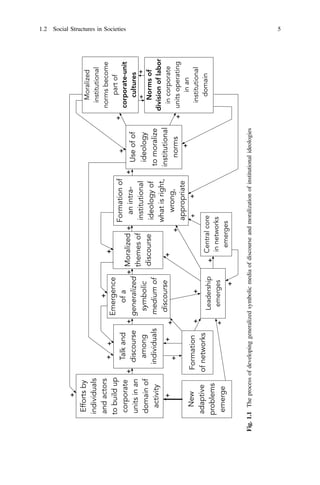
  • 2.
    Here are somerecommended products that we believe you will be interested in. You can click the link to download. Language Learning And Teaching As Social Interaction Zhu Hua https://ebookbell.com/product/language-learning-and-teaching-as- social-interaction-zhu-hua-5369240 Edemocracy Toward A New Model Of Interactive Society Alfredo M Ronchi https://ebookbell.com/product/edemocracy-toward-a-new-model-of- interactive-society-alfredo-m-ronchi-9958816 Architecture And The Social Sciences Inter And Multidisciplinary Approaches Between Society And Space 1st Edition Maria Manuela Mendes https://ebookbell.com/product/architecture-and-the-social-sciences- inter-and-multidisciplinary-approaches-between-society-and-space-1st- edition-maria-manuela-mendes-5882934 Hegemony And Domination Civil Society And Regime Variation In Interwar Europe Dylan John Riley https://ebookbell.com/product/hegemony-and-domination-civil-society- and-regime-variation-in-interwar-europe-dylan-john-riley-4738498
  • 3.
    Performative Interactions InAfrican Theatre 2 Innovation Creativity And Social Change 1st Kene Igweonu https://ebookbell.com/product/performative-interactions-in-african- theatre-2-innovation-creativity-and-social-change-1st-kene- igweonu-5703474 Education Social Justice And Interagency Working Joined Up Or Fractured Policy Routledge Research In Education Series 4 1st Edition Sheila Riddell https://ebookbell.com/product/education-social-justice-and- interagency-working-joined-up-or-fractured-policy-routledge-research- in-education-series-4-1st-edition-sheila-riddell-1987710 Blood Is Thicker Than Water Amerindian Intra And Interinsular Relationships And Social Organization In The Precolonial Windward Islands 1st Edition Alistair J Bright https://ebookbell.com/product/blood-is-thicker-than-water-amerindian- intra-and-interinsular-relationships-and-social-organization-in-the- precolonial-windward-islands-1st-edition-alistair-j-bright-51710688 Void And Fullness In The Buddhist Hindu And Christian Traditions Sunya Purna Pleroma Papers Presented At An Interreligious Retreat Seminar Organized By The Abhishiktananda Society Delhi Held In Sarnath Varanasi From December 11 To 16 19 Ed By Bettina Baumer https://ebookbell.com/product/void-and-fullness-in-the-buddhist-hindu- and-christian-traditions-sunya-purna-pleroma-papers-presented-at-an- interreligious-retreat-seminar-organized-by-the-abhishiktananda- society-delhi-held-in-sarnath-varanasi-from-december-11-to-16-19-ed- by-bettina-baumer-4704216 World Eparliament Report 2008 United Nationsdepartment Of Economic And Social Affairs https://ebookbell.com/product/world-eparliament-report-2008-united- nationsdepartment-of-economic-and-social-affairs-2020614
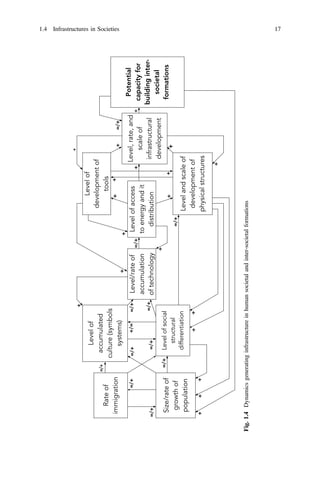
  • 5.
    Inter-Societal Dynamics Jonathan H. Turner AnthonyJ. Roberts Toward a General Theory Emerging Globalities and Civilizational Perspectives
  • 6.
    Emerging Globalities andCivilizational Perspectives Series Editor Ino Rossi, Saint John’s University, Great Neck, NY, USA
  • 7.
    This series documentsthe range of emerging globalities in the 21st century at the national, transnational and trans-civilizational levels of analysis. “Globality” refers to a global condition where people located at any point on Earth are aware of being part of the world as a whole—the world as a single interacting entity. Social interactions occur among actors belonging to different societies, different social strata and different cultural traditions so that the condition of “globality” is experienced in many different ways. Examples of emerging globalities are social movements generated from the unfulfilled promises of neoliberalism and feelings of discrimination and marginal- ization of lower social strata; cultural otherization or the blaming of economic problems of certain geographical areas on a low level of cultural development; insecurities generated by technological risks, epidemics, and global terrorism; uncertainties generated by processes of transnational governance, outsourcing, unbalanced trade and massive migrations; biology-machine interfaces and impacts of non-human organisms and technologies on human consciousness and action; long-term threats of global warming, climate change and depletion of bio-diversity; increasing exploitation and marginalization of less industrialized regions. We state that globalization entails encounters and often clashes among people and nations of different civilizational traditions. Hence, one of the exploratory questions of these volumes will be the extent to which negative or problematic globalities are reactions to failed promises and unrealized ideals of civilizational and national traditions and/or perhaps attempts to revive those traditions. Our notion of civilizational tradition takes inspiration from the classical works of Spengler and Toynbee, Benjamin Nelson, Vytautas Kavolis, Roland Robertson, Johann P. Arnason, Jeremy Smith, and others; a tradition which is in sharp contrast with the civilizationism recently promoted by authoritarian leaders with hegemonic ambitions. The volumes in this series aim to extend the inter-civilizational focus of classical civilizational thinkers from the analysis of the origins and development of civilizations to the fostering of contemporary inter-civilizational dialogues; the intent is to facilitate an international rapprochement in the contemporary atmosphere of global conflicts. The volumes will reflect the diversity of theoretical perspectives and captures some of the novel thinking in social sciences, economics and humanities on intra- and inter-societal processes; the attention to novel thinking will extend to emerging policy formulations in dealing with threats, risks, insecurities and inequities and to strategic thinking for a sustainable global future. The historical perspective will also be an important component of analysis together with the avoidance of West-centric perspectives. The intended readership of this series is not just an academic audience but also policy decision-makers and the public at large; accessibility of language and clarity of discourse will be a key concern in the preparation of these volumes.
  • 8.
    Jonathan H. Turner• Anthony J. Roberts Inter-Societal Dynamics Toward a General Theory 123
  • 9.
    Jonathan H. Turner Departmentof Sociology University of California Riverside, CA, USA Anthony J. Roberts Department of Sociology Colorado State University Fort Collins, CO, USA ISSN 2731-0620 ISSN 2731-0639 (electronic) Emerging Globalities and Civilizational Perspectives ISBN 978-3-031-12447-1 ISBN 978-3-031-12448-8 (eBook) https://doi.org/10.1007/978-3-031-12448-8 © The Editor(s) (if applicable) and The Author(s), under exclusive license to Springer Nature Switzerland AG 2023 This work is subject to copyright. All rights are solely and exclusively licensed by the Publisher, whether the whole or part of the material is concerned, specifically the rights of translation, reprinting, reuse of illustrations, recitation, broadcasting, reproduction on microfilms or in any other physical way, and transmission or information storage and retrieval, electronic adaptation, computer software, or by similar or dissimilar methodology now known or hereafter developed. The use of general descriptive names, registered names, trademarks, service marks, etc. in this publication does not imply, even in the absence of a specific statement, that such names are exempt from the relevant protective laws and regulations and therefore free for general use. The publisher, the authors, and the editors are safe to assume that the advice and information in this book are believed to be true and accurate at the date of publication. Neither the publisher nor the authors or the editors give a warranty, expressed or implied, with respect to the material contained herein or for any errors or omissions that may have been made. The publisher remains neutral with regard to jurisdictional claims in published maps and institutional affiliations. This Springer imprint is published by the registered company Springer Nature Switzerland AG The registered company address is: Gewerbestrasse 11, 6330 Cham, Switzerland
  • 10.
    Randall Collins & Christopher Chase-Dunn Inappreciation for their efforts to expand the reach of inter-societal theorizing and to inspire out effort, for better or worse, to make this approach more scientific and theoretical
  • 11.
    Preface Sociology from itsbeginning addressed inter-societal dynamics, although these early efforts typically emphasized their effects on internal societal development than inter-societal evolution. More generally, historians and social scientists have been engaged in studying the ebb and flow of empires and other forms of inter-societal relations. Still, it was not until the second half of the twentieth century that inter-societal formations were taken as distinctive level of social reality that, in essence, determined many of the internal structures and dynamics of human soci- eties and their other institutional domains. However, this shift in theorizing initially emphasized how inter-societal systems were often highly exploitive. Starting with dependency theory, and then world-systems analysis (WSA), these perspectives challenged the dominant “modernization theory” and policies of the 1950s and 1960s by emphasizing how inter-societal relations reproduced conditions of underdevelopment and international stratification among societies. Nonetheless, these perspectives identified inter-societal systems as a macro-unit of social orga- nization that needs more study and theorizing. At the same time, these perspectives gave new life to Marxist arguments about the “contradictions of capitalism” becoming evident as world-level capitalism spread across the globe, leading somehow to the collapse of capitalism and the rise of socialism and a new world order. This always struck us as rather unlikely and, like all “end of history” arguments, has more hope and bluster than predictable outcome derived from a general theory. It was, as has always been the case in sociology, giving unjustified credence to ideologies about what should occur, as opposed to what can and does occur, in human societies, and now inter-societal systems. As authors, we are a couple of sociological generations apart, with J. H. T. receiving his Ph.D. in the 1960s and A. J. R. receiving his in the twenty-first century. Not only age but our respective knowledge bases are somewhat different. J. H. T. is a general theorist, who is not bothered, by the epithet “grand theory” as long it is actual theory rather than grand illusions, as is much of the ideology that penetrates the world-systems tradition today. A. J. R. is trained in world-systems theory and research, as a former student of Christopher Chase-Dunn who has been vii
  • 12.
    one of themost important scholars in this tradition. The book could not have been written without our respective skills, and as will become evident, this book will look very different from other works in the world-systems tradition over the last 50 years. This is a theory book rather than an empirical book—although empirical reality is not ignored since, after all, this is what we are trying to explain. We accept the view that inter-societal systems are an emergent level of social reality that has been universal since the beginning of human societies at least 400,000 years ago. Thus, inter-societal systems and their dynamics are an appro- priate and, indeed, a necessary subject for abstract sociological theory. For all the good work in WSA, it has been too narrow in its focus on the last 500 years as capitalism arose. In our view, humans have been creating geo-economic systems for hundreds of thousands of years and, hence, should be a set of data points for the other 399,500 years that humans have organized into societies, granted very small and simple societies, but nonetheless societies that have likely (given the data on pre-literate societies) formed geo-economic and geo-political inter-societal systems. This book is, in part, dedicated to Christopher Chase-Dunn in recognition for his effort to push this simple point, even if he would not necessarily agree to our hard-nosed positivism emphasizing the possibility of generating, as the subtitle for this book proclaims, a more general theory of inter-societal dynamics—a theory that covers from the very beginning of such formations to the present and, perhaps, into the future. This is an effort to move toward a general theory rather than a set of historical descriptions, classification of societies in inter-societal formations, and weak ideological arguments expressing hope for a certain form of inter-societal societal governance—socialism. For J. H. T., writing general theories of all layers and levels of human social organization has basically been a 60-year project dedicated to making sociology a theoretical and explanatory science. Indeed, J. H. T. would prefer that sociology go by its original, but short-lived name, Social Physics—a label that might be available if sociology, and especially American sociology continues its evolution into a cheerleader for social justice—a worthy thing to cheer for but not a very useful way to develop knowledge about the dynamics of human societies and inter-societal systems. Social Physics might be a good name for the refugees of American sociology, seeking a label for what they do: value-free (as much as is possible, given that we are all human) analysis of the socio-cultural universe. The book is also dedicated to Randall Collins who produced a series of articles that inspired J. H. T. to begin studying geo-economic and geo-political formations and their dynamics, and this book is, except for three articles, is the outcome of decades of reading about inter-societal systems. Collins’ articles and what they inspired motivated J. H. T. to push hard for Christopher Chase-Dunn’s appointment at the University of California Riverside to build a strong graduate specialization populated by a constant flow of very good young scholars to their Ph.D.s, such as A. J. R., who would also take J. H. T.’s theory courses. Our zoom dialogues and exchanges of drafts over the last year have allowed us to write this book, drawing upon our respective knowledge bases and analytical skills. viii Preface
  • 13.
    What we presentis only tentative; it simply is our best effort, at this point in time. Our hope is that other scholars working in the world-systems tradition will join us in trying to make WSA less ideological, less descriptive, and less con- strained by the emphasis on the last 500 years of history. Instead, WSA should draw upon, as we do, the very large databases, and analyses of these bases, now accu- mulated on all types of societies that have existed over the last 400,000 years. These offer the information needed to begin developing more abstract theoretical models and inventories of abstract principles. What we offer is not a complete, and perhaps not even an accurate theory, but we hope to convince at least some that this kind of effort at developing general, and highly abstract, theory is useful. Murrieta and Santa Barbara, CA, USA Jonathan H. Turner Fort Collins, CO, USA Anthony J. Roberts Preface ix
  • 14.
    Contents 1 Fundamental Propertiesof Societies . . . . . . . . . . . . . . . . . . . . . . . . . 1 1.1 The Fundamental Properties of Human Societies . . . . . . . . . . . . . 2 1.2 Social Structures in Societies. . . . . . . . . . . . . . . . . . . . . . . . . . . . 3 1.2.1 Institutional Domains in Human Societies . . . . . . . . . . . . . 3 1.2.2 Stratification Systems in Human Societies . . . . . . . . . . . . . 7 1.3 Cultural Structures in Societies . . . . . . . . . . . . . . . . . . . . . . . . . . 11 1.4 Infrastructures in Societies . . . . . . . . . . . . . . . . . . . . . . . . . . . . . 15 1.4.1 A Model of Infrastructural Dynamics . . . . . . . . . . . . . . . . 15 1.4.2 Impacts of Infrastructure on Societal and Inter-societal Dynamics . . . . . . . . . . . . . . . . . . . . . . . . . . . . . . . . . . . . 22 1.5 Societal and Inter-Societal Systems . . . . . . . . . . . . . . . . . . . . . . . 23 References . . . . . . . . . . . . . . . . . . . . . . . . . . . . . . . . . . . . . . . . . . . . . 25 2 Current Theorizing of Inter-Societal Dynamics: Origins and Critiques . . . . . . . . . . . . . . . . . . . . . . . . . . . . . . . . . . . . . . . . . . 27 2.1 Immanuel Wallerstein’s and World-Systems Analysis . . . . . . . . . . 29 2.2 The Evolution of the Modern World-System . . . . . . . . . . . . . . . . 31 2.3 The Theoretical Roots of World-System Analysis . . . . . . . . . . . . . 33 2.3.1 Imperialism and Capitalism as a Global System . . . . . . . . 33 2.3.2 Dependency Theory and Unequal Exchange . . . . . . . . . . . 35 2.3.3 Exchange Theorizing in Sociology . . . . . . . . . . . . . . . . . . 38 2.4 The Limitations of World-Systems Analysis. . . . . . . . . . . . . . . . . 41 2.4.1 Descriptive Theorizing . . . . . . . . . . . . . . . . . . . . . . . . . . . 41 2.4.2 The Marxist Ideology of World-Systems Analysis . . . . . . . 43 2.4.3 The Return to Marxism: William Robison’s Critique of World-Systems Analysis . . . . . . . . . . . . . . . . . . . . . . . 45 2.4.4 The Absence of Geo-Cultural Dynamics . . . . . . . . . . . . . . 47 2.4.5 Scope Conditions and Pre-modern Inter-Societal Systems . . . . . . . . . . . . . . . . . . . . . . . . . . . . . . . . . . . . . 47 2.4.6 The Predictive Power of World-Systems Analysis . . . . . . . 49 xi
  • 15.
    2.5 From theBeginning: The Pervasiveness of Inter-Societal Relations . . . . . . . . . . . . . . . . . . . . . . . . . . . . . . . . . . . . . . . . . . 49 2.5.1 The Beginnings of Geo-Economic Relations . . . . . . . . . . . 49 2.5.2 The Evolution of Markets and Money. . . . . . . . . . . . . . . . 52 2.5.3 The Beginnings of Geo-Political Relations . . . . . . . . . . . . 55 2.5.4 The Basis of Power . . . . . . . . . . . . . . . . . . . . . . . . . . . . . 56 2.6 Conclusion . . . . . . . . . . . . . . . . . . . . . . . . . . . . . . . . . . . . . . . . . 58 References . . . . . . . . . . . . . . . . . . . . . . . . . . . . . . . . . . . . . . . . . . . . . 58 3 Key Ideas for Building a Scientific Theory of Inter-Societal Dynamics . . . . . . . . . . . . . . . . . . . . . . . . . . . . . . . . . . . . . . . . . . . . . 63 3.1 Two Early Theoretical Approaches . . . . . . . . . . . . . . . . . . . . . . . 64 3.1.1 Herbert Spencer . . . . . . . . . . . . . . . . . . . . . . . . . . . . . . . . 64 3.1.2 Ibin Khaldun . . . . . . . . . . . . . . . . . . . . . . . . . . . . . . . . . . 72 3.2 Contemporary Theoretical Approaches . . . . . . . . . . . . . . . . . . . . . 73 3.2.1 Peter Turchin. . . . . . . . . . . . . . . . . . . . . . . . . . . . . . . . . . 73 3.2.2 Christopher Chase-Dunn and Colleagues . . . . . . . . . . . . . . 79 3.2.3 Randall Collins on the Dynamics of Geo-Political Inter-Societal Systems . . . . . . . . . . . . . . . . . . . . . . . . . . . 86 3.2.4 Fernand Braudel and Randall Collins on Markets . . . . . . . 91 3.2.5 Jack Goldstone on State Breakdown . . . . . . . . . . . . . . . . . 96 3.2.6 Ecological Theories and Inter-Societal Dynamics . . . . . . . . 99 3.2.7 World Society Theory and Geo-Cultural Dynamics . . . . . . 101 3.3 Conclusion . . . . . . . . . . . . . . . . . . . . . . . . . . . . . . . . . . . . . . . . . 104 References . . . . . . . . . . . . . . . . . . . . . . . . . . . . . . . . . . . . . . . . . . . . . 105 4 Scientific Theorizing of Inter-Societal Dynamics . . . . . . . . . . . . . . . . 109 4.1 Developing Scientific Explanations of Inter-Societal Systems . . . . 110 4.1.1 Fundamental Properties of Inter-Societal Dynamics . . . . . . 110 4.1.2 A Typology of Inter-Societal Patterns . . . . . . . . . . . . . . . . 111 4.1.3 A Strategy for Developing Scientific Theories . . . . . . . . . . 117 4.2 Conclusion . . . . . . . . . . . . . . . . . . . . . . . . . . . . . . . . . . . . . . . . . 119 References . . . . . . . . . . . . . . . . . . . . . . . . . . . . . . . . . . . . . . . . . . . . . 119 5 Geo-Political Dynamics . . . . . . . . . . . . . . . . . . . . . . . . . . . . . . . . . . . 123 5.1 The Evolution of Polity . . . . . . . . . . . . . . . . . . . . . . . . . . . . . . . 124 5.1.1 Consolidating Bases of Power . . . . . . . . . . . . . . . . . . . . . 126 5.1.2 Centralizing Bases of Power. . . . . . . . . . . . . . . . . . . . . . . 127 5.1.3 Bases of Power in Geo-Political Dynamics . . . . . . . . . . . . 128 5.1.4 A Model of Power Consolidation and Centralization . . . . . 130 5.2 Expansion Through Warfare: The Intersection of Geo-Economic and Geo-Political Dynamics . . . . . . . . . . . . . . . 136 5.3 Success and Failure in Geo-Political Actions . . . . . . . . . . . . . . . . 142 5.3.1 A Model of Geo-Political Dynamics . . . . . . . . . . . . . . . . . 144 5.4 Strategies of Domination, Point of Over-Extension, and Collapse of Geo-Political Systems . . . . . . . . . . . . . . . . . . . . . 148 xii Contents
  • 16.
    5.4.1 Mutual DefensePacts . . . . . . . . . . . . . . . . . . . . . . . . . . . 148 5.4.2 Kin-Based Geo-Political Formations . . . . . . . . . . . . . . . . . 149 5.4.3 “Plantation” Geo-Economic Systems and Power Use . . . . . 151 5.4.4 Tributary Patterns of Geo-Political Inter-Societal Systems . . . . . . . . . . . . . . . . . . . . . . . . . . . . . . . . . . . . . 152 5.4.5 Colonial Patterns in Geo-Political Inter-Societal Systems . . . . . . . . . . . . . . . . . . . . . . . . . . . . . . . . . . . . . 154 5.4.6 Geo-Political Inter-Societal Systems and the Emergence of Capitalism . . . . . . . . . . . . . . . . . . . . . . . . . . . . . . . . . . 156 5.5 Additional Theoretical Principles . . . . . . . . . . . . . . . . . . . . . . . . . 157 5.5.1 Success and Size of Geo-Political Expansion. . . . . . . . . . . 157 5.5.2 Duration and Stability of Geo-Political Systems . . . . . . . . 161 5.6 Conclusion . . . . . . . . . . . . . . . . . . . . . . . . . . . . . . . . . . . . . . . . . 163 References . . . . . . . . . . . . . . . . . . . . . . . . . . . . . . . . . . . . . . . . . . . . . 164 6 Geo-Economic Dynamics. . . . . . . . . . . . . . . . . . . . . . . . . . . . . . . . . . 167 6.1 Reconceptualizing the Economy . . . . . . . . . . . . . . . . . . . . . . . . . 167 6.1.1 Technology . . . . . . . . . . . . . . . . . . . . . . . . . . . . . . . . . . . 168 6.1.2 Physical Capital . . . . . . . . . . . . . . . . . . . . . . . . . . . . . . . . 168 6.1.3 Human Capital . . . . . . . . . . . . . . . . . . . . . . . . . . . . . . . . 169 6.1.4 Transactional Capital . . . . . . . . . . . . . . . . . . . . . . . . . . . . 169 6.1.5 Property . . . . . . . . . . . . . . . . . . . . . . . . . . . . . . . . . . . . . 171 6.1.6 Structural Formations . . . . . . . . . . . . . . . . . . . . . . . . . . . . 172 6.1.7 Cultural Formations . . . . . . . . . . . . . . . . . . . . . . . . . . . . . 174 6.2 Models and Principles of Geo-Economic Dynamics . . . . . . . . . . . 176 6.2.1 Basic Economic Forces . . . . . . . . . . . . . . . . . . . . . . . . . . 176 6.2.2 Dependency in Geo-Economic Relations . . . . . . . . . . . . . . 179 6.2.3 Modern Patterns of Geo-Economic Relations. . . . . . . . . . . 188 6.2.4 Modeling Recent Trends in Geo-Economic Inter-Societal Systems . . . . . . . . . . . . . . . . . . . . . . . . . . . 193 6.2.5 Additional Theoretical Propositions on Geo-Economic Systems . . . . . . . . . . . . . . . . . . . . . . . . . . . . . . . . . . . . . 199 6.3 Conclusion . . . . . . . . . . . . . . . . . . . . . . . . . . . . . . . . . . . . . . . . . 201 References . . . . . . . . . . . . . . . . . . . . . . . . . . . . . . . . . . . . . . . . . . . . . 203 7 Geo-Cultural Dynamics. . . . . . . . . . . . . . . . . . . . . . . . . . . . . . . . . . . 205 7.1 Drivers of Geo-Cultural Dynamics. . . . . . . . . . . . . . . . . . . . . . . . 208 7.1.1 Proximity and Language . . . . . . . . . . . . . . . . . . . . . . . . . 208 7.1.2 Diffusion of Geo-Cultural Formations . . . . . . . . . . . . . . . . 208 7.1.3 Structural and Cultural Equivalences . . . . . . . . . . . . . . . . . 211 7.1.4 Infrastructural Equivalence . . . . . . . . . . . . . . . . . . . . . . . . 213 7.1.5 Market Development and Exchange . . . . . . . . . . . . . . . . . 214 7.1.6 Political Domination and Culture . . . . . . . . . . . . . . . . . . . 216 7.1.7 Economic Domination and Culture . . . . . . . . . . . . . . . . . . 221 Contents xiii
  • 17.
    7.2 A GeneralModel of Geo-Cultural Dynamics . . . . . . . . . . . . . . . . 224 7.2.1 Explanatory Principles on Geo-Cultural Inter-societal Systems . . . . . . . . . . . . . . . . . . . . . . . . . . . . . . . . . . . . . 228 7.3 The Interplay of Geo-Cultural, Political, and Economic Dynamics . . . . . . . . . . . . . . . . . . . . . . . . . . . . . . . . . . . . . . . . . . 231 7.3.1 Geo-Political Strategies of Domination and Institutional Change . . . . . . . . . . . . . . . . . . . . . . . . . . . . . . . . . . . . . . 232 7.3.2 Geo-Economic Strategies of Domination and Institutional Change . . . . . . . . . . . . . . . . . . . . . . . . . . . . . . . . . . . . . . 233 7.3.3 Structural and Cultural Equivalences . . . . . . . . . . . . . . . . . 235 7.4 Conclusions . . . . . . . . . . . . . . . . . . . . . . . . . . . . . . . . . . . . . . . . 236 References . . . . . . . . . . . . . . . . . . . . . . . . . . . . . . . . . . . . . . . . . . . . . 237 Epilogue. . . . . . . . . . . . . . . . . . . . . . . . . . . . . . . . . . . . . . . . . . . . . . . . . . . . 239 Bibliography . . . . . . . . . . . . . . . . . . . . . . . . . . . . . . . . . . . . . . . . . . . . . . . . 247 xiv Contents
  • 18.
    List of Figures Fig.1.1 The process of developing generalized symbolic media of discourse and moralization of institutional ideologies . . . . . . . 5 Fig. 1.2 Fundamental subsystems of human societies. . . . . . . . . . . . . . . . . 9 Fig. 1.3 Cultural structures in human societies. . . . . . . . . . . . . . . . . . . . . . 12 Fig. 1.4 Dynamics generating infrastructure in human societal and inter-societal formations . . . . . . . . . . . . . . . . . . . . . . . . . . . . . 17 Fig. 3.1 Spencer’s implicit model of the dynamics of geo-political formations. . . . . . . . . . . . . . . . . . . . . . . . . . . . . . . . . . . . . . . . . . . 68 Fig. 3.2 Spencer's conception of cycle phases of political centralization and decentralization. . . . . . . . . . . . . . . . . . . . . . . . . 71 Fig. 3.3 Secular cycles of societies and inter-societal systems . . . . . . . . . . 74 Fig. 3.4 Christopher Chase-Dunn’s iteration model . . . . . . . . . . . . . . . . . . 85 Fig. 3.5 Modeling of Randall Collins’ theory of geo-politics . . . . . . . . . . . 89 Fig. 3.6 Fernand Braudel’s analysis of the evolution of markets . . . . . . . . 93 Fig. 3.7 Extensions of Randall Collins’ Conception of Meta-market Dynamics . . . . . . . . . . . . . . . . . . . . . . . . . . . . . . . . . . . . . . . . . . . 95 Fig. 3.8 Gerhard Lenski’s assessment of global evolution in the global system of societies in the last 10,000 years . . . . . . . 100 Fig. 5.1 Consolidation and centralization of power and geo-political action . . . . . . . . . . . . . . . . . . . . . . . . . . . . . . . . . . . . . . . . . . . . . . 134 Fig. 5.2 Forces operating to form geo-economic and geo-political formations. . . . . . . . . . . . . . . . . . . . . . . . . . . . . . . . . . . . . . . . . . . 139 Fig. 5.3 The Complex Dynamics of Geo-Political Inter-Societal Formations . . . . . . . . . . . . . . . . . . . . . . . . . . . . . . . . . . . . . . . . . . 145 Fig. 6.1 Forces driving societal complexity and types of geo-economic inter-societal formations. . . . . . . . . . . . . . . . . . . 177 Fig. 6.2 Conditions Increasing Likelihood of a Dependency Geo-economic Inter-societal Formation. . . . . . . . . . . . . . . . . . . . . 180 Fig. 6.3 Forces driving more recent patterns of geo-economic inter-societal systems . . . . . . . . . . . . . . . . . . . . . . . . . . . . . . . . . . 194 xv
  • 19.
    Fig. 7.1 Conceptualizingculture at a high level of abstraction in geo-cultural inter-societal systems. . . . . . . . . . . . . . . . . . . . . . . 225 Fig. 7.2 The dynamics of geo-cultural formations and geo-cultural inter-societal systems . . . . . . . . . . . . . . . . . . . . . . . . . . . . . . . . . . 229 xvi List of Figures
  • 20.
    List of Tables Table1.1 Legend for signs on figures . . . . . . . . . . . . . . . . . . . . . . . . . . . . 4 Table 1.2 Generalized symbolic media of institutional domains. . . . . . . . . 6 Table 2.1 Richard Emerson’s basic theory on power-dependent relations . . . . . . . . . . . . . . . . . . . . . . . . . . . . . . . . . . . . . . . . . . . 39 Table 2.2 Peter Blau’s proposition on conflict dynamics in exchange . . . . 40 Table 3.1 Key propositions derived from Randall Collins’ theory of empire building . . . . . . . . . . . . . . . . . . . . . . . . . . . . . . . . . . . 87 Table 3.2 Extending Jack Goldstone’s theory of state breakdown to inter-state breakdown. . . . . . . . . . . . . . . . . . . . . . . . . . . . . . . 97 Table 4.1 Long-Term Patterns of Inter-Societal Relations . . . . . . . . . . . . . 112 Table 5.1 Propositions on geo-political action in inter-societal systems . . . . . . . . . . . . . . . . . . . . . . . . . . . . . . . . . . . . . . . . . . . 137 Table 5.2 Propositions on the likelihood of geo-political warfare and conquest . . . . . . . . . . . . . . . . . . . . . . . . . . . . . . . . . . . . . . . 142 Table 5.3 Propositions on the size and scope of geo-political expansion. . . . . . . . . . . . . . . . . . . . . . . . . . . . . . . . . . . . . . . . . . 158 Table 5.4 Propositions on geo-political instability and collapse . . . . . . . . . 162 Table 6.1 Modes of organization among corporate unit organization within institutional domains . . . . . . . . . . . . . . . . . . . . . . . . . . . . 173 Table 6.2 Propositions on the probability of dependency and degree of stratification in geo-economic systems. . . . . . . . . . . . . . . . . . 184 Table 6.3 Additional theoretical propositions on geo-economic systems . . . . . . . . . . . . . . . . . . . . . . . . . . . . . . . . . . . . . . . . . . . 199 Table 7.1 Elements of societal culture and geo-cultural formations in inter-societal systems . . . . . . . . . . . . . . . . . . . . . . . . . . . . . . . 226 Table 7.2 Geo-cultural convergence and inter-societal systems . . . . . . . . . 231 xvii
  • 21.
    Chapter 1 Fundamental Propertiesof Societies Over the last half-century, the revival of inter-societal analysis in the form of World-Systems Analysis (hereafter, WSA) has been one of the most important empirical and theoretical developments within sociology. As we will emphasize in this book, human societies have almost always formed inter-societal systems, although most world-systems analysts have emphasized only the last five hundred years as world-level capitalism began to emerge. Still, historians, political scientists, and anthropologists have long studied inter-societal relations among all types of societies—beginning with hunting and gathering and moving through horticulture then agrarianism, industrialism, and post-industrialism. This emphasis has, we feel, led to analysis of the evolution in the present at the expense of analyzing the full range of inter-societal systems. In our view, inter-societal systems have exist since the beginning of human societies and have episodically existed for many thousands of years right up to the present. In contrast, WSA has generally focused on the evolution of capitalism over a very short historical period of human societies. The result is that “theories” are time-bound and often more descriptive of the last 500 years of history rather than the actual theoretical explanation of the funda- mental dynamics of all inter-societal systems. We emphasize this point as a mild critique of current WSA because a general theory of such a universal form of human social organization as inter-societal formations should include all types in all times and in all places where inter-societal have emerged and evolved. The emphasis on the rise of capitalism captures only a 500-year slice of a phenomenon that has existed for at least 800 five-hundred-year spans (400,000 years of human societies divided by 500). The result is that this conceptualization of societies and inter-societal systems is often skewed, which is understandable because the recent history of inter-societal sys- tems is of most interest. Yet, the emphasis on the evolution of capitalism is a very limiting case for a phenomenon that has existed for so many hundreds of thousands of years before capitalism. A general theoretical approach should explain all forms of inter-societal organization, from the simplest to the most complex. © The Author(s), under exclusive license to Springer Nature Switzerland AG 2023 J. H. Turner and A. J. Roberts, Inter-Societal Dynamics, Emerging Globalities and Civilizational Perspectives, https://doi.org/10.1007/978-3-031-12448-8_1 1
  • 22.
    This means thatthe conceptualization of the phenomenon to be explained— inter-societal dynamics—must begin with a conceptualization of the fundamental properties of societies in general and then, the properties and dynamics of inter-relations among all types of societies. As will become evident, our analysis will be more inclusive of the full range of societal and inter-societal formations than most current theories. And, to engage in this kind of analysis, we should begin with a very abstract and general conceptualization of the fundamental properties of all societal systems. 1.1 The Fundamental Properties of Human Societies All societies are built from three fundamental elements: (1) social structures, (2) cultural structures, and (3) infrastructures. These vary enormously from the very simple structural, cultural, and infrastructural formations organizing hunting and gathering societies of a few dozen to several hundred individuals to the very complex structures organizing societies numbering many millions and even billions of persons. Yet, in imposing a much longer time frame in conceptualizing societal and inter-societal formations, we can gain greater theoretical purchase on their generic dynamics. And so, we begin our theoretical analysis of inter-societal dynamics by outlining, first, the fundamental properties of social structures and then, move on to the analysis of cultural structures, and finally, infrastructures. For in the end, the properties of social structures, cultural structures, and infrastructures together help explain societal and inter-societal formations for all times and places that humans have lived. The result is that theoretical analysis will thus look different than many contemporary WSA analyses, while at the same time explaining the most recent world-system formations. Indeed, a great deal of WSA analysis can be viewed constructing a classification system for analyzing the evolution of the capitalist world-system as much as an explanation of the operative dynamics of inter-societal systems in general. A theory of inter-societal dynamics must explain the processes operating within and between societies. A system for categorizing societies into roles within inter- national division of labor, such as the WSA’s emphasis on core, peripheral, and semi-peripheral societies in the “modern world-system” was a useful beginning point (Wallerstein 1974). However, this created two fundamental problems: First, how are the dynamics of modern world-systems to be explained by a typology of three types when one of these three types, most typically the semi-periphery, is often missing empirically? And second, and perhaps a more fundamental problem, how does a typology that only classifies phenomena explain the dynamic processes driving these phenomena? Many WSA theoretical approaches have been able to create dynamic models, but some of these have suffered from the problem of not having a sufficiently robust conception of the elements of societies that are involved in inter-societal formations. Often, this problem stems from a weak conception of the internal dynamics of the societies forming inter-societal systems. In this chapter, 2 1 Fundamental Properties of Societies
  • 23.
    we address thisunderlying problem by outlining, in detail, the full range of social structures, cultural structures, and infrastructures that are involved in creating inter-societal formations. More will be needed, however, because an outline of the properties of social structures, cultural structures, and infrastructures is only a beginning point of the- orizing. We will also need to specify the dynamic processes operating within and between these structures in the formation of inter-societal systems. Still, for the moment, let us simply outline the fundamental societal-level structures that drive the formation of societal and inter-societal systems. We will touch on some dynamic processes, but theoretical models and propositions to be presented in later chapters will delineate a more robust picture of the dynamics driving these struc- tures of social life. 1.2 Social Structures in Societies There are two pillars on which human societies are eventually constructed: (1) in- stitutional systems or domains and (2) stratification systems. Humans survived over the long run of human history by elaborating the number of institutional systems (Abrutyn and Turner 2022). Stratification systems emerged somewhat later and as a consequence of institutional evolution. Still, even among hunter-gatherers with only one differentiated institutional system (kinship), selection pressures on small pop- ulations of hunter-gatherers could occasionally push for very rudimentary forms of inequality and stratification. 1.2.1 Institutional Domains in Human Societies Institutions are constructed from corporate units organizing differentiated status positions, roles, and normative systems creating divisions of labor within a given institutional domain, such as kinship, economy, polity, religion, education, etc. As noted above, institutional systems have evolved as a response to selection pressures on human populations as they attempted over the last 400,000 years to adapt to diverse environments, eventually inhabiting all parts of the globe. There are only three generic types of corporate units: communities (organizing individuals in ecological space), groups (organizing behaviors of people occupying positions and playing roles), and organizations (coordinating groups of individuals in communities). The first human societies were organized only at the group level. Kinship was confined to nuclear family groups as part of nomadic bands. Such was the structure of human societies for hundreds of thousands of years. Thus, the first bands were built, from one institutional domain—kinship—with all other institutional activities embedded within nuclear families and the band organizing these families. Thus, 1.2 Social Structures in Societies 3
  • 24.
    economic, religious, educational,political, and legal activities were not yet struc- tured as distinctive institutional systems but, rather, were embedded in the nor- mative systems of kinship and band, with the band constituting a simple organization of nuclear kin units, although if bands settled down, they could and did morph into a second type of corporate unit, community. And, as populations settled down into more permanent communities, they grew larger and increasingly faced selection pressures that, over time, led to the evolution of the diverse institutional domains listed in Table 1.2. And, in turn, as each institutional domain emerged with its own generalized media of exchange as outlined in Fig. 1.1 on page 5, these media and other generalized forms of value (e.g., prestige, honor, positive emo- tions) were increasingly distributed unequally to members of bands that became communities, thus introducing the first signs of stratification, and hence, the second pillar of to human societies. Figure 1.1 describes the process by which generalized media first emerge within activities that become institutionalized Table 1.2. Generalized symbolic media have some special qualities. They are the media by which discourse and talk of indi- viduals pursuing various types of activities—e.g., family relations, economic actions to secure resources for production and exchange, relations involving power and authority to coordinate and control, spiritual activities revolving around ritual appeal to supernatural forces, and so on for all institutional domains that evolve (see Table 1.2 for more details). As generalized symbolic media are used in discourse among individuals, themes evolve that will eventually become codified in beliefs, norms, and ideologies. As these themes form ideologies, they moralize institutional activities that are codified into ideologies of right, wrong, appropriate, and inap- propriate behaviors when operating within an institutional domain. Ideologies reflect normative agreements that emerge among individuals engaged in the insti- tutional activity, while at the same providing moral guidance as to the nature of norms. Table 1.1 Legend for signs on figures + = positive effect on - = negative effect on +/- = positive curvilinear effect on -/+ = negative curvilinear effect on +/= = positive effect, leveling off ¼/+ = lagged positive effect, turning positive ¼/- = lagged negative effect, turning negative The signs on lines connecting variables in the model in Fig. 1.1 are defined above. These will be used in all figures in this book. Marking for easy reference this page can make referencing the legend easier. 4 1 Fundamental Properties of Societies
  • 25.
    Efforts by individuals and actors to build up corporate units in an domain of activity Talk and discourse among individuals Emergence of a generalized symbolic medium of discourse Moralized themes of discourse Formation of an intra- institutional ideology of what is right, wrong, appropriate Use of of ideology to moralize institutional norms Moralized institutional norms become part of corporate-unit cultures + + + + + + + + + + + + + + Formation of networks Leadership emerges Central core in networks emerges + New adaptive problems emerge + + + + + + + + + + + Norms of division of labor in corporate units operating in an institutional domain + + + Fig. 1.1 The process of developing generalized symbolic media of discourse and moralization of institutional ideologies 1.2 Social Structuresin Societies 5
  • 26.
    In turn, institutionalnorms are used to regulate the formation of corporate units, revealing a division of labor regulated by specific norms and roles within different institutional domains. Accordingly, the terms of discourse that rise when engaged in activities—economic, political, religious, family, artistic, educational, etc.—even- tually are codified into a generalized medium for engaging in not only discourse but in exchanges among individuals. Moreover, generalized media moralize human action and interaction by generating conceptions of right and proper behavior within the corporate units that make up an institutional domain. Generalized symbolic media not only provide symbolic tools for discourse and moral guidance in the formation of ideologies and normative systems guiding conduct, but they also become valued resources in their own right, as is outlined in Table 1.2. Each generalized medium is valuable to humans and each institutional domain has its own unique generalized symbolic medium for discourse, exchange, moralizing conduct, and developing cultural systems like ideologies and norms organizing conduct in corporate units in institutional domains. Having power, money, love-loyalty, piety, knowledge, or any of the generalized symbolic media listed in Table 1.2 is rewarding, and as societies become stratified, one of the basic resources distributed unequally is the generalized symbolic media of various institutional domains that, in turn, activate other valued states such has positive Table 1.2 Generalized symbolic media of institutional domains Kinship Love/loyalty, or the use of intense positive affective states to forge and mark commitments to others and groups of others Economy Money, or the denotation of exchange value for objects, actions, and services by the metrics inhering in money Polity Power, or the capacity to control the actions of other actors Law Imperative coordination/justice, or the capacity to adjudicate social relations and render judgments about justice, fairness, and appropriateness of actions Religion Sacredness/Piety, or the commitment to beliefs about forces and entities inhabiting a non-observable supernatural realm and the propensity to explain events and conditions by references to these sacred forces and beings Education Learning, or the commitment to acquiring and passing on knowledge Science Knowledge, or the invocation of standards for gaining verified knowledge about all dimensions of the social, biotic, and physical–chemical universes Medicine Health, or the concern about and commitment to sustaining the normal functioning of the human body Sport Competitiveness, or the definition of games that produce winners and losers by virtue of the respective efforts of players Arts Aesthetics, or the commitment to make and evaluate objects and performances by standards of beauty and pleasure that they give observers Note These and other generalized symbolic media are employed in discourse among actors, in articulating themes, and in developing ideologies about what should and ought to transpire in an institutional domain. They tend to circulate within a domain, but all of the symbolic media can circulate in other domains, although some media are more likely to do so than others. These media are also valued resources distributed by corporate units within institutional domains and, hence, are among the resources distributed unequally in a society’s system of stratification 6 1 Fundamental Properties of Societies
  • 27.
    emotions, prestige, anda sense of well-being in general. As will become evident, the culture of a society and geo-cultural formations across societies are all built from institutional ideologies which emerge from the moralizing effects of gener- alized symbolic media. Yet, even when periodically settled, early societies of humans were quite simple, revealing only one institutional system or domain (nuclear families as the basis of kinship), one generalized symbolic medium (love-loyalty), and very little, if any, forms of stratification unless a population was under stress. Thus, the nature of inter-societal systems among these early forms of societies was limited by their simplicity of the structure and, as we will see, by the nature of their cultures (with limited generalized symbolic media to develop ideologies and norms) and little technology to build up infrastructures. Still, inter-societal contact among hunter- gatherers would be a force that could push populations to begin developing other institutional systems, such as religion, economy, and polity which are somewhat differentiated from kinship and, hence, different from the generalized symbolic medium of kinship. And once the number of generalized symbolic media began to increase, so did the number of valued resources that can be distributed unequally, thus marking the beginnings of inequality and stratification among categories of persons. The evolution of human societies from simple to more complex formations revolving around institutional differentiation and increased levels of inequality and stratification were often the result of problematic inter-societal relations. Indeed, early sociologists like Herbert Spencer (1874–96) argued that circumscription of societies in the same territory could lead to competition and warfare that would cause the emergence of polity as an institutional system as well as stratification built around inequalities in the distribution of power and authority to certain social categories (e.g., male adult leaders) marking the beginnings of a stratification system. Spencer argued that warfare between societies had been a powerful force in the evolution of human societies from simple forms to ever-more complex forms. He also recognized, as have many anthropologists, that expanded trade between populations can make economic activity more prominent, thus marking the very beginnings of the economy as a differentiated institutional system as well as the beginnings of stratification around unequal distributions of valued resources from the trade of bulk and prestige goods with other populations, as well as unequal distribution of prestige and authority inhering in the inequality of valued goods acquired in exchanges with other small societies. 1.2.2 Stratification Systems in Human Societies Stratification systems are constructed from categoric units that place individuals into social categories marking differences (by sex, gender, age, ethnicity, religious affiliation, occupation, etc.) that carry varying evaluations and that become the basis for inequalities in the distribution of valued resources which can, as noted above, be generalized (e.g., prestige, esteem, positive emotions) or more specific to the 1.2 Social Structures in Societies 7
  • 28.
    generalized symbolic mediadistributed within and between institutional domains (e.g., money, power and authority, piety, love-loyalty, knowledge, etc.). As institutional systems evolve and, eventually, differentiate into specific domains, they develop generalized symbolic media as part of the cultural structure of a society (see next section) that are used as resources for building cultural and social structures (and infrastructures). For example, money is a symbol of value and emerged in a primitive form quite early in human societal evolution to operate as a mechanism for conducting exchanges within the economy of a society, as well as a mechanism for intra-societal exchanges between the economy and other institu- tional domains and, of course, for inter-societal exchanges among societies. At the same time, money as a valued resource is increasingly distributed unequally by the corporate units of the economy, with all other institutions using money in some way, thus initiating stratification or the unequal distribution of valued resources to categories of individuals and subpopulations. The structural formations and, in the case of generalized media, cultural formations that humans use to adapt to environments also generate inequality and stratification that often work against the integration of societies and inter-societal systems. While the most fundamental categoric units—i.e., sex, gender, and age—were not initially used to stratify people by differential evaluations of their worth and by inequalities in the distribution of resource shares, the very beginnings of stratifi- cation would sometimes emerge, as noted earlier, when bands settled into com- munities (even if only temporarily), when engaged in warfare with neighbors, or when bands faced environmental crises requiring leadership, or when some other force generated selection pressures on a simple band of hunter-gatherers. Under these conditions leadership would evolve into authority and power, marking the very beginnings of stratification. Still, societies with distinctive classes and ranked social strata would not emerge for many thousands of years, although precursors to full-blown stratification would periodically emerge when populations were under stress. Indeed, one source of stress was the conflict between populations, which would push even simple hunter-gatherers to organize leadership systems that, in turn, led to differential evaluations of leaders who would be given more prestige and authority—two highly valued resources that are unequally distributed in all developed stratification systems. At other times, religious leaders would emerge (i.e., shaman) and gain prestige, thus again marking early “differences” (in prestige and influence) within bands that otherwise were mostly egalitarian. Thus, human societies were, in their beginnings, not stratified to any great extent, but eventually they would become stratified as they grew, as they came into conflict with other bands of hunter-gatherers, as they were under ecological stress, and any condition putting pressure on bands of kin units. But for most nomadic hunter-gathering populations, there were powerful cultural ideologies (see next section) against differential evaluations of categories of person and inequality in the distribution of resources. As discussed above, we can conceive of societies as composed of three sub- systems. The first subsystem is a social structure, with the basic skeleton of a societal social structure modeled in Fig. 1.2. We will turn to culture next, followed 8 1 Fundamental Properties of Societies
  • 29.
  • 30.
    by infrastructure. Thepurely structural formations of societies are built by suc- cessive embedding of corporate units, with organizations built from groups and with communities constructed from organizations and groups. Corporate units at all levels of social organization distribute resources unequally based on the location of individuals in the divisions of labor in groups and organizations, and the location of individuals and their families within the ecology of communities. The unequal distribution of resources, and hence stratification as a basic social structure of society, is determined by the categoric units of individuals and sub- populations of individuals that become marked and differentially evaluated by cultural standards that arise as generalized symbolic media and institutional ide- ologies. The more categoric-unit memberships—in age, sex, gender, religion, eth- nicity, sexual preference, or any other designation by cultural labels—are evaluated on a scale of positive to negative, the more likely is this scaling to lead to inequality in the distribution of valued resources. Accordingly, stratification systems are based on two fundamental pillars: (1) generalized resources such as prestige, positive emotions, and definitions of moral worth are distributed unequally as are (2) gen- eralized symbolic media of institutional domains (e.g., money from the economy, authority and power from all polity, love-loyalty from kinship, knowledge from education, health from medicine, piety and sacredness from religion, aesthetics from art, and competition from sport, justice from law, etc.). Once these two pillars of societies are fully in place, so are symbolic systems allowing for the formation of a culture of a society or cultural models in inter-societal systems. Moreover, generalized media circulate across institutional domains, as is the case when (a) money is used to pay incumbents in corporate units of diverse institutional domains or to purchase in markets the output of different domains and when (b) power and authority “franchised” by polity1 and law to corporate units as a whole and incumbents in corporate units within diverse institutional domains (e.g., to parents in families, educators in schools, doctors in medicine, and so on for all corporate units organized by authority). Inequality also increases when valued and devaluated categoric units are often consolidated. For example, it is often the case for devalued ethnics (by prejudicial beliefs and widespread discrimination by a majority of a population) to be denied full access to corporate units bestowing generalized resources (prestige, honor) as well as highly valued generalized sym- bolic media as resources, such as knowledge from education, money from the economy, justice from law, health from medicine, and authority from a polity or corporate units in diverse institutional domains. The converse is true for those who are members of categoric units that are evaluated positively. This consolidation 1 Power is, from an institutional perspective, given by polity as conditional authority to corporate units in institutional domains. It can almost always be taken back, but this franchising of authority reduces the monitoring and administrative costs to the polity of micro-managing organizations. Yet, in highly authoritarian societies, one can see that authority in corporate units has a very visible fist of political control. Such is the case in all societies; and in so distributing authority, polity also distributions the generalized symbolic medium of power to some and not others in corporate units. 10 1 Fundamental Properties of Societies
  • 31.
    ramps up thedegree of inequality between members of valued and devalued cat- egoric units. It is clear, then, that structural position in corporate and categoric units are dramatically affected by cultural beliefs, ideologies, traditions, and normative systems. Indeed, culture provides the “instructions” for how individuals and groups in organizations and communities are to act as well as the worth and value of individuals, families, and subpopulations revealing distinctive characteristics. Every type of social structure—i.e., groups, organizations, communities, and institutional domains as well as for categoric units such as classes, ethnics, gender, religion, and other designations of a categoric-unit membership—are ultimately the building blocks of stratification systems. And for each element in the structure of institu- tional domains and stratification systems, there are corresponding symbol systems or cultures. And while these systems of culture are embedded in these structural formations, they reveal unique dynamics that can and should be analyzed as a distinct property of societies. Figure 1.2 on page 9 outlines the key dimensions of societal structures that are affected by cultural structures, as well as infrastructures, but the boxes representing these two additional subsystems—that is, culture and infrastructures—of the human societal organization are empty, thus necessitating that they are filled in. Without culture and the infrastructures in which social structures are grounded, and by which they operate, the properties and dynamics of societies and, potentially, of inter-societal systems cannot be known. And, to some extent, WSA has not fully integrated them in their conceptualizations of inter-societal systems, with the result that theorizing on inter-societal systems has not realized its full potential. 1.3 Cultural Structures in Societies The term, “culture,” has many connotations in general discourse and the social sciences. For our purposes, the term culture denotes systems of symbols generating common meanings that humans share and use to regulate and organize behaviors of individuals and subpopulations in societal and, at times, inter-societal forma- tions. Social structures are the skeletal system of human societies, but it is the culture that gives these structures meaning and that directs individual and collective behaviors that occur within and between social structures. From our perspective, there are relatively few forms and dimensions of culture that bring life to behaviors and interactions in social structures from which societies, and to an extent, inter-societal structures are created and sustained. Figure 1.3 outlines the key dimensions of culture at the societal and, at times, inter-societal levels of social organization. Specifically, Fig. 1.3 lists the cultural systems attached to the social structures of all societies. There are cultural elements of the whole society, which are then adapted to the two fundamental pillars of societies: institutional domains and stratification systems. The cultures of institu- tional domains and their respective corporate-unit flow down the left side of 1.3 Cultural Structures in Societies 11
  • 32.
    Technologies Traditions Texts Values Generalized ideologies Useof generalized Symbolic media in talk and theme building Formation of ideologies within differentiated institutional domains Formation of institutional norms in differentiated domains Formation of meta-ideologies Macro-level of Societal Organization and Culture Moral evaluations of members of categoric units Formation of status beliefs about members of categoric units Formation of expectation states for members of categoric units Culture of Stratification System Culture of institutional domains Basic Elements of Societal-level Culture Meso-level of Societal Organization and Culture Application of institutional ideologies to corporate units within institutional domains Creation of moralized normative structure of corporatie units within institutional domains Application of status beliefs to members of differentiated categoric units Expectations states for members of categoric units within divisions of labor of corporate units Focused encounters within corporate units Focused encounters in public spaces Unfocused encounters within corporate units Micro-level Interactions in Encounters Unfocused encounters in public spaces Fig. 1.3 Cultural structures in human societies 12 1 Fundamental Properties of Societies
  • 33.
    Fig. 1.3, whilethe right side of the figure denotes the culture attached to the categoric units from which stratification systems and their cultures are built. As is evident, there is a constant exchange of cultural elements back and forth between the cultures driving institutional domains and stratification systems. Figure 1.3 emphasizes the cultural elements operating at the macro level of social organization —that is, societies and their institutional and stratification systems—which are built, respectively, from corporate and categoric units. The figure also emphasizes that these elements are drawn from systems of symbols that embrace the entire society, while at the same time, often providing new cultural elements for the societal culture. Thus, as designated by the arrows in Fig. 1.3, there is a constant flow of culture from the micro to macro, and vice versa, as well across any given level of social structure. From our perspective, culture works at all levels of social organization—macro, meso, and micro—flowing down and then back up these levels of structural and cultural organization. Probably the most controversial part of Fig. 1.3 is the seemingly limited list of elements of society-wide culture as (a) technologies (knowledge of how to manipulate the environment), (b) traditions (conceptions, beliefs, narratives, etc.) on the past and how this past is relevant in the present and future), (c) texts (any and all symbolic systems codified in as collective memories or as information coded a formal “language” including speech, written language, and many other forms of symbolic communication spoken or written down), (d) value premises (or abstract standards of what is correct and morally right and what is morally wrong and incorrect), and (e) generalized ideologies (or moral codes drawn from values applied to macro social structures and large segments of the population in a society and from the ideologies of dominant institutional domains). Obviously, culture is more complex than implied by these simple labels, but we contend that most symbol systems in the simplest and most complex societies can be described by this basic scheme. We are not interested in the details, per se, of a culture; but, rather, our concern is with how generic forms of culture are critical to the orga- nization of societies, and at times, the operation of inter-societal systems at different structural levels and across different levels of human social organization. At the macro level, the respective cultures of diverse institutional domains are generated by existing technologies (or knowledge about how to manipulate the environment), applications of value premises arising from the other societal-level elements of cultures, and generalized ideologies that, in the past, have been codified by existing institutional domains (e.g., economy, polity, kinship, religion, law, etc.) in a society and the emergence of generalized symbolic media of exchange, as outlined in Table 1.2. The respective cultures of institutional domains and strati- fication systems, as well as the cultures of each of these two pillars of societies and their constituent corporate and categoric units, all flow from these often-moralized elements of a society’s general culture. The moral systems of culture are used to classify individuals and subpopulations in a society in terms of their worth, value, and other evaluative criteria. Each of the generalized symbolic media evolves moral evaluations, as do institutional ideolo- gies, which are combined (typically with the ideologies emerging in dominant 1.3 Cultural Structures in Societies 13
  • 34.
    domain institutions) intoa meta-ideology that dominates other evaluative symbol systems operating on corporate and categoric units forming institutional domains and stratification systems. Such meta-ideologies, when they arise, feedback and shape the content of the generalized ideologies that affect all structures within a society. The moralized symbol systems become the basis for creating what many social psychologists label as status beliefs (Berger and Zelditch 1985; Ridgeway 2001), which are evaluative beliefs about the character and nature of individuals in diverse categoric units and in diverse locations in the divisions of labor in corporate units. This moral coding, in turn, also drives the formation of normative systems oper- ating on individuals in status locations in the division of labor in corporate units and for the behaviors of individuals who are members of variously evaluated categoric units. Social structures are almost always “moralized” from the macro-level, but as changes occur in macro-, meso- and micro-level cultures, feedbacks from micro- and meso-levels of social structure can alter macro-level elements of cultures—i.e., technology, texts, traditions, value premises, generalized ideologies operating at the societal-level of organization, and ideologies and normative systems operating within and between institutional domains and stratification system. Change in cultures at any level can come from many sources: other societies, environmental pressures on a population, evolution of new institutional systems, changing beliefs about the nature of incumbents in categoric and/or corporate units, creation of new kinds of corporate units, and interpersonal experiences with incumbents in corpo- rate and categoric units. And, as feedback from micro- and meso-levels of socio-cultural organizations gain traction, they can begin to alter general macro-level cultural formations. Culture exerts its power by virtue of being vertically integrated across structures operating at the macro-, meso-, and micro-levels of social structural organization, moving up, down, and across types of corporate and categoric units making up, respectively, institutional domains and stratification systems. Such vertical moral- ization across levels of socio-cultural reality work, on the one side, to constrain and control individuals at all levels of social organization: face-to-face interpersonal behavior, incumbency in groups, organizations, communities that are located within differentiated institutional domains whose culture creates meta ideologies and status beliefs regulating individuals in diverse categoric units within a system of strati- fication. On the other side, this layering of socio-cultural reality allows for changes at lower levels of organization, from interpersonal experience through various types of corporate and categoric units to filter up to the macro level culture of a society. It is in this context that the structure and culture (and infrastructure as well) can be forces in the creation or, alternatively, collapse of inter-societal systems. Depending on the strategies of dominating dependent societies inter-societal for- mations, varying elements of social structure, cultural structures, and infrastructures can become the basis of whatever form of inter-societal relations evolves. This reality should alert us to the fact that inter-societal dynamics are very complex depending upon which institutional domains and their ideologies (e.g., economy, 14 1 Fundamental Properties of Societies
  • 35.
    religion, polity) andwhich generalized symbolic media of these domains are the conduits of relations with other societies. The same is true of the respective stratification systems and the status beliefs about categories of persons that make up this system. Over time the nature of institutional and stratification systems can change, thereby forcing, the evolution of new types of inter-societal formations. Moreover, cultural structures and even social structures can circulate among societies, especially when developed infrastructures are in place so that organizing elements of one society can diffuse to other societies. Such is particularly evident in the contemporary world where highly developed infrastructures facilitate the movement of information, people, culture, and resources about the globe, even at the speed of sound and light or at the compar- atively more “leisurely movement” pace of air, ground, and ocean travel. And the evolution of world markets and attendant infrastructure has made such diffusion of elements of societies across geo-economic inter-societal systems even more likely. It is also the case that geo-political activities can also carry many elements of social structures, cultural structures, and infrastructures rapidly around the globe—a fact that contemporary world-systems theorizing clearly recognizes but often underemphasizes. But, as we will emphasize, these dynamics have also been operating even in lower technology eras of human organization. 1.4 Infrastructures in Societies 1.4.1 A Model of Infrastructural Dynamics The scale of social and cultural structures has large effects on the capacity of a population to develop infrastructures for generating and distributing energy and material resources to members of a population and the corporate units organizing their activities. For most of human history, the capacity to gain access energy and to distribute this energy was very limited. Indeed, the basic source of energy driving human patterns of societal and inter-societal organization was the consumption of calories to drive the human body for hunting, gathering, exchanging, and other activities. The reasons for this limited access to energy were a very minimal social structure built from two groups—nuclear family and band—and very low levels of technology. The energy needed to sustain these structures and minimal culture was not great, consisting of perhaps 15–20 h of work to gather food by women (often assisted by children) and to hunt-down animal protein by men. This original “Garden of Eden,” portrayed by Marshall Shalins (1968), was highly gratifying and, thus, probably did not provide much motivational push for seeking more sources of energy that would eventually change the nature of societies and human culture. Yet, it is inter-societal relations that may have been the first force driving modest increases in infrastructure, such as the wearing down pathways connecting populations with resources to exchange. A pathway is probably infrastructure in its 1.4 Infrastructures in Societies 15
  • 36.
    simplest form, creatinga means for humans to expend less energy walking to secure resources in exchanges that are not otherwise available in a population’s particular ecology. As populations settled near water, sometimes episodically and eventually per- manently, new infrastructures appeared, such as the addition of more pathways and trails between populations. Fishing, for example, requires “tools” to catch fish, and while the energy driving fishing was human calories, additional tools often began to look like an infrastructure increasing access to fish at less energy costs in human power. For example, rafts and maybe even canoes, or any structure increasing access to protein and calorie-laden fish, can be seen as a proto infrastructure. Yet, even as horticultural populations began to settle down and engage in gardening, it was still human power that drove the economy, as women gardened and as men often helped in heavy tasks such as using digging sticks (a tool) to loosen the soil for plantings. Again, it may have been inter-societal processes that worked to expand infras- tructure among early horticulturalists as well, because of the development of pathways across larger territories in highly diverse habitats—from jungles to more open country lands—or the invention of watercraft for movement along rivers and streams extended relations among members of a given population as well as exchange relations with more distant populations. Moreover, as warfare between horticultural societies increasingly became typical, and indeed, as men’s energy was often spent in warfare as much as economic production, observation towers were constructed from the ground or in trees became a form of infrastructure for warfare. Thus, early hunting and gathering societies may also have participated in geo-economics (exchange) and even geo-political activities (warfare), but once populations began to settle down in semi-permanent locations, these became increasingly typical of human societies and, simple horticulture in communities began to spread across the globe. Still, it was probably hundreds of thousands of years before such settlements were prevalent among human populations. Simple tools for economic activities (e.g., spears, crude axes, bow-and-arrows, and boomerangs), were supplemented by (or converted into) weapons for geo-political activities revolving around warfare. Both would begin to increase selection pressures for not only tools and weapons but also for expanded infras- tructures that would increase the movements at less calorie cost as more goods were exchanged and as more warriors moved into a neighboring society’s territory. We can conceptualize these processes with a parsimonious model that can describe both the infrastructural dynamics of the simplest to most complex soci- eties. We can do so because the dynamics of infrastructure in small and large societies are essentially the same and, thus, can be theorized. Indeed, the only difference between the two is the scale of the values of the variables interacting in the pattern outlined in Fig. 1.4. The fundamental force behind infrastructural dynamics and the increasing level of organization and culture in a society is population growth. Related to population growth is immigration from other societies that not only increases the size of population, as is emphasized in the directional arrows indicated, it also will bring culture from other populations, or perhaps even new schemes for organizing a 16 1 Fundamental Properties of Societies
  • 37.
  • 38.
    growing population. And,as we will see, it marks a form of geo-demography that often becomes part of geo-economic, geo-political, and geo-cultural dynamics, as we see in later chapters. The positive signs of arrows in Fig. 1.4 suggest that once the process of population growth begins, it increases all the other forces moving from left to right in the model. Some of the causal arrows on signed with a “=/+” which, as noted in Fig. 1.4, denotes a lagged positive effect. Since the model is intended to explain infrastructural dynamics in all types of human societies, this lagged effect surely operated because it took many thousands of years for human populations to grow to the where the rest of the forces in the figure had high values. Indeed, there were regimes and then sudden take-offs with population growth, enhanced culture, and more complex structures evolved with settled hunter-gatherers, simple horticulturalists (without the use of animal power), advanced horticulturalists (often using animal and even wind or water power) to simple and then advanced agrarian societies that were larger and more complex in culture, social structures, and infrastructure, and then to industrial and post-industrial societies where many new forms of power and energy evolved in now large, complex, and culturally advanced societies. As the differentiation of social structures and the accumulation of more knowledge in general increased with human societal evolution, the level of tech- nology also increased, which in turn, increased access to new sources of energy, and dramatically accelerated societal evolution, especially over the last 500 years. This knowledge allowed for the use of ever-more efficient tools, eventually pow- ered by new sources of energy—initially animals, wind, and water, and then eventually petroleum, gas, nuclear, solar, and now new forms of wind power from the blades of ocean windmills with blades the length of football fields and even parachute-like sails that are beginning to supplement the petroleum power of container ships circling the globe. And, with new sources of energy, tools could be huge and powerful, whether boring tunnels through the earth to moving massive amounts of materials the buckets of huge bulldozers, trucks, and tankers. And as tools are used in this way, they can also be used to build infrastructures from highways to ports for airplanes or ships. And, as the positive arrows connecting the forces in the middle of Fig. 1.4 emphasize, these dynamics begin to rapidly escalate. Energy, tools, and infrastructures have large effects on the structure and culture of a society; and as they build out, this impact on the scale of physical structures used to house and organize larger, more differentiated populations in all their institutional activities increases dramatically. In so doing, infrastructures directly or indirectly change the culture of a society. Indeed, institutional evolution in human societies was very much related to not only technologies but to their application in building up infrastructures (Turner 1972, 1998, 2002; Abrutyn and Turner 2022; Lenski 1964, 2005; Nolan and Lenski 2021; Turner and Maryanski 2008). And these same processes would inevitably build up inter-societal systems. New sources of energy, more powerful tools, and the building of physical structures created demands for more infrastructures and vice versa. Thus, once this set of variables feeds off each other, infrastructures develop rapidly, and then feedbacks to accelerate the development of tools and new forms of efficient energy. 18 1 Fundamental Properties of Societies
  • 39.
    In so doing,these forces leading to development of physical structures to enclose all institutional activity that, in turn, leads to further development of infrastructures between communities of a society and, eventually, between societies. The mutually escalating effects that the forces in the middle of Fig. 1.4 emphasize also feedback and escalate population growth, human migration, cultural and social structural development, and even more dramatic technological development that then feed forward to escalate the search for new sources of energy, new more efficient and powerful tools driven by this energy, new physical structures, and then new infrastructures that allow inter-society relations to operate on a truly global scale. Rapid alteration of physical structures that house, organize, and connect human activities inevitably increases the level of technology that alters key cultural ele- ments, such as values, beliefs, and ideologies that, in turn, eventually pushed humans and their corporate units to “modernity.” And even counter movements to this incessant growth (e.g., environmentalism in all its manifestations) will, them- selves, be housed in a physical structures utilizing the infrastructure—roads, air- ports, ports, airwaves and satellites, roads, trains, cars, etc. of the modern world—to connect ever more of the world’s population. Moreover, as we will see in later chapters, infrastructural development is not only what connects societies in inter-societal systems, it has often been a point of contention among societies, especially when more developed societies seek resources of less developed societies while failing to help develop the infrastruc- tures of these dependent societies, thus trapping them into giving up their highly valued basic resources or narrow range of products for low prices and little tech- nological and engineering assistance in building up their physical structures and, more critically, their infrastructures. It is important to remember that these escalating dynamics started very modestly in the evolution of human societies, but they are fundamentally the same processes, just on a dramatically smaller scale and a slower rate of movement. Thus, the number and scale of physical structures housing and organizing small numbers of nomadic hunter-gatherers into two types of groups (e.g., nuclear family and band among nomadic hunter-gatherers) is on a very modest scale, at best pathways through a territory and the construction of huts. Later, among simple horticulturalists, physical structures such as huts housing families could become more permanent, as could paths to the water, neighboring communities, and even other populations. If the conflict was common, then weapons would become more diverse and deadly, and infrastructural structures like observation towers or platforms in trees could be built to serve as monitoring movements of potential adversaries and as warning signals to the general population. But, even in pre-literate societies, the increasing tool (and weapon) use, the scale of the physical structures built to house and organize groups would increase the scale of infrastructural development, and vice versa. Increases in the scale of physical structure and infrastructure will feed off each other, escalating the scale of both. And as these increase, they will feedback and heighten the valences for all of the other variables in the model. As a result, these forces will feedforward and generate selection pressures for higher levels of tech- nology that increases energy use, tool (and weapon) development, building of 1.4 Infrastructures in Societies 19
  • 40.
    physical structures, andexpansion of infrastructures for distributing energy across a larger number of individuals organized into new types of corporate units. As we have emphasized, every variable in the model outlined in Fig. 1.4 is positively signed, and so it can be asked: why did it take so long—hundreds of thousands of years, in fact—for the potential dynamism of these forces to take off? The answer resides in the variables on the left side of the model—the beginning points of the chain reaction that would accelerate development. As long as popu- lations remain small, there were no intense selection pressures to expand culture, particularly technologies, nor was there a powerful need to expand the knowledge or the number and scale of corporate units organizing the activities of small pop- ulations engaged in hunting and gathering or simple horticulture. Moreover, to increase the amount of energy to build up a society was limited by the lack of technologies for harnessing energy and by knowledge of materials to build physical structures, much less infrastructures. Indeed, through most of the agrarian era, human power was only supplemented by animal, wind, and waterpower. Furthermore, the materials available for building physical structures were for most of the human history sticks of wood and piles of rocks, which still could create spectacular edifices like pyramids, castles, roads, canals, aqueducts, etc. And these only came rather late in human societal evolution —at best the last 8000 years of the 400,000 years of human societal and inter-societal organization. Thus, a knowledge barrier existed with respect to technologies and access to not only materials for building physical structures but also infrastructures. Only under increasing population growth, exchanges of resources, and warfare were their sufficient selection pressures to increase access to sources of energy and materials for building up physical structures for organizing increasing numbers of different types of corporate units and for building infrastructures for gathering and dis- tributing energy that could be used to connect this more complex systems of corporate units. And the knowledge necessary for this development required the evolution of new institutional domains, such as science and education. Religion and polity, under growing populations and/or warfare between soci- eties, were perhaps the prime forces driving the creation of new technologies for building up the social and physical structures of societies. However, these forces tend to generate ideologies, values, beliefs, and knowledge that is limited to reg- ulating access to the supernatural and/or controlling of actions of members of larger populations. They are inherently conservative and generally do not drive the expansion of technology and infrastructures, except those related to worshiping the supernatural and political leaders who are often seen as demi-gods, or the military geared to warfare with other societies and/or suppression of dissent of members of a population, or members of an inter-societal system. Still, once these institutional systems begin to increase the scale of societies, expand their cultures, and generate new physical means for organizing corporate units, they begin the process of expanding infrastructures. Much of social development during the agrarian era was driven by these forces, by episodic expansions and contractions, but alongside these forces driving 20 1 Fundamental Properties of Societies
  • 41.
    infrastructural development wereeconomic forces. A productive economy and system of market distribution generate wealth that can be taxed by church and state, and moreover, used to expand human inquiry, thereby allowing science and edu- cation to begin to evolve and expand the storehouse of cultural knowledge. And as ever-more diverse sources of energy were discovered beyond animal, wind, and waterpower, infrastructural development was more than a response to geo-economic and geo-political activities; infrastructural development became a driving force, per se, accelerating all the dynamics outlined in Fig. 1.4. And as noted above, the development of new technologies also began to alter value pre- mises, institutional ideologies, meta-ideologies, and normative systems to be compatible with institutional growth and differentiation within and between soci- eties that was made possible by new technologies. And, as the ideologies of emerging institutional domains beyond kinship, religion, polity, and economy were codified, they too would support the expansion of physical structures and related infrastructures for linkages among corporate units within and between institutions within, and moreover, between societies. And later, as dramatically increased capacities to capture and distribute many forms of energy, infrastructure develop- ment could be developed to expand the reach of inter-societal systems. The result has been world-level markets, complex systems of inter-societal trading and investment, and as noted earlier in the chapter, potentially new patterns of geo-political conflict and organization. Thus, what is often considered to be an entirely new world-system is, in fact, just a world-system operating on a larger scale, but the underlying dynamics outlined in Fig. 1.4 which have always existed on a dramatically smaller scale, of course, but even so, these dynamics involve the same fundamentals across all forms of human society. Scale makes a difference, but this difference is not as fundamental as is often claimed by world-systems theorists. And the presumption that the societies on earth are moving toward some form of world-level governance is, we feel, rather exaggerated. Markets can still collapse, resources can become scarce, technologically systems can be sabotaged, and geo-political warfare that destroys infrastructures can raise its ugly head and destroy societies and inter-societal systems. Indeed, we could posit with some justification that the current world-system may be moving toward a new era of geo-political conflict. And, the notion of a coming world-level socialism is inevitable as the contradictions of capitalism are finally understood, as many in world-systems theory hope or even predict, is far from inevitable. The vulnerability of modern infrastructures, especially the electronic infrastructures that run just about everything in post-industrial societies, make societies highly vulnerable to geo-political intrusion without firing a shot or dropping a bomb (see Collins 2022). In fact, the dynamics in Fig. 1.4 can work against a world-system because if, for example, markets collapse, warfare breaks out, access to energy decreases, pro- duction decreases, and the world economy collapses. This kind of scenario shows that any events decreasing the forces driving infrastructural development carries forward in the model because of the positively signed linkages between the vari- ables in the model. As a result, these forces would reduce the values of any of the 1.4 Infrastructures in Societies 21
  • 42.
    variables; and oncethis process is initiated, it can work to reduce all other variables in the model. Thus, what has been built up can rapidly decline, even though infrastructures have a certain level of longevity, but as the remains of past “civi- lizations” dug up by archeologists suggest, infrastructures and what they integrate —societies and systems of societies—depend upon the arrows in Fig. 1.4 consis- tently carrying positive valences. Overall, the positive signs in the model suggest that growth in one variable affects growth or higher values in the other variables, but these same signs also carry reductions in the values of forces across the model. Accordingly, in assessing inter-societal dynamics, we need to know the valence of any of the variables in the model. Those that might turn negative or even stall and flatten out can cascade across the model, decreasing, or dramatically changing, the scale and profile of the world-system in a way not easily predicted. 1.4.2 Impacts of Infrastructure on Societal and Inter-societal Dynamics Earlier infrastructural systems provide the base for later development of not only infrastructural systems, but also the physical base for the organization of corporate-unit structures. For example, basic infrastructural systems such as irri- gation, waste management, and electrical systems create the basis for secondary forms of infrastructure, such as grain storehouses, stable business storefronts, schools, parks, public services (police, fire) hospitals, subways, and other forms of corporate-unit organization requiring physical structures to operate effectively. Indeed, infrastructure allows for higher levels of cooperation among larger numbers of individuals in diverse corporate units that ultimately are the building blocks of institutional systems (McCaffree 2022). Institutional differentiation during human evolution requires ever-more sophis- ticated tools to build both the infrastructure and physical structures and the paths connecting these physical structures. Thus, infrastructures encourage increased cooperative behavior in more diverse and differentiated corporate units in an increased number of relatively autonomous institutional domains. Moreover, infrastructures reduce incentives for mutual destruction of two or more societies’ infrastructures, even as they are more vulnerable. And so, it is not out of the question that the destruction of a society’s infrastructure can become a goal in all-out wars of attrition. Missiles and bombs often target the infrastructures of enemies for the simple reason that damage to infrastructures makes it difficult producing the instruments of war, while demoralizing populations under siege. As noted above, much of the post-industrial infrastructure within and between societies is electronic, composed of networks of computers and their vulnerable programs, all of which can eventually be “hacked” by other polities, or even non-political mercenaries in other societies. As we will come to see, infrastructure is often the basis for inter-societal rela- tions. Such was the case when the first pathway to another population was cut, but 22 1 Fundamental Properties of Societies
  • 43.
    in societies wherethere are high levels of inequality in terms of their resources, political power, economic development, institutional bases, physical structures, and infrastructures, the effects of the dominant society on the subordinate can vary. If, as noted above, a dominant society seeks to extract resources from a dependent society, it may do so with selective infrastructural investments, perhaps just enough to secure large quantities of resources and move them to the dominant society. Indeed, maintaining dependence on the dominant society can be a secondary goal of a hegemonic society, which may resist broader infrastructural development in order to sustain the dependence of the poorer society. Yet, there are always pressures from dependent societies for technology, tools, and engineering expertise to develop infrastructure as a means for the polity in a dependent society to sustain its legitimacy. The general population can usually recognize that primary infrastructures will generate secondary infrastructures which, in turn, will allow for the building up of the physical structures of a society and, hence, its social structures and cultures in an increasing number of autonomous institutional domains. Thus, many of the dynamics between societies revolve around exchanges of resources for technologies and resources to build up less developed societies. And if this becomes possible, dependence will in the long run be reduced, and a society can establish less exploitive relationships with dominant societies. For example, the British Empire in its relatively short existence extracted resources from colonies across the globe—India, Middle East, Africa (Kenya), and South Africa. In so doing, it often built-up infrastructure—e.g., roads, oil wells, pipelines, ports for export of resources—and secondary infrastructures that led to the expansion corporate units within economy, polity, and education that, in turn, would allow its “colonies” to develop and, eventually, throw the British out of the society. Indeed, a century earlier when infrastructures were less developed and indeed rather minimal (networks of roads, ports, schools, local governments, etc.), the British did the same in the Americas, thus inviting the Americans to success- fully revolt. Hence, everything about a society is related to its infrastructures (and the underlining technologies used in the design and build them). And, as we will outline, they have been a very important part of inter-societal systems, from the very beginnings of human societies. 1.5 Societal and Inter-Societal Systems The goal of this chapter has been to lay out in the most parsimonious perspective of the three structures—social, cultural, and infra—of human societies that are central in theorizing inter-societal dynamics. We have stayed away from the label “world-system” because it assumes that the world is now, or at least will soon be, one system. And for many, the goal is a world-system that has rediscovered socialism as the most viable form of organization. In reality, we think that the globe is filled with what will nine billion inhabitants distributed across over 100 societies, 1.5 Societal and Inter-Societal Systems 23
  • 44.
    some of themsmall and undeveloped, others still small but developed, and two that have over a billion inhabitants and others in-between small and large, developed and less developed. While capitalist markets have certainly connected more of the globe than any other mechanisms, there is still the enormous number of people to coordinate across very long distances, with varying cultures and levels of devel- opment in their social structures and infrastructures. A one-world polity is not likely. More likely, because it almost exists today, is a world-system that evidences global trade, to be sure, but this trade is not likely to integrate the globe, nor is it likely to slay the dragon that warring and competing polities can become. But our goal in this book is not to make confident predictions. Rather we aim to lay out abstract models and propositions that can be used to account for the various patterns of inter-societal systems and, if possible, to make calculated predictions based on the theory rather than ideology and hopes for the future. For us, inter-societal systems are one of the fundamental and generic forms of social organization, evident from the very beginnings of human society. Therefore, if there is to be a science of human patterns of social organization, there must be a set of models and principles that explain the operative dynamics of inter-societal systems. There can be many directions that inter-societal systems have taken. The most visible and most studied directions are geo-economic and geo-political inter-societal systems. These are not wholly discrete because inter-societal sys- tems generally involve both economies and polities in asymmetrical relations in terms of relative power or economic production and distribution. We will empha- size these two forms of inter-societal systems, developing models and propositions to explain the dynamics of both. We will also address the notion of geo-cultural inter-societal systems. This form of inter-societal system can be layered over geo-political or geo-economic systems, or it can evolve by other means, such as heavy migrations of persons and families from one culture into another, the dif- fusion of key cultural structures, such as religion, across a large territory. Indeed, the Islamic states of the Middle East or even Eastern Eurasia are one example of a cultural system as much as geo-political and geo-economic system; the Catholic church in the Holy Roman Empire is another example of a geo-cultural inter-societal system, especially after the collapse of Rome, and the breakup of what became Europe into a series of feudal systems that would take a thousand years to become geo-political and geo-economic systems. The theoretical ideas that we develop will focus on three forms of inter-societal systems. Again, there can be other bases for inter-societal systems to evolve but these three have been the most common. By developing models and theoretical principles on these three types of inter-societal system, we can make progress in developing a general theory of inter-societal systems. In the next two chapters, we review some of the important contributions from existing WSA, as well as others doing historical/sociological work that can contribute to our efforts at developing a more abstract and general theory of inter-societal systems. Then, in Chaps. 5, 6 and 7 we will begin to introduce our theoretical ideas. In the Epilogue, we will offer some closing remarks to make WSA more theoretical and capable of predicting and explaining inter-societal dynamics. 24 1 Fundamental Properties of Societies
  • 45.
    References Abrutyn, Seth, andJonathan H. Turner. 2022. The First Institutional Spheres in Human Societies: Evolution and Adaptations from Foraging to the Threshold of Modernity. New York: Routledge. Berger, Joseph, and Morris Zelditch, Jr. (eds.). 1985. Status, Rewards, and Influence. Jossey-Bass. Collins, Randall. 2022. Explosive Conflict: Time-Dynamics of Violence. New York and London: Routledge. Lenski, Gerhard. 1964. Power and Privilege: A Theory of Stratification. New York: McGraw-Hill. Lenski, Gerhard. 2005. Ecological-Evolutionary Theory: Principles & Applications. New York: Routledge. McCaffree, Kevin. 2022. The Dance of Innovation: Infrastructure, Social Oscillation, and the Evolution of Societies. New York: Routledge. Nolan, Patrick, and Gerhard Lenski. 2021. Human Societies: An Introduction to Macrosociology. New York: Oxford University Press. Ridgeway, Cecilia. 2001. Inequality, status, and the construct of status beliefs. In: Handbook of Sociological Theory, ed. Johnathan H. Turner. Boston: Springer. Spencer, Herbert. 1874. The Study of Sociology. New York: D. Appleton. Turner, Jonathan. H. 1972. Patterns of Social Organization: A Survey of Social Institutions. New York: McGraw-Hill. Turner, Jonathan. H. 1998. Some elementary principles of geo-politics and geo-economics. EuraAmerican: Journal of European and American Studies 28: 41–71. Turner, Jonathan. H. 2002. Face-to-Face: Toward a Sociological Theory of Interpersonal Behavior. Stanford CA: Stanford University Press. Turner, Johnathan H. and Alexandra Maryanski. 2008. On the Origins of Societies by Natural Selection. Boulder: Paradigm. Wallerstein, Immanuel. The Modern World-System: Capitalist Agriculture and the Origins of the European World-Economy in the Sixteenth Century. New York: Academic Press. References 25
  • 46.
    Chapter 2 Current Theorizingof Inter-Societal Dynamics: Origins and Critiques The revival in theorizing inter-societal dynamics and formations in the 1960s and 1970s has stressed that a world-system emerged during the fifteenth and sixteenth centuries with (1) the intensification of power and resource differentials between societies and (2) the emergence of markets and money as the primary medium of economic exchange. The geo-political formations of the modern world-system are thus built from patterns of domination of the polities of one society over other societies, often forming empires in which a central polity exploits through tribute and other means for extracting resources from less powerful societies. Similarly, geo-economic formations have emerged when exchanges of resources among societies are regularized through markets in a pattern where dominant economies and polities can use markets, often coupled with political coercion, to extract valued resources from more dependent societies. Accordingly, this conceptualization of inter-societal formations led to a dramatic upsurge in both empirical and theoretical work on the modern world-system in the social sciences, especially in sociology. Yet, as we noted in Chap. 1, the resurgence of work on geo-political and geo-economic dynamics in inter-societal systems has often been more descriptive rather than explanatory. And, more importantly, contemporary theorizing of inter-societal systems has been biased toward geo-political and geo-economic dynamics over the last five hundred years with the emergence of capitalism and the unequal exchanges among dominant and dependent societies. While such an emphasis is historically and theoretically important, it tends to ignore or underem- phasize the fact that similar dynamics have existed, albeit on a much smaller scale, among human societies since the beginning of human societies 400,000 years ago (c.f. Chase-Dunn and Hall 1993; Chase-Dunn et al. 2015). Thus, contemporary world-systems analysis imposes an unnecessary scope condition—variations in economic and political power of dominant over weaker societies via markets and coercion in the contemporary capitalist world economy. If a more general explanatory theory of inter-social systems is to be developed, then we need to create generalized models of inter-societal systems explaining all types and forms of inter-societal dynamics that have existed among modern and pre-modern societies. © The Author(s), under exclusive license to Springer Nature Switzerland AG 2023 J. H. Turner and A. J. Roberts, Inter-Societal Dynamics, Emerging Globalities and Civilizational Perspectives, https://doi.org/10.1007/978-3-031-12448-8_2 27
  • 47.
    The last fivehundred years is a special, but a limited case of what has been occurring for hundreds of thousands of years. In many ways, current world-system analysis tends to posit a “theory” of the evolution of capitalism over the last five hundred years which, when examined closely, is more of a historical description than an explanatory theory. For us, this perspective of inter-societal systems is too time-bounded. Additionally, contemporary world-systems theorizing explicitly draws on a Marxian model of inter-societal stratification and inequality which introduces a degree of ideological bias toward assumptions about the nature of inter-societal exchange, the direction evolution of inter-societal systems, and the nature of the world-system in the future. For the present, we will begin by outlining the contours of contemporary world-systems theory by some of its early founders. Later, we can examine variants of these foundational approaches, especially since they will provide a means for expanding the scope of contemporary world-systems analysis. Our goal is not to reject current conceptualizations of inter-societal dynamics but, instead, to incor- porate key insights evident in this now very large literature into a different kind of theorizing couched at a much higher level of abstraction than is normally the case with the current world-systems analysis (WSA). Overall, the main purpose of this book is to develop a more abstract and general theory of inter-societal systems for explaining relations between societies since the inception of human societies. To do so, we need to critique existing approaches with an eye to reformulating the insights of contemporary world-systems theoriz- ing. In the next chapter, we revisit early foundational sociologists who had more general theories of inter-societal dynamics than most contemporary theorists. Moreover, we will highlight those contemporary sociologists who have begun to break away from the orthodoxy of much of present-day world-systems and who have developed important insights that can be integrated into a new kind of theo- rizing on inter-societal dynamics that avoids some of the problems that we will outline later in this chapter. Accordingly, we address the implicit ideological bias in much of this theorizing that quietly but persistently views the modern world-system as revealing the con- tradictions emphasized by Marx that will lead to a new promised land: world-level socialism. Our view is that this is an implicit, and often explicit over-reach, that is not supported by data or more general theories of inter-societal dynamics. Thus, while we believe that the last decades of world-systems analysis have been enor- mously important, it is time to re-assess many of the assumptions and biases inhering in theorizing and research with an eye to moving toward a more value-neutral effort at developing a more general theory of inter-societal relations, for all times and all places. In so doing, we can develop a more robust theory while, at the same time, incorporating the many important insights on inter-societal sys- tems which have been developed over the last 50 years in the social sciences. 28 2 Current Theorizing of Inter-Societal Dynamics: Origins and Critiques
  • 48.
    2.1 Immanuel Wallerstein’sand World-Systems Analysis Although Immanuel Wallerstein was not the first scholar to develop a theory of inter-societal relations, he was the most influential in shaping the direction of contemporary approaches to conceptualizing and analyzing inter-societal systems. Drawing on the early work on dependency theory (e.g., Frank 1969, 1978, 1979a, b), Wallerstein’s (1974a, b) perspective begins with a fundamental critique of early theories and conceptions of “modernization” that had dominated both scholarly and applied work on economic development and democratization in developing soci- eties during the middle decades of the twentieth century. Specifically, moderniza- tion theories offered a model of social progress where societies evolved along a unilineal path from “traditional” to “modern” and became socially differentiated, economically advanced, and democratic. Therefore, societies should converge toward a common socio-economic and socio-political model as seen in the United States and Western Europe. Wallerstein (1974a, b, 1980, 1988) contended that the modernization of “tra- ditional” societies was not possible because of the emergence of a modern world-system. In this modern world-system, traditional societies are too dependent on exploitive relations of developed societies, with this dependence leading to the reproduction of the internal conditions of underdevelopment in “traditional” soci- eties and perpetuating the international stratification among societies. From this perspective, international stratification among societies is as important as the stratification systems within societies for social development. Overcoming inter-societal stratification was to be the key to the widespread development and perpetuation of “traditional” societies. In many ways, WSA simply shifted the unit of Marxist analysis of revolutions within societies as being contingent on a “revolution” in which the path to socialism rested on exposing the “contradictions” of capitalism but is now conceived as a capitalist world-system filled with contradictions that would ignite the revolution to world-level socialism. Put simply, Wallerstein’s perspective identified the structure of international stratification as the most important driver of inter-societal inequalities and stratification; and by the 1980s, sociologists had abandoned “modernization theories” that had rested on extending the benefits of capitalism and democracy to the rest of the underdeveloped world. Such would not be possible with world-level capitalism as a driving force of stratification both within and between societies. According to Wallerstein, a central proposition of WSA is societies are embedded in a dense network of economic relations defined by the unequal exchange of commodities, services, and investment. Moreover, the development of societies within the world-system is contingent on their relative position in these networks of economic exchange where the patterns of domination and exploitation among societies are as important to their development as the internal characteristics of each society. Thus, WSA identifies the world-system as the primary unit of analysis which is organized into a tripartite stratification system in which societies 2.1 Immanuel Wallerstein’s and World-Systems Analysis 29
  • 49.
    are classified byone of the following structural positions: the dominant core, the peripheral societies dominated by the core, and the semi-periphery societies that operate as an intermediary between the core and periphery. Based on this tripartite structure of the capitalist world economy in WSA, inter-societal systems are defined as a hierarchy of societies that are reproduced by asymmetrical and exploitative exchanges among core, semi-peripheral, and peripheral societies. Societies in the core are economically developed with high levels of technology, capital formation, production, and political power. These societies contain large and sophisticated economies with strong consumer markets, skilled labor forces, advanced technology for leading manufacturing and service sectors, and elaborate infrastructures. Additionally, core societies contain strong states with highly advanced militaries. In contrast, peripheral societies are defined by weak states and small and traditional economies with weak consumer markets, unskilled labor forces, specialization in resource extraction and agricultural production, and poorly developed infrastructures. As a result, societies in the periphery are underdeveloped with low levels of capital formation, technology, labor skills, and infrastructure development; and as a result, they are exploited by actors in the core (and semi-periphery) who seek cheap resources and labor, the result of which is to put these societies in a perpetual state of exploitation and, hence, underdevelopment. The semi-periphery is composed of industrializing and transitioning societies that exhibit a mixture of core and peripheral characteristics, and in fact, often eventually evolve into core societies (e.g., the United States and China) evidencing dramatic infrastructural development, complex social structural differentiation, and cultures driven by high technologies. Thus, semi-peripheral societies contain economies with a mixture of core and peripheral features with emerging consumer markets, semi-skilled labor forces, technology for light manufacturing, routine services, and resource extraction. What they need is more capital, technology, and more exten- sive infrastructures to spawn further development to core status in the world-system of stratified societies. For Wallerstein and WSA, however, economic trade and investment relations among the core, semi-periphery, and periphery are perpetually exploitative and reproduce international stratification among contemporary societies, thereby blocking the mobility of most peripheral societies to semi-periphery and then to core. Specifically, WSA draws on the concept of unequal exchange from dependency theory (e.g., Frank 1966) to conceptualize how trade and investment among the core, semi-periphery, and periphery reproduce the underdevelopment of the periphery while advancing the core through re-appropriating surplus capital from the periphery to the core. However, a critical distinction between world-systems and dependency perspective is the intermediation of core–peripheral relations by semi-peripheral societies. The semi-periphery performs an important function in the modern world-system in mediating the exploitive relationship between core and periphery which creates a degree of stability in the international stratification system. Despite an overt emphasis on the capitalist world economy in Wallerstein’s WSA, we argue, along with others, that inter-societal systems have existed since the inception of human societies beginning with bands of hunter-gathers interacting 30 2 Current Theorizing of Inter-Societal Dynamics: Origins and Critiques
  • 50.
    with each otherthrough exchange and, less frequently, warfare (e.g., Turner 2010a, b: 289; Chase-Dunn and Hall 1997; Abrutyn and Turner 2022). However, for Wallerstein (1974b: 390), these early inter-societal systems were not world-systems, but rather “mini inter-societal systems”—a small-scale social sys- tem encompassed a set of societies in an inter-societal division of labor often within a single cultural framework. Wallerstein suggests these systems are not full-scale inter-societal systems because they are not structured into a tripartite hierarchy of core, semi-periphery, and periphery. Accordingly, the analysis of inter-societal systems, according to Wallerstein, should be dedicated to studying relations among only societies in a core–periphery hierarchy. It is this problematic assumption that has spawned our interest in writing this book. For Wallerstein, “world systems” emerged as large-scale social systems encompassing a set of multiple cultural systems into a complex division of labor. As such, these world-systems came in two forms: world empires and world economies. A world empire is an inter-societal system with large bureaucratic structures, a single political center, and a centrally determined division of labor (we will refer to these as geo-political formations). A world economy is a more decentralized division of labor with multiple political centers linked together in patterns of market exchanges (Wallerstein 1987: 204; we will refer to these as geo-economic formations). From this perspective, the period of 10,000 B.C.–1500 A.D. was defined by the absorption of mini-systems and world-economies into the world empires through military conflict, alliances, and establishment of tributary systems. However, world-empires were presumed to be limited in their capacity to expand and would, therefore, always reach a point where the central authority’s power would crumble in response to logistical loads relating to unmet demands stemming from population growth and/or the production/reproduction and distribution of goods and services. Accordingly, Wallerstein’s WSA contends inter-societal systems evolved from historical world empires into a modern capitalist world economy (Turner and Machalek 2018). 2.2 The Evolution of the Modern World-System The evolutionary dynamics of the modern world-system is defined by a series of historical stages which are driven by a series of hegemonic cycles and economic fluctuations. Wallerstein (1974b: 406) argues the capitalist world economy emerged in four historical epochs: (1) the emergence of capitalism in the sixteenth century, (2) the Western political consolidation of capitalism after 1650, (3) the transition from agricultural to industrial modes of production in the eighteenth and nineteenth centuries, and (4) the emergence of the contemporary international division of labor and governance institutions after the first world war. These “epochs” of the capi- talist world economy also coincided with hegemonic cycles of core states and international warfare. The first hegemonic cycle was the rise and fall of the Dutch 2.2 The Evolution of the Modern World-System 31
  • 51.
    empire, which culminatedin the Napoleonic wars. This was followed by the second cycle of the rise and fall of the British empire, which culminated in the first world war. And, following the second world war, the third hegemonic cycle of the cap- italist world economy began with the rise of the United States and, more recently, the perpetual decline of U.S. economic and military power (Wallerstein 2003). Additionally, these hegemonic cycles encompassed a series of long-run business cycles of global economic growth and a contraction (Kondratieff waves) and varying cycles of globalization defined by the expansion and contraction of the world-system (Chase-Dunn 1989; Chase-Dunn et al. 2000). Giovanni Arrighi is an important scholar who elaborated upon the basic evo- lutionary dynamics of inter-societal systems outlined by Wallerstein.1 Specifically, Arrighi (1994) extended this evolutionary dynamic of the modern world-system with the concept of systemic cycles of accumulation. Following the orthodox Marxian conceptualization of production (capital–commodity–capital), Arrighi argued that the modern world-system evolved through successive and overlapping cycles of hegemony and the material expansion and contraction of hegemonic core states in which finance capital and state power take on new forms and increasingly expand the whole system. This cyclical dynamic and evolution of the modern world-system is defined by two general events which distinctly mark the transition between phases within cycles and in transition between cycles themselves. “Signal crises” are events which mark the transition within the current regime of an accumulation from investing in commodity markets to investing in meta-markets in which media facilitating exchange (e.g., money and other financial instruments) in one market can become the commodity exchange in a meta-market (see Collins 1990; Braudel 1977). “Terminal crises” are the major events when regimes accumulation collapse and are incapable of reproducing themselves (Arrighi 1994: 215). Based on this framework, Arrighi argues that the evolution of the capitalist world economy is defined by four major system cycles of accumulation in which the interest of economic and political elites in hegemonic core states was consol- idated and, then, eventually disintegrated—e.g., (1) the rise and fall of Genoese finance and the Spanish empire; (2) the rise and fall of the East India Company and the Dutch empire; (3) the rise and fall of the British empire and free trade impe- rialism; and (4) the rise and decline of U.S. hegemony and the free enterprise system. The next systemic cycle of accumulation remains somewhat unknown. However, Arrighi (2007) predicts the disintegration of U.S. hegemony and increasing dependence on the Chinese economy will facilitate the emergence of a multi-polar market system and decline in international stratification. In contrast, Wallerstein (2003) expected the contemporary structural crises of the modern world to cause the “end of capitalism.” More specifically, he argued the capitalist world economy is unable to resolve the decline in the average rate of profit caused by rising wages, rising cost of material inputs from environmental 1 There are, of course, many others who also contributed which we discuss in Chap. 3. 32 2 Current Theorizing of Inter-Societal Dynamics: Origins and Critiques
  • 52.
    degradation, and increasingtaxation. In the past, new regimes devised strategies for combating these trends (industrial automation, outsourcing, state retrenchment) but these strategies have become ineffective for resolving contemporary structural crises. Therefore, Wallerstein calls the next five decades “The Age of Transition” (Hopkins and Wallerstein 1996; Wallerstein 2003), where world-system will either institutionalize a new mode accumulation or fall into a long-term state of instability. However, Wallerstein and other world-systems scholars continue to expect a transition to a global socialist world-system based on the ideologies and politics of anti-systemic movements (Chase-Dunn and Roberts 2012; Boswell and Chase-Dunn 2000; Hopkins and Wallerstein 1996; Wallerstein 1998). The stability of the modern world-system remains an important question given the crises outlined by Wallerstein and others. However, given the state of con- temporary WSA and theorizing of inter-societal systems, the future of the capitalist world economy is unclear because WSA lacks modeling and theoretical tools to explain the trajectory of inter-societal systems. Accordingly, most predictions within WSA are based on simple speculations. Therefore, to improve our predictions for the next inter-societal system, we need to develop a more generalized and explanatory theory of inter-societal systems and dynamics. This is a fundamental goal of our book. Thus, we begin by outlining the roots of contemporary WSA; the limitations of this approach; and the need to examine the beginning of inter-social relations and dynamics. In the next chapter, we review important past and contemporary approaches to theorizing inter-social dynamics and then begin to build a more synthetic, generalized, and explanatory theory of inter-societal systems. 2.3 The Theoretical Roots of World-System Analysis 2.3.1 Imperialism and Capitalism as a Global System The origins of Wallerstein’s WSA reside directly in dependency theorizing which is built on the core concept of imperialism by dominant core societies through unequal exchange with less developed societies, and the growing dependency of these peripheral societies on the core. Early works by Hobson (1902) and Lenin (1917) had conceptualized imperialism by extending Marxist theorizing of capitalism to the analysis of inter-societal systems. The dynamics of such systems were seen to revolve around imperialism by highly developed capitalist societies, which was seen as a function of these developed societies’ overproduction, surplus capital, and the consolidation of economic and political interests. According to Hobson, imperialism refers to the subjugation of “uncivilized” non-capitalist states by (a) destroying their traditional institutions and (b) introducing markets and com- modity production. More generally, Lenin defines this as the “monopoly stage of capitalism” where stronger states politically and economically dominate weaker states to resolve the internal contradictions of capitalism. Gilpin (1987: 39) provides 2.3 The Theoretical Roots of World-System Analysis 33
  • 53.
    a useful summaryof this early perspective of inter-societal systems with the fol- lowing proposition: As capitalist economies mature, as capital accumulates, and as profit rates fall, the capitalist economies are compelled to seize colonies and create dependencies to serve as markets, investment outlets, and sources of food and raw materials. In competition with one another, they divide up the colonial world in accordance with their relative strengths. From this early perspective, inter-societal systems emerge from the political and economic subordination of weaker non-capitalist societies by stronger, more highly developed capitalist societies, which resolve the fundamental need for new com- modity markets and investment outlets for capitalist expansion. The growth in domestic productivity and concentration of wealth and income created conditions of under-consumption and declining returns to investment in capitalist societies. Colonizing and subjugating traditional societies resolved this problem of over-production and under-consumption by creating outlets for foreign investment and the cultivation of new consumer markets in these less developed countries. However, traditional societies lacked modern institutions for capitalism and resisted foreign economic advancement in their societies. As a result, the governments of highly developed capitalist societies engaged in direct political intervention into traditional and non-capitalist societies to incorporate and control new populations and geographies in circuits of production and consumption while establishing new institutions that were conducive to capitalist production and consumption. Overall, this early perspective defined inter-societal geo-political and geo-economic dynamics as “exploitative” because the exchange relationships between capitalist and traditional societies allowed capitalist societies to extract resources from the dependent while, at the same time, keeping them dependent and unable to create sufficient capital, technology, and productive capacity. This conceptualization of inter-societal systems has directly informed WSA in the second half of the twentieth into the twenty-first century. Prior to Wallerstein, Oliver Cox’s work during the early and mid-twentieth century extended this early perspective of inter-societal systems by re-conceptualizing capitalism as a global system which emerged during the six- teenth century. Surprisingly, Cox’s contribution to the development of WSA is incredibly understated especially given his conceptualization of capitalism as an inter-societal system. In The Foundations of Capitalism, Cox (1959) contends “capitalism tends to form a system or network of national and territorial units bound together by commercial and exploitative relationships in such a way that a capitalist nation is inconceivable outside this capitalist system” (p. 15). However, in contrast to Wallerstein’s model of inter-social systems, Cox (1959) emphasized the importance of geo-political dynamics in the development of capitalism. Cox argues the origins of capitalism can be traced to early Venetian society where ruling elites established a stable government based on the rule of law to protect the interest of wealthy merchants in the city-state. And, over time, the capitalist system expanded in geographic scale with the transition from small-scale commercial markets in 34 2 Current Theorizing of Inter-Societal Dynamics: Origins and Critiques
  • 54.
    Venice to themercantilism of the Spanish and Dutch Empires and to the indus- trialization of the English empire. For Cox (1959: 78), geo-economic dynamics were central to this expansion. He argues that modern capitalism required expansive international trade where “capi- talism sets in motion by its foreign trade, produced all sorts of consumptive demands at home, which was naturally satisfied by the trader.” This emphasis on international trade as the driving force behind the expansion of capitalism directly draws on Marx’s early theorization of the endless expansion of commodity and labor markets to mitigate the internal contradiction of the capitalist mode of pro- duction. However, unlike Marx, Cox identified the primary unit of analysis for theorizing capitalism as the entire world rather than the discrete nation-state. This analytical approach would provide the foundation for dependency theory and WSA in sociology. 2.3.2 Dependency Theory and Unequal Exchange Drawing on the work of Marx, Lenin, Hobson, and others, a new theoretical per- spective emerged in the 1950s to explain the persistence of international inequality and uneven economic development across countries during a period of de-colonialization. Based on the early imperialist conceptualization of capitalism and inter-societal systems, dependency theorists argued that contemporary inter- national inequality is a function of power asymmetries and unequal economic exchange between societies. Like Hobson and Lenin, this perspective argued that highly developed capitalist societies exploit traditional societies and foster depen- dent relations. However, this perspective departs from Hobson and Lenin by arguing this exploitation and dependency is a function of asymmetrical international trade and investment rather than direct political coercion and colonization. According to the dependency perspective, international trade and investment between advanced capitalist societies and traditional societies fosters both the underdevelopment of traditional societies and their economic dependence on cap- italist societies. Initially formulated as the “Prebisch-Singer Hypothesis,” the con- cept of unequal exchange in trade and investment relations is central to understanding the persistence of international inequality and underdevelopment of traditional societies. Here, the unequal exchange of international trade refers to differences in the price of commodities exchanged between highly developed capitalist and traditional societies where the price of exported raw materials and food products from traditional societies to capitalist societies precipitously declined relative to the price of imported manufacturing goods from capitalist societies to traditional societies (Singer 1950; Prebisch 1950). This exchange of primary commodities for manufacturing goods re-appropriated surplus value from tradi- tional societies to capitalist societies, thereby providing capitalist societies with the requisite capital to invest in new production technologies, research, and the development of advanced manufacturing techniques. As a result, capitalist societies 2.3 The Theoretical Roots of World-System Analysis 35
  • 55.
    Random documents withunrelated content Scribd suggests to you:
  • 57.
    CHAPTER XXXIV. CLIMATE ANDWEATHER. The Climate of a country has an important influence on the health and character of its inhabitants. The character of a climate depends on four main conditions:— 1. The distance from the equator. 2. The height above the sea. 3. The distance from the sea. 4. The prevailing winds. There are other conditions which are of subsidiary importance, but which have great influence in modifying the climate of any given locality. Thus:— 5. The nature of a surface—its aspect, shelter, slope; the colour of the soil or rock, the reflection from rocks or sheets of water, and the influence of vegetation. 6. The cultivation of the soil. 7. The drainage of marshes and damp soils. 8. The planting and clearing away of forests. The Distance from the Equator is the most important factor in relation to climate. The sun’s rays become less powerful as they fall more obliquely, in travelling from the equator. This primary factor in producing climate is largely modified, however, by the relative distribution of land and water, and by the character of the prevailing winds of a district. The Elevation of a locality affects the temperature and the barometric pressure, both falling as the height is increased. The amount of fall varies with the latitude of the place, with its situation
  • 58.
    in regard tosurrounding districts, the degree of moisture of the air, the presence of winds, the hour of day, and the season of the year. It is usual to allow 1° Fahr. for every 300 feet of ascent above the level of the sea, and one-thousandth part of an inch depression of the barometer for every increase of one foot in height. Hills, Plain and Valley.—The law of decrease of temperature with increase of altitude, is liable to great modifications, and even subversions, from various causes. The chief cause producing such modification of the law is the elevation in relation to the surrounding district. Thus, in the case of rising ground, the higher parts become rapidly cooled by radiation. The air here is likewise cooled by contact, and becoming heavier in consequence, flows down to low- lying ground. Hence places on rising ground are not so fully exposed to the intensity of frosts at night as places in the valley. Valleys surrounded by hills and high grounds, not only retain their own cold and heavy air, but serve as reservoirs for the cold air falling from neighbouring heights. One finds, in consequence, mists in low situations, while adjoining eminences are quite clear. The air of mountains is (1) cooler than that of lower districts with the exception already named. (2) It is less dense in proportion to the altitude; its pressure at the height of 16,000 feet being only half that at the sea level. (3) Its absolute humidity is decidedly diminished; there is some difference of opinion as to the relative humidity. (4) The air is as a rule purer. It is generally free from dust, and to a large extent aseptic (that is, free from microbes). (5) The amount of ozone is commonly greater than in lower regions. In addition to these characters, (6) the light is intense, and (7) the direct heat of the sun is greater, and the difference between sun and shade greater than in lower regions. Owing to these peculiarities of mountain air, it is of great value as a restorative. The circulation of blood is increased, nutrition is improved, the chest expands, and the increase in its size may be permanent.
  • 59.
    The presence offorests and sheets of water counteracts the effects of radiation from the earth. Thus if a deep lake fills the basin of a valley, the cold air descending from higher levels cools the surface water, which sinks and is replaced by warmer water from below. In this way deep lakes are sources of heat in winter, and places on their shores are free from the severe frosts which are peculiar to other low-lying situations. If the slopes of a hill are covered with trees the temperature of its sides and base are considerably increased, as the trees obstruct the descending currents of cold air. The frosts of winter are felt most severely in localities where the slopes above them are destitute of vegetation, and especially of trees. It follows that in any given locality, the best protection against the winter cold is ensured by a dwelling situated on a slope a little above the plain or valley from which it rises, with a southern exposure, and sheltered by trees planted above it. Such local conditions should always be carefully enquired into, when a choice of site is possible, as the temperature of one part of a neighbourhood may differ by several degrees from that of another part near at hand. This is particularly important in the case of invalids. Forests tend to modify a climate, and mitigate its extremes, whether situated on the slopes of mountains or on plains. In America, as elsewhere, the effect of destruction of forests has been to produce greater variation in the annual rainfall, to lengthen periods of drought, and to increase the power of floods and cloud bursts. Trees are heated and cooled by radiation like other bodies, but from their slow conducting power, the periods of their maximum and minimum temperatures are not reached for some hours after the same phases of the temperature of the air, and the effects of radiation are not confined to a small surface on the soil, but distributed to the level of the tree-tops. For these reasons, trees make night warmer and day cooler, thus giving to forest districts something of the character of an island climate. Evaporation occurs slowly from the damp soil beneath trees, as it is screened from the
  • 60.
    sun, and thetrees prevent a free circulation of wind. Hence the relative humidity and rainfall are increased. At the same time forests mitigate the disintegrating effect of the rainfall on the soil. Ground covered with Vegetation has a more uniform temperature than bare soil, the effect being much the same as that of forests, though on a smaller scale. All growing vegetation evaporates a large quantity of water. A plant evaporates 200 pounds of water while it forms one pound of woody fibre; the effect of a forest must, therefore, be enormous. At the same time, vegetation, and especially trees, retain moisture in the soil. The water-supply of barren regions may be greatly increased by planting trees. The absence of vegetation leads to extreme fluctuations of temperature. An extent of sand, for instance, raises the temperature of the air greatly during the day, as it is a bad conductor; but at night, radiation is very great, and the temperature falls accordingly. Relation of Sea to Climate.—Water has the greatest specific heat of any known substance, being four times greater than that of the earth’s crust. On this account it takes longer to heat and to cool than the earth. Unlike the earth, likewise, it allows free penetration of the sun’s rays,—in clear water probably to a depth of at least 600 feet; consequently, the surface of the water becomes less rapidly heated. The freezing point of fresh water is 32°, while that of sea- water is 27·5°-28·4°. Thus, the sea remains open at a temperature at which inland lakes freeze, and has, therefore, a greater influence in moderating winter cold and summer heat. Another factor rendering it more competent to mitigate extremes of temperature than lakes, is the presence of currents, causing admixture of the water of different climates. Of these currents the most important for this country is the Gulf Stream, an immense stream of water which, when it leaves the Gulf of Mexico, is travelling at the rate of four to five miles an hour, and has a surface temperature of 88° F.
  • 61.
    It is importantto distinguish between the surface temperature and the deep-sea temperature, the latter being fairly constant. The whole of the depths of the sea is filled with water at or near 32° Fahr., which in the tropics is 40°-50° below the temperature of the surface-water. The influence of seas on climate is so great as to lead to a classification of climates into oceanic, insular, and continental. An oceanic climate is least liable to violent changes of temperature. It can only be obtained by a sea-voyage. An insular climate presents smaller differences between the temperature of summer and winter than the interior of great continents, especially when the island is small and in the midst of the ocean. In the British Islands, the prevailing winds being westerly, places on the east coast are less truly insular than similarly situated ones on the west coast; and their climate approaches more nearly that of inland countries. A continental climate is drier and more subject to extreme alternations of temperature than insular and oceanic climates. Isothermal lines (lines of equal mean temperature) around the world bend up and down, the bendings being determined by the relative position of continents and oceans. New York has the same mean temperature as London, though New York is as far south of London as Madrid. This fact illustrates the fallacy in judging of the climate of a locality by the annual mean temperature. Means, it has been well said, are general truths but particular fallacies. One should know the extremes of temperature, and the extremes for each month of the year, as well as the amount and distribution of the rainfall, and the amount of sunshine, before judging of a local climate. Winds are due to differences in atmospheric pressure caused by changes in temperature and moisture. Inasmuch as the temperature and degree of moisture of air vary with the prevailing winds, their
  • 62.
    consideration becomes veryimportant. Winds bring with them the temperature of the air they have traversed: thus, in England, south winds are warm, while north winds are cold. Winds coming over an ocean cause less variation in temperature than those which have passed over an extensive tract of country. Thus, moist ocean winds are accompanied by a mild winter and cool summer, while dry continental winds cause the reverse conditions. The amount of moisture capable of being carried by a current of air increases with its temperature; therefore, equatorial winds become moister as they proceed, while north winds become drier. The south-west winds, in the British Isles, being both oceanic and equatorial, are very moist, while the north-east winds, being both northerly and continental, are peculiarly dry and parching. Owing to the atmospheric pressure diminishing from the south of Europe northwards to Iceland, south-west winds are the most prevalent in Great Britain; and as this diminution of atmospheric pressure is greatest in the winter months, south-west winds are most common at this season. The result is that the temperature of these islands is higher than that due to mere latitude, and the temperature on the west coast is fairly uniform from Shetland to Wales. Mountain ranges have an important bearing in determining the character of the prevailing winds. If the range is perpendicular to the direction of the winds, the latter lose the greater part of their moisture, and the places to leeward being exposed more completely to solar and terrestrial radiation (from comparative absence of aqueous vapour), winter becomes colder and summer hotter. The difference between the climates of the west and east parts of Great Britain is largely due to this cause. In Ireland, the mountains are not grouped in ranges running north and south, but in isolated masses, and the difference in climate between the east and west coasts is consequently less marked. The prevailing winds have a great influence on the rainfall. (1) Thus if the wind has traversed a considerable extent of ocean,
  • 63.
    the rainfall ismoderately large. (2) If a wind reaches into a colder region, its saturation point is lowered, and the rainfall is greatly increased; and if a range of mountains lies across its path, the rainfall on the side facing the wind is greatly increased, but diminished on the opposite side of the range. (3) If a wind after reaching land proceeds into lower latitudes or warmer regions, the rainfall is small, or absent. This accounts for the rainless summers of California, North Africa, and South Europe. The Barometric Pressure varies daily, being at its maximum at about 9 a.m. and 9 p.m. The average range in the tropics amounts to 0·1 inch, but in this country does not usually exceed 0·02 inches. During the year the minimum barometric pressure usually occurs about the end of October, while the maximum is usually at the end of May or early in June. The ordinary variations in barometric pressure with changes of weather have little apparent effect on health; but more extreme changes produce marked effect. In mountain-climbing faintness and nausea may be caused at great altitudes. At the opposite extreme, in pier-driving and laying the foundations of bridges, men have to work in air-chambers at a pressure of from three to four atmospheres. Then what is known as “caisson disease” may be produced. The usual symptoms are discomfort or pain in the ears, giddiness, bleeding at the nose, vomiting, or even temporary paralysis. In such occupations it is most important that on leaving the air-chambers the atmospheric pressure should be gradually lowered. The use of the barometer as a weather indicator is based on the fact that moist air is lighter than dry air. Hence, if the air is moist and rain imminent, the barometer falls rapidly. The maximum daily range in this country is rarely greater than 3 inches. Weather observations can be based on records kept at one spot. Their value is greatly enhanced, when such observations are compared with others distributed over a wide area. The wider the area from which such observations are collated, the more accurate the deductions that can be secured. If observations of places at which the
  • 64.
    barometrical pressure isidentical be recorded on a map, we have a synoptic map, and the lines of equal barometrical pressure connecting these points are called isobars. The modern development of meteorology, enabling forecasts of weather to be made with approximate accuracy, is based chiefly on telegraphic communication of information, enabling isobars to be constructed. It is found that isobars arrange themselves into seven chief forms (1) Cyclones. (2) Secondary cyclones. (3) V-shaped depressions. (4) Anti-cyclones. (5) Wedge-shaped isobars. (6) Cols. (7) Straight isobars. Each of these varieties is shown in Fig. 43, which embraces the conditions in Europe, the eastern part of the United States, and over the North Atlantic on a certain day. The closeness of the isobars, i.e. the rapidity of changes in atmospheric pressure determines the barometric gradient. The steeper this gradient, the greater the velocity of the wind in any given place. The distance between two isobars is equal to a change of a tenth of an inch in the mercury in the barometer. The direction of the wind in a given place is from the higher to the lower isobars. This is expressed in Buys Ballot’s law, which states that in the northern hemisphere, if you stand with your back to the wind, the lowest pressure is to your left and in front. Fig. 43. The Seven Fundamental Shapes of Isobars (after Abercrombie).
  • 65.
    Cyclones or depressionsare areas of low barometric pressure. A cyclonic system (Fig. 43) is formed by circles of concentric isobars. The differences between cyclones and anti-cyclones are as follows:— Cyclones. Anti-cyclones. Wind moves in the opposite direction to the hands of a watch. Wind moves in same direction as the hands of a watch. Barometer is lowest in the centre. Barometer is highest in the centre. Area comparatively small. Area comparatively large. Gradient from centre to circumference steep. Gradient not steep. Short duration. Long duration. Velocity of wind great. Air comparatively quiet. Weather bad; much rainfall. Weather fine. Cool in summer; warm in winter. Hot in summer; cold and frosty in winter. Cyclones usually travel from west to east, and are always associated with bad weather. The essential point in determining the character of the weather, both in cyclones and anti-cyclones, is the barometric gradient. Thus, according to the gradient, a cyclone may mean mild wet weather, a gale, or a hurricane. The turning point of a cyclone, just before the barometer begins to rise again, is called the trough. Cyclones are usually oval in shape, except in the tropics, where they are smaller and circular. The ordinary course of events in a cyclone is shown in Fig. 44, reading it from left to right. In Secondary Cyclones, bad weather is usually associated with a stationary barometer and no wind. They are incompletely circular looped concentric isobars, with the lowest pressure in the centre. They frequently follow primary cyclones. V-shaped Depressions are angular areas, with the lowest pressure in the centre, frequently forming between adjoining anti- cyclones (Fig. 43). In the northern hemisphere the tip usually points south. They usually move with great rapidity from east to west, and are always associated with squalls or thunderstorms. Their
  • 66.
    movement is veryuncertain, and their forecast therefore more difficult than that of cyclones and anti-cyclones. Fig. 44. Weather Sequence in a Cyclone (after Abercrombie). The tracing indicates the line which a self-recording barometer would have marked. The arrows mark the shift of the wind, and the number of barbs denote the varying force of the wind. Anti-cyclones are associated with calm and cold in the centre, while on the borders the wind blows around the centre, spirally outwards in the direction of the hands of a clock. An anti-cyclone is usually accompanied by a blue sky, dry cold air, a hot sun, a hazy horizon, and little or no wind. Wedge-shaped Isobars, unlike V’s, usually point north. They are areas of high pressure moving along between two cyclones, being really projecting parts of an anti-cyclone. The fine weather accompanying them is only temporary, because they are never stationary, and are generally followed by cyclonic disturbances. At the narrow end of the wedge thunderstorms or showers often occur, and at the wide end fog is common. Cols or necks of relatively low barometric pressure occur between two anticyclonic areas. Like straight isobars they are intermediate systems. Over cols the weather is dull and gloomy; in summer they may be associated with thunderstorms.
  • 67.
    Straight Isobars obviouslydo not enclose any area of high or low pressure. They form an intermediate condition, preceding the formation of a cyclone; and are usually associated with a blustering wind and hard sky. Weather forecasting is necessarily somewhat difficult and uncertain. If one is dependent on observations at a single point the following rules are useful:— (a) If the barometer falls slowly and steadily bad weather will follow. (b) The barometer falls for rain with S.W., S.E., and W. winds. (c) When the barometer falls rapidly, heavy storms may be expected. (d) The barometer rises rapidly for unsettled weather. (e) The barometer rises gradually for fine, settled weather. The Thermometer also is of great value as a weather indicator, especially if one knows what is the average temperature at the place of observation for each day of the year. Thus:— (a) A temperature continued for some time above or below the average, indicates a probable change. (b) Electric storms follow unusual warmth in summer. (c) A low thermometer and almost steady barometer are succeeded in winter by gales from N.N.W. or N.E. The veering of the wind in England is also useful as an indicator. Thus:— (a) When the wind, in shifting, goes round in the same direction as the hands of a clock—i.e., from N. by E. to S., or from S. by W. to N.,—favourable changes of weather may be looked for. (b) When the wind backs—that is, veers round in the opposite direction—bad weather generally follows. The direction of the wind is an important factor. Thus: (a) Settled N.W. winds bring cold and fine weather. (b) Continued W. and S.W. winds are followed by rain. Clouds give useful indications. Thus:—
  • 68.
    A mackerel sky,that is, one covered with lines of cirrus clouds, causing halos around the sun and moon, presages rain in summer and thaw in winter. By degrees the light clouds descend and pass into either masses of cumulus, or into dense, horizontal stratus, which form at sunset and disappear at sunrise. Both these kinds pass into the grey, shapeless nimbus, which soon covers the entire sky and is followed by rain. When numerous observations can be synoptically studied, forecasting becomes much more nearly certain. For this purpose telegraphic communications are indispensable. The continent of Europe is better placed than England for accurate forecasting. Areas of high pressure coincide usually with large areas of land, of low pressure with large surfaces of water. Thus England is placed near the boundary of the usual anticyclonic and cyclonic systems, and its chief disturbances come from the Atlantic from which early communication is impracticable. Furthermore cyclonic disturbances may be diverted from their course by a coastline or mountains or by the formation of an anticyclonic area. In view of these uncertainties, the large proportion of correct forecasts is somewhat surprising. The Moisture of the Air depends upon the amount of vapour present in it, and the ratio of this to the amount which would saturate the air at the actual temperature. The former is called the absolute humidity, the latter the relative humidity. The dew point is the point at which condensation of some of the vapour in the atmosphere occurs, either as dew, rain, snow, or hoar-frost. The amount of moisture which the atmosphere can retain before such condensation occurs, varies with the temperature (see page 101). Thus the air is drier at noon than at midnight, though the amount of vapour present in the two cases be the same; and it is for the most part drier in summer than in winter. This refers to the relative humidity, which is highest in cold weather. The absolute humidity is higher in summer than in winter; it varies more in continental than in maritime and insular climates; and there are daily variations according to the state of the sky, the movements of air, etc. The relative humidity is expressed as a percentage of what would be required to produce saturation at the given temperature. The usual
  • 69.
    relative humidity is50 to 75 per cent. A moist air prevents excessive changes of temperature due to radiation. It protects the earth from too great intensity of the solar rays by day and from too rapid loss of heat by radiation at night. The inhalation of a dry air plays an important part in the cure of consumption. When the air is almost saturated with moisture, evaporation from the skin and lungs is diminished, and there is a feeling of oppression and disinclination to work caused by the interference with the tissue changes of the system. Rainfall is caused by over-saturation of a column of moist air. This may be due to the contact of the air with a cold surface, as the ridge of a mountain or a large surface of water, or to the impact of a colder wind. The amount of rainfall varies greatly. In some parts there is no rain, as in the desert of Sahara; while on the south-east slopes of the Himalayas, which are exposed to winds laden with moisture, it may be several hundred inches. The latitude of a place has a great influence. As a rule the rainfall decreases with increasing distance from the equator; but local conditions may produce great modification, or even alterations of this law. The elevation above the sea-level has a varying influence. In the Swiss Alps it is said that the rainfall increases with the elevation; but this rule does not hold good in America. The nearness of large surfaces of water in summer tends to increase the rainfall, when water is colder than its surroundings, while in winter it has the opposite effect. The neighbourhood of the sea is for the west of England and islands adjacent, a cause of increased rainfall. The influence of winds on the rainfall has been already considered. In Great Britain south-west winds more especially increase the rainfall. In their course they have travelled over the Gulf
  • 70.
    Stream and thegeneral equatorial current, and have thus received warmth and moisture. The condensation of their moisture liberates a large amount of latent heat, thus raising the temperature of this country. In summer, however, south-west winds are cool and moist, as the Atlantic is not so hot as the continents of Asia and Europe over which other winds have travelled. In England the average rainfall is about 33 inches, in Scotland 46, and in Ireland 38 inches. In the east of Great Britain, the rainfall is from twenty to twenty-eight inches. On the west coasts of Scotland and Ireland it is from 60 to 80 inches; and in some parts of Cumberland may be about 150 inches per annum. The annual rainfall varies greatly from the average for a number of years. In this country it has been estimated that the maximum annual rainfall exceeds by one-third, and the minimum annual rainfall is less by one-third than the average rainfall of a series of years. The number of rainy days by no means corresponds with the amount of rainfall. There are fewest rainy days at the equator, where the rainfall is greatest. The rain diminishes the relative humidity of the air, and purifies it from dust.
  • 72.
    CHAPTER XXXV. METEOROLOGICAL OBSERVATIONS. TheRoyal Meteorological Society recognises stations for the making and recording of observations of three kinds: (1) Second Order Stations, at which observations are taken twice daily at 9 a.m. and 9 p.m.; (2) Climatological Stations, at which the observations are taken once daily, at 9 a.m.; (3) Stations at which one or more elements only, e.g. rainfall, are observed. All instruments used should have been previously verified at Kew Observatory, so that the corrections for index error may be known. The Barometer used should be of a standard kind. Five chief kinds of barometer are in use, only the last two of which are sufficiently accurate for scientific purposes. 1. The Dial or wheel barometer consists of a bent tube A B, the open end of which supports an ivory float B. This, as it rises and falls with the mercury, by means of the rack C turns a wheel, in the axle of which a needle is fixed. The needle turns in one direction, or the other as the mercury rises or falls (Fig. 45); the dial is divided by comparing it with a standard barometer. As the ordinary variations of the barometer are from 28 to 31 inches, the circumference of the wheel is made exactly 1½ inches, and thus the float B will rise or fall 1½ inches for a rise or fall of 3 inches in the barometer. 2. The ordinary syphon barometer (Fig. 46) consists of a bent tube attached to a piece of wood, and furnished with a screw v. The atmospheric pressure acts on the mercury at d, and the difference between the level of the mercury in the two arms of the syphon is the height of the barometer. To find the true height of the barometer the screw is turned till the shorter column stands at a opposite zero. 3. The aneroid barometer is made by exhausting the air from a small round metal box. This box is closed by a flexible lid of metal which, being elastic, yields to changes in the atmospheric pressure. To the lower end of the lid a spring is attached which runs downwards to the floor of the box and resists the atmospheric pressure. The movements thus produced by variations in pressure are
  • 73.
    Fig. 45. magnified bya rack and pinion, and so communicated to a long index which moves over a graduated scale. The standard Kew and Fortin barometers are both cistern barometers, the mercury in the inverted tube communicating with the mercury in a cistern below. 4. The Kew pattern barometer has a closed cistern below, the area of which being accurately known, the inches on the scale are not real inches, but inches of pressure, i.e. inches so shortened as to compensate for the rise of the mercury in the cistern. This compensation is necessary inasmuch as changes in atmospheric pressure affect the level of the mercury in the cistern as well as of that in the tube. 5. In the Fortin barometer (Fig. 47) the cistern has a pliable base of leather, which can be raised or lowered by means of a screw. The upper part of the cistern is made of glass, a piece of ivory indicating the zero of the scale. Before taking a reading, the level of the mercury must always be set exactly to this point by means of the screw. The Fortin is the most sensitive form of barometer, and the adjustment required in order to take a reading is easily performed. To ensure more accurate reading of the barometer, a secondary scale or vernier is used, which slides upon the principal scale. This vernier is so graduated that 25 of its divisions correspond to 24 of the divisions on the fixed scale. The fixed scale is divided into inches, tenths (·1), and half-tenths (·05). Each division of the movable scale or vernier is therefore shorter than each division of the scale by 1 ∕ 25 of ·05, i.e. ·002 inch. Consequently the vernier shows differences of two thousands of an inch. Method of reading Fortin’s Barometer.—First note the reading of the attached thermometer; next turn the screw at the bottom of the cistern, so that the ivory
  • 74.
    Fig. 46 Fig. 47. FortinBarometer. a—Attached thermometer. b—Screw of vernier. c—Screw for setting level of cistern. point just touches the surface of the mercury. Next adjust the vernier by means of the rack and pinion at the side of the barometer (Fig. 47) so as to bring its two lower edges exactly on a level with the convex surface of the mercury. In reading the barometer, first read off the division next below the lower edge of the vernier. In Fig. 48 this is 29·05. Then the true reading is 29·05 plus the vernier indication. Next look along the vernier until one of its lines is found to agree with a line on the scale. In Fig. 48 this is at the fourth division on the vernier. But each of the figures marked on the vernier counts as 1 ∕ 100 (·01), and each intermediate division as 2 ∕ 1000 (·002); hence the reading of the vernier will be ·008 inch, and the reading of the barometer 29·05 + ·008 = 29·058 inch. If two lines on the vernier are in equally near agreement with two on the scale, the intermediate value should be adopted. Certain corrections are required in the actual reading for (1) index error; (2) temperature; and (3) height above sea-level. The index error is found by comparison with a recognised standard at Kew. Correction for temperature is required. Every
  • 75.
    Fig. 48. Scale ofBarometer (to Right) and of Vernier (to Left). barometer has a thermometer attached, and the reading is reduced to the standard temperature of 32° F, by means of tables such as are given on page 32 of Marriott’s Hints to Meteorological Observers. The height of the cistern of the barometer above sea-level should always be exactly obtained. The correction necessary to reduce observations to sea-level (i.e. mean half-tide level at Liverpool), depends on the temperature and pressure of the air, as well as on the altitude. The data for this correction are given in Table III. of Marriott’s Hints. Thermometers.—The maximum thermometer may be on Negretti and Zambra’s, or on Phillips’ principle. In the former (Fig. 49) the bore of the tube is reduced in section near the bulb (A) in such a way that while the expanding mercury forces its way into the tube, the column of mercury breaks off on contraction, so that its upper limit shows the highest temperature that has been reached. The thermometer is set by holding it bulb downwards and shaking to make the mercurial column continuous. It is mounted in the screen horizontally (Fig. 51). Fig. 49 Negretti and Zambra’s Maximum Thermometer.
  • 76.
    The minimum thermometerchiefly used is Rutherford’s. It contains spirit in which is an immersed index (A, Fig. 50). With a falling temperature the spirit draws the index along with it; but on rising again, the spirit passes the index, leaving it at the lowest point to which it has been drawn. Thus the end farthest from the bulb registers the minimum temperature. The instrument is set by raising the bulb and allowing the index to slide to the end of the column of spirit. The thermometer must be firmly fixed and mounted quite horizontally. Fig. 50. Minimum Thermometer. Thermometer Screen.—The above thermometers, as well as the dry and wet bulb thermometers are mounted in a Stevenson’s screen (Fig. 51). This is a doubled-louvred box through which the air can pass freely, but the sun cannot enter. The horizontal position of the maximum and minimum and the vertical position of the dry and wet bulb thermometers are shown in Fig. 51. Three additional thermometers are usually included in a well- organised meteorological station. A minimum thermometer placed on the grass gives the lowest temperature on the grass, which is often considerably lower than that of the neighbouring gravel walk. This record is chiefly useful for agricultural purposes. The earth thermometer chiefly used is shown in Fig. 52. It consists of a sluggish thermometer mounted in a short weighted stick attached to a strong chain, and of a stout iron pipe which is
  • 77.
    Fig. 51. Stevenson’s Thermometer Screen. drawnout at the bottom to a point and driven into the earth, usually to a depth of 4 feet. Solar radiation is measured by black-bulb and light-bulb thermometers in vacuo, which are mounted on a post 4 feet above the ground and record the maximum temperature. Humidity in the air is measured by direct or indirect hygrometers. Of the former Dines’, Daniell’s, and Regnault’s are the best known, but as they are not used in observations acknowledged by the Royal Meteorological Society, the reader may be referred to their description in books on physics. The indirect hygrometer which is universally employed in this country is that furnished by the dry and wet bulb thermometers. In frosty weather they require much attention, and then a Saussure’s hair hygrometer may be used as supplementary. The general arrangement of the dry and wet bulb thermometers is shown in Fig. 53. The wet bulb is covered with a single layer of soft muslin, while a noose of six to eight strands of darning cotton connects the neck of
  • 78.
    Fig. 52. Symons’ EarthThermometer. Fig. 53. Dry and Wet Bulb Thermometers. the wet bulb with a covered water receptacle 2 to 3 inches distant, below and at its side. This receptacle is kept filled with rain-water. From the reading s of the dry and wet bulb thermo meters three deducti ons can be made: 1. The tempera ture of the dew point. 2. The elastic force of aqueous vapour. 3. The relative humidity. The dew point temperature is that temperature at which the outside air at the time the observation is taken will deposit the moisture contained in it. It is the temperature at which the air is saturated with moisture. It is calculated from the readings of the wet and dry bulb thermometers (a) by Glaisher’s tables; (b) by Apjohn’s formula.
  • 79.
    Glaisher’s tables arebased on a series of numbers called Greenwich or Glaisher’s factors, which he determined by comparison between observations made with the dry and wet bulb thermometers and with Daniell’s hygrometer. The formula for using the factors is as follows:— d = D - {(D - W) × f} where d = dew point, D = dry bulb temperatures, W = wet bulb temperature, and f = factor. The following examples are from Glaisher’s table of factors. READING OF DRY BULB THERMOMETER FAHR. FACTOR. 55° 1·96 56° 1·94 57° 1·92 58° 1·90 59° 1·89 60° 1·88 Thus, if D = 60°, W = 55°, then dew point = 60 - {(60 - 55) 1·96} = 50°·2. The dew-point may also be obtained by Apjohn’s formula; which for a pressure of about 30 inches is F = f - (D - W) ∕ 87 D being dry and W wet bulb temperature, F elastic force of vapour corresponding to dew-point, and f, elastic force corresponding to wet bulb temperature (ascertained from a table of tensions). The elastic force of aqueous vapour, i.e. the amount of barometric pressure due to the vapour present in the air is dependent upon the temperature of the dew-point. It is given for every tenth of a degree of temperature in Table VI. (p. 42) of Marriott’s Hints.
  • 80.
    Fig. 54. Snowdon PatternRain-Gauge. A. Copper Upper Part of Gauge. B. Funnel. C. Bottle. To the right is shown the glass measure inverted. The relative humidity is a term expressing the percentage of saturation of the air with water vapour. It is obtained from Table VI. (above) as follows:— Relative = Elastic force of water vapour at the temperature of the dew-point Humidity Elastic force of water vapour at the temperature of the air (i.e. the dry-bulb reading.) Thus elastic force with dry bulb = 55° is ·433 in. in the table. Thus elastic force with dew-point = 46°·5 is ·317 in. „ ·317 ∕ ·433 = ·73. If saturation = 100, relative humidity is 73. In Table VII. of Marriott’s Hints, a table is given which enables the relative humidity to be found by mere inspection. Thus if the dry bulb temperature is 58°·5, wet-bulb 51°·7, and the difference 6°·8, the relative humidity given in the table is 62. The Rain-Gauge is best made of copper in the shape of a circular funnel, usually 5 or 8 inches in diameter, leading into a bottle underneath. It must always be set in an open situation away from trees, walls, and buildings. According to Scott no object ought to subtend a greater angle with the horizon than 20° in any direction from the gauge. The rain is measured by pouring the contents of the bottle into a glass measure, which is graduated to represent tenths and hundredths of an inch on the area of the gauge, the measure holding half an inch of rain on this area. Snow is melted before being measured.
  • 81.
    Observations of windshould include its direction and force. The direction is observed by means of a well-oiled and freely exposed vane. There are 32 points to the compass, but a reading to eight points suffices. The force of the wind should be estimated by Beaufort’s scale, from 0 to 12. Thus:— FORCE. MILES PER HOUR. 0. Calm 3 1. Light air 8 2. Light breeze 13 3. Gentle 18 4. Moderate 23 5. Fresh 28 6. Strong 34 7. Moderate gale 40 8. Fresh 48 9. Strong 56 10. Whole 65 11. Storm 57 12. Hurricane 90 Robinson’s anemometer is also employed, but it is not altogether trustworthy. Sunshine is recorded by the Campbell-Stokes burning recorder, and the Jordan photographic recorder. Of these the former is the more easily worked and gives more uniform results. It consists of a sphere of glass 4 inches in diameter, supported on a pedestal in a metal zodiacal frame (Fig. 55). The setting of the recorder should be due south, level from east to west, and with the axis of the ring inclined to the horizon at an angle equal to the latitude of the place, and so that the image of the sun, when the sun is due south, shall fall on the meridian line marked on the ring. The sun burns away or chars the surface of the cards inserted in the proper groove, and so gives a record of the duration of bright sunshine.
  • 82.
    Fig. 55. Campbell-Stokes SunshineRecorder. The amount of Cloud should be estimated daily, according to a scale ranging from 0 to 10, i.e. clear sky up to completely overcast. The form of cloud should also be stated, as cirrus, cirro-cumulus, cirro-stratus, cumulus, cumulo-stratus, stratus, and nimbus.
  • 84.
    CHAPTER XXXVI. PERSONAL HYGIENE. Certainpersonal factors are very important in relation to health. The chief of these are constitution, temperament, heredity, idiosyncrasy, age, sex, and habits. Constitution.—Health may vary in degree without the presence of actual disease. This fact is expressed by the use of such terms as “perfect,” “strong,” “feeble,” “delicate,” in speaking of the health of the same person at different times, and also as distinguishing one person from another. The constitution is an important factor in resisting disease, and a robust constitution may determine recovery from a severe illness, while the patient with a feeble constitution falls a victim to it. The constitution of an individual is partly acquired, partly inherited. A feeble or delicate constitution may be acquired by unhygienic conditions, such as deficient exercise, the prolonged breathing of impure air, unhealthy occupations, some imperfection in diet, or dissipation. But while many a robust constitution is enfeebled by such conditions, a weak constitution may happily be strengthened by careful and prolonged attention to the laws of health. This is especially well seen in the case of those who strengthen their muscular system by carefully-graduated and not excessive exercise. Heredity has a great influence on health. As a rule the children of healthy parents are robust, and on the contrary, any “weak point” in the parents’ constitutions is liable to be participated in by their children. Both mental and physical conditions may be inherited. A
  • 85.
    peculiar habit ofmind, as well as the same expression of features, may be inherited. As regards physical diseases, the influence of parents is not less remarkable. The son of a gouty father requires to be particularly abstemious in order to avoid his father’s disease. Certain specific febrile diseases, e.g., enteric fever, diphtheria, and still more rheumatic fever, are hereditary in the sense that the members of certain families are more prone to them than others. Insanity, epilepsy, asthma, neuralgia, and hysteria are also hereditary in the same sense, and it is noticed that they occasionally alternate in different generations. Cancer, consumption, certain skin diseases, and a tendency to the early onset of degenerative diseases, appear also to occur more often in certain families than in others. In most cases it is the tendency to disease which is transmitted, and not the disease itself. When an actual disease is inherited, as happens very rarely in tuberculosis and often in syphilis, the actual infection is transmitted before birth from the parent. A peculiarity of form, character, or tendency to disease has been known to disappear in one generation and re-appear in the next; this variety of heredity is termed atavism. The evidence showing the inheritance of acquired characters, i.e. those which arise in consequence of the effect of external forces on the organism is not conclusive. Weismann believes that only those forces that influence the germ-plasm are inherited. It must be admitted that the instances of inheritance of acquired characters can be better explained otherwise. Thus the long neck of the giraffe was formerly explained on the supposition that the neck became gradually lengthened owing to the efforts made generation after generation in reaching food; but is better explained by Weismann on the supposition that those giraffes which, during times of famine were able to reach higher and obtain food from the twigs of trees would survive and pass on their characteristics to their young, while shorter necked giraffes would be exterminated.
  • 86.
    The inheritance ofproclivity to or immunity from attacks of infectious diseases is a problem of great difficulty; but there is no substantial reason for thinking that the efforts being made to diminish the prevalence of these diseases (including consumption) are likely to produce a weaker race or one more likely to suffer with excessive severity from these diseases should they be introduced after a long absence. (See also page 309). Temperament indicates a peculiarity in constitution, causing a liability to particular diseases, or to a special character in any disease to which a person becomes subject. Four temperaments are usually recognized—the sanguine, phlegmatic, bilious, and nervous, but unmixed specimens of these temperaments are rarely seen. By idiosyncrasy is understood a peculiarity limited to a comparatively small number of individuals. Four varieties of idiosyncrasy may be described. The first consists in an extreme susceptibility to the action of certain things, or an extreme lack of susceptibility. Thus most people at some time or other inhale the pollen of grasses, but only in a few cases does it produce that troublesome and distressing complaint— hay asthma. In certain persons a very minute dose of iodide of potassium produces distressing symptoms; in most cases these symptoms arise if the drug is taken for a prolonged period; but in a few cases it may be taken for an indefinite period without troublesome result. The case of a physician at Bath is very curious. The smell of hyacinths in bloom always made him faint away; so constant was this result, that before entering a room during the hyacinth season, he always asked the servant if there were any hyacinths in it. The second form of idiosyncrasy consists in the production of poisonous results by common articles of diet. Thus some people cannot partake of shell-fish or lobsters without having severe nettlerash. In rare instances the smallest amount of egg, or in other
  • 87.
    Welcome to ourwebsite – the perfect destination for book lovers and knowledge seekers. We believe that every book holds a new world, offering opportunities for learning, discovery, and personal growth. That’s why we are dedicated to bringing you a diverse collection of books, ranging from classic literature and specialized publications to self-development guides and children's books. More than just a book-buying platform, we strive to be a bridge connecting you with timeless cultural and intellectual values. With an elegant, user-friendly interface and a smart search system, you can quickly find the books that best suit your interests. Additionally, our special promotions and home delivery services help you save time and fully enjoy the joy of reading. Join us on a journey of knowledge exploration, passion nurturing, and personal growth every day! ebookbell.com