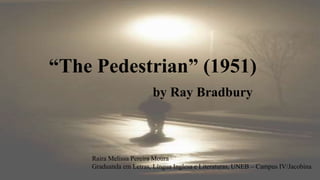
“The Pedestrian” (1951)
by Ray Bradbury
Raira Melissa Pereira Moura
Graduanda em Letras, Língua Inglesa e Literaturas, UNEB – Campus IV/Jacobina
The literary genre short story is a short narrative with the same
elements of romance: narrator, characters, plot, setting and period but
the period is shorter than romance;
Differs from romance because there is just one conflict;
This conflict happened in a short period;
The conflict happened in a limited setting.
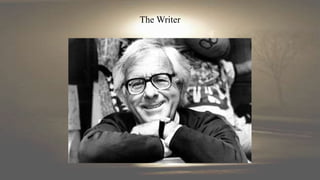
The Writer
Ray Bradbury was an American fantasy and horror author best known
for his fantasy and science fiction stories. Bradbury's best writing
effectively combines a lively imagination with a poetic style;
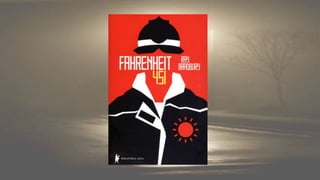
One of his most famous novels is Fahrenheit 451;
Bradbury shows his skepticism of technology and "progress" in "The
Pedestrian”;
FAHRENHEIT 451
“The temperature at which book-paper catches fire and burns.”
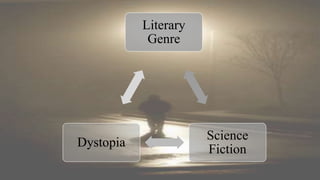
Literary
Genre
Science
Fiction
Dystopia
Plot
“Fiction is movement. A story is a story because it tells about a process of
change. A person’s situation changes. Or the person is changed in some way.
Or our understand of the person changes.” (SCHOLES, p. 128)
“To enter out into that silence that was the city at eight o'clock of a misty
evening in November, to put your feet upon that buckling concrete walk,
to step over grassy seams and make your way, hands in pockets, through
the silences, that was what Mr. Leonard Mead most dearly loved to do. He
would stand upon the corner of an intersection and peer down long
moonlit avenues of sidewalk in four directions, deciding which way to go,
but it really made no difference; he was alone in this world of A.D. 2053,
or as good as alone, and with a final decision made, a path selected, he
would stride off, sending patterns of frosty air before him like the smoke
of a cigar.”
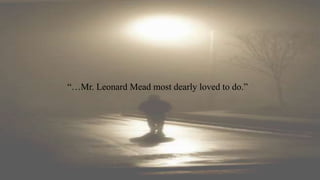
“…Mr. Leonard Mead most dearly loved to do.”
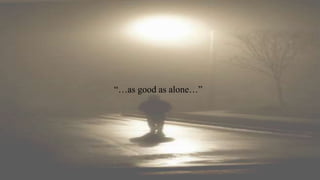
“…as good as alone…”
(In)Conformity
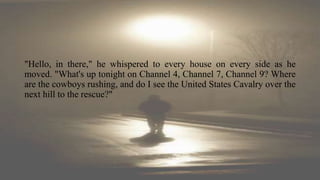
"Hello, in there," he whispered to every house on every side as he
moved. "What's up tonight on Channel 4, Channel 7, Channel 9? Where
are the cowboys rushing, and do I see the United States Cavalry over the
next hill to the rescue?"
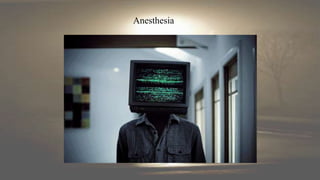
Anesthesia
“The street was silent and long and empty, with only his shadow moving
like the shadow of a hawk in mid-country. If he closed his eyes and
stood very still, frozen, he could imagine himself upon the centre of a
plain, a wintry, windless Arizona desert with no house in a thousand
miles, and only dry river beds, the streets, for company.”
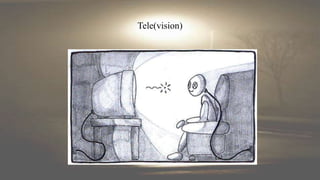
Tele(vision)
“Late in the night he looked over at Mildred. She was awake. There was a
tiny dance of melody in the air, her Seashell was tamped in her ear again
and she was listening to far people in far places, her eyes wide and
staring at the fathoms of blackness above her in the ceiling.”
Fahrenheit 451
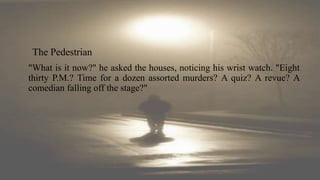
"What is it now?" he asked the houses, noticing his wrist watch. "Eight
thirty P.M.? Time for a dozen assorted murders? A quiz? A revue? A
comedian falling off the stage?"
The Pedestrian
Totalitarian Dystopia
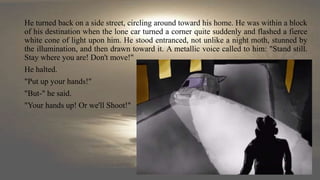
He turned back on a side street, circling around toward his home. He was within a block
of his destination when the lone car turned a corner quite suddenly and flashed a fierce
white cone of light upon him. He stood entranced, not unlike a night moth, stunned by
the illumination, and then drawn toward it. A metallic voice called to him: "Stand still.
Stay where you are! Don't move!"
He halted.
"Put up your hands!"
"But-" he said.
"Your hands up! Or we'll Shoot!"
They do not live, they just exist!
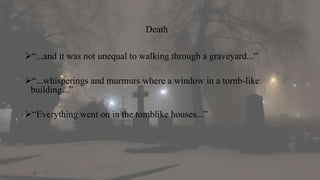
“...and it was not unequal to walking through a graveyard...”
“...whisperings and murmurs where a window in a tornb-like
building...”
“Everything went on in the tomblike houses...”
Death
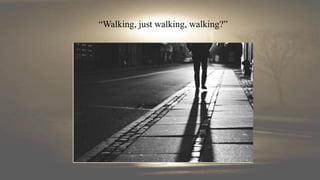
“Walking, just walking, walking?”
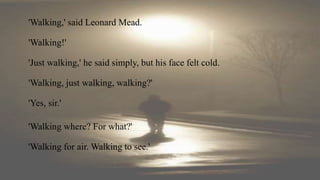
'Walking,' said Leonard Mead.
'Walking!'
'Just walking,' he said simply, but his face felt cold.
'Walking, just walking, walking?'
'Yes, sir.'
'Walking where? For what?'
'Walking for air. Walking to see.'
Metalic voice.
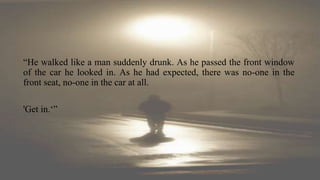
“He walked like a man suddenly drunk. As he passed the front window
of the car he looked in. As he had expected, there was no-one in the
front seat, no-one in the car at all.
'Get in.‘”
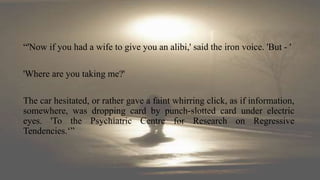
Psychiatric Centre for Research on Regressive Tendencies.
“'Now if you had a wife to give you an alibi,' said the iron voice. 'But - '
'Where are you taking me?'
The car hesitated, or rather gave a faint whirring click, as if information,
somewhere, was dropping card by punch-slotted card under electric
eyes. 'To the Psychiatric Centre for Research on Regressive
Tendencies.‘”
So...
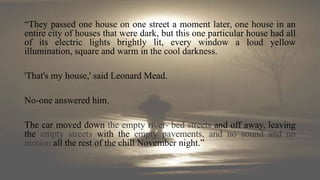
“They passed one house on one street a moment later, one house in an
entire city of houses that were dark, but this one particular house had all
of its electric lights brightly lit, every window a loud yellow
illumination, square and warm in the cool darkness.
'That's my house,' said Leonard Mead.
No-one answered him.
The car moved down the empty river- bed streets and off away, leaving
the empty streets with the empty pavements, and no sound and no
motion all the rest of the chill November night.”
Suggested activity
The class should be divided into 2 groups;
Group 1 will answer two questions and group 2 will discuss the
answers, using the connectives brought to class;
Group 2 will answer the same questions and the group 1 will discuss
the answer using the connectives brought to class.
Questions:
Can you see similarities between “Fahrenehit 451” and “The
Pedestrian”?
In your opinion, how can “The Pedestrian” be realted to our current
society?
Connectives:
I agree, because...
I agree, but...
I disagree, because...
I think...
Additionally...
Indeed...
Not only...
By contrast...
Anyway...
http://obviousmag.org/archives/2011/01/a_literatura_da_distopia.html Acesso em 25/03/2016 às
22:37.
http://vivianeblood.blogspot.com.br/2013/10/generos-literarios-1-distopia.html Acesso em
25/03/2016 às 23:42.
http://www.nouniversodaliteratura.com.br/2013/09/dicas-de-livros-distopias.html Acesso em
28/03/2016 às 22:13.
http://whosthanny.com/entendendo-o-genero-distopia Acesso em 03/04/2016 às 22:10.
http://www.book-addict.com/2013/12/fahrenheit-451-ray-bradbury.html Acesso em 07/04/2016 às
22:23.
http://www.enotes.com/homework-help/what-overall-theme-pedestrian-by-ray-bradbury-468290
Acesso em 29/04/2016 às 23:15.
http://www.theimaginativeconservative.org/2012/08/walking-to-see-ray-bradburys-pedestrian.html
Acesso em 29/04/2016 às 23:40.
http://www.biography.com/people/ray-bradbury-9223240 Acesso em 07/05/2016 às 21:05.
http://www.gradesaver.com/ray-bradbury-short-stories/study-guide/summary-the-pedestrian Acesso
em 07/05/2016 às 23:00.
http://genius.com/Ray-bradbury-the-pedestrian-annotated Acesso em 09/04/2016 às 22:15.
References:
https://memegenerator.net/instance/58401081 Acesso em 16/05/2016 às 23:52.
CHIAPPINI, Ligia e LEITE, Moraes. O Foco Narrativo. São Paulo: Editora. Ática, 1997.
EAGLETON, T. “What is literature?”. In: Literary theory: na introduction. Minneapolis:
University of Minnesota Press, 1996.
GOTLIB, Nádia Battella. Teoria do conto. 11. ed. São Paulo Ática, 2006. 95p. – (Princípios; 2)
SCHOLES, Robert et alii. (Eds.). Elements of Literature: Essay, fiction, drama and film. Oxford:
Oxford University Press, 1986.

The pedestrian by Ray Bradbury - Análise Literária.

  • 1.
    “The Pedestrian” (1951) byRay Bradbury Raira Melissa Pereira Moura Graduanda em Letras, Língua Inglesa e Literaturas, UNEB – Campus IV/Jacobina
  • 3.
    The literary genreshort story is a short narrative with the same elements of romance: narrator, characters, plot, setting and period but the period is shorter than romance; Differs from romance because there is just one conflict; This conflict happened in a short period; The conflict happened in a limited setting.
  • 4.
  • 5.
    Ray Bradbury wasan American fantasy and horror author best known for his fantasy and science fiction stories. Bradbury's best writing effectively combines a lively imagination with a poetic style; One of his most famous novels is Fahrenheit 451; Bradbury shows his skepticism of technology and "progress" in "The Pedestrian”;
  • 6.
    FAHRENHEIT 451 “The temperatureat which book-paper catches fire and burns.”
  • 8.
  • 9.
    Plot “Fiction is movement.A story is a story because it tells about a process of change. A person’s situation changes. Or the person is changed in some way. Or our understand of the person changes.” (SCHOLES, p. 128)
  • 10.
    “To enter outinto that silence that was the city at eight o'clock of a misty evening in November, to put your feet upon that buckling concrete walk, to step over grassy seams and make your way, hands in pockets, through the silences, that was what Mr. Leonard Mead most dearly loved to do. He would stand upon the corner of an intersection and peer down long moonlit avenues of sidewalk in four directions, deciding which way to go, but it really made no difference; he was alone in this world of A.D. 2053, or as good as alone, and with a final decision made, a path selected, he would stride off, sending patterns of frosty air before him like the smoke of a cigar.”
  • 11.
    “…Mr. Leonard Meadmost dearly loved to do.”
  • 12.
    “…as good asalone…”
  • 13.
  • 14.
    "Hello, in there,"he whispered to every house on every side as he moved. "What's up tonight on Channel 4, Channel 7, Channel 9? Where are the cowboys rushing, and do I see the United States Cavalry over the next hill to the rescue?"
  • 15.
  • 16.
    “The street wassilent and long and empty, with only his shadow moving like the shadow of a hawk in mid-country. If he closed his eyes and stood very still, frozen, he could imagine himself upon the centre of a plain, a wintry, windless Arizona desert with no house in a thousand miles, and only dry river beds, the streets, for company.”
  • 17.
  • 18.
    “Late in thenight he looked over at Mildred. She was awake. There was a tiny dance of melody in the air, her Seashell was tamped in her ear again and she was listening to far people in far places, her eyes wide and staring at the fathoms of blackness above her in the ceiling.” Fahrenheit 451
  • 19.
    "What is itnow?" he asked the houses, noticing his wrist watch. "Eight thirty P.M.? Time for a dozen assorted murders? A quiz? A revue? A comedian falling off the stage?" The Pedestrian
  • 20.
  • 21.
    He turned backon a side street, circling around toward his home. He was within a block of his destination when the lone car turned a corner quite suddenly and flashed a fierce white cone of light upon him. He stood entranced, not unlike a night moth, stunned by the illumination, and then drawn toward it. A metallic voice called to him: "Stand still. Stay where you are! Don't move!" He halted. "Put up your hands!" "But-" he said. "Your hands up! Or we'll Shoot!"
  • 22.
    They do notlive, they just exist!
  • 23.
    “...and it wasnot unequal to walking through a graveyard...” “...whisperings and murmurs where a window in a tornb-like building...” “Everything went on in the tomblike houses...” Death
  • 24.
  • 25.
    'Walking,' said LeonardMead. 'Walking!' 'Just walking,' he said simply, but his face felt cold. 'Walking, just walking, walking?' 'Yes, sir.' 'Walking where? For what?' 'Walking for air. Walking to see.'
  • 26.
  • 27.
    “He walked likea man suddenly drunk. As he passed the front window of the car he looked in. As he had expected, there was no-one in the front seat, no-one in the car at all. 'Get in.‘”
  • 28.
    Psychiatric Centre forResearch on Regressive Tendencies.
  • 29.
    “'Now if youhad a wife to give you an alibi,' said the iron voice. 'But - ' 'Where are you taking me?' The car hesitated, or rather gave a faint whirring click, as if information, somewhere, was dropping card by punch-slotted card under electric eyes. 'To the Psychiatric Centre for Research on Regressive Tendencies.‘”
  • 30.
  • 31.
    “They passed onehouse on one street a moment later, one house in an entire city of houses that were dark, but this one particular house had all of its electric lights brightly lit, every window a loud yellow illumination, square and warm in the cool darkness. 'That's my house,' said Leonard Mead. No-one answered him. The car moved down the empty river- bed streets and off away, leaving the empty streets with the empty pavements, and no sound and no motion all the rest of the chill November night.”
  • 32.
  • 33.
    The class shouldbe divided into 2 groups; Group 1 will answer two questions and group 2 will discuss the answers, using the connectives brought to class; Group 2 will answer the same questions and the group 1 will discuss the answer using the connectives brought to class.
  • 34.
    Questions: Can you seesimilarities between “Fahrenehit 451” and “The Pedestrian”? In your opinion, how can “The Pedestrian” be realted to our current society?
  • 35.
    Connectives: I agree, because... Iagree, but... I disagree, because... I think... Additionally... Indeed... Not only... By contrast... Anyway...
  • 37.
    http://obviousmag.org/archives/2011/01/a_literatura_da_distopia.html Acesso em25/03/2016 às 22:37. http://vivianeblood.blogspot.com.br/2013/10/generos-literarios-1-distopia.html Acesso em 25/03/2016 às 23:42. http://www.nouniversodaliteratura.com.br/2013/09/dicas-de-livros-distopias.html Acesso em 28/03/2016 às 22:13. http://whosthanny.com/entendendo-o-genero-distopia Acesso em 03/04/2016 às 22:10. http://www.book-addict.com/2013/12/fahrenheit-451-ray-bradbury.html Acesso em 07/04/2016 às 22:23. http://www.enotes.com/homework-help/what-overall-theme-pedestrian-by-ray-bradbury-468290 Acesso em 29/04/2016 às 23:15. http://www.theimaginativeconservative.org/2012/08/walking-to-see-ray-bradburys-pedestrian.html Acesso em 29/04/2016 às 23:40. http://www.biography.com/people/ray-bradbury-9223240 Acesso em 07/05/2016 às 21:05. http://www.gradesaver.com/ray-bradbury-short-stories/study-guide/summary-the-pedestrian Acesso em 07/05/2016 às 23:00. http://genius.com/Ray-bradbury-the-pedestrian-annotated Acesso em 09/04/2016 às 22:15. References:
  • 38.
    https://memegenerator.net/instance/58401081 Acesso em16/05/2016 às 23:52. CHIAPPINI, Ligia e LEITE, Moraes. O Foco Narrativo. São Paulo: Editora. Ática, 1997. EAGLETON, T. “What is literature?”. In: Literary theory: na introduction. Minneapolis: University of Minnesota Press, 1996. GOTLIB, Nádia Battella. Teoria do conto. 11. ed. São Paulo Ática, 2006. 95p. – (Princípios; 2) SCHOLES, Robert et alii. (Eds.). Elements of Literature: Essay, fiction, drama and film. Oxford: Oxford University Press, 1986.