The
Partying,
On-duty
RA
Discussion led by: Amber Danku, Lauren Donnelly, Tom Durkee
Summary & Key Players
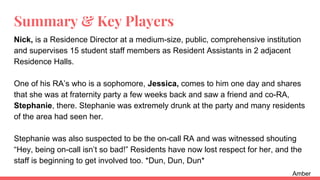
Nick, is a Residence Director at a medium-size, public, comprehensive institution
and supervises 15 student staff members as Resident Assistants in 2 adjacent
Residence Halls.
One of his RA’s who is a sophomore, Jessica, comes to him one day and shares
that she was at fraternity party a few weeks back and saw a friend and co-RA,
Stephanie, there. Stephanie was extremely drunk at the party and many residents
of the area had seen her.
Stephanie was also suspected to be the on-call RA and was witnessed shouting
“Hey, being on-call isn’t so bad!” Residents have now lost respect for her, and the
staff is beginning to get involved too. *Dun, Dun, Dun*
Amber
Lenses
Lauren
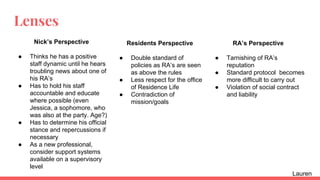
RA’s Perspective
● Tarnishing of RA’s
reputation
● Standard protocol becomes
more difficult to carry out
● Violation of social contract
and liability
Nick’s Perspective
● Thinks he has a positive
staff dynamic until he hears
troubling news about one of
his RA’s
● Has to hold his staff
accountable and educate
where possible (even
Jessica, a sophomore, who
was also at the party. Age?)
● Has to determine his official
stance and repercussions if
necessary
● As a new professional,
consider support systems
available on a supervisory
level
Residents Perspective
● Double standard of
policies as RA’s are seen
as above the rules
● Less respect for the office
of Residence Life
● Contradiction of
mission/goals
ACPA Tenets
2.11 Discuss with students issues, attitudes, and behaviors that have ethical implications.
(RAs behavior has implications for the way the community perceives all of the RAs which in turn affects how
they can do their job)
3.3 Recognize that conflicts among students, colleagues, or the institution should be resolved
without diminishing respect for or appropriate obligations to any party involved.
(Nick has to be cognizant of the various and competing interests at play to best serve the needs of
Residence Life)
4.2 Demonstrate concern for the welfare of all students and work for constructive change on
behalf of students.
(Nick has to reflect on the conversation he had with Jessica and consider how he can best care for the
welfare of all students)
Lauren
CAS Tenets
Principle I - Autonomy (Behavior is outside of residence hall, but around residents, no proof)
● We believe that individuals, ourselves and others, are responsible for their own behavior and learning.
● We hold ourselves and others accountable.
● We foster an environment where people feel empowered to make decisions.
Principle IV - Justice (abide by policies within residence life, what are the policies?)
● We operate within the framework of laws and policies
● We assess students in a valid, open, and fair manner and one consistent with learning objectives
Principle V - Fidelity (follow guidelines, honor confidentiality, who gave information is irrelevant)
● We maintain confidentiality of interactions, student records, and information related to legal and private
matters
● We honor commitments made within the guidelines of established policies and procedures
Amber
NASPA Tenets
5. Conflict of Interest : Members recognize their obligation to the employing institution
and seek to avoid private interests, obligations, and transactions which are in conflict of
interest or give the appearance of impropriety.
6. Legal Authority: Members demonstrate concern for the legal, social codes and
moral expectations of the communities in which they live and work even when the
dictates of one’s conscience may require behavior as a private citizen.
8. Student Behavior: Members demonstrate and promote responsible behavior and
support actions that enhance personal growth and development of students. Members
foster conditions designed to ensure a student’s acceptance of responsibility of their
own behavior. Members inform and educate students as to sanctions to constraints on
student behavior which may result from violation of law or institutional policies.
Tom
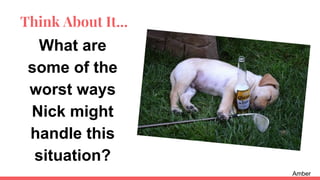
What are
some of the
worst ways
Nick might
handle this
situation?
Amber
Think About It...
Discussion
● What are the immediate options that Nick has?
● How do you think policy and/or culture of the institution may affect this
dilemma?
● What are some options for the kind of conversation Nick should have?
● Should Nick bring anyone else into this conversation?
● How should Nick approach the rest of his staff from a supervisory
lens?
Tom
Our Approach (***depending on culture/policy.)
● Speak with Jessica about her presence at the party as an RA, and if underage,
discuss possible penalties.
● Keep Jessica’s revelation confidential, yet address Stephanie’s alleged
“misconduct” by looking at the duty schedule and log and bringing up concerns
from ‘other students.’
● If Stephanie admits to being at this party and/or enough statements place her
there, move towards termination, bring up to Director for a final decision
● If Stephanie does not admit to being there, due to a lack of hard evidence, move
towards probation if there was evidence suggesting she was not on campus
during duty, and seek students who might be able to validate Jessica’s claims.
● Reiterate expectations and policy with staff, while maintaining confidentiality.
Tom

The Partying, On-Duty RA

  • 1.
    The Partying, On-duty RA Discussion led by:Amber Danku, Lauren Donnelly, Tom Durkee
  • 2.
    Summary & KeyPlayers Nick, is a Residence Director at a medium-size, public, comprehensive institution and supervises 15 student staff members as Resident Assistants in 2 adjacent Residence Halls. One of his RA’s who is a sophomore, Jessica, comes to him one day and shares that she was at fraternity party a few weeks back and saw a friend and co-RA, Stephanie, there. Stephanie was extremely drunk at the party and many residents of the area had seen her. Stephanie was also suspected to be the on-call RA and was witnessed shouting “Hey, being on-call isn’t so bad!” Residents have now lost respect for her, and the staff is beginning to get involved too. *Dun, Dun, Dun* Amber
  • 3.
    Lenses Lauren RA’s Perspective ● Tarnishingof RA’s reputation ● Standard protocol becomes more difficult to carry out ● Violation of social contract and liability Nick’s Perspective ● Thinks he has a positive staff dynamic until he hears troubling news about one of his RA’s ● Has to hold his staff accountable and educate where possible (even Jessica, a sophomore, who was also at the party. Age?) ● Has to determine his official stance and repercussions if necessary ● As a new professional, consider support systems available on a supervisory level Residents Perspective ● Double standard of policies as RA’s are seen as above the rules ● Less respect for the office of Residence Life ● Contradiction of mission/goals
  • 4.
    ACPA Tenets 2.11 Discusswith students issues, attitudes, and behaviors that have ethical implications. (RAs behavior has implications for the way the community perceives all of the RAs which in turn affects how they can do their job) 3.3 Recognize that conflicts among students, colleagues, or the institution should be resolved without diminishing respect for or appropriate obligations to any party involved. (Nick has to be cognizant of the various and competing interests at play to best serve the needs of Residence Life) 4.2 Demonstrate concern for the welfare of all students and work for constructive change on behalf of students. (Nick has to reflect on the conversation he had with Jessica and consider how he can best care for the welfare of all students) Lauren
  • 5.
    CAS Tenets Principle I- Autonomy (Behavior is outside of residence hall, but around residents, no proof) ● We believe that individuals, ourselves and others, are responsible for their own behavior and learning. ● We hold ourselves and others accountable. ● We foster an environment where people feel empowered to make decisions. Principle IV - Justice (abide by policies within residence life, what are the policies?) ● We operate within the framework of laws and policies ● We assess students in a valid, open, and fair manner and one consistent with learning objectives Principle V - Fidelity (follow guidelines, honor confidentiality, who gave information is irrelevant) ● We maintain confidentiality of interactions, student records, and information related to legal and private matters ● We honor commitments made within the guidelines of established policies and procedures Amber
  • 6.
    NASPA Tenets 5. Conflictof Interest : Members recognize their obligation to the employing institution and seek to avoid private interests, obligations, and transactions which are in conflict of interest or give the appearance of impropriety. 6. Legal Authority: Members demonstrate concern for the legal, social codes and moral expectations of the communities in which they live and work even when the dictates of one’s conscience may require behavior as a private citizen. 8. Student Behavior: Members demonstrate and promote responsible behavior and support actions that enhance personal growth and development of students. Members foster conditions designed to ensure a student’s acceptance of responsibility of their own behavior. Members inform and educate students as to sanctions to constraints on student behavior which may result from violation of law or institutional policies. Tom
  • 7.
    What are some ofthe worst ways Nick might handle this situation? Amber Think About It...
  • 8.
    Discussion ● What arethe immediate options that Nick has? ● How do you think policy and/or culture of the institution may affect this dilemma? ● What are some options for the kind of conversation Nick should have? ● Should Nick bring anyone else into this conversation? ● How should Nick approach the rest of his staff from a supervisory lens? Tom
  • 9.
    Our Approach (***dependingon culture/policy.) ● Speak with Jessica about her presence at the party as an RA, and if underage, discuss possible penalties. ● Keep Jessica’s revelation confidential, yet address Stephanie’s alleged “misconduct” by looking at the duty schedule and log and bringing up concerns from ‘other students.’ ● If Stephanie admits to being at this party and/or enough statements place her there, move towards termination, bring up to Director for a final decision ● If Stephanie does not admit to being there, due to a lack of hard evidence, move towards probation if there was evidence suggesting she was not on campus during duty, and seek students who might be able to validate Jessica’s claims. ● Reiterate expectations and policy with staff, while maintaining confidentiality. Tom