THE OPTIC NERVE
Student’s Name
Institutional
Professor
Course
Date
INTRODUCTION
• The cranial nerves are a set of twelve peripheral nerves that
originate from the brain (Vilensky, Robertson & Quian, 2015).
• The nerves are labelled I to XII in the order they originate from the
brain.
• The optic nerve is the second nerve.
• It originates from the cerebrum and conducts sensory information
from the eyes to the brain.
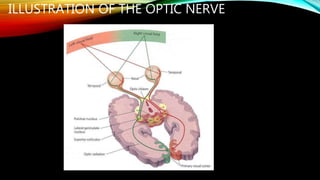
ILLUSTRATION OF THE OPTIC NERVE
ANATOMY AND PHYSIOLOGY OF THE OPTICAL NERVE
• The optic nerve is composed of approximately one million nerve fibers. The nerve fibers
are mainly composed of the visual afferent fibers and the pupillary afferent fibers.
• The visual afferent fibers relay visual signals to the lateral geniculate nucleus. The pupillary
afferent fibers transmit light signals to the brain stem to regulate pupil dilation (Vilensky,
Robertson & Quian, 2015).
• The optical nerve originates from the axons of the retinal ganglion cells which form a
network and transverse the cranial space culminating at the lateral geniculate nucleus.
• The optic nerve is divided into four main parts, all of which play a role in the relay of visual
signals to the brain.
• These parts include:
1. The intraocular portion
2. The intraorbital portion
3. The intracanalicular portion
4. The intracranial portion
THE INTRAOCULAR PORTION
• Also called the optical nerve head, this portion is located behind the retina in the blind spot
of the eye. It is 1mm long.
• The retinal ganglion nerve cells converge at the optic disk and form the optic nerve head.
• The optical nerve head is divided into three portions; the surface nerve fiber layer, the
prelaminar region and the lamina cribosa region (Rea, 2014)..
• The surface nerve fiber layer has multiple capillary and vein networks, large retinal arteries
and unmyelinated ganglion cell axons (Rea, 2014)..
• The prelaminar region is composed of glial tissue and connective tissue in the perivascular
regions. This region provides structural support to the unmyelinated axons as they make the
90֯ turn from the retina to the optic disk (Rea, 2014)..
• The lamina cribosa region is fenestrated to allow the retinal ganglion axons to pass to the
extraocular space. The axons converge and form a tight plug to protect the tissues in the
extraocular space from the high intraocular pressure (Rea, 2014)..
• The optical nerve head is also composed of the astrocytes, fibroblasts and capillary-
associated cells that perform a variety of roles. The astrocytes, for instance, form a layer that
separates the surface nerve fiber layer from the vitreous humor.
THE INTRAORBITAL PORTION
• This portion extends from the posterior end of the lamina cribosa region to the apex of the orbit. It is
approximately 25-30mm (Rea, 2014).
• These nerves are myelinated by oligodendrocytes and transverse the subarachnoid space to get to the
opening of the optic canal at the orbit. Here, it runs adjacent to the oculomotor, trochlear and nasocilliary
nerves (Rea, 2014).
• Orbital fat protects the optic nerve from the rest of the extraocular tissues.
• This portion interacts with all three meningeal layers. The cerebrospinal fluid serves to separate the nerve
from the arachnoid matter.
• As the nerve approaches the apex of the orbit, it is encased by the annulus of Zinn. This is fibrous tissue
that encapsulates the nerve at the entrance of the optical canal at the apex of the orbit.
THE INTRACANALICULAR PORTION
• This is the portion of the optic nerve in the optical canal. It is
approximately 4-10mm long (Rea, 2014).
• This portion is structurally similar to the intraorbital portion.
• It runs adjacent to the ophthalmic artery and the sympathetic nerves.
THE INTRACRANIAL PORTION
• This portion is 10mm long.
• It exits the optical canal and forms the optical chiasma with its contralateral optic nerve
under the forebrain on the floor of the third ventricle (Salazar, et. al., 2018).
• The portion lies medial to the internal carotid artery, superomedial to the ophthalmic artery
and under the anterior cerebral artery (Salazar, et. al., 2018).
• The pia matter covers this portion of the optic nerve.
ILLUSTRATION OF THE FOUR PARTS OF THE CRANIAL NERVE
THE OPTICAL CHIASM AND OPTICAL TRACT
• This is where the two optic nerves converge and form optical tracts that relay information to the lateral
geniculate nucleus.
• 55% of the optical nerves cross at this junction as this is imperative for binocular vision (Salazar, et. al.,
2018).
• The retina is divided into the nasal and temporal hemifields. The nasal nerve fibers of each eye cross the
midline to join the temporal fibers of the contralateral eye (Salazar, et. al., 2018).
• The macular fibers run posterior to the optical chiasma and join the optical tracts.
• The optical tract is paired and is the extension of the optical nerve. It relays the nasal fibers of the
contralateral eye and the temporal fibers of the ipsilateral eye to the lateral geniculate nucleus.
• The pupillary afferent fibers move past the lateral geniculate body to the pretectal nucleus in the
brainstem to control pupil light reflex (Salazar, et. al., 2018).
THE LATERAL GENICULATE BODY
• The optic tract terminates in the lateral geniculate body.
• It is an ovoid projection on the thalamus. The optic tract fibers synapse in the lateral
geniculate nucleus of the lateral geniculate body.
• The lateral geniculate nucleus is the relay point of the visual information from the
retinal afferents to the visual cortex.
• The axons from the nucleus converge and relay information to the visual cortex
through the optic radiation.
• The optic radiation is divided into two parts:
1. The upper optic radiation which conveys superior retinal afferents to the visual
cortex by passing through the parietal lobe.
2. The lower optic radiation which conveys the inferior retinal afferents through the
Meyer’s loop to the visual cortex.
• The visual cortex then processes these signals to form a visual image of the
individual’s surroundings.
COMMON PATHOLOGIES OF THE OPTIC NERVE
• Damage to the optic nerve can go either of three ways;
1. Damage to the optic nerve where only the affected eye loses vision.
2. Damage to the optic chiasm where the vision of the outer areas of both eyes is affected.
3. Damage to the optic tracts and optic radiation where one visual field for both eyes is
affected.
• The common conditions that afflict the optic nerve include:
1. Glaucoma
2. Optic neuritis
3. Ischemic optic neuropathy
4. Papilledema
5. Traumatic optic neuropathy
GLAUCOMA
• This is the collection of diseases that lead to optical neuropathies. It is the most common
disease affecting the optic nerve and could lead to visual field loss.
• One major risk factor for development of glaucoma is increased eye pressure.
• Primary open angle glaucoma is a common disease among people over 40 years and
commonly leads to loss of sight (Vilensky, Robertson & Quian, 2015).
• The disease affects both eyes and is asymptomatic in its early stages. While the cause of the
disease is still unclear, genetic factors play a huge role in disease development.
• Angle closure glaucoma is another common type of glaucoma. The iris is pushed forward
by the restricted flow of the aqueous humor to the trabecular meshwork (Vilensky,
Robertson & Quian, 2015). The restricted flow of the aqueous humor raises the intraocular
pressure which leads to optic nerve damage (Vilensky, Robertson & Quian, 2015).
• Since the nerve damage is irreversible, treatment interventions available seek to prevent
continued nerve degradation.
OPTIC NEURITIS
• This is the inflammation that occurs on the myelin sheath of the optical nerve, leading to nerve
damage.
• The inflammation obstructs the transmission of visual signals leading to visual loss. The nerve
damage also causes pain to the patient.
• This inflammation can be caused by infections or even autoimmune diseases. Multiple sclerosis is
the common cause for optic neuritis (Vilensky, Robertson & Quian, 2015).
• The disease affects one eye, however, it could affect both eyes when advanced.
• Optic neuritis is often used as a sign of multiple sclerosis.
ISCHEMIC OPTIC NEUROPATHY
• The optic nerve is damaged due to the obstruction of its blood supply.
• This condition is common among the elderly people. There are two types of ischemic optic
neuropathy;
1. Arteritic ischemic optic neuropathy- The inflammation of the arteries blocks the blood
supply to the optic nerve, which leads to nerve damage (Midi, 2014). This condition is
common among patients who are over 70 years old.
2. NonArteritic ischemic optic neuropathy- A plethora of risk factors such as high blood
pressure, obstructive sleep apnea, use of specific drugs, smoking and diabetes leads to
the obstructed blood flow to the optic nerve (Midi, 2014). It is common among people
above 50 years.
• The condition leads to the rapid loss of vision in one or both eyes. Arteritic ischemic optic
neuropathy is more severe than nonArteritic ischemic optic neuropathy.
• Medical intervention for the Arteritic ischemic optic neuropathy serves to prevent further
nerve damage but does not restore sight.
PAPILLEDEMA
• This is the swelling of the optic nerve head.
• This condition may be caused by lack of cerebrospinal fluid absorption, lesion occupying
space in the cavity, cerebral swelling or intracranial high blood pressure (Midi, 2014).
• The swelling pushes down on the nerve leading to visual impairment due to the difficulty in
transmitting visual signals.
• There is often an underlying cause for the condition.
• The condition leads to the loss of clear vision and inability to discern colors in one or both
eyes (Midi, 2014).
• Surgical and urgent intervention is needed to address the underlying cause of the
condition.
TRAUMATIC OPTIC NEUROPATHY
• This type of nerve damage is caused by trauma or blunt force to the orbit or cranial space.
It is commonly caused by falls, accidents or assault.
• This condition is more common in men than women.
• The majority of the victims lose consciousness after the trauma.
• This type of condition can occur in two ways;
1. Direct optic nerve injury- This is where the optic nerve is pierced which affects the
anatomy and function of the nerve. This commonly happens in the orbit or the optic
canal. This condition leads to orbital and sheath hemorrhage (Midi, 2014). This condition
leads to delayed sight loss and loss of color vision.
2. Indirect optic nerve injury- The optic nerve is injured by the force experienced in other
tissues of the brain such as blunt force trauma to the head in accidents.
• The intracanalicular portion is mostly susceptible to this condition.
CONCLUSION
• The optic nerve is a complex network of neural connections which serve to relay
visual information to the brain.
• The optic nerve is the only nerve that originates from the cranial space and exits the
cranial space.
• The optic nerve is afflicted by a number of common pathologies and precautions
should be taken to protect the optic nerve from these conditions.
But in fact God has arranged the parts in the body, every one of them, just as he
wanted them to be (Holy Bible, New International Version, 2012, 1 Cor 12: 18).
REFERENCES
• Holy Bible, New International Version. (2011). Grand Rapids, Michigan: Zondervan.
• Salazar, J., Ramírez, A., Hoz, R., Garcia, E., Rojas, P., Albarral, J., Cuenca, I.,
Rojas, B., Triviño A. & Ramírez, J. (2018, November 5th ). Anatomy of the Human
Optic Nerve: Structure and Function, Optic Nerve, Felicia M. Ferreri, IntechOpen,
DOI: 10.5772/intechopen.79827. Available from:
https://www.intechopen.com/chapters/62850
• Ipek Midi (September 3rd 2014). Disorders of Optic Nerve and Visual Pathways,
Ophthalmology - Current Clinical and Research Updates, Pinakin Davey,
IntechOpen, DOI: 10.5772/58312. Available from:
https://www.intechopen.com/chapters/46503
• Rea, P. (2014). Clinical anatomy of the cranial nerves. Amsterdam: Academic Press.
• Vilensky, J., Robertson, W. & Quian, C. (2015). The clinical anatomy of the cranial
nerves : the nerves of an old Olympus towering top. Ames, Iowa: Wiley Blackwell.
THANK YOU

THE OPTIC NERVE

  • 1.
    THE OPTIC NERVE Student’sName Institutional Professor Course Date
  • 2.
    INTRODUCTION • The cranialnerves are a set of twelve peripheral nerves that originate from the brain (Vilensky, Robertson & Quian, 2015). • The nerves are labelled I to XII in the order they originate from the brain. • The optic nerve is the second nerve. • It originates from the cerebrum and conducts sensory information from the eyes to the brain.
  • 3.
  • 4.
    ANATOMY AND PHYSIOLOGYOF THE OPTICAL NERVE • The optic nerve is composed of approximately one million nerve fibers. The nerve fibers are mainly composed of the visual afferent fibers and the pupillary afferent fibers. • The visual afferent fibers relay visual signals to the lateral geniculate nucleus. The pupillary afferent fibers transmit light signals to the brain stem to regulate pupil dilation (Vilensky, Robertson & Quian, 2015). • The optical nerve originates from the axons of the retinal ganglion cells which form a network and transverse the cranial space culminating at the lateral geniculate nucleus. • The optic nerve is divided into four main parts, all of which play a role in the relay of visual signals to the brain. • These parts include: 1. The intraocular portion 2. The intraorbital portion 3. The intracanalicular portion 4. The intracranial portion
  • 5.
    THE INTRAOCULAR PORTION •Also called the optical nerve head, this portion is located behind the retina in the blind spot of the eye. It is 1mm long. • The retinal ganglion nerve cells converge at the optic disk and form the optic nerve head. • The optical nerve head is divided into three portions; the surface nerve fiber layer, the prelaminar region and the lamina cribosa region (Rea, 2014).. • The surface nerve fiber layer has multiple capillary and vein networks, large retinal arteries and unmyelinated ganglion cell axons (Rea, 2014).. • The prelaminar region is composed of glial tissue and connective tissue in the perivascular regions. This region provides structural support to the unmyelinated axons as they make the 90֯ turn from the retina to the optic disk (Rea, 2014).. • The lamina cribosa region is fenestrated to allow the retinal ganglion axons to pass to the extraocular space. The axons converge and form a tight plug to protect the tissues in the extraocular space from the high intraocular pressure (Rea, 2014).. • The optical nerve head is also composed of the astrocytes, fibroblasts and capillary- associated cells that perform a variety of roles. The astrocytes, for instance, form a layer that separates the surface nerve fiber layer from the vitreous humor.
  • 6.
    THE INTRAORBITAL PORTION •This portion extends from the posterior end of the lamina cribosa region to the apex of the orbit. It is approximately 25-30mm (Rea, 2014). • These nerves are myelinated by oligodendrocytes and transverse the subarachnoid space to get to the opening of the optic canal at the orbit. Here, it runs adjacent to the oculomotor, trochlear and nasocilliary nerves (Rea, 2014). • Orbital fat protects the optic nerve from the rest of the extraocular tissues. • This portion interacts with all three meningeal layers. The cerebrospinal fluid serves to separate the nerve from the arachnoid matter. • As the nerve approaches the apex of the orbit, it is encased by the annulus of Zinn. This is fibrous tissue that encapsulates the nerve at the entrance of the optical canal at the apex of the orbit.
  • 7.
    THE INTRACANALICULAR PORTION •This is the portion of the optic nerve in the optical canal. It is approximately 4-10mm long (Rea, 2014). • This portion is structurally similar to the intraorbital portion. • It runs adjacent to the ophthalmic artery and the sympathetic nerves.
  • 8.
    THE INTRACRANIAL PORTION •This portion is 10mm long. • It exits the optical canal and forms the optical chiasma with its contralateral optic nerve under the forebrain on the floor of the third ventricle (Salazar, et. al., 2018). • The portion lies medial to the internal carotid artery, superomedial to the ophthalmic artery and under the anterior cerebral artery (Salazar, et. al., 2018). • The pia matter covers this portion of the optic nerve.
  • 9.
    ILLUSTRATION OF THEFOUR PARTS OF THE CRANIAL NERVE
  • 10.
    THE OPTICAL CHIASMAND OPTICAL TRACT • This is where the two optic nerves converge and form optical tracts that relay information to the lateral geniculate nucleus. • 55% of the optical nerves cross at this junction as this is imperative for binocular vision (Salazar, et. al., 2018). • The retina is divided into the nasal and temporal hemifields. The nasal nerve fibers of each eye cross the midline to join the temporal fibers of the contralateral eye (Salazar, et. al., 2018). • The macular fibers run posterior to the optical chiasma and join the optical tracts. • The optical tract is paired and is the extension of the optical nerve. It relays the nasal fibers of the contralateral eye and the temporal fibers of the ipsilateral eye to the lateral geniculate nucleus. • The pupillary afferent fibers move past the lateral geniculate body to the pretectal nucleus in the brainstem to control pupil light reflex (Salazar, et. al., 2018).
  • 11.
    THE LATERAL GENICULATEBODY • The optic tract terminates in the lateral geniculate body. • It is an ovoid projection on the thalamus. The optic tract fibers synapse in the lateral geniculate nucleus of the lateral geniculate body. • The lateral geniculate nucleus is the relay point of the visual information from the retinal afferents to the visual cortex. • The axons from the nucleus converge and relay information to the visual cortex through the optic radiation. • The optic radiation is divided into two parts: 1. The upper optic radiation which conveys superior retinal afferents to the visual cortex by passing through the parietal lobe. 2. The lower optic radiation which conveys the inferior retinal afferents through the Meyer’s loop to the visual cortex. • The visual cortex then processes these signals to form a visual image of the individual’s surroundings.
  • 12.
    COMMON PATHOLOGIES OFTHE OPTIC NERVE • Damage to the optic nerve can go either of three ways; 1. Damage to the optic nerve where only the affected eye loses vision. 2. Damage to the optic chiasm where the vision of the outer areas of both eyes is affected. 3. Damage to the optic tracts and optic radiation where one visual field for both eyes is affected. • The common conditions that afflict the optic nerve include: 1. Glaucoma 2. Optic neuritis 3. Ischemic optic neuropathy 4. Papilledema 5. Traumatic optic neuropathy
  • 13.
    GLAUCOMA • This isthe collection of diseases that lead to optical neuropathies. It is the most common disease affecting the optic nerve and could lead to visual field loss. • One major risk factor for development of glaucoma is increased eye pressure. • Primary open angle glaucoma is a common disease among people over 40 years and commonly leads to loss of sight (Vilensky, Robertson & Quian, 2015). • The disease affects both eyes and is asymptomatic in its early stages. While the cause of the disease is still unclear, genetic factors play a huge role in disease development. • Angle closure glaucoma is another common type of glaucoma. The iris is pushed forward by the restricted flow of the aqueous humor to the trabecular meshwork (Vilensky, Robertson & Quian, 2015). The restricted flow of the aqueous humor raises the intraocular pressure which leads to optic nerve damage (Vilensky, Robertson & Quian, 2015). • Since the nerve damage is irreversible, treatment interventions available seek to prevent continued nerve degradation.
  • 14.
    OPTIC NEURITIS • Thisis the inflammation that occurs on the myelin sheath of the optical nerve, leading to nerve damage. • The inflammation obstructs the transmission of visual signals leading to visual loss. The nerve damage also causes pain to the patient. • This inflammation can be caused by infections or even autoimmune diseases. Multiple sclerosis is the common cause for optic neuritis (Vilensky, Robertson & Quian, 2015). • The disease affects one eye, however, it could affect both eyes when advanced. • Optic neuritis is often used as a sign of multiple sclerosis.
  • 15.
    ISCHEMIC OPTIC NEUROPATHY •The optic nerve is damaged due to the obstruction of its blood supply. • This condition is common among the elderly people. There are two types of ischemic optic neuropathy; 1. Arteritic ischemic optic neuropathy- The inflammation of the arteries blocks the blood supply to the optic nerve, which leads to nerve damage (Midi, 2014). This condition is common among patients who are over 70 years old. 2. NonArteritic ischemic optic neuropathy- A plethora of risk factors such as high blood pressure, obstructive sleep apnea, use of specific drugs, smoking and diabetes leads to the obstructed blood flow to the optic nerve (Midi, 2014). It is common among people above 50 years. • The condition leads to the rapid loss of vision in one or both eyes. Arteritic ischemic optic neuropathy is more severe than nonArteritic ischemic optic neuropathy. • Medical intervention for the Arteritic ischemic optic neuropathy serves to prevent further nerve damage but does not restore sight.
  • 16.
    PAPILLEDEMA • This isthe swelling of the optic nerve head. • This condition may be caused by lack of cerebrospinal fluid absorption, lesion occupying space in the cavity, cerebral swelling or intracranial high blood pressure (Midi, 2014). • The swelling pushes down on the nerve leading to visual impairment due to the difficulty in transmitting visual signals. • There is often an underlying cause for the condition. • The condition leads to the loss of clear vision and inability to discern colors in one or both eyes (Midi, 2014). • Surgical and urgent intervention is needed to address the underlying cause of the condition.
  • 17.
    TRAUMATIC OPTIC NEUROPATHY •This type of nerve damage is caused by trauma or blunt force to the orbit or cranial space. It is commonly caused by falls, accidents or assault. • This condition is more common in men than women. • The majority of the victims lose consciousness after the trauma. • This type of condition can occur in two ways; 1. Direct optic nerve injury- This is where the optic nerve is pierced which affects the anatomy and function of the nerve. This commonly happens in the orbit or the optic canal. This condition leads to orbital and sheath hemorrhage (Midi, 2014). This condition leads to delayed sight loss and loss of color vision. 2. Indirect optic nerve injury- The optic nerve is injured by the force experienced in other tissues of the brain such as blunt force trauma to the head in accidents. • The intracanalicular portion is mostly susceptible to this condition.
  • 18.
    CONCLUSION • The opticnerve is a complex network of neural connections which serve to relay visual information to the brain. • The optic nerve is the only nerve that originates from the cranial space and exits the cranial space. • The optic nerve is afflicted by a number of common pathologies and precautions should be taken to protect the optic nerve from these conditions. But in fact God has arranged the parts in the body, every one of them, just as he wanted them to be (Holy Bible, New International Version, 2012, 1 Cor 12: 18).
  • 19.
    REFERENCES • Holy Bible,New International Version. (2011). Grand Rapids, Michigan: Zondervan. • Salazar, J., Ramírez, A., Hoz, R., Garcia, E., Rojas, P., Albarral, J., Cuenca, I., Rojas, B., Triviño A. & Ramírez, J. (2018, November 5th ). Anatomy of the Human Optic Nerve: Structure and Function, Optic Nerve, Felicia M. Ferreri, IntechOpen, DOI: 10.5772/intechopen.79827. Available from: https://www.intechopen.com/chapters/62850 • Ipek Midi (September 3rd 2014). Disorders of Optic Nerve and Visual Pathways, Ophthalmology - Current Clinical and Research Updates, Pinakin Davey, IntechOpen, DOI: 10.5772/58312. Available from: https://www.intechopen.com/chapters/46503 • Rea, P. (2014). Clinical anatomy of the cranial nerves. Amsterdam: Academic Press. • Vilensky, J., Robertson, W. & Quian, C. (2015). The clinical anatomy of the cranial nerves : the nerves of an old Olympus towering top. Ames, Iowa: Wiley Blackwell.
  • 20.