1 www.arabbusinessreview.com 
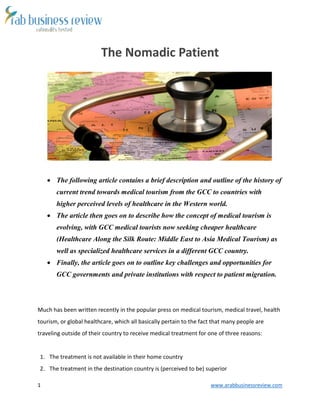
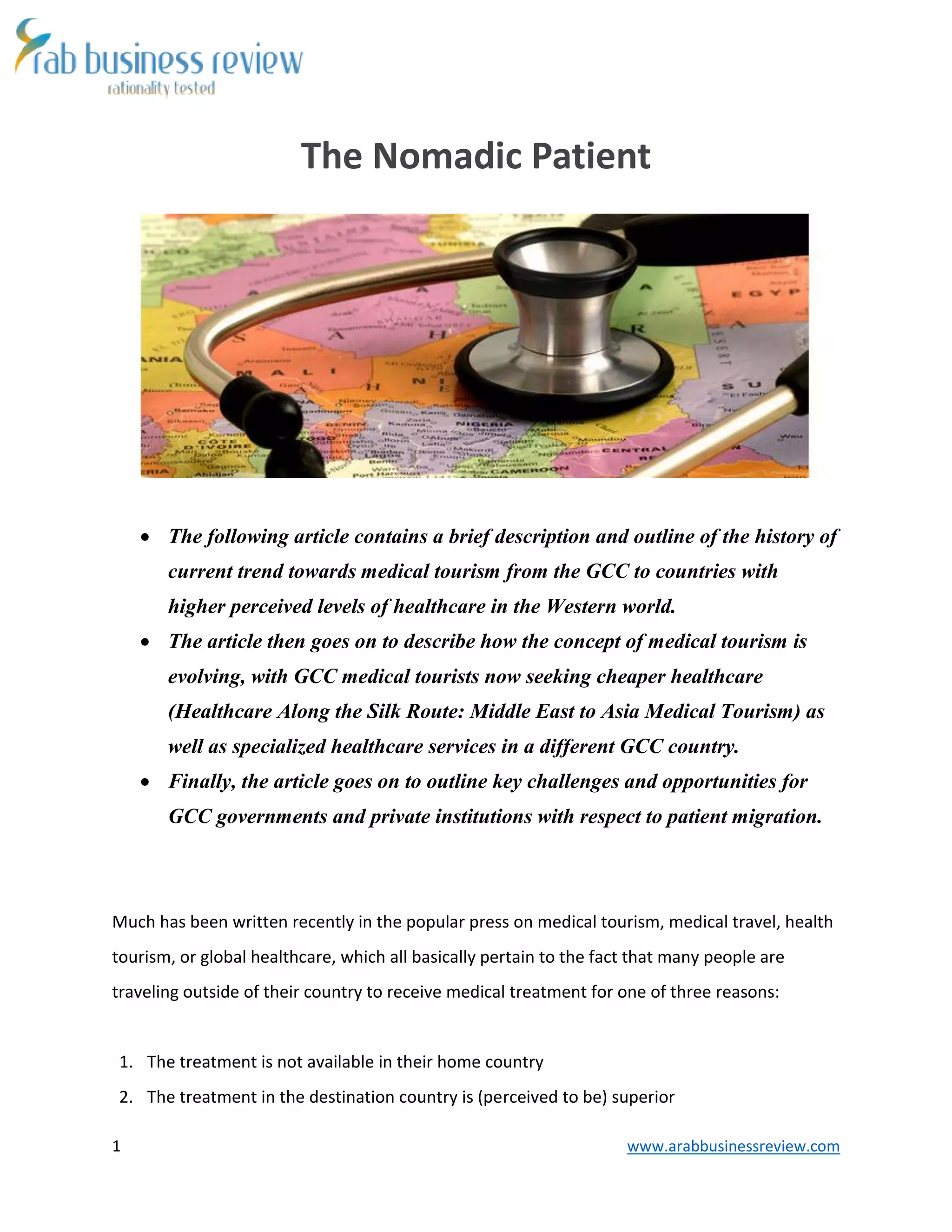
The Nomadic Patient 
 The following article contains a brief description and outline of the history of 
current trend towards medical tourism from the GCC to countries with 
higher perceived levels of healthcare in the Western world. 
 The article then goes on to describe how the concept of medical tourism is 
evolving, with GCC medical tourists now seeking cheaper healthcare 
(Healthcare Along the Silk Route: Middle East to Asia Medical Tourism) as 
well as specialized healthcare services in a different GCC country. 
 Finally, the article goes on to outline key challenges and opportunities for 
GCC governments and private institutions with respect to patient migration. 
Much has been written recently in the popular press on medical tourism, medical travel, health 
tourism, or global healthcare, which all basically pertain to the fact that many people are 
traveling outside of their country to receive medical treatment for one of three reasons: 
1. The treatment is not available in their home country 
2. The treatment in the destination country is (perceived to be) superior
2 www.arabbusinessreview.com 
3. The treatment in the destination country is cheaper 
My own personal experience with medical tourism occurred back when I was still a clinician. I 
was on an extramural maxillofacial surgery rotation at Mass General Hospital of Harvard 
University a few years ago, when a Kuwaiti patient and his brother were brought into one of the 
patient rooms. 
“Nothing is too expensive, please do everything you can for my brother,” was a phrased 
constantly echoed. My patient had been in a motor vehicle accident resulting in a compound 
fracture of his mandible (lower jaw) that had subsequently cartilaginized since it had been 
almost three months since his traumatic accident. 
Here I was, an aspiring Kuwaiti surgeon treating a Kuwaiti patient 3,000 miles away from Kuwait 
in a Harvard hospital as an extern, I was completely shocked and dismayed by the situation 
afoot. Was it that my patient could not receive adequate care in Kuwait? At least some form of 
treatment that would prevent his wounds from attempting to heal in the wrong position? Or 
was it the long and tiresome process of applying for overseas healthcare for three months that 
resulted in his complicated medical state? 
This is just one example of medical tourism and how it fits neatly with the trends towards 
globalization. 
More and more Middle Eastern patients are traveling for both acute, chronic and cosmetic 
healthcare. According to most calculations, Gulf Cooperation Council (GCC) governments alone 
spend well over ten to 20 billion US dollars on sending their citizens abroad for healthcare. 
Complicating the matter further, different government agencies typically send their own 
employees abroad. The following is a brief outline:
3 www.arabbusinessreview.com 
1. Ministries of Health 
2. Local Health Authorities – this is the case in Abu Dhabi and Dubai 
3. Military – including the Army, Navy, Police and National Guard 
4. Foreign Ministry 
5. Oil Sector 
6. Amiri Diwan/King’s Decree – official ministry (office) of the ruler of the country 
As to which countries patients are sent to. The top countries usually include the US, UK, France 
and Germany, with Germany the top country in the case of Saudi Arabia and the UAE, versus 
the UK for Kuwait. Surprisingly enough, the Bahraini Ministry of Health sends close to 2/3rds of 
its overseas patients to neighboring Saudi Arabia, whereas the Omani Ministry of Health prefers 
to send the majority of its patients east to India. The Kuwaiti government for example, used to 
rely on the foreign offices of the Kuwait Airways Corporation to manage the international 
patient flow and overseas healthcare budgets. Today, the Kuwaiti Ministry of Health has its own 
Overseas Health Offices in New York, London, Paris and Frankfurt, which work closely with the 
Kuwaiti Ministry of Foreign Affairs to assist patients in their treatment abroad both 
administratively and financially. 
Even though there will always be a need for GCC government’s to send patients abroad for 
specialized care, it is widely accepted that the current model of overseas healthcare is not 
sustainable. Local GCC governments are increasingly investing in the local healthcare 
infrastructure and encouraging free market dynamics to stimulate private investment in the 
healthcare. 
Privately, an increasing number of GCC patients are seeking treatment along the (ancient) Silk 
Route – traveling to India, Thailand and as far as China for cheaper healthcare that is perceived 
to be of better quality.
4 www.arabbusinessreview.com 
I believe that a private sector solution to overseas healthcare may provide an optimal interim 
solution – governments in the GCC should outsource the administration of their overseas 
healthcare to experience third party administrators (TPA) with an international network and 
experience as many global companies already do for their own healthcare needs. However, it is 
imperative that the government actively monitor the TPA by setting key performance indicators 
and targets to ensure that a quality service is delivered to its citizens. This efficiency will allow 
the GCC governments to not only send more patients (in the near future) but to also control 
both its cash flow and overall cost of sending patients abroad. Such measures will hopefully 
reduce the projected ten to 20 billion dollars of spending by 2020 to a mere fraction. 
The article is written by Dr. Mussaad Al Razouki for Arab Business Review 
To read more thought-leadership stuff by leaders from Arab Region, please visit Arab Business Review

The nomadic patient

  • 1.
    1 www.arabbusinessreview.com TheNomadic Patient  The following article contains a brief description and outline of the history of current trend towards medical tourism from the GCC to countries with higher perceived levels of healthcare in the Western world.  The article then goes on to describe how the concept of medical tourism is evolving, with GCC medical tourists now seeking cheaper healthcare (Healthcare Along the Silk Route: Middle East to Asia Medical Tourism) as well as specialized healthcare services in a different GCC country.  Finally, the article goes on to outline key challenges and opportunities for GCC governments and private institutions with respect to patient migration. Much has been written recently in the popular press on medical tourism, medical travel, health tourism, or global healthcare, which all basically pertain to the fact that many people are traveling outside of their country to receive medical treatment for one of three reasons: 1. The treatment is not available in their home country 2. The treatment in the destination country is (perceived to be) superior
  • 2.
    2 www.arabbusinessreview.com 3.The treatment in the destination country is cheaper My own personal experience with medical tourism occurred back when I was still a clinician. I was on an extramural maxillofacial surgery rotation at Mass General Hospital of Harvard University a few years ago, when a Kuwaiti patient and his brother were brought into one of the patient rooms. “Nothing is too expensive, please do everything you can for my brother,” was a phrased constantly echoed. My patient had been in a motor vehicle accident resulting in a compound fracture of his mandible (lower jaw) that had subsequently cartilaginized since it had been almost three months since his traumatic accident. Here I was, an aspiring Kuwaiti surgeon treating a Kuwaiti patient 3,000 miles away from Kuwait in a Harvard hospital as an extern, I was completely shocked and dismayed by the situation afoot. Was it that my patient could not receive adequate care in Kuwait? At least some form of treatment that would prevent his wounds from attempting to heal in the wrong position? Or was it the long and tiresome process of applying for overseas healthcare for three months that resulted in his complicated medical state? This is just one example of medical tourism and how it fits neatly with the trends towards globalization. More and more Middle Eastern patients are traveling for both acute, chronic and cosmetic healthcare. According to most calculations, Gulf Cooperation Council (GCC) governments alone spend well over ten to 20 billion US dollars on sending their citizens abroad for healthcare. Complicating the matter further, different government agencies typically send their own employees abroad. The following is a brief outline:
  • 3.
    3 www.arabbusinessreview.com 1.Ministries of Health 2. Local Health Authorities – this is the case in Abu Dhabi and Dubai 3. Military – including the Army, Navy, Police and National Guard 4. Foreign Ministry 5. Oil Sector 6. Amiri Diwan/King’s Decree – official ministry (office) of the ruler of the country As to which countries patients are sent to. The top countries usually include the US, UK, France and Germany, with Germany the top country in the case of Saudi Arabia and the UAE, versus the UK for Kuwait. Surprisingly enough, the Bahraini Ministry of Health sends close to 2/3rds of its overseas patients to neighboring Saudi Arabia, whereas the Omani Ministry of Health prefers to send the majority of its patients east to India. The Kuwaiti government for example, used to rely on the foreign offices of the Kuwait Airways Corporation to manage the international patient flow and overseas healthcare budgets. Today, the Kuwaiti Ministry of Health has its own Overseas Health Offices in New York, London, Paris and Frankfurt, which work closely with the Kuwaiti Ministry of Foreign Affairs to assist patients in their treatment abroad both administratively and financially. Even though there will always be a need for GCC government’s to send patients abroad for specialized care, it is widely accepted that the current model of overseas healthcare is not sustainable. Local GCC governments are increasingly investing in the local healthcare infrastructure and encouraging free market dynamics to stimulate private investment in the healthcare. Privately, an increasing number of GCC patients are seeking treatment along the (ancient) Silk Route – traveling to India, Thailand and as far as China for cheaper healthcare that is perceived to be of better quality.
  • 4.
    4 www.arabbusinessreview.com Ibelieve that a private sector solution to overseas healthcare may provide an optimal interim solution – governments in the GCC should outsource the administration of their overseas healthcare to experience third party administrators (TPA) with an international network and experience as many global companies already do for their own healthcare needs. However, it is imperative that the government actively monitor the TPA by setting key performance indicators and targets to ensure that a quality service is delivered to its citizens. This efficiency will allow the GCC governments to not only send more patients (in the near future) but to also control both its cash flow and overall cost of sending patients abroad. Such measures will hopefully reduce the projected ten to 20 billion dollars of spending by 2020 to a mere fraction. The article is written by Dr. Mussaad Al Razouki for Arab Business Review To read more thought-leadership stuff by leaders from Arab Region, please visit Arab Business Review