Narrative Text
Ms. Rukadah
Intermediate Class
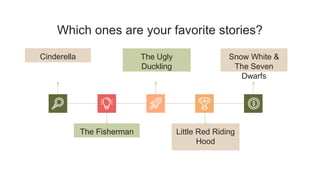
Which ones are your favorite stories?
The Ugly
Duckling
Cinderella
The Fisherman Little Red Riding
Hood
Snow White &
The Seven
Dwarfs
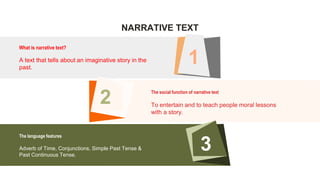
NARRATIVE TEXT
1
2
3
A text that tells about an imaginative story in the
past.
What is narrative text?
To entertain and to teach people moral lessons
with a story.
The social function of narrative text
Adverb of Time, Conjunctions, Simple Past Tense &
Past Continuous Tense.
The language features
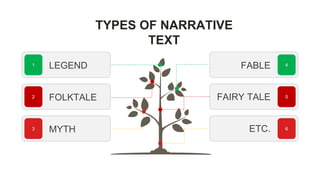
TYPES OF NARRATIVE
TEXT
1 LEGEND
2 FOLKTALE
3 MYTH
4
.
FABLE
5
.
FAIRY TALE
6
ETC.
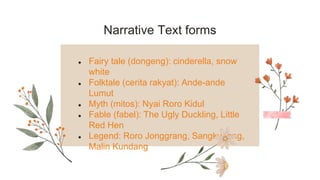
Narrative Text forms
● Fairy tale (dongeng): cinderella, snow
white
● Folktale (cerita rakyat): Ande-ande
Lumut
● Myth (mitos): Nyai Roro Kidul
● Fable (fabel): The Ugly Duckling, Little
Red Hen
● Legend: Roro Jonggrang, Sangkuriang,
Malin Kundang
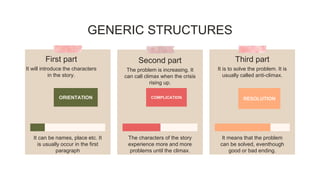
GENERIC STRUCTURES
It will introduce the characters
in the story.
First part
The problem is increasing. It
can call climax when the crisis
rising up.
Second part
It is to solve the problem. It is
usually called anti-climax.
Third part
It can be names, place etc. It
is usually occur in the first
paragraph
ORIENTATION
The characters of the story
experience more and more
problems until the climax.
COMPLICATION
It means that the problem
can be solved, eventhough
good or bad ending.
RESOLUTION
Example
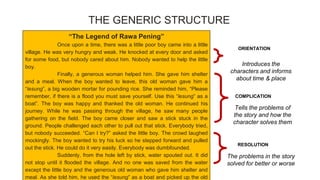
THE GENERIC STRUCTURE
“The Legend of Rawa Pening”
Once upon a time, there was a little poor boy came into a little
village. He was very hungry and weak. He knocked at every door and asked
for some food, but nobody cared about him. Nobody wanted to help the little
boy.
Finally, a generous woman helped him. She gave him shelter
and a meal. When the boy wanted to leave, this old woman gave him a
“lesung”, a big wooden mortar for pounding rice. She reminded him, “Please
remember, if there is a flood you must save yourself. Use this “lesung” as a
boat”. The boy was happy and thanked the old woman. He continued his
journey. While he was passing through the village, he saw many people
gathering on the field. The boy came closer and saw a stick stuck in the
ground. People challenged each other to pull out that stick. Everybody tried,
but nobody succeeded. “Can I try?” asked the little boy. The crowd laughed
mockingly. The boy wanted to try his luck so he stepped forward and pulled
out the stick. He could do it very easily. Everybody was dumbfounded.
Suddenly, from the hole left by stick, water spouted out. It did
not stop until it flooded the village. And no one was saved from the water
except the little boy and the generous old woman who gave him shelter and
meal. As she told him, he used the “lesung” as a boat and picked up the old
Introduces the
characters and informs
about time & place
Tells the problems of
the story and how the
character solves them
The problems in the story
solved for better or worse
ORIENTATION
COMPLICATION
RESOLUTION
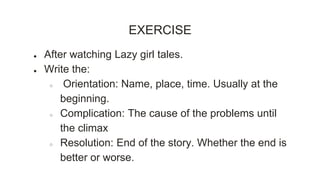
EXERCISE
● After watching Lazy girl tales.
● Write the:
○ Orientation: Name, place, time. Usually at the
beginning.
○ Complication: The cause of the problems until
the climax
○ Resolution: End of the story. Whether the end is
better or worse.

The Narrative text for junior high school l

  • 1.
  • 2.
    Which ones areyour favorite stories? The Ugly Duckling Cinderella The Fisherman Little Red Riding Hood Snow White & The Seven Dwarfs
  • 3.
    NARRATIVE TEXT 1 2 3 A textthat tells about an imaginative story in the past. What is narrative text? To entertain and to teach people moral lessons with a story. The social function of narrative text Adverb of Time, Conjunctions, Simple Past Tense & Past Continuous Tense. The language features
  • 4.
    TYPES OF NARRATIVE TEXT 1LEGEND 2 FOLKTALE 3 MYTH 4 . FABLE 5 . FAIRY TALE 6 ETC.
  • 5.
    Narrative Text forms ●Fairy tale (dongeng): cinderella, snow white ● Folktale (cerita rakyat): Ande-ande Lumut ● Myth (mitos): Nyai Roro Kidul ● Fable (fabel): The Ugly Duckling, Little Red Hen ● Legend: Roro Jonggrang, Sangkuriang, Malin Kundang
  • 6.
    GENERIC STRUCTURES It willintroduce the characters in the story. First part The problem is increasing. It can call climax when the crisis rising up. Second part It is to solve the problem. It is usually called anti-climax. Third part It can be names, place etc. It is usually occur in the first paragraph ORIENTATION The characters of the story experience more and more problems until the climax. COMPLICATION It means that the problem can be solved, eventhough good or bad ending. RESOLUTION
  • 7.
  • 8.
    THE GENERIC STRUCTURE “TheLegend of Rawa Pening” Once upon a time, there was a little poor boy came into a little village. He was very hungry and weak. He knocked at every door and asked for some food, but nobody cared about him. Nobody wanted to help the little boy. Finally, a generous woman helped him. She gave him shelter and a meal. When the boy wanted to leave, this old woman gave him a “lesung”, a big wooden mortar for pounding rice. She reminded him, “Please remember, if there is a flood you must save yourself. Use this “lesung” as a boat”. The boy was happy and thanked the old woman. He continued his journey. While he was passing through the village, he saw many people gathering on the field. The boy came closer and saw a stick stuck in the ground. People challenged each other to pull out that stick. Everybody tried, but nobody succeeded. “Can I try?” asked the little boy. The crowd laughed mockingly. The boy wanted to try his luck so he stepped forward and pulled out the stick. He could do it very easily. Everybody was dumbfounded. Suddenly, from the hole left by stick, water spouted out. It did not stop until it flooded the village. And no one was saved from the water except the little boy and the generous old woman who gave him shelter and meal. As she told him, he used the “lesung” as a boat and picked up the old Introduces the characters and informs about time & place Tells the problems of the story and how the character solves them The problems in the story solved for better or worse ORIENTATION COMPLICATION RESOLUTION
  • 9.
    EXERCISE ● After watchingLazy girl tales. ● Write the: ○ Orientation: Name, place, time. Usually at the beginning. ○ Complication: The cause of the problems until the climax ○ Resolution: End of the story. Whether the end is better or worse.

Editor's Notes

  • #3 These are the examples of narrative texts