Pablo A. Jiménez
www.drpablojimenez.net
The narrative-storytelling sermon
may be conveyed through different
sermon patterns or forms.
In this presentation we will explore
some of the different options
available to contemporary preacher.
There are two basic narrative patterns.
 Introduction
 Body (2 to 5 points)
 First episode or scene
 Second episode or scene
 Third episode or scene, etc.
 Conclusion
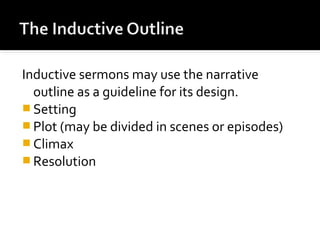
Inductive sermons may use the narrative
outline as a guideline for its design.
 Setting
 Plot (may be divided in scenes or episodes)
 Climax
 Resolution
You may use the form and the literary structure of your text as a pattern for
your sermon.
Most of the biblical stories found in the
OT are “sagas”.
The saga is a narrative that preserves
and transmits the folklore and self-
understanding of a given community.
There are three main types of sagas in
the Bible: primeval, family and heroic.
Sagas usually follow the basic form of
the short story.
 Setting
Plot (may be divided in episodes)
Climax
Resolution
Primeval sagas explain the origins of the
world, of a group, of a place, or of an
specific practice.
Family & heroic sagas usually have two
main characters: a protagonist and an
antagonist.
They have many literary “layers” because
they were orally transmitted for centuries.
The prophetic call is a narrative that
describes how a specific biblical
character was commissioned as a spoke
person for God.
Although they are appear mostly in the
OT prophetic books, they are also found
in Exodus 3 (the call of Moses) and in the
NT (mostly in Luke & Acts).
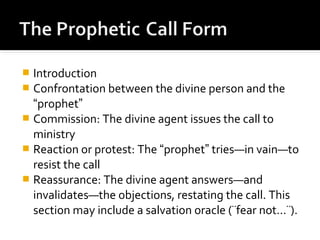
 Introduction
 Confrontation between the divine person and the
“prophet”
 Commission: The divine agent issues the call to
ministry
 Reaction or protest: The “prophet” tries—in vain—to
resist the call
 Reassurance: The divine agent answers—and
invalidates—the objections, restating the call. This
section may include a salvation oracle (¨fear not…¨).
 The Miracle Story is a narrative that describes
God’s salvific intervention in human history on
behalf of a particular person, group or place.
 There are four basic miracle stories:
▪ Healing
▪ Exorcism
▪ Miracle of Nature
▪ Miracle with controversy
Statement of the need
Encounter with the divine agent (In the
OT is usually a prophet. In the NT such
agent is usually Jesus).
The miraculous event (healing, casting
out demons, a miracle of “nature”, etc.)
Evidence that the miracle has occurred
 Parables are didactic stories whose main
purpose is to challenge and shatter the world
view of the audience. They have surprising
elements, such as an outrageous setting,
incredible events or a reversal at the end.
 As a rule, they collapse the latter elements of
a short story (climax and resolution) into a
surprising ending.
Setting
Plot (may be divided into
episodes)
Surprising ending
You may also use the following advanced patterns with either biblical or
non-biblical stories.
Upsetting the equilibrium, Oops!
Analyzing the discrepancy, Ugh!
Finding the clue to the resolution,
Aha!
Experiencing the Gospel, Wee!
Anticipating the consequences,
Yeah!
Lowry also suggests forms that vary
according to the timing of the story:
Running the story
Delaying the story
Suspending the story
Alternating the story
These options may be used
sparsely.
Sermons in the first person.
A pastoral letter.
A historical sermon
Use your creativity in the
development of forms, patterns and
structures for narrative preaching.
You may mix and match the story
with elements such as literature,
song, or argumentation, among
others.
Now we offer 12 tips regarding the
preparation, design and delivery
of the narrative-storytelling
sermon.
See the additional handout that
suggests a methodology for
memorizing stories.
 Main Character: The main character is fully
developed. There may be more than one.
 Secondary characters: They are important to
the story, but they are not as developed as
the main character.
 Types: These characters represent a larger
group. We rarely learn their names.
 Shadows: They are part of the scenery (e.g.
the multitude).
Study the social, political and
historical background of the
biblical text.
Do not be discouraged by this
task. Remember that this kind of
research has a cumulative effect.
Be aware of the events that
immediately precede and follow
your story.
Remember that most NT stories
use OT stories as sub-text.
Study the geography of the place(s)
where the story develops.
A good biblical atlas may help you
to achieve a good handling of these
details.
Consider the possibility of taking a
(tax-deductible!) trip to Israel.
Maintain the order of the
story.
Do not add details.
Do not eliminate details.
Read between the lines
There are two pitfalls to avoid:
Anachronisms that stem out of
biblical illiteracy.
Anachronisms that transpose
contemporary experiences to the
past.
Stories that describe encounters
or confrontations between
biblical characters are excellent
sources for narrative preaching.
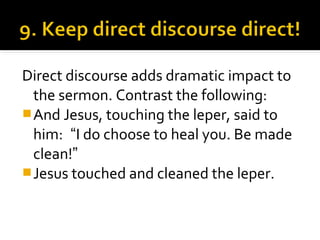
Direct discourse adds dramatic impact to
the sermon. Contrast the following:
And Jesus, touching the leper, said to
him: “I do choose to heal you. Be made
clean!”
Jesus touched and cleaned the leper.
Talk about colors, odors and textures.
Without adding details, describe
vividly those the different elements
of the story.
In storytelling, the verb is more
important than the adjective.
Sprinkle your re-telling of the story
with contemporary elements that
may be common to your audience’s
experience.
James Earl Massey, Designing the
Sermon, pp. 35-49
Lowry, The Lowry Loop, Doing Time in
the Pulpit, How to Preach a Parable, &
The Sermon: Dancing at the Edge of
Mistery
Robinson, Journeys to Narrative
Preaching
Steimle, et. al, Preaching the Story

The Narrative Sermon

  • 1.
  • 2.
    The narrative-storytelling sermon maybe conveyed through different sermon patterns or forms. In this presentation we will explore some of the different options available to contemporary preacher.
  • 3.
    There are twobasic narrative patterns.
  • 4.
     Introduction  Body(2 to 5 points)  First episode or scene  Second episode or scene  Third episode or scene, etc.  Conclusion
  • 5.
    Inductive sermons mayuse the narrative outline as a guideline for its design.  Setting  Plot (may be divided in scenes or episodes)  Climax  Resolution
  • 6.
    You may usethe form and the literary structure of your text as a pattern for your sermon.
  • 7.
    Most of thebiblical stories found in the OT are “sagas”. The saga is a narrative that preserves and transmits the folklore and self- understanding of a given community. There are three main types of sagas in the Bible: primeval, family and heroic.
  • 8.
    Sagas usually followthe basic form of the short story.  Setting Plot (may be divided in episodes) Climax Resolution
  • 9.
    Primeval sagas explainthe origins of the world, of a group, of a place, or of an specific practice. Family & heroic sagas usually have two main characters: a protagonist and an antagonist. They have many literary “layers” because they were orally transmitted for centuries.
  • 10.
    The prophetic callis a narrative that describes how a specific biblical character was commissioned as a spoke person for God. Although they are appear mostly in the OT prophetic books, they are also found in Exodus 3 (the call of Moses) and in the NT (mostly in Luke & Acts).
  • 11.
     Introduction  Confrontationbetween the divine person and the “prophet”  Commission: The divine agent issues the call to ministry  Reaction or protest: The “prophet” tries—in vain—to resist the call  Reassurance: The divine agent answers—and invalidates—the objections, restating the call. This section may include a salvation oracle (¨fear not…¨).
  • 12.
     The MiracleStory is a narrative that describes God’s salvific intervention in human history on behalf of a particular person, group or place.  There are four basic miracle stories: ▪ Healing ▪ Exorcism ▪ Miracle of Nature ▪ Miracle with controversy
  • 13.
    Statement of theneed Encounter with the divine agent (In the OT is usually a prophet. In the NT such agent is usually Jesus). The miraculous event (healing, casting out demons, a miracle of “nature”, etc.) Evidence that the miracle has occurred
  • 14.
     Parables aredidactic stories whose main purpose is to challenge and shatter the world view of the audience. They have surprising elements, such as an outrageous setting, incredible events or a reversal at the end.  As a rule, they collapse the latter elements of a short story (climax and resolution) into a surprising ending.
  • 15.
    Setting Plot (may bedivided into episodes) Surprising ending
  • 16.
    You may alsouse the following advanced patterns with either biblical or non-biblical stories.
  • 17.
    Upsetting the equilibrium,Oops! Analyzing the discrepancy, Ugh! Finding the clue to the resolution, Aha! Experiencing the Gospel, Wee! Anticipating the consequences, Yeah!
  • 18.
    Lowry also suggestsforms that vary according to the timing of the story: Running the story Delaying the story Suspending the story Alternating the story
  • 19.
    These options maybe used sparsely. Sermons in the first person. A pastoral letter. A historical sermon
  • 20.
    Use your creativityin the development of forms, patterns and structures for narrative preaching. You may mix and match the story with elements such as literature, song, or argumentation, among others.
  • 21.
    Now we offer12 tips regarding the preparation, design and delivery of the narrative-storytelling sermon.
  • 22.
    See the additionalhandout that suggests a methodology for memorizing stories.
  • 23.
     Main Character:The main character is fully developed. There may be more than one.  Secondary characters: They are important to the story, but they are not as developed as the main character.  Types: These characters represent a larger group. We rarely learn their names.  Shadows: They are part of the scenery (e.g. the multitude).
  • 24.
    Study the social,political and historical background of the biblical text. Do not be discouraged by this task. Remember that this kind of research has a cumulative effect.
  • 25.
    Be aware ofthe events that immediately precede and follow your story. Remember that most NT stories use OT stories as sub-text.
  • 26.
    Study the geographyof the place(s) where the story develops. A good biblical atlas may help you to achieve a good handling of these details. Consider the possibility of taking a (tax-deductible!) trip to Israel.
  • 27.
    Maintain the orderof the story. Do not add details. Do not eliminate details. Read between the lines
  • 28.
    There are twopitfalls to avoid: Anachronisms that stem out of biblical illiteracy. Anachronisms that transpose contemporary experiences to the past.
  • 29.
    Stories that describeencounters or confrontations between biblical characters are excellent sources for narrative preaching.
  • 30.
    Direct discourse addsdramatic impact to the sermon. Contrast the following: And Jesus, touching the leper, said to him: “I do choose to heal you. Be made clean!” Jesus touched and cleaned the leper.
  • 31.
    Talk about colors,odors and textures. Without adding details, describe vividly those the different elements of the story.
  • 32.
    In storytelling, theverb is more important than the adjective.
  • 33.
    Sprinkle your re-tellingof the story with contemporary elements that may be common to your audience’s experience.
  • 34.
    James Earl Massey,Designing the Sermon, pp. 35-49 Lowry, The Lowry Loop, Doing Time in the Pulpit, How to Preach a Parable, & The Sermon: Dancing at the Edge of Mistery Robinson, Journeys to Narrative Preaching Steimle, et. al, Preaching the Story