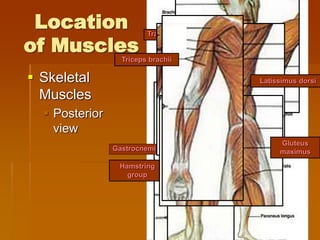
Location
of Muscles
 Skeletal
Muscles
 Posterior
view
Hamstring
group
Trapezius
Hamstring
group
Gastrocnemius
Latissimus dorsi
Gluteus
maximus
Triceps brachii
F
A
D
C
B
E
L
K
J
H
G
P
O
N
M
I
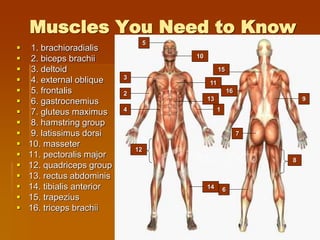
Muscles You Need to Know
 1. brachioradialis
 2. biceps brachii
 3. deltoid
 4. external oblique
 5. frontalis
 6. gastrocnemius
 7. gluteus maximus
 8. hamstring group
 9. latissimus dorsi
 10. masseter
 11. pectoralis major
 12. quadriceps group
 13. rectus abdominis
 14. tibialis anterior
 15. trapezius
 16. triceps brachii
9
1
2
3
4
5
6
7
8
10
11
12
13
14
15
16
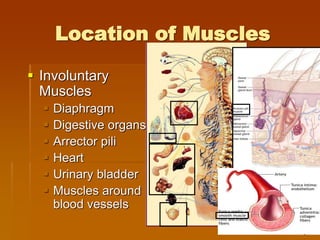
Location of Muscles
 Involuntary
Muscles
 Diaphragm
 Digestive organs
 Arrector pili
 Heart
 Urinary bladder
 Muscles around
blood vessels
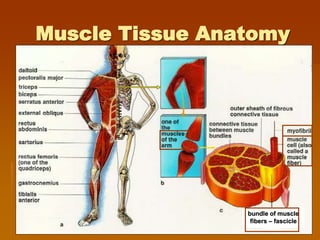
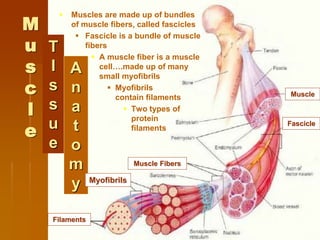
Muscle Tissue Anatomy
bundle of muscle
fibers – fascicle
M
u
s
c
l
e
T
I
s
s
u
e
A
n
a
t
o
m
y
Muscle
Filaments
Myofibrils
Muscle Fibers
Fascicle
 Muscles are made up of bundles
of muscle fibers, called fascicles
 Fascicle is a bundle of muscle
fibers
 A muscle fiber is a muscle
cell….made up of many
small myofibrils
 Myofibrils
contain filaments
 Two types of
protein
filaments
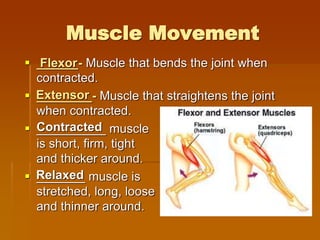
Muscle Movement
 ______- Muscle that bends the joint when
contracted.
 ________- Muscle that straightens the joint
when contracted.
 __________ muscle
is short, firm, tight
and thicker around.
 _______ muscle is
stretched, long, loose
and thinner around.
Flexor
Extensor
Relaxed
Contracted
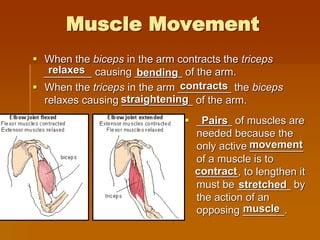
Muscle Movement
 When the biceps in the arm contracts the triceps
________ causing ________ of the arm.
 When the triceps in the arm _________ the biceps
relaxes causing ____________ of the arm.
relaxes
 ______ of muscles are
needed because the
only active _________
of a muscle is to
_______, to lengthen it
must be _________ by
the action of an
opposing _______.
bending
contracts
straightening
Pairs
movement
contract
stretched
muscle
Muscle + Bone Interaction
 Let’s review the structures involved in
movement at a joint.
 Ligament
 Tendon
 Cartilage
 Body (Belly)
 Origin
 Insertion
 Contracted muscle
 Relaxed muscle
 Flexor
 Extensor
B
C
F F
B
F
B
C
D
E
G
D C
A
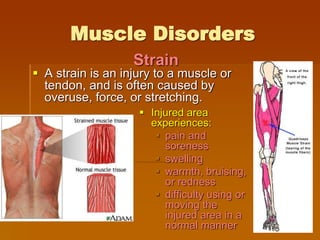
Muscle Disorders
 A strain is an injury to a muscle or
tendon, and is often caused by
overuse, force, or stretching.
 Injured area
experiences:
 pain and
soreness
 swelling
 warmth, bruising,
or redness
 difficulty using or
moving the
injured area in a
normal manner
Strain
Muscle Disorders
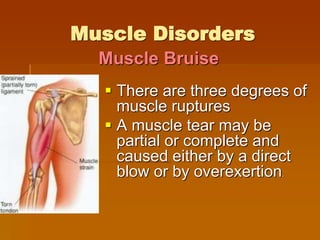
 There are three degrees of
muscle ruptures
 A muscle tear may be
partial or complete and
caused either by a direct
blow or by overexertion.
Muscle Bruise
Muscle Disorders
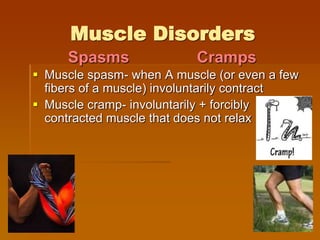
 Muscle spasm- when A muscle (or even a few
fibers of a muscle) involuntarily contract
 Muscle cramp- involuntarily + forcibly
contracted muscle that does not relax
CrampsSpasms
Muscle Disorders
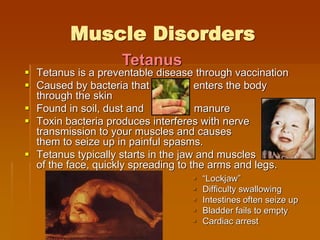
 Tetanus is a preventable disease through vaccination
 Caused by bacteria that enters the body
through the skin
 Found in soil, dust and manure
 Toxin bacteria produces interferes with nerve
transmission to your muscles and causes
them to seize up in painful spasms.
 Tetanus typically starts in the jaw and muscles
of the face, quickly spreading to the arms and legs.
 “Lockjaw”
 Difficulty swallowing
 Intestines often seize up
 Bladder fails to empty
 Cardiac arrest
Tetanus
Muscle Disorders
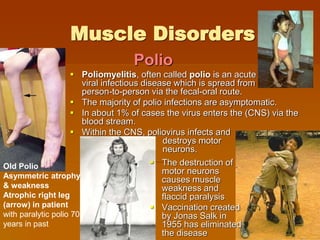
 Poliomyelitis, often called polio is an acute
viral infectious disease which is spread from
person-to-person via the fecal-oral route.
 The majority of polio infections are asymptomatic.
 In about 1% of cases the virus enters the (CNS) via the
blood stream.
 Within the CNS, poliovirus infects and
destroys motor
neurons.
Polio
Old Polio
Asymmetric atrophy
& weakness
Atrophic right leg
(arrow) in patient
with paralytic polio 70
years in past
 The destruction of
motor neurons
causes muscle
weakness and
flaccid paralysis
 Vaccination created
by Jonas Salk in
1955 has eliminated
the disease

The muscle system disorder

  • 1.
    Location of Muscles  Skeletal Muscles Posterior view Hamstring group Trapezius Hamstring group Gastrocnemius Latissimus dorsi Gluteus maximus Triceps brachii
  • 2.
    F A D C B E L K J H G P O N M I Muscles You Needto Know  1. brachioradialis  2. biceps brachii  3. deltoid  4. external oblique  5. frontalis  6. gastrocnemius  7. gluteus maximus  8. hamstring group  9. latissimus dorsi  10. masseter  11. pectoralis major  12. quadriceps group  13. rectus abdominis  14. tibialis anterior  15. trapezius  16. triceps brachii 9 1 2 3 4 5 6 7 8 10 11 12 13 14 15 16
  • 3.
    Location of Muscles Involuntary Muscles  Diaphragm  Digestive organs  Arrector pili  Heart  Urinary bladder  Muscles around blood vessels
  • 4.
    Muscle Tissue Anatomy bundleof muscle fibers – fascicle
  • 5.
    M u s c l e T I s s u e A n a t o m y Muscle Filaments Myofibrils Muscle Fibers Fascicle  Musclesare made up of bundles of muscle fibers, called fascicles  Fascicle is a bundle of muscle fibers  A muscle fiber is a muscle cell….made up of many small myofibrils  Myofibrils contain filaments  Two types of protein filaments
  • 6.
    Muscle Movement  ______-Muscle that bends the joint when contracted.  ________- Muscle that straightens the joint when contracted.  __________ muscle is short, firm, tight and thicker around.  _______ muscle is stretched, long, loose and thinner around. Flexor Extensor Relaxed Contracted
  • 7.
    Muscle Movement  Whenthe biceps in the arm contracts the triceps ________ causing ________ of the arm.  When the triceps in the arm _________ the biceps relaxes causing ____________ of the arm. relaxes  ______ of muscles are needed because the only active _________ of a muscle is to _______, to lengthen it must be _________ by the action of an opposing _______. bending contracts straightening Pairs movement contract stretched muscle
  • 8.
    Muscle + BoneInteraction  Let’s review the structures involved in movement at a joint.  Ligament  Tendon  Cartilage  Body (Belly)  Origin  Insertion  Contracted muscle  Relaxed muscle  Flexor  Extensor B C F F B F B C D E G D C A
  • 9.
    Muscle Disorders  Astrain is an injury to a muscle or tendon, and is often caused by overuse, force, or stretching.  Injured area experiences:  pain and soreness  swelling  warmth, bruising, or redness  difficulty using or moving the injured area in a normal manner Strain
  • 10.
    Muscle Disorders  Thereare three degrees of muscle ruptures  A muscle tear may be partial or complete and caused either by a direct blow or by overexertion. Muscle Bruise
  • 11.
    Muscle Disorders  Musclespasm- when A muscle (or even a few fibers of a muscle) involuntarily contract  Muscle cramp- involuntarily + forcibly contracted muscle that does not relax CrampsSpasms
  • 12.
    Muscle Disorders  Tetanusis a preventable disease through vaccination  Caused by bacteria that enters the body through the skin  Found in soil, dust and manure  Toxin bacteria produces interferes with nerve transmission to your muscles and causes them to seize up in painful spasms.  Tetanus typically starts in the jaw and muscles of the face, quickly spreading to the arms and legs.  “Lockjaw”  Difficulty swallowing  Intestines often seize up  Bladder fails to empty  Cardiac arrest Tetanus
  • 13.
    Muscle Disorders  Poliomyelitis,often called polio is an acute viral infectious disease which is spread from person-to-person via the fecal-oral route.  The majority of polio infections are asymptomatic.  In about 1% of cases the virus enters the (CNS) via the blood stream.  Within the CNS, poliovirus infects and destroys motor neurons. Polio Old Polio Asymmetric atrophy & weakness Atrophic right leg (arrow) in patient with paralytic polio 70 years in past  The destruction of motor neurons causes muscle weakness and flaccid paralysis  Vaccination created by Jonas Salk in 1955 has eliminated the disease