2018-1-RO01-KA229-049131
The European Commission support for the production of this publication does not constitute an
endorsement of the contents which reflects the views only of the authors, and the Commission cannot be
held responsible for any use which may be made of the information contained therein.
SCOALA GIMNAZIALA LUCIAN GRIGORESCU
MEDGIDIA – ROMANIA
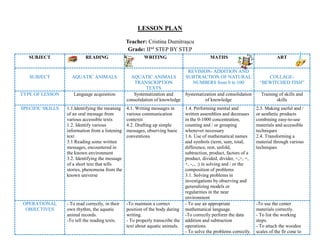
LESSON PLAN
Teacher: Cristina Dumitraşcu
Grade: IInd
STEP BY STEP
SUBJECT READING WRITING MATHS ART
SUBJECT AQUATIC ANIMALS AQUATIC ANIMALS
TRANSCRIPTION
TEXTS
REVISION- ADDITION AND
SUBTRACTION OF NATURAL
NUMBERS from 0 to 100
COLLAGE-
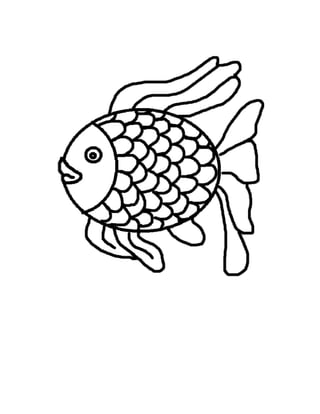
“BEWITCHED FISH”
TYPE OF LESSON Language acquisition Systematization and
consolidation of knowledge
Systematization and consolidation
of knowledge
Training of skills and
skills
SPECIFIC SKILLS 1.1.Identifying the meaning
of an oral message from
various accessible texts
1.2. Identify various
information from a listening
text
3.1 Reading some written
messages, encountered in
the known environment
3.2. Identifying the message
of a short text that tells
stories, phenomena from the
known universe
4.1. Writing messages in
various communication
contexts
4.2. Drafting up simple
messages, observing basic
conventions
1.4. Performing mental and
written assemblies and decreases
in the 0-1000 concentration,
counting and / or grouping
whenever necessary
1.6. Use of mathematical names
and symbols (term, sum, total,
difference, rest, unfold,
subtraction, product, factors of a
product, divided, divider, <,>, =,
+, -,., :) in solving and / or the
composition of problems
3.1. Solving problems in
investigations by observing and
generalizing models or
regularities in the near
environment
2.3. Making useful and /
or aesthetic products
combining easy-to-use
materials and accessible
techniques
2.4. Transforming a
material through various
techniques
OPERATIONAL
OBJECTIVES
- To read correctly, in their
own rhythm, the aquatic
animal records.
-To tell the reading texts.
-To maintain a correct
position of the body during
writing.
- To properly transcribe the
text about aquatic animals.
- To use an appropriate
mathematical language.
-To correctly perform the data
addition and subtraction
operations.
- To solve the problems correctly.
-To use the center
materials correctly.
- To list the working
steps.
- To attach the wooden
scales of the fir cone to
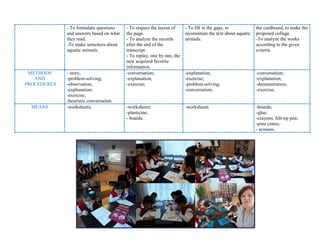
- To formulate questions
and answers based on what
they read.
-To make sentences about
aquatic animals.
- To respect the layout of
the page.
- To analyze the records
after the end of the
transcript.
- To replay, one by one, the
new acquired favorite
information.
- To fill in the gaps, to
reconstitute the text about aquatic
animals.
the cardboard, to make the
proposed collage.
-To analyze the works
according to the given
criteria.
METHODS
AND
PROCEDURES
- story,
-problem-solving;
-observation;
-explanation;
-exercise;
-heuristic conversation.
-conversation;
-explanation;
-exercise;
-explanation;
-exercise;
-problem-solving;
-conversation;
-conversation;
-explanation;
-demonstration;
-exercise.
MEANS -worksheets; -worksheets;
-plasticine,
- boards.
-worksheets -boards;
-glue;
-crayons, felt-tip pen;
-pine cones;
- scissors.
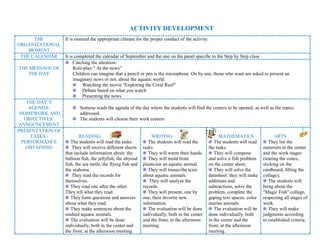
ACTIVITY DEVELOPMENT
THE
ORGANIZATIONAL
MOMENT
It is ensured the appropriate climate for the proper conduct of the activity.
THE CALENDAR It is completed the calendar of September and the one on the panel specific to the Step by Step class
THE MESSAGE OF
THE DAY
Catching the attention:
Role-play:” At the news”
Children can imagine that a pencil or pen is the microphone. On by one, those who want are asked to present an
imaginary news or not, about the aquatic world.
Watching the movie "Exploring the Coral Reef"
Debate based on what you watch
Presenting the news.
THE DAY’S
AGENDA:
HOMEWORK AND
OBJECTIVES’
ANNOUNCEMENT
Somene reads the agenda of the day where the students will find the centers to be opened, as well as the topics
addressed.
The students will choose their work centers.
PRESENTATION OF
TASKS /
PERFORMANCE
OBTAINING
READING
The students will read the tasks.
They will receive different sheets
that include information about: the
balloon fish, the jellyfish, the abyssal
fish, the sea turtle, the flying fish and
the seahorse.
They read the records for
themselves.
They read one after the other.
They tell what they read.
They form questions and answers
about what they read.
They make sentences about the
studied aquatic animals.
The evaluation will be done
individually, both in the center and
the front, at the afternoon meeting.
WRITING
The students will read the
tasks.
They will warm their hands.
They will mold from
plasticine an aquatic animal.
They will transcribe texts
about aquatic animals.
They will analyze the
records.
They will present, one by
one, their favorite new
information.
The evaluation will be done
individually, both in the center
and the front, at the afternoon
meeting.
MATHEMATICS
The students will read
the tasks.
They will compose
and solve a fish problem
on the center sheet;
They will solve the
datasheet: they will make
additions and
subtractions, solve the
problem, complete the
gaping text spaces, color
marine animals.
The evaluation will be
done individually, both
in the center and the
front, at the afternoon
meeting.
ARTS
They list the
materials in the center
and the work stages
(tearing the cones,
sticking on the
cardboard, filling the
collage);
The students will
bring about the
"Magic Fish" collage,
respecting all stages of
work.
They will make
judgments according
to established criteria.
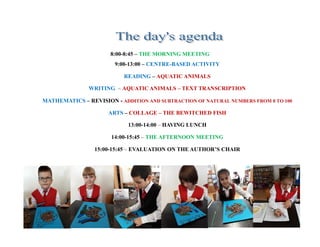
8:00-8:45 – THE MORNING MEETING
9:00-13:00 – CENTRE-BASED ACTIVITY
READING – AQUATIC ANIMALS
WRITING – AQUATIC ANIMALS – TEXT TRANSCRIPTION
MATHEMATICS – REVISION - ADDITION AND SUBTRACTION OF NATURAL NUMBERS FROM 0 TO 100
ARTS – COLLAGE – THE BEWITCHED FISH
13:00-14:00 – HAVING LUNCH
14:00-15:45 – THE AFTERNOON MEETING
15:00-15:45 – EVALUATION ON THE AUTHOR’S CHAIR
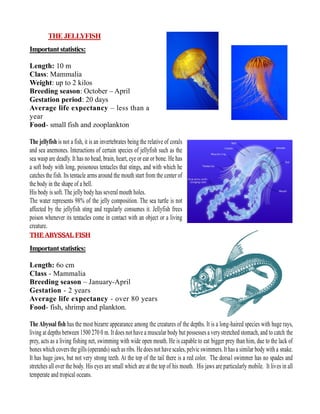
THE JELLYFISH
Importantstatistics:
Length: 10 m
Class: Mammalia
Weight: up to 2 kilos
Breeding season: October – April
Gestation period: 20 days
Average life expectancy – less than a
year
Food- small fish and zooplankton
The jellyfish is not a fish, it is an invertebrates being the relative of corals
and sea anemones. Interactions of certain species of jellyfish such as the
sea wasp are deadly. It has no head, brain, heart, eye or ear or bone. He has
a soft body with long, poisonous tentacles that stings, and with which he
catches the fish. Its tentacle arms around the mouth start from the center of
the body in the shape of a bell.
His body is soft. The jelly body has several mouth holes.
The water represents 98% of the jelly composition. The sea turtle is not
affected by the jellyfish sting and regularly consumes it. Jellyfish frees
poison whenever its tentacles come in contact with an object or a living
creature.
THEABYSSAL FISH
Importantstatistics:
Length: 6o cm
Class - Mammalia
Breeding season – January-April
Gestation - 2 years
Average life expectancy - over 80 years
Food- fish, shrimp and plankton.
TheAbyssal fish has the most bizarre appearance among the creatures of the depths. It is a long-haired species with huge rays,
living at depths between 1500 270 0 m. It does not have a muscular body but possesses a very stretched stomach, and to catch the
prey, acts as a living fishing net, swimming with wide open mouth. He is capable to eat bigger prey than him, due to the lack of
bones which coversthe gills (operands) such as ribs. He doesnot have scales,pelvic swimmers. Ithasa similar body with a snake.
It has huge jaws, but not very strong teeth. At the top of the tail there is a red color. The dorsal swimmer has no spades and
stretches all over the body. His eyes are small which are at the top of his mouth. His jaws are particularly mobile. It lives in all
temperate and tropical oceans.
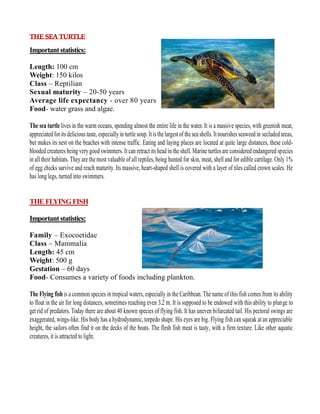
THE SEA TURTLE
Importantstatistics:
Length: 100 cm
Weight: 150 kilos
Class – Reptilian
Sexual maturity – 20-50 years
Average life expectancy - over 80 years
Food- water grass and algae.
The sea turtle lives in the warm oceans, spending almost the entire life in the water. It is a massive species, with greenish meat,
appreciatedfor its delicious taste, especially in turtle soup.It isthelargest of the sea shells.Itnourishes seaweed in secludedareas,
but makes its nest on the beaches with intense traffic. Eating and laying places are located at quite large distances, these cold-
blooded creatures being very good swimmers. It can retract its head in the shell. Marine turtles are considered endangered species
in all their habitats. They are the most valuable of all reptiles, being hunted for skin, meat, shell and for edible cartilage. Only 1%
of egg chicks survive and reach maturity. Its massive, heart-shaped shell is covered with a layer of tiles called crown scales. He
has long legs, turned into swimmers.
THE FLYING FISH
Importantstatistics:
Family – Exocoetidae
Class – Mammalia
Length: 45 cm
Weight: 500 g
Gestation – 60 days
Food- Consumes a variety of foods including plankton.
The Flying fish is a common species in tropical waters, especially in the Caribbean. The name of this fish comes from its ability
to float in the air for long distances, sometimes reaching even 3.2 m. It is supposed to be endowed with this ability to plunge to
get rid of predators. Today there are about 40 known species of flying fish. It has uneven bifurcated tail. His pectoral swings are
exaggerated, wings-like. His body has a hydrodynamic, torpedo shape. His eyes are big. Flying fish can squeak at an appreciable
height, the sailors often find it on the decks of the boats. The flesh fish meat is tasty, with a firm texture. Like other aquatic
creatures, it is attracted to light.
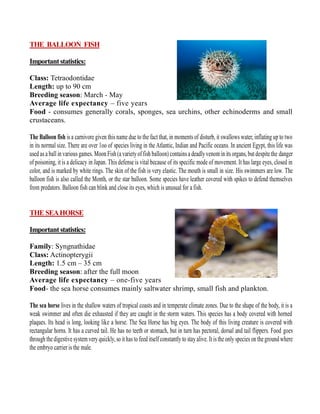
THE BALLOON FISH
Importantstatistics:
Class: Tetraodontidae
Length: up to 90 cm
Breeding season: March - May
Average life expectancy – five years
Food - consumes generally corals, sponges, sea urchins, other echinoderms and small
crustaceans.
The Balloon fish is a carnivore given this name due to the fact that, in moments of disturb, it swallows water, inflating up to two
in its normal size. There are over 1oo of species living in the Atlantic, Indian and Pacific oceans. In ancient Egypt, this life was
used as a ball in various games. Moon Fish(a varietyoffish balloon) contains a deadlyvenom in itsorgans, but despite the danger
of poisoning, it is a delicacy in Japan. This defense is vital because of its specific mode of movement. It has large eyes, closed in
color, and is marked by white rings. The skin of the fish is very elastic. The mouth is small in size. His swimmers are low. The
balloon fish is also called the Month, or the star balloon. Some species have leather covered with spikes to defend themselves
from predators. Balloon fish can blink and close its eyes, which is unusual for a fish.
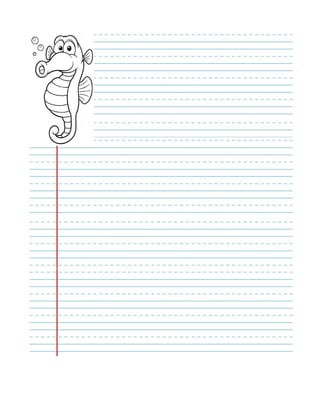
THE SEAHORSE
Importantstatistics:
Family: Syngnathidae
Class: Actinopterygii
Length: 1.5 cm – 35 cm
Breeding season: after the full moon
Average life expectancy – one-five years
Food- the sea horse consumes mainly saltwater shrimp, small fish and plankton.
The sea horse lives in the shallow waters of tropical coasts and in temperate climate zones. Due to the shape of the body, it is a
weak swimmer and often die exhausted if they are caught in the storm waters. This species has a body covered with horned
plaques. Its head is long, looking like a horse. The Sea Horse has big eyes. The body of this living creature is covered with
rectangular horns. It has a curved tail. He has no teeth or stomach, but in turn has pectoral, dorsal and tail flippers. Food goes
through the digestive system very quickly, so it has tofeed itself constantly to stay alive. It is the only species on theground where
the embryo carrier is the male.
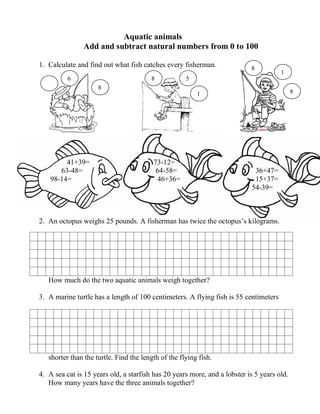
Aquatic animals
Add and subtract natural numbers from 0 to 100
1. Calculate and find out what fish catches every fisherman.
41+39= 73-12=
63-48= 64-58= 36+47=
98-14= 46+36= 15+37=
54-39=
2. An octopus weighs 25 pounds. A fisherman has twice the octopus’s kilograms.
How much do the two aquatic animals weigh together?
3. A marine turtle has a length of 100 centimeters. A flying fish is 55 centimeters
shorter than the turtle. Find the length of the flying fish.
4. A sea cat is 15 years old, a starfish has 20 years more, and a lobster is 5 years old.
How many years have the three animals together?
8
2
6
6
1
8
3
5
2
1
5
8
0
1
5
8
4
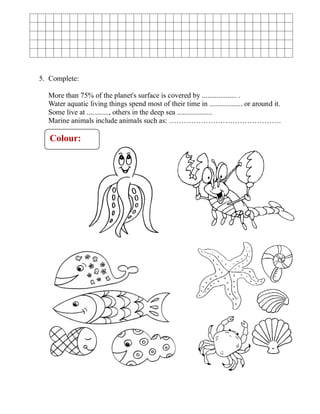
5. Complete:
More than 75% of the planet's surface is covered by ................... .
Water aquatic living things spend most of their time in .................. or around it.
Some live at ............, others in the deep sea ...................
Marine animals include animals such as: ……………………………………….
Colour:
LESSON PLAN
Teacher: Anişoara Cornea
Grade: 4th
B
Time of lesson: 45 minutes
Curricular area: Math and science
Subject: Science
The thematic unit: The relationships between living creatures and their living
environment
The title of the lesson: Animals and their environment
Type of lesson: Revision
GENERAL COMPETENCES: Solving problems in everyday life by capitalizing on
environmental acquisitions
SPECIFIC SKILLS:
- Use of criteria for ordering and classification of bodies and phenomena
- Drawing conclusions on the results of their own investigations
- Present your own conclusions
OPERATIONAL OBJECTIVES: During and until the end of the lesson, students must
be able to:
1 - Fill in the gaps with specific terms;
2 - Determine the truth value of some statements;
3 - Find missing items from a food chain;
4 - Write a dialogue on a given theme;
5 - Show information gathered by them.
AFFECTIVE OBJECTIVE - Manifestation of concern for correct behavior in relation
to the natural environment.
TEACHING STRATEGIES
METHODS AND PROCEDURES: explanation, exercise, conversation, didactic play.
EDUCATIONAL MEANS: PC, PPT presentation, worksheets, portfolios.
FORMS OF ORGANIZATION: frontal, by groups
EVALUATION FORMS AND TECHNIQUES: systematic observation of student
behavior, verbal appreciation, incentives
Lesson
moments
Operational
objectives
Didactic approach
Teaching strategy
Forms of
organization
Methods Means Assessment
Organizational
moment
The conditions for the lesson are created. Students prepare
their materials.
Frontal Conversation
Catching
students’
attention
I will show the students a presentation about Seahorses. Observation PPT, video
projector
Announcing the
lesson’s subject
and the
operational
objectives
Today we will revise the knowledge about animals adapting
to living conditions in different environments. We will see
how marine life has adapted to life in the water.
Conversation
Content revision
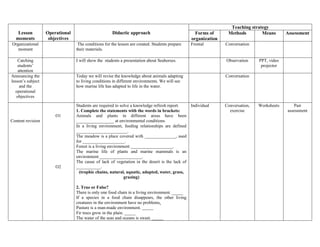
O1
O2
Students are required to solve a knowledge refresh report.
1. Complete the statements with the words in brackets:
Animals and plants in different areas have been
_________________ at environmental conditions.
In a living environment, feeding relationships are defined
_______________________.
The meadow is a place covered with ______________, used
for ___________________.
Forest is a living environment ___________________.
The marine life of plants and marine mammals is an
environment ___________________.
The cause of lack of vegetation in the desert is the lack of
___________.
(trophic chains, natural, aquatic, adapted, water, grass,
grazing)
2. True or False?
There is only one food chain in a living environment. _____
If a species in a food chain disappears, the other living
creatures in the environment have no problems.
Pasture is a man-made environment. _____
Fir trees grow in the plain. _____
The water of the seas and oceans is sweet. _____
Individual Conversation,
exercise
Worksheets Pair
assessment
O3
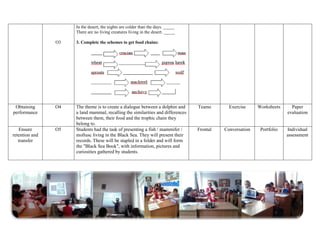
In the desert, the nights are colder than the days. _____
There are no living creatures living in the desert. _____
3. Complete the schemes to get food chains:
Obtaining
performance
O4 The theme is to create a dialogue between a dolphin and
a land mammal, recalling the similarities and differences
between them, their food and the trophic chain they
belong to.
Teams Exercise Worksheets Paper
evaluation
Ensure
retention and
transfer
O5 Students had the task of presenting a fish / mammifer /
mollusc living in the Black Sea. They will present their
records. These will be stapled in a folder and will form
the "Black Sea Book", with information, pictures and
curiosities gathered by students.
Frontal Conversation Portfolio Individual
assessment
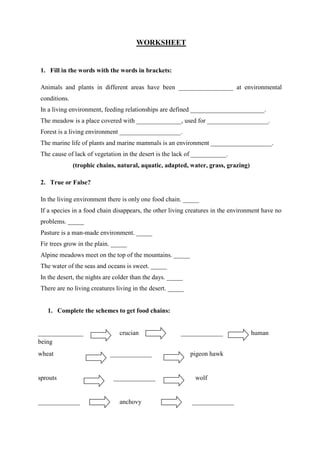
WORKSHEET
1. Fill in the words with the words in brackets:
Animals and plants in different areas have been _________________ at environmental
conditions.
In a living environment, feeding relationships are defined _______________________.
The meadow is a place covered with ______________, used for ___________________.
Forest is a living environment ___________________.
The marine life of plants and marine mammals is an environment ___________________.
The cause of lack of vegetation in the desert is the lack of ___________.
(trophic chains, natural, aquatic, adapted, water, grass, grazing)
2. True or False?
In the living environment there is only one food chain. _____
If a species in a food chain disappears, the other living creatures in the environment have no
problems. _____
Pasture is a man-made environment. _____
Fir trees grow in the plain. _____
Alpine meadows meet on the top of the mountains. _____
The water of the seas and oceans is sweet. _____
In the desert, the nights are colder than the days. _____
There are no living creatures living in the desert. _____
1. Complete the schemes to get food chains:
______________ crucian _____________ human
being
wheat _____________ pigeon hawk
sprouts _____________ wolf
_____________ anchovy _____________
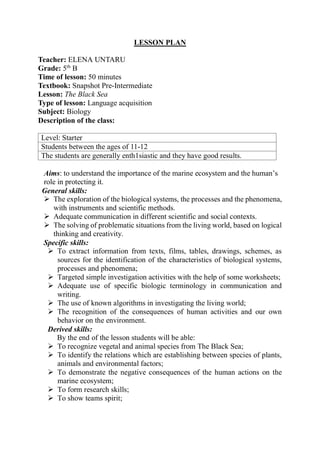
LESSON PLAN
Teacher: ELENA UNTARU
Grade: 5th
B
Time of lesson: 50 minutes
Textbook: Snapshot Pre-Intermediate
Lesson: The Black Sea
Type of lesson: Language acquisition
Subject: Biology
Description of the class:
Level: Starter
Students between the ages of 11-12
The students are generally enth1siastic and they have good results.
Aims: to understand the importance of the marine ecosystem and the human’s
role in protecting it.
General skills:
 The exploration of the biological systems, the processes and the phenomena,
with instruments and scientific methods.
 Adequate communication in different scientific and social contexts.
 The solving of problematic situations from the living world, based on logical
thinking and creativity.
Specific skills:
 To extract information from texts, films, tables, drawings, schemes, as
sources for the identification of the characteristics of biological systems,
processes and phenomena;
 Targeted simple investigation activities with the help of some worksheets;
 Adequate use of specific biologic terminology in communication and
writing.
 The use of known algorithms in investigating the living world;
 The recognition of the consequences of human activities and our own
behavior on the environment.
Derived skills:
By the end of the lesson students will be able:
 To recognize vegetal and animal species from The Black Sea;
 To identify the relations which are establishing between species of plants,
animals and environmental factors;
 To demonstrate the negative consequences of the human actions on the
marine ecosystem;
 To form research skills;
 To show teams spirit;
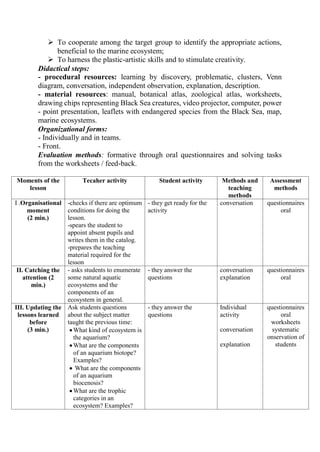
 To cooperate among the target group to identify the appropriate actions,
beneficial to the marine ecosystem;
 To harness the plastic-artistic skills and to stimulate creativity.
Didactical steps:
- procedural resources: learning by discovery, problematic, clusters, Venn
diagram, conversation, independent observation, explanation, description.
- material resources: manual, botanical atlas, zoological atlas, worksheets,
drawing chips representing Black Sea creatures, video projector, computer, power
- point presentation, leaflets with endangered species from the Black Sea, map,
marine ecosystems.
Organizational forms:
- Individually and in teams.
- Front.
Evaluation methods: formative through oral questionnaires and solving tasks
from the worksheets / feed-back.
Moments of the
lesson
Tecaher activity Student activity Methods and
teaching
methods
Assessment
methods
I .Organisational
moment
(2 min.)
-checks if there are optimum
conditions for doing the
lesson.
-spears the student to
appoint absent pupils and
writes them in the catalog.
-prepares the teaching
material required for the
lesson
- they get ready for the
activity
conversation questionnaires
oral
II. Catching the
attention (2
min.)
- asks students to enumerate
some natural aquatic
ecosystems and the
components of an
ecosystem in general.
- they answer the
questions
conversation
explanation
questionnaires
oral
III. Updating the
lessons learned
before
(3 min.)
Ask students questions
about the subject matter
taught the previous time:
What kind of ecosystem is
the aquarium?
What are the components
of an aquarium biotope?
Examples?
 What are the components
of an aquarium
biocenosis?
What are the trophic
categories in an
ecosystem? Examples?
- they answer the
questions
Individual
activity
conversation
explanation
questionnaires
oral
worksheets
systematic
onservation of
students
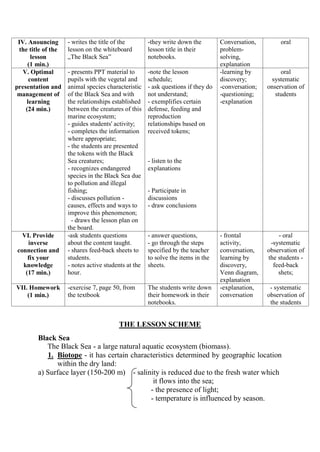
IV. Anouncing
the title of the
lesson
(1 min.)
- writes the title of the
lesson on the whiteboard
„The Black Sea”
-they write down the
lesson title in their
notebooks.
Conversation,
problem-
solving,
explanation
oral
V. Optimal
content
presentation and
management of
learning
(24 min.)
- presents PPT material to
pupils with the vegetal and
animal species characteristic
of the Black Sea and with
the relationships established
between the creatures of this
marine ecosystem;
- guides students' activity;
- completes the information
where appropriate;
- the students are presented
the tokens with the Black
Sea creatures;
- recognizes endangered
species in the Black Sea due
to pollution and illegal
fishing;
- discusses pollution -
causes, effects and ways to
improve this phenomenon;
- draws the lesson plan on
the board.
-note the lesson
schedule;
- ask questions if they do
not understand;
- exemplifies certain
defense, feeding and
reproduction
relationships based on
received tokens;
- listen to the
explanations
- Participate in
discussions
- draw conclusions
-learning by
discovery;
-conversation;
-questioning;
-explanation
oral
systematic
onservation of
students
VI. Provide
inverse
connection and
fix your
knowledge
(17 min.)
-ask students questions
about the content taught.
- shares feed-back sheets to
students.
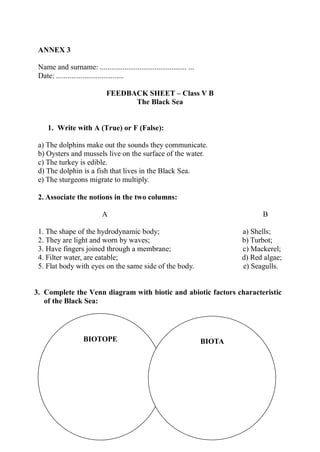
- notes active students at the
hour.
- answer questions,
- go through the steps
specified by the teacher
to solve the items in the
sheets.
- frontal
activity,
conversation,
learning by
discovery,
Venn diagram,
explanation
- oral
-systematic
observation of
the students -
feed-back
shets;
VII. Homework
(1 min.)
-exercise 7, page 50, from
the textbook
The students write down
their homework in their
notebooks.
-explanation,
conversation
- systematic
observation of
the students
THE LESSON SCHEME
Black Sea
The Black Sea - a large natural aquatic ecosystem (biomass).
1. Biotope - it has certain characteristics determined by geographic location
within the dry land:
a) Surface layer (150-200 m) - salinity is reduced due to the fresh water which
it flows into the sea;
- the presence of light;
- temperature is influenced by season.
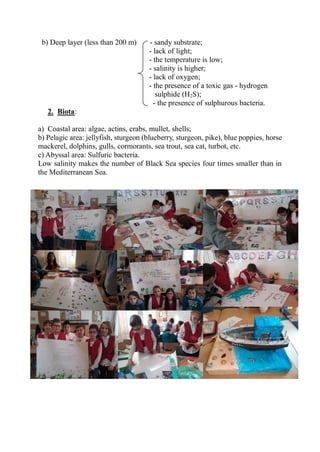
b) Deep layer (less than 200 m) - sandy substrate;
- lack of light;
- the temperature is low;
- salinity is higher;
- lack of oxygen;
- the presence of a toxic gas - hydrogen
sulphide (H2S);
- the presence of sulphurous bacteria.
2. Biota:
a) Coastal area: algae, actins, crabs, mullet, shells;
b) Pelagic area: jellyfish, sturgeon (blueberry, sturgeon, pike), blue poppies, horse
mackerel, dolphins, gulls, cormorants, sea trout, sea cat, turbot, etc.
c) Abyssal area: Sulfuric bacteria.
Low salinity makes the number of Black Sea species four times smaller than in
the Mediterranean Sea.
Annex 1
DOCUMENTATION SHEET - CLASS V B
The Black Sea
The Black Sea is highlighted by a number of unique hydrological aspects in the world, being
a remnant of the Sarmatic Sea, which millions of years ago stretched from the center of Asia to
central Europe. These peculiarities relate to salty waters with a very low salinity, 16-18 grams
of salt per liter compared to the other seas and oceans that have 34-37 grams per liter, and to
stratification of water, surface are oxygenated with deep ones that are anoxic. Salinity in the
Romanian seaside area is even lower.
• It is the largest anoxic aquatic structure on the planet, that is, with the lowest oxygen
content in some layers, and in others even without. Over 90% of the Black Sea water is devoid
of oxygen because of the large amount of sediment and increased density that prevents the
surface layers from transferring oxygen from the atmosphere to the deep ones. Thus, at depths
of over 200 meters, there is no longer oxygen, and the water temperature has a constant value
of 9 degrees Celsius, so the only existing species are anaerobic bacteria. These sulphurous
bacteria play an essential role in ensuring life in this sea, by oxidizing the entire amount of
hydrogen sulfide in the deep layers, leaving it to turn the Black Sea into a dead sea.
• It has a stretch of 423,488 square kilometers, and the maximum depth is 2,211 meters
and is reached near the seashore in the part of Turkey. The marshes that are produced are of
small amplitude generally, and the largest amount of water that feeds it comes from the
freshwater flowing into it, hence the reduced salinity, then the atmospheric precipitation.
• Because its very low salinity makes it unique. Because it is not as salty as it should be,
biodiversity suffers. Here many marine animals do not live, they need a certain percentage of
salt to survive, at least 20%. In it live 149 species of fish and only three species of marine
mammals, the best known of them are dolphins. Here lives a fish called Squalus acantius, which
is part of the dreamy family of sharks. He lives at about 20 km from the shore, at depths of 20-
80 m and does not attack man.
• It is considered the youngest in the world, her training being estimated by specialists
somewhere in the period of the Mesozoic. It is assumed that there have been land hoards that
led to the disappearance of the Tethys Ocean and several smaller aquatic basins such as the
Caspian Sea, the Mediterranean Sea and the Black Sea.
• It was named by the ancient Greeks who settled and founded fortresses on its shore
"Pontos Euxeinos", and by the Romans "Pontus Euxinus", which means Hospice Sea. Because
it is darker, and in the storm it becomes dark, later it was called the Black Sea. On its coasts, in
part of Turkey, some of the last speakers of an ancient Pontic Greek dialect still live, because
most of the Greeks settled there have gone to Greece after the First World War.
• Due to the non-oxygenated water layer on the bottom of the aquatic basin, it is the only
sea in the world where a sinking pot has been preserved in perfect condition for a very long
time, namely, from the Byzantine Empire to the present.
• At 45 kilometers northwest of Sulina, near the Serpent Island, it is said that there is a
mysterious Bermuda Triangle, also called "death," which few know. The first accounts of this
mysterious area, which they call the Death Wind, made them the Turks, signaling surprising
disappearances in relatively quiet waters in the daylight. Other strange stories are the Russians
from the 13th and 14th centuries, who are talking about a "white whirlwind" that dragged deep
birds, ships and even small islands. NASA confirms the existence of magnetic anomalies in the
Black Sea, following a study conducted with Harvard researchers. There are also reports of
pathogenic radiation, known since antiquity.
Bibliography: http://www.almanahonline.ro
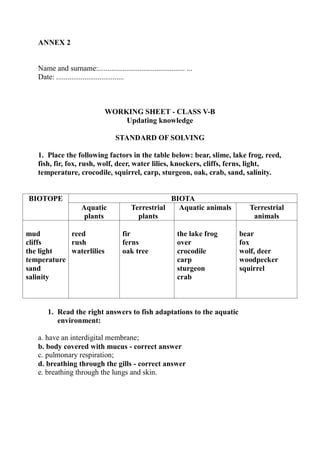
ANNEX 2
Name and surname: .............................................. ...
Date: ....................................
WORKING DOCUMENT - CLASS V-B
Updating knowledge
1. Place the following factors in the table below: bear, slime, lake frog, reed,
fish, fir, fox, rush, wolf, deer, water lilies, knockers, cliffs, ferns, light, temperature,
crocodile, squirrel, carp, sturgeon, oak, crab, sand, salinity.
BIOTOPE BIOTA
Aquatic plants Terrestrila plants Aquatic animals Terrestrial animals
2. Circle the right answers with connection to fish adaptations to the aquatic
environment:
a. have an interdigital membrane;
b. body covered with mucus;
c. pulmonary respiration;
d. breathing through the gills;
e. breathing through the lungs and skin.
ANNEX 3
Name and surname: .............................................. ...
Date: ....................................
FEEDBACK SHEET – Class V B
The Black Sea
1. Write with A (True) or F (False):
a) The dolphins make out the sounds they communicate.
b) Oysters and mussels live on the surface of the water.
c) The turkey is edible.
d) The dolphin is a fish that lives in the Black Sea.
e) The sturgeons migrate to multiply.
2. Associate the notions in the two columns:
A B
1. The shape of the hydrodynamic body; a) Shells;
2. They are light and worn by waves; b) Turbot;
3. Have fingers joined through a membrane; c) Mackerel;
4. Filter water, are eatable; d) Red algae;
5. Flat body with eyes on the same side of the body. e) Seagulls.
3. Complete the Venn diagram with biotic and abiotic factors characteristic
of the Black Sea:
BIOTOPE BIOTA
ANNEX 2
Name and surname:.............................................. ...
Date: ....................................
WORKING SHEET - CLASS V-B
Updating knowledge
STANDARD OF SOLVING
1. Place the following factors in the table below: bear, slime, lake frog, reed,
fish, fir, fox, rush, wolf, deer, water lilies, knockers, cliffs, ferns, light,
temperature, crocodile, squirrel, carp, sturgeon, oak, crab, sand, salinity.
BIOTOPE BIOTA
Aquatic
plants
Terrestrial
plants
Aquatic animals Terrestrial
animals
mud
cliffs
the light
temperature
sand
salinity
reed
rush
waterlilies
fir
ferns
oak tree
the lake frog
over
crocodile
carp
sturgeon
crab
bear
fox
wolf, deer
woodpecker
squirrel
1. Read the right answers to fish adaptations to the aquatic
environment:
a. have an interdigital membrane;
b. body covered with mucus - correct answer
c. pulmonary respiration;
d. breathing through the gills - correct answer
e. breathing through the lungs and skin.
ANNEX 3
Name and surname: .............................................. ...
Date: ....................................
FEED-BACK SHEET - V-Class B
Black Sea
STANDARD OF SOLVING
1. Write with A (True) or F (False):
a) The dolphins make out the sounds they communicate. A
b) Oysters and mussels live on the surface of the water. F
c) The turkey is edible. A
d) The dolphin is a fish that lives in the Black Sea. F
e) The sturgeons migrate to multiply. A
2. Associate the notions in the two columns:
A B
1.Form of hydrodynamic body; a) Shell;
2. They are light and worn by waves; b) Turbot;
3. Fingers joined by a membrane; c) Mackerel;
4.Filter water, are edible; d) Red algae;
5. Flat, eyes on the same side of the body. e) Seagulls.
Solution: 1-c, 2-d, 3-e, 4-a, 5-b
4. Complete the Venn diagram with biotic and abiotic factors characteristic
of the Black Sea:
BIOTOPE
- Surface layer (150-200m) -
salinity is reduced, the
presence of light, the
temperature influenced by
the season, O2 present.
- Deep layer (less than 200m)
- sandy substrate, lack of
light, low temperature, lack
of O2, the presence of toxic
gas H2S, sulfurous bacteria,
salinity is higher
BIOTA
- algae, actins, crabs,
guvids, shells;
- jellyfish, sturgeons
(blueberry, sturgeon,
stingray), blue poppies,
horse mackerel, dolphins,
gulls, cormorants, sea
bass, sea cat, turbot.
- sulphurous bacteria
LESSON PLAN
Teacher: Ionel Nedelcu
Class: 8th
B
Type: vocabulary class
Time: 50 minutes
Objective: Practice of English language
STRUCTURES:
 Vocabulary related to environment
FUNCTIONS/COMMUNICATION:
 Ask for and make suggestions, agree and disagree
SKILLS: reading, comprehension of a text, speaking
AIMS:
 students practice vocabulary related to environment;
 students understand the life of the sea turtles
 students become familiar with expressing opinions on environment and
tourism
OBJECTIVES
Cognitive: by the end of the lesson students will be able to:
 to generate their own oral messages (at least two) using the new vocabulary
 understand and react adequately to questions and statements;
 express information explicitly;
 understand, produce and use the stated information;
Affective:
 making students confident in their ability to use the language;
 creating interest in the topic of the lesson;
 creating a relaxed atmosphere, proper for studying;
 foster learner independence and cooperative learning;
 stimulating students’ imagination and creativity;
 having fun.
Operational:
 to learn how to use the vocabulary related to environment;
 to produce ideas for debating on the tourist behavior regarding protected
species or areas on their own;
 to identify and use the elements related to environment.
TEACHING AIDS:
 Whiteboard
 Film
 Images
TEACHING METHODS AND TECHNIQUES:
 Communicative approach
 Exercise; questions and answers; fact file filling exercise; sentence writing;
conversation; debates; film and image presentation
ORGANIZATION AND TIME:
 Whole class
 Individual and pair work
 50’
ASSUMPTIONS:
I assume that part of the vocabulary to be taught is already known to my
students.
ANTICIPATED PROBLEMS:
Students may have problems using the new vocabulary and the specific terms
related to the environment.
Teaching scenario
Step Time
1. Class Warm-up: greeting, situational conversation 2 minutes
2. Class Development
 The teacher plays a short film about sea turtles and asks the students a few
questions about their life and habits. The teacher invites the students to find
out more information about the topic by reading the text “Sea turtles in
danger” from page 92.
10 minutes
 The teacher asks the students to identify the new and unknown words from
the text and explains them.
5 minutes
 The teacher asks the students to identify the words with similar meaning to
the words from exercise 1a from page 93.
15 minutes
 The teacher verifies if the students understood the main facts of the text by
asking them to complete the fact file about turtles (exercise 1b page 93) and
by asking them the questions from exercise 1c page 93.
 The teacher asks the students about some protected species or protected
areas in Romania and later he gives examples with bison, sturgeon,
edelweiss and bustard (as endangered species) and Danube Delta, Retezat
Mountains, Cerna Valley (protected areas), all presented in images.
5 minutes
 The teacher asks the students to think about the “dos” and “don’ts” for
every tourist visiting a protected area or encountering any protected species
which they are to present
10 minutes
3. Evaluation: The teacher asks the students what they liked about the topic
and the ideas they consider useful.
2 minutes
4. Conclusion:
The teacher asks the students to write down the 10 commandments of a good
tourist.
1 minute
LESSON PLAN
Teacher: LENUŢA ṢTEFAN
Grade: 5th
grade
Time of lesson: 50 minutes
Lesson: Optional course – The sea – from legend to art
Type of lesson: mixt
Subject: Closer to our sea – The Marine Ecosystem
GENERAL SKILLS:
1. Understanding the problems of marine ecosystems through
interdisciplinary lessons;
2. Stimulate motivation to explore the natural values of the sea from the
cultural and artistic perspective.
SPECIFIC SKILLS:
- Involving students in research activities for knowledge and understanding
the natural and social environment, stimulating interest in its investigation;
Related Content: documentation on Marine Ecosystems; creating a mini-journal
with information on marine flora and fauna; developing ICT skills
Related Content: producing informative materials; developing sensitivity,
imagination and artistic creativity.
Associated content: writing, individually and / or in a team, of artistic creations:
acrostics, quintet.
OPERATIONAL OBJECTIVES:
At the end of the teaching activity, students will be able to:
I. COGNITIVE:
1: provide information about the marine ecosystem;
2: to make an electronic journalist with information about marine flora
and fauna;
3: create acrostics and quintets with the theme Deep World;
II. AFFECTIVE:
1: to show curiosity and interest in documentary work;
2: to participate with interest in the act of communication.
TEACHING STRATEGIES:
METHODS: heuristic conversation, frontal activity, alternating with independent,
individual activity; activity on groups.
COMMUNICATION TECHNIQUES: didactic play, rebus.
MEANS: worksheets, marker, video projector.
RESOURCES:
1. content - according to the program;
2. student learning capacity - homogeneous class, with sufficient learning
resources;
3. venue - CORAL Hall;
4. time - one course hour (50 minutes).
TYPES OF EVALUATION: systematic observation, frontal questionnaire, self-
evaluation.
THE TEACHING SCENARIO
LESSON EVENTS CONTENT METHODS DIDACTIC
MATERIALS
FORMS OF
ASSESSMENT
I. EVOCATION
1. Organizational
moment
Preparing the necessary things needed for the
lesson, providing the right climate for the class.
Conversation
2. Checking the
homework and
updating the
knowledge
previously
learned
The knowledge about the marine ecosystem
is updated through a ppt presentation.
Conversation
3. Capturing
attention
A rebus is completed, based on the previously
acquired knowledge - the Marine Universe
Didactic game
Reflection
(critical
thinking)
Observation
II. REALIZING
SENSE
1. Announcement
of the topic and
stating the
objectives
The teacher tells the students that they will
develop a mini-journal with information on marine
flora and fauna.
Also at this stage the competences that will be
achieved in the didactic approach will be stated.
Exposure Observation
2. Driving
learning and
acquiring new
knowledge
The didactic approach will be done by groups.
On each table there will be notebooks, portfolios,
sheets, marker.
On the interactive whiteboard, the
minidictionary with information about marine flora
and fauna, in PowerPoint format, will gradually be
created in images and words. The students will also
use the Vocaroo Tutorial to record the results.
In the end, each group will create acrostics and
quintets with the theme "The World in the Deep,"
which will be displayed on the whiteboard
Group activity
Explanation
Quintet
Acrostics
Worksheets,
portfolios,
sheets of
paper, marker.
Observation
Oral
questionning
III.
REFLECTION
1.Maintaining
performance and
ensurring
feedback.
Feedback takes place permanently during the
didactic process and takes place through verbal
appreciations made by the teacher.
2. Ensure
retention and
transfer
The homework is directed, giving the necessary
explanations. The students have to write narrative
compositions, in which the characters must be
marine animals.
Written
exercises
Individual
3. General
Appreciations
General and / or individual, positive and / or
negative appreciations are made both during the
lesson and at the end of it.
Proffesor’s
appreciation
Final
questionning
LESSON PLAN
Teacher: FLORENTINA MIHAELA DELI-IORGA
Grade: 4th
STEP BY STEP
Time of lesson: 45 minutes
Textbook: Fairyland 4, Express Publishing
Lesson: Sea animals
Type of lesson: vocabulary acquisition
Description of the class:
Level: Starter
Students between the ages of 10-11
The students are generally enthusiastic and they have good results.
Aims: By the end of the lesson students will be able to identify and talk about sea
animals.
Objectives:
1. To encourage communication;
2. To enrich knowledge of words related to sea animals
3. To develop Ss' reading and speaking skills
4. To allow students to practice speaking spontaneously and fluently about
something that may provoke the use of words and phrases they have been
learning recently
5. To provide practice of the words studied before.
6. To allow students to practice listening abilities
Materials:
Textbooks
Whiteboard
Worksheets
Video player
Activity 1: Warm-up ( 5 min)
Objective: To encourage communication.
Context: Students’ own experience
Procedure: The teacher checks the homework. Then she provides a situational context
to introduce the topic of the lesson by asking the students if they know anything about
the ocean, its inhabitants and the dangers affecting it.
Aids: notebooks, whiteboard, textbook
Language: all and any
Possible problems: Students may have some problems in expressing themselves
correctly.
Activity 2: (Estimated time: 10 minutes)
Objective: To enrich knowledge of words related to sea animals
Context: students’ own knowledge
Procedure: The teacher shows the students a ppt presentation on marine animals. The
student write down the new words in their notebooks.
Aids: textbook, computer, video player.
Language: all and any
Possible problems: Because of some students’ low level of knowledge some words may
not be understood properly.
Activity 3: (Estimated time: 5 minutes)
Objective: To develop Ss' reading and speaking skills
Context: students’ own knowledge
Procedure: The teacher asks the students to take a look at exercise 1 on page 21 from
the textbook. They should read, translate and match the descriptions with the names of
the animals on their right.
Aids: textbook, computer, video player.
Language: all and any
Possible problems: Because of some students’ low level of knowledge some words
cannot be translated properly.
Activity 4: (Estimated time: 5 minutes)
Objective: To allow students to practice speaking spontaneously and fluently about
something that may provoke the use of words and phrases they have been learning
recently
Context: students’ own experience
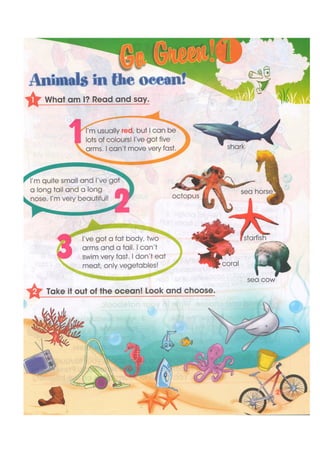
Procedure: The teacher asks the students to look carefully at exercise 2 page 21 from
the textbook. The pupils are asked to take out all the things that mustn’t be in the ocean
together with the sea animals.
Aids: whiteboard, textbooks
Language: all and any
Possible problems: Students may have some problems in expressing themselves
correctly.
Activity 5: (Estimated time: 15 minutes)
Objective: To provide practice of the words studied before.
Context: students’ own experience
Procedure: The students are given some worksheets. They have to solve the exercises,
like unscrambling words, guessing the word, directed gap filling, etc.
Aids: worksheet
Language: all and any
Possible problems: Students may make some mistakes or may not manage to provide a
correct answer.
Activity 6: (Estimated time: 5 minutes)
Objective: To allow students to practice listening abilities
Context: students’ own experience
Procedure: Students are going to listen again to a song about animals and their actions
(The animals down in the ocean), and they will sing it together with their teacher.
Aids: textbook
Language: all and any
Possible problems: The students may not understand all the words.
Homework: exercise 1, page 22
Bibliography:
 www.busyteacher.org
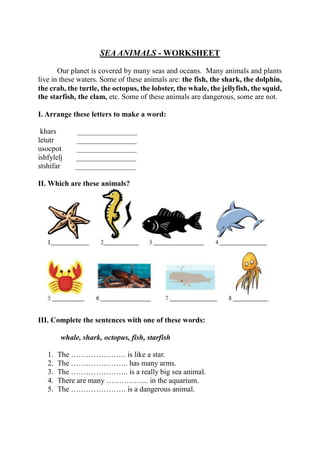
SEA ANIMALS - WORKSHEET
Our planet is covered by many seas and oceans. Many animals and plants
live in these waters. Some of these animals are: the fish, the shark, the dolphin,
the crab, the turtle, the octopus, the lobster, the whale, the jellyfish, the squid,
the starfish, the clam, etc. Some of these animals are dangerous, some are not.
I. Arrange these letters to make a word:
khars ________________
letutr ________________
usocpot ________________
ishfylelj ________________
stshifar ________________
II. Which are these animals?
III. Complete the sentences with one of these words:
whale, shark, octopus, fish, starfish
1. The …………………. is like a star.
2. The ………………….. has many arms.
3. The ………………….. is a really big sea animal.
4. There are many …………….. in the aquarium.
5. The …………………. is a dangerous animal.
LESSON PLAN
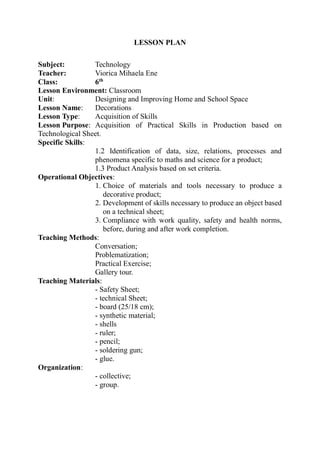
Subject: Technology
Teacher: Viorica Mihaela Ene
Class: 6th
Lesson Environment: Classroom
Unit: Designing and Improving Home and School Space
Lesson Name: Decorations
Lesson Type: Acquisition of Skills
Lesson Purpose: Acquisition of Practical Skills in Production based on
Technological Sheet.
Specific Skills:
1.2 Identification of data, size, relations, processes and
phenomena specific to maths and science for a product;
1.3 Product Analysis based on set criteria.
Operational Objectives:
1. Choice of materials and tools necessary to produce a
decorative product;
2. Development of skills necessary to produce an object based
on a technical sheet;
3. Compliance with work quality, safety and health norms,
before, during and after work completion.
Teaching Methods:
Conversation;
Problematization;
Practical Exercise;
Gallery tour.
Teaching Materials:
- Safety Sheet;
- technical Sheet;
- board (25/18 cm);
- synthetic material;
- shells
- ruler;
- pencil;
- soldering gun;
- glue.
Organization:
- collective;
- group.
Lesson
Sequence
Time
Operational
Objectives
Activities Teaching
Methods
Teaching
Materials
Assessment
Lesson
Organization
Comment
sTeacher Student
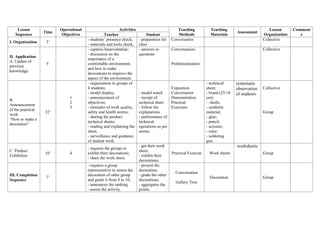
I. Organization 3’
- students’ presence check;
- materials and tools check;
- preparation for
class
Conversation Collective
II. Application
A. Update of
previous
knowledge:
5’
- captatio benevolentiae;
- discussion on the
importance of a
comfortable environment,
and how to make
decorations to improve the
aspect of the environment.
- answers to
questions
Conversations
Problematization
Collective
B.
Announcement
of the practical
work
“How to make a
decoration”
22’
1
2
3
- organization in groups of
4 students;
- model display;
- announcement of
objectives;
- reminder of work quality,
safety and health norms;
- sharing the product
technical sheets;
- reading and explaining the
sheet;
- surveillance and guidance
of student work.
- model watch
- receipt of
technical sheet
- follow the
explanations
- performance of
technical
operations as per
norms.
Exposition
Conversation
Demonstration
Practical
Exercises
- technical
sheet;
- board (25/18
cm);
- shells;
- synthetic
material;
- glue;
- pencil;
- scissors;
- ruler;
- soldering
gun.
systematic
observation
of students
Collective
Group
C. Product
Exhibition
10’ 4
- requires the groups to
exhibit their decorations;
- share the work sheet.
- get their work
sheet;
- exhibit their
decorations.
Practical Exercise Work sheets
worksheets
Group
III. Completion
Sequence
7’
- requires a group
representative to assess the
decoration of other group
and grade it from 8 to 10;
- announces the ranking
- assess the activity.
- present the
decoration;
- grade the other
decorations;
- aggregates the
points.
Conversation
Gallery Tour
Decoration Group
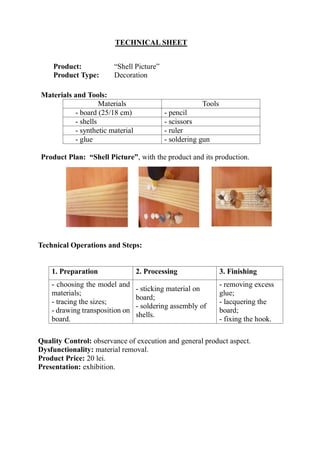
TECHNICAL SHEET
Product: “Shell Picture”
Product Type: Decoration
Technical Operations and Steps:
1. Preparation 2. Processing 3. Finishing
- choosing the model and
materials;
- tracing the sizes;
- drawing transposition on
board.
- sticking material on
board;
- soldering assembly of
shells.
- removing excess
glue;
- lacquering the
board;
- fixing the hook.
Quality Control: observance of execution and general product aspect.
Dysfunctionality: material removal.
Product Price: 20 lei.
Presentation: exhibition.
Materials and Tools:
Materials Tools
- board (25/18 cm) - pencil
- shells - scissors
- synthetic material - ruler
- glue - soldering gun
Product Plan: “Shell Picture”, with the product and its production.
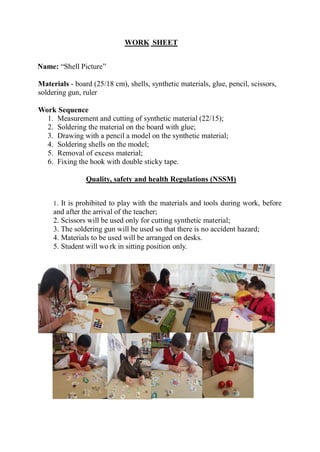
WORK SHEET
Name: “Shell Picture”
Materials - board (25/18 cm), shells, synthetic materials, glue, pencil, scissors,
soldering gun, ruler
Work Sequence
1. Measurement and cutting of synthetic material (22/15);
2. Soldering the material on the board with glue;
3. Drawing with a pencil a model on the synthetic material;
4. Soldering shells on the model;
5. Removal of excess material;
6. Fixing the hook with double sticky tape.
Quality, safety and health Regulations (NSSM)
1. It is prohibited to play with the materials and tools during work, before
and after the arrival of the teacher;
2. Scissors will be used only for cutting synthetic material;
3. The soldering gun will be used so that there is no accident hazard;
4. Materials to be used will be arranged on desks.
5. Student will wo rk in sitting position only.
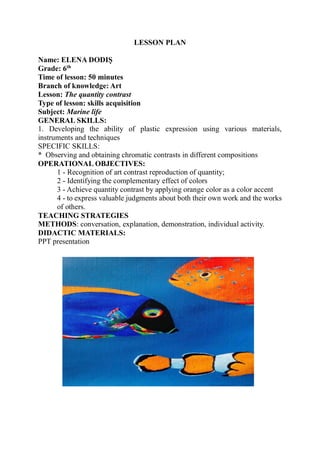
LESSON PLAN
Name: ELENA DODIṢ
Grade: 6th
Time of lesson: 50 minutes
Branch of knowledge: Art
Lesson: The quantity contrast
Type of lesson: skills acquisition
Subject: Marine life
GENERAL SKILLS:
1. Developing the ability of plastic expression using various materials,
instruments and techniques
SPECIFIC SKILLS:
* Observing and obtaining chromatic contrasts in different compositions
OPERATIONAL OBJECTIVES:
1 - Recognition of art contrast reproduction of quantity;
2 - Identifying the complementary effect of colors
3 - Achieve quantity contrast by applying orange color as a color accent
4 - to express valuable judgments about both their own work and the works
of others.
TEACHING STRATEGIES
METHODS: conversation, explanation, demonstration, individual activity.
DIDACTIC MATERIALS:
PPT presentation
THE TEACHING SCENARIO
SKILLS TIME LESSON EVENTS SCIENTIFIC CONTENT DIDACTICAL
STRATEGIES
FORMS OF
ASSESSMENT
2 min
Organizational moment Preparing the required teaching material;
Ensuring discipline;
Appointment of absences;
Conversation
1 2 min Capturing attention Do you remember what work you made last time?
What was our theme? Conversation
Frontal and
individual
1
2
3 min
15 min
Checking the homework
Announcement of the
topic and teaching it
Brief presentation of the requirements of the theme:
Today we will talk about the contrast of quantity and we will make a
work with the subject "Underwater Life"
Then, yje teacher explains to the students the processes to reach that
requirement;
The idea of contrast is very well illustrated by the alternation of day and
night, winter summer, cold hot. Contrast is defined as a strong
opposition between two or more elements, states, actions.
The contrast of the quantity represents the opposition between a lot –
little, big – small.. It is the contrast of 2 or more spots, different in size.
The quantity contrast says: which is less is more obvious than what is
more. You can use this to create the center of interest in your drawing,
that climax that any story needs and without which it would be totally
uninteresting.
You can use it together with the complementary contrast.
So ,we will do today a work with the subject "Underwater Life".
- PPT material is presented;
The teacher explains the misunderstood terms and the pursuit of a good
work. Each student is trained and given individual or general
instructions.
Explanation
Observation
Conversation
Demostration
Frontal and
individual
3
4
25 min The practical work of
students
Students are asked to work, explaining any possible concerns. Independent
work
Individual
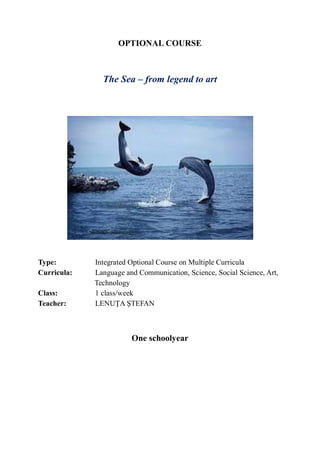
OPTIONAL COURSE
The Sea – from legend to art
Type: Integrated Optional Course on Multiple Curricula
Curricula: Language and Communication, Science, Social Science, Art,
Technology
Class: 1 class/week
Teacher: LENUŢA ŞTEFAN
One schoolyear
Optional Class Curriculum
“The Sea – from legend to art”
5th Grade
INTEGRATED CURRICULUM FOR ROMANIAN, BIOLOGY,
GEOGRAPHY, HISTORY, ART AND TECHNOLOGY
ARGUMENT
In order to enjoy the priceless feature of childhood – the spirit of observation
and investigation, ingenuity, fantasy, imagination – I have opted for a multi-
curricular optional course, to formulate objectives which are common to multiple
disciplines.
The optional course The Sea – From Legend to Art was designed to integrate
into the school curriculum the topic of the Erasmus+ Project, Once upon a time …
the SEA, and it addresses to 5th graders who will have the opportunity to involve
in inter-discipline documenting activities, which will lead to producing auxiliary
teaching materials necessary to increase the attractivity of classes. The activities
will include innovative methods and techniques specific to student education and
adapted to their particulars, interactive methods to stimulate motivation, creativity
and involvement in class (discovery, role play, projects, individual and group
activity).
Originality, creativity, free expression of students’ feelings and impressions
will be means to solve the mystery and beauty of marine universe, illustrated in a
mini-dictionary with information on marine flora and fauna or posters, pictures,
photos, brochures with food recipes and literary creations as legends, stories,
poems, educational games and multimedia presentations.
Activities such as Sea – Source of inspiration in art (music, painting, photo,
cinema), Marine Life Carnival, and literary creations published as Sea Poetry,
The Sea in Stories and Legends, will stimulate motivation to explore natural
features of the sea in culture and art. A poster gallery on marine environment
protection, Together for the Sea!, and the creation of slogans with an awareness
campaign on the importance of an healthy marine environment, as well as
cleaning campaigns will provide the formation of a responsible ecological, social
and civic behaviour.
GENERAL SKILLS
1. Understanding the marine ecosystem issues via inter-disciplinary lessons;
2. Stimulation of learning motivation via cultural – artistic exploration of the
sea natural features.
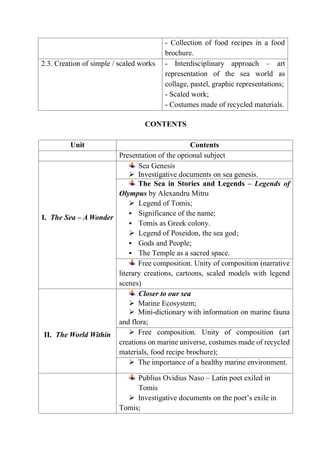
SPECIFIC SKILLS AND LEARNING ACTIVITIES
1. Understanding the marine ecosystem issues via inter-disciplinary lessons
SPECIFIC SKILLS LEARNING ACTIVITIES
1.1. Involving students in research
activities to know and understand the
natural and social environment and
stimulate interest in investigating it;
- documentation on the sea genesis,
marine ecosystem, ports and tourist
destination on the Mediterranean and
Black Sea, respectively Ovid’s exile,
the sea as source of artistic inspiration;
- Creating a mini-dictionary with
information of the marine flora and
fauna.
1.2. Forming marine protection skills; - creation of slogans, awareness
campaign on the importance of a
healthy marine environment;
- cleaning campaigns;
1.3. IT&C Skill Development Workshops (information materials;
presentation of outputs).
2. Stimulation of motivation to explore sea natural values from cultural –
artistic perspective
SPECIFIC SKILLS LEARNING ACTIVITIES
2.1. Presentation of personal creative
and critical opinions based on given
texts or art creations
- Selective, explanatory reading;
- Expression of viewpoints on a given
topic.
2.2. Development of artistic
imagination and creativity;
- Cartoons with legend scenes;
- Roleplay;
- individual or group creation of fiction
/ short plays about the sea;
- Collection of food recipes in a food
brochure.
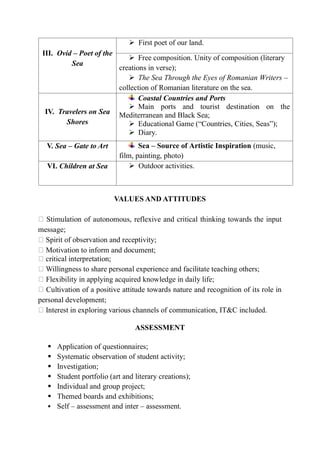
2.3. Creation of simple / scaled works - Interdisciplinary approach – art
representation of the sea world as
collage, pastel, graphic representations;
- Scaled work;
- Costumes made of recycled materials.
CONTENTS
Unit Contents
Presentation of the optional subject
I. The Sea – A Wonder
Sea Genesis
 Investigative documents on sea genesis.
The Sea in Stories and Legends – Legends of
Olympus by Alexandru Mitru
 Legend of Tomis;
 Significance of the name;
 Tomis as Greek colony.
 Legend of Poseidon, the sea god;
 Gods and People;
 The Temple as a sacred space.
Free composition. Unity of composition (narrative
literary creations, cartoons, scaled models with legend
scenes)
II. The World Within
Closer to our sea
 Marine Ecosystem;
 Mini-dictionary with information on marine fauna
and flora;
 Free composition. Unity of composition (art
creations on marine universe, costumes made of recycled
materials, food recipe brochure);
 The importance of a healthy marine environment.
Publius Ovidius Naso – Latin poet exiled in
Tomis
 Investigative documents on the poet’s exile in
Tomis;
III. Ovid – Poet of the
Sea
 First poet of our land.
 Free composition. Unity of composition (literary
creations in verse);
 The Sea Through the Eyes of Romanian Writers –
collection of Romanian literature on the sea.
IV. Travelers on Sea
Shores
Coastal Countries and Ports
 Main ports and tourist destination on the
Mediterranean and Black Sea;
 Educational Game (“Countries, Cities, Seas”);
 Diary.
V. Sea – Gate to Art Sea – Source of Artistic Inspiration (music,
film, painting, photo)
VI. Children at Sea  Outdoor activities.
VALUES AND ATTITUDES
Stimulation of autonomous, reflexive and critical thinking towards the input
message;
Spirit of observation and receptivity;
Motivation to inform and document;
critical interpretation;
Willingness to share personal experience and facilitate teaching others;
Flexibility in applying acquired knowledge in daily life;
Cultivation of a positive attitude towards nature and recognition of its role in
personal development;
Interest in exploring various channels of communication, IT&C included.
ASSESSMENT
 Application of questionnaires;
 Systematic observation of student activity;
 Investigation;
 Student portfolio (art and literary creations);
 Individual and group project;
 Themed boards and exhibitions;
 Self – assessment and inter – assessment.
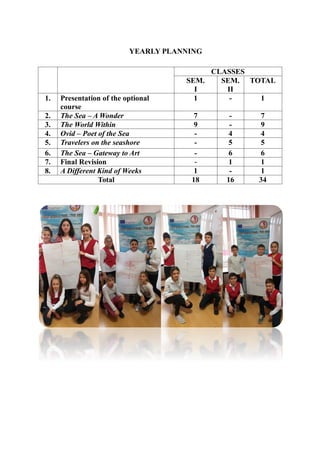
YEARLY PLANNING
CLASSES
SEM.
I
SEM.
II
TOTAL
1. Presentation of the optional
course
1 - 1
2. The Sea – A Wonder 7 - 7
3. The World Within 9 - 9
4. Ovid – Poet of the Sea - 4 4
5. Travelers on the seashore - 5 5
6. The Sea – Gateway to Art - 6 6
7. Final Revision - 1 1
8. A Different Kind of Weeks 1 - 1
Total 18 16 34
ISTITUTO COMPRENSIVO STATALE FRANCESCO RISO
ISOLA DELL E FEMMINE (PALERMO) – ITALIA
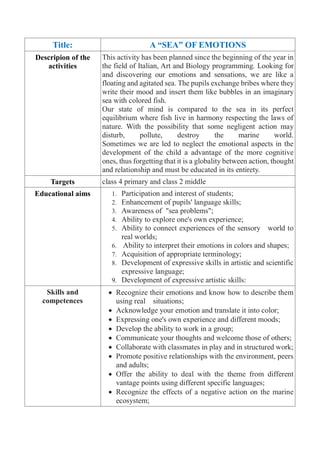
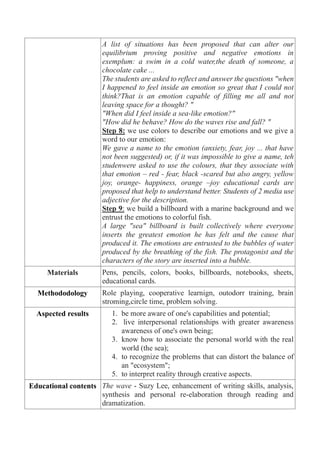
Title: A “SEA” OF EMOTIONS
Descripion of the
activities
This activity has been planned since the beginning of the year in
the field of Italian, Art and Biology programming. Looking for
and discovering our emotions and sensations, we are like a
floating and agitated sea. The pupils exchange bribes where they
write their mood and insert them like bubbles in an imaginary
sea with colored fish.
Our state of mind is compared to the sea in its perfect
equilibrium where fish live in harmony respecting the laws of
nature. With the possibility that some negligent action may
disturb, pollute, destroy the marine world.
Sometimes we are led to neglect the emotional aspects in the
development of the child a advantage of the more cognitive
ones, thus forgetting that it is a globality between action, thought
and relationship and must be educated in its entirety.
Targets class 4 primary and class 2 middle
Educational aims 1. Participation and interest of students;
2. Enhancement of pupils' language skills;
3. Awareness of "sea problems";
4. Ability to explore one's own experience;
5. Ability to connect experiences of the sensory world to
real worlds;
6. Ability to interpret their emotions in colors and shapes;
7. Acquisition of appropriate terminology;
8. Development of expressive skills in artistic and scientific
expressive language;
9. Development of expressive artistic skills:
Skills and
competences
 Recognize their emotions and know how to describe them
using real situations;
 Acknowledge your emotion and translate it into color;
 Expressing one's own experience and different moods;
 Develop the ability to work in a group;
 Communicate your thoughts and welcome those of others;
 Collaborate with classmates in play and in structured work;
 Promote positive relationships with the environment, peers
and adults;
 Offer the ability to deal with the theme from different
vantage points using different specific languages;
 Recognize the effects of a negative action on the marine
ecosystem;
 Reconsider the negative effects of an action on our
emotional system.
Organization and
descriptions of the
acitivity
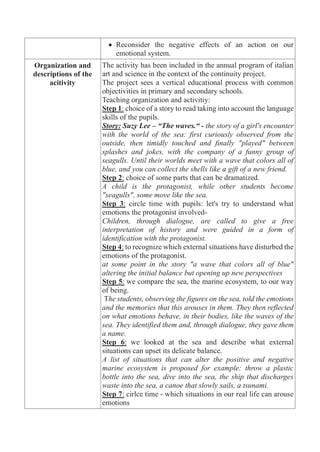
The activity has been included in the annual program of italian
art and science in the context of the continuity project.
The project sees a vertical educational process with common
objectivities in primary and secondary schools.
Teaching organization and activitiy:
Step 1: choice of a story to read taking into account the language
skills of the pupils.
Story: Suzy Lee – “The waves.“ - the story of a girl's encounter
with the world of the sea: first curiously observed from the
outside, then timidly touched and finally "played" between
splashes and jokes, with the company of a funny group of
seagulls. Until their worlds meet with a wave that colors all of
blue, and you can collect the shells like a gift of a new friend.
Step 2: choice of some parts that can be dramatized.
A child is the protagonist, while other students become
"seagulls", some move like the sea.
Step 3: circle time with pupils: let's try to understand what
emotions the protagonist involved-
Children, through dialogue, are called to give a free
interpretation of history and were guided in a form of
identification with the protagonist.
Step 4: to recognize which external situations have disturbed the
emotions of the protagonist.
at some point in the story "a wave that colors all of blue"
altering the initial balance but opening up new perspectives
Step 5: we compare the sea, the marine ecosystem, to our way
of being.
The students, observing the figures on the sea, told the emotions
and the memories that this arouses in them. They then reflected
on what emotions behave, in their bodies, like the waves of the
sea. They identified them and, through dialogue, they gave them
a name.
Step 6: we looked at the sea and describe what external
situations can upset its delicate balance.
A list of situations that can alter the positive and negative
marine ecosystem is proposed for example: throw a plastic
bottle into the sea, dive into the sea, the ship that discharges
waste into the sea, a canoe that slowly sails, a tsunami.
Step 7: cirlce time - which situations in our real life can arouse
emotions
A list of situations has been proposed that can alter our
equilibrium proving positive and negative emotions in
exemplum: a swim in a cold water,the death of someone, a
chocolate cake ...
The students are asked to reflect and answer the questions "when
I happened to feel inside an emotion so great that I could not
think?That is an emotion capable of filling me all and not
leaving space for a thought? "
"When did I feel inside a sea-like emotion?"
"How did he behave? How do the waves rise and fall? "
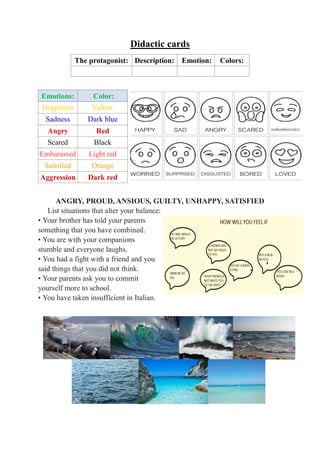
Step 8: we use colors to describe our emotions and we give a
word to our emotion:
We gave a name to the emotion (anxiety, fear, joy ... that have
not been suggested) or, if it was impossible to give a name, teh
studenwere asked to use the colours, that they associate with
that emotion – red - fear, black -scared but also angry, yellow
joy, orange- happiness, orange –joy educational cards are
proposed that help to understand better. Students of 2 media use
adjective for the description.
Step 9: we build a billboard with a marine background and we
entrust the emotions to colorful fish.
A large "sea" billboard is built collectively where everyone
inserts the greatest emotion he has felt and the cause that
produced it. The emotions are entrusted to the bubbles of water
produced by the breathing of the fish. The protagonist and the
characters of the story are inserted into a bubble.
Materials Pens, pencils, colors, books, billboards, notebooks, sheets,
educational cards.
Methododology Role playing, cooperative learnign, outodorr training, brain
stroming,circle time, problem solving.
Aspected results 1. be more aware of one's capabilities and potential;
2. live interpersonal relationships with greater awareness
awareness of one's own being;
3. know how to associate the personal world with the real
world (the sea);
4. to recognize the problems that can distort the balance of
an "ecosystem";
5. to interpret reality through creative aspects.
Educational contents The wave - Suzy Lee, enhancement of writing skills, analysis,
synthesis and personal re-elaboration through reading and
dramatization.
Verification The verification of the skills and competences achieved will be
carried out in itinere through occasional and systematic
observation of the behavior of children during exploration,
production, relationship and communication in the group,
evaluating of the drawings made by the children.
Duration 6 hours distributed in 4 weeks:
- 1 - moments of socailization;
- reading the short story (protagonists, antagonists,
situations, emotions, places, times);
- 2 - Dramatization of some scenes;
- circle time;
- 3 - conversation and educational games on the knowledge
of our emotions 4 the sea, the ecosistem, we are like fish,
play into the water, letting ourselves go and lead from the
sea of our emotions;
- 5 - which actions disturb our balance;
- 6 - which actions disturb the delicate balance of the sea;
we build a poster and entrust our emotions to the fish.
Didactic cards
The protagonist: Description: Emotion: Colors:
Emotions: Color:
Happiness Yellow
Sadness Dark blue
Angry Red
Scared Black
Embarassed Light red
Satisfied Orange
Aggression Dark red
ANGRY, PROUD, ANSIOUS, GUILTY, UNHAPPY, SATISFIED
List situations that alter your balance:
• Your brother has told your parents
something that you have combined.
• You are with your companions
stumble and everyone laughs.
• You had a fight with a friend and you
said things that you did not think.
• Your parents ask you to commit
yourself more to school.
• You have taken insufficient in Italian.
Title: Interactive lesson at the ecomuseum of the sea
Description of
the activity
(Italian,
history,
science,
ITC)
The training paths are based on being active users, authors, story-tellers. The visit is very
interactive and calls individuals to get involved and build individual narratives as well as the
different thematic workshops are never lectures but activities that make children and teenagers
protagonists working on the expression of self, on the critical sense, on changes that the coast has
suffered in recent years, on degradation that the sea has suffered.The visit to the ecomuseum is a
planned activity in the field of history and citizenship education.
In Ecomuseum you can find Palermo’s relationship to its sea is very telling of the city that was,
that is and that could be. There are stories of resistance, travel, commerce, holiday and work.
There are memories, faded photographs, forgotten places, fairy-tales and postcards. Seafarers,
dockers, writers, poets, sunbathers, ship-workers, captains and sailors. People who go out to sea,
and people who carry the sea in them wherever they go.
Target 2nd
class middle school
Subjetcs Italian, History, Geography, ITC, Science
Partner Comune di Palermo – Museo memoa
Objectivies 1. Environmental education related to the theme of the sea, marine biodiversity, underwater
worlds and respect for the marine ecosystem.
2. The city and its transformations, like when and why Palermo has changed and its relationship
with the sea.
3. Live memories: what do we lose if we lose the link with the past? How new communication
technologies can help us conserve and enhance memory and how to commit ourselves to
transform the present.
Educational
aims
1. Environmental education related to the theme of the sea, marine biodiversity, underwater
worlds and respect for the marine ecosystem.
2. The city and its transformations, like when and why Palermo has changed and its
relationship with the sea.
3. Live memories: what do we lose if we lose the link with the past? How new communication
technologies can help us conserve and enhance memory and how to commit ourselves to
transform the present. Active citizenship: what does being a citizen mean.
4. Know how collective actions can contribute to defend common goods.
5. Know how engagement can transform the present.
Skills and
competence
1. Develop ability to reserve marine biodiversity, submerged worlds and respect for the sea’s
ecosystems.
2. Understanding how some human actions such as: illegal construction, corruption, affect the
balance of the ecosystem.
3. To know the actions of some people who have opposed the damage to the coasts and the
sea, like judicial inquiries and courageous journalists in the Palermo of the 1960s and
1980s.
Organization
and
description of
the activity
Step 1 Preparation for the visit through research on the meaning of the Ecomuseum, its location
and purpose of the installation
Step 2: Visit Ecomuseum
Step 3: Participation in the narrative visit.
Step 4: The students take note on their written notes of the main topics of the visit
Step 5: What I saw? The students in the class rework the main steps of their experience, telling
what has most affected their interest and why
Step 6: Discussion of which attitudes of degradation are present in one's own local community.
Step 7: We compare the sea, the marine ecosystem, to our way defend it.
Step 8: The students discuss episodes of degradation and illegal building and abusiveness on
the coast in the local community.
Step 9: The students tell about which characters they know among those who have been more
involved in the fight against abusiveness
Step 10: Students prepare a report by critically reworking of their visit experience, and explain
what the value of an installation like the ecomuseum is for them.
Materials Pens, pencils, books, notebooks, sheets, digital camera,
Methodology guided tour, work in little groups, free and guided conversation, circle time
Aspected
results
- to recognize the problems that can distort the balance of an "ecosystem";
- know how to recognize and report acts of damage of the territory;
- know how over time initiatives to combat degradation have been undertaken;
- development of the critical sense and acquisition of new digitral skills.
Educational
contents
development of the civil conscience, living responsibly one's belonging to the community.
Verification The verification of the skills and competences achieved will be carried out in itinere through
occasional and systematic observation of the behavior of students during exploration, production,
relationship and communication in the group.
Duration 8 hours distributed in 4 weeks: 2 hours to find notice and describe about Ecomuseum; 3 hours of
visit of Ecomuseum; 2 hours first discussion in small group and then in plenary of the meaning
of the visit and relationship with one's own experience; 1 hour personal report processing.
Teachers Anna Durante, Pia Franco
Title The marine ecosystem and its biodiversity
(to discovery of marine fauna)
Educational
purpose
To increase the knowledge of animal speciesbelonging to multiple taxonomic
groups, such as cnidarians, echinoderms, molluscs, crustaceans and fish.
We also want to increase respect for the marine ecosystem and want to deepen
the students in those themes ecosustainable in coastal and marine
environments.
Target 5th
class primary school
Partner Microcosmos Associacition
Objectives
1. Knowledge of the ecosystem concept;
2. Know how to identify different species of fish and the dangers to a
marine ecosystem, awareness of the problem of the sea;
3. Knowledge of scientific language and enhancement of language skills;
4. The interest and recognition of all those marine animal species known
only from a gastronomic point of view and not known for their ecological
role and for their importance for food chains and for the food webs;
5. Develops attitudes of curiosity e ways of looking at the world that
stimulate him to look explanations of what see it happen.
Skills and
compentence
Students of the classes involved in the project in question will be able to
expand their own to know about basic zoology, general ecology, biology
marine and ethology linked to living marine organisms brought to the
classroom. Plus they will have also to learn the value of biodiversity and the
importance of variety of habitats for human beings and for life in general.
Students will be able to to learn the meaning of alimentary chains, of animal
biodiversity, of ecosustainability, environmental vulnerability, marine
pollution and zoology applied to a coastal context of the Sicilian territory.
Description
and
organization
of the activity:
Students can closely observe live animals and multiple shells tropical and
native wines brought to the classroom, will touch the above species, they will
be able to draw them highlighting some more characteristic traits, they will be
able to learn to recognize them and can be interested in and approach the
marine ecosystem. The students they will also learn how to respect and protect
marine environments and the many animal creatures that are part of it.
Step 1: presentation of the workshop - ppt
Step 2: the fish of the Mediterranean: vertebrate and invertebrate animals,
body description: the fins - anal caudal dorsal - gout breathing the scales, the
differences between the various endemic speciesthe length of some various
types of fish and the size of the most common fish: anchovy, herring, sea bass,
mullet, gurnard, cod, hake, sea bream, flounder, fish S. Pietro, swordfish, race,
turbot, sardine, scorpionfish, mackerel, sole, tuna, mullet.
Step 3: live observation in the classroom of some live marine invertebrates
and some embalmed animal species. They will be described and closely
observed made by hand presented multiple large shells either native that
exotic.
Step 4: behavioral analysis and the ecological role of each single animal
species brought to the classroom.
Step 5: the pupils will have to describe some species highlighting their
knowledge-length, width, weight.
Step 6: microscopic observation of relevant aspects of the body
Step 7: ppt and didactical cards.
Materials Organic material (fish shells), easy-to-use material, scale, meter, microscope.
Methodology Pupils will be stimulated to the taste of discovery as motivation, observation,
reflection and analysis. The activity also aims to develop sensory and tactile
expectations.
Aspected
results
At t The end of the workshop the students will have learned to:
- use / understand appropriate terms;
- exchange points of view, explanations, opinions, information;
- problematize all the aspects considered significant, recognize some
species of native fish.
Evaluations The evaluation will be done during the didactic course, considering also the
attention, the participation, the acquired skills. Students, during the practical
workshop in the classroom, will be questioned both by the external expert that
by their teacher on the topics covered. They will be invited to take notes on
your science notebook and draw some species animals of particular ecological
importance. Later, at the end of the laboratory, the teacher of the class will be
produced a billboard by relating with the images and text the experience lived.
Duration 5 hours: 1 hour - presentation of the workshop; ppt. - The fish of the
Mediterranean Sea; 2 - 3 hours - live observation of fish and molluscs;
4-5 hours – conversation - billboard, ppt.
Teacher M. L. Bertolino
ESCOLA GABRIEL CASTELLÀ I RAICH
IGUALADA – SPAIN
Title A SEA OF CULTURE
Descriptions
of the
activity
The educational class is part of the curricular activities of the art lessons.
It has been completed by class 3 of primary school.
It consists in make an artistic creation inspired in sea pictures that they saw
previously. After that using their creativity, they did a sea with Joan Miró
paitings.
Target 3rd class primary school
Objectives 1. to trace a collaborative continuous line
2. to work in small groups to decide: which section to paint and which
color to use
3. to imporve the control of a brush when tracing lines
4. language skills.
Methods for
evaluations
a. peer to peer assessment:
the bit of the line traced is: not continuous/partially continuous/contiuous
b. student self assessment:
I always give ideas/ I sometimes give ideas/ I prefer to follow peer’s
ideas.
c. teacher to student assessment:
shows high control while tracing and coloring using a brush/ shows
control of the brush in almost all occasions / uses the brush in an
inadequate way or shows very little control.
Results 1. Some students give quality opinions to help their peers improve;
2. Around half of students show commitment when assessing themselves;
3. Very little students hold the brush with delicacy. Most of them are able
to trace lines but they use a lot of paint.
Teachers Aïda Elias Monell i Laia Benito Mullerat
Title COMPARISON OF SEAS
Descriptions
of the
activity
The educational class is part of the curricular activities of the language
and science department. It has been completed by class 5 of primary
school. External experts involved from the Secondary School.
The students with the information from Power Points made by Italian,
Portuguese and Romanian and the one given by the expert have to
prepare a oral explanation about similarities and difference between
Mediterranean, Black Sea and Atlantic Ocean.
Target 5th
class primary school
Partner Insitut Badia i Margarit
Objectives 1. To know more about many aspects of the different sea
2. To know how to select the most important information
3. To compare Black sea and Mediterranen sea and Atlantic Ocean.
4. To make an oral explanation about the results of the comparison
5. To respect and be awared about the different languages that
Europeans use.
Methods for
evaluations
a) participation and interest of students
b) research ability
c) accuracy in knowledge in the coparison
d) fluency speaking
Results a) They could have an acquisition of sea knowledge having to
compare the same concept from one sea to the other.
b) They had have a good organisation to expose the information
clearly to the other students.
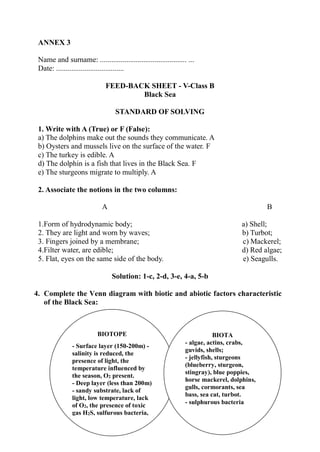
Teacher Anna Bayà and Núria Ramon
Title HAND SEA ANIMALS
Descriptions
of the
activity
The educational class is part of the curricular activities of the language and
arts department. It has been completed by all the school from 3 to 11 years
old. The students thought how to make sea animals only with their hands.
Target From Nursery School 1 to 6th
class primary school
Objectives - To know more about sea animals and their shapes;
- To think using hands how to represent a sea animal shape;
- To be creative using their hands, different colours and techniques;
- (Only Primary) To understand easy instructions in English.
Methods for
evaluations
- participation and interest of students;
- creativity;
- accuracy in art tecniques and shape making;
- (only primary) good speaning understanding;
Results - They could have an acquisition of sea animals shapes;
- They produced more than 200 animals that we could use to decorate
the school.
Teacher All Teachers
AGRUPAMENTO DE ESCOLAS DE VALE DE OVIL
BAIÃO – PORTUGAL
LEARNING SCENARIO
School: Agrupamento de Escolas de Vale de Ovil Duration: 45 min.
Teacher: Nuno Mota
Students age:
12-15 years
Aims:
 To introduce new teaching and working methods appropriate to approach the
problems and importance of the sea, develop digital skills, attitudes and
competences;
 To know how to make decisions to preserve the sea as an important part of
learning how to be a responsible adult;
 To train our students to make decisions when they have to use resources;
 To use ICT as a tool for learning, collaboration, creativity and innovations.
Outcomes:
 Children motivated for learning and acquiring new competences;
 Citizens more responsible and able to share values;
 Exploration of ITC in teaching and learning.
Work practices and methods:
 Interactive exercise / Teaching and Learning with smartphone;
 QR Code App exploration;
 Conversation;
 Collaborative and individual work.
ARTICULATION
Course of action (duration, minutes)
INTRODUCTION (10 minutes)
The teacher promotes a debate about the problems of the sea and tries to know how
the students are conscious about it; remember some concepts spoken during the
different subjects and in the news.
Topic: Our Sea Our Life
MAIN PART (20 minutes)
The teacher explains to the students that they will make a smart peddy using their
smartphones and QR Code reader App. It is explained how to use, install and use the
application, the methodology and the rules.
Then the students are invited to gather in groups. Each group is a team that need to
follow the clues and make the track passing through different points. In each point
there is a QR Code with a challenge.
At the end of the smart peddy the results are presented.
CONCLUSION (10 minutes)
A small report is handed out with the performance of each team. Students are then
invited to reflect on their performance.
Methods Work practices
ICT Competences
interview
dialogue
demonstration
work on the text
role playing
interactive exercise
individual work
pair work
group work
frontal work
Material/means:
 QR Code App;
 Smartphone.
PERSONAL OBSERVATIONS, COMMENTS AND NOTES
The points in the track can be in the Library, Lab, Classroom, Garden, ITC Lab, Arts
Lab.
In each point, the students are challenged to do one activity that can be: making a
video; exploring a book; answering a questionnaire; drawing a logo;
All the activities need to be sent to the jury using the smartphone.
Methodical guide

Methodical guide

  • 1.
  • 2.
    The European Commissionsupport for the production of this publication does not constitute an endorsement of the contents which reflects the views only of the authors, and the Commission cannot be held responsible for any use which may be made of the information contained therein.
  • 3.
    SCOALA GIMNAZIALA LUCIANGRIGORESCU MEDGIDIA – ROMANIA
  • 4.
    LESSON PLAN Teacher: CristinaDumitraşcu Grade: IInd STEP BY STEP SUBJECT READING WRITING MATHS ART SUBJECT AQUATIC ANIMALS AQUATIC ANIMALS TRANSCRIPTION TEXTS REVISION- ADDITION AND SUBTRACTION OF NATURAL NUMBERS from 0 to 100 COLLAGE- “BEWITCHED FISH” TYPE OF LESSON Language acquisition Systematization and consolidation of knowledge Systematization and consolidation of knowledge Training of skills and skills SPECIFIC SKILLS 1.1.Identifying the meaning of an oral message from various accessible texts 1.2. Identify various information from a listening text 3.1 Reading some written messages, encountered in the known environment 3.2. Identifying the message of a short text that tells stories, phenomena from the known universe 4.1. Writing messages in various communication contexts 4.2. Drafting up simple messages, observing basic conventions 1.4. Performing mental and written assemblies and decreases in the 0-1000 concentration, counting and / or grouping whenever necessary 1.6. Use of mathematical names and symbols (term, sum, total, difference, rest, unfold, subtraction, product, factors of a product, divided, divider, <,>, =, +, -,., :) in solving and / or the composition of problems 3.1. Solving problems in investigations by observing and generalizing models or regularities in the near environment 2.3. Making useful and / or aesthetic products combining easy-to-use materials and accessible techniques 2.4. Transforming a material through various techniques OPERATIONAL OBJECTIVES - To read correctly, in their own rhythm, the aquatic animal records. -To tell the reading texts. -To maintain a correct position of the body during writing. - To properly transcribe the text about aquatic animals. - To use an appropriate mathematical language. -To correctly perform the data addition and subtraction operations. - To solve the problems correctly. -To use the center materials correctly. - To list the working steps. - To attach the wooden scales of the fir cone to
  • 5.
    - To formulatequestions and answers based on what they read. -To make sentences about aquatic animals. - To respect the layout of the page. - To analyze the records after the end of the transcript. - To replay, one by one, the new acquired favorite information. - To fill in the gaps, to reconstitute the text about aquatic animals. the cardboard, to make the proposed collage. -To analyze the works according to the given criteria. METHODS AND PROCEDURES - story, -problem-solving; -observation; -explanation; -exercise; -heuristic conversation. -conversation; -explanation; -exercise; -explanation; -exercise; -problem-solving; -conversation; -conversation; -explanation; -demonstration; -exercise. MEANS -worksheets; -worksheets; -plasticine, - boards. -worksheets -boards; -glue; -crayons, felt-tip pen; -pine cones; - scissors.
  • 6.
    ACTIVITY DEVELOPMENT THE ORGANIZATIONAL MOMENT It isensured the appropriate climate for the proper conduct of the activity. THE CALENDAR It is completed the calendar of September and the one on the panel specific to the Step by Step class THE MESSAGE OF THE DAY Catching the attention: Role-play:” At the news” Children can imagine that a pencil or pen is the microphone. On by one, those who want are asked to present an imaginary news or not, about the aquatic world. Watching the movie "Exploring the Coral Reef" Debate based on what you watch Presenting the news. THE DAY’S AGENDA: HOMEWORK AND OBJECTIVES’ ANNOUNCEMENT Somene reads the agenda of the day where the students will find the centers to be opened, as well as the topics addressed. The students will choose their work centers. PRESENTATION OF TASKS / PERFORMANCE OBTAINING READING The students will read the tasks. They will receive different sheets that include information about: the balloon fish, the jellyfish, the abyssal fish, the sea turtle, the flying fish and the seahorse. They read the records for themselves. They read one after the other. They tell what they read. They form questions and answers about what they read. They make sentences about the studied aquatic animals. The evaluation will be done individually, both in the center and the front, at the afternoon meeting. WRITING The students will read the tasks. They will warm their hands. They will mold from plasticine an aquatic animal. They will transcribe texts about aquatic animals. They will analyze the records. They will present, one by one, their favorite new information. The evaluation will be done individually, both in the center and the front, at the afternoon meeting. MATHEMATICS The students will read the tasks. They will compose and solve a fish problem on the center sheet; They will solve the datasheet: they will make additions and subtractions, solve the problem, complete the gaping text spaces, color marine animals. The evaluation will be done individually, both in the center and the front, at the afternoon meeting. ARTS They list the materials in the center and the work stages (tearing the cones, sticking on the cardboard, filling the collage); The students will bring about the "Magic Fish" collage, respecting all stages of work. They will make judgments according to established criteria.
  • 7.
    8:00-8:45 – THEMORNING MEETING 9:00-13:00 – CENTRE-BASED ACTIVITY READING – AQUATIC ANIMALS WRITING – AQUATIC ANIMALS – TEXT TRANSCRIPTION MATHEMATICS – REVISION - ADDITION AND SUBTRACTION OF NATURAL NUMBERS FROM 0 TO 100 ARTS – COLLAGE – THE BEWITCHED FISH 13:00-14:00 – HAVING LUNCH 14:00-15:45 – THE AFTERNOON MEETING 15:00-15:45 – EVALUATION ON THE AUTHOR’S CHAIR
  • 8.
    THE JELLYFISH Importantstatistics: Length: 10m Class: Mammalia Weight: up to 2 kilos Breeding season: October – April Gestation period: 20 days Average life expectancy – less than a year Food- small fish and zooplankton The jellyfish is not a fish, it is an invertebrates being the relative of corals and sea anemones. Interactions of certain species of jellyfish such as the sea wasp are deadly. It has no head, brain, heart, eye or ear or bone. He has a soft body with long, poisonous tentacles that stings, and with which he catches the fish. Its tentacle arms around the mouth start from the center of the body in the shape of a bell. His body is soft. The jelly body has several mouth holes. The water represents 98% of the jelly composition. The sea turtle is not affected by the jellyfish sting and regularly consumes it. Jellyfish frees poison whenever its tentacles come in contact with an object or a living creature. THEABYSSAL FISH Importantstatistics: Length: 6o cm Class - Mammalia Breeding season – January-April Gestation - 2 years Average life expectancy - over 80 years Food- fish, shrimp and plankton. TheAbyssal fish has the most bizarre appearance among the creatures of the depths. It is a long-haired species with huge rays, living at depths between 1500 270 0 m. It does not have a muscular body but possesses a very stretched stomach, and to catch the prey, acts as a living fishing net, swimming with wide open mouth. He is capable to eat bigger prey than him, due to the lack of bones which coversthe gills (operands) such as ribs. He doesnot have scales,pelvic swimmers. Ithasa similar body with a snake. It has huge jaws, but not very strong teeth. At the top of the tail there is a red color. The dorsal swimmer has no spades and stretches all over the body. His eyes are small which are at the top of his mouth. His jaws are particularly mobile. It lives in all temperate and tropical oceans.
  • 9.
    THE SEA TURTLE Importantstatistics: Length:100 cm Weight: 150 kilos Class – Reptilian Sexual maturity – 20-50 years Average life expectancy - over 80 years Food- water grass and algae. The sea turtle lives in the warm oceans, spending almost the entire life in the water. It is a massive species, with greenish meat, appreciatedfor its delicious taste, especially in turtle soup.It isthelargest of the sea shells.Itnourishes seaweed in secludedareas, but makes its nest on the beaches with intense traffic. Eating and laying places are located at quite large distances, these cold- blooded creatures being very good swimmers. It can retract its head in the shell. Marine turtles are considered endangered species in all their habitats. They are the most valuable of all reptiles, being hunted for skin, meat, shell and for edible cartilage. Only 1% of egg chicks survive and reach maturity. Its massive, heart-shaped shell is covered with a layer of tiles called crown scales. He has long legs, turned into swimmers. THE FLYING FISH Importantstatistics: Family – Exocoetidae Class – Mammalia Length: 45 cm Weight: 500 g Gestation – 60 days Food- Consumes a variety of foods including plankton. The Flying fish is a common species in tropical waters, especially in the Caribbean. The name of this fish comes from its ability to float in the air for long distances, sometimes reaching even 3.2 m. It is supposed to be endowed with this ability to plunge to get rid of predators. Today there are about 40 known species of flying fish. It has uneven bifurcated tail. His pectoral swings are exaggerated, wings-like. His body has a hydrodynamic, torpedo shape. His eyes are big. Flying fish can squeak at an appreciable height, the sailors often find it on the decks of the boats. The flesh fish meat is tasty, with a firm texture. Like other aquatic creatures, it is attracted to light.
  • 10.
    THE BALLOON FISH Importantstatistics: Class:Tetraodontidae Length: up to 90 cm Breeding season: March - May Average life expectancy – five years Food - consumes generally corals, sponges, sea urchins, other echinoderms and small crustaceans. The Balloon fish is a carnivore given this name due to the fact that, in moments of disturb, it swallows water, inflating up to two in its normal size. There are over 1oo of species living in the Atlantic, Indian and Pacific oceans. In ancient Egypt, this life was used as a ball in various games. Moon Fish(a varietyoffish balloon) contains a deadlyvenom in itsorgans, but despite the danger of poisoning, it is a delicacy in Japan. This defense is vital because of its specific mode of movement. It has large eyes, closed in color, and is marked by white rings. The skin of the fish is very elastic. The mouth is small in size. His swimmers are low. The balloon fish is also called the Month, or the star balloon. Some species have leather covered with spikes to defend themselves from predators. Balloon fish can blink and close its eyes, which is unusual for a fish. THE SEAHORSE Importantstatistics: Family: Syngnathidae Class: Actinopterygii Length: 1.5 cm – 35 cm Breeding season: after the full moon Average life expectancy – one-five years Food- the sea horse consumes mainly saltwater shrimp, small fish and plankton. The sea horse lives in the shallow waters of tropical coasts and in temperate climate zones. Due to the shape of the body, it is a weak swimmer and often die exhausted if they are caught in the storm waters. This species has a body covered with horned plaques. Its head is long, looking like a horse. The Sea Horse has big eyes. The body of this living creature is covered with rectangular horns. It has a curved tail. He has no teeth or stomach, but in turn has pectoral, dorsal and tail flippers. Food goes through the digestive system very quickly, so it has tofeed itself constantly to stay alive. It is the only species on theground where the embryo carrier is the male.
  • 17.
    Aquatic animals Add andsubtract natural numbers from 0 to 100 1. Calculate and find out what fish catches every fisherman. 41+39= 73-12= 63-48= 64-58= 36+47= 98-14= 46+36= 15+37= 54-39= 2. An octopus weighs 25 pounds. A fisherman has twice the octopus’s kilograms. How much do the two aquatic animals weigh together? 3. A marine turtle has a length of 100 centimeters. A flying fish is 55 centimeters shorter than the turtle. Find the length of the flying fish. 4. A sea cat is 15 years old, a starfish has 20 years more, and a lobster is 5 years old. How many years have the three animals together? 8 2 6 6 1 8 3 5 2 1 5 8 0 1 5 8 4
  • 18.
    5. Complete: More than75% of the planet's surface is covered by ................... . Water aquatic living things spend most of their time in .................. or around it. Some live at ............, others in the deep sea ................... Marine animals include animals such as: ………………………………………. Colour:
  • 20.
    LESSON PLAN Teacher: AnişoaraCornea Grade: 4th B Time of lesson: 45 minutes Curricular area: Math and science Subject: Science The thematic unit: The relationships between living creatures and their living environment The title of the lesson: Animals and their environment Type of lesson: Revision GENERAL COMPETENCES: Solving problems in everyday life by capitalizing on environmental acquisitions SPECIFIC SKILLS: - Use of criteria for ordering and classification of bodies and phenomena - Drawing conclusions on the results of their own investigations - Present your own conclusions OPERATIONAL OBJECTIVES: During and until the end of the lesson, students must be able to: 1 - Fill in the gaps with specific terms; 2 - Determine the truth value of some statements; 3 - Find missing items from a food chain; 4 - Write a dialogue on a given theme; 5 - Show information gathered by them. AFFECTIVE OBJECTIVE - Manifestation of concern for correct behavior in relation to the natural environment. TEACHING STRATEGIES METHODS AND PROCEDURES: explanation, exercise, conversation, didactic play. EDUCATIONAL MEANS: PC, PPT presentation, worksheets, portfolios. FORMS OF ORGANIZATION: frontal, by groups EVALUATION FORMS AND TECHNIQUES: systematic observation of student behavior, verbal appreciation, incentives
  • 21.
    Lesson moments Operational objectives Didactic approach Teaching strategy Formsof organization Methods Means Assessment Organizational moment The conditions for the lesson are created. Students prepare their materials. Frontal Conversation Catching students’ attention I will show the students a presentation about Seahorses. Observation PPT, video projector Announcing the lesson’s subject and the operational objectives Today we will revise the knowledge about animals adapting to living conditions in different environments. We will see how marine life has adapted to life in the water. Conversation Content revision O1 O2 Students are required to solve a knowledge refresh report. 1. Complete the statements with the words in brackets: Animals and plants in different areas have been _________________ at environmental conditions. In a living environment, feeding relationships are defined _______________________. The meadow is a place covered with ______________, used for ___________________. Forest is a living environment ___________________. The marine life of plants and marine mammals is an environment ___________________. The cause of lack of vegetation in the desert is the lack of ___________. (trophic chains, natural, aquatic, adapted, water, grass, grazing) 2. True or False? There is only one food chain in a living environment. _____ If a species in a food chain disappears, the other living creatures in the environment have no problems. Pasture is a man-made environment. _____ Fir trees grow in the plain. _____ The water of the seas and oceans is sweet. _____ Individual Conversation, exercise Worksheets Pair assessment
  • 22.
    O3 In the desert,the nights are colder than the days. _____ There are no living creatures living in the desert. _____ 3. Complete the schemes to get food chains: Obtaining performance O4 The theme is to create a dialogue between a dolphin and a land mammal, recalling the similarities and differences between them, their food and the trophic chain they belong to. Teams Exercise Worksheets Paper evaluation Ensure retention and transfer O5 Students had the task of presenting a fish / mammifer / mollusc living in the Black Sea. They will present their records. These will be stapled in a folder and will form the "Black Sea Book", with information, pictures and curiosities gathered by students. Frontal Conversation Portfolio Individual assessment
  • 23.
    WORKSHEET 1. Fill inthe words with the words in brackets: Animals and plants in different areas have been _________________ at environmental conditions. In a living environment, feeding relationships are defined _______________________. The meadow is a place covered with ______________, used for ___________________. Forest is a living environment ___________________. The marine life of plants and marine mammals is an environment ___________________. The cause of lack of vegetation in the desert is the lack of ___________. (trophic chains, natural, aquatic, adapted, water, grass, grazing) 2. True or False? In the living environment there is only one food chain. _____ If a species in a food chain disappears, the other living creatures in the environment have no problems. _____ Pasture is a man-made environment. _____ Fir trees grow in the plain. _____ Alpine meadows meet on the top of the mountains. _____ The water of the seas and oceans is sweet. _____ In the desert, the nights are colder than the days. _____ There are no living creatures living in the desert. _____ 1. Complete the schemes to get food chains: ______________ crucian _____________ human being wheat _____________ pigeon hawk sprouts _____________ wolf _____________ anchovy _____________
  • 24.
    LESSON PLAN Teacher: ELENAUNTARU Grade: 5th B Time of lesson: 50 minutes Textbook: Snapshot Pre-Intermediate Lesson: The Black Sea Type of lesson: Language acquisition Subject: Biology Description of the class: Level: Starter Students between the ages of 11-12 The students are generally enth1siastic and they have good results. Aims: to understand the importance of the marine ecosystem and the human’s role in protecting it. General skills:  The exploration of the biological systems, the processes and the phenomena, with instruments and scientific methods.  Adequate communication in different scientific and social contexts.  The solving of problematic situations from the living world, based on logical thinking and creativity. Specific skills:  To extract information from texts, films, tables, drawings, schemes, as sources for the identification of the characteristics of biological systems, processes and phenomena;  Targeted simple investigation activities with the help of some worksheets;  Adequate use of specific biologic terminology in communication and writing.  The use of known algorithms in investigating the living world;  The recognition of the consequences of human activities and our own behavior on the environment. Derived skills: By the end of the lesson students will be able:  To recognize vegetal and animal species from The Black Sea;  To identify the relations which are establishing between species of plants, animals and environmental factors;  To demonstrate the negative consequences of the human actions on the marine ecosystem;  To form research skills;  To show teams spirit;
  • 25.
     To cooperateamong the target group to identify the appropriate actions, beneficial to the marine ecosystem;  To harness the plastic-artistic skills and to stimulate creativity. Didactical steps: - procedural resources: learning by discovery, problematic, clusters, Venn diagram, conversation, independent observation, explanation, description. - material resources: manual, botanical atlas, zoological atlas, worksheets, drawing chips representing Black Sea creatures, video projector, computer, power - point presentation, leaflets with endangered species from the Black Sea, map, marine ecosystems. Organizational forms: - Individually and in teams. - Front. Evaluation methods: formative through oral questionnaires and solving tasks from the worksheets / feed-back. Moments of the lesson Tecaher activity Student activity Methods and teaching methods Assessment methods I .Organisational moment (2 min.) -checks if there are optimum conditions for doing the lesson. -spears the student to appoint absent pupils and writes them in the catalog. -prepares the teaching material required for the lesson - they get ready for the activity conversation questionnaires oral II. Catching the attention (2 min.) - asks students to enumerate some natural aquatic ecosystems and the components of an ecosystem in general. - they answer the questions conversation explanation questionnaires oral III. Updating the lessons learned before (3 min.) Ask students questions about the subject matter taught the previous time: What kind of ecosystem is the aquarium? What are the components of an aquarium biotope? Examples?  What are the components of an aquarium biocenosis? What are the trophic categories in an ecosystem? Examples? - they answer the questions Individual activity conversation explanation questionnaires oral worksheets systematic onservation of students
  • 26.
    IV. Anouncing the titleof the lesson (1 min.) - writes the title of the lesson on the whiteboard „The Black Sea” -they write down the lesson title in their notebooks. Conversation, problem- solving, explanation oral V. Optimal content presentation and management of learning (24 min.) - presents PPT material to pupils with the vegetal and animal species characteristic of the Black Sea and with the relationships established between the creatures of this marine ecosystem; - guides students' activity; - completes the information where appropriate; - the students are presented the tokens with the Black Sea creatures; - recognizes endangered species in the Black Sea due to pollution and illegal fishing; - discusses pollution - causes, effects and ways to improve this phenomenon; - draws the lesson plan on the board. -note the lesson schedule; - ask questions if they do not understand; - exemplifies certain defense, feeding and reproduction relationships based on received tokens; - listen to the explanations - Participate in discussions - draw conclusions -learning by discovery; -conversation; -questioning; -explanation oral systematic onservation of students VI. Provide inverse connection and fix your knowledge (17 min.) -ask students questions about the content taught. - shares feed-back sheets to students. - notes active students at the hour. - answer questions, - go through the steps specified by the teacher to solve the items in the sheets. - frontal activity, conversation, learning by discovery, Venn diagram, explanation - oral -systematic observation of the students - feed-back shets; VII. Homework (1 min.) -exercise 7, page 50, from the textbook The students write down their homework in their notebooks. -explanation, conversation - systematic observation of the students THE LESSON SCHEME Black Sea The Black Sea - a large natural aquatic ecosystem (biomass). 1. Biotope - it has certain characteristics determined by geographic location within the dry land: a) Surface layer (150-200 m) - salinity is reduced due to the fresh water which it flows into the sea; - the presence of light; - temperature is influenced by season.
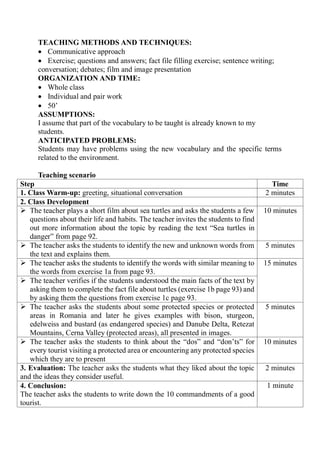
  • 27.
    b) Deep layer(less than 200 m) - sandy substrate; - lack of light; - the temperature is low; - salinity is higher; - lack of oxygen; - the presence of a toxic gas - hydrogen sulphide (H2S); - the presence of sulphurous bacteria. 2. Biota: a) Coastal area: algae, actins, crabs, mullet, shells; b) Pelagic area: jellyfish, sturgeon (blueberry, sturgeon, pike), blue poppies, horse mackerel, dolphins, gulls, cormorants, sea trout, sea cat, turbot, etc. c) Abyssal area: Sulfuric bacteria. Low salinity makes the number of Black Sea species four times smaller than in the Mediterranean Sea.
  • 28.
    Annex 1 DOCUMENTATION SHEET- CLASS V B The Black Sea The Black Sea is highlighted by a number of unique hydrological aspects in the world, being a remnant of the Sarmatic Sea, which millions of years ago stretched from the center of Asia to central Europe. These peculiarities relate to salty waters with a very low salinity, 16-18 grams of salt per liter compared to the other seas and oceans that have 34-37 grams per liter, and to stratification of water, surface are oxygenated with deep ones that are anoxic. Salinity in the Romanian seaside area is even lower. • It is the largest anoxic aquatic structure on the planet, that is, with the lowest oxygen content in some layers, and in others even without. Over 90% of the Black Sea water is devoid of oxygen because of the large amount of sediment and increased density that prevents the surface layers from transferring oxygen from the atmosphere to the deep ones. Thus, at depths of over 200 meters, there is no longer oxygen, and the water temperature has a constant value of 9 degrees Celsius, so the only existing species are anaerobic bacteria. These sulphurous bacteria play an essential role in ensuring life in this sea, by oxidizing the entire amount of hydrogen sulfide in the deep layers, leaving it to turn the Black Sea into a dead sea. • It has a stretch of 423,488 square kilometers, and the maximum depth is 2,211 meters and is reached near the seashore in the part of Turkey. The marshes that are produced are of small amplitude generally, and the largest amount of water that feeds it comes from the freshwater flowing into it, hence the reduced salinity, then the atmospheric precipitation. • Because its very low salinity makes it unique. Because it is not as salty as it should be, biodiversity suffers. Here many marine animals do not live, they need a certain percentage of salt to survive, at least 20%. In it live 149 species of fish and only three species of marine mammals, the best known of them are dolphins. Here lives a fish called Squalus acantius, which is part of the dreamy family of sharks. He lives at about 20 km from the shore, at depths of 20- 80 m and does not attack man. • It is considered the youngest in the world, her training being estimated by specialists somewhere in the period of the Mesozoic. It is assumed that there have been land hoards that led to the disappearance of the Tethys Ocean and several smaller aquatic basins such as the Caspian Sea, the Mediterranean Sea and the Black Sea. • It was named by the ancient Greeks who settled and founded fortresses on its shore "Pontos Euxeinos", and by the Romans "Pontus Euxinus", which means Hospice Sea. Because it is darker, and in the storm it becomes dark, later it was called the Black Sea. On its coasts, in part of Turkey, some of the last speakers of an ancient Pontic Greek dialect still live, because most of the Greeks settled there have gone to Greece after the First World War. • Due to the non-oxygenated water layer on the bottom of the aquatic basin, it is the only sea in the world where a sinking pot has been preserved in perfect condition for a very long time, namely, from the Byzantine Empire to the present. • At 45 kilometers northwest of Sulina, near the Serpent Island, it is said that there is a mysterious Bermuda Triangle, also called "death," which few know. The first accounts of this mysterious area, which they call the Death Wind, made them the Turks, signaling surprising disappearances in relatively quiet waters in the daylight. Other strange stories are the Russians from the 13th and 14th centuries, who are talking about a "white whirlwind" that dragged deep birds, ships and even small islands. NASA confirms the existence of magnetic anomalies in the Black Sea, following a study conducted with Harvard researchers. There are also reports of pathogenic radiation, known since antiquity. Bibliography: http://www.almanahonline.ro
  • 29.
    ANNEX 2 Name andsurname: .............................................. ... Date: .................................... WORKING DOCUMENT - CLASS V-B Updating knowledge 1. Place the following factors in the table below: bear, slime, lake frog, reed, fish, fir, fox, rush, wolf, deer, water lilies, knockers, cliffs, ferns, light, temperature, crocodile, squirrel, carp, sturgeon, oak, crab, sand, salinity. BIOTOPE BIOTA Aquatic plants Terrestrila plants Aquatic animals Terrestrial animals 2. Circle the right answers with connection to fish adaptations to the aquatic environment: a. have an interdigital membrane; b. body covered with mucus; c. pulmonary respiration; d. breathing through the gills; e. breathing through the lungs and skin.
  • 30.
    ANNEX 3 Name andsurname: .............................................. ... Date: .................................... FEEDBACK SHEET – Class V B The Black Sea 1. Write with A (True) or F (False): a) The dolphins make out the sounds they communicate. b) Oysters and mussels live on the surface of the water. c) The turkey is edible. d) The dolphin is a fish that lives in the Black Sea. e) The sturgeons migrate to multiply. 2. Associate the notions in the two columns: A B 1. The shape of the hydrodynamic body; a) Shells; 2. They are light and worn by waves; b) Turbot; 3. Have fingers joined through a membrane; c) Mackerel; 4. Filter water, are eatable; d) Red algae; 5. Flat body with eyes on the same side of the body. e) Seagulls. 3. Complete the Venn diagram with biotic and abiotic factors characteristic of the Black Sea: BIOTOPE BIOTA
  • 31.
    ANNEX 2 Name andsurname:.............................................. ... Date: .................................... WORKING SHEET - CLASS V-B Updating knowledge STANDARD OF SOLVING 1. Place the following factors in the table below: bear, slime, lake frog, reed, fish, fir, fox, rush, wolf, deer, water lilies, knockers, cliffs, ferns, light, temperature, crocodile, squirrel, carp, sturgeon, oak, crab, sand, salinity. BIOTOPE BIOTA Aquatic plants Terrestrial plants Aquatic animals Terrestrial animals mud cliffs the light temperature sand salinity reed rush waterlilies fir ferns oak tree the lake frog over crocodile carp sturgeon crab bear fox wolf, deer woodpecker squirrel 1. Read the right answers to fish adaptations to the aquatic environment: a. have an interdigital membrane; b. body covered with mucus - correct answer c. pulmonary respiration; d. breathing through the gills - correct answer e. breathing through the lungs and skin.
  • 32.
    ANNEX 3 Name andsurname: .............................................. ... Date: .................................... FEED-BACK SHEET - V-Class B Black Sea STANDARD OF SOLVING 1. Write with A (True) or F (False): a) The dolphins make out the sounds they communicate. A b) Oysters and mussels live on the surface of the water. F c) The turkey is edible. A d) The dolphin is a fish that lives in the Black Sea. F e) The sturgeons migrate to multiply. A 2. Associate the notions in the two columns: A B 1.Form of hydrodynamic body; a) Shell; 2. They are light and worn by waves; b) Turbot; 3. Fingers joined by a membrane; c) Mackerel; 4.Filter water, are edible; d) Red algae; 5. Flat, eyes on the same side of the body. e) Seagulls. Solution: 1-c, 2-d, 3-e, 4-a, 5-b 4. Complete the Venn diagram with biotic and abiotic factors characteristic of the Black Sea: BIOTOPE - Surface layer (150-200m) - salinity is reduced, the presence of light, the temperature influenced by the season, O2 present. - Deep layer (less than 200m) - sandy substrate, lack of light, low temperature, lack of O2, the presence of toxic gas H2S, sulfurous bacteria, salinity is higher BIOTA - algae, actins, crabs, guvids, shells; - jellyfish, sturgeons (blueberry, sturgeon, stingray), blue poppies, horse mackerel, dolphins, gulls, cormorants, sea bass, sea cat, turbot. - sulphurous bacteria
  • 33.
    LESSON PLAN Teacher: IonelNedelcu Class: 8th B Type: vocabulary class Time: 50 minutes Objective: Practice of English language STRUCTURES:  Vocabulary related to environment FUNCTIONS/COMMUNICATION:  Ask for and make suggestions, agree and disagree SKILLS: reading, comprehension of a text, speaking AIMS:  students practice vocabulary related to environment;  students understand the life of the sea turtles  students become familiar with expressing opinions on environment and tourism OBJECTIVES Cognitive: by the end of the lesson students will be able to:  to generate their own oral messages (at least two) using the new vocabulary  understand and react adequately to questions and statements;  express information explicitly;  understand, produce and use the stated information; Affective:  making students confident in their ability to use the language;  creating interest in the topic of the lesson;  creating a relaxed atmosphere, proper for studying;  foster learner independence and cooperative learning;  stimulating students’ imagination and creativity;  having fun. Operational:  to learn how to use the vocabulary related to environment;  to produce ideas for debating on the tourist behavior regarding protected species or areas on their own;  to identify and use the elements related to environment. TEACHING AIDS:  Whiteboard  Film  Images
  • 34.
    TEACHING METHODS ANDTECHNIQUES:  Communicative approach  Exercise; questions and answers; fact file filling exercise; sentence writing; conversation; debates; film and image presentation ORGANIZATION AND TIME:  Whole class  Individual and pair work  50’ ASSUMPTIONS: I assume that part of the vocabulary to be taught is already known to my students. ANTICIPATED PROBLEMS: Students may have problems using the new vocabulary and the specific terms related to the environment. Teaching scenario Step Time 1. Class Warm-up: greeting, situational conversation 2 minutes 2. Class Development  The teacher plays a short film about sea turtles and asks the students a few questions about their life and habits. The teacher invites the students to find out more information about the topic by reading the text “Sea turtles in danger” from page 92. 10 minutes  The teacher asks the students to identify the new and unknown words from the text and explains them. 5 minutes  The teacher asks the students to identify the words with similar meaning to the words from exercise 1a from page 93. 15 minutes  The teacher verifies if the students understood the main facts of the text by asking them to complete the fact file about turtles (exercise 1b page 93) and by asking them the questions from exercise 1c page 93.  The teacher asks the students about some protected species or protected areas in Romania and later he gives examples with bison, sturgeon, edelweiss and bustard (as endangered species) and Danube Delta, Retezat Mountains, Cerna Valley (protected areas), all presented in images. 5 minutes  The teacher asks the students to think about the “dos” and “don’ts” for every tourist visiting a protected area or encountering any protected species which they are to present 10 minutes 3. Evaluation: The teacher asks the students what they liked about the topic and the ideas they consider useful. 2 minutes 4. Conclusion: The teacher asks the students to write down the 10 commandments of a good tourist. 1 minute
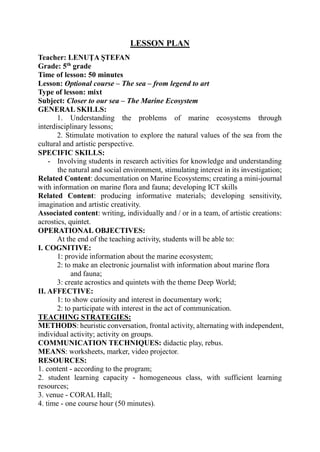
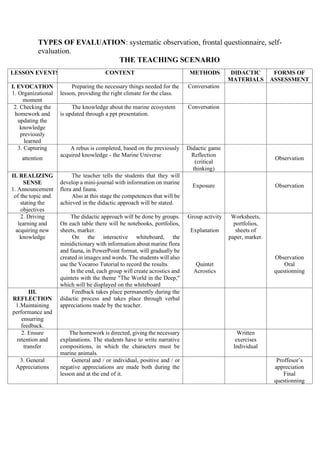
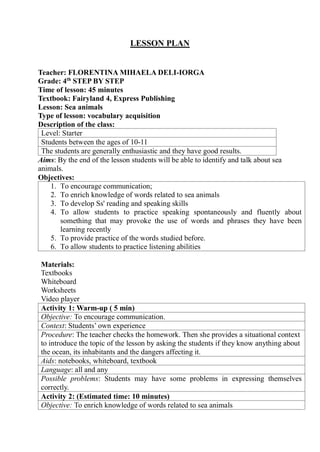
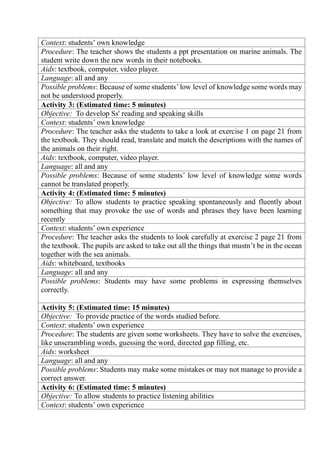
  • 35.
    LESSON PLAN Teacher: LENUŢAṢTEFAN Grade: 5th grade Time of lesson: 50 minutes Lesson: Optional course – The sea – from legend to art Type of lesson: mixt Subject: Closer to our sea – The Marine Ecosystem GENERAL SKILLS: 1. Understanding the problems of marine ecosystems through interdisciplinary lessons; 2. Stimulate motivation to explore the natural values of the sea from the cultural and artistic perspective. SPECIFIC SKILLS: - Involving students in research activities for knowledge and understanding the natural and social environment, stimulating interest in its investigation; Related Content: documentation on Marine Ecosystems; creating a mini-journal with information on marine flora and fauna; developing ICT skills Related Content: producing informative materials; developing sensitivity, imagination and artistic creativity. Associated content: writing, individually and / or in a team, of artistic creations: acrostics, quintet. OPERATIONAL OBJECTIVES: At the end of the teaching activity, students will be able to: I. COGNITIVE: 1: provide information about the marine ecosystem; 2: to make an electronic journalist with information about marine flora and fauna; 3: create acrostics and quintets with the theme Deep World; II. AFFECTIVE: 1: to show curiosity and interest in documentary work; 2: to participate with interest in the act of communication. TEACHING STRATEGIES: METHODS: heuristic conversation, frontal activity, alternating with independent, individual activity; activity on groups. COMMUNICATION TECHNIQUES: didactic play, rebus. MEANS: worksheets, marker, video projector. RESOURCES: 1. content - according to the program; 2. student learning capacity - homogeneous class, with sufficient learning resources; 3. venue - CORAL Hall; 4. time - one course hour (50 minutes).
  • 36.
    TYPES OF EVALUATION:systematic observation, frontal questionnaire, self- evaluation. THE TEACHING SCENARIO LESSON EVENTS CONTENT METHODS DIDACTIC MATERIALS FORMS OF ASSESSMENT I. EVOCATION 1. Organizational moment Preparing the necessary things needed for the lesson, providing the right climate for the class. Conversation 2. Checking the homework and updating the knowledge previously learned The knowledge about the marine ecosystem is updated through a ppt presentation. Conversation 3. Capturing attention A rebus is completed, based on the previously acquired knowledge - the Marine Universe Didactic game Reflection (critical thinking) Observation II. REALIZING SENSE 1. Announcement of the topic and stating the objectives The teacher tells the students that they will develop a mini-journal with information on marine flora and fauna. Also at this stage the competences that will be achieved in the didactic approach will be stated. Exposure Observation 2. Driving learning and acquiring new knowledge The didactic approach will be done by groups. On each table there will be notebooks, portfolios, sheets, marker. On the interactive whiteboard, the minidictionary with information about marine flora and fauna, in PowerPoint format, will gradually be created in images and words. The students will also use the Vocaroo Tutorial to record the results. In the end, each group will create acrostics and quintets with the theme "The World in the Deep," which will be displayed on the whiteboard Group activity Explanation Quintet Acrostics Worksheets, portfolios, sheets of paper, marker. Observation Oral questionning III. REFLECTION 1.Maintaining performance and ensurring feedback. Feedback takes place permanently during the didactic process and takes place through verbal appreciations made by the teacher. 2. Ensure retention and transfer The homework is directed, giving the necessary explanations. The students have to write narrative compositions, in which the characters must be marine animals. Written exercises Individual 3. General Appreciations General and / or individual, positive and / or negative appreciations are made both during the lesson and at the end of it. Proffesor’s appreciation Final questionning
  • 37.
    LESSON PLAN Teacher: FLORENTINAMIHAELA DELI-IORGA Grade: 4th STEP BY STEP Time of lesson: 45 minutes Textbook: Fairyland 4, Express Publishing Lesson: Sea animals Type of lesson: vocabulary acquisition Description of the class: Level: Starter Students between the ages of 10-11 The students are generally enthusiastic and they have good results. Aims: By the end of the lesson students will be able to identify and talk about sea animals. Objectives: 1. To encourage communication; 2. To enrich knowledge of words related to sea animals 3. To develop Ss' reading and speaking skills 4. To allow students to practice speaking spontaneously and fluently about something that may provoke the use of words and phrases they have been learning recently 5. To provide practice of the words studied before. 6. To allow students to practice listening abilities Materials: Textbooks Whiteboard Worksheets Video player Activity 1: Warm-up ( 5 min) Objective: To encourage communication. Context: Students’ own experience Procedure: The teacher checks the homework. Then she provides a situational context to introduce the topic of the lesson by asking the students if they know anything about the ocean, its inhabitants and the dangers affecting it. Aids: notebooks, whiteboard, textbook Language: all and any Possible problems: Students may have some problems in expressing themselves correctly. Activity 2: (Estimated time: 10 minutes) Objective: To enrich knowledge of words related to sea animals
  • 38.
    Context: students’ ownknowledge Procedure: The teacher shows the students a ppt presentation on marine animals. The student write down the new words in their notebooks. Aids: textbook, computer, video player. Language: all and any Possible problems: Because of some students’ low level of knowledge some words may not be understood properly. Activity 3: (Estimated time: 5 minutes) Objective: To develop Ss' reading and speaking skills Context: students’ own knowledge Procedure: The teacher asks the students to take a look at exercise 1 on page 21 from the textbook. They should read, translate and match the descriptions with the names of the animals on their right. Aids: textbook, computer, video player. Language: all and any Possible problems: Because of some students’ low level of knowledge some words cannot be translated properly. Activity 4: (Estimated time: 5 minutes) Objective: To allow students to practice speaking spontaneously and fluently about something that may provoke the use of words and phrases they have been learning recently Context: students’ own experience Procedure: The teacher asks the students to look carefully at exercise 2 page 21 from the textbook. The pupils are asked to take out all the things that mustn’t be in the ocean together with the sea animals. Aids: whiteboard, textbooks Language: all and any Possible problems: Students may have some problems in expressing themselves correctly. Activity 5: (Estimated time: 15 minutes) Objective: To provide practice of the words studied before. Context: students’ own experience Procedure: The students are given some worksheets. They have to solve the exercises, like unscrambling words, guessing the word, directed gap filling, etc. Aids: worksheet Language: all and any Possible problems: Students may make some mistakes or may not manage to provide a correct answer. Activity 6: (Estimated time: 5 minutes) Objective: To allow students to practice listening abilities Context: students’ own experience
  • 39.
    Procedure: Students aregoing to listen again to a song about animals and their actions (The animals down in the ocean), and they will sing it together with their teacher. Aids: textbook Language: all and any Possible problems: The students may not understand all the words. Homework: exercise 1, page 22 Bibliography:  www.busyteacher.org
  • 40.
    SEA ANIMALS -WORKSHEET Our planet is covered by many seas and oceans. Many animals and plants live in these waters. Some of these animals are: the fish, the shark, the dolphin, the crab, the turtle, the octopus, the lobster, the whale, the jellyfish, the squid, the starfish, the clam, etc. Some of these animals are dangerous, some are not. I. Arrange these letters to make a word: khars ________________ letutr ________________ usocpot ________________ ishfylelj ________________ stshifar ________________ II. Which are these animals? III. Complete the sentences with one of these words: whale, shark, octopus, fish, starfish 1. The …………………. is like a star. 2. The ………………….. has many arms. 3. The ………………….. is a really big sea animal. 4. There are many …………….. in the aquarium. 5. The …………………. is a dangerous animal.
  • 42.
    LESSON PLAN Subject: Technology Teacher:Viorica Mihaela Ene Class: 6th Lesson Environment: Classroom Unit: Designing and Improving Home and School Space Lesson Name: Decorations Lesson Type: Acquisition of Skills Lesson Purpose: Acquisition of Practical Skills in Production based on Technological Sheet. Specific Skills: 1.2 Identification of data, size, relations, processes and phenomena specific to maths and science for a product; 1.3 Product Analysis based on set criteria. Operational Objectives: 1. Choice of materials and tools necessary to produce a decorative product; 2. Development of skills necessary to produce an object based on a technical sheet; 3. Compliance with work quality, safety and health norms, before, during and after work completion. Teaching Methods: Conversation; Problematization; Practical Exercise; Gallery tour. Teaching Materials: - Safety Sheet; - technical Sheet; - board (25/18 cm); - synthetic material; - shells - ruler; - pencil; - soldering gun; - glue. Organization: - collective; - group.
  • 43.
    Lesson Sequence Time Operational Objectives Activities Teaching Methods Teaching Materials Assessment Lesson Organization Comment sTeacher Student I.Organization 3’ - students’ presence check; - materials and tools check; - preparation for class Conversation Collective II. Application A. Update of previous knowledge: 5’ - captatio benevolentiae; - discussion on the importance of a comfortable environment, and how to make decorations to improve the aspect of the environment. - answers to questions Conversations Problematization Collective B. Announcement of the practical work “How to make a decoration” 22’ 1 2 3 - organization in groups of 4 students; - model display; - announcement of objectives; - reminder of work quality, safety and health norms; - sharing the product technical sheets; - reading and explaining the sheet; - surveillance and guidance of student work. - model watch - receipt of technical sheet - follow the explanations - performance of technical operations as per norms. Exposition Conversation Demonstration Practical Exercises - technical sheet; - board (25/18 cm); - shells; - synthetic material; - glue; - pencil; - scissors; - ruler; - soldering gun. systematic observation of students Collective Group C. Product Exhibition 10’ 4 - requires the groups to exhibit their decorations; - share the work sheet. - get their work sheet; - exhibit their decorations. Practical Exercise Work sheets worksheets Group III. Completion Sequence 7’ - requires a group representative to assess the decoration of other group and grade it from 8 to 10; - announces the ranking - assess the activity. - present the decoration; - grade the other decorations; - aggregates the points. Conversation Gallery Tour Decoration Group
  • 44.
    TECHNICAL SHEET Product: “ShellPicture” Product Type: Decoration Technical Operations and Steps: 1. Preparation 2. Processing 3. Finishing - choosing the model and materials; - tracing the sizes; - drawing transposition on board. - sticking material on board; - soldering assembly of shells. - removing excess glue; - lacquering the board; - fixing the hook. Quality Control: observance of execution and general product aspect. Dysfunctionality: material removal. Product Price: 20 lei. Presentation: exhibition. Materials and Tools: Materials Tools - board (25/18 cm) - pencil - shells - scissors - synthetic material - ruler - glue - soldering gun Product Plan: “Shell Picture”, with the product and its production.
  • 45.
    WORK SHEET Name: “ShellPicture” Materials - board (25/18 cm), shells, synthetic materials, glue, pencil, scissors, soldering gun, ruler Work Sequence 1. Measurement and cutting of synthetic material (22/15); 2. Soldering the material on the board with glue; 3. Drawing with a pencil a model on the synthetic material; 4. Soldering shells on the model; 5. Removal of excess material; 6. Fixing the hook with double sticky tape. Quality, safety and health Regulations (NSSM) 1. It is prohibited to play with the materials and tools during work, before and after the arrival of the teacher; 2. Scissors will be used only for cutting synthetic material; 3. The soldering gun will be used so that there is no accident hazard; 4. Materials to be used will be arranged on desks. 5. Student will wo rk in sitting position only.
  • 46.
    LESSON PLAN Name: ELENADODIṢ Grade: 6th Time of lesson: 50 minutes Branch of knowledge: Art Lesson: The quantity contrast Type of lesson: skills acquisition Subject: Marine life GENERAL SKILLS: 1. Developing the ability of plastic expression using various materials, instruments and techniques SPECIFIC SKILLS: * Observing and obtaining chromatic contrasts in different compositions OPERATIONAL OBJECTIVES: 1 - Recognition of art contrast reproduction of quantity; 2 - Identifying the complementary effect of colors 3 - Achieve quantity contrast by applying orange color as a color accent 4 - to express valuable judgments about both their own work and the works of others. TEACHING STRATEGIES METHODS: conversation, explanation, demonstration, individual activity. DIDACTIC MATERIALS: PPT presentation
  • 47.
    THE TEACHING SCENARIO SKILLSTIME LESSON EVENTS SCIENTIFIC CONTENT DIDACTICAL STRATEGIES FORMS OF ASSESSMENT 2 min Organizational moment Preparing the required teaching material; Ensuring discipline; Appointment of absences; Conversation 1 2 min Capturing attention Do you remember what work you made last time? What was our theme? Conversation Frontal and individual 1 2 3 min 15 min Checking the homework Announcement of the topic and teaching it Brief presentation of the requirements of the theme: Today we will talk about the contrast of quantity and we will make a work with the subject "Underwater Life" Then, yje teacher explains to the students the processes to reach that requirement; The idea of contrast is very well illustrated by the alternation of day and night, winter summer, cold hot. Contrast is defined as a strong opposition between two or more elements, states, actions. The contrast of the quantity represents the opposition between a lot – little, big – small.. It is the contrast of 2 or more spots, different in size. The quantity contrast says: which is less is more obvious than what is more. You can use this to create the center of interest in your drawing, that climax that any story needs and without which it would be totally uninteresting. You can use it together with the complementary contrast. So ,we will do today a work with the subject "Underwater Life". - PPT material is presented; The teacher explains the misunderstood terms and the pursuit of a good work. Each student is trained and given individual or general instructions. Explanation Observation Conversation Demostration Frontal and individual 3 4 25 min The practical work of students Students are asked to work, explaining any possible concerns. Independent work Individual
  • 48.
    OPTIONAL COURSE The Sea– from legend to art Type: Integrated Optional Course on Multiple Curricula Curricula: Language and Communication, Science, Social Science, Art, Technology Class: 1 class/week Teacher: LENUŢA ŞTEFAN One schoolyear
  • 49.
    Optional Class Curriculum “TheSea – from legend to art” 5th Grade INTEGRATED CURRICULUM FOR ROMANIAN, BIOLOGY, GEOGRAPHY, HISTORY, ART AND TECHNOLOGY ARGUMENT In order to enjoy the priceless feature of childhood – the spirit of observation and investigation, ingenuity, fantasy, imagination – I have opted for a multi- curricular optional course, to formulate objectives which are common to multiple disciplines. The optional course The Sea – From Legend to Art was designed to integrate into the school curriculum the topic of the Erasmus+ Project, Once upon a time … the SEA, and it addresses to 5th graders who will have the opportunity to involve in inter-discipline documenting activities, which will lead to producing auxiliary teaching materials necessary to increase the attractivity of classes. The activities will include innovative methods and techniques specific to student education and adapted to their particulars, interactive methods to stimulate motivation, creativity and involvement in class (discovery, role play, projects, individual and group activity). Originality, creativity, free expression of students’ feelings and impressions will be means to solve the mystery and beauty of marine universe, illustrated in a mini-dictionary with information on marine flora and fauna or posters, pictures, photos, brochures with food recipes and literary creations as legends, stories, poems, educational games and multimedia presentations. Activities such as Sea – Source of inspiration in art (music, painting, photo, cinema), Marine Life Carnival, and literary creations published as Sea Poetry, The Sea in Stories and Legends, will stimulate motivation to explore natural features of the sea in culture and art. A poster gallery on marine environment protection, Together for the Sea!, and the creation of slogans with an awareness campaign on the importance of an healthy marine environment, as well as cleaning campaigns will provide the formation of a responsible ecological, social and civic behaviour.
  • 50.
    GENERAL SKILLS 1. Understandingthe marine ecosystem issues via inter-disciplinary lessons; 2. Stimulation of learning motivation via cultural – artistic exploration of the sea natural features. SPECIFIC SKILLS AND LEARNING ACTIVITIES 1. Understanding the marine ecosystem issues via inter-disciplinary lessons SPECIFIC SKILLS LEARNING ACTIVITIES 1.1. Involving students in research activities to know and understand the natural and social environment and stimulate interest in investigating it; - documentation on the sea genesis, marine ecosystem, ports and tourist destination on the Mediterranean and Black Sea, respectively Ovid’s exile, the sea as source of artistic inspiration; - Creating a mini-dictionary with information of the marine flora and fauna. 1.2. Forming marine protection skills; - creation of slogans, awareness campaign on the importance of a healthy marine environment; - cleaning campaigns; 1.3. IT&C Skill Development Workshops (information materials; presentation of outputs). 2. Stimulation of motivation to explore sea natural values from cultural – artistic perspective SPECIFIC SKILLS LEARNING ACTIVITIES 2.1. Presentation of personal creative and critical opinions based on given texts or art creations - Selective, explanatory reading; - Expression of viewpoints on a given topic. 2.2. Development of artistic imagination and creativity; - Cartoons with legend scenes; - Roleplay; - individual or group creation of fiction / short plays about the sea;
  • 51.
    - Collection offood recipes in a food brochure. 2.3. Creation of simple / scaled works - Interdisciplinary approach – art representation of the sea world as collage, pastel, graphic representations; - Scaled work; - Costumes made of recycled materials. CONTENTS Unit Contents Presentation of the optional subject I. The Sea – A Wonder Sea Genesis  Investigative documents on sea genesis. The Sea in Stories and Legends – Legends of Olympus by Alexandru Mitru  Legend of Tomis;  Significance of the name;  Tomis as Greek colony.  Legend of Poseidon, the sea god;  Gods and People;  The Temple as a sacred space. Free composition. Unity of composition (narrative literary creations, cartoons, scaled models with legend scenes) II. The World Within Closer to our sea  Marine Ecosystem;  Mini-dictionary with information on marine fauna and flora;  Free composition. Unity of composition (art creations on marine universe, costumes made of recycled materials, food recipe brochure);  The importance of a healthy marine environment. Publius Ovidius Naso – Latin poet exiled in Tomis  Investigative documents on the poet’s exile in Tomis;
  • 52.
    III. Ovid –Poet of the Sea  First poet of our land.  Free composition. Unity of composition (literary creations in verse);  The Sea Through the Eyes of Romanian Writers – collection of Romanian literature on the sea. IV. Travelers on Sea Shores Coastal Countries and Ports  Main ports and tourist destination on the Mediterranean and Black Sea;  Educational Game (“Countries, Cities, Seas”);  Diary. V. Sea – Gate to Art Sea – Source of Artistic Inspiration (music, film, painting, photo) VI. Children at Sea  Outdoor activities. VALUES AND ATTITUDES Stimulation of autonomous, reflexive and critical thinking towards the input message; Spirit of observation and receptivity; Motivation to inform and document; critical interpretation; Willingness to share personal experience and facilitate teaching others; Flexibility in applying acquired knowledge in daily life; Cultivation of a positive attitude towards nature and recognition of its role in personal development; Interest in exploring various channels of communication, IT&C included. ASSESSMENT  Application of questionnaires;  Systematic observation of student activity;  Investigation;  Student portfolio (art and literary creations);  Individual and group project;  Themed boards and exhibitions;  Self – assessment and inter – assessment.
  • 53.
    YEARLY PLANNING CLASSES SEM. I SEM. II TOTAL 1. Presentationof the optional course 1 - 1 2. The Sea – A Wonder 7 - 7 3. The World Within 9 - 9 4. Ovid – Poet of the Sea - 4 4 5. Travelers on the seashore - 5 5 6. The Sea – Gateway to Art - 6 6 7. Final Revision - 1 1 8. A Different Kind of Weeks 1 - 1 Total 18 16 34
  • 54.
    ISTITUTO COMPRENSIVO STATALEFRANCESCO RISO ISOLA DELL E FEMMINE (PALERMO) – ITALIA
  • 55.
    Title: A “SEA”OF EMOTIONS Descripion of the activities This activity has been planned since the beginning of the year in the field of Italian, Art and Biology programming. Looking for and discovering our emotions and sensations, we are like a floating and agitated sea. The pupils exchange bribes where they write their mood and insert them like bubbles in an imaginary sea with colored fish. Our state of mind is compared to the sea in its perfect equilibrium where fish live in harmony respecting the laws of nature. With the possibility that some negligent action may disturb, pollute, destroy the marine world. Sometimes we are led to neglect the emotional aspects in the development of the child a advantage of the more cognitive ones, thus forgetting that it is a globality between action, thought and relationship and must be educated in its entirety. Targets class 4 primary and class 2 middle Educational aims 1. Participation and interest of students; 2. Enhancement of pupils' language skills; 3. Awareness of "sea problems"; 4. Ability to explore one's own experience; 5. Ability to connect experiences of the sensory world to real worlds; 6. Ability to interpret their emotions in colors and shapes; 7. Acquisition of appropriate terminology; 8. Development of expressive skills in artistic and scientific expressive language; 9. Development of expressive artistic skills: Skills and competences  Recognize their emotions and know how to describe them using real situations;  Acknowledge your emotion and translate it into color;  Expressing one's own experience and different moods;  Develop the ability to work in a group;  Communicate your thoughts and welcome those of others;  Collaborate with classmates in play and in structured work;  Promote positive relationships with the environment, peers and adults;  Offer the ability to deal with the theme from different vantage points using different specific languages;  Recognize the effects of a negative action on the marine ecosystem;
  • 56.
     Reconsider thenegative effects of an action on our emotional system. Organization and descriptions of the acitivity The activity has been included in the annual program of italian art and science in the context of the continuity project. The project sees a vertical educational process with common objectivities in primary and secondary schools. Teaching organization and activitiy: Step 1: choice of a story to read taking into account the language skills of the pupils. Story: Suzy Lee – “The waves.“ - the story of a girl's encounter with the world of the sea: first curiously observed from the outside, then timidly touched and finally "played" between splashes and jokes, with the company of a funny group of seagulls. Until their worlds meet with a wave that colors all of blue, and you can collect the shells like a gift of a new friend. Step 2: choice of some parts that can be dramatized. A child is the protagonist, while other students become "seagulls", some move like the sea. Step 3: circle time with pupils: let's try to understand what emotions the protagonist involved- Children, through dialogue, are called to give a free interpretation of history and were guided in a form of identification with the protagonist. Step 4: to recognize which external situations have disturbed the emotions of the protagonist. at some point in the story "a wave that colors all of blue" altering the initial balance but opening up new perspectives Step 5: we compare the sea, the marine ecosystem, to our way of being. The students, observing the figures on the sea, told the emotions and the memories that this arouses in them. They then reflected on what emotions behave, in their bodies, like the waves of the sea. They identified them and, through dialogue, they gave them a name. Step 6: we looked at the sea and describe what external situations can upset its delicate balance. A list of situations that can alter the positive and negative marine ecosystem is proposed for example: throw a plastic bottle into the sea, dive into the sea, the ship that discharges waste into the sea, a canoe that slowly sails, a tsunami. Step 7: cirlce time - which situations in our real life can arouse emotions
  • 57.
    A list ofsituations has been proposed that can alter our equilibrium proving positive and negative emotions in exemplum: a swim in a cold water,the death of someone, a chocolate cake ... The students are asked to reflect and answer the questions "when I happened to feel inside an emotion so great that I could not think?That is an emotion capable of filling me all and not leaving space for a thought? " "When did I feel inside a sea-like emotion?" "How did he behave? How do the waves rise and fall? " Step 8: we use colors to describe our emotions and we give a word to our emotion: We gave a name to the emotion (anxiety, fear, joy ... that have not been suggested) or, if it was impossible to give a name, teh studenwere asked to use the colours, that they associate with that emotion – red - fear, black -scared but also angry, yellow joy, orange- happiness, orange –joy educational cards are proposed that help to understand better. Students of 2 media use adjective for the description. Step 9: we build a billboard with a marine background and we entrust the emotions to colorful fish. A large "sea" billboard is built collectively where everyone inserts the greatest emotion he has felt and the cause that produced it. The emotions are entrusted to the bubbles of water produced by the breathing of the fish. The protagonist and the characters of the story are inserted into a bubble. Materials Pens, pencils, colors, books, billboards, notebooks, sheets, educational cards. Methododology Role playing, cooperative learnign, outodorr training, brain stroming,circle time, problem solving. Aspected results 1. be more aware of one's capabilities and potential; 2. live interpersonal relationships with greater awareness awareness of one's own being; 3. know how to associate the personal world with the real world (the sea); 4. to recognize the problems that can distort the balance of an "ecosystem"; 5. to interpret reality through creative aspects. Educational contents The wave - Suzy Lee, enhancement of writing skills, analysis, synthesis and personal re-elaboration through reading and dramatization.
  • 58.
    Verification The verificationof the skills and competences achieved will be carried out in itinere through occasional and systematic observation of the behavior of children during exploration, production, relationship and communication in the group, evaluating of the drawings made by the children. Duration 6 hours distributed in 4 weeks: - 1 - moments of socailization; - reading the short story (protagonists, antagonists, situations, emotions, places, times); - 2 - Dramatization of some scenes; - circle time; - 3 - conversation and educational games on the knowledge of our emotions 4 the sea, the ecosistem, we are like fish, play into the water, letting ourselves go and lead from the sea of our emotions; - 5 - which actions disturb our balance; - 6 - which actions disturb the delicate balance of the sea; we build a poster and entrust our emotions to the fish.
  • 59.
    Didactic cards The protagonist:Description: Emotion: Colors: Emotions: Color: Happiness Yellow Sadness Dark blue Angry Red Scared Black Embarassed Light red Satisfied Orange Aggression Dark red ANGRY, PROUD, ANSIOUS, GUILTY, UNHAPPY, SATISFIED List situations that alter your balance: • Your brother has told your parents something that you have combined. • You are with your companions stumble and everyone laughs. • You had a fight with a friend and you said things that you did not think. • Your parents ask you to commit yourself more to school. • You have taken insufficient in Italian.
  • 60.
    Title: Interactive lessonat the ecomuseum of the sea Description of the activity (Italian, history, science, ITC) The training paths are based on being active users, authors, story-tellers. The visit is very interactive and calls individuals to get involved and build individual narratives as well as the different thematic workshops are never lectures but activities that make children and teenagers protagonists working on the expression of self, on the critical sense, on changes that the coast has suffered in recent years, on degradation that the sea has suffered.The visit to the ecomuseum is a planned activity in the field of history and citizenship education. In Ecomuseum you can find Palermo’s relationship to its sea is very telling of the city that was, that is and that could be. There are stories of resistance, travel, commerce, holiday and work. There are memories, faded photographs, forgotten places, fairy-tales and postcards. Seafarers, dockers, writers, poets, sunbathers, ship-workers, captains and sailors. People who go out to sea, and people who carry the sea in them wherever they go. Target 2nd class middle school Subjetcs Italian, History, Geography, ITC, Science Partner Comune di Palermo – Museo memoa Objectivies 1. Environmental education related to the theme of the sea, marine biodiversity, underwater worlds and respect for the marine ecosystem. 2. The city and its transformations, like when and why Palermo has changed and its relationship with the sea. 3. Live memories: what do we lose if we lose the link with the past? How new communication technologies can help us conserve and enhance memory and how to commit ourselves to transform the present. Educational aims 1. Environmental education related to the theme of the sea, marine biodiversity, underwater worlds and respect for the marine ecosystem. 2. The city and its transformations, like when and why Palermo has changed and its relationship with the sea. 3. Live memories: what do we lose if we lose the link with the past? How new communication technologies can help us conserve and enhance memory and how to commit ourselves to transform the present. Active citizenship: what does being a citizen mean. 4. Know how collective actions can contribute to defend common goods. 5. Know how engagement can transform the present. Skills and competence 1. Develop ability to reserve marine biodiversity, submerged worlds and respect for the sea’s ecosystems. 2. Understanding how some human actions such as: illegal construction, corruption, affect the balance of the ecosystem. 3. To know the actions of some people who have opposed the damage to the coasts and the sea, like judicial inquiries and courageous journalists in the Palermo of the 1960s and 1980s. Organization and description of the activity Step 1 Preparation for the visit through research on the meaning of the Ecomuseum, its location and purpose of the installation Step 2: Visit Ecomuseum Step 3: Participation in the narrative visit. Step 4: The students take note on their written notes of the main topics of the visit Step 5: What I saw? The students in the class rework the main steps of their experience, telling what has most affected their interest and why Step 6: Discussion of which attitudes of degradation are present in one's own local community.
  • 61.
    Step 7: Wecompare the sea, the marine ecosystem, to our way defend it. Step 8: The students discuss episodes of degradation and illegal building and abusiveness on the coast in the local community. Step 9: The students tell about which characters they know among those who have been more involved in the fight against abusiveness Step 10: Students prepare a report by critically reworking of their visit experience, and explain what the value of an installation like the ecomuseum is for them. Materials Pens, pencils, books, notebooks, sheets, digital camera, Methodology guided tour, work in little groups, free and guided conversation, circle time Aspected results - to recognize the problems that can distort the balance of an "ecosystem"; - know how to recognize and report acts of damage of the territory; - know how over time initiatives to combat degradation have been undertaken; - development of the critical sense and acquisition of new digitral skills. Educational contents development of the civil conscience, living responsibly one's belonging to the community. Verification The verification of the skills and competences achieved will be carried out in itinere through occasional and systematic observation of the behavior of students during exploration, production, relationship and communication in the group. Duration 8 hours distributed in 4 weeks: 2 hours to find notice and describe about Ecomuseum; 3 hours of visit of Ecomuseum; 2 hours first discussion in small group and then in plenary of the meaning of the visit and relationship with one's own experience; 1 hour personal report processing. Teachers Anna Durante, Pia Franco
  • 62.
    Title The marineecosystem and its biodiversity (to discovery of marine fauna) Educational purpose To increase the knowledge of animal speciesbelonging to multiple taxonomic groups, such as cnidarians, echinoderms, molluscs, crustaceans and fish. We also want to increase respect for the marine ecosystem and want to deepen the students in those themes ecosustainable in coastal and marine environments. Target 5th class primary school Partner Microcosmos Associacition Objectives 1. Knowledge of the ecosystem concept; 2. Know how to identify different species of fish and the dangers to a marine ecosystem, awareness of the problem of the sea; 3. Knowledge of scientific language and enhancement of language skills; 4. The interest and recognition of all those marine animal species known only from a gastronomic point of view and not known for their ecological role and for their importance for food chains and for the food webs; 5. Develops attitudes of curiosity e ways of looking at the world that stimulate him to look explanations of what see it happen. Skills and compentence Students of the classes involved in the project in question will be able to expand their own to know about basic zoology, general ecology, biology marine and ethology linked to living marine organisms brought to the classroom. Plus they will have also to learn the value of biodiversity and the importance of variety of habitats for human beings and for life in general. Students will be able to to learn the meaning of alimentary chains, of animal biodiversity, of ecosustainability, environmental vulnerability, marine pollution and zoology applied to a coastal context of the Sicilian territory. Description and organization of the activity: Students can closely observe live animals and multiple shells tropical and native wines brought to the classroom, will touch the above species, they will be able to draw them highlighting some more characteristic traits, they will be able to learn to recognize them and can be interested in and approach the marine ecosystem. The students they will also learn how to respect and protect marine environments and the many animal creatures that are part of it. Step 1: presentation of the workshop - ppt Step 2: the fish of the Mediterranean: vertebrate and invertebrate animals, body description: the fins - anal caudal dorsal - gout breathing the scales, the differences between the various endemic speciesthe length of some various types of fish and the size of the most common fish: anchovy, herring, sea bass, mullet, gurnard, cod, hake, sea bream, flounder, fish S. Pietro, swordfish, race, turbot, sardine, scorpionfish, mackerel, sole, tuna, mullet.
  • 63.
    Step 3: liveobservation in the classroom of some live marine invertebrates and some embalmed animal species. They will be described and closely observed made by hand presented multiple large shells either native that exotic. Step 4: behavioral analysis and the ecological role of each single animal species brought to the classroom. Step 5: the pupils will have to describe some species highlighting their knowledge-length, width, weight. Step 6: microscopic observation of relevant aspects of the body Step 7: ppt and didactical cards. Materials Organic material (fish shells), easy-to-use material, scale, meter, microscope. Methodology Pupils will be stimulated to the taste of discovery as motivation, observation, reflection and analysis. The activity also aims to develop sensory and tactile expectations. Aspected results At t The end of the workshop the students will have learned to: - use / understand appropriate terms; - exchange points of view, explanations, opinions, information; - problematize all the aspects considered significant, recognize some species of native fish. Evaluations The evaluation will be done during the didactic course, considering also the attention, the participation, the acquired skills. Students, during the practical workshop in the classroom, will be questioned both by the external expert that by their teacher on the topics covered. They will be invited to take notes on your science notebook and draw some species animals of particular ecological importance. Later, at the end of the laboratory, the teacher of the class will be produced a billboard by relating with the images and text the experience lived. Duration 5 hours: 1 hour - presentation of the workshop; ppt. - The fish of the Mediterranean Sea; 2 - 3 hours - live observation of fish and molluscs; 4-5 hours – conversation - billboard, ppt. Teacher M. L. Bertolino
  • 64.
    ESCOLA GABRIEL CASTELLÀI RAICH IGUALADA – SPAIN
  • 65.
    Title A SEAOF CULTURE Descriptions of the activity The educational class is part of the curricular activities of the art lessons. It has been completed by class 3 of primary school. It consists in make an artistic creation inspired in sea pictures that they saw previously. After that using their creativity, they did a sea with Joan Miró paitings. Target 3rd class primary school Objectives 1. to trace a collaborative continuous line 2. to work in small groups to decide: which section to paint and which color to use 3. to imporve the control of a brush when tracing lines 4. language skills. Methods for evaluations a. peer to peer assessment: the bit of the line traced is: not continuous/partially continuous/contiuous b. student self assessment: I always give ideas/ I sometimes give ideas/ I prefer to follow peer’s ideas. c. teacher to student assessment: shows high control while tracing and coloring using a brush/ shows control of the brush in almost all occasions / uses the brush in an inadequate way or shows very little control. Results 1. Some students give quality opinions to help their peers improve; 2. Around half of students show commitment when assessing themselves; 3. Very little students hold the brush with delicacy. Most of them are able to trace lines but they use a lot of paint. Teachers Aïda Elias Monell i Laia Benito Mullerat
  • 66.
    Title COMPARISON OFSEAS Descriptions of the activity The educational class is part of the curricular activities of the language and science department. It has been completed by class 5 of primary school. External experts involved from the Secondary School. The students with the information from Power Points made by Italian, Portuguese and Romanian and the one given by the expert have to prepare a oral explanation about similarities and difference between Mediterranean, Black Sea and Atlantic Ocean. Target 5th class primary school Partner Insitut Badia i Margarit Objectives 1. To know more about many aspects of the different sea 2. To know how to select the most important information 3. To compare Black sea and Mediterranen sea and Atlantic Ocean. 4. To make an oral explanation about the results of the comparison 5. To respect and be awared about the different languages that Europeans use. Methods for evaluations a) participation and interest of students b) research ability c) accuracy in knowledge in the coparison d) fluency speaking Results a) They could have an acquisition of sea knowledge having to compare the same concept from one sea to the other. b) They had have a good organisation to expose the information clearly to the other students. Teacher Anna Bayà and Núria Ramon
  • 67.
    Title HAND SEAANIMALS Descriptions of the activity The educational class is part of the curricular activities of the language and arts department. It has been completed by all the school from 3 to 11 years old. The students thought how to make sea animals only with their hands. Target From Nursery School 1 to 6th class primary school Objectives - To know more about sea animals and their shapes; - To think using hands how to represent a sea animal shape; - To be creative using their hands, different colours and techniques; - (Only Primary) To understand easy instructions in English. Methods for evaluations - participation and interest of students; - creativity; - accuracy in art tecniques and shape making; - (only primary) good speaning understanding; Results - They could have an acquisition of sea animals shapes; - They produced more than 200 animals that we could use to decorate the school. Teacher All Teachers
  • 68.
    AGRUPAMENTO DE ESCOLASDE VALE DE OVIL BAIÃO – PORTUGAL
  • 69.
    LEARNING SCENARIO School: Agrupamentode Escolas de Vale de Ovil Duration: 45 min. Teacher: Nuno Mota Students age: 12-15 years Aims:  To introduce new teaching and working methods appropriate to approach the problems and importance of the sea, develop digital skills, attitudes and competences;  To know how to make decisions to preserve the sea as an important part of learning how to be a responsible adult;  To train our students to make decisions when they have to use resources;  To use ICT as a tool for learning, collaboration, creativity and innovations. Outcomes:  Children motivated for learning and acquiring new competences;  Citizens more responsible and able to share values;  Exploration of ITC in teaching and learning. Work practices and methods:  Interactive exercise / Teaching and Learning with smartphone;  QR Code App exploration;  Conversation;  Collaborative and individual work. ARTICULATION Course of action (duration, minutes) INTRODUCTION (10 minutes) The teacher promotes a debate about the problems of the sea and tries to know how the students are conscious about it; remember some concepts spoken during the different subjects and in the news. Topic: Our Sea Our Life
  • 70.
    MAIN PART (20minutes) The teacher explains to the students that they will make a smart peddy using their smartphones and QR Code reader App. It is explained how to use, install and use the application, the methodology and the rules. Then the students are invited to gather in groups. Each group is a team that need to follow the clues and make the track passing through different points. In each point there is a QR Code with a challenge. At the end of the smart peddy the results are presented. CONCLUSION (10 minutes) A small report is handed out with the performance of each team. Students are then invited to reflect on their performance. Methods Work practices ICT Competences interview dialogue demonstration work on the text role playing interactive exercise individual work pair work group work frontal work Material/means:  QR Code App;  Smartphone. PERSONAL OBSERVATIONS, COMMENTS AND NOTES The points in the track can be in the Library, Lab, Classroom, Garden, ITC Lab, Arts Lab. In each point, the students are challenged to do one activity that can be: making a video; exploring a book; answering a questionnaire; drawing a logo; All the activities need to be sent to the jury using the smartphone.