The Membrane Interface ProbeSome ins and outs
2ProgramThe Membrane Interface ProbeStandard Practise (ASTM D7352-07)Direct push machines (Geoprobe and CPT)MIP ≠MIPInfluences and detection limits
MIP (Membrane Interface Probe)MIP DetectorsFID (Flame Ionization Detector)Corg.
PID (Photo Ionization Detector)Ionization Potential < 10,6 eV
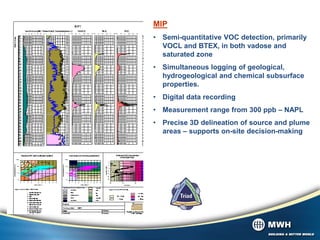
DELCD (Dry Electrolytic Conductivity Detector)Organic Bonded Chlorine (VOCL)MIPSemi-quantitative VOC detection, primarilyVOCL and BTEX, in both vadose and saturated zone
Simultaneous logging of geological, hydrogeological and chemical subsurface properties.
Digital data recording
Measurement range from 300 ppb – NAPL
Precise 3D delineation of source and plume areas – supports on-site decision-makingStandard Operating procedureASTM D 7352-07 Geoprobe Standard Operating Procedure MIPProvide consultants with a better understanding of how MIP works and what should be reported in a field report!
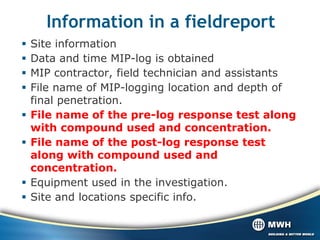
Information in a fieldreportSite informationData and time MIP-log is obtainedMIP contractor, field technician and assistantsFile name of MIP-logging location and depth of final penetration.File name of the pre-log response test along with compound used and concentration.File name of the post-log response test along with compound used and concentration.Equipment used in the investigation.Site and locations specific info.
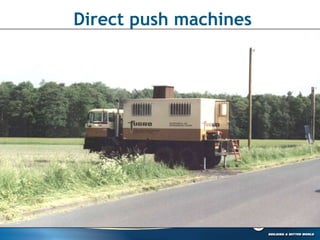
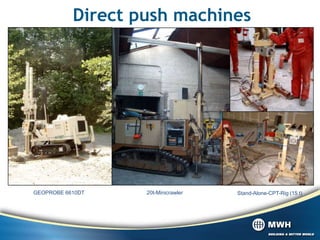
Direct push machines
Mobile In Situ Techniques
Direct push machinesGEOPROBE 6610DT20t-MinicrawlerStand-Alone-CPT-Rig (15 t)
MIP ≠MIPMIP technology is >15 years old. Several MIP-service providers have made adjustments to their system.Geoprobe has developed system as well. MIP technique is still being improved (Enissa MIP)All systems are still on the market so MIP ≠MIP!!
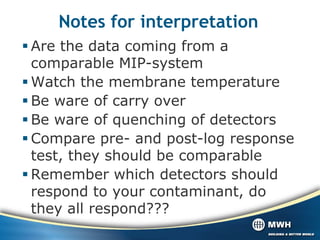
11Membrane Interface Probe : influencesTemperature membrane block (70 tot 130 °C)Membrane :Quality is never the same, not with new membranes but certainly not when used.Trunkline(used material, length, temperature of cable can heat the transport line)Detectors (FID, PID, DELCD great difference in quality and stabilityPID : needs to be cleaned regularly for a stable baselineDELCD : central electrode may shift resulting in a false positive signal only on DELCDGasses : 	H2S  can give a respons on the DELCD!				CH4  can cause quenching on PID and DELCD geven.Lithology and type of contamination. High concentration : carry over on detectors, contamination of membrane and trunk line. Heated trunk-line and being able to better heat the membrane block can minimize the effect.
They all affect the detection limits Some examplesMIP detection limits by VITO (2008)Detection limits mentioned by Geoprobe and service providers.
13Detectionlimitsaccording to Belgium’s VITO 02.2008(OLD MIP-system)
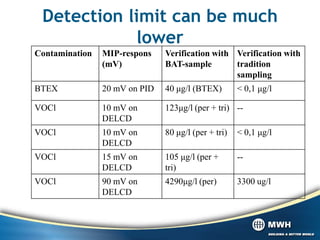
Detection limit can be much lower
“Detection” limitsMIP in the fieldPER : 300 µg/lTri : 300 µg/lCIS : 300 µg/lVC : 400 µg/lBTEX 300-500 µg/lEnissa MIP (1-10 µg/l) willbepresented later onNote: External factors have a stronginfluenceon the detection limit. These are just a indication and canbehigherorlowerdependingontehexternal factors. MIP is a screening tool, alwaystake samples forverification. 15
MIP developmentsDevelopments of the last 15 yearsRecent development (Enissa MIP)

The Membrane Interface Probe

  • 1.
    The Membrane InterfaceProbeSome ins and outs
  • 2.
    2ProgramThe Membrane InterfaceProbeStandard Practise (ASTM D7352-07)Direct push machines (Geoprobe and CPT)MIP ≠MIPInfluences and detection limits
  • 3.
    MIP (Membrane InterfaceProbe)MIP DetectorsFID (Flame Ionization Detector)Corg.
  • 4.
    PID (Photo IonizationDetector)Ionization Potential < 10,6 eV
  • 5.
    DELCD (Dry ElectrolyticConductivity Detector)Organic Bonded Chlorine (VOCL)MIPSemi-quantitative VOC detection, primarilyVOCL and BTEX, in both vadose and saturated zone
  • 6.
    Simultaneous logging ofgeological, hydrogeological and chemical subsurface properties.
  • 7.
  • 8.
    Measurement range from300 ppb – NAPL
  • 9.
    Precise 3D delineationof source and plume areas – supports on-site decision-makingStandard Operating procedureASTM D 7352-07 Geoprobe Standard Operating Procedure MIPProvide consultants with a better understanding of how MIP works and what should be reported in a field report!
  • 10.
    Information in afieldreportSite informationData and time MIP-log is obtainedMIP contractor, field technician and assistantsFile name of MIP-logging location and depth of final penetration.File name of the pre-log response test along with compound used and concentration.File name of the post-log response test along with compound used and concentration.Equipment used in the investigation.Site and locations specific info.
  • 11.
  • 12.
    Mobile In SituTechniques
  • 13.
    Direct push machinesGEOPROBE6610DT20t-MinicrawlerStand-Alone-CPT-Rig (15 t)
  • 14.
    MIP ≠MIPMIP technologyis >15 years old. Several MIP-service providers have made adjustments to their system.Geoprobe has developed system as well. MIP technique is still being improved (Enissa MIP)All systems are still on the market so MIP ≠MIP!!
  • 15.
    11Membrane Interface Probe: influencesTemperature membrane block (70 tot 130 °C)Membrane :Quality is never the same, not with new membranes but certainly not when used.Trunkline(used material, length, temperature of cable can heat the transport line)Detectors (FID, PID, DELCD great difference in quality and stabilityPID : needs to be cleaned regularly for a stable baselineDELCD : central electrode may shift resulting in a false positive signal only on DELCDGasses : H2S can give a respons on the DELCD! CH4 can cause quenching on PID and DELCD geven.Lithology and type of contamination. High concentration : carry over on detectors, contamination of membrane and trunk line. Heated trunk-line and being able to better heat the membrane block can minimize the effect.
  • 16.
    They all affectthe detection limits Some examplesMIP detection limits by VITO (2008)Detection limits mentioned by Geoprobe and service providers.
  • 17.
    13Detectionlimitsaccording to Belgium’sVITO 02.2008(OLD MIP-system)
  • 18.
    Detection limit canbe much lower
  • 19.
    “Detection” limitsMIP inthe fieldPER : 300 µg/lTri : 300 µg/lCIS : 300 µg/lVC : 400 µg/lBTEX 300-500 µg/lEnissa MIP (1-10 µg/l) willbepresented later onNote: External factors have a stronginfluenceon the detection limit. These are just a indication and canbehigherorlowerdependingontehexternal factors. MIP is a screening tool, alwaystake samples forverification. 15
  • 20.
    MIP developmentsDevelopments ofthe last 15 yearsRecent development (Enissa MIP)