The Linux Programming Interface 1st Edition Michael Kerrisk
The Linux Programming Interface 1st Edition Michael Kerrisk
The Linux Programming Interface 1st Edition Michael Kerrisk
The Linux Programming Interface 1st Edition Michael Kerrisk
The Linux Programming Interface 1st Edition Michael Kerrisk
1.
The Linux ProgrammingInterface 1st Edition
Michael Kerrisk download
https://ebookultra.com/download/the-linux-programming-
interface-1st-edition-michael-kerrisk/
Explore and download more ebooks or textbooks
at ebookultra.com
2.
We have selectedsome products that you may be interested in
Click the link to download now or visit ebookultra.com
for more options!.
The Linux programming interface a Linux and UNIX system
programming handbook 1st Edition Michael Kerrisk
https://ebookultra.com/download/the-linux-programming-interface-a-
linux-and-unix-system-programming-handbook-1st-edition-michael-
kerrisk/
C Programming in Linux 1st edition Edition Haskins D.
https://ebookultra.com/download/c-programming-in-linux-1st-edition-
edition-haskins-d/
Principles of Cellular Engineering Understanding the
Biomolecular Interface 1st Edition Michael R. King
https://ebookultra.com/download/principles-of-cellular-engineering-
understanding-the-biomolecular-interface-1st-edition-michael-r-king/
Modern Perl Programming 1st Edition Michael Saltzman
https://ebookultra.com/download/modern-perl-programming-1st-edition-
michael-saltzman/
3.
Linux system programmingtalking directly to the kernel
and C library 2nd Edition Robert Love
https://ebookultra.com/download/linux-system-programming-talking-
directly-to-the-kernel-and-c-library-2nd-edition-robert-love/
C Programming for the Absolute Beginner 2nd Edition
Michael Vine
https://ebookultra.com/download/c-programming-for-the-absolute-
beginner-2nd-edition-michael-vine/
A Practical Guide to Linux Commands Editors and Shell
Programming 2nd Edition Mark G. Sobell
https://ebookultra.com/download/a-practical-guide-to-linux-commands-
editors-and-shell-programming-2nd-edition-mark-g-sobell/
Programming Language Pragmatics 2nd Edition Michael L.
Scott
https://ebookultra.com/download/programming-language-pragmatics-2nd-
edition-michael-l-scott/
Python programming for the absolute beginner Michael
Dawson Third Edition Dawson
https://ebookultra.com/download/python-programming-for-the-absolute-
beginner-michael-dawson-third-edition-dawson/
5.
The Linux ProgrammingInterface 1st Edition Michael
Kerrisk Digital Instant Download
Author(s): Michael Kerrisk
ISBN(s): 9781593272203, 1593272200
Edition: 1
File Details: PDF, 12.87 MB
Year: 2010
Language: english
6.
The Linux
Programming
inTerface
A Linuxand UNIX
®
System Programming Handbook
Michael KerrisK
KerrisK
The
Linux
Programming
inTerface
The Linux Programming Interface is the definitive guide
to the Linux and UNIX programming interface—the
interface employed by nearly every application that
runs on a Linux or UNIX system.
In this authoritative work, Linux programming
expert Michael Kerrisk provides detailed descriptions
of the system calls and library functions that you need
in order to master the craft of system programming,
and accompanies his explanations with clear, complete
example programs.
You’ll find descriptions of over 500 system calls
and library functions, and more than 200 example pro-
grams, 88 tables, and 115 diagrams. You’ll learn how to:
f Read and write files efficiently
f Use signals, clocks, and timers
f Create processes and execute programs
f Write secure programs
f Write multithreaded programs using POSIX threads
f Build and use shared libraries
f Perform interprocess communication using pipes,
message queues, shared memory, and semaphores
f Write network applications with the sockets API
While The Linux Programming Interface covers a wealth
of Linux-specific features, including epoll, inotify, and
the /proc file system, its emphasis on UNIX standards
(POSIX.1-2001/SUSv3 and POSIX.1-2008/SUSv4)
makes it equally valuable to programmers working on
other UNIX platforms.
The Linux Programming Interface is the most com-
prehensive single-volume work on the Linux and UNIX
programming interface, and a book that’s destined to
become a new classic.
about the author
Michael Kerrisk (http://man7.org/) has been using and programming UNIX systems
for more than 20 years, and has taught many week-long courses on UNIX system
programming. Since 2004, he has maintained the man-pages project, which
produces the manual pages describing the Linux kernel and glibc programming
APIs. He has written or cowritten more than 250 of the manual pages and is actively
involved in the testing and design review of new Linux kernel-userspace interfaces.
Michael lives with his family in Munich, Germany.
The definiTive guide To Linux
and unix
®
sysTem Programming
covers current uNiX standards (PosiX.1-2001/susv3 and PosiX.1-2008/susv4)
5 9 9 9 5
9 7 81 5 93 2 72 20 3
ISBN: 978-1-59327-220-3
6 89 1 45 7 22 00 0
$99.95 ($114.95 CDN) Shelve In: linux/programming
THE FINEST IN GEEK ENTERTAINMENT™
www.nostarch.com
This logo applies only to the text stock.
Fixed at 2024-06-16 by David from https://man7.org/tlpi/errata/
index.html
8.
PRAISE FOR THELINUX PROGRAMMING INTERFACE
“If I had to choose a single book to sit next to my machine when writing
software for Linux, this would be it.”
—MARTIN LANDERS, SOFTWARE ENGINEER, GOOGLE
“This book, with its detailed descriptions and examples, contains everything
you need to understand the details and nuances of the low-level programming
APIs in Linux . . . no matter what the level of reader, there will be something
to be learnt from this book.”
—MEL GORMAN, AUTHOR OF Understanding the Linux Virtual Memory Manager
“Michael Kerrisk has not only written a great book about Linux programming
and how it relates to various standards, but has also taken care that bugs he
noticed got fixed and the man pages were (greatly) improved. In all three
ways, he has made Linux programming easier. The in-depth treatment of
topics in The Linux Programming Interface . . . makes it a must-have reference
for both new and experienced Linux programmers.”
—ANDREAS JAEGER, PROGRAM MANAGER, OPENSUSE, NOVELL
“Michael’s inexhaustible determination to get his information right, and to
express it clearly and concisely, has resulted in a strong reference source for
programmers. While this work is targeted at Linux programmers, it will be of
value to any programmer working in the UNIX/POSIX ecosystem.”
—DAVID BUTENHOF, AUTHOR OF Programming with POSIX Threads AND
CONTRIBUTOR TO THE POSIX AND UNIX STANDARDS
“ . . . a very thorough—yet easy to read—explanation of UNIX system and
network programming, with an emphasis on Linux systems. It’s certainly a
book I’d recommend to anybody wanting to get into UNIX programming
(in general) or to experienced UNIX programmers wanting to know ‘what’s
new’ in the popular GNU/Linux system.”
—FERNANDO GONT, NETWORK SECURITY RESEARCHER, IETF PARTICIPANT, AND
RFC AUTHOR
9.
“ . .. encyclopedic in the breadth and depth of its coverage, and textbook-
like in its wealth of worked examples and exercises. Each topic is clearly
and comprehensively covered, from theory to hands-on working code.
Professionals, students, educators, this is the Linux/UNIX reference that
you have been waiting for.”
—ANTHONY ROBINS, ASSOCIATE PROFESSOR OF COMPUTER SCIENCE, THE
UNIVERSITY OF OTAGO
“I’ve been very impressed by the precision, the quality and the level of detail
Michael Kerrisk put in his book. He is a great expert of Linux system calls
and lets us share his knowledge and understanding of the Linux APIs.”
—CHRISTOPHE BLAESS, AUTHOR OF Programmation système en C sous Linux
“ . . . an essential resource for the serious or professional Linux and UNIX
systems programmer. Michael Kerrisk covers the use of all the key APIs
across both the Linux and UNIX system interfaces with clear descriptions
and tutorial examples and stresses the importance and benefits of following
standards such as the Single UNIX Specification and POSIX 1003.1.”
—ANDREW JOSEY, DIRECTOR, STANDARDS, THE OPEN GROUP, AND CHAIR OF
THE POSIX 1003.1 WORKING GROUP
“What could be better than an encyclopedic reference to the Linux system,
from the standpoint of the system programmer, written by none other than
the maintainer of the man pages himself? The Linux Programming Interface is
comprehensive and detailed. I firmly expect it to become an indispensable
addition to my programming bookshelf.”
—BILL GALLMEISTER, AUTHOR OF POSIX.4 Programmer’s Guide: Programming for
the Real World
“ . . . the most complete and up-to-date book about Linux and UNIX system
programming. If you’re new to Linux system programming, if you’re a UNIX
veteran focused on portability while interested in learning the Linux way,
or if you’re simply looking for an excellent reference about the Linux pro-
gramming interface, then Michael Kerrisk’s book is definitely the companion
you want on your bookshelf.”
—LOÏC DOMAIGNÉ, CHIEF SOFTWARE ARCHITECT (EMBEDDED), CORPULS.COM
B R IE F C O N T E N T S
Preface .....................................................................................................................xxxi
Chapter 1: History and Standards.................................................................................... 1
Chapter 2: Fundamental Concepts ................................................................................. 21
Chapter 3: System Programming Concepts...................................................................... 43
Chapter 4: File I/O: The Universal I/O Model................................................................. 69
Chapter 5: File I/O: Further Details ................................................................................ 89
Chapter 6: Processes.................................................................................................. 113
Chapter 7: Memory Allocation..................................................................................... 139
Chapter 8: Users and Groups...................................................................................... 153
Chapter 9: Process Credentials .................................................................................... 167
Chapter 10: Time....................................................................................................... 185
Chapter 11: System Limits and Options......................................................................... 211
Chapter 12: System and Process Information................................................................. 223
Chapter 13: File I/O Buffering..................................................................................... 233
Chapter 14: File Systems ............................................................................................ 251
Chapter 15: File Attributes .......................................................................................... 279
Chapter 16: Extended Attributes .................................................................................. 311
Chapter 17: Access Control Lists.................................................................................. 319
Chapter 18: Directories and Links ................................................................................ 339
Chapter 19: Monitoring File Events .............................................................................. 375
15.
viii Brief Contents
Chapter20: Signals: Fundamental Concepts ................................................................. 387
Chapter 21: Signals: Signal Handlers........................................................................... 421
Chapter 22: Signals: Advanced Features ...................................................................... 447
Chapter 23: Timers and Sleeping................................................................................. 479
Chapter 24: Process Creation...................................................................................... 513
Chapter 25: Process Termination.................................................................................. 531
Chapter 26: Monitoring Child Processes ....................................................................... 541
Chapter 27: Program Execution ................................................................................... 563
Chapter 28: Process Creation and Program Execution in More Detail............................... 591
Chapter 29: Threads: Introduction................................................................................ 617
Chapter 30: Threads: Thread Synchronization............................................................... 631
Chapter 31: Threads: Thread Safety and Per-Thread Storage........................................... 655
Chapter 32: Threads: Thread Cancellation.................................................................... 671
Chapter 33: Threads: Further Details ............................................................................ 681
Chapter 34: Process Groups, Sessions, and Job Control ................................................. 699
Chapter 35: Process Priorities and Scheduling ............................................................... 733
Chapter 36: Process Resources .................................................................................... 753
Chapter 37: Daemons ................................................................................................ 767
Chapter 38: Writing Secure Privileged Programs ........................................................... 783
Chapter 39: Capabilities ............................................................................................ 797
Chapter 40: Login Accounting ..................................................................................... 817
Chapter 41: Fundamentals of Shared Libraries .............................................................. 833
Chapter 42: Advanced Features of Shared Libraries....................................................... 859
Chapter 43: Interprocess Communication Overview ....................................................... 877
Chapter 44: Pipes and FIFOs....................................................................................... 889
Chapter 45: Introduction to System V IPC...................................................................... 921
Chapter 46: System V Message Queues ....................................................................... 937
16.
Brief Contents ix
Chapter47: System V Semaphores .............................................................................. 965
Chapter 48: System V Shared Memory......................................................................... 997
Chapter 49: Memory Mappings ................................................................................ 1017
Chapter 50: Virtual Memory Operations..................................................................... 1045
Chapter 51: Introduction to POSIX IPC........................................................................ 1057
Chapter 52: POSIX Message Queues ......................................................................... 1063
Chapter 53: POSIX Semaphores ................................................................................ 1089
Chapter 54: POSIX Shared Memory........................................................................... 1107
Chapter 55: File Locking........................................................................................... 1117
Chapter 56: Sockets: Introduction .............................................................................. 1149
Chapter 57: Sockets: UNIX Domain ........................................................................... 1165
Chapter 58: Sockets: Fundamentals of TCP/IP Networks............................................... 1179
Chapter 59: Sockets: Internet Domains ....................................................................... 1197
Chapter 60: Sockets: Server Design ........................................................................... 1239
Chapter 61: Sockets: Advanced Topics....................................................................... 1253
Chapter 62: Terminals .............................................................................................. 1289
Chapter 63: Alternative I/O Models........................................................................... 1325
Chapter 64: Pseudoterminals..................................................................................... 1375
Appendix A: Tracing System Calls ............................................................................. 1401
Appendix B: Parsing Command-Line Options............................................................... 1405
Appendix C: Casting the NULL Pointer......................................................................... 1413
Appendix D: Kernel Configuration ............................................................................. 1417
Appendix E: Further Sources of Information ................................................................. 1419
Appendix F: Solutions to Selected Exercises................................................................. 1425
Bibliography............................................................................................................ 1437
Index.......................................................................................................................1447
18.
C O NT E N T S I N D E T A I L
PREFACE xxxi
1 HISTORY AND STANDARDS 1
1.1 A Brief History of UNIX and C ........................................................................................2
1.2 A Brief History of Linux ...................................................................................................5
1.2.1 The GNU Project ......................................................................................5
1.2.2 The Linux Kernel .......................................................................................6
1.3 Standardization .......................................................................................................... 10
1.3.1 The C Programming Language ................................................................. 10
1.3.2 The First POSIX Standards........................................................................ 11
1.3.3 X/Open Company and The Open Group .................................................. 13
1.3.4 SUSv3 and POSIX.1-2001....................................................................... 13
1.3.5 SUSv4 and POSIX.1-2008....................................................................... 15
1.3.6 UNIX Standards Timeline ......................................................................... 16
1.3.7 Implementation Standards........................................................................ 17
1.3.8 Linux, Standards, and the Linux Standard Base........................................... 18
1.4 Summary.................................................................................................................... 19
2 FUNDAMENTAL CONCEPTS 21
2.1 The Core Operating System: The Kernel......................................................................... 21
2.2 The Shell .................................................................................................................... 24
2.3 Users and Groups ....................................................................................................... 26
2.4 Single Directory Hierarchy, Directories, Links, and Files ................................................... 27
2.5 File I/O Model ........................................................................................................... 29
2.6 Programs.................................................................................................................... 30
2.7 Processes ................................................................................................................... 31
2.8 Memory Mappings...................................................................................................... 35
2.9 Static and Shared Libraries........................................................................................... 35
2.10 Interprocess Communication and Synchronization ........................................................... 36
2.11 Signals....................................................................................................................... 37
2.12 Threads...................................................................................................................... 38
2.13 Process Groups and Shell Job Control............................................................................ 38
2.14 Sessions, Controlling Terminals, and Controlling Processes............................................... 39
2.15 Pseudoterminals .......................................................................................................... 39
2.16 Date and Time ............................................................................................................ 40
2.17 Client-Server Architecture ............................................................................................. 40
2.18 Realtime..................................................................................................................... 41
2.19 The /proc File System................................................................................................... 42
2.20 Summary.................................................................................................................... 42
3 SYSTEM PROGRAMMING CONCEPTS 43
3.1 System Calls ............................................................................................................... 43
3.2 Library Functions ......................................................................................................... 46
3.3 The Standard C Library; The GNU C Library (glibc) ......................................................... 47
3.4 Handling Errors from System Calls and Library Functions.................................................. 48
3.5 Notes on the Example Programs in This Book.................................................................. 50
3.5.1 Command-Line Options and Arguments ..................................................... 50
3.5.2 Common Functions and Header Files......................................................... 51
19.
xii Contents inDetail
3.6 Portability Issues.......................................................................................................... 61
3.6.1 Feature Test Macros ................................................................................ 61
3.6.2 System Data Types.................................................................................. 63
3.6.3 Miscellaneous Portability Issues................................................................. 66
3.7 Summary.................................................................................................................... 68
3.8 Exercise ..................................................................................................................... 68
4 FILE I/O: THE UNIVERSAL I/O MODEL 69
4.1 Overview ................................................................................................................... 69
4.2 Universality of I/O ...................................................................................................... 72
4.3 Opening a File: open()................................................................................................. 72
4.3.1 The open() flags Argument........................................................................ 74
4.3.2 Errors from open() ................................................................................... 77
4.3.3 The creat() System Call ............................................................................ 78
4.4 Reading from a File: read()........................................................................................... 79
4.5 Writing to a File: write()............................................................................................... 80
4.6 Closing a File: close()................................................................................................... 80
4.7 Changing the File Offset: lseek().................................................................................... 81
4.8 Operations Outside the Universal I/O Model: ioctl() ....................................................... 86
4.9 Summary.................................................................................................................... 86
4.10 Exercises.................................................................................................................... 87
5 FILE I/O: FURTHER DETAILS 89
5.1 Atomicity and Race Conditions ..................................................................................... 90
5.2 File Control Operations: fcntl() ..................................................................................... 92
5.3 Open File Status Flags ................................................................................................. 93
5.4 Relationship Between File Descriptors and Open Files...................................................... 94
5.5 Duplicating File Descriptors .......................................................................................... 96
5.6 File I/O at a Specified Offset: pread() and pwrite() ......................................................... 98
5.7 Scatter-Gather I/O: readv() and writev() ........................................................................ 99
5.8 Truncating a File: truncate() and ftruncate() ................................................................. 103
5.9 Nonblocking I/O ...................................................................................................... 103
5.10 I/O on Large Files..................................................................................................... 104
5.11 The /dev/fd Directory ................................................................................................ 107
5.12 Creating Temporary Files ........................................................................................... 108
5.13 Summary.................................................................................................................. 109
5.14 Exercises.................................................................................................................. 110
6 PROCESSES 113
6.1 Processes and Programs............................................................................................. 113
6.2 Process ID and Parent Process ID................................................................................. 114
6.3 Memory Layout of a Process ....................................................................................... 115
6.4 Virtual Memory Management ..................................................................................... 118
6.5 The Stack and Stack Frames ....................................................................................... 121
6.6 Command-Line Arguments (argc, argv) ......................................................................... 122
6.7 Environment List ........................................................................................................ 125
6.8 Performing a Nonlocal Goto: setjmp() and longjmp() .................................................... 131
6.9 Summary.................................................................................................................. 138
6.10 Exercises.................................................................................................................. 138
20.
Contents in Detailxiii
7 MEMORY ALLOCATION 139
7.1 Allocating Memory on the Heap ................................................................................. 139
7.1.1 Adjusting the Program Break: brk() and sbrk().......................................... 139
7.1.2 Allocating Memory on the Heap: malloc() and free() ................................. 140
7.1.3 Implementation of malloc() and free() ...................................................... 144
7.1.4 Other Methods of Allocating Memory on the Heap ................................... 147
7.2 Allocating Memory on the Stack: alloca() ..................................................................... 150
7.3 Summary.................................................................................................................. 151
7.4 Exercises.................................................................................................................. 152
8 USERS AND GROUPS 153
8.1 The Password File: /etc/passwd................................................................................... 153
8.2 The Shadow Password File: /etc/shadow ...................................................................... 155
8.3 The Group File: /etc/group......................................................................................... 155
8.4 Retrieving User and Group Information ........................................................................ 157
8.5 Password Encryption and User Authentication............................................................... 162
8.6 Summary.................................................................................................................. 166
8.7 Exercises.................................................................................................................. 166
9 PROCESS CREDENTIALS 167
9.1 Real User ID and Real Group ID.................................................................................. 167
9.2 Effective User ID and Effective Group ID....................................................................... 168
9.3 Set-User-ID and Set-Group-ID Programs ........................................................................ 168
9.4 Saved Set-User-ID and Saved Set-Group-ID ................................................................... 170
9.5 File-System User ID and File-System Group ID................................................................ 171
9.6 Supplementary Group IDs .......................................................................................... 172
9.7 Retrieving and Modifying Process Credentials............................................................... 172
9.7.1 Retrieving and Modifying Real, Effective, and Saved Set IDs ...................... 172
9.7.2 Retrieving and Modifying File-System IDs ................................................. 178
9.7.3 Retrieving and Modifying Supplementary Group IDs ................................. 178
9.7.4 Summary of Calls for Modifying Process Credentials ................................. 180
9.7.5 Example: Displaying Process Credentials ................................................. 182
9.8 Summary.................................................................................................................. 183
9.9 Exercises.................................................................................................................. 184
10 TIME 185
10.1 Calendar Time .......................................................................................................... 186
10.2 Time-Conversion Functions.......................................................................................... 187
10.2.1 Converting time_t to Printable Form ........................................................ 188
10.2.2 Converting Between time_t and Broken-Down Time................................... 189
10.2.3 Converting Between Broken-Down Time and Printable Form ....................... 191
10.3 Timezones................................................................................................................ 197
10.4 Locales..................................................................................................................... 200
10.5 Updating the System Clock......................................................................................... 204
10.6 The Software Clock (Jiffies) ......................................................................................... 205
10.7 Process Time............................................................................................................. 206
10.8 Summary.................................................................................................................. 209
10.9 Exercise ................................................................................................................... 210
The Project GutenbergeBook of The Life of Sir
Rowland Hill and the History of Penny
Postage, Vol. 1 (of 2)
26.
This ebook isfor the use of anyone anywhere in the United
States and most other parts of the world at no cost and with
almost no restrictions whatsoever. You may copy it, give it away
or re-use it under the terms of the Project Gutenberg License
included with this ebook or online at www.gutenberg.org. If you
are not located in the United States, you will have to check the
laws of the country where you are located before using this
eBook.
Title: The Life of Sir Rowland Hill and the History of Penny
Postage, Vol. 1 (of 2)
Author: Sir Rowland Hill
George Birkbeck Norman Hill
Release date: April 29, 2019 [eBook #59390]
Language: English
Credits: E-text prepared by MWS, Adrian Mastronardi, The
Philatelic Digital Library Project, and the Online
Distributed Proofreading Team (http://www.pgdp.net)
from page images generously made available by
Internet Archive (https://archive.org)
*** START OF THE PROJECT GUTENBERG EBOOK THE LIFE OF SIR
ROWLAND HILL AND THE HISTORY OF PENNY POSTAGE, VOL. 1
(OF 2) ***
27.
E-text prepared byMWS, Adrian Mastronardi,
The Philatelic Digital Library Project,
and the Online Distributed Proofreading Team
(http://www.pgdp.net)
from page images generously made available by
Internet Archive
(https://archive.org)
Note:
Images of the original pages are available through
Internet Archive. See
https://archive.org/details/lifeofsirrowland01hilluoft
Project Gutenberg has the other volume of this
work.
Volume II: see
http://www.gutenberg.org/files/46498/46498-
h/46498-h.htm
Some characters might not display properly in this
html file (e.g., empty squares). If so, the reader
should consult the original page images noted
above.
28.
THE LIFE OFSIR ROWLAND HILL
AND THE
HISTORY OF PENNY POSTAGE.
30.
THE LIFE
OF
SIR ROWLANDHILL
K.C.B., D.C.L., F.R.S., F.R.A.S., etc.
AND THE
HISTORY OF PENNY POSTAGE.
BY
SIR ROWLAND HILL
AND
HIS NEPHEW
GEORGE BIRKBECK HILL, D.C.L.
AUTHOR OF
“DR. JOHNSON: HIS FRIENDS AND HIS CRITICS,” ETC.
IN TWO VOLUMES.
VOL. I.
LONDON:
THOS. DE LA RUE & CO.
110, BUNHILL ROW.
1880
(The right of Translation and Reproduction is reserved.)
31.
PRINTED BY
THOMAS DELA RUE AND CO., BUNHILL ROW,
LONDON.
TO THE
RIGHT HON.
WILLIAM EWART GLADSTONE, M.P.
FIRST LORD OF THE TREASURY,
CHANCELLOR OF THE EXCHEQUER, ETC., ETC.
Sir,
The following pages tell how much Sir Rowland Hill felt your
kindness in a time of great trouble. In his Private Journal I find even
stronger expressions of his gratitude. “I spoke,” he says in recording
one of his interviews with you, “in strong terms, and with emotion
which I in vain tried to suppress, of the feeling I entertained towards
him for the uniform kindness, sympathy, and support I have received
at his hands.” In asking you, therefore, to allow me to dedicate to
you all in this work that is mine, I am sure that I have done what
would have been pleasing to him.
I am, Sir, with the highest respect,
Your obedient servant,
G. B. HILL.
32.
PREFACE.
Sir Rowland Hill,after his retirement from the public service, as
soon as prolonged rest had given him back some portion of his
former strength, satisfied a mind which had always found its chief
happiness in hard work, by taking upon himself the task of writing
the history of his great postal reform. In a “Prefatory Memoir” he
gave, moreover, a sketch of the earlier part of his life. It had been
his hope that he might live to bring out his book himself; but, for
reasons which the reader will find set forth in his Preface,[1] he at
last, though with reluctance, came to the decision that the
publication must be delayed till after his death. Though he had, as it
seemed, really finished his work, and had even gone so far as to
have a few copies printed, yet he spent many an hour on its
revision. He went through it more than once with the utmost care,
sparing no pains to obtain complete accuracy. In the year 1872 he
asked me to examine it carefully, and to point out whatever might
strike me as being defective either in its method or its execution. I
found, as I told him, that the “Prefatory Memoir” was too short, and
“The History of Penny Postage” too long. Too little was told of the
way in which his character had been trained for the hard task which
awaited it, and too much was told of the improvements which had
been effected. In the case of inventors it is not so much what a man
does, as how he learns to do it, and how he does it, that we all care
to know. We so soon come to think that what is has always been,
that our curiosity is not much excited about the origin of the
conveniences of modern life. Though the improvements themselves
we accept as a matter of course, yet if in getting them adopted
there was a hard struggle with ignorance, routine, indifference, and
jealousy, then our interest is at once aroused. In his book there were
33.
very many passageswhich I had read with the strongest interest,
containing as they did the history of a great and a very curious fight.
In these there was scarcely any change that I could wish made. But
mixed up with these there were accounts of improvements which,
though important in themselves, were of little interest to an outsider.
I suggested, therefore, that certain parts should be altogether struck
out, and that others should be gathered either into one Appendix at
the end of the History, or into Appendices at the end of the chapters.
Though he did not by any means adopt all my recommendations, yet
he entrusted me with the duty of writing the history of his early life.
In the course of the next few years he drew up many interesting
papers containing the recollections of his childhood and youth. In
this he was aided by his brother Arthur, in whose mind, though he
has seen more than fourscore years, the past seems to live with all
the freshness of yesterday. These papers he put into my hands some
months before his death, and, together with them, a large number
of old letters and a manuscript history of his life which he had begun
to write when he was but seventeen years old. In fact, the
abundance of the materials thus placed at my disposal was so great,
that my chief difficulty has been to keep my part of the work at all
within reasonable limits.
If the “Prefatory Memoir” in which his early life was told had really
been an Autobiography, I might well have hesitated, and hesitated
long, before I ventured to rewrite it. So much of a man’s character is
shown by his style, that even an imperfect life written by himself
will, likely enough, be of far greater value than the most perfect life
written by another. But, as will be seen later on,[2] so far as the style
goes, this Memoir was in no sense autobiographical. It was, indeed,
told in the first person; but “I had,” he said, “to devolve upon
another the task of immediate composition.” I may add that his
brother, who thus assisted him, had not at his command many of the
materials which were afterwards placed at my disposal. My uncle
had not at that time wished that a full account should be given of his
early days, and he had not, therefore, thought it needful to lay
before him either the letters or the fragment of an early
34.
autobiography which Ihave mentioned above. He had a strange
unwillingness to let this history of his youthful days be seen. In a
memorandum which he made a few years ago he says, “These
memoirs of the early part of my life having been written, for the
most part, when I was very young and ill-informed, contain much
which I have since known to be ridiculous; and for this reason I have
never shown them to any one—except, I think, a small portion to my
wife. After some hesitation I have decided to preserve the memoirs
for any use to which my executors may think proper to put them.” A
far greater value is added to them by the fact that the author
intended them for no other eye but his own. None of his brothers, I
believe, even knew that he was writing them. He used, in late years,
often to speak to me about them; but it was only a short time before
his death that he could bring himself to let me read them. When he
gave them to me he bade me remember that he was very young
and ignorant when he wrote them. “You must not,” he said, “judge
me harshly.” Happily I was soon able to tell him that, though I had
been a great reader of autobiographies, there were few which had
interested me more than his. I found nothing to dispose me to
ridicule, but much that moved my pity, and still more that roused my
admiration.
I need scarcely say that the “Prefatory Memoir” has been of great
service to me in my task. It is not for me to say how well it is
written, or to praise the work of one to whom I owe everything. I
may, at all events, acknowledge my debt. I have, as the reader will
see, largely drawn upon it. That it was, however, imperfect—
necessarily so, as I have shown—will be at once recognised by any
one who considers how much I have quoted from my uncle’s
Memoirs and from the letters. It contained, for instance, no mention
of the visit to Edgeworth-Town, and not a single extract from a letter.
In giving so full an account of my grandparents and of their home-
life, I have borne in mind the saying of Mr. Carlyle, that “the history
of a man’s childhood is the description of his parents and
environment.”[3] In a very large sense is this true of the childhood of
35.
Rowland Hill. Ihave not dwelt so much, as I should otherwise have
done, on the character of his eldest brother, towards whom he felt
himself indebted in so many ways. By “The Life of Matthew
Davenport Hill, the Recorder of Birmingham,” by his daughters, I find
myself forestalled in this part of my work.
In my duty as Editor of “The History of Penny Postage,” I have
ventured not only here and there on a verbal alteration, but also on
considerable omissions, and in some places, on a change of
arrangement. In fact, I have acted on the advice which I gave eight
years ago. I have gathered into Appendices some of the less
important matters, and I have thus enabled my readers, as their
tastes may lead them, either to read the whole History, or, if they
find that too long, to follow a somewhat briefer but still a connected
narrative. In making changes such as these I was running, I was
well aware, a great risk of falling into serious errors. A reference, for
instance, might be left in to a passage which, by the new
arrangement, was either not given at all, or else was found on a
later page. I have, however, spared no pains to guard against such
blunders, trying always to keep before me the high standard of strict
accuracy which the subject of my biography ever set me.
G. B. Hill.
The Poplars, Burghfield, September 21st, 1880.
36.
CONTENTS OF THEFIRST VOLUME.
BOOK I.
CHAPTER I.
Birth of Rowland Hill. His Father’s Ancestors, 1—His Mother’s
Ancestors, 5—His Father’s unusual Character, 7—His Relish of
Life, 8—His legal reading, 9—Study of Astronomy. Priestley, 11
—His Short-hand, 13—A Schoolmaster, 14—His Love of
Theories, 18—Admirable as a Father, 19—A Reformer, 20—A
Free-trader, 23—A bad Man of Business, 24—His Death, 26—
Rowland Hill’s Mother, 27—He himself a Combination of the
strong Qualities of each Parent, 31—Bailie Lea, 32—
Birmingham Riots, 33—Birth-place, 34—Life at Horsehills.
Dearth of 1800, 35—A Night-alarm, 37—Peace of Amiens, 38—
Trafalgar, 39—Currency, 40—Forgers, 41—Mr. Joseph Pearson,
42—Early Courtship, 43—Love of Counting. Water-wheel, 44—
Perpetual Motion, 45.
CHAPTER II.
Hill Top, 47—School opened, 48—Young Traders, 49—Miss
Edgeworth, 50—Workshop. Household Work, 51—Feeling of
Responsibility, 52—Debts. Ruling Machine, 53—Rowland Hill
becomes a Teacher, 54—His Father’s Lectures, 55—Electrical
Machine, 56—A young Astronomer, 57—Habit of Criticism, 58—
Mathematics, 60—Learning by teaching, 61—Mr. Beasley, 62—
Discovery of his own Deficiencies, 63-67—Horse-dealing, 64—
Literary and Scientific Societies, 68—Representation of
Minorities, 69—William Matthews, 73—Prize for Drawing, 74.
37.
CHAPTER III.
Early Perseverance,76—School Theatre, 77—Map-making, 79—His
Father’s Lecture on Electricity, 80—Family Help, 82—Alarum
Water-clock, 83—Screw Steamboats, 84—Land Surveying. Map
of Scene of Thornton’s Murder, 85—Ambition. A model College,
87—No Jealousy of the Sons in the Father, 88—Punctuality, 89
—Enforcement of Penalties, 90—Family Debts paid off.
“Exhibition.” Shakespeare corrected, 91—Eighteen Hours’ Work
a-Day. Zerah Colbourn, 92—Mental Arithmetic, 93—
Trigonometrical Survey, 94—A Rival School, 97—Survey of a
Coal-pit, 98—Roman Road, 99.
CHAPTER IV.
Dr. Arnold, 100—Charter House, 101—“Public Education,” 103—The
New System, 104—Overwork, 105—Court of Justice, 107—A
Constitution, 108—Benevolent Society, 109—Magistrates, 110
—Character on leaving, 111—Band. Corporal Punishment.
Marks, 112—School “a little World,” 113—Conference of
Teachers, 114—Code of Laws, 115—Juries. “Voluntary Labour,”
116—Fights, 118—“School Fund,” 119—Punctuality, 120—Rank,
121—“Edinburgh Review.” Captain Basil Hall, 122—Mr. W. L.
Sargant, 123—Unalterable Determinations. Enforcement of
Penalties, 124—Restraint of Temper. Rowland Hill’s Courage,
125—His Brother Matthew goes to the Bar. His Brother Arthur
takes his Place, 126—Becomes his Father’s Partner. Architect of
the new School-house, 128—Hazelwood opened, 130.
CHAPTER V.
Long Walks. Shrewsbury, 131—Criminal Trial, 132—Margate, 133—
Peace of 1814. Public Lectures, 134—Illuminations after
Waterloo. First Sight of a Steam-boat, 135—Benjamin West.
Sub-Secretary to a Deaf and Dumb Institution, 136—
Derbyshire, 137—Floods, 138—Hampden Club, 139—Chester.
Liverpool, 140—John Howard. Uriconium, 141—Gratitude to his
Parents, 142—Early Rising. John Kemble, 143—Lord Mayor’s
38.
English. Habeas CorpusAct, 144—Netley Abbey, 145—
Freshwater. Stonehenge, 146—Diet, 147—Thomas Campbell.
New Hall Hill Meeting, 149—Major Cartwright. Election of first
Member for Birmingham, 150.
CHAPTER VI.
Fire at Hazelwood, 151—Origin of the Fire, 158—Fire Insurance,
158—Trip to Ireland. Gas. Steamboats, 160. Ireland in 1821,
161—Edgeworth Town Assisting School, 162—Miss Edgeworth,
163—“Public Education,” 164—Miss Edgeworth’s Father, 165—A
Sunday Evening at Edgeworth Town, 166—The “Monsoons.”
Steamboats, 168—Hermit’s Cave, 169.
CHAPTER VII.
“Public Education” published, 170—Jeremy Bentham. An active
Schoolmaster, 171—The Greek Committee. Wilberforce. Grote,
172—Hillska Skola. Hazelwood famous, 173—Joseph Hume.
“Edinburgh Review.” De Quincey, 174—Overwork. Tour in
Scotland, 175—Paris, 176—Break-down in Health, 177—
Hazelwood full, 178—Plan of a model School, 179—“A Sucker
from the Hazelwood Tree,” 180—Bruce Castle, 181—Marriage,
182.
CHAPTER VIII.
Family Group broken up, 184—Brotherly Love, 185—All Things in
common, 186—Articles of Partnership, 187—Family Fund, 188
—Family Council, 191—League of Brothers, 192—Reason
versus Authority, 194—Rowland Hill’s Sisters, 195—Howard Hill,
196—“A little ideal World,” 198—Early Prejudices, 199—Society
for the Diffusion of Useful Knowledge. Vernier Pendulum, 201—
Home Colonies, 202—Rowland Hill retires from School-keeping.
Confidence in himself, 203—Schemes, 204—Robert Owen, 206
—Social Community, 207—Sir J. Shaw-Lefevre, 209—Professor
Wheatstone, 210—Pantisocracy, 213—Mr. Roebuck, 214—A
new Career, 215.
CHAPTER IX.
39.
Mr. E. G.Wakefield. South Australian Association. Past Training, 216
—Stamp Duty on Newspapers, 217—Mr. Charles Knight and
Stamped Covers. Pauper Education, 218—Lord Brougham.
South Australian Colonisation, 219—Secretary to the
Commission, 220—Survey of the Colony. Emigrant Ships, 221—
Progress of the Colony, 222—Representation of Minorities.
Resignation of Secretaryship, 223—Printing Machine, 224—First
Hopes of Postal Reform, 229.
BOOK II.
Preface to the History of Penny Postage, 233.
CHAPTER I.
CONCEPTION OF MY PLAN. CHIEFLY 1836.
The Post Office as it used to be, 237—Coleridge and Miss
Martineau, 239—Franks, 240—A Travelling Post Office, 241—
Effects of Reduction in Taxation, 243—Post Office Revenue,
244—Systematic Study of Postal Accounts, 246—Cost of
Primary Distribution, 248—Cost of Conveying a Letter from
London to Edinburgh, 249;—Uniform Rate, 250—Secondary
Distribution, 251—Contraband Conveyance, 253—Effects of
Cheapness on Consumption, 255—Mr. Wallace, 257—
Commission of Inquiry of 1835-8, 259.
CHAPTER II.
PROMULGATION OF MY PLAN.
“Post Office Reform,” 262—Plan laid before Government. Mr. Villiers,
263—Stamped Covers, 265—Publication of “Post Office
Reform,” 267—Examined before the Commission of Inquiry,
268—Stamps, 270—Recommendation of Commissioners, 273—
Government does Nothing, 274—Appeal to Public, 275—
Instances of heavy Postage, 276—Support of the Press, 278—
Court of Common Council, 280—Post Office Consolidation Act,
281—“The old state of things,” 282—Difficulties raised, 285—
Appointment of Parliamentary Committee, 287—City of London
Petition, 289—Ignorance of the Postmaster-General, 290.
40.
CHAPTER III.
PARLIAMENTARY COMMITTEE.
Lettersto Lord Lichfield, 292—Mercantile Committee, 294—
Parliamentary Committee, 295—Postage Rates, 296—Number
of Letters, 298—Contraband Conveyance, 300-4—High Postage
and the Poor, 305-9—Mr. Jones-Loyd, 310—Low Postage no
Tax, 311—Uniform Rate, 312—Mode of Prepayment, 315—
Charge by Weight, 317—Conveyance of Mails, 319—Letters not
sent by Post, 320—Franks, 321—Colonel Maberly’s Plan, 323—
Examined before the Committee, 325—Votes of Committee,
327—Lord Seymour’s Report, 329—Committee’s Report, 331—
Mr. Warburton, 333.
CHAPTER IV.
PENNY POSTAGE BILL.
United States, 336—Issue of Report, 337—Reduction by a Penny.
Petitions, 339—“Post Circular,” 340—Deputation to Lord
Melbourne, 341—Adoption of Plan, 343—Stamps, 345—
Envelopes, 346—“Facts and Estimates,” 347—Stationers. The
Budget, 348—The Chancellor of the Exchequer’s Resolution,
350—The Division, 352—Duke of Wellington, 353—Penny
Postage Bill, 355—“Kitchen” of the House of Commons, 356—
Interview with Lord Melbourne, 357—The Bill before the Lords,
359—The Bill becomes Law. Miss Martineau, 361—Lord
Ashburton, 362—Wolverhampton Testimonial, 363.
CHAPTER V.
APPOINTMENT IN TREASURY (1839).
Interview with Mr. Baring, 365—Mr. M. D. Hill’s letter, 366—
Appointment Accepted, 369—First Visit to the Post Office, 371
—Proposed Establishment of London District Offices, 373—
Private Journal Resumed, 374—Sorting of Letters, 375—Visit to
the French Post Office, 376—“Quarterly Review.” Post-paid
Envelopes in 1653, 377—“Edinburgh Review,” 378.
41.
CHAPTER VI.
PENNY POSTAGE(1839-40).
Competing Plans of Collecting the Postage, 381—Mr. Cobden’s
Expectations, 382—Stamps, 383—Fourpenny Rate, 384—The
Chancellor of the Exchequer at Home, 385—“My Lords,” 386—
Franking Abolished, 388—Treasury Warrant, 389—Penny
Postage begins, January 10th, 1840, 390.
CHAPTER VII.
STAMPS (1840).
Mr. Edwin Hill’s Appointment, 392—The Mulready Envelope, 393—
Number of Letters in the First Quarter, 395—Official Dignity,
396—First Issue of Stamps, 397—Attempts at Forgery.
Obliteration of Stamps, 399—The Commissioners of Stamps
and Taxes and Mr. Edwin Hill, 405—Manufacture of Stamps,
406—Number Issued, 407.
CHAPTER VIII.
SUBSIDIARY PROCEEDINGS.
Registration. Negotiations with France, 410—Money Orders.
Increase in Expenditure partly caused by Railways, 411—
Applications for Increase of Salaries, 413—Pillar Letter-Boxes,
417—Captain Basil Hall. Gummed Envelopes, 418—Envelope
Folding Machine, 419—“A Princess Royal,” 420—Miss
Edgeworth, 421.
CHAPTER IX.
PROGRESS UNDER DIFFICULTIES.
Mr. Baring’s increasing Confidence, 422—Post-Office
Correspondence. Messengers, 425—Lecture at the Polytechnic,
426—Threatened Break-down in the Post Office, 427—Errors in
Accounts. Distribution of Stamps, 429—Slow Progress, 431—
Want of Statistics, 433—Question of a Twopenny Rate, 435—
Liberal Administration falling, 437—Change of Ministry, 439—
Mr. Baring’s Letter, 440—Testimonials, 442.
42.
CHAPTER X.
NEW MASTERS(1841-2).
Mr. Goulburn, 443—Lord Lowther, 444—Lack of Employment, 445—
Mr. Cole, 447—Errors in Returns, 448—“Penny Postage is safe,”
449—Country Post Offices, 451—Mr. Baring’s Minute on Rural
Distribution, 452—Modes of Waste, 453—Frauds, 454—Lord
Lowther’s Plan of Registration, 455—Cost of the Packet Service,
460—Official Reticence, 462—Letters to Mr. Goulburn, 463—
Announcement of Dismissal, 467—Sir Robert Peel, 469.
CHAPTER XI.
OUT OF OFFICE (1842-3).
Proposed Publication of Correspondence with the Treasury, 473—
Earl Spencer, 474—Mr. Baring, 475—Mr. Cobden, 477—Thomas
Hood, 479—Personal Expenditure, 480—Mr. Stephen, 481—
Official Publication of Correspondence, 482—Petition to House
of Commons, 483—Publication of the whole Correspondence,
484—Australian Letters and India, 485—Sir T. Wilde’s Motion,
487—Mr. Goulburn’s Amendment, 489—Sir Robert Peel’s
Defence, 491—Committee of Enquiry, 492—Sir George Clerk,
493.
APPENDICES.
A.—Royal Astronomical Society, p. 497.
B.—Preface to the Laws of the Society for Literary and Scientific
Improvement, p. 511.
C.—Cube Roots, p. 513.
D.—Vernier Pendulum, p. 517.
E.—Coach Company, p. 520.
F.—Sir Rowland Hill’s Printing Press, p. 525.
G.—Speech at Greenock, p. 529.
H.—“Facts and Estimates as to the Increase of Letters,” p. 534.
I.—Extracts from Reports of Commissioners of Inland Revenue (Mr.
Edwin Hill), p. 539.
43.
J.—Letter to theChancellor of the Exchequer (June 23rd, 1841), p.
542.
44.
LIST OF PLATES.
Portraitof Sir Rowland Hill (Frontispiece)
Thomas Wright Hill (Father of Sir Rowland Hill) Facing page 8
Sarah Hill (Mother of Sir Rowland Hill) ” 28
The Birth-place of Sir Rowland Hill, Kidderminster ” 34
Bruce Castle, Tottenham ” 181
Fac-simile of the Mulready Envelope ” 393
45.
BOOK I.
THE LIFEOF SIR ROWLAND HILL.
“When I was yet a child ...
... my mind was set
Serious to learn and know, and thence to do
What might be public good; myself I thought
Born to that end.”
—Milton
THE LIFE
OF
SIR ROWLAND HILL.
CHAPTER I.
Rowland Hill, the third son of Thomas Wright Hill and Sarah Lea,
his wife, was born at Kidderminster on the third day of December,
1795. On both sides he sprang from families which belonged to the
middle-class, but which, by the time of his birth, had somewhat
46.
come down inthe world. When he was presented with the freedom
of the City of London a few months before his death, the
Chamberlain informed him that he belonged to a line which already
twice before had received that high distinction. Whether he could
claim kindred with Sir Rowland Hill of Queen Elizabeth’s time, and
with Sir Rowland Hill, the famous soldier of the Peninsular War, I
have no means of knowing. In a fire which sixty years ago burnt
down part of his father’s house, many family deeds were destroyed,
some of which, he informed me, went back to the age of the Tudors.
He was not, however, without ancestors, who justly raised in him a
strong feeling of pride. His father’s mother, Sarah Symonds, “had a
common descent with the family of Symons, or Symeon, of Pyrton,
the heiress of which branch married John Hampden.”[4] His father,
who had many kinsmen of the name of Butler, had been told in his
youth that he was related by blood to the author of “Hudibras.”[5]
With these two famous men his connection was but remote. But
both father and mother could tell the boy of nearer and undoubted
ancestors, who had shown, some of them, strong independence of
character, and one or two a noble spirit of self-sacrifice. In the
eloquent words of Romilly, he might have said that “his father left
his children no other inheritance than the habits of industry, the
example of his own virtuous life, an hereditary detestation of tyranny
and injustice, and an ardent zeal in the cause of civil and religious
freedom.” With perfect truthfulness he might have applied these
words to his mother also. The detestation of tyranny and injustice,
and the ardent zeal in the cause of civil and religious freedom were,
indeed, hereditary, in most of the branches of his family. They were
chiefly old Puritan stocks, with much of the narrowness, but all the
integrity of the best of the Nonconformists.
His father had received a hurt in defending a house against the
brutal mob which, in the year 1791, burned down in Birmingham the
chapels and the dwellings of unoffending dissenters. His grandfather,
James Hill, had shown his attachment to civil liberty in a curious
way. He was a baker in Kidderminster—“a substantial freeholder,” as
his son described him. He was descended from a considerable
47.
landowner who hadmarried twice, and had left the children of his
first wife very much to shift for themselves. One of them had settled
in trade in Kidderminster.[6] James Hill was his grandson. In his time
the bakers all heated their ovens with faggots, which they bought of
the neighbouring squire. An election for the county came on; the
squire was one of the candidates, and the steward asked James Hill
for his vote. “My father,” his son records, “could not bring himself to
the expected compliance. The result was that at the next faggot-
harvest[7] his application was refused, and he was thus put to great
inconvenience.” The baker, however, was an ingenious man. Coals
were cheap if faggots were dear. He began by trying a mixture of
coals and wood. He found, by repeated trials, that he could go on
lessening the quantity of faggots and increasing the quantity of coal.
Other bakers profited by his experience, and the faggots now lacked
purchasers. “Applications were made to him to know if he had no
room for faggots, from the quarter which had refused the supply.”[8]
James Hill’s brother, John, had enrolled himself as a volunteer
against the Young Pretender in 1745; for, like a famous brother-
volunteer, Fielding’s Tom Jones, “he had some heroic ingredients in
his composition, and was a hearty well-wisher to the glorious cause
of liberty and of the Protestant religion.” He was once summoned to
Worcester to serve on a jury, when he alone of the twelve jurymen
refused a bribe. The judge, coming to hear of this, praised him
highly, and whenever he went the same circuit asked whether he
was to have the pleasure of meeting “the honest juror.” Later on in
life he became, like Faraday, a Sandemanian, and was bound by
conscience to a kind of practical communism. He died in the year
1810, at the age of ninety-one, and so was well known by Rowland
Hill and his brothers. It is a striking fact that there should still be
living men who can well remember one who volunteered against the
Young Pretender.
James Hill’s wife was the grand-daughter of a medical practitioner
at Shrewsbury of the name of Symonds, who had married Miss
Millington, the only sister of a wealthy lawyer of that town. An
election for the borough came on. The doctor refused to place his
48.
vote at thedisposal of his rich brother-in-law, the attorney. “The
consequence is,” writes Thomas Hill “that Millington’s Hospital now
stands a monument of my great-grandfather’s persistence and his
brother-in-law’s implacability. Of this privation,” he adds, “my mother
used to speak with very good temper. She said the hospital was a
valuable charity, and she believed that no descendant of her
grandfather’s was the less happy for having missed a share of the
fortune bestowed upon the hospital.” Through this lady Rowland Hill
was related to the Rev. Joshua Symonds, the friend and
correspondent of Howard and Wilberforce.[9] Such were the worthies
he could undoubtedly boast of on his father’s side. There is no man
among them whom the world would reckon as famous; and yet I
remember how proud I felt as a mere child when my father first told
me of the “honest juror,” and of the forefather who had lost a
fortune by his vote. To such feelings as these Rowland must have
been susceptible in a singular degree.
The story of his mother’s ancestors is more romantic, but,
perhaps, even more affords a just cause for honest pride. Her
grandmother’s name was Sarah Simmons. She had been left an
orphan at an early age, and was heiress to a considerable fortune.
She was brought up by an uncle and aunt, who were severe
disciplinarians, even for the time in which they lived. They tried to
force her to marry a man for whom she had no liking, and, when she
refused, subjected her to close confinement. She escaped from their
house in the habit of a countrywoman, with a soldier’s coat thrown
over it. In those days, and much later also, poor women in wet
weather often wore the coats of men. She set out to walk to
Birmingham, a distance of some fifteen miles. On the road she was
overtaken by one of her uncle’s servants, mounted on horseback,
who asked of her whether she had been passed by a young lady,
whose appearance he described. She replied that no such person
had passed her, and the man rode away, leaving her rejoicing at the
completeness of her disguise. She reached Birmingham, and there
supported herself by spinning. To her fortune she never laid claim.
At the end of two years she married a working man named
49.
Davenport. For thirteenyears they lived a happy life, when a fever
broke out in the town, and carried off a great number of people.
One of her neighbours died among the rest. The alarm was so great
that no one was found daring enough to go near the dead man’s
house. Mrs. Davenport, fearful that his unburied body might spread
the pestilence still more widely through the neighbourhood, herself
ordered his coffin, and with her own hands laid him in it. Her
devotion cost her her life. In a few days this generous woman was
herself swept away by the fever. Her husband never held up his
head after her death, and in about a year was himself carried to his
grave. They left four children behind them; the eldest a girl of
thirteen. She showed herself the worthy child of such a mother.
From her she had learnt how to spin, and by her spinning, aided no
doubt by that charity which the poor so bountifully show to the poor,
she managed to support herself and her brothers until the two boys
were old enough to be apprenticed to trades. Then she went out to
service in a farm-house. She married her master’s son, whose name
was William Lea. He had been called out to serve in the militia when
it was raised on the landing of the Young Pretender. He, like John
Hill, the volunteer, lived till he was past ninety, and, like him, was
known by kinsmen who are still living. Once he saved a poor old
woman from death by drowning, to which she had been sentenced
on a charge of witchcraft by a brutal mob. Where the Birmingham
cattle-market now is, there was of old a piece of water known as the
Moat. In it he saw the unhappy woman struggling for her life, and
surrounded by a crowd as cruel as it was ignorant. Being a powerful
man he easily forced his way through, leapt into the water, and
brought the poor creature to land. He took her home and kept her in
his house for some days till she had recovered her strength. Mrs.
Lea, according to her daughter, was a woman of considerable
information. She had been taught by her mother by word of mouth
as they sat spinning together, and she, in her turn, in the same way
taught her daughter. Her views of political events were much wider
and more liberal than those of most of the people round her. Her
daughter often heard her condemn the harsh policy of the mother-
country towards our settlements in America, and foretell as the
50.
result the separationbetween the two that soon followed. She had
had too heavy a burthen of care thrown on her when she was still a
child, and her health broke down almost before she had reached
middle life. She died when her daughter Sarah, Rowland Hill’s
mother, was but fifteen. The young girl had for some years, during
her mother’s long illness, taken upon herself the chief part of all the
household duties. At the same time she had been a most devoted
nurse. For most of her life she was troubled with wakefulness. She
had, she said, formed the habit when she was a mere child, and
used to lie awake in the night fearing that her sick mother might
require her services. She had a brother not unworthy of her. He
settled in Haddington, where the name of Bailie Lea was long held in
respect. When the cholera visited that town in 1832 he was found
“fearlessly assisting all who stood in want of aid.” In the houses on
both sides of him the dreadful disorder raged, and at length his own
servant was struck down. The old man showed no signs of fear, but
bore himself as became the grandson of the woman who had lost
her life by her devotion to the public good when the fever raged in
Birmingham.
In the short account that I have thus given of Rowland Hill’s
kindred, there is seen much of that strong sense of duty, that
integrity, that courage, and that persistency which in so high a
degree distinguished him even from his very childhood. There are
but few signs shown, however, of that boldness of thought and
fertility of mind which were no less his mark. These he inherited
from his father. Thomas Wright Hill was, indeed, as his son said of
him, a man of a very unusual character. I have never come across
his like, either in the world of men or books. He had a simplicity
which would have made him shine even in the pages of Goldsmith.
He had an inventiveness, and a disregard for everything that was
conventional, that would have admirably fitted him for that country
where kings were philosophers, or philosophers were kings. He had,
his friends used to say, every sense but common-sense. He was the
most guileless of men. He lived fourscore years and eight, and at the
end of his long life he trusted his fellow-men as much as he had at
51.
the beginning. Hislot had been for many years a hard one. His
difficulties had been great—such as might have well-nigh broken the
heart of many a man. “If ever,” he once wrote, “that happy day shall
arrive when we can pay off every account as presented, we should
fancy ourselves in a terrestrial Paradise.” He longs “to accelerate the
arrival of that blessed hour, if that be ever to come, when I shall be
able to say, ‘I owe no man anything but love.’” Yet he had always
been cheerful. When death one winter came upon his household,
and carried off his youngest son, he wrote, “Christmas, for the first
time, as far as I can remember, comes without a smile.” He had by
this time seen sixty-eight Christmases, and at one period of his life,
poverty had been an unfailing guest at his board. He had inherited
from his father, as he said, a buoyant spirit of optimism which
carried his thoughts beyond all present mishaps. He never spoke ill
of the world. Like Franklin, he said on his death-bed that he would
gladly live his days over again. His relish of life had even at the last
lost but little of its keenness. Yet he met his death with the most
unruffled calmness, and with profound resignation. I account myself
happy in that he lived to such an age, that I was able to know him
well. The sitting-room in the house where he spent his last years
faced, indeed, the south. The sun could not, however, every day
have shone in at his window. Nevertheless in my memory it seems
as if the aged man were always seated in perpetual sunshine. How
much of the brightness and warmth must have come from his own
cheerful temperament!
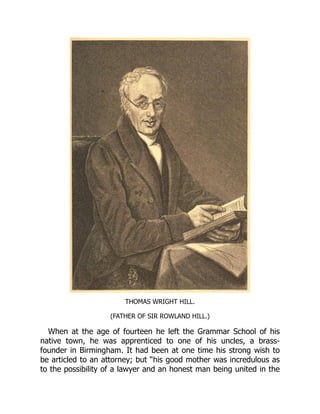
52.
THOMAS WRIGHT HILL.
(FATHEROF SIR ROWLAND HILL.)
When at the age of fourteen he left the Grammar School of his
native town, he was apprenticed to one of his uncles, a brass-
founder in Birmingham. It had been at one time his strong wish to
be articled to an attorney; but “his good mother was incredulous as
to the possibility of a lawyer and an honest man being united in the
53.
same person.” Hiseldest son, the late Mr. Matthew Davenport Hill,
said that his father had many of the qualities which make an able
lawyer:—
“He had what is known in the profession as a good head for
law. He was quick at discovering distinctions, possessed logical
powers, both strong and subtle, and a memory exceedingly
retentive: while his language was at once lucid and accurate. In
conversation he was a fluent speaker, and with early practice
doubtless would have learnt to make fluent speeches; but I do
not think he could ever have brought himself to utter an
unnecessary word.”
He used to read with eagerness all law books that came in his
way, and was, says his son, better informed on all matters pertaining
to the law than almost any layman he ever met with. I greatly
doubt, however, whether as a lawyer he could have made his way.
When he was in his seventieth year, his son was counsel in a political
trial, where the judge so far forgot his position on the bench, as in
summing-up to speak of the learned gentleman who was opposed to
him. “Thanks to God,” wrote the old man on hearing of the case,
“that it is not my profession to plead before such judgment-seats. I
should ruin the best of causes by unbridled indignation.” With his
eager and impatient mind, with his love for “the divine principle of
utility,” he would never have borne “the tyranny of lawyers,” which
was, to use Gibbon’s words, “more oppressive and ridiculous than
even the old yoke of the clergy.”
Leaving school as he did at an early age his education was but
imperfect. Nevertheless in his Calvinistic home he had studied one
book thoroughly, and that was the Bible. Its beautiful language was
ever at his command. On Sunday afternoons, while he was still a
child, it had been his father’s wont to entertain him and his brother
with Scripture stories told in homely words. “The story of Gideon,”
wrote the old man, more than eighty years later, “was a great
favourite, and ecstatic was the moment when my father came to
narrate the breaking of the jugs, the sudden blaze of the lamps, and
54.
the accompanying shoutof the watchword—‘The sword of the Lord,
and of Gideon.’” The child used to delight in reading the Latin
quotations in Stackhouse’s “History of the Bible.” He did not
understand them, but he found pleasure in the melody of the words.
Later on at school he acquired a fair knowledge of Latin and some
knowledge of Greek, but he was removed at too early an age to
become much of a scholar. Like many another youth of those days
eager after knowledge, he had but few books at his command. Even
his copy of Robinson Crusoe was but a fragment. It began, as he
vividly recollected, with the words “‘More than thirty dancing round a
fire,’ by which,” he wrote, “those who are familiarly acquainted with
that fascinating book will perceive how dreadfully my copy had
suffered mutilation.” A friend of his father’s—a man of secluded
habits and of a studious turn of mind, and therefore set down by
some of the good people of Kidderminster as being in league with
the Evil One—knowing that the boy was fond of reading,
bequeathed to him two volumes. One of the trustees wished to have
them burnt at once, as they bore a suspicious appearance and came
from a dangerous quarter. “My father,” wrote his son, “who was
somewhat less credulous than his neighbours, said, ‘Oh! let the boy
have them;’ whereupon were put into my hands a ‘Manual of
Geography,’ and a copy of ‘Euclid’s Elements.’” On Euclid he at once
fastened, and soon mastered it. He went on to algebra and the
higher mathematics. To astronomy he devoted himself with an
ardour that never flagged. When he was eighty-four years old he
repaired with his telescope to Willingdon that he might observe the
great eclipse of the sun of the year 1847. To this eclipse he had long
been looking forward, but unhappily he was disappointed by a
cloudy sky. Even within a month or two of his death he was engaged
in framing a system of nomenclature for the stars.
His settlement at Birmingham was, in one way, most fortunate. It
brought him under the instruction of the excellent Priestley. He left
the strict and narrow sect in which he had been brought up, and
joined a congregation which its pastor, perhaps with justice,
described as the most liberal of any in England. He became an
55.
Welcome to ourwebsite – the ideal destination for book lovers and
knowledge seekers. With a mission to inspire endlessly, we offer a
vast collection of books, ranging from classic literary works to
specialized publications, self-development books, and children's
literature. Each book is a new journey of discovery, expanding
knowledge and enriching the soul of the reade
Our website is not just a platform for buying books, but a bridge
connecting readers to the timeless values of culture and wisdom. With
an elegant, user-friendly interface and an intelligent search system,
we are committed to providing a quick and convenient shopping
experience. Additionally, our special promotions and home delivery
services ensure that you save time and fully enjoy the joy of reading.
Let us accompany you on the journey of exploring knowledge and
personal growth!
ebookultra.com

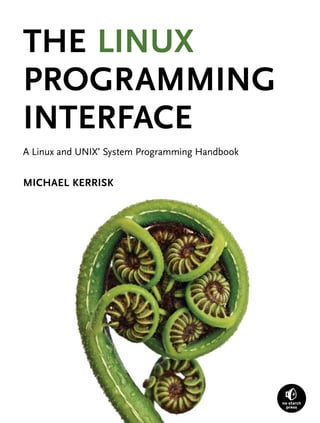



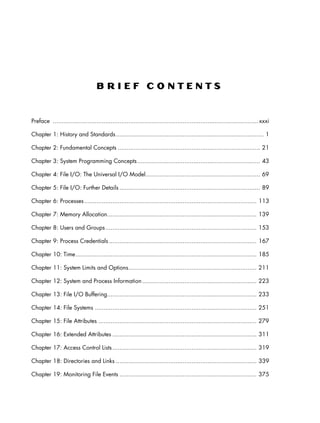
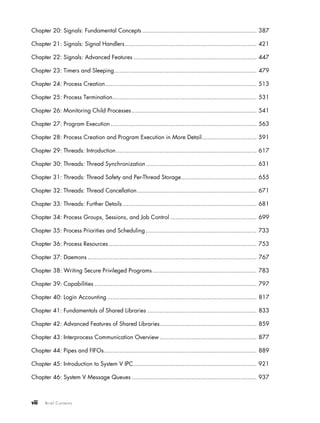
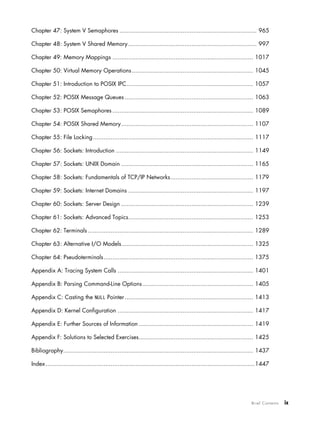

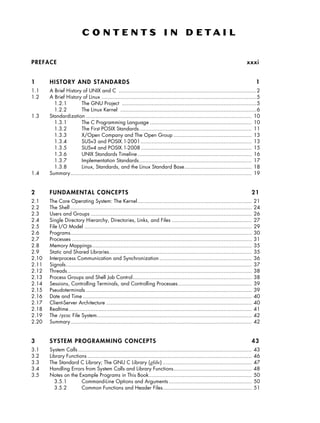
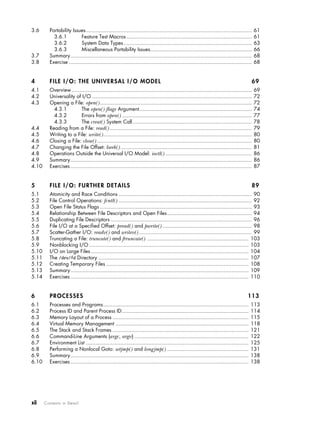
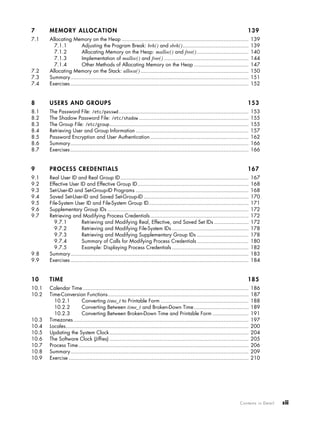

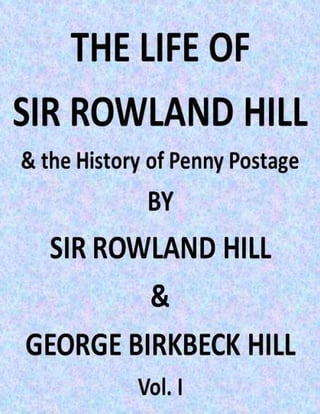

![This ebook is for the use of anyone anywhere in the United
States and most other parts of the world at no cost and with
almost no restrictions whatsoever. You may copy it, give it away
or re-use it under the terms of the Project Gutenberg License
included with this ebook or online at www.gutenberg.org. If you
are not located in the United States, you will have to check the
laws of the country where you are located before using this
eBook.
Title: The Life of Sir Rowland Hill and the History of Penny
Postage, Vol. 1 (of 2)
Author: Sir Rowland Hill
George Birkbeck Norman Hill
Release date: April 29, 2019 [eBook #59390]
Language: English
Credits: E-text prepared by MWS, Adrian Mastronardi, The
Philatelic Digital Library Project, and the Online
Distributed Proofreading Team (http://www.pgdp.net)
from page images generously made available by
Internet Archive (https://archive.org)
*** START OF THE PROJECT GUTENBERG EBOOK THE LIFE OF SIR
ROWLAND HILL AND THE HISTORY OF PENNY POSTAGE, VOL. 1
(OF 2) ***](https://image.slidesharecdn.com/75956-250507083256-13f2c29b/85/The-Linux-Programming-Interface-1st-Edition-Michael-Kerrisk-26-320.jpg)
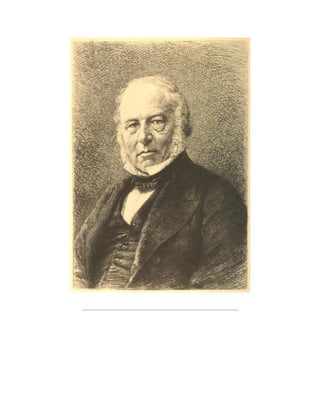
![PREFACE.
Sir Rowland Hill, after his retirement from the public service, as
soon as prolonged rest had given him back some portion of his
former strength, satisfied a mind which had always found its chief
happiness in hard work, by taking upon himself the task of writing
the history of his great postal reform. In a “Prefatory Memoir” he
gave, moreover, a sketch of the earlier part of his life. It had been
his hope that he might live to bring out his book himself; but, for
reasons which the reader will find set forth in his Preface,[1] he at
last, though with reluctance, came to the decision that the
publication must be delayed till after his death. Though he had, as it
seemed, really finished his work, and had even gone so far as to
have a few copies printed, yet he spent many an hour on its
revision. He went through it more than once with the utmost care,
sparing no pains to obtain complete accuracy. In the year 1872 he
asked me to examine it carefully, and to point out whatever might
strike me as being defective either in its method or its execution. I
found, as I told him, that the “Prefatory Memoir” was too short, and
“The History of Penny Postage” too long. Too little was told of the
way in which his character had been trained for the hard task which
awaited it, and too much was told of the improvements which had
been effected. In the case of inventors it is not so much what a man
does, as how he learns to do it, and how he does it, that we all care
to know. We so soon come to think that what is has always been,
that our curiosity is not much excited about the origin of the
conveniences of modern life. Though the improvements themselves
we accept as a matter of course, yet if in getting them adopted
there was a hard struggle with ignorance, routine, indifference, and
jealousy, then our interest is at once aroused. In his book there were](https://image.slidesharecdn.com/75956-250507083256-13f2c29b/85/The-Linux-Programming-Interface-1st-Edition-Michael-Kerrisk-32-320.jpg)
![very many passages which I had read with the strongest interest,
containing as they did the history of a great and a very curious fight.
In these there was scarcely any change that I could wish made. But
mixed up with these there were accounts of improvements which,
though important in themselves, were of little interest to an outsider.
I suggested, therefore, that certain parts should be altogether struck
out, and that others should be gathered either into one Appendix at
the end of the History, or into Appendices at the end of the chapters.
Though he did not by any means adopt all my recommendations, yet
he entrusted me with the duty of writing the history of his early life.
In the course of the next few years he drew up many interesting
papers containing the recollections of his childhood and youth. In
this he was aided by his brother Arthur, in whose mind, though he
has seen more than fourscore years, the past seems to live with all
the freshness of yesterday. These papers he put into my hands some
months before his death, and, together with them, a large number
of old letters and a manuscript history of his life which he had begun
to write when he was but seventeen years old. In fact, the
abundance of the materials thus placed at my disposal was so great,
that my chief difficulty has been to keep my part of the work at all
within reasonable limits.
If the “Prefatory Memoir” in which his early life was told had really
been an Autobiography, I might well have hesitated, and hesitated
long, before I ventured to rewrite it. So much of a man’s character is
shown by his style, that even an imperfect life written by himself
will, likely enough, be of far greater value than the most perfect life
written by another. But, as will be seen later on,[2] so far as the style
goes, this Memoir was in no sense autobiographical. It was, indeed,
told in the first person; but “I had,” he said, “to devolve upon
another the task of immediate composition.” I may add that his
brother, who thus assisted him, had not at his command many of the
materials which were afterwards placed at my disposal. My uncle
had not at that time wished that a full account should be given of his
early days, and he had not, therefore, thought it needful to lay
before him either the letters or the fragment of an early](https://image.slidesharecdn.com/75956-250507083256-13f2c29b/85/The-Linux-Programming-Interface-1st-Edition-Michael-Kerrisk-33-320.jpg)
![autobiography which I have mentioned above. He had a strange
unwillingness to let this history of his youthful days be seen. In a
memorandum which he made a few years ago he says, “These
memoirs of the early part of my life having been written, for the
most part, when I was very young and ill-informed, contain much
which I have since known to be ridiculous; and for this reason I have
never shown them to any one—except, I think, a small portion to my
wife. After some hesitation I have decided to preserve the memoirs
for any use to which my executors may think proper to put them.” A
far greater value is added to them by the fact that the author
intended them for no other eye but his own. None of his brothers, I
believe, even knew that he was writing them. He used, in late years,
often to speak to me about them; but it was only a short time before
his death that he could bring himself to let me read them. When he
gave them to me he bade me remember that he was very young
and ignorant when he wrote them. “You must not,” he said, “judge
me harshly.” Happily I was soon able to tell him that, though I had
been a great reader of autobiographies, there were few which had
interested me more than his. I found nothing to dispose me to
ridicule, but much that moved my pity, and still more that roused my
admiration.
I need scarcely say that the “Prefatory Memoir” has been of great
service to me in my task. It is not for me to say how well it is
written, or to praise the work of one to whom I owe everything. I
may, at all events, acknowledge my debt. I have, as the reader will
see, largely drawn upon it. That it was, however, imperfect—
necessarily so, as I have shown—will be at once recognised by any
one who considers how much I have quoted from my uncle’s
Memoirs and from the letters. It contained, for instance, no mention
of the visit to Edgeworth-Town, and not a single extract from a letter.
In giving so full an account of my grandparents and of their home-
life, I have borne in mind the saying of Mr. Carlyle, that “the history
of a man’s childhood is the description of his parents and
environment.”[3] In a very large sense is this true of the childhood of](https://image.slidesharecdn.com/75956-250507083256-13f2c29b/85/The-Linux-Programming-Interface-1st-Edition-Michael-Kerrisk-34-320.jpg)
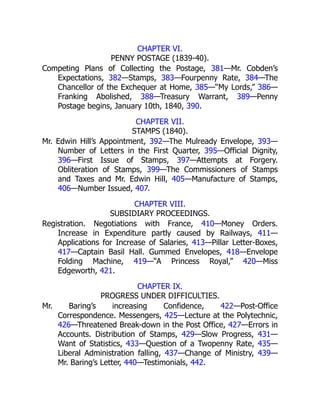
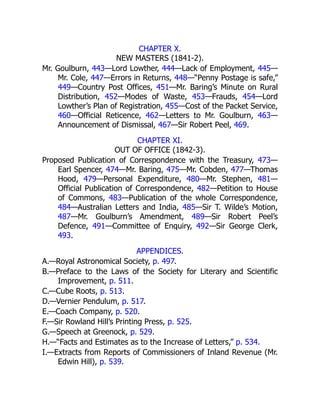
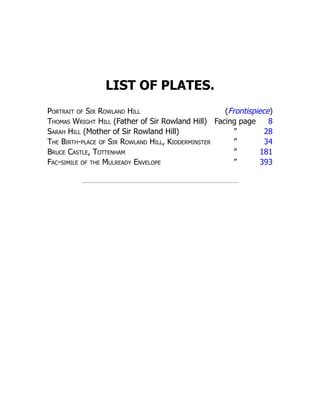
![come down in the world. When he was presented with the freedom
of the City of London a few months before his death, the
Chamberlain informed him that he belonged to a line which already
twice before had received that high distinction. Whether he could
claim kindred with Sir Rowland Hill of Queen Elizabeth’s time, and
with Sir Rowland Hill, the famous soldier of the Peninsular War, I
have no means of knowing. In a fire which sixty years ago burnt
down part of his father’s house, many family deeds were destroyed,
some of which, he informed me, went back to the age of the Tudors.
He was not, however, without ancestors, who justly raised in him a
strong feeling of pride. His father’s mother, Sarah Symonds, “had a
common descent with the family of Symons, or Symeon, of Pyrton,
the heiress of which branch married John Hampden.”[4] His father,
who had many kinsmen of the name of Butler, had been told in his
youth that he was related by blood to the author of “Hudibras.”[5]
With these two famous men his connection was but remote. But
both father and mother could tell the boy of nearer and undoubted
ancestors, who had shown, some of them, strong independence of
character, and one or two a noble spirit of self-sacrifice. In the
eloquent words of Romilly, he might have said that “his father left
his children no other inheritance than the habits of industry, the
example of his own virtuous life, an hereditary detestation of tyranny
and injustice, and an ardent zeal in the cause of civil and religious
freedom.” With perfect truthfulness he might have applied these
words to his mother also. The detestation of tyranny and injustice,
and the ardent zeal in the cause of civil and religious freedom were,
indeed, hereditary, in most of the branches of his family. They were
chiefly old Puritan stocks, with much of the narrowness, but all the
integrity of the best of the Nonconformists.
His father had received a hurt in defending a house against the
brutal mob which, in the year 1791, burned down in Birmingham the
chapels and the dwellings of unoffending dissenters. His grandfather,
James Hill, had shown his attachment to civil liberty in a curious
way. He was a baker in Kidderminster—“a substantial freeholder,” as
his son described him. He was descended from a considerable](https://image.slidesharecdn.com/75956-250507083256-13f2c29b/85/The-Linux-Programming-Interface-1st-Edition-Michael-Kerrisk-46-320.jpg)
![landowner who had married twice, and had left the children of his
first wife very much to shift for themselves. One of them had settled
in trade in Kidderminster.[6] James Hill was his grandson. In his time
the bakers all heated their ovens with faggots, which they bought of
the neighbouring squire. An election for the county came on; the
squire was one of the candidates, and the steward asked James Hill
for his vote. “My father,” his son records, “could not bring himself to
the expected compliance. The result was that at the next faggot-
harvest[7] his application was refused, and he was thus put to great
inconvenience.” The baker, however, was an ingenious man. Coals
were cheap if faggots were dear. He began by trying a mixture of
coals and wood. He found, by repeated trials, that he could go on
lessening the quantity of faggots and increasing the quantity of coal.
Other bakers profited by his experience, and the faggots now lacked
purchasers. “Applications were made to him to know if he had no
room for faggots, from the quarter which had refused the supply.”[8]
James Hill’s brother, John, had enrolled himself as a volunteer
against the Young Pretender in 1745; for, like a famous brother-
volunteer, Fielding’s Tom Jones, “he had some heroic ingredients in
his composition, and was a hearty well-wisher to the glorious cause
of liberty and of the Protestant religion.” He was once summoned to
Worcester to serve on a jury, when he alone of the twelve jurymen
refused a bribe. The judge, coming to hear of this, praised him
highly, and whenever he went the same circuit asked whether he
was to have the pleasure of meeting “the honest juror.” Later on in
life he became, like Faraday, a Sandemanian, and was bound by
conscience to a kind of practical communism. He died in the year
1810, at the age of ninety-one, and so was well known by Rowland
Hill and his brothers. It is a striking fact that there should still be
living men who can well remember one who volunteered against the
Young Pretender.
James Hill’s wife was the grand-daughter of a medical practitioner
at Shrewsbury of the name of Symonds, who had married Miss
Millington, the only sister of a wealthy lawyer of that town. An
election for the borough came on. The doctor refused to place his](https://image.slidesharecdn.com/75956-250507083256-13f2c29b/85/The-Linux-Programming-Interface-1st-Edition-Michael-Kerrisk-47-320.jpg)
![vote at the disposal of his rich brother-in-law, the attorney. “The
consequence is,” writes Thomas Hill “that Millington’s Hospital now
stands a monument of my great-grandfather’s persistence and his
brother-in-law’s implacability. Of this privation,” he adds, “my mother
used to speak with very good temper. She said the hospital was a
valuable charity, and she believed that no descendant of her
grandfather’s was the less happy for having missed a share of the
fortune bestowed upon the hospital.” Through this lady Rowland Hill
was related to the Rev. Joshua Symonds, the friend and
correspondent of Howard and Wilberforce.[9] Such were the worthies
he could undoubtedly boast of on his father’s side. There is no man
among them whom the world would reckon as famous; and yet I
remember how proud I felt as a mere child when my father first told
me of the “honest juror,” and of the forefather who had lost a
fortune by his vote. To such feelings as these Rowland must have
been susceptible in a singular degree.
The story of his mother’s ancestors is more romantic, but,
perhaps, even more affords a just cause for honest pride. Her
grandmother’s name was Sarah Simmons. She had been left an
orphan at an early age, and was heiress to a considerable fortune.
She was brought up by an uncle and aunt, who were severe
disciplinarians, even for the time in which they lived. They tried to
force her to marry a man for whom she had no liking, and, when she
refused, subjected her to close confinement. She escaped from their
house in the habit of a countrywoman, with a soldier’s coat thrown
over it. In those days, and much later also, poor women in wet
weather often wore the coats of men. She set out to walk to
Birmingham, a distance of some fifteen miles. On the road she was
overtaken by one of her uncle’s servants, mounted on horseback,
who asked of her whether she had been passed by a young lady,
whose appearance he described. She replied that no such person
had passed her, and the man rode away, leaving her rejoicing at the
completeness of her disguise. She reached Birmingham, and there
supported herself by spinning. To her fortune she never laid claim.
At the end of two years she married a working man named](https://image.slidesharecdn.com/75956-250507083256-13f2c29b/85/The-Linux-Programming-Interface-1st-Edition-Michael-Kerrisk-48-320.jpg)