North Maharashtra University
School of Management Studies
Name :- Rahul D Bharambe
M.B.A. II nd year
Roll no :- 4
Subject :- 302 Business Law –I
Presented to :- Mr. Milind Dhanraj sir
Unit :-I
INDIAN CONTRACT ACT
2
Introduction
The law of contract is the function
upon which the super structure of
modern business is built .
The law of contract is applicable
not only to business community
but also to other .
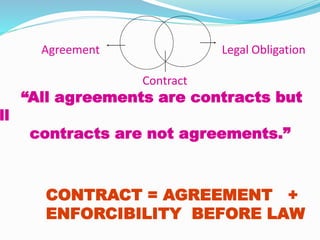
Agreement Legal Obligation
Contract
“All agreements are contracts but
ll
contracts are not agreements.”
CONTRACT = AGREEMENT +
ENFORCIBILITY BEFORE LAW
Meaning
 The law of contract in india is contained in the indian
contract act 1872
 This act is based mainly on English common law
which is to large extent mode up of judicial
proccedency
 It extends to the whole of India except the state of J&K
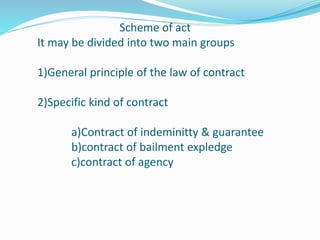
Scheme of act
It may be divided into two main groups
1)General principle of the law of contract
2)Specific kind of contract
a)Contract of indeminitty & guarantee
b)contract of bailment expledge
c)contract of agency
Definition
 According to section 2(h) of indian contract act
“ an agreement en forable by law is a contract .
A contract is an agreement the object of which is to
create a leglal obligation .i.e a duty enforceable by
law
according to this defination contract essentially
consist of two element
1) on agreement
2) Legal obligation
Essentials
 The essential element of valid contract are -:
1) Offer & acceptance
2) Intention to create legal relation
3) Lawful consideartion
4) capacity of parties
5) Free constent
6) lawful Object
7) writing & registration
8) certanity
9) Possibilality of performance
10) not expressery declered avoid
Offer & acceptance
 There must be a lawful offer and a lawful
acceptance of the affect thus resulting in an
agreemeants .the adjective lawful implies
that the offer & accpetance must satisfy the
reguirment or the contract act in relagtion
therero.
Intentien to create legal relation
There must be an intention among
the parties that the agreement
should be attached be legal
consequences create legal obligation
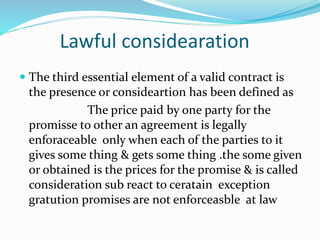
Lawful considearation
 The third essential element of a valid contract is
the presence or consideartion has been defined as
The price paid by one party for the
promisse to other an agreement is legally
enforaceable only when each of the parties to it
gives some thing & gets some thing .the some given
or obtained is the prices for the promise & is called
consideration sub react to ceratain exception
gratution promises are not enforceasble at law
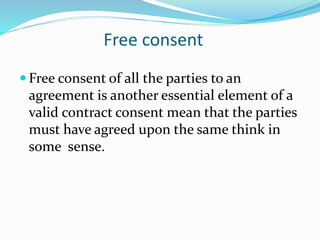
Free consent
 Free consent of all the parties to an
agreement is another essential element of a
valid contract consent mean that the parties
must have agreed upon the same think in
some sense.
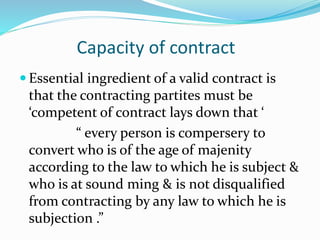
Capacity of contract
 Essential ingredient of a valid contract is
that the contracting partites must be
‘competent of contract lays down that ‘
“ every person is compersery to
convert who is of the age of majenity
according to the law to which he is subject &
who is at sound ming & is not disqualified
from contracting by any law to which he is
subjection .”
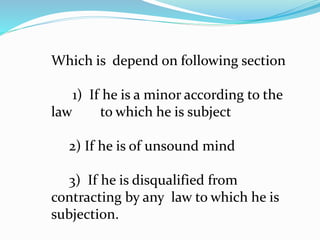
Which is depend on following section
1) If he is a minor according to the
law to which he is subject
2) If he is of unsound mind
3) If he is disqualified from
contracting by any law to which he is
subjection.
THANK
YOU

The indian contract act

  • 1.
    North Maharashtra University Schoolof Management Studies Name :- Rahul D Bharambe M.B.A. II nd year Roll no :- 4 Subject :- 302 Business Law –I Presented to :- Mr. Milind Dhanraj sir
  • 2.
  • 3.
    Introduction The law ofcontract is the function upon which the super structure of modern business is built . The law of contract is applicable not only to business community but also to other .
  • 5.
    Agreement Legal Obligation Contract “Allagreements are contracts but ll contracts are not agreements.” CONTRACT = AGREEMENT + ENFORCIBILITY BEFORE LAW
  • 6.
    Meaning  The lawof contract in india is contained in the indian contract act 1872  This act is based mainly on English common law which is to large extent mode up of judicial proccedency  It extends to the whole of India except the state of J&K
  • 7.
    Scheme of act Itmay be divided into two main groups 1)General principle of the law of contract 2)Specific kind of contract a)Contract of indeminitty & guarantee b)contract of bailment expledge c)contract of agency
  • 8.
    Definition  According tosection 2(h) of indian contract act “ an agreement en forable by law is a contract . A contract is an agreement the object of which is to create a leglal obligation .i.e a duty enforceable by law according to this defination contract essentially consist of two element 1) on agreement 2) Legal obligation
  • 9.
    Essentials  The essentialelement of valid contract are -: 1) Offer & acceptance 2) Intention to create legal relation 3) Lawful consideartion 4) capacity of parties 5) Free constent 6) lawful Object 7) writing & registration 8) certanity 9) Possibilality of performance 10) not expressery declered avoid
  • 10.
    Offer & acceptance There must be a lawful offer and a lawful acceptance of the affect thus resulting in an agreemeants .the adjective lawful implies that the offer & accpetance must satisfy the reguirment or the contract act in relagtion therero.
  • 12.
    Intentien to createlegal relation There must be an intention among the parties that the agreement should be attached be legal consequences create legal obligation
  • 13.
    Lawful considearation  Thethird essential element of a valid contract is the presence or consideartion has been defined as The price paid by one party for the promisse to other an agreement is legally enforaceable only when each of the parties to it gives some thing & gets some thing .the some given or obtained is the prices for the promise & is called consideration sub react to ceratain exception gratution promises are not enforceasble at law
  • 14.
    Free consent  Freeconsent of all the parties to an agreement is another essential element of a valid contract consent mean that the parties must have agreed upon the same think in some sense.
  • 15.
    Capacity of contract Essential ingredient of a valid contract is that the contracting partites must be ‘competent of contract lays down that ‘ “ every person is compersery to convert who is of the age of majenity according to the law to which he is subject & who is at sound ming & is not disqualified from contracting by any law to which he is subjection .”
  • 16.
    Which is dependon following section 1) If he is a minor according to the law to which he is subject 2) If he is of unsound mind 3) If he is disqualified from contracting by any law to which he is subjection.
  • 17.