The Lean Studio:
Running a modern agency
• James Jeffries @jjeffries1
• Dave Heath @daveheathuk
• @computerlovers
A digital experience
studio in the heart of
Manchester
THE LEAN STUDIO // @JJEFFRIES1 // @DAVEHEATHUK // @COMPUTERLOVER S
Why are we changing?
THE LEAN STUDIO // @JJEFFRIES1 // @DAVEHEATHUK // @COMPUTERLOVER S
The traditional agency model
THE LEAN STUDIO // @JJEFFRIES1 // @DAVEHEATHUK // @COMPUTERLOVER S
The traditional agency model
Projects not products
THE LEAN STUDIO // @JJEFFRIES1 // @DAVEHEATHUK // @COMPUTERLOVER S
Projects not products
Deliver fast at the expense of quality
The traditional agency model
THE LEAN STUDIO // @JJEFFRIES1 // @DAVEHEATHUK // @COMPUTERLOVER S
Projects not products
Deliver fast at the expense of quality
Build what the customer asks for
The traditional agency model
THE LEAN STUDIO // @JJEFFRIES1 // @DAVEHEATHUK // @COMPUTERLOVER S
AQA - LEAN WORKSHOP - SEPTEMBER 2016 9
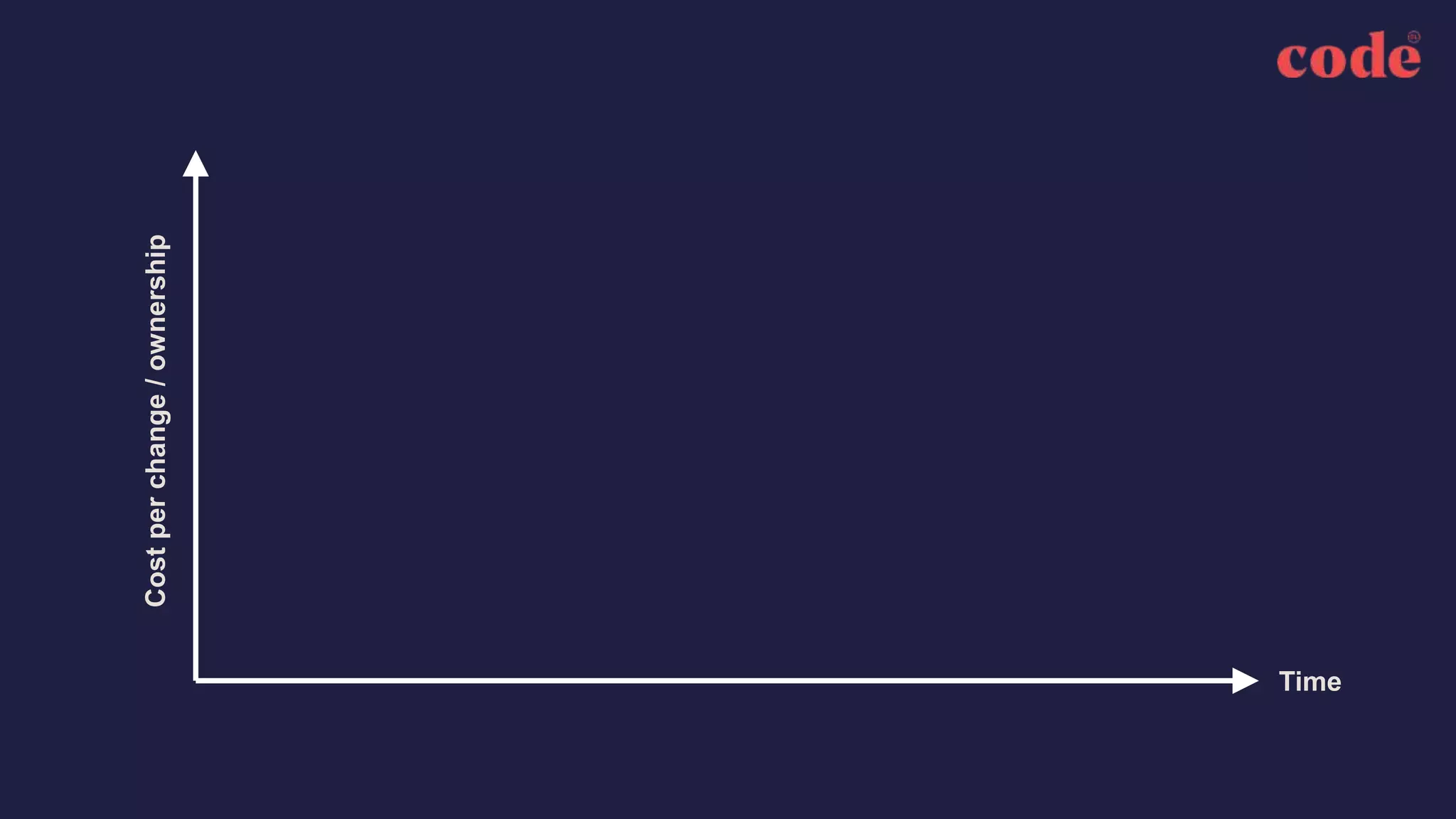
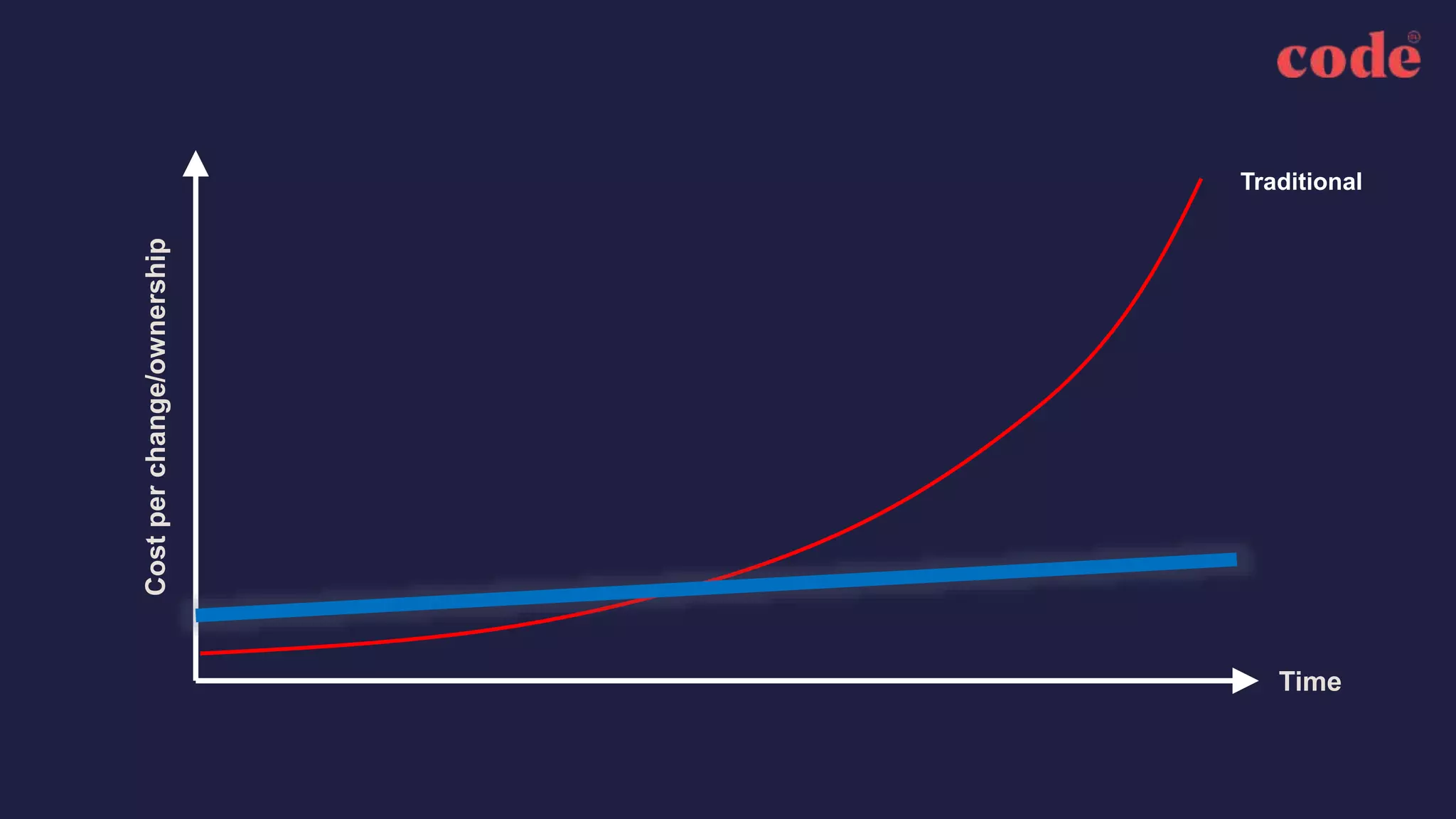
Costperchange/ownership
Time
AQA - LEAN WORKSHOP - SEPTEMBER 2016 10
Time
Traditional
Costperchange/ownership
How are we changing?
THE LEAN STUDIO // @JJEFFRIES1 // @DAVEHEATHUK // @COMPUTERLOVERS
OurStudioManifesto
SOLVEPROBLEMSover Predefined Solutions
EXPERIENCESover Designs
PRODUCTover Project
VALUEover Volume
INSIGHTSover Opinion
ITERATIVEover Big Bang
ADAPTABILITYover Constraints
http://lean.codecomputerlove.com/lean-studio-manifesto/
12AQA - LEAN WORKSHOP - SEPTEMBER 2016
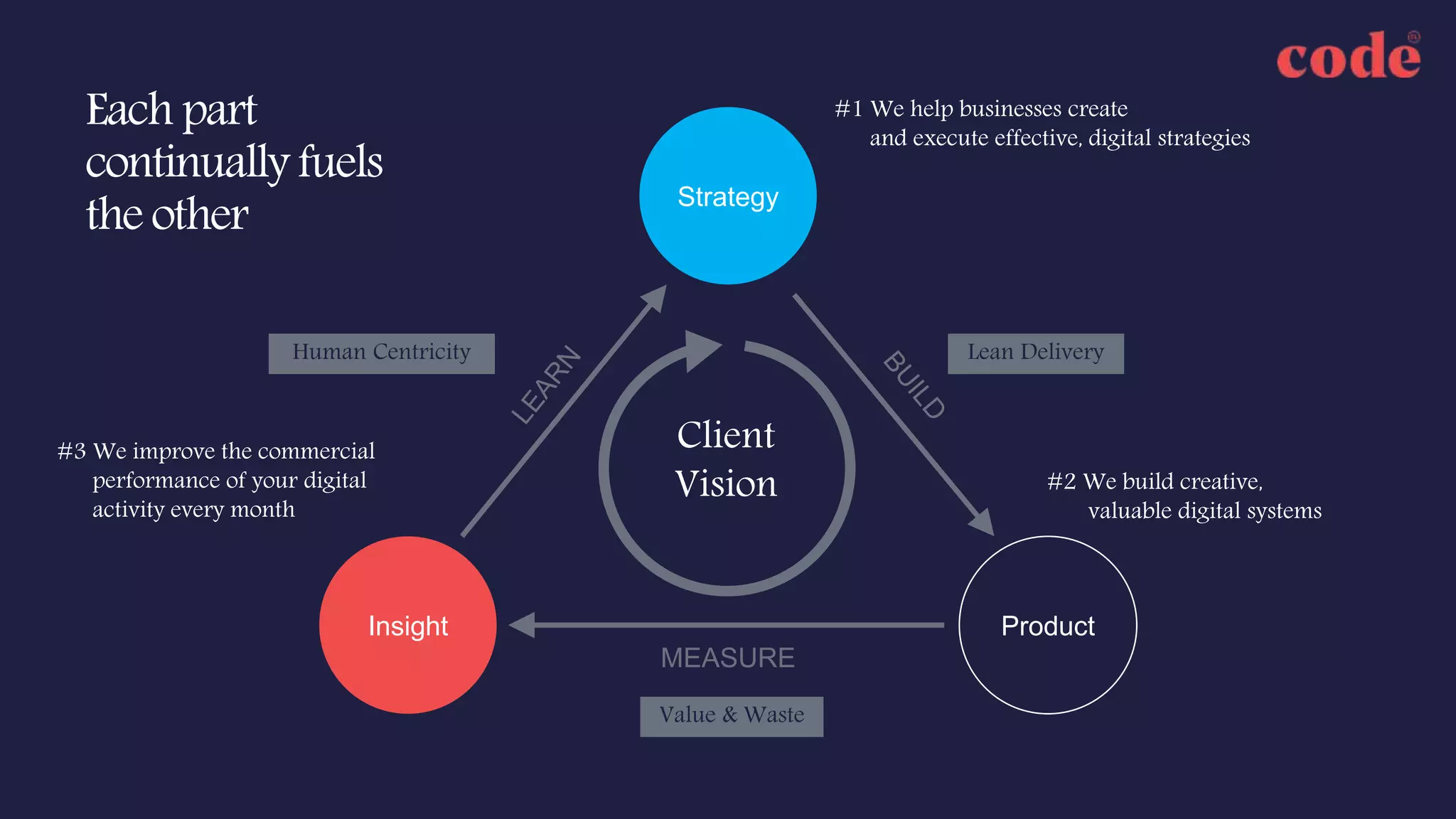
Strategy
ProductInsight
MEASURE
Client
Vision
#1 We help businesses create
and execute effective, digital strategies
#2 We build creative,
valuable digital systems
Lean Delivery
Value & Waste
#3 We improve the commercial
performance of your digital
activity every month
Human Centricity
Each part
continually fuels
the other
14
Long term partnerships
THE LEAN STUDIO // @JJEFFRIES1 // @DAVEHEATHUK // @COMPUTERLOVER S
15
Focus on value, not
deadline/budget
THE LEAN STUDIO // @JJEFFRIES1 // @DAVEHEATHUK // @COMPUTERLOVER S
16
Fixed, cross functional
teams
THE LEAN STUDIO // @JJEFFRIES1 // @DAVEHEATHUK // @COMPUTERLOVER S
17
Bring ‘dot com’ lean
thinking to agency &
client
THE LEAN STUDIO // @JJEFFRIES1 // @DAVEHEATHUK // @COMPUTERLOVER S
18THE LEAN STUDIO // @JJEFFRIES1 // @DAVEHEATHUK // @COMPUTERLOVER S
Product
Roadmap &
Backlog
Feature
Roadmap
Prioritisation
Architectural
Roadmap
AQA - LEAN WORKSHOP - SEPTEMBER 2016 19
Time
Traditional
Costperchange/ownership
Challenges
THE LEAN STUDIO // @JJEFFRIES1 // @DAVEHEATHUK // @COMPUTERLOVER S
Challenges
Roles are changing
THE LEAN STUDIO // @JJEFFRIES1 // @DAVEHEATHUK // @COMPUTERLOVER S
Roles are changing
More collaboration required
Challenges
THE LEAN STUDIO // @JJEFFRIES1 // @DAVEHEATHUK // @COMPUTERLOVER S
Roles are changing
More collaboration required
Mindset & Empowerment
Challenges
THE LEAN STUDIO // @JJEFFRIES1 // @DAVEHEATHUK // @COMPUTERLOVER S
Roles are changing
More collaboration required
Mindset & Empowerment
Building Trust
Challenges
THE LEAN STUDIO // @JJEFFRIES1 // @DAVEHEATHUK // @COMPUTERLOVER S
Is this right for everyone?
THE LEAN STUDIO // @JJEFFRIES1 // @DAVEHEATHUK // @COMPUTERLOVER S
Probably not
THE LEAN STUDIO // @JJEFFRIES1 // @DAVEHEATHUK // @COMPUTERLOVER S
Why?
THE LEAN STUDIO // @JJEFFRIES1 // @DAVEHEATHUK // @COMPUTERLOVER S
Challenging clients proposals
Why?
THE LEAN STUDIO // @JJEFFRIES1 // @DAVEHEATHUK // @COMPUTERLOVER S
Challenging clients proposals
High level of collaboration required with clients
Why?
THE LEAN STUDIO // @JJEFFRIES1 // @DAVEHEATHUK // @COMPUTERLOVER S
Challenging clients proposals
High level of collaboration required with clients
Data driven & insights
Why?
Challenging clients proposals
High level of collaboration required with clients
Data driven & insights
High level of engineering maturity required
THE LEAN STUDIO // @JJEFFRIES1 // @DAVEHEATHUK // @COMPUTERLOVER S
Takeaways
THE LEAN STUDIO // @JJEFFRIES1 // @DAVEHEATHUK // @COMPUTERLOVER S
• Align the business top down to achieve the goal – total buy in
• Give people the time and space to learn and improve
• Give them the space to experiment safely
• Aim for an open culture where feedback and change is
welcomed
Start with culture
THE LEAN STUDIO // @JJEFFRIES1 // @DAVEHEATHUK // @COMPUTERLOVER S
• Collect data and use it to make decisions
• Look for opportunities to improve
• Be proactive and innovate
Use data
THE LEAN STUDIO // @JJEFFRIES1 // @DAVEHEATHUK // @COMPUTERLOVER S
• Not on how much you get done or what you’ll get paid for doing
• This applies to client work and continuous improvement
• What’s the smallest thing we can do to get the most value?
Focus on value
THE LEAN STUDIO // @JJEFFRIES1 // @DAVEHEATHUK // @COMPUTERLOVER S
Questions
THE LEAN STUDIO // @JJEFFRIES1 // @DAVEHEATHUK // @COMPUTERLOVER S

The Lean Studio

  • 1.
    The Lean Studio: Runninga modern agency • James Jeffries @jjeffries1 • Dave Heath @daveheathuk • @computerlovers
  • 2.
    A digital experience studioin the heart of Manchester
  • 3.
    THE LEAN STUDIO// @JJEFFRIES1 // @DAVEHEATHUK // @COMPUTERLOVER S
  • 4.
    Why are wechanging? THE LEAN STUDIO // @JJEFFRIES1 // @DAVEHEATHUK // @COMPUTERLOVER S
  • 5.
    The traditional agencymodel THE LEAN STUDIO // @JJEFFRIES1 // @DAVEHEATHUK // @COMPUTERLOVER S
  • 6.
    The traditional agencymodel Projects not products THE LEAN STUDIO // @JJEFFRIES1 // @DAVEHEATHUK // @COMPUTERLOVER S
  • 7.
    Projects not products Deliverfast at the expense of quality The traditional agency model THE LEAN STUDIO // @JJEFFRIES1 // @DAVEHEATHUK // @COMPUTERLOVER S
  • 8.
    Projects not products Deliverfast at the expense of quality Build what the customer asks for The traditional agency model THE LEAN STUDIO // @JJEFFRIES1 // @DAVEHEATHUK // @COMPUTERLOVER S
  • 9.
    AQA - LEANWORKSHOP - SEPTEMBER 2016 9 Costperchange/ownership Time
  • 10.
    AQA - LEANWORKSHOP - SEPTEMBER 2016 10 Time Traditional Costperchange/ownership
  • 11.
    How are wechanging? THE LEAN STUDIO // @JJEFFRIES1 // @DAVEHEATHUK // @COMPUTERLOVERS
  • 12.
    OurStudioManifesto SOLVEPROBLEMSover Predefined Solutions EXPERIENCESoverDesigns PRODUCTover Project VALUEover Volume INSIGHTSover Opinion ITERATIVEover Big Bang ADAPTABILITYover Constraints http://lean.codecomputerlove.com/lean-studio-manifesto/ 12AQA - LEAN WORKSHOP - SEPTEMBER 2016
  • 13.
    Strategy ProductInsight MEASURE Client Vision #1 We helpbusinesses create and execute effective, digital strategies #2 We build creative, valuable digital systems Lean Delivery Value & Waste #3 We improve the commercial performance of your digital activity every month Human Centricity Each part continually fuels the other
  • 14.
    14 Long term partnerships THELEAN STUDIO // @JJEFFRIES1 // @DAVEHEATHUK // @COMPUTERLOVER S
  • 15.
    15 Focus on value,not deadline/budget THE LEAN STUDIO // @JJEFFRIES1 // @DAVEHEATHUK // @COMPUTERLOVER S
  • 16.
    16 Fixed, cross functional teams THELEAN STUDIO // @JJEFFRIES1 // @DAVEHEATHUK // @COMPUTERLOVER S
  • 17.
    17 Bring ‘dot com’lean thinking to agency & client THE LEAN STUDIO // @JJEFFRIES1 // @DAVEHEATHUK // @COMPUTERLOVER S
  • 18.
    18THE LEAN STUDIO// @JJEFFRIES1 // @DAVEHEATHUK // @COMPUTERLOVER S Product Roadmap & Backlog Feature Roadmap Prioritisation Architectural Roadmap
  • 19.
    AQA - LEANWORKSHOP - SEPTEMBER 2016 19 Time Traditional Costperchange/ownership
  • 20.
    Challenges THE LEAN STUDIO// @JJEFFRIES1 // @DAVEHEATHUK // @COMPUTERLOVER S
  • 21.
    Challenges Roles are changing THELEAN STUDIO // @JJEFFRIES1 // @DAVEHEATHUK // @COMPUTERLOVER S
  • 22.
    Roles are changing Morecollaboration required Challenges THE LEAN STUDIO // @JJEFFRIES1 // @DAVEHEATHUK // @COMPUTERLOVER S
  • 23.
    Roles are changing Morecollaboration required Mindset & Empowerment Challenges THE LEAN STUDIO // @JJEFFRIES1 // @DAVEHEATHUK // @COMPUTERLOVER S
  • 24.
    Roles are changing Morecollaboration required Mindset & Empowerment Building Trust Challenges THE LEAN STUDIO // @JJEFFRIES1 // @DAVEHEATHUK // @COMPUTERLOVER S
  • 25.
    Is this rightfor everyone? THE LEAN STUDIO // @JJEFFRIES1 // @DAVEHEATHUK // @COMPUTERLOVER S
  • 26.
    Probably not THE LEANSTUDIO // @JJEFFRIES1 // @DAVEHEATHUK // @COMPUTERLOVER S
  • 27.
    Why? THE LEAN STUDIO// @JJEFFRIES1 // @DAVEHEATHUK // @COMPUTERLOVER S Challenging clients proposals
  • 28.
    Why? THE LEAN STUDIO// @JJEFFRIES1 // @DAVEHEATHUK // @COMPUTERLOVER S Challenging clients proposals High level of collaboration required with clients
  • 29.
    Why? THE LEAN STUDIO// @JJEFFRIES1 // @DAVEHEATHUK // @COMPUTERLOVER S Challenging clients proposals High level of collaboration required with clients Data driven & insights
  • 30.
    Why? Challenging clients proposals Highlevel of collaboration required with clients Data driven & insights High level of engineering maturity required THE LEAN STUDIO // @JJEFFRIES1 // @DAVEHEATHUK // @COMPUTERLOVER S
  • 31.
    Takeaways THE LEAN STUDIO// @JJEFFRIES1 // @DAVEHEATHUK // @COMPUTERLOVER S
  • 32.
    • Align thebusiness top down to achieve the goal – total buy in • Give people the time and space to learn and improve • Give them the space to experiment safely • Aim for an open culture where feedback and change is welcomed Start with culture THE LEAN STUDIO // @JJEFFRIES1 // @DAVEHEATHUK // @COMPUTERLOVER S
  • 33.
    • Collect dataand use it to make decisions • Look for opportunities to improve • Be proactive and innovate Use data THE LEAN STUDIO // @JJEFFRIES1 // @DAVEHEATHUK // @COMPUTERLOVER S
  • 34.
    • Not onhow much you get done or what you’ll get paid for doing • This applies to client work and continuous improvement • What’s the smallest thing we can do to get the most value? Focus on value THE LEAN STUDIO // @JJEFFRIES1 // @DAVEHEATHUK // @COMPUTERLOVER S
  • 35.
    Questions THE LEAN STUDIO// @JJEFFRIES1 // @DAVEHEATHUK // @COMPUTERLOVER S

Editor's Notes

  • #2  Slide 1 Dave Heath – Technical Director @ Code 30 strong engineering discipline James Jeffries – Principal Software Developer @ Code Responsible for technical architecture of team/client products and engineering best practice. Both Lean/Agile Evangelists
  • #3  Slide 2 Established in 1999 in Manchester, Code are an award winning digital product agency providing specialist skills across Product Strategy & Consultancy, Experience Design, Product Development & Engineering, Product Delivery, Search & Optimisation. Code have always been a forward thinking agency – willing to evolve and adapt where traditionals won’t Now in an ongoing evolution to take a lean, agile approach to delivering value with our clients
  • #4  Slide 3 We’ve worked with clients big and small, national and international on a variety of projects and products. Now helping these clients transition to a leaner approach, to deliver more value, quickly.
  • #5  Slide 4 Why are we changing? Differentiate to traditional ‘digital agency’ – to keep iterating ourselves in finding more efficient ways to delivering value with clients.
  • #6  Slide 5: Q: Who works in agencies? (How many are still in agencies?!) We’ve worked client side in dot coms an agile software development houses, but never an agency that wanted to adopt lean/agile practices. What we all consider agency to be? - Great Design & Usability - Poor Engineering underpinning it – build on a budget. - Lipstick on a pig?
  • #7  Slide 6 Projects not Products – having a fixed scope of a project restricts development team to a deadline
  • #8  Slide 7 Delivering to a fixed deadline causes compromises on quality. Most agencies undercut to win a tender – only one way that can go – poor quality engineering It’s traditionally about how many things you do – over the value of what you are doing
  • #9  Slide 8 Not necessarily building what’s right for the consumer – only what the client thinks is right. No data behind these decisions. Often building for the sake of building – “life’s too short to build things nobody wants” Client thinks it is strategic, but the constraints (iron triangle – “Cost, Scope, Time”) result in a tactical solutions – the client is ill advised if advised at all – We consider this very unethical.
  • #10  Slide 9 Cost ownership / cost per change scales
  • #11  Slide 10 Traditional Client/Agency relationship sit in the Red. Low starting cost (to win a tender), poor engineering quality and low adaptability from the start. Initially attractive – fast delivery – however over time changes get harder, until the Cost per change and product stability becomes unmanageable. Usually ends in a tender for new supplier and website – cycle starts again. We see this cycle in anything from 9-24 months!! Definition of insanity to keep going around this cycle and expect a different outcome. Q: How many people have seen this Boom Bust cycle?
  • #12  Slide 11 How are we changing? We believe in Lean approaches will offer us and client to be in a position to adapt to a faster changing world.
  • #13  Slide 12 Manifesto is a statement of intent – read it in full - http://lean.codecomputerlove.com/lean-studio-manifesto/ Ours leads on from a range of leading manifesto’s & thinkers Agile Manifesto of 2001 - http://agilemanifesto.org/ Test Manifesto - https://leanpub.com/AgileTesting/read Product Management Manifesto – http://melissaperri.com/2015/01/21/lean-product-management-manifesto Q: How many people have heard of the term HiPPO? Highest Paid Persons Opinion (Insights over Opinion). We believe in the items on the left over the items on the right (Code Computerlove v Traditional) Alhtough all people would also believe in the items on the right – the default execution shows the behaviours on the right.
  • #14  Slide 13 How we use the Build Measure Learn iterative loop within Code. Define a Product Strategy & Goal Identify Problems Create Hypothesis around a problem Build to test and prove the hypothesis to gether insights (this can be anything, user testing, A/B testing, MVP build) Measure & Insights – effectiveness of the ‘build’ – gather metrics to help identify next iteration Use to define how what we have learnt changes our Strategy or Goal and pivot if required. In traditional methods this loop is generally done once per 6-12 months (big build) – the macro level However we want to run through this at micro level – allowing client & product to pivot to react to changes and value opportunities.
  • #15  Slide 14 Long term partnerships with clients Work on products not projects – ongoing continual improvement and innovation Sustainable long term relationships - help clients evolve their capability Provide ongoing value
  • #16  Slide 15 Help clients make data driven decisions to provide real, quantifiable value Experiments to prove value before we commit to building Dashboards to raise awareness of ongoing value Show data in terms of clients KPIs and aims
  • #17  Slide 16 Product Consultant, Product Owner, Developers, Agile Test, Designers, UX, Optimisation… - Fixed teams aligned with client value - VALUE over Volume Clients hire us for longer periods of time – creating product roadmaps Moving away from timesheets - just work on whatever is most important Teams challenged to continuously improve – build measure learn applies to them also.
  • #18  Slide 17 Our world is changing faster and faster, more disruption then ever. Having the ability to change direction, adapt with minimal waste is a key part of modern business success. Why do dot coms, succeed or fail? Ability to compete and adapt to disruption We start with ‘Plan A’ – the direction we think we need to go in, but the measure of success is how we can iterate and pivot to Plan B, C ,Z or a plan that works and delivers the value before we run out of ‘resources’ (Time, money). Q: Read Running Lean?
  • #19  Slide 18 What makes an effective / balance for your product roadmap Having the technology platform that allows you to be able to pivot and maintain a low cost per change and low cost of ownership over the long term (strategic) – means you have to balance feature and architecture with a strategic mind. Focusing on features will take you back to the red line. This is a new concept for our sector
  • #20  Slide 19 What we deliver @ Code – with an initial higher cost – is the ability to adapt and change the shape of your client solutions easier without an ever increasing cost & risk. This is done through modern Software Engineering, Strategic Loosely Coupled Architecture principles, TDD, BDD, Automation, which create Repeatability as Reliability
  • #21  Slide 20 Moving on to some of the challenges we’ve faced so far, and are facing currently.
  • #22  Slide 21 Roles are changing cross discipline upskilling each other within account teams the challenges are lost people who aren’t in the mindset people having to learn to work in different ways eg Project managers – people not from engineering background The challenge is keeping people like this hiring people who “get it” is key Diluting the message is very dangerous
  • #23  Slide 22 More collaboration required Moving away from command and control to more collaborative empowered working practices
  • #24  Slide 23 Mindset Stopping people focussing on money and thinking about what is valuable to the client instead
  • #25  Slide 24 Trust This is new to many client – so there will be low levels of trust – so collaboration is key. Make sure they are involved, take an active role with the team, and support how they communicate the message inside their business - eg, don’t just send them a report – hold their hand – it’s a partnership.
  • #26  Slide 25 Is this right for everyone?
  • #27  Slide 26 No – there will be people in your business, and clients that will not want or be able to work in this way Comes back to how you onboard clients and the how you choose your talent
  • #28  Slide 27 Why isn’t it for everyone? Momentum to attract people/clients who already “get it” Roll back up to try and identify what is the PROBLEM we need to solve? Not just build me a website.. Confidence to challenge at the stakeholder/board level @ Client
  • #29  Slide 28 Why isn’t it for everyone? Momentum to attract people/clients who already “get it” Client change and education – it’s new to them – it’ Experience of improving an empowered team culture
  • #30  Slide 29 Why isn’t it for everyone? Momentum to attract people/clients who already “get it” Using the right amount of data or insights to validate the hypothesis Experience and brave enough to make measured responsibility & accountability – not JFDI
  • #31  Slide 30 Why isn’t it for everyone? Building with modern architectural concepts and engineering principles. It’s not about a business integration (CMS, CRM, ERP) rooling the roost, it’s considering them as integrations and abstracting away from them through a ‘hexagonal - ports and adapters’ approach so that we can use best in breed at every isolation layer. Yes, it takes longer – but it creates longer term adaptability
  • #32  Slide 31 To summarise
  • #33  Slide 32 Start with internal culture Board of directors down – reinforce the thinking – don’t do bottom up (never works) Align the workspace and organisation to support your goal Attract the right sort of people Continuously improve & challenge
  • #34  Slide 33 Hard to argue with the facts You need less than you think to get insights or validate If the client can’t define a KPI or metric – you must do it off your own back. Example: The Nasa hero metric metaphor When Nasa launch rockets, they don’t all measure success by looking into the sky on take off to see if the rocket is still firing. Otherwise, when the flame goes out – it is too late to take action. This is a hero metric – the 1 big thing (like how many purchases have we had on a web system?) Instead, all the various moving parts that play a part into the hero metric are also measured, and mission control have dashboards for each moving part & sub system. This allows them to measure at MICRO level metrics – and are able to predict based on tolerances and make decisions before the flame (hero metric) fails. The same should apply to your business systems – although the client may define 1-5 KPI’s or hero metrics, you must define micro level metrics - on a shared dashboard - and ensure the client see the value of looking at these level of metrics to be able to make decisions to keep the business firing. Eventually, the micro level metrics will be the things that drive hypothesis for value & therefore your backlog priorities.
  • #35  Slide 34 Only try to solve 1 problem at a time People will always want more than is needed -
  • #36  Slide 35 Thanks – please do contact us if you have any questions! @daveheathuk @jjeffries1 @computerlovers