
CLICK TO EDIT MASTER
TITLE STYLE
The Knowledge Level: Structure and
Details
Newell, A. (1982). The knowledge level. Artificial
intelligence, 18(1), 87-127.
Anna Fensel
© Copyright 2016 | www.sti-innsbruck.at
11.05.2016
• Knowledge Level Structure
• Knowledge Level Details
Outline
2016 www.sti-innsbruck.at 2
“I am about to propose the existence of something called the knowledge
level, within which knowledge is to be defined. I am about to propose the
existence of something called the knowledge level,
within which knowledge is to be defined.”
What it is about?
2016 www.sti-innsbruck.at 3
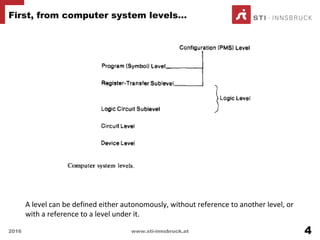
First, from computer system levels…
2016 www.sti-innsbruck.at 4
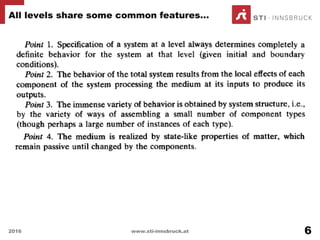
A level can be defined either autonomously, without reference to another level, or
with a reference to a level under it.
Aspects of a computer system level…
2016 www.sti-innsbruck.at 5
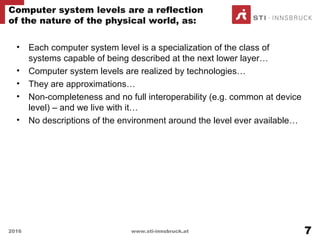
All levels share some common features…
2016 www.sti-innsbruck.at 6
• Each computer system level is a specialization of the class of
systems capable of being described at the next lower layer…
• Computer system levels are realized by technologies…
• They are approximations…
• Non-completeness and no full interoperability (e.g. common at device
level) – and we live with it…
• No descriptions of the environment around the level ever available…
Computer system levels are a reflection
of the nature of the physical world, as:
2016 www.sti-innsbruck.at 7
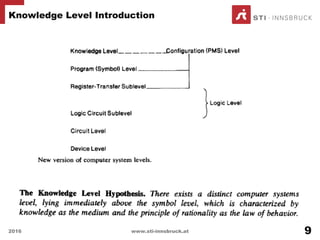
• The system at the knowledge level is the agent.
• The components at the knowledge level are goals, actions, and
bodies.
• Thus, an agent is composed of a set of actions, a set of goals and a
body.
• The medium at the knowledge level is knowledge (as might be
suspected).
• Thus, the agent processes its knowledge to determine the actions to
take.
• Finally, the behavior law is the principle of rationality: Actions are
selected to attain the agent's goals.
– E.g. if you know that 2+2 is 4, you rationally reply “4” on a question “how
much is 2+2”, if it is your goal to give a correct answer.
Knowledge level is a systems level,
like all the other system levels
2016 www.sti-innsbruck.at 8
Knowledge Level Introduction
2016 www.sti-innsbruck.at 9
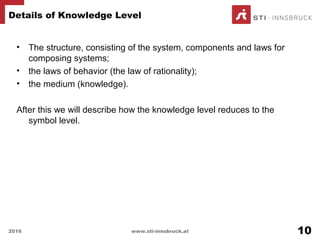
• The structure, consisting of the system, components and laws for
composing systems;
• the laws of behavior (the law of rationality);
• the medium (knowledge).
After this we will describe how the knowledge level reduces to the
symbol level.
Details of Knowledge Level
2016 www.sti-innsbruck.at 10
• Agent:
– has some physical body and a set of actions. These can be arbitrary
complex, and are external to the knowledge level.
– has a body of knowledge. Acts like a memory, has constraints w.r.t. its
structure, size, etc.
– has set of goals. A goal is a body of knowledge of a state of affairs in the
environment, formed out of body of knowledge of the agent.
• No structures for an agent, no ways to build complex agents.
The structure
2016 www.sti-innsbruck.at 11
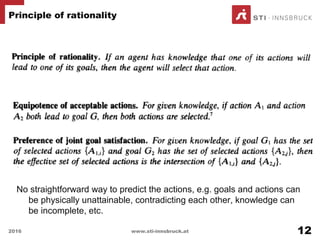
No straightforward way to predict the actions, e.g. goals and actions can
be physically unattainable, contradicting each other, knowledge can
be incomplete, etc.
Principle of rationality
2016 www.sti-innsbruck.at 12
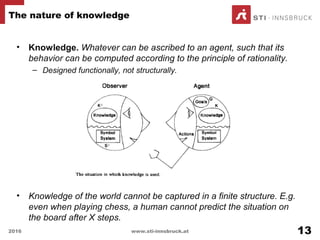
• Knowledge. Whatever can be ascribed to an agent, such that its
behavior can be computed according to the principle of rationality.
– Designed functionally, not structurally.
• Knowledge of the world cannot be captured in a finite structure. E.g.
even when playing chess, a human cannot predict the situation on
the board after X steps.
The nature of knowledge
2016 www.sti-innsbruck.at 13
• Knowledge, in the principle of rationality, is defined entirely in terms of
the environment of the agent, for it is the environment that is the
object of the agent's goals, and whose features therefore bear on the
way actions can attain goals.
• A logic is just a representation of knowledge. It is not the knowledge
itself, but a structure at the symbol level.
• The knowledge level is only an approximation, and a relatively poor
one on many occasions--we called it radically incomplete.
• An essential part of the current proposal is the existence of the
second level of approximation, namely, the symbol level.
• Fundamental principle of the observer: “To ascribe to an agent the
structure S is to ascribe whatever the observer can know from
structure S.”
Solutions to the representation of knowledge
2016 www.sti-innsbruck.at 14
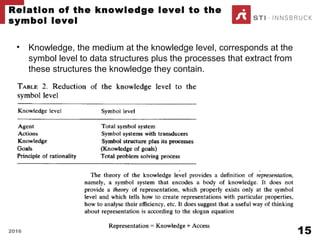
• Knowledge, the medium at the knowledge level, corresponds at the
symbol level to data structures plus the processes that extract from
these structures the knowledge they contain.
Relation of the knowledge level to the
symbol level
2016 www.sti-innsbruck.at 15
• Knowledge level and its details are introduced.
– Principle of rationality
– The nature of knowledge
– Knowledge representation
• If an actual system is produced, all knowledge-level descriptions must
ultimately be replaced by symbol-level descriptions.
• The knowledge-level description can be a good approximation even
though the subsystem being so described is quite simple, due to the
nature of the goals and environments of such agents, whose
specification is also under the control of the system designer.
Conclusions
2016 www.sti-innsbruck.at 16
CLICK TO EDIT MASTER
TITLE STYLE
Thank you
Questions

The Knowledge Level: Structure and Details (A. Newell, 1982)

  • 1.
    CLICK TO EDITMASTER TITLE STYLE The Knowledge Level: Structure and Details Newell, A. (1982). The knowledge level. Artificial intelligence, 18(1), 87-127. Anna Fensel © Copyright 2016 | www.sti-innsbruck.at 11.05.2016
  • 2.
    • Knowledge LevelStructure • Knowledge Level Details Outline 2016 www.sti-innsbruck.at 2
  • 3.
    “I am aboutto propose the existence of something called the knowledge level, within which knowledge is to be defined. I am about to propose the existence of something called the knowledge level, within which knowledge is to be defined.” What it is about? 2016 www.sti-innsbruck.at 3
  • 4.
    First, from computersystem levels… 2016 www.sti-innsbruck.at 4 A level can be defined either autonomously, without reference to another level, or with a reference to a level under it.
  • 5.
    Aspects of acomputer system level… 2016 www.sti-innsbruck.at 5
  • 6.
    All levels sharesome common features… 2016 www.sti-innsbruck.at 6
  • 7.
    • Each computersystem level is a specialization of the class of systems capable of being described at the next lower layer… • Computer system levels are realized by technologies… • They are approximations… • Non-completeness and no full interoperability (e.g. common at device level) – and we live with it… • No descriptions of the environment around the level ever available… Computer system levels are a reflection of the nature of the physical world, as: 2016 www.sti-innsbruck.at 7
  • 8.
    • The systemat the knowledge level is the agent. • The components at the knowledge level are goals, actions, and bodies. • Thus, an agent is composed of a set of actions, a set of goals and a body. • The medium at the knowledge level is knowledge (as might be suspected). • Thus, the agent processes its knowledge to determine the actions to take. • Finally, the behavior law is the principle of rationality: Actions are selected to attain the agent's goals. – E.g. if you know that 2+2 is 4, you rationally reply “4” on a question “how much is 2+2”, if it is your goal to give a correct answer. Knowledge level is a systems level, like all the other system levels 2016 www.sti-innsbruck.at 8
  • 9.
    Knowledge Level Introduction 2016www.sti-innsbruck.at 9
  • 10.
    • The structure,consisting of the system, components and laws for composing systems; • the laws of behavior (the law of rationality); • the medium (knowledge). After this we will describe how the knowledge level reduces to the symbol level. Details of Knowledge Level 2016 www.sti-innsbruck.at 10
  • 11.
    • Agent: – hassome physical body and a set of actions. These can be arbitrary complex, and are external to the knowledge level. – has a body of knowledge. Acts like a memory, has constraints w.r.t. its structure, size, etc. – has set of goals. A goal is a body of knowledge of a state of affairs in the environment, formed out of body of knowledge of the agent. • No structures for an agent, no ways to build complex agents. The structure 2016 www.sti-innsbruck.at 11
  • 12.
    No straightforward wayto predict the actions, e.g. goals and actions can be physically unattainable, contradicting each other, knowledge can be incomplete, etc. Principle of rationality 2016 www.sti-innsbruck.at 12
  • 13.
    • Knowledge. Whatevercan be ascribed to an agent, such that its behavior can be computed according to the principle of rationality. – Designed functionally, not structurally. • Knowledge of the world cannot be captured in a finite structure. E.g. even when playing chess, a human cannot predict the situation on the board after X steps. The nature of knowledge 2016 www.sti-innsbruck.at 13
  • 14.
    • Knowledge, inthe principle of rationality, is defined entirely in terms of the environment of the agent, for it is the environment that is the object of the agent's goals, and whose features therefore bear on the way actions can attain goals. • A logic is just a representation of knowledge. It is not the knowledge itself, but a structure at the symbol level. • The knowledge level is only an approximation, and a relatively poor one on many occasions--we called it radically incomplete. • An essential part of the current proposal is the existence of the second level of approximation, namely, the symbol level. • Fundamental principle of the observer: “To ascribe to an agent the structure S is to ascribe whatever the observer can know from structure S.” Solutions to the representation of knowledge 2016 www.sti-innsbruck.at 14
  • 15.
    • Knowledge, themedium at the knowledge level, corresponds at the symbol level to data structures plus the processes that extract from these structures the knowledge they contain. Relation of the knowledge level to the symbol level 2016 www.sti-innsbruck.at 15
  • 16.
    • Knowledge leveland its details are introduced. – Principle of rationality – The nature of knowledge – Knowledge representation • If an actual system is produced, all knowledge-level descriptions must ultimately be replaced by symbol-level descriptions. • The knowledge-level description can be a good approximation even though the subsystem being so described is quite simple, due to the nature of the goals and environments of such agents, whose specification is also under the control of the system designer. Conclusions 2016 www.sti-innsbruck.at 16
  • 17.
    CLICK TO EDITMASTER TITLE STYLE Thank you Questions