The iPad is 40 Years Old 40 Years of Invention, Development  & Commercialization of  Human-Computer Interaction (HCI)  and the Graphical User Interface (GUI) Copyright © Arnold Wasserman 2010
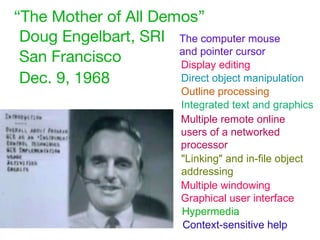
Doug Engelbart, SRI “ The Mother of All Demos” Dec. 9, 1968 The computer mouse  and pointer cursor Display editing Outline processing Multiple remote online   users of a networked   processor "Linking" and in-file object addressing Multiple windowing  Graphical user interface Hypermedia Context-sensitive help Direct object manipulation Integrated text and graphics San Francisco
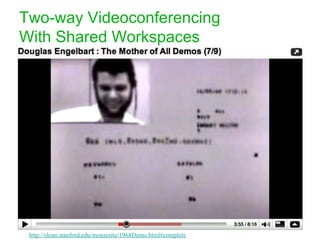
http://sloan.stanford.edu/mousesite/1968Demo.html#complete Two-way Videoconferencing  With Shared Workspaces
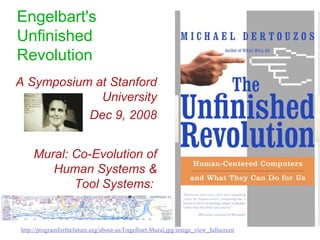
Engelbart's  Unfinished  Revolution http://programforthefuture.org/about-us/Engelbart-Mural.jpg/image_view_fullscreen Mural: Co-Evolution of Human Systems & Tool Systems:  A Symposium at Stanford University Dec 9, 2008
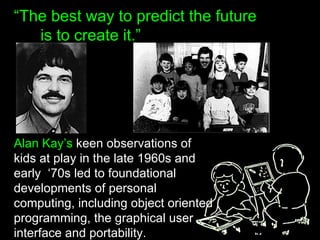
Alan Kay’s  keen observations of kids at play in the late 1960s and early  ‘70s led to foundational developments of personal computing, including object oriented programming, the graphical user interface and portability. “ The best way to predict the future uture  is to create it.”
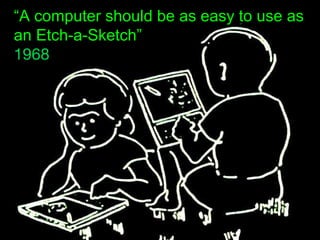
“ A computer should be as easy to use as an Etch-a-Sketch”   1968
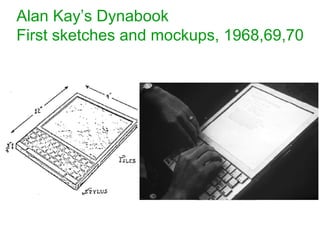
Alan Kay’s Dynabook  First sketches and mockups, 1968,69,70
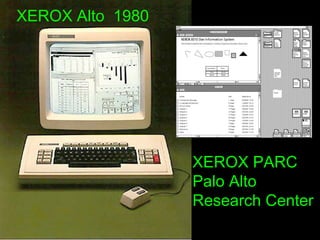
XEROX Alto  1980 XEROX PARC Palo Alto Research Center
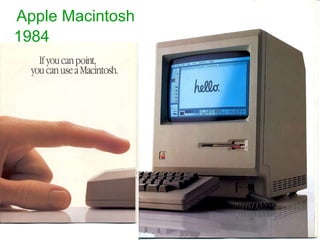
Apple Macintosh 1984
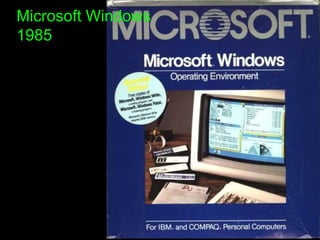
Microsoft Windows  1985
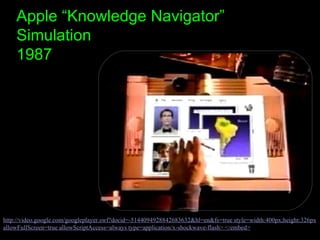
Apple “Knowledge Navigator” Simulation 1987 http://video.google.com/googleplayer.swf?docid=-5144094928842683632&hl=en&fs=true style=width:400px;height:326px allowFullScreen=true allowScriptAccess=always type=application/x-shockwave-flash> </embed>
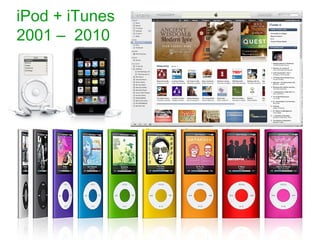
iPod + iTunes 2001 –  2010
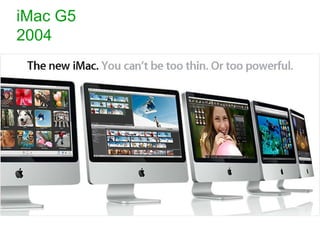
iMac G5 2004
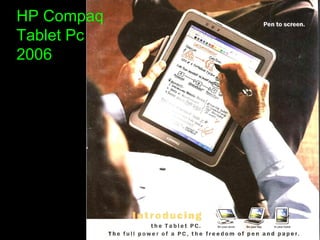
HP Compaq  Tablet Pc 2006
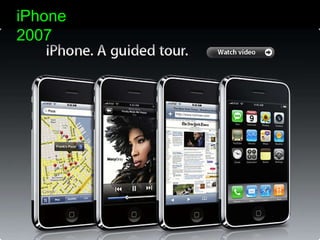
iPhone 2007
http://link.brightcove.com/services/player/bcpid713271701?bclid=713073346&bctid=709364416 
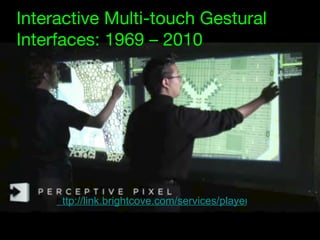
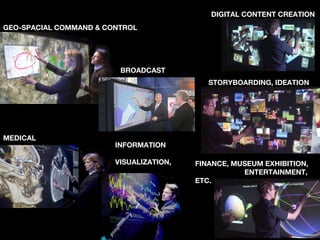
 Interactive Multi-touch Gestural Interfaces: 1969 – 2010
GEO-SPACIAL COMMAND & CONTROL BROADCAST MEDICAL INFORMATION  VISUALIZATION,  EXPLORATION DIGITAL CONTENT CREATION STORYBOARDING, IDEATION FINANCE, MUSEUM EXHIBITION,  ENTERTAINMENT, ETC.
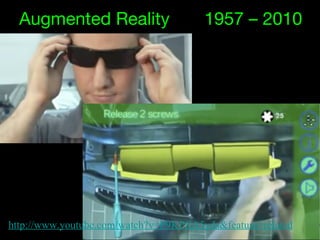
Augmented Reality  1957 – 2010 http://www.youtube.com/watch?v=P9KPJlA5yds&feature=related
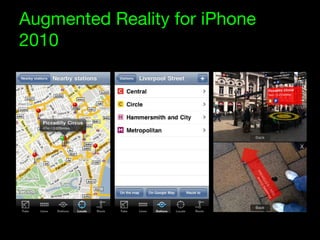
Augmented Reality for iPhone  2010
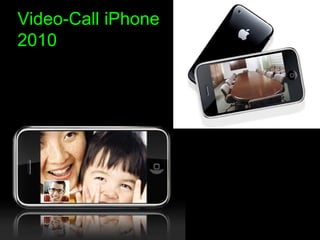
Video-Call iPhone 2010
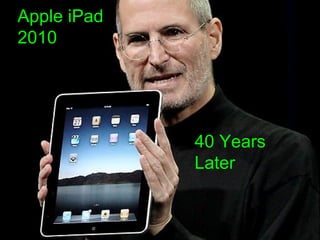
Apple iPad 2010 40 Years Later

The iPad is 40 years old

Editor's Notes

  • #5 Try to imagine &amp;quot;personal&amp;quot; computing without the following::ïThe mouse and pointer cursorïDisplay editingïOutline processingïMultiple remote online users of a networked processorï&amp;quot;Linking&amp;quot; and in-file object addressingïMultiple windowsïHypermediaïContext-sensitive helpThese features, which we take for granted in 1998, were unheard of before Doug Engelbart&apos;s inquiries into &amp;quot;Augmented Human Intellect&amp;quot; led to a revolutionary vision of the computer, a vision which was revealed to the computer world on December 9, 1968 ...On that day Doug Engelbart and a small team of researchers from the Stanford Research Institute stunned the computing world with an extraordinary demonstration at a San Francisco computer conference. They debuted: the computer mouse, graphical user interface, display editing and integrated text and graphics, hyper-documents, and two-way video-conferencing with shared workspaces. These concepts and technologies were to become the cornerstones of modern interactive computing Stanford University Libraries and the Institute for the Future presented a day-long, public symposium bringing together Engelbart and members of his historic team, along with other computer visionaries, to consider the impact of Engelbart&apos;s work on the last three decades of the computer revolution, to explore the challenges facing us today, and to speculate about the next three decades.That landmark 1968 demonstration took place at the American Federation of Information Processing Societies&apos; Fall Joint Computer Conference. At a time when computers were little more than huge number-crunchers, Engelbart and his team&apos;s introduction of their two-way interactive system, called NLS (for oN Line System) was a shock.Today the mouse, graphical user interface, hyper-documents, display editing and integrated text and graphics are taken for granted. Other features of NLS, such two-way video-conferencing with shared workspaces, remain more vision than reality even today. And some of NLS&apos; most important elements, such as the concept of bootstrapping, remain so novel that they are all but unknown to the current generation of systems designers.NLS&apos; 1968 demo was a watershed that fundamentally changed the trajectory of the computing revolution, contributing not only ideas, but also many of the people who would later build the systems we would use today. Alumni of the NLS project (and its successor, the Augment project) include many of the most influential figures in Silicon Valley (and elsewhere). Others credit Doug&apos;s work in general, and the 1968 demo in particular with influencing their design philosophies. As personal computing pioneer and visionary Alan Kay once observed, &amp;quot;I don&apos;t know what Silicon Valley will do when it runs out of Doug&apos;s ideas.&amp;quot; 
t of Doug&apos;s ideas.&amp;quot; 

  • #17 Perceptive Pixel develops and markets the most advanced multi-touch solutions in the world. 

ur work is driven by the belief that user interfaces have not kept pace with the 
remendous advances realized in computing power. Perceptive Pixelís graphical 
ulti-touch interfaces aim to unleash that latent power and make machines usable once again. 

ur solutions are used in numerous markets including medical imaging, broadcast, 
efense, energy exploration, geo-intelligence, and industrial design. Perceptive Pixel just won the prestigious 2009 National Design Award from the Cooper Hewitt Museum Design Branch of the Smithsonian Institution
  • #18 Perceptive Pixel develops and markets the most advanced multi-touch solutions in the world. 

ur work is driven by the belief that user interfaces have not kept pace with the 
remendous advances realized in computing power. Perceptive Pixelís graphical 
ulti-touch interfaces aim to unleash that latent power and make machines usable once again. 

ur solutions are used in numerous markets including medical imaging, broadcast, 
efense, energy exploration, geo-intelligence, and industrial design. Perceptive Pixel just won the prestigious 2009 National Design Award from the Cooper Hewitt Museum Design Branch of the Smithsonian Institution