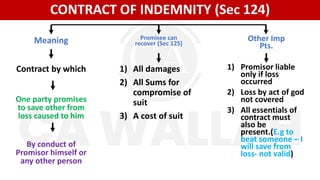
CONTRACT OF INDEMNITY(Sec 124)
Meaning Promisee can
recover (Sec 125)
Other Imp
Pts.
Contract by which 1) All damages
2) All Sums for
compromise of
suit
3) A cost of suit
1) Promisor liable
only if loss
occurred
2) Loss by act of god
not covered
3) All essentials of
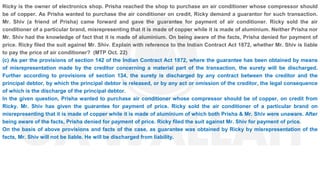
contract must
also be
present.(E.g to
beat someone – I
will save from
loss- not valid)
One party promises
to save other from
loss caused to him
By conduct of
Promisor himself or
any other person
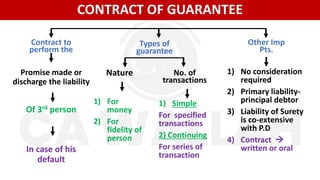
CONTRACT OF GUARANTEE
Contractto
perform the
Types of
guarantee
Other Imp
Pts.
Promise made or
discharge the liability
Nature 1) No consideration
required
2) Primary liability-
principal debtor
3) Liability of Surety
is co-extensive
with P.D
4) Contract
written or oral
Of 3rd person
In case of his
default
1) For
money
2) For
fidelity of
person
No. of
transactions
1) Simple
For specified
transactions
2) Continuing
For series of
transaction
6.
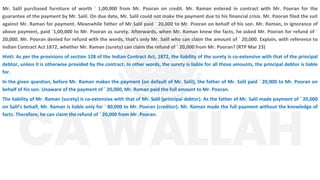
Mr. Salil purchasedfurniture of worth ` 1,00,000 from Mr. Pooran on credit. Mr. Raman entered in contract with Mr. Pooran for the
guarantee of the payment by Mr. Salil. On due date, Mr. Salil could not make the payment due to his financial crisis. Mr. Pooran filed the suit
against Mr. Raman for payment. Meanwhile father of Mr.Salil paid ` 20,000 to Mr. Pooran on behalf of his son. Mr. Raman, in ignorance of
above payment, paid `1,00,000 to Mr. Pooran as surety. Afterwards, when Mr. Raman knew the facts, he asked Mr. Pooran for refund of `
20,000. Mr. Pooran denied for refund with the words, that’s only Mr. Salil who can claim the amount of ` 20,000. Explain, with reference to
Indian Contract Act 1872, whether Mr. Raman (surety) can claim the refund of ` 20,000 from Mr. Pooran? (RTP Mar 23)
Hinti: As per the provisions of section 128 of the Indian Contract Act, 1872, the liability of the surety is co-extensive with that of the principal
debtor, unless it is otherwise provided by the contract. In other words, the surety is liable for all those amounts, the principal debtor is liable
for.
In the given question, before Mr. Raman makes the payment (on default of Mr. Salil), the father of Mr. Salil paid ` 20,000 to Mr. Pooran on
behalf of his son. Unaware of the payment of ` 20,000, Mr. Raman paid the full amount to Mr. Pooran.
The liability of Mr. Raman (surety) is co-extensive with that of Mr. Salil (principal debtor). As the father of Mr. Salil made payment of ` 20,000
on Salil’s behalf, Mr. Raman is liable only for ` 80,000 to Mr. Pooran (creditor). Mr. Raman made the full payment without the knowledge of
facts. Therefore, he can claim the refund of ` 20,000 from Mr. Pooran.
7.
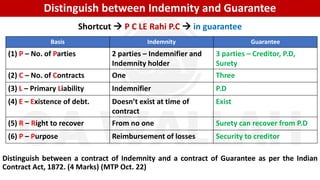
Distinguish between Indemnityand Guarantee
Shortcut P C LE Rahi P.C in guarantee
Basis Indemnity Guarantee
(1) P – No. of Parties 2 parties – Indemnifier and
Indemnity holder
3 parties – Creditor, P.D,
Surety
(2) C – No. of Contracts One Three
(3) L – Primary Liability Indemnifier P.D
(4) E – Existence of debt. Doesn’t exist at time of
contract
Exist
(5) R – Right to recover From no one Surety can recover from P.D
(6) P – Purpose Reimbursement of losses Security to creditor
Distinguish between a contract of Indemnity and a contract of Guarantee as per the Indian
Contract Act, 1872. (4 Marks) (MTP Oct. 22)
8.
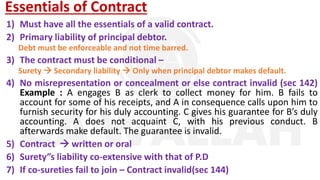
Essentials of Contract
1)Must have all the essentials of a valid contract.
2) Primary liability of principal debtor.
Debt must be enforceable and not time barred.
3) The contract must be conditional –
Surety Secondary liability Only when principal debtor makes default.
4) No misrepresentation or concealment or else contract invalid (sec 142)
Example : A engages B as clerk to collect money for him. B fails to
account for some of his receipts, and A in consequence calls upon him to
furnish security for his duly accounting. C gives his guarantee for B’s duly
accounting. A does not acquaint C, with his previous conduct. B
afterwards make default. The guarantee is invalid.
5) Contract written or oral
6) Surety”s liability co-extensive with that of P.D
7) If co-sureties fail to join – Contract invalid(sec 144)
9.
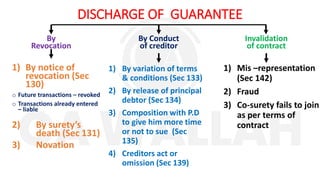
DISCHARGE OF GUARANTEE
By
Revocation
ByConduct
of creditor
Invalidation
of contract
1) By notice of
revocation (Sec
130)
o Future transactions – revoked
o Transactions already entered
– liable
2) By surety’s
death (Sec 131)
3) Novation
1) By variation of terms
& conditions (Sec 133)
2) By release of principal
debtor (Sec 134)
3) Composition with P.D
to give him more time
or not to sue (Sec
135)
4) Creditors act or
omission (Sec 139)
1) Mis –representation
(Sec 142)
2) Fraud
3) Co-surety fails to join
as per terms of
contract
10.
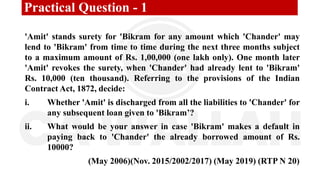
Practical Question -1
'Amit' stands surety for 'Bikram for any amount which 'Chander' may
lend to 'Bikram' from time to time during the next three months subject
to a maximum amount of Rs. 1,00,000 (one lakh only). One month later
'Amit' revokes the surety, when 'Chander' had already lent to 'Bikram'
Rs. 10,000 (ten thousand). Referring to the provisions of the Indian
Contract Act, 1872, decide:
i. Whether 'Amit' is discharged from all the liabilities to 'Chander' for
any subsequent loan given to 'Bikram’?
ii. What would be your answer in case 'Bikram' makes a default in
paying back to 'Chander' the already borrowed amount of Rs.
10000?
(May 2006)(Nov. 2015/2002/2017) (May 2019) (RTP N 20)
11.
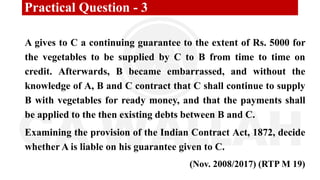
Practical Question -3
A gives to C a continuing guarantee to the extent of Rs. 5000 for
the vegetables to be supplied by C to B from time to time on
credit. Afterwards, B became embarrassed, and without the
knowledge of A, B and C contract that C shall continue to supply
B with vegetables for ready money, and that the payments shall
be applied to the then existing debts between B and C.
Examining the provision of the Indian Contract Act, 1872, decide
whether A is liable on his guarantee given to C.
(Nov. 2008/2017) (RTP M 19)
12.
Note
1) Forbearance tosue does not discharge
surety (sec 137)
2) If agreement made with 3rd person not to
sue does not discharge contract. (sec 136)
13.
Practical Question -5
C, the holder of an over due bill of
exchange drawn by A as surety for B,
and accepted by B, contracts with X to
give time to B. Is A discharged from his
liability?
(Nov. 2006) (RTP N 18) (MTP M 19/20)
14.
Practical Question -6
B owes C a debt guaranteed by A. C does not
sue B for a year after the debt has become
payable. In the meantime, B becomes insolvent.
Is A discharged? Decide with reference to the
provisions of the Indian Contract Act, 1872.
(Nov. 2008)
15.
Example
● A putsM as apprentice to B and gives a guarantee to B for M’s
fidelity. B promises on his part that he will, at least once a month,
see that M make up the cash. B omits to see this done as promised,
and M embezzles. A is not liable to B on his guarantee
● .
16.
Ricky is theowner of electronics shop. Prisha reached the shop to purchase an air conditioner whose compressor should
be of copper. As Prisha wanted to purchase the air conditioner on credit, Ricky demand a guarantor for such transaction.
Mr. Shiv (a friend of Prisha) came forward and gave the guarantee for payment of air conditioner. Ricky sold the air
conditioner of a particular brand, misrepresenting that it is made of copper while it is made of aluminium. Neither Prisha nor
Mr. Shiv had the knowledge of fact that it is made of aluminium. On being aware of the facts, Prisha denied for payment of
price. Ricky filed the suit against Mr. Shiv. Explain with reference to the Indian Contract Act 1872, whether Mr. Shiv is liable
to pay the price of air conditioner? (MTP Oct. 22)
(c) As per the provisions of section 142 of the Indian Contract Act 1872, where the guarantee has been obtained by means
of misrepresentation made by the creditor concerning a material part of the transaction, the surety will be discharged.
Further according to provisions of section 134, the surety is discharged by any contract between the creditor and the
principal debtor, by which the principal debtor is released, or by any act or omission of the creditor, the legal consequence
of which is the discharge of the principal debtor.
In the given question, Prisha wanted to purchase air conditioner whose compressor should be of copper, on credit from
Ricky. Mr. Shiv has given the guarantee for payment of price. Ricky sold the air conditioner of a particular brand on
misrepresenting that it is made of copper while it is made of aluminium of which both Prisha & Mr. Shiv were unaware. After
being aware of the facts, Prisha denied for payment of price. Ricky filed the suit against Mr. Shiv for payment of price.
On the basis of above provisions and facts of the case, as guarantee was obtained by Ricky by misrepresentation of the
facts, Mr. Shiv will not be liable. He will be discharged from liability.
17.
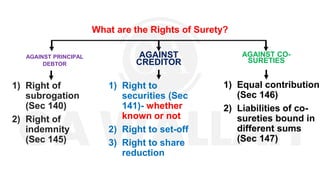
What are theRights of Surety?
AGAINST PRINCIPAL
DEBTOR
AGAINST
CREDITOR
AGAINST CO-
SURETIES
1) Right of
subrogation
(Sec 140)
2) Right of
indemnity
(Sec 145)
1) Right to
securities (Sec
141)- whether
known or not
2) Right to set-off
3) Right to share
reduction
1) Equal contribution
(Sec 146)
2) Liabilities of co-
sureties bound in
different sums
(Sec 147)
18.
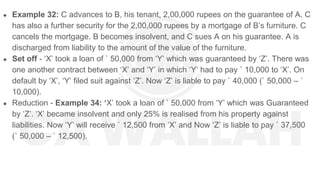
● Example 32:C advances to B, his tenant, 2,00,000 rupees on the guarantee of A. C
has also a further security for the 2,00,000 rupees by a mortgage of B’s furniture. C
cancels the mortgage. B becomes insolvent, and C sues A on his guarantee. A is
discharged from liability to the amount of the value of the furniture.
● Set off - ‘X’ took a loan of ` 50,000 from ‘Y’ which was guaranteed by ‘Z’. There was
one another contract between ‘X’ and ‘Y’ in which ‘Y’ had to pay ` 10,000 to ‘X’. On
default by ‘X’, ‘Y’ filed suit against ‘Z’. Now ‘Z’ is liable to pay ` 40,000 (` 50,000 – `
10,000).
● Reduction - Example 34: ‘X’ took a loan of ` 50,000 from ‘Y’ which was Guaranteed
by ‘Z’. ‘X’ became insolvent and only 25% is realised from his property against
liabilities. Now ‘Y’ will receive ` 12,500 from ‘X’ and Now ‘Z’ is liable to pay ` 37,500
(` 50,000 – ` 12,500).
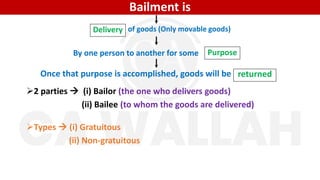
Bailment is
of goods(Only movable goods)
Delivery
By one person to another for some
returned
Purpose
Once that purpose is accomplished, goods will be
2 parties (i) Bailor (the one who delivers goods)
(ii) Bailee (to whom the goods are delivered)
Types (i) Gratuitous
(ii) Non-gratuitous
21.
State the essentialelements of a contract of
bailment.
• Delivery of goods—The essence of bailment is delivery of goods by one
person to another.
• Bailment is a contract—In bailment, the delivery of goods is upon a
contract that when the purpose is accomplished, the goods shall be
returned to the bailor.
• Return of goods in specific—The goods are delivered for some purpose and
it is agreed that the specific goods shall be returned.
• Ownership of goods—In a bailment, it is only the possession of goods which
is transferred, and the bailor continues to be the owner of the goods.
• Property must be movable—Bailment is only for movable goods and never
for immovable goods or money.
22.
• For example,servant of a master who is in custody of goods of the master
does not become a bailee.
• Similarly, depositing ornaments in a bank locker is not bailment, because
ornaments are kept in a locker whose key are still with the owner and not with
the bank. The ornaments are in possession of the owner though kept in a
locker at the bank.
• Deposit of money in a bank is not bailment since the money returned by the
bank would not be identical currency notes.
23.
1. Examine whetherthe following constitute a contract of ‘Bailment’
under the provisions of the Indian Contract Act, 1872: (module)
(i)V parks his car at a parking lot, locks it, and keeps the keys with
himself.
(ii)Seizure of goods by customs authorities.
24.
1. As perthe provisions of the Indian Contract Act, 1872, what is the meaning of:
(1) Continuing guarantee
(2) Gratuitous Bailment (4 Marks) (MTP Sep. 22)
Hint
(1) Continuing guarantee: A guarantee which extends to a series of transaction is called a continuing guarantee. A surety’s liability continues
until the revocation of the guarantee.
The essence of continuing guarantee is that it applies not to a specific number of transactions but to any number of transactions and makes
the surety liable for the unpaid balance at the end of the guarantee.
(2) Gratuitous Bailment: The word gratuitous means free of charge. So, a gratuitous bailment is one when the provider of service does it
gratuitously i.e. free of charge. Such bailment would be either for the exclusive benefits of bailor or bailee.
2. Shweta and Mira are very good friends. Shweta bailed her jewellery with Mira on the condition to safeguard it in a bank’s safe locker.
However, Mira kept it in safe locker at her residence, where she usually keeps her own jewellery. After a month all jewellery was lost in a
religious riot. Shweta filed a suit against Mira for recovery. Referring to provisions of the Indian Contract Act, 1872, state whether Shweta will
succeed. (4 Marks) (MTP Sep. 22)
Hint: According to section 152 of the Indian Contract Act, 1872, the bailee, in the absence of any special contract, is not responsible for the
loss, destruction or deterioration of the thing bailed, if he has taken reasonable care as required under section 151.
In the given question, Shweta and Mira agreed to keep Shweta’s jewellery (bailed to Mira) at the Bank’s safe locker and not at the latter’s
residence (i.e. Mira’s residence). So, Mira is liable to compensate Shweta for her negligence to keep jewellery at her (Mira’s) residence. Thus,
Shweta will succeed in her claim.
3. Mrs. A delivered her old silver jewellery to Mr. Y a Goldsmith, for the purpose of making new a silver bowl out of it. Every evening she used
to receive the unfinished good (silver bowl) to put it into box kept at Mr. Y’s Shop. She kept the key of that box with herself. One night, the
silver bowl was stolen from that box. Whether the possession of the goods (actual or constructive) delivered, constitute contract of bailment
or not?
(MTP MAY 2020)
25.
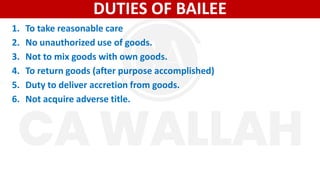
DUTIES OF BAILEE
1.To take reasonable care
2. No unauthorized use of goods.
3. Not to mix goods with own goods.
4. To return goods (after purpose accomplished)
5. Duty to deliver accretion from goods.
6. Not acquire adverse title.
26.
• R giveshis umbrella to M during raining season to be used for two
days during Examinations. M keeps the umbrella for a week. While
going to R’s house to return the umbrella, M accidently slips and the
umbrella is badly damaged. Who bear the loss and why? (module)
• Amar bailed 50 kg of high quality sugar to Srijith, who owned a kirana
shop, promising to give ` 200 at the time of taking back the bailed
goods. Srijith's employee, unaware of this, mixed the 50 kg of sugar
belonging to Amar with the sugar in the shop and packaged it for sale
when Srijith was away. This came to light only when Amar came
asking for the sugar he had bailed with Srijith, as the price of the
specific quality of sugar had trebled. What is the remedy available to
Amar? (module)
27.
Duties of bailor-Disclose faults in goods [Sec.150]
Liability for Defects in Goods
In case of Gratuitous Bailment
Bailor is liable only for those losses
which arise due to non-disclosed risks
In case of Non- Gratuitous Bailment
Bailor is liable for damages whether or not he was
aware of the existence of faults
Bear Expenses [Sec. 158]
Expenses of Bailment
In case of Gratuitous Bailment
all necessary expenses e.g - Dog
In case of Non- Gratuitous Bailment
only extra-ordinary expenses, and not the
ordinary expenses. E.g car lent
Indemnify Bailee [Sec. 159 & 164]
To indemnify Bailee
Premature Termination of Gratuitous Bailment
• Bailor has the right to terminate the Gratuitous Bailment even
if is for particular period.
• In such a case, Bailor has to indemnify the Bailee the excess of
loss over benefit.
When Bailor’s title is defective
Balior is responsible to the Bailee for any loss which the
Bailee may sustain by reason that the Bailor was not
entitled to make Bailment
28.
1. A hiresa carriage from B and agrees to pay ` 500 as hire charges. The
carriage is unsafe, though B is unaware of it. A is injured and claims
compensation for injuries suffered by him. B refuses to pay. Discuss
the liability of B. (module)
29.
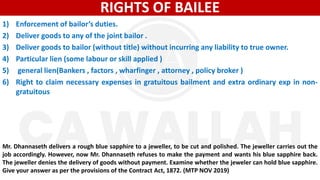
RIGHTS OF BAILEE
1)Enforcement of bailor’s duties.
2) Deliver goods to any of the joint bailor .
3) Deliver goods to bailor (without title) without incurring any liability to true owner.
4) Particular lien (some labour or skill applied )
5) general lien(Bankers , factors , wharfinger , attorney , policy broker )
6) Right to claim necessary expenses in gratuitous bailment and extra ordinary exp in non-
gratuitous
Mr. Dhannaseth delivers a rough blue sapphire to a jeweller, to be cut and polished. The jeweller carries out the
job accordingly. However, now Mr. Dhannaseth refuses to make the payment and wants his blue sapphire back.
The jeweller denies the delivery of goods without payment. Examine whether the jeweler can hold blue sapphire.
Give your answer as per the provisions of the Contract Act, 1872. (MTP NOV 2019)
30.
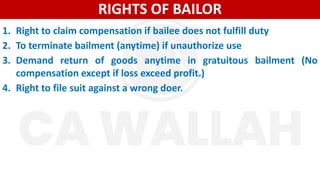
RIGHTS OF BAILOR
1.Right to claim compensation if bailee does not fulfill duty
2. To terminate bailment (anytime) if unauthorize use
3. Demand return of goods anytime in gratuitous bailment (No
compensation except if loss exceed profit.)
4. Right to file suit against a wrong doer.
31.
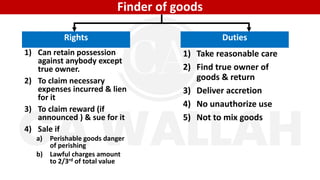
Finder of goods
Rights
1)Can retain possession
against anybody except
true owner.
2) To claim necessary
expenses incurred & lien
for it
3) To claim reward (if
announced ) & sue for it
4) Sale if
a) Perishable goods danger
of perishing
b) Lawful charges amount
to 2/3rd of total value
Duties
1) Take reasonable care
2) Find true owner of
goods & return
3) Deliver accretion
4) No unauthorize use
5) Not to mix goods
32.
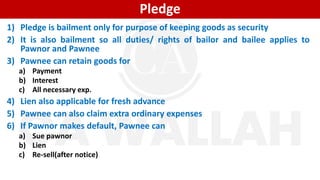
Pledge
1) Pledge isbailment only for purpose of keeping goods as security
2) It is also bailment so all duties/ rights of bailor and bailee applies to
Pawnor and Pawnee
3) Pawnee can retain goods for
a) Payment
b) Interest
c) All necessary exp.
4) Lien also applicable for fresh advance
5) Pawnee can also claim extra ordinary expenses
6) If Pawnor makes default, Pawnee can
a) Sue pawnor
b) Lien
c) Re-sell(after notice)
33.
Pledge by Non-owners-Whenvalid
1) Pledge by Mercantile Agent [Sec 178] –
Valid (whether he is authorized by owner or not)
2) Pledge in case of Voidable Contract [Sec 178 A] –
Valid (if not rescinded at the time of pledge)
3) Pledge goods for limited interest [Sec 179] –
Valid (to the extent of interest)
4) Pledge by a co-owner in possession.
Valid (with the consent of other co owners)
5) Pledge by seller or buyer in possession.
Valid (after prior permission of seller)
Srushti acquired a valuable diamond at a very low price by a voidable contract under the provisions of India
Contract Act, 1872. The voidable contract was not rescinded. Srushti pledged the diamond with Mr. VK. Is this a
valid pledge under the Indian Contract Act, 1872? (Nov. 2019) (module)
34.
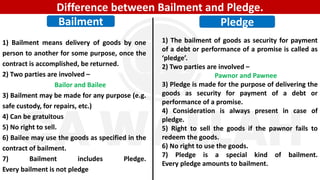
1) Bailment meansdelivery of goods by one
person to another for some purpose, once the
contract is accomplished, be returned.
2) Two parties are involved –
Bailor and Bailee
3) Bailment may be made for any purpose (e.g.
safe custody, for repairs, etc.)
4) Can be gratuitous
5) No right to sell.
6) Bailee may use the goods as specified in the
contract of bailment.
7) Bailment includes Pledge.
Every bailment is not pledge
1) The bailment of goods as security for payment
of a debt or performance of a promise is called as
‘pledge’.
2) Two parties are involved –
Pawnor and Pawnee
3) Pledge is made for the purpose of delivering the
goods as security for payment of a debt or
performance of a promise.
4) Consideration is always present in case of
pledge.
5) Right to sell the goods if the pawnor fails to
redeem the goods.
6) No right to use the goods.
7) Pledge is a special kind of bailment.
Every pledge amounts to bailment.
Bailment Pledge
Difference between Bailment and Pledge.
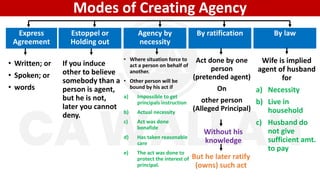
Modes of CreatingAgency
Express
Agreement
Estoppel or
Holding out
Agency by
necessity
By ratification By law
• Written; or
• Spoken; or
• words
If you induce
other to believe
somebody than a
person is agent,
but he is not,
later you cannot
deny.
• Where situation force to
act a person on behalf of
another.
• Other person will be
bound by his act if
a) Impossible to get
principals instruction
b) Actual necessity
c) Act was done
bonafide
d) Has taken reasonable
care
e) The act was done to
protect the interest of
principal.
Act done by one
person
(pretended agent)
On
other person
(Alleged Principal)
Wife is implied
agent of husband
for
a) Necessity
b) Live in
household
c) Husband do
not give
sufficient amt.
to pay
Without his
knowledge
But he later ratify
(owns) such act
37.
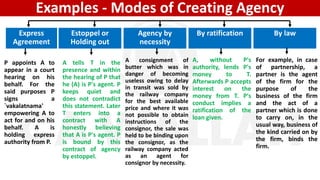
Examples - Modesof Creating Agency
Express
Agreement
Estoppel or
Holding out
Agency by
necessity
By ratification By law
P appoints A to
appear in a court
hearing on his
behalf. For the
said purposes P
signs a
`vakalatnama'
empowering A to
act for and on his
behalf. A is
holding express
authority from P.
A tells T in the
presence and within
the hearing of P that
he (A) is P's agent. P
keeps quiet and
does not contradict
this statement. Later
T enters into a
contract with A
honestly believing
that A is P's agent. P
is bound by this
contract of agency
by estoppel.
A consignment of
butter which was in
danger of becoming
useless owing to delay
in transit was sold by
the railway company
for the best available
price and where it was
not possible to obtain
instructions of the
consignor, the sale was
held to be binding upon
the consignor, as the
railway company acted
as an agent for
consignor by necessity.
A, without P's
authority, lends P's
money to T.
Afterwards P accepts
interest on the
money from T. P's
conduct implies a
ratification of the
loan given.
For example, in case
of partnership, a
partner is the agent
of the firm for the
purpose of the
business of the firm
and the act of a
partner which is done
to carry on, in the
usual way, business of
the kind carried on by
the firm, binds the
firm.
38.
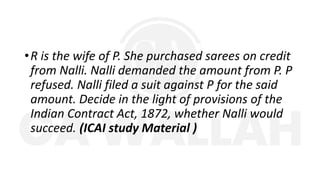
•R is thewife of P. She purchased sarees on credit
from Nalli. Nalli demanded the amount from P. P
refused. Nalli filed a suit against P for the said
amount. Decide in the light of provisions of the
Indian Contract Act, 1872, whether Nalli would
succeed. (ICAI study Material )
39.
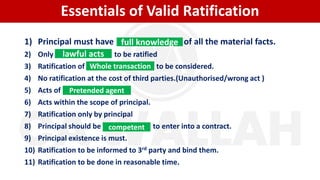
Essentials of ValidRatification
full knowledge
1) Principal must have of all the material facts.
2) Only to be ratified
3) Ratification of to be considered.
4) No ratification at the cost of third parties.(Unauthorised/wrong act )
5) Acts of
6) Acts within the scope of principal.
7) Ratification only by principal
8) Principal should be to enter into a contract.
9) Principal existence is must.
10) Ratification to be informed to 3rd party and bind them.
11) Ratification to be done in reasonable time.
lawful acts
Whole transaction
Pretended agent
competent
40.
•State with reasonwhether the following
statement is correct or incorrect:
Ratification of agency is valid even if
knowledge of the principal is materially
defective. (ICAI study Material )
41.
Extent of Agent’sAuthority
1. the nature of the act or the business he is appointed to do.
2. things which are incidental to the business or are usually done in the course of such
business.
3. the usage of trade or business.
Agent’s authority is governed by two principles –
• Agent’s authority in normal circumstances [Section 188]
e.g. A is employed by B, residing in London, to recover at Mumbai a debt due to B. A may adopt any legal
process necessary for the purpose of recovering the debt, and may give a valid discharge for the same.
• Agent’s authority in an emergency [Section 189]
e.g. A consigns perishable goods to B at Srinagar, with directions to send them immediately to C at
Tamilnadu. B may sell the good if they begin to perish before reaching its destination.
42.
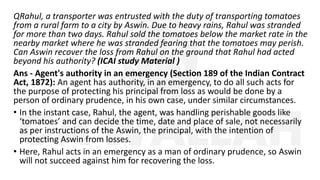
QRahul, a transporterwas entrusted with the duty of transporting tomatoes
from a rural farm to a city by Aswin. Due to heavy rains, Rahul was stranded
for more than two days. Rahul sold the tomatoes below the market rate in the
nearby market where he was stranded fearing that the tomatoes may perish.
Can Aswin recover the loss from Rahul on the ground that Rahul had acted
beyond his authority? (ICAI study Material )
Ans - Agent's authority in an emergency (Section 189 of the Indian Contract
Act, 1872): An agent has authority, in an emergency, to do all such acts for
the purpose of protecting his principal from loss as would be done by a
person of ordinary prudence, in his own case, under similar circumstances.
• In the instant case, Rahul, the agent, was handling perishable goods like
‘tomatoes’ and can decide the time, date and place of sale, not necessarily
as per instructions of the Aswin, the principal, with the intention of
protecting Aswin from losses.
• Here, Rahul acts in an emergency as a man of ordinary prudence, so Aswin
will not succeed against him for recovering the loss.
43.
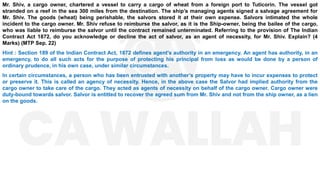
Mr. Shiv, acargo owner, chartered a vessel to carry a cargo of wheat from a foreign port to Tuticorin. The vessel got
stranded on a reef in the sea 300 miles from the destination. The ship’s managing agents signed a salvage agreement for
Mr. Shiv. The goods (wheat) being perishable, the salvors stored it at their own expense. Salvors intimated the whole
incident to the cargo owner. Mr. Shiv refuse to reimburse the salvor, as it is the Ship-owner, being the bailee of the cargo,
who was liable to reimburse the salvor until the contract remained unterminated. Referring to the provision of The Indian
Contract Act 1872, do you acknowledge or decline the act of salvor, as an agent of necessity, for Mr. Shiv. Explain? (4
Marks) (MTP Sep. 22)
Hint : Section 189 of the Indian Contract Act, 1872 defines agent's authority in an emergency. An agent has authority, in an
emergency, to do all such acts for the purpose of protecting his principal from loss as would be done by a person of
ordinary prudence, in his own case, under similar circumstances.
In certain circumstances, a person who has been entrusted with another’s property may have to incur expenses to protect
or preserve it. This is called an agency of necessity. Hence, in the above case the Salvor had implied authority from the
cargo owner to take care of the cargo. They acted as agents of necessity on behalf of the cargo owner. Cargo owner were
duty-bound towards salvor. Salvor is entitled to recover the agreed sum from Mr. Shiv and not from the ship owner, as a lien
on the goods.
44.
Duties of Agent
1.Act on direction of principal (otherwise liable for loss) [Sec 211]
e.g. A, an agent engaged in carrying on for a business, in which it is the custom to invest from time
to time, at interest, the moneys which may be in hand, omits to make such investment. As per Sec.
211, A must make good to B the interest usually obtained by such investments.
2. Act with reasonable diligence [Sec 212]
e.g. A, an agent for the sale of goods, having authority to sell on credit, sells to B in credit, without
making the proper and usual enquiries as to the solvency of B. B at the time of such sale, is
insolvent. As per Sec. 212, A must make compensation to his principal in respect of any loss thereby
sustained.
3. Render proper accounts when asked [Sec 213]
4. Pay all sums to principal when asked for [Sec 218]
5. In difficulty or unusual cases, ask for instructions [Sec 214]
6. Not to deal on his own accounts / not to make secret profit. (else principal will recover) [Sec 215-
216]
e.g. A directs B to sell A's estate. B buys the estate for himself in the name of C. As per Sec. 215, A
may repudiate sale, if he can show that the sale has been disadvantageous to him.
45.
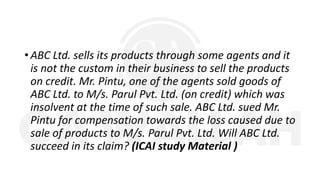
• ABC Ltd.sells its products through some agents and it
is not the custom in their business to sell the products
on credit. Mr. Pintu, one of the agents sold goods of
ABC Ltd. to M/s. Parul Pvt. Ltd. (on credit) which was
insolvent at the time of such sale. ABC Ltd. sued Mr.
Pintu for compensation towards the loss caused due to
sale of products to M/s. Parul Pvt. Ltd. Will ABC Ltd.
succeed in its claim? (ICAI study Material )
46.
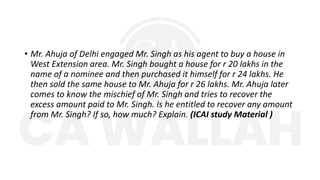
• Mr. Ahujaof Delhi engaged Mr. Singh as his agent to buy a house in
West Extension area. Mr. Singh bought a house for r 20 lakhs in the
name of a nominee and then purchased it himself for r 24 lakhs. He
then sold the same house to Mr. Ahuja for r 26 lakhs. Mr. Ahuja later
comes to know the mischief of Mr. Singh and tries to recover the
excess amount paid to Mr. Singh. Is he entitled to recover any amount
from Mr. Singh? If so, how much? Explain. (ICAI study Material )
47.
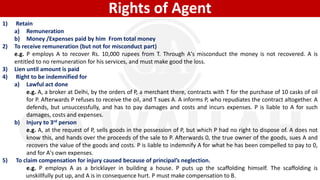
Rights of Agent
1)Retain
a) Remuneration
b) Money /Expenses paid by him From total money
2) To receive remuneration (but not for misconduct part)
e.g. P employs A to recover Rs. 10,000 rupees from T. Through A's misconduct the money is not recovered. A is
entitled to no remuneration for his services, and must make good the loss.
3) Lien until amount is paid
4) Right to be indemnified for
a) Lawful act done
e.g. A, a broker at Delhi, by the orders of P, a merchant there, contracts with T for the purchase of 10 casks of oil
for P. Afterwards P refuses to receive the oil, and T sues A. A informs P, who repudiates the contract altogether. A
defends, but unsuccessfully, and has to pay damages and costs and incurs expenses. P is liable to A for such
damages, costs and expenses.
b) Injury to 3rd person
e.g. A, at the request of P, sells goods in the possession of P, but which P had no right to dispose of. A does not
know this, and hands over the proceeds of the sale to P. Afterwards 0, the true owner of the goods, sues A and
recovers the value of the goods and costs. P is liable to indemnify A for what he has been compelled to pay to 0,
and for A's own expenses.
5) To claim compensation for injury caused because of principal’s neglection.
e.g. P employs A as a bricklayer in building a house. P puts up the scaffolding himself. The scaffolding is
unskillfully put up, and A is in consequence hurt. P must make compensation to B.
48.
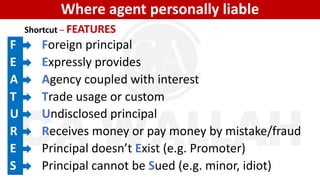
Where agent personallyliable
Shortcut – FEATURES
F Foreign principal
E Expressly provides
A Agency coupled with interest
T Trade usage or custom
U Undisclosed principal
R Receives money or pay money by mistake/fraud
E Principal doesn’t Exist (e.g. Promoter)
S Principal cannot be Sued (e.g. minor, idiot)
49.
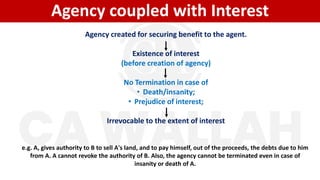
Agency coupled withInterest
Agency created for securing benefit to the agent.
Existence of interest
(before creation of agency)
No Termination in case of
• Death/insanity;
• Prejudice of interest;
Irrevocable to the extent of interest
e.g. A, gives authority to B to sell A's land, and to pay himself, out of the proceeds, the debts due to him
from A. A cannot revoke the authority of B. Also, the agency cannot be terminated even in case of
insanity or death of A.
50.
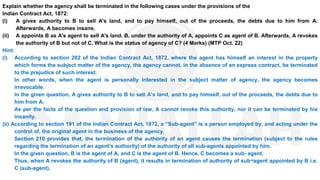
Explain whether theagency shall be terminated in the following cases under the provisions of the
Indian Contract Act, 1872:
(i) A gives authority to B to sell A's land, and to pay himself, out of the proceeds, the debts due to him from A.
Afterwards, A becomes insane.
(ii) A appoints B as A's agent to sell A's land. B, under the authority of A, appoints C as agent of B. Afterwards, A revokes
the authority of B but not of C. What is the status of agency of C? (4 Marks) (MTP Oct. 22)
Hint:
(i) According to section 202 of the Indian Contract Act, 1872, where the agent has himself an interest in the property
which forms the subject matter of the agency, the agency cannot, in the absence of an express contract, be terminated
to the prejudice of such interest.
In other words, when the agent is personally interested in the subject matter of agency, the agency becomes
irrevocable.
In the given question, A gives authority to B to sell A’s land, and to pay himself, out of the proceeds, the debts due to
him from A.
As per the facts of the question and provision of law, A cannot revoke this authority, nor it can be terminated by his
insanity.
(ii) According to section 191 of the Indian Contract Act, 1872, a “Sub-agent” is a person employed by, and acting under the
control of, the original agent in the business of the agency.
Section 210 provides that, the termination of the authority of an agent causes the termination (subject to the rules
regarding the termination of an agent’s authority) of the authority of all sub-agents appointed by him.
In the given question, B is the agent of A, and C is the agent of B. Hence, C becomes a sub- agent.
Thus, when A revokes the authority of B (agent), it results in termination of authority of sub¬agent appointed by B i.e.
C (sub-agent).
51.
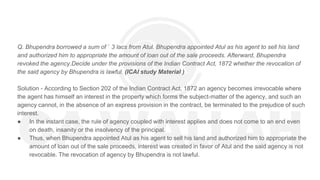
Q. Bhupendra borroweda sum of ` 3 lacs from Atul. Bhupendra appointed Atul as his agent to sell his land
and authorized him to appropriate the amount of loan out of the sale proceeds. Afterward, Bhupendra
revoked the agency.Decide under the provisions of the Indian Contract Act, 1872 whether the revocation of
the said agency by Bhupendra is lawful. (ICAI study Material )
Solution - According to Section 202 of the Indian Contract Act, 1872 an agency becomes irrevocable where
the agent has himself an interest in the property which forms the subject-matter of the agency, and such an
agency cannot, in the absence of an express provision in the contract, be terminated to the prejudice of such
interest.
● In the instant case, the rule of agency coupled with interest applies and does not come to an end even
on death, insanity or the insolvency of the principal.
● Thus, when Bhupendra appointed Atul as his agent to sell his land and authorized him to appropriate the
amount of loan out of the sale proceeds, interest was created in favor of Atul and the said agency is not
revocable. The revocation of agency by Bhupendra is not lawful.
52.
Legal relationship b/wPrincipal and Sub-agent and agent
A] Where sub-agent properly appointed
Principal responsible 3rd Parties (for the acts of sub-agent)
Agent responsible Principal (for the acts of sub-agent)
Sub-agent responsible Agent (for the acts done by him)
Sub-agent not responsible Principal (except in case of fraud)
B] Where sub-agent not properly appointed
Principal not responsible 3rd Parties (for the acts of sub-agent)
Agent responsible Principal + 3rd parties (for the acts of sub-agent)
Sub-agent responsible Agent (for the acts done by him)
Sub-agent not responsible Principal
53.
•Comment on thestatement ‘Principal is
not always bound by the acts of a sub-
agent’. (ICAI study Material )
54.
• A appointsM, a minor, as his agent to sell his watch for cash at a price
not less than r 700. M sells it to D for r 350. Is the sale valid? Explain
the legal position of M and D, referring to the provisions of the Indian
Contract Act, 1872. (ICAI study Material )

![Duties of bailor- Disclose faults in goods [Sec.150]
Liability for Defects in Goods
In case of Gratuitous Bailment
Bailor is liable only for those losses
which arise due to non-disclosed risks
In case of Non- Gratuitous Bailment
Bailor is liable for damages whether or not he was
aware of the existence of faults
Bear Expenses [Sec. 158]
Expenses of Bailment
In case of Gratuitous Bailment
all necessary expenses e.g - Dog
In case of Non- Gratuitous Bailment
only extra-ordinary expenses, and not the
ordinary expenses. E.g car lent
Indemnify Bailee [Sec. 159 & 164]
To indemnify Bailee
Premature Termination of Gratuitous Bailment
• Bailor has the right to terminate the Gratuitous Bailment even
if is for particular period.
• In such a case, Bailor has to indemnify the Bailee the excess of
loss over benefit.
When Bailor’s title is defective
Balior is responsible to the Bailee for any loss which the
Bailee may sustain by reason that the Bailor was not
entitled to make Bailment](https://image.slidesharecdn.com/theindiancontractact1872classnotes-250520113031-195bc45e/85/The-Indian-Contract-Act-1872-_-Class-Notes-pdf-27-320.jpg)
![Pledge by Non-owners-When valid
1) Pledge by Mercantile Agent [Sec 178] –
Valid (whether he is authorized by owner or not)
2) Pledge in case of Voidable Contract [Sec 178 A] –
Valid (if not rescinded at the time of pledge)
3) Pledge goods for limited interest [Sec 179] –
Valid (to the extent of interest)
4) Pledge by a co-owner in possession.
Valid (with the consent of other co owners)
5) Pledge by seller or buyer in possession.
Valid (after prior permission of seller)
Srushti acquired a valuable diamond at a very low price by a voidable contract under the provisions of India
Contract Act, 1872. The voidable contract was not rescinded. Srushti pledged the diamond with Mr. VK. Is this a
valid pledge under the Indian Contract Act, 1872? (Nov. 2019) (module)](https://image.slidesharecdn.com/theindiancontractact1872classnotes-250520113031-195bc45e/85/The-Indian-Contract-Act-1872-_-Class-Notes-pdf-33-320.jpg)
![Extent of Agent’s Authority
1. the nature of the act or the business he is appointed to do.
2. things which are incidental to the business or are usually done in the course of such
business.
3. the usage of trade or business.
Agent’s authority is governed by two principles –
• Agent’s authority in normal circumstances [Section 188]
e.g. A is employed by B, residing in London, to recover at Mumbai a debt due to B. A may adopt any legal
process necessary for the purpose of recovering the debt, and may give a valid discharge for the same.
• Agent’s authority in an emergency [Section 189]
e.g. A consigns perishable goods to B at Srinagar, with directions to send them immediately to C at
Tamilnadu. B may sell the good if they begin to perish before reaching its destination.](https://image.slidesharecdn.com/theindiancontractact1872classnotes-250520113031-195bc45e/85/The-Indian-Contract-Act-1872-_-Class-Notes-pdf-41-320.jpg)
![Duties of Agent
1. Act on direction of principal (otherwise liable for loss) [Sec 211]
e.g. A, an agent engaged in carrying on for a business, in which it is the custom to invest from time
to time, at interest, the moneys which may be in hand, omits to make such investment. As per Sec.
211, A must make good to B the interest usually obtained by such investments.
2. Act with reasonable diligence [Sec 212]
e.g. A, an agent for the sale of goods, having authority to sell on credit, sells to B in credit, without
making the proper and usual enquiries as to the solvency of B. B at the time of such sale, is
insolvent. As per Sec. 212, A must make compensation to his principal in respect of any loss thereby
sustained.
3. Render proper accounts when asked [Sec 213]
4. Pay all sums to principal when asked for [Sec 218]
5. In difficulty or unusual cases, ask for instructions [Sec 214]
6. Not to deal on his own accounts / not to make secret profit. (else principal will recover) [Sec 215-
216]
e.g. A directs B to sell A's estate. B buys the estate for himself in the name of C. As per Sec. 215, A
may repudiate sale, if he can show that the sale has been disadvantageous to him.](https://image.slidesharecdn.com/theindiancontractact1872classnotes-250520113031-195bc45e/85/The-Indian-Contract-Act-1872-_-Class-Notes-pdf-44-320.jpg)
![Legal relationship b/w Principal and Sub-agent and agent
A] Where sub-agent properly appointed
Principal responsible 3rd Parties (for the acts of sub-agent)
Agent responsible Principal (for the acts of sub-agent)
Sub-agent responsible Agent (for the acts done by him)
Sub-agent not responsible Principal (except in case of fraud)
B] Where sub-agent not properly appointed
Principal not responsible 3rd Parties (for the acts of sub-agent)
Agent responsible Principal + 3rd parties (for the acts of sub-agent)
Sub-agent responsible Agent (for the acts done by him)
Sub-agent not responsible Principal](https://image.slidesharecdn.com/theindiancontractact1872classnotes-250520113031-195bc45e/85/The-Indian-Contract-Act-1872-_-Class-Notes-pdf-52-320.jpg)