Topics, Issues, and Controversies in Corporate Governance and Leadership
S T A N F O R D C L O S E R L O O K S E R I E S
stanford closer look series		 1
The Ideal Proxy Statement
introduction
Institutional investors are highly dissatisfied with
the quality of information they receive about cor-
porate governance policies and practices in the an-
nual proxy. Across the board, investors want proxies
to be shorter, more concise, more candid, and less
legal. According to a recent survey by RR Donnel-
ley, Equilar, and the Rock Center for Corporate
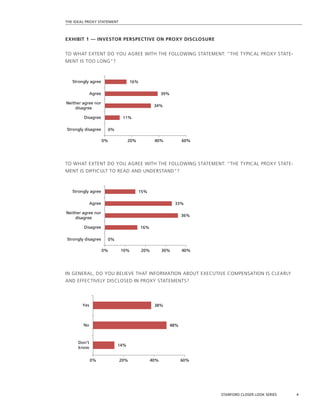
Governance at Stanford University, 55 percent of
investors believe that the typical proxy statement is
too long. Forty-eight percent believe that it is dif-
ficult to read and understand. Investors claim to
read only 32 percent of a typical proxy, on average.
They report that the ideal length of a proxy is 25
pages, compared with an actual average of 80 pages
among companies in the Russell 3000.1
	 The fundamental complaint about proxies is
rooted in a perception that companies are not com-
municating candidly with owners. Shareholders
want corporations to explain information rather
than disclose it. Investors view corporations as using
the proxy as a vehicle to meet disclosure obligations
without a willingness to provide information in a
format that is clear and understandable to a typi-
calโ€”or even sophisticatedโ€”owner.
	 The largest complaint involves executive com-
pensation and the inability of investors to read the
information that companies disclose and determine
whether senior management is paid appropriately.
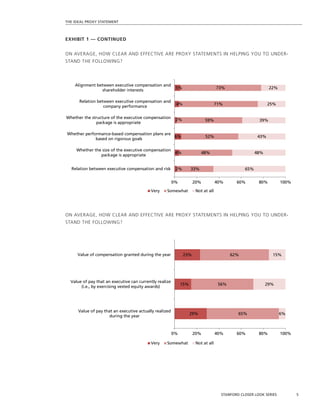
According to the survey above, less than half (38
percent) of institutional investors believe that ex-
ecutive compensation is clearly and effectively
disclosed in the proxy. Responses are consistently
negative across all elements of compensation dis-
closure. Sixty-five percent say that the relation be-
tween compensation and risk is โ€œnot at allโ€ clear.
By David F. Larcker and Brian Tayan
February 17, 2015
Forty-eight percent say that it is โ€œnot at allโ€ clear
that the size of compensation is appropriate. For-
ty-three percent believe that it is โ€œnot at allโ€ clear
whether performance-based compensation plans
are based on rigorous goals. Significant minorities
cannot determine whether the structure of execu-
tive compensation is appropriate (39 percent), can-
not understand the relation between compensation
and performance (25 percent), and cannot deter-
mine whether compensation is well-aligned with
shareholder interests (22 percent). Investors also
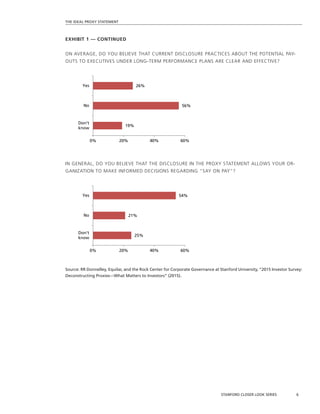
express considerable dissatisfaction with the disclo-
sure of potential payouts to executives under long-
term performance plans.
	 Inadequate disclosure negatively impacts the
voting process. Only half (54 percent) believe that
the proxy allows them to make an informed deci-
sion regarding โ€œsay on payโ€ (see Exhibit 1).
The ideal proxy
The challenge that corporations face is to find a
solution that satisfies investor demands for clarity
while at the same time satisfying numerous regula-
tory requirements for the disclosure of specific ele-
ments. Based on the feedback of major institutional
asset owners and asset managers, the ideal proxy
would include the following:
Context. Investors believe that proxies, as written
today, lack context. In the words of one investor:
โ€œWeโ€™ve lost sight of what the proxy is for. Itโ€™s be-
come a catch-all for non-financial information.โ€
Investors want to know how the companyโ€™s gover-
nance choices are informed by its strategic goals, in
particular its choices relating to board composition,
shareholder rights, financial targets, performance
stanford closer look series		 2
the ideal proxy statement
measurement, and executive compensation:
Contextualize it. I cannot recall reading a proxy
and walking away with a full appreciation of
the link between the pay structure, where the
company wants to go, and how it will get there.
Instead, itโ€™s a bunch of discrete information thatโ€™s
disconnected and too long. It forces the reader to
fill in the blanks.
Investors want companies to avoid the use of boil-
erplate, legal, and compliance-oriented language
and instead to describe the context for corporate
decision making in simple and direct language.
Preferably, this information would come from the
independent chairman or lead director (~1 page in
length).
	 Investors cite Pfizer as a company that does a
notable job of summarizing governance informa-
tion in the proxy.
Board Composition. Investors want a better under-
standing of why each director is on the board and
how they contribute to the corporate strategy and
governance of the firm. This information could
take the form of a skills matrix that maps direc-
tor qualifications to the needs of the organization.
Shareholders would be able to make decisions
about director reelection based on their assessment
of the companyโ€™s performance in each of these ar-
eas. Investors also want to understand the process
for committee assignments, director evaluation,
and refreshing the board over time, including some
information about board succession planning.2
In
addition, the proxy should continue to summarize
the companyโ€™s ownership guidelines and provide a
table on director compensation and ownership lev-
els (~2 pages).
	 Investors cite The Coca-Cola Company as an
example of a company that does an exemplary job
describing director qualifications and the value they
add to the board.
Compensation. The compensation section of the
proxy could be improved through a more concise
presentation of data and clearer description of how
compensation is tied to long-term strategy, finan-
cial metrics, and risk. According to one investor,
the compensation section of the proxy would ben-
efit from context: โ€œA big sticking point for us is that
we want to see better disclosure, not more disclo-
sure.โ€ According to another, investors need better
information to help them determine whether pay
levels are appropriate: โ€œPay can be perfectly aligned
with performance, yet still be too high.โ€ To improve
their understanding of these issues, investors would
like to see the following:
โ€ข	 The value of compensation granted, realized, and
realizable by named executives during the year.
โ€ข	 Comparable data among peers or industry aver-
ages.
โ€ข	 Metrics, targets, and weightings used to award
performance-based awards.
โ€ข	 The companyโ€™s actual performance relative to
targets.
โ€ข	 Outstanding awards and the conditions under
which they can be realized.
โ€ข	 A justification for discretionary payments.
โ€ข	 Ownership guidelines and ownership levels.
(~4 pages).
Investors cite Apple and ExxonMobil as two com-
panies that do a particularly good job framing and
discussing compensation practices.
Shareholder Rights. Investors want a concise sum-
mary of charter and bylaw provisions that spells out
their rights to influence the corporation, including
changes made in recent years and an explanation
of why those changes were made. They want plain-
language statements of company opposition to
shareholder-sponsored proposals, and an explana-
tion of the process the board will take in response
to shareholder engagement (~1 page, plus summary
discussion for each proposal).3
	 Ironically, the ideal proxy statement today in
many ways resembles proxy statements as written
over fifty years ago. Then, a typical proxy was less
than 10 pages in length, was simple in design and
language, and contained a specificity of disclosure
consistent with what investors are requesting to-
day.4
	 Regulatory requirements and investor demands
for information make a return to historical proxy
formats unlikely. Still, one approach that suggests
stanford closer look series		 3
the ideal proxy statement
itself from the research above is to make expanded
use of a summary section at the beginning of prox-
ies for increased clarity, while retaining detail in the
body. Investors express considerable preference for
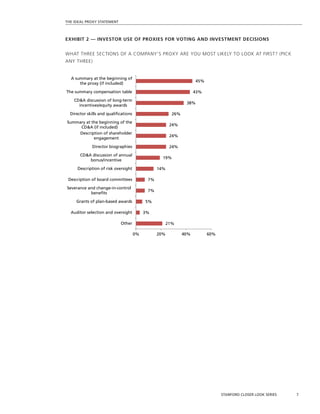
summarized data, and respondents to the survey
above claim they are most likely to read the sum-
mary section first (see Exhibit 2). This is consistent
with the practice of including a summary prospec-
tus in the event of a merger or acquisition.
Why This Matters
1.	Corporate proxies contain more disclosure than
ever, and yet investors are highly dissatisfied with
the quality of information they receive. What
changes can companies make so that proxies
contain the detailed information that investors
want, in a format that is easy to read and navi-
gate?
2.	Would shareholder understanding of corporate
governance practices improve if companies pro-
vided clearer and more succinct information
in a summary proxy statementโ€”with detailed,
supplementary information available on the In-
ternet for those shareholders that value it?
3.	How might the debate about executive compen-
sation change if shareholders were given more
useful information to determine whether pay
packages are appropriate? Would this improve
the effectiveness of โ€œsay on payโ€ voting to rein in
bad practices? ๏ฎ
1
	 All figures and quotes in this Closer Look are derived from: RR
Donnelly, Equilar, and The Rock Center for Corporate Governance
at Stanford University, โ€œ2015 Investor Survey: Deconstructing Prox-
iesโ€”What Matters to Investorsโ€ (2015).
2
	 For a discussion of committee assignments, see: David F. Larcker,
Brian Tayan, and Christina Zhu, โ€œA Meeting of the Minds: How
Do Companies Distribute Knowledge and Workload Across Board
Committees?โ€ Stanford Closer Look Series CGRP-46 (December 8,
2014).
3
	 The recent controversy on proxy access proposals is one example of
an issue where shareholders want more information from the com-
pany. For example, in January 2015, the SEC reversed a previous
decision to allow Whole Foods to exclude a resolution allowing cer-
tain qualifying shareholders the right to nominate candidates to the
board of directors. Shareholders will want the company to explain
what actions, if any, it will take in response to the proposal and its
outcome.
4
	 See: David F. Larcker and Brian Tayan, โ€œA Historical Look at Com-
pensation and Disclosure: Cool and Refreshing!โ€ Stanford Closer
Look Series CGRP-04 (June 15, 2010).
David Larcker is Director of the Corporate Governance Re-
search Initiative at the Stanford Graduate School of Busi-
ness and senior faculty member at the Rock Center for
Corporate Governance at Stanford University. Brian Tayan
is a researcher with Stanfordโ€™s Corporate Governance Re-
search Initiative. They are coauthors of the books A Real
Look at Real World Corporate Governance and Corpo-
rate Governance Matters. The authors would like to thank
Michelle E. Gutman for research assistance in the prepara-
tion of these materials.
The Stanford Closer Look Series is a collection of short
case studies that explore topics, issues, and controver-
sies in corporate governance and leadership. The Closer
Look Series is published by the Corporate Governance
Research Initiative at the Stanford Graduate School
of Business and the Rock Center for Corporate Gover-
nance at Stanford University. For more information, visit:
http://www.gsb.stanford.edu/faculty-research/
programs/cgri.
Copyright ยฉ 2015 by the Board of Trustees of the Leland
Stanford Junior University. All rights reserved.
stanford closer look series		 4
the ideal proxy statement
Exhibit 1 โ€” Investor Perspective on Proxy Disclosure
To what extent do you agree with the following statement: โ€œThe typical proxy state-
ment is too longโ€?
To what extent do you agree with the following statement: โ€œThe typical proxy state-
ment is difficult to read and understandโ€?
0%
11%
34%
39%
16%
0% 20% 40% 60%
Strongly disagree
Disagree
Neither agree nor
disagree
Agree
Strongly agree
0%
16%
36%
33%
15%
0% 10% 20% 30% 40%
Strongly disagree
Disagree
Neither agree nor
disagree
Agree
Strongly agree
In general, do you believe that information about executive compensation is clearly
and effectively disclosed in proxy statements?
14%
48%
38%
0% 20% 40% 60%
Don't
know
No
Yes
stanford closer look series		 5
the ideal proxy statement
Exhibit 1 โ€” continued
On average, how clear and effective are proxy statements in helping you to under-
stand the following?
2%
4%
6%
2%
4%
5%
33%
48%
52%
59%
71%
73%
65%
48%
43%
39%
25%
22%
0% 20% 40% 60% 80% 100%
Relation between executive compensation and risk
Whether the size of the executive compensation
package is appropriate
Whether performance-based compensation plans are
based on rigorous goals
Whether the structure of the executive compensation
package is appropriate
Relation between executive compensation and
company performance
Alignment between executive compensation and
shareholder interests
Very Somewhat Not at all
On average, how clear and effective are proxy statements in helping you to under-
stand the following?
29%
15%
23%
65%
56%
62%
6%
29%
15%
0% 20% 40% 60% 80% 100%
Value of pay that an executive actually realized
during the year
Value of pay that an executive can currently realize
(i.e., by exercising vested equity awards)
Value of compensation granted during the year
Very Somewhat Not at all
stanford closer look series		 6
the ideal proxy statement
Exhibit 1 โ€” continued
Source: RR Donnelley, Equilar, and the Rock Center for Corporate Governance at Stanford University, โ€œ2015 Investor Survey:
Deconstructing Proxiesโ€”What Matters to Investorsโ€ (2015).
On average, do you believe that current disclosure practices about the potential pay-
outs to executives under long-term performance plans are clear and effective?
In general, do you believe that the disclosure in the proxy statement allows your or-
ganization to make informed decisions regarding โ€œSay on Payโ€?
19%
56%
26%
0% 20% 40% 60%
Don't
know
No
Yes
25%
21%
54%
0% 20% 40% 60%
Don't
know
No
Yes
stanford closer look series		 7
the ideal proxy statement
Exhibit 2 โ€” Investor Use of Proxies for Voting and Investment Decisions
What three sections of a companyโ€™s proxy are you most likely to look at first? (pick
any three)
21%
3%
5%
7%
7%
14%
19%
24%
24%
24%
26%
38%
43%
45%
0% 20% 40% 60%
Other
Auditor selection and oversight
Grants of plan-based awards
Severance and change-in-control
benefits
Description of board committees
Description of risk oversight
CD&A discussion of annual
bonus/incentive
Director biographies
Description of shareholder
engagement
Summary at the beginning of the
CD&A (if included)
Director skills and qualifications
CD&A discussion of long-term
incentives/equity awards
The summary compensation table
A summary at the beginning of
the proxy (if included)
stanford closer look series		 8
the ideal proxy statement
Exhibit 2 โ€” continued
Which of the following sections of the proxy does your firm read and rely on to make
voting and investment decisions? (select all that apply)
29%
16%
3%
5%
5%
12%
10%
10%
7%
5%
17%
5%
14%
22%
29%
19%
26%
33%
19%
40%
17%
34%
14%
7%
12%
19%
22%
24%
28%
28%
33%
33%
33%
34%
36%
41%
43%
45%
48%
59%
59%
62%
62%
64%
0% 20% 40% 60% 80%
None of these
Other
Ratio of CEO/median employee pay
Political contributions
Ratio of CEO/named executive officer pay
CSR/sustainability profile
Clawbacks
Board evaluation process
Realized/realizable pay
Supporting statements to 14a-8 proposals
Succession planning (CEO and director)
Company opposition to 14a-8 proposals
Investor engagement
Peer group benchmarking
Risk oversight
Related-person transactions
Compensation philosophy
Shareholder rights/anti-takeover
Director nominee descriptions
Performance metrics
Director independence
Pay-for-performance alignment
Voting decision Investment decision
Source: RR Donnelley, Equilar, and the Rock Center for Corporate Governance at Stanford University, โ€œ2015 Investor Survey:
Deconstructing Proxiesโ€”What Matters to Investorsโ€ (2015).

The Ideal Proxy Statement

  • 1.
    Topics, Issues, andControversies in Corporate Governance and Leadership S T A N F O R D C L O S E R L O O K S E R I E S stanford closer look series 1 The Ideal Proxy Statement introduction Institutional investors are highly dissatisfied with the quality of information they receive about cor- porate governance policies and practices in the an- nual proxy. Across the board, investors want proxies to be shorter, more concise, more candid, and less legal. According to a recent survey by RR Donnel- ley, Equilar, and the Rock Center for Corporate Governance at Stanford University, 55 percent of investors believe that the typical proxy statement is too long. Forty-eight percent believe that it is dif- ficult to read and understand. Investors claim to read only 32 percent of a typical proxy, on average. They report that the ideal length of a proxy is 25 pages, compared with an actual average of 80 pages among companies in the Russell 3000.1 The fundamental complaint about proxies is rooted in a perception that companies are not com- municating candidly with owners. Shareholders want corporations to explain information rather than disclose it. Investors view corporations as using the proxy as a vehicle to meet disclosure obligations without a willingness to provide information in a format that is clear and understandable to a typi- calโ€”or even sophisticatedโ€”owner. The largest complaint involves executive com- pensation and the inability of investors to read the information that companies disclose and determine whether senior management is paid appropriately. According to the survey above, less than half (38 percent) of institutional investors believe that ex- ecutive compensation is clearly and effectively disclosed in the proxy. Responses are consistently negative across all elements of compensation dis- closure. Sixty-five percent say that the relation be- tween compensation and risk is โ€œnot at allโ€ clear. By David F. Larcker and Brian Tayan February 17, 2015 Forty-eight percent say that it is โ€œnot at allโ€ clear that the size of compensation is appropriate. For- ty-three percent believe that it is โ€œnot at allโ€ clear whether performance-based compensation plans are based on rigorous goals. Significant minorities cannot determine whether the structure of execu- tive compensation is appropriate (39 percent), can- not understand the relation between compensation and performance (25 percent), and cannot deter- mine whether compensation is well-aligned with shareholder interests (22 percent). Investors also express considerable dissatisfaction with the disclo- sure of potential payouts to executives under long- term performance plans. Inadequate disclosure negatively impacts the voting process. Only half (54 percent) believe that the proxy allows them to make an informed deci- sion regarding โ€œsay on payโ€ (see Exhibit 1). The ideal proxy The challenge that corporations face is to find a solution that satisfies investor demands for clarity while at the same time satisfying numerous regula- tory requirements for the disclosure of specific ele- ments. Based on the feedback of major institutional asset owners and asset managers, the ideal proxy would include the following: Context. Investors believe that proxies, as written today, lack context. In the words of one investor: โ€œWeโ€™ve lost sight of what the proxy is for. Itโ€™s be- come a catch-all for non-financial information.โ€ Investors want to know how the companyโ€™s gover- nance choices are informed by its strategic goals, in particular its choices relating to board composition, shareholder rights, financial targets, performance
  • 2.
    stanford closer lookseries 2 the ideal proxy statement measurement, and executive compensation: Contextualize it. I cannot recall reading a proxy and walking away with a full appreciation of the link between the pay structure, where the company wants to go, and how it will get there. Instead, itโ€™s a bunch of discrete information thatโ€™s disconnected and too long. It forces the reader to fill in the blanks. Investors want companies to avoid the use of boil- erplate, legal, and compliance-oriented language and instead to describe the context for corporate decision making in simple and direct language. Preferably, this information would come from the independent chairman or lead director (~1 page in length). Investors cite Pfizer as a company that does a notable job of summarizing governance informa- tion in the proxy. Board Composition. Investors want a better under- standing of why each director is on the board and how they contribute to the corporate strategy and governance of the firm. This information could take the form of a skills matrix that maps direc- tor qualifications to the needs of the organization. Shareholders would be able to make decisions about director reelection based on their assessment of the companyโ€™s performance in each of these ar- eas. Investors also want to understand the process for committee assignments, director evaluation, and refreshing the board over time, including some information about board succession planning.2 In addition, the proxy should continue to summarize the companyโ€™s ownership guidelines and provide a table on director compensation and ownership lev- els (~2 pages). Investors cite The Coca-Cola Company as an example of a company that does an exemplary job describing director qualifications and the value they add to the board. Compensation. The compensation section of the proxy could be improved through a more concise presentation of data and clearer description of how compensation is tied to long-term strategy, finan- cial metrics, and risk. According to one investor, the compensation section of the proxy would ben- efit from context: โ€œA big sticking point for us is that we want to see better disclosure, not more disclo- sure.โ€ According to another, investors need better information to help them determine whether pay levels are appropriate: โ€œPay can be perfectly aligned with performance, yet still be too high.โ€ To improve their understanding of these issues, investors would like to see the following: โ€ข The value of compensation granted, realized, and realizable by named executives during the year. โ€ข Comparable data among peers or industry aver- ages. โ€ข Metrics, targets, and weightings used to award performance-based awards. โ€ข The companyโ€™s actual performance relative to targets. โ€ข Outstanding awards and the conditions under which they can be realized. โ€ข A justification for discretionary payments. โ€ข Ownership guidelines and ownership levels. (~4 pages). Investors cite Apple and ExxonMobil as two com- panies that do a particularly good job framing and discussing compensation practices. Shareholder Rights. Investors want a concise sum- mary of charter and bylaw provisions that spells out their rights to influence the corporation, including changes made in recent years and an explanation of why those changes were made. They want plain- language statements of company opposition to shareholder-sponsored proposals, and an explana- tion of the process the board will take in response to shareholder engagement (~1 page, plus summary discussion for each proposal).3 Ironically, the ideal proxy statement today in many ways resembles proxy statements as written over fifty years ago. Then, a typical proxy was less than 10 pages in length, was simple in design and language, and contained a specificity of disclosure consistent with what investors are requesting to- day.4 Regulatory requirements and investor demands for information make a return to historical proxy formats unlikely. Still, one approach that suggests
  • 3.
    stanford closer lookseries 3 the ideal proxy statement itself from the research above is to make expanded use of a summary section at the beginning of prox- ies for increased clarity, while retaining detail in the body. Investors express considerable preference for summarized data, and respondents to the survey above claim they are most likely to read the sum- mary section first (see Exhibit 2). This is consistent with the practice of including a summary prospec- tus in the event of a merger or acquisition. Why This Matters 1. Corporate proxies contain more disclosure than ever, and yet investors are highly dissatisfied with the quality of information they receive. What changes can companies make so that proxies contain the detailed information that investors want, in a format that is easy to read and navi- gate? 2. Would shareholder understanding of corporate governance practices improve if companies pro- vided clearer and more succinct information in a summary proxy statementโ€”with detailed, supplementary information available on the In- ternet for those shareholders that value it? 3. How might the debate about executive compen- sation change if shareholders were given more useful information to determine whether pay packages are appropriate? Would this improve the effectiveness of โ€œsay on payโ€ voting to rein in bad practices? ๏ฎ 1 All figures and quotes in this Closer Look are derived from: RR Donnelly, Equilar, and The Rock Center for Corporate Governance at Stanford University, โ€œ2015 Investor Survey: Deconstructing Prox- iesโ€”What Matters to Investorsโ€ (2015). 2 For a discussion of committee assignments, see: David F. Larcker, Brian Tayan, and Christina Zhu, โ€œA Meeting of the Minds: How Do Companies Distribute Knowledge and Workload Across Board Committees?โ€ Stanford Closer Look Series CGRP-46 (December 8, 2014). 3 The recent controversy on proxy access proposals is one example of an issue where shareholders want more information from the com- pany. For example, in January 2015, the SEC reversed a previous decision to allow Whole Foods to exclude a resolution allowing cer- tain qualifying shareholders the right to nominate candidates to the board of directors. Shareholders will want the company to explain what actions, if any, it will take in response to the proposal and its outcome. 4 See: David F. Larcker and Brian Tayan, โ€œA Historical Look at Com- pensation and Disclosure: Cool and Refreshing!โ€ Stanford Closer Look Series CGRP-04 (June 15, 2010). David Larcker is Director of the Corporate Governance Re- search Initiative at the Stanford Graduate School of Busi- ness and senior faculty member at the Rock Center for Corporate Governance at Stanford University. Brian Tayan is a researcher with Stanfordโ€™s Corporate Governance Re- search Initiative. They are coauthors of the books A Real Look at Real World Corporate Governance and Corpo- rate Governance Matters. The authors would like to thank Michelle E. Gutman for research assistance in the prepara- tion of these materials. The Stanford Closer Look Series is a collection of short case studies that explore topics, issues, and controver- sies in corporate governance and leadership. The Closer Look Series is published by the Corporate Governance Research Initiative at the Stanford Graduate School of Business and the Rock Center for Corporate Gover- nance at Stanford University. For more information, visit: http://www.gsb.stanford.edu/faculty-research/ programs/cgri. Copyright ยฉ 2015 by the Board of Trustees of the Leland Stanford Junior University. All rights reserved.
  • 4.
    stanford closer lookseries 4 the ideal proxy statement Exhibit 1 โ€” Investor Perspective on Proxy Disclosure To what extent do you agree with the following statement: โ€œThe typical proxy state- ment is too longโ€? To what extent do you agree with the following statement: โ€œThe typical proxy state- ment is difficult to read and understandโ€? 0% 11% 34% 39% 16% 0% 20% 40% 60% Strongly disagree Disagree Neither agree nor disagree Agree Strongly agree 0% 16% 36% 33% 15% 0% 10% 20% 30% 40% Strongly disagree Disagree Neither agree nor disagree Agree Strongly agree In general, do you believe that information about executive compensation is clearly and effectively disclosed in proxy statements? 14% 48% 38% 0% 20% 40% 60% Don't know No Yes
  • 5.
    stanford closer lookseries 5 the ideal proxy statement Exhibit 1 โ€” continued On average, how clear and effective are proxy statements in helping you to under- stand the following? 2% 4% 6% 2% 4% 5% 33% 48% 52% 59% 71% 73% 65% 48% 43% 39% 25% 22% 0% 20% 40% 60% 80% 100% Relation between executive compensation and risk Whether the size of the executive compensation package is appropriate Whether performance-based compensation plans are based on rigorous goals Whether the structure of the executive compensation package is appropriate Relation between executive compensation and company performance Alignment between executive compensation and shareholder interests Very Somewhat Not at all On average, how clear and effective are proxy statements in helping you to under- stand the following? 29% 15% 23% 65% 56% 62% 6% 29% 15% 0% 20% 40% 60% 80% 100% Value of pay that an executive actually realized during the year Value of pay that an executive can currently realize (i.e., by exercising vested equity awards) Value of compensation granted during the year Very Somewhat Not at all
  • 6.
    stanford closer lookseries 6 the ideal proxy statement Exhibit 1 โ€” continued Source: RR Donnelley, Equilar, and the Rock Center for Corporate Governance at Stanford University, โ€œ2015 Investor Survey: Deconstructing Proxiesโ€”What Matters to Investorsโ€ (2015). On average, do you believe that current disclosure practices about the potential pay- outs to executives under long-term performance plans are clear and effective? In general, do you believe that the disclosure in the proxy statement allows your or- ganization to make informed decisions regarding โ€œSay on Payโ€? 19% 56% 26% 0% 20% 40% 60% Don't know No Yes 25% 21% 54% 0% 20% 40% 60% Don't know No Yes
  • 7.
    stanford closer lookseries 7 the ideal proxy statement Exhibit 2 โ€” Investor Use of Proxies for Voting and Investment Decisions What three sections of a companyโ€™s proxy are you most likely to look at first? (pick any three) 21% 3% 5% 7% 7% 14% 19% 24% 24% 24% 26% 38% 43% 45% 0% 20% 40% 60% Other Auditor selection and oversight Grants of plan-based awards Severance and change-in-control benefits Description of board committees Description of risk oversight CD&A discussion of annual bonus/incentive Director biographies Description of shareholder engagement Summary at the beginning of the CD&A (if included) Director skills and qualifications CD&A discussion of long-term incentives/equity awards The summary compensation table A summary at the beginning of the proxy (if included)
  • 8.
    stanford closer lookseries 8 the ideal proxy statement Exhibit 2 โ€” continued Which of the following sections of the proxy does your firm read and rely on to make voting and investment decisions? (select all that apply) 29% 16% 3% 5% 5% 12% 10% 10% 7% 5% 17% 5% 14% 22% 29% 19% 26% 33% 19% 40% 17% 34% 14% 7% 12% 19% 22% 24% 28% 28% 33% 33% 33% 34% 36% 41% 43% 45% 48% 59% 59% 62% 62% 64% 0% 20% 40% 60% 80% None of these Other Ratio of CEO/median employee pay Political contributions Ratio of CEO/named executive officer pay CSR/sustainability profile Clawbacks Board evaluation process Realized/realizable pay Supporting statements to 14a-8 proposals Succession planning (CEO and director) Company opposition to 14a-8 proposals Investor engagement Peer group benchmarking Risk oversight Related-person transactions Compensation philosophy Shareholder rights/anti-takeover Director nominee descriptions Performance metrics Director independence Pay-for-performance alignment Voting decision Investment decision Source: RR Donnelley, Equilar, and the Rock Center for Corporate Governance at Stanford University, โ€œ2015 Investor Survey: Deconstructing Proxiesโ€”What Matters to Investorsโ€ (2015).