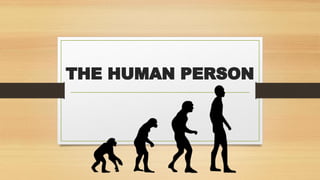
THE HUMAN PERSON
HOW DOES PHILOSOPHY VIEW THE
NATURE OF MAN?
• MAN
- refers to the entire human race.
• HUMAN
- refers to man as a species (homo sapiens sapiens) or
modern human beings.
• PERSON
-more complex; refers to a human being granted recognition
of certain rights, protection and responsibilities.
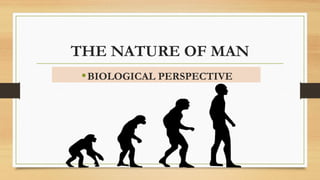
THE NATURE OF MAN
•BIOLOGICAL PERSPECTIVE
THE NATURE OF MAN
•BIOLOGICAL PERSPECTIVE
- Considers man as part of the natural world and a product of evolution.
- Homo Sapiens Sapiens
- States that humans are closely related to primates, especially apes, but have
developed distinct physical features such as:
A. Bipedalism C. smaller jaws and teeth
B. highly developed hands D. larger and more developed brain
THE NATURE OF MAN
•BIOLOGICAL PERSPECTIVE
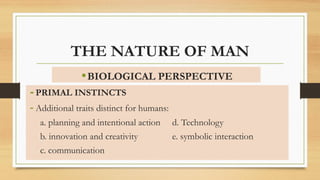
- PRIMAL INSTINCTS
- Additional traits distinct for humans:
a. planning and intentional action d. Technology
b. innovation and creativity e. symbolic interaction
c. communication
THE NATURE OF MAN
•BIOLOGICAL PERSPECTIVE
CULTURE
THE NATURE OF MAN
•PSYCHOLOGICAL PERSPECTIVE
THE NATURE OF MAN
•PSYCHOLOGICAL PERSPECTIVE
- Emphasizes on human behavior and thought processes
- States that man has mental faculties that enables him to possess:
Awareness Sense of Self
Perceive Experience
THE NATURE OF MAN
•PSYCHOLOGICAL PERSPECTIVE
MENTAL FACULTIES AND CAPABILITIES OF MAN INCLUDE:
PSYCHE
Refers to the human mind.
CONSCIOUS
PSYCHE
UNCONSCIOUS
governs awareness
latent or repressed emotions,
thoughts and desires
THE NATURE OF MAN
•PSYCHOLOGICAL PERSPECTIVE
MENTAL FACULTIES AND CAPABILITIES OF MAN INCLUDE:
RATIONALITY
The state of being reasonable
THE NATURE OF MAN
•PSYCHOLOGICAL PERSPECTIVE
MENTAL FACULTIES AND CAPABILITIES OF MAN INCLUDE:
INTELLIGENCE
Perceive information, store knowledge, application
THE NATURE OF MAN
•PSYCHOLOGICAL PERSPECTIVE
MENTAL FACULTIES AND CAPABILITIES OF MAN INCLUDE:
INTROSPECTION
Examine one’s own conscious thoughts, feelings and mental state.
Capacity to reflect.
THE NATURE OF MAN
•PSYCHOLOGICAL PERSPECTIVE
MENTAL FACULTIES AND CAPABILITIES OF MAN INCLUDE:
COGNITION
Ability to perceive and experience reality through the physical body
that enables the self to form one’s consciousness.
THE NATURE OF MAN
•PSYCHOLOGICAL PERSPECTIVE
MENTAL FACULTIES AND CAPABILITIES OF MAN INCLUDE:
COGNITION
ENACTIVISM
States that cognition arises through the
interaction between an organism and its
environment.
THE NATURE OF MAN
•ECONOMIC PERSPECTIVE
- Focuses on man’s ability to engage in productive
activities in an effort to meet his wants and needs.
- Homo Economicus (19th
century)
- Man is a productive being and it’s primary role is to
produce and engage in labor.
THE NATURE OF MAN
•SOCIAL AND POLITICAL PERSPECTIVE
THE NATURE OF MAN
• SOCIAL AND POLITICAL PERSPECTIVE
- This view believes that no individual is fully self-sufficient; thus
human beings is always inclined to coexist with other parts of the
community,
- SOCIETY
- Humans are integrated to the society to the point that they cannot
function apart it.
THE NATURE OF MAN
•THEOLOGICAL PERSPECTIVE
THE NATURE OF MAN
•THEOLOGICAL PERSPECTIVE
- Considers man as God’s Creation
- Man is considered to have a special relationship with the creator.
HOW DOES
PHILOSOPHY
DEFINE THE
HUMAN PERSON?
THE HUMAN PERSON
• Refers to the individual, and all the attributes and characteristics
that set him or her apart from other human beings.
SELF
IDENTITY
PERSONHOOD
SELF
• One of the most unique traits of humans is the awareness of self.
• SENTIENCE – ability to feel and experience; react to stimulus
• NATURE OF SELF
INNATE EMERGENT
INTEGRATED AND DEVELOPING
IDENTITY
•Distinct personality of an individual.
•Personal Identity is composed of:
a. Physical Characteristics d. Memories
b. Mental attributes e. Ideas
c. Experiences f. Views
PERSONHOOD
•Recognition of a human being as a distinct entity.
JUSTIFICATION OF
PERSONHOOD
•THE PERSON AS AN
“AUTONOMOUS BEING”
- Human beings are considered
person of he/she possesses the
ability to determine his or her life
through “reasoned free choice”
JUSTIFICATION OF
PERSONHOOD
•THE PERSON AS A
“UNIFIED INDIVIDUAL”
- Emphasizes the potential of the
human being and recognizes that each
human possesses the means to achieve
his or her capabilities.
JUSTIFICATION OF
PERSONHOOD
•THE PERSON “IN
RELATION TO
OTHERS”
- Human being becomes a person
through interactions with other
human beings.
TIMES WHEN
PEOPLE MAY NOT
BE RECOGNIZED
AS A PERSON.
PEOPLE WHO ARE
IN COMATOSE
SLAVES
WOMEN IN ANCIENT GREECE
•It was only in the 19th
Century that women were given the
right to vote and participate in the government.
AFRICAN SLAVES (18th
Century)
•Were considered subhuman and considered equivalent to
only 3/5 of a person.
•May be recognized as persons given that they possess
certain cognitive faculties similar to humans.
END… ☺

THE HUMAN PERSON.pptx (1).pdf

  • 2.
  • 3.
    HOW DOES PHILOSOPHYVIEW THE NATURE OF MAN? • MAN - refers to the entire human race. • HUMAN - refers to man as a species (homo sapiens sapiens) or modern human beings. • PERSON -more complex; refers to a human being granted recognition of certain rights, protection and responsibilities.
  • 4.
    THE NATURE OFMAN •BIOLOGICAL PERSPECTIVE
  • 5.
    THE NATURE OFMAN •BIOLOGICAL PERSPECTIVE - Considers man as part of the natural world and a product of evolution. - Homo Sapiens Sapiens - States that humans are closely related to primates, especially apes, but have developed distinct physical features such as: A. Bipedalism C. smaller jaws and teeth B. highly developed hands D. larger and more developed brain
  • 6.
    THE NATURE OFMAN •BIOLOGICAL PERSPECTIVE - PRIMAL INSTINCTS - Additional traits distinct for humans: a. planning and intentional action d. Technology b. innovation and creativity e. symbolic interaction c. communication
  • 7.
    THE NATURE OFMAN •BIOLOGICAL PERSPECTIVE CULTURE
  • 8.
    THE NATURE OFMAN •PSYCHOLOGICAL PERSPECTIVE
  • 9.
    THE NATURE OFMAN •PSYCHOLOGICAL PERSPECTIVE - Emphasizes on human behavior and thought processes - States that man has mental faculties that enables him to possess: Awareness Sense of Self Perceive Experience
  • 10.
    THE NATURE OFMAN •PSYCHOLOGICAL PERSPECTIVE MENTAL FACULTIES AND CAPABILITIES OF MAN INCLUDE: PSYCHE Refers to the human mind.
  • 11.
    CONSCIOUS PSYCHE UNCONSCIOUS governs awareness latent orrepressed emotions, thoughts and desires
  • 12.
    THE NATURE OFMAN •PSYCHOLOGICAL PERSPECTIVE MENTAL FACULTIES AND CAPABILITIES OF MAN INCLUDE: RATIONALITY The state of being reasonable
  • 14.
    THE NATURE OFMAN •PSYCHOLOGICAL PERSPECTIVE MENTAL FACULTIES AND CAPABILITIES OF MAN INCLUDE: INTELLIGENCE Perceive information, store knowledge, application
  • 16.
    THE NATURE OFMAN •PSYCHOLOGICAL PERSPECTIVE MENTAL FACULTIES AND CAPABILITIES OF MAN INCLUDE: INTROSPECTION Examine one’s own conscious thoughts, feelings and mental state. Capacity to reflect.
  • 18.
    THE NATURE OFMAN •PSYCHOLOGICAL PERSPECTIVE MENTAL FACULTIES AND CAPABILITIES OF MAN INCLUDE: COGNITION Ability to perceive and experience reality through the physical body that enables the self to form one’s consciousness.
  • 19.
    THE NATURE OFMAN •PSYCHOLOGICAL PERSPECTIVE MENTAL FACULTIES AND CAPABILITIES OF MAN INCLUDE: COGNITION ENACTIVISM States that cognition arises through the interaction between an organism and its environment.
  • 20.
    THE NATURE OFMAN •ECONOMIC PERSPECTIVE - Focuses on man’s ability to engage in productive activities in an effort to meet his wants and needs. - Homo Economicus (19th century) - Man is a productive being and it’s primary role is to produce and engage in labor.
  • 21.
    THE NATURE OFMAN •SOCIAL AND POLITICAL PERSPECTIVE
  • 22.
    THE NATURE OFMAN • SOCIAL AND POLITICAL PERSPECTIVE - This view believes that no individual is fully self-sufficient; thus human beings is always inclined to coexist with other parts of the community, - SOCIETY - Humans are integrated to the society to the point that they cannot function apart it.
  • 23.
    THE NATURE OFMAN •THEOLOGICAL PERSPECTIVE
  • 24.
    THE NATURE OFMAN •THEOLOGICAL PERSPECTIVE - Considers man as God’s Creation - Man is considered to have a special relationship with the creator.
  • 25.
  • 26.
    THE HUMAN PERSON •Refers to the individual, and all the attributes and characteristics that set him or her apart from other human beings. SELF IDENTITY PERSONHOOD
  • 27.
    SELF • One ofthe most unique traits of humans is the awareness of self. • SENTIENCE – ability to feel and experience; react to stimulus • NATURE OF SELF INNATE EMERGENT INTEGRATED AND DEVELOPING
  • 28.
    IDENTITY •Distinct personality ofan individual. •Personal Identity is composed of: a. Physical Characteristics d. Memories b. Mental attributes e. Ideas c. Experiences f. Views
  • 29.
    PERSONHOOD •Recognition of ahuman being as a distinct entity.
  • 30.
    JUSTIFICATION OF PERSONHOOD •THE PERSONAS AN “AUTONOMOUS BEING” - Human beings are considered person of he/she possesses the ability to determine his or her life through “reasoned free choice”
  • 31.
    JUSTIFICATION OF PERSONHOOD •THE PERSONAS A “UNIFIED INDIVIDUAL” - Emphasizes the potential of the human being and recognizes that each human possesses the means to achieve his or her capabilities.
  • 32.
    JUSTIFICATION OF PERSONHOOD •THE PERSON“IN RELATION TO OTHERS” - Human being becomes a person through interactions with other human beings.
  • 33.
    TIMES WHEN PEOPLE MAYNOT BE RECOGNIZED AS A PERSON.
  • 34.
    PEOPLE WHO ARE INCOMATOSE SLAVES
  • 35.
    WOMEN IN ANCIENTGREECE •It was only in the 19th Century that women were given the right to vote and participate in the government. AFRICAN SLAVES (18th Century) •Were considered subhuman and considered equivalent to only 3/5 of a person.
  • 36.
    •May be recognizedas persons given that they possess certain cognitive faculties similar to humans.
  • 37.