THE HORROR GENRE 
By Megan Jones
ORIGINS OF THE 
HORROR GENRE 
• The genre was brought to light in the 18th century as 
Gothic horror, which is now a sub-genre of Horror, with 
the publication of the Castle of Otrantoby by Horace 
Walpole in 1764. 
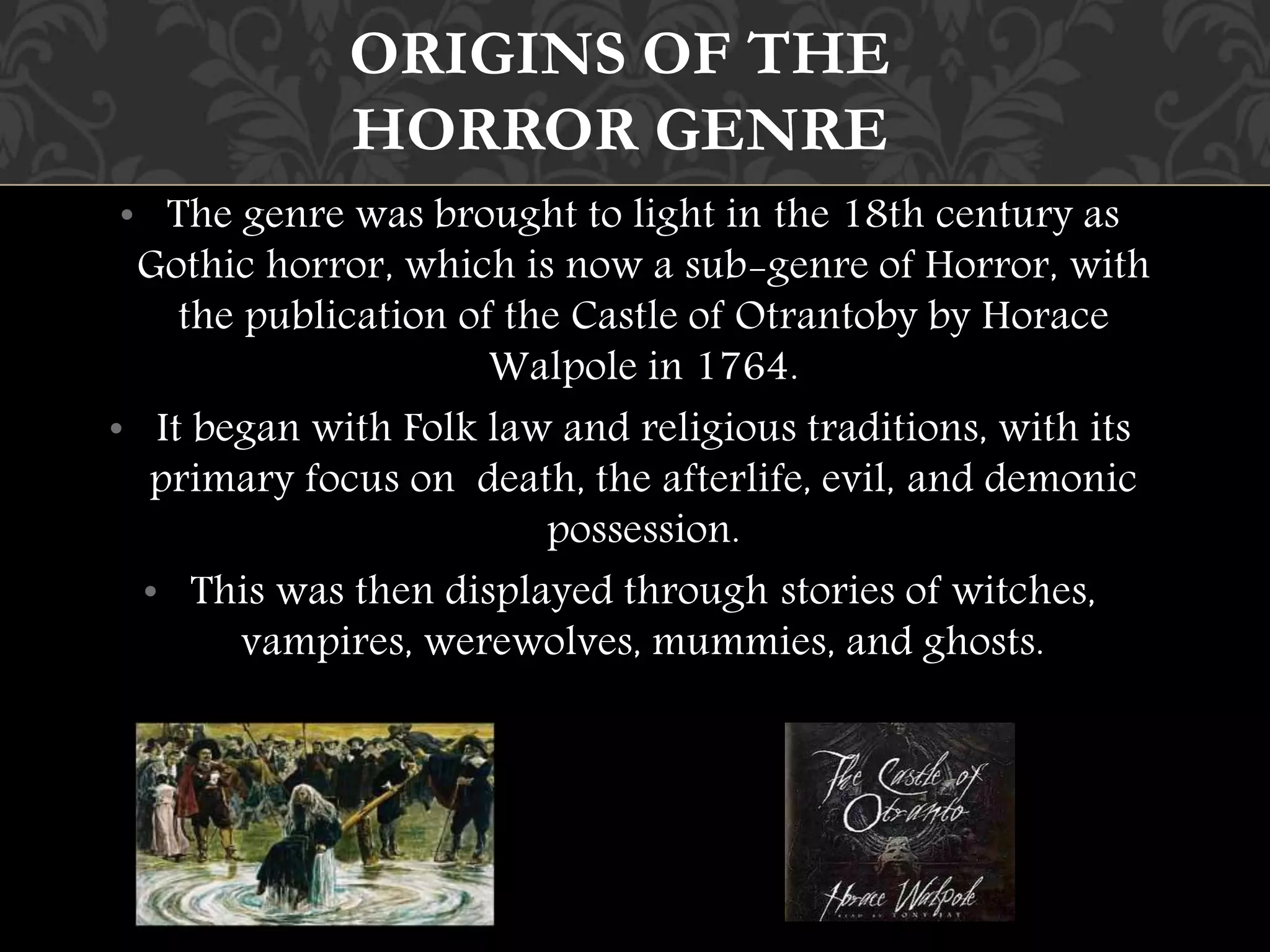
• It began with Folk law and religious traditions, with its 
primary focus on death, the afterlife, evil, and demonic 
possession. 
• This was then displayed through stories of witches, 
vampires, werewolves, mummies, and ghosts.
CHARACTERISTICS & QUOTES 
• Horror intends to provokes a response; emotional, 
psychological or physical, within readers that causes them 
to react with fear. 
• Elizabeth Barrette - “Sometimes a story intends to shock and 
disgust, but the best horror intends to shake us out of our 
complacency. It makes us think, forces us to confront ideas 
we might rather ignore. Horror reminds us that the world is 
not always as safe as it seems.” 
• H.P. Lovecraft - "The oldest and strongest emotion of 
mankind is fear, and the oldest and strongest kind of fear is 
fear of the unknown’’
Horror Fiction Conventions 
Setting 
• Conventionally set in isolated towns/villages, more specifically 
located in desolate mansions in the rural countryside, typically with 
a dark and disturbing past which conventionally forebodes the 
narrative. 
• Horror conventionally includes pathetic fallacy such as a winter 
scene including darkness and foul, miserable weather in order to 
connect the reader with the mood of the novel.
Horror Fiction Conventions 
Plot and Characters 
• The semantic field of any horror novel is fear. The main 
character can be either adult or child, but should begin as a 
victim and should be a good person. 
• There is a supernatural or unexplained mystery in the narrative. 
The evil should begin as an invisible force, as that then creates 
enigma surrounding the plot, enticing the reader to learn more. 
• The protagonist, conventionally male, should develop some 
power in order to conquer the evil entity, which is put to use in 
the final, climatic showdown at the conclusion of the novel.
Horror Fiction Conventions 
Plot and Characters 
• The antagonist is conventionally not revealed until the just before 
the end of the narrative, but appears to be one step ahead of the 
protagonist throughout. 
• The narrator is omniscient, which helps the reader learn more 
about each villainous act committed, as well as the narrator 
seeing the story unfolding from the perspective of the reader.
SALEM’S LOT – STEPHEN KING
• Unearthly – Adverbial 
This adds a sense of unease and a supernatural element suggested to the reader. 
• Quiet – Adjective 
Creates a remote and isolated atmosphere, conventional of horror 
• Few planes; no turnpikes; even that [the radio] was noise without meaning;, 
no one owned… - Semantic field of misery 
The persistent downcast attitude of the language creates discouragement and a 
gloomy mood, a typical convention seen throughout the genre. 
• Setting/plot - The characters have diverted themselves from an urban area 
and moved to a desolate area that is out of touch with society
• Faded (Stative verb) in and out – Adjective 
The use of a stative verb allows a more emotive bond with the reader, allowing the 
omniscient narrator to connect with thoughts and feelings. The actual action of 
fading in and out is conventional as it adds a sense of unease and a ghostly 
presence. 
• The only motor within hearing distance – 
This implies isolation and a total cut of from the real world, a highly common 
characteristic of the genre as it gives the sense that no one is there to hear a cry 
for help/come to aid. 
• Irregular [Adj.] Faintly [Adv.] Uneasy [Adj.] 
All create a semantic field of agitation and anxiety, stirring fear within the reader. 
• Uneasy spirit – Noun 
A spirit is a highly conventional non-physical character occurring in a horror 
novel in order to create a fear into the reader, relating back to the origins of 
horror (supernatural and unearthly creatures)
• Characters – Predominantly male, which conforms to the typically character 
type, as well as the age range of a young ‘boy’ and then a grown ‘man’. 
• Setting – Church 
This is highly conventional as it links with the religious aspects of the horror 
genre which date back to its origins, and is also used throughout many horror 
texts as it carries a juxtaposed demonic stigma with its otherwise Godly outlook. 
• Drowsing, suffocating – Verbs (dynamic) 
The use of a dynamic verb paints a more realistic and almost palpable for the 
reader.
• It was not over in ‘Salem’s Lot yet – 
Enigmatic and mysterious, used to entice the reader and forebode the plot 
• Ghost Town – 
Conventional setting for the narrative to take place, also foreshadowing the events 
that could take place in the future of the town, or revealing the dark history of the 
town, which are both conventional. 
• ‘Scared’ – Stative verb 
This stative verb is used as an emotive technique on the reader, as it connects with 
them on a personal level, causing them to envision a frightful image and feel in a 
particularly uneasy way. 
• The boy being scared is not unnerving for the reader, as children are often 
timid, yet the ‘tall man’ also being frightened is unsettling as it proves that this 
is no feeble matter.

The Horror Genre - English Language

  • 1.
    THE HORROR GENRE By Megan Jones
  • 2.
    ORIGINS OF THE HORROR GENRE • The genre was brought to light in the 18th century as Gothic horror, which is now a sub-genre of Horror, with the publication of the Castle of Otrantoby by Horace Walpole in 1764. • It began with Folk law and religious traditions, with its primary focus on death, the afterlife, evil, and demonic possession. • This was then displayed through stories of witches, vampires, werewolves, mummies, and ghosts.
  • 3.
    CHARACTERISTICS & QUOTES • Horror intends to provokes a response; emotional, psychological or physical, within readers that causes them to react with fear. • Elizabeth Barrette - “Sometimes a story intends to shock and disgust, but the best horror intends to shake us out of our complacency. It makes us think, forces us to confront ideas we might rather ignore. Horror reminds us that the world is not always as safe as it seems.” • H.P. Lovecraft - "The oldest and strongest emotion of mankind is fear, and the oldest and strongest kind of fear is fear of the unknown’’
  • 4.
    Horror Fiction Conventions Setting • Conventionally set in isolated towns/villages, more specifically located in desolate mansions in the rural countryside, typically with a dark and disturbing past which conventionally forebodes the narrative. • Horror conventionally includes pathetic fallacy such as a winter scene including darkness and foul, miserable weather in order to connect the reader with the mood of the novel.
  • 5.
    Horror Fiction Conventions Plot and Characters • The semantic field of any horror novel is fear. The main character can be either adult or child, but should begin as a victim and should be a good person. • There is a supernatural or unexplained mystery in the narrative. The evil should begin as an invisible force, as that then creates enigma surrounding the plot, enticing the reader to learn more. • The protagonist, conventionally male, should develop some power in order to conquer the evil entity, which is put to use in the final, climatic showdown at the conclusion of the novel.
  • 6.
    Horror Fiction Conventions Plot and Characters • The antagonist is conventionally not revealed until the just before the end of the narrative, but appears to be one step ahead of the protagonist throughout. • The narrator is omniscient, which helps the reader learn more about each villainous act committed, as well as the narrator seeing the story unfolding from the perspective of the reader.
  • 7.
    SALEM’S LOT –STEPHEN KING
  • 8.
    • Unearthly –Adverbial This adds a sense of unease and a supernatural element suggested to the reader. • Quiet – Adjective Creates a remote and isolated atmosphere, conventional of horror • Few planes; no turnpikes; even that [the radio] was noise without meaning;, no one owned… - Semantic field of misery The persistent downcast attitude of the language creates discouragement and a gloomy mood, a typical convention seen throughout the genre. • Setting/plot - The characters have diverted themselves from an urban area and moved to a desolate area that is out of touch with society
  • 9.
    • Faded (Stativeverb) in and out – Adjective The use of a stative verb allows a more emotive bond with the reader, allowing the omniscient narrator to connect with thoughts and feelings. The actual action of fading in and out is conventional as it adds a sense of unease and a ghostly presence. • The only motor within hearing distance – This implies isolation and a total cut of from the real world, a highly common characteristic of the genre as it gives the sense that no one is there to hear a cry for help/come to aid. • Irregular [Adj.] Faintly [Adv.] Uneasy [Adj.] All create a semantic field of agitation and anxiety, stirring fear within the reader. • Uneasy spirit – Noun A spirit is a highly conventional non-physical character occurring in a horror novel in order to create a fear into the reader, relating back to the origins of horror (supernatural and unearthly creatures)
  • 10.
    • Characters –Predominantly male, which conforms to the typically character type, as well as the age range of a young ‘boy’ and then a grown ‘man’. • Setting – Church This is highly conventional as it links with the religious aspects of the horror genre which date back to its origins, and is also used throughout many horror texts as it carries a juxtaposed demonic stigma with its otherwise Godly outlook. • Drowsing, suffocating – Verbs (dynamic) The use of a dynamic verb paints a more realistic and almost palpable for the reader.
  • 11.
    • It wasnot over in ‘Salem’s Lot yet – Enigmatic and mysterious, used to entice the reader and forebode the plot • Ghost Town – Conventional setting for the narrative to take place, also foreshadowing the events that could take place in the future of the town, or revealing the dark history of the town, which are both conventional. • ‘Scared’ – Stative verb This stative verb is used as an emotive technique on the reader, as it connects with them on a personal level, causing them to envision a frightful image and feel in a particularly uneasy way. • The boy being scared is not unnerving for the reader, as children are often timid, yet the ‘tall man’ also being frightened is unsettling as it proves that this is no feeble matter.