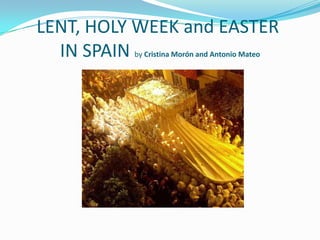
LENT, HOLY WEEK and EASTER
  IN SPAINby Cristina Morón and Antonio Mateo
What’s Easter?

 Easter is a Christian feast and holiday
  celebrating the resurrection of Jesus
  Christ on the third day after his crucifixion
  at Calvary as described in the New
  Testament. Easter is preceded by Lent, a
  forty-day period of fasting, prayer, and
  penance. The last week of Lent is called
  Holy Week.
What’s Easter?
 Easter is followed by a fifty-day
  period called the Easter
  Season, ending with Pentecost
  Sunday. The First Council of
  Nicaea established the date of
  Easter as the first Sunday after
  the full moon (the Paschal Full
  Moon) following the northern
  hemisphere's vernal equinox.
 The date of Easter usually varies
  between 22 March and 25 April.
Theological significance
 The New Testament
 teaches that the
 resurrection of Jesus,
 which Easter celebrates, is
 a foundation of the
 Christian faith. The
 resurrection established
 Jesus as the powerful Son
 of God.
Holy Week in Spain

 Spain celebrates the Holy
  Week much more than most
  European countries. During
  the Holy Week, street
  processions are organised in
  most Spanish towns each
  evening, from Palm Sunday
  to Easter Sunday.                 Here the virgin of “La Pollinica”, a typical
                                     throne of Málaga
Holy Week in Spain
 People carry statues of saints,
  decorated with special banners
  and flowers, on wooden
  platforms, in an atmosphere of
  mourning - which can seem
  quite oppressive to onlookers.
  The Holy Week processions
  end with Easter Sunday, a day
  full of light and colour when
  church and cathedral bells are
  heard ringing throughout the
  country.
Nazarenos
 In some of the processions,
  marchers wear clothes which
  are meant to depict the
  Nazarenos, people from
  Nazareth. The religious
  fraternities and brotherhoods
  are responsable for carrying
  the statues and organising
  the penitents and musicians.
  The Nazarenos follow the
  people who carry the floats
  bearing sculptures and
  models of biblical scenes.
Thrones
Here is another
trhone called “La
Cena” in Málaga.
Holy Week in Spain
 The people who carry the weight of
  the floats are called "costaleros" and
  are expected to carry these
  "thrones" with solemnity and grace.
  They use a small cushion ("costal")
  to protect themselves from getting
  sores from the wood rubbing against
  their skin during the long
  processions.
Holy Week in Málaga
Holy Week Processions in Málaga
Typicals thrones of Andalucía
   El Cautivo     La Macarena
LENT AND EASTER FOOD
ABSTINENCE                   POTAJES AND TORRIJAS
This is a period of
abstinence: Catholic
people won´t eat meat
during Lent and the Holy
Week.
That is the reason why
Easter meals and cakes are
remarkable for being
tasteful and enriched with
proteins.
The holy week in spain

The holy week in spain

  • 1.
    LENT, HOLY WEEKand EASTER IN SPAINby Cristina Morón and Antonio Mateo
  • 2.
    What’s Easter?  Easteris a Christian feast and holiday celebrating the resurrection of Jesus Christ on the third day after his crucifixion at Calvary as described in the New Testament. Easter is preceded by Lent, a forty-day period of fasting, prayer, and penance. The last week of Lent is called Holy Week.
  • 3.
    What’s Easter?  Easteris followed by a fifty-day period called the Easter Season, ending with Pentecost Sunday. The First Council of Nicaea established the date of Easter as the first Sunday after the full moon (the Paschal Full Moon) following the northern hemisphere's vernal equinox.  The date of Easter usually varies between 22 March and 25 April.
  • 4.
    Theological significance  TheNew Testament teaches that the resurrection of Jesus, which Easter celebrates, is a foundation of the Christian faith. The resurrection established Jesus as the powerful Son of God.
  • 5.
    Holy Week inSpain  Spain celebrates the Holy Week much more than most European countries. During the Holy Week, street processions are organised in most Spanish towns each evening, from Palm Sunday to Easter Sunday.  Here the virgin of “La Pollinica”, a typical throne of Málaga
  • 6.
    Holy Week inSpain  People carry statues of saints, decorated with special banners and flowers, on wooden platforms, in an atmosphere of mourning - which can seem quite oppressive to onlookers. The Holy Week processions end with Easter Sunday, a day full of light and colour when church and cathedral bells are heard ringing throughout the country.
  • 7.
    Nazarenos  In someof the processions, marchers wear clothes which are meant to depict the Nazarenos, people from Nazareth. The religious fraternities and brotherhoods are responsable for carrying the statues and organising the penitents and musicians. The Nazarenos follow the people who carry the floats bearing sculptures and models of biblical scenes.
  • 8.
    Thrones Here is another trhonecalled “La Cena” in Málaga.
  • 9.
    Holy Week inSpain  The people who carry the weight of the floats are called "costaleros" and are expected to carry these "thrones" with solemnity and grace. They use a small cushion ("costal") to protect themselves from getting sores from the wood rubbing against their skin during the long processions.
  • 10.
    Holy Week inMálaga
  • 11.
  • 12.
  • 13.
    Typicals thrones ofAndalucía El Cautivo La Macarena
  • 14.
    LENT AND EASTERFOOD ABSTINENCE POTAJES AND TORRIJAS This is a period of abstinence: Catholic people won´t eat meat during Lent and the Holy Week. That is the reason why Easter meals and cakes are remarkable for being tasteful and enriched with proteins.