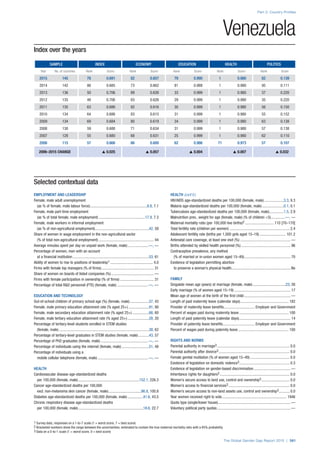
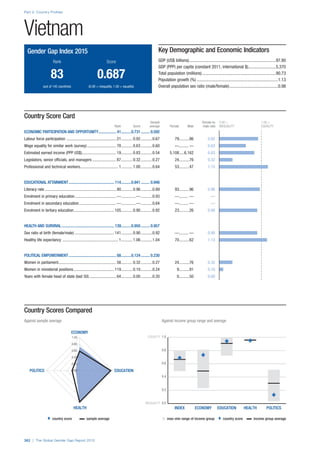
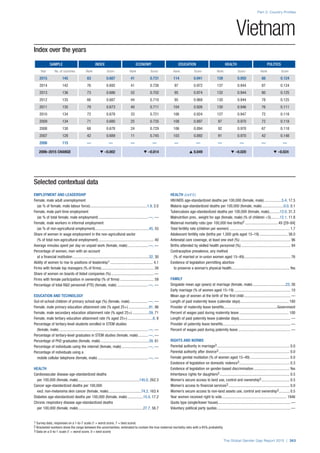
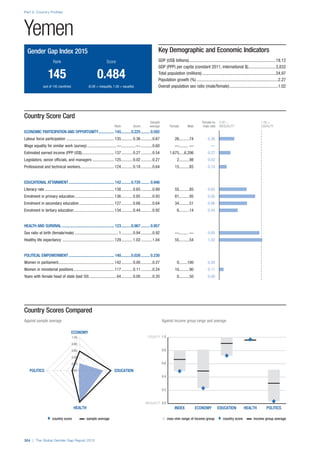
The Global Gender
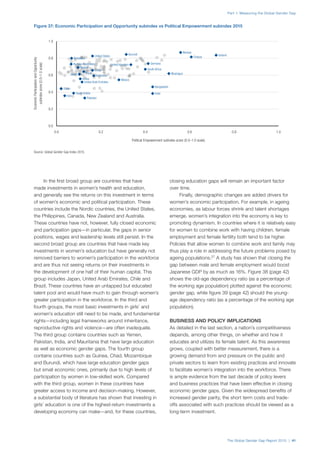
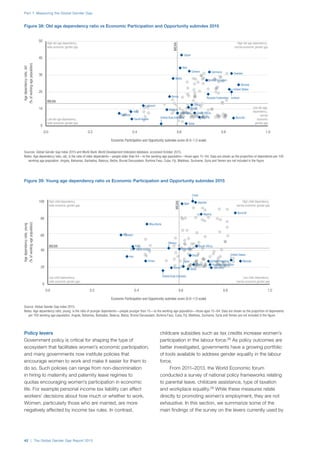
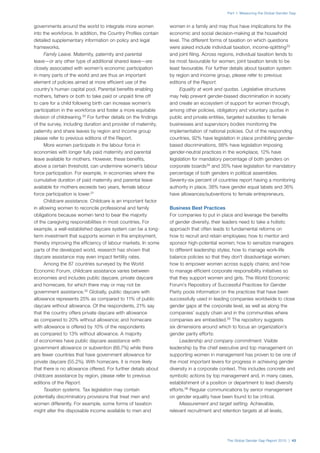
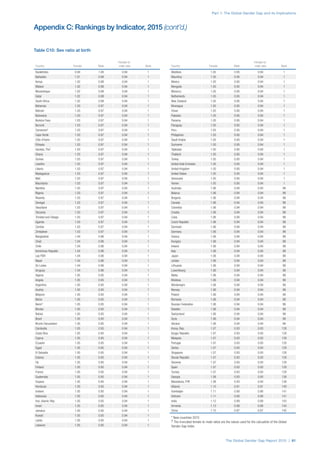
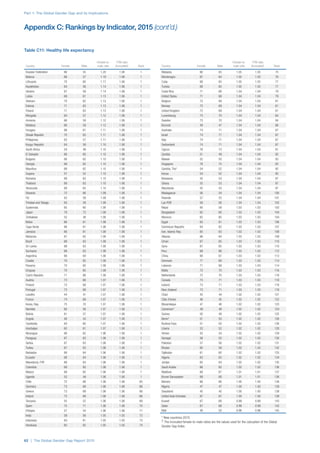
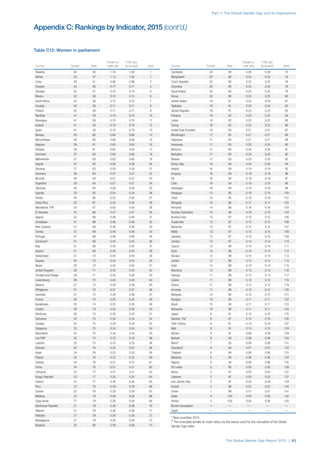
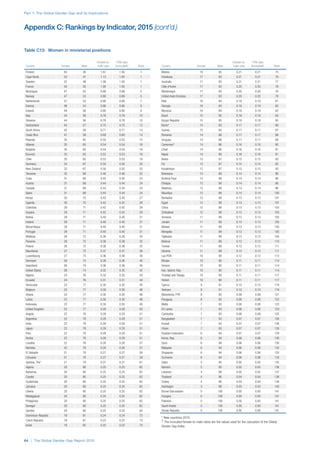
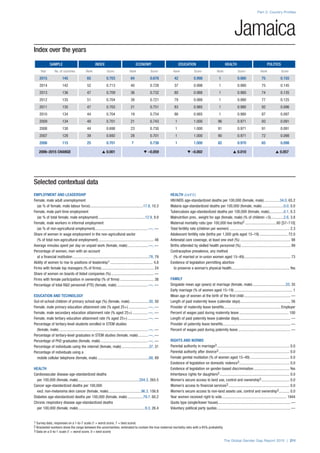
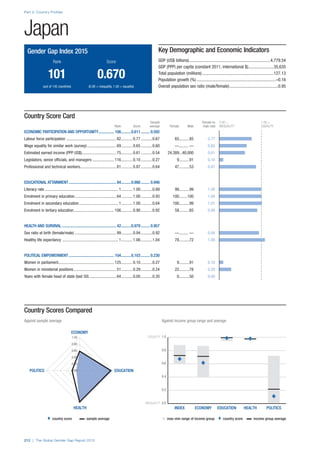
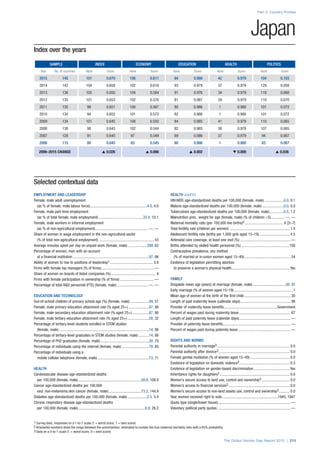
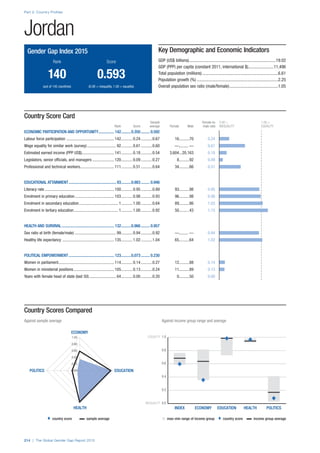
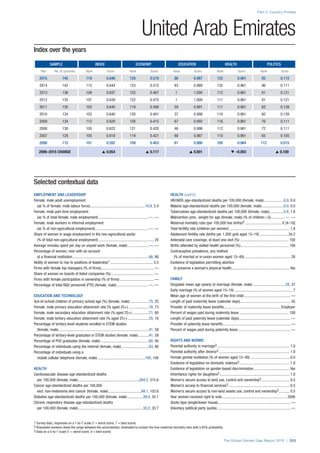
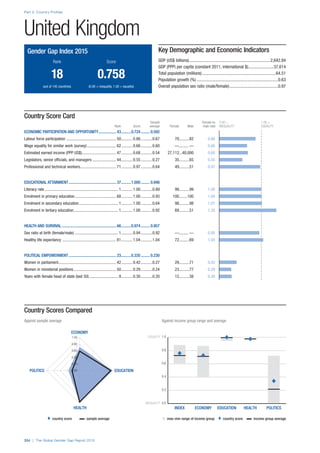
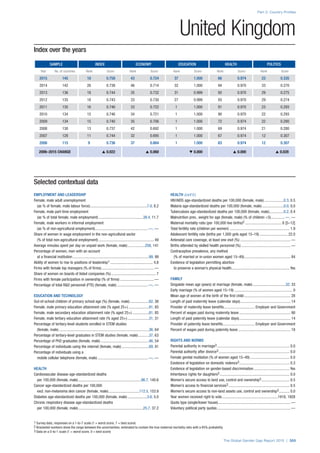
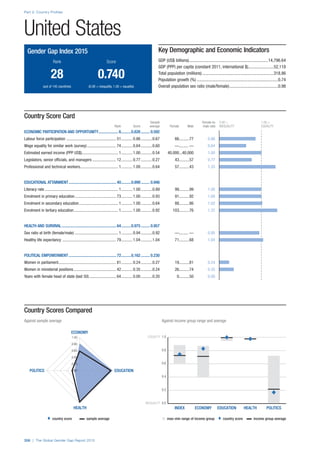
Gap Report
2015
Insight Report
10th Anniversary Edition
Insight Report
The Global
Gender Gap Report
2015
10th Anniversary Edition
The Global Gender Gap Report 2015 is published by the
World Economic Forum.
AT THE WORLD ECONOMIC FORUM
Professor Klaus Schwab
Founder and Executive Chairman
Richard Samans
Head of the Centre for the Global Agenda,
Member of the Managing Board
Saadia Zahidi
Head of Employment and Gender Initiatives,
Member of the Executive Committee
Yasmina Bekhouche
Project Lead, Gender Parity Initiative
Paulina Padilla Ugarte
Specialist, Employment and Gender Initiatives
Vesselina Ratcheva
Data Analyst, Employment and Gender Parity Initiatives
AT HARVARD UNIVERSITY
Professor Ricardo Hausmann
Director of the Center for International Development (CID) and
Professor of the Practice of Economic Development at the
Harvard Kennedy School.
AT THE UNIVERSITY OF CALIFORNIA, BERKELEY
Professor Laura D’Andrea Tyson
Director of the Institute for Business and Social Impact at
the Haas School of Business and the chair of the Board of
Trustees of the Blum Center for Developing Economies
We are very grateful for the support of Valentina Stoevska,
Rosina Gammarano, Kristen Sobeck, and Marie-Claire
Sodergren at the ILO; Said Voffal, Amélie Gagnon, Friedrich
Huebler, and Chiao-Ling Chien at UNESCO; Kareen Jabre
at the IPU; Ann-Beth Moller, Retno Wahyu Mahanani and
Jessica Chi Ying Ho at the WHO; Nathalie Delmas at the ITU;
Chris Clarke at OECD and Till Leopold, Valerie Peyre, Kristin
Keveloh, and Lena Woodward at the World Economic Forum.
A special thank you to Michael Fisher for his excellent
copyediting work and Neil Weinberg for his superb graphic
design and layout. We greatly appreciate, too, the efforts of
graphic design agency Graphéine, which created the cover.
Thank you to Kamal Kamaoui and the World Economic
Forum’s Publications team for their invaluable collaboration
on the production of this report.
World Economic Forum
91-93 route de la Capite
CH-1223 Cologny/Geneva
Switzerland
Tel.: +41 (0)22 869 1212
Fax: +41 (0)22 786 2744
E-mail: contact@weforum.org
www.weforum.org
©2015 World Economic Forum
All rights reserved.
No part of this publication may be reproduced or transmitted
in any form or by any means, including photocopying and
recording, or by any information storage and retrieval system.
92-95044-41-X
978-92-95044-41-8
This book is printed on paper suitable for recycling and made
from fully managed and sustained forest sources. Printed and
bound in Switzerland.
TERMS OF USE AND DISCLAIMER
The Global Gender Gap Report 2015 (herein: “Report”) presents
information and data that were compiled and/or collected by the
World Economic Forum (all information and data referred herein
as “Data”). Data in this Report is subject to change without
notice.
The terms country and nation as used in this report do not in
all cases refer to a territorial entity that is a state as understood
by international law and practice. The term covers well-defined,
geographically self-contained economic areas that may not be
states but for which statistical data are maintained on a separate
and independent basis.
Although the World Economic Forum takes every reasonable
step to ensure that the Data thus compiled and/or collected
is accurately reflected in this Report, the World Economic
Forum, its agents, officers, and employees: (i) provide the Data
“as is, as available” and without warranty of any kind, either
express or implied, including, without limitation, warranties
of merchantability, fitness for a particular purpose and non-
infringement; (ii) make no representations, express or implied,
as to the accuracy of the Data contained in this Report or its
suitability for any particular purpose; (iii) accept no liability for any
use of the said Data or reliance placed on it, in particular, for any
interpretation, decisions, or actions based on the Data in this
Report.
Other parties may have ownership interests in some of the
Data contained in this Report. The World Economic Forum in
no way represents or warrants that it owns or controls all rights
in all Data, and the World Economic Forum will not be liable to
users for any claims brought against users by third parties in
connection with their use of any Data.
The World Economic Forum, its agents, officers, and employees
do not endorse or in any respect warrant any third-party
products or services by virtue of any Data, material, or content
referred to or included in this Report.
Users shall not infringe upon the integrity of the Data and in
particular shall refrain from any act of alteration of the Data that
intentionally affects its nature or accuracy. If the Data is materially
transformed by the user, this must be stated explicitly along with
the required source citation.
For Data compiled by parties other than the World Economic
Forum, users must refer to these parties’ terms of use,
in particular concerning the attribution, distribution, and
reproduction of the Data.
When Data for which the World Economic Forum is the source
(herein “World Economic Forum”) is distributed or reproduced, it
must appear accurately and be attributed to the World Economic
Forum. This source attribution requirement is attached to any
use of Data, whether obtained directly from the World Economic
Forum or from a user.
Users who make World Economic Forum Data available to other
users through any type of distribution or download environment
agree to make reasonable efforts to communicate and promote
compliance by their end users with these terms.
Users who intend to sell World Economic Forum Data as
part of a database or as a standalone product must first
obtain the permission from the World Economic Forum
(genderparityprogramme@weforum.org).
The Global Gender Gap Report 2015 | iii
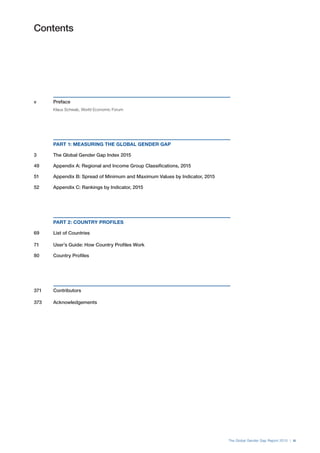
v	Preface
	 Klaus Schwab, World Economic Forum
	 PART 1: MEASURING THE GLOBAL GENDER GAP
3	 The Global Gender Gap Index 2015
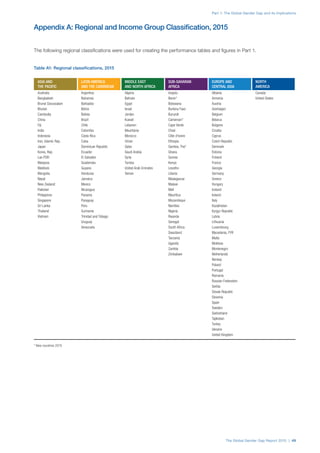
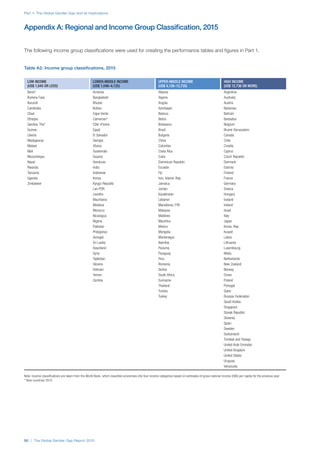
49	 Appendix A: Regional and Income Group Classifications, 2015
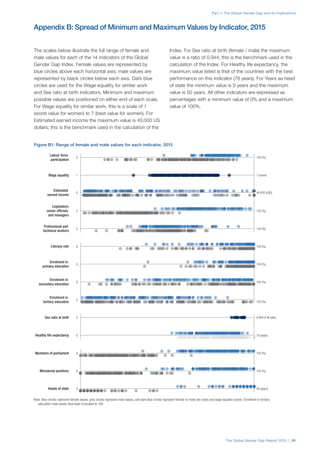
51		Appendix B: Spread of Minimum and Maximum Values by Indicator, 2015	
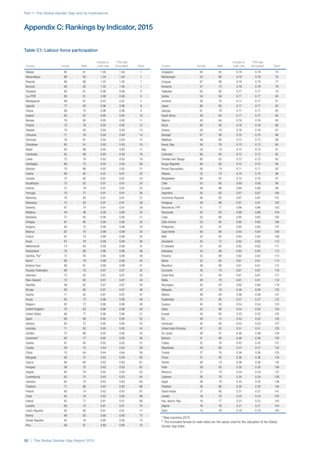
52	 Appendix C: Rankings by Indicator, 2015
	 PART 2: COUNTRY PROFILES
69	 List of Countries
71	 User’s Guide: How Country Profiles Work
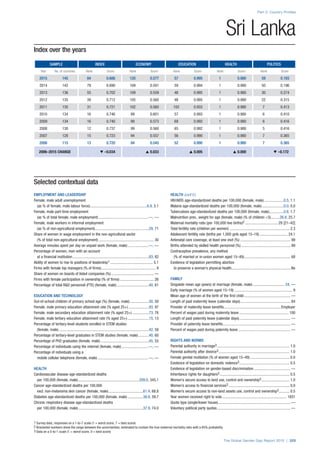
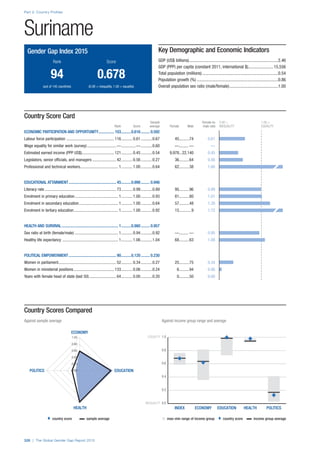
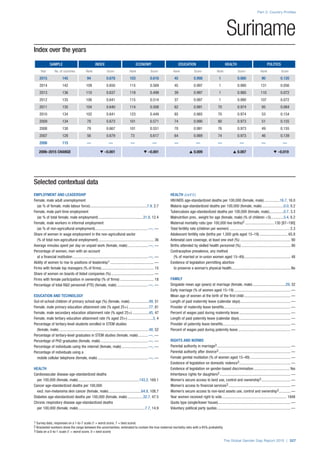
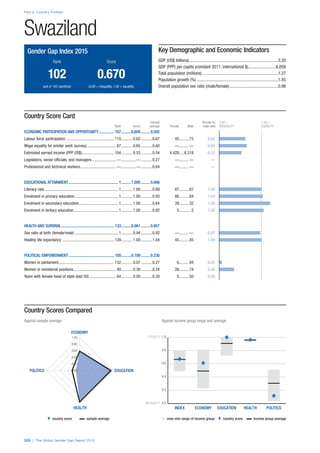
80	 Country Profiles
371	Contributors
373	Acknowledgements
Contents
The Global Gender Gap Report 2015 | v
People and their talents are among the core drivers of
sustainable, long-term economic growth. If half of these
talents are underdeveloped or underutilized, growth
and sustainability will be compromised. Moreover,
there is a compelling and fundamental values case for
empowering women: women represent one half of the
global population—they deserve equal access to health,
education, earning power and political representation.
The current inequalities risk being exacerbated in the
future. The Fourth Industrial Revolution will transform the
global economy and society in an unprecedented manner.
Industries are already undergoing profound shifts in their
business models as technology is disrupting current
methods of production, consumption and delivery. Labour
markets are also rapidly changing in this context. As a
result, gender gaps are set to increase in some industries
as jobs traditionally held by women become obsolete, while
at the same time opportunities are emerging in wholly new
domains. We must clearly understand the progress thus far
as well as the future outlook to reap the opportunities and
mitigate the challenges presented by these trends.
Through the Global Gender Gap Report, the World
Economic Forum quantifies the magnitude of gender-
based disparities and tracks their progress over time. While
no single measure can capture the complete situation, the
Global Gender Gap Index presented in this Report seeks
to measure one important aspect of gender equality: the
relative gaps between women and men across four key
areas: health, education, economy and politics. The Index
points to potential role models by revealing those countries
that—within their region or income group—are leaders in
distributing resources more equitably between women and
men, regardless of the overall level of available resources.
The Global Gender Gap Index was developed in
2006, partially to address the need for a consistent and
comprehensive measure for gender equality that can
track a country’s progress over time. In some countries,
progress is occurring rapidly regardless of starting point
and income level, but in others, change is much slower
or negligible. A decade of data has revealed that the
Economic Participation and Opportunity gender gap has
been closed by 59%, with slow improvements of 3% over
the past ten years. In Educational Attainment, the gender
gap has decreased compared to 2006 and now stands at
95%. Health and Survival is the subindex that is closest to
parity, at 96%, but the gap has widened slightly compared
to 2006. While the most relative improvement over the last
decade has been made in Political Empowerment, the
gender gap in this area remains the widest, with only 23%
being closed.
The magnitude of national gender gaps is the
combined result of various socioeconomic, policy and
cultural variables. Governments thus have a leading
role to play as the closure or continuation of these gaps
is intrinsically connected to the framework of national
policies in place. The Index does not seek to set priorities
for countries but rather to provide a comprehensive set
of data and a clear method for tracking gaps on critical
indicators so that countries may set priorities within their
own economic, political and cultural contexts. In addition,
governments must align their efforts with those of business
and civil society to foster growth that includes both
men and women. The World Economic Forum’s Global
Challenge on Gender Parity seeks to promote public-private
cooperation to close gender gaps, based in part on the
analytical tools provided by this Report as well as others.
We would like to express our appreciation to Yasmina
Bekhouche, Project Lead, Gender Parity Initiative; Paulina
Padilla Ugarte, Specialist, Employment and Gender Parity
Initiatives; Vesselina Ratcheva, Data Analyst, Employment
and Gender Parity Initiatives; and Saadia Zahidi, Head of
Employment and Gender Initiatives, for their dedication to
this Report. We would also like to thank Lena Woodward,
Valerie Peyre, Kristin Keveloh and Till Leopold for their
support at the World Economic Forum. We are grateful
for the ongoing support of Ricardo Hausmann, Director,
Center for International Development, Harvard University,
and Laura D. Tyson, Director of the Institute for Business
and Social Impact at the Haas School of Business at the
University of California, Berkeley, and the chair of the Board
of Trustees of the Blum Center for Developing Economies.
Finally, we welcome the untiring support of the Partners
of the Global Challenge on Gender Parity and their
commitment to closing gender gaps
It is our hope that this latest edition of the Report will
serve as a call to action to spur change on an issue that is
central to our future. Ultimately, it is through each individual
adapting his or her beliefs and actions that change can
occur. We call upon every reader of this Report to join
these efforts.
Preface
KLAUS SCHWAB
Founder and Executive Chairman, World Economic Forum
Part 1
Measuring the
Global Gender Gap
The Global Gender Gap Report 2015 | 3
The Global Gender Gap Index was first introduced by
the World Economic Forum in 2006 as a framework for
capturing the magnitude of gender-based disparities
and tracking their progress. This year is the 10th edition
of the Index, allowing for time-series analysis on the
changing patterns of gender equality around the world and
comparisons between and within countries.
The Index benchmarks national gender gaps
on economic, political, education and health criteria,
and provides country rankings that allow for effective
comparisons across regions and income groups. The
rankings are designed to create greater awareness among
a global audience of the challenges posed by gender
gaps and the opportunities created by reducing them. The
methodology and quantitative analysis behind the rankings
are intended to serve as a basis for designing effective
measures for reducing gender gaps.
The first part of this chapter reviews the underlying
concepts employed in creating the Global Gender Gap
Index and outlines the methods used to calculate it. The
second part presents the 2015 rankings, global patterns,
regional performance and notable country cases. This
includes an analysis on country performance over time,
particularly for those countries that have been included
in the Index since 2006. Next, we provide information on
the key trends that can be observed through a decade of
data for the 109 countries that have been covered since
the first Index, by analysing data along subindex, income
and regional lines. The fourth part of this chapter lays out
the economic case for gender equality, including links
between gender gaps and the economic performance of
countries. In the fifth and final part, we provide information
on implications for public policy and business practices.
The Country Profiles contained in Part 2 of this Report
give a more detailed picture of the relative strengths and
weaknesses of each country’s performance compared
with that of other nations and relative to its own past
performance. The first page of each profile contains key
demographic and economic indicators as well as detailed
information on the country’s performance in 2015, including
a comparison within its income group. The second page
of the Country Profiles shows the trends between 2006
and 2015 on the overall Index and four subindexes, as well
as over 55 gender-related indicators that provide a fuller
context for the country’s performance. These indicators
include information on employment & leadership; education
and technology; health; family; and rights and norms.
MEASURING THE GLOBAL GENDER GAP
The methodology of the Index has remained stable since
its development in 2006, providing robust comparative and
intra-country information.
Three underlying concepts
There are three basic concepts underlying the Global
Gender Gap Index, forming the basis of how indicators
were chosen, how the data is treated and the scale
used. First, the Index focuses on measuring gaps
rather than levels. Second, it captures gaps in outcome
variables rather than gaps in input variables. Third, it
ranks countries according to gender equality rather than
women’s empowerment. These three concepts are briefly
outlined below. For a description of how these concepts
are captured by the construction techniques used in the
creation of the Index, please see the “Construction of the
Index” section below.
Gaps vs. levels
The Index is designed to measure gender-based gaps
in access to resources and opportunities in countries
rather than the actual levels of the available resources and
opportunities in those countries. We do this in order to
make the Global Gender Gap Index independent from the
countries’ levels of development. In other words, the Index
is constructed to rank countries on their gender gaps not
on their development level. For example, rich countries,
generally speaking, are able to offer more education and
health opportunities to all members of society, although
this is quite independent of the gender-related gaps that
may exist within those higher levels of health or education.
The Global Gender Gap Index rewards countries for
smaller gaps in access to these resources, regardless
of the overall level of resources. Thus, in the case of
education, the Index penalizes or rewards countries based
The Global Gender Gap Index 2015
Part 1: Measuring the Global Gender Gap
4 | The Global Gender Gap Report 2015
on the size of the gap between male and female enrolment
rates, but not for the overall levels of education in the
country.
Outcomes vs. inputs
The second basic concept underlying the Global Gender
Gap Index is that it evaluates countries based on outcomes
rather than inputs or means. Our aim is to provide a
snapshot of where men and women stand with regard to
some fundamental outcome indicators related to basic
rights such as health, education, economic participation
and political empowerment. Indicators related to country-
specific policies, rights, culture or customs—factors that we
consider “input” or “means” indicators—are not included
in the Index, but they are displayed in the Country Profiles.
For example, the Index includes an indicator comparing
the gap between men and women in high-skilled jobs such
as legislators, senior officials and managers (an outcome
indicator) but does not include data on the length of
maternity leave (a policy indicator).
Gender equality vs. women’s empowerment
The third distinguishing feature of the Global Gender Gap
Index is that it ranks countries according to their proximity
to gender equality rather than to women’s empowerment.
Our aim is to focus on whether the gap between women
and men in the chosen indicators has declined, rather than
whether women are “winning” the “battle of the sexes”.
Hence, the Index rewards countries that reach the point
where outcomes for women equal those for men, but
it neither rewards nor penalizes cases in which women
are outperforming men in particular indicators in some
countries. Thus a country that has higher enrolment for
girls rather than boys in secondary school will score equal
to a country where boys’ and girls’ enrolment is the same.
The four subindexes
The Global Gender Gap Index examines the gap
between men and women in four fundamental categories
(subindexes): Economic Participation and Opportunity,
Educational Attainment, Health and Survival and Political
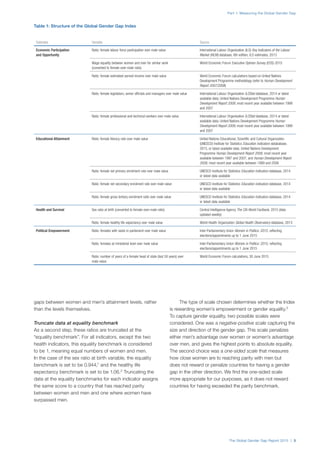
Empowerment. Table 1 (page 5) displays all four of
these subindexes and the 14 different indicators that
compose them, along with the sources of data used for
each.
Economic Participation and Opportunity
This subindex contains three concepts: the participation
gap, the remuneration gap and the advancement gap. The
participation gap is captured using the difference between
women and men in labour force participation rates. The
remuneration gap is captured through a hard data indicator
(ratio of estimated female-to-male earned income) and a
qualitative indicator gathered through the World Economic
Forum’s Executive Opinion Survey (wage equality for similar
work). Finally, the gap between the advancement of women
and men is captured through two hard data statistics (the
ratio of women to men among legislators, senior officials
and managers, and the ratio of women to men among
technical and professional workers).
Educational Attainment
In this subindex, the gap between women’s and men’s
current access to education is captured through ratios of
women to men in primary-, secondary- and tertiary-level
education. A longer-term view of the country’s ability to
educate women and men in equal numbers is captured
through the ratio of the female literacy rate to the male
literacy rate.
Health and Survival
This subindex provides an overview of the differences
between women’s and men’s health through the use of
two indicators. The first is the sex ratio at birth, which
aims specifically to capture the phenomenon of “missing
women” prevalent in many countries with a strong son
preference. Second, we use the gap between women’s
and men’s healthy life expectancy. This measure provides
an estimate of the number of years that women and men
can expect to live in good health by taking into account
the years lost to violence, disease, malnutrition or other
relevant factors.
Political Empowerment
This subindex measures the gap between men and women
at the highest level of political decision-making through
the ratio of women to men in minister-level positions and
the ratio of women to men in parliamentary positions. In
addition, we include the ratio of women to men in terms
of years in executive office (prime minister or president)
for the last 50 years. A clear drawback in this category
is the absence of any indicators capturing differences
between the participation of women and men at local
levels of government. Should such data become available
at a globally comparative level in future years, they will be
considered for inclusion in the Index.
Construction of the Index
The overall Global Gender Gap Index is constructed
using a four-step process, outlined below. Some of the
indicators listed in Table 1 require specific construction or
modification in order to be used in the Index. For further
information on the indicator-specific calculations, please
refer to the How to Read the Country Profiles section in
Part 2 of this Report.
Convert to ratios
Initially, all data are converted to female/male ratios. For
example, a country with 20% of women in ministerial
positions is assigned a ratio of 20 women /80 men, thus a
value of 0.25. This is to ensure that the Index is capturing
The Global Gender Gap Report 2015 | 5
Part 1: Measuring the Global Gender Gap
gaps between women and men’s attainment levels, rather
than the levels themselves.
Truncate data at equality benchmark
As a second step, these ratios are truncated at the
“equality benchmark”. For all indicators, except the two
health indicators, this equality benchmark is considered
to be 1, meaning equal numbers of women and men.
In the case of the sex ratio at birth variable, the equality
benchmark is set to be 0.944,1
and the healthy life
expectancy benchmark is set to be 1.06.2
Truncating the
data at the equality benchmarks for each indicator assigns
the same score to a country that has reached parity
between women and men and one where women have
surpassed men.
The type of scale chosen determines whether the Index
is rewarding women’s empowerment or gender equality.3
To capture gender equality, two possible scales were
considered. One was a negative-positive scale capturing the
size and direction of the gender gap. This scale penalizes
either men’s advantage over women or women’s advantage
over men, and gives the highest points to absolute equality.
The second choice was a one-sided scale that measures
how close women are to reaching parity with men but
does not reward or penalize countries for having a gender
gap in the other direction. We find the one-sided scale
more appropriate for our purposes, as it does not reward
countries for having exceeded the parity benchmark.
Table 1: Structure of the Global Gender Gap Index
Subindex Variable Source
Economic Participation
and Opportunity
Ratio: female labour force participation over male value International Labour Organisation (ILO) Key Indicators of the Labour
Market (KILM) database, 6th edition; ILO estimates, 2013
Wage equality between women and men for similar work
(converted to female-over-male ratio)
World Economic Forum Executive Opinion Survey (EOS) 2015
Ratio: female estimated earned income over male value World Economic Forum calculations based on United Nations
Development Programme methodology (refer to Human Development
Report 2007/2008)
Ratio: female legislators, senior officials and managers over male value International Labour Organisation ILOStat database, 2014 or latest
available data; United Nations Development Programme Human
Development Report 2009, most recent year available between 1999
and 2007
Ratio: female professional and technical workers over male value International Labour Organisation ILOStat database, 2014 or latest
available data; United Nations Development Programme Human
Development Report 2009, most recent year available between 1999
and 2007
Educational Attainment Ratio: female literacy rate over male value United Nations Educational, Scientific and Cultural Organization
(UNESCO) Institute for Statistics Education indicators datababase,
2015, or latest available data; United Nations Development
Programme Human Development Report 2009, most recent year
available between 1997 and 2007; and Human Development Report
2008, most recent year available between 1999 and 2006
Ratio: female net primary enrolment rate over male value UNESCO Institute for Statistics Education indicators database, 2014
or latest data available
Ratio: female net secondary enrolment rate over male value UNESCO Institute for Statistics Education indicators database, 2014
or latest data available
Ratio: female gross tertiary enrolment ratio over male value UNESCO Institute for Statistics Education indicators database, 2014
or latest data available
Health and Survival Sex ratio at birth (converted to female-over-male ratio) Central Intelligence Agency The CIA World Factbook, 2015 (data
updated weekly)
Ratio: female healthy life expectancy over male value World Health Organization Global Health Observatory database, 2013
Political Empowerment Ratio: females with seats in parliament over male value Inter-Parliamentary Union Women in Politics: 2015, reflecting
elections/appointments up to 1 June 2015
Ratio: females at ministerial level over male value Inter-Parliamentary Union Women in Politics: 2015, reflecting
elections/appointments up to 1 June 2015
Ratio: number of years of a female head of state (last 50 years) over
male value
World Economic Forum calculations, 30 June 2015
Part 1: Measuring the Global Gender Gap
6 | The Global Gender Gap Report 2015
Calculate subindex scores
The third step in the process involves calculating the
weighted average of the indicators within each subindex
to create the subindex scores. Averaging the different
indicators would implicitly give more weight to the measure
that exhibits the largest variability or standard deviation. We
therefore first normalize the indicators by equalizing their
standard deviations. For example, within the Educational
Attainment subindex, standard deviations for each of the
four indicators are calculated. Then we determine what a
1% point change would translate to in terms of standard
deviations by dividing 0.01 by the standard deviation for
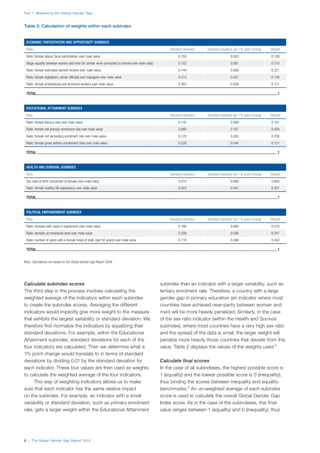
each indicator. These four values are then used as weights
to calculate the weighted average of the four indicators.
This way of weighting indicators allows us to make
sure that each indicator has the same relative impact
on the subindex. For example, an indicator with a small
variability or standard deviation, such as primary enrolment
rate, gets a larger weight within the Educational Attainment
subindex than an indicator with a larger variability, such as
tertiary enrolment rate. Therefore, a country with a large
gender gap in primary education (an indicator where most
countries have achieved near-parity between women and
men) will be more heavily penalized. Similarly, in the case
of the sex ratio indicator (within the Health and Survival
subindex), where most countries have a very high sex ratio
and the spread of the data is small, the larger weight will
penalize more heavily those countries that deviate from this
value. Table 2 displays the values of the weights used.4
Calculate final scores
In the case of all subindexes, the highest possible score is
1 (equality) and the lowest possible score is 0 (inequality),
thus binding the scores between inequality and equality
benchmarks.5
An un-weighted average of each subindex
score is used to calculate the overall Global Gender Gap
Index score. As in the case of the subindexes, this final
value ranges between 1 (equality) and 0 (inequality), thus
Table 2: Calculation of weights within each subindex
ECONOMIC PARTICIPATION AND OPPORTUNITY SUBINDEX
Ratio Standard deviation Standard deviation per 1% point change Weight
Ratio: female labour force participation over male value 0.160 0.063 0.199
Wage equality between women and men for similar work (converted to female-over-male ratio) 0.103 0.097 0.310
Ratio: female estimated earned income over male value 0.144 0.069 0.221
Ratio: female legislators, senior officials and managers over male value 0.214 0.047 0.149
Ratio: female professional and technical workers over male value 0.262 0.038 0.121
TOTAL..........................................................................................................................................................................................................................................1
EDUCATIONAL ATTAINMENT SUBINDEX
Ratio Standard deviation Standard deviation per 1% point change Weight
Ratio: female literacy rate over male value 0.145 0.069 0.191
Ratio: female net primary enrolment rate over male value 0.060 0.167 0.459
Ratio: female net secondary enrolment rate over male value 0.120 0.083 0.230
Ratio: female gross tertiary enrolement ratio over male value 0.228 0.044 0.121
TOTAL..........................................................................................................................................................................................................................................1
HEALTH AND SURVIVAL SUBINDEX
Ratio Standard deviation Standard deviation per 1% point change Weight
Sex ratio at birth (converted to female-over-male ratio) 0.010 0.998 0.693
Ratio: female healthy life expectancy over male value 0.023 0.441 0.307
TOTAL..........................................................................................................................................................................................................................................1
POLITICAL EMPOWERMENT SUBINDEX
Ratio Standard deviation Standard deviation per 1% point change Weight
Ratio: females with seats in parliament over male value 0.166 0.060 0.310
Ratio: females at ministerial level over male value 0.208 0.048 0.247
Ratio: number of years with a female head of state (last 50 years) over male value 0.116 0.086 0.443
TOTAL..........................................................................................................................................................................................................................................1
Note: Calculations are based on the Global Gender Gap Report 2006.
The Global Gender Gap Report 2015 | 7
Part 1: Measuring the Global Gender Gap
allowing for comparisons relative to ideal standards of
equality in addition to relative country rankings.6
The
equality and inequality benchmarks remain fixed across
time, allowing the reader to track individual country
progress in relation to an ideal standard of equality.
Furthermore, the option of roughly interpreting the final
Index scores as a percentage value that reveals how a
country has reduced its gender gap should help make the
Index more intuitively appealing to readers.7
THE GLOBAL GENDER GAP INDEX RESULTS IN 2015
Country Coverage 2015
We aim to include a maximum number of countries in the
Report every year, within the constraints posed by data
availability. To be included in the Report, a country must
have data available for a minimum of 12 indicators out
of the 14 that make up the Index. In 2015, we have been
able to include 145 countries in the Report. Of these, 109
have been included in the Report since the first edition
published in 2006.
Nearly 200 countries were considered for inclusion this
year. Out of the 145 ultimately covered in this Report, 19
countries had one data point missing and 31 countries had
two data points missing. Missing data is clearly marked on
each relevant Country Profile.
Last year we included 142 countries in the Index. This
year, we were able to include three new countries—Benin,
Cameroon and The Gambia —resulting in a total of 145
countries.
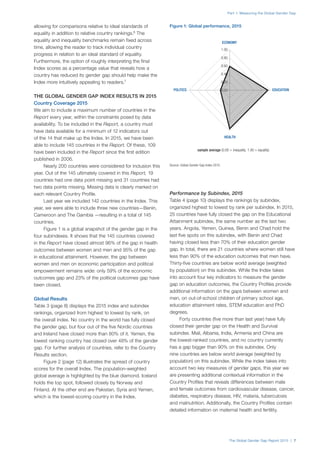
Figure 1 is a global snapshot of the gender gap in the
four subindexes. It shows that the 145 countries covered
in the Report have closed almost 96% of the gap in health
outcomes between women and men and 95% of the gap
in educational attainment. However, the gap between
women and men on economic participation and political
empowerment remains wide: only 59% of the economic
outcomes gap and 23% of the political outcomes gap have
been closed.
Global Results
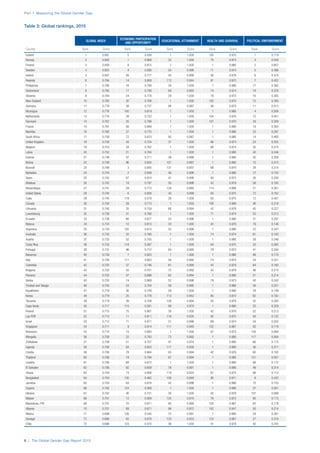
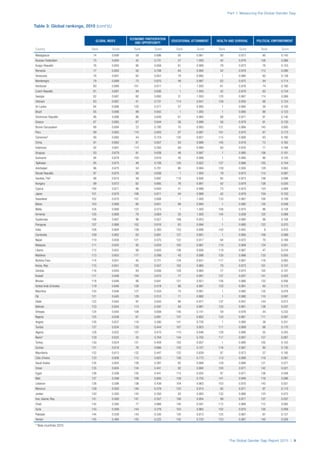
Table 3 (page 8) displays the 2015 index and subindex
rankings, organized from highest to lowest by rank, on
the overall index. No country in the world has fully closed
the gender gap, but four out of the five Nordic countries
and Ireland have closed more than 80% of it. Yemen, the
lowest ranking country has closed over 48% of the gender
gap. For further analysis of countries, refer to the Country
Results section.
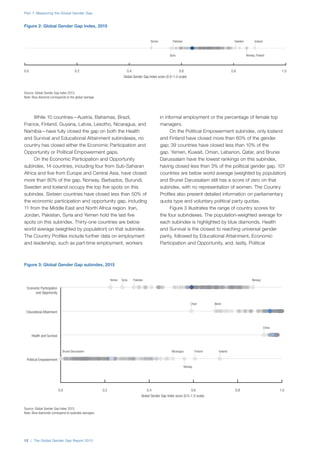
Figure 2 (page 12) illustrates the spread of country
scores for the overall Index. The population-weighted
global average is highlighted by the blue diamond. Iceland
holds the top spot, followed closely by Norway and
Finland. At the other end are Pakistan, Syria and Yemen,
which is the lowest-scoring country in the Index.
Performance by Subindex, 2015
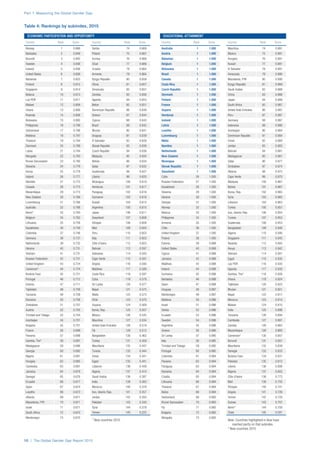
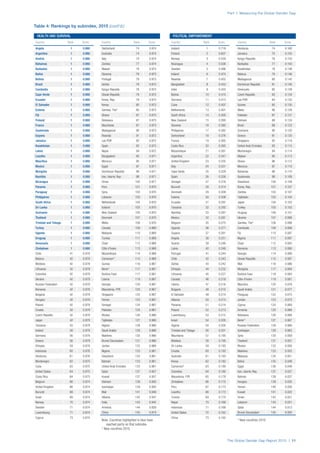
Table 4 (page 10) displays the rankings by subindex,
organized highest to lowest by rank per subindex. In 2015,
25 countries have fully closed the gap on the Educational
Attainment subindex, the same number as the last two
years. Angola, Yemen, Guinea, Benin and Chad hold the
last five spots on this subindex, with Benin and Chad
having closed less than 70% of their education gender
gap. In total, there are 21 countries where women still have
less than 90% of the education outcomes that men have.
Thirty-five countries are below world average (weighted
by population) on this subindex. While the Index takes
into account four key indicators to measure the gender
gap on education outcomes, the Country Profiles provide
additional information on the gaps between women and
men, on out-of-school children of primary school age,
education attainment rates, STEM education and PhD
degrees.
Forty countries (five more than last year) have fully
closed their gender gap on the Health and Survival
subindex. Mali, Albania, India, Armenia and China are
the lowest-ranked countries, and no country currently
has a gap bigger than 90% on this subindex. Only
nine countries are below world average (weighted by
population) on this subindex. While the index takes into
account two key measures of gender gaps, this year we
are presenting additional contextual information in the
Country Profiles that reveals differences between male
and female outcomes from cardiovascular disease, cancer,
diabetes, respiratory disease, HIV, malaria, tuberculosis
and malnutrition. Additionally, the Country Profiles contain
detailed information on maternal health and fertility.
Figure 1: Global performance, 2015
0.00
0.20
0.40
0.60
0.80
1.00
ECONOMY
EDUCATION
HEALTH
POLITICS
	 sample average (0.00 = inequality, 1.00 = equality)
Source: Global Gender Gap Index 2015.
Part 1: Measuring the Global Gender Gap
8 | The Global Gender Gap Report 2015
Table 3: Global rankings, 2015
GLOBAL INDEX
ECONOMIC PARTICIPATION
AND OPPORTUNITY
EDUCATIONAL ATTAINMENT HEALTH AND SURVIVAL POLITICAL EMPOWERMENT
Country Rank Score Rank Score Rank Score Rank Score Rank Score
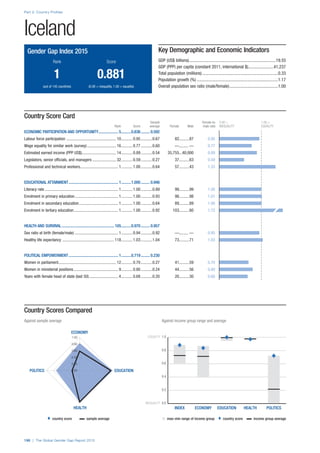
Iceland 1 0.881 5 0.836 1 1.000 105 0.970 1 0.719
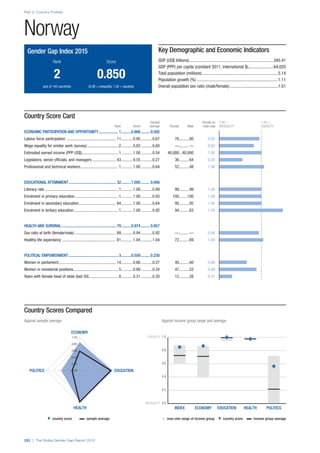
Norway 2 0.850 1 0.868 32 1.000 70 0.974 3 0.559
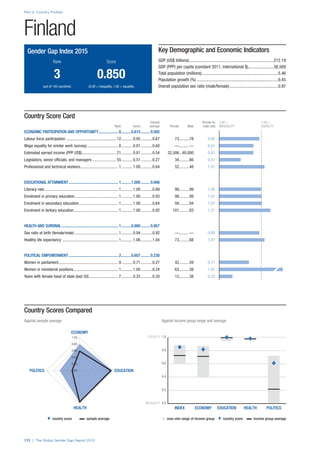
Finland 3 0.850 8 0.815 1 1.000 1 0.980 2 0.607
Sweden 4 0.823 4 0.836 54 0.996 71 0.974 5 0.486
Ireland 5 0.807 26 0.777 44 0.998 56 0.979 6 0.474
Rwanda 6 0.794 14 0.808 112 0.944 91 0.972 7 0.452
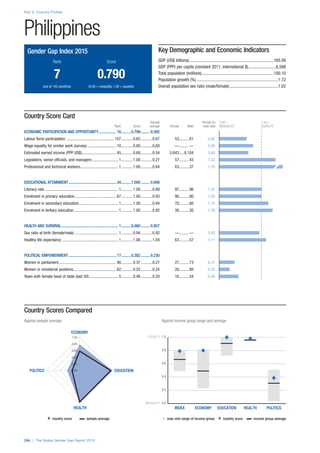
Philippines 7 0.790 16 0.799 34 1.000 1 0.980 17 0.382
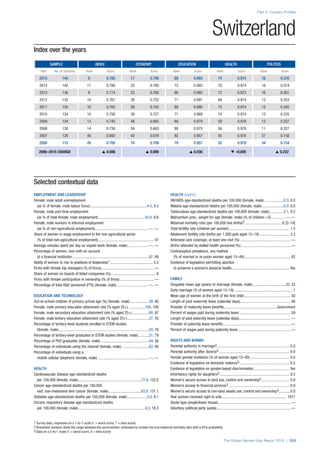
Switzerland 8 0.785 17 0.798 69 0.993 74 0.974 18 0.376
Slovenia 9 0.784 24 0.778 29 1.000 79 0.973 16 0.385
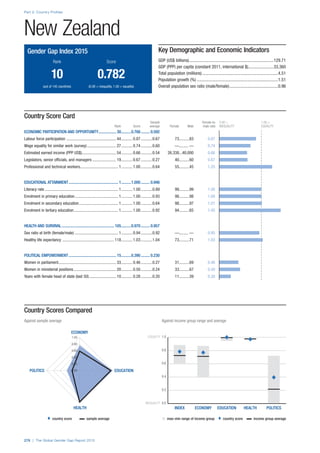
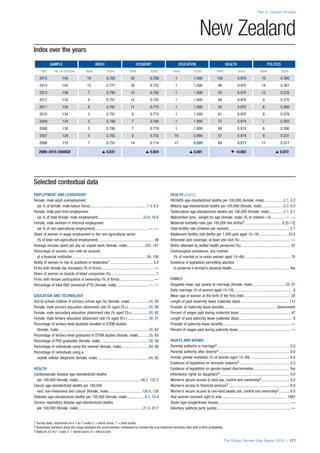
New Zealand 10 0.782 30 0.768 1 1.000 105 0.970 15 0.390
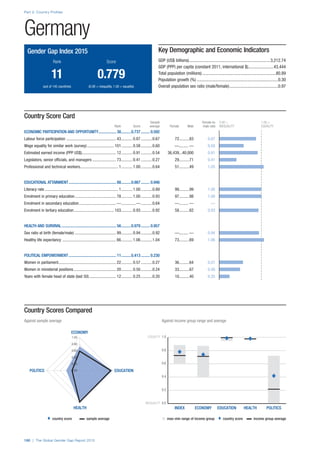
Germany 11 0.779 38 0.737 88 0.987 56 0.979 11 0.413
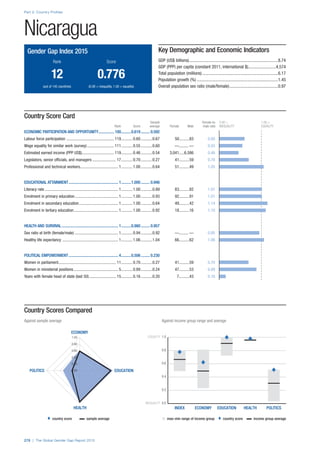
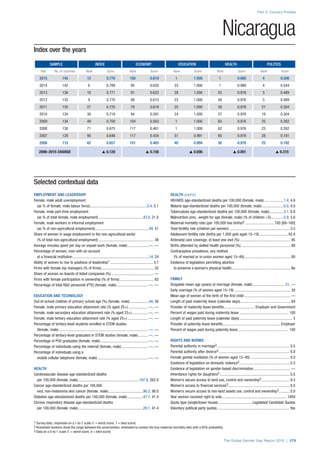
Nicaragua 12 0.776 100 0.619 1 1.000 1 0.980 4 0.506
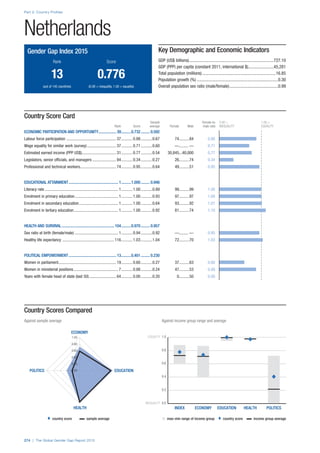
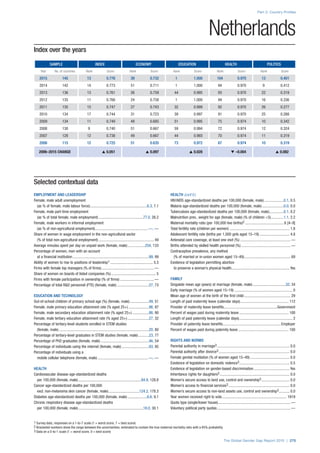
Netherlands 13 0.776 39 0.732 1 1.000 104 0.970 13 0.401
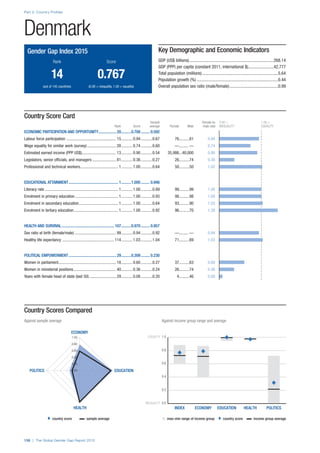
Denmark 14 0.767 20 0.788 1 1.000 107 0.970 29 0.309
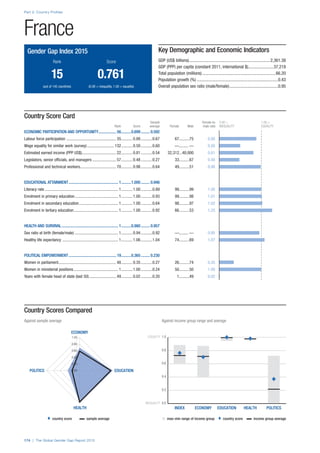
France 15 0.761 56 0.699 1 1.000 1 0.980 19 0.365
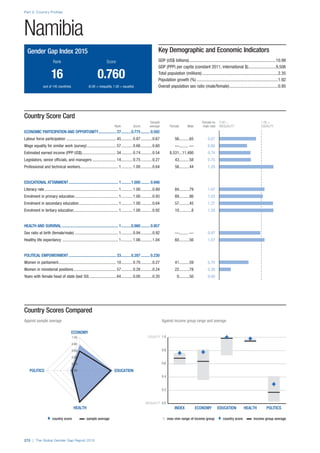
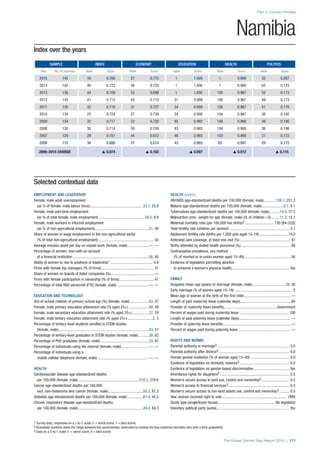
Namibia 16 0.760 27 0.775 1 1.000 1 0.980 33 0.287
South Africa 17 0.759 72 0.670 85 0.987 1 0.980 14 0.400
United Kingdom 18 0.758 43 0.724 37 1.000 66 0.974 23 0.335
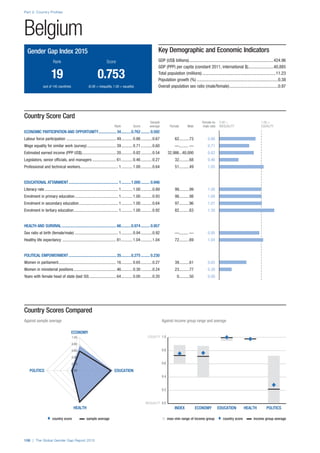
Belgium 19 0.753 34 0.762 1 1.000 66 0.974 35 0.275
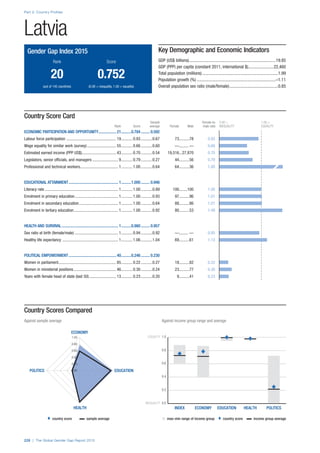
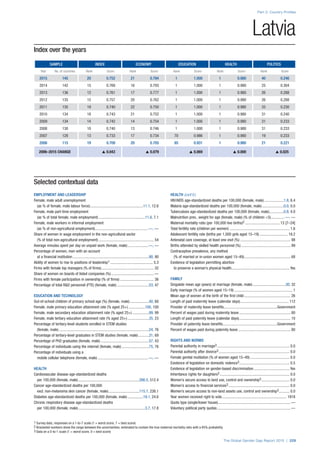
Latvia 20 0.752 21 0.784 1 1.000 1 0.980 40 0.246
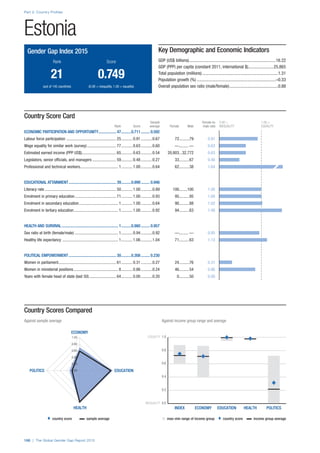
Estonia 21 0.749 47 0.711 39 0.999 1 0.980 30 0.308
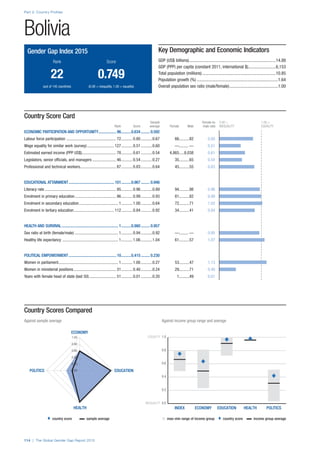
Bolivia 22 0.749 96 0.634 101 0.967 1 0.980 10 0.415
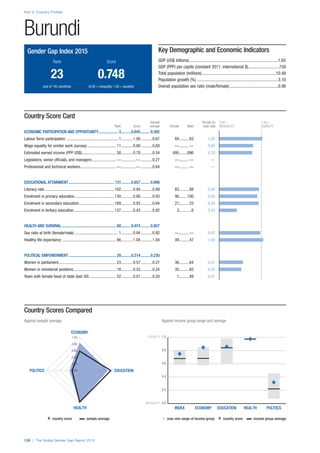
Burundi 23 0.748 3 0.845 131 0.857 68 0.974 28 0.314
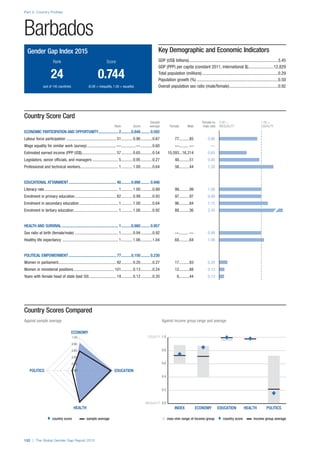
Barbados 24 0.744 2 0.848 46 0.998 1 0.980 77 0.150
Spain 25 0.742 67 0.674 47 0.998 93 0.972 26 0.326
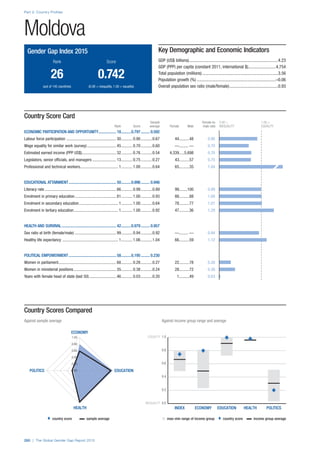
Moldova 26 0.742 18 0.797 50 0.996 42 0.979 58 0.195
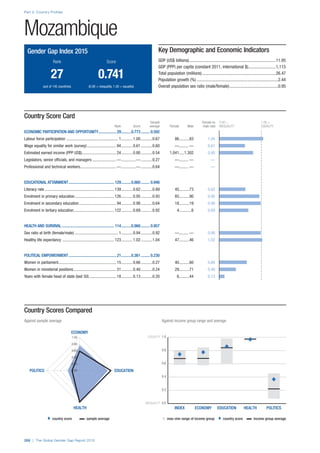
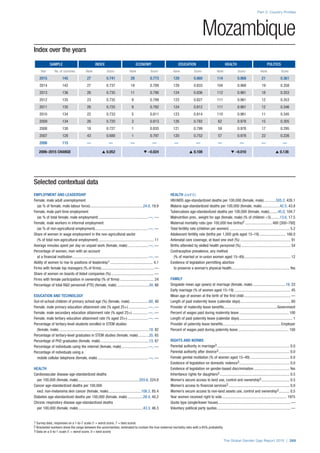
Mozambique 27 0.741 29 0.773 129 0.860 114 0.968 21 0.361
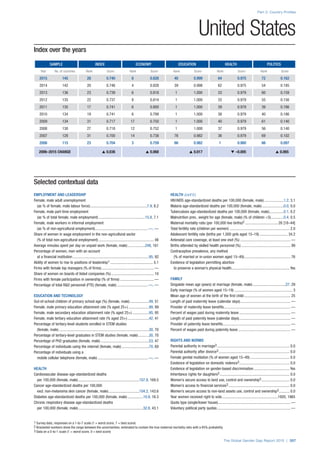
United States 28 0.740 6 0.826 40 0.999 64 0.975 72 0.162
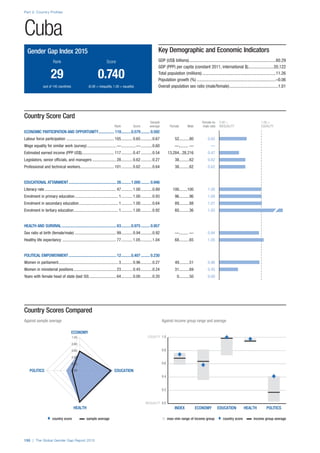
Cuba 29 0.740 119 0.579 26 1.000 63 0.975 12 0.407
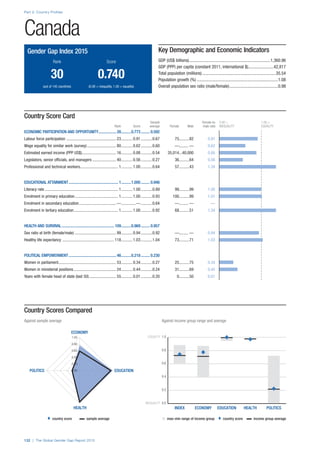
Canada 30 0.740 28 0.773 1 1.000 109 0.969 46 0.218
Lithuania 31 0.740 35 0.759 66 0.994 42 0.979 45 0.227
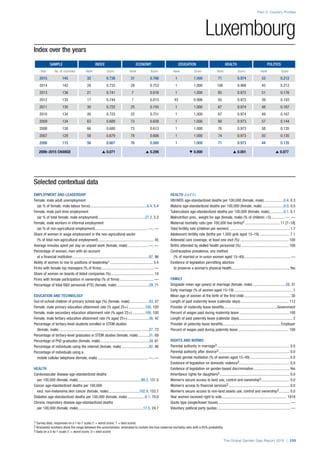
Luxembourg 32 0.738 31 0.766 1 1.000 71 0.974 53 0.212
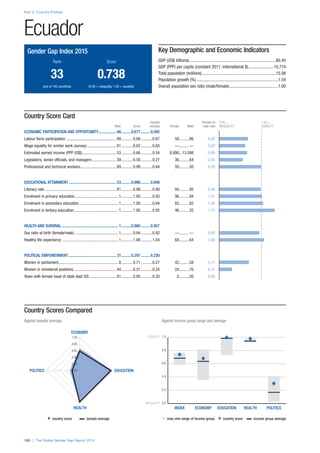
Ecuador 33 0.738 66 0.677 53 0.996 1 0.980 31 0.297
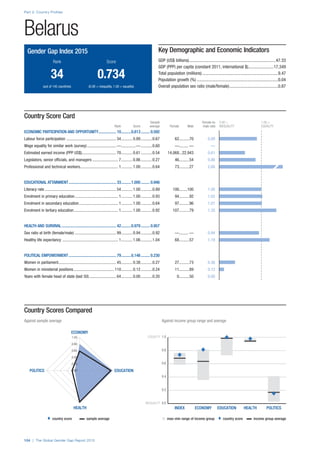
Belarus 34 0.734 10 0.813 33 1.000 42 0.979 79 0.146
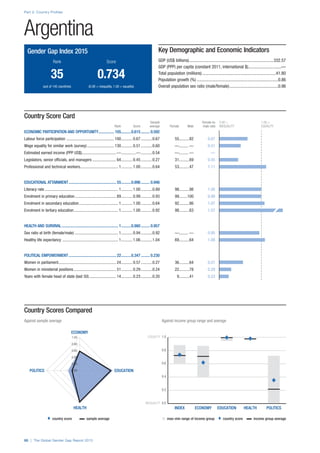
Argentina 35 0.734 105 0.615 55 0.996 1 0.980 22 0.347
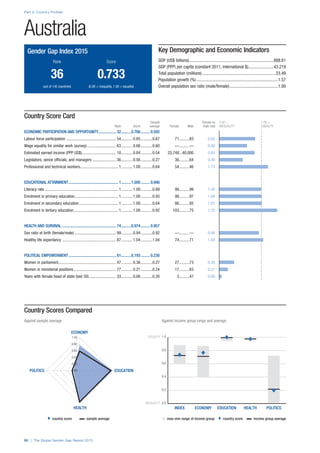
Australia 36 0.733 32 0.766 1 1.000 74 0.974 61 0.193
Austria 37 0.733 52 0.705 1 1.000 1 0.980 39 0.246
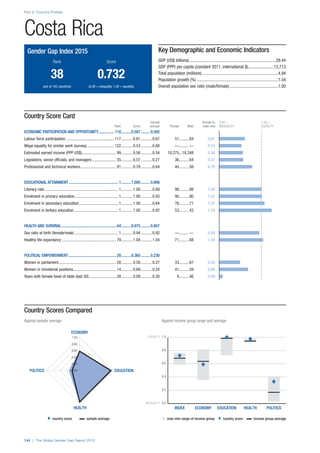
Costa Rica 38 0.732 118 0.587 1 1.000 64 0.975 20 0.365
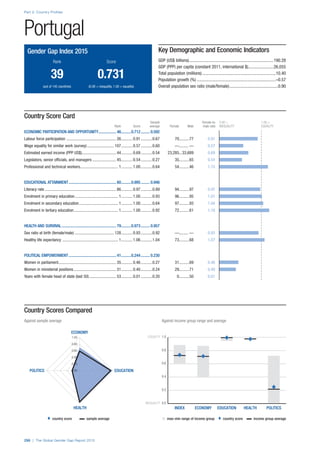
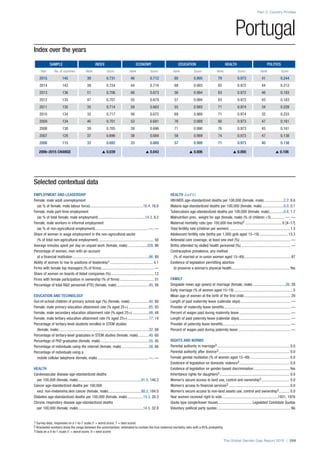
Portugal 39 0.731 46 0.712 60 0.995 79 0.973 41 0.244
Bahamas 40 0.728 7 0.823 1 1.000 1 0.980 98 0.110
Italy 41 0.726 111 0.603 58 0.995 74 0.974 24 0.331
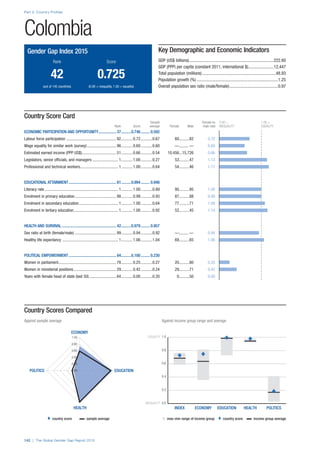
Colombia 42 0.725 37 0.746 61 0.994 42 0.979 64 0.180
Bulgaria 43 0.722 55 0.701 72 0.992 42 0.979 48 0.215
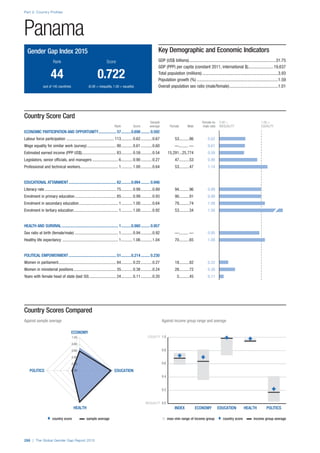
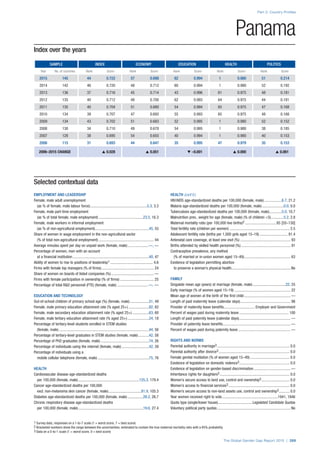
Panama 44 0.722 57 0.698 62 0.994 1 0.980 51 0.214
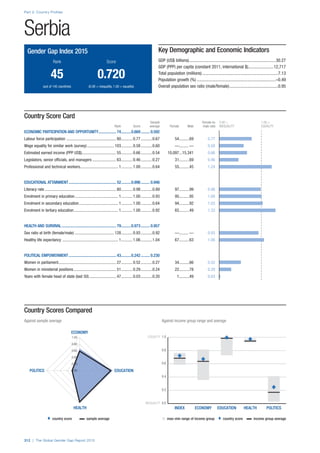
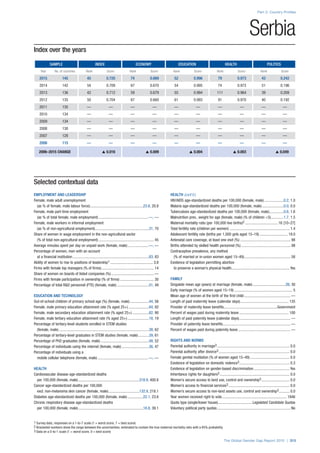
Serbia 45 0.720 74 0.669 52 0.996 79 0.973 43 0.242
Trinidad and Tobago 46 0.720 53 0.704 59 0.995 1 0.980 56 0.201
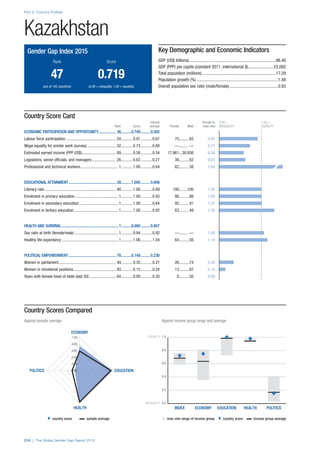
Kazakhstan 47 0.719 36 0.749 28 1.000 1 0.980 78 0.148
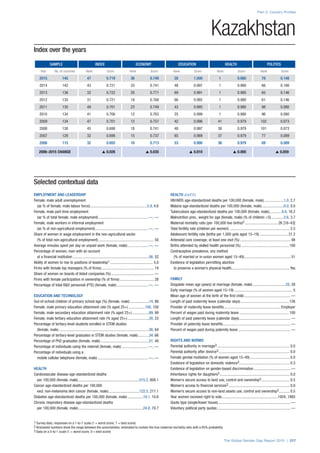
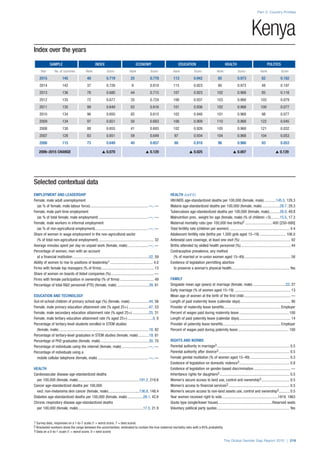
Kenya 48 0.719 25 0.778 113 0.942 85 0.973 62 0.182
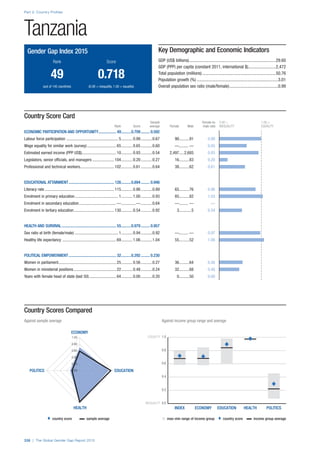
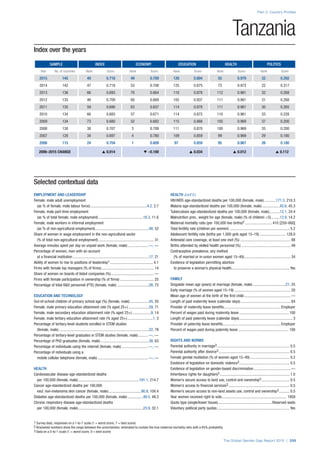
Tanzania 49 0.718 49 0.709 126 0.894 55 0.979 32 0.292
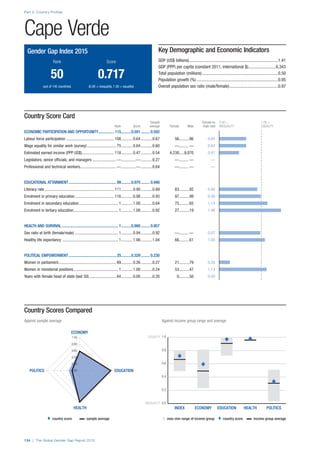
Cape Verde 50 0.717 115 0.591 99 0.970 1 0.980 25 0.329
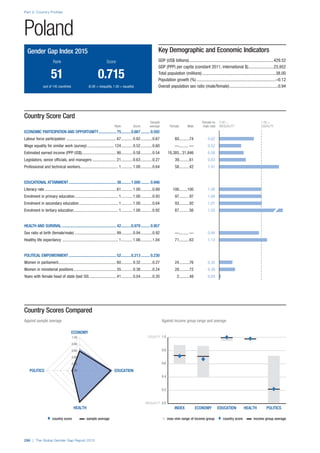
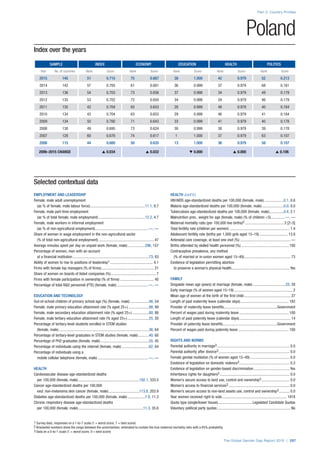
Poland 51 0.715 75 0.667 38 1.000 42 0.979 52 0.213
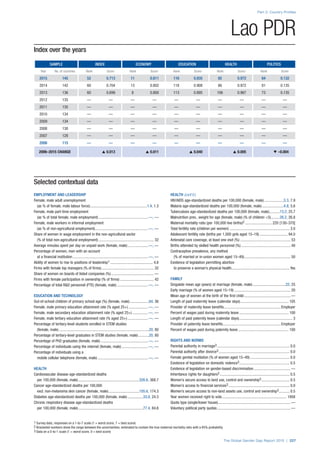
Lao PDR 52 0.713 11 0.811 116 0.935 92 0.972 84 0.132
Israel 53 0.712 71 0.671 51 0.996 69 0.974 54 0.205
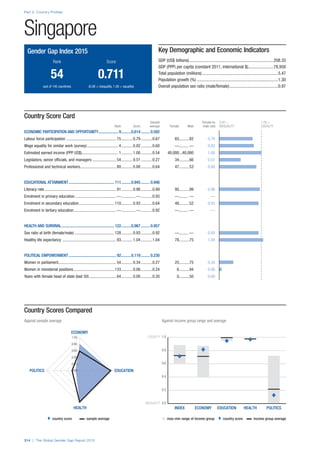
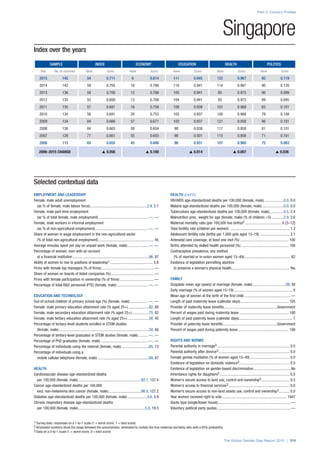
Singapore 54 0.711 9 0.814 111 0.945 122 0.967 92 0.119
Botswana 55 0.710 15 0.800 1 1.000 87 0.973 126 0.068
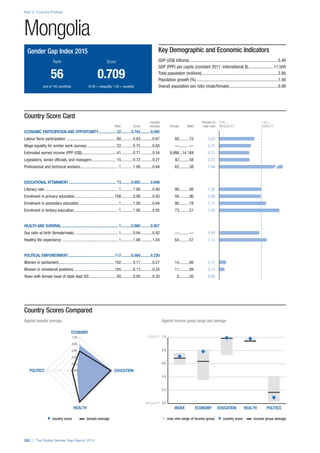
Mongolia 56 0.709 22 0.783 73 0.992 1 0.980 117 0.084
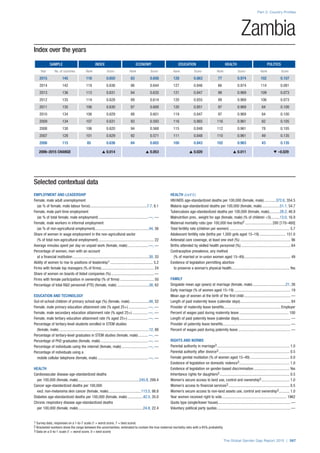
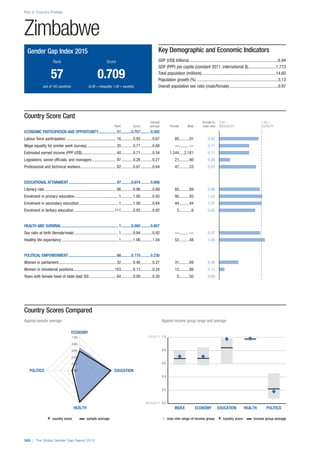
Zimbabwe 57 0.709 51 0.707 97 0.974 1 0.980 66 0.175
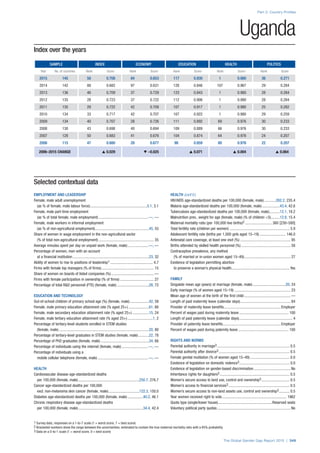
Uganda 58 0.708 84 0.653 117 0.930 1 0.980 36 0.271
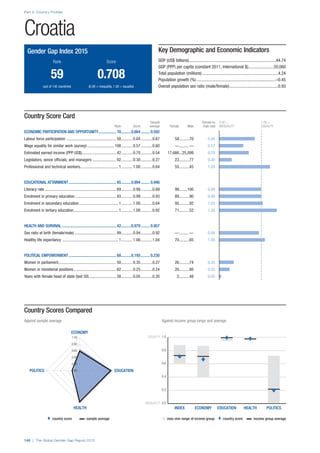
Croatia 59 0.708 78 0.664 65 0.994 42 0.979 60 0.193
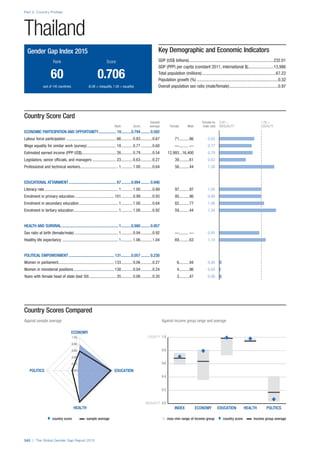
Thailand 60 0.706 19 0.794 67 0.994 1 0.980 131 0.057
Lesotho 61 0.706 68 0.672 1 1.000 1 0.980 68 0.172
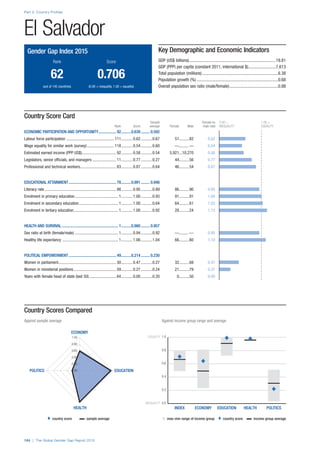
El Salvador 62 0.706 92 0.639 78 0.991 1 0.980 49 0.214
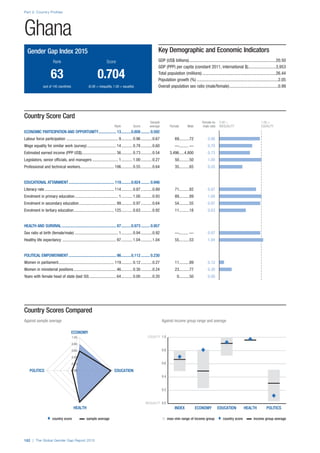
Ghana 63 0.704 13 0.808 119 0.924 87 0.973 96 0.112
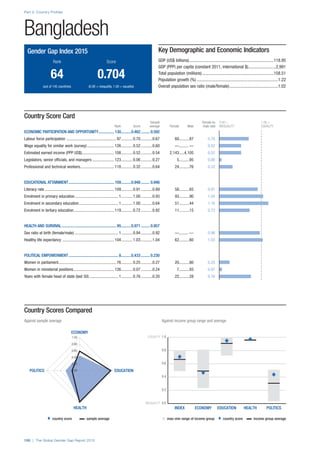
Bangladesh 64 0.704 130 0.462 109 0.948 95 0.971 8 0.433
Jamaica 65 0.703 64 0.678 42 0.998 1 0.980 75 0.155
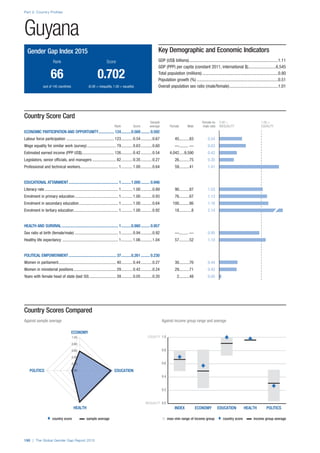
Guyana 66 0.702 124 0.569 1 1.000 1 0.980 37 0.261
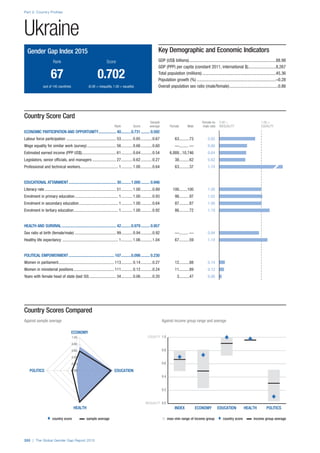
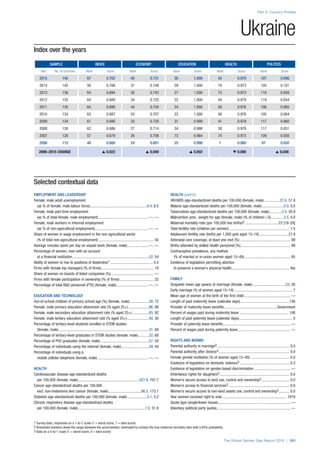
Ukraine 67 0.702 40 0.731 30 1.000 42 0.979 107 0.098
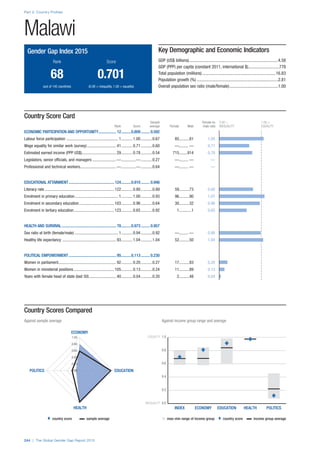
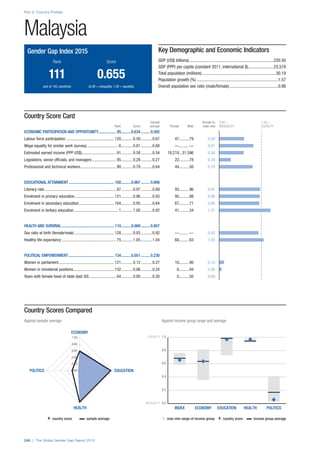
Malawi 68 0.701 12 0.809 124 0.910 78 0.973 95 0.113
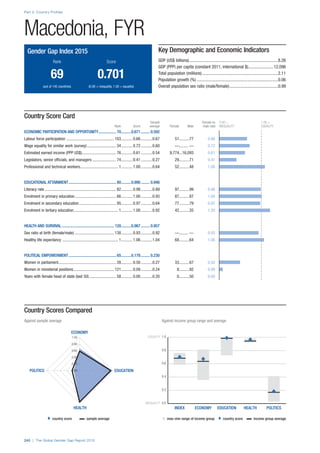
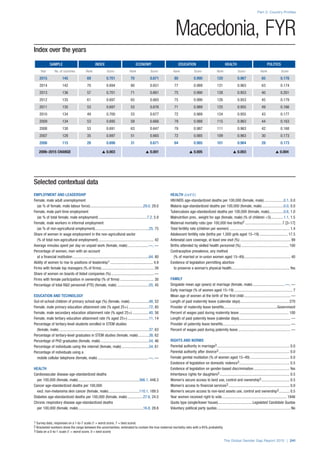
Macedonia, FYR 69 0.701 70 0.671 80 0.990 120 0.967 65 0.178
Albania 70 0.701 69 0.671 98 0.972 142 0.947 50 0.214
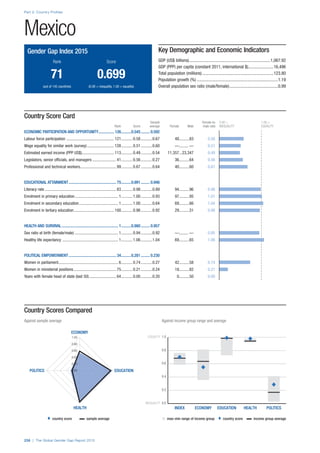
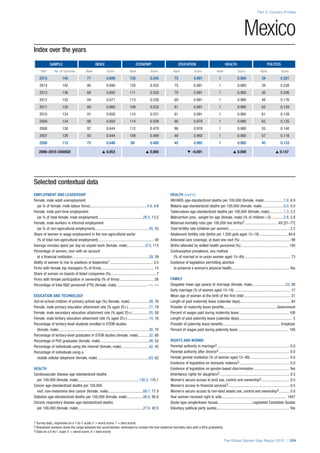
Mexico 71 0.699 126 0.545 75 0.991 1 0.980 34 0.281
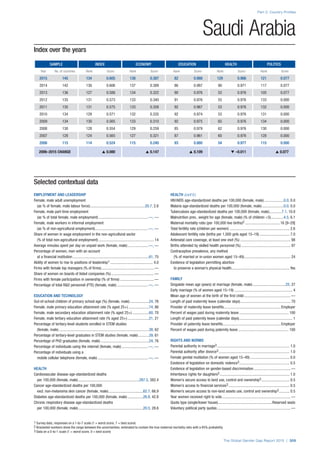
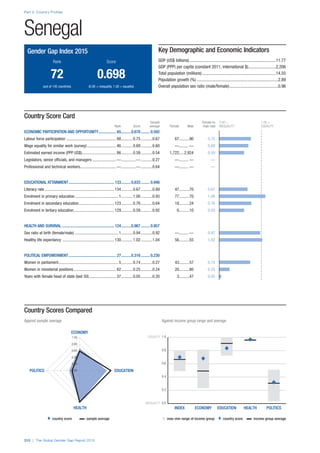
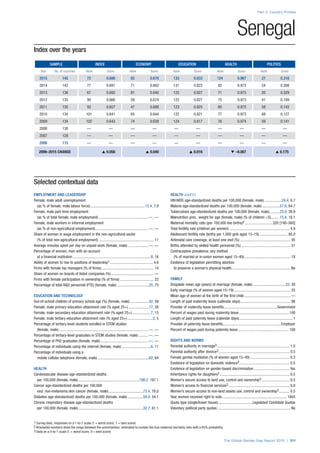
Senegal 72 0.698 65 0.678 133 0.833 124 0.967 27 0.316
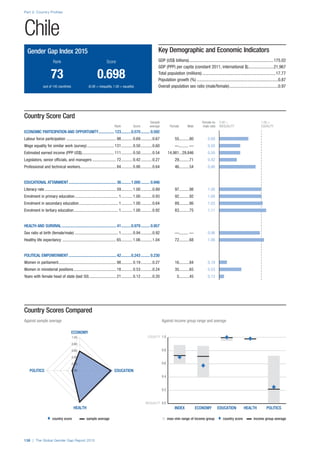
Chile 73 0.698 123 0.570 36 1.000 41 0.979 42 0.243
The Global Gender Gap Report 2015 | 9
Part 1: Measuring the Global Gender Gap
Table 3: Global rankings, 2015 (cont’d.)
GLOBAL INDEX
ECONOMIC PARTICIPATION
AND OPPORTUNITY
EDUCATIONAL ATTAINMENT HEALTH AND SURVIVAL POLITICAL EMPOWERMENT
Country Rank Score Rank Score Rank Score Rank Score Rank Score
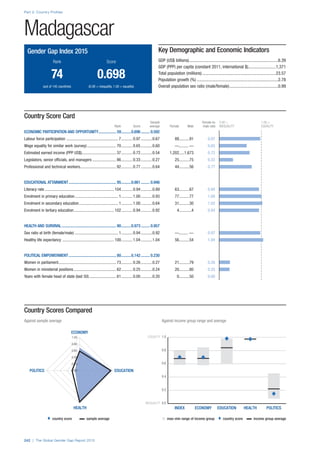
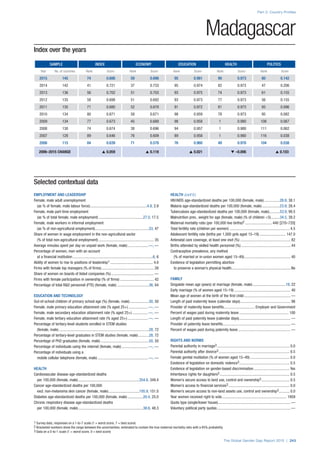
Madagascar 74 0.698 59 0.696 95 0.981 90 0.973 80 0.142
Russian Federation 75 0.694 42 0.731 27 1.000 42 0.979 128 0.066
Kyrgyz Republic 76 0.693 80 0.658 81 0.989 79 0.973 76 0.153
Romania 77 0.693 50 0.708 64 0.994 42 0.979 113 0.090
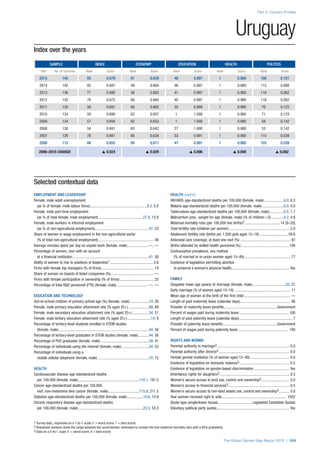
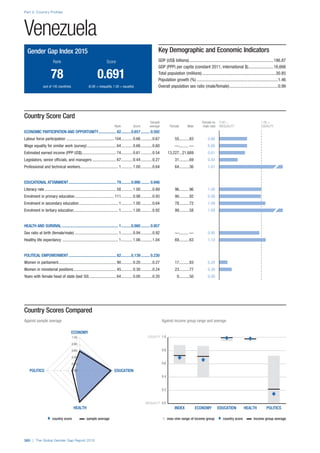
Venezuela 78 0.691 82 0.657 79 0.990 1 0.980 82 0.139
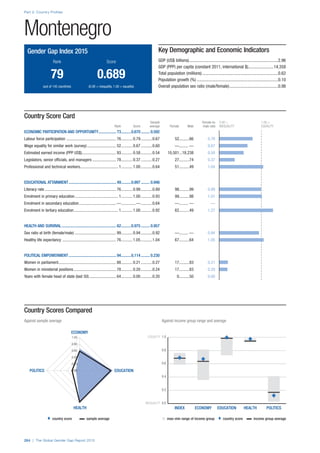
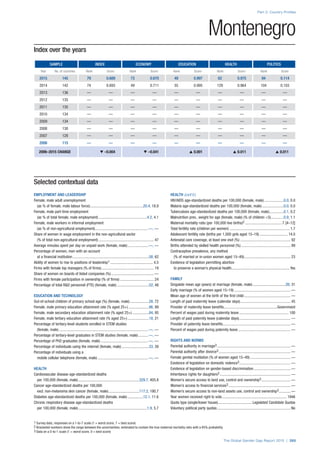
Montenegro 79 0.689 73 0.670 49 0.997 62 0.975 94 0.114
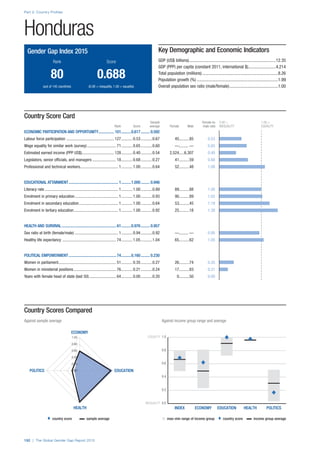
Honduras 80 0.688 101 0.617 1 1.000 61 0.976 74 0.160
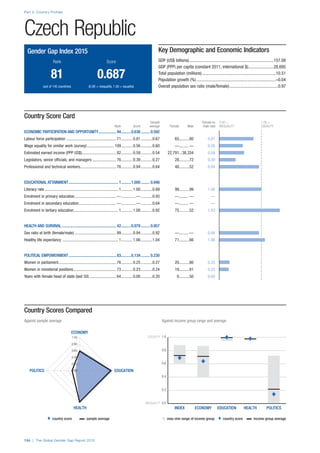
Czech Republic 81 0.687 94 0.636 1 1.000 42 0.979 83 0.134
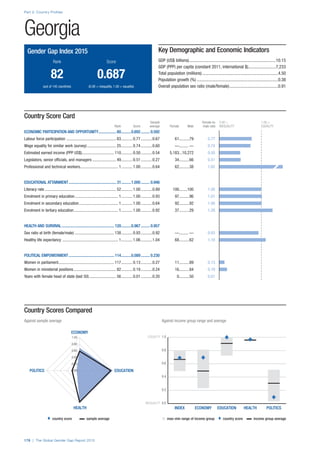
Georgia 82 0.687 60 0.692 31 1.000 120 0.967 114 0.089
Vietnam 83 0.687 41 0.731 114 0.941 139 0.950 88 0.124
Sri Lanka 84 0.686 120 0.577 57 0.995 1 0.980 59 0.193
Brazil 85 0.686 89 0.642 1 1.000 1 0.980 89 0.123
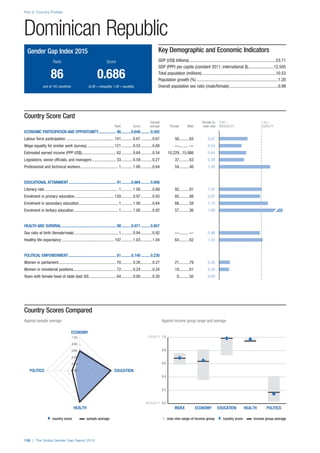
Dominican Republic 86 0.686 86 0.648 91 0.984 98 0.971 81 0.140
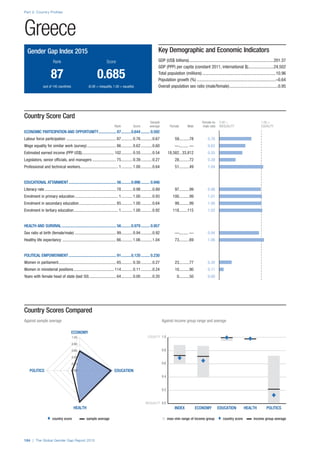
Greece 87 0.685 87 0.644 56 0.996 56 0.979 91 0.120
Brunei Darussalam 88 0.684 23 0.780 70 0.993 131 0.966 145 0.000
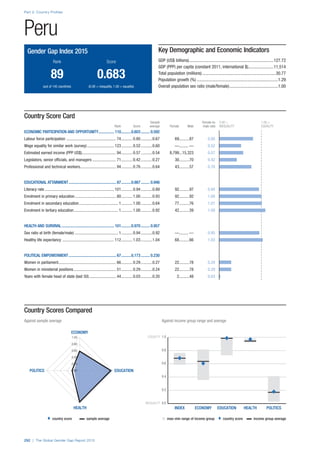
Peru 89 0.683 110 0.603 87 0.987 101 0.970 67 0.173
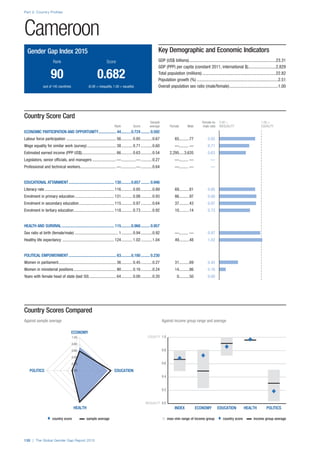
Cameroon* 90 0.682 44 0.724 130 0.857 115 0.968 63 0.180
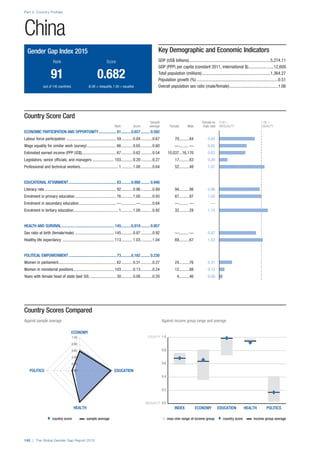
China 91 0.682 81 0.657 83 0.988 145 0.919 73 0.162
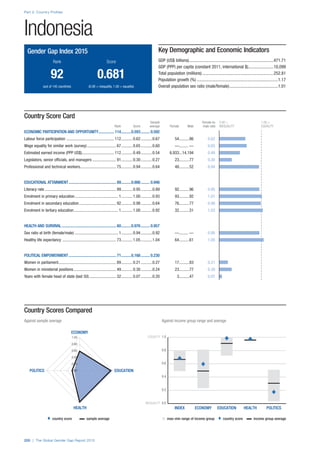
Indonesia 92 0.681 114 0.593 89 0.986 60 0.976 71 0.168
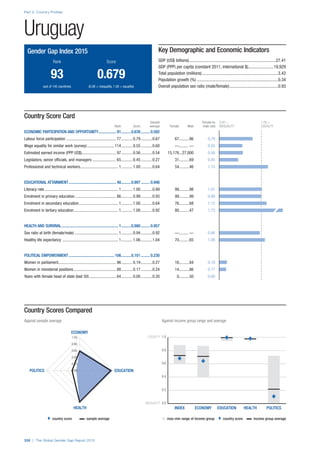
Uruguay 93 0.679 91 0.639 48 0.997 1 0.980 106 0.101
Suriname 94 0.678 103 0.616 45 0.998 1 0.980 90 0.120
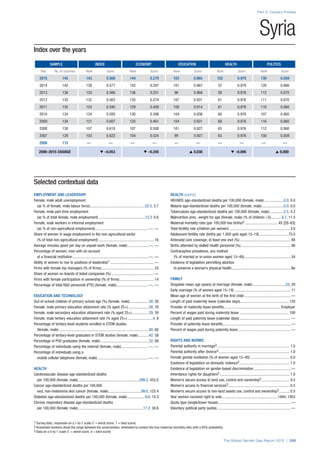
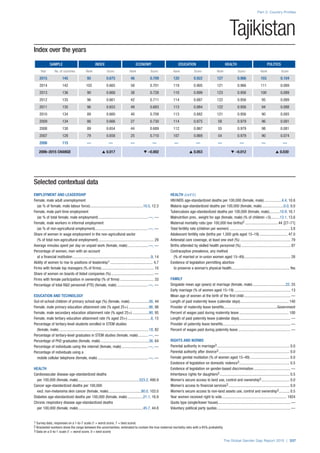
Tajikistan 95 0.675 48 0.709 120 0.922 127 0.966 103 0.104
Azerbaijan 96 0.675 54 0.701 90 0.984 139 0.950 129 0.063
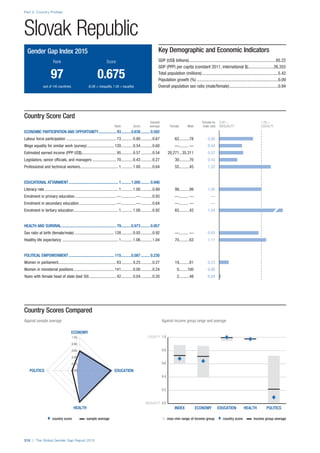
Slovak Republic 97 0.675 93 0.638 1 1.000 79 0.973 115 0.087
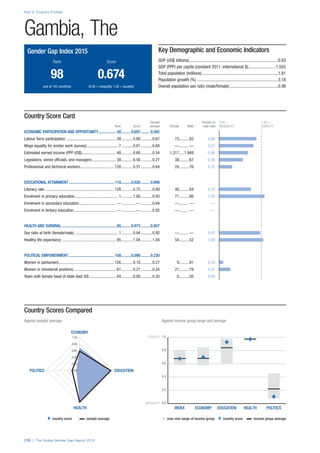
Gambia, The* 98 0.674 58 0.697 118 0.926 85 0.973 108 0.098
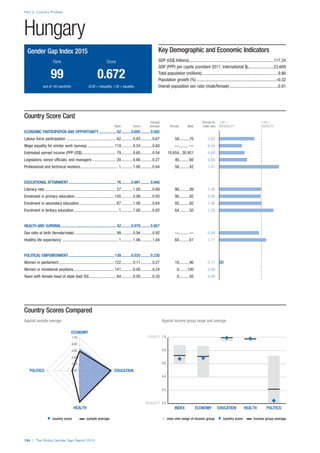
Hungary 99 0.672 62 0.685 76 0.991 42 0.979 139 0.035
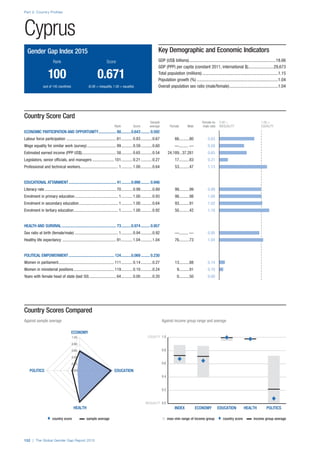
Cyprus 100 0.671 88 0.643 41 0.998 73 0.974 124 0.069
Japan 101 0.670 106 0.611 84 0.988 42 0.979 104 0.103
Swaziland 102 0.670 107 0.608 1 1.000 133 0.961 100 0.109
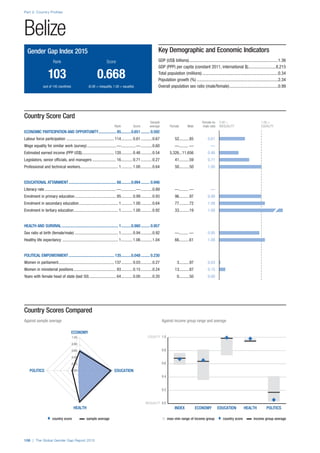
Belize 103 0.668 85 0.651 68 0.994 1 0.980 135 0.048
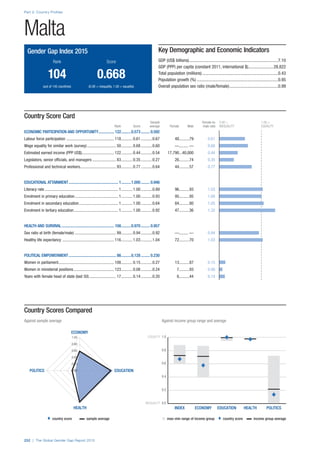
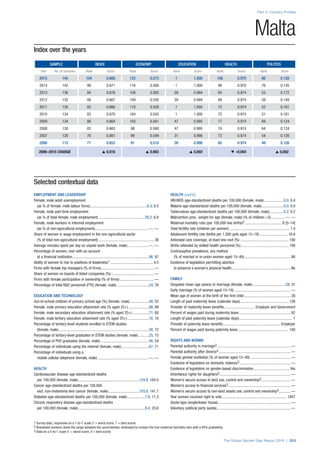
Malta 104 0.668 122 0.573 1 1.000 108 0.970 86 0.128
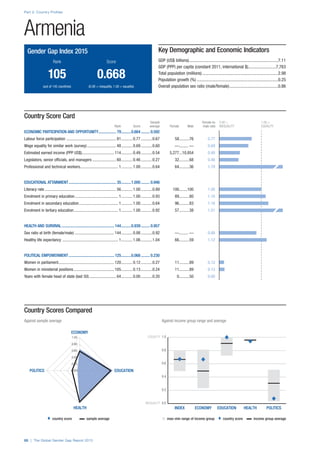
Armenia 105 0.668 79 0.664 35 1.000 144 0.939 125 0.068
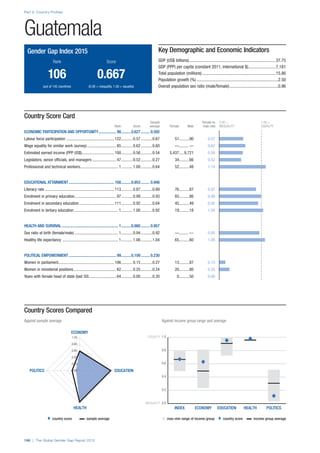
Guatemala 106 0.667 98 0.627 108 0.953 1 0.980 99 0.109
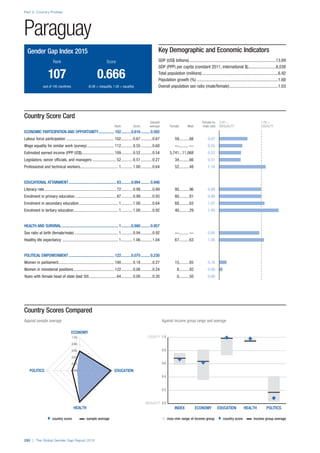
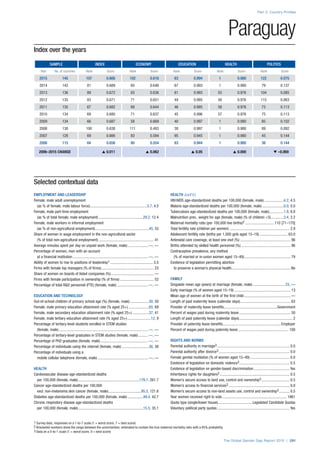
Paraguay 107 0.666 102 0.616 63 0.994 1 0.980 122 0.075
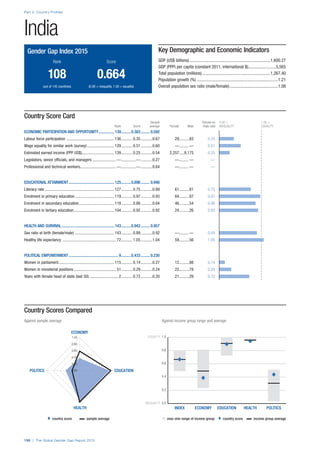
India 108 0.664 139 0.383 125 0.896 143 0.942 9 0.433
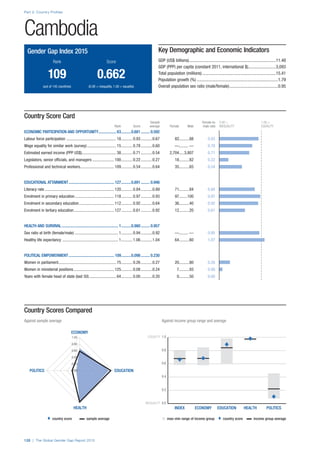
Cambodia 109 0.662 63 0.681 127 0.891 1 0.980 109 0.098
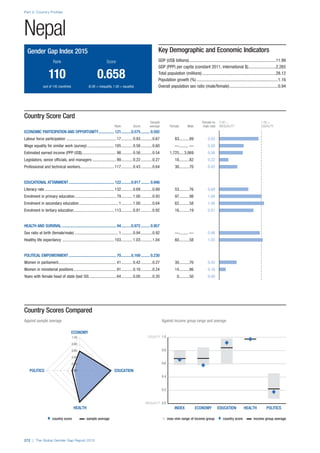
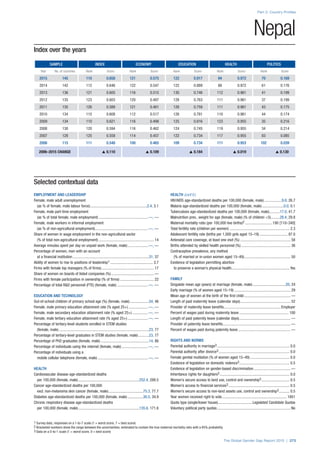
Nepal 110 0.658 121 0.575 122 0.917 94 0.972 70 0.169
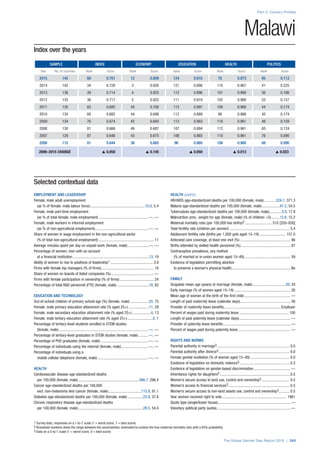
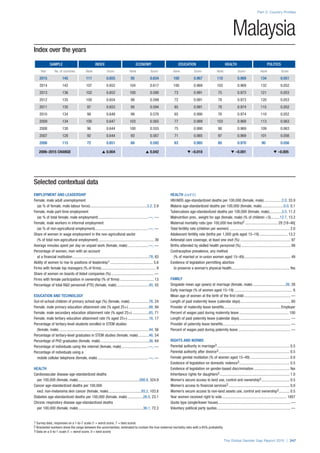
Malaysia 111 0.655 95 0.634 100 0.967 110 0.969 134 0.051
Liberia 112 0.652 99 0.620 136 0.806 119 0.967 47 0.216
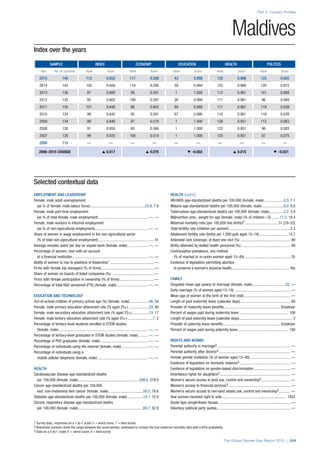
Maldives 113 0.652 117 0.589 43 0.998 130 0.966 133 0.055
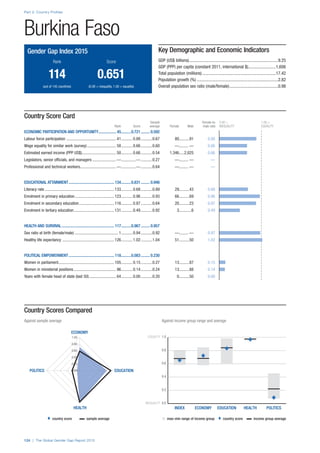
Burkina Faso 114 0.651 45 0.721 134 0.831 117 0.967 118 0.083
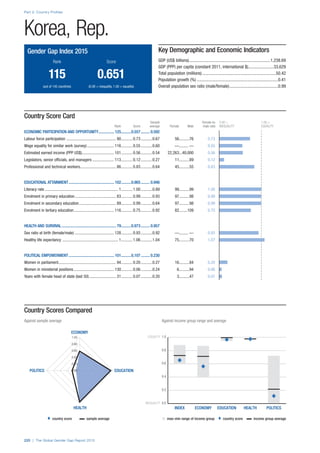
Korea, Rep. 115 0.651 125 0.557 102 0.965 79 0.973 101 0.107
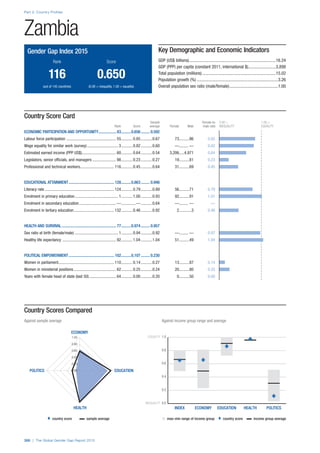
Zambia 116 0.650 83 0.656 128 0.863 77 0.974 102 0.107
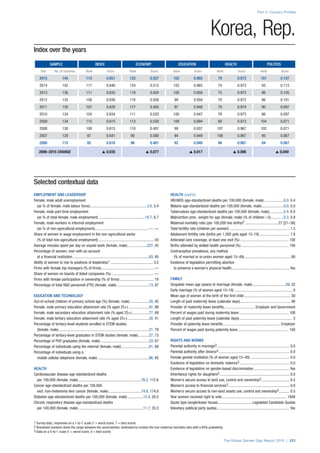
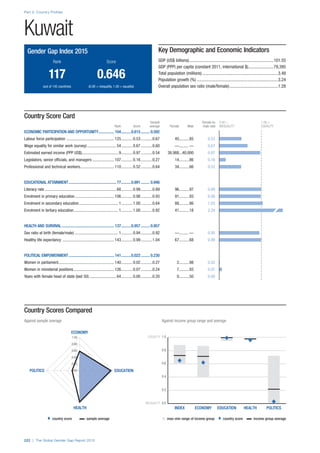
Kuwait 117 0.646 104 0.615 77 0.991 137 0.957 141 0.022
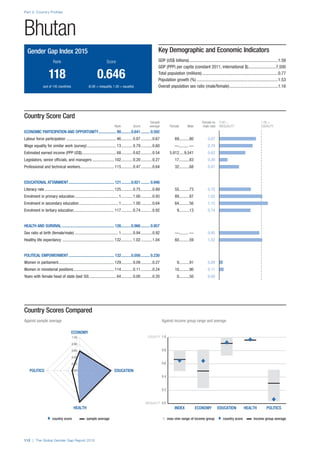
Bhutan 118 0.646 90 0.641 121 0.921 126 0.966 132 0.056
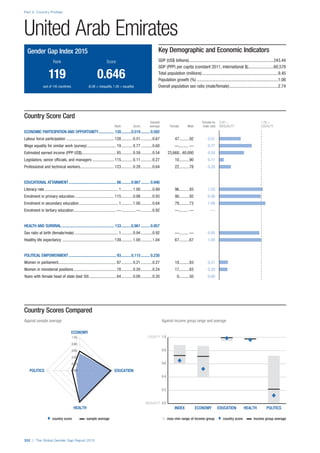
United Arab Emirates 119 0.646 128 0.519 86 0.987 133 0.961 93 0.115
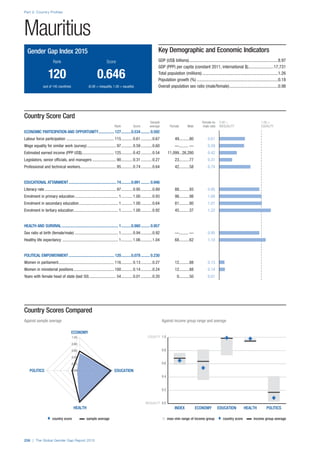
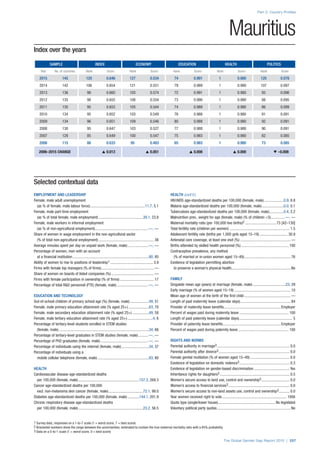
Mauritius 120 0.646 127 0.534 74 0.991 1 0.980 120 0.078
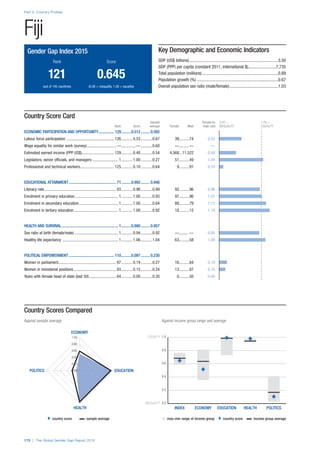
Fiji 121 0.645 129 0.512 71 0.992 1 0.980 110 0.097
Qatar 122 0.645 97 0.632 96 0.977 137 0.957 144 0.013
Bahrain 123 0.644 113 0.597 94 0.981 133 0.961 138 0.037
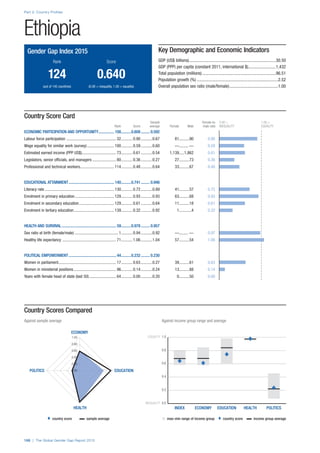
Ethiopia 124 0.640 108 0.608 140 0.741 59 0.978 44 0.232
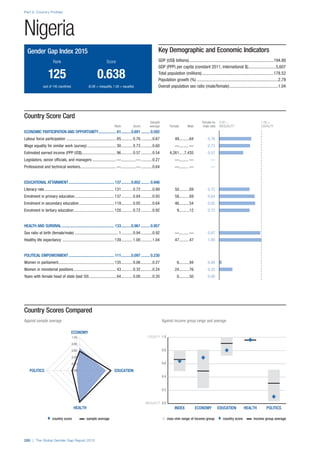
Nigeria 125 0.638 61 0.691 137 0.802 133 0.961 111 0.097
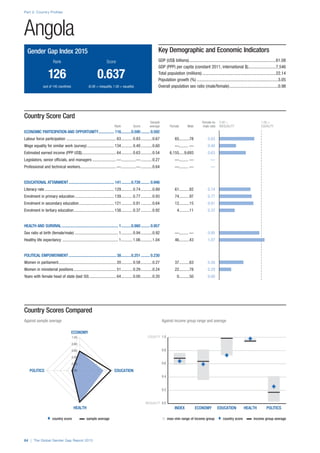
Angola 126 0.637 116 0.590 141 0.726 1 0.980 38 0.251
Tunisia 127 0.634 133 0.444 107 0.953 111 0.969 69 0.170
Algeria 128 0.632 137 0.410 110 0.946 128 0.966 55 0.205
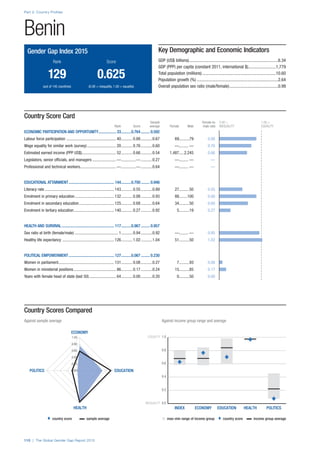
Benin* 129 0.625 33 0.764 144 0.700 117 0.967 127 0.067
Turkey 130 0.624 131 0.459 105 0.957 1 0.980 105 0.103
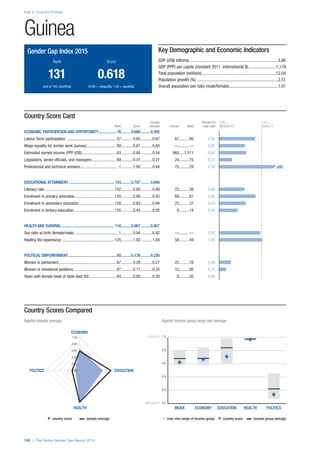
Guinea 131 0.618 76 0.666 143 0.707 116 0.967 85 0.130
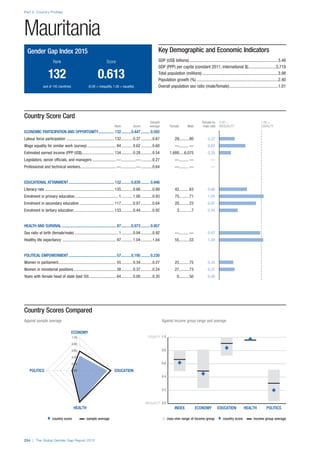
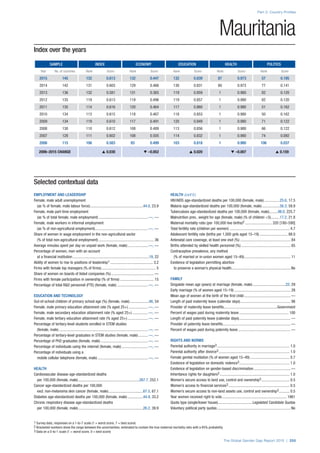
Mauritania 132 0.613 132 0.447 132 0.839 87 0.973 57 0.195
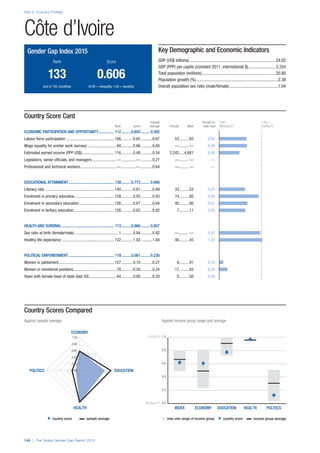
Côte d'Ivoire 133 0.606 112 0.603 138 0.773 113 0.968 119 0.081
Saudi Arabia 134 0.605 138 0.387 82 0.988 129 0.966 121 0.077
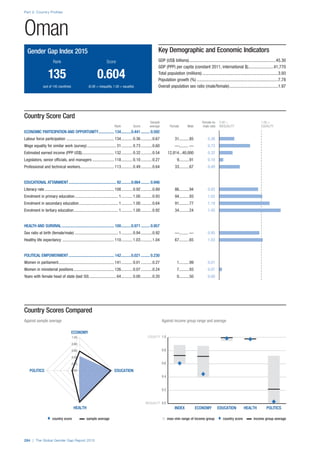
Oman 135 0.604 134 0.441 92 0.984 100 0.971 142 0.021
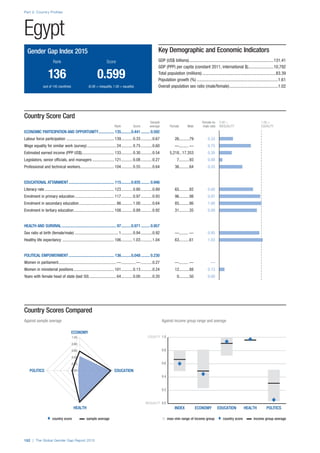
Egypt 136 0.599 135 0.441 115 0.935 97 0.971 136 0.048
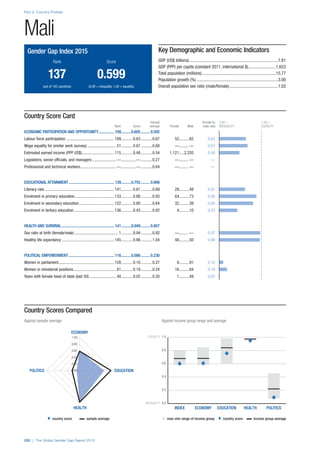
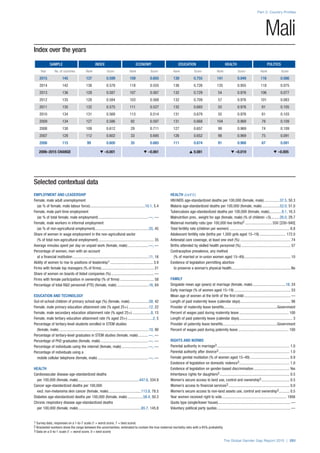
Mali 137 0.599 109 0.605 139 0.755 141 0.949 116 0.086
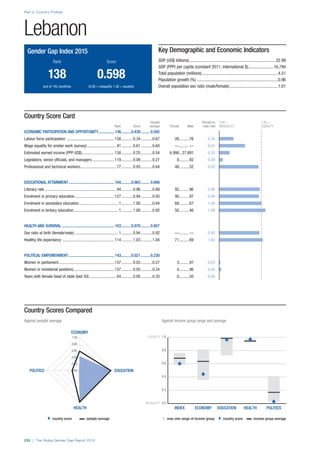
Lebanon 138 0.598 136 0.439 104 0.963 103 0.970 143 0.021
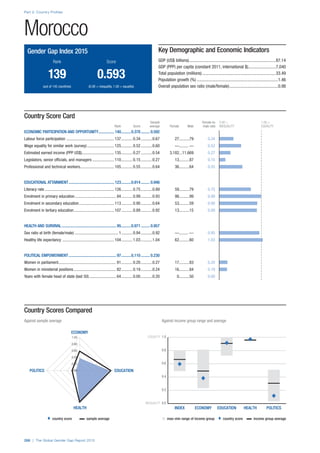
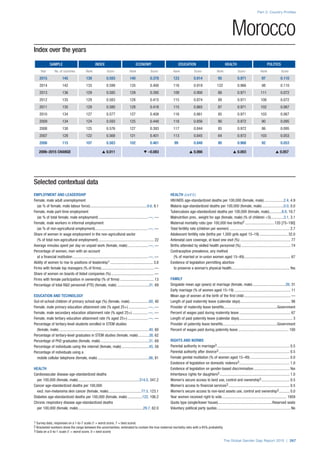
Morocco 139 0.593 140 0.378 123 0.914 95 0.971 97 0.110
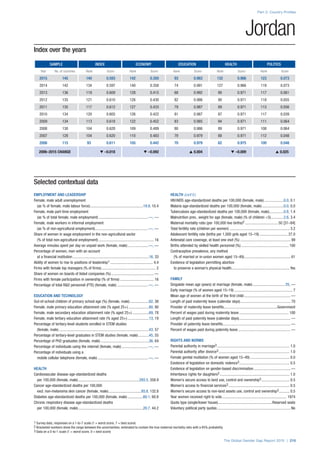
Jordan 140 0.593 142 0.350 93 0.983 132 0.966 123 0.073
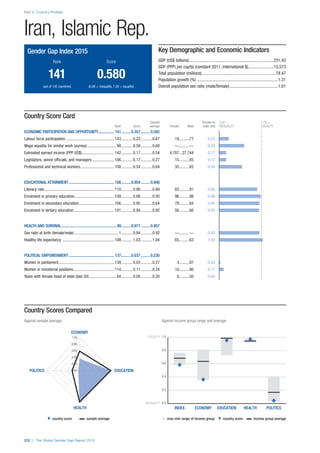
Iran, Islamic Rep. 141 0.580 141 0.357 106 0.954 99 0.971 137 0.037
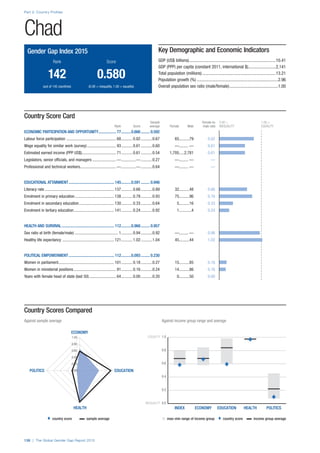
Chad 142 0.580 77 0.666 145 0.591 112 0.968 112 0.093
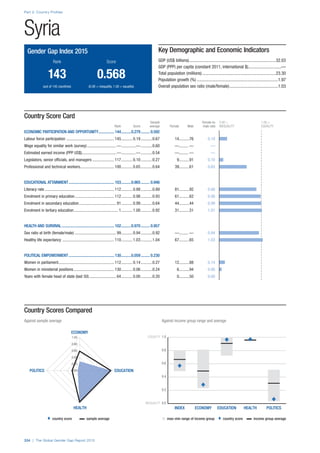
Syria 143 0.568 144 0.279 103 0.965 102 0.970 130 0.059
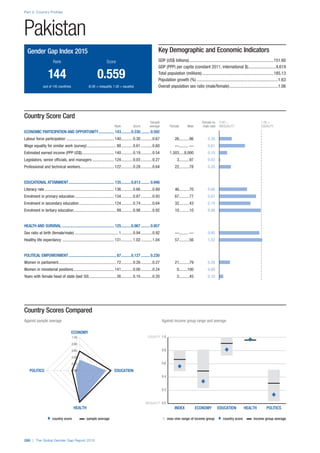
Pakistan 144 0.559 143 0.330 135 0.813 125 0.967 87 0.127
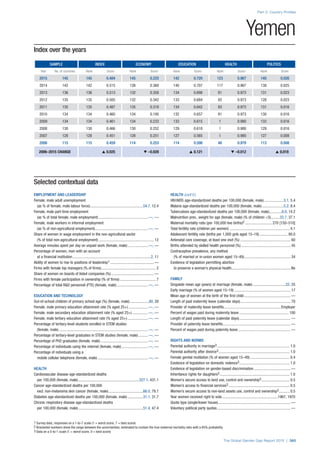
Yemen 145 0.484 145 0.225 142 0.720 123 0.967 140 0.026
* New countries 2015
Part 1: Measuring the Global Gender Gap
10 | The Global Gender Gap Report 2015
Table 4: Rankings by subindex, 2015
Country Rank Score
Norway 1 0.868
Barbados 2 0.848
Burundi 3 0.845
Sweden 4 0.836
Iceland 5 0.836
United States 6 0.826
Bahamas 7 0.823
Finland 8 0.815
Singapore 9 0.814
Belarus 10 0.813
Lao PDR 11 0.811
Malawi 12 0.809
Ghana 13 0.808
Rwanda 14 0.808
Botswana 15 0.800
Philippines 16 0.799
Switzerland 17 0.798
Moldova 18 0.797
Thailand 19 0.794
Denmark 20 0.788
Latvia 21 0.784
Mongolia 22 0.783
Brunei Darussalam 23 0.780
Slovenia 24 0.778
Kenya 25 0.778
Ireland 26 0.777
Namibia 27 0.775
Canada 28 0.773
Mozambique 29 0.773
New Zealand 30 0.768
Luxembourg 31 0.766
Australia 32 0.766
Benin* 33 0.764
Belgium 34 0.762
Lithuania 35 0.759
Kazakhstan 36 0.749
Colombia 37 0.746
Germany 38 0.737
Netherlands 39 0.732
Ukraine 40 0.731
Vietnam 41 0.731
Russian Federation 42 0.731
United Kingdom 43 0.724
Cameroon* 44 0.724
Burkina Faso 45 0.721
Portugal 46 0.712
Estonia 47 0.711
Tajikistan 48 0.709
Tanzania 49 0.709
Romania 50 0.708
Zimbabwe 51 0.707
Austria 52 0.705
Trinidad and Tobago 53 0.704
Azerbaijan 54 0.701
Bulgaria 55 0.701
France 56 0.699
Panama 57 0.698
Gambia, The* 58 0.697
Madagascar 59 0.696
Georgia 60 0.692
Nigeria 61 0.691
Hungary 62 0.685
Cambodia 63 0.681
Jamaica 64 0.678
Senegal 65 0.678
Ecuador 66 0.677
Spain 67 0.674
Lesotho 68 0.672
Albania 69 0.671
Macedonia, FYR 70 0.671
Israel 71 0.671
South Africa 72 0.670
Montenegro 73 0.670
Country Rank Score
Serbia 74 0.669
Poland 75 0.667
Guinea 76 0.666
Chad 77 0.666
Croatia 78 0.664
Armenia 79 0.664
Kyrgyz Republic 80 0.658
China 81 0.657
Venezuela 82 0.657
Zambia 83 0.656
Uganda 84 0.653
Belize 85 0.651
Dominican Republic 86 0.648
Greece 87 0.644
Cyprus 88 0.643
Brazil 89 0.642
Bhutan 90 0.641
Uruguay 91 0.639
El Salvador 92 0.639
Slovak Republic 93 0.638
Czech Republic 94 0.636
Malaysia 95 0.634
Bolivia 96 0.634
Qatar 97 0.632
Guatemala 98 0.627
Liberia 99 0.620
Nicaragua 100 0.619
Honduras 101 0.617
Paraguay 102 0.616
Suriname 103 0.616
Kuwait 104 0.615
Argentina 105 0.615
Japan 106 0.611
Swaziland 107 0.608
Ethiopia 108 0.608
Mali 109 0.605
Peru 110 0.603
Italy 111 0.603
Côte d'Ivoire 112 0.603
Bahrain 113 0.597
Indonesia 114 0.593
Cape Verde 115 0.591
Angola 116 0.590
Maldives 117 0.589
Costa Rica 118 0.587
Cuba 119 0.579
Sri Lanka 120 0.577
Nepal 121 0.575
Malta 122 0.573
Chile 123 0.570
Guyana 124 0.569
Korea, Rep. 125 0.557
Mexico 126 0.545
Mauritius 127 0.534
United Arab Emirates 128 0.519
Fiji 129 0.512
Bangladesh 130 0.462
Turkey 131 0.459
Mauritania 132 0.447
Tunisia 133 0.444
Oman 134 0.441
Egypt 135 0.441
Lebanon 136 0.439
Algeria 137 0.410
Saudi Arabia 138 0.387
India 139 0.383
Morocco 140 0.378
Iran, Islamic Rep. 141 0.357
Jordan 142 0.350
Pakistan 143 0.330
Syria 144 0.279
Yemen 145 0.225
* New countries 2015
Country Rank Score
Australia 1 1.000
Austria 1 1.000
Bahamas 1 1.000
Belgium 1 1.000
Botswana 1 1.000
Brazil 1 1.000
Canada 1 1.000
Costa Rica 1 1.000
Czech Republic 1 1.000
Denmark 1 1.000
Finland 1 1.000
France 1 1.000
Guyana 1 1.000
Honduras 1 1.000
Iceland 1 1.000
Latvia 1 1.000
Lesotho 1 1.000
Luxembourg 1 1.000
Malta 1 1.000
Namibia 1 1.000
Netherlands 1 1.000
New Zealand 1 1.000
Nicaragua 1 1.000
Slovak Republic 1 1.000
Swaziland 1 1.000
Cuba 26 1.000
Russian Federation 27 1.000
Kazakhstan 28 1.000
Slovenia 29 1.000
Ukraine 30 1.000
Georgia 31 1.000
Norway 32 1.000
Belarus 33 1.000
Philippines 34 1.000
Armenia 35 1.000
Chile 36 1.000
United Kingdom 37 1.000
Poland 38 1.000
Estonia 39 0.999
United States 40 0.999
Cyprus 41 0.998
Jamaica 42 0.998
Maldives 43 0.998
Ireland 44 0.998
Suriname 45 0.998
Barbados 46 0.998
Spain 47 0.998
Uruguay 48 0.997
Montenegro 49 0.997
Moldova 50 0.996
Israel 51 0.996
Serbia 52 0.996
Ecuador 53 0.996
Sweden 54 0.996
Argentina 55 0.996
Greece 56 0.996
Sri Lanka 57 0.995
Italy 58 0.995
Trinidad and Tobago 59 0.995
Portugal 60 0.995
Colombia 61 0.994
Panama 62 0.994
Paraguay 63 0.994
Romania 64 0.994
Croatia 65 0.994
Lithuania 66 0.994
Thailand 67 0.994
Belize 68 0.994
Switzerland 69 0.993
Brunei Darussalam 70 0.993
Fiji 71 0.992
Bulgaria 72 0.992
Mongolia 73 0.992
Country Rank Score
Mauritius 74 0.991
Mexico 75 0.991
Hungary 76 0.991
Kuwait 77 0.991
El Salvador 78 0.991
Venezuela 79 0.990
Macedonia, FYR 80 0.990
Kyrgyz Republic 81 0.989
Saudi Arabia 82 0.988
China 83 0.988
Japan 84 0.988
South Africa 85 0.987
United Arab Emirates 86 0.987
Peru 87 0.987
Germany 88 0.987
Indonesia 89 0.986
Azerbaijan 90 0.984
Dominican Republic 91 0.984
Oman 92 0.984
Jordan 93 0.983
Bahrain 94 0.981
Madagascar 95 0.981
Qatar 96 0.977
Zimbabwe 97 0.974
Albania 98 0.972
Cape Verde 99 0.970
Malaysia 100 0.967
Bolivia 101 0.967
Korea, Rep. 102 0.965
Syria 103 0.965
Lebanon 104 0.963
Turkey 105 0.957
Iran, Islamic Rep. 106 0.954
Tunisia 107 0.953
Guatemala 108 0.953
Bangladesh 109 0.948
Algeria 110 0.946
Singapore 111 0.945
Rwanda 112 0.944
Kenya 113 0.942
Vietnam 114 0.941
Egypt 115 0.935
Lao PDR 116 0.935
Uganda 117 0.930
Gambia, The* 118 0.926
Ghana 119 0.924
Tajikistan 120 0.922
Bhutan 121 0.921
Nepal 122 0.917
Morocco 123 0.914
Malawi 124 0.910
India 125 0.896
Tanzania 126 0.894
Cambodia 127 0.891
Zambia 128 0.863
Mozambique 129 0.860
Cameroon* 130 0.857
Burundi 131 0.857
Mauritania 132 0.839
Senegal 133 0.833
Burkina Faso 134 0.831
Pakistan 135 0.813
Liberia 136 0.806
Nigeria 137 0.802
Côte d'Ivoire 138 0.773
Mali 139 0.755
Ethiopia 140 0.741
Angola 141 0.726
Yemen 142 0.720
Guinea 143 0.707
Benin* 144 0.700
Chad 145 0.591
Note: Countries highlighted in blue have
reached parity on that subindex.
* New countries 2015
ECONOMIC PARTICIPATION AND OPPORTUNITY EDUCATIONAL ATTAINMENT
The Global Gender Gap Report 2015 | 11
Part 1: Measuring the Global Gender Gap
Country Rank Score
Angola 1 0.980
Argentina 1 0.980
Austria 1 0.980
Bahamas 1 0.980
Barbados 1 0.980
Belize 1 0.980
Bolivia 1 0.980
Brazil 1 0.980
Cambodia 1 0.980
Cape Verde 1 0.980
Ecuador 1 0.980
El Salvador 1 0.980
Estonia 1 0.980
Fiji 1 0.980
Finland 1 0.980
France 1 0.980
Guatemala 1 0.980
Guyana 1 0.980
Jamaica 1 0.980
Kazakhstan 1 0.980
Latvia 1 0.980
Lesotho 1 0.980
Mauritius 1 0.980
Mexico 1 0.980
Mongolia 1 0.980
Namibia 1 0.980
Nicaragua 1 0.980
Panama 1 0.980
Paraguay 1 0.980
Philippines 1 0.980
South Africa 1 0.980
Sri Lanka 1 0.980
Suriname 1 0.980
Thailand 1 0.980
Trinidad and Tobago 1 0.980
Turkey 1 0.980
Uganda 1 0.980
Uruguay 1 0.980
Venezuela 1 0.980
Zimbabwe 1 0.980
Chile 41 0.979
Belarus 42 0.979
Moldova 42 0.979
Lithuania 42 0.979
Colombia 42 0.979
Ukraine 42 0.979
Russian Federation 42 0.979
Romania 42 0.979
Bulgaria 42 0.979
Hungary 42 0.979
Poland 42 0.979
Croatia 42 0.979
Czech Republic 42 0.979
Japan 42 0.979
Tanzania 55 0.979
Ireland 56 0.979
Germany 56 0.979
Greece 56 0.979
Ethiopia 59 0.978
Indonesia 60 0.976
Honduras 61 0.976
Montenegro 62 0.975
Cuba 63 0.975
United States 64 0.975
Costa Rica 64 0.975
Belgium 66 0.974
United Kingdom 66 0.974
Burundi 68 0.974
Israel 69 0.974
Norway 70 0.974
Sweden 71 0.974
Luxembourg 71 0.974
Cyprus 73 0.974
Country Rank Score
Switzerland 74 0.974
Australia 74 0.974
Italy 74 0.974
Zambia 77 0.974
Malawi 78 0.973
Slovenia 79 0.973
Portugal 79 0.973
Serbia 79 0.973
Kyrgyz Republic 79 0.973
Slovak Republic 79 0.973
Korea, Rep. 79 0.973
Kenya 85 0.973
Gambia, The* 85 0.973
Ghana 87 0.973
Botswana 87 0.973
Mauritania 87 0.973
Madagascar 90 0.973
Rwanda 91 0.972
Lao PDR 92 0.972
Spain 93 0.972
Nepal 94 0.972
Bangladesh 95 0.971
Morocco 95 0.971
Egypt 97 0.971
Dominican Republic 98 0.971
Iran, Islamic Rep. 99 0.971
Oman 100 0.971
Peru 101 0.970
Syria 102 0.970
Lebanon 103 0.970
Netherlands 104 0.970
Iceland 105 0.970
New Zealand 105 0.970
Denmark 107 0.970
Malta 108 0.970
Canada 109 0.969
Malaysia 110 0.969
Tunisia 111 0.969
Chad 112 0.968
Côte d'Ivoire 113 0.968
Mozambique 114 0.968
Cameroon* 115 0.968
Guinea 116 0.967
Benin* 117 0.967
Burkina Faso 117 0.967
Liberia 119 0.967
Georgia 120 0.967
Macedonia, FYR 120 0.967
Singapore 122 0.967
Yemen 123 0.967
Senegal 124 0.967
Pakistan 125 0.967
Bhutan 126 0.966
Tajikistan 127 0.966
Algeria 128 0.966
Saudi Arabia 129 0.966
Maldives 130 0.966
Brunei Darussalam 131 0.966
Jordan 132 0.966
Nigeria 133 0.961
Swaziland 133 0.961
Bahrain 133 0.961
United Arab Emirates 133 0.961
Qatar 137 0.957
Kuwait 137 0.957
Vietnam 139 0.950
Azerbaijan 139 0.950
Mali 141 0.949
Albania 142 0.947
India 143 0.942
Armenia 144 0.939
China 145 0.919
Note: Countries highlighted in blue have
reached parity on that subindex.
* New countries 2015
HEALTH AND SURVIVAL POLITICAL EMPOWERMENT
Table 4: Rankings by subindex, 2015 (cont’d.)
Country Rank Score
Iceland 1 0.719
Finland 2 0.607
Norway 3 0.559
Nicaragua 4 0.506
Sweden 5 0.486
Ireland 6 0.474
Rwanda 7 0.452
Bangladesh 8 0.433
India 9 0.433
Bolivia 10 0.415
Germany 11 0.413
Cuba 12 0.407
Netherlands 13 0.401
South Africa 14 0.400
New Zealand 15 0.390
Slovenia 16 0.385
Philippines 17 0.382
Switzerland 18 0.376
France 19 0.365
Costa Rica 20 0.365
Mozambique 21 0.361
Argentina 22 0.347
United Kingdom 23 0.335
Italy 24 0.331
Cape Verde 25 0.329
Spain 26 0.326
Senegal 27 0.316
Burundi 28 0.314
Denmark 29 0.309
Estonia 30 0.308
Ecuador 31 0.297
Tanzania 32 0.292
Namibia 33 0.287
Mexico 34 0.281
Belgium 35 0.275
Uganda 36 0.271
Guyana 37 0.261
Angola 38 0.251
Austria 39 0.246
Latvia 40 0.246
Portugal 41 0.244
Chile 42 0.243
Serbia 43 0.242
Ethiopia 44 0.232
Lithuania 45 0.227
Canada 46 0.218
Liberia 47 0.216
Bulgaria 48 0.215
El Salvador 49 0.214
Albania 50 0.214
Panama 51 0.214
Poland 52 0.213
Luxembourg 53 0.212
Israel 54 0.205
Algeria 55 0.205
Trinidad and Tobago 56 0.201
Mauritania 57 0.195
Moldova 58 0.195
Sri Lanka 59 0.193
Croatia 60 0.193
Australia 61 0.193
Kenya 62 0.182
Cameroon* 63 0.180
Colombia 64 0.180
Macedonia, FYR 65 0.178
Zimbabwe 66 0.175
Peru 67 0.173
Lesotho 68 0.172
Tunisia 69 0.170
Nepal 70 0.169
Indonesia 71 0.168
United States 72 0.162
China 73 0.162
Country Rank Score
Honduras 74 0.160
Jamaica 75 0.155
Kyrgyz Republic 76 0.153
Barbados 77 0.150
Kazakhstan 78 0.148
Belarus 79 0.146
Madagascar 80 0.142
Dominican Republic 81 0.140
Venezuela 82 0.139
Czech Republic 83 0.134
Lao PDR 84 0.132
Guinea 85 0.130
Malta 86 0.128
Pakistan 87 0.127
Vietnam 88 0.124
Brazil 89 0.123
Suriname 90 0.120
Greece 91 0.120
Singapore 92 0.119
United Arab Emirates 93 0.115
Montenegro 94 0.114
Malawi 95 0.113
Ghana 96 0.112
Morocco 97 0.110
Bahamas 98 0.110
Guatemala 99 0.109
Swaziland 100 0.109
Korea, Rep. 101 0.107
Zambia 102 0.107
Tajikistan 103 0.104
Japan 104 0.103
Turkey 105 0.103
Uruguay 106 0.101
Ukraine 107 0.098
Gambia, The* 108 0.098
Cambodia 109 0.098
Fiji 110 0.097
Nigeria 111 0.097
Chad 112 0.093
Romania 113 0.090
Georgia 114 0.089
Slovak Republic 115 0.087
Mali 116 0.086
Mongolia 117 0.084
Burkina Faso 118 0.083
Côte d'Ivoire 119 0.081
Mauritius 120 0.078
Saudi Arabia 121 0.077
Paraguay 122 0.075
Jordan 123 0.073
Cyprus 124 0.069
Armenia 125 0.068
Botswana 126 0.068
Benin* 127 0.067
Russian Federation 128 0.066
Azerbaijan 129 0.063
Syria 130 0.059
Thailand 131 0.057
Bhutan 132 0.056
Maldives 133 0.055
Malaysia 134 0.051
Belize 135 0.048
Egypt 136 0.048
Iran, Islamic Rep. 137 0.037
Bahrain 138 0.037
Hungary 139 0.035
Yemen 140 0.026
Kuwait 141 0.022
Oman 142 0.021
Lebanon 143 0.021
Qatar 144 0.013
Brunei Darussalam 145 0.000
* New countries 2015
Part 1: Measuring the Global Gender Gap
12 | The Global Gender Gap Report 2015
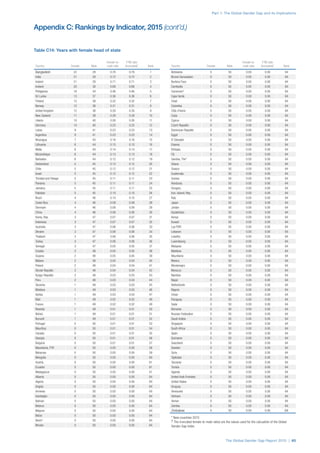
While 10 countries—Austria, Bahamas, Brazil,
France, Finland, Guyana, Latvia, Lesotho, Nicaragua, and
Namibia—have fully closed the gap on both the Health
and Survival and Educational Attainment subindexes, no
country has closed either the Economic Participation and
Opportunity or Political Empowerment gaps.
On the Economic Participation and Opportunity
subindex, 14 countries, including four from Sub-Saharan
Africa and five from Europe and Central Asia, have closed
more than 80% of the gap. Norway, Barbados, Burundi,
Sweden and Iceland occupy the top five spots on this
subindex. Sixteen countries have closed less than 50% of
the economic participation and opportunity gap, including
11 from the Middle East and North Africa region. Iran,
Jordan, Pakistan, Syria and Yemen hold the last five
spots on this subindex. Thirty-one countries are below
world average (weighted by population) on that subindex.
The Country Profiles include further data on employment
and leadership, such as part-time employment, workers
in informal employment or the percentage of female top
managers.
On the Political Empowerment subindex, only Iceland
and Finland have closed more than 60% of the gender
gap; 39 countries have closed less than 10% of the
gap. Yemen, Kuwait, Oman, Lebanon, Qatar, and Brunei
Darussalam have the lowest rankings on this subindex,
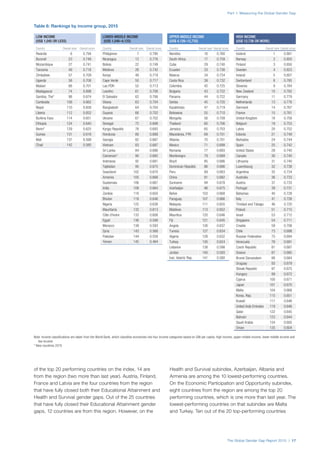
having closed less than 3% of the political gender gap. 101
countries are below world average (weighted by population)
and Brunei Darussalam still has a score of zero on that
subindex, with no representation of women. The Country
Profiles also present detailed information on parliamentary
quota type and voluntary political party quotas.
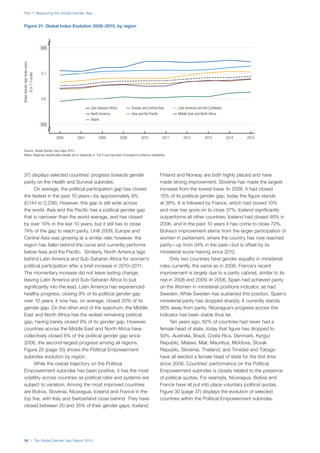
Figure 3 illustrates the range of country scores for
the four subindexes. The population-weighted average for
each subindex is highlighted by blue diamonds. Health
and Survival is the closest to reaching universal gender
parity, followed by Educational Attainment, Economic
Participation and Opportunity, and, lastly, Political
0.0 0.2 0.4 0.6 0.8 1.0
Yemen
Syria
Pakistan Sweden
Norway, Finland
Iceland
Figure 2: Global Gender Gap Index, 2015
Source: Global Gender Gap Index 2015.
Note: Blue diamond corresponds to the global average.
Global Gender Gap Index score (0.0–1.0 scale)
0.0 0.2 0.4 0.6 0.8 1.0
Political Empowerment
Health and Survival
Educational Attainment
Economic Participation
and Opportunity
Yemen Syria Pakistan
Chad Benin
Brunei Darussalam
China
Nicaragua
Norway
Finland Iceland
Norway
Figure 3: Global Gender Gap subindex, 2015
Source: Global Gender Gap Index 2015.
Note: Blue diamonds correspond to subindex averages.
Global Gender Gap Index score (0.0–1.0 scale)
The Global Gender Gap Report 2015 | 13
Part 1: Measuring the Global Gender Gap
Empowerment. The widest range in scores is found on the
Political Empowerment subindex, followed by Economic
Participation and Opportunity. Norway tops the Economic
Participation and Opportunity subindex and Yemen is the
worst performing country. Chad clearly lags behind the
rest of the world on Educational Attainment and China
is the worst performing country on Health and Survival.
Iceland tops the Political Empowerment subindex, followed
by Finland and Norway. Brunei Darussalam is the worst
performing country in this subindex, with a score of 0.
Performance by Region, 2015
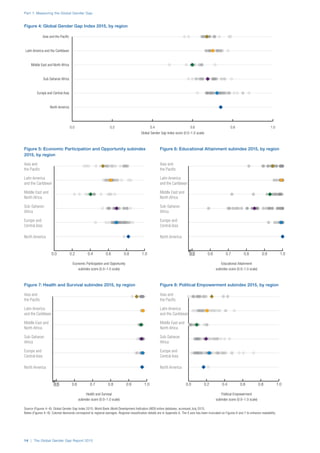
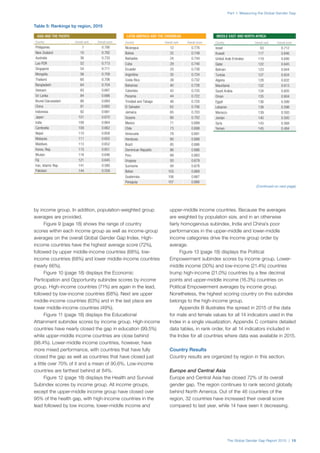
Table 5 (page 15) displays the rankings by regional
classification, organized by rank within each regional
group. In 2015, eight out of the 24 countries from Asia
and the Pacific have closed over 70% of the gap, with
the Philippines, New Zealand and Australia in the lead. At
the bottom end of the rankings, two countries from the
region—Iran and Pakistan—have closed less than 60% of
the gender gap. In Latin America and the Caribbean, 14 of
the 26 countries in the region have closed over 70% of the
gender gap. Nicaragua, Bolivia and Barbados occupy the
top three spots. The lowest-ranked country in the region—
Paraguay—has closed a little over 65% of its gender gap.
In the Middle East and North Africa region, only Israel has
closed over 70% of the gender gap, while six countries
have closed less than 60% of the gender gap. Canada
and the United States have both closed nearly 75% of the
gender gap. In Sub-Saharan Africa, out of 28 countries
covered, 14 have closed over 70% of the gender gap, with
Rwanda, Namibia and South Africa in the lead, while two
countries—Mali and Chad—have closed less than 60% of
the gap. In Europe and Central Asia, out of 46 countries,
five countries have closed over 80% of the gap, while 15
countries have closed less than 70%.
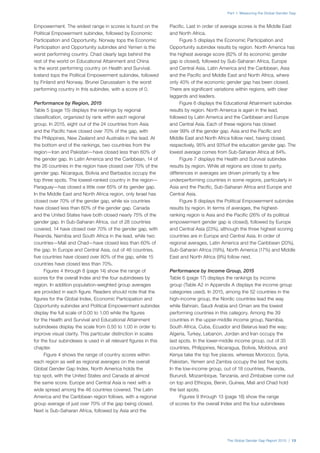
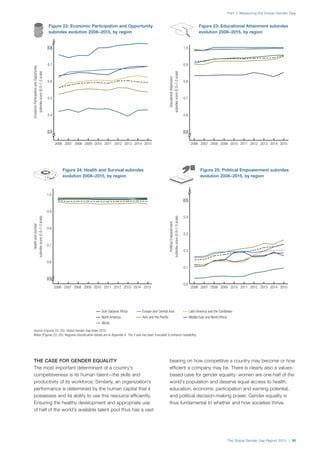
Figures 4 through 8 (page 14) show the range of
scores for the overall Index and the four subindexes by
region. In addition population-weighted group averages
are provided in each figure. Readers should note that the
figures for the Global Index, Economic Participation and
Opportunity subindex and Political Empowerment subindex
display the full scale of 0.00 to 1.00 while the figures
for the Health and Survival and Educational Attainment
subindexes display the scale from 0.50 to 1.00 in order to
improve visual clarity. This particular distinction in scales
for the four subindexes is used in all relevant figures in this
chapter.
Figure 4 shows the range of country scores within
each region as well as regional averages on the overall
Global Gender Gap Index. North America holds the
top spot, with the United States and Canada at almost
the same score. Europe and Central Asia is next with a
wide spread among the 46 countries covered. The Latin
America and the Caribbean region follows, with a regional
group average of just over 70% of the gap being closed.
Next is Sub-Saharan Africa, followed by Asia and the
Pacific. Last in order of average scores is the Middle East
and North Africa.
Figure 5 displays the Economic Participation and
Opportunity subindex results by region. North America has
the highest average score (82% of its economic gender
gap is closed), followed by Sub-Saharan Africa, Europe
and Central Asia, Latin America and the Caribbean, Asia
and the Pacific and Middle East and North Africa, where
only 40% of the economic gender gap has been closed.
There are significant variations within regions, with clear
laggards and leaders.
Figure 6 displays the Educational Attainment subindex
results by region. North America is again in the lead,
followed by Latin America and the Caribbean and Europe
and Central Asia. Each of these regions has closed
over 99% of the gender gap. Asia and the Pacific and
Middle East and North Africa follow next, having closed,
respectively, 95% and 93%of the education gender gap. The
lowest average comes from Sub-Saharan Africa at 84%.
Figure 7 displays the Health and Survival subindex
results by region. While all regions are close to parity,
differences in averages are driven primarily by a few
underperforming countries in some regions, particularly in
Asia and the Pacific, Sub-Saharan Africa and Europe and
Central Asia.
Figure 8 displays the Political Empowerment subindex
results by region. In terms of averages, the highest-
ranking region is Asia and the Pacific (26% of its political
empowerment gender gap is closed), followed by Europe
and Central Asia (23%), although the three highest scoring
countries are in Europe and Central Asia. In order of
regional averages, Latin America and the Caribbean (20%),
Sub-Saharan Africa (19%), North America (17%) and Middle
East and North Africa (9%) follow next.
Performance by Income Group, 2015
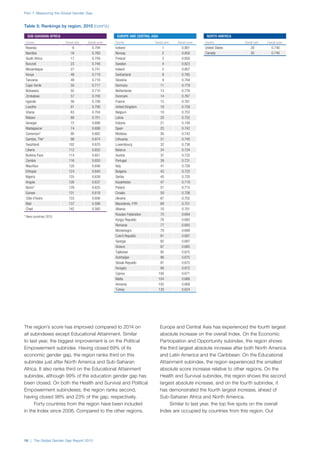
Table 6 (page 17) displays the rankings by income
group (Table A2 in Appendix A displays the income group
categories used). In 2015, among the 52 countries in the
high-income group, the Nordic countries lead the way
while Bahrain, Saudi Arabia and Oman are the lowest
performing countries in this category. Among the 39
countries in the upper-middle income group, Namibia,
South Africa, Cuba, Ecuador and Belarus lead the way;
Algeria, Turkey, Lebanon, Jordan and Iran occupy the
last spots. In the lower-middle income group, out of 35
countries, Philippines, Nicaragua, Bolivia, Moldova, and
Kenya take the top five places, whereas Morocco, Syria,
Pakistan, Yemen and Zambia occupy the last five spots.
In the low-income group, out of 18 countries, Rwanda,
Burundi, Mozambique, Tanzania, and Zimbabwe come out
on top and Ethiopia, Benin, Guinea, Mali and Chad hold
the last spots.
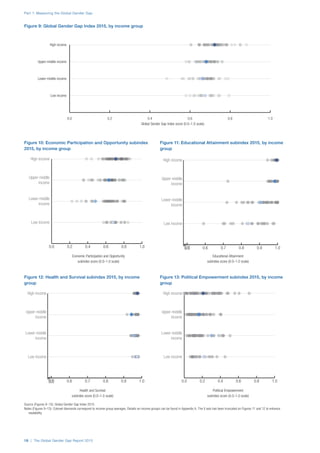
Figures 9 through 13 (page 18) show the range
of scores for the overall Index and the four subindexes
Part 1: Measuring the Global Gender Gap
14 | The Global Gender Gap Report 2015
Figure 5: Economic Participation and Opportunity subindex
2015, by region
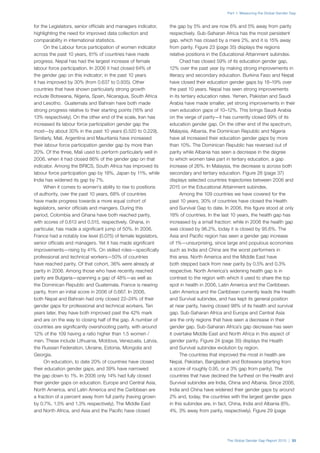
Figure 6: Educational Attainment subindex 2015, by region
Asia and
the Pacific
Latin America
and the Caribbean
Middle East and
North Africa
Sub-Saharan
Africa
Europe and
Central Asia
North America
0.0 0.2 0.4 0.6 0.8 1.0
Asia and
the Pacific
Latin America
and the Caribbean
Middle East and
North Africa
Sub-Saharan
Africa
Europe and
Central Asia
North America
0.5 0.6 0.7 0.8 0.9 1.0
Economic Participation and Opportunity
subindex score (0.0–1.0 scale)
Educational Attainment
subindex score (0.0–1.0 scale)
Source (Figures 4–8): Global Gender Gap Index 2015; World Bank World Development Indicators (WDI) online database, accessed July 2015.
Notes (Figures 4–8): Colored diamonds correspond to regional averages. Regional classification details are in Appendix A. The X axis has been truncated on Figures 6 and 7 to enhance readability.
Health and Survival
subindex score (0.0–1.0 scale)
Political Empowerment
subindex score (0.0–1.0 scale)
Asia and
the Pacific
Latin America
and the Caribbean
Middle East and
North Africa
Sub-Saharan
Africa
Europe and
Central Asia
North America
0.5 0.6 0.7 0.8 0.9 1.0
Asia and
the Pacific
Latin America
and the Caribbean
Middle East and
North Africa
Sub-Saharan
Africa
Europe and
Central Asia
North America
0.0 0.2 0.4 0.6 0.8 1.0
Figure 7: Health and Survival subindex 2015, by region Figure 8: Political Empowerment subindex 2015, by region
Figure 4: Global Gender Gap Index 2015, by region
0.0 0.2 0.4 0.6 0.8 1.0
Asia and the Pacific
Latin America and the Caribbean
Middle East and North Africa
Sub-Saharan Africa
Europe and Central Asia
North America
Global Gender Gap Index score (0.0–1.0 scale)
The Global Gender Gap Report 2015 | 15
Part 1: Measuring the Global Gender Gap
by income group. In addition, population-weighted group
averages are provided.
Figure 9 (page 18) shows the range of country
scores within each income group as well as income-group
averages on the overall Global Gender Gap Index. High-
income countries have the highest average score (72%),
followed by upper middle-income countries (68%), low-
income countries (68%) and lower middle-income countries
(nearly 66%).
Figure 10 (page 18) displays the Economic
Participation and Opportunity subindex scores by income
group. High-income countries (71%) are again in the lead,
followed by low-income countries (68%). Next are upper
middle-income countries (63%) and in the last place are
lower middle-income countries (49%).
Figure 11 (page 18) displays the Educational
Attainment subindex scores by income group. High-income
countries have nearly closed the gap in education (99.5%)
while upper-middle income countries are close behind
(98.4%). Lower-middle income countries, however, have
more mixed performance, with countries that have fully
closed the gap as well as countries that have closed just
a little over 70% of it and a mean of 90.6%. Low-income
countries are farthest behind at 84%.
Figure 12 (page 18) displays the Health and Survival
Subindex scores by income group. All income groups,
except the upper-middle income group have closed over
95% of the health gap, with high-income countries in the
lead followed by low income, lower-middle income and
upper-middle income countries. Because the averages
are weighted by population size, and in an otherwise
fairly homogenous subindex, India and China’s poor
performances in the upper-middle and lower-middle
income categories drive the income group order by
average.
Figure 13 (page 18) displays the Political
Empowerment subindex scores by income group. Lower-
middle income (30%) and low-income (21.4%) countries
trump high-income (21.0%) countries by a few decimal
points and upper-middle income (16.3%) countries on
Political Empowerment averages by income group.
Nonetheless, the highest scoring country on this subindex
belongs to the high-income group.
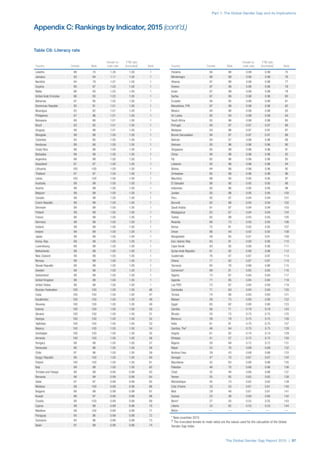
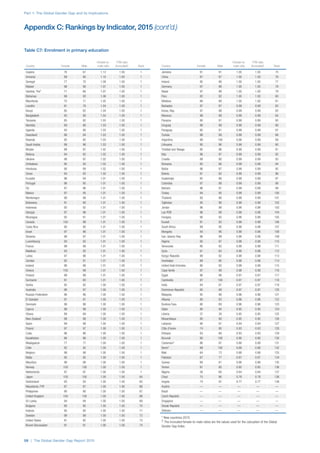
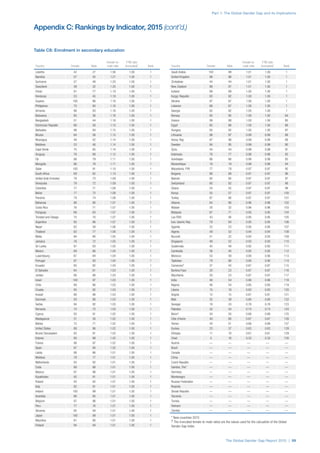
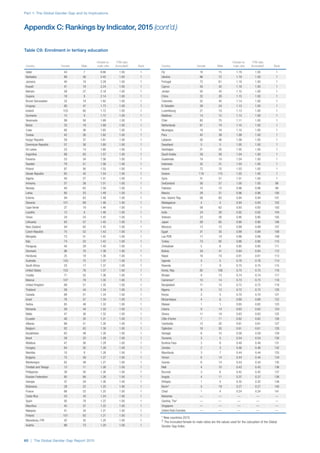
Appendix B illustrates the spread in 2015 of the data
for male and female values for all 14 indicators used in the
Index in a single visualization. Appendix C contains detailed
data tables, in rank order, for all 14 indicators included in
the Index for all countries where data was available in 2015.
Country Results
Country results are organized by region in this section.
Europe and Central Asia
Europe and Central Asia has closed 72% of its overall
gender gap. The region continues to rank second globally
behind North America. Out of the 46 countries of the
region, 32 countries have increased their overall score
compared to last year, while 14 have seen it decreasing.
Table 5: Rankings by region, 2015
Country Overall rank Overall score
Philippines 7 0.790
New Zealand 10 0.782
Australia 36 0.733
Lao PDR 52 0.713
Singapore 54 0.711
Mongolia 56 0.709
Thailand 60 0.706
Bangladesh 64 0.704
Vietnam 83 0.687
Sri Lanka 84 0.686
Brunei Darussalam 88 0.684
China 91 0.682
Indonesia 92 0.681
Japan 101 0.670
India 108 0.664
Cambodia 109 0.662
Nepal 110 0.658
Malaysia 111 0.655
Maldives 113 0.652
Korea, Rep. 115 0.651
Bhutan 118 0.646
Fiji 121 0.645
Iran, Islamic Rep. 141 0.580
Pakistan 144 0.559
Country Overall rank Overall score
Nicaragua 12 0.776
Bolivia 22 0.749
Barbados 24 0.744
Cuba 29 0.740
Ecuador 33 0.738
Argentina 35 0.734
Costa Rica 38 0.732
Bahamas 40 0.728
Colombia 42 0.725
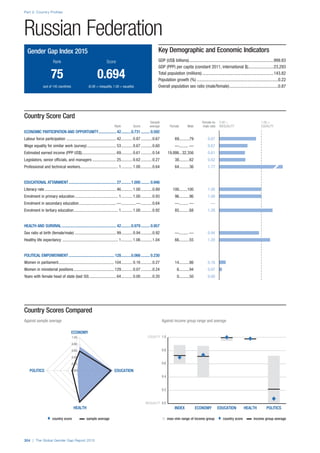
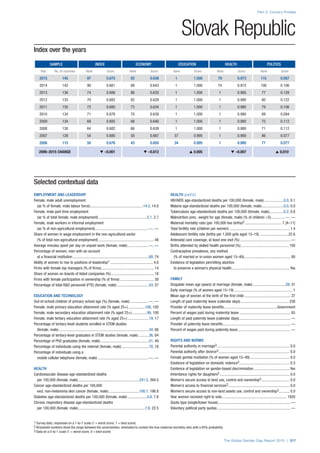
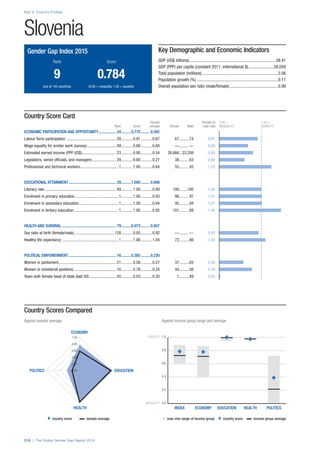
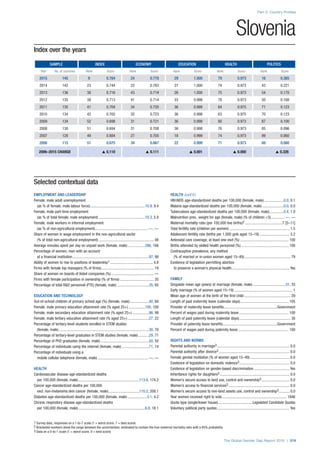
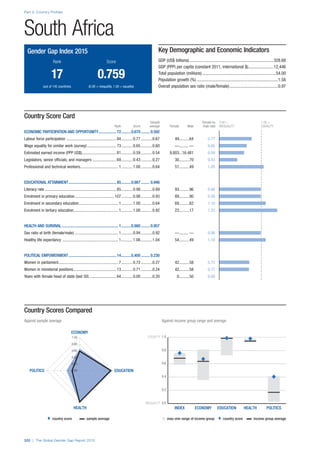
Panama 44 0.722
Trinidad and Tobago 46 0.720
El Salvador 62 0.706
Jamaica 65 0.703
Guyana 66 0.702
Mexico 71 0.699
Chile 73 0.698
Venezuela 78 0.691
Honduras 80 0.688
Brazil 85 0.686
Dominican Republic 86 0.686
Peru 89 0.683
Uruguay 93 0.679
Suriname 94 0.678
Belize 103 0.668
Guatemala 106 0.667
Paraguay 107 0.666
Country Overall rank Overall score
Israel 53 0.712
Kuwait 117 0.646
United Arab Emirates 119 0.646
Qatar 122 0.645
Bahrain 123 0.644
Tunisia 127 0.634
Algeria 128 0.632
Mauritania 132 0.613
Saudi Arabia 134 0.605
Oman 135 0.604
Egypt 136 0.599
Lebanon 138 0.598
Morocco 139 0.593
Jordan 140 0.593
Syria 143 0.568
Yemen 145 0.484
ASIA AND THE PACIFIC LATIN AMERICA AND THE CARIBBEAN MIDDLE EAST AND NORTH AFRICA
(Continued on next page)
Part 1: Measuring the Global Gender Gap
16 | The Global Gender Gap Report 2015
The region’s score has improved compared to 2014 on
all subindexes except Educational Attainment. Similar
to last year, the biggest improvement is on the Political
Empowerment subindex. Having closed 69% of its
economic gender gap, the region ranks third on this
subindex just after North America and Sub-Saharan
Africa. It also ranks third on the Educational Attainment
subindex, although 99% of the education gender gap has
been closed. On both the Health and Survival and Political
Empowerment subindexes, the region ranks second,
having closed 98% and 23% of the gap, respectively.
Forty countries from the region have been included
in the Index since 2006. Compared to the other regions,
Europe and Central Asia has experienced the fourth largest
absolute increase on the overall Index. On the Economic
Participation and Opportunity subindex, the region shows
the third largest absolute increase after both North America
and Latin America and the Caribbean. On the Educational
Attainment subindex, the region experienced the smallest
absolute score increase relative to other regions. On the
Health and Survival subindex, the region shows the second
largest absolute increase, and on the fourth subindex, it
has demonstrated the fourth largest increase, ahead of
Sub-Saharan Africa and North America.
Similar to last year, the top five spots on the overall
Index are occupied by countries from this region. Out
Table 5: Rankings by region, 2015 (cont’d.)
Country Overall rank Overall score
Rwanda 6 0.794
Namibia 16 0.760
South Africa 17 0.759
Burundi 23 0.748
Mozambique 27 0.741
Kenya 48 0.719
Tanzania 49 0.718
Cape Verde 50 0.717
Botswana 55 0.710
Zimbabwe 57 0.709
Uganda 58 0.708
Lesotho 61 0.706
Ghana 63 0.704
Malawi 68 0.701
Senegal 72 0.698
Madagascar 74 0.698
Cameroon* 90 0.682
Gambia, The* 98 0.674
Swaziland 102 0.670
Liberia 112 0.652
Burkina Faso 114 0.651
Zambia 116 0.650
Mauritius 120 0.646
Ethiopia 124 0.640
Nigeria 125 0.638
Angola 126 0.637
Benin* 129 0.625
Guinea 131 0.618
Côte d'Ivoire 133 0.606
Mali 137 0.599
Chad 142 0.580
* New countries 2015
Country Overall rank Overall score
Iceland 1 0.881
Norway 2 0.850
Finland 3 0.850
Sweden 4 0.823
Ireland 5 0.807
Switzerland 8 0.785
Slovenia 9 0.784
Germany 11 0.779
Netherlands 13 0.776
Denmark 14 0.767
France 15 0.761
United Kingdom 18 0.758
Belgium 19 0.753
Latvia 20 0.752
Estonia 21 0.749
Spain 25 0.742
Moldova 26 0.742
Lithuania 31 0.740
Luxembourg 32 0.738
Belarus 34 0.734
Austria 37 0.733
Portugal 39 0.731
Italy 41 0.726
Bulgaria 43 0.722
Serbia 45 0.720
Kazakhstan 47 0.719
Poland 51 0.715
Croatia 59 0.708
Ukraine 67 0.702
Macedonia, FYR 69 0.701
Albania 70 0.701
Russian Federation 75 0.694
Kyrgyz Republic 76 0.693
Romania 77 0.693
Montenegro 79 0.689
Czech Republic 81 0.687
Georgia 82 0.687
Greece 87 0.685
Tajikistan 95 0.675
Azerbaijan 96 0.675
Slovak Republic 97 0.675
Hungary 99 0.672
Cyprus 100 0.671
Malta 104 0.668
Armenia 105 0.668
Turkey 130 0.624
SUB-SAHARAN AFRICA EUROPE AND CENTRAL ASIA
Country Overall rank Overall score
United States 28 0.740
Canada 30 0.740
NORTH AMERICA
The Global Gender Gap Report 2015 | 17
Part 1: Measuring the Global Gender Gap
of the top 20 performing countries on the index, 14 are
from the region (two more than last year). Austria, Finland,
France and Latvia are the four countries from the region
that have fully closed both their Educational Attainment and
Health and Survival gender gaps. Out of the 25 countries
that have fully closed their Educational Attainment gender
gaps, 12 countries are from this region. However, on the
Health and Survival subindex, Azerbaijan, Albania and
Armenia are among the 10 lowest-performing countries.
On the Economic Participation and Opportunity subindex,
eight countries from the region are among the top 20
performing countries, which is one more than last year. The
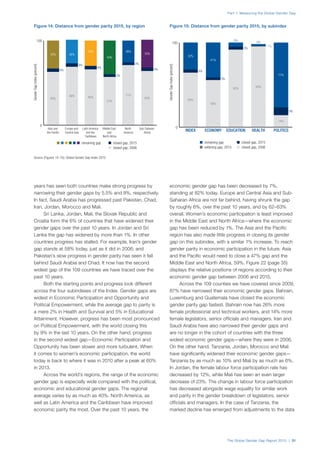
lowest-performing countries on that subindex are Malta
and Turkey. Ten out of the 20 top-performing countries
Table 6: Rankings by income group, 2015
Country Overall rank Overall score
Rwanda 6 0.794
Burundi 23 0.748
Mozambique 27 0.741
Tanzania 49 0.718
Zimbabwe 57 0.709
Uganda 58 0.708
Malawi 68 0.701
Madagascar 74 0.698
Gambia, The* 98 0.674
Cambodia 109 0.662
Nepal 110 0.658
Liberia 112 0.652
Burkina Faso 114 0.651
Ethiopia 124 0.640
Benin* 129 0.625
Guinea 131 0.618
Mali 137 0.599
Chad 142 0.580
Country Overall rank Overall score
Philippines 7 0.790
Nicaragua 12 0.776
Bolivia 22 0.749
Moldova 26 0.742
Kenya 48 0.719
Cape Verde 50 0.717
Lao PDR 52 0.713
Lesotho 61 0.706
El Salvador 62 0.706
Ghana 63 0.704
Bangladesh 64 0.704
Guyana 66 0.702
Ukraine 67 0.702
Senegal 72 0.698
Kyrgyz Republic 76 0.693
Honduras 80 0.688
Georgia 82 0.687
Vietnam 83 0.687
Sri Lanka 84 0.686
Cameroon* 90 0.682
Indonesia 92 0.681
Tajikistan 95 0.675
Swaziland 102 0.670
Armenia 105 0.668
Guatemala 106 0.667
India 108 0.664
Zambia 116 0.650
Bhutan 118 0.646
Nigeria 125 0.638
Mauritania 132 0.613
Côte d'Ivoire 133 0.606
Egypt 136 0.599
Morocco 139 0.593
Syria 143 0.568
Pakistan 144 0.559
Yemen 145 0.484
Country Overall rank Overall score
Namibia 16 0.760
South Africa 17 0.759
Cuba 29 0.740
Ecuador 33 0.738
Belarus 34 0.734
Costa Rica 38 0.732
Colombia 42 0.725
Bulgaria 43 0.722
Panama 44 0.722
Serbia 45 0.720
Kazakhstan 47 0.719
Botswana 55 0.710
Mongolia 56 0.709
Thailand 60 0.706
Jamaica 65 0.703
Macedonia, FYR 69 0.701
Albania 70 0.701
Mexico 71 0.699
Romania 77 0.693
Montenegro 79 0.689
Brazil 85 0.686
Dominican Republic 86 0.686
Peru 89 0.683
China 91 0.682
Suriname 94 0.678
Azerbaijan 96 0.675
Belize 103 0.668
Paraguay 107 0.666
Malaysia 111 0.655
Maldives 113 0.652
Mauritius 120 0.646
Fiji 121 0.645
Angola 126 0.637
Tunisia 127 0.634
Algeria 128 0.632
Turkey 130 0.624
Lebanon 138 0.598
Jordan 140 0.593
Iran, Islamic Rep. 141 0.580
Country Overall rank Overall score
Iceland 1 0.881
Norway 2 0.850
Finland 3 0.850
Sweden 4 0.823
Ireland 5 0.807
Switzerland 8 0.785
Slovenia 9 0.784
New Zealand 10 0.782
Germany 11 0.779
Netherlands 13 0.776
Denmark 14 0.767
France 15 0.761
United Kingdom 18 0.758
Belgium 19 0.753
Latvia 20 0.752
Estonia 21 0.749
Barbados 24 0.744
Spain 25 0.742
United States 28 0.740
Canada 30 0.740
Lithuania 31 0.740
Luxembourg 32 0.738
Argentina 35 0.734
Australia 36 0.733
Austria 37 0.733
Portugal 39 0.731
Bahamas 40 0.728
Italy 41 0.726
Trinidad and Tobago 46 0.720
Poland 51 0.715
Israel 53 0.712
Singapore 54 0.711
Croatia 59 0.708
Chile 73 0.698
Russian Federation 75 0.694
Venezuela 78 0.691
Czech Republic 81 0.687
Greece 87 0.685
Brunei Darussalam 88 0.684
Uruguay 93 0.679
Slovak Republic 97 0.675
Hungary 99 0.672
Cyprus 100 0.671
Japan 101 0.670
Malta 104 0.668
Korea, Rep. 115 0.651
Kuwait 117 0.646
United Arab Emirates 119 0.646
Qatar 122 0.645
Bahrain 123 0.644
Saudi Arabia 134 0.605
Oman 135 0.604
LOW INCOME
(US$ 1,045 OR LESS)
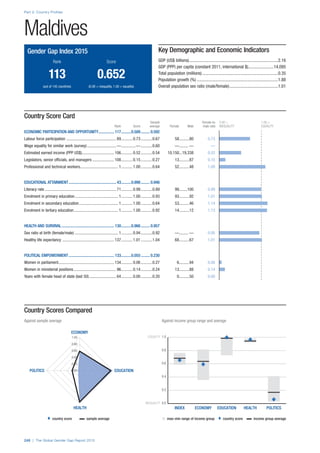
LOWER-MIDDLE INCOME
(US$ 1,046–4,125)
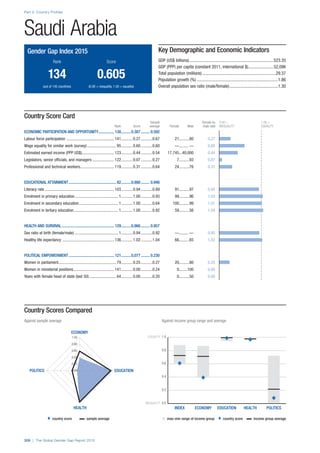
UPPER-MIDDLE INCOME
(US$ 4,126–12,735)
HIGH INCOME
(US$ 12,736 OR MORE)
Note: Income classifications are taken from the World Bank, which classifies economies into four income categories based on GNI per capita: high income, upper-middle income, lower-middle income and
low income.
* New countries 2015
Part 1: Measuring the Global Gender Gap
18 | The Global Gender Gap Report 2015
0.0 0.2 0.4 0.6 0.8 1.0
Lower-middle income
Low income
Upper-middle income
High income
Figure 9: Global Gender Gap Index 2015, by income group
Global Gender Gap Index score (0.0–1.0 scale)
Figure 10: Economic Participation and Opportunity subindex
2015, by income group
Figure 11: Educational Attainment subindex 2015, by income
group
0.0 0.2 0.4 0.6 0.8 1.0
High income
Upper-middle
income
Low income
Lower-middle
income
Economic Participation and Opportunity
subindex score (0.0–1.0 scale)
Educational Attainment
subindex score (0.0–1.0 scale)
0.5 0.6 0.7 0.8 0.9 1.0
High income
Upper-middle
income
Low income
Lower-middle
income
Source (Figures 9–13): Global Gender Gap Index 2015.
Notes (Figures 9–13): Colored diamonds correspond to income group averages. Details on income groups can be found in Appendix A. The X axis has been truncated on Figures 11 and 12 to enhance
readability.
Figure 12: Health and Survival subindex 2015, by income
group
Figure 13: Political Empowerment subindex 2015, by income
group
Health and Survival
subindex score (0.0–1.0 scale)
Political Empowerment
subindex score (0.0–1.0 scale)
0.5 0.6 0.7 0.8 0.9 1.0
High income
Upper-middle
income
Low income
Lower-middle
income
0.0 0.2 0.4 0.6 0.8 1.0
High income
Upper-middle
income
Low income
Lower-middle
income
The Global Gender Gap Report 2015 | 19
Part 1: Measuring the Global Gender Gap
on the Political Empowerment subindex—including four
countries in the top five: Iceland, Finland, Norway and
Sweden—are from Europe and Central Asia. On the Labour
force participation indicator, eight countries from the region
are part of the 20 best-performing countries. On the Sex
ratio at birth indicator, six out of the 10 lowest performing
countries are from the region, with Armenia ranking in the
second last position. On the Women in ministerial positions
indicator, 13 out of the 20 best-performing countries are
from the region, with Finland ranking in first place.
Iceland (1) is for the seventh year in a row the top
performer country on the overall Index. From 2006, the
country experienced a steady increase of its overall score,
except last year when the country showed a decrease
mostly due to a slight fall on the Health and Survival and
Political Empowerment subindexes. Iceland is among the
top three countries from the region that have improved
the most compared to 2006 on their overall Index and
Political Empowerment subindex scores. This year,
Iceland’s improvement on the Economic Participation
and Opportunity subindex score translated into a gain of
two ranks (from the 7th to the 5th position). As of 2009,
the country has fully closed its educational gender gap
and ranks first on the Political Empowerment subindex.
In Iceland, 41% of parliamentarians are women, 44% of
ministers are women and, out of the last 50 years, 20
were spent with a female head of state. Iceland ranks
105th on the Health and Survival subindex, gaining 23
places compared to last year. Iceland’s low score on that
subindex is due to its performance on the Healthy life
expectancy indicator. Iceland is also a strong performer
on the contextual indicators provided in the report but
not included in the Index. Iceland is among the top three
countries on the ability of women to rise to positions of
enterprise leadership. It is also the country with the longest
paternity coverage, with 90 calendar days entitled to new
fathers, one among many policies in the country (and in
other Nordic countries) to help parents combine work and
family.
Norway (2) is back in the second position after
having lost that place to Finland for three consecutive
years. This gain comes mainly from improvements in
Economic, Health and Political subindexes. Norway is the
highest-ranking country on the Economic Participation and
Opportunity subindex and the third highest on the Political
Empowerment subindex. The country ranks 32nd on the
Educational Attainment subindex and 70th on the Health
and Survival subindex—due to very small differences in
performance of the countries near the top—but scores
very high. The country is among the top twenty best
performers on the following five indicators: Labour force
participation, Wage equality for similar work, Women in
parliament, Women in ministerial position and Years with
female head of state. Norway is also the top country overall
on the share of women on boards of listed companies, with
37%, as well as the second best-performing country on
the Ability of women to rise to positions of leadership. The
country presents as well the smallest difference between
the average minutes spent per day on unpaid work by men
and women.
Finland (3) fell one place and now sits in the third
position on the overall Index. Finland however remains
the highest-ranked country from the European Union. It
ranks 8th on the Economic Participation and Opportunity
subindex, gaining 13 places compared to last year, mostly
due to improvements on the Wage equality for similar work
indicator. Finland is one of four countries from the region
that has fully closed gender gaps on both the Educational
Attainment and Health and Survival subindexes. Similar
to last year, Finland ranks second on the Political
Empowerment subindex. It is the third-ranked country from
the region on both the Labour force participation and Wage
equality for similar work indicators. Finland is also the top-
performing country on the Women in ministerial positions
indicator and has a government that is 63% women.
Sweden (4) ranks fourth for the seventh consecutive
year. The country ranks 4th on the Economic Participation
and Opportunity subindex, an increase of 11 places
compared with last year, due to improvements on the
Perceived wage equality for similar work, the Estimated
earned income and the Legislators, senior officials and
managers indicators. The country has seen its subindex
score on Educational Attainment decrease slightly due to
a drop on the Enrolment in secondary education score.
On the other hand, its Health and Survival subindex score
improved from last year. The country continues to rank
5th on the Political and Empowerment subindex. Despite
its high score on that subindex, Sweden is one of three
countries from the region with a smaller score increase
compared to 2006.
Ireland (5) gained three places compared to last
year, mainly due to improvements on the Economic and
Political subindexes. Ireland is among the top 10 best-
performing countries on the Political Empowerment
subindex. It is also one of the best three climbers from
the region on the Health and Survival subindex compared
to 2006. Finally, Ireland is the highest-ranked country
from the region (ranking 3rd overall) on the Years with
female head of state indicator. Switzerland (8) re-enters
the top 10, gaining three places compared to last year.
This is mostly due to improvements on the Economic
Participation and Opportunity as well as the Education and
Political subindexes. This year, Switzerland ranks 17th on
the Economic and Opportunity subindex and 18th on the
Political Empowerment subindex. Switzerland is among
the top 20 top-performing countries on both Women in
ministerial positions and Years with female head of state
indicators. Compared with 2006, Switzerland is among
the top three climbers from the region on the Educational
Attainment subindex. Switzerland continues to be the
fourth-highest ranked country overall on the percentage of
Part 1: Measuring the Global Gender Gap
20 | The Global Gender Gap Report 2015
female part-time employment compared to the total female
employment.
Next is Slovenia (9), which enters for the first time
the top 10 countries on the overall Index. Out of the 109
countries that have been part of the Index since 2006,
Slovenia has shown the fourth largest increase and the
largest increase from the Europe and Central Asia region.
Since 2006, all its subindexes scores have improved. The
biggest improvements have come from the Economic
Participation and Opportunity subindex and, in particular,
the Political Empowerment subindex. This year, Slovenia
ranks 21st on the Women in parliament indicator and
10th on the Women in ministerial positions indicator, with
women representing 44% of ministers (whereas it was 18%
last year). After Iceland, Slovenia has the second highest
length of paid paternity leave.
Germany (11) follows next. The country has seen its
overall score slightly increase compared to last year, due
to better performance on the Health and Survival and
the Political Empowerment subindexes. The increase has
been offset by a decrease on the Economic Participation
and Opportunity and Educational Attainment subindexes.
The country’s ten-year evolution is characterized by two
ups and downs; however, compared to 2006, Germany’s
overall score has improved. This year, the country ranks
38th on the Economic Participation and Opportunity
subindex, and 11th (similar to last year) on the Political
Empowerment subindex. Out of the 40 countries that
have provided data on the percentage share of women
on boards of listed companies, Germany has one of the
lowest percentages (2.8%). Germany shares with 10 other
countries the second lowest total fertility rate (1.4 children
per woman).
The Netherlands (13) ranks thirteenth on the overall
Index this year, gaining one position. It remains the
country with the highest percentage of female part-time
employment compared to total female employment (77%).
Despite the high level of male part-time employment,
Netherlands is the country with the largest difference
between female and male part-time employment. Next is
Denmark (14) at the fourteenth position, its lowest place
since the creation of the Index. Compared to 2006, its
overall score has steadily improved, but there have been
significant decreases from last year on the Economic,
Health and Political subindexes. Denmark remains the
country with the highest average minutes spent per day
by men on unpaid work. Denmark is followed by France
(15), which gained one place compared to last year due
to improvement on the Political Empowerment subindex.
This improvement has been slightly offset by a decrease
on the Economic Participation and Opportunity subindex.
Compared to 2006, France’s evolution is characterized
by two peaks, one in 2008 and one this year. France
is the second country from the region with the highest
increase compared to 2006 on the overall Index but also
on the Economic Participation and Opportunity subindex.
France has also achieved the third highest increase from
the region on the Political Empowerment subindex. In this
year’s ranking, France is among the four countries from the
region that have closed both their Educational and Health
gender gaps. France is also among the four countries that
rank first on the Women in Ministerial positions, with 50%
of Women in ministerial position. France is the lowest-
ranked country from the region on the Wage equality for
similar work indicator, sitting at 132nd position out of 134
countries. Regarding the share of women on boards of
listed companies, France is ranked second, after Norway.
The United Kingdom (18) re-enters the top 20
countries on the overall Index, gaining eight places over
last year. This increase is due to improvements on the
Economic, Health and Political subindexes. The country’s
ten-year evolution is characterized by three decreases: in
2008, 2012 and 2014. Next are Belgium (19) and Latvia
(20). Belgium lost nine places and Latvia five places
compared to 2014. In the case of Belgium, this is mostly
due to a decrease on the Health and Survival and Political
Empowerment subindexes. The percentage of women in
ministerial position has dropped from 42% to 23% in a
year. For Latvia, the reason is a decrease on the Economic
Participation and Opportunity and Political Empowerment
subindexes. Latvia remains one of the four countries from
the region that has closed both its Educational Attainment
and Health and Survival gender gaps. In addition, Latvia is
among the three countries with the highest percentage of
female research and development personnel.
Estonia (21) made the largest score improvement from
the region compared to 2014, mostly due to significant
improvement on the Political Empowerment subindex.
The percentage of women in parliament increased from
19% to 24% and the percentage of women in ministerial
positions increased from 17% to 46%. This year’s score
is the highest Estonia has achieved in the past 10 years.
Spain ranks 25th, followed by Moldova (26). Over the past
10 years, Spain experienced an increase on its Economic
Participation and Opportunity subindex score, whereas
the Political Empowerment subindex score has gradually
decreased, despite a peak in 2010 and 2011. Spain
experienced the second largest decrease on this subindex
over the past 10 years. Its overall Index score has mirrored
that peak during the same years.
Lithuania (31), Luxembourg (32) and Belarus (34)
follow next. This year, Lithuania ranks 14th globally on the
Labour force participation indicator, between Sweden and
Denmark. Luxembourg is the country from the region with
the largest improvement on the Economic Participation
and Opportunity subindex compared to 2006. Belarus
is the highest-ranked country from the region on the
Legislators, senior officials and managers and Professional
and technical workers indicators, with 44% of leadership
positions held by women and 73% of Professional and
technical workers occupied by women. Belarus is also the
top country from the region in the upper-middle income
The Global Gender Gap Report 2015 | 21
Part 1: Measuring the Global Gender Gap
group. Out of the 95 countries that have provided data
for the Firms with female top manager indicator, Belarus
has the third largest percentage overall after Mongolia and
Bahamas.
Austria (37) has seen a small decrease from 2014
of its overall score. Austria is the third country from the
region with the largest improvement on the Economic
Participation and Opportunity subindex over the past 10
years.
Austria is followed by Portugal (39) and Italy (41).
Italy has shown a steady increase on its overall score
with the exceptions of 2010 and 2012. The increase of
the overall score has been driven over the past three
years by improvements on the Political Empowerment
subindex. Italy gained 28 positions over 2014, mostly on its
Political Empowerment subindex due to an increase in the
percentage of women in parliament and women holding
ministerial positions. This year, Italy is again among the
three lowest-performing countries from the region on the
Economic Participation and Opportunity subindex (together
with Malta and Turkey). This year, the country ranks 91st
overall on the Labour force participation indicator and
109th on wage equality for similar work. Bulgaria (43)
is next at the 43rd position. Bulgaria had experienced
last year a peak in its overall score, which was due to
improvements on both the Economic Participation and
Opportunity and Political Empowerment subindexes. This
year, these two subindexes have seen their score decrease
again, influencing the overall score in the same direction.
Following next are Serbia (45), Kazakhstan (47), Poland
(51) and Croatia (59). Croatia is the country from the region
with the largest decrease on the overall Index compared to
2006.
Ukraine’s (67) overall score has fallen from 2014
due to decreases on the Economic Participation and
Opportunity and Political Empowerment subindexes.
Macedonia, FYR follows, ranking 69th. It continues to
have the highest percentage of female R&D personnel
(FTE) compared to men. Albania stands in the 70th
position. Albania has improved its overall ranking by 13
positions since 2014; however, it is also the country from
the region that has progressed the least over the past
10 years on the Educational Attainment and Health and
Survival subindexes. Russian Federation (75) improved
its overall score compared to 2006, having peaked in
2010 and 2011. Compared to last year, the country’s
overall score slightly improved with no impact on its overall
rank. This year, the Russian Federation ranks 42st on the
Economic Participation and Opportunity subindex (similar
to last year) and 128th on the Political Empowerment
subindex. Similar to last year, the country remains among
the three lowest-ranking countries of the region on this
subindex. The country ranks first on the Healthy life
expectancy indicator, with a female-to-male ratio of 1.20.
Next is the Kyrgyz Republic (76). Its best
performance over the last 10 years was in 2009.
Compared to 2006, the Kyrgyz Republic is among the
three countries from the region with the lowest increase on
the Economic, Education and Health subindexes. Following
next are Romania (77) and Montenegro (79). The Czech
Republic (81) gained 15 places this year compared to
last year, mostly due to improvements on the Economic
Participation and Opportunity and Political Empowerment
subindexes. The percentage of women in ministerial
positions improved from 7% to 19%. Georgia (82) follows,
with Greece (87) and Tajikistan (95) next. Georgia is the
country from the region that has made the most progress
on the Health and Survival subindex since 2006. Greece’s
highest overall score over the past 10 years was in 2011.
Similar to last year, Greece ranks 87th on the Economic
Participation and Opportunity subindex. On the Political
Empowerment subindex, however, the country gained 17
places over last year, ranking this year at the 91st position.
Tajikistan is the lowest-performing country from the region
on the Enrolment in tertiary education and Healthy life
expectancy indicators.
Next are Azerbaijan (96), Slovak Republic (97),
Hungary (99) and Cyprus (100). Azerbaijan is the second-
lowest ranked country from the region on the Political
Empowerment subindex, in 129th place. On the Health and
Survival subindex, it is the third-lowest performing country
from the region, ahead of Albania and Armenia. Out of the
95 countries that have provided data for the Firms with
female top managers indicator, Azerbaijan presents the
third-smallest percentage overall, just ahead of Jordan
and Yemen. It is also, overall, the country with the lowest
percentage of firms with female participation in ownership.
Slovak Republic lost seven places this year, due to
decreases on the Economic Participation and Opportunity
and Political Empowerment subindexes. The Slovak
Republic is among the five countries in the world that
don’t have any women in ministerial positions. Hungary
lost six places this year due to a drop on the Political
Empowerment subindex, where it is again this year the
region’s lowest performing country, ranking 139th. Hungary
is the region’s lowest-ranked performer on the Women in
parliament indicator, with only 10% of its parliament made
up of women. It is also among the five countries in the
world that don’t have any women in ministerial positions.
The final positions in the region are occupied by Malta
(104), Armenia (105) and Turkey (130). Malta’s overall
highest score over the past 10 years was in 2013. This year
Malta lost five places, due to a decrease on the Political
Empowerment subindex. Armenia continues to be the
lowest-performing country from the region on the Health
and Survival subindex. Armenia has the second lowest
female-to-male sex ratio at birth score in the world, just
above China’s. However Armenia has a high percentage
(64%) of female professional and technical workers. Turkey
has experienced a steady improvement of its overall score
since 2010. Compared to 2006, the country is among the
top three climbers from the region on the Education and
Part 1: Measuring the Global Gender Gap
22 | The Global Gender Gap Report 2015
Health subindexes. Over the past 10 years, the evolution of
its Economic Participation and Opportunity subindex score
forms a U shape, with its lowest point in 2010. Turkey is
again the lowest-performing country from the region on the
Economic Participation and Opportunity subindex. Out of
the 29 countries that have provided data on the average
minutes spent per day in unpaid work, Turkey has the
third-largest difference between women and men, following
Mexico and India.
Latin America and the Caribbean
The Latin America and Caribbean region has closed 70%
of the overall gender gap. It is the third-best performing
region on the overall Index after North America and
Europe and Central Asia. It is also the best performer
on Health and Survival and second best on Educational
Attainment. Compared to 2014, the region has slightly
progressed on Political Empowerment and regressed
on Economic Participation and Opportunity, with more
than 20% and 62%, respectively, of the gender gaps
now closed. The Educational Attainment and Health and
Survival gender gaps remain roughly the same at 99% and
98%, respectively. When compared to 2006, the region
has shown the most improvement on the overall Index
and second-most improvement on both the Economic
Participation and Opportunity and Political Empowerment
subindexes. The region is also home to the best climber
of the world on the overall Index, Nicaragua, and the
best climber of the world on the Political Empowerment
subindex, Bolivia.
Nicaragua (12) remains the best performer of the
region for the fourth year in a row despite dropping six
places from 2014 to 2015. It has closed the gender gap
fully on both Educational Attainment and Health and
Survival. Furthermore, on Political Empowerment it is the
highest-ranking country of the region and fourth in the
world, with more than 50% of the gender gap now closed.
Since 2006, it is the world’s most improved country on
the overall Index and third-most improved of the world on
Political Empowerment. Bolivia (22) moves up 36 places
from last year, making it the second-best performer of the
region, with nearly 75% of the gender gap now closed. This
is mostly due to an increase on the Political Empowerment
score, resulting from a doubling of women in parliament
(from 25% to 53%). The country is now the second-highest
ranked country in the region on the Political Empowerment
subindex, with 42% of the gender gap now closed. On
the Health and Survival subindex it has fully closed its
gender gap, but on Educational Attainment it is the region’s
second-worst performer. Since 2006, the country is the
world’s most improved country on Political Empowerment
and second-most improved on the overall Index.
Barbados (24) moves up nine places from last year,
overtaking Cuba, Ecuador and Argentina on the regional
rankings. This is mostly due to an increase of its Economic
Participation and Opportunity score, resulting from a rise
in the number of female legislators, senior officials and
managers as well as professional and technical workers.
It is now the best-performing country of the region and
second in the world on this subindex. It has also fully
closed its Health and Survival gender gap. Within the
region, it scores above average on all subindexes except
Political Empowerment. Cuba (29) moves up one spot
from last year. This is partly due to an increase in the
number of women in ministerial positions (from 23%
to 31%). It has nearly closed the gender gap on the
Educational Attainment subindex and ranks third in the
region on Political Empowerment with 40% of the gender
gap now closed. Ecuador (33) has regressed since last
year, dropping 12 places in rank. This is partly due to a
slight decrease in the female-to-male ratio of estimated
earned income. In Health and Survival it has fully closed
the gender gap. When compared to 2006, it is the second-
most improved country in the region and the fourth-most
improved of the world on the Economic Participation and
Opportunity subindex.
Argentina (35) has slightly progressed since last
year despite dropping four places in rank. This is due to
a slight increase on the Political Empowerment subindex,
resulting from more women in ministerial positions and
an additional year with a female head of state. It has fully
closed its gender gap on the Health and Survival subindex.
Since 2006 it has improved across all subindexes except
Educational Attainment, where there has been no change
in score. Costa Rica (38) has improved over last year
and moves up 10 places with 73% of the gender gap
now closed. This is due to a near doubling of women in
ministerial positions (from 25% to 41%). It has also fully
closed its gender gap on the Educational Attainment
subindex, but ranks among the bottom three in the region
on Health and Survival. Since 2006, it has improved in all
subindexes except Health and Survival where it has slightly
regressed. Bahamas (40) drops five places since last year
but slightly increased its score. It has closed the gender
gap fully on the Educational Attainment and Health and
Survival subindexes, and is the second-best performing
country in the region on Economic Participation and
Opportunity, with more than 82% of the gender gap now
closed.
Colombia (42) has made progress over last year,
moving up 11 places in rank. This is due to improvements
in wage equality for similar work and estimated earned
income. It is now the third-best performing country in
the region on the Economic Participation an Opportunity
subindex, with more than 74% of the gender gap now
closed. Since 2006, it has made almost no improvement
on Health and Survival and Political Empowerment and
has actually regressed on Educational Attainment. Both
Panama (44) and Trinidad and Tobago (46) made slight
progress over last year, with more women in parliament.
Both countries have also fully closed their gender gap on
Health and Survival in 2015. In fact, since 2006, they have
The Global Gender Gap Report 2015 | 23
Part 1: Measuring the Global Gender Gap
improved on all subindexes except Educational Attainment,
where they have regressed. El Salvador (62) rises 22
places, with more women in parliament and in ministerial
positions (from 7% to 21%). Since 2006 it has fully closed
its Health and Survival gender gap and has improved
across all indicators.
Jamaica (65) has dropped 13 places on the Economic
Participation and Opportunity subindex, mostly due to
recently available data for the number of female legislators,
senior officials and managers. It has closed the gender
gap fully on Health and Survival and is the most improved
country of the region on this subindex since 2006. It has
also improved on Political Empowerment but is the region’s
least improved country on Economic Participation and
Opportunity and on the overall Index. Guyana (66) follows
and drops two places from last year, without any major
changes in score besides slight improvements in literacy
rate, wage equality and the number of women in ministerial
positions. Its Educational Attainment and Health and
Survival gender gaps remain fully closed but the country
is the region’s second-worst performer on Economic
Participation and Opportunity.
Mexico (71) moves up nine places from last year with
more women in parliament. Slight improvements have also
been made in estimated earned income and the number
of female legislators, senior officials and managers, but
it remains the region’s lowest-ranked country on the
Economic Participation and Opportunity subindex, with
less than 55% of the gender gap closed. Since 2006 it
has fully closed its Health and Survival gender gap and
ranks among the top five most-improved countries in the
region on the overall Index and Political Empowerment
subindex. It has slightly regressed on Educational
Attainment. Chile (73) hasn’t changed in score despite
dropping seven places from last year. The number of
legislators, senior officials and managers has improved,
as has the number of years with a female head of state,
but there are fewer women in ministerial positions. It
ranks among the bottom three in the region on Economic
Participation and Opportunity. Since 2006 it has improved
on all subindexes except Health and Survival and ranks
among the region’s top five most-improved countries on
Educational Attainment. Venezuela (78) moves up eight
places in rank, with 69% its gender gap now closed.
While it has regressed on Economic Participation and
Opportunity, improvements have been made on Political
Empowerment, as it has added more women in ministerial
positions. Most of the progress made since 2006 has
occurred on these two subindexes. Honduras (80) drops
seven places in rank, with less wage equality for similar
work. It has fully closed the gender gap on the Educational
Attainment subindex. Since 2006 it has improved across all
subindexes except Health and Survival where it has slightly
regressed.
Brazil (85) has slightly regressed, dropping 14 places
since 2014. This is likely due to a fall in the number of
women in ministerial positions (from 26% to 15%). Yet its
Educational Attainment and Health and Survival gender
gaps remain fully closed, and, since 2006, it has improved
across all subindexes, with the most progress being
made on Political Empowerment. Dominican Republic
(86) is ranked next and has similarly regressed, dropping
eight places since last year. While improvements have
been made to its Political Empowerment score, with more
women in ministerial positions, Economic Participation
and Opportunity has suffered, with less wage equality for
similar work. Since 2006, it is the least improved country
of the region and third least improved globally on the
Educational Attainment subindex. It is also the region’s
least improved on the Health and Survival subindex,
ranking in the region’s bottom three today. Peru (89) has
also regressed, dropping 44 places since last year. This is
mostly due to halving the number of women in ministerial
positions (from 44% to 22%). However, since 2006, it has
improved across all subindexes except Health and Survival
where it has regressed. It is the worst performing country
of the region in this category, with 97% of the gender gap
closed.
Uruguay (93) drops 11 places in 2015, with fewer
female legislators, senior officials and managers. Some
progress has been made in the percentage of women in
parliament and in ministerial positions but the country is
still one of the region’s three worst performers on these
indicators. Since 2006 it has fully closed its gender gap
on Health and Survival and has advanced across all
subindexes. Suriname (94) follows, but has risen 15 places
since last year. This can be attributed to an increase in the
number of female legislators, senior officials and managers
and the number of professional and technical workers,
as well as a doubling of women in parliament (from 12%
to 25%). Since 2012 it has fully closed its Health and
Survival gender gap. Belize (103) drops three places from
last year due to a slight decrease in female enrolment in
secondary education. It is the worst performing country of
the region on Political Empowerment, with less than 5% of
the gender gap closed. The gender gap on the Health and
Survival subindex has remained fully closed since 2007.
Guatemala (106) has regressed, dropping 17 places from
last year, with fewer women in ministerial positions. When
compared to 2006, the country is the most improved of the
region and third-most improved globally on the Economic
Participation and Opportunity subindex. Similarly, while it
is the region’s lowest-performing country on Educational
Attainment, it has improved the most since 2006. The
gender gap on Health and Survival remains fully closed.
Paraguay (107) drops 26 places from last year and is the
worst performing country of the region, with less than
67% of the gender gap closed. It has regressed across
most of the indicators in Economic Participation and
Opportunity—with wage equality for similar work being the
exception. The number of women in ministerial positions
has also nearly halved (from 25% to 8%) making it the
Part 1: Measuring the Global Gender Gap
24 | The Global Gender Gap Report 2015
second-worst performing country of the region on the
Political Empowerment subindex. However, it improved on
Health and Survival, fully closing the gender gap this year.
Since 2006, it is the second-most improved country of the
region on Educational Attainment but the least improved
on Political Empowerment.
North America
North America has closed 74% of its overall gender gap,
remaining the best performer on the global Index. It is also
the best performer on the Economic Participation and
Opportunity subindex, with 82% of the gender gap closed,
and on the Educational Attainment subindex, where it
has nearly achieved parity. On the Health and Survival
subindex it ranks third in the world; yet on the Political
Empowerment it ranks second-to-last, with less than 17%
of the gender gap closed. In fact, when compared to
2006, North America is the second-least improved region
on the overall index and on the Health and Survival and
Political Empowerment subindexes. It is, however, the
most improved region on the Economic Participation and
Opportunity subindex.
The United States (28) falls eight places this year and
drops out of the top 20, mostly due to a decrease on its
Political Empowerment score, where it has demonstrated
fewer women in ministerial positions (from 32% to 26%).
On the Economic Participation and Opportunity subindex,
the country also drops out of the top five, with slightly less
wage equality for similar work. It ranks in the top 10 on the
Estimated earned income and Professional and technical
workers indicators, and top 25 on the Legislators, senior
officials and managers indicator. The country has not
reached full parity on either the Educational Attainment or
Health and Survival subindexes. Over the past 10 years,
its overall score has fluctuated, with a peak in 2014. It has
improved across all subindexes except Health and Survival,
where it has slightly regressed.
Canada (30) falls 11 places this year, mainly due to a
decrease on its Economic Participation and Opportunity
score, with less wage equality for similar work as well, as
on its Political Empowerment score, where it has slightly
less women in ministerial positions. It ranks among the top
25 on the labour force participation and estimated earned
income indicators. The country continues to rank first in
the world with full parity on the Educational Attainment
subindex, but ranks below the regional average on Health
and Survival, with less than 97% of the gender gap
closed. Looking back to 2006, Canada’s overall score is
characterized by similar fluctuations in score with a peak
in 2014. Like the United States, Canada has improved on
all subindexes except Health and Survival, where it has
slightly regressed.
The Middle East and North Africa
The Middle East and North Africa region has closed almost
60% of the overall gender gap. However, it ranks last
globally on the overall Index; on the Economic Participation
and Opportunity subindex, with only 40% of the gender
gap closed; and on the Political Empowerment subindex,
with only 9% of the gender gap closed. Four of the five
world’s lowest-ranking countries on this latter subindex
belong to this region. On both Educational Attainment
(93% of the gender gap closed) and Health and Survival
(nearly 97% of the gender gap closed) it ranks fifth
globally—surpassing Sub-Saharan Africa and Asia and
the Pacific, respectively. Still, no country from the region
has fully closed its gender gap on either subindex. When
compared to 2006, the region has shown the most
improvement on the Educational Attainment subindex, but
the least improvement on the overall Index as well as on
the Economic Participation and Opportunity and Political
Empowerment subindexes. The region is also home to the
best climber of the world on the Economic Participation
and Opportunity subindex: Bahrain.
Israel (53) continues to hold the top spot in the
Middle East and North Africa region and moves up 12
places on the overall ranking due to improvements on
the Economic Participation and Opportunity, Health
and Survival, and Political Empowerment subindexes It
is the region’s best-performing country across all four
subindexes. It is also the best performer on the Labour
force participation and Legislators, senior officials and
managers indicators, but the second-worst performer on
the Wage equality for similar work indicator. The country is
the region’s second most improved country on the Health
and Survival subindex since 2006. Kuwait (117) drops four
places this year. It is the region’s second-best performing
country on Educational Attainment and the third-best
performer on Economic Participation and Opportunity.
On Health and Survival it is the lowest-performing country
along with Qatar, with less than 96% of the gender gap
closed. It has improved across all subindexes since 2006,
with Educational Attainment and Health and Survival
the exceptions. The United Arab Emirates (119) follows
closely. It scores above the regional average across all
subindexes except Health and Survival, where it is the
third-lowest ranked country, with 96% of the gender gap
closed. It ranks first in the region on literacy rate and
third on wage equality for similar work. Since 2006 it
has improved across all subindexes except Health and
Survival. Next is Qatar (122), the region’s second-best
performing on Economic Participation and Opportunity, but
the second-lowest performer on Health and Survival and
lowest performer on Political Empowerment, where it has
closed only 1.3% of the gender gap.
Bahrain (123) scores above the regional average
on Economic Participation and Opportunity, with
the region’s highest score on the Wage equality for
similar work indicator. It also scores above average on
Educational Attainment with the second-highest score
on the Enrolment in tertiary education indicator. It is
the world’s most improved country on the Economic
The Global Gender Gap Report 2015 | 25
Part 1: Measuring the Global Gender Gap
Participation and Opportunity subindex, and the second-
most improved of the region on the overall Index since
2006. Nevertheless, it is also the least improved since
2006 on both the Educational Attainment and Political
Empowerment subindexes. Tunisia (127) scores above the
regional average across all subindexes and ranks best in
the region for healthy life expectancy and second best on
the percentage of female legislators, senior officials and
managers. Since 2006, it has shown the region’s most
improvement on the Health and Survival subindex. Algeria
(128) is the region’s second-best performing country on
Political Empowerment, with the highest percentage of
women in parliament (32). In fact, it is the second-most
improved country on this subindex when compared with its
2006 performance.
Mauritania (132) is the region’s second-best
performing country on the Health and Survival subindex
and the third-best performer on Political Empowerment
where it has the highest percentage of women in ministerial
positions (27). It is the most improved of the region in
this subindex since 2006. Still, it is the second lowest
performing country on Educational Attainment, with the
lowest enrolment of women in tertiary education. Saudi
Arabia (134) drops four places from last year, mainly due to
a decrease on its Economic Participation and Opportunity
and Health and Survival scores. It is the region’s third-
best performing country on Educational Attainment, with
parity across enrolment in primary, secondary, and tertiary
education. Still, it ranks below the regional average across
the rest of the subindexes. Since 2006, the country has
shown the region’s largest improvement on the overall
Index and the second-largest improvement on Economic
Participation and Opportunity. On Educational Attainment,
it is the fifth-most improved country in the world; however,
it is the world’s fifth-least improved country on Health and
Survival.
Oman (135) drops seven places from last year, due
to regression on Economic Participation and Opportunity.
It ranks above the regional average across all subindexes
except Political Empowerment, where it is the third-
lowest performing country of the region. Egypt follows
in 136th position this year, with scores above average
on all subindexes except Political Empowerment. Since
2006, the country has improved on three out of the four
subindexes; the lone exception, the Health and Survival
subindex. Lebanon (138) has improved over 2014, with
the second highest percentage of female professional and
technical workers in the region and more female ministers.
Still, it is the region’s second-lowest performer on Political
Empowerment, with only 3% of female parliamentarians.
Morocco (139) is the third-best performing country of the
region on Health and Survival, but also the third-lowest
performing country on Educational Attainment, where it
has closed less than 92% of the gender gap. Since 2006
it has improved across all subindexes except Economic
Participation and Opportunity, where it is the world’s
third-least improved country. Jordan (140) is the region’s
third-lowest performing country on Economic Participation
and Opportunity, with 35% of the gender gap closed.
It ranks below the regional average across the rest of
the subindexes except Educational Attainment. While
improvements have been made on Educational Attainment
and Political Empowerment since 2006, it is the world’s
second-least improved country on the overall Index as
well as on the Economic Participation and Opportunity
subindex.
Syria (143) drops four places from last year and
remains in the bottom five of the global ranking. It is the
region’s second-lowest performing country on Economic
Participation and Opportunity, with the region’s lowest
score on the Labour force participation indicator. Yemen
(145) continues to occupy the last place in the region
and on the global Index since 2006. It is the lowest
performing country of the region across the Economic
Participation and Opportunity subindex and fourth-lowest
in the world on Educational Attainment. It has made some
improvements, though, and since 2006 it has been the
most improved country of the region and fourth in the
world on Educational Attainment. Still, it is also the least
improved of the region and fourth-least improved of the
world on the Health and Survival subindex.
Asia and the Pacific
The Asia and the Pacific region has closed more than
67% of its overall gender gap. It has improved its Political
Empowerment performance since 2014 and remains first
globally with more than 25% of the gender gap closed.
However, the region ranks second from the bottom on the
overall Index and Economic Participation and Opportunity
subindex, with 54% of the gender gap closed. On Health
and Survival, the region has regressed since 2014 and,
once again, scores last with less than 95% of the gender
gap closed. When compared to 2006, the region is the
most improved on Political Empowerment and second-
most improved on Educational Attainment and on the
overall Index. It is the least improved on Health and
Survival despite being home to three of the five most-
improved countries on this subindex. Of the 24 countries
in the region, 17 have improved and seven have regressed
since 2006. The region is also home to one of the top
five climbers on the overall Index and on Educational
Attainment: Nepal.
The Philippines (7) has made progress from last
year and continues to rank among the top 10 on the
overall index and first in the region with 79% of its gender
gap closed. This can be explained by an increase on its
Economic Participation and Opportunity score, which
is due to more female legislators, senior officials and
managers as well as professional and technical workers.
It now ranks third-best in the region on this subindex.
Improvements have also been made on the Political
Empowerment subindex, due to more women in ministerial
Part 1: Measuring the Global Gender Gap
26 | The Global Gender Gap Report 2015
positions. The Health and Survival gender gap remains fully
closed while the Educational Attainment gap, which had
been fully closed since 2006, reopens slightly. Since 2006,
the country has progressed across all categories except
Educational Attainment, where it has slightly regressed.
New Zealand (10) similarly improves and moves up
three places from last year, joining the top 10 on the overall
Index with more than 78% of its gender gap closed. The
country has also improved on Economic Participation and
Opportunity, with better wage equality for similar work
and more equal estimated earned income. Improvements
have also been made on Political Empowerment, and
the country now ranks third best in the region in this
subindex. Its Educational Attainment gender gap remains
fully closed. Since 2006, the country has progressed
across all categories except Health and Survival where it
has slightly regressed. Australia (36) follows and drops
12 places from where it ranked in 2014, with 73% of
the gender gap now closed. This can be explained by a
decrease on its Economic Participation and Opportunity
score, due to a drop in estimated earned income. Since
2006, its Educational Attainment gender gap has remained
fully closed. The country has shown progress across
all subindexes except Health and Survival where it has
slightly regressed. Lao PDR (52) moves up by eight places,
closing 71% of its overall gender gap. The country has
increased its Economic Participation and Opportunity
score, with improvements to the Estimated earned income
indicator score, and now ranks second best in the region
on this subindex. Its Educational Attainment score has
also improved, due to higher literacy rates and more equal
enrolment in secondary and tertiary education.
Singapore (54) moves up five places from last year
due to improvements to its Economic Participation and
Opportunity score, where it has increased wage equality
for similar work and added more female legislators,
senior officials and managers as well as professional
and technical workers. The country now ranks first in the
region on this subindex. Yet on Educational Attainment
and Political Empowerment it scores below the regional
average. Singapore has made progress across all
subindexes since 2006 and is the most improved
country in the region on Economic Participation and
Opportunity. Mongolia (56) falls twelve spots from last
year. The decrease can mainly be seen on the Political
Empowerment score, with fewer women in ministerial
positions (from 17% to 11%). The Health and Survival
gender gap remains fully closed. When compared to
2006, the country has demonstrated improvements across
all subindexes except Educational Attainment where it
has regressed. Thailand (60) moves down one rank but
slightly improves its overall score, due to an increase on
the Economic Participation and Opportunity subindex—in
particular, more female legislators, senior officials and
managers in the workforce. The country’s Health and
Survival gender gap is fully closed. When compared
to 2006, the country has shown progress across all
subindexes except Political Empowerment, where it has
regressed.
Bangladesh (64) moves up four places from 2014 to
2015, showing improvement across all subindexes except
Economic Participation and Opportunity. After a steady
increase in score from 2006 to 2010, the country has
regressed on this subindex since 2013. Its Educational
Attainment score continues to rise, due to higher literacy
rates and enrolment in tertiary education. On the Health
and Survival subindex, the country ranks first in the region
and, since 2006, is the second most-improved country in
the world. Improvements have also been made on Political
Empowerment, with more years with a female head of
state; since 2006, it has been the second-most improved
country of the region on this subindex. Bangladesh is also
the region’s second-most improved country on the overall
Index.
Vietnam (83) has fallen seven places on the overall
ranking. While its Economic Participation and Opportunity,
Political Empowerment and Health and Survival scores
have remained almost unchanged, its Educational
Attainment score has decreased. This may be attributed
to a decrease in female literacy rates. Sri Lanka (84) drops
five positions—it has less wage equality for similar work
and fewer female legislators, senior officials and managers.
The country’s Political Empowerment performance has
also regressed, with fewer years with a female head
of state, even though there are now more women in
ministerial positions. The Health and Survival gender gap
is fully closed. Since 2006 the country is the region’s
least improved country on the overall Index, and the least
improved in the world, on the Political Empowerment
subindex.
Brunei Darussalam (88) moves up by 10 places
from 2014, with an improved Economic Participation and
Opportunity score due to more female legislators, senior
officials and managers as well as female professional
and technical workers. However, it ranks last in the world
on Political Empowerment, with no women in ministerial
positions or years with a female head of state. China
(91) drops four places from last year, slightly regressing
in score due to a decrease in female sex ratio at birth.
It is the world’s lowest-ranked country on this indicator.
China has slightly improved its Economic Participation
and Opportunity performance, with more wage equality
for similar work, as well as its Political Empowerment
score, where it has seen an increase in the percentage of
women in ministerial positions. Since 2006 it has shown
progress across all subindexes except Health and Survival
where it is now the third-least improved country in the
world. Indonesia (92) moves up five places, due to a near
doubling of women in ministerial positions (from 12% to
23%). Since 2006, the country has been steadily improving
across all subindexes except Economic Participation and
Opportunity, where it has regressed.
The Global Gender Gap Report 2015 | 27
Part 1: Measuring the Global Gender Gap
Japan (101) moves up three places from 2014 due to
a similar near doubling of women in ministerial positions
(from 11% to 22%). The Health and Survival gap remains
unchanged since 2012, at almost 98%, and the Economic
Participation and Opportunity score has decreased since
2014, due to lower wage equality for similar work and
fewer female legislators, senior officials and managers.
Since 2006 the country has demonstrated progress across
all subindexes except Health and Survival where it has
slightly regressed. India (108) moves up six positions from
2014 with more than double the percentage of women in
ministerial positions (from 9% to 22%). It now ranks second
in the region on this subindex. While the Educational
Attainment and Health and Survival scores have also
improved, the country ranks third-lowest in the region and
third-lowest in the world on both subindexes. Economic
Participation and Opportunity has declined due to a
decrease in wage equality for similar work and less female
labour force participation, placing the country third-lowest
in the region. Since 2006 the country has improved across
most subindexes, and in fact is the region’s most-improved
country on Political Empowerment. Nevertheless, it has
regressed on Economic Participation and Opportunity and
is the world’s least-improved country on the Health and
Survival subindex.
Cambodia (109) slightly improves its Economic
Participation and Opportunity score, showing consecutive
growth with more wage equality for similar work. The
country has also improved on the Political Empowerment
subindex, adding more women in ministerial positions.
While higher literacy rates have boosted Educational
Attainment, it is the region’s second-lowest ranking
country on this subindex. The country has reached gender
parity on the Health and Survival subindex. Since 2006
the country has improved across all subindexes. Nepal
(110) moves up two spots from last year, with improved
Economic Participation and Opportunity and Educational
Attainment scores. There have been no major fluctuations
on Health and Survival but its Political Empowerment
score has decreased slightly. Since 2006 the country
has improved across all subindexes, and ranks as the
second-most improved country in the world on Educational
Attainment and third-most improved globally on the overall
Index and on Health and Survival. It is also the region’s
second-most improved on Economic Participation and
Opportunity.
Malaysia (111) slightly improves in score despite
falling four places in rank. Improvements across Economic
Participation and Opportunity are a likely cause but the
country has slightly regressed on Political Empowerment,
where it now ranks third lowest. It has also regressed
slightly on the Educational Attainment subindex; in fact,
since 2006, it is the world’s least improved country on
this subindex. Over the last decade it has also regressed
on both Health and Survival and Political Empowerment.
The Maldives (113) drops eight places in rank due, in
part, to less equal estimated earned income and fewer
women in ministerial positions. The country ranks above
the regional average across all subindexes except Political
Empowerment, where less than 6% of its gender gap has
closed.
Korea, Rep. (115) moves up two places with 65% of
its overall gender gap now closed. This is likely triggered
by progress across nearly all indicators on the Economic
Participation and Opportunity subindex. Regarding Political
Empowerment however, there has been a near halving of
women in ministerial positions (from 12% to 6%). When
compared to 2006, the country has improved across all
subindexes, with the most progress being made on the
Economic Participation and Opportunity subindex. Bhutan
(118) also moves up two positions in rank, with the most
improvement being made on Educational Attainment,
which has been boosted by a higher literacy rate and
enrolment in tertiary education. Its Heath and Survival and
Political Empowerment scores remain the same as last
year. Fiji (121) has seen more estimated earned income
and a greater number of women in ministerial positions.
Full gender parity has been reached on the Health and
Survival subindex.
Iran, Islamic Rep. (141) slightly regresses and joins
the world’s bottom five on the overall Index. It is also
the region’s second lowest performer on the Economic
Participation and Opportunity and Political Empowerment
subindex, with under 36% and 4% of the respective
gender gaps closed. When compared to 2006 it has
made almost no improvements in any category and has
actually regressed on the Economic Participation and
Opportunity and Health and Survival subindexes. Pakistan
(144) has slightly improved its 2014 performance, but still
ranks second–to-last in the world on the overall Index. On
the Economic Participation and Opportunity subindex,
the country has improved wage equality for similar work
but still remains last in the region and, when compared
to 2006, has improved the least of any country in the
region. Similarly, improved literacy rates and enrolment in
tertiary education have boosted educational attainment
but the country remains last in the regional rankings. When
compared to 2006, though, it is the region’s second-most
advanced on this subindex. It is also one of the top five
most-improved countries in the world on the Health and
Survival subindex.
Sub-Saharan Africa
By 2015, the Sub-Saharan Africa region has closed 68% of
its overall gender gap, showing a slight increase compared
to 2014. Out of six regions measured, it ranks fourth
behind North America, Europe and Central Asia, and Latin
America and the Caribbean. The region has closed 97% of
its Health and Survival gap, showing the second absolute
largest increase compared to last year. Eighty-four percent
of its Educational Attainment gender gap has closed, the
largest absolute improvement over 2014. This year, 69%
Part 1: Measuring the Global Gender Gap
28 | The Global Gender Gap Report 2015
of its Economic Participation and Opportunity gender
gap and 19% of the gap on the Political Empowerment
have been closed. Since 2006, the region (17 countries
were included from 2006 to 2015) has experienced an
increase of its overall score from 0.64 to 0.67, which is
the fourth-largest absolute increase after North America,
Latin America and the Caribbean and Europe and Central
Asia. On the Economic Participation and Opportunity
and Political Empowerment subindexes, the region has
demonstrated the fourth largest absolute increase, and
the third-largest absolute improvement on the Educational
Attainment subindex. On Health and Survival however, the
region improved more than any of the five regions. Thirty-
one countries from the region are included in the 2015
index; three—Benin, Cameroon and The Gambia—are
new this year. In 2015, Rwanda (6), Namibia (16) and South
Africa (17) rank among the top 20 countries on the overall
Index, with Namibia climbing from 40th in 2014 into the top
20 for the first time. Mali (137) and Chad (142) are among
the 10 countries at the bottom.
Among the top 20 performing countries on the
Economic Participation and Opportunity subindex are
Burundi, Malawi, Ghana, Rwanda and Botswana. Nine
countries from Sub-Saharan Africa are in the top 20 on
the Labour force participation indicator, with Malawi,
Mozambique, Rwanda and Burundi demonstrating a
higher representation of women in the labour force
than men. Globally, Rwanda is the country with the
best wage equality for similar work, followed by Norway
and then Zambia. Namibia and Lesotho are the only
two countries from the region that have closed their
Educational Attainment and Health and Survival gender
gaps. Botswana, Lesotho, Namibia, and Swaziland are
among the world’s 25 countries that have fully closed their
Educational Attainment gender gaps, while Benin and
Chad rank the lowest overall on that subindex. Six of the
10 lowest-ranked countries on the literacy rate indicator
are from the region. Whereas 16 countries in the region
have closed their gender gap for primary education, only
nine have closed it for secondary education and seven for
tertiary education. On the Health and Survival subindex,
Namibia, Cape Verde, Zimbabwe, Lesotho, South Africa,
Uganda, Angola and Mauritius are among the 40 countries
that have closed their gender gap. In 141st position, Mali
ranks among the 10 lowest-performing countries on
that subindex. On the Political Empowerment subindex,
Rwanda and South Africa are the two countries from the
region in the top 20. Rwanda, Senegal, South Africa and
Namibia are among the 10 top-ranked countries on the
Women in parliament indicator. In fact, Rwanda is ranked
first globally and one of only two countries (including
Bolivia) worldwide that have more women in parliament
than men.
Rwanda (6) is included in the Global Gender Gap
Index for the second year and gained one place in
2015. It is the strongest performer from the region and
the only country from the region ranked in the top 10.
Its high ranking can be explained by Rwanda’s strong
performance on the Political Empowerment subindex (7th)
and good performance on the Economic Participation and
Opportunity subindex (14th). However, this performance
is slightly offset by lower scores and wider gender gaps
on Health and Survival and Educational Attainment.
Rwanda has closed its gender gap on the Labour force
participation, Enrolment in primary education, Sex ratio
at birth and Women in parliament indicators. It is also the
best-performing country overall on the Perceived wage
equality for similar work indicator.
Namibia (16) climbed from 40th in 2006 to 16th in
2015 on the overall Index, the region’s largest overall score
improvement. The country is also the region’s best climber
on the Economic Participation and Opportunity subindex
compared to 2006. It is one of two countries from the
region that has closed its gender gaps on the Educational
Attainment and Health and Survival subindexes. The
country has also closed its literacy rate gender gap.
Compared to 2006, the country has improved on all four
subindexes. Following Namibia, South Africa (17) is the
third Sub-Saharan country in the top 20. Compared to
last year, South Africa increased its overall performance
by one ranking due to improvements on the Economic
Participation and Opportunity and Political Empowerment
subindexes. Its gender gap on Health and Survival
subindex remains closed. The country ranks 85th on
the Educational Attainment subindex and 72nd on the
Economic Participation and Opportunity subindex. On the
Political Empowerment subindex, South Africa is among
the top 20 performers, ranking 14th, due to high scores on
both the Women in parliament and Women in ministerial
positions indicators.
Burundi (23) is ranks in the top five on Economic
Participation and Opportunity and shows a strong
performance on Political Empowerment (28). Compared
to last year, scores on three of four subindexes have
decreased—the exception being Political Empowerment.
The country is one of four countries that has closed its
gender gap on the Labour Participation indicator, but is
among the 10 lowest-performing countries with regard
to enrolment in both primary and tertiary education.
Mozambique (27) remains at the same rank as last year
despite a slight increase of its overall score. It, too, is one
of four countries that have closed the gender gap on the
Labour force participation indicator. Yet it is among the 20
lowest-performing countries globally on the Literacy rate
and Enrolment in primary and tertiary education indicators.
Kenya (48) dropped eleven places on the overall rankings
this year, mostly due to a decrease on both the Wage
equality for similar work and Women in ministerial positions
indicators. The country ranks 25th on the Economic
Participation and Opportunity subindex, 62nd on the
Political Empowerment subindex, 85th on the Health and
The Global Gender Gap Report 2015 | 29
Part 1: Measuring the Global Gender Gap
Survival subindex, and 113th on the Educational Attainment
subindex.
Tanzania (49) moves two places down from last
year despite no changes to its overall score. Compared
to last year, it has slightly improved its performance
on Educational Attainment, Health and Survival and
Economic Participation and Opportunity subindexes, while
decreasing slightly on Political Empowerment. Tanzania
is the country with the biggest decrease overall on the
Economic pillar over the last 10 years. Tanzania ranks 5th
overall on the Labour force participation and 10th on the
Estimated earned income indicators, while it is the lowest-
performing country from the region on the Legislator,
senior officials and managers indicator. Cape Verde (50)
maintains its position this year despite a slight overall
score increase. Cape Verde demonstrates a particularly
strong performance on Health and Survival where it
has closed its gender gap. It ranks 25th on the Political
Empowerment subindex, where it has the region’s highest
percentage—53%--of women in ministerial positions.
Botswana (55) moves a few places down from last year.
The country closed its Educational Attainment gap and
continues to demonstrate a strong performance on the
Economic Participation and Opportuniy subindex, ranking
15th. It has closed its literacy gender gap. Compared to
10 years ago, Botswana is the country that has made the
region’s biggest improvement on the Health and Survival
subindex but also the largest decrease on the Political
Empowerment subindex.
Zimbabwe (57) climbed six places from 2014 to
2015. This is mainly due to an increase in performance
on the Educational Attainment subindex; in particular,
improvements on the Literacy rate and Enrolment in
secondary and tertiary education indicators (Zimbabwe has
closed its gender gap on Enrolment in primary education).
Zimbabwe is one of eight countries in the region that has
closed its gender gap on Health and Survival. Uganda
(58) climbed 30 places this year and is the region’s third-
most improved country from 2014. The country has also
improved its Economic Participation and Opportunity,
Educational Attainment and Health and Survival subindex
scores, while it its Political Empowerment subindex
performance has decreased. Uganda is among the top 10
performers on the Labour force participation indicator, but
is the region’s lowest-ranked performer on the Estimated
earned income indicator. Lesotho (61) drops 23 places in
the ranking compared to last year. Though the country has
closed its Educational Attainment and Health and Survival
gaps, it ranks 68th on both the Economic Participation and
Opportunity and Political Empowerment subindexes; on
the former subindex, the country experienced its second
lowest score of the past 10 years. Lesotho is one of
four countries from the region that has closed its literacy
gender gap. Ghana (63) climbed 38 places in 2015 and
improved its performance on all subindexes. It has shown
the region’s second-largest improvement after Namibia.
Ghana improved most noticeably on the Economic
participation and Opportunity subindex and is among the
top 10 countries on the Labour force participation indicator
and the region’s best performer on the Legislators, senior
officials and managers indicator, where it has closed the
gender gap.
Next are Malawi (68), Senegal (72) and Madagascar
(74). Malawi drops 34 places compared to last year,
mainly due to a decline on the Economic Participation
and Opportunity and Political Empowerment subindexes,
though it improved, slightly, its performance on the other
two subindexes. The country is one of four countries
that have closed the gender gap on the Labour force
participation indicator. Senegal has slightly improved its
performance over the last year with increased scores for
all subindexes except for Health and Survival, which fell
slightly in 2015. Madagascar sees a significant drop of 33
places in the ranking compared to last year. The country
decreased its score on both the Economic Participation
and Opportunity and Political Empowerment subindexes,
while showing a stable performance on the Health and
Survival subindex and a slight increase on the Educational
Attainment subindex.
Due to a lack of data Cameroon (90) was not included
in last year’s Report. In 2013, however, it ranked 100th,
which means that it gained 10 places over the last two
years, mainly because of improvements on the Political
Empowerment subindex. Similarly, The Gambia (98) re-
enters the rankings after a gap of two years due to newly
available data. When last included in 2012, the country
ranked 93rd. The Gambia has experienced a slight
decrease on its Economic Participation and Opportunity,
Health and Survival and Political Empowerment subindex
scores compared to 2012. On the other hand, it has
improved its Educational Attainment performance. It is the
region’s lowest-performing country on the Professional and
technical workers indicator.
Swaziland (102), included for the first time in 2014,
improved its Educational Attainment score, whereas its
Economic Participation and Opportunity and Heath and
Survival subindexes scores fell. Swaziland is the second-
lowest performing country on Health and Survival, ahead
of Mali. It has maintained the same score on the Political
Empowerment subindex.
Next are Liberia (112), Burkina Faso (114) and
Zambia (116). Liberia is included for the second time
in the rankings and has dropped one place from 2014
despite a slight overall increase of its score The country’s
performance on the Economic Participation and
Opportunity subindex decreased, while its Educational
Attainment and Political Empowerment subindex scores
improved slightly. Its Health and Survival score remains
unchanged. Liberia is the world’s worst performing country
on the Literacy rate indicator. Burkina Faso fell four places
this year, but is the country that has shown the largest
improvement on the Educational Attainment subindex over
Part 1: Measuring the Global Gender Gap
30 | The Global Gender Gap Report 2015
the last 10 years. Zambia climbed three places from 2014,
and is among the top 10 on the wage equality survey.
Mauritius (120) follows, though it has dropped 14 places
from 2014 due to decreases on the Economic Participation
and Opportunity and Political Empowerment subindexes.
The country has closed its gender gap on the Health and
Survival subindex. It is the lowest performing country from
the region on the Labour force participation indicator.
Ethiopia (124) has moved up three places from 2014.
The country ranks 44th on the Political Empowerment
subindex and 59th on the Health and Survival subindex,
but only 108th on the Economic Participation and
Opportunity and 140th on the Educational Attainment
subindexes. Ethiopia has seen the region’s biggest
improvement on the Political Empowerment subindex
since 2006. Nigeria (125) lost seven places in 2015,
due to a decrease on all subindexes except the
Educational Attainment subindex. However, the country
has demonstrated the region’s largest decrease on this
subindex over the last 10 years. Today, it ranks 61st on
the Economic Participation and Opportunity subindex.
It is among the 10 worst performing countries on the
Educational Attainment subindex and has the region’s
lowest percentage of female parliamentarians. Angola
(126) has dropped five places despite an overall score
improvement. The country has closed its gender gap on
the Health and Survival subindex and ranks 38th on the
Political Empowerment subindex. Angola is among the five
lowest performing countries on the Educational Attainment
subindex and ranks 116th on the Economic Participation
and Opportunity subindex. Angola is the lowest performing
country on the Perceived wage equality for similar work
and Enrolment in primary education indicators. However,
it does rank among the world’s top 25 countries on the
Women in parliament indicator.
Benin (129) re-enters the rankings after a one-year
absence due to missing data. The country ranks 33rd on
the Economic Participation and Opportunity subindex and
is second-to-last on the Educational Attainment subindex.
It is also second-to-last on the Literacy rate indicator
and part of the bottom 10 countries on the Enrolment
in primary, secondary and tertiary education indicators.
Included for the first time last year, Guinea (131) made
small progress in its overall performance this year. The
final positions in the region are occupied by Côte d’Ivoire
(133), Mali (137) and Chad (142). Côte d’Ivoire gained three
places over last year. The country is among the bottom
10 countries on the Educational Attainment subindex. It
is the fifth-lowest performing country on the Enrolment in
secondary education indicator. Mali gained one place in
rank over 2014, improving on all four subindexes except the
Health and Survival subindex. Mali has seen the region’s
largest score decrease since 2006 on both the overall
Index as well as on the Health and Survival subindex. This
year, Mali is also the worst performing country globally on
the Healthy life expectancy indicator. Chad continues to
be the region’s lowest ranked country on the overall Index,
as well as the lowest-performing country overall on the
Educational Attainment subindex.
TRACKING THE GENDER GAP OVER TIME
Since 2006, the Global Gender Gap Report has served as
a benchmark for different stakeholders to track a country’s
standing in gender parity over time—whether relative to
other countries or to themselves. As we consider 10 years
of data, it is possible to assess the speed of progress
and understand more about the nature of the changes
underway.
The aggregate figures allow for an estimate of the
state of gender parity across the world as a whole. In
2006, the Index showed that the world had closed 64% of
the gender gap. In the past 10 years, the gap has closed
by a further 4%. There is variation across regions, with
some moving ahead faster than others, but no region has
managed to change its overall placement since 2006. The
Latin America and the Caribbean region, which closed its
gap by over 4% in the past 10 years, has made the most
progress. Asia and the Pacific is next, but started with a
wider gap. Sub-Saharan Africa, Europe and Central Asia,
and North America follow next, having closed 3.7%, 3.6%
and 3.5% of their gaps, respectively. The Middle East and
North Africa region has made the least progress, at 2.9%.
Nordic countries had some of the smallest gender
gaps in 2006. In 2015, they remain the countries with
some of the smallest gender gaps in the world—but their
progress towards parity has been uneven. Finland and
Norway, the countries with the second and third smallest
gender gaps in 2006, have closed them by 5% over the
past 10 years, making steady progress. In 2006, Sweden
had the narrowest gender gap in the world. However
over the past 10 years, it has closed it by a mere 1%.
Its neighbour Iceland has overtaken it by making 10%
progress to top the rankings. As it currently has the
narrowest gender gap in the world—having closed it by
88%—if Iceland were to make similar progress in the next
10 years, it will be in a position to close its gender gap fully.
Progress has emerged from both high- and low-
ranked countries. For example, Iceland’s strong progress
is matched by that of Nicaragua, Bolivia, and Nepal,
who are among the countries that have made the most
progress on reducing their gender gap in the past 10 years
(by 10–12%). Nicaragua leads the way, having closed its
political gender gap by 32% and its economic gender gap
by 16%. Bolivia has made similar progress. Nepal started
its transition from having the 5th largest gap (55% overall)
and has now closed its political gender gap by 13% and its
education gender gap by 18%. While Yemen has remained
the lowest-ranked country throughout the 10 years, it has
made progress—from having closed a mere 46% of its
gender gap in 2006 to closing the gap by a further 2.5%
today. In 2006, Chad and Saudi Arabia had the second
and third widest gender gaps in the world. The past 10
The Global Gender Gap Report 2015 | 31
Part 1: Measuring the Global Gender Gap
years has seen both countries make strong progress by
narrowing their gender gaps by 5.5% and 8%, respectively.
In fact, Saudi Arabia has progressed past Pakistan, Chad,
Iran, Jordan, Morocco and Mali.
Sri Lanka, Jordan, Mali, the Slovak Republic and
Croatia form the 6% of countries that have widened their
gender gaps over the past 10 years. In Jordan and Sri
Lanka the gap has widened by more than 1%. In other
countries progress has stalled. For example, Iran’s gender
gap stands at 58% today, just as it did in 2006; and
Pakistan’s slow progress in gender parity has seen it fall
behind Saudi Arabia and Chad. It now has the second
widest gap of the 109 countries we have traced over the
past 10 years.
Both the starting points and progress look different
across the four subindexes of the Index. Gender gaps are
widest in Economic Participation and Opportunity and
Political Empowerment, while the average gap to parity is
a mere 2% in Health and Survival and 5% in Educational
Attainment. However, progress has been most pronounced
on Political Empowerment, with the world closing this
by 9% in the last 10 years. On the other hand, progress
in the second widest gap—Economic Participation and
Opportunity has been slower and more turbulent. When
it comes to women’s economic participation, the world
today is back to where it was in 2010 after a peak at 60%
in 2013.
Across the world’s regions, the range of the economic
gender gap is especially wide compared with the political,
economic and educational gender gaps. The regional
average varies by as much as 40%. North America, as
well as Latin America and the Caribbean have improved
economic parity the most. Over the past 10 years, the
economic gender gap has been decreased by 7%,
standing at 82% today. Europe and Central Asia and Sub-
Saharan Africa are not far behind, having shrunk the gap
by roughly 6%, over the past 10 years, and by 62–63%
overall. Women’s economic participation is least improved
in the Middle East and North Africa—where the economic
gap has been reduced by 1%. The Asia and the Pacific
region has also made little progress in closing its gender
gap on this subindex, with a similar 1% increase. To reach
gender parity in economic participation in the future, Asia
and the Pacific would need to close a 47% gap and the
Middle East and North Africa, 59%. Figure 22 (page 35)
displays the relative positions of regions according to their
economic gender gap between 2006 and 2015.
Across the 109 counties we have covered since 2009,
87% have narrowed their economic gender gaps. Bahrain,
Luxemburg and Guatemala have closed the economic
gender parity gap fastest. Bahrain now has 26% more
female professional and technical workers, and 14% more
female legislators, senior officials and managers. Iran and
Saudi Arabia have also narrowed their gender gaps and
are no longer in the cohort of countries with the three
widest economic gender gaps—where they were in 2006.
On the other hand, Tanzania, Jordan, Morocco and Mali
have significantly widened their economic gender gaps—
Tanzania by as much as 10% and Mali by as much as 6%.
In Jordan, the female labour force participation rate has
decreased by 12%, while Mali has seen an even larger
decrease of 23%. The change in labour force participation
has decreased alongside wage equality for similar work
and parity in the gender breakdown of legislators, senior
officials and managers. In the case of Tanzania, the
marked decline has emerged from adjustments to the data
Source (Figures 14–15): Global Gender Gap Index 2015.
Figure 14: Distance from gender parity 2015, by region
0
100
Sub-Saharan
Africa
North
America
Middle East
and
North Africa
Latin America
and the
Caribbean
Europe and
Central Asia
Asia and
the Pacific
28%33%
63%
30% 26%
40%
69% 66%
71%
57%
33%
4%
4%
3%
4%
3%
4%
64%
n n n n n n  remaining gap	 n  closed gap, 2015
	 n  closed gap, 2006
GenderGapIndex(percent)
Figure 15: Distance from gender parity 2015, by subindex
0
100
POLITICSHEALTHEDUCATIONECONOMYINDEX
32%
64%
41%
56%
5%
92%
2%
95%
77%
4%
3%
3%
–1%
9%
14%
n  remaining gap	 n  closed gap, 2015
n  widening gap, 2015	 n  closed gap, 2006
GenderGapIndex(percent)
Part 1: Measuring the Global Gender Gap
32 | The Global Gender Gap Report 2015
Figure 16: Global Gender Gap Index and subindexes evolution 2006-2015
0.0
0.2
0.4
0.6
0.8
1.0
2015201420132012201120102009200820072006
Health
Education
Economy
Politics
Index
GlobalGenderGapIndexscore
(0.0–1.0scale)
Source (Figures 16 –20): Global Gender Gap Index 2015.
Note (Figures 17–20): The Y axis has been truncated to enhance readability.
Figure 17: Economic Participation and Opportunity subindex
evolution 2006–2015
Figure 18: Educational Attainment subindex evolution
2006–2015
2015201420132012201120102009200820072006
0.52
0.54
0.56
0.58
0.60
0.62
EconomicParticipationandOpportunity
subindexscore(0.0–1.0scale)
2015201420132012201120102009200820072006
0.92
0.94
0.96
0.98
1.00
0.90
EconomicParticipationandOpportunity
subindexscore(0.0–1.0scale)
Figure 19: Health and Survival subindex evolution 2006–2015 Figure 20: Political Empowerment subindex evolution
2006–2015
0.90
0.92
0.94
0.96
0.98
1.00
2015201420132012201120102009200820072006
EconomicParticipationandOpportunity
subindexscore(0.0–1.0scale)
2015201420132012201120102009200820072006
0.14
0.16
0.18
0.20
0.22
0.24
EconomicParticipationandOpportunity
subindexscore(0.0–1.0scale)
The Global Gender Gap Report 2015 | 33
Part 1: Measuring the Global Gender Gap
for the Legislators, senior officials and managers indicator,
highlighting the need for improved data collection and
comparability in international statistics.
On the Labour force participation of women indicator
across the past 10 years, 81% of countries have made
progress. Nepal has had the largest increase of female
labour force participation. In 2006 it had closed 64% of
the gender gap on this indicator; in the past 10 years
it has improved by 30% (from 0.637 to 0.935). Other
countries that have shown particularly strong growth
include Botswana, Nigeria, Spain, Nicaragua, South Africa
and Lesotho. Guatemala and Bahrain have both made
strong progress relative to their starting points (16% and
13% respectively). On the other end of the scale, Iran has
increased its labour force participation gender gap the
most—by about 30% in the past 10 years (0.520 to 0.229).
Similarly, Mali, Argentina and Mauritania have increased
their labour force participation gender gap by more than
20%. Of the three, Mali used to perform particularly well in
2006, when it had closed 86% of the gender gap on that
indicator. Among the BRICS, South Africa has improved its
labour force participation gap by 18%, Japan by 11%, while
India has widened its gap by 7%.
When it comes to women’s ability to rise to positions
of authority, over the past 10 years, 68% of countries
have made progress towards a more equal cohort of
legislators, senior officials and mangers. During this
period, Colombia and Ghana have both reached parity,
with scores of 0.613 and 0.515, respectively. Ghana, in
particular, has made a significant jump of 50%. In 2006,
France had a notably low level (0.075) of female legislators,
senior officials and managers. Yet it has made significant
improvements—rising by 41%. On skilled roles—specifically
professional and technical workers—50% of countries
have reached parity. Of that cohort, 36% were already at
parity in 2006. Among those who have recently reached
parity are Bulgaria—spanning a gap of 48%—as well as
the Dominican Republic and Guatemala. France is nearing
parity, from an initial score in 2006 of 0.667. In 2006,
both Nepal and Bahrain had only closed 22–24% of their
gender gaps for professional and technical workers. Ten
years later, they have both improved past the 42% mark
and are on the way to closing half of the gap. A number of
countries are significantly overshooting parity, with around
12% of the 109 having a ratio higher than 1.5 women /
men. These include Lithuania, Moldova, Venezuela, Latvia,
the Russian Federation, Ukraine, Estonia, Mongolia and
Georgia.
On education, to date 20% of countries have closed
their education gender gaps, and 39% have narrowed
the gap down to 1%. In 2006 only 14% had fully closed
their gender gaps on education. Europe and Central Asia,
North America, and Latin America and the Caribbean are
a fraction of a percent away from full parity (having grown
by 0.7%, 1.5% and 1.3% respectively). The Middle East
and North Africa, and Asia and the Pacific have closed
the gap by 5% and are now 6% and 5% away from parity
respectively. Sub-Saharan Africa has the most persistent
gap, which has closed by a mere 2%, and it is 15% away
from parity. Figure 23 (page 35) displays the regions
relative positions in the Educational Attainment subindex.
Chad has closed 59% of its education gender gap,
12% over the past year by making strong improvements in
literacy and secondary education. Burkina Faso and Nepal
have closed their education gender gaps by 18–19% over
the past 10 years. Nepal has seen strong improvements
in its tertiary education rates. Yemen, Pakistan and Saudi
Arabia have made smaller, yet strong improvements in their
own education gaps of 10–12%. This brings Saudi Arabia
on the verge of parity—it has currently closed 99% of its
education gender gap. On the other end of the spectrum,
Malaysia, Albania, the Dominican Republic and Nigeria
have all increased their education gender gaps by more
than 10%. The Dominican Republic has reversed out of
parity while Albania has seen a decrease in the degree
to which women take part in tertiary education, a gap
increase of 26%. In Malaysia, the decrease is across both
secondary and tertiary education. Figure 28 (page 37)
displays selected countries trajectories between 2006 and
2015 on the Educational Attainment subindex.
Among the 109 countries we have covered for the
past 10 years, 30% of countries have closed the Health
and Survival Gap to date. In 2006, this figure stood at only
18% of countries. In the last 10 years, the health gap has
increased by a small fraction: while in 2006 the health gap
was closed by 96.2%, today it is closed by 95.6%. The
Asia and Pacific region has seen a gender gap increase
of 1%—unsurprising, since large and populous economies
such as India and China are the worst performers in
this area. North America and the Middle East have
both stepped back from near parity by 0.5% and 0.3%
respective. North America’s widening health gap is in
contrast to the region with which it used to share the top
spot in health in 2006, Latin America and the Caribbean.
Latin America and the Caribbean currently leads the Health
and Survival subindex, and has kept its general position
at near parity, having closed 98% of its health and survival
gap. Sub-Saharan Africa and Europe and Central Asia
are the only regions that have seen a decrease in their
gender gap. Sub-Saharan Africa’s gap decrease has seen
it overtake Middle East and North Africa in this aspect of
gender parity. Figure 24 (page 35) displays the Health
and Survival subindex evolution by region.
The countries that improved the most in health are
Nepal, Pakistan, Bangladesh and Botswana (starting from
a score of roughly 0.95, or a 3% gap from parity). The
countries that have declined the furthest on the Health and
Survival subindex are India, China and Albania. Since 2006,
India and China have widened their gender gaps by around
2% and, today, the countries with the largest gender gaps
in this subindex are, in fact, China, India and Albania (6%,
4%, 3% away from parity, respectively). Figure 29 (page
Part 1: Measuring the Global Gender Gap
34 | The Global Gender Gap Report 2015
37) displays selected countries’ progress towards gender
parity on the Health and Survival subindex.
On average, the political participation gap has closed
the fastest in the past 10 years—by approximately 9%
(0.144 to 0.236). However, this gap is still wide across
the world. Asia and the Pacific has a political gender gap
that is narrower than the world average, and has closed
by over 10% in the last 10 years, but it still has to close
74% of the gap to reach parity. Until 2009, Europe and
Central Asia was growing at a similar rate; however, the
region has fallen behind the curve and currently performs
below Asia and the Pacific. Similarly, North America lags
behind Latin America and Sub-Saharan Africa for women’s
political participation after a brief increase in 2010–2011.
The momentary increase did not leave lasting change,
leaving Latin America and Sub-Saharan Africa to pull
significantly into the lead. Latin America has experienced
healthy progress, closing 9% of its political gender gap
over 10 years; it now has, on average, closed 20% of its
gender gap. On the other end of the spectrum, the Middle
East and North Africa has the widest remaining political
gap, having barely closed 9% of its gender gap. However,
countries across the Middle East and North Africa have
collectively closed 6% of the political gender gap since
2006, the second-largest progress among all regions.
Figure 25 (page 35) shows the Political Empowerment
subindex evolution by region.
While the overall trajectory on the Political
Empowerment subindex has been positive, it has the most
volatility across countries as political roles and systems are
subject to variation. Among the most improved countries
are Bolivia, Slovenia, Nicaragua, Iceland and France in the
top five, with Italy and Switzerland close behind. They have
closed between 20 and 35% of their gender gaps. Iceland,
Finland and Norway are both highly placed and have
made strong improvement. Slovenia has made the largest
increase from the lowest base. In 2006, it had closed
15% of its political gender gap; today the figure stands
at 38%. It is followed by France, which had closed 10%
and now has gone on to close 37%. Iceland significantly
outperforms all other countries. Iceland had closed 46% in
2006, and in the past 10 years it has come to close 72%.
Bolivia’s improvement stems from the larger participation of
women in parliament, where the country has now reached
parity—up from 34% in the past—but is offset by its
ministerial score halving since 2012.
Only two countries have gender equality in ministerial
roles currently, the same as in 2006. France’s recent
improvement is largely due to a parity cabinet, similar to its
rise in 2008 and 2009. In 2006, Spain had achieved parity
on the Women in ministerial positions indicator, as had
Sweden. While Sweden has sustained this position, Spain’s
ministerial parity has dropped sharply. It currently stands
56% away from parity. Nicaragua’s progress across this
indicator has been stable thus far.
Ten years ago, 62% of countries had never had a
female head of state, today that figure has dropped to
50%. Australia, Brazil, Costa Rica, Denmark, Kyrgyz
Republic, Malawi, Mali, Mauritius, Moldova, Slovak
Republic, Slovenia, Thailand, and Trinidad and Tobago
have all elected a female head of state for the first time
since 2006. Countries’ performance on the Political
Empowerment subindex is closely related to the presence
of political quotas. For example, Nicaragua, Bolivia and
France have all put into place voluntary political quotas.
Figure 30 (page 37) displays the evolution of selected
countries within the Political Empowerment subindex.
Source: Global Gender Gap Index 2015.
Notes: Regional classification details are in Appendix A. The Y axis has been truncated to enhance readability.
Figure 21: Global Index Evolution 2006–2015, by region
0.6
0.5
0.7
0.8
2015201420132012201120102009200820072006
GlobalGenderGapIndexscore
(0.0–1.0scale)
World
Sub-Saharan Africa Latin America and the CaribbeanEurope and Central Asia
North America Middle East and North AfricaAsia and the Pacific
The Global Gender Gap Report 2015 | 35
Part 1: Measuring the Global Gender Gap
THE CASE FOR GENDER EQUALITY
The most important determinant of a country’s
competitiveness is its human talent—the skills and
productivity of its workforce. Similarly, an organization’s
performance is determined by the human capital that it
possesses and its ability to use this resource efficiently.
Ensuring the healthy development and appropriate use
of half of the world’s available talent pool thus has a vast
bearing on how competitive a country may become or how
efficient a company may be. There is clearly also a values-
based case for gender equality: women are one-half of the
world’s population and deserve equal access to health,
education, economic participation and earning potential,
and political decision-making power. Gender equality is
thus fundamental to whether and how societies thrive.
Figure 22: Economic Participation and Opportunity
subindex evolution 2006–2015, by region
Figure 23: Educational Attainment subindex
evolution 2006–2015, by region
Figure 24: Health and Survival subindex
evolution 2006–2015, by region
Figure 25: Political Empowerment subindex
evolution 2006–2015, by region
0.3
0.4
0.5
0.6
0.7
0.8
World
Sub-Saharan Africa
North America
Middle East and North Africa
Latin America and the Carribbean
Europe and Central Asia
Asia and the Pacific
2015201420132012201120102009200820072006
EconomicParticipationandOpportunity
subindexscore(0.0–1.0scale)
HealthandSurvival
subindexscore(0.0–1.0scale)
0.5
0.6
0.7
0.8
0.9
1.0
2015201420132012201120102009200820072006
EducationalAttainment
subindexscore(0.0–1.0scale)
0.0
0.1
0.2
0.3
0.4
0.5
2015201420132012201120102009200820072006
PoliticalEmpowerment
subindexscore(0.0–1.0scale)
0.5
0.6
0.7
0.8
0.9
1.0
2015201420132012201120102009200820072006
World
Sub-Saharan Africa Latin America and the CaribbeanEurope and Central Asia
North America Middle East and North AfricaAsia and the Pacific
Source (Figures 22–25): Global Gender Gap Index 2015.
Notes (Figures 22–25): Regional classification details are in Appendix A. The Y axis has been truncated to enhance readability.
Part 1: Measuring the Global Gender Gap
36 | The Global Gender Gap Report 2015
Figure 31 (page 38) demonstrates the relationship
between GDP per capita and the Global Gender Gap Index
2015. Figure 32 (page 38) shows the links between the
Human Development Index 2014 and Global Gender Gap
Index 2015 and Figure 33 (page 39) illustrates the links
between the Global Competitiveness Index 2015–2016
and Global Gender Gap Index 2015. The graphs confirm a
correlation between gender equality and GDP per capita,
the level of competitiveness and human development.
The correlation is evident despite the fact that the Global
Gender Gap Index (unlike other gender indexes) explicitly
eliminates any direct impact of the absolute levels of any
of the indicators used in the Index (e.g. life expectancy,
educational attainment, labour force participation), as
these may be impacted by the relative wealth of a country.
While correlation does not prove causality, it is consistent
with the theory and mounting evidence that empowering
women means a more efficient use of a nation’s human
capital endowment and that reducing gender inequality
enhances productivity and economic growth.
The Global Gender Gap Index takes into account four
critical areas when measuring the gaps between women
and men’s access to resources and opportunities. For
each of these areas, there are economic or societal gains
from increased gender parity. This section summarizes
some of the key research findings on the broader
economic and societal case for gender equality. Figures 34
through 39 (starting on page 39) display some of the key
relationships.
The multiplier effect of girls’ education on several
aspects of development as well as its impact on economic
growth is now commonly accepted: education reduces
high fertility rates, lowers infant and child mortality rates,
lowers maternal mortality rates, increases labour force
participation rates and earnings, and fosters further
educational investment in children.8
Therefore, the cost
of girls’ exclusion from education considerably hinders
the productive potential of an economy and its overall
development. In the Asia and the Pacific region specifically,
it has been estimated that between US$16 billion to
US$30 billion is lost annually as a result of gender gaps in
education.9
Investing in advancing girls’ education would in
fact lead to lifetime earnings of today’s cohort of girls of up
to 68% of annual GDP. Similarly, closing the inactivity rate
between girls and boys would also increase GDP by up to
5.4% by some measures.10
The impact of health on economic growth is also well
documented. Studies have shown that a one-year increase
in health expectancy could raise GDP by up to 4%.11
More
spending on health significantly improves health outcomes,
which in turn contribute to reducing poverty and improving
overall growth. Similar to education, investing in health and
specifically in maternal, newborn and child health has a
multiplier effect.12
There is a strong case for broadening women’s
representation in politics. Research has found that
inequality is lower in countries where more women
have been engaged in public life. The breadth of issues
women tend to advocate and prioritize investments
on, have broader societal implications relating to family
life, health and education, thereby fostering greater
credibility in institutions and producing more democratic
outcomes.13
There is also some evidence from India to
suggest that women in local government roles make
decisions with better outcomes for communities than men
do when charged with budget decisions.14
They obtain
more resources for their constituencies despite having
significantly lower education and relevant labor market
experience.15
More equal female representation in political
bodies also affects the participation of women in the
workforce, suggesting that greater participation of women
in politics could serve as a policy tool to positively impact
labour force participation by increasing supply and demand
of employment opportunities for women.16
Having more women in the workforce contributes
to economic performance through several pathways.
According to one study, greater female participation in the
U.S. workforce since 1970 accounts for a quarter of current
GDP).17
Another study indicates that the reduction in the
male-female employment gap has been an important driver
of European economic growth in the last decade. Closing
this gap would have massive economic implications for
'15'14'13'12'11'10'09'08'07'06
Yemen: 46%
United States: 74%
Sweden: 81%
Finland: 80%
Sri Lanka: 69%
Average: 65%
South Africa: 76%
Yemen: 48%
United States: 70%
Sweden: 82%
Sri Lanka: 72%
Average:68%
South Africa: 71%
Saudi Arabia: 60%
Russian Federation: 68%
Pakistan: 56%
Norway: 85%
Finland: 85%
Saudi Arabia: 52%
Russian Federation: 69%
Pakistan: 54%
Norway: 80%
Nicaragua: 66%
Nepal: 66%
Japan: 67%
India: 66%
China: 68%
Brazil: 69%
Bolivia: 75%
Nicaragua: 78%
Nepal: 55%
Japan: 64%
India: 60%
China: 66%
Brazil: 65%
Bolivia: 63%
Source: Global Gender Gap Index 2015.
Figure 26: Global Gender Gap Index evolution 2006-2015,
selected countries
The Global Gender Gap Report 2015 | 37
Part 1: Measuring the Global Gender Gap
Figure 27: Economic Participation and Opportunity
subindex evolution 2006-2015, selected countries
'15'14'13'12'11'10'09'08'07'06
Bahrain: 38%
Bahrain: 60%
United States: 83%
Sweden: 73%
Jordan: 44%
Average: 56%
South Africa: 67%
United States: 76%
Sweden: 84%
Jordan: 35%
Average: 59%South Africa: 56%
Saudi Arabia: 39%
Russian Federation: 70%
Norway: 87%
Tanzania: 71%
Tanzania: 81%
Saudi Arabia: 24%
Russian Federation: 73%
Norway: 73%
Japan: 61%
Brazil: 64%
Japan: 55%
Brazil: 60%
China: 62%
China: 66%
Iran: 36%
India: 40%
Guatemala: 44%
Guatemala: 63%
India: 38%
Iran: 36%
'15'14'13'12'11'10'09'08'07'06
Average: 95%
Yemen: 72%
Russian Federation: 100%
Nepal: 92%Average: 92%
Yemen: 60%
United States: 98%
Nepal: 73%
India: 82%
Ethiopia: 74%
China: 96%
Chad: 47%
Burkina Faso: 65%
Brazil, Russian Federation,
United States: 100%
India: 90%
Ethiopia: 74%
China, Japan, South Africa: 99%
Chad: 59%
Burkina Faso: 83%
Brazil: 97%
Albania: 97%
Albania, Japan,
South Africa: 99%
Figure 28: Educational Attainment subindex
evolution 2006–2015, selected countries
'15'14'13'12'11'10'09'08'07'06
Average: 96%
Yemen: 97%
United States: 97%
South Africa: 98%
Saudi Arabia: 97%
Russian Federation: 98%
Pakistan: 97%
Nepal: 97%
Mali: 95%
Japan: 98%
India: 96%
Georgia: 92%
China: 94%
Brazil: 98%
Botswana: 96%
Bangladesh: 95% Albania: 95%
Average: 96%
Yemen: 98%
United States: 98%
South Africa: 98%
Saudi Arabia: 98%
Russian Federation: 98%
Pakistan: 95%
Nepal: 95%
Mali: 97%
Japan: 98%
India: 94%
Georgia: 97%
China: 94%
Brazil: 98%
Botswana: 97%
Bangladesh: 97%
Albania: 96%
Figure 29: Health and Survival subindex
evolution 2006–2015, selected countries
'15'14'13'12'11'10'09'08'07'06
Average: 14%
United States: 10%
Sri Lanka: 37%
Spain: 42%
South Africa: 33%
Slovenia: 6%
Saudi Arabia: 0%
Russian Federation: 3%
Paraguay: 14%
Nicaragua: 19%
Kuwait: 0%
Japan: 7%
India: 23%
Iceland: 46%
Hungary: 7%
Finland: 47%
China: 11%
Brazil: 6%
Bolivia: 41%
Bolivia: 9%
Average: 24%
United States: 16%
Sri Lanka: 19%
Spain: 33%
South Africa: 40%
Slovenia: 39%
Saudi Arabia: 8%
Russian Federation: 7%
Paraguay: 8%
Nicaragua: 51%
Kuwait: 2%
Japan: 10%
India: 43%
Iceland: 72%
Hungary: 3%
Finland: 61%
China: 16%
Brazil: 12%
Figure 30: Political Empowerment subindex
evolution 2006–2015, selected countries
Source (Figures 27–30): Global Gender Gap Index 2015.
Part 1: Measuring the Global Gender Gap
38 | The Global Gender Gap Report 2015
developed economies, boosting US GDP by as much as
9% and euro zone GDP by as much as 13%.18
Conversely,
limiting women’s access to labour markets is costly. For
example, Asia and the Pacific reportedly loses US$42
billion to US$47 billion annually as a region because of
women’s limited access to employment opportunities.19
Research by the World Bank demonstrates that similar
restrictions have also imposed massive costs throughout
the Middle East, where decades of substantial investment
have dramatically reduced the gender gap in education but
where the gender gap in economic opportunity remains
the widest in the world.20
There is also a growing business case for gender
diversity. As women become more economically
independent, they also become more significant
consumers of goods and services, including for the
majority of purchasing decisions of the household.
Research has also shown that women are more likely
than men to invest a larger proportion of their household
income to the education and health of their children.
The combined impact of growing gender equality, the
emerging middle class and women’s spending priorities
is expected to lead to rising household savings rates
and shifting spending patterns, affecting sectors such
Source: Global Gender Gap Index 2015 and the World Bank’s World Development Indicators (WDI) online database, accessed July 2015.
Notes: GDP per capita for Kuwait, Luxembourg, Norway, Qatar, Singapore and the United Arab Emirates has been capped at $60,000. Argentina is not included in the figure. The X axis has been
truncated to enhance readability.
Global Gender Gap Index score (0.0–1.0 scale)
GDPpercapita,PPP
(constant2011international$)
0.5
0
10,000
20,000
30,000
40,000
50,000
60,000
0.6 0.7 0.8 0.9 1.0
Iran
Korea
United Arab Emirates
Chad
Norway
Switzerland
Philippines
Rwanda
Brazil
Finland
China
Pakistan
Iceland
Saudi Arabia
United Kingdom
Japan
Oman
Russian Federation
Germany
India
South Africa
Indonesia
Mexico
Nigeria
United States
Figure 31: GDP per capita vs Global Gender Gap Index 2015
Sources: Global Gender Gap Index 2015 and UNDP International Human Development Indicators online database, 2014 (accessed October 2015).
Notes: The X axis has been truncated to enhance readability. Angola, Bahamas, Barbados, Belarus, Belize, Brunei Darussalam, Burkina Faso, Cuba, Fiji, Maldives, Suriname, Syria and Yemen
are not included in the figure.
Global Gender Gap Index score (0.0–1.0 scale)
HumanDevelopmentIndex
2014values(0.0–1.0scale)
0.0
0.2
0.4
0.6
0.8
1.0
0.5 0.6 0.7 0.8 0.9 1.0
Iran
Korea
United Arab Emirates
Nicaragua
Chad
Rwanda
Burundi
Iceland
Brazil
Norway
China
Pakistan
Finland
Saudi Arabia United Kingdom
Japan
Qatar Russian Federation
Germany
India
South AfricaIndonesia
Mexico
Nigeria
United States
Figure 32: Human Development Index vs Global Gender Gap Index 2015
The Global Gender Gap Report 2015 | 39
Part 1: Measuring the Global Gender Gap
as food, healthcare, education, childcare, apparel,
consumer durables and financial services.21
In nearly 100
countries women now account for more than half of the
college and university graduates. As they begin to take
up half of entry-level positions in several industries—in
several OECD countries, for example—it is a loss for
companies if these highly skilled women are forced to
choose between work and family at later stages of their
career.22
Additionally, in a highly interconnected and
rapidly changing world, organizations and countries must
adapt strategies and innovate in order to remain relevant
and competitive, augmenting the need for the creativity
fostered by diversity.23
Diversity is also critical to informed
decision-making.
When it comes to leadership positions, companies
with top quartile representation of women in executive
committees in general perform better than companies
with no women at the top, by some estimates with a 47%
average return on equity.24
Links exists between having
more women directors and corporate sustainability, as
well as with economic growth. More diverse leadership
teams can cater to a broader array of stakeholder needs
and concerns.25
They are enriched by diverse leadership
Sources: Global Gender Gap Index 2015 and the World Bank’s World Development Indicators (WDI) online database, accessed July 2015.
Notes: GDP per capita for Kuwait, Luxembourg, Norway, Qatar, Singapore and the United Arab Emirates has been capped at $60,000. Argentina is not included in the figure.
Economic Participation and Opportunity subindex score (0.0–1.0 scale)
GDPpercapita,PPP
(constant2011international$)
0.0 0.2 0.4 0.6 0.8 1.0
0
10,000
20,000
30,000
40,000
50,000
60,000
Iran
United Arab Emirates
Jordan
Norway
Philippines
Botswana
Burundi
Brazil
Finland
China
Pakistan
Iceland
Saudi Arabia
United Kingdom
Korea
Japan
Oman
Russian Federation
Germany
India
South Africa
Indonesia
Mexico
Nigeria
United States
Figure 34: GDP per capita vs Economic Participation and Opportunity subindex 2015
Sources: Global Gender Gap Index 2015 and Global Competitiveness Index 2015–2016.
Notes: The X axis has been truncated to enhance readability. Angola, Bahamas, Barbados, Belarus, Belize, Brunei Darussalam, Burkina Faso, Cuba, Fiji, Maldives, Suriname, Syria and Yemen are not
included in the figure.
Global Gender Gap Index score (0.0–1.0 scale)
GlobalCompetitivenessIndex2015–2016
score(1–7scale)
0.5 0.6 0.7 0.8 0.9 1.0
1
2
3
4
5
6
7
Iran
Singapore
United Arab Emirates
Malawi
Chad
Iceland
Burundi
Guinea
Brazil
Finland
China
Pakistan
Switzerland
Saudi Arabia United Kingdom
Japan
Russian Federation
Germany
India
South Africa
Indonesia
Mexico
Nigeria
United States
Figure 33: Global Competitiveness Index vs Global Gender Gap Index 2015
Part 1: Measuring the Global Gender Gap
40 | The Global Gender Gap Report 2015
skills and capacities, are better positioned to reflect the
consumer and are more risk averse.26
The Global Gender Gap Index helps reveal which
countries are relatively strong or weak at integrating female
talent in the economy. Among the 145 countries covered,
almost 95% of the gap in educational attainment has been
closed. In nearly 100 of these countries, women make up
the majority of those in tertiary education. This means that,
though countries are ideally poised to maximize opportunities
for women’s participation in the labour market, many have
failed to reap the returns from this investment. In Figure 35
(page 40), we plot the Educational Attainment subindex
against the Economic Participation and Opportunity
subindex, while Figure 36 (page 40) specifically focuses
on G20 countries. The data reveals four broad groups of
countries: (1) countries that have closed or are generally
closing education gaps and show high levels of women’s
economic participation, (2) countries that have closed or
are generally closing education gaps but show low levels of
women’s economic participation, (3) countries that have large
education gaps as well as large gaps in women’s economic
participation and (4) countries that have large education gaps
but display small gaps in women’s economic participation.
Sources: Global Gender Gap Index 2015 and the World Bank’s World Development Indicators (WDI) online database, accessed July 2015.
Notes: GDP per capita for Kuwait, Luxembourg, Norway, Qatar, Singapore, and the United Arab Emirates has been capped at $60,000. Argentina is not included in the figure. The X axis has been
truncated to enhance readability.
Source: Global Gender Gap Index 2015.
Note: The X and Y axes have been truncated to enhance readability.
Educational Attainment subindex score (0.0–1.0 scale)
EconomicParticipationandOpportunity
subindexscore(0.0–1.0scale)
EconomicParticipationandOpportunity
subindexscore(0.0–1.0scale)
0.0
0.5 0.6 0.7 0.8 0.9 1.0
0.2
0.4
0.6
0.8
1.0
MEAN
MEAN
Iran
Korea
United Arab Emirates
Chad
Norway
Mauritania
Jordan
Morocco
Brazil
Burundi
China
Pakistan
Guinea
Saudi Arabia
United Kingdom
Japan
Benin
Russian Federation
Germany
India
South Africa
Indonesia
Mexico
Nigeria
United States
0.8 0.9
0.2
0.4
0.6
0.8
1.0
1.0
Italy
Mexico
Argentina
Brazil
France
China
Canada
Australia
Saudi Arabia
United Kingdom
Korea
Japan
Turkey
Russian FederationGermany
India
South Africa
Indonesia
United States
Figure 35: Economic Participation and Opportunity subindex vs Educational Attainment subindex 2015
Figure 36: Economic Participation and Opportunity subindex vs Educational Attainment subindex 2015 (only G20 countries)
The Global Gender Gap Report 2015 | 41
Part 1: Measuring the Global Gender Gap
In the first broad group are countries that have
made investments in women’s health and education,
and generally see the returns on this investment in terms
of women’s economic and political participation. These
countries include the Nordic countries, the United States,
the Philippines, Canada, New Zealand and Australia.
These countries have not, however, fully closed economic
and participation gaps—in particular, the gaps in senior
positions, wages and leadership levels still persist. In the
second broad group are countries that have made key
investments in women’s education but have generally not
removed barriers to women’s participation in the workforce
and are thus not seeing returns on their investments in
the development of one half of their human capital. This
group includes Japan, United Arab Emirates, Chile and
Brazil. These countries have an untapped but educated
talent pool and would have much to gain through women’s
greater participation in the workforce. In the third and
fourth groups, the most basic investments in girls’ and
women’s education still need to be made, and fundamental
rights—including legal frameworks around inheritance,
reproductive rights and violence—are often inadequate.
The third group contains countries such as Yemen,
Pakistan, India, and Mauritania that have large education
as well as economic gender gaps. The fourth group
contains countries such as Guinea, Chad, Mozambique
and Burundi, which have large education gender gaps
but small economic ones, primarily due to high levels of
participation by women in low-skilled work. Compared
with the third group, women in these countries have
greater access to income and decision-making. However,
a substantial body of literature has shown that investing in
girls’ education is one of the highest-return investments a
developing economy can make—and, for these countries,
closing education gaps will remain an important factor
over time.
Finally, demographic changes are added drivers for
women’s economic participation. For example, in ageing
economies, as labour forces shrink and talent shortages
emerge, women’s integration into the economy is key to
promoting dynamism. In countries where it is relatively easy
for women to combine work with having children, female
employment and female fertility both tend to be higher.
Policies that allow women to combine work and family may
thus play a role in addressing the future problems posed by
ageing populations.27
A study has shown that closing the
gap between male and female employment would boost
Japanese GDP by as much as 16%. Figure 38 (page 42)
shows the old-age dependency ratio (as a percentage of
the working age population) plotted against the economic
gender gap, while figure 39 (page 42) should the young-
age dependency ratio (as a percentage of the working age
population).
BUSINESS AND POLICY IMPLICATIONS
As detailed in the last section, a nation’s competitiveness
depends, among other things, on whether and how it
educates and utilizes its female talent. As this awareness
grows, coupled with better measurement, there is a
growing demand from and pressure on the public and
private sectors to learn from existing practices and innovate
to facilitate women’s integration into the workforce. There
is ample evidence from the last decade of policy levers
and business practices that have been effective in closing
economic gender gaps. Given the widespread benefits of
increased gender parity, the short term costs and trade-
offs associated with such practices should be viewed as a
long-term investment.
Source: Global Gender Gap Index 2015.
Political Empowerment subindex score (0.0–1.0 scale)
EconomicParticipationandOpportunity
subindexscore(0.0–1.0scale)
0.0 0.2 0.4 0.6 0.8 1.0
0.0
0.2
0.4
0.6
0.8
1.0
United Kingdom
United States
United Arab Emirates
Indonesia
China
Mexico
Oman
Korea
India
Finland
Nicaragua
Burundi
Japan
Bangladesh
Iran
Brazil
Iceland
Norway
South Africa
Nigeria
Botswana
Russian Federation Germany
Pakistan
Saudi Arabia
Figure 37: Economic Participation and Opportunity subindex vs Political Empowerment subindex 2015
Part 1: Measuring the Global Gender Gap
42 | The Global Gender Gap Report 2015
Policy levers
Government policy is critical for shaping the type of
ecosystem that facilitates women’s economic participation,
and many governments now institute policies that
encourage women to work and make it easier for them to
do so. Such policies can range from non-discrimination
in hiring to maternity and paternity leave regimes to
quotas encouraging women’s participation in economic
life. For example personal income tax liability can affect
workers’ decisions about how much or whether to work.
Women, particularly those who are married, are more
negatively affected by income tax rules. In contrast,
childcare subsidies such as tax credits increase women’s
participation in the labour force.28
As policy outcomes are
better investigated, governments have a growing portfolio
of tools available to address gender equality in the labour
force.
From 2011–2013, the World Economic forum
conducted a survey of national policy frameworks relating
to parental leave, childcare assistance, type of taxation
and workplace equality.29
While these measures relate
directly to promoting women’s employment, they are not
exhaustive. In this section, we summarize some of the
main findings of the survey on the levers currently used by
Sources: Global Gender Gap Index 2015 and World Bank World Development Indicators database, accessed October 2015.
Notes: Age dependency ratio, old, is the ratio of older dependents—people older than 64—to the working-age population—those ages 15–64. Data are shown as the proportion of dependents per 100
working-age population. Angola, Bahamas, Barbados, Belarus, Belize, Brunei Darussalam, Burkina Faso, Cuba, Fiji, Maldives, Suriname, Syria and Yemen are not included in the figure.
Economic Participation and Opportunity subindex score (0.0–1.0 scale)
Agedependencyratio,old
(%ofworking-agepopulation)
MEAN
MEAN
0.0 0.2 0.4 0.6 0.8 1.0
0
10
20
30
40
50
High old-age dependency,
wide economic gender gap
Low old-age dependency,
wide economic gender gap
High old-age dependency,
narrow economic gender gap
Low old-age
dependency,
narrow
economic
gender gap
United Kingdom
United States
United Arab Emirates
Indonesia
Mexico
Lebanon
Korea
India
Italy
Greece
Burundi
Japan
Malta
Qatar
Brazil
Iceland
Norway
South Africa
Nigeria
Sweden
China
Russian Federation
Germany
Pakistan
Saudi Arabia
Figure 38: Old age dependency ratio vs Economic Participation and Opportunity subindex 2015
Source: Global Gender Gap Index 2015.
Notes: Age dependency ratio, young, is the ratio of younger dependents—people younger than 15—to the working-age population—those ages 15–64. Data are shown as the proportion of dependents
per 100 working-age population. Angola, Bahamas, Barbados, Belarus, Belize, Brunei Darussalam, Burkina Faso, Cuba, Fiji, Maldives, Suriname, Syria and Yemen are not included in the figure.
Economic Participation and Opportunity subindex score (0.0–1.0 scale)
Agedependencyratio,young
(%ofworking-agepopulation)
MEAN
MEAN
High child dependency,
wide economic gender gap
Low child dependency,
wide economic gender gap
High child dependency,
narrow economic gender gap
Low child dependency,
narrow economic gender gap
0.0 0.2 0.4 0.6 0.8 1.0
0
20
40
60
80
100
Iran
Korea
United Arab Emirates
Oman
Chad
Uganda
Burundi
Mali
Brazil
Norway
China
Pakistan
Mauritania
Saudi Arabia
United KingdomJapan
Qatar
Russian Federation
Germany
India South Africa
Indonesia
Mexico
Nigeria
United States
Figure 39: Young age dependency ratio vs Economic Participation and Opportunity subindex 2015
The Global Gender Gap Report 2015 | 43
Part 1: Measuring the Global Gender Gap
governments around the world to integrate more women
into the workforce. In addition, the Country Profiles contain
detailed supplementary information on policy and legal
frameworks.
Family Leave. Maternity, paternity and parental
leave—or any other type of additional shared leave—are
closely associated with women’s economic participation
in many parts of the world and are thus an important
element of policies aimed at more efficient use of the
country’s human capital pool. Parental benefits enabling
mothers, fathers or both to take paid or unpaid time off
to care for a child following birth can increase women’s
participation in the workforce and foster a more equitable
division of childrearing.30
For further details on the findings
of the survey, including duration and provider of maternity,
paternity and share leaves by region and income group
please refer to previous editions of the Report.
More women participate in the labour force in
economies with longer fully paid maternity and parental
leave available for mothers. However, these benefits,
above a certain threshold, can undermine women’s labour
force participation. For example, in economies where the
cumulative duration of paid maternity and parental leave
available for mothers exceeds two years, female labour
force participation is lower.31
Childcare assistance. Childcare is an important factor
in allowing women to reconcile professional and family
obligations because women tend to bear the majority
of the caregiving responsibilities in most countries. For
example, a well-established daycare system can be a long-
term investment that supports women in the employment,
thereby improving the efficiency of labour markets. In some
parts of the developed world, research has shown that
daycare assistance may even impact fertility rates.
Among the 87 countries surveyed by the World
Economic Forum, childcare assistance varies between
economies and includes public daycare, private daycare
and homecare, for which there may or may not be
government assistance.32
Globally, public daycare with
allowance represents 25% as compared to 11% of public
daycare without allowance. Of the respondents, 21% say
that the country offers private daycare with allowance
as compared to 20% without allowance; and homecare
with allowance is offered by 10% of the respondents
as compared to 13% without allowance. A majority
of economies have public daycare assistance with
government allowance or subvention (66.7%) while there
are fewer countries that have government allowance for
private daycare (55.2%). With homecare, it is more likely
that there is no allowance offered. For further details about
childcare assistance by region, please refer to previous
editions of the Report.
Taxation systems. Tax legislation may contain
potentially discriminatory provisions that treat men and
women differently. For example, some forms of taxation
might alter the disposable income available to men and
women in a family and may thus have implications for the
economic and social decision-making at the household
level. The different forms of taxation on which questions
were asked include individual taxation, income-splitting33
and joint filing. Across regions, individual taxation tends to
be most favourable for women; joint taxation tends to be
least favourable. For further details about taxation system
by region and income group, please refer to previous
editions of the Report.
Equality at work and quotas. Legislative structures
may help prevent gender-biased discrimination in society
and create an ecosystem of support for women through,
among other policies, obligatory and voluntary quotas in
public and private entities, targeted subsidies to female
businesses and supervisory bodies monitoring the
implementation of national policies. Out of the responding
countries, 92% have legislation in place prohibiting gender-
based discriminations, 88% have legislation imposing
gender-neutral practices in the workplace, 12% have
legislation for mandatory percentage of both genders on
corporate boards34
and 35% have legislation for mandatory
percentage of both genders in political assemblies.
Seventy-six percent of countries report having a monitoring
authority in place, 38% have gender equal labels and 36%
have allowances/subventions to female entrepreneurs.
Business Best Practices
For companies to put in place and leverage the benefits
of gender diversity, their leaders need to take a holistic
approach that often leads to fundamental reforms on
how to recruit and retain employees; how to mentor and
sponsor high-potential women; how to sensitize managers
to different leadership styles; how to manage work-life
balance policies so that they don’t disadvantage women;
how to empower women across supply chains; and how
to manage efficient corporate responsibility initiatives so
that they support women and girls. The World Economic
Forum’s Repository of Successful Practices for Gender
Parity pools information on the practices that have been
successfully used in leading companies worldwide to close
gender gaps at the corporate level, as well as along the
companies’ supply chain and in the communities where
companies are embedded.35
The repository suggests
six dimensions around which to focus an organization’s
gender parity efforts:
Leadership and company commitment. Visible
leadership by the chief executive and top management on
supporting women in management has proven to be one of
the most important levers for progress in achieving gender
diversity in a corporate context. This includes concrete and
symbolic actions by top management and, in many cases,
establishment of a position or department to lead diversity
efforts.36
Regular communications by senior management
on gender equality have been found to be critical.
Measurement and target setting. Achievable,
relevant recruitment and retention targets at all levels,
Part 1: Measuring the Global Gender Gap
44 | The Global Gender Gap Report 2015
with an embedded accountability mechanism, are
critical. Developing a disaggregated database can help
to evaluate the causes of gender imbalances and track
progress. Transparent salary bands to track and address
male and female salary gaps are additional useful tools to
understand the status quo in organizations.
Awareness and accountability. The focus of many
companies on building awareness indicates that the
case for change still needs to be built to make progress.
Accountably of the senior management and transparency
of career paths and opportunities have proven to be
effective practices. Ensuring that management policies,
processes, systems and tools do not harbour gender-
biased discrimination and enhancing the understanding
of unconscious biases can also make inclusive leadership
more tangible.
Work environment and work- life balance. Women
are often the primary caregiver for both children and the
elderly in most countries. Ensuring smooth on- and off-
ramping and appropriate childcare options, and developing
guidelines on implementation of work-life balance policies
and mentoring for women going through a transition are
important levers to ensure a sustained career progression
towards management. For those companies that already
offer parental leave, flexible working hours and other work-
life balance programmes, the next steps lie in accelerating
their use and acceptance of their female and male
employees.
Mentorship and training. Companies have benefitted
from programmes that promote guidelines on the value
of diversity as an underlying culture of the organization,
and impart knowledge on how to manage a more diverse
workforce and how to attract, retain and promote female
talent. These training programmes, for both men and
women, can be relevant for shaping an environment within
the broader employee base for women to successfully
lead. In addition, many companies have formal mentoring
schemes for women seeking leadership positions, although
they also find that high-potential women lack the sponsorship
and tailored training needed to move into the executive ranks.
A repositioning of the human resources directors beyond a
focus on systems and administration to talent development
and training can help address specific roadblocks for
women, in addition to better overall talent management.
Responsibility beyond the office. Many companies
have leveraged the opportunity to exercise external
influence along the value chain including diversity training
for suppliers, distributors and partners and training to
support women-owned businesses in the organization’s
value chain. External influence can also be exercised by
ensuring gender neutrality in advertising, engaging girls
and young women to display possible career paths and
developing partnerships with gender parity-focused civil
society and public sector initiatives.
It is important to emphasize that these interventions
do not work as a checklist of actions that will each
independently produce results.37
The right leadership
context is critical. It must be accompanied by a holistic
set of priorities and a long-term commitment, and with a
deep understanding of the corporate, industry, and cultural
context, as well as the organizational culture and local
policy environment. While some of the transformations
in corporate practices and public policies will entail
adaptation in the short term by families, companies and the
public sector, in the long term, the subsequent expansion
of opportunities for women has the potential to transform
economies, society and demography of countries.38
CONCLUSION
The Global Gender Gap Report 2015 provides a
comprehensive overview of current performance and
progress over the last decade. On average, in 2015, over
96% of the gap in health outcomes, 95% of the gap in
educational attainment, 59% of the gap in economic
participation and 23% of the gap in political empowerment
has been closed. No country in the world has achieved
gender equality. The highest ranked countries—Iceland,
Norway, Finland, Sweden and Ireland —have closed
over 80% of their gender gaps, while the lowest ranked
country—Yemen—has closed a little less than half of its
gender gap (48%).
The Index points to potential role models by revealing
those countries that—within their region or their income
group—are leaders in having divided resources more
equitably between women and men than other countries
have, regardless of the overall level of resources available.
The detailed Country Profiles allow users to understand
not only how close each country lies relative to the equality
benchmark in each of the four critical areas, but also
provide a snapshot of the legal and social framework within
which these outcomes are produced.
The Global Gender Gap Index was developed in
2006 partially to address the need for a consistent and
comprehensive measure for gender equality that can track
a country’s progress over time. This edition of the Global
Gender Gap Report reveals the trends observed in the
data over the past 10 years and seeks to call attention to
the need for more rapid progress in closing gender gaps.
Out of the 109 countries covered in the past near-decade,
104 have improved their performance, while five have
widening gaps. In some countries, progress is occurring
in a relatively short time, regardless of whether they are
starting out near the top or the bottom of the rankings, and
independent of their income; yet in other countries, change
is much slower or negligible. The Index points to potential
learnings from those that have been able to accelerate the
pace of change.
The Report continues to highlight the strong
correlation between a country’s gender gap and its
economic performance, and summarizes some of the
latest research on the economic and societal case for
gender equality. Because women account for one-half of a
The Global Gender Gap Report 2015 | 45
Part 1: Measuring the Global Gender Gap
country’s potential talent base, a nation’s competitiveness
in the long term depends significantly on whether and how
it educates and utilizes its women. The Report highlights
the message to policy-makers that, in order to maximize
competitiveness and development potential, each country
should strive for gender equality—that is, should give
women the same rights, responsibilities and opportunities
as men. Four broad groups of countries are evident in the
Index: (1) countries that are generally closing education
gaps and show high levels of women’s economic
participation, (2) countries that are generally closing
education gaps but show low levels of women’s economic
participation, (3) countries that have large education gaps
as well as large gaps in women’s economic participation
and (4) countries that have large education gaps but
display small gaps in women’s economic participation.
The magnitude of gender gaps in countries around
the world is the combined result of various socioeconomic,
policy and cultural variables. The Index does not seek
to set priorities for countries but rather to provide a
comprehensive set of data and a clear method for tracking
gaps on critical indicators so that countries may set
priorities within their own economic, political and cultural
contexts. We also provide information in the Report on
the policy levers and business practices currently in use
around the world to address the economic gender gap.
What might the next 10 years look like? According
to the current rates, reaching parity could take a century
or more. However, as many of the measures that are
expected to help accelerate change—from paternity
leave policies to boardroom targets—have only been
implemented in the last few years, they may take some
time to bear fruit. Furthermore, 10 years ago the same
level of social awareness did not exist around the issue
of gender equality and the current momentum gives
cause for hope of faster change. Indeed, in a survey
of the Chief Human Resource Officers of some of the
largest companies in the world on gender equality and
the future of jobs, we found optimistic forecasts around
gender equality across most levels in organizations and
in most of the key economies surveyed. However, there
was also recognition of the changing nature of labour
markets and a potential reversal of the gains in gender
equality unless women and girls are better prepared for
the type of occupations that are likely to grow in the future.
Figures 40–42 show the expectations of Chief Human
Resource Officers around gender equality in entry level,
middle management and senior roles by 2020.
We hope that the information contained in the Global
Gender Gap Report series will serve as a basis for
continued benchmarking by countries on their progress
towards gender equality, help support the case for closing
gender gaps and encourage further research on policies
and practices that are effective at promoting change.
Figure 40: Chief Human Resource Officers’ projections, 2020,
women in junior-level positions
0
10
20
30
40
50
ChinaMexicoUnited KingdomItalyUnited StatesJapan
n  2015    n projected
Figure 41: Chief Human Resource Officers’ projections, 2020,
women in mid-level positions
0
10
20
30
40
50
ChinaMexicoUnited KingdomItalyUnited StatesJapan
n  2015    n projected
PercentageoffemaleemployeesPercentageoffemaleemployees
Source (Figures 40–42): Global Gender Gap Index 2015.
Figure 42: Chief Human Resource Officers’ projections, 2020,
women in senior-level positions
0
10
20
30
40
50
ChinaMexicoUnited KingdomItalyUnited StatesJapan
Percentageoffemaleemployees
n  2015    n projected
Part 1: Measuring the Global Gender Gap
46 | The Global Gender Gap Report 2015
	 23	 Lauren Leader-Chivee, “New Study: Diversity Drives Serial
Innovation”, October 2013 and Deloitte, “Waiter, is that inclusion in
my soup? A new recipe to improve business performance”, 2012
(http://www.deloitte.com/assets/Dcom-Australia/Local%20Assets/
Documents/Services/Consulting/Deloitte_Diversity_Inclusion_
Report_V4_Nov_2012.pdf).
	 24	 McKinsey & Company. “Women Matter 2013”.
	 25	 Jeremy Galbreath, Are there Gender-Related Influences on Corporate
Sustainability? A study of women on Boards, Journal of Management
& Organization, Vol 17, No 1 (2011). (http://espace.library.curtin.edu.
au/R/?func=dbin-jump-full&object_id=158930&local_base=GEN01-
ERA02).
	 26	 Credit Suisse Research Institute. “Gender diversity and corporate
performance”, 2012.
	 27	 Daly, “Gender Inequality, Growth and Global Ageing”.
	28	 Women, Business and the Law 2014.
	 29	 World Economic Forum. Global Gender Gap Report, Appendix E,
2006–2013.
	30	 Women, Business and the Law 2014.
	31	 Women, Business and the Law 2014.
	 32	 Homecare assistance is when one parent stays home and the other
goes to work.
	 33	 A form of family taxation where income can be transferred to family
members with more favourable tax brackets (with limits defined by
attribution rules).
	 34	 “Six economies have established quotas for women on boards of
publicly listed companies. These quotas vary. Rwanda’s constitution
sets a minimum of 30% for women and men on boards of publicly
listed companies. In 2010 Iceland set a 40% quota for women’s
representation on corporate boards, and in 2011 Belgium and
Italy established 33% quotas. France’s law 2011-103, enacted in
January 2011, established a 20% quota, to be progressively raised
to 40%. Norway, which led the way on this issue in 2002, introduced
voluntary quotas in 2005 with the goal of reaching 40%. In 2005,
the average had only increased to 25%, so parliament amended
the Public Companies Act—making quotas mandatory with a new
deadline of 2008. The quotas were to be enforced by fines, then
deregistration from the Oslo Stock Exchange and, finally dissolution.
By 2008 more than 80% of listed firms had complied.” Women,
Business and the Law 2014..
	 35	 The complete “Repository of Successful Practices for Gender Parity”
is available at: http://www.weforum.org/gender-parity/closing-gender-
gap.
	 36	 World Economic Forum. “Toolkit for Corporate Practices for closing
gender gaps”, 2013.
	 37	 World Economic Forum. “Closing the Gender Gap in Japan”, 2014.
	 38	 World Economic Forum. “Closing the Gender Gap in Japan”, 2014.
REFERENCES
Bartlett, L A, Mawji, S, Whitehead, S, Crouse, C, Dalil, S, Ionete, D,
Salama, P and the Afghan Mortality Study Team. Where Giving
Birth is a Forecast of Death: Maternal Mortality in Four Districts of
Afghanistan, 1999–2002. In The Lancet, 2005, 365 (9462): 864–870.
Beaman, L, Chattopadhyay, R, Duflo, E, Pande, R, and Topaloya, P.
Powerful Women: Does Exposure Reduce Bias?. http://econ-www.
mit.edu/files/3122.
Bloom, David E., Canning, David and Sevilla, Jaypee. The Effect of Health
on Economic Growth: A Production Function Approach. World
Development Vol. 32, No. 1, pp. 1–13, 2004.
Catalyst. The Bottom Line: Connecting Corporate Performance and
Gender Diversity. 2004. http://www.catalyst.org/publication/82/
the-bottom-line-connecting-corporate-performance-and-gender-
diversity.
Centre for Work Life Policy. http://www.worklifepolicy.org/.
NOTES
	 1	 This ratio is based on what is considered to be a “normal” sex ratio
at birth: 1.06 males for every female born. See Klasen and Wink,
“Missing Women: Revisiting the Debate”.
	 2	 This ratio is based on the standards used in the UN’s Gender-Related
Development Index, which uses 87.5 years as the maximum age for
women and 82.5 years as the maximum age for men.
	 3	 A first attempt to calculate the gender gap was made by the World
Economic Forum in 2005; see Lopez-Claros and Zahidi, Women’s
Empowerment: Measuring the Global Gender Gap. The 2005 Index,
which was attempting to capture women’s empowerment, used
a “feminist” scale that rewarded women’s supremacy over men
(highest score is assigned to the country with the biggest gap in
favour of women).
	 4	 The weights derived for the 2006 Index were used again this year
and will be used in future years to allow for comparisons over time.
	 5	 This is not strictly accurate in the case of the Health and Survival
subindex, where the highest possible value a country can achieve is
0.9796. However, for purposes of simplicity we will refer to this value
as 1 throughout the chapter and in all tables, figures and Country
Profiles.
	 6	 Because of the special equality benchmark value of 0.9796 for
the Health and Survival subindex, it is not strictly accurate that the
equality benchmark for the overall index score is 1. This value is
in fact (1 + 1 + 1 + 0.9796) / 4 = 0.9949. However, for purposes
of simplicity, we will refer to the overall equality benchmark as 1
throughout this chapter.
	 7	 Since the indicators in the subindexes are weighted by the standard
deviations, the final scores for the subindexes and the overall Index
are not a pure measure of the gap vis-à-vis the equality benchmark
and therefore cannot be strictly interpreted as percentage values
measuring the closure of the gender gap. However, for ease of
interpretation and intuitive appeal, we will be using the percentage
concept as a rough interpretation of the final scores.
	 8	 See the Global Gender Gap Report 2013.
	 9	 ILO and ADV. “Women and labour markets in Asia – Rebalancing for
Gender Equality”, 2011.
	 10	 Jad Chaaban and Wendy Cunningham, “Measuring the Economic
Gain of Investing in Girls: The Girl Effect Dividend”, World Bank Policy
Research Working Paper, World Bank, August 2011. http://elibrary.
worldbank.org/doi/book/10.1596/1813-9450-5753.
	 11	 David E Bloom, David Canning and Jaypee Sevilla, “The Effect of
Health on Economic Growth: A Production Function Approach”,
World Development, Vol. 32, No. 1, pp. 1–13, 2004. (http://www.
ppge.ufrgs.br/giacomo/arquivos/eco02072/bloom-canning-
sevilla-2004.pdf).
	 12	 Karl Wilhelmson and Ulf-G Gerdtham, “Impact on Economic
Growth of investing in maternal and newborn health”, World Health
Organization, 2006.
	 13	 OECD. “Women, Government and Policy Making in OECD Countries
- Fostering Diversity for Inclusive Growth”, 2014.
	 14	 See Beaman et al., “Powerful Women”.
	 15	 Munshi and Rosensweig, “The Efficacy of Parochial Politics”.
	 16	 Ejaz Ghani, Anandi Mani and Stephen D. O’Connell, “Can Political
Empowerment Help Economic Empowerment? Women Leaders
and Female Labor Force Participation in India”, World Bank, Policy
Research Working Paper 6675, Oct 2013.
	 17	 McKinsey, “Unlocking the full potential of women in the U.S. economy
2011”.
	 18	 See Daly, “Gender Inequality, Growth and Global Ageing”.
	 19	 ILO and ADV. “Women and labour markets in Asia–Rebalancing for
Gender Equality”, 2011.
	 20	 See World Bank, “Gender and Development in the Middle East and
North Africa”.
	 21	 Goldman Sachs Global Markets Institute. “The Power of the Purse”.
	 22	 See Ibarra and Zahidi, The Corporate Gender Gap Report 2010.
The Global Gender Gap Report 2015 | 47
Part 1: Measuring the Global Gender Gap
Chaaban Jad and Cunningham, Wendy. Measuring the Economic Gain
of Investing in Girls: The Girl Effect Dividend, World Bank Policy
Research Working Paper, World Bank, August 2011.
CIA (Central Intelligence Agency). The CIA World Factbook, 2011.
Coale, A J. Excess Female Mortality and the Balance of the Sexes in
the Population: An Estimate of the Number of Missing Females. In
Population and Development Review, 1991, 17 (3): 517–523.
Credit Suisse Research Institute. Gender diversity and corporate
performance. 2012.
Daly, K. Gender Inequality, Growth and Global Ageing. Goldman Sachs
Global Economics Paper No. 154, April 2007.
Deloitte. Waiter, is that inclusion in my soup? A new recipe to improve
business performance. 2012. http://www.deloitte.com/assets/Dcom-
Australia/Local%20Assets/Documents/Services/Consulting/Deloitte_
Diversity_Inclusion_Report_V4_Nov_2012.pdf.
Dervarics, C. Closing the Gap in Male-Female Schooling. Population
Reference Bureau, 2004. http://www.prb.org/Articles/2004/
ClosingtheGapinMaleFemaleSchooling.aspx (accessed October
2009).
Duflo, E. Gender Equality in Development. BREAD Policy Paper No. 001,
December 2005. http://econ-www.mit.edu/files/799.
Engendering Development through Gender Equality in Rights, Resources
and Voice. World Bank Policy Research Report No. 21776. 2001.
Washington, DC: World Bank.
ESCAP (Economic and Social Commission for Asia and the Pacific).
Economic and Social Survey of Asia and the Pacific 2007: Surging
Ahead in Uncertain Times. New York: United Nations, 2007.
Falkingham, J. The Impact of Maternal Health on Poverty. In id21 Health,
id21 Research Highlight, 2 August 2007. http://www.id21.org/zinter/
id21zinter.exe?a=0&i=InsightsHealth11art3&u=4ae36338.
Gertler, P, Martinez, S, Levine, D and Bretozzi, S. Lost Presence and
Presents: How Parental Death Affects Children. Princeton University,
2004.
Ghani, Ejaz, Mani, Anandi and O’Connell, Stephen D. Can Political
Empowerment Help Economic Empowerment?, Women Leaders and
Female Labor Force Participation in India. The World Bank Policy
Research Working Paper 6675, Oct 2013.
Goldman Sachs Global Markets Institute. The Power of the Purse: Gender
Equality and Middle-Class Spending. 5 August 2009.
Flabbi, Luca, Macis, Mario, Moro, Andrea, and Schivardi, Fabiano. Do
Female Executives Make a Difference? The Impact of Female
Leadership on Gender Gaps and Firm Performance, September 12,
2014. http://www.rotman.utoronto.ca/-/media/Files/Programs-and-
Areas/Strategy/papers/FMMS-femaleceos.pdf.
Greig, F, Hausmann, R, Tyson, L D and Zahidi, S. The Gender Gap Index
2006: A New Framework for Measuring Equality. In The Global
Gender Gap Report 2006. Geneva: World Economic Forum, 2006.
Hausmann, R and Székely, M. Inequality and the Family in Latin America.
In Population Matters: Demographic Change, Economic Growth, and
Poverty in the Developing World, edited by N. Birdsall, A C Kelley,
and S Sinding. New York: Oxford University Press, 2001.
Human Development Report 2006. Oxford: Oxford University Press, 2006.
Ibarra, H and Zahidi, S. The Corporate Gender Gap Report 2010. Geneva:
World Economic Forum, 2010.
ILO (International Labour Organization), International programme on the
elimination of child labour, World Day 2009. Give Girls a Chance: End
Child Labour, 2009, http://www.ilo.org/ipec/Campaignandadvocacy/
WDACL/WorldDay2009/lang--en/index.htm (accessed October
2009).
ILO (International Labour Organization) and Asia Development Bank,
Women and labour markets in Asia–Rebalancing for Gender Equality.
2011.
Inter-Parliamentary Union. National Women in Parliaments, July 2011.
Galbreath, Jeremy. Are there Gender-Related Influences on Corporate
Sustainability? A study of women on Boards. Journal of Management
& Organization, Vol 17, No 1 (2011). http://espace.library.curtin.edu.
au/R/?func=dbin-jump-full&object_id=158930&local_base=GEN01-
ERA02.
Jütting, J P, Morrisson, C Dayton-Johnson, J and Drechsler, D.
Measuring Gender (In)equality: Introducing the Gender, Institutions
and Development Data Base (GID). Working Paper No. 247.
OECD Development Centre, March, 2006. http://www.oecd.org/
dataoecd/17/49/36228820.pdf.
Kilpatrick, S J, Crabtree, K E, Kemp, A and Geller, S. Preventability of
Maternal Deaths: Comparison between Zambian and American
Referral Hospitals. In Obstetrics & Gynecology, 2002, 100: 321–326.
Klasen, S and Wink, C. Missing Women: Revisiting the Debate. In Feminist
Economics, 2003, 9 (2–3): 263–299.
LABORSTA Internet, online database, 2011.
Leader-Chivee, Lauren. New Study: Diversity Drives Serial Innovation. 2013
Lopez-Claros, A and Zahidi, S. Women’s Empowerment: Measuring the
Global Gender Gap. Geneva: World Economic Forum, 2005.
Mathers, C D, Iburg, K M Salomon, J A Tandon, A Chatterji, S Ustün, B
and Murray, C J L. Global Patterns of Healthy Life Expectancy in the
Year 2002. In BioMed Central Public Health, 2004, 4: 66. http://www.
biomedcentral.com/1471-2458/4/66.
Matthews, Z. Improving the Health of Mothers and Babies. In id21 insights,
health # 11, University of Sussex. http://www.id21.org/insights/
insights-h11/art00.html/.
McKinsey & Company. Unlocking the full potential of women in the U.S.
economy 2011.
———. Women Matter 2013.
Munshi, K and Rosensweig, R. The Efficacy of Parochial Politics: Caste,
Commitment, and Competence in Indian Local Governments. Center
Discussion Paper No. 964. Economic Growth Center, Yale University,
September 2008. http://www.econ.yale.edu/growth_pdf/cdp964.pdf.
Nardo, M, Saisana, M, Saltelli, A, Tarantola, and Hoffmann, A and
Giovannini, E. Handbook on Constructing Composite Indicators:
Methodology and User Guide, OECD Statistics Working Papers,
2005/3, OECD Publishing. doi:10.1787/533411815016.
Nike Foundation. The Girl Effect: Not Just about Girls: Engaging Men and
Boys Is Key to Girls’ Ability to Achieve their Full Potential, 2009.
http://www.nikefoundation.com/media_room.html (accessed October
2009).
OECD (Organisation for Economic Co-operation and Development).
Women, Government and Policy Making in OECD Countries -
Fostering Diversity for Inclusive Growth, 2014.
Parrotta, Pierpaolo, Pozzoli, Dario and Pytlikova, Mariola. The Nexus
between Labor Diversity and Firm’s Innovation. NORFACE
MIGRATION Discussion Paper No. 2011-5. http://www.norface-
migration.org/publ_uploads/NDP_05_11.pdf.
PLAN. Girls in the Global Economy: Adding It All Up, 2009.
Sen, A. Development as Freedom. Oxford: Oxford University Press, 1999.
Sen, A. Missing Women. In British Medical Journal, 1992, 7 March, 304
(6827): 587–588.
Sen, G, George, A, and Ostlin, P (eds). Engendering International Health:
The Challenge of Equity. Boston: MIT Press, 2002.
Summers, L. The Most Influential Investment. In Scientific American, 1992,
August: 132.
Switlick, N, Geeta, K and Lule E. Acceleration Progress Towards Achieving
the MDG to Improve Maternal Health: A Collection of Promising
Approaches. April, 2005. Washington, DC: World Bank.
Technical Note: Computing the Indices. In Human Development Report
2000. Oxford: Oxford University Press, 2000. http://hdr.undp.org/
reports/global/2000/en/.
Part 1: Measuring the Global Gender Gap
48 | The Global Gender Gap Report 2015
UNAIDS (Joint United Nations Programme on HIV/AIDS) and WHO (World
Health Organization). AIDS Epidemic Update 2005. Joint Annual
Report. December, 2005. Geneva: Joint United Nations Programme
on HIV/AIDS (UNAIDS) and WHO. http://www.unaids.org/epi/2005/
doc/report_pdf.asp.
UNDP (United Nations Development Programme). Human Development
Report 2010.
UNESCO (United Nations Educational, Scientific and Cultural Organization).
Gender and Education for All: The Leap to Equality. Summary Report,
2003. Paris: UNESCO.
UNFPA (United Nations Population Fund). Safe Motherhood: Facts about
Safe Motherhood, 2008. http://www.unfpa.org/mothers/facts.htm
(accessed October 2009).
———. State of World Population 2004: Maternal Health. http://www.unfpa.
org/swp/2004/english/ch7/page2.htm.
UNICEF (United Nations Children’s Fund). The State of the World’s Children
2004. http://www.unicef.org/sowc04/sowc04_girls_left_out.html
(accessed October 2009).
———. The State of the World’s Children 2009: Maternal and Newborn
Health. New York: UNICEF, December 2008. http://www.unicef.org/
sowc09/docs/SOWC09-FullReport-EN.pdf.
United Nations Foundation. Why Invest in Adolescent Girls. http://www.
unfoundation.org/global-issues/women-and-population/investing-
adolescent-girls.html.
United Nations Secretariat, Population Division of the Department of
Economic and Social Affairs. World Population Prospects: The 2008
Revision. http://esa.un.org/unpp/ (accessed October 2009).
Varkey, S, Gupta, S S. How Gender (In)Sensitive Are the Gender-Related
Indices? In Bulletin of the World Health Organization, 2005, 83 (12):
954–956.
Wessel, H, Reitmaier, P, Dupret, A, Rocha, E, Cnattingius, S, Bergströmm,
S. Deaths among Women of Reproductive Age in Cape Verde:
Causes and Avoidability. In Acta Obstetricia et Gynecologica
Scandinavica, 1999, 78 (3): 225–232; 2009: 2.
Wilhelmson, Karl and Gerdtham, Ulf-G. Impact on Economic Growth of
investing in maternal and newborn health. World Health Organization,
2006.
World Bank. Gender and Development in the Middle East and North Africa.
2004.
———. Girl’s Education. http://web.worldbank.org/WBSITE/EXTERNAL/
TOPICS/EXTEDUCATION/0,,contentMDK:20298916~menuPK:617572
~pagePK:148956~piPK:216618~theSitePK:282386,00.html (accessed
October 2009).
———. Women, Business and the Law 2014. 2014.
———. World Data Bank: World Development Indicators & Global
Development Finance online database 2008 (accessed July 2010).
World Economic Forum. Closing the Gender Gap in Japan, 2014.
———. Global Gender Gap Report 2013. 2013. Geneva: World Economic
Forum.
———. The Global Competitiveness Report 2010–2011. 2010. Geneva:
World Economic Forum.
———. Online Repository of Successful Practices for Gender Parity, 2014.
http://www.weforum.org/gender-parity/closing-gender-gap (accessed
in October 2014).
———. Toolkit for Corporate Practices for Closing Gender Gaps, 2013.
Geneva: World Economic Forum.
WHO (World Health Organization). World Health Report: Working Together
for Health. April 2006, Geneva: WHO; p.xxiv in Merlin: All Mothers
Matter. http://www.merlin.org.uk/images/libimages/1755.pdf
(accessed October 2009).
———. Global Health Observatory database. Data from 2007.
———. The World Health Report 2007. 2007. Geneva: WHO (World Health
Organization).
———. The World Health Report 2001, Statistical Annex: Explanatory Notes.
2001. Geneva: WHO (World Health Organization).
Part 1: The Global Gender Gap and its Implications
The Global Gender Gap Report 2015 | 49
The following regional classifications were used for creating the performance tables and figures in Part 1.
Appendix A: Regional and Income Group Classification, 2015
Table A1: Regional classifications, 2015
ASIA AND
THE PACIFIC
LATIN AMERICA
AND THE CARIBBEAN
MIDDLE EAST
AND NORTH AFRICA
SUB-SAHARAN
AFRICA
EUROPE AND
CENTRAL ASIA
NORTH
AMERICA
Australia Argentina Algeria Angola Albania Canada
Bangladesh Bahamas Bahrain Benin* Armenia United States
Brunei Darussalam Barbados Egypt Botswana Austria
Bhutan Belize Israel Burkina Faso Azerbaijan
Cambodia Bolivia Jordan Burundi Belgium
China Brazil Kuwait Cameroon* Belarus
Fiji Chile Lebanon Cape Verde Bulgaria
India Colombia Mauritania Chad Croatia
Indonesia Costa Rica Morocco Côte d’Ivoire Cyprus
Iran, Islamic Rep. Cuba Oman Ethiopia Czech Republic
Japan Dominican Republic Qatar Gambia, The* Denmark
Korea, Rep. Ecuador Saudi Arabia Ghana Estonia
Lao PDR El Salvador Syria Guinea Finland
Malaysia Guatemala Tunisia Kenya France
Maldives Guyana United Arab Emirates Lesotho Georgia
Mongolia Honduras Yemen Liberia Germany
Nepal Jamaica Madagascar Greece
New Zealand Mexico Malawi Hungary
Pakistan Nicaragua Mali Iceland
Philippines Panama Mauritius Ireland
Singapore Paraguay Mozambique Italy
Sri Lanka Peru Namibia Kazakhstan
Thailand Suriname Nigeria Kyrgyz Republic
Vietnam Trinidad and Tobago Rwanda Latvia
Uruguay Senegal Lithuania
Venezuela South Africa Luxembourg
Swaziland Macedonia, FYR
Tanzania Malta
Uganda Moldova
Zambia Montenegro
Zimbabwe Netherlands
Norway
Poland
Portugal
Romania
Russian Federation
Serbia
Slovak Republic
Slovenia
Spain
Sweden
Switzerland
Tajikistan
Turkey
Ukraine
United Kingdom
* New countries 2015
Part 1: The Global Gender Gap and its Implications
50 | The Global Gender Gap Report 2015
The following income group classifications were used for creating the performance tables and figures in Part 1.
Appendix A: Regional and Income Group Classification, 2015
Table A2: Income group classifications, 2015
LOW INCOME
(US$ 1,045 OR LESS)
LOWER-MIDDLE INCOME
(US$ 1,046–4,125)
UPPER-MIDDLE INCOME
(US$ 4,126–12,735)
HIGH INCOME
(US$ 12,736 OR MORE)
Benin* Armenia Albania Argentina
Burkina Faso Bangladesh Algeria Australia
Burundi Bhutan Angola Austria
Cambodia Bolivia Azerbaijan Bahamas
Chad Cape Verde Belarus Bahrain
Ethiopia Cameroon* Belize Barbados
Gambia, The* Côte d'Ivoire Botswana Belgium
Guinea Egypt Brazil Brunei Darussalam
Liberia El Salvador Bulgaria Canada
Madagascar Georgia China Chile
Malawi Ghana Colombia Croatia
Mali Guatemala Costa Rica Cyprus
Mozambique Guyana Cuba Czech Republic
Nepal Honduras Dominican Republic Denmark
Rwanda India Ecuador Estonia
Tanzania Indonesia Fiji Finland
Uganda Kenya Iran, Islamic Rep. France
Zimbabwe Kyrgyz Republic Jamaica Germany
Lao PDR Jordan Greece
Lesotho Kazakhstan Hungary
Mauritania Lebanon Iceland
Moldova Macedonia, FYR Ireland
Morocco Malaysia Israel
Nicaragua Maldives Italy
Nigeria Mauritius Japan
Pakistan Mexico Korea, Rep.
Philippines Mongolia Kuwait
Senegal Montenegro Latvia
Sri Lanka Namibia Lithuania
Swaziland Panama Luxembourg
Syria Paraguay Malta
Tajikistan Peru Netherlands
Ukraine Romania New Zealand
Vietnam Serbia Norway
Yemen South Africa Oman
Zambia Suriname Poland
Thailand Portugal
Tunisia Qatar
Turkey Russian Federation
Saudi Arabia
Singapore
Slovak Republic
Slovenia
Spain
Sweden
Switzerland
Trinidad and Tobago
United Arab Emirates
United Kingdom
United States
Uruguay
Venezuela
Note: Income classifications are taken from the World Bank, which classifies economies into four income categories based on estimates of gross national income (GNI) per capita for the previous year.
* New countries 2015
Part 1: The Global Gender Gap and its Implications
The Global Gender Gap Report 2015 | 51
Appendix B: Spread of Minimum and Maximum Values by Indicator, 2015
The scales below illustrate the full range of female and
male values for each of the 14 indicators of the Global
Gender Gap Index. Female values are represented by
blue circles above each horizontal axis; male values are
represented by black circles below each axis. Dark blue
circles are used for the Wage equality for similar work
and Sex ratio at birth indicators. Minimum and maximum
possible values are positioned on either end of each scale.
For Wage equality for similar work, this is a scale of 1
(worst value for women) to 7 (best value for women). For
Estimated earned income the maximum value is 40,000 US
dollars; this is the benchmark used in the calculation of the
Index. For Sex ratio at birth (female / male) the maximum
value is a ratio of 0.944; this is the benchmark used in the
calculation of the Index. For Healthy life expectancy, the
maximum value listed is that of the countries with the best
performance on this indicator (78 years). For Years as head
of state the minimum value is 0 years and the maximum
value is 50 years. All other indicators are expressed as
percentages with a minimum value of 0% and a maximum
value of 100%.
0 100 (%)
0 40,000 (USD)
0 100 (%)
0 100 (%)
0 100 (%)
100 (%)
0 100 (%)
0 100 (%)
1 7 (score)
0 0.944 (F:M ratio)
0 78 (years)
100 (%)
0
0 50 (years)
100 (%)
0Members of parliament
Labour force
participation
Estimated
earned income
Legislators,
senior officials
and managers
Professional and
technical workers
Literacy rate
Enrolment in
secondary education
Enrolment in
primary education
Enrolment in
tertiary education
Healthy life expectancy
Sex ratio at birth
Wage equality
0Ministerial positions
Heads of state
Figure B1: Range of female and male values for each indicator, 2015
Note: Blue circles represent female values, grey circles represent male values, and dark blue circles represent female-to-male sex ratios and wage equality scores. Enrolment in tertiary
education male values have been truncated to 100.
Part 1: The Global Gender Gap and its Implications
52 | The Global Gender Gap Report 2015
Table C1: Labour force participation
Appendix C: Rankings by Indicator, 2015
Country Female Male
Female-to-
male ratio
FTM ratio
(truncated)†
Rank
Malawi 85 81 1.05 1.00 1
Mozambique 86 83 1.04 1.00 1
Rwanda 88 86 1.02 1.00 1
Burundi 84 83 1.02 1.00 1
Tanzania 90 91 0.99 0.99 5
Lao PDR 80 81 0.99 0.99 6
Madagascar 88 91 0.97 0.97 7
Uganda 77 80 0.96 0.96 8
Ghana 69 72 0.96 0.96 9
Iceland 82 87 0.95 0.95 10
Norway 76 80 0.95 0.95 11
Finland 73 78 0.95 0.95 12
Sweden 79 83 0.94 0.94 13
Lithuania 71 76 0.94 0.94 14
Denmark 76 81 0.94 0.94 15
Zimbabwe 85 91 0.93 0.93 16
Nepal 83 89 0.93 0.93 17
Cambodia 82 88 0.93 0.93 18
Latvia 73 78 0.93 0.93 19
Azerbaijan 68 73 0.93 0.93 20
Vietnam 79 86 0.92 0.92 21
Liberia 60 65 0.91 0.91 22
Canada 75 82 0.91 0.91 23
Kazakhstan 75 82 0.91 0.91 24
Estonia 72 79 0.91 0.91 25
Portugal 70 77 0.91 0.91 26
Bahamas 76 84 0.91 0.91 27
Botswana 75 83 0.91 0.91 28
Slovenia 67 74 0.91 0.91 29
Moldova 44 48 0.90 0.90 30
Barbados 77 85 0.90 0.90 31
Ethiopia 81 90 0.90 0.90 32
Bulgaria 64 72 0.89 0.89 33
Belarus 62 70 0.89 0.89 34
France 67 75 0.88 0.88 35
Israel 67 76 0.88 0.88 36
Netherlands 74 84 0.88 0.88 37
Switzerland 78 89 0.88 0.88 38
Gambia, The* 73 83 0.88 0.88 39
Benin* 69 79 0.88 0.88 40
Burkina Faso 80 91 0.88 0.88 41
Russian Federation 69 79 0.87 0.87 42
Germany 72 83 0.87 0.87 43
New Zealand 73 83 0.87 0.87 44
Namibia 56 65 0.87 0.87 45
Bhutan 69 80 0.87 0.87 46
Austria 71 82 0.87 0.87 47
Kenya 63 73 0.86 0.86 48
Belgium 62 73 0.86 0.86 49
United Kingdom 70 82 0.86 0.86 50
United States 66 77 0.86 0.86 51
Spain 68 80 0.85 0.85 52
Ukraine 63 73 0.85 0.85 53
Australia 71 83 0.85 0.85 54
Zambia 73 86 0.85 0.85 55
Cameroon* 65 77 0.85 0.85 56
Guinea 67 80 0.85 0.85 57
Croatia 58 70 0.84 0.84 58
China 70 84 0.84 0.84 59
Mongolia 60 72 0.83 0.83 60
Cyprus 66 80 0.83 0.83 61
Hungary 58 70 0.83 0.83 62
Angola 65 78 0.83 0.83 63
Luxembourg 62 75 0.83 0.83 64
Jamaica 62 74 0.83 0.83 65
Thailand 71 86 0.83 0.83 66
Poland 60 74 0.82 0.82 67
Chad 65 79 0.82 0.82 68
Ireland 63 77 0.81 0.81 69
Lesotho 60 75 0.81 0.81 70
Czech Republic 65 80 0.81 0.81 71
Bolivia 66 82 0.80 0.80 72
Slovak Republic 62 78 0.80 0.80 73
Peru 69 87 0.80 0.80 74
Country Female Male
Female-to-
male ratio
FTM ratio
(truncated)†
Rank
Singapore 65 82 0.79 0.79 75
Montenegro 52 66 0.79 0.79 76
Uruguay 67 86 0.79 0.79 77
Romania 57 73 0.78 0.78 78
Tajikistan 62 80 0.77 0.77 79
Serbia 54 69 0.77 0.77 80
Armenia 58 76 0.77 0.77 81
Japan 65 85 0.77 0.77 82
Georgia 61 79 0.77 0.77 83
South Africa 49 64 0.77 0.77 84
Nigeria 49 64 0.76 0.76 85
Brazil 65 85 0.76 0.76 86
Greece 59 78 0.76 0.76 87
Senegal 67 90 0.75 0.75 88
Maldives 58 80 0.73 0.73 89
Korea, Rep. 56 76 0.73 0.73 90
Italy 54 74 0.72 0.72 91
Colombia 60 82 0.72 0.72 92
Trinidad and Tobago 60 82 0.72 0.72 92
Kyrgyz Republic 60 83 0.72 0.72 94
Brunei Darussalam 56 79 0.71 0.71 95
Albania 52 74 0.70 0.70 96
Bangladesh 60 87 0.70 0.70 97
Chile 55 80 0.69 0.69 98
Ecuador 58 86 0.68 0.68 99
Argentina 55 82 0.67 0.67 100
Dominican Republic 56 83 0.67 0.67 101
Paraguay 59 88 0.67 0.67 102
Macedonia, FYR 51 77 0.66 0.66 103
Venezuela 55 83 0.66 0.66 104
Cuba 52 80 0.65 0.65 105
Côte d'Ivoire 53 82 0.65 0.65 106
Philippines 53 81 0.65 0.65 107
Cape Verde 56 86 0.64 0.64 108
Mali 52 82 0.63 0.63 109
Swaziland 45 73 0.62 0.62 110
El Salvador 51 82 0.62 0.62 111
Indonesia 54 86 0.62 0.62 112
Panama 53 86 0.62 0.62 113
Belize 52 85 0.61 0.61 114
Mauritius 49 80 0.61 0.61 115
Suriname 45 74 0.61 0.61 116
Costa Rica 51 84 0.61 0.61 117
Malta 48 79 0.61 0.61 118
Nicaragua 50 83 0.60 0.60 119
Malaysia 47 79 0.59 0.59 120
Mexico 48 83 0.58 0.58 121
Guatemala 51 90 0.57 0.57 122
Guyana 45 83 0.54 0.54 123
Qatar 52 96 0.54 0.54 124
Kuwait 45 85 0.53 0.53 125
Fiji 39 74 0.53 0.53 126
Honduras 45 85 0.53 0.53 127
United Arab Emirates 47 92 0.51 0.51 128
Sri Lanka 39 81 0.48 0.48 129
Bahrain 41 88 0.46 0.46 130
Turkey 32 76 0.43 0.43 131
Mauritania 29 80 0.37 0.37 132
Tunisia 27 76 0.36 0.36 133
Oman 31 85 0.36 0.36 134
Yemen 26 74 0.36 0.36 135
India 29 83 0.35 0.35 136
Morocco 27 79 0.34 0.34 137
Lebanon 26 76 0.34 0.34 138
Egypt 26 79 0.33 0.33 139
Pakistan 26 86 0.30 0.30 140
Saudi Arabia 21 80 0.27 0.27 141
Jordan 16 70 0.24 0.24 142
Iran, Islamic Rep. 18 77 0.23 0.23 143
Algeria 16 76 0.21 0.21 144
Syria 14 76 0.19 0.19 145
* New countries 2015
† The truncated female-to-male ratios are the values used for the calcuation of the Global
Gender Gap Index.
Part 1: The Global Gender Gap and its Implications
The Global Gender Gap Report 2015 | 53
Country Survey data‡
Female-to-
male ratio
Female-to-male
ratio (truncated)†
Rank
Rwanda 6.14 0.88 0.88 1
Norway 5.76 0.82 0.82 2
Zambia 5.74 0.82 0.82 3
Singapore 5.73 0.82 0.82 4
Albania 5.70 0.81 0.81 5
Malaysia 5.68 0.81 0.81 6
Gambia, The* 5.67 0.81 0.81 7
Finland 5.64 0.81 0.81 8
Bahrain 5.60 0.80 0.80 9
Philippines 5.60 0.80 0.80 10
Burundi 5.57 0.80 0.80 11
Qatar 5.55 0.79 0.79 12
Bhutan 5.51 0.79 0.79 13
Ghana 5.46 0.78 0.78 14
Cambodia 5.43 0.78 0.78 15
Iceland 5.42 0.77 0.77 16
Uganda 5.41 0.77 0.77 17
Thailand 5.41 0.77 0.77 18
United Arab Emirates 5.37 0.77 0.77 19
Benin* 5.35 0.76 0.76 20
Tajikistan 5.29 0.76 0.76 21
Mongolia 5.26 0.75 0.75 22
Lao PDR 5.26 0.75 0.75 23
Egypt 5.22 0.75 0.75 24
Georgia 5.20 0.74 0.74 25
Luxembourg 5.16 0.74 0.74 26
New Zealand 5.16 0.74 0.74 27
Denmark 5.15 0.74 0.74 28
Sri Lanka 5.14 0.73 0.73 29
Nigeria 5.11 0.73 0.73 30
Oman 5.09 0.73 0.73 31
Kazakhstan 5.09 0.73 0.73 32
Azerbaijan 5.07 0.72 0.72 33
Macedonia, FYR 5.04 0.72 0.72 34
Zimbabwe 4.98 0.71 0.71 35
Ireland 4.97 0.71 0.71 36
Netherlands 4.96 0.71 0.71 37
Cameroon* 4.96 0.71 0.71 38
Belgium 4.95 0.71 0.71 39
Kyrgyz Republic 4.95 0.71 0.71 40
Malawi 4.94 0.71 0.71 41
Sweden 4.92 0.70 0.70 42
Algeria 4.90 0.70 0.70 43
Botswana 4.87 0.70 0.70 44
Moldova 4.87 0.70 0.70 45
Senegal 4.85 0.69 0.69 46
Switzerland 4.84 0.69 0.69 47
Armenia 4.81 0.69 0.69 48
Slovenia 4.74 0.68 0.68 49
Malta 4.73 0.68 0.68 50
Mali 4.72 0.67 0.67 51
Montenegro 4.71 0.67 0.67 52
Russian Federation 4.68 0.67 0.67 53
Kuwait 4.68 0.67 0.67 54
Latvia 4.65 0.66 0.66 55
Ukraine 4.65 0.66 0.66 56
Namibia 4.64 0.66 0.66 57
Burkina Faso 4.64 0.66 0.66 58
Romania 4.63 0.66 0.66 59
Côte d'Ivoire 4.63 0.66 0.66 60
Trinidad and Tobago 4.63 0.66 0.66 61
United Kingdom 4.63 0.66 0.66 62
Australia 4.61 0.66 0.66 63
Venezuela 4.59 0.66 0.66 64
Tanzania 4.58 0.65 0.65 65
China 4.58 0.65 0.65 66
Indonesia 4.57 0.65 0.65 67
Swaziland 4.57 0.65 0.65 67
Japan 4.57 0.65 0.65 69
Madagascar 4.55 0.65 0.65 70
Honduras 4.53 0.65 0.65 71
Tunisia 4.53 0.65 0.65 72
South Africa 4.52 0.65 0.65 73
United States 4.51 0.64 0.64 74
Country Survey data‡
Female-to-
male ratio
Female-to-male
ratio (truncated)†
Rank
Cape Verde 4.51 0.64 0.64 75
Jamaica 4.43 0.63 0.63 76
Estonia 4.43 0.63 0.63 77
Vietnam 4.40 0.63 0.63 78
Guyana 4.40 0.63 0.63 79
Canada 4.37 0.62 0.62 80
Ecuador 4.36 0.62 0.62 81
Turkey 4.35 0.62 0.62 82
Lithuania 4.35 0.62 0.62 83
Mauritania 4.34 0.62 0.62 84
Guatemala 4.33 0.62 0.62 85
Greece 4.33 0.62 0.62 86
Kenya 4.31 0.62 0.62 87
Pakistan 4.30 0.61 0.61 88
Guinea 4.29 0.61 0.61 89
Panama 4.27 0.61 0.61 90
Lebanon 4.26 0.61 0.61 91
Jordan 4.26 0.61 0.61 92
Chad 4.26 0.61 0.61 93
Mozambique 4.25 0.61 0.61 94
Saudi Arabia 4.23 0.60 0.60 95
Colombia 4.17 0.60 0.60 96
Mauritius 4.16 0.59 0.59 97
Iran, Islamic Rep. 4.12 0.59 0.59 98
Cyprus 4.11 0.59 0.59 99
Ethiopia 4.10 0.59 0.59 100
Germany 4.08 0.58 0.58 101
Liberia 4.08 0.58 0.58 102
Serbia 4.07 0.58 0.58 103
Austria 4.05 0.58 0.58 104
Nepal 4.04 0.58 0.58 105
Spain 4.01 0.57 0.57 106
Portugal 3.97 0.57 0.57 107
Croatia 3.96 0.57 0.57 108
Czech Republic 3.89 0.56 0.56 109
Italy 3.89 0.56 0.56 109
Nicaragua 3.88 0.55 0.55 111
Paraguay 3.87 0.55 0.55 112
Bulgaria 3.87 0.55 0.55 113
Uruguay 3.86 0.55 0.55 114
Lesotho 3.85 0.55 0.55 115
Korea, Rep. 3.84 0.55 0.55 116
Israel 3.81 0.54 0.54 117
El Salvador 3.79 0.54 0.54 118
Hungary 3.77 0.54 0.54 119
Slovak Republic 3.76 0.54 0.54 120
Dominican Republic 3.70 0.53 0.53 121
Costa Rica 3.69 0.53 0.53 122
Peru 3.65 0.52 0.52 123
Poland 3.65 0.52 0.52 124
Morocco 3.63 0.52 0.52 125
Bangladesh 3.63 0.52 0.52 126
Bolivia 3.60 0.51 0.51 127
Mexico 3.58 0.51 0.51 128
India 3.54 0.51 0.51 129
Argentina 3.54 0.51 0.51 130
Chile 3.49 0.50 0.50 131
France 3.47 0.50 0.50 132
Brazil 3.39 0.48 0.48 133
Angola 2.83 0.40 0.40 134
Yemen — — — —
Bahamas — — — —
Barbados — — — —
Belarus — — — —
Belize — — — —
Brunei Darussalam — — — —
Cuba — — — —
Fiji — — — —
Maldives — — — —
Suriname — — — —
Syria — — — —
* New countries 2015
‡ 1 = Not at all, significantly below those of men; 7 = Fully, equal to those of men
† The truncated female-to-male ratios are the values used for the calcuation of the Global
Gender Gap Index.
Table C2: Wage equality survey
Appendix C: Rankings by Indicator, 2015 (cont’d.)
Part 1: The Global Gender Gap and its Implications
54 | The Global Gender Gap Report 2015
Country Female Male
Female (US$
40,000
cut-off)
Male
(US$ 40,000
cut-off)
FTM ratio
(US$ 40,000
cut-off) Rank
Brunei Darussalam 51,971 98,825 40,000 40,000 1.00 1
Luxembourg 74,764 107,466 40,000 40,000 1.00 1
Norway 57,293 72,471 40,000 40,000 1.00 1
Qatar 59,334 164,771 40,000 40,000 1.00 1
Singapore 67,494 98,423 40,000 40,000 1.00 1
Switzerland 44,421 69,805 40,000 40,000 1.00 1
United States 43,335 66,281 40,000 40,000 1.00 1
Sweden 39,996 50,323 39,996 40,000 1.00 8
Kuwait 38,988 111,001 38,988 40,000 0.97 9
Tanzania 2,497 2,685 2,497 2,685 0.93 10
Kenya 2,800 3,020 2,800 3,020 0.93 11
Germany 36,439 55,126 36,439 40,000 0.91 12
Denmark 35,986 53,873 35,986 40,000 0.90 13
Iceland 35,755 50,923 35,755 40,000 0.89 14
Ireland 35,680 60,081 35,680 40,000 0.89 15
Canada 35,014 53,298 35,014 40,000 0.88 16
Botswana 16,142 18,901 16,142 18,901 0.85 17
Australia 33,748 54,155 33,748 40,000 0.84 18
Vietnam 5,108 6,162 5,108 6,162 0.83 19
Belgium 32,986 52,824 32,986 40,000 0.82 20
Finland 32,506 47,253 32,506 40,000 0.81 21
France 32,312 45,811 32,312 40,000 0.81 22
Slovenia 26,666 33,208 26,666 33,208 0.80 23
Mozambique 1,041 1,302 1,041 1,302 0.80 24
Bahrain 31,797 54,830 31,797 40,000 0.79 25
Thailand 12,993 16,400 12,993 16,400 0.79 26
Austria 31,348 61,669 31,348 40,000 0.78 27
Rwanda 1,371 1,751 1,371 1,751 0.78 28
Malawi 715 914 715 914 0.78 29
Burundi 695 896 695 896 0.78 30
Netherlands 30,845 63,678 30,845 40,000 0.77 31
Moldova 4,339 5,698 4,339 5,698 0.76 32
Lithuania 23,011 30,901 23,011 30,901 0.74 33
Namibia 8,531 11,480 8,531 11,480 0.74 34
Lao PDR 4,385 5,945 4,385 5,945 0.74 35
Ghana 3,496 4,800 3,496 4,800 0.73 36
Madagascar 1,202 1,673 1,202 1,673 0.72 37
Cambodia 2,704 3,807 2,704 3,807 0.71 38
Romania 16,174 22,802 16,174 22,802 0.71 39
Zimbabwe 1,544 2,181 1,544 2,181 0.71 40
Mongolia 9,998 14,169 9,998 14,169 0.71 41
Croatia 17,666 25,099 17,666 25,099 0.70 42
Latvia 19,516 27,870 19,516 27,870 0.70 43
Portugal 23,285 33,689 23,285 33,689 0.69 44
Philippines 5,643 8,184 5,643 8,184 0.69 45
Liberia 794 1,162 794 1,162 0.68 46
United Kingdom 27,112 51,500 27,112 40,000 0.68 47
Gambia, The* 1,317 1,949 1,317 1,949 0.68 48
Bahamas 18,963 28,276 18,963 28,276 0.67 49
Burkina Faso 1,346 2,025 1,346 2,025 0.66 50
Colombia 10,456 15,726 10,456 15,726 0.66 51
Benin* 1,487 2,245 1,487 2,245 0.66 52
Ecuador 8,990 13,598 8,990 13,598 0.66 53
New Zealand 26,338 44,418 26,338 40,000 0.66 54
Serbia 10,097 15,341 10,097 15,341 0.66 55
Bulgaria 13,008 19,836 13,008 19,836 0.66 56
Barbados 10,593 16,314 10,593 16,314 0.65 57
Cyprus 24,189 37,281 24,189 37,281 0.65 58
Spain 25,859 41,853 25,859 40,000 0.65 59
Zambia 3,206 4,971 3,206 4,971 0.64 60
Ukraine 6,888 10,746 6,888 10,746 0.64 61
Dominican Republic 10,229 15,986 10,229 15,986 0.64 62
Guinea 960 1,511 960 1,511 0.64 63
Angola 6,155 9,693 6,155 9,693 0.63 64
Estonia 20,803 32,772 20,803 32,772 0.63 65
Cameroon* 2,295 3,635 2,295 3,635 0.63 66
China 10,037 16,170 10,037 16,170 0.62 67
Bhutan 5,912 9,541 5,912 9,541 0.62 68
Russian Federation 19,886 32,356 19,886 32,356 0.61 69
Belarus 14,068 22,943 14,068 22,943 0.61 70
Chad 1,705 2,781 1,705 2,781 0.61 71
Lesotho 1,992 3,252 1,992 3,252 0.61 72
Ethiopia 1,139 1,862 1,139 1,862 0.61 73
Venezuela 13,227 21,689 13,227 21,689 0.61 74
Country Female Male
Female (US$
40,000
cut-off)
Male
(US$ 40,000
cut-off)
FTM ratio
(US$ 40,000
cut-off) Rank
Japan 24,389 49,141 24,389 40,000 0.61 75
Macedonia, FYR 9,774 16,093 9,774 16,093 0.61 76
Jamaica 6,743 11,109 6,743 11,109 0.61 77
Bolivia 4,865 8,038 4,865 8,038 0.61 78
Hungary 18,654 30,951 18,654 30,951 0.60 79
Israel 24,098 42,210 24,098 40,000 0.60 80
South Africa 9,803 16,481 9,803 16,481 0.59 81
Czech Republic 22,791 38,334 22,791 38,334 0.59 82
Panama 15,291 25,774 15,291 25,774 0.59 83
Italy 23,717 46,430 23,717 40,000 0.59 84
United Arab Emirates 23,668 80,745 23,668 40,000 0.59 85
Senegal 1,722 2,924 1,722 2,924 0.59 86
Brazil 12,019 20,433 12,019 20,433 0.59 87
Tajikistan 1,959 3,346 1,959 3,346 0.59 88
Kazakhstan 17,961 30,936 17,961 30,936 0.58 89
Poland 18,385 31,846 18,385 31,846 0.58 90
Malaysia 18,218 31,596 18,218 31,596 0.58 91
El Salvador 5,921 10,270 5,921 10,270 0.58 92
Montenegro 10,501 18,238 10,501 18,238 0.58 93
Peru 8,799 15,323 8,799 15,323 0.57 94
Slovak Republic 20,271 35,311 20,271 35,311 0.57 95
Nigeria 4,261 7,435 4,261 7,435 0.57 96
Uruguay 15,176 27,000 15,176 27,000 0.56 97
Nepal 1,725 3,069 1,725 3,069 0.56 98
Costa Rica 10,275 18,348 10,275 18,348 0.56 99
Guatemala 5,437 9,721 5,437 9,721 0.56 100
Korea, Rep. 22,263 46,587 22,263 40,000 0.56 101
Greece 18,582 33,812 18,582 33,812 0.55 102
Trinidad and Tobago 21,345 39,761 21,345 39,761 0.54 103
Swaziland 4,428 8,318 4,428 8,318 0.53 104
Kyrgyz Republic 2,315 4,357 2,315 4,357 0.53 105
Maldives 10,150 19,338 10,150 19,338 0.52 106
Albania 7,156 13,691 7,156 13,691 0.52 107
Bangladesh 2,143 4,105 2,143 4,105 0.52 108
Paraguay 5,741 11,068 5,741 11,068 0.52 109
Georgia 5,183 10,272 5,183 10,272 0.50 110
Chile 14,981 29,846 14,981 29,846 0.50 111
Indonesia 6,933 14,194 6,933 14,194 0.49 112
Mexico 11,357 23,347 11,357 23,347 0.49 113
Armenia 5,277 10,854 5,277 10,854 0.49 114
Mali 1,121 2,335 1,121 2,335 0.48 115
Côte d'Ivoire 2,242 4,681 2,242 4,681 0.48 116
Cuba 13,284 28,216 13,284 28,216 0.47 117
Cape Verde 4,238 9,070 4,238 9,070 0.47 118
Nicaragua 3,041 6,586 3,041 6,586 0.46 119
Belize 5,326 11,656 5,326 11,656 0.46 120
Suriname 9,978 22,140 9,978 22,140 0.45 121
Malta 17,790 40,480 17,790 40,000 0.44 122
Saudi Arabia 17,745 81,463 17,745 40,000 0.44 123
Azerbaijan 10,768 24,341 10,768 24,341 0.44 124
Mauritius 11,099 26,280 11,099 26,280 0.42 125
Guyana 4,042 9,590 4,042 9,590 0.42 126
Uganda 982 2,448 982 2,448 0.40 127
Honduras 2,524 6,307 2,524 6,307 0.40 128
Fiji 4,568 11,522 4,568 11,522 0.40 129
Turkey 10,967 27,836 10,967 27,836 0.39 130
Sri Lanka 5,954 15,323 5,954 15,323 0.39 131
Oman 12,814 59,728 12,814 40,000 0.32 132
Egypt 5,218 17,353 5,218 17,353 0.30 133
Mauritania 1,688 6,075 1,688 6,075 0.28 134
Morocco 3,182 11,669 3,182 11,669 0.27 135
Tunisia 4,771 17,596 4,771 17,596 0.27 136
Yemen 1,675 6,206 1,675 6,206 0.27 137
Lebanon 6,998 27,891 6,998 27,891 0.25 138
India 2,257 9,175 2,257 9,175 0.25 139
Pakistan 1,503 8,000 1,503 8,000 0.19 140
Jordan 3,604 20,163 3,604 20,163 0.18 141
Iran, Islamic Rep. 4,787 27,744 4,787 27,744 0.17 142
Algeria 3,820 23,592 3,820 23,592 0.16 143
Argentina — — — — — —
Syria — — — — — —
* New countries 2015
Table C3: Estimated earned income
Appendix C: Rankings by Indicator, 2015 (cont’d.)
Part 1: The Global Gender Gap and its Implications
The Global Gender Gap Report 2015 | 55
Country Female Male
Female-to-
male ratio
FTM ratio
(truncated)†
Rank
Philippines 57 43 1.33 1.00 1
Colombia 53 47 1.13 1.00 1
Fiji 51 49 1.04 1.00 1
Ghana 50 50 1.00 1.00 1
Barbados 48 51 0.95 0.95 5
Panama 47 53 0.90 0.90 6
Belarus 46 54 0.86 0.86 7
Bahamas 44 56 0.79 0.79 8
Latvia 44 56 0.79 0.79 9
Trinidad and Tobago 44 56 0.77 0.77 10
El Salvador 44 56 0.77 0.77 11
United States 43 57 0.77 0.77 12
Moldova 43 57 0.75 0.75 13
Namibia 43 58 0.75 0.75 14
Mongolia 42 58 0.72 0.72 15
Belize 41 59 0.71 0.71 16
Nicaragua 41 59 0.70 0.70 17
Honduras 41 59 0.68 0.68 18
New Zealand 40 60 0.67 0.67 19
Hungary 40 60 0.66 0.66 20
Poland 39 61 0.63 0.63 21
Botswana 39 61 0.63 0.63 22
Thailand 39 61 0.63 0.63 23
Lithuania 39 61 0.63 0.63 24
Russian Federation 38 62 0.62 0.62 25
Kazakhstan 38 62 0.62 0.62 26
Ukraine 38 62 0.62 0.62 27
Cuba 38 62 0.62 0.62 28
Slovenia 38 63 0.60 0.60 29
Brazil 37 63 0.60 0.60 30
Sweden 37 63 0.59 0.59 31
Iceland 37 63 0.59 0.59 32
Dominican Republic 37 63 0.59 0.59 33
Bulgaria 37 63 0.58 0.58 34
Costa Rica 36 64 0.57 0.57 35
Australia 36 64 0.56 0.56 36
Lesotho 36 65 0.56 0.56 37
Gambia, The* 38 67 0.56 0.56 38
Ecuador 36 64 0.56 0.56 39
Canada 36 64 0.56 0.56 40
Mexico 36 64 0.56 0.56 41
Suriname 36 64 0.56 0.56 42
Norway 36 64 0.55 0.55 43
United Kingdom 35 65 0.55 0.55 44
Portugal 35 65 0.54 0.54 45
Bolivia 35 65 0.54 0.54 46
Guatemala 34 66 0.52 0.52 47
Brunei Darussalam 34 66 0.52 0.52 48
Georgia 34 66 0.51 0.51 49
Switzerland 34 66 0.51 0.51 50
Ireland 34 66 0.51 0.51 51
Paraguay 34 66 0.51 0.51 52
Rwanda 34 66 0.51 0.51 53
Singapore 34 66 0.51 0.51 54
Finland 34 66 0.51 0.51 55
Azerbaijan 33 67 0.49 0.49 56
France 33 67 0.48 0.48 57
Israel 33 67 0.48 0.48 58
Estonia 33 67 0.48 0.48 59
Armenia 32 68 0.46 0.46 60
Belgium 32 68 0.46 0.46 61
Romania 32 68 0.46 0.46 62
Serbia 31 69 0.46 0.46 63
Argentina 31 69 0.45 0.45 64
Uruguay 31 69 0.45 0.45 65
Spain 31 69 0.45 0.45 66
Venezuela 31 69 0.44 0.44 67
Austria 30 70 0.43 0.43 68
South Africa 30 70 0.43 0.43 69
Slovak Republic 30 70 0.43 0.43 70
Peru 30 70 0.42 0.42 71
Chile 29 71 0.42 0.42 72
Germany 29 71 0.41 0.41 73
Macedonia, FYR 29 71 0.41 0.41 74
Country Female Male
Female-to-
male ratio
FTM ratio
(truncated)†
Rank
Greece 28 72 0.39 0.39 75
Czech Republic 28 72 0.39 0.39 76
Kyrgyz Republic 28 73 0.38 0.38 77
Montenegro 27 74 0.37 0.37 78
Italy 27 73 0.36 0.36 79
Ethiopia 27 73 0.36 0.36 80
Denmark 26 74 0.36 0.36 81
Guyana 26 75 0.35 0.35 82
Malta 26 74 0.35 0.35 83
Netherlands 26 74 0.34 0.34 84
Uganda 25 75 0.34 0.34 85
Madagascar 25 75 0.33 0.33 86
Vietnam 24 76 0.32 0.32 87
Sri Lanka 24 76 0.32 0.32 88
Guinea 24 75 0.31 0.31 89
Mauritius 23 77 0.31 0.31 90
Indonesia 23 77 0.30 0.30 91
Croatia 23 77 0.30 0.30 92
Albania 23 78 0.29 0.29 93
Luxembourg 22 76 0.29 0.29 94
Malaysia 22 78 0.28 0.28 95
Liberia 21 79 0.27 0.27 96
Zimbabwe 21 80 0.26 0.26 97
Zambia 19 81 0.23 0.23 98
Nepal 18 82 0.22 0.22 99
Cambodia 18 82 0.22 0.22 100
Cyprus 17 83 0.21 0.21 101
Bhutan 17 83 0.20 0.20 102
China 17 83 0.20 0.20 103
Tanzania 16 83 0.20 0.20 104
Tunisia 15 85 0.17 0.17 105
Iran, Islamic Rep. 15 85 0.17 0.17 106
Kuwait 14 86 0.16 0.16 107
Maldives 13 87 0.15 0.15 108
Turkey 13 87 0.15 0.15 109
Morocco 13 87 0.15 0.15 110
Bahrain 13 88 0.14 0.14 111
Qatar 12 88 0.14 0.14 112
Korea, Rep. 11 89 0.12 0.12 113
Algeria 11 89 0.12 0.12 114
United Arab Emirates 10 90 0.11 0.11 115
Japan 9 91 0.10 0.10 116
Syria 9 91 0.10 0.10 117
Oman 9 91 0.10 0.10 118
Lebanon 8 92 0.09 0.09 119
Jordan 8 92 0.09 0.09 120
Egypt 7 93 0.08 0.08 121
Saudi Arabia 7 93 0.07 0.07 122
Bangladesh 5 95 0.06 0.06 123
Pakistan 3 97 0.03 0.03 124
Yemen 2 98 0.02 0.02 125
Angola — — — — —
Benin* — — — — —
Burkina Faso — — — — —
Burundi — — — — —
Cameroon* — — — — —
Cape Verde — — — — —
Chad — — — — —
Côte d'Ivoire — — — — —
India — — — — —
Jamaica — — — — —
Kenya — — — — —
Lao PDR — — — — —
Malawi — — — — —
Mali — — — — —
Mauritania — — — — —
Mozambique — — — — —
Nigeria — — — — —
Senegal — — — — —
Swaziland — — — — —
Tajikistan — — — — —
* New countries 2015
† The truncated female-to-male ratios are the values used for the calcuation of the Global
Gender Gap Index.
Table C4: Legislators, senior officials and managers
Appendix C: Rankings by Indicator, 2015 (cont’d.)
Part 1: The Global Gender Gap and its Implications
56 | The Global Gender Gap Report 2015
Country Female Male
Female-to-
male ratio
FTM ratio
(truncated)†
Rank
Belarus 73 27 2.66 1.00 1
Guinea 72 29 2.50 1.00 1
Lithuania 66 34 1.97 1.00 1
Moldova 65 35 1.84 1.00 1
Venezuela 64 36 1.81 1.00 1
Latvia 64 36 1.80 1.00 1
Armenia 64 36 1.79 1.00 1
Russian Federation 64 36 1.77 1.00 1
Ukraine 63 37 1.74 1.00 1
Bahamas 63 37 1.73 1.00 1
Philippines 63 37 1.70 1.00 1
Kyrgyz Republic 62 38 1.67 1.00 1
Estonia 62 38 1.64 1.00 1
Mongolia 62 38 1.64 1.00 1
Kazakhstan 62 38 1.64 1.00 1
Lesotho 62 38 1.63 1.00 1
Georgia 62 38 1.62 1.00 1
Suriname 62 38 1.60 1.00 1
Bulgaria 60 40 1.50 1.00 1
Azerbaijan 60 40 1.47 1.00 1
Guyana 59 41 1.41 1.00 1
Poland 58 42 1.41 1.00 1
Hungary 58 42 1.41 1.00 1
Trinidad and Tobago 57 43 1.34 1.00 1
Canada 57 43 1.34 1.00 1
Iceland 57 43 1.33 1.00 1
United States 57 43 1.33 1.00 1
Thailand 56 44 1.30 1.00 1
Israel 56 44 1.29 1.00 1
Albania 56 44 1.29 1.00 1
Barbados 56 44 1.28 1.00 1
Namibia 56 44 1.28 1.00 1
Romania 56 44 1.26 1.00 1
New Zealand 55 45 1.25 1.00 1
Serbia 55 45 1.24 1.00 1
Slovenia 55 45 1.23 1.00 1
Slovak Republic 55 45 1.22 1.00 1
Brazil 55 45 1.22 1.00 1
Croatia 55 45 1.20 1.00 1
Dominican Republic 54 46 1.20 1.00 1
Colombia 54 46 1.17 1.00 1
Portugal 54 46 1.15 1.00 1
Australia 54 46 1.15 1.00 1
Uruguay 54 46 1.15 1.00 1
Vietnam 53 47 1.15 1.00 1
Panama 53 47 1.14 1.00 1
Cyprus 53 47 1.13 1.00 1
Argentina 53 47 1.11 1.00 1
Paraguay 52 48 1.10 1.00 1
Guatemala 52 48 1.10 1.00 1
Maldives 52 48 1.09 1.00 1
Sweden 52 48 1.08 1.00 1
Honduras 52 48 1.08 1.00 1
Macedonia, FYR 52 48 1.08 1.00 1
Ireland 52 48 1.07 1.00 1
China 52 48 1.07 1.00 1
Finland 52 48 1.07 1.00 1
Norway 52 48 1.06 1.00 1
Nicaragua 51 49 1.05 1.00 1
Germany 51 49 1.05 1.00 1
Belgium 51 49 1.05 1.00 1
South Africa 51 49 1.05 1.00 1
Greece 51 49 1.04 1.00 1
Montenegro 51 49 1.04 1.00 1
Sri Lanka 51 49 1.03 1.00 1
Denmark 50 50 1.02 1.00 1
Botswana 50 50 1.01 1.00 1
Belize 50 50 1.00 1.00 1
Ecuador 50 50 0.99 0.99 69
France 49 51 0.98 0.98 70
United Kingdom 49 51 0.97 0.97 71
Spain 49 51 0.96 0.96 72
Austria 49 51 0.95 0.95 73
Netherlands 49 51 0.95 0.95 74
Country Female Male
Female-to-
male ratio
FTM ratio
(truncated)†
Rank
Indonesia 48 52 0.94 0.94 75
Czech Republic 48 52 0.94 0.94 76
Lebanon 48 52 0.93 0.93 77
Switzerland 48 52 0.92 0.92 78
Luxembourg 47 53 0.89 0.89 79
Singapore 47 53 0.88 0.88 80
Japan 47 53 0.87 0.87 81
Zimbabwe 47 53 0.87 0.87 82
El Salvador 46 54 0.87 0.87 83
Chile 46 54 0.86 0.86 84
Italy 46 54 0.84 0.84 85
Korea, Rep. 45 55 0.83 0.83 86
Bolivia 45 55 0.83 0.83 87
Brunei Darussalam 45 55 0.82 0.82 88
Algeria 45 55 0.80 0.80 89
Malaysia 44 56 0.79 0.79 90
Costa Rica 44 56 0.78 0.78 91
Madagascar 44 56 0.77 0.77 92
Malta 44 57 0.77 0.77 93
Peru 43 57 0.76 0.76 94
Mauritius 42 58 0.74 0.74 95
Rwanda 42 58 0.73 0.73 96
Tunisia 41 59 0.71 0.71 97
Uganda 40 60 0.68 0.68 98
Mexico 40 60 0.67 0.67 99
Syria 39 61 0.65 0.65 100
Cuba 38 62 0.62 0.62 101
Tanzania 38 62 0.61 0.61 102
Turkey 37 63 0.59 0.59 103
Egypt 36 64 0.55 0.55 104
Morocco 36 64 0.55 0.55 105
Ghana 35 65 0.55 0.55 106
Liberia 35 65 0.54 0.54 107
Iran, Islamic Rep. 35 65 0.54 0.54 108
Cambodia 35 65 0.54 0.54 109
Kuwait 34 66 0.52 0.52 110
Jordan 34 66 0.51 0.51 111
Bahrain 33 67 0.50 0.50 112
Oman 33 67 0.49 0.49 113
Ethiopia 33 67 0.48 0.48 114
Bhutan 32 68 0.47 0.47 115
Zambia 31 69 0.45 0.45 116
Nepal 30 70 0.43 0.43 117
Bangladesh 24 76 0.32 0.32 118
Saudi Arabia 24 76 0.31 0.31 119
Gambia, The* 24 76 0.31 0.31 120
Qatar 23 77 0.31 0.31 121
Pakistan 22 78 0.28 0.28 122
United Arab Emirates 22 78 0.28 0.28 123
Yemen 15 85 0.18 0.18 124
Fiji 9 91 0.10 0.10 125
Angola — — — — —
Benin* — — — — —
Burkina Faso — — — — —
Burundi — — — — —
Cameroon* — — — — —
Cape Verde — — — — —
Chad — — — — —
Côte d'Ivoire — — — — —
India — — — — —
Jamaica — — — — —
Kenya — — — — —
Lao PDR — — — — —
Malawi — — — — —
Mali — — — — —
Mauritania — — — — —
Mozambique — — — — —
Nigeria — — — — —
Senegal — — — — —
Swaziland — — — — —
Tajikistan — — — — —
* New countries 2015
† The truncated female-to-male ratios are the values used for the calcuation of the Global
Gender Gap Index.
Table C5: Professional and technical workers
Appendix C: Rankings by Indicator, 2015 (cont’d.)
Part 1: The Global Gender Gap and its Implications
The Global Gender Gap Report 2015 | 57
Country Female Male
Female-to-
male ratio
FTM ratio
(truncated)†
Rank
Lesotho 88 70 1.26 1.00 1
Jamaica 93 84 1.11 1.00 1
Namibia 84 79 1.07 1.00 1
Guyana 90 87 1.03 1.00 1
Malta 96 93 1.03 1.00 1
United Arab Emirates 96 93 1.03 1.00 1
Bahamas 97 95 1.02 1.00 1
Dominican Republic 92 91 1.01 1.00 1
Nicaragua 83 82 1.01 1.00 1
Philippines 97 96 1.01 1.00 1
Botswana 89 88 1.01 1.00 1
Brazil 93 92 1.01 1.00 1
Uruguay 99 98 1.01 1.00 1
Mongolia 99 98 1.00 1.00 1
Colombia 95 95 1.00 1.00 1
Honduras 89 88 1.00 1.00 1
Costa Rica 98 98 1.00 1.00 1
Barbados 99 99 1.00 1.00 1
Argentina 98 98 1.00 1.00 1
Swaziland 87 87 1.00 1.00 1
Lithuania 100 100 1.00 1.00 1
Thailand 97 97 1.00 1.00 1
Latvia 100 100 1.00 1.00 1
Australia 99 99 1.00 1.00 1
Austria 99 99 1.00 1.00 1
Belgium 99 99 1.00 1.00 1
Canada 99 99 1.00 1.00 1
Czech Republic 99 99 1.00 1.00 1
Denmark 99 99 1.00 1.00 1
Finland 99 99 1.00 1.00 1
France 99 99 1.00 1.00 1
Germany 99 99 1.00 1.00 1
Iceland 99 99 1.00 1.00 1
Ireland 99 99 1.00 1.00 1
Japan 99 99 1.00 1.00 1
Korea, Rep. 99 99 1.00 1.00 1
Luxembourg 99 99 1.00 1.00 1
Netherlands 99 99 1.00 1.00 1
New Zealand 99 99 1.00 1.00 1
Norway 99 99 1.00 1.00 1
Slovak Republic 99 99 1.00 1.00 1
Sweden 99 99 1.00 1.00 1
Switzerland 99 99 1.00 1.00 1
United Kingdom 99 99 1.00 1.00 1
United States 99 99 1.00 1.00 1
Russian Federation 100 100 1.00 1.00 46
Cuba 100 100 1.00 1.00 47
Kazakhstan 100 100 1.00 1.00 48
Slovenia 100 100 1.00 1.00 49
Estonia 100 100 1.00 1.00 50
Ukraine 100 100 1.00 1.00 51
Georgia 100 100 1.00 1.00 52
Tajikistan 100 100 1.00 1.00 53
Belarus 100 100 1.00 1.00 54
Azerbaijan 100 100 1.00 1.00 55
Armenia 100 100 1.00 1.00 56
Hungary 99 99 1.00 1.00 57
Venezuela 96 96 1.00 1.00 58
Chile 97 98 1.00 1.00 59
Kyrgyz Republic 99 100 1.00 1.00 60
Poland 100 100 1.00 1.00 61
Italy 99 99 1.00 1.00 62
Trinidad and Tobago 99 99 0.99 0.99 63
Romania 98 99 0.99 0.99 64
Qatar 97 97 0.99 0.99 65
Moldova 99 100 0.99 0.99 66
Bulgaria 98 99 0.99 0.99 67
Kuwait 96 97 0.99 0.99 68
Croatia 99 100 0.99 0.99 69
Cyprus 99 99 0.99 0.99 70
Maldives 99 100 0.99 0.99 71
Paraguay 95 96 0.99 0.99 72
Suriname 95 96 0.99 0.99 73
Spain 97 99 0.99 0.99 74
Country Female Male
Female-to-
male ratio
FTM ratio
(truncated)†
Rank
Panama 94 96 0.99 0.99 75
Montenegro 98 99 0.99 0.99 76
Albania 97 98 0.98 0.98 77
Greece 97 99 0.98 0.98 78
Israel 97 99 0.98 0.98 79
Serbia 97 99 0.98 0.98 80
Ecuador 94 95 0.98 0.98 81
Macedonia, FYR 97 99 0.98 0.98 82
Mexico 94 96 0.98 0.98 83
Sri Lanka 92 94 0.98 0.98 84
South Africa 93 96 0.98 0.98 85
Portugal 94 97 0.97 0.97 86
Malaysia 93 96 0.97 0.97 87
Brunei Darussalam 94 97 0.97 0.97 88
Bahrain 93 97 0.96 0.96 89
Vietnam 93 96 0.96 0.96 90
Singapore 95 99 0.96 0.96 91
China 94 98 0.96 0.96 92
Fiji 92 96 0.96 0.96 93
Lebanon 92 96 0.96 0.96 94
Bolivia 94 98 0.96 0.96 95
Zimbabwe 85 89 0.96 0.96 96
Mauritius 88 93 0.95 0.95 97
El Salvador 86 90 0.95 0.95 98
Indonesia 92 96 0.95 0.95 99
Jordan 93 98 0.95 0.95 100
Peru 92 97 0.94 0.94 101
Burundi 83 88 0.94 0.94 102
Saudi Arabia 91 97 0.94 0.94 103
Madagascar 63 67 0.94 0.94 104
Turkey 92 98 0.93 0.93 105
Rwanda 68 73 0.93 0.93 106
Kenya 75 81 0.92 0.92 107
Oman 86 94 0.92 0.92 108
Bangladesh 58 65 0.91 0.91 109
Iran, Islamic Rep. 83 91 0.90 0.90 110
Cape Verde 83 92 0.90 0.90 111
Syrian Arab Republic 81 92 0.88 0.88 112
Guatemala 76 87 0.87 0.87 113
Ghana 71 82 0.87 0.87 114
Tanzania 65 76 0.86 0.86 115
Cameroon* 69 81 0.85 0.85 116
Algeria 73 87 0.84 0.84 117
Uganda 71 85 0.84 0.84 118
Lao PDR 73 87 0.84 0.84 119
Cambodia 71 84 0.84 0.84 120
Tunisia 74 90 0.83 0.83 121
Malawi 59 73 0.80 0.80 122
Egypt 65 82 0.80 0.80 123
Zambia 56 71 0.79 0.79 124
Bhutan 55 73 0.75 0.75 125
Morocco 59 79 0.75 0.75 126
India 61 81 0.75 0.75 127
Gambia, The* 48 64 0.75 0.75 128
Angola 61 82 0.74 0.74 129
Ethiopia 41 57 0.72 0.72 130
Nigeria 50 69 0.72 0.72 131
Nepal 53 76 0.69 0.69 132
Burkina Faso 29 43 0.68 0.68 133
Senegal 47 70 0.67 0.67 134
Mauritania 42 63 0.66 0.66 135
Pakistan 46 70 0.66 0.66 136
Chad 32 48 0.66 0.66 137
Yemen 55 85 0.65 0.65 138
Mozambique 45 73 0.62 0.62 139
Cote d'Ivoire 33 53 0.61 0.61 140
Mali 29 48 0.61 0.61 141
Guinea 23 38 0.60 0.60 142
Benin* 27 50 0.55 0.55 143
Liberia 33 62 0.53 0.53 144
Belize — — — — —
* New countries 2015
† The truncated female-to-male ratios are the values used for the calcuation of the Global
Gender Gap Index.
Table C6: Literacy rate
Appendix C: Rankings by Indicator, 2015 (cont’d.)
Part 1: The Global Gender Gap and its Implications
58 | The Global Gender Gap Report 2015
Country Female Male
Female-to-
male ratio
FTM ratio
(truncated)†
Rank
Guyana 76 67 1.13 1.00 1
Armenia 89 80 1.10 1.00 1
Senegal 77 70 1.09 1.00 1
Malawi 96 90 1.07 1.00 1
Gambia, The* 71 66 1.07 1.00 1
Bahamas 99 93 1.06 1.00 1
Mauritania 75 71 1.05 1.00 1
Lesotho 81 78 1.04 1.00 1
Kenya 85 82 1.04 1.00 1
Bangladesh 93 90 1.04 1.00 1
Tanzania 85 82 1.03 1.00 1
Namibia 89 86 1.03 1.00 1
Uganda 93 90 1.03 1.00 1
Swaziland 86 84 1.03 1.00 1
Rwanda 95 92 1.03 1.00 1
Saudi Arabia 99 96 1.03 1.00 1
Bhutan 89 87 1.02 1.00 1
Belarus 94 92 1.02 1.00 1
Ukraine 98 97 1.02 1.00 1
Zimbabwe 95 93 1.02 1.00 1
Honduras 90 89 1.02 1.00 1
Oman 94 93 1.02 1.00 1
Ecuador 96 94 1.01 1.00 1
Portugal 96 95 1.01 1.00 1
Fiji 97 96 1.01 1.00 1
Mexico 97 95 1.01 1.00 1
Montenegro 99 98 1.01 1.00 1
Botswana 91 90 1.01 1.00 1
Indonesia 93 92 1.01 1.00 1
Georgia 97 96 1.01 1.00 1
Nicaragua 92 91 1.01 1.00 1
Canada 100 99 1.01 1.00 1
Costa Rica 90 90 1.01 1.00 1
Israel 97 96 1.01 1.00 1
Slovenia 98 97 1.01 1.00 1
Luxembourg 93 92 1.01 1.00 1
France 99 98 1.01 1.00 1
Maldives 93 92 1.01 1.00 1
Latvia 97 96 1.01 1.00 1
Zambia 92 91 1.01 1.00 1
Iceland 98 98 1.01 1.00 1
Greece 100 99 1.01 1.00 1
Finland 99 99 1.01 1.00 1
Suriname 81 80 1.01 1.00 1
Serbia 95 95 1.00 1.00 1
Australia 98 97 1.00 1.00 1
Russian Federation 96 96 1.00 1.00 1
El Salvador 91 91 1.00 1.00 1
Denmark 98 98 1.00 1.00 1
Cyprus 98 98 1.00 1.00 1
Ghana 89 89 1.00 1.00 1
New Zealand 98 98 1.00 1.00 1
Spain 99 98 1.00 1.00 1
Poland 97 97 1.00 1.00 1
Cuba 96 96 1.00 1.00 1
Kazakhstan 86 86 1.00 1.00 1
Madagascar 77 77 1.00 1.00 1
Chile 92 92 1.00 1.00 1
Belgium 98 98 1.00 1.00 1
Malta 95 95 1.00 1.00 1
Mauritius 98 98 1.00 1.00 1
Norway 100 100 1.00 1.00 1
Netherlands 97 97 1.00 1.00 1
Japan 100 100 1.00 1.00 64
Switzerland 93 93 1.00 1.00 65
Macedonia, FYR 87 87 1.00 1.00 66
Philippines 90 90 1.00 1.00 67
United Kingdom 100 100 1.00 1.00 68
Sri Lanka 94 94 1.00 1.00 69
Bulgaria 95 95 1.00 1.00 70
Estonia 95 95 1.00 1.00 71
Sweden 99 99 1.00 1.00 72
United States 91 92 1.00 1.00 73
Brunei Darussalam 91 91 1.00 1.00 74
Country Female Male
Female-to-
male ratio
FTM ratio
(truncated)†
Rank
Jamaica 91 91 1.00 1.00 75
China 87 87 1.00 1.00 76
Ireland 95 96 1.00 1.00 77
Germany 97 98 1.00 1.00 78
Nepal 97 98 1.00 1.00 79
Peru 92 92 1.00 1.00 80
Moldova 88 88 1.00 1.00 81
Barbados 97 97 0.99 0.99 82
Korea, Rep. 97 98 0.99 0.99 83
Morocco 98 99 0.99 0.99 84
Panama 90 91 0.99 0.99 85
Uruguay 99 99 0.99 0.99 86
Paraguay 80 81 0.99 0.99 87
Tunisia 98 99 0.99 0.99 88
Argentina 99 100 0.99 0.99 89
Lithuania 95 96 0.99 0.99 90
Trinidad and Tobago 95 96 0.99 0.99 91
Italy 96 97 0.99 0.99 92
Croatia 89 90 0.99 0.99 93
Romania 85 86 0.99 0.99 94
Belize 96 97 0.99 0.99 95
Bolivia 81 82 0.99 0.99 96
Guatemala 85 86 0.99 0.99 97
Colombia 87 88 0.99 0.99 98
Bahrain 96 97 0.99 0.99 99
Turkey 94 95 0.99 0.99 100
Thailand 95 96 0.99 0.99 101
Tajikistan 95 96 0.99 0.99 102
Jordan 96 98 0.98 0.98 103
Lao PDR 96 98 0.98 0.98 104
Hungary 90 92 0.98 0.98 105
Kuwait 91 93 0.98 0.98 106
South Africa 89 90 0.98 0.98 107
Mongolia 94 96 0.98 0.98 108
Iran, Islamic Rep. 96 98 0.98 0.98 109
Algeria 95 97 0.98 0.98 110
Venezuela 90 92 0.98 0.98 111
Syria 61 62 0.98 0.98 112
Kyrgyz Republic 89 92 0.98 0.98 113
Azerbaijan 88 90 0.98 0.98 114
United Arab Emirates 90 92 0.98 0.98 115
Cape Verde 97 99 0.98 0.98 116
Egypt 96 98 0.97 0.97 117
Cambodia 97 100 0.97 0.97 118
India 84 87 0.97 0.97 119
Dominican Republic 85 88 0.97 0.97 120
Malaysia 95 98 0.96 0.96 121
Albania 90 93 0.96 0.96 122
Burkina Faso 66 69 0.96 0.96 123
Qatar 90 94 0.95 0.95 124
Liberia 37 39 0.95 0.95 125
Mozambique 85 90 0.95 0.95 126
Lebanon 90 97 0.94 0.94 127
Côte d'Ivoire 74 80 0.93 0.93 128
Ethiopia 63 68 0.93 0.93 129
Burundi 90 100 0.90 0.90 130
Cameroon* 86 97 0.88 0.88 131
Benin* 88 100 0.88 0.88 132
Mali 64 73 0.88 0.88 133
Pakistan 67 77 0.87 0.87 134
Guinea 69 81 0.86 0.86 135
Yemen 81 95 0.85 0.85 136
Nigeria 58 69 0.84 0.84 137
Chad 75 96 0.78 0.78 138
Angola 74 97 0.77 0.77 139
Austria — — — — —
Brazil — — — — —
Czech Republic — — — — —
Singapore — — — — —
Slovak Republic — — — — —
Vietnam — — — — —
* New countries 2015
† The truncated female-to-male ratios are the values used for the calcuation of the Global
Gender Gap Index.
Table C7: Enrolment in primary education
Appendix C: Rankings by Indicator, 2015 (cont’d.)
Part 1: The Global Gender Gap and its Implications
The Global Gender Gap Report 2015 | 59
Country Female Male
Female-to-
male ratio
FTM ratio
(truncated)†
Rank
Lesotho 42 27 1.56 1.00 1
Namibia 57 45 1.27 1.00 1
Suriname 57 48 1.20 1.00 1
Swaziland 39 32 1.20 1.00 1
Oman 91 77 1.19 1.00 1
Honduras 53 45 1.19 1.00 1
Guyana 100 86 1.16 1.00 1
Philippines 70 60 1.16 1.00 1
Armenia 96 83 1.16 1.00 1
Botswana 65 56 1.16 1.00 1
Bangladesh 51 44 1.16 1.00 1
Dominican Republic 66 58 1.15 1.00 1
Barbados 96 84 1.15 1.00 1
Bhutan 64 56 1.15 1.00 1
Nicaragua 49 42 1.14 1.00 1
Maldives 53 46 1.14 1.00 1
Cape Verde 75 65 1.14 1.00 1
Uruguay 76 68 1.12 1.00 1
Fiji 88 79 1.11 1.00 1
Mongolia 86 78 1.11 1.00 1
Qatar 100 91 1.10 1.00 1
South Africa 69 62 1.10 1.00 1
United Arab Emirates 79 73 1.09 1.00 1
Venezuela 78 72 1.09 1.00 1
Colombia 77 71 1.08 1.00 1
Belize 77 72 1.08 1.00 1
Panama 79 74 1.08 1.00 1
Bahamas 86 80 1.07 1.00 1
Costa Rica 76 71 1.07 1.00 1
Paraguay 68 63 1.07 1.00 1
Trinidad and Tobago 75 70 1.07 1.00 1
Argentina 92 86 1.07 1.00 1
Nepal 62 58 1.06 1.00 1
Thailand 82 77 1.06 1.00 1
Malta 84 80 1.05 1.00 1
Jamaica 76 72 1.05 1.00 1
Sri Lanka 87 83 1.05 1.00 1
Mexico 69 66 1.04 1.00 1
Luxembourg 87 84 1.04 1.00 1
Portugal 97 93 1.04 1.00 1
Ecuador 85 82 1.04 1.00 1
El Salvador 64 61 1.03 1.00 1
Jordan 89 86 1.03 1.00 1
Israel 100 97 1.03 1.00 1
Chile 89 86 1.03 1.00 1
Croatia 95 92 1.03 1.00 1
Kuwait 88 86 1.03 1.00 1
Denmark 93 90 1.03 1.00 1
Serbia 94 92 1.03 1.00 1
Romania 74 72 1.03 1.00 1
Cyprus 93 91 1.02 1.00 1
Madagascar 31 30 1.02 1.00 1
Bolivia 72 71 1.02 1.00 1
United States 88 86 1.02 1.00 1
Brunei Darussalam 93 91 1.02 1.00 1
Estonia 90 88 1.02 1.00 1
France 98 97 1.02 1.00 1
Spain 97 95 1.02 1.00 1
Latvia 88 86 1.01 1.00 1
Moldova 78 77 1.01 1.00 1
Netherlands 93 92 1.01 1.00 1
Cuba 89 88 1.01 1.00 1
Belarus 97 96 1.01 1.00 1
Kazakhstan 92 91 1.01 1.00 1
Poland 93 92 1.01 1.00 1
Italy 92 91 1.01 1.00 1
Ireland 100 99 1.01 1.00 1
Australia 86 85 1.01 1.00 1
Belgium 97 96 1.01 1.00 1
Peru 77 76 1.01 1.00 1
Slovenia 95 94 1.01 1.00 1
Japan 100 99 1.01 1.00 1
Mauritius 81 80 1.01 1.00 1
Finland 94 94 1.01 1.00 1
Country Female Male
Female-to-
male ratio
FTM ratio
(truncated)†
Rank
Saudi Arabia 100 99 1.01 1.00 1
United Kingdom 98 98 1.01 1.00 1
Zimbabwe 44 44 1.01 1.00 1
New Zealand 98 97 1.01 1.00 1
Iceland 89 89 1.00 1.00 1
Kyrgyz Republic 83 82 1.00 1.00 1
Ukraine 87 87 1.00 1.00 1
Lebanon 68 67 1.00 1.00 1
Georgia 92 92 1.00 1.00 1
Norway 95 95 1.00 1.00 84
Greece 99 99 1.00 1.00 85
Egypt 85 86 1.00 1.00 86
Hungary 92 92 1.00 1.00 87
Lithuania 96 97 0.99 0.99 88
Korea, Rep. 97 98 0.99 0.99 89
Sweden 94 95 0.99 0.99 90
Syria 44 44 0.99 0.99 91
Indonesia 76 77 0.98 0.98 92
Azerbaijan 86 88 0.98 0.98 93
Mozambique 18 19 0.98 0.98 94
Macedonia, FYR 77 79 0.97 0.97 95
Bulgaria 86 89 0.97 0.97 96
Bahrain 92 95 0.97 0.97 97
Switzerland 80 82 0.97 0.97 98
Ghana 54 55 0.97 0.97 99
Kenya 55 57 0.97 0.97 100
Turkey 87 90 0.97 0.97 101
Albania 64 66 0.96 0.96 102
Malawi 30 32 0.96 0.96 103
Malaysia 67 71 0.95 0.95 104
Lao PDR 43 46 0.95 0.95 105
Iran, Islamic Rep. 79 84 0.95 0.95 106
Uganda 22 23 0.95 0.95 107
Algeria 49 52 0.94 0.94 108
Burundi 21 22 0.93 0.93 109
Singapore 48 52 0.93 0.93 110
Guatemala 45 49 0.92 0.92 111
Cambodia 36 40 0.92 0.92 112
Morocco 53 59 0.90 0.90 113
Tajikistan 79 88 0.90 0.90 114
Cameroon* 37 43 0.87 0.87 115
Burkina Faso 20 23 0.87 0.87 116
Mauritania 20 23 0.87 0.87 117
India 46 54 0.86 0.86 118
Nigeria 46 54 0.85 0.85 119
Liberia 15 18 0.83 0.83 120
Angola 12 15 0.81 0.81 121
Mali 32 39 0.80 0.80 122
Senegal 18 24 0.76 0.76 123
Pakistan 32 43 0.74 0.74 124
Benin* 34 50 0.68 0.68 125
Côte d'Ivoire 40 60 0.67 0.67 126
Yemen 34 51 0.66 0.66 127
Guinea 23 37 0.63 0.63 128
Ethiopia 11 18 0.61 0.61 129
Chad 5 16 0.33 0.33 130
Austria — — — — —
Brazil — — — — —
Canada — — — — —
China — — — — —
Czech Republic — — — — —
Gambia, The* — — — — —
Germany — — — — —
Montenegro — — — — —
Russian Federation — — — — —
Rwanda — — — — —
Slovak Republic — — — — —
Tanzania — — — — —
Tunisia — — — — —
Vietnam — — — — —
Zambia — — — — —
* New countries 2015
† The truncated female-to-male ratios are the values used for the calcuation of the Global
Gender Gap Index.
Table C8: Enrolment in secondary education
Appendix C: Rankings by Indicator, 2015 (cont’d.)
Part 1: The Global Gender Gap and its Implications
60 | The Global Gender Gap Report 2015
Country Female Male
Female-to-
male ratio
FTM ratio
(truncated)†
Rank
Qatar 44 7 6.66 1.00 1
Barbados 88 36 2.45 1.00 1
Jamaica 40 18 2.29 1.00 1
Kuwait 41 18 2.24 1.00 1
Bahrain 59 27 2.18 1.00 1
Guyana 18 8 2.14 1.00 1
Brunei Darussalam 33 18 1.82 1.00 1
Uruguay 80 47 1.73 1.00 1
Iceland 103 60 1.72 1.00 1
Suriname 15 9 1.72 1.00 1
Venezuela 99 58 1.69 1.00 1
Belize 33 19 1.68 1.00 1
Cuba 60 36 1.65 1.00 1
Tunisia 42 26 1.62 1.00 1
Kyrgyz Republic 59 37 1.61 1.00 1
Dominican Republic 57 36 1.60 1.00 1
Sri Lanka 23 14 1.60 1.00 1
Argentina 98 63 1.57 1.00 1
Panama 53 34 1.56 1.00 1
Sweden 79 51 1.56 1.00 1
Poland 87 56 1.55 1.00 1
Slovak Republic 65 42 1.54 1.00 1
Algeria 40 27 1.51 1.00 1
Armenia 57 38 1.51 1.00 1
Norway 94 63 1.50 1.00 1
Latvia 80 53 1.49 1.00 1
Estonia 94 63 1.48 1.00 1
Slovenia 101 69 1.46 1.00 1
Cape Verde 27 19 1.46 1.00 1
Lesotho 12 8 1.46 1.00 1
Oman 34 24 1.45 1.00 1
Lithuania 83 57 1.45 1.00 1
New Zealand 94 65 1.45 1.00 1
Czech Republic 75 52 1.43 1.00 1
Mongolia 73 51 1.42 1.00 1
Italy 74 52 1.42 1.00 1
Paraguay 40 29 1.40 1.00 1
Denmark 96 70 1.38 1.00 1
Honduras 25 18 1.38 1.00 1
Australia 103 75 1.37 1.00 1
South Africa 23 17 1.37 1.00 1
United States 103 76 1.37 1.00 1
Croatia 71 52 1.36 1.00 1
Belarus 107 79 1.35 1.00 1
United Kingdom 69 51 1.35 1.00 1
Thailand 59 44 1.34 1.00 1
Canada 68 51 1.34 1.00 1
Israel 76 57 1.34 1.00 1
Serbia 65 49 1.33 1.00 1
Romania 59 44 1.33 1.00 1
Malta 47 36 1.32 1.00 1
Ecuador 46 35 1.31 1.00 1
Albania 66 51 1.30 1.00 1
Belgium 82 63 1.30 1.00 1
Kazakhstan 63 48 1.30 1.00 1
Brazil 29 22 1.29 1.00 1
Moldova 47 36 1.29 1.00 1
Hungary 64 50 1.28 1.00 1
Namibia 10 8 1.28 1.00 1
Bulgaria 75 59 1.27 1.00 1
Montenegro 62 49 1.27 1.00 1
Trinidad and Tobago 13 11 1.26 1.00 1
Philippines 38 30 1.26 1.00 1
Russian Federation 85 68 1.26 1.00 1
Georgia 37 29 1.26 1.00 1
Botswana 28 22 1.25 1.00 1
France 66 53 1.25 1.00 1
Costa Rica 53 43 1.24 1.00 1
Spain 95 78 1.22 1.00 1
Mauritius 45 37 1.22 1.00 1
Malaysia 41 34 1.21 1.00 1
Finland 101 83 1.21 1.00 1
Macedonia, FYR 42 35 1.20 1.00 1
Austria 88 73 1.20 1.00 1
Country Female Male
Female-to-
male ratio
FTM ratio
(truncated)†
Rank
Fiji 18 15 1.19 1.00 1
Ukraine 86 72 1.19 1.00 1
Portugal 72 61 1.18 1.00 1
Cyprus 50 42 1.18 1.00 1
Jordan 50 43 1.15 1.00 1
China 32 28 1.15 1.00 1
Colombia 52 45 1.14 1.00 1
El Salvador 28 24 1.13 1.00 1
Luxembourg 21 19 1.13 1.00 1
Maldives 14 12 1.13 1.00 1
Chile 83 75 1.11 1.00 1
Netherlands 81 74 1.10 1.00 1
Nicaragua 18 16 1.10 1.00 1
Peru 42 39 1.09 1.00 1
Lebanon 50 46 1.09 1.00 1
Swaziland 5 5 1.05 1.00 1
Azerbaijan 21 20 1.05 1.00 1
Saudi Arabia 59 56 1.04 1.00 1
Guatemala 19 18 1.04 1.00 1
Indonesia 32 31 1.03 1.00 1
Ireland 72 70 1.03 1.00 1
Greece 118 115 1.02 1.00 1
Syria 31 31 1.01 1.00 1
Switzerland 56 57 1.00 1.00 98
Pakistan 10 10 0.98 0.98 99
Mexico 29 31 0.96 0.96 100
Iran, Islamic Rep. 56 60 0.94 0.94 101
Madagascar 4 4 0.94 0.94 102
Germany 58 62 0.93 0.93 103
India 24 26 0.92 0.92 104
Vietnam 23 26 0.90 0.90 105
Japan 58 65 0.90 0.90 106
Morocco 13 15 0.89 0.89 107
Egypt 31 35 0.89 0.89 108
Lao PDR 17 19 0.88 0.88 109
Turkey 73 85 0.86 0.86 110
Zimbabwe 5 6 0.85 0.85 111
Bolivia 34 41 0.84 0.84 112
Nepal 16 19 0.81 0.81 113
Uganda 4 5 0.78 0.78 114
Rwanda 7 9 0.75 0.75 115
Korea, Rep. 82 109 0.75 0.75 116
Bhutan 9 13 0.74 0.74 117
Cameroon* 10 14 0.73 0.73 118
Bangladesh 11 15 0.72 0.72 119
Nigeria 9 12 0.72 0.72 120
Kenya 3 5 0.70 0.70 121
Mozambique 4 6 0.69 0.69 122
Malawi 1 1 0.65 0.65 123
Liberia 9 14 0.63 0.63 124
Ghana 11 18 0.63 0.63 125
Côte d'Ivoire 7 11 0.62 0.62 126
Cambodia 12 20 0.61 0.61 127
Tajikistan 18 30 0.61 0.61 128
Senegal 6 10 0.59 0.59 129
Tanzania 3 5 0.54 0.54 130
Burkina Faso 3 6 0.49 0.49 131
Zambia 2 3 0.46 0.46 132
Mauritania 3 7 0.44 0.44 133
Yemen 6 14 0.44 0.44 134
Guinea 6 14 0.44 0.44 135
Mali 4 10 0.43 0.43 136
Burundi 3 6 0.42 0.42 137
Angola 4 11 0.37 0.37 138
Ethiopia 1 4 0.32 0.32 139
Benin* 5 19 0.27 0.27 140
Chad 1 4 0.24 0.24 141
Bahamas — — — — —
Gambia, The* — — — — —
Singapore — — — — —
United Arab Emirates — — — — —
* New countries 2015
† The truncated female-to-male ratios are the values used for the calcuation of the Global
Gender Gap Index.
Table C9: Enrolment in tertiary education
Appendix C: Rankings by Indicator, 2015 (cont’d.)
Part 1: The Global Gender Gap and its Implications
The Global Gender Gap Report 2015 | 61
Country Female Male
Female-to-
male ratio Rank
Kazakhstan 0.94 1.06 0.94 1
Barbados 1.01 0.99 0.94 1
Kenya 1.02 0.98 0.94 1
Malawi 1.02 0.98 0.94 1
Mozambique 1.02 0.98 0.94 1
Qatar 1.02 0.98 0.94 1
South Africa 1.02 0.98 0.94 1
Bahamas 1.03 0.97 0.94 1
Bahrain 1.03 0.97 0.94 1
Botswana 1.03 0.97 0.94 1
Burkina Faso 1.03 0.97 0.94 1
Burundi 1.03 0.97 0.94 1
Cameroon* 1.03 0.97 0.94 1
Cape Verde 1.03 0.97 0.94 1
Côte d'Ivoire 1.03 0.97 0.94 1
Ethiopia 1.03 0.97 0.94 1
Gambia, The* 1.03 0.97 0.94 1
Ghana 1.03 0.97 0.94 1
Guinea 1.03 0.97 0.94 1
Lesotho 1.03 0.97 0.94 1
Liberia 1.03 0.97 0.94 1
Madagascar 1.03 0.97 0.94 1
Mali 1.03 0.97 0.94 1
Mauritania 1.03 0.97 0.94 1
Namibia 1.03 0.97 0.94 1
Nigeria 1.03 0.97 0.94 1
Rwanda 1.03 0.97 0.94 1
Senegal 1.03 0.97 0.94 1
Swaziland 1.03 0.97 0.94 1
Tanzania 1.03 0.97 0.94 1
Trinidad and Tobago 1.03 0.97 0.94 1
Uganda 1.03 0.97 0.94 1
Zambia 1.03 0.97 0.94 1
Zimbabwe 1.03 0.97 0.94 1
Bangladesh 1.04 0.96 0.94 1
Chad 1.04 0.96 0.94 1
Chile 1.04 0.96 0.94 1
Dominican Republic 1.04 0.96 0.94 1
Lao PDR 1.04 0.96 0.94 1
Nepal 1.04 0.96 0.94 1
Sri Lanka 1.04 0.96 0.94 1
Uruguay 1.04 0.96 0.94 1
Algeria 1.05 0.95 0.94 1
Angola 1.05 0.95 0.94 1
Argentina 1.05 0.95 0.94 1
Austria 1.05 0.95 0.94 1
Belgium 1.05 0.95 0.94 1
Belize 1.05 0.95 0.94 1
Benin* 1.05 0.95 0.94 1
Bhutan 1.05 0.95 0.94 1
Bolivia 1.05 0.95 0.94 1
Brazil 1.05 0.95 0.94 1
Brunei Darussalam 1.05 0.95 0.94 1
Cambodia 1.05 0.95 0.94 1
Costa Rica 1.05 0.95 0.94 1
Cyprus 1.05 0.95 0.94 1
Ecuador 1.05 0.95 0.94 1
Egypt 1.05 0.95 0.94 1
El Salvador 1.05 0.95 0.94 1
Estonia 1.05 0.95 0.94 1
Fiji 1.05 0.95 0.94 1
Finland 1.05 0.95 0.94 1
France 1.05 0.95 0.94 1
Guatemala 1.05 0.95 0.94 1
Guyana 1.05 0.95 0.94 1
Honduras 1.05 0.95 0.94 1
Iceland 1.05 0.95 0.94 1
Indonesia 1.05 0.95 0.94 1
Iran, Islamic Rep. 1.05 0.95 0.94 1
Israel 1.05 0.95 0.94 1
Jamaica 1.05 0.95 0.94 1
Kuwait 1.05 0.95 0.94 1
Latvia 1.05 0.95 0.94 1
Lebanon 1.05 0.95 0.94 1
Country Female Male
Female-to-
male ratio Rank
Maldives 1.05 0.95 0.94 1
Mauritius 1.05 0.95 0.94 1
Mexico 1.05 0.95 0.94 1
Mongolia 1.05 0.95 0.94 1
Morocco 1.05 0.95 0.94 1
Netherlands 1.05 0.95 0.94 1
New Zealand 1.05 0.95 0.94 1
Nicaragua 1.05 0.95 0.94 1
Oman 1.05 0.95 0.94 1
Pakistan 1.05 0.95 0.94 1
Panama 1.05 0.95 0.94 1
Paraguay 1.05 0.95 0.94 1
Peru 1.05 0.95 0.94 1
Philippines 1.05 0.95 0.94 1
Saudi Arabia 1.05 0.95 0.94 1
Suriname 1.05 0.95 0.94 1
Tajikistan 1.05 0.95 0.94 1
Thailand 1.05 0.95 0.94 1
Turkey 1.05 0.95 0.94 1
United Arab Emirates 1.05 0.95 0.94 1
United Kingdom 1.05 0.95 0.94 1
United States 1.05 0.95 0.94 1
Venezuela 1.05 0.95 0.94 1
Yemen 1.05 0.95 0.94 1
Australia 1.06 0.94 0.94 99
Belarus 1.06 0.94 0.94 99
Bulgaria 1.06 0.94 0.94 99
Canada 1.06 0.94 0.94 99
Colombia 1.06 0.94 0.94 99
Croatia 1.06 0.94 0.94 99
Cuba 1.06 0.94 0.94 99
Czech Republic 1.06 0.94 0.94 99
Denmark 1.06 0.94 0.94 99
Germany 1.06 0.94 0.94 99
Greece 1.06 0.94 0.94 99
Hungary 1.06 0.94 0.94 99
Ireland 1.06 0.94 0.94 99
Italy 1.06 0.94 0.94 99
Japan 1.06 0.94 0.94 99
Jordan 1.06 0.94 0.94 99
Lithuania 1.06 0.94 0.94 99
Luxembourg 1.06 0.94 0.94 99
Malta 1.06 0.94 0.94 99
Moldova 1.06 0.94 0.94 99
Montenegro 1.06 0.94 0.94 99
Norway 1.06 0.94 0.94 99
Poland 1.06 0.94 0.94 99
Romania 1.06 0.94 0.94 99
Russian Federation 1.06 0.94 0.94 99
Sweden 1.06 0.94 0.94 99
Switzerland 1.06 0.94 0.94 99
Syria 1.06 0.94 0.94 99
Ukraine 1.06 0.94 0.94 99
Korea, Rep. 1.07 0.93 0.93 128
Kyrgyz Republic 1.07 0.93 0.93 128
Malaysia 1.07 0.93 0.93 128
Portugal 1.07 0.93 0.93 128
Serbia 1.07 0.93 0.93 128
Singapore 1.07 0.93 0.93 128
Slovak Republic 1.07 0.93 0.93 128
Slovenia 1.07 0.93 0.93 128
Spain 1.07 0.93 0.93 128
Tunisia 1.07 0.93 0.93 128
Georgia 1.08 0.93 0.93 138
Macedonia, FYR 1.08 0.93 0.93 138
Albania 1.10 0.91 0.91 140
Azerbaijan 1.11 0.90 0.90 141
Vietnam 1.11 0.90 0.90 141
India 1.12 0.89 0.89 143
Armenia 1.13 0.88 0.88 144
China 1.15 0.87 0.87 145
* New countries 2015
† The truncated female-to-male ratios are the values used for the calcuation of the Global
Gender Gap Index.
Table C10: Sex ratio at birth
Appendix C: Rankings by Indicator, 2015 (cont’d.)
Part 1: The Global Gender Gap and its Implications
62 | The Global Gender Gap Report 2015
Country Female Male
Female-to-
male ratio
FTM ratio
(truncated)†
Rank
Russian Federation 66 55 1.20 1.06 1
Belarus 68 57 1.19 1.06 1
Lithuania 70 60 1.17 1.06 1
Kazakhstan 64 56 1.14 1.06 1
Ukraine 67 59 1.14 1.06 1
Latvia 69 61 1.13 1.06 1
Vietnam 70 62 1.13 1.06 1
Estonia 71 63 1.13 1.06 1
Poland 71 63 1.13 1.06 1
Mongolia 64 57 1.12 1.06 1
Armenia 66 59 1.12 1.06 1
Moldova 66 59 1.12 1.06 1
Hungary 68 61 1.11 1.06 1
Slovak Republic 70 63 1.11 1.06 1
Philippines 63 57 1.11 1.06 1
Kyrgyz Republic 64 58 1.10 1.06 1
South Africa 54 49 1.10 1.06 1
El Salvador 66 60 1.10 1.06 1
Bulgaria 68 62 1.10 1.06 1
Georgia 68 62 1.10 1.06 1
Mauritius 68 62 1.10 1.06 1
Guyana 57 52 1.10 1.06 1
Romania 69 63 1.10 1.06 1
Thailand 69 63 1.10 1.06 1
Venezuela 69 63 1.10 1.06 1
Slovenia 72 66 1.09 1.06 1
Fiji 63 58 1.09 1.06 1
Trinidad and Tobago 63 58 1.09 1.06 1
Guatemala 65 60 1.08 1.06 1
Japan 78 72 1.08 1.06 1
Zimbabwe 52 48 1.08 1.06 1
Belize 66 61 1.08 1.06 1
Cape Verde 66 61 1.08 1.06 1
Jamaica 66 61 1.08 1.06 1
Bahamas 67 62 1.08 1.06 1
Brazil 68 63 1.08 1.06 1
Sri Lanka 68 63 1.08 1.06 1
Suriname 68 63 1.08 1.06 1
Argentina 69 64 1.08 1.06 1
Croatia 70 65 1.08 1.06 1
Panama 70 65 1.08 1.06 1
Uruguay 70 65 1.08 1.06 1
Czech Republic 71 66 1.08 1.06 1
Austria 73 68 1.07 1.06 1
Finland 73 68 1.07 1.06 1
Portugal 73 68 1.07 1.06 1
Lesotho 44 41 1.07 1.06 1
France 74 69 1.07 1.06 1
Korea, Rep. 75 70 1.07 1.06 1
Namibia 60 56 1.07 1.06 1
Bolivia 61 57 1.07 1.06 1
Angola 46 43 1.07 1.06 1
Cambodia 64 60 1.07 1.06 1
Azerbaijan 65 61 1.07 1.06 1
Nicaragua 66 62 1.06 1.06 1
Paraguay 67 63 1.06 1.06 1
Serbia 67 63 1.06 1.06 1
Turkey 67 63 1.06 1.06 1
Barbados 68 64 1.06 1.06 1
Ecuador 68 64 1.06 1.06 1
Macedonia, FYR 68 64 1.06 1.06 1
Colombia 69 65 1.06 1.06 1
Mexico 69 65 1.06 1.06 1
Uganda 52 49 1.06 1.06 1
Chile 72 68 1.06 1.06 65
Germany 73 69 1.06 1.06 66
Greece 73 69 1.06 1.06 66
Ireland 73 69 1.06 1.06 66
Tanzania 55 52 1.06 1.06 69
Spain 75 71 1.06 1.06 70
Ethiopia 57 54 1.06 1.06 71
India 59 56 1.05 1.05 72
Indonesia 64 61 1.05 1.05 73
Honduras 65 62 1.05 1.05 74
Country Female Male
Female-to-
male ratio
FTM ratio
(truncated)†
Rank
Malaysia 66 63 1.05 1.05 75
Montenegro 67 64 1.05 1.05 76
Cuba 68 65 1.05 1.05 77
Tunisia 68 65 1.05 1.05 77
Costa Rica 71 68 1.04 1.04 79
United States 71 68 1.04 1.04 79
Belgium 72 69 1.04 1.04 81
Norway 72 69 1.04 1.04 81
United Kingdom 72 69 1.04 1.04 81
Luxembourg 73 70 1.04 1.04 84
Sweden 73 70 1.04 1.04 84
Burundi 49 47 1.04 1.04 86
Australia 74 71 1.04 1.04 87
Israel 74 71 1.04 1.04 87
Italy 74 71 1.04 1.04 87
Switzerland 74 71 1.04 1.04 87
Cyprus 76 73 1.04 1.04 91
Zambia 51 49 1.04 1.04 92
Malawi 52 50 1.04 1.04 93
Singapore 78 75 1.04 1.04 93
Gambia, The* 54 52 1.04 1.04 95
Kenya 54 52 1.04 1.04 95
Botswana 55 53 1.04 1.04 97
Ghana 55 53 1.04 1.04 97
Mauritania 55 53 1.04 1.04 97
Madagascar 56 54 1.04 1.04 100
Rwanda 57 55 1.04 1.04 101
Lao PDR 58 56 1.04 1.04 102
Nepal 60 58 1.03 1.03 103
Bangladesh 62 60 1.03 1.03 104
Morocco 62 60 1.03 1.03 104
Egypt 63 61 1.03 1.03 106
Dominican Republic 64 62 1.03 1.03 107
Iran, Islamic Rep. 65 63 1.03 1.03 108
Albania 66 64 1.03 1.03 109
Oman 67 65 1.03 1.03 110
Syria 67 65 1.03 1.03 110
Peru 68 66 1.03 1.03 112
China 69 67 1.03 1.03 113
Denmark 71 69 1.03 1.03 114
Lebanon 71 69 1.03 1.03 114
Malta 72 70 1.03 1.03 116
Netherlands 72 70 1.03 1.03 116
Canada 73 71 1.03 1.03 118
Iceland 73 71 1.03 1.03 118
New Zealand 73 71 1.03 1.03 118
Chad 45 44 1.02 1.02 121
Côte d'Ivoire 46 45 1.02 1.02 122
Mozambique 47 46 1.02 1.02 123
Cameroon* 49 48 1.02 1.02 124
Guinea 50 49 1.02 1.02 125
Benin* 51 50 1.02 1.02 126
Burkina Faso 51 50 1.02 1.02 126
Liberia 53 52 1.02 1.02 128
Yemen 55 54 1.02 1.02 129
Senegal 56 55 1.02 1.02 130
Pakistan 57 56 1.02 1.02 131
Bhutan 60 59 1.02 1.02 132
Tajikistan 61 60 1.02 1.02 133
Algeria 63 62 1.02 1.02 134
Jordan 65 64 1.02 1.02 135
Saudi Arabia 66 65 1.02 1.02 136
Maldives 68 67 1.01 1.01 137
Brunei Darussalam 69 68 1.01 1.01 138
Bahrain 66 66 1.00 1.00 139
Nigeria 47 47 1.00 1.00 139
Swaziland 45 45 1.00 1.00 139
United Arab Emirates 67 67 1.00 1.00 139
Kuwait 67 68 0.99 0.99 143
Qatar 67 68 0.99 0.99 143
Mali 48 50 0.96 0.96 145
* New countries 2015
† The truncated female-to-male ratios are the values used for the calcuation of the Global
Gender Gap Index.
Table C11: Healthy life expectancy
Appendix C: Rankings by Indicator, 2015 (cont’d.)
Part 1: The Global Gender Gap and its Implications
The Global Gender Gap Report 2015 | 63
Country Female Male
Female-to-
male ratio
FTM ratio
(truncated)†
Rank
Rwanda 64 36 1.76 1.00 1
Bolivia 53 47 1.13 1.00 1
Cuba 49 51 0.96 0.96 3
Sweden 44 56 0.77 0.77 4
Senegal 43 57 0.74 0.74 5
Mexico 42 58 0.74 0.74 6
South Africa 42 58 0.72 0.72 7
Ecuador 42 58 0.71 0.71 8
Finland 42 59 0.71 0.71 9
Namibia 41 59 0.70 0.70 10
Nicaragua 41 59 0.70 0.70 11
Iceland 41 59 0.70 0.70 12
Spain 41 59 0.70 0.70 13
Norway 40 60 0.66 0.66 14
Mozambique 40 60 0.66 0.66 15
Belgium 39 61 0.65 0.65 16
Ethiopia 39 61 0.63 0.63 17
Denmark 37 63 0.60 0.60 18
Netherlands 37 63 0.60 0.60 19
Angola 37 63 0.58 0.58 20
Slovenia 37 63 0.58 0.58 21
Germany 36 64 0.57 0.57 22
Burundi 36 64 0.57 0.57 23
Argentina 36 64 0.57 0.57 24
Tanzania 36 64 0.56 0.56 25
Uganda 35 65 0.54 0.54 26
Serbia 34 66 0.52 0.52 27
Costa Rica 33 67 0.50 0.50 28
Macedonia, FYR 33 67 0.50 0.50 28
El Salvador 32 68 0.47 0.47 30
Algeria 32 68 0.46 0.46 31
Zimbabwe 31 69 0.46 0.46 32
New Zealand 31 69 0.46 0.46 33
Tunisia 31 69 0.46 0.46 34
Portugal 31 69 0.46 0.46 35
Cameroon* 31 69 0.45 0.45 36
Italy 31 69 0.45 0.45 37
Austria 31 69 0.44 0.44 38
Switzerland 31 70 0.44 0.44 39
Guyana 30 70 0.44 0.44 40
Nepal 30 70 0.42 0.42 41
United Kingdom 29 71 0.42 0.42 42
Trinidad and Tobago 29 71 0.40 0.40 43
Luxembourg 28 72 0.40 0.40 44
Belarus 27 73 0.38 0.38 45
Philippines 27 73 0.37 0.37 46
Australia 27 73 0.36 0.36 47
France 26 74 0.35 0.35 48
Kazakhstan 26 74 0.35 0.35 49
Croatia 26 74 0.35 0.35 50
Honduras 26 74 0.35 0.35 51
Suriname 25 75 0.34 0.34 52
Canada 25 75 0.34 0.34 53
Singapore 25 75 0.34 0.34 54
Mauritania 25 75 0.34 0.34 55
Lao PDR 25 75 0.33 0.33 56
Lesotho 25 75 0.33 0.33 56
Vietnam 24 76 0.32 0.32 58
Israel 24 76 0.32 0.32 59
Poland 24 76 0.32 0.32 60
Estonia 24 76 0.31 0.31 61
China 24 76 0.31 0.31 62
Lithuania 23 77 0.31 0.31 63
Kyrgyz Republic 23 77 0.30 0.30 64
Greece 23 77 0.30 0.30 65
Peru 22 78 0.29 0.29 66
Guinea 22 78 0.28 0.28 67
Moldova 22 78 0.28 0.28 68
Cape Verde 21 79 0.26 0.26 69
Dominican Republic 21 79 0.26 0.26 70
Albania 21 79 0.26 0.26 71
Pakistan 21 79 0.26 0.26 72
Madagascar 21 79 0.26 0.26 73
Bulgaria 20 80 0.26 0.26 74
Country Female Male
Female-to-
male ratio
FTM ratio
(truncated)†
Rank
Cambodia 20 80 0.26 0.26 75
Bangladesh 20 80 0.25 0.25 76
Czech Republic 20 80 0.25 0.25 76
Colombia 20 80 0.25 0.25 78
Saudi Arabia 20 80 0.25 0.25 79
Kenya 20 80 0.25 0.25 80
United States 19 81 0.24 0.24 81
Tajikistan 19 81 0.24 0.24 82
Slovak Republic 19 81 0.23 0.23 83
Panama 18 82 0.22 0.22 84
Latvia 18 82 0.22 0.22 85
Turkey 18 82 0.22 0.22 86
United Arab Emirates 18 83 0.21 0.21 87
Montenegro 17 83 0.21 0.21 88
Indonesia 17 83 0.21 0.21 89
Venezuela 17 83 0.20 0.20 90
Morocco 17 83 0.20 0.20 91
Barbados 17 83 0.20 0.20 92
Malawi 17 83 0.20 0.20 92
Korea, Rep. 16 84 0.20 0.20 94
Ireland 16 84 0.19 0.19 95
Uruguay 16 84 0.19 0.19 96
Fiji 16 84 0.19 0.19 97
Chile 16 84 0.19 0.19 98
Azerbaijan 16 84 0.18 0.18 99
Paraguay 15 85 0.18 0.18 100
Chad 15 85 0.18 0.18 101
Mongolia 14 86 0.17 0.17 102
Romania 14 86 0.16 0.16 103
Russian Federation 14 86 0.16 0.16 104
Burkina Faso 13 87 0.15 0.15 105
Guatemala 13 87 0.15 0.15 106
Bahamas 13 87 0.15 0.15 107
Malta 13 87 0.15 0.15 108
Jamaica 13 87 0.15 0.15 109
Zambia 13 87 0.14 0.14 110
Cyprus 13 88 0.14 0.14 111
Syria 12 88 0.14 0.14 112
Ukraine 12 88 0.14 0.14 113
Jordan 12 88 0.14 0.14 114
India 12 88 0.14 0.14 115
Mauritius 12 88 0.13 0.13 116
Georgia 11 89 0.13 0.13 117
Liberia 11 89 0.12 0.12 118
Ghana 11 89 0.12 0.12 119
Armenia 11 89 0.12 0.12 120
Malaysia 10 90 0.12 0.12 121
Hungary 10 90 0.11 0.11 122
Brazil 10 90 0.11 0.11 123
Botswana 10 90 0.11 0.11 124
Japan 9 91 0.10 0.10 125
Gambia, The* 9 91 0.10 0.10 126
Côte d'Ivoire 9 91 0.10 0.10 127
Mali 9 91 0.10 0.10 128
Bhutan 9 91 0.09 0.09 129
Bahrain 8 93 0.08 0.08 130
Benin* 7 93 0.08 0.08 131
Swaziland 6 94 0.07 0.07 132
Thailand 6 94 0.06 0.06 133
Maldives 6 94 0.06 0.06 134
Nigeria 6 94 0.06 0.06 135
Sri Lanka 5 95 0.05 0.05 136
Belize 3 97 0.03 0.03 137
Lebanon 3 97 0.03 0.03 137
Iran, Islamic Rep. 3 97 0.03 0.03 139
Kuwait 2 98 0.02 0.02 140
Oman 1 99 0.01 0.01 141
Qatar 0 100 0.00 0.00 142
Yemen 0 100 0.00 0.00 142
Brunei Darussalam — — — — —
Egypt — — — — —
* New countries 2015
† The truncated female-to-male ratios are the values used for the calcuation of the Global
Gender Gap Index.
Table C12: Women in parliament
Appendix C: Rankings by Indicator, 2015 (cont’d.)
Part 1: The Global Gender Gap and its Implications
64 | The Global Gender Gap Report 2015
Country Female Male
Female-to-
male ratio
FTM ratio
(truncated)†
Rank
Finland 63 38 1.67 1.00 1
Cape Verde 53 47 1.13 1.00 1
Sweden 52 48 1.09 1.00 1
France 50 50 1.00 1.00 1
Nicaragua 47 53 0.89 0.89 5
Norway 47 53 0.89 0.89 5
Netherlands 47 53 0.88 0.88 7
Estonia 46 54 0.86 0.86 8
Iceland 44 56 0.80 0.80 9
Italy 44 56 0.78 0.78 10
Slovenia 44 56 0.78 0.78 10
Switzerland 43 57 0.75 0.75 12
South Africa 42 58 0.71 0.71 13
Costa Rica 41 59 0.69 0.69 14
Rwanda 35 65 0.55 0.55 15
Albania 35 65 0.54 0.54 16
Bulgaria 35 65 0.54 0.54 16
Burundi 35 65 0.53 0.53 18
Chile 35 65 0.53 0.53 18
Germany 33 67 0.50 0.50 20
New Zealand 33 67 0.50 0.50 20
Tanzania 32 68 0.48 0.48 22
Cuba 31 69 0.45 0.45 23
Austria 31 69 0.44 0.44 24
Canada 31 69 0.44 0.44 24
Spain 31 69 0.44 0.44 24
Kenya 30 70 0.43 0.43 27
Uganda 30 70 0.42 0.42 28
Colombia 29 71 0.42 0.42 29
Guyana 29 71 0.42 0.42 29
Bolivia 29 71 0.40 0.40 31
Ireland 29 71 0.40 0.40 31
Mozambique 29 71 0.40 0.40 31
Portugal 29 71 0.40 0.40 31
Moldova 28 72 0.38 0.38 35
Panama 28 72 0.38 0.38 35
Poland 28 72 0.38 0.38 35
Mauritania 27 73 0.37 0.37 38
Luxembourg 27 73 0.36 0.36 39
Denmark 26 74 0.36 0.36 40
Swaziland 26 74 0.36 0.36 40
United States 26 74 0.35 0.35 42
Nigeria 24 76 0.32 0.32 43
Ecuador 24 76 0.31 0.31 44
Venezuela 23 77 0.30 0.30 45
Belgium 23 77 0.30 0.30 46
Ghana 23 77 0.30 0.30 46
Latvia 23 77 0.30 0.30 46
Indonesia 23 77 0.30 0.30 49
United Kingdom 23 77 0.29 0.29 50
Angola 22 78 0.29 0.29 51
Argentina 22 78 0.29 0.29 51
India 22 78 0.29 0.29 51
Japan 22 78 0.29 0.29 51
Peru 22 78 0.29 0.29 51
Serbia 22 78 0.29 0.29 51
Lesotho 22 78 0.28 0.28 57
Namibia 22 78 0.28 0.28 57
El Salvador 21 79 0.27 0.27 59
Lithuania 21 79 0.27 0.27 59
Gambia, The* 21 79 0.27 0.27 61
Algeria 20 80 0.25 0.25 62
Bahamas 20 80 0.25 0.25 62
Croatia 20 80 0.25 0.25 62
Guatemala 20 80 0.25 0.25 62
Jamaica 20 80 0.25 0.25 62
Liberia 20 80 0.25 0.25 62
Madagascar 20 80 0.25 0.25 62
Philippines 20 80 0.25 0.25 62
Senegal 20 80 0.25 0.25 62
Zambia 20 80 0.25 0.25 62
Dominican Republic 19 81 0.24 0.24 72
Czech Republic 19 81 0.23 0.23 73
Israel 18 82 0.22 0.22 74
Country Female Male
Female-to-
male ratio
FTM ratio
(truncated)†
Rank
Mexico 18 82 0.21 0.21 75
Honduras 17 83 0.21 0.21 76
Australia 17 83 0.21 0.21 77
Côte d'Ivoire 17 83 0.20 0.20 78
Montenegro 17 83 0.20 0.20 78
United Arab Emirates 17 83 0.20 0.20 78
Mali 16 84 0.19 0.19 81
Georgia 16 84 0.19 0.19 82
Morocco 16 84 0.19 0.19 82
Brazil 15 85 0.18 0.18 84
Kyrgyz Republic 15 85 0.18 0.18 85
Benin* 15 85 0.17 0.17 86
Guinea 15 85 0.17 0.17 87
Romania 14 86 0.17 0.17 88
Uruguay 14 86 0.17 0.17 88
Cameroon* 14 86 0.16 0.16 90
Chad 14 86 0.16 0.16 91
Nepal 14 86 0.16 0.16 91
Belize 13 87 0.15 0.15 93
Fiji 13 87 0.15 0.15 93
Kazakhstan 13 87 0.15 0.15 93
Botswana 13 88 0.14 0.14 96
Burkina Faso 13 88 0.14 0.14 96
Ethiopia 13 88 0.14 0.14 96
Maldives 13 88 0.14 0.14 96
Mauritius 12 88 0.14 0.14 100
Barbados 12 88 0.13 0.13 101
Egypt 12 88 0.13 0.13 101
China 12 88 0.13 0.13 103
Zimbabwe 12 88 0.13 0.13 103
Armenia 11 89 0.13 0.13 105
Jordan 11 89 0.13 0.13 105
Malawi 11 89 0.13 0.13 105
Mongolia 11 89 0.13 0.13 105
Tajikistan 11 89 0.13 0.13 105
Belarus 11 89 0.12 0.12 110
Tunisia 11 89 0.12 0.12 111
Ukraine 11 89 0.12 0.12 111
Lao PDR 10 90 0.12 0.12 113
Bhutan 10 90 0.11 0.11 114
Greece 10 90 0.11 0.11 114
Iran, Islamic Rep. 10 90 0.11 0.11 114
Trinidad and Tobago 10 90 0.11 0.11 117
Yemen 10 90 0.11 0.11 117
Cyprus 9 91 0.10 0.10 119
Vietnam 9 91 0.10 0.10 119
Macedonia, FYR 8 92 0.09 0.09 121
Paraguay 8 92 0.08 0.08 122
Malta 7 93 0.08 0.08 123
Sri Lanka 7 93 0.08 0.08 123
Cambodia 7 93 0.08 0.08 125
Bangladesh 7 93 0.07 0.07 126
Kuwait 7 93 0.07 0.07 126
Oman 7 93 0.07 0.07 126
Russian Federation 6 94 0.07 0.07 129
Korea, Rep. 6 94 0.06 0.06 130
Syria 6 94 0.06 0.06 130
Malaysia 6 94 0.06 0.06 132
Singapore 6 94 0.06 0.06 133
Suriname 6 94 0.06 0.06 133
Qatar 5 95 0.05 0.05 135
Bahrain 5 95 0.05 0.05 136
Lebanon 4 96 0.05 0.05 137
Thailand 4 96 0.04 0.04 138
Turkey 4 96 0.04 0.04 139
Azerbaijan 3 98 0.03 0.03 140
Brunei Darussalam 0 100 0.00 0.00 141
Hungary 0 100 0.00 0.00 141
Pakistan 0 100 0.00 0.00 141
Saudi Arabia 0 100 0.00 0.00 141
Slovak Republic 0 100 0.00 0.00 141
* New countries 2015
† The truncated female-to-male ratios are the values used for the calcuation of the Global
Gender Gap Index.
Table C13: Women in ministerial positions
Appendix C: Rankings by Indicator, 2015 (cont’d.)
Part 1: The Global Gender Gap and its Implications
The Global Gender Gap Report 2015 | 65
Country Female Male
Female-to-
male ratio
FTM ratio
(truncated)†
Rank
Bangladesh 22 28 0.76 0.76 1
India 21 29 0.72 0.72 2
Ireland 21 29 0.71 0.71 3
Iceland 20 30 0.68 0.68 4
Philippines 16 34 0.46 0.46 5
Sri Lanka 13 37 0.36 0.36 6
Finland 12 38 0.32 0.32 7
Norway 12 38 0.31 0.31 8
United Kingdom 12 38 0.30 0.30 9
New Zealand 11 39 0.28 0.28 10
Liberia 10 40 0.26 0.26 11
Germany 10 40 0.25 0.25 12
Latvia 9 41 0.23 0.23 13
Argentina 9 41 0.23 0.23 14
Nicaragua 7 43 0.16 0.16 15
Lithuania 6 44 0.15 0.15 16
Malta 6 44 0.14 0.14 17
Mozambique 6 44 0.13 0.13 18
Barbados 6 44 0.12 0.12 19
Switzerland 5 45 0.12 0.12 20
Chile 5 45 0.12 0.12 21
Israel 5 45 0.12 0.12 22
Trinidad and Tobago 5 45 0.11 0.11 23
Panama 5 45 0.11 0.11 24
Jamaica 5 45 0.11 0.11 25
Pakistan 5 45 0.10 0.10 26
Brazil 4 46 0.10 0.10 27
Costa Rica 4 46 0.09 0.09 28
Denmark 4 46 0.08 0.08 29
China 4 46 0.08 0.08 30
Korea, Rep. 3 47 0.07 0.07 31
Indonesia 3 47 0.07 0.07 32
Australia 3 47 0.06 0.06 33
Ukraine 3 47 0.06 0.06 34
Thailand 3 47 0.06 0.06 35
Turkey 3 47 0.06 0.06 36
Senegal 3 47 0.05 0.05 37
Croatia 2 48 0.05 0.05 38
Guyana 2 48 0.05 0.05 39
Malawi 2 48 0.04 0.04 40
Poland 2 48 0.04 0.04 41
Slovak Republic 2 48 0.04 0.04 42
Kyrgyz Republic 2 48 0.03 0.03 43
Peru 2 48 0.03 0.03 44
Slovenia 1 49 0.03 0.03 45
Moldova 1 49 0.03 0.03 46
Serbia 1 49 0.03 0.03 47
Mali 1 49 0.02 0.02 48
France 1 49 0.02 0.02 49
Rwanda 1 49 0.01 0.01 50
Bolivia 1 49 0.01 0.01 51
Burundi 1 49 0.01 0.01 52
Portugal 0 50 0.01 0.01 53
Mauritius 0 50 0.01 0.01 54
Canada 0 50 0.01 0.01 55
Georgia 0 50 0.01 0.01 56
Bulgaria 0 50 0.01 0.01 57
Macedonia, FYR 0 50 0.00 0.00 58
Bahamas 0 50 0.00 0.00 59
Mongolia 0 50 0.00 0.00 60
Austria 0 50 0.00 0.00 61
Ecuador 0 50 0.00 0.00 61
Madagascar 0 50 0.00 0.00 61
Albania 0 50 0.00 0.00 64
Algeria 0 50 0.00 0.00 64
Angola 0 50 0.00 0.00 64
Armenia 0 50 0.00 0.00 64
Azerbaijan 0 50 0.00 0.00 64
Bahrain 0 50 0.00 0.00 64
Belarus 0 50 0.00 0.00 64
Belgium 0 50 0.00 0.00 64
Belize 0 50 0.00 0.00 64
Benin* 0 50 0.00 0.00 64
Bhutan 0 50 0.00 0.00 64
Country Female Male
Female-to-
male ratio
FTM ratio
(truncated)†
Rank
Botswana 0 50 0.00 0.00 64
Brunei Darussalam 0 50 0.00 0.00 64
Burkina Faso 0 50 0.00 0.00 64
Cambodia 0 50 0.00 0.00 64
Cameroon* 0 50 0.00 0.00 64
Cape Verde 0 50 0.00 0.00 64
Chad 0 50 0.00 0.00 64
Colombia 0 50 0.00 0.00 64
Côte d'Ivoire 0 50 0.00 0.00 64
Cuba 0 50 0.00 0.00 64
Cyprus 0 50 0.00 0.00 64
Czech Republic 0 50 0.00 0.00 64
Dominican Republic 0 50 0.00 0.00 64
Egypt 0 50 0.00 0.00 64
El Salvador 0 50 0.00 0.00 64
Estonia 0 50 0.00 0.00 64
Ethiopia 0 50 0.00 0.00 64
Fiji 0 50 0.00 0.00 64
Gambia, The* 0 50 0.00 0.00 64
Ghana 0 50 0.00 0.00 64
Greece 0 50 0.00 0.00 64
Guatemala 0 50 0.00 0.00 64
Guinea 0 50 0.00 0.00 64
Honduras 0 50 0.00 0.00 64
Hungary 0 50 0.00 0.00 64
Iran, Islamic Rep. 0 50 0.00 0.00 64
Italy 0 50 0.00 0.00 64
Japan 0 50 0.00 0.00 64
Jordan 0 50 0.00 0.00 64
Kazakhstan 0 50 0.00 0.00 64
Kenya 0 50 0.00 0.00 64
Kuwait 0 50 0.00 0.00 64
Lao PDR 0 50 0.00 0.00 64
Lebanon 0 50 0.00 0.00 64
Lesotho 0 50 0.00 0.00 64
Luxembourg 0 50 0.00 0.00 64
Malaysia 0 50 0.00 0.00 64
Maldives 0 50 0.00 0.00 64
Mauritania 0 50 0.00 0.00 64
Mexico 0 50 0.00 0.00 64
Montenegro 0 50 0.00 0.00 64
Morocco 0 50 0.00 0.00 64
Namibia 0 50 0.00 0.00 64
Nepal 0 50 0.00 0.00 64
Netherlands 0 50 0.00 0.00 64
Nigeria 0 50 0.00 0.00 64
Oman 0 50 0.00 0.00 64
Paraguay 0 50 0.00 0.00 64
Qatar 0 50 0.00 0.00 64
Romania 0 50 0.00 0.00 64
Russian Federation 0 50 0.00 0.00 64
Saudi Arabia 0 50 0.00 0.00 64
Singapore 0 50 0.00 0.00 64
South Africa 0 50 0.00 0.00 64
Spain 0 50 0.00 0.00 64
Suriname 0 50 0.00 0.00 64
Swaziland 0 50 0.00 0.00 64
Sweden 0 50 0.00 0.00 64
Syria 0 50 0.00 0.00 64
Tajikistan 0 50 0.00 0.00 64
Tanzania 0 50 0.00 0.00 64
Tunisia 0 50 0.00 0.00 64
Uganda 0 50 0.00 0.00 64
United Arab Emirates 0 50 0.00 0.00 64
United States 0 50 0.00 0.00 64
Uruguay 0 50 0.00 0.00 64
Venezuela 0 50 0.00 0.00 64
Vietnam 0 50 0.00 0.00 64
Yemen 0 50 0.00 0.00 64
Zambia 0 50 0.00 0.00 64
Zimbabwe 0 50 0.00 0.00 64
* New countries 2015
† The truncated female-to-male ratios are the values used for the calcuation of the Global
Gender Gap Index.
Table C14: Years with female head of state
Appendix C: Rankings by Indicator, 2015 (cont’d.)
Part 2
Country Profiles
The Global Gender Gap Report 2015 | 69
List of Countries
Country/Economy Page
Albania 80
Algeria 82
Angola 84
Argentina 86
Armenia 88
Australia 90
Austria 92
Azerbaijan 94
Bahamas 96
Bahrain 98
Bangladesh 100
Barbados 102
Belarus 104
Belgium 106
Belize 108
Benin* 110
Bhutan 112
Bolivia 114
Botswana 116
Brazil 118
Brunei Darussalam 120
Bulgaria 122
Burkina Faso 124
Burundi 126
Cambodia 128
Cameroon* 130
Canada 132
Cape Verde 134
Chad 136
Chile 138
China 140
Colombia 142
Costa Rica 144
Côte d'Ivoire 146
Croatia 148
Cuba 150
Cyprus 152
Czech Republic 154
Denmark 156
Dominican Republic 158
Ecuador 160
Egypt 162
El Salvador 164
Estonia 166
Ethiopia 168
Fiji 170
Finland 172
France 174
Gambia, The* 176
Country/Economy Page
Georgia 178
Germany 180
Ghana 182
Greece 184
Guatemala 186
Guinea 188
Guyana 190
Honduras 192
Hungary 194
Iceland 196
India 198
Indonesia 200
Iran, Islamic Rep. 202
Ireland 204
Israel 206
Italy 208
Jamaica 210
Japan 212
Jordan 214
Kazakhstan 216
Kenya 218
Korea, Rep. 220
Kuwait 222
Kyrgyz Republic 224
Lao PDR 226
Latvia 228
Lebanon 230
Lesotho 232
Liberia 234
Lithuania 236
Luxembourg 238
Macedonia, FYR 240
Madagascar 242
Malawi 244
Malaysia 246
Maldives 248
Mali 250
Malta 252
Mauritania 254
Mauritius 256
Mexico 258
Moldova 260
Mongolia 262
Montenegro 264
Morocco 266
Mozambique 268
Namibia 270
Nepal 272
Netherlands 274
Country/Economy Page
New Zealand 276
Nicaragua 278
Nigeria 280
Norway 282
Oman 284
Pakistan 286
Panama 288
Paraguay 290
Peru 292
Philippines 294
Poland 296
Portugal 298
Qatar 300
Romania 302
Russian Federation 304
Rwanda 306
Saudi Arabia 308
Senegal 310
Serbia 312
Singapore 314
Slovak Republic 316
Slovenia 318
South Africa 320
Spain 322
Sri Lanka 324
Suriname 326
Swaziland 328
Sweden 330
Switzerland 332
Syria 334
Tajikistan 336
Tanzania 338
Thailand 340
Trinidad and Tobago 342
Tunisia 344
Turkey 346
Uganda 348
Ukraine 350
United Arab Emirates 352
United Kingdom 354
United States 356
Uruguay 358
Venezuela 360
Vietnam 362
Yemen 364
Zambia 366
Zimbabwe 368
* New countries
The Global Gender Gap Report 2015 | 71
♦ country score sample average ■ max–min range of income group ♦ country score income group average
INEQUALITY 0.0
0.2
0.4
0.6
0.8
EQUALITY 1.0
POLITICSHEALTHEDUCATIONECONOMYINDEX
ECONOMY
EDUCATION
HEALTH
POLITICS 0.00
0.20
0.40
0.60
0.80
1.00
Part 2: Country Profiles
The Global Gender Gap Report 2015
Country Scores Compared
Against sample average Against income group range and average
Country Score Card
Sample Female-to- 0.00 = 1.00 =
Rank Score average Female Male male ratio INEQUALITY EQUALITY
ECONOMIC PARTICIPATION AND OPPORTUNITY.................. 69..........0.671......... 0.592
Labour force participation ................................................ 96...........0.70...........0.67 52..........74 0.70
Wage equality for similar work (survey).............................. 5...........0.81...........0.60 —......... — 0.81
Estimated earned income (PPP US$)............................... 107...........0.52...........0.54 7,156...13,691 0.52
Legislators, senior officials, and managers ....................... 93...........0.29...........0.27 23..........78 0.29
Professional and technical workers..................................... 1...........1.00...........0.64 56..........44 1.29
EDUCATIONAL ATTAINMENT................................................ 98..........0.972......... 0.946
Literacy rate ..................................................................... 77...........0.98...........0.89 97..........98 0.98
Enrolment in primary education...................................... 122...........0.96...........0.93 90..........93 0.96
Enrolment in secondary education.................................. 102...........0.96...........0.64 64..........66 0.96
Enrolment in tertiary education........................................... 1...........1.00...........0.92 66..........51 1.30
HEALTH AND SURVIVAL ..................................................... 142..........0.947......... 0.957
Sex ratio at birth (female/male) ...................................... 140...........0.91...........0.92 —......... — 0.91
Healthy life expectancy .................................................. 109...........1.03...........1.04 66..........64 1.03
POLITICAL EMPOWERMENT................................................ 50..........0.214......... 0.230
Women in parliament........................................................ 71...........0.26...........0.27 21..........79 0.26
Women in ministerial positions......................................... 16...........0.54...........0.24 35..........65 0.54
Years with female head of state (last 50).......................... 64...........0.00...........0.20 0..........50 0.00
Albania
Key Demographic and Economic Indicators
GDP (US$ billions)...............................................................................11.56
GDP (PPP) per capita (constant 2011, international $).......................10,160
Total population (millions).....................................................................2.89
Population growth (%) ........................................................................–0.10
Overall population sex ratio (male/female)............................................0.98
Gender Gap Index 2015
Rank Score
70 0.701
(out of 145 countries) (0.00 = inequality, 1.00 = equality)
•	 Total population (in millions of people): Source
is the World Bank’s World Development Indicators
(WDI) online database, 2014 (accessed July 2015).
Total population is based on the de facto definition
of population, which counts all residents regardless
of legal status or citizenship—except for refugees not
permanently settled in the country of asylum who
are generally considered part of the population of
their country of origin. The values shown are midyear
estimates.
•	 Population growth (annual percentage): Source is
the World Bank’s World Development Indicators (WDI)
online database, 2014 (accessed July 2015). Annual
population growth rate for year t is the exponential
rate of growth of midyear population from year t-1 to
t, expressed as a percentage. Population is based on
the de facto definition of population, which counts all
residents regardless of legal status or citizenship—
except for refugees not permanently settled in the
country of asylum who are generally considered part
of the population of the country of origin.
User’s Guide: How Country Profiles Work
COUNTRY PROFILES: PAGE 1
The first page of each Country Profile displays overall
results on the Global Gender Gap Index; key demographic
and economic indicators; details of each of the 14
indicators that are used to build the Global Gender Gap
Index; country results relative to income group and country
results relative to the 145-country sample average.
  GLOBAL GENDER GAP INDEX SCORE AND RANK
•	 The country’s overall performance on the Global
Gender Gap Index on a 0-to-1 scale and its rank out
of 145 countries.
  KEY DEMOGRAPHIC AND ECONOMIC INDICATORS
•	 GDP (constant 2005 US$ billions): Source is
the World Bank’s World Development Indicators
(WDI) online database, 2014 or latest available data
(accessed July 2015). GDP at purchaser’s price is the
sum of gross value added by all resident producers in
the economy, plus any product taxes and minus any
subsidies not included in the value of the products.
It is calculated without making deductions for
depreciation of fabricated assets or for depletion and
degradation of natural resources. Dollar figures for
GDP are converted from domestic currencies using
2005 official exchange rates. For a few countries
where the official exchange rate does not reflect the
rate effectively applied to actual foreign exchange
transactions, an alternative conversion factor is used.
•	 GDP per capita PPP (constant 2011 international
dollars): Source is the World Bank’s World
Development Indicators (WDI) online database, 2014
or latest available data (accessed July 2015). PPP GDP
is gross domestic product converted to international
dollars using purchasing power parity rates. An
international dollar has the same purchasing power over
GDP as the U.S. dollar has in the United States. GDP
at purchaser’s price is the sum of gross value added by
all resident producers in the economy plus any product
taxes and minus any subsidies not included in the
value of the products. It is calculated without making
deductions for depreciation of fabricated assets or for
depletion and degradation of natural resources. Data
are in constant 2011 international dollars.
Part 2: Country Profiles
72 | The Global Gender Gap Report 2015
•	 Overall population sex ratio (male/female): Source
is the United Nations, Department of Economic and
Social Affairs, Population Division, World Population
Prospects: The 2015 Revision (accessed July 2015).
  COUNTRY SCORE CARD (GENDER GAP
SUBINDEXES)
This section provides an overview of each country’s
rankings and scores on the four subindexes of the Global
Gender Gap Report 2015, as well as on the individual
indicators that compose each subindex. For each of the
indicators that enter into the Global Gender Gap Index
2015, column one displays the country’s rank; column
two displays the country’s score; column three displays
the population-weighted sample average (145 countries);
column four displays the female value; column five displays
the male value; and, finally, column six displays the female-
to-male ratio.
To calculate the Index, all ratios were truncated at the
equality benchmark of 1 (for more details, please refer to
Part 1) and thus the highest score possible is 1—except
for the Sex ratio at birth (0.944) and the Healthy life
expectancy (1.06) indicators. In the case of countries where
women surpass men on particular indicators, the reader
can refer to the exact female and male values as well as
the female-to-male ratio to understand the magnitude of
the female advantage.
The bar charts visually display the female-to-male ratio
for each of the 14 indicators, allowing the reader to see
clearly when the female-to-male ratio is above or below
the equality benchmark. Values above 1 (the equality
benchmark) favour women and values below 1 favour
men. Please note that the equality benchmark is 1 for all
variables except Sex ratio at birth (0.944) and Healthy life
expectancy (1.06). Therefore, the equality benchmark of
1 in the bar charts for these two indicators is not strictly
accurate. Finally, in the few cases where the ratio exceeds
the scale of the bar chart (which ends at 1.5), the reader
should refer to the number under the “female-to-male ratio”
column for the actual value.
The female and male values are displayed without
decimals in order to facilitate reading. For example, the
values for Women in parliament and Women in ministerial
positions are on a scale of 0 to 100 and the value of Years
with a female head of state is on a scale of 0 to 50. Due
to rounding, data that represent less than six months are
displayed as zero, although they are fully considered in
the construction of the Index. The reader can refer to the
female-over-male ratio in order to see specific values.
Economic Participation and Opportunity Subindex
•	 Labour force participation rate, age 15–64 (%):
Source is the International Labour Office’s (ILO) KILM,
(EAPEP) database 6th edition, ILO estimates, 2013
or latest available data (accessed August 2015).
Measures the proportion of a country’s working-age
population that engages actively in the labour market,
either by working or looking for work.1
Labour force
data doesn’t take into account workers employed
abroad. The dataset includes data as reported and
ILO estimates for missing data.
•	 Wage equality between men and women for
similar work: Source is the World Economic Forum’s
Executive Opinion Survey, 2015. Response to the
survey question, “In your country, for similar work,
to what extent are wages for women equal to those
of men?” (1 = not at all, significantly below those of
men; 7 = fully, equal to those of men). The data is
converted to a female-over-male ratio. For selected
countries the years of the data are slightly different.
For Wage equality for similar work, the average of two
or three past years were calculated for the United Arab
Emirates (2012–2014), Azerbaijan (2013–2014), Burundi
(2013–2014), Guinea (2013–2014), Russian Federation
(2013–2014) and Seychelles (2013–2014).
•	 Estimated earned income: Calculated using the
methodology of the United Nations Development
Programme (UNDP)’s Human Development Report
2007/2008. Data used to calculate this indicator
include: world population by country, GDP PPP
(current international $), labour force participation
rate, and mean nominal monthly earnings of
employees by economic activity. Where possible,
mean nominal monthly earnings do not include the
agriculture economic activity estimates. Otherwise,
earnings across all economic sectors were used. The
substitution is possible because agricultural activity
is often not reported or underreported. For purposes
of calculating its index, the UNDP caps the estimated
earned income at US$ 40,000 PPP. The same
methodology has been used in this Report.
•	 Legislators, senior officials and managers:
Corresponds to the Major Group 1 for (ISCO-881
and
ISCO-08) and Major Group 2 for (ISCO-68). Source
is the ILO, ILOStat, Employment by occupation, 2014
or latest available data (accessed August 2015).
Estimates for countries that have implemented the
International Standard Classification of Occupations
(ISCO-08) are not strictly comparable with those for
countries using the previous classification (ISCO-88)
and (ISCO-68). In order to include Fiji, Philippines
and Zambia in the Report, data from the UNDP’s
Human Development Report 2009 were used for the
Legislators, senior officials and managers indicator.
•	 Professional and technical workers: Corresponds
to the sum of Major Groups 2 and 3 for (ISCO-88
and ISCO-08) and to Major Group 0/1 for (ISCO-
68). Source is the ILO, ILOStat, Employment by
Part 2: Country Profiles
The Global Gender Gap Report 2015 | 73
occupation, 2014 or latest available data (accessed
August 2015). When not available, data is sourced
from the United Nations Development Programme’s
Human Development Report 2009. Estimates for
countries that have implemented the International
Standard Classification of Occupations (ISCO-08) are
not strictly comparable with those for countries using
the previous classification (ISCO-88) or (ISCO-68).
In order to include Fiji, Philippines and Zambia in the
Report, data from the UNDP’s Human Development
Report 2009 were used for this indicator.
Educational Attainment Subindex
•	 Literacy rate (%): Percentage of population aged
15 years and over who can both read and write
and understand a short simple statement on his/
her everyday life. Source is UNESCO Institute for
Statistics, Education Indicators, 2015 or latest data
available (accessed July 2015). When not available,
data is sourced from United Nations Development
Programme, Human Development Reports 2009, the
most recent year available between 1997 and 2007.
•	 Enrolment in primary education (%): Total number
of students in the theoretical age group for primary
education enrolled in that level, expressed as a
percentage of the total population in that age group.
Source is UNESCO, Institute for Statistics, Education
Indicators, 2014 or latest available data (accessed
September 2015).
•	 Enrolment in secondary education (%): Total
number of students in the theoretical age group for
secondary education enrolled in that level, expressed
as a percentage of the total population in that age
group. Source is UNESCO, Institute for Statistics,
Education Indicators, 2014 or latest available data
(accessed September 2015). Given that secondary
net enrolment rates were not available for Côte
d’Ivoire, India, Nigeria, and Singapore, those countries’
percentages of students in secondary education,
taken from UNESCO, were used to include these
countries in the Report. The data is therefore not
strictly comparable.
•	 Enrolment in tertiary education (%): Total enrolment
in tertiary education, regardless of age, expressed as
a percentage of the total population of the five-year
age group starting from the official secondary school
graduation age. Tertiary gross enrolment data should
be examined within the context of a country structure
regarding military service as well as propensity
of student to seek education abroad. Source is
UNESCO, Institute for Statistics, Education Indicators,
2014 or latest available data (accessed July 2015).
Health and Survival Subindex
•	 Sex ratio at birth (female/male): Refers to the
number of boys born alive per 100 girls born alive.
Data is converted to a female over male value. Source
is the Central Intelligence Agency’s The CIA World
Factbook, data updated weekly, 2015 (accessed July
2015).
•	 Healthy life expectancy: Average number of years
that a person can expect to live in “full health” by
taking into account years lived in less than full health
due to disease and/or injury. Source is the World
Health Organization’s Global Health Observatory
database, data from 2013 (accessed July 2015).
Political Empowerment Subindex
•	 Women in parliament (%): Percentage of women
in the lower or single House. Source is the Inter-
Parliamentary Union, Women in National Parliaments.
Data reflect information provided by National
Parliaments by 1 September 2015.
•	 Women in ministerial positions: Percentage of
women holding ministerial portfolios. Some overlap
between ministers and heads of state that also
hold a ministerial portfolio may occur. Source is the
Inter-Parliamentary Union, Women in Politics 2015,
reflecting appointments up to 1 January 2015. Data is
updated every two years.
•	 Years with female head of state (last 50): The
abbreviation “female head of state” is used to
describe an elected female head of state or head
of government. Source is World Economic Forum
calculations, 30 June 2015.
Data updates are not made in all major international
databases annually. The threshold applied for all data is
1997.
Our aim is to monitor the condition of women across
the widest possible range of countries across the world.
To meet our 12-data point cut-off, we have on occasion
substituted data points when otherwise we would have
had to drop specific countries. Therefore, in a number of
cases, we used the secondary sources mentioned under
each indicator. In exceptional circumstances, we repeated
previous years’ entries, which are no longer featured in
online repositories. This includes Angola and Burkina
Faso (Wage equality for similar work); Brazil (Tertiary gross
enrolment ratio); United States (Sex ratio at birth).
  PERFORMANCE RELATIVE TO SAMPLE AVERAGE
The chart in the bottom left-hand side compares the
country’s score for each of the four subindexes of the
Global Gender Gap Report 2015 with the average score
Part 2: Country Profiles
74 | The Global Gender Gap Report 2015
weighted by population across all 145 countries. The centre
of the chart corresponds to the lowest possible score (0),
while the outermost corners of the chart correspond to
the highest possible score (1), or equality. Please note that
the equality benchmark is 1 for all indicators, except Sex
ratio at birth (0.944) and Healthy life expectancy (1.06).
Therefore, the equality benchmark of 1 for the Health and
Survival subindex is not strictly accurate.
  PERFORMANCE RELATIVE TO INCOME GROUP
The chart in the bottom right-hand side compares the
country’s index and subindex scores with its income
group maximum, minimum and average values. There are
four different income groups: low income, lower-middle
income, upper-middle income and high income. Income
classifications are taken from the World Bank. Further
details can be found in Table A2 of Appendix A.
COUNTRY PROFILES: PAGE 2
The second page of each Country Profile displays each
country’s evolution on the overall index and on the
subindexes, both numerically and visually. In addition,
this page provides over 50 contextual indicators for each
country.
  INDEX OVER THE YEARS
The first section of the second page of each Country Profile
presents the evolution of that country’s overall performance
on the Global Gender Gap Index from 2006 to 2015, and on
the four subindexes (Economic Participation and Opportunity,
Educational Attainment, Health and Survival and Political
Empowerment), measured by changes in rank and score (on
a 0-to-1 scale). The last line shows the difference in score
between 2006 and 2015 (or a shorter period if a country was
included after 2006) for the Index and the four subindexes.
The values are marked with either a downward or upward
trending arrow to represent a decrease or increase in score.
Please note that for decreasing values truncated at 0.000
there is no negative sign.
SELECTED CONTEXTUAL DATA
The final section compiles a selection of data that provide
a more comprehensive overview of the country’s gender
gap, and includes social and policy indicators. These data
were not used to calculate the Global Gender Gap Index
2015. The indicators in this section are displayed in five
broad categories: Employment and Leadership; Education
and Technology; Health; Family; and Rights and Norms.
When both data are available and relevant, female data
are displayed first, in blue, and male data are displayed
second, in black.
Employment and Leadership
•	 Female, male adult unemployment (as % of
female, male labour force): Source is the World
Bank’s World Development Indicators (WDI) online
database, 2013 or latest available data (accessed
July 2015). Unemployment refers to the share of the
labour force that is without work but available for and
seeking employment. Definitions of labour force and
unemployment differ by country.
•	 Female, male part-time employment (as % of total
female, male employment): Source is the World
Bank’s World Development Indicators (WDI) online
database, 2012 or latest available data (accessed
June 2015). Part-time employment refers to regular
employment in which working time is substantially less
than normal. Definitions of part-time employment differ
by country.
•	 Female, male workers in informal employment
(% of non-agricultural employment): Source is the
International Labour Organization’s Laborsta Informal
economy-cross-country online database, 2010 or
latest available data (accessed June 2015). Excludes
employment in agriculture, hunting, forestry and fishing
activities.
•	 Share of women in wage employment in the non-
agricultural sector (% of total non-agricultural
employment): Source is the World Bank’s World
Development Indicators (WDI) online database, 2012
or latest available data (accessed July 2015). Measures
the share of women in wage employment in the non-
Index over the years
SAMPLE INDEX ECONOMY EDUCATION HEALTH POLITICS
Year No. of countries Rank Score Rank Score Rank Score Rank Score Rank Score
2015 145 70 0.701 69 0.671 98 0.972 142 0.947 50 0.214
2014 142 83 0.687 78 0.653 98 0.970 139 0.941 55 0.183
2013 136 108 0.641 87 0.632 92 0.976 134 0.931 130 0.026
2012 135 91 0.665 63 0.666 76 0.989 133 0.931 105 0.075
2011 135 78 0.675 38 0.713 87 0.981 135 0.927 99 0.078
2010 134 78 0.673 51 0.681 52 0.994 131 0.937 97 0.079
2009 134 91 0.660 63 0.653 73 0.991 122 0.955 125 0.041
2008 130 87 0.659 62 0.649 68 0.991 118 0.955 119 0.041
2007 128 66 0.668 36 0.689 48 0.992 116 0.955 117 0.038
2006 115 61 0.661 38 0.661 58 0.989 110 0.955 105 0.038
2006–2015 CHANGE ▲ 0.040 ▲ 0.010 ▼ –0.017 ▼ –0.009 ▲ 0.177
Part 2: Country Profiles
The Global Gender Gap Report 2015
1 Survey data, responses on a 1-to-7 scale (1 = worst score, 7 = best score)
2 Bracketed numbers show the range between the uncertainties, estimated to contain the true maternal mortality ratio with a 95% probability
3 Data on a 0-to-1 scale (1 = worst score, 0 = best score)
Albania
Selected contextual data
EMPLOYMENT AND LEADERSHIP
Female, male adult unemployment
(as % of female, male labour force).......................................................12.1, 14.5
Female, male part-time employment
(as % of total female, male employment) ..............................................50.2, 46.1
Female, male workers in informal employment
(as % of non-agricultural employment)....................................................... —, —
Share of women in wage employment in the non-agricultural sector
(% of total non-agricultural employment) ......................................................... 37
Average minutes spent per day on unpaid work (female, male).....................—, —
Percentage of women, men with an account
at a financial institution...............................................................................34, 43
Ability of women to rise to positions of leadership1 ............................................ 5.7
Firms with female top managers (% of firms)...................................................... 12
Share of women on boards of listed companies (%)............................................ —
Firms with female participation in ownership (% of firms) ................................... 13
Percentage of total R&D personnel (FTE) (female, male) .................................49, 51
EDUCATION AND TECHNOLOGY
Out-of-school children of primary school age (%) (female, male)....................59, 41
Female, male primary education attainment rate (% aged 25+) .....................94, 97
Female, male secondary education attainment rate (% aged 25+) .................85, 89
Female, male tertiary education attainment rate (% aged 25+) ......................12, 13
Percentage of tertiary-level students enrolled in STEM studies
(female, male) .............................................................................................39, 61
Percentage of tertiary-level graduates in STEM studies (female, male)...........52, 48
Percentage of PhD graduates (female, male) ..................................................55, 45
Percentage of individuals using the internet (female, male) ...........................—, —
Percentage of individuals using a
mobile cellular telephone (female, male) ....................................................—, —
HEALTH
Cardiovascular disease age-standardized deaths
per 100,000 (female, male)...............................................................417.6, 447.4
Cancer age-standardized deaths per 100,000
excl. non-melanoma skin cancer (female, male)................................105.3, 142.5
Diabetes age-standardized deaths per 100,000 (female, male) ....................7.4, 6.4
Chronic respiratory disease age-standardized deaths
per 100,000 (female, male)...................................................................27.8, 42.4
HEALTH (cont’d.)
HIV/AIDS age-standardized deaths per 100,000 (female, male) ....................0.1, 0.1
Malaria age-standardized deaths per 100,000 (female, male) ......................0.0, 0.0
Tuberculosis age-standardized deaths per 100,000 (female, male)...............0.3, 0.2
Malnutrition prev., weight for age (female, male) (% of children <5).............6.0, 6.6
Maternal mortality ratio (per 100,000 live births)2 ..................................21 [13–34]
Total fertility rate (children per women) .............................................................. 1.8
Adolescent fertility rate (births per 1,000 girls aged 15–19) ............................. 11.5
Antenatal care coverage, at least one visit (%) .................................................... 97
Births attended by skilled health personnel (%) ................................................... 99
Contraceptive prevalence, any method
(% of married or in-union women aged 15–49)................................................ 69
Existence of legislation permitting abortion
to preserve a woman’s physical health............................................................ Yes
FAMILY
Singulate mean age (years) at marriage (female, male)..................................25, 29
Early marriage (% of women aged 15–19) ............................................................ 7
Mean age of women at the birth of the first child................................................ —
Length of paid maternity leave (calendar days).................................................. 365
Provider of maternity leave benefits.......................................................Government
Percent of wages paid during maternity leave ..................................................... 65
Length of paid paternity leave (calendar days)..................................................... —
Provider of paternity leave benefits...................................................................... —
Percent of wages paid during paternity leave ...................................................... —
RIGHTS AND NORMS
Parental authority in marriage3........................................................................... 0.0
Parental authority after divorce3 ......................................................................... 0.0
Female genital mutilation (% of women aged 15–49)......................................... 0.0
Existence of legislation on domestic violence3.................................................... 0.3
Existence of legislation on gender-based discrimination..................................... Yes
Inheritance rights for daughters3........................................................................ 0.5
Women’s secure access to land use, control and ownership3............................. 0.5
Women’s access to financial services3 ............................................................... 0.0
Women’s secure access to non-land assets use, control and ownership3........... 0.5
Year women received right to vote................................................................... 1920
Quota type (single/lower house)................................... Legislated Candidate Quotas
Voluntary political party quotas............................................................................ No
Part 2: Country Profiles
The Global Gender Gap Report 2015 | 75
agricultural sector (industry and services), expressed as
a percentage of total employment in the non-agricultural
sector. Industries include mining and quarrying
(including oil production), manufacturing, construction,
electricity, gas, and water. Services include wholesale
and retail trade and restaurants and hotels; transport,
storage, and communications; financing, insurance, real
estate, and business services; and community, social,
and personal services.
•	 Average minutes spent per day on unpaid work
(female, male): Source is the OECD’s Database
on Gender Equality, 2011, or latest available data
(accessed July 2015). Measures the average minutes
spent per day on unpaid work, including routine
housework, shopping, care for household members,
care for non-household members volunteering, travel
related to household activities and other unpaid
activities for men and women aged 15–64 years.
•	 Percentage of women/men with an account at a
financial institution (% aged over 15): Source is
the World Bank’s Global Financial Inclusion Database
(Global Findex) (accessed July 2015). Measures the
percentage of men and women who report having an
account (self or together with someone else) at a bank
or another type of financial institution.
•	 Ability of women to rise to positions of leadership:
Source is the World Economic Forum’s Executive
Opinion Survey 2014–2015. The survey question is as
follows: “In your country, to what extent do companies
provide women the same opportunities as men to
rise to positions of leadership? (1 = not at all, women
have no opportunities to rise to positions of leadership;
7 = extensive, women have equal opportunities of
leadership)”. For selected countries the years of the
data are slightly different.
•	 Firms with female top managers (% of firms):
Source is the World Bank’s World Development
Indicators (WDI) online database, 2014 or latest
available data (accessed July 2015). Refers to the
percentage of firms in the private sector who report
having females as top managers. Top manager
refers to the highest-ranking manager or CEO of the
establishment. This person may be the owner if he/
she works as the manager of the firm. The results are
based on surveys of more than 100,000 private firms.
•	 Share of women on boards of listed companies (%):
Source is the OECD iLibrary online database, 2009
(accessed July 2015). The share of women on company
boards is derived by calculating country averages
of the percentages of women among the members
of the board of directors of each company in the
OECD ORBIS dataset. The calculation is restricted to
companies with at least two board members. The share
is also derived for the subset of listed companies.
•	 Firms with female participation in ownership
(% of firms): Source is the World Bank’s World
Development Indicators online database, 2014 or
latest available data (accessed July 2015). Measures
the percentage of firms with a woman among the
principal owners.
•	 Percentage of total R&D personnel (FTE, female,
male): Source is UNESCO’s Institute for Statistics
(UIS) database, 2012 or latest available data (accessed
July 2015). Measures the percentage of male and
female workers employed directly on Research and
Development (R&D), as well as those providing direct
services such as R&D managers, administrators and
clerical staff. People providing indirect services such
as canteen and security staff are excluded.
Education and Technology
•	 Out-of-school children of primary school age,
(female, male) (%): Source is UNESCO’s Institute for
Statistics (UIS) 2015 database (accessed September
2015). Measures the male and female share of the total
number of out-of-school children of primary school age.
•	 Female, male primary education attainment rate
(% aged over 25): Source is UNESCO’s Institute for
Statistics (UIS) 2015 database (accessed September
2015). Percentage of the population with at least a
primary education (ISCED 1). Data is cumulative, which
means that those with secondary education and
above are counted in the figures. Therefore, the total
figures across more than one category may add up to
more than 100%.
•	 Female, male secondary education attainment rate
(% aged over 25): Source is UNESCO’s Institute for
Statistics (UIS) 2015 database (accessed September
2015). Percentage of the population with at least
a secondary education (ISCED 2–4). This data is
cumulative, which means that those with tertiary
education are counted in the figures. Therefore, the
total figures across more than one category may add
up to more than 100%.
•	 Female, male tertiary education attainment rate
(% aged over 25): Source is UNESCO’s Institute for
Statistics (UIS) 2015 database (accessed September
2015). Percentage of the population with at least a
tertiary education (ISCED 5-8).
Part 2: Country Profiles
76 | The Global Gender Gap Report 2015
•	 Percentage of tertiary-level STEM students,
(female, male): Source is UNESCO’s Institute
for Statistics (UIS) database (received September
2015). Measures the percentage of female and male
students enrolled in ISCED 8 programmes in Science,
Engineering, Manufacturing and Construction (% of
total number of enrolments).
•	 Percentage of tertiary-level STEM graduates,
(female, male): Source is UNESCO’s Institute for
Statistics (UIS) database (received September
2015). Measures the percentage of female and male
students enrolled in ISCED 8 programmes in Science,
Engineering, Manufacturing and Construction (% of
total number of graduates).
•	 Percentage of PhD graduates (female, male):
Source is UNESCO’s Institute for Statistics (UIS)
database, 2014 or latest available data (accessed July
2015). Measures the percentage of female graduates
from tertiary ISCED Level 8 doctoral or equivalent
level programmes, expressed as a percentage of total
graduates from the same ISCED level programmes.
A graduate is a person who, during the reference
academic year, has successfully completed an
education programme.
•	 Percentage of individuals using the internet
(female, male): Source is the World International
Telecommunications Union’s (ITU) ICT Indicators
database, 2013 or latest available data (accessed July
2015). Refers to the proportion of individuals who used
the internet from any location in the last three months.
•	 Percentage of individuals using a mobile cellular
telephone (female, male): Source is the World
Telecommunication Union, previously unpublished
data, 2013 or latest available data (received on July
2015). Measures the proportion of individuals who
used a mobile telephone in the last three months.
Health
•	 Cardiovascular disease, age-standardized deaths
per 100,000 (female, male): Source is the World
Health Organization’s Global Health Estimates 2013:
Deaths by Cause, Age and Sex by Country 2000–
2012 database (accessed August 2015). Measures
the age-standardized death rates per 100,000 for
cardiovascular diseases, including rheumatic heart
disease, hypertensive heart disease, ischaemic heart
disease, stroke, cardiomyopathy, myocardities and
endocarditis.
•	 Cancer age-standardized deaths per 100,000
(female, male): Source is the World Health
Organization’s Global Health Estimates 2013: Deaths
by Cause, Age and Sex by Country 2000–2012
database (accessed August 2015). Measures the age-
standardized death rate per 100,000 for malignant
neoplasms, including mouth and oropharynx cancer,
oesophagus cancer, stomach cancer, colon and
rectum cancer, liver cancer, pancreas cancer, trachea,
bronchus and lung cancers, melanoma and skin
cancer, breast cancer, cervix uteri cancer, corpus uteri
cancer, ovary cancer, prostate cancer, bladder cancer,
lymphomas and multiple myeloma, leukaemia and
other malignant neoplasms.
•	 Diabetes age-standardized deaths per 100,000
(female, male): Source is the World Health
Organization’s Global Health Estimates 2013: Deaths
by Cause, Age and Sex by Country 2000–2012
database (accessed August 2015). Measures age-
standardized death rate per 100,000 for diabetes
mellitus.
•	 Chronic respiratory diseases age-standardized
deaths per 100,000 (female, male): Source is the
World Health Organization’s Global Health Estimates
2013: Deaths by Cause, Age and Sex by Country
2000-2012 database (accessed August 2015).
Measures age-standardized death rate per 100,000
for chronic respiratory disease, including chronic
obstructive pulmonary disease and asthma.
•	 HIV/AIDS age-standardized deaths per 100,000
(female, male): Source is the World Health
Organization’s Global Health Estimates 2013: Deaths
by Cause, Age and Sex by Country 2000–2012
(accessed August 2015). Measures age-standardized
death rate per 100,000 by HIV/AIDS.
•	 Malaria age-standardized deaths per 100,000
(female, male): Source is the World Health
Organization’s Global Health Estimates 2013: Deaths
by Cause, Age and Sex by Country 2000–2012
database (accessed August 2015). Measures age-
standardized death rate per 100,000 for malaria.
•	 Tuberculosis age-standardized deaths per
100,000 (female, male): Source is the World Health
Organization’s Global Health Estimates 2013: Deaths
by Cause, Age and Sex by Country 2000–2012
database (accessed August 2015). Measures age-
standardized death rate per 100,000 for tuberculosis.
Part 2: Country Profiles
The Global Gender Gap Report 2015 | 77
•	 Malnutrition prevalence, weight for age (female,
male) (% of children under 5): Source is the World
Bank’s World Development Indicators, (WDI) online
database, 2014 or latest available data (accessed
September 2015). Measures the prevalence of child
malnutrition in the percentage of children under age
5 whose weight for age is more than two standard
deviations below the median for the international
reference population aged 0–59 months. Data are
based on the WHO’s child growth standards released
in 2006.
•	 Maternal mortality ratio (per 100,000 live births):
Source is the World Health Organization’s Global
Health Observatory, Health-related Millennium
Development Goals, Maternal Health, 2013 database
(accessed July 2015). Maternal mortality ratio (MMR)
is the annual number of female deaths from any
cause related to or aggravated by pregnancy or its
management (excluding accidental or incidental
causes) during pregnancy and childbirth or within 42
days of termination of pregnancy, irrespective of the
duration and site of the pregnancy, per 100,000 live
births, for a specified year.
•	 Total fertility rate (children per woman): Source
is the World Health Organization’s Global Health
Observatory, World Health Statistics, Demographic
and Socioeconomic Statistics database, 2013 or latest
available data (accessed July 2015). Measures the
average number of children a hypothetical cohort of
women would have at the end of their reproductive
period if they were subject during their whole lives to
the fertility rates of a given period and if they were not
subject to mortality.
•	 Adolescent fertility rate (births per 1,000 girls aged
15–19): Source is the World Health Organization’s
Global Health Observatory, World Health Statistics,
Demographic and Socioeconomic Statistics database,
2013 or latest available (accessed July 2015).
Measures the annual number of births per 1,000
women aged 15–19.
•	 Antenatal care coverage – at least one visit (%):
Source is the World Health Organization’s Global
Health Observatory, Health-related Millennium
Development Goals, Maternal Health, 2014 or latest
available data (accessed July 2015). Measures the
percentage of women aged 15–49 with a live birth
in a given time period who received antenatal care
provided by skilled health personnel (doctors, nurses
or midwives) at least once during pregnancy.
•	 Births attended by skilled health personnel (%):
Source is the World Health Organization’s Global
Health Observatory, Health-related Millennium
Development Goals, Maternal Health, 2014 or latest
available data (accessed July 2015). Measures the
percentage of live births attended by skilled health
personnel in a given period of time.
•	 Contraceptive prevalence, married or in-union
women (% any method): Source is the United
Nations, Department of Economic and Social Affairs,
Population Division’s 2015 update for the MDG
Database (accessed September 2015). Measures the
percentage of women aged 15–49 years, married or
in-union, who are currently using, or whose sexual
partner is using, at least one method of contraception,
regardless of the method used.
•	 Existence of legislation permitting abortion to
preserve a woman’s physical health: Source is the
United Nations, Department of Economic and Social
Affairs, Population Division, World Abortion Policies
2013 database (accessed July 2015).
Family
•	 Singulate mean age at marriage (years) (female,
male): Source is the United Nations Statistics Division,
Statistics and Indicators on Women and Men, 2013
or latest available data (accessed June 2015). The
singulate mean age at marriage is an estimate of
the average number of years lived in the single state
among those who marry before age 50.
•	 Early marriage (% women, aged 15–19): Source
is the OECD’s Gender, Institutions and Development
database 2014 (GID-DB) (accessed July 2015).
Measures the percentage of women married between
15 and 19 years of age.
•	 Mean age of women at the birth of the first child:
Source is the OECD’s Family Database (The Structure
of Families – Fertility Indicators) 2012, or latest
available data (accessed July 2015). The mean age of
mothers at first child’s birth is defined as the average
completed year of age of women when their first child
is born.
•	 Length of paid maternity leave (calendar days),
Provider of maternity leave benefits and Percent
of wages paid during maternity leave: Sources
are the World Bank and the International Finance
Corporation’s Women, Business and Law: Getting to
Equal dataset (accessed September 2015).
Part 2: Country Profiles
78 | The Global Gender Gap Report 2015
•	 Length of paternity leave (calendar days), Provider
of paternity leave benefits and Percent of wages
paid during paternity leave: Sources are the World
Bank and the International Finance Corporation’s
Women, Business and Law: Getting to Equal dataset
(accessed September 2015).
Rights and Norms
•	 Parental authority in marriage and Parental
authority after divorce: Source is the OECD’s
Gender, Institutions and Development Database 2014
(GID-DB) (accessed September 2015). Refers to legal
guardianship of a child during marriage and to custody
rights over a child after divorce. The numbers are on a
0-to-1 scale, where 1 is the worst possible score and
0 the best possible score.
•	 Female genital mutilation (% of women aged
15–49): Source is the OECD’s Gender, Institutions
and Development Database 2014 (GID-DB) (accessed
September 2015). Refers to the percentage of
women who have undergone any type of female
genital mutilation, as defined by the World Health
Organization.
•	 Existence of legislation on domestic violence:
Source is the OECD’s Gender, Institutions and
Development Database 2014 (GID-DB) (accessed
September 2015). Refers to whether the legal
framework offers women legal protection from
domestic violence. The indicator takes a value of 0
when there is specific legislation in place; 0.25 when
there is specific legislation in place but there are
widespread reported problems with implementation;
0.5 when there is general legislation in place or
specific legislation is inadequate; 0.75 when legislation
is being planned, drafted or reviewed or existing
legislation is highly inadequate; and 1 when there is no
legislation.
•	 Existence of legislation on gender-based
discrimination: Source is the World Economic
Forum’s Policy Frameworks for Gender Equality Survey
2011, 2012 and 2013 database (accessed July 2015).
•	 Inheritance rights of daughters: Source is the
OECD’s Gender, Institutions and Development
Database 2014 (GID-DB) (accessed September 2015).
Refers to whether daughters and sons have equal
inheritance rights. The numbers are on a 0-to-1 scale,
where 1 is the worst possible score and 0 the best
possible score.
•	 Women’s secure access to land use, control and
ownership, Women’s access to financial services,
and Women’s secure access to non-land assets
use, control and ownership: Source is the OECD’s
Gender, Institutions and Development Database
2014 (GID-DB) (accessed September 2015). Refers
to whether women and men have equal and secure
access to land use, control and ownership; whether
women and men have equal access to financial
services; and whether women and men have equal
and secure access to non-land assets use, control
and ownership. The numbers are on a 0-to-1 scale,
where 1 is the worst possible score and 0 the best
possible score.
•	 Year women received right to vote: Source is the
United Nations Development Programme’s Human
Development Report 2009 database (accessed July
2015). Refers to the year in which the right to vote or
stand for election on a universal and equal basis was
recognised. Where two years are shown, the first
refers to the first partial recognition of the right to vote
or stand for election.
•	 Quota type (single/lower house) and Voluntary
political party quotas: Sources are the International
Institute for Democracy and Electoral Assistance,
Stockholm University and the Inter-Parliamentarian
Union’s QuotaProject, Global Database of Quotas for
Women (accessed July 2015). (www.quotaproject.org).
NOTES
	 1	 International Standard Classification of Occupations:
http://www.ilo.org/public/english/bureau/stat/isco.
♦  country score     sample average n  max–min range of income group  ♦  country score    income group average 
INEQUALITY 0.0
0.2
0.4
0.6
0.8
EQUALITY 1.0
POLITICSHEALTHEDUCATIONECONOMYINDEX
ECONOMY
EDUCATION
HEALTH
POLITICS 0.00
0.20
0.40
0.60
0.80
1.00
Part 2: Country Profiles
80 | The Global Gender Gap Report 2015
Country Scores Compared
Against sample average	 Against income group range and average
Country Score Card
	 Sample	Female-to-	0.00 =	 1.00 =
	 Rank	 Score	 average	 Female	 Male	 male ratio	 INEQUALITY	EQUALITY
ECONOMIC PARTICIPATION AND OPPORTUNITY................... 69...........0.671.......... 0.592
Labour force participation ................................................. 96............0.70............0.67	52..........74	 0.70
Wage equality for similar work (survey)............................... 5............0.81............0.60	—......... —	 0.81
Estimated earned income (PPP US$)................................ 107............0.52............0.54	7,156...13,691	 0.52
Legislators, senior officials, and managers........................ 93............0.29............0.27	23..........78	 0.29
Professional and technical workers..................................... 1............1.00............0.64	56..........44	 1.29
EDUCATIONAL ATTAINMENT................................................. 98...........0.972.......... 0.946
Literacy rate...................................................................... 77............0.98............0.89	97..........98	 0.98
Enrolment in primary education....................................... 122............0.96............0.93	90..........93	 0.96
Enrolment in secondary education................................... 102............0.96............0.64	64..........66	 0.96
Enrolment in tertiary education............................................ 1............1.00............0.92	66..........51	 1.30
HEALTH AND SURVIVAL...................................................... 142...........0.947.......... 0.957
Sex ratio at birth (female/male)....................................... 140............0.91............0.92	—......... —	 0.91
Healthy life expectancy ................................................... 109............1.03............1.04	66..........64	 1.03
POLITICAL EMPOWERMENT................................................. 50...........0.214.......... 0.230
Women in parliament......................................................... 71............0.26............0.27	21..........79	 0.26
Women in ministerial positions.......................................... 16............0.54............0.24	35..........65	 0.54
Years with female head of state (last 50)........................... 64............0.00............0.20	0..........50	 0.00
Albania
Key Demographic and Economic Indicators
GDP (US$ billions)................................................................................11.56
GDP (PPP) per capita (constant 2011, international $)........................10,160
Total population (millions)......................................................................2.89
Population growth (%).........................................................................–0.10
Overall population sex ratio (male/female).............................................0.98
Gender Gap Index 2015
	Rank	 Score
	70	 0.701
	 (out of 145 countries)	 (0.00 = inequality, 1.00 = equality)
Index over the years
SAMPLE INDEX ECONOMY EDUCATION HEALTH POLITICS
Year No. of countries Rank Score Rank Score Rank Score Rank Score Rank Score
2015 145 70 0.701 69 0.671 98 0.972 142 0.947 50 0.214
2014 142 83 0.687 78 0.653 98 0.970 139 0.941 55 0.183
2013 136 108 0.641 87 0.632 92 0.976 134 0.931 130 0.026
2012 135 91 0.665 63 0.666 76 0.989 133 0.931 105 0.075
2011 135 78 0.675 38 0.713 87 0.981 135 0.927 99 0.078
2010 134 78 0.673 51 0.681 52 0.994 131 0.937 97 0.079
2009 134 91 0.660 63 0.653 73 0.991 122 0.955 125 0.041
2008 130 87 0.659 62 0.649 68 0.991 118 0.955 119 0.041
2007 128 66 0.668 36 0.689 48 0.992 116 0.955 117 0.038
2006 115 61 0.661 38 0.661 58 0.989 110 0.955 105 0.038
2006–2015 CHANGE s 0.040 s 0.010 t –0.017 t –0.009 s 0.177
Part 2: Country Profiles
The Global Gender Gap Report 2015 | 81
1 Survey data, responses on a 1-to-7 scale (1 = worst score, 7 = best score)
2 Bracketed numbers show the range between the uncertainties, estimated to contain the true maternal mortality ratio with a 95% probability
3 Data on a 0-to-1 scale (1 = worst score, 0 = best score)
Albania
Selected contextual data
EMPLOYMENT AND LEADERSHIP
Female, male adult unemployment
(as % of female, male labour force)........................................................12.1, 14.5
Female, male part-time employment
(as % of total female, male employment)...............................................50.2, 46.1
Female, male workers in informal employment
(as % of non-agricultural employment).......................................................—, —
Share of women in wage employment in the non-agricultural sector
(% of total non-agricultural employment).......................................................... 37
Average minutes spent per day on unpaid work (female, male)......................—, —
Percentage of women, men with an account
at a financial institution................................................................................34, 43
Ability of women to rise to positions of leadership1............................................. 5.7
Firms with female top managers (% of firms)....................................................... 12
Share of women on boards of listed companies (%)............................................. —
Firms with female participation in ownership (% of firms).................................... 13
Percentage of total R&D personnel (FTE) (female, male)..................................49, 51
EDUCATION AND TECHNOLOGY
Out-of-school children of primary school age (%) (female, male).....................59, 41
Female, male primary education attainment rate (% aged 25+)......................94, 97
Female, male secondary education attainment rate (% aged 25+)..................85, 89
Female, male tertiary education attainment rate (% aged 25+).......................12, 13
Percentage of tertiary-level students enrolled in STEM studies
(female, male)..............................................................................................39, 61
Percentage of tertiary-level graduates in STEM studies (female, male)............52, 48
Percentage of PhD graduates (female, male)...................................................55, 45
Percentage of individuals using the internet (female, male)............................—, —
Percentage of individuals using a
mobile cellular telephone (female, male).....................................................—, —
HEALTH
Cardiovascular disease age-standardized deaths
per 100,000 (female, male)................................................................417.6, 447.4
Cancer age-standardized deaths per 100,000
excl. non-melanoma skin cancer (female, male).................................105.3, 142.5
Diabetes age-standardized deaths per 100,000 (female, male).....................7.4, 6.4
Chronic respiratory disease age-standardized deaths
per 100,000 (female, male)....................................................................27.8, 42.4
HEALTH (cont’d.)
HIV/AIDS age-standardized deaths per 100,000 (female, male).....................0.1, 0.1
Malaria age-standardized deaths per 100,000 (female, male).......................0.0, 0.0
Tuberculosis age-standardized deaths per 100,000 (female, male)................0.3, 0.2
Malnutrition prev., weight for age (female, male) (% of children <5)..............6.0, 6.6
Maternal mortality ratio (per 100,000 live births)2...................................21 [13–34]
Total fertility rate (children per women)............................................................... 1.8
Adolescent fertility rate (births per 1,000 girls aged 15–19).............................. 11.5
Antenatal care coverage, at least one visit (%)..................................................... 97
Births attended by skilled health personnel (%).................................................... 99
Contraceptive prevalence, any method
(% of married or in-union women aged 15–49)................................................. 69
Existence of legislation permitting abortion
to preserve a woman’s physical health............................................................. Yes
FAMILY
Singulate mean age (years) at marriage (female, male)...................................25, 29
Early marriage (% of women aged 15–19)............................................................. 7
Mean age of women at the birth of the first child................................................. —
Length of paid maternity leave (calendar days)................................................... 365
Provider of maternity leave benefits........................................................Government
Percent of wages paid during maternity leave...................................................... 65
Length of paid paternity leave (calendar days)...................................................... —
Provider of paternity leave benefits....................................................................... —
Percent of wages paid during paternity leave....................................................... —
RIGHTS AND NORMS
Parental authority in marriage3............................................................................ 0.0
Parental authority after divorce3.......................................................................... 0.0
Female genital mutilation (% of women aged 15–49).......................................... 0.0
Existence of legislation on domestic violence3..................................................... 0.3
Existence of legislation on gender-based discrimination...................................... Yes
Inheritance rights for daughters3......................................................................... 0.5
Women’s secure access to land use, control and ownership3.............................. 0.5
Women’s access to financial services3................................................................ 0.0
Women’s secure access to non-land assets use, control and ownership3............ 0.5
Year women received right to vote.................................................................... 1920
Quota type (single/lower house).................................... Legislated Candidate Quotas
Voluntary political party quotas............................................................................. No
♦  country score     sample average n  max–min range of income group  ♦  country score    income group average 
INEQUALITY 0.0
0.2
0.4
0.6
0.8
EQUALITY 1.0
POLITICSHEALTHEDUCATIONECONOMYINDEX
ECONOMY
EDUCATION
HEALTH
POLITICS 0.00
0.20
0.40
0.60
0.80
1.00
Part 2: Country Profiles
82 | The Global Gender Gap Report 2015
Country Scores Compared
Against sample average	 Against income group range and average
Country Score Card
	 Sample	Female-to-	0.00 =	 1.00 =
	 Rank	 Score	 average	 Female	 Male	 male ratio	 INEQUALITY	EQUALITY
ECONOMIC PARTICIPATION AND OPPORTUNITY................. 137...........0.410.......... 0.592
Labour force participation ............................................... 144............0.21............0.67	16..........76	 0.21
Wage equality for similar work (survey)............................. 43............0.70............0.60	—......... —	 0.70
Estimated earned income (PPP US$)................................ 143............0.16............0.54	3,820...23,592	 0.16
Legislators, senior officials, and managers...................... 114............0.12............0.27	11..........89	 0.12
Professional and technical workers................................... 89............0.80............0.64	45..........55	 0.80
EDUCATIONAL ATTAINMENT............................................... 110...........0.946.......... 0.946
Literacy rate.................................................................... 117............0.84............0.89	73..........87	 0.84
Enrolment in primary education....................................... 110............0.98............0.93	95..........97	 0.98
Enrolment in secondary education................................... 108............0.94............0.64	49..........52	 0.94
Enrolment in tertiary education............................................ 1............1.00............0.92	40..........27	 1.51
HEALTH AND SURVIVAL...................................................... 128...........0.966.......... 0.957
Sex ratio at birth (female/male)........................................... 1............0.94............0.92	—......... —	 0.95
Healthy life expectancy ................................................... 134............1.02............1.04	63..........62	 1.02
POLITICAL EMPOWERMENT................................................. 55...........0.205.......... 0.230
Women in parliament......................................................... 31............0.46............0.27	32..........68	 0.46
Women in ministerial positions.......................................... 62............0.25............0.24	20..........80	 0.25
Years with female head of state (last 50)........................... 64............0.00............0.20	0..........50	 0.00
Algeria
Key Demographic and Economic Indicators
GDP (US$ billions)..............................................................................132.41
GDP (PPP) per capita (constant 2011, international $)........................13,179
Total population (millions)....................................................................39.93
Population growth (%)...........................................................................1.82
Overall population sex ratio (male/female).............................................1.01
Gender Gap Index 2015
	Rank	 Score
	128	 0.632
	 (out of 145 countries)	 (0.00 = inequality, 1.00 = equality)
Index over the years
SAMPLE INDEX ECONOMY EDUCATION HEALTH POLITICS
Year No. of countries Rank Score Rank Score Rank Score Rank Score Rank Score
2015 145 128 0.632 137 0.410 110 0.946 128 0.966 55 0.205
2014 142 126 0.618 136 0.393 113 0.936 124 0.966 60 0.177
2013 136 124 0.597 133 0.331 106 0.939 108 0.966 62 0.151
2012 135 120 0.611 131 0.378 103 0.950 108 0.966 57 0.151
2011 135 121 0.599 124 0.445 96 0.950 107 0.966 124 0.035
2010 134 119 0.605 119 0.467 99 0.953 106 0.966 123 0.035
2009 134 117 0.612 119 0.470 99 0.951 91 0.971 120 0.056
2008 130 111 0.611 115 0.468 96 0.949 86 0.971 115 0.056
2007 128 108 0.607 113 0.464 96 0.942 85 0.971 111 0.049
2006 115 97 0.602 103 0.443 84 0.944 78 0.971 98 0.049
2006–2015 CHANGE s 0.030 t –0.033 s 0.002 t –0.005 s 0.155
Part 2: Country Profiles
The Global Gender Gap Report 2015 | 83
1 Survey data, responses on a 1-to-7 scale (1 = worst score, 7 = best score)
2 Bracketed numbers show the range between the uncertainties, estimated to contain the true maternal mortality ratio with a 95% probability
3 Data on a 0-to-1 scale (1 = worst score, 0 = best score)
Algeria
Selected contextual data
EMPLOYMENT AND LEADERSHIP
Female, male adult unemployment
(as % of female, male labour force)..........................................................16.3, 8.3
Female, male part-time employment
(as % of total female, male employment)....................................................—, —
Female, male workers in informal employment
(as % of non-agricultural employment).......................................................—, —
Share of women in wage employment in the non-agricultural sector
(% of total non-agricultural employment).......................................................... 15
Average minutes spent per day on unpaid work (female, male)......................—, —
Percentage of women, men with an account
at a financial institution................................................................................40, 61
Ability of women to rise to positions of leadership1............................................. 4.4
Firms with female top managers (% of firms)....................................................... —
Share of women on boards of listed companies (%)............................................. —
Firms with female participation in ownership (% of firms).................................... 15
Percentage of total R&D personnel (FTE) (female, male)..................................33, 67
EDUCATION AND TECHNOLOGY
Out-of-school children of primary school age (%) (female, male).....................100, 0
Female, male primary education attainment rate (% aged 25+)......................38, 54
Female, male secondary education attainment rate (% aged 25+)..................21, 27
Female, male tertiary education attainment rate (% aged 25+)...........................0, 0
Percentage of tertiary-level students enrolled in STEM studies
(female, male)..............................................................................................45, 55
Percentage of tertiary-level graduates in STEM studies (female, male)............47, 53
Percentage of PhD graduates (female, male)..................................................—, —
Percentage of individuals using the internet (female, male)............................—, —
Percentage of individuals using a
mobile cellular telephone (female, male).....................................................—, —
HEALTH
Cardiovascular disease age-standardized deaths
per 100,000 (female, male)................................................................359.9, 434.6
Cancer age-standardized deaths per 100,000
excl. non-melanoma skin cancer (female, male).....................................78.0, 83.9
Diabetes age-standardized deaths per 100,000 (female, male).................58.7, 76.3
Chronic respiratory disease age-standardized deaths
per 100,000 (female, male)....................................................................22.9, 34.7
HEALTH (cont’d.)
HIV/AIDS age-standardized deaths per 100,000 (female, male).....................4.3, 2.0
Malaria age-standardized deaths per 100,000 (female, male).......................0.0, 0.0
Tuberculosis age-standardized deaths per 100,000 (female, male)............16.0, 25.1
Malnutrition prev., weight for age (female, male) (% of children <5)..............3.7, 3.7
Maternal mortality ratio (per 100,000 live births)2.................................89 [48–170]
Total fertility rate (children per women)............................................................... 2.8
Adolescent fertility rate (births per 1,000 girls aged 15–19)................................ 4.4
Antenatal care coverage, at least one visit (%)..................................................... 93
Births attended by skilled health personnel (%).................................................... 97
Contraceptive prevalence, any method
(% of married or in-union women aged 15–49)................................................. 56
Existence of legislation permitting abortion
to preserve a woman’s physical health............................................................. Yes
FAMILY
Singulate mean age (years) at marriage (female, male)...................................30, 33
Early marriage (% of women aged 15–19)............................................................. 2
Mean age of women at the birth of the first child................................................. —
Length of paid maternity leave (calendar days)..................................................... 98
Provider of maternity leave benefits........................................................Government
Percent of wages paid during maternity leave.................................................... 100
Length of paid paternity leave (calendar days)........................................................ 3
Provider of paternity leave benefits.............................................................Employer
Percent of wages paid during paternity leave..................................................... 100
RIGHTS AND NORMS
Parental authority in marriage3............................................................................ 1.0
Parental authority after divorce3.......................................................................... 0.5
Female genital mutilation (% of women aged 15–49).......................................... 0.0
Existence of legislation on domestic violence3..................................................... 0.8
Existence of legislation on gender-based discrimination....................................... —
Inheritance rights for daughters3......................................................................... 1.0
Women’s secure access to land use, control and ownership3.............................. 0.5
Women’s access to financial services3................................................................ 0.5
Women’s secure access to non-land assets use, control and ownership3............ 0.5
Year women received right to vote.................................................................... 1962
Quota type (single/lower house).........................................................Reserved seats
Voluntary political party quotas............................................................................. No
♦  country score     sample average n  max–min range of income group  ♦  country score    income group average 
INEQUALITY 0.0
0.2
0.4
0.6
0.8
EQUALITY 1.0
POLITICSHEALTHEDUCATIONECONOMYINDEX
ECONOMY
EDUCATION
HEALTH
POLITICS 0.00
0.20
0.40
0.60
0.80
1.00
Part 2: Country Profiles
84 | The Global Gender Gap Report 2015
Country Scores Compared
Against sample average	 Against income group range and average
Country Score Card
	 Sample	Female-to-	0.00 =	 1.00 =
	 Rank	 Score	 average	 Female	 Male	 male ratio	 INEQUALITY	EQUALITY
ECONOMIC PARTICIPATION AND OPPORTUNITY................. 116...........0.590.......... 0.592
Labour force participation ................................................. 63............0.83............0.67	65..........78	 0.83
Wage equality for similar work (survey)........................... 134............0.40............0.60	—......... —	 0.40
Estimated earned income (PPP US$).................................. 64............0.63............0.54	6,155.....9,693	 0.63
Legislators, senior officials, and managers........................—...............—............0.27	—......... —	 —
Professional and technical workers...................................—...............—............0.64	—......... —	 —
EDUCATIONAL ATTAINMENT............................................... 141...........0.726.......... 0.946
Literacy rate.................................................................... 129............0.74............0.89	61..........82	 0.74
Enrolment in primary education....................................... 139............0.77............0.93	74..........97	 0.77
Enrolment in secondary education................................... 121............0.81............0.64	12..........15	 0.81
Enrolment in tertiary education........................................ 138............0.37............0.92	4..........11	 0.37
HEALTH AND SURVIVAL.......................................................... 1...........0.980.......... 0.957
Sex ratio at birth (female/male)........................................... 1............0.94............0.92	—......... —	 0.95
Healthy life expectancy ....................................................... 1............1.06............1.04	46..........43	 1.07
POLITICAL EMPOWERMENT................................................. 38...........0.251.......... 0.230
Women in parliament......................................................... 20............0.58............0.27	37..........63	 0.58
Women in ministerial positions.......................................... 51............0.29............0.24	22..........78	 0.29
Years with female head of state (last 50)........................... 64............0.00............0.20	0..........50	 0.00
Angola
Key Demographic and Economic Indicators
GDP (US$ billions)................................................................................61.08
GDP (PPP) per capita (constant 2011, international $)..........................7,546
Total population (millions)....................................................................22.14
Population growth (%)...........................................................................3.05
Overall population sex ratio (male/female).............................................0.98
Gender Gap Index 2015
	Rank	 Score
	126	 0.637
	 (out of 145 countries)	 (0.00 = inequality, 1.00 = equality)
Index over the years
SAMPLE INDEX ECONOMY EDUCATION HEALTH POLITICS
Year No. of countries Rank Score Rank Score Rank Score Rank Score Rank Score
2015 145 126 0.637 116 0.590 141 0.726 1 0.980 38 0.251
2014 142 121 0.631 111 0.588 138 0.721 61 0.975 38 0.240
2013 136 92 0.666 92 0.616 127 0.806 1 0.980 34 0.261
2012 135 — — — — — — — — — —
2011 135 87 0.662 96 0.594 126 0.786 1 0.980 24 0.290
2010 134 81 0.671 76 0.630 125 0.785 1 0.980 24 0.290
2009 134 106 0.635 96 0.583 127 0.778 1 0.980 36 0.201
2008 130 114 0.603 87 0.584 122 0.778 1 0.980 103 0.071
2007 128 110 0.603 87 0.585 119 0.779 1 0.980 92 0.070
2006 115 96 0.604 69 0.587 107 0.779 1 0.980 81 0.070
2006–2015 CHANGE s 0.033 s 0.003 t –0.054 s 0.000 s 0.182
Part 2: Country Profiles
The Global Gender Gap Report 2015 | 85
1 Survey data, responses on a 1-to-7 scale (1 = worst score, 7 = best score)
2 Bracketed numbers show the range between the uncertainties, estimated to contain the true maternal mortality ratio with a 95% probability
3 Data on a 0-to-1 scale (1 = worst score, 0 = best score)
Angola
Selected contextual data
EMPLOYMENT AND LEADERSHIP
Female, male adult unemployment
(as % of female, male labour force).............................................................—, —
Female, male part-time employment
(as % of total female, male employment)....................................................—, —
Female, male workers in informal employment
(as % of non-agricultural employment).......................................................—, —
Share of women in wage employment in the non-agricultural sector
(% of total non-agricultural employment).......................................................... 24
Average minutes spent per day on unpaid work (female, male)......................—, —
Percentage of women, men with an account
at a financial institution................................................................................22, 36
Ability of women to rise to positions of leadership1.............................................. —
Firms with female top managers (% of firms)....................................................... 14
Share of women on boards of listed companies (%)............................................. —
Firms with female participation in ownership (% of firms).................................... 57
Percentage of total R&D personnel (FTE) (female, male)..................................28, 72
EDUCATION AND TECHNOLOGY
Out-of-school children of primary school age (%) (female, male).....................89, 11
Female, male primary education attainment rate (% aged 25+).....................—, —
Female, male secondary education attainment rate (% aged 25+).................—, —
Female, male tertiary education attainment rate (% aged 25+)......................—, —
Percentage of tertiary-level students enrolled in STEM studies
(female, male)..............................................................................................26, 74
Percentage of tertiary-level graduates in STEM studies (female, male)............30, 70
Percentage of PhD graduates (female, male)..................................................—, —
Percentage of individuals using the internet (female, male)............................—, —
Percentage of individuals using a
mobile cellular telephone (female, male).....................................................—, —
HEALTH
Cardiovascular disease age-standardized deaths
per 100,000 (female, male)................................................................369.8, 376.4
Cancer age-standardized deaths per 100,000
excl. non-melanoma skin cancer (female, male).....................................86.1, 97.9
Diabetes age-standardized deaths per 100,000 (female, male).................44.4, 39.5
Chronic respiratory disease age-standardized deaths
per 100,000 (female, male)....................................................................58.6, 95.3
HEALTH (cont’d.)
HIV/AIDS age-standardized deaths per 100,000 (female, male)...............102.7, 82.8
Malaria age-standardized deaths per 100,000 (female, male)...................59.6, 55.8
Tuberculosis age-standardized deaths per 100,000 (female, male)............44.1, 85.6
Malnutrition prev., weight for age (female, male) (% of children <5)..........14.6, 16.6
Maternal mortality ratio (per 100,000 live births)2.............................460 [220–980]
Total fertility rate (children per women)............................................................... 5.9
Adolescent fertility rate (births per 1,000 girls aged 15–19)............................ 188.0
Antenatal care coverage, at least one visit (%)..................................................... 68
Births attended by skilled health personnel (%).................................................... 49
Contraceptive prevalence, any method
(% of married or in-union women aged 15–49)................................................. 18
Existence of legislation permitting abortion
to preserve a woman’s physical health.............................................................. No
FAMILY
Singulate mean age (years) at marriage (female, male)...................................19, 25
Early marriage (% of women aged 15–19)........................................................... 36
Mean age of women at the birth of the first child................................................. —
Length of paid maternity leave (calendar days)..................................................... 90
Provider of maternity leave benefits........................................................Government
Percent of wages paid during maternity leave.................................................... 100
Length of paid paternity leave (calendar days)........................................................ 0
Provider of paternity leave benefits....................................................................... —
Percent of wages paid during paternity leave....................................................... —
RIGHTS AND NORMS
Parental authority in marriage3............................................................................ 0.0
Parental authority after divorce3.......................................................................... 0.0
Female genital mutilation (% of women aged 15–49).......................................... 0.0
Existence of legislation on domestic violence3..................................................... 0.0
Existence of legislation on gender-based discrimination....................................... —
Inheritance rights for daughters3......................................................................... 0.5
Women’s secure access to land use, control and ownership3.............................. 0.5
Women’s access to financial services3................................................................ 0.5
Women’s secure access to non-land assets use, control and ownership3............ 0.5
Year women received right to vote.................................................................... 1975
Quota type (single/lower house).................................... Legislated Candidate Quotas
Voluntary political party quotas............................................................................. No
♦  country score     sample average n  max–min range of income group  ♦  country score    income group average 
INEQUALITY 0.0
0.2
0.4
0.6
0.8
EQUALITY 1.0
POLITICSHEALTHEDUCATIONECONOMYINDEX
ECONOMY
EDUCATION
HEALTH
POLITICS 0.00
0.20
0.40
0.60
0.80
1.00
Part 2: Country Profiles
86 | The Global Gender Gap Report 2015
Country Scores Compared
Against sample average	 Against income group range and average
Country Score Card
	 Sample	Female-to-	0.00 =	 1.00 =
	 Rank	 Score	 average	 Female	 Male	 male ratio	 INEQUALITY	EQUALITY
ECONOMIC PARTICIPATION AND OPPORTUNITY................. 105...........0.615.......... 0.592
Labour force participation ............................................... 100............0.67............0.67	55..........82	 0.67
Wage equality for similar work (survey)........................... 130............0.51............0.60	—......... —	 0.51
Estimated earned income (PPP US$)..................................—...............—............0.54	—......... —	 —
Legislators, senior officials, and managers........................ 64............0.45............0.27	31..........69	 0.45
Professional and technical workers..................................... 1............1.00............0.64	53..........47	 1.11
EDUCATIONAL ATTAINMENT................................................. 55...........0.996.......... 0.946
Literacy rate........................................................................ 1............1.00............0.89	98..........98	 1.00
Enrolment in primary education......................................... 89............0.99............0.93	99........100	 0.99
Enrolment in secondary education....................................... 1............1.00............0.64	92..........86	 1.07
Enrolment in tertiary education............................................ 1............1.00............0.92	98..........63	 1.57
HEALTH AND SURVIVAL.......................................................... 1...........0.980.......... 0.957
Sex ratio at birth (female/male)........................................... 1............0.94............0.92	—......... —	 0.95
Healthy life expectancy ....................................................... 1............1.06............1.04	69..........64	 1.08
POLITICAL EMPOWERMENT................................................. 22...........0.347.......... 0.230
Women in parliament......................................................... 24............0.57............0.27	36..........64	 0.57
Women in ministerial positions.......................................... 51............0.29............0.24	22..........78	 0.29
Years with female head of state (last 50)........................... 14............0.23............0.20	9..........41	 0.23
Argentina
Key Demographic and Economic Indicators
GDP (US$ billions)..............................................................................332.57
GDP (PPP) per capita (constant 2011, international $)...............................—
Total population (millions)....................................................................41.80
Population growth (%)...........................................................................0.86
Overall population sex ratio (male/female).............................................0.96
Gender Gap Index 2015
	Rank	 Score
	35	 0.734
	 (out of 145 countries)	 (0.00 = inequality, 1.00 = equality)
Index over the years
SAMPLE INDEX ECONOMY EDUCATION HEALTH POLITICS
Year No. of countries Rank Score Rank Score Rank Score Rank Score Rank Score
2015 145 35 0.734 105 0.615 55 0.996 1 0.980 22 0.347
2014 142 31 0.732 96 0.631 50 0.996 1 0.980 21 0.320
2013 136 34 0.720 101 0.589 42 0.996 1 0.980 24 0.314
2012 135 32 0.721 92 0.607 41 0.996 1 0.980 24 0.302
2011 135 28 0.724 84 0.612 51 0.994 1 0.980 20 0.308
2010 134 29 0.719 87 0.602 47 0.995 1 0.980 20 0.298
2009 134 24 0.721 89 0.603 57 0.994 1 0.980 14 0.308
2008 130 24 0.721 80 0.607 57 0.994 1 0.980 15 0.303
2007 128 33 0.698 75 0.613 33 0.996 1 0.980 25 0.204
2006 115 41 0.683 82 0.551 29 0.997 1 0.980 23 0.204
2006–2015 CHANGE s 0.052 s 0.063 t 0.000 s 0.000 s 0.143
Part 2: Country Profiles
The Global Gender Gap Report 2015 | 87
1 Survey data, responses on a 1-to-7 scale (1 = worst score, 7 = best score)
2 Bracketed numbers show the range between the uncertainties, estimated to contain the true maternal mortality ratio with a 95% probability
3 Data on a 0-to-1 scale (1 = worst score, 0 = best score)
Argentina
Selected contextual data
EMPLOYMENT AND LEADERSHIP
Female, male adult unemployment
(as % of female, male labour force)............................................................8.7, 5.1
Female, male part-time employment
(as % of total female, male employment)...............................................38.0, 16.1
Female, male workers in informal employment
(as % of non-agricultural employment)........................................................43, 57
Share of women in wage employment in the non-agricultural sector
(% of total non-agricultural employment).......................................................... 44
Average minutes spent per day on unpaid work (female, male)......................—, —
Percentage of women, men with an account
at a financial institution................................................................................51, 49
Ability of women to rise to positions of leadership1............................................. 3.5
Firms with female top managers (% of firms)......................................................... 9
Share of women on boards of listed companies (%)............................................... 8
Firms with female participation in ownership (% of firms).................................... 38
Percentage of total R&D personnel (FTE) (female, male).................................—, —
EDUCATION AND TECHNOLOGY
Out-of-school children of primary school age (%) (female, male).....................90, 10
Female, male primary education attainment rate (% aged 25+)......................89, 90
Female, male secondary education attainment rate (% aged 25+)..................56, 56
Female, male tertiary education attainment rate (% aged 25+).......................15, 12
Percentage of tertiary-level students enrolled in STEM studies
(female, male)..............................................................................................39, 61
Percentage of tertiary-level graduates in STEM studies (female, male)............38, 62
Percentage of PhD graduates (female, male)...................................................59, 41
Percentage of individuals using the internet (female, male)............................—, —
Percentage of individuals using a
mobile cellular telephone (female, male).....................................................—, —
HEALTH
Cardiovascular disease age-standardized deaths
per 100,000 (female, male)................................................................148.4, 247.8
Cancer age-standardized deaths per 100,000
excl. non-melanoma skin cancer (female, male).................................109.1, 166.5
Diabetes age-standardized deaths per 100,000 (female, male).................14.4, 21.7
Chronic respiratory disease age-standardized deaths
per 100,000 (female, male)....................................................................24.7, 51.3
HEALTH (cont’d.)
HIV/AIDS age-standardized deaths per 100,000 (female, male)...................3.8, 14.3
Malaria age-standardized deaths per 100,000 (female, male).......................0.0, 0.0
Tuberculosis age-standardized deaths per 100,000 (female, male)................0.7, 1.7
Malnutrition prev., weight for age (female, male) (% of children <5)..............2.2, 2.4
Maternal mortality ratio (per 100,000 live births)2...................................69 [60–81]
Total fertility rate (children per women)............................................................... 2.2
Adolescent fertility rate (births per 1,000 girls aged 15–19).............................. 69.6
Antenatal care coverage, at least one visit (%)..................................................... 98
Births attended by skilled health personnel (%).................................................. 100
Contraceptive prevalence, any method
(% of married or in-union women aged 15–49)................................................. 55
Existence of legislation permitting abortion
to preserve a woman’s physical health............................................................. Yes
FAMILY
Singulate mean age (years) at marriage (female, male)...................................25, 27
Early marriage (% of women aged 15–19)........................................................... 13
Mean age of women at the birth of the first child................................................. —
Length of paid maternity leave (calendar days)..................................................... 90
Provider of maternity leave benefits........................................................Government
Percent of wages paid during maternity leave.................................................... 100
Length of paid paternity leave (calendar days)........................................................ 2
Provider of paternity leave benefits.............................................................Employer
Percent of wages paid during paternity leave..................................................... 100
RIGHTS AND NORMS
Parental authority in marriage3............................................................................ 0.0
Parental authority after divorce3.......................................................................... 0.0
Female genital mutilation (% of women aged 15–49).......................................... 0.0
Existence of legislation on domestic violence3..................................................... 0.0
Existence of legislation on gender-based discrimination....................................... —
Inheritance rights for daughters3......................................................................... 0.0
Women’s secure access to land use, control and ownership3.............................. 0.5
Women’s access to financial services3................................................................ 0.0
Women’s secure access to non-land assets use, control and ownership3............ 0.0
Year women received right to vote.................................................................... 1947
Quota type (single/lower house).................................... Legislated Candidate Quotas
Voluntary political party quotas............................................................................ Yes
♦  country score     sample average n  max–min range of income group  ♦  country score    income group average 
INEQUALITY 0.0
0.2
0.4
0.6
0.8
EQUALITY 1.0
POLITICSHEALTHEDUCATIONECONOMYINDEX
ECONOMY
EDUCATION
HEALTH
POLITICS 0.00
0.20
0.40
0.60
0.80
1.00
Part 2: Country Profiles
88 | The Global Gender Gap Report 2015
Country Scores Compared
Against sample average	 Against income group range and average
Country Score Card
	 Sample	Female-to-	0.00 =	 1.00 =
	 Rank	 Score	 average	 Female	 Male	 male ratio	 INEQUALITY	EQUALITY
ECONOMIC PARTICIPATION AND OPPORTUNITY................... 79...........0.664.......... 0.592
Labour force participation ................................................. 81............0.77............0.67	58..........76	 0.77
Wage equality for similar work (survey)............................. 48............0.69............0.60	—......... —	 0.69
Estimated earned income (PPP US$)................................ 114............0.49............0.54	5,277...10,854	 0.49
Legislators, senior officials, and managers........................ 60............0.46............0.27	32..........68	 0.46
Professional and technical workers..................................... 1............1.00............0.64	64..........36	 1.79
EDUCATIONAL ATTAINMENT................................................. 35...........1.000.......... 0.946
Literacy rate...................................................................... 56............1.00............0.89	100........100	 1.00
Enrolment in primary education........................................... 1............1.00............0.93	89..........80	 1.10
Enrolment in secondary education....................................... 1............1.00............0.64	96..........83	 1.16
Enrolment in tertiary education............................................ 1............1.00............0.92	57..........38	 1.51
HEALTH AND SURVIVAL...................................................... 144...........0.939.......... 0.957
Sex ratio at birth (female/male)....................................... 144............0.88............0.92	—......... —	 0.88
Healthy life expectancy ....................................................... 1............1.06............1.04	66..........59	 1.12
POLITICAL EMPOWERMENT............................................... 125...........0.068.......... 0.230
Women in parliament....................................................... 120............0.12............0.27	11..........89	 0.12
Women in ministerial positions........................................ 105............0.13............0.24	11..........89	 0.13
Years with female head of state (last 50)........................... 64............0.00............0.20	0..........50	 0.00
Armenia
Key Demographic and Economic Indicators
GDP (US$ billions)..................................................................................7.11
GDP (PPP) per capita (constant 2011, international $)..........................7,763
Total population (millions)......................................................................2.98
Population growth (%)...........................................................................0.25
Overall population sex ratio (male/female).............................................0.86
Gender Gap Index 2015
	Rank	 Score
	105	 0.668
	 (out of 145 countries)	 (0.00 = inequality, 1.00 = equality)
Index over the years
SAMPLE INDEX ECONOMY EDUCATION HEALTH POLITICS
Year No. of countries Rank Score Rank Score Rank Score Rank Score Rank Score
2015 145 105 0.668 79 0.664 35 1.000 144 0.939 125 0.068
2014 142 103 0.662 82 0.648 31 1.000 142 0.933 123 0.068
2013 136 94 0.663 82 0.638 29 1.000 131 0.950 115 0.066
2012 135 92 0.664 76 0.645 25 0.999 130 0.944 114 0.066
2011 135 84 0.665 62 0.658 27 0.999 131 0.942 108 0.062
2010 134 84 0.667 59 0.669 26 0.999 130 0.937 106 0.062
2009 134 90 0.662 56 0.671 29 0.999 133 0.933 123 0.044
2008 130 78 0.668 36 0.697 29 0.999 130 0.928 118 0.047
2007 128 71 0.665 24 0.721 24 0.999 128 0.923 125 0.017
2006 115 — — — — — — — — — —
2006–2015 CHANGE s 0.003 t –0.057 s 0.001 s 0.016 s 0.051
Part 2: Country Profiles
The Global Gender Gap Report 2015 | 89
1 Survey data, responses on a 1-to-7 scale (1 = worst score, 7 = best score)
2 Bracketed numbers show the range between the uncertainties, estimated to contain the true maternal mortality ratio with a 95% probability
3 Data on a 0-to-1 scale (1 = worst score, 0 = best score)
Armenia
Selected contextual data
EMPLOYMENT AND LEADERSHIP
Female, male adult unemployment
(as % of female, male labour force)........................................................19.6, 17.3
Female, male part-time employment
(as % of total female, male employment)...............................................30.1, 19.0
Female, male workers in informal employment
(as % of non-agricultural employment)........................................................27, 73
Share of women in wage employment in the non-agricultural sector
(% of total non-agricultural employment).......................................................... 46
Average minutes spent per day on unpaid work (female, male)......................—, —
Percentage of women, men with an account
at a financial institution................................................................................14, 21
Ability of women to rise to positions of leadership1............................................. 4.5
Firms with female top managers (% of firms)....................................................... 19
Share of women on boards of listed companies (%)............................................. —
Firms with female participation in ownership (% of firms).................................... 25
Percentage of total R&D personnel (FTE) (female, male).................................—, —
EDUCATION AND TECHNOLOGY
Out-of-school children of primary school age (%) (female, male).....................14, 86
Female, male primary education attainment rate (% aged 25+)....................99, 100
Female, male secondary education attainment rate (% aged 25+)..................96, 97
Female, male tertiary education attainment rate (% aged 25+).......................45, 42
Percentage of tertiary-level students enrolled in STEM studies
(female, male).............................................................................................—, —
Percentage of tertiary-level graduates in STEM studies (female, male)............38, 62
Percentage of PhD graduates (female, male)...................................................28, 72
Percentage of individuals using the internet (female, male)............................—, —
Percentage of individuals using a
mobile cellular telephone (female, male).....................................................—, —
HEALTH
Cardiovascular disease age-standardized deaths
per 100,000 (female, male)................................................................367.7, 606.9
Cancer age-standardized deaths per 100,000
excl. non-melanoma skin cancer (female, male).................................175.3, 277.1
Diabetes age-standardized deaths per 100,000 (female, male).................31.9, 35.7
Chronic respiratory disease age-standardized deaths
per 100,000 (female, male)....................................................................26.5, 64.7
HEALTH (cont’d.)
HIV/AIDS age-standardized deaths per 100,000 (female, male)...................1.4, 11.8
Malaria age-standardized deaths per 100,000 (female, male).......................0.0, 0.0
Tuberculosis age-standardized deaths per 100,000 (female, male)..............0.8, 10.7
Malnutrition prev., weight for age (female, male) (% of children <5)..............5.9, 4.7
Maternal mortality ratio (per 100,000 live births)2...................................29 [19–44]
Total fertility rate (children per women)............................................................... 1.7
Adolescent fertility rate (births per 1,000 girls aged 15–19).............................. 28.3
Antenatal care coverage, at least one visit (%)..................................................... 99
Births attended by skilled health personnel (%).................................................. 100
Contraceptive prevalence, any method
(% of married or in-union women aged 15–49)................................................. 55
Existence of legislation permitting abortion
to preserve a woman’s physical health............................................................. Yes
FAMILY
Singulate mean age (years) at marriage (female, male)...................................24, 28
Early marriage (% of women aged 15–19)............................................................. 8
Mean age of women at the birth of the first child................................................. —
Length of paid maternity leave (calendar days)................................................... 140
Provider of maternity leave benefits........................................................Government
Percent of wages paid during maternity leave.................................................... 100
Length of paid paternity leave (calendar days)........................................................ 0
Provider of paternity leave benefits....................................................................... —
Percent of wages paid during paternity leave....................................................... —
RIGHTS AND NORMS
Parental authority in marriage3............................................................................ 0.0
Parental authority after divorce3.......................................................................... 0.0
Female genital mutilation (% of women aged 15–49).......................................... 0.0
Existence of legislation on domestic violence3..................................................... 1.0
Existence of legislation on gender-based discrimination...................................... Yes
Inheritance rights for daughters3......................................................................... 0.0
Women’s secure access to land use, control and ownership3.............................. 0.5
Women’s access to financial services3................................................................ 0.0
Women’s secure access to non-land assets use, control and ownership3............ 0.0
Year women received right to vote.................................................................... 1918
Quota type (single/lower house).................................... Legislated Candidate Quotas
Voluntary political party quotas............................................................................. No
♦  country score     sample average n  max–min range of income group  ♦  country score    income group average 
INEQUALITY 0.0
0.2
0.4
0.6
0.8
EQUALITY 1.0
POLITICSHEALTHEDUCATIONECONOMYINDEX
ECONOMY
EDUCATION
HEALTH
POLITICS 0.00
0.20
0.40
0.60
0.80
1.00
Part 2: Country Profiles
90 | The Global Gender Gap Report 2015
Country Scores Compared
Against sample average	 Against income group range and average
Country Score Card
	 Sample	Female-to-	0.00 =	 1.00 =
	 Rank	 Score	 average	 Female	 Male	 male ratio	 INEQUALITY	EQUALITY
ECONOMIC PARTICIPATION AND OPPORTUNITY................... 32...........0.766.......... 0.592
Labour force participation ................................................. 54............0.85............0.67	71..........83	 0.85
Wage equality for similar work (survey)............................. 63............0.66............0.60	—......... —	 0.66
Estimated earned income (PPP US$).................................. 18............0.84............0.54	33,748...40,000	 0.84
Legislators, senior officials, and managers........................ 36............0.56............0.27	36..........64	 0.56
Professional and technical workers..................................... 1............1.00............0.64	54..........46	 1.15
EDUCATIONAL ATTAINMENT................................................... 1...........1.000.......... 0.946
Literacy rate........................................................................ 1............1.00............0.89	99..........99	 1.00
Enrolment in primary education........................................... 1............1.00............0.93	98..........97	 1.00
Enrolment in secondary education....................................... 1............1.00............0.64	86..........85	 1.01
Enrolment in tertiary education............................................ 1............1.00............0.92	103..........75	 1.37
HEALTH AND SURVIVAL........................................................ 74...........0.974.......... 0.957
Sex ratio at birth (female/male)......................................... 99............0.94............0.92	—......... —	 0.94
Healthy life expectancy ..................................................... 87............1.04............1.04	74..........71	 1.04
POLITICAL EMPOWERMENT................................................. 61...........0.193.......... 0.230
Women in parliament......................................................... 47............0.36............0.27	27..........73	 0.36
Women in ministerial positions.......................................... 77............0.21............0.24	17..........83	 0.21
Years with female head of state (last 50)........................... 33............0.06............0.20	3..........47	 0.06
Australia
Key Demographic and Economic Indicators
GDP (US$ billions)..............................................................................888.61
GDP (PPP) per capita (constant 2011, international $)........................43,219
Total population (millions)....................................................................23.49
Population growth (%)...........................................................................1.57
Overall population sex ratio (male/female).............................................1.00
Gender Gap Index 2015
	Rank	 Score
	36	 0.733
	 (out of 145 countries)	 (0.00 = inequality, 1.00 = equality)
Index over the years
SAMPLE INDEX ECONOMY EDUCATION HEALTH POLITICS
Year No. of countries Rank Score Rank Score Rank Score Rank Score Rank Score
2015 145 36 0.733 32 0.766 1 1.000 74 0.974 61 0.193
2014 142 24 0.741 14 0.801 1 1.000 70 0.974 53 0.189
2013 136 24 0.739 13 0.788 1 1.000 69 0.974 43 0.194
2012 135 25 0.729 22 0.759 1 1.000 73 0.974 42 0.185
2011 135 23 0.729 18 0.756 1 1.000 74 0.974 38 0.186
2010 134 23 0.727 24 0.743 1 1.000 73 0.974 39 0.192
2009 134 20 0.728 19 0.748 1 1.000 78 0.974 39 0.191
2008 130 21 0.724 22 0.731 1 1.000 73 0.974 37 0.191
2007 128 17 0.720 12 0.744 1 1.000 71 0.974 35 0.163
2006 115 15 0.716 12 0.726 1 1.000 57 0.976 32 0.163
2006–2015 CHANGE s 0.017 s 0.040 t 0.000 t –0.002 s 0.029
Part 2: Country Profiles
The Global Gender Gap Report 2015 | 91
1 Survey data, responses on a 1-to-7 scale (1 = worst score, 7 = best score)
2 Bracketed numbers show the range between the uncertainties, estimated to contain the true maternal mortality ratio with a 95% probability
3 Data on a 0-to-1 scale (1 = worst score, 0 = best score)
Australia
Selected contextual data
EMPLOYMENT AND LEADERSHIP
Female, male adult unemployment
(as % of female, male labour force)............................................................5.3, 5.1
Female, male part-time employment
(as % of total female, male employment)...............................................38.3, 13.1
Female, male workers in informal employment
(as % of non-agricultural employment).......................................................—, —
Share of women in wage employment in the non-agricultural sector
(% of total non-agricultural employment).......................................................... 47
Average minutes spent per day on unpaid work (female, male)...................311, 172
Percentage of women, men with an account
at a financial institution................................................................................99, 99
Ability of women to rise to positions of leadership1............................................. 5.1
Firms with female top managers (% of firms)....................................................... —
Share of women on boards of listed companies (%)............................................... 7
Firms with female participation in ownership (% of firms).................................... —
Percentage of total R&D personnel (FTE) (female, male).................................—, —
EDUCATION AND TECHNOLOGY
Out-of-school children of primary school age (%) (female, male).....................44, 56
Female, male primary education attainment rate (% aged 25+)..................100, 100
Female, male secondary education attainment rate (% aged 25+)..................91, 91
Female, male tertiary education attainment rate (% aged 25+).......................41, 33
Percentage of tertiary-level students enrolled in STEM studies
(female, male)..............................................................................................28, 72
Percentage of tertiary-level graduates in STEM studies (female, male)............29, 71
Percentage of PhD graduates (female, male)...................................................50, 50
Percentage of individuals using the internet (female, male).............................83, 84
Percentage of individuals using a
mobile cellular telephone (female, male).....................................................—, —
HEALTH
Cardiovascular disease age-standardized deaths
per 100,000 (female, male)..................................................................75.6, 110.6
Cancer age-standardized deaths per 100,000
excl. non-melanoma skin cancer (female, male)...................................90.6, 135.9
Diabetes age-standardized deaths per 100,000 (female, male)...................7.7, 11.6
Chronic respiratory disease age-standardized deaths
per 100,000 (female, male)....................................................................18.0, 27.8
HEALTH (cont’d.)
HIV/AIDS age-standardized deaths per 100,000 (female, male).....................0.0, 0.5
Malaria age-standardized deaths per 100,000 (female, male).......................0.0, 0.0
Tuberculosis age-standardized deaths per 100,000 (female, male)................0.1, 0.2
Malnutrition prev., weight for age (female, male) (% of children <5)...............—, —
Maternal mortality ratio (per 100,000 live births)2.......................................6 [4–10]
Total fertility rate (children per women)............................................................... 1.9
Adolescent fertility rate (births per 1,000 girls aged 15–19).............................. 15.3
Antenatal care coverage, at least one visit (%)..................................................... 96
Births attended by skilled health personnel (%).................................................... 99
Contraceptive prevalence, any method
(% of married or in-union women aged 15–49)................................................. 72
Existence of legislation permitting abortion
to preserve a woman’s physical health............................................................. Yes
FAMILY
Singulate mean age (years) at marriage (female, male)...................................30, 32
Early marriage (% of women aged 15–19)............................................................. 1
Mean age of women at the birth of the first child................................................. 29
Length of paid maternity leave (calendar days)..................................................... —
Provider of maternity leave benefits...................................................................... —
Percent of wages paid during maternity leave...................................................... —
Length of paid paternity leave (calendar days)...................................................... —
Provider of paternity leave benefits....................................................................... —
Percent of wages paid during paternity leave....................................................... —
RIGHTS AND NORMS
Parental authority in marriage3............................................................................ 0.0
Parental authority after divorce3.......................................................................... 0.0
Female genital mutilation (% of women aged 15–49).......................................... 0.0
Existence of legislation on domestic violence3..................................................... 0.3
Existence of legislation on gender-based discrimination...................................... Yes
Inheritance rights for daughters3......................................................................... 0.0
Women’s secure access to land use, control and ownership3.............................. 0.0
Women’s access to financial services3................................................................ 0.0
Women’s secure access to non-land assets use, control and ownership3............ 0.0
Year women received right to vote...........................................................1902, 1962
Quota type (single/lower house)............................................................................ —
Voluntary political party quotas............................................................................. —
♦  country score     sample average n  max–min range of income group  ♦  country score    income group average 
INEQUALITY 0.0
0.2
0.4
0.6
0.8
EQUALITY 1.0
POLITICSHEALTHEDUCATIONECONOMYINDEX
ECONOMY
EDUCATION
HEALTH
POLITICS 0.00
0.20
0.40
0.60
0.80
1.00
Part 2: Country Profiles
92 | The Global Gender Gap Report 2015
Country Scores Compared
Against sample average	 Against income group range and average
Country Score Card
	 Sample	Female-to-	0.00 =	 1.00 =
	 Rank	 Score	 average	 Female	 Male	 male ratio	 INEQUALITY	EQUALITY
ECONOMIC PARTICIPATION AND OPPORTUNITY................... 52...........0.705.......... 0.592
Labour force participation ................................................. 47............0.87............0.67	71..........82	 0.87
Wage equality for similar work (survey)........................... 104............0.58............0.60	—......... —	 0.58
Estimated earned income (PPP US$).................................. 27............0.78............0.54	31,348...40,000	 0.78
Legislators, senior officials, and managers........................ 68............0.43............0.27	30..........70	 0.43
Professional and technical workers................................... 73............0.95............0.64	49..........51	 0.95
EDUCATIONAL ATTAINMENT................................................... 1...........1.000.......... 0.946
Literacy rate........................................................................ 1............1.00............0.89	99..........99	 1.00
Enrolment in primary education.........................................—...............—............0.93	—......... —	 —
Enrolment in secondary education.....................................—...............—............0.64	—......... —	 —
Enrolment in tertiary education............................................ 1............1.00............0.92	88..........73	 1.20
HEALTH AND SURVIVAL.......................................................... 1...........0.980.......... 0.957
Sex ratio at birth (female/male)........................................... 1............0.94............0.92	—......... —	 0.95
Healthy life expectancy ....................................................... 1............1.06............1.04	73..........68	 1.07
POLITICAL EMPOWERMENT................................................. 39...........0.246.......... 0.230
Women in parliament......................................................... 38............0.44............0.27	31..........69	 0.44
Women in ministerial positions.......................................... 24............0.44............0.24	31..........69	 0.44
Years with female head of state (last 50)........................... 61............0.00............0.20	0..........50	 0.00
Austria
Key Demographic and Economic Indicators
GDP (US$ billions)..............................................................................350.57
GDP (PPP) per capita (constant 2011, international $)........................43,906
Total population (millions)......................................................................8.53
Population growth (%)...........................................................................0.65
Overall population sex ratio (male/female).............................................0.97
Gender Gap Index 2015
	Rank	 Score
	37	 0.733
	 (out of 145 countries)	 (0.00 = inequality, 1.00 = equality)
Index over the years
SAMPLE INDEX ECONOMY EDUCATION HEALTH POLITICS
Year No. of countries Rank Score Rank Score Rank Score Rank Score Rank Score
2015 145 37 0.733 52 0.705 1 1.000 1 0.980 39 0.246
2014 142 36 0.727 68 0.670 1 1.000 52 0.979 36 0.257
2013 136 19 0.744 69 0.664 1 1.000 47 0.979 19 0.332
2012 135 20 0.739 70 0.652 49 0.995 50 0.979 18 0.332
2011 135 34 0.717 77 0.624 76 0.989 46 0.979 27 0.274
2010 134 37 0.709 92 0.595 75 0.989 44 0.979 26 0.274
2009 134 42 0.703 102 0.570 78 0.989 1 0.980 23 0.274
2008 130 29 0.715 84 0.587 76 0.989 1 0.980 14 0.306
2007 128 27 0.706 89 0.582 77 0.980 1 0.980 15 0.282
2006 115 27 0.699 81 0.553 68 0.980 1 0.980 14 0.282
2006–2015 CHANGE s 0.034 s 0.153 s 0.020 s 0.000 t –0.036
Part 2: Country Profiles
The Global Gender Gap Report 2015 | 93
1 Survey data, responses on a 1-to-7 scale (1 = worst score, 7 = best score)
2 Bracketed numbers show the range between the uncertainties, estimated to contain the true maternal mortality ratio with a 95% probability
3 Data on a 0-to-1 scale (1 = worst score, 0 = best score)
Austria
Selected contextual data
EMPLOYMENT AND LEADERSHIP
Female, male adult unemployment
(as % of female, male labour force)............................................................4.9, 4.9
Female, male part-time employment
(as % of total female, male employment).................................................33.2, 6.9
Female, male workers in informal employment
(as % of non-agricultural employment).......................................................—, —
Share of women in wage employment in the non-agricultural sector
(% of total non-agricultural employment).......................................................... 48
Average minutes spent per day on unpaid work (female, male)...................269, 135
Percentage of women, men with an account
at a financial institution................................................................................97, 96
Ability of women to rise to positions of leadership1............................................. 4.6
Firms with female top managers (% of firms)....................................................... —
Share of women on boards of listed companies (%)............................................... 0
Firms with female participation in ownership (% of firms).................................... —
Percentage of total R&D personnel (FTE) (female, male)..................................25, 75
EDUCATION AND TECHNOLOGY
Out-of-school children of primary school age (%) (female, male)....................—, —
Female, male primary education attainment rate (% aged 25+)..................100, 100
Female, male secondary education attainment rate (% aged 25+)..............100, 100
Female, male tertiary education attainment rate (% aged 25+).......................16, 22
Percentage of tertiary-level students enrolled in STEM studies
(female, male)..............................................................................................28, 72
Percentage of tertiary-level graduates in STEM studies (female, male)............25, 75
Percentage of PhD graduates (female, male)...................................................44, 56
Percentage of individuals using the internet (female, male).............................77, 84
Percentage of individuals using a
mobile cellular telephone (female, male).....................................................—, —
HEALTH
Cardiovascular disease age-standardized deaths
per 100,000 (female, male)................................................................119.0, 177.8
Cancer age-standardized deaths per 100,000
excl. non-melanoma skin cancer (female, male)...................................99.7, 152.3
Diabetes age-standardized deaths per 100,000 (female, male).................10.8, 16.7
Chronic respiratory disease age-standardized deaths
per 100,000 (female, male)....................................................................10.6, 21.9
HEALTH (cont’d.)
HIV/AIDS age-standardized deaths per 100,000 (female, male).....................0.2, 0.6
Malaria age-standardized deaths per 100,000 (female, male).......................0.0, 0.0
Tuberculosis age-standardized deaths per 100,000 (female, male)................0.2, 0.4
Malnutrition prev., weight for age (female, male) (% of children <5)...............—, —
Maternal mortality ratio (per 100,000 live births)2.......................................4 [1–10]
Total fertility rate (children per women)............................................................... 1.5
Adolescent fertility rate (births per 1,000 girls aged 15–19)................................ 8.9
Antenatal care coverage, at least one visit (%)..................................................... —
Births attended by skilled health personnel (%).................................................... 99
Contraceptive prevalence, any method
(% of married or in-union women aged 15–49)................................................. 70
Existence of legislation permitting abortion
to preserve a woman’s physical health............................................................. Yes
FAMILY
Singulate mean age (years) at marriage (female, male)...................................31, 34
Early marriage (% of women aged 15–19)............................................................. 0
Mean age of women at the birth of the first child................................................. 29
Length of paid maternity leave (calendar days)................................................... 112
Provider of maternity leave benefits........................................................Government
Percent of wages paid during maternity leave.................................................... 100
Length of paid paternity leave (calendar days)...................................................... —
Provider of paternity leave benefits....................................................................... —
Percent of wages paid during paternity leave....................................................... —
RIGHTS AND NORMS
Parental authority in marriage3............................................................................ 0.0
Parental authority after divorce3.......................................................................... 0.0
Female genital mutilation (% of women aged 15–49).......................................... 0.0
Existence of legislation on domestic violence3..................................................... 0.0
Existence of legislation on gender-based discrimination...................................... Yes
Inheritance rights for daughters3......................................................................... 0.0
Women’s secure access to land use, control and ownership3.............................. 0.0
Women’s access to financial services3................................................................ 0.0
Women’s secure access to non-land assets use, control and ownership3............ 0.0
Year women received right to vote.................................................................... 1918
Quota type (single/lower house)............................................................................ —
Voluntary political party quotas............................................................................. —
♦  country score     sample average n  max–min range of income group  ♦  country score    income group average 
INEQUALITY 0.0
0.2
0.4
0.6
0.8
EQUALITY 1.0
POLITICSHEALTHEDUCATIONECONOMYINDEX
ECONOMY
EDUCATION
HEALTH
POLITICS 0.00
0.20
0.40
0.60
0.80
1.00
Part 2: Country Profiles
94 | The Global Gender Gap Report 2015
Country Scores Compared
Against sample average	 Against income group range and average
Country Score Card
	 Sample	Female-to-	0.00 =	 1.00 =
	 Rank	 Score	 average	 Female	 Male	 male ratio	 INEQUALITY	EQUALITY
ECONOMIC PARTICIPATION AND OPPORTUNITY................... 54...........0.701.......... 0.592
Labour force participation ................................................. 20............0.93............0.67	68..........73	 0.93
Wage equality for similar work (survey)............................. 33............0.72............0.60	—......... —	 0.72
Estimated earned income (PPP US$)................................ 124............0.44............0.54	10,768...24,341	 0.44
Legislators, senior officials, and managers........................ 56............0.49............0.27	33..........67	 0.49
Professional and technical workers..................................... 1............1.00............0.64	60..........40	 1.47
EDUCATIONAL ATTAINMENT................................................. 90...........0.984.......... 0.946
Literacy rate...................................................................... 55............1.00............0.89	100........100	 1.00
Enrolment in primary education....................................... 114............0.98............0.93	88..........90	 0.98
Enrolment in secondary education..................................... 93............0.98............0.64	86..........88	 0.98
Enrolment in tertiary education............................................ 1............1.00............0.92	21..........20	 1.05
HEALTH AND SURVIVAL...................................................... 139...........0.950.......... 0.957
Sex ratio at birth (female/male)....................................... 141............0.90............0.92	—......... —	 0.90
Healthy life expectancy ....................................................... 1............1.06............1.04	65..........61	 1.07
POLITICAL EMPOWERMENT............................................... 129...........0.063.......... 0.230
Women in parliament......................................................... 99............0.18............0.27	16..........84	 0.18
Women in ministerial positions........................................ 140............0.03............0.24	3..........98	 0.03
Years with female head of state (last 50)........................... 64............0.00............0.20	0..........50	 0.00
Azerbaijan
Key Demographic and Economic Indicators
GDP (US$ billions)................................................................................31.24
GDP (PPP) per capita (constant 2011, international $)........................16,710
Total population (millions)......................................................................9.54
Population growth (%)...........................................................................1.28
Overall population sex ratio (male/female).............................................0.99
Gender Gap Index 2015
	Rank	 Score
	96	 0.675
	 (out of 145 countries)	 (0.00 = inequality, 1.00 = equality)
Index over the years
SAMPLE INDEX ECONOMY EDUCATION HEALTH POLITICS
Year No. of countries Rank Score Rank Score Rank Score Rank Score Rank Score
2015 145 96 0.675 54 0.701 90 0.984 139 0.950 129 0.063
2014 142 94 0.675 52 0.709 92 0.984 137 0.944 127 0.064
2013 136 99 0.658 72 0.659 85 0.982 136 0.925 114 0.066
2012 135 99 0.655 74 0.649 84 0.983 135 0.920 113 0.066
2011 135 91 0.658 70 0.642 73 0.989 132 0.933 103 0.066
2010 134 100 0.645 73 0.635 93 0.967 134 0.929 113 0.047
2009 134 89 0.663 47 0.686 94 0.970 132 0.937 119 0.058
2008 130 61 0.686 4 0.786 91 0.967 129 0.931 114 0.058
2007 128 59 0.678 19 0.732 82 0.971 127 0.926 85 0.083
2006 115 — — — — — — — — — —
2006–2015 CHANGE t –0.003 t –0.030 s 0.013 s 0.024 t –0.020
Part 2: Country Profiles
The Global Gender Gap Report 2015 | 95
1 Survey data, responses on a 1-to-7 scale (1 = worst score, 7 = best score)
2 Bracketed numbers show the range between the uncertainties, estimated to contain the true maternal mortality ratio with a 95% probability
3 Data on a 0-to-1 scale (1 = worst score, 0 = best score)
Azerbaijan
Selected contextual data
EMPLOYMENT AND LEADERSHIP
Female, male adult unemployment
(as % of female, male labour force)............................................................5.9, 4.0
Female, male part-time employment
(as % of total female, male employment)...............................................24.3, 13.3
Female, male workers in informal employment
(as % of non-agricultural employment).......................................................—, —
Share of women in wage employment in the non-agricultural sector
(% of total non-agricultural employment).......................................................... 43
Average minutes spent per day on unpaid work (female, male)......................—, —
Percentage of women, men with an account
at a financial institution................................................................................26, 33
Ability of women to rise to positions of leadership1............................................. 5.1
Firms with female top managers (% of firms)......................................................... 2
Share of women on boards of listed companies (%)............................................. —
Firms with female participation in ownership (% of firms)...................................... 4
Percentage of total R&D personnel (FTE) (female, male).................................—, —
EDUCATION AND TECHNOLOGY
Out-of-school children of primary school age (%) (female, male).....................52, 48
Female, male primary education attainment rate (% aged 25+)......................98, 99
Female, male secondary education attainment rate (% aged 25+)..................94, 97
Female, male tertiary education attainment rate (% aged 25+).......................24, 27
Percentage of tertiary-level students enrolled in STEM studies
(female, male)..............................................................................................42, 58
Percentage of tertiary-level graduates in STEM studies (female, male)............42, 58
Percentage of PhD graduates (female, male)...................................................31, 69
Percentage of individuals using the internet (female, male)............................—, —
Percentage of individuals using a
mobile cellular telephone (female, male)......................................................91, 83
HEALTH
Cardiovascular disease age-standardized deaths
per 100,000 (female, male)................................................................377.6, 523.5
Cancer age-standardized deaths per 100,000
excl. non-melanoma skin cancer (female, male)...................................88.5, 145.0
Diabetes age-standardized deaths per 100,000 (female, male).................14.9, 13.9
Chronic respiratory disease age-standardized deaths
per 100,000 (female, male)....................................................................16.5, 30.1
HEALTH (cont’d.)
HIV/AIDS age-standardized deaths per 100,000 (female, male)...................1.0, 11.5
Malaria age-standardized deaths per 100,000 (female, male).......................0.0, 0.0
Tuberculosis age-standardized deaths per 100,000 (female, male)................1.8, 7.8
Malnutrition prev., weight for age (female, male) (% of children <5)..............8.0, 8.7
Maternal mortality ratio (per 100,000 live births)2...................................26 [17–40]
Total fertility rate (children per women)............................................................... 1.9
Adolescent fertility rate (births per 1,000 girls aged 15–19).............................. 47.0
Antenatal care coverage, at least one visit (%)..................................................... 77
Births attended by skilled health personnel (%).................................................. 100
Contraceptive prevalence, any method
(% of married or in-union women aged 15–49)................................................. 51
Existence of legislation permitting abortion
to preserve a woman’s physical health............................................................. Yes
FAMILY
Singulate mean age (years) at marriage (female, male)...................................24, 28
Early marriage (% of women aged 15–19)............................................................. 8
Mean age of women at the birth of the first child................................................. —
Length of paid maternity leave (calendar days)................................................... 126
Provider of maternity leave benefits........................................................Government
Percent of wages paid during maternity leave.................................................... 100
Length of paid paternity leave (calendar days)........................................................ 0
Provider of paternity leave benefits....................................................................... —
Percent of wages paid during paternity leave....................................................... —
RIGHTS AND NORMS
Parental authority in marriage3............................................................................ 0.0
Parental authority after divorce3.......................................................................... 0.0
Female genital mutilation (% of women aged 15–49).......................................... 0.0
Existence of legislation on domestic violence3..................................................... 0.3
Existence of legislation on gender-based discrimination...................................... Yes
Inheritance rights for daughters3......................................................................... 0.0
Women’s secure access to land use, control and ownership3.............................. 0.0
Women’s access to financial services3................................................................ 0.5
Women’s secure access to non-land assets use, control and ownership3............ 0.0
Year women received right to vote.................................................................... 1918
Quota type (single/lower house)............................................................................ —
Voluntary political party quotas............................................................................. —
♦  country score     sample average n  max–min range of income group  ♦  country score    income group average 
INEQUALITY 0.0
0.2
0.4
0.6
0.8
EQUALITY 1.0
POLITICSHEALTHEDUCATIONECONOMYINDEX
ECONOMY
EDUCATION
HEALTH
POLITICS 0.00
0.20
0.40
0.60
0.80
1.00
Part 2: Country Profiles
96 | The Global Gender Gap Report 2015
Country Scores Compared
Against sample average	 Against income group range and average
Country Score Card
	 Sample	Female-to-	0.00 =	 1.00 =
	 Rank	 Score	 average	 Female	 Male	 male ratio	 INEQUALITY	EQUALITY
ECONOMIC PARTICIPATION AND OPPORTUNITY..................... 7...........0.823.......... 0.592
Labour force participation ................................................. 27............0.91............0.67	76..........84	 0.91
Wage equality for similar work (survey).............................—...............—............0.60	—......... —	 —
Estimated earned income (PPP US$).................................. 49............0.67............0.54	18,963...28,276	 0.67
Legislators, senior officials, and managers.......................... 8............0.79............0.27	44..........56	 0.79
Professional and technical workers..................................... 1............1.00............0.64	63..........37	 1.73
EDUCATIONAL ATTAINMENT................................................... 1...........1.000.......... 0.946
Literacy rate........................................................................ 1............1.00............0.89	97..........95	 1.02
Enrolment in primary education........................................... 1............1.00............0.93	99..........93	 1.06
Enrolment in secondary education....................................... 1............1.00............0.64	86..........80	 1.07
Enrolment in tertiary education..........................................—...............—............0.92	—......... —	 —
HEALTH AND SURVIVAL.......................................................... 1...........0.980.......... 0.957
Sex ratio at birth (female/male)........................................... 1............0.94............0.92	—......... —	 0.97
Healthy life expectancy ....................................................... 1............1.06............1.04	67..........62	 1.08
POLITICAL EMPOWERMENT................................................. 98...........0.110.......... 0.230
Women in parliament....................................................... 107............0.15............0.27	13..........87	 0.15
Women in ministerial positions.......................................... 62............0.25............0.24	20..........80	 0.25
Years with female head of state (last 50)........................... 59............0.00............0.20	0..........50	 0.00
Bahamas
Key Demographic and Economic Indicators
GDP (US$ billions)..................................................................................7.92
GDP (PPP) per capita (constant 2011, international $)........................22,439
Total population (millions)......................................................................0.38
Population growth (%)...........................................................................1.37
Overall population sex ratio (male/female).............................................0.96
Gender Gap Index 2015
	Rank	 Score
	40	 0.728
	 (out of 145 countries)	 (0.00 = inequality, 1.00 = equality)
Index over the years
SAMPLE INDEX ECONOMY EDUCATION HEALTH POLITICS
Year No. of countries Rank Score Rank Score Rank Score Rank Score Rank Score
2015 145 40 0.728 7 0.823 1 1.000 1 0.980 98 0.110
2014 142 35 0.727 5 0.822 1 1.000 1 0.980 101 0.106
2013 136 40 0.713 5 0.824 1 1.000 1 0.980 124 0.047
2012 135 37 0.716 2 0.836 1 1.000 1 0.980 122 0.047
2011 135 22 0.734 1 0.914 1 1.000 1 0.980 117 0.043
2010 134 36 0.713 4 0.829 1 1.000 1 0.980 115 0.043
2009 134 28 0.718 2 0.826 1 1.000 1 0.980 109 0.066
2008 130 — — — — — — — — — —
2007 128 — — — — — — — — — —
2006 115 — — — — — — — — — —
2006–2015 CHANGE s 0.010 t –0.004 t 0.000 t 0.000 s 0.044
Part 2: Country Profiles
The Global Gender Gap Report 2015 | 97
1 Survey data, responses on a 1-to-7 scale (1 = worst score, 7 = best score)
2 Bracketed numbers show the range between the uncertainties, estimated to contain the true maternal mortality ratio with a 95% probability
3 Data on a 0-to-1 scale (1 = worst score, 0 = best score)
Bahamas
Selected contextual data
EMPLOYMENT AND LEADERSHIP
Female, male adult unemployment
(as % of female, male labour force)........................................................16.3, 16.1
Female, male part-time employment
(as % of total female, male employment).................................................11.9, 9.6
Female, male workers in informal employment
(as % of non-agricultural employment).......................................................—, —
Share of women in wage employment in the non-agricultural sector
(% of total non-agricultural employment).......................................................... 52
Average minutes spent per day on unpaid work (female, male)......................—, —
Percentage of women, men with an account
at a financial institution...............................................................................—, —
Ability of women to rise to positions of leadership1.............................................. —
Firms with female top managers (% of firms)....................................................... 33
Share of women on boards of listed companies (%)............................................. —
Firms with female participation in ownership (% of firms).................................... 58
Percentage of total R&D personnel (FTE) (female, male).................................—, —
EDUCATION AND TECHNOLOGY
Out-of-school children of primary school age (%) (female, male).....................13, 87
Female, male primary education attainment rate (% aged 25+)......................95, 93
Female, male secondary education attainment rate (% aged 25+)..................88, 88
Female, male tertiary education attainment rate (% aged 25+).......................27, 18
Percentage of tertiary-level students enrolled in STEM studies
(female, male).............................................................................................—, —
Percentage of tertiary-level graduates in STEM studies (female, male)...........—, —
Percentage of PhD graduates (female, male)..................................................—, —
Percentage of individuals using the internet (female, male).............................67, 62
Percentage of individuals using a
mobile cellular telephone (female, male).....................................................—, —
HEALTH
Cardiovascular disease age-standardized deaths
per 100,000 (female, male)................................................................169.6, 292.5
Cancer age-standardized deaths per 100,000
excl. non-melanoma skin cancer (female, male)...................................88.1, 131.8
Diabetes age-standardized deaths per 100,000 (female, male).................38.9, 45.4
Chronic respiratory disease age-standardized deaths
per 100,000 (female, male)......................................................................4.4, 12.1
HEALTH (cont’d.)
HIV/AIDS age-standardized deaths per 100,000 (female, male).................66.4, 79.5
Malaria age-standardized deaths per 100,000 (female, male).......................0.0, 0.0
Tuberculosis age-standardized deaths per 100,000 (female, male)................0.2, 0.5
Malnutrition prev., weight for age (female, male) (% of children <5)...............—, —
Maternal mortality ratio (per 100,000 live births)2...................................37 [24–55]
Total fertility rate (children per women)............................................................... 1.9
Adolescent fertility rate (births per 1,000 girls aged 15–19).............................. 39.5
Antenatal care coverage, at least one visit (%)..................................................... 86
Births attended by skilled health personnel (%).................................................... 99
Contraceptive prevalence, any method
(% of married or in-union women aged 15–49)................................................. —
Existence of legislation permitting abortion
to preserve a woman’s physical health............................................................. Yes
FAMILY
Singulate mean age (years) at marriage (female, male)...................................27, 30
Early marriage (% of women aged 15–19)........................................................... —
Mean age of women at the birth of the first child................................................. —
Length of paid maternity leave (calendar days)..................................................... 91
Provider of maternity leave benefits................................. Employer and Government
Percent of wages paid during maternity leave.................................................... 100
Length of paid paternity leave (calendar days)........................................................ 0
Provider of paternity leave benefits....................................................................... —
Percent of wages paid during paternity leave....................................................... —
RIGHTS AND NORMS
Parental authority in marriage3............................................................................. —
Parental authority after divorce3........................................................................... —
Female genital mutilation (% of women aged 15–49)........................................... —
Existence of legislation on domestic violence3...................................................... —
Existence of legislation on gender-based discrimination...................................... Yes
Inheritance rights for daughters3.......................................................................... —
Women’s secure access to land use, control and ownership3............................... —
Women’s access to financial services3................................................................. —
Women’s secure access to non-land assets use, control and ownership3............. —
Year women received right to vote...........................................................1961, 1964
Quota type (single/lower house)............................................................................ —
Voluntary political party quotas............................................................................. —
♦  country score     sample average n  max–min range of income group  ♦  country score    income group average 
INEQUALITY 0.0
0.2
0.4
0.6
0.8
EQUALITY 1.0
POLITICSHEALTHEDUCATIONECONOMYINDEX
ECONOMY
EDUCATION
HEALTH
POLITICS 0.00
0.20
0.40
0.60
0.80
1.00
Part 2: Country Profiles
98 | The Global Gender Gap Report 2015
Country Scores Compared
Against sample average	 Against income group range and average
Country Score Card
	 Sample	Female-to-	0.00 =	 1.00 =
	 Rank	 Score	 average	 Female	 Male	 male ratio	 INEQUALITY	EQUALITY
ECONOMIC PARTICIPATION AND OPPORTUNITY................. 113...........0.597.......... 0.592
Labour force participation ............................................... 130............0.46............0.67	41..........88	 0.46
Wage equality for similar work (survey)............................... 9............0.80............0.60	—......... —	 0.80
Estimated earned income (PPP US$).................................. 25............0.79............0.54	31,797...40,000	 0.79
Legislators, senior officials, and managers...................... 111............0.14............0.27	13..........88	 0.14
Professional and technical workers................................. 112............0.50............0.64	33..........67	 0.50
EDUCATIONAL ATTAINMENT................................................. 94...........0.981.......... 0.946
Literacy rate...................................................................... 89............0.96............0.89	93..........97	 0.96
Enrolment in primary education......................................... 99............0.99............0.93	96..........97	 0.99
Enrolment in secondary education..................................... 97............0.97............0.64	92..........95	 0.97
Enrolment in tertiary education............................................ 1............1.00............0.92	59..........27	 2.18
HEALTH AND SURVIVAL...................................................... 133...........0.961.......... 0.957
Sex ratio at birth (female/male)........................................... 1............0.94............0.92	—......... —	 0.97
Healthy life expectancy ................................................... 139............1.00............1.04	66..........66	 1.00
POLITICAL EMPOWERMENT............................................... 138...........0.037.......... 0.230
Women in parliament....................................................... 130............0.08............0.27	8..........93	 0.08
Women in ministerial positions........................................ 136............0.05............0.24	5..........95	 0.05
Years with female head of state (last 50)........................... 64............0.00............0.20	0..........50	 0.00
Bahrain
Key Demographic and Economic Indicators
GDP (US$ billions)................................................................................24.37
GDP (PPP) per capita (constant 2011, international $)........................43,963
Total population (millions)......................................................................1.34
Population growth (%)...........................................................................0.89
Overall population sex ratio (male/female).............................................1.63
Gender Gap Index 2015
	Rank	 Score
	123	 0.644
	 (out of 145 countries)	 (0.00 = inequality, 1.00 = equality)
Index over the years
SAMPLE INDEX ECONOMY EDUCATION HEALTH POLITICS
Year No. of countries Rank Score Rank Score Rank Score Rank Score Rank Score
2015 145 123 0.644 113 0.597 94 0.981 133 0.961 138 0.037
2014 142 124 0.626 126 0.480 90 0.986 132 0.961 116 0.077
2013 136 112 0.633 117 0.515 71 0.991 112 0.961 113 0.067
2012 135 111 0.630 118 0.497 47 0.995 111 0.961 112 0.067
2011 135 110 0.623 115 0.508 81 0.986 111 0.961 122 0.038
2010 134 110 0.622 115 0.497 60 0.991 110 0.961 120 0.038
2009 134 116 0.614 118 0.483 69 0.991 116 0.961 131 0.019
2008 130 121 0.593 126 0.399 66 0.992 112 0.961 127 0.019
2007 128 115 0.593 124 0.390 59 0.989 110 0.961 121 0.031
2006 115 102 0.589 111 0.383 54 0.989 104 0.962 110 0.024
2006–2015 CHANGE s 0.055 s 0.214 t –0.008 t –0.001 s 0.013
Part 2: Country Profiles
The Global Gender Gap Report 2015 | 99
1 Survey data, responses on a 1-to-7 scale (1 = worst score, 7 = best score)
2 Bracketed numbers show the range between the uncertainties, estimated to contain the true maternal mortality ratio with a 95% probability
3 Data on a 0-to-1 scale (1 = worst score, 0 = best score)
Bahrain
Selected contextual data
EMPLOYMENT AND LEADERSHIP
Female, male adult unemployment
(as % of female, male labour force)............................................................3.9, 0.5
Female, male part-time employment
(as % of total female, male employment)...................................................2.8, 2.2
Female, male workers in informal employment
(as % of non-agricultural employment).......................................................—, —
Share of women in wage employment in the non-agricultural sector
(% of total non-agricultural employment).......................................................... 21
Average minutes spent per day on unpaid work (female, male)......................—, —
Percentage of women, men with an account
at a financial institution................................................................................67, 90
Ability of women to rise to positions of leadership1............................................. 5.5
Firms with female top managers (% of firms)....................................................... —
Share of women on boards of listed companies (%)............................................. —
Firms with female participation in ownership (% of firms).................................... —
Percentage of total R&D personnel (FTE) (female, male).................................—, —
EDUCATION AND TECHNOLOGY
Out-of-school children of primary school age (%) (female, male).....................86, 14
Female, male primary education attainment rate (% aged 25+)......................64, 70
Female, male secondary education attainment rate (% aged 25+)..................57, 54
Female, male tertiary education attainment rate (% aged 25+).......................22, 18
Percentage of tertiary-level students enrolled in STEM studies
(female, male)..............................................................................................42, 58
Percentage of tertiary-level graduates in STEM studies (female, male)............43, 57
Percentage of PhD graduates (female, male)...................................................31, 69
Percentage of individuals using the internet (female, male)...........................105, 82
Percentage of individuals using a
mobile cellular telephone (female, male)......................................................98, 97
HEALTH
Cardiovascular disease age-standardized deaths
per 100,000 (female, male)................................................................176.1, 195.9
Cancer age-standardized deaths per 100,000
excl. non-melanoma skin cancer (female, male).....................................65.4, 80.4
Diabetes age-standardized deaths per 100,000 (female, male).................84.3, 96.9
Chronic respiratory disease age-standardized deaths
per 100,000 (female, male)....................................................................36.5, 49.3
HEALTH (cont’d.)
HIV/AIDS age-standardized deaths per 100,000 (female, male).....................0.6, 0.6
Malaria age-standardized deaths per 100,000 (female, male).......................0.0, 0.0
Tuberculosis age-standardized deaths per 100,000 (female, male)................0.5, 1.6
Malnutrition prev., weight for age (female, male) (% of children <5)...............—, —
Maternal mortality ratio (per 100,000 live births)2...................................22 [14–35]
Total fertility rate (children per women)............................................................... 2.1
Adolescent fertility rate (births per 1,000 girls aged 15–19).............................. 14.2
Antenatal care coverage, at least one visit (%)................................................... 100
Births attended by skilled health personnel (%).................................................. 100
Contraceptive prevalence, any method
(% of married or in-union women aged 15–49)................................................. 62
Existence of legislation permitting abortion
to preserve a woman’s physical health............................................................. Yes
FAMILY
Singulate mean age (years) at marriage (female, male)...................................26, 30
Early marriage (% of women aged 15–19)............................................................. 4
Mean age of women at the birth of the first child................................................. —
Length of paid maternity leave (calendar days)..................................................... 60
Provider of maternity leave benefits........................................................Government
Percent of wages paid during maternity leave.................................................... 100
Length of paid paternity leave (calendar days)........................................................ 1
Provider of paternity leave benefits.............................................................Employer
Percent of wages paid during paternity leave..................................................... 100
RIGHTS AND NORMS
Parental authority in marriage3............................................................................ 1.0
Parental authority after divorce3.......................................................................... 1.0
Female genital mutilation (% of women aged 15–49).......................................... 0.0
Existence of legislation on domestic violence3..................................................... 0.8
Existence of legislation on gender-based discrimination....................................... —
Inheritance rights for daughters3......................................................................... 1.0
Women’s secure access to land use, control and ownership3.............................. 0.0
Women’s access to financial services3................................................................ 0.5
Women’s secure access to non-land assets use, control and ownership3............ 0.0
Year women received right to vote...........................................................1973, 2002
Quota type (single/lower house)............................................................................ —
Voluntary political party quotas............................................................................. —
♦  country score     sample average n  max–min range of income group  ♦  country score    income group average 
INEQUALITY 0.0
0.2
0.4
0.6
0.8
EQUALITY 1.0
POLITICSHEALTHEDUCATIONECONOMYINDEX
ECONOMY
EDUCATION
HEALTH
POLITICS 0.00
0.20
0.40
0.60
0.80
1.00
Part 2: Country Profiles
100 | The Global Gender Gap Report 2015
Country Scores Compared
Against sample average	 Against income group range and average
Country Score Card
	 Sample	Female-to-	0.00 =	 1.00 =
	 Rank	 Score	 average	 Female	 Male	 male ratio	 INEQUALITY	EQUALITY
ECONOMIC PARTICIPATION AND OPPORTUNITY................. 130...........0.462.......... 0.592
Labour force participation ................................................. 97............0.70............0.67	60..........87	 0.70
Wage equality for similar work (survey)........................... 126............0.52............0.60	—......... —	 0.52
Estimated earned income (PPP US$)................................ 108............0.52............0.54	2,143.....4,105	 0.52
Legislators, senior officials, and managers...................... 123............0.06............0.27	5..........95	 0.06
Professional and technical workers................................. 118............0.32............0.64	24..........76	 0.32
EDUCATIONAL ATTAINMENT............................................... 109...........0.948.......... 0.946
Literacy rate.................................................................... 109............0.91............0.89	58..........65	 0.91
Enrolment in primary education........................................... 1............1.00............0.93	93..........90	 1.04
Enrolment in secondary education....................................... 1............1.00............0.64	51..........44	 1.16
Enrolment in tertiary education........................................ 119............0.72............0.92	11..........15	 0.72
HEALTH AND SURVIVAL........................................................ 95...........0.971.......... 0.957
Sex ratio at birth (female/male)........................................... 1............0.94............0.92	—......... —	 0.96
Healthy life expectancy ................................................... 104............1.03............1.04	62..........60	 1.03
POLITICAL EMPOWERMENT................................................... 8...........0.433.......... 0.230
Women in parliament......................................................... 76............0.25............0.27	20..........80	 0.25
Women in ministerial positions........................................ 126............0.07............0.24	7..........93	 0.07
Years with female head of state (last 50)............................. 1............0.76............0.20	22..........28	 0.76
Bangladesh
Key Demographic and Economic Indicators
GDP (US$ billions)..............................................................................118.95
GDP (PPP) per capita (constant 2011, international $)..........................2,991
Total population (millions)..................................................................158.51
Population growth (%)...........................................................................1.22
Overall population sex ratio (male/female).............................................1.02
Gender Gap Index 2015
	Rank	 Score
	64	 0.704
	 (out of 145 countries)	 (0.00 = inequality, 1.00 = equality)
Index over the years
SAMPLE INDEX ECONOMY EDUCATION HEALTH POLITICS
Year No. of countries Rank Score Rank Score Rank Score Rank Score Rank Score
2015 145 64 0.704 130 0.462 109 0.948 95 0.971 8 0.433
2014 142 68 0.697 127 0.477 111 0.940 122 0.966 10 0.406
2013 136 75 0.685 121 0.495 115 0.885 124 0.956 7 0.404
2012 135 86 0.668 121 0.480 118 0.858 123 0.956 8 0.380
2011 135 69 0.681 118 0.493 108 0.917 123 0.956 11 0.359
2010 134 82 0.670 117 0.473 108 0.914 122 0.956 12 0.338
2009 134 93 0.653 121 0.455 105 0.911 127 0.950 17 0.294
2008 130 90 0.653 119 0.444 104 0.909 124 0.950 13 0.310
2007 128 100 0.631 116 0.437 105 0.871 122 0.950 17 0.267
2006 115 91 0.627 107 0.423 95 0.868 113 0.950 17 0.267
2006–2015 CHANGE s 0.077 s 0.039 s 0.080 s 0.022 s 0.166
Part 2: Country Profiles
The Global Gender Gap Report 2015 | 101
1 Survey data, responses on a 1-to-7 scale (1 = worst score, 7 = best score)
2 Bracketed numbers show the range between the uncertainties, estimated to contain the true maternal mortality ratio with a 95% probability
3 Data on a 0-to-1 scale (1 = worst score, 0 = best score)
Bangladesh
Selected contextual data
EMPLOYMENT AND LEADERSHIP
Female, male adult unemployment
(as % of female, male labour force)............................................................5.7, 4.0
Female, male part-time employment
(as % of total female, male employment)....................................................—, —
Female, male workers in informal employment
(as % of non-agricultural employment).......................................................—, —
Share of women in wage employment in the non-agricultural sector
(% of total non-agricultural employment).......................................................... 18
Average minutes spent per day on unpaid work (female, male)......................—, —
Percentage of women, men with an account
at a financial institution................................................................................25, 33
Ability of women to rise to positions of leadership1............................................. 3.8
Firms with female top managers (% of firms)......................................................... 5
Share of women on boards of listed companies (%)............................................. —
Firms with female participation in ownership (% of firms).................................... 13
Percentage of total R&D personnel (FTE) (female, male).................................—, —
EDUCATION AND TECHNOLOGY
Out-of-school children of primary school age (%) (female, male).....................20, 80
Female, male primary education attainment rate (% aged 25+)......................42, 53
Female, male secondary education attainment rate (% aged 25+)..................22, 31
Female, male tertiary education attainment rate (% aged 25+)...........................3, 5
Percentage of tertiary-level students enrolled in STEM studies
(female, male)..............................................................................................27, 73
Percentage of tertiary-level graduates in STEM studies (female, male)............36, 64
Percentage of PhD graduates (female, male)...................................................38, 62
Percentage of individuals using the internet (female, male).................................5, 8
Percentage of individuals using a
mobile cellular telephone (female, male)......................................................83, 79
HEALTH
Cardiovascular disease age-standardized deaths
per 100,000 (female, male)................................................................152.6, 178.7
Cancer age-standardized deaths per 100,000
excl. non-melanoma skin cancer (female, male).....................................79.9, 94.9
Diabetes age-standardized deaths per 100,000 (female, male).................28.7, 30.8
Chronic respiratory disease age-standardized deaths
per 100,000 (female, male)..................................................................92.7, 119.6
HEALTH (cont’d.)
HIV/AIDS age-standardized deaths per 100,000 (female, male).....................0.2, 0.3
Malaria age-standardized deaths per 100,000 (female, male).......................0.3, 1.9
Tuberculosis age-standardized deaths per 100,000 (female, male)............31.9, 98.7
Malnutrition prev., weight for age (female, male) (% of children <5)..........38.8, 34.8
Maternal mortality ratio (per 100,000 live births)2...............................170 [94–300]
Total fertility rate (children per women)............................................................... 2.2
Adolescent fertility rate (births per 1,000 girls aged 15–19)............................ 128.0
Antenatal care coverage, at least one visit (%)..................................................... 59
Births attended by skilled health personnel (%).................................................... 44
Contraceptive prevalence, any method
(% of married or in-union women aged 15–49)................................................. 62
Existence of legislation permitting abortion
to preserve a woman’s physical health.............................................................. No
FAMILY
Singulate mean age (years) at marriage (female, male)...................................19, 25
Early marriage (% of women aged 15–19)........................................................... 46
Mean age of women at the birth of the first child................................................. —
Length of paid maternity leave (calendar days)................................................... 112
Provider of maternity leave benefits............................................................Employer
Percent of wages paid during maternity leave.................................................... 100
Length of paid paternity leave (calendar days)...................................................... —
Provider of paternity leave benefits....................................................................... —
Percent of wages paid during paternity leave....................................................... —
RIGHTS AND NORMS
Parental authority in marriage3............................................................................ 1.0
Parental authority after divorce3.......................................................................... 1.0
Female genital mutilation (% of women aged 15–49).......................................... 0.0
Existence of legislation on domestic violence3..................................................... 0.3
Existence of legislation on gender-based discrimination....................................... —
Inheritance rights for daughters3......................................................................... 1.0
Women’s secure access to land use, control and ownership3.............................. 0.5
Women’s access to financial services3................................................................ 0.5
Women’s secure access to non-land assets use, control and ownership3............ 0.5
Year women received right to vote...........................................................1935, 1972
Quota type (single/lower house).........................................................Reserved seats
Voluntary political party quotas............................................................................. No
♦  country score     sample average n  max–min range of income group  ♦  country score    income group average 
INEQUALITY 0.0
0.2
0.4
0.6
0.8
EQUALITY 1.0
POLITICSHEALTHEDUCATIONECONOMYINDEX
ECONOMY
EDUCATION
HEALTH
POLITICS 0.00
0.20
0.40
0.60
0.80
1.00
Part 2: Country Profiles
102 | The Global Gender Gap Report 2015
Country Scores Compared
Against sample average	 Against income group range and average
Country Score Card
	 Sample	Female-to-	0.00 =	 1.00 =
	 Rank	 Score	 average	 Female	 Male	 male ratio	 INEQUALITY	EQUALITY
ECONOMIC PARTICIPATION AND OPPORTUNITY..................... 2...........0.848.......... 0.592
Labour force participation ................................................. 31............0.90............0.67	77..........85	 0.90
Wage equality for similar work (survey).............................—...............—............0.60	—......... —	 —
Estimated earned income (PPP US$).................................. 57............0.65............0.54	10,593...16,314	 0.65
Legislators, senior officials, and managers.......................... 5............0.95............0.27	48..........51	 0.95
Professional and technical workers..................................... 1............1.00............0.64	56..........44	 1.28
EDUCATIONAL ATTAINMENT................................................. 46...........0.998.......... 0.946
Literacy rate........................................................................ 1............1.00............0.89	99..........99	 1.00
Enrolment in primary education......................................... 82............0.99............0.93	97..........97	 0.99
Enrolment in secondary education....................................... 1............1.00............0.64	96..........84	 1.15
Enrolment in tertiary education............................................ 1............1.00............0.92	88..........36	 2.45
HEALTH AND SURVIVAL.......................................................... 1...........0.980.......... 0.957
Sex ratio at birth (female/male)........................................... 1............0.94............0.92	—......... —	 0.99
Healthy life expectancy ....................................................... 1............1.06............1.04	68..........64	 1.06
POLITICAL EMPOWERMENT................................................. 77...........0.150.......... 0.230
Women in parliament......................................................... 92............0.20............0.27	17..........83	 0.20
Women in ministerial positions........................................ 101............0.13............0.24	12..........88	 0.13
Years with female head of state (last 50)........................... 19............0.12............0.20	6..........44	 0.12
Barbados
Key Demographic and Economic Indicators
GDP (US$ billions)..................................................................................3.45
GDP (PPP) per capita (constant 2011, international $)........................12,829
Total population (millions)......................................................................0.29
Population growth (%)...........................................................................0.50
Overall population sex ratio (male/female).............................................0.92
Gender Gap Index 2015
	Rank	 Score
	24	 0.744
	 (out of 145 countries)	 (0.00 = inequality, 1.00 = equality)
Index over the years
SAMPLE INDEX ECONOMY EDUCATION HEALTH POLITICS
Year No. of countries Rank Score Rank Score Rank Score Rank Score Rank Score
2015 145 24 0.744 2 0.848 46 0.998 1 0.980 77 0.150
2014 142 33 0.729 20 0.788 42 0.998 1 0.980 73 0.150
2013 136 29 0.730 10 0.791 1 1.000 1 0.980 63 0.150
2012 135 27 0.723 11 0.791 1 1.000 1 0.980 79 0.123
2011 135 33 0.717 8 0.784 1 1.000 1 0.980 82 0.104
2010 134 31 0.718 7 0.787 1 1.000 1 0.980 80 0.104
2009 134 21 0.724 5 0.785 1 1.000 1 0.980 67 0.129
2008 130 26 0.719 9 0.771 44 0.996 1 0.980 62 0.129
2007 128 — — — — — — — — — —
2006 115 — — — — — — — — — —
2006–2015 CHANGE s 0.025 s 0.078 s 0.002 t 0.000 s 0.021
Part 2: Country Profiles
The Global Gender Gap Report 2015 | 103
1 Survey data, responses on a 1-to-7 scale (1 = worst score, 7 = best score)
2 Bracketed numbers show the range between the uncertainties, estimated to contain the true maternal mortality ratio with a 95% probability
3 Data on a 0-to-1 scale (1 = worst score, 0 = best score)
Barbados
Selected contextual data
EMPLOYMENT AND LEADERSHIP
Female, male adult unemployment
(as % of female, male labour force)........................................................12.2, 10.9
Female, male part-time employment
(as % of total female, male employment)....................................................—, —
Female, male workers in informal employment
(as % of non-agricultural employment).......................................................—, —
Share of women in wage employment in the non-agricultural sector
(% of total non-agricultural employment).......................................................... 51
Average minutes spent per day on unpaid work (female, male)......................—, —
Percentage of women, men with an account
at a financial institution...............................................................................—, —
Ability of women to rise to positions of leadership1.............................................. —
Firms with female top managers (% of firms)....................................................... 25
Share of women on boards of listed companies (%)............................................. —
Firms with female participation in ownership (% of firms).................................... 44
Percentage of total R&D personnel (FTE) (female, male).................................—, —
EDUCATION AND TECHNOLOGY
Out-of-school children of primary school age (%) (female, male).....................54, 46
Female, male primary education attainment rate (% aged 25+)......................86, 86
Female, male secondary education attainment rate (% aged 25+)..................79, 77
Female, male tertiary education attainment rate (% aged 25+)...........................1, 1
Percentage of tertiary-level students enrolled in STEM studies
(female, male)..............................................................................................51, 49
Percentage of tertiary-level graduates in STEM studies (female, male)............41, 59
Percentage of PhD graduates (female, male)...................................................89, 11
Percentage of individuals using the internet (female, male)............................—, —
Percentage of individuals using a
mobile cellular telephone (female, male).....................................................—, —
HEALTH
Cardiovascular disease age-standardized deaths
per 100,000 (female, male)................................................................102.6, 159.8
Cancer age-standardized deaths per 100,000
excl. non-melanoma skin cancer (female, male).................................117.7, 179.3
Diabetes age-standardized deaths per 100,000 (female, male).................41.2, 43.3
Chronic respiratory disease age-standardized deaths
per 100,000 (female, male)......................................................................5.3, 13.9
HEALTH (cont’d.)
HIV/AIDS age-standardized deaths per 100,000 (female, male)...................1.7, 20.7
Malaria age-standardized deaths per 100,000 (female, male).......................0.0, 0.0
Tuberculosis age-standardized deaths per 100,000 (female, male)................0.4, 0.7
Malnutrition prev., weight for age (female, male) (% of children <5)..............4.7, 2.5
Maternal mortality ratio (per 100,000 live births)2...................................52 [33–83]
Total fertility rate (children per women)............................................................... 1.8
Adolescent fertility rate (births per 1,000 girls aged 15–19).............................. 48.9
Antenatal care coverage, at least one visit (%)..................................................... 93
Births attended by skilled health personnel (%).................................................... 99
Contraceptive prevalence, any method
(% of married or in-union women aged 15–49)................................................. 59
Existence of legislation permitting abortion
to preserve a woman’s physical health............................................................. Yes
FAMILY
Singulate mean age (years) at marriage (female, male)...................................32, 34
Early marriage (% of women aged 15–19)........................................................... —
Mean age of women at the birth of the first child................................................. —
Length of paid maternity leave (calendar days)..................................................... 84
Provider of maternity leave benefits........................................................Government
Percent of wages paid during maternity leave.................................................... 100
Length of paid paternity leave (calendar days)...................................................... —
Provider of paternity leave benefits....................................................................... —
Percent of wages paid during paternity leave....................................................... —
RIGHTS AND NORMS
Parental authority in marriage3............................................................................. —
Parental authority after divorce3........................................................................... —
Female genital mutilation (% of women aged 15–49)........................................... —
Existence of legislation on domestic violence3...................................................... —
Existence of legislation on gender-based discrimination...................................... Yes
Inheritance rights for daughters3.......................................................................... —
Women’s secure access to land use, control and ownership3............................... —
Women’s access to financial services3................................................................. —
Women’s secure access to non-land assets use, control and ownership3............. —
Year women received right to vote.................................................................... 1950
Quota type (single/lower house)............................................................................ —
Voluntary political party quotas............................................................................. —
♦  country score     sample average n  max–min range of income group  ♦  country score    income group average 
INEQUALITY 0.0
0.2
0.4
0.6
0.8
EQUALITY 1.0
POLITICSHEALTHEDUCATIONECONOMYINDEX
ECONOMY
EDUCATION
HEALTH
POLITICS 0.00
0.20
0.40
0.60
0.80
1.00
Part 2: Country Profiles
104 | The Global Gender Gap Report 2015
Country Scores Compared
Against sample average	 Against income group range and average
Country Score Card
	 Sample	Female-to-	0.00 =	 1.00 =
	 Rank	 Score	 average	 Female	 Male	 male ratio	 INEQUALITY	EQUALITY
ECONOMIC PARTICIPATION AND OPPORTUNITY................... 10...........0.813.......... 0.592
Labour force participation ................................................. 34............0.89............0.67	62..........70	 0.89
Wage equality for similar work (survey).............................—...............—............0.60	—......... —	 —
Estimated earned income (PPP US$).................................. 70............0.61............0.54	14,068...22,943	 0.61
Legislators, senior officials, and managers.......................... 7............0.86............0.27	46..........54	 0.86
Professional and technical workers..................................... 1............1.00............0.64	73..........27	 2.66
EDUCATIONAL ATTAINMENT................................................. 33...........1.000.......... 0.946
Literacy rate...................................................................... 54............1.00............0.89	100........100	 1.00
Enrolment in primary education........................................... 1............1.00............0.93	94..........92	 1.02
Enrolment in secondary education....................................... 1............1.00............0.64	97..........96	 1.01
Enrolment in tertiary education............................................ 1............1.00............0.92	107..........79	 1.35
HEALTH AND SURVIVAL........................................................ 42...........0.979.......... 0.957
Sex ratio at birth (female/male)......................................... 99............0.94............0.92	—......... —	 0.94
Healthy life expectancy ....................................................... 1............1.06............1.04	68..........57	 1.19
POLITICAL EMPOWERMENT................................................. 79...........0.146.......... 0.230
Women in parliament......................................................... 45............0.38............0.27	27..........73	 0.38
Women in ministerial positions........................................ 110............0.12............0.24	11..........89	 0.12
Years with female head of state (last 50)........................... 64............0.00............0.20	0..........50	 0.00
Belarus
Key Demographic and Economic Indicators
GDP (US$ billions)................................................................................47.33
GDP (PPP) per capita (constant 2011, international $)........................17,349
Total population (millions)......................................................................9.47
Population growth (%)...........................................................................0.04
Overall population sex ratio (male/female).............................................0.87
Gender Gap Index 2015
	Rank	 Score
	34	 0.734
	 (out of 145 countries)	 (0.00 = inequality, 1.00 = equality)
Index over the years
SAMPLE INDEX ECONOMY EDUCATION HEALTH POLITICS
Year No. of countries Rank Score Rank Score Rank Score Rank Score Rank Score
2015 145 34 0.734 10 0.813 33 1.000 42 0.979 79 0.146
2014 142 32 0.730 6 0.820 35 0.999 37 0.979 89 0.121
2013 136 — — — — — — — — — —
2012 135 — — — — — — — — — —
2011 135 — — — — — — — — — —
2010 134 — — — — — — — — — —
2009 134 34 0.714 29 0.726 75 0.990 41 0.979 46 0.161
2008 130 33 0.710 26 0.726 72 0.990 38 0.979 52 0.144
2007 128 23 0.711 20 0.728 74 0.983 37 0.979 39 0.155
2006 115 — — — — — — — — — —
2006–2015 CHANGE s 0.023 s 0.085 s 0.016 s 0.000 t –0.009
Part 2: Country Profiles
The Global Gender Gap Report 2015 | 105
1 Survey data, responses on a 1-to-7 scale (1 = worst score, 7 = best score)
2 Bracketed numbers show the range between the uncertainties, estimated to contain the true maternal mortality ratio with a 95% probability
3 Data on a 0-to-1 scale (1 = worst score, 0 = best score)
Belarus
Selected contextual data
EMPLOYMENT AND LEADERSHIP
Female, male adult unemployment
(as % of female, male labour force)............................................................4.6, 7.5
Female, male part-time employment
(as % of total female, male employment)....................................................—, —
Female, male workers in informal employment
(as % of non-agricultural employment).......................................................—, —
Share of women in wage employment in the non-agricultural sector
(% of total non-agricultural employment).......................................................... 52
Average minutes spent per day on unpaid work (female, male)......................—, —
Percentage of women, men with an account
at a financial institution................................................................................72, 72
Ability of women to rise to positions of leadership1.............................................. —
Firms with female top managers (% of firms)....................................................... 33
Share of women on boards of listed companies (%)............................................. —
Firms with female participation in ownership (% of firms).................................... 44
Percentage of total R&D personnel (FTE) (female, male).................................—, —
EDUCATION AND TECHNOLOGY
Out-of-school children of primary school age (%) (female, male).....................42, 58
Female, male primary education attainment rate (% aged 25+)......................96, 97
Female, male secondary education attainment rate (% aged 25+)..................87, 92
Female, male tertiary education attainment rate (% aged 25+).......................53, 47
Percentage of tertiary-level students enrolled in STEM studies
(female, male)..............................................................................................29, 71
Percentage of tertiary-level graduates in STEM studies (female, male)............32, 68
Percentage of PhD graduates (female, male)...................................................55, 45
Percentage of individuals using the internet (female, male).............................52, 58
Percentage of individuals using a
mobile cellular telephone (female, male)......................................................91, 90
HEALTH
Cardiovascular disease age-standardized deaths
per 100,000 (female, male)................................................................339.6, 674.4
Cancer age-standardized deaths per 100,000
excl. non-melanoma skin cancer (female, male)...................................79.0, 182.2
Diabetes age-standardized deaths per 100,000 (female, male).....................1.7, 2.0
Chronic respiratory disease age-standardized deaths
per 100,000 (female, male)......................................................................5.2, 37.1
HEALTH (cont’d.)
HIV/AIDS age-standardized deaths per 100,000 (female, male)...................5.9, 13.8
Malaria age-standardized deaths per 100,000 (female, male).......................0.0, 0.0
Tuberculosis age-standardized deaths per 100,000 (female, male)................1.2, 7.9
Malnutrition prev., weight for age (female, male) (% of children <5)..............1.0, 1.5
Maternal mortality ratio (per 100,000 live births)2.........................................1 [1–2]
Total fertility rate (children per women)............................................................... 1.5
Adolescent fertility rate (births per 1,000 girls aged 15–19).............................. 20.7
Antenatal care coverage, at least one visit (%)................................................... 100
Births attended by skilled health personnel (%).................................................. 100
Contraceptive prevalence, any method
(% of married or in-union women aged 15–49)................................................. 63
Existence of legislation permitting abortion
to preserve a woman’s physical health............................................................. Yes
FAMILY
Singulate mean age (years) at marriage (female, male)...................................25, 27
Early marriage (% of women aged 15–19)............................................................. 4
Mean age of women at the birth of the first child................................................. —
Length of paid maternity leave (calendar days)................................................... 126
Provider of maternity leave benefits........................................................Government
Percent of wages paid during maternity leave.................................................... 100
Length of paid paternity leave (calendar days)...................................................... —
Provider of paternity leave benefits....................................................................... —
Percent of wages paid during paternity leave....................................................... —
RIGHTS AND NORMS
Parental authority in marriage3............................................................................ 0.0
Parental authority after divorce3.......................................................................... 0.0
Female genital mutilation (% of women aged 15–49).......................................... 0.0
Existence of legislation on domestic violence3..................................................... 0.3
Existence of legislation on gender-based discrimination....................................... —
Inheritance rights for daughters3......................................................................... 0.0
Women’s secure access to land use, control and ownership3.............................. 0.0
Women’s access to financial services3................................................................ 0.0
Women’s secure access to non-land assets use, control and ownership3............ 0.0
Year women received right to vote.................................................................... 1918
Quota type (single/lower house)............................................................................ —
Voluntary political party quotas............................................................................. —
♦  country score     sample average n  max–min range of income group  ♦  country score    income group average 
INEQUALITY 0.0
0.2
0.4
0.6
0.8
EQUALITY 1.0
POLITICSHEALTHEDUCATIONECONOMYINDEX
ECONOMY
EDUCATION
HEALTH
POLITICS 0.00
0.20
0.40
0.60
0.80
1.00
Part 2: Country Profiles
106 | The Global Gender Gap Report 2015
Country Scores Compared
Against sample average	 Against income group range and average
Country Score Card
	 Sample	Female-to-	0.00 =	 1.00 =
	 Rank	 Score	 average	 Female	 Male	 male ratio	 INEQUALITY	EQUALITY
ECONOMIC PARTICIPATION AND OPPORTUNITY................... 34...........0.762.......... 0.592
Labour force participation ................................................. 49............0.86............0.67	62..........73	 0.86
Wage equality for similar work (survey)............................. 39............0.71............0.60	—......... —	 0.71
Estimated earned income (PPP US$).................................. 20............0.82............0.54	32,986...40,000	 0.82
Legislators, senior officials, and managers........................ 61............0.46............0.27	32..........68	 0.46
Professional and technical workers..................................... 1............1.00............0.64	51..........49	 1.05
EDUCATIONAL ATTAINMENT................................................... 1...........1.000.......... 0.946
Literacy rate........................................................................ 1............1.00............0.89	99..........99	 1.00
Enrolment in primary education........................................... 1............1.00............0.93	98..........98	 1.00
Enrolment in secondary education....................................... 1............1.00............0.64	97..........96	 1.01
Enrolment in tertiary education............................................ 1............1.00............0.92	82..........63	 1.30
HEALTH AND SURVIVAL........................................................ 66...........0.974.......... 0.957
Sex ratio at birth (female/male)........................................... 1............0.94............0.92	—......... —	 0.95
Healthy life expectancy ..................................................... 81............1.04............1.04	72..........69	 1.04
POLITICAL EMPOWERMENT................................................. 35...........0.275.......... 0.230
Women in parliament......................................................... 16............0.65............0.27	39..........61	 0.65
Women in ministerial positions.......................................... 46............0.30............0.24	23..........77	 0.30
Years with female head of state (last 50)........................... 64............0.00............0.20	0..........50	 0.00
Belgium
Key Demographic and Economic Indicators
GDP (US$ billions)..............................................................................424.96
GDP (PPP) per capita (constant 2011, international $)........................40,885
Total population (millions)....................................................................11.23
Population growth (%)...........................................................................0.38
Overall population sex ratio (male/female).............................................0.97
Gender Gap Index 2015
	Rank	 Score
	19	 0.753
	 (out of 145 countries)	 (0.00 = inequality, 1.00 = equality)
Index over the years
SAMPLE INDEX ECONOMY EDUCATION HEALTH POLITICS
Year No. of countries Rank Score Rank Score Rank Score Rank Score Rank Score
2015 145 19 0.753 34 0.762 1 1.000 66 0.974 35 0.275
2014 142 10 0.781 27 0.758 73 0.992 52 0.979 13 0.395
2013 136 11 0.768 34 0.737 67 0.992 47 0.979 14 0.366
2012 135 12 0.765 36 0.724 67 0.992 50 0.979 10 0.366
2011 135 13 0.753 36 0.719 63 0.991 46 0.979 17 0.324
2010 134 14 0.751 39 0.710 62 0.991 44 0.979 16 0.324
2009 134 33 0.717 64 0.653 71 0.991 55 0.979 29 0.243
2008 130 28 0.716 60 0.652 67 0.991 52 0.979 27 0.243
2007 128 19 0.720 46 0.668 1 1.000 50 0.979 20 0.232
2006 115 20 0.708 54 0.620 1 1.000 1 0.980 19 0.232
2006–2015 CHANGE s 0.045 s 0.142 t 0.000 t –0.005 s 0.043
Part 2: Country Profiles
The Global Gender Gap Report 2015 | 107
1 Survey data, responses on a 1-to-7 scale (1 = worst score, 7 = best score)
2 Bracketed numbers show the range between the uncertainties, estimated to contain the true maternal mortality ratio with a 95% probability
3 Data on a 0-to-1 scale (1 = worst score, 0 = best score)
Belgium
Selected contextual data
EMPLOYMENT AND LEADERSHIP
Female, male adult unemployment
(as % of female, male labour force)............................................................8.2, 8.6
Female, male part-time employment
(as % of total female, male employment).................................................29.9, 6.3
Female, male workers in informal employment
(as % of non-agricultural employment).......................................................—, —
Share of women in wage employment in the non-agricultural sector
(% of total non-agricultural employment).......................................................... 48
Average minutes spent per day on unpaid work (female, male)...................245, 151
Percentage of women, men with an account
at a financial institution..............................................................................100, 97
Ability of women to rise to positions of leadership1............................................. 5.4
Firms with female top managers (% of firms)....................................................... —
Share of women on boards of listed companies (%)............................................. 10
Firms with female participation in ownership (% of firms).................................... —
Percentage of total R&D personnel (FTE) (female, male)..................................34, 66
EDUCATION AND TECHNOLOGY
Out-of-school children of primary school age (%) (female, male).....................46, 54
Female, male primary education attainment rate (% aged 25+)......................92, 94
Female, male secondary education attainment rate (% aged 25+)..................79, 84
Female, male tertiary education attainment rate (% aged 25+).......................31, 30
Percentage of tertiary-level students enrolled in STEM studies
(female, male)..............................................................................................22, 78
Percentage of tertiary-level graduates in STEM studies (female, male)............24, 76
Percentage of PhD graduates (female, male)...................................................44, 56
Percentage of individuals using the internet (female, male).............................80, 84
Percentage of individuals using a
mobile cellular telephone (female, male).....................................................—, —
HEALTH
Cardiovascular disease age-standardized deaths
per 100,000 (female, male)..................................................................86.9, 140.3
Cancer age-standardized deaths per 100,000
excl. non-melanoma skin cancer (female, male).................................102.0, 167.5
Diabetes age-standardized deaths per 100,000 (female, male).....................5.7, 7.7
Chronic respiratory disease age-standardized deaths
per 100,000 (female, male)....................................................................16.6, 38.9
HEALTH (cont’d.)
HIV/AIDS age-standardized deaths per 100,000 (female, male).....................0.2, 0.4
Malaria age-standardized deaths per 100,000 (female, male).......................0.0, 0.0
Tuberculosis age-standardized deaths per 100,000 (female, male)................0.2, 0.5
Malnutrition prev., weight for age (female, male) (% of children <5)...............—, —
Maternal mortality ratio (per 100,000 live births)2.......................................6 [4–10]
Total fertility rate (children per women)............................................................... 1.9
Adolescent fertility rate (births per 1,000 girls aged 15–19)................................ 9.0
Antenatal care coverage, at least one visit (%)..................................................... —
Births attended by skilled health personnel (%).................................................... —
Contraceptive prevalence, any method
(% of married or in-union women aged 15–49)................................................. 70
Existence of legislation permitting abortion
to preserve a woman’s physical health............................................................. Yes
FAMILY
Singulate mean age (years) at marriage (female, male)...................................31, 33
Early marriage (% of women aged 15–19)............................................................. 1
Mean age of women at the birth of the first child................................................. 28
Length of paid maternity leave (calendar days)................................................... 105
Provider of maternity leave benefits........................................................Government
Percent of wages paid during maternity leave...................................................... 86
Length of paid paternity leave (calendar days)...................................................... 10
Provider of paternity leave benefits.................................. Employer and Government
Percent of wages paid during paternity leave....................................................... 80
RIGHTS AND NORMS
Parental authority in marriage3............................................................................ 0.0
Parental authority after divorce3.......................................................................... 0.0
Female genital mutilation (% of women aged 15–49).......................................... 0.0
Existence of legislation on domestic violence3..................................................... 0.0
Existence of legislation on gender-based discrimination...................................... Yes
Inheritance rights for daughters3......................................................................... 0.0
Women’s secure access to land use, control and ownership3.............................. 0.0
Women’s access to financial services3................................................................ 0.0
Women’s secure access to non-land assets use, control and ownership3............ 0.0
Year women received right to vote...........................................................1919, 1948
Quota type (single/lower house).................................... Legislated Candidate Quotas
Voluntary political party quotas............................................................................. No
♦  country score     sample average n  max–min range of income group  ♦  country score    income group average 
INEQUALITY 0.0
0.2
0.4
0.6
0.8
EQUALITY 1.0
POLITICSHEALTHEDUCATIONECONOMYINDEX
ECONOMY
EDUCATION
HEALTH
POLITICS 0.00
0.20
0.40
0.60
0.80
1.00
Part 2: Country Profiles
108 | The Global Gender Gap Report 2015
Country Scores Compared
Against sample average	 Against income group range and average
Country Score Card
	 Sample	Female-to-	0.00 =	 1.00 =
	 Rank	 Score	 average	 Female	 Male	 male ratio	 INEQUALITY	EQUALITY
ECONOMIC PARTICIPATION AND OPPORTUNITY................... 85...........0.651.......... 0.592
Labour force participation ............................................... 114............0.61............0.67	52..........85	 0.61
Wage equality for similar work (survey).............................—...............—............0.60	—......... —	 —
Estimated earned income (PPP US$)................................ 120............0.46............0.54	5,326...11,656	 0.46
Legislators, senior officials, and managers........................ 16............0.71............0.27	41..........59	 0.71
Professional and technical workers..................................... 1............1.00............0.64	50..........50	 1.00
EDUCATIONAL ATTAINMENT................................................. 68...........0.994.......... 0.946
Literacy rate......................................................................—...............—............0.89	—......... —	 —
Enrolment in primary education......................................... 95............0.99............0.93	96..........97	 0.99
Enrolment in secondary education....................................... 1............1.00............0.64	77..........72	 1.08
Enrolment in tertiary education............................................ 1............1.00............0.92	33..........19	 1.68
HEALTH AND SURVIVAL.......................................................... 1...........0.980.......... 0.957
Sex ratio at birth (female/male)........................................... 1............0.94............0.92	—......... —	 0.95
Healthy life expectancy ....................................................... 1............1.06............1.04	66..........61	 1.08
POLITICAL EMPOWERMENT............................................... 135...........0.048.......... 0.230
Women in parliament....................................................... 137............0.03............0.27	3..........97	 0.03
Women in ministerial positions.......................................... 93............0.15............0.24	13..........87	 0.15
Years with female head of state (last 50)........................... 64............0.00............0.20	0..........50	 0.00
Belize
Key Demographic and Economic Indicators
GDP (US$ billions)..................................................................................1.36
GDP (PPP) per capita (constant 2011, international $)..........................8,215
Total population (millions)......................................................................0.34
Population growth (%)...........................................................................2.34
Overall population sex ratio (male/female).............................................0.99
Gender Gap Index 2015
	Rank	 Score
	103	 0.668
	 (out of 145 countries)	 (0.00 = inequality, 1.00 = equality)
Index over the years
SAMPLE INDEX ECONOMY EDUCATION HEALTH POLITICS
Year No. of countries Rank Score Rank Score Rank Score Rank Score Rank Score
2015 145 103 0.668 85 0.651 68 0.994 1 0.980 135 0.048
2014 142 100 0.670 79 0.653 1 1.000 1 0.980 133 0.048
2013 136 107 0.645 80 0.646 103 0.944 1 0.980 133 0.010
2012 135 102 0.646 77 0.641 100 0.955 1 0.980 131 0.010
2011 135 100 0.649 81 0.616 1 1.000 1 0.980 132 0.000
2010 134 93 0.654 72 0.636 32 0.999 1 0.980 131 0.000
2009 134 87 0.664 79 0.622 35 0.998 1 0.980 121 0.055
2008 130 86 0.661 79 0.609 1 1.000 1 0.980 116 0.055
2007 128 94 0.643 96 0.552 1 1.000 1 0.980 114 0.039
2006 115 — — — — — — — — — —
2006–2015 CHANGE s 0.025 s 0.099 t –0.006 t 0.000 s 0.009
Part 2: Country Profiles
The Global Gender Gap Report 2015 | 109
1 Survey data, responses on a 1-to-7 scale (1 = worst score, 7 = best score)
2 Bracketed numbers show the range between the uncertainties, estimated to contain the true maternal mortality ratio with a 95% probability
3 Data on a 0-to-1 scale (1 = worst score, 0 = best score)
Belize
Selected contextual data
EMPLOYMENT AND LEADERSHIP
Female, male adult unemployment
(as % of female, male labour force)..........................................................22.3, 9.1
Female, male part-time employment
(as % of total female, male employment)...............................................25.5, 12.0
Female, male workers in informal employment
(as % of non-agricultural employment).......................................................—, —
Share of women in wage employment in the non-agricultural sector
(% of total non-agricultural employment).......................................................... 38
Average minutes spent per day on unpaid work (female, male)......................—, —
Percentage of women, men with an account
at a financial institution................................................................................52, 44
Ability of women to rise to positions of leadership1.............................................. —
Firms with female top managers (% of firms)....................................................... 26
Share of women on boards of listed companies (%)............................................. —
Firms with female participation in ownership (% of firms).................................... 30
Percentage of total R&D personnel (FTE) (female, male).................................—, —
EDUCATION AND TECHNOLOGY
Out-of-school children of primary school age (%) (female, male).....................45, 55
Female, male primary education attainment rate (% aged 25+)......................91, 90
Female, male secondary education attainment rate (% aged 25+)..................76, 76
Female, male tertiary education attainment rate (% aged 25+)...........................5, 5
Percentage of tertiary-level students enrolled in STEM studies
(female, male).............................................................................................—, —
Percentage of tertiary-level graduates in STEM studies (female, male)...........—, —
Percentage of PhD graduates (female, male)..................................................—, —
Percentage of individuals using the internet (female, male)............................—, —
Percentage of individuals using a
mobile cellular telephone (female, male).....................................................—, —
HEALTH
Cardiovascular disease age-standardized deaths
per 100,000 (female, male)................................................................180.8, 201.6
Cancer age-standardized deaths per 100,000
excl. non-melanoma skin cancer (female, male)...................................57.3, 114.4
Diabetes age-standardized deaths per 100,000 (female, male).................73.4, 63.1
Chronic respiratory disease age-standardized deaths
per 100,000 (female, male)......................................................................8.9, 46.4
HEALTH (cont’d.)
HIV/AIDS age-standardized deaths per 100,000 (female, male).................16.8, 40.1
Malaria age-standardized deaths per 100,000 (female, male).......................0.0, 0.0
Tuberculosis age-standardized deaths per 100,000 (female, male)..............2.2, 10.7
Malnutrition prev., weight for age (female, male) (% of children <5)..............6.6, 5.7
Maternal mortality ratio (per 100,000 live births)2...................................45 [30–68]
Total fertility rate (children per women)............................................................... 2.7
Adolescent fertility rate (births per 1,000 girls aged 15–19).............................. 93.1
Antenatal care coverage, at least one visit (%)..................................................... 96
Births attended by skilled health personnel (%).................................................... 95
Contraceptive prevalence, any method
(% of married or in-union women aged 15–49)................................................. 55
Existence of legislation permitting abortion
to preserve a woman’s physical health............................................................. Yes
FAMILY
Singulate mean age (years) at marriage (female, male)...................................21, 24
Early marriage (% of women aged 15–19)........................................................... —
Mean age of women at the birth of the first child................................................. —
Length of paid maternity leave (calendar days)..................................................... 98
Provider of maternity leave benefits........................................................Government
Percent of wages paid during maternity leave...................................................... 80
Length of paid paternity leave (calendar days)...................................................... —
Provider of paternity leave benefits....................................................................... —
Percent of wages paid during paternity leave....................................................... —
RIGHTS AND NORMS
Parental authority in marriage3............................................................................. —
Parental authority after divorce3........................................................................... —
Female genital mutilation (% of women aged 15–49)........................................... —
Existence of legislation on domestic violence3...................................................... —
Existence of legislation on gender-based discrimination....................................... —
Inheritance rights for daughters3.......................................................................... —
Women’s secure access to land use, control and ownership3............................... —
Women’s access to financial services3................................................................. —
Women’s secure access to non-land assets use, control and ownership3............. —
Year women received right to vote.................................................................... 1954
Quota type (single/lower house)............................................................................ —
Voluntary political party quotas............................................................................. —
♦  country score     sample average n  max–min range of income group  ♦  country score    income group average 
INEQUALITY 0.0
0.2
0.4
0.6
0.8
EQUALITY 1.0
POLITICSHEALTHEDUCATIONECONOMYINDEX
ECONOMY
EDUCATION
HEALTH
POLITICS 0.00
0.20
0.40
0.60
0.80
1.00
Part 2: Country Profiles
110 | The Global Gender Gap Report 2015
Country Scores Compared
Against sample average	 Against income group range and average
Country Score Card
	 Sample	Female-to-	0.00 =	 1.00 =
	 Rank	 Score	 average	 Female	 Male	 male ratio	 INEQUALITY	EQUALITY
ECONOMIC PARTICIPATION AND OPPORTUNITY................... 33...........0.764.......... 0.592
Labour force participation ................................................. 40............0.88............0.67	69..........79	 0.88
Wage equality for similar work (survey)............................. 20............0.76............0.60	—......... —	 0.76
Estimated earned income (PPP US$).................................. 52............0.66............0.54	1,487.....2,245	 0.66
Legislators, senior officials, and managers........................—...............—............0.27	—......... —	 —
Professional and technical workers...................................—...............—............0.64	—......... —	 —
EDUCATIONAL ATTAINMENT............................................... 144...........0.700.......... 0.946
Literacy rate.................................................................... 143............0.55............0.89	27..........50	 0.55
Enrolment in primary education....................................... 132............0.88............0.93	88........100	 0.88
Enrolment in secondary education................................... 125............0.68............0.64	34..........50	 0.68
Enrolment in tertiary education........................................ 140............0.27............0.92	5..........19	 0.27
HEALTH AND SURVIVAL...................................................... 117...........0.967.......... 0.957
Sex ratio at birth (female/male)........................................... 1............0.94............0.92	—......... —	 0.95
Healthy life expectancy ................................................... 126............1.02............1.04	51..........50	 1.02
POLITICAL EMPOWERMENT............................................... 127...........0.067.......... 0.230
Women in parliament....................................................... 131............0.08............0.27	7..........93	 0.08
Women in ministerial positions.......................................... 86............0.17............0.24	15..........85	 0.17
Years with female head of state (last 50)........................... 64............0.00............0.20	0..........50	 0.00
Benin
Key Demographic and Economic Indicators
GDP (US$ billions)..................................................................................6.34
GDP (PPP) per capita (constant 2011, international $)..........................1,779
Total population (millions)....................................................................10.60
Population growth (%)...........................................................................2.64
Overall population sex ratio (male/female).............................................0.99
Gender Gap Index 2015
	Rank	 Score
	129	 0.625
	 (out of 145 countries)	 (0.00 = inequality, 1.00 = equality)
Index over the years
SAMPLE INDEX ECONOMY EDUCATION HEALTH POLITICS
Year No. of countries Rank Score Rank Score Rank Score Rank Score Rank Score
2015 145 129 0.625 33 0.764 144 0.700 117 0.967 127 0.067
2014 142 — — — — — — — — — —
2013 136 126 0.589 31 0.742 136 0.513 112 0.961 72 0.138
2012 135 117 0.626 23 0.759 134 0.645 111 0.961 69 0.138
2011 135 128 0.583 67 0.649 133 0.656 111 0.961 104 0.066
2010 134 128 0.572 85 0.605 133 0.646 110 0.961 100 0.076
2009 134 131 0.564 110 0.546 132 0.627 70 0.975 79 0.108
2008 130 126 0.558 105 0.516 128 0.633 67 0.975 75 0.108
2007 128 123 0.566 102 0.543 125 0.658 65 0.975 81 0.086
2006 115 110 0.578 55 0.618 113 0.643 86 0.969 76 0.082
2006–2015 CHANGE s 0.047 s 0.146 s 0.056 t –0.002 t –0.015
Part 2: Country Profiles
The Global Gender Gap Report 2015 | 111
1 Survey data, responses on a 1-to-7 scale (1 = worst score, 7 = best score)
2 Bracketed numbers show the range between the uncertainties, estimated to contain the true maternal mortality ratio with a 95% probability
3 Data on a 0-to-1 scale (1 = worst score, 0 = best score)
Benin
Selected contextual data
EMPLOYMENT AND LEADERSHIP
Female, male adult unemployment
(as % of female, male labour force)............................................................1.1, 0.9
Female, male part-time employment
(as % of total female, male employment)....................................................—, —
Female, male workers in informal employment
(as % of non-agricultural employment).......................................................—, —
Share of women in wage employment in the non-agricultural sector
(% of total non-agricultural employment).......................................................... 26
Average minutes spent per day on unpaid work (female, male)......................—, —
Percentage of women, men with an account
at a financial institution................................................................................13, 19
Ability of women to rise to positions of leadership1............................................. 4.5
Firms with female top managers (% of firms)....................................................... 27
Share of women on boards of listed companies (%)............................................. —
Firms with female participation in ownership (% of firms).................................... 45
Percentage of total R&D personnel (FTE) (female, male).................................—, —
EDUCATION AND TECHNOLOGY
Out-of-school children of primary school age (%) (female, male).......................99, 1
Female, male primary education attainment rate (% aged 25+)......................20, 43
Female, male secondary education attainment rate (% aged 25+)....................8, 21
Female, male tertiary education attainment rate (% aged 25+)...........................1, 4
Percentage of tertiary-level students enrolled in STEM studies
(female, male)..............................................................................................12, 88
Percentage of tertiary-level graduates in STEM studies (female, male)............19, 81
Percentage of PhD graduates (female, male)..................................................—, —
Percentage of individuals using the internet (female, male)............................—, —
Percentage of individuals using a
mobile cellular telephone (female, male).....................................................—, —
HEALTH
Cardiovascular disease age-standardized deaths
per 100,000 (female, male)................................................................371.1, 367.4
Cancer age-standardized deaths per 100,000
excl. non-melanoma skin cancer (female, male)...................................82.6, 104.8
Diabetes age-standardized deaths per 100,000 (female, male).................48.1, 47.3
Chronic respiratory disease age-standardized deaths
per 100,000 (female, male)....................................................................31.6, 58.2
HEALTH (cont’d.)
HIV/AIDS age-standardized deaths per 100,000 (female, male).................42.9, 35.3
Malaria age-standardized deaths per 100,000 (female, male)...................54.0, 60.8
Tuberculosis age-standardized deaths per 100,000 (female, male)..............9.8, 22.1
Malnutrition prev., weight for age (female, male) (% of children <5)..........17.6, 22.7
Maternal mortality ratio (per 100,000 live births)2.............................340 [200–580]
Total fertility rate (children per women)............................................................... 4.8
Adolescent fertility rate (births per 1,000 girls aged 15–19).............................. 98.0
Antenatal care coverage, at least one visit (%)..................................................... 84
Births attended by skilled health personnel (%).................................................... 81
Contraceptive prevalence, any method
(% of married or in-union women aged 15–49)................................................. 13
Existence of legislation permitting abortion
to preserve a woman’s physical health............................................................. Yes
FAMILY
Singulate mean age (years) at marriage (female, male)...................................21, 25
Early marriage (% of women aged 15–19)........................................................... 22
Mean age of women at the birth of the first child................................................. —
Length of paid maternity leave (calendar days)..................................................... 98
Provider of maternity leave benefits................................. Employer and Government
Percent of wages paid during maternity leave.................................................... 100
Length of paid paternity leave (calendar days)........................................................ 3
Provider of paternity leave benefits.............................................................Employer
Percent of wages paid during paternity leave..................................................... 100
RIGHTS AND NORMS
Parental authority in marriage3............................................................................ 0.0
Parental authority after divorce3.......................................................................... 0.0
Female genital mutilation (% of women aged 15–49).......................................... 0.1
Existence of legislation on domestic violence3..................................................... 0.3
Existence of legislation on gender-based discrimination....................................... —
Inheritance rights for daughters3......................................................................... 0.5
Women’s secure access to land use, control and ownership3.............................. 0.5
Women’s access to financial services3................................................................ 0.5
Women’s secure access to non-land assets use, control and ownership3............ 0.5
Year women received right to vote.................................................................... 1956
Quota type (single/lower house)............................................................................ —
Voluntary political party quotas............................................................................. —
♦  country score     sample average n  max–min range of income group  ♦  country score    income group average 
INEQUALITY 0.0
0.2
0.4
0.6
0.8
EQUALITY 1.0
POLITICSHEALTHEDUCATIONECONOMYINDEX
ECONOMY
EDUCATION
HEALTH
POLITICS 0.00
0.20
0.40
0.60
0.80
1.00
Part 2: Country Profiles
112 | The Global Gender Gap Report 2015
Country Scores Compared
Against sample average	 Against income group range and average
Country Score Card
	 Sample	Female-to-	0.00 =	 1.00 =
	 Rank	 Score	 average	 Female	 Male	 male ratio	 INEQUALITY	EQUALITY
ECONOMIC PARTICIPATION AND OPPORTUNITY................... 90...........0.641.......... 0.592
Labour force participation ................................................. 46............0.87............0.67	69..........80	 0.87
Wage equality for similar work (survey)............................. 13............0.79............0.60	—......... —	 0.79
Estimated earned income (PPP US$).................................. 68............0.62............0.54	5,912.....9,541	 0.62
Legislators, senior officials, and managers...................... 102............0.20............0.27	17..........83	 0.20
Professional and technical workers................................. 115............0.47............0.64	32..........68	 0.47
EDUCATIONAL ATTAINMENT............................................... 121...........0.921.......... 0.946
Literacy rate.................................................................... 125............0.75............0.89	55..........73	 0.75
Enrolment in primary education........................................... 1............1.00............0.93	89..........87	 1.02
Enrolment in secondary education....................................... 1............1.00............0.64	64..........56	 1.15
Enrolment in tertiary education........................................ 117............0.74............0.92	9..........13	 0.74
HEALTH AND SURVIVAL...................................................... 126...........0.966.......... 0.957
Sex ratio at birth (female/male)........................................... 1............0.94............0.92	—......... —	 0.95
Healthy life expectancy ................................................... 132............1.02............1.04	60..........59	 1.02
POLITICAL EMPOWERMENT............................................... 132...........0.056.......... 0.230
Women in parliament....................................................... 129............0.09............0.27	9..........91	 0.09
Women in ministerial positions........................................ 114............0.11............0.24	10..........90	 0.11
Years with female head of state (last 50)........................... 64............0.00............0.20	0..........50	 0.00
Bhutan
Key Demographic and Economic Indicators
GDP (US$ billions)..................................................................................1.58
GDP (PPP) per capita (constant 2011, international $)..........................7,500
Total population (millions)......................................................................0.77
Population growth (%)...........................................................................1.53
Overall population sex ratio (male/female).............................................1.16
Gender Gap Index 2015
	Rank	 Score
	118	 0.646
	 (out of 145 countries)	 (0.00 = inequality, 1.00 = equality)
Index over the years
SAMPLE INDEX ECONOMY EDUCATION HEALTH POLITICS
Year No. of countries Rank Score Rank Score Rank Score Rank Score Rank Score
2015 145 118 0.646 90 0.641 121 0.921 126 0.966 132 0.056
2014 142 120 0.636 93 0.637 123 0.886 120 0.966 130 0.056
2013 136 93 0.665 27 0.753 116 0.884 82 0.973 122 0.051
2012 135 — — — — — — — — — —
2011 135 — — — — — — — — — —
2010 134 — — — — — — — — — —
2009 134 — — — — — — — — — —
2008 130 — — — — — — — — — —
2007 128 — — — — — — — — — —
2006 115 — — — — — — — — — —
2006–2015 CHANGE t –0.019 t –0.112 s 0.037 t –0.006 s 0.005
Part 2: Country Profiles
The Global Gender Gap Report 2015 | 113
1 Survey data, responses on a 1-to-7 scale (1 = worst score, 7 = best score)
2 Bracketed numbers show the range between the uncertainties, estimated to contain the true maternal mortality ratio with a 95% probability
3 Data on a 0-to-1 scale (1 = worst score, 0 = best score)
Bhutan
Selected contextual data
EMPLOYMENT AND LEADERSHIP
Female, male adult unemployment
(as % of female, male labour force)............................................................2.2, 1.9
Female, male part-time employment
(as % of total female, male employment).................................................13.3, 1.4
Female, male workers in informal employment
(as % of non-agricultural employment).......................................................—, —
Share of women in wage employment in the non-agricultural sector
(% of total non-agricultural employment).......................................................... 26
Average minutes spent per day on unpaid work (female, male)......................—, —
Percentage of women, men with an account
at a financial institution................................................................................28, 39
Ability of women to rise to positions of leadership1............................................. 5.3
Firms with female top managers (% of firms)....................................................... —
Share of women on boards of listed companies (%)............................................. —
Firms with female participation in ownership (% of firms).................................... 31
Percentage of total R&D personnel (FTE) (female, male).................................—, —
EDUCATION AND TECHNOLOGY
Out-of-school children of primary school age (%) (female, male).....................42, 58
Female, male primary education attainment rate (% aged 25+)......................49, 47
Female, male secondary education attainment rate (% aged 25+)..................34, 35
Female, male tertiary education attainment rate (% aged 25+)...........................8, 9
Percentage of tertiary-level students enrolled in STEM studies
(female, male)..............................................................................................30, 70
Percentage of tertiary-level graduates in STEM studies (female, male)............25, 75
Percentage of PhD graduates (female, male)..................................................—, —
Percentage of individuals using the internet (female, male)............................—, —
Percentage of individuals using a
mobile cellular telephone (female, male).....................................................—, —
HEALTH
Cardiovascular disease age-standardized deaths
per 100,000 (female, male)................................................................203.4, 187.1
Cancer age-standardized deaths per 100,000
excl. non-melanoma skin cancer (female, male).....................................79.8, 80.8
Diabetes age-standardized deaths per 100,000 (female, male).................36.0, 32.2
Chronic respiratory disease age-standardized deaths
per 100,000 (female, male)..................................................................84.9, 120.5
HEALTH (cont’d.)
HIV/AIDS age-standardized deaths per 100,000 (female, male)...................4.7, 12.1
Malaria age-standardized deaths per 100,000 (female, male).......................0.0, 0.0
Tuberculosis age-standardized deaths per 100,000 (female, male)............14.6, 25.0
Malnutrition prev., weight for age (female, male) (% of children <5)..........12.3, 13.4
Maternal mortality ratio (per 100,000 live births)2...............................120 [74–190]
Total fertility rate (children per women)............................................................... 2.2
Adolescent fertility rate (births per 1,000 girls aged 15–19).............................. 59.0
Antenatal care coverage, at least one visit (%)..................................................... 74
Births attended by skilled health personnel (%).................................................... 58
Contraceptive prevalence, any method
(% of married or in-union women aged 15–49)................................................. 66
Existence of legislation permitting abortion
to preserve a woman’s physical health.............................................................. No
FAMILY
Singulate mean age (years) at marriage (female, male)...................................23, 25
Early marriage (% of women aged 15–19)........................................................... 14
Mean age of women at the birth of the first child................................................. —
Length of paid maternity leave (calendar days)..................................................... 56
Provider of maternity leave benefits............................................................Employer
Percent of wages paid during maternity leave.................................................... 100
Length of paid paternity leave (calendar days)........................................................ 5
Provider of paternity leave benefits.............................................................Employer
Percent of wages paid during paternity leave..................................................... 100
RIGHTS AND NORMS
Parental authority in marriage3..................................................................................
Parental authority after divorce3.......................................................................... 0.0
Female genital mutilation (% of women aged 15–49).......................................... 0.0
Existence of legislation on domestic violence3..................................................... 0.0
Existence of legislation on gender-based discrimination....................................... —
Inheritance rights for daughters3......................................................................... 0.5
Women’s secure access to land use, control and ownership3.............................. 0.0
Women’s access to financial services3................................................................ 0.0
Women’s secure access to non-land assets use, control and ownership3............ 0.0
Year women received right to vote.................................................................... 1953
Quota type (single/lower house)............................................................................ —
Voluntary political party quotas............................................................................. —
♦  country score     sample average n  max–min range of income group  ♦  country score    income group average 
INEQUALITY 0.0
0.2
0.4
0.6
0.8
EQUALITY 1.0
POLITICSHEALTHEDUCATIONECONOMYINDEX
ECONOMY
EDUCATION
HEALTH
POLITICS 0.00
0.20
0.40
0.60
0.80
1.00
Part 2: Country Profiles
114 | The Global Gender Gap Report 2015
Country Scores Compared
Against sample average	 Against income group range and average
Country Score Card
	 Sample	Female-to-	0.00 =	 1.00 =
	 Rank	 Score	 average	 Female	 Male	 male ratio	 INEQUALITY	EQUALITY
ECONOMIC PARTICIPATION AND OPPORTUNITY................... 96...........0.634.......... 0.592
Labour force participation ................................................. 72............0.80............0.67	66..........82	 0.80
Wage equality for similar work (survey)........................... 127............0.51............0.60	—......... —	 0.51
Estimated earned income (PPP US$).................................. 78............0.61............0.54	4,865.....8,038	 0.61
Legislators, senior officials, and managers........................ 46............0.54............0.27	35..........65	 0.54
Professional and technical workers................................... 87............0.83............0.64	45..........55	 0.83
EDUCATIONAL ATTAINMENT............................................... 101...........0.967.......... 0.946
Literacy rate...................................................................... 95............0.96............0.89	94..........98	 0.96
Enrolment in primary education......................................... 96............0.99............0.93	81..........82	 0.99
Enrolment in secondary education....................................... 1............1.00............0.64	72..........71	 1.02
Enrolment in tertiary education........................................ 112............0.84............0.92	34..........41	 0.84
HEALTH AND SURVIVAL.......................................................... 1...........0.980.......... 0.957
Sex ratio at birth (female/male)........................................... 1............0.94............0.92	—......... —	 0.95
Healthy life expectancy ....................................................... 1............1.06............1.04	61..........57	 1.07
POLITICAL EMPOWERMENT................................................. 10...........0.415.......... 0.230
Women in parliament........................................................... 1............1.00............0.27	53..........47	 1.13
Women in ministerial positions.......................................... 31............0.40............0.24	29..........71	 0.40
Years with female head of state (last 50)........................... 51............0.01............0.20	1..........49	 0.01
Bolivia
Key Demographic and Economic Indicators
GDP (US$ billions)................................................................................14.88
GDP (PPP) per capita (constant 2011, international $)..........................6,153
Total population (millions)....................................................................10.85
Population growth (%)...........................................................................1.64
Overall population sex ratio (male/female).............................................1.00
Gender Gap Index 2015
	Rank	 Score
	22	 0.749
	 (out of 145 countries)	 (0.00 = inequality, 1.00 = equality)
Index over the years
SAMPLE INDEX ECONOMY EDUCATION HEALTH POLITICS
Year No. of countries Rank Score Rank Score Rank Score Rank Score Rank Score
2015 145 22 0.749 96 0.634 101 0.967 1 0.980 10 0.415
2014 142 58 0.705 92 0.638 99 0.970 56 0.977 40 0.235
2013 136 27 0.734 57 0.684 99 0.962 84 0.972 23 0.317
2012 135 30 0.722 79 0.637 98 0.963 84 0.972 20 0.317
2011 135 62 0.686 72 0.635 95 0.965 84 0.972 45 0.173
2010 134 76 0.675 91 0.596 97 0.959 82 0.972 46 0.173
2009 134 82 0.669 94 0.591 91 0.975 112 0.967 56 0.145
2008 130 80 0.667 88 0.584 90 0.971 108 0.967 51 0.145
2007 128 80 0.657 77 0.607 85 0.968 107 0.967 79 0.087
2006 115 87 0.634 77 0.559 89 0.917 79 0.970 71 0.087
2006–2015 CHANGE s 0.115 s 0.074 s 0.050 s 0.009 s 0.327
Part 2: Country Profiles
The Global Gender Gap Report 2015 | 115
1 Survey data, responses on a 1-to-7 scale (1 = worst score, 7 = best score)
2 Bracketed numbers show the range between the uncertainties, estimated to contain the true maternal mortality ratio with a 95% probability
3 Data on a 0-to-1 scale (1 = worst score, 0 = best score)
Bolivia
Selected contextual data
EMPLOYMENT AND LEADERSHIP
Female, male adult unemployment
(as % of female, male labour force)............................................................3.3, 2.2
Female, male part-time employment
(as % of total female, male employment)...............................................30.7, 17.3
Female, male workers in informal employment
(as % of non-agricultural employment)........................................................47, 53
Share of women in wage employment in the non-agricultural sector
(% of total non-agricultural employment).......................................................... 37
Average minutes spent per day on unpaid work (female, male)......................—, —
Percentage of women, men with an account
at a financial institution................................................................................38, 44
Ability of women to rise to positions of leadership1............................................. 3.3
Firms with female top managers (% of firms)....................................................... 22
Share of women on boards of listed companies (%)............................................. —
Firms with female participation in ownership (% of firms).................................... 41
Percentage of total R&D personnel (FTE) (female, male).................................—, —
EDUCATION AND TECHNOLOGY
Out-of-school children of primary school age (%) (female, male).....................50, 50
Female, male primary education attainment rate (% aged 25+)......................51, 62
Female, male secondary education attainment rate (% aged 25+)..................46, 55
Female, male tertiary education attainment rate (% aged 25+).......................22, 25
Percentage of tertiary-level students enrolled in STEM studies
(female, male).............................................................................................—, —
Percentage of tertiary-level graduates in STEM studies (female, male)...........—, —
Percentage of PhD graduates (female, male)..................................................—, —
Percentage of individuals using the internet (female, male).............................34, 40
Percentage of individuals using a
mobile cellular telephone (female, male)......................................................71, 70
HEALTH
Cardiovascular disease age-standardized deaths
per 100,000 (female, male)................................................................236.9, 308.7
Cancer age-standardized deaths per 100,000
excl. non-melanoma skin cancer (female, male).................................109.9, 106.0
Diabetes age-standardized deaths per 100,000 (female, male).................48.5, 40.4
Chronic respiratory disease age-standardized deaths
per 100,000 (female, male)....................................................................33.9, 46.7
HEALTH (cont’d.)
HIV/AIDS age-standardized deaths per 100,000 (female, male)...................8.3, 21.8
Malaria age-standardized deaths per 100,000 (female, male).......................0.0, 0.0
Tuberculosis age-standardized deaths per 100,000 (female, male)............20.8, 40.9
Malnutrition prev., weight for age (female, male) (% of children <5)..............4.0, 4.9
Maternal mortality ratio (per 100,000 live births)2.............................200 [130–310]
Total fertility rate (children per women)............................................................... 3.2
Adolescent fertility rate (births per 1,000 girls aged 15–19).............................. 89.0
Antenatal care coverage, at least one visit (%)..................................................... 86
Births attended by skilled health personnel (%).................................................... 84
Contraceptive prevalence, any method
(% of married or in-union women aged 15–49)................................................. 61
Existence of legislation permitting abortion
to preserve a woman’s physical health............................................................. Yes
FAMILY
Singulate mean age (years) at marriage (female, male)...................................23, 25
Early marriage (% of women aged 15–19)........................................................... 15
Mean age of women at the birth of the first child................................................. —
Length of paid maternity leave (calendar days)..................................................... 90
Provider of maternity leave benefits................................. Employer and Government
Percent of wages paid during maternity leave.................................................... 100
Length of paid paternity leave (calendar days)........................................................ 3
Provider of paternity leave benefits.............................................................Employer
Percent of wages paid during paternity leave..................................................... 100
RIGHTS AND NORMS
Parental authority in marriage3............................................................................ 0.0
Parental authority after divorce3.......................................................................... 0.0
Female genital mutilation (% of women aged 15–49).......................................... 0.0
Existence of legislation on domestic violence3..................................................... 0.0
Existence of legislation on gender-based discrimination....................................... —
Inheritance rights for daughters3......................................................................... 0.5
Women’s secure access to land use, control and ownership3.............................. 0.5
Women’s access to financial services3................................................................ 0.0
Women’s secure access to non-land assets use, control and ownership3............ 0.0
Year women received right to vote...........................................................1938, 1952
Quota type (single/lower house).................................... Legislated Candidate Quotas
Voluntary political party quotas............................................................................ Yes
♦  country score     sample average n  max–min range of income group  ♦  country score    income group average 
INEQUALITY 0.0
0.2
0.4
0.6
0.8
EQUALITY 1.0
POLITICSHEALTHEDUCATIONECONOMYINDEX
ECONOMY
EDUCATION
HEALTH
POLITICS 0.00
0.20
0.40
0.60
0.80
1.00
Part 2: Country Profiles
116 | The Global Gender Gap Report 2015
Country Scores Compared
Against sample average	 Against income group range and average
Country Score Card
	 Sample	Female-to-	0.00 =	 1.00 =
	 Rank	 Score	 average	 Female	 Male	 male ratio	 INEQUALITY	EQUALITY
ECONOMIC PARTICIPATION AND OPPORTUNITY................... 15...........0.800.......... 0.592
Labour force participation ................................................. 28............0.91............0.67	75..........83	 0.91
Wage equality for similar work (survey)............................. 44............0.70............0.60	—......... —	 0.70
Estimated earned income (PPP US$).................................. 17............0.85............0.54	16,142...18,901	 0.85
Legislators, senior officials, and managers........................ 22............0.63............0.27	39..........61	 0.63
Professional and technical workers..................................... 1............1.00............0.64	50..........50	 1.01
EDUCATIONAL ATTAINMENT................................................... 1...........1.000.......... 0.946
Literacy rate........................................................................ 1............1.00............0.89	89..........88	 1.01
Enrolment in primary education........................................... 1............1.00............0.93	91..........90	 1.01
Enrolment in secondary education....................................... 1............1.00............0.64	65..........56	 1.16
Enrolment in tertiary education............................................ 1............1.00............0.92	28..........22	 1.25
HEALTH AND SURVIVAL........................................................ 87...........0.973.......... 0.957
Sex ratio at birth (female/male)........................................... 1............0.94............0.92	—......... —	 0.97
Healthy life expectancy ..................................................... 97............1.04............1.04	55..........53	 1.04
POLITICAL EMPOWERMENT............................................... 126...........0.068.......... 0.230
Women in parliament....................................................... 124............0.11............0.27	10..........90	 0.11
Women in ministerial positions.......................................... 96............0.14............0.24	13..........88	 0.14
Years with female head of state (last 50)........................... 64............0.00............0.20	0..........50	 0.00
Botswana
Key Demographic and Economic Indicators
GDP (US$ billions)................................................................................15.75
GDP (PPP) per capita (constant 2011, international $)........................16,725
Total population (millions)......................................................................2.04
Population growth (%)...........................................................................0.86
Overall population sex ratio (male/female).............................................1.00
Gender Gap Index 2015
	Rank	 Score
	55	 0.710
	 (out of 145 countries)	 (0.00 = inequality, 1.00 = equality)
Index over the years
SAMPLE INDEX ECONOMY EDUCATION HEALTH POLITICS
Year No. of countries Rank Score Rank Score Rank Score Rank Score Rank Score
2015 145 55 0.710 15 0.800 1 1.000 87 0.973 126 0.068
2014 142 51 0.713 8 0.817 1 1.000 112 0.967 124 0.068
2013 136 85 0.675 48 0.711 1 1.000 127 0.955 127 0.035
2012 135 77 0.674 45 0.708 1 1.000 125 0.955 124 0.035
2011 135 66 0.683 37 0.719 1 1.000 126 0.955 111 0.060
2010 134 62 0.688 29 0.736 1 1.000 125 0.955 108 0.060
2009 134 39 0.707 22 0.742 27 1.000 124 0.953 66 0.134
2008 130 63 0.684 61 0.649 26 1.000 120 0.953 61 0.134
2007 128 53 0.680 63 0.640 30 0.998 118 0.953 53 0.129
2006 115 34 0.690 23 0.693 67 0.981 109 0.956 47 0.129
2006–2015 CHANGE s 0.020 s 0.107 s 0.019 s 0.017 t –0.061
Part 2: Country Profiles
The Global Gender Gap Report 2015 | 117
1 Survey data, responses on a 1-to-7 scale (1 = worst score, 7 = best score)
2 Bracketed numbers show the range between the uncertainties, estimated to contain the true maternal mortality ratio with a 95% probability
3 Data on a 0-to-1 scale (1 = worst score, 0 = best score)
Botswana
Selected contextual data
EMPLOYMENT AND LEADERSHIP
Female, male adult unemployment
(as % of female, male labour force)........................................................21.4, 14.6
Female, male part-time employment
(as % of total female, male employment)...............................................15.4, 11.7
Female, male workers in informal employment
(as % of non-agricultural employment).......................................................—, —
Share of women in wage employment in the non-agricultural sector
(% of total non-agricultural employment).......................................................... 41
Average minutes spent per day on unpaid work (female, male)......................—, —
Percentage of women, men with an account
at a financial institution................................................................................46, 53
Ability of women to rise to positions of leadership1............................................. 4.4
Firms with female top managers (% of firms)....................................................... 16
Share of women on boards of listed companies (%)............................................. —
Firms with female participation in ownership (% of firms).................................... 55
Percentage of total R&D personnel (FTE) (female, male).................................—, —
EDUCATION AND TECHNOLOGY
Out-of-school children of primary school age (%) (female, male).....................46, 54
Female, male primary education attainment rate (% aged 25+).....................—, —
Female, male secondary education attainment rate (% aged 25+).................—, —
Female, male tertiary education attainment rate (% aged 25+)......................—, —
Percentage of tertiary-level students enrolled in STEM studies
(female, male)..............................................................................................39, 61
Percentage of tertiary-level graduates in STEM studies (female, male)...........—, —
Percentage of PhD graduates (female, male)..................................................—, —
Percentage of individuals using the internet (female, male)............................—, —
Percentage of individuals using a
mobile cellular telephone (female, male).....................................................—, —
HEALTH
Cardiovascular disease age-standardized deaths
per 100,000 (female, male)................................................................349.5, 277.5
Cancer age-standardized deaths per 100,000
excl. non-melanoma skin cancer (female, male)...................................70.6, 110.5
Diabetes age-standardized deaths per 100,000 (female, male).................73.0, 40.6
Chronic respiratory disease age-standardized deaths
per 100,000 (female, male)....................................................................24.2, 40.5
HEALTH (cont’d.)
HIV/AIDS age-standardized deaths per 100,000 (female, male).............367.3, 390.6
Malaria age-standardized deaths per 100,000 (female, male).......................0.2, 0.1
Tuberculosis age-standardized deaths per 100,000 (female, male)............16.1, 60.5
Malnutrition prev., weight for age (female, male) (% of children <5)..........10.2, 12.1
Maternal mortality ratio (per 100,000 live births)2.............................170 [110–280]
Total fertility rate (children per women)............................................................... 2.6
Adolescent fertility rate (births per 1,000 girls aged 15–19).............................. 51.0
Antenatal care coverage, at least one visit (%)..................................................... 94
Births attended by skilled health personnel (%).................................................... 99
Contraceptive prevalence, any method
(% of married or in-union women aged 15–49)................................................. 53
Existence of legislation permitting abortion
to preserve a woman’s physical health............................................................. Yes
FAMILY
Singulate mean age (years) at marriage (female, male)...................................26, 31
Early marriage (% of women aged 15–19)............................................................. 5
Mean age of women at the birth of the first child................................................. —
Length of paid maternity leave (calendar days)..................................................... 84
Provider of maternity leave benefits............................................................Employer
Percent of wages paid during maternity leave...................................................... 50
Length of paid paternity leave (calendar days)...................................................... —
Provider of paternity leave benefits....................................................................... —
Percent of wages paid during paternity leave....................................................... —
RIGHTS AND NORMS
Parental authority in marriage3............................................................................ 0.5
Parental authority after divorce3.......................................................................... 0.5
Female genital mutilation (% of women aged 15–49).......................................... 0.0
Existence of legislation on domestic violence3..................................................... 0.3
Existence of legislation on gender-based discrimination...................................... Yes
Inheritance rights for daughters3......................................................................... 0.5
Women’s secure access to land use, control and ownership3.............................. 0.5
Women’s access to financial services3................................................................ 0.5
Women’s secure access to non-land assets use, control and ownership3............ 0.5
Year women received right to vote.................................................................... 1965
Quota type (single/lower house)............................................................................ —
Voluntary political party quotas............................................................................. —
♦  country score     sample average n  max–min range of income group  ♦  country score    income group average 
INEQUALITY 0.0
0.2
0.4
0.6
0.8
EQUALITY 1.0
POLITICSHEALTHEDUCATIONECONOMYINDEX
ECONOMY
EDUCATION
HEALTH
POLITICS 0.00
0.20
0.40
0.60
0.80
1.00
Part 2: Country Profiles
118 | The Global Gender Gap Report 2015
Country Scores Compared
Against sample average	 Against income group range and average
Country Score Card
	 Sample	Female-to-	0.00 =	 1.00 =
	 Rank	 Score	 average	 Female	 Male	 male ratio	 INEQUALITY	EQUALITY
ECONOMIC PARTICIPATION AND OPPORTUNITY................... 89...........0.642.......... 0.592
Labour force participation ................................................. 86............0.76............0.67	65..........85	 0.76
Wage equality for similar work (survey)........................... 133............0.48............0.60	—......... —	 0.48
Estimated earned income (PPP US$).................................. 87............0.59............0.54	12,019...20,433	 0.59
Legislators, senior officials, and managers........................ 30............0.60............0.27	37..........63	 0.60
Professional and technical workers..................................... 1............1.00............0.64	55..........45	 1.22
EDUCATIONAL ATTAINMENT................................................... 1...........1.000.......... 0.946
Literacy rate........................................................................ 1............1.00............0.89	93..........92	 1.01
Enrolment in primary education.........................................—...............—............0.93	—......... —	 —
Enrolment in secondary education.....................................—...............—............0.64	—......... —	 —
Enrolment in tertiary education............................................ 1............1.00............0.92	29..........22	 1.29
HEALTH AND SURVIVAL.......................................................... 1...........0.980.......... 0.957
Sex ratio at birth (female/male)........................................... 1............0.94............0.92	—......... —	 0.95
Healthy life expectancy ....................................................... 1............1.06............1.04	68..........63	 1.08
POLITICAL EMPOWERMENT................................................. 89...........0.123.......... 0.230
Women in parliament....................................................... 123............0.11............0.27	10..........90	 0.11
Women in ministerial positions.......................................... 84............0.18............0.24	15..........85	 0.18
Years with female head of state (last 50)........................... 27............0.10............0.20	4..........46	 0.10
Brazil
Key Demographic and Economic Indicators
GDP (US$ billions)...........................................................................1,206.08
GDP (PPP) per capita (constant 2011, international $)........................15,412
Total population (millions)..................................................................202.03
Population growth (%)...........................................................................0.83
,Overall population sex ratio (male/female)............................................0.97
Gender Gap Index 2015
	Rank	 Score
	85	 0.686
	 (out of 145 countries)	 (0.00 = inequality, 1.00 = equality)
Index over the years
SAMPLE INDEX ECONOMY EDUCATION HEALTH POLITICS
Year No. of countries Rank Score Rank Score Rank Score Rank Score Rank Score
2015 145 85 0.686 89 0.642 1 1.000 1 0.980 89 0.123
2014 142 71 0.694 81 0.649 1 1.000 1 0.980 74 0.148
2013 136 62 0.695 74 0.656 1 1.000 1 0.980 68 0.144
2012 135 62 0.691 73 0.650 1 1.000 1 0.980 72 0.134
2011 135 82 0.668 68 0.649 66 0.990 1 0.980 114 0.053
2010 134 85 0.665 66 0.643 63 0.990 1 0.980 112 0.049
2009 134 81 0.670 75 0.637 32 0.999 1 0.980 114 0.063
2008 130 73 0.674 59 0.653 1 1.000 1 0.980 110 0.063
2007 128 74 0.664 62 0.645 84 0.969 1 0.980 96 0.062
2006 115 67 0.654 63 0.604 74 0.972 1 0.980 86 0.061
2006–2015 CHANGE s 0.032 s 0.038 s 0.028 s 0.000 s 0.062
Part 2: Country Profiles
The Global Gender Gap Report 2015 | 119
1 Survey data, responses on a 1-to-7 scale (1 = worst score, 7 = best score)
2 Bracketed numbers show the range between the uncertainties, estimated to contain the true maternal mortality ratio with a 95% probability
3 Data on a 0-to-1 scale (1 = worst score, 0 = best score)
Brazil
Selected contextual data
EMPLOYMENT AND LEADERSHIP
Female, male adult unemployment
(as % of female, male labour force)............................................................9.1, 4.9
Female, male part-time employment
(as % of total female, male employment)...............................................28.1, 10.1
Female, male workers in informal employment
(as % of non-agricultural employment)........................................................49, 51
Share of women in wage employment in the non-agricultural sector
(% of total non-agricultural employment).......................................................... 47
Average minutes spent per day on unpaid work (female, male)......................—, —
Percentage of women, men with an account
at a financial institution................................................................................65, 72
Ability of women to rise to positions of leadership1............................................. 3.3
Firms with female top managers (% of firms)....................................................... 19
Share of women on boards of listed companies (%)............................................... 9
Firms with female participation in ownership (% of firms).................................... 50
Percentage of total R&D personnel (FTE) (female, male).................................—, —
EDUCATION AND TECHNOLOGY
Out-of-school children of primary school age (%) (female, male)....................—, —
Female, male primary education attainment rate (% aged 25+)......................78, 77
Female, male secondary education attainment rate (% aged 25+)..................56, 53
Female, male tertiary education attainment rate (% aged 25+).......................13, 11
Percentage of tertiary-level students enrolled in STEM studies
(female, male)..............................................................................................31, 69
Percentage of tertiary-level graduates in STEM studies (female, male)............31, 69
Percentage of PhD graduates (female, male)...................................................51, 49
Percentage of individuals using the internet (female, male).............................53, 49
Percentage of individuals using a
mobile cellular telephone (female, male)......................................................84, 85
HEALTH
Cardiovascular disease age-standardized deaths
per 100,000 (female, male)................................................................177.7, 258.9
Cancer age-standardized deaths per 100,000
excl. non-melanoma skin cancer (female, male).................................100.2, 142.9
Diabetes age-standardized deaths per 100,000 (female, male).................38.9, 39.0
Chronic respiratory disease age-standardized deaths
per 100,000 (female, male)....................................................................29.9, 49.2
HEALTH (cont’d.)
HIV/AIDS age-standardized deaths per 100,000 (female, male)...................5.1, 10.1
Malaria age-standardized deaths per 100,000 (female, male).......................0.0, 0.1
Tuberculosis age-standardized deaths per 100,000 (female, male)................1.5, 4.9
Malnutrition prev., weight for age (female, male) (% of children <5)..............2.1, 2.2
Maternal mortality ratio (per 100,000 live births)2.................................69 [44–110]
Total fertility rate (children per women)............................................................... 1.8
Adolescent fertility rate (births per 1,000 girls aged 15–19).............................. 64.8
Antenatal care coverage, at least one visit (%)..................................................... 96
Births attended by skilled health personnel (%).................................................... 99
Contraceptive prevalence, any method
(% of married or in-union women aged 15–49)................................................. 80
Existence of legislation permitting abortion
to preserve a woman’s physical health.............................................................. No
FAMILY
Singulate mean age (years) at marriage (female, male)...................................30, 32
Early marriage (% of women aged 15–19)............................................................. 4
Mean age of women at the birth of the first child................................................. —
Length of paid maternity leave (calendar days)................................................... 120
Provider of maternity leave benefits........................................................Government
Percent of wages paid during maternity leave.................................................... 100
Length of paid paternity leave (calendar days)........................................................ 5
Provider of paternity leave benefits.............................................................Employer
Percent of wages paid during paternity leave..................................................... 100
RIGHTS AND NORMS
Parental authority in marriage3............................................................................ 0.0
Parental authority after divorce3.......................................................................... 0.0
Female genital mutilation (% of women aged 15–49).......................................... 0.0
Existence of legislation on domestic violence3..................................................... 0.3
Existence of legislation on gender-based discrimination...................................... Yes
Inheritance rights for daughters3......................................................................... 0.5
Women’s secure access to land use, control and ownership3.............................. 0.0
Women’s access to financial services3................................................................ 0.5
Women’s secure access to non-land assets use, control and ownership3............ 0.0
Year women received right to vote.................................................................... 1932
Quota type (single/lower house).................................... Legislated Candidate Quotas
Voluntary political party quotas............................................................................. No
♦  country score     sample average n  max–min range of income group  ♦  country score    income group average 
INEQUALITY 0.0
0.2
0.4
0.6
0.8
EQUALITY 1.0
POLITICSHEALTHEDUCATIONECONOMYINDEX
ECONOMY
EDUCATION
HEALTH
POLITICS 0.00
0.20
0.40
0.60
0.80
1.00
Part 2: Country Profiles
120 | The Global Gender Gap Report 2015
Country Scores Compared
Against sample average	 Against income group range and average
Country Score Card
	 Sample	Female-to-	0.00 =	 1.00 =
	 Rank	 Score	 average	 Female	 Male	 male ratio	 INEQUALITY	EQUALITY
ECONOMIC PARTICIPATION AND OPPORTUNITY................... 23...........0.780.......... 0.592
Labour force participation ................................................. 95............0.71............0.67	56..........79	 0.71
Wage equality for similar work (survey).............................—...............—............0.60	—......... —	 —
Estimated earned income (PPP US$).................................... 1............1.00............0.54	40,000...40,000	 1.00
Legislators, senior officials, and managers........................ 48............0.52............0.27	34..........66	 0.52
Professional and technical workers................................... 88............0.82............0.64	45..........55	 0.82
EDUCATIONAL ATTAINMENT................................................. 70...........0.993.......... 0.946
Literacy rate...................................................................... 88............0.97............0.89	94..........97	 0.97
Enrolment in primary education......................................... 74............1.00............0.93	91..........91	 1.00
Enrolment in secondary education....................................... 1............1.00............0.64	93..........91	 1.02
Enrolment in tertiary education............................................ 1............1.00............0.92	33..........18	 1.82
HEALTH AND SURVIVAL...................................................... 131...........0.966.......... 0.957
Sex ratio at birth (female/male)........................................... 1............0.94............0.92	—......... —	 0.95
Healthy life expectancy ................................................... 138............1.01............1.04	69..........68	 1.01
POLITICAL EMPOWERMENT............................................... 145...........0.000.......... 0.230
Women in parliament.........................................................—...............—............0.27	—......... —	 —
Women in ministerial positions........................................ 141............0.00............0.24	0........100	 0.00
Years with female head of state (last 50)........................... 64............0.00............0.20	0..........50	 0.00
Brunei Darussalam
Key Demographic and Economic Indicators
GDP (US$ billions)................................................................................10.64
GDP (PPP) per capita (constant 2011, international $)........................72,219
Total population (millions)......................................................................0.42
Population growth (%)...........................................................................1.29
Overall population sex ratio (male/female).............................................1.06
Gender Gap Index 2015
	Rank	 Score
	88	 0.684
	 (out of 145 countries)	 (0.00 = inequality, 1.00 = equality)
Index over the years
SAMPLE INDEX ECONOMY EDUCATION HEALTH POLITICS
Year No. of countries Rank Score Rank Score Rank Score Rank Score Rank Score
2015 145 88 0.684 23 0.780 70 0.993 131 0.966 145 0.000
2014 142 98 0.672 36 0.736 88 0.986 126 0.966 142 0.000
2013 136 88 0.673 33 0.737 76 0.989 109 0.966 135 0.000
2012 135 75 0.675 30 0.740 56 0.994 109 0.966 133 0.000
2011 135 76 0.679 20 0.755 52 0.994 108 0.966 132 0.000
2010 134 77 0.675 26 0.740 56 0.993 107 0.966 131 0.000
2009 134 94 0.652 78 0.624 65 0.992 113 0.966 127 0.028
2008 130 99 0.639 91 0.570 62 0.993 109 0.966 122 0.028
2007 128 — — — — — — — — — —
2006 115 — — — — — — — — — —
2006–2015 CHANGE s 0.045 s 0.210 t –0.001 t 0.000 t –0.028
Part 2: Country Profiles
The Global Gender Gap Report 2015 | 121
1 Survey data, responses on a 1-to-7 scale (1 = worst score, 7 = best score)
2 Bracketed numbers show the range between the uncertainties, estimated to contain the true maternal mortality ratio with a 95% probability
3 Data on a 0-to-1 scale (1 = worst score, 0 = best score)
Brunei Darussalam
Selected contextual data
EMPLOYMENT AND LEADERSHIP
Female, male adult unemployment
(as % of female, male labour force)............................................................2.4, 1.3
Female, male part-time employment
(as % of total female, male employment)....................................................—, —
Female, male workers in informal employment
(as % of non-agricultural employment).......................................................—, —
Share of women in wage employment in the non-agricultural sector
(% of total non-agricultural employment).......................................................... 30
Average minutes spent per day on unpaid work (female, male)......................—, —
Percentage of women, men with an account
at a financial institution...............................................................................—, —
Ability of women to rise to positions of leadership1.............................................. —
Firms with female top managers (% of firms)....................................................... —
Share of women on boards of listed companies (%)............................................. —
Firms with female participation in ownership (% of firms).................................... —
Percentage of total R&D personnel (FTE) (female, male).................................—, —
EDUCATION AND TECHNOLOGY
Out-of-school children of primary school age (%) (female, male).....................47, 53
Female, male primary education attainment rate (% aged 25+).....................—, —
Female, male secondary education attainment rate (% aged 25+).................—, —
Female, male tertiary education attainment rate (% aged 25+)......................—, —
Percentage of tertiary-level students enrolled in STEM studies
(female, male)..............................................................................................53, 47
Percentage of tertiary-level graduates in STEM studies (female, male)............53, 47
Percentage of PhD graduates (female, male)...................................................100, 0
Percentage of individuals using the internet (female, male)............................—, —
Percentage of individuals using a
mobile cellular telephone (female, male).....................................................—, —
HEALTH
Cardiovascular disease age-standardized deaths
per 100,000 (female, male)................................................................189.8, 232.8
Cancer age-standardized deaths per 100,000
excl. non-melanoma skin cancer (female, male).....................................80.3, 94.1
Diabetes age-standardized deaths per 100,000 (female, male).................65.9, 59.7
Chronic respiratory disease age-standardized deaths
per 100,000 (female, male)....................................................................36.5, 62.9
HEALTH (cont’d.)
HIV/AIDS age-standardized deaths per 100,000 (female, male).....................0.9, 1.4
Malaria age-standardized deaths per 100,000 (female, male).......................0.0, 0.0
Tuberculosis age-standardized deaths per 100,000 (female, male)................4.1, 7.2
Malnutrition prev., weight for age (female, male) (% of children <5)...............—, —
Maternal mortality ratio (per 100,000 live births)2...................................27 [16–43]
Total fertility rate (children per women)............................................................... 2.0
Adolescent fertility rate (births per 1,000 girls aged 15–19).............................. 16.8
Antenatal care coverage, at least one visit (%)..................................................... 93
Births attended by skilled health personnel (%).................................................. 100
Contraceptive prevalence, any method
(% of married or in-union women aged 15–49)................................................. —
Existence of legislation permitting abortion
to preserve a woman’s physical health.............................................................. No
FAMILY
Singulate mean age (years) at marriage (female, male)...................................25, 28
Early marriage (% of women aged 15–19)........................................................... —
Mean age of women at the birth of the first child................................................. —
Length of paid maternity leave (calendar days)..................................................... 91
Provider of maternity leave benefits............................................................Employer
Percent of wages paid during maternity leave.................................................... 100
Length of paid paternity leave (calendar days)...................................................... —
Provider of paternity leave benefits....................................................................... —
Percent of wages paid during paternity leave....................................................... —
RIGHTS AND NORMS
Parental authority in marriage3............................................................................. —
Parental authority after divorce3........................................................................... —
Female genital mutilation (% of women aged 15–49)........................................... —
Existence of legislation on domestic violence3...................................................... —
Existence of legislation on gender-based discrimination....................................... No
Inheritance rights for daughters3.......................................................................... —
Women’s secure access to land use, control and ownership3............................... —
Women’s access to financial services3................................................................. —
Women’s secure access to non-land assets use, control and ownership3............. —
Year women received right to vote........................................................................ —
Quota type (single/lower house)............................................................................ —
Voluntary political party quotas............................................................................. —
♦  country score     sample average n  max–min range of income group  ♦  country score    income group average 
INEQUALITY 0.0
0.2
0.4
0.6
0.8
EQUALITY 1.0
POLITICSHEALTHEDUCATIONECONOMYINDEX
ECONOMY
EDUCATION
HEALTH
POLITICS 0.00
0.20
0.40
0.60
0.80
1.00
Part 2: Country Profiles
122 | The Global Gender Gap Report 2015
Country Scores Compared
Against sample average	 Against income group range and average
Country Score Card
	 Sample	Female-to-	0.00 =	 1.00 =
	 Rank	 Score	 average	 Female	 Male	 male ratio	 INEQUALITY	EQUALITY
ECONOMIC PARTICIPATION AND OPPORTUNITY................... 55...........0.701.......... 0.592
Labour force participation ................................................. 33............0.89............0.67	64..........72	 0.89
Wage equality for similar work (survey)........................... 113............0.55............0.60	—......... —	 0.55
Estimated earned income (PPP US$).................................. 56............0.66............0.54	13,008...19,836	 0.66
Legislators, senior officials, and managers........................ 34............0.58............0.27	37..........63	 0.58
Professional and technical workers..................................... 1............1.00............0.64	60..........40	 1.50
EDUCATIONAL ATTAINMENT................................................. 72...........0.992.......... 0.946
Literacy rate...................................................................... 67............0.99............0.89	98..........99	 0.99
Enrolment in primary education......................................... 70............1.00............0.93	95..........95	 1.00
Enrolment in secondary education..................................... 96............0.97............0.64	86..........89	 0.97
Enrolment in tertiary education............................................ 1............1.00............0.92	75..........59	 1.27
HEALTH AND SURVIVAL........................................................ 42...........0.979.......... 0.957
Sex ratio at birth (female/male)......................................... 99............0.94............0.92	—......... —	 0.94
Healthy life expectancy ....................................................... 1............1.06............1.04	68..........62	 1.10
POLITICAL EMPOWERMENT................................................. 48...........0.215.......... 0.230
Women in parliament......................................................... 74............0.26............0.27	20..........80	 0.26
Women in ministerial positions.......................................... 16............0.54............0.24	35..........65	 0.54
Years with female head of state (last 50)........................... 57............0.01............0.20	0..........50	 0.01
Bulgaria
Key Demographic and Economic Indicators
GDP (US$ billions)................................................................................35.52
GDP (PPP) per capita (constant 2011, international $)........................16,048
Total population (millions)......................................................................7.23
Population growth (%).........................................................................–0.54
Overall population sex ratio (male/female).............................................0.94
Gender Gap Index 2015
	Rank	 Score
	43	 0.722
	 (out of 145 countries)	 (0.00 = inequality, 1.00 = equality)
Index over the years
SAMPLE INDEX ECONOMY EDUCATION HEALTH POLITICS
Year No. of countries Rank Score Rank Score Rank Score Rank Score Rank Score
2015 145 43 0.722 55 0.701 72 0.992 42 0.979 48 0.215
2014 142 22 0.744 39 0.729 66 0.993 37 0.979 31 0.276
2013 136 43 0.710 49 0.707 64 0.992 34 0.979 58 0.161
2012 135 52 0.702 50 0.696 64 0.992 34 0.979 67 0.141
2011 135 51 0.699 48 0.687 58 0.992 41 0.979 67 0.137
2010 134 50 0.698 50 0.684 58 0.993 40 0.979 64 0.137
2009 134 38 0.707 40 0.693 66 0.992 41 0.979 42 0.164
2008 130 36 0.708 35 0.698 73 0.990 38 0.979 43 0.164
2007 128 25 0.708 30 0.699 62 0.989 37 0.979 32 0.167
2006 115 37 0.687 58 0.613 56 0.989 36 0.979 30 0.167
2006–2015 CHANGE s 0.035 s 0.088 s 0.003 s 0.000 s 0.048
Part 2: Country Profiles
The Global Gender Gap Report 2015 | 123
1 Survey data, responses on a 1-to-7 scale (1 = worst score, 7 = best score)
2 Bracketed numbers show the range between the uncertainties, estimated to contain the true maternal mortality ratio with a 95% probability
3 Data on a 0-to-1 scale (1 = worst score, 0 = best score)
Bulgaria
Selected contextual data
EMPLOYMENT AND LEADERSHIP
Female, male adult unemployment
(as % of female, male labour force)........................................................11.8, 13.9
Female, male part-time employment
(as % of total female, male employment)...................................................2.7, 2.1
Female, male workers in informal employment
(as % of non-agricultural employment).......................................................—, —
Share of women in wage employment in the non-agricultural sector
(% of total non-agricultural employment).......................................................... 50
Average minutes spent per day on unpaid work (female, male)......................—, —
Percentage of women, men with an account
at a financial institution................................................................................63, 63
Ability of women to rise to positions of leadership1............................................. 4.2
Firms with female top managers (% of firms)....................................................... 24
Share of women on boards of listed companies (%)............................................. 15
Firms with female participation in ownership (% of firms).................................... 39
Percentage of total R&D personnel (FTE) (female, male)..................................53, 47
EDUCATION AND TECHNOLOGY
Out-of-school children of primary school age (%) (female, male).....................48, 52
Female, male primary education attainment rate (% aged 25+)..................100, 100
Female, male secondary education attainment rate (% aged 25+)..................93, 96
Female, male tertiary education attainment rate (% aged 25+).......................26, 19
Percentage of tertiary-level students enrolled in STEM studies
(female, male)..............................................................................................33, 67
Percentage of tertiary-level graduates in STEM studies (female, male)............38, 62
Percentage of PhD graduates (female, male)...................................................52, 48
Percentage of individuals using the internet (female, male).............................52, 54
Percentage of individuals using a
mobile cellular telephone (female, male).....................................................—, —
HEALTH
Cardiovascular disease age-standardized deaths
per 100,000 (female, male)................................................................331.8, 498.6
Cancer age-standardized deaths per 100,000
excl. non-melanoma skin cancer (female, male)...................................99.2, 175.7
Diabetes age-standardized deaths per 100,000 (female, male).................11.5, 14.2
Chronic respiratory disease age-standardized deaths
per 100,000 (female, male)....................................................................20.5, 48.0
HEALTH (cont’d.)
HIV/AIDS age-standardized deaths per 100,000 (female, male).....................1.4, 5.8
Malaria age-standardized deaths per 100,000 (female, male).......................0.0, 0.0
Tuberculosis age-standardized deaths per 100,000 (female, male)................0.7, 2.3
Malnutrition prev., weight for age (female, male) (% of children <5)..............1.9, 1.3
Maternal mortality ratio (per 100,000 live births)2.........................................5 [3–8]
Total fertility rate (children per women)............................................................... 1.5
Adolescent fertility rate (births per 1,000 girls aged 15–19).............................. 42.0
Antenatal care coverage, at least one visit (%)..................................................... —
Births attended by skilled health personnel (%).................................................. 100
Contraceptive prevalence, any method
(% of married or in-union women aged 15–49)................................................. 64
Existence of legislation permitting abortion
to preserve a woman’s physical health............................................................. Yes
FAMILY
Singulate mean age (years) at marriage (female, male)...................................26, 30
Early marriage (% of women aged 15–19)............................................................. 9
Mean age of women at the birth of the first child................................................. 26
Length of paid maternity leave (calendar days)................................................... 410
Provider of maternity leave benefits........................................................Government
Percent of wages paid during maternity leave...................................................... 90
Length of paid paternity leave (calendar days)...................................................... 15
Provider of paternity leave benefits.........................................................Government
Percent of wages paid during paternity leave....................................................... 90
RIGHTS AND NORMS
Parental authority in marriage3............................................................................ 0.0
Parental authority after divorce3.......................................................................... 0.0
Female genital mutilation (% of women aged 15–49).......................................... 0.0
Existence of legislation on domestic violence3..................................................... 0.3
Existence of legislation on gender-based discrimination...................................... Yes
Inheritance rights for daughters3......................................................................... 0.0
Women’s secure access to land use, control and ownership3.............................. 0.0
Women’s access to financial services3................................................................ 0.0
Women’s secure access to non-land assets use, control and ownership3............ 0.0
Year women received right to vote...........................................................1937, 1945
Quota type (single/lower house)............................................................................ —
Voluntary political party quotas............................................................................. —
♦  country score     sample average n  max–min range of income group  ♦  country score    income group average 
INEQUALITY 0.0
0.2
0.4
0.6
0.8
EQUALITY 1.0
POLITICSHEALTHEDUCATIONECONOMYINDEX
ECONOMY
EDUCATION
HEALTH
POLITICS 0.00
0.20
0.40
0.60
0.80
1.00
Part 2: Country Profiles
124 | The Global Gender Gap Report 2015
Country Scores Compared
Against sample average	 Against income group range and average
Country Score Card
	 Sample	Female-to-	0.00 =	 1.00 =
	 Rank	 Score	 average	 Female	 Male	 male ratio	 INEQUALITY	EQUALITY
ECONOMIC PARTICIPATION AND OPPORTUNITY................... 45...........0.721.......... 0.592
Labour force participation ................................................. 41............0.88............0.67	80..........91	 0.88
Wage equality for similar work (survey)............................. 58............0.66............0.60	—......... —	 0.66
Estimated earned income (PPP US$).................................. 50............0.66............0.54	1,346.....2,025	 0.66
Legislators, senior officials, and managers........................—...............—............0.27	—......... —	 —
Professional and technical workers...................................—...............—............0.64	—......... —	 —
EDUCATIONAL ATTAINMENT............................................... 134...........0.831.......... 0.946
Literacy rate.................................................................... 133............0.68............0.89	29..........43	 0.68
Enrolment in primary education....................................... 123............0.96............0.93	66..........69	 0.96
Enrolment in secondary education................................... 116............0.87............0.64	20..........23	 0.87
Enrolment in tertiary education........................................ 131............0.49............0.92	3............6	 0.49
HEALTH AND SURVIVAL...................................................... 117...........0.967.......... 0.957
Sex ratio at birth (female/male)........................................... 1............0.94............0.92	—......... —	 0.97
Healthy life expectancy ................................................... 126............1.02............1.04	51..........50	 1.02
POLITICAL EMPOWERMENT............................................... 118...........0.083.......... 0.230
Women in parliament....................................................... 105............0.15............0.27	13..........87	 0.15
Women in ministerial positions.......................................... 96............0.14............0.24	13..........88	 0.14
Years with female head of state (last 50)........................... 64............0.00............0.20	0..........50	 0.00
Burkina Faso
Key Demographic and Economic Indicators
GDP (US$ billions)..................................................................................9.25
GDP (PPP) per capita (constant 2011, international $)..........................1,606
Total population (millions)....................................................................17.42
Population growth (%)...........................................................................2.82
Overall population sex ratio (male/female).............................................0.98
Gender Gap Index 2015
	Rank	 Score
	114	 0.651
	 (out of 145 countries)	 (0.00 = inequality, 1.00 = equality)
Index over the years
SAMPLE INDEX ECONOMY EDUCATION HEALTH POLITICS
Year No. of countries Rank Score Rank Score Rank Score Rank Score Rank Score
2015 145 114 0.651 45 0.721 134 0.831 117 0.967 118 0.083
2014 142 110 0.650 43 0.722 133 0.799 110 0.967 92 0.112
2013 136 103 0.651 28 0.747 128 0.799 99 0.968 98 0.091
2012 135 104 0.646 32 0.738 125 0.786 100 0.968 94 0.090
2011 135 115 0.615 76 0.627 129 0.756 98 0.968 77 0.110
2010 134 111 0.616 69 0.638 128 0.748 98 0.968 77 0.110
2009 134 120 0.608 72 0.639 129 0.726 98 0.970 88 0.097
2008 130 115 0.603 67 0.638 125 0.707 93 0.970 82 0.097
2007 128 117 0.591 67 0.631 124 0.680 92 0.970 84 0.084
2006 115 104 0.585 49 0.639 112 0.646 68 0.973 74 0.084
2006–2015 CHANGE s 0.065 s 0.083 s 0.186 t –0.006 t –0.001
Part 2: Country Profiles
The Global Gender Gap Report 2015 | 125
1 Survey data, responses on a 1-to-7 scale (1 = worst score, 7 = best score)
2 Bracketed numbers show the range between the uncertainties, estimated to contain the true maternal mortality ratio with a 95% probability
3 Data on a 0-to-1 scale (1 = worst score, 0 = best score)
Burkina Faso
Selected contextual data
EMPLOYMENT AND LEADERSHIP
Female, male adult unemployment
(as % of female, male labour force)............................................................1.7, 2.9
Female, male part-time employment
(as % of total female, male employment)....................................................—, —
Female, male workers in informal employment
(as % of non-agricultural employment).......................................................—, —
Share of women in wage employment in the non-agricultural sector
(% of total non-agricultural employment).......................................................... 27
Average minutes spent per day on unpaid work (female, male)......................—, —
Percentage of women, men with an account
at a financial institution................................................................................12, 15
Ability of women to rise to positions of leadership1.............................................. —
Firms with female top managers (% of firms)....................................................... 11
Share of women on boards of listed companies (%)............................................. —
Firms with female participation in ownership (% of firms).................................... 19
Percentage of total R&D personnel (FTE) (female, male)..................................26, 74
EDUCATION AND TECHNOLOGY
Out-of-school children of primary school age (%) (female, male).....................51, 49
Female, male primary education attainment rate (% aged 25+)..........................3, 8
Female, male secondary education attainment rate (% aged 25+)......................1, 3
Female, male tertiary education attainment rate (% aged 25+)...........................0, 0
Percentage of tertiary-level students enrolled in STEM studies
(female, male)..............................................................................................15, 85
Percentage of tertiary-level graduates in STEM studies (female, male)............20, 80
Percentage of PhD graduates (female, male)...................................................21, 79
Percentage of individuals using the internet (female, male)............................—, —
Percentage of individuals using a
mobile cellular telephone (female, male).....................................................—, —
HEALTH
Cardiovascular disease age-standardized deaths
per 100,000 (female, male)................................................................355.6, 395.6
Cancer age-standardized deaths per 100,000
excl. non-melanoma skin cancer (female, male).....................................92.4, 95.7
Diabetes age-standardized deaths per 100,000 (female, male).................69.7, 44.7
Chronic respiratory disease age-standardized deaths
per 100,000 (female, male)....................................................................40.5, 60.2
HEALTH (cont’d.)
HIV/AIDS age-standardized deaths per 100,000 (female, male).................39.1, 32.6
Malaria age-standardized deaths per 100,000 (female, male)...................62.2, 64.6
Tuberculosis age-standardized deaths per 100,000 (female, male)............11.7, 18.0
Malnutrition prev., weight for age (female, male) (% of children <5)..........24.7, 27.7
Maternal mortality ratio (per 100,000 live births)2.............................400 [240–680]
Total fertility rate (children per women)............................................................... 5.6
Adolescent fertility rate (births per 1,000 girls aged 15–19)............................ 136.0
Antenatal care coverage, at least one visit (%)..................................................... 95
Births attended by skilled health personnel (%).................................................... 66
Contraceptive prevalence, any method
(% of married or in-union women aged 15–49)................................................. 17
Existence of legislation permitting abortion
to preserve a woman’s physical health............................................................. Yes
FAMILY
Singulate mean age (years) at marriage (female, male)...................................20, 25
Early marriage (% of women aged 15–19)........................................................... 32
Mean age of women at the birth of the first child................................................. —
Length of paid maternity leave (calendar days)..................................................... 98
Provider of maternity leave benefits................................. Employer and Government
Percent of wages paid during maternity leave.................................................... 100
Length of paid paternity leave (calendar days)........................................................ 3
Provider of paternity leave benefits.............................................................Employer
Percent of wages paid during paternity leave..................................................... 100
RIGHTS AND NORMS
Parental authority in marriage3............................................................................ 0.0
Parental authority after divorce3.......................................................................... 0.0
Female genital mutilation (% of women aged 15–49).......................................... 0.8
Existence of legislation on domestic violence3..................................................... 1.0
Existence of legislation on gender-based discrimination....................................... —
Inheritance rights for daughters3......................................................................... 0.5
Women’s secure access to land use, control and ownership3.............................. 0.5
Women’s access to financial services3................................................................ 0.5
Women’s secure access to non-land assets use, control and ownership3............ 0.5
Year women received right to vote.................................................................... 1958
Quota type (single/lower house).................................... Legislated Candidate Quotas
Voluntary political party quotas............................................................................. No
♦  country score     sample average n  max–min range of income group  ♦  country score    income group average 
INEQUALITY 0.0
0.2
0.4
0.6
0.8
EQUALITY 1.0
POLITICSHEALTHEDUCATIONECONOMYINDEX
ECONOMY
EDUCATION
HEALTH
POLITICS 0.00
0.20
0.40
0.60
0.80
1.00
Part 2: Country Profiles
126 | The Global Gender Gap Report 2015
Country Scores Compared
Against sample average	 Against income group range and average
Country Score Card
	 Sample	Female-to-	0.00 =	 1.00 =
	 Rank	 Score	 average	 Female	 Male	 male ratio	 INEQUALITY	EQUALITY
ECONOMIC PARTICIPATION AND OPPORTUNITY..................... 3...........0.845.......... 0.592
Labour force participation ................................................... 1............1.00............0.67	84..........83	 1.02
Wage equality for similar work (survey)............................. 11............0.80............0.60	—......... —	 0.80
Estimated earned income (PPP US$).................................. 30............0.78............0.54	695........896	 0.78
Legislators, senior officials, and managers........................—...............—............0.27	—......... —	 —
Professional and technical workers...................................—...............—............0.64	—......... —	 —
EDUCATIONAL ATTAINMENT............................................... 131...........0.857.......... 0.946
Literacy rate.................................................................... 102............0.94............0.89	83..........88	 0.94
Enrolment in primary education....................................... 130............0.90............0.93	90........100	 0.90
Enrolment in secondary education................................... 109............0.93............0.64	21..........22	 0.93
Enrolment in tertiary education........................................ 137............0.42............0.92	3............6	 0.42
HEALTH AND SURVIVAL........................................................ 68...........0.974.......... 0.957
Sex ratio at birth (female/male)........................................... 1............0.94............0.92	—......... —	 0.97
Healthy life expectancy ..................................................... 86............1.04............1.04	49..........47	 1.04
POLITICAL EMPOWERMENT................................................. 28...........0.314.......... 0.230
Women in parliament......................................................... 23............0.57............0.27	36..........64	 0.57
Women in ministerial positions.......................................... 18............0.53............0.24	35..........65	 0.53
Years with female head of state (last 50)........................... 52............0.01............0.20	1..........49	 0.01
Burundi
Key Demographic and Economic Indicators
GDP (US$ billions)..................................................................................1.65
GDP (PPP) per capita (constant 2011, international $).............................758
Total population (millions)....................................................................10.48
Population growth (%)...........................................................................3.10
Overall population sex ratio (male/female).............................................0.98
Gender Gap Index 2015
	Rank	 Score
	23	 0.748
	 (out of 145 countries)	 (0.00 = inequality, 1.00 = equality)
Index over the years
SAMPLE INDEX ECONOMY EDUCATION HEALTH POLITICS
Year No. of countries Rank Score Rank Score Rank Score Rank Score Rank Score
2015 145 23 0.748 3 0.845 131 0.857 68 0.974 28 0.314
2014 142 17 0.757 1 0.863 120 0.901 1 0.980 30 0.282
2013 136 22 0.740 3 0.831 114 0.890 99 0.968 31 0.270
2012 135 24 0.734 3 0.832 117 0.864 100 0.968 30 0.270
2011 135 24 0.727 4 0.836 119 0.857 98 0.968 32 0.248
2010 134 — — — — — — — — — —
2009 134 — — — — — — — — — —
2008 130 — — — — — — — — — —
2007 128 — — — — — — — — — —
2006 115 — — — — — — — — — —
2006–2015 CHANGE s 0.021 s 0.010 s 0.000 s 0.006 s 0.066
Part 2: Country Profiles
The Global Gender Gap Report 2015 | 127
1 Survey data, responses on a 1-to-7 scale (1 = worst score, 7 = best score)
2 Bracketed numbers show the range between the uncertainties, estimated to contain the true maternal mortality ratio with a 95% probability
3 Data on a 0-to-1 scale (1 = worst score, 0 = best score)
Burundi
Selected contextual data
EMPLOYMENT AND LEADERSHIP
Female, male adult unemployment
(as % of female, male labour force)............................................................0.3, 0.7
Female, male part-time employment
(as % of total female, male employment)....................................................—, —
Female, male workers in informal employment
(as % of non-agricultural employment).......................................................—, —
Share of women in wage employment in the non-agricultural sector
(% of total non-agricultural employment).......................................................... 14
Average minutes spent per day on unpaid work (female, male)......................—, —
Percentage of women, men with an account
at a financial institution....................................................................................7, 7
Ability of women to rise to positions of leadership1............................................. 4.9
Firms with female top managers (% of firms)....................................................... 16
Share of women on boards of listed companies (%)............................................. —
Firms with female participation in ownership (% of firms).................................... 44
Percentage of total R&D personnel (FTE) (female, male).................................—, —
EDUCATION AND TECHNOLOGY
Out-of-school children of primary school age (%) (female, male).....................100, 0
Female, male primary education attainment rate (% aged 25+).....................—, —
Female, male secondary education attainment rate (% aged 25+).................—, —
Female, male tertiary education attainment rate (% aged 25+)......................—, —
Percentage of tertiary-level students enrolled in STEM studies
(female, male)................................................................................................9, 91
Percentage of tertiary-level graduates in STEM studies (female, male)............34, 67
Percentage of PhD graduates (female, male)...................................................21, 79
Percentage of individuals using the internet (female, male)............................—, —
Percentage of individuals using a
mobile cellular telephone (female, male).....................................................—, —
HEALTH
Cardiovascular disease age-standardized deaths
per 100,000 (female, male)................................................................292.1, 329.0
Cancer age-standardized deaths per 100,000
excl. non-melanoma skin cancer (female, male).................................142.4, 130.2
Diabetes age-standardized deaths per 100,000 (female, male).................35.1, 42.8
Chronic respiratory disease age-standardized deaths
per 100,000 (female, male)....................................................................38.8, 52.2
HEALTH (cont’d.)
HIV/AIDS age-standardized deaths per 100,000 (female, male).................69.4, 58.7
Malaria age-standardized deaths per 100,000 (female, male)...................22.8, 24.6
Tuberculosis age-standardized deaths per 100,000 (female, male)............25.6, 51.9
Malnutrition prev., weight for age (female, male) (% of children <5)..........26.1, 32.0
Maternal mortality ratio (per 100,000 live births)2...........................740 [390–1400]
Total fertility rate (children per women)............................................................... 6.0
Adolescent fertility rate (births per 1,000 girls aged 15–19).............................. 65.0
Antenatal care coverage, at least one visit (%)..................................................... 99
Births attended by skilled health personnel (%).................................................... 60
Contraceptive prevalence, any method
(% of married or in-union women aged 15–49)................................................. 22
Existence of legislation permitting abortion
to preserve a woman’s physical health............................................................. Yes
FAMILY
Singulate mean age (years) at marriage (female, male)...................................22, 25
Early marriage (% of women aged 15–19)........................................................... 10
Mean age of women at the birth of the first child................................................. —
Length of paid maternity leave (calendar days)..................................................... 84
Provider of maternity leave benefits................................. Employer and Government
Percent of wages paid during maternity leave.................................................... 100
Length of paid paternity leave (calendar days)........................................................ 4
Provider of paternity leave benefits.............................................................Employer
Percent of wages paid during paternity leave..................................................... 100
RIGHTS AND NORMS
Parental authority in marriage3............................................................................ 0.5
Parental authority after divorce3.......................................................................... 0.0
Female genital mutilation (% of women aged 15–49).......................................... 0.0
Existence of legislation on domestic violence3..................................................... 0.3
Existence of legislation on gender-based discrimination....................................... —
Inheritance rights for daughters3......................................................................... 1.0
Women’s secure access to land use, control and ownership3.............................. 0.5
Women’s access to financial services3................................................................ 0.0
Women’s secure access to non-land assets use, control and ownership3............ 0.5
Year women received right to vote.................................................................... 1961
Quota type (single/lower house).........................................................Reserved seats
Voluntary political party quotas............................................................................. No
♦  country score     sample average n  max–min range of income group  ♦  country score    income group average 
INEQUALITY 0.0
0.2
0.4
0.6
0.8
EQUALITY 1.0
POLITICSHEALTHEDUCATIONECONOMYINDEX
ECONOMY
EDUCATION
HEALTH
POLITICS 0.00
0.20
0.40
0.60
0.80
1.00
Part 2: Country Profiles
128 | The Global Gender Gap Report 2015
Country Scores Compared
Against sample average	 Against income group range and average
Country Score Card
	 Sample	Female-to-	0.00 =	 1.00 =
	 Rank	 Score	 average	 Female	 Male	 male ratio	 INEQUALITY	EQUALITY
ECONOMIC PARTICIPATION AND OPPORTUNITY................... 63...........0.681.......... 0.592
Labour force participation ................................................. 18............0.93............0.67	82..........88	 0.93
Wage equality for similar work (survey)............................. 15............0.78............0.60	—......... —	 0.78
Estimated earned income (PPP US$).................................. 38............0.71............0.54	2,704.....3,807	 0.71
Legislators, senior officials, and managers...................... 100............0.22............0.27	18..........82	 0.22
Professional and technical workers................................. 109............0.54............0.64	35..........65	 0.54
EDUCATIONAL ATTAINMENT............................................... 127...........0.891.......... 0.946
Literacy rate.................................................................... 120............0.84............0.89	71..........84	 0.84
Enrolment in primary education....................................... 118............0.97............0.93	97........100	 0.97
Enrolment in secondary education................................... 112............0.92............0.64	36..........40	 0.92
Enrolment in tertiary education........................................ 127............0.61............0.92	12..........20	 0.61
HEALTH AND SURVIVAL.......................................................... 1...........0.980.......... 0.957
Sex ratio at birth (female/male)........................................... 1............0.94............0.92	—......... —	 0.95
Healthy life expectancy ....................................................... 1............1.06............1.04	64..........60	 1.07
POLITICAL EMPOWERMENT............................................... 109...........0.098.......... 0.230
Women in parliament......................................................... 75............0.26............0.27	20..........80	 0.26
Women in ministerial positions........................................ 125............0.08............0.24	7..........93	 0.08
Years with female head of state (last 50)........................... 64............0.00............0.20	0..........50	 0.00
Cambodia
Key Demographic and Economic Indicators
GDP (US$ billions)................................................................................11.48
GDP (PPP) per capita (constant 2011, international $)..........................3,093
Total population (millions)....................................................................15.41
Population growth (%)...........................................................................1.79
Overall population sex ratio (male/female).............................................0.95
Gender Gap Index 2015
	Rank	 Score
	109	 0.662
	 (out of 145 countries)	 (0.00 = inequality, 1.00 = equality)
Index over the years
SAMPLE INDEX ECONOMY EDUCATION HEALTH POLITICS
Year No. of countries Rank Score Rank Score Rank Score Rank Score Rank Score
2015 145 109 0.662 63 0.681 127 0.891 1 0.980 109 0.098
2014 142 108 0.652 77 0.654 124 0.883 1 0.980 110 0.091
2013 136 104 0.651 77 0.651 117 0.881 1 0.980 96 0.092
2012 135 103 0.646 78 0.640 116 0.871 1 0.980 91 0.092
2011 135 102 0.646 75 0.632 116 0.865 1 0.980 78 0.109
2010 134 97 0.648 68 0.638 115 0.866 1 0.980 78 0.110
2009 134 104 0.641 65 0.649 117 0.857 1 0.980 98 0.079
2008 130 94 0.647 56 0.659 114 0.856 1 0.980 87 0.093
2007 128 98 0.635 52 0.664 112 0.845 1 0.980 105 0.053
2006 115 89 0.629 29 0.675 105 0.809 1 0.980 94 0.053
2006–2015 CHANGE s 0.033 s 0.005 s 0.082 s 0.000 s 0.045
Part 2: Country Profiles
The Global Gender Gap Report 2015 | 129
1 Survey data, responses on a 1-to-7 scale (1 = worst score, 7 = best score)
2 Bracketed numbers show the range between the uncertainties, estimated to contain the true maternal mortality ratio with a 95% probability
3 Data on a 0-to-1 scale (1 = worst score, 0 = best score)
Cambodia
Selected contextual data
EMPLOYMENT AND LEADERSHIP
Female, male adult unemployment
(as % of female, male labour force)............................................................0.3, 0.3
Female, male part-time employment
(as % of total female, male employment)....................................................—, —
Female, male workers in informal employment
(as % of non-agricultural employment).......................................................—, —
Share of women in wage employment in the non-agricultural sector
(% of total non-agricultural employment).......................................................... 41
Average minutes spent per day on unpaid work (female, male)......................—, —
Percentage of women, men with an account
at a financial institution................................................................................11, 15
Ability of women to rise to positions of leadership1............................................. 4.6
Firms with female top managers (% of firms)....................................................... —
Share of women on boards of listed companies (%)............................................. —
Firms with female participation in ownership (% of firms).................................... —
Percentage of total R&D personnel (FTE) (female, male)..................................23, 77
EDUCATION AND TECHNOLOGY
Out-of-school children of primary school age (%) (female, male).....................90, 10
Female, male primary education attainment rate (% aged 25+)......................25, 48
Female, male secondary education attainment rate (% aged 25+)..................10, 22
Female, male tertiary education attainment rate (% aged 25+)...........................0, 0
Percentage of tertiary-level students enrolled in STEM studies
(female, male)..............................................................................................13, 87
Percentage of tertiary-level graduates in STEM studies (female, male)............10, 90
Percentage of PhD graduates (female, male)...................................................30, 70
Percentage of individuals using the internet (female, male)............................—, —
Percentage of individuals using a
mobile cellular telephone (female, male).....................................................—, —
HEALTH
Cardiovascular disease age-standardized deaths
per 100,000 (female, male)................................................................170.4, 202.5
Cancer age-standardized deaths per 100,000
excl. non-melanoma skin cancer (female, male)...................................92.7, 111.7
Diabetes age-standardized deaths per 100,000 (female, male).................15.6, 11.9
Chronic respiratory disease age-standardized deaths
per 100,000 (female, male).......................................................................29.1, 40
HEALTH (cont’d.)
HIV/AIDS age-standardized deaths per 100,000 (female, male).................18.5, 21.7
Malaria age-standardized deaths per 100,000 (female, male).......................1.6, 2.0
Tuberculosis age-standardized deaths per 100,000 (female, male)............56.4, 94.8
Malnutrition prev., weight for age (female, male) (% of children <5)..........29.1, 28.8
Maternal mortality ratio (per 100,000 live births)2.............................170 [110–280]
Total fertility rate (children per women)............................................................... 2.9
Adolescent fertility rate (births per 1,000 girls aged 15–19).............................. 30.0
Antenatal care coverage, at least one visit (%)..................................................... 89
Births attended by skilled health personnel (%).................................................... 71
Contraceptive prevalence, any method
(% of married or in-union women aged 15–49)................................................. 56
Existence of legislation permitting abortion
to preserve a woman’s physical health............................................................. Yes
FAMILY
Singulate mean age (years) at marriage (female, male)...................................22, 25
Early marriage (% of women aged 15–19)........................................................... 11
Mean age of women at the birth of the first child................................................. —
Length of paid maternity leave (calendar days)..................................................... 90
Provider of maternity leave benefits............................................................Employer
Percent of wages paid during maternity leave...................................................... 50
Length of paid paternity leave (calendar days)...................................................... —
Provider of paternity leave benefits....................................................................... —
Percent of wages paid during paternity leave....................................................... —
RIGHTS AND NORMS
Parental authority in marriage3............................................................................ 0.0
Parental authority after divorce3.......................................................................... 0.0
Female genital mutilation (% of women aged 15–49).......................................... 0.0
Existence of legislation on domestic violence3..................................................... 0.3
Existence of legislation on gender-based discrimination....................................... —
Inheritance rights for daughters3......................................................................... 0.0
Women’s secure access to land use, control and ownership3.............................. 0.0
Women’s access to financial services3................................................................ 0.0
Women’s secure access to non-land assets use, control and ownership3............ 0.5
Year women received right to vote.................................................................... 1955
Quota type (single/lower house)............................................................................ —
Voluntary political party quotas............................................................................. —
♦  country score     sample average n  max–min range of income group  ♦  country score    income group average 
INEQUALITY 0.0
0.2
0.4
0.6
0.8
EQUALITY 1.0
POLITICSHEALTHEDUCATIONECONOMYINDEX
ECONOMY
EDUCATION
HEALTH
POLITICS 0.00
0.20
0.40
0.60
0.80
1.00
Part 2: Country Profiles
130 | The Global Gender Gap Report 2015
Country Scores Compared
Against sample average	 Against income group range and average
Country Score Card
	 Sample	Female-to-	0.00 =	 1.00 =
	 Rank	 Score	 average	 Female	 Male	 male ratio	 INEQUALITY	EQUALITY
ECONOMIC PARTICIPATION AND OPPORTUNITY................... 44...........0.724.......... 0.592
Labour force participation ................................................. 56............0.85............0.67	65..........77	 0.85
Wage equality for similar work (survey)............................. 38............0.71............0.60	—......... —	 0.71
Estimated earned income (PPP US$).................................. 66............0.63............0.54	2,295.....3,635	 0.63
Legislators, senior officials, and managers........................—...............—............0.27	—......... —	 —
Professional and technical workers...................................—...............—............0.64	—......... —	 —
EDUCATIONAL ATTAINMENT............................................... 130...........0.857.......... 0.946
Literacy rate.................................................................... 116............0.85............0.89	69..........81	 0.85
Enrolment in primary education....................................... 131............0.88............0.93	86..........97	 0.88
Enrolment in secondary education................................... 115............0.87............0.64	37..........43	 0.87
Enrolment in tertiary education........................................ 118............0.73............0.92	10..........14	 0.73
HEALTH AND SURVIVAL...................................................... 115...........0.968.......... 0.957
Sex ratio at birth (female/male)........................................... 1............0.94............0.92	—......... —	 0.97
Healthy life expectancy ................................................... 124............1.02............1.04	49..........48	 1.02
POLITICAL EMPOWERMENT................................................. 63...........0.180.......... 0.230
Women in parliament......................................................... 36............0.45............0.27	31..........69	 0.45
Women in ministerial positions.......................................... 90............0.16............0.24	14..........86	 0.16
Years with female head of state (last 50)........................... 64............0.00............0.20	0..........50	 0.00
Cameroon
Key Demographic and Economic Indicators
GDP (US$ billions)................................................................................23.31
GDP (PPP) per capita (constant 2011, international $)..........................2,829
Total population (millions)....................................................................22.82
Population growth (%)...........................................................................2.51
Overall population sex ratio (male/female).............................................1.00
Gender Gap Index 2015
	Rank	 Score
	90	 0.682
	 (out of 145 countries)	 (0.00 = inequality, 1.00 = equality)
Index over the years
SAMPLE INDEX ECONOMY EDUCATION HEALTH POLITICS
Year No. of countries Rank Score Rank Score Rank Score Rank Score Rank Score
2015 145 90 0.682 44 0.724 130 0.857 115 0.968 63 0.180
2014 142 — — — — — — — — — —
2013 136 100 0.656 40 0.726 122 0.847 112 0.961 99 0.090
2012 135 112 0.629 52 0.683 126 0.782 111 0.961 92 0.090
2011 135 119 0.607 112 0.525 118 0.860 111 0.961 96 0.083
2010 134 114 0.611 105 0.541 117 0.859 110 0.961 93 0.083
2009 134 118 0.611 107 0.550 122 0.842 106 0.969 95 0.083
2008 130 117 0.602 104 0.521 119 0.834 101 0.969 97 0.083
2007 128 116 0.592 107 0.511 115 0.826 100 0.969 97 0.061
2006 115 103 0.587 94 0.495 101 0.824 97 0.966 85 0.061
2006–2015 CHANGE s 0.096 s 0.229 s 0.033 s 0.002 s 0.119
Part 2: Country Profiles
The Global Gender Gap Report 2015 | 131
1 Survey data, responses on a 1-to-7 scale (1 = worst score, 7 = best score)
2 Bracketed numbers show the range between the uncertainties, estimated to contain the true maternal mortality ratio with a 95% probability
3 Data on a 0-to-1 scale (1 = worst score, 0 = best score)
Cameroon
Selected contextual data
EMPLOYMENT AND LEADERSHIP
Female, male adult unemployment
(as % of female, male labour force)............................................................4.5, 3.1
Female, male part-time employment
(as % of total female, male employment)....................................................—, —
Female, male workers in informal employment
(as % of non-agricultural employment).......................................................—, —
Share of women in wage employment in the non-agricultural sector
(% of total non-agricultural employment).......................................................... 26
Average minutes spent per day on unpaid work (female, male)......................—, —
Percentage of women, men with an account
at a financial institution..................................................................................9, 14
Ability of women to rise to positions of leadership1............................................. 4.1
Firms with female top managers (% of firms)....................................................... 10
Share of women on boards of listed companies (%)............................................. —
Firms with female participation in ownership (% of firms).................................... 16
Percentage of total R&D personnel (FTE) (female, male).................................—, —
EDUCATION AND TECHNOLOGY
Out-of-school children of primary school age (%) (female, male).......................96, 4
Female, male primary education attainment rate (% aged 25+).....................—, —
Female, male secondary education attainment rate (% aged 25+).................—, —
Female, male tertiary education attainment rate (% aged 25+)......................—, —
Percentage of tertiary-level students enrolled in STEM studies
(female, male)..............................................................................................28, 72
Percentage of tertiary-level graduates in STEM studies (female, male)...........—, —
Percentage of PhD graduates (female, male)..................................................—, —
Percentage of individuals using the internet (female, male)............................—, —
Percentage of individuals using a
mobile cellular telephone (female, male).....................................................—, —
HEALTH
Cardiovascular disease age-standardized deaths
per 100,000 (female, male)................................................................284.8, 283.9
Cancer age-standardized deaths per 100,000
excl. non-melanoma skin cancer (female, male).....................................73.9, 75.2
Diabetes age-standardized deaths per 100,000 (female, male).................55.5, 48.1
Chronic respiratory disease age-standardized deaths
per 100,000 (female, male)....................................................................29.9, 46.8
HEALTH (cont’d.)
HIV/AIDS age-standardized deaths per 100,000 (female, male).............221.8, 191.3
Malaria age-standardized deaths per 100,000 (female, male)...................40.5, 42.7
Tuberculosis age-standardized deaths per 100,000 (female, male)............34.6, 65.7
Malnutrition prev., weight for age (female, male) (% of children <5)..........14.5, 15.8
Maternal mortality ratio (per 100,000 live births)2...........................590 [350–1000]
Total fertility rate (children per women)............................................................... 4.8
Adolescent fertility rate (births per 1,000 girls aged 15–19)............................ 128.0
Antenatal care coverage, at least one visit (%)..................................................... 85
Births attended by skilled health personnel (%).................................................... 64
Contraceptive prevalence, any method
(% of married or in-union women aged 15–49)................................................. 23
Existence of legislation permitting abortion
to preserve a woman’s physical health............................................................. Yes
FAMILY
Singulate mean age (years) at marriage (female, male)...................................21, 27
Early marriage (% of women aged 15–19)........................................................... 26
Mean age of women at the birth of the first child................................................. —
Length of paid maternity leave (calendar days)..................................................... 98
Provider of maternity leave benefits........................................................Government
Percent of wages paid during maternity leave.................................................... 100
Length of paid paternity leave (calendar days)........................................................ 3
Provider of paternity leave benefits.............................................................Employer
Percent of wages paid during paternity leave..................................................... 100
RIGHTS AND NORMS
Parental authority in marriage3............................................................................ 0.0
Parental authority after divorce3........................................................................... —
Female genital mutilation (% of women aged 15–49).......................................... 0.0
Existence of legislation on domestic violence3..................................................... 1.0
Existence of legislation on gender-based discrimination....................................... —
Inheritance rights for daughters3......................................................................... 0.5
Women’s secure access to land use, control and ownership3.............................. 0.5
Women’s access to financial services3................................................................ 0.5
Women’s secure access to non-land assets use, control and ownership3............ 1.0
Year women received right to vote.................................................................... 1946
Quota type (single/lower house)............................................................................ —
Voluntary political party quotas............................................................................. —
♦  country score     sample average n  max–min range of income group  ♦  country score    income group average 
INEQUALITY 0.0
0.2
0.4
0.6
0.8
EQUALITY 1.0
POLITICSHEALTHEDUCATIONECONOMYINDEX
ECONOMY
EDUCATION
HEALTH
POLITICS 0.00
0.20
0.40
0.60
0.80
1.00
Part 2: Country Profiles
132 | The Global Gender Gap Report 2015
Country Scores Compared
Against sample average	 Against income group range and average
Country Score Card
	 Sample	Female-to-	0.00 =	 1.00 =
	 Rank	 Score	 average	 Female	 Male	 male ratio	 INEQUALITY	EQUALITY
ECONOMIC PARTICIPATION AND OPPORTUNITY................... 28...........0.773.......... 0.592
Labour force participation ................................................. 23............0.91............0.67	75..........82	 0.91
Wage equality for similar work (survey)............................. 80............0.62............0.60	—......... —	 0.62
Estimated earned income (PPP US$).................................. 16............0.88............0.54	35,014...40,000	 0.88
Legislators, senior officials, and managers........................ 40............0.56............0.27	36..........64	 0.56
Professional and technical workers..................................... 1............1.00............0.64	57..........43	 1.34
EDUCATIONAL ATTAINMENT................................................... 1...........1.000.......... 0.946
Literacy rate........................................................................ 1............1.00............0.89	99..........99	 1.00
Enrolment in primary education........................................... 1............1.00............0.93	100..........99	 1.01
Enrolment in secondary education.....................................—...............—............0.64	—......... —	 —
Enrolment in tertiary education............................................ 1............1.00............0.92	68..........51	 1.34
HEALTH AND SURVIVAL...................................................... 109...........0.969.......... 0.957
Sex ratio at birth (female/male)......................................... 99............0.94............0.92	—......... —	 0.94
Healthy life expectancy ................................................... 118............1.03............1.04	73..........71	 1.03
POLITICAL EMPOWERMENT................................................. 46...........0.218.......... 0.230
Women in parliament......................................................... 53............0.34............0.27	25..........75	 0.34
Women in ministerial positions.......................................... 24............0.44............0.24	31..........69	 0.44
Years with female head of state (last 50)........................... 55............0.01............0.20	0..........50	 0.01
Canada
Key Demographic and Economic Indicators
GDP (US$ billions)...........................................................................1,360.96
GDP (PPP) per capita (constant 2011, international $)........................42,817
Total population (millions)....................................................................35.54
Population growth (%)...........................................................................1.08
Overall population sex ratio (male/female).............................................0.98
Gender Gap Index 2015
	Rank	 Score
	30	 0.740
	 (out of 145 countries)	 (0.00 = inequality, 1.00 = equality)
Index over the years
SAMPLE INDEX ECONOMY EDUCATION HEALTH POLITICS
Year No. of countries Rank Score Rank Score Rank Score Rank Score Rank Score
2015 145 30 0.740 28 0.773 1 1.000 109 0.969 46 0.218
2014 142 19 0.746 17 0.793 1 1.000 100 0.969 42 0.223
2013 136 20 0.742 9 0.796 1 1.000 49 0.978 42 0.196
2012 135 21 0.738 12 0.788 70 0.991 52 0.978 38 0.196
2011 135 18 0.741 10 0.776 31 0.999 49 0.978 36 0.210
2010 134 20 0.737 8 0.777 35 0.998 47 0.978 36 0.196
2009 134 25 0.720 10 0.764 38 0.998 60 0.978 62 0.138
2008 130 31 0.714 15 0.744 37 0.998 57 0.978 60 0.134
2007 128 18 0.720 13 0.743 26 0.999 51 0.979 36 0.159
2006 115 14 0.716 10 0.730 21 0.999 51 0.978 33 0.159
2006–2015 CHANGE s 0.024 s 0.043 s 0.001 t –0.009 s 0.059
Part 2: Country Profiles
The Global Gender Gap Report 2015 | 133
1 Survey data, responses on a 1-to-7 scale (1 = worst score, 7 = best score)
2 Bracketed numbers show the range between the uncertainties, estimated to contain the true maternal mortality ratio with a 95% probability
3 Data on a 0-to-1 scale (1 = worst score, 0 = best score)
Canada
Selected contextual data
EMPLOYMENT AND LEADERSHIP
Female, male adult unemployment
(as % of female, male labour force)............................................................6.8, 7.7
Female, male part-time employment
(as % of total female, male employment)...............................................26.5, 11.8
Female, male workers in informal employment
(as % of non-agricultural employment).......................................................—, —
Share of women in wage employment in the non-agricultural sector
(% of total non-agricultural employment).......................................................... 50
Average minutes spent per day on unpaid work (female, male)...................254, 160
Percentage of women, men with an account
at a financial institution................................................................................99, 99
Ability of women to rise to positions of leadership1............................................. 4.9
Firms with female top managers (% of firms)....................................................... —
Share of women on boards of listed companies (%)............................................... 6
Firms with female participation in ownership (% of firms).................................... —
Percentage of total R&D personnel (FTE) (female, male).................................—, —
EDUCATION AND TECHNOLOGY
Out-of-school children of primary school age (%) (female, male).....................22, 78
Female, male primary education attainment rate (% aged 25+)..................100, 100
Female, male secondary education attainment rate (% aged 25+)..............100, 100
Female, male tertiary education attainment rate (% aged 25+).......................51, 45
Percentage of tertiary-level students enrolled in STEM studies
(female, male)..............................................................................................29, 71
Percentage of tertiary-level graduates in STEM studies (female, male)............32, 68
Percentage of PhD graduates (female, male)...................................................44, 56
Percentage of individuals using the internet (female, male).............................79, 82
Percentage of individuals using a
mobile cellular telephone (female, male).....................................................—, —
HEALTH
Cardiovascular disease age-standardized deaths
per 100,000 (female, male)..................................................................68.1, 112.2
Cancer age-standardized deaths per 100,000
excl. non-melanoma skin cancer (female, male).................................104.0, 138.9
Diabetes age-standardized deaths per 100,000 (female, male)...................7.5, 12.3
Chronic respiratory disease age-standardized deaths
per 100,000 (female, male)....................................................................18.6, 28.0
HEALTH (cont’d.)
HIV/AIDS age-standardized deaths per 100,000 (female, male).....................0.4, 1.3
Malaria age-standardized deaths per 100,000 (female, male).......................0.0, 0.0
Tuberculosis age-standardized deaths per 100,000 (female, male)................0.1, 0.2
Malnutrition prev., weight for age (female, male) (% of children <5)..............1.7, 1.8
Maternal mortality ratio (per 100,000 live births)2.....................................11 [7–18]
Total fertility rate (children per women)............................................................... 1.7
Adolescent fertility rate (births per 1,000 girls aged 15–19).............................. 14.2
Antenatal care coverage, at least one visit (%)................................................... 100
Births attended by skilled health personnel (%).................................................... 98
Contraceptive prevalence, any method
(% of married or in-union women aged 15–49)................................................. 74
Existence of legislation permitting abortion
to preserve a woman’s physical health............................................................. Yes
FAMILY
Singulate mean age (years) at marriage (female, male)...................................27, 29
Early marriage (% of women aged 15–19)............................................................. 3
Mean age of women at the birth of the first child................................................. 28
Length of paid maternity leave (calendar days)................................................... 105
Provider of maternity leave benefits........................................................Government
Percent of wages paid during maternity leave...................................................... 34
Length of paid paternity leave (calendar days)...................................................... —
Provider of paternity leave benefits....................................................................... —
Percent of wages paid during paternity leave....................................................... —
RIGHTS AND NORMS
Parental authority in marriage3............................................................................ 0.0
Parental authority after divorce3.......................................................................... 0.0
Female genital mutilation (% of women aged 15–49).......................................... 0.0
Existence of legislation on domestic violence3..................................................... 0.0
Existence of legislation on gender-based discrimination...................................... Yes
Inheritance rights for daughters3......................................................................... 0.0
Women’s secure access to land use, control and ownership3.............................. 0.0
Women’s access to financial services3................................................................ 0.0
Women’s secure access to non-land assets use, control and ownership3............ 0.0
Year women received right to vote...........................................................1917, 1960
Quota type (single/lower house)............................................................................ —
Voluntary political party quotas............................................................................. No
♦  country score     sample average n  max–min range of income group  ♦  country score    income group average 
INEQUALITY 0.0
0.2
0.4
0.6
0.8
EQUALITY 1.0
POLITICSHEALTHEDUCATIONECONOMYINDEX
ECONOMY
EDUCATION
HEALTH
POLITICS 0.00
0.20
0.40
0.60
0.80
1.00
Part 2: Country Profiles
134 | The Global Gender Gap Report 2015
Country Scores Compared
Against sample average	 Against income group range and average
Country Score Card
	 Sample	Female-to-	0.00 =	 1.00 =
	 Rank	 Score	 average	 Female	 Male	 male ratio	 INEQUALITY	EQUALITY
ECONOMIC PARTICIPATION AND OPPORTUNITY................. 115...........0.591.......... 0.592
Labour force participation ............................................... 108............0.64............0.67	56..........86	 0.64
Wage equality for similar work (survey)............................. 75............0.64............0.60	—......... —	 0.64
Estimated earned income (PPP US$)................................ 118............0.47............0.54	4,238.....9,070	 0.47
Legislators, senior officials, and managers........................—...............—............0.27	—......... —	 —
Professional and technical workers...................................—...............—............0.64	—......... —	 —
EDUCATIONAL ATTAINMENT................................................. 99...........0.970.......... 0.946
Literacy rate.................................................................... 111............0.90............0.89	83..........92	 0.90
Enrolment in primary education....................................... 116............0.98............0.93	97..........99	 0.98
Enrolment in secondary education....................................... 1............1.00............0.64	75..........65	 1.14
Enrolment in tertiary education............................................ 1............1.00............0.92	27..........19	 1.46
HEALTH AND SURVIVAL.......................................................... 1...........0.980.......... 0.957
Sex ratio at birth (female/male)........................................... 1............0.94............0.92	—......... —	 0.97
Healthy life expectancy ....................................................... 1............1.06............1.04	66..........61	 1.08
POLITICAL EMPOWERMENT................................................. 25...........0.329.......... 0.230
Women in parliament......................................................... 69............0.26............0.27	21..........79	 0.26
Women in ministerial positions............................................ 1............1.00............0.24	53..........47	 1.13
Years with female head of state (last 50)........................... 64............0.00............0.20	0..........50	 0.00
Cape Verde
Key Demographic and Economic Indicators
GDP (US$ billions)..................................................................................1.41
GDP (PPP) per capita (constant 2011, international $)..........................6,343
Total population (millions)......................................................................0.50
Population growth (%)...........................................................................0.95
Overall population sex ratio (male/female).............................................0.97
Gender Gap Index 2015
	Rank	 Score
	50	 0.717
	 (out of 145 countries)	 (0.00 = inequality, 1.00 = equality)
Index over the years
SAMPLE INDEX ECONOMY EDUCATION HEALTH POLITICS
Year No. of countries Rank Score Rank Score Rank Score Rank Score Rank Score
2015 145 50 0.717 115 0.591 99 0.970 1 0.980 25 0.329
2014 142 50 0.713 107 0.608 102 0.965 1 0.980 26 0.301
2013 136 41 0.712 96 0.602 97 0.966 1 0.980 25 0.301
2012 135 35 0.718 84 0.623 97 0.968 1 0.980 25 0.301
2011 135 — — — — — — — — — —
2010 134 — — — — — — — — — —
2009 134 — — — — — — — — — —
2008 130 — — — — — — — — — —
2007 128 — — — — — — — — — —
2006 115 — — — — — — — — — —
2006–2015 CHANGE t –0.001 t –0.032 s 0.002 t 0.000 s 0.028
Part 2: Country Profiles
The Global Gender Gap Report 2015 | 135
1 Survey data, responses on a 1-to-7 scale (1 = worst score, 7 = best score)
2 Bracketed numbers show the range between the uncertainties, estimated to contain the true maternal mortality ratio with a 95% probability
3 Data on a 0-to-1 scale (1 = worst score, 0 = best score)
Cape Verde
Selected contextual data
EMPLOYMENT AND LEADERSHIP
Female, male adult unemployment
(as % of female, male labour force)........................................................22.6, 23.3
Female, male part-time employment
(as % of total female, male employment)....................................................—, —
Female, male workers in informal employment
(as % of non-agricultural employment).......................................................—, —
Share of women in wage employment in the non-agricultural sector
(% of total non-agricultural employment).......................................................... 39
Average minutes spent per day on unpaid work (female, male)......................—, —
Percentage of women, men with an account
at a financial institution...............................................................................—, —
Ability of women to rise to positions of leadership1............................................. 4.4
Firms with female top managers (% of firms)....................................................... 17
Share of women on boards of listed companies (%)............................................. —
Firms with female participation in ownership (% of firms).................................... 33
Percentage of total R&D personnel (FTE) (female, male)..................................43, 57
EDUCATION AND TECHNOLOGY
Out-of-school children of primary school age (%) (female, male).....................83, 17
Female, male primary education attainment rate (% aged 25+).....................—, —
Female, male secondary education attainment rate (% aged 25+).................—, —
Female, male tertiary education attainment rate (% aged 25+)......................—, —
Percentage of tertiary-level students enrolled in STEM studies
(female, male)..............................................................................................37, 63
Percentage of tertiary-level graduates in STEM studies (female, male)...........—, —
Percentage of PhD graduates (female, male)..................................................—, —
Percentage of individuals using the internet (female, male)............................—, —
Percentage of individuals using a
mobile cellular telephone (female, male).....................................................—, —
HEALTH
Cardiovascular disease age-standardized deaths
per 100,000 (female, male)................................................................195.2, 330.4
Cancer age-standardized deaths per 100,000
excl. non-melanoma skin cancer (female, male).....................................62.0, 68.2
Diabetes age-standardized deaths per 100,000 (female, male).................19.9, 26.8
Chronic respiratory disease age-standardized deaths
per 100,000 (female, male)....................................................................26.3, 85.9
HEALTH (cont’d.)
HIV/AIDS age-standardized deaths per 100,000 (female, male).....................3.0, 3.6
Malaria age-standardized deaths per 100,000 (female, male).......................0.1, 0.1
Tuberculosis age-standardized deaths per 100,000 (female, male)............11.8, 51.0
Malnutrition prev., weight for age (female, male) (% of children <5)...............—, —
Maternal mortality ratio (per 100,000 live births)2.................................53 [25–110]
Total fertility rate (children per women)............................................................... 2.3
Adolescent fertility rate (births per 1,000 girls aged 15–19).............................. 92.0
Antenatal care coverage, at least one visit (%)..................................................... 91
Births attended by skilled health personnel (%).................................................... 99
Contraceptive prevalence, any method
(% of married or in-union women aged 15–49)................................................. 61
Existence of legislation permitting abortion
to preserve a woman’s physical health............................................................. Yes
FAMILY
Singulate mean age (years) at marriage (female, male)...................................23, 28
Early marriage (% of women aged 15–19)........................................................... —
Mean age of women at the birth of the first child................................................. —
Length of paid maternity leave (calendar days)..................................................... —
Provider of maternity leave benefits...................................................................... —
Percent of wages paid during maternity leave...................................................... —
Length of paid paternity leave (calendar days)...................................................... —
Provider of paternity leave benefits....................................................................... —
Percent of wages paid during paternity leave....................................................... —
RIGHTS AND NORMS
Parental authority in marriage3............................................................................. —
Parental authority after divorce3........................................................................... —
Female genital mutilation (% of women aged 15–49)........................................... —
Existence of legislation on domestic violence3...................................................... —
Existence of legislation on gender-based discrimination....................................... —
Inheritance rights for daughters3.......................................................................... —
Women’s secure access to land use, control and ownership3............................... —
Women’s access to financial services3................................................................. —
Women’s secure access to non-land assets use, control and ownership3............. —
Year women received right to vote.................................................................... 1975
Quota type (single/lower house).................................... Legislated Candidate Quotas
Voluntary political party quotas............................................................................. —
♦  country score     sample average n  max–min range of income group  ♦  country score    income group average 
INEQUALITY 0.0
0.2
0.4
0.6
0.8
EQUALITY 1.0
POLITICSHEALTHEDUCATIONECONOMYINDEX
ECONOMY
EDUCATION
HEALTH
POLITICS 0.00
0.20
0.40
0.60
0.80
1.00
Part 2: Country Profiles
136 | The Global Gender Gap Report 2015
Country Scores Compared
Against sample average	 Against income group range and average
Country Score Card
	 Sample	Female-to-	0.00 =	 1.00 =
	 Rank	 Score	 average	 Female	 Male	 male ratio	 INEQUALITY	EQUALITY
ECONOMIC PARTICIPATION AND OPPORTUNITY................... 77...........0.666.......... 0.592
Labour force participation ................................................. 68............0.82............0.67	65..........79	 0.82
Wage equality for similar work (survey)............................. 93............0.61............0.60	—......... —	 0.61
Estimated earned income (PPP US$).................................. 71............0.61............0.54	1,705.....2,781	 0.61
Legislators, senior officials, and managers........................—...............—............0.27	—......... —	 —
Professional and technical workers...................................—...............—............0.64	—......... —	 —
EDUCATIONAL ATTAINMENT............................................... 145...........0.591.......... 0.946
Literacy rate.................................................................... 137............0.66............0.89	32..........48	 0.66
Enrolment in primary education....................................... 138............0.78............0.93	75..........96	 0.78
Enrolment in secondary education................................... 130............0.33............0.64	5..........16	 0.33
Enrolment in tertiary education........................................ 141............0.24............0.92	1............4	 0.24
HEALTH AND SURVIVAL...................................................... 112...........0.968.......... 0.957
Sex ratio at birth (female/male)........................................... 1............0.94............0.92	—......... —	 0.96
Healthy life expectancy ................................................... 121............1.02............1.04	45..........44	 1.02
POLITICAL EMPOWERMENT............................................... 112...........0.093.......... 0.230
Women in parliament....................................................... 101............0.18............0.27	15..........85	 0.18
Women in ministerial positions.......................................... 91............0.16............0.24	14..........86	 0.16
Years with female head of state (last 50)........................... 64............0.00............0.20	0..........50	 0.00
Chad
Key Demographic and Economic Indicators
GDP (US$ billions)................................................................................10.41
GDP (PPP) per capita (constant 2011, international $)..........................2,141
Total population (millions)....................................................................13.21
Population growth (%)...........................................................................2.96
Overall population sex ratio (male/female).............................................1.00
Gender Gap Index 2015
	Rank	 Score
	142	 0.580
	 (out of 145 countries)	 (0.00 = inequality, 1.00 = equality)
Index over the years
SAMPLE INDEX ECONOMY EDUCATION HEALTH POLITICS
Year No. of countries Rank Score Rank Score Rank Score Rank Score Rank Score
2015 145 142 0.580 77 0.666 145 0.591 112 0.968 112 0.093
2014 142 140 0.576 70 0.664 142 0.574 103 0.968 106 0.098
2013 136 134 0.559 75 0.655 135 0.531 112 0.961 102 0.088
2012 135 133 0.559 56 0.677 135 0.520 111 0.961 102 0.080
2011 135 134 0.533 98 0.593 135 0.516 111 0.961 107 0.064
2010 134 133 0.533 77 0.627 134 0.509 110 0.961 122 0.035
2009 134 133 0.542 66 0.647 134 0.474 65 0.976 106 0.068
2008 130 129 0.529 81 0.603 130 0.468 62 0.976 105 0.068
2007 128 127 0.538 58 0.652 128 0.470 60 0.976 102 0.054
2006 115 113 0.525 65 0.601 115 0.468 56 0.976 91 0.054
2006–2015 CHANGE s 0.055 s 0.065 s 0.123 t –0.008 s 0.040
Part 2: Country Profiles
The Global Gender Gap Report 2015 | 137
1 Survey data, responses on a 1-to-7 scale (1 = worst score, 7 = best score)
2 Bracketed numbers show the range between the uncertainties, estimated to contain the true maternal mortality ratio with a 95% probability
3 Data on a 0-to-1 scale (1 = worst score, 0 = best score)
Chad
Selected contextual data
EMPLOYMENT AND LEADERSHIP
Female, male adult unemployment
(as % of female, male labour force)............................................................0.3, 1.1
Female, male part-time employment
(as % of total female, male employment)....................................................—, —
Female, male workers in informal employment
(as % of non-agricultural employment).......................................................—, —
Share of women in wage employment in the non-agricultural sector
(% of total non-agricultural employment)............................................................ 6
Average minutes spent per day on unpaid work (female, male)......................—, —
Percentage of women, men with an account
at a financial institution..................................................................................4, 12
Ability of women to rise to positions of leadership1............................................. 3.4
Firms with female top managers (% of firms)......................................................... 7
Share of women on boards of listed companies (%)............................................. —
Firms with female participation in ownership (% of firms).................................... 40
Percentage of total R&D personnel (FTE) (female, male).................................—, —
EDUCATION AND TECHNOLOGY
Out-of-school children of primary school age (%) (female, male).....................87, 13
Female, male primary education attainment rate (% aged 25+)........................3, 14
Female, male secondary education attainment rate (% aged 25+)....................2, 10
Female, male tertiary education attainment rate (% aged 25+)...........................1, 6
Percentage of tertiary-level students enrolled in STEM studies
(female, male).............................................................................................—, —
Percentage of tertiary-level graduates in STEM studies (female, male)...........—, —
Percentage of PhD graduates (female, male)..................................................—, —
Percentage of individuals using the internet (female, male)............................—, —
Percentage of individuals using a
mobile cellular telephone (female, male).....................................................—, —
HEALTH
Cardiovascular disease age-standardized deaths
per 100,000 (female, male)................................................................300.4, 310.2
Cancer age-standardized deaths per 100,000
excl. non-melanoma skin cancer (female, male).....................................88.6, 90.5
Diabetes age-standardized deaths per 100,000 (female, male).................43.7, 45.6
Chronic respiratory disease age-standardized deaths
per 100,000 (female, male)....................................................................48.4, 54.0
HEALTH (cont’d.)
HIV/AIDS age-standardized deaths per 100,000 (female, male).............165.2, 145.9
Malaria age-standardized deaths per 100,000 (female, male)...................76.3, 74.4
Tuberculosis age-standardized deaths per 100,000 (female, male)............19.2, 42.2
Malnutrition prev., weight for age (female, male) (% of children <5)..........28.2, 32.5
Maternal mortality ratio (per 100,000 live births)2...........................980 [550–1800]
Total fertility rate (children per women)............................................................... 6.3
Adolescent fertility rate (births per 1,000 girls aged 15–19)............................ 203.4
Antenatal care coverage, at least one visit (%)..................................................... 43
Births attended by skilled health personnel (%).................................................... 14
Contraceptive prevalence, any method
(% of married or in-union women aged 15–49)................................................... 5
Existence of legislation permitting abortion
to preserve a woman’s physical health............................................................. Yes
FAMILY
Singulate mean age (years) at marriage (female, male)...................................18, 25
Early marriage (% of women aged 15–19)........................................................... 45
Mean age of women at the birth of the first child................................................. —
Length of paid maternity leave (calendar days)..................................................... 98
Provider of maternity leave benefits........................................................Government
Percent of wages paid during maternity leave...................................................... 50
Length of paid paternity leave (calendar days)........................................................ 1
Provider of paternity leave benefits.............................................................Employer
Percent of wages paid during paternity leave..................................................... 100
RIGHTS AND NORMS
Parental authority in marriage3............................................................................ 1.0
Parental authority after divorce3.......................................................................... 1.0
Female genital mutilation (% of women aged 15–49).......................................... 0.4
Existence of legislation on domestic violence3..................................................... 1.0
Existence of legislation on gender-based discrimination....................................... —
Inheritance rights for daughters3......................................................................... 1.0
Women’s secure access to land use, control and ownership3.............................. 0.5
Women’s access to financial services3................................................................ 0.5
Women’s secure access to non-land assets use, control and ownership3............ 0.5
Year women received right to vote.................................................................... 1958
Quota type (single/lower house)............................................................................ —
Voluntary political party quotas............................................................................. —
♦  country score     sample average n  max–min range of income group  ♦  country score    income group average 
INEQUALITY 0.0
0.2
0.4
0.6
0.8
EQUALITY 1.0
POLITICSHEALTHEDUCATIONECONOMYINDEX
ECONOMY
EDUCATION
HEALTH
POLITICS 0.00
0.20
0.40
0.60
0.80
1.00
Part 2: Country Profiles
138 | The Global Gender Gap Report 2015
Country Scores Compared
Against sample average	 Against income group range and average
Country Score Card
	 Sample	Female-to-	0.00 =	 1.00 =
	 Rank	 Score	 average	 Female	 Male	 male ratio	 INEQUALITY	EQUALITY
ECONOMIC PARTICIPATION AND OPPORTUNITY................. 123...........0.570.......... 0.592
Labour force participation ................................................. 98............0.69............0.67	55..........80	 0.69
Wage equality for similar work (survey)........................... 131............0.50............0.60	—......... —	 0.50
Estimated earned income (PPP US$)................................ 111............0.50............0.54	14,981...29,846	 0.50
Legislators, senior officials, and managers........................ 72............0.42............0.27	29..........71	 0.42
Professional and technical workers................................... 84............0.86............0.64	46..........54	 0.86
EDUCATIONAL ATTAINMENT................................................. 36...........1.000.......... 0.946
Literacy rate...................................................................... 59............1.00............0.89	97..........98	 1.00
Enrolment in primary education........................................... 1............1.00............0.93	92..........92	 1.00
Enrolment in secondary education....................................... 1............1.00............0.64	89..........86	 1.03
Enrolment in tertiary education............................................ 1............1.00............0.92	83..........75	 1.11
HEALTH AND SURVIVAL........................................................ 41...........0.979.......... 0.957
Sex ratio at birth (female/male)........................................... 1............0.94............0.92	—......... —	 0.96
Healthy life expectancy ..................................................... 65............1.06............1.04	72..........68	 1.06
POLITICAL EMPOWERMENT................................................. 42...........0.243.......... 0.230
Women in parliament......................................................... 98............0.19............0.27	16..........84	 0.19
Women in ministerial positions.......................................... 18............0.53............0.24	35..........65	 0.53
Years with female head of state (last 50)........................... 21............0.12............0.20	5..........45	 0.12
Chile
Key Demographic and Economic Indicators
GDP (US$ billions)..............................................................................175.02
GDP (PPP) per capita (constant 2011, international $)........................21,967
Total population (millions)....................................................................17.77
Population growth (%)...........................................................................0.87
Overall population sex ratio (male/female).............................................0.97
Gender Gap Index 2015
	Rank	 Score
	73	 0.698
	 (out of 145 countries)	 (0.00 = inequality, 1.00 = equality)
Index over the years
SAMPLE INDEX ECONOMY EDUCATION HEALTH POLITICS
Year No. of countries Rank Score Rank Score Rank Score Rank Score Rank Score
2015 145 73 0.698 123 0.570 36 1.000 41 0.979 42 0.243
2014 142 66 0.698 119 0.552 30 1.000 36 0.979 35 0.259
2013 136 91 0.667 112 0.545 32 0.999 1 0.980 67 0.145
2012 135 87 0.668 110 0.547 32 0.999 1 0.980 64 0.145
2011 135 46 0.703 106 0.541 40 0.996 1 0.980 22 0.296
2010 134 48 0.701 108 0.534 42 0.996 1 0.980 21 0.296
2009 134 64 0.688 112 0.521 44 0.996 1 0.980 26 0.257
2008 130 65 0.682 106 0.515 81 0.986 1 0.980 26 0.247
2007 128 86 0.648 105 0.517 78 0.980 1 0.980 58 0.116
2006 115 78 0.645 90 0.514 69 0.980 1 0.980 56 0.109
2006–2015 CHANGE s 0.052 s 0.056 s 0.020 t 0.000 s 0.134
Part 2: Country Profiles
The Global Gender Gap Report 2015 | 139
1 Survey data, responses on a 1-to-7 scale (1 = worst score, 7 = best score)
2 Bracketed numbers show the range between the uncertainties, estimated to contain the true maternal mortality ratio with a 95% probability
3 Data on a 0-to-1 scale (1 = worst score, 0 = best score)
Chile
Selected contextual data
EMPLOYMENT AND LEADERSHIP
Female, male adult unemployment
(as % of female, male labour force)............................................................7.9, 5.4
Female, male part-time employment
(as % of total female, male employment)...............................................24.6, 11.3
Female, male workers in informal employment
(as % of non-agricultural employment).......................................................—, —
Share of women in wage employment in the non-agricultural sector
(% of total non-agricultural employment).......................................................... 39
Average minutes spent per day on unpaid work (female, male)......................—, —
Percentage of women, men with an account
at a financial institution................................................................................59, 68
Ability of women to rise to positions of leadership1............................................. 3.6
Firms with female top managers (% of firms)......................................................... 5
Share of women on boards of listed companies (%)............................................... 5
Firms with female participation in ownership (% of firms).................................... 30
Percentage of total R&D personnel (FTE) (female, male)..................................37, 63
EDUCATION AND TECHNOLOGY
Out-of-school children of primary school age (%) (female, male).....................49, 51
Female, male primary education attainment rate (% aged 25+)......................79, 82
Female, male secondary education attainment rate (% aged 25+)..................71, 75
Female, male tertiary education attainment rate (% aged 25+).......................15, 16
Percentage of tertiary-level students enrolled in STEM studies
(female, male)..............................................................................................20, 80
Percentage of tertiary-level graduates in STEM studies (female, male)............19, 81
Percentage of PhD graduates (female, male)...................................................39, 61
Percentage of individuals using the internet (female, male).............................37, 41
Percentage of individuals using a
mobile cellular telephone (female, male)......................................................60, 65
HEALTH
Cardiovascular disease age-standardized deaths
per 100,000 (female, male)..................................................................90.4, 145.2
Cancer age-standardized deaths per 100,000
excl. non-melanoma skin cancer (female, male)...................................99.0, 139.3
Diabetes age-standardized deaths per 100,000 (female, male).................12.5, 18.3
Chronic respiratory disease age-standardized deaths
per 100,000 (female, male)....................................................................19.8, 34.5
HEALTH (cont’d.)
HIV/AIDS age-standardized deaths per 100,000 (female, male).....................0.9, 3.7
Malaria age-standardized deaths per 100,000 (female, male).......................0.0, 0.0
Tuberculosis age-standardized deaths per 100,000 (female, male)................1.1, 2.6
Malnutrition prev., weight for age (female, male) (% of children <5)..............0.4, 0.6
Maternal mortality ratio (per 100,000 live births)2...................................22 [14–35]
Total fertility rate (children per women)............................................................... 1.8
Adolescent fertility rate (births per 1,000 girls aged 15–19).............................. 51.9
Antenatal care coverage, at least one visit (%)..................................................... —
Births attended by skilled health personnel (%).................................................. 100
Contraceptive prevalence, any method
(% of married or in-union women aged 15–49)................................................. 64
Existence of legislation permitting abortion
to preserve a woman’s physical health.............................................................. No
FAMILY
Singulate mean age (years) at marriage (female, male)...................................27, 29
Early marriage (% of women aged 15–19)............................................................. 6
Mean age of women at the birth of the first child................................................. 24
Length of paid maternity leave (calendar days)................................................... 126
Provider of maternity leave benefits........................................................Government
Percent of wages paid during maternity leave.................................................... 100
Length of paid paternity leave (calendar days)........................................................ 5
Provider of paternity leave benefits.............................................................Employer
Percent of wages paid during paternity leave..................................................... 100
RIGHTS AND NORMS
Parental authority in marriage3............................................................................ 1.0
Parental authority after divorce3.......................................................................... 1.0
Female genital mutilation (% of women aged 15–49).......................................... 0.0
Existence of legislation on domestic violence3..................................................... 0.0
Existence of legislation on gender-based discrimination...................................... Yes
Inheritance rights for daughters3......................................................................... 0.5
Women’s secure access to land use, control and ownership3.............................. 0.0
Women’s access to financial services3................................................................ 0.0
Women’s secure access to non-land assets use, control and ownership3............ 0.0
Year women received right to vote.................................................................... 1949
Quota type (single/lower house)............................................................................ —
Voluntary political party quotas............................................................................. —
♦  country score     sample average n  max–min range of income group  ♦  country score    income group average 
INEQUALITY 0.0
0.2
0.4
0.6
0.8
EQUALITY 1.0
POLITICSHEALTHEDUCATIONECONOMYINDEX
ECONOMY
EDUCATION
HEALTH
POLITICS 0.00
0.20
0.40
0.60
0.80
1.00
Part 2: Country Profiles
140 | The Global Gender Gap Report 2015
Country Scores Compared
Against sample average	 Against income group range and average
Country Score Card
	 Sample	Female-to-	0.00 =	 1.00 =
	 Rank	 Score	 average	 Female	 Male	 male ratio	 INEQUALITY	EQUALITY
ECONOMIC PARTICIPATION AND OPPORTUNITY................... 81...........0.657.......... 0.592
Labour force participation ................................................. 59............0.84............0.67	70..........84	 0.84
Wage equality for similar work (survey)............................. 66............0.65............0.60	—......... —	 0.65
Estimated earned income (PPP US$).................................. 67............0.62............0.54	10,037...16,170	 0.62
Legislators, senior officials, and managers...................... 103............0.20............0.27	17..........83	 0.20
Professional and technical workers..................................... 1............1.00............0.64	52..........48	 1.07
EDUCATIONAL ATTAINMENT................................................. 83...........0.988.......... 0.946
Literacy rate...................................................................... 92............0.96............0.89	94..........98	 0.96
Enrolment in primary education......................................... 76............1.00............0.93	87..........87	 1.00
Enrolment in secondary education.....................................—...............—............0.64	—......... —	 —
Enrolment in tertiary education............................................ 1............1.00............0.92	32..........28	 1.15
HEALTH AND SURVIVAL...................................................... 145...........0.919.......... 0.957
Sex ratio at birth (female/male)....................................... 145............0.87............0.92	—......... —	 0.87
Healthy life expectancy ................................................... 113............1.03............1.04	69..........67	 1.03
POLITICAL EMPOWERMENT................................................. 73...........0.162.......... 0.230
Women in parliament......................................................... 62............0.31............0.27	24..........76	 0.31
Women in ministerial positions........................................ 103............0.13............0.24	12..........88	 0.13
Years with female head of state (last 50)........................... 30............0.08............0.20	4..........46	 0.08
China
Key Demographic and Economic Indicators
GDP (US$ billions)...........................................................................5,274.11
GDP (PPP) per capita (constant 2011, international $)........................12,609
Total population (millions)...............................................................1,364.27
Population growth (%)...........................................................................0.51
Overall population sex ratio (male/female).............................................1.06
Gender Gap Index 2015
	Rank	 Score
	91	 0.682
	 (out of 145 countries)	 (0.00 = inequality, 1.00 = equality)
Index over the years
SAMPLE INDEX ECONOMY EDUCATION HEALTH POLITICS
Year No. of countries Rank Score Rank Score Rank Score Rank Score Rank Score
2015 145 91 0.682 81 0.657 83 0.988 145 0.919 73 0.162
2014 142 87 0.683 76 0.656 89 0.986 140 0.940 72 0.151
2013 136 69 0.691 62 0.675 81 0.988 133 0.940 59 0.160
2012 135 69 0.685 58 0.675 85 0.982 132 0.934 58 0.150
2011 135 61 0.687 50 0.683 85 0.981 133 0.933 57 0.150
2010 134 61 0.688 46 0.693 88 0.981 133 0.929 56 0.150
2009 134 60 0.691 38 0.696 87 0.980 130 0.947 60 0.141
2008 130 57 0.688 43 0.692 87 0.978 126 0.941 54 0.141
2007 128 73 0.664 60 0.648 91 0.957 124 0.941 59 0.111
2006 115 63 0.656 53 0.621 78 0.957 114 0.936 52 0.111
2006–2015 CHANGE s 0.025 s 0.037 s 0.031 t –0.017 s 0.051
Part 2: Country Profiles
The Global Gender Gap Report 2015 | 141
1 Survey data, responses on a 1-to-7 scale (1 = worst score, 7 = best score)
2 Bracketed numbers show the range between the uncertainties, estimated to contain the true maternal mortality ratio with a 95% probability
3 Data on a 0-to-1 scale (1 = worst score, 0 = best score)
China
Selected contextual data
EMPLOYMENT AND LEADERSHIP
Female, male adult unemployment
(as % of female, male labour force)............................................................3.2, 2.6
Female, male part-time employment
(as % of total female, male employment)....................................................—, —
Female, male workers in informal employment
(as % of non-agricultural employment).......................................................—, —
Share of women in wage employment in the non-agricultural sector
(% of total non-agricultural employment).......................................................... 39
Average minutes spent per day on unpaid work (female, male).....................234, 91
Percentage of women, men with an account
at a financial institution................................................................................76, 81
Ability of women to rise to positions of leadership1............................................. 4.5
Firms with female top managers (% of firms)....................................................... 18
Share of women on boards of listed companies (%)............................................. —
Firms with female participation in ownership (% of firms).................................... 64
Percentage of total R&D personnel (FTE) (female, male).................................—, —
EDUCATION AND TECHNOLOGY
Out-of-school children of primary school age (%) (female, male)....................—, —
Female, male primary education attainment rate (% aged 25+)......................90, 97
Female, male secondary education attainment rate (% aged 25+)..................59, 72
Female, male tertiary education attainment rate (% aged 25+).........................8, 10
Percentage of tertiary-level students enrolled in STEM studies
(female, male).............................................................................................—, —
Percentage of tertiary-level graduates in STEM studies (female, male)...........—, —
Percentage of PhD graduates (female, male)...................................................37, 63
Percentage of individuals using the internet (female, male)............................—, —
Percentage of individuals using a
mobile cellular telephone (female, male).....................................................—, —
HEALTH
Cardiovascular disease age-standardized deaths
per 100,000 (female, male)................................................................286.1, 313.8
Cancer age-standardized deaths per 100,000
excl. non-melanoma skin cancer (female, male)...................................98.0, 193.3
Diabetes age-standardized deaths per 100,000 (female, male).................17.7, 11.9
Chronic respiratory disease age-standardized deaths
per 100,000 (female, male)....................................................................66.7, 89.6
HEALTH (cont’d.)
HIV/AIDS age-standardized deaths per 100,000 (female, male).....................1.4, 3.4
Malaria age-standardized deaths per 100,000 (female, male).......................0.0, 0.0
Tuberculosis age-standardized deaths per 100,000 (female, male)................1.8, 3.8
Malnutrition prev., weight for age (female, male) (% of children <5)..............3.3, 3.5
Maternal mortality ratio (per 100,000 live births)2...................................32 [20–53]
Total fertility rate (children per women)............................................................... 1.7
Adolescent fertility rate (births per 1,000 girls aged 15–19)................................ 6.2
Antenatal care coverage, at least one visit (%)..................................................... 95
Births attended by skilled health personnel (%).................................................. 100
Contraceptive prevalence, any method
(% of married or in-union women aged 15–49)................................................. 85
Existence of legislation permitting abortion
to preserve a woman’s physical health............................................................. Yes
FAMILY
Singulate mean age (years) at marriage (female, male)...................................25, 27
Early marriage (% of women aged 15–19)............................................................. 2
Mean age of women at the birth of the first child................................................. —
Length of paid maternity leave (calendar days)................................................... 128
Provider of maternity leave benefits................................. Employer and Government
Percent of wages paid during maternity leave.................................................... 100
Length of paid paternity leave (calendar days)........................................................ 3
Provider of paternity leave benefits.............................................................Employer
Percent of wages paid during paternity leave..................................................... 100
RIGHTS AND NORMS
Parental authority in marriage3............................................................................ 0.0
Parental authority after divorce3.......................................................................... 0.0
Female genital mutilation (% of women aged 15–49).......................................... 0.0
Existence of legislation on domestic violence3..................................................... 0.5
Existence of legislation on gender-based discrimination....................................... —
Inheritance rights for daughters3......................................................................... 0.5
Women’s secure access to land use, control and ownership3.............................. 0.5
Women’s access to financial services3................................................................ 0.0
Women’s secure access to non-land assets use, control and ownership3............ 0.5
Year women received right to vote.................................................................... 1949
Quota type (single/lower house).........................................................Reserved seats
Voluntary political party quotas............................................................................. —
♦  country score     sample average n  max–min range of income group  ♦  country score    income group average 
INEQUALITY 0.0
0.2
0.4
0.6
0.8
EQUALITY 1.0
POLITICSHEALTHEDUCATIONECONOMYINDEX
ECONOMY
EDUCATION
HEALTH
POLITICS 0.00
0.20
0.40
0.60
0.80
1.00
Part 2: Country Profiles
142 | The Global Gender Gap Report 2015
Country Scores Compared
Against sample average	 Against income group range and average
Country Score Card
	 Sample	Female-to-	0.00 =	 1.00 =
	 Rank	 Score	 average	 Female	 Male	 male ratio	 INEQUALITY	EQUALITY
ECONOMIC PARTICIPATION AND OPPORTUNITY................... 37...........0.746.......... 0.592
Labour force participation ................................................. 92............0.72............0.67	60..........82	 0.72
Wage equality for similar work (survey)............................. 96............0.60............0.60	—......... —	 0.60
Estimated earned income (PPP US$).................................. 51............0.66............0.54	10,456...15,726	 0.66
Legislators, senior officials, and managers.......................... 1............1.00............0.27	53..........47	 1.13
Professional and technical workers..................................... 1............1.00............0.64	54..........46	 1.17
EDUCATIONAL ATTAINMENT................................................. 61...........0.994.......... 0.946
Literacy rate........................................................................ 1............1.00............0.89	95..........95	 1.00
Enrolment in primary education......................................... 98............0.99............0.93	87..........88	 0.99
Enrolment in secondary education....................................... 1............1.00............0.64	77..........71	 1.08
Enrolment in tertiary education............................................ 1............1.00............0.92	52..........45	 1.14
HEALTH AND SURVIVAL........................................................ 42...........0.979.......... 0.957
Sex ratio at birth (female/male)......................................... 99............0.94............0.92	—......... —	 0.94
Healthy life expectancy ....................................................... 1............1.06............1.04	69..........65	 1.06
POLITICAL EMPOWERMENT................................................. 64...........0.180.......... 0.230
Women in parliament......................................................... 78............0.25............0.27	20..........80	 0.25
Women in ministerial positions.......................................... 29............0.42............0.24	29..........71	 0.42
Years with female head of state (last 50)........................... 64............0.00............0.20	0..........50	 0.00
Colombia
Key Demographic and Economic Indicators
GDP (US$ billions)..............................................................................222.60
GDP (PPP) per capita (constant 2011, international $)........................12,447
Total population (millions)....................................................................48.93
Population growth (%)...........................................................................1.25
Overall population sex ratio (male/female).............................................0.97
Gender Gap Index 2015
	Rank	 Score
	42	 0.725
	 (out of 145 countries)	 (0.00 = inequality, 1.00 = equality)
Index over the years
SAMPLE INDEX ECONOMY EDUCATION HEALTH POLITICS
Year No. of countries Rank Score Rank Score Rank Score Rank Score Rank Score
2015 145 42 0.725 37 0.746 61 0.994 42 0.979 64 0.180
2014 142 53 0.712 50 0.711 51 0.996 37 0.979 67 0.163
2013 136 35 0.717 39 0.728 45 0.995 34 0.979 55 0.166
2012 135 63 0.690 86 0.621 51 0.994 34 0.979 51 0.166
2011 135 80 0.671 89 0.598 42 0.996 41 0.979 74 0.112
2010 134 55 0.693 45 0.694 44 0.996 40 0.979 83 0.102
2009 134 56 0.694 39 0.694 28 1.000 1 0.980 84 0.103
2008 130 50 0.694 37 0.697 32 0.999 1 0.980 79 0.103
2007 128 24 0.709 35 0.691 16 1.000 1 0.980 33 0.166
2006 115 22 0.705 39 0.661 14 1.000 1 0.980 27 0.180
2006–2015 CHANGE s 0.020 s 0.085 t –0.005 t 0.000 t 0.000
Part 2: Country Profiles
The Global Gender Gap Report 2015 | 143
1 Survey data, responses on a 1-to-7 scale (1 = worst score, 7 = best score)
2 Bracketed numbers show the range between the uncertainties, estimated to contain the true maternal mortality ratio with a 95% probability
3 Data on a 0-to-1 scale (1 = worst score, 0 = best score)
Colombia
Selected contextual data
EMPLOYMENT AND LEADERSHIP
Female, male adult unemployment
(as % of female, male labour force)..........................................................11.5, 7.0
Female, male part-time employment
(as % of total female, male employment)...............................................31.0, 14.1
Female, male workers in informal employment
(as % of non-agricultural employment)........................................................49, 51
Share of women in wage employment in the non-agricultural sector
(% of total non-agricultural employment).......................................................... 46
Average minutes spent per day on unpaid work (female, male)......................—, —
Percentage of women, men with an account
at a financial institution................................................................................34, 43
Ability of women to rise to positions of leadership1............................................. 4.2
Firms with female top managers (% of firms)....................................................... 12
Share of women on boards of listed companies (%)............................................. —
Firms with female participation in ownership (% of firms).................................... 35
Percentage of total R&D personnel (FTE) (female, male).................................—, —
EDUCATION AND TECHNOLOGY
Out-of-school children of primary school age (%) (female, male).....................50, 50
Female, male primary education attainment rate (% aged 25+)......................74, 75
Female, male secondary education attainment rate (% aged 25+)..................58, 60
Female, male tertiary education attainment rate (% aged 25+).......................21, 23
Percentage of tertiary-level students enrolled in STEM studies
(female, male)..............................................................................................33, 67
Percentage of tertiary-level graduates in STEM studies (female, male)............34, 66
Percentage of PhD graduates (female, male)...................................................40, 60
Percentage of individuals using the internet (female, male).............................51, 52
Percentage of individuals using a
mobile cellular telephone (female, male)......................................................85, 86
HEALTH
Cardiovascular disease age-standardized deaths
per 100,000 (female, male)................................................................128.0, 178.2
Cancer age-standardized deaths per 100,000
excl. non-melanoma skin cancer (female, male)...................................85.0, 100.2
Diabetes age-standardized deaths per 100,000 (female, male).................16.8, 16.0
Chronic respiratory disease age-standardized deaths
per 100,000 (female, male)....................................................................29.1, 45.9
HEALTH (cont’d.)
HIV/AIDS age-standardized deaths per 100,000 (female, male).....................2.9, 9.5
Malaria age-standardized deaths per 100,000 (female, male).......................0.1, 0.2
Tuberculosis age-standardized deaths per 100,000 (female, male)................1.6, 4.2
Malnutrition prev., weight for age (female, male) (% of children <5)..............3.3, 3.5
Maternal mortality ratio (per 100,000 live births)2.................................83 [56–130]
Total fertility rate (children per women)............................................................... 2.3
Adolescent fertility rate (births per 1,000 girls aged 15–19).............................. 85.0
Antenatal care coverage, at least one visit (%)..................................................... 97
Births attended by skilled health personnel (%).................................................... 99
Contraceptive prevalence, any method
(% of married or in-union women aged 15–49)................................................. 79
Existence of legislation permitting abortion
to preserve a woman’s physical health............................................................. Yes
FAMILY
Singulate mean age (years) at marriage (female, male).................................. 22, —
Early marriage (% of women aged 15–19)........................................................... 17
Mean age of women at the birth of the first child................................................. —
Length of paid maternity leave (calendar days)..................................................... 98
Provider of maternity leave benefits........................................................Government
Percent of wages paid during maternity leave.................................................... 100
Length of paid paternity leave (calendar days)...................................................... 10
Provider of paternity leave benefits.........................................................Government
Percent of wages paid during paternity leave..................................................... 100
RIGHTS AND NORMS
Parental authority in marriage3............................................................................ 0.0
Parental authority after divorce3.......................................................................... 0.0
Female genital mutilation (% of women aged 15–49).......................................... 0.0
Existence of legislation on domestic violence3..................................................... 0.0
Existence of legislation on gender-based discrimination...................................... Yes
Inheritance rights for daughters3......................................................................... 0.0
Women’s secure access to land use, control and ownership3.............................. 0.0
Women’s access to financial services3................................................................ 0.0
Women’s secure access to non-land assets use, control and ownership3............ 0.0
Year women received right to vote.................................................................... 1954
Quota type (single/lower house).................................... Legislated Candidate Quotas
Voluntary political party quotas............................................................................. No
♦  country score     sample average n  max–min range of income group  ♦  country score    income group average 
INEQUALITY 0.0
0.2
0.4
0.6
0.8
EQUALITY 1.0
POLITICSHEALTHEDUCATIONECONOMYINDEX
ECONOMY
EDUCATION
HEALTH
POLITICS 0.00
0.20
0.40
0.60
0.80
1.00
Part 2: Country Profiles
144 | The Global Gender Gap Report 2015
Country Scores Compared
Against sample average	 Against income group range and average
Country Score Card
	 Sample	Female-to-	0.00 =	 1.00 =
	 Rank	 Score	 average	 Female	 Male	 male ratio	 INEQUALITY	EQUALITY
ECONOMIC PARTICIPATION AND OPPORTUNITY................. 118...........0.587.......... 0.592
Labour force participation ............................................... 117............0.61............0.67	51..........84	 0.61
Wage equality for similar work (survey)........................... 122............0.53............0.60	—......... —	 0.53
Estimated earned income (PPP US$).................................. 99............0.56............0.54	10,275...18,348	 0.56
Legislators, senior officials, and managers........................ 35............0.57............0.27	36..........64	 0.57
Professional and technical workers................................... 91............0.78............0.64	44..........56	 0.78
EDUCATIONAL ATTAINMENT................................................... 1...........1.000.......... 0.946
Literacy rate........................................................................ 1............1.00............0.89	98..........98	 1.00
Enrolment in primary education........................................... 1............1.00............0.93	90..........90	 1.01
Enrolment in secondary education....................................... 1............1.00............0.64	76..........71	 1.07
Enrolment in tertiary education............................................ 1............1.00............0.92	53..........43	 1.24
HEALTH AND SURVIVAL........................................................ 64...........0.975.......... 0.957
Sex ratio at birth (female/male)........................................... 1............0.94............0.92	—......... —	 0.95
Healthy life expectancy ..................................................... 79............1.04............1.04	71..........68	 1.04
POLITICAL EMPOWERMENT................................................. 20...........0.365.......... 0.230
Women in parliament......................................................... 28............0.50............0.27	33..........67	 0.50
Women in ministerial positions.......................................... 14............0.69............0.24	41..........59	 0.69
Years with female head of state (last 50)........................... 28............0.09............0.20	4..........46	 0.09
Costa Rica
Key Demographic and Economic Indicators
GDP (US$ billions)................................................................................29.44
GDP (PPP) per capita (constant 2011, international $)........................13,713
Total population (millions)......................................................................4.94
Population growth (%)...........................................................................1.34
Overall population sex ratio (male/female).............................................1.00
Gender Gap Index 2015
	Rank	 Score
	38	 0.732
	 (out of 145 countries)	 (0.00 = inequality, 1.00 = equality)
Index over the years
SAMPLE INDEX ECONOMY EDUCATION HEALTH POLITICS
Year No. of countries Rank Score Rank Score Rank Score Rank Score Rank Score
2015 145 38 0.732 118 0.587 1 1.000 64 0.975 20 0.365
2014 142 48 0.717 105 0.616 1 1.000 62 0.975 32 0.276
2013 136 31 0.724 98 0.595 1 1.000 62 0.975 21 0.326
2012 135 29 0.722 99 0.599 1 1.000 65 0.975 21 0.316
2011 135 25 0.727 97 0.594 1 1.000 66 0.975 14 0.338
2010 134 28 0.719 98 0.579 46 0.995 66 0.975 14 0.329
2009 134 27 0.718 84 0.614 48 0.995 1 0.980 20 0.283
2008 130 32 0.711 86 0.586 51 0.995 1 0.980 20 0.283
2007 128 28 0.701 95 0.554 36 0.995 1 0.980 16 0.277
2006 115 30 0.694 89 0.522 32 0.995 1 0.980 15 0.277
2006–2015 CHANGE s 0.038 s 0.065 s 0.005 t –0.005 s 0.087
Part 2: Country Profiles
The Global Gender Gap Report 2015 | 145
1 Survey data, responses on a 1-to-7 scale (1 = worst score, 7 = best score)
2 Bracketed numbers show the range between the uncertainties, estimated to contain the true maternal mortality ratio with a 95% probability
3 Data on a 0-to-1 scale (1 = worst score, 0 = best score)
Costa Rica
Selected contextual data
EMPLOYMENT AND LEADERSHIP
Female, male adult unemployment
(as % of female, male labour force)..........................................................10.8, 7.0
Female, male part-time employment
(as % of total female, male employment)...............................................27.2, 13.6
Female, male workers in informal employment
(as % of non-agricultural employment)........................................................43, 57
Share of women in wage employment in the non-agricultural sector
(% of total non-agricultural employment).......................................................... 43
Average minutes spent per day on unpaid work (female, male)......................—, —
Percentage of women, men with an account
at a financial institution................................................................................60, 69
Ability of women to rise to positions of leadership1............................................. 4.2
Firms with female top managers (% of firms)....................................................... 15
Share of women on boards of listed companies (%)............................................. —
Firms with female participation in ownership (% of firms).................................... 44
Percentage of total R&D personnel (FTE) (female, male).................................—, —
EDUCATION AND TECHNOLOGY
Out-of-school children of primary school age (%) (female, male).....................46, 54
Female, male primary education attainment rate (% aged 25+)......................80, 80
Female, male secondary education attainment rate (% aged 25+)..................51, 50
Female, male tertiary education attainment rate (% aged 25+).......................21, 21
Percentage of tertiary-level students enrolled in STEM studies
(female, male)..............................................................................................31, 69
Percentage of tertiary-level graduates in STEM studies (female, male)............32, 68
Percentage of PhD graduates (female, male)...................................................44, 56
Percentage of individuals using the internet (female, male).............................47, 49
Percentage of individuals using a
mobile cellular telephone (female, male)......................................................73, 73
HEALTH
Cardiovascular disease age-standardized deaths
per 100,000 (female, male)................................................................118.4, 163.0
Cancer age-standardized deaths per 100,000
excl. non-melanoma skin cancer (female, male)...................................97.3, 127.4
Diabetes age-standardized deaths per 100,000 (female, male).................19.5, 18.6
Chronic respiratory disease age-standardized deaths
per 100,000 (female, male)....................................................................25.9, 31.1
HEALTH (cont’d.)
HIV/AIDS age-standardized deaths per 100,000 (female, male).....................1.1, 4.7
Malaria age-standardized deaths per 100,000 (female, male).......................0.0, 0.0
Tuberculosis age-standardized deaths per 100,000 (female, male)................0.6, 2.2
Malnutrition prev., weight for age (female, male) (% of children <5)..............1.8, 0.6
Maternal mortality ratio (per 100,000 live births)2...................................38 [25–57]
Total fertility rate (children per women)............................................................... 1.8
Adolescent fertility rate (births per 1,000 girls aged 15–19).............................. 67.2
Antenatal care coverage, at least one visit (%)..................................................... 95
Births attended by skilled health personnel (%).................................................... 99
Contraceptive prevalence, any method
(% of married or in-union women aged 15–49)................................................. 76
Existence of legislation permitting abortion
to preserve a woman’s physical health............................................................. Yes
FAMILY
Singulate mean age (years) at marriage (female, male)...................................24, 27
Early marriage (% of women aged 15–19)........................................................... 13
Mean age of women at the birth of the first child................................................. —
Length of paid maternity leave (calendar days)................................................... 120
Provider of maternity leave benefits................................. Employer and Government
Percent of wages paid during maternity leave.................................................... 100
Length of paid paternity leave (calendar days)...................................................... —
Provider of paternity leave benefits....................................................................... —
Percent of wages paid during paternity leave....................................................... —
RIGHTS AND NORMS
Parental authority in marriage3............................................................................ 0.5
Parental authority after divorce3.......................................................................... 0.0
Female genital mutilation (% of women aged 15–49).......................................... 0.0
Existence of legislation on domestic violence3..................................................... 0.0
Existence of legislation on gender-based discrimination...................................... Yes
Inheritance rights for daughters3......................................................................... 0.0
Women’s secure access to land use, control and ownership3.............................. 0.5
Women’s access to financial services3................................................................ 0.0
Women’s secure access to non-land assets use, control and ownership3............ 0.5
Year women received right to vote.................................................................... 1949
Quota type (single/lower house).................................... Legislated Candidate Quotas
Voluntary political party quotas............................................................................ Yes
♦  country score     sample average n  max–min range of income group  ♦  country score    income group average 
INEQUALITY 0.0
0.2
0.4
0.6
0.8
EQUALITY 1.0
POLITICSHEALTHEDUCATIONECONOMYINDEX
ECONOMY
EDUCATION
HEALTH
POLITICS 0.00
0.20
0.40
0.60
0.80
1.00
Part 2: Country Profiles
146 | The Global Gender Gap Report 2015
Country Scores Compared
Against sample average	 Against income group range and average
Country Score Card
	 Sample	Female-to-	0.00 =	 1.00 =
	 Rank	 Score	 average	 Female	 Male	 male ratio	 INEQUALITY	EQUALITY
ECONOMIC PARTICIPATION AND OPPORTUNITY................. 112...........0.603.......... 0.592
Labour force participation ............................................... 106............0.65............0.67	53..........82	 0.65
Wage equality for similar work (survey)............................. 60............0.66............0.60	—......... —	 0.66
Estimated earned income (PPP US$)................................ 116............0.48............0.54	2,242.....4,681	 0.48
Legislators, senior officials, and managers........................—...............—............0.27	—......... —	 —
Professional and technical workers...................................—...............—............0.64	—......... —	 —
EDUCATIONAL ATTAINMENT............................................... 138...........0.773.......... 0.946
Literacy rate.................................................................... 140............0.61............0.89	33..........53	 0.61
Enrolment in primary education....................................... 128............0.93............0.93	74..........80	 0.93
Enrolment in secondary education................................... 126............0.67............0.64	40..........60	 0.67
Enrolment in tertiary education........................................ 126............0.62............0.92	7..........11	 0.62
HEALTH AND SURVIVAL...................................................... 113...........0.968.......... 0.957
Sex ratio at birth (female/male)........................................... 1............0.94............0.92	—......... —	 0.97
Healthy life expectancy ................................................... 122............1.02............1.04	46..........45	 1.02
POLITICAL EMPOWERMENT............................................... 119...........0.081.......... 0.230
Women in parliament....................................................... 127............0.10............0.27	9..........91	 0.10
Women in ministerial positions.......................................... 78............0.20............0.24	17..........83	 0.20
Years with female head of state (last 50)........................... 64............0.00............0.20	0..........50	 0.00
Côte d’Ivoire
Key Demographic and Economic Indicators
GDP (US$ billions)................................................................................24.02
GDP (PPP) per capita (constant 2011, international $)..........................3,324
Total population (millions)....................................................................20.80
Population growth (%)...........................................................................2.38
Overall population sex ratio (male/female).............................................1.04
Gender Gap Index 2015
	Rank	 Score
	133	 0.606
	 (out of 145 countries)	 (0.00 = inequality, 1.00 = equality)
Index over the years
SAMPLE INDEX ECONOMY EDUCATION HEALTH POLITICS
Year No. of countries Rank Score Rank Score Rank Score Rank Score Rank Score
2015 145 133 0.606 112 0.603 138 0.773 113 0.968 119 0.081
2014 142 136 0.587 112 0.582 137 0.722 104 0.968 115 0.078
2013 136 131 0.581 110 0.556 133 0.714 1 0.980 107 0.076
2012 135 130 0.578 111 0.547 131 0.709 1 0.980 104 0.078
2011 135 130 0.577 103 0.557 130 0.707 1 0.980 105 0.066
2010 134 130 0.569 106 0.539 130 0.692 1 0.980 104 0.065
2009 134 — — — — — — — — — —
2008 130 — — — — — — — — — —
2007 128 — — — — — — — — — —
2006 115 — — — — — — — — — —
2006–2015 CHANGE s 0.037 s 0.064 s 0.080 t –0.012 s 0.015
Part 2: Country Profiles
The Global Gender Gap Report 2015 | 147
1 Survey data, responses on a 1-to-7 scale (1 = worst score, 7 = best score)
2 Bracketed numbers show the range between the uncertainties, estimated to contain the true maternal mortality ratio with a 95% probability
3 Data on a 0-to-1 scale (1 = worst score, 0 = best score)
Côte d’Ivoire
Selected contextual data
EMPLOYMENT AND LEADERSHIP
Female, male adult unemployment
(as % of female, male labour force)..........................................................11.9, 7.4
Female, male part-time employment
(as % of total female, male employment)....................................................—, —
Female, male workers in informal employment
(as % of non-agricultural employment).......................................................—, —
Share of women in wage employment in the non-agricultural sector
(% of total non-agricultural employment).......................................................... 21
Average minutes spent per day on unpaid work (female, male)......................—, —
Percentage of women, men with an account
at a financial institution................................................................................12, 18
Ability of women to rise to positions of leadership1............................................. 4.2
Firms with female top managers (% of firms)....................................................... —
Share of women on boards of listed companies (%)............................................. —
Firms with female participation in ownership (% of firms).................................... 62
Percentage of total R&D personnel (FTE) (female, male).................................—, —
EDUCATION AND TECHNOLOGY
Out-of-school children of primary school age (%) (female, male).....................57, 43
Female, male primary education attainment rate (% aged 25+).....................—, —
Female, male secondary education attainment rate (% aged 25+).................—, —
Female, male tertiary education attainment rate (% aged 25+)......................—, —
Percentage of tertiary-level students enrolled in STEM studies
(female, male)..............................................................................................16, 84
Percentage of tertiary-level graduates in STEM studies (female, male)...........—, —
Percentage of PhD graduates (female, male)..................................................—, —
Percentage of individuals using the internet (female, male)............................—, —
Percentage of individuals using a
mobile cellular telephone (female, male).....................................................—, —
HEALTH
Cardiovascular disease age-standardized deaths
per 100,000 (female, male)................................................................338.8, 332.3
Cancer age-standardized deaths per 100,000
excl. non-melanoma skin cancer (female, male).................................100.5, 123.1
Diabetes age-standardized deaths per 100,000 (female, male).................59.0, 49.0
Chronic respiratory disease age-standardized deaths
per 100,000 (female, male)....................................................................36.5, 55.4
HEALTH (cont’d.)
HIV/AIDS age-standardized deaths per 100,000 (female, male).............233.2, 191.3
Malaria age-standardized deaths per 100,000 (female, male)...................46.4, 51.6
Tuberculosis age-standardized deaths per 100,000 (female, male)............24.8, 44.7
Malnutrition prev., weight for age (female, male) (% of children <5)..........12.8, 18.8
Maternal mortality ratio (per 100,000 live births)2...........................720 [440–1200]
Total fertility rate (children per women)............................................................... 4.9
Adolescent fertility rate (births per 1,000 girls aged 15–19)............................ 125.0
Antenatal care coverage, at least one visit (%)..................................................... 89
Births attended by skilled health personnel (%).................................................... 57
Contraceptive prevalence, any method
(% of married or in-union women aged 15–49)................................................. 18
Existence of legislation permitting abortion
to preserve a woman’s physical health.............................................................. No
FAMILY
Singulate mean age (years) at marriage (female, male)...................................22, 28
Early marriage (% of women aged 15–19)........................................................... 25
Mean age of women at the birth of the first child................................................. —
Length of paid maternity leave (calendar days)..................................................... 98
Provider of maternity leave benefits........................................................Government
Percent of wages paid during maternity leave.................................................... 100
Length of paid paternity leave (calendar days)........................................................ 2
Provider of paternity leave benefits.............................................................Employer
Percent of wages paid during paternity leave..................................................... 100
RIGHTS AND NORMS
Parental authority in marriage3............................................................................ 0.0
Parental authority after divorce3.......................................................................... 0.0
Female genital mutilation (% of women aged 15–49).......................................... 0.4
Existence of legislation on domestic violence3..................................................... 1.0
Existence of legislation on gender-based discrimination....................................... —
Inheritance rights for daughters3......................................................................... 0.5
Women’s secure access to land use, control and ownership3.............................. 0.5
Women’s access to financial services3................................................................ 0.5
Women’s secure access to non-land assets use, control and ownership3............ 0.5
Year women received right to vote.................................................................... 1952
Quota type (single/lower house)............................................................................ —
Voluntary political party quotas............................................................................. —
♦  country score     sample average n  max–min range of income group  ♦  country score    income group average 
INEQUALITY 0.0
0.2
0.4
0.6
0.8
EQUALITY 1.0
POLITICSHEALTHEDUCATIONECONOMYINDEX
ECONOMY
EDUCATION
HEALTH
POLITICS 0.00
0.20
0.40
0.60
0.80
1.00
Part 2: Country Profiles
148 | The Global Gender Gap Report 2015
Country Scores Compared
Against sample average	 Against income group range and average
Country Score Card
	 Sample	Female-to-	0.00 =	 1.00 =
	 Rank	 Score	 average	 Female	 Male	 male ratio	 INEQUALITY	EQUALITY
ECONOMIC PARTICIPATION AND OPPORTUNITY................... 78...........0.664.......... 0.592
Labour force participation ................................................. 58............0.84............0.67	58..........70	 0.84
Wage equality for similar work (survey)........................... 108............0.57............0.60	—......... —	 0.57
Estimated earned income (PPP US$).................................. 42............0.70............0.54	17,666...25,099	 0.70
Legislators, senior officials, and managers........................ 92............0.30............0.27	23..........77	 0.30
Professional and technical workers..................................... 1............1.00............0.64	55..........45	 1.20
EDUCATIONAL ATTAINMENT................................................. 65...........0.994.......... 0.946
Literacy rate...................................................................... 69............0.99............0.89	99........100	 0.99
Enrolment in primary education......................................... 93............0.99............0.93	89..........90	 0.99
Enrolment in secondary education....................................... 1............1.00............0.64	95..........92	 1.03
Enrolment in tertiary education............................................ 1............1.00............0.92	71..........52	 1.36
HEALTH AND SURVIVAL........................................................ 42...........0.979.......... 0.957
Sex ratio at birth (female/male)......................................... 99............0.94............0.92	—......... —	 0.94
Healthy life expectancy ....................................................... 1............1.06............1.04	70..........65	 1.08
POLITICAL EMPOWERMENT................................................. 60...........0.193.......... 0.230
Women in parliament......................................................... 50............0.35............0.27	26..........74	 0.35
Women in ministerial positions.......................................... 62............0.25............0.24	20..........80	 0.25
Years with female head of state (last 50)........................... 38............0.05............0.20	2..........48	 0.05
Croatia
Key Demographic and Economic Indicators
GDP (US$ billions)................................................................................44.74
GDP (PPP) per capita (constant 2011, international $)........................20,060
Total population (millions)......................................................................4.24
Population growth (%).........................................................................–0.45
Overall population sex ratio (male/female).............................................0.93
Gender Gap Index 2015
	Rank	 Score
	59	 0.708
	 (out of 145 countries)	 (0.00 = inequality, 1.00 = equality)
Index over the years
SAMPLE INDEX ECONOMY EDUCATION HEALTH POLITICS
Year No. of countries Rank Score Rank Score Rank Score Rank Score Rank Score
2015 145 59 0.708 78 0.664 65 0.994 42 0.979 60 0.193
2014 142 55 0.707 65 0.675 65 0.994 37 0.979 56 0.182
2013 136 49 0.707 61 0.675 47 0.995 34 0.979 50 0.178
2012 135 49 0.705 61 0.669 46 0.995 34 0.979 47 0.178
2011 135 50 0.701 56 0.668 44 0.995 1 0.980 53 0.160
2010 134 53 0.694 61 0.661 53 0.994 1 0.980 57 0.142
2009 134 54 0.694 69 0.646 55 0.995 41 0.979 49 0.158
2008 130 46 0.697 57 0.655 56 0.994 38 0.979 47 0.158
2007 128 16 0.721 40 0.678 61 0.989 37 0.979 18 0.238
2006 115 16 0.714 42 0.651 51 0.990 36 0.979 18 0.238
2006–2015 CHANGE t –0.007 s 0.014 s 0.004 s 0.000 t –0.045
Part 2: Country Profiles
The Global Gender Gap Report 2015 | 149
1 Survey data, responses on a 1-to-7 scale (1 = worst score, 7 = best score)
2 Bracketed numbers show the range between the uncertainties, estimated to contain the true maternal mortality ratio with a 95% probability
3 Data on a 0-to-1 scale (1 = worst score, 0 = best score)
Croatia
Selected contextual data
EMPLOYMENT AND LEADERSHIP
Female, male adult unemployment
(as % of female, male labour force)........................................................16.8, 17.7
Female, male part-time employment
(as % of total female, male employment)...................................................9.3, 6.5
Female, male workers in informal employment
(as % of non-agricultural employment).......................................................—, —
Share of women in wage employment in the non-agricultural sector
(% of total non-agricultural employment).......................................................... 47
Average minutes spent per day on unpaid work (female, male)......................—, —
Percentage of women, men with an account
at a financial institution................................................................................88, 84
Ability of women to rise to positions of leadership1............................................. 3.9
Firms with female top managers (% of firms)....................................................... 19
Share of women on boards of listed companies (%)............................................. —
Firms with female participation in ownership (% of firms).................................... 32
Percentage of total R&D personnel (FTE) (female, male)..................................51, 49
EDUCATION AND TECHNOLOGY
Out-of-school children of primary school age (%) (female, male).....................11, 89
Female, male primary education attainment rate (% aged 25+)......................95, 99
Female, male secondary education attainment rate (% aged 25+)..................85, 94
Female, male tertiary education attainment rate (% aged 25+).......................18, 18
Percentage of tertiary-level students enrolled in STEM studies
(female, male)..............................................................................................33, 67
Percentage of tertiary-level graduates in STEM studies (female, male)............35, 65
Percentage of PhD graduates (female, male)...................................................55, 45
Percentage of individuals using the internet (female, male).............................60, 74
Percentage of individuals using a
mobile cellular telephone (female, male).....................................................—, —
HEALTH
Cardiovascular disease age-standardized deaths
per 100,000 (female, male)................................................................193.6, 291.7
Cancer age-standardized deaths per 100,000
excl. non-melanoma skin cancer (female, male).................................112.8, 222.8
Diabetes age-standardized deaths per 100,000 (female, male).................10.8, 16.7
Chronic respiratory disease age-standardized deaths
per 100,000 (female, male)......................................................................9.8, 29.4
HEALTH (cont’d.)
HIV/AIDS age-standardized deaths per 100,000 (female, male).....................0.0, 0.3
Malaria age-standardized deaths per 100,000 (female, male).......................0.0, 0.0
Tuberculosis age-standardized deaths per 100,000 (female, male)................0.5, 1.2
Malnutrition prev., weight for age (female, male) (% of children <5)...............—, —
Maternal mortality ratio (per 100,000 live births)2.....................................13 [6–27]
Total fertility rate (children per women)............................................................... 1.5
Adolescent fertility rate (births per 1,000 girls aged 15–19).............................. 11.9
Antenatal care coverage, at least one visit (%)..................................................... 94
Births attended by skilled health personnel (%).................................................. 100
Contraceptive prevalence, any method
(% of married or in-union women aged 15–49)................................................. —
Existence of legislation permitting abortion
to preserve a woman’s physical health............................................................. Yes
FAMILY
Singulate mean age (years) at marriage (female, male)...................................26, 30
Early marriage (% of women aged 15–19)............................................................. 2
Mean age of women at the birth of the first child................................................. 28
Length of paid maternity leave (calendar days)................................................... 208
Provider of maternity leave benefits........................................................Government
Percent of wages paid during maternity leave.................................................... 100
Length of paid paternity leave (calendar days)...................................................... —
Provider of paternity leave benefits....................................................................... —
Percent of wages paid during paternity leave....................................................... —
RIGHTS AND NORMS
Parental authority in marriage3............................................................................ 0.0
Parental authority after divorce3.......................................................................... 0.0
Female genital mutilation (% of women aged 15–49).......................................... 0.0
Existence of legislation on domestic violence3..................................................... 0.3
Existence of legislation on gender-based discrimination...................................... Yes
Inheritance rights for daughters3......................................................................... 0.0
Women’s secure access to land use, control and ownership3.............................. 0.0
Women’s access to financial services3................................................................ 0.0
Women’s secure access to non-land assets use, control and ownership3............ 0.0
Year women received right to vote.................................................................... 1945
Quota type (single/lower house).................................... Legislated Candidate Quotas
Voluntary political party quotas............................................................................ Yes
♦  country score     sample average n  max–min range of income group  ♦  country score    income group average 
INEQUALITY 0.0
0.2
0.4
0.6
0.8
EQUALITY 1.0
POLITICSHEALTHEDUCATIONECONOMYINDEX
ECONOMY
EDUCATION
HEALTH
POLITICS 0.00
0.20
0.40
0.60
0.80
1.00
Part 2: Country Profiles
150 | The Global Gender Gap Report 2015
Country Scores Compared
Against sample average	 Against income group range and average
Country Score Card
	 Sample	Female-to-	0.00 =	 1.00 =
	 Rank	 Score	 average	 Female	 Male	 male ratio	 INEQUALITY	EQUALITY
ECONOMIC PARTICIPATION AND OPPORTUNITY................. 119...........0.579.......... 0.592
Labour force participation ............................................... 105............0.65............0.67	52..........80	 0.65
Wage equality for similar work (survey).............................—...............—............0.60	—......... —	 —
Estimated earned income (PPP US$)................................ 117............0.47............0.54	13,284...28,216	 0.47
Legislators, senior officials, and managers........................ 28............0.62............0.27	38..........62	 0.62
Professional and technical workers................................. 101............0.62............0.64	38..........62	 0.62
EDUCATIONAL ATTAINMENT................................................. 26...........1.000.......... 0.946
Literacy rate...................................................................... 47............1.00............0.89	100........100	 1.00
Enrolment in primary education........................................... 1............1.00............0.93	96..........96	 1.00
Enrolment in secondary education....................................... 1............1.00............0.64	89..........88	 1.01
Enrolment in tertiary education............................................ 1............1.00............0.92	60..........36	 1.65
HEALTH AND SURVIVAL........................................................ 63...........0.975.......... 0.957
Sex ratio at birth (female/male)......................................... 99............0.94............0.92	—......... —	 0.94
Healthy life expectancy ..................................................... 77............1.05............1.04	68..........65	 1.05
POLITICAL EMPOWERMENT................................................. 12...........0.407.......... 0.230
Women in parliament........................................................... 3............0.96............0.27	49..........51	 0.96
Women in ministerial positions.......................................... 23............0.45............0.24	31..........69	 0.45
Years with female head of state (last 50)........................... 64............0.00............0.20	0..........50	 0.00
Cuba
Key Demographic and Economic Indicators
GDP (US$ billions)................................................................................60.29
GDP (PPP) per capita (constant 2011, international $)........................20,122
Total population (millions)....................................................................11.26
Population growth (%).........................................................................–0.06
Overall population sex ratio (male/female).............................................1.01
Gender Gap Index 2015
	Rank	 Score
	29	 0.740
	 (out of 145 countries)	 (0.00 = inequality, 1.00 = equality)
Index over the years
SAMPLE INDEX ECONOMY EDUCATION HEALTH POLITICS
Year No. of countries Rank Score Rank Score Rank Score Rank Score Rank Score
2015 145 29 0.740 119 0.579 26 1.000 63 0.975 12 0.407
2014 142 30 0.732 113 0.580 26 1.000 37 0.979 18 0.368
2013 136 15 0.754 65 0.674 30 1.000 63 0.974 13 0.368
2012 135 19 0.742 64 0.666 24 1.000 66 0.974 19 0.328
2011 135 20 0.739 57 0.666 23 1.000 69 0.974 18 0.318
2010 134 24 0.725 84 0.609 1 1.000 69 0.974 18 0.318
2009 134 29 0.718 88 0.603 1 1.000 74 0.974 18 0.293
2008 130 25 0.720 77 0.611 25 1.000 71 0.974 19 0.293
2007 128 22 0.717 39 0.681 55 0.990 69 0.974 23 0.222
2006 115 — — — — — — — — — —
2006–2015 CHANGE s 0.023 t –0.102 s 0.010 s 0.000 s 0.185
Part 2: Country Profiles
The Global Gender Gap Report 2015 | 151
1 Survey data, responses on a 1-to-7 scale (1 = worst score, 7 = best score)
2 Bracketed numbers show the range between the uncertainties, estimated to contain the true maternal mortality ratio with a 95% probability
3 Data on a 0-to-1 scale (1 = worst score, 0 = best score)
Cuba
Selected contextual data
EMPLOYMENT AND LEADERSHIP
Female, male adult unemployment
(as % of female, male labour force)............................................................3.5, 3.0
Female, male part-time employment
(as % of total female, male employment)....................................................—, —
Female, male workers in informal employment
(as % of non-agricultural employment).......................................................—, —
Share of women in wage employment in the non-agricultural sector
(% of total non-agricultural employment).......................................................... 45
Average minutes spent per day on unpaid work (female, male)......................—, —
Percentage of women, men with an account
at a financial institution...............................................................................—, —
Ability of women to rise to positions of leadership1.............................................. —
Firms with female top managers (% of firms)....................................................... —
Share of women on boards of listed companies (%)............................................. —
Firms with female participation in ownership (% of firms).................................... —
Percentage of total R&D personnel (FTE) (female, male).................................—, —
EDUCATION AND TECHNOLOGY
Out-of-school children of primary school age (%) (female, male).....................46, 54
Female, male primary education attainment rate (% aged 25+)......................90, 92
Female, male secondary education attainment rate (% aged 25+)..................79, 83
Female, male tertiary education attainment rate (% aged 25+).......................17, 13
Percentage of tertiary-level students enrolled in STEM studies
(female, male)..............................................................................................41, 59
Percentage of tertiary-level graduates in STEM studies (female, male)............39, 61
Percentage of PhD graduates (female, male)...................................................40, 60
Percentage of individuals using the internet (female, male).............................30, 25
Percentage of individuals using a
mobile cellular telephone (female, male)......................................................12, 11
HEALTH
Cardiovascular disease age-standardized deaths
per 100,000 (female, male)................................................................157.2, 214.4
Cancer age-standardized deaths per 100,000
excl. non-melanoma skin cancer (female, male).................................109.1, 161.4
Diabetes age-standardized deaths per 100,000 (female, male).................17.7, 13.7
Chronic respiratory disease age-standardized deaths
per 100,000 (female, male)....................................................................15.3, 22.4
HEALTH (cont’d.)
HIV/AIDS age-standardized deaths per 100,000 (female, male).....................0.5, 4.0
Malaria age-standardized deaths per 100,000 (female, male).......................0.0, 0.0
Tuberculosis age-standardized deaths per 100,000 (female, male)................0.1, 0.4
Malnutrition prev., weight for age (female, male) (% of children <5)...............—, —
Maternal mortality ratio (per 100,000 live births)2.................................80 [50–130]
Total fertility rate (children per women)............................................................... 1.4
Adolescent fertility rate (births per 1,000 girls aged 15–19).............................. 54.2
Antenatal care coverage, at least one visit (%)................................................... 100
Births attended by skilled health personnel (%).................................................. 100
Contraceptive prevalence, any method
(% of married or in-union women aged 15–49)................................................. 74
Existence of legislation permitting abortion
to preserve a woman’s physical health............................................................. Yes
FAMILY
Singulate mean age (years) at marriage (female, male)...................................21, 25
Early marriage (% of women aged 15–19)........................................................... 23
Mean age of women at the birth of the first child................................................. —
Length of paid maternity leave (calendar days)..................................................... —
Provider of maternity leave benefits...................................................................... —
Percent of wages paid during maternity leave...................................................... —
Length of paid paternity leave (calendar days)...................................................... —
Provider of paternity leave benefits....................................................................... —
Percent of wages paid during paternity leave....................................................... —
RIGHTS AND NORMS
Parental authority in marriage3............................................................................ 0.0
Parental authority after divorce3.......................................................................... 0.0
Female genital mutilation (% of women aged 15–49).......................................... 0.0
Existence of legislation on domestic violence3..................................................... 0.5
Existence of legislation on gender-based discrimination....................................... —
Inheritance rights for daughters3......................................................................... 0.0
Women’s secure access to land use, control and ownership3.............................. 0.0
Women’s access to financial services3................................................................ 0.0
Women’s secure access to non-land assets use, control and ownership3............ 0.0
Year women received right to vote.................................................................... 1934
Quota type (single/lower house)............................................................................ —
Voluntary political party quotas............................................................................. —
♦  country score     sample average n  max–min range of income group  ♦  country score    income group average 
INEQUALITY 0.0
0.2
0.4
0.6
0.8
EQUALITY 1.0
POLITICSHEALTHEDUCATIONECONOMYINDEX
ECONOMY
EDUCATION
HEALTH
POLITICS 0.00
0.20
0.40
0.60
0.80
1.00
Part 2: Country Profiles
152 | The Global Gender Gap Report 2015
Country Scores Compared
Against sample average	 Against income group range and average
Country Score Card
	 Sample	Female-to-	0.00 =	 1.00 =
	 Rank	 Score	 average	 Female	 Male	 male ratio	 INEQUALITY	EQUALITY
ECONOMIC PARTICIPATION AND OPPORTUNITY................... 88...........0.643.......... 0.592
Labour force participation ................................................. 61............0.83............0.67	66..........80	 0.83
Wage equality for similar work (survey)............................. 99............0.59............0.60	—......... —	 0.59
Estimated earned income (PPP US$).................................. 58............0.65............0.54	24,189...37,281	 0.65
Legislators, senior officials, and managers...................... 101............0.21............0.27	17..........83	 0.21
Professional and technical workers..................................... 1............1.00............0.64	53..........47	 1.13
EDUCATIONAL ATTAINMENT................................................. 41...........0.998.......... 0.946
Literacy rate...................................................................... 70............0.99............0.89	99..........99	 0.99
Enrolment in primary education........................................... 1............1.00............0.93	98..........98	 1.00
Enrolment in secondary education....................................... 1............1.00............0.64	93..........91	 1.02
Enrolment in tertiary education............................................ 1............1.00............0.92	50..........42	 1.18
HEALTH AND SURVIVAL........................................................ 73...........0.974.......... 0.957
Sex ratio at birth (female/male)........................................... 1............0.94............0.92	—......... —	 0.95
Healthy life expectancy ..................................................... 91............1.04............1.04	76..........73	 1.04
POLITICAL EMPOWERMENT............................................... 124...........0.069.......... 0.230
Women in parliament....................................................... 111............0.14............0.27	13..........88	 0.14
Women in ministerial positions........................................ 119............0.10............0.24	9..........91	 0.10
Years with female head of state (last 50)........................... 64............0.00............0.20	0..........50	 0.00
Cyprus
Key Demographic and Economic Indicators
GDP (US$ billions)................................................................................18.66
GDP (PPP) per capita (constant 2011, international $)........................29,673
Total population (millions)......................................................................1.15
Population growth (%)...........................................................................1.04
Overall population sex ratio (male/female).............................................1.04
Gender Gap Index 2015
	Rank	 Score
	100	 0.671
	 (out of 145 countries)	 (0.00 = inequality, 1.00 = equality)
Index over the years
SAMPLE INDEX ECONOMY EDUCATION HEALTH POLITICS
Year No. of countries Rank Score Rank Score Rank Score Rank Score Rank Score
2015 145 100 0.671 88 0.643 41 0.998 73 0.974 124 0.069
2014 142 95 0.674 75 0.656 41 0.998 69 0.974 122 0.069
2013 136 79 0.680 85 0.635 83 0.985 91 0.970 76 0.130
2012 135 79 0.673 87 0.615 90 0.978 92 0.970 74 0.130
2011 135 93 0.657 80 0.617 89 0.978 90 0.970 109 0.062
2010 134 86 0.664 75 0.630 77 0.988 88 0.970 102 0.069
2009 134 79 0.671 82 0.617 61 0.993 114 0.966 80 0.107
2008 130 76 0.669 78 0.610 50 0.995 110 0.966 76 0.107
2007 128 82 0.652 81 0.602 60 0.989 108 0.966 107 0.052
2006 115 83 0.643 75 0.562 55 0.989 84 0.969 95 0.052
2006–2015 CHANGE s 0.028 s 0.082 s 0.009 s 0.004 s 0.017
Part 2: Country Profiles
The Global Gender Gap Report 2015 | 153
1 Survey data, responses on a 1-to-7 scale (1 = worst score, 7 = best score)
2 Bracketed numbers show the range between the uncertainties, estimated to contain the true maternal mortality ratio with a 95% probability
3 Data on a 0-to-1 scale (1 = worst score, 0 = best score)
Cyprus
Selected contextual data
EMPLOYMENT AND LEADERSHIP
Female, male adult unemployment
(as % of female, male labour force)........................................................15.2, 16.5
Female, male part-time employment
(as % of total female, male employment).................................................13.6, 7.6
Female, male workers in informal employment
(as % of non-agricultural employment).......................................................—, —
Share of women in wage employment in the non-agricultural sector
(% of total non-agricultural employment).......................................................... 51
Average minutes spent per day on unpaid work (female, male)......................—, —
Percentage of women, men with an account
at a financial institution................................................................................90, 90
Ability of women to rise to positions of leadership1............................................. 4.2
Firms with female top managers (% of firms)....................................................... —
Share of women on boards of listed companies (%)............................................. —
Firms with female participation in ownership (% of firms).................................... —
Percentage of total R&D personnel (FTE) (female, male)..................................41, 59
EDUCATION AND TECHNOLOGY
Out-of-school children of primary school age (%) (female, male).....................44, 56
Female, male primary education attainment rate (% aged 25+)......................92, 97
Female, male secondary education attainment rate (% aged 25+)..................77, 83
Female, male tertiary education attainment rate (% aged 25+).......................35, 34
Percentage of tertiary-level students enrolled in STEM studies
(female, male)..............................................................................................35, 65
Percentage of tertiary-level graduates in STEM studies (female, male)............49, 51
Percentage of PhD graduates (female, male)...................................................50, 50
Percentage of individuals using the internet (female, male).............................64, 67
Percentage of individuals using a
mobile cellular telephone (female, male).....................................................—, —
HEALTH
Cardiovascular disease age-standardized deaths
per 100,000 (female, male)................................................................117.9, 155.2
Cancer age-standardized deaths per 100,000
excl. non-melanoma skin cancer (female, male)...................................74.7, 115.8
Diabetes age-standardized deaths per 100,000 (female, male).................21.1, 24.8
Chronic respiratory disease age-standardized deaths
per 100,000 (female, male)....................................................................14.5, 25.4
HEALTH (cont’d.)
HIV/AIDS age-standardized deaths per 100,000 (female, male).....................0.2, 0.2
Malaria age-standardized deaths per 100,000 (female, male).......................0.0, 0.0
Tuberculosis age-standardized deaths per 100,000 (female, male)................0.0, 0.1
Malnutrition prev., weight for age (female, male) (% of children <5)...............—, —
Maternal mortality ratio (per 100,000 live births)2.....................................10 [5–20]
Total fertility rate (children per women)............................................................... 1.5
Adolescent fertility rate (births per 1,000 girls aged 15–19)................................ 4.2
Antenatal care coverage, at least one visit (%)..................................................... 99
Births attended by skilled health personnel (%).................................................... 99
Contraceptive prevalence, any method
(% of married or in-union women aged 15–49)................................................. —
Existence of legislation permitting abortion
to preserve a woman’s physical health............................................................. Yes
FAMILY
Singulate mean age (years) at marriage (female, male)...................................28, 31
Early marriage (% of women aged 15–19)............................................................. 2
Mean age of women at the birth of the first child................................................. 29
Length of paid maternity leave (calendar days)..................................................... —
Provider of maternity leave benefits...................................................................... —
Percent of wages paid during maternity leave...................................................... —
Length of paid paternity leave (calendar days)...................................................... —
Provider of paternity leave benefits....................................................................... —
Percent of wages paid during paternity leave....................................................... —
RIGHTS AND NORMS
Parental authority in marriage3............................................................................ 0.0
Parental authority after divorce3.......................................................................... 0.0
Female genital mutilation (% of women aged 15–49).......................................... 0.0
Existence of legislation on domestic violence3..................................................... 0.5
Existence of legislation on gender-based discrimination...................................... Yes
Inheritance rights for daughters3......................................................................... 0.0
Women’s secure access to land use, control and ownership3.............................. 0.0
Women’s access to financial services3................................................................ 0.0
Women’s secure access to non-land assets use, control and ownership3............ 0.0
Year women received right to vote.................................................................... 1960
Quota type (single/lower house)............................................................................ —
Voluntary political party quotas............................................................................. —
♦  country score     sample average n  max–min range of income group  ♦  country score    income group average 
INEQUALITY 0.0
0.2
0.4
0.6
0.8
EQUALITY 1.0
POLITICSHEALTHEDUCATIONECONOMYINDEX
ECONOMY
EDUCATION
HEALTH
POLITICS 0.00
0.20
0.40
0.60
0.80
1.00
Part 2: Country Profiles
154 | The Global Gender Gap Report 2015
Country Scores Compared
Against sample average	 Against income group range and average
Country Score Card
	 Sample	Female-to-	0.00 =	 1.00 =
	 Rank	 Score	 average	 Female	 Male	 male ratio	 INEQUALITY	EQUALITY
ECONOMIC PARTICIPATION AND OPPORTUNITY................... 94...........0.636.......... 0.592
Labour force participation ................................................. 71............0.81............0.67	65..........80	 0.81
Wage equality for similar work (survey)........................... 109............0.56............0.60	—......... —	 0.56
Estimated earned income (PPP US$).................................. 82............0.59............0.54	22,791...38,334	 0.59
Legislators, senior officials, and managers........................ 76............0.39............0.27	28..........72	 0.39
Professional and technical workers................................... 76............0.94............0.64	48..........52	 0.94
EDUCATIONAL ATTAINMENT................................................... 1...........1.000.......... 0.946
Literacy rate........................................................................ 1............1.00............0.89	99..........99	 1.00
Enrolment in primary education.........................................—...............—............0.93	—......... —	 —
Enrolment in secondary education.....................................—...............—............0.64	—......... —	 —
Enrolment in tertiary education............................................ 1............1.00............0.92	75..........52	 1.43
HEALTH AND SURVIVAL........................................................ 42...........0.979.......... 0.957
Sex ratio at birth (female/male)......................................... 99............0.94............0.92	—......... —	 0.94
Healthy life expectancy ....................................................... 1............1.06............1.04	71..........66	 1.08
POLITICAL EMPOWERMENT................................................. 83...........0.134.......... 0.230
Women in parliament......................................................... 76............0.25............0.27	20..........80	 0.25
Women in ministerial positions.......................................... 73............0.23............0.24	19..........81	 0.23
Years with female head of state (last 50)........................... 64............0.00............0.20	0..........50	 0.00
Czech Republic
Key Demographic and Economic Indicators
GDP (US$ billions)..............................................................................157.08
GDP (PPP) per capita (constant 2011, international $)........................28,695
Total population (millions)....................................................................10.51
Population growth (%).........................................................................–0.04
Overall population sex ratio (male/female).............................................0.97
Gender Gap Index 2015
	Rank	 Score
	81	 0.687
	 (out of 145 countries)	 (0.00 = inequality, 1.00 = equality)
Index over the years
SAMPLE INDEX ECONOMY EDUCATION HEALTH POLITICS
Year No. of countries Rank Score Rank Score Rank Score Rank Score Rank Score
2015 145 81 0.687 94 0.636 1 1.000 42 0.979 83 0.134
2014 142 96 0.674 100 0.622 1 1.000 37 0.979 109 0.094
2013 136 83 0.677 95 0.604 1 1.000 46 0.979 79 0.125
2012 135 73 0.677 95 0.603 1 1.000 49 0.979 76 0.125
2011 135 75 0.679 94 0.596 1 1.000 39 0.979 60 0.140
2010 134 65 0.685 80 0.621 1 1.000 38 0.979 59 0.140
2009 134 74 0.679 70 0.644 1 1.000 41 0.979 91 0.092
2008 130 69 0.677 68 0.637 1 1.000 38 0.979 88 0.092
2007 128 64 0.672 71 0.630 53 0.991 37 0.979 78 0.088
2006 115 53 0.671 52 0.627 47 0.991 36 0.979 70 0.088
2006–2015 CHANGE s 0.016 s 0.009 s 0.009 s 0.000 s 0.047
Part 2: Country Profiles
The Global Gender Gap Report 2015 | 155
1 Survey data, responses on a 1-to-7 scale (1 = worst score, 7 = best score)
2 Bracketed numbers show the range between the uncertainties, estimated to contain the true maternal mortality ratio with a 95% probability
3 Data on a 0-to-1 scale (1 = worst score, 0 = best score)
Czech Republic
Selected contextual data
EMPLOYMENT AND LEADERSHIP
Female, male adult unemployment
(as % of female, male labour force)............................................................8.3, 5.9
Female, male part-time employment
(as % of total female, male employment)...................................................7.0, 2.3
Female, male workers in informal employment
(as % of non-agricultural employment).......................................................—, —
Share of women in wage employment in the non-agricultural sector
(% of total non-agricultural employment).......................................................... 46
Average minutes spent per day on unpaid work (female, male)......................—, —
Percentage of women, men with an account
at a financial institution................................................................................79, 85
Ability of women to rise to positions of leadership1............................................. 4.5
Firms with female top managers (% of firms)....................................................... 12
Share of women on boards of listed companies (%)............................................... 0
Firms with female participation in ownership (% of firms).................................... 31
Percentage of total R&D personnel (FTE) (female, male)..................................30, 70
EDUCATION AND TECHNOLOGY
Out-of-school children of primary school age (%) (female, male)....................—, —
Female, male primary education attainment rate (% aged 25+)..................100, 100
Female, male secondary education attainment rate (% aged 25+)..............100, 100
Female, male tertiary education attainment rate (% aged 25+).......................17, 19
Percentage of tertiary-level students enrolled in STEM studies
(female, male)..............................................................................................31, 69
Percentage of tertiary-level graduates in STEM studies (female, male)............32, 68
Percentage of PhD graduates (female, male)...................................................41, 59
Percentage of individuals using the internet (female, male).............................73, 75
Percentage of individuals using a
mobile cellular telephone (female, male).....................................................—, —
HEALTH
Cardiovascular disease age-standardized deaths
per 100,000 (female, male)................................................................191.9, 299.3
Cancer age-standardized deaths per 100,000
excl. non-melanoma skin cancer (female, male).................................109.2, 188.2
Diabetes age-standardized deaths per 100,000 (female, male)...................9.5, 12.9
Chronic respiratory disease age-standardized deaths
per 100,000 (female, male)....................................................................10.0, 23.1
HEALTH (cont’d.)
HIV/AIDS age-standardized deaths per 100,000 (female, male).....................0.0, 0.1
Malaria age-standardized deaths per 100,000 (female, male).......................0.0, 0.0
Tuberculosis age-standardized deaths per 100,000 (female, male)................0.1, 0.4
Malnutrition prev., weight for age (female, male) (% of children <5)..............1.6, 2.5
Maternal mortality ratio (per 100,000 live births)2.........................................5 [3–9]
Total fertility rate (children per women)............................................................... 1.6
Adolescent fertility rate (births per 1,000 girls aged 15–19).............................. 10.7
Antenatal care coverage, at least one visit (%)..................................................... 98
Births attended by skilled health personnel (%).................................................. 100
Contraceptive prevalence, any method
(% of married or in-union women aged 15–49)................................................. 86
Existence of legislation permitting abortion
to preserve a woman’s physical health............................................................. Yes
FAMILY
Singulate mean age (years) at marriage (female, male)...................................30, 33
Early marriage (% of women aged 15–19)............................................................. 0
Mean age of women at the birth of the first child................................................. 28
Length of paid maternity leave (calendar days)................................................... 196
Provider of maternity leave benefits........................................................Government
Percent of wages paid during maternity leave...................................................... 70
Length of paid paternity leave (calendar days)...................................................... —
Provider of paternity leave benefits....................................................................... —
Percent of wages paid during paternity leave....................................................... —
RIGHTS AND NORMS
Parental authority in marriage3............................................................................ 0.0
Parental authority after divorce3.......................................................................... 0.0
Female genital mutilation (% of women aged 15–49).......................................... 0.0
Existence of legislation on domestic violence3..................................................... 0.0
Existence of legislation on gender-based discrimination...................................... Yes
Inheritance rights for daughters3......................................................................... 0.0
Women’s secure access to land use, control and ownership3.............................. 0.0
Women’s access to financial services3................................................................ 0.0
Women’s secure access to non-land assets use, control and ownership3............ 0.0
Year women received right to vote.................................................................... 1920
Quota type (single/lower house)............................................................................ —
Voluntary political party quotas............................................................................. —
♦  country score     sample average n  max–min range of income group  ♦  country score    income group average 
INEQUALITY 0.0
0.2
0.4
0.6
0.8
EQUALITY 1.0
POLITICSHEALTHEDUCATIONECONOMYINDEX
ECONOMY
EDUCATION
HEALTH
POLITICS 0.00
0.20
0.40
0.60
0.80
1.00
Part 2: Country Profiles
156 | The Global Gender Gap Report 2015
Country Scores Compared
Against sample average	 Against income group range and average
Country Score Card
	 Sample	Female-to-	0.00 =	 1.00 =
	 Rank	 Score	 average	 Female	 Male	 male ratio	 INEQUALITY	EQUALITY
ECONOMIC PARTICIPATION AND OPPORTUNITY................... 20...........0.788.......... 0.592
Labour force participation ................................................. 15............0.94............0.67	76..........81	 0.94
Wage equality for similar work (survey)............................. 28............0.74............0.60	—......... —	 0.74
Estimated earned income (PPP US$).................................. 13............0.90............0.54	35,986...40,000	 0.90
Legislators, senior officials, and managers........................ 81............0.36............0.27	26..........74	 0.36
Professional and technical workers..................................... 1............1.00............0.64	50..........50	 1.02
EDUCATIONAL ATTAINMENT................................................... 1...........1.000.......... 0.946
Literacy rate........................................................................ 1............1.00............0.89	99..........99	 1.00
Enrolment in primary education........................................... 1............1.00............0.93	98..........98	 1.00
Enrolment in secondary education....................................... 1............1.00............0.64	93..........90	 1.03
Enrolment in tertiary education............................................ 1............1.00............0.92	96..........70	 1.38
HEALTH AND SURVIVAL...................................................... 107...........0.970.......... 0.957
Sex ratio at birth (female/male)......................................... 99............0.94............0.92	—......... —	 0.94
Healthy life expectancy ................................................... 114............1.03............1.04	71..........69	 1.03
POLITICAL EMPOWERMENT................................................. 29...........0.309.......... 0.230
Women in parliament......................................................... 18............0.60............0.27	37..........63	 0.60
Women in ministerial positions.......................................... 40............0.36............0.24	26..........74	 0.36
Years with female head of state (last 50)........................... 29............0.08............0.20	4..........46	 0.08
Denmark
Key Demographic and Economic Indicators
GDP (US$ billions)..............................................................................268.14
GDP (PPP) per capita (constant 2011, international $)........................42,777
Total population (millions)......................................................................5.64
Population growth (%)...........................................................................0.44
Overall population sex ratio (male/female).............................................0.99
Gender Gap Index 2015
	Rank	 Score
	14	 0.767
	 (out of 145 countries)	 (0.00 = inequality, 1.00 = equality)
Index over the years
SAMPLE INDEX ECONOMY EDUCATION HEALTH POLITICS
Year No. of countries Rank Score Rank Score Rank Score Rank Score Rank Score
2015 145 14 0.767 20 0.788 1 1.000 107 0.970 29 0.309
2014 142 5 0.803 12 0.805 1 1.000 65 0.974 7 0.431
2013 136 8 0.778 25 0.764 1 1.000 64 0.974 11 0.374
2012 135 7 0.778 16 0.772 1 1.000 67 0.974 11 0.364
2011 135 7 0.778 13 0.767 1 1.000 68 0.974 10 0.370
2010 134 7 0.772 23 0.744 1 1.000 68 0.974 10 0.370
2009 134 7 0.763 20 0.748 1 1.000 102 0.970 11 0.334
2008 130 7 0.754 28 0.712 1 1.000 97 0.970 10 0.334
2007 128 8 0.752 18 0.734 1 1.000 96 0.970 13 0.305
2006 115 8 0.746 19 0.708 1 1.000 76 0.972 13 0.305
2006–2015 CHANGE s 0.020 s 0.080 t 0.000 t –0.003 s 0.005
Part 2: Country Profiles
The Global Gender Gap Report 2015 | 157
1 Survey data, responses on a 1-to-7 scale (1 = worst score, 7 = best score)
2 Bracketed numbers show the range between the uncertainties, estimated to contain the true maternal mortality ratio with a 95% probability
3 Data on a 0-to-1 scale (1 = worst score, 0 = best score)
Denmark
Selected contextual data
EMPLOYMENT AND LEADERSHIP
Female, male adult unemployment
(as % of female, male labour force)............................................................7.3, 6.7
Female, male part-time employment
(as % of total female, male employment)...............................................24.8, 14.4
Female, male workers in informal employment
(as % of non-agricultural employment).......................................................—, —
Share of women in wage employment in the non-agricultural sector
(% of total non-agricultural employment).......................................................... 50
Average minutes spent per day on unpaid work (female, male)...................243, 186
Percentage of women, men with an account
at a financial institution............................................................................100, 100
Ability of women to rise to positions of leadership1............................................. 5.7
Firms with female top managers (% of firms)....................................................... —
Share of women on boards of listed companies (%)............................................... 9
Firms with female participation in ownership (% of firms).................................... —
Percentage of total R&D personnel (FTE) (female, male)..................................36, 64
EDUCATION AND TECHNOLOGY
Out-of-school children of primary school age (%) (female, male).....................38, 62
Female, male primary education attainment rate (% aged 25+)..................100, 100
Female, male secondary education attainment rate (% aged 25+)................100, 99
Female, male tertiary education attainment rate (% aged 25+).......................37, 25
Percentage of tertiary-level students enrolled in STEM studies
(female, male)..............................................................................................34, 66
Percentage of tertiary-level graduates in STEM studies (female, male)............35, 65
Percentage of PhD graduates (female, male)...................................................45, 55
Percentage of individuals using the internet (female, male).............................94, 95
Percentage of individuals using a
mobile cellular telephone (female, male).....................................................—, —
HEALTH
Cardiovascular disease age-standardized deaths
per 100,000 (female, male)..................................................................85.5, 134.6
Cancer age-standardized deaths per 100,000
excl. non-melanoma skin cancer (female, male).................................137.8, 179.9
Diabetes age-standardized deaths per 100,000 (female, male)...................8.5, 16.9
Chronic respiratory disease age-standardized deaths
per 100,000 (female, male)....................................................................32.9, 40.4
HEALTH (cont’d.)
HIV/AIDS age-standardized deaths per 100,000 (female, male).....................0.2, 0.6
Malaria age-standardized deaths per 100,000 (female, male).......................0.0, 0.0
Tuberculosis age-standardized deaths per 100,000 (female, male)................0.2, 0.4
Malnutrition prev., weight for age (female, male) (% of children <5)...............—, —
Maternal mortality ratio (per 100,000 live births)2.......................................5 [2–12]
Total fertility rate (children per women)............................................................... 1.9
Adolescent fertility rate (births per 1,000 girls aged 15–19)................................ 4.6
Antenatal care coverage, at least one visit (%)..................................................... —
Births attended by skilled health personnel (%).................................................... 98
Contraceptive prevalence, any method
(% of married or in-union women aged 15–49)................................................. 77
Existence of legislation permitting abortion
to preserve a woman’s physical health............................................................. Yes
FAMILY
Singulate mean age (years) at marriage (female, male)...................................31, 33
Early marriage (% of women aged 15–19)............................................................. 0
Mean age of women at the birth of the first child................................................. 29
Length of paid maternity leave (calendar days)................................................... 126
Provider of maternity leave benefits........................................................Government
Percent of wages paid during maternity leave...................................................... 50
Length of paid paternity leave (calendar days)...................................................... 14
Provider of paternity leave benefits.........................................................Government
Percent of wages paid during paternity leave....................................................... 50
RIGHTS AND NORMS
Parental authority in marriage3............................................................................ 0.0
Parental authority after divorce3.......................................................................... 0.0
Female genital mutilation (% of women aged 15–49).......................................... 0.0
Existence of legislation on domestic violence3..................................................... 0.0
Existence of legislation on gender-based discrimination...................................... Yes
Inheritance rights for daughters3......................................................................... 0.0
Women’s secure access to land use, control and ownership3.............................. 0.0
Women’s access to financial services3................................................................ 0.0
Women’s secure access to non-land assets use, control and ownership3............ 0.0
Year women received right to vote.................................................................... 1915
Quota type (single/lower house)............................................................................ —
Voluntary political party quotas............................................................................. —
♦  country score     sample average n  max–min range of income group  ♦  country score    income group average 
INEQUALITY 0.0
0.2
0.4
0.6
0.8
EQUALITY 1.0
POLITICSHEALTHEDUCATIONECONOMYINDEX
ECONOMY
EDUCATION
HEALTH
POLITICS 0.00
0.20
0.40
0.60
0.80
1.00
Part 2: Country Profiles
158 | The Global Gender Gap Report 2015
Country Scores Compared
Against sample average	 Against income group range and average
Country Score Card
	 Sample	Female-to-	0.00 =	 1.00 =
	 Rank	 Score	 average	 Female	 Male	 male ratio	 INEQUALITY	EQUALITY
ECONOMIC PARTICIPATION AND OPPORTUNITY................... 86...........0.648.......... 0.592
Labour force participation ............................................... 101............0.67............0.67	56..........83	 0.67
Wage equality for similar work (survey)........................... 121............0.53............0.60	—......... —	 0.53
Estimated earned income (PPP US$).................................. 62............0.64............0.54	10,229...15,986	 0.64
Legislators, senior officials, and managers........................ 33............0.59............0.27	37..........63	 0.59
Professional and technical workers..................................... 1............1.00............0.64	54..........46	 1.20
EDUCATIONAL ATTAINMENT................................................. 91...........0.984.......... 0.946
Literacy rate........................................................................ 1............1.00............0.89	92..........91	 1.01
Enrolment in primary education....................................... 120............0.97............0.93	85..........88	 0.97
Enrolment in secondary education....................................... 1............1.00............0.64	66..........58	 1.15
Enrolment in tertiary education............................................ 1............1.00............0.92	57..........36	 1.60
HEALTH AND SURVIVAL........................................................ 98...........0.971.......... 0.957
Sex ratio at birth (female/male)........................................... 1............0.94............0.92	—......... —	 0.96
Healthy life expectancy ................................................... 107............1.03............1.04	64..........62	 1.03
POLITICAL EMPOWERMENT................................................. 81...........0.140.......... 0.230
Women in parliament......................................................... 70............0.26............0.27	21..........79	 0.26
Women in ministerial positions.......................................... 72............0.24............0.24	19..........81	 0.24
Years with female head of state (last 50)........................... 64............0.00............0.20	0..........50	 0.00
Dominican Republic
Key Demographic and Economic Indicators
GDP (US$ billions)................................................................................53.71
GDP (PPP) per capita (constant 2011, international $)........................12,505
Total population (millions)....................................................................10.53
Population growth (%)...........................................................................1.20
Overall population sex ratio (male/female).............................................0.99
Gender Gap Index 2015
	Rank	 Score
	86	 0.686
	 (out of 145 countries)	 (0.00 = inequality, 1.00 = equality)
Index over the years
SAMPLE INDEX ECONOMY EDUCATION HEALTH POLITICS
Year No. of countries Rank Score Rank Score Rank Score Rank Score Rank Score
2015 145 86 0.686 86 0.648 91 0.984 98 0.971 81 0.140
2014 142 78 0.691 63 0.679 91 0.984 91 0.971 84 0.128
2013 136 72 0.687 63 0.675 84 0.982 89 0.971 84 0.118
2012 135 89 0.666 93 0.605 94 0.969 89 0.971 84 0.118
2011 135 81 0.668 92 0.597 1 1.000 88 0.971 80 0.105
2010 134 73 0.677 64 0.652 1 1.000 86 0.971 92 0.087
2009 134 67 0.686 67 0.647 1 1.000 1 0.980 73 0.117
2008 130 72 0.674 82 0.601 1 1.000 1 0.980 69 0.117
2007 128 65 0.670 88 0.585 1 1.000 1 0.980 55 0.117
2006 115 59 0.664 78 0.559 1 1.000 1 0.980 49 0.117
2006–2015 CHANGE s 0.022 s 0.089 t –0.016 t –0.009 s 0.023
Part 2: Country Profiles
The Global Gender Gap Report 2015 | 159
1 Survey data, responses on a 1-to-7 scale (1 = worst score, 7 = best score)
2 Bracketed numbers show the range between the uncertainties, estimated to contain the true maternal mortality ratio with a 95% probability
3 Data on a 0-to-1 scale (1 = worst score, 0 = best score)
Dominican Republic
Selected contextual data
EMPLOYMENT AND LEADERSHIP
Female, male adult unemployment
(as % of female, male labour force)..........................................................23.0, 9.7
Female, male part-time employment
(as % of total female, male employment)...............................................16.4, 11.8
Female, male workers in informal employment
(as % of non-agricultural employment)........................................................41, 59
Share of women in wage employment in the non-agricultural sector
(% of total non-agricultural employment).......................................................... 42
Average minutes spent per day on unpaid work (female, male)......................—, —
Percentage of women, men with an account
at a financial institution................................................................................56, 52
Ability of women to rise to positions of leadership1............................................. 3.6
Firms with female top managers (% of firms)....................................................... 11
Share of women on boards of listed companies (%)............................................. —
Firms with female participation in ownership (% of firms).................................... 30
Percentage of total R&D personnel (FTE) (female, male).................................—, —
EDUCATION AND TECHNOLOGY
Out-of-school children of primary school age (%) (female, male).....................53, 47
Female, male primary education attainment rate (% aged 25+)......................66, 65
Female, male secondary education attainment rate (% aged 25+)..................56, 54
Female, male tertiary education attainment rate (% aged 25+).......................12, 10
Percentage of tertiary-level students enrolled in STEM studies
(female, male)..............................................................................................31, 69
Percentage of tertiary-level graduates in STEM studies (female, male)............35, 65
Percentage of PhD graduates (female, male)..................................................—, —
Percentage of individuals using the internet (female, male)............................—, —
Percentage of individuals using a
mobile cellular telephone (female, male).....................................................—, —
HEALTH
Cardiovascular disease age-standardized deaths
per 100,000 (female, male)................................................................208.7, 187.0
Cancer age-standardized deaths per 100,000
excl. non-melanoma skin cancer (female, male)...................................81.6, 111.5
Diabetes age-standardized deaths per 100,000 (female, male).................30.9, 18.2
Chronic respiratory disease age-standardized deaths
per 100,000 (female, male)....................................................................14.7, 14.7
HEALTH (cont’d.)
HIV/AIDS age-standardized deaths per 100,000 (female, male).................11.8, 19.5
Malaria age-standardized deaths per 100,000 (female, male).......................0.0, 0.0
Tuberculosis age-standardized deaths per 100,000 (female, male)................3.2, 6.1
Malnutrition prev., weight for age (female, male) (% of children <5)..............4.1, 3.9
Maternal mortality ratio (per 100,000 live births)2...............................100 [71–150]
Total fertility rate (children per women)............................................................... 2.5
Adolescent fertility rate (births per 1,000 girls aged 15–19).............................. 96.2
Antenatal care coverage, at least one visit (%)..................................................... 99
Births attended by skilled health personnel (%).................................................... 99
Contraceptive prevalence, any method
(% of married or in-union women aged 15–49)................................................. 72
Existence of legislation permitting abortion
to preserve a woman’s physical health.............................................................. No
FAMILY
Singulate mean age (years) at marriage (female, male)...................................21, 25
Early marriage (% of women aged 15–19)........................................................... 27
Mean age of women at the birth of the first child................................................. —
Length of paid maternity leave (calendar days)..................................................... 84
Provider of maternity leave benefits................................. Employer and Government
Percent of wages paid during maternity leave.................................................... 100
Length of paid paternity leave (calendar days)........................................................ 2
Provider of paternity leave benefits.............................................................Employer
Percent of wages paid during paternity leave..................................................... 100
RIGHTS AND NORMS
Parental authority in marriage3............................................................................ 0.0
Parental authority after divorce3.......................................................................... 0.0
Female genital mutilation (% of women aged 15–49).......................................... 0.0
Existence of legislation on domestic violence3..................................................... 0.0
Existence of legislation on gender-based discrimination...................................... Yes
Inheritance rights for daughters3......................................................................... 0.0
Women’s secure access to land use, control and ownership3.............................. 0.0
Women’s access to financial services3................................................................ 0.0
Women’s secure access to non-land assets use, control and ownership3............ 0.0
Year women received right to vote.................................................................... 1942
Quota type (single/lower house).................................... Legislated Candidate Quotas
Voluntary political party quotas............................................................................. No
♦  country score     sample average n  max–min range of income group  ♦  country score    income group average 
INEQUALITY 0.0
0.2
0.4
0.6
0.8
EQUALITY 1.0
POLITICSHEALTHEDUCATIONECONOMYINDEX
ECONOMY
EDUCATION
HEALTH
POLITICS 0.00
0.20
0.40
0.60
0.80
1.00
Part 2: Country Profiles
160 | The Global Gender Gap Report 2015
Country Scores Compared
Against sample average	 Against income group range and average
Country Score Card
	 Sample	Female-to-	0.00 =	 1.00 =
	 Rank	 Score	 average	 Female	 Male	 male ratio	 INEQUALITY	EQUALITY
ECONOMIC PARTICIPATION AND OPPORTUNITY................... 66...........0.677.......... 0.592
Labour force participation ................................................. 99............0.68............0.67	58..........86	 0.68
Wage equality for similar work (survey)............................. 81............0.62............0.60	—......... —	 0.62
Estimated earned income (PPP US$).................................. 53............0.66............0.54	8,990...13,598	 0.66
Legislators, senior officials, and managers........................ 39............0.56............0.27	36..........64	 0.56
Professional and technical workers................................... 69............0.99............0.64	50..........50	 0.99
EDUCATIONAL ATTAINMENT................................................. 53...........0.996.......... 0.946
Literacy rate...................................................................... 81............0.98............0.89	94..........95	 0.98
Enrolment in primary education........................................... 1............1.00............0.93	96..........94	 1.01
Enrolment in secondary education....................................... 1............1.00............0.64	85..........82	 1.04
Enrolment in tertiary education............................................ 1............1.00............0.92	46..........35	 1.31
HEALTH AND SURVIVAL.......................................................... 1...........0.980.......... 0.957
Sex ratio at birth (female/male)........................................... 1............0.94............0.92	—......... —	 0.95
Healthy life expectancy ....................................................... 1............1.06............1.04	68..........64	 1.06
POLITICAL EMPOWERMENT................................................. 31...........0.297.......... 0.230
Women in parliament........................................................... 8............0.71............0.27	42..........58	 0.71
Women in ministerial positions.......................................... 44............0.31............0.24	24..........76	 0.31
Years with female head of state (last 50)........................... 61............0.00............0.20	0..........50	 0.00
Ecuador
Key Demographic and Economic Indicators
GDP (US$ billions)................................................................................60.45
GDP (PPP) per capita (constant 2011, international $)........................10,774
Total population (millions)....................................................................15.98
Population growth (%)...........................................................................1.54
Overall population sex ratio (male/female).............................................1.00
Gender Gap Index 2015
	Rank	 Score
	33	 0.738
	 (out of 145 countries)	 (0.00 = inequality, 1.00 = equality)
Index over the years
SAMPLE INDEX ECONOMY EDUCATION HEALTH POLITICS
Year No. of countries Rank Score Rank Score Rank Score Rank Score Rank Score
2015 145 33 0.738 66 0.677 53 0.996 1 0.980 31 0.297
2014 142 21 0.745 45 0.715 52 0.996 1 0.980 28 0.291
2013 136 25 0.739 90 0.625 52 0.994 55 0.976 17 0.360
2012 135 33 0.721 97 0.600 54 0.994 58 0.976 23 0.313
2011 135 45 0.704 99 0.584 77 0.988 58 0.976 29 0.267
2010 134 40 0.707 90 0.599 78 0.988 57 0.976 28 0.267
2009 134 23 0.722 77 0.630 45 0.996 1 0.980 21 0.283
2008 130 35 0.709 74 0.623 52 0.995 1 0.980 28 0.238
2007 128 44 0.688 65 0.634 42 0.994 1 0.980 44 0.145
2006 115 82 0.643 92 0.499 39 0.994 1 0.980 64 0.100
2006–2015 CHANGE s 0.094 s 0.178 s 0.003 s 0.000 s 0.197
Part 2: Country Profiles
The Global Gender Gap Report 2015 | 161
1 Survey data, responses on a 1-to-7 scale (1 = worst score, 7 = best score)
2 Bracketed numbers show the range between the uncertainties, estimated to contain the true maternal mortality ratio with a 95% probability
3 Data on a 0-to-1 scale (1 = worst score, 0 = best score)
Ecuador
Selected contextual data
EMPLOYMENT AND LEADERSHIP
Female, male adult unemployment
(as % of female, male labour force)............................................................4.8, 3.7
Female, male part-time employment
(as % of total female, male employment)...............................................22.9, 11.5
Female, male workers in informal employment
(as % of non-agricultural employment)........................................................45, 55
Share of women in wage employment in the non-agricultural sector
(% of total non-agricultural employment).......................................................... 40
Average minutes spent per day on unpaid work (female, male)......................—, —
Percentage of women, men with an account
at a financial institution................................................................................41, 52
Ability of women to rise to positions of leadership1............................................. 4.2
Firms with female top managers (% of firms)....................................................... 17
Share of women on boards of listed companies (%)............................................. —
Firms with female participation in ownership (% of firms).................................... 24
Percentage of total R&D personnel (FTE) (female, male).................................—, —
EDUCATION AND TECHNOLOGY
Out-of-school children of primary school age (%) (female, male).....................36, 64
Female, male primary education attainment rate (% aged 25+)......................78, 81
Female, male secondary education attainment rate (% aged 25+)..................48, 48
Female, male tertiary education attainment rate (% aged 25+).......................14, 14
Percentage of tertiary-level students enrolled in STEM studies
(female, male)..............................................................................................28, 72
Percentage of tertiary-level graduates in STEM studies (female, male)............30, 70
Percentage of PhD graduates (female, male)...................................................54, 46
Percentage of individuals using the internet (female, male)............................—, —
Percentage of individuals using a
mobile cellular telephone (female, male)......................................................43, 40
HEALTH
Cardiovascular disease age-standardized deaths
per 100,000 (female, male)................................................................130.3, 170.3
Cancer age-standardized deaths per 100,000
excl. non-melanoma skin cancer (female, male).................................106.0, 111.7
Diabetes age-standardized deaths per 100,000 (female, male).................27.4, 24.5
Chronic respiratory disease age-standardized deaths
per 100,000 (female, male)....................................................................18.5, 29.3
HEALTH (cont’d.)
HIV/AIDS age-standardized deaths per 100,000 (female, male)...................6.3, 30.1
Malaria age-standardized deaths per 100,000 (female, male).......................0.0, 0.0
Tuberculosis age-standardized deaths per 100,000 (female, male)................2.1, 4.4
Malnutrition prev., weight for age (female, male) (% of children <5)..............5.6, 7.1
Maternal mortality ratio (per 100,000 live births)2.................................87 [58–130]
Total fertility rate (children per women)............................................................... 2.6
Adolescent fertility rate (births per 1,000 girls aged 15–19).............................. 99.6
Antenatal care coverage, at least one visit (%)..................................................... 84
Births attended by skilled health personnel (%).................................................... 95
Contraceptive prevalence, any method
(% of married or in-union women aged 15–49)................................................. 73
Existence of legislation permitting abortion
to preserve a woman’s physical health............................................................. Yes
FAMILY
Singulate mean age (years) at marriage (female, male)...................................22, 25
Early marriage (% of women aged 15–19)........................................................... 22
Mean age of women at the birth of the first child................................................. —
Length of paid maternity leave (calendar days)..................................................... 84
Provider of maternity leave benefits................................. Employer and Government
Percent of wages paid during maternity leave.................................................... 100
Length of paid paternity leave (calendar days)...................................................... 12
Provider of paternity leave benefits.............................................................Employer
Percent of wages paid during paternity leave..................................................... 100
RIGHTS AND NORMS
Parental authority in marriage3............................................................................ 0.0
Parental authority after divorce3.......................................................................... 0.0
Female genital mutilation (% of women aged 15–49).......................................... 0.0
Existence of legislation on domestic violence3..................................................... 0.0
Existence of legislation on gender-based discrimination...................................... Yes
Inheritance rights for daughters3......................................................................... 0.0
Women’s secure access to land use, control and ownership3.............................. 0.5
Women’s access to financial services3................................................................ 0.0
Women’s secure access to non-land assets use, control and ownership3............ 0.0
Year women received right to vote.................................................................... 1929
Quota type (single/lower house).................................... Legislated Candidate Quotas
Voluntary political party quotas............................................................................. No
♦  country score     sample average n  max–min range of income group  ♦  country score    income group average 
INEQUALITY 0.0
0.2
0.4
0.6
0.8
EQUALITY 1.0
POLITICSHEALTHEDUCATIONECONOMYINDEX
ECONOMY
EDUCATION
HEALTH
POLITICS 0.00
0.20
0.40
0.60
0.80
1.00
Part 2: Country Profiles
162 | The Global Gender Gap Report 2015
Country Scores Compared
Against sample average	 Against income group range and average
Country Score Card
	 Sample	Female-to-	0.00 =	 1.00 =
	 Rank	 Score	 average	 Female	 Male	 male ratio	 INEQUALITY	EQUALITY
ECONOMIC PARTICIPATION AND OPPORTUNITY................. 135...........0.441.......... 0.592
Labour force participation ............................................... 139............0.33............0.67	26..........79	 0.33
Wage equality for similar work (survey)............................. 24............0.75............0.60	—......... —	 0.75
Estimated earned income (PPP US$)................................ 133............0.30............0.54	5,218...17,353	 0.30
Legislators, senior officials, and managers...................... 121............0.08............0.27	7..........93	 0.08
Professional and technical workers................................. 104............0.55............0.64	36..........64	 0.55
EDUCATIONAL ATTAINMENT............................................... 115...........0.935.......... 0.946
Literacy rate.................................................................... 123............0.80............0.89	65..........82	 0.80
Enrolment in primary education....................................... 117............0.97............0.93	96..........98	 0.97
Enrolment in secondary education..................................... 86............1.00............0.64	85..........86	 1.00
Enrolment in tertiary education........................................ 108............0.89............0.92	31..........35	 0.89
HEALTH AND SURVIVAL........................................................ 97...........0.971.......... 0.957
Sex ratio at birth (female/male)........................................... 1............0.94............0.92	—......... —	 0.95
Healthy life expectancy ................................................... 106............1.03............1.04	63..........61	 1.03
POLITICAL EMPOWERMENT............................................... 136...........0.048.......... 0.230
Women in parliament.........................................................—...............—............0.27	—......... —	 —
Women in ministerial positions........................................ 101............0.13............0.24	12..........88	 0.13
Years with female head of state (last 50)........................... 64............0.00............0.20	0..........50	 0.00
Egypt
Key Demographic and Economic Indicators
GDP (US$ billions)..............................................................................131.41
GDP (PPP) per capita (constant 2011, international $)........................10,792
Total population (millions)....................................................................83.39
Population growth (%)...........................................................................1.61
Overall population sex ratio (male/female).............................................1.02
Gender Gap Index 2015
	Rank	 Score
	136	 0.599
	 (out of 145 countries)	 (0.00 = inequality, 1.00 = equality)
Index over the years
SAMPLE INDEX ECONOMY EDUCATION HEALTH POLITICS
Year No. of countries Rank Score Rank Score Rank Score Rank Score Rank Score
2015 145 136 0.599 135 0.441 115 0.935 97 0.971 136 0.048
2014 142 129 0.606 131 0.461 109 0.947 57 0.976 134 0.041
2013 136 125 0.594 125 0.443 108 0.920 51 0.977 128 0.035
2012 135 126 0.597 124 0.454 110 0.925 54 0.977 125 0.035
2011 135 123 0.593 122 0.457 110 0.908 52 0.977 126 0.031
2010 134 125 0.590 121 0.453 110 0.899 52 0.977 125 0.031
2009 134 126 0.586 124 0.450 107 0.900 89 0.972 129 0.023
2008 130 124 0.583 120 0.437 105 0.902 84 0.972 124 0.023
2007 128 120 0.581 120 0.421 101 0.909 83 0.972 123 0.022
2006 115 109 0.579 108 0.416 90 0.903 66 0.974 111 0.022
2006–2015 CHANGE s 0.020 s 0.026 s 0.032 t –0.003 s 0.026
Part 2: Country Profiles
The Global Gender Gap Report 2015 | 163
1 Survey data, responses on a 1-to-7 scale (1 = worst score, 7 = best score)
2 Bracketed numbers show the range between the uncertainties, estimated to contain the true maternal mortality ratio with a 95% probability
3 Data on a 0-to-1 scale (1 = worst score, 0 = best score)
Egypt
Selected contextual data
EMPLOYMENT AND LEADERSHIP
Female, male adult unemployment
(as % of female, male labour force)..........................................................24.2, 9.9
Female, male part-time employment
(as % of total female, male employment)....................................................—, —
Female, male workers in informal employment
(as % of non-agricultural employment)..........................................................7, 93
Share of women in wage employment in the non-agricultural sector
(% of total non-agricultural employment).......................................................... 19
Average minutes spent per day on unpaid work (female, male)......................—, —
Percentage of women, men with an account
at a financial institution..................................................................................9, 18
Ability of women to rise to positions of leadership1............................................. 4.2
Firms with female top managers (% of firms)....................................................... —
Share of women on boards of listed companies (%)............................................... 7
Firms with female participation in ownership (% of firms).................................... 34
Percentage of total R&D personnel (FTE) (female, male).................................—, —
EDUCATION AND TECHNOLOGY
Out-of-school children of primary school age (%) (female, male).....................76, 24
Female, male primary education attainment rate (% aged 25+).....................—, —
Female, male secondary education attainment rate (% aged 25+).................—, —
Female, male tertiary education attainment rate (% aged 25+)......................—, —
Percentage of tertiary-level students enrolled in STEM studies
(female, male)..............................................................................................32, 68
Percentage of tertiary-level graduates in STEM studies (female, male)............34, 66
Percentage of PhD graduates (female, male)...................................................45, 55
Percentage of individuals using the internet (female, male).............................19, 24
Percentage of individuals using a
mobile cellular telephone (female, male)......................................................83, 78
HEALTH
Cardiovascular disease age-standardized deaths
per 100,000 (female, male)................................................................387.7, 515.9
Cancer age-standardized deaths per 100,000
excl. non-melanoma skin cancer (female, male).................................100.5, 145.9
Diabetes age-standardized deaths per 100,000 (female, male).................12.7, 13.5
Chronic respiratory disease age-standardized deaths
per 100,000 (female, male)....................................................................31.5, 54.5
HEALTH (cont’d.)
HIV/AIDS age-standardized deaths per 100,000 (female, male).....................0.2, 0.6
Malaria age-standardized deaths per 100,000 (female, male).......................0.0, 0.0
Tuberculosis age-standardized deaths per 100,000 (female, male)................0.4, 0.8
Malnutrition prev., weight for age (female, male) (% of children <5)..............5.4, 8.1
Maternal mortality ratio (per 100,000 live births)2...................................45 [30–70]
Total fertility rate (children per women)............................................................... 2.8
Adolescent fertility rate (births per 1,000 girls aged 15–19).............................. 50.0
Antenatal care coverage, at least one visit (%)..................................................... 90
Births attended by skilled health personnel (%).................................................... 92
Contraceptive prevalence, any method
(% of married or in-union women aged 15–49)................................................. 59
Existence of legislation permitting abortion
to preserve a woman’s physical health.............................................................. No
FAMILY
Singulate mean age (years) at marriage (female, male).................................. 23, —
Early marriage (% of women aged 15–19)........................................................... 14
Mean age of women at the birth of the first child................................................. —
Length of paid maternity leave (calendar days)..................................................... 90
Provider of maternity leave benefits................................. Employer and Government
Percent of wages paid during maternity leave.................................................... 100
Length of paid paternity leave (calendar days)...................................................... —
Provider of paternity leave benefits....................................................................... —
Percent of wages paid during paternity leave....................................................... —
RIGHTS AND NORMS
Parental authority in marriage3............................................................................ 1.0
Parental authority after divorce3.......................................................................... 1.0
Female genital mutilation (% of women aged 15–49).......................................... 0.9
Existence of legislation on domestic violence3..................................................... 1.0
Existence of legislation on gender-based discrimination....................................... —
Inheritance rights for daughters3......................................................................... 1.0
Women’s secure access to land use, control and ownership3.............................. 0.5
Women’s access to financial services3................................................................ 0.5
Women’s secure access to non-land assets use, control and ownership3............ 0.5
Year women received right to vote.................................................................... 1956
Quota type (single/lower house).................................... Legislated Candidate Quotas
Voluntary political party quotas............................................................................. No
♦  country score     sample average n  max–min range of income group  ♦  country score    income group average 
INEQUALITY 0.0
0.2
0.4
0.6
0.8
EQUALITY 1.0
POLITICSHEALTHEDUCATIONECONOMYINDEX
ECONOMY
EDUCATION
HEALTH
POLITICS 0.00
0.20
0.40
0.60
0.80
1.00
Part 2: Country Profiles
164 | The Global Gender Gap Report 2015
Country Scores Compared
Against sample average	 Against income group range and average
Country Score Card
	 Sample	Female-to-	0.00 =	 1.00 =
	 Rank	 Score	 average	 Female	 Male	 male ratio	 INEQUALITY	EQUALITY
ECONOMIC PARTICIPATION AND OPPORTUNITY................... 92...........0.639.......... 0.592
Labour force participation ............................................... 111............0.62............0.67	51..........82	 0.62
Wage equality for similar work (survey)........................... 118............0.54............0.60	—......... —	 0.54
Estimated earned income (PPP US$).................................. 92............0.58............0.54	5,921...10,270	 0.58
Legislators, senior officials, and managers........................ 11............0.77............0.27	44..........56	 0.77
Professional and technical workers................................... 83............0.87............0.64	46..........54	 0.87
EDUCATIONAL ATTAINMENT................................................. 78...........0.991.......... 0.946
Literacy rate...................................................................... 98............0.95............0.89	86..........90	 0.95
Enrolment in primary education........................................... 1............1.00............0.93	91..........91	 1.00
Enrolment in secondary education....................................... 1............1.00............0.64	64..........61	 1.03
Enrolment in tertiary education............................................ 1............1.00............0.92	28..........24	 1.13
HEALTH AND SURVIVAL.......................................................... 1...........0.980.......... 0.957
Sex ratio at birth (female/male)........................................... 1............0.94............0.92	—......... —	 0.95
Healthy life expectancy ....................................................... 1............1.06............1.04	66..........60	 1.10
POLITICAL EMPOWERMENT................................................. 49...........0.214.......... 0.230
Women in parliament......................................................... 30............0.47............0.27	32..........68	 0.47
Women in ministerial positions.......................................... 59............0.27............0.24	21..........79	 0.27
Years with female head of state (last 50)........................... 64............0.00............0.20	0..........50	 0.00
El Salvador
Key Demographic and Economic Indicators
GDP (US$ billions)................................................................................19.81
GDP (PPP) per capita (constant 2011, international $)..........................7,613
Total population (millions)......................................................................6.38
Population growth (%)...........................................................................0.68
Overall population sex ratio (male/female).............................................0.88
Gender Gap Index 2015
	Rank	 Score
	62	 0.706
	 (out of 145 countries)	 (0.00 = inequality, 1.00 = equality)
Index over the years
SAMPLE INDEX ECONOMY EDUCATION HEALTH POLITICS
Year No. of countries Rank Score Rank Score Rank Score Rank Score Rank Score
2015 145 62 0.706 92 0.639 78 0.991 1 0.980 49 0.214
2014 142 84 0.686 89 0.642 82 0.988 1 0.980 80 0.136
2013 136 96 0.661 114 0.535 79 0.989 1 0.980 70 0.141
2012 135 94 0.663 112 0.543 77 0.989 1 0.980 66 0.141
2011 135 94 0.657 108 0.541 72 0.989 1 0.980 72 0.118
2010 134 90 0.660 102 0.553 79 0.988 1 0.980 73 0.118
2009 134 55 0.694 98 0.579 81 0.988 1 0.980 32 0.230
2008 130 58 0.688 97 0.563 78 0.988 1 0.980 32 0.219
2007 128 48 0.685 91 0.576 66 0.988 1 0.980 26 0.197
2006 115 39 0.684 73 0.570 59 0.988 1 0.980 24 0.197
2006–2015 CHANGE s 0.022 s 0.068 s 0.003 s 0.000 s 0.017
Part 2: Country Profiles
The Global Gender Gap Report 2015 | 165
1 Survey data, responses on a 1-to-7 scale (1 = worst score, 7 = best score)
2 Bracketed numbers show the range between the uncertainties, estimated to contain the true maternal mortality ratio with a 95% probability
3 Data on a 0-to-1 scale (1 = worst score, 0 = best score)
El Salvador
Selected contextual data
EMPLOYMENT AND LEADERSHIP
Female, male adult unemployment
(as % of female, male labour force)............................................................4.7, 6.8
Female, male part-time employment
(as % of total female, male employment)...................................................7.2, 3.4
Female, male workers in informal employment
(as % of non-agricultural employment)........................................................56, 44
Share of women in wage employment in the non-agricultural sector
(% of total non-agricultural employment).......................................................... 33
Average minutes spent per day on unpaid work (female, male)......................—, —
Percentage of women, men with an account
at a financial institution................................................................................29, 40
Ability of women to rise to positions of leadership1............................................. 3.4
Firms with female top managers (% of firms)....................................................... 21
Share of women on boards of listed companies (%)............................................. —
Firms with female participation in ownership (% of firms).................................... 40
Percentage of total R&D personnel (FTE) (female, male).................................—, —
EDUCATION AND TECHNOLOGY
Out-of-school children of primary school age (%) (female, male).....................47, 53
Female, male primary education attainment rate (% aged 25+)......................52, 60
Female, male secondary education attainment rate (% aged 25+)..................37, 44
Female, male tertiary education attainment rate (% aged 25+).......................11, 12
Percentage of tertiary-level students enrolled in STEM studies
(female, male)..............................................................................................25, 75
Percentage of tertiary-level graduates in STEM studies (female, male)............28, 72
Percentage of PhD graduates (female, male)...................................................27, 73
Percentage of individuals using the internet (female, male).............................21, 25
Percentage of individuals using a
mobile cellular telephone (female, male)......................................................77, 76
HEALTH
Cardiovascular disease age-standardized deaths
per 100,000 (female, male)................................................................155.0, 191.9
Cancer age-standardized deaths per 100,000
excl. non-melanoma skin cancer (female, male).................................112.0, 107.9
Diabetes age-standardized deaths per 100,000 (female, male).................44.0, 34.1
Chronic respiratory disease age-standardized deaths
per 100,000 (female, male)....................................................................29.8, 29.6
HEALTH (cont’d.)
HIV/AIDS age-standardized deaths per 100,000 (female, male).................12.3, 25.4
Malaria age-standardized deaths per 100,000 (female, male).......................0.0, 0.0
Tuberculosis age-standardized deaths per 100,000 (female, male)................0.9, 1.6
Malnutrition prev., weight for age (female, male) (% of children <5)..............6.7, 6.5
Maternal mortality ratio (per 100,000 live births)2.................................69 [48–100]
Total fertility rate (children per women)............................................................... 2.2
Adolescent fertility rate (births per 1,000 girls aged 15–19).............................. 63.3
Antenatal care coverage, at least one visit (%)..................................................... 94
Births attended by skilled health personnel (%).................................................. 100
Contraceptive prevalence, any method
(% of married or in-union women aged 15–49)................................................. 72
Existence of legislation permitting abortion
to preserve a woman’s physical health.............................................................. No
FAMILY
Singulate mean age (years) at marriage (female, male)...................................23, 26
Early marriage (% of women aged 15–19)........................................................... 17
Mean age of women at the birth of the first child................................................. —
Length of paid maternity leave (calendar days)..................................................... 84
Provider of maternity leave benefits........................................................Government
Percent of wages paid during maternity leave.................................................... 100
Length of paid paternity leave (calendar days)........................................................ 3
Provider of paternity leave benefits.............................................................Employer
Percent of wages paid during paternity leave..................................................... 100
RIGHTS AND NORMS
Parental authority in marriage3............................................................................ 0.0
Parental authority after divorce3.......................................................................... 0.0
Female genital mutilation (% of women aged 15–49).......................................... 0.0
Existence of legislation on domestic violence3..................................................... 0.3
Existence of legislation on gender-based discrimination....................................... —
Inheritance rights for daughters3......................................................................... 0.0
Women’s secure access to land use, control and ownership3.............................. 0.5
Women’s access to financial services3................................................................ 0.5
Women’s secure access to non-land assets use, control and ownership3............ 0.0
Year women received right to vote.................................................................... 1939
Quota type (single/lower house).................................... Legislated Candidate Quotas
Voluntary political party quotas............................................................................ Yes
♦  country score     sample average n  max–min range of income group  ♦  country score    income group average 
INEQUALITY 0.0
0.2
0.4
0.6
0.8
EQUALITY 1.0
POLITICSHEALTHEDUCATIONECONOMYINDEX
ECONOMY
EDUCATION
HEALTH
POLITICS 0.00
0.20
0.40
0.60
0.80
1.00
Part 2: Country Profiles
166 | The Global Gender Gap Report 2015
Country Scores Compared
Against sample average	 Against income group range and average
Country Score Card
	 Sample	Female-to-	0.00 =	 1.00 =
	 Rank	 Score	 average	 Female	 Male	 male ratio	 INEQUALITY	EQUALITY
ECONOMIC PARTICIPATION AND OPPORTUNITY................... 47...........0.711.......... 0.592
Labour force participation ................................................. 25............0.91............0.67	72..........79	 0.91
Wage equality for similar work (survey)............................. 77............0.63............0.60	—......... —	 0.63
Estimated earned income (PPP US$).................................. 65............0.63............0.54	20,803...32,772	 0.63
Legislators, senior officials, and managers........................ 59............0.48............0.27	33..........67	 0.48
Professional and technical workers..................................... 1............1.00............0.64	62..........38	 1.64
EDUCATIONAL ATTAINMENT................................................. 39...........0.999.......... 0.946
Literacy rate...................................................................... 50............1.00............0.89	100........100	 1.00
Enrolment in primary education......................................... 71............1.00............0.93	95..........95	 1.00
Enrolment in secondary education....................................... 1............1.00............0.64	90..........88	 1.02
Enrolment in tertiary education............................................ 1............1.00............0.92	94..........63	 1.48
HEALTH AND SURVIVAL.......................................................... 1...........0.980.......... 0.957
Sex ratio at birth (female/male)........................................... 1............0.94............0.92	—......... —	 0.95
Healthy life expectancy ....................................................... 1............1.06............1.04	71..........63	 1.13
POLITICAL EMPOWERMENT................................................. 30...........0.308.......... 0.230
Women in parliament......................................................... 61............0.31............0.27	24..........76	 0.31
Women in ministerial positions............................................ 8............0.86............0.24	46..........54	 0.86
Years with female head of state (last 50)........................... 64............0.00............0.20	0..........50	 0.00
Estonia
Key Demographic and Economic Indicators
GDP (US$ billions)................................................................................16.22
GDP (PPP) per capita (constant 2011, international $)........................25,865
Total population (millions)......................................................................1.31
Population growth (%).........................................................................–0.33
Overall population sex ratio (male/female).............................................0.88
Gender Gap Index 2015
	Rank	 Score
	21	 0.749
	 (out of 145 countries)	 (0.00 = inequality, 1.00 = equality)
Index over the years
SAMPLE INDEX ECONOMY EDUCATION HEALTH POLITICS
Year No. of countries Rank Score Rank Score Rank Score Rank Score Rank Score
2015 145 21 0.749 47 0.711 39 0.999 1 0.980 30 0.308
2014 142 62 0.702 56 0.705 1 1.000 37 0.979 88 0.122
2013 136 59 0.700 41 0.723 59 0.993 34 0.979 88 0.104
2012 135 60 0.698 40 0.719 58 0.994 34 0.979 87 0.099
2011 135 52 0.698 35 0.720 38 0.997 51 0.977 87 0.099
2010 134 47 0.702 35 0.719 38 0.997 50 0.977 74 0.114
2009 134 37 0.709 36 0.705 37 0.998 41 0.979 50 0.156
2008 130 37 0.708 33 0.700 48 0.995 38 0.979 48 0.156
2007 128 30 0.701 34 0.694 20 0.999 37 0.979 51 0.131
2006 115 29 0.694 27 0.682 16 0.999 36 0.979 51 0.117
2006–2015 CHANGE s 0.055 s 0.028 t 0.000 s 0.000 s 0.192
Part 2: Country Profiles
The Global Gender Gap Report 2015 | 167
1 Survey data, responses on a 1-to-7 scale (1 = worst score, 7 = best score)
2 Bracketed numbers show the range between the uncertainties, estimated to contain the true maternal mortality ratio with a 95% probability
3 Data on a 0-to-1 scale (1 = worst score, 0 = best score)
Estonia
Selected contextual data
EMPLOYMENT AND LEADERSHIP
Female, male adult unemployment
(as % of female, male labour force)............................................................8.2, 9.1
Female, male part-time employment
(as % of total female, male employment).................................................14.9, 5.8
Female, male workers in informal employment
(as % of non-agricultural employment).......................................................—, —
Share of women in wage employment in the non-agricultural sector
(% of total non-agricultural employment).......................................................... 53
Average minutes spent per day on unpaid work (female, male)...................288, 169
Percentage of women, men with an account
at a financial institution................................................................................97, 98
Ability of women to rise to positions of leadership1............................................. 5.3
Firms with female top managers (% of firms)....................................................... 25
Share of women on boards of listed companies (%)............................................... 0
Firms with female participation in ownership (% of firms).................................... 36
Percentage of total R&D personnel (FTE) (female, male)..................................44, 56
EDUCATION AND TECHNOLOGY
Out-of-school children of primary school age (%) (female, male).....................44, 56
Female, male primary education attainment rate (% aged 25+)..................100, 100
Female, male secondary education attainment rate (% aged 25+)..............100, 100
Female, male tertiary education attainment rate (% aged 25+).......................44, 29
Percentage of tertiary-level students enrolled in STEM studies
(female, male)..............................................................................................31, 69
Percentage of tertiary-level graduates in STEM studies (female, male)............36, 64
Percentage of PhD graduates (female, male)...................................................51, 49
Percentage of individuals using the internet (female, male).............................79, 81
Percentage of individuals using a
mobile cellular telephone (female, male).....................................................—, —
HEALTH
Cardiovascular disease age-standardized deaths
per 100,000 (female, male)................................................................199.5, 387.4
Cancer age-standardized deaths per 100,000
excl. non-melanoma skin cancer (female, male).................................103.6, 216.2
Diabetes age-standardized deaths per 100,000 (female, male).....................4.3, 6.8
Chronic respiratory disease age-standardized deaths
per 100,000 (female, male)......................................................................3.8, 20.2
HEALTH (cont’d.)
HIV/AIDS age-standardized deaths per 100,000 (female, male).....................2.4, 6.0
Malaria age-standardized deaths per 100,000 (female, male).......................0.0, 0.0
Tuberculosis age-standardized deaths per 100,000 (female, male)................0.3, 3.7
Malnutrition prev., weight for age (female, male) (% of children <5)...............—, —
Maternal mortality ratio (per 100,000 live births)2.....................................11 [5–25]
Total fertility rate (children per women)............................................................... 1.6
Adolescent fertility rate (births per 1,000 girls aged 15–19).............................. 16.4
Antenatal care coverage, at least one visit (%)..................................................... 99
Births attended by skilled health personnel (%).................................................... 99
Contraceptive prevalence, any method
(% of married or in-union women aged 15–49)................................................. 63
Existence of legislation permitting abortion
to preserve a woman’s physical health............................................................. Yes
FAMILY
Singulate mean age (years) at marriage (female, male)...................................25, 27
Early marriage (% of women aged 15–19)............................................................. 5
Mean age of women at the birth of the first child................................................. 27
Length of paid maternity leave (calendar days)................................................... 140
Provider of maternity leave benefits........................................................Government
Percent of wages paid during maternity leave.................................................... 100
Length of paid paternity leave (calendar days)...................................................... 10
Provider of paternity leave benefits.........................................................Government
Percent of wages paid during paternity leave..................................................... 100
RIGHTS AND NORMS
Parental authority in marriage3............................................................................ 0.0
Parental authority after divorce3.......................................................................... 0.0
Female genital mutilation (% of women aged 15–49).......................................... 0.0
Existence of legislation on domestic violence3..................................................... 0.0
Existence of legislation on gender-based discrimination...................................... Yes
Inheritance rights for daughters3......................................................................... 0.0
Women’s secure access to land use, control and ownership3.............................. 0.0
Women’s access to financial services3................................................................ 0.0
Women’s secure access to non-land assets use, control and ownership3............ 0.0
Year women received right to vote.................................................................... 1918
Quota type (single/lower house)............................................................................ —
Voluntary political party quotas............................................................................. —
♦  country score     sample average n  max–min range of income group  ♦  country score    income group average 
INEQUALITY 0.0
0.2
0.4
0.6
0.8
EQUALITY 1.0
POLITICSHEALTHEDUCATIONECONOMYINDEX
ECONOMY
EDUCATION
HEALTH
POLITICS 0.00
0.20
0.40
0.60
0.80
1.00
Part 2: Country Profiles
168 | The Global Gender Gap Report 2015
Country Scores Compared
Against sample average	 Against income group range and average
Country Score Card
	 Sample	Female-to-	0.00 =	 1.00 =
	 Rank	 Score	 average	 Female	 Male	 male ratio	 INEQUALITY	EQUALITY
ECONOMIC PARTICIPATION AND OPPORTUNITY................. 108...........0.608.......... 0.592
Labour force participation ................................................. 32............0.90............0.67	81..........90	 0.90
Wage equality for similar work (survey)........................... 100............0.59............0.60	—......... —	 0.59
Estimated earned income (PPP US$).................................. 73............0.61............0.54	1,139.....1,862	 0.61
Legislators, senior officials, and managers........................ 80............0.36............0.27	27..........73	 0.36
Professional and technical workers................................. 114............0.48............0.64	33..........67	 0.48
EDUCATIONAL ATTAINMENT............................................... 140...........0.741.......... 0.946
Literacy rate.................................................................... 130............0.72............0.89	41..........57	 0.72
Enrolment in primary education....................................... 129............0.93............0.93	63..........68	 0.93
Enrolment in secondary education................................... 129............0.61............0.64	11..........18	 0.61
Enrolment in tertiary education........................................ 139............0.32............0.92	1............4	 0.32
HEALTH AND SURVIVAL........................................................ 59...........0.978.......... 0.957
Sex ratio at birth (female/male)........................................... 1............0.94............0.92	—......... —	 0.97
Healthy life expectancy ..................................................... 71............1.06............1.04	57..........54	 1.06
POLITICAL EMPOWERMENT................................................. 44...........0.232.......... 0.230
Women in parliament......................................................... 17............0.63............0.27	39..........61	 0.63
Women in ministerial positions.......................................... 96............0.14............0.24	13..........88	 0.14
Years with female head of state (last 50)........................... 64............0.00............0.20	0..........50	 0.00
Ethiopia
Key Demographic and Economic Indicators
GDP (US$ billions)................................................................................30.50
GDP (PPP) per capita (constant 2011, international $)..........................1,432
Total population (millions)....................................................................96.51
Population growth (%)...........................................................................2.52
Overall population sex ratio (male/female).............................................1.00
Gender Gap Index 2015
	Rank	 Score
	124	 0.640
	 (out of 145 countries)	 (0.00 = inequality, 1.00 = equality)
Index over the years
SAMPLE INDEX ECONOMY EDUCATION HEALTH POLITICS
Year No. of countries Rank Score Rank Score Rank Score Rank Score Rank Score
2015 145 124 0.640 108 0.608 140 0.741 59 0.978 44 0.232
2014 142 127 0.614 103 0.618 139 0.711 82 0.973 70 0.156
2013 136 118 0.620 93 0.615 131 0.745 68 0.974 66 0.146
2012 135 118 0.620 85 0.622 130 0.739 72 0.974 62 0.146
2011 135 116 0.614 71 0.637 131 0.704 77 0.974 64 0.139
2010 134 121 0.602 74 0.632 129 0.700 75 0.974 82 0.102
2009 134 122 0.595 91 0.598 130 0.700 106 0.969 74 0.113
2008 130 122 0.587 96 0.565 126 0.700 101 0.969 70 0.113
2007 128 113 0.599 86 0.585 121 0.740 100 0.969 68 0.102
2006 115 100 0.595 74 0.568 108 0.739 87 0.969 61 0.102
2006–2015 CHANGE s 0.045 s 0.039 s 0.002 s 0.009 s 0.130
Part 2: Country Profiles
The Global Gender Gap Report 2015 | 169
1 Survey data, responses on a 1-to-7 scale (1 = worst score, 7 = best score)
2 Bracketed numbers show the range between the uncertainties, estimated to contain the true maternal mortality ratio with a 95% probability
3 Data on a 0-to-1 scale (1 = worst score, 0 = best score)
Ethiopia
Selected contextual data
EMPLOYMENT AND LEADERSHIP
Female, male adult unemployment
(as % of female, male labour force)............................................................6.5, 2.7
Female, male part-time employment
(as % of total female, male employment)...............................................28.4, 16.8
Female, male workers in informal employment
(as % of non-agricultural employment).......................................................—, —
Share of women in wage employment in the non-agricultural sector
(% of total non-agricultural employment).......................................................... 42
Average minutes spent per day on unpaid work (female, male)......................—, —
Percentage of women, men with an account
at a financial institution................................................................................21, 23
Ability of women to rise to positions of leadership1............................................. 4.1
Firms with female top managers (% of firms)....................................................... 14
Share of women on boards of listed companies (%)............................................. —
Firms with female participation in ownership (% of firms).................................... 35
Percentage of total R&D personnel (FTE) (female, male)..................................16, 85
EDUCATION AND TECHNOLOGY
Out-of-school children of primary school age (%) (female, male).....................53, 47
Female, male primary education attainment rate (% aged 25+)......................14, 37
Female, male secondary education attainment rate (% aged 25+)....................8, 18
Female, male tertiary education attainment rate (% aged 25+)...........................0, 2
Percentage of tertiary-level students enrolled in STEM studies
(female, male)..............................................................................................19, 81
Percentage of tertiary-level graduates in STEM studies (female, male)............17, 83
Percentage of PhD graduates (female, male)...................................................10, 90
Percentage of individuals using the internet (female, male)............................—, —
Percentage of individuals using a
mobile cellular telephone (female, male).....................................................—, —
HEALTH
Cardiovascular disease age-standardized deaths
per 100,000 (female, male)................................................................141.1, 183.9
Cancer age-standardized deaths per 100,000
excl. non-melanoma skin cancer (female, male)...................................107.2, 63.5
Diabetes age-standardized deaths per 100,000 (female, male).................24.2, 24.7
Chronic respiratory disease age-standardized deaths
per 100,000 (female, male)..................................................................11.6, 103.0
HEALTH (cont’d.)
HIV/AIDS age-standardized deaths per 100,000 (female, male).................71.3, 50.3
Malaria age-standardized deaths per 100,000 (female, male)...................19.3, 16.0
Tuberculosis age-standardized deaths per 100,000 (female, male)............24.3, 44.1
Malnutrition prev., weight for age (female, male) (% of children <5)..........25.7, 24.8
Maternal mortality ratio (per 100,000 live births)2.............................420 [240–720]
Total fertility rate (children per women)............................................................... 4.5
Adolescent fertility rate (births per 1,000 girls aged 15–19).............................. 87.0
Antenatal care coverage, at least one visit (%)..................................................... 34
Births attended by skilled health personnel (%).................................................... 10
Contraceptive prevalence, any method
(% of married or in-union women aged 15–49)................................................. 34
Existence of legislation permitting abortion
to preserve a woman’s physical health............................................................. Yes
FAMILY
Singulate mean age (years) at marriage (female, male)...................................21, 26
Early marriage (% of women aged 15–19)........................................................... 23
Mean age of women at the birth of the first child................................................. —
Length of paid maternity leave (calendar days)..................................................... 90
Provider of maternity leave benefits............................................................Employer
Percent of wages paid during maternity leave.................................................... 100
Length of paid paternity leave (calendar days)...................................................... —
Provider of paternity leave benefits....................................................................... —
Percent of wages paid during paternity leave....................................................... —
RIGHTS AND NORMS
Parental authority in marriage3............................................................................ 0.0
Parental authority after divorce3.......................................................................... 0.0
Female genital mutilation (% of women aged 15–49).......................................... 0.7
Existence of legislation on domestic violence3..................................................... 0.3
Existence of legislation on gender-based discrimination...................................... Yes
Inheritance rights for daughters3......................................................................... 0.5
Women’s secure access to land use, control and ownership3.............................. 0.5
Women’s access to financial services3................................................................ 0.5
Women’s secure access to non-land assets use, control and ownership3............ 0.5
Year women received right to vote.................................................................... 1955
Quota type (single/lower house)............................................................................ —
Voluntary political party quotas............................................................................. —
♦  country score     sample average n  max–min range of income group  ♦  country score    income group average 
INEQUALITY 0.0
0.2
0.4
0.6
0.8
EQUALITY 1.0
POLITICSHEALTHEDUCATIONECONOMYINDEX
ECONOMY
EDUCATION
HEALTH
POLITICS 0.00
0.20
0.40
0.60
0.80
1.00
Part 2: Country Profiles
170 | The Global Gender Gap Report 2015
Country Scores Compared
Against sample average	 Against income group range and average
Country Score Card
	 Sample	Female-to-	0.00 =	 1.00 =
	 Rank	 Score	 average	 Female	 Male	 male ratio	 INEQUALITY	EQUALITY
ECONOMIC PARTICIPATION AND OPPORTUNITY................. 129...........0.512.......... 0.592
Labour force participation ............................................... 126............0.53............0.67	39..........74	 0.53
Wage equality for similar work (survey).............................—...............—............0.60	—......... —	 —
Estimated earned income (PPP US$)................................ 129............0.40............0.54	4,568...11,522	 0.40
Legislators, senior officials, and managers.......................... 1............1.00............0.27	51..........49	 1.04
Professional and technical workers................................. 125............0.10............0.64	9..........91	 0.10
EDUCATIONAL ATTAINMENT................................................. 71...........0.992.......... 0.946
Literacy rate...................................................................... 93............0.96............0.89	92..........96	 0.96
Enrolment in primary education........................................... 1............1.00............0.93	97..........96	 1.01
Enrolment in secondary education....................................... 1............1.00............0.64	88..........79	 1.11
Enrolment in tertiary education............................................ 1............1.00............0.92	18..........15	 1.19
HEALTH AND SURVIVAL.......................................................... 1...........0.980.......... 0.957
Sex ratio at birth (female/male)........................................... 1............0.94............0.92	—......... —	 0.95
Healthy life expectancy ....................................................... 1............1.06............1.04	63..........58	 1.09
POLITICAL EMPOWERMENT............................................... 110...........0.097.......... 0.230
Women in parliament......................................................... 97............0.19............0.27	16..........84	 0.19
Women in ministerial positions.......................................... 93............0.15............0.24	13..........87	 0.15
Years with female head of state (last 50)........................... 64............0.00............0.20	0..........50	 0.00
Fiji
Key Demographic and Economic Indicators
GDP (US$ billions)..................................................................................3.50
GDP (PPP) per capita (constant 2011, international $)..........................7,735
Total population (millions)......................................................................0.89
Population growth (%)...........................................................................0.67
Overall population sex ratio (male/female).............................................1.03
Gender Gap Index 2015
	Rank	 Score
	121	 0.645
	 (out of 145 countries)	 (0.00 = inequality, 1.00 = equality)
Index over the years
SAMPLE INDEX ECONOMY EDUCATION HEALTH POLITICS
Year No. of countries Rank Score Rank Score Rank Score Rank Score Rank Score
2015 145 121 0.645 129 0.512 71 0.992 1 0.980 110 0.097
2014 142 122 0.629 125 0.506 70 0.992 1 0.980 136 0.036
2013 136 117 0.629 120 0.498 63 0.992 1 0.980 125 0.045
2012 135 113 0.629 117 0.497 63 0.992 1 0.980 123 0.045
2011 135 109 0.625 116 0.497 70 0.989 1 0.980 123 0.036
2010 134 108 0.626 114 0.498 70 0.989 1 0.980 121 0.036
2009 134 103 0.641 111 0.534 72 0.991 1 0.980 115 0.061
2008 130 — — — — — — — — — —
2007 128 — — — — — — — — — —
2006 115 — — — — — — — — — —
2006–2015 CHANGE s 0.004 t –0.022 s 0.002 t 0.000 s 0.036
Part 2: Country Profiles
The Global Gender Gap Report 2015 | 171
1 Survey data, responses on a 1-to-7 scale (1 = worst score, 7 = best score)
2 Bracketed numbers show the range between the uncertainties, estimated to contain the true maternal mortality ratio with a 95% probability
3 Data on a 0-to-1 scale (1 = worst score, 0 = best score)
Fiji
Selected contextual data
EMPLOYMENT AND LEADERSHIP
Female, male adult unemployment
(as % of female, male labour force)..........................................................12.9, 6.4
Female, male part-time employment
(as % of total female, male employment)....................................................—, —
Female, male workers in informal employment
(as % of non-agricultural employment).......................................................—, —
Share of women in wage employment in the non-agricultural sector
(% of total non-agricultural employment).......................................................... 30
Average minutes spent per day on unpaid work (female, male)......................—, —
Percentage of women, men with an account
at a financial institution...............................................................................—, —
Ability of women to rise to positions of leadership1.............................................. —
Firms with female top managers (% of firms)....................................................... —
Share of women on boards of listed companies (%)............................................. —
Firms with female participation in ownership (% of firms).................................... 49
Percentage of total R&D personnel (FTE) (female, male).................................—, —
EDUCATION AND TECHNOLOGY
Out-of-school children of primary school age (%) (female, male).......................9, 91
Female, male primary education attainment rate (% aged 25+)......................78, 81
Female, male secondary education attainment rate (% aged 25+)..................58, 58
Female, male tertiary education attainment rate (% aged 25+).......................11, 13
Percentage of tertiary-level students enrolled in STEM studies
(female, male).............................................................................................—, —
Percentage of tertiary-level graduates in STEM studies (female, male)...........—, —
Percentage of PhD graduates (female, male)..................................................—, —
Percentage of individuals using the internet (female, male)............................—, —
Percentage of individuals using a
mobile cellular telephone (female, male).....................................................—, —
HEALTH
Cardiovascular disease age-standardized deaths
per 100,000 (female, male)................................................................264.0, 494.1
Cancer age-standardized deaths per 100,000
excl. non-melanoma skin cancer (female, male)...................................119.0, 76.0
Diabetes age-standardized deaths per 100,000 (female, male).............134.7, 170.1
Chronic respiratory disease age-standardized deaths
per 100,000 (female, male)....................................................................29.9, 75.0
HEALTH (cont’d.)
HIV/AIDS age-standardized deaths per 100,000 (female, male).....................1.0, 9.7
Malaria age-standardized deaths per 100,000 (female, male).......................0.0, 0.0
Tuberculosis age-standardized deaths per 100,000 (female, male)................2.0, 2.4
Malnutrition prev., weight for age (female, male) (% of children <5)..............5.7, 4.9
Maternal mortality ratio (per 100,000 live births)2...................................59 [35–95]
Total fertility rate (children per women)............................................................... 2.6
Adolescent fertility rate (births per 1,000 girls aged 15–19).............................. 31.1
Antenatal care coverage, at least one visit (%)..................................................... 98
Births attended by skilled health personnel (%).................................................... 99
Contraceptive prevalence, any method
(% of married or in-union women aged 15–49)................................................. —
Existence of legislation permitting abortion
to preserve a woman’s physical health............................................................. Yes
FAMILY
Singulate mean age (years) at marriage (female, male)...................................23, 26
Early marriage (% of women aged 15–19)........................................................... 10
Mean age of women at the birth of the first child................................................. —
Length of paid maternity leave (calendar days)..................................................... 84
Provider of maternity leave benefits............................................................Employer
Percent of wages paid during maternity leave.................................................... 100
Length of paid paternity leave (calendar days)...................................................... —
Provider of paternity leave benefits....................................................................... —
Percent of wages paid during paternity leave....................................................... —
RIGHTS AND NORMS
Parental authority in marriage3............................................................................ 0.0
Parental authority after divorce3.......................................................................... 0.0
Female genital mutilation (% of women aged 15–49).......................................... 0.0
Existence of legislation on domestic violence3..................................................... 0.3
Existence of legislation on gender-based discrimination....................................... —
Inheritance rights for daughters3......................................................................... 0.5
Women’s secure access to land use, control and ownership3.............................. 0.5
Women’s access to financial services3................................................................ 0.5
Women’s secure access to non-land assets use, control and ownership3............ 0.5
Year women received right to vote.................................................................... 1963
Quota type (single/lower house)............................................................................ —
Voluntary political party quotas............................................................................. —
♦  country score     sample average n  max–min range of income group  ♦  country score    income group average 
INEQUALITY 0.0
0.2
0.4
0.6
0.8
EQUALITY 1.0
POLITICSHEALTHEDUCATIONECONOMYINDEX
ECONOMY
EDUCATION
HEALTH
POLITICS 0.00
0.20
0.40
0.60
0.80
1.00
Part 2: Country Profiles
172 | The Global Gender Gap Report 2015
Country Scores Compared
Against sample average	 Against income group range and average
Country Score Card
	 Sample	Female-to-	0.00 =	 1.00 =
	 Rank	 Score	 average	 Female	 Male	 male ratio	 INEQUALITY	EQUALITY
ECONOMIC PARTICIPATION AND OPPORTUNITY..................... 8...........0.815.......... 0.592
Labour force participation ................................................. 12............0.95............0.67	73..........78	 0.95
Wage equality for similar work (survey)............................... 8............0.81............0.60	—......... —	 0.81
Estimated earned income (PPP US$).................................. 21............0.81............0.54	32,506...40,000	 0.81
Legislators, senior officials, and managers........................ 55............0.51............0.27	34..........66	 0.51
Professional and technical workers..................................... 1............1.00............0.64	52..........48	 1.07
EDUCATIONAL ATTAINMENT................................................... 1...........1.000.......... 0.946
Literacy rate........................................................................ 1............1.00............0.89	99..........99	 1.00
Enrolment in primary education........................................... 1............1.00............0.93	99..........99	 1.01
Enrolment in secondary education....................................... 1............1.00............0.64	94..........94	 1.01
Enrolment in tertiary education............................................ 1............1.00............0.92	101..........83	 1.21
HEALTH AND SURVIVAL.......................................................... 1...........0.980.......... 0.957
Sex ratio at birth (female/male)........................................... 1............0.94............0.92	—......... —	 0.95
Healthy life expectancy ....................................................... 1............1.06............1.04	73..........68	 1.07
POLITICAL EMPOWERMENT................................................... 2...........0.607.......... 0.230
Women in parliament........................................................... 9............0.71............0.27	42..........59	 0.71
Women in ministerial positions............................................ 1............1.00............0.24	63..........38	 1.67
Years with female head of state (last 50)............................. 7............0.32............0.20	12..........38	 0.32
Finland
Key Demographic and Economic Indicators
GDP (US$ billions)..............................................................................212.19
GDP (PPP) per capita (constant 2011, international $)........................38,569
Total population (millions)......................................................................5.46
Population growth (%)...........................................................................0.45
Overall population sex ratio (male/female).............................................0.97
Gender Gap Index 2015
	Rank	 Score
	3	 0.850
	 (out of 145 countries)	 (0.00 = inequality, 1.00 = equality)
Index over the years
SAMPLE INDEX ECONOMY EDUCATION HEALTH POLITICS
Year No. of countries Rank Score Rank Score Rank Score Rank Score Rank Score
2015 145 3 0.850 8 0.815 1 1.000 1 0.980 2 0.607
2014 142 2 0.845 21 0.786 1 1.000 52 0.979 2 0.616
2013 136 2 0.842 19 0.773 1 1.000 1 0.980 2 0.616
2012 135 2 0.845 14 0.785 1 1.000 1 0.980 2 0.616
2011 135 3 0.838 12 0.768 26 0.999 1 0.980 2 0.606
2010 134 3 0.826 16 0.757 28 0.999 1 0.980 2 0.569
2009 134 2 0.825 15 0.750 1 1.000 1 0.980 2 0.571
2008 130 2 0.820 19 0.741 1 1.000 1 0.980 1 0.558
2007 128 3 0.804 22 0.723 21 0.999 1 0.980 2 0.517
2006 115 3 0.796 8 0.734 18 0.999 1 0.980 3 0.470
2006–2015 CHANGE s 0.054 s 0.080 s 0.001 s 0.000 s 0.137
Part 2: Country Profiles
The Global Gender Gap Report 2015 | 173
1 Survey data, responses on a 1-to-7 scale (1 = worst score, 7 = best score)
2 Bracketed numbers show the range between the uncertainties, estimated to contain the true maternal mortality ratio with a 95% probability
3 Data on a 0-to-1 scale (1 = worst score, 0 = best score)
Finland
Selected contextual data
EMPLOYMENT AND LEADERSHIP
Female, male adult unemployment
(as % of female, male labour force)............................................................7.6, 8.7
Female, male part-time employment
(as % of total female, male employment).................................................16.4, 9.5
Female, male workers in informal employment
(as % of non-agricultural employment).......................................................—, —
Share of women in wage employment in the non-agricultural sector
(% of total non-agricultural employment).......................................................... 52
Average minutes spent per day on unpaid work (female, male)...................232, 159
Percentage of women, men with an account
at a financial institution............................................................................100, 100
Ability of women to rise to positions of leadership1............................................. 5.8
Firms with female top managers (% of firms)....................................................... —
Share of women on boards of listed companies (%)............................................. 14
Firms with female participation in ownership (% of firms).................................... —
Percentage of total R&D personnel (FTE) (female, male).................................—, —
EDUCATION AND TECHNOLOGY
Out-of-school children of primary school age (%) (female, male).....................32, 68
Female, male primary education attainment rate (% aged 25+)..................100, 100
Female, male secondary education attainment rate (% aged 25+)..............100, 100
Female, male tertiary education attainment rate (% aged 25+).......................36, 30
Percentage of tertiary-level students enrolled in STEM studies
(female, male)..............................................................................................24, 76
Percentage of tertiary-level graduates in STEM studies (female, male)............27, 73
Percentage of PhD graduates (female, male)...................................................51, 49
Percentage of individuals using the internet (female, male).............................91, 92
Percentage of individuals using a
mobile cellular telephone (female, male).....................................................—, —
HEALTH
Cardiovascular disease age-standardized deaths
per 100,000 (female, male)................................................................104.1, 197.3
Cancer age-standardized deaths per 100,000
excl. non-melanoma skin cancer (female, male)...................................86.9, 124.5
Diabetes age-standardized deaths per 100,000 (female, male).....................3.0, 5.6
Chronic respiratory disease age-standardized deaths
per 100,000 (female, male)......................................................................8.1, 19.8
HEALTH (cont’d.)
HIV/AIDS age-standardized deaths per 100,000 (female, male).....................0.0, 0.1
Malaria age-standardized deaths per 100,000 (female, male).......................0.0, 0.0
Tuberculosis age-standardized deaths per 100,000 (female, male)................0.3, 0.6
Malnutrition prev., weight for age (female, male) (% of children <5)...............—, —
Maternal mortality ratio (per 100,000 live births)2.........................................4 [2–6]
Total fertility rate (children per women)............................................................... 1.9
Adolescent fertility rate (births per 1,000 girls aged 15–19)................................ 7.6
Antenatal care coverage, at least one visit (%)..................................................... —
Births attended by skilled health personnel (%).................................................. 100
Contraceptive prevalence, any method
(% of married or in-union women aged 15–49)................................................. 77
Existence of legislation permitting abortion
to preserve a woman’s physical health............................................................. Yes
FAMILY
Singulate mean age (years) at marriage (female, male)...................................30, 32
Early marriage (% of women aged 15–19)............................................................. 1
Mean age of women at the birth of the first child................................................. 29
Length of paid maternity leave (calendar days)................................................... 147
Provider of maternity leave benefits........................................................Government
Percent of wages paid during maternity leave...................................................... 58
Length of paid paternity leave (calendar days)...................................................... 24
Provider of paternity leave benefits.........................................................Government
Percent of wages paid during paternity leave....................................................... 58
RIGHTS AND NORMS
Parental authority in marriage3............................................................................ 0.0
Parental authority after divorce3.......................................................................... 0.0
Female genital mutilation (% of women aged 15–49).......................................... 0.0
Existence of legislation on domestic violence3..................................................... 0.3
Existence of legislation on gender-based discrimination...................................... Yes
Inheritance rights for daughters3......................................................................... 0.0
Women’s secure access to land use, control and ownership3.............................. 0.0
Women’s access to financial services3................................................................ 0.0
Women’s secure access to non-land assets use, control and ownership3............ 0.0
Year women received right to vote.................................................................... 1906
Quota type (single/lower house)............................................................................ —
Voluntary political party quotas............................................................................. —
♦  country score     sample average n  max–min range of income group  ♦  country score    income group average 
INEQUALITY 0.0
0.2
0.4
0.6
0.8
EQUALITY 1.0
POLITICSHEALTHEDUCATIONECONOMYINDEX
ECONOMY
EDUCATION
HEALTH
POLITICS 0.00
0.20
0.40
0.60
0.80
1.00
Part 2: Country Profiles
174 | The Global Gender Gap Report 2015
Country Scores Compared
Against sample average	 Against income group range and average
Country Score Card
	 Sample	Female-to-	0.00 =	 1.00 =
	 Rank	 Score	 average	 Female	 Male	 male ratio	 INEQUALITY	EQUALITY
ECONOMIC PARTICIPATION AND OPPORTUNITY................... 56...........0.699.......... 0.592
Labour force participation ................................................. 35............0.88............0.67	67..........75	 0.88
Wage equality for similar work (survey)........................... 132............0.50............0.60	—......... —	 0.50
Estimated earned income (PPP US$).................................. 22............0.81............0.54	32,312...40,000	 0.81
Legislators, senior officials, and managers........................ 57............0.48............0.27	33..........67	 0.48
Professional and technical workers................................... 70............0.98............0.64	49..........51	 0.98
EDUCATIONAL ATTAINMENT................................................... 1...........1.000.......... 0.946
Literacy rate........................................................................ 1............1.00............0.89	99..........99	 1.00
Enrolment in primary education........................................... 1............1.00............0.93	99..........98	 1.01
Enrolment in secondary education....................................... 1............1.00............0.64	98..........97	 1.02
Enrolment in tertiary education............................................ 1............1.00............0.92	66..........53	 1.25
HEALTH AND SURVIVAL.......................................................... 1...........0.980.......... 0.957
Sex ratio at birth (female/male)........................................... 1............0.94............0.92	—......... —	 0.95
Healthy life expectancy ....................................................... 1............1.06............1.04	74..........69	 1.07
POLITICAL EMPOWERMENT................................................. 19...........0.365.......... 0.230
Women in parliament......................................................... 48............0.35............0.27	26..........74	 0.35
Women in ministerial positions............................................ 1............1.00............0.24	50..........50	 1.00
Years with female head of state (last 50)........................... 49............0.02............0.20	1..........49	 0.02
France
Key Demographic and Economic Indicators
GDP (US$ billions)...........................................................................2,361.38
GDP (PPP) per capita (constant 2011, international $)........................37,218
Total population (millions)....................................................................66.20
Population growth (%)...........................................................................0.43
Overall population sex ratio (male/female).............................................0.95
Gender Gap Index 2015
	Rank	 Score
	15	 0.761
	 (out of 145 countries)	 (0.00 = inequality, 1.00 = equality)
Index over the years
SAMPLE INDEX ECONOMY EDUCATION HEALTH POLITICS
Year No. of countries Rank Score Rank Score Rank Score Rank Score Rank Score
2015 145 15 0.761 56 0.699 1 1.000 1 0.980 19 0.365
2014 142 16 0.759 57 0.704 1 1.000 1 0.980 20 0.352
2013 136 45 0.709 67 0.669 1 1.000 1 0.980 45 0.187
2012 135 57 0.698 62 0.669 1 1.000 1 0.980 63 0.145
2011 135 48 0.702 61 0.659 1 1.000 1 0.980 46 0.169
2010 134 46 0.703 60 0.661 1 1.000 1 0.980 47 0.169
2009 134 18 0.733 61 0.659 1 1.000 1 0.980 16 0.294
2008 130 15 0.734 53 0.663 1 1.000 1 0.980 18 0.294
2007 128 51 0.682 61 0.646 1 1.000 1 0.980 67 0.104
2006 115 70 0.652 88 0.525 1 1.000 1 0.980 60 0.104
2006–2015 CHANGE s 0.109 s 0.174 t 0.000 s 0.000 s 0.261
Part 2: Country Profiles
The Global Gender Gap Report 2015 | 175
1 Survey data, responses on a 1-to-7 scale (1 = worst score, 7 = best score)
2 Bracketed numbers show the range between the uncertainties, estimated to contain the true maternal mortality ratio with a 95% probability
3 Data on a 0-to-1 scale (1 = worst score, 0 = best score)
France
Selected contextual data
EMPLOYMENT AND LEADERSHIP
Female, male adult unemployment
(as % of female, male labour force)..........................................................9.7, 10.0
Female, male part-time employment
(as % of total female, male employment).................................................30.2, 6.8
Female, male workers in informal employment
(as % of non-agricultural employment).......................................................—, —
Share of women in wage employment in the non-agricultural sector
(% of total non-agricultural employment).......................................................... 50
Average minutes spent per day on unpaid work (female, male)...................233, 143
Percentage of women, men with an account
at a financial institution................................................................................95, 98
Ability of women to rise to positions of leadership1............................................. 4.2
Firms with female top managers (% of firms)....................................................... —
Share of women on boards of listed companies (%)............................................. 18
Firms with female participation in ownership (% of firms).................................... —
Percentage of total R&D personnel (FTE) (female, male)..................................30, 70
EDUCATION AND TECHNOLOGY
Out-of-school children of primary school age (%) (female, male).....................31, 69
Female, male primary education attainment rate (% aged 25+)......................98, 99
Female, male secondary education attainment rate (% aged 25+)..................78, 83
Female, male tertiary education attainment rate (% aged 25+).......................26, 26
Percentage of tertiary-level students enrolled in STEM studies
(female, male)..............................................................................................30, 70
Percentage of tertiary-level graduates in STEM studies (female, male)............30, 70
Percentage of PhD graduates (female, male)...................................................44, 56
Percentage of individuals using the internet (female, male).............................80, 84
Percentage of individuals using a
mobile cellular telephone (female, male).....................................................—, —
HEALTH
Cardiovascular disease age-standardized deaths
per 100,000 (female, male)..................................................................65.0, 111.8
Cancer age-standardized deaths per 100,000
excl. non-melanoma skin cancer (female, male)...................................95.5, 179.8
Diabetes age-standardized deaths per 100,000 (female, male).....................5.6, 9.0
Chronic respiratory disease age-standardized deaths
per 100,000 (female, male)......................................................................8.1, 18.7
HEALTH (cont’d.)
HIV/AIDS age-standardized deaths per 100,000 (female, male).....................0.3, 0.9
Malaria age-standardized deaths per 100,000 (female, male).......................0.0, 0.0
Tuberculosis age-standardized deaths per 100,000 (female, male)................0.2, 0.5
Malnutrition prev., weight for age (female, male) (% of children <5)...............—, —
Maternal mortality ratio (per 100,000 live births)2.....................................12 [8–19]
Total fertility rate (children per women)............................................................... 2.0
Adolescent fertility rate (births per 1,000 girls aged 15–19)................................ 9.4
Antenatal care coverage, at least one visit (%)................................................... 100
Births attended by skilled health personnel (%).................................................... 97
Contraceptive prevalence, any method
(% of married or in-union women aged 15–49)................................................. 76
Existence of legislation permitting abortion
to preserve a woman’s physical health............................................................. Yes
FAMILY
Singulate mean age (years) at marriage (female, male)...................................32, 33
Early marriage (% of women aged 15–19)............................................................. 1
Mean age of women at the birth of the first child................................................. 29
Length of paid maternity leave (calendar days)................................................... 112
Provider of maternity leave benefits........................................................Government
Percent of wages paid during maternity leave...................................................... 73
Length of paid paternity leave (calendar days)...................................................... 11
Provider of paternity leave benefits.........................................................Government
Percent of wages paid during paternity leave....................................................... 73
RIGHTS AND NORMS
Parental authority in marriage3............................................................................ 0.0
Parental authority after divorce3.......................................................................... 0.0
Female genital mutilation (% of women aged 15–49).......................................... 0.0
Existence of legislation on domestic violence3..................................................... 0.0
Existence of legislation on gender-based discrimination....................................... —
Inheritance rights for daughters3......................................................................... 0.0
Women’s secure access to land use, control and ownership3.............................. 0.0
Women’s access to financial services3................................................................ 0.0
Women’s secure access to non-land assets use, control and ownership3............ 0.0
Year women received right to vote.................................................................... 1944
Quota type (single/lower house).................................... Legislated Candidate Quotas
Voluntary political party quotas............................................................................ Yes
♦  country score     sample average n  max–min range of income group  ♦  country score    income group average 
INEQUALITY 0.0
0.2
0.4
0.6
0.8
EQUALITY 1.0
POLITICSHEALTHEDUCATIONECONOMYINDEX
ECONOMY
EDUCATION
HEALTH
POLITICS 0.00
0.20
0.40
0.60
0.80
1.00
Part 2: Country Profiles
176 | The Global Gender Gap Report 2015
Country Scores Compared
Against sample average	 Against income group range and average
Country Score Card
	 Sample	Female-to-	0.00 =	 1.00 =
	 Rank	 Score	 average	 Female	 Male	 male ratio	 INEQUALITY	EQUALITY
ECONOMIC PARTICIPATION AND OPPORTUNITY................... 58...........0.697.......... 0.592
Labour force participation ................................................. 39............0.88............0.67	73..........83	 0.88
Wage equality for similar work (survey)............................... 7............0.81............0.60	—......... —	 0.81
Estimated earned income (PPP US$).................................. 48............0.68............0.54	1,317.....1,949	 0.68
Legislators, senior officials, and managers........................ 38............0.56............0.27	38..........67	 0.56
Professional and technical workers................................. 120............0.31............0.64	24..........76	 0.31
EDUCATIONAL ATTAINMENT............................................... 118...........0.926.......... 0.946
Literacy rate.................................................................... 128............0.75............0.89	48..........64	 0.75
Enrolment in primary education........................................... 1............1.00............0.93	71..........66	 1.07
Enrolment in secondary education.....................................—...............—............0.64	—......... —	 —
Enrolment in tertiary education..........................................—...............—............0.92	—......... —	 —
HEALTH AND SURVIVAL........................................................ 85...........0.973.......... 0.957
Sex ratio at birth (female/male)........................................... 1............0.94............0.92	—......... —	 0.97
Healthy life expectancy ..................................................... 95............1.04............1.04	54..........52	 1.04
POLITICAL EMPOWERMENT............................................... 108...........0.098.......... 0.230
Women in parliament....................................................... 126............0.10............0.27	9..........91	 0.10
Women in ministerial positions.......................................... 61............0.27............0.24	21..........79	 0.27
Years with female head of state (last 50)........................... 64............0.00............0.20	0..........50	 0.00
Gambia, The
Key Demographic and Economic Indicators
GDP (US$ billions)..................................................................................0.83
GDP (PPP) per capita (constant 2011, international $)..........................1,555
Total population (millions)......................................................................1.91
Population growth (%)...........................................................................3.18
Overall population sex ratio (male/female).............................................0.98
Gender Gap Index 2015
	Rank	 Score
	98	 0.674
	 (out of 145 countries)	 (0.00 = inequality, 1.00 = equality)
Index over the years
SAMPLE INDEX ECONOMY EDUCATION HEALTH POLITICS
Year No. of countries Rank Score Rank Score Rank Score Rank Score Rank Score
2015 145 98 0.674 58 0.697 118 0.926 85 0.973 108 0.098
2014 142 — — — — — — — — — —
2013 136 — — — — — — — — — —
2012 135 93 0.663 18 0.772 127 0.763 1 0.980 70 0.137
2011 135 77 0.676 19 0.756 122 0.832 1 0.980 66 0.137
2010 134 75 0.676 14 0.759 121 0.829 1 0.980 62 0.138
2009 134 75 0.675 23 0.741 119 0.853 1 0.980 68 0.127
2008 130 85 0.662 32 0.706 118 0.836 1 0.980 63 0.127
2007 128 95 0.642 37 0.687 117 0.808 1 0.980 73 0.094
2006 115 79 0.645 25 0.688 106 0.809 64 0.974 55 0.109
2006–2015 CHANGE s 0.029 s 0.010 s 0.117 t –0.001 t –0.011
Part 2: Country Profiles
The Global Gender Gap Report 2015 | 177
1 Survey data, responses on a 1-to-7 scale (1 = worst score, 7 = best score)
2 Bracketed numbers show the range between the uncertainties, estimated to contain the true maternal mortality ratio with a 95% probability
3 Data on a 0-to-1 scale (1 = worst score, 0 = best score)
Gambia, The
Selected contextual data
EMPLOYMENT AND LEADERSHIP
Female, male adult unemployment
(as % of female, male labour force).............................................................—, —
Female, male part-time employment
(as % of total female, male employment)....................................................—, —
Female, male workers in informal employment
(as % of non-agricultural employment).......................................................—, —
Share of women in wage employment in the non-agricultural sector
(% of total non-agricultural employment).......................................................... 32
Average minutes spent per day on unpaid work (female, male)......................—, —
Percentage of women, men with an account
at a financial institution...............................................................................—, —
Ability of women to rise to positions of leadership1............................................. 5.0
Firms with female top managers (% of firms)....................................................... —
Share of women on boards of listed companies (%)............................................. —
Firms with female participation in ownership (% of firms).................................... 21
Percentage of total R&D personnel (FTE) (female, male)....................................5, 95
EDUCATION AND TECHNOLOGY
Out-of-school children of primary school age (%) (female, male).....................46, 54
Female, male primary education attainment rate (% aged 25+).....................—, —
Female, male secondary education attainment rate (% aged 25+).................—, —
Female, male tertiary education attainment rate (% aged 25+)......................—, —
Percentage of tertiary-level students enrolled in STEM studies
(female, male).............................................................................................—, —
Percentage of tertiary-level graduates in STEM studies (female, male)...........—, —
Percentage of PhD graduates (female, male)..................................................—, —
Percentage of individuals using the internet (female, male)............................—, —
Percentage of individuals using a
mobile cellular telephone (female, male).....................................................—, —
HEALTH
Cardiovascular disease age-standardized deaths
per 100,000 (female, male)................................................................292.0, 306.2
Cancer age-standardized deaths per 100,000
excl. non-melanoma skin cancer (female, male).....................................56.6, 73.3
Diabetes age-standardized deaths per 100,000 (female, male).................55.7, 41.3
Chronic respiratory disease age-standardized deaths
per 100,000 (female, male)....................................................................28.1, 49.3
HEALTH (cont’d.)
HIV/AIDS age-standardized deaths per 100,000 (female, male).................25.4, 40.6
Malaria age-standardized deaths per 100,000 (female, male)...................68.5, 67.4
Tuberculosis age-standardized deaths per 100,000 (female, male)..........59.3, 123.3
Malnutrition prev., weight for age (female, male) (% of children <5)..........16.9, 17.8
Maternal mortality ratio (per 100,000 live births)2.............................430 [210–930]
Total fertility rate (children per women)............................................................... 5.8
Adolescent fertility rate (births per 1,000 girls aged 15–19).............................. 88.0
Antenatal care coverage, at least one visit (%)..................................................... 86
Births attended by skilled health personnel (%).................................................... 57
Contraceptive prevalence, any method
(% of married or in-union women aged 15–49)................................................... 9
Existence of legislation permitting abortion
to preserve a woman’s physical health............................................................. Yes
FAMILY
Singulate mean age (years) at marriage (female, male)...................................20, 28
Early marriage (% of women aged 15–19)........................................................... 25
Mean age of women at the birth of the first child................................................. —
Length of paid maternity leave (calendar days)..................................................... —
Provider of maternity leave benefits...................................................................... —
Percent of wages paid during maternity leave...................................................... —
Length of paid paternity leave (calendar days)...................................................... —
Provider of paternity leave benefits....................................................................... —
Percent of wages paid during paternity leave....................................................... —
RIGHTS AND NORMS
Parental authority in marriage3............................................................................ 0.0
Parental authority after divorce3.......................................................................... 0.0
Female genital mutilation (% of women aged 15–49).......................................... 0.8
Existence of legislation on domestic violence3..................................................... 1.0
Existence of legislation on gender-based discrimination....................................... —
Inheritance rights for daughters3......................................................................... 1.0
Women’s secure access to land use, control and ownership3.............................. 1.0
Women’s access to financial services3................................................................ 0.5
Women’s secure access to non-land assets use, control and ownership3............ 1.0
Year women received right to vote.................................................................... 1960
Quota type (single/lower house)............................................................................ —
Voluntary political party quotas............................................................................. —
♦  country score     sample average n  max–min range of income group  ♦  country score    income group average 
INEQUALITY 0.0
0.2
0.4
0.6
0.8
EQUALITY 1.0
POLITICSHEALTHEDUCATIONECONOMYINDEX
ECONOMY
EDUCATION
HEALTH
POLITICS 0.00
0.20
0.40
0.60
0.80
1.00
Part 2: Country Profiles
178 | The Global Gender Gap Report 2015
Country Scores Compared
Against sample average	 Against income group range and average
Country Score Card
	 Sample	Female-to-	0.00 =	 1.00 =
	 Rank	 Score	 average	 Female	 Male	 male ratio	 INEQUALITY	EQUALITY
ECONOMIC PARTICIPATION AND OPPORTUNITY................... 60...........0.692.......... 0.592
Labour force participation ................................................. 83............0.77............0.67	61..........79	 0.77
Wage equality for similar work (survey)............................. 25............0.74............0.60	—......... —	 0.74
Estimated earned income (PPP US$)................................ 110............0.50............0.54	5,183...10,272	 0.50
Legislators, senior officials, and managers........................ 49............0.51............0.27	34..........66	 0.51
Professional and technical workers..................................... 1............1.00............0.64	62..........38	 1.62
EDUCATIONAL ATTAINMENT................................................. 31...........1.000.......... 0.946
Literacy rate...................................................................... 52............1.00............0.89	100........100	 1.00
Enrolment in primary education........................................... 1............1.00............0.93	97..........96	 1.01
Enrolment in secondary education....................................... 1............1.00............0.64	92..........92	 1.00
Enrolment in tertiary education............................................ 1............1.00............0.92	37..........29	 1.26
HEALTH AND SURVIVAL...................................................... 120...........0.967.......... 0.957
Sex ratio at birth (female/male)....................................... 138............0.93............0.92	—......... —	 0.93
Healthy life expectancy ....................................................... 1............1.06............1.04	68..........62	 1.10
POLITICAL EMPOWERMENT............................................... 114...........0.089.......... 0.230
Women in parliament....................................................... 117............0.13............0.27	11..........89	 0.13
Women in ministerial positions.......................................... 82............0.19............0.24	16..........84	 0.19
Years with female head of state (last 50)........................... 56............0.01............0.20	0..........50	 0.01
Georgia
Key Demographic and Economic Indicators
GDP (US$ billions)................................................................................10.15
GDP (PPP) per capita (constant 2011, international $)..........................7,233
Total population (millions)......................................................................4.50
Population growth (%)...........................................................................0.38
Overall population sex ratio (male/female).............................................0.91
Gender Gap Index 2015
	Rank	 Score
	82	 0.687
	 (out of 145 countries)	 (0.00 = inequality, 1.00 = equality)
Index over the years
SAMPLE INDEX ECONOMY EDUCATION HEALTH POLITICS
Year No. of countries Rank Score Rank Score Rank Score Rank Score Rank Score
2015 145 82 0.687 60 0.692 31 1.000 120 0.967 114 0.089
2014 142 85 0.685 66 0.675 80 0.989 115 0.967 94 0.111
2013 136 86 0.675 64 0.674 89 0.979 126 0.955 97 0.091
2012 135 85 0.669 57 0.677 89 0.979 129 0.950 109 0.071
2011 135 86 0.662 54 0.672 67 0.990 128 0.948 120 0.039
2010 134 88 0.660 54 0.675 87 0.981 129 0.944 119 0.039
2009 134 83 0.668 54 0.675 82 0.985 131 0.939 103 0.073
2008 130 82 0.665 69 0.635 1 1.000 127 0.939 92 0.088
2007 128 67 0.666 69 0.630 28 0.998 125 0.933 66 0.104
2006 115 54 0.670 41 0.656 28 0.997 115 0.923 59 0.104
2006–2015 CHANGE s 0.017 s 0.036 s 0.003 s 0.044 t –0.015
Part 2: Country Profiles
The Global Gender Gap Report 2015 | 179
1 Survey data, responses on a 1-to-7 scale (1 = worst score, 7 = best score)
2 Bracketed numbers show the range between the uncertainties, estimated to contain the true maternal mortality ratio with a 95% probability
3 Data on a 0-to-1 scale (1 = worst score, 0 = best score)
Georgia
Selected contextual data
EMPLOYMENT AND LEADERSHIP
Female, male adult unemployment
(as % of female, male labour force)........................................................12.3, 16.5
Female, male part-time employment
(as % of total female, male employment)...............................................50.5, 36.5
Female, male workers in informal employment
(as % of non-agricultural employment).......................................................—, —
Share of women in wage employment in the non-agricultural sector
(% of total non-agricultural employment).......................................................... 46
Average minutes spent per day on unpaid work (female, male)......................—, —
Percentage of women, men with an account
at a financial institution................................................................................40, 40
Ability of women to rise to positions of leadership1............................................. 4.8
Firms with female top managers (% of firms)....................................................... 32
Share of women on boards of listed companies (%)............................................. —
Firms with female participation in ownership (% of firms).................................... 34
Percentage of total R&D personnel (FTE) (female, male).................................—, —
EDUCATION AND TECHNOLOGY
Out-of-school children of primary school age (%) (female, male).....................38, 62
Female, male primary education attainment rate (% aged 25+)......................98, 99
Female, male secondary education attainment rate (% aged 25+)..................95, 97
Female, male tertiary education attainment rate (% aged 25+).......................30, 31
Percentage of tertiary-level students enrolled in STEM studies
(female, male)..............................................................................................32, 68
Percentage of tertiary-level graduates in STEM studies (female, male)............38, 62
Percentage of PhD graduates (female, male)...................................................54, 46
Percentage of individuals using the internet (female, male).............................42, 45
Percentage of individuals using a
mobile cellular telephone (female, male).....................................................—, —
HEALTH
Cardiovascular disease age-standardized deaths
per 100,000 (female, male)................................................................349.3, 545.3
Cancer age-standardized deaths per 100,000
excl. non-melanoma skin cancer (female, male)...................................76.9, 134.4
Diabetes age-standardized deaths per 100,000 (female, male).....................7.4, 9.7
Chronic respiratory disease age-standardized deaths
per 100,000 (female, male)....................................................................15.7, 39.3
HEALTH (cont’d.)
HIV/AIDS age-standardized deaths per 100,000 (female, male).....................1.4, 5.8
Malaria age-standardized deaths per 100,000 (female, male).......................0.0, 0.0
Tuberculosis age-standardized deaths per 100,000 (female, male)................1.0, 6.4
Malnutrition prev., weight for age (female, male) (% of children <5)..............1.0, 1.3
Maternal mortality ratio (per 100,000 live births)2...................................41 [23–77]
Total fertility rate (children per women)............................................................... 1.8
Adolescent fertility rate (births per 1,000 girls aged 15–19).............................. 39.5
Antenatal care coverage, at least one visit (%)..................................................... 98
Births attended by skilled health personnel (%).................................................. 100
Contraceptive prevalence, any method
(% of married or in-union women aged 15–49)................................................. 53
Existence of legislation permitting abortion
to preserve a woman’s physical health............................................................. Yes
FAMILY
Singulate mean age (years) at marriage (female, male).................................. 23, —
Early marriage (% of women aged 15–19)........................................................... 14
Mean age of women at the birth of the first child................................................. —
Length of paid maternity leave (calendar days)................................................... 183
Provider of maternity leave benefits........................................................Government
Percent of wages paid during maternity leave.................................................... 100
Length of paid paternity leave (calendar days)...................................................... —
Provider of paternity leave benefits....................................................................... —
Percent of wages paid during paternity leave....................................................... —
RIGHTS AND NORMS
Parental authority in marriage3............................................................................ 0.5
Parental authority after divorce3.......................................................................... 0.5
Female genital mutilation (% of women aged 15–49).......................................... 0.0
Existence of legislation on domestic violence3..................................................... 0.3
Existence of legislation on gender-based discrimination...................................... Yes
Inheritance rights for daughters3......................................................................... 0.5
Women’s secure access to land use, control and ownership3.............................. 0.5
Women’s access to financial services3................................................................ 0.0
Women’s secure access to non-land assets use, control and ownership3............ 0.5
Year women received right to vote...........................................................1918, 1921
Quota type (single/lower house)............................................................................ —
Voluntary political party quotas............................................................................. —
♦  country score     sample average n  max–min range of income group  ♦  country score    income group average 
INEQUALITY 0.0
0.2
0.4
0.6
0.8
EQUALITY 1.0
POLITICSHEALTHEDUCATIONECONOMYINDEX
ECONOMY
EDUCATION
HEALTH
POLITICS 0.00
0.20
0.40
0.60
0.80
1.00
Part 2: Country Profiles
180 | The Global Gender Gap Report 2015
Country Scores Compared
Against sample average	 Against income group range and average
Country Score Card
	 Sample	Female-to-	0.00 =	 1.00 =
	 Rank	 Score	 average	 Female	 Male	 male ratio	 INEQUALITY	EQUALITY
ECONOMIC PARTICIPATION AND OPPORTUNITY................... 38...........0.737.......... 0.592
Labour force participation ................................................. 43............0.87............0.67	72..........83	 0.87
Wage equality for similar work (survey)........................... 101............0.58............0.60	—......... —	 0.58
Estimated earned income (PPP US$).................................. 12............0.91............0.54	36,439...40,000	 0.91
Legislators, senior officials, and managers........................ 73............0.41............0.27	29..........71	 0.41
Professional and technical workers..................................... 1............1.00............0.64	51..........49	 1.05
EDUCATIONAL ATTAINMENT................................................. 88...........0.987.......... 0.946
Literacy rate........................................................................ 1............1.00............0.89	99..........99	 1.00
Enrolment in primary education......................................... 78............1.00............0.93	97..........98	 1.00
Enrolment in secondary education.....................................—...............—............0.64	—......... —	 —
Enrolment in tertiary education........................................ 103............0.93............0.92	58..........62	 0.93
HEALTH AND SURVIVAL........................................................ 56...........0.979.......... 0.957
Sex ratio at birth (female/male)......................................... 99............0.94............0.92	—......... —	 0.94
Healthy life expectancy ..................................................... 66............1.06............1.04	73..........69	 1.06
POLITICAL EMPOWERMENT................................................. 11...........0.413.......... 0.230
Women in parliament......................................................... 22............0.57............0.27	36..........64	 0.57
Women in ministerial positions.......................................... 20............0.50............0.24	33..........67	 0.50
Years with female head of state (last 50)........................... 12............0.25............0.20	10..........40	 0.25
Germany
Key Demographic and Economic Indicators
GDP (US$ billions)...........................................................................3,212.74
GDP (PPP) per capita (constant 2011, international $)........................43,444
Total population (millions)....................................................................80.89
Population growth (%)...........................................................................0.30
Overall population sex ratio (male/female).............................................0.97
Gender Gap Index 2015
	Rank	 Score
	11	 0.779
	 (out of 145 countries)	 (0.00 = inequality, 1.00 = equality)
Index over the years
SAMPLE INDEX ECONOMY EDUCATION HEALTH POLITICS
Year No. of countries Rank Score Rank Score Rank Score Rank Score Rank Score
2015 145 11 0.779 38 0.737 88 0.987 56 0.979 11 0.413
2014 142 12 0.778 34 0.739 34 0.999 67 0.974 11 0.400
2013 136 14 0.758 46 0.712 86 0.982 49 0.978 15 0.361
2012 135 13 0.763 31 0.740 83 0.985 52 0.978 15 0.349
2011 135 11 0.759 32 0.727 50 0.994 49 0.978 15 0.336
2010 134 13 0.753 37 0.714 51 0.995 47 0.978 15 0.325
2009 134 12 0.745 37 0.696 49 0.995 60 0.978 13 0.311
2008 130 11 0.739 45 0.688 49 0.995 57 0.978 16 0.296
2007 128 7 0.762 29 0.700 35 0.995 56 0.978 6 0.374
2006 115 5 0.752 32 0.669 31 0.995 36 0.979 6 0.366
2006–2015 CHANGE s 0.027 s 0.068 t –0.009 t –0.001 s 0.048
Part 2: Country Profiles
The Global Gender Gap Report 2015 | 181
1 Survey data, responses on a 1-to-7 scale (1 = worst score, 7 = best score)
2 Bracketed numbers show the range between the uncertainties, estimated to contain the true maternal mortality ratio with a 95% probability
3 Data on a 0-to-1 scale (1 = worst score, 0 = best score)
Germany
Selected contextual data
EMPLOYMENT AND LEADERSHIP
Female, male adult unemployment
(as % of female, male labour force)............................................................4.9, 5.6
Female, male part-time employment
(as % of total female, male employment).................................................38.4, 8.9
Female, male workers in informal employment
(as % of non-agricultural employment).......................................................—, —
Share of women in wage employment in the non-agricultural sector
(% of total non-agricultural employment).......................................................... 48
Average minutes spent per day on unpaid work (female, male)...................269, 164
Percentage of women, men with an account
at a financial institution................................................................................99, 98
Ability of women to rise to positions of leadership1............................................. 4.6
Firms with female top managers (% of firms)....................................................... —
Share of women on boards of listed companies (%)............................................... 3
Firms with female participation in ownership (% of firms).................................... 20
Percentage of total R&D personnel (FTE) (female, male)..................................27, 73
EDUCATION AND TECHNOLOGY
Out-of-school children of primary school age (%) (female, male).....................46, 54
Female, male primary education attainment rate (% aged 25+)..................100, 100
Female, male secondary education attainment rate (% aged 25+)..................96, 97
Female, male tertiary education attainment rate (% aged 25+).......................22, 30
Percentage of tertiary-level students enrolled in STEM studies
(female, male)..............................................................................................26, 74
Percentage of tertiary-level graduates in STEM studies (female, male)............23, 77
Percentage of PhD graduates (female, male)...................................................45, 55
Percentage of individuals using the internet (female, male).............................82, 87
Percentage of individuals using a
mobile cellular telephone (female, male).....................................................—, —
HEALTH
Cardiovascular disease age-standardized deaths
per 100,000 (female, male)................................................................116.2, 171.6
Cancer age-standardized deaths per 100,000
excl. non-melanoma skin cancer (female, male)...................................98.9, 152.3
Diabetes age-standardized deaths per 100,000 (female, male)...................8.6, 11.9
Chronic respiratory disease age-standardized deaths
per 100,000 (female, male)....................................................................14.1, 27.1
HEALTH (cont’d.)
HIV/AIDS age-standardized deaths per 100,000 (female, male).....................0.2, 0.7
Malaria age-standardized deaths per 100,000 (female, male).......................0.0, 0.0
Tuberculosis age-standardized deaths per 100,000 (female, male)................0.1, 0.2
Malnutrition prev., weight for age (female, male) (% of children <5)..............1.3, 0.9
Maternal mortality ratio (per 100,000 live births)2.........................................7 [5–9]
Total fertility rate (children per women)............................................................... 1.4
Adolescent fertility rate (births per 1,000 girls aged 15–19)................................ 7.9
Antenatal care coverage, at least one visit (%)..................................................... —
Births attended by skilled health personnel (%).................................................... 99
Contraceptive prevalence, any method
(% of married or in-union women aged 15–49)................................................. 66
Existence of legislation permitting abortion
to preserve a woman’s physical health............................................................. Yes
FAMILY
Singulate mean age (years) at marriage (female, male)...................................32, 34
Early marriage (% of women aged 15–19)............................................................. 0
Mean age of women at the birth of the first child................................................. 29
Length of paid maternity leave (calendar days)..................................................... 98
Provider of maternity leave benefits................................. Employer and Government
Percent of wages paid during maternity leave.................................................... 100
Length of paid paternity leave (calendar days)...................................................... —
Provider of paternity leave benefits....................................................................... —
Percent of wages paid during paternity leave....................................................... —
RIGHTS AND NORMS
Parental authority in marriage3............................................................................ 0.0
Parental authority after divorce3.......................................................................... 0.0
Female genital mutilation (% of women aged 15–49).......................................... 0.0
Existence of legislation on domestic violence3..................................................... 0.5
Existence of legislation on gender-based discrimination...................................... Yes
Inheritance rights for daughters3......................................................................... 0.0
Women’s secure access to land use, control and ownership3.............................. 0.0
Women’s access to financial services3................................................................ 0.0
Women’s secure access to non-land assets use, control and ownership3............ 0.0
Year women received right to vote.................................................................... 1918
Quota type (single/lower house)............................................................................ —
Voluntary political party quotas............................................................................. —
♦  country score     sample average n  max–min range of income group  ♦  country score    income group average 
INEQUALITY 0.0
0.2
0.4
0.6
0.8
EQUALITY 1.0
POLITICSHEALTHEDUCATIONECONOMYINDEX
ECONOMY
EDUCATION
HEALTH
POLITICS 0.00
0.20
0.40
0.60
0.80
1.00
Part 2: Country Profiles
182 | The Global Gender Gap Report 2015
Country Scores Compared
Against sample average	 Against income group range and average
Country Score Card
	 Sample	Female-to-	0.00 =	 1.00 =
	 Rank	 Score	 average	 Female	 Male	 male ratio	 INEQUALITY	EQUALITY
ECONOMIC PARTICIPATION AND OPPORTUNITY................... 13...........0.808.......... 0.592
Labour force participation ................................................... 9............0.96............0.67	69..........72	 0.96
Wage equality for similar work (survey)............................. 14............0.78............0.60	—......... —	 0.78
Estimated earned income (PPP US$).................................. 36............0.73............0.54	3,496.....4,800	 0.73
Legislators, senior officials, and managers.......................... 1............1.00............0.27	50..........50	 1.00
Professional and technical workers................................. 106............0.55............0.64	35..........65	 0.55
EDUCATIONAL ATTAINMENT............................................... 119...........0.924.......... 0.946
Literacy rate.................................................................... 114............0.87............0.89	71..........82	 0.87
Enrolment in primary education........................................... 1............1.00............0.93	89..........89	 1.00
Enrolment in secondary education..................................... 99............0.97............0.64	54..........55	 0.97
Enrolment in tertiary education........................................ 125............0.63............0.92	11..........18	 0.63
HEALTH AND SURVIVAL........................................................ 87...........0.973.......... 0.957
Sex ratio at birth (female/male)........................................... 1............0.94............0.92	—......... —	 0.97
Healthy life expectancy ..................................................... 97............1.04............1.04	55..........53	 1.04
POLITICAL EMPOWERMENT................................................. 96...........0.112.......... 0.230
Women in parliament....................................................... 119............0.12............0.27	11..........89	 0.12
Women in ministerial positions.......................................... 46............0.30............0.24	23..........77	 0.30
Years with female head of state (last 50)........................... 64............0.00............0.20	0..........50	 0.00
Ghana
Key Demographic and Economic Indicators
GDP (US$ billions)................................................................................20.50
GDP (PPP) per capita (constant 2011, international $)..........................3,953
Total population (millions)....................................................................26.44
Population growth (%)...........................................................................2.05
Overall population sex ratio (male/female).............................................0.99
Gender Gap Index 2015
	Rank	 Score
	63	 0.704
	 (out of 145 countries)	 (0.00 = inequality, 1.00 = equality)
Index over the years
SAMPLE INDEX ECONOMY EDUCATION HEALTH POLITICS
Year No. of countries Rank Score Rank Score Rank Score Rank Score Rank Score
2015 145 63 0.704 13 0.808 119 0.924 87 0.973 96 0.112
2014 142 101 0.666 64 0.677 117 0.910 116 0.967 97 0.110
2013 136 76 0.681 24 0.766 111 0.897 104 0.967 95 0.094
2012 135 71 0.678 26 0.754 113 0.906 105 0.967 100 0.084
2011 135 70 0.681 17 0.758 111 0.903 104 0.967 91 0.096
2010 134 70 0.678 15 0.758 111 0.891 103 0.967 88 0.096
2009 134 80 0.670 13 0.755 112 0.886 111 0.967 101 0.073
2008 130 77 0.668 14 0.745 110 0.875 106 0.967 94 0.085
2007 128 63 0.673 3 0.781 106 0.871 105 0.967 91 0.071
2006 115 58 0.665 5 0.753 94 0.868 89 0.969 80 0.071
2006–2015 CHANGE s 0.039 s 0.055 s 0.056 s 0.004 s 0.041
Part 2: Country Profiles
The Global Gender Gap Report 2015 | 183
1 Survey data, responses on a 1-to-7 scale (1 = worst score, 7 = best score)
2 Bracketed numbers show the range between the uncertainties, estimated to contain the true maternal mortality ratio with a 95% probability
3 Data on a 0-to-1 scale (1 = worst score, 0 = best score)
Ghana
Selected contextual data
EMPLOYMENT AND LEADERSHIP
Female, male adult unemployment
(as % of female, male labour force)............................................................4.4, 3.9
Female, male part-time employment
(as % of total female, male employment)....................................................—, —
Female, male workers in informal employment
(as % of non-agricultural employment).......................................................—, —
Share of women in wage employment in the non-agricultural sector
(% of total non-agricultural employment).......................................................... 32
Average minutes spent per day on unpaid work (female, male)......................—, —
Percentage of women, men with an account
at a financial institution................................................................................34, 35
Ability of women to rise to positions of leadership1............................................. 4.5
Firms with female top managers (% of firms)....................................................... 15
Share of women on boards of listed companies (%)............................................. —
Firms with female participation in ownership (% of firms).................................... 32
Percentage of total R&D personnel (FTE) (female, male)..................................21, 79
EDUCATION AND TECHNOLOGY
Out-of-school children of primary school age (%) (female, male).....................48, 52
Female, male primary education attainment rate (% aged 25+)......................57, 73
Female, male secondary education attainment rate (% aged 25+)..................45, 65
Female, male tertiary education attainment rate (% aged 25+)...........................2, 5
Percentage of tertiary-level students enrolled in STEM studies
(female, male)..............................................................................................21, 79
Percentage of tertiary-level graduates in STEM studies (female, male)............23, 77
Percentage of PhD graduates (female, male)...................................................19, 81
Percentage of individuals using the internet (female, male)............................—, —
Percentage of individuals using a
mobile cellular telephone (female, male)..................................................... —, 48
HEALTH
Cardiovascular disease age-standardized deaths
per 100,000 (female, male)................................................................350.0, 320.0
Cancer age-standardized deaths per 100,000
excl. non-melanoma skin cancer (female, male).....................................72.6, 93.3
Diabetes age-standardized deaths per 100,000 (female, male).................37.3, 41.9
Chronic respiratory disease age-standardized deaths
per 100,000 (female, male)....................................................................29.6, 36.4
HEALTH (cont’d.)
HIV/AIDS age-standardized deaths per 100,000 (female, male).................49.0, 50.0
Malaria age-standardized deaths per 100,000 (female, male)...................62.2, 64.1
Tuberculosis age-standardized deaths per 100,000 (female, male)..............9.0, 14.3
Malnutrition prev., weight for age (female, male) (% of children <5)..........11.3, 15.4
Maternal mortality ratio (per 100,000 live births)2.............................380 [210–720]
Total fertility rate (children per women)............................................................... 3.9
Adolescent fertility rate (births per 1,000 girls aged 15–19).............................. 70.0
Antenatal care coverage, at least one visit (%)..................................................... 96
Births attended by skilled health personnel (%).................................................... 67
Contraceptive prevalence, any method
(% of married or in-union women aged 15–49)................................................. 26
Existence of legislation permitting abortion
to preserve a woman’s physical health............................................................. Yes
FAMILY
Singulate mean age (years) at marriage (female, male)...................................23, 28
Early marriage (% of women aged 15–19)............................................................. 9
Mean age of women at the birth of the first child................................................. —
Length of paid maternity leave (calendar days)..................................................... 84
Provider of maternity leave benefits............................................................Employer
Percent of wages paid during maternity leave.................................................... 100
Length of paid paternity leave (calendar days)...................................................... —
Provider of paternity leave benefits....................................................................... —
Percent of wages paid during paternity leave....................................................... —
RIGHTS AND NORMS
Parental authority in marriage3............................................................................ 0.0
Parental authority after divorce3.......................................................................... 0.5
Female genital mutilation (% of women aged 15–49).......................................... 0.0
Existence of legislation on domestic violence3..................................................... 0.3
Existence of legislation on gender-based discrimination....................................... No
Inheritance rights for daughters3......................................................................... 0.5
Women’s secure access to land use, control and ownership3.............................. 1.0
Women’s access to financial services3................................................................ 0.5
Women’s secure access to non-land assets use, control and ownership3............ 0.5
Year women received right to vote.................................................................... 1954
Quota type (single/lower house)............................................................................ —
Voluntary political party quotas............................................................................. —
♦  country score     sample average n  max–min range of income group  ♦  country score    income group average 
INEQUALITY 0.0
0.2
0.4
0.6
0.8
EQUALITY 1.0
POLITICSHEALTHEDUCATIONECONOMYINDEX
ECONOMY
EDUCATION
HEALTH
POLITICS 0.00
0.20
0.40
0.60
0.80
1.00
Part 2: Country Profiles
184 | The Global Gender Gap Report 2015
Country Scores Compared
Against sample average	 Against income group range and average
Country Score Card
	 Sample	Female-to-	0.00 =	 1.00 =
	 Rank	 Score	 average	 Female	 Male	 male ratio	 INEQUALITY	EQUALITY
ECONOMIC PARTICIPATION AND OPPORTUNITY................... 87...........0.644.......... 0.592
Labour force participation ................................................. 87............0.76............0.67	59..........78	 0.76
Wage equality for similar work (survey)............................. 86............0.62............0.60	—......... —	 0.62
Estimated earned income (PPP US$)................................ 102............0.55............0.54	18,582...33,812	 0.55
Legislators, senior officials, and managers........................ 75............0.39............0.27	28..........72	 0.39
Professional and technical workers..................................... 1............1.00............0.64	51..........49	 1.04
EDUCATIONAL ATTAINMENT................................................. 56...........0.996.......... 0.946
Literacy rate...................................................................... 78............0.98............0.89	97..........99	 0.98
Enrolment in primary education........................................... 1............1.00............0.93	100..........99	 1.01
Enrolment in secondary education..................................... 85............1.00............0.64	99..........99	 1.00
Enrolment in tertiary education............................................ 1............1.00............0.92	118........115	 1.02
HEALTH AND SURVIVAL........................................................ 56...........0.979.......... 0.957
Sex ratio at birth (female/male)......................................... 99............0.94............0.92	—......... —	 0.94
Healthy life expectancy ..................................................... 66............1.06............1.04	73..........69	 1.06
POLITICAL EMPOWERMENT................................................. 91...........0.120.......... 0.230
Women in parliament......................................................... 65............0.30............0.27	23..........77	 0.30
Women in ministerial positions........................................ 114............0.11............0.24	10..........90	 0.11
Years with female head of state (last 50)........................... 64............0.00............0.20	0..........50	 0.00
Greece
Key Demographic and Economic Indicators
GDP (US$ billions)..............................................................................201.37
GDP (PPP) per capita (constant 2011, international $)........................24,502
Total population (millions)....................................................................10.96
Population growth (%).........................................................................–0.64
Overall population sex ratio (male/female).............................................0.95
Gender Gap Index 2015
	Rank	 Score
	87	 0.685
	 (out of 145 countries)	 (0.00 = inequality, 1.00 = equality)
Index over the years
SAMPLE INDEX ECONOMY EDUCATION HEALTH POLITICS
Year No. of countries Rank Score Rank Score Rank Score Rank Score Rank Score
2015 145 87 0.685 87 0.644 56 0.996 56 0.979 91 0.120
2014 142 91 0.678 87 0.643 53 0.995 55 0.979 108 0.096
2013 136 81 0.678 79 0.647 46 0.995 65 0.974 92 0.097
2012 135 82 0.672 80 0.633 55 0.994 69 0.974 99 0.086
2011 135 56 0.692 78 0.624 53 0.994 86 0.971 42 0.177
2010 134 58 0.691 79 0.621 54 0.994 84 0.971 42 0.177
2009 134 85 0.666 86 0.607 60 0.993 57 0.979 94 0.086
2008 130 75 0.673 72 0.631 55 0.994 54 0.979 93 0.086
2007 128 72 0.665 70 0.630 57 0.989 53 0.979 98 0.061
2006 115 69 0.654 70 0.585 46 0.992 53 0.978 87 0.061
2006–2015 CHANGE s 0.031 s 0.058 s 0.004 s 0.001 s 0.059
Part 2: Country Profiles
The Global Gender Gap Report 2015 | 185
1 Survey data, responses on a 1-to-7 scale (1 = worst score, 7 = best score)
2 Bracketed numbers show the range between the uncertainties, estimated to contain the true maternal mortality ratio with a 95% probability
3 Data on a 0-to-1 scale (1 = worst score, 0 = best score)
Greece
Selected contextual data
EMPLOYMENT AND LEADERSHIP
Female, male adult unemployment
(as % of female, male labour force)........................................................31.3, 24.3
Female, male part-time employment
(as % of total female, male employment).................................................15.0, 6.0
Female, male workers in informal employment
(as % of non-agricultural employment).......................................................—, —
Share of women in wage employment in the non-agricultural sector
(% of total non-agricultural employment).......................................................... 44
Average minutes spent per day on unpaid work (female, male)......................—, —
Percentage of women, men with an account
at a financial institution................................................................................87, 88
Ability of women to rise to positions of leadership1............................................. 4.1
Firms with female top managers (% of firms)....................................................... —
Share of women on boards of listed companies (%)............................................. 11
Firms with female participation in ownership (% of firms).................................... 24
Percentage of total R&D personnel (FTE) (female, male)..................................42, 58
EDUCATION AND TECHNOLOGY
Out-of-school children of primary school age (%) (female, male).....................19, 81
Female, male primary education attainment rate (% aged 25+)......................91, 96
Female, male secondary education attainment rate (% aged 25+)..................60, 67
Female, male tertiary education attainment rate (% aged 25+).......................19, 21
Percentage of tertiary-level students enrolled in STEM studies
(female, male)..............................................................................................31, 69
Percentage of tertiary-level graduates in STEM studies (female, male)............38, 62
Percentage of PhD graduates (female, male)...................................................44, 56
Percentage of individuals using the internet (female, male).............................56, 64
Percentage of individuals using a
mobile cellular telephone (female, male).....................................................—, —
HEALTH
Cardiovascular disease age-standardized deaths
per 100,000 (female, male)................................................................145.2, 210.2
Cancer age-standardized deaths per 100,000
excl. non-melanoma skin cancer (female, male)...................................82.8, 157.0
Diabetes age-standardized deaths per 100,000 (female, male).....................4.7, 6.6
Chronic respiratory disease age-standardized deaths
per 100,000 (female, male)....................................................................22.5, 34.2
HEALTH (cont’d.)
HIV/AIDS age-standardized deaths per 100,000 (female, male).....................0.9, 2.1
Malaria age-standardized deaths per 100,000 (female, male).......................0.0, 0.0
Tuberculosis age-standardized deaths per 100,000 (female, male)................0.2, 0.6
Malnutrition prev., weight for age (female, male) (% of children <5)...............—, —
Maternal mortality ratio (per 100,000 live births)2.......................................5 [2–13]
Total fertility rate (children per women)............................................................... 1.5
Adolescent fertility rate (births per 1,000 girls aged 15–19).............................. 10.0
Antenatal care coverage, at least one visit (%)..................................................... —
Births attended by skilled health personnel (%).................................................... —
Contraceptive prevalence, any method
(% of married or in-union women aged 15–49)................................................. 76
Existence of legislation permitting abortion
to preserve a woman’s physical health............................................................. Yes
FAMILY
Singulate mean age (years) at marriage (female, male)...................................27, 31
Early marriage (% of women aged 15–19)............................................................. 4
Mean age of women at the birth of the first child................................................. 30
Length of paid maternity leave (calendar days)................................................... 119
Provider of maternity leave benefits........................................................Government
Percent of wages paid during maternity leave.................................................... 100
Length of paid paternity leave (calendar days)........................................................ 2
Provider of paternity leave benefits.............................................................Employer
Percent of wages paid during paternity leave..................................................... 100
RIGHTS AND NORMS
Parental authority in marriage3............................................................................ 0.5
Parental authority after divorce3.......................................................................... 0.5
Female genital mutilation (% of women aged 15–49).......................................... 0.0
Existence of legislation on domestic violence3..................................................... 0.3
Existence of legislation on gender-based discrimination...................................... Yes
Inheritance rights for daughters3......................................................................... 0.5
Women’s secure access to land use, control and ownership3.............................. 0.0
Women’s access to financial services3................................................................ 0.0
Women’s secure access to non-land assets use, control and ownership3............ 0.0
Year women received right to vote.................................................................... 1952
Quota type (single/lower house).................................... Legislated Candidate Quotas
Voluntary political party quotas............................................................................ Yes
♦  country score     sample average n  max–min range of income group  ♦  country score    income group average 
INEQUALITY 0.0
0.2
0.4
0.6
0.8
EQUALITY 1.0
POLITICSHEALTHEDUCATIONECONOMYINDEX
ECONOMY
EDUCATION
HEALTH
POLITICS 0.00
0.20
0.40
0.60
0.80
1.00
Part 2: Country Profiles
186 | The Global Gender Gap Report 2015
Country Scores Compared
Against sample average	 Against income group range and average
Country Score Card
	 Sample	Female-to-	0.00 =	 1.00 =
	 Rank	 Score	 average	 Female	 Male	 male ratio	 INEQUALITY	EQUALITY
ECONOMIC PARTICIPATION AND OPPORTUNITY................... 98...........0.627.......... 0.592
Labour force participation ............................................... 122............0.57............0.67	51..........90	 0.57
Wage equality for similar work (survey)............................. 85............0.62............0.60	—......... —	 0.62
Estimated earned income (PPP US$)................................ 100............0.56............0.54	5,437.....9,721	 0.56
Legislators, senior officials, and managers........................ 47............0.52............0.27	34..........66	 0.52
Professional and technical workers..................................... 1............1.00............0.64	52..........48	 1.10
EDUCATIONAL ATTAINMENT............................................... 108...........0.953.......... 0.946
Literacy rate.................................................................... 113............0.87............0.89	76..........87	 0.87
Enrolment in primary education......................................... 97............0.99............0.93	85..........86	 0.99
Enrolment in secondary education................................... 111............0.92............0.64	45..........49	 0.92
Enrolment in tertiary education............................................ 1............1.00............0.92	19..........18	 1.04
HEALTH AND SURVIVAL.......................................................... 1...........0.980.......... 0.957
Sex ratio at birth (female/male)........................................... 1............0.94............0.92	—......... —	 0.95
Healthy life expectancy ....................................................... 1............1.06............1.04	65..........60	 1.08
POLITICAL EMPOWERMENT................................................. 99...........0.109.......... 0.230
Women in parliament....................................................... 106............0.15............0.27	13..........87	 0.15
Women in ministerial positions.......................................... 62............0.25............0.24	20..........80	 0.25
Years with female head of state (last 50)........................... 64............0.00............0.20	0..........50	 0.00
Guatemala
Key Demographic and Economic Indicators
GDP (US$ billions)................................................................................37.75
GDP (PPP) per capita (constant 2011, international $)..........................7,181
Total population (millions)....................................................................15.86
Population growth (%)...........................................................................2.50
Overall population sex ratio (male/female).............................................0.96
Gender Gap Index 2015
	Rank	 Score
	106	 0.667
	 (out of 145 countries)	 (0.00 = inequality, 1.00 = equality)
Index over the years
SAMPLE INDEX ECONOMY EDUCATION HEALTH POLITICS
Year No. of countries Rank Score Rank Score Rank Score Rank Score Rank Score
2015 145 106 0.667 98 0.627 108 0.953 1 0.980 99 0.109
2014 142 89 0.682 72 0.662 108 0.949 1 0.980 78 0.137
2013 136 114 0.630 113 0.542 102 0.952 1 0.980 123 0.048
2012 135 116 0.626 114 0.526 102 0.951 1 0.980 121 0.048
2011 135 112 0.623 113 0.524 98 0.946 1 0.980 118 0.042
2010 134 109 0.624 109 0.528 101 0.945 1 0.980 116 0.042
2009 134 111 0.621 115 0.506 101 0.938 1 0.980 118 0.060
2008 130 112 0.607 114 0.475 103 0.915 1 0.980 113 0.060
2007 128 106 0.614 112 0.471 102 0.897 1 0.980 61 0.110
2006 115 95 0.607 104 0.443 91 0.895 1 0.980 54 0.110
2006–2015 CHANGE s 0.061 s 0.185 s 0.059 s 0.000 t –0.001
Part 2: Country Profiles
The Global Gender Gap Report 2015 | 187
1 Survey data, responses on a 1-to-7 scale (1 = worst score, 7 = best score)
2 Bracketed numbers show the range between the uncertainties, estimated to contain the true maternal mortality ratio with a 95% probability
3 Data on a 0-to-1 scale (1 = worst score, 0 = best score)
Guatemala
Selected contextual data
EMPLOYMENT AND LEADERSHIP
Female, male adult unemployment
(as % of female, male labour force)............................................................2.9, 3.0
Female, male part-time employment
(as % of total female, male employment).................................................37.8, 9.5
Female, male workers in informal employment
(as % of non-agricultural employment).......................................................—, —
Share of women in wage employment in the non-agricultural sector
(% of total non-agricultural employment).......................................................... 29
Average minutes spent per day on unpaid work (female, male)......................—, —
Percentage of women, men with an account
at a financial institution................................................................................35, 48
Ability of women to rise to positions of leadership1............................................. 4.1
Firms with female top managers (% of firms)....................................................... 16
Share of women on boards of listed companies (%)............................................. —
Firms with female participation in ownership (% of firms).................................... 44
Percentage of total R&D personnel (FTE) (female, male)..................................46, 54
EDUCATION AND TECHNOLOGY
Out-of-school children of primary school age (%) (female, male).....................51, 49
Female, male primary education attainment rate (% aged 25+)......................40, 50
Female, male secondary education attainment rate (% aged 25+)..................23, 29
Female, male tertiary education attainment rate (% aged 25+)...........................3, 3
Percentage of tertiary-level students enrolled in STEM studies
(female, male).............................................................................................—, —
Percentage of tertiary-level graduates in STEM studies (female, male)............34, 66
Percentage of PhD graduates (female, male)..................................................—, —
Percentage of individuals using the internet (female, male)............................—, —
Percentage of individuals using a
mobile cellular telephone (female, male).....................................................—, —
HEALTH
Cardiovascular disease age-standardized deaths
per 100,000 (female, male)................................................................108.6, 139.2
Cancer age-standardized deaths per 100,000
excl. non-melanoma skin cancer (female, male).................................110.0, 108.9
Diabetes age-standardized deaths per 100,000 (female, male).................45.6, 39.6
Chronic respiratory disease age-standardized deaths
per 100,000 (female, male)....................................................................19.5, 26.9
HEALTH (cont’d.)
HIV/AIDS age-standardized deaths per 100,000 (female, male).................15.4, 44.1
Malaria age-standardized deaths per 100,000 (female, male).......................0.0, 0.0
Tuberculosis age-standardized deaths per 100,000 (female, male)................2.5, 4.6
Malnutrition prev., weight for age (female, male) (% of children <5)..........12.1, 13.9
Maternal mortality ratio (per 100,000 live births)2...............................140 [89–210]
Total fertility rate (children per women)............................................................... 3.8
Adolescent fertility rate (births per 1,000 girls aged 15–19).............................. 92.4
Antenatal care coverage, at least one visit (%)..................................................... 93
Births attended by skilled health personnel (%).................................................... 59
Contraceptive prevalence, any method
(% of married or in-union women aged 15–49)................................................. 54
Existence of legislation permitting abortion
to preserve a woman’s physical health.............................................................. No
FAMILY
Singulate mean age (years) at marriage (female, male).................................. 22, —
Early marriage (% of women aged 15–19)........................................................... 20
Mean age of women at the birth of the first child................................................. —
Length of paid maternity leave (calendar days)..................................................... 84
Provider of maternity leave benefits................................. Employer and Government
Percent of wages paid during maternity leave.................................................... 100
Length of paid paternity leave (calendar days)........................................................ 2
Provider of paternity leave benefits.............................................................Employer
Percent of wages paid during paternity leave..................................................... 100
RIGHTS AND NORMS
Parental authority in marriage3............................................................................ 0.5
Parental authority after divorce3.......................................................................... 0.5
Female genital mutilation (% of women aged 15–49).......................................... 0.0
Existence of legislation on domestic violence3..................................................... 0.0
Existence of legislation on gender-based discrimination....................................... —
Inheritance rights for daughters3......................................................................... 0.0
Women’s secure access to land use, control and ownership3.............................. 0.5
Women’s access to financial services3................................................................ 0.0
Women’s secure access to non-land assets use, control and ownership3............ 0.0
Year women received right to vote.................................................................... 1946
Quota type (single/lower house)............................................................................ —
Voluntary political party quotas............................................................................. —
♦  country score     sample average n  max–min range of income group  ♦  country score    income group average 
INEQUALITY 0.0
0.2
0.4
0.6
0.8
EQUALITY 1.0
POLITICSHEALTHEDUCATIONECONOMYINDEX
ECONOMY
EDUCATION
HEALTH
POLITICS 0.00
0.20
0.40
0.60
0.80
1.00
Part 2: Country Profiles
188 | The Global Gender Gap Report 2015
Country Scores Compared
Against sample average	 Against income group range and average
Country Score Card
	 Sample	Female-to-	0.00 =	 1.00 =
	 Rank	 Score	 average	 Female	 Male	 male ratio	 INEQUALITY	EQUALITY
ECONOMIC PARTICIPATION AND OPPORTUNITY................... 76...........0.666.......... 0.592
Labour force participation ................................................. 57............0.85............0.67	67..........80	 0.85
Wage equality for similar work (survey)............................. 89............0.61............0.60	—......... —	 0.61
Estimated earned income (PPP US$).................................. 63............0.64............0.54	960.....1,511	 0.64
Legislators, senior officials, and managers........................ 89............0.31............0.27	24..........75	 0.31
Professional and technical workers..................................... 1............1.00............0.64	72..........29	 2.50
EDUCATIONAL ATTAINMENT............................................... 143...........0.707.......... 0.946
Literacy rate.................................................................... 142............0.60............0.89	23..........38	 0.60
Enrolment in primary education....................................... 135............0.86............0.93	69..........81	 0.86
Enrolment in secondary education................................... 128............0.63............0.64	23..........37	 0.63
Enrolment in tertiary education........................................ 135............0.44............0.92	6..........14	 0.44
HEALTH AND SURVIVAL...................................................... 116...........0.967.......... 0.957
Sex ratio at birth (female/male)........................................... 1............0.94............0.92	—......... —	 0.97
Healthy life expectancy ................................................... 125............1.02............1.04	50..........49	 1.02
POLITICAL EMPOWERMENT................................................. 85...........0.130.......... 0.230
Women in parliament......................................................... 67............0.28............0.27	22..........78	 0.28
Women in ministerial positions.......................................... 87............0.17............0.24	15..........85	 0.17
Years with female head of state (last 50)........................... 64............0.00............0.20	0..........50	 0.00
Guinea
Key Demographic and Economic Indicators
GDP (US$ billions)..................................................................................3.60
GDP (PPP) per capita (constant 2011, international $)..........................1,179
Total population (millions)....................................................................12.04
Population growth (%)...........................................................................2.51
Overall population sex ratio (male/female).............................................1.01
Gender Gap Index 2015
	Rank	 Score
	131	 0.618
	 (out of 145 countries)	 (0.00 = inequality, 1.00 = equality)
Index over the years
SAMPLE INDEX ECONOMY EDUCATION HEALTH POLITICS
Year No. of countries Rank Score Rank Score Rank Score Rank Score Rank Score
2015 145 131 0.618 76 0.666 143 0.707 116 0.967 85 0.130
2014 142 132 0.600 74 0.656 141 0.649 107 0.967 83 0.130
2013 136 — — — — — — — — — —
2012 135 — — — — — — — — — —
2011 135 — — — — — — — — — —
2010 134 — — — — — — — — — —
2009 134 — — — — — — — — — —
2008 130 — — — — — — — — — —
2007 128 — — — — — — — — — —
2006 115 — — — — — — — — — —
2006–2015 CHANGE s 0.017 s 0.010 s 0.058 t 0.000 s 0.000
Part 2: Country Profiles
The Global Gender Gap Report 2015 | 189
1 Survey data, responses on a 1-to-7 scale (1 = worst score, 7 = best score)
2 Bracketed numbers show the range between the uncertainties, estimated to contain the true maternal mortality ratio with a 95% probability
3 Data on a 0-to-1 scale (1 = worst score, 0 = best score)
Guinea
Selected contextual data
EMPLOYMENT AND LEADERSHIP
Female, male adult unemployment
(as % of female, male labour force)............................................................0.9, 2.5
Female, male part-time employment
(as % of total female, male employment)....................................................—, —
Female, male workers in informal employment
(as % of non-agricultural employment).......................................................—, —
Share of women in wage employment in the non-agricultural sector
(% of total non-agricultural employment).......................................................... 18
Average minutes spent per day on unpaid work (female, male)......................—, —
Percentage of women, men with an account
at a financial institution....................................................................................4, 9
Ability of women to rise to positions of leadership1............................................. 3.9
Firms with female top managers (% of firms)....................................................... —
Share of women on boards of listed companies (%)............................................. —
Firms with female participation in ownership (% of firms).................................... 25
Percentage of total R&D personnel (FTE) (female, male).................................—, —
EDUCATION AND TECHNOLOGY
Out-of-school children of primary school age (%) (female, male).....................62, 38
Female, male primary education attainment rate (% aged 25+).....................—, —
Female, male secondary education attainment rate (% aged 25+).................—, —
Female, male tertiary education attainment rate (% aged 25+)......................—, —
Percentage of tertiary-level students enrolled in STEM studies
(female, male)..............................................................................................23, 77
Percentage of tertiary-level graduates in STEM studies (female, male)...........—, —
Percentage of PhD graduates (female, male)..................................................—, —
Percentage of individuals using the internet (female, male)............................—, —
Percentage of individuals using a
mobile cellular telephone (female, male).....................................................—, —
HEALTH
Cardiovascular disease age-standardized deaths
per 100,000 (female, male)................................................................332.0, 288.1
Cancer age-standardized deaths per 100,000
excl. non-melanoma skin cancer (female, male)...................................74.2, 119.7
Diabetes age-standardized deaths per 100,000 (female, male).................44.9, 41.4
Chronic respiratory disease age-standardized deaths
per 100,000 (female, male)....................................................................36.4, 50.2
HEALTH (cont’d.)
HIV/AIDS age-standardized deaths per 100,000 (female, male).................60.7, 50.4
Malaria age-standardized deaths per 100,000 (female, male)...................62.6, 61.9
Tuberculosis age-standardized deaths per 100,000 (female, male)............23.6, 50.0
Malnutrition prev., weight for age (female, male) (% of children <5)..........15.2, 17.3
Maternal mortality ratio (per 100,000 live births)2...........................650 [390–1100]
Total fertility rate (children per women)............................................................... 4.9
Adolescent fertility rate (births per 1,000 girls aged 15–19)............................ 154.0
Antenatal care coverage, at least one visit (%)..................................................... 85
Births attended by skilled health personnel (%).................................................... 45
Contraceptive prevalence, any method
(% of married or in-union women aged 15–49)................................................... 6
Existence of legislation permitting abortion
to preserve a woman’s physical health............................................................. Yes
FAMILY
Singulate mean age (years) at marriage (female, male)...................................19, 26
Early marriage (% of women aged 15–19)........................................................... 38
Mean age of women at the birth of the first child................................................. —
Length of paid maternity leave (calendar days)..................................................... 98
Provider of maternity leave benefits................................. Employer and Government
Percent of wages paid during maternity leave.................................................... 100
Length of paid paternity leave (calendar days)...................................................... —
Provider of paternity leave benefits....................................................................... —
Percent of wages paid during paternity leave....................................................... —
RIGHTS AND NORMS
Parental authority in marriage3............................................................................ 1.0
Parental authority after divorce3.......................................................................... 1.0
Female genital mutilation (% of women aged 15–49).......................................... 1.0
Existence of legislation on domestic violence3..................................................... 0.5
Existence of legislation on gender-based discrimination....................................... —
Inheritance rights for daughters3......................................................................... 0.5
Women’s secure access to land use, control and ownership3.............................. 0.5
Women’s access to financial services3................................................................ 0.5
Women’s secure access to non-land assets use, control and ownership3............ 0.0
Year women received right to vote.................................................................... 1958
Quota type (single/lower house).................................... Legislated Candidate Quotas
Voluntary political party quotas............................................................................. No
♦  country score     sample average n  max–min range of income group  ♦  country score    income group average 
INEQUALITY 0.0
0.2
0.4
0.6
0.8
EQUALITY 1.0
POLITICSHEALTHEDUCATIONECONOMYINDEX
ECONOMY
EDUCATION
HEALTH
POLITICS 0.00
0.20
0.40
0.60
0.80
1.00
Part 2: Country Profiles
190 | The Global Gender Gap Report 2015
Country Scores Compared
Against sample average	 Against income group range and average
Country Score Card
	 Sample	Female-to-	0.00 =	 1.00 =
	 Rank	 Score	 average	 Female	 Male	 male ratio	 INEQUALITY	EQUALITY
ECONOMIC PARTICIPATION AND OPPORTUNITY................. 124...........0.569.......... 0.592
Labour force participation ............................................... 123............0.54............0.67	45..........83	 0.54
Wage equality for similar work (survey)............................. 79............0.63............0.60	—......... —	 0.63
Estimated earned income (PPP US$)................................ 126............0.42............0.54	4,042.....9,590	 0.42
Legislators, senior officials, and managers........................ 82............0.35............0.27	26..........75	 0.35
Professional and technical workers..................................... 1............1.00............0.64	59..........41	 1.41
EDUCATIONAL ATTAINMENT................................................... 1...........1.000.......... 0.946
Literacy rate........................................................................ 1............1.00............0.89	90..........87	 1.03
Enrolment in primary education........................................... 1............1.00............0.93	76..........67	 1.13
Enrolment in secondary education....................................... 1............1.00............0.64	100..........86	 1.16
Enrolment in tertiary education............................................ 1............1.00............0.92	18............8	 2.14
HEALTH AND SURVIVAL.......................................................... 1...........0.980.......... 0.957
Sex ratio at birth (female/male)........................................... 1............0.94............0.92	—......... —	 0.95
Healthy life expectancy ....................................................... 1............1.06............1.04	57..........52	 1.10
POLITICAL EMPOWERMENT................................................. 37...........0.261.......... 0.230
Women in parliament......................................................... 40............0.44............0.27	30..........70	 0.44
Women in ministerial positions.......................................... 29............0.42............0.24	29..........71	 0.42
Years with female head of state (last 50)........................... 39............0.05............0.20	2..........48	 0.05
Guyana
Key Demographic and Economic Indicators
GDP (US$ billions)..................................................................................1.11
GDP (PPP) per capita (constant 2011, international $)..........................6,545
Total population (millions)......................................................................0.80
Population growth (%)...........................................................................0.51
Overall population sex ratio (male/female).............................................1.01
Gender Gap Index 2015
	Rank	 Score
	66	 0.702
	 (out of 145 countries)	 (0.00 = inequality, 1.00 = equality)
Index over the years
SAMPLE INDEX ECONOMY EDUCATION HEALTH POLITICS
Year No. of countries Rank Score Rank Score Rank Score Rank Score Rank Score
2015 145 66 0.702 124 0.569 1 1.000 1 0.980 37 0.261
2014 142 64 0.701 117 0.565 1 1.000 1 0.980 34 0.259
2013 136 48 0.709 102 0.589 1 1.000 45 0.979 33 0.267
2012 135 42 0.712 94 0.603 28 0.999 47 0.979 32 0.267
2011 135 38 0.708 88 0.598 75 0.989 45 0.979 28 0.268
2010 134 38 0.709 93 0.592 33 0.998 43 0.979 27 0.267
2009 134 35 0.711 85 0.613 41 0.997 1 0.980 28 0.254
2008 130 — — — — — — — — — —
2007 128 — — — — — — — — — —
2006 115 — — — — — — — — — —
2006–2015 CHANGE t –0.008 t –0.045 s 0.003 t 0.000 s 0.008
Part 2: Country Profiles
The Global Gender Gap Report 2015 | 191
1 Survey data, responses on a 1-to-7 scale (1 = worst score, 7 = best score)
2 Bracketed numbers show the range between the uncertainties, estimated to contain the true maternal mortality ratio with a 95% probability
3 Data on a 0-to-1 scale (1 = worst score, 0 = best score)
Guyana
Selected contextual data
EMPLOYMENT AND LEADERSHIP
Female, male adult unemployment
(as % of female, male labour force)........................................................15.2, 10.3
Female, male part-time employment
(as % of total female, male employment)....................................................—, —
Female, male workers in informal employment
(as % of non-agricultural employment).......................................................—, —
Share of women in wage employment in the non-agricultural sector
(% of total non-agricultural employment).......................................................... 35
Average minutes spent per day on unpaid work (female, male)......................—, —
Percentage of women, men with an account
at a financial institution...............................................................................—, —
Ability of women to rise to positions of leadership1............................................. 4.3
Firms with female top managers (% of firms)....................................................... 18
Share of women on boards of listed companies (%)............................................. —
Firms with female participation in ownership (% of firms).................................... 58
Percentage of total R&D personnel (FTE) (female, male).................................—, —
EDUCATION AND TECHNOLOGY
Out-of-school children of primary school age (%) (female, male).....................37, 63
Female, male primary education attainment rate (% aged 25+)......................68, 67
Female, male secondary education attainment rate (% aged 25+)..................33, 29
Female, male tertiary education attainment rate (% aged 25+)...........................0, 0
Percentage of tertiary-level students enrolled in STEM studies
(female, male)..............................................................................................33, 67
Percentage of tertiary-level graduates in STEM studies (female, male)............25, 75
Percentage of PhD graduates (female, male)..................................................—, —
Percentage of individuals using the internet (female, male)............................—, —
Percentage of individuals using a
mobile cellular telephone (female, male).....................................................—, —
HEALTH
Cardiovascular disease age-standardized deaths
per 100,000 (female, male)................................................................451.0, 709.7
Cancer age-standardized deaths per 100,000
excl. non-melanoma skin cancer (female, male).................................134.8, 230.4
Diabetes age-standardized deaths per 100,000 (female, male).............142.1, 129.5
Chronic respiratory disease age-standardized deaths
per 100,000 (female, male)....................................................................15.2, 35.1
HEALTH (cont’d.)
HIV/AIDS age-standardized deaths per 100,000 (female, male)...................9.2, 16.2
Malaria age-standardized deaths per 100,000 (female, male).....................8.7, 23.0
Tuberculosis age-standardized deaths per 100,000 (female, male)............15.4, 53.4
Malnutrition prev., weight for age (female, male) (% of children <5)............9.4, 12.8
Maternal mortality ratio (per 100,000 live births)2.............................250 [160–380]
Total fertility rate (children per women)............................................................... 2.5
Adolescent fertility rate (births per 1,000 girls aged 15–19).............................. 97.0
Antenatal care coverage, at least one visit (%)..................................................... 86
Births attended by skilled health personnel (%).................................................... 87
Contraceptive prevalence, any method
(% of married or in-union women aged 15–49)................................................. 43
Existence of legislation permitting abortion
to preserve a woman’s physical health............................................................. Yes
FAMILY
Singulate mean age (years) at marriage (female, male)...................................22, 25
Early marriage (% of women aged 15–19)........................................................... —
Mean age of women at the birth of the first child................................................. —
Length of paid maternity leave (calendar days)..................................................... 91
Provider of maternity leave benefits........................................................Government
Percent of wages paid during maternity leave...................................................... 70
Length of paid paternity leave (calendar days)...................................................... —
Provider of paternity leave benefits....................................................................... —
Percent of wages paid during paternity leave....................................................... —
RIGHTS AND NORMS
Parental authority in marriage3............................................................................. —
Parental authority after divorce3........................................................................... —
Female genital mutilation (% of women aged 15–49)........................................... —
Existence of legislation on domestic violence3...................................................... —
Existence of legislation on gender-based discrimination....................................... —
Inheritance rights for daughters3.......................................................................... —
Women’s secure access to land use, control and ownership3............................... —
Women’s access to financial services3................................................................. —
Women’s secure access to non-land assets use, control and ownership3............. —
Year women received right to vote.................................................................... 1953
Quota type (single/lower house).................................... Legislated Candidate Quotas
Voluntary political party quotas............................................................................. No
♦  country score     sample average n  max–min range of income group  ♦  country score    income group average 
INEQUALITY 0.0
0.2
0.4
0.6
0.8
EQUALITY 1.0
POLITICSHEALTHEDUCATIONECONOMYINDEX
ECONOMY
EDUCATION
HEALTH
POLITICS 0.00
0.20
0.40
0.60
0.80
1.00
Part 2: Country Profiles
192 | The Global Gender Gap Report 2015
Country Scores Compared
Against sample average	 Against income group range and average
Country Score Card
	 Sample	Female-to-	0.00 =	 1.00 =
	 Rank	 Score	 average	 Female	 Male	 male ratio	 INEQUALITY	EQUALITY
ECONOMIC PARTICIPATION AND OPPORTUNITY................. 101...........0.617.......... 0.592
Labour force participation ............................................... 127............0.53............0.67	45..........85	 0.53
Wage equality for similar work (survey)............................. 71............0.65............0.60	—......... —	 0.65
Estimated earned income (PPP US$)................................ 128............0.40............0.54	2,524.....6,307	 0.40
Legislators, senior officials, and managers........................ 18............0.68............0.27	41..........59	 0.68
Professional and technical workers..................................... 1............1.00............0.64	52..........48	 1.08
EDUCATIONAL ATTAINMENT................................................... 1...........1.000.......... 0.946
Literacy rate........................................................................ 1............1.00............0.89	89..........88	 1.00
Enrolment in primary education........................................... 1............1.00............0.93	90..........89	 1.02
Enrolment in secondary education....................................... 1............1.00............0.64	53..........45	 1.19
Enrolment in tertiary education............................................ 1............1.00............0.92	25..........18	 1.38
HEALTH AND SURVIVAL........................................................ 61...........0.976.......... 0.957
Sex ratio at birth (female/male)........................................... 1............0.94............0.92	—......... —	 0.95
Healthy life expectancy ..................................................... 74............1.05............1.04	65..........62	 1.05
POLITICAL EMPOWERMENT................................................. 74...........0.160.......... 0.230
Women in parliament......................................................... 51............0.35............0.27	26..........74	 0.35
Women in ministerial positions.......................................... 76............0.21............0.24	17..........83	 0.21
Years with female head of state (last 50)........................... 64............0.00............0.20	0..........50	 0.00
Honduras
Key Demographic and Economic Indicators
GDP (US$ billions)................................................................................12.35
GDP (PPP) per capita (constant 2011, international $)..........................4,214
Total population (millions)......................................................................8.26
Population growth (%)...........................................................................1.99
Overall population sex ratio (male/female).............................................1.00
Gender Gap Index 2015
	Rank	 Score
	80	 0.688
	 (out of 145 countries)	 (0.00 = inequality, 1.00 = equality)
Index over the years
SAMPLE INDEX ECONOMY EDUCATION HEALTH POLITICS
Year No. of countries Rank Score Rank Score Rank Score Rank Score Rank Score
2015 145 80 0.688 101 0.617 1 1.000 61 0.976 74 0.160
2014 142 73 0.693 91 0.639 38 0.998 59 0.976 69 0.161
2013 136 82 0.677 94 0.606 35 0.999 52 0.976 78 0.128
2012 135 74 0.676 96 0.601 21 1.000 55 0.976 75 0.128
2011 135 54 0.694 91 0.597 29 0.999 53 0.976 37 0.205
2010 134 54 0.693 96 0.590 30 0.999 53 0.976 35 0.205
2009 134 62 0.689 87 0.605 1 1.000 1 0.980 41 0.173
2008 130 47 0.696 70 0.634 1 1.000 1 0.980 41 0.171
2007 128 68 0.666 98 0.549 1 1.000 1 0.980 48 0.136
2006 115 74 0.648 99 0.478 1 1.000 1 0.980 42 0.136
2006–2015 CHANGE s 0.040 s 0.139 t 0.000 t –0.004 s 0.024
Part 2: Country Profiles
The Global Gender Gap Report 2015 | 193
1 Survey data, responses on a 1-to-7 scale (1 = worst score, 7 = best score)
2 Bracketed numbers show the range between the uncertainties, estimated to contain the true maternal mortality ratio with a 95% probability
3 Data on a 0-to-1 scale (1 = worst score, 0 = best score)
Honduras
Selected contextual data
EMPLOYMENT AND LEADERSHIP
Female, male adult unemployment
(as % of female, male labour force)............................................................6.2, 3.4
Female, male part-time employment
(as % of total female, male employment)...............................................35.0, 16.0
Female, male workers in informal employment
(as % of non-agricultural employment)........................................................50, 50
Share of women in wage employment in the non-agricultural sector
(% of total non-agricultural employment).......................................................... 42
Average minutes spent per day on unpaid work (female, male)......................—, —
Percentage of women, men with an account
at a financial institution................................................................................25, 35
Ability of women to rise to positions of leadership1............................................. 4.5
Firms with female top managers (% of firms)....................................................... 32
Share of women on boards of listed companies (%)............................................. —
Firms with female participation in ownership (% of firms).................................... 43
Percentage of total R&D personnel (FTE) (female, male).................................—, —
EDUCATION AND TECHNOLOGY
Out-of-school children of primary school age (%) (female, male).....................45, 55
Female, male primary education attainment rate (% aged 25+)......................53, 53
Female, male secondary education attainment rate (% aged 25+)..................28, 26
Female, male tertiary education attainment rate (% aged 25+)...........................4, 4
Percentage of tertiary-level students enrolled in STEM studies
(female, male)..............................................................................................33, 67
Percentage of tertiary-level graduates in STEM studies (female, male)............37, 63
Percentage of PhD graduates (female, male)...................................................27, 73
Percentage of individuals using the internet (female, male)............................—, —
Percentage of individuals using a
mobile cellular telephone (female, male).....................................................—, —
HEALTH
Cardiovascular disease age-standardized deaths
per 100,000 (female, male)................................................................164.4, 240.1
Cancer age-standardized deaths per 100,000
excl. non-melanoma skin cancer (female, male).................................104.6, 106.8
Diabetes age-standardized deaths per 100,000 (female, male).................15.2, 16.4
Chronic respiratory disease age-standardized deaths
per 100,000 (female, male)....................................................................30.8, 50.4
HEALTH (cont’d.)
HIV/AIDS age-standardized deaths per 100,000 (female, male).................18.0, 33.2
Malaria age-standardized deaths per 100,000 (female, male).......................0.0, 0.1
Tuberculosis age-standardized deaths per 100,000 (female, male)................3.5, 6.1
Malnutrition prev., weight for age (female, male) (% of children <5)..............6.5, 7.7
Maternal mortality ratio (per 100,000 live births)2...............................120 [73–190]
Total fertility rate (children per women)............................................................... 3.0
Adolescent fertility rate (births per 1,000 girls aged 15–19).............................. 99.0
Antenatal care coverage, at least one visit (%)..................................................... 94
Births attended by skilled health personnel (%).................................................... 83
Contraceptive prevalence, any method
(% of married or in-union women aged 15–49)................................................. 73
Existence of legislation permitting abortion
to preserve a woman’s physical health.............................................................. No
FAMILY
Singulate mean age (years) at marriage (female, male).................................. 21, —
Early marriage (% of women aged 15–19)........................................................... 25
Mean age of women at the birth of the first child................................................. —
Length of paid maternity leave (calendar days)..................................................... 84
Provider of maternity leave benefits................................. Employer and Government
Percent of wages paid during maternity leave.................................................... 100
Length of paid paternity leave (calendar days)...................................................... —
Provider of paternity leave benefits....................................................................... —
Percent of wages paid during paternity leave....................................................... —
RIGHTS AND NORMS
Parental authority in marriage3............................................................................ 0.0
Parental authority after divorce3.......................................................................... 0.0
Female genital mutilation (% of women aged 15–49).......................................... 0.0
Existence of legislation on domestic violence3..................................................... 0.3
Existence of legislation on gender-based discrimination...................................... Yes
Inheritance rights for daughters3......................................................................... 0.5
Women’s secure access to land use, control and ownership3.............................. 0.5
Women’s access to financial services3................................................................ 0.5
Women’s secure access to non-land assets use, control and ownership3............ 0.0
Year women received right to vote.................................................................... 1955
Quota type (single/lower house).................................... Legislated Candidate Quotas
Voluntary political party quotas............................................................................. No
♦  country score     sample average n  max–min range of income group  ♦  country score    income group average 
INEQUALITY 0.0
0.2
0.4
0.6
0.8
EQUALITY 1.0
POLITICSHEALTHEDUCATIONECONOMYINDEX
ECONOMY
EDUCATION
HEALTH
POLITICS 0.00
0.20
0.40
0.60
0.80
1.00
Part 2: Country Profiles
194 | The Global Gender Gap Report 2015
Country Scores Compared
Against sample average	 Against income group range and average
Country Score Card
	 Sample	Female-to-	0.00 =	 1.00 =
	 Rank	 Score	 average	 Female	 Male	 male ratio	 INEQUALITY	EQUALITY
ECONOMIC PARTICIPATION AND OPPORTUNITY................... 62...........0.685.......... 0.592
Labour force participation ................................................. 62............0.83............0.67	58..........70	 0.83
Wage equality for similar work (survey)........................... 119............0.54............0.60	—......... —	 0.54
Estimated earned income (PPP US$).................................. 79............0.60............0.54	18,654...30,951	 0.60
Legislators, senior officials, and managers........................ 20............0.66............0.27	40..........60	 0.66
Professional and technical workers..................................... 1............1.00............0.64	58..........42	 1.41
EDUCATIONAL ATTAINMENT................................................. 76...........0.991.......... 0.946
Literacy rate...................................................................... 57............1.00............0.89	99..........99	 1.00
Enrolment in primary education....................................... 105............0.98............0.93	90..........92	 0.98
Enrolment in secondary education..................................... 87............1.00............0.64	92..........92	 1.00
Enrolment in tertiary education............................................ 1............1.00............0.92	64..........50	 1.28
HEALTH AND SURVIVAL........................................................ 42...........0.979.......... 0.957
Sex ratio at birth (female/male)......................................... 99............0.94............0.92	—......... —	 0.94
Healthy life expectancy ....................................................... 1............1.06............1.04	68..........61	 1.11
POLITICAL EMPOWERMENT............................................... 139...........0.035.......... 0.230
Women in parliament....................................................... 122............0.11............0.27	10..........90	 0.11
Women in ministerial positions........................................ 141............0.00............0.24	0........100	 0.00
Years with female head of state (last 50)........................... 64............0.00............0.20	0..........50	 0.00
Hungary
Key Demographic and Economic Indicators
GDP (US$ billions)..............................................................................117.24
GDP (PPP) per capita (constant 2011, international $)........................23,609
Total population (millions)......................................................................9.86
Population growth (%).........................................................................–0.32
Overall population sex ratio (male/female).............................................0.91
Gender Gap Index 2015
	Rank	 Score
	99	 0.672
	 (out of 145 countries)	 (0.00 = inequality, 1.00 = equality)
Index over the years
SAMPLE INDEX ECONOMY EDUCATION HEALTH POLITICS
Year No. of countries Rank Score Rank Score Rank Score Rank Score Rank Score
2015 145 99 0.672 62 0.685 76 0.991 42 0.979 139 0.035
2014 142 93 0.676 69 0.668 71 0.992 37 0.979 128 0.064
2013 136 87 0.674 68 0.668 62 0.993 34 0.979 120 0.057
2012 135 81 0.672 68 0.659 68 0.992 34 0.979 117 0.057
2011 135 85 0.664 64 0.654 56 0.993 1 0.980 127 0.031
2010 134 79 0.672 48 0.689 64 0.990 49 0.978 126 0.031
2009 134 65 0.688 55 0.674 64 0.992 41 0.979 81 0.106
2008 130 60 0.687 50 0.669 64 0.993 38 0.979 77 0.106
2007 128 61 0.673 56 0.653 50 0.991 37 0.979 93 0.069
2006 115 55 0.670 48 0.640 49 0.991 36 0.979 82 0.069
2006–2015 CHANGE s 0.003 s 0.045 s 0.000 s 0.000 t –0.034
Part 2: Country Profiles
The Global Gender Gap Report 2015 | 195
1 Survey data, responses on a 1-to-7 scale (1 = worst score, 7 = best score)
2 Bracketed numbers show the range between the uncertainties, estimated to contain the true maternal mortality ratio with a 95% probability
3 Data on a 0-to-1 scale (1 = worst score, 0 = best score)
Hungary
Selected contextual data
EMPLOYMENT AND LEADERSHIP
Female, male adult unemployment
(as % of female, male labour force)........................................................10.2, 10.2
Female, male part-time employment
(as % of total female, male employment)...................................................6.6, 3.1
Female, male workers in informal employment
(as % of non-agricultural employment).......................................................—, —
Share of women in wage employment in the non-agricultural sector
(% of total non-agricultural employment).......................................................... 49
Average minutes spent per day on unpaid work (female, male)...................268, 127
Percentage of women, men with an account
at a financial institution................................................................................72, 72
Ability of women to rise to positions of leadership1............................................. 3.6
Firms with female top managers (% of firms)....................................................... 20
Share of women on boards of listed companies (%)............................................... 7
Firms with female participation in ownership (% of firms).................................... 47
Percentage of total R&D personnel (FTE) (female, male)..................................37, 63
EDUCATION AND TECHNOLOGY
Out-of-school children of primary school age (%) (female, male).....................49, 51
Female, male primary education attainment rate (% aged 25+)..................100, 100
Female, male secondary education attainment rate (% aged 25+)..................98, 99
Female, male tertiary education attainment rate (% aged 25+).......................23, 19
Percentage of tertiary-level students enrolled in STEM studies
(female, male)..............................................................................................24, 76
Percentage of tertiary-level graduates in STEM studies (female, male)............28, 72
Percentage of PhD graduates (female, male)...................................................46, 54
Percentage of individuals using the internet (female, male).............................72, 74
Percentage of individuals using a
mobile cellular telephone (female, male).....................................................—, —
HEALTH
Cardiovascular disease age-standardized deaths
per 100,000 (female, male)................................................................229.4, 383.7
Cancer age-standardized deaths per 100,000
excl. non-melanoma skin cancer (female, male).................................137.8, 253.0
Diabetes age-standardized deaths per 100,000 (female, male).................10.8, 14.2
Chronic respiratory disease age-standardized deaths
per 100,000 (female, male)....................................................................18.4, 42.0
HEALTH (cont’d.)
HIV/AIDS age-standardized deaths per 100,000 (female, male).....................0.0, 0.2
Malaria age-standardized deaths per 100,000 (female, male).......................0.0, 0.0
Tuberculosis age-standardized deaths per 100,000 (female, male)................0.4, 1.3
Malnutrition prev., weight for age (female, male) (% of children <5)..............1.6, 2.9
Maternal mortality ratio (per 100,000 live births)2.....................................14 [9–21]
Total fertility rate (children per women)............................................................... 1.4
Adolescent fertility rate (births per 1,000 girls aged 15–19).............................. 17.7
Antenatal care coverage, at least one visit (%)..................................................... —
Births attended by skilled health personnel (%).................................................... 99
Contraceptive prevalence, any method
(% of married or in-union women aged 15–49)................................................. 81
Existence of legislation permitting abortion
to preserve a woman’s physical health............................................................. Yes
FAMILY
Singulate mean age (years) at marriage (female, male)...................................31, 33
Early marriage (% of women aged 15–19)............................................................. 1
Mean age of women at the birth of the first child................................................. 28
Length of paid maternity leave (calendar days)................................................... 168
Provider of maternity leave benefits........................................................Government
Percent of wages paid during maternity leave...................................................... 70
Length of paid paternity leave (calendar days)........................................................ 5
Provider of paternity leave benefits.............................................................Employer
Percent of wages paid during paternity leave..................................................... 100
RIGHTS AND NORMS
Parental authority in marriage3............................................................................ 0.0
Parental authority after divorce3.......................................................................... 0.0
Female genital mutilation (% of women aged 15–49).......................................... 0.0
Existence of legislation on domestic violence3..................................................... 0.5
Existence of legislation on gender-based discrimination...................................... Yes
Inheritance rights for daughters3...............................................................................
Women’s secure access to land use, control and ownership3.............................. 0.0
Women’s access to financial services3................................................................ 0.0
Women’s secure access to non-land assets use, control and ownership3............ 0.0
Year women received right to vote...........................................................1918, 1945
Quota type (single/lower house)............................................................................ —
Voluntary political party quotas............................................................................. —
♦  country score     sample average n  max–min range of income group  ♦  country score    income group average 
INEQUALITY 0.0
0.2
0.4
0.6
0.8
EQUALITY 1.0
POLITICSHEALTHEDUCATIONECONOMYINDEX
ECONOMY
EDUCATION
HEALTH
POLITICS 0.00
0.20
0.40
0.60
0.80
1.00
Part 2: Country Profiles
196 | The Global Gender Gap Report 2015
Country Scores Compared
Against sample average	 Against income group range and average
Country Score Card
	 Sample	Female-to-	0.00 =	 1.00 =
	 Rank	 Score	 average	 Female	 Male	 male ratio	 INEQUALITY	EQUALITY
ECONOMIC PARTICIPATION AND OPPORTUNITY..................... 5...........0.836.......... 0.592
Labour force participation ................................................. 10............0.95............0.67	82..........87	 0.95
Wage equality for similar work (survey)............................. 16............0.77............0.60	—......... —	 0.77
Estimated earned income (PPP US$).................................. 14............0.89............0.54	35,755...40,000	 0.89
Legislators, senior officials, and managers........................ 32............0.59............0.27	37..........63	 0.59
Professional and technical workers..................................... 1............1.00............0.64	57..........43	 1.33
EDUCATIONAL ATTAINMENT................................................... 1...........1.000.......... 0.946
Literacy rate........................................................................ 1............1.00............0.89	99..........99	 1.00
Enrolment in primary education........................................... 1............1.00............0.93	98..........98	 1.01
Enrolment in secondary education....................................... 1............1.00............0.64	89..........89	 1.00
Enrolment in tertiary education............................................ 1............1.00............0.92	103..........60	 1.72
HEALTH AND SURVIVAL...................................................... 105...........0.970.......... 0.957
Sex ratio at birth (female/male)........................................... 1............0.94............0.92	—......... —	 0.95
Healthy life expectancy ................................................... 118............1.03............1.04	73..........71	 1.03
POLITICAL EMPOWERMENT................................................... 1...........0.719.......... 0.230
Women in parliament......................................................... 12............0.70............0.27	41..........59	 0.70
Women in ministerial positions............................................ 9............0.80............0.24	44..........56	 0.80
Years with female head of state (last 50)............................. 4............0.68............0.20	20..........30	 0.68
Iceland
Key Demographic and Economic Indicators
GDP (US$ billions)................................................................................19.55
GDP (PPP) per capita (constant 2011, international $)........................41,237
Total population (millions)......................................................................0.33
Population growth (%)...........................................................................1.17
Overall population sex ratio (male/female).............................................1.00
Gender Gap Index 2015
	Rank	 Score
	1	 0.881
	 (out of 145 countries)	 (0.00 = inequality, 1.00 = equality)
Index over the years
SAMPLE INDEX ECONOMY EDUCATION HEALTH POLITICS
Year No. of countries Rank Score Rank Score Rank Score Rank Score Rank Score
2015 145 1 0.881 5 0.836 1 1.000 105 0.970 1 0.719
2014 142 1 0.859 7 0.817 1 1.000 128 0.965 1 0.655
2013 136 1 0.873 22 0.768 1 1.000 97 0.970 1 0.754
2012 135 1 0.864 27 0.754 1 1.000 98 0.970 1 0.733
2011 135 1 0.853 24 0.745 1 1.000 96 0.970 1 0.697
2010 134 1 0.850 18 0.754 1 1.000 96 0.970 1 0.675
2009 134 1 0.828 16 0.750 1 1.000 101 0.970 1 0.591
2008 130 4 0.800 20 0.732 61 0.993 96 0.970 3 0.504
2007 128 4 0.784 23 0.721 67 0.987 95 0.970 4 0.456
2006 115 4 0.781 17 0.711 50 0.991 92 0.968 4 0.456
2006–2015 CHANGE s 0.100 s 0.125 s 0.009 s 0.002 s 0.263
Part 2: Country Profiles
The Global Gender Gap Report 2015 | 197
1 Survey data, responses on a 1-to-7 scale (1 = worst score, 7 = best score)
2 Bracketed numbers show the range between the uncertainties, estimated to contain the true maternal mortality ratio with a 95% probability
3 Data on a 0-to-1 scale (1 = worst score, 0 = best score)
Iceland
Selected contextual data
EMPLOYMENT AND LEADERSHIP
Female, male adult unemployment
(as % of female, male labour force)............................................................5.1, 5.7
Female, male part-time employment
(as % of total female, male employment)...............................................23.7, 11.4
Female, male workers in informal employment
(as % of non-agricultural employment).......................................................—, —
Share of women in wage employment in the non-agricultural sector
(% of total non-agricultural employment).......................................................... 51
Average minutes spent per day on unpaid work (female, male)......................—, —
Percentage of women, men with an account
at a financial institution...............................................................................—, —
Ability of women to rise to positions of leadership1............................................. 6.0
Firms with female top managers (% of firms)....................................................... —
Share of women on boards of listed companies (%)............................................... 0
Firms with female participation in ownership (% of firms).................................... —
Percentage of total R&D personnel (FTE) (female, male)..................................39, 62
EDUCATION AND TECHNOLOGY
Out-of-school children of primary school age (%) (female, male).....................41, 59
Female, male primary education attainment rate (% aged 25+)......................96, 95
Female, male secondary education attainment rate (% aged 25+)..................91, 92
Female, male tertiary education attainment rate (% aged 25+).......................30, 25
Percentage of tertiary-level students enrolled in STEM studies
(female, male)..............................................................................................35, 65
Percentage of tertiary-level graduates in STEM studies (female, male)............35, 65
Percentage of PhD graduates (female, male)...................................................53, 48
Percentage of individuals using the internet (female, male).............................96, 98
Percentage of individuals using a
mobile cellular telephone (female, male).....................................................—, —
HEALTH
Cardiovascular disease age-standardized deaths
per 100,000 (female, male)..................................................................87.2, 118.8
Cancer age-standardized deaths per 100,000
excl. non-melanoma skin cancer (female, male).................................112.9, 127.4
Diabetes age-standardized deaths per 100,000 (female, male).....................5.0, 4.9
Chronic respiratory disease age-standardized deaths
per 100,000 (female, male)....................................................................20.1, 25.1
HEALTH (cont’d.)
HIV/AIDS age-standardized deaths per 100,000 (female, male).....................0.0, 0.2
Malaria age-standardized deaths per 100,000 (female, male).......................0.0, 0.0
Tuberculosis age-standardized deaths per 100,000 (female, male)................0.9, 0.2
Malnutrition prev., weight for age (female, male) (% of children <5)...............—, —
Maternal mortality ratio (per 100,000 live births)2.........................................4 [2–7]
Total fertility rate (children per women)............................................................... 2.1
Adolescent fertility rate (births per 1,000 girls aged 15–19).............................. 10.8
Antenatal care coverage, at least one visit (%)..................................................... —
Births attended by skilled health personnel (%).................................................... —
Contraceptive prevalence, any method
(% of married or in-union women aged 15–49)................................................. —
Existence of legislation permitting abortion
to preserve a woman’s physical health............................................................. Yes
FAMILY
Singulate mean age (years) at marriage (female, male)...................................28, 30
Early marriage (% of women aged 15–19)............................................................. 1
Mean age of women at the birth of the first child................................................. 27
Length of paid maternity leave (calendar days)..................................................... 90
Provider of maternity leave benefits........................................................Government
Percent of wages paid during maternity leave...................................................... 49
Length of paid paternity leave (calendar days)...................................................... 90
Provider of paternity leave benefits.........................................................Government
Percent of wages paid during paternity leave....................................................... 49
RIGHTS AND NORMS
Parental authority in marriage3............................................................................ 0.0
Parental authority after divorce3.......................................................................... 0.0
Female genital mutilation (% of women aged 15–49).......................................... 0.0
Existence of legislation on domestic violence3..................................................... 0.5
Existence of legislation on gender-based discrimination...................................... Yes
Inheritance rights for daughters3......................................................................... 0.0
Women’s secure access to land use, control and ownership3.............................. 0.0
Women’s access to financial services3................................................................ 0.0
Women’s secure access to non-land assets use, control and ownership3............ 0.0
Year women received right to vote...........................................................1915, 1920
Quota type (single/lower house)............................................................................ —
Voluntary political party quotas............................................................................. —
♦  country score     sample average n  max–min range of income group  ♦  country score    income group average 
INEQUALITY 0.0
0.2
0.4
0.6
0.8
EQUALITY 1.0
POLITICSHEALTHEDUCATIONECONOMYINDEX
ECONOMY
EDUCATION
HEALTH
POLITICS 0.00
0.20
0.40
0.60
0.80
1.00
Part 2: Country Profiles
198 | The Global Gender Gap Report 2015
Country Scores Compared
Against sample average	 Against income group range and average
Country Score Card
	 Sample	Female-to-	0.00 =	 1.00 =
	 Rank	 Score	 average	 Female	 Male	 male ratio	 INEQUALITY	EQUALITY
ECONOMIC PARTICIPATION AND OPPORTUNITY................. 139...........0.383.......... 0.592
Labour force participation ............................................... 136............0.35............0.67	29..........83	 0.35
Wage equality for similar work (survey)........................... 129............0.51............0.60	—......... —	 0.51
Estimated earned income (PPP US$)................................ 139............0.25............0.54	2,257.....9,175	 0.25
Legislators, senior officials, and managers........................—...............—............0.27	—......... —	 —
Professional and technical workers...................................—...............—............0.64	—......... —	 —
EDUCATIONAL ATTAINMENT............................................... 125...........0.896.......... 0.946
Literacy rate.................................................................... 127............0.75............0.89	61..........81	 0.75
Enrolment in primary education....................................... 119............0.97............0.93	84..........87	 0.97
Enrolment in secondary education................................... 118............0.86............0.64	46..........54	 0.86
Enrolment in tertiary education........................................ 104............0.92............0.92	24..........26	 0.92
HEALTH AND SURVIVAL...................................................... 143...........0.942.......... 0.957
Sex ratio at birth (female/male)....................................... 143............0.89............0.92	—......... —	 0.89
Healthy life expectancy ..................................................... 72............1.05............1.04	59..........56	 1.05
POLITICAL EMPOWERMENT................................................... 9...........0.433.......... 0.230
Women in parliament....................................................... 115............0.14............0.27	12..........88	 0.14
Women in ministerial positions.......................................... 51............0.29............0.24	22..........78	 0.29
Years with female head of state (last 50)............................. 2............0.72............0.20	21..........29	 0.72
India
Key Demographic and Economic Indicators
GDP (US$ billions)...........................................................................1,600.27
GDP (PPP) per capita (constant 2011, international $)..........................5,565
Total population (millions)...............................................................1,267.40
Population growth (%)...........................................................................1.21
Overall population sex ratio (male/female).............................................1.08
Gender Gap Index 2015
	Rank	 Score
	108	 0.664
	 (out of 145 countries)	 (0.00 = inequality, 1.00 = equality)
Index over the years
SAMPLE INDEX ECONOMY EDUCATION HEALTH POLITICS
Year No. of countries Rank Score Rank Score Rank Score Rank Score Rank Score
2015 145 108 0.664 139 0.383 125 0.896 143 0.942 9 0.433
2014 142 114 0.646 134 0.410 126 0.850 141 0.937 15 0.385
2013 136 101 0.655 124 0.446 120 0.857 135 0.931 9 0.385
2012 135 105 0.644 123 0.459 121 0.852 134 0.931 17 0.334
2011 135 113 0.619 131 0.396 121 0.837 134 0.931 19 0.312
2010 134 112 0.615 128 0.403 120 0.837 132 0.931 23 0.291
2009 134 114 0.615 127 0.412 121 0.843 134 0.931 24 0.273
2008 130 113 0.606 125 0.399 116 0.845 128 0.931 25 0.248
2007 128 114 0.594 122 0.398 116 0.819 126 0.931 21 0.227
2006 115 98 0.601 110 0.397 102 0.819 103 0.962 20 0.227
2006–2015 CHANGE s 0.062 t –0.013 s 0.077 t –0.020 s 0.206
Part 2: Country Profiles
The Global Gender Gap Report 2015 | 199
1 Survey data, responses on a 1-to-7 scale (1 = worst score, 7 = best score)
2 Bracketed numbers show the range between the uncertainties, estimated to contain the true maternal mortality ratio with a 95% probability
3 Data on a 0-to-1 scale (1 = worst score, 0 = best score)
India
Selected contextual data
EMPLOYMENT AND LEADERSHIP
Female, male adult unemployment
(as % of female, male labour force)............................................................4.0, 3.4
Female, male part-time employment
(as % of total female, male employment)....................................................—, —
Female, male workers in informal employment
(as % of non-agricultural employment)........................................................19, 81
Share of women in wage employment in the non-agricultural sector
(% of total non-agricultural employment).......................................................... 19
Average minutes spent per day on unpaid work (female, male).....................352, 52
Percentage of women, men with an account
at a financial institution................................................................................43, 62
Ability of women to rise to positions of leadership1............................................. 3.3
Firms with female top managers (% of firms)......................................................... 9
Share of women on boards of listed companies (%)............................................... 7
Firms with female participation in ownership (% of firms).................................... 11
Percentage of total R&D personnel (FTE) (female, male)..................................15, 85
EDUCATION AND TECHNOLOGY
Out-of-school children of primary school age (%) (female, male).....................56, 44
Female, male primary education attainment rate (% aged 25+).....................—, —
Female, male secondary education attainment rate (% aged 25+).................—, —
Female, male tertiary education attainment rate (% aged 25+)......................—, —
Percentage of tertiary-level students enrolled in STEM studies
(female, male).............................................................................................—, —
Percentage of tertiary-level graduates in STEM studies (female, male)...........—, —
Percentage of PhD graduates (female, male)..................................................—, —
Percentage of individuals using the internet (female, male)............................—, —
Percentage of individuals using a
mobile cellular telephone (female, male).....................................................—, —
HEALTH
Cardiovascular disease age-standardized deaths
per 100,000 (female, male)................................................................264.6, 348.9
Cancer age-standardized deaths per 100,000
excl. non-melanoma skin cancer (female, male).....................................66.3, 79.0
Diabetes age-standardized deaths per 100,000 (female, male).................22.7, 30.2
Chronic respiratory disease age-standardized deaths
per 100,000 (female, male)................................................................124.9, 188.5
HEALTH (cont’d.)
HIV/AIDS age-standardized deaths per 100,000 (female, male)...................8.5, 13.8
Malaria age-standardized deaths per 100,000 (female, male).......................2.0, 3.2
Tuberculosis age-standardized deaths per 100,000 (female, male)............18.2, 39.5
Malnutrition prev., weight for age (female, male) (% of children <5)..........43.9, 43.1
Maternal mortality ratio (per 100,000 live births)2.............................190 [130–300]
Total fertility rate (children per women)............................................................... 2.5
Adolescent fertility rate (births per 1,000 girls aged 15–19).............................. 38.5
Antenatal care coverage, at least one visit (%)..................................................... 75
Births attended by skilled health personnel (%).................................................... 67
Contraceptive prevalence, any method
(% of married or in-union women aged 15–49)................................................. 55
Existence of legislation permitting abortion
to preserve a woman’s physical health............................................................. Yes
FAMILY
Singulate mean age (years) at marriage (female, male).................................. 20, —
Early marriage (% of women aged 15–19)........................................................... 28
Mean age of women at the birth of the first child................................................. —
Length of paid maternity leave (calendar days)..................................................... 84
Provider of maternity leave benefits............................................................Employer
Percent of wages paid during maternity leave.................................................... 100
Length of paid paternity leave (calendar days)...................................................... —
Provider of paternity leave benefits....................................................................... —
Percent of wages paid during paternity leave....................................................... —
RIGHTS AND NORMS
Parental authority in marriage3............................................................................ 0.5
Parental authority after divorce3.......................................................................... 0.5
Female genital mutilation (% of women aged 15–49).......................................... 0.0
Existence of legislation on domestic violence3..................................................... 0.3
Existence of legislation on gender-based discrimination....................................... —
Inheritance rights for daughters3......................................................................... 0.5
Women’s secure access to land use, control and ownership3.............................. 0.5
Women’s access to financial services3................................................................ 0.5
Women’s secure access to non-land assets use, control and ownership3............ 0.5
Year women received right to vote...........................................................1935, 1950
Quota type (single/lower house)............................................................ No legislated
Voluntary political party quotas............................................................................. No
♦  country score     sample average n  max–min range of income group  ♦  country score    income group average 
INEQUALITY 0.0
0.2
0.4
0.6
0.8
EQUALITY 1.0
POLITICSHEALTHEDUCATIONECONOMYINDEX
ECONOMY
EDUCATION
HEALTH
POLITICS 0.00
0.20
0.40
0.60
0.80
1.00
Part 2: Country Profiles
200 | The Global Gender Gap Report 2015
Country Scores Compared
Against sample average	 Against income group range and average
Country Score Card
	 Sample	Female-to-	0.00 =	 1.00 =
	 Rank	 Score	 average	 Female	 Male	 male ratio	 INEQUALITY	EQUALITY
ECONOMIC PARTICIPATION AND OPPORTUNITY................. 114...........0.593.......... 0.592
Labour force participation ............................................... 112............0.62............0.67	54..........86	 0.62
Wage equality for similar work (survey)............................. 67............0.65............0.60	—......... —	 0.65
Estimated earned income (PPP US$)................................ 112............0.49............0.54	6,933...14,194	 0.49
Legislators, senior officials, and managers........................ 91............0.30............0.27	23..........77	 0.30
Professional and technical workers................................... 75............0.94............0.64	48..........52	 0.94
EDUCATIONAL ATTAINMENT................................................. 89...........0.986.......... 0.946
Literacy rate...................................................................... 99............0.95............0.89	92..........96	 0.95
Enrolment in primary education........................................... 1............1.00............0.93	93..........92	 1.01
Enrolment in secondary education..................................... 92............0.98............0.64	76..........77	 0.98
Enrolment in tertiary education............................................ 1............1.00............0.92	32..........31	 1.03
HEALTH AND SURVIVAL........................................................ 60...........0.976.......... 0.957
Sex ratio at birth (female/male)........................................... 1............0.94............0.92	—......... —	 0.95
Healthy life expectancy ..................................................... 73............1.05............1.04	64..........61	 1.05
POLITICAL EMPOWERMENT................................................. 71...........0.168.......... 0.230
Women in parliament......................................................... 89............0.21............0.27	17..........83	 0.21
Women in ministerial positions.......................................... 49............0.30............0.24	23..........77	 0.30
Years with female head of state (last 50)........................... 32............0.07............0.20	3..........47	 0.07
Indonesia
Key Demographic and Economic Indicators
GDP (US$ billions)..............................................................................471.71
GDP (PPP) per capita (constant 2011, international $)........................10,099
Total population (millions)..................................................................252.81
Population growth (%)...........................................................................1.17
Overall population sex ratio (male/female).............................................1.01
Gender Gap Index 2015
	Rank	 Score
	92	 0.681
	 (out of 145 countries)	 (0.00 = inequality, 1.00 = equality)
Index over the years
SAMPLE INDEX ECONOMY EDUCATION HEALTH POLITICS
Year No. of countries Rank Score Rank Score Rank Score Rank Score Rank Score
2015 145 92 0.681 114 0.593 89 0.986 60 0.976 71 0.168
2014 142 97 0.672 108 0.598 78 0.989 58 0.976 86 0.126
2013 136 95 0.661 103 0.588 101 0.957 107 0.966 75 0.133
2012 135 97 0.659 104 0.565 92 0.973 107 0.966 73 0.132
2011 135 90 0.659 101 0.564 93 0.967 106 0.966 61 0.140
2010 134 87 0.661 100 0.575 95 0.964 105 0.966 58 0.141
2009 134 92 0.658 100 0.572 95 0.966 87 0.972 70 0.122
2008 130 93 0.647 90 0.571 97 0.945 82 0.972 80 0.101
2007 128 81 0.655 82 0.599 93 0.949 81 0.972 70 0.101
2006 115 68 0.654 67 0.598 81 0.949 88 0.969 63 0.101
2006–2015 CHANGE s 0.027 t –0.006 s 0.038 s 0.008 s 0.067
Part 2: Country Profiles
The Global Gender Gap Report 2015 | 201
1 Survey data, responses on a 1-to-7 scale (1 = worst score, 7 = best score)
2 Bracketed numbers show the range between the uncertainties, estimated to contain the true maternal mortality ratio with a 95% probability
3 Data on a 0-to-1 scale (1 = worst score, 0 = best score)
Indonesia
Selected contextual data
EMPLOYMENT AND LEADERSHIP
Female, male adult unemployment
(as % of female, male labour force)............................................................6.4, 6.0
Female, male part-time employment
(as % of total female, male employment)...............................................31.0, 16.7
Female, male workers in informal employment
(as % of non-agricultural employment).......................................................—, —
Share of women in wage employment in the non-agricultural sector
(% of total non-agricultural employment).......................................................... 33
Average minutes spent per day on unpaid work (female, male)......................—, —
Percentage of women, men with an account
at a financial institution................................................................................37, 35
Ability of women to rise to positions of leadership1............................................. 4.7
Firms with female top managers (% of firms)....................................................... 31
Share of women on boards of listed companies (%)............................................. 18
Firms with female participation in ownership (% of firms).................................... 43
Percentage of total R&D personnel (FTE) (female, male).................................—, —
EDUCATION AND TECHNOLOGY
Out-of-school children of primary school age (%) (female, male).....................42, 58
Female, male primary education attainment rate (% aged 25+)......................70, 79
Female, male secondary education attainment rate (% aged 25+)..................40, 49
Female, male tertiary education attainment rate (% aged 25+)...........................8, 8
Percentage of tertiary-level students enrolled in STEM studies
(female, male).............................................................................................—, —
Percentage of tertiary-level graduates in STEM studies (female, male)...........—, —
Percentage of PhD graduates (female, male)...................................................41, 59
Percentage of individuals using the internet (female, male)...............................9, 11
Percentage of individuals using a
mobile cellular telephone (female, male)..................................................... —, 35
HEALTH
Cardiovascular disease age-standardized deaths
per 100,000 (female, male)................................................................337.0, 407.5
Cancer age-standardized deaths per 100,000
excl. non-melanoma skin cancer (female, male)...................................94.8, 132.6
Diabetes age-standardized deaths per 100,000 (female, male).................71.9, 48.9
Chronic respiratory disease age-standardized deaths
per 100,000 (female, male)....................................................................34.2, 85.4
HEALTH (cont’d.)
HIV/AIDS age-standardized deaths per 100,000 (female, male)...................7.1, 13.2
Malaria age-standardized deaths per 100,000 (female, male).......................2.2, 6.2
Tuberculosis age-standardized deaths per 100,000 (female, male)............24.7, 48.7
Malnutrition prev., weight for age (female, male) (% of children <5)..........19.4, 20.5
Maternal mortality ratio (per 100,000 live births)2.............................190 [120–300]
Total fertility rate (children per women)............................................................... 2.3
Adolescent fertility rate (births per 1,000 girls aged 15–19).............................. 47.0
Antenatal care coverage, at least one visit (%)..................................................... 96
Births attended by skilled health personnel (%).................................................... 83
Contraceptive prevalence, any method
(% of married or in-union women aged 15–49)................................................. 63
Existence of legislation permitting abortion
to preserve a woman’s physical health.............................................................. No
FAMILY
Singulate mean age (years) at marriage (female, male)...................................22, 26
Early marriage (% of women aged 15–19)........................................................... 14
Mean age of women at the birth of the first child................................................. —
Length of paid maternity leave (calendar days)..................................................... 90
Provider of maternity leave benefits............................................................Employer
Percent of wages paid during maternity leave.................................................... 100
Length of paid paternity leave (calendar days)........................................................ 2
Provider of paternity leave benefits.............................................................Employer
Percent of wages paid during paternity leave..................................................... 100
RIGHTS AND NORMS
Parental authority in marriage3............................................................................ 0.5
Parental authority after divorce3.......................................................................... 0.5
Female genital mutilation (% of women aged 15–49).......................................... 0.0
Existence of legislation on domestic violence3..................................................... 0.5
Existence of legislation on gender-based discrimination....................................... —
Inheritance rights for daughters3......................................................................... 0.5
Women’s secure access to land use, control and ownership3.............................. 0.0
Women’s access to financial services3................................................................ 0.5
Women’s secure access to non-land assets use, control and ownership3............ 0.0
Year women received right to vote...........................................................1945, 2003
Quota type (single/lower house).................................... Legislated Candidate Quotas
Voluntary political party quotas............................................................................. No
♦  country score     sample average n  max–min range of income group  ♦  country score    income group average 
INEQUALITY 0.0
0.2
0.4
0.6
0.8
EQUALITY 1.0
POLITICSHEALTHEDUCATIONECONOMYINDEX
ECONOMY
EDUCATION
HEALTH
POLITICS 0.00
0.20
0.40
0.60
0.80
1.00
Part 2: Country Profiles
202 | The Global Gender Gap Report 2015
Country Scores Compared
Against sample average	 Against income group range and average
Country Score Card
	 Sample	Female-to-	0.00 =	 1.00 =
	 Rank	 Score	 average	 Female	 Male	 male ratio	 INEQUALITY	EQUALITY
ECONOMIC PARTICIPATION AND OPPORTUNITY................. 141...........0.357.......... 0.592
Labour force participation ............................................... 143............0.23............0.67	18..........77	 0.23
Wage equality for similar work (survey)............................. 98............0.59............0.60	—......... —	 0.59
Estimated earned income (PPP US$)................................ 142............0.17............0.54	4,787...27,744	 0.17
Legislators, senior officials, and managers...................... 106............0.17............0.27	15..........85	 0.17
Professional and technical workers................................. 108............0.54............0.64	35..........65	 0.54
EDUCATIONAL ATTAINMENT............................................... 106...........0.954.......... 0.946
Literacy rate.................................................................... 110............0.90............0.89	83..........91	 0.90
Enrolment in primary education....................................... 109............0.98............0.93	96..........98	 0.98
Enrolment in secondary education................................... 106............0.95............0.64	79..........84	 0.95
Enrolment in tertiary education........................................ 101............0.94............0.92	56..........60	 0.94
HEALTH AND SURVIVAL........................................................ 99...........0.971.......... 0.957
Sex ratio at birth (female/male)........................................... 1............0.94............0.92	—......... —	 0.95
Healthy life expectancy ................................................... 108............1.03............1.04	65..........63	 1.03
POLITICAL EMPOWERMENT............................................... 137...........0.037.......... 0.230
Women in parliament....................................................... 139............0.03............0.27	3..........97	 0.03
Women in ministerial positions........................................ 114............0.11............0.24	10..........90	 0.11
Years with female head of state (last 50)........................... 64............0.00............0.20	0..........50	 0.00
Iran, Islamic Rep.
Key Demographic and Economic Indicators
GDP (US$ billions)..............................................................................231.43
GDP (PPP) per capita (constant 2011, international $)........................15,573
Total population (millions)....................................................................78.47
Population growth (%)...........................................................................1.31
Overall population sex ratio (male/female).............................................1.01
Gender Gap Index 2015
	Rank	 Score
	141	 0.580
	 (out of 145 countries)	 (0.00 = inequality, 1.00 = equality)
Index over the years
SAMPLE INDEX ECONOMY EDUCATION HEALTH POLITICS
Year No. of countries Rank Score Rank Score Rank Score Rank Score Rank Score
2015 145 141 0.580 141 0.357 106 0.954 99 0.971 137 0.037
2014 142 137 0.581 139 0.359 104 0.957 89 0.971 135 0.037
2013 136 130 0.584 130 0.365 98 0.965 87 0.971 129 0.035
2012 135 127 0.593 130 0.412 101 0.953 87 0.971 126 0.035
2011 135 125 0.589 125 0.444 105 0.925 85 0.971 130 0.017
2010 134 123 0.593 125 0.426 96 0.959 83 0.971 129 0.017
2009 134 128 0.584 131 0.377 96 0.964 63 0.978 132 0.017
2008 130 116 0.602 118 0.449 92 0.965 60 0.978 128 0.017
2007 128 118 0.590 123 0.395 90 0.958 58 0.978 122 0.031
2006 115 108 0.580 113 0.359 80 0.954 52 0.978 109 0.031
2006–2015 CHANGE t 0.000 t –0.001 s 0.000 t –0.007 s 0.006
Part 2: Country Profiles
The Global Gender Gap Report 2015 | 203
1 Survey data, responses on a 1-to-7 scale (1 = worst score, 7 = best score)
2 Bracketed numbers show the range between the uncertainties, estimated to contain the true maternal mortality ratio with a 95% probability
3 Data on a 0-to-1 scale (1 = worst score, 0 = best score)
Iran, Islamic Rep.
Selected contextual data
EMPLOYMENT AND LEADERSHIP
Female, male adult unemployment
(as % of female, male labour force)..........................................................19.8, 8.6
Female, male part-time employment
(as % of total female, male employment)....................................................—, —
Female, male workers in informal employment
(as % of non-agricultural employment).......................................................—, —
Share of women in wage employment in the non-agricultural sector
(% of total non-agricultural employment).......................................................... 15
Average minutes spent per day on unpaid work (female, male)......................—, —
Percentage of women, men with an account
at a financial institution................................................................................87, 97
Ability of women to rise to positions of leadership1............................................. 3.5
Firms with female top managers (% of firms)....................................................... —
Share of women on boards of listed companies (%)............................................. —
Firms with female participation in ownership (% of firms).................................... —
Percentage of total R&D personnel (FTE) (female, male).................................—, —
EDUCATION AND TECHNOLOGY
Out-of-school children of primary school age (%) (female, male).....................65, 35
Female, male primary education attainment rate (% aged 25+)..................100, 100
Female, male secondary education attainment rate (% aged 25+)..................62, 67
Female, male tertiary education attainment rate (% aged 25+).......................18, 21
Percentage of tertiary-level students enrolled in STEM studies
(female, male)..............................................................................................35, 65
Percentage of tertiary-level graduates in STEM studies (female, male)............32, 68
Percentage of PhD graduates (female, male)...................................................35, 65
Percentage of individuals using the internet (female, male).............................26, 34
Percentage of individuals using a
mobile cellular telephone (female, male)......................................................78, 67
HEALTH
Cardiovascular disease age-standardized deaths
per 100,000 (female, male)................................................................329.6, 371.0
Cancer age-standardized deaths per 100,000
excl. non-melanoma skin cancer (female, male)...................................81.4, 112.6
Diabetes age-standardized deaths per 100,000 (female, male).................18.9, 15.1
Chronic respiratory disease age-standardized deaths
per 100,000 (female, male)....................................................................24.3, 33.3
HEALTH (cont’d.)
HIV/AIDS age-standardized deaths per 100,000 (female, male).....................1.6, 9.5
Malaria age-standardized deaths per 100,000 (female, male).......................0.0, 0.0
Tuberculosis age-standardized deaths per 100,000 (female, male)................3.0, 4.5
Malnutrition prev., weight for age (female, male) (% of children <5)...............—, —
Maternal mortality ratio (per 100,000 live births)2...................................23 [16–35]
Total fertility rate (children per women)............................................................... 1.9
Adolescent fertility rate (births per 1,000 girls aged 15–19).............................. 23.0
Antenatal care coverage, at least one visit (%)..................................................... 97
Births attended by skilled health personnel (%).................................................... 96
Contraceptive prevalence, any method
(% of married or in-union women aged 15–49)................................................. 77
Existence of legislation permitting abortion
to preserve a woman’s physical health.............................................................. No
FAMILY
Singulate mean age (years) at marriage (female, male)...................................24, 27
Early marriage (% of women aged 15–19)........................................................... 21
Mean age of women at the birth of the first child................................................. —
Length of paid maternity leave (calendar days)................................................... 270
Provider of maternity leave benefits........................................................Government
Percent of wages paid during maternity leave...................................................... 67
Length of paid paternity leave (calendar days)...................................................... 14
Provider of paternity leave benefits.........................................................Government
Percent of wages paid during paternity leave..................................................... 100
RIGHTS AND NORMS
Parental authority in marriage3............................................................................ 1.0
Parental authority after divorce3.......................................................................... 1.0
Female genital mutilation (% of women aged 15–49).......................................... 0.0
Existence of legislation on domestic violence3..................................................... 1.0
Existence of legislation on gender-based discrimination....................................... —
Inheritance rights for daughters3......................................................................... 1.0
Women’s secure access to land use, control and ownership3.............................. 0.5
Women’s access to financial services3................................................................ 0.5
Women’s secure access to non-land assets use, control and ownership3............ 0.5
Year women received right to vote.................................................................... 1963
Quota type (single/lower house)............................................................................ —
Voluntary political party quotas............................................................................. —
♦  country score     sample average n  max–min range of income group  ♦  country score    income group average 
INEQUALITY 0.0
0.2
0.4
0.6
0.8
EQUALITY 1.0
POLITICSHEALTHEDUCATIONECONOMYINDEX
ECONOMY
EDUCATION
HEALTH
POLITICS 0.00
0.20
0.40
0.60
0.80
1.00
Part 2: Country Profiles
204 | The Global Gender Gap Report 2015
Country Scores Compared
Against sample average	 Against income group range and average
Country Score Card
	 Sample	Female-to-	0.00 =	 1.00 =
	 Rank	 Score	 average	 Female	 Male	 male ratio	 INEQUALITY	EQUALITY
ECONOMIC PARTICIPATION AND OPPORTUNITY................... 26...........0.777.......... 0.592
Labour force participation ................................................. 69............0.81............0.67	63..........77	 0.81
Wage equality for similar work (survey)............................. 36............0.71............0.60	—......... —	 0.71
Estimated earned income (PPP US$).................................. 15............0.89............0.54	35,680...40,000	 0.89
Legislators, senior officials, and managers........................ 51............0.51............0.27	34..........66	 0.51
Professional and technical workers..................................... 1............1.00............0.64	52..........48	 1.07
EDUCATIONAL ATTAINMENT................................................. 44...........0.998.......... 0.946
Literacy rate........................................................................ 1............1.00............0.89	99..........99	 1.00
Enrolment in primary education......................................... 77............1.00............0.93	95..........96	 1.00
Enrolment in secondary education....................................... 1............1.00............0.64	100..........99	 1.01
Enrolment in tertiary education............................................ 1............1.00............0.92	72..........70	 1.03
HEALTH AND SURVIVAL........................................................ 56...........0.979.......... 0.957
Sex ratio at birth (female/male)......................................... 99............0.94............0.92	—......... —	 0.94
Healthy life expectancy ..................................................... 66............1.06............1.04	73..........69	 1.06
POLITICAL EMPOWERMENT................................................... 6...........0.474.......... 0.230
Women in parliament......................................................... 95............0.19............0.27	16..........84	 0.19
Women in ministerial positions.......................................... 31............0.40............0.24	29..........71	 0.40
Years with female head of state (last 50)............................. 3............0.71............0.20	21..........29	 0.71
Ireland
Key Demographic and Economic Indicators
GDP (US$ billions)..............................................................................227.69
GDP (PPP) per capita (constant 2011, international $)........................46,633
Total population (millions)......................................................................4.61
Population growth (%)...........................................................................0.31
Overall population sex ratio (male/female).............................................1.00
Gender Gap Index 2015
	Rank	 Score
	5	 0.807
	 (out of 145 countries)	 (0.00 = inequality, 1.00 = equality)
Index over the years
SAMPLE INDEX ECONOMY EDUCATION HEALTH POLITICS
Year No. of countries Rank Score Rank Score Rank Score Rank Score Rank Score
2015 145 5 0.807 26 0.777 44 0.998 56 0.979 6 0.474
2014 142 8 0.785 28 0.754 40 0.998 67 0.974 8 0.414
2013 136 6 0.782 29 0.745 34 0.999 65 0.974 6 0.412
2012 135 5 0.784 29 0.751 30 0.999 69 0.974 6 0.412
2011 135 5 0.783 30 0.732 1 1.000 72 0.974 6 0.426
2010 134 6 0.777 25 0.741 1 1.000 89 0.970 7 0.398
2009 134 8 0.760 43 0.692 1 1.000 86 0.973 8 0.374
2008 130 8 0.752 48 0.681 1 1.000 81 0.973 8 0.354
2007 128 9 0.746 48 0.667 1 1.000 80 0.973 8 0.343
2006 115 10 0.733 47 0.640 1 1.000 81 0.970 9 0.323
2006–2015 CHANGE s 0.073 s 0.136 t –0.002 s 0.008 s 0.151
Part 2: Country Profiles
The Global Gender Gap Report 2015 | 205
1 Survey data, responses on a 1-to-7 scale (1 = worst score, 7 = best score)
2 Bracketed numbers show the range between the uncertainties, estimated to contain the true maternal mortality ratio with a 95% probability
3 Data on a 0-to-1 scale (1 = worst score, 0 = best score)
Ireland
Selected contextual data
EMPLOYMENT AND LEADERSHIP
Female, male adult unemployment
(as % of female, male labour force)........................................................10.7, 15.0
Female, male part-time employment
(as % of total female, male employment)...............................................35.3, 13.9
Female, male workers in informal employment
(as % of non-agricultural employment).......................................................—, —
Share of women in wage employment in the non-agricultural sector
(% of total non-agricultural employment).......................................................... 52
Average minutes spent per day on unpaid work (female, male)...................296, 129
Percentage of women, men with an account
at a financial institution................................................................................95, 95
Ability of women to rise to positions of leadership1............................................. 5.0
Firms with female top managers (% of firms)....................................................... —
Share of women on boards of listed companies (%)............................................... 6
Firms with female participation in ownership (% of firms).................................... 42
Percentage of total R&D personnel (FTE) (female, male)..................................31, 70
EDUCATION AND TECHNOLOGY
Out-of-school children of primary school age (%) (female, male).....................34, 66
Female, male primary education attainment rate (% aged 25+)......................94, 93
Female, male secondary education attainment rate (% aged 25+)..................81, 79
Female, male tertiary education attainment rate (% aged 25+).......................33, 28
Percentage of tertiary-level students enrolled in STEM studies
(female, male)..............................................................................................28, 72
Percentage of tertiary-level graduates in STEM studies (female, male)............29, 71
Percentage of PhD graduates (female, male)...................................................49, 51
Percentage of individuals using the internet (female, male).............................79, 78
Percentage of individuals using a
mobile cellular telephone (female, male).....................................................—, —
HEALTH
Cardiovascular disease age-standardized deaths
per 100,000 (female, male)..................................................................93.5, 147.5
Cancer age-standardized deaths per 100,000
excl. non-melanoma skin cancer (female, male).................................107.3, 149.2
Diabetes age-standardized deaths per 100,000 (female, male).....................4.7, 8.9
Chronic respiratory disease age-standardized deaths
per 100,000 (female, male)....................................................................20.1, 33.0
HEALTH (cont’d.)
HIV/AIDS age-standardized deaths per 100,000 (female, male).....................0.2, 0.3
Malaria age-standardized deaths per 100,000 (female, male).......................0.0, 0.0
Tuberculosis age-standardized deaths per 100,000 (female, male)................0.4, 0.7
Malnutrition prev., weight for age (female, male) (% of children <5)...............—, —
Maternal mortality ratio (per 100,000 live births)2.......................................9 [5–13]
Total fertility rate (children per women)............................................................... 2.0
Adolescent fertility rate (births per 1,000 girls aged 15–19).............................. 14.0
Antenatal care coverage, at least one visit (%)................................................... 100
Births attended by skilled health personnel (%).................................................. 100
Contraceptive prevalence, any method
(% of married or in-union women aged 15–49)................................................. 65
Existence of legislation permitting abortion
to preserve a woman’s physical health.............................................................. No
FAMILY
Singulate mean age (years) at marriage (female, male)...................................32, 33
Early marriage (% of women aged 15–19)............................................................. 0
Mean age of women at the birth of the first child................................................. 29
Length of paid maternity leave (calendar days)................................................... 182
Provider of maternity leave benefits........................................................Government
Percent of wages paid during maternity leave...................................................... 35
Length of paid paternity leave (calendar days)...................................................... —
Provider of paternity leave benefits....................................................................... —
Percent of wages paid during paternity leave....................................................... —
RIGHTS AND NORMS
Parental authority in marriage3............................................................................ 0.0
Parental authority after divorce3.......................................................................... 0.0
Female genital mutilation (% of women aged 15–49).......................................... 0.0
Existence of legislation on domestic violence3..................................................... 0.0
Existence of legislation on gender-based discrimination...................................... Yes
Inheritance rights for daughters3......................................................................... 0.0
Women’s secure access to land use, control and ownership3.............................. 0.0
Women’s access to financial services3................................................................ 0.0
Women’s secure access to non-land assets use, control and ownership3............ 0.0
Year women received right to vote...........................................................1918, 1928
Quota type (single/lower house).................................... Legislated Candidate Quotas
Voluntary political party quotas............................................................................. No
♦  country score     sample average n  max–min range of income group  ♦  country score    income group average 
INEQUALITY 0.0
0.2
0.4
0.6
0.8
EQUALITY 1.0
POLITICSHEALTHEDUCATIONECONOMYINDEX
ECONOMY
EDUCATION
HEALTH
POLITICS 0.00
0.20
0.40
0.60
0.80
1.00
Part 2: Country Profiles
206 | The Global Gender Gap Report 2015
Country Scores Compared
Against sample average	 Against income group range and average
Country Score Card
	 Sample	Female-to-	0.00 =	 1.00 =
	 Rank	 Score	 average	 Female	 Male	 male ratio	 INEQUALITY	EQUALITY
ECONOMIC PARTICIPATION AND OPPORTUNITY................... 71...........0.671.......... 0.592
Labour force participation ................................................. 36............0.88............0.67	67..........76	 0.88
Wage equality for similar work (survey)........................... 117............0.54............0.60	—......... —	 0.54
Estimated earned income (PPP US$).................................. 80............0.60............0.54	24,098...40,000	 0.60
Legislators, senior officials, and managers........................ 58............0.48............0.27	33..........67	 0.48
Professional and technical workers..................................... 1............1.00............0.64	56..........44	 1.29
EDUCATIONAL ATTAINMENT................................................. 51...........0.996.......... 0.946
Literacy rate...................................................................... 79............0.98............0.89	97..........99	 0.98
Enrolment in primary education........................................... 1............1.00............0.93	97..........96	 1.01
Enrolment in secondary education....................................... 1............1.00............0.64	100..........97	 1.03
Enrolment in tertiary education............................................ 1............1.00............0.92	76..........57	 1.34
HEALTH AND SURVIVAL........................................................ 69...........0.974.......... 0.957
Sex ratio at birth (female/male)........................................... 1............0.94............0.92	—......... —	 0.95
Healthy life expectancy ..................................................... 87............1.04............1.04	74..........71	 1.04
POLITICAL EMPOWERMENT................................................. 54...........0.205.......... 0.230
Women in parliament......................................................... 59............0.32............0.27	24..........76	 0.32
Women in ministerial positions.......................................... 74............0.22............0.24	18..........82	 0.22
Years with female head of state (last 50)........................... 22............0.12............0.20	5..........45	 0.12
Israel
Key Demographic and Economic Indicators
GDP (US$ billions)..............................................................................201.61
GDP (PPP) per capita (constant 2011, international $)........................31,180
Total population (millions)......................................................................8.22
Population growth (%)...........................................................................1.91
Overall population sex ratio (male/female).............................................0.98
Gender Gap Index 2015
	Rank	 Score
	53	 0.712
	 (out of 145 countries)	 (0.00 = inequality, 1.00 = equality)
Index over the years
SAMPLE INDEX ECONOMY EDUCATION HEALTH POLITICS
Year No. of countries Rank Score Rank Score Rank Score Rank Score Rank Score
2015 145 53 0.712 71 0.671 51 0.996 69 0.974 54 0.205
2014 142 65 0.700 90 0.639 49 0.996 96 0.970 49 0.196
2013 136 53 0.703 56 0.691 82 0.987 93 0.970 57 0.164
2012 135 56 0.699 53 0.682 80 0.987 94 0.970 54 0.156
2011 135 55 0.693 55 0.672 78 0.987 92 0.970 59 0.141
2010 134 52 0.696 49 0.688 80 0.987 91 0.970 63 0.138
2009 134 45 0.702 41 0.693 50 0.995 98 0.970 53 0.150
2008 130 56 0.690 55 0.659 42 0.996 93 0.970 59 0.135
2007 128 36 0.696 45 0.671 38 0.995 92 0.970 41 0.150
2006 115 35 0.689 46 0.641 36 0.995 83 0.969 36 0.150
2006–2015 CHANGE s 0.023 s 0.030 s 0.001 s 0.005 s 0.055
Part 2: Country Profiles
The Global Gender Gap Report 2015 | 207
1 Survey data, responses on a 1-to-7 scale (1 = worst score, 7 = best score)
2 Bracketed numbers show the range between the uncertainties, estimated to contain the true maternal mortality ratio with a 95% probability
3 Data on a 0-to-1 scale (1 = worst score, 0 = best score)
Israel
Selected contextual data
EMPLOYMENT AND LEADERSHIP
Female, male adult unemployment
(as % of female, male labour force)............................................................7.0, 6.8
Female, male part-time employment
(as % of total female, male employment).................................................17.9, 7.0
Female, male workers in informal employment
(as % of non-agricultural employment).......................................................—, —
Share of women in wage employment in the non-agricultural sector
(% of total non-agricultural employment).......................................................... 49
Average minutes spent per day on unpaid work (female, male)......................—, —
Percentage of women, men with an account
at a financial institution................................................................................90, 90
Ability of women to rise to positions of leadership1............................................. 4.6
Firms with female top managers (% of firms)....................................................... 10
Share of women on boards of listed companies (%)............................................. —
Firms with female participation in ownership (% of firms).................................... 27
Percentage of total R&D personnel (FTE) (female, male)..................................24, 77
EDUCATION AND TECHNOLOGY
Out-of-school children of primary school age (%) (female, male).....................44, 56
Female, male primary education attainment rate (% aged 25+)......................93, 97
Female, male secondary education attainment rate (% aged 25+)..................84, 87
Female, male tertiary education attainment rate (% aged 25+).......................47, 41
Percentage of tertiary-level students enrolled in STEM studies
(female, male)..............................................................................................31, 69
Percentage of tertiary-level graduates in STEM studies (female, male)............31, 69
Percentage of PhD graduates (female, male)...................................................52, 48
Percentage of individuals using the internet (female, male).............................68, 73
Percentage of individuals using a
mobile cellular telephone (female, male)......................................................94, 91
HEALTH
Cardiovascular disease age-standardized deaths
per 100,000 (female, male)..................................................................70.1, 105.0
Cancer age-standardized deaths per 100,000
excl. non-melanoma skin cancer (female, male)...................................95.7, 129.1
Diabetes age-standardized deaths per 100,000 (female, male).................17.6, 23.3
Chronic respiratory disease age-standardized deaths
per 100,000 (female, male)....................................................................14.4, 24.1
HEALTH (cont’d.)
HIV/AIDS age-standardized deaths per 100,000 (female, male).....................0.2, 0.6
Malaria age-standardized deaths per 100,000 (female, male).......................0.0, 0.0
Tuberculosis age-standardized deaths per 100,000 (female, male)................0.1, 0.3
Malnutrition prev., weight for age (female, male) (% of children <5)...............—, —
Maternal mortality ratio (per 100,000 live births)2.........................................2 [1–4]
Total fertility rate (children per women)............................................................... 2.9
Adolescent fertility rate (births per 1,000 girls aged 15–19).............................. 13.1
Antenatal care coverage, at least one visit (%)..................................................... —
Births attended by skilled health personnel (%).................................................... —
Contraceptive prevalence, any method
(% of married or in-union women aged 15–49)................................................. —
Existence of legislation permitting abortion
to preserve a woman’s physical health............................................................. Yes
FAMILY
Singulate mean age (years) at marriage (female, male)...................................26, 29
Early marriage (% of women aged 15–19)............................................................. 3
Mean age of women at the birth of the first child................................................. 27
Length of paid maternity leave (calendar days)..................................................... 98
Provider of maternity leave benefits........................................................Government
Percent of wages paid during maternity leave.................................................... 100
Length of paid paternity leave (calendar days)........................................................ 0
Provider of paternity leave benefits....................................................................... —
Percent of wages paid during paternity leave....................................................... —
RIGHTS AND NORMS
Parental authority in marriage3............................................................................ 0.0
Parental authority after divorce3.......................................................................... 0.0
Female genital mutilation (% of women aged 15–49).......................................... 0.0
Existence of legislation on domestic violence3..................................................... 0.3
Existence of legislation on gender-based discrimination...................................... Yes
Inheritance rights for daughters3......................................................................... 0.0
Women’s secure access to land use, control and ownership3.............................. 0.0
Women’s access to financial services3................................................................ 0.0
Women’s secure access to non-land assets use, control and ownership3............ 0.0
Year women received right to vote.................................................................... 1948
Quota type (single/lower house)............................................................................ —
Voluntary political party quotas............................................................................. —
♦  country score     sample average n  max–min range of income group  ♦  country score    income group average 
INEQUALITY 0.0
0.2
0.4
0.6
0.8
EQUALITY 1.0
POLITICSHEALTHEDUCATIONECONOMYINDEX
ECONOMY
EDUCATION
HEALTH
POLITICS 0.00
0.20
0.40
0.60
0.80
1.00
Part 2: Country Profiles
208 | The Global Gender Gap Report 2015
Country Scores Compared
Against sample average	 Against income group range and average
Country Score Card
	 Sample	Female-to-	0.00 =	 1.00 =
	 Rank	 Score	 average	 Female	 Male	 male ratio	 INEQUALITY	EQUALITY
ECONOMIC PARTICIPATION AND OPPORTUNITY................. 111...........0.603.......... 0.592
Labour force participation ................................................. 91............0.72............0.67	54..........74	 0.72
Wage equality for similar work (survey)........................... 109............0.56............0.60	—......... —	 0.56
Estimated earned income (PPP US$).................................. 84............0.59............0.54	23,717...40,000	 0.59
Legislators, senior officials, and managers........................ 79............0.36............0.27	27..........73	 0.36
Professional and technical workers................................... 85............0.84............0.64	46..........54	 0.84
EDUCATIONAL ATTAINMENT................................................. 58...........0.995.......... 0.946
Literacy rate...................................................................... 62............1.00............0.89	99..........99	 1.00
Enrolment in primary education......................................... 92............0.99............0.93	96..........97	 0.99
Enrolment in secondary education....................................... 1............1.00............0.64	92..........91	 1.01
Enrolment in tertiary education............................................ 1............1.00............0.92	74..........52	 1.42
HEALTH AND SURVIVAL........................................................ 74...........0.974.......... 0.957
Sex ratio at birth (female/male)......................................... 99............0.94............0.92	—......... —	 0.94
Healthy life expectancy ..................................................... 87............1.04............1.04	74..........71	 1.04
POLITICAL EMPOWERMENT................................................. 24...........0.331.......... 0.230
Women in parliament......................................................... 37............0.45............0.27	31..........69	 0.45
Women in ministerial positions.......................................... 10............0.78............0.24	44..........56	 0.78
Years with female head of state (last 50)........................... 64............0.00............0.20	0..........50	 0.00
Italy
Key Demographic and Economic Indicators
GDP (US$ billions)...........................................................................1,747.13
GDP (PPP) per capita (constant 2011, international $)........................33,078
Total population (millions)....................................................................61.34
Population growth (%)...........................................................................1.81
Overall population sex ratio (male/female).............................................0.95
Gender Gap Index 2015
	Rank	 Score
	41	 0.726
	 (out of 145 countries)	 (0.00 = inequality, 1.00 = equality)
Index over the years
SAMPLE INDEX ECONOMY EDUCATION HEALTH POLITICS
Year No. of countries Rank Score Rank Score Rank Score Rank Score Rank Score
2015 145 41 0.726 111 0.603 58 0.995 74 0.974 24 0.331
2014 142 69 0.697 114 0.574 62 0.994 70 0.974 37 0.248
2013 136 71 0.689 97 0.597 65 0.992 72 0.973 44 0.191
2012 135 80 0.673 101 0.591 65 0.992 76 0.973 71 0.135
2011 135 74 0.680 90 0.598 48 0.995 75 0.974 55 0.152
2010 134 74 0.677 97 0.589 49 0.995 95 0.970 54 0.152
2009 134 72 0.680 95 0.590 46 0.996 88 0.972 45 0.162
2008 130 67 0.679 85 0.587 43 0.996 83 0.972 46 0.160
2007 128 84 0.650 101 0.543 32 0.997 82 0.972 80 0.087
2006 115 77 0.646 87 0.527 27 0.997 77 0.972 72 0.087
2006–2015 CHANGE s 0.080 s 0.076 t –0.002 s 0.002 s 0.244
Part 2: Country Profiles
The Global Gender Gap Report 2015 | 209
1 Survey data, responses on a 1-to-7 scale (1 = worst score, 7 = best score)
2 Bracketed numbers show the range between the uncertainties, estimated to contain the true maternal mortality ratio with a 95% probability
3 Data on a 0-to-1 scale (1 = worst score, 0 = best score)
Italy
Selected contextual data
EMPLOYMENT AND LEADERSHIP
Female, male adult unemployment
(as % of female, male labour force)........................................................13.1, 11.5
Female, male part-time employment
(as % of total female, male employment).................................................31.1, 7.1
Female, male workers in informal employment
(as % of non-agricultural employment).......................................................—, —
Share of women in wage employment in the non-agricultural sector
(% of total non-agricultural employment).......................................................... 45
Average minutes spent per day on unpaid work (female, male)...................315, 104
Percentage of women, men with an account
at a financial institution................................................................................83, 92
Ability of women to rise to positions of leadership1............................................. 3.5
Firms with female top managers (% of firms)....................................................... —
Share of women on boards of listed companies (%)............................................... 8
Firms with female participation in ownership (% of firms).................................... —
Percentage of total R&D personnel (FTE) (female, male)..................................35, 66
EDUCATION AND TECHNOLOGY
Out-of-school children of primary school age (%) (female, male).....................57, 43
Female, male primary education attainment rate (% aged 25+)......................93, 96
Female, male secondary education attainment rate (% aged 25+)..................71, 81
Female, male tertiary education attainment rate (% aged 25+).......................13, 12
Percentage of tertiary-level students enrolled in STEM studies
(female, male)..............................................................................................38, 62
Percentage of tertiary-level graduates in STEM studies (female, male)............45, 55
Percentage of PhD graduates (female, male)...................................................53, 47
Percentage of individuals using the internet (female, male).............................54, 63
Percentage of individuals using a
mobile cellular telephone (female, male).....................................................—, —
HEALTH
Cardiovascular disease age-standardized deaths
per 100,000 (female, male)..................................................................85.4, 129.7
Cancer age-standardized deaths per 100,000
excl. non-melanoma skin cancer (female, male)...................................90.2, 150.8
Diabetes age-standardized deaths per 100,000 (female, male)...................9.5, 13.1
Chronic respiratory disease age-standardized deaths
per 100,000 (female, male)....................................................................10.0, 23.5
HEALTH (cont’d.)
HIV/AIDS age-standardized deaths per 100,000 (female, male).....................0.5, 1.7
Malaria age-standardized deaths per 100,000 (female, male).......................0.0, 0.0
Tuberculosis age-standardized deaths per 100,000 (female, male)................0.2, 0.4
Malnutrition prev., weight for age (female, male) (% of children <5)...............—, —
Maternal mortality ratio (per 100,000 live births)2.........................................4 [3–6]
Total fertility rate (children per women)............................................................... 1.5
Adolescent fertility rate (births per 1,000 girls aged 15–19)................................ 6.6
Antenatal care coverage, at least one visit (%)..................................................... 98
Births attended by skilled health personnel (%).................................................. 100
Contraceptive prevalence, any method
(% of married or in-union women aged 15–49)................................................. 63
Existence of legislation permitting abortion
to preserve a woman’s physical health............................................................. Yes
FAMILY
Singulate mean age (years) at marriage (female, male)...................................31, 34
Early marriage (% of women aged 15–19)............................................................. 0
Mean age of women at the birth of the first child................................................. 29
Length of paid maternity leave (calendar days)................................................... 150
Provider of maternity leave benefits........................................................Government
Percent of wages paid during maternity leave...................................................... 80
Length of paid paternity leave (calendar days)........................................................ 1
Provider of paternity leave benefits.........................................................Government
Percent of wages paid during paternity leave..................................................... 100
RIGHTS AND NORMS
Parental authority in marriage3............................................................................ 0.0
Parental authority after divorce3.......................................................................... 0.0
Female genital mutilation (% of women aged 15–49).......................................... 0.0
Existence of legislation on domestic violence3..................................................... 0.3
Existence of legislation on gender-based discrimination...................................... Yes
Inheritance rights for daughters3......................................................................... 0.0
Women’s secure access to land use, control and ownership3.............................. 0.0
Women’s access to financial services3................................................................ 0.0
Women’s secure access to non-land assets use, control and ownership3............ 0.0
Year women received right to vote.................................................................... 1945
Quota type (single/lower house)............................................................ No legislated
Voluntary political party quotas............................................................................ Yes
♦  country score     sample average n  max–min range of income group  ♦  country score    income group average 
INEQUALITY 0.0
0.2
0.4
0.6
0.8
EQUALITY 1.0
POLITICSHEALTHEDUCATIONECONOMYINDEX
ECONOMY
EDUCATION
HEALTH
POLITICS 0.00
0.20
0.40
0.60
0.80
1.00
Part 2: Country Profiles
210 | The Global Gender Gap Report 2015
Country Scores Compared
Against sample average	 Against income group range a
The Global Gender Gap Report 2015

The Global Gender Gap Report 2015

  • 1.
    The Global Gender GapReport 2015 Insight Report 10th Anniversary Edition
  • 3.
    Insight Report The Global GenderGap Report 2015 10th Anniversary Edition
  • 4.
    The Global GenderGap Report 2015 is published by the World Economic Forum. AT THE WORLD ECONOMIC FORUM Professor Klaus Schwab Founder and Executive Chairman Richard Samans Head of the Centre for the Global Agenda, Member of the Managing Board Saadia Zahidi Head of Employment and Gender Initiatives, Member of the Executive Committee Yasmina Bekhouche Project Lead, Gender Parity Initiative Paulina Padilla Ugarte Specialist, Employment and Gender Initiatives Vesselina Ratcheva Data Analyst, Employment and Gender Parity Initiatives AT HARVARD UNIVERSITY Professor Ricardo Hausmann Director of the Center for International Development (CID) and Professor of the Practice of Economic Development at the Harvard Kennedy School. AT THE UNIVERSITY OF CALIFORNIA, BERKELEY Professor Laura D’Andrea Tyson Director of the Institute for Business and Social Impact at the Haas School of Business and the chair of the Board of Trustees of the Blum Center for Developing Economies We are very grateful for the support of Valentina Stoevska, Rosina Gammarano, Kristen Sobeck, and Marie-Claire Sodergren at the ILO; Said Voffal, Amélie Gagnon, Friedrich Huebler, and Chiao-Ling Chien at UNESCO; Kareen Jabre at the IPU; Ann-Beth Moller, Retno Wahyu Mahanani and Jessica Chi Ying Ho at the WHO; Nathalie Delmas at the ITU; Chris Clarke at OECD and Till Leopold, Valerie Peyre, Kristin Keveloh, and Lena Woodward at the World Economic Forum. A special thank you to Michael Fisher for his excellent copyediting work and Neil Weinberg for his superb graphic design and layout. We greatly appreciate, too, the efforts of graphic design agency Graphéine, which created the cover. Thank you to Kamal Kamaoui and the World Economic Forum’s Publications team for their invaluable collaboration on the production of this report. World Economic Forum 91-93 route de la Capite CH-1223 Cologny/Geneva Switzerland Tel.: +41 (0)22 869 1212 Fax: +41 (0)22 786 2744 E-mail: contact@weforum.org www.weforum.org ©2015 World Economic Forum All rights reserved. No part of this publication may be reproduced or transmitted in any form or by any means, including photocopying and recording, or by any information storage and retrieval system. 92-95044-41-X 978-92-95044-41-8 This book is printed on paper suitable for recycling and made from fully managed and sustained forest sources. Printed and bound in Switzerland. TERMS OF USE AND DISCLAIMER The Global Gender Gap Report 2015 (herein: “Report”) presents information and data that were compiled and/or collected by the World Economic Forum (all information and data referred herein as “Data”). Data in this Report is subject to change without notice. The terms country and nation as used in this report do not in all cases refer to a territorial entity that is a state as understood by international law and practice. The term covers well-defined, geographically self-contained economic areas that may not be states but for which statistical data are maintained on a separate and independent basis. Although the World Economic Forum takes every reasonable step to ensure that the Data thus compiled and/or collected is accurately reflected in this Report, the World Economic Forum, its agents, officers, and employees: (i) provide the Data “as is, as available” and without warranty of any kind, either express or implied, including, without limitation, warranties of merchantability, fitness for a particular purpose and non- infringement; (ii) make no representations, express or implied, as to the accuracy of the Data contained in this Report or its suitability for any particular purpose; (iii) accept no liability for any use of the said Data or reliance placed on it, in particular, for any interpretation, decisions, or actions based on the Data in this Report. Other parties may have ownership interests in some of the Data contained in this Report. The World Economic Forum in no way represents or warrants that it owns or controls all rights in all Data, and the World Economic Forum will not be liable to users for any claims brought against users by third parties in connection with their use of any Data. The World Economic Forum, its agents, officers, and employees do not endorse or in any respect warrant any third-party products or services by virtue of any Data, material, or content referred to or included in this Report. Users shall not infringe upon the integrity of the Data and in particular shall refrain from any act of alteration of the Data that intentionally affects its nature or accuracy. If the Data is materially transformed by the user, this must be stated explicitly along with the required source citation. For Data compiled by parties other than the World Economic Forum, users must refer to these parties’ terms of use, in particular concerning the attribution, distribution, and reproduction of the Data. When Data for which the World Economic Forum is the source (herein “World Economic Forum”) is distributed or reproduced, it must appear accurately and be attributed to the World Economic Forum. This source attribution requirement is attached to any use of Data, whether obtained directly from the World Economic Forum or from a user. Users who make World Economic Forum Data available to other users through any type of distribution or download environment agree to make reasonable efforts to communicate and promote compliance by their end users with these terms. Users who intend to sell World Economic Forum Data as part of a database or as a standalone product must first obtain the permission from the World Economic Forum (genderparityprogramme@weforum.org).
  • 5.
    The Global GenderGap Report 2015 | iii v Preface Klaus Schwab, World Economic Forum PART 1: MEASURING THE GLOBAL GENDER GAP 3 The Global Gender Gap Index 2015 49 Appendix A: Regional and Income Group Classifications, 2015 51 Appendix B: Spread of Minimum and Maximum Values by Indicator, 2015 52 Appendix C: Rankings by Indicator, 2015 PART 2: COUNTRY PROFILES 69 List of Countries 71 User’s Guide: How Country Profiles Work 80 Country Profiles 371 Contributors 373 Acknowledgements Contents
  • 7.
    The Global GenderGap Report 2015 | v People and their talents are among the core drivers of sustainable, long-term economic growth. If half of these talents are underdeveloped or underutilized, growth and sustainability will be compromised. Moreover, there is a compelling and fundamental values case for empowering women: women represent one half of the global population—they deserve equal access to health, education, earning power and political representation. The current inequalities risk being exacerbated in the future. The Fourth Industrial Revolution will transform the global economy and society in an unprecedented manner. Industries are already undergoing profound shifts in their business models as technology is disrupting current methods of production, consumption and delivery. Labour markets are also rapidly changing in this context. As a result, gender gaps are set to increase in some industries as jobs traditionally held by women become obsolete, while at the same time opportunities are emerging in wholly new domains. We must clearly understand the progress thus far as well as the future outlook to reap the opportunities and mitigate the challenges presented by these trends. Through the Global Gender Gap Report, the World Economic Forum quantifies the magnitude of gender- based disparities and tracks their progress over time. While no single measure can capture the complete situation, the Global Gender Gap Index presented in this Report seeks to measure one important aspect of gender equality: the relative gaps between women and men across four key areas: health, education, economy and politics. The Index points to potential role models by revealing those countries that—within their region or income group—are leaders in distributing resources more equitably between women and men, regardless of the overall level of available resources. The Global Gender Gap Index was developed in 2006, partially to address the need for a consistent and comprehensive measure for gender equality that can track a country’s progress over time. In some countries, progress is occurring rapidly regardless of starting point and income level, but in others, change is much slower or negligible. A decade of data has revealed that the Economic Participation and Opportunity gender gap has been closed by 59%, with slow improvements of 3% over the past ten years. In Educational Attainment, the gender gap has decreased compared to 2006 and now stands at 95%. Health and Survival is the subindex that is closest to parity, at 96%, but the gap has widened slightly compared to 2006. While the most relative improvement over the last decade has been made in Political Empowerment, the gender gap in this area remains the widest, with only 23% being closed. The magnitude of national gender gaps is the combined result of various socioeconomic, policy and cultural variables. Governments thus have a leading role to play as the closure or continuation of these gaps is intrinsically connected to the framework of national policies in place. The Index does not seek to set priorities for countries but rather to provide a comprehensive set of data and a clear method for tracking gaps on critical indicators so that countries may set priorities within their own economic, political and cultural contexts. In addition, governments must align their efforts with those of business and civil society to foster growth that includes both men and women. The World Economic Forum’s Global Challenge on Gender Parity seeks to promote public-private cooperation to close gender gaps, based in part on the analytical tools provided by this Report as well as others. We would like to express our appreciation to Yasmina Bekhouche, Project Lead, Gender Parity Initiative; Paulina Padilla Ugarte, Specialist, Employment and Gender Parity Initiatives; Vesselina Ratcheva, Data Analyst, Employment and Gender Parity Initiatives; and Saadia Zahidi, Head of Employment and Gender Initiatives, for their dedication to this Report. We would also like to thank Lena Woodward, Valerie Peyre, Kristin Keveloh and Till Leopold for their support at the World Economic Forum. We are grateful for the ongoing support of Ricardo Hausmann, Director, Center for International Development, Harvard University, and Laura D. Tyson, Director of the Institute for Business and Social Impact at the Haas School of Business at the University of California, Berkeley, and the chair of the Board of Trustees of the Blum Center for Developing Economies. Finally, we welcome the untiring support of the Partners of the Global Challenge on Gender Parity and their commitment to closing gender gaps It is our hope that this latest edition of the Report will serve as a call to action to spur change on an issue that is central to our future. Ultimately, it is through each individual adapting his or her beliefs and actions that change can occur. We call upon every reader of this Report to join these efforts. Preface KLAUS SCHWAB Founder and Executive Chairman, World Economic Forum
  • 9.
  • 11.
    The Global GenderGap Report 2015 | 3 The Global Gender Gap Index was first introduced by the World Economic Forum in 2006 as a framework for capturing the magnitude of gender-based disparities and tracking their progress. This year is the 10th edition of the Index, allowing for time-series analysis on the changing patterns of gender equality around the world and comparisons between and within countries. The Index benchmarks national gender gaps on economic, political, education and health criteria, and provides country rankings that allow for effective comparisons across regions and income groups. The rankings are designed to create greater awareness among a global audience of the challenges posed by gender gaps and the opportunities created by reducing them. The methodology and quantitative analysis behind the rankings are intended to serve as a basis for designing effective measures for reducing gender gaps. The first part of this chapter reviews the underlying concepts employed in creating the Global Gender Gap Index and outlines the methods used to calculate it. The second part presents the 2015 rankings, global patterns, regional performance and notable country cases. This includes an analysis on country performance over time, particularly for those countries that have been included in the Index since 2006. Next, we provide information on the key trends that can be observed through a decade of data for the 109 countries that have been covered since the first Index, by analysing data along subindex, income and regional lines. The fourth part of this chapter lays out the economic case for gender equality, including links between gender gaps and the economic performance of countries. In the fifth and final part, we provide information on implications for public policy and business practices. The Country Profiles contained in Part 2 of this Report give a more detailed picture of the relative strengths and weaknesses of each country’s performance compared with that of other nations and relative to its own past performance. The first page of each profile contains key demographic and economic indicators as well as detailed information on the country’s performance in 2015, including a comparison within its income group. The second page of the Country Profiles shows the trends between 2006 and 2015 on the overall Index and four subindexes, as well as over 55 gender-related indicators that provide a fuller context for the country’s performance. These indicators include information on employment & leadership; education and technology; health; family; and rights and norms. MEASURING THE GLOBAL GENDER GAP The methodology of the Index has remained stable since its development in 2006, providing robust comparative and intra-country information. Three underlying concepts There are three basic concepts underlying the Global Gender Gap Index, forming the basis of how indicators were chosen, how the data is treated and the scale used. First, the Index focuses on measuring gaps rather than levels. Second, it captures gaps in outcome variables rather than gaps in input variables. Third, it ranks countries according to gender equality rather than women’s empowerment. These three concepts are briefly outlined below. For a description of how these concepts are captured by the construction techniques used in the creation of the Index, please see the “Construction of the Index” section below. Gaps vs. levels The Index is designed to measure gender-based gaps in access to resources and opportunities in countries rather than the actual levels of the available resources and opportunities in those countries. We do this in order to make the Global Gender Gap Index independent from the countries’ levels of development. In other words, the Index is constructed to rank countries on their gender gaps not on their development level. For example, rich countries, generally speaking, are able to offer more education and health opportunities to all members of society, although this is quite independent of the gender-related gaps that may exist within those higher levels of health or education. The Global Gender Gap Index rewards countries for smaller gaps in access to these resources, regardless of the overall level of resources. Thus, in the case of education, the Index penalizes or rewards countries based The Global Gender Gap Index 2015
  • 12.
    Part 1: Measuringthe Global Gender Gap 4 | The Global Gender Gap Report 2015 on the size of the gap between male and female enrolment rates, but not for the overall levels of education in the country. Outcomes vs. inputs The second basic concept underlying the Global Gender Gap Index is that it evaluates countries based on outcomes rather than inputs or means. Our aim is to provide a snapshot of where men and women stand with regard to some fundamental outcome indicators related to basic rights such as health, education, economic participation and political empowerment. Indicators related to country- specific policies, rights, culture or customs—factors that we consider “input” or “means” indicators—are not included in the Index, but they are displayed in the Country Profiles. For example, the Index includes an indicator comparing the gap between men and women in high-skilled jobs such as legislators, senior officials and managers (an outcome indicator) but does not include data on the length of maternity leave (a policy indicator). Gender equality vs. women’s empowerment The third distinguishing feature of the Global Gender Gap Index is that it ranks countries according to their proximity to gender equality rather than to women’s empowerment. Our aim is to focus on whether the gap between women and men in the chosen indicators has declined, rather than whether women are “winning” the “battle of the sexes”. Hence, the Index rewards countries that reach the point where outcomes for women equal those for men, but it neither rewards nor penalizes cases in which women are outperforming men in particular indicators in some countries. Thus a country that has higher enrolment for girls rather than boys in secondary school will score equal to a country where boys’ and girls’ enrolment is the same. The four subindexes The Global Gender Gap Index examines the gap between men and women in four fundamental categories (subindexes): Economic Participation and Opportunity, Educational Attainment, Health and Survival and Political Empowerment. Table 1 (page 5) displays all four of these subindexes and the 14 different indicators that compose them, along with the sources of data used for each. Economic Participation and Opportunity This subindex contains three concepts: the participation gap, the remuneration gap and the advancement gap. The participation gap is captured using the difference between women and men in labour force participation rates. The remuneration gap is captured through a hard data indicator (ratio of estimated female-to-male earned income) and a qualitative indicator gathered through the World Economic Forum’s Executive Opinion Survey (wage equality for similar work). Finally, the gap between the advancement of women and men is captured through two hard data statistics (the ratio of women to men among legislators, senior officials and managers, and the ratio of women to men among technical and professional workers). Educational Attainment In this subindex, the gap between women’s and men’s current access to education is captured through ratios of women to men in primary-, secondary- and tertiary-level education. A longer-term view of the country’s ability to educate women and men in equal numbers is captured through the ratio of the female literacy rate to the male literacy rate. Health and Survival This subindex provides an overview of the differences between women’s and men’s health through the use of two indicators. The first is the sex ratio at birth, which aims specifically to capture the phenomenon of “missing women” prevalent in many countries with a strong son preference. Second, we use the gap between women’s and men’s healthy life expectancy. This measure provides an estimate of the number of years that women and men can expect to live in good health by taking into account the years lost to violence, disease, malnutrition or other relevant factors. Political Empowerment This subindex measures the gap between men and women at the highest level of political decision-making through the ratio of women to men in minister-level positions and the ratio of women to men in parliamentary positions. In addition, we include the ratio of women to men in terms of years in executive office (prime minister or president) for the last 50 years. A clear drawback in this category is the absence of any indicators capturing differences between the participation of women and men at local levels of government. Should such data become available at a globally comparative level in future years, they will be considered for inclusion in the Index. Construction of the Index The overall Global Gender Gap Index is constructed using a four-step process, outlined below. Some of the indicators listed in Table 1 require specific construction or modification in order to be used in the Index. For further information on the indicator-specific calculations, please refer to the How to Read the Country Profiles section in Part 2 of this Report. Convert to ratios Initially, all data are converted to female/male ratios. For example, a country with 20% of women in ministerial positions is assigned a ratio of 20 women /80 men, thus a value of 0.25. This is to ensure that the Index is capturing
  • 13.
    The Global GenderGap Report 2015 | 5 Part 1: Measuring the Global Gender Gap gaps between women and men’s attainment levels, rather than the levels themselves. Truncate data at equality benchmark As a second step, these ratios are truncated at the “equality benchmark”. For all indicators, except the two health indicators, this equality benchmark is considered to be 1, meaning equal numbers of women and men. In the case of the sex ratio at birth variable, the equality benchmark is set to be 0.944,1 and the healthy life expectancy benchmark is set to be 1.06.2 Truncating the data at the equality benchmarks for each indicator assigns the same score to a country that has reached parity between women and men and one where women have surpassed men. The type of scale chosen determines whether the Index is rewarding women’s empowerment or gender equality.3 To capture gender equality, two possible scales were considered. One was a negative-positive scale capturing the size and direction of the gender gap. This scale penalizes either men’s advantage over women or women’s advantage over men, and gives the highest points to absolute equality. The second choice was a one-sided scale that measures how close women are to reaching parity with men but does not reward or penalize countries for having a gender gap in the other direction. We find the one-sided scale more appropriate for our purposes, as it does not reward countries for having exceeded the parity benchmark. Table 1: Structure of the Global Gender Gap Index Subindex Variable Source Economic Participation and Opportunity Ratio: female labour force participation over male value International Labour Organisation (ILO) Key Indicators of the Labour Market (KILM) database, 6th edition; ILO estimates, 2013 Wage equality between women and men for similar work (converted to female-over-male ratio) World Economic Forum Executive Opinion Survey (EOS) 2015 Ratio: female estimated earned income over male value World Economic Forum calculations based on United Nations Development Programme methodology (refer to Human Development Report 2007/2008) Ratio: female legislators, senior officials and managers over male value International Labour Organisation ILOStat database, 2014 or latest available data; United Nations Development Programme Human Development Report 2009, most recent year available between 1999 and 2007 Ratio: female professional and technical workers over male value International Labour Organisation ILOStat database, 2014 or latest available data; United Nations Development Programme Human Development Report 2009, most recent year available between 1999 and 2007 Educational Attainment Ratio: female literacy rate over male value United Nations Educational, Scientific and Cultural Organization (UNESCO) Institute for Statistics Education indicators datababase, 2015, or latest available data; United Nations Development Programme Human Development Report 2009, most recent year available between 1997 and 2007; and Human Development Report 2008, most recent year available between 1999 and 2006 Ratio: female net primary enrolment rate over male value UNESCO Institute for Statistics Education indicators database, 2014 or latest data available Ratio: female net secondary enrolment rate over male value UNESCO Institute for Statistics Education indicators database, 2014 or latest data available Ratio: female gross tertiary enrolment ratio over male value UNESCO Institute for Statistics Education indicators database, 2014 or latest data available Health and Survival Sex ratio at birth (converted to female-over-male ratio) Central Intelligence Agency The CIA World Factbook, 2015 (data updated weekly) Ratio: female healthy life expectancy over male value World Health Organization Global Health Observatory database, 2013 Political Empowerment Ratio: females with seats in parliament over male value Inter-Parliamentary Union Women in Politics: 2015, reflecting elections/appointments up to 1 June 2015 Ratio: females at ministerial level over male value Inter-Parliamentary Union Women in Politics: 2015, reflecting elections/appointments up to 1 June 2015 Ratio: number of years of a female head of state (last 50 years) over male value World Economic Forum calculations, 30 June 2015
  • 14.
    Part 1: Measuringthe Global Gender Gap 6 | The Global Gender Gap Report 2015 Calculate subindex scores The third step in the process involves calculating the weighted average of the indicators within each subindex to create the subindex scores. Averaging the different indicators would implicitly give more weight to the measure that exhibits the largest variability or standard deviation. We therefore first normalize the indicators by equalizing their standard deviations. For example, within the Educational Attainment subindex, standard deviations for each of the four indicators are calculated. Then we determine what a 1% point change would translate to in terms of standard deviations by dividing 0.01 by the standard deviation for each indicator. These four values are then used as weights to calculate the weighted average of the four indicators. This way of weighting indicators allows us to make sure that each indicator has the same relative impact on the subindex. For example, an indicator with a small variability or standard deviation, such as primary enrolment rate, gets a larger weight within the Educational Attainment subindex than an indicator with a larger variability, such as tertiary enrolment rate. Therefore, a country with a large gender gap in primary education (an indicator where most countries have achieved near-parity between women and men) will be more heavily penalized. Similarly, in the case of the sex ratio indicator (within the Health and Survival subindex), where most countries have a very high sex ratio and the spread of the data is small, the larger weight will penalize more heavily those countries that deviate from this value. Table 2 displays the values of the weights used.4 Calculate final scores In the case of all subindexes, the highest possible score is 1 (equality) and the lowest possible score is 0 (inequality), thus binding the scores between inequality and equality benchmarks.5 An un-weighted average of each subindex score is used to calculate the overall Global Gender Gap Index score. As in the case of the subindexes, this final value ranges between 1 (equality) and 0 (inequality), thus Table 2: Calculation of weights within each subindex ECONOMIC PARTICIPATION AND OPPORTUNITY SUBINDEX Ratio Standard deviation Standard deviation per 1% point change Weight Ratio: female labour force participation over male value 0.160 0.063 0.199 Wage equality between women and men for similar work (converted to female-over-male ratio) 0.103 0.097 0.310 Ratio: female estimated earned income over male value 0.144 0.069 0.221 Ratio: female legislators, senior officials and managers over male value 0.214 0.047 0.149 Ratio: female professional and technical workers over male value 0.262 0.038 0.121 TOTAL..........................................................................................................................................................................................................................................1 EDUCATIONAL ATTAINMENT SUBINDEX Ratio Standard deviation Standard deviation per 1% point change Weight Ratio: female literacy rate over male value 0.145 0.069 0.191 Ratio: female net primary enrolment rate over male value 0.060 0.167 0.459 Ratio: female net secondary enrolment rate over male value 0.120 0.083 0.230 Ratio: female gross tertiary enrolement ratio over male value 0.228 0.044 0.121 TOTAL..........................................................................................................................................................................................................................................1 HEALTH AND SURVIVAL SUBINDEX Ratio Standard deviation Standard deviation per 1% point change Weight Sex ratio at birth (converted to female-over-male ratio) 0.010 0.998 0.693 Ratio: female healthy life expectancy over male value 0.023 0.441 0.307 TOTAL..........................................................................................................................................................................................................................................1 POLITICAL EMPOWERMENT SUBINDEX Ratio Standard deviation Standard deviation per 1% point change Weight Ratio: females with seats in parliament over male value 0.166 0.060 0.310 Ratio: females at ministerial level over male value 0.208 0.048 0.247 Ratio: number of years with a female head of state (last 50 years) over male value 0.116 0.086 0.443 TOTAL..........................................................................................................................................................................................................................................1 Note: Calculations are based on the Global Gender Gap Report 2006.
  • 15.
    The Global GenderGap Report 2015 | 7 Part 1: Measuring the Global Gender Gap allowing for comparisons relative to ideal standards of equality in addition to relative country rankings.6 The equality and inequality benchmarks remain fixed across time, allowing the reader to track individual country progress in relation to an ideal standard of equality. Furthermore, the option of roughly interpreting the final Index scores as a percentage value that reveals how a country has reduced its gender gap should help make the Index more intuitively appealing to readers.7 THE GLOBAL GENDER GAP INDEX RESULTS IN 2015 Country Coverage 2015 We aim to include a maximum number of countries in the Report every year, within the constraints posed by data availability. To be included in the Report, a country must have data available for a minimum of 12 indicators out of the 14 that make up the Index. In 2015, we have been able to include 145 countries in the Report. Of these, 109 have been included in the Report since the first edition published in 2006. Nearly 200 countries were considered for inclusion this year. Out of the 145 ultimately covered in this Report, 19 countries had one data point missing and 31 countries had two data points missing. Missing data is clearly marked on each relevant Country Profile. Last year we included 142 countries in the Index. This year, we were able to include three new countries—Benin, Cameroon and The Gambia —resulting in a total of 145 countries. Figure 1 is a global snapshot of the gender gap in the four subindexes. It shows that the 145 countries covered in the Report have closed almost 96% of the gap in health outcomes between women and men and 95% of the gap in educational attainment. However, the gap between women and men on economic participation and political empowerment remains wide: only 59% of the economic outcomes gap and 23% of the political outcomes gap have been closed. Global Results Table 3 (page 8) displays the 2015 index and subindex rankings, organized from highest to lowest by rank, on the overall index. No country in the world has fully closed the gender gap, but four out of the five Nordic countries and Ireland have closed more than 80% of it. Yemen, the lowest ranking country has closed over 48% of the gender gap. For further analysis of countries, refer to the Country Results section. Figure 2 (page 12) illustrates the spread of country scores for the overall Index. The population-weighted global average is highlighted by the blue diamond. Iceland holds the top spot, followed closely by Norway and Finland. At the other end are Pakistan, Syria and Yemen, which is the lowest-scoring country in the Index. Performance by Subindex, 2015 Table 4 (page 10) displays the rankings by subindex, organized highest to lowest by rank per subindex. In 2015, 25 countries have fully closed the gap on the Educational Attainment subindex, the same number as the last two years. Angola, Yemen, Guinea, Benin and Chad hold the last five spots on this subindex, with Benin and Chad having closed less than 70% of their education gender gap. In total, there are 21 countries where women still have less than 90% of the education outcomes that men have. Thirty-five countries are below world average (weighted by population) on this subindex. While the Index takes into account four key indicators to measure the gender gap on education outcomes, the Country Profiles provide additional information on the gaps between women and men, on out-of-school children of primary school age, education attainment rates, STEM education and PhD degrees. Forty countries (five more than last year) have fully closed their gender gap on the Health and Survival subindex. Mali, Albania, India, Armenia and China are the lowest-ranked countries, and no country currently has a gap bigger than 90% on this subindex. Only nine countries are below world average (weighted by population) on this subindex. While the index takes into account two key measures of gender gaps, this year we are presenting additional contextual information in the Country Profiles that reveals differences between male and female outcomes from cardiovascular disease, cancer, diabetes, respiratory disease, HIV, malaria, tuberculosis and malnutrition. Additionally, the Country Profiles contain detailed information on maternal health and fertility. Figure 1: Global performance, 2015 0.00 0.20 0.40 0.60 0.80 1.00 ECONOMY EDUCATION HEALTH POLITICS sample average (0.00 = inequality, 1.00 = equality) Source: Global Gender Gap Index 2015.
  • 16.
    Part 1: Measuringthe Global Gender Gap 8 | The Global Gender Gap Report 2015 Table 3: Global rankings, 2015 GLOBAL INDEX ECONOMIC PARTICIPATION AND OPPORTUNITY EDUCATIONAL ATTAINMENT HEALTH AND SURVIVAL POLITICAL EMPOWERMENT Country Rank Score Rank Score Rank Score Rank Score Rank Score Iceland 1 0.881 5 0.836 1 1.000 105 0.970 1 0.719 Norway 2 0.850 1 0.868 32 1.000 70 0.974 3 0.559 Finland 3 0.850 8 0.815 1 1.000 1 0.980 2 0.607 Sweden 4 0.823 4 0.836 54 0.996 71 0.974 5 0.486 Ireland 5 0.807 26 0.777 44 0.998 56 0.979 6 0.474 Rwanda 6 0.794 14 0.808 112 0.944 91 0.972 7 0.452 Philippines 7 0.790 16 0.799 34 1.000 1 0.980 17 0.382 Switzerland 8 0.785 17 0.798 69 0.993 74 0.974 18 0.376 Slovenia 9 0.784 24 0.778 29 1.000 79 0.973 16 0.385 New Zealand 10 0.782 30 0.768 1 1.000 105 0.970 15 0.390 Germany 11 0.779 38 0.737 88 0.987 56 0.979 11 0.413 Nicaragua 12 0.776 100 0.619 1 1.000 1 0.980 4 0.506 Netherlands 13 0.776 39 0.732 1 1.000 104 0.970 13 0.401 Denmark 14 0.767 20 0.788 1 1.000 107 0.970 29 0.309 France 15 0.761 56 0.699 1 1.000 1 0.980 19 0.365 Namibia 16 0.760 27 0.775 1 1.000 1 0.980 33 0.287 South Africa 17 0.759 72 0.670 85 0.987 1 0.980 14 0.400 United Kingdom 18 0.758 43 0.724 37 1.000 66 0.974 23 0.335 Belgium 19 0.753 34 0.762 1 1.000 66 0.974 35 0.275 Latvia 20 0.752 21 0.784 1 1.000 1 0.980 40 0.246 Estonia 21 0.749 47 0.711 39 0.999 1 0.980 30 0.308 Bolivia 22 0.749 96 0.634 101 0.967 1 0.980 10 0.415 Burundi 23 0.748 3 0.845 131 0.857 68 0.974 28 0.314 Barbados 24 0.744 2 0.848 46 0.998 1 0.980 77 0.150 Spain 25 0.742 67 0.674 47 0.998 93 0.972 26 0.326 Moldova 26 0.742 18 0.797 50 0.996 42 0.979 58 0.195 Mozambique 27 0.741 29 0.773 129 0.860 114 0.968 21 0.361 United States 28 0.740 6 0.826 40 0.999 64 0.975 72 0.162 Cuba 29 0.740 119 0.579 26 1.000 63 0.975 12 0.407 Canada 30 0.740 28 0.773 1 1.000 109 0.969 46 0.218 Lithuania 31 0.740 35 0.759 66 0.994 42 0.979 45 0.227 Luxembourg 32 0.738 31 0.766 1 1.000 71 0.974 53 0.212 Ecuador 33 0.738 66 0.677 53 0.996 1 0.980 31 0.297 Belarus 34 0.734 10 0.813 33 1.000 42 0.979 79 0.146 Argentina 35 0.734 105 0.615 55 0.996 1 0.980 22 0.347 Australia 36 0.733 32 0.766 1 1.000 74 0.974 61 0.193 Austria 37 0.733 52 0.705 1 1.000 1 0.980 39 0.246 Costa Rica 38 0.732 118 0.587 1 1.000 64 0.975 20 0.365 Portugal 39 0.731 46 0.712 60 0.995 79 0.973 41 0.244 Bahamas 40 0.728 7 0.823 1 1.000 1 0.980 98 0.110 Italy 41 0.726 111 0.603 58 0.995 74 0.974 24 0.331 Colombia 42 0.725 37 0.746 61 0.994 42 0.979 64 0.180 Bulgaria 43 0.722 55 0.701 72 0.992 42 0.979 48 0.215 Panama 44 0.722 57 0.698 62 0.994 1 0.980 51 0.214 Serbia 45 0.720 74 0.669 52 0.996 79 0.973 43 0.242 Trinidad and Tobago 46 0.720 53 0.704 59 0.995 1 0.980 56 0.201 Kazakhstan 47 0.719 36 0.749 28 1.000 1 0.980 78 0.148 Kenya 48 0.719 25 0.778 113 0.942 85 0.973 62 0.182 Tanzania 49 0.718 49 0.709 126 0.894 55 0.979 32 0.292 Cape Verde 50 0.717 115 0.591 99 0.970 1 0.980 25 0.329 Poland 51 0.715 75 0.667 38 1.000 42 0.979 52 0.213 Lao PDR 52 0.713 11 0.811 116 0.935 92 0.972 84 0.132 Israel 53 0.712 71 0.671 51 0.996 69 0.974 54 0.205 Singapore 54 0.711 9 0.814 111 0.945 122 0.967 92 0.119 Botswana 55 0.710 15 0.800 1 1.000 87 0.973 126 0.068 Mongolia 56 0.709 22 0.783 73 0.992 1 0.980 117 0.084 Zimbabwe 57 0.709 51 0.707 97 0.974 1 0.980 66 0.175 Uganda 58 0.708 84 0.653 117 0.930 1 0.980 36 0.271 Croatia 59 0.708 78 0.664 65 0.994 42 0.979 60 0.193 Thailand 60 0.706 19 0.794 67 0.994 1 0.980 131 0.057 Lesotho 61 0.706 68 0.672 1 1.000 1 0.980 68 0.172 El Salvador 62 0.706 92 0.639 78 0.991 1 0.980 49 0.214 Ghana 63 0.704 13 0.808 119 0.924 87 0.973 96 0.112 Bangladesh 64 0.704 130 0.462 109 0.948 95 0.971 8 0.433 Jamaica 65 0.703 64 0.678 42 0.998 1 0.980 75 0.155 Guyana 66 0.702 124 0.569 1 1.000 1 0.980 37 0.261 Ukraine 67 0.702 40 0.731 30 1.000 42 0.979 107 0.098 Malawi 68 0.701 12 0.809 124 0.910 78 0.973 95 0.113 Macedonia, FYR 69 0.701 70 0.671 80 0.990 120 0.967 65 0.178 Albania 70 0.701 69 0.671 98 0.972 142 0.947 50 0.214 Mexico 71 0.699 126 0.545 75 0.991 1 0.980 34 0.281 Senegal 72 0.698 65 0.678 133 0.833 124 0.967 27 0.316 Chile 73 0.698 123 0.570 36 1.000 41 0.979 42 0.243
  • 17.
    The Global GenderGap Report 2015 | 9 Part 1: Measuring the Global Gender Gap Table 3: Global rankings, 2015 (cont’d.) GLOBAL INDEX ECONOMIC PARTICIPATION AND OPPORTUNITY EDUCATIONAL ATTAINMENT HEALTH AND SURVIVAL POLITICAL EMPOWERMENT Country Rank Score Rank Score Rank Score Rank Score Rank Score Madagascar 74 0.698 59 0.696 95 0.981 90 0.973 80 0.142 Russian Federation 75 0.694 42 0.731 27 1.000 42 0.979 128 0.066 Kyrgyz Republic 76 0.693 80 0.658 81 0.989 79 0.973 76 0.153 Romania 77 0.693 50 0.708 64 0.994 42 0.979 113 0.090 Venezuela 78 0.691 82 0.657 79 0.990 1 0.980 82 0.139 Montenegro 79 0.689 73 0.670 49 0.997 62 0.975 94 0.114 Honduras 80 0.688 101 0.617 1 1.000 61 0.976 74 0.160 Czech Republic 81 0.687 94 0.636 1 1.000 42 0.979 83 0.134 Georgia 82 0.687 60 0.692 31 1.000 120 0.967 114 0.089 Vietnam 83 0.687 41 0.731 114 0.941 139 0.950 88 0.124 Sri Lanka 84 0.686 120 0.577 57 0.995 1 0.980 59 0.193 Brazil 85 0.686 89 0.642 1 1.000 1 0.980 89 0.123 Dominican Republic 86 0.686 86 0.648 91 0.984 98 0.971 81 0.140 Greece 87 0.685 87 0.644 56 0.996 56 0.979 91 0.120 Brunei Darussalam 88 0.684 23 0.780 70 0.993 131 0.966 145 0.000 Peru 89 0.683 110 0.603 87 0.987 101 0.970 67 0.173 Cameroon* 90 0.682 44 0.724 130 0.857 115 0.968 63 0.180 China 91 0.682 81 0.657 83 0.988 145 0.919 73 0.162 Indonesia 92 0.681 114 0.593 89 0.986 60 0.976 71 0.168 Uruguay 93 0.679 91 0.639 48 0.997 1 0.980 106 0.101 Suriname 94 0.678 103 0.616 45 0.998 1 0.980 90 0.120 Tajikistan 95 0.675 48 0.709 120 0.922 127 0.966 103 0.104 Azerbaijan 96 0.675 54 0.701 90 0.984 139 0.950 129 0.063 Slovak Republic 97 0.675 93 0.638 1 1.000 79 0.973 115 0.087 Gambia, The* 98 0.674 58 0.697 118 0.926 85 0.973 108 0.098 Hungary 99 0.672 62 0.685 76 0.991 42 0.979 139 0.035 Cyprus 100 0.671 88 0.643 41 0.998 73 0.974 124 0.069 Japan 101 0.670 106 0.611 84 0.988 42 0.979 104 0.103 Swaziland 102 0.670 107 0.608 1 1.000 133 0.961 100 0.109 Belize 103 0.668 85 0.651 68 0.994 1 0.980 135 0.048 Malta 104 0.668 122 0.573 1 1.000 108 0.970 86 0.128 Armenia 105 0.668 79 0.664 35 1.000 144 0.939 125 0.068 Guatemala 106 0.667 98 0.627 108 0.953 1 0.980 99 0.109 Paraguay 107 0.666 102 0.616 63 0.994 1 0.980 122 0.075 India 108 0.664 139 0.383 125 0.896 143 0.942 9 0.433 Cambodia 109 0.662 63 0.681 127 0.891 1 0.980 109 0.098 Nepal 110 0.658 121 0.575 122 0.917 94 0.972 70 0.169 Malaysia 111 0.655 95 0.634 100 0.967 110 0.969 134 0.051 Liberia 112 0.652 99 0.620 136 0.806 119 0.967 47 0.216 Maldives 113 0.652 117 0.589 43 0.998 130 0.966 133 0.055 Burkina Faso 114 0.651 45 0.721 134 0.831 117 0.967 118 0.083 Korea, Rep. 115 0.651 125 0.557 102 0.965 79 0.973 101 0.107 Zambia 116 0.650 83 0.656 128 0.863 77 0.974 102 0.107 Kuwait 117 0.646 104 0.615 77 0.991 137 0.957 141 0.022 Bhutan 118 0.646 90 0.641 121 0.921 126 0.966 132 0.056 United Arab Emirates 119 0.646 128 0.519 86 0.987 133 0.961 93 0.115 Mauritius 120 0.646 127 0.534 74 0.991 1 0.980 120 0.078 Fiji 121 0.645 129 0.512 71 0.992 1 0.980 110 0.097 Qatar 122 0.645 97 0.632 96 0.977 137 0.957 144 0.013 Bahrain 123 0.644 113 0.597 94 0.981 133 0.961 138 0.037 Ethiopia 124 0.640 108 0.608 140 0.741 59 0.978 44 0.232 Nigeria 125 0.638 61 0.691 137 0.802 133 0.961 111 0.097 Angola 126 0.637 116 0.590 141 0.726 1 0.980 38 0.251 Tunisia 127 0.634 133 0.444 107 0.953 111 0.969 69 0.170 Algeria 128 0.632 137 0.410 110 0.946 128 0.966 55 0.205 Benin* 129 0.625 33 0.764 144 0.700 117 0.967 127 0.067 Turkey 130 0.624 131 0.459 105 0.957 1 0.980 105 0.103 Guinea 131 0.618 76 0.666 143 0.707 116 0.967 85 0.130 Mauritania 132 0.613 132 0.447 132 0.839 87 0.973 57 0.195 Côte d'Ivoire 133 0.606 112 0.603 138 0.773 113 0.968 119 0.081 Saudi Arabia 134 0.605 138 0.387 82 0.988 129 0.966 121 0.077 Oman 135 0.604 134 0.441 92 0.984 100 0.971 142 0.021 Egypt 136 0.599 135 0.441 115 0.935 97 0.971 136 0.048 Mali 137 0.599 109 0.605 139 0.755 141 0.949 116 0.086 Lebanon 138 0.598 136 0.439 104 0.963 103 0.970 143 0.021 Morocco 139 0.593 140 0.378 123 0.914 95 0.971 97 0.110 Jordan 140 0.593 142 0.350 93 0.983 132 0.966 123 0.073 Iran, Islamic Rep. 141 0.580 141 0.357 106 0.954 99 0.971 137 0.037 Chad 142 0.580 77 0.666 145 0.591 112 0.968 112 0.093 Syria 143 0.568 144 0.279 103 0.965 102 0.970 130 0.059 Pakistan 144 0.559 143 0.330 135 0.813 125 0.967 87 0.127 Yemen 145 0.484 145 0.225 142 0.720 123 0.967 140 0.026 * New countries 2015
  • 18.
    Part 1: Measuringthe Global Gender Gap 10 | The Global Gender Gap Report 2015 Table 4: Rankings by subindex, 2015 Country Rank Score Norway 1 0.868 Barbados 2 0.848 Burundi 3 0.845 Sweden 4 0.836 Iceland 5 0.836 United States 6 0.826 Bahamas 7 0.823 Finland 8 0.815 Singapore 9 0.814 Belarus 10 0.813 Lao PDR 11 0.811 Malawi 12 0.809 Ghana 13 0.808 Rwanda 14 0.808 Botswana 15 0.800 Philippines 16 0.799 Switzerland 17 0.798 Moldova 18 0.797 Thailand 19 0.794 Denmark 20 0.788 Latvia 21 0.784 Mongolia 22 0.783 Brunei Darussalam 23 0.780 Slovenia 24 0.778 Kenya 25 0.778 Ireland 26 0.777 Namibia 27 0.775 Canada 28 0.773 Mozambique 29 0.773 New Zealand 30 0.768 Luxembourg 31 0.766 Australia 32 0.766 Benin* 33 0.764 Belgium 34 0.762 Lithuania 35 0.759 Kazakhstan 36 0.749 Colombia 37 0.746 Germany 38 0.737 Netherlands 39 0.732 Ukraine 40 0.731 Vietnam 41 0.731 Russian Federation 42 0.731 United Kingdom 43 0.724 Cameroon* 44 0.724 Burkina Faso 45 0.721 Portugal 46 0.712 Estonia 47 0.711 Tajikistan 48 0.709 Tanzania 49 0.709 Romania 50 0.708 Zimbabwe 51 0.707 Austria 52 0.705 Trinidad and Tobago 53 0.704 Azerbaijan 54 0.701 Bulgaria 55 0.701 France 56 0.699 Panama 57 0.698 Gambia, The* 58 0.697 Madagascar 59 0.696 Georgia 60 0.692 Nigeria 61 0.691 Hungary 62 0.685 Cambodia 63 0.681 Jamaica 64 0.678 Senegal 65 0.678 Ecuador 66 0.677 Spain 67 0.674 Lesotho 68 0.672 Albania 69 0.671 Macedonia, FYR 70 0.671 Israel 71 0.671 South Africa 72 0.670 Montenegro 73 0.670 Country Rank Score Serbia 74 0.669 Poland 75 0.667 Guinea 76 0.666 Chad 77 0.666 Croatia 78 0.664 Armenia 79 0.664 Kyrgyz Republic 80 0.658 China 81 0.657 Venezuela 82 0.657 Zambia 83 0.656 Uganda 84 0.653 Belize 85 0.651 Dominican Republic 86 0.648 Greece 87 0.644 Cyprus 88 0.643 Brazil 89 0.642 Bhutan 90 0.641 Uruguay 91 0.639 El Salvador 92 0.639 Slovak Republic 93 0.638 Czech Republic 94 0.636 Malaysia 95 0.634 Bolivia 96 0.634 Qatar 97 0.632 Guatemala 98 0.627 Liberia 99 0.620 Nicaragua 100 0.619 Honduras 101 0.617 Paraguay 102 0.616 Suriname 103 0.616 Kuwait 104 0.615 Argentina 105 0.615 Japan 106 0.611 Swaziland 107 0.608 Ethiopia 108 0.608 Mali 109 0.605 Peru 110 0.603 Italy 111 0.603 Côte d'Ivoire 112 0.603 Bahrain 113 0.597 Indonesia 114 0.593 Cape Verde 115 0.591 Angola 116 0.590 Maldives 117 0.589 Costa Rica 118 0.587 Cuba 119 0.579 Sri Lanka 120 0.577 Nepal 121 0.575 Malta 122 0.573 Chile 123 0.570 Guyana 124 0.569 Korea, Rep. 125 0.557 Mexico 126 0.545 Mauritius 127 0.534 United Arab Emirates 128 0.519 Fiji 129 0.512 Bangladesh 130 0.462 Turkey 131 0.459 Mauritania 132 0.447 Tunisia 133 0.444 Oman 134 0.441 Egypt 135 0.441 Lebanon 136 0.439 Algeria 137 0.410 Saudi Arabia 138 0.387 India 139 0.383 Morocco 140 0.378 Iran, Islamic Rep. 141 0.357 Jordan 142 0.350 Pakistan 143 0.330 Syria 144 0.279 Yemen 145 0.225 * New countries 2015 Country Rank Score Australia 1 1.000 Austria 1 1.000 Bahamas 1 1.000 Belgium 1 1.000 Botswana 1 1.000 Brazil 1 1.000 Canada 1 1.000 Costa Rica 1 1.000 Czech Republic 1 1.000 Denmark 1 1.000 Finland 1 1.000 France 1 1.000 Guyana 1 1.000 Honduras 1 1.000 Iceland 1 1.000 Latvia 1 1.000 Lesotho 1 1.000 Luxembourg 1 1.000 Malta 1 1.000 Namibia 1 1.000 Netherlands 1 1.000 New Zealand 1 1.000 Nicaragua 1 1.000 Slovak Republic 1 1.000 Swaziland 1 1.000 Cuba 26 1.000 Russian Federation 27 1.000 Kazakhstan 28 1.000 Slovenia 29 1.000 Ukraine 30 1.000 Georgia 31 1.000 Norway 32 1.000 Belarus 33 1.000 Philippines 34 1.000 Armenia 35 1.000 Chile 36 1.000 United Kingdom 37 1.000 Poland 38 1.000 Estonia 39 0.999 United States 40 0.999 Cyprus 41 0.998 Jamaica 42 0.998 Maldives 43 0.998 Ireland 44 0.998 Suriname 45 0.998 Barbados 46 0.998 Spain 47 0.998 Uruguay 48 0.997 Montenegro 49 0.997 Moldova 50 0.996 Israel 51 0.996 Serbia 52 0.996 Ecuador 53 0.996 Sweden 54 0.996 Argentina 55 0.996 Greece 56 0.996 Sri Lanka 57 0.995 Italy 58 0.995 Trinidad and Tobago 59 0.995 Portugal 60 0.995 Colombia 61 0.994 Panama 62 0.994 Paraguay 63 0.994 Romania 64 0.994 Croatia 65 0.994 Lithuania 66 0.994 Thailand 67 0.994 Belize 68 0.994 Switzerland 69 0.993 Brunei Darussalam 70 0.993 Fiji 71 0.992 Bulgaria 72 0.992 Mongolia 73 0.992 Country Rank Score Mauritius 74 0.991 Mexico 75 0.991 Hungary 76 0.991 Kuwait 77 0.991 El Salvador 78 0.991 Venezuela 79 0.990 Macedonia, FYR 80 0.990 Kyrgyz Republic 81 0.989 Saudi Arabia 82 0.988 China 83 0.988 Japan 84 0.988 South Africa 85 0.987 United Arab Emirates 86 0.987 Peru 87 0.987 Germany 88 0.987 Indonesia 89 0.986 Azerbaijan 90 0.984 Dominican Republic 91 0.984 Oman 92 0.984 Jordan 93 0.983 Bahrain 94 0.981 Madagascar 95 0.981 Qatar 96 0.977 Zimbabwe 97 0.974 Albania 98 0.972 Cape Verde 99 0.970 Malaysia 100 0.967 Bolivia 101 0.967 Korea, Rep. 102 0.965 Syria 103 0.965 Lebanon 104 0.963 Turkey 105 0.957 Iran, Islamic Rep. 106 0.954 Tunisia 107 0.953 Guatemala 108 0.953 Bangladesh 109 0.948 Algeria 110 0.946 Singapore 111 0.945 Rwanda 112 0.944 Kenya 113 0.942 Vietnam 114 0.941 Egypt 115 0.935 Lao PDR 116 0.935 Uganda 117 0.930 Gambia, The* 118 0.926 Ghana 119 0.924 Tajikistan 120 0.922 Bhutan 121 0.921 Nepal 122 0.917 Morocco 123 0.914 Malawi 124 0.910 India 125 0.896 Tanzania 126 0.894 Cambodia 127 0.891 Zambia 128 0.863 Mozambique 129 0.860 Cameroon* 130 0.857 Burundi 131 0.857 Mauritania 132 0.839 Senegal 133 0.833 Burkina Faso 134 0.831 Pakistan 135 0.813 Liberia 136 0.806 Nigeria 137 0.802 Côte d'Ivoire 138 0.773 Mali 139 0.755 Ethiopia 140 0.741 Angola 141 0.726 Yemen 142 0.720 Guinea 143 0.707 Benin* 144 0.700 Chad 145 0.591 Note: Countries highlighted in blue have reached parity on that subindex. * New countries 2015 ECONOMIC PARTICIPATION AND OPPORTUNITY EDUCATIONAL ATTAINMENT
  • 19.
    The Global GenderGap Report 2015 | 11 Part 1: Measuring the Global Gender Gap Country Rank Score Angola 1 0.980 Argentina 1 0.980 Austria 1 0.980 Bahamas 1 0.980 Barbados 1 0.980 Belize 1 0.980 Bolivia 1 0.980 Brazil 1 0.980 Cambodia 1 0.980 Cape Verde 1 0.980 Ecuador 1 0.980 El Salvador 1 0.980 Estonia 1 0.980 Fiji 1 0.980 Finland 1 0.980 France 1 0.980 Guatemala 1 0.980 Guyana 1 0.980 Jamaica 1 0.980 Kazakhstan 1 0.980 Latvia 1 0.980 Lesotho 1 0.980 Mauritius 1 0.980 Mexico 1 0.980 Mongolia 1 0.980 Namibia 1 0.980 Nicaragua 1 0.980 Panama 1 0.980 Paraguay 1 0.980 Philippines 1 0.980 South Africa 1 0.980 Sri Lanka 1 0.980 Suriname 1 0.980 Thailand 1 0.980 Trinidad and Tobago 1 0.980 Turkey 1 0.980 Uganda 1 0.980 Uruguay 1 0.980 Venezuela 1 0.980 Zimbabwe 1 0.980 Chile 41 0.979 Belarus 42 0.979 Moldova 42 0.979 Lithuania 42 0.979 Colombia 42 0.979 Ukraine 42 0.979 Russian Federation 42 0.979 Romania 42 0.979 Bulgaria 42 0.979 Hungary 42 0.979 Poland 42 0.979 Croatia 42 0.979 Czech Republic 42 0.979 Japan 42 0.979 Tanzania 55 0.979 Ireland 56 0.979 Germany 56 0.979 Greece 56 0.979 Ethiopia 59 0.978 Indonesia 60 0.976 Honduras 61 0.976 Montenegro 62 0.975 Cuba 63 0.975 United States 64 0.975 Costa Rica 64 0.975 Belgium 66 0.974 United Kingdom 66 0.974 Burundi 68 0.974 Israel 69 0.974 Norway 70 0.974 Sweden 71 0.974 Luxembourg 71 0.974 Cyprus 73 0.974 Country Rank Score Switzerland 74 0.974 Australia 74 0.974 Italy 74 0.974 Zambia 77 0.974 Malawi 78 0.973 Slovenia 79 0.973 Portugal 79 0.973 Serbia 79 0.973 Kyrgyz Republic 79 0.973 Slovak Republic 79 0.973 Korea, Rep. 79 0.973 Kenya 85 0.973 Gambia, The* 85 0.973 Ghana 87 0.973 Botswana 87 0.973 Mauritania 87 0.973 Madagascar 90 0.973 Rwanda 91 0.972 Lao PDR 92 0.972 Spain 93 0.972 Nepal 94 0.972 Bangladesh 95 0.971 Morocco 95 0.971 Egypt 97 0.971 Dominican Republic 98 0.971 Iran, Islamic Rep. 99 0.971 Oman 100 0.971 Peru 101 0.970 Syria 102 0.970 Lebanon 103 0.970 Netherlands 104 0.970 Iceland 105 0.970 New Zealand 105 0.970 Denmark 107 0.970 Malta 108 0.970 Canada 109 0.969 Malaysia 110 0.969 Tunisia 111 0.969 Chad 112 0.968 Côte d'Ivoire 113 0.968 Mozambique 114 0.968 Cameroon* 115 0.968 Guinea 116 0.967 Benin* 117 0.967 Burkina Faso 117 0.967 Liberia 119 0.967 Georgia 120 0.967 Macedonia, FYR 120 0.967 Singapore 122 0.967 Yemen 123 0.967 Senegal 124 0.967 Pakistan 125 0.967 Bhutan 126 0.966 Tajikistan 127 0.966 Algeria 128 0.966 Saudi Arabia 129 0.966 Maldives 130 0.966 Brunei Darussalam 131 0.966 Jordan 132 0.966 Nigeria 133 0.961 Swaziland 133 0.961 Bahrain 133 0.961 United Arab Emirates 133 0.961 Qatar 137 0.957 Kuwait 137 0.957 Vietnam 139 0.950 Azerbaijan 139 0.950 Mali 141 0.949 Albania 142 0.947 India 143 0.942 Armenia 144 0.939 China 145 0.919 Note: Countries highlighted in blue have reached parity on that subindex. * New countries 2015 HEALTH AND SURVIVAL POLITICAL EMPOWERMENT Table 4: Rankings by subindex, 2015 (cont’d.) Country Rank Score Iceland 1 0.719 Finland 2 0.607 Norway 3 0.559 Nicaragua 4 0.506 Sweden 5 0.486 Ireland 6 0.474 Rwanda 7 0.452 Bangladesh 8 0.433 India 9 0.433 Bolivia 10 0.415 Germany 11 0.413 Cuba 12 0.407 Netherlands 13 0.401 South Africa 14 0.400 New Zealand 15 0.390 Slovenia 16 0.385 Philippines 17 0.382 Switzerland 18 0.376 France 19 0.365 Costa Rica 20 0.365 Mozambique 21 0.361 Argentina 22 0.347 United Kingdom 23 0.335 Italy 24 0.331 Cape Verde 25 0.329 Spain 26 0.326 Senegal 27 0.316 Burundi 28 0.314 Denmark 29 0.309 Estonia 30 0.308 Ecuador 31 0.297 Tanzania 32 0.292 Namibia 33 0.287 Mexico 34 0.281 Belgium 35 0.275 Uganda 36 0.271 Guyana 37 0.261 Angola 38 0.251 Austria 39 0.246 Latvia 40 0.246 Portugal 41 0.244 Chile 42 0.243 Serbia 43 0.242 Ethiopia 44 0.232 Lithuania 45 0.227 Canada 46 0.218 Liberia 47 0.216 Bulgaria 48 0.215 El Salvador 49 0.214 Albania 50 0.214 Panama 51 0.214 Poland 52 0.213 Luxembourg 53 0.212 Israel 54 0.205 Algeria 55 0.205 Trinidad and Tobago 56 0.201 Mauritania 57 0.195 Moldova 58 0.195 Sri Lanka 59 0.193 Croatia 60 0.193 Australia 61 0.193 Kenya 62 0.182 Cameroon* 63 0.180 Colombia 64 0.180 Macedonia, FYR 65 0.178 Zimbabwe 66 0.175 Peru 67 0.173 Lesotho 68 0.172 Tunisia 69 0.170 Nepal 70 0.169 Indonesia 71 0.168 United States 72 0.162 China 73 0.162 Country Rank Score Honduras 74 0.160 Jamaica 75 0.155 Kyrgyz Republic 76 0.153 Barbados 77 0.150 Kazakhstan 78 0.148 Belarus 79 0.146 Madagascar 80 0.142 Dominican Republic 81 0.140 Venezuela 82 0.139 Czech Republic 83 0.134 Lao PDR 84 0.132 Guinea 85 0.130 Malta 86 0.128 Pakistan 87 0.127 Vietnam 88 0.124 Brazil 89 0.123 Suriname 90 0.120 Greece 91 0.120 Singapore 92 0.119 United Arab Emirates 93 0.115 Montenegro 94 0.114 Malawi 95 0.113 Ghana 96 0.112 Morocco 97 0.110 Bahamas 98 0.110 Guatemala 99 0.109 Swaziland 100 0.109 Korea, Rep. 101 0.107 Zambia 102 0.107 Tajikistan 103 0.104 Japan 104 0.103 Turkey 105 0.103 Uruguay 106 0.101 Ukraine 107 0.098 Gambia, The* 108 0.098 Cambodia 109 0.098 Fiji 110 0.097 Nigeria 111 0.097 Chad 112 0.093 Romania 113 0.090 Georgia 114 0.089 Slovak Republic 115 0.087 Mali 116 0.086 Mongolia 117 0.084 Burkina Faso 118 0.083 Côte d'Ivoire 119 0.081 Mauritius 120 0.078 Saudi Arabia 121 0.077 Paraguay 122 0.075 Jordan 123 0.073 Cyprus 124 0.069 Armenia 125 0.068 Botswana 126 0.068 Benin* 127 0.067 Russian Federation 128 0.066 Azerbaijan 129 0.063 Syria 130 0.059 Thailand 131 0.057 Bhutan 132 0.056 Maldives 133 0.055 Malaysia 134 0.051 Belize 135 0.048 Egypt 136 0.048 Iran, Islamic Rep. 137 0.037 Bahrain 138 0.037 Hungary 139 0.035 Yemen 140 0.026 Kuwait 141 0.022 Oman 142 0.021 Lebanon 143 0.021 Qatar 144 0.013 Brunei Darussalam 145 0.000 * New countries 2015
  • 20.
    Part 1: Measuringthe Global Gender Gap 12 | The Global Gender Gap Report 2015 While 10 countries—Austria, Bahamas, Brazil, France, Finland, Guyana, Latvia, Lesotho, Nicaragua, and Namibia—have fully closed the gap on both the Health and Survival and Educational Attainment subindexes, no country has closed either the Economic Participation and Opportunity or Political Empowerment gaps. On the Economic Participation and Opportunity subindex, 14 countries, including four from Sub-Saharan Africa and five from Europe and Central Asia, have closed more than 80% of the gap. Norway, Barbados, Burundi, Sweden and Iceland occupy the top five spots on this subindex. Sixteen countries have closed less than 50% of the economic participation and opportunity gap, including 11 from the Middle East and North Africa region. Iran, Jordan, Pakistan, Syria and Yemen hold the last five spots on this subindex. Thirty-one countries are below world average (weighted by population) on that subindex. The Country Profiles include further data on employment and leadership, such as part-time employment, workers in informal employment or the percentage of female top managers. On the Political Empowerment subindex, only Iceland and Finland have closed more than 60% of the gender gap; 39 countries have closed less than 10% of the gap. Yemen, Kuwait, Oman, Lebanon, Qatar, and Brunei Darussalam have the lowest rankings on this subindex, having closed less than 3% of the political gender gap. 101 countries are below world average (weighted by population) and Brunei Darussalam still has a score of zero on that subindex, with no representation of women. The Country Profiles also present detailed information on parliamentary quota type and voluntary political party quotas. Figure 3 illustrates the range of country scores for the four subindexes. The population-weighted average for each subindex is highlighted by blue diamonds. Health and Survival is the closest to reaching universal gender parity, followed by Educational Attainment, Economic Participation and Opportunity, and, lastly, Political 0.0 0.2 0.4 0.6 0.8 1.0 Yemen Syria Pakistan Sweden Norway, Finland Iceland Figure 2: Global Gender Gap Index, 2015 Source: Global Gender Gap Index 2015. Note: Blue diamond corresponds to the global average. Global Gender Gap Index score (0.0–1.0 scale) 0.0 0.2 0.4 0.6 0.8 1.0 Political Empowerment Health and Survival Educational Attainment Economic Participation and Opportunity Yemen Syria Pakistan Chad Benin Brunei Darussalam China Nicaragua Norway Finland Iceland Norway Figure 3: Global Gender Gap subindex, 2015 Source: Global Gender Gap Index 2015. Note: Blue diamonds correspond to subindex averages. Global Gender Gap Index score (0.0–1.0 scale)
  • 21.
    The Global GenderGap Report 2015 | 13 Part 1: Measuring the Global Gender Gap Empowerment. The widest range in scores is found on the Political Empowerment subindex, followed by Economic Participation and Opportunity. Norway tops the Economic Participation and Opportunity subindex and Yemen is the worst performing country. Chad clearly lags behind the rest of the world on Educational Attainment and China is the worst performing country on Health and Survival. Iceland tops the Political Empowerment subindex, followed by Finland and Norway. Brunei Darussalam is the worst performing country in this subindex, with a score of 0. Performance by Region, 2015 Table 5 (page 15) displays the rankings by regional classification, organized by rank within each regional group. In 2015, eight out of the 24 countries from Asia and the Pacific have closed over 70% of the gap, with the Philippines, New Zealand and Australia in the lead. At the bottom end of the rankings, two countries from the region—Iran and Pakistan—have closed less than 60% of the gender gap. In Latin America and the Caribbean, 14 of the 26 countries in the region have closed over 70% of the gender gap. Nicaragua, Bolivia and Barbados occupy the top three spots. The lowest-ranked country in the region— Paraguay—has closed a little over 65% of its gender gap. In the Middle East and North Africa region, only Israel has closed over 70% of the gender gap, while six countries have closed less than 60% of the gender gap. Canada and the United States have both closed nearly 75% of the gender gap. In Sub-Saharan Africa, out of 28 countries covered, 14 have closed over 70% of the gender gap, with Rwanda, Namibia and South Africa in the lead, while two countries—Mali and Chad—have closed less than 60% of the gap. In Europe and Central Asia, out of 46 countries, five countries have closed over 80% of the gap, while 15 countries have closed less than 70%. Figures 4 through 8 (page 14) show the range of scores for the overall Index and the four subindexes by region. In addition population-weighted group averages are provided in each figure. Readers should note that the figures for the Global Index, Economic Participation and Opportunity subindex and Political Empowerment subindex display the full scale of 0.00 to 1.00 while the figures for the Health and Survival and Educational Attainment subindexes display the scale from 0.50 to 1.00 in order to improve visual clarity. This particular distinction in scales for the four subindexes is used in all relevant figures in this chapter. Figure 4 shows the range of country scores within each region as well as regional averages on the overall Global Gender Gap Index. North America holds the top spot, with the United States and Canada at almost the same score. Europe and Central Asia is next with a wide spread among the 46 countries covered. The Latin America and the Caribbean region follows, with a regional group average of just over 70% of the gap being closed. Next is Sub-Saharan Africa, followed by Asia and the Pacific. Last in order of average scores is the Middle East and North Africa. Figure 5 displays the Economic Participation and Opportunity subindex results by region. North America has the highest average score (82% of its economic gender gap is closed), followed by Sub-Saharan Africa, Europe and Central Asia, Latin America and the Caribbean, Asia and the Pacific and Middle East and North Africa, where only 40% of the economic gender gap has been closed. There are significant variations within regions, with clear laggards and leaders. Figure 6 displays the Educational Attainment subindex results by region. North America is again in the lead, followed by Latin America and the Caribbean and Europe and Central Asia. Each of these regions has closed over 99% of the gender gap. Asia and the Pacific and Middle East and North Africa follow next, having closed, respectively, 95% and 93%of the education gender gap. The lowest average comes from Sub-Saharan Africa at 84%. Figure 7 displays the Health and Survival subindex results by region. While all regions are close to parity, differences in averages are driven primarily by a few underperforming countries in some regions, particularly in Asia and the Pacific, Sub-Saharan Africa and Europe and Central Asia. Figure 8 displays the Political Empowerment subindex results by region. In terms of averages, the highest- ranking region is Asia and the Pacific (26% of its political empowerment gender gap is closed), followed by Europe and Central Asia (23%), although the three highest scoring countries are in Europe and Central Asia. In order of regional averages, Latin America and the Caribbean (20%), Sub-Saharan Africa (19%), North America (17%) and Middle East and North Africa (9%) follow next. Performance by Income Group, 2015 Table 6 (page 17) displays the rankings by income group (Table A2 in Appendix A displays the income group categories used). In 2015, among the 52 countries in the high-income group, the Nordic countries lead the way while Bahrain, Saudi Arabia and Oman are the lowest performing countries in this category. Among the 39 countries in the upper-middle income group, Namibia, South Africa, Cuba, Ecuador and Belarus lead the way; Algeria, Turkey, Lebanon, Jordan and Iran occupy the last spots. In the lower-middle income group, out of 35 countries, Philippines, Nicaragua, Bolivia, Moldova, and Kenya take the top five places, whereas Morocco, Syria, Pakistan, Yemen and Zambia occupy the last five spots. In the low-income group, out of 18 countries, Rwanda, Burundi, Mozambique, Tanzania, and Zimbabwe come out on top and Ethiopia, Benin, Guinea, Mali and Chad hold the last spots. Figures 9 through 13 (page 18) show the range of scores for the overall Index and the four subindexes
  • 22.
    Part 1: Measuringthe Global Gender Gap 14 | The Global Gender Gap Report 2015 Figure 5: Economic Participation and Opportunity subindex 2015, by region Figure 6: Educational Attainment subindex 2015, by region Asia and the Pacific Latin America and the Caribbean Middle East and North Africa Sub-Saharan Africa Europe and Central Asia North America 0.0 0.2 0.4 0.6 0.8 1.0 Asia and the Pacific Latin America and the Caribbean Middle East and North Africa Sub-Saharan Africa Europe and Central Asia North America 0.5 0.6 0.7 0.8 0.9 1.0 Economic Participation and Opportunity subindex score (0.0–1.0 scale) Educational Attainment subindex score (0.0–1.0 scale) Source (Figures 4–8): Global Gender Gap Index 2015; World Bank World Development Indicators (WDI) online database, accessed July 2015. Notes (Figures 4–8): Colored diamonds correspond to regional averages. Regional classification details are in Appendix A. The X axis has been truncated on Figures 6 and 7 to enhance readability. Health and Survival subindex score (0.0–1.0 scale) Political Empowerment subindex score (0.0–1.0 scale) Asia and the Pacific Latin America and the Caribbean Middle East and North Africa Sub-Saharan Africa Europe and Central Asia North America 0.5 0.6 0.7 0.8 0.9 1.0 Asia and the Pacific Latin America and the Caribbean Middle East and North Africa Sub-Saharan Africa Europe and Central Asia North America 0.0 0.2 0.4 0.6 0.8 1.0 Figure 7: Health and Survival subindex 2015, by region Figure 8: Political Empowerment subindex 2015, by region Figure 4: Global Gender Gap Index 2015, by region 0.0 0.2 0.4 0.6 0.8 1.0 Asia and the Pacific Latin America and the Caribbean Middle East and North Africa Sub-Saharan Africa Europe and Central Asia North America Global Gender Gap Index score (0.0–1.0 scale)
  • 23.
    The Global GenderGap Report 2015 | 15 Part 1: Measuring the Global Gender Gap by income group. In addition, population-weighted group averages are provided. Figure 9 (page 18) shows the range of country scores within each income group as well as income-group averages on the overall Global Gender Gap Index. High- income countries have the highest average score (72%), followed by upper middle-income countries (68%), low- income countries (68%) and lower middle-income countries (nearly 66%). Figure 10 (page 18) displays the Economic Participation and Opportunity subindex scores by income group. High-income countries (71%) are again in the lead, followed by low-income countries (68%). Next are upper middle-income countries (63%) and in the last place are lower middle-income countries (49%). Figure 11 (page 18) displays the Educational Attainment subindex scores by income group. High-income countries have nearly closed the gap in education (99.5%) while upper-middle income countries are close behind (98.4%). Lower-middle income countries, however, have more mixed performance, with countries that have fully closed the gap as well as countries that have closed just a little over 70% of it and a mean of 90.6%. Low-income countries are farthest behind at 84%. Figure 12 (page 18) displays the Health and Survival Subindex scores by income group. All income groups, except the upper-middle income group have closed over 95% of the health gap, with high-income countries in the lead followed by low income, lower-middle income and upper-middle income countries. Because the averages are weighted by population size, and in an otherwise fairly homogenous subindex, India and China’s poor performances in the upper-middle and lower-middle income categories drive the income group order by average. Figure 13 (page 18) displays the Political Empowerment subindex scores by income group. Lower- middle income (30%) and low-income (21.4%) countries trump high-income (21.0%) countries by a few decimal points and upper-middle income (16.3%) countries on Political Empowerment averages by income group. Nonetheless, the highest scoring country on this subindex belongs to the high-income group. Appendix B illustrates the spread in 2015 of the data for male and female values for all 14 indicators used in the Index in a single visualization. Appendix C contains detailed data tables, in rank order, for all 14 indicators included in the Index for all countries where data was available in 2015. Country Results Country results are organized by region in this section. Europe and Central Asia Europe and Central Asia has closed 72% of its overall gender gap. The region continues to rank second globally behind North America. Out of the 46 countries of the region, 32 countries have increased their overall score compared to last year, while 14 have seen it decreasing. Table 5: Rankings by region, 2015 Country Overall rank Overall score Philippines 7 0.790 New Zealand 10 0.782 Australia 36 0.733 Lao PDR 52 0.713 Singapore 54 0.711 Mongolia 56 0.709 Thailand 60 0.706 Bangladesh 64 0.704 Vietnam 83 0.687 Sri Lanka 84 0.686 Brunei Darussalam 88 0.684 China 91 0.682 Indonesia 92 0.681 Japan 101 0.670 India 108 0.664 Cambodia 109 0.662 Nepal 110 0.658 Malaysia 111 0.655 Maldives 113 0.652 Korea, Rep. 115 0.651 Bhutan 118 0.646 Fiji 121 0.645 Iran, Islamic Rep. 141 0.580 Pakistan 144 0.559 Country Overall rank Overall score Nicaragua 12 0.776 Bolivia 22 0.749 Barbados 24 0.744 Cuba 29 0.740 Ecuador 33 0.738 Argentina 35 0.734 Costa Rica 38 0.732 Bahamas 40 0.728 Colombia 42 0.725 Panama 44 0.722 Trinidad and Tobago 46 0.720 El Salvador 62 0.706 Jamaica 65 0.703 Guyana 66 0.702 Mexico 71 0.699 Chile 73 0.698 Venezuela 78 0.691 Honduras 80 0.688 Brazil 85 0.686 Dominican Republic 86 0.686 Peru 89 0.683 Uruguay 93 0.679 Suriname 94 0.678 Belize 103 0.668 Guatemala 106 0.667 Paraguay 107 0.666 Country Overall rank Overall score Israel 53 0.712 Kuwait 117 0.646 United Arab Emirates 119 0.646 Qatar 122 0.645 Bahrain 123 0.644 Tunisia 127 0.634 Algeria 128 0.632 Mauritania 132 0.613 Saudi Arabia 134 0.605 Oman 135 0.604 Egypt 136 0.599 Lebanon 138 0.598 Morocco 139 0.593 Jordan 140 0.593 Syria 143 0.568 Yemen 145 0.484 ASIA AND THE PACIFIC LATIN AMERICA AND THE CARIBBEAN MIDDLE EAST AND NORTH AFRICA (Continued on next page)
  • 24.
    Part 1: Measuringthe Global Gender Gap 16 | The Global Gender Gap Report 2015 The region’s score has improved compared to 2014 on all subindexes except Educational Attainment. Similar to last year, the biggest improvement is on the Political Empowerment subindex. Having closed 69% of its economic gender gap, the region ranks third on this subindex just after North America and Sub-Saharan Africa. It also ranks third on the Educational Attainment subindex, although 99% of the education gender gap has been closed. On both the Health and Survival and Political Empowerment subindexes, the region ranks second, having closed 98% and 23% of the gap, respectively. Forty countries from the region have been included in the Index since 2006. Compared to the other regions, Europe and Central Asia has experienced the fourth largest absolute increase on the overall Index. On the Economic Participation and Opportunity subindex, the region shows the third largest absolute increase after both North America and Latin America and the Caribbean. On the Educational Attainment subindex, the region experienced the smallest absolute score increase relative to other regions. On the Health and Survival subindex, the region shows the second largest absolute increase, and on the fourth subindex, it has demonstrated the fourth largest increase, ahead of Sub-Saharan Africa and North America. Similar to last year, the top five spots on the overall Index are occupied by countries from this region. Out Table 5: Rankings by region, 2015 (cont’d.) Country Overall rank Overall score Rwanda 6 0.794 Namibia 16 0.760 South Africa 17 0.759 Burundi 23 0.748 Mozambique 27 0.741 Kenya 48 0.719 Tanzania 49 0.718 Cape Verde 50 0.717 Botswana 55 0.710 Zimbabwe 57 0.709 Uganda 58 0.708 Lesotho 61 0.706 Ghana 63 0.704 Malawi 68 0.701 Senegal 72 0.698 Madagascar 74 0.698 Cameroon* 90 0.682 Gambia, The* 98 0.674 Swaziland 102 0.670 Liberia 112 0.652 Burkina Faso 114 0.651 Zambia 116 0.650 Mauritius 120 0.646 Ethiopia 124 0.640 Nigeria 125 0.638 Angola 126 0.637 Benin* 129 0.625 Guinea 131 0.618 Côte d'Ivoire 133 0.606 Mali 137 0.599 Chad 142 0.580 * New countries 2015 Country Overall rank Overall score Iceland 1 0.881 Norway 2 0.850 Finland 3 0.850 Sweden 4 0.823 Ireland 5 0.807 Switzerland 8 0.785 Slovenia 9 0.784 Germany 11 0.779 Netherlands 13 0.776 Denmark 14 0.767 France 15 0.761 United Kingdom 18 0.758 Belgium 19 0.753 Latvia 20 0.752 Estonia 21 0.749 Spain 25 0.742 Moldova 26 0.742 Lithuania 31 0.740 Luxembourg 32 0.738 Belarus 34 0.734 Austria 37 0.733 Portugal 39 0.731 Italy 41 0.726 Bulgaria 43 0.722 Serbia 45 0.720 Kazakhstan 47 0.719 Poland 51 0.715 Croatia 59 0.708 Ukraine 67 0.702 Macedonia, FYR 69 0.701 Albania 70 0.701 Russian Federation 75 0.694 Kyrgyz Republic 76 0.693 Romania 77 0.693 Montenegro 79 0.689 Czech Republic 81 0.687 Georgia 82 0.687 Greece 87 0.685 Tajikistan 95 0.675 Azerbaijan 96 0.675 Slovak Republic 97 0.675 Hungary 99 0.672 Cyprus 100 0.671 Malta 104 0.668 Armenia 105 0.668 Turkey 130 0.624 SUB-SAHARAN AFRICA EUROPE AND CENTRAL ASIA Country Overall rank Overall score United States 28 0.740 Canada 30 0.740 NORTH AMERICA
  • 25.
    The Global GenderGap Report 2015 | 17 Part 1: Measuring the Global Gender Gap of the top 20 performing countries on the index, 14 are from the region (two more than last year). Austria, Finland, France and Latvia are the four countries from the region that have fully closed both their Educational Attainment and Health and Survival gender gaps. Out of the 25 countries that have fully closed their Educational Attainment gender gaps, 12 countries are from this region. However, on the Health and Survival subindex, Azerbaijan, Albania and Armenia are among the 10 lowest-performing countries. On the Economic Participation and Opportunity subindex, eight countries from the region are among the top 20 performing countries, which is one more than last year. The lowest-performing countries on that subindex are Malta and Turkey. Ten out of the 20 top-performing countries Table 6: Rankings by income group, 2015 Country Overall rank Overall score Rwanda 6 0.794 Burundi 23 0.748 Mozambique 27 0.741 Tanzania 49 0.718 Zimbabwe 57 0.709 Uganda 58 0.708 Malawi 68 0.701 Madagascar 74 0.698 Gambia, The* 98 0.674 Cambodia 109 0.662 Nepal 110 0.658 Liberia 112 0.652 Burkina Faso 114 0.651 Ethiopia 124 0.640 Benin* 129 0.625 Guinea 131 0.618 Mali 137 0.599 Chad 142 0.580 Country Overall rank Overall score Philippines 7 0.790 Nicaragua 12 0.776 Bolivia 22 0.749 Moldova 26 0.742 Kenya 48 0.719 Cape Verde 50 0.717 Lao PDR 52 0.713 Lesotho 61 0.706 El Salvador 62 0.706 Ghana 63 0.704 Bangladesh 64 0.704 Guyana 66 0.702 Ukraine 67 0.702 Senegal 72 0.698 Kyrgyz Republic 76 0.693 Honduras 80 0.688 Georgia 82 0.687 Vietnam 83 0.687 Sri Lanka 84 0.686 Cameroon* 90 0.682 Indonesia 92 0.681 Tajikistan 95 0.675 Swaziland 102 0.670 Armenia 105 0.668 Guatemala 106 0.667 India 108 0.664 Zambia 116 0.650 Bhutan 118 0.646 Nigeria 125 0.638 Mauritania 132 0.613 Côte d'Ivoire 133 0.606 Egypt 136 0.599 Morocco 139 0.593 Syria 143 0.568 Pakistan 144 0.559 Yemen 145 0.484 Country Overall rank Overall score Namibia 16 0.760 South Africa 17 0.759 Cuba 29 0.740 Ecuador 33 0.738 Belarus 34 0.734 Costa Rica 38 0.732 Colombia 42 0.725 Bulgaria 43 0.722 Panama 44 0.722 Serbia 45 0.720 Kazakhstan 47 0.719 Botswana 55 0.710 Mongolia 56 0.709 Thailand 60 0.706 Jamaica 65 0.703 Macedonia, FYR 69 0.701 Albania 70 0.701 Mexico 71 0.699 Romania 77 0.693 Montenegro 79 0.689 Brazil 85 0.686 Dominican Republic 86 0.686 Peru 89 0.683 China 91 0.682 Suriname 94 0.678 Azerbaijan 96 0.675 Belize 103 0.668 Paraguay 107 0.666 Malaysia 111 0.655 Maldives 113 0.652 Mauritius 120 0.646 Fiji 121 0.645 Angola 126 0.637 Tunisia 127 0.634 Algeria 128 0.632 Turkey 130 0.624 Lebanon 138 0.598 Jordan 140 0.593 Iran, Islamic Rep. 141 0.580 Country Overall rank Overall score Iceland 1 0.881 Norway 2 0.850 Finland 3 0.850 Sweden 4 0.823 Ireland 5 0.807 Switzerland 8 0.785 Slovenia 9 0.784 New Zealand 10 0.782 Germany 11 0.779 Netherlands 13 0.776 Denmark 14 0.767 France 15 0.761 United Kingdom 18 0.758 Belgium 19 0.753 Latvia 20 0.752 Estonia 21 0.749 Barbados 24 0.744 Spain 25 0.742 United States 28 0.740 Canada 30 0.740 Lithuania 31 0.740 Luxembourg 32 0.738 Argentina 35 0.734 Australia 36 0.733 Austria 37 0.733 Portugal 39 0.731 Bahamas 40 0.728 Italy 41 0.726 Trinidad and Tobago 46 0.720 Poland 51 0.715 Israel 53 0.712 Singapore 54 0.711 Croatia 59 0.708 Chile 73 0.698 Russian Federation 75 0.694 Venezuela 78 0.691 Czech Republic 81 0.687 Greece 87 0.685 Brunei Darussalam 88 0.684 Uruguay 93 0.679 Slovak Republic 97 0.675 Hungary 99 0.672 Cyprus 100 0.671 Japan 101 0.670 Malta 104 0.668 Korea, Rep. 115 0.651 Kuwait 117 0.646 United Arab Emirates 119 0.646 Qatar 122 0.645 Bahrain 123 0.644 Saudi Arabia 134 0.605 Oman 135 0.604 LOW INCOME (US$ 1,045 OR LESS) LOWER-MIDDLE INCOME (US$ 1,046–4,125) UPPER-MIDDLE INCOME (US$ 4,126–12,735) HIGH INCOME (US$ 12,736 OR MORE) Note: Income classifications are taken from the World Bank, which classifies economies into four income categories based on GNI per capita: high income, upper-middle income, lower-middle income and low income. * New countries 2015
  • 26.
    Part 1: Measuringthe Global Gender Gap 18 | The Global Gender Gap Report 2015 0.0 0.2 0.4 0.6 0.8 1.0 Lower-middle income Low income Upper-middle income High income Figure 9: Global Gender Gap Index 2015, by income group Global Gender Gap Index score (0.0–1.0 scale) Figure 10: Economic Participation and Opportunity subindex 2015, by income group Figure 11: Educational Attainment subindex 2015, by income group 0.0 0.2 0.4 0.6 0.8 1.0 High income Upper-middle income Low income Lower-middle income Economic Participation and Opportunity subindex score (0.0–1.0 scale) Educational Attainment subindex score (0.0–1.0 scale) 0.5 0.6 0.7 0.8 0.9 1.0 High income Upper-middle income Low income Lower-middle income Source (Figures 9–13): Global Gender Gap Index 2015. Notes (Figures 9–13): Colored diamonds correspond to income group averages. Details on income groups can be found in Appendix A. The X axis has been truncated on Figures 11 and 12 to enhance readability. Figure 12: Health and Survival subindex 2015, by income group Figure 13: Political Empowerment subindex 2015, by income group Health and Survival subindex score (0.0–1.0 scale) Political Empowerment subindex score (0.0–1.0 scale) 0.5 0.6 0.7 0.8 0.9 1.0 High income Upper-middle income Low income Lower-middle income 0.0 0.2 0.4 0.6 0.8 1.0 High income Upper-middle income Low income Lower-middle income
  • 27.
    The Global GenderGap Report 2015 | 19 Part 1: Measuring the Global Gender Gap on the Political Empowerment subindex—including four countries in the top five: Iceland, Finland, Norway and Sweden—are from Europe and Central Asia. On the Labour force participation indicator, eight countries from the region are part of the 20 best-performing countries. On the Sex ratio at birth indicator, six out of the 10 lowest performing countries are from the region, with Armenia ranking in the second last position. On the Women in ministerial positions indicator, 13 out of the 20 best-performing countries are from the region, with Finland ranking in first place. Iceland (1) is for the seventh year in a row the top performer country on the overall Index. From 2006, the country experienced a steady increase of its overall score, except last year when the country showed a decrease mostly due to a slight fall on the Health and Survival and Political Empowerment subindexes. Iceland is among the top three countries from the region that have improved the most compared to 2006 on their overall Index and Political Empowerment subindex scores. This year, Iceland’s improvement on the Economic Participation and Opportunity subindex score translated into a gain of two ranks (from the 7th to the 5th position). As of 2009, the country has fully closed its educational gender gap and ranks first on the Political Empowerment subindex. In Iceland, 41% of parliamentarians are women, 44% of ministers are women and, out of the last 50 years, 20 were spent with a female head of state. Iceland ranks 105th on the Health and Survival subindex, gaining 23 places compared to last year. Iceland’s low score on that subindex is due to its performance on the Healthy life expectancy indicator. Iceland is also a strong performer on the contextual indicators provided in the report but not included in the Index. Iceland is among the top three countries on the ability of women to rise to positions of enterprise leadership. It is also the country with the longest paternity coverage, with 90 calendar days entitled to new fathers, one among many policies in the country (and in other Nordic countries) to help parents combine work and family. Norway (2) is back in the second position after having lost that place to Finland for three consecutive years. This gain comes mainly from improvements in Economic, Health and Political subindexes. Norway is the highest-ranking country on the Economic Participation and Opportunity subindex and the third highest on the Political Empowerment subindex. The country ranks 32nd on the Educational Attainment subindex and 70th on the Health and Survival subindex—due to very small differences in performance of the countries near the top—but scores very high. The country is among the top twenty best performers on the following five indicators: Labour force participation, Wage equality for similar work, Women in parliament, Women in ministerial position and Years with female head of state. Norway is also the top country overall on the share of women on boards of listed companies, with 37%, as well as the second best-performing country on the Ability of women to rise to positions of leadership. The country presents as well the smallest difference between the average minutes spent per day on unpaid work by men and women. Finland (3) fell one place and now sits in the third position on the overall Index. Finland however remains the highest-ranked country from the European Union. It ranks 8th on the Economic Participation and Opportunity subindex, gaining 13 places compared to last year, mostly due to improvements on the Wage equality for similar work indicator. Finland is one of four countries from the region that has fully closed gender gaps on both the Educational Attainment and Health and Survival subindexes. Similar to last year, Finland ranks second on the Political Empowerment subindex. It is the third-ranked country from the region on both the Labour force participation and Wage equality for similar work indicators. Finland is also the top- performing country on the Women in ministerial positions indicator and has a government that is 63% women. Sweden (4) ranks fourth for the seventh consecutive year. The country ranks 4th on the Economic Participation and Opportunity subindex, an increase of 11 places compared with last year, due to improvements on the Perceived wage equality for similar work, the Estimated earned income and the Legislators, senior officials and managers indicators. The country has seen its subindex score on Educational Attainment decrease slightly due to a drop on the Enrolment in secondary education score. On the other hand, its Health and Survival subindex score improved from last year. The country continues to rank 5th on the Political and Empowerment subindex. Despite its high score on that subindex, Sweden is one of three countries from the region with a smaller score increase compared to 2006. Ireland (5) gained three places compared to last year, mainly due to improvements on the Economic and Political subindexes. Ireland is among the top 10 best- performing countries on the Political Empowerment subindex. It is also one of the best three climbers from the region on the Health and Survival subindex compared to 2006. Finally, Ireland is the highest-ranked country from the region (ranking 3rd overall) on the Years with female head of state indicator. Switzerland (8) re-enters the top 10, gaining three places compared to last year. This is mostly due to improvements on the Economic Participation and Opportunity as well as the Education and Political subindexes. This year, Switzerland ranks 17th on the Economic and Opportunity subindex and 18th on the Political Empowerment subindex. Switzerland is among the top 20 top-performing countries on both Women in ministerial positions and Years with female head of state indicators. Compared with 2006, Switzerland is among the top three climbers from the region on the Educational Attainment subindex. Switzerland continues to be the fourth-highest ranked country overall on the percentage of
  • 28.
    Part 1: Measuringthe Global Gender Gap 20 | The Global Gender Gap Report 2015 female part-time employment compared to the total female employment. Next is Slovenia (9), which enters for the first time the top 10 countries on the overall Index. Out of the 109 countries that have been part of the Index since 2006, Slovenia has shown the fourth largest increase and the largest increase from the Europe and Central Asia region. Since 2006, all its subindexes scores have improved. The biggest improvements have come from the Economic Participation and Opportunity subindex and, in particular, the Political Empowerment subindex. This year, Slovenia ranks 21st on the Women in parliament indicator and 10th on the Women in ministerial positions indicator, with women representing 44% of ministers (whereas it was 18% last year). After Iceland, Slovenia has the second highest length of paid paternity leave. Germany (11) follows next. The country has seen its overall score slightly increase compared to last year, due to better performance on the Health and Survival and the Political Empowerment subindexes. The increase has been offset by a decrease on the Economic Participation and Opportunity and Educational Attainment subindexes. The country’s ten-year evolution is characterized by two ups and downs; however, compared to 2006, Germany’s overall score has improved. This year, the country ranks 38th on the Economic Participation and Opportunity subindex, and 11th (similar to last year) on the Political Empowerment subindex. Out of the 40 countries that have provided data on the percentage share of women on boards of listed companies, Germany has one of the lowest percentages (2.8%). Germany shares with 10 other countries the second lowest total fertility rate (1.4 children per woman). The Netherlands (13) ranks thirteenth on the overall Index this year, gaining one position. It remains the country with the highest percentage of female part-time employment compared to total female employment (77%). Despite the high level of male part-time employment, Netherlands is the country with the largest difference between female and male part-time employment. Next is Denmark (14) at the fourteenth position, its lowest place since the creation of the Index. Compared to 2006, its overall score has steadily improved, but there have been significant decreases from last year on the Economic, Health and Political subindexes. Denmark remains the country with the highest average minutes spent per day by men on unpaid work. Denmark is followed by France (15), which gained one place compared to last year due to improvement on the Political Empowerment subindex. This improvement has been slightly offset by a decrease on the Economic Participation and Opportunity subindex. Compared to 2006, France’s evolution is characterized by two peaks, one in 2008 and one this year. France is the second country from the region with the highest increase compared to 2006 on the overall Index but also on the Economic Participation and Opportunity subindex. France has also achieved the third highest increase from the region on the Political Empowerment subindex. In this year’s ranking, France is among the four countries from the region that have closed both their Educational and Health gender gaps. France is also among the four countries that rank first on the Women in Ministerial positions, with 50% of Women in ministerial position. France is the lowest- ranked country from the region on the Wage equality for similar work indicator, sitting at 132nd position out of 134 countries. Regarding the share of women on boards of listed companies, France is ranked second, after Norway. The United Kingdom (18) re-enters the top 20 countries on the overall Index, gaining eight places over last year. This increase is due to improvements on the Economic, Health and Political subindexes. The country’s ten-year evolution is characterized by three decreases: in 2008, 2012 and 2014. Next are Belgium (19) and Latvia (20). Belgium lost nine places and Latvia five places compared to 2014. In the case of Belgium, this is mostly due to a decrease on the Health and Survival and Political Empowerment subindexes. The percentage of women in ministerial position has dropped from 42% to 23% in a year. For Latvia, the reason is a decrease on the Economic Participation and Opportunity and Political Empowerment subindexes. Latvia remains one of the four countries from the region that has closed both its Educational Attainment and Health and Survival gender gaps. In addition, Latvia is among the three countries with the highest percentage of female research and development personnel. Estonia (21) made the largest score improvement from the region compared to 2014, mostly due to significant improvement on the Political Empowerment subindex. The percentage of women in parliament increased from 19% to 24% and the percentage of women in ministerial positions increased from 17% to 46%. This year’s score is the highest Estonia has achieved in the past 10 years. Spain ranks 25th, followed by Moldova (26). Over the past 10 years, Spain experienced an increase on its Economic Participation and Opportunity subindex score, whereas the Political Empowerment subindex score has gradually decreased, despite a peak in 2010 and 2011. Spain experienced the second largest decrease on this subindex over the past 10 years. Its overall Index score has mirrored that peak during the same years. Lithuania (31), Luxembourg (32) and Belarus (34) follow next. This year, Lithuania ranks 14th globally on the Labour force participation indicator, between Sweden and Denmark. Luxembourg is the country from the region with the largest improvement on the Economic Participation and Opportunity subindex compared to 2006. Belarus is the highest-ranked country from the region on the Legislators, senior officials and managers and Professional and technical workers indicators, with 44% of leadership positions held by women and 73% of Professional and technical workers occupied by women. Belarus is also the top country from the region in the upper-middle income
  • 29.
    The Global GenderGap Report 2015 | 21 Part 1: Measuring the Global Gender Gap group. Out of the 95 countries that have provided data for the Firms with female top manager indicator, Belarus has the third largest percentage overall after Mongolia and Bahamas. Austria (37) has seen a small decrease from 2014 of its overall score. Austria is the third country from the region with the largest improvement on the Economic Participation and Opportunity subindex over the past 10 years. Austria is followed by Portugal (39) and Italy (41). Italy has shown a steady increase on its overall score with the exceptions of 2010 and 2012. The increase of the overall score has been driven over the past three years by improvements on the Political Empowerment subindex. Italy gained 28 positions over 2014, mostly on its Political Empowerment subindex due to an increase in the percentage of women in parliament and women holding ministerial positions. This year, Italy is again among the three lowest-performing countries from the region on the Economic Participation and Opportunity subindex (together with Malta and Turkey). This year, the country ranks 91st overall on the Labour force participation indicator and 109th on wage equality for similar work. Bulgaria (43) is next at the 43rd position. Bulgaria had experienced last year a peak in its overall score, which was due to improvements on both the Economic Participation and Opportunity and Political Empowerment subindexes. This year, these two subindexes have seen their score decrease again, influencing the overall score in the same direction. Following next are Serbia (45), Kazakhstan (47), Poland (51) and Croatia (59). Croatia is the country from the region with the largest decrease on the overall Index compared to 2006. Ukraine’s (67) overall score has fallen from 2014 due to decreases on the Economic Participation and Opportunity and Political Empowerment subindexes. Macedonia, FYR follows, ranking 69th. It continues to have the highest percentage of female R&D personnel (FTE) compared to men. Albania stands in the 70th position. Albania has improved its overall ranking by 13 positions since 2014; however, it is also the country from the region that has progressed the least over the past 10 years on the Educational Attainment and Health and Survival subindexes. Russian Federation (75) improved its overall score compared to 2006, having peaked in 2010 and 2011. Compared to last year, the country’s overall score slightly improved with no impact on its overall rank. This year, the Russian Federation ranks 42st on the Economic Participation and Opportunity subindex (similar to last year) and 128th on the Political Empowerment subindex. Similar to last year, the country remains among the three lowest-ranking countries of the region on this subindex. The country ranks first on the Healthy life expectancy indicator, with a female-to-male ratio of 1.20. Next is the Kyrgyz Republic (76). Its best performance over the last 10 years was in 2009. Compared to 2006, the Kyrgyz Republic is among the three countries from the region with the lowest increase on the Economic, Education and Health subindexes. Following next are Romania (77) and Montenegro (79). The Czech Republic (81) gained 15 places this year compared to last year, mostly due to improvements on the Economic Participation and Opportunity and Political Empowerment subindexes. The percentage of women in ministerial positions improved from 7% to 19%. Georgia (82) follows, with Greece (87) and Tajikistan (95) next. Georgia is the country from the region that has made the most progress on the Health and Survival subindex since 2006. Greece’s highest overall score over the past 10 years was in 2011. Similar to last year, Greece ranks 87th on the Economic Participation and Opportunity subindex. On the Political Empowerment subindex, however, the country gained 17 places over last year, ranking this year at the 91st position. Tajikistan is the lowest-performing country from the region on the Enrolment in tertiary education and Healthy life expectancy indicators. Next are Azerbaijan (96), Slovak Republic (97), Hungary (99) and Cyprus (100). Azerbaijan is the second- lowest ranked country from the region on the Political Empowerment subindex, in 129th place. On the Health and Survival subindex, it is the third-lowest performing country from the region, ahead of Albania and Armenia. Out of the 95 countries that have provided data for the Firms with female top managers indicator, Azerbaijan presents the third-smallest percentage overall, just ahead of Jordan and Yemen. It is also, overall, the country with the lowest percentage of firms with female participation in ownership. Slovak Republic lost seven places this year, due to decreases on the Economic Participation and Opportunity and Political Empowerment subindexes. The Slovak Republic is among the five countries in the world that don’t have any women in ministerial positions. Hungary lost six places this year due to a drop on the Political Empowerment subindex, where it is again this year the region’s lowest performing country, ranking 139th. Hungary is the region’s lowest-ranked performer on the Women in parliament indicator, with only 10% of its parliament made up of women. It is also among the five countries in the world that don’t have any women in ministerial positions. The final positions in the region are occupied by Malta (104), Armenia (105) and Turkey (130). Malta’s overall highest score over the past 10 years was in 2013. This year Malta lost five places, due to a decrease on the Political Empowerment subindex. Armenia continues to be the lowest-performing country from the region on the Health and Survival subindex. Armenia has the second lowest female-to-male sex ratio at birth score in the world, just above China’s. However Armenia has a high percentage (64%) of female professional and technical workers. Turkey has experienced a steady improvement of its overall score since 2010. Compared to 2006, the country is among the top three climbers from the region on the Education and
  • 30.
    Part 1: Measuringthe Global Gender Gap 22 | The Global Gender Gap Report 2015 Health subindexes. Over the past 10 years, the evolution of its Economic Participation and Opportunity subindex score forms a U shape, with its lowest point in 2010. Turkey is again the lowest-performing country from the region on the Economic Participation and Opportunity subindex. Out of the 29 countries that have provided data on the average minutes spent per day in unpaid work, Turkey has the third-largest difference between women and men, following Mexico and India. Latin America and the Caribbean The Latin America and Caribbean region has closed 70% of the overall gender gap. It is the third-best performing region on the overall Index after North America and Europe and Central Asia. It is also the best performer on Health and Survival and second best on Educational Attainment. Compared to 2014, the region has slightly progressed on Political Empowerment and regressed on Economic Participation and Opportunity, with more than 20% and 62%, respectively, of the gender gaps now closed. The Educational Attainment and Health and Survival gender gaps remain roughly the same at 99% and 98%, respectively. When compared to 2006, the region has shown the most improvement on the overall Index and second-most improvement on both the Economic Participation and Opportunity and Political Empowerment subindexes. The region is also home to the best climber of the world on the overall Index, Nicaragua, and the best climber of the world on the Political Empowerment subindex, Bolivia. Nicaragua (12) remains the best performer of the region for the fourth year in a row despite dropping six places from 2014 to 2015. It has closed the gender gap fully on both Educational Attainment and Health and Survival. Furthermore, on Political Empowerment it is the highest-ranking country of the region and fourth in the world, with more than 50% of the gender gap now closed. Since 2006, it is the world’s most improved country on the overall Index and third-most improved of the world on Political Empowerment. Bolivia (22) moves up 36 places from last year, making it the second-best performer of the region, with nearly 75% of the gender gap now closed. This is mostly due to an increase on the Political Empowerment score, resulting from a doubling of women in parliament (from 25% to 53%). The country is now the second-highest ranked country in the region on the Political Empowerment subindex, with 42% of the gender gap now closed. On the Health and Survival subindex it has fully closed its gender gap, but on Educational Attainment it is the region’s second-worst performer. Since 2006, the country is the world’s most improved country on Political Empowerment and second-most improved on the overall Index. Barbados (24) moves up nine places from last year, overtaking Cuba, Ecuador and Argentina on the regional rankings. This is mostly due to an increase of its Economic Participation and Opportunity score, resulting from a rise in the number of female legislators, senior officials and managers as well as professional and technical workers. It is now the best-performing country of the region and second in the world on this subindex. It has also fully closed its Health and Survival gender gap. Within the region, it scores above average on all subindexes except Political Empowerment. Cuba (29) moves up one spot from last year. This is partly due to an increase in the number of women in ministerial positions (from 23% to 31%). It has nearly closed the gender gap on the Educational Attainment subindex and ranks third in the region on Political Empowerment with 40% of the gender gap now closed. Ecuador (33) has regressed since last year, dropping 12 places in rank. This is partly due to a slight decrease in the female-to-male ratio of estimated earned income. In Health and Survival it has fully closed the gender gap. When compared to 2006, it is the second- most improved country in the region and the fourth-most improved of the world on the Economic Participation and Opportunity subindex. Argentina (35) has slightly progressed since last year despite dropping four places in rank. This is due to a slight increase on the Political Empowerment subindex, resulting from more women in ministerial positions and an additional year with a female head of state. It has fully closed its gender gap on the Health and Survival subindex. Since 2006 it has improved across all subindexes except Educational Attainment, where there has been no change in score. Costa Rica (38) has improved over last year and moves up 10 places with 73% of the gender gap now closed. This is due to a near doubling of women in ministerial positions (from 25% to 41%). It has also fully closed its gender gap on the Educational Attainment subindex, but ranks among the bottom three in the region on Health and Survival. Since 2006, it has improved in all subindexes except Health and Survival where it has slightly regressed. Bahamas (40) drops five places since last year but slightly increased its score. It has closed the gender gap fully on the Educational Attainment and Health and Survival subindexes, and is the second-best performing country in the region on Economic Participation and Opportunity, with more than 82% of the gender gap now closed. Colombia (42) has made progress over last year, moving up 11 places in rank. This is due to improvements in wage equality for similar work and estimated earned income. It is now the third-best performing country in the region on the Economic Participation an Opportunity subindex, with more than 74% of the gender gap now closed. Since 2006, it has made almost no improvement on Health and Survival and Political Empowerment and has actually regressed on Educational Attainment. Both Panama (44) and Trinidad and Tobago (46) made slight progress over last year, with more women in parliament. Both countries have also fully closed their gender gap on Health and Survival in 2015. In fact, since 2006, they have
  • 31.
    The Global GenderGap Report 2015 | 23 Part 1: Measuring the Global Gender Gap improved on all subindexes except Educational Attainment, where they have regressed. El Salvador (62) rises 22 places, with more women in parliament and in ministerial positions (from 7% to 21%). Since 2006 it has fully closed its Health and Survival gender gap and has improved across all indicators. Jamaica (65) has dropped 13 places on the Economic Participation and Opportunity subindex, mostly due to recently available data for the number of female legislators, senior officials and managers. It has closed the gender gap fully on Health and Survival and is the most improved country of the region on this subindex since 2006. It has also improved on Political Empowerment but is the region’s least improved country on Economic Participation and Opportunity and on the overall Index. Guyana (66) follows and drops two places from last year, without any major changes in score besides slight improvements in literacy rate, wage equality and the number of women in ministerial positions. Its Educational Attainment and Health and Survival gender gaps remain fully closed but the country is the region’s second-worst performer on Economic Participation and Opportunity. Mexico (71) moves up nine places from last year with more women in parliament. Slight improvements have also been made in estimated earned income and the number of female legislators, senior officials and managers, but it remains the region’s lowest-ranked country on the Economic Participation and Opportunity subindex, with less than 55% of the gender gap closed. Since 2006 it has fully closed its Health and Survival gender gap and ranks among the top five most-improved countries in the region on the overall Index and Political Empowerment subindex. It has slightly regressed on Educational Attainment. Chile (73) hasn’t changed in score despite dropping seven places from last year. The number of legislators, senior officials and managers has improved, as has the number of years with a female head of state, but there are fewer women in ministerial positions. It ranks among the bottom three in the region on Economic Participation and Opportunity. Since 2006 it has improved on all subindexes except Health and Survival and ranks among the region’s top five most-improved countries on Educational Attainment. Venezuela (78) moves up eight places in rank, with 69% its gender gap now closed. While it has regressed on Economic Participation and Opportunity, improvements have been made on Political Empowerment, as it has added more women in ministerial positions. Most of the progress made since 2006 has occurred on these two subindexes. Honduras (80) drops seven places in rank, with less wage equality for similar work. It has fully closed the gender gap on the Educational Attainment subindex. Since 2006 it has improved across all subindexes except Health and Survival where it has slightly regressed. Brazil (85) has slightly regressed, dropping 14 places since 2014. This is likely due to a fall in the number of women in ministerial positions (from 26% to 15%). Yet its Educational Attainment and Health and Survival gender gaps remain fully closed, and, since 2006, it has improved across all subindexes, with the most progress being made on Political Empowerment. Dominican Republic (86) is ranked next and has similarly regressed, dropping eight places since last year. While improvements have been made to its Political Empowerment score, with more women in ministerial positions, Economic Participation and Opportunity has suffered, with less wage equality for similar work. Since 2006, it is the least improved country of the region and third least improved globally on the Educational Attainment subindex. It is also the region’s least improved on the Health and Survival subindex, ranking in the region’s bottom three today. Peru (89) has also regressed, dropping 44 places since last year. This is mostly due to halving the number of women in ministerial positions (from 44% to 22%). However, since 2006, it has improved across all subindexes except Health and Survival where it has regressed. It is the worst performing country of the region in this category, with 97% of the gender gap closed. Uruguay (93) drops 11 places in 2015, with fewer female legislators, senior officials and managers. Some progress has been made in the percentage of women in parliament and in ministerial positions but the country is still one of the region’s three worst performers on these indicators. Since 2006 it has fully closed its gender gap on Health and Survival and has advanced across all subindexes. Suriname (94) follows, but has risen 15 places since last year. This can be attributed to an increase in the number of female legislators, senior officials and managers and the number of professional and technical workers, as well as a doubling of women in parliament (from 12% to 25%). Since 2012 it has fully closed its Health and Survival gender gap. Belize (103) drops three places from last year due to a slight decrease in female enrolment in secondary education. It is the worst performing country of the region on Political Empowerment, with less than 5% of the gender gap closed. The gender gap on the Health and Survival subindex has remained fully closed since 2007. Guatemala (106) has regressed, dropping 17 places from last year, with fewer women in ministerial positions. When compared to 2006, the country is the most improved of the region and third-most improved globally on the Economic Participation and Opportunity subindex. Similarly, while it is the region’s lowest-performing country on Educational Attainment, it has improved the most since 2006. The gender gap on Health and Survival remains fully closed. Paraguay (107) drops 26 places from last year and is the worst performing country of the region, with less than 67% of the gender gap closed. It has regressed across most of the indicators in Economic Participation and Opportunity—with wage equality for similar work being the exception. The number of women in ministerial positions has also nearly halved (from 25% to 8%) making it the
  • 32.
    Part 1: Measuringthe Global Gender Gap 24 | The Global Gender Gap Report 2015 second-worst performing country of the region on the Political Empowerment subindex. However, it improved on Health and Survival, fully closing the gender gap this year. Since 2006, it is the second-most improved country of the region on Educational Attainment but the least improved on Political Empowerment. North America North America has closed 74% of its overall gender gap, remaining the best performer on the global Index. It is also the best performer on the Economic Participation and Opportunity subindex, with 82% of the gender gap closed, and on the Educational Attainment subindex, where it has nearly achieved parity. On the Health and Survival subindex it ranks third in the world; yet on the Political Empowerment it ranks second-to-last, with less than 17% of the gender gap closed. In fact, when compared to 2006, North America is the second-least improved region on the overall index and on the Health and Survival and Political Empowerment subindexes. It is, however, the most improved region on the Economic Participation and Opportunity subindex. The United States (28) falls eight places this year and drops out of the top 20, mostly due to a decrease on its Political Empowerment score, where it has demonstrated fewer women in ministerial positions (from 32% to 26%). On the Economic Participation and Opportunity subindex, the country also drops out of the top five, with slightly less wage equality for similar work. It ranks in the top 10 on the Estimated earned income and Professional and technical workers indicators, and top 25 on the Legislators, senior officials and managers indicator. The country has not reached full parity on either the Educational Attainment or Health and Survival subindexes. Over the past 10 years, its overall score has fluctuated, with a peak in 2014. It has improved across all subindexes except Health and Survival, where it has slightly regressed. Canada (30) falls 11 places this year, mainly due to a decrease on its Economic Participation and Opportunity score, with less wage equality for similar work as well, as on its Political Empowerment score, where it has slightly less women in ministerial positions. It ranks among the top 25 on the labour force participation and estimated earned income indicators. The country continues to rank first in the world with full parity on the Educational Attainment subindex, but ranks below the regional average on Health and Survival, with less than 97% of the gender gap closed. Looking back to 2006, Canada’s overall score is characterized by similar fluctuations in score with a peak in 2014. Like the United States, Canada has improved on all subindexes except Health and Survival, where it has slightly regressed. The Middle East and North Africa The Middle East and North Africa region has closed almost 60% of the overall gender gap. However, it ranks last globally on the overall Index; on the Economic Participation and Opportunity subindex, with only 40% of the gender gap closed; and on the Political Empowerment subindex, with only 9% of the gender gap closed. Four of the five world’s lowest-ranking countries on this latter subindex belong to this region. On both Educational Attainment (93% of the gender gap closed) and Health and Survival (nearly 97% of the gender gap closed) it ranks fifth globally—surpassing Sub-Saharan Africa and Asia and the Pacific, respectively. Still, no country from the region has fully closed its gender gap on either subindex. When compared to 2006, the region has shown the most improvement on the Educational Attainment subindex, but the least improvement on the overall Index as well as on the Economic Participation and Opportunity and Political Empowerment subindexes. The region is also home to the best climber of the world on the Economic Participation and Opportunity subindex: Bahrain. Israel (53) continues to hold the top spot in the Middle East and North Africa region and moves up 12 places on the overall ranking due to improvements on the Economic Participation and Opportunity, Health and Survival, and Political Empowerment subindexes It is the region’s best-performing country across all four subindexes. It is also the best performer on the Labour force participation and Legislators, senior officials and managers indicators, but the second-worst performer on the Wage equality for similar work indicator. The country is the region’s second most improved country on the Health and Survival subindex since 2006. Kuwait (117) drops four places this year. It is the region’s second-best performing country on Educational Attainment and the third-best performer on Economic Participation and Opportunity. On Health and Survival it is the lowest-performing country along with Qatar, with less than 96% of the gender gap closed. It has improved across all subindexes since 2006, with Educational Attainment and Health and Survival the exceptions. The United Arab Emirates (119) follows closely. It scores above the regional average across all subindexes except Health and Survival, where it is the third-lowest ranked country, with 96% of the gender gap closed. It ranks first in the region on literacy rate and third on wage equality for similar work. Since 2006 it has improved across all subindexes except Health and Survival. Next is Qatar (122), the region’s second-best performing on Economic Participation and Opportunity, but the second-lowest performer on Health and Survival and lowest performer on Political Empowerment, where it has closed only 1.3% of the gender gap. Bahrain (123) scores above the regional average on Economic Participation and Opportunity, with the region’s highest score on the Wage equality for similar work indicator. It also scores above average on Educational Attainment with the second-highest score on the Enrolment in tertiary education indicator. It is the world’s most improved country on the Economic
  • 33.
    The Global GenderGap Report 2015 | 25 Part 1: Measuring the Global Gender Gap Participation and Opportunity subindex, and the second- most improved of the region on the overall Index since 2006. Nevertheless, it is also the least improved since 2006 on both the Educational Attainment and Political Empowerment subindexes. Tunisia (127) scores above the regional average across all subindexes and ranks best in the region for healthy life expectancy and second best on the percentage of female legislators, senior officials and managers. Since 2006, it has shown the region’s most improvement on the Health and Survival subindex. Algeria (128) is the region’s second-best performing country on Political Empowerment, with the highest percentage of women in parliament (32). In fact, it is the second-most improved country on this subindex when compared with its 2006 performance. Mauritania (132) is the region’s second-best performing country on the Health and Survival subindex and the third-best performer on Political Empowerment where it has the highest percentage of women in ministerial positions (27). It is the most improved of the region in this subindex since 2006. Still, it is the second lowest performing country on Educational Attainment, with the lowest enrolment of women in tertiary education. Saudi Arabia (134) drops four places from last year, mainly due to a decrease on its Economic Participation and Opportunity and Health and Survival scores. It is the region’s third- best performing country on Educational Attainment, with parity across enrolment in primary, secondary, and tertiary education. Still, it ranks below the regional average across the rest of the subindexes. Since 2006, the country has shown the region’s largest improvement on the overall Index and the second-largest improvement on Economic Participation and Opportunity. On Educational Attainment, it is the fifth-most improved country in the world; however, it is the world’s fifth-least improved country on Health and Survival. Oman (135) drops seven places from last year, due to regression on Economic Participation and Opportunity. It ranks above the regional average across all subindexes except Political Empowerment, where it is the third- lowest performing country of the region. Egypt follows in 136th position this year, with scores above average on all subindexes except Political Empowerment. Since 2006, the country has improved on three out of the four subindexes; the lone exception, the Health and Survival subindex. Lebanon (138) has improved over 2014, with the second highest percentage of female professional and technical workers in the region and more female ministers. Still, it is the region’s second-lowest performer on Political Empowerment, with only 3% of female parliamentarians. Morocco (139) is the third-best performing country of the region on Health and Survival, but also the third-lowest performing country on Educational Attainment, where it has closed less than 92% of the gender gap. Since 2006 it has improved across all subindexes except Economic Participation and Opportunity, where it is the world’s third-least improved country. Jordan (140) is the region’s third-lowest performing country on Economic Participation and Opportunity, with 35% of the gender gap closed. It ranks below the regional average across the rest of the subindexes except Educational Attainment. While improvements have been made on Educational Attainment and Political Empowerment since 2006, it is the world’s second-least improved country on the overall Index as well as on the Economic Participation and Opportunity subindex. Syria (143) drops four places from last year and remains in the bottom five of the global ranking. It is the region’s second-lowest performing country on Economic Participation and Opportunity, with the region’s lowest score on the Labour force participation indicator. Yemen (145) continues to occupy the last place in the region and on the global Index since 2006. It is the lowest performing country of the region across the Economic Participation and Opportunity subindex and fourth-lowest in the world on Educational Attainment. It has made some improvements, though, and since 2006 it has been the most improved country of the region and fourth in the world on Educational Attainment. Still, it is also the least improved of the region and fourth-least improved of the world on the Health and Survival subindex. Asia and the Pacific The Asia and the Pacific region has closed more than 67% of its overall gender gap. It has improved its Political Empowerment performance since 2014 and remains first globally with more than 25% of the gender gap closed. However, the region ranks second from the bottom on the overall Index and Economic Participation and Opportunity subindex, with 54% of the gender gap closed. On Health and Survival, the region has regressed since 2014 and, once again, scores last with less than 95% of the gender gap closed. When compared to 2006, the region is the most improved on Political Empowerment and second- most improved on Educational Attainment and on the overall Index. It is the least improved on Health and Survival despite being home to three of the five most- improved countries on this subindex. Of the 24 countries in the region, 17 have improved and seven have regressed since 2006. The region is also home to one of the top five climbers on the overall Index and on Educational Attainment: Nepal. The Philippines (7) has made progress from last year and continues to rank among the top 10 on the overall index and first in the region with 79% of its gender gap closed. This can be explained by an increase on its Economic Participation and Opportunity score, which is due to more female legislators, senior officials and managers as well as professional and technical workers. It now ranks third-best in the region on this subindex. Improvements have also been made on the Political Empowerment subindex, due to more women in ministerial
  • 34.
    Part 1: Measuringthe Global Gender Gap 26 | The Global Gender Gap Report 2015 positions. The Health and Survival gender gap remains fully closed while the Educational Attainment gap, which had been fully closed since 2006, reopens slightly. Since 2006, the country has progressed across all categories except Educational Attainment, where it has slightly regressed. New Zealand (10) similarly improves and moves up three places from last year, joining the top 10 on the overall Index with more than 78% of its gender gap closed. The country has also improved on Economic Participation and Opportunity, with better wage equality for similar work and more equal estimated earned income. Improvements have also been made on Political Empowerment, and the country now ranks third best in the region in this subindex. Its Educational Attainment gender gap remains fully closed. Since 2006, the country has progressed across all categories except Health and Survival where it has slightly regressed. Australia (36) follows and drops 12 places from where it ranked in 2014, with 73% of the gender gap now closed. This can be explained by a decrease on its Economic Participation and Opportunity score, due to a drop in estimated earned income. Since 2006, its Educational Attainment gender gap has remained fully closed. The country has shown progress across all subindexes except Health and Survival where it has slightly regressed. Lao PDR (52) moves up by eight places, closing 71% of its overall gender gap. The country has increased its Economic Participation and Opportunity score, with improvements to the Estimated earned income indicator score, and now ranks second best in the region on this subindex. Its Educational Attainment score has also improved, due to higher literacy rates and more equal enrolment in secondary and tertiary education. Singapore (54) moves up five places from last year due to improvements to its Economic Participation and Opportunity score, where it has increased wage equality for similar work and added more female legislators, senior officials and managers as well as professional and technical workers. The country now ranks first in the region on this subindex. Yet on Educational Attainment and Political Empowerment it scores below the regional average. Singapore has made progress across all subindexes since 2006 and is the most improved country in the region on Economic Participation and Opportunity. Mongolia (56) falls twelve spots from last year. The decrease can mainly be seen on the Political Empowerment score, with fewer women in ministerial positions (from 17% to 11%). The Health and Survival gender gap remains fully closed. When compared to 2006, the country has demonstrated improvements across all subindexes except Educational Attainment where it has regressed. Thailand (60) moves down one rank but slightly improves its overall score, due to an increase on the Economic Participation and Opportunity subindex—in particular, more female legislators, senior officials and managers in the workforce. The country’s Health and Survival gender gap is fully closed. When compared to 2006, the country has shown progress across all subindexes except Political Empowerment, where it has regressed. Bangladesh (64) moves up four places from 2014 to 2015, showing improvement across all subindexes except Economic Participation and Opportunity. After a steady increase in score from 2006 to 2010, the country has regressed on this subindex since 2013. Its Educational Attainment score continues to rise, due to higher literacy rates and enrolment in tertiary education. On the Health and Survival subindex, the country ranks first in the region and, since 2006, is the second most-improved country in the world. Improvements have also been made on Political Empowerment, with more years with a female head of state; since 2006, it has been the second-most improved country of the region on this subindex. Bangladesh is also the region’s second-most improved country on the overall Index. Vietnam (83) has fallen seven places on the overall ranking. While its Economic Participation and Opportunity, Political Empowerment and Health and Survival scores have remained almost unchanged, its Educational Attainment score has decreased. This may be attributed to a decrease in female literacy rates. Sri Lanka (84) drops five positions—it has less wage equality for similar work and fewer female legislators, senior officials and managers. The country’s Political Empowerment performance has also regressed, with fewer years with a female head of state, even though there are now more women in ministerial positions. The Health and Survival gender gap is fully closed. Since 2006 the country is the region’s least improved country on the overall Index, and the least improved in the world, on the Political Empowerment subindex. Brunei Darussalam (88) moves up by 10 places from 2014, with an improved Economic Participation and Opportunity score due to more female legislators, senior officials and managers as well as female professional and technical workers. However, it ranks last in the world on Political Empowerment, with no women in ministerial positions or years with a female head of state. China (91) drops four places from last year, slightly regressing in score due to a decrease in female sex ratio at birth. It is the world’s lowest-ranked country on this indicator. China has slightly improved its Economic Participation and Opportunity performance, with more wage equality for similar work, as well as its Political Empowerment score, where it has seen an increase in the percentage of women in ministerial positions. Since 2006 it has shown progress across all subindexes except Health and Survival where it is now the third-least improved country in the world. Indonesia (92) moves up five places, due to a near doubling of women in ministerial positions (from 12% to 23%). Since 2006, the country has been steadily improving across all subindexes except Economic Participation and Opportunity, where it has regressed.
  • 35.
    The Global GenderGap Report 2015 | 27 Part 1: Measuring the Global Gender Gap Japan (101) moves up three places from 2014 due to a similar near doubling of women in ministerial positions (from 11% to 22%). The Health and Survival gap remains unchanged since 2012, at almost 98%, and the Economic Participation and Opportunity score has decreased since 2014, due to lower wage equality for similar work and fewer female legislators, senior officials and managers. Since 2006 the country has demonstrated progress across all subindexes except Health and Survival where it has slightly regressed. India (108) moves up six positions from 2014 with more than double the percentage of women in ministerial positions (from 9% to 22%). It now ranks second in the region on this subindex. While the Educational Attainment and Health and Survival scores have also improved, the country ranks third-lowest in the region and third-lowest in the world on both subindexes. Economic Participation and Opportunity has declined due to a decrease in wage equality for similar work and less female labour force participation, placing the country third-lowest in the region. Since 2006 the country has improved across most subindexes, and in fact is the region’s most-improved country on Political Empowerment. Nevertheless, it has regressed on Economic Participation and Opportunity and is the world’s least-improved country on the Health and Survival subindex. Cambodia (109) slightly improves its Economic Participation and Opportunity score, showing consecutive growth with more wage equality for similar work. The country has also improved on the Political Empowerment subindex, adding more women in ministerial positions. While higher literacy rates have boosted Educational Attainment, it is the region’s second-lowest ranking country on this subindex. The country has reached gender parity on the Health and Survival subindex. Since 2006 the country has improved across all subindexes. Nepal (110) moves up two spots from last year, with improved Economic Participation and Opportunity and Educational Attainment scores. There have been no major fluctuations on Health and Survival but its Political Empowerment score has decreased slightly. Since 2006 the country has improved across all subindexes, and ranks as the second-most improved country in the world on Educational Attainment and third-most improved globally on the overall Index and on Health and Survival. It is also the region’s second-most improved on Economic Participation and Opportunity. Malaysia (111) slightly improves in score despite falling four places in rank. Improvements across Economic Participation and Opportunity are a likely cause but the country has slightly regressed on Political Empowerment, where it now ranks third lowest. It has also regressed slightly on the Educational Attainment subindex; in fact, since 2006, it is the world’s least improved country on this subindex. Over the last decade it has also regressed on both Health and Survival and Political Empowerment. The Maldives (113) drops eight places in rank due, in part, to less equal estimated earned income and fewer women in ministerial positions. The country ranks above the regional average across all subindexes except Political Empowerment, where less than 6% of its gender gap has closed. Korea, Rep. (115) moves up two places with 65% of its overall gender gap now closed. This is likely triggered by progress across nearly all indicators on the Economic Participation and Opportunity subindex. Regarding Political Empowerment however, there has been a near halving of women in ministerial positions (from 12% to 6%). When compared to 2006, the country has improved across all subindexes, with the most progress being made on the Economic Participation and Opportunity subindex. Bhutan (118) also moves up two positions in rank, with the most improvement being made on Educational Attainment, which has been boosted by a higher literacy rate and enrolment in tertiary education. Its Heath and Survival and Political Empowerment scores remain the same as last year. Fiji (121) has seen more estimated earned income and a greater number of women in ministerial positions. Full gender parity has been reached on the Health and Survival subindex. Iran, Islamic Rep. (141) slightly regresses and joins the world’s bottom five on the overall Index. It is also the region’s second lowest performer on the Economic Participation and Opportunity and Political Empowerment subindex, with under 36% and 4% of the respective gender gaps closed. When compared to 2006 it has made almost no improvements in any category and has actually regressed on the Economic Participation and Opportunity and Health and Survival subindexes. Pakistan (144) has slightly improved its 2014 performance, but still ranks second–to-last in the world on the overall Index. On the Economic Participation and Opportunity subindex, the country has improved wage equality for similar work but still remains last in the region and, when compared to 2006, has improved the least of any country in the region. Similarly, improved literacy rates and enrolment in tertiary education have boosted educational attainment but the country remains last in the regional rankings. When compared to 2006, though, it is the region’s second-most advanced on this subindex. It is also one of the top five most-improved countries in the world on the Health and Survival subindex. Sub-Saharan Africa By 2015, the Sub-Saharan Africa region has closed 68% of its overall gender gap, showing a slight increase compared to 2014. Out of six regions measured, it ranks fourth behind North America, Europe and Central Asia, and Latin America and the Caribbean. The region has closed 97% of its Health and Survival gap, showing the second absolute largest increase compared to last year. Eighty-four percent of its Educational Attainment gender gap has closed, the largest absolute improvement over 2014. This year, 69%
  • 36.
    Part 1: Measuringthe Global Gender Gap 28 | The Global Gender Gap Report 2015 of its Economic Participation and Opportunity gender gap and 19% of the gap on the Political Empowerment have been closed. Since 2006, the region (17 countries were included from 2006 to 2015) has experienced an increase of its overall score from 0.64 to 0.67, which is the fourth-largest absolute increase after North America, Latin America and the Caribbean and Europe and Central Asia. On the Economic Participation and Opportunity and Political Empowerment subindexes, the region has demonstrated the fourth largest absolute increase, and the third-largest absolute improvement on the Educational Attainment subindex. On Health and Survival however, the region improved more than any of the five regions. Thirty- one countries from the region are included in the 2015 index; three—Benin, Cameroon and The Gambia—are new this year. In 2015, Rwanda (6), Namibia (16) and South Africa (17) rank among the top 20 countries on the overall Index, with Namibia climbing from 40th in 2014 into the top 20 for the first time. Mali (137) and Chad (142) are among the 10 countries at the bottom. Among the top 20 performing countries on the Economic Participation and Opportunity subindex are Burundi, Malawi, Ghana, Rwanda and Botswana. Nine countries from Sub-Saharan Africa are in the top 20 on the Labour force participation indicator, with Malawi, Mozambique, Rwanda and Burundi demonstrating a higher representation of women in the labour force than men. Globally, Rwanda is the country with the best wage equality for similar work, followed by Norway and then Zambia. Namibia and Lesotho are the only two countries from the region that have closed their Educational Attainment and Health and Survival gender gaps. Botswana, Lesotho, Namibia, and Swaziland are among the world’s 25 countries that have fully closed their Educational Attainment gender gaps, while Benin and Chad rank the lowest overall on that subindex. Six of the 10 lowest-ranked countries on the literacy rate indicator are from the region. Whereas 16 countries in the region have closed their gender gap for primary education, only nine have closed it for secondary education and seven for tertiary education. On the Health and Survival subindex, Namibia, Cape Verde, Zimbabwe, Lesotho, South Africa, Uganda, Angola and Mauritius are among the 40 countries that have closed their gender gap. In 141st position, Mali ranks among the 10 lowest-performing countries on that subindex. On the Political Empowerment subindex, Rwanda and South Africa are the two countries from the region in the top 20. Rwanda, Senegal, South Africa and Namibia are among the 10 top-ranked countries on the Women in parliament indicator. In fact, Rwanda is ranked first globally and one of only two countries (including Bolivia) worldwide that have more women in parliament than men. Rwanda (6) is included in the Global Gender Gap Index for the second year and gained one place in 2015. It is the strongest performer from the region and the only country from the region ranked in the top 10. Its high ranking can be explained by Rwanda’s strong performance on the Political Empowerment subindex (7th) and good performance on the Economic Participation and Opportunity subindex (14th). However, this performance is slightly offset by lower scores and wider gender gaps on Health and Survival and Educational Attainment. Rwanda has closed its gender gap on the Labour force participation, Enrolment in primary education, Sex ratio at birth and Women in parliament indicators. It is also the best-performing country overall on the Perceived wage equality for similar work indicator. Namibia (16) climbed from 40th in 2006 to 16th in 2015 on the overall Index, the region’s largest overall score improvement. The country is also the region’s best climber on the Economic Participation and Opportunity subindex compared to 2006. It is one of two countries from the region that has closed its gender gaps on the Educational Attainment and Health and Survival subindexes. The country has also closed its literacy rate gender gap. Compared to 2006, the country has improved on all four subindexes. Following Namibia, South Africa (17) is the third Sub-Saharan country in the top 20. Compared to last year, South Africa increased its overall performance by one ranking due to improvements on the Economic Participation and Opportunity and Political Empowerment subindexes. Its gender gap on Health and Survival subindex remains closed. The country ranks 85th on the Educational Attainment subindex and 72nd on the Economic Participation and Opportunity subindex. On the Political Empowerment subindex, South Africa is among the top 20 performers, ranking 14th, due to high scores on both the Women in parliament and Women in ministerial positions indicators. Burundi (23) is ranks in the top five on Economic Participation and Opportunity and shows a strong performance on Political Empowerment (28). Compared to last year, scores on three of four subindexes have decreased—the exception being Political Empowerment. The country is one of four countries that has closed its gender gap on the Labour Participation indicator, but is among the 10 lowest-performing countries with regard to enrolment in both primary and tertiary education. Mozambique (27) remains at the same rank as last year despite a slight increase of its overall score. It, too, is one of four countries that have closed the gender gap on the Labour force participation indicator. Yet it is among the 20 lowest-performing countries globally on the Literacy rate and Enrolment in primary and tertiary education indicators. Kenya (48) dropped eleven places on the overall rankings this year, mostly due to a decrease on both the Wage equality for similar work and Women in ministerial positions indicators. The country ranks 25th on the Economic Participation and Opportunity subindex, 62nd on the Political Empowerment subindex, 85th on the Health and
  • 37.
    The Global GenderGap Report 2015 | 29 Part 1: Measuring the Global Gender Gap Survival subindex, and 113th on the Educational Attainment subindex. Tanzania (49) moves two places down from last year despite no changes to its overall score. Compared to last year, it has slightly improved its performance on Educational Attainment, Health and Survival and Economic Participation and Opportunity subindexes, while decreasing slightly on Political Empowerment. Tanzania is the country with the biggest decrease overall on the Economic pillar over the last 10 years. Tanzania ranks 5th overall on the Labour force participation and 10th on the Estimated earned income indicators, while it is the lowest- performing country from the region on the Legislator, senior officials and managers indicator. Cape Verde (50) maintains its position this year despite a slight overall score increase. Cape Verde demonstrates a particularly strong performance on Health and Survival where it has closed its gender gap. It ranks 25th on the Political Empowerment subindex, where it has the region’s highest percentage—53%--of women in ministerial positions. Botswana (55) moves a few places down from last year. The country closed its Educational Attainment gap and continues to demonstrate a strong performance on the Economic Participation and Opportuniy subindex, ranking 15th. It has closed its literacy gender gap. Compared to 10 years ago, Botswana is the country that has made the region’s biggest improvement on the Health and Survival subindex but also the largest decrease on the Political Empowerment subindex. Zimbabwe (57) climbed six places from 2014 to 2015. This is mainly due to an increase in performance on the Educational Attainment subindex; in particular, improvements on the Literacy rate and Enrolment in secondary and tertiary education indicators (Zimbabwe has closed its gender gap on Enrolment in primary education). Zimbabwe is one of eight countries in the region that has closed its gender gap on Health and Survival. Uganda (58) climbed 30 places this year and is the region’s third- most improved country from 2014. The country has also improved its Economic Participation and Opportunity, Educational Attainment and Health and Survival subindex scores, while it its Political Empowerment subindex performance has decreased. Uganda is among the top 10 performers on the Labour force participation indicator, but is the region’s lowest-ranked performer on the Estimated earned income indicator. Lesotho (61) drops 23 places in the ranking compared to last year. Though the country has closed its Educational Attainment and Health and Survival gaps, it ranks 68th on both the Economic Participation and Opportunity and Political Empowerment subindexes; on the former subindex, the country experienced its second lowest score of the past 10 years. Lesotho is one of four countries from the region that has closed its literacy gender gap. Ghana (63) climbed 38 places in 2015 and improved its performance on all subindexes. It has shown the region’s second-largest improvement after Namibia. Ghana improved most noticeably on the Economic participation and Opportunity subindex and is among the top 10 countries on the Labour force participation indicator and the region’s best performer on the Legislators, senior officials and managers indicator, where it has closed the gender gap. Next are Malawi (68), Senegal (72) and Madagascar (74). Malawi drops 34 places compared to last year, mainly due to a decline on the Economic Participation and Opportunity and Political Empowerment subindexes, though it improved, slightly, its performance on the other two subindexes. The country is one of four countries that have closed the gender gap on the Labour force participation indicator. Senegal has slightly improved its performance over the last year with increased scores for all subindexes except for Health and Survival, which fell slightly in 2015. Madagascar sees a significant drop of 33 places in the ranking compared to last year. The country decreased its score on both the Economic Participation and Opportunity and Political Empowerment subindexes, while showing a stable performance on the Health and Survival subindex and a slight increase on the Educational Attainment subindex. Due to a lack of data Cameroon (90) was not included in last year’s Report. In 2013, however, it ranked 100th, which means that it gained 10 places over the last two years, mainly because of improvements on the Political Empowerment subindex. Similarly, The Gambia (98) re- enters the rankings after a gap of two years due to newly available data. When last included in 2012, the country ranked 93rd. The Gambia has experienced a slight decrease on its Economic Participation and Opportunity, Health and Survival and Political Empowerment subindex scores compared to 2012. On the other hand, it has improved its Educational Attainment performance. It is the region’s lowest-performing country on the Professional and technical workers indicator. Swaziland (102), included for the first time in 2014, improved its Educational Attainment score, whereas its Economic Participation and Opportunity and Heath and Survival subindexes scores fell. Swaziland is the second- lowest performing country on Health and Survival, ahead of Mali. It has maintained the same score on the Political Empowerment subindex. Next are Liberia (112), Burkina Faso (114) and Zambia (116). Liberia is included for the second time in the rankings and has dropped one place from 2014 despite a slight overall increase of its score The country’s performance on the Economic Participation and Opportunity subindex decreased, while its Educational Attainment and Political Empowerment subindex scores improved slightly. Its Health and Survival score remains unchanged. Liberia is the world’s worst performing country on the Literacy rate indicator. Burkina Faso fell four places this year, but is the country that has shown the largest improvement on the Educational Attainment subindex over
  • 38.
    Part 1: Measuringthe Global Gender Gap 30 | The Global Gender Gap Report 2015 the last 10 years. Zambia climbed three places from 2014, and is among the top 10 on the wage equality survey. Mauritius (120) follows, though it has dropped 14 places from 2014 due to decreases on the Economic Participation and Opportunity and Political Empowerment subindexes. The country has closed its gender gap on the Health and Survival subindex. It is the lowest performing country from the region on the Labour force participation indicator. Ethiopia (124) has moved up three places from 2014. The country ranks 44th on the Political Empowerment subindex and 59th on the Health and Survival subindex, but only 108th on the Economic Participation and Opportunity and 140th on the Educational Attainment subindexes. Ethiopia has seen the region’s biggest improvement on the Political Empowerment subindex since 2006. Nigeria (125) lost seven places in 2015, due to a decrease on all subindexes except the Educational Attainment subindex. However, the country has demonstrated the region’s largest decrease on this subindex over the last 10 years. Today, it ranks 61st on the Economic Participation and Opportunity subindex. It is among the 10 worst performing countries on the Educational Attainment subindex and has the region’s lowest percentage of female parliamentarians. Angola (126) has dropped five places despite an overall score improvement. The country has closed its gender gap on the Health and Survival subindex and ranks 38th on the Political Empowerment subindex. Angola is among the five lowest performing countries on the Educational Attainment subindex and ranks 116th on the Economic Participation and Opportunity subindex. Angola is the lowest performing country on the Perceived wage equality for similar work and Enrolment in primary education indicators. However, it does rank among the world’s top 25 countries on the Women in parliament indicator. Benin (129) re-enters the rankings after a one-year absence due to missing data. The country ranks 33rd on the Economic Participation and Opportunity subindex and is second-to-last on the Educational Attainment subindex. It is also second-to-last on the Literacy rate indicator and part of the bottom 10 countries on the Enrolment in primary, secondary and tertiary education indicators. Included for the first time last year, Guinea (131) made small progress in its overall performance this year. The final positions in the region are occupied by Côte d’Ivoire (133), Mali (137) and Chad (142). Côte d’Ivoire gained three places over last year. The country is among the bottom 10 countries on the Educational Attainment subindex. It is the fifth-lowest performing country on the Enrolment in secondary education indicator. Mali gained one place in rank over 2014, improving on all four subindexes except the Health and Survival subindex. Mali has seen the region’s largest score decrease since 2006 on both the overall Index as well as on the Health and Survival subindex. This year, Mali is also the worst performing country globally on the Healthy life expectancy indicator. Chad continues to be the region’s lowest ranked country on the overall Index, as well as the lowest-performing country overall on the Educational Attainment subindex. TRACKING THE GENDER GAP OVER TIME Since 2006, the Global Gender Gap Report has served as a benchmark for different stakeholders to track a country’s standing in gender parity over time—whether relative to other countries or to themselves. As we consider 10 years of data, it is possible to assess the speed of progress and understand more about the nature of the changes underway. The aggregate figures allow for an estimate of the state of gender parity across the world as a whole. In 2006, the Index showed that the world had closed 64% of the gender gap. In the past 10 years, the gap has closed by a further 4%. There is variation across regions, with some moving ahead faster than others, but no region has managed to change its overall placement since 2006. The Latin America and the Caribbean region, which closed its gap by over 4% in the past 10 years, has made the most progress. Asia and the Pacific is next, but started with a wider gap. Sub-Saharan Africa, Europe and Central Asia, and North America follow next, having closed 3.7%, 3.6% and 3.5% of their gaps, respectively. The Middle East and North Africa region has made the least progress, at 2.9%. Nordic countries had some of the smallest gender gaps in 2006. In 2015, they remain the countries with some of the smallest gender gaps in the world—but their progress towards parity has been uneven. Finland and Norway, the countries with the second and third smallest gender gaps in 2006, have closed them by 5% over the past 10 years, making steady progress. In 2006, Sweden had the narrowest gender gap in the world. However over the past 10 years, it has closed it by a mere 1%. Its neighbour Iceland has overtaken it by making 10% progress to top the rankings. As it currently has the narrowest gender gap in the world—having closed it by 88%—if Iceland were to make similar progress in the next 10 years, it will be in a position to close its gender gap fully. Progress has emerged from both high- and low- ranked countries. For example, Iceland’s strong progress is matched by that of Nicaragua, Bolivia, and Nepal, who are among the countries that have made the most progress on reducing their gender gap in the past 10 years (by 10–12%). Nicaragua leads the way, having closed its political gender gap by 32% and its economic gender gap by 16%. Bolivia has made similar progress. Nepal started its transition from having the 5th largest gap (55% overall) and has now closed its political gender gap by 13% and its education gender gap by 18%. While Yemen has remained the lowest-ranked country throughout the 10 years, it has made progress—from having closed a mere 46% of its gender gap in 2006 to closing the gap by a further 2.5% today. In 2006, Chad and Saudi Arabia had the second and third widest gender gaps in the world. The past 10
  • 39.
    The Global GenderGap Report 2015 | 31 Part 1: Measuring the Global Gender Gap years has seen both countries make strong progress by narrowing their gender gaps by 5.5% and 8%, respectively. In fact, Saudi Arabia has progressed past Pakistan, Chad, Iran, Jordan, Morocco and Mali. Sri Lanka, Jordan, Mali, the Slovak Republic and Croatia form the 6% of countries that have widened their gender gaps over the past 10 years. In Jordan and Sri Lanka the gap has widened by more than 1%. In other countries progress has stalled. For example, Iran’s gender gap stands at 58% today, just as it did in 2006; and Pakistan’s slow progress in gender parity has seen it fall behind Saudi Arabia and Chad. It now has the second widest gap of the 109 countries we have traced over the past 10 years. Both the starting points and progress look different across the four subindexes of the Index. Gender gaps are widest in Economic Participation and Opportunity and Political Empowerment, while the average gap to parity is a mere 2% in Health and Survival and 5% in Educational Attainment. However, progress has been most pronounced on Political Empowerment, with the world closing this by 9% in the last 10 years. On the other hand, progress in the second widest gap—Economic Participation and Opportunity has been slower and more turbulent. When it comes to women’s economic participation, the world today is back to where it was in 2010 after a peak at 60% in 2013. Across the world’s regions, the range of the economic gender gap is especially wide compared with the political, economic and educational gender gaps. The regional average varies by as much as 40%. North America, as well as Latin America and the Caribbean have improved economic parity the most. Over the past 10 years, the economic gender gap has been decreased by 7%, standing at 82% today. Europe and Central Asia and Sub- Saharan Africa are not far behind, having shrunk the gap by roughly 6%, over the past 10 years, and by 62–63% overall. Women’s economic participation is least improved in the Middle East and North Africa—where the economic gap has been reduced by 1%. The Asia and the Pacific region has also made little progress in closing its gender gap on this subindex, with a similar 1% increase. To reach gender parity in economic participation in the future, Asia and the Pacific would need to close a 47% gap and the Middle East and North Africa, 59%. Figure 22 (page 35) displays the relative positions of regions according to their economic gender gap between 2006 and 2015. Across the 109 counties we have covered since 2009, 87% have narrowed their economic gender gaps. Bahrain, Luxemburg and Guatemala have closed the economic gender parity gap fastest. Bahrain now has 26% more female professional and technical workers, and 14% more female legislators, senior officials and managers. Iran and Saudi Arabia have also narrowed their gender gaps and are no longer in the cohort of countries with the three widest economic gender gaps—where they were in 2006. On the other hand, Tanzania, Jordan, Morocco and Mali have significantly widened their economic gender gaps— Tanzania by as much as 10% and Mali by as much as 6%. In Jordan, the female labour force participation rate has decreased by 12%, while Mali has seen an even larger decrease of 23%. The change in labour force participation has decreased alongside wage equality for similar work and parity in the gender breakdown of legislators, senior officials and managers. In the case of Tanzania, the marked decline has emerged from adjustments to the data Source (Figures 14–15): Global Gender Gap Index 2015. Figure 14: Distance from gender parity 2015, by region 0 100 Sub-Saharan Africa North America Middle East and North Africa Latin America and the Caribbean Europe and Central Asia Asia and the Pacific 28%33% 63% 30% 26% 40% 69% 66% 71% 57% 33% 4% 4% 3% 4% 3% 4% 64% n n n n n n  remaining gap n  closed gap, 2015 n  closed gap, 2006 GenderGapIndex(percent) Figure 15: Distance from gender parity 2015, by subindex 0 100 POLITICSHEALTHEDUCATIONECONOMYINDEX 32% 64% 41% 56% 5% 92% 2% 95% 77% 4% 3% 3% –1% 9% 14% n  remaining gap n  closed gap, 2015 n  widening gap, 2015 n  closed gap, 2006 GenderGapIndex(percent)
  • 40.
    Part 1: Measuringthe Global Gender Gap 32 | The Global Gender Gap Report 2015 Figure 16: Global Gender Gap Index and subindexes evolution 2006-2015 0.0 0.2 0.4 0.6 0.8 1.0 2015201420132012201120102009200820072006 Health Education Economy Politics Index GlobalGenderGapIndexscore (0.0–1.0scale) Source (Figures 16 –20): Global Gender Gap Index 2015. Note (Figures 17–20): The Y axis has been truncated to enhance readability. Figure 17: Economic Participation and Opportunity subindex evolution 2006–2015 Figure 18: Educational Attainment subindex evolution 2006–2015 2015201420132012201120102009200820072006 0.52 0.54 0.56 0.58 0.60 0.62 EconomicParticipationandOpportunity subindexscore(0.0–1.0scale) 2015201420132012201120102009200820072006 0.92 0.94 0.96 0.98 1.00 0.90 EconomicParticipationandOpportunity subindexscore(0.0–1.0scale) Figure 19: Health and Survival subindex evolution 2006–2015 Figure 20: Political Empowerment subindex evolution 2006–2015 0.90 0.92 0.94 0.96 0.98 1.00 2015201420132012201120102009200820072006 EconomicParticipationandOpportunity subindexscore(0.0–1.0scale) 2015201420132012201120102009200820072006 0.14 0.16 0.18 0.20 0.22 0.24 EconomicParticipationandOpportunity subindexscore(0.0–1.0scale)
  • 41.
    The Global GenderGap Report 2015 | 33 Part 1: Measuring the Global Gender Gap for the Legislators, senior officials and managers indicator, highlighting the need for improved data collection and comparability in international statistics. On the Labour force participation of women indicator across the past 10 years, 81% of countries have made progress. Nepal has had the largest increase of female labour force participation. In 2006 it had closed 64% of the gender gap on this indicator; in the past 10 years it has improved by 30% (from 0.637 to 0.935). Other countries that have shown particularly strong growth include Botswana, Nigeria, Spain, Nicaragua, South Africa and Lesotho. Guatemala and Bahrain have both made strong progress relative to their starting points (16% and 13% respectively). On the other end of the scale, Iran has increased its labour force participation gender gap the most—by about 30% in the past 10 years (0.520 to 0.229). Similarly, Mali, Argentina and Mauritania have increased their labour force participation gender gap by more than 20%. Of the three, Mali used to perform particularly well in 2006, when it had closed 86% of the gender gap on that indicator. Among the BRICS, South Africa has improved its labour force participation gap by 18%, Japan by 11%, while India has widened its gap by 7%. When it comes to women’s ability to rise to positions of authority, over the past 10 years, 68% of countries have made progress towards a more equal cohort of legislators, senior officials and mangers. During this period, Colombia and Ghana have both reached parity, with scores of 0.613 and 0.515, respectively. Ghana, in particular, has made a significant jump of 50%. In 2006, France had a notably low level (0.075) of female legislators, senior officials and managers. Yet it has made significant improvements—rising by 41%. On skilled roles—specifically professional and technical workers—50% of countries have reached parity. Of that cohort, 36% were already at parity in 2006. Among those who have recently reached parity are Bulgaria—spanning a gap of 48%—as well as the Dominican Republic and Guatemala. France is nearing parity, from an initial score in 2006 of 0.667. In 2006, both Nepal and Bahrain had only closed 22–24% of their gender gaps for professional and technical workers. Ten years later, they have both improved past the 42% mark and are on the way to closing half of the gap. A number of countries are significantly overshooting parity, with around 12% of the 109 having a ratio higher than 1.5 women / men. These include Lithuania, Moldova, Venezuela, Latvia, the Russian Federation, Ukraine, Estonia, Mongolia and Georgia. On education, to date 20% of countries have closed their education gender gaps, and 39% have narrowed the gap down to 1%. In 2006 only 14% had fully closed their gender gaps on education. Europe and Central Asia, North America, and Latin America and the Caribbean are a fraction of a percent away from full parity (having grown by 0.7%, 1.5% and 1.3% respectively). The Middle East and North Africa, and Asia and the Pacific have closed the gap by 5% and are now 6% and 5% away from parity respectively. Sub-Saharan Africa has the most persistent gap, which has closed by a mere 2%, and it is 15% away from parity. Figure 23 (page 35) displays the regions relative positions in the Educational Attainment subindex. Chad has closed 59% of its education gender gap, 12% over the past year by making strong improvements in literacy and secondary education. Burkina Faso and Nepal have closed their education gender gaps by 18–19% over the past 10 years. Nepal has seen strong improvements in its tertiary education rates. Yemen, Pakistan and Saudi Arabia have made smaller, yet strong improvements in their own education gaps of 10–12%. This brings Saudi Arabia on the verge of parity—it has currently closed 99% of its education gender gap. On the other end of the spectrum, Malaysia, Albania, the Dominican Republic and Nigeria have all increased their education gender gaps by more than 10%. The Dominican Republic has reversed out of parity while Albania has seen a decrease in the degree to which women take part in tertiary education, a gap increase of 26%. In Malaysia, the decrease is across both secondary and tertiary education. Figure 28 (page 37) displays selected countries trajectories between 2006 and 2015 on the Educational Attainment subindex. Among the 109 countries we have covered for the past 10 years, 30% of countries have closed the Health and Survival Gap to date. In 2006, this figure stood at only 18% of countries. In the last 10 years, the health gap has increased by a small fraction: while in 2006 the health gap was closed by 96.2%, today it is closed by 95.6%. The Asia and Pacific region has seen a gender gap increase of 1%—unsurprising, since large and populous economies such as India and China are the worst performers in this area. North America and the Middle East have both stepped back from near parity by 0.5% and 0.3% respective. North America’s widening health gap is in contrast to the region with which it used to share the top spot in health in 2006, Latin America and the Caribbean. Latin America and the Caribbean currently leads the Health and Survival subindex, and has kept its general position at near parity, having closed 98% of its health and survival gap. Sub-Saharan Africa and Europe and Central Asia are the only regions that have seen a decrease in their gender gap. Sub-Saharan Africa’s gap decrease has seen it overtake Middle East and North Africa in this aspect of gender parity. Figure 24 (page 35) displays the Health and Survival subindex evolution by region. The countries that improved the most in health are Nepal, Pakistan, Bangladesh and Botswana (starting from a score of roughly 0.95, or a 3% gap from parity). The countries that have declined the furthest on the Health and Survival subindex are India, China and Albania. Since 2006, India and China have widened their gender gaps by around 2% and, today, the countries with the largest gender gaps in this subindex are, in fact, China, India and Albania (6%, 4%, 3% away from parity, respectively). Figure 29 (page
  • 42.
    Part 1: Measuringthe Global Gender Gap 34 | The Global Gender Gap Report 2015 37) displays selected countries’ progress towards gender parity on the Health and Survival subindex. On average, the political participation gap has closed the fastest in the past 10 years—by approximately 9% (0.144 to 0.236). However, this gap is still wide across the world. Asia and the Pacific has a political gender gap that is narrower than the world average, and has closed by over 10% in the last 10 years, but it still has to close 74% of the gap to reach parity. Until 2009, Europe and Central Asia was growing at a similar rate; however, the region has fallen behind the curve and currently performs below Asia and the Pacific. Similarly, North America lags behind Latin America and Sub-Saharan Africa for women’s political participation after a brief increase in 2010–2011. The momentary increase did not leave lasting change, leaving Latin America and Sub-Saharan Africa to pull significantly into the lead. Latin America has experienced healthy progress, closing 9% of its political gender gap over 10 years; it now has, on average, closed 20% of its gender gap. On the other end of the spectrum, the Middle East and North Africa has the widest remaining political gap, having barely closed 9% of its gender gap. However, countries across the Middle East and North Africa have collectively closed 6% of the political gender gap since 2006, the second-largest progress among all regions. Figure 25 (page 35) shows the Political Empowerment subindex evolution by region. While the overall trajectory on the Political Empowerment subindex has been positive, it has the most volatility across countries as political roles and systems are subject to variation. Among the most improved countries are Bolivia, Slovenia, Nicaragua, Iceland and France in the top five, with Italy and Switzerland close behind. They have closed between 20 and 35% of their gender gaps. Iceland, Finland and Norway are both highly placed and have made strong improvement. Slovenia has made the largest increase from the lowest base. In 2006, it had closed 15% of its political gender gap; today the figure stands at 38%. It is followed by France, which had closed 10% and now has gone on to close 37%. Iceland significantly outperforms all other countries. Iceland had closed 46% in 2006, and in the past 10 years it has come to close 72%. Bolivia’s improvement stems from the larger participation of women in parliament, where the country has now reached parity—up from 34% in the past—but is offset by its ministerial score halving since 2012. Only two countries have gender equality in ministerial roles currently, the same as in 2006. France’s recent improvement is largely due to a parity cabinet, similar to its rise in 2008 and 2009. In 2006, Spain had achieved parity on the Women in ministerial positions indicator, as had Sweden. While Sweden has sustained this position, Spain’s ministerial parity has dropped sharply. It currently stands 56% away from parity. Nicaragua’s progress across this indicator has been stable thus far. Ten years ago, 62% of countries had never had a female head of state, today that figure has dropped to 50%. Australia, Brazil, Costa Rica, Denmark, Kyrgyz Republic, Malawi, Mali, Mauritius, Moldova, Slovak Republic, Slovenia, Thailand, and Trinidad and Tobago have all elected a female head of state for the first time since 2006. Countries’ performance on the Political Empowerment subindex is closely related to the presence of political quotas. For example, Nicaragua, Bolivia and France have all put into place voluntary political quotas. Figure 30 (page 37) displays the evolution of selected countries within the Political Empowerment subindex. Source: Global Gender Gap Index 2015. Notes: Regional classification details are in Appendix A. The Y axis has been truncated to enhance readability. Figure 21: Global Index Evolution 2006–2015, by region 0.6 0.5 0.7 0.8 2015201420132012201120102009200820072006 GlobalGenderGapIndexscore (0.0–1.0scale) World Sub-Saharan Africa Latin America and the CaribbeanEurope and Central Asia North America Middle East and North AfricaAsia and the Pacific
  • 43.
    The Global GenderGap Report 2015 | 35 Part 1: Measuring the Global Gender Gap THE CASE FOR GENDER EQUALITY The most important determinant of a country’s competitiveness is its human talent—the skills and productivity of its workforce. Similarly, an organization’s performance is determined by the human capital that it possesses and its ability to use this resource efficiently. Ensuring the healthy development and appropriate use of half of the world’s available talent pool thus has a vast bearing on how competitive a country may become or how efficient a company may be. There is clearly also a values- based case for gender equality: women are one-half of the world’s population and deserve equal access to health, education, economic participation and earning potential, and political decision-making power. Gender equality is thus fundamental to whether and how societies thrive. Figure 22: Economic Participation and Opportunity subindex evolution 2006–2015, by region Figure 23: Educational Attainment subindex evolution 2006–2015, by region Figure 24: Health and Survival subindex evolution 2006–2015, by region Figure 25: Political Empowerment subindex evolution 2006–2015, by region 0.3 0.4 0.5 0.6 0.7 0.8 World Sub-Saharan Africa North America Middle East and North Africa Latin America and the Carribbean Europe and Central Asia Asia and the Pacific 2015201420132012201120102009200820072006 EconomicParticipationandOpportunity subindexscore(0.0–1.0scale) HealthandSurvival subindexscore(0.0–1.0scale) 0.5 0.6 0.7 0.8 0.9 1.0 2015201420132012201120102009200820072006 EducationalAttainment subindexscore(0.0–1.0scale) 0.0 0.1 0.2 0.3 0.4 0.5 2015201420132012201120102009200820072006 PoliticalEmpowerment subindexscore(0.0–1.0scale) 0.5 0.6 0.7 0.8 0.9 1.0 2015201420132012201120102009200820072006 World Sub-Saharan Africa Latin America and the CaribbeanEurope and Central Asia North America Middle East and North AfricaAsia and the Pacific Source (Figures 22–25): Global Gender Gap Index 2015. Notes (Figures 22–25): Regional classification details are in Appendix A. The Y axis has been truncated to enhance readability.
  • 44.
    Part 1: Measuringthe Global Gender Gap 36 | The Global Gender Gap Report 2015 Figure 31 (page 38) demonstrates the relationship between GDP per capita and the Global Gender Gap Index 2015. Figure 32 (page 38) shows the links between the Human Development Index 2014 and Global Gender Gap Index 2015 and Figure 33 (page 39) illustrates the links between the Global Competitiveness Index 2015–2016 and Global Gender Gap Index 2015. The graphs confirm a correlation between gender equality and GDP per capita, the level of competitiveness and human development. The correlation is evident despite the fact that the Global Gender Gap Index (unlike other gender indexes) explicitly eliminates any direct impact of the absolute levels of any of the indicators used in the Index (e.g. life expectancy, educational attainment, labour force participation), as these may be impacted by the relative wealth of a country. While correlation does not prove causality, it is consistent with the theory and mounting evidence that empowering women means a more efficient use of a nation’s human capital endowment and that reducing gender inequality enhances productivity and economic growth. The Global Gender Gap Index takes into account four critical areas when measuring the gaps between women and men’s access to resources and opportunities. For each of these areas, there are economic or societal gains from increased gender parity. This section summarizes some of the key research findings on the broader economic and societal case for gender equality. Figures 34 through 39 (starting on page 39) display some of the key relationships. The multiplier effect of girls’ education on several aspects of development as well as its impact on economic growth is now commonly accepted: education reduces high fertility rates, lowers infant and child mortality rates, lowers maternal mortality rates, increases labour force participation rates and earnings, and fosters further educational investment in children.8 Therefore, the cost of girls’ exclusion from education considerably hinders the productive potential of an economy and its overall development. In the Asia and the Pacific region specifically, it has been estimated that between US$16 billion to US$30 billion is lost annually as a result of gender gaps in education.9 Investing in advancing girls’ education would in fact lead to lifetime earnings of today’s cohort of girls of up to 68% of annual GDP. Similarly, closing the inactivity rate between girls and boys would also increase GDP by up to 5.4% by some measures.10 The impact of health on economic growth is also well documented. Studies have shown that a one-year increase in health expectancy could raise GDP by up to 4%.11 More spending on health significantly improves health outcomes, which in turn contribute to reducing poverty and improving overall growth. Similar to education, investing in health and specifically in maternal, newborn and child health has a multiplier effect.12 There is a strong case for broadening women’s representation in politics. Research has found that inequality is lower in countries where more women have been engaged in public life. The breadth of issues women tend to advocate and prioritize investments on, have broader societal implications relating to family life, health and education, thereby fostering greater credibility in institutions and producing more democratic outcomes.13 There is also some evidence from India to suggest that women in local government roles make decisions with better outcomes for communities than men do when charged with budget decisions.14 They obtain more resources for their constituencies despite having significantly lower education and relevant labor market experience.15 More equal female representation in political bodies also affects the participation of women in the workforce, suggesting that greater participation of women in politics could serve as a policy tool to positively impact labour force participation by increasing supply and demand of employment opportunities for women.16 Having more women in the workforce contributes to economic performance through several pathways. According to one study, greater female participation in the U.S. workforce since 1970 accounts for a quarter of current GDP).17 Another study indicates that the reduction in the male-female employment gap has been an important driver of European economic growth in the last decade. Closing this gap would have massive economic implications for '15'14'13'12'11'10'09'08'07'06 Yemen: 46% United States: 74% Sweden: 81% Finland: 80% Sri Lanka: 69% Average: 65% South Africa: 76% Yemen: 48% United States: 70% Sweden: 82% Sri Lanka: 72% Average:68% South Africa: 71% Saudi Arabia: 60% Russian Federation: 68% Pakistan: 56% Norway: 85% Finland: 85% Saudi Arabia: 52% Russian Federation: 69% Pakistan: 54% Norway: 80% Nicaragua: 66% Nepal: 66% Japan: 67% India: 66% China: 68% Brazil: 69% Bolivia: 75% Nicaragua: 78% Nepal: 55% Japan: 64% India: 60% China: 66% Brazil: 65% Bolivia: 63% Source: Global Gender Gap Index 2015. Figure 26: Global Gender Gap Index evolution 2006-2015, selected countries
  • 45.
    The Global GenderGap Report 2015 | 37 Part 1: Measuring the Global Gender Gap Figure 27: Economic Participation and Opportunity subindex evolution 2006-2015, selected countries '15'14'13'12'11'10'09'08'07'06 Bahrain: 38% Bahrain: 60% United States: 83% Sweden: 73% Jordan: 44% Average: 56% South Africa: 67% United States: 76% Sweden: 84% Jordan: 35% Average: 59%South Africa: 56% Saudi Arabia: 39% Russian Federation: 70% Norway: 87% Tanzania: 71% Tanzania: 81% Saudi Arabia: 24% Russian Federation: 73% Norway: 73% Japan: 61% Brazil: 64% Japan: 55% Brazil: 60% China: 62% China: 66% Iran: 36% India: 40% Guatemala: 44% Guatemala: 63% India: 38% Iran: 36% '15'14'13'12'11'10'09'08'07'06 Average: 95% Yemen: 72% Russian Federation: 100% Nepal: 92%Average: 92% Yemen: 60% United States: 98% Nepal: 73% India: 82% Ethiopia: 74% China: 96% Chad: 47% Burkina Faso: 65% Brazil, Russian Federation, United States: 100% India: 90% Ethiopia: 74% China, Japan, South Africa: 99% Chad: 59% Burkina Faso: 83% Brazil: 97% Albania: 97% Albania, Japan, South Africa: 99% Figure 28: Educational Attainment subindex evolution 2006–2015, selected countries '15'14'13'12'11'10'09'08'07'06 Average: 96% Yemen: 97% United States: 97% South Africa: 98% Saudi Arabia: 97% Russian Federation: 98% Pakistan: 97% Nepal: 97% Mali: 95% Japan: 98% India: 96% Georgia: 92% China: 94% Brazil: 98% Botswana: 96% Bangladesh: 95% Albania: 95% Average: 96% Yemen: 98% United States: 98% South Africa: 98% Saudi Arabia: 98% Russian Federation: 98% Pakistan: 95% Nepal: 95% Mali: 97% Japan: 98% India: 94% Georgia: 97% China: 94% Brazil: 98% Botswana: 97% Bangladesh: 97% Albania: 96% Figure 29: Health and Survival subindex evolution 2006–2015, selected countries '15'14'13'12'11'10'09'08'07'06 Average: 14% United States: 10% Sri Lanka: 37% Spain: 42% South Africa: 33% Slovenia: 6% Saudi Arabia: 0% Russian Federation: 3% Paraguay: 14% Nicaragua: 19% Kuwait: 0% Japan: 7% India: 23% Iceland: 46% Hungary: 7% Finland: 47% China: 11% Brazil: 6% Bolivia: 41% Bolivia: 9% Average: 24% United States: 16% Sri Lanka: 19% Spain: 33% South Africa: 40% Slovenia: 39% Saudi Arabia: 8% Russian Federation: 7% Paraguay: 8% Nicaragua: 51% Kuwait: 2% Japan: 10% India: 43% Iceland: 72% Hungary: 3% Finland: 61% China: 16% Brazil: 12% Figure 30: Political Empowerment subindex evolution 2006–2015, selected countries Source (Figures 27–30): Global Gender Gap Index 2015.
  • 46.
    Part 1: Measuringthe Global Gender Gap 38 | The Global Gender Gap Report 2015 developed economies, boosting US GDP by as much as 9% and euro zone GDP by as much as 13%.18 Conversely, limiting women’s access to labour markets is costly. For example, Asia and the Pacific reportedly loses US$42 billion to US$47 billion annually as a region because of women’s limited access to employment opportunities.19 Research by the World Bank demonstrates that similar restrictions have also imposed massive costs throughout the Middle East, where decades of substantial investment have dramatically reduced the gender gap in education but where the gender gap in economic opportunity remains the widest in the world.20 There is also a growing business case for gender diversity. As women become more economically independent, they also become more significant consumers of goods and services, including for the majority of purchasing decisions of the household. Research has also shown that women are more likely than men to invest a larger proportion of their household income to the education and health of their children. The combined impact of growing gender equality, the emerging middle class and women’s spending priorities is expected to lead to rising household savings rates and shifting spending patterns, affecting sectors such Source: Global Gender Gap Index 2015 and the World Bank’s World Development Indicators (WDI) online database, accessed July 2015. Notes: GDP per capita for Kuwait, Luxembourg, Norway, Qatar, Singapore and the United Arab Emirates has been capped at $60,000. Argentina is not included in the figure. The X axis has been truncated to enhance readability. Global Gender Gap Index score (0.0–1.0 scale) GDPpercapita,PPP (constant2011international$) 0.5 0 10,000 20,000 30,000 40,000 50,000 60,000 0.6 0.7 0.8 0.9 1.0 Iran Korea United Arab Emirates Chad Norway Switzerland Philippines Rwanda Brazil Finland China Pakistan Iceland Saudi Arabia United Kingdom Japan Oman Russian Federation Germany India South Africa Indonesia Mexico Nigeria United States Figure 31: GDP per capita vs Global Gender Gap Index 2015 Sources: Global Gender Gap Index 2015 and UNDP International Human Development Indicators online database, 2014 (accessed October 2015). Notes: The X axis has been truncated to enhance readability. Angola, Bahamas, Barbados, Belarus, Belize, Brunei Darussalam, Burkina Faso, Cuba, Fiji, Maldives, Suriname, Syria and Yemen are not included in the figure. Global Gender Gap Index score (0.0–1.0 scale) HumanDevelopmentIndex 2014values(0.0–1.0scale) 0.0 0.2 0.4 0.6 0.8 1.0 0.5 0.6 0.7 0.8 0.9 1.0 Iran Korea United Arab Emirates Nicaragua Chad Rwanda Burundi Iceland Brazil Norway China Pakistan Finland Saudi Arabia United Kingdom Japan Qatar Russian Federation Germany India South AfricaIndonesia Mexico Nigeria United States Figure 32: Human Development Index vs Global Gender Gap Index 2015
  • 47.
    The Global GenderGap Report 2015 | 39 Part 1: Measuring the Global Gender Gap as food, healthcare, education, childcare, apparel, consumer durables and financial services.21 In nearly 100 countries women now account for more than half of the college and university graduates. As they begin to take up half of entry-level positions in several industries—in several OECD countries, for example—it is a loss for companies if these highly skilled women are forced to choose between work and family at later stages of their career.22 Additionally, in a highly interconnected and rapidly changing world, organizations and countries must adapt strategies and innovate in order to remain relevant and competitive, augmenting the need for the creativity fostered by diversity.23 Diversity is also critical to informed decision-making. When it comes to leadership positions, companies with top quartile representation of women in executive committees in general perform better than companies with no women at the top, by some estimates with a 47% average return on equity.24 Links exists between having more women directors and corporate sustainability, as well as with economic growth. More diverse leadership teams can cater to a broader array of stakeholder needs and concerns.25 They are enriched by diverse leadership Sources: Global Gender Gap Index 2015 and the World Bank’s World Development Indicators (WDI) online database, accessed July 2015. Notes: GDP per capita for Kuwait, Luxembourg, Norway, Qatar, Singapore and the United Arab Emirates has been capped at $60,000. Argentina is not included in the figure. Economic Participation and Opportunity subindex score (0.0–1.0 scale) GDPpercapita,PPP (constant2011international$) 0.0 0.2 0.4 0.6 0.8 1.0 0 10,000 20,000 30,000 40,000 50,000 60,000 Iran United Arab Emirates Jordan Norway Philippines Botswana Burundi Brazil Finland China Pakistan Iceland Saudi Arabia United Kingdom Korea Japan Oman Russian Federation Germany India South Africa Indonesia Mexico Nigeria United States Figure 34: GDP per capita vs Economic Participation and Opportunity subindex 2015 Sources: Global Gender Gap Index 2015 and Global Competitiveness Index 2015–2016. Notes: The X axis has been truncated to enhance readability. Angola, Bahamas, Barbados, Belarus, Belize, Brunei Darussalam, Burkina Faso, Cuba, Fiji, Maldives, Suriname, Syria and Yemen are not included in the figure. Global Gender Gap Index score (0.0–1.0 scale) GlobalCompetitivenessIndex2015–2016 score(1–7scale) 0.5 0.6 0.7 0.8 0.9 1.0 1 2 3 4 5 6 7 Iran Singapore United Arab Emirates Malawi Chad Iceland Burundi Guinea Brazil Finland China Pakistan Switzerland Saudi Arabia United Kingdom Japan Russian Federation Germany India South Africa Indonesia Mexico Nigeria United States Figure 33: Global Competitiveness Index vs Global Gender Gap Index 2015
  • 48.
    Part 1: Measuringthe Global Gender Gap 40 | The Global Gender Gap Report 2015 skills and capacities, are better positioned to reflect the consumer and are more risk averse.26 The Global Gender Gap Index helps reveal which countries are relatively strong or weak at integrating female talent in the economy. Among the 145 countries covered, almost 95% of the gap in educational attainment has been closed. In nearly 100 of these countries, women make up the majority of those in tertiary education. This means that, though countries are ideally poised to maximize opportunities for women’s participation in the labour market, many have failed to reap the returns from this investment. In Figure 35 (page 40), we plot the Educational Attainment subindex against the Economic Participation and Opportunity subindex, while Figure 36 (page 40) specifically focuses on G20 countries. The data reveals four broad groups of countries: (1) countries that have closed or are generally closing education gaps and show high levels of women’s economic participation, (2) countries that have closed or are generally closing education gaps but show low levels of women’s economic participation, (3) countries that have large education gaps as well as large gaps in women’s economic participation and (4) countries that have large education gaps but display small gaps in women’s economic participation. Sources: Global Gender Gap Index 2015 and the World Bank’s World Development Indicators (WDI) online database, accessed July 2015. Notes: GDP per capita for Kuwait, Luxembourg, Norway, Qatar, Singapore, and the United Arab Emirates has been capped at $60,000. Argentina is not included in the figure. The X axis has been truncated to enhance readability. Source: Global Gender Gap Index 2015. Note: The X and Y axes have been truncated to enhance readability. Educational Attainment subindex score (0.0–1.0 scale) Educational Attainment subindex score (0.0–1.0 scale) EconomicParticipationandOpportunity subindexscore(0.0–1.0scale) EconomicParticipationandOpportunity subindexscore(0.0–1.0scale) 0.0 0.5 0.6 0.7 0.8 0.9 1.0 0.2 0.4 0.6 0.8 1.0 MEAN MEAN Iran Korea United Arab Emirates Chad Norway Mauritania Jordan Morocco Brazil Burundi China Pakistan Guinea Saudi Arabia United Kingdom Japan Benin Russian Federation Germany India South Africa Indonesia Mexico Nigeria United States 0.8 0.9 0.2 0.4 0.6 0.8 1.0 1.0 Italy Mexico Argentina Brazil France China Canada Australia Saudi Arabia United Kingdom Korea Japan Turkey Russian FederationGermany India South Africa Indonesia United States Figure 35: Economic Participation and Opportunity subindex vs Educational Attainment subindex 2015 Figure 36: Economic Participation and Opportunity subindex vs Educational Attainment subindex 2015 (only G20 countries)
  • 49.
    The Global GenderGap Report 2015 | 41 Part 1: Measuring the Global Gender Gap In the first broad group are countries that have made investments in women’s health and education, and generally see the returns on this investment in terms of women’s economic and political participation. These countries include the Nordic countries, the United States, the Philippines, Canada, New Zealand and Australia. These countries have not, however, fully closed economic and participation gaps—in particular, the gaps in senior positions, wages and leadership levels still persist. In the second broad group are countries that have made key investments in women’s education but have generally not removed barriers to women’s participation in the workforce and are thus not seeing returns on their investments in the development of one half of their human capital. This group includes Japan, United Arab Emirates, Chile and Brazil. These countries have an untapped but educated talent pool and would have much to gain through women’s greater participation in the workforce. In the third and fourth groups, the most basic investments in girls’ and women’s education still need to be made, and fundamental rights—including legal frameworks around inheritance, reproductive rights and violence—are often inadequate. The third group contains countries such as Yemen, Pakistan, India, and Mauritania that have large education as well as economic gender gaps. The fourth group contains countries such as Guinea, Chad, Mozambique and Burundi, which have large education gender gaps but small economic ones, primarily due to high levels of participation by women in low-skilled work. Compared with the third group, women in these countries have greater access to income and decision-making. However, a substantial body of literature has shown that investing in girls’ education is one of the highest-return investments a developing economy can make—and, for these countries, closing education gaps will remain an important factor over time. Finally, demographic changes are added drivers for women’s economic participation. For example, in ageing economies, as labour forces shrink and talent shortages emerge, women’s integration into the economy is key to promoting dynamism. In countries where it is relatively easy for women to combine work with having children, female employment and female fertility both tend to be higher. Policies that allow women to combine work and family may thus play a role in addressing the future problems posed by ageing populations.27 A study has shown that closing the gap between male and female employment would boost Japanese GDP by as much as 16%. Figure 38 (page 42) shows the old-age dependency ratio (as a percentage of the working age population) plotted against the economic gender gap, while figure 39 (page 42) should the young- age dependency ratio (as a percentage of the working age population). BUSINESS AND POLICY IMPLICATIONS As detailed in the last section, a nation’s competitiveness depends, among other things, on whether and how it educates and utilizes its female talent. As this awareness grows, coupled with better measurement, there is a growing demand from and pressure on the public and private sectors to learn from existing practices and innovate to facilitate women’s integration into the workforce. There is ample evidence from the last decade of policy levers and business practices that have been effective in closing economic gender gaps. Given the widespread benefits of increased gender parity, the short term costs and trade- offs associated with such practices should be viewed as a long-term investment. Source: Global Gender Gap Index 2015. Political Empowerment subindex score (0.0–1.0 scale) EconomicParticipationandOpportunity subindexscore(0.0–1.0scale) 0.0 0.2 0.4 0.6 0.8 1.0 0.0 0.2 0.4 0.6 0.8 1.0 United Kingdom United States United Arab Emirates Indonesia China Mexico Oman Korea India Finland Nicaragua Burundi Japan Bangladesh Iran Brazil Iceland Norway South Africa Nigeria Botswana Russian Federation Germany Pakistan Saudi Arabia Figure 37: Economic Participation and Opportunity subindex vs Political Empowerment subindex 2015
  • 50.
    Part 1: Measuringthe Global Gender Gap 42 | The Global Gender Gap Report 2015 Policy levers Government policy is critical for shaping the type of ecosystem that facilitates women’s economic participation, and many governments now institute policies that encourage women to work and make it easier for them to do so. Such policies can range from non-discrimination in hiring to maternity and paternity leave regimes to quotas encouraging women’s participation in economic life. For example personal income tax liability can affect workers’ decisions about how much or whether to work. Women, particularly those who are married, are more negatively affected by income tax rules. In contrast, childcare subsidies such as tax credits increase women’s participation in the labour force.28 As policy outcomes are better investigated, governments have a growing portfolio of tools available to address gender equality in the labour force. From 2011–2013, the World Economic forum conducted a survey of national policy frameworks relating to parental leave, childcare assistance, type of taxation and workplace equality.29 While these measures relate directly to promoting women’s employment, they are not exhaustive. In this section, we summarize some of the main findings of the survey on the levers currently used by Sources: Global Gender Gap Index 2015 and World Bank World Development Indicators database, accessed October 2015. Notes: Age dependency ratio, old, is the ratio of older dependents—people older than 64—to the working-age population—those ages 15–64. Data are shown as the proportion of dependents per 100 working-age population. Angola, Bahamas, Barbados, Belarus, Belize, Brunei Darussalam, Burkina Faso, Cuba, Fiji, Maldives, Suriname, Syria and Yemen are not included in the figure. Economic Participation and Opportunity subindex score (0.0–1.0 scale) Agedependencyratio,old (%ofworking-agepopulation) MEAN MEAN 0.0 0.2 0.4 0.6 0.8 1.0 0 10 20 30 40 50 High old-age dependency, wide economic gender gap Low old-age dependency, wide economic gender gap High old-age dependency, narrow economic gender gap Low old-age dependency, narrow economic gender gap United Kingdom United States United Arab Emirates Indonesia Mexico Lebanon Korea India Italy Greece Burundi Japan Malta Qatar Brazil Iceland Norway South Africa Nigeria Sweden China Russian Federation Germany Pakistan Saudi Arabia Figure 38: Old age dependency ratio vs Economic Participation and Opportunity subindex 2015 Source: Global Gender Gap Index 2015. Notes: Age dependency ratio, young, is the ratio of younger dependents—people younger than 15—to the working-age population—those ages 15–64. Data are shown as the proportion of dependents per 100 working-age population. Angola, Bahamas, Barbados, Belarus, Belize, Brunei Darussalam, Burkina Faso, Cuba, Fiji, Maldives, Suriname, Syria and Yemen are not included in the figure. Economic Participation and Opportunity subindex score (0.0–1.0 scale) Agedependencyratio,young (%ofworking-agepopulation) MEAN MEAN High child dependency, wide economic gender gap Low child dependency, wide economic gender gap High child dependency, narrow economic gender gap Low child dependency, narrow economic gender gap 0.0 0.2 0.4 0.6 0.8 1.0 0 20 40 60 80 100 Iran Korea United Arab Emirates Oman Chad Uganda Burundi Mali Brazil Norway China Pakistan Mauritania Saudi Arabia United KingdomJapan Qatar Russian Federation Germany India South Africa Indonesia Mexico Nigeria United States Figure 39: Young age dependency ratio vs Economic Participation and Opportunity subindex 2015
  • 51.
    The Global GenderGap Report 2015 | 43 Part 1: Measuring the Global Gender Gap governments around the world to integrate more women into the workforce. In addition, the Country Profiles contain detailed supplementary information on policy and legal frameworks. Family Leave. Maternity, paternity and parental leave—or any other type of additional shared leave—are closely associated with women’s economic participation in many parts of the world and are thus an important element of policies aimed at more efficient use of the country’s human capital pool. Parental benefits enabling mothers, fathers or both to take paid or unpaid time off to care for a child following birth can increase women’s participation in the workforce and foster a more equitable division of childrearing.30 For further details on the findings of the survey, including duration and provider of maternity, paternity and share leaves by region and income group please refer to previous editions of the Report. More women participate in the labour force in economies with longer fully paid maternity and parental leave available for mothers. However, these benefits, above a certain threshold, can undermine women’s labour force participation. For example, in economies where the cumulative duration of paid maternity and parental leave available for mothers exceeds two years, female labour force participation is lower.31 Childcare assistance. Childcare is an important factor in allowing women to reconcile professional and family obligations because women tend to bear the majority of the caregiving responsibilities in most countries. For example, a well-established daycare system can be a long- term investment that supports women in the employment, thereby improving the efficiency of labour markets. In some parts of the developed world, research has shown that daycare assistance may even impact fertility rates. Among the 87 countries surveyed by the World Economic Forum, childcare assistance varies between economies and includes public daycare, private daycare and homecare, for which there may or may not be government assistance.32 Globally, public daycare with allowance represents 25% as compared to 11% of public daycare without allowance. Of the respondents, 21% say that the country offers private daycare with allowance as compared to 20% without allowance; and homecare with allowance is offered by 10% of the respondents as compared to 13% without allowance. A majority of economies have public daycare assistance with government allowance or subvention (66.7%) while there are fewer countries that have government allowance for private daycare (55.2%). With homecare, it is more likely that there is no allowance offered. For further details about childcare assistance by region, please refer to previous editions of the Report. Taxation systems. Tax legislation may contain potentially discriminatory provisions that treat men and women differently. For example, some forms of taxation might alter the disposable income available to men and women in a family and may thus have implications for the economic and social decision-making at the household level. The different forms of taxation on which questions were asked include individual taxation, income-splitting33 and joint filing. Across regions, individual taxation tends to be most favourable for women; joint taxation tends to be least favourable. For further details about taxation system by region and income group, please refer to previous editions of the Report. Equality at work and quotas. Legislative structures may help prevent gender-biased discrimination in society and create an ecosystem of support for women through, among other policies, obligatory and voluntary quotas in public and private entities, targeted subsidies to female businesses and supervisory bodies monitoring the implementation of national policies. Out of the responding countries, 92% have legislation in place prohibiting gender- based discriminations, 88% have legislation imposing gender-neutral practices in the workplace, 12% have legislation for mandatory percentage of both genders on corporate boards34 and 35% have legislation for mandatory percentage of both genders in political assemblies. Seventy-six percent of countries report having a monitoring authority in place, 38% have gender equal labels and 36% have allowances/subventions to female entrepreneurs. Business Best Practices For companies to put in place and leverage the benefits of gender diversity, their leaders need to take a holistic approach that often leads to fundamental reforms on how to recruit and retain employees; how to mentor and sponsor high-potential women; how to sensitize managers to different leadership styles; how to manage work-life balance policies so that they don’t disadvantage women; how to empower women across supply chains; and how to manage efficient corporate responsibility initiatives so that they support women and girls. The World Economic Forum’s Repository of Successful Practices for Gender Parity pools information on the practices that have been successfully used in leading companies worldwide to close gender gaps at the corporate level, as well as along the companies’ supply chain and in the communities where companies are embedded.35 The repository suggests six dimensions around which to focus an organization’s gender parity efforts: Leadership and company commitment. Visible leadership by the chief executive and top management on supporting women in management has proven to be one of the most important levers for progress in achieving gender diversity in a corporate context. This includes concrete and symbolic actions by top management and, in many cases, establishment of a position or department to lead diversity efforts.36 Regular communications by senior management on gender equality have been found to be critical. Measurement and target setting. Achievable, relevant recruitment and retention targets at all levels,
  • 52.
    Part 1: Measuringthe Global Gender Gap 44 | The Global Gender Gap Report 2015 with an embedded accountability mechanism, are critical. Developing a disaggregated database can help to evaluate the causes of gender imbalances and track progress. Transparent salary bands to track and address male and female salary gaps are additional useful tools to understand the status quo in organizations. Awareness and accountability. The focus of many companies on building awareness indicates that the case for change still needs to be built to make progress. Accountably of the senior management and transparency of career paths and opportunities have proven to be effective practices. Ensuring that management policies, processes, systems and tools do not harbour gender- biased discrimination and enhancing the understanding of unconscious biases can also make inclusive leadership more tangible. Work environment and work- life balance. Women are often the primary caregiver for both children and the elderly in most countries. Ensuring smooth on- and off- ramping and appropriate childcare options, and developing guidelines on implementation of work-life balance policies and mentoring for women going through a transition are important levers to ensure a sustained career progression towards management. For those companies that already offer parental leave, flexible working hours and other work- life balance programmes, the next steps lie in accelerating their use and acceptance of their female and male employees. Mentorship and training. Companies have benefitted from programmes that promote guidelines on the value of diversity as an underlying culture of the organization, and impart knowledge on how to manage a more diverse workforce and how to attract, retain and promote female talent. These training programmes, for both men and women, can be relevant for shaping an environment within the broader employee base for women to successfully lead. In addition, many companies have formal mentoring schemes for women seeking leadership positions, although they also find that high-potential women lack the sponsorship and tailored training needed to move into the executive ranks. A repositioning of the human resources directors beyond a focus on systems and administration to talent development and training can help address specific roadblocks for women, in addition to better overall talent management. Responsibility beyond the office. Many companies have leveraged the opportunity to exercise external influence along the value chain including diversity training for suppliers, distributors and partners and training to support women-owned businesses in the organization’s value chain. External influence can also be exercised by ensuring gender neutrality in advertising, engaging girls and young women to display possible career paths and developing partnerships with gender parity-focused civil society and public sector initiatives. It is important to emphasize that these interventions do not work as a checklist of actions that will each independently produce results.37 The right leadership context is critical. It must be accompanied by a holistic set of priorities and a long-term commitment, and with a deep understanding of the corporate, industry, and cultural context, as well as the organizational culture and local policy environment. While some of the transformations in corporate practices and public policies will entail adaptation in the short term by families, companies and the public sector, in the long term, the subsequent expansion of opportunities for women has the potential to transform economies, society and demography of countries.38 CONCLUSION The Global Gender Gap Report 2015 provides a comprehensive overview of current performance and progress over the last decade. On average, in 2015, over 96% of the gap in health outcomes, 95% of the gap in educational attainment, 59% of the gap in economic participation and 23% of the gap in political empowerment has been closed. No country in the world has achieved gender equality. The highest ranked countries—Iceland, Norway, Finland, Sweden and Ireland —have closed over 80% of their gender gaps, while the lowest ranked country—Yemen—has closed a little less than half of its gender gap (48%). The Index points to potential role models by revealing those countries that—within their region or their income group—are leaders in having divided resources more equitably between women and men than other countries have, regardless of the overall level of resources available. The detailed Country Profiles allow users to understand not only how close each country lies relative to the equality benchmark in each of the four critical areas, but also provide a snapshot of the legal and social framework within which these outcomes are produced. The Global Gender Gap Index was developed in 2006 partially to address the need for a consistent and comprehensive measure for gender equality that can track a country’s progress over time. This edition of the Global Gender Gap Report reveals the trends observed in the data over the past 10 years and seeks to call attention to the need for more rapid progress in closing gender gaps. Out of the 109 countries covered in the past near-decade, 104 have improved their performance, while five have widening gaps. In some countries, progress is occurring in a relatively short time, regardless of whether they are starting out near the top or the bottom of the rankings, and independent of their income; yet in other countries, change is much slower or negligible. The Index points to potential learnings from those that have been able to accelerate the pace of change. The Report continues to highlight the strong correlation between a country’s gender gap and its economic performance, and summarizes some of the latest research on the economic and societal case for gender equality. Because women account for one-half of a
  • 53.
    The Global GenderGap Report 2015 | 45 Part 1: Measuring the Global Gender Gap country’s potential talent base, a nation’s competitiveness in the long term depends significantly on whether and how it educates and utilizes its women. The Report highlights the message to policy-makers that, in order to maximize competitiveness and development potential, each country should strive for gender equality—that is, should give women the same rights, responsibilities and opportunities as men. Four broad groups of countries are evident in the Index: (1) countries that are generally closing education gaps and show high levels of women’s economic participation, (2) countries that are generally closing education gaps but show low levels of women’s economic participation, (3) countries that have large education gaps as well as large gaps in women’s economic participation and (4) countries that have large education gaps but display small gaps in women’s economic participation. The magnitude of gender gaps in countries around the world is the combined result of various socioeconomic, policy and cultural variables. The Index does not seek to set priorities for countries but rather to provide a comprehensive set of data and a clear method for tracking gaps on critical indicators so that countries may set priorities within their own economic, political and cultural contexts. We also provide information in the Report on the policy levers and business practices currently in use around the world to address the economic gender gap. What might the next 10 years look like? According to the current rates, reaching parity could take a century or more. However, as many of the measures that are expected to help accelerate change—from paternity leave policies to boardroom targets—have only been implemented in the last few years, they may take some time to bear fruit. Furthermore, 10 years ago the same level of social awareness did not exist around the issue of gender equality and the current momentum gives cause for hope of faster change. Indeed, in a survey of the Chief Human Resource Officers of some of the largest companies in the world on gender equality and the future of jobs, we found optimistic forecasts around gender equality across most levels in organizations and in most of the key economies surveyed. However, there was also recognition of the changing nature of labour markets and a potential reversal of the gains in gender equality unless women and girls are better prepared for the type of occupations that are likely to grow in the future. Figures 40–42 show the expectations of Chief Human Resource Officers around gender equality in entry level, middle management and senior roles by 2020. We hope that the information contained in the Global Gender Gap Report series will serve as a basis for continued benchmarking by countries on their progress towards gender equality, help support the case for closing gender gaps and encourage further research on policies and practices that are effective at promoting change. Figure 40: Chief Human Resource Officers’ projections, 2020, women in junior-level positions 0 10 20 30 40 50 ChinaMexicoUnited KingdomItalyUnited StatesJapan n  2015    n projected Figure 41: Chief Human Resource Officers’ projections, 2020, women in mid-level positions 0 10 20 30 40 50 ChinaMexicoUnited KingdomItalyUnited StatesJapan n  2015    n projected PercentageoffemaleemployeesPercentageoffemaleemployees Source (Figures 40–42): Global Gender Gap Index 2015. Figure 42: Chief Human Resource Officers’ projections, 2020, women in senior-level positions 0 10 20 30 40 50 ChinaMexicoUnited KingdomItalyUnited StatesJapan Percentageoffemaleemployees n  2015    n projected
  • 54.
    Part 1: Measuringthe Global Gender Gap 46 | The Global Gender Gap Report 2015 23 Lauren Leader-Chivee, “New Study: Diversity Drives Serial Innovation”, October 2013 and Deloitte, “Waiter, is that inclusion in my soup? A new recipe to improve business performance”, 2012 (http://www.deloitte.com/assets/Dcom-Australia/Local%20Assets/ Documents/Services/Consulting/Deloitte_Diversity_Inclusion_ Report_V4_Nov_2012.pdf). 24 McKinsey & Company. “Women Matter 2013”. 25 Jeremy Galbreath, Are there Gender-Related Influences on Corporate Sustainability? A study of women on Boards, Journal of Management & Organization, Vol 17, No 1 (2011). (http://espace.library.curtin.edu. au/R/?func=dbin-jump-full&object_id=158930&local_base=GEN01- ERA02). 26 Credit Suisse Research Institute. “Gender diversity and corporate performance”, 2012. 27 Daly, “Gender Inequality, Growth and Global Ageing”. 28 Women, Business and the Law 2014. 29 World Economic Forum. Global Gender Gap Report, Appendix E, 2006–2013. 30 Women, Business and the Law 2014. 31 Women, Business and the Law 2014. 32 Homecare assistance is when one parent stays home and the other goes to work. 33 A form of family taxation where income can be transferred to family members with more favourable tax brackets (with limits defined by attribution rules). 34 “Six economies have established quotas for women on boards of publicly listed companies. These quotas vary. Rwanda’s constitution sets a minimum of 30% for women and men on boards of publicly listed companies. In 2010 Iceland set a 40% quota for women’s representation on corporate boards, and in 2011 Belgium and Italy established 33% quotas. France’s law 2011-103, enacted in January 2011, established a 20% quota, to be progressively raised to 40%. Norway, which led the way on this issue in 2002, introduced voluntary quotas in 2005 with the goal of reaching 40%. In 2005, the average had only increased to 25%, so parliament amended the Public Companies Act—making quotas mandatory with a new deadline of 2008. The quotas were to be enforced by fines, then deregistration from the Oslo Stock Exchange and, finally dissolution. By 2008 more than 80% of listed firms had complied.” Women, Business and the Law 2014.. 35 The complete “Repository of Successful Practices for Gender Parity” is available at: http://www.weforum.org/gender-parity/closing-gender- gap. 36 World Economic Forum. “Toolkit for Corporate Practices for closing gender gaps”, 2013. 37 World Economic Forum. “Closing the Gender Gap in Japan”, 2014. 38 World Economic Forum. “Closing the Gender Gap in Japan”, 2014. REFERENCES Bartlett, L A, Mawji, S, Whitehead, S, Crouse, C, Dalil, S, Ionete, D, Salama, P and the Afghan Mortality Study Team. Where Giving Birth is a Forecast of Death: Maternal Mortality in Four Districts of Afghanistan, 1999–2002. In The Lancet, 2005, 365 (9462): 864–870. Beaman, L, Chattopadhyay, R, Duflo, E, Pande, R, and Topaloya, P. Powerful Women: Does Exposure Reduce Bias?. http://econ-www. mit.edu/files/3122. Bloom, David E., Canning, David and Sevilla, Jaypee. The Effect of Health on Economic Growth: A Production Function Approach. World Development Vol. 32, No. 1, pp. 1–13, 2004. Catalyst. The Bottom Line: Connecting Corporate Performance and Gender Diversity. 2004. http://www.catalyst.org/publication/82/ the-bottom-line-connecting-corporate-performance-and-gender- diversity. Centre for Work Life Policy. http://www.worklifepolicy.org/. NOTES 1 This ratio is based on what is considered to be a “normal” sex ratio at birth: 1.06 males for every female born. See Klasen and Wink, “Missing Women: Revisiting the Debate”. 2 This ratio is based on the standards used in the UN’s Gender-Related Development Index, which uses 87.5 years as the maximum age for women and 82.5 years as the maximum age for men. 3 A first attempt to calculate the gender gap was made by the World Economic Forum in 2005; see Lopez-Claros and Zahidi, Women’s Empowerment: Measuring the Global Gender Gap. The 2005 Index, which was attempting to capture women’s empowerment, used a “feminist” scale that rewarded women’s supremacy over men (highest score is assigned to the country with the biggest gap in favour of women). 4 The weights derived for the 2006 Index were used again this year and will be used in future years to allow for comparisons over time. 5 This is not strictly accurate in the case of the Health and Survival subindex, where the highest possible value a country can achieve is 0.9796. However, for purposes of simplicity we will refer to this value as 1 throughout the chapter and in all tables, figures and Country Profiles. 6 Because of the special equality benchmark value of 0.9796 for the Health and Survival subindex, it is not strictly accurate that the equality benchmark for the overall index score is 1. This value is in fact (1 + 1 + 1 + 0.9796) / 4 = 0.9949. However, for purposes of simplicity, we will refer to the overall equality benchmark as 1 throughout this chapter. 7 Since the indicators in the subindexes are weighted by the standard deviations, the final scores for the subindexes and the overall Index are not a pure measure of the gap vis-à-vis the equality benchmark and therefore cannot be strictly interpreted as percentage values measuring the closure of the gender gap. However, for ease of interpretation and intuitive appeal, we will be using the percentage concept as a rough interpretation of the final scores. 8 See the Global Gender Gap Report 2013. 9 ILO and ADV. “Women and labour markets in Asia – Rebalancing for Gender Equality”, 2011. 10 Jad Chaaban and Wendy Cunningham, “Measuring the Economic Gain of Investing in Girls: The Girl Effect Dividend”, World Bank Policy Research Working Paper, World Bank, August 2011. http://elibrary. worldbank.org/doi/book/10.1596/1813-9450-5753. 11 David E Bloom, David Canning and Jaypee Sevilla, “The Effect of Health on Economic Growth: A Production Function Approach”, World Development, Vol. 32, No. 1, pp. 1–13, 2004. (http://www. ppge.ufrgs.br/giacomo/arquivos/eco02072/bloom-canning- sevilla-2004.pdf). 12 Karl Wilhelmson and Ulf-G Gerdtham, “Impact on Economic Growth of investing in maternal and newborn health”, World Health Organization, 2006. 13 OECD. “Women, Government and Policy Making in OECD Countries - Fostering Diversity for Inclusive Growth”, 2014. 14 See Beaman et al., “Powerful Women”. 15 Munshi and Rosensweig, “The Efficacy of Parochial Politics”. 16 Ejaz Ghani, Anandi Mani and Stephen D. O’Connell, “Can Political Empowerment Help Economic Empowerment? Women Leaders and Female Labor Force Participation in India”, World Bank, Policy Research Working Paper 6675, Oct 2013. 17 McKinsey, “Unlocking the full potential of women in the U.S. economy 2011”. 18 See Daly, “Gender Inequality, Growth and Global Ageing”. 19 ILO and ADV. “Women and labour markets in Asia–Rebalancing for Gender Equality”, 2011. 20 See World Bank, “Gender and Development in the Middle East and North Africa”. 21 Goldman Sachs Global Markets Institute. “The Power of the Purse”. 22 See Ibarra and Zahidi, The Corporate Gender Gap Report 2010.
  • 55.
    The Global GenderGap Report 2015 | 47 Part 1: Measuring the Global Gender Gap Chaaban Jad and Cunningham, Wendy. Measuring the Economic Gain of Investing in Girls: The Girl Effect Dividend, World Bank Policy Research Working Paper, World Bank, August 2011. CIA (Central Intelligence Agency). The CIA World Factbook, 2011. Coale, A J. Excess Female Mortality and the Balance of the Sexes in the Population: An Estimate of the Number of Missing Females. In Population and Development Review, 1991, 17 (3): 517–523. Credit Suisse Research Institute. Gender diversity and corporate performance. 2012. Daly, K. Gender Inequality, Growth and Global Ageing. Goldman Sachs Global Economics Paper No. 154, April 2007. Deloitte. Waiter, is that inclusion in my soup? A new recipe to improve business performance. 2012. http://www.deloitte.com/assets/Dcom- Australia/Local%20Assets/Documents/Services/Consulting/Deloitte_ Diversity_Inclusion_Report_V4_Nov_2012.pdf. Dervarics, C. Closing the Gap in Male-Female Schooling. Population Reference Bureau, 2004. http://www.prb.org/Articles/2004/ ClosingtheGapinMaleFemaleSchooling.aspx (accessed October 2009). Duflo, E. Gender Equality in Development. BREAD Policy Paper No. 001, December 2005. http://econ-www.mit.edu/files/799. Engendering Development through Gender Equality in Rights, Resources and Voice. World Bank Policy Research Report No. 21776. 2001. Washington, DC: World Bank. ESCAP (Economic and Social Commission for Asia and the Pacific). Economic and Social Survey of Asia and the Pacific 2007: Surging Ahead in Uncertain Times. New York: United Nations, 2007. Falkingham, J. The Impact of Maternal Health on Poverty. In id21 Health, id21 Research Highlight, 2 August 2007. http://www.id21.org/zinter/ id21zinter.exe?a=0&i=InsightsHealth11art3&u=4ae36338. Gertler, P, Martinez, S, Levine, D and Bretozzi, S. Lost Presence and Presents: How Parental Death Affects Children. Princeton University, 2004. Ghani, Ejaz, Mani, Anandi and O’Connell, Stephen D. Can Political Empowerment Help Economic Empowerment?, Women Leaders and Female Labor Force Participation in India. The World Bank Policy Research Working Paper 6675, Oct 2013. Goldman Sachs Global Markets Institute. The Power of the Purse: Gender Equality and Middle-Class Spending. 5 August 2009. Flabbi, Luca, Macis, Mario, Moro, Andrea, and Schivardi, Fabiano. Do Female Executives Make a Difference? The Impact of Female Leadership on Gender Gaps and Firm Performance, September 12, 2014. http://www.rotman.utoronto.ca/-/media/Files/Programs-and- Areas/Strategy/papers/FMMS-femaleceos.pdf. Greig, F, Hausmann, R, Tyson, L D and Zahidi, S. The Gender Gap Index 2006: A New Framework for Measuring Equality. In The Global Gender Gap Report 2006. Geneva: World Economic Forum, 2006. Hausmann, R and Székely, M. Inequality and the Family in Latin America. In Population Matters: Demographic Change, Economic Growth, and Poverty in the Developing World, edited by N. Birdsall, A C Kelley, and S Sinding. New York: Oxford University Press, 2001. Human Development Report 2006. Oxford: Oxford University Press, 2006. Ibarra, H and Zahidi, S. The Corporate Gender Gap Report 2010. Geneva: World Economic Forum, 2010. ILO (International Labour Organization), International programme on the elimination of child labour, World Day 2009. Give Girls a Chance: End Child Labour, 2009, http://www.ilo.org/ipec/Campaignandadvocacy/ WDACL/WorldDay2009/lang--en/index.htm (accessed October 2009). ILO (International Labour Organization) and Asia Development Bank, Women and labour markets in Asia–Rebalancing for Gender Equality. 2011. Inter-Parliamentary Union. National Women in Parliaments, July 2011. Galbreath, Jeremy. Are there Gender-Related Influences on Corporate Sustainability? A study of women on Boards. Journal of Management & Organization, Vol 17, No 1 (2011). http://espace.library.curtin.edu. au/R/?func=dbin-jump-full&object_id=158930&local_base=GEN01- ERA02. Jütting, J P, Morrisson, C Dayton-Johnson, J and Drechsler, D. Measuring Gender (In)equality: Introducing the Gender, Institutions and Development Data Base (GID). Working Paper No. 247. OECD Development Centre, March, 2006. http://www.oecd.org/ dataoecd/17/49/36228820.pdf. Kilpatrick, S J, Crabtree, K E, Kemp, A and Geller, S. Preventability of Maternal Deaths: Comparison between Zambian and American Referral Hospitals. In Obstetrics & Gynecology, 2002, 100: 321–326. Klasen, S and Wink, C. Missing Women: Revisiting the Debate. In Feminist Economics, 2003, 9 (2–3): 263–299. LABORSTA Internet, online database, 2011. Leader-Chivee, Lauren. New Study: Diversity Drives Serial Innovation. 2013 Lopez-Claros, A and Zahidi, S. Women’s Empowerment: Measuring the Global Gender Gap. Geneva: World Economic Forum, 2005. Mathers, C D, Iburg, K M Salomon, J A Tandon, A Chatterji, S Ustün, B and Murray, C J L. Global Patterns of Healthy Life Expectancy in the Year 2002. In BioMed Central Public Health, 2004, 4: 66. http://www. biomedcentral.com/1471-2458/4/66. Matthews, Z. Improving the Health of Mothers and Babies. In id21 insights, health # 11, University of Sussex. http://www.id21.org/insights/ insights-h11/art00.html/. McKinsey & Company. Unlocking the full potential of women in the U.S. economy 2011. ———. Women Matter 2013. Munshi, K and Rosensweig, R. The Efficacy of Parochial Politics: Caste, Commitment, and Competence in Indian Local Governments. Center Discussion Paper No. 964. Economic Growth Center, Yale University, September 2008. http://www.econ.yale.edu/growth_pdf/cdp964.pdf. Nardo, M, Saisana, M, Saltelli, A, Tarantola, and Hoffmann, A and Giovannini, E. Handbook on Constructing Composite Indicators: Methodology and User Guide, OECD Statistics Working Papers, 2005/3, OECD Publishing. doi:10.1787/533411815016. Nike Foundation. The Girl Effect: Not Just about Girls: Engaging Men and Boys Is Key to Girls’ Ability to Achieve their Full Potential, 2009. http://www.nikefoundation.com/media_room.html (accessed October 2009). OECD (Organisation for Economic Co-operation and Development). Women, Government and Policy Making in OECD Countries - Fostering Diversity for Inclusive Growth, 2014. Parrotta, Pierpaolo, Pozzoli, Dario and Pytlikova, Mariola. The Nexus between Labor Diversity and Firm’s Innovation. NORFACE MIGRATION Discussion Paper No. 2011-5. http://www.norface- migration.org/publ_uploads/NDP_05_11.pdf. PLAN. Girls in the Global Economy: Adding It All Up, 2009. Sen, A. Development as Freedom. Oxford: Oxford University Press, 1999. Sen, A. Missing Women. In British Medical Journal, 1992, 7 March, 304 (6827): 587–588. Sen, G, George, A, and Ostlin, P (eds). Engendering International Health: The Challenge of Equity. Boston: MIT Press, 2002. Summers, L. The Most Influential Investment. In Scientific American, 1992, August: 132. Switlick, N, Geeta, K and Lule E. Acceleration Progress Towards Achieving the MDG to Improve Maternal Health: A Collection of Promising Approaches. April, 2005. Washington, DC: World Bank. Technical Note: Computing the Indices. In Human Development Report 2000. Oxford: Oxford University Press, 2000. http://hdr.undp.org/ reports/global/2000/en/.
  • 56.
    Part 1: Measuringthe Global Gender Gap 48 | The Global Gender Gap Report 2015 UNAIDS (Joint United Nations Programme on HIV/AIDS) and WHO (World Health Organization). AIDS Epidemic Update 2005. Joint Annual Report. December, 2005. Geneva: Joint United Nations Programme on HIV/AIDS (UNAIDS) and WHO. http://www.unaids.org/epi/2005/ doc/report_pdf.asp. UNDP (United Nations Development Programme). Human Development Report 2010. UNESCO (United Nations Educational, Scientific and Cultural Organization). Gender and Education for All: The Leap to Equality. Summary Report, 2003. Paris: UNESCO. UNFPA (United Nations Population Fund). Safe Motherhood: Facts about Safe Motherhood, 2008. http://www.unfpa.org/mothers/facts.htm (accessed October 2009). ———. State of World Population 2004: Maternal Health. http://www.unfpa. org/swp/2004/english/ch7/page2.htm. UNICEF (United Nations Children’s Fund). The State of the World’s Children 2004. http://www.unicef.org/sowc04/sowc04_girls_left_out.html (accessed October 2009). ———. The State of the World’s Children 2009: Maternal and Newborn Health. New York: UNICEF, December 2008. http://www.unicef.org/ sowc09/docs/SOWC09-FullReport-EN.pdf. United Nations Foundation. Why Invest in Adolescent Girls. http://www. unfoundation.org/global-issues/women-and-population/investing- adolescent-girls.html. United Nations Secretariat, Population Division of the Department of Economic and Social Affairs. World Population Prospects: The 2008 Revision. http://esa.un.org/unpp/ (accessed October 2009). Varkey, S, Gupta, S S. How Gender (In)Sensitive Are the Gender-Related Indices? In Bulletin of the World Health Organization, 2005, 83 (12): 954–956. Wessel, H, Reitmaier, P, Dupret, A, Rocha, E, Cnattingius, S, Bergströmm, S. Deaths among Women of Reproductive Age in Cape Verde: Causes and Avoidability. In Acta Obstetricia et Gynecologica Scandinavica, 1999, 78 (3): 225–232; 2009: 2. Wilhelmson, Karl and Gerdtham, Ulf-G. Impact on Economic Growth of investing in maternal and newborn health. World Health Organization, 2006. World Bank. Gender and Development in the Middle East and North Africa. 2004. ———. Girl’s Education. http://web.worldbank.org/WBSITE/EXTERNAL/ TOPICS/EXTEDUCATION/0,,contentMDK:20298916~menuPK:617572 ~pagePK:148956~piPK:216618~theSitePK:282386,00.html (accessed October 2009). ———. Women, Business and the Law 2014. 2014. ———. World Data Bank: World Development Indicators & Global Development Finance online database 2008 (accessed July 2010). World Economic Forum. Closing the Gender Gap in Japan, 2014. ———. Global Gender Gap Report 2013. 2013. Geneva: World Economic Forum. ———. The Global Competitiveness Report 2010–2011. 2010. Geneva: World Economic Forum. ———. Online Repository of Successful Practices for Gender Parity, 2014. http://www.weforum.org/gender-parity/closing-gender-gap (accessed in October 2014). ———. Toolkit for Corporate Practices for Closing Gender Gaps, 2013. Geneva: World Economic Forum. WHO (World Health Organization). World Health Report: Working Together for Health. April 2006, Geneva: WHO; p.xxiv in Merlin: All Mothers Matter. http://www.merlin.org.uk/images/libimages/1755.pdf (accessed October 2009). ———. Global Health Observatory database. Data from 2007. ———. The World Health Report 2007. 2007. Geneva: WHO (World Health Organization). ———. The World Health Report 2001, Statistical Annex: Explanatory Notes. 2001. Geneva: WHO (World Health Organization).
  • 57.
    Part 1: TheGlobal Gender Gap and its Implications The Global Gender Gap Report 2015 | 49 The following regional classifications were used for creating the performance tables and figures in Part 1. Appendix A: Regional and Income Group Classification, 2015 Table A1: Regional classifications, 2015 ASIA AND THE PACIFIC LATIN AMERICA AND THE CARIBBEAN MIDDLE EAST AND NORTH AFRICA SUB-SAHARAN AFRICA EUROPE AND CENTRAL ASIA NORTH AMERICA Australia Argentina Algeria Angola Albania Canada Bangladesh Bahamas Bahrain Benin* Armenia United States Brunei Darussalam Barbados Egypt Botswana Austria Bhutan Belize Israel Burkina Faso Azerbaijan Cambodia Bolivia Jordan Burundi Belgium China Brazil Kuwait Cameroon* Belarus Fiji Chile Lebanon Cape Verde Bulgaria India Colombia Mauritania Chad Croatia Indonesia Costa Rica Morocco Côte d’Ivoire Cyprus Iran, Islamic Rep. Cuba Oman Ethiopia Czech Republic Japan Dominican Republic Qatar Gambia, The* Denmark Korea, Rep. Ecuador Saudi Arabia Ghana Estonia Lao PDR El Salvador Syria Guinea Finland Malaysia Guatemala Tunisia Kenya France Maldives Guyana United Arab Emirates Lesotho Georgia Mongolia Honduras Yemen Liberia Germany Nepal Jamaica Madagascar Greece New Zealand Mexico Malawi Hungary Pakistan Nicaragua Mali Iceland Philippines Panama Mauritius Ireland Singapore Paraguay Mozambique Italy Sri Lanka Peru Namibia Kazakhstan Thailand Suriname Nigeria Kyrgyz Republic Vietnam Trinidad and Tobago Rwanda Latvia Uruguay Senegal Lithuania Venezuela South Africa Luxembourg Swaziland Macedonia, FYR Tanzania Malta Uganda Moldova Zambia Montenegro Zimbabwe Netherlands Norway Poland Portugal Romania Russian Federation Serbia Slovak Republic Slovenia Spain Sweden Switzerland Tajikistan Turkey Ukraine United Kingdom * New countries 2015
  • 58.
    Part 1: TheGlobal Gender Gap and its Implications 50 | The Global Gender Gap Report 2015 The following income group classifications were used for creating the performance tables and figures in Part 1. Appendix A: Regional and Income Group Classification, 2015 Table A2: Income group classifications, 2015 LOW INCOME (US$ 1,045 OR LESS) LOWER-MIDDLE INCOME (US$ 1,046–4,125) UPPER-MIDDLE INCOME (US$ 4,126–12,735) HIGH INCOME (US$ 12,736 OR MORE) Benin* Armenia Albania Argentina Burkina Faso Bangladesh Algeria Australia Burundi Bhutan Angola Austria Cambodia Bolivia Azerbaijan Bahamas Chad Cape Verde Belarus Bahrain Ethiopia Cameroon* Belize Barbados Gambia, The* Côte d'Ivoire Botswana Belgium Guinea Egypt Brazil Brunei Darussalam Liberia El Salvador Bulgaria Canada Madagascar Georgia China Chile Malawi Ghana Colombia Croatia Mali Guatemala Costa Rica Cyprus Mozambique Guyana Cuba Czech Republic Nepal Honduras Dominican Republic Denmark Rwanda India Ecuador Estonia Tanzania Indonesia Fiji Finland Uganda Kenya Iran, Islamic Rep. France Zimbabwe Kyrgyz Republic Jamaica Germany Lao PDR Jordan Greece Lesotho Kazakhstan Hungary Mauritania Lebanon Iceland Moldova Macedonia, FYR Ireland Morocco Malaysia Israel Nicaragua Maldives Italy Nigeria Mauritius Japan Pakistan Mexico Korea, Rep. Philippines Mongolia Kuwait Senegal Montenegro Latvia Sri Lanka Namibia Lithuania Swaziland Panama Luxembourg Syria Paraguay Malta Tajikistan Peru Netherlands Ukraine Romania New Zealand Vietnam Serbia Norway Yemen South Africa Oman Zambia Suriname Poland Thailand Portugal Tunisia Qatar Turkey Russian Federation Saudi Arabia Singapore Slovak Republic Slovenia Spain Sweden Switzerland Trinidad and Tobago United Arab Emirates United Kingdom United States Uruguay Venezuela Note: Income classifications are taken from the World Bank, which classifies economies into four income categories based on estimates of gross national income (GNI) per capita for the previous year. * New countries 2015
  • 59.
    Part 1: TheGlobal Gender Gap and its Implications The Global Gender Gap Report 2015 | 51 Appendix B: Spread of Minimum and Maximum Values by Indicator, 2015 The scales below illustrate the full range of female and male values for each of the 14 indicators of the Global Gender Gap Index. Female values are represented by blue circles above each horizontal axis; male values are represented by black circles below each axis. Dark blue circles are used for the Wage equality for similar work and Sex ratio at birth indicators. Minimum and maximum possible values are positioned on either end of each scale. For Wage equality for similar work, this is a scale of 1 (worst value for women) to 7 (best value for women). For Estimated earned income the maximum value is 40,000 US dollars; this is the benchmark used in the calculation of the Index. For Sex ratio at birth (female / male) the maximum value is a ratio of 0.944; this is the benchmark used in the calculation of the Index. For Healthy life expectancy, the maximum value listed is that of the countries with the best performance on this indicator (78 years). For Years as head of state the minimum value is 0 years and the maximum value is 50 years. All other indicators are expressed as percentages with a minimum value of 0% and a maximum value of 100%. 0 100 (%) 0 40,000 (USD) 0 100 (%) 0 100 (%) 0 100 (%) 100 (%) 0 100 (%) 0 100 (%) 1 7 (score) 0 0.944 (F:M ratio) 0 78 (years) 100 (%) 0 0 50 (years) 100 (%) 0Members of parliament Labour force participation Estimated earned income Legislators, senior officials and managers Professional and technical workers Literacy rate Enrolment in secondary education Enrolment in primary education Enrolment in tertiary education Healthy life expectancy Sex ratio at birth Wage equality 0Ministerial positions Heads of state Figure B1: Range of female and male values for each indicator, 2015 Note: Blue circles represent female values, grey circles represent male values, and dark blue circles represent female-to-male sex ratios and wage equality scores. Enrolment in tertiary education male values have been truncated to 100.
  • 60.
    Part 1: TheGlobal Gender Gap and its Implications 52 | The Global Gender Gap Report 2015 Table C1: Labour force participation Appendix C: Rankings by Indicator, 2015 Country Female Male Female-to- male ratio FTM ratio (truncated)† Rank Malawi 85 81 1.05 1.00 1 Mozambique 86 83 1.04 1.00 1 Rwanda 88 86 1.02 1.00 1 Burundi 84 83 1.02 1.00 1 Tanzania 90 91 0.99 0.99 5 Lao PDR 80 81 0.99 0.99 6 Madagascar 88 91 0.97 0.97 7 Uganda 77 80 0.96 0.96 8 Ghana 69 72 0.96 0.96 9 Iceland 82 87 0.95 0.95 10 Norway 76 80 0.95 0.95 11 Finland 73 78 0.95 0.95 12 Sweden 79 83 0.94 0.94 13 Lithuania 71 76 0.94 0.94 14 Denmark 76 81 0.94 0.94 15 Zimbabwe 85 91 0.93 0.93 16 Nepal 83 89 0.93 0.93 17 Cambodia 82 88 0.93 0.93 18 Latvia 73 78 0.93 0.93 19 Azerbaijan 68 73 0.93 0.93 20 Vietnam 79 86 0.92 0.92 21 Liberia 60 65 0.91 0.91 22 Canada 75 82 0.91 0.91 23 Kazakhstan 75 82 0.91 0.91 24 Estonia 72 79 0.91 0.91 25 Portugal 70 77 0.91 0.91 26 Bahamas 76 84 0.91 0.91 27 Botswana 75 83 0.91 0.91 28 Slovenia 67 74 0.91 0.91 29 Moldova 44 48 0.90 0.90 30 Barbados 77 85 0.90 0.90 31 Ethiopia 81 90 0.90 0.90 32 Bulgaria 64 72 0.89 0.89 33 Belarus 62 70 0.89 0.89 34 France 67 75 0.88 0.88 35 Israel 67 76 0.88 0.88 36 Netherlands 74 84 0.88 0.88 37 Switzerland 78 89 0.88 0.88 38 Gambia, The* 73 83 0.88 0.88 39 Benin* 69 79 0.88 0.88 40 Burkina Faso 80 91 0.88 0.88 41 Russian Federation 69 79 0.87 0.87 42 Germany 72 83 0.87 0.87 43 New Zealand 73 83 0.87 0.87 44 Namibia 56 65 0.87 0.87 45 Bhutan 69 80 0.87 0.87 46 Austria 71 82 0.87 0.87 47 Kenya 63 73 0.86 0.86 48 Belgium 62 73 0.86 0.86 49 United Kingdom 70 82 0.86 0.86 50 United States 66 77 0.86 0.86 51 Spain 68 80 0.85 0.85 52 Ukraine 63 73 0.85 0.85 53 Australia 71 83 0.85 0.85 54 Zambia 73 86 0.85 0.85 55 Cameroon* 65 77 0.85 0.85 56 Guinea 67 80 0.85 0.85 57 Croatia 58 70 0.84 0.84 58 China 70 84 0.84 0.84 59 Mongolia 60 72 0.83 0.83 60 Cyprus 66 80 0.83 0.83 61 Hungary 58 70 0.83 0.83 62 Angola 65 78 0.83 0.83 63 Luxembourg 62 75 0.83 0.83 64 Jamaica 62 74 0.83 0.83 65 Thailand 71 86 0.83 0.83 66 Poland 60 74 0.82 0.82 67 Chad 65 79 0.82 0.82 68 Ireland 63 77 0.81 0.81 69 Lesotho 60 75 0.81 0.81 70 Czech Republic 65 80 0.81 0.81 71 Bolivia 66 82 0.80 0.80 72 Slovak Republic 62 78 0.80 0.80 73 Peru 69 87 0.80 0.80 74 Country Female Male Female-to- male ratio FTM ratio (truncated)† Rank Singapore 65 82 0.79 0.79 75 Montenegro 52 66 0.79 0.79 76 Uruguay 67 86 0.79 0.79 77 Romania 57 73 0.78 0.78 78 Tajikistan 62 80 0.77 0.77 79 Serbia 54 69 0.77 0.77 80 Armenia 58 76 0.77 0.77 81 Japan 65 85 0.77 0.77 82 Georgia 61 79 0.77 0.77 83 South Africa 49 64 0.77 0.77 84 Nigeria 49 64 0.76 0.76 85 Brazil 65 85 0.76 0.76 86 Greece 59 78 0.76 0.76 87 Senegal 67 90 0.75 0.75 88 Maldives 58 80 0.73 0.73 89 Korea, Rep. 56 76 0.73 0.73 90 Italy 54 74 0.72 0.72 91 Colombia 60 82 0.72 0.72 92 Trinidad and Tobago 60 82 0.72 0.72 92 Kyrgyz Republic 60 83 0.72 0.72 94 Brunei Darussalam 56 79 0.71 0.71 95 Albania 52 74 0.70 0.70 96 Bangladesh 60 87 0.70 0.70 97 Chile 55 80 0.69 0.69 98 Ecuador 58 86 0.68 0.68 99 Argentina 55 82 0.67 0.67 100 Dominican Republic 56 83 0.67 0.67 101 Paraguay 59 88 0.67 0.67 102 Macedonia, FYR 51 77 0.66 0.66 103 Venezuela 55 83 0.66 0.66 104 Cuba 52 80 0.65 0.65 105 Côte d'Ivoire 53 82 0.65 0.65 106 Philippines 53 81 0.65 0.65 107 Cape Verde 56 86 0.64 0.64 108 Mali 52 82 0.63 0.63 109 Swaziland 45 73 0.62 0.62 110 El Salvador 51 82 0.62 0.62 111 Indonesia 54 86 0.62 0.62 112 Panama 53 86 0.62 0.62 113 Belize 52 85 0.61 0.61 114 Mauritius 49 80 0.61 0.61 115 Suriname 45 74 0.61 0.61 116 Costa Rica 51 84 0.61 0.61 117 Malta 48 79 0.61 0.61 118 Nicaragua 50 83 0.60 0.60 119 Malaysia 47 79 0.59 0.59 120 Mexico 48 83 0.58 0.58 121 Guatemala 51 90 0.57 0.57 122 Guyana 45 83 0.54 0.54 123 Qatar 52 96 0.54 0.54 124 Kuwait 45 85 0.53 0.53 125 Fiji 39 74 0.53 0.53 126 Honduras 45 85 0.53 0.53 127 United Arab Emirates 47 92 0.51 0.51 128 Sri Lanka 39 81 0.48 0.48 129 Bahrain 41 88 0.46 0.46 130 Turkey 32 76 0.43 0.43 131 Mauritania 29 80 0.37 0.37 132 Tunisia 27 76 0.36 0.36 133 Oman 31 85 0.36 0.36 134 Yemen 26 74 0.36 0.36 135 India 29 83 0.35 0.35 136 Morocco 27 79 0.34 0.34 137 Lebanon 26 76 0.34 0.34 138 Egypt 26 79 0.33 0.33 139 Pakistan 26 86 0.30 0.30 140 Saudi Arabia 21 80 0.27 0.27 141 Jordan 16 70 0.24 0.24 142 Iran, Islamic Rep. 18 77 0.23 0.23 143 Algeria 16 76 0.21 0.21 144 Syria 14 76 0.19 0.19 145 * New countries 2015 † The truncated female-to-male ratios are the values used for the calcuation of the Global Gender Gap Index.
  • 61.
    Part 1: TheGlobal Gender Gap and its Implications The Global Gender Gap Report 2015 | 53 Country Survey data‡ Female-to- male ratio Female-to-male ratio (truncated)† Rank Rwanda 6.14 0.88 0.88 1 Norway 5.76 0.82 0.82 2 Zambia 5.74 0.82 0.82 3 Singapore 5.73 0.82 0.82 4 Albania 5.70 0.81 0.81 5 Malaysia 5.68 0.81 0.81 6 Gambia, The* 5.67 0.81 0.81 7 Finland 5.64 0.81 0.81 8 Bahrain 5.60 0.80 0.80 9 Philippines 5.60 0.80 0.80 10 Burundi 5.57 0.80 0.80 11 Qatar 5.55 0.79 0.79 12 Bhutan 5.51 0.79 0.79 13 Ghana 5.46 0.78 0.78 14 Cambodia 5.43 0.78 0.78 15 Iceland 5.42 0.77 0.77 16 Uganda 5.41 0.77 0.77 17 Thailand 5.41 0.77 0.77 18 United Arab Emirates 5.37 0.77 0.77 19 Benin* 5.35 0.76 0.76 20 Tajikistan 5.29 0.76 0.76 21 Mongolia 5.26 0.75 0.75 22 Lao PDR 5.26 0.75 0.75 23 Egypt 5.22 0.75 0.75 24 Georgia 5.20 0.74 0.74 25 Luxembourg 5.16 0.74 0.74 26 New Zealand 5.16 0.74 0.74 27 Denmark 5.15 0.74 0.74 28 Sri Lanka 5.14 0.73 0.73 29 Nigeria 5.11 0.73 0.73 30 Oman 5.09 0.73 0.73 31 Kazakhstan 5.09 0.73 0.73 32 Azerbaijan 5.07 0.72 0.72 33 Macedonia, FYR 5.04 0.72 0.72 34 Zimbabwe 4.98 0.71 0.71 35 Ireland 4.97 0.71 0.71 36 Netherlands 4.96 0.71 0.71 37 Cameroon* 4.96 0.71 0.71 38 Belgium 4.95 0.71 0.71 39 Kyrgyz Republic 4.95 0.71 0.71 40 Malawi 4.94 0.71 0.71 41 Sweden 4.92 0.70 0.70 42 Algeria 4.90 0.70 0.70 43 Botswana 4.87 0.70 0.70 44 Moldova 4.87 0.70 0.70 45 Senegal 4.85 0.69 0.69 46 Switzerland 4.84 0.69 0.69 47 Armenia 4.81 0.69 0.69 48 Slovenia 4.74 0.68 0.68 49 Malta 4.73 0.68 0.68 50 Mali 4.72 0.67 0.67 51 Montenegro 4.71 0.67 0.67 52 Russian Federation 4.68 0.67 0.67 53 Kuwait 4.68 0.67 0.67 54 Latvia 4.65 0.66 0.66 55 Ukraine 4.65 0.66 0.66 56 Namibia 4.64 0.66 0.66 57 Burkina Faso 4.64 0.66 0.66 58 Romania 4.63 0.66 0.66 59 Côte d'Ivoire 4.63 0.66 0.66 60 Trinidad and Tobago 4.63 0.66 0.66 61 United Kingdom 4.63 0.66 0.66 62 Australia 4.61 0.66 0.66 63 Venezuela 4.59 0.66 0.66 64 Tanzania 4.58 0.65 0.65 65 China 4.58 0.65 0.65 66 Indonesia 4.57 0.65 0.65 67 Swaziland 4.57 0.65 0.65 67 Japan 4.57 0.65 0.65 69 Madagascar 4.55 0.65 0.65 70 Honduras 4.53 0.65 0.65 71 Tunisia 4.53 0.65 0.65 72 South Africa 4.52 0.65 0.65 73 United States 4.51 0.64 0.64 74 Country Survey data‡ Female-to- male ratio Female-to-male ratio (truncated)† Rank Cape Verde 4.51 0.64 0.64 75 Jamaica 4.43 0.63 0.63 76 Estonia 4.43 0.63 0.63 77 Vietnam 4.40 0.63 0.63 78 Guyana 4.40 0.63 0.63 79 Canada 4.37 0.62 0.62 80 Ecuador 4.36 0.62 0.62 81 Turkey 4.35 0.62 0.62 82 Lithuania 4.35 0.62 0.62 83 Mauritania 4.34 0.62 0.62 84 Guatemala 4.33 0.62 0.62 85 Greece 4.33 0.62 0.62 86 Kenya 4.31 0.62 0.62 87 Pakistan 4.30 0.61 0.61 88 Guinea 4.29 0.61 0.61 89 Panama 4.27 0.61 0.61 90 Lebanon 4.26 0.61 0.61 91 Jordan 4.26 0.61 0.61 92 Chad 4.26 0.61 0.61 93 Mozambique 4.25 0.61 0.61 94 Saudi Arabia 4.23 0.60 0.60 95 Colombia 4.17 0.60 0.60 96 Mauritius 4.16 0.59 0.59 97 Iran, Islamic Rep. 4.12 0.59 0.59 98 Cyprus 4.11 0.59 0.59 99 Ethiopia 4.10 0.59 0.59 100 Germany 4.08 0.58 0.58 101 Liberia 4.08 0.58 0.58 102 Serbia 4.07 0.58 0.58 103 Austria 4.05 0.58 0.58 104 Nepal 4.04 0.58 0.58 105 Spain 4.01 0.57 0.57 106 Portugal 3.97 0.57 0.57 107 Croatia 3.96 0.57 0.57 108 Czech Republic 3.89 0.56 0.56 109 Italy 3.89 0.56 0.56 109 Nicaragua 3.88 0.55 0.55 111 Paraguay 3.87 0.55 0.55 112 Bulgaria 3.87 0.55 0.55 113 Uruguay 3.86 0.55 0.55 114 Lesotho 3.85 0.55 0.55 115 Korea, Rep. 3.84 0.55 0.55 116 Israel 3.81 0.54 0.54 117 El Salvador 3.79 0.54 0.54 118 Hungary 3.77 0.54 0.54 119 Slovak Republic 3.76 0.54 0.54 120 Dominican Republic 3.70 0.53 0.53 121 Costa Rica 3.69 0.53 0.53 122 Peru 3.65 0.52 0.52 123 Poland 3.65 0.52 0.52 124 Morocco 3.63 0.52 0.52 125 Bangladesh 3.63 0.52 0.52 126 Bolivia 3.60 0.51 0.51 127 Mexico 3.58 0.51 0.51 128 India 3.54 0.51 0.51 129 Argentina 3.54 0.51 0.51 130 Chile 3.49 0.50 0.50 131 France 3.47 0.50 0.50 132 Brazil 3.39 0.48 0.48 133 Angola 2.83 0.40 0.40 134 Yemen — — — — Bahamas — — — — Barbados — — — — Belarus — — — — Belize — — — — Brunei Darussalam — — — — Cuba — — — — Fiji — — — — Maldives — — — — Suriname — — — — Syria — — — — * New countries 2015 ‡ 1 = Not at all, significantly below those of men; 7 = Fully, equal to those of men † The truncated female-to-male ratios are the values used for the calcuation of the Global Gender Gap Index. Table C2: Wage equality survey Appendix C: Rankings by Indicator, 2015 (cont’d.)
  • 62.
    Part 1: TheGlobal Gender Gap and its Implications 54 | The Global Gender Gap Report 2015 Country Female Male Female (US$ 40,000 cut-off) Male (US$ 40,000 cut-off) FTM ratio (US$ 40,000 cut-off) Rank Brunei Darussalam 51,971 98,825 40,000 40,000 1.00 1 Luxembourg 74,764 107,466 40,000 40,000 1.00 1 Norway 57,293 72,471 40,000 40,000 1.00 1 Qatar 59,334 164,771 40,000 40,000 1.00 1 Singapore 67,494 98,423 40,000 40,000 1.00 1 Switzerland 44,421 69,805 40,000 40,000 1.00 1 United States 43,335 66,281 40,000 40,000 1.00 1 Sweden 39,996 50,323 39,996 40,000 1.00 8 Kuwait 38,988 111,001 38,988 40,000 0.97 9 Tanzania 2,497 2,685 2,497 2,685 0.93 10 Kenya 2,800 3,020 2,800 3,020 0.93 11 Germany 36,439 55,126 36,439 40,000 0.91 12 Denmark 35,986 53,873 35,986 40,000 0.90 13 Iceland 35,755 50,923 35,755 40,000 0.89 14 Ireland 35,680 60,081 35,680 40,000 0.89 15 Canada 35,014 53,298 35,014 40,000 0.88 16 Botswana 16,142 18,901 16,142 18,901 0.85 17 Australia 33,748 54,155 33,748 40,000 0.84 18 Vietnam 5,108 6,162 5,108 6,162 0.83 19 Belgium 32,986 52,824 32,986 40,000 0.82 20 Finland 32,506 47,253 32,506 40,000 0.81 21 France 32,312 45,811 32,312 40,000 0.81 22 Slovenia 26,666 33,208 26,666 33,208 0.80 23 Mozambique 1,041 1,302 1,041 1,302 0.80 24 Bahrain 31,797 54,830 31,797 40,000 0.79 25 Thailand 12,993 16,400 12,993 16,400 0.79 26 Austria 31,348 61,669 31,348 40,000 0.78 27 Rwanda 1,371 1,751 1,371 1,751 0.78 28 Malawi 715 914 715 914 0.78 29 Burundi 695 896 695 896 0.78 30 Netherlands 30,845 63,678 30,845 40,000 0.77 31 Moldova 4,339 5,698 4,339 5,698 0.76 32 Lithuania 23,011 30,901 23,011 30,901 0.74 33 Namibia 8,531 11,480 8,531 11,480 0.74 34 Lao PDR 4,385 5,945 4,385 5,945 0.74 35 Ghana 3,496 4,800 3,496 4,800 0.73 36 Madagascar 1,202 1,673 1,202 1,673 0.72 37 Cambodia 2,704 3,807 2,704 3,807 0.71 38 Romania 16,174 22,802 16,174 22,802 0.71 39 Zimbabwe 1,544 2,181 1,544 2,181 0.71 40 Mongolia 9,998 14,169 9,998 14,169 0.71 41 Croatia 17,666 25,099 17,666 25,099 0.70 42 Latvia 19,516 27,870 19,516 27,870 0.70 43 Portugal 23,285 33,689 23,285 33,689 0.69 44 Philippines 5,643 8,184 5,643 8,184 0.69 45 Liberia 794 1,162 794 1,162 0.68 46 United Kingdom 27,112 51,500 27,112 40,000 0.68 47 Gambia, The* 1,317 1,949 1,317 1,949 0.68 48 Bahamas 18,963 28,276 18,963 28,276 0.67 49 Burkina Faso 1,346 2,025 1,346 2,025 0.66 50 Colombia 10,456 15,726 10,456 15,726 0.66 51 Benin* 1,487 2,245 1,487 2,245 0.66 52 Ecuador 8,990 13,598 8,990 13,598 0.66 53 New Zealand 26,338 44,418 26,338 40,000 0.66 54 Serbia 10,097 15,341 10,097 15,341 0.66 55 Bulgaria 13,008 19,836 13,008 19,836 0.66 56 Barbados 10,593 16,314 10,593 16,314 0.65 57 Cyprus 24,189 37,281 24,189 37,281 0.65 58 Spain 25,859 41,853 25,859 40,000 0.65 59 Zambia 3,206 4,971 3,206 4,971 0.64 60 Ukraine 6,888 10,746 6,888 10,746 0.64 61 Dominican Republic 10,229 15,986 10,229 15,986 0.64 62 Guinea 960 1,511 960 1,511 0.64 63 Angola 6,155 9,693 6,155 9,693 0.63 64 Estonia 20,803 32,772 20,803 32,772 0.63 65 Cameroon* 2,295 3,635 2,295 3,635 0.63 66 China 10,037 16,170 10,037 16,170 0.62 67 Bhutan 5,912 9,541 5,912 9,541 0.62 68 Russian Federation 19,886 32,356 19,886 32,356 0.61 69 Belarus 14,068 22,943 14,068 22,943 0.61 70 Chad 1,705 2,781 1,705 2,781 0.61 71 Lesotho 1,992 3,252 1,992 3,252 0.61 72 Ethiopia 1,139 1,862 1,139 1,862 0.61 73 Venezuela 13,227 21,689 13,227 21,689 0.61 74 Country Female Male Female (US$ 40,000 cut-off) Male (US$ 40,000 cut-off) FTM ratio (US$ 40,000 cut-off) Rank Japan 24,389 49,141 24,389 40,000 0.61 75 Macedonia, FYR 9,774 16,093 9,774 16,093 0.61 76 Jamaica 6,743 11,109 6,743 11,109 0.61 77 Bolivia 4,865 8,038 4,865 8,038 0.61 78 Hungary 18,654 30,951 18,654 30,951 0.60 79 Israel 24,098 42,210 24,098 40,000 0.60 80 South Africa 9,803 16,481 9,803 16,481 0.59 81 Czech Republic 22,791 38,334 22,791 38,334 0.59 82 Panama 15,291 25,774 15,291 25,774 0.59 83 Italy 23,717 46,430 23,717 40,000 0.59 84 United Arab Emirates 23,668 80,745 23,668 40,000 0.59 85 Senegal 1,722 2,924 1,722 2,924 0.59 86 Brazil 12,019 20,433 12,019 20,433 0.59 87 Tajikistan 1,959 3,346 1,959 3,346 0.59 88 Kazakhstan 17,961 30,936 17,961 30,936 0.58 89 Poland 18,385 31,846 18,385 31,846 0.58 90 Malaysia 18,218 31,596 18,218 31,596 0.58 91 El Salvador 5,921 10,270 5,921 10,270 0.58 92 Montenegro 10,501 18,238 10,501 18,238 0.58 93 Peru 8,799 15,323 8,799 15,323 0.57 94 Slovak Republic 20,271 35,311 20,271 35,311 0.57 95 Nigeria 4,261 7,435 4,261 7,435 0.57 96 Uruguay 15,176 27,000 15,176 27,000 0.56 97 Nepal 1,725 3,069 1,725 3,069 0.56 98 Costa Rica 10,275 18,348 10,275 18,348 0.56 99 Guatemala 5,437 9,721 5,437 9,721 0.56 100 Korea, Rep. 22,263 46,587 22,263 40,000 0.56 101 Greece 18,582 33,812 18,582 33,812 0.55 102 Trinidad and Tobago 21,345 39,761 21,345 39,761 0.54 103 Swaziland 4,428 8,318 4,428 8,318 0.53 104 Kyrgyz Republic 2,315 4,357 2,315 4,357 0.53 105 Maldives 10,150 19,338 10,150 19,338 0.52 106 Albania 7,156 13,691 7,156 13,691 0.52 107 Bangladesh 2,143 4,105 2,143 4,105 0.52 108 Paraguay 5,741 11,068 5,741 11,068 0.52 109 Georgia 5,183 10,272 5,183 10,272 0.50 110 Chile 14,981 29,846 14,981 29,846 0.50 111 Indonesia 6,933 14,194 6,933 14,194 0.49 112 Mexico 11,357 23,347 11,357 23,347 0.49 113 Armenia 5,277 10,854 5,277 10,854 0.49 114 Mali 1,121 2,335 1,121 2,335 0.48 115 Côte d'Ivoire 2,242 4,681 2,242 4,681 0.48 116 Cuba 13,284 28,216 13,284 28,216 0.47 117 Cape Verde 4,238 9,070 4,238 9,070 0.47 118 Nicaragua 3,041 6,586 3,041 6,586 0.46 119 Belize 5,326 11,656 5,326 11,656 0.46 120 Suriname 9,978 22,140 9,978 22,140 0.45 121 Malta 17,790 40,480 17,790 40,000 0.44 122 Saudi Arabia 17,745 81,463 17,745 40,000 0.44 123 Azerbaijan 10,768 24,341 10,768 24,341 0.44 124 Mauritius 11,099 26,280 11,099 26,280 0.42 125 Guyana 4,042 9,590 4,042 9,590 0.42 126 Uganda 982 2,448 982 2,448 0.40 127 Honduras 2,524 6,307 2,524 6,307 0.40 128 Fiji 4,568 11,522 4,568 11,522 0.40 129 Turkey 10,967 27,836 10,967 27,836 0.39 130 Sri Lanka 5,954 15,323 5,954 15,323 0.39 131 Oman 12,814 59,728 12,814 40,000 0.32 132 Egypt 5,218 17,353 5,218 17,353 0.30 133 Mauritania 1,688 6,075 1,688 6,075 0.28 134 Morocco 3,182 11,669 3,182 11,669 0.27 135 Tunisia 4,771 17,596 4,771 17,596 0.27 136 Yemen 1,675 6,206 1,675 6,206 0.27 137 Lebanon 6,998 27,891 6,998 27,891 0.25 138 India 2,257 9,175 2,257 9,175 0.25 139 Pakistan 1,503 8,000 1,503 8,000 0.19 140 Jordan 3,604 20,163 3,604 20,163 0.18 141 Iran, Islamic Rep. 4,787 27,744 4,787 27,744 0.17 142 Algeria 3,820 23,592 3,820 23,592 0.16 143 Argentina — — — — — — Syria — — — — — — * New countries 2015 Table C3: Estimated earned income Appendix C: Rankings by Indicator, 2015 (cont’d.)
  • 63.
    Part 1: TheGlobal Gender Gap and its Implications The Global Gender Gap Report 2015 | 55 Country Female Male Female-to- male ratio FTM ratio (truncated)† Rank Philippines 57 43 1.33 1.00 1 Colombia 53 47 1.13 1.00 1 Fiji 51 49 1.04 1.00 1 Ghana 50 50 1.00 1.00 1 Barbados 48 51 0.95 0.95 5 Panama 47 53 0.90 0.90 6 Belarus 46 54 0.86 0.86 7 Bahamas 44 56 0.79 0.79 8 Latvia 44 56 0.79 0.79 9 Trinidad and Tobago 44 56 0.77 0.77 10 El Salvador 44 56 0.77 0.77 11 United States 43 57 0.77 0.77 12 Moldova 43 57 0.75 0.75 13 Namibia 43 58 0.75 0.75 14 Mongolia 42 58 0.72 0.72 15 Belize 41 59 0.71 0.71 16 Nicaragua 41 59 0.70 0.70 17 Honduras 41 59 0.68 0.68 18 New Zealand 40 60 0.67 0.67 19 Hungary 40 60 0.66 0.66 20 Poland 39 61 0.63 0.63 21 Botswana 39 61 0.63 0.63 22 Thailand 39 61 0.63 0.63 23 Lithuania 39 61 0.63 0.63 24 Russian Federation 38 62 0.62 0.62 25 Kazakhstan 38 62 0.62 0.62 26 Ukraine 38 62 0.62 0.62 27 Cuba 38 62 0.62 0.62 28 Slovenia 38 63 0.60 0.60 29 Brazil 37 63 0.60 0.60 30 Sweden 37 63 0.59 0.59 31 Iceland 37 63 0.59 0.59 32 Dominican Republic 37 63 0.59 0.59 33 Bulgaria 37 63 0.58 0.58 34 Costa Rica 36 64 0.57 0.57 35 Australia 36 64 0.56 0.56 36 Lesotho 36 65 0.56 0.56 37 Gambia, The* 38 67 0.56 0.56 38 Ecuador 36 64 0.56 0.56 39 Canada 36 64 0.56 0.56 40 Mexico 36 64 0.56 0.56 41 Suriname 36 64 0.56 0.56 42 Norway 36 64 0.55 0.55 43 United Kingdom 35 65 0.55 0.55 44 Portugal 35 65 0.54 0.54 45 Bolivia 35 65 0.54 0.54 46 Guatemala 34 66 0.52 0.52 47 Brunei Darussalam 34 66 0.52 0.52 48 Georgia 34 66 0.51 0.51 49 Switzerland 34 66 0.51 0.51 50 Ireland 34 66 0.51 0.51 51 Paraguay 34 66 0.51 0.51 52 Rwanda 34 66 0.51 0.51 53 Singapore 34 66 0.51 0.51 54 Finland 34 66 0.51 0.51 55 Azerbaijan 33 67 0.49 0.49 56 France 33 67 0.48 0.48 57 Israel 33 67 0.48 0.48 58 Estonia 33 67 0.48 0.48 59 Armenia 32 68 0.46 0.46 60 Belgium 32 68 0.46 0.46 61 Romania 32 68 0.46 0.46 62 Serbia 31 69 0.46 0.46 63 Argentina 31 69 0.45 0.45 64 Uruguay 31 69 0.45 0.45 65 Spain 31 69 0.45 0.45 66 Venezuela 31 69 0.44 0.44 67 Austria 30 70 0.43 0.43 68 South Africa 30 70 0.43 0.43 69 Slovak Republic 30 70 0.43 0.43 70 Peru 30 70 0.42 0.42 71 Chile 29 71 0.42 0.42 72 Germany 29 71 0.41 0.41 73 Macedonia, FYR 29 71 0.41 0.41 74 Country Female Male Female-to- male ratio FTM ratio (truncated)† Rank Greece 28 72 0.39 0.39 75 Czech Republic 28 72 0.39 0.39 76 Kyrgyz Republic 28 73 0.38 0.38 77 Montenegro 27 74 0.37 0.37 78 Italy 27 73 0.36 0.36 79 Ethiopia 27 73 0.36 0.36 80 Denmark 26 74 0.36 0.36 81 Guyana 26 75 0.35 0.35 82 Malta 26 74 0.35 0.35 83 Netherlands 26 74 0.34 0.34 84 Uganda 25 75 0.34 0.34 85 Madagascar 25 75 0.33 0.33 86 Vietnam 24 76 0.32 0.32 87 Sri Lanka 24 76 0.32 0.32 88 Guinea 24 75 0.31 0.31 89 Mauritius 23 77 0.31 0.31 90 Indonesia 23 77 0.30 0.30 91 Croatia 23 77 0.30 0.30 92 Albania 23 78 0.29 0.29 93 Luxembourg 22 76 0.29 0.29 94 Malaysia 22 78 0.28 0.28 95 Liberia 21 79 0.27 0.27 96 Zimbabwe 21 80 0.26 0.26 97 Zambia 19 81 0.23 0.23 98 Nepal 18 82 0.22 0.22 99 Cambodia 18 82 0.22 0.22 100 Cyprus 17 83 0.21 0.21 101 Bhutan 17 83 0.20 0.20 102 China 17 83 0.20 0.20 103 Tanzania 16 83 0.20 0.20 104 Tunisia 15 85 0.17 0.17 105 Iran, Islamic Rep. 15 85 0.17 0.17 106 Kuwait 14 86 0.16 0.16 107 Maldives 13 87 0.15 0.15 108 Turkey 13 87 0.15 0.15 109 Morocco 13 87 0.15 0.15 110 Bahrain 13 88 0.14 0.14 111 Qatar 12 88 0.14 0.14 112 Korea, Rep. 11 89 0.12 0.12 113 Algeria 11 89 0.12 0.12 114 United Arab Emirates 10 90 0.11 0.11 115 Japan 9 91 0.10 0.10 116 Syria 9 91 0.10 0.10 117 Oman 9 91 0.10 0.10 118 Lebanon 8 92 0.09 0.09 119 Jordan 8 92 0.09 0.09 120 Egypt 7 93 0.08 0.08 121 Saudi Arabia 7 93 0.07 0.07 122 Bangladesh 5 95 0.06 0.06 123 Pakistan 3 97 0.03 0.03 124 Yemen 2 98 0.02 0.02 125 Angola — — — — — Benin* — — — — — Burkina Faso — — — — — Burundi — — — — — Cameroon* — — — — — Cape Verde — — — — — Chad — — — — — Côte d'Ivoire — — — — — India — — — — — Jamaica — — — — — Kenya — — — — — Lao PDR — — — — — Malawi — — — — — Mali — — — — — Mauritania — — — — — Mozambique — — — — — Nigeria — — — — — Senegal — — — — — Swaziland — — — — — Tajikistan — — — — — * New countries 2015 † The truncated female-to-male ratios are the values used for the calcuation of the Global Gender Gap Index. Table C4: Legislators, senior officials and managers Appendix C: Rankings by Indicator, 2015 (cont’d.)
  • 64.
    Part 1: TheGlobal Gender Gap and its Implications 56 | The Global Gender Gap Report 2015 Country Female Male Female-to- male ratio FTM ratio (truncated)† Rank Belarus 73 27 2.66 1.00 1 Guinea 72 29 2.50 1.00 1 Lithuania 66 34 1.97 1.00 1 Moldova 65 35 1.84 1.00 1 Venezuela 64 36 1.81 1.00 1 Latvia 64 36 1.80 1.00 1 Armenia 64 36 1.79 1.00 1 Russian Federation 64 36 1.77 1.00 1 Ukraine 63 37 1.74 1.00 1 Bahamas 63 37 1.73 1.00 1 Philippines 63 37 1.70 1.00 1 Kyrgyz Republic 62 38 1.67 1.00 1 Estonia 62 38 1.64 1.00 1 Mongolia 62 38 1.64 1.00 1 Kazakhstan 62 38 1.64 1.00 1 Lesotho 62 38 1.63 1.00 1 Georgia 62 38 1.62 1.00 1 Suriname 62 38 1.60 1.00 1 Bulgaria 60 40 1.50 1.00 1 Azerbaijan 60 40 1.47 1.00 1 Guyana 59 41 1.41 1.00 1 Poland 58 42 1.41 1.00 1 Hungary 58 42 1.41 1.00 1 Trinidad and Tobago 57 43 1.34 1.00 1 Canada 57 43 1.34 1.00 1 Iceland 57 43 1.33 1.00 1 United States 57 43 1.33 1.00 1 Thailand 56 44 1.30 1.00 1 Israel 56 44 1.29 1.00 1 Albania 56 44 1.29 1.00 1 Barbados 56 44 1.28 1.00 1 Namibia 56 44 1.28 1.00 1 Romania 56 44 1.26 1.00 1 New Zealand 55 45 1.25 1.00 1 Serbia 55 45 1.24 1.00 1 Slovenia 55 45 1.23 1.00 1 Slovak Republic 55 45 1.22 1.00 1 Brazil 55 45 1.22 1.00 1 Croatia 55 45 1.20 1.00 1 Dominican Republic 54 46 1.20 1.00 1 Colombia 54 46 1.17 1.00 1 Portugal 54 46 1.15 1.00 1 Australia 54 46 1.15 1.00 1 Uruguay 54 46 1.15 1.00 1 Vietnam 53 47 1.15 1.00 1 Panama 53 47 1.14 1.00 1 Cyprus 53 47 1.13 1.00 1 Argentina 53 47 1.11 1.00 1 Paraguay 52 48 1.10 1.00 1 Guatemala 52 48 1.10 1.00 1 Maldives 52 48 1.09 1.00 1 Sweden 52 48 1.08 1.00 1 Honduras 52 48 1.08 1.00 1 Macedonia, FYR 52 48 1.08 1.00 1 Ireland 52 48 1.07 1.00 1 China 52 48 1.07 1.00 1 Finland 52 48 1.07 1.00 1 Norway 52 48 1.06 1.00 1 Nicaragua 51 49 1.05 1.00 1 Germany 51 49 1.05 1.00 1 Belgium 51 49 1.05 1.00 1 South Africa 51 49 1.05 1.00 1 Greece 51 49 1.04 1.00 1 Montenegro 51 49 1.04 1.00 1 Sri Lanka 51 49 1.03 1.00 1 Denmark 50 50 1.02 1.00 1 Botswana 50 50 1.01 1.00 1 Belize 50 50 1.00 1.00 1 Ecuador 50 50 0.99 0.99 69 France 49 51 0.98 0.98 70 United Kingdom 49 51 0.97 0.97 71 Spain 49 51 0.96 0.96 72 Austria 49 51 0.95 0.95 73 Netherlands 49 51 0.95 0.95 74 Country Female Male Female-to- male ratio FTM ratio (truncated)† Rank Indonesia 48 52 0.94 0.94 75 Czech Republic 48 52 0.94 0.94 76 Lebanon 48 52 0.93 0.93 77 Switzerland 48 52 0.92 0.92 78 Luxembourg 47 53 0.89 0.89 79 Singapore 47 53 0.88 0.88 80 Japan 47 53 0.87 0.87 81 Zimbabwe 47 53 0.87 0.87 82 El Salvador 46 54 0.87 0.87 83 Chile 46 54 0.86 0.86 84 Italy 46 54 0.84 0.84 85 Korea, Rep. 45 55 0.83 0.83 86 Bolivia 45 55 0.83 0.83 87 Brunei Darussalam 45 55 0.82 0.82 88 Algeria 45 55 0.80 0.80 89 Malaysia 44 56 0.79 0.79 90 Costa Rica 44 56 0.78 0.78 91 Madagascar 44 56 0.77 0.77 92 Malta 44 57 0.77 0.77 93 Peru 43 57 0.76 0.76 94 Mauritius 42 58 0.74 0.74 95 Rwanda 42 58 0.73 0.73 96 Tunisia 41 59 0.71 0.71 97 Uganda 40 60 0.68 0.68 98 Mexico 40 60 0.67 0.67 99 Syria 39 61 0.65 0.65 100 Cuba 38 62 0.62 0.62 101 Tanzania 38 62 0.61 0.61 102 Turkey 37 63 0.59 0.59 103 Egypt 36 64 0.55 0.55 104 Morocco 36 64 0.55 0.55 105 Ghana 35 65 0.55 0.55 106 Liberia 35 65 0.54 0.54 107 Iran, Islamic Rep. 35 65 0.54 0.54 108 Cambodia 35 65 0.54 0.54 109 Kuwait 34 66 0.52 0.52 110 Jordan 34 66 0.51 0.51 111 Bahrain 33 67 0.50 0.50 112 Oman 33 67 0.49 0.49 113 Ethiopia 33 67 0.48 0.48 114 Bhutan 32 68 0.47 0.47 115 Zambia 31 69 0.45 0.45 116 Nepal 30 70 0.43 0.43 117 Bangladesh 24 76 0.32 0.32 118 Saudi Arabia 24 76 0.31 0.31 119 Gambia, The* 24 76 0.31 0.31 120 Qatar 23 77 0.31 0.31 121 Pakistan 22 78 0.28 0.28 122 United Arab Emirates 22 78 0.28 0.28 123 Yemen 15 85 0.18 0.18 124 Fiji 9 91 0.10 0.10 125 Angola — — — — — Benin* — — — — — Burkina Faso — — — — — Burundi — — — — — Cameroon* — — — — — Cape Verde — — — — — Chad — — — — — Côte d'Ivoire — — — — — India — — — — — Jamaica — — — — — Kenya — — — — — Lao PDR — — — — — Malawi — — — — — Mali — — — — — Mauritania — — — — — Mozambique — — — — — Nigeria — — — — — Senegal — — — — — Swaziland — — — — — Tajikistan — — — — — * New countries 2015 † The truncated female-to-male ratios are the values used for the calcuation of the Global Gender Gap Index. Table C5: Professional and technical workers Appendix C: Rankings by Indicator, 2015 (cont’d.)
  • 65.
    Part 1: TheGlobal Gender Gap and its Implications The Global Gender Gap Report 2015 | 57 Country Female Male Female-to- male ratio FTM ratio (truncated)† Rank Lesotho 88 70 1.26 1.00 1 Jamaica 93 84 1.11 1.00 1 Namibia 84 79 1.07 1.00 1 Guyana 90 87 1.03 1.00 1 Malta 96 93 1.03 1.00 1 United Arab Emirates 96 93 1.03 1.00 1 Bahamas 97 95 1.02 1.00 1 Dominican Republic 92 91 1.01 1.00 1 Nicaragua 83 82 1.01 1.00 1 Philippines 97 96 1.01 1.00 1 Botswana 89 88 1.01 1.00 1 Brazil 93 92 1.01 1.00 1 Uruguay 99 98 1.01 1.00 1 Mongolia 99 98 1.00 1.00 1 Colombia 95 95 1.00 1.00 1 Honduras 89 88 1.00 1.00 1 Costa Rica 98 98 1.00 1.00 1 Barbados 99 99 1.00 1.00 1 Argentina 98 98 1.00 1.00 1 Swaziland 87 87 1.00 1.00 1 Lithuania 100 100 1.00 1.00 1 Thailand 97 97 1.00 1.00 1 Latvia 100 100 1.00 1.00 1 Australia 99 99 1.00 1.00 1 Austria 99 99 1.00 1.00 1 Belgium 99 99 1.00 1.00 1 Canada 99 99 1.00 1.00 1 Czech Republic 99 99 1.00 1.00 1 Denmark 99 99 1.00 1.00 1 Finland 99 99 1.00 1.00 1 France 99 99 1.00 1.00 1 Germany 99 99 1.00 1.00 1 Iceland 99 99 1.00 1.00 1 Ireland 99 99 1.00 1.00 1 Japan 99 99 1.00 1.00 1 Korea, Rep. 99 99 1.00 1.00 1 Luxembourg 99 99 1.00 1.00 1 Netherlands 99 99 1.00 1.00 1 New Zealand 99 99 1.00 1.00 1 Norway 99 99 1.00 1.00 1 Slovak Republic 99 99 1.00 1.00 1 Sweden 99 99 1.00 1.00 1 Switzerland 99 99 1.00 1.00 1 United Kingdom 99 99 1.00 1.00 1 United States 99 99 1.00 1.00 1 Russian Federation 100 100 1.00 1.00 46 Cuba 100 100 1.00 1.00 47 Kazakhstan 100 100 1.00 1.00 48 Slovenia 100 100 1.00 1.00 49 Estonia 100 100 1.00 1.00 50 Ukraine 100 100 1.00 1.00 51 Georgia 100 100 1.00 1.00 52 Tajikistan 100 100 1.00 1.00 53 Belarus 100 100 1.00 1.00 54 Azerbaijan 100 100 1.00 1.00 55 Armenia 100 100 1.00 1.00 56 Hungary 99 99 1.00 1.00 57 Venezuela 96 96 1.00 1.00 58 Chile 97 98 1.00 1.00 59 Kyrgyz Republic 99 100 1.00 1.00 60 Poland 100 100 1.00 1.00 61 Italy 99 99 1.00 1.00 62 Trinidad and Tobago 99 99 0.99 0.99 63 Romania 98 99 0.99 0.99 64 Qatar 97 97 0.99 0.99 65 Moldova 99 100 0.99 0.99 66 Bulgaria 98 99 0.99 0.99 67 Kuwait 96 97 0.99 0.99 68 Croatia 99 100 0.99 0.99 69 Cyprus 99 99 0.99 0.99 70 Maldives 99 100 0.99 0.99 71 Paraguay 95 96 0.99 0.99 72 Suriname 95 96 0.99 0.99 73 Spain 97 99 0.99 0.99 74 Country Female Male Female-to- male ratio FTM ratio (truncated)† Rank Panama 94 96 0.99 0.99 75 Montenegro 98 99 0.99 0.99 76 Albania 97 98 0.98 0.98 77 Greece 97 99 0.98 0.98 78 Israel 97 99 0.98 0.98 79 Serbia 97 99 0.98 0.98 80 Ecuador 94 95 0.98 0.98 81 Macedonia, FYR 97 99 0.98 0.98 82 Mexico 94 96 0.98 0.98 83 Sri Lanka 92 94 0.98 0.98 84 South Africa 93 96 0.98 0.98 85 Portugal 94 97 0.97 0.97 86 Malaysia 93 96 0.97 0.97 87 Brunei Darussalam 94 97 0.97 0.97 88 Bahrain 93 97 0.96 0.96 89 Vietnam 93 96 0.96 0.96 90 Singapore 95 99 0.96 0.96 91 China 94 98 0.96 0.96 92 Fiji 92 96 0.96 0.96 93 Lebanon 92 96 0.96 0.96 94 Bolivia 94 98 0.96 0.96 95 Zimbabwe 85 89 0.96 0.96 96 Mauritius 88 93 0.95 0.95 97 El Salvador 86 90 0.95 0.95 98 Indonesia 92 96 0.95 0.95 99 Jordan 93 98 0.95 0.95 100 Peru 92 97 0.94 0.94 101 Burundi 83 88 0.94 0.94 102 Saudi Arabia 91 97 0.94 0.94 103 Madagascar 63 67 0.94 0.94 104 Turkey 92 98 0.93 0.93 105 Rwanda 68 73 0.93 0.93 106 Kenya 75 81 0.92 0.92 107 Oman 86 94 0.92 0.92 108 Bangladesh 58 65 0.91 0.91 109 Iran, Islamic Rep. 83 91 0.90 0.90 110 Cape Verde 83 92 0.90 0.90 111 Syrian Arab Republic 81 92 0.88 0.88 112 Guatemala 76 87 0.87 0.87 113 Ghana 71 82 0.87 0.87 114 Tanzania 65 76 0.86 0.86 115 Cameroon* 69 81 0.85 0.85 116 Algeria 73 87 0.84 0.84 117 Uganda 71 85 0.84 0.84 118 Lao PDR 73 87 0.84 0.84 119 Cambodia 71 84 0.84 0.84 120 Tunisia 74 90 0.83 0.83 121 Malawi 59 73 0.80 0.80 122 Egypt 65 82 0.80 0.80 123 Zambia 56 71 0.79 0.79 124 Bhutan 55 73 0.75 0.75 125 Morocco 59 79 0.75 0.75 126 India 61 81 0.75 0.75 127 Gambia, The* 48 64 0.75 0.75 128 Angola 61 82 0.74 0.74 129 Ethiopia 41 57 0.72 0.72 130 Nigeria 50 69 0.72 0.72 131 Nepal 53 76 0.69 0.69 132 Burkina Faso 29 43 0.68 0.68 133 Senegal 47 70 0.67 0.67 134 Mauritania 42 63 0.66 0.66 135 Pakistan 46 70 0.66 0.66 136 Chad 32 48 0.66 0.66 137 Yemen 55 85 0.65 0.65 138 Mozambique 45 73 0.62 0.62 139 Cote d'Ivoire 33 53 0.61 0.61 140 Mali 29 48 0.61 0.61 141 Guinea 23 38 0.60 0.60 142 Benin* 27 50 0.55 0.55 143 Liberia 33 62 0.53 0.53 144 Belize — — — — — * New countries 2015 † The truncated female-to-male ratios are the values used for the calcuation of the Global Gender Gap Index. Table C6: Literacy rate Appendix C: Rankings by Indicator, 2015 (cont’d.)
  • 66.
    Part 1: TheGlobal Gender Gap and its Implications 58 | The Global Gender Gap Report 2015 Country Female Male Female-to- male ratio FTM ratio (truncated)† Rank Guyana 76 67 1.13 1.00 1 Armenia 89 80 1.10 1.00 1 Senegal 77 70 1.09 1.00 1 Malawi 96 90 1.07 1.00 1 Gambia, The* 71 66 1.07 1.00 1 Bahamas 99 93 1.06 1.00 1 Mauritania 75 71 1.05 1.00 1 Lesotho 81 78 1.04 1.00 1 Kenya 85 82 1.04 1.00 1 Bangladesh 93 90 1.04 1.00 1 Tanzania 85 82 1.03 1.00 1 Namibia 89 86 1.03 1.00 1 Uganda 93 90 1.03 1.00 1 Swaziland 86 84 1.03 1.00 1 Rwanda 95 92 1.03 1.00 1 Saudi Arabia 99 96 1.03 1.00 1 Bhutan 89 87 1.02 1.00 1 Belarus 94 92 1.02 1.00 1 Ukraine 98 97 1.02 1.00 1 Zimbabwe 95 93 1.02 1.00 1 Honduras 90 89 1.02 1.00 1 Oman 94 93 1.02 1.00 1 Ecuador 96 94 1.01 1.00 1 Portugal 96 95 1.01 1.00 1 Fiji 97 96 1.01 1.00 1 Mexico 97 95 1.01 1.00 1 Montenegro 99 98 1.01 1.00 1 Botswana 91 90 1.01 1.00 1 Indonesia 93 92 1.01 1.00 1 Georgia 97 96 1.01 1.00 1 Nicaragua 92 91 1.01 1.00 1 Canada 100 99 1.01 1.00 1 Costa Rica 90 90 1.01 1.00 1 Israel 97 96 1.01 1.00 1 Slovenia 98 97 1.01 1.00 1 Luxembourg 93 92 1.01 1.00 1 France 99 98 1.01 1.00 1 Maldives 93 92 1.01 1.00 1 Latvia 97 96 1.01 1.00 1 Zambia 92 91 1.01 1.00 1 Iceland 98 98 1.01 1.00 1 Greece 100 99 1.01 1.00 1 Finland 99 99 1.01 1.00 1 Suriname 81 80 1.01 1.00 1 Serbia 95 95 1.00 1.00 1 Australia 98 97 1.00 1.00 1 Russian Federation 96 96 1.00 1.00 1 El Salvador 91 91 1.00 1.00 1 Denmark 98 98 1.00 1.00 1 Cyprus 98 98 1.00 1.00 1 Ghana 89 89 1.00 1.00 1 New Zealand 98 98 1.00 1.00 1 Spain 99 98 1.00 1.00 1 Poland 97 97 1.00 1.00 1 Cuba 96 96 1.00 1.00 1 Kazakhstan 86 86 1.00 1.00 1 Madagascar 77 77 1.00 1.00 1 Chile 92 92 1.00 1.00 1 Belgium 98 98 1.00 1.00 1 Malta 95 95 1.00 1.00 1 Mauritius 98 98 1.00 1.00 1 Norway 100 100 1.00 1.00 1 Netherlands 97 97 1.00 1.00 1 Japan 100 100 1.00 1.00 64 Switzerland 93 93 1.00 1.00 65 Macedonia, FYR 87 87 1.00 1.00 66 Philippines 90 90 1.00 1.00 67 United Kingdom 100 100 1.00 1.00 68 Sri Lanka 94 94 1.00 1.00 69 Bulgaria 95 95 1.00 1.00 70 Estonia 95 95 1.00 1.00 71 Sweden 99 99 1.00 1.00 72 United States 91 92 1.00 1.00 73 Brunei Darussalam 91 91 1.00 1.00 74 Country Female Male Female-to- male ratio FTM ratio (truncated)† Rank Jamaica 91 91 1.00 1.00 75 China 87 87 1.00 1.00 76 Ireland 95 96 1.00 1.00 77 Germany 97 98 1.00 1.00 78 Nepal 97 98 1.00 1.00 79 Peru 92 92 1.00 1.00 80 Moldova 88 88 1.00 1.00 81 Barbados 97 97 0.99 0.99 82 Korea, Rep. 97 98 0.99 0.99 83 Morocco 98 99 0.99 0.99 84 Panama 90 91 0.99 0.99 85 Uruguay 99 99 0.99 0.99 86 Paraguay 80 81 0.99 0.99 87 Tunisia 98 99 0.99 0.99 88 Argentina 99 100 0.99 0.99 89 Lithuania 95 96 0.99 0.99 90 Trinidad and Tobago 95 96 0.99 0.99 91 Italy 96 97 0.99 0.99 92 Croatia 89 90 0.99 0.99 93 Romania 85 86 0.99 0.99 94 Belize 96 97 0.99 0.99 95 Bolivia 81 82 0.99 0.99 96 Guatemala 85 86 0.99 0.99 97 Colombia 87 88 0.99 0.99 98 Bahrain 96 97 0.99 0.99 99 Turkey 94 95 0.99 0.99 100 Thailand 95 96 0.99 0.99 101 Tajikistan 95 96 0.99 0.99 102 Jordan 96 98 0.98 0.98 103 Lao PDR 96 98 0.98 0.98 104 Hungary 90 92 0.98 0.98 105 Kuwait 91 93 0.98 0.98 106 South Africa 89 90 0.98 0.98 107 Mongolia 94 96 0.98 0.98 108 Iran, Islamic Rep. 96 98 0.98 0.98 109 Algeria 95 97 0.98 0.98 110 Venezuela 90 92 0.98 0.98 111 Syria 61 62 0.98 0.98 112 Kyrgyz Republic 89 92 0.98 0.98 113 Azerbaijan 88 90 0.98 0.98 114 United Arab Emirates 90 92 0.98 0.98 115 Cape Verde 97 99 0.98 0.98 116 Egypt 96 98 0.97 0.97 117 Cambodia 97 100 0.97 0.97 118 India 84 87 0.97 0.97 119 Dominican Republic 85 88 0.97 0.97 120 Malaysia 95 98 0.96 0.96 121 Albania 90 93 0.96 0.96 122 Burkina Faso 66 69 0.96 0.96 123 Qatar 90 94 0.95 0.95 124 Liberia 37 39 0.95 0.95 125 Mozambique 85 90 0.95 0.95 126 Lebanon 90 97 0.94 0.94 127 Côte d'Ivoire 74 80 0.93 0.93 128 Ethiopia 63 68 0.93 0.93 129 Burundi 90 100 0.90 0.90 130 Cameroon* 86 97 0.88 0.88 131 Benin* 88 100 0.88 0.88 132 Mali 64 73 0.88 0.88 133 Pakistan 67 77 0.87 0.87 134 Guinea 69 81 0.86 0.86 135 Yemen 81 95 0.85 0.85 136 Nigeria 58 69 0.84 0.84 137 Chad 75 96 0.78 0.78 138 Angola 74 97 0.77 0.77 139 Austria — — — — — Brazil — — — — — Czech Republic — — — — — Singapore — — — — — Slovak Republic — — — — — Vietnam — — — — — * New countries 2015 † The truncated female-to-male ratios are the values used for the calcuation of the Global Gender Gap Index. Table C7: Enrolment in primary education Appendix C: Rankings by Indicator, 2015 (cont’d.)
  • 67.
    Part 1: TheGlobal Gender Gap and its Implications The Global Gender Gap Report 2015 | 59 Country Female Male Female-to- male ratio FTM ratio (truncated)† Rank Lesotho 42 27 1.56 1.00 1 Namibia 57 45 1.27 1.00 1 Suriname 57 48 1.20 1.00 1 Swaziland 39 32 1.20 1.00 1 Oman 91 77 1.19 1.00 1 Honduras 53 45 1.19 1.00 1 Guyana 100 86 1.16 1.00 1 Philippines 70 60 1.16 1.00 1 Armenia 96 83 1.16 1.00 1 Botswana 65 56 1.16 1.00 1 Bangladesh 51 44 1.16 1.00 1 Dominican Republic 66 58 1.15 1.00 1 Barbados 96 84 1.15 1.00 1 Bhutan 64 56 1.15 1.00 1 Nicaragua 49 42 1.14 1.00 1 Maldives 53 46 1.14 1.00 1 Cape Verde 75 65 1.14 1.00 1 Uruguay 76 68 1.12 1.00 1 Fiji 88 79 1.11 1.00 1 Mongolia 86 78 1.11 1.00 1 Qatar 100 91 1.10 1.00 1 South Africa 69 62 1.10 1.00 1 United Arab Emirates 79 73 1.09 1.00 1 Venezuela 78 72 1.09 1.00 1 Colombia 77 71 1.08 1.00 1 Belize 77 72 1.08 1.00 1 Panama 79 74 1.08 1.00 1 Bahamas 86 80 1.07 1.00 1 Costa Rica 76 71 1.07 1.00 1 Paraguay 68 63 1.07 1.00 1 Trinidad and Tobago 75 70 1.07 1.00 1 Argentina 92 86 1.07 1.00 1 Nepal 62 58 1.06 1.00 1 Thailand 82 77 1.06 1.00 1 Malta 84 80 1.05 1.00 1 Jamaica 76 72 1.05 1.00 1 Sri Lanka 87 83 1.05 1.00 1 Mexico 69 66 1.04 1.00 1 Luxembourg 87 84 1.04 1.00 1 Portugal 97 93 1.04 1.00 1 Ecuador 85 82 1.04 1.00 1 El Salvador 64 61 1.03 1.00 1 Jordan 89 86 1.03 1.00 1 Israel 100 97 1.03 1.00 1 Chile 89 86 1.03 1.00 1 Croatia 95 92 1.03 1.00 1 Kuwait 88 86 1.03 1.00 1 Denmark 93 90 1.03 1.00 1 Serbia 94 92 1.03 1.00 1 Romania 74 72 1.03 1.00 1 Cyprus 93 91 1.02 1.00 1 Madagascar 31 30 1.02 1.00 1 Bolivia 72 71 1.02 1.00 1 United States 88 86 1.02 1.00 1 Brunei Darussalam 93 91 1.02 1.00 1 Estonia 90 88 1.02 1.00 1 France 98 97 1.02 1.00 1 Spain 97 95 1.02 1.00 1 Latvia 88 86 1.01 1.00 1 Moldova 78 77 1.01 1.00 1 Netherlands 93 92 1.01 1.00 1 Cuba 89 88 1.01 1.00 1 Belarus 97 96 1.01 1.00 1 Kazakhstan 92 91 1.01 1.00 1 Poland 93 92 1.01 1.00 1 Italy 92 91 1.01 1.00 1 Ireland 100 99 1.01 1.00 1 Australia 86 85 1.01 1.00 1 Belgium 97 96 1.01 1.00 1 Peru 77 76 1.01 1.00 1 Slovenia 95 94 1.01 1.00 1 Japan 100 99 1.01 1.00 1 Mauritius 81 80 1.01 1.00 1 Finland 94 94 1.01 1.00 1 Country Female Male Female-to- male ratio FTM ratio (truncated)† Rank Saudi Arabia 100 99 1.01 1.00 1 United Kingdom 98 98 1.01 1.00 1 Zimbabwe 44 44 1.01 1.00 1 New Zealand 98 97 1.01 1.00 1 Iceland 89 89 1.00 1.00 1 Kyrgyz Republic 83 82 1.00 1.00 1 Ukraine 87 87 1.00 1.00 1 Lebanon 68 67 1.00 1.00 1 Georgia 92 92 1.00 1.00 1 Norway 95 95 1.00 1.00 84 Greece 99 99 1.00 1.00 85 Egypt 85 86 1.00 1.00 86 Hungary 92 92 1.00 1.00 87 Lithuania 96 97 0.99 0.99 88 Korea, Rep. 97 98 0.99 0.99 89 Sweden 94 95 0.99 0.99 90 Syria 44 44 0.99 0.99 91 Indonesia 76 77 0.98 0.98 92 Azerbaijan 86 88 0.98 0.98 93 Mozambique 18 19 0.98 0.98 94 Macedonia, FYR 77 79 0.97 0.97 95 Bulgaria 86 89 0.97 0.97 96 Bahrain 92 95 0.97 0.97 97 Switzerland 80 82 0.97 0.97 98 Ghana 54 55 0.97 0.97 99 Kenya 55 57 0.97 0.97 100 Turkey 87 90 0.97 0.97 101 Albania 64 66 0.96 0.96 102 Malawi 30 32 0.96 0.96 103 Malaysia 67 71 0.95 0.95 104 Lao PDR 43 46 0.95 0.95 105 Iran, Islamic Rep. 79 84 0.95 0.95 106 Uganda 22 23 0.95 0.95 107 Algeria 49 52 0.94 0.94 108 Burundi 21 22 0.93 0.93 109 Singapore 48 52 0.93 0.93 110 Guatemala 45 49 0.92 0.92 111 Cambodia 36 40 0.92 0.92 112 Morocco 53 59 0.90 0.90 113 Tajikistan 79 88 0.90 0.90 114 Cameroon* 37 43 0.87 0.87 115 Burkina Faso 20 23 0.87 0.87 116 Mauritania 20 23 0.87 0.87 117 India 46 54 0.86 0.86 118 Nigeria 46 54 0.85 0.85 119 Liberia 15 18 0.83 0.83 120 Angola 12 15 0.81 0.81 121 Mali 32 39 0.80 0.80 122 Senegal 18 24 0.76 0.76 123 Pakistan 32 43 0.74 0.74 124 Benin* 34 50 0.68 0.68 125 Côte d'Ivoire 40 60 0.67 0.67 126 Yemen 34 51 0.66 0.66 127 Guinea 23 37 0.63 0.63 128 Ethiopia 11 18 0.61 0.61 129 Chad 5 16 0.33 0.33 130 Austria — — — — — Brazil — — — — — Canada — — — — — China — — — — — Czech Republic — — — — — Gambia, The* — — — — — Germany — — — — — Montenegro — — — — — Russian Federation — — — — — Rwanda — — — — — Slovak Republic — — — — — Tanzania — — — — — Tunisia — — — — — Vietnam — — — — — Zambia — — — — — * New countries 2015 † The truncated female-to-male ratios are the values used for the calcuation of the Global Gender Gap Index. Table C8: Enrolment in secondary education Appendix C: Rankings by Indicator, 2015 (cont’d.)
  • 68.
    Part 1: TheGlobal Gender Gap and its Implications 60 | The Global Gender Gap Report 2015 Country Female Male Female-to- male ratio FTM ratio (truncated)† Rank Qatar 44 7 6.66 1.00 1 Barbados 88 36 2.45 1.00 1 Jamaica 40 18 2.29 1.00 1 Kuwait 41 18 2.24 1.00 1 Bahrain 59 27 2.18 1.00 1 Guyana 18 8 2.14 1.00 1 Brunei Darussalam 33 18 1.82 1.00 1 Uruguay 80 47 1.73 1.00 1 Iceland 103 60 1.72 1.00 1 Suriname 15 9 1.72 1.00 1 Venezuela 99 58 1.69 1.00 1 Belize 33 19 1.68 1.00 1 Cuba 60 36 1.65 1.00 1 Tunisia 42 26 1.62 1.00 1 Kyrgyz Republic 59 37 1.61 1.00 1 Dominican Republic 57 36 1.60 1.00 1 Sri Lanka 23 14 1.60 1.00 1 Argentina 98 63 1.57 1.00 1 Panama 53 34 1.56 1.00 1 Sweden 79 51 1.56 1.00 1 Poland 87 56 1.55 1.00 1 Slovak Republic 65 42 1.54 1.00 1 Algeria 40 27 1.51 1.00 1 Armenia 57 38 1.51 1.00 1 Norway 94 63 1.50 1.00 1 Latvia 80 53 1.49 1.00 1 Estonia 94 63 1.48 1.00 1 Slovenia 101 69 1.46 1.00 1 Cape Verde 27 19 1.46 1.00 1 Lesotho 12 8 1.46 1.00 1 Oman 34 24 1.45 1.00 1 Lithuania 83 57 1.45 1.00 1 New Zealand 94 65 1.45 1.00 1 Czech Republic 75 52 1.43 1.00 1 Mongolia 73 51 1.42 1.00 1 Italy 74 52 1.42 1.00 1 Paraguay 40 29 1.40 1.00 1 Denmark 96 70 1.38 1.00 1 Honduras 25 18 1.38 1.00 1 Australia 103 75 1.37 1.00 1 South Africa 23 17 1.37 1.00 1 United States 103 76 1.37 1.00 1 Croatia 71 52 1.36 1.00 1 Belarus 107 79 1.35 1.00 1 United Kingdom 69 51 1.35 1.00 1 Thailand 59 44 1.34 1.00 1 Canada 68 51 1.34 1.00 1 Israel 76 57 1.34 1.00 1 Serbia 65 49 1.33 1.00 1 Romania 59 44 1.33 1.00 1 Malta 47 36 1.32 1.00 1 Ecuador 46 35 1.31 1.00 1 Albania 66 51 1.30 1.00 1 Belgium 82 63 1.30 1.00 1 Kazakhstan 63 48 1.30 1.00 1 Brazil 29 22 1.29 1.00 1 Moldova 47 36 1.29 1.00 1 Hungary 64 50 1.28 1.00 1 Namibia 10 8 1.28 1.00 1 Bulgaria 75 59 1.27 1.00 1 Montenegro 62 49 1.27 1.00 1 Trinidad and Tobago 13 11 1.26 1.00 1 Philippines 38 30 1.26 1.00 1 Russian Federation 85 68 1.26 1.00 1 Georgia 37 29 1.26 1.00 1 Botswana 28 22 1.25 1.00 1 France 66 53 1.25 1.00 1 Costa Rica 53 43 1.24 1.00 1 Spain 95 78 1.22 1.00 1 Mauritius 45 37 1.22 1.00 1 Malaysia 41 34 1.21 1.00 1 Finland 101 83 1.21 1.00 1 Macedonia, FYR 42 35 1.20 1.00 1 Austria 88 73 1.20 1.00 1 Country Female Male Female-to- male ratio FTM ratio (truncated)† Rank Fiji 18 15 1.19 1.00 1 Ukraine 86 72 1.19 1.00 1 Portugal 72 61 1.18 1.00 1 Cyprus 50 42 1.18 1.00 1 Jordan 50 43 1.15 1.00 1 China 32 28 1.15 1.00 1 Colombia 52 45 1.14 1.00 1 El Salvador 28 24 1.13 1.00 1 Luxembourg 21 19 1.13 1.00 1 Maldives 14 12 1.13 1.00 1 Chile 83 75 1.11 1.00 1 Netherlands 81 74 1.10 1.00 1 Nicaragua 18 16 1.10 1.00 1 Peru 42 39 1.09 1.00 1 Lebanon 50 46 1.09 1.00 1 Swaziland 5 5 1.05 1.00 1 Azerbaijan 21 20 1.05 1.00 1 Saudi Arabia 59 56 1.04 1.00 1 Guatemala 19 18 1.04 1.00 1 Indonesia 32 31 1.03 1.00 1 Ireland 72 70 1.03 1.00 1 Greece 118 115 1.02 1.00 1 Syria 31 31 1.01 1.00 1 Switzerland 56 57 1.00 1.00 98 Pakistan 10 10 0.98 0.98 99 Mexico 29 31 0.96 0.96 100 Iran, Islamic Rep. 56 60 0.94 0.94 101 Madagascar 4 4 0.94 0.94 102 Germany 58 62 0.93 0.93 103 India 24 26 0.92 0.92 104 Vietnam 23 26 0.90 0.90 105 Japan 58 65 0.90 0.90 106 Morocco 13 15 0.89 0.89 107 Egypt 31 35 0.89 0.89 108 Lao PDR 17 19 0.88 0.88 109 Turkey 73 85 0.86 0.86 110 Zimbabwe 5 6 0.85 0.85 111 Bolivia 34 41 0.84 0.84 112 Nepal 16 19 0.81 0.81 113 Uganda 4 5 0.78 0.78 114 Rwanda 7 9 0.75 0.75 115 Korea, Rep. 82 109 0.75 0.75 116 Bhutan 9 13 0.74 0.74 117 Cameroon* 10 14 0.73 0.73 118 Bangladesh 11 15 0.72 0.72 119 Nigeria 9 12 0.72 0.72 120 Kenya 3 5 0.70 0.70 121 Mozambique 4 6 0.69 0.69 122 Malawi 1 1 0.65 0.65 123 Liberia 9 14 0.63 0.63 124 Ghana 11 18 0.63 0.63 125 Côte d'Ivoire 7 11 0.62 0.62 126 Cambodia 12 20 0.61 0.61 127 Tajikistan 18 30 0.61 0.61 128 Senegal 6 10 0.59 0.59 129 Tanzania 3 5 0.54 0.54 130 Burkina Faso 3 6 0.49 0.49 131 Zambia 2 3 0.46 0.46 132 Mauritania 3 7 0.44 0.44 133 Yemen 6 14 0.44 0.44 134 Guinea 6 14 0.44 0.44 135 Mali 4 10 0.43 0.43 136 Burundi 3 6 0.42 0.42 137 Angola 4 11 0.37 0.37 138 Ethiopia 1 4 0.32 0.32 139 Benin* 5 19 0.27 0.27 140 Chad 1 4 0.24 0.24 141 Bahamas — — — — — Gambia, The* — — — — — Singapore — — — — — United Arab Emirates — — — — — * New countries 2015 † The truncated female-to-male ratios are the values used for the calcuation of the Global Gender Gap Index. Table C9: Enrolment in tertiary education Appendix C: Rankings by Indicator, 2015 (cont’d.)
  • 69.
    Part 1: TheGlobal Gender Gap and its Implications The Global Gender Gap Report 2015 | 61 Country Female Male Female-to- male ratio Rank Kazakhstan 0.94 1.06 0.94 1 Barbados 1.01 0.99 0.94 1 Kenya 1.02 0.98 0.94 1 Malawi 1.02 0.98 0.94 1 Mozambique 1.02 0.98 0.94 1 Qatar 1.02 0.98 0.94 1 South Africa 1.02 0.98 0.94 1 Bahamas 1.03 0.97 0.94 1 Bahrain 1.03 0.97 0.94 1 Botswana 1.03 0.97 0.94 1 Burkina Faso 1.03 0.97 0.94 1 Burundi 1.03 0.97 0.94 1 Cameroon* 1.03 0.97 0.94 1 Cape Verde 1.03 0.97 0.94 1 Côte d'Ivoire 1.03 0.97 0.94 1 Ethiopia 1.03 0.97 0.94 1 Gambia, The* 1.03 0.97 0.94 1 Ghana 1.03 0.97 0.94 1 Guinea 1.03 0.97 0.94 1 Lesotho 1.03 0.97 0.94 1 Liberia 1.03 0.97 0.94 1 Madagascar 1.03 0.97 0.94 1 Mali 1.03 0.97 0.94 1 Mauritania 1.03 0.97 0.94 1 Namibia 1.03 0.97 0.94 1 Nigeria 1.03 0.97 0.94 1 Rwanda 1.03 0.97 0.94 1 Senegal 1.03 0.97 0.94 1 Swaziland 1.03 0.97 0.94 1 Tanzania 1.03 0.97 0.94 1 Trinidad and Tobago 1.03 0.97 0.94 1 Uganda 1.03 0.97 0.94 1 Zambia 1.03 0.97 0.94 1 Zimbabwe 1.03 0.97 0.94 1 Bangladesh 1.04 0.96 0.94 1 Chad 1.04 0.96 0.94 1 Chile 1.04 0.96 0.94 1 Dominican Republic 1.04 0.96 0.94 1 Lao PDR 1.04 0.96 0.94 1 Nepal 1.04 0.96 0.94 1 Sri Lanka 1.04 0.96 0.94 1 Uruguay 1.04 0.96 0.94 1 Algeria 1.05 0.95 0.94 1 Angola 1.05 0.95 0.94 1 Argentina 1.05 0.95 0.94 1 Austria 1.05 0.95 0.94 1 Belgium 1.05 0.95 0.94 1 Belize 1.05 0.95 0.94 1 Benin* 1.05 0.95 0.94 1 Bhutan 1.05 0.95 0.94 1 Bolivia 1.05 0.95 0.94 1 Brazil 1.05 0.95 0.94 1 Brunei Darussalam 1.05 0.95 0.94 1 Cambodia 1.05 0.95 0.94 1 Costa Rica 1.05 0.95 0.94 1 Cyprus 1.05 0.95 0.94 1 Ecuador 1.05 0.95 0.94 1 Egypt 1.05 0.95 0.94 1 El Salvador 1.05 0.95 0.94 1 Estonia 1.05 0.95 0.94 1 Fiji 1.05 0.95 0.94 1 Finland 1.05 0.95 0.94 1 France 1.05 0.95 0.94 1 Guatemala 1.05 0.95 0.94 1 Guyana 1.05 0.95 0.94 1 Honduras 1.05 0.95 0.94 1 Iceland 1.05 0.95 0.94 1 Indonesia 1.05 0.95 0.94 1 Iran, Islamic Rep. 1.05 0.95 0.94 1 Israel 1.05 0.95 0.94 1 Jamaica 1.05 0.95 0.94 1 Kuwait 1.05 0.95 0.94 1 Latvia 1.05 0.95 0.94 1 Lebanon 1.05 0.95 0.94 1 Country Female Male Female-to- male ratio Rank Maldives 1.05 0.95 0.94 1 Mauritius 1.05 0.95 0.94 1 Mexico 1.05 0.95 0.94 1 Mongolia 1.05 0.95 0.94 1 Morocco 1.05 0.95 0.94 1 Netherlands 1.05 0.95 0.94 1 New Zealand 1.05 0.95 0.94 1 Nicaragua 1.05 0.95 0.94 1 Oman 1.05 0.95 0.94 1 Pakistan 1.05 0.95 0.94 1 Panama 1.05 0.95 0.94 1 Paraguay 1.05 0.95 0.94 1 Peru 1.05 0.95 0.94 1 Philippines 1.05 0.95 0.94 1 Saudi Arabia 1.05 0.95 0.94 1 Suriname 1.05 0.95 0.94 1 Tajikistan 1.05 0.95 0.94 1 Thailand 1.05 0.95 0.94 1 Turkey 1.05 0.95 0.94 1 United Arab Emirates 1.05 0.95 0.94 1 United Kingdom 1.05 0.95 0.94 1 United States 1.05 0.95 0.94 1 Venezuela 1.05 0.95 0.94 1 Yemen 1.05 0.95 0.94 1 Australia 1.06 0.94 0.94 99 Belarus 1.06 0.94 0.94 99 Bulgaria 1.06 0.94 0.94 99 Canada 1.06 0.94 0.94 99 Colombia 1.06 0.94 0.94 99 Croatia 1.06 0.94 0.94 99 Cuba 1.06 0.94 0.94 99 Czech Republic 1.06 0.94 0.94 99 Denmark 1.06 0.94 0.94 99 Germany 1.06 0.94 0.94 99 Greece 1.06 0.94 0.94 99 Hungary 1.06 0.94 0.94 99 Ireland 1.06 0.94 0.94 99 Italy 1.06 0.94 0.94 99 Japan 1.06 0.94 0.94 99 Jordan 1.06 0.94 0.94 99 Lithuania 1.06 0.94 0.94 99 Luxembourg 1.06 0.94 0.94 99 Malta 1.06 0.94 0.94 99 Moldova 1.06 0.94 0.94 99 Montenegro 1.06 0.94 0.94 99 Norway 1.06 0.94 0.94 99 Poland 1.06 0.94 0.94 99 Romania 1.06 0.94 0.94 99 Russian Federation 1.06 0.94 0.94 99 Sweden 1.06 0.94 0.94 99 Switzerland 1.06 0.94 0.94 99 Syria 1.06 0.94 0.94 99 Ukraine 1.06 0.94 0.94 99 Korea, Rep. 1.07 0.93 0.93 128 Kyrgyz Republic 1.07 0.93 0.93 128 Malaysia 1.07 0.93 0.93 128 Portugal 1.07 0.93 0.93 128 Serbia 1.07 0.93 0.93 128 Singapore 1.07 0.93 0.93 128 Slovak Republic 1.07 0.93 0.93 128 Slovenia 1.07 0.93 0.93 128 Spain 1.07 0.93 0.93 128 Tunisia 1.07 0.93 0.93 128 Georgia 1.08 0.93 0.93 138 Macedonia, FYR 1.08 0.93 0.93 138 Albania 1.10 0.91 0.91 140 Azerbaijan 1.11 0.90 0.90 141 Vietnam 1.11 0.90 0.90 141 India 1.12 0.89 0.89 143 Armenia 1.13 0.88 0.88 144 China 1.15 0.87 0.87 145 * New countries 2015 † The truncated female-to-male ratios are the values used for the calcuation of the Global Gender Gap Index. Table C10: Sex ratio at birth Appendix C: Rankings by Indicator, 2015 (cont’d.)
  • 70.
    Part 1: TheGlobal Gender Gap and its Implications 62 | The Global Gender Gap Report 2015 Country Female Male Female-to- male ratio FTM ratio (truncated)† Rank Russian Federation 66 55 1.20 1.06 1 Belarus 68 57 1.19 1.06 1 Lithuania 70 60 1.17 1.06 1 Kazakhstan 64 56 1.14 1.06 1 Ukraine 67 59 1.14 1.06 1 Latvia 69 61 1.13 1.06 1 Vietnam 70 62 1.13 1.06 1 Estonia 71 63 1.13 1.06 1 Poland 71 63 1.13 1.06 1 Mongolia 64 57 1.12 1.06 1 Armenia 66 59 1.12 1.06 1 Moldova 66 59 1.12 1.06 1 Hungary 68 61 1.11 1.06 1 Slovak Republic 70 63 1.11 1.06 1 Philippines 63 57 1.11 1.06 1 Kyrgyz Republic 64 58 1.10 1.06 1 South Africa 54 49 1.10 1.06 1 El Salvador 66 60 1.10 1.06 1 Bulgaria 68 62 1.10 1.06 1 Georgia 68 62 1.10 1.06 1 Mauritius 68 62 1.10 1.06 1 Guyana 57 52 1.10 1.06 1 Romania 69 63 1.10 1.06 1 Thailand 69 63 1.10 1.06 1 Venezuela 69 63 1.10 1.06 1 Slovenia 72 66 1.09 1.06 1 Fiji 63 58 1.09 1.06 1 Trinidad and Tobago 63 58 1.09 1.06 1 Guatemala 65 60 1.08 1.06 1 Japan 78 72 1.08 1.06 1 Zimbabwe 52 48 1.08 1.06 1 Belize 66 61 1.08 1.06 1 Cape Verde 66 61 1.08 1.06 1 Jamaica 66 61 1.08 1.06 1 Bahamas 67 62 1.08 1.06 1 Brazil 68 63 1.08 1.06 1 Sri Lanka 68 63 1.08 1.06 1 Suriname 68 63 1.08 1.06 1 Argentina 69 64 1.08 1.06 1 Croatia 70 65 1.08 1.06 1 Panama 70 65 1.08 1.06 1 Uruguay 70 65 1.08 1.06 1 Czech Republic 71 66 1.08 1.06 1 Austria 73 68 1.07 1.06 1 Finland 73 68 1.07 1.06 1 Portugal 73 68 1.07 1.06 1 Lesotho 44 41 1.07 1.06 1 France 74 69 1.07 1.06 1 Korea, Rep. 75 70 1.07 1.06 1 Namibia 60 56 1.07 1.06 1 Bolivia 61 57 1.07 1.06 1 Angola 46 43 1.07 1.06 1 Cambodia 64 60 1.07 1.06 1 Azerbaijan 65 61 1.07 1.06 1 Nicaragua 66 62 1.06 1.06 1 Paraguay 67 63 1.06 1.06 1 Serbia 67 63 1.06 1.06 1 Turkey 67 63 1.06 1.06 1 Barbados 68 64 1.06 1.06 1 Ecuador 68 64 1.06 1.06 1 Macedonia, FYR 68 64 1.06 1.06 1 Colombia 69 65 1.06 1.06 1 Mexico 69 65 1.06 1.06 1 Uganda 52 49 1.06 1.06 1 Chile 72 68 1.06 1.06 65 Germany 73 69 1.06 1.06 66 Greece 73 69 1.06 1.06 66 Ireland 73 69 1.06 1.06 66 Tanzania 55 52 1.06 1.06 69 Spain 75 71 1.06 1.06 70 Ethiopia 57 54 1.06 1.06 71 India 59 56 1.05 1.05 72 Indonesia 64 61 1.05 1.05 73 Honduras 65 62 1.05 1.05 74 Country Female Male Female-to- male ratio FTM ratio (truncated)† Rank Malaysia 66 63 1.05 1.05 75 Montenegro 67 64 1.05 1.05 76 Cuba 68 65 1.05 1.05 77 Tunisia 68 65 1.05 1.05 77 Costa Rica 71 68 1.04 1.04 79 United States 71 68 1.04 1.04 79 Belgium 72 69 1.04 1.04 81 Norway 72 69 1.04 1.04 81 United Kingdom 72 69 1.04 1.04 81 Luxembourg 73 70 1.04 1.04 84 Sweden 73 70 1.04 1.04 84 Burundi 49 47 1.04 1.04 86 Australia 74 71 1.04 1.04 87 Israel 74 71 1.04 1.04 87 Italy 74 71 1.04 1.04 87 Switzerland 74 71 1.04 1.04 87 Cyprus 76 73 1.04 1.04 91 Zambia 51 49 1.04 1.04 92 Malawi 52 50 1.04 1.04 93 Singapore 78 75 1.04 1.04 93 Gambia, The* 54 52 1.04 1.04 95 Kenya 54 52 1.04 1.04 95 Botswana 55 53 1.04 1.04 97 Ghana 55 53 1.04 1.04 97 Mauritania 55 53 1.04 1.04 97 Madagascar 56 54 1.04 1.04 100 Rwanda 57 55 1.04 1.04 101 Lao PDR 58 56 1.04 1.04 102 Nepal 60 58 1.03 1.03 103 Bangladesh 62 60 1.03 1.03 104 Morocco 62 60 1.03 1.03 104 Egypt 63 61 1.03 1.03 106 Dominican Republic 64 62 1.03 1.03 107 Iran, Islamic Rep. 65 63 1.03 1.03 108 Albania 66 64 1.03 1.03 109 Oman 67 65 1.03 1.03 110 Syria 67 65 1.03 1.03 110 Peru 68 66 1.03 1.03 112 China 69 67 1.03 1.03 113 Denmark 71 69 1.03 1.03 114 Lebanon 71 69 1.03 1.03 114 Malta 72 70 1.03 1.03 116 Netherlands 72 70 1.03 1.03 116 Canada 73 71 1.03 1.03 118 Iceland 73 71 1.03 1.03 118 New Zealand 73 71 1.03 1.03 118 Chad 45 44 1.02 1.02 121 Côte d'Ivoire 46 45 1.02 1.02 122 Mozambique 47 46 1.02 1.02 123 Cameroon* 49 48 1.02 1.02 124 Guinea 50 49 1.02 1.02 125 Benin* 51 50 1.02 1.02 126 Burkina Faso 51 50 1.02 1.02 126 Liberia 53 52 1.02 1.02 128 Yemen 55 54 1.02 1.02 129 Senegal 56 55 1.02 1.02 130 Pakistan 57 56 1.02 1.02 131 Bhutan 60 59 1.02 1.02 132 Tajikistan 61 60 1.02 1.02 133 Algeria 63 62 1.02 1.02 134 Jordan 65 64 1.02 1.02 135 Saudi Arabia 66 65 1.02 1.02 136 Maldives 68 67 1.01 1.01 137 Brunei Darussalam 69 68 1.01 1.01 138 Bahrain 66 66 1.00 1.00 139 Nigeria 47 47 1.00 1.00 139 Swaziland 45 45 1.00 1.00 139 United Arab Emirates 67 67 1.00 1.00 139 Kuwait 67 68 0.99 0.99 143 Qatar 67 68 0.99 0.99 143 Mali 48 50 0.96 0.96 145 * New countries 2015 † The truncated female-to-male ratios are the values used for the calcuation of the Global Gender Gap Index. Table C11: Healthy life expectancy Appendix C: Rankings by Indicator, 2015 (cont’d.)
  • 71.
    Part 1: TheGlobal Gender Gap and its Implications The Global Gender Gap Report 2015 | 63 Country Female Male Female-to- male ratio FTM ratio (truncated)† Rank Rwanda 64 36 1.76 1.00 1 Bolivia 53 47 1.13 1.00 1 Cuba 49 51 0.96 0.96 3 Sweden 44 56 0.77 0.77 4 Senegal 43 57 0.74 0.74 5 Mexico 42 58 0.74 0.74 6 South Africa 42 58 0.72 0.72 7 Ecuador 42 58 0.71 0.71 8 Finland 42 59 0.71 0.71 9 Namibia 41 59 0.70 0.70 10 Nicaragua 41 59 0.70 0.70 11 Iceland 41 59 0.70 0.70 12 Spain 41 59 0.70 0.70 13 Norway 40 60 0.66 0.66 14 Mozambique 40 60 0.66 0.66 15 Belgium 39 61 0.65 0.65 16 Ethiopia 39 61 0.63 0.63 17 Denmark 37 63 0.60 0.60 18 Netherlands 37 63 0.60 0.60 19 Angola 37 63 0.58 0.58 20 Slovenia 37 63 0.58 0.58 21 Germany 36 64 0.57 0.57 22 Burundi 36 64 0.57 0.57 23 Argentina 36 64 0.57 0.57 24 Tanzania 36 64 0.56 0.56 25 Uganda 35 65 0.54 0.54 26 Serbia 34 66 0.52 0.52 27 Costa Rica 33 67 0.50 0.50 28 Macedonia, FYR 33 67 0.50 0.50 28 El Salvador 32 68 0.47 0.47 30 Algeria 32 68 0.46 0.46 31 Zimbabwe 31 69 0.46 0.46 32 New Zealand 31 69 0.46 0.46 33 Tunisia 31 69 0.46 0.46 34 Portugal 31 69 0.46 0.46 35 Cameroon* 31 69 0.45 0.45 36 Italy 31 69 0.45 0.45 37 Austria 31 69 0.44 0.44 38 Switzerland 31 70 0.44 0.44 39 Guyana 30 70 0.44 0.44 40 Nepal 30 70 0.42 0.42 41 United Kingdom 29 71 0.42 0.42 42 Trinidad and Tobago 29 71 0.40 0.40 43 Luxembourg 28 72 0.40 0.40 44 Belarus 27 73 0.38 0.38 45 Philippines 27 73 0.37 0.37 46 Australia 27 73 0.36 0.36 47 France 26 74 0.35 0.35 48 Kazakhstan 26 74 0.35 0.35 49 Croatia 26 74 0.35 0.35 50 Honduras 26 74 0.35 0.35 51 Suriname 25 75 0.34 0.34 52 Canada 25 75 0.34 0.34 53 Singapore 25 75 0.34 0.34 54 Mauritania 25 75 0.34 0.34 55 Lao PDR 25 75 0.33 0.33 56 Lesotho 25 75 0.33 0.33 56 Vietnam 24 76 0.32 0.32 58 Israel 24 76 0.32 0.32 59 Poland 24 76 0.32 0.32 60 Estonia 24 76 0.31 0.31 61 China 24 76 0.31 0.31 62 Lithuania 23 77 0.31 0.31 63 Kyrgyz Republic 23 77 0.30 0.30 64 Greece 23 77 0.30 0.30 65 Peru 22 78 0.29 0.29 66 Guinea 22 78 0.28 0.28 67 Moldova 22 78 0.28 0.28 68 Cape Verde 21 79 0.26 0.26 69 Dominican Republic 21 79 0.26 0.26 70 Albania 21 79 0.26 0.26 71 Pakistan 21 79 0.26 0.26 72 Madagascar 21 79 0.26 0.26 73 Bulgaria 20 80 0.26 0.26 74 Country Female Male Female-to- male ratio FTM ratio (truncated)† Rank Cambodia 20 80 0.26 0.26 75 Bangladesh 20 80 0.25 0.25 76 Czech Republic 20 80 0.25 0.25 76 Colombia 20 80 0.25 0.25 78 Saudi Arabia 20 80 0.25 0.25 79 Kenya 20 80 0.25 0.25 80 United States 19 81 0.24 0.24 81 Tajikistan 19 81 0.24 0.24 82 Slovak Republic 19 81 0.23 0.23 83 Panama 18 82 0.22 0.22 84 Latvia 18 82 0.22 0.22 85 Turkey 18 82 0.22 0.22 86 United Arab Emirates 18 83 0.21 0.21 87 Montenegro 17 83 0.21 0.21 88 Indonesia 17 83 0.21 0.21 89 Venezuela 17 83 0.20 0.20 90 Morocco 17 83 0.20 0.20 91 Barbados 17 83 0.20 0.20 92 Malawi 17 83 0.20 0.20 92 Korea, Rep. 16 84 0.20 0.20 94 Ireland 16 84 0.19 0.19 95 Uruguay 16 84 0.19 0.19 96 Fiji 16 84 0.19 0.19 97 Chile 16 84 0.19 0.19 98 Azerbaijan 16 84 0.18 0.18 99 Paraguay 15 85 0.18 0.18 100 Chad 15 85 0.18 0.18 101 Mongolia 14 86 0.17 0.17 102 Romania 14 86 0.16 0.16 103 Russian Federation 14 86 0.16 0.16 104 Burkina Faso 13 87 0.15 0.15 105 Guatemala 13 87 0.15 0.15 106 Bahamas 13 87 0.15 0.15 107 Malta 13 87 0.15 0.15 108 Jamaica 13 87 0.15 0.15 109 Zambia 13 87 0.14 0.14 110 Cyprus 13 88 0.14 0.14 111 Syria 12 88 0.14 0.14 112 Ukraine 12 88 0.14 0.14 113 Jordan 12 88 0.14 0.14 114 India 12 88 0.14 0.14 115 Mauritius 12 88 0.13 0.13 116 Georgia 11 89 0.13 0.13 117 Liberia 11 89 0.12 0.12 118 Ghana 11 89 0.12 0.12 119 Armenia 11 89 0.12 0.12 120 Malaysia 10 90 0.12 0.12 121 Hungary 10 90 0.11 0.11 122 Brazil 10 90 0.11 0.11 123 Botswana 10 90 0.11 0.11 124 Japan 9 91 0.10 0.10 125 Gambia, The* 9 91 0.10 0.10 126 Côte d'Ivoire 9 91 0.10 0.10 127 Mali 9 91 0.10 0.10 128 Bhutan 9 91 0.09 0.09 129 Bahrain 8 93 0.08 0.08 130 Benin* 7 93 0.08 0.08 131 Swaziland 6 94 0.07 0.07 132 Thailand 6 94 0.06 0.06 133 Maldives 6 94 0.06 0.06 134 Nigeria 6 94 0.06 0.06 135 Sri Lanka 5 95 0.05 0.05 136 Belize 3 97 0.03 0.03 137 Lebanon 3 97 0.03 0.03 137 Iran, Islamic Rep. 3 97 0.03 0.03 139 Kuwait 2 98 0.02 0.02 140 Oman 1 99 0.01 0.01 141 Qatar 0 100 0.00 0.00 142 Yemen 0 100 0.00 0.00 142 Brunei Darussalam — — — — — Egypt — — — — — * New countries 2015 † The truncated female-to-male ratios are the values used for the calcuation of the Global Gender Gap Index. Table C12: Women in parliament Appendix C: Rankings by Indicator, 2015 (cont’d.)
  • 72.
    Part 1: TheGlobal Gender Gap and its Implications 64 | The Global Gender Gap Report 2015 Country Female Male Female-to- male ratio FTM ratio (truncated)† Rank Finland 63 38 1.67 1.00 1 Cape Verde 53 47 1.13 1.00 1 Sweden 52 48 1.09 1.00 1 France 50 50 1.00 1.00 1 Nicaragua 47 53 0.89 0.89 5 Norway 47 53 0.89 0.89 5 Netherlands 47 53 0.88 0.88 7 Estonia 46 54 0.86 0.86 8 Iceland 44 56 0.80 0.80 9 Italy 44 56 0.78 0.78 10 Slovenia 44 56 0.78 0.78 10 Switzerland 43 57 0.75 0.75 12 South Africa 42 58 0.71 0.71 13 Costa Rica 41 59 0.69 0.69 14 Rwanda 35 65 0.55 0.55 15 Albania 35 65 0.54 0.54 16 Bulgaria 35 65 0.54 0.54 16 Burundi 35 65 0.53 0.53 18 Chile 35 65 0.53 0.53 18 Germany 33 67 0.50 0.50 20 New Zealand 33 67 0.50 0.50 20 Tanzania 32 68 0.48 0.48 22 Cuba 31 69 0.45 0.45 23 Austria 31 69 0.44 0.44 24 Canada 31 69 0.44 0.44 24 Spain 31 69 0.44 0.44 24 Kenya 30 70 0.43 0.43 27 Uganda 30 70 0.42 0.42 28 Colombia 29 71 0.42 0.42 29 Guyana 29 71 0.42 0.42 29 Bolivia 29 71 0.40 0.40 31 Ireland 29 71 0.40 0.40 31 Mozambique 29 71 0.40 0.40 31 Portugal 29 71 0.40 0.40 31 Moldova 28 72 0.38 0.38 35 Panama 28 72 0.38 0.38 35 Poland 28 72 0.38 0.38 35 Mauritania 27 73 0.37 0.37 38 Luxembourg 27 73 0.36 0.36 39 Denmark 26 74 0.36 0.36 40 Swaziland 26 74 0.36 0.36 40 United States 26 74 0.35 0.35 42 Nigeria 24 76 0.32 0.32 43 Ecuador 24 76 0.31 0.31 44 Venezuela 23 77 0.30 0.30 45 Belgium 23 77 0.30 0.30 46 Ghana 23 77 0.30 0.30 46 Latvia 23 77 0.30 0.30 46 Indonesia 23 77 0.30 0.30 49 United Kingdom 23 77 0.29 0.29 50 Angola 22 78 0.29 0.29 51 Argentina 22 78 0.29 0.29 51 India 22 78 0.29 0.29 51 Japan 22 78 0.29 0.29 51 Peru 22 78 0.29 0.29 51 Serbia 22 78 0.29 0.29 51 Lesotho 22 78 0.28 0.28 57 Namibia 22 78 0.28 0.28 57 El Salvador 21 79 0.27 0.27 59 Lithuania 21 79 0.27 0.27 59 Gambia, The* 21 79 0.27 0.27 61 Algeria 20 80 0.25 0.25 62 Bahamas 20 80 0.25 0.25 62 Croatia 20 80 0.25 0.25 62 Guatemala 20 80 0.25 0.25 62 Jamaica 20 80 0.25 0.25 62 Liberia 20 80 0.25 0.25 62 Madagascar 20 80 0.25 0.25 62 Philippines 20 80 0.25 0.25 62 Senegal 20 80 0.25 0.25 62 Zambia 20 80 0.25 0.25 62 Dominican Republic 19 81 0.24 0.24 72 Czech Republic 19 81 0.23 0.23 73 Israel 18 82 0.22 0.22 74 Country Female Male Female-to- male ratio FTM ratio (truncated)† Rank Mexico 18 82 0.21 0.21 75 Honduras 17 83 0.21 0.21 76 Australia 17 83 0.21 0.21 77 Côte d'Ivoire 17 83 0.20 0.20 78 Montenegro 17 83 0.20 0.20 78 United Arab Emirates 17 83 0.20 0.20 78 Mali 16 84 0.19 0.19 81 Georgia 16 84 0.19 0.19 82 Morocco 16 84 0.19 0.19 82 Brazil 15 85 0.18 0.18 84 Kyrgyz Republic 15 85 0.18 0.18 85 Benin* 15 85 0.17 0.17 86 Guinea 15 85 0.17 0.17 87 Romania 14 86 0.17 0.17 88 Uruguay 14 86 0.17 0.17 88 Cameroon* 14 86 0.16 0.16 90 Chad 14 86 0.16 0.16 91 Nepal 14 86 0.16 0.16 91 Belize 13 87 0.15 0.15 93 Fiji 13 87 0.15 0.15 93 Kazakhstan 13 87 0.15 0.15 93 Botswana 13 88 0.14 0.14 96 Burkina Faso 13 88 0.14 0.14 96 Ethiopia 13 88 0.14 0.14 96 Maldives 13 88 0.14 0.14 96 Mauritius 12 88 0.14 0.14 100 Barbados 12 88 0.13 0.13 101 Egypt 12 88 0.13 0.13 101 China 12 88 0.13 0.13 103 Zimbabwe 12 88 0.13 0.13 103 Armenia 11 89 0.13 0.13 105 Jordan 11 89 0.13 0.13 105 Malawi 11 89 0.13 0.13 105 Mongolia 11 89 0.13 0.13 105 Tajikistan 11 89 0.13 0.13 105 Belarus 11 89 0.12 0.12 110 Tunisia 11 89 0.12 0.12 111 Ukraine 11 89 0.12 0.12 111 Lao PDR 10 90 0.12 0.12 113 Bhutan 10 90 0.11 0.11 114 Greece 10 90 0.11 0.11 114 Iran, Islamic Rep. 10 90 0.11 0.11 114 Trinidad and Tobago 10 90 0.11 0.11 117 Yemen 10 90 0.11 0.11 117 Cyprus 9 91 0.10 0.10 119 Vietnam 9 91 0.10 0.10 119 Macedonia, FYR 8 92 0.09 0.09 121 Paraguay 8 92 0.08 0.08 122 Malta 7 93 0.08 0.08 123 Sri Lanka 7 93 0.08 0.08 123 Cambodia 7 93 0.08 0.08 125 Bangladesh 7 93 0.07 0.07 126 Kuwait 7 93 0.07 0.07 126 Oman 7 93 0.07 0.07 126 Russian Federation 6 94 0.07 0.07 129 Korea, Rep. 6 94 0.06 0.06 130 Syria 6 94 0.06 0.06 130 Malaysia 6 94 0.06 0.06 132 Singapore 6 94 0.06 0.06 133 Suriname 6 94 0.06 0.06 133 Qatar 5 95 0.05 0.05 135 Bahrain 5 95 0.05 0.05 136 Lebanon 4 96 0.05 0.05 137 Thailand 4 96 0.04 0.04 138 Turkey 4 96 0.04 0.04 139 Azerbaijan 3 98 0.03 0.03 140 Brunei Darussalam 0 100 0.00 0.00 141 Hungary 0 100 0.00 0.00 141 Pakistan 0 100 0.00 0.00 141 Saudi Arabia 0 100 0.00 0.00 141 Slovak Republic 0 100 0.00 0.00 141 * New countries 2015 † The truncated female-to-male ratios are the values used for the calcuation of the Global Gender Gap Index. Table C13: Women in ministerial positions Appendix C: Rankings by Indicator, 2015 (cont’d.)
  • 73.
    Part 1: TheGlobal Gender Gap and its Implications The Global Gender Gap Report 2015 | 65 Country Female Male Female-to- male ratio FTM ratio (truncated)† Rank Bangladesh 22 28 0.76 0.76 1 India 21 29 0.72 0.72 2 Ireland 21 29 0.71 0.71 3 Iceland 20 30 0.68 0.68 4 Philippines 16 34 0.46 0.46 5 Sri Lanka 13 37 0.36 0.36 6 Finland 12 38 0.32 0.32 7 Norway 12 38 0.31 0.31 8 United Kingdom 12 38 0.30 0.30 9 New Zealand 11 39 0.28 0.28 10 Liberia 10 40 0.26 0.26 11 Germany 10 40 0.25 0.25 12 Latvia 9 41 0.23 0.23 13 Argentina 9 41 0.23 0.23 14 Nicaragua 7 43 0.16 0.16 15 Lithuania 6 44 0.15 0.15 16 Malta 6 44 0.14 0.14 17 Mozambique 6 44 0.13 0.13 18 Barbados 6 44 0.12 0.12 19 Switzerland 5 45 0.12 0.12 20 Chile 5 45 0.12 0.12 21 Israel 5 45 0.12 0.12 22 Trinidad and Tobago 5 45 0.11 0.11 23 Panama 5 45 0.11 0.11 24 Jamaica 5 45 0.11 0.11 25 Pakistan 5 45 0.10 0.10 26 Brazil 4 46 0.10 0.10 27 Costa Rica 4 46 0.09 0.09 28 Denmark 4 46 0.08 0.08 29 China 4 46 0.08 0.08 30 Korea, Rep. 3 47 0.07 0.07 31 Indonesia 3 47 0.07 0.07 32 Australia 3 47 0.06 0.06 33 Ukraine 3 47 0.06 0.06 34 Thailand 3 47 0.06 0.06 35 Turkey 3 47 0.06 0.06 36 Senegal 3 47 0.05 0.05 37 Croatia 2 48 0.05 0.05 38 Guyana 2 48 0.05 0.05 39 Malawi 2 48 0.04 0.04 40 Poland 2 48 0.04 0.04 41 Slovak Republic 2 48 0.04 0.04 42 Kyrgyz Republic 2 48 0.03 0.03 43 Peru 2 48 0.03 0.03 44 Slovenia 1 49 0.03 0.03 45 Moldova 1 49 0.03 0.03 46 Serbia 1 49 0.03 0.03 47 Mali 1 49 0.02 0.02 48 France 1 49 0.02 0.02 49 Rwanda 1 49 0.01 0.01 50 Bolivia 1 49 0.01 0.01 51 Burundi 1 49 0.01 0.01 52 Portugal 0 50 0.01 0.01 53 Mauritius 0 50 0.01 0.01 54 Canada 0 50 0.01 0.01 55 Georgia 0 50 0.01 0.01 56 Bulgaria 0 50 0.01 0.01 57 Macedonia, FYR 0 50 0.00 0.00 58 Bahamas 0 50 0.00 0.00 59 Mongolia 0 50 0.00 0.00 60 Austria 0 50 0.00 0.00 61 Ecuador 0 50 0.00 0.00 61 Madagascar 0 50 0.00 0.00 61 Albania 0 50 0.00 0.00 64 Algeria 0 50 0.00 0.00 64 Angola 0 50 0.00 0.00 64 Armenia 0 50 0.00 0.00 64 Azerbaijan 0 50 0.00 0.00 64 Bahrain 0 50 0.00 0.00 64 Belarus 0 50 0.00 0.00 64 Belgium 0 50 0.00 0.00 64 Belize 0 50 0.00 0.00 64 Benin* 0 50 0.00 0.00 64 Bhutan 0 50 0.00 0.00 64 Country Female Male Female-to- male ratio FTM ratio (truncated)† Rank Botswana 0 50 0.00 0.00 64 Brunei Darussalam 0 50 0.00 0.00 64 Burkina Faso 0 50 0.00 0.00 64 Cambodia 0 50 0.00 0.00 64 Cameroon* 0 50 0.00 0.00 64 Cape Verde 0 50 0.00 0.00 64 Chad 0 50 0.00 0.00 64 Colombia 0 50 0.00 0.00 64 Côte d'Ivoire 0 50 0.00 0.00 64 Cuba 0 50 0.00 0.00 64 Cyprus 0 50 0.00 0.00 64 Czech Republic 0 50 0.00 0.00 64 Dominican Republic 0 50 0.00 0.00 64 Egypt 0 50 0.00 0.00 64 El Salvador 0 50 0.00 0.00 64 Estonia 0 50 0.00 0.00 64 Ethiopia 0 50 0.00 0.00 64 Fiji 0 50 0.00 0.00 64 Gambia, The* 0 50 0.00 0.00 64 Ghana 0 50 0.00 0.00 64 Greece 0 50 0.00 0.00 64 Guatemala 0 50 0.00 0.00 64 Guinea 0 50 0.00 0.00 64 Honduras 0 50 0.00 0.00 64 Hungary 0 50 0.00 0.00 64 Iran, Islamic Rep. 0 50 0.00 0.00 64 Italy 0 50 0.00 0.00 64 Japan 0 50 0.00 0.00 64 Jordan 0 50 0.00 0.00 64 Kazakhstan 0 50 0.00 0.00 64 Kenya 0 50 0.00 0.00 64 Kuwait 0 50 0.00 0.00 64 Lao PDR 0 50 0.00 0.00 64 Lebanon 0 50 0.00 0.00 64 Lesotho 0 50 0.00 0.00 64 Luxembourg 0 50 0.00 0.00 64 Malaysia 0 50 0.00 0.00 64 Maldives 0 50 0.00 0.00 64 Mauritania 0 50 0.00 0.00 64 Mexico 0 50 0.00 0.00 64 Montenegro 0 50 0.00 0.00 64 Morocco 0 50 0.00 0.00 64 Namibia 0 50 0.00 0.00 64 Nepal 0 50 0.00 0.00 64 Netherlands 0 50 0.00 0.00 64 Nigeria 0 50 0.00 0.00 64 Oman 0 50 0.00 0.00 64 Paraguay 0 50 0.00 0.00 64 Qatar 0 50 0.00 0.00 64 Romania 0 50 0.00 0.00 64 Russian Federation 0 50 0.00 0.00 64 Saudi Arabia 0 50 0.00 0.00 64 Singapore 0 50 0.00 0.00 64 South Africa 0 50 0.00 0.00 64 Spain 0 50 0.00 0.00 64 Suriname 0 50 0.00 0.00 64 Swaziland 0 50 0.00 0.00 64 Sweden 0 50 0.00 0.00 64 Syria 0 50 0.00 0.00 64 Tajikistan 0 50 0.00 0.00 64 Tanzania 0 50 0.00 0.00 64 Tunisia 0 50 0.00 0.00 64 Uganda 0 50 0.00 0.00 64 United Arab Emirates 0 50 0.00 0.00 64 United States 0 50 0.00 0.00 64 Uruguay 0 50 0.00 0.00 64 Venezuela 0 50 0.00 0.00 64 Vietnam 0 50 0.00 0.00 64 Yemen 0 50 0.00 0.00 64 Zambia 0 50 0.00 0.00 64 Zimbabwe 0 50 0.00 0.00 64 * New countries 2015 † The truncated female-to-male ratios are the values used for the calcuation of the Global Gender Gap Index. Table C14: Years with female head of state Appendix C: Rankings by Indicator, 2015 (cont’d.)
  • 75.
  • 77.
    The Global GenderGap Report 2015 | 69 List of Countries Country/Economy Page Albania 80 Algeria 82 Angola 84 Argentina 86 Armenia 88 Australia 90 Austria 92 Azerbaijan 94 Bahamas 96 Bahrain 98 Bangladesh 100 Barbados 102 Belarus 104 Belgium 106 Belize 108 Benin* 110 Bhutan 112 Bolivia 114 Botswana 116 Brazil 118 Brunei Darussalam 120 Bulgaria 122 Burkina Faso 124 Burundi 126 Cambodia 128 Cameroon* 130 Canada 132 Cape Verde 134 Chad 136 Chile 138 China 140 Colombia 142 Costa Rica 144 Côte d'Ivoire 146 Croatia 148 Cuba 150 Cyprus 152 Czech Republic 154 Denmark 156 Dominican Republic 158 Ecuador 160 Egypt 162 El Salvador 164 Estonia 166 Ethiopia 168 Fiji 170 Finland 172 France 174 Gambia, The* 176 Country/Economy Page Georgia 178 Germany 180 Ghana 182 Greece 184 Guatemala 186 Guinea 188 Guyana 190 Honduras 192 Hungary 194 Iceland 196 India 198 Indonesia 200 Iran, Islamic Rep. 202 Ireland 204 Israel 206 Italy 208 Jamaica 210 Japan 212 Jordan 214 Kazakhstan 216 Kenya 218 Korea, Rep. 220 Kuwait 222 Kyrgyz Republic 224 Lao PDR 226 Latvia 228 Lebanon 230 Lesotho 232 Liberia 234 Lithuania 236 Luxembourg 238 Macedonia, FYR 240 Madagascar 242 Malawi 244 Malaysia 246 Maldives 248 Mali 250 Malta 252 Mauritania 254 Mauritius 256 Mexico 258 Moldova 260 Mongolia 262 Montenegro 264 Morocco 266 Mozambique 268 Namibia 270 Nepal 272 Netherlands 274 Country/Economy Page New Zealand 276 Nicaragua 278 Nigeria 280 Norway 282 Oman 284 Pakistan 286 Panama 288 Paraguay 290 Peru 292 Philippines 294 Poland 296 Portugal 298 Qatar 300 Romania 302 Russian Federation 304 Rwanda 306 Saudi Arabia 308 Senegal 310 Serbia 312 Singapore 314 Slovak Republic 316 Slovenia 318 South Africa 320 Spain 322 Sri Lanka 324 Suriname 326 Swaziland 328 Sweden 330 Switzerland 332 Syria 334 Tajikistan 336 Tanzania 338 Thailand 340 Trinidad and Tobago 342 Tunisia 344 Turkey 346 Uganda 348 Ukraine 350 United Arab Emirates 352 United Kingdom 354 United States 356 Uruguay 358 Venezuela 360 Vietnam 362 Yemen 364 Zambia 366 Zimbabwe 368 * New countries
  • 79.
    The Global GenderGap Report 2015 | 71 ♦ country score sample average ■ max–min range of income group ♦ country score income group average INEQUALITY 0.0 0.2 0.4 0.6 0.8 EQUALITY 1.0 POLITICSHEALTHEDUCATIONECONOMYINDEX ECONOMY EDUCATION HEALTH POLITICS 0.00 0.20 0.40 0.60 0.80 1.00 Part 2: Country Profiles The Global Gender Gap Report 2015 Country Scores Compared Against sample average Against income group range and average Country Score Card Sample Female-to- 0.00 = 1.00 = Rank Score average Female Male male ratio INEQUALITY EQUALITY ECONOMIC PARTICIPATION AND OPPORTUNITY.................. 69..........0.671......... 0.592 Labour force participation ................................................ 96...........0.70...........0.67 52..........74 0.70 Wage equality for similar work (survey).............................. 5...........0.81...........0.60 —......... — 0.81 Estimated earned income (PPP US$)............................... 107...........0.52...........0.54 7,156...13,691 0.52 Legislators, senior officials, and managers ....................... 93...........0.29...........0.27 23..........78 0.29 Professional and technical workers..................................... 1...........1.00...........0.64 56..........44 1.29 EDUCATIONAL ATTAINMENT................................................ 98..........0.972......... 0.946 Literacy rate ..................................................................... 77...........0.98...........0.89 97..........98 0.98 Enrolment in primary education...................................... 122...........0.96...........0.93 90..........93 0.96 Enrolment in secondary education.................................. 102...........0.96...........0.64 64..........66 0.96 Enrolment in tertiary education........................................... 1...........1.00...........0.92 66..........51 1.30 HEALTH AND SURVIVAL ..................................................... 142..........0.947......... 0.957 Sex ratio at birth (female/male) ...................................... 140...........0.91...........0.92 —......... — 0.91 Healthy life expectancy .................................................. 109...........1.03...........1.04 66..........64 1.03 POLITICAL EMPOWERMENT................................................ 50..........0.214......... 0.230 Women in parliament........................................................ 71...........0.26...........0.27 21..........79 0.26 Women in ministerial positions......................................... 16...........0.54...........0.24 35..........65 0.54 Years with female head of state (last 50).......................... 64...........0.00...........0.20 0..........50 0.00 Albania Key Demographic and Economic Indicators GDP (US$ billions)...............................................................................11.56 GDP (PPP) per capita (constant 2011, international $).......................10,160 Total population (millions).....................................................................2.89 Population growth (%) ........................................................................–0.10 Overall population sex ratio (male/female)............................................0.98 Gender Gap Index 2015 Rank Score 70 0.701 (out of 145 countries) (0.00 = inequality, 1.00 = equality) • Total population (in millions of people): Source is the World Bank’s World Development Indicators (WDI) online database, 2014 (accessed July 2015). Total population is based on the de facto definition of population, which counts all residents regardless of legal status or citizenship—except for refugees not permanently settled in the country of asylum who are generally considered part of the population of their country of origin. The values shown are midyear estimates. • Population growth (annual percentage): Source is the World Bank’s World Development Indicators (WDI) online database, 2014 (accessed July 2015). Annual population growth rate for year t is the exponential rate of growth of midyear population from year t-1 to t, expressed as a percentage. Population is based on the de facto definition of population, which counts all residents regardless of legal status or citizenship— except for refugees not permanently settled in the country of asylum who are generally considered part of the population of the country of origin. User’s Guide: How Country Profiles Work COUNTRY PROFILES: PAGE 1 The first page of each Country Profile displays overall results on the Global Gender Gap Index; key demographic and economic indicators; details of each of the 14 indicators that are used to build the Global Gender Gap Index; country results relative to income group and country results relative to the 145-country sample average.   GLOBAL GENDER GAP INDEX SCORE AND RANK • The country’s overall performance on the Global Gender Gap Index on a 0-to-1 scale and its rank out of 145 countries.   KEY DEMOGRAPHIC AND ECONOMIC INDICATORS • GDP (constant 2005 US$ billions): Source is the World Bank’s World Development Indicators (WDI) online database, 2014 or latest available data (accessed July 2015). GDP at purchaser’s price is the sum of gross value added by all resident producers in the economy, plus any product taxes and minus any subsidies not included in the value of the products. It is calculated without making deductions for depreciation of fabricated assets or for depletion and degradation of natural resources. Dollar figures for GDP are converted from domestic currencies using 2005 official exchange rates. For a few countries where the official exchange rate does not reflect the rate effectively applied to actual foreign exchange transactions, an alternative conversion factor is used. • GDP per capita PPP (constant 2011 international dollars): Source is the World Bank’s World Development Indicators (WDI) online database, 2014 or latest available data (accessed July 2015). PPP GDP is gross domestic product converted to international dollars using purchasing power parity rates. An international dollar has the same purchasing power over GDP as the U.S. dollar has in the United States. GDP at purchaser’s price is the sum of gross value added by all resident producers in the economy plus any product taxes and minus any subsidies not included in the value of the products. It is calculated without making deductions for depreciation of fabricated assets or for depletion and degradation of natural resources. Data are in constant 2011 international dollars.
  • 80.
    Part 2: CountryProfiles 72 | The Global Gender Gap Report 2015 • Overall population sex ratio (male/female): Source is the United Nations, Department of Economic and Social Affairs, Population Division, World Population Prospects: The 2015 Revision (accessed July 2015).   COUNTRY SCORE CARD (GENDER GAP SUBINDEXES) This section provides an overview of each country’s rankings and scores on the four subindexes of the Global Gender Gap Report 2015, as well as on the individual indicators that compose each subindex. For each of the indicators that enter into the Global Gender Gap Index 2015, column one displays the country’s rank; column two displays the country’s score; column three displays the population-weighted sample average (145 countries); column four displays the female value; column five displays the male value; and, finally, column six displays the female- to-male ratio. To calculate the Index, all ratios were truncated at the equality benchmark of 1 (for more details, please refer to Part 1) and thus the highest score possible is 1—except for the Sex ratio at birth (0.944) and the Healthy life expectancy (1.06) indicators. In the case of countries where women surpass men on particular indicators, the reader can refer to the exact female and male values as well as the female-to-male ratio to understand the magnitude of the female advantage. The bar charts visually display the female-to-male ratio for each of the 14 indicators, allowing the reader to see clearly when the female-to-male ratio is above or below the equality benchmark. Values above 1 (the equality benchmark) favour women and values below 1 favour men. Please note that the equality benchmark is 1 for all variables except Sex ratio at birth (0.944) and Healthy life expectancy (1.06). Therefore, the equality benchmark of 1 in the bar charts for these two indicators is not strictly accurate. Finally, in the few cases where the ratio exceeds the scale of the bar chart (which ends at 1.5), the reader should refer to the number under the “female-to-male ratio” column for the actual value. The female and male values are displayed without decimals in order to facilitate reading. For example, the values for Women in parliament and Women in ministerial positions are on a scale of 0 to 100 and the value of Years with a female head of state is on a scale of 0 to 50. Due to rounding, data that represent less than six months are displayed as zero, although they are fully considered in the construction of the Index. The reader can refer to the female-over-male ratio in order to see specific values. Economic Participation and Opportunity Subindex • Labour force participation rate, age 15–64 (%): Source is the International Labour Office’s (ILO) KILM, (EAPEP) database 6th edition, ILO estimates, 2013 or latest available data (accessed August 2015). Measures the proportion of a country’s working-age population that engages actively in the labour market, either by working or looking for work.1 Labour force data doesn’t take into account workers employed abroad. The dataset includes data as reported and ILO estimates for missing data. • Wage equality between men and women for similar work: Source is the World Economic Forum’s Executive Opinion Survey, 2015. Response to the survey question, “In your country, for similar work, to what extent are wages for women equal to those of men?” (1 = not at all, significantly below those of men; 7 = fully, equal to those of men). The data is converted to a female-over-male ratio. For selected countries the years of the data are slightly different. For Wage equality for similar work, the average of two or three past years were calculated for the United Arab Emirates (2012–2014), Azerbaijan (2013–2014), Burundi (2013–2014), Guinea (2013–2014), Russian Federation (2013–2014) and Seychelles (2013–2014). • Estimated earned income: Calculated using the methodology of the United Nations Development Programme (UNDP)’s Human Development Report 2007/2008. Data used to calculate this indicator include: world population by country, GDP PPP (current international $), labour force participation rate, and mean nominal monthly earnings of employees by economic activity. Where possible, mean nominal monthly earnings do not include the agriculture economic activity estimates. Otherwise, earnings across all economic sectors were used. The substitution is possible because agricultural activity is often not reported or underreported. For purposes of calculating its index, the UNDP caps the estimated earned income at US$ 40,000 PPP. The same methodology has been used in this Report. • Legislators, senior officials and managers: Corresponds to the Major Group 1 for (ISCO-881 and ISCO-08) and Major Group 2 for (ISCO-68). Source is the ILO, ILOStat, Employment by occupation, 2014 or latest available data (accessed August 2015). Estimates for countries that have implemented the International Standard Classification of Occupations (ISCO-08) are not strictly comparable with those for countries using the previous classification (ISCO-88) and (ISCO-68). In order to include Fiji, Philippines and Zambia in the Report, data from the UNDP’s Human Development Report 2009 were used for the Legislators, senior officials and managers indicator. • Professional and technical workers: Corresponds to the sum of Major Groups 2 and 3 for (ISCO-88 and ISCO-08) and to Major Group 0/1 for (ISCO- 68). Source is the ILO, ILOStat, Employment by
  • 81.
    Part 2: CountryProfiles The Global Gender Gap Report 2015 | 73 occupation, 2014 or latest available data (accessed August 2015). When not available, data is sourced from the United Nations Development Programme’s Human Development Report 2009. Estimates for countries that have implemented the International Standard Classification of Occupations (ISCO-08) are not strictly comparable with those for countries using the previous classification (ISCO-88) or (ISCO-68). In order to include Fiji, Philippines and Zambia in the Report, data from the UNDP’s Human Development Report 2009 were used for this indicator. Educational Attainment Subindex • Literacy rate (%): Percentage of population aged 15 years and over who can both read and write and understand a short simple statement on his/ her everyday life. Source is UNESCO Institute for Statistics, Education Indicators, 2015 or latest data available (accessed July 2015). When not available, data is sourced from United Nations Development Programme, Human Development Reports 2009, the most recent year available between 1997 and 2007. • Enrolment in primary education (%): Total number of students in the theoretical age group for primary education enrolled in that level, expressed as a percentage of the total population in that age group. Source is UNESCO, Institute for Statistics, Education Indicators, 2014 or latest available data (accessed September 2015). • Enrolment in secondary education (%): Total number of students in the theoretical age group for secondary education enrolled in that level, expressed as a percentage of the total population in that age group. Source is UNESCO, Institute for Statistics, Education Indicators, 2014 or latest available data (accessed September 2015). Given that secondary net enrolment rates were not available for Côte d’Ivoire, India, Nigeria, and Singapore, those countries’ percentages of students in secondary education, taken from UNESCO, were used to include these countries in the Report. The data is therefore not strictly comparable. • Enrolment in tertiary education (%): Total enrolment in tertiary education, regardless of age, expressed as a percentage of the total population of the five-year age group starting from the official secondary school graduation age. Tertiary gross enrolment data should be examined within the context of a country structure regarding military service as well as propensity of student to seek education abroad. Source is UNESCO, Institute for Statistics, Education Indicators, 2014 or latest available data (accessed July 2015). Health and Survival Subindex • Sex ratio at birth (female/male): Refers to the number of boys born alive per 100 girls born alive. Data is converted to a female over male value. Source is the Central Intelligence Agency’s The CIA World Factbook, data updated weekly, 2015 (accessed July 2015). • Healthy life expectancy: Average number of years that a person can expect to live in “full health” by taking into account years lived in less than full health due to disease and/or injury. Source is the World Health Organization’s Global Health Observatory database, data from 2013 (accessed July 2015). Political Empowerment Subindex • Women in parliament (%): Percentage of women in the lower or single House. Source is the Inter- Parliamentary Union, Women in National Parliaments. Data reflect information provided by National Parliaments by 1 September 2015. • Women in ministerial positions: Percentage of women holding ministerial portfolios. Some overlap between ministers and heads of state that also hold a ministerial portfolio may occur. Source is the Inter-Parliamentary Union, Women in Politics 2015, reflecting appointments up to 1 January 2015. Data is updated every two years. • Years with female head of state (last 50): The abbreviation “female head of state” is used to describe an elected female head of state or head of government. Source is World Economic Forum calculations, 30 June 2015. Data updates are not made in all major international databases annually. The threshold applied for all data is 1997. Our aim is to monitor the condition of women across the widest possible range of countries across the world. To meet our 12-data point cut-off, we have on occasion substituted data points when otherwise we would have had to drop specific countries. Therefore, in a number of cases, we used the secondary sources mentioned under each indicator. In exceptional circumstances, we repeated previous years’ entries, which are no longer featured in online repositories. This includes Angola and Burkina Faso (Wage equality for similar work); Brazil (Tertiary gross enrolment ratio); United States (Sex ratio at birth).   PERFORMANCE RELATIVE TO SAMPLE AVERAGE The chart in the bottom left-hand side compares the country’s score for each of the four subindexes of the Global Gender Gap Report 2015 with the average score
  • 82.
    Part 2: CountryProfiles 74 | The Global Gender Gap Report 2015 weighted by population across all 145 countries. The centre of the chart corresponds to the lowest possible score (0), while the outermost corners of the chart correspond to the highest possible score (1), or equality. Please note that the equality benchmark is 1 for all indicators, except Sex ratio at birth (0.944) and Healthy life expectancy (1.06). Therefore, the equality benchmark of 1 for the Health and Survival subindex is not strictly accurate.   PERFORMANCE RELATIVE TO INCOME GROUP The chart in the bottom right-hand side compares the country’s index and subindex scores with its income group maximum, minimum and average values. There are four different income groups: low income, lower-middle income, upper-middle income and high income. Income classifications are taken from the World Bank. Further details can be found in Table A2 of Appendix A. COUNTRY PROFILES: PAGE 2 The second page of each Country Profile displays each country’s evolution on the overall index and on the subindexes, both numerically and visually. In addition, this page provides over 50 contextual indicators for each country.   INDEX OVER THE YEARS The first section of the second page of each Country Profile presents the evolution of that country’s overall performance on the Global Gender Gap Index from 2006 to 2015, and on the four subindexes (Economic Participation and Opportunity, Educational Attainment, Health and Survival and Political Empowerment), measured by changes in rank and score (on a 0-to-1 scale). The last line shows the difference in score between 2006 and 2015 (or a shorter period if a country was included after 2006) for the Index and the four subindexes. The values are marked with either a downward or upward trending arrow to represent a decrease or increase in score. Please note that for decreasing values truncated at 0.000 there is no negative sign. SELECTED CONTEXTUAL DATA The final section compiles a selection of data that provide a more comprehensive overview of the country’s gender gap, and includes social and policy indicators. These data were not used to calculate the Global Gender Gap Index 2015. The indicators in this section are displayed in five broad categories: Employment and Leadership; Education and Technology; Health; Family; and Rights and Norms. When both data are available and relevant, female data are displayed first, in blue, and male data are displayed second, in black. Employment and Leadership • Female, male adult unemployment (as % of female, male labour force): Source is the World Bank’s World Development Indicators (WDI) online database, 2013 or latest available data (accessed July 2015). Unemployment refers to the share of the labour force that is without work but available for and seeking employment. Definitions of labour force and unemployment differ by country. • Female, male part-time employment (as % of total female, male employment): Source is the World Bank’s World Development Indicators (WDI) online database, 2012 or latest available data (accessed June 2015). Part-time employment refers to regular employment in which working time is substantially less than normal. Definitions of part-time employment differ by country. • Female, male workers in informal employment (% of non-agricultural employment): Source is the International Labour Organization’s Laborsta Informal economy-cross-country online database, 2010 or latest available data (accessed June 2015). Excludes employment in agriculture, hunting, forestry and fishing activities. • Share of women in wage employment in the non- agricultural sector (% of total non-agricultural employment): Source is the World Bank’s World Development Indicators (WDI) online database, 2012 or latest available data (accessed July 2015). Measures the share of women in wage employment in the non- Index over the years SAMPLE INDEX ECONOMY EDUCATION HEALTH POLITICS Year No. of countries Rank Score Rank Score Rank Score Rank Score Rank Score 2015 145 70 0.701 69 0.671 98 0.972 142 0.947 50 0.214 2014 142 83 0.687 78 0.653 98 0.970 139 0.941 55 0.183 2013 136 108 0.641 87 0.632 92 0.976 134 0.931 130 0.026 2012 135 91 0.665 63 0.666 76 0.989 133 0.931 105 0.075 2011 135 78 0.675 38 0.713 87 0.981 135 0.927 99 0.078 2010 134 78 0.673 51 0.681 52 0.994 131 0.937 97 0.079 2009 134 91 0.660 63 0.653 73 0.991 122 0.955 125 0.041 2008 130 87 0.659 62 0.649 68 0.991 118 0.955 119 0.041 2007 128 66 0.668 36 0.689 48 0.992 116 0.955 117 0.038 2006 115 61 0.661 38 0.661 58 0.989 110 0.955 105 0.038 2006–2015 CHANGE ▲ 0.040 ▲ 0.010 ▼ –0.017 ▼ –0.009 ▲ 0.177 Part 2: Country Profiles The Global Gender Gap Report 2015 1 Survey data, responses on a 1-to-7 scale (1 = worst score, 7 = best score) 2 Bracketed numbers show the range between the uncertainties, estimated to contain the true maternal mortality ratio with a 95% probability 3 Data on a 0-to-1 scale (1 = worst score, 0 = best score) Albania Selected contextual data EMPLOYMENT AND LEADERSHIP Female, male adult unemployment (as % of female, male labour force).......................................................12.1, 14.5 Female, male part-time employment (as % of total female, male employment) ..............................................50.2, 46.1 Female, male workers in informal employment (as % of non-agricultural employment)....................................................... —, — Share of women in wage employment in the non-agricultural sector (% of total non-agricultural employment) ......................................................... 37 Average minutes spent per day on unpaid work (female, male).....................—, — Percentage of women, men with an account at a financial institution...............................................................................34, 43 Ability of women to rise to positions of leadership1 ............................................ 5.7 Firms with female top managers (% of firms)...................................................... 12 Share of women on boards of listed companies (%)............................................ — Firms with female participation in ownership (% of firms) ................................... 13 Percentage of total R&D personnel (FTE) (female, male) .................................49, 51 EDUCATION AND TECHNOLOGY Out-of-school children of primary school age (%) (female, male)....................59, 41 Female, male primary education attainment rate (% aged 25+) .....................94, 97 Female, male secondary education attainment rate (% aged 25+) .................85, 89 Female, male tertiary education attainment rate (% aged 25+) ......................12, 13 Percentage of tertiary-level students enrolled in STEM studies (female, male) .............................................................................................39, 61 Percentage of tertiary-level graduates in STEM studies (female, male)...........52, 48 Percentage of PhD graduates (female, male) ..................................................55, 45 Percentage of individuals using the internet (female, male) ...........................—, — Percentage of individuals using a mobile cellular telephone (female, male) ....................................................—, — HEALTH Cardiovascular disease age-standardized deaths per 100,000 (female, male)...............................................................417.6, 447.4 Cancer age-standardized deaths per 100,000 excl. non-melanoma skin cancer (female, male)................................105.3, 142.5 Diabetes age-standardized deaths per 100,000 (female, male) ....................7.4, 6.4 Chronic respiratory disease age-standardized deaths per 100,000 (female, male)...................................................................27.8, 42.4 HEALTH (cont’d.) HIV/AIDS age-standardized deaths per 100,000 (female, male) ....................0.1, 0.1 Malaria age-standardized deaths per 100,000 (female, male) ......................0.0, 0.0 Tuberculosis age-standardized deaths per 100,000 (female, male)...............0.3, 0.2 Malnutrition prev., weight for age (female, male) (% of children <5).............6.0, 6.6 Maternal mortality ratio (per 100,000 live births)2 ..................................21 [13–34] Total fertility rate (children per women) .............................................................. 1.8 Adolescent fertility rate (births per 1,000 girls aged 15–19) ............................. 11.5 Antenatal care coverage, at least one visit (%) .................................................... 97 Births attended by skilled health personnel (%) ................................................... 99 Contraceptive prevalence, any method (% of married or in-union women aged 15–49)................................................ 69 Existence of legislation permitting abortion to preserve a woman’s physical health............................................................ Yes FAMILY Singulate mean age (years) at marriage (female, male)..................................25, 29 Early marriage (% of women aged 15–19) ............................................................ 7 Mean age of women at the birth of the first child................................................ — Length of paid maternity leave (calendar days).................................................. 365 Provider of maternity leave benefits.......................................................Government Percent of wages paid during maternity leave ..................................................... 65 Length of paid paternity leave (calendar days)..................................................... — Provider of paternity leave benefits...................................................................... — Percent of wages paid during paternity leave ...................................................... — RIGHTS AND NORMS Parental authority in marriage3........................................................................... 0.0 Parental authority after divorce3 ......................................................................... 0.0 Female genital mutilation (% of women aged 15–49)......................................... 0.0 Existence of legislation on domestic violence3.................................................... 0.3 Existence of legislation on gender-based discrimination..................................... Yes Inheritance rights for daughters3........................................................................ 0.5 Women’s secure access to land use, control and ownership3............................. 0.5 Women’s access to financial services3 ............................................................... 0.0 Women’s secure access to non-land assets use, control and ownership3........... 0.5 Year women received right to vote................................................................... 1920 Quota type (single/lower house)................................... Legislated Candidate Quotas Voluntary political party quotas............................................................................ No
  • 83.
    Part 2: CountryProfiles The Global Gender Gap Report 2015 | 75 agricultural sector (industry and services), expressed as a percentage of total employment in the non-agricultural sector. Industries include mining and quarrying (including oil production), manufacturing, construction, electricity, gas, and water. Services include wholesale and retail trade and restaurants and hotels; transport, storage, and communications; financing, insurance, real estate, and business services; and community, social, and personal services. • Average minutes spent per day on unpaid work (female, male): Source is the OECD’s Database on Gender Equality, 2011, or latest available data (accessed July 2015). Measures the average minutes spent per day on unpaid work, including routine housework, shopping, care for household members, care for non-household members volunteering, travel related to household activities and other unpaid activities for men and women aged 15–64 years. • Percentage of women/men with an account at a financial institution (% aged over 15): Source is the World Bank’s Global Financial Inclusion Database (Global Findex) (accessed July 2015). Measures the percentage of men and women who report having an account (self or together with someone else) at a bank or another type of financial institution. • Ability of women to rise to positions of leadership: Source is the World Economic Forum’s Executive Opinion Survey 2014–2015. The survey question is as follows: “In your country, to what extent do companies provide women the same opportunities as men to rise to positions of leadership? (1 = not at all, women have no opportunities to rise to positions of leadership; 7 = extensive, women have equal opportunities of leadership)”. For selected countries the years of the data are slightly different. • Firms with female top managers (% of firms): Source is the World Bank’s World Development Indicators (WDI) online database, 2014 or latest available data (accessed July 2015). Refers to the percentage of firms in the private sector who report having females as top managers. Top manager refers to the highest-ranking manager or CEO of the establishment. This person may be the owner if he/ she works as the manager of the firm. The results are based on surveys of more than 100,000 private firms. • Share of women on boards of listed companies (%): Source is the OECD iLibrary online database, 2009 (accessed July 2015). The share of women on company boards is derived by calculating country averages of the percentages of women among the members of the board of directors of each company in the OECD ORBIS dataset. The calculation is restricted to companies with at least two board members. The share is also derived for the subset of listed companies. • Firms with female participation in ownership (% of firms): Source is the World Bank’s World Development Indicators online database, 2014 or latest available data (accessed July 2015). Measures the percentage of firms with a woman among the principal owners. • Percentage of total R&D personnel (FTE, female, male): Source is UNESCO’s Institute for Statistics (UIS) database, 2012 or latest available data (accessed July 2015). Measures the percentage of male and female workers employed directly on Research and Development (R&D), as well as those providing direct services such as R&D managers, administrators and clerical staff. People providing indirect services such as canteen and security staff are excluded. Education and Technology • Out-of-school children of primary school age, (female, male) (%): Source is UNESCO’s Institute for Statistics (UIS) 2015 database (accessed September 2015). Measures the male and female share of the total number of out-of-school children of primary school age. • Female, male primary education attainment rate (% aged over 25): Source is UNESCO’s Institute for Statistics (UIS) 2015 database (accessed September 2015). Percentage of the population with at least a primary education (ISCED 1). Data is cumulative, which means that those with secondary education and above are counted in the figures. Therefore, the total figures across more than one category may add up to more than 100%. • Female, male secondary education attainment rate (% aged over 25): Source is UNESCO’s Institute for Statistics (UIS) 2015 database (accessed September 2015). Percentage of the population with at least a secondary education (ISCED 2–4). This data is cumulative, which means that those with tertiary education are counted in the figures. Therefore, the total figures across more than one category may add up to more than 100%. • Female, male tertiary education attainment rate (% aged over 25): Source is UNESCO’s Institute for Statistics (UIS) 2015 database (accessed September 2015). Percentage of the population with at least a tertiary education (ISCED 5-8).
  • 84.
    Part 2: CountryProfiles 76 | The Global Gender Gap Report 2015 • Percentage of tertiary-level STEM students, (female, male): Source is UNESCO’s Institute for Statistics (UIS) database (received September 2015). Measures the percentage of female and male students enrolled in ISCED 8 programmes in Science, Engineering, Manufacturing and Construction (% of total number of enrolments). • Percentage of tertiary-level STEM graduates, (female, male): Source is UNESCO’s Institute for Statistics (UIS) database (received September 2015). Measures the percentage of female and male students enrolled in ISCED 8 programmes in Science, Engineering, Manufacturing and Construction (% of total number of graduates). • Percentage of PhD graduates (female, male): Source is UNESCO’s Institute for Statistics (UIS) database, 2014 or latest available data (accessed July 2015). Measures the percentage of female graduates from tertiary ISCED Level 8 doctoral or equivalent level programmes, expressed as a percentage of total graduates from the same ISCED level programmes. A graduate is a person who, during the reference academic year, has successfully completed an education programme. • Percentage of individuals using the internet (female, male): Source is the World International Telecommunications Union’s (ITU) ICT Indicators database, 2013 or latest available data (accessed July 2015). Refers to the proportion of individuals who used the internet from any location in the last three months. • Percentage of individuals using a mobile cellular telephone (female, male): Source is the World Telecommunication Union, previously unpublished data, 2013 or latest available data (received on July 2015). Measures the proportion of individuals who used a mobile telephone in the last three months. Health • Cardiovascular disease, age-standardized deaths per 100,000 (female, male): Source is the World Health Organization’s Global Health Estimates 2013: Deaths by Cause, Age and Sex by Country 2000– 2012 database (accessed August 2015). Measures the age-standardized death rates per 100,000 for cardiovascular diseases, including rheumatic heart disease, hypertensive heart disease, ischaemic heart disease, stroke, cardiomyopathy, myocardities and endocarditis. • Cancer age-standardized deaths per 100,000 (female, male): Source is the World Health Organization’s Global Health Estimates 2013: Deaths by Cause, Age and Sex by Country 2000–2012 database (accessed August 2015). Measures the age- standardized death rate per 100,000 for malignant neoplasms, including mouth and oropharynx cancer, oesophagus cancer, stomach cancer, colon and rectum cancer, liver cancer, pancreas cancer, trachea, bronchus and lung cancers, melanoma and skin cancer, breast cancer, cervix uteri cancer, corpus uteri cancer, ovary cancer, prostate cancer, bladder cancer, lymphomas and multiple myeloma, leukaemia and other malignant neoplasms. • Diabetes age-standardized deaths per 100,000 (female, male): Source is the World Health Organization’s Global Health Estimates 2013: Deaths by Cause, Age and Sex by Country 2000–2012 database (accessed August 2015). Measures age- standardized death rate per 100,000 for diabetes mellitus. • Chronic respiratory diseases age-standardized deaths per 100,000 (female, male): Source is the World Health Organization’s Global Health Estimates 2013: Deaths by Cause, Age and Sex by Country 2000-2012 database (accessed August 2015). Measures age-standardized death rate per 100,000 for chronic respiratory disease, including chronic obstructive pulmonary disease and asthma. • HIV/AIDS age-standardized deaths per 100,000 (female, male): Source is the World Health Organization’s Global Health Estimates 2013: Deaths by Cause, Age and Sex by Country 2000–2012 (accessed August 2015). Measures age-standardized death rate per 100,000 by HIV/AIDS. • Malaria age-standardized deaths per 100,000 (female, male): Source is the World Health Organization’s Global Health Estimates 2013: Deaths by Cause, Age and Sex by Country 2000–2012 database (accessed August 2015). Measures age- standardized death rate per 100,000 for malaria. • Tuberculosis age-standardized deaths per 100,000 (female, male): Source is the World Health Organization’s Global Health Estimates 2013: Deaths by Cause, Age and Sex by Country 2000–2012 database (accessed August 2015). Measures age- standardized death rate per 100,000 for tuberculosis.
  • 85.
    Part 2: CountryProfiles The Global Gender Gap Report 2015 | 77 • Malnutrition prevalence, weight for age (female, male) (% of children under 5): Source is the World Bank’s World Development Indicators, (WDI) online database, 2014 or latest available data (accessed September 2015). Measures the prevalence of child malnutrition in the percentage of children under age 5 whose weight for age is more than two standard deviations below the median for the international reference population aged 0–59 months. Data are based on the WHO’s child growth standards released in 2006. • Maternal mortality ratio (per 100,000 live births): Source is the World Health Organization’s Global Health Observatory, Health-related Millennium Development Goals, Maternal Health, 2013 database (accessed July 2015). Maternal mortality ratio (MMR) is the annual number of female deaths from any cause related to or aggravated by pregnancy or its management (excluding accidental or incidental causes) during pregnancy and childbirth or within 42 days of termination of pregnancy, irrespective of the duration and site of the pregnancy, per 100,000 live births, for a specified year. • Total fertility rate (children per woman): Source is the World Health Organization’s Global Health Observatory, World Health Statistics, Demographic and Socioeconomic Statistics database, 2013 or latest available data (accessed July 2015). Measures the average number of children a hypothetical cohort of women would have at the end of their reproductive period if they were subject during their whole lives to the fertility rates of a given period and if they were not subject to mortality. • Adolescent fertility rate (births per 1,000 girls aged 15–19): Source is the World Health Organization’s Global Health Observatory, World Health Statistics, Demographic and Socioeconomic Statistics database, 2013 or latest available (accessed July 2015). Measures the annual number of births per 1,000 women aged 15–19. • Antenatal care coverage – at least one visit (%): Source is the World Health Organization’s Global Health Observatory, Health-related Millennium Development Goals, Maternal Health, 2014 or latest available data (accessed July 2015). Measures the percentage of women aged 15–49 with a live birth in a given time period who received antenatal care provided by skilled health personnel (doctors, nurses or midwives) at least once during pregnancy. • Births attended by skilled health personnel (%): Source is the World Health Organization’s Global Health Observatory, Health-related Millennium Development Goals, Maternal Health, 2014 or latest available data (accessed July 2015). Measures the percentage of live births attended by skilled health personnel in a given period of time. • Contraceptive prevalence, married or in-union women (% any method): Source is the United Nations, Department of Economic and Social Affairs, Population Division’s 2015 update for the MDG Database (accessed September 2015). Measures the percentage of women aged 15–49 years, married or in-union, who are currently using, or whose sexual partner is using, at least one method of contraception, regardless of the method used. • Existence of legislation permitting abortion to preserve a woman’s physical health: Source is the United Nations, Department of Economic and Social Affairs, Population Division, World Abortion Policies 2013 database (accessed July 2015). Family • Singulate mean age at marriage (years) (female, male): Source is the United Nations Statistics Division, Statistics and Indicators on Women and Men, 2013 or latest available data (accessed June 2015). The singulate mean age at marriage is an estimate of the average number of years lived in the single state among those who marry before age 50. • Early marriage (% women, aged 15–19): Source is the OECD’s Gender, Institutions and Development database 2014 (GID-DB) (accessed July 2015). Measures the percentage of women married between 15 and 19 years of age. • Mean age of women at the birth of the first child: Source is the OECD’s Family Database (The Structure of Families – Fertility Indicators) 2012, or latest available data (accessed July 2015). The mean age of mothers at first child’s birth is defined as the average completed year of age of women when their first child is born. • Length of paid maternity leave (calendar days), Provider of maternity leave benefits and Percent of wages paid during maternity leave: Sources are the World Bank and the International Finance Corporation’s Women, Business and Law: Getting to Equal dataset (accessed September 2015).
  • 86.
    Part 2: CountryProfiles 78 | The Global Gender Gap Report 2015 • Length of paternity leave (calendar days), Provider of paternity leave benefits and Percent of wages paid during paternity leave: Sources are the World Bank and the International Finance Corporation’s Women, Business and Law: Getting to Equal dataset (accessed September 2015). Rights and Norms • Parental authority in marriage and Parental authority after divorce: Source is the OECD’s Gender, Institutions and Development Database 2014 (GID-DB) (accessed September 2015). Refers to legal guardianship of a child during marriage and to custody rights over a child after divorce. The numbers are on a 0-to-1 scale, where 1 is the worst possible score and 0 the best possible score. • Female genital mutilation (% of women aged 15–49): Source is the OECD’s Gender, Institutions and Development Database 2014 (GID-DB) (accessed September 2015). Refers to the percentage of women who have undergone any type of female genital mutilation, as defined by the World Health Organization. • Existence of legislation on domestic violence: Source is the OECD’s Gender, Institutions and Development Database 2014 (GID-DB) (accessed September 2015). Refers to whether the legal framework offers women legal protection from domestic violence. The indicator takes a value of 0 when there is specific legislation in place; 0.25 when there is specific legislation in place but there are widespread reported problems with implementation; 0.5 when there is general legislation in place or specific legislation is inadequate; 0.75 when legislation is being planned, drafted or reviewed or existing legislation is highly inadequate; and 1 when there is no legislation. • Existence of legislation on gender-based discrimination: Source is the World Economic Forum’s Policy Frameworks for Gender Equality Survey 2011, 2012 and 2013 database (accessed July 2015). • Inheritance rights of daughters: Source is the OECD’s Gender, Institutions and Development Database 2014 (GID-DB) (accessed September 2015). Refers to whether daughters and sons have equal inheritance rights. The numbers are on a 0-to-1 scale, where 1 is the worst possible score and 0 the best possible score. • Women’s secure access to land use, control and ownership, Women’s access to financial services, and Women’s secure access to non-land assets use, control and ownership: Source is the OECD’s Gender, Institutions and Development Database 2014 (GID-DB) (accessed September 2015). Refers to whether women and men have equal and secure access to land use, control and ownership; whether women and men have equal access to financial services; and whether women and men have equal and secure access to non-land assets use, control and ownership. The numbers are on a 0-to-1 scale, where 1 is the worst possible score and 0 the best possible score. • Year women received right to vote: Source is the United Nations Development Programme’s Human Development Report 2009 database (accessed July 2015). Refers to the year in which the right to vote or stand for election on a universal and equal basis was recognised. Where two years are shown, the first refers to the first partial recognition of the right to vote or stand for election. • Quota type (single/lower house) and Voluntary political party quotas: Sources are the International Institute for Democracy and Electoral Assistance, Stockholm University and the Inter-Parliamentarian Union’s QuotaProject, Global Database of Quotas for Women (accessed July 2015). (www.quotaproject.org). NOTES 1 International Standard Classification of Occupations: http://www.ilo.org/public/english/bureau/stat/isco.
  • 88.
    ♦  country score    sample average n  max–min range of income group  ♦  country score    income group average  INEQUALITY 0.0 0.2 0.4 0.6 0.8 EQUALITY 1.0 POLITICSHEALTHEDUCATIONECONOMYINDEX ECONOMY EDUCATION HEALTH POLITICS 0.00 0.20 0.40 0.60 0.80 1.00 Part 2: Country Profiles 80 | The Global Gender Gap Report 2015 Country Scores Compared Against sample average Against income group range and average Country Score Card Sample Female-to- 0.00 = 1.00 = Rank Score average Female Male male ratio INEQUALITY EQUALITY ECONOMIC PARTICIPATION AND OPPORTUNITY................... 69...........0.671.......... 0.592 Labour force participation ................................................. 96............0.70............0.67 52..........74 0.70 Wage equality for similar work (survey)............................... 5............0.81............0.60 —......... — 0.81 Estimated earned income (PPP US$)................................ 107............0.52............0.54 7,156...13,691 0.52 Legislators, senior officials, and managers........................ 93............0.29............0.27 23..........78 0.29 Professional and technical workers..................................... 1............1.00............0.64 56..........44 1.29 EDUCATIONAL ATTAINMENT................................................. 98...........0.972.......... 0.946 Literacy rate...................................................................... 77............0.98............0.89 97..........98 0.98 Enrolment in primary education....................................... 122............0.96............0.93 90..........93 0.96 Enrolment in secondary education................................... 102............0.96............0.64 64..........66 0.96 Enrolment in tertiary education............................................ 1............1.00............0.92 66..........51 1.30 HEALTH AND SURVIVAL...................................................... 142...........0.947.......... 0.957 Sex ratio at birth (female/male)....................................... 140............0.91............0.92 —......... — 0.91 Healthy life expectancy ................................................... 109............1.03............1.04 66..........64 1.03 POLITICAL EMPOWERMENT................................................. 50...........0.214.......... 0.230 Women in parliament......................................................... 71............0.26............0.27 21..........79 0.26 Women in ministerial positions.......................................... 16............0.54............0.24 35..........65 0.54 Years with female head of state (last 50)........................... 64............0.00............0.20 0..........50 0.00 Albania Key Demographic and Economic Indicators GDP (US$ billions)................................................................................11.56 GDP (PPP) per capita (constant 2011, international $)........................10,160 Total population (millions)......................................................................2.89 Population growth (%).........................................................................–0.10 Overall population sex ratio (male/female).............................................0.98 Gender Gap Index 2015 Rank Score 70 0.701 (out of 145 countries) (0.00 = inequality, 1.00 = equality)
  • 89.
    Index over theyears SAMPLE INDEX ECONOMY EDUCATION HEALTH POLITICS Year No. of countries Rank Score Rank Score Rank Score Rank Score Rank Score 2015 145 70 0.701 69 0.671 98 0.972 142 0.947 50 0.214 2014 142 83 0.687 78 0.653 98 0.970 139 0.941 55 0.183 2013 136 108 0.641 87 0.632 92 0.976 134 0.931 130 0.026 2012 135 91 0.665 63 0.666 76 0.989 133 0.931 105 0.075 2011 135 78 0.675 38 0.713 87 0.981 135 0.927 99 0.078 2010 134 78 0.673 51 0.681 52 0.994 131 0.937 97 0.079 2009 134 91 0.660 63 0.653 73 0.991 122 0.955 125 0.041 2008 130 87 0.659 62 0.649 68 0.991 118 0.955 119 0.041 2007 128 66 0.668 36 0.689 48 0.992 116 0.955 117 0.038 2006 115 61 0.661 38 0.661 58 0.989 110 0.955 105 0.038 2006–2015 CHANGE s 0.040 s 0.010 t –0.017 t –0.009 s 0.177 Part 2: Country Profiles The Global Gender Gap Report 2015 | 81 1 Survey data, responses on a 1-to-7 scale (1 = worst score, 7 = best score) 2 Bracketed numbers show the range between the uncertainties, estimated to contain the true maternal mortality ratio with a 95% probability 3 Data on a 0-to-1 scale (1 = worst score, 0 = best score) Albania Selected contextual data EMPLOYMENT AND LEADERSHIP Female, male adult unemployment (as % of female, male labour force)........................................................12.1, 14.5 Female, male part-time employment (as % of total female, male employment)...............................................50.2, 46.1 Female, male workers in informal employment (as % of non-agricultural employment).......................................................—, — Share of women in wage employment in the non-agricultural sector (% of total non-agricultural employment).......................................................... 37 Average minutes spent per day on unpaid work (female, male)......................—, — Percentage of women, men with an account at a financial institution................................................................................34, 43 Ability of women to rise to positions of leadership1............................................. 5.7 Firms with female top managers (% of firms)....................................................... 12 Share of women on boards of listed companies (%)............................................. — Firms with female participation in ownership (% of firms).................................... 13 Percentage of total R&D personnel (FTE) (female, male)..................................49, 51 EDUCATION AND TECHNOLOGY Out-of-school children of primary school age (%) (female, male).....................59, 41 Female, male primary education attainment rate (% aged 25+)......................94, 97 Female, male secondary education attainment rate (% aged 25+)..................85, 89 Female, male tertiary education attainment rate (% aged 25+).......................12, 13 Percentage of tertiary-level students enrolled in STEM studies (female, male)..............................................................................................39, 61 Percentage of tertiary-level graduates in STEM studies (female, male)............52, 48 Percentage of PhD graduates (female, male)...................................................55, 45 Percentage of individuals using the internet (female, male)............................—, — Percentage of individuals using a mobile cellular telephone (female, male).....................................................—, — HEALTH Cardiovascular disease age-standardized deaths per 100,000 (female, male)................................................................417.6, 447.4 Cancer age-standardized deaths per 100,000 excl. non-melanoma skin cancer (female, male).................................105.3, 142.5 Diabetes age-standardized deaths per 100,000 (female, male).....................7.4, 6.4 Chronic respiratory disease age-standardized deaths per 100,000 (female, male)....................................................................27.8, 42.4 HEALTH (cont’d.) HIV/AIDS age-standardized deaths per 100,000 (female, male).....................0.1, 0.1 Malaria age-standardized deaths per 100,000 (female, male).......................0.0, 0.0 Tuberculosis age-standardized deaths per 100,000 (female, male)................0.3, 0.2 Malnutrition prev., weight for age (female, male) (% of children <5)..............6.0, 6.6 Maternal mortality ratio (per 100,000 live births)2...................................21 [13–34] Total fertility rate (children per women)............................................................... 1.8 Adolescent fertility rate (births per 1,000 girls aged 15–19).............................. 11.5 Antenatal care coverage, at least one visit (%)..................................................... 97 Births attended by skilled health personnel (%).................................................... 99 Contraceptive prevalence, any method (% of married or in-union women aged 15–49)................................................. 69 Existence of legislation permitting abortion to preserve a woman’s physical health............................................................. Yes FAMILY Singulate mean age (years) at marriage (female, male)...................................25, 29 Early marriage (% of women aged 15–19)............................................................. 7 Mean age of women at the birth of the first child................................................. — Length of paid maternity leave (calendar days)................................................... 365 Provider of maternity leave benefits........................................................Government Percent of wages paid during maternity leave...................................................... 65 Length of paid paternity leave (calendar days)...................................................... — Provider of paternity leave benefits....................................................................... — Percent of wages paid during paternity leave....................................................... — RIGHTS AND NORMS Parental authority in marriage3............................................................................ 0.0 Parental authority after divorce3.......................................................................... 0.0 Female genital mutilation (% of women aged 15–49).......................................... 0.0 Existence of legislation on domestic violence3..................................................... 0.3 Existence of legislation on gender-based discrimination...................................... Yes Inheritance rights for daughters3......................................................................... 0.5 Women’s secure access to land use, control and ownership3.............................. 0.5 Women’s access to financial services3................................................................ 0.0 Women’s secure access to non-land assets use, control and ownership3............ 0.5 Year women received right to vote.................................................................... 1920 Quota type (single/lower house).................................... Legislated Candidate Quotas Voluntary political party quotas............................................................................. No
  • 90.
    ♦  country score    sample average n  max–min range of income group  ♦  country score    income group average  INEQUALITY 0.0 0.2 0.4 0.6 0.8 EQUALITY 1.0 POLITICSHEALTHEDUCATIONECONOMYINDEX ECONOMY EDUCATION HEALTH POLITICS 0.00 0.20 0.40 0.60 0.80 1.00 Part 2: Country Profiles 82 | The Global Gender Gap Report 2015 Country Scores Compared Against sample average Against income group range and average Country Score Card Sample Female-to- 0.00 = 1.00 = Rank Score average Female Male male ratio INEQUALITY EQUALITY ECONOMIC PARTICIPATION AND OPPORTUNITY................. 137...........0.410.......... 0.592 Labour force participation ............................................... 144............0.21............0.67 16..........76 0.21 Wage equality for similar work (survey)............................. 43............0.70............0.60 —......... — 0.70 Estimated earned income (PPP US$)................................ 143............0.16............0.54 3,820...23,592 0.16 Legislators, senior officials, and managers...................... 114............0.12............0.27 11..........89 0.12 Professional and technical workers................................... 89............0.80............0.64 45..........55 0.80 EDUCATIONAL ATTAINMENT............................................... 110...........0.946.......... 0.946 Literacy rate.................................................................... 117............0.84............0.89 73..........87 0.84 Enrolment in primary education....................................... 110............0.98............0.93 95..........97 0.98 Enrolment in secondary education................................... 108............0.94............0.64 49..........52 0.94 Enrolment in tertiary education............................................ 1............1.00............0.92 40..........27 1.51 HEALTH AND SURVIVAL...................................................... 128...........0.966.......... 0.957 Sex ratio at birth (female/male)........................................... 1............0.94............0.92 —......... — 0.95 Healthy life expectancy ................................................... 134............1.02............1.04 63..........62 1.02 POLITICAL EMPOWERMENT................................................. 55...........0.205.......... 0.230 Women in parliament......................................................... 31............0.46............0.27 32..........68 0.46 Women in ministerial positions.......................................... 62............0.25............0.24 20..........80 0.25 Years with female head of state (last 50)........................... 64............0.00............0.20 0..........50 0.00 Algeria Key Demographic and Economic Indicators GDP (US$ billions)..............................................................................132.41 GDP (PPP) per capita (constant 2011, international $)........................13,179 Total population (millions)....................................................................39.93 Population growth (%)...........................................................................1.82 Overall population sex ratio (male/female).............................................1.01 Gender Gap Index 2015 Rank Score 128 0.632 (out of 145 countries) (0.00 = inequality, 1.00 = equality)
  • 91.
    Index over theyears SAMPLE INDEX ECONOMY EDUCATION HEALTH POLITICS Year No. of countries Rank Score Rank Score Rank Score Rank Score Rank Score 2015 145 128 0.632 137 0.410 110 0.946 128 0.966 55 0.205 2014 142 126 0.618 136 0.393 113 0.936 124 0.966 60 0.177 2013 136 124 0.597 133 0.331 106 0.939 108 0.966 62 0.151 2012 135 120 0.611 131 0.378 103 0.950 108 0.966 57 0.151 2011 135 121 0.599 124 0.445 96 0.950 107 0.966 124 0.035 2010 134 119 0.605 119 0.467 99 0.953 106 0.966 123 0.035 2009 134 117 0.612 119 0.470 99 0.951 91 0.971 120 0.056 2008 130 111 0.611 115 0.468 96 0.949 86 0.971 115 0.056 2007 128 108 0.607 113 0.464 96 0.942 85 0.971 111 0.049 2006 115 97 0.602 103 0.443 84 0.944 78 0.971 98 0.049 2006–2015 CHANGE s 0.030 t –0.033 s 0.002 t –0.005 s 0.155 Part 2: Country Profiles The Global Gender Gap Report 2015 | 83 1 Survey data, responses on a 1-to-7 scale (1 = worst score, 7 = best score) 2 Bracketed numbers show the range between the uncertainties, estimated to contain the true maternal mortality ratio with a 95% probability 3 Data on a 0-to-1 scale (1 = worst score, 0 = best score) Algeria Selected contextual data EMPLOYMENT AND LEADERSHIP Female, male adult unemployment (as % of female, male labour force)..........................................................16.3, 8.3 Female, male part-time employment (as % of total female, male employment)....................................................—, — Female, male workers in informal employment (as % of non-agricultural employment).......................................................—, — Share of women in wage employment in the non-agricultural sector (% of total non-agricultural employment).......................................................... 15 Average minutes spent per day on unpaid work (female, male)......................—, — Percentage of women, men with an account at a financial institution................................................................................40, 61 Ability of women to rise to positions of leadership1............................................. 4.4 Firms with female top managers (% of firms)....................................................... — Share of women on boards of listed companies (%)............................................. — Firms with female participation in ownership (% of firms).................................... 15 Percentage of total R&D personnel (FTE) (female, male)..................................33, 67 EDUCATION AND TECHNOLOGY Out-of-school children of primary school age (%) (female, male).....................100, 0 Female, male primary education attainment rate (% aged 25+)......................38, 54 Female, male secondary education attainment rate (% aged 25+)..................21, 27 Female, male tertiary education attainment rate (% aged 25+)...........................0, 0 Percentage of tertiary-level students enrolled in STEM studies (female, male)..............................................................................................45, 55 Percentage of tertiary-level graduates in STEM studies (female, male)............47, 53 Percentage of PhD graduates (female, male)..................................................—, — Percentage of individuals using the internet (female, male)............................—, — Percentage of individuals using a mobile cellular telephone (female, male).....................................................—, — HEALTH Cardiovascular disease age-standardized deaths per 100,000 (female, male)................................................................359.9, 434.6 Cancer age-standardized deaths per 100,000 excl. non-melanoma skin cancer (female, male).....................................78.0, 83.9 Diabetes age-standardized deaths per 100,000 (female, male).................58.7, 76.3 Chronic respiratory disease age-standardized deaths per 100,000 (female, male)....................................................................22.9, 34.7 HEALTH (cont’d.) HIV/AIDS age-standardized deaths per 100,000 (female, male).....................4.3, 2.0 Malaria age-standardized deaths per 100,000 (female, male).......................0.0, 0.0 Tuberculosis age-standardized deaths per 100,000 (female, male)............16.0, 25.1 Malnutrition prev., weight for age (female, male) (% of children <5)..............3.7, 3.7 Maternal mortality ratio (per 100,000 live births)2.................................89 [48–170] Total fertility rate (children per women)............................................................... 2.8 Adolescent fertility rate (births per 1,000 girls aged 15–19)................................ 4.4 Antenatal care coverage, at least one visit (%)..................................................... 93 Births attended by skilled health personnel (%).................................................... 97 Contraceptive prevalence, any method (% of married or in-union women aged 15–49)................................................. 56 Existence of legislation permitting abortion to preserve a woman’s physical health............................................................. Yes FAMILY Singulate mean age (years) at marriage (female, male)...................................30, 33 Early marriage (% of women aged 15–19)............................................................. 2 Mean age of women at the birth of the first child................................................. — Length of paid maternity leave (calendar days)..................................................... 98 Provider of maternity leave benefits........................................................Government Percent of wages paid during maternity leave.................................................... 100 Length of paid paternity leave (calendar days)........................................................ 3 Provider of paternity leave benefits.............................................................Employer Percent of wages paid during paternity leave..................................................... 100 RIGHTS AND NORMS Parental authority in marriage3............................................................................ 1.0 Parental authority after divorce3.......................................................................... 0.5 Female genital mutilation (% of women aged 15–49).......................................... 0.0 Existence of legislation on domestic violence3..................................................... 0.8 Existence of legislation on gender-based discrimination....................................... — Inheritance rights for daughters3......................................................................... 1.0 Women’s secure access to land use, control and ownership3.............................. 0.5 Women’s access to financial services3................................................................ 0.5 Women’s secure access to non-land assets use, control and ownership3............ 0.5 Year women received right to vote.................................................................... 1962 Quota type (single/lower house).........................................................Reserved seats Voluntary political party quotas............................................................................. No
  • 92.
    ♦  country score    sample average n  max–min range of income group  ♦  country score    income group average  INEQUALITY 0.0 0.2 0.4 0.6 0.8 EQUALITY 1.0 POLITICSHEALTHEDUCATIONECONOMYINDEX ECONOMY EDUCATION HEALTH POLITICS 0.00 0.20 0.40 0.60 0.80 1.00 Part 2: Country Profiles 84 | The Global Gender Gap Report 2015 Country Scores Compared Against sample average Against income group range and average Country Score Card Sample Female-to- 0.00 = 1.00 = Rank Score average Female Male male ratio INEQUALITY EQUALITY ECONOMIC PARTICIPATION AND OPPORTUNITY................. 116...........0.590.......... 0.592 Labour force participation ................................................. 63............0.83............0.67 65..........78 0.83 Wage equality for similar work (survey)........................... 134............0.40............0.60 —......... — 0.40 Estimated earned income (PPP US$).................................. 64............0.63............0.54 6,155.....9,693 0.63 Legislators, senior officials, and managers........................—...............—............0.27 —......... — — Professional and technical workers...................................—...............—............0.64 —......... — — EDUCATIONAL ATTAINMENT............................................... 141...........0.726.......... 0.946 Literacy rate.................................................................... 129............0.74............0.89 61..........82 0.74 Enrolment in primary education....................................... 139............0.77............0.93 74..........97 0.77 Enrolment in secondary education................................... 121............0.81............0.64 12..........15 0.81 Enrolment in tertiary education........................................ 138............0.37............0.92 4..........11 0.37 HEALTH AND SURVIVAL.......................................................... 1...........0.980.......... 0.957 Sex ratio at birth (female/male)........................................... 1............0.94............0.92 —......... — 0.95 Healthy life expectancy ....................................................... 1............1.06............1.04 46..........43 1.07 POLITICAL EMPOWERMENT................................................. 38...........0.251.......... 0.230 Women in parliament......................................................... 20............0.58............0.27 37..........63 0.58 Women in ministerial positions.......................................... 51............0.29............0.24 22..........78 0.29 Years with female head of state (last 50)........................... 64............0.00............0.20 0..........50 0.00 Angola Key Demographic and Economic Indicators GDP (US$ billions)................................................................................61.08 GDP (PPP) per capita (constant 2011, international $)..........................7,546 Total population (millions)....................................................................22.14 Population growth (%)...........................................................................3.05 Overall population sex ratio (male/female).............................................0.98 Gender Gap Index 2015 Rank Score 126 0.637 (out of 145 countries) (0.00 = inequality, 1.00 = equality)
  • 93.
    Index over theyears SAMPLE INDEX ECONOMY EDUCATION HEALTH POLITICS Year No. of countries Rank Score Rank Score Rank Score Rank Score Rank Score 2015 145 126 0.637 116 0.590 141 0.726 1 0.980 38 0.251 2014 142 121 0.631 111 0.588 138 0.721 61 0.975 38 0.240 2013 136 92 0.666 92 0.616 127 0.806 1 0.980 34 0.261 2012 135 — — — — — — — — — — 2011 135 87 0.662 96 0.594 126 0.786 1 0.980 24 0.290 2010 134 81 0.671 76 0.630 125 0.785 1 0.980 24 0.290 2009 134 106 0.635 96 0.583 127 0.778 1 0.980 36 0.201 2008 130 114 0.603 87 0.584 122 0.778 1 0.980 103 0.071 2007 128 110 0.603 87 0.585 119 0.779 1 0.980 92 0.070 2006 115 96 0.604 69 0.587 107 0.779 1 0.980 81 0.070 2006–2015 CHANGE s 0.033 s 0.003 t –0.054 s 0.000 s 0.182 Part 2: Country Profiles The Global Gender Gap Report 2015 | 85 1 Survey data, responses on a 1-to-7 scale (1 = worst score, 7 = best score) 2 Bracketed numbers show the range between the uncertainties, estimated to contain the true maternal mortality ratio with a 95% probability 3 Data on a 0-to-1 scale (1 = worst score, 0 = best score) Angola Selected contextual data EMPLOYMENT AND LEADERSHIP Female, male adult unemployment (as % of female, male labour force).............................................................—, — Female, male part-time employment (as % of total female, male employment)....................................................—, — Female, male workers in informal employment (as % of non-agricultural employment).......................................................—, — Share of women in wage employment in the non-agricultural sector (% of total non-agricultural employment).......................................................... 24 Average minutes spent per day on unpaid work (female, male)......................—, — Percentage of women, men with an account at a financial institution................................................................................22, 36 Ability of women to rise to positions of leadership1.............................................. — Firms with female top managers (% of firms)....................................................... 14 Share of women on boards of listed companies (%)............................................. — Firms with female participation in ownership (% of firms).................................... 57 Percentage of total R&D personnel (FTE) (female, male)..................................28, 72 EDUCATION AND TECHNOLOGY Out-of-school children of primary school age (%) (female, male).....................89, 11 Female, male primary education attainment rate (% aged 25+).....................—, — Female, male secondary education attainment rate (% aged 25+).................—, — Female, male tertiary education attainment rate (% aged 25+)......................—, — Percentage of tertiary-level students enrolled in STEM studies (female, male)..............................................................................................26, 74 Percentage of tertiary-level graduates in STEM studies (female, male)............30, 70 Percentage of PhD graduates (female, male)..................................................—, — Percentage of individuals using the internet (female, male)............................—, — Percentage of individuals using a mobile cellular telephone (female, male).....................................................—, — HEALTH Cardiovascular disease age-standardized deaths per 100,000 (female, male)................................................................369.8, 376.4 Cancer age-standardized deaths per 100,000 excl. non-melanoma skin cancer (female, male).....................................86.1, 97.9 Diabetes age-standardized deaths per 100,000 (female, male).................44.4, 39.5 Chronic respiratory disease age-standardized deaths per 100,000 (female, male)....................................................................58.6, 95.3 HEALTH (cont’d.) HIV/AIDS age-standardized deaths per 100,000 (female, male)...............102.7, 82.8 Malaria age-standardized deaths per 100,000 (female, male)...................59.6, 55.8 Tuberculosis age-standardized deaths per 100,000 (female, male)............44.1, 85.6 Malnutrition prev., weight for age (female, male) (% of children <5)..........14.6, 16.6 Maternal mortality ratio (per 100,000 live births)2.............................460 [220–980] Total fertility rate (children per women)............................................................... 5.9 Adolescent fertility rate (births per 1,000 girls aged 15–19)............................ 188.0 Antenatal care coverage, at least one visit (%)..................................................... 68 Births attended by skilled health personnel (%).................................................... 49 Contraceptive prevalence, any method (% of married or in-union women aged 15–49)................................................. 18 Existence of legislation permitting abortion to preserve a woman’s physical health.............................................................. No FAMILY Singulate mean age (years) at marriage (female, male)...................................19, 25 Early marriage (% of women aged 15–19)........................................................... 36 Mean age of women at the birth of the first child................................................. — Length of paid maternity leave (calendar days)..................................................... 90 Provider of maternity leave benefits........................................................Government Percent of wages paid during maternity leave.................................................... 100 Length of paid paternity leave (calendar days)........................................................ 0 Provider of paternity leave benefits....................................................................... — Percent of wages paid during paternity leave....................................................... — RIGHTS AND NORMS Parental authority in marriage3............................................................................ 0.0 Parental authority after divorce3.......................................................................... 0.0 Female genital mutilation (% of women aged 15–49).......................................... 0.0 Existence of legislation on domestic violence3..................................................... 0.0 Existence of legislation on gender-based discrimination....................................... — Inheritance rights for daughters3......................................................................... 0.5 Women’s secure access to land use, control and ownership3.............................. 0.5 Women’s access to financial services3................................................................ 0.5 Women’s secure access to non-land assets use, control and ownership3............ 0.5 Year women received right to vote.................................................................... 1975 Quota type (single/lower house).................................... Legislated Candidate Quotas Voluntary political party quotas............................................................................. No
  • 94.
    ♦  country score    sample average n  max–min range of income group  ♦  country score    income group average  INEQUALITY 0.0 0.2 0.4 0.6 0.8 EQUALITY 1.0 POLITICSHEALTHEDUCATIONECONOMYINDEX ECONOMY EDUCATION HEALTH POLITICS 0.00 0.20 0.40 0.60 0.80 1.00 Part 2: Country Profiles 86 | The Global Gender Gap Report 2015 Country Scores Compared Against sample average Against income group range and average Country Score Card Sample Female-to- 0.00 = 1.00 = Rank Score average Female Male male ratio INEQUALITY EQUALITY ECONOMIC PARTICIPATION AND OPPORTUNITY................. 105...........0.615.......... 0.592 Labour force participation ............................................... 100............0.67............0.67 55..........82 0.67 Wage equality for similar work (survey)........................... 130............0.51............0.60 —......... — 0.51 Estimated earned income (PPP US$)..................................—...............—............0.54 —......... — — Legislators, senior officials, and managers........................ 64............0.45............0.27 31..........69 0.45 Professional and technical workers..................................... 1............1.00............0.64 53..........47 1.11 EDUCATIONAL ATTAINMENT................................................. 55...........0.996.......... 0.946 Literacy rate........................................................................ 1............1.00............0.89 98..........98 1.00 Enrolment in primary education......................................... 89............0.99............0.93 99........100 0.99 Enrolment in secondary education....................................... 1............1.00............0.64 92..........86 1.07 Enrolment in tertiary education............................................ 1............1.00............0.92 98..........63 1.57 HEALTH AND SURVIVAL.......................................................... 1...........0.980.......... 0.957 Sex ratio at birth (female/male)........................................... 1............0.94............0.92 —......... — 0.95 Healthy life expectancy ....................................................... 1............1.06............1.04 69..........64 1.08 POLITICAL EMPOWERMENT................................................. 22...........0.347.......... 0.230 Women in parliament......................................................... 24............0.57............0.27 36..........64 0.57 Women in ministerial positions.......................................... 51............0.29............0.24 22..........78 0.29 Years with female head of state (last 50)........................... 14............0.23............0.20 9..........41 0.23 Argentina Key Demographic and Economic Indicators GDP (US$ billions)..............................................................................332.57 GDP (PPP) per capita (constant 2011, international $)...............................— Total population (millions)....................................................................41.80 Population growth (%)...........................................................................0.86 Overall population sex ratio (male/female).............................................0.96 Gender Gap Index 2015 Rank Score 35 0.734 (out of 145 countries) (0.00 = inequality, 1.00 = equality)
  • 95.
    Index over theyears SAMPLE INDEX ECONOMY EDUCATION HEALTH POLITICS Year No. of countries Rank Score Rank Score Rank Score Rank Score Rank Score 2015 145 35 0.734 105 0.615 55 0.996 1 0.980 22 0.347 2014 142 31 0.732 96 0.631 50 0.996 1 0.980 21 0.320 2013 136 34 0.720 101 0.589 42 0.996 1 0.980 24 0.314 2012 135 32 0.721 92 0.607 41 0.996 1 0.980 24 0.302 2011 135 28 0.724 84 0.612 51 0.994 1 0.980 20 0.308 2010 134 29 0.719 87 0.602 47 0.995 1 0.980 20 0.298 2009 134 24 0.721 89 0.603 57 0.994 1 0.980 14 0.308 2008 130 24 0.721 80 0.607 57 0.994 1 0.980 15 0.303 2007 128 33 0.698 75 0.613 33 0.996 1 0.980 25 0.204 2006 115 41 0.683 82 0.551 29 0.997 1 0.980 23 0.204 2006–2015 CHANGE s 0.052 s 0.063 t 0.000 s 0.000 s 0.143 Part 2: Country Profiles The Global Gender Gap Report 2015 | 87 1 Survey data, responses on a 1-to-7 scale (1 = worst score, 7 = best score) 2 Bracketed numbers show the range between the uncertainties, estimated to contain the true maternal mortality ratio with a 95% probability 3 Data on a 0-to-1 scale (1 = worst score, 0 = best score) Argentina Selected contextual data EMPLOYMENT AND LEADERSHIP Female, male adult unemployment (as % of female, male labour force)............................................................8.7, 5.1 Female, male part-time employment (as % of total female, male employment)...............................................38.0, 16.1 Female, male workers in informal employment (as % of non-agricultural employment)........................................................43, 57 Share of women in wage employment in the non-agricultural sector (% of total non-agricultural employment).......................................................... 44 Average minutes spent per day on unpaid work (female, male)......................—, — Percentage of women, men with an account at a financial institution................................................................................51, 49 Ability of women to rise to positions of leadership1............................................. 3.5 Firms with female top managers (% of firms)......................................................... 9 Share of women on boards of listed companies (%)............................................... 8 Firms with female participation in ownership (% of firms).................................... 38 Percentage of total R&D personnel (FTE) (female, male).................................—, — EDUCATION AND TECHNOLOGY Out-of-school children of primary school age (%) (female, male).....................90, 10 Female, male primary education attainment rate (% aged 25+)......................89, 90 Female, male secondary education attainment rate (% aged 25+)..................56, 56 Female, male tertiary education attainment rate (% aged 25+).......................15, 12 Percentage of tertiary-level students enrolled in STEM studies (female, male)..............................................................................................39, 61 Percentage of tertiary-level graduates in STEM studies (female, male)............38, 62 Percentage of PhD graduates (female, male)...................................................59, 41 Percentage of individuals using the internet (female, male)............................—, — Percentage of individuals using a mobile cellular telephone (female, male).....................................................—, — HEALTH Cardiovascular disease age-standardized deaths per 100,000 (female, male)................................................................148.4, 247.8 Cancer age-standardized deaths per 100,000 excl. non-melanoma skin cancer (female, male).................................109.1, 166.5 Diabetes age-standardized deaths per 100,000 (female, male).................14.4, 21.7 Chronic respiratory disease age-standardized deaths per 100,000 (female, male)....................................................................24.7, 51.3 HEALTH (cont’d.) HIV/AIDS age-standardized deaths per 100,000 (female, male)...................3.8, 14.3 Malaria age-standardized deaths per 100,000 (female, male).......................0.0, 0.0 Tuberculosis age-standardized deaths per 100,000 (female, male)................0.7, 1.7 Malnutrition prev., weight for age (female, male) (% of children <5)..............2.2, 2.4 Maternal mortality ratio (per 100,000 live births)2...................................69 [60–81] Total fertility rate (children per women)............................................................... 2.2 Adolescent fertility rate (births per 1,000 girls aged 15–19).............................. 69.6 Antenatal care coverage, at least one visit (%)..................................................... 98 Births attended by skilled health personnel (%).................................................. 100 Contraceptive prevalence, any method (% of married or in-union women aged 15–49)................................................. 55 Existence of legislation permitting abortion to preserve a woman’s physical health............................................................. Yes FAMILY Singulate mean age (years) at marriage (female, male)...................................25, 27 Early marriage (% of women aged 15–19)........................................................... 13 Mean age of women at the birth of the first child................................................. — Length of paid maternity leave (calendar days)..................................................... 90 Provider of maternity leave benefits........................................................Government Percent of wages paid during maternity leave.................................................... 100 Length of paid paternity leave (calendar days)........................................................ 2 Provider of paternity leave benefits.............................................................Employer Percent of wages paid during paternity leave..................................................... 100 RIGHTS AND NORMS Parental authority in marriage3............................................................................ 0.0 Parental authority after divorce3.......................................................................... 0.0 Female genital mutilation (% of women aged 15–49).......................................... 0.0 Existence of legislation on domestic violence3..................................................... 0.0 Existence of legislation on gender-based discrimination....................................... — Inheritance rights for daughters3......................................................................... 0.0 Women’s secure access to land use, control and ownership3.............................. 0.5 Women’s access to financial services3................................................................ 0.0 Women’s secure access to non-land assets use, control and ownership3............ 0.0 Year women received right to vote.................................................................... 1947 Quota type (single/lower house).................................... Legislated Candidate Quotas Voluntary political party quotas............................................................................ Yes
  • 96.
    ♦  country score    sample average n  max–min range of income group  ♦  country score    income group average  INEQUALITY 0.0 0.2 0.4 0.6 0.8 EQUALITY 1.0 POLITICSHEALTHEDUCATIONECONOMYINDEX ECONOMY EDUCATION HEALTH POLITICS 0.00 0.20 0.40 0.60 0.80 1.00 Part 2: Country Profiles 88 | The Global Gender Gap Report 2015 Country Scores Compared Against sample average Against income group range and average Country Score Card Sample Female-to- 0.00 = 1.00 = Rank Score average Female Male male ratio INEQUALITY EQUALITY ECONOMIC PARTICIPATION AND OPPORTUNITY................... 79...........0.664.......... 0.592 Labour force participation ................................................. 81............0.77............0.67 58..........76 0.77 Wage equality for similar work (survey)............................. 48............0.69............0.60 —......... — 0.69 Estimated earned income (PPP US$)................................ 114............0.49............0.54 5,277...10,854 0.49 Legislators, senior officials, and managers........................ 60............0.46............0.27 32..........68 0.46 Professional and technical workers..................................... 1............1.00............0.64 64..........36 1.79 EDUCATIONAL ATTAINMENT................................................. 35...........1.000.......... 0.946 Literacy rate...................................................................... 56............1.00............0.89 100........100 1.00 Enrolment in primary education........................................... 1............1.00............0.93 89..........80 1.10 Enrolment in secondary education....................................... 1............1.00............0.64 96..........83 1.16 Enrolment in tertiary education............................................ 1............1.00............0.92 57..........38 1.51 HEALTH AND SURVIVAL...................................................... 144...........0.939.......... 0.957 Sex ratio at birth (female/male)....................................... 144............0.88............0.92 —......... — 0.88 Healthy life expectancy ....................................................... 1............1.06............1.04 66..........59 1.12 POLITICAL EMPOWERMENT............................................... 125...........0.068.......... 0.230 Women in parliament....................................................... 120............0.12............0.27 11..........89 0.12 Women in ministerial positions........................................ 105............0.13............0.24 11..........89 0.13 Years with female head of state (last 50)........................... 64............0.00............0.20 0..........50 0.00 Armenia Key Demographic and Economic Indicators GDP (US$ billions)..................................................................................7.11 GDP (PPP) per capita (constant 2011, international $)..........................7,763 Total population (millions)......................................................................2.98 Population growth (%)...........................................................................0.25 Overall population sex ratio (male/female).............................................0.86 Gender Gap Index 2015 Rank Score 105 0.668 (out of 145 countries) (0.00 = inequality, 1.00 = equality)
  • 97.
    Index over theyears SAMPLE INDEX ECONOMY EDUCATION HEALTH POLITICS Year No. of countries Rank Score Rank Score Rank Score Rank Score Rank Score 2015 145 105 0.668 79 0.664 35 1.000 144 0.939 125 0.068 2014 142 103 0.662 82 0.648 31 1.000 142 0.933 123 0.068 2013 136 94 0.663 82 0.638 29 1.000 131 0.950 115 0.066 2012 135 92 0.664 76 0.645 25 0.999 130 0.944 114 0.066 2011 135 84 0.665 62 0.658 27 0.999 131 0.942 108 0.062 2010 134 84 0.667 59 0.669 26 0.999 130 0.937 106 0.062 2009 134 90 0.662 56 0.671 29 0.999 133 0.933 123 0.044 2008 130 78 0.668 36 0.697 29 0.999 130 0.928 118 0.047 2007 128 71 0.665 24 0.721 24 0.999 128 0.923 125 0.017 2006 115 — — — — — — — — — — 2006–2015 CHANGE s 0.003 t –0.057 s 0.001 s 0.016 s 0.051 Part 2: Country Profiles The Global Gender Gap Report 2015 | 89 1 Survey data, responses on a 1-to-7 scale (1 = worst score, 7 = best score) 2 Bracketed numbers show the range between the uncertainties, estimated to contain the true maternal mortality ratio with a 95% probability 3 Data on a 0-to-1 scale (1 = worst score, 0 = best score) Armenia Selected contextual data EMPLOYMENT AND LEADERSHIP Female, male adult unemployment (as % of female, male labour force)........................................................19.6, 17.3 Female, male part-time employment (as % of total female, male employment)...............................................30.1, 19.0 Female, male workers in informal employment (as % of non-agricultural employment)........................................................27, 73 Share of women in wage employment in the non-agricultural sector (% of total non-agricultural employment).......................................................... 46 Average minutes spent per day on unpaid work (female, male)......................—, — Percentage of women, men with an account at a financial institution................................................................................14, 21 Ability of women to rise to positions of leadership1............................................. 4.5 Firms with female top managers (% of firms)....................................................... 19 Share of women on boards of listed companies (%)............................................. — Firms with female participation in ownership (% of firms).................................... 25 Percentage of total R&D personnel (FTE) (female, male).................................—, — EDUCATION AND TECHNOLOGY Out-of-school children of primary school age (%) (female, male).....................14, 86 Female, male primary education attainment rate (% aged 25+)....................99, 100 Female, male secondary education attainment rate (% aged 25+)..................96, 97 Female, male tertiary education attainment rate (% aged 25+).......................45, 42 Percentage of tertiary-level students enrolled in STEM studies (female, male).............................................................................................—, — Percentage of tertiary-level graduates in STEM studies (female, male)............38, 62 Percentage of PhD graduates (female, male)...................................................28, 72 Percentage of individuals using the internet (female, male)............................—, — Percentage of individuals using a mobile cellular telephone (female, male).....................................................—, — HEALTH Cardiovascular disease age-standardized deaths per 100,000 (female, male)................................................................367.7, 606.9 Cancer age-standardized deaths per 100,000 excl. non-melanoma skin cancer (female, male).................................175.3, 277.1 Diabetes age-standardized deaths per 100,000 (female, male).................31.9, 35.7 Chronic respiratory disease age-standardized deaths per 100,000 (female, male)....................................................................26.5, 64.7 HEALTH (cont’d.) HIV/AIDS age-standardized deaths per 100,000 (female, male)...................1.4, 11.8 Malaria age-standardized deaths per 100,000 (female, male).......................0.0, 0.0 Tuberculosis age-standardized deaths per 100,000 (female, male)..............0.8, 10.7 Malnutrition prev., weight for age (female, male) (% of children <5)..............5.9, 4.7 Maternal mortality ratio (per 100,000 live births)2...................................29 [19–44] Total fertility rate (children per women)............................................................... 1.7 Adolescent fertility rate (births per 1,000 girls aged 15–19).............................. 28.3 Antenatal care coverage, at least one visit (%)..................................................... 99 Births attended by skilled health personnel (%).................................................. 100 Contraceptive prevalence, any method (% of married or in-union women aged 15–49)................................................. 55 Existence of legislation permitting abortion to preserve a woman’s physical health............................................................. Yes FAMILY Singulate mean age (years) at marriage (female, male)...................................24, 28 Early marriage (% of women aged 15–19)............................................................. 8 Mean age of women at the birth of the first child................................................. — Length of paid maternity leave (calendar days)................................................... 140 Provider of maternity leave benefits........................................................Government Percent of wages paid during maternity leave.................................................... 100 Length of paid paternity leave (calendar days)........................................................ 0 Provider of paternity leave benefits....................................................................... — Percent of wages paid during paternity leave....................................................... — RIGHTS AND NORMS Parental authority in marriage3............................................................................ 0.0 Parental authority after divorce3.......................................................................... 0.0 Female genital mutilation (% of women aged 15–49).......................................... 0.0 Existence of legislation on domestic violence3..................................................... 1.0 Existence of legislation on gender-based discrimination...................................... Yes Inheritance rights for daughters3......................................................................... 0.0 Women’s secure access to land use, control and ownership3.............................. 0.5 Women’s access to financial services3................................................................ 0.0 Women’s secure access to non-land assets use, control and ownership3............ 0.0 Year women received right to vote.................................................................... 1918 Quota type (single/lower house).................................... Legislated Candidate Quotas Voluntary political party quotas............................................................................. No
  • 98.
    ♦  country score    sample average n  max–min range of income group  ♦  country score    income group average  INEQUALITY 0.0 0.2 0.4 0.6 0.8 EQUALITY 1.0 POLITICSHEALTHEDUCATIONECONOMYINDEX ECONOMY EDUCATION HEALTH POLITICS 0.00 0.20 0.40 0.60 0.80 1.00 Part 2: Country Profiles 90 | The Global Gender Gap Report 2015 Country Scores Compared Against sample average Against income group range and average Country Score Card Sample Female-to- 0.00 = 1.00 = Rank Score average Female Male male ratio INEQUALITY EQUALITY ECONOMIC PARTICIPATION AND OPPORTUNITY................... 32...........0.766.......... 0.592 Labour force participation ................................................. 54............0.85............0.67 71..........83 0.85 Wage equality for similar work (survey)............................. 63............0.66............0.60 —......... — 0.66 Estimated earned income (PPP US$).................................. 18............0.84............0.54 33,748...40,000 0.84 Legislators, senior officials, and managers........................ 36............0.56............0.27 36..........64 0.56 Professional and technical workers..................................... 1............1.00............0.64 54..........46 1.15 EDUCATIONAL ATTAINMENT................................................... 1...........1.000.......... 0.946 Literacy rate........................................................................ 1............1.00............0.89 99..........99 1.00 Enrolment in primary education........................................... 1............1.00............0.93 98..........97 1.00 Enrolment in secondary education....................................... 1............1.00............0.64 86..........85 1.01 Enrolment in tertiary education............................................ 1............1.00............0.92 103..........75 1.37 HEALTH AND SURVIVAL........................................................ 74...........0.974.......... 0.957 Sex ratio at birth (female/male)......................................... 99............0.94............0.92 —......... — 0.94 Healthy life expectancy ..................................................... 87............1.04............1.04 74..........71 1.04 POLITICAL EMPOWERMENT................................................. 61...........0.193.......... 0.230 Women in parliament......................................................... 47............0.36............0.27 27..........73 0.36 Women in ministerial positions.......................................... 77............0.21............0.24 17..........83 0.21 Years with female head of state (last 50)........................... 33............0.06............0.20 3..........47 0.06 Australia Key Demographic and Economic Indicators GDP (US$ billions)..............................................................................888.61 GDP (PPP) per capita (constant 2011, international $)........................43,219 Total population (millions)....................................................................23.49 Population growth (%)...........................................................................1.57 Overall population sex ratio (male/female).............................................1.00 Gender Gap Index 2015 Rank Score 36 0.733 (out of 145 countries) (0.00 = inequality, 1.00 = equality)
  • 99.
    Index over theyears SAMPLE INDEX ECONOMY EDUCATION HEALTH POLITICS Year No. of countries Rank Score Rank Score Rank Score Rank Score Rank Score 2015 145 36 0.733 32 0.766 1 1.000 74 0.974 61 0.193 2014 142 24 0.741 14 0.801 1 1.000 70 0.974 53 0.189 2013 136 24 0.739 13 0.788 1 1.000 69 0.974 43 0.194 2012 135 25 0.729 22 0.759 1 1.000 73 0.974 42 0.185 2011 135 23 0.729 18 0.756 1 1.000 74 0.974 38 0.186 2010 134 23 0.727 24 0.743 1 1.000 73 0.974 39 0.192 2009 134 20 0.728 19 0.748 1 1.000 78 0.974 39 0.191 2008 130 21 0.724 22 0.731 1 1.000 73 0.974 37 0.191 2007 128 17 0.720 12 0.744 1 1.000 71 0.974 35 0.163 2006 115 15 0.716 12 0.726 1 1.000 57 0.976 32 0.163 2006–2015 CHANGE s 0.017 s 0.040 t 0.000 t –0.002 s 0.029 Part 2: Country Profiles The Global Gender Gap Report 2015 | 91 1 Survey data, responses on a 1-to-7 scale (1 = worst score, 7 = best score) 2 Bracketed numbers show the range between the uncertainties, estimated to contain the true maternal mortality ratio with a 95% probability 3 Data on a 0-to-1 scale (1 = worst score, 0 = best score) Australia Selected contextual data EMPLOYMENT AND LEADERSHIP Female, male adult unemployment (as % of female, male labour force)............................................................5.3, 5.1 Female, male part-time employment (as % of total female, male employment)...............................................38.3, 13.1 Female, male workers in informal employment (as % of non-agricultural employment).......................................................—, — Share of women in wage employment in the non-agricultural sector (% of total non-agricultural employment).......................................................... 47 Average minutes spent per day on unpaid work (female, male)...................311, 172 Percentage of women, men with an account at a financial institution................................................................................99, 99 Ability of women to rise to positions of leadership1............................................. 5.1 Firms with female top managers (% of firms)....................................................... — Share of women on boards of listed companies (%)............................................... 7 Firms with female participation in ownership (% of firms).................................... — Percentage of total R&D personnel (FTE) (female, male).................................—, — EDUCATION AND TECHNOLOGY Out-of-school children of primary school age (%) (female, male).....................44, 56 Female, male primary education attainment rate (% aged 25+)..................100, 100 Female, male secondary education attainment rate (% aged 25+)..................91, 91 Female, male tertiary education attainment rate (% aged 25+).......................41, 33 Percentage of tertiary-level students enrolled in STEM studies (female, male)..............................................................................................28, 72 Percentage of tertiary-level graduates in STEM studies (female, male)............29, 71 Percentage of PhD graduates (female, male)...................................................50, 50 Percentage of individuals using the internet (female, male).............................83, 84 Percentage of individuals using a mobile cellular telephone (female, male).....................................................—, — HEALTH Cardiovascular disease age-standardized deaths per 100,000 (female, male)..................................................................75.6, 110.6 Cancer age-standardized deaths per 100,000 excl. non-melanoma skin cancer (female, male)...................................90.6, 135.9 Diabetes age-standardized deaths per 100,000 (female, male)...................7.7, 11.6 Chronic respiratory disease age-standardized deaths per 100,000 (female, male)....................................................................18.0, 27.8 HEALTH (cont’d.) HIV/AIDS age-standardized deaths per 100,000 (female, male).....................0.0, 0.5 Malaria age-standardized deaths per 100,000 (female, male).......................0.0, 0.0 Tuberculosis age-standardized deaths per 100,000 (female, male)................0.1, 0.2 Malnutrition prev., weight for age (female, male) (% of children <5)...............—, — Maternal mortality ratio (per 100,000 live births)2.......................................6 [4–10] Total fertility rate (children per women)............................................................... 1.9 Adolescent fertility rate (births per 1,000 girls aged 15–19).............................. 15.3 Antenatal care coverage, at least one visit (%)..................................................... 96 Births attended by skilled health personnel (%).................................................... 99 Contraceptive prevalence, any method (% of married or in-union women aged 15–49)................................................. 72 Existence of legislation permitting abortion to preserve a woman’s physical health............................................................. Yes FAMILY Singulate mean age (years) at marriage (female, male)...................................30, 32 Early marriage (% of women aged 15–19)............................................................. 1 Mean age of women at the birth of the first child................................................. 29 Length of paid maternity leave (calendar days)..................................................... — Provider of maternity leave benefits...................................................................... — Percent of wages paid during maternity leave...................................................... — Length of paid paternity leave (calendar days)...................................................... — Provider of paternity leave benefits....................................................................... — Percent of wages paid during paternity leave....................................................... — RIGHTS AND NORMS Parental authority in marriage3............................................................................ 0.0 Parental authority after divorce3.......................................................................... 0.0 Female genital mutilation (% of women aged 15–49).......................................... 0.0 Existence of legislation on domestic violence3..................................................... 0.3 Existence of legislation on gender-based discrimination...................................... Yes Inheritance rights for daughters3......................................................................... 0.0 Women’s secure access to land use, control and ownership3.............................. 0.0 Women’s access to financial services3................................................................ 0.0 Women’s secure access to non-land assets use, control and ownership3............ 0.0 Year women received right to vote...........................................................1902, 1962 Quota type (single/lower house)............................................................................ — Voluntary political party quotas............................................................................. —
  • 100.
    ♦  country score    sample average n  max–min range of income group  ♦  country score    income group average  INEQUALITY 0.0 0.2 0.4 0.6 0.8 EQUALITY 1.0 POLITICSHEALTHEDUCATIONECONOMYINDEX ECONOMY EDUCATION HEALTH POLITICS 0.00 0.20 0.40 0.60 0.80 1.00 Part 2: Country Profiles 92 | The Global Gender Gap Report 2015 Country Scores Compared Against sample average Against income group range and average Country Score Card Sample Female-to- 0.00 = 1.00 = Rank Score average Female Male male ratio INEQUALITY EQUALITY ECONOMIC PARTICIPATION AND OPPORTUNITY................... 52...........0.705.......... 0.592 Labour force participation ................................................. 47............0.87............0.67 71..........82 0.87 Wage equality for similar work (survey)........................... 104............0.58............0.60 —......... — 0.58 Estimated earned income (PPP US$).................................. 27............0.78............0.54 31,348...40,000 0.78 Legislators, senior officials, and managers........................ 68............0.43............0.27 30..........70 0.43 Professional and technical workers................................... 73............0.95............0.64 49..........51 0.95 EDUCATIONAL ATTAINMENT................................................... 1...........1.000.......... 0.946 Literacy rate........................................................................ 1............1.00............0.89 99..........99 1.00 Enrolment in primary education.........................................—...............—............0.93 —......... — — Enrolment in secondary education.....................................—...............—............0.64 —......... — — Enrolment in tertiary education............................................ 1............1.00............0.92 88..........73 1.20 HEALTH AND SURVIVAL.......................................................... 1...........0.980.......... 0.957 Sex ratio at birth (female/male)........................................... 1............0.94............0.92 —......... — 0.95 Healthy life expectancy ....................................................... 1............1.06............1.04 73..........68 1.07 POLITICAL EMPOWERMENT................................................. 39...........0.246.......... 0.230 Women in parliament......................................................... 38............0.44............0.27 31..........69 0.44 Women in ministerial positions.......................................... 24............0.44............0.24 31..........69 0.44 Years with female head of state (last 50)........................... 61............0.00............0.20 0..........50 0.00 Austria Key Demographic and Economic Indicators GDP (US$ billions)..............................................................................350.57 GDP (PPP) per capita (constant 2011, international $)........................43,906 Total population (millions)......................................................................8.53 Population growth (%)...........................................................................0.65 Overall population sex ratio (male/female).............................................0.97 Gender Gap Index 2015 Rank Score 37 0.733 (out of 145 countries) (0.00 = inequality, 1.00 = equality)
  • 101.
    Index over theyears SAMPLE INDEX ECONOMY EDUCATION HEALTH POLITICS Year No. of countries Rank Score Rank Score Rank Score Rank Score Rank Score 2015 145 37 0.733 52 0.705 1 1.000 1 0.980 39 0.246 2014 142 36 0.727 68 0.670 1 1.000 52 0.979 36 0.257 2013 136 19 0.744 69 0.664 1 1.000 47 0.979 19 0.332 2012 135 20 0.739 70 0.652 49 0.995 50 0.979 18 0.332 2011 135 34 0.717 77 0.624 76 0.989 46 0.979 27 0.274 2010 134 37 0.709 92 0.595 75 0.989 44 0.979 26 0.274 2009 134 42 0.703 102 0.570 78 0.989 1 0.980 23 0.274 2008 130 29 0.715 84 0.587 76 0.989 1 0.980 14 0.306 2007 128 27 0.706 89 0.582 77 0.980 1 0.980 15 0.282 2006 115 27 0.699 81 0.553 68 0.980 1 0.980 14 0.282 2006–2015 CHANGE s 0.034 s 0.153 s 0.020 s 0.000 t –0.036 Part 2: Country Profiles The Global Gender Gap Report 2015 | 93 1 Survey data, responses on a 1-to-7 scale (1 = worst score, 7 = best score) 2 Bracketed numbers show the range between the uncertainties, estimated to contain the true maternal mortality ratio with a 95% probability 3 Data on a 0-to-1 scale (1 = worst score, 0 = best score) Austria Selected contextual data EMPLOYMENT AND LEADERSHIP Female, male adult unemployment (as % of female, male labour force)............................................................4.9, 4.9 Female, male part-time employment (as % of total female, male employment).................................................33.2, 6.9 Female, male workers in informal employment (as % of non-agricultural employment).......................................................—, — Share of women in wage employment in the non-agricultural sector (% of total non-agricultural employment).......................................................... 48 Average minutes spent per day on unpaid work (female, male)...................269, 135 Percentage of women, men with an account at a financial institution................................................................................97, 96 Ability of women to rise to positions of leadership1............................................. 4.6 Firms with female top managers (% of firms)....................................................... — Share of women on boards of listed companies (%)............................................... 0 Firms with female participation in ownership (% of firms).................................... — Percentage of total R&D personnel (FTE) (female, male)..................................25, 75 EDUCATION AND TECHNOLOGY Out-of-school children of primary school age (%) (female, male)....................—, — Female, male primary education attainment rate (% aged 25+)..................100, 100 Female, male secondary education attainment rate (% aged 25+)..............100, 100 Female, male tertiary education attainment rate (% aged 25+).......................16, 22 Percentage of tertiary-level students enrolled in STEM studies (female, male)..............................................................................................28, 72 Percentage of tertiary-level graduates in STEM studies (female, male)............25, 75 Percentage of PhD graduates (female, male)...................................................44, 56 Percentage of individuals using the internet (female, male).............................77, 84 Percentage of individuals using a mobile cellular telephone (female, male).....................................................—, — HEALTH Cardiovascular disease age-standardized deaths per 100,000 (female, male)................................................................119.0, 177.8 Cancer age-standardized deaths per 100,000 excl. non-melanoma skin cancer (female, male)...................................99.7, 152.3 Diabetes age-standardized deaths per 100,000 (female, male).................10.8, 16.7 Chronic respiratory disease age-standardized deaths per 100,000 (female, male)....................................................................10.6, 21.9 HEALTH (cont’d.) HIV/AIDS age-standardized deaths per 100,000 (female, male).....................0.2, 0.6 Malaria age-standardized deaths per 100,000 (female, male).......................0.0, 0.0 Tuberculosis age-standardized deaths per 100,000 (female, male)................0.2, 0.4 Malnutrition prev., weight for age (female, male) (% of children <5)...............—, — Maternal mortality ratio (per 100,000 live births)2.......................................4 [1–10] Total fertility rate (children per women)............................................................... 1.5 Adolescent fertility rate (births per 1,000 girls aged 15–19)................................ 8.9 Antenatal care coverage, at least one visit (%)..................................................... — Births attended by skilled health personnel (%).................................................... 99 Contraceptive prevalence, any method (% of married or in-union women aged 15–49)................................................. 70 Existence of legislation permitting abortion to preserve a woman’s physical health............................................................. Yes FAMILY Singulate mean age (years) at marriage (female, male)...................................31, 34 Early marriage (% of women aged 15–19)............................................................. 0 Mean age of women at the birth of the first child................................................. 29 Length of paid maternity leave (calendar days)................................................... 112 Provider of maternity leave benefits........................................................Government Percent of wages paid during maternity leave.................................................... 100 Length of paid paternity leave (calendar days)...................................................... — Provider of paternity leave benefits....................................................................... — Percent of wages paid during paternity leave....................................................... — RIGHTS AND NORMS Parental authority in marriage3............................................................................ 0.0 Parental authority after divorce3.......................................................................... 0.0 Female genital mutilation (% of women aged 15–49).......................................... 0.0 Existence of legislation on domestic violence3..................................................... 0.0 Existence of legislation on gender-based discrimination...................................... Yes Inheritance rights for daughters3......................................................................... 0.0 Women’s secure access to land use, control and ownership3.............................. 0.0 Women’s access to financial services3................................................................ 0.0 Women’s secure access to non-land assets use, control and ownership3............ 0.0 Year women received right to vote.................................................................... 1918 Quota type (single/lower house)............................................................................ — Voluntary political party quotas............................................................................. —
  • 102.
    ♦  country score    sample average n  max–min range of income group  ♦  country score    income group average  INEQUALITY 0.0 0.2 0.4 0.6 0.8 EQUALITY 1.0 POLITICSHEALTHEDUCATIONECONOMYINDEX ECONOMY EDUCATION HEALTH POLITICS 0.00 0.20 0.40 0.60 0.80 1.00 Part 2: Country Profiles 94 | The Global Gender Gap Report 2015 Country Scores Compared Against sample average Against income group range and average Country Score Card Sample Female-to- 0.00 = 1.00 = Rank Score average Female Male male ratio INEQUALITY EQUALITY ECONOMIC PARTICIPATION AND OPPORTUNITY................... 54...........0.701.......... 0.592 Labour force participation ................................................. 20............0.93............0.67 68..........73 0.93 Wage equality for similar work (survey)............................. 33............0.72............0.60 —......... — 0.72 Estimated earned income (PPP US$)................................ 124............0.44............0.54 10,768...24,341 0.44 Legislators, senior officials, and managers........................ 56............0.49............0.27 33..........67 0.49 Professional and technical workers..................................... 1............1.00............0.64 60..........40 1.47 EDUCATIONAL ATTAINMENT................................................. 90...........0.984.......... 0.946 Literacy rate...................................................................... 55............1.00............0.89 100........100 1.00 Enrolment in primary education....................................... 114............0.98............0.93 88..........90 0.98 Enrolment in secondary education..................................... 93............0.98............0.64 86..........88 0.98 Enrolment in tertiary education............................................ 1............1.00............0.92 21..........20 1.05 HEALTH AND SURVIVAL...................................................... 139...........0.950.......... 0.957 Sex ratio at birth (female/male)....................................... 141............0.90............0.92 —......... — 0.90 Healthy life expectancy ....................................................... 1............1.06............1.04 65..........61 1.07 POLITICAL EMPOWERMENT............................................... 129...........0.063.......... 0.230 Women in parliament......................................................... 99............0.18............0.27 16..........84 0.18 Women in ministerial positions........................................ 140............0.03............0.24 3..........98 0.03 Years with female head of state (last 50)........................... 64............0.00............0.20 0..........50 0.00 Azerbaijan Key Demographic and Economic Indicators GDP (US$ billions)................................................................................31.24 GDP (PPP) per capita (constant 2011, international $)........................16,710 Total population (millions)......................................................................9.54 Population growth (%)...........................................................................1.28 Overall population sex ratio (male/female).............................................0.99 Gender Gap Index 2015 Rank Score 96 0.675 (out of 145 countries) (0.00 = inequality, 1.00 = equality)
  • 103.
    Index over theyears SAMPLE INDEX ECONOMY EDUCATION HEALTH POLITICS Year No. of countries Rank Score Rank Score Rank Score Rank Score Rank Score 2015 145 96 0.675 54 0.701 90 0.984 139 0.950 129 0.063 2014 142 94 0.675 52 0.709 92 0.984 137 0.944 127 0.064 2013 136 99 0.658 72 0.659 85 0.982 136 0.925 114 0.066 2012 135 99 0.655 74 0.649 84 0.983 135 0.920 113 0.066 2011 135 91 0.658 70 0.642 73 0.989 132 0.933 103 0.066 2010 134 100 0.645 73 0.635 93 0.967 134 0.929 113 0.047 2009 134 89 0.663 47 0.686 94 0.970 132 0.937 119 0.058 2008 130 61 0.686 4 0.786 91 0.967 129 0.931 114 0.058 2007 128 59 0.678 19 0.732 82 0.971 127 0.926 85 0.083 2006 115 — — — — — — — — — — 2006–2015 CHANGE t –0.003 t –0.030 s 0.013 s 0.024 t –0.020 Part 2: Country Profiles The Global Gender Gap Report 2015 | 95 1 Survey data, responses on a 1-to-7 scale (1 = worst score, 7 = best score) 2 Bracketed numbers show the range between the uncertainties, estimated to contain the true maternal mortality ratio with a 95% probability 3 Data on a 0-to-1 scale (1 = worst score, 0 = best score) Azerbaijan Selected contextual data EMPLOYMENT AND LEADERSHIP Female, male adult unemployment (as % of female, male labour force)............................................................5.9, 4.0 Female, male part-time employment (as % of total female, male employment)...............................................24.3, 13.3 Female, male workers in informal employment (as % of non-agricultural employment).......................................................—, — Share of women in wage employment in the non-agricultural sector (% of total non-agricultural employment).......................................................... 43 Average minutes spent per day on unpaid work (female, male)......................—, — Percentage of women, men with an account at a financial institution................................................................................26, 33 Ability of women to rise to positions of leadership1............................................. 5.1 Firms with female top managers (% of firms)......................................................... 2 Share of women on boards of listed companies (%)............................................. — Firms with female participation in ownership (% of firms)...................................... 4 Percentage of total R&D personnel (FTE) (female, male).................................—, — EDUCATION AND TECHNOLOGY Out-of-school children of primary school age (%) (female, male).....................52, 48 Female, male primary education attainment rate (% aged 25+)......................98, 99 Female, male secondary education attainment rate (% aged 25+)..................94, 97 Female, male tertiary education attainment rate (% aged 25+).......................24, 27 Percentage of tertiary-level students enrolled in STEM studies (female, male)..............................................................................................42, 58 Percentage of tertiary-level graduates in STEM studies (female, male)............42, 58 Percentage of PhD graduates (female, male)...................................................31, 69 Percentage of individuals using the internet (female, male)............................—, — Percentage of individuals using a mobile cellular telephone (female, male)......................................................91, 83 HEALTH Cardiovascular disease age-standardized deaths per 100,000 (female, male)................................................................377.6, 523.5 Cancer age-standardized deaths per 100,000 excl. non-melanoma skin cancer (female, male)...................................88.5, 145.0 Diabetes age-standardized deaths per 100,000 (female, male).................14.9, 13.9 Chronic respiratory disease age-standardized deaths per 100,000 (female, male)....................................................................16.5, 30.1 HEALTH (cont’d.) HIV/AIDS age-standardized deaths per 100,000 (female, male)...................1.0, 11.5 Malaria age-standardized deaths per 100,000 (female, male).......................0.0, 0.0 Tuberculosis age-standardized deaths per 100,000 (female, male)................1.8, 7.8 Malnutrition prev., weight for age (female, male) (% of children <5)..............8.0, 8.7 Maternal mortality ratio (per 100,000 live births)2...................................26 [17–40] Total fertility rate (children per women)............................................................... 1.9 Adolescent fertility rate (births per 1,000 girls aged 15–19).............................. 47.0 Antenatal care coverage, at least one visit (%)..................................................... 77 Births attended by skilled health personnel (%).................................................. 100 Contraceptive prevalence, any method (% of married or in-union women aged 15–49)................................................. 51 Existence of legislation permitting abortion to preserve a woman’s physical health............................................................. Yes FAMILY Singulate mean age (years) at marriage (female, male)...................................24, 28 Early marriage (% of women aged 15–19)............................................................. 8 Mean age of women at the birth of the first child................................................. — Length of paid maternity leave (calendar days)................................................... 126 Provider of maternity leave benefits........................................................Government Percent of wages paid during maternity leave.................................................... 100 Length of paid paternity leave (calendar days)........................................................ 0 Provider of paternity leave benefits....................................................................... — Percent of wages paid during paternity leave....................................................... — RIGHTS AND NORMS Parental authority in marriage3............................................................................ 0.0 Parental authority after divorce3.......................................................................... 0.0 Female genital mutilation (% of women aged 15–49).......................................... 0.0 Existence of legislation on domestic violence3..................................................... 0.3 Existence of legislation on gender-based discrimination...................................... Yes Inheritance rights for daughters3......................................................................... 0.0 Women’s secure access to land use, control and ownership3.............................. 0.0 Women’s access to financial services3................................................................ 0.5 Women’s secure access to non-land assets use, control and ownership3............ 0.0 Year women received right to vote.................................................................... 1918 Quota type (single/lower house)............................................................................ — Voluntary political party quotas............................................................................. —
  • 104.
    ♦  country score    sample average n  max–min range of income group  ♦  country score    income group average  INEQUALITY 0.0 0.2 0.4 0.6 0.8 EQUALITY 1.0 POLITICSHEALTHEDUCATIONECONOMYINDEX ECONOMY EDUCATION HEALTH POLITICS 0.00 0.20 0.40 0.60 0.80 1.00 Part 2: Country Profiles 96 | The Global Gender Gap Report 2015 Country Scores Compared Against sample average Against income group range and average Country Score Card Sample Female-to- 0.00 = 1.00 = Rank Score average Female Male male ratio INEQUALITY EQUALITY ECONOMIC PARTICIPATION AND OPPORTUNITY..................... 7...........0.823.......... 0.592 Labour force participation ................................................. 27............0.91............0.67 76..........84 0.91 Wage equality for similar work (survey).............................—...............—............0.60 —......... — — Estimated earned income (PPP US$).................................. 49............0.67............0.54 18,963...28,276 0.67 Legislators, senior officials, and managers.......................... 8............0.79............0.27 44..........56 0.79 Professional and technical workers..................................... 1............1.00............0.64 63..........37 1.73 EDUCATIONAL ATTAINMENT................................................... 1...........1.000.......... 0.946 Literacy rate........................................................................ 1............1.00............0.89 97..........95 1.02 Enrolment in primary education........................................... 1............1.00............0.93 99..........93 1.06 Enrolment in secondary education....................................... 1............1.00............0.64 86..........80 1.07 Enrolment in tertiary education..........................................—...............—............0.92 —......... — — HEALTH AND SURVIVAL.......................................................... 1...........0.980.......... 0.957 Sex ratio at birth (female/male)........................................... 1............0.94............0.92 —......... — 0.97 Healthy life expectancy ....................................................... 1............1.06............1.04 67..........62 1.08 POLITICAL EMPOWERMENT................................................. 98...........0.110.......... 0.230 Women in parliament....................................................... 107............0.15............0.27 13..........87 0.15 Women in ministerial positions.......................................... 62............0.25............0.24 20..........80 0.25 Years with female head of state (last 50)........................... 59............0.00............0.20 0..........50 0.00 Bahamas Key Demographic and Economic Indicators GDP (US$ billions)..................................................................................7.92 GDP (PPP) per capita (constant 2011, international $)........................22,439 Total population (millions)......................................................................0.38 Population growth (%)...........................................................................1.37 Overall population sex ratio (male/female).............................................0.96 Gender Gap Index 2015 Rank Score 40 0.728 (out of 145 countries) (0.00 = inequality, 1.00 = equality)
  • 105.
    Index over theyears SAMPLE INDEX ECONOMY EDUCATION HEALTH POLITICS Year No. of countries Rank Score Rank Score Rank Score Rank Score Rank Score 2015 145 40 0.728 7 0.823 1 1.000 1 0.980 98 0.110 2014 142 35 0.727 5 0.822 1 1.000 1 0.980 101 0.106 2013 136 40 0.713 5 0.824 1 1.000 1 0.980 124 0.047 2012 135 37 0.716 2 0.836 1 1.000 1 0.980 122 0.047 2011 135 22 0.734 1 0.914 1 1.000 1 0.980 117 0.043 2010 134 36 0.713 4 0.829 1 1.000 1 0.980 115 0.043 2009 134 28 0.718 2 0.826 1 1.000 1 0.980 109 0.066 2008 130 — — — — — — — — — — 2007 128 — — — — — — — — — — 2006 115 — — — — — — — — — — 2006–2015 CHANGE s 0.010 t –0.004 t 0.000 t 0.000 s 0.044 Part 2: Country Profiles The Global Gender Gap Report 2015 | 97 1 Survey data, responses on a 1-to-7 scale (1 = worst score, 7 = best score) 2 Bracketed numbers show the range between the uncertainties, estimated to contain the true maternal mortality ratio with a 95% probability 3 Data on a 0-to-1 scale (1 = worst score, 0 = best score) Bahamas Selected contextual data EMPLOYMENT AND LEADERSHIP Female, male adult unemployment (as % of female, male labour force)........................................................16.3, 16.1 Female, male part-time employment (as % of total female, male employment).................................................11.9, 9.6 Female, male workers in informal employment (as % of non-agricultural employment).......................................................—, — Share of women in wage employment in the non-agricultural sector (% of total non-agricultural employment).......................................................... 52 Average minutes spent per day on unpaid work (female, male)......................—, — Percentage of women, men with an account at a financial institution...............................................................................—, — Ability of women to rise to positions of leadership1.............................................. — Firms with female top managers (% of firms)....................................................... 33 Share of women on boards of listed companies (%)............................................. — Firms with female participation in ownership (% of firms).................................... 58 Percentage of total R&D personnel (FTE) (female, male).................................—, — EDUCATION AND TECHNOLOGY Out-of-school children of primary school age (%) (female, male).....................13, 87 Female, male primary education attainment rate (% aged 25+)......................95, 93 Female, male secondary education attainment rate (% aged 25+)..................88, 88 Female, male tertiary education attainment rate (% aged 25+).......................27, 18 Percentage of tertiary-level students enrolled in STEM studies (female, male).............................................................................................—, — Percentage of tertiary-level graduates in STEM studies (female, male)...........—, — Percentage of PhD graduates (female, male)..................................................—, — Percentage of individuals using the internet (female, male).............................67, 62 Percentage of individuals using a mobile cellular telephone (female, male).....................................................—, — HEALTH Cardiovascular disease age-standardized deaths per 100,000 (female, male)................................................................169.6, 292.5 Cancer age-standardized deaths per 100,000 excl. non-melanoma skin cancer (female, male)...................................88.1, 131.8 Diabetes age-standardized deaths per 100,000 (female, male).................38.9, 45.4 Chronic respiratory disease age-standardized deaths per 100,000 (female, male)......................................................................4.4, 12.1 HEALTH (cont’d.) HIV/AIDS age-standardized deaths per 100,000 (female, male).................66.4, 79.5 Malaria age-standardized deaths per 100,000 (female, male).......................0.0, 0.0 Tuberculosis age-standardized deaths per 100,000 (female, male)................0.2, 0.5 Malnutrition prev., weight for age (female, male) (% of children <5)...............—, — Maternal mortality ratio (per 100,000 live births)2...................................37 [24–55] Total fertility rate (children per women)............................................................... 1.9 Adolescent fertility rate (births per 1,000 girls aged 15–19).............................. 39.5 Antenatal care coverage, at least one visit (%)..................................................... 86 Births attended by skilled health personnel (%).................................................... 99 Contraceptive prevalence, any method (% of married or in-union women aged 15–49)................................................. — Existence of legislation permitting abortion to preserve a woman’s physical health............................................................. Yes FAMILY Singulate mean age (years) at marriage (female, male)...................................27, 30 Early marriage (% of women aged 15–19)........................................................... — Mean age of women at the birth of the first child................................................. — Length of paid maternity leave (calendar days)..................................................... 91 Provider of maternity leave benefits................................. Employer and Government Percent of wages paid during maternity leave.................................................... 100 Length of paid paternity leave (calendar days)........................................................ 0 Provider of paternity leave benefits....................................................................... — Percent of wages paid during paternity leave....................................................... — RIGHTS AND NORMS Parental authority in marriage3............................................................................. — Parental authority after divorce3........................................................................... — Female genital mutilation (% of women aged 15–49)........................................... — Existence of legislation on domestic violence3...................................................... — Existence of legislation on gender-based discrimination...................................... Yes Inheritance rights for daughters3.......................................................................... — Women’s secure access to land use, control and ownership3............................... — Women’s access to financial services3................................................................. — Women’s secure access to non-land assets use, control and ownership3............. — Year women received right to vote...........................................................1961, 1964 Quota type (single/lower house)............................................................................ — Voluntary political party quotas............................................................................. —
  • 106.
    ♦  country score    sample average n  max–min range of income group  ♦  country score    income group average  INEQUALITY 0.0 0.2 0.4 0.6 0.8 EQUALITY 1.0 POLITICSHEALTHEDUCATIONECONOMYINDEX ECONOMY EDUCATION HEALTH POLITICS 0.00 0.20 0.40 0.60 0.80 1.00 Part 2: Country Profiles 98 | The Global Gender Gap Report 2015 Country Scores Compared Against sample average Against income group range and average Country Score Card Sample Female-to- 0.00 = 1.00 = Rank Score average Female Male male ratio INEQUALITY EQUALITY ECONOMIC PARTICIPATION AND OPPORTUNITY................. 113...........0.597.......... 0.592 Labour force participation ............................................... 130............0.46............0.67 41..........88 0.46 Wage equality for similar work (survey)............................... 9............0.80............0.60 —......... — 0.80 Estimated earned income (PPP US$).................................. 25............0.79............0.54 31,797...40,000 0.79 Legislators, senior officials, and managers...................... 111............0.14............0.27 13..........88 0.14 Professional and technical workers................................. 112............0.50............0.64 33..........67 0.50 EDUCATIONAL ATTAINMENT................................................. 94...........0.981.......... 0.946 Literacy rate...................................................................... 89............0.96............0.89 93..........97 0.96 Enrolment in primary education......................................... 99............0.99............0.93 96..........97 0.99 Enrolment in secondary education..................................... 97............0.97............0.64 92..........95 0.97 Enrolment in tertiary education............................................ 1............1.00............0.92 59..........27 2.18 HEALTH AND SURVIVAL...................................................... 133...........0.961.......... 0.957 Sex ratio at birth (female/male)........................................... 1............0.94............0.92 —......... — 0.97 Healthy life expectancy ................................................... 139............1.00............1.04 66..........66 1.00 POLITICAL EMPOWERMENT............................................... 138...........0.037.......... 0.230 Women in parliament....................................................... 130............0.08............0.27 8..........93 0.08 Women in ministerial positions........................................ 136............0.05............0.24 5..........95 0.05 Years with female head of state (last 50)........................... 64............0.00............0.20 0..........50 0.00 Bahrain Key Demographic and Economic Indicators GDP (US$ billions)................................................................................24.37 GDP (PPP) per capita (constant 2011, international $)........................43,963 Total population (millions)......................................................................1.34 Population growth (%)...........................................................................0.89 Overall population sex ratio (male/female).............................................1.63 Gender Gap Index 2015 Rank Score 123 0.644 (out of 145 countries) (0.00 = inequality, 1.00 = equality)
  • 107.
    Index over theyears SAMPLE INDEX ECONOMY EDUCATION HEALTH POLITICS Year No. of countries Rank Score Rank Score Rank Score Rank Score Rank Score 2015 145 123 0.644 113 0.597 94 0.981 133 0.961 138 0.037 2014 142 124 0.626 126 0.480 90 0.986 132 0.961 116 0.077 2013 136 112 0.633 117 0.515 71 0.991 112 0.961 113 0.067 2012 135 111 0.630 118 0.497 47 0.995 111 0.961 112 0.067 2011 135 110 0.623 115 0.508 81 0.986 111 0.961 122 0.038 2010 134 110 0.622 115 0.497 60 0.991 110 0.961 120 0.038 2009 134 116 0.614 118 0.483 69 0.991 116 0.961 131 0.019 2008 130 121 0.593 126 0.399 66 0.992 112 0.961 127 0.019 2007 128 115 0.593 124 0.390 59 0.989 110 0.961 121 0.031 2006 115 102 0.589 111 0.383 54 0.989 104 0.962 110 0.024 2006–2015 CHANGE s 0.055 s 0.214 t –0.008 t –0.001 s 0.013 Part 2: Country Profiles The Global Gender Gap Report 2015 | 99 1 Survey data, responses on a 1-to-7 scale (1 = worst score, 7 = best score) 2 Bracketed numbers show the range between the uncertainties, estimated to contain the true maternal mortality ratio with a 95% probability 3 Data on a 0-to-1 scale (1 = worst score, 0 = best score) Bahrain Selected contextual data EMPLOYMENT AND LEADERSHIP Female, male adult unemployment (as % of female, male labour force)............................................................3.9, 0.5 Female, male part-time employment (as % of total female, male employment)...................................................2.8, 2.2 Female, male workers in informal employment (as % of non-agricultural employment).......................................................—, — Share of women in wage employment in the non-agricultural sector (% of total non-agricultural employment).......................................................... 21 Average minutes spent per day on unpaid work (female, male)......................—, — Percentage of women, men with an account at a financial institution................................................................................67, 90 Ability of women to rise to positions of leadership1............................................. 5.5 Firms with female top managers (% of firms)....................................................... — Share of women on boards of listed companies (%)............................................. — Firms with female participation in ownership (% of firms).................................... — Percentage of total R&D personnel (FTE) (female, male).................................—, — EDUCATION AND TECHNOLOGY Out-of-school children of primary school age (%) (female, male).....................86, 14 Female, male primary education attainment rate (% aged 25+)......................64, 70 Female, male secondary education attainment rate (% aged 25+)..................57, 54 Female, male tertiary education attainment rate (% aged 25+).......................22, 18 Percentage of tertiary-level students enrolled in STEM studies (female, male)..............................................................................................42, 58 Percentage of tertiary-level graduates in STEM studies (female, male)............43, 57 Percentage of PhD graduates (female, male)...................................................31, 69 Percentage of individuals using the internet (female, male)...........................105, 82 Percentage of individuals using a mobile cellular telephone (female, male)......................................................98, 97 HEALTH Cardiovascular disease age-standardized deaths per 100,000 (female, male)................................................................176.1, 195.9 Cancer age-standardized deaths per 100,000 excl. non-melanoma skin cancer (female, male).....................................65.4, 80.4 Diabetes age-standardized deaths per 100,000 (female, male).................84.3, 96.9 Chronic respiratory disease age-standardized deaths per 100,000 (female, male)....................................................................36.5, 49.3 HEALTH (cont’d.) HIV/AIDS age-standardized deaths per 100,000 (female, male).....................0.6, 0.6 Malaria age-standardized deaths per 100,000 (female, male).......................0.0, 0.0 Tuberculosis age-standardized deaths per 100,000 (female, male)................0.5, 1.6 Malnutrition prev., weight for age (female, male) (% of children <5)...............—, — Maternal mortality ratio (per 100,000 live births)2...................................22 [14–35] Total fertility rate (children per women)............................................................... 2.1 Adolescent fertility rate (births per 1,000 girls aged 15–19).............................. 14.2 Antenatal care coverage, at least one visit (%)................................................... 100 Births attended by skilled health personnel (%).................................................. 100 Contraceptive prevalence, any method (% of married or in-union women aged 15–49)................................................. 62 Existence of legislation permitting abortion to preserve a woman’s physical health............................................................. Yes FAMILY Singulate mean age (years) at marriage (female, male)...................................26, 30 Early marriage (% of women aged 15–19)............................................................. 4 Mean age of women at the birth of the first child................................................. — Length of paid maternity leave (calendar days)..................................................... 60 Provider of maternity leave benefits........................................................Government Percent of wages paid during maternity leave.................................................... 100 Length of paid paternity leave (calendar days)........................................................ 1 Provider of paternity leave benefits.............................................................Employer Percent of wages paid during paternity leave..................................................... 100 RIGHTS AND NORMS Parental authority in marriage3............................................................................ 1.0 Parental authority after divorce3.......................................................................... 1.0 Female genital mutilation (% of women aged 15–49).......................................... 0.0 Existence of legislation on domestic violence3..................................................... 0.8 Existence of legislation on gender-based discrimination....................................... — Inheritance rights for daughters3......................................................................... 1.0 Women’s secure access to land use, control and ownership3.............................. 0.0 Women’s access to financial services3................................................................ 0.5 Women’s secure access to non-land assets use, control and ownership3............ 0.0 Year women received right to vote...........................................................1973, 2002 Quota type (single/lower house)............................................................................ — Voluntary political party quotas............................................................................. —
  • 108.
    ♦  country score    sample average n  max–min range of income group  ♦  country score    income group average  INEQUALITY 0.0 0.2 0.4 0.6 0.8 EQUALITY 1.0 POLITICSHEALTHEDUCATIONECONOMYINDEX ECONOMY EDUCATION HEALTH POLITICS 0.00 0.20 0.40 0.60 0.80 1.00 Part 2: Country Profiles 100 | The Global Gender Gap Report 2015 Country Scores Compared Against sample average Against income group range and average Country Score Card Sample Female-to- 0.00 = 1.00 = Rank Score average Female Male male ratio INEQUALITY EQUALITY ECONOMIC PARTICIPATION AND OPPORTUNITY................. 130...........0.462.......... 0.592 Labour force participation ................................................. 97............0.70............0.67 60..........87 0.70 Wage equality for similar work (survey)........................... 126............0.52............0.60 —......... — 0.52 Estimated earned income (PPP US$)................................ 108............0.52............0.54 2,143.....4,105 0.52 Legislators, senior officials, and managers...................... 123............0.06............0.27 5..........95 0.06 Professional and technical workers................................. 118............0.32............0.64 24..........76 0.32 EDUCATIONAL ATTAINMENT............................................... 109...........0.948.......... 0.946 Literacy rate.................................................................... 109............0.91............0.89 58..........65 0.91 Enrolment in primary education........................................... 1............1.00............0.93 93..........90 1.04 Enrolment in secondary education....................................... 1............1.00............0.64 51..........44 1.16 Enrolment in tertiary education........................................ 119............0.72............0.92 11..........15 0.72 HEALTH AND SURVIVAL........................................................ 95...........0.971.......... 0.957 Sex ratio at birth (female/male)........................................... 1............0.94............0.92 —......... — 0.96 Healthy life expectancy ................................................... 104............1.03............1.04 62..........60 1.03 POLITICAL EMPOWERMENT................................................... 8...........0.433.......... 0.230 Women in parliament......................................................... 76............0.25............0.27 20..........80 0.25 Women in ministerial positions........................................ 126............0.07............0.24 7..........93 0.07 Years with female head of state (last 50)............................. 1............0.76............0.20 22..........28 0.76 Bangladesh Key Demographic and Economic Indicators GDP (US$ billions)..............................................................................118.95 GDP (PPP) per capita (constant 2011, international $)..........................2,991 Total population (millions)..................................................................158.51 Population growth (%)...........................................................................1.22 Overall population sex ratio (male/female).............................................1.02 Gender Gap Index 2015 Rank Score 64 0.704 (out of 145 countries) (0.00 = inequality, 1.00 = equality)
  • 109.
    Index over theyears SAMPLE INDEX ECONOMY EDUCATION HEALTH POLITICS Year No. of countries Rank Score Rank Score Rank Score Rank Score Rank Score 2015 145 64 0.704 130 0.462 109 0.948 95 0.971 8 0.433 2014 142 68 0.697 127 0.477 111 0.940 122 0.966 10 0.406 2013 136 75 0.685 121 0.495 115 0.885 124 0.956 7 0.404 2012 135 86 0.668 121 0.480 118 0.858 123 0.956 8 0.380 2011 135 69 0.681 118 0.493 108 0.917 123 0.956 11 0.359 2010 134 82 0.670 117 0.473 108 0.914 122 0.956 12 0.338 2009 134 93 0.653 121 0.455 105 0.911 127 0.950 17 0.294 2008 130 90 0.653 119 0.444 104 0.909 124 0.950 13 0.310 2007 128 100 0.631 116 0.437 105 0.871 122 0.950 17 0.267 2006 115 91 0.627 107 0.423 95 0.868 113 0.950 17 0.267 2006–2015 CHANGE s 0.077 s 0.039 s 0.080 s 0.022 s 0.166 Part 2: Country Profiles The Global Gender Gap Report 2015 | 101 1 Survey data, responses on a 1-to-7 scale (1 = worst score, 7 = best score) 2 Bracketed numbers show the range between the uncertainties, estimated to contain the true maternal mortality ratio with a 95% probability 3 Data on a 0-to-1 scale (1 = worst score, 0 = best score) Bangladesh Selected contextual data EMPLOYMENT AND LEADERSHIP Female, male adult unemployment (as % of female, male labour force)............................................................5.7, 4.0 Female, male part-time employment (as % of total female, male employment)....................................................—, — Female, male workers in informal employment (as % of non-agricultural employment).......................................................—, — Share of women in wage employment in the non-agricultural sector (% of total non-agricultural employment).......................................................... 18 Average minutes spent per day on unpaid work (female, male)......................—, — Percentage of women, men with an account at a financial institution................................................................................25, 33 Ability of women to rise to positions of leadership1............................................. 3.8 Firms with female top managers (% of firms)......................................................... 5 Share of women on boards of listed companies (%)............................................. — Firms with female participation in ownership (% of firms).................................... 13 Percentage of total R&D personnel (FTE) (female, male).................................—, — EDUCATION AND TECHNOLOGY Out-of-school children of primary school age (%) (female, male).....................20, 80 Female, male primary education attainment rate (% aged 25+)......................42, 53 Female, male secondary education attainment rate (% aged 25+)..................22, 31 Female, male tertiary education attainment rate (% aged 25+)...........................3, 5 Percentage of tertiary-level students enrolled in STEM studies (female, male)..............................................................................................27, 73 Percentage of tertiary-level graduates in STEM studies (female, male)............36, 64 Percentage of PhD graduates (female, male)...................................................38, 62 Percentage of individuals using the internet (female, male).................................5, 8 Percentage of individuals using a mobile cellular telephone (female, male)......................................................83, 79 HEALTH Cardiovascular disease age-standardized deaths per 100,000 (female, male)................................................................152.6, 178.7 Cancer age-standardized deaths per 100,000 excl. non-melanoma skin cancer (female, male).....................................79.9, 94.9 Diabetes age-standardized deaths per 100,000 (female, male).................28.7, 30.8 Chronic respiratory disease age-standardized deaths per 100,000 (female, male)..................................................................92.7, 119.6 HEALTH (cont’d.) HIV/AIDS age-standardized deaths per 100,000 (female, male).....................0.2, 0.3 Malaria age-standardized deaths per 100,000 (female, male).......................0.3, 1.9 Tuberculosis age-standardized deaths per 100,000 (female, male)............31.9, 98.7 Malnutrition prev., weight for age (female, male) (% of children <5)..........38.8, 34.8 Maternal mortality ratio (per 100,000 live births)2...............................170 [94–300] Total fertility rate (children per women)............................................................... 2.2 Adolescent fertility rate (births per 1,000 girls aged 15–19)............................ 128.0 Antenatal care coverage, at least one visit (%)..................................................... 59 Births attended by skilled health personnel (%).................................................... 44 Contraceptive prevalence, any method (% of married or in-union women aged 15–49)................................................. 62 Existence of legislation permitting abortion to preserve a woman’s physical health.............................................................. No FAMILY Singulate mean age (years) at marriage (female, male)...................................19, 25 Early marriage (% of women aged 15–19)........................................................... 46 Mean age of women at the birth of the first child................................................. — Length of paid maternity leave (calendar days)................................................... 112 Provider of maternity leave benefits............................................................Employer Percent of wages paid during maternity leave.................................................... 100 Length of paid paternity leave (calendar days)...................................................... — Provider of paternity leave benefits....................................................................... — Percent of wages paid during paternity leave....................................................... — RIGHTS AND NORMS Parental authority in marriage3............................................................................ 1.0 Parental authority after divorce3.......................................................................... 1.0 Female genital mutilation (% of women aged 15–49).......................................... 0.0 Existence of legislation on domestic violence3..................................................... 0.3 Existence of legislation on gender-based discrimination....................................... — Inheritance rights for daughters3......................................................................... 1.0 Women’s secure access to land use, control and ownership3.............................. 0.5 Women’s access to financial services3................................................................ 0.5 Women’s secure access to non-land assets use, control and ownership3............ 0.5 Year women received right to vote...........................................................1935, 1972 Quota type (single/lower house).........................................................Reserved seats Voluntary political party quotas............................................................................. No
  • 110.
    ♦  country score    sample average n  max–min range of income group  ♦  country score    income group average  INEQUALITY 0.0 0.2 0.4 0.6 0.8 EQUALITY 1.0 POLITICSHEALTHEDUCATIONECONOMYINDEX ECONOMY EDUCATION HEALTH POLITICS 0.00 0.20 0.40 0.60 0.80 1.00 Part 2: Country Profiles 102 | The Global Gender Gap Report 2015 Country Scores Compared Against sample average Against income group range and average Country Score Card Sample Female-to- 0.00 = 1.00 = Rank Score average Female Male male ratio INEQUALITY EQUALITY ECONOMIC PARTICIPATION AND OPPORTUNITY..................... 2...........0.848.......... 0.592 Labour force participation ................................................. 31............0.90............0.67 77..........85 0.90 Wage equality for similar work (survey).............................—...............—............0.60 —......... — — Estimated earned income (PPP US$).................................. 57............0.65............0.54 10,593...16,314 0.65 Legislators, senior officials, and managers.......................... 5............0.95............0.27 48..........51 0.95 Professional and technical workers..................................... 1............1.00............0.64 56..........44 1.28 EDUCATIONAL ATTAINMENT................................................. 46...........0.998.......... 0.946 Literacy rate........................................................................ 1............1.00............0.89 99..........99 1.00 Enrolment in primary education......................................... 82............0.99............0.93 97..........97 0.99 Enrolment in secondary education....................................... 1............1.00............0.64 96..........84 1.15 Enrolment in tertiary education............................................ 1............1.00............0.92 88..........36 2.45 HEALTH AND SURVIVAL.......................................................... 1...........0.980.......... 0.957 Sex ratio at birth (female/male)........................................... 1............0.94............0.92 —......... — 0.99 Healthy life expectancy ....................................................... 1............1.06............1.04 68..........64 1.06 POLITICAL EMPOWERMENT................................................. 77...........0.150.......... 0.230 Women in parliament......................................................... 92............0.20............0.27 17..........83 0.20 Women in ministerial positions........................................ 101............0.13............0.24 12..........88 0.13 Years with female head of state (last 50)........................... 19............0.12............0.20 6..........44 0.12 Barbados Key Demographic and Economic Indicators GDP (US$ billions)..................................................................................3.45 GDP (PPP) per capita (constant 2011, international $)........................12,829 Total population (millions)......................................................................0.29 Population growth (%)...........................................................................0.50 Overall population sex ratio (male/female).............................................0.92 Gender Gap Index 2015 Rank Score 24 0.744 (out of 145 countries) (0.00 = inequality, 1.00 = equality)
  • 111.
    Index over theyears SAMPLE INDEX ECONOMY EDUCATION HEALTH POLITICS Year No. of countries Rank Score Rank Score Rank Score Rank Score Rank Score 2015 145 24 0.744 2 0.848 46 0.998 1 0.980 77 0.150 2014 142 33 0.729 20 0.788 42 0.998 1 0.980 73 0.150 2013 136 29 0.730 10 0.791 1 1.000 1 0.980 63 0.150 2012 135 27 0.723 11 0.791 1 1.000 1 0.980 79 0.123 2011 135 33 0.717 8 0.784 1 1.000 1 0.980 82 0.104 2010 134 31 0.718 7 0.787 1 1.000 1 0.980 80 0.104 2009 134 21 0.724 5 0.785 1 1.000 1 0.980 67 0.129 2008 130 26 0.719 9 0.771 44 0.996 1 0.980 62 0.129 2007 128 — — — — — — — — — — 2006 115 — — — — — — — — — — 2006–2015 CHANGE s 0.025 s 0.078 s 0.002 t 0.000 s 0.021 Part 2: Country Profiles The Global Gender Gap Report 2015 | 103 1 Survey data, responses on a 1-to-7 scale (1 = worst score, 7 = best score) 2 Bracketed numbers show the range between the uncertainties, estimated to contain the true maternal mortality ratio with a 95% probability 3 Data on a 0-to-1 scale (1 = worst score, 0 = best score) Barbados Selected contextual data EMPLOYMENT AND LEADERSHIP Female, male adult unemployment (as % of female, male labour force)........................................................12.2, 10.9 Female, male part-time employment (as % of total female, male employment)....................................................—, — Female, male workers in informal employment (as % of non-agricultural employment).......................................................—, — Share of women in wage employment in the non-agricultural sector (% of total non-agricultural employment).......................................................... 51 Average minutes spent per day on unpaid work (female, male)......................—, — Percentage of women, men with an account at a financial institution...............................................................................—, — Ability of women to rise to positions of leadership1.............................................. — Firms with female top managers (% of firms)....................................................... 25 Share of women on boards of listed companies (%)............................................. — Firms with female participation in ownership (% of firms).................................... 44 Percentage of total R&D personnel (FTE) (female, male).................................—, — EDUCATION AND TECHNOLOGY Out-of-school children of primary school age (%) (female, male).....................54, 46 Female, male primary education attainment rate (% aged 25+)......................86, 86 Female, male secondary education attainment rate (% aged 25+)..................79, 77 Female, male tertiary education attainment rate (% aged 25+)...........................1, 1 Percentage of tertiary-level students enrolled in STEM studies (female, male)..............................................................................................51, 49 Percentage of tertiary-level graduates in STEM studies (female, male)............41, 59 Percentage of PhD graduates (female, male)...................................................89, 11 Percentage of individuals using the internet (female, male)............................—, — Percentage of individuals using a mobile cellular telephone (female, male).....................................................—, — HEALTH Cardiovascular disease age-standardized deaths per 100,000 (female, male)................................................................102.6, 159.8 Cancer age-standardized deaths per 100,000 excl. non-melanoma skin cancer (female, male).................................117.7, 179.3 Diabetes age-standardized deaths per 100,000 (female, male).................41.2, 43.3 Chronic respiratory disease age-standardized deaths per 100,000 (female, male)......................................................................5.3, 13.9 HEALTH (cont’d.) HIV/AIDS age-standardized deaths per 100,000 (female, male)...................1.7, 20.7 Malaria age-standardized deaths per 100,000 (female, male).......................0.0, 0.0 Tuberculosis age-standardized deaths per 100,000 (female, male)................0.4, 0.7 Malnutrition prev., weight for age (female, male) (% of children <5)..............4.7, 2.5 Maternal mortality ratio (per 100,000 live births)2...................................52 [33–83] Total fertility rate (children per women)............................................................... 1.8 Adolescent fertility rate (births per 1,000 girls aged 15–19).............................. 48.9 Antenatal care coverage, at least one visit (%)..................................................... 93 Births attended by skilled health personnel (%).................................................... 99 Contraceptive prevalence, any method (% of married or in-union women aged 15–49)................................................. 59 Existence of legislation permitting abortion to preserve a woman’s physical health............................................................. Yes FAMILY Singulate mean age (years) at marriage (female, male)...................................32, 34 Early marriage (% of women aged 15–19)........................................................... — Mean age of women at the birth of the first child................................................. — Length of paid maternity leave (calendar days)..................................................... 84 Provider of maternity leave benefits........................................................Government Percent of wages paid during maternity leave.................................................... 100 Length of paid paternity leave (calendar days)...................................................... — Provider of paternity leave benefits....................................................................... — Percent of wages paid during paternity leave....................................................... — RIGHTS AND NORMS Parental authority in marriage3............................................................................. — Parental authority after divorce3........................................................................... — Female genital mutilation (% of women aged 15–49)........................................... — Existence of legislation on domestic violence3...................................................... — Existence of legislation on gender-based discrimination...................................... Yes Inheritance rights for daughters3.......................................................................... — Women’s secure access to land use, control and ownership3............................... — Women’s access to financial services3................................................................. — Women’s secure access to non-land assets use, control and ownership3............. — Year women received right to vote.................................................................... 1950 Quota type (single/lower house)............................................................................ — Voluntary political party quotas............................................................................. —
  • 112.
    ♦  country score    sample average n  max–min range of income group  ♦  country score    income group average  INEQUALITY 0.0 0.2 0.4 0.6 0.8 EQUALITY 1.0 POLITICSHEALTHEDUCATIONECONOMYINDEX ECONOMY EDUCATION HEALTH POLITICS 0.00 0.20 0.40 0.60 0.80 1.00 Part 2: Country Profiles 104 | The Global Gender Gap Report 2015 Country Scores Compared Against sample average Against income group range and average Country Score Card Sample Female-to- 0.00 = 1.00 = Rank Score average Female Male male ratio INEQUALITY EQUALITY ECONOMIC PARTICIPATION AND OPPORTUNITY................... 10...........0.813.......... 0.592 Labour force participation ................................................. 34............0.89............0.67 62..........70 0.89 Wage equality for similar work (survey).............................—...............—............0.60 —......... — — Estimated earned income (PPP US$).................................. 70............0.61............0.54 14,068...22,943 0.61 Legislators, senior officials, and managers.......................... 7............0.86............0.27 46..........54 0.86 Professional and technical workers..................................... 1............1.00............0.64 73..........27 2.66 EDUCATIONAL ATTAINMENT................................................. 33...........1.000.......... 0.946 Literacy rate...................................................................... 54............1.00............0.89 100........100 1.00 Enrolment in primary education........................................... 1............1.00............0.93 94..........92 1.02 Enrolment in secondary education....................................... 1............1.00............0.64 97..........96 1.01 Enrolment in tertiary education............................................ 1............1.00............0.92 107..........79 1.35 HEALTH AND SURVIVAL........................................................ 42...........0.979.......... 0.957 Sex ratio at birth (female/male)......................................... 99............0.94............0.92 —......... — 0.94 Healthy life expectancy ....................................................... 1............1.06............1.04 68..........57 1.19 POLITICAL EMPOWERMENT................................................. 79...........0.146.......... 0.230 Women in parliament......................................................... 45............0.38............0.27 27..........73 0.38 Women in ministerial positions........................................ 110............0.12............0.24 11..........89 0.12 Years with female head of state (last 50)........................... 64............0.00............0.20 0..........50 0.00 Belarus Key Demographic and Economic Indicators GDP (US$ billions)................................................................................47.33 GDP (PPP) per capita (constant 2011, international $)........................17,349 Total population (millions)......................................................................9.47 Population growth (%)...........................................................................0.04 Overall population sex ratio (male/female).............................................0.87 Gender Gap Index 2015 Rank Score 34 0.734 (out of 145 countries) (0.00 = inequality, 1.00 = equality)
  • 113.
    Index over theyears SAMPLE INDEX ECONOMY EDUCATION HEALTH POLITICS Year No. of countries Rank Score Rank Score Rank Score Rank Score Rank Score 2015 145 34 0.734 10 0.813 33 1.000 42 0.979 79 0.146 2014 142 32 0.730 6 0.820 35 0.999 37 0.979 89 0.121 2013 136 — — — — — — — — — — 2012 135 — — — — — — — — — — 2011 135 — — — — — — — — — — 2010 134 — — — — — — — — — — 2009 134 34 0.714 29 0.726 75 0.990 41 0.979 46 0.161 2008 130 33 0.710 26 0.726 72 0.990 38 0.979 52 0.144 2007 128 23 0.711 20 0.728 74 0.983 37 0.979 39 0.155 2006 115 — — — — — — — — — — 2006–2015 CHANGE s 0.023 s 0.085 s 0.016 s 0.000 t –0.009 Part 2: Country Profiles The Global Gender Gap Report 2015 | 105 1 Survey data, responses on a 1-to-7 scale (1 = worst score, 7 = best score) 2 Bracketed numbers show the range between the uncertainties, estimated to contain the true maternal mortality ratio with a 95% probability 3 Data on a 0-to-1 scale (1 = worst score, 0 = best score) Belarus Selected contextual data EMPLOYMENT AND LEADERSHIP Female, male adult unemployment (as % of female, male labour force)............................................................4.6, 7.5 Female, male part-time employment (as % of total female, male employment)....................................................—, — Female, male workers in informal employment (as % of non-agricultural employment).......................................................—, — Share of women in wage employment in the non-agricultural sector (% of total non-agricultural employment).......................................................... 52 Average minutes spent per day on unpaid work (female, male)......................—, — Percentage of women, men with an account at a financial institution................................................................................72, 72 Ability of women to rise to positions of leadership1.............................................. — Firms with female top managers (% of firms)....................................................... 33 Share of women on boards of listed companies (%)............................................. — Firms with female participation in ownership (% of firms).................................... 44 Percentage of total R&D personnel (FTE) (female, male).................................—, — EDUCATION AND TECHNOLOGY Out-of-school children of primary school age (%) (female, male).....................42, 58 Female, male primary education attainment rate (% aged 25+)......................96, 97 Female, male secondary education attainment rate (% aged 25+)..................87, 92 Female, male tertiary education attainment rate (% aged 25+).......................53, 47 Percentage of tertiary-level students enrolled in STEM studies (female, male)..............................................................................................29, 71 Percentage of tertiary-level graduates in STEM studies (female, male)............32, 68 Percentage of PhD graduates (female, male)...................................................55, 45 Percentage of individuals using the internet (female, male).............................52, 58 Percentage of individuals using a mobile cellular telephone (female, male)......................................................91, 90 HEALTH Cardiovascular disease age-standardized deaths per 100,000 (female, male)................................................................339.6, 674.4 Cancer age-standardized deaths per 100,000 excl. non-melanoma skin cancer (female, male)...................................79.0, 182.2 Diabetes age-standardized deaths per 100,000 (female, male).....................1.7, 2.0 Chronic respiratory disease age-standardized deaths per 100,000 (female, male)......................................................................5.2, 37.1 HEALTH (cont’d.) HIV/AIDS age-standardized deaths per 100,000 (female, male)...................5.9, 13.8 Malaria age-standardized deaths per 100,000 (female, male).......................0.0, 0.0 Tuberculosis age-standardized deaths per 100,000 (female, male)................1.2, 7.9 Malnutrition prev., weight for age (female, male) (% of children <5)..............1.0, 1.5 Maternal mortality ratio (per 100,000 live births)2.........................................1 [1–2] Total fertility rate (children per women)............................................................... 1.5 Adolescent fertility rate (births per 1,000 girls aged 15–19).............................. 20.7 Antenatal care coverage, at least one visit (%)................................................... 100 Births attended by skilled health personnel (%).................................................. 100 Contraceptive prevalence, any method (% of married or in-union women aged 15–49)................................................. 63 Existence of legislation permitting abortion to preserve a woman’s physical health............................................................. Yes FAMILY Singulate mean age (years) at marriage (female, male)...................................25, 27 Early marriage (% of women aged 15–19)............................................................. 4 Mean age of women at the birth of the first child................................................. — Length of paid maternity leave (calendar days)................................................... 126 Provider of maternity leave benefits........................................................Government Percent of wages paid during maternity leave.................................................... 100 Length of paid paternity leave (calendar days)...................................................... — Provider of paternity leave benefits....................................................................... — Percent of wages paid during paternity leave....................................................... — RIGHTS AND NORMS Parental authority in marriage3............................................................................ 0.0 Parental authority after divorce3.......................................................................... 0.0 Female genital mutilation (% of women aged 15–49).......................................... 0.0 Existence of legislation on domestic violence3..................................................... 0.3 Existence of legislation on gender-based discrimination....................................... — Inheritance rights for daughters3......................................................................... 0.0 Women’s secure access to land use, control and ownership3.............................. 0.0 Women’s access to financial services3................................................................ 0.0 Women’s secure access to non-land assets use, control and ownership3............ 0.0 Year women received right to vote.................................................................... 1918 Quota type (single/lower house)............................................................................ — Voluntary political party quotas............................................................................. —
  • 114.
    ♦  country score    sample average n  max–min range of income group  ♦  country score    income group average  INEQUALITY 0.0 0.2 0.4 0.6 0.8 EQUALITY 1.0 POLITICSHEALTHEDUCATIONECONOMYINDEX ECONOMY EDUCATION HEALTH POLITICS 0.00 0.20 0.40 0.60 0.80 1.00 Part 2: Country Profiles 106 | The Global Gender Gap Report 2015 Country Scores Compared Against sample average Against income group range and average Country Score Card Sample Female-to- 0.00 = 1.00 = Rank Score average Female Male male ratio INEQUALITY EQUALITY ECONOMIC PARTICIPATION AND OPPORTUNITY................... 34...........0.762.......... 0.592 Labour force participation ................................................. 49............0.86............0.67 62..........73 0.86 Wage equality for similar work (survey)............................. 39............0.71............0.60 —......... — 0.71 Estimated earned income (PPP US$).................................. 20............0.82............0.54 32,986...40,000 0.82 Legislators, senior officials, and managers........................ 61............0.46............0.27 32..........68 0.46 Professional and technical workers..................................... 1............1.00............0.64 51..........49 1.05 EDUCATIONAL ATTAINMENT................................................... 1...........1.000.......... 0.946 Literacy rate........................................................................ 1............1.00............0.89 99..........99 1.00 Enrolment in primary education........................................... 1............1.00............0.93 98..........98 1.00 Enrolment in secondary education....................................... 1............1.00............0.64 97..........96 1.01 Enrolment in tertiary education............................................ 1............1.00............0.92 82..........63 1.30 HEALTH AND SURVIVAL........................................................ 66...........0.974.......... 0.957 Sex ratio at birth (female/male)........................................... 1............0.94............0.92 —......... — 0.95 Healthy life expectancy ..................................................... 81............1.04............1.04 72..........69 1.04 POLITICAL EMPOWERMENT................................................. 35...........0.275.......... 0.230 Women in parliament......................................................... 16............0.65............0.27 39..........61 0.65 Women in ministerial positions.......................................... 46............0.30............0.24 23..........77 0.30 Years with female head of state (last 50)........................... 64............0.00............0.20 0..........50 0.00 Belgium Key Demographic and Economic Indicators GDP (US$ billions)..............................................................................424.96 GDP (PPP) per capita (constant 2011, international $)........................40,885 Total population (millions)....................................................................11.23 Population growth (%)...........................................................................0.38 Overall population sex ratio (male/female).............................................0.97 Gender Gap Index 2015 Rank Score 19 0.753 (out of 145 countries) (0.00 = inequality, 1.00 = equality)
  • 115.
    Index over theyears SAMPLE INDEX ECONOMY EDUCATION HEALTH POLITICS Year No. of countries Rank Score Rank Score Rank Score Rank Score Rank Score 2015 145 19 0.753 34 0.762 1 1.000 66 0.974 35 0.275 2014 142 10 0.781 27 0.758 73 0.992 52 0.979 13 0.395 2013 136 11 0.768 34 0.737 67 0.992 47 0.979 14 0.366 2012 135 12 0.765 36 0.724 67 0.992 50 0.979 10 0.366 2011 135 13 0.753 36 0.719 63 0.991 46 0.979 17 0.324 2010 134 14 0.751 39 0.710 62 0.991 44 0.979 16 0.324 2009 134 33 0.717 64 0.653 71 0.991 55 0.979 29 0.243 2008 130 28 0.716 60 0.652 67 0.991 52 0.979 27 0.243 2007 128 19 0.720 46 0.668 1 1.000 50 0.979 20 0.232 2006 115 20 0.708 54 0.620 1 1.000 1 0.980 19 0.232 2006–2015 CHANGE s 0.045 s 0.142 t 0.000 t –0.005 s 0.043 Part 2: Country Profiles The Global Gender Gap Report 2015 | 107 1 Survey data, responses on a 1-to-7 scale (1 = worst score, 7 = best score) 2 Bracketed numbers show the range between the uncertainties, estimated to contain the true maternal mortality ratio with a 95% probability 3 Data on a 0-to-1 scale (1 = worst score, 0 = best score) Belgium Selected contextual data EMPLOYMENT AND LEADERSHIP Female, male adult unemployment (as % of female, male labour force)............................................................8.2, 8.6 Female, male part-time employment (as % of total female, male employment).................................................29.9, 6.3 Female, male workers in informal employment (as % of non-agricultural employment).......................................................—, — Share of women in wage employment in the non-agricultural sector (% of total non-agricultural employment).......................................................... 48 Average minutes spent per day on unpaid work (female, male)...................245, 151 Percentage of women, men with an account at a financial institution..............................................................................100, 97 Ability of women to rise to positions of leadership1............................................. 5.4 Firms with female top managers (% of firms)....................................................... — Share of women on boards of listed companies (%)............................................. 10 Firms with female participation in ownership (% of firms).................................... — Percentage of total R&D personnel (FTE) (female, male)..................................34, 66 EDUCATION AND TECHNOLOGY Out-of-school children of primary school age (%) (female, male).....................46, 54 Female, male primary education attainment rate (% aged 25+)......................92, 94 Female, male secondary education attainment rate (% aged 25+)..................79, 84 Female, male tertiary education attainment rate (% aged 25+).......................31, 30 Percentage of tertiary-level students enrolled in STEM studies (female, male)..............................................................................................22, 78 Percentage of tertiary-level graduates in STEM studies (female, male)............24, 76 Percentage of PhD graduates (female, male)...................................................44, 56 Percentage of individuals using the internet (female, male).............................80, 84 Percentage of individuals using a mobile cellular telephone (female, male).....................................................—, — HEALTH Cardiovascular disease age-standardized deaths per 100,000 (female, male)..................................................................86.9, 140.3 Cancer age-standardized deaths per 100,000 excl. non-melanoma skin cancer (female, male).................................102.0, 167.5 Diabetes age-standardized deaths per 100,000 (female, male).....................5.7, 7.7 Chronic respiratory disease age-standardized deaths per 100,000 (female, male)....................................................................16.6, 38.9 HEALTH (cont’d.) HIV/AIDS age-standardized deaths per 100,000 (female, male).....................0.2, 0.4 Malaria age-standardized deaths per 100,000 (female, male).......................0.0, 0.0 Tuberculosis age-standardized deaths per 100,000 (female, male)................0.2, 0.5 Malnutrition prev., weight for age (female, male) (% of children <5)...............—, — Maternal mortality ratio (per 100,000 live births)2.......................................6 [4–10] Total fertility rate (children per women)............................................................... 1.9 Adolescent fertility rate (births per 1,000 girls aged 15–19)................................ 9.0 Antenatal care coverage, at least one visit (%)..................................................... — Births attended by skilled health personnel (%).................................................... — Contraceptive prevalence, any method (% of married or in-union women aged 15–49)................................................. 70 Existence of legislation permitting abortion to preserve a woman’s physical health............................................................. Yes FAMILY Singulate mean age (years) at marriage (female, male)...................................31, 33 Early marriage (% of women aged 15–19)............................................................. 1 Mean age of women at the birth of the first child................................................. 28 Length of paid maternity leave (calendar days)................................................... 105 Provider of maternity leave benefits........................................................Government Percent of wages paid during maternity leave...................................................... 86 Length of paid paternity leave (calendar days)...................................................... 10 Provider of paternity leave benefits.................................. Employer and Government Percent of wages paid during paternity leave....................................................... 80 RIGHTS AND NORMS Parental authority in marriage3............................................................................ 0.0 Parental authority after divorce3.......................................................................... 0.0 Female genital mutilation (% of women aged 15–49).......................................... 0.0 Existence of legislation on domestic violence3..................................................... 0.0 Existence of legislation on gender-based discrimination...................................... Yes Inheritance rights for daughters3......................................................................... 0.0 Women’s secure access to land use, control and ownership3.............................. 0.0 Women’s access to financial services3................................................................ 0.0 Women’s secure access to non-land assets use, control and ownership3............ 0.0 Year women received right to vote...........................................................1919, 1948 Quota type (single/lower house).................................... Legislated Candidate Quotas Voluntary political party quotas............................................................................. No
  • 116.
    ♦  country score    sample average n  max–min range of income group  ♦  country score    income group average  INEQUALITY 0.0 0.2 0.4 0.6 0.8 EQUALITY 1.0 POLITICSHEALTHEDUCATIONECONOMYINDEX ECONOMY EDUCATION HEALTH POLITICS 0.00 0.20 0.40 0.60 0.80 1.00 Part 2: Country Profiles 108 | The Global Gender Gap Report 2015 Country Scores Compared Against sample average Against income group range and average Country Score Card Sample Female-to- 0.00 = 1.00 = Rank Score average Female Male male ratio INEQUALITY EQUALITY ECONOMIC PARTICIPATION AND OPPORTUNITY................... 85...........0.651.......... 0.592 Labour force participation ............................................... 114............0.61............0.67 52..........85 0.61 Wage equality for similar work (survey).............................—...............—............0.60 —......... — — Estimated earned income (PPP US$)................................ 120............0.46............0.54 5,326...11,656 0.46 Legislators, senior officials, and managers........................ 16............0.71............0.27 41..........59 0.71 Professional and technical workers..................................... 1............1.00............0.64 50..........50 1.00 EDUCATIONAL ATTAINMENT................................................. 68...........0.994.......... 0.946 Literacy rate......................................................................—...............—............0.89 —......... — — Enrolment in primary education......................................... 95............0.99............0.93 96..........97 0.99 Enrolment in secondary education....................................... 1............1.00............0.64 77..........72 1.08 Enrolment in tertiary education............................................ 1............1.00............0.92 33..........19 1.68 HEALTH AND SURVIVAL.......................................................... 1...........0.980.......... 0.957 Sex ratio at birth (female/male)........................................... 1............0.94............0.92 —......... — 0.95 Healthy life expectancy ....................................................... 1............1.06............1.04 66..........61 1.08 POLITICAL EMPOWERMENT............................................... 135...........0.048.......... 0.230 Women in parliament....................................................... 137............0.03............0.27 3..........97 0.03 Women in ministerial positions.......................................... 93............0.15............0.24 13..........87 0.15 Years with female head of state (last 50)........................... 64............0.00............0.20 0..........50 0.00 Belize Key Demographic and Economic Indicators GDP (US$ billions)..................................................................................1.36 GDP (PPP) per capita (constant 2011, international $)..........................8,215 Total population (millions)......................................................................0.34 Population growth (%)...........................................................................2.34 Overall population sex ratio (male/female).............................................0.99 Gender Gap Index 2015 Rank Score 103 0.668 (out of 145 countries) (0.00 = inequality, 1.00 = equality)
  • 117.
    Index over theyears SAMPLE INDEX ECONOMY EDUCATION HEALTH POLITICS Year No. of countries Rank Score Rank Score Rank Score Rank Score Rank Score 2015 145 103 0.668 85 0.651 68 0.994 1 0.980 135 0.048 2014 142 100 0.670 79 0.653 1 1.000 1 0.980 133 0.048 2013 136 107 0.645 80 0.646 103 0.944 1 0.980 133 0.010 2012 135 102 0.646 77 0.641 100 0.955 1 0.980 131 0.010 2011 135 100 0.649 81 0.616 1 1.000 1 0.980 132 0.000 2010 134 93 0.654 72 0.636 32 0.999 1 0.980 131 0.000 2009 134 87 0.664 79 0.622 35 0.998 1 0.980 121 0.055 2008 130 86 0.661 79 0.609 1 1.000 1 0.980 116 0.055 2007 128 94 0.643 96 0.552 1 1.000 1 0.980 114 0.039 2006 115 — — — — — — — — — — 2006–2015 CHANGE s 0.025 s 0.099 t –0.006 t 0.000 s 0.009 Part 2: Country Profiles The Global Gender Gap Report 2015 | 109 1 Survey data, responses on a 1-to-7 scale (1 = worst score, 7 = best score) 2 Bracketed numbers show the range between the uncertainties, estimated to contain the true maternal mortality ratio with a 95% probability 3 Data on a 0-to-1 scale (1 = worst score, 0 = best score) Belize Selected contextual data EMPLOYMENT AND LEADERSHIP Female, male adult unemployment (as % of female, male labour force)..........................................................22.3, 9.1 Female, male part-time employment (as % of total female, male employment)...............................................25.5, 12.0 Female, male workers in informal employment (as % of non-agricultural employment).......................................................—, — Share of women in wage employment in the non-agricultural sector (% of total non-agricultural employment).......................................................... 38 Average minutes spent per day on unpaid work (female, male)......................—, — Percentage of women, men with an account at a financial institution................................................................................52, 44 Ability of women to rise to positions of leadership1.............................................. — Firms with female top managers (% of firms)....................................................... 26 Share of women on boards of listed companies (%)............................................. — Firms with female participation in ownership (% of firms).................................... 30 Percentage of total R&D personnel (FTE) (female, male).................................—, — EDUCATION AND TECHNOLOGY Out-of-school children of primary school age (%) (female, male).....................45, 55 Female, male primary education attainment rate (% aged 25+)......................91, 90 Female, male secondary education attainment rate (% aged 25+)..................76, 76 Female, male tertiary education attainment rate (% aged 25+)...........................5, 5 Percentage of tertiary-level students enrolled in STEM studies (female, male).............................................................................................—, — Percentage of tertiary-level graduates in STEM studies (female, male)...........—, — Percentage of PhD graduates (female, male)..................................................—, — Percentage of individuals using the internet (female, male)............................—, — Percentage of individuals using a mobile cellular telephone (female, male).....................................................—, — HEALTH Cardiovascular disease age-standardized deaths per 100,000 (female, male)................................................................180.8, 201.6 Cancer age-standardized deaths per 100,000 excl. non-melanoma skin cancer (female, male)...................................57.3, 114.4 Diabetes age-standardized deaths per 100,000 (female, male).................73.4, 63.1 Chronic respiratory disease age-standardized deaths per 100,000 (female, male)......................................................................8.9, 46.4 HEALTH (cont’d.) HIV/AIDS age-standardized deaths per 100,000 (female, male).................16.8, 40.1 Malaria age-standardized deaths per 100,000 (female, male).......................0.0, 0.0 Tuberculosis age-standardized deaths per 100,000 (female, male)..............2.2, 10.7 Malnutrition prev., weight for age (female, male) (% of children <5)..............6.6, 5.7 Maternal mortality ratio (per 100,000 live births)2...................................45 [30–68] Total fertility rate (children per women)............................................................... 2.7 Adolescent fertility rate (births per 1,000 girls aged 15–19).............................. 93.1 Antenatal care coverage, at least one visit (%)..................................................... 96 Births attended by skilled health personnel (%).................................................... 95 Contraceptive prevalence, any method (% of married or in-union women aged 15–49)................................................. 55 Existence of legislation permitting abortion to preserve a woman’s physical health............................................................. Yes FAMILY Singulate mean age (years) at marriage (female, male)...................................21, 24 Early marriage (% of women aged 15–19)........................................................... — Mean age of women at the birth of the first child................................................. — Length of paid maternity leave (calendar days)..................................................... 98 Provider of maternity leave benefits........................................................Government Percent of wages paid during maternity leave...................................................... 80 Length of paid paternity leave (calendar days)...................................................... — Provider of paternity leave benefits....................................................................... — Percent of wages paid during paternity leave....................................................... — RIGHTS AND NORMS Parental authority in marriage3............................................................................. — Parental authority after divorce3........................................................................... — Female genital mutilation (% of women aged 15–49)........................................... — Existence of legislation on domestic violence3...................................................... — Existence of legislation on gender-based discrimination....................................... — Inheritance rights for daughters3.......................................................................... — Women’s secure access to land use, control and ownership3............................... — Women’s access to financial services3................................................................. — Women’s secure access to non-land assets use, control and ownership3............. — Year women received right to vote.................................................................... 1954 Quota type (single/lower house)............................................................................ — Voluntary political party quotas............................................................................. —
  • 118.
    ♦  country score    sample average n  max–min range of income group  ♦  country score    income group average  INEQUALITY 0.0 0.2 0.4 0.6 0.8 EQUALITY 1.0 POLITICSHEALTHEDUCATIONECONOMYINDEX ECONOMY EDUCATION HEALTH POLITICS 0.00 0.20 0.40 0.60 0.80 1.00 Part 2: Country Profiles 110 | The Global Gender Gap Report 2015 Country Scores Compared Against sample average Against income group range and average Country Score Card Sample Female-to- 0.00 = 1.00 = Rank Score average Female Male male ratio INEQUALITY EQUALITY ECONOMIC PARTICIPATION AND OPPORTUNITY................... 33...........0.764.......... 0.592 Labour force participation ................................................. 40............0.88............0.67 69..........79 0.88 Wage equality for similar work (survey)............................. 20............0.76............0.60 —......... — 0.76 Estimated earned income (PPP US$).................................. 52............0.66............0.54 1,487.....2,245 0.66 Legislators, senior officials, and managers........................—...............—............0.27 —......... — — Professional and technical workers...................................—...............—............0.64 —......... — — EDUCATIONAL ATTAINMENT............................................... 144...........0.700.......... 0.946 Literacy rate.................................................................... 143............0.55............0.89 27..........50 0.55 Enrolment in primary education....................................... 132............0.88............0.93 88........100 0.88 Enrolment in secondary education................................... 125............0.68............0.64 34..........50 0.68 Enrolment in tertiary education........................................ 140............0.27............0.92 5..........19 0.27 HEALTH AND SURVIVAL...................................................... 117...........0.967.......... 0.957 Sex ratio at birth (female/male)........................................... 1............0.94............0.92 —......... — 0.95 Healthy life expectancy ................................................... 126............1.02............1.04 51..........50 1.02 POLITICAL EMPOWERMENT............................................... 127...........0.067.......... 0.230 Women in parliament....................................................... 131............0.08............0.27 7..........93 0.08 Women in ministerial positions.......................................... 86............0.17............0.24 15..........85 0.17 Years with female head of state (last 50)........................... 64............0.00............0.20 0..........50 0.00 Benin Key Demographic and Economic Indicators GDP (US$ billions)..................................................................................6.34 GDP (PPP) per capita (constant 2011, international $)..........................1,779 Total population (millions)....................................................................10.60 Population growth (%)...........................................................................2.64 Overall population sex ratio (male/female).............................................0.99 Gender Gap Index 2015 Rank Score 129 0.625 (out of 145 countries) (0.00 = inequality, 1.00 = equality)
  • 119.
    Index over theyears SAMPLE INDEX ECONOMY EDUCATION HEALTH POLITICS Year No. of countries Rank Score Rank Score Rank Score Rank Score Rank Score 2015 145 129 0.625 33 0.764 144 0.700 117 0.967 127 0.067 2014 142 — — — — — — — — — — 2013 136 126 0.589 31 0.742 136 0.513 112 0.961 72 0.138 2012 135 117 0.626 23 0.759 134 0.645 111 0.961 69 0.138 2011 135 128 0.583 67 0.649 133 0.656 111 0.961 104 0.066 2010 134 128 0.572 85 0.605 133 0.646 110 0.961 100 0.076 2009 134 131 0.564 110 0.546 132 0.627 70 0.975 79 0.108 2008 130 126 0.558 105 0.516 128 0.633 67 0.975 75 0.108 2007 128 123 0.566 102 0.543 125 0.658 65 0.975 81 0.086 2006 115 110 0.578 55 0.618 113 0.643 86 0.969 76 0.082 2006–2015 CHANGE s 0.047 s 0.146 s 0.056 t –0.002 t –0.015 Part 2: Country Profiles The Global Gender Gap Report 2015 | 111 1 Survey data, responses on a 1-to-7 scale (1 = worst score, 7 = best score) 2 Bracketed numbers show the range between the uncertainties, estimated to contain the true maternal mortality ratio with a 95% probability 3 Data on a 0-to-1 scale (1 = worst score, 0 = best score) Benin Selected contextual data EMPLOYMENT AND LEADERSHIP Female, male adult unemployment (as % of female, male labour force)............................................................1.1, 0.9 Female, male part-time employment (as % of total female, male employment)....................................................—, — Female, male workers in informal employment (as % of non-agricultural employment).......................................................—, — Share of women in wage employment in the non-agricultural sector (% of total non-agricultural employment).......................................................... 26 Average minutes spent per day on unpaid work (female, male)......................—, — Percentage of women, men with an account at a financial institution................................................................................13, 19 Ability of women to rise to positions of leadership1............................................. 4.5 Firms with female top managers (% of firms)....................................................... 27 Share of women on boards of listed companies (%)............................................. — Firms with female participation in ownership (% of firms).................................... 45 Percentage of total R&D personnel (FTE) (female, male).................................—, — EDUCATION AND TECHNOLOGY Out-of-school children of primary school age (%) (female, male).......................99, 1 Female, male primary education attainment rate (% aged 25+)......................20, 43 Female, male secondary education attainment rate (% aged 25+)....................8, 21 Female, male tertiary education attainment rate (% aged 25+)...........................1, 4 Percentage of tertiary-level students enrolled in STEM studies (female, male)..............................................................................................12, 88 Percentage of tertiary-level graduates in STEM studies (female, male)............19, 81 Percentage of PhD graduates (female, male)..................................................—, — Percentage of individuals using the internet (female, male)............................—, — Percentage of individuals using a mobile cellular telephone (female, male).....................................................—, — HEALTH Cardiovascular disease age-standardized deaths per 100,000 (female, male)................................................................371.1, 367.4 Cancer age-standardized deaths per 100,000 excl. non-melanoma skin cancer (female, male)...................................82.6, 104.8 Diabetes age-standardized deaths per 100,000 (female, male).................48.1, 47.3 Chronic respiratory disease age-standardized deaths per 100,000 (female, male)....................................................................31.6, 58.2 HEALTH (cont’d.) HIV/AIDS age-standardized deaths per 100,000 (female, male).................42.9, 35.3 Malaria age-standardized deaths per 100,000 (female, male)...................54.0, 60.8 Tuberculosis age-standardized deaths per 100,000 (female, male)..............9.8, 22.1 Malnutrition prev., weight for age (female, male) (% of children <5)..........17.6, 22.7 Maternal mortality ratio (per 100,000 live births)2.............................340 [200–580] Total fertility rate (children per women)............................................................... 4.8 Adolescent fertility rate (births per 1,000 girls aged 15–19).............................. 98.0 Antenatal care coverage, at least one visit (%)..................................................... 84 Births attended by skilled health personnel (%).................................................... 81 Contraceptive prevalence, any method (% of married or in-union women aged 15–49)................................................. 13 Existence of legislation permitting abortion to preserve a woman’s physical health............................................................. Yes FAMILY Singulate mean age (years) at marriage (female, male)...................................21, 25 Early marriage (% of women aged 15–19)........................................................... 22 Mean age of women at the birth of the first child................................................. — Length of paid maternity leave (calendar days)..................................................... 98 Provider of maternity leave benefits................................. Employer and Government Percent of wages paid during maternity leave.................................................... 100 Length of paid paternity leave (calendar days)........................................................ 3 Provider of paternity leave benefits.............................................................Employer Percent of wages paid during paternity leave..................................................... 100 RIGHTS AND NORMS Parental authority in marriage3............................................................................ 0.0 Parental authority after divorce3.......................................................................... 0.0 Female genital mutilation (% of women aged 15–49).......................................... 0.1 Existence of legislation on domestic violence3..................................................... 0.3 Existence of legislation on gender-based discrimination....................................... — Inheritance rights for daughters3......................................................................... 0.5 Women’s secure access to land use, control and ownership3.............................. 0.5 Women’s access to financial services3................................................................ 0.5 Women’s secure access to non-land assets use, control and ownership3............ 0.5 Year women received right to vote.................................................................... 1956 Quota type (single/lower house)............................................................................ — Voluntary political party quotas............................................................................. —
  • 120.
    ♦  country score    sample average n  max–min range of income group  ♦  country score    income group average  INEQUALITY 0.0 0.2 0.4 0.6 0.8 EQUALITY 1.0 POLITICSHEALTHEDUCATIONECONOMYINDEX ECONOMY EDUCATION HEALTH POLITICS 0.00 0.20 0.40 0.60 0.80 1.00 Part 2: Country Profiles 112 | The Global Gender Gap Report 2015 Country Scores Compared Against sample average Against income group range and average Country Score Card Sample Female-to- 0.00 = 1.00 = Rank Score average Female Male male ratio INEQUALITY EQUALITY ECONOMIC PARTICIPATION AND OPPORTUNITY................... 90...........0.641.......... 0.592 Labour force participation ................................................. 46............0.87............0.67 69..........80 0.87 Wage equality for similar work (survey)............................. 13............0.79............0.60 —......... — 0.79 Estimated earned income (PPP US$).................................. 68............0.62............0.54 5,912.....9,541 0.62 Legislators, senior officials, and managers...................... 102............0.20............0.27 17..........83 0.20 Professional and technical workers................................. 115............0.47............0.64 32..........68 0.47 EDUCATIONAL ATTAINMENT............................................... 121...........0.921.......... 0.946 Literacy rate.................................................................... 125............0.75............0.89 55..........73 0.75 Enrolment in primary education........................................... 1............1.00............0.93 89..........87 1.02 Enrolment in secondary education....................................... 1............1.00............0.64 64..........56 1.15 Enrolment in tertiary education........................................ 117............0.74............0.92 9..........13 0.74 HEALTH AND SURVIVAL...................................................... 126...........0.966.......... 0.957 Sex ratio at birth (female/male)........................................... 1............0.94............0.92 —......... — 0.95 Healthy life expectancy ................................................... 132............1.02............1.04 60..........59 1.02 POLITICAL EMPOWERMENT............................................... 132...........0.056.......... 0.230 Women in parliament....................................................... 129............0.09............0.27 9..........91 0.09 Women in ministerial positions........................................ 114............0.11............0.24 10..........90 0.11 Years with female head of state (last 50)........................... 64............0.00............0.20 0..........50 0.00 Bhutan Key Demographic and Economic Indicators GDP (US$ billions)..................................................................................1.58 GDP (PPP) per capita (constant 2011, international $)..........................7,500 Total population (millions)......................................................................0.77 Population growth (%)...........................................................................1.53 Overall population sex ratio (male/female).............................................1.16 Gender Gap Index 2015 Rank Score 118 0.646 (out of 145 countries) (0.00 = inequality, 1.00 = equality)
  • 121.
    Index over theyears SAMPLE INDEX ECONOMY EDUCATION HEALTH POLITICS Year No. of countries Rank Score Rank Score Rank Score Rank Score Rank Score 2015 145 118 0.646 90 0.641 121 0.921 126 0.966 132 0.056 2014 142 120 0.636 93 0.637 123 0.886 120 0.966 130 0.056 2013 136 93 0.665 27 0.753 116 0.884 82 0.973 122 0.051 2012 135 — — — — — — — — — — 2011 135 — — — — — — — — — — 2010 134 — — — — — — — — — — 2009 134 — — — — — — — — — — 2008 130 — — — — — — — — — — 2007 128 — — — — — — — — — — 2006 115 — — — — — — — — — — 2006–2015 CHANGE t –0.019 t –0.112 s 0.037 t –0.006 s 0.005 Part 2: Country Profiles The Global Gender Gap Report 2015 | 113 1 Survey data, responses on a 1-to-7 scale (1 = worst score, 7 = best score) 2 Bracketed numbers show the range between the uncertainties, estimated to contain the true maternal mortality ratio with a 95% probability 3 Data on a 0-to-1 scale (1 = worst score, 0 = best score) Bhutan Selected contextual data EMPLOYMENT AND LEADERSHIP Female, male adult unemployment (as % of female, male labour force)............................................................2.2, 1.9 Female, male part-time employment (as % of total female, male employment).................................................13.3, 1.4 Female, male workers in informal employment (as % of non-agricultural employment).......................................................—, — Share of women in wage employment in the non-agricultural sector (% of total non-agricultural employment).......................................................... 26 Average minutes spent per day on unpaid work (female, male)......................—, — Percentage of women, men with an account at a financial institution................................................................................28, 39 Ability of women to rise to positions of leadership1............................................. 5.3 Firms with female top managers (% of firms)....................................................... — Share of women on boards of listed companies (%)............................................. — Firms with female participation in ownership (% of firms).................................... 31 Percentage of total R&D personnel (FTE) (female, male).................................—, — EDUCATION AND TECHNOLOGY Out-of-school children of primary school age (%) (female, male).....................42, 58 Female, male primary education attainment rate (% aged 25+)......................49, 47 Female, male secondary education attainment rate (% aged 25+)..................34, 35 Female, male tertiary education attainment rate (% aged 25+)...........................8, 9 Percentage of tertiary-level students enrolled in STEM studies (female, male)..............................................................................................30, 70 Percentage of tertiary-level graduates in STEM studies (female, male)............25, 75 Percentage of PhD graduates (female, male)..................................................—, — Percentage of individuals using the internet (female, male)............................—, — Percentage of individuals using a mobile cellular telephone (female, male).....................................................—, — HEALTH Cardiovascular disease age-standardized deaths per 100,000 (female, male)................................................................203.4, 187.1 Cancer age-standardized deaths per 100,000 excl. non-melanoma skin cancer (female, male).....................................79.8, 80.8 Diabetes age-standardized deaths per 100,000 (female, male).................36.0, 32.2 Chronic respiratory disease age-standardized deaths per 100,000 (female, male)..................................................................84.9, 120.5 HEALTH (cont’d.) HIV/AIDS age-standardized deaths per 100,000 (female, male)...................4.7, 12.1 Malaria age-standardized deaths per 100,000 (female, male).......................0.0, 0.0 Tuberculosis age-standardized deaths per 100,000 (female, male)............14.6, 25.0 Malnutrition prev., weight for age (female, male) (% of children <5)..........12.3, 13.4 Maternal mortality ratio (per 100,000 live births)2...............................120 [74–190] Total fertility rate (children per women)............................................................... 2.2 Adolescent fertility rate (births per 1,000 girls aged 15–19).............................. 59.0 Antenatal care coverage, at least one visit (%)..................................................... 74 Births attended by skilled health personnel (%).................................................... 58 Contraceptive prevalence, any method (% of married or in-union women aged 15–49)................................................. 66 Existence of legislation permitting abortion to preserve a woman’s physical health.............................................................. No FAMILY Singulate mean age (years) at marriage (female, male)...................................23, 25 Early marriage (% of women aged 15–19)........................................................... 14 Mean age of women at the birth of the first child................................................. — Length of paid maternity leave (calendar days)..................................................... 56 Provider of maternity leave benefits............................................................Employer Percent of wages paid during maternity leave.................................................... 100 Length of paid paternity leave (calendar days)........................................................ 5 Provider of paternity leave benefits.............................................................Employer Percent of wages paid during paternity leave..................................................... 100 RIGHTS AND NORMS Parental authority in marriage3.................................................................................. Parental authority after divorce3.......................................................................... 0.0 Female genital mutilation (% of women aged 15–49).......................................... 0.0 Existence of legislation on domestic violence3..................................................... 0.0 Existence of legislation on gender-based discrimination....................................... — Inheritance rights for daughters3......................................................................... 0.5 Women’s secure access to land use, control and ownership3.............................. 0.0 Women’s access to financial services3................................................................ 0.0 Women’s secure access to non-land assets use, control and ownership3............ 0.0 Year women received right to vote.................................................................... 1953 Quota type (single/lower house)............................................................................ — Voluntary political party quotas............................................................................. —
  • 122.
    ♦  country score    sample average n  max–min range of income group  ♦  country score    income group average  INEQUALITY 0.0 0.2 0.4 0.6 0.8 EQUALITY 1.0 POLITICSHEALTHEDUCATIONECONOMYINDEX ECONOMY EDUCATION HEALTH POLITICS 0.00 0.20 0.40 0.60 0.80 1.00 Part 2: Country Profiles 114 | The Global Gender Gap Report 2015 Country Scores Compared Against sample average Against income group range and average Country Score Card Sample Female-to- 0.00 = 1.00 = Rank Score average Female Male male ratio INEQUALITY EQUALITY ECONOMIC PARTICIPATION AND OPPORTUNITY................... 96...........0.634.......... 0.592 Labour force participation ................................................. 72............0.80............0.67 66..........82 0.80 Wage equality for similar work (survey)........................... 127............0.51............0.60 —......... — 0.51 Estimated earned income (PPP US$).................................. 78............0.61............0.54 4,865.....8,038 0.61 Legislators, senior officials, and managers........................ 46............0.54............0.27 35..........65 0.54 Professional and technical workers................................... 87............0.83............0.64 45..........55 0.83 EDUCATIONAL ATTAINMENT............................................... 101...........0.967.......... 0.946 Literacy rate...................................................................... 95............0.96............0.89 94..........98 0.96 Enrolment in primary education......................................... 96............0.99............0.93 81..........82 0.99 Enrolment in secondary education....................................... 1............1.00............0.64 72..........71 1.02 Enrolment in tertiary education........................................ 112............0.84............0.92 34..........41 0.84 HEALTH AND SURVIVAL.......................................................... 1...........0.980.......... 0.957 Sex ratio at birth (female/male)........................................... 1............0.94............0.92 —......... — 0.95 Healthy life expectancy ....................................................... 1............1.06............1.04 61..........57 1.07 POLITICAL EMPOWERMENT................................................. 10...........0.415.......... 0.230 Women in parliament........................................................... 1............1.00............0.27 53..........47 1.13 Women in ministerial positions.......................................... 31............0.40............0.24 29..........71 0.40 Years with female head of state (last 50)........................... 51............0.01............0.20 1..........49 0.01 Bolivia Key Demographic and Economic Indicators GDP (US$ billions)................................................................................14.88 GDP (PPP) per capita (constant 2011, international $)..........................6,153 Total population (millions)....................................................................10.85 Population growth (%)...........................................................................1.64 Overall population sex ratio (male/female).............................................1.00 Gender Gap Index 2015 Rank Score 22 0.749 (out of 145 countries) (0.00 = inequality, 1.00 = equality)
  • 123.
    Index over theyears SAMPLE INDEX ECONOMY EDUCATION HEALTH POLITICS Year No. of countries Rank Score Rank Score Rank Score Rank Score Rank Score 2015 145 22 0.749 96 0.634 101 0.967 1 0.980 10 0.415 2014 142 58 0.705 92 0.638 99 0.970 56 0.977 40 0.235 2013 136 27 0.734 57 0.684 99 0.962 84 0.972 23 0.317 2012 135 30 0.722 79 0.637 98 0.963 84 0.972 20 0.317 2011 135 62 0.686 72 0.635 95 0.965 84 0.972 45 0.173 2010 134 76 0.675 91 0.596 97 0.959 82 0.972 46 0.173 2009 134 82 0.669 94 0.591 91 0.975 112 0.967 56 0.145 2008 130 80 0.667 88 0.584 90 0.971 108 0.967 51 0.145 2007 128 80 0.657 77 0.607 85 0.968 107 0.967 79 0.087 2006 115 87 0.634 77 0.559 89 0.917 79 0.970 71 0.087 2006–2015 CHANGE s 0.115 s 0.074 s 0.050 s 0.009 s 0.327 Part 2: Country Profiles The Global Gender Gap Report 2015 | 115 1 Survey data, responses on a 1-to-7 scale (1 = worst score, 7 = best score) 2 Bracketed numbers show the range between the uncertainties, estimated to contain the true maternal mortality ratio with a 95% probability 3 Data on a 0-to-1 scale (1 = worst score, 0 = best score) Bolivia Selected contextual data EMPLOYMENT AND LEADERSHIP Female, male adult unemployment (as % of female, male labour force)............................................................3.3, 2.2 Female, male part-time employment (as % of total female, male employment)...............................................30.7, 17.3 Female, male workers in informal employment (as % of non-agricultural employment)........................................................47, 53 Share of women in wage employment in the non-agricultural sector (% of total non-agricultural employment).......................................................... 37 Average minutes spent per day on unpaid work (female, male)......................—, — Percentage of women, men with an account at a financial institution................................................................................38, 44 Ability of women to rise to positions of leadership1............................................. 3.3 Firms with female top managers (% of firms)....................................................... 22 Share of women on boards of listed companies (%)............................................. — Firms with female participation in ownership (% of firms).................................... 41 Percentage of total R&D personnel (FTE) (female, male).................................—, — EDUCATION AND TECHNOLOGY Out-of-school children of primary school age (%) (female, male).....................50, 50 Female, male primary education attainment rate (% aged 25+)......................51, 62 Female, male secondary education attainment rate (% aged 25+)..................46, 55 Female, male tertiary education attainment rate (% aged 25+).......................22, 25 Percentage of tertiary-level students enrolled in STEM studies (female, male).............................................................................................—, — Percentage of tertiary-level graduates in STEM studies (female, male)...........—, — Percentage of PhD graduates (female, male)..................................................—, — Percentage of individuals using the internet (female, male).............................34, 40 Percentage of individuals using a mobile cellular telephone (female, male)......................................................71, 70 HEALTH Cardiovascular disease age-standardized deaths per 100,000 (female, male)................................................................236.9, 308.7 Cancer age-standardized deaths per 100,000 excl. non-melanoma skin cancer (female, male).................................109.9, 106.0 Diabetes age-standardized deaths per 100,000 (female, male).................48.5, 40.4 Chronic respiratory disease age-standardized deaths per 100,000 (female, male)....................................................................33.9, 46.7 HEALTH (cont’d.) HIV/AIDS age-standardized deaths per 100,000 (female, male)...................8.3, 21.8 Malaria age-standardized deaths per 100,000 (female, male).......................0.0, 0.0 Tuberculosis age-standardized deaths per 100,000 (female, male)............20.8, 40.9 Malnutrition prev., weight for age (female, male) (% of children <5)..............4.0, 4.9 Maternal mortality ratio (per 100,000 live births)2.............................200 [130–310] Total fertility rate (children per women)............................................................... 3.2 Adolescent fertility rate (births per 1,000 girls aged 15–19).............................. 89.0 Antenatal care coverage, at least one visit (%)..................................................... 86 Births attended by skilled health personnel (%).................................................... 84 Contraceptive prevalence, any method (% of married or in-union women aged 15–49)................................................. 61 Existence of legislation permitting abortion to preserve a woman’s physical health............................................................. Yes FAMILY Singulate mean age (years) at marriage (female, male)...................................23, 25 Early marriage (% of women aged 15–19)........................................................... 15 Mean age of women at the birth of the first child................................................. — Length of paid maternity leave (calendar days)..................................................... 90 Provider of maternity leave benefits................................. Employer and Government Percent of wages paid during maternity leave.................................................... 100 Length of paid paternity leave (calendar days)........................................................ 3 Provider of paternity leave benefits.............................................................Employer Percent of wages paid during paternity leave..................................................... 100 RIGHTS AND NORMS Parental authority in marriage3............................................................................ 0.0 Parental authority after divorce3.......................................................................... 0.0 Female genital mutilation (% of women aged 15–49).......................................... 0.0 Existence of legislation on domestic violence3..................................................... 0.0 Existence of legislation on gender-based discrimination....................................... — Inheritance rights for daughters3......................................................................... 0.5 Women’s secure access to land use, control and ownership3.............................. 0.5 Women’s access to financial services3................................................................ 0.0 Women’s secure access to non-land assets use, control and ownership3............ 0.0 Year women received right to vote...........................................................1938, 1952 Quota type (single/lower house).................................... Legislated Candidate Quotas Voluntary political party quotas............................................................................ Yes
  • 124.
    ♦  country score    sample average n  max–min range of income group  ♦  country score    income group average  INEQUALITY 0.0 0.2 0.4 0.6 0.8 EQUALITY 1.0 POLITICSHEALTHEDUCATIONECONOMYINDEX ECONOMY EDUCATION HEALTH POLITICS 0.00 0.20 0.40 0.60 0.80 1.00 Part 2: Country Profiles 116 | The Global Gender Gap Report 2015 Country Scores Compared Against sample average Against income group range and average Country Score Card Sample Female-to- 0.00 = 1.00 = Rank Score average Female Male male ratio INEQUALITY EQUALITY ECONOMIC PARTICIPATION AND OPPORTUNITY................... 15...........0.800.......... 0.592 Labour force participation ................................................. 28............0.91............0.67 75..........83 0.91 Wage equality for similar work (survey)............................. 44............0.70............0.60 —......... — 0.70 Estimated earned income (PPP US$).................................. 17............0.85............0.54 16,142...18,901 0.85 Legislators, senior officials, and managers........................ 22............0.63............0.27 39..........61 0.63 Professional and technical workers..................................... 1............1.00............0.64 50..........50 1.01 EDUCATIONAL ATTAINMENT................................................... 1...........1.000.......... 0.946 Literacy rate........................................................................ 1............1.00............0.89 89..........88 1.01 Enrolment in primary education........................................... 1............1.00............0.93 91..........90 1.01 Enrolment in secondary education....................................... 1............1.00............0.64 65..........56 1.16 Enrolment in tertiary education............................................ 1............1.00............0.92 28..........22 1.25 HEALTH AND SURVIVAL........................................................ 87...........0.973.......... 0.957 Sex ratio at birth (female/male)........................................... 1............0.94............0.92 —......... — 0.97 Healthy life expectancy ..................................................... 97............1.04............1.04 55..........53 1.04 POLITICAL EMPOWERMENT............................................... 126...........0.068.......... 0.230 Women in parliament....................................................... 124............0.11............0.27 10..........90 0.11 Women in ministerial positions.......................................... 96............0.14............0.24 13..........88 0.14 Years with female head of state (last 50)........................... 64............0.00............0.20 0..........50 0.00 Botswana Key Demographic and Economic Indicators GDP (US$ billions)................................................................................15.75 GDP (PPP) per capita (constant 2011, international $)........................16,725 Total population (millions)......................................................................2.04 Population growth (%)...........................................................................0.86 Overall population sex ratio (male/female).............................................1.00 Gender Gap Index 2015 Rank Score 55 0.710 (out of 145 countries) (0.00 = inequality, 1.00 = equality)
  • 125.
    Index over theyears SAMPLE INDEX ECONOMY EDUCATION HEALTH POLITICS Year No. of countries Rank Score Rank Score Rank Score Rank Score Rank Score 2015 145 55 0.710 15 0.800 1 1.000 87 0.973 126 0.068 2014 142 51 0.713 8 0.817 1 1.000 112 0.967 124 0.068 2013 136 85 0.675 48 0.711 1 1.000 127 0.955 127 0.035 2012 135 77 0.674 45 0.708 1 1.000 125 0.955 124 0.035 2011 135 66 0.683 37 0.719 1 1.000 126 0.955 111 0.060 2010 134 62 0.688 29 0.736 1 1.000 125 0.955 108 0.060 2009 134 39 0.707 22 0.742 27 1.000 124 0.953 66 0.134 2008 130 63 0.684 61 0.649 26 1.000 120 0.953 61 0.134 2007 128 53 0.680 63 0.640 30 0.998 118 0.953 53 0.129 2006 115 34 0.690 23 0.693 67 0.981 109 0.956 47 0.129 2006–2015 CHANGE s 0.020 s 0.107 s 0.019 s 0.017 t –0.061 Part 2: Country Profiles The Global Gender Gap Report 2015 | 117 1 Survey data, responses on a 1-to-7 scale (1 = worst score, 7 = best score) 2 Bracketed numbers show the range between the uncertainties, estimated to contain the true maternal mortality ratio with a 95% probability 3 Data on a 0-to-1 scale (1 = worst score, 0 = best score) Botswana Selected contextual data EMPLOYMENT AND LEADERSHIP Female, male adult unemployment (as % of female, male labour force)........................................................21.4, 14.6 Female, male part-time employment (as % of total female, male employment)...............................................15.4, 11.7 Female, male workers in informal employment (as % of non-agricultural employment).......................................................—, — Share of women in wage employment in the non-agricultural sector (% of total non-agricultural employment).......................................................... 41 Average minutes spent per day on unpaid work (female, male)......................—, — Percentage of women, men with an account at a financial institution................................................................................46, 53 Ability of women to rise to positions of leadership1............................................. 4.4 Firms with female top managers (% of firms)....................................................... 16 Share of women on boards of listed companies (%)............................................. — Firms with female participation in ownership (% of firms).................................... 55 Percentage of total R&D personnel (FTE) (female, male).................................—, — EDUCATION AND TECHNOLOGY Out-of-school children of primary school age (%) (female, male).....................46, 54 Female, male primary education attainment rate (% aged 25+).....................—, — Female, male secondary education attainment rate (% aged 25+).................—, — Female, male tertiary education attainment rate (% aged 25+)......................—, — Percentage of tertiary-level students enrolled in STEM studies (female, male)..............................................................................................39, 61 Percentage of tertiary-level graduates in STEM studies (female, male)...........—, — Percentage of PhD graduates (female, male)..................................................—, — Percentage of individuals using the internet (female, male)............................—, — Percentage of individuals using a mobile cellular telephone (female, male).....................................................—, — HEALTH Cardiovascular disease age-standardized deaths per 100,000 (female, male)................................................................349.5, 277.5 Cancer age-standardized deaths per 100,000 excl. non-melanoma skin cancer (female, male)...................................70.6, 110.5 Diabetes age-standardized deaths per 100,000 (female, male).................73.0, 40.6 Chronic respiratory disease age-standardized deaths per 100,000 (female, male)....................................................................24.2, 40.5 HEALTH (cont’d.) HIV/AIDS age-standardized deaths per 100,000 (female, male).............367.3, 390.6 Malaria age-standardized deaths per 100,000 (female, male).......................0.2, 0.1 Tuberculosis age-standardized deaths per 100,000 (female, male)............16.1, 60.5 Malnutrition prev., weight for age (female, male) (% of children <5)..........10.2, 12.1 Maternal mortality ratio (per 100,000 live births)2.............................170 [110–280] Total fertility rate (children per women)............................................................... 2.6 Adolescent fertility rate (births per 1,000 girls aged 15–19).............................. 51.0 Antenatal care coverage, at least one visit (%)..................................................... 94 Births attended by skilled health personnel (%).................................................... 99 Contraceptive prevalence, any method (% of married or in-union women aged 15–49)................................................. 53 Existence of legislation permitting abortion to preserve a woman’s physical health............................................................. Yes FAMILY Singulate mean age (years) at marriage (female, male)...................................26, 31 Early marriage (% of women aged 15–19)............................................................. 5 Mean age of women at the birth of the first child................................................. — Length of paid maternity leave (calendar days)..................................................... 84 Provider of maternity leave benefits............................................................Employer Percent of wages paid during maternity leave...................................................... 50 Length of paid paternity leave (calendar days)...................................................... — Provider of paternity leave benefits....................................................................... — Percent of wages paid during paternity leave....................................................... — RIGHTS AND NORMS Parental authority in marriage3............................................................................ 0.5 Parental authority after divorce3.......................................................................... 0.5 Female genital mutilation (% of women aged 15–49).......................................... 0.0 Existence of legislation on domestic violence3..................................................... 0.3 Existence of legislation on gender-based discrimination...................................... Yes Inheritance rights for daughters3......................................................................... 0.5 Women’s secure access to land use, control and ownership3.............................. 0.5 Women’s access to financial services3................................................................ 0.5 Women’s secure access to non-land assets use, control and ownership3............ 0.5 Year women received right to vote.................................................................... 1965 Quota type (single/lower house)............................................................................ — Voluntary political party quotas............................................................................. —
  • 126.
    ♦  country score    sample average n  max–min range of income group  ♦  country score    income group average  INEQUALITY 0.0 0.2 0.4 0.6 0.8 EQUALITY 1.0 POLITICSHEALTHEDUCATIONECONOMYINDEX ECONOMY EDUCATION HEALTH POLITICS 0.00 0.20 0.40 0.60 0.80 1.00 Part 2: Country Profiles 118 | The Global Gender Gap Report 2015 Country Scores Compared Against sample average Against income group range and average Country Score Card Sample Female-to- 0.00 = 1.00 = Rank Score average Female Male male ratio INEQUALITY EQUALITY ECONOMIC PARTICIPATION AND OPPORTUNITY................... 89...........0.642.......... 0.592 Labour force participation ................................................. 86............0.76............0.67 65..........85 0.76 Wage equality for similar work (survey)........................... 133............0.48............0.60 —......... — 0.48 Estimated earned income (PPP US$).................................. 87............0.59............0.54 12,019...20,433 0.59 Legislators, senior officials, and managers........................ 30............0.60............0.27 37..........63 0.60 Professional and technical workers..................................... 1............1.00............0.64 55..........45 1.22 EDUCATIONAL ATTAINMENT................................................... 1...........1.000.......... 0.946 Literacy rate........................................................................ 1............1.00............0.89 93..........92 1.01 Enrolment in primary education.........................................—...............—............0.93 —......... — — Enrolment in secondary education.....................................—...............—............0.64 —......... — — Enrolment in tertiary education............................................ 1............1.00............0.92 29..........22 1.29 HEALTH AND SURVIVAL.......................................................... 1...........0.980.......... 0.957 Sex ratio at birth (female/male)........................................... 1............0.94............0.92 —......... — 0.95 Healthy life expectancy ....................................................... 1............1.06............1.04 68..........63 1.08 POLITICAL EMPOWERMENT................................................. 89...........0.123.......... 0.230 Women in parliament....................................................... 123............0.11............0.27 10..........90 0.11 Women in ministerial positions.......................................... 84............0.18............0.24 15..........85 0.18 Years with female head of state (last 50)........................... 27............0.10............0.20 4..........46 0.10 Brazil Key Demographic and Economic Indicators GDP (US$ billions)...........................................................................1,206.08 GDP (PPP) per capita (constant 2011, international $)........................15,412 Total population (millions)..................................................................202.03 Population growth (%)...........................................................................0.83 ,Overall population sex ratio (male/female)............................................0.97 Gender Gap Index 2015 Rank Score 85 0.686 (out of 145 countries) (0.00 = inequality, 1.00 = equality)
  • 127.
    Index over theyears SAMPLE INDEX ECONOMY EDUCATION HEALTH POLITICS Year No. of countries Rank Score Rank Score Rank Score Rank Score Rank Score 2015 145 85 0.686 89 0.642 1 1.000 1 0.980 89 0.123 2014 142 71 0.694 81 0.649 1 1.000 1 0.980 74 0.148 2013 136 62 0.695 74 0.656 1 1.000 1 0.980 68 0.144 2012 135 62 0.691 73 0.650 1 1.000 1 0.980 72 0.134 2011 135 82 0.668 68 0.649 66 0.990 1 0.980 114 0.053 2010 134 85 0.665 66 0.643 63 0.990 1 0.980 112 0.049 2009 134 81 0.670 75 0.637 32 0.999 1 0.980 114 0.063 2008 130 73 0.674 59 0.653 1 1.000 1 0.980 110 0.063 2007 128 74 0.664 62 0.645 84 0.969 1 0.980 96 0.062 2006 115 67 0.654 63 0.604 74 0.972 1 0.980 86 0.061 2006–2015 CHANGE s 0.032 s 0.038 s 0.028 s 0.000 s 0.062 Part 2: Country Profiles The Global Gender Gap Report 2015 | 119 1 Survey data, responses on a 1-to-7 scale (1 = worst score, 7 = best score) 2 Bracketed numbers show the range between the uncertainties, estimated to contain the true maternal mortality ratio with a 95% probability 3 Data on a 0-to-1 scale (1 = worst score, 0 = best score) Brazil Selected contextual data EMPLOYMENT AND LEADERSHIP Female, male adult unemployment (as % of female, male labour force)............................................................9.1, 4.9 Female, male part-time employment (as % of total female, male employment)...............................................28.1, 10.1 Female, male workers in informal employment (as % of non-agricultural employment)........................................................49, 51 Share of women in wage employment in the non-agricultural sector (% of total non-agricultural employment).......................................................... 47 Average minutes spent per day on unpaid work (female, male)......................—, — Percentage of women, men with an account at a financial institution................................................................................65, 72 Ability of women to rise to positions of leadership1............................................. 3.3 Firms with female top managers (% of firms)....................................................... 19 Share of women on boards of listed companies (%)............................................... 9 Firms with female participation in ownership (% of firms).................................... 50 Percentage of total R&D personnel (FTE) (female, male).................................—, — EDUCATION AND TECHNOLOGY Out-of-school children of primary school age (%) (female, male)....................—, — Female, male primary education attainment rate (% aged 25+)......................78, 77 Female, male secondary education attainment rate (% aged 25+)..................56, 53 Female, male tertiary education attainment rate (% aged 25+).......................13, 11 Percentage of tertiary-level students enrolled in STEM studies (female, male)..............................................................................................31, 69 Percentage of tertiary-level graduates in STEM studies (female, male)............31, 69 Percentage of PhD graduates (female, male)...................................................51, 49 Percentage of individuals using the internet (female, male).............................53, 49 Percentage of individuals using a mobile cellular telephone (female, male)......................................................84, 85 HEALTH Cardiovascular disease age-standardized deaths per 100,000 (female, male)................................................................177.7, 258.9 Cancer age-standardized deaths per 100,000 excl. non-melanoma skin cancer (female, male).................................100.2, 142.9 Diabetes age-standardized deaths per 100,000 (female, male).................38.9, 39.0 Chronic respiratory disease age-standardized deaths per 100,000 (female, male)....................................................................29.9, 49.2 HEALTH (cont’d.) HIV/AIDS age-standardized deaths per 100,000 (female, male)...................5.1, 10.1 Malaria age-standardized deaths per 100,000 (female, male).......................0.0, 0.1 Tuberculosis age-standardized deaths per 100,000 (female, male)................1.5, 4.9 Malnutrition prev., weight for age (female, male) (% of children <5)..............2.1, 2.2 Maternal mortality ratio (per 100,000 live births)2.................................69 [44–110] Total fertility rate (children per women)............................................................... 1.8 Adolescent fertility rate (births per 1,000 girls aged 15–19).............................. 64.8 Antenatal care coverage, at least one visit (%)..................................................... 96 Births attended by skilled health personnel (%).................................................... 99 Contraceptive prevalence, any method (% of married or in-union women aged 15–49)................................................. 80 Existence of legislation permitting abortion to preserve a woman’s physical health.............................................................. No FAMILY Singulate mean age (years) at marriage (female, male)...................................30, 32 Early marriage (% of women aged 15–19)............................................................. 4 Mean age of women at the birth of the first child................................................. — Length of paid maternity leave (calendar days)................................................... 120 Provider of maternity leave benefits........................................................Government Percent of wages paid during maternity leave.................................................... 100 Length of paid paternity leave (calendar days)........................................................ 5 Provider of paternity leave benefits.............................................................Employer Percent of wages paid during paternity leave..................................................... 100 RIGHTS AND NORMS Parental authority in marriage3............................................................................ 0.0 Parental authority after divorce3.......................................................................... 0.0 Female genital mutilation (% of women aged 15–49).......................................... 0.0 Existence of legislation on domestic violence3..................................................... 0.3 Existence of legislation on gender-based discrimination...................................... Yes Inheritance rights for daughters3......................................................................... 0.5 Women’s secure access to land use, control and ownership3.............................. 0.0 Women’s access to financial services3................................................................ 0.5 Women’s secure access to non-land assets use, control and ownership3............ 0.0 Year women received right to vote.................................................................... 1932 Quota type (single/lower house).................................... Legislated Candidate Quotas Voluntary political party quotas............................................................................. No
  • 128.
    ♦  country score    sample average n  max–min range of income group  ♦  country score    income group average  INEQUALITY 0.0 0.2 0.4 0.6 0.8 EQUALITY 1.0 POLITICSHEALTHEDUCATIONECONOMYINDEX ECONOMY EDUCATION HEALTH POLITICS 0.00 0.20 0.40 0.60 0.80 1.00 Part 2: Country Profiles 120 | The Global Gender Gap Report 2015 Country Scores Compared Against sample average Against income group range and average Country Score Card Sample Female-to- 0.00 = 1.00 = Rank Score average Female Male male ratio INEQUALITY EQUALITY ECONOMIC PARTICIPATION AND OPPORTUNITY................... 23...........0.780.......... 0.592 Labour force participation ................................................. 95............0.71............0.67 56..........79 0.71 Wage equality for similar work (survey).............................—...............—............0.60 —......... — — Estimated earned income (PPP US$).................................... 1............1.00............0.54 40,000...40,000 1.00 Legislators, senior officials, and managers........................ 48............0.52............0.27 34..........66 0.52 Professional and technical workers................................... 88............0.82............0.64 45..........55 0.82 EDUCATIONAL ATTAINMENT................................................. 70...........0.993.......... 0.946 Literacy rate...................................................................... 88............0.97............0.89 94..........97 0.97 Enrolment in primary education......................................... 74............1.00............0.93 91..........91 1.00 Enrolment in secondary education....................................... 1............1.00............0.64 93..........91 1.02 Enrolment in tertiary education............................................ 1............1.00............0.92 33..........18 1.82 HEALTH AND SURVIVAL...................................................... 131...........0.966.......... 0.957 Sex ratio at birth (female/male)........................................... 1............0.94............0.92 —......... — 0.95 Healthy life expectancy ................................................... 138............1.01............1.04 69..........68 1.01 POLITICAL EMPOWERMENT............................................... 145...........0.000.......... 0.230 Women in parliament.........................................................—...............—............0.27 —......... — — Women in ministerial positions........................................ 141............0.00............0.24 0........100 0.00 Years with female head of state (last 50)........................... 64............0.00............0.20 0..........50 0.00 Brunei Darussalam Key Demographic and Economic Indicators GDP (US$ billions)................................................................................10.64 GDP (PPP) per capita (constant 2011, international $)........................72,219 Total population (millions)......................................................................0.42 Population growth (%)...........................................................................1.29 Overall population sex ratio (male/female).............................................1.06 Gender Gap Index 2015 Rank Score 88 0.684 (out of 145 countries) (0.00 = inequality, 1.00 = equality)
  • 129.
    Index over theyears SAMPLE INDEX ECONOMY EDUCATION HEALTH POLITICS Year No. of countries Rank Score Rank Score Rank Score Rank Score Rank Score 2015 145 88 0.684 23 0.780 70 0.993 131 0.966 145 0.000 2014 142 98 0.672 36 0.736 88 0.986 126 0.966 142 0.000 2013 136 88 0.673 33 0.737 76 0.989 109 0.966 135 0.000 2012 135 75 0.675 30 0.740 56 0.994 109 0.966 133 0.000 2011 135 76 0.679 20 0.755 52 0.994 108 0.966 132 0.000 2010 134 77 0.675 26 0.740 56 0.993 107 0.966 131 0.000 2009 134 94 0.652 78 0.624 65 0.992 113 0.966 127 0.028 2008 130 99 0.639 91 0.570 62 0.993 109 0.966 122 0.028 2007 128 — — — — — — — — — — 2006 115 — — — — — — — — — — 2006–2015 CHANGE s 0.045 s 0.210 t –0.001 t 0.000 t –0.028 Part 2: Country Profiles The Global Gender Gap Report 2015 | 121 1 Survey data, responses on a 1-to-7 scale (1 = worst score, 7 = best score) 2 Bracketed numbers show the range between the uncertainties, estimated to contain the true maternal mortality ratio with a 95% probability 3 Data on a 0-to-1 scale (1 = worst score, 0 = best score) Brunei Darussalam Selected contextual data EMPLOYMENT AND LEADERSHIP Female, male adult unemployment (as % of female, male labour force)............................................................2.4, 1.3 Female, male part-time employment (as % of total female, male employment)....................................................—, — Female, male workers in informal employment (as % of non-agricultural employment).......................................................—, — Share of women in wage employment in the non-agricultural sector (% of total non-agricultural employment).......................................................... 30 Average minutes spent per day on unpaid work (female, male)......................—, — Percentage of women, men with an account at a financial institution...............................................................................—, — Ability of women to rise to positions of leadership1.............................................. — Firms with female top managers (% of firms)....................................................... — Share of women on boards of listed companies (%)............................................. — Firms with female participation in ownership (% of firms).................................... — Percentage of total R&D personnel (FTE) (female, male).................................—, — EDUCATION AND TECHNOLOGY Out-of-school children of primary school age (%) (female, male).....................47, 53 Female, male primary education attainment rate (% aged 25+).....................—, — Female, male secondary education attainment rate (% aged 25+).................—, — Female, male tertiary education attainment rate (% aged 25+)......................—, — Percentage of tertiary-level students enrolled in STEM studies (female, male)..............................................................................................53, 47 Percentage of tertiary-level graduates in STEM studies (female, male)............53, 47 Percentage of PhD graduates (female, male)...................................................100, 0 Percentage of individuals using the internet (female, male)............................—, — Percentage of individuals using a mobile cellular telephone (female, male).....................................................—, — HEALTH Cardiovascular disease age-standardized deaths per 100,000 (female, male)................................................................189.8, 232.8 Cancer age-standardized deaths per 100,000 excl. non-melanoma skin cancer (female, male).....................................80.3, 94.1 Diabetes age-standardized deaths per 100,000 (female, male).................65.9, 59.7 Chronic respiratory disease age-standardized deaths per 100,000 (female, male)....................................................................36.5, 62.9 HEALTH (cont’d.) HIV/AIDS age-standardized deaths per 100,000 (female, male).....................0.9, 1.4 Malaria age-standardized deaths per 100,000 (female, male).......................0.0, 0.0 Tuberculosis age-standardized deaths per 100,000 (female, male)................4.1, 7.2 Malnutrition prev., weight for age (female, male) (% of children <5)...............—, — Maternal mortality ratio (per 100,000 live births)2...................................27 [16–43] Total fertility rate (children per women)............................................................... 2.0 Adolescent fertility rate (births per 1,000 girls aged 15–19).............................. 16.8 Antenatal care coverage, at least one visit (%)..................................................... 93 Births attended by skilled health personnel (%).................................................. 100 Contraceptive prevalence, any method (% of married or in-union women aged 15–49)................................................. — Existence of legislation permitting abortion to preserve a woman’s physical health.............................................................. No FAMILY Singulate mean age (years) at marriage (female, male)...................................25, 28 Early marriage (% of women aged 15–19)........................................................... — Mean age of women at the birth of the first child................................................. — Length of paid maternity leave (calendar days)..................................................... 91 Provider of maternity leave benefits............................................................Employer Percent of wages paid during maternity leave.................................................... 100 Length of paid paternity leave (calendar days)...................................................... — Provider of paternity leave benefits....................................................................... — Percent of wages paid during paternity leave....................................................... — RIGHTS AND NORMS Parental authority in marriage3............................................................................. — Parental authority after divorce3........................................................................... — Female genital mutilation (% of women aged 15–49)........................................... — Existence of legislation on domestic violence3...................................................... — Existence of legislation on gender-based discrimination....................................... No Inheritance rights for daughters3.......................................................................... — Women’s secure access to land use, control and ownership3............................... — Women’s access to financial services3................................................................. — Women’s secure access to non-land assets use, control and ownership3............. — Year women received right to vote........................................................................ — Quota type (single/lower house)............................................................................ — Voluntary political party quotas............................................................................. —
  • 130.
    ♦  country score    sample average n  max–min range of income group  ♦  country score    income group average  INEQUALITY 0.0 0.2 0.4 0.6 0.8 EQUALITY 1.0 POLITICSHEALTHEDUCATIONECONOMYINDEX ECONOMY EDUCATION HEALTH POLITICS 0.00 0.20 0.40 0.60 0.80 1.00 Part 2: Country Profiles 122 | The Global Gender Gap Report 2015 Country Scores Compared Against sample average Against income group range and average Country Score Card Sample Female-to- 0.00 = 1.00 = Rank Score average Female Male male ratio INEQUALITY EQUALITY ECONOMIC PARTICIPATION AND OPPORTUNITY................... 55...........0.701.......... 0.592 Labour force participation ................................................. 33............0.89............0.67 64..........72 0.89 Wage equality for similar work (survey)........................... 113............0.55............0.60 —......... — 0.55 Estimated earned income (PPP US$).................................. 56............0.66............0.54 13,008...19,836 0.66 Legislators, senior officials, and managers........................ 34............0.58............0.27 37..........63 0.58 Professional and technical workers..................................... 1............1.00............0.64 60..........40 1.50 EDUCATIONAL ATTAINMENT................................................. 72...........0.992.......... 0.946 Literacy rate...................................................................... 67............0.99............0.89 98..........99 0.99 Enrolment in primary education......................................... 70............1.00............0.93 95..........95 1.00 Enrolment in secondary education..................................... 96............0.97............0.64 86..........89 0.97 Enrolment in tertiary education............................................ 1............1.00............0.92 75..........59 1.27 HEALTH AND SURVIVAL........................................................ 42...........0.979.......... 0.957 Sex ratio at birth (female/male)......................................... 99............0.94............0.92 —......... — 0.94 Healthy life expectancy ....................................................... 1............1.06............1.04 68..........62 1.10 POLITICAL EMPOWERMENT................................................. 48...........0.215.......... 0.230 Women in parliament......................................................... 74............0.26............0.27 20..........80 0.26 Women in ministerial positions.......................................... 16............0.54............0.24 35..........65 0.54 Years with female head of state (last 50)........................... 57............0.01............0.20 0..........50 0.01 Bulgaria Key Demographic and Economic Indicators GDP (US$ billions)................................................................................35.52 GDP (PPP) per capita (constant 2011, international $)........................16,048 Total population (millions)......................................................................7.23 Population growth (%).........................................................................–0.54 Overall population sex ratio (male/female).............................................0.94 Gender Gap Index 2015 Rank Score 43 0.722 (out of 145 countries) (0.00 = inequality, 1.00 = equality)
  • 131.
    Index over theyears SAMPLE INDEX ECONOMY EDUCATION HEALTH POLITICS Year No. of countries Rank Score Rank Score Rank Score Rank Score Rank Score 2015 145 43 0.722 55 0.701 72 0.992 42 0.979 48 0.215 2014 142 22 0.744 39 0.729 66 0.993 37 0.979 31 0.276 2013 136 43 0.710 49 0.707 64 0.992 34 0.979 58 0.161 2012 135 52 0.702 50 0.696 64 0.992 34 0.979 67 0.141 2011 135 51 0.699 48 0.687 58 0.992 41 0.979 67 0.137 2010 134 50 0.698 50 0.684 58 0.993 40 0.979 64 0.137 2009 134 38 0.707 40 0.693 66 0.992 41 0.979 42 0.164 2008 130 36 0.708 35 0.698 73 0.990 38 0.979 43 0.164 2007 128 25 0.708 30 0.699 62 0.989 37 0.979 32 0.167 2006 115 37 0.687 58 0.613 56 0.989 36 0.979 30 0.167 2006–2015 CHANGE s 0.035 s 0.088 s 0.003 s 0.000 s 0.048 Part 2: Country Profiles The Global Gender Gap Report 2015 | 123 1 Survey data, responses on a 1-to-7 scale (1 = worst score, 7 = best score) 2 Bracketed numbers show the range between the uncertainties, estimated to contain the true maternal mortality ratio with a 95% probability 3 Data on a 0-to-1 scale (1 = worst score, 0 = best score) Bulgaria Selected contextual data EMPLOYMENT AND LEADERSHIP Female, male adult unemployment (as % of female, male labour force)........................................................11.8, 13.9 Female, male part-time employment (as % of total female, male employment)...................................................2.7, 2.1 Female, male workers in informal employment (as % of non-agricultural employment).......................................................—, — Share of women in wage employment in the non-agricultural sector (% of total non-agricultural employment).......................................................... 50 Average minutes spent per day on unpaid work (female, male)......................—, — Percentage of women, men with an account at a financial institution................................................................................63, 63 Ability of women to rise to positions of leadership1............................................. 4.2 Firms with female top managers (% of firms)....................................................... 24 Share of women on boards of listed companies (%)............................................. 15 Firms with female participation in ownership (% of firms).................................... 39 Percentage of total R&D personnel (FTE) (female, male)..................................53, 47 EDUCATION AND TECHNOLOGY Out-of-school children of primary school age (%) (female, male).....................48, 52 Female, male primary education attainment rate (% aged 25+)..................100, 100 Female, male secondary education attainment rate (% aged 25+)..................93, 96 Female, male tertiary education attainment rate (% aged 25+).......................26, 19 Percentage of tertiary-level students enrolled in STEM studies (female, male)..............................................................................................33, 67 Percentage of tertiary-level graduates in STEM studies (female, male)............38, 62 Percentage of PhD graduates (female, male)...................................................52, 48 Percentage of individuals using the internet (female, male).............................52, 54 Percentage of individuals using a mobile cellular telephone (female, male).....................................................—, — HEALTH Cardiovascular disease age-standardized deaths per 100,000 (female, male)................................................................331.8, 498.6 Cancer age-standardized deaths per 100,000 excl. non-melanoma skin cancer (female, male)...................................99.2, 175.7 Diabetes age-standardized deaths per 100,000 (female, male).................11.5, 14.2 Chronic respiratory disease age-standardized deaths per 100,000 (female, male)....................................................................20.5, 48.0 HEALTH (cont’d.) HIV/AIDS age-standardized deaths per 100,000 (female, male).....................1.4, 5.8 Malaria age-standardized deaths per 100,000 (female, male).......................0.0, 0.0 Tuberculosis age-standardized deaths per 100,000 (female, male)................0.7, 2.3 Malnutrition prev., weight for age (female, male) (% of children <5)..............1.9, 1.3 Maternal mortality ratio (per 100,000 live births)2.........................................5 [3–8] Total fertility rate (children per women)............................................................... 1.5 Adolescent fertility rate (births per 1,000 girls aged 15–19).............................. 42.0 Antenatal care coverage, at least one visit (%)..................................................... — Births attended by skilled health personnel (%).................................................. 100 Contraceptive prevalence, any method (% of married or in-union women aged 15–49)................................................. 64 Existence of legislation permitting abortion to preserve a woman’s physical health............................................................. Yes FAMILY Singulate mean age (years) at marriage (female, male)...................................26, 30 Early marriage (% of women aged 15–19)............................................................. 9 Mean age of women at the birth of the first child................................................. 26 Length of paid maternity leave (calendar days)................................................... 410 Provider of maternity leave benefits........................................................Government Percent of wages paid during maternity leave...................................................... 90 Length of paid paternity leave (calendar days)...................................................... 15 Provider of paternity leave benefits.........................................................Government Percent of wages paid during paternity leave....................................................... 90 RIGHTS AND NORMS Parental authority in marriage3............................................................................ 0.0 Parental authority after divorce3.......................................................................... 0.0 Female genital mutilation (% of women aged 15–49).......................................... 0.0 Existence of legislation on domestic violence3..................................................... 0.3 Existence of legislation on gender-based discrimination...................................... Yes Inheritance rights for daughters3......................................................................... 0.0 Women’s secure access to land use, control and ownership3.............................. 0.0 Women’s access to financial services3................................................................ 0.0 Women’s secure access to non-land assets use, control and ownership3............ 0.0 Year women received right to vote...........................................................1937, 1945 Quota type (single/lower house)............................................................................ — Voluntary political party quotas............................................................................. —
  • 132.
    ♦  country score    sample average n  max–min range of income group  ♦  country score    income group average  INEQUALITY 0.0 0.2 0.4 0.6 0.8 EQUALITY 1.0 POLITICSHEALTHEDUCATIONECONOMYINDEX ECONOMY EDUCATION HEALTH POLITICS 0.00 0.20 0.40 0.60 0.80 1.00 Part 2: Country Profiles 124 | The Global Gender Gap Report 2015 Country Scores Compared Against sample average Against income group range and average Country Score Card Sample Female-to- 0.00 = 1.00 = Rank Score average Female Male male ratio INEQUALITY EQUALITY ECONOMIC PARTICIPATION AND OPPORTUNITY................... 45...........0.721.......... 0.592 Labour force participation ................................................. 41............0.88............0.67 80..........91 0.88 Wage equality for similar work (survey)............................. 58............0.66............0.60 —......... — 0.66 Estimated earned income (PPP US$).................................. 50............0.66............0.54 1,346.....2,025 0.66 Legislators, senior officials, and managers........................—...............—............0.27 —......... — — Professional and technical workers...................................—...............—............0.64 —......... — — EDUCATIONAL ATTAINMENT............................................... 134...........0.831.......... 0.946 Literacy rate.................................................................... 133............0.68............0.89 29..........43 0.68 Enrolment in primary education....................................... 123............0.96............0.93 66..........69 0.96 Enrolment in secondary education................................... 116............0.87............0.64 20..........23 0.87 Enrolment in tertiary education........................................ 131............0.49............0.92 3............6 0.49 HEALTH AND SURVIVAL...................................................... 117...........0.967.......... 0.957 Sex ratio at birth (female/male)........................................... 1............0.94............0.92 —......... — 0.97 Healthy life expectancy ................................................... 126............1.02............1.04 51..........50 1.02 POLITICAL EMPOWERMENT............................................... 118...........0.083.......... 0.230 Women in parliament....................................................... 105............0.15............0.27 13..........87 0.15 Women in ministerial positions.......................................... 96............0.14............0.24 13..........88 0.14 Years with female head of state (last 50)........................... 64............0.00............0.20 0..........50 0.00 Burkina Faso Key Demographic and Economic Indicators GDP (US$ billions)..................................................................................9.25 GDP (PPP) per capita (constant 2011, international $)..........................1,606 Total population (millions)....................................................................17.42 Population growth (%)...........................................................................2.82 Overall population sex ratio (male/female).............................................0.98 Gender Gap Index 2015 Rank Score 114 0.651 (out of 145 countries) (0.00 = inequality, 1.00 = equality)
  • 133.
    Index over theyears SAMPLE INDEX ECONOMY EDUCATION HEALTH POLITICS Year No. of countries Rank Score Rank Score Rank Score Rank Score Rank Score 2015 145 114 0.651 45 0.721 134 0.831 117 0.967 118 0.083 2014 142 110 0.650 43 0.722 133 0.799 110 0.967 92 0.112 2013 136 103 0.651 28 0.747 128 0.799 99 0.968 98 0.091 2012 135 104 0.646 32 0.738 125 0.786 100 0.968 94 0.090 2011 135 115 0.615 76 0.627 129 0.756 98 0.968 77 0.110 2010 134 111 0.616 69 0.638 128 0.748 98 0.968 77 0.110 2009 134 120 0.608 72 0.639 129 0.726 98 0.970 88 0.097 2008 130 115 0.603 67 0.638 125 0.707 93 0.970 82 0.097 2007 128 117 0.591 67 0.631 124 0.680 92 0.970 84 0.084 2006 115 104 0.585 49 0.639 112 0.646 68 0.973 74 0.084 2006–2015 CHANGE s 0.065 s 0.083 s 0.186 t –0.006 t –0.001 Part 2: Country Profiles The Global Gender Gap Report 2015 | 125 1 Survey data, responses on a 1-to-7 scale (1 = worst score, 7 = best score) 2 Bracketed numbers show the range between the uncertainties, estimated to contain the true maternal mortality ratio with a 95% probability 3 Data on a 0-to-1 scale (1 = worst score, 0 = best score) Burkina Faso Selected contextual data EMPLOYMENT AND LEADERSHIP Female, male adult unemployment (as % of female, male labour force)............................................................1.7, 2.9 Female, male part-time employment (as % of total female, male employment)....................................................—, — Female, male workers in informal employment (as % of non-agricultural employment).......................................................—, — Share of women in wage employment in the non-agricultural sector (% of total non-agricultural employment).......................................................... 27 Average minutes spent per day on unpaid work (female, male)......................—, — Percentage of women, men with an account at a financial institution................................................................................12, 15 Ability of women to rise to positions of leadership1.............................................. — Firms with female top managers (% of firms)....................................................... 11 Share of women on boards of listed companies (%)............................................. — Firms with female participation in ownership (% of firms).................................... 19 Percentage of total R&D personnel (FTE) (female, male)..................................26, 74 EDUCATION AND TECHNOLOGY Out-of-school children of primary school age (%) (female, male).....................51, 49 Female, male primary education attainment rate (% aged 25+)..........................3, 8 Female, male secondary education attainment rate (% aged 25+)......................1, 3 Female, male tertiary education attainment rate (% aged 25+)...........................0, 0 Percentage of tertiary-level students enrolled in STEM studies (female, male)..............................................................................................15, 85 Percentage of tertiary-level graduates in STEM studies (female, male)............20, 80 Percentage of PhD graduates (female, male)...................................................21, 79 Percentage of individuals using the internet (female, male)............................—, — Percentage of individuals using a mobile cellular telephone (female, male).....................................................—, — HEALTH Cardiovascular disease age-standardized deaths per 100,000 (female, male)................................................................355.6, 395.6 Cancer age-standardized deaths per 100,000 excl. non-melanoma skin cancer (female, male).....................................92.4, 95.7 Diabetes age-standardized deaths per 100,000 (female, male).................69.7, 44.7 Chronic respiratory disease age-standardized deaths per 100,000 (female, male)....................................................................40.5, 60.2 HEALTH (cont’d.) HIV/AIDS age-standardized deaths per 100,000 (female, male).................39.1, 32.6 Malaria age-standardized deaths per 100,000 (female, male)...................62.2, 64.6 Tuberculosis age-standardized deaths per 100,000 (female, male)............11.7, 18.0 Malnutrition prev., weight for age (female, male) (% of children <5)..........24.7, 27.7 Maternal mortality ratio (per 100,000 live births)2.............................400 [240–680] Total fertility rate (children per women)............................................................... 5.6 Adolescent fertility rate (births per 1,000 girls aged 15–19)............................ 136.0 Antenatal care coverage, at least one visit (%)..................................................... 95 Births attended by skilled health personnel (%).................................................... 66 Contraceptive prevalence, any method (% of married or in-union women aged 15–49)................................................. 17 Existence of legislation permitting abortion to preserve a woman’s physical health............................................................. Yes FAMILY Singulate mean age (years) at marriage (female, male)...................................20, 25 Early marriage (% of women aged 15–19)........................................................... 32 Mean age of women at the birth of the first child................................................. — Length of paid maternity leave (calendar days)..................................................... 98 Provider of maternity leave benefits................................. Employer and Government Percent of wages paid during maternity leave.................................................... 100 Length of paid paternity leave (calendar days)........................................................ 3 Provider of paternity leave benefits.............................................................Employer Percent of wages paid during paternity leave..................................................... 100 RIGHTS AND NORMS Parental authority in marriage3............................................................................ 0.0 Parental authority after divorce3.......................................................................... 0.0 Female genital mutilation (% of women aged 15–49).......................................... 0.8 Existence of legislation on domestic violence3..................................................... 1.0 Existence of legislation on gender-based discrimination....................................... — Inheritance rights for daughters3......................................................................... 0.5 Women’s secure access to land use, control and ownership3.............................. 0.5 Women’s access to financial services3................................................................ 0.5 Women’s secure access to non-land assets use, control and ownership3............ 0.5 Year women received right to vote.................................................................... 1958 Quota type (single/lower house).................................... Legislated Candidate Quotas Voluntary political party quotas............................................................................. No
  • 134.
    ♦  country score    sample average n  max–min range of income group  ♦  country score    income group average  INEQUALITY 0.0 0.2 0.4 0.6 0.8 EQUALITY 1.0 POLITICSHEALTHEDUCATIONECONOMYINDEX ECONOMY EDUCATION HEALTH POLITICS 0.00 0.20 0.40 0.60 0.80 1.00 Part 2: Country Profiles 126 | The Global Gender Gap Report 2015 Country Scores Compared Against sample average Against income group range and average Country Score Card Sample Female-to- 0.00 = 1.00 = Rank Score average Female Male male ratio INEQUALITY EQUALITY ECONOMIC PARTICIPATION AND OPPORTUNITY..................... 3...........0.845.......... 0.592 Labour force participation ................................................... 1............1.00............0.67 84..........83 1.02 Wage equality for similar work (survey)............................. 11............0.80............0.60 —......... — 0.80 Estimated earned income (PPP US$).................................. 30............0.78............0.54 695........896 0.78 Legislators, senior officials, and managers........................—...............—............0.27 —......... — — Professional and technical workers...................................—...............—............0.64 —......... — — EDUCATIONAL ATTAINMENT............................................... 131...........0.857.......... 0.946 Literacy rate.................................................................... 102............0.94............0.89 83..........88 0.94 Enrolment in primary education....................................... 130............0.90............0.93 90........100 0.90 Enrolment in secondary education................................... 109............0.93............0.64 21..........22 0.93 Enrolment in tertiary education........................................ 137............0.42............0.92 3............6 0.42 HEALTH AND SURVIVAL........................................................ 68...........0.974.......... 0.957 Sex ratio at birth (female/male)........................................... 1............0.94............0.92 —......... — 0.97 Healthy life expectancy ..................................................... 86............1.04............1.04 49..........47 1.04 POLITICAL EMPOWERMENT................................................. 28...........0.314.......... 0.230 Women in parliament......................................................... 23............0.57............0.27 36..........64 0.57 Women in ministerial positions.......................................... 18............0.53............0.24 35..........65 0.53 Years with female head of state (last 50)........................... 52............0.01............0.20 1..........49 0.01 Burundi Key Demographic and Economic Indicators GDP (US$ billions)..................................................................................1.65 GDP (PPP) per capita (constant 2011, international $).............................758 Total population (millions)....................................................................10.48 Population growth (%)...........................................................................3.10 Overall population sex ratio (male/female).............................................0.98 Gender Gap Index 2015 Rank Score 23 0.748 (out of 145 countries) (0.00 = inequality, 1.00 = equality)
  • 135.
    Index over theyears SAMPLE INDEX ECONOMY EDUCATION HEALTH POLITICS Year No. of countries Rank Score Rank Score Rank Score Rank Score Rank Score 2015 145 23 0.748 3 0.845 131 0.857 68 0.974 28 0.314 2014 142 17 0.757 1 0.863 120 0.901 1 0.980 30 0.282 2013 136 22 0.740 3 0.831 114 0.890 99 0.968 31 0.270 2012 135 24 0.734 3 0.832 117 0.864 100 0.968 30 0.270 2011 135 24 0.727 4 0.836 119 0.857 98 0.968 32 0.248 2010 134 — — — — — — — — — — 2009 134 — — — — — — — — — — 2008 130 — — — — — — — — — — 2007 128 — — — — — — — — — — 2006 115 — — — — — — — — — — 2006–2015 CHANGE s 0.021 s 0.010 s 0.000 s 0.006 s 0.066 Part 2: Country Profiles The Global Gender Gap Report 2015 | 127 1 Survey data, responses on a 1-to-7 scale (1 = worst score, 7 = best score) 2 Bracketed numbers show the range between the uncertainties, estimated to contain the true maternal mortality ratio with a 95% probability 3 Data on a 0-to-1 scale (1 = worst score, 0 = best score) Burundi Selected contextual data EMPLOYMENT AND LEADERSHIP Female, male adult unemployment (as % of female, male labour force)............................................................0.3, 0.7 Female, male part-time employment (as % of total female, male employment)....................................................—, — Female, male workers in informal employment (as % of non-agricultural employment).......................................................—, — Share of women in wage employment in the non-agricultural sector (% of total non-agricultural employment).......................................................... 14 Average minutes spent per day on unpaid work (female, male)......................—, — Percentage of women, men with an account at a financial institution....................................................................................7, 7 Ability of women to rise to positions of leadership1............................................. 4.9 Firms with female top managers (% of firms)....................................................... 16 Share of women on boards of listed companies (%)............................................. — Firms with female participation in ownership (% of firms).................................... 44 Percentage of total R&D personnel (FTE) (female, male).................................—, — EDUCATION AND TECHNOLOGY Out-of-school children of primary school age (%) (female, male).....................100, 0 Female, male primary education attainment rate (% aged 25+).....................—, — Female, male secondary education attainment rate (% aged 25+).................—, — Female, male tertiary education attainment rate (% aged 25+)......................—, — Percentage of tertiary-level students enrolled in STEM studies (female, male)................................................................................................9, 91 Percentage of tertiary-level graduates in STEM studies (female, male)............34, 67 Percentage of PhD graduates (female, male)...................................................21, 79 Percentage of individuals using the internet (female, male)............................—, — Percentage of individuals using a mobile cellular telephone (female, male).....................................................—, — HEALTH Cardiovascular disease age-standardized deaths per 100,000 (female, male)................................................................292.1, 329.0 Cancer age-standardized deaths per 100,000 excl. non-melanoma skin cancer (female, male).................................142.4, 130.2 Diabetes age-standardized deaths per 100,000 (female, male).................35.1, 42.8 Chronic respiratory disease age-standardized deaths per 100,000 (female, male)....................................................................38.8, 52.2 HEALTH (cont’d.) HIV/AIDS age-standardized deaths per 100,000 (female, male).................69.4, 58.7 Malaria age-standardized deaths per 100,000 (female, male)...................22.8, 24.6 Tuberculosis age-standardized deaths per 100,000 (female, male)............25.6, 51.9 Malnutrition prev., weight for age (female, male) (% of children <5)..........26.1, 32.0 Maternal mortality ratio (per 100,000 live births)2...........................740 [390–1400] Total fertility rate (children per women)............................................................... 6.0 Adolescent fertility rate (births per 1,000 girls aged 15–19).............................. 65.0 Antenatal care coverage, at least one visit (%)..................................................... 99 Births attended by skilled health personnel (%).................................................... 60 Contraceptive prevalence, any method (% of married or in-union women aged 15–49)................................................. 22 Existence of legislation permitting abortion to preserve a woman’s physical health............................................................. Yes FAMILY Singulate mean age (years) at marriage (female, male)...................................22, 25 Early marriage (% of women aged 15–19)........................................................... 10 Mean age of women at the birth of the first child................................................. — Length of paid maternity leave (calendar days)..................................................... 84 Provider of maternity leave benefits................................. Employer and Government Percent of wages paid during maternity leave.................................................... 100 Length of paid paternity leave (calendar days)........................................................ 4 Provider of paternity leave benefits.............................................................Employer Percent of wages paid during paternity leave..................................................... 100 RIGHTS AND NORMS Parental authority in marriage3............................................................................ 0.5 Parental authority after divorce3.......................................................................... 0.0 Female genital mutilation (% of women aged 15–49).......................................... 0.0 Existence of legislation on domestic violence3..................................................... 0.3 Existence of legislation on gender-based discrimination....................................... — Inheritance rights for daughters3......................................................................... 1.0 Women’s secure access to land use, control and ownership3.............................. 0.5 Women’s access to financial services3................................................................ 0.0 Women’s secure access to non-land assets use, control and ownership3............ 0.5 Year women received right to vote.................................................................... 1961 Quota type (single/lower house).........................................................Reserved seats Voluntary political party quotas............................................................................. No
  • 136.
    ♦  country score    sample average n  max–min range of income group  ♦  country score    income group average  INEQUALITY 0.0 0.2 0.4 0.6 0.8 EQUALITY 1.0 POLITICSHEALTHEDUCATIONECONOMYINDEX ECONOMY EDUCATION HEALTH POLITICS 0.00 0.20 0.40 0.60 0.80 1.00 Part 2: Country Profiles 128 | The Global Gender Gap Report 2015 Country Scores Compared Against sample average Against income group range and average Country Score Card Sample Female-to- 0.00 = 1.00 = Rank Score average Female Male male ratio INEQUALITY EQUALITY ECONOMIC PARTICIPATION AND OPPORTUNITY................... 63...........0.681.......... 0.592 Labour force participation ................................................. 18............0.93............0.67 82..........88 0.93 Wage equality for similar work (survey)............................. 15............0.78............0.60 —......... — 0.78 Estimated earned income (PPP US$).................................. 38............0.71............0.54 2,704.....3,807 0.71 Legislators, senior officials, and managers...................... 100............0.22............0.27 18..........82 0.22 Professional and technical workers................................. 109............0.54............0.64 35..........65 0.54 EDUCATIONAL ATTAINMENT............................................... 127...........0.891.......... 0.946 Literacy rate.................................................................... 120............0.84............0.89 71..........84 0.84 Enrolment in primary education....................................... 118............0.97............0.93 97........100 0.97 Enrolment in secondary education................................... 112............0.92............0.64 36..........40 0.92 Enrolment in tertiary education........................................ 127............0.61............0.92 12..........20 0.61 HEALTH AND SURVIVAL.......................................................... 1...........0.980.......... 0.957 Sex ratio at birth (female/male)........................................... 1............0.94............0.92 —......... — 0.95 Healthy life expectancy ....................................................... 1............1.06............1.04 64..........60 1.07 POLITICAL EMPOWERMENT............................................... 109...........0.098.......... 0.230 Women in parliament......................................................... 75............0.26............0.27 20..........80 0.26 Women in ministerial positions........................................ 125............0.08............0.24 7..........93 0.08 Years with female head of state (last 50)........................... 64............0.00............0.20 0..........50 0.00 Cambodia Key Demographic and Economic Indicators GDP (US$ billions)................................................................................11.48 GDP (PPP) per capita (constant 2011, international $)..........................3,093 Total population (millions)....................................................................15.41 Population growth (%)...........................................................................1.79 Overall population sex ratio (male/female).............................................0.95 Gender Gap Index 2015 Rank Score 109 0.662 (out of 145 countries) (0.00 = inequality, 1.00 = equality)
  • 137.
    Index over theyears SAMPLE INDEX ECONOMY EDUCATION HEALTH POLITICS Year No. of countries Rank Score Rank Score Rank Score Rank Score Rank Score 2015 145 109 0.662 63 0.681 127 0.891 1 0.980 109 0.098 2014 142 108 0.652 77 0.654 124 0.883 1 0.980 110 0.091 2013 136 104 0.651 77 0.651 117 0.881 1 0.980 96 0.092 2012 135 103 0.646 78 0.640 116 0.871 1 0.980 91 0.092 2011 135 102 0.646 75 0.632 116 0.865 1 0.980 78 0.109 2010 134 97 0.648 68 0.638 115 0.866 1 0.980 78 0.110 2009 134 104 0.641 65 0.649 117 0.857 1 0.980 98 0.079 2008 130 94 0.647 56 0.659 114 0.856 1 0.980 87 0.093 2007 128 98 0.635 52 0.664 112 0.845 1 0.980 105 0.053 2006 115 89 0.629 29 0.675 105 0.809 1 0.980 94 0.053 2006–2015 CHANGE s 0.033 s 0.005 s 0.082 s 0.000 s 0.045 Part 2: Country Profiles The Global Gender Gap Report 2015 | 129 1 Survey data, responses on a 1-to-7 scale (1 = worst score, 7 = best score) 2 Bracketed numbers show the range between the uncertainties, estimated to contain the true maternal mortality ratio with a 95% probability 3 Data on a 0-to-1 scale (1 = worst score, 0 = best score) Cambodia Selected contextual data EMPLOYMENT AND LEADERSHIP Female, male adult unemployment (as % of female, male labour force)............................................................0.3, 0.3 Female, male part-time employment (as % of total female, male employment)....................................................—, — Female, male workers in informal employment (as % of non-agricultural employment).......................................................—, — Share of women in wage employment in the non-agricultural sector (% of total non-agricultural employment).......................................................... 41 Average minutes spent per day on unpaid work (female, male)......................—, — Percentage of women, men with an account at a financial institution................................................................................11, 15 Ability of women to rise to positions of leadership1............................................. 4.6 Firms with female top managers (% of firms)....................................................... — Share of women on boards of listed companies (%)............................................. — Firms with female participation in ownership (% of firms).................................... — Percentage of total R&D personnel (FTE) (female, male)..................................23, 77 EDUCATION AND TECHNOLOGY Out-of-school children of primary school age (%) (female, male).....................90, 10 Female, male primary education attainment rate (% aged 25+)......................25, 48 Female, male secondary education attainment rate (% aged 25+)..................10, 22 Female, male tertiary education attainment rate (% aged 25+)...........................0, 0 Percentage of tertiary-level students enrolled in STEM studies (female, male)..............................................................................................13, 87 Percentage of tertiary-level graduates in STEM studies (female, male)............10, 90 Percentage of PhD graduates (female, male)...................................................30, 70 Percentage of individuals using the internet (female, male)............................—, — Percentage of individuals using a mobile cellular telephone (female, male).....................................................—, — HEALTH Cardiovascular disease age-standardized deaths per 100,000 (female, male)................................................................170.4, 202.5 Cancer age-standardized deaths per 100,000 excl. non-melanoma skin cancer (female, male)...................................92.7, 111.7 Diabetes age-standardized deaths per 100,000 (female, male).................15.6, 11.9 Chronic respiratory disease age-standardized deaths per 100,000 (female, male).......................................................................29.1, 40 HEALTH (cont’d.) HIV/AIDS age-standardized deaths per 100,000 (female, male).................18.5, 21.7 Malaria age-standardized deaths per 100,000 (female, male).......................1.6, 2.0 Tuberculosis age-standardized deaths per 100,000 (female, male)............56.4, 94.8 Malnutrition prev., weight for age (female, male) (% of children <5)..........29.1, 28.8 Maternal mortality ratio (per 100,000 live births)2.............................170 [110–280] Total fertility rate (children per women)............................................................... 2.9 Adolescent fertility rate (births per 1,000 girls aged 15–19).............................. 30.0 Antenatal care coverage, at least one visit (%)..................................................... 89 Births attended by skilled health personnel (%).................................................... 71 Contraceptive prevalence, any method (% of married or in-union women aged 15–49)................................................. 56 Existence of legislation permitting abortion to preserve a woman’s physical health............................................................. Yes FAMILY Singulate mean age (years) at marriage (female, male)...................................22, 25 Early marriage (% of women aged 15–19)........................................................... 11 Mean age of women at the birth of the first child................................................. — Length of paid maternity leave (calendar days)..................................................... 90 Provider of maternity leave benefits............................................................Employer Percent of wages paid during maternity leave...................................................... 50 Length of paid paternity leave (calendar days)...................................................... — Provider of paternity leave benefits....................................................................... — Percent of wages paid during paternity leave....................................................... — RIGHTS AND NORMS Parental authority in marriage3............................................................................ 0.0 Parental authority after divorce3.......................................................................... 0.0 Female genital mutilation (% of women aged 15–49).......................................... 0.0 Existence of legislation on domestic violence3..................................................... 0.3 Existence of legislation on gender-based discrimination....................................... — Inheritance rights for daughters3......................................................................... 0.0 Women’s secure access to land use, control and ownership3.............................. 0.0 Women’s access to financial services3................................................................ 0.0 Women’s secure access to non-land assets use, control and ownership3............ 0.5 Year women received right to vote.................................................................... 1955 Quota type (single/lower house)............................................................................ — Voluntary political party quotas............................................................................. —
  • 138.
    ♦  country score    sample average n  max–min range of income group  ♦  country score    income group average  INEQUALITY 0.0 0.2 0.4 0.6 0.8 EQUALITY 1.0 POLITICSHEALTHEDUCATIONECONOMYINDEX ECONOMY EDUCATION HEALTH POLITICS 0.00 0.20 0.40 0.60 0.80 1.00 Part 2: Country Profiles 130 | The Global Gender Gap Report 2015 Country Scores Compared Against sample average Against income group range and average Country Score Card Sample Female-to- 0.00 = 1.00 = Rank Score average Female Male male ratio INEQUALITY EQUALITY ECONOMIC PARTICIPATION AND OPPORTUNITY................... 44...........0.724.......... 0.592 Labour force participation ................................................. 56............0.85............0.67 65..........77 0.85 Wage equality for similar work (survey)............................. 38............0.71............0.60 —......... — 0.71 Estimated earned income (PPP US$).................................. 66............0.63............0.54 2,295.....3,635 0.63 Legislators, senior officials, and managers........................—...............—............0.27 —......... — — Professional and technical workers...................................—...............—............0.64 —......... — — EDUCATIONAL ATTAINMENT............................................... 130...........0.857.......... 0.946 Literacy rate.................................................................... 116............0.85............0.89 69..........81 0.85 Enrolment in primary education....................................... 131............0.88............0.93 86..........97 0.88 Enrolment in secondary education................................... 115............0.87............0.64 37..........43 0.87 Enrolment in tertiary education........................................ 118............0.73............0.92 10..........14 0.73 HEALTH AND SURVIVAL...................................................... 115...........0.968.......... 0.957 Sex ratio at birth (female/male)........................................... 1............0.94............0.92 —......... — 0.97 Healthy life expectancy ................................................... 124............1.02............1.04 49..........48 1.02 POLITICAL EMPOWERMENT................................................. 63...........0.180.......... 0.230 Women in parliament......................................................... 36............0.45............0.27 31..........69 0.45 Women in ministerial positions.......................................... 90............0.16............0.24 14..........86 0.16 Years with female head of state (last 50)........................... 64............0.00............0.20 0..........50 0.00 Cameroon Key Demographic and Economic Indicators GDP (US$ billions)................................................................................23.31 GDP (PPP) per capita (constant 2011, international $)..........................2,829 Total population (millions)....................................................................22.82 Population growth (%)...........................................................................2.51 Overall population sex ratio (male/female).............................................1.00 Gender Gap Index 2015 Rank Score 90 0.682 (out of 145 countries) (0.00 = inequality, 1.00 = equality)
  • 139.
    Index over theyears SAMPLE INDEX ECONOMY EDUCATION HEALTH POLITICS Year No. of countries Rank Score Rank Score Rank Score Rank Score Rank Score 2015 145 90 0.682 44 0.724 130 0.857 115 0.968 63 0.180 2014 142 — — — — — — — — — — 2013 136 100 0.656 40 0.726 122 0.847 112 0.961 99 0.090 2012 135 112 0.629 52 0.683 126 0.782 111 0.961 92 0.090 2011 135 119 0.607 112 0.525 118 0.860 111 0.961 96 0.083 2010 134 114 0.611 105 0.541 117 0.859 110 0.961 93 0.083 2009 134 118 0.611 107 0.550 122 0.842 106 0.969 95 0.083 2008 130 117 0.602 104 0.521 119 0.834 101 0.969 97 0.083 2007 128 116 0.592 107 0.511 115 0.826 100 0.969 97 0.061 2006 115 103 0.587 94 0.495 101 0.824 97 0.966 85 0.061 2006–2015 CHANGE s 0.096 s 0.229 s 0.033 s 0.002 s 0.119 Part 2: Country Profiles The Global Gender Gap Report 2015 | 131 1 Survey data, responses on a 1-to-7 scale (1 = worst score, 7 = best score) 2 Bracketed numbers show the range between the uncertainties, estimated to contain the true maternal mortality ratio with a 95% probability 3 Data on a 0-to-1 scale (1 = worst score, 0 = best score) Cameroon Selected contextual data EMPLOYMENT AND LEADERSHIP Female, male adult unemployment (as % of female, male labour force)............................................................4.5, 3.1 Female, male part-time employment (as % of total female, male employment)....................................................—, — Female, male workers in informal employment (as % of non-agricultural employment).......................................................—, — Share of women in wage employment in the non-agricultural sector (% of total non-agricultural employment).......................................................... 26 Average minutes spent per day on unpaid work (female, male)......................—, — Percentage of women, men with an account at a financial institution..................................................................................9, 14 Ability of women to rise to positions of leadership1............................................. 4.1 Firms with female top managers (% of firms)....................................................... 10 Share of women on boards of listed companies (%)............................................. — Firms with female participation in ownership (% of firms).................................... 16 Percentage of total R&D personnel (FTE) (female, male).................................—, — EDUCATION AND TECHNOLOGY Out-of-school children of primary school age (%) (female, male).......................96, 4 Female, male primary education attainment rate (% aged 25+).....................—, — Female, male secondary education attainment rate (% aged 25+).................—, — Female, male tertiary education attainment rate (% aged 25+)......................—, — Percentage of tertiary-level students enrolled in STEM studies (female, male)..............................................................................................28, 72 Percentage of tertiary-level graduates in STEM studies (female, male)...........—, — Percentage of PhD graduates (female, male)..................................................—, — Percentage of individuals using the internet (female, male)............................—, — Percentage of individuals using a mobile cellular telephone (female, male).....................................................—, — HEALTH Cardiovascular disease age-standardized deaths per 100,000 (female, male)................................................................284.8, 283.9 Cancer age-standardized deaths per 100,000 excl. non-melanoma skin cancer (female, male).....................................73.9, 75.2 Diabetes age-standardized deaths per 100,000 (female, male).................55.5, 48.1 Chronic respiratory disease age-standardized deaths per 100,000 (female, male)....................................................................29.9, 46.8 HEALTH (cont’d.) HIV/AIDS age-standardized deaths per 100,000 (female, male).............221.8, 191.3 Malaria age-standardized deaths per 100,000 (female, male)...................40.5, 42.7 Tuberculosis age-standardized deaths per 100,000 (female, male)............34.6, 65.7 Malnutrition prev., weight for age (female, male) (% of children <5)..........14.5, 15.8 Maternal mortality ratio (per 100,000 live births)2...........................590 [350–1000] Total fertility rate (children per women)............................................................... 4.8 Adolescent fertility rate (births per 1,000 girls aged 15–19)............................ 128.0 Antenatal care coverage, at least one visit (%)..................................................... 85 Births attended by skilled health personnel (%).................................................... 64 Contraceptive prevalence, any method (% of married or in-union women aged 15–49)................................................. 23 Existence of legislation permitting abortion to preserve a woman’s physical health............................................................. Yes FAMILY Singulate mean age (years) at marriage (female, male)...................................21, 27 Early marriage (% of women aged 15–19)........................................................... 26 Mean age of women at the birth of the first child................................................. — Length of paid maternity leave (calendar days)..................................................... 98 Provider of maternity leave benefits........................................................Government Percent of wages paid during maternity leave.................................................... 100 Length of paid paternity leave (calendar days)........................................................ 3 Provider of paternity leave benefits.............................................................Employer Percent of wages paid during paternity leave..................................................... 100 RIGHTS AND NORMS Parental authority in marriage3............................................................................ 0.0 Parental authority after divorce3........................................................................... — Female genital mutilation (% of women aged 15–49).......................................... 0.0 Existence of legislation on domestic violence3..................................................... 1.0 Existence of legislation on gender-based discrimination....................................... — Inheritance rights for daughters3......................................................................... 0.5 Women’s secure access to land use, control and ownership3.............................. 0.5 Women’s access to financial services3................................................................ 0.5 Women’s secure access to non-land assets use, control and ownership3............ 1.0 Year women received right to vote.................................................................... 1946 Quota type (single/lower house)............................................................................ — Voluntary political party quotas............................................................................. —
  • 140.
    ♦  country score    sample average n  max–min range of income group  ♦  country score    income group average  INEQUALITY 0.0 0.2 0.4 0.6 0.8 EQUALITY 1.0 POLITICSHEALTHEDUCATIONECONOMYINDEX ECONOMY EDUCATION HEALTH POLITICS 0.00 0.20 0.40 0.60 0.80 1.00 Part 2: Country Profiles 132 | The Global Gender Gap Report 2015 Country Scores Compared Against sample average Against income group range and average Country Score Card Sample Female-to- 0.00 = 1.00 = Rank Score average Female Male male ratio INEQUALITY EQUALITY ECONOMIC PARTICIPATION AND OPPORTUNITY................... 28...........0.773.......... 0.592 Labour force participation ................................................. 23............0.91............0.67 75..........82 0.91 Wage equality for similar work (survey)............................. 80............0.62............0.60 —......... — 0.62 Estimated earned income (PPP US$).................................. 16............0.88............0.54 35,014...40,000 0.88 Legislators, senior officials, and managers........................ 40............0.56............0.27 36..........64 0.56 Professional and technical workers..................................... 1............1.00............0.64 57..........43 1.34 EDUCATIONAL ATTAINMENT................................................... 1...........1.000.......... 0.946 Literacy rate........................................................................ 1............1.00............0.89 99..........99 1.00 Enrolment in primary education........................................... 1............1.00............0.93 100..........99 1.01 Enrolment in secondary education.....................................—...............—............0.64 —......... — — Enrolment in tertiary education............................................ 1............1.00............0.92 68..........51 1.34 HEALTH AND SURVIVAL...................................................... 109...........0.969.......... 0.957 Sex ratio at birth (female/male)......................................... 99............0.94............0.92 —......... — 0.94 Healthy life expectancy ................................................... 118............1.03............1.04 73..........71 1.03 POLITICAL EMPOWERMENT................................................. 46...........0.218.......... 0.230 Women in parliament......................................................... 53............0.34............0.27 25..........75 0.34 Women in ministerial positions.......................................... 24............0.44............0.24 31..........69 0.44 Years with female head of state (last 50)........................... 55............0.01............0.20 0..........50 0.01 Canada Key Demographic and Economic Indicators GDP (US$ billions)...........................................................................1,360.96 GDP (PPP) per capita (constant 2011, international $)........................42,817 Total population (millions)....................................................................35.54 Population growth (%)...........................................................................1.08 Overall population sex ratio (male/female).............................................0.98 Gender Gap Index 2015 Rank Score 30 0.740 (out of 145 countries) (0.00 = inequality, 1.00 = equality)
  • 141.
    Index over theyears SAMPLE INDEX ECONOMY EDUCATION HEALTH POLITICS Year No. of countries Rank Score Rank Score Rank Score Rank Score Rank Score 2015 145 30 0.740 28 0.773 1 1.000 109 0.969 46 0.218 2014 142 19 0.746 17 0.793 1 1.000 100 0.969 42 0.223 2013 136 20 0.742 9 0.796 1 1.000 49 0.978 42 0.196 2012 135 21 0.738 12 0.788 70 0.991 52 0.978 38 0.196 2011 135 18 0.741 10 0.776 31 0.999 49 0.978 36 0.210 2010 134 20 0.737 8 0.777 35 0.998 47 0.978 36 0.196 2009 134 25 0.720 10 0.764 38 0.998 60 0.978 62 0.138 2008 130 31 0.714 15 0.744 37 0.998 57 0.978 60 0.134 2007 128 18 0.720 13 0.743 26 0.999 51 0.979 36 0.159 2006 115 14 0.716 10 0.730 21 0.999 51 0.978 33 0.159 2006–2015 CHANGE s 0.024 s 0.043 s 0.001 t –0.009 s 0.059 Part 2: Country Profiles The Global Gender Gap Report 2015 | 133 1 Survey data, responses on a 1-to-7 scale (1 = worst score, 7 = best score) 2 Bracketed numbers show the range between the uncertainties, estimated to contain the true maternal mortality ratio with a 95% probability 3 Data on a 0-to-1 scale (1 = worst score, 0 = best score) Canada Selected contextual data EMPLOYMENT AND LEADERSHIP Female, male adult unemployment (as % of female, male labour force)............................................................6.8, 7.7 Female, male part-time employment (as % of total female, male employment)...............................................26.5, 11.8 Female, male workers in informal employment (as % of non-agricultural employment).......................................................—, — Share of women in wage employment in the non-agricultural sector (% of total non-agricultural employment).......................................................... 50 Average minutes spent per day on unpaid work (female, male)...................254, 160 Percentage of women, men with an account at a financial institution................................................................................99, 99 Ability of women to rise to positions of leadership1............................................. 4.9 Firms with female top managers (% of firms)....................................................... — Share of women on boards of listed companies (%)............................................... 6 Firms with female participation in ownership (% of firms).................................... — Percentage of total R&D personnel (FTE) (female, male).................................—, — EDUCATION AND TECHNOLOGY Out-of-school children of primary school age (%) (female, male).....................22, 78 Female, male primary education attainment rate (% aged 25+)..................100, 100 Female, male secondary education attainment rate (% aged 25+)..............100, 100 Female, male tertiary education attainment rate (% aged 25+).......................51, 45 Percentage of tertiary-level students enrolled in STEM studies (female, male)..............................................................................................29, 71 Percentage of tertiary-level graduates in STEM studies (female, male)............32, 68 Percentage of PhD graduates (female, male)...................................................44, 56 Percentage of individuals using the internet (female, male).............................79, 82 Percentage of individuals using a mobile cellular telephone (female, male).....................................................—, — HEALTH Cardiovascular disease age-standardized deaths per 100,000 (female, male)..................................................................68.1, 112.2 Cancer age-standardized deaths per 100,000 excl. non-melanoma skin cancer (female, male).................................104.0, 138.9 Diabetes age-standardized deaths per 100,000 (female, male)...................7.5, 12.3 Chronic respiratory disease age-standardized deaths per 100,000 (female, male)....................................................................18.6, 28.0 HEALTH (cont’d.) HIV/AIDS age-standardized deaths per 100,000 (female, male).....................0.4, 1.3 Malaria age-standardized deaths per 100,000 (female, male).......................0.0, 0.0 Tuberculosis age-standardized deaths per 100,000 (female, male)................0.1, 0.2 Malnutrition prev., weight for age (female, male) (% of children <5)..............1.7, 1.8 Maternal mortality ratio (per 100,000 live births)2.....................................11 [7–18] Total fertility rate (children per women)............................................................... 1.7 Adolescent fertility rate (births per 1,000 girls aged 15–19).............................. 14.2 Antenatal care coverage, at least one visit (%)................................................... 100 Births attended by skilled health personnel (%).................................................... 98 Contraceptive prevalence, any method (% of married or in-union women aged 15–49)................................................. 74 Existence of legislation permitting abortion to preserve a woman’s physical health............................................................. Yes FAMILY Singulate mean age (years) at marriage (female, male)...................................27, 29 Early marriage (% of women aged 15–19)............................................................. 3 Mean age of women at the birth of the first child................................................. 28 Length of paid maternity leave (calendar days)................................................... 105 Provider of maternity leave benefits........................................................Government Percent of wages paid during maternity leave...................................................... 34 Length of paid paternity leave (calendar days)...................................................... — Provider of paternity leave benefits....................................................................... — Percent of wages paid during paternity leave....................................................... — RIGHTS AND NORMS Parental authority in marriage3............................................................................ 0.0 Parental authority after divorce3.......................................................................... 0.0 Female genital mutilation (% of women aged 15–49).......................................... 0.0 Existence of legislation on domestic violence3..................................................... 0.0 Existence of legislation on gender-based discrimination...................................... Yes Inheritance rights for daughters3......................................................................... 0.0 Women’s secure access to land use, control and ownership3.............................. 0.0 Women’s access to financial services3................................................................ 0.0 Women’s secure access to non-land assets use, control and ownership3............ 0.0 Year women received right to vote...........................................................1917, 1960 Quota type (single/lower house)............................................................................ — Voluntary political party quotas............................................................................. No
  • 142.
    ♦  country score    sample average n  max–min range of income group  ♦  country score    income group average  INEQUALITY 0.0 0.2 0.4 0.6 0.8 EQUALITY 1.0 POLITICSHEALTHEDUCATIONECONOMYINDEX ECONOMY EDUCATION HEALTH POLITICS 0.00 0.20 0.40 0.60 0.80 1.00 Part 2: Country Profiles 134 | The Global Gender Gap Report 2015 Country Scores Compared Against sample average Against income group range and average Country Score Card Sample Female-to- 0.00 = 1.00 = Rank Score average Female Male male ratio INEQUALITY EQUALITY ECONOMIC PARTICIPATION AND OPPORTUNITY................. 115...........0.591.......... 0.592 Labour force participation ............................................... 108............0.64............0.67 56..........86 0.64 Wage equality for similar work (survey)............................. 75............0.64............0.60 —......... — 0.64 Estimated earned income (PPP US$)................................ 118............0.47............0.54 4,238.....9,070 0.47 Legislators, senior officials, and managers........................—...............—............0.27 —......... — — Professional and technical workers...................................—...............—............0.64 —......... — — EDUCATIONAL ATTAINMENT................................................. 99...........0.970.......... 0.946 Literacy rate.................................................................... 111............0.90............0.89 83..........92 0.90 Enrolment in primary education....................................... 116............0.98............0.93 97..........99 0.98 Enrolment in secondary education....................................... 1............1.00............0.64 75..........65 1.14 Enrolment in tertiary education............................................ 1............1.00............0.92 27..........19 1.46 HEALTH AND SURVIVAL.......................................................... 1...........0.980.......... 0.957 Sex ratio at birth (female/male)........................................... 1............0.94............0.92 —......... — 0.97 Healthy life expectancy ....................................................... 1............1.06............1.04 66..........61 1.08 POLITICAL EMPOWERMENT................................................. 25...........0.329.......... 0.230 Women in parliament......................................................... 69............0.26............0.27 21..........79 0.26 Women in ministerial positions............................................ 1............1.00............0.24 53..........47 1.13 Years with female head of state (last 50)........................... 64............0.00............0.20 0..........50 0.00 Cape Verde Key Demographic and Economic Indicators GDP (US$ billions)..................................................................................1.41 GDP (PPP) per capita (constant 2011, international $)..........................6,343 Total population (millions)......................................................................0.50 Population growth (%)...........................................................................0.95 Overall population sex ratio (male/female).............................................0.97 Gender Gap Index 2015 Rank Score 50 0.717 (out of 145 countries) (0.00 = inequality, 1.00 = equality)
  • 143.
    Index over theyears SAMPLE INDEX ECONOMY EDUCATION HEALTH POLITICS Year No. of countries Rank Score Rank Score Rank Score Rank Score Rank Score 2015 145 50 0.717 115 0.591 99 0.970 1 0.980 25 0.329 2014 142 50 0.713 107 0.608 102 0.965 1 0.980 26 0.301 2013 136 41 0.712 96 0.602 97 0.966 1 0.980 25 0.301 2012 135 35 0.718 84 0.623 97 0.968 1 0.980 25 0.301 2011 135 — — — — — — — — — — 2010 134 — — — — — — — — — — 2009 134 — — — — — — — — — — 2008 130 — — — — — — — — — — 2007 128 — — — — — — — — — — 2006 115 — — — — — — — — — — 2006–2015 CHANGE t –0.001 t –0.032 s 0.002 t 0.000 s 0.028 Part 2: Country Profiles The Global Gender Gap Report 2015 | 135 1 Survey data, responses on a 1-to-7 scale (1 = worst score, 7 = best score) 2 Bracketed numbers show the range between the uncertainties, estimated to contain the true maternal mortality ratio with a 95% probability 3 Data on a 0-to-1 scale (1 = worst score, 0 = best score) Cape Verde Selected contextual data EMPLOYMENT AND LEADERSHIP Female, male adult unemployment (as % of female, male labour force)........................................................22.6, 23.3 Female, male part-time employment (as % of total female, male employment)....................................................—, — Female, male workers in informal employment (as % of non-agricultural employment).......................................................—, — Share of women in wage employment in the non-agricultural sector (% of total non-agricultural employment).......................................................... 39 Average minutes spent per day on unpaid work (female, male)......................—, — Percentage of women, men with an account at a financial institution...............................................................................—, — Ability of women to rise to positions of leadership1............................................. 4.4 Firms with female top managers (% of firms)....................................................... 17 Share of women on boards of listed companies (%)............................................. — Firms with female participation in ownership (% of firms).................................... 33 Percentage of total R&D personnel (FTE) (female, male)..................................43, 57 EDUCATION AND TECHNOLOGY Out-of-school children of primary school age (%) (female, male).....................83, 17 Female, male primary education attainment rate (% aged 25+).....................—, — Female, male secondary education attainment rate (% aged 25+).................—, — Female, male tertiary education attainment rate (% aged 25+)......................—, — Percentage of tertiary-level students enrolled in STEM studies (female, male)..............................................................................................37, 63 Percentage of tertiary-level graduates in STEM studies (female, male)...........—, — Percentage of PhD graduates (female, male)..................................................—, — Percentage of individuals using the internet (female, male)............................—, — Percentage of individuals using a mobile cellular telephone (female, male).....................................................—, — HEALTH Cardiovascular disease age-standardized deaths per 100,000 (female, male)................................................................195.2, 330.4 Cancer age-standardized deaths per 100,000 excl. non-melanoma skin cancer (female, male).....................................62.0, 68.2 Diabetes age-standardized deaths per 100,000 (female, male).................19.9, 26.8 Chronic respiratory disease age-standardized deaths per 100,000 (female, male)....................................................................26.3, 85.9 HEALTH (cont’d.) HIV/AIDS age-standardized deaths per 100,000 (female, male).....................3.0, 3.6 Malaria age-standardized deaths per 100,000 (female, male).......................0.1, 0.1 Tuberculosis age-standardized deaths per 100,000 (female, male)............11.8, 51.0 Malnutrition prev., weight for age (female, male) (% of children <5)...............—, — Maternal mortality ratio (per 100,000 live births)2.................................53 [25–110] Total fertility rate (children per women)............................................................... 2.3 Adolescent fertility rate (births per 1,000 girls aged 15–19).............................. 92.0 Antenatal care coverage, at least one visit (%)..................................................... 91 Births attended by skilled health personnel (%).................................................... 99 Contraceptive prevalence, any method (% of married or in-union women aged 15–49)................................................. 61 Existence of legislation permitting abortion to preserve a woman’s physical health............................................................. Yes FAMILY Singulate mean age (years) at marriage (female, male)...................................23, 28 Early marriage (% of women aged 15–19)........................................................... — Mean age of women at the birth of the first child................................................. — Length of paid maternity leave (calendar days)..................................................... — Provider of maternity leave benefits...................................................................... — Percent of wages paid during maternity leave...................................................... — Length of paid paternity leave (calendar days)...................................................... — Provider of paternity leave benefits....................................................................... — Percent of wages paid during paternity leave....................................................... — RIGHTS AND NORMS Parental authority in marriage3............................................................................. — Parental authority after divorce3........................................................................... — Female genital mutilation (% of women aged 15–49)........................................... — Existence of legislation on domestic violence3...................................................... — Existence of legislation on gender-based discrimination....................................... — Inheritance rights for daughters3.......................................................................... — Women’s secure access to land use, control and ownership3............................... — Women’s access to financial services3................................................................. — Women’s secure access to non-land assets use, control and ownership3............. — Year women received right to vote.................................................................... 1975 Quota type (single/lower house).................................... Legislated Candidate Quotas Voluntary political party quotas............................................................................. —
  • 144.
    ♦  country score    sample average n  max–min range of income group  ♦  country score    income group average  INEQUALITY 0.0 0.2 0.4 0.6 0.8 EQUALITY 1.0 POLITICSHEALTHEDUCATIONECONOMYINDEX ECONOMY EDUCATION HEALTH POLITICS 0.00 0.20 0.40 0.60 0.80 1.00 Part 2: Country Profiles 136 | The Global Gender Gap Report 2015 Country Scores Compared Against sample average Against income group range and average Country Score Card Sample Female-to- 0.00 = 1.00 = Rank Score average Female Male male ratio INEQUALITY EQUALITY ECONOMIC PARTICIPATION AND OPPORTUNITY................... 77...........0.666.......... 0.592 Labour force participation ................................................. 68............0.82............0.67 65..........79 0.82 Wage equality for similar work (survey)............................. 93............0.61............0.60 —......... — 0.61 Estimated earned income (PPP US$).................................. 71............0.61............0.54 1,705.....2,781 0.61 Legislators, senior officials, and managers........................—...............—............0.27 —......... — — Professional and technical workers...................................—...............—............0.64 —......... — — EDUCATIONAL ATTAINMENT............................................... 145...........0.591.......... 0.946 Literacy rate.................................................................... 137............0.66............0.89 32..........48 0.66 Enrolment in primary education....................................... 138............0.78............0.93 75..........96 0.78 Enrolment in secondary education................................... 130............0.33............0.64 5..........16 0.33 Enrolment in tertiary education........................................ 141............0.24............0.92 1............4 0.24 HEALTH AND SURVIVAL...................................................... 112...........0.968.......... 0.957 Sex ratio at birth (female/male)........................................... 1............0.94............0.92 —......... — 0.96 Healthy life expectancy ................................................... 121............1.02............1.04 45..........44 1.02 POLITICAL EMPOWERMENT............................................... 112...........0.093.......... 0.230 Women in parliament....................................................... 101............0.18............0.27 15..........85 0.18 Women in ministerial positions.......................................... 91............0.16............0.24 14..........86 0.16 Years with female head of state (last 50)........................... 64............0.00............0.20 0..........50 0.00 Chad Key Demographic and Economic Indicators GDP (US$ billions)................................................................................10.41 GDP (PPP) per capita (constant 2011, international $)..........................2,141 Total population (millions)....................................................................13.21 Population growth (%)...........................................................................2.96 Overall population sex ratio (male/female).............................................1.00 Gender Gap Index 2015 Rank Score 142 0.580 (out of 145 countries) (0.00 = inequality, 1.00 = equality)
  • 145.
    Index over theyears SAMPLE INDEX ECONOMY EDUCATION HEALTH POLITICS Year No. of countries Rank Score Rank Score Rank Score Rank Score Rank Score 2015 145 142 0.580 77 0.666 145 0.591 112 0.968 112 0.093 2014 142 140 0.576 70 0.664 142 0.574 103 0.968 106 0.098 2013 136 134 0.559 75 0.655 135 0.531 112 0.961 102 0.088 2012 135 133 0.559 56 0.677 135 0.520 111 0.961 102 0.080 2011 135 134 0.533 98 0.593 135 0.516 111 0.961 107 0.064 2010 134 133 0.533 77 0.627 134 0.509 110 0.961 122 0.035 2009 134 133 0.542 66 0.647 134 0.474 65 0.976 106 0.068 2008 130 129 0.529 81 0.603 130 0.468 62 0.976 105 0.068 2007 128 127 0.538 58 0.652 128 0.470 60 0.976 102 0.054 2006 115 113 0.525 65 0.601 115 0.468 56 0.976 91 0.054 2006–2015 CHANGE s 0.055 s 0.065 s 0.123 t –0.008 s 0.040 Part 2: Country Profiles The Global Gender Gap Report 2015 | 137 1 Survey data, responses on a 1-to-7 scale (1 = worst score, 7 = best score) 2 Bracketed numbers show the range between the uncertainties, estimated to contain the true maternal mortality ratio with a 95% probability 3 Data on a 0-to-1 scale (1 = worst score, 0 = best score) Chad Selected contextual data EMPLOYMENT AND LEADERSHIP Female, male adult unemployment (as % of female, male labour force)............................................................0.3, 1.1 Female, male part-time employment (as % of total female, male employment)....................................................—, — Female, male workers in informal employment (as % of non-agricultural employment).......................................................—, — Share of women in wage employment in the non-agricultural sector (% of total non-agricultural employment)............................................................ 6 Average minutes spent per day on unpaid work (female, male)......................—, — Percentage of women, men with an account at a financial institution..................................................................................4, 12 Ability of women to rise to positions of leadership1............................................. 3.4 Firms with female top managers (% of firms)......................................................... 7 Share of women on boards of listed companies (%)............................................. — Firms with female participation in ownership (% of firms).................................... 40 Percentage of total R&D personnel (FTE) (female, male).................................—, — EDUCATION AND TECHNOLOGY Out-of-school children of primary school age (%) (female, male).....................87, 13 Female, male primary education attainment rate (% aged 25+)........................3, 14 Female, male secondary education attainment rate (% aged 25+)....................2, 10 Female, male tertiary education attainment rate (% aged 25+)...........................1, 6 Percentage of tertiary-level students enrolled in STEM studies (female, male).............................................................................................—, — Percentage of tertiary-level graduates in STEM studies (female, male)...........—, — Percentage of PhD graduates (female, male)..................................................—, — Percentage of individuals using the internet (female, male)............................—, — Percentage of individuals using a mobile cellular telephone (female, male).....................................................—, — HEALTH Cardiovascular disease age-standardized deaths per 100,000 (female, male)................................................................300.4, 310.2 Cancer age-standardized deaths per 100,000 excl. non-melanoma skin cancer (female, male).....................................88.6, 90.5 Diabetes age-standardized deaths per 100,000 (female, male).................43.7, 45.6 Chronic respiratory disease age-standardized deaths per 100,000 (female, male)....................................................................48.4, 54.0 HEALTH (cont’d.) HIV/AIDS age-standardized deaths per 100,000 (female, male).............165.2, 145.9 Malaria age-standardized deaths per 100,000 (female, male)...................76.3, 74.4 Tuberculosis age-standardized deaths per 100,000 (female, male)............19.2, 42.2 Malnutrition prev., weight for age (female, male) (% of children <5)..........28.2, 32.5 Maternal mortality ratio (per 100,000 live births)2...........................980 [550–1800] Total fertility rate (children per women)............................................................... 6.3 Adolescent fertility rate (births per 1,000 girls aged 15–19)............................ 203.4 Antenatal care coverage, at least one visit (%)..................................................... 43 Births attended by skilled health personnel (%).................................................... 14 Contraceptive prevalence, any method (% of married or in-union women aged 15–49)................................................... 5 Existence of legislation permitting abortion to preserve a woman’s physical health............................................................. Yes FAMILY Singulate mean age (years) at marriage (female, male)...................................18, 25 Early marriage (% of women aged 15–19)........................................................... 45 Mean age of women at the birth of the first child................................................. — Length of paid maternity leave (calendar days)..................................................... 98 Provider of maternity leave benefits........................................................Government Percent of wages paid during maternity leave...................................................... 50 Length of paid paternity leave (calendar days)........................................................ 1 Provider of paternity leave benefits.............................................................Employer Percent of wages paid during paternity leave..................................................... 100 RIGHTS AND NORMS Parental authority in marriage3............................................................................ 1.0 Parental authority after divorce3.......................................................................... 1.0 Female genital mutilation (% of women aged 15–49).......................................... 0.4 Existence of legislation on domestic violence3..................................................... 1.0 Existence of legislation on gender-based discrimination....................................... — Inheritance rights for daughters3......................................................................... 1.0 Women’s secure access to land use, control and ownership3.............................. 0.5 Women’s access to financial services3................................................................ 0.5 Women’s secure access to non-land assets use, control and ownership3............ 0.5 Year women received right to vote.................................................................... 1958 Quota type (single/lower house)............................................................................ — Voluntary political party quotas............................................................................. —
  • 146.
    ♦  country score    sample average n  max–min range of income group  ♦  country score    income group average  INEQUALITY 0.0 0.2 0.4 0.6 0.8 EQUALITY 1.0 POLITICSHEALTHEDUCATIONECONOMYINDEX ECONOMY EDUCATION HEALTH POLITICS 0.00 0.20 0.40 0.60 0.80 1.00 Part 2: Country Profiles 138 | The Global Gender Gap Report 2015 Country Scores Compared Against sample average Against income group range and average Country Score Card Sample Female-to- 0.00 = 1.00 = Rank Score average Female Male male ratio INEQUALITY EQUALITY ECONOMIC PARTICIPATION AND OPPORTUNITY................. 123...........0.570.......... 0.592 Labour force participation ................................................. 98............0.69............0.67 55..........80 0.69 Wage equality for similar work (survey)........................... 131............0.50............0.60 —......... — 0.50 Estimated earned income (PPP US$)................................ 111............0.50............0.54 14,981...29,846 0.50 Legislators, senior officials, and managers........................ 72............0.42............0.27 29..........71 0.42 Professional and technical workers................................... 84............0.86............0.64 46..........54 0.86 EDUCATIONAL ATTAINMENT................................................. 36...........1.000.......... 0.946 Literacy rate...................................................................... 59............1.00............0.89 97..........98 1.00 Enrolment in primary education........................................... 1............1.00............0.93 92..........92 1.00 Enrolment in secondary education....................................... 1............1.00............0.64 89..........86 1.03 Enrolment in tertiary education............................................ 1............1.00............0.92 83..........75 1.11 HEALTH AND SURVIVAL........................................................ 41...........0.979.......... 0.957 Sex ratio at birth (female/male)........................................... 1............0.94............0.92 —......... — 0.96 Healthy life expectancy ..................................................... 65............1.06............1.04 72..........68 1.06 POLITICAL EMPOWERMENT................................................. 42...........0.243.......... 0.230 Women in parliament......................................................... 98............0.19............0.27 16..........84 0.19 Women in ministerial positions.......................................... 18............0.53............0.24 35..........65 0.53 Years with female head of state (last 50)........................... 21............0.12............0.20 5..........45 0.12 Chile Key Demographic and Economic Indicators GDP (US$ billions)..............................................................................175.02 GDP (PPP) per capita (constant 2011, international $)........................21,967 Total population (millions)....................................................................17.77 Population growth (%)...........................................................................0.87 Overall population sex ratio (male/female).............................................0.97 Gender Gap Index 2015 Rank Score 73 0.698 (out of 145 countries) (0.00 = inequality, 1.00 = equality)
  • 147.
    Index over theyears SAMPLE INDEX ECONOMY EDUCATION HEALTH POLITICS Year No. of countries Rank Score Rank Score Rank Score Rank Score Rank Score 2015 145 73 0.698 123 0.570 36 1.000 41 0.979 42 0.243 2014 142 66 0.698 119 0.552 30 1.000 36 0.979 35 0.259 2013 136 91 0.667 112 0.545 32 0.999 1 0.980 67 0.145 2012 135 87 0.668 110 0.547 32 0.999 1 0.980 64 0.145 2011 135 46 0.703 106 0.541 40 0.996 1 0.980 22 0.296 2010 134 48 0.701 108 0.534 42 0.996 1 0.980 21 0.296 2009 134 64 0.688 112 0.521 44 0.996 1 0.980 26 0.257 2008 130 65 0.682 106 0.515 81 0.986 1 0.980 26 0.247 2007 128 86 0.648 105 0.517 78 0.980 1 0.980 58 0.116 2006 115 78 0.645 90 0.514 69 0.980 1 0.980 56 0.109 2006–2015 CHANGE s 0.052 s 0.056 s 0.020 t 0.000 s 0.134 Part 2: Country Profiles The Global Gender Gap Report 2015 | 139 1 Survey data, responses on a 1-to-7 scale (1 = worst score, 7 = best score) 2 Bracketed numbers show the range between the uncertainties, estimated to contain the true maternal mortality ratio with a 95% probability 3 Data on a 0-to-1 scale (1 = worst score, 0 = best score) Chile Selected contextual data EMPLOYMENT AND LEADERSHIP Female, male adult unemployment (as % of female, male labour force)............................................................7.9, 5.4 Female, male part-time employment (as % of total female, male employment)...............................................24.6, 11.3 Female, male workers in informal employment (as % of non-agricultural employment).......................................................—, — Share of women in wage employment in the non-agricultural sector (% of total non-agricultural employment).......................................................... 39 Average minutes spent per day on unpaid work (female, male)......................—, — Percentage of women, men with an account at a financial institution................................................................................59, 68 Ability of women to rise to positions of leadership1............................................. 3.6 Firms with female top managers (% of firms)......................................................... 5 Share of women on boards of listed companies (%)............................................... 5 Firms with female participation in ownership (% of firms).................................... 30 Percentage of total R&D personnel (FTE) (female, male)..................................37, 63 EDUCATION AND TECHNOLOGY Out-of-school children of primary school age (%) (female, male).....................49, 51 Female, male primary education attainment rate (% aged 25+)......................79, 82 Female, male secondary education attainment rate (% aged 25+)..................71, 75 Female, male tertiary education attainment rate (% aged 25+).......................15, 16 Percentage of tertiary-level students enrolled in STEM studies (female, male)..............................................................................................20, 80 Percentage of tertiary-level graduates in STEM studies (female, male)............19, 81 Percentage of PhD graduates (female, male)...................................................39, 61 Percentage of individuals using the internet (female, male).............................37, 41 Percentage of individuals using a mobile cellular telephone (female, male)......................................................60, 65 HEALTH Cardiovascular disease age-standardized deaths per 100,000 (female, male)..................................................................90.4, 145.2 Cancer age-standardized deaths per 100,000 excl. non-melanoma skin cancer (female, male)...................................99.0, 139.3 Diabetes age-standardized deaths per 100,000 (female, male).................12.5, 18.3 Chronic respiratory disease age-standardized deaths per 100,000 (female, male)....................................................................19.8, 34.5 HEALTH (cont’d.) HIV/AIDS age-standardized deaths per 100,000 (female, male).....................0.9, 3.7 Malaria age-standardized deaths per 100,000 (female, male).......................0.0, 0.0 Tuberculosis age-standardized deaths per 100,000 (female, male)................1.1, 2.6 Malnutrition prev., weight for age (female, male) (% of children <5)..............0.4, 0.6 Maternal mortality ratio (per 100,000 live births)2...................................22 [14–35] Total fertility rate (children per women)............................................................... 1.8 Adolescent fertility rate (births per 1,000 girls aged 15–19).............................. 51.9 Antenatal care coverage, at least one visit (%)..................................................... — Births attended by skilled health personnel (%).................................................. 100 Contraceptive prevalence, any method (% of married or in-union women aged 15–49)................................................. 64 Existence of legislation permitting abortion to preserve a woman’s physical health.............................................................. No FAMILY Singulate mean age (years) at marriage (female, male)...................................27, 29 Early marriage (% of women aged 15–19)............................................................. 6 Mean age of women at the birth of the first child................................................. 24 Length of paid maternity leave (calendar days)................................................... 126 Provider of maternity leave benefits........................................................Government Percent of wages paid during maternity leave.................................................... 100 Length of paid paternity leave (calendar days)........................................................ 5 Provider of paternity leave benefits.............................................................Employer Percent of wages paid during paternity leave..................................................... 100 RIGHTS AND NORMS Parental authority in marriage3............................................................................ 1.0 Parental authority after divorce3.......................................................................... 1.0 Female genital mutilation (% of women aged 15–49).......................................... 0.0 Existence of legislation on domestic violence3..................................................... 0.0 Existence of legislation on gender-based discrimination...................................... Yes Inheritance rights for daughters3......................................................................... 0.5 Women’s secure access to land use, control and ownership3.............................. 0.0 Women’s access to financial services3................................................................ 0.0 Women’s secure access to non-land assets use, control and ownership3............ 0.0 Year women received right to vote.................................................................... 1949 Quota type (single/lower house)............................................................................ — Voluntary political party quotas............................................................................. —
  • 148.
    ♦  country score    sample average n  max–min range of income group  ♦  country score    income group average  INEQUALITY 0.0 0.2 0.4 0.6 0.8 EQUALITY 1.0 POLITICSHEALTHEDUCATIONECONOMYINDEX ECONOMY EDUCATION HEALTH POLITICS 0.00 0.20 0.40 0.60 0.80 1.00 Part 2: Country Profiles 140 | The Global Gender Gap Report 2015 Country Scores Compared Against sample average Against income group range and average Country Score Card Sample Female-to- 0.00 = 1.00 = Rank Score average Female Male male ratio INEQUALITY EQUALITY ECONOMIC PARTICIPATION AND OPPORTUNITY................... 81...........0.657.......... 0.592 Labour force participation ................................................. 59............0.84............0.67 70..........84 0.84 Wage equality for similar work (survey)............................. 66............0.65............0.60 —......... — 0.65 Estimated earned income (PPP US$).................................. 67............0.62............0.54 10,037...16,170 0.62 Legislators, senior officials, and managers...................... 103............0.20............0.27 17..........83 0.20 Professional and technical workers..................................... 1............1.00............0.64 52..........48 1.07 EDUCATIONAL ATTAINMENT................................................. 83...........0.988.......... 0.946 Literacy rate...................................................................... 92............0.96............0.89 94..........98 0.96 Enrolment in primary education......................................... 76............1.00............0.93 87..........87 1.00 Enrolment in secondary education.....................................—...............—............0.64 —......... — — Enrolment in tertiary education............................................ 1............1.00............0.92 32..........28 1.15 HEALTH AND SURVIVAL...................................................... 145...........0.919.......... 0.957 Sex ratio at birth (female/male)....................................... 145............0.87............0.92 —......... — 0.87 Healthy life expectancy ................................................... 113............1.03............1.04 69..........67 1.03 POLITICAL EMPOWERMENT................................................. 73...........0.162.......... 0.230 Women in parliament......................................................... 62............0.31............0.27 24..........76 0.31 Women in ministerial positions........................................ 103............0.13............0.24 12..........88 0.13 Years with female head of state (last 50)........................... 30............0.08............0.20 4..........46 0.08 China Key Demographic and Economic Indicators GDP (US$ billions)...........................................................................5,274.11 GDP (PPP) per capita (constant 2011, international $)........................12,609 Total population (millions)...............................................................1,364.27 Population growth (%)...........................................................................0.51 Overall population sex ratio (male/female).............................................1.06 Gender Gap Index 2015 Rank Score 91 0.682 (out of 145 countries) (0.00 = inequality, 1.00 = equality)
  • 149.
    Index over theyears SAMPLE INDEX ECONOMY EDUCATION HEALTH POLITICS Year No. of countries Rank Score Rank Score Rank Score Rank Score Rank Score 2015 145 91 0.682 81 0.657 83 0.988 145 0.919 73 0.162 2014 142 87 0.683 76 0.656 89 0.986 140 0.940 72 0.151 2013 136 69 0.691 62 0.675 81 0.988 133 0.940 59 0.160 2012 135 69 0.685 58 0.675 85 0.982 132 0.934 58 0.150 2011 135 61 0.687 50 0.683 85 0.981 133 0.933 57 0.150 2010 134 61 0.688 46 0.693 88 0.981 133 0.929 56 0.150 2009 134 60 0.691 38 0.696 87 0.980 130 0.947 60 0.141 2008 130 57 0.688 43 0.692 87 0.978 126 0.941 54 0.141 2007 128 73 0.664 60 0.648 91 0.957 124 0.941 59 0.111 2006 115 63 0.656 53 0.621 78 0.957 114 0.936 52 0.111 2006–2015 CHANGE s 0.025 s 0.037 s 0.031 t –0.017 s 0.051 Part 2: Country Profiles The Global Gender Gap Report 2015 | 141 1 Survey data, responses on a 1-to-7 scale (1 = worst score, 7 = best score) 2 Bracketed numbers show the range between the uncertainties, estimated to contain the true maternal mortality ratio with a 95% probability 3 Data on a 0-to-1 scale (1 = worst score, 0 = best score) China Selected contextual data EMPLOYMENT AND LEADERSHIP Female, male adult unemployment (as % of female, male labour force)............................................................3.2, 2.6 Female, male part-time employment (as % of total female, male employment)....................................................—, — Female, male workers in informal employment (as % of non-agricultural employment).......................................................—, — Share of women in wage employment in the non-agricultural sector (% of total non-agricultural employment).......................................................... 39 Average minutes spent per day on unpaid work (female, male).....................234, 91 Percentage of women, men with an account at a financial institution................................................................................76, 81 Ability of women to rise to positions of leadership1............................................. 4.5 Firms with female top managers (% of firms)....................................................... 18 Share of women on boards of listed companies (%)............................................. — Firms with female participation in ownership (% of firms).................................... 64 Percentage of total R&D personnel (FTE) (female, male).................................—, — EDUCATION AND TECHNOLOGY Out-of-school children of primary school age (%) (female, male)....................—, — Female, male primary education attainment rate (% aged 25+)......................90, 97 Female, male secondary education attainment rate (% aged 25+)..................59, 72 Female, male tertiary education attainment rate (% aged 25+).........................8, 10 Percentage of tertiary-level students enrolled in STEM studies (female, male).............................................................................................—, — Percentage of tertiary-level graduates in STEM studies (female, male)...........—, — Percentage of PhD graduates (female, male)...................................................37, 63 Percentage of individuals using the internet (female, male)............................—, — Percentage of individuals using a mobile cellular telephone (female, male).....................................................—, — HEALTH Cardiovascular disease age-standardized deaths per 100,000 (female, male)................................................................286.1, 313.8 Cancer age-standardized deaths per 100,000 excl. non-melanoma skin cancer (female, male)...................................98.0, 193.3 Diabetes age-standardized deaths per 100,000 (female, male).................17.7, 11.9 Chronic respiratory disease age-standardized deaths per 100,000 (female, male)....................................................................66.7, 89.6 HEALTH (cont’d.) HIV/AIDS age-standardized deaths per 100,000 (female, male).....................1.4, 3.4 Malaria age-standardized deaths per 100,000 (female, male).......................0.0, 0.0 Tuberculosis age-standardized deaths per 100,000 (female, male)................1.8, 3.8 Malnutrition prev., weight for age (female, male) (% of children <5)..............3.3, 3.5 Maternal mortality ratio (per 100,000 live births)2...................................32 [20–53] Total fertility rate (children per women)............................................................... 1.7 Adolescent fertility rate (births per 1,000 girls aged 15–19)................................ 6.2 Antenatal care coverage, at least one visit (%)..................................................... 95 Births attended by skilled health personnel (%).................................................. 100 Contraceptive prevalence, any method (% of married or in-union women aged 15–49)................................................. 85 Existence of legislation permitting abortion to preserve a woman’s physical health............................................................. Yes FAMILY Singulate mean age (years) at marriage (female, male)...................................25, 27 Early marriage (% of women aged 15–19)............................................................. 2 Mean age of women at the birth of the first child................................................. — Length of paid maternity leave (calendar days)................................................... 128 Provider of maternity leave benefits................................. Employer and Government Percent of wages paid during maternity leave.................................................... 100 Length of paid paternity leave (calendar days)........................................................ 3 Provider of paternity leave benefits.............................................................Employer Percent of wages paid during paternity leave..................................................... 100 RIGHTS AND NORMS Parental authority in marriage3............................................................................ 0.0 Parental authority after divorce3.......................................................................... 0.0 Female genital mutilation (% of women aged 15–49).......................................... 0.0 Existence of legislation on domestic violence3..................................................... 0.5 Existence of legislation on gender-based discrimination....................................... — Inheritance rights for daughters3......................................................................... 0.5 Women’s secure access to land use, control and ownership3.............................. 0.5 Women’s access to financial services3................................................................ 0.0 Women’s secure access to non-land assets use, control and ownership3............ 0.5 Year women received right to vote.................................................................... 1949 Quota type (single/lower house).........................................................Reserved seats Voluntary political party quotas............................................................................. —
  • 150.
    ♦  country score    sample average n  max–min range of income group  ♦  country score    income group average  INEQUALITY 0.0 0.2 0.4 0.6 0.8 EQUALITY 1.0 POLITICSHEALTHEDUCATIONECONOMYINDEX ECONOMY EDUCATION HEALTH POLITICS 0.00 0.20 0.40 0.60 0.80 1.00 Part 2: Country Profiles 142 | The Global Gender Gap Report 2015 Country Scores Compared Against sample average Against income group range and average Country Score Card Sample Female-to- 0.00 = 1.00 = Rank Score average Female Male male ratio INEQUALITY EQUALITY ECONOMIC PARTICIPATION AND OPPORTUNITY................... 37...........0.746.......... 0.592 Labour force participation ................................................. 92............0.72............0.67 60..........82 0.72 Wage equality for similar work (survey)............................. 96............0.60............0.60 —......... — 0.60 Estimated earned income (PPP US$).................................. 51............0.66............0.54 10,456...15,726 0.66 Legislators, senior officials, and managers.......................... 1............1.00............0.27 53..........47 1.13 Professional and technical workers..................................... 1............1.00............0.64 54..........46 1.17 EDUCATIONAL ATTAINMENT................................................. 61...........0.994.......... 0.946 Literacy rate........................................................................ 1............1.00............0.89 95..........95 1.00 Enrolment in primary education......................................... 98............0.99............0.93 87..........88 0.99 Enrolment in secondary education....................................... 1............1.00............0.64 77..........71 1.08 Enrolment in tertiary education............................................ 1............1.00............0.92 52..........45 1.14 HEALTH AND SURVIVAL........................................................ 42...........0.979.......... 0.957 Sex ratio at birth (female/male)......................................... 99............0.94............0.92 —......... — 0.94 Healthy life expectancy ....................................................... 1............1.06............1.04 69..........65 1.06 POLITICAL EMPOWERMENT................................................. 64...........0.180.......... 0.230 Women in parliament......................................................... 78............0.25............0.27 20..........80 0.25 Women in ministerial positions.......................................... 29............0.42............0.24 29..........71 0.42 Years with female head of state (last 50)........................... 64............0.00............0.20 0..........50 0.00 Colombia Key Demographic and Economic Indicators GDP (US$ billions)..............................................................................222.60 GDP (PPP) per capita (constant 2011, international $)........................12,447 Total population (millions)....................................................................48.93 Population growth (%)...........................................................................1.25 Overall population sex ratio (male/female).............................................0.97 Gender Gap Index 2015 Rank Score 42 0.725 (out of 145 countries) (0.00 = inequality, 1.00 = equality)
  • 151.
    Index over theyears SAMPLE INDEX ECONOMY EDUCATION HEALTH POLITICS Year No. of countries Rank Score Rank Score Rank Score Rank Score Rank Score 2015 145 42 0.725 37 0.746 61 0.994 42 0.979 64 0.180 2014 142 53 0.712 50 0.711 51 0.996 37 0.979 67 0.163 2013 136 35 0.717 39 0.728 45 0.995 34 0.979 55 0.166 2012 135 63 0.690 86 0.621 51 0.994 34 0.979 51 0.166 2011 135 80 0.671 89 0.598 42 0.996 41 0.979 74 0.112 2010 134 55 0.693 45 0.694 44 0.996 40 0.979 83 0.102 2009 134 56 0.694 39 0.694 28 1.000 1 0.980 84 0.103 2008 130 50 0.694 37 0.697 32 0.999 1 0.980 79 0.103 2007 128 24 0.709 35 0.691 16 1.000 1 0.980 33 0.166 2006 115 22 0.705 39 0.661 14 1.000 1 0.980 27 0.180 2006–2015 CHANGE s 0.020 s 0.085 t –0.005 t 0.000 t 0.000 Part 2: Country Profiles The Global Gender Gap Report 2015 | 143 1 Survey data, responses on a 1-to-7 scale (1 = worst score, 7 = best score) 2 Bracketed numbers show the range between the uncertainties, estimated to contain the true maternal mortality ratio with a 95% probability 3 Data on a 0-to-1 scale (1 = worst score, 0 = best score) Colombia Selected contextual data EMPLOYMENT AND LEADERSHIP Female, male adult unemployment (as % of female, male labour force)..........................................................11.5, 7.0 Female, male part-time employment (as % of total female, male employment)...............................................31.0, 14.1 Female, male workers in informal employment (as % of non-agricultural employment)........................................................49, 51 Share of women in wage employment in the non-agricultural sector (% of total non-agricultural employment).......................................................... 46 Average minutes spent per day on unpaid work (female, male)......................—, — Percentage of women, men with an account at a financial institution................................................................................34, 43 Ability of women to rise to positions of leadership1............................................. 4.2 Firms with female top managers (% of firms)....................................................... 12 Share of women on boards of listed companies (%)............................................. — Firms with female participation in ownership (% of firms).................................... 35 Percentage of total R&D personnel (FTE) (female, male).................................—, — EDUCATION AND TECHNOLOGY Out-of-school children of primary school age (%) (female, male).....................50, 50 Female, male primary education attainment rate (% aged 25+)......................74, 75 Female, male secondary education attainment rate (% aged 25+)..................58, 60 Female, male tertiary education attainment rate (% aged 25+).......................21, 23 Percentage of tertiary-level students enrolled in STEM studies (female, male)..............................................................................................33, 67 Percentage of tertiary-level graduates in STEM studies (female, male)............34, 66 Percentage of PhD graduates (female, male)...................................................40, 60 Percentage of individuals using the internet (female, male).............................51, 52 Percentage of individuals using a mobile cellular telephone (female, male)......................................................85, 86 HEALTH Cardiovascular disease age-standardized deaths per 100,000 (female, male)................................................................128.0, 178.2 Cancer age-standardized deaths per 100,000 excl. non-melanoma skin cancer (female, male)...................................85.0, 100.2 Diabetes age-standardized deaths per 100,000 (female, male).................16.8, 16.0 Chronic respiratory disease age-standardized deaths per 100,000 (female, male)....................................................................29.1, 45.9 HEALTH (cont’d.) HIV/AIDS age-standardized deaths per 100,000 (female, male).....................2.9, 9.5 Malaria age-standardized deaths per 100,000 (female, male).......................0.1, 0.2 Tuberculosis age-standardized deaths per 100,000 (female, male)................1.6, 4.2 Malnutrition prev., weight for age (female, male) (% of children <5)..............3.3, 3.5 Maternal mortality ratio (per 100,000 live births)2.................................83 [56–130] Total fertility rate (children per women)............................................................... 2.3 Adolescent fertility rate (births per 1,000 girls aged 15–19).............................. 85.0 Antenatal care coverage, at least one visit (%)..................................................... 97 Births attended by skilled health personnel (%).................................................... 99 Contraceptive prevalence, any method (% of married or in-union women aged 15–49)................................................. 79 Existence of legislation permitting abortion to preserve a woman’s physical health............................................................. Yes FAMILY Singulate mean age (years) at marriage (female, male).................................. 22, — Early marriage (% of women aged 15–19)........................................................... 17 Mean age of women at the birth of the first child................................................. — Length of paid maternity leave (calendar days)..................................................... 98 Provider of maternity leave benefits........................................................Government Percent of wages paid during maternity leave.................................................... 100 Length of paid paternity leave (calendar days)...................................................... 10 Provider of paternity leave benefits.........................................................Government Percent of wages paid during paternity leave..................................................... 100 RIGHTS AND NORMS Parental authority in marriage3............................................................................ 0.0 Parental authority after divorce3.......................................................................... 0.0 Female genital mutilation (% of women aged 15–49).......................................... 0.0 Existence of legislation on domestic violence3..................................................... 0.0 Existence of legislation on gender-based discrimination...................................... Yes Inheritance rights for daughters3......................................................................... 0.0 Women’s secure access to land use, control and ownership3.............................. 0.0 Women’s access to financial services3................................................................ 0.0 Women’s secure access to non-land assets use, control and ownership3............ 0.0 Year women received right to vote.................................................................... 1954 Quota type (single/lower house).................................... Legislated Candidate Quotas Voluntary political party quotas............................................................................. No
  • 152.
    ♦  country score    sample average n  max–min range of income group  ♦  country score    income group average  INEQUALITY 0.0 0.2 0.4 0.6 0.8 EQUALITY 1.0 POLITICSHEALTHEDUCATIONECONOMYINDEX ECONOMY EDUCATION HEALTH POLITICS 0.00 0.20 0.40 0.60 0.80 1.00 Part 2: Country Profiles 144 | The Global Gender Gap Report 2015 Country Scores Compared Against sample average Against income group range and average Country Score Card Sample Female-to- 0.00 = 1.00 = Rank Score average Female Male male ratio INEQUALITY EQUALITY ECONOMIC PARTICIPATION AND OPPORTUNITY................. 118...........0.587.......... 0.592 Labour force participation ............................................... 117............0.61............0.67 51..........84 0.61 Wage equality for similar work (survey)........................... 122............0.53............0.60 —......... — 0.53 Estimated earned income (PPP US$).................................. 99............0.56............0.54 10,275...18,348 0.56 Legislators, senior officials, and managers........................ 35............0.57............0.27 36..........64 0.57 Professional and technical workers................................... 91............0.78............0.64 44..........56 0.78 EDUCATIONAL ATTAINMENT................................................... 1...........1.000.......... 0.946 Literacy rate........................................................................ 1............1.00............0.89 98..........98 1.00 Enrolment in primary education........................................... 1............1.00............0.93 90..........90 1.01 Enrolment in secondary education....................................... 1............1.00............0.64 76..........71 1.07 Enrolment in tertiary education............................................ 1............1.00............0.92 53..........43 1.24 HEALTH AND SURVIVAL........................................................ 64...........0.975.......... 0.957 Sex ratio at birth (female/male)........................................... 1............0.94............0.92 —......... — 0.95 Healthy life expectancy ..................................................... 79............1.04............1.04 71..........68 1.04 POLITICAL EMPOWERMENT................................................. 20...........0.365.......... 0.230 Women in parliament......................................................... 28............0.50............0.27 33..........67 0.50 Women in ministerial positions.......................................... 14............0.69............0.24 41..........59 0.69 Years with female head of state (last 50)........................... 28............0.09............0.20 4..........46 0.09 Costa Rica Key Demographic and Economic Indicators GDP (US$ billions)................................................................................29.44 GDP (PPP) per capita (constant 2011, international $)........................13,713 Total population (millions)......................................................................4.94 Population growth (%)...........................................................................1.34 Overall population sex ratio (male/female).............................................1.00 Gender Gap Index 2015 Rank Score 38 0.732 (out of 145 countries) (0.00 = inequality, 1.00 = equality)
  • 153.
    Index over theyears SAMPLE INDEX ECONOMY EDUCATION HEALTH POLITICS Year No. of countries Rank Score Rank Score Rank Score Rank Score Rank Score 2015 145 38 0.732 118 0.587 1 1.000 64 0.975 20 0.365 2014 142 48 0.717 105 0.616 1 1.000 62 0.975 32 0.276 2013 136 31 0.724 98 0.595 1 1.000 62 0.975 21 0.326 2012 135 29 0.722 99 0.599 1 1.000 65 0.975 21 0.316 2011 135 25 0.727 97 0.594 1 1.000 66 0.975 14 0.338 2010 134 28 0.719 98 0.579 46 0.995 66 0.975 14 0.329 2009 134 27 0.718 84 0.614 48 0.995 1 0.980 20 0.283 2008 130 32 0.711 86 0.586 51 0.995 1 0.980 20 0.283 2007 128 28 0.701 95 0.554 36 0.995 1 0.980 16 0.277 2006 115 30 0.694 89 0.522 32 0.995 1 0.980 15 0.277 2006–2015 CHANGE s 0.038 s 0.065 s 0.005 t –0.005 s 0.087 Part 2: Country Profiles The Global Gender Gap Report 2015 | 145 1 Survey data, responses on a 1-to-7 scale (1 = worst score, 7 = best score) 2 Bracketed numbers show the range between the uncertainties, estimated to contain the true maternal mortality ratio with a 95% probability 3 Data on a 0-to-1 scale (1 = worst score, 0 = best score) Costa Rica Selected contextual data EMPLOYMENT AND LEADERSHIP Female, male adult unemployment (as % of female, male labour force)..........................................................10.8, 7.0 Female, male part-time employment (as % of total female, male employment)...............................................27.2, 13.6 Female, male workers in informal employment (as % of non-agricultural employment)........................................................43, 57 Share of women in wage employment in the non-agricultural sector (% of total non-agricultural employment).......................................................... 43 Average minutes spent per day on unpaid work (female, male)......................—, — Percentage of women, men with an account at a financial institution................................................................................60, 69 Ability of women to rise to positions of leadership1............................................. 4.2 Firms with female top managers (% of firms)....................................................... 15 Share of women on boards of listed companies (%)............................................. — Firms with female participation in ownership (% of firms).................................... 44 Percentage of total R&D personnel (FTE) (female, male).................................—, — EDUCATION AND TECHNOLOGY Out-of-school children of primary school age (%) (female, male).....................46, 54 Female, male primary education attainment rate (% aged 25+)......................80, 80 Female, male secondary education attainment rate (% aged 25+)..................51, 50 Female, male tertiary education attainment rate (% aged 25+).......................21, 21 Percentage of tertiary-level students enrolled in STEM studies (female, male)..............................................................................................31, 69 Percentage of tertiary-level graduates in STEM studies (female, male)............32, 68 Percentage of PhD graduates (female, male)...................................................44, 56 Percentage of individuals using the internet (female, male).............................47, 49 Percentage of individuals using a mobile cellular telephone (female, male)......................................................73, 73 HEALTH Cardiovascular disease age-standardized deaths per 100,000 (female, male)................................................................118.4, 163.0 Cancer age-standardized deaths per 100,000 excl. non-melanoma skin cancer (female, male)...................................97.3, 127.4 Diabetes age-standardized deaths per 100,000 (female, male).................19.5, 18.6 Chronic respiratory disease age-standardized deaths per 100,000 (female, male)....................................................................25.9, 31.1 HEALTH (cont’d.) HIV/AIDS age-standardized deaths per 100,000 (female, male).....................1.1, 4.7 Malaria age-standardized deaths per 100,000 (female, male).......................0.0, 0.0 Tuberculosis age-standardized deaths per 100,000 (female, male)................0.6, 2.2 Malnutrition prev., weight for age (female, male) (% of children <5)..............1.8, 0.6 Maternal mortality ratio (per 100,000 live births)2...................................38 [25–57] Total fertility rate (children per women)............................................................... 1.8 Adolescent fertility rate (births per 1,000 girls aged 15–19).............................. 67.2 Antenatal care coverage, at least one visit (%)..................................................... 95 Births attended by skilled health personnel (%).................................................... 99 Contraceptive prevalence, any method (% of married or in-union women aged 15–49)................................................. 76 Existence of legislation permitting abortion to preserve a woman’s physical health............................................................. Yes FAMILY Singulate mean age (years) at marriage (female, male)...................................24, 27 Early marriage (% of women aged 15–19)........................................................... 13 Mean age of women at the birth of the first child................................................. — Length of paid maternity leave (calendar days)................................................... 120 Provider of maternity leave benefits................................. Employer and Government Percent of wages paid during maternity leave.................................................... 100 Length of paid paternity leave (calendar days)...................................................... — Provider of paternity leave benefits....................................................................... — Percent of wages paid during paternity leave....................................................... — RIGHTS AND NORMS Parental authority in marriage3............................................................................ 0.5 Parental authority after divorce3.......................................................................... 0.0 Female genital mutilation (% of women aged 15–49).......................................... 0.0 Existence of legislation on domestic violence3..................................................... 0.0 Existence of legislation on gender-based discrimination...................................... Yes Inheritance rights for daughters3......................................................................... 0.0 Women’s secure access to land use, control and ownership3.............................. 0.5 Women’s access to financial services3................................................................ 0.0 Women’s secure access to non-land assets use, control and ownership3............ 0.5 Year women received right to vote.................................................................... 1949 Quota type (single/lower house).................................... Legislated Candidate Quotas Voluntary political party quotas............................................................................ Yes
  • 154.
    ♦  country score    sample average n  max–min range of income group  ♦  country score    income group average  INEQUALITY 0.0 0.2 0.4 0.6 0.8 EQUALITY 1.0 POLITICSHEALTHEDUCATIONECONOMYINDEX ECONOMY EDUCATION HEALTH POLITICS 0.00 0.20 0.40 0.60 0.80 1.00 Part 2: Country Profiles 146 | The Global Gender Gap Report 2015 Country Scores Compared Against sample average Against income group range and average Country Score Card Sample Female-to- 0.00 = 1.00 = Rank Score average Female Male male ratio INEQUALITY EQUALITY ECONOMIC PARTICIPATION AND OPPORTUNITY................. 112...........0.603.......... 0.592 Labour force participation ............................................... 106............0.65............0.67 53..........82 0.65 Wage equality for similar work (survey)............................. 60............0.66............0.60 —......... — 0.66 Estimated earned income (PPP US$)................................ 116............0.48............0.54 2,242.....4,681 0.48 Legislators, senior officials, and managers........................—...............—............0.27 —......... — — Professional and technical workers...................................—...............—............0.64 —......... — — EDUCATIONAL ATTAINMENT............................................... 138...........0.773.......... 0.946 Literacy rate.................................................................... 140............0.61............0.89 33..........53 0.61 Enrolment in primary education....................................... 128............0.93............0.93 74..........80 0.93 Enrolment in secondary education................................... 126............0.67............0.64 40..........60 0.67 Enrolment in tertiary education........................................ 126............0.62............0.92 7..........11 0.62 HEALTH AND SURVIVAL...................................................... 113...........0.968.......... 0.957 Sex ratio at birth (female/male)........................................... 1............0.94............0.92 —......... — 0.97 Healthy life expectancy ................................................... 122............1.02............1.04 46..........45 1.02 POLITICAL EMPOWERMENT............................................... 119...........0.081.......... 0.230 Women in parliament....................................................... 127............0.10............0.27 9..........91 0.10 Women in ministerial positions.......................................... 78............0.20............0.24 17..........83 0.20 Years with female head of state (last 50)........................... 64............0.00............0.20 0..........50 0.00 Côte d’Ivoire Key Demographic and Economic Indicators GDP (US$ billions)................................................................................24.02 GDP (PPP) per capita (constant 2011, international $)..........................3,324 Total population (millions)....................................................................20.80 Population growth (%)...........................................................................2.38 Overall population sex ratio (male/female).............................................1.04 Gender Gap Index 2015 Rank Score 133 0.606 (out of 145 countries) (0.00 = inequality, 1.00 = equality)
  • 155.
    Index over theyears SAMPLE INDEX ECONOMY EDUCATION HEALTH POLITICS Year No. of countries Rank Score Rank Score Rank Score Rank Score Rank Score 2015 145 133 0.606 112 0.603 138 0.773 113 0.968 119 0.081 2014 142 136 0.587 112 0.582 137 0.722 104 0.968 115 0.078 2013 136 131 0.581 110 0.556 133 0.714 1 0.980 107 0.076 2012 135 130 0.578 111 0.547 131 0.709 1 0.980 104 0.078 2011 135 130 0.577 103 0.557 130 0.707 1 0.980 105 0.066 2010 134 130 0.569 106 0.539 130 0.692 1 0.980 104 0.065 2009 134 — — — — — — — — — — 2008 130 — — — — — — — — — — 2007 128 — — — — — — — — — — 2006 115 — — — — — — — — — — 2006–2015 CHANGE s 0.037 s 0.064 s 0.080 t –0.012 s 0.015 Part 2: Country Profiles The Global Gender Gap Report 2015 | 147 1 Survey data, responses on a 1-to-7 scale (1 = worst score, 7 = best score) 2 Bracketed numbers show the range between the uncertainties, estimated to contain the true maternal mortality ratio with a 95% probability 3 Data on a 0-to-1 scale (1 = worst score, 0 = best score) Côte d’Ivoire Selected contextual data EMPLOYMENT AND LEADERSHIP Female, male adult unemployment (as % of female, male labour force)..........................................................11.9, 7.4 Female, male part-time employment (as % of total female, male employment)....................................................—, — Female, male workers in informal employment (as % of non-agricultural employment).......................................................—, — Share of women in wage employment in the non-agricultural sector (% of total non-agricultural employment).......................................................... 21 Average minutes spent per day on unpaid work (female, male)......................—, — Percentage of women, men with an account at a financial institution................................................................................12, 18 Ability of women to rise to positions of leadership1............................................. 4.2 Firms with female top managers (% of firms)....................................................... — Share of women on boards of listed companies (%)............................................. — Firms with female participation in ownership (% of firms).................................... 62 Percentage of total R&D personnel (FTE) (female, male).................................—, — EDUCATION AND TECHNOLOGY Out-of-school children of primary school age (%) (female, male).....................57, 43 Female, male primary education attainment rate (% aged 25+).....................—, — Female, male secondary education attainment rate (% aged 25+).................—, — Female, male tertiary education attainment rate (% aged 25+)......................—, — Percentage of tertiary-level students enrolled in STEM studies (female, male)..............................................................................................16, 84 Percentage of tertiary-level graduates in STEM studies (female, male)...........—, — Percentage of PhD graduates (female, male)..................................................—, — Percentage of individuals using the internet (female, male)............................—, — Percentage of individuals using a mobile cellular telephone (female, male).....................................................—, — HEALTH Cardiovascular disease age-standardized deaths per 100,000 (female, male)................................................................338.8, 332.3 Cancer age-standardized deaths per 100,000 excl. non-melanoma skin cancer (female, male).................................100.5, 123.1 Diabetes age-standardized deaths per 100,000 (female, male).................59.0, 49.0 Chronic respiratory disease age-standardized deaths per 100,000 (female, male)....................................................................36.5, 55.4 HEALTH (cont’d.) HIV/AIDS age-standardized deaths per 100,000 (female, male).............233.2, 191.3 Malaria age-standardized deaths per 100,000 (female, male)...................46.4, 51.6 Tuberculosis age-standardized deaths per 100,000 (female, male)............24.8, 44.7 Malnutrition prev., weight for age (female, male) (% of children <5)..........12.8, 18.8 Maternal mortality ratio (per 100,000 live births)2...........................720 [440–1200] Total fertility rate (children per women)............................................................... 4.9 Adolescent fertility rate (births per 1,000 girls aged 15–19)............................ 125.0 Antenatal care coverage, at least one visit (%)..................................................... 89 Births attended by skilled health personnel (%).................................................... 57 Contraceptive prevalence, any method (% of married or in-union women aged 15–49)................................................. 18 Existence of legislation permitting abortion to preserve a woman’s physical health.............................................................. No FAMILY Singulate mean age (years) at marriage (female, male)...................................22, 28 Early marriage (% of women aged 15–19)........................................................... 25 Mean age of women at the birth of the first child................................................. — Length of paid maternity leave (calendar days)..................................................... 98 Provider of maternity leave benefits........................................................Government Percent of wages paid during maternity leave.................................................... 100 Length of paid paternity leave (calendar days)........................................................ 2 Provider of paternity leave benefits.............................................................Employer Percent of wages paid during paternity leave..................................................... 100 RIGHTS AND NORMS Parental authority in marriage3............................................................................ 0.0 Parental authority after divorce3.......................................................................... 0.0 Female genital mutilation (% of women aged 15–49).......................................... 0.4 Existence of legislation on domestic violence3..................................................... 1.0 Existence of legislation on gender-based discrimination....................................... — Inheritance rights for daughters3......................................................................... 0.5 Women’s secure access to land use, control and ownership3.............................. 0.5 Women’s access to financial services3................................................................ 0.5 Women’s secure access to non-land assets use, control and ownership3............ 0.5 Year women received right to vote.................................................................... 1952 Quota type (single/lower house)............................................................................ — Voluntary political party quotas............................................................................. —
  • 156.
    ♦  country score    sample average n  max–min range of income group  ♦  country score    income group average  INEQUALITY 0.0 0.2 0.4 0.6 0.8 EQUALITY 1.0 POLITICSHEALTHEDUCATIONECONOMYINDEX ECONOMY EDUCATION HEALTH POLITICS 0.00 0.20 0.40 0.60 0.80 1.00 Part 2: Country Profiles 148 | The Global Gender Gap Report 2015 Country Scores Compared Against sample average Against income group range and average Country Score Card Sample Female-to- 0.00 = 1.00 = Rank Score average Female Male male ratio INEQUALITY EQUALITY ECONOMIC PARTICIPATION AND OPPORTUNITY................... 78...........0.664.......... 0.592 Labour force participation ................................................. 58............0.84............0.67 58..........70 0.84 Wage equality for similar work (survey)........................... 108............0.57............0.60 —......... — 0.57 Estimated earned income (PPP US$).................................. 42............0.70............0.54 17,666...25,099 0.70 Legislators, senior officials, and managers........................ 92............0.30............0.27 23..........77 0.30 Professional and technical workers..................................... 1............1.00............0.64 55..........45 1.20 EDUCATIONAL ATTAINMENT................................................. 65...........0.994.......... 0.946 Literacy rate...................................................................... 69............0.99............0.89 99........100 0.99 Enrolment in primary education......................................... 93............0.99............0.93 89..........90 0.99 Enrolment in secondary education....................................... 1............1.00............0.64 95..........92 1.03 Enrolment in tertiary education............................................ 1............1.00............0.92 71..........52 1.36 HEALTH AND SURVIVAL........................................................ 42...........0.979.......... 0.957 Sex ratio at birth (female/male)......................................... 99............0.94............0.92 —......... — 0.94 Healthy life expectancy ....................................................... 1............1.06............1.04 70..........65 1.08 POLITICAL EMPOWERMENT................................................. 60...........0.193.......... 0.230 Women in parliament......................................................... 50............0.35............0.27 26..........74 0.35 Women in ministerial positions.......................................... 62............0.25............0.24 20..........80 0.25 Years with female head of state (last 50)........................... 38............0.05............0.20 2..........48 0.05 Croatia Key Demographic and Economic Indicators GDP (US$ billions)................................................................................44.74 GDP (PPP) per capita (constant 2011, international $)........................20,060 Total population (millions)......................................................................4.24 Population growth (%).........................................................................–0.45 Overall population sex ratio (male/female).............................................0.93 Gender Gap Index 2015 Rank Score 59 0.708 (out of 145 countries) (0.00 = inequality, 1.00 = equality)
  • 157.
    Index over theyears SAMPLE INDEX ECONOMY EDUCATION HEALTH POLITICS Year No. of countries Rank Score Rank Score Rank Score Rank Score Rank Score 2015 145 59 0.708 78 0.664 65 0.994 42 0.979 60 0.193 2014 142 55 0.707 65 0.675 65 0.994 37 0.979 56 0.182 2013 136 49 0.707 61 0.675 47 0.995 34 0.979 50 0.178 2012 135 49 0.705 61 0.669 46 0.995 34 0.979 47 0.178 2011 135 50 0.701 56 0.668 44 0.995 1 0.980 53 0.160 2010 134 53 0.694 61 0.661 53 0.994 1 0.980 57 0.142 2009 134 54 0.694 69 0.646 55 0.995 41 0.979 49 0.158 2008 130 46 0.697 57 0.655 56 0.994 38 0.979 47 0.158 2007 128 16 0.721 40 0.678 61 0.989 37 0.979 18 0.238 2006 115 16 0.714 42 0.651 51 0.990 36 0.979 18 0.238 2006–2015 CHANGE t –0.007 s 0.014 s 0.004 s 0.000 t –0.045 Part 2: Country Profiles The Global Gender Gap Report 2015 | 149 1 Survey data, responses on a 1-to-7 scale (1 = worst score, 7 = best score) 2 Bracketed numbers show the range between the uncertainties, estimated to contain the true maternal mortality ratio with a 95% probability 3 Data on a 0-to-1 scale (1 = worst score, 0 = best score) Croatia Selected contextual data EMPLOYMENT AND LEADERSHIP Female, male adult unemployment (as % of female, male labour force)........................................................16.8, 17.7 Female, male part-time employment (as % of total female, male employment)...................................................9.3, 6.5 Female, male workers in informal employment (as % of non-agricultural employment).......................................................—, — Share of women in wage employment in the non-agricultural sector (% of total non-agricultural employment).......................................................... 47 Average minutes spent per day on unpaid work (female, male)......................—, — Percentage of women, men with an account at a financial institution................................................................................88, 84 Ability of women to rise to positions of leadership1............................................. 3.9 Firms with female top managers (% of firms)....................................................... 19 Share of women on boards of listed companies (%)............................................. — Firms with female participation in ownership (% of firms).................................... 32 Percentage of total R&D personnel (FTE) (female, male)..................................51, 49 EDUCATION AND TECHNOLOGY Out-of-school children of primary school age (%) (female, male).....................11, 89 Female, male primary education attainment rate (% aged 25+)......................95, 99 Female, male secondary education attainment rate (% aged 25+)..................85, 94 Female, male tertiary education attainment rate (% aged 25+).......................18, 18 Percentage of tertiary-level students enrolled in STEM studies (female, male)..............................................................................................33, 67 Percentage of tertiary-level graduates in STEM studies (female, male)............35, 65 Percentage of PhD graduates (female, male)...................................................55, 45 Percentage of individuals using the internet (female, male).............................60, 74 Percentage of individuals using a mobile cellular telephone (female, male).....................................................—, — HEALTH Cardiovascular disease age-standardized deaths per 100,000 (female, male)................................................................193.6, 291.7 Cancer age-standardized deaths per 100,000 excl. non-melanoma skin cancer (female, male).................................112.8, 222.8 Diabetes age-standardized deaths per 100,000 (female, male).................10.8, 16.7 Chronic respiratory disease age-standardized deaths per 100,000 (female, male)......................................................................9.8, 29.4 HEALTH (cont’d.) HIV/AIDS age-standardized deaths per 100,000 (female, male).....................0.0, 0.3 Malaria age-standardized deaths per 100,000 (female, male).......................0.0, 0.0 Tuberculosis age-standardized deaths per 100,000 (female, male)................0.5, 1.2 Malnutrition prev., weight for age (female, male) (% of children <5)...............—, — Maternal mortality ratio (per 100,000 live births)2.....................................13 [6–27] Total fertility rate (children per women)............................................................... 1.5 Adolescent fertility rate (births per 1,000 girls aged 15–19).............................. 11.9 Antenatal care coverage, at least one visit (%)..................................................... 94 Births attended by skilled health personnel (%).................................................. 100 Contraceptive prevalence, any method (% of married or in-union women aged 15–49)................................................. — Existence of legislation permitting abortion to preserve a woman’s physical health............................................................. Yes FAMILY Singulate mean age (years) at marriage (female, male)...................................26, 30 Early marriage (% of women aged 15–19)............................................................. 2 Mean age of women at the birth of the first child................................................. 28 Length of paid maternity leave (calendar days)................................................... 208 Provider of maternity leave benefits........................................................Government Percent of wages paid during maternity leave.................................................... 100 Length of paid paternity leave (calendar days)...................................................... — Provider of paternity leave benefits....................................................................... — Percent of wages paid during paternity leave....................................................... — RIGHTS AND NORMS Parental authority in marriage3............................................................................ 0.0 Parental authority after divorce3.......................................................................... 0.0 Female genital mutilation (% of women aged 15–49).......................................... 0.0 Existence of legislation on domestic violence3..................................................... 0.3 Existence of legislation on gender-based discrimination...................................... Yes Inheritance rights for daughters3......................................................................... 0.0 Women’s secure access to land use, control and ownership3.............................. 0.0 Women’s access to financial services3................................................................ 0.0 Women’s secure access to non-land assets use, control and ownership3............ 0.0 Year women received right to vote.................................................................... 1945 Quota type (single/lower house).................................... Legislated Candidate Quotas Voluntary political party quotas............................................................................ Yes
  • 158.
    ♦  country score    sample average n  max–min range of income group  ♦  country score    income group average  INEQUALITY 0.0 0.2 0.4 0.6 0.8 EQUALITY 1.0 POLITICSHEALTHEDUCATIONECONOMYINDEX ECONOMY EDUCATION HEALTH POLITICS 0.00 0.20 0.40 0.60 0.80 1.00 Part 2: Country Profiles 150 | The Global Gender Gap Report 2015 Country Scores Compared Against sample average Against income group range and average Country Score Card Sample Female-to- 0.00 = 1.00 = Rank Score average Female Male male ratio INEQUALITY EQUALITY ECONOMIC PARTICIPATION AND OPPORTUNITY................. 119...........0.579.......... 0.592 Labour force participation ............................................... 105............0.65............0.67 52..........80 0.65 Wage equality for similar work (survey).............................—...............—............0.60 —......... — — Estimated earned income (PPP US$)................................ 117............0.47............0.54 13,284...28,216 0.47 Legislators, senior officials, and managers........................ 28............0.62............0.27 38..........62 0.62 Professional and technical workers................................. 101............0.62............0.64 38..........62 0.62 EDUCATIONAL ATTAINMENT................................................. 26...........1.000.......... 0.946 Literacy rate...................................................................... 47............1.00............0.89 100........100 1.00 Enrolment in primary education........................................... 1............1.00............0.93 96..........96 1.00 Enrolment in secondary education....................................... 1............1.00............0.64 89..........88 1.01 Enrolment in tertiary education............................................ 1............1.00............0.92 60..........36 1.65 HEALTH AND SURVIVAL........................................................ 63...........0.975.......... 0.957 Sex ratio at birth (female/male)......................................... 99............0.94............0.92 —......... — 0.94 Healthy life expectancy ..................................................... 77............1.05............1.04 68..........65 1.05 POLITICAL EMPOWERMENT................................................. 12...........0.407.......... 0.230 Women in parliament........................................................... 3............0.96............0.27 49..........51 0.96 Women in ministerial positions.......................................... 23............0.45............0.24 31..........69 0.45 Years with female head of state (last 50)........................... 64............0.00............0.20 0..........50 0.00 Cuba Key Demographic and Economic Indicators GDP (US$ billions)................................................................................60.29 GDP (PPP) per capita (constant 2011, international $)........................20,122 Total population (millions)....................................................................11.26 Population growth (%).........................................................................–0.06 Overall population sex ratio (male/female).............................................1.01 Gender Gap Index 2015 Rank Score 29 0.740 (out of 145 countries) (0.00 = inequality, 1.00 = equality)
  • 159.
    Index over theyears SAMPLE INDEX ECONOMY EDUCATION HEALTH POLITICS Year No. of countries Rank Score Rank Score Rank Score Rank Score Rank Score 2015 145 29 0.740 119 0.579 26 1.000 63 0.975 12 0.407 2014 142 30 0.732 113 0.580 26 1.000 37 0.979 18 0.368 2013 136 15 0.754 65 0.674 30 1.000 63 0.974 13 0.368 2012 135 19 0.742 64 0.666 24 1.000 66 0.974 19 0.328 2011 135 20 0.739 57 0.666 23 1.000 69 0.974 18 0.318 2010 134 24 0.725 84 0.609 1 1.000 69 0.974 18 0.318 2009 134 29 0.718 88 0.603 1 1.000 74 0.974 18 0.293 2008 130 25 0.720 77 0.611 25 1.000 71 0.974 19 0.293 2007 128 22 0.717 39 0.681 55 0.990 69 0.974 23 0.222 2006 115 — — — — — — — — — — 2006–2015 CHANGE s 0.023 t –0.102 s 0.010 s 0.000 s 0.185 Part 2: Country Profiles The Global Gender Gap Report 2015 | 151 1 Survey data, responses on a 1-to-7 scale (1 = worst score, 7 = best score) 2 Bracketed numbers show the range between the uncertainties, estimated to contain the true maternal mortality ratio with a 95% probability 3 Data on a 0-to-1 scale (1 = worst score, 0 = best score) Cuba Selected contextual data EMPLOYMENT AND LEADERSHIP Female, male adult unemployment (as % of female, male labour force)............................................................3.5, 3.0 Female, male part-time employment (as % of total female, male employment)....................................................—, — Female, male workers in informal employment (as % of non-agricultural employment).......................................................—, — Share of women in wage employment in the non-agricultural sector (% of total non-agricultural employment).......................................................... 45 Average minutes spent per day on unpaid work (female, male)......................—, — Percentage of women, men with an account at a financial institution...............................................................................—, — Ability of women to rise to positions of leadership1.............................................. — Firms with female top managers (% of firms)....................................................... — Share of women on boards of listed companies (%)............................................. — Firms with female participation in ownership (% of firms).................................... — Percentage of total R&D personnel (FTE) (female, male).................................—, — EDUCATION AND TECHNOLOGY Out-of-school children of primary school age (%) (female, male).....................46, 54 Female, male primary education attainment rate (% aged 25+)......................90, 92 Female, male secondary education attainment rate (% aged 25+)..................79, 83 Female, male tertiary education attainment rate (% aged 25+).......................17, 13 Percentage of tertiary-level students enrolled in STEM studies (female, male)..............................................................................................41, 59 Percentage of tertiary-level graduates in STEM studies (female, male)............39, 61 Percentage of PhD graduates (female, male)...................................................40, 60 Percentage of individuals using the internet (female, male).............................30, 25 Percentage of individuals using a mobile cellular telephone (female, male)......................................................12, 11 HEALTH Cardiovascular disease age-standardized deaths per 100,000 (female, male)................................................................157.2, 214.4 Cancer age-standardized deaths per 100,000 excl. non-melanoma skin cancer (female, male).................................109.1, 161.4 Diabetes age-standardized deaths per 100,000 (female, male).................17.7, 13.7 Chronic respiratory disease age-standardized deaths per 100,000 (female, male)....................................................................15.3, 22.4 HEALTH (cont’d.) HIV/AIDS age-standardized deaths per 100,000 (female, male).....................0.5, 4.0 Malaria age-standardized deaths per 100,000 (female, male).......................0.0, 0.0 Tuberculosis age-standardized deaths per 100,000 (female, male)................0.1, 0.4 Malnutrition prev., weight for age (female, male) (% of children <5)...............—, — Maternal mortality ratio (per 100,000 live births)2.................................80 [50–130] Total fertility rate (children per women)............................................................... 1.4 Adolescent fertility rate (births per 1,000 girls aged 15–19).............................. 54.2 Antenatal care coverage, at least one visit (%)................................................... 100 Births attended by skilled health personnel (%).................................................. 100 Contraceptive prevalence, any method (% of married or in-union women aged 15–49)................................................. 74 Existence of legislation permitting abortion to preserve a woman’s physical health............................................................. Yes FAMILY Singulate mean age (years) at marriage (female, male)...................................21, 25 Early marriage (% of women aged 15–19)........................................................... 23 Mean age of women at the birth of the first child................................................. — Length of paid maternity leave (calendar days)..................................................... — Provider of maternity leave benefits...................................................................... — Percent of wages paid during maternity leave...................................................... — Length of paid paternity leave (calendar days)...................................................... — Provider of paternity leave benefits....................................................................... — Percent of wages paid during paternity leave....................................................... — RIGHTS AND NORMS Parental authority in marriage3............................................................................ 0.0 Parental authority after divorce3.......................................................................... 0.0 Female genital mutilation (% of women aged 15–49).......................................... 0.0 Existence of legislation on domestic violence3..................................................... 0.5 Existence of legislation on gender-based discrimination....................................... — Inheritance rights for daughters3......................................................................... 0.0 Women’s secure access to land use, control and ownership3.............................. 0.0 Women’s access to financial services3................................................................ 0.0 Women’s secure access to non-land assets use, control and ownership3............ 0.0 Year women received right to vote.................................................................... 1934 Quota type (single/lower house)............................................................................ — Voluntary political party quotas............................................................................. —
  • 160.
    ♦  country score    sample average n  max–min range of income group  ♦  country score    income group average  INEQUALITY 0.0 0.2 0.4 0.6 0.8 EQUALITY 1.0 POLITICSHEALTHEDUCATIONECONOMYINDEX ECONOMY EDUCATION HEALTH POLITICS 0.00 0.20 0.40 0.60 0.80 1.00 Part 2: Country Profiles 152 | The Global Gender Gap Report 2015 Country Scores Compared Against sample average Against income group range and average Country Score Card Sample Female-to- 0.00 = 1.00 = Rank Score average Female Male male ratio INEQUALITY EQUALITY ECONOMIC PARTICIPATION AND OPPORTUNITY................... 88...........0.643.......... 0.592 Labour force participation ................................................. 61............0.83............0.67 66..........80 0.83 Wage equality for similar work (survey)............................. 99............0.59............0.60 —......... — 0.59 Estimated earned income (PPP US$).................................. 58............0.65............0.54 24,189...37,281 0.65 Legislators, senior officials, and managers...................... 101............0.21............0.27 17..........83 0.21 Professional and technical workers..................................... 1............1.00............0.64 53..........47 1.13 EDUCATIONAL ATTAINMENT................................................. 41...........0.998.......... 0.946 Literacy rate...................................................................... 70............0.99............0.89 99..........99 0.99 Enrolment in primary education........................................... 1............1.00............0.93 98..........98 1.00 Enrolment in secondary education....................................... 1............1.00............0.64 93..........91 1.02 Enrolment in tertiary education............................................ 1............1.00............0.92 50..........42 1.18 HEALTH AND SURVIVAL........................................................ 73...........0.974.......... 0.957 Sex ratio at birth (female/male)........................................... 1............0.94............0.92 —......... — 0.95 Healthy life expectancy ..................................................... 91............1.04............1.04 76..........73 1.04 POLITICAL EMPOWERMENT............................................... 124...........0.069.......... 0.230 Women in parliament....................................................... 111............0.14............0.27 13..........88 0.14 Women in ministerial positions........................................ 119............0.10............0.24 9..........91 0.10 Years with female head of state (last 50)........................... 64............0.00............0.20 0..........50 0.00 Cyprus Key Demographic and Economic Indicators GDP (US$ billions)................................................................................18.66 GDP (PPP) per capita (constant 2011, international $)........................29,673 Total population (millions)......................................................................1.15 Population growth (%)...........................................................................1.04 Overall population sex ratio (male/female).............................................1.04 Gender Gap Index 2015 Rank Score 100 0.671 (out of 145 countries) (0.00 = inequality, 1.00 = equality)
  • 161.
    Index over theyears SAMPLE INDEX ECONOMY EDUCATION HEALTH POLITICS Year No. of countries Rank Score Rank Score Rank Score Rank Score Rank Score 2015 145 100 0.671 88 0.643 41 0.998 73 0.974 124 0.069 2014 142 95 0.674 75 0.656 41 0.998 69 0.974 122 0.069 2013 136 79 0.680 85 0.635 83 0.985 91 0.970 76 0.130 2012 135 79 0.673 87 0.615 90 0.978 92 0.970 74 0.130 2011 135 93 0.657 80 0.617 89 0.978 90 0.970 109 0.062 2010 134 86 0.664 75 0.630 77 0.988 88 0.970 102 0.069 2009 134 79 0.671 82 0.617 61 0.993 114 0.966 80 0.107 2008 130 76 0.669 78 0.610 50 0.995 110 0.966 76 0.107 2007 128 82 0.652 81 0.602 60 0.989 108 0.966 107 0.052 2006 115 83 0.643 75 0.562 55 0.989 84 0.969 95 0.052 2006–2015 CHANGE s 0.028 s 0.082 s 0.009 s 0.004 s 0.017 Part 2: Country Profiles The Global Gender Gap Report 2015 | 153 1 Survey data, responses on a 1-to-7 scale (1 = worst score, 7 = best score) 2 Bracketed numbers show the range between the uncertainties, estimated to contain the true maternal mortality ratio with a 95% probability 3 Data on a 0-to-1 scale (1 = worst score, 0 = best score) Cyprus Selected contextual data EMPLOYMENT AND LEADERSHIP Female, male adult unemployment (as % of female, male labour force)........................................................15.2, 16.5 Female, male part-time employment (as % of total female, male employment).................................................13.6, 7.6 Female, male workers in informal employment (as % of non-agricultural employment).......................................................—, — Share of women in wage employment in the non-agricultural sector (% of total non-agricultural employment).......................................................... 51 Average minutes spent per day on unpaid work (female, male)......................—, — Percentage of women, men with an account at a financial institution................................................................................90, 90 Ability of women to rise to positions of leadership1............................................. 4.2 Firms with female top managers (% of firms)....................................................... — Share of women on boards of listed companies (%)............................................. — Firms with female participation in ownership (% of firms).................................... — Percentage of total R&D personnel (FTE) (female, male)..................................41, 59 EDUCATION AND TECHNOLOGY Out-of-school children of primary school age (%) (female, male).....................44, 56 Female, male primary education attainment rate (% aged 25+)......................92, 97 Female, male secondary education attainment rate (% aged 25+)..................77, 83 Female, male tertiary education attainment rate (% aged 25+).......................35, 34 Percentage of tertiary-level students enrolled in STEM studies (female, male)..............................................................................................35, 65 Percentage of tertiary-level graduates in STEM studies (female, male)............49, 51 Percentage of PhD graduates (female, male)...................................................50, 50 Percentage of individuals using the internet (female, male).............................64, 67 Percentage of individuals using a mobile cellular telephone (female, male).....................................................—, — HEALTH Cardiovascular disease age-standardized deaths per 100,000 (female, male)................................................................117.9, 155.2 Cancer age-standardized deaths per 100,000 excl. non-melanoma skin cancer (female, male)...................................74.7, 115.8 Diabetes age-standardized deaths per 100,000 (female, male).................21.1, 24.8 Chronic respiratory disease age-standardized deaths per 100,000 (female, male)....................................................................14.5, 25.4 HEALTH (cont’d.) HIV/AIDS age-standardized deaths per 100,000 (female, male).....................0.2, 0.2 Malaria age-standardized deaths per 100,000 (female, male).......................0.0, 0.0 Tuberculosis age-standardized deaths per 100,000 (female, male)................0.0, 0.1 Malnutrition prev., weight for age (female, male) (% of children <5)...............—, — Maternal mortality ratio (per 100,000 live births)2.....................................10 [5–20] Total fertility rate (children per women)............................................................... 1.5 Adolescent fertility rate (births per 1,000 girls aged 15–19)................................ 4.2 Antenatal care coverage, at least one visit (%)..................................................... 99 Births attended by skilled health personnel (%).................................................... 99 Contraceptive prevalence, any method (% of married or in-union women aged 15–49)................................................. — Existence of legislation permitting abortion to preserve a woman’s physical health............................................................. Yes FAMILY Singulate mean age (years) at marriage (female, male)...................................28, 31 Early marriage (% of women aged 15–19)............................................................. 2 Mean age of women at the birth of the first child................................................. 29 Length of paid maternity leave (calendar days)..................................................... — Provider of maternity leave benefits...................................................................... — Percent of wages paid during maternity leave...................................................... — Length of paid paternity leave (calendar days)...................................................... — Provider of paternity leave benefits....................................................................... — Percent of wages paid during paternity leave....................................................... — RIGHTS AND NORMS Parental authority in marriage3............................................................................ 0.0 Parental authority after divorce3.......................................................................... 0.0 Female genital mutilation (% of women aged 15–49).......................................... 0.0 Existence of legislation on domestic violence3..................................................... 0.5 Existence of legislation on gender-based discrimination...................................... Yes Inheritance rights for daughters3......................................................................... 0.0 Women’s secure access to land use, control and ownership3.............................. 0.0 Women’s access to financial services3................................................................ 0.0 Women’s secure access to non-land assets use, control and ownership3............ 0.0 Year women received right to vote.................................................................... 1960 Quota type (single/lower house)............................................................................ — Voluntary political party quotas............................................................................. —
  • 162.
    ♦  country score    sample average n  max–min range of income group  ♦  country score    income group average  INEQUALITY 0.0 0.2 0.4 0.6 0.8 EQUALITY 1.0 POLITICSHEALTHEDUCATIONECONOMYINDEX ECONOMY EDUCATION HEALTH POLITICS 0.00 0.20 0.40 0.60 0.80 1.00 Part 2: Country Profiles 154 | The Global Gender Gap Report 2015 Country Scores Compared Against sample average Against income group range and average Country Score Card Sample Female-to- 0.00 = 1.00 = Rank Score average Female Male male ratio INEQUALITY EQUALITY ECONOMIC PARTICIPATION AND OPPORTUNITY................... 94...........0.636.......... 0.592 Labour force participation ................................................. 71............0.81............0.67 65..........80 0.81 Wage equality for similar work (survey)........................... 109............0.56............0.60 —......... — 0.56 Estimated earned income (PPP US$).................................. 82............0.59............0.54 22,791...38,334 0.59 Legislators, senior officials, and managers........................ 76............0.39............0.27 28..........72 0.39 Professional and technical workers................................... 76............0.94............0.64 48..........52 0.94 EDUCATIONAL ATTAINMENT................................................... 1...........1.000.......... 0.946 Literacy rate........................................................................ 1............1.00............0.89 99..........99 1.00 Enrolment in primary education.........................................—...............—............0.93 —......... — — Enrolment in secondary education.....................................—...............—............0.64 —......... — — Enrolment in tertiary education............................................ 1............1.00............0.92 75..........52 1.43 HEALTH AND SURVIVAL........................................................ 42...........0.979.......... 0.957 Sex ratio at birth (female/male)......................................... 99............0.94............0.92 —......... — 0.94 Healthy life expectancy ....................................................... 1............1.06............1.04 71..........66 1.08 POLITICAL EMPOWERMENT................................................. 83...........0.134.......... 0.230 Women in parliament......................................................... 76............0.25............0.27 20..........80 0.25 Women in ministerial positions.......................................... 73............0.23............0.24 19..........81 0.23 Years with female head of state (last 50)........................... 64............0.00............0.20 0..........50 0.00 Czech Republic Key Demographic and Economic Indicators GDP (US$ billions)..............................................................................157.08 GDP (PPP) per capita (constant 2011, international $)........................28,695 Total population (millions)....................................................................10.51 Population growth (%).........................................................................–0.04 Overall population sex ratio (male/female).............................................0.97 Gender Gap Index 2015 Rank Score 81 0.687 (out of 145 countries) (0.00 = inequality, 1.00 = equality)
  • 163.
    Index over theyears SAMPLE INDEX ECONOMY EDUCATION HEALTH POLITICS Year No. of countries Rank Score Rank Score Rank Score Rank Score Rank Score 2015 145 81 0.687 94 0.636 1 1.000 42 0.979 83 0.134 2014 142 96 0.674 100 0.622 1 1.000 37 0.979 109 0.094 2013 136 83 0.677 95 0.604 1 1.000 46 0.979 79 0.125 2012 135 73 0.677 95 0.603 1 1.000 49 0.979 76 0.125 2011 135 75 0.679 94 0.596 1 1.000 39 0.979 60 0.140 2010 134 65 0.685 80 0.621 1 1.000 38 0.979 59 0.140 2009 134 74 0.679 70 0.644 1 1.000 41 0.979 91 0.092 2008 130 69 0.677 68 0.637 1 1.000 38 0.979 88 0.092 2007 128 64 0.672 71 0.630 53 0.991 37 0.979 78 0.088 2006 115 53 0.671 52 0.627 47 0.991 36 0.979 70 0.088 2006–2015 CHANGE s 0.016 s 0.009 s 0.009 s 0.000 s 0.047 Part 2: Country Profiles The Global Gender Gap Report 2015 | 155 1 Survey data, responses on a 1-to-7 scale (1 = worst score, 7 = best score) 2 Bracketed numbers show the range between the uncertainties, estimated to contain the true maternal mortality ratio with a 95% probability 3 Data on a 0-to-1 scale (1 = worst score, 0 = best score) Czech Republic Selected contextual data EMPLOYMENT AND LEADERSHIP Female, male adult unemployment (as % of female, male labour force)............................................................8.3, 5.9 Female, male part-time employment (as % of total female, male employment)...................................................7.0, 2.3 Female, male workers in informal employment (as % of non-agricultural employment).......................................................—, — Share of women in wage employment in the non-agricultural sector (% of total non-agricultural employment).......................................................... 46 Average minutes spent per day on unpaid work (female, male)......................—, — Percentage of women, men with an account at a financial institution................................................................................79, 85 Ability of women to rise to positions of leadership1............................................. 4.5 Firms with female top managers (% of firms)....................................................... 12 Share of women on boards of listed companies (%)............................................... 0 Firms with female participation in ownership (% of firms).................................... 31 Percentage of total R&D personnel (FTE) (female, male)..................................30, 70 EDUCATION AND TECHNOLOGY Out-of-school children of primary school age (%) (female, male)....................—, — Female, male primary education attainment rate (% aged 25+)..................100, 100 Female, male secondary education attainment rate (% aged 25+)..............100, 100 Female, male tertiary education attainment rate (% aged 25+).......................17, 19 Percentage of tertiary-level students enrolled in STEM studies (female, male)..............................................................................................31, 69 Percentage of tertiary-level graduates in STEM studies (female, male)............32, 68 Percentage of PhD graduates (female, male)...................................................41, 59 Percentage of individuals using the internet (female, male).............................73, 75 Percentage of individuals using a mobile cellular telephone (female, male).....................................................—, — HEALTH Cardiovascular disease age-standardized deaths per 100,000 (female, male)................................................................191.9, 299.3 Cancer age-standardized deaths per 100,000 excl. non-melanoma skin cancer (female, male).................................109.2, 188.2 Diabetes age-standardized deaths per 100,000 (female, male)...................9.5, 12.9 Chronic respiratory disease age-standardized deaths per 100,000 (female, male)....................................................................10.0, 23.1 HEALTH (cont’d.) HIV/AIDS age-standardized deaths per 100,000 (female, male).....................0.0, 0.1 Malaria age-standardized deaths per 100,000 (female, male).......................0.0, 0.0 Tuberculosis age-standardized deaths per 100,000 (female, male)................0.1, 0.4 Malnutrition prev., weight for age (female, male) (% of children <5)..............1.6, 2.5 Maternal mortality ratio (per 100,000 live births)2.........................................5 [3–9] Total fertility rate (children per women)............................................................... 1.6 Adolescent fertility rate (births per 1,000 girls aged 15–19).............................. 10.7 Antenatal care coverage, at least one visit (%)..................................................... 98 Births attended by skilled health personnel (%).................................................. 100 Contraceptive prevalence, any method (% of married or in-union women aged 15–49)................................................. 86 Existence of legislation permitting abortion to preserve a woman’s physical health............................................................. Yes FAMILY Singulate mean age (years) at marriage (female, male)...................................30, 33 Early marriage (% of women aged 15–19)............................................................. 0 Mean age of women at the birth of the first child................................................. 28 Length of paid maternity leave (calendar days)................................................... 196 Provider of maternity leave benefits........................................................Government Percent of wages paid during maternity leave...................................................... 70 Length of paid paternity leave (calendar days)...................................................... — Provider of paternity leave benefits....................................................................... — Percent of wages paid during paternity leave....................................................... — RIGHTS AND NORMS Parental authority in marriage3............................................................................ 0.0 Parental authority after divorce3.......................................................................... 0.0 Female genital mutilation (% of women aged 15–49).......................................... 0.0 Existence of legislation on domestic violence3..................................................... 0.0 Existence of legislation on gender-based discrimination...................................... Yes Inheritance rights for daughters3......................................................................... 0.0 Women’s secure access to land use, control and ownership3.............................. 0.0 Women’s access to financial services3................................................................ 0.0 Women’s secure access to non-land assets use, control and ownership3............ 0.0 Year women received right to vote.................................................................... 1920 Quota type (single/lower house)............................................................................ — Voluntary political party quotas............................................................................. —
  • 164.
    ♦  country score    sample average n  max–min range of income group  ♦  country score    income group average  INEQUALITY 0.0 0.2 0.4 0.6 0.8 EQUALITY 1.0 POLITICSHEALTHEDUCATIONECONOMYINDEX ECONOMY EDUCATION HEALTH POLITICS 0.00 0.20 0.40 0.60 0.80 1.00 Part 2: Country Profiles 156 | The Global Gender Gap Report 2015 Country Scores Compared Against sample average Against income group range and average Country Score Card Sample Female-to- 0.00 = 1.00 = Rank Score average Female Male male ratio INEQUALITY EQUALITY ECONOMIC PARTICIPATION AND OPPORTUNITY................... 20...........0.788.......... 0.592 Labour force participation ................................................. 15............0.94............0.67 76..........81 0.94 Wage equality for similar work (survey)............................. 28............0.74............0.60 —......... — 0.74 Estimated earned income (PPP US$).................................. 13............0.90............0.54 35,986...40,000 0.90 Legislators, senior officials, and managers........................ 81............0.36............0.27 26..........74 0.36 Professional and technical workers..................................... 1............1.00............0.64 50..........50 1.02 EDUCATIONAL ATTAINMENT................................................... 1...........1.000.......... 0.946 Literacy rate........................................................................ 1............1.00............0.89 99..........99 1.00 Enrolment in primary education........................................... 1............1.00............0.93 98..........98 1.00 Enrolment in secondary education....................................... 1............1.00............0.64 93..........90 1.03 Enrolment in tertiary education............................................ 1............1.00............0.92 96..........70 1.38 HEALTH AND SURVIVAL...................................................... 107...........0.970.......... 0.957 Sex ratio at birth (female/male)......................................... 99............0.94............0.92 —......... — 0.94 Healthy life expectancy ................................................... 114............1.03............1.04 71..........69 1.03 POLITICAL EMPOWERMENT................................................. 29...........0.309.......... 0.230 Women in parliament......................................................... 18............0.60............0.27 37..........63 0.60 Women in ministerial positions.......................................... 40............0.36............0.24 26..........74 0.36 Years with female head of state (last 50)........................... 29............0.08............0.20 4..........46 0.08 Denmark Key Demographic and Economic Indicators GDP (US$ billions)..............................................................................268.14 GDP (PPP) per capita (constant 2011, international $)........................42,777 Total population (millions)......................................................................5.64 Population growth (%)...........................................................................0.44 Overall population sex ratio (male/female).............................................0.99 Gender Gap Index 2015 Rank Score 14 0.767 (out of 145 countries) (0.00 = inequality, 1.00 = equality)
  • 165.
    Index over theyears SAMPLE INDEX ECONOMY EDUCATION HEALTH POLITICS Year No. of countries Rank Score Rank Score Rank Score Rank Score Rank Score 2015 145 14 0.767 20 0.788 1 1.000 107 0.970 29 0.309 2014 142 5 0.803 12 0.805 1 1.000 65 0.974 7 0.431 2013 136 8 0.778 25 0.764 1 1.000 64 0.974 11 0.374 2012 135 7 0.778 16 0.772 1 1.000 67 0.974 11 0.364 2011 135 7 0.778 13 0.767 1 1.000 68 0.974 10 0.370 2010 134 7 0.772 23 0.744 1 1.000 68 0.974 10 0.370 2009 134 7 0.763 20 0.748 1 1.000 102 0.970 11 0.334 2008 130 7 0.754 28 0.712 1 1.000 97 0.970 10 0.334 2007 128 8 0.752 18 0.734 1 1.000 96 0.970 13 0.305 2006 115 8 0.746 19 0.708 1 1.000 76 0.972 13 0.305 2006–2015 CHANGE s 0.020 s 0.080 t 0.000 t –0.003 s 0.005 Part 2: Country Profiles The Global Gender Gap Report 2015 | 157 1 Survey data, responses on a 1-to-7 scale (1 = worst score, 7 = best score) 2 Bracketed numbers show the range between the uncertainties, estimated to contain the true maternal mortality ratio with a 95% probability 3 Data on a 0-to-1 scale (1 = worst score, 0 = best score) Denmark Selected contextual data EMPLOYMENT AND LEADERSHIP Female, male adult unemployment (as % of female, male labour force)............................................................7.3, 6.7 Female, male part-time employment (as % of total female, male employment)...............................................24.8, 14.4 Female, male workers in informal employment (as % of non-agricultural employment).......................................................—, — Share of women in wage employment in the non-agricultural sector (% of total non-agricultural employment).......................................................... 50 Average minutes spent per day on unpaid work (female, male)...................243, 186 Percentage of women, men with an account at a financial institution............................................................................100, 100 Ability of women to rise to positions of leadership1............................................. 5.7 Firms with female top managers (% of firms)....................................................... — Share of women on boards of listed companies (%)............................................... 9 Firms with female participation in ownership (% of firms).................................... — Percentage of total R&D personnel (FTE) (female, male)..................................36, 64 EDUCATION AND TECHNOLOGY Out-of-school children of primary school age (%) (female, male).....................38, 62 Female, male primary education attainment rate (% aged 25+)..................100, 100 Female, male secondary education attainment rate (% aged 25+)................100, 99 Female, male tertiary education attainment rate (% aged 25+).......................37, 25 Percentage of tertiary-level students enrolled in STEM studies (female, male)..............................................................................................34, 66 Percentage of tertiary-level graduates in STEM studies (female, male)............35, 65 Percentage of PhD graduates (female, male)...................................................45, 55 Percentage of individuals using the internet (female, male).............................94, 95 Percentage of individuals using a mobile cellular telephone (female, male).....................................................—, — HEALTH Cardiovascular disease age-standardized deaths per 100,000 (female, male)..................................................................85.5, 134.6 Cancer age-standardized deaths per 100,000 excl. non-melanoma skin cancer (female, male).................................137.8, 179.9 Diabetes age-standardized deaths per 100,000 (female, male)...................8.5, 16.9 Chronic respiratory disease age-standardized deaths per 100,000 (female, male)....................................................................32.9, 40.4 HEALTH (cont’d.) HIV/AIDS age-standardized deaths per 100,000 (female, male).....................0.2, 0.6 Malaria age-standardized deaths per 100,000 (female, male).......................0.0, 0.0 Tuberculosis age-standardized deaths per 100,000 (female, male)................0.2, 0.4 Malnutrition prev., weight for age (female, male) (% of children <5)...............—, — Maternal mortality ratio (per 100,000 live births)2.......................................5 [2–12] Total fertility rate (children per women)............................................................... 1.9 Adolescent fertility rate (births per 1,000 girls aged 15–19)................................ 4.6 Antenatal care coverage, at least one visit (%)..................................................... — Births attended by skilled health personnel (%).................................................... 98 Contraceptive prevalence, any method (% of married or in-union women aged 15–49)................................................. 77 Existence of legislation permitting abortion to preserve a woman’s physical health............................................................. Yes FAMILY Singulate mean age (years) at marriage (female, male)...................................31, 33 Early marriage (% of women aged 15–19)............................................................. 0 Mean age of women at the birth of the first child................................................. 29 Length of paid maternity leave (calendar days)................................................... 126 Provider of maternity leave benefits........................................................Government Percent of wages paid during maternity leave...................................................... 50 Length of paid paternity leave (calendar days)...................................................... 14 Provider of paternity leave benefits.........................................................Government Percent of wages paid during paternity leave....................................................... 50 RIGHTS AND NORMS Parental authority in marriage3............................................................................ 0.0 Parental authority after divorce3.......................................................................... 0.0 Female genital mutilation (% of women aged 15–49).......................................... 0.0 Existence of legislation on domestic violence3..................................................... 0.0 Existence of legislation on gender-based discrimination...................................... Yes Inheritance rights for daughters3......................................................................... 0.0 Women’s secure access to land use, control and ownership3.............................. 0.0 Women’s access to financial services3................................................................ 0.0 Women’s secure access to non-land assets use, control and ownership3............ 0.0 Year women received right to vote.................................................................... 1915 Quota type (single/lower house)............................................................................ — Voluntary political party quotas............................................................................. —
  • 166.
    ♦  country score    sample average n  max–min range of income group  ♦  country score    income group average  INEQUALITY 0.0 0.2 0.4 0.6 0.8 EQUALITY 1.0 POLITICSHEALTHEDUCATIONECONOMYINDEX ECONOMY EDUCATION HEALTH POLITICS 0.00 0.20 0.40 0.60 0.80 1.00 Part 2: Country Profiles 158 | The Global Gender Gap Report 2015 Country Scores Compared Against sample average Against income group range and average Country Score Card Sample Female-to- 0.00 = 1.00 = Rank Score average Female Male male ratio INEQUALITY EQUALITY ECONOMIC PARTICIPATION AND OPPORTUNITY................... 86...........0.648.......... 0.592 Labour force participation ............................................... 101............0.67............0.67 56..........83 0.67 Wage equality for similar work (survey)........................... 121............0.53............0.60 —......... — 0.53 Estimated earned income (PPP US$).................................. 62............0.64............0.54 10,229...15,986 0.64 Legislators, senior officials, and managers........................ 33............0.59............0.27 37..........63 0.59 Professional and technical workers..................................... 1............1.00............0.64 54..........46 1.20 EDUCATIONAL ATTAINMENT................................................. 91...........0.984.......... 0.946 Literacy rate........................................................................ 1............1.00............0.89 92..........91 1.01 Enrolment in primary education....................................... 120............0.97............0.93 85..........88 0.97 Enrolment in secondary education....................................... 1............1.00............0.64 66..........58 1.15 Enrolment in tertiary education............................................ 1............1.00............0.92 57..........36 1.60 HEALTH AND SURVIVAL........................................................ 98...........0.971.......... 0.957 Sex ratio at birth (female/male)........................................... 1............0.94............0.92 —......... — 0.96 Healthy life expectancy ................................................... 107............1.03............1.04 64..........62 1.03 POLITICAL EMPOWERMENT................................................. 81...........0.140.......... 0.230 Women in parliament......................................................... 70............0.26............0.27 21..........79 0.26 Women in ministerial positions.......................................... 72............0.24............0.24 19..........81 0.24 Years with female head of state (last 50)........................... 64............0.00............0.20 0..........50 0.00 Dominican Republic Key Demographic and Economic Indicators GDP (US$ billions)................................................................................53.71 GDP (PPP) per capita (constant 2011, international $)........................12,505 Total population (millions)....................................................................10.53 Population growth (%)...........................................................................1.20 Overall population sex ratio (male/female).............................................0.99 Gender Gap Index 2015 Rank Score 86 0.686 (out of 145 countries) (0.00 = inequality, 1.00 = equality)
  • 167.
    Index over theyears SAMPLE INDEX ECONOMY EDUCATION HEALTH POLITICS Year No. of countries Rank Score Rank Score Rank Score Rank Score Rank Score 2015 145 86 0.686 86 0.648 91 0.984 98 0.971 81 0.140 2014 142 78 0.691 63 0.679 91 0.984 91 0.971 84 0.128 2013 136 72 0.687 63 0.675 84 0.982 89 0.971 84 0.118 2012 135 89 0.666 93 0.605 94 0.969 89 0.971 84 0.118 2011 135 81 0.668 92 0.597 1 1.000 88 0.971 80 0.105 2010 134 73 0.677 64 0.652 1 1.000 86 0.971 92 0.087 2009 134 67 0.686 67 0.647 1 1.000 1 0.980 73 0.117 2008 130 72 0.674 82 0.601 1 1.000 1 0.980 69 0.117 2007 128 65 0.670 88 0.585 1 1.000 1 0.980 55 0.117 2006 115 59 0.664 78 0.559 1 1.000 1 0.980 49 0.117 2006–2015 CHANGE s 0.022 s 0.089 t –0.016 t –0.009 s 0.023 Part 2: Country Profiles The Global Gender Gap Report 2015 | 159 1 Survey data, responses on a 1-to-7 scale (1 = worst score, 7 = best score) 2 Bracketed numbers show the range between the uncertainties, estimated to contain the true maternal mortality ratio with a 95% probability 3 Data on a 0-to-1 scale (1 = worst score, 0 = best score) Dominican Republic Selected contextual data EMPLOYMENT AND LEADERSHIP Female, male adult unemployment (as % of female, male labour force)..........................................................23.0, 9.7 Female, male part-time employment (as % of total female, male employment)...............................................16.4, 11.8 Female, male workers in informal employment (as % of non-agricultural employment)........................................................41, 59 Share of women in wage employment in the non-agricultural sector (% of total non-agricultural employment).......................................................... 42 Average minutes spent per day on unpaid work (female, male)......................—, — Percentage of women, men with an account at a financial institution................................................................................56, 52 Ability of women to rise to positions of leadership1............................................. 3.6 Firms with female top managers (% of firms)....................................................... 11 Share of women on boards of listed companies (%)............................................. — Firms with female participation in ownership (% of firms).................................... 30 Percentage of total R&D personnel (FTE) (female, male).................................—, — EDUCATION AND TECHNOLOGY Out-of-school children of primary school age (%) (female, male).....................53, 47 Female, male primary education attainment rate (% aged 25+)......................66, 65 Female, male secondary education attainment rate (% aged 25+)..................56, 54 Female, male tertiary education attainment rate (% aged 25+).......................12, 10 Percentage of tertiary-level students enrolled in STEM studies (female, male)..............................................................................................31, 69 Percentage of tertiary-level graduates in STEM studies (female, male)............35, 65 Percentage of PhD graduates (female, male)..................................................—, — Percentage of individuals using the internet (female, male)............................—, — Percentage of individuals using a mobile cellular telephone (female, male).....................................................—, — HEALTH Cardiovascular disease age-standardized deaths per 100,000 (female, male)................................................................208.7, 187.0 Cancer age-standardized deaths per 100,000 excl. non-melanoma skin cancer (female, male)...................................81.6, 111.5 Diabetes age-standardized deaths per 100,000 (female, male).................30.9, 18.2 Chronic respiratory disease age-standardized deaths per 100,000 (female, male)....................................................................14.7, 14.7 HEALTH (cont’d.) HIV/AIDS age-standardized deaths per 100,000 (female, male).................11.8, 19.5 Malaria age-standardized deaths per 100,000 (female, male).......................0.0, 0.0 Tuberculosis age-standardized deaths per 100,000 (female, male)................3.2, 6.1 Malnutrition prev., weight for age (female, male) (% of children <5)..............4.1, 3.9 Maternal mortality ratio (per 100,000 live births)2...............................100 [71–150] Total fertility rate (children per women)............................................................... 2.5 Adolescent fertility rate (births per 1,000 girls aged 15–19).............................. 96.2 Antenatal care coverage, at least one visit (%)..................................................... 99 Births attended by skilled health personnel (%).................................................... 99 Contraceptive prevalence, any method (% of married or in-union women aged 15–49)................................................. 72 Existence of legislation permitting abortion to preserve a woman’s physical health.............................................................. No FAMILY Singulate mean age (years) at marriage (female, male)...................................21, 25 Early marriage (% of women aged 15–19)........................................................... 27 Mean age of women at the birth of the first child................................................. — Length of paid maternity leave (calendar days)..................................................... 84 Provider of maternity leave benefits................................. Employer and Government Percent of wages paid during maternity leave.................................................... 100 Length of paid paternity leave (calendar days)........................................................ 2 Provider of paternity leave benefits.............................................................Employer Percent of wages paid during paternity leave..................................................... 100 RIGHTS AND NORMS Parental authority in marriage3............................................................................ 0.0 Parental authority after divorce3.......................................................................... 0.0 Female genital mutilation (% of women aged 15–49).......................................... 0.0 Existence of legislation on domestic violence3..................................................... 0.0 Existence of legislation on gender-based discrimination...................................... Yes Inheritance rights for daughters3......................................................................... 0.0 Women’s secure access to land use, control and ownership3.............................. 0.0 Women’s access to financial services3................................................................ 0.0 Women’s secure access to non-land assets use, control and ownership3............ 0.0 Year women received right to vote.................................................................... 1942 Quota type (single/lower house).................................... Legislated Candidate Quotas Voluntary political party quotas............................................................................. No
  • 168.
    ♦  country score    sample average n  max–min range of income group  ♦  country score    income group average  INEQUALITY 0.0 0.2 0.4 0.6 0.8 EQUALITY 1.0 POLITICSHEALTHEDUCATIONECONOMYINDEX ECONOMY EDUCATION HEALTH POLITICS 0.00 0.20 0.40 0.60 0.80 1.00 Part 2: Country Profiles 160 | The Global Gender Gap Report 2015 Country Scores Compared Against sample average Against income group range and average Country Score Card Sample Female-to- 0.00 = 1.00 = Rank Score average Female Male male ratio INEQUALITY EQUALITY ECONOMIC PARTICIPATION AND OPPORTUNITY................... 66...........0.677.......... 0.592 Labour force participation ................................................. 99............0.68............0.67 58..........86 0.68 Wage equality for similar work (survey)............................. 81............0.62............0.60 —......... — 0.62 Estimated earned income (PPP US$).................................. 53............0.66............0.54 8,990...13,598 0.66 Legislators, senior officials, and managers........................ 39............0.56............0.27 36..........64 0.56 Professional and technical workers................................... 69............0.99............0.64 50..........50 0.99 EDUCATIONAL ATTAINMENT................................................. 53...........0.996.......... 0.946 Literacy rate...................................................................... 81............0.98............0.89 94..........95 0.98 Enrolment in primary education........................................... 1............1.00............0.93 96..........94 1.01 Enrolment in secondary education....................................... 1............1.00............0.64 85..........82 1.04 Enrolment in tertiary education............................................ 1............1.00............0.92 46..........35 1.31 HEALTH AND SURVIVAL.......................................................... 1...........0.980.......... 0.957 Sex ratio at birth (female/male)........................................... 1............0.94............0.92 —......... — 0.95 Healthy life expectancy ....................................................... 1............1.06............1.04 68..........64 1.06 POLITICAL EMPOWERMENT................................................. 31...........0.297.......... 0.230 Women in parliament........................................................... 8............0.71............0.27 42..........58 0.71 Women in ministerial positions.......................................... 44............0.31............0.24 24..........76 0.31 Years with female head of state (last 50)........................... 61............0.00............0.20 0..........50 0.00 Ecuador Key Demographic and Economic Indicators GDP (US$ billions)................................................................................60.45 GDP (PPP) per capita (constant 2011, international $)........................10,774 Total population (millions)....................................................................15.98 Population growth (%)...........................................................................1.54 Overall population sex ratio (male/female).............................................1.00 Gender Gap Index 2015 Rank Score 33 0.738 (out of 145 countries) (0.00 = inequality, 1.00 = equality)
  • 169.
    Index over theyears SAMPLE INDEX ECONOMY EDUCATION HEALTH POLITICS Year No. of countries Rank Score Rank Score Rank Score Rank Score Rank Score 2015 145 33 0.738 66 0.677 53 0.996 1 0.980 31 0.297 2014 142 21 0.745 45 0.715 52 0.996 1 0.980 28 0.291 2013 136 25 0.739 90 0.625 52 0.994 55 0.976 17 0.360 2012 135 33 0.721 97 0.600 54 0.994 58 0.976 23 0.313 2011 135 45 0.704 99 0.584 77 0.988 58 0.976 29 0.267 2010 134 40 0.707 90 0.599 78 0.988 57 0.976 28 0.267 2009 134 23 0.722 77 0.630 45 0.996 1 0.980 21 0.283 2008 130 35 0.709 74 0.623 52 0.995 1 0.980 28 0.238 2007 128 44 0.688 65 0.634 42 0.994 1 0.980 44 0.145 2006 115 82 0.643 92 0.499 39 0.994 1 0.980 64 0.100 2006–2015 CHANGE s 0.094 s 0.178 s 0.003 s 0.000 s 0.197 Part 2: Country Profiles The Global Gender Gap Report 2015 | 161 1 Survey data, responses on a 1-to-7 scale (1 = worst score, 7 = best score) 2 Bracketed numbers show the range between the uncertainties, estimated to contain the true maternal mortality ratio with a 95% probability 3 Data on a 0-to-1 scale (1 = worst score, 0 = best score) Ecuador Selected contextual data EMPLOYMENT AND LEADERSHIP Female, male adult unemployment (as % of female, male labour force)............................................................4.8, 3.7 Female, male part-time employment (as % of total female, male employment)...............................................22.9, 11.5 Female, male workers in informal employment (as % of non-agricultural employment)........................................................45, 55 Share of women in wage employment in the non-agricultural sector (% of total non-agricultural employment).......................................................... 40 Average minutes spent per day on unpaid work (female, male)......................—, — Percentage of women, men with an account at a financial institution................................................................................41, 52 Ability of women to rise to positions of leadership1............................................. 4.2 Firms with female top managers (% of firms)....................................................... 17 Share of women on boards of listed companies (%)............................................. — Firms with female participation in ownership (% of firms).................................... 24 Percentage of total R&D personnel (FTE) (female, male).................................—, — EDUCATION AND TECHNOLOGY Out-of-school children of primary school age (%) (female, male).....................36, 64 Female, male primary education attainment rate (% aged 25+)......................78, 81 Female, male secondary education attainment rate (% aged 25+)..................48, 48 Female, male tertiary education attainment rate (% aged 25+).......................14, 14 Percentage of tertiary-level students enrolled in STEM studies (female, male)..............................................................................................28, 72 Percentage of tertiary-level graduates in STEM studies (female, male)............30, 70 Percentage of PhD graduates (female, male)...................................................54, 46 Percentage of individuals using the internet (female, male)............................—, — Percentage of individuals using a mobile cellular telephone (female, male)......................................................43, 40 HEALTH Cardiovascular disease age-standardized deaths per 100,000 (female, male)................................................................130.3, 170.3 Cancer age-standardized deaths per 100,000 excl. non-melanoma skin cancer (female, male).................................106.0, 111.7 Diabetes age-standardized deaths per 100,000 (female, male).................27.4, 24.5 Chronic respiratory disease age-standardized deaths per 100,000 (female, male)....................................................................18.5, 29.3 HEALTH (cont’d.) HIV/AIDS age-standardized deaths per 100,000 (female, male)...................6.3, 30.1 Malaria age-standardized deaths per 100,000 (female, male).......................0.0, 0.0 Tuberculosis age-standardized deaths per 100,000 (female, male)................2.1, 4.4 Malnutrition prev., weight for age (female, male) (% of children <5)..............5.6, 7.1 Maternal mortality ratio (per 100,000 live births)2.................................87 [58–130] Total fertility rate (children per women)............................................................... 2.6 Adolescent fertility rate (births per 1,000 girls aged 15–19).............................. 99.6 Antenatal care coverage, at least one visit (%)..................................................... 84 Births attended by skilled health personnel (%).................................................... 95 Contraceptive prevalence, any method (% of married or in-union women aged 15–49)................................................. 73 Existence of legislation permitting abortion to preserve a woman’s physical health............................................................. Yes FAMILY Singulate mean age (years) at marriage (female, male)...................................22, 25 Early marriage (% of women aged 15–19)........................................................... 22 Mean age of women at the birth of the first child................................................. — Length of paid maternity leave (calendar days)..................................................... 84 Provider of maternity leave benefits................................. Employer and Government Percent of wages paid during maternity leave.................................................... 100 Length of paid paternity leave (calendar days)...................................................... 12 Provider of paternity leave benefits.............................................................Employer Percent of wages paid during paternity leave..................................................... 100 RIGHTS AND NORMS Parental authority in marriage3............................................................................ 0.0 Parental authority after divorce3.......................................................................... 0.0 Female genital mutilation (% of women aged 15–49).......................................... 0.0 Existence of legislation on domestic violence3..................................................... 0.0 Existence of legislation on gender-based discrimination...................................... Yes Inheritance rights for daughters3......................................................................... 0.0 Women’s secure access to land use, control and ownership3.............................. 0.5 Women’s access to financial services3................................................................ 0.0 Women’s secure access to non-land assets use, control and ownership3............ 0.0 Year women received right to vote.................................................................... 1929 Quota type (single/lower house).................................... Legislated Candidate Quotas Voluntary political party quotas............................................................................. No
  • 170.
    ♦  country score    sample average n  max–min range of income group  ♦  country score    income group average  INEQUALITY 0.0 0.2 0.4 0.6 0.8 EQUALITY 1.0 POLITICSHEALTHEDUCATIONECONOMYINDEX ECONOMY EDUCATION HEALTH POLITICS 0.00 0.20 0.40 0.60 0.80 1.00 Part 2: Country Profiles 162 | The Global Gender Gap Report 2015 Country Scores Compared Against sample average Against income group range and average Country Score Card Sample Female-to- 0.00 = 1.00 = Rank Score average Female Male male ratio INEQUALITY EQUALITY ECONOMIC PARTICIPATION AND OPPORTUNITY................. 135...........0.441.......... 0.592 Labour force participation ............................................... 139............0.33............0.67 26..........79 0.33 Wage equality for similar work (survey)............................. 24............0.75............0.60 —......... — 0.75 Estimated earned income (PPP US$)................................ 133............0.30............0.54 5,218...17,353 0.30 Legislators, senior officials, and managers...................... 121............0.08............0.27 7..........93 0.08 Professional and technical workers................................. 104............0.55............0.64 36..........64 0.55 EDUCATIONAL ATTAINMENT............................................... 115...........0.935.......... 0.946 Literacy rate.................................................................... 123............0.80............0.89 65..........82 0.80 Enrolment in primary education....................................... 117............0.97............0.93 96..........98 0.97 Enrolment in secondary education..................................... 86............1.00............0.64 85..........86 1.00 Enrolment in tertiary education........................................ 108............0.89............0.92 31..........35 0.89 HEALTH AND SURVIVAL........................................................ 97...........0.971.......... 0.957 Sex ratio at birth (female/male)........................................... 1............0.94............0.92 —......... — 0.95 Healthy life expectancy ................................................... 106............1.03............1.04 63..........61 1.03 POLITICAL EMPOWERMENT............................................... 136...........0.048.......... 0.230 Women in parliament.........................................................—...............—............0.27 —......... — — Women in ministerial positions........................................ 101............0.13............0.24 12..........88 0.13 Years with female head of state (last 50)........................... 64............0.00............0.20 0..........50 0.00 Egypt Key Demographic and Economic Indicators GDP (US$ billions)..............................................................................131.41 GDP (PPP) per capita (constant 2011, international $)........................10,792 Total population (millions)....................................................................83.39 Population growth (%)...........................................................................1.61 Overall population sex ratio (male/female).............................................1.02 Gender Gap Index 2015 Rank Score 136 0.599 (out of 145 countries) (0.00 = inequality, 1.00 = equality)
  • 171.
    Index over theyears SAMPLE INDEX ECONOMY EDUCATION HEALTH POLITICS Year No. of countries Rank Score Rank Score Rank Score Rank Score Rank Score 2015 145 136 0.599 135 0.441 115 0.935 97 0.971 136 0.048 2014 142 129 0.606 131 0.461 109 0.947 57 0.976 134 0.041 2013 136 125 0.594 125 0.443 108 0.920 51 0.977 128 0.035 2012 135 126 0.597 124 0.454 110 0.925 54 0.977 125 0.035 2011 135 123 0.593 122 0.457 110 0.908 52 0.977 126 0.031 2010 134 125 0.590 121 0.453 110 0.899 52 0.977 125 0.031 2009 134 126 0.586 124 0.450 107 0.900 89 0.972 129 0.023 2008 130 124 0.583 120 0.437 105 0.902 84 0.972 124 0.023 2007 128 120 0.581 120 0.421 101 0.909 83 0.972 123 0.022 2006 115 109 0.579 108 0.416 90 0.903 66 0.974 111 0.022 2006–2015 CHANGE s 0.020 s 0.026 s 0.032 t –0.003 s 0.026 Part 2: Country Profiles The Global Gender Gap Report 2015 | 163 1 Survey data, responses on a 1-to-7 scale (1 = worst score, 7 = best score) 2 Bracketed numbers show the range between the uncertainties, estimated to contain the true maternal mortality ratio with a 95% probability 3 Data on a 0-to-1 scale (1 = worst score, 0 = best score) Egypt Selected contextual data EMPLOYMENT AND LEADERSHIP Female, male adult unemployment (as % of female, male labour force)..........................................................24.2, 9.9 Female, male part-time employment (as % of total female, male employment)....................................................—, — Female, male workers in informal employment (as % of non-agricultural employment)..........................................................7, 93 Share of women in wage employment in the non-agricultural sector (% of total non-agricultural employment).......................................................... 19 Average minutes spent per day on unpaid work (female, male)......................—, — Percentage of women, men with an account at a financial institution..................................................................................9, 18 Ability of women to rise to positions of leadership1............................................. 4.2 Firms with female top managers (% of firms)....................................................... — Share of women on boards of listed companies (%)............................................... 7 Firms with female participation in ownership (% of firms).................................... 34 Percentage of total R&D personnel (FTE) (female, male).................................—, — EDUCATION AND TECHNOLOGY Out-of-school children of primary school age (%) (female, male).....................76, 24 Female, male primary education attainment rate (% aged 25+).....................—, — Female, male secondary education attainment rate (% aged 25+).................—, — Female, male tertiary education attainment rate (% aged 25+)......................—, — Percentage of tertiary-level students enrolled in STEM studies (female, male)..............................................................................................32, 68 Percentage of tertiary-level graduates in STEM studies (female, male)............34, 66 Percentage of PhD graduates (female, male)...................................................45, 55 Percentage of individuals using the internet (female, male).............................19, 24 Percentage of individuals using a mobile cellular telephone (female, male)......................................................83, 78 HEALTH Cardiovascular disease age-standardized deaths per 100,000 (female, male)................................................................387.7, 515.9 Cancer age-standardized deaths per 100,000 excl. non-melanoma skin cancer (female, male).................................100.5, 145.9 Diabetes age-standardized deaths per 100,000 (female, male).................12.7, 13.5 Chronic respiratory disease age-standardized deaths per 100,000 (female, male)....................................................................31.5, 54.5 HEALTH (cont’d.) HIV/AIDS age-standardized deaths per 100,000 (female, male).....................0.2, 0.6 Malaria age-standardized deaths per 100,000 (female, male).......................0.0, 0.0 Tuberculosis age-standardized deaths per 100,000 (female, male)................0.4, 0.8 Malnutrition prev., weight for age (female, male) (% of children <5)..............5.4, 8.1 Maternal mortality ratio (per 100,000 live births)2...................................45 [30–70] Total fertility rate (children per women)............................................................... 2.8 Adolescent fertility rate (births per 1,000 girls aged 15–19).............................. 50.0 Antenatal care coverage, at least one visit (%)..................................................... 90 Births attended by skilled health personnel (%).................................................... 92 Contraceptive prevalence, any method (% of married or in-union women aged 15–49)................................................. 59 Existence of legislation permitting abortion to preserve a woman’s physical health.............................................................. No FAMILY Singulate mean age (years) at marriage (female, male).................................. 23, — Early marriage (% of women aged 15–19)........................................................... 14 Mean age of women at the birth of the first child................................................. — Length of paid maternity leave (calendar days)..................................................... 90 Provider of maternity leave benefits................................. Employer and Government Percent of wages paid during maternity leave.................................................... 100 Length of paid paternity leave (calendar days)...................................................... — Provider of paternity leave benefits....................................................................... — Percent of wages paid during paternity leave....................................................... — RIGHTS AND NORMS Parental authority in marriage3............................................................................ 1.0 Parental authority after divorce3.......................................................................... 1.0 Female genital mutilation (% of women aged 15–49).......................................... 0.9 Existence of legislation on domestic violence3..................................................... 1.0 Existence of legislation on gender-based discrimination....................................... — Inheritance rights for daughters3......................................................................... 1.0 Women’s secure access to land use, control and ownership3.............................. 0.5 Women’s access to financial services3................................................................ 0.5 Women’s secure access to non-land assets use, control and ownership3............ 0.5 Year women received right to vote.................................................................... 1956 Quota type (single/lower house).................................... Legislated Candidate Quotas Voluntary political party quotas............................................................................. No
  • 172.
    ♦  country score    sample average n  max–min range of income group  ♦  country score    income group average  INEQUALITY 0.0 0.2 0.4 0.6 0.8 EQUALITY 1.0 POLITICSHEALTHEDUCATIONECONOMYINDEX ECONOMY EDUCATION HEALTH POLITICS 0.00 0.20 0.40 0.60 0.80 1.00 Part 2: Country Profiles 164 | The Global Gender Gap Report 2015 Country Scores Compared Against sample average Against income group range and average Country Score Card Sample Female-to- 0.00 = 1.00 = Rank Score average Female Male male ratio INEQUALITY EQUALITY ECONOMIC PARTICIPATION AND OPPORTUNITY................... 92...........0.639.......... 0.592 Labour force participation ............................................... 111............0.62............0.67 51..........82 0.62 Wage equality for similar work (survey)........................... 118............0.54............0.60 —......... — 0.54 Estimated earned income (PPP US$).................................. 92............0.58............0.54 5,921...10,270 0.58 Legislators, senior officials, and managers........................ 11............0.77............0.27 44..........56 0.77 Professional and technical workers................................... 83............0.87............0.64 46..........54 0.87 EDUCATIONAL ATTAINMENT................................................. 78...........0.991.......... 0.946 Literacy rate...................................................................... 98............0.95............0.89 86..........90 0.95 Enrolment in primary education........................................... 1............1.00............0.93 91..........91 1.00 Enrolment in secondary education....................................... 1............1.00............0.64 64..........61 1.03 Enrolment in tertiary education............................................ 1............1.00............0.92 28..........24 1.13 HEALTH AND SURVIVAL.......................................................... 1...........0.980.......... 0.957 Sex ratio at birth (female/male)........................................... 1............0.94............0.92 —......... — 0.95 Healthy life expectancy ....................................................... 1............1.06............1.04 66..........60 1.10 POLITICAL EMPOWERMENT................................................. 49...........0.214.......... 0.230 Women in parliament......................................................... 30............0.47............0.27 32..........68 0.47 Women in ministerial positions.......................................... 59............0.27............0.24 21..........79 0.27 Years with female head of state (last 50)........................... 64............0.00............0.20 0..........50 0.00 El Salvador Key Demographic and Economic Indicators GDP (US$ billions)................................................................................19.81 GDP (PPP) per capita (constant 2011, international $)..........................7,613 Total population (millions)......................................................................6.38 Population growth (%)...........................................................................0.68 Overall population sex ratio (male/female).............................................0.88 Gender Gap Index 2015 Rank Score 62 0.706 (out of 145 countries) (0.00 = inequality, 1.00 = equality)
  • 173.
    Index over theyears SAMPLE INDEX ECONOMY EDUCATION HEALTH POLITICS Year No. of countries Rank Score Rank Score Rank Score Rank Score Rank Score 2015 145 62 0.706 92 0.639 78 0.991 1 0.980 49 0.214 2014 142 84 0.686 89 0.642 82 0.988 1 0.980 80 0.136 2013 136 96 0.661 114 0.535 79 0.989 1 0.980 70 0.141 2012 135 94 0.663 112 0.543 77 0.989 1 0.980 66 0.141 2011 135 94 0.657 108 0.541 72 0.989 1 0.980 72 0.118 2010 134 90 0.660 102 0.553 79 0.988 1 0.980 73 0.118 2009 134 55 0.694 98 0.579 81 0.988 1 0.980 32 0.230 2008 130 58 0.688 97 0.563 78 0.988 1 0.980 32 0.219 2007 128 48 0.685 91 0.576 66 0.988 1 0.980 26 0.197 2006 115 39 0.684 73 0.570 59 0.988 1 0.980 24 0.197 2006–2015 CHANGE s 0.022 s 0.068 s 0.003 s 0.000 s 0.017 Part 2: Country Profiles The Global Gender Gap Report 2015 | 165 1 Survey data, responses on a 1-to-7 scale (1 = worst score, 7 = best score) 2 Bracketed numbers show the range between the uncertainties, estimated to contain the true maternal mortality ratio with a 95% probability 3 Data on a 0-to-1 scale (1 = worst score, 0 = best score) El Salvador Selected contextual data EMPLOYMENT AND LEADERSHIP Female, male adult unemployment (as % of female, male labour force)............................................................4.7, 6.8 Female, male part-time employment (as % of total female, male employment)...................................................7.2, 3.4 Female, male workers in informal employment (as % of non-agricultural employment)........................................................56, 44 Share of women in wage employment in the non-agricultural sector (% of total non-agricultural employment).......................................................... 33 Average minutes spent per day on unpaid work (female, male)......................—, — Percentage of women, men with an account at a financial institution................................................................................29, 40 Ability of women to rise to positions of leadership1............................................. 3.4 Firms with female top managers (% of firms)....................................................... 21 Share of women on boards of listed companies (%)............................................. — Firms with female participation in ownership (% of firms).................................... 40 Percentage of total R&D personnel (FTE) (female, male).................................—, — EDUCATION AND TECHNOLOGY Out-of-school children of primary school age (%) (female, male).....................47, 53 Female, male primary education attainment rate (% aged 25+)......................52, 60 Female, male secondary education attainment rate (% aged 25+)..................37, 44 Female, male tertiary education attainment rate (% aged 25+).......................11, 12 Percentage of tertiary-level students enrolled in STEM studies (female, male)..............................................................................................25, 75 Percentage of tertiary-level graduates in STEM studies (female, male)............28, 72 Percentage of PhD graduates (female, male)...................................................27, 73 Percentage of individuals using the internet (female, male).............................21, 25 Percentage of individuals using a mobile cellular telephone (female, male)......................................................77, 76 HEALTH Cardiovascular disease age-standardized deaths per 100,000 (female, male)................................................................155.0, 191.9 Cancer age-standardized deaths per 100,000 excl. non-melanoma skin cancer (female, male).................................112.0, 107.9 Diabetes age-standardized deaths per 100,000 (female, male).................44.0, 34.1 Chronic respiratory disease age-standardized deaths per 100,000 (female, male)....................................................................29.8, 29.6 HEALTH (cont’d.) HIV/AIDS age-standardized deaths per 100,000 (female, male).................12.3, 25.4 Malaria age-standardized deaths per 100,000 (female, male).......................0.0, 0.0 Tuberculosis age-standardized deaths per 100,000 (female, male)................0.9, 1.6 Malnutrition prev., weight for age (female, male) (% of children <5)..............6.7, 6.5 Maternal mortality ratio (per 100,000 live births)2.................................69 [48–100] Total fertility rate (children per women)............................................................... 2.2 Adolescent fertility rate (births per 1,000 girls aged 15–19).............................. 63.3 Antenatal care coverage, at least one visit (%)..................................................... 94 Births attended by skilled health personnel (%).................................................. 100 Contraceptive prevalence, any method (% of married or in-union women aged 15–49)................................................. 72 Existence of legislation permitting abortion to preserve a woman’s physical health.............................................................. No FAMILY Singulate mean age (years) at marriage (female, male)...................................23, 26 Early marriage (% of women aged 15–19)........................................................... 17 Mean age of women at the birth of the first child................................................. — Length of paid maternity leave (calendar days)..................................................... 84 Provider of maternity leave benefits........................................................Government Percent of wages paid during maternity leave.................................................... 100 Length of paid paternity leave (calendar days)........................................................ 3 Provider of paternity leave benefits.............................................................Employer Percent of wages paid during paternity leave..................................................... 100 RIGHTS AND NORMS Parental authority in marriage3............................................................................ 0.0 Parental authority after divorce3.......................................................................... 0.0 Female genital mutilation (% of women aged 15–49).......................................... 0.0 Existence of legislation on domestic violence3..................................................... 0.3 Existence of legislation on gender-based discrimination....................................... — Inheritance rights for daughters3......................................................................... 0.0 Women’s secure access to land use, control and ownership3.............................. 0.5 Women’s access to financial services3................................................................ 0.5 Women’s secure access to non-land assets use, control and ownership3............ 0.0 Year women received right to vote.................................................................... 1939 Quota type (single/lower house).................................... Legislated Candidate Quotas Voluntary political party quotas............................................................................ Yes
  • 174.
    ♦  country score    sample average n  max–min range of income group  ♦  country score    income group average  INEQUALITY 0.0 0.2 0.4 0.6 0.8 EQUALITY 1.0 POLITICSHEALTHEDUCATIONECONOMYINDEX ECONOMY EDUCATION HEALTH POLITICS 0.00 0.20 0.40 0.60 0.80 1.00 Part 2: Country Profiles 166 | The Global Gender Gap Report 2015 Country Scores Compared Against sample average Against income group range and average Country Score Card Sample Female-to- 0.00 = 1.00 = Rank Score average Female Male male ratio INEQUALITY EQUALITY ECONOMIC PARTICIPATION AND OPPORTUNITY................... 47...........0.711.......... 0.592 Labour force participation ................................................. 25............0.91............0.67 72..........79 0.91 Wage equality for similar work (survey)............................. 77............0.63............0.60 —......... — 0.63 Estimated earned income (PPP US$).................................. 65............0.63............0.54 20,803...32,772 0.63 Legislators, senior officials, and managers........................ 59............0.48............0.27 33..........67 0.48 Professional and technical workers..................................... 1............1.00............0.64 62..........38 1.64 EDUCATIONAL ATTAINMENT................................................. 39...........0.999.......... 0.946 Literacy rate...................................................................... 50............1.00............0.89 100........100 1.00 Enrolment in primary education......................................... 71............1.00............0.93 95..........95 1.00 Enrolment in secondary education....................................... 1............1.00............0.64 90..........88 1.02 Enrolment in tertiary education............................................ 1............1.00............0.92 94..........63 1.48 HEALTH AND SURVIVAL.......................................................... 1...........0.980.......... 0.957 Sex ratio at birth (female/male)........................................... 1............0.94............0.92 —......... — 0.95 Healthy life expectancy ....................................................... 1............1.06............1.04 71..........63 1.13 POLITICAL EMPOWERMENT................................................. 30...........0.308.......... 0.230 Women in parliament......................................................... 61............0.31............0.27 24..........76 0.31 Women in ministerial positions............................................ 8............0.86............0.24 46..........54 0.86 Years with female head of state (last 50)........................... 64............0.00............0.20 0..........50 0.00 Estonia Key Demographic and Economic Indicators GDP (US$ billions)................................................................................16.22 GDP (PPP) per capita (constant 2011, international $)........................25,865 Total population (millions)......................................................................1.31 Population growth (%).........................................................................–0.33 Overall population sex ratio (male/female).............................................0.88 Gender Gap Index 2015 Rank Score 21 0.749 (out of 145 countries) (0.00 = inequality, 1.00 = equality)
  • 175.
    Index over theyears SAMPLE INDEX ECONOMY EDUCATION HEALTH POLITICS Year No. of countries Rank Score Rank Score Rank Score Rank Score Rank Score 2015 145 21 0.749 47 0.711 39 0.999 1 0.980 30 0.308 2014 142 62 0.702 56 0.705 1 1.000 37 0.979 88 0.122 2013 136 59 0.700 41 0.723 59 0.993 34 0.979 88 0.104 2012 135 60 0.698 40 0.719 58 0.994 34 0.979 87 0.099 2011 135 52 0.698 35 0.720 38 0.997 51 0.977 87 0.099 2010 134 47 0.702 35 0.719 38 0.997 50 0.977 74 0.114 2009 134 37 0.709 36 0.705 37 0.998 41 0.979 50 0.156 2008 130 37 0.708 33 0.700 48 0.995 38 0.979 48 0.156 2007 128 30 0.701 34 0.694 20 0.999 37 0.979 51 0.131 2006 115 29 0.694 27 0.682 16 0.999 36 0.979 51 0.117 2006–2015 CHANGE s 0.055 s 0.028 t 0.000 s 0.000 s 0.192 Part 2: Country Profiles The Global Gender Gap Report 2015 | 167 1 Survey data, responses on a 1-to-7 scale (1 = worst score, 7 = best score) 2 Bracketed numbers show the range between the uncertainties, estimated to contain the true maternal mortality ratio with a 95% probability 3 Data on a 0-to-1 scale (1 = worst score, 0 = best score) Estonia Selected contextual data EMPLOYMENT AND LEADERSHIP Female, male adult unemployment (as % of female, male labour force)............................................................8.2, 9.1 Female, male part-time employment (as % of total female, male employment).................................................14.9, 5.8 Female, male workers in informal employment (as % of non-agricultural employment).......................................................—, — Share of women in wage employment in the non-agricultural sector (% of total non-agricultural employment).......................................................... 53 Average minutes spent per day on unpaid work (female, male)...................288, 169 Percentage of women, men with an account at a financial institution................................................................................97, 98 Ability of women to rise to positions of leadership1............................................. 5.3 Firms with female top managers (% of firms)....................................................... 25 Share of women on boards of listed companies (%)............................................... 0 Firms with female participation in ownership (% of firms).................................... 36 Percentage of total R&D personnel (FTE) (female, male)..................................44, 56 EDUCATION AND TECHNOLOGY Out-of-school children of primary school age (%) (female, male).....................44, 56 Female, male primary education attainment rate (% aged 25+)..................100, 100 Female, male secondary education attainment rate (% aged 25+)..............100, 100 Female, male tertiary education attainment rate (% aged 25+).......................44, 29 Percentage of tertiary-level students enrolled in STEM studies (female, male)..............................................................................................31, 69 Percentage of tertiary-level graduates in STEM studies (female, male)............36, 64 Percentage of PhD graduates (female, male)...................................................51, 49 Percentage of individuals using the internet (female, male).............................79, 81 Percentage of individuals using a mobile cellular telephone (female, male).....................................................—, — HEALTH Cardiovascular disease age-standardized deaths per 100,000 (female, male)................................................................199.5, 387.4 Cancer age-standardized deaths per 100,000 excl. non-melanoma skin cancer (female, male).................................103.6, 216.2 Diabetes age-standardized deaths per 100,000 (female, male).....................4.3, 6.8 Chronic respiratory disease age-standardized deaths per 100,000 (female, male)......................................................................3.8, 20.2 HEALTH (cont’d.) HIV/AIDS age-standardized deaths per 100,000 (female, male).....................2.4, 6.0 Malaria age-standardized deaths per 100,000 (female, male).......................0.0, 0.0 Tuberculosis age-standardized deaths per 100,000 (female, male)................0.3, 3.7 Malnutrition prev., weight for age (female, male) (% of children <5)...............—, — Maternal mortality ratio (per 100,000 live births)2.....................................11 [5–25] Total fertility rate (children per women)............................................................... 1.6 Adolescent fertility rate (births per 1,000 girls aged 15–19).............................. 16.4 Antenatal care coverage, at least one visit (%)..................................................... 99 Births attended by skilled health personnel (%).................................................... 99 Contraceptive prevalence, any method (% of married or in-union women aged 15–49)................................................. 63 Existence of legislation permitting abortion to preserve a woman’s physical health............................................................. Yes FAMILY Singulate mean age (years) at marriage (female, male)...................................25, 27 Early marriage (% of women aged 15–19)............................................................. 5 Mean age of women at the birth of the first child................................................. 27 Length of paid maternity leave (calendar days)................................................... 140 Provider of maternity leave benefits........................................................Government Percent of wages paid during maternity leave.................................................... 100 Length of paid paternity leave (calendar days)...................................................... 10 Provider of paternity leave benefits.........................................................Government Percent of wages paid during paternity leave..................................................... 100 RIGHTS AND NORMS Parental authority in marriage3............................................................................ 0.0 Parental authority after divorce3.......................................................................... 0.0 Female genital mutilation (% of women aged 15–49).......................................... 0.0 Existence of legislation on domestic violence3..................................................... 0.0 Existence of legislation on gender-based discrimination...................................... Yes Inheritance rights for daughters3......................................................................... 0.0 Women’s secure access to land use, control and ownership3.............................. 0.0 Women’s access to financial services3................................................................ 0.0 Women’s secure access to non-land assets use, control and ownership3............ 0.0 Year women received right to vote.................................................................... 1918 Quota type (single/lower house)............................................................................ — Voluntary political party quotas............................................................................. —
  • 176.
    ♦  country score    sample average n  max–min range of income group  ♦  country score    income group average  INEQUALITY 0.0 0.2 0.4 0.6 0.8 EQUALITY 1.0 POLITICSHEALTHEDUCATIONECONOMYINDEX ECONOMY EDUCATION HEALTH POLITICS 0.00 0.20 0.40 0.60 0.80 1.00 Part 2: Country Profiles 168 | The Global Gender Gap Report 2015 Country Scores Compared Against sample average Against income group range and average Country Score Card Sample Female-to- 0.00 = 1.00 = Rank Score average Female Male male ratio INEQUALITY EQUALITY ECONOMIC PARTICIPATION AND OPPORTUNITY................. 108...........0.608.......... 0.592 Labour force participation ................................................. 32............0.90............0.67 81..........90 0.90 Wage equality for similar work (survey)........................... 100............0.59............0.60 —......... — 0.59 Estimated earned income (PPP US$).................................. 73............0.61............0.54 1,139.....1,862 0.61 Legislators, senior officials, and managers........................ 80............0.36............0.27 27..........73 0.36 Professional and technical workers................................. 114............0.48............0.64 33..........67 0.48 EDUCATIONAL ATTAINMENT............................................... 140...........0.741.......... 0.946 Literacy rate.................................................................... 130............0.72............0.89 41..........57 0.72 Enrolment in primary education....................................... 129............0.93............0.93 63..........68 0.93 Enrolment in secondary education................................... 129............0.61............0.64 11..........18 0.61 Enrolment in tertiary education........................................ 139............0.32............0.92 1............4 0.32 HEALTH AND SURVIVAL........................................................ 59...........0.978.......... 0.957 Sex ratio at birth (female/male)........................................... 1............0.94............0.92 —......... — 0.97 Healthy life expectancy ..................................................... 71............1.06............1.04 57..........54 1.06 POLITICAL EMPOWERMENT................................................. 44...........0.232.......... 0.230 Women in parliament......................................................... 17............0.63............0.27 39..........61 0.63 Women in ministerial positions.......................................... 96............0.14............0.24 13..........88 0.14 Years with female head of state (last 50)........................... 64............0.00............0.20 0..........50 0.00 Ethiopia Key Demographic and Economic Indicators GDP (US$ billions)................................................................................30.50 GDP (PPP) per capita (constant 2011, international $)..........................1,432 Total population (millions)....................................................................96.51 Population growth (%)...........................................................................2.52 Overall population sex ratio (male/female).............................................1.00 Gender Gap Index 2015 Rank Score 124 0.640 (out of 145 countries) (0.00 = inequality, 1.00 = equality)
  • 177.
    Index over theyears SAMPLE INDEX ECONOMY EDUCATION HEALTH POLITICS Year No. of countries Rank Score Rank Score Rank Score Rank Score Rank Score 2015 145 124 0.640 108 0.608 140 0.741 59 0.978 44 0.232 2014 142 127 0.614 103 0.618 139 0.711 82 0.973 70 0.156 2013 136 118 0.620 93 0.615 131 0.745 68 0.974 66 0.146 2012 135 118 0.620 85 0.622 130 0.739 72 0.974 62 0.146 2011 135 116 0.614 71 0.637 131 0.704 77 0.974 64 0.139 2010 134 121 0.602 74 0.632 129 0.700 75 0.974 82 0.102 2009 134 122 0.595 91 0.598 130 0.700 106 0.969 74 0.113 2008 130 122 0.587 96 0.565 126 0.700 101 0.969 70 0.113 2007 128 113 0.599 86 0.585 121 0.740 100 0.969 68 0.102 2006 115 100 0.595 74 0.568 108 0.739 87 0.969 61 0.102 2006–2015 CHANGE s 0.045 s 0.039 s 0.002 s 0.009 s 0.130 Part 2: Country Profiles The Global Gender Gap Report 2015 | 169 1 Survey data, responses on a 1-to-7 scale (1 = worst score, 7 = best score) 2 Bracketed numbers show the range between the uncertainties, estimated to contain the true maternal mortality ratio with a 95% probability 3 Data on a 0-to-1 scale (1 = worst score, 0 = best score) Ethiopia Selected contextual data EMPLOYMENT AND LEADERSHIP Female, male adult unemployment (as % of female, male labour force)............................................................6.5, 2.7 Female, male part-time employment (as % of total female, male employment)...............................................28.4, 16.8 Female, male workers in informal employment (as % of non-agricultural employment).......................................................—, — Share of women in wage employment in the non-agricultural sector (% of total non-agricultural employment).......................................................... 42 Average minutes spent per day on unpaid work (female, male)......................—, — Percentage of women, men with an account at a financial institution................................................................................21, 23 Ability of women to rise to positions of leadership1............................................. 4.1 Firms with female top managers (% of firms)....................................................... 14 Share of women on boards of listed companies (%)............................................. — Firms with female participation in ownership (% of firms).................................... 35 Percentage of total R&D personnel (FTE) (female, male)..................................16, 85 EDUCATION AND TECHNOLOGY Out-of-school children of primary school age (%) (female, male).....................53, 47 Female, male primary education attainment rate (% aged 25+)......................14, 37 Female, male secondary education attainment rate (% aged 25+)....................8, 18 Female, male tertiary education attainment rate (% aged 25+)...........................0, 2 Percentage of tertiary-level students enrolled in STEM studies (female, male)..............................................................................................19, 81 Percentage of tertiary-level graduates in STEM studies (female, male)............17, 83 Percentage of PhD graduates (female, male)...................................................10, 90 Percentage of individuals using the internet (female, male)............................—, — Percentage of individuals using a mobile cellular telephone (female, male).....................................................—, — HEALTH Cardiovascular disease age-standardized deaths per 100,000 (female, male)................................................................141.1, 183.9 Cancer age-standardized deaths per 100,000 excl. non-melanoma skin cancer (female, male)...................................107.2, 63.5 Diabetes age-standardized deaths per 100,000 (female, male).................24.2, 24.7 Chronic respiratory disease age-standardized deaths per 100,000 (female, male)..................................................................11.6, 103.0 HEALTH (cont’d.) HIV/AIDS age-standardized deaths per 100,000 (female, male).................71.3, 50.3 Malaria age-standardized deaths per 100,000 (female, male)...................19.3, 16.0 Tuberculosis age-standardized deaths per 100,000 (female, male)............24.3, 44.1 Malnutrition prev., weight for age (female, male) (% of children <5)..........25.7, 24.8 Maternal mortality ratio (per 100,000 live births)2.............................420 [240–720] Total fertility rate (children per women)............................................................... 4.5 Adolescent fertility rate (births per 1,000 girls aged 15–19).............................. 87.0 Antenatal care coverage, at least one visit (%)..................................................... 34 Births attended by skilled health personnel (%).................................................... 10 Contraceptive prevalence, any method (% of married or in-union women aged 15–49)................................................. 34 Existence of legislation permitting abortion to preserve a woman’s physical health............................................................. Yes FAMILY Singulate mean age (years) at marriage (female, male)...................................21, 26 Early marriage (% of women aged 15–19)........................................................... 23 Mean age of women at the birth of the first child................................................. — Length of paid maternity leave (calendar days)..................................................... 90 Provider of maternity leave benefits............................................................Employer Percent of wages paid during maternity leave.................................................... 100 Length of paid paternity leave (calendar days)...................................................... — Provider of paternity leave benefits....................................................................... — Percent of wages paid during paternity leave....................................................... — RIGHTS AND NORMS Parental authority in marriage3............................................................................ 0.0 Parental authority after divorce3.......................................................................... 0.0 Female genital mutilation (% of women aged 15–49).......................................... 0.7 Existence of legislation on domestic violence3..................................................... 0.3 Existence of legislation on gender-based discrimination...................................... Yes Inheritance rights for daughters3......................................................................... 0.5 Women’s secure access to land use, control and ownership3.............................. 0.5 Women’s access to financial services3................................................................ 0.5 Women’s secure access to non-land assets use, control and ownership3............ 0.5 Year women received right to vote.................................................................... 1955 Quota type (single/lower house)............................................................................ — Voluntary political party quotas............................................................................. —
  • 178.
    ♦  country score    sample average n  max–min range of income group  ♦  country score    income group average  INEQUALITY 0.0 0.2 0.4 0.6 0.8 EQUALITY 1.0 POLITICSHEALTHEDUCATIONECONOMYINDEX ECONOMY EDUCATION HEALTH POLITICS 0.00 0.20 0.40 0.60 0.80 1.00 Part 2: Country Profiles 170 | The Global Gender Gap Report 2015 Country Scores Compared Against sample average Against income group range and average Country Score Card Sample Female-to- 0.00 = 1.00 = Rank Score average Female Male male ratio INEQUALITY EQUALITY ECONOMIC PARTICIPATION AND OPPORTUNITY................. 129...........0.512.......... 0.592 Labour force participation ............................................... 126............0.53............0.67 39..........74 0.53 Wage equality for similar work (survey).............................—...............—............0.60 —......... — — Estimated earned income (PPP US$)................................ 129............0.40............0.54 4,568...11,522 0.40 Legislators, senior officials, and managers.......................... 1............1.00............0.27 51..........49 1.04 Professional and technical workers................................. 125............0.10............0.64 9..........91 0.10 EDUCATIONAL ATTAINMENT................................................. 71...........0.992.......... 0.946 Literacy rate...................................................................... 93............0.96............0.89 92..........96 0.96 Enrolment in primary education........................................... 1............1.00............0.93 97..........96 1.01 Enrolment in secondary education....................................... 1............1.00............0.64 88..........79 1.11 Enrolment in tertiary education............................................ 1............1.00............0.92 18..........15 1.19 HEALTH AND SURVIVAL.......................................................... 1...........0.980.......... 0.957 Sex ratio at birth (female/male)........................................... 1............0.94............0.92 —......... — 0.95 Healthy life expectancy ....................................................... 1............1.06............1.04 63..........58 1.09 POLITICAL EMPOWERMENT............................................... 110...........0.097.......... 0.230 Women in parliament......................................................... 97............0.19............0.27 16..........84 0.19 Women in ministerial positions.......................................... 93............0.15............0.24 13..........87 0.15 Years with female head of state (last 50)........................... 64............0.00............0.20 0..........50 0.00 Fiji Key Demographic and Economic Indicators GDP (US$ billions)..................................................................................3.50 GDP (PPP) per capita (constant 2011, international $)..........................7,735 Total population (millions)......................................................................0.89 Population growth (%)...........................................................................0.67 Overall population sex ratio (male/female).............................................1.03 Gender Gap Index 2015 Rank Score 121 0.645 (out of 145 countries) (0.00 = inequality, 1.00 = equality)
  • 179.
    Index over theyears SAMPLE INDEX ECONOMY EDUCATION HEALTH POLITICS Year No. of countries Rank Score Rank Score Rank Score Rank Score Rank Score 2015 145 121 0.645 129 0.512 71 0.992 1 0.980 110 0.097 2014 142 122 0.629 125 0.506 70 0.992 1 0.980 136 0.036 2013 136 117 0.629 120 0.498 63 0.992 1 0.980 125 0.045 2012 135 113 0.629 117 0.497 63 0.992 1 0.980 123 0.045 2011 135 109 0.625 116 0.497 70 0.989 1 0.980 123 0.036 2010 134 108 0.626 114 0.498 70 0.989 1 0.980 121 0.036 2009 134 103 0.641 111 0.534 72 0.991 1 0.980 115 0.061 2008 130 — — — — — — — — — — 2007 128 — — — — — — — — — — 2006 115 — — — — — — — — — — 2006–2015 CHANGE s 0.004 t –0.022 s 0.002 t 0.000 s 0.036 Part 2: Country Profiles The Global Gender Gap Report 2015 | 171 1 Survey data, responses on a 1-to-7 scale (1 = worst score, 7 = best score) 2 Bracketed numbers show the range between the uncertainties, estimated to contain the true maternal mortality ratio with a 95% probability 3 Data on a 0-to-1 scale (1 = worst score, 0 = best score) Fiji Selected contextual data EMPLOYMENT AND LEADERSHIP Female, male adult unemployment (as % of female, male labour force)..........................................................12.9, 6.4 Female, male part-time employment (as % of total female, male employment)....................................................—, — Female, male workers in informal employment (as % of non-agricultural employment).......................................................—, — Share of women in wage employment in the non-agricultural sector (% of total non-agricultural employment).......................................................... 30 Average minutes spent per day on unpaid work (female, male)......................—, — Percentage of women, men with an account at a financial institution...............................................................................—, — Ability of women to rise to positions of leadership1.............................................. — Firms with female top managers (% of firms)....................................................... — Share of women on boards of listed companies (%)............................................. — Firms with female participation in ownership (% of firms).................................... 49 Percentage of total R&D personnel (FTE) (female, male).................................—, — EDUCATION AND TECHNOLOGY Out-of-school children of primary school age (%) (female, male).......................9, 91 Female, male primary education attainment rate (% aged 25+)......................78, 81 Female, male secondary education attainment rate (% aged 25+)..................58, 58 Female, male tertiary education attainment rate (% aged 25+).......................11, 13 Percentage of tertiary-level students enrolled in STEM studies (female, male).............................................................................................—, — Percentage of tertiary-level graduates in STEM studies (female, male)...........—, — Percentage of PhD graduates (female, male)..................................................—, — Percentage of individuals using the internet (female, male)............................—, — Percentage of individuals using a mobile cellular telephone (female, male).....................................................—, — HEALTH Cardiovascular disease age-standardized deaths per 100,000 (female, male)................................................................264.0, 494.1 Cancer age-standardized deaths per 100,000 excl. non-melanoma skin cancer (female, male)...................................119.0, 76.0 Diabetes age-standardized deaths per 100,000 (female, male).............134.7, 170.1 Chronic respiratory disease age-standardized deaths per 100,000 (female, male)....................................................................29.9, 75.0 HEALTH (cont’d.) HIV/AIDS age-standardized deaths per 100,000 (female, male).....................1.0, 9.7 Malaria age-standardized deaths per 100,000 (female, male).......................0.0, 0.0 Tuberculosis age-standardized deaths per 100,000 (female, male)................2.0, 2.4 Malnutrition prev., weight for age (female, male) (% of children <5)..............5.7, 4.9 Maternal mortality ratio (per 100,000 live births)2...................................59 [35–95] Total fertility rate (children per women)............................................................... 2.6 Adolescent fertility rate (births per 1,000 girls aged 15–19).............................. 31.1 Antenatal care coverage, at least one visit (%)..................................................... 98 Births attended by skilled health personnel (%).................................................... 99 Contraceptive prevalence, any method (% of married or in-union women aged 15–49)................................................. — Existence of legislation permitting abortion to preserve a woman’s physical health............................................................. Yes FAMILY Singulate mean age (years) at marriage (female, male)...................................23, 26 Early marriage (% of women aged 15–19)........................................................... 10 Mean age of women at the birth of the first child................................................. — Length of paid maternity leave (calendar days)..................................................... 84 Provider of maternity leave benefits............................................................Employer Percent of wages paid during maternity leave.................................................... 100 Length of paid paternity leave (calendar days)...................................................... — Provider of paternity leave benefits....................................................................... — Percent of wages paid during paternity leave....................................................... — RIGHTS AND NORMS Parental authority in marriage3............................................................................ 0.0 Parental authority after divorce3.......................................................................... 0.0 Female genital mutilation (% of women aged 15–49).......................................... 0.0 Existence of legislation on domestic violence3..................................................... 0.3 Existence of legislation on gender-based discrimination....................................... — Inheritance rights for daughters3......................................................................... 0.5 Women’s secure access to land use, control and ownership3.............................. 0.5 Women’s access to financial services3................................................................ 0.5 Women’s secure access to non-land assets use, control and ownership3............ 0.5 Year women received right to vote.................................................................... 1963 Quota type (single/lower house)............................................................................ — Voluntary political party quotas............................................................................. —
  • 180.
    ♦  country score    sample average n  max–min range of income group  ♦  country score    income group average  INEQUALITY 0.0 0.2 0.4 0.6 0.8 EQUALITY 1.0 POLITICSHEALTHEDUCATIONECONOMYINDEX ECONOMY EDUCATION HEALTH POLITICS 0.00 0.20 0.40 0.60 0.80 1.00 Part 2: Country Profiles 172 | The Global Gender Gap Report 2015 Country Scores Compared Against sample average Against income group range and average Country Score Card Sample Female-to- 0.00 = 1.00 = Rank Score average Female Male male ratio INEQUALITY EQUALITY ECONOMIC PARTICIPATION AND OPPORTUNITY..................... 8...........0.815.......... 0.592 Labour force participation ................................................. 12............0.95............0.67 73..........78 0.95 Wage equality for similar work (survey)............................... 8............0.81............0.60 —......... — 0.81 Estimated earned income (PPP US$).................................. 21............0.81............0.54 32,506...40,000 0.81 Legislators, senior officials, and managers........................ 55............0.51............0.27 34..........66 0.51 Professional and technical workers..................................... 1............1.00............0.64 52..........48 1.07 EDUCATIONAL ATTAINMENT................................................... 1...........1.000.......... 0.946 Literacy rate........................................................................ 1............1.00............0.89 99..........99 1.00 Enrolment in primary education........................................... 1............1.00............0.93 99..........99 1.01 Enrolment in secondary education....................................... 1............1.00............0.64 94..........94 1.01 Enrolment in tertiary education............................................ 1............1.00............0.92 101..........83 1.21 HEALTH AND SURVIVAL.......................................................... 1...........0.980.......... 0.957 Sex ratio at birth (female/male)........................................... 1............0.94............0.92 —......... — 0.95 Healthy life expectancy ....................................................... 1............1.06............1.04 73..........68 1.07 POLITICAL EMPOWERMENT................................................... 2...........0.607.......... 0.230 Women in parliament........................................................... 9............0.71............0.27 42..........59 0.71 Women in ministerial positions............................................ 1............1.00............0.24 63..........38 1.67 Years with female head of state (last 50)............................. 7............0.32............0.20 12..........38 0.32 Finland Key Demographic and Economic Indicators GDP (US$ billions)..............................................................................212.19 GDP (PPP) per capita (constant 2011, international $)........................38,569 Total population (millions)......................................................................5.46 Population growth (%)...........................................................................0.45 Overall population sex ratio (male/female).............................................0.97 Gender Gap Index 2015 Rank Score 3 0.850 (out of 145 countries) (0.00 = inequality, 1.00 = equality)
  • 181.
    Index over theyears SAMPLE INDEX ECONOMY EDUCATION HEALTH POLITICS Year No. of countries Rank Score Rank Score Rank Score Rank Score Rank Score 2015 145 3 0.850 8 0.815 1 1.000 1 0.980 2 0.607 2014 142 2 0.845 21 0.786 1 1.000 52 0.979 2 0.616 2013 136 2 0.842 19 0.773 1 1.000 1 0.980 2 0.616 2012 135 2 0.845 14 0.785 1 1.000 1 0.980 2 0.616 2011 135 3 0.838 12 0.768 26 0.999 1 0.980 2 0.606 2010 134 3 0.826 16 0.757 28 0.999 1 0.980 2 0.569 2009 134 2 0.825 15 0.750 1 1.000 1 0.980 2 0.571 2008 130 2 0.820 19 0.741 1 1.000 1 0.980 1 0.558 2007 128 3 0.804 22 0.723 21 0.999 1 0.980 2 0.517 2006 115 3 0.796 8 0.734 18 0.999 1 0.980 3 0.470 2006–2015 CHANGE s 0.054 s 0.080 s 0.001 s 0.000 s 0.137 Part 2: Country Profiles The Global Gender Gap Report 2015 | 173 1 Survey data, responses on a 1-to-7 scale (1 = worst score, 7 = best score) 2 Bracketed numbers show the range between the uncertainties, estimated to contain the true maternal mortality ratio with a 95% probability 3 Data on a 0-to-1 scale (1 = worst score, 0 = best score) Finland Selected contextual data EMPLOYMENT AND LEADERSHIP Female, male adult unemployment (as % of female, male labour force)............................................................7.6, 8.7 Female, male part-time employment (as % of total female, male employment).................................................16.4, 9.5 Female, male workers in informal employment (as % of non-agricultural employment).......................................................—, — Share of women in wage employment in the non-agricultural sector (% of total non-agricultural employment).......................................................... 52 Average minutes spent per day on unpaid work (female, male)...................232, 159 Percentage of women, men with an account at a financial institution............................................................................100, 100 Ability of women to rise to positions of leadership1............................................. 5.8 Firms with female top managers (% of firms)....................................................... — Share of women on boards of listed companies (%)............................................. 14 Firms with female participation in ownership (% of firms).................................... — Percentage of total R&D personnel (FTE) (female, male).................................—, — EDUCATION AND TECHNOLOGY Out-of-school children of primary school age (%) (female, male).....................32, 68 Female, male primary education attainment rate (% aged 25+)..................100, 100 Female, male secondary education attainment rate (% aged 25+)..............100, 100 Female, male tertiary education attainment rate (% aged 25+).......................36, 30 Percentage of tertiary-level students enrolled in STEM studies (female, male)..............................................................................................24, 76 Percentage of tertiary-level graduates in STEM studies (female, male)............27, 73 Percentage of PhD graduates (female, male)...................................................51, 49 Percentage of individuals using the internet (female, male).............................91, 92 Percentage of individuals using a mobile cellular telephone (female, male).....................................................—, — HEALTH Cardiovascular disease age-standardized deaths per 100,000 (female, male)................................................................104.1, 197.3 Cancer age-standardized deaths per 100,000 excl. non-melanoma skin cancer (female, male)...................................86.9, 124.5 Diabetes age-standardized deaths per 100,000 (female, male).....................3.0, 5.6 Chronic respiratory disease age-standardized deaths per 100,000 (female, male)......................................................................8.1, 19.8 HEALTH (cont’d.) HIV/AIDS age-standardized deaths per 100,000 (female, male).....................0.0, 0.1 Malaria age-standardized deaths per 100,000 (female, male).......................0.0, 0.0 Tuberculosis age-standardized deaths per 100,000 (female, male)................0.3, 0.6 Malnutrition prev., weight for age (female, male) (% of children <5)...............—, — Maternal mortality ratio (per 100,000 live births)2.........................................4 [2–6] Total fertility rate (children per women)............................................................... 1.9 Adolescent fertility rate (births per 1,000 girls aged 15–19)................................ 7.6 Antenatal care coverage, at least one visit (%)..................................................... — Births attended by skilled health personnel (%).................................................. 100 Contraceptive prevalence, any method (% of married or in-union women aged 15–49)................................................. 77 Existence of legislation permitting abortion to preserve a woman’s physical health............................................................. Yes FAMILY Singulate mean age (years) at marriage (female, male)...................................30, 32 Early marriage (% of women aged 15–19)............................................................. 1 Mean age of women at the birth of the first child................................................. 29 Length of paid maternity leave (calendar days)................................................... 147 Provider of maternity leave benefits........................................................Government Percent of wages paid during maternity leave...................................................... 58 Length of paid paternity leave (calendar days)...................................................... 24 Provider of paternity leave benefits.........................................................Government Percent of wages paid during paternity leave....................................................... 58 RIGHTS AND NORMS Parental authority in marriage3............................................................................ 0.0 Parental authority after divorce3.......................................................................... 0.0 Female genital mutilation (% of women aged 15–49).......................................... 0.0 Existence of legislation on domestic violence3..................................................... 0.3 Existence of legislation on gender-based discrimination...................................... Yes Inheritance rights for daughters3......................................................................... 0.0 Women’s secure access to land use, control and ownership3.............................. 0.0 Women’s access to financial services3................................................................ 0.0 Women’s secure access to non-land assets use, control and ownership3............ 0.0 Year women received right to vote.................................................................... 1906 Quota type (single/lower house)............................................................................ — Voluntary political party quotas............................................................................. —
  • 182.
    ♦  country score    sample average n  max–min range of income group  ♦  country score    income group average  INEQUALITY 0.0 0.2 0.4 0.6 0.8 EQUALITY 1.0 POLITICSHEALTHEDUCATIONECONOMYINDEX ECONOMY EDUCATION HEALTH POLITICS 0.00 0.20 0.40 0.60 0.80 1.00 Part 2: Country Profiles 174 | The Global Gender Gap Report 2015 Country Scores Compared Against sample average Against income group range and average Country Score Card Sample Female-to- 0.00 = 1.00 = Rank Score average Female Male male ratio INEQUALITY EQUALITY ECONOMIC PARTICIPATION AND OPPORTUNITY................... 56...........0.699.......... 0.592 Labour force participation ................................................. 35............0.88............0.67 67..........75 0.88 Wage equality for similar work (survey)........................... 132............0.50............0.60 —......... — 0.50 Estimated earned income (PPP US$).................................. 22............0.81............0.54 32,312...40,000 0.81 Legislators, senior officials, and managers........................ 57............0.48............0.27 33..........67 0.48 Professional and technical workers................................... 70............0.98............0.64 49..........51 0.98 EDUCATIONAL ATTAINMENT................................................... 1...........1.000.......... 0.946 Literacy rate........................................................................ 1............1.00............0.89 99..........99 1.00 Enrolment in primary education........................................... 1............1.00............0.93 99..........98 1.01 Enrolment in secondary education....................................... 1............1.00............0.64 98..........97 1.02 Enrolment in tertiary education............................................ 1............1.00............0.92 66..........53 1.25 HEALTH AND SURVIVAL.......................................................... 1...........0.980.......... 0.957 Sex ratio at birth (female/male)........................................... 1............0.94............0.92 —......... — 0.95 Healthy life expectancy ....................................................... 1............1.06............1.04 74..........69 1.07 POLITICAL EMPOWERMENT................................................. 19...........0.365.......... 0.230 Women in parliament......................................................... 48............0.35............0.27 26..........74 0.35 Women in ministerial positions............................................ 1............1.00............0.24 50..........50 1.00 Years with female head of state (last 50)........................... 49............0.02............0.20 1..........49 0.02 France Key Demographic and Economic Indicators GDP (US$ billions)...........................................................................2,361.38 GDP (PPP) per capita (constant 2011, international $)........................37,218 Total population (millions)....................................................................66.20 Population growth (%)...........................................................................0.43 Overall population sex ratio (male/female).............................................0.95 Gender Gap Index 2015 Rank Score 15 0.761 (out of 145 countries) (0.00 = inequality, 1.00 = equality)
  • 183.
    Index over theyears SAMPLE INDEX ECONOMY EDUCATION HEALTH POLITICS Year No. of countries Rank Score Rank Score Rank Score Rank Score Rank Score 2015 145 15 0.761 56 0.699 1 1.000 1 0.980 19 0.365 2014 142 16 0.759 57 0.704 1 1.000 1 0.980 20 0.352 2013 136 45 0.709 67 0.669 1 1.000 1 0.980 45 0.187 2012 135 57 0.698 62 0.669 1 1.000 1 0.980 63 0.145 2011 135 48 0.702 61 0.659 1 1.000 1 0.980 46 0.169 2010 134 46 0.703 60 0.661 1 1.000 1 0.980 47 0.169 2009 134 18 0.733 61 0.659 1 1.000 1 0.980 16 0.294 2008 130 15 0.734 53 0.663 1 1.000 1 0.980 18 0.294 2007 128 51 0.682 61 0.646 1 1.000 1 0.980 67 0.104 2006 115 70 0.652 88 0.525 1 1.000 1 0.980 60 0.104 2006–2015 CHANGE s 0.109 s 0.174 t 0.000 s 0.000 s 0.261 Part 2: Country Profiles The Global Gender Gap Report 2015 | 175 1 Survey data, responses on a 1-to-7 scale (1 = worst score, 7 = best score) 2 Bracketed numbers show the range between the uncertainties, estimated to contain the true maternal mortality ratio with a 95% probability 3 Data on a 0-to-1 scale (1 = worst score, 0 = best score) France Selected contextual data EMPLOYMENT AND LEADERSHIP Female, male adult unemployment (as % of female, male labour force)..........................................................9.7, 10.0 Female, male part-time employment (as % of total female, male employment).................................................30.2, 6.8 Female, male workers in informal employment (as % of non-agricultural employment).......................................................—, — Share of women in wage employment in the non-agricultural sector (% of total non-agricultural employment).......................................................... 50 Average minutes spent per day on unpaid work (female, male)...................233, 143 Percentage of women, men with an account at a financial institution................................................................................95, 98 Ability of women to rise to positions of leadership1............................................. 4.2 Firms with female top managers (% of firms)....................................................... — Share of women on boards of listed companies (%)............................................. 18 Firms with female participation in ownership (% of firms).................................... — Percentage of total R&D personnel (FTE) (female, male)..................................30, 70 EDUCATION AND TECHNOLOGY Out-of-school children of primary school age (%) (female, male).....................31, 69 Female, male primary education attainment rate (% aged 25+)......................98, 99 Female, male secondary education attainment rate (% aged 25+)..................78, 83 Female, male tertiary education attainment rate (% aged 25+).......................26, 26 Percentage of tertiary-level students enrolled in STEM studies (female, male)..............................................................................................30, 70 Percentage of tertiary-level graduates in STEM studies (female, male)............30, 70 Percentage of PhD graduates (female, male)...................................................44, 56 Percentage of individuals using the internet (female, male).............................80, 84 Percentage of individuals using a mobile cellular telephone (female, male).....................................................—, — HEALTH Cardiovascular disease age-standardized deaths per 100,000 (female, male)..................................................................65.0, 111.8 Cancer age-standardized deaths per 100,000 excl. non-melanoma skin cancer (female, male)...................................95.5, 179.8 Diabetes age-standardized deaths per 100,000 (female, male).....................5.6, 9.0 Chronic respiratory disease age-standardized deaths per 100,000 (female, male)......................................................................8.1, 18.7 HEALTH (cont’d.) HIV/AIDS age-standardized deaths per 100,000 (female, male).....................0.3, 0.9 Malaria age-standardized deaths per 100,000 (female, male).......................0.0, 0.0 Tuberculosis age-standardized deaths per 100,000 (female, male)................0.2, 0.5 Malnutrition prev., weight for age (female, male) (% of children <5)...............—, — Maternal mortality ratio (per 100,000 live births)2.....................................12 [8–19] Total fertility rate (children per women)............................................................... 2.0 Adolescent fertility rate (births per 1,000 girls aged 15–19)................................ 9.4 Antenatal care coverage, at least one visit (%)................................................... 100 Births attended by skilled health personnel (%).................................................... 97 Contraceptive prevalence, any method (% of married or in-union women aged 15–49)................................................. 76 Existence of legislation permitting abortion to preserve a woman’s physical health............................................................. Yes FAMILY Singulate mean age (years) at marriage (female, male)...................................32, 33 Early marriage (% of women aged 15–19)............................................................. 1 Mean age of women at the birth of the first child................................................. 29 Length of paid maternity leave (calendar days)................................................... 112 Provider of maternity leave benefits........................................................Government Percent of wages paid during maternity leave...................................................... 73 Length of paid paternity leave (calendar days)...................................................... 11 Provider of paternity leave benefits.........................................................Government Percent of wages paid during paternity leave....................................................... 73 RIGHTS AND NORMS Parental authority in marriage3............................................................................ 0.0 Parental authority after divorce3.......................................................................... 0.0 Female genital mutilation (% of women aged 15–49).......................................... 0.0 Existence of legislation on domestic violence3..................................................... 0.0 Existence of legislation on gender-based discrimination....................................... — Inheritance rights for daughters3......................................................................... 0.0 Women’s secure access to land use, control and ownership3.............................. 0.0 Women’s access to financial services3................................................................ 0.0 Women’s secure access to non-land assets use, control and ownership3............ 0.0 Year women received right to vote.................................................................... 1944 Quota type (single/lower house).................................... Legislated Candidate Quotas Voluntary political party quotas............................................................................ Yes
  • 184.
    ♦  country score    sample average n  max–min range of income group  ♦  country score    income group average  INEQUALITY 0.0 0.2 0.4 0.6 0.8 EQUALITY 1.0 POLITICSHEALTHEDUCATIONECONOMYINDEX ECONOMY EDUCATION HEALTH POLITICS 0.00 0.20 0.40 0.60 0.80 1.00 Part 2: Country Profiles 176 | The Global Gender Gap Report 2015 Country Scores Compared Against sample average Against income group range and average Country Score Card Sample Female-to- 0.00 = 1.00 = Rank Score average Female Male male ratio INEQUALITY EQUALITY ECONOMIC PARTICIPATION AND OPPORTUNITY................... 58...........0.697.......... 0.592 Labour force participation ................................................. 39............0.88............0.67 73..........83 0.88 Wage equality for similar work (survey)............................... 7............0.81............0.60 —......... — 0.81 Estimated earned income (PPP US$).................................. 48............0.68............0.54 1,317.....1,949 0.68 Legislators, senior officials, and managers........................ 38............0.56............0.27 38..........67 0.56 Professional and technical workers................................. 120............0.31............0.64 24..........76 0.31 EDUCATIONAL ATTAINMENT............................................... 118...........0.926.......... 0.946 Literacy rate.................................................................... 128............0.75............0.89 48..........64 0.75 Enrolment in primary education........................................... 1............1.00............0.93 71..........66 1.07 Enrolment in secondary education.....................................—...............—............0.64 —......... — — Enrolment in tertiary education..........................................—...............—............0.92 —......... — — HEALTH AND SURVIVAL........................................................ 85...........0.973.......... 0.957 Sex ratio at birth (female/male)........................................... 1............0.94............0.92 —......... — 0.97 Healthy life expectancy ..................................................... 95............1.04............1.04 54..........52 1.04 POLITICAL EMPOWERMENT............................................... 108...........0.098.......... 0.230 Women in parliament....................................................... 126............0.10............0.27 9..........91 0.10 Women in ministerial positions.......................................... 61............0.27............0.24 21..........79 0.27 Years with female head of state (last 50)........................... 64............0.00............0.20 0..........50 0.00 Gambia, The Key Demographic and Economic Indicators GDP (US$ billions)..................................................................................0.83 GDP (PPP) per capita (constant 2011, international $)..........................1,555 Total population (millions)......................................................................1.91 Population growth (%)...........................................................................3.18 Overall population sex ratio (male/female).............................................0.98 Gender Gap Index 2015 Rank Score 98 0.674 (out of 145 countries) (0.00 = inequality, 1.00 = equality)
  • 185.
    Index over theyears SAMPLE INDEX ECONOMY EDUCATION HEALTH POLITICS Year No. of countries Rank Score Rank Score Rank Score Rank Score Rank Score 2015 145 98 0.674 58 0.697 118 0.926 85 0.973 108 0.098 2014 142 — — — — — — — — — — 2013 136 — — — — — — — — — — 2012 135 93 0.663 18 0.772 127 0.763 1 0.980 70 0.137 2011 135 77 0.676 19 0.756 122 0.832 1 0.980 66 0.137 2010 134 75 0.676 14 0.759 121 0.829 1 0.980 62 0.138 2009 134 75 0.675 23 0.741 119 0.853 1 0.980 68 0.127 2008 130 85 0.662 32 0.706 118 0.836 1 0.980 63 0.127 2007 128 95 0.642 37 0.687 117 0.808 1 0.980 73 0.094 2006 115 79 0.645 25 0.688 106 0.809 64 0.974 55 0.109 2006–2015 CHANGE s 0.029 s 0.010 s 0.117 t –0.001 t –0.011 Part 2: Country Profiles The Global Gender Gap Report 2015 | 177 1 Survey data, responses on a 1-to-7 scale (1 = worst score, 7 = best score) 2 Bracketed numbers show the range between the uncertainties, estimated to contain the true maternal mortality ratio with a 95% probability 3 Data on a 0-to-1 scale (1 = worst score, 0 = best score) Gambia, The Selected contextual data EMPLOYMENT AND LEADERSHIP Female, male adult unemployment (as % of female, male labour force).............................................................—, — Female, male part-time employment (as % of total female, male employment)....................................................—, — Female, male workers in informal employment (as % of non-agricultural employment).......................................................—, — Share of women in wage employment in the non-agricultural sector (% of total non-agricultural employment).......................................................... 32 Average minutes spent per day on unpaid work (female, male)......................—, — Percentage of women, men with an account at a financial institution...............................................................................—, — Ability of women to rise to positions of leadership1............................................. 5.0 Firms with female top managers (% of firms)....................................................... — Share of women on boards of listed companies (%)............................................. — Firms with female participation in ownership (% of firms).................................... 21 Percentage of total R&D personnel (FTE) (female, male)....................................5, 95 EDUCATION AND TECHNOLOGY Out-of-school children of primary school age (%) (female, male).....................46, 54 Female, male primary education attainment rate (% aged 25+).....................—, — Female, male secondary education attainment rate (% aged 25+).................—, — Female, male tertiary education attainment rate (% aged 25+)......................—, — Percentage of tertiary-level students enrolled in STEM studies (female, male).............................................................................................—, — Percentage of tertiary-level graduates in STEM studies (female, male)...........—, — Percentage of PhD graduates (female, male)..................................................—, — Percentage of individuals using the internet (female, male)............................—, — Percentage of individuals using a mobile cellular telephone (female, male).....................................................—, — HEALTH Cardiovascular disease age-standardized deaths per 100,000 (female, male)................................................................292.0, 306.2 Cancer age-standardized deaths per 100,000 excl. non-melanoma skin cancer (female, male).....................................56.6, 73.3 Diabetes age-standardized deaths per 100,000 (female, male).................55.7, 41.3 Chronic respiratory disease age-standardized deaths per 100,000 (female, male)....................................................................28.1, 49.3 HEALTH (cont’d.) HIV/AIDS age-standardized deaths per 100,000 (female, male).................25.4, 40.6 Malaria age-standardized deaths per 100,000 (female, male)...................68.5, 67.4 Tuberculosis age-standardized deaths per 100,000 (female, male)..........59.3, 123.3 Malnutrition prev., weight for age (female, male) (% of children <5)..........16.9, 17.8 Maternal mortality ratio (per 100,000 live births)2.............................430 [210–930] Total fertility rate (children per women)............................................................... 5.8 Adolescent fertility rate (births per 1,000 girls aged 15–19).............................. 88.0 Antenatal care coverage, at least one visit (%)..................................................... 86 Births attended by skilled health personnel (%).................................................... 57 Contraceptive prevalence, any method (% of married or in-union women aged 15–49)................................................... 9 Existence of legislation permitting abortion to preserve a woman’s physical health............................................................. Yes FAMILY Singulate mean age (years) at marriage (female, male)...................................20, 28 Early marriage (% of women aged 15–19)........................................................... 25 Mean age of women at the birth of the first child................................................. — Length of paid maternity leave (calendar days)..................................................... — Provider of maternity leave benefits...................................................................... — Percent of wages paid during maternity leave...................................................... — Length of paid paternity leave (calendar days)...................................................... — Provider of paternity leave benefits....................................................................... — Percent of wages paid during paternity leave....................................................... — RIGHTS AND NORMS Parental authority in marriage3............................................................................ 0.0 Parental authority after divorce3.......................................................................... 0.0 Female genital mutilation (% of women aged 15–49).......................................... 0.8 Existence of legislation on domestic violence3..................................................... 1.0 Existence of legislation on gender-based discrimination....................................... — Inheritance rights for daughters3......................................................................... 1.0 Women’s secure access to land use, control and ownership3.............................. 1.0 Women’s access to financial services3................................................................ 0.5 Women’s secure access to non-land assets use, control and ownership3............ 1.0 Year women received right to vote.................................................................... 1960 Quota type (single/lower house)............................................................................ — Voluntary political party quotas............................................................................. —
  • 186.
    ♦  country score    sample average n  max–min range of income group  ♦  country score    income group average  INEQUALITY 0.0 0.2 0.4 0.6 0.8 EQUALITY 1.0 POLITICSHEALTHEDUCATIONECONOMYINDEX ECONOMY EDUCATION HEALTH POLITICS 0.00 0.20 0.40 0.60 0.80 1.00 Part 2: Country Profiles 178 | The Global Gender Gap Report 2015 Country Scores Compared Against sample average Against income group range and average Country Score Card Sample Female-to- 0.00 = 1.00 = Rank Score average Female Male male ratio INEQUALITY EQUALITY ECONOMIC PARTICIPATION AND OPPORTUNITY................... 60...........0.692.......... 0.592 Labour force participation ................................................. 83............0.77............0.67 61..........79 0.77 Wage equality for similar work (survey)............................. 25............0.74............0.60 —......... — 0.74 Estimated earned income (PPP US$)................................ 110............0.50............0.54 5,183...10,272 0.50 Legislators, senior officials, and managers........................ 49............0.51............0.27 34..........66 0.51 Professional and technical workers..................................... 1............1.00............0.64 62..........38 1.62 EDUCATIONAL ATTAINMENT................................................. 31...........1.000.......... 0.946 Literacy rate...................................................................... 52............1.00............0.89 100........100 1.00 Enrolment in primary education........................................... 1............1.00............0.93 97..........96 1.01 Enrolment in secondary education....................................... 1............1.00............0.64 92..........92 1.00 Enrolment in tertiary education............................................ 1............1.00............0.92 37..........29 1.26 HEALTH AND SURVIVAL...................................................... 120...........0.967.......... 0.957 Sex ratio at birth (female/male)....................................... 138............0.93............0.92 —......... — 0.93 Healthy life expectancy ....................................................... 1............1.06............1.04 68..........62 1.10 POLITICAL EMPOWERMENT............................................... 114...........0.089.......... 0.230 Women in parliament....................................................... 117............0.13............0.27 11..........89 0.13 Women in ministerial positions.......................................... 82............0.19............0.24 16..........84 0.19 Years with female head of state (last 50)........................... 56............0.01............0.20 0..........50 0.01 Georgia Key Demographic and Economic Indicators GDP (US$ billions)................................................................................10.15 GDP (PPP) per capita (constant 2011, international $)..........................7,233 Total population (millions)......................................................................4.50 Population growth (%)...........................................................................0.38 Overall population sex ratio (male/female).............................................0.91 Gender Gap Index 2015 Rank Score 82 0.687 (out of 145 countries) (0.00 = inequality, 1.00 = equality)
  • 187.
    Index over theyears SAMPLE INDEX ECONOMY EDUCATION HEALTH POLITICS Year No. of countries Rank Score Rank Score Rank Score Rank Score Rank Score 2015 145 82 0.687 60 0.692 31 1.000 120 0.967 114 0.089 2014 142 85 0.685 66 0.675 80 0.989 115 0.967 94 0.111 2013 136 86 0.675 64 0.674 89 0.979 126 0.955 97 0.091 2012 135 85 0.669 57 0.677 89 0.979 129 0.950 109 0.071 2011 135 86 0.662 54 0.672 67 0.990 128 0.948 120 0.039 2010 134 88 0.660 54 0.675 87 0.981 129 0.944 119 0.039 2009 134 83 0.668 54 0.675 82 0.985 131 0.939 103 0.073 2008 130 82 0.665 69 0.635 1 1.000 127 0.939 92 0.088 2007 128 67 0.666 69 0.630 28 0.998 125 0.933 66 0.104 2006 115 54 0.670 41 0.656 28 0.997 115 0.923 59 0.104 2006–2015 CHANGE s 0.017 s 0.036 s 0.003 s 0.044 t –0.015 Part 2: Country Profiles The Global Gender Gap Report 2015 | 179 1 Survey data, responses on a 1-to-7 scale (1 = worst score, 7 = best score) 2 Bracketed numbers show the range between the uncertainties, estimated to contain the true maternal mortality ratio with a 95% probability 3 Data on a 0-to-1 scale (1 = worst score, 0 = best score) Georgia Selected contextual data EMPLOYMENT AND LEADERSHIP Female, male adult unemployment (as % of female, male labour force)........................................................12.3, 16.5 Female, male part-time employment (as % of total female, male employment)...............................................50.5, 36.5 Female, male workers in informal employment (as % of non-agricultural employment).......................................................—, — Share of women in wage employment in the non-agricultural sector (% of total non-agricultural employment).......................................................... 46 Average minutes spent per day on unpaid work (female, male)......................—, — Percentage of women, men with an account at a financial institution................................................................................40, 40 Ability of women to rise to positions of leadership1............................................. 4.8 Firms with female top managers (% of firms)....................................................... 32 Share of women on boards of listed companies (%)............................................. — Firms with female participation in ownership (% of firms).................................... 34 Percentage of total R&D personnel (FTE) (female, male).................................—, — EDUCATION AND TECHNOLOGY Out-of-school children of primary school age (%) (female, male).....................38, 62 Female, male primary education attainment rate (% aged 25+)......................98, 99 Female, male secondary education attainment rate (% aged 25+)..................95, 97 Female, male tertiary education attainment rate (% aged 25+).......................30, 31 Percentage of tertiary-level students enrolled in STEM studies (female, male)..............................................................................................32, 68 Percentage of tertiary-level graduates in STEM studies (female, male)............38, 62 Percentage of PhD graduates (female, male)...................................................54, 46 Percentage of individuals using the internet (female, male).............................42, 45 Percentage of individuals using a mobile cellular telephone (female, male).....................................................—, — HEALTH Cardiovascular disease age-standardized deaths per 100,000 (female, male)................................................................349.3, 545.3 Cancer age-standardized deaths per 100,000 excl. non-melanoma skin cancer (female, male)...................................76.9, 134.4 Diabetes age-standardized deaths per 100,000 (female, male).....................7.4, 9.7 Chronic respiratory disease age-standardized deaths per 100,000 (female, male)....................................................................15.7, 39.3 HEALTH (cont’d.) HIV/AIDS age-standardized deaths per 100,000 (female, male).....................1.4, 5.8 Malaria age-standardized deaths per 100,000 (female, male).......................0.0, 0.0 Tuberculosis age-standardized deaths per 100,000 (female, male)................1.0, 6.4 Malnutrition prev., weight for age (female, male) (% of children <5)..............1.0, 1.3 Maternal mortality ratio (per 100,000 live births)2...................................41 [23–77] Total fertility rate (children per women)............................................................... 1.8 Adolescent fertility rate (births per 1,000 girls aged 15–19).............................. 39.5 Antenatal care coverage, at least one visit (%)..................................................... 98 Births attended by skilled health personnel (%).................................................. 100 Contraceptive prevalence, any method (% of married or in-union women aged 15–49)................................................. 53 Existence of legislation permitting abortion to preserve a woman’s physical health............................................................. Yes FAMILY Singulate mean age (years) at marriage (female, male).................................. 23, — Early marriage (% of women aged 15–19)........................................................... 14 Mean age of women at the birth of the first child................................................. — Length of paid maternity leave (calendar days)................................................... 183 Provider of maternity leave benefits........................................................Government Percent of wages paid during maternity leave.................................................... 100 Length of paid paternity leave (calendar days)...................................................... — Provider of paternity leave benefits....................................................................... — Percent of wages paid during paternity leave....................................................... — RIGHTS AND NORMS Parental authority in marriage3............................................................................ 0.5 Parental authority after divorce3.......................................................................... 0.5 Female genital mutilation (% of women aged 15–49).......................................... 0.0 Existence of legislation on domestic violence3..................................................... 0.3 Existence of legislation on gender-based discrimination...................................... Yes Inheritance rights for daughters3......................................................................... 0.5 Women’s secure access to land use, control and ownership3.............................. 0.5 Women’s access to financial services3................................................................ 0.0 Women’s secure access to non-land assets use, control and ownership3............ 0.5 Year women received right to vote...........................................................1918, 1921 Quota type (single/lower house)............................................................................ — Voluntary political party quotas............................................................................. —
  • 188.
    ♦  country score    sample average n  max–min range of income group  ♦  country score    income group average  INEQUALITY 0.0 0.2 0.4 0.6 0.8 EQUALITY 1.0 POLITICSHEALTHEDUCATIONECONOMYINDEX ECONOMY EDUCATION HEALTH POLITICS 0.00 0.20 0.40 0.60 0.80 1.00 Part 2: Country Profiles 180 | The Global Gender Gap Report 2015 Country Scores Compared Against sample average Against income group range and average Country Score Card Sample Female-to- 0.00 = 1.00 = Rank Score average Female Male male ratio INEQUALITY EQUALITY ECONOMIC PARTICIPATION AND OPPORTUNITY................... 38...........0.737.......... 0.592 Labour force participation ................................................. 43............0.87............0.67 72..........83 0.87 Wage equality for similar work (survey)........................... 101............0.58............0.60 —......... — 0.58 Estimated earned income (PPP US$).................................. 12............0.91............0.54 36,439...40,000 0.91 Legislators, senior officials, and managers........................ 73............0.41............0.27 29..........71 0.41 Professional and technical workers..................................... 1............1.00............0.64 51..........49 1.05 EDUCATIONAL ATTAINMENT................................................. 88...........0.987.......... 0.946 Literacy rate........................................................................ 1............1.00............0.89 99..........99 1.00 Enrolment in primary education......................................... 78............1.00............0.93 97..........98 1.00 Enrolment in secondary education.....................................—...............—............0.64 —......... — — Enrolment in tertiary education........................................ 103............0.93............0.92 58..........62 0.93 HEALTH AND SURVIVAL........................................................ 56...........0.979.......... 0.957 Sex ratio at birth (female/male)......................................... 99............0.94............0.92 —......... — 0.94 Healthy life expectancy ..................................................... 66............1.06............1.04 73..........69 1.06 POLITICAL EMPOWERMENT................................................. 11...........0.413.......... 0.230 Women in parliament......................................................... 22............0.57............0.27 36..........64 0.57 Women in ministerial positions.......................................... 20............0.50............0.24 33..........67 0.50 Years with female head of state (last 50)........................... 12............0.25............0.20 10..........40 0.25 Germany Key Demographic and Economic Indicators GDP (US$ billions)...........................................................................3,212.74 GDP (PPP) per capita (constant 2011, international $)........................43,444 Total population (millions)....................................................................80.89 Population growth (%)...........................................................................0.30 Overall population sex ratio (male/female).............................................0.97 Gender Gap Index 2015 Rank Score 11 0.779 (out of 145 countries) (0.00 = inequality, 1.00 = equality)
  • 189.
    Index over theyears SAMPLE INDEX ECONOMY EDUCATION HEALTH POLITICS Year No. of countries Rank Score Rank Score Rank Score Rank Score Rank Score 2015 145 11 0.779 38 0.737 88 0.987 56 0.979 11 0.413 2014 142 12 0.778 34 0.739 34 0.999 67 0.974 11 0.400 2013 136 14 0.758 46 0.712 86 0.982 49 0.978 15 0.361 2012 135 13 0.763 31 0.740 83 0.985 52 0.978 15 0.349 2011 135 11 0.759 32 0.727 50 0.994 49 0.978 15 0.336 2010 134 13 0.753 37 0.714 51 0.995 47 0.978 15 0.325 2009 134 12 0.745 37 0.696 49 0.995 60 0.978 13 0.311 2008 130 11 0.739 45 0.688 49 0.995 57 0.978 16 0.296 2007 128 7 0.762 29 0.700 35 0.995 56 0.978 6 0.374 2006 115 5 0.752 32 0.669 31 0.995 36 0.979 6 0.366 2006–2015 CHANGE s 0.027 s 0.068 t –0.009 t –0.001 s 0.048 Part 2: Country Profiles The Global Gender Gap Report 2015 | 181 1 Survey data, responses on a 1-to-7 scale (1 = worst score, 7 = best score) 2 Bracketed numbers show the range between the uncertainties, estimated to contain the true maternal mortality ratio with a 95% probability 3 Data on a 0-to-1 scale (1 = worst score, 0 = best score) Germany Selected contextual data EMPLOYMENT AND LEADERSHIP Female, male adult unemployment (as % of female, male labour force)............................................................4.9, 5.6 Female, male part-time employment (as % of total female, male employment).................................................38.4, 8.9 Female, male workers in informal employment (as % of non-agricultural employment).......................................................—, — Share of women in wage employment in the non-agricultural sector (% of total non-agricultural employment).......................................................... 48 Average minutes spent per day on unpaid work (female, male)...................269, 164 Percentage of women, men with an account at a financial institution................................................................................99, 98 Ability of women to rise to positions of leadership1............................................. 4.6 Firms with female top managers (% of firms)....................................................... — Share of women on boards of listed companies (%)............................................... 3 Firms with female participation in ownership (% of firms).................................... 20 Percentage of total R&D personnel (FTE) (female, male)..................................27, 73 EDUCATION AND TECHNOLOGY Out-of-school children of primary school age (%) (female, male).....................46, 54 Female, male primary education attainment rate (% aged 25+)..................100, 100 Female, male secondary education attainment rate (% aged 25+)..................96, 97 Female, male tertiary education attainment rate (% aged 25+).......................22, 30 Percentage of tertiary-level students enrolled in STEM studies (female, male)..............................................................................................26, 74 Percentage of tertiary-level graduates in STEM studies (female, male)............23, 77 Percentage of PhD graduates (female, male)...................................................45, 55 Percentage of individuals using the internet (female, male).............................82, 87 Percentage of individuals using a mobile cellular telephone (female, male).....................................................—, — HEALTH Cardiovascular disease age-standardized deaths per 100,000 (female, male)................................................................116.2, 171.6 Cancer age-standardized deaths per 100,000 excl. non-melanoma skin cancer (female, male)...................................98.9, 152.3 Diabetes age-standardized deaths per 100,000 (female, male)...................8.6, 11.9 Chronic respiratory disease age-standardized deaths per 100,000 (female, male)....................................................................14.1, 27.1 HEALTH (cont’d.) HIV/AIDS age-standardized deaths per 100,000 (female, male).....................0.2, 0.7 Malaria age-standardized deaths per 100,000 (female, male).......................0.0, 0.0 Tuberculosis age-standardized deaths per 100,000 (female, male)................0.1, 0.2 Malnutrition prev., weight for age (female, male) (% of children <5)..............1.3, 0.9 Maternal mortality ratio (per 100,000 live births)2.........................................7 [5–9] Total fertility rate (children per women)............................................................... 1.4 Adolescent fertility rate (births per 1,000 girls aged 15–19)................................ 7.9 Antenatal care coverage, at least one visit (%)..................................................... — Births attended by skilled health personnel (%).................................................... 99 Contraceptive prevalence, any method (% of married or in-union women aged 15–49)................................................. 66 Existence of legislation permitting abortion to preserve a woman’s physical health............................................................. Yes FAMILY Singulate mean age (years) at marriage (female, male)...................................32, 34 Early marriage (% of women aged 15–19)............................................................. 0 Mean age of women at the birth of the first child................................................. 29 Length of paid maternity leave (calendar days)..................................................... 98 Provider of maternity leave benefits................................. Employer and Government Percent of wages paid during maternity leave.................................................... 100 Length of paid paternity leave (calendar days)...................................................... — Provider of paternity leave benefits....................................................................... — Percent of wages paid during paternity leave....................................................... — RIGHTS AND NORMS Parental authority in marriage3............................................................................ 0.0 Parental authority after divorce3.......................................................................... 0.0 Female genital mutilation (% of women aged 15–49).......................................... 0.0 Existence of legislation on domestic violence3..................................................... 0.5 Existence of legislation on gender-based discrimination...................................... Yes Inheritance rights for daughters3......................................................................... 0.0 Women’s secure access to land use, control and ownership3.............................. 0.0 Women’s access to financial services3................................................................ 0.0 Women’s secure access to non-land assets use, control and ownership3............ 0.0 Year women received right to vote.................................................................... 1918 Quota type (single/lower house)............................................................................ — Voluntary political party quotas............................................................................. —
  • 190.
    ♦  country score    sample average n  max–min range of income group  ♦  country score    income group average  INEQUALITY 0.0 0.2 0.4 0.6 0.8 EQUALITY 1.0 POLITICSHEALTHEDUCATIONECONOMYINDEX ECONOMY EDUCATION HEALTH POLITICS 0.00 0.20 0.40 0.60 0.80 1.00 Part 2: Country Profiles 182 | The Global Gender Gap Report 2015 Country Scores Compared Against sample average Against income group range and average Country Score Card Sample Female-to- 0.00 = 1.00 = Rank Score average Female Male male ratio INEQUALITY EQUALITY ECONOMIC PARTICIPATION AND OPPORTUNITY................... 13...........0.808.......... 0.592 Labour force participation ................................................... 9............0.96............0.67 69..........72 0.96 Wage equality for similar work (survey)............................. 14............0.78............0.60 —......... — 0.78 Estimated earned income (PPP US$).................................. 36............0.73............0.54 3,496.....4,800 0.73 Legislators, senior officials, and managers.......................... 1............1.00............0.27 50..........50 1.00 Professional and technical workers................................. 106............0.55............0.64 35..........65 0.55 EDUCATIONAL ATTAINMENT............................................... 119...........0.924.......... 0.946 Literacy rate.................................................................... 114............0.87............0.89 71..........82 0.87 Enrolment in primary education........................................... 1............1.00............0.93 89..........89 1.00 Enrolment in secondary education..................................... 99............0.97............0.64 54..........55 0.97 Enrolment in tertiary education........................................ 125............0.63............0.92 11..........18 0.63 HEALTH AND SURVIVAL........................................................ 87...........0.973.......... 0.957 Sex ratio at birth (female/male)........................................... 1............0.94............0.92 —......... — 0.97 Healthy life expectancy ..................................................... 97............1.04............1.04 55..........53 1.04 POLITICAL EMPOWERMENT................................................. 96...........0.112.......... 0.230 Women in parliament....................................................... 119............0.12............0.27 11..........89 0.12 Women in ministerial positions.......................................... 46............0.30............0.24 23..........77 0.30 Years with female head of state (last 50)........................... 64............0.00............0.20 0..........50 0.00 Ghana Key Demographic and Economic Indicators GDP (US$ billions)................................................................................20.50 GDP (PPP) per capita (constant 2011, international $)..........................3,953 Total population (millions)....................................................................26.44 Population growth (%)...........................................................................2.05 Overall population sex ratio (male/female).............................................0.99 Gender Gap Index 2015 Rank Score 63 0.704 (out of 145 countries) (0.00 = inequality, 1.00 = equality)
  • 191.
    Index over theyears SAMPLE INDEX ECONOMY EDUCATION HEALTH POLITICS Year No. of countries Rank Score Rank Score Rank Score Rank Score Rank Score 2015 145 63 0.704 13 0.808 119 0.924 87 0.973 96 0.112 2014 142 101 0.666 64 0.677 117 0.910 116 0.967 97 0.110 2013 136 76 0.681 24 0.766 111 0.897 104 0.967 95 0.094 2012 135 71 0.678 26 0.754 113 0.906 105 0.967 100 0.084 2011 135 70 0.681 17 0.758 111 0.903 104 0.967 91 0.096 2010 134 70 0.678 15 0.758 111 0.891 103 0.967 88 0.096 2009 134 80 0.670 13 0.755 112 0.886 111 0.967 101 0.073 2008 130 77 0.668 14 0.745 110 0.875 106 0.967 94 0.085 2007 128 63 0.673 3 0.781 106 0.871 105 0.967 91 0.071 2006 115 58 0.665 5 0.753 94 0.868 89 0.969 80 0.071 2006–2015 CHANGE s 0.039 s 0.055 s 0.056 s 0.004 s 0.041 Part 2: Country Profiles The Global Gender Gap Report 2015 | 183 1 Survey data, responses on a 1-to-7 scale (1 = worst score, 7 = best score) 2 Bracketed numbers show the range between the uncertainties, estimated to contain the true maternal mortality ratio with a 95% probability 3 Data on a 0-to-1 scale (1 = worst score, 0 = best score) Ghana Selected contextual data EMPLOYMENT AND LEADERSHIP Female, male adult unemployment (as % of female, male labour force)............................................................4.4, 3.9 Female, male part-time employment (as % of total female, male employment)....................................................—, — Female, male workers in informal employment (as % of non-agricultural employment).......................................................—, — Share of women in wage employment in the non-agricultural sector (% of total non-agricultural employment).......................................................... 32 Average minutes spent per day on unpaid work (female, male)......................—, — Percentage of women, men with an account at a financial institution................................................................................34, 35 Ability of women to rise to positions of leadership1............................................. 4.5 Firms with female top managers (% of firms)....................................................... 15 Share of women on boards of listed companies (%)............................................. — Firms with female participation in ownership (% of firms).................................... 32 Percentage of total R&D personnel (FTE) (female, male)..................................21, 79 EDUCATION AND TECHNOLOGY Out-of-school children of primary school age (%) (female, male).....................48, 52 Female, male primary education attainment rate (% aged 25+)......................57, 73 Female, male secondary education attainment rate (% aged 25+)..................45, 65 Female, male tertiary education attainment rate (% aged 25+)...........................2, 5 Percentage of tertiary-level students enrolled in STEM studies (female, male)..............................................................................................21, 79 Percentage of tertiary-level graduates in STEM studies (female, male)............23, 77 Percentage of PhD graduates (female, male)...................................................19, 81 Percentage of individuals using the internet (female, male)............................—, — Percentage of individuals using a mobile cellular telephone (female, male)..................................................... —, 48 HEALTH Cardiovascular disease age-standardized deaths per 100,000 (female, male)................................................................350.0, 320.0 Cancer age-standardized deaths per 100,000 excl. non-melanoma skin cancer (female, male).....................................72.6, 93.3 Diabetes age-standardized deaths per 100,000 (female, male).................37.3, 41.9 Chronic respiratory disease age-standardized deaths per 100,000 (female, male)....................................................................29.6, 36.4 HEALTH (cont’d.) HIV/AIDS age-standardized deaths per 100,000 (female, male).................49.0, 50.0 Malaria age-standardized deaths per 100,000 (female, male)...................62.2, 64.1 Tuberculosis age-standardized deaths per 100,000 (female, male)..............9.0, 14.3 Malnutrition prev., weight for age (female, male) (% of children <5)..........11.3, 15.4 Maternal mortality ratio (per 100,000 live births)2.............................380 [210–720] Total fertility rate (children per women)............................................................... 3.9 Adolescent fertility rate (births per 1,000 girls aged 15–19).............................. 70.0 Antenatal care coverage, at least one visit (%)..................................................... 96 Births attended by skilled health personnel (%).................................................... 67 Contraceptive prevalence, any method (% of married or in-union women aged 15–49)................................................. 26 Existence of legislation permitting abortion to preserve a woman’s physical health............................................................. Yes FAMILY Singulate mean age (years) at marriage (female, male)...................................23, 28 Early marriage (% of women aged 15–19)............................................................. 9 Mean age of women at the birth of the first child................................................. — Length of paid maternity leave (calendar days)..................................................... 84 Provider of maternity leave benefits............................................................Employer Percent of wages paid during maternity leave.................................................... 100 Length of paid paternity leave (calendar days)...................................................... — Provider of paternity leave benefits....................................................................... — Percent of wages paid during paternity leave....................................................... — RIGHTS AND NORMS Parental authority in marriage3............................................................................ 0.0 Parental authority after divorce3.......................................................................... 0.5 Female genital mutilation (% of women aged 15–49).......................................... 0.0 Existence of legislation on domestic violence3..................................................... 0.3 Existence of legislation on gender-based discrimination....................................... No Inheritance rights for daughters3......................................................................... 0.5 Women’s secure access to land use, control and ownership3.............................. 1.0 Women’s access to financial services3................................................................ 0.5 Women’s secure access to non-land assets use, control and ownership3............ 0.5 Year women received right to vote.................................................................... 1954 Quota type (single/lower house)............................................................................ — Voluntary political party quotas............................................................................. —
  • 192.
    ♦  country score    sample average n  max–min range of income group  ♦  country score    income group average  INEQUALITY 0.0 0.2 0.4 0.6 0.8 EQUALITY 1.0 POLITICSHEALTHEDUCATIONECONOMYINDEX ECONOMY EDUCATION HEALTH POLITICS 0.00 0.20 0.40 0.60 0.80 1.00 Part 2: Country Profiles 184 | The Global Gender Gap Report 2015 Country Scores Compared Against sample average Against income group range and average Country Score Card Sample Female-to- 0.00 = 1.00 = Rank Score average Female Male male ratio INEQUALITY EQUALITY ECONOMIC PARTICIPATION AND OPPORTUNITY................... 87...........0.644.......... 0.592 Labour force participation ................................................. 87............0.76............0.67 59..........78 0.76 Wage equality for similar work (survey)............................. 86............0.62............0.60 —......... — 0.62 Estimated earned income (PPP US$)................................ 102............0.55............0.54 18,582...33,812 0.55 Legislators, senior officials, and managers........................ 75............0.39............0.27 28..........72 0.39 Professional and technical workers..................................... 1............1.00............0.64 51..........49 1.04 EDUCATIONAL ATTAINMENT................................................. 56...........0.996.......... 0.946 Literacy rate...................................................................... 78............0.98............0.89 97..........99 0.98 Enrolment in primary education........................................... 1............1.00............0.93 100..........99 1.01 Enrolment in secondary education..................................... 85............1.00............0.64 99..........99 1.00 Enrolment in tertiary education............................................ 1............1.00............0.92 118........115 1.02 HEALTH AND SURVIVAL........................................................ 56...........0.979.......... 0.957 Sex ratio at birth (female/male)......................................... 99............0.94............0.92 —......... — 0.94 Healthy life expectancy ..................................................... 66............1.06............1.04 73..........69 1.06 POLITICAL EMPOWERMENT................................................. 91...........0.120.......... 0.230 Women in parliament......................................................... 65............0.30............0.27 23..........77 0.30 Women in ministerial positions........................................ 114............0.11............0.24 10..........90 0.11 Years with female head of state (last 50)........................... 64............0.00............0.20 0..........50 0.00 Greece Key Demographic and Economic Indicators GDP (US$ billions)..............................................................................201.37 GDP (PPP) per capita (constant 2011, international $)........................24,502 Total population (millions)....................................................................10.96 Population growth (%).........................................................................–0.64 Overall population sex ratio (male/female).............................................0.95 Gender Gap Index 2015 Rank Score 87 0.685 (out of 145 countries) (0.00 = inequality, 1.00 = equality)
  • 193.
    Index over theyears SAMPLE INDEX ECONOMY EDUCATION HEALTH POLITICS Year No. of countries Rank Score Rank Score Rank Score Rank Score Rank Score 2015 145 87 0.685 87 0.644 56 0.996 56 0.979 91 0.120 2014 142 91 0.678 87 0.643 53 0.995 55 0.979 108 0.096 2013 136 81 0.678 79 0.647 46 0.995 65 0.974 92 0.097 2012 135 82 0.672 80 0.633 55 0.994 69 0.974 99 0.086 2011 135 56 0.692 78 0.624 53 0.994 86 0.971 42 0.177 2010 134 58 0.691 79 0.621 54 0.994 84 0.971 42 0.177 2009 134 85 0.666 86 0.607 60 0.993 57 0.979 94 0.086 2008 130 75 0.673 72 0.631 55 0.994 54 0.979 93 0.086 2007 128 72 0.665 70 0.630 57 0.989 53 0.979 98 0.061 2006 115 69 0.654 70 0.585 46 0.992 53 0.978 87 0.061 2006–2015 CHANGE s 0.031 s 0.058 s 0.004 s 0.001 s 0.059 Part 2: Country Profiles The Global Gender Gap Report 2015 | 185 1 Survey data, responses on a 1-to-7 scale (1 = worst score, 7 = best score) 2 Bracketed numbers show the range between the uncertainties, estimated to contain the true maternal mortality ratio with a 95% probability 3 Data on a 0-to-1 scale (1 = worst score, 0 = best score) Greece Selected contextual data EMPLOYMENT AND LEADERSHIP Female, male adult unemployment (as % of female, male labour force)........................................................31.3, 24.3 Female, male part-time employment (as % of total female, male employment).................................................15.0, 6.0 Female, male workers in informal employment (as % of non-agricultural employment).......................................................—, — Share of women in wage employment in the non-agricultural sector (% of total non-agricultural employment).......................................................... 44 Average minutes spent per day on unpaid work (female, male)......................—, — Percentage of women, men with an account at a financial institution................................................................................87, 88 Ability of women to rise to positions of leadership1............................................. 4.1 Firms with female top managers (% of firms)....................................................... — Share of women on boards of listed companies (%)............................................. 11 Firms with female participation in ownership (% of firms).................................... 24 Percentage of total R&D personnel (FTE) (female, male)..................................42, 58 EDUCATION AND TECHNOLOGY Out-of-school children of primary school age (%) (female, male).....................19, 81 Female, male primary education attainment rate (% aged 25+)......................91, 96 Female, male secondary education attainment rate (% aged 25+)..................60, 67 Female, male tertiary education attainment rate (% aged 25+).......................19, 21 Percentage of tertiary-level students enrolled in STEM studies (female, male)..............................................................................................31, 69 Percentage of tertiary-level graduates in STEM studies (female, male)............38, 62 Percentage of PhD graduates (female, male)...................................................44, 56 Percentage of individuals using the internet (female, male).............................56, 64 Percentage of individuals using a mobile cellular telephone (female, male).....................................................—, — HEALTH Cardiovascular disease age-standardized deaths per 100,000 (female, male)................................................................145.2, 210.2 Cancer age-standardized deaths per 100,000 excl. non-melanoma skin cancer (female, male)...................................82.8, 157.0 Diabetes age-standardized deaths per 100,000 (female, male).....................4.7, 6.6 Chronic respiratory disease age-standardized deaths per 100,000 (female, male)....................................................................22.5, 34.2 HEALTH (cont’d.) HIV/AIDS age-standardized deaths per 100,000 (female, male).....................0.9, 2.1 Malaria age-standardized deaths per 100,000 (female, male).......................0.0, 0.0 Tuberculosis age-standardized deaths per 100,000 (female, male)................0.2, 0.6 Malnutrition prev., weight for age (female, male) (% of children <5)...............—, — Maternal mortality ratio (per 100,000 live births)2.......................................5 [2–13] Total fertility rate (children per women)............................................................... 1.5 Adolescent fertility rate (births per 1,000 girls aged 15–19).............................. 10.0 Antenatal care coverage, at least one visit (%)..................................................... — Births attended by skilled health personnel (%).................................................... — Contraceptive prevalence, any method (% of married or in-union women aged 15–49)................................................. 76 Existence of legislation permitting abortion to preserve a woman’s physical health............................................................. Yes FAMILY Singulate mean age (years) at marriage (female, male)...................................27, 31 Early marriage (% of women aged 15–19)............................................................. 4 Mean age of women at the birth of the first child................................................. 30 Length of paid maternity leave (calendar days)................................................... 119 Provider of maternity leave benefits........................................................Government Percent of wages paid during maternity leave.................................................... 100 Length of paid paternity leave (calendar days)........................................................ 2 Provider of paternity leave benefits.............................................................Employer Percent of wages paid during paternity leave..................................................... 100 RIGHTS AND NORMS Parental authority in marriage3............................................................................ 0.5 Parental authority after divorce3.......................................................................... 0.5 Female genital mutilation (% of women aged 15–49).......................................... 0.0 Existence of legislation on domestic violence3..................................................... 0.3 Existence of legislation on gender-based discrimination...................................... Yes Inheritance rights for daughters3......................................................................... 0.5 Women’s secure access to land use, control and ownership3.............................. 0.0 Women’s access to financial services3................................................................ 0.0 Women’s secure access to non-land assets use, control and ownership3............ 0.0 Year women received right to vote.................................................................... 1952 Quota type (single/lower house).................................... Legislated Candidate Quotas Voluntary political party quotas............................................................................ Yes
  • 194.
    ♦  country score    sample average n  max–min range of income group  ♦  country score    income group average  INEQUALITY 0.0 0.2 0.4 0.6 0.8 EQUALITY 1.0 POLITICSHEALTHEDUCATIONECONOMYINDEX ECONOMY EDUCATION HEALTH POLITICS 0.00 0.20 0.40 0.60 0.80 1.00 Part 2: Country Profiles 186 | The Global Gender Gap Report 2015 Country Scores Compared Against sample average Against income group range and average Country Score Card Sample Female-to- 0.00 = 1.00 = Rank Score average Female Male male ratio INEQUALITY EQUALITY ECONOMIC PARTICIPATION AND OPPORTUNITY................... 98...........0.627.......... 0.592 Labour force participation ............................................... 122............0.57............0.67 51..........90 0.57 Wage equality for similar work (survey)............................. 85............0.62............0.60 —......... — 0.62 Estimated earned income (PPP US$)................................ 100............0.56............0.54 5,437.....9,721 0.56 Legislators, senior officials, and managers........................ 47............0.52............0.27 34..........66 0.52 Professional and technical workers..................................... 1............1.00............0.64 52..........48 1.10 EDUCATIONAL ATTAINMENT............................................... 108...........0.953.......... 0.946 Literacy rate.................................................................... 113............0.87............0.89 76..........87 0.87 Enrolment in primary education......................................... 97............0.99............0.93 85..........86 0.99 Enrolment in secondary education................................... 111............0.92............0.64 45..........49 0.92 Enrolment in tertiary education............................................ 1............1.00............0.92 19..........18 1.04 HEALTH AND SURVIVAL.......................................................... 1...........0.980.......... 0.957 Sex ratio at birth (female/male)........................................... 1............0.94............0.92 —......... — 0.95 Healthy life expectancy ....................................................... 1............1.06............1.04 65..........60 1.08 POLITICAL EMPOWERMENT................................................. 99...........0.109.......... 0.230 Women in parliament....................................................... 106............0.15............0.27 13..........87 0.15 Women in ministerial positions.......................................... 62............0.25............0.24 20..........80 0.25 Years with female head of state (last 50)........................... 64............0.00............0.20 0..........50 0.00 Guatemala Key Demographic and Economic Indicators GDP (US$ billions)................................................................................37.75 GDP (PPP) per capita (constant 2011, international $)..........................7,181 Total population (millions)....................................................................15.86 Population growth (%)...........................................................................2.50 Overall population sex ratio (male/female).............................................0.96 Gender Gap Index 2015 Rank Score 106 0.667 (out of 145 countries) (0.00 = inequality, 1.00 = equality)
  • 195.
    Index over theyears SAMPLE INDEX ECONOMY EDUCATION HEALTH POLITICS Year No. of countries Rank Score Rank Score Rank Score Rank Score Rank Score 2015 145 106 0.667 98 0.627 108 0.953 1 0.980 99 0.109 2014 142 89 0.682 72 0.662 108 0.949 1 0.980 78 0.137 2013 136 114 0.630 113 0.542 102 0.952 1 0.980 123 0.048 2012 135 116 0.626 114 0.526 102 0.951 1 0.980 121 0.048 2011 135 112 0.623 113 0.524 98 0.946 1 0.980 118 0.042 2010 134 109 0.624 109 0.528 101 0.945 1 0.980 116 0.042 2009 134 111 0.621 115 0.506 101 0.938 1 0.980 118 0.060 2008 130 112 0.607 114 0.475 103 0.915 1 0.980 113 0.060 2007 128 106 0.614 112 0.471 102 0.897 1 0.980 61 0.110 2006 115 95 0.607 104 0.443 91 0.895 1 0.980 54 0.110 2006–2015 CHANGE s 0.061 s 0.185 s 0.059 s 0.000 t –0.001 Part 2: Country Profiles The Global Gender Gap Report 2015 | 187 1 Survey data, responses on a 1-to-7 scale (1 = worst score, 7 = best score) 2 Bracketed numbers show the range between the uncertainties, estimated to contain the true maternal mortality ratio with a 95% probability 3 Data on a 0-to-1 scale (1 = worst score, 0 = best score) Guatemala Selected contextual data EMPLOYMENT AND LEADERSHIP Female, male adult unemployment (as % of female, male labour force)............................................................2.9, 3.0 Female, male part-time employment (as % of total female, male employment).................................................37.8, 9.5 Female, male workers in informal employment (as % of non-agricultural employment).......................................................—, — Share of women in wage employment in the non-agricultural sector (% of total non-agricultural employment).......................................................... 29 Average minutes spent per day on unpaid work (female, male)......................—, — Percentage of women, men with an account at a financial institution................................................................................35, 48 Ability of women to rise to positions of leadership1............................................. 4.1 Firms with female top managers (% of firms)....................................................... 16 Share of women on boards of listed companies (%)............................................. — Firms with female participation in ownership (% of firms).................................... 44 Percentage of total R&D personnel (FTE) (female, male)..................................46, 54 EDUCATION AND TECHNOLOGY Out-of-school children of primary school age (%) (female, male).....................51, 49 Female, male primary education attainment rate (% aged 25+)......................40, 50 Female, male secondary education attainment rate (% aged 25+)..................23, 29 Female, male tertiary education attainment rate (% aged 25+)...........................3, 3 Percentage of tertiary-level students enrolled in STEM studies (female, male).............................................................................................—, — Percentage of tertiary-level graduates in STEM studies (female, male)............34, 66 Percentage of PhD graduates (female, male)..................................................—, — Percentage of individuals using the internet (female, male)............................—, — Percentage of individuals using a mobile cellular telephone (female, male).....................................................—, — HEALTH Cardiovascular disease age-standardized deaths per 100,000 (female, male)................................................................108.6, 139.2 Cancer age-standardized deaths per 100,000 excl. non-melanoma skin cancer (female, male).................................110.0, 108.9 Diabetes age-standardized deaths per 100,000 (female, male).................45.6, 39.6 Chronic respiratory disease age-standardized deaths per 100,000 (female, male)....................................................................19.5, 26.9 HEALTH (cont’d.) HIV/AIDS age-standardized deaths per 100,000 (female, male).................15.4, 44.1 Malaria age-standardized deaths per 100,000 (female, male).......................0.0, 0.0 Tuberculosis age-standardized deaths per 100,000 (female, male)................2.5, 4.6 Malnutrition prev., weight for age (female, male) (% of children <5)..........12.1, 13.9 Maternal mortality ratio (per 100,000 live births)2...............................140 [89–210] Total fertility rate (children per women)............................................................... 3.8 Adolescent fertility rate (births per 1,000 girls aged 15–19).............................. 92.4 Antenatal care coverage, at least one visit (%)..................................................... 93 Births attended by skilled health personnel (%).................................................... 59 Contraceptive prevalence, any method (% of married or in-union women aged 15–49)................................................. 54 Existence of legislation permitting abortion to preserve a woman’s physical health.............................................................. No FAMILY Singulate mean age (years) at marriage (female, male).................................. 22, — Early marriage (% of women aged 15–19)........................................................... 20 Mean age of women at the birth of the first child................................................. — Length of paid maternity leave (calendar days)..................................................... 84 Provider of maternity leave benefits................................. Employer and Government Percent of wages paid during maternity leave.................................................... 100 Length of paid paternity leave (calendar days)........................................................ 2 Provider of paternity leave benefits.............................................................Employer Percent of wages paid during paternity leave..................................................... 100 RIGHTS AND NORMS Parental authority in marriage3............................................................................ 0.5 Parental authority after divorce3.......................................................................... 0.5 Female genital mutilation (% of women aged 15–49).......................................... 0.0 Existence of legislation on domestic violence3..................................................... 0.0 Existence of legislation on gender-based discrimination....................................... — Inheritance rights for daughters3......................................................................... 0.0 Women’s secure access to land use, control and ownership3.............................. 0.5 Women’s access to financial services3................................................................ 0.0 Women’s secure access to non-land assets use, control and ownership3............ 0.0 Year women received right to vote.................................................................... 1946 Quota type (single/lower house)............................................................................ — Voluntary political party quotas............................................................................. —
  • 196.
    ♦  country score    sample average n  max–min range of income group  ♦  country score    income group average  INEQUALITY 0.0 0.2 0.4 0.6 0.8 EQUALITY 1.0 POLITICSHEALTHEDUCATIONECONOMYINDEX ECONOMY EDUCATION HEALTH POLITICS 0.00 0.20 0.40 0.60 0.80 1.00 Part 2: Country Profiles 188 | The Global Gender Gap Report 2015 Country Scores Compared Against sample average Against income group range and average Country Score Card Sample Female-to- 0.00 = 1.00 = Rank Score average Female Male male ratio INEQUALITY EQUALITY ECONOMIC PARTICIPATION AND OPPORTUNITY................... 76...........0.666.......... 0.592 Labour force participation ................................................. 57............0.85............0.67 67..........80 0.85 Wage equality for similar work (survey)............................. 89............0.61............0.60 —......... — 0.61 Estimated earned income (PPP US$).................................. 63............0.64............0.54 960.....1,511 0.64 Legislators, senior officials, and managers........................ 89............0.31............0.27 24..........75 0.31 Professional and technical workers..................................... 1............1.00............0.64 72..........29 2.50 EDUCATIONAL ATTAINMENT............................................... 143...........0.707.......... 0.946 Literacy rate.................................................................... 142............0.60............0.89 23..........38 0.60 Enrolment in primary education....................................... 135............0.86............0.93 69..........81 0.86 Enrolment in secondary education................................... 128............0.63............0.64 23..........37 0.63 Enrolment in tertiary education........................................ 135............0.44............0.92 6..........14 0.44 HEALTH AND SURVIVAL...................................................... 116...........0.967.......... 0.957 Sex ratio at birth (female/male)........................................... 1............0.94............0.92 —......... — 0.97 Healthy life expectancy ................................................... 125............1.02............1.04 50..........49 1.02 POLITICAL EMPOWERMENT................................................. 85...........0.130.......... 0.230 Women in parliament......................................................... 67............0.28............0.27 22..........78 0.28 Women in ministerial positions.......................................... 87............0.17............0.24 15..........85 0.17 Years with female head of state (last 50)........................... 64............0.00............0.20 0..........50 0.00 Guinea Key Demographic and Economic Indicators GDP (US$ billions)..................................................................................3.60 GDP (PPP) per capita (constant 2011, international $)..........................1,179 Total population (millions)....................................................................12.04 Population growth (%)...........................................................................2.51 Overall population sex ratio (male/female).............................................1.01 Gender Gap Index 2015 Rank Score 131 0.618 (out of 145 countries) (0.00 = inequality, 1.00 = equality)
  • 197.
    Index over theyears SAMPLE INDEX ECONOMY EDUCATION HEALTH POLITICS Year No. of countries Rank Score Rank Score Rank Score Rank Score Rank Score 2015 145 131 0.618 76 0.666 143 0.707 116 0.967 85 0.130 2014 142 132 0.600 74 0.656 141 0.649 107 0.967 83 0.130 2013 136 — — — — — — — — — — 2012 135 — — — — — — — — — — 2011 135 — — — — — — — — — — 2010 134 — — — — — — — — — — 2009 134 — — — — — — — — — — 2008 130 — — — — — — — — — — 2007 128 — — — — — — — — — — 2006 115 — — — — — — — — — — 2006–2015 CHANGE s 0.017 s 0.010 s 0.058 t 0.000 s 0.000 Part 2: Country Profiles The Global Gender Gap Report 2015 | 189 1 Survey data, responses on a 1-to-7 scale (1 = worst score, 7 = best score) 2 Bracketed numbers show the range between the uncertainties, estimated to contain the true maternal mortality ratio with a 95% probability 3 Data on a 0-to-1 scale (1 = worst score, 0 = best score) Guinea Selected contextual data EMPLOYMENT AND LEADERSHIP Female, male adult unemployment (as % of female, male labour force)............................................................0.9, 2.5 Female, male part-time employment (as % of total female, male employment)....................................................—, — Female, male workers in informal employment (as % of non-agricultural employment).......................................................—, — Share of women in wage employment in the non-agricultural sector (% of total non-agricultural employment).......................................................... 18 Average minutes spent per day on unpaid work (female, male)......................—, — Percentage of women, men with an account at a financial institution....................................................................................4, 9 Ability of women to rise to positions of leadership1............................................. 3.9 Firms with female top managers (% of firms)....................................................... — Share of women on boards of listed companies (%)............................................. — Firms with female participation in ownership (% of firms).................................... 25 Percentage of total R&D personnel (FTE) (female, male).................................—, — EDUCATION AND TECHNOLOGY Out-of-school children of primary school age (%) (female, male).....................62, 38 Female, male primary education attainment rate (% aged 25+).....................—, — Female, male secondary education attainment rate (% aged 25+).................—, — Female, male tertiary education attainment rate (% aged 25+)......................—, — Percentage of tertiary-level students enrolled in STEM studies (female, male)..............................................................................................23, 77 Percentage of tertiary-level graduates in STEM studies (female, male)...........—, — Percentage of PhD graduates (female, male)..................................................—, — Percentage of individuals using the internet (female, male)............................—, — Percentage of individuals using a mobile cellular telephone (female, male).....................................................—, — HEALTH Cardiovascular disease age-standardized deaths per 100,000 (female, male)................................................................332.0, 288.1 Cancer age-standardized deaths per 100,000 excl. non-melanoma skin cancer (female, male)...................................74.2, 119.7 Diabetes age-standardized deaths per 100,000 (female, male).................44.9, 41.4 Chronic respiratory disease age-standardized deaths per 100,000 (female, male)....................................................................36.4, 50.2 HEALTH (cont’d.) HIV/AIDS age-standardized deaths per 100,000 (female, male).................60.7, 50.4 Malaria age-standardized deaths per 100,000 (female, male)...................62.6, 61.9 Tuberculosis age-standardized deaths per 100,000 (female, male)............23.6, 50.0 Malnutrition prev., weight for age (female, male) (% of children <5)..........15.2, 17.3 Maternal mortality ratio (per 100,000 live births)2...........................650 [390–1100] Total fertility rate (children per women)............................................................... 4.9 Adolescent fertility rate (births per 1,000 girls aged 15–19)............................ 154.0 Antenatal care coverage, at least one visit (%)..................................................... 85 Births attended by skilled health personnel (%).................................................... 45 Contraceptive prevalence, any method (% of married or in-union women aged 15–49)................................................... 6 Existence of legislation permitting abortion to preserve a woman’s physical health............................................................. Yes FAMILY Singulate mean age (years) at marriage (female, male)...................................19, 26 Early marriage (% of women aged 15–19)........................................................... 38 Mean age of women at the birth of the first child................................................. — Length of paid maternity leave (calendar days)..................................................... 98 Provider of maternity leave benefits................................. Employer and Government Percent of wages paid during maternity leave.................................................... 100 Length of paid paternity leave (calendar days)...................................................... — Provider of paternity leave benefits....................................................................... — Percent of wages paid during paternity leave....................................................... — RIGHTS AND NORMS Parental authority in marriage3............................................................................ 1.0 Parental authority after divorce3.......................................................................... 1.0 Female genital mutilation (% of women aged 15–49).......................................... 1.0 Existence of legislation on domestic violence3..................................................... 0.5 Existence of legislation on gender-based discrimination....................................... — Inheritance rights for daughters3......................................................................... 0.5 Women’s secure access to land use, control and ownership3.............................. 0.5 Women’s access to financial services3................................................................ 0.5 Women’s secure access to non-land assets use, control and ownership3............ 0.0 Year women received right to vote.................................................................... 1958 Quota type (single/lower house).................................... Legislated Candidate Quotas Voluntary political party quotas............................................................................. No
  • 198.
    ♦  country score    sample average n  max–min range of income group  ♦  country score    income group average  INEQUALITY 0.0 0.2 0.4 0.6 0.8 EQUALITY 1.0 POLITICSHEALTHEDUCATIONECONOMYINDEX ECONOMY EDUCATION HEALTH POLITICS 0.00 0.20 0.40 0.60 0.80 1.00 Part 2: Country Profiles 190 | The Global Gender Gap Report 2015 Country Scores Compared Against sample average Against income group range and average Country Score Card Sample Female-to- 0.00 = 1.00 = Rank Score average Female Male male ratio INEQUALITY EQUALITY ECONOMIC PARTICIPATION AND OPPORTUNITY................. 124...........0.569.......... 0.592 Labour force participation ............................................... 123............0.54............0.67 45..........83 0.54 Wage equality for similar work (survey)............................. 79............0.63............0.60 —......... — 0.63 Estimated earned income (PPP US$)................................ 126............0.42............0.54 4,042.....9,590 0.42 Legislators, senior officials, and managers........................ 82............0.35............0.27 26..........75 0.35 Professional and technical workers..................................... 1............1.00............0.64 59..........41 1.41 EDUCATIONAL ATTAINMENT................................................... 1...........1.000.......... 0.946 Literacy rate........................................................................ 1............1.00............0.89 90..........87 1.03 Enrolment in primary education........................................... 1............1.00............0.93 76..........67 1.13 Enrolment in secondary education....................................... 1............1.00............0.64 100..........86 1.16 Enrolment in tertiary education............................................ 1............1.00............0.92 18............8 2.14 HEALTH AND SURVIVAL.......................................................... 1...........0.980.......... 0.957 Sex ratio at birth (female/male)........................................... 1............0.94............0.92 —......... — 0.95 Healthy life expectancy ....................................................... 1............1.06............1.04 57..........52 1.10 POLITICAL EMPOWERMENT................................................. 37...........0.261.......... 0.230 Women in parliament......................................................... 40............0.44............0.27 30..........70 0.44 Women in ministerial positions.......................................... 29............0.42............0.24 29..........71 0.42 Years with female head of state (last 50)........................... 39............0.05............0.20 2..........48 0.05 Guyana Key Demographic and Economic Indicators GDP (US$ billions)..................................................................................1.11 GDP (PPP) per capita (constant 2011, international $)..........................6,545 Total population (millions)......................................................................0.80 Population growth (%)...........................................................................0.51 Overall population sex ratio (male/female).............................................1.01 Gender Gap Index 2015 Rank Score 66 0.702 (out of 145 countries) (0.00 = inequality, 1.00 = equality)
  • 199.
    Index over theyears SAMPLE INDEX ECONOMY EDUCATION HEALTH POLITICS Year No. of countries Rank Score Rank Score Rank Score Rank Score Rank Score 2015 145 66 0.702 124 0.569 1 1.000 1 0.980 37 0.261 2014 142 64 0.701 117 0.565 1 1.000 1 0.980 34 0.259 2013 136 48 0.709 102 0.589 1 1.000 45 0.979 33 0.267 2012 135 42 0.712 94 0.603 28 0.999 47 0.979 32 0.267 2011 135 38 0.708 88 0.598 75 0.989 45 0.979 28 0.268 2010 134 38 0.709 93 0.592 33 0.998 43 0.979 27 0.267 2009 134 35 0.711 85 0.613 41 0.997 1 0.980 28 0.254 2008 130 — — — — — — — — — — 2007 128 — — — — — — — — — — 2006 115 — — — — — — — — — — 2006–2015 CHANGE t –0.008 t –0.045 s 0.003 t 0.000 s 0.008 Part 2: Country Profiles The Global Gender Gap Report 2015 | 191 1 Survey data, responses on a 1-to-7 scale (1 = worst score, 7 = best score) 2 Bracketed numbers show the range between the uncertainties, estimated to contain the true maternal mortality ratio with a 95% probability 3 Data on a 0-to-1 scale (1 = worst score, 0 = best score) Guyana Selected contextual data EMPLOYMENT AND LEADERSHIP Female, male adult unemployment (as % of female, male labour force)........................................................15.2, 10.3 Female, male part-time employment (as % of total female, male employment)....................................................—, — Female, male workers in informal employment (as % of non-agricultural employment).......................................................—, — Share of women in wage employment in the non-agricultural sector (% of total non-agricultural employment).......................................................... 35 Average minutes spent per day on unpaid work (female, male)......................—, — Percentage of women, men with an account at a financial institution...............................................................................—, — Ability of women to rise to positions of leadership1............................................. 4.3 Firms with female top managers (% of firms)....................................................... 18 Share of women on boards of listed companies (%)............................................. — Firms with female participation in ownership (% of firms).................................... 58 Percentage of total R&D personnel (FTE) (female, male).................................—, — EDUCATION AND TECHNOLOGY Out-of-school children of primary school age (%) (female, male).....................37, 63 Female, male primary education attainment rate (% aged 25+)......................68, 67 Female, male secondary education attainment rate (% aged 25+)..................33, 29 Female, male tertiary education attainment rate (% aged 25+)...........................0, 0 Percentage of tertiary-level students enrolled in STEM studies (female, male)..............................................................................................33, 67 Percentage of tertiary-level graduates in STEM studies (female, male)............25, 75 Percentage of PhD graduates (female, male)..................................................—, — Percentage of individuals using the internet (female, male)............................—, — Percentage of individuals using a mobile cellular telephone (female, male).....................................................—, — HEALTH Cardiovascular disease age-standardized deaths per 100,000 (female, male)................................................................451.0, 709.7 Cancer age-standardized deaths per 100,000 excl. non-melanoma skin cancer (female, male).................................134.8, 230.4 Diabetes age-standardized deaths per 100,000 (female, male).............142.1, 129.5 Chronic respiratory disease age-standardized deaths per 100,000 (female, male)....................................................................15.2, 35.1 HEALTH (cont’d.) HIV/AIDS age-standardized deaths per 100,000 (female, male)...................9.2, 16.2 Malaria age-standardized deaths per 100,000 (female, male).....................8.7, 23.0 Tuberculosis age-standardized deaths per 100,000 (female, male)............15.4, 53.4 Malnutrition prev., weight for age (female, male) (% of children <5)............9.4, 12.8 Maternal mortality ratio (per 100,000 live births)2.............................250 [160–380] Total fertility rate (children per women)............................................................... 2.5 Adolescent fertility rate (births per 1,000 girls aged 15–19).............................. 97.0 Antenatal care coverage, at least one visit (%)..................................................... 86 Births attended by skilled health personnel (%).................................................... 87 Contraceptive prevalence, any method (% of married or in-union women aged 15–49)................................................. 43 Existence of legislation permitting abortion to preserve a woman’s physical health............................................................. Yes FAMILY Singulate mean age (years) at marriage (female, male)...................................22, 25 Early marriage (% of women aged 15–19)........................................................... — Mean age of women at the birth of the first child................................................. — Length of paid maternity leave (calendar days)..................................................... 91 Provider of maternity leave benefits........................................................Government Percent of wages paid during maternity leave...................................................... 70 Length of paid paternity leave (calendar days)...................................................... — Provider of paternity leave benefits....................................................................... — Percent of wages paid during paternity leave....................................................... — RIGHTS AND NORMS Parental authority in marriage3............................................................................. — Parental authority after divorce3........................................................................... — Female genital mutilation (% of women aged 15–49)........................................... — Existence of legislation on domestic violence3...................................................... — Existence of legislation on gender-based discrimination....................................... — Inheritance rights for daughters3.......................................................................... — Women’s secure access to land use, control and ownership3............................... — Women’s access to financial services3................................................................. — Women’s secure access to non-land assets use, control and ownership3............. — Year women received right to vote.................................................................... 1953 Quota type (single/lower house).................................... Legislated Candidate Quotas Voluntary political party quotas............................................................................. No
  • 200.
    ♦  country score    sample average n  max–min range of income group  ♦  country score    income group average  INEQUALITY 0.0 0.2 0.4 0.6 0.8 EQUALITY 1.0 POLITICSHEALTHEDUCATIONECONOMYINDEX ECONOMY EDUCATION HEALTH POLITICS 0.00 0.20 0.40 0.60 0.80 1.00 Part 2: Country Profiles 192 | The Global Gender Gap Report 2015 Country Scores Compared Against sample average Against income group range and average Country Score Card Sample Female-to- 0.00 = 1.00 = Rank Score average Female Male male ratio INEQUALITY EQUALITY ECONOMIC PARTICIPATION AND OPPORTUNITY................. 101...........0.617.......... 0.592 Labour force participation ............................................... 127............0.53............0.67 45..........85 0.53 Wage equality for similar work (survey)............................. 71............0.65............0.60 —......... — 0.65 Estimated earned income (PPP US$)................................ 128............0.40............0.54 2,524.....6,307 0.40 Legislators, senior officials, and managers........................ 18............0.68............0.27 41..........59 0.68 Professional and technical workers..................................... 1............1.00............0.64 52..........48 1.08 EDUCATIONAL ATTAINMENT................................................... 1...........1.000.......... 0.946 Literacy rate........................................................................ 1............1.00............0.89 89..........88 1.00 Enrolment in primary education........................................... 1............1.00............0.93 90..........89 1.02 Enrolment in secondary education....................................... 1............1.00............0.64 53..........45 1.19 Enrolment in tertiary education............................................ 1............1.00............0.92 25..........18 1.38 HEALTH AND SURVIVAL........................................................ 61...........0.976.......... 0.957 Sex ratio at birth (female/male)........................................... 1............0.94............0.92 —......... — 0.95 Healthy life expectancy ..................................................... 74............1.05............1.04 65..........62 1.05 POLITICAL EMPOWERMENT................................................. 74...........0.160.......... 0.230 Women in parliament......................................................... 51............0.35............0.27 26..........74 0.35 Women in ministerial positions.......................................... 76............0.21............0.24 17..........83 0.21 Years with female head of state (last 50)........................... 64............0.00............0.20 0..........50 0.00 Honduras Key Demographic and Economic Indicators GDP (US$ billions)................................................................................12.35 GDP (PPP) per capita (constant 2011, international $)..........................4,214 Total population (millions)......................................................................8.26 Population growth (%)...........................................................................1.99 Overall population sex ratio (male/female).............................................1.00 Gender Gap Index 2015 Rank Score 80 0.688 (out of 145 countries) (0.00 = inequality, 1.00 = equality)
  • 201.
    Index over theyears SAMPLE INDEX ECONOMY EDUCATION HEALTH POLITICS Year No. of countries Rank Score Rank Score Rank Score Rank Score Rank Score 2015 145 80 0.688 101 0.617 1 1.000 61 0.976 74 0.160 2014 142 73 0.693 91 0.639 38 0.998 59 0.976 69 0.161 2013 136 82 0.677 94 0.606 35 0.999 52 0.976 78 0.128 2012 135 74 0.676 96 0.601 21 1.000 55 0.976 75 0.128 2011 135 54 0.694 91 0.597 29 0.999 53 0.976 37 0.205 2010 134 54 0.693 96 0.590 30 0.999 53 0.976 35 0.205 2009 134 62 0.689 87 0.605 1 1.000 1 0.980 41 0.173 2008 130 47 0.696 70 0.634 1 1.000 1 0.980 41 0.171 2007 128 68 0.666 98 0.549 1 1.000 1 0.980 48 0.136 2006 115 74 0.648 99 0.478 1 1.000 1 0.980 42 0.136 2006–2015 CHANGE s 0.040 s 0.139 t 0.000 t –0.004 s 0.024 Part 2: Country Profiles The Global Gender Gap Report 2015 | 193 1 Survey data, responses on a 1-to-7 scale (1 = worst score, 7 = best score) 2 Bracketed numbers show the range between the uncertainties, estimated to contain the true maternal mortality ratio with a 95% probability 3 Data on a 0-to-1 scale (1 = worst score, 0 = best score) Honduras Selected contextual data EMPLOYMENT AND LEADERSHIP Female, male adult unemployment (as % of female, male labour force)............................................................6.2, 3.4 Female, male part-time employment (as % of total female, male employment)...............................................35.0, 16.0 Female, male workers in informal employment (as % of non-agricultural employment)........................................................50, 50 Share of women in wage employment in the non-agricultural sector (% of total non-agricultural employment).......................................................... 42 Average minutes spent per day on unpaid work (female, male)......................—, — Percentage of women, men with an account at a financial institution................................................................................25, 35 Ability of women to rise to positions of leadership1............................................. 4.5 Firms with female top managers (% of firms)....................................................... 32 Share of women on boards of listed companies (%)............................................. — Firms with female participation in ownership (% of firms).................................... 43 Percentage of total R&D personnel (FTE) (female, male).................................—, — EDUCATION AND TECHNOLOGY Out-of-school children of primary school age (%) (female, male).....................45, 55 Female, male primary education attainment rate (% aged 25+)......................53, 53 Female, male secondary education attainment rate (% aged 25+)..................28, 26 Female, male tertiary education attainment rate (% aged 25+)...........................4, 4 Percentage of tertiary-level students enrolled in STEM studies (female, male)..............................................................................................33, 67 Percentage of tertiary-level graduates in STEM studies (female, male)............37, 63 Percentage of PhD graduates (female, male)...................................................27, 73 Percentage of individuals using the internet (female, male)............................—, — Percentage of individuals using a mobile cellular telephone (female, male).....................................................—, — HEALTH Cardiovascular disease age-standardized deaths per 100,000 (female, male)................................................................164.4, 240.1 Cancer age-standardized deaths per 100,000 excl. non-melanoma skin cancer (female, male).................................104.6, 106.8 Diabetes age-standardized deaths per 100,000 (female, male).................15.2, 16.4 Chronic respiratory disease age-standardized deaths per 100,000 (female, male)....................................................................30.8, 50.4 HEALTH (cont’d.) HIV/AIDS age-standardized deaths per 100,000 (female, male).................18.0, 33.2 Malaria age-standardized deaths per 100,000 (female, male).......................0.0, 0.1 Tuberculosis age-standardized deaths per 100,000 (female, male)................3.5, 6.1 Malnutrition prev., weight for age (female, male) (% of children <5)..............6.5, 7.7 Maternal mortality ratio (per 100,000 live births)2...............................120 [73–190] Total fertility rate (children per women)............................................................... 3.0 Adolescent fertility rate (births per 1,000 girls aged 15–19).............................. 99.0 Antenatal care coverage, at least one visit (%)..................................................... 94 Births attended by skilled health personnel (%).................................................... 83 Contraceptive prevalence, any method (% of married or in-union women aged 15–49)................................................. 73 Existence of legislation permitting abortion to preserve a woman’s physical health.............................................................. No FAMILY Singulate mean age (years) at marriage (female, male).................................. 21, — Early marriage (% of women aged 15–19)........................................................... 25 Mean age of women at the birth of the first child................................................. — Length of paid maternity leave (calendar days)..................................................... 84 Provider of maternity leave benefits................................. Employer and Government Percent of wages paid during maternity leave.................................................... 100 Length of paid paternity leave (calendar days)...................................................... — Provider of paternity leave benefits....................................................................... — Percent of wages paid during paternity leave....................................................... — RIGHTS AND NORMS Parental authority in marriage3............................................................................ 0.0 Parental authority after divorce3.......................................................................... 0.0 Female genital mutilation (% of women aged 15–49).......................................... 0.0 Existence of legislation on domestic violence3..................................................... 0.3 Existence of legislation on gender-based discrimination...................................... Yes Inheritance rights for daughters3......................................................................... 0.5 Women’s secure access to land use, control and ownership3.............................. 0.5 Women’s access to financial services3................................................................ 0.5 Women’s secure access to non-land assets use, control and ownership3............ 0.0 Year women received right to vote.................................................................... 1955 Quota type (single/lower house).................................... Legislated Candidate Quotas Voluntary political party quotas............................................................................. No
  • 202.
    ♦  country score    sample average n  max–min range of income group  ♦  country score    income group average  INEQUALITY 0.0 0.2 0.4 0.6 0.8 EQUALITY 1.0 POLITICSHEALTHEDUCATIONECONOMYINDEX ECONOMY EDUCATION HEALTH POLITICS 0.00 0.20 0.40 0.60 0.80 1.00 Part 2: Country Profiles 194 | The Global Gender Gap Report 2015 Country Scores Compared Against sample average Against income group range and average Country Score Card Sample Female-to- 0.00 = 1.00 = Rank Score average Female Male male ratio INEQUALITY EQUALITY ECONOMIC PARTICIPATION AND OPPORTUNITY................... 62...........0.685.......... 0.592 Labour force participation ................................................. 62............0.83............0.67 58..........70 0.83 Wage equality for similar work (survey)........................... 119............0.54............0.60 —......... — 0.54 Estimated earned income (PPP US$).................................. 79............0.60............0.54 18,654...30,951 0.60 Legislators, senior officials, and managers........................ 20............0.66............0.27 40..........60 0.66 Professional and technical workers..................................... 1............1.00............0.64 58..........42 1.41 EDUCATIONAL ATTAINMENT................................................. 76...........0.991.......... 0.946 Literacy rate...................................................................... 57............1.00............0.89 99..........99 1.00 Enrolment in primary education....................................... 105............0.98............0.93 90..........92 0.98 Enrolment in secondary education..................................... 87............1.00............0.64 92..........92 1.00 Enrolment in tertiary education............................................ 1............1.00............0.92 64..........50 1.28 HEALTH AND SURVIVAL........................................................ 42...........0.979.......... 0.957 Sex ratio at birth (female/male)......................................... 99............0.94............0.92 —......... — 0.94 Healthy life expectancy ....................................................... 1............1.06............1.04 68..........61 1.11 POLITICAL EMPOWERMENT............................................... 139...........0.035.......... 0.230 Women in parliament....................................................... 122............0.11............0.27 10..........90 0.11 Women in ministerial positions........................................ 141............0.00............0.24 0........100 0.00 Years with female head of state (last 50)........................... 64............0.00............0.20 0..........50 0.00 Hungary Key Demographic and Economic Indicators GDP (US$ billions)..............................................................................117.24 GDP (PPP) per capita (constant 2011, international $)........................23,609 Total population (millions)......................................................................9.86 Population growth (%).........................................................................–0.32 Overall population sex ratio (male/female).............................................0.91 Gender Gap Index 2015 Rank Score 99 0.672 (out of 145 countries) (0.00 = inequality, 1.00 = equality)
  • 203.
    Index over theyears SAMPLE INDEX ECONOMY EDUCATION HEALTH POLITICS Year No. of countries Rank Score Rank Score Rank Score Rank Score Rank Score 2015 145 99 0.672 62 0.685 76 0.991 42 0.979 139 0.035 2014 142 93 0.676 69 0.668 71 0.992 37 0.979 128 0.064 2013 136 87 0.674 68 0.668 62 0.993 34 0.979 120 0.057 2012 135 81 0.672 68 0.659 68 0.992 34 0.979 117 0.057 2011 135 85 0.664 64 0.654 56 0.993 1 0.980 127 0.031 2010 134 79 0.672 48 0.689 64 0.990 49 0.978 126 0.031 2009 134 65 0.688 55 0.674 64 0.992 41 0.979 81 0.106 2008 130 60 0.687 50 0.669 64 0.993 38 0.979 77 0.106 2007 128 61 0.673 56 0.653 50 0.991 37 0.979 93 0.069 2006 115 55 0.670 48 0.640 49 0.991 36 0.979 82 0.069 2006–2015 CHANGE s 0.003 s 0.045 s 0.000 s 0.000 t –0.034 Part 2: Country Profiles The Global Gender Gap Report 2015 | 195 1 Survey data, responses on a 1-to-7 scale (1 = worst score, 7 = best score) 2 Bracketed numbers show the range between the uncertainties, estimated to contain the true maternal mortality ratio with a 95% probability 3 Data on a 0-to-1 scale (1 = worst score, 0 = best score) Hungary Selected contextual data EMPLOYMENT AND LEADERSHIP Female, male adult unemployment (as % of female, male labour force)........................................................10.2, 10.2 Female, male part-time employment (as % of total female, male employment)...................................................6.6, 3.1 Female, male workers in informal employment (as % of non-agricultural employment).......................................................—, — Share of women in wage employment in the non-agricultural sector (% of total non-agricultural employment).......................................................... 49 Average minutes spent per day on unpaid work (female, male)...................268, 127 Percentage of women, men with an account at a financial institution................................................................................72, 72 Ability of women to rise to positions of leadership1............................................. 3.6 Firms with female top managers (% of firms)....................................................... 20 Share of women on boards of listed companies (%)............................................... 7 Firms with female participation in ownership (% of firms).................................... 47 Percentage of total R&D personnel (FTE) (female, male)..................................37, 63 EDUCATION AND TECHNOLOGY Out-of-school children of primary school age (%) (female, male).....................49, 51 Female, male primary education attainment rate (% aged 25+)..................100, 100 Female, male secondary education attainment rate (% aged 25+)..................98, 99 Female, male tertiary education attainment rate (% aged 25+).......................23, 19 Percentage of tertiary-level students enrolled in STEM studies (female, male)..............................................................................................24, 76 Percentage of tertiary-level graduates in STEM studies (female, male)............28, 72 Percentage of PhD graduates (female, male)...................................................46, 54 Percentage of individuals using the internet (female, male).............................72, 74 Percentage of individuals using a mobile cellular telephone (female, male).....................................................—, — HEALTH Cardiovascular disease age-standardized deaths per 100,000 (female, male)................................................................229.4, 383.7 Cancer age-standardized deaths per 100,000 excl. non-melanoma skin cancer (female, male).................................137.8, 253.0 Diabetes age-standardized deaths per 100,000 (female, male).................10.8, 14.2 Chronic respiratory disease age-standardized deaths per 100,000 (female, male)....................................................................18.4, 42.0 HEALTH (cont’d.) HIV/AIDS age-standardized deaths per 100,000 (female, male).....................0.0, 0.2 Malaria age-standardized deaths per 100,000 (female, male).......................0.0, 0.0 Tuberculosis age-standardized deaths per 100,000 (female, male)................0.4, 1.3 Malnutrition prev., weight for age (female, male) (% of children <5)..............1.6, 2.9 Maternal mortality ratio (per 100,000 live births)2.....................................14 [9–21] Total fertility rate (children per women)............................................................... 1.4 Adolescent fertility rate (births per 1,000 girls aged 15–19).............................. 17.7 Antenatal care coverage, at least one visit (%)..................................................... — Births attended by skilled health personnel (%).................................................... 99 Contraceptive prevalence, any method (% of married or in-union women aged 15–49)................................................. 81 Existence of legislation permitting abortion to preserve a woman’s physical health............................................................. Yes FAMILY Singulate mean age (years) at marriage (female, male)...................................31, 33 Early marriage (% of women aged 15–19)............................................................. 1 Mean age of women at the birth of the first child................................................. 28 Length of paid maternity leave (calendar days)................................................... 168 Provider of maternity leave benefits........................................................Government Percent of wages paid during maternity leave...................................................... 70 Length of paid paternity leave (calendar days)........................................................ 5 Provider of paternity leave benefits.............................................................Employer Percent of wages paid during paternity leave..................................................... 100 RIGHTS AND NORMS Parental authority in marriage3............................................................................ 0.0 Parental authority after divorce3.......................................................................... 0.0 Female genital mutilation (% of women aged 15–49).......................................... 0.0 Existence of legislation on domestic violence3..................................................... 0.5 Existence of legislation on gender-based discrimination...................................... Yes Inheritance rights for daughters3............................................................................... Women’s secure access to land use, control and ownership3.............................. 0.0 Women’s access to financial services3................................................................ 0.0 Women’s secure access to non-land assets use, control and ownership3............ 0.0 Year women received right to vote...........................................................1918, 1945 Quota type (single/lower house)............................................................................ — Voluntary political party quotas............................................................................. —
  • 204.
    ♦  country score    sample average n  max–min range of income group  ♦  country score    income group average  INEQUALITY 0.0 0.2 0.4 0.6 0.8 EQUALITY 1.0 POLITICSHEALTHEDUCATIONECONOMYINDEX ECONOMY EDUCATION HEALTH POLITICS 0.00 0.20 0.40 0.60 0.80 1.00 Part 2: Country Profiles 196 | The Global Gender Gap Report 2015 Country Scores Compared Against sample average Against income group range and average Country Score Card Sample Female-to- 0.00 = 1.00 = Rank Score average Female Male male ratio INEQUALITY EQUALITY ECONOMIC PARTICIPATION AND OPPORTUNITY..................... 5...........0.836.......... 0.592 Labour force participation ................................................. 10............0.95............0.67 82..........87 0.95 Wage equality for similar work (survey)............................. 16............0.77............0.60 —......... — 0.77 Estimated earned income (PPP US$).................................. 14............0.89............0.54 35,755...40,000 0.89 Legislators, senior officials, and managers........................ 32............0.59............0.27 37..........63 0.59 Professional and technical workers..................................... 1............1.00............0.64 57..........43 1.33 EDUCATIONAL ATTAINMENT................................................... 1...........1.000.......... 0.946 Literacy rate........................................................................ 1............1.00............0.89 99..........99 1.00 Enrolment in primary education........................................... 1............1.00............0.93 98..........98 1.01 Enrolment in secondary education....................................... 1............1.00............0.64 89..........89 1.00 Enrolment in tertiary education............................................ 1............1.00............0.92 103..........60 1.72 HEALTH AND SURVIVAL...................................................... 105...........0.970.......... 0.957 Sex ratio at birth (female/male)........................................... 1............0.94............0.92 —......... — 0.95 Healthy life expectancy ................................................... 118............1.03............1.04 73..........71 1.03 POLITICAL EMPOWERMENT................................................... 1...........0.719.......... 0.230 Women in parliament......................................................... 12............0.70............0.27 41..........59 0.70 Women in ministerial positions............................................ 9............0.80............0.24 44..........56 0.80 Years with female head of state (last 50)............................. 4............0.68............0.20 20..........30 0.68 Iceland Key Demographic and Economic Indicators GDP (US$ billions)................................................................................19.55 GDP (PPP) per capita (constant 2011, international $)........................41,237 Total population (millions)......................................................................0.33 Population growth (%)...........................................................................1.17 Overall population sex ratio (male/female).............................................1.00 Gender Gap Index 2015 Rank Score 1 0.881 (out of 145 countries) (0.00 = inequality, 1.00 = equality)
  • 205.
    Index over theyears SAMPLE INDEX ECONOMY EDUCATION HEALTH POLITICS Year No. of countries Rank Score Rank Score Rank Score Rank Score Rank Score 2015 145 1 0.881 5 0.836 1 1.000 105 0.970 1 0.719 2014 142 1 0.859 7 0.817 1 1.000 128 0.965 1 0.655 2013 136 1 0.873 22 0.768 1 1.000 97 0.970 1 0.754 2012 135 1 0.864 27 0.754 1 1.000 98 0.970 1 0.733 2011 135 1 0.853 24 0.745 1 1.000 96 0.970 1 0.697 2010 134 1 0.850 18 0.754 1 1.000 96 0.970 1 0.675 2009 134 1 0.828 16 0.750 1 1.000 101 0.970 1 0.591 2008 130 4 0.800 20 0.732 61 0.993 96 0.970 3 0.504 2007 128 4 0.784 23 0.721 67 0.987 95 0.970 4 0.456 2006 115 4 0.781 17 0.711 50 0.991 92 0.968 4 0.456 2006–2015 CHANGE s 0.100 s 0.125 s 0.009 s 0.002 s 0.263 Part 2: Country Profiles The Global Gender Gap Report 2015 | 197 1 Survey data, responses on a 1-to-7 scale (1 = worst score, 7 = best score) 2 Bracketed numbers show the range between the uncertainties, estimated to contain the true maternal mortality ratio with a 95% probability 3 Data on a 0-to-1 scale (1 = worst score, 0 = best score) Iceland Selected contextual data EMPLOYMENT AND LEADERSHIP Female, male adult unemployment (as % of female, male labour force)............................................................5.1, 5.7 Female, male part-time employment (as % of total female, male employment)...............................................23.7, 11.4 Female, male workers in informal employment (as % of non-agricultural employment).......................................................—, — Share of women in wage employment in the non-agricultural sector (% of total non-agricultural employment).......................................................... 51 Average minutes spent per day on unpaid work (female, male)......................—, — Percentage of women, men with an account at a financial institution...............................................................................—, — Ability of women to rise to positions of leadership1............................................. 6.0 Firms with female top managers (% of firms)....................................................... — Share of women on boards of listed companies (%)............................................... 0 Firms with female participation in ownership (% of firms).................................... — Percentage of total R&D personnel (FTE) (female, male)..................................39, 62 EDUCATION AND TECHNOLOGY Out-of-school children of primary school age (%) (female, male).....................41, 59 Female, male primary education attainment rate (% aged 25+)......................96, 95 Female, male secondary education attainment rate (% aged 25+)..................91, 92 Female, male tertiary education attainment rate (% aged 25+).......................30, 25 Percentage of tertiary-level students enrolled in STEM studies (female, male)..............................................................................................35, 65 Percentage of tertiary-level graduates in STEM studies (female, male)............35, 65 Percentage of PhD graduates (female, male)...................................................53, 48 Percentage of individuals using the internet (female, male).............................96, 98 Percentage of individuals using a mobile cellular telephone (female, male).....................................................—, — HEALTH Cardiovascular disease age-standardized deaths per 100,000 (female, male)..................................................................87.2, 118.8 Cancer age-standardized deaths per 100,000 excl. non-melanoma skin cancer (female, male).................................112.9, 127.4 Diabetes age-standardized deaths per 100,000 (female, male).....................5.0, 4.9 Chronic respiratory disease age-standardized deaths per 100,000 (female, male)....................................................................20.1, 25.1 HEALTH (cont’d.) HIV/AIDS age-standardized deaths per 100,000 (female, male).....................0.0, 0.2 Malaria age-standardized deaths per 100,000 (female, male).......................0.0, 0.0 Tuberculosis age-standardized deaths per 100,000 (female, male)................0.9, 0.2 Malnutrition prev., weight for age (female, male) (% of children <5)...............—, — Maternal mortality ratio (per 100,000 live births)2.........................................4 [2–7] Total fertility rate (children per women)............................................................... 2.1 Adolescent fertility rate (births per 1,000 girls aged 15–19).............................. 10.8 Antenatal care coverage, at least one visit (%)..................................................... — Births attended by skilled health personnel (%).................................................... — Contraceptive prevalence, any method (% of married or in-union women aged 15–49)................................................. — Existence of legislation permitting abortion to preserve a woman’s physical health............................................................. Yes FAMILY Singulate mean age (years) at marriage (female, male)...................................28, 30 Early marriage (% of women aged 15–19)............................................................. 1 Mean age of women at the birth of the first child................................................. 27 Length of paid maternity leave (calendar days)..................................................... 90 Provider of maternity leave benefits........................................................Government Percent of wages paid during maternity leave...................................................... 49 Length of paid paternity leave (calendar days)...................................................... 90 Provider of paternity leave benefits.........................................................Government Percent of wages paid during paternity leave....................................................... 49 RIGHTS AND NORMS Parental authority in marriage3............................................................................ 0.0 Parental authority after divorce3.......................................................................... 0.0 Female genital mutilation (% of women aged 15–49).......................................... 0.0 Existence of legislation on domestic violence3..................................................... 0.5 Existence of legislation on gender-based discrimination...................................... Yes Inheritance rights for daughters3......................................................................... 0.0 Women’s secure access to land use, control and ownership3.............................. 0.0 Women’s access to financial services3................................................................ 0.0 Women’s secure access to non-land assets use, control and ownership3............ 0.0 Year women received right to vote...........................................................1915, 1920 Quota type (single/lower house)............................................................................ — Voluntary political party quotas............................................................................. —
  • 206.
    ♦  country score    sample average n  max–min range of income group  ♦  country score    income group average  INEQUALITY 0.0 0.2 0.4 0.6 0.8 EQUALITY 1.0 POLITICSHEALTHEDUCATIONECONOMYINDEX ECONOMY EDUCATION HEALTH POLITICS 0.00 0.20 0.40 0.60 0.80 1.00 Part 2: Country Profiles 198 | The Global Gender Gap Report 2015 Country Scores Compared Against sample average Against income group range and average Country Score Card Sample Female-to- 0.00 = 1.00 = Rank Score average Female Male male ratio INEQUALITY EQUALITY ECONOMIC PARTICIPATION AND OPPORTUNITY................. 139...........0.383.......... 0.592 Labour force participation ............................................... 136............0.35............0.67 29..........83 0.35 Wage equality for similar work (survey)........................... 129............0.51............0.60 —......... — 0.51 Estimated earned income (PPP US$)................................ 139............0.25............0.54 2,257.....9,175 0.25 Legislators, senior officials, and managers........................—...............—............0.27 —......... — — Professional and technical workers...................................—...............—............0.64 —......... — — EDUCATIONAL ATTAINMENT............................................... 125...........0.896.......... 0.946 Literacy rate.................................................................... 127............0.75............0.89 61..........81 0.75 Enrolment in primary education....................................... 119............0.97............0.93 84..........87 0.97 Enrolment in secondary education................................... 118............0.86............0.64 46..........54 0.86 Enrolment in tertiary education........................................ 104............0.92............0.92 24..........26 0.92 HEALTH AND SURVIVAL...................................................... 143...........0.942.......... 0.957 Sex ratio at birth (female/male)....................................... 143............0.89............0.92 —......... — 0.89 Healthy life expectancy ..................................................... 72............1.05............1.04 59..........56 1.05 POLITICAL EMPOWERMENT................................................... 9...........0.433.......... 0.230 Women in parliament....................................................... 115............0.14............0.27 12..........88 0.14 Women in ministerial positions.......................................... 51............0.29............0.24 22..........78 0.29 Years with female head of state (last 50)............................. 2............0.72............0.20 21..........29 0.72 India Key Demographic and Economic Indicators GDP (US$ billions)...........................................................................1,600.27 GDP (PPP) per capita (constant 2011, international $)..........................5,565 Total population (millions)...............................................................1,267.40 Population growth (%)...........................................................................1.21 Overall population sex ratio (male/female).............................................1.08 Gender Gap Index 2015 Rank Score 108 0.664 (out of 145 countries) (0.00 = inequality, 1.00 = equality)
  • 207.
    Index over theyears SAMPLE INDEX ECONOMY EDUCATION HEALTH POLITICS Year No. of countries Rank Score Rank Score Rank Score Rank Score Rank Score 2015 145 108 0.664 139 0.383 125 0.896 143 0.942 9 0.433 2014 142 114 0.646 134 0.410 126 0.850 141 0.937 15 0.385 2013 136 101 0.655 124 0.446 120 0.857 135 0.931 9 0.385 2012 135 105 0.644 123 0.459 121 0.852 134 0.931 17 0.334 2011 135 113 0.619 131 0.396 121 0.837 134 0.931 19 0.312 2010 134 112 0.615 128 0.403 120 0.837 132 0.931 23 0.291 2009 134 114 0.615 127 0.412 121 0.843 134 0.931 24 0.273 2008 130 113 0.606 125 0.399 116 0.845 128 0.931 25 0.248 2007 128 114 0.594 122 0.398 116 0.819 126 0.931 21 0.227 2006 115 98 0.601 110 0.397 102 0.819 103 0.962 20 0.227 2006–2015 CHANGE s 0.062 t –0.013 s 0.077 t –0.020 s 0.206 Part 2: Country Profiles The Global Gender Gap Report 2015 | 199 1 Survey data, responses on a 1-to-7 scale (1 = worst score, 7 = best score) 2 Bracketed numbers show the range between the uncertainties, estimated to contain the true maternal mortality ratio with a 95% probability 3 Data on a 0-to-1 scale (1 = worst score, 0 = best score) India Selected contextual data EMPLOYMENT AND LEADERSHIP Female, male adult unemployment (as % of female, male labour force)............................................................4.0, 3.4 Female, male part-time employment (as % of total female, male employment)....................................................—, — Female, male workers in informal employment (as % of non-agricultural employment)........................................................19, 81 Share of women in wage employment in the non-agricultural sector (% of total non-agricultural employment).......................................................... 19 Average minutes spent per day on unpaid work (female, male).....................352, 52 Percentage of women, men with an account at a financial institution................................................................................43, 62 Ability of women to rise to positions of leadership1............................................. 3.3 Firms with female top managers (% of firms)......................................................... 9 Share of women on boards of listed companies (%)............................................... 7 Firms with female participation in ownership (% of firms).................................... 11 Percentage of total R&D personnel (FTE) (female, male)..................................15, 85 EDUCATION AND TECHNOLOGY Out-of-school children of primary school age (%) (female, male).....................56, 44 Female, male primary education attainment rate (% aged 25+).....................—, — Female, male secondary education attainment rate (% aged 25+).................—, — Female, male tertiary education attainment rate (% aged 25+)......................—, — Percentage of tertiary-level students enrolled in STEM studies (female, male).............................................................................................—, — Percentage of tertiary-level graduates in STEM studies (female, male)...........—, — Percentage of PhD graduates (female, male)..................................................—, — Percentage of individuals using the internet (female, male)............................—, — Percentage of individuals using a mobile cellular telephone (female, male).....................................................—, — HEALTH Cardiovascular disease age-standardized deaths per 100,000 (female, male)................................................................264.6, 348.9 Cancer age-standardized deaths per 100,000 excl. non-melanoma skin cancer (female, male).....................................66.3, 79.0 Diabetes age-standardized deaths per 100,000 (female, male).................22.7, 30.2 Chronic respiratory disease age-standardized deaths per 100,000 (female, male)................................................................124.9, 188.5 HEALTH (cont’d.) HIV/AIDS age-standardized deaths per 100,000 (female, male)...................8.5, 13.8 Malaria age-standardized deaths per 100,000 (female, male).......................2.0, 3.2 Tuberculosis age-standardized deaths per 100,000 (female, male)............18.2, 39.5 Malnutrition prev., weight for age (female, male) (% of children <5)..........43.9, 43.1 Maternal mortality ratio (per 100,000 live births)2.............................190 [130–300] Total fertility rate (children per women)............................................................... 2.5 Adolescent fertility rate (births per 1,000 girls aged 15–19).............................. 38.5 Antenatal care coverage, at least one visit (%)..................................................... 75 Births attended by skilled health personnel (%).................................................... 67 Contraceptive prevalence, any method (% of married or in-union women aged 15–49)................................................. 55 Existence of legislation permitting abortion to preserve a woman’s physical health............................................................. Yes FAMILY Singulate mean age (years) at marriage (female, male).................................. 20, — Early marriage (% of women aged 15–19)........................................................... 28 Mean age of women at the birth of the first child................................................. — Length of paid maternity leave (calendar days)..................................................... 84 Provider of maternity leave benefits............................................................Employer Percent of wages paid during maternity leave.................................................... 100 Length of paid paternity leave (calendar days)...................................................... — Provider of paternity leave benefits....................................................................... — Percent of wages paid during paternity leave....................................................... — RIGHTS AND NORMS Parental authority in marriage3............................................................................ 0.5 Parental authority after divorce3.......................................................................... 0.5 Female genital mutilation (% of women aged 15–49).......................................... 0.0 Existence of legislation on domestic violence3..................................................... 0.3 Existence of legislation on gender-based discrimination....................................... — Inheritance rights for daughters3......................................................................... 0.5 Women’s secure access to land use, control and ownership3.............................. 0.5 Women’s access to financial services3................................................................ 0.5 Women’s secure access to non-land assets use, control and ownership3............ 0.5 Year women received right to vote...........................................................1935, 1950 Quota type (single/lower house)............................................................ No legislated Voluntary political party quotas............................................................................. No
  • 208.
    ♦  country score    sample average n  max–min range of income group  ♦  country score    income group average  INEQUALITY 0.0 0.2 0.4 0.6 0.8 EQUALITY 1.0 POLITICSHEALTHEDUCATIONECONOMYINDEX ECONOMY EDUCATION HEALTH POLITICS 0.00 0.20 0.40 0.60 0.80 1.00 Part 2: Country Profiles 200 | The Global Gender Gap Report 2015 Country Scores Compared Against sample average Against income group range and average Country Score Card Sample Female-to- 0.00 = 1.00 = Rank Score average Female Male male ratio INEQUALITY EQUALITY ECONOMIC PARTICIPATION AND OPPORTUNITY................. 114...........0.593.......... 0.592 Labour force participation ............................................... 112............0.62............0.67 54..........86 0.62 Wage equality for similar work (survey)............................. 67............0.65............0.60 —......... — 0.65 Estimated earned income (PPP US$)................................ 112............0.49............0.54 6,933...14,194 0.49 Legislators, senior officials, and managers........................ 91............0.30............0.27 23..........77 0.30 Professional and technical workers................................... 75............0.94............0.64 48..........52 0.94 EDUCATIONAL ATTAINMENT................................................. 89...........0.986.......... 0.946 Literacy rate...................................................................... 99............0.95............0.89 92..........96 0.95 Enrolment in primary education........................................... 1............1.00............0.93 93..........92 1.01 Enrolment in secondary education..................................... 92............0.98............0.64 76..........77 0.98 Enrolment in tertiary education............................................ 1............1.00............0.92 32..........31 1.03 HEALTH AND SURVIVAL........................................................ 60...........0.976.......... 0.957 Sex ratio at birth (female/male)........................................... 1............0.94............0.92 —......... — 0.95 Healthy life expectancy ..................................................... 73............1.05............1.04 64..........61 1.05 POLITICAL EMPOWERMENT................................................. 71...........0.168.......... 0.230 Women in parliament......................................................... 89............0.21............0.27 17..........83 0.21 Women in ministerial positions.......................................... 49............0.30............0.24 23..........77 0.30 Years with female head of state (last 50)........................... 32............0.07............0.20 3..........47 0.07 Indonesia Key Demographic and Economic Indicators GDP (US$ billions)..............................................................................471.71 GDP (PPP) per capita (constant 2011, international $)........................10,099 Total population (millions)..................................................................252.81 Population growth (%)...........................................................................1.17 Overall population sex ratio (male/female).............................................1.01 Gender Gap Index 2015 Rank Score 92 0.681 (out of 145 countries) (0.00 = inequality, 1.00 = equality)
  • 209.
    Index over theyears SAMPLE INDEX ECONOMY EDUCATION HEALTH POLITICS Year No. of countries Rank Score Rank Score Rank Score Rank Score Rank Score 2015 145 92 0.681 114 0.593 89 0.986 60 0.976 71 0.168 2014 142 97 0.672 108 0.598 78 0.989 58 0.976 86 0.126 2013 136 95 0.661 103 0.588 101 0.957 107 0.966 75 0.133 2012 135 97 0.659 104 0.565 92 0.973 107 0.966 73 0.132 2011 135 90 0.659 101 0.564 93 0.967 106 0.966 61 0.140 2010 134 87 0.661 100 0.575 95 0.964 105 0.966 58 0.141 2009 134 92 0.658 100 0.572 95 0.966 87 0.972 70 0.122 2008 130 93 0.647 90 0.571 97 0.945 82 0.972 80 0.101 2007 128 81 0.655 82 0.599 93 0.949 81 0.972 70 0.101 2006 115 68 0.654 67 0.598 81 0.949 88 0.969 63 0.101 2006–2015 CHANGE s 0.027 t –0.006 s 0.038 s 0.008 s 0.067 Part 2: Country Profiles The Global Gender Gap Report 2015 | 201 1 Survey data, responses on a 1-to-7 scale (1 = worst score, 7 = best score) 2 Bracketed numbers show the range between the uncertainties, estimated to contain the true maternal mortality ratio with a 95% probability 3 Data on a 0-to-1 scale (1 = worst score, 0 = best score) Indonesia Selected contextual data EMPLOYMENT AND LEADERSHIP Female, male adult unemployment (as % of female, male labour force)............................................................6.4, 6.0 Female, male part-time employment (as % of total female, male employment)...............................................31.0, 16.7 Female, male workers in informal employment (as % of non-agricultural employment).......................................................—, — Share of women in wage employment in the non-agricultural sector (% of total non-agricultural employment).......................................................... 33 Average minutes spent per day on unpaid work (female, male)......................—, — Percentage of women, men with an account at a financial institution................................................................................37, 35 Ability of women to rise to positions of leadership1............................................. 4.7 Firms with female top managers (% of firms)....................................................... 31 Share of women on boards of listed companies (%)............................................. 18 Firms with female participation in ownership (% of firms).................................... 43 Percentage of total R&D personnel (FTE) (female, male).................................—, — EDUCATION AND TECHNOLOGY Out-of-school children of primary school age (%) (female, male).....................42, 58 Female, male primary education attainment rate (% aged 25+)......................70, 79 Female, male secondary education attainment rate (% aged 25+)..................40, 49 Female, male tertiary education attainment rate (% aged 25+)...........................8, 8 Percentage of tertiary-level students enrolled in STEM studies (female, male).............................................................................................—, — Percentage of tertiary-level graduates in STEM studies (female, male)...........—, — Percentage of PhD graduates (female, male)...................................................41, 59 Percentage of individuals using the internet (female, male)...............................9, 11 Percentage of individuals using a mobile cellular telephone (female, male)..................................................... —, 35 HEALTH Cardiovascular disease age-standardized deaths per 100,000 (female, male)................................................................337.0, 407.5 Cancer age-standardized deaths per 100,000 excl. non-melanoma skin cancer (female, male)...................................94.8, 132.6 Diabetes age-standardized deaths per 100,000 (female, male).................71.9, 48.9 Chronic respiratory disease age-standardized deaths per 100,000 (female, male)....................................................................34.2, 85.4 HEALTH (cont’d.) HIV/AIDS age-standardized deaths per 100,000 (female, male)...................7.1, 13.2 Malaria age-standardized deaths per 100,000 (female, male).......................2.2, 6.2 Tuberculosis age-standardized deaths per 100,000 (female, male)............24.7, 48.7 Malnutrition prev., weight for age (female, male) (% of children <5)..........19.4, 20.5 Maternal mortality ratio (per 100,000 live births)2.............................190 [120–300] Total fertility rate (children per women)............................................................... 2.3 Adolescent fertility rate (births per 1,000 girls aged 15–19).............................. 47.0 Antenatal care coverage, at least one visit (%)..................................................... 96 Births attended by skilled health personnel (%).................................................... 83 Contraceptive prevalence, any method (% of married or in-union women aged 15–49)................................................. 63 Existence of legislation permitting abortion to preserve a woman’s physical health.............................................................. No FAMILY Singulate mean age (years) at marriage (female, male)...................................22, 26 Early marriage (% of women aged 15–19)........................................................... 14 Mean age of women at the birth of the first child................................................. — Length of paid maternity leave (calendar days)..................................................... 90 Provider of maternity leave benefits............................................................Employer Percent of wages paid during maternity leave.................................................... 100 Length of paid paternity leave (calendar days)........................................................ 2 Provider of paternity leave benefits.............................................................Employer Percent of wages paid during paternity leave..................................................... 100 RIGHTS AND NORMS Parental authority in marriage3............................................................................ 0.5 Parental authority after divorce3.......................................................................... 0.5 Female genital mutilation (% of women aged 15–49).......................................... 0.0 Existence of legislation on domestic violence3..................................................... 0.5 Existence of legislation on gender-based discrimination....................................... — Inheritance rights for daughters3......................................................................... 0.5 Women’s secure access to land use, control and ownership3.............................. 0.0 Women’s access to financial services3................................................................ 0.5 Women’s secure access to non-land assets use, control and ownership3............ 0.0 Year women received right to vote...........................................................1945, 2003 Quota type (single/lower house).................................... Legislated Candidate Quotas Voluntary political party quotas............................................................................. No
  • 210.
    ♦  country score    sample average n  max–min range of income group  ♦  country score    income group average  INEQUALITY 0.0 0.2 0.4 0.6 0.8 EQUALITY 1.0 POLITICSHEALTHEDUCATIONECONOMYINDEX ECONOMY EDUCATION HEALTH POLITICS 0.00 0.20 0.40 0.60 0.80 1.00 Part 2: Country Profiles 202 | The Global Gender Gap Report 2015 Country Scores Compared Against sample average Against income group range and average Country Score Card Sample Female-to- 0.00 = 1.00 = Rank Score average Female Male male ratio INEQUALITY EQUALITY ECONOMIC PARTICIPATION AND OPPORTUNITY................. 141...........0.357.......... 0.592 Labour force participation ............................................... 143............0.23............0.67 18..........77 0.23 Wage equality for similar work (survey)............................. 98............0.59............0.60 —......... — 0.59 Estimated earned income (PPP US$)................................ 142............0.17............0.54 4,787...27,744 0.17 Legislators, senior officials, and managers...................... 106............0.17............0.27 15..........85 0.17 Professional and technical workers................................. 108............0.54............0.64 35..........65 0.54 EDUCATIONAL ATTAINMENT............................................... 106...........0.954.......... 0.946 Literacy rate.................................................................... 110............0.90............0.89 83..........91 0.90 Enrolment in primary education....................................... 109............0.98............0.93 96..........98 0.98 Enrolment in secondary education................................... 106............0.95............0.64 79..........84 0.95 Enrolment in tertiary education........................................ 101............0.94............0.92 56..........60 0.94 HEALTH AND SURVIVAL........................................................ 99...........0.971.......... 0.957 Sex ratio at birth (female/male)........................................... 1............0.94............0.92 —......... — 0.95 Healthy life expectancy ................................................... 108............1.03............1.04 65..........63 1.03 POLITICAL EMPOWERMENT............................................... 137...........0.037.......... 0.230 Women in parliament....................................................... 139............0.03............0.27 3..........97 0.03 Women in ministerial positions........................................ 114............0.11............0.24 10..........90 0.11 Years with female head of state (last 50)........................... 64............0.00............0.20 0..........50 0.00 Iran, Islamic Rep. Key Demographic and Economic Indicators GDP (US$ billions)..............................................................................231.43 GDP (PPP) per capita (constant 2011, international $)........................15,573 Total population (millions)....................................................................78.47 Population growth (%)...........................................................................1.31 Overall population sex ratio (male/female).............................................1.01 Gender Gap Index 2015 Rank Score 141 0.580 (out of 145 countries) (0.00 = inequality, 1.00 = equality)
  • 211.
    Index over theyears SAMPLE INDEX ECONOMY EDUCATION HEALTH POLITICS Year No. of countries Rank Score Rank Score Rank Score Rank Score Rank Score 2015 145 141 0.580 141 0.357 106 0.954 99 0.971 137 0.037 2014 142 137 0.581 139 0.359 104 0.957 89 0.971 135 0.037 2013 136 130 0.584 130 0.365 98 0.965 87 0.971 129 0.035 2012 135 127 0.593 130 0.412 101 0.953 87 0.971 126 0.035 2011 135 125 0.589 125 0.444 105 0.925 85 0.971 130 0.017 2010 134 123 0.593 125 0.426 96 0.959 83 0.971 129 0.017 2009 134 128 0.584 131 0.377 96 0.964 63 0.978 132 0.017 2008 130 116 0.602 118 0.449 92 0.965 60 0.978 128 0.017 2007 128 118 0.590 123 0.395 90 0.958 58 0.978 122 0.031 2006 115 108 0.580 113 0.359 80 0.954 52 0.978 109 0.031 2006–2015 CHANGE t 0.000 t –0.001 s 0.000 t –0.007 s 0.006 Part 2: Country Profiles The Global Gender Gap Report 2015 | 203 1 Survey data, responses on a 1-to-7 scale (1 = worst score, 7 = best score) 2 Bracketed numbers show the range between the uncertainties, estimated to contain the true maternal mortality ratio with a 95% probability 3 Data on a 0-to-1 scale (1 = worst score, 0 = best score) Iran, Islamic Rep. Selected contextual data EMPLOYMENT AND LEADERSHIP Female, male adult unemployment (as % of female, male labour force)..........................................................19.8, 8.6 Female, male part-time employment (as % of total female, male employment)....................................................—, — Female, male workers in informal employment (as % of non-agricultural employment).......................................................—, — Share of women in wage employment in the non-agricultural sector (% of total non-agricultural employment).......................................................... 15 Average minutes spent per day on unpaid work (female, male)......................—, — Percentage of women, men with an account at a financial institution................................................................................87, 97 Ability of women to rise to positions of leadership1............................................. 3.5 Firms with female top managers (% of firms)....................................................... — Share of women on boards of listed companies (%)............................................. — Firms with female participation in ownership (% of firms).................................... — Percentage of total R&D personnel (FTE) (female, male).................................—, — EDUCATION AND TECHNOLOGY Out-of-school children of primary school age (%) (female, male).....................65, 35 Female, male primary education attainment rate (% aged 25+)..................100, 100 Female, male secondary education attainment rate (% aged 25+)..................62, 67 Female, male tertiary education attainment rate (% aged 25+).......................18, 21 Percentage of tertiary-level students enrolled in STEM studies (female, male)..............................................................................................35, 65 Percentage of tertiary-level graduates in STEM studies (female, male)............32, 68 Percentage of PhD graduates (female, male)...................................................35, 65 Percentage of individuals using the internet (female, male).............................26, 34 Percentage of individuals using a mobile cellular telephone (female, male)......................................................78, 67 HEALTH Cardiovascular disease age-standardized deaths per 100,000 (female, male)................................................................329.6, 371.0 Cancer age-standardized deaths per 100,000 excl. non-melanoma skin cancer (female, male)...................................81.4, 112.6 Diabetes age-standardized deaths per 100,000 (female, male).................18.9, 15.1 Chronic respiratory disease age-standardized deaths per 100,000 (female, male)....................................................................24.3, 33.3 HEALTH (cont’d.) HIV/AIDS age-standardized deaths per 100,000 (female, male).....................1.6, 9.5 Malaria age-standardized deaths per 100,000 (female, male).......................0.0, 0.0 Tuberculosis age-standardized deaths per 100,000 (female, male)................3.0, 4.5 Malnutrition prev., weight for age (female, male) (% of children <5)...............—, — Maternal mortality ratio (per 100,000 live births)2...................................23 [16–35] Total fertility rate (children per women)............................................................... 1.9 Adolescent fertility rate (births per 1,000 girls aged 15–19).............................. 23.0 Antenatal care coverage, at least one visit (%)..................................................... 97 Births attended by skilled health personnel (%).................................................... 96 Contraceptive prevalence, any method (% of married or in-union women aged 15–49)................................................. 77 Existence of legislation permitting abortion to preserve a woman’s physical health.............................................................. No FAMILY Singulate mean age (years) at marriage (female, male)...................................24, 27 Early marriage (% of women aged 15–19)........................................................... 21 Mean age of women at the birth of the first child................................................. — Length of paid maternity leave (calendar days)................................................... 270 Provider of maternity leave benefits........................................................Government Percent of wages paid during maternity leave...................................................... 67 Length of paid paternity leave (calendar days)...................................................... 14 Provider of paternity leave benefits.........................................................Government Percent of wages paid during paternity leave..................................................... 100 RIGHTS AND NORMS Parental authority in marriage3............................................................................ 1.0 Parental authority after divorce3.......................................................................... 1.0 Female genital mutilation (% of women aged 15–49).......................................... 0.0 Existence of legislation on domestic violence3..................................................... 1.0 Existence of legislation on gender-based discrimination....................................... — Inheritance rights for daughters3......................................................................... 1.0 Women’s secure access to land use, control and ownership3.............................. 0.5 Women’s access to financial services3................................................................ 0.5 Women’s secure access to non-land assets use, control and ownership3............ 0.5 Year women received right to vote.................................................................... 1963 Quota type (single/lower house)............................................................................ — Voluntary political party quotas............................................................................. —
  • 212.
    ♦  country score    sample average n  max–min range of income group  ♦  country score    income group average  INEQUALITY 0.0 0.2 0.4 0.6 0.8 EQUALITY 1.0 POLITICSHEALTHEDUCATIONECONOMYINDEX ECONOMY EDUCATION HEALTH POLITICS 0.00 0.20 0.40 0.60 0.80 1.00 Part 2: Country Profiles 204 | The Global Gender Gap Report 2015 Country Scores Compared Against sample average Against income group range and average Country Score Card Sample Female-to- 0.00 = 1.00 = Rank Score average Female Male male ratio INEQUALITY EQUALITY ECONOMIC PARTICIPATION AND OPPORTUNITY................... 26...........0.777.......... 0.592 Labour force participation ................................................. 69............0.81............0.67 63..........77 0.81 Wage equality for similar work (survey)............................. 36............0.71............0.60 —......... — 0.71 Estimated earned income (PPP US$).................................. 15............0.89............0.54 35,680...40,000 0.89 Legislators, senior officials, and managers........................ 51............0.51............0.27 34..........66 0.51 Professional and technical workers..................................... 1............1.00............0.64 52..........48 1.07 EDUCATIONAL ATTAINMENT................................................. 44...........0.998.......... 0.946 Literacy rate........................................................................ 1............1.00............0.89 99..........99 1.00 Enrolment in primary education......................................... 77............1.00............0.93 95..........96 1.00 Enrolment in secondary education....................................... 1............1.00............0.64 100..........99 1.01 Enrolment in tertiary education............................................ 1............1.00............0.92 72..........70 1.03 HEALTH AND SURVIVAL........................................................ 56...........0.979.......... 0.957 Sex ratio at birth (female/male)......................................... 99............0.94............0.92 —......... — 0.94 Healthy life expectancy ..................................................... 66............1.06............1.04 73..........69 1.06 POLITICAL EMPOWERMENT................................................... 6...........0.474.......... 0.230 Women in parliament......................................................... 95............0.19............0.27 16..........84 0.19 Women in ministerial positions.......................................... 31............0.40............0.24 29..........71 0.40 Years with female head of state (last 50)............................. 3............0.71............0.20 21..........29 0.71 Ireland Key Demographic and Economic Indicators GDP (US$ billions)..............................................................................227.69 GDP (PPP) per capita (constant 2011, international $)........................46,633 Total population (millions)......................................................................4.61 Population growth (%)...........................................................................0.31 Overall population sex ratio (male/female).............................................1.00 Gender Gap Index 2015 Rank Score 5 0.807 (out of 145 countries) (0.00 = inequality, 1.00 = equality)
  • 213.
    Index over theyears SAMPLE INDEX ECONOMY EDUCATION HEALTH POLITICS Year No. of countries Rank Score Rank Score Rank Score Rank Score Rank Score 2015 145 5 0.807 26 0.777 44 0.998 56 0.979 6 0.474 2014 142 8 0.785 28 0.754 40 0.998 67 0.974 8 0.414 2013 136 6 0.782 29 0.745 34 0.999 65 0.974 6 0.412 2012 135 5 0.784 29 0.751 30 0.999 69 0.974 6 0.412 2011 135 5 0.783 30 0.732 1 1.000 72 0.974 6 0.426 2010 134 6 0.777 25 0.741 1 1.000 89 0.970 7 0.398 2009 134 8 0.760 43 0.692 1 1.000 86 0.973 8 0.374 2008 130 8 0.752 48 0.681 1 1.000 81 0.973 8 0.354 2007 128 9 0.746 48 0.667 1 1.000 80 0.973 8 0.343 2006 115 10 0.733 47 0.640 1 1.000 81 0.970 9 0.323 2006–2015 CHANGE s 0.073 s 0.136 t –0.002 s 0.008 s 0.151 Part 2: Country Profiles The Global Gender Gap Report 2015 | 205 1 Survey data, responses on a 1-to-7 scale (1 = worst score, 7 = best score) 2 Bracketed numbers show the range between the uncertainties, estimated to contain the true maternal mortality ratio with a 95% probability 3 Data on a 0-to-1 scale (1 = worst score, 0 = best score) Ireland Selected contextual data EMPLOYMENT AND LEADERSHIP Female, male adult unemployment (as % of female, male labour force)........................................................10.7, 15.0 Female, male part-time employment (as % of total female, male employment)...............................................35.3, 13.9 Female, male workers in informal employment (as % of non-agricultural employment).......................................................—, — Share of women in wage employment in the non-agricultural sector (% of total non-agricultural employment).......................................................... 52 Average minutes spent per day on unpaid work (female, male)...................296, 129 Percentage of women, men with an account at a financial institution................................................................................95, 95 Ability of women to rise to positions of leadership1............................................. 5.0 Firms with female top managers (% of firms)....................................................... — Share of women on boards of listed companies (%)............................................... 6 Firms with female participation in ownership (% of firms).................................... 42 Percentage of total R&D personnel (FTE) (female, male)..................................31, 70 EDUCATION AND TECHNOLOGY Out-of-school children of primary school age (%) (female, male).....................34, 66 Female, male primary education attainment rate (% aged 25+)......................94, 93 Female, male secondary education attainment rate (% aged 25+)..................81, 79 Female, male tertiary education attainment rate (% aged 25+).......................33, 28 Percentage of tertiary-level students enrolled in STEM studies (female, male)..............................................................................................28, 72 Percentage of tertiary-level graduates in STEM studies (female, male)............29, 71 Percentage of PhD graduates (female, male)...................................................49, 51 Percentage of individuals using the internet (female, male).............................79, 78 Percentage of individuals using a mobile cellular telephone (female, male).....................................................—, — HEALTH Cardiovascular disease age-standardized deaths per 100,000 (female, male)..................................................................93.5, 147.5 Cancer age-standardized deaths per 100,000 excl. non-melanoma skin cancer (female, male).................................107.3, 149.2 Diabetes age-standardized deaths per 100,000 (female, male).....................4.7, 8.9 Chronic respiratory disease age-standardized deaths per 100,000 (female, male)....................................................................20.1, 33.0 HEALTH (cont’d.) HIV/AIDS age-standardized deaths per 100,000 (female, male).....................0.2, 0.3 Malaria age-standardized deaths per 100,000 (female, male).......................0.0, 0.0 Tuberculosis age-standardized deaths per 100,000 (female, male)................0.4, 0.7 Malnutrition prev., weight for age (female, male) (% of children <5)...............—, — Maternal mortality ratio (per 100,000 live births)2.......................................9 [5–13] Total fertility rate (children per women)............................................................... 2.0 Adolescent fertility rate (births per 1,000 girls aged 15–19).............................. 14.0 Antenatal care coverage, at least one visit (%)................................................... 100 Births attended by skilled health personnel (%).................................................. 100 Contraceptive prevalence, any method (% of married or in-union women aged 15–49)................................................. 65 Existence of legislation permitting abortion to preserve a woman’s physical health.............................................................. No FAMILY Singulate mean age (years) at marriage (female, male)...................................32, 33 Early marriage (% of women aged 15–19)............................................................. 0 Mean age of women at the birth of the first child................................................. 29 Length of paid maternity leave (calendar days)................................................... 182 Provider of maternity leave benefits........................................................Government Percent of wages paid during maternity leave...................................................... 35 Length of paid paternity leave (calendar days)...................................................... — Provider of paternity leave benefits....................................................................... — Percent of wages paid during paternity leave....................................................... — RIGHTS AND NORMS Parental authority in marriage3............................................................................ 0.0 Parental authority after divorce3.......................................................................... 0.0 Female genital mutilation (% of women aged 15–49).......................................... 0.0 Existence of legislation on domestic violence3..................................................... 0.0 Existence of legislation on gender-based discrimination...................................... Yes Inheritance rights for daughters3......................................................................... 0.0 Women’s secure access to land use, control and ownership3.............................. 0.0 Women’s access to financial services3................................................................ 0.0 Women’s secure access to non-land assets use, control and ownership3............ 0.0 Year women received right to vote...........................................................1918, 1928 Quota type (single/lower house).................................... Legislated Candidate Quotas Voluntary political party quotas............................................................................. No
  • 214.
    ♦  country score    sample average n  max–min range of income group  ♦  country score    income group average  INEQUALITY 0.0 0.2 0.4 0.6 0.8 EQUALITY 1.0 POLITICSHEALTHEDUCATIONECONOMYINDEX ECONOMY EDUCATION HEALTH POLITICS 0.00 0.20 0.40 0.60 0.80 1.00 Part 2: Country Profiles 206 | The Global Gender Gap Report 2015 Country Scores Compared Against sample average Against income group range and average Country Score Card Sample Female-to- 0.00 = 1.00 = Rank Score average Female Male male ratio INEQUALITY EQUALITY ECONOMIC PARTICIPATION AND OPPORTUNITY................... 71...........0.671.......... 0.592 Labour force participation ................................................. 36............0.88............0.67 67..........76 0.88 Wage equality for similar work (survey)........................... 117............0.54............0.60 —......... — 0.54 Estimated earned income (PPP US$).................................. 80............0.60............0.54 24,098...40,000 0.60 Legislators, senior officials, and managers........................ 58............0.48............0.27 33..........67 0.48 Professional and technical workers..................................... 1............1.00............0.64 56..........44 1.29 EDUCATIONAL ATTAINMENT................................................. 51...........0.996.......... 0.946 Literacy rate...................................................................... 79............0.98............0.89 97..........99 0.98 Enrolment in primary education........................................... 1............1.00............0.93 97..........96 1.01 Enrolment in secondary education....................................... 1............1.00............0.64 100..........97 1.03 Enrolment in tertiary education............................................ 1............1.00............0.92 76..........57 1.34 HEALTH AND SURVIVAL........................................................ 69...........0.974.......... 0.957 Sex ratio at birth (female/male)........................................... 1............0.94............0.92 —......... — 0.95 Healthy life expectancy ..................................................... 87............1.04............1.04 74..........71 1.04 POLITICAL EMPOWERMENT................................................. 54...........0.205.......... 0.230 Women in parliament......................................................... 59............0.32............0.27 24..........76 0.32 Women in ministerial positions.......................................... 74............0.22............0.24 18..........82 0.22 Years with female head of state (last 50)........................... 22............0.12............0.20 5..........45 0.12 Israel Key Demographic and Economic Indicators GDP (US$ billions)..............................................................................201.61 GDP (PPP) per capita (constant 2011, international $)........................31,180 Total population (millions)......................................................................8.22 Population growth (%)...........................................................................1.91 Overall population sex ratio (male/female).............................................0.98 Gender Gap Index 2015 Rank Score 53 0.712 (out of 145 countries) (0.00 = inequality, 1.00 = equality)
  • 215.
    Index over theyears SAMPLE INDEX ECONOMY EDUCATION HEALTH POLITICS Year No. of countries Rank Score Rank Score Rank Score Rank Score Rank Score 2015 145 53 0.712 71 0.671 51 0.996 69 0.974 54 0.205 2014 142 65 0.700 90 0.639 49 0.996 96 0.970 49 0.196 2013 136 53 0.703 56 0.691 82 0.987 93 0.970 57 0.164 2012 135 56 0.699 53 0.682 80 0.987 94 0.970 54 0.156 2011 135 55 0.693 55 0.672 78 0.987 92 0.970 59 0.141 2010 134 52 0.696 49 0.688 80 0.987 91 0.970 63 0.138 2009 134 45 0.702 41 0.693 50 0.995 98 0.970 53 0.150 2008 130 56 0.690 55 0.659 42 0.996 93 0.970 59 0.135 2007 128 36 0.696 45 0.671 38 0.995 92 0.970 41 0.150 2006 115 35 0.689 46 0.641 36 0.995 83 0.969 36 0.150 2006–2015 CHANGE s 0.023 s 0.030 s 0.001 s 0.005 s 0.055 Part 2: Country Profiles The Global Gender Gap Report 2015 | 207 1 Survey data, responses on a 1-to-7 scale (1 = worst score, 7 = best score) 2 Bracketed numbers show the range between the uncertainties, estimated to contain the true maternal mortality ratio with a 95% probability 3 Data on a 0-to-1 scale (1 = worst score, 0 = best score) Israel Selected contextual data EMPLOYMENT AND LEADERSHIP Female, male adult unemployment (as % of female, male labour force)............................................................7.0, 6.8 Female, male part-time employment (as % of total female, male employment).................................................17.9, 7.0 Female, male workers in informal employment (as % of non-agricultural employment).......................................................—, — Share of women in wage employment in the non-agricultural sector (% of total non-agricultural employment).......................................................... 49 Average minutes spent per day on unpaid work (female, male)......................—, — Percentage of women, men with an account at a financial institution................................................................................90, 90 Ability of women to rise to positions of leadership1............................................. 4.6 Firms with female top managers (% of firms)....................................................... 10 Share of women on boards of listed companies (%)............................................. — Firms with female participation in ownership (% of firms).................................... 27 Percentage of total R&D personnel (FTE) (female, male)..................................24, 77 EDUCATION AND TECHNOLOGY Out-of-school children of primary school age (%) (female, male).....................44, 56 Female, male primary education attainment rate (% aged 25+)......................93, 97 Female, male secondary education attainment rate (% aged 25+)..................84, 87 Female, male tertiary education attainment rate (% aged 25+).......................47, 41 Percentage of tertiary-level students enrolled in STEM studies (female, male)..............................................................................................31, 69 Percentage of tertiary-level graduates in STEM studies (female, male)............31, 69 Percentage of PhD graduates (female, male)...................................................52, 48 Percentage of individuals using the internet (female, male).............................68, 73 Percentage of individuals using a mobile cellular telephone (female, male)......................................................94, 91 HEALTH Cardiovascular disease age-standardized deaths per 100,000 (female, male)..................................................................70.1, 105.0 Cancer age-standardized deaths per 100,000 excl. non-melanoma skin cancer (female, male)...................................95.7, 129.1 Diabetes age-standardized deaths per 100,000 (female, male).................17.6, 23.3 Chronic respiratory disease age-standardized deaths per 100,000 (female, male)....................................................................14.4, 24.1 HEALTH (cont’d.) HIV/AIDS age-standardized deaths per 100,000 (female, male).....................0.2, 0.6 Malaria age-standardized deaths per 100,000 (female, male).......................0.0, 0.0 Tuberculosis age-standardized deaths per 100,000 (female, male)................0.1, 0.3 Malnutrition prev., weight for age (female, male) (% of children <5)...............—, — Maternal mortality ratio (per 100,000 live births)2.........................................2 [1–4] Total fertility rate (children per women)............................................................... 2.9 Adolescent fertility rate (births per 1,000 girls aged 15–19).............................. 13.1 Antenatal care coverage, at least one visit (%)..................................................... — Births attended by skilled health personnel (%).................................................... — Contraceptive prevalence, any method (% of married or in-union women aged 15–49)................................................. — Existence of legislation permitting abortion to preserve a woman’s physical health............................................................. Yes FAMILY Singulate mean age (years) at marriage (female, male)...................................26, 29 Early marriage (% of women aged 15–19)............................................................. 3 Mean age of women at the birth of the first child................................................. 27 Length of paid maternity leave (calendar days)..................................................... 98 Provider of maternity leave benefits........................................................Government Percent of wages paid during maternity leave.................................................... 100 Length of paid paternity leave (calendar days)........................................................ 0 Provider of paternity leave benefits....................................................................... — Percent of wages paid during paternity leave....................................................... — RIGHTS AND NORMS Parental authority in marriage3............................................................................ 0.0 Parental authority after divorce3.......................................................................... 0.0 Female genital mutilation (% of women aged 15–49).......................................... 0.0 Existence of legislation on domestic violence3..................................................... 0.3 Existence of legislation on gender-based discrimination...................................... Yes Inheritance rights for daughters3......................................................................... 0.0 Women’s secure access to land use, control and ownership3.............................. 0.0 Women’s access to financial services3................................................................ 0.0 Women’s secure access to non-land assets use, control and ownership3............ 0.0 Year women received right to vote.................................................................... 1948 Quota type (single/lower house)............................................................................ — Voluntary political party quotas............................................................................. —
  • 216.
    ♦  country score    sample average n  max–min range of income group  ♦  country score    income group average  INEQUALITY 0.0 0.2 0.4 0.6 0.8 EQUALITY 1.0 POLITICSHEALTHEDUCATIONECONOMYINDEX ECONOMY EDUCATION HEALTH POLITICS 0.00 0.20 0.40 0.60 0.80 1.00 Part 2: Country Profiles 208 | The Global Gender Gap Report 2015 Country Scores Compared Against sample average Against income group range and average Country Score Card Sample Female-to- 0.00 = 1.00 = Rank Score average Female Male male ratio INEQUALITY EQUALITY ECONOMIC PARTICIPATION AND OPPORTUNITY................. 111...........0.603.......... 0.592 Labour force participation ................................................. 91............0.72............0.67 54..........74 0.72 Wage equality for similar work (survey)........................... 109............0.56............0.60 —......... — 0.56 Estimated earned income (PPP US$).................................. 84............0.59............0.54 23,717...40,000 0.59 Legislators, senior officials, and managers........................ 79............0.36............0.27 27..........73 0.36 Professional and technical workers................................... 85............0.84............0.64 46..........54 0.84 EDUCATIONAL ATTAINMENT................................................. 58...........0.995.......... 0.946 Literacy rate...................................................................... 62............1.00............0.89 99..........99 1.00 Enrolment in primary education......................................... 92............0.99............0.93 96..........97 0.99 Enrolment in secondary education....................................... 1............1.00............0.64 92..........91 1.01 Enrolment in tertiary education............................................ 1............1.00............0.92 74..........52 1.42 HEALTH AND SURVIVAL........................................................ 74...........0.974.......... 0.957 Sex ratio at birth (female/male)......................................... 99............0.94............0.92 —......... — 0.94 Healthy life expectancy ..................................................... 87............1.04............1.04 74..........71 1.04 POLITICAL EMPOWERMENT................................................. 24...........0.331.......... 0.230 Women in parliament......................................................... 37............0.45............0.27 31..........69 0.45 Women in ministerial positions.......................................... 10............0.78............0.24 44..........56 0.78 Years with female head of state (last 50)........................... 64............0.00............0.20 0..........50 0.00 Italy Key Demographic and Economic Indicators GDP (US$ billions)...........................................................................1,747.13 GDP (PPP) per capita (constant 2011, international $)........................33,078 Total population (millions)....................................................................61.34 Population growth (%)...........................................................................1.81 Overall population sex ratio (male/female).............................................0.95 Gender Gap Index 2015 Rank Score 41 0.726 (out of 145 countries) (0.00 = inequality, 1.00 = equality)
  • 217.
    Index over theyears SAMPLE INDEX ECONOMY EDUCATION HEALTH POLITICS Year No. of countries Rank Score Rank Score Rank Score Rank Score Rank Score 2015 145 41 0.726 111 0.603 58 0.995 74 0.974 24 0.331 2014 142 69 0.697 114 0.574 62 0.994 70 0.974 37 0.248 2013 136 71 0.689 97 0.597 65 0.992 72 0.973 44 0.191 2012 135 80 0.673 101 0.591 65 0.992 76 0.973 71 0.135 2011 135 74 0.680 90 0.598 48 0.995 75 0.974 55 0.152 2010 134 74 0.677 97 0.589 49 0.995 95 0.970 54 0.152 2009 134 72 0.680 95 0.590 46 0.996 88 0.972 45 0.162 2008 130 67 0.679 85 0.587 43 0.996 83 0.972 46 0.160 2007 128 84 0.650 101 0.543 32 0.997 82 0.972 80 0.087 2006 115 77 0.646 87 0.527 27 0.997 77 0.972 72 0.087 2006–2015 CHANGE s 0.080 s 0.076 t –0.002 s 0.002 s 0.244 Part 2: Country Profiles The Global Gender Gap Report 2015 | 209 1 Survey data, responses on a 1-to-7 scale (1 = worst score, 7 = best score) 2 Bracketed numbers show the range between the uncertainties, estimated to contain the true maternal mortality ratio with a 95% probability 3 Data on a 0-to-1 scale (1 = worst score, 0 = best score) Italy Selected contextual data EMPLOYMENT AND LEADERSHIP Female, male adult unemployment (as % of female, male labour force)........................................................13.1, 11.5 Female, male part-time employment (as % of total female, male employment).................................................31.1, 7.1 Female, male workers in informal employment (as % of non-agricultural employment).......................................................—, — Share of women in wage employment in the non-agricultural sector (% of total non-agricultural employment).......................................................... 45 Average minutes spent per day on unpaid work (female, male)...................315, 104 Percentage of women, men with an account at a financial institution................................................................................83, 92 Ability of women to rise to positions of leadership1............................................. 3.5 Firms with female top managers (% of firms)....................................................... — Share of women on boards of listed companies (%)............................................... 8 Firms with female participation in ownership (% of firms).................................... — Percentage of total R&D personnel (FTE) (female, male)..................................35, 66 EDUCATION AND TECHNOLOGY Out-of-school children of primary school age (%) (female, male).....................57, 43 Female, male primary education attainment rate (% aged 25+)......................93, 96 Female, male secondary education attainment rate (% aged 25+)..................71, 81 Female, male tertiary education attainment rate (% aged 25+).......................13, 12 Percentage of tertiary-level students enrolled in STEM studies (female, male)..............................................................................................38, 62 Percentage of tertiary-level graduates in STEM studies (female, male)............45, 55 Percentage of PhD graduates (female, male)...................................................53, 47 Percentage of individuals using the internet (female, male).............................54, 63 Percentage of individuals using a mobile cellular telephone (female, male).....................................................—, — HEALTH Cardiovascular disease age-standardized deaths per 100,000 (female, male)..................................................................85.4, 129.7 Cancer age-standardized deaths per 100,000 excl. non-melanoma skin cancer (female, male)...................................90.2, 150.8 Diabetes age-standardized deaths per 100,000 (female, male)...................9.5, 13.1 Chronic respiratory disease age-standardized deaths per 100,000 (female, male)....................................................................10.0, 23.5 HEALTH (cont’d.) HIV/AIDS age-standardized deaths per 100,000 (female, male).....................0.5, 1.7 Malaria age-standardized deaths per 100,000 (female, male).......................0.0, 0.0 Tuberculosis age-standardized deaths per 100,000 (female, male)................0.2, 0.4 Malnutrition prev., weight for age (female, male) (% of children <5)...............—, — Maternal mortality ratio (per 100,000 live births)2.........................................4 [3–6] Total fertility rate (children per women)............................................................... 1.5 Adolescent fertility rate (births per 1,000 girls aged 15–19)................................ 6.6 Antenatal care coverage, at least one visit (%)..................................................... 98 Births attended by skilled health personnel (%).................................................. 100 Contraceptive prevalence, any method (% of married or in-union women aged 15–49)................................................. 63 Existence of legislation permitting abortion to preserve a woman’s physical health............................................................. Yes FAMILY Singulate mean age (years) at marriage (female, male)...................................31, 34 Early marriage (% of women aged 15–19)............................................................. 0 Mean age of women at the birth of the first child................................................. 29 Length of paid maternity leave (calendar days)................................................... 150 Provider of maternity leave benefits........................................................Government Percent of wages paid during maternity leave...................................................... 80 Length of paid paternity leave (calendar days)........................................................ 1 Provider of paternity leave benefits.........................................................Government Percent of wages paid during paternity leave..................................................... 100 RIGHTS AND NORMS Parental authority in marriage3............................................................................ 0.0 Parental authority after divorce3.......................................................................... 0.0 Female genital mutilation (% of women aged 15–49).......................................... 0.0 Existence of legislation on domestic violence3..................................................... 0.3 Existence of legislation on gender-based discrimination...................................... Yes Inheritance rights for daughters3......................................................................... 0.0 Women’s secure access to land use, control and ownership3.............................. 0.0 Women’s access to financial services3................................................................ 0.0 Women’s secure access to non-land assets use, control and ownership3............ 0.0 Year women received right to vote.................................................................... 1945 Quota type (single/lower house)............................................................ No legislated Voluntary political party quotas............................................................................ Yes
  • 218.
    ♦  country score    sample average n  max–min range of income group  ♦  country score    income group average  INEQUALITY 0.0 0.2 0.4 0.6 0.8 EQUALITY 1.0 POLITICSHEALTHEDUCATIONECONOMYINDEX ECONOMY EDUCATION HEALTH POLITICS 0.00 0.20 0.40 0.60 0.80 1.00 Part 2: Country Profiles 210 | The Global Gender Gap Report 2015 Country Scores Compared Against sample average Against income group range a