



The Future of Logic Models:
Logic Models in 3D
Isaac D. Castillo
@isaac_outcomes
Elizabeth Grim
@ecgrim
10/28/2020 #3DLM 2
Elizabeth Grim
Director of Community Impact
Connecticut Data Collaborative
@ecgrim
Isaac Castillo
Director of Outcomes,
Assessment, and Learning
Venture Philanthropy Partners
@Isaac_outcomes
10/28/2020 #3DLM 3
10/28/2020 #3DLM 4
10/28/2020 #3DLM 5
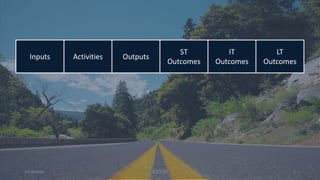
Inputs Activities Outputs
ST
Outcomes
IT
Outcomes
LT
Outcomes
10/28/2020 #3DLM 6
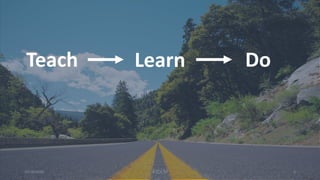
Teach Learn Do
10/28/2020 #3DLM 7
10/28/2020 #3DLM 8
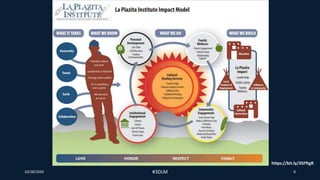
https://bit.ly/35FftgR
10/28/2020 #3DLM 9
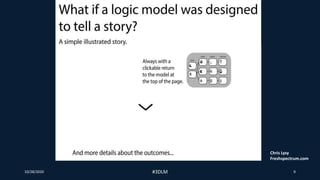
Chris Lysy
Freshspectrum.com
10/28/2020 #3DLM 10
https://bit.ly/2IGHszo
10/28/2020 #3DLM 11
https://bit.ly/2v4QapA
10/28/2020 #3DLM 12
Focus on the concept.
The technology may
take a while….
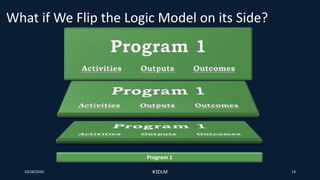
What if We Flip the Logic Model on its Side?
10/28/2020 #3DLM 13
Program 1
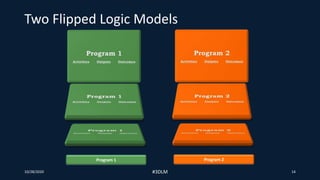
Two Flipped Logic Models
10/28/2020 #3DLM 14
Program 1 Program 2
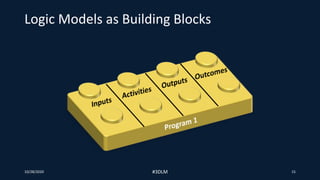
Logic Models as Building Blocks
10/28/2020 #3DLM 15
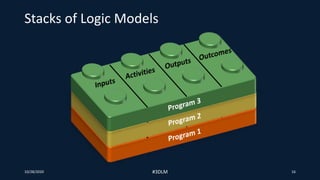
Stacks of Logic Models
10/28/2020 #3DLM 16
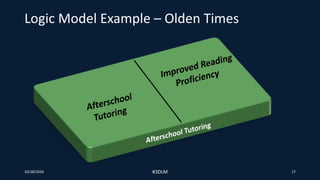
Logic Model Example – Olden Times
10/28/2020 #3DLM 17
10/28/2020 #3DLM 18
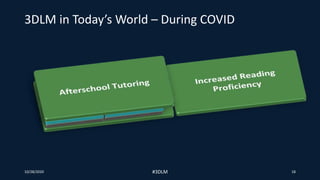
3DLM in Today’s World – During COVID
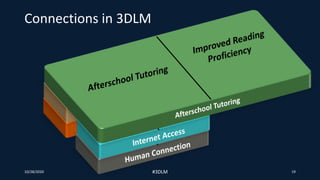
Connections in 3DLM
10/28/2020 #3DLM 19
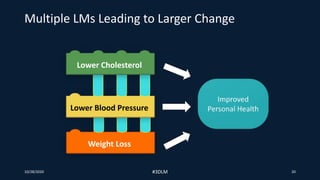
Multiple LMs Leading to Larger Change
10/28/2020 #3DLM 20
Weight Loss
Lower Blood Pressure
Lower Cholesterol
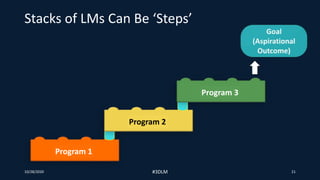
Stacks of LMs Can Be ‘Steps’
10/28/2020 #3DLM 21
Program 1
Program 2
Program 3
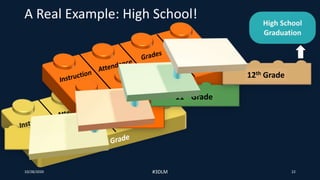
A Real Example: High School!
10/28/2020 #3DLM 22
9th Grade
10th Grade
11th Grade
12th Grade
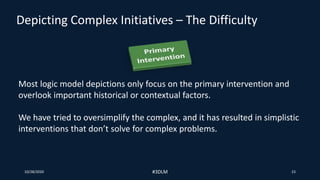
Depicting Complex Initiatives – The Difficulty
10/28/2020 #3DLM 23
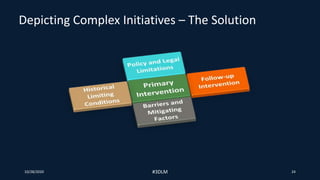
Most logic model depictions only focus on the primary intervention and
overlook important historical or contextual factors.
We have tried to oversimplify the complex, and it has resulted in simplistic
interventions that don’t solve for complex problems.
Depicting Complex Initiatives – The Solution
10/28/2020 #3DLM 24
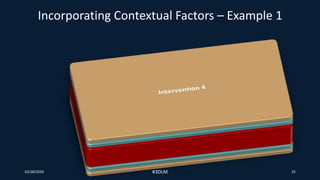
Incorporating Contextual Factors – Example 1
10/28/2020 #3DLM 25
10/28/2020 #3DLM 26
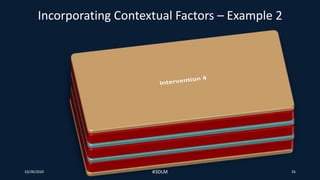
Incorporating Contextual Factors – Example 2
10/28/2020 #3DLM 27
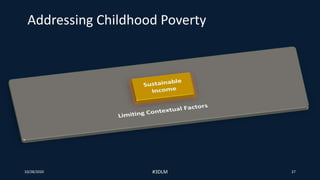
Addressing Childhood Poverty
10/28/2020 #3DLM 28
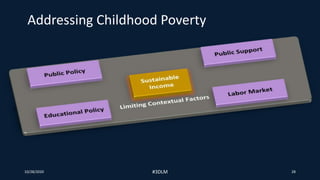
Addressing Childhood Poverty
Time to Build Your Own!
05/06/2019 #3DLM 29

The Future of Logic Models: Logic Models in 3D

Editor's Notes

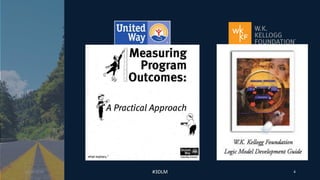
  • #4 A logic model is a visual depiction of how a program or initiative works. Often compared to a roadmap, a logic model visualizes the links between the activities that are being conducted and the outcomes that the program is seeking to achieve.
  • #5 In one of the seminal texts on logic models, The Kellogg Foundation defined a logic model “as a picture of how your organization does its work – the theory and assumptions underlying the program. A program logic model links outcomes (both short- and long-term) with program activities/processes and the theoretical assumptions/principles of the program.” 
  • #6 As a visual representation, a logic model is intended to help stakeholders develop a common understanding of the inner workings of the program, including how, why, and what a program is intended to do and to achieve
  • #7 As Tom Archibald mentioned in a recent webinar about evaluative thinking, this traditional model locks us into false and simplified assumptions like teach – learn – do. I have a Masters in Public Health so I know from my training that eating healthy foods is essential for having a healthy mind and body. I know that I feel better when I eat healthy foods and that my bank account looks a lot nicer when I cook my own food. I also know that when my car drives past my favorite takeout place when I’m hungry on my way home, that I am probably throwing all my knowledge out the window. We are humans. Humans make up programs and systems. We have to stop pretending that we operate in a randomized control trial bubble. We don’t.
  • #8 Challenges: Logic models aren’t built for 2020. They aren’t built for Covid. They aren’t built for complexity. They are built for simple Western programs which hide the working assumptions and relationships behind the programs and models. Logic models, as status quo, are not in service of communities or equity. They force round complex programs into a square box to meet the needs of funders. This results in them often being made to appease requirements rather than being used as a tool for change. Appears linear when few programs are Suggests causality Disregards culture and context Does not incorporate methodology May not represent feasibility Often lacks input of key stakeholders Break down for more complex programs such as when a program operates at the systems level or has multiple sites Not published so difficult to align with similar programs Competing metrics from funders
  • #9 Share 4 brief examples of alternatives to traditional logic models
  • #10 Chris Lysy interactive logic model
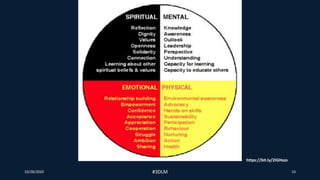
  • #11 Atlantic Council for International Cooperation: https://static1.squarespace.com/static/58eb972e414fb5fae517f552/t/59cd121af9a61e43a95191c6/1506611739652/Medicine_Wheel_Evaluation_Framework.pdf Medicine wheel logic model Medi cine wheel evaluation framework Jenkins, S., Robinson, K., & Davis, R. Adapting the medicine wheel model to extend the applicability of the traditional logic model in evaluation research. Retrieved from https://s3.amazonaws.com/sitesusa/wp-content/uploads/sites/242/2016/03/F2_Jenkins_2015FCSM.pdf 
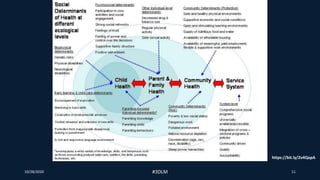
  • #12 Centre for Community Based Research eco-logic model
  • #13 We know you can use all different types of technology to create a LM. We also know it isn’t just about the tool, it’s about the process and the thinking. It’s about connecting the pieces and being able to articulate and understand these connections.