28/10/2018
1
Shane Hastie MIM ICE-VM
Director of Agile Learning Programs
The Foundations of
Business Agility
28/10/2018
2
Agenda
•Introduction
•The need for business agility
•What your organisation can do
•What you can do
•Wrap-up
3
Business Agility
•Business agility describes the
nimbleness of a company; that is, the
ability to adapt quickly while
empowering everyone associated with
the brand.
•Forbes
•Agility is the ability of an organization to
renew itself, adapt, change quickly, and
succeed in a rapidly changing,
ambiguous, turbulent environment.
•McKinsey
http://theagiledirector.com/article/2017/05/25/domains-of-business-agility-v2/
28/10/2018
3
Why Business Agility
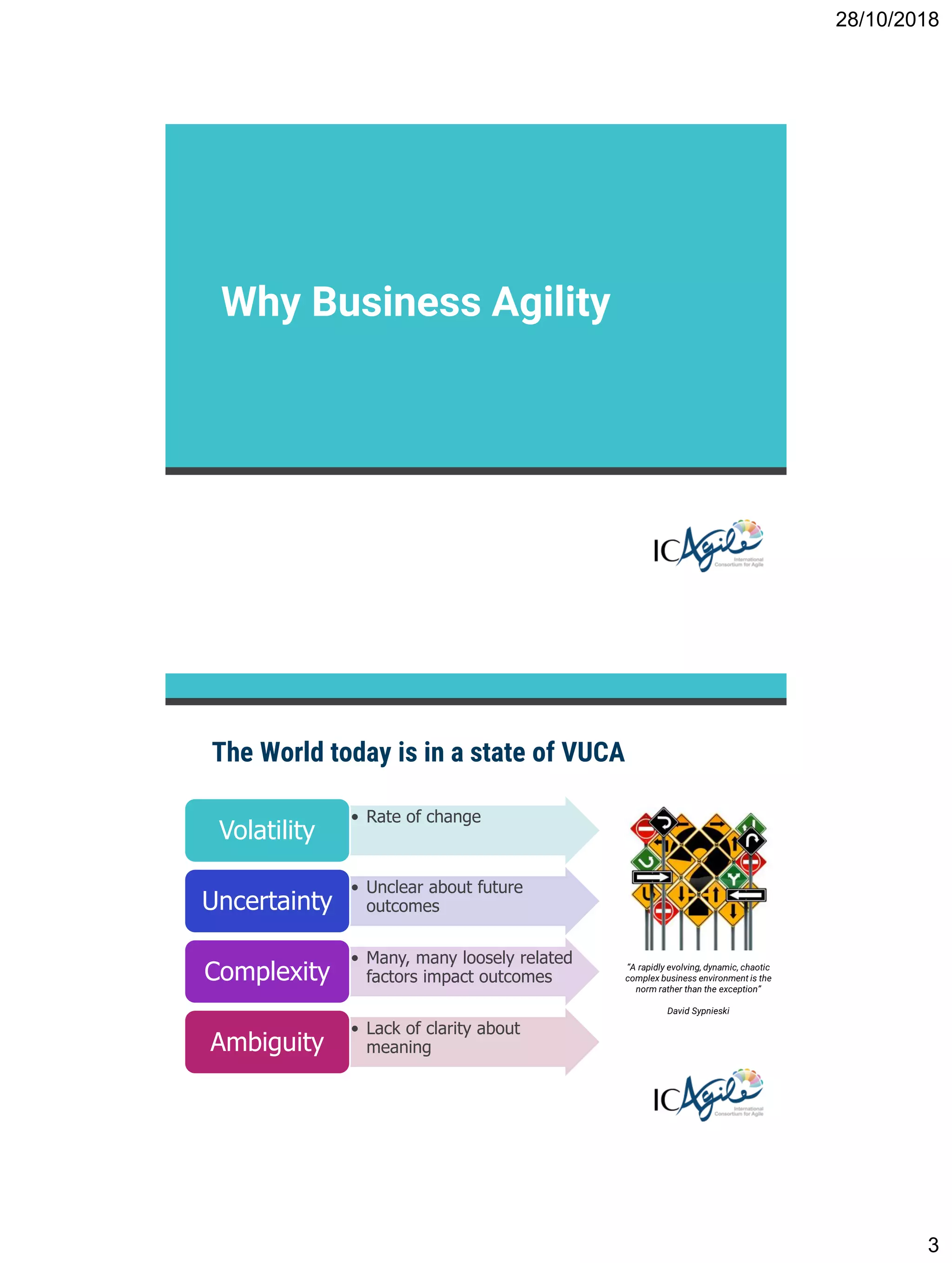
The World today is in a state of VUCA
“A rapidly evolving, dynamic, chaotic
complex business environment is the
norm rather than the exception”
David Sypnieski
• Rate of change
Volatility
• Unclear about future
outcomesUncertainty
• Many, many loosely related
factors impact outcomesComplexity
• Lack of clarity about
meaningAmbiguity
28/10/2018
4
Business Agility is Necessary for Survival
The ability to respond rapidly to changes
in the internal and external environment
without losing sight of organisational
goals
•Adaptability
•Flexibility
•Balance
Building responsiveness and change
into the DNA of the organisation
Change Your Organisation
28/10/2018
5
State of Business Agility
State of Business Agility Report – 2017 – CA Technologies
Changed Imperatives
• Leadership at every levelTop-down
management
• Do less, betterDo more with less
• Minimum viable process,
empowered people
Process over people
• Realtime value metricsCentralized annual
planning & budgeting
• Decentralized rolling-wave
planning
Activity milestones
• Long lived teams responsible
for products or services
Temporary teams on
projects
28/10/2018
6
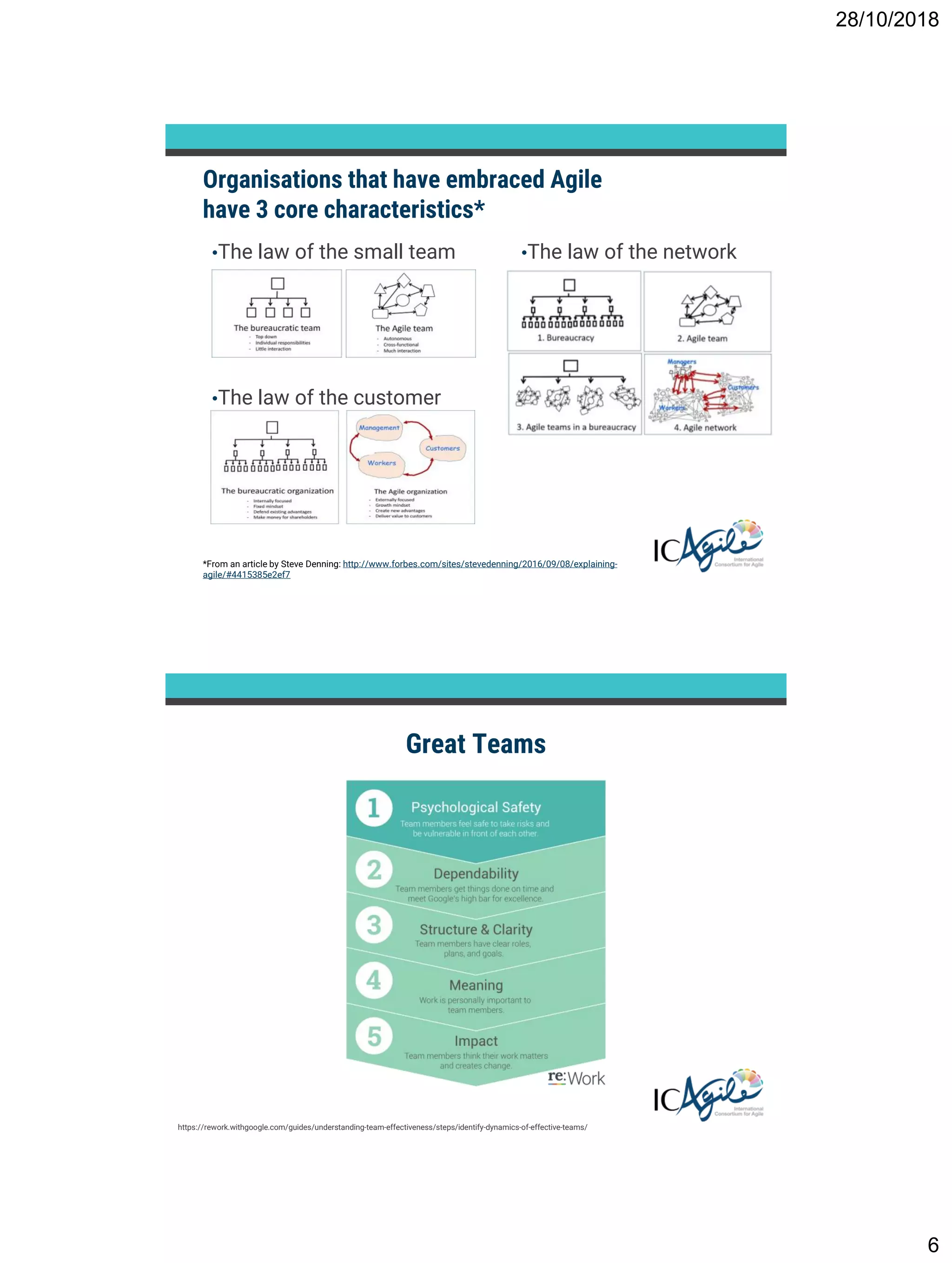
Organisations that have embraced Agile
have 3 core characteristics*
•The law of the small team
•The law of the customer
•The law of the network
*From an article by Steve Denning: http://www.forbes.com/sites/stevedenning/2016/09/08/explaining-
agile/#4415385e2ef7
Great Teams
https://rework.withgoogle.com/guides/understanding-team-effectiveness/steps/identify-dynamics-of-effective-teams/
28/10/2018
7
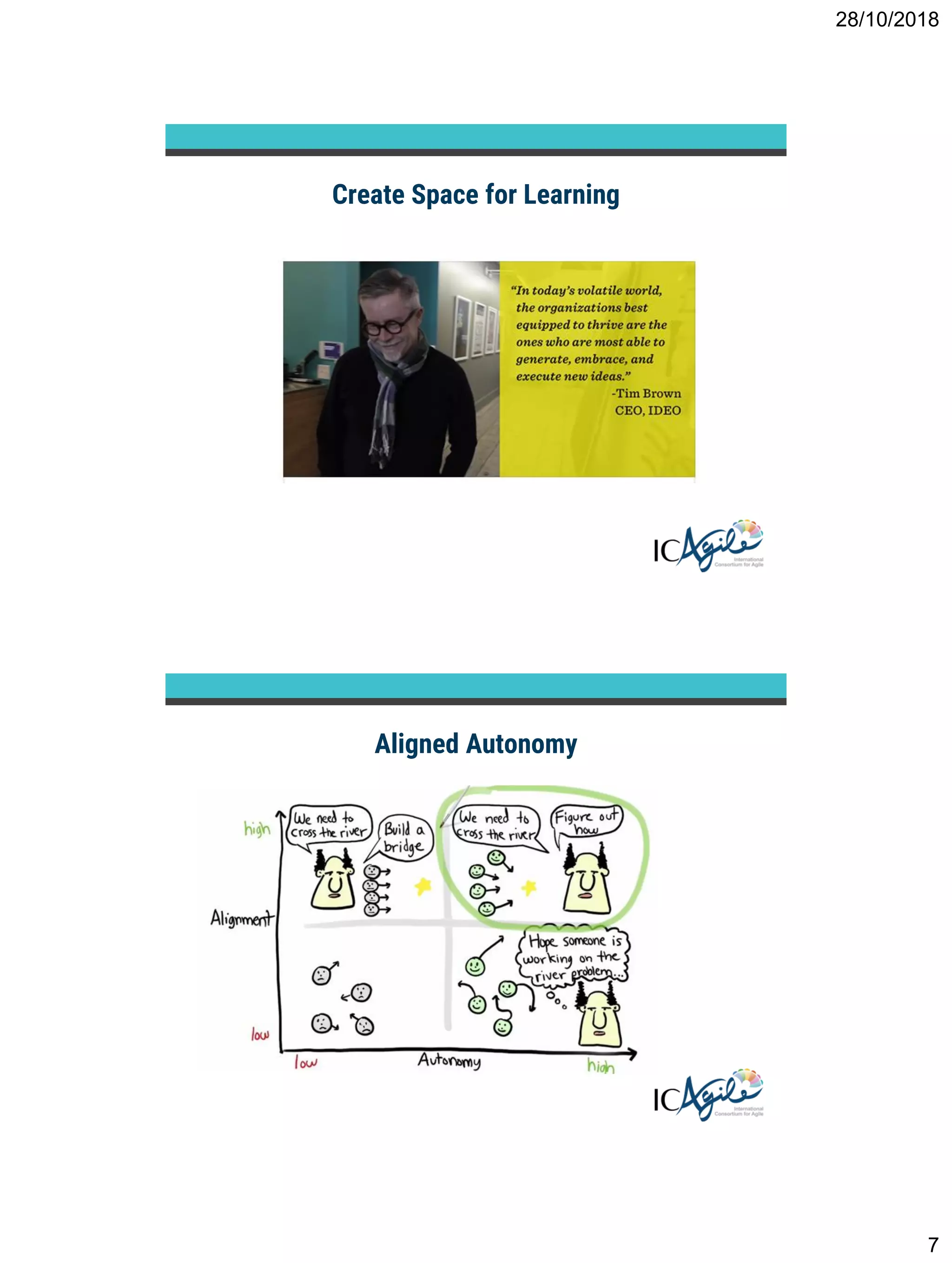
Create Space for Learning
Aligned Autonomy
28/10/2018
8
Measuring the Right Things
•Value as outcomes delivered, not as work done
•Productivity (Value/Cost to create Value)
•Benefits Realized
•Quality
•Customer and Employee Engagement &
Satisfaction
•Net Promoter Score
•Org Capability and Responsiveness
•How rapidly are we learning?
Beyond Budgeting – New Financial Models
Traditional Budgeting
Management Model
Beyond Budgeting
Management Model
Targets & rewards Incremental targets
Fixed incentives
Stretch goals
Relative targets & rewards
Planning & controls Fixed annual plans
Variance controls
Continuous planning
KPI’s & rolling forecasts
Resource &
coordination
Pre-allocated resources
Central co-ordination
Resources on demand
Dynamic coordination
Organisational
culture
Central control
Focus on managing
numbers
Local control of goals/plans
Focus on value creation
28/10/2018
9
Radical Transparency
Act on Feedback
•Truthfully and honestly examine
the feedback through all
channels
•What is the next sensible step –
amplify, change direction, or
stop?
•Adapt and respond
28/10/2018
10
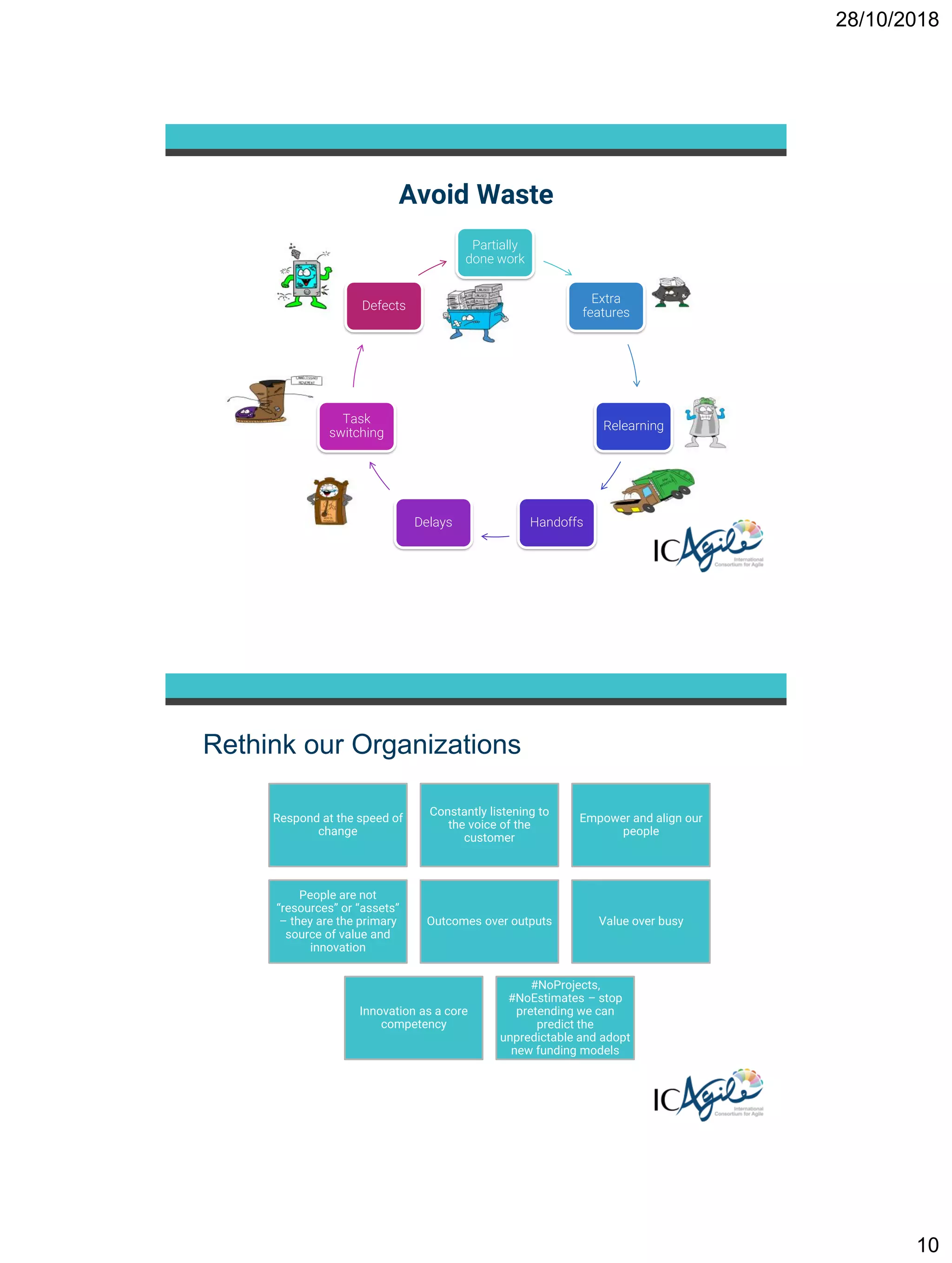
Avoid Waste
Partially
done work
Extra
features
Relearning
HandoffsDelays
Task
switching
Defects
Rethink our Organizations
Respond at the speed of
change
Constantly listening to
the voice of the
customer
Empower and align our
people
People are not
“resources” or “assets”
– they are the primary
source of value and
innovation
Outcomes over outputs Value over busy
Innovation as a core
competency
#NoProjects,
#NoEstimates – stop
pretending we can
predict the
unpredictable and adopt
new funding models
28/10/2018
11
This means real changes,
not putting lipstick on a pig
http://thenewsdoctors.com/wp-content/uploads/2014/11/pig-lipstick.jpg
Change Yourself
28/10/2018
12
ATTITUDES AND HABITS
ESTABLISHED SET OF
28/10/2018
13
Become a Lifelong Learner
Become Passionately Dissatisfied
•Challenge the status quo
•“We’ve always done it that way” leads to
entrenched failures
•Stop trying to “do more with less” –
focus on doing less, and doing it well
•Look for new ways, new ideas, new
combinations of existing ideas
•Take ownership of your own
improvements
•Hold yourself and your colleagues
accountable
Image © Kenhurst | Dreamstime Stock Photos
& Stock Free Images
28/10/2018
14
Become Customer Fanatical
•We all have customers
•Empathize and understand
their needs
•We all contribute to the
value stream
•How can I make my
customers’ lives better?
Think like an entrepreneur
•Everything is an experiment
•Estimates are hypotheses
•Take calculated risks
•Courage to fail in order to succeed sooner
•Welcome challenges
•Embrace uncertainty and transform into knowledge
•Learn continuously through fact-based data analysis
•Create time and space for experimentation and
innovation
•Become comfortable being uncomfortable
Source: IDEO
28/10/2018
15
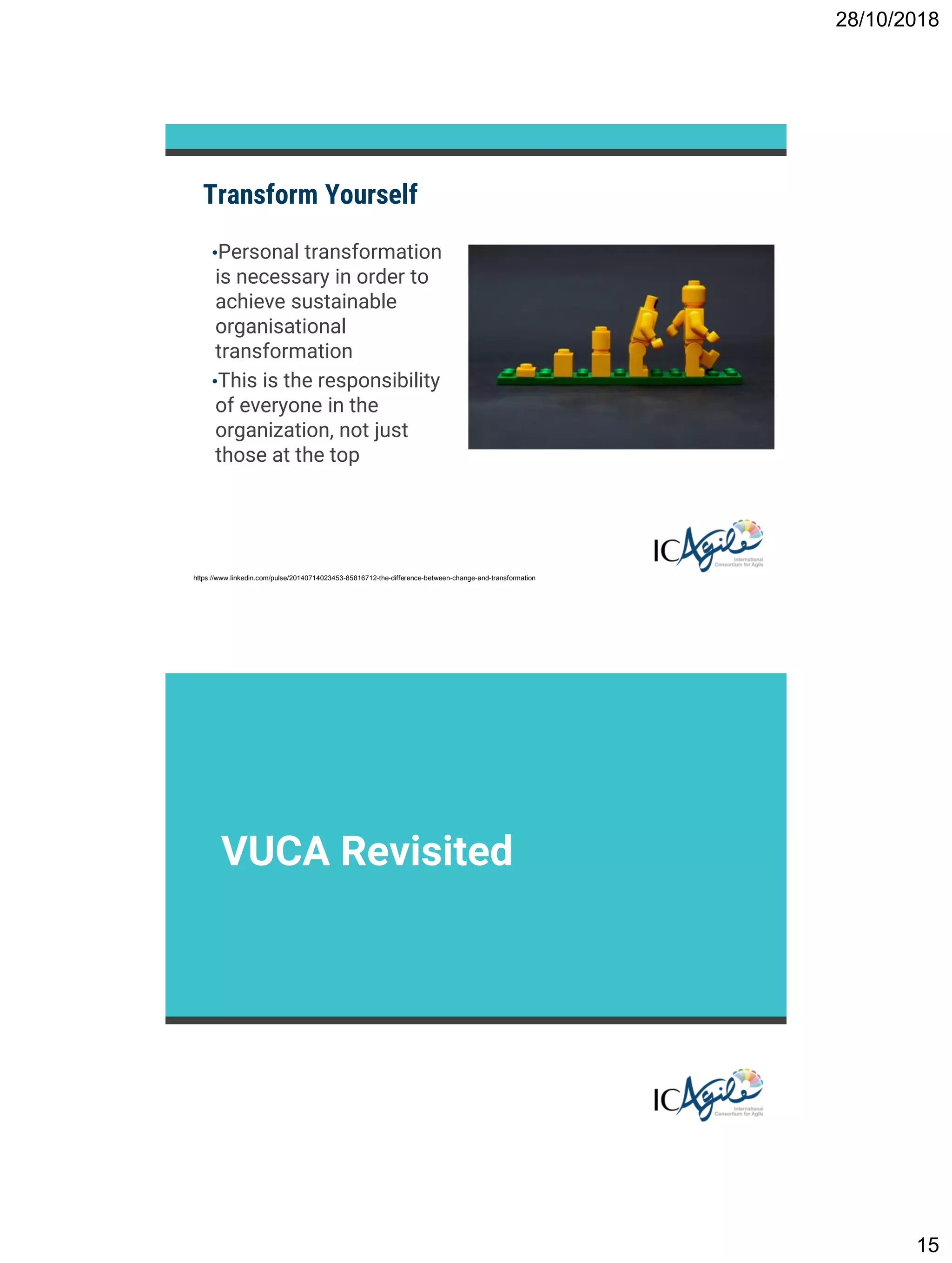
Transform Yourself
•Personal transformation
is necessary in order to
achieve sustainable
organisational
transformation
•This is the responsibility
of everyone in the
organization, not just
those at the top
https://www.linkedin.com/pulse/20140714023453-85816712-the-difference-between-change-and-transformation
VUCA Revisited
28/10/2018
16
VUCA Revisited
•Vision
•The intent to create the future
•Understanding
•Learn, hear, feedback
•Clarity
•Sense making
•Agility
•The ability to respond to change
in order to profit in a turbulent
world
“A rapidly evolving, dynamic, chaotic complex
business environment is the norm rather than
the exception”
David Sypnieski
28/10/2018
17
• People
• Marketing
• Finance
• Innovation
• Leadership
Business
Agility
Foundations
28/10/2018
18
Shane Hastie,
Director of Agile Learning Programs
Contact Information
shane@icagile.com
ICAgile.com
Twitter: @shanehastie
LinkedIn: http://nz.linkedin.com/in/shanehastie/

The Foundations of Business Agility

  • 1.
    28/10/2018 1 Shane Hastie MIMICE-VM Director of Agile Learning Programs The Foundations of Business Agility
  • 2.
    28/10/2018 2 Agenda •Introduction •The need forbusiness agility •What your organisation can do •What you can do •Wrap-up 3 Business Agility •Business agility describes the nimbleness of a company; that is, the ability to adapt quickly while empowering everyone associated with the brand. •Forbes •Agility is the ability of an organization to renew itself, adapt, change quickly, and succeed in a rapidly changing, ambiguous, turbulent environment. •McKinsey http://theagiledirector.com/article/2017/05/25/domains-of-business-agility-v2/
  • 3.
    28/10/2018 3 Why Business Agility TheWorld today is in a state of VUCA “A rapidly evolving, dynamic, chaotic complex business environment is the norm rather than the exception” David Sypnieski • Rate of change Volatility • Unclear about future outcomesUncertainty • Many, many loosely related factors impact outcomesComplexity • Lack of clarity about meaningAmbiguity
  • 4.
    28/10/2018 4 Business Agility isNecessary for Survival The ability to respond rapidly to changes in the internal and external environment without losing sight of organisational goals •Adaptability •Flexibility •Balance Building responsiveness and change into the DNA of the organisation Change Your Organisation
  • 5.
    28/10/2018 5 State of BusinessAgility State of Business Agility Report – 2017 – CA Technologies Changed Imperatives • Leadership at every levelTop-down management • Do less, betterDo more with less • Minimum viable process, empowered people Process over people • Realtime value metricsCentralized annual planning & budgeting • Decentralized rolling-wave planning Activity milestones • Long lived teams responsible for products or services Temporary teams on projects
  • 6.
    28/10/2018 6 Organisations that haveembraced Agile have 3 core characteristics* •The law of the small team •The law of the customer •The law of the network *From an article by Steve Denning: http://www.forbes.com/sites/stevedenning/2016/09/08/explaining- agile/#4415385e2ef7 Great Teams https://rework.withgoogle.com/guides/understanding-team-effectiveness/steps/identify-dynamics-of-effective-teams/
  • 7.
    28/10/2018 7 Create Space forLearning Aligned Autonomy
  • 8.
    28/10/2018 8 Measuring the RightThings •Value as outcomes delivered, not as work done •Productivity (Value/Cost to create Value) •Benefits Realized •Quality •Customer and Employee Engagement & Satisfaction •Net Promoter Score •Org Capability and Responsiveness •How rapidly are we learning? Beyond Budgeting – New Financial Models Traditional Budgeting Management Model Beyond Budgeting Management Model Targets & rewards Incremental targets Fixed incentives Stretch goals Relative targets & rewards Planning & controls Fixed annual plans Variance controls Continuous planning KPI’s & rolling forecasts Resource & coordination Pre-allocated resources Central co-ordination Resources on demand Dynamic coordination Organisational culture Central control Focus on managing numbers Local control of goals/plans Focus on value creation
  • 9.
    28/10/2018 9 Radical Transparency Act onFeedback •Truthfully and honestly examine the feedback through all channels •What is the next sensible step – amplify, change direction, or stop? •Adapt and respond
  • 10.
    28/10/2018 10 Avoid Waste Partially done work Extra features Relearning HandoffsDelays Task switching Defects Rethinkour Organizations Respond at the speed of change Constantly listening to the voice of the customer Empower and align our people People are not “resources” or “assets” – they are the primary source of value and innovation Outcomes over outputs Value over busy Innovation as a core competency #NoProjects, #NoEstimates – stop pretending we can predict the unpredictable and adopt new funding models
  • 11.
    28/10/2018 11 This means realchanges, not putting lipstick on a pig http://thenewsdoctors.com/wp-content/uploads/2014/11/pig-lipstick.jpg Change Yourself
  • 12.
  • 13.
    28/10/2018 13 Become a LifelongLearner Become Passionately Dissatisfied •Challenge the status quo •“We’ve always done it that way” leads to entrenched failures •Stop trying to “do more with less” – focus on doing less, and doing it well •Look for new ways, new ideas, new combinations of existing ideas •Take ownership of your own improvements •Hold yourself and your colleagues accountable Image © Kenhurst | Dreamstime Stock Photos & Stock Free Images
  • 14.
    28/10/2018 14 Become Customer Fanatical •Weall have customers •Empathize and understand their needs •We all contribute to the value stream •How can I make my customers’ lives better? Think like an entrepreneur •Everything is an experiment •Estimates are hypotheses •Take calculated risks •Courage to fail in order to succeed sooner •Welcome challenges •Embrace uncertainty and transform into knowledge •Learn continuously through fact-based data analysis •Create time and space for experimentation and innovation •Become comfortable being uncomfortable Source: IDEO
  • 15.
    28/10/2018 15 Transform Yourself •Personal transformation isnecessary in order to achieve sustainable organisational transformation •This is the responsibility of everyone in the organization, not just those at the top https://www.linkedin.com/pulse/20140714023453-85816712-the-difference-between-change-and-transformation VUCA Revisited
  • 16.
    28/10/2018 16 VUCA Revisited •Vision •The intentto create the future •Understanding •Learn, hear, feedback •Clarity •Sense making •Agility •The ability to respond to change in order to profit in a turbulent world “A rapidly evolving, dynamic, chaotic complex business environment is the norm rather than the exception” David Sypnieski
  • 17.
    28/10/2018 17 • People • Marketing •Finance • Innovation • Leadership Business Agility Foundations
  • 18.
    28/10/2018 18 Shane Hastie, Director ofAgile Learning Programs Contact Information shane@icagile.com ICAgile.com Twitter: @shanehastie LinkedIn: http://nz.linkedin.com/in/shanehastie/