WRITING A FEATUREARTICLE
THE FEAT
that is
ERWIN M. BADIOLA
SPEAKER/ FRIEND/ LIFE COACH
(WHAT’S A LIFE COACH ANYWAY?)
ONTO YOUR FEET AND TAKE ON
BUT DON’T YOU THROW A FIT, OK?
I. DEFINITION
“News andfeature stories are meant to
complement each other, and allow a newspaper
to offer well-rounded coverage that varies in
depth and timeliness. While the two styles
share basic elements, they differ in the
treatment of an issue, depth of research, style
of writing and structure of the piece.”
5.
Hard news storiesmove briskly through
the five W's and the H, packing in just
enough detail to give readers a clear
picture of the news.
Immediacy is everything in hard news.
The goal of a feature story is to
communicate the truth – not fiction – in
a different way than a hard news story.
In feature, the immediacy of the event is
secondary. It's replaced by reader interest.
NEWS
FEATURE
I. DEFINITION
Therefore, afeature article might as
well be a retelling of a news story.
Only, it likes to put more emphasis on
the HOWs and the WHYs rather than
the WHOs, WHATs and SO WHATs.
It likes to dwell in the “human aspect”
of a story.
It is the story behind “the story”.
10.
EXAMPLE
News:
Duque recommends usingup
all 525,699 AstraZeneca
doses first
What’s the story behind “the story”?
• How Mary Joy Garcia, a health worker
whose son was among those who got
vaccinated with Dengvaxia, feels
about vaccines.
• Curious cases involving AstraZeneca
• Known celebrities who are self-
confessed Anti Vaxxers
11.
EXAMPLE
News:
Senators hit doublestandards,
‘band-aid’ solutions a year into
COVID-19 lockdown
What’s the story behind “the story”?
• Thriving businesses during last
year’s lockdown
• Breakout vloggers who rose to
fame during the lockdown
• Noel and Minda: Love in the time
of COVID-19
12.
Feature articles canbe said to have two aims:
INFORM and ENTERTAIN.
Ideally, a feature has elements of both and the
writer can use a variety of techniques and
devices to add “color” to the story.
13.
To help solvethe alleged reading crisis
among public schools nationwide, San
Jose Integrated School took stand against
the common misconception that the “No
Child Left Behind” policy of the
Department of Education equates to
promoting learners en masse.
NEWS or FEATURE?
14.
Most unfortunately, knowinghow to read might be
the least of ten-year-old Geraldine’s problems.
Admittedly, she also could not count. Geraldine
(name withheld) is already in grade five but she
still finds it difficult to count from one to ten let
alone write them in figures.
NEWS or FEATURE?
15.
II. STRUCTURE
The newsuses the inverted pyramid structure while
feature uses the hourglass structure.
16.
The title ofthe feature article aims to
catch the attention of the reader and
tell the subject of the story at the
same time.
a. TITLE
17.
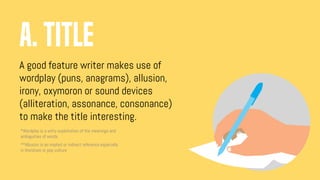
A good featurewriter makes use of
wordplay (puns, anagrams), allusion,
irony, oxymoron or sound devices
(alliteration, assonance, consonance)
to make the title interesting.
a. TITLE
*Wordplay is a witty exploitation of the meanings and
ambiguities of words
**Allusion is an implied or indirect reference especially
in literature or pop culture
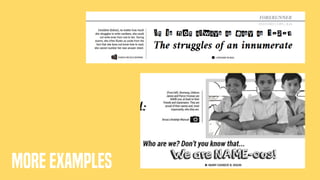
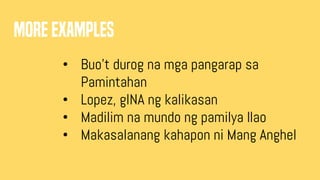
MORE EXAMPLES
• Buo’tdurog na mga pangarap sa
Pamintahan
• Lopez, gINA ng kalikasan
• Madilim na mundo ng pamilya Ilao
• Makasalanang kahapon ni Mang Anghel
21.
The lead aimsto sustain the interest of
the reader by introducing the “hook” of
the story.
The “hook” tells why the reader has to read the story.
It can either be a single paragraph or, sometimes, a succession
of several short paragraphs. Recently though, the trend is that
lead paragraphs are kept short and direct.
Also, avoid general statements as lead!
B. LEAD
22.
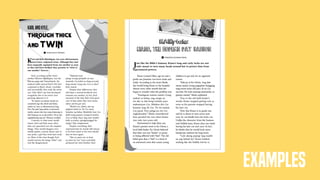
EXAMPLES
Karl and KyleMandigma, ten-year-old Josenians, were born
conjoined twins. Although they had been surgically separated from
one another as soon as their mom birthed them, they promise to
“stick to one another” forever.
The often overlooked Pamintahan area, the now grimy and smelly
slope that most have only come to know as a shortcut from the
city proper to the Latag – San Jose junction, actually had once
served as a safe haven to war-stricken Lipeños during the
Japanese occupation.
23.
EXAMPLES
Habang rumaragasa ang‘Buyayao’ o malalakas na alon sa
nangagsi-angklang mga bato sa baybayin ng isla, nang-aanyaya ang
kariktan ng paraisong ito. Kung anong ambang daluyong at ligalig
ng dagat sa paligid, siya namang hinahon ng pamumuhay sa
natatagong isla ng Buyayao.
Balot ng dilim, tanging ang liwanag mula sa gasera ang gabay ng
12 taong gulang na si John Michael Ilao sa pagsasagot ng kanyang
takdang-aralin. Batid niya na mahaba pa ang gabi. Gayunpaman,
alam din niya na may dalang pag-asa ang kaunting ilaw na kanyang
kaagapay.
24.
Look for thebest angle. It may be an
irony, an allusion, a striking statement
or simply a fascinating truth. From
there, develop your title and your lead.
THE THOUGHT PROCESS
25.
The nut graf(nutshell paragraph)
is a paragraph that explains the
context of the story.
C. NUT GRAF
Its main objective is to introduce the subject of the story.
26.
EXAMPLE
Karl, according tothe twin’s mother Marissa Mandigma, was the
firstborn. Immediately, the overseeing doctor noticed Karl’s left
foot attached to Kyle’s cheek. After careful examination, the doctor
proposed to surgically separate the twins, which their parents
agreed to. While the procedure was successful, Kyle’s jaw had
developed irregularly due to his twin’s foot growing next to it.
27.
D. BODY
The bodyis composed of three elements:
• FACTS
• QUOTES
• ANECDOTE
NOTE: Do not ask questions to
which the answer is obvious!
28.
E. ENDING
Three waysto finish the story:
• CIRCLE BACK
• LOOK AHEAD
• SPREAD OUT
29.
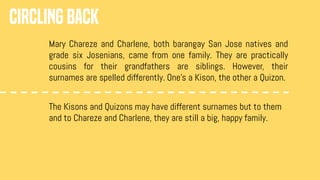
CIRCLING BACK
Mary Charezeand Charlene, both barangay San Jose natives and
grade six Josenians, came from one family. They are practically
cousins for their grandfathers are siblings. However, their
surnames are spelled differently. One’s a Kison, the other a Quizon.
The Kisons and Quizons may have different surnames but to them
and to Chareze and Charlene, they are still a big, happy family.
30.
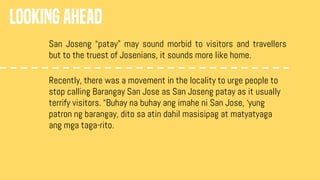
LOOKING AHEAD
San Joseng“patay” may sound morbid to visitors and travellers
but to the truest of Josenians, it sounds more like home.
Recently, there was a movement in the locality to urge people to
stop calling Barangay San Jose as San Joseng patay as it usually
terrify visitors. “Buhay na buhay ang imahe ni San Jose, ‘yung
patron ng barangay, dito sa atin dahil masisipag at matyatyaga
ang mga taga-rito.
31.
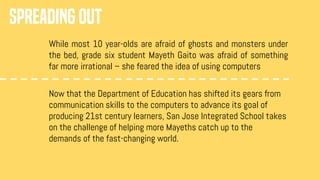
SPREADING OUT
While most10 year-olds are afraid of ghosts and monsters under
the bed, grade six student Mayeth Gaito was afraid of something
far more irrational – she feared the idea of using computers
Now that the Department of Education has shifted its gears from
communication skills to the computers to advance its goal of
producing 21st century learners, San Jose Integrated School takes
on the challenge of helping more Mayeths catch up to the
demands of the fast-changing world.
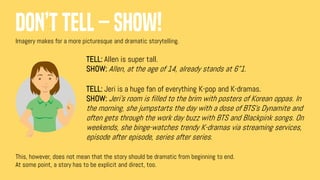
Don’t tell –show!
Imagery makes for a more picturesque and dramatic storytelling.
This, however, does not mean that the story should be dramatic from beginning to end.
At some point, a story has to be explicit and direct, too.
TELL: Allen is super tall.
SHOW: Allen, at the age of 14, already stands at 6”1.
TELL: Jeri is a huge fan of everything K-pop and K-dramas.
SHOW: Jeri’s room is filled to the brim with posters of Korean oppas. In
the morning, she jumpstarts the day with a dose of BTS’s Dynamite and
often gets through the work day buzz with BTS and Blackpink songs. On
weekends, she binge-watches trendy K-dramas via streaming services,
episode after episode, series after series.
34.
Streamline your data
Rememberthat the readers initially took notice of your article
because of the “hook”, focus only on information that talk about
the “hook” of your story.
Use personal information as appositives
or modifiers so that they don’t get in the
way of the flow of the story. Also, as
much as possible, exhaust these
information early on.
35.
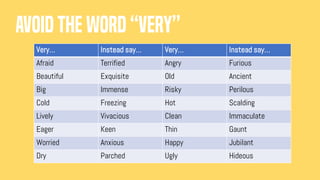
AVOID THE WORD“VERY”
Very… Instead say… Very… Instead say…
Afraid Terrified Angry Furious
Beautiful Exquisite Old Ancient
Big Immense Risky Perilous
Cold Freezing Hot Scalding
Lively Vivacious Clean Immaculate
Eager Keen Thin Gaunt
Worried Anxious Happy Jubilant
Dry Parched Ugly Hideous
36.
Limit the useof
figurative language
Another misconception some writers have is
the belief that the heavy use of figurative
language translates to a good feature
article. Wrong!
Although commonly perceived as flowery and
free-flowing, the feature article is a form of
journalistic writing which means that it
should sound believable and not too fancy!
37.
Should you needto write a
lengthy paragraph…
FOLLOW IT UP WITH A SHORT (BUT
STRIKING) SENTENCE.
Short but striking one-liners serve as great
breathing spaces for the readers.
Don’t let the reader get lost in the sea of gray, give
them a room to stop and breathe.
38.
Use only quotes
thatmatter
A writer does not use all the
quotations that he has gathered.
Use only those that reveal important
information, or those that help build
up your story. Oftentimes, short but
striking quotations do magic.
39.
GOT Questions?
“Once youlearn to question, you will start
to learn.”
― Abhijit Naskar, Sleepless for Society