The FCC Certification Process:

Going Wireless
Many manufacturers
hesitate to use wireless
features because of the
uncertainty of the
certification process.
But we are here to tell you
that the certification
process for the United
States is really not as bad
as it seems.
The Federal Communications
Commission (FCC)
• The FCC regulates radio frequencies in the U.S.
• They make sure wireless broadcasters can share the wireless
spectrum without interfering with each other.
• They require that any device that radiates RF energy to be
tested for compliance with the FCC rules
Licensed & Unlicensed
Broadcasts
Licensed Broadcasts
Some broadcasters are licensed to broadcast on a specific spectrum,
such as a radio station. A radio station can be licensed to operate at
100.3MHz in a region and the FCC regulations prevent someone else
from using that spectrum.

Unlicensed Broadcasts
The FCC allows unlicensed broadcasts as well subject to regulations to
prevent interference. The FCC rules for unlicensed broadcasting from
below 1MHz in excess of 32GHz are included in CFR 47 Part 15.
FCC Compliance
• The FCC requires any device that radiates RF energy to be tested
for compliance with the FCC rules.
• Part 15 - deals with the operational aspects and requirements for
devices that emit RF energy and are to be operated without the end
user needing a license
• Part 2 - deals with issues of marketing and authorization and
includes details on the certification and approval process
The 8 Step
FCC Certification
Process
1. Choose the Optimum
Operating Frequency
• Have a clear understanding of which frequencies are legally
available
• Choose a specific frequency based on technical issues (ex: range,
propagation, antenna length, power consumption and potential
interference)
2. Component Selection
• The RF section and antenna must be carefully designed and
optimized to comply with the allowed power and harmonic limitations
imposed by Part 15
• If you are using a Linx module this is much easier to do

• Important to recognize that antenna and layout play key roles in your
product’s legal operation
3. Build Production-Ready
Prototypes
• Once you’ve selected a frequency of operation and a suitable RF
stage you will want to move from concept breadboard prototypes to a
production-ready model as soon as you can
4. Prescreen and Optimize
• When your wireless product is finished, output power and harmonics
should be checked to ensure that the RF stage is both optimized and
Part 15 compliant.
• Do this with a spectrum analyzer and calibrated antennas
• Consider prescreening if you don’t have access to the above
instruments
• Linx partners with a test lab that offers these services at a
discount to Linx customers
• The process can result in a cost savings over formal testing and
provides an opportunity to maximize product performance
5. Lab Selection
• The FCC requires that final product testing be conducted by a
registered testing facility
• A list of registered, independent testing facilities is on the FCC
website
• Quality and competence of labs varies widely

• Linx is happy to recommend competent facilities
• Once you pick a lab, determine the extent of services they’ll provide
• Our advice? Have them do as much as possible.

• Taking time to understand the subtleties of the filing process in
the middle of trying to get a product to market is a bad idea.
Saving a few bucks to do things yourself may end up costing
more in the end, and could jeopardize the approval.
6. Registering
• A Federal Registration Number (FRN) must be obtained when your
product is complete and ready for testing
• This is free and can be obtained in a few minutes on the FCC
website
• Request a grantee code from the FCC (also can be done online)

• $60 and must be paid within 30 days of the application
7. Send the Production-Ready
Prototype to an FCC Authorized
Testing Facility
• Once product is in finished form testing should be performed by an
accredited laboratory (not necessary to be present)
• Testing usually takes less than two weeks depending on lab’s
schedule
Items Needed to Complete Filing
• A letter appointing the test lab as your technical agent for certification

• The FCC ID Number of the unit.
• The first 3 or 5 numbers are the grantee code. The rest is up to
the applicant, up to 14 characters
• A sketch of the FCC label and the location on the unit
• A block diagram of the unit showing all clock oscillators and their
frequencies of operation
• Full schematic diagram

• The user’s manual
• A brief, non-technical description of the product and its operation
• A product sample for testing and photos
8. The Filing Process
• Independent testing laboratories are now allowed to issue
certifications through the Telecommunication Certification Body
(TCB) program
• Filing process usually done through test lab
• The TCB will review all application materials and if the device
conforms to the requirements, they will upload this info to the FCC
• The FCC will add the product and the ID number to their database
and website, and issue a Grant of Equipment Authorization
• At this point, the product can be legally marketed and sold
International Considerations
International Certification Info
• The process and cost varies widely

• Ex: The requirements for Industry Canada (IC) are close to the
U.S., so adding a Canadian certification is generally not much
more expensive than the U.S. alone
• Ex: The European Union has harmonized requirements across
all European countries but the test requirements are much more
involved than for the U.S. which means more money
• Most countries follow the same rules as either Europe or the U.S.
• Many countries require testing to be done in their country and all
require a representative within the country as a point of contact
• Become aware of the requirements of each country before you
market your product
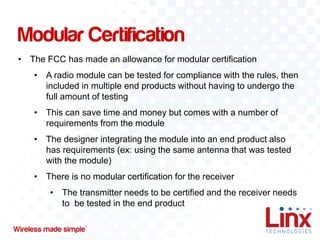
Modular Certification
• The FCC has made an allowance for modular certification

• A radio module can be tested for compliance with the rules, then
included in multiple end products without having to undergo the
full amount of testing
• This can save time and money but comes with a number of
requirements from the module
• The designer integrating the module into an end product also
has requirements (ex: using the same antenna that was tested
with the module)

• There is no modular certification for the receiver
• The transmitter needs to be certified and the receiver needs
to be tested in the end product
In Conclusion
In Conclusion
• As the number of wireless products has grown the process for
certification ahs become much more streamlined
• In you have any concerns or questions…
• You can contact Linx Technologies and speak with an
applications engineer

• You can contact a test lab
Enjoy the show?
Follow our blog for
more RF info!
CLICK TO SUBSCRIBE!
http://www.linxtechnologies.com/blog

The FCC Certification Process: Going Wireless

  • 1.
    The FCC CertificationProcess: Going Wireless
  • 2.
    Many manufacturers hesitate touse wireless features because of the uncertainty of the certification process.
  • 3.
    But we arehere to tell you that the certification process for the United States is really not as bad as it seems.
  • 4.
    The Federal Communications Commission(FCC) • The FCC regulates radio frequencies in the U.S. • They make sure wireless broadcasters can share the wireless spectrum without interfering with each other. • They require that any device that radiates RF energy to be tested for compliance with the FCC rules
  • 5.
    Licensed & Unlicensed Broadcasts LicensedBroadcasts Some broadcasters are licensed to broadcast on a specific spectrum, such as a radio station. A radio station can be licensed to operate at 100.3MHz in a region and the FCC regulations prevent someone else from using that spectrum. Unlicensed Broadcasts The FCC allows unlicensed broadcasts as well subject to regulations to prevent interference. The FCC rules for unlicensed broadcasting from below 1MHz in excess of 32GHz are included in CFR 47 Part 15.
  • 6.
    FCC Compliance • TheFCC requires any device that radiates RF energy to be tested for compliance with the FCC rules. • Part 15 - deals with the operational aspects and requirements for devices that emit RF energy and are to be operated without the end user needing a license • Part 2 - deals with issues of marketing and authorization and includes details on the certification and approval process
  • 7.
    The 8 Step FCCCertification Process
  • 8.
    1. Choose theOptimum Operating Frequency • Have a clear understanding of which frequencies are legally available • Choose a specific frequency based on technical issues (ex: range, propagation, antenna length, power consumption and potential interference)
  • 9.
    2. Component Selection •The RF section and antenna must be carefully designed and optimized to comply with the allowed power and harmonic limitations imposed by Part 15 • If you are using a Linx module this is much easier to do • Important to recognize that antenna and layout play key roles in your product’s legal operation
  • 10.
    3. Build Production-Ready Prototypes •Once you’ve selected a frequency of operation and a suitable RF stage you will want to move from concept breadboard prototypes to a production-ready model as soon as you can
  • 11.
    4. Prescreen andOptimize • When your wireless product is finished, output power and harmonics should be checked to ensure that the RF stage is both optimized and Part 15 compliant. • Do this with a spectrum analyzer and calibrated antennas • Consider prescreening if you don’t have access to the above instruments • Linx partners with a test lab that offers these services at a discount to Linx customers • The process can result in a cost savings over formal testing and provides an opportunity to maximize product performance
  • 12.
    5. Lab Selection •The FCC requires that final product testing be conducted by a registered testing facility • A list of registered, independent testing facilities is on the FCC website • Quality and competence of labs varies widely • Linx is happy to recommend competent facilities • Once you pick a lab, determine the extent of services they’ll provide • Our advice? Have them do as much as possible. • Taking time to understand the subtleties of the filing process in the middle of trying to get a product to market is a bad idea. Saving a few bucks to do things yourself may end up costing more in the end, and could jeopardize the approval.
  • 13.
    6. Registering • AFederal Registration Number (FRN) must be obtained when your product is complete and ready for testing • This is free and can be obtained in a few minutes on the FCC website • Request a grantee code from the FCC (also can be done online) • $60 and must be paid within 30 days of the application
  • 14.
    7. Send theProduction-Ready Prototype to an FCC Authorized Testing Facility • Once product is in finished form testing should be performed by an accredited laboratory (not necessary to be present) • Testing usually takes less than two weeks depending on lab’s schedule
  • 15.
    Items Needed toComplete Filing • A letter appointing the test lab as your technical agent for certification • The FCC ID Number of the unit. • The first 3 or 5 numbers are the grantee code. The rest is up to the applicant, up to 14 characters • A sketch of the FCC label and the location on the unit • A block diagram of the unit showing all clock oscillators and their frequencies of operation • Full schematic diagram • The user’s manual • A brief, non-technical description of the product and its operation • A product sample for testing and photos
  • 16.
    8. The FilingProcess • Independent testing laboratories are now allowed to issue certifications through the Telecommunication Certification Body (TCB) program • Filing process usually done through test lab • The TCB will review all application materials and if the device conforms to the requirements, they will upload this info to the FCC • The FCC will add the product and the ID number to their database and website, and issue a Grant of Equipment Authorization • At this point, the product can be legally marketed and sold
  • 17.
  • 18.
    International Certification Info •The process and cost varies widely • Ex: The requirements for Industry Canada (IC) are close to the U.S., so adding a Canadian certification is generally not much more expensive than the U.S. alone • Ex: The European Union has harmonized requirements across all European countries but the test requirements are much more involved than for the U.S. which means more money • Most countries follow the same rules as either Europe or the U.S. • Many countries require testing to be done in their country and all require a representative within the country as a point of contact • Become aware of the requirements of each country before you market your product
  • 19.
  • 20.
    Modular Certification • TheFCC has made an allowance for modular certification • A radio module can be tested for compliance with the rules, then included in multiple end products without having to undergo the full amount of testing • This can save time and money but comes with a number of requirements from the module • The designer integrating the module into an end product also has requirements (ex: using the same antenna that was tested with the module) • There is no modular certification for the receiver • The transmitter needs to be certified and the receiver needs to be tested in the end product
  • 21.
  • 22.
    In Conclusion • Asthe number of wireless products has grown the process for certification ahs become much more streamlined • In you have any concerns or questions… • You can contact Linx Technologies and speak with an applications engineer • You can contact a test lab
  • 23.
    Enjoy the show? Followour blog for more RF info! CLICK TO SUBSCRIBE! http://www.linxtechnologies.com/blog