The Fascinating Story of the
First AI Ever Created
In the realm of technology and innovation, the creation of artificial
intelligence (AI) stands as a pivotal moment in human history. The first AI
ever created marked the beginning of a new era, opening up possibilities
that were once confined to the realms of science fiction. This article delves
into the fascinating story of the birth of the first AI, a groundbreaking
achievement that has transformed the way we live, work, and interact with
the world around us.
The Genesis of AI
The journey to creating the first AI began in the mid-20th century, during a
time when computers were in their infancy, and the concept of machines
possessing human-like intelligence was still largely speculative. The term
“artificial intelligence” was coined by computer scientist John McCarthy in
1956, at the Dartmouth Conference, where pioneers in the field gathered to
explore the potential of creating machines that could simulate human
intelligence.
The Early Years
The early years of AI development were characterized by ambitious goals
and limited computing power. Researchers faced significant challenges in
defining what intelligence entailed and how it could be replicated in
machines. The first AI ever created was a product of collaboration and
ingenuity that spanned several decades.
One of the earliest attempts to create artificial intelligence came in the form
of the Logic Theorist, developed by Allen Newell and Herbert A. Simon in
1955. The Logic Theorist was designed to emulate human problem-solving
skills and successfully proved mathematical theorems. While not a fully
autonomous AI, it laid the foundation for future endeavors in the field.
The Birth of the First AI
The true milestone in AI history came with the creation of the first fully
functional artificial intelligence. In 1966, Joseph Weizenbaum, a computer
scientist at the Massachusetts Institute of Technology (MIT), introduced
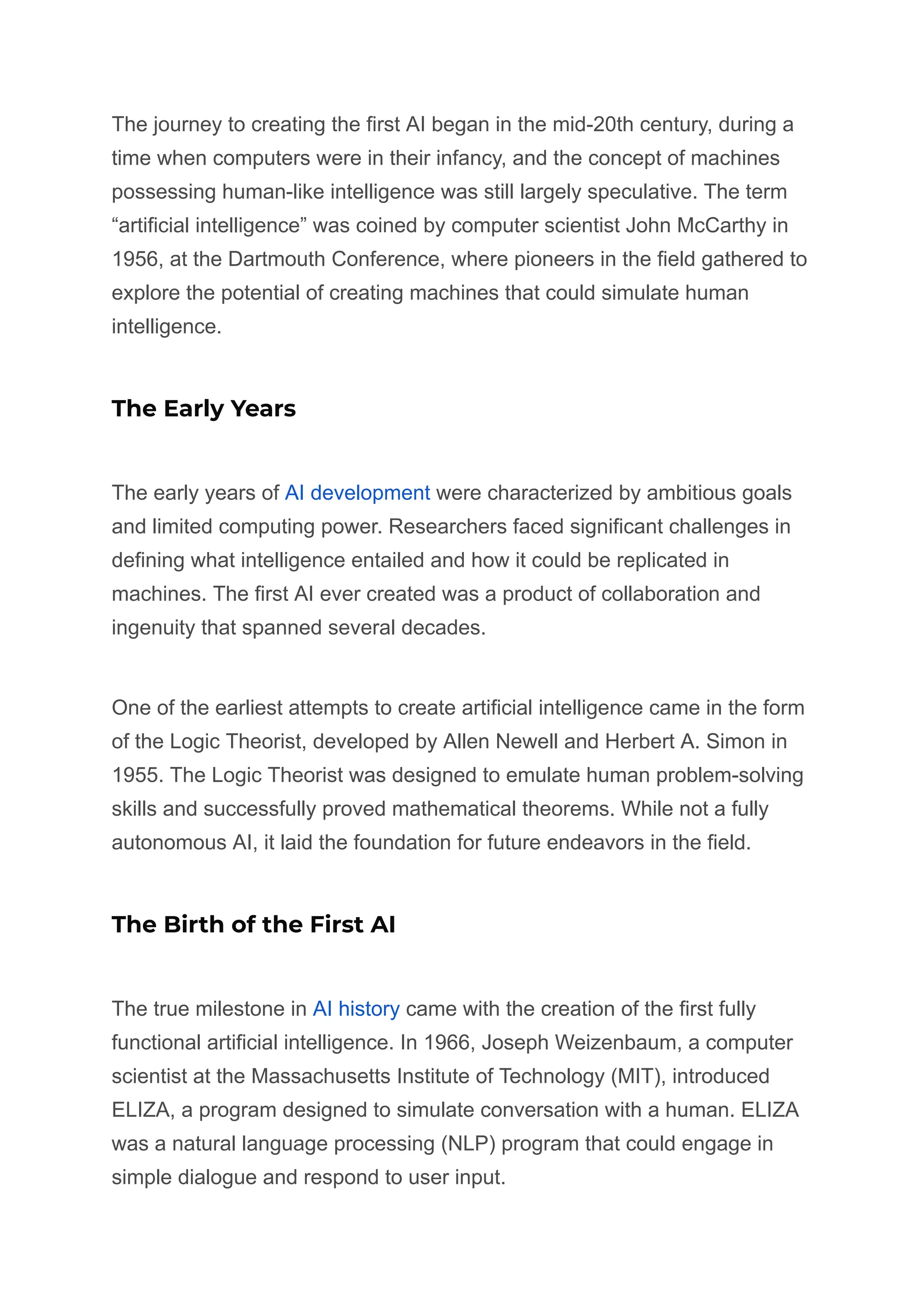
ELIZA, a program designed to simulate conversation with a human. ELIZA
was a natural language processing (NLP) program that could engage in
simple dialogue and respond to user input.
Source – Curiocial
ELIZA’s architecture was based on pattern-matching techniques, allowing it
to recognize keywords and generate appropriate responses. Although
ELIZA’s understanding of language was limited, it captivated users by
providing an illusion of intelligent conversation. ELIZA’s success marked a
significant leap forward in AI development and set the stage for further
advancements in the field.
The Key Innovations
The creation of the first AI involved several key innovations that paved the
way for future breakthroughs. One such innovation was the development of
rule-based systems, which allowed AI programs to follow predefined rules
and make decisions based on input. This approach was crucial in shaping
the functionality of early AI systems like ELIZA.
Another pivotal innovation was the integration of machine learning
techniques. Machine learning enabled AI programs to improve and adapt
their performance over time by learning from data and experience. This
concept became fundamental to the evolution of AI, leading to the
development of more sophisticated and capable systems.
ELIZA’s Impact
ELIZA’s impact extended beyond its technical achievements; it sparked
widespread interest and discussions about the potential applications of
artificial intelligence. People marveled at the idea of machines that could
understand and respond to human language, opening up possibilities in
areas such as customer service, information retrieval, and even
psychological therapy.
As word spread about ELIZA’s capabilities, researchers and developers
around the world began exploring new avenues for AI applications. The first
AI ever created became a catalyst for an era of experimentation and
innovation, with scientists pushing the boundaries of what machines could
achieve.
Challenges and Limitations
Despite the groundbreaking nature of the first AI, it was not without its
challenges and limitations. ELIZA’s conversational abilities were limited to
specific patterns and predefined responses, revealing the inherent difficulty
in creating machines that truly understood language and context. The need
for more sophisticated algorithms and computational power became
evident as researchers sought to overcome these limitations.
Additionally, ethical concerns emerged as AI systems started to interact
more closely with humans. Questions about privacy, bias, and the potential
misuse of AI technology became central to discussions surrounding its
development. These challenges prompted a reevaluation of the ethical
considerations associated with the creation and deployment of artificial
intelligence.
The Evolution Continues
The success of the first AI spurred further research and development,
leading to the creation of more advanced systems in the following decades.
As computing power increased and algorithms became more sophisticated,
AI applications diversified across various industries.
In the 1980s and 1990s, expert systems emerged as a dominant form of AI,
with programs designed to mimic the decision-making abilities of human
experts in specific domains. These systems found applications in fields
such as medicine, finance, and engineering, providing valuable insights
and recommendations based on vast amounts of data.
The Rise of Neural Networks
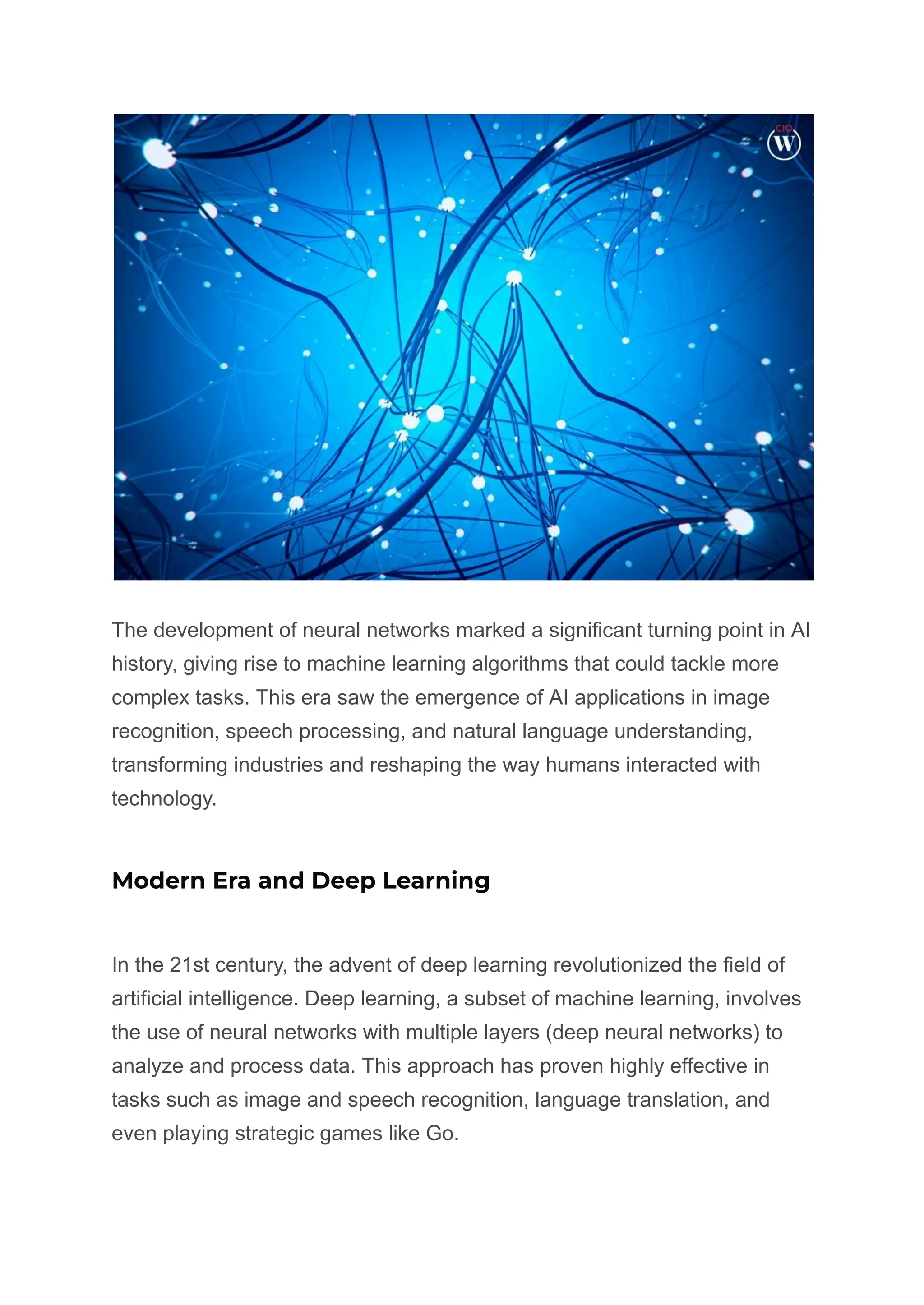
The late 20th century witnessed the rise of neural networks, a revolutionary
approach inspired by the human brain’s structure and function. Neural
networks allowed AI systems to learn from data in a manner that closely
resembled human learning, enabling them to recognize patterns and make
complex decisions.
The development of neural networks marked a significant turning point in AI
history, giving rise to machine learning algorithms that could tackle more
complex tasks. This era saw the emergence of AI applications in image
recognition, speech processing, and natural language understanding,
transforming industries and reshaping the way humans interacted with
technology.
Modern Era and Deep Learning
In the 21st century, the advent of deep learning revolutionized the field of
artificial intelligence. Deep learning, a subset of machine learning, involves
the use of neural networks with multiple layers (deep neural networks) to
analyze and process data. This approach has proven highly effective in
tasks such as image and speech recognition, language translation, and
even playing strategic games like Go.
The integration of deep learning techniques has fueled advancements in
autonomous vehicles, healthcare diagnostics, and personal assistants. AI
systems have become more adept at understanding and generating
human-like language, bridging the gap between machines and humans in
ways previously unimaginable.
Ethical Considerations in AI
As AI technology continues to evolve, ethical considerations have become
increasingly important. The impact of AI on privacy, job displacement, and
decision-making processes has raised concerns about its responsible use.
The development of ethical guidelines and regulations has become a
priority to ensure that AI benefits society without compromising
fundamental values.
The First AI Ever Created: A Lasting Legacy
Reflecting on the fascinating story of the first AI ever created, it becomes
clear that ELIZA’s humble beginnings paved the way for the technological
marvels of today. From rule-based systems to neural networks and deep
learning, the evolution of artificial intelligence has been a journey marked
by persistence, innovation, and the collective efforts of countless
researchers and developers.
ELIZA’s legacy is embedded in the fabric of modern technology, influencing
the design and implementation of AI systems across diverse applications.
The first AI ever created was a catalyst for change, inspiring generations of
scientists to push the boundaries of what machines could achieve. As we
continue to explore the frontiers of AI, it is essential to acknowledge and
appreciate the pioneering work that laid the foundation for the intelligent
systems shaping our world today.
Conclusion
The story of the first AI ever created is a testament to human ingenuity and
the relentless pursuit of knowledge. ELIZA’s emergence in the mid-20th
century sparked a revolution in artificial intelligence, setting the stage for
decades of innovation and advancements. From simple pattern-matching to
complex deep learning algorithms, the evolution of AI has been a
fascinating journey that continues to shape our present and future.
As we navigate the ethical considerations and challenges associated with
AI, it is essential to recognize the transformative impact of the first AI. Its
legacy lives on in the intelligent systems that have become integral to our
daily lives, from virtual assistants to medical diagnostics. The first AI ever
created not only opened the door to new possibilities but also instilled a
sense of curiosity and wonder that propels us forward in the quest for
greater technological achievements.

The Fascinating Story of the First AI Ever Created.pdf

  • 1.
    The Fascinating Storyof the First AI Ever Created In the realm of technology and innovation, the creation of artificial intelligence (AI) stands as a pivotal moment in human history. The first AI ever created marked the beginning of a new era, opening up possibilities that were once confined to the realms of science fiction. This article delves into the fascinating story of the birth of the first AI, a groundbreaking achievement that has transformed the way we live, work, and interact with the world around us. The Genesis of AI
  • 2.
    The journey tocreating the first AI began in the mid-20th century, during a time when computers were in their infancy, and the concept of machines possessing human-like intelligence was still largely speculative. The term “artificial intelligence” was coined by computer scientist John McCarthy in 1956, at the Dartmouth Conference, where pioneers in the field gathered to explore the potential of creating machines that could simulate human intelligence. The Early Years The early years of AI development were characterized by ambitious goals and limited computing power. Researchers faced significant challenges in defining what intelligence entailed and how it could be replicated in machines. The first AI ever created was a product of collaboration and ingenuity that spanned several decades. One of the earliest attempts to create artificial intelligence came in the form of the Logic Theorist, developed by Allen Newell and Herbert A. Simon in 1955. The Logic Theorist was designed to emulate human problem-solving skills and successfully proved mathematical theorems. While not a fully autonomous AI, it laid the foundation for future endeavors in the field. The Birth of the First AI The true milestone in AI history came with the creation of the first fully functional artificial intelligence. In 1966, Joseph Weizenbaum, a computer scientist at the Massachusetts Institute of Technology (MIT), introduced ELIZA, a program designed to simulate conversation with a human. ELIZA was a natural language processing (NLP) program that could engage in simple dialogue and respond to user input.
  • 3.
    Source – Curiocial ELIZA’sarchitecture was based on pattern-matching techniques, allowing it to recognize keywords and generate appropriate responses. Although ELIZA’s understanding of language was limited, it captivated users by providing an illusion of intelligent conversation. ELIZA’s success marked a significant leap forward in AI development and set the stage for further advancements in the field. The Key Innovations The creation of the first AI involved several key innovations that paved the way for future breakthroughs. One such innovation was the development of rule-based systems, which allowed AI programs to follow predefined rules and make decisions based on input. This approach was crucial in shaping the functionality of early AI systems like ELIZA.
  • 4.
    Another pivotal innovationwas the integration of machine learning techniques. Machine learning enabled AI programs to improve and adapt their performance over time by learning from data and experience. This concept became fundamental to the evolution of AI, leading to the development of more sophisticated and capable systems. ELIZA’s Impact ELIZA’s impact extended beyond its technical achievements; it sparked widespread interest and discussions about the potential applications of artificial intelligence. People marveled at the idea of machines that could understand and respond to human language, opening up possibilities in areas such as customer service, information retrieval, and even psychological therapy. As word spread about ELIZA’s capabilities, researchers and developers around the world began exploring new avenues for AI applications. The first AI ever created became a catalyst for an era of experimentation and innovation, with scientists pushing the boundaries of what machines could achieve. Challenges and Limitations Despite the groundbreaking nature of the first AI, it was not without its challenges and limitations. ELIZA’s conversational abilities were limited to specific patterns and predefined responses, revealing the inherent difficulty in creating machines that truly understood language and context. The need for more sophisticated algorithms and computational power became evident as researchers sought to overcome these limitations.
  • 5.
    Additionally, ethical concernsemerged as AI systems started to interact more closely with humans. Questions about privacy, bias, and the potential misuse of AI technology became central to discussions surrounding its development. These challenges prompted a reevaluation of the ethical considerations associated with the creation and deployment of artificial intelligence. The Evolution Continues The success of the first AI spurred further research and development, leading to the creation of more advanced systems in the following decades. As computing power increased and algorithms became more sophisticated, AI applications diversified across various industries. In the 1980s and 1990s, expert systems emerged as a dominant form of AI, with programs designed to mimic the decision-making abilities of human experts in specific domains. These systems found applications in fields such as medicine, finance, and engineering, providing valuable insights and recommendations based on vast amounts of data. The Rise of Neural Networks The late 20th century witnessed the rise of neural networks, a revolutionary approach inspired by the human brain’s structure and function. Neural networks allowed AI systems to learn from data in a manner that closely resembled human learning, enabling them to recognize patterns and make complex decisions.
  • 6.
    The development ofneural networks marked a significant turning point in AI history, giving rise to machine learning algorithms that could tackle more complex tasks. This era saw the emergence of AI applications in image recognition, speech processing, and natural language understanding, transforming industries and reshaping the way humans interacted with technology. Modern Era and Deep Learning In the 21st century, the advent of deep learning revolutionized the field of artificial intelligence. Deep learning, a subset of machine learning, involves the use of neural networks with multiple layers (deep neural networks) to analyze and process data. This approach has proven highly effective in tasks such as image and speech recognition, language translation, and even playing strategic games like Go.
  • 7.
    The integration ofdeep learning techniques has fueled advancements in autonomous vehicles, healthcare diagnostics, and personal assistants. AI systems have become more adept at understanding and generating human-like language, bridging the gap between machines and humans in ways previously unimaginable. Ethical Considerations in AI As AI technology continues to evolve, ethical considerations have become increasingly important. The impact of AI on privacy, job displacement, and decision-making processes has raised concerns about its responsible use. The development of ethical guidelines and regulations has become a priority to ensure that AI benefits society without compromising fundamental values.
  • 8.
    The First AIEver Created: A Lasting Legacy Reflecting on the fascinating story of the first AI ever created, it becomes clear that ELIZA’s humble beginnings paved the way for the technological marvels of today. From rule-based systems to neural networks and deep learning, the evolution of artificial intelligence has been a journey marked by persistence, innovation, and the collective efforts of countless researchers and developers. ELIZA’s legacy is embedded in the fabric of modern technology, influencing the design and implementation of AI systems across diverse applications. The first AI ever created was a catalyst for change, inspiring generations of scientists to push the boundaries of what machines could achieve. As we continue to explore the frontiers of AI, it is essential to acknowledge and appreciate the pioneering work that laid the foundation for the intelligent systems shaping our world today. Conclusion The story of the first AI ever created is a testament to human ingenuity and the relentless pursuit of knowledge. ELIZA’s emergence in the mid-20th century sparked a revolution in artificial intelligence, setting the stage for decades of innovation and advancements. From simple pattern-matching to complex deep learning algorithms, the evolution of AI has been a fascinating journey that continues to shape our present and future. As we navigate the ethical considerations and challenges associated with AI, it is essential to recognize the transformative impact of the first AI. Its legacy lives on in the intelligent systems that have become integral to our daily lives, from virtual assistants to medical diagnostics. The first AI ever
  • 9.
    created not onlyopened the door to new possibilities but also instilled a sense of curiosity and wonder that propels us forward in the quest for greater technological achievements.