The evolution ofWeb
Rendering Architectures
From Static HTML to Hybrid Architectures
Evangelia Mitsopoulou, Founder @Evangelia
Thessaloniki, 05.12.24
2.
Agenda
❏ Key Aspectsof Rendering Architectures
❏ Evolution of Rendering Architectures
❏ Current trends & Hybrid Rendering Solutions
❏ Future Directions of Rendering Architectures
3.
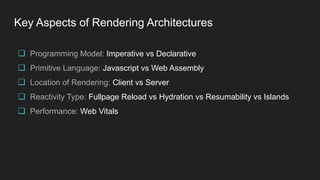
Key Aspects ofRendering Architectures
❏ Programming Model: Imperative vs Declarative
❏ Primitive Language: Javascript vs Web Assembly
❏ Location of Rendering: Client vs Server
❏ Reactivity Type: Fullpage Reload vs Hydration vs Resumability vs Islands
❏ Performance: Web Vitals
4.
Understanding Imperative vs.Declarative Approaches
Declarative
WHAT?
is the desired outcome
Imperative
HOW?
to create the desired outcome
5.
Understanding Imperative vs.Declarative Approaches
function ItemList({ items }) {
return (
<ul>
{items.map(item => (
<li key={item}>{item}</li>
))}
</ul>
);
}
const items = ['Item 1', 'Item 2', 'Item 3'];
ReactDOM.render(<ItemList
items={items} />,
document.getElementById('root'));
Declarative
const list = document.getElementById("list");
const items = ['Item 1', 'Item 2', 'Item 3'];
// Imperatively append items to the list
items.forEach(item => {
const li = document.createElement('li');
li.textContent = item;
list.appendChild(li);
});
Imperative
Add data on the what (template) of UI
Instruct browser how to create the UI
FRONTEND
6.
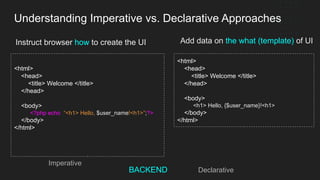
Understanding Imperative vs.Declarative Approaches
<html>
<head>
<title> Welcome </title>
</head>
<body>
<h1> Hello, {$user_name}!<h1>
</body>
</html>
Declarative
<html>
<head>
<title> Welcome </title>
</head>
<body>
<?php echo “<h1> Hello, $user_name!<h1>”;?>
</body>
</html>
Imperative
Add data on the what (template) of UI
Instruct browser how to create the UI
BACKEND
7.
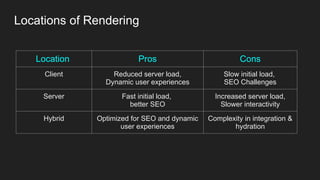
Locations of Rendering
LocationPros Cons
Client Reduced server load,
Dynamic user experiences
Slow initial load,
SEO Challenges
Server Fast initial load,
better SEO
Increased server load,
Slower interactivity
Hybrid Optimized for SEO and dynamic
user experiences
Complexity in integration &
hydration
8.
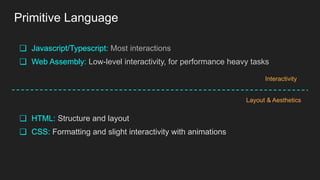
Primitive Language
❏ Javascript/Typescript:Most interactions
❏ Web Assembly: Low-level interactivity, for performance heavy tasks
❏ HTML: Structure and layout
❏ CSS: Formatting and slight interactivity with animations
Interactivity
Layout & Aesthetics
9.
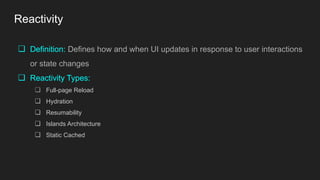
Reactivity
❏ Definition: Defineshow and when UI updates in response to user interactions
or state changes
❏ Reactivity Types:
❏ Full-page Reload
❏ Hydration
❏ Resumability
❏ Islands Architecture
❏ Static Cached
10.
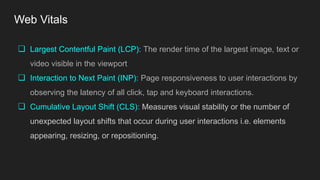
Web Vitals
❏ LargestContentful Paint (LCP): The render time of the largest image, text or
video visible in the viewport
❏ Interaction to Next Paint (INP): Page responsiveness to user interactions by
observing the latency of all click, tap and keyboard interactions.
❏ Cumulative Layout Shift (CLS): Measures visual stability or the number of
unexpected layout shifts that occur during user interactions i.e. elements
appearing, resizing, or repositioning.
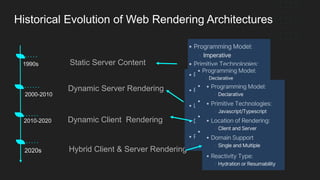
Historical Evolution ofWeb Rendering Architectures
Static Server Content
1990s
2000-2010
2010-2020
2020s
Dynamic Server Rendering
Dynamic Client Rendering
Hybrid Client & Server Rendering
13.
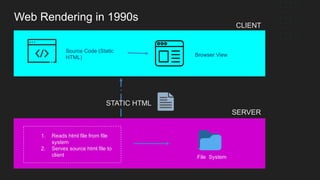
Web Rendering in1990s
Browser View
CLIENT
SERVER
STATIC HTML
Source Code (Static
HTML)
File System
1. Reads html file from file
system
2. Serves source html file to
client
14.
Web Rendering in2000-2010
Browser View
CLIENT
SERVER
HTML with dynamic content
HTML Source Code
Placeholders have been
replaced by their values
1. Retrieval of dynamic DB values
2. Further computations of values
3. Placement of computed values as
Variables-placeholders at template-
engine
Database
Add interactivity to
Static HTML
jQuery, ES6
Modules
15.
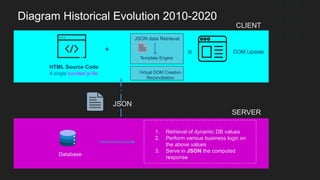
DOM Update
CLIENT
SERVER
JSON
HTML SourceCode
A single bundled js file
1. Retrieval of dynamic DB values
2. Perform various business logic on
the above values
3. Serve in JSON the computed
response
Database
Diagram Historical Evolution 2010-2020
JSON data Retrieval
Template Engine
Virtual DOM Creation
Reconciliation
+ =
16.
Current trends &Hybrid Rendering Solutions
❏ Hybrid Approaches combining SSR, CSR, RSC, SSG, ISG.
❏ Granularity in Rendering (Islands Architecture): focusing hydration of specific
components
❏ Resumability: avoid hydration altogether by resuming from server-rendered
state
17.
React Server Components(RSC)
❏ React Server Components (RSC): React’s feature that allows components to
run on the server and send lightweight html/json to the client without any
javascript.
❏ Render on server at runtime
❏ Non-interactive
❏ Combine seamlessly with client components
18.
Server Side Rendering(SSR)
❏ Server Side Rendering (SSR): Generates HTML on the server for every
request, delivering dynamic pages with pre-rendered content.
❏ Used in Nextjs, Nuxtjs, Ruby on Rails
❏ Best Use Case: E-commerce, dashboards or pages requiring dynamic content
and personalization
19.
Client Side Rendering(CSR)
❏ Client Side Rendering (CSR): The Browser fetches a minimal HTML shell and
renders content dynamically using Javascript.
❏ Used in SPAs with frameworks like Angular, Vue, React
❏ Best Use Case: Highly interactive applications where dynamic updates
dominate
20.
Static Site Generation(SSG)
❏ Static Side Generation (SSG): Pre-renders pages at build time, generating
static HTML files that can be served directly by a CDN
❏ Used by frameworks like Next.js, Astro, Hugo, Gatsby
❏ Best Use Case: Blogs, documentation stites or any other static content
21.
Incremental Static Generation(ISG)
❏ Incremental Static Generation (ISG): A hybrid approach where static pages
are pre-rendered during on demand and cached for future-requests
❏ Next.js specific
❏ Best use case: Large content-heavy sites (e.g., e-commerce with thousands
of product pages)
22.
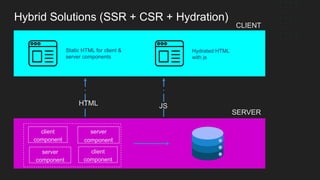
Hybrid Solutions (SSR+ CSR + Hydration)
client
component
server
component
server
component
client
component
JS
Hydrated HTML
with js
CLIENT
SERVER
HTML
Static HTML for client &
server components
23.
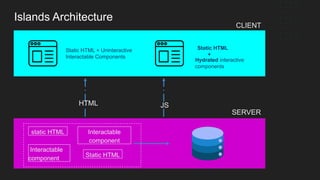
Islands Architectures (partial/selectivehydration)
❏ Definition: A rendering strategy where only specific “islands” (interactive
components) on the page are hydrated while the rest remains static HTML.
❏ How it works:
❏ The server pre-renders the static parts and isolates interactive parts as “islands”
❏ Each island is hydrated independently, avoiding unnecessary Javascript execution
❏ Use case: Content-heavy sites with isolated interactive components
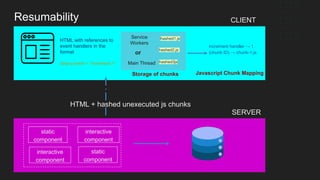
Resumability
❏ Definition: Anew paradigm in rendering where client resumes execution
from the server-rendered state without requiring hydration
❏ How it works:
❏ Server renders the page and sends it to the client along the application state
❏ The client directly resumes the application state without initializing or
executing redundant Javascript
Resumability Example
// QwikComponent Example
import { component$ } from '@builder.io/qwik';
export const Counter = component$(() => {
let count = 0;
// Event handler embedded in the server-rendered HTML
const increment = () => {
count += 1;
console.log(count);
};
return (
<div>
<button onClick$={increment}>Increment</button>
<span>{count}</span>
</div>
);
});
<!-- Server-rendered HTML with event handlers
embedded -->
<div>
<button
data-q:event="increment:1">Increment</button>
<span>0</span>
</div>
28.
Visual Comparison betweenarchitectures
Render all components
together and hydrate
Render all components, hydrate
key components first and then
progressively hydrate others
Static components are server
rendered HTML. Script is only
required for interactive
components
SSR Progressive Hydration Islands Architecture
https://www.patterns.dev/vanilla/islands-architecture/
29.
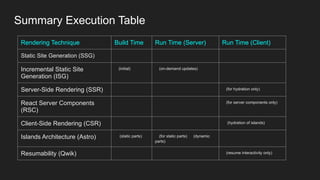
Summary Execution Table
RenderingTechnique Build Time Run Time (Server) Run Time (Client)
Static Site Generation (SSG) ✅ ❌ ❌
Incremental Static Site
Generation (ISG)
✅ (initial) ✅ (on-demand updates) ❌
Server-Side Rendering (SSR) ❌ ✅ ✅ (for hydration only)
React Server Components
(RSC)
❌ ✅ ❌ (for server components only)
Client-Side Rendering (CSR) ❌ ❌ ✅ (hydration of islands)
Islands Architecture (Astro) ✅ (static parts) ❌ (for static parts) ✅ (dynamic
parts)
✅
Resumability (Qwik) ✅ ❌ ✅(resume interactivity only)
30.
The Future ofWeb Rendering Architectures (Part 1)
❏ Streaming SSR: Sends HTML to the client in chunks from the server
❏ Edge-rendering: Distributed, faster content delivery via edge servers, reducing
latency by serving content from global locations (e.g. Cloudflare Workers)
❏ Use Case : Global apps with fast content delivery
❏ Serverless Rendering: Serverless functions, removing the need for dedicated
servers and dynamically scaling resources. Reduces overhead. Optimize cost.
❏ Use Case: Scalable apps with fluctuating traffic demands
31.
The Future ofWeb Rendering Architectures (Part 2)
❏ Web Assembly: High Performance client-side processing at near-native
speed (e.g. Rust)
❏ Use cases: Games, simulations, Image Video Processing, CAD Applications for 3D
Rendering, TensorFlow, complex web design tool (Figma)
❏ Real-time Rendering: Immediate content updates where systems responds to
user interactions
❏ Use cases: Live collaboration tools, chat applications, live updates
#5 Declarative: You simply declare what the UI should look like. You describe a list of items. React manages the how (rendering, updating DOM)
Imperative:
#6 Declarative: You simply declare what the UI should look like. You describe a list of items. React manages the how (rendering, updating DOM)
Imperative:
#7 Client:
The browser downloads HTML, CSS, and JavaScript, then renders the page using JavaScript (React, Vue, etc.).
Server:
The server generates the complete HTML page and sends it to the client.
Hybrid:
The initial render happens on the server (SSR), then the client takes over for further interactivity (CSR).
#16 https://dev.to/jenhsuan/day-32-of-100daysofcode-the-difference-between-csr-ssr-pre-rendering-and-static-ssr-1f49
Compare ssr vs csr vs ssg vs pre-rendering
#19 TTFB: Time to First Byte - seen as the time between clicking a link and the first bit of content coming in.
FCP: First Contentful Paint - the time when requested content (article body, etc) becomes visible.
TTI: Time To Interactive - the time at which a page becomes interactive (events wired up, etc).
All logic, data fetching, templating and routing are handled on the client rather than the server.
Ways to improve performance:
Aggressive code-splitting
Pre-rendering
PRPL pattern
Preload the late-discovered resources
Render the initial route as soon as possible
Pre-cache remaining assets (e.g., service worker)
Lazy load other routes and non-critical assets
There are two types of hydrations.
Destructive hydration: destroy the DOM tree and reload it when rendering on the browser (has flickering issue)
Non-destructive hydration: instead of destroying, the DOM tree will be leveraged on the client side
#30 Hybrid Approaches: React Server Components will influence the future of web rendering, allowing developers to split
Server-rendered and client-rendered parts of the app. Server will do the computation heavy, while clien
will focus on the dynamic and interactive parts
Web Assembly: Will be needed for computational-heavy tasks such as Games, Simulations, Image/Video processing.
It will enable languages like Go/Rust/C++ to run in a near-native performance in the browser
Edge Rendering: Edge Computing will grow in importance as more applications are moving from centralized servers to
distributed network of servers close to the user. This enable faster load times, better SEO & performance.
Frontend role: Optimize for content-caching strategies, assets pre-rendered or delivered from the nearest server
Serverless-Side Rendering: https://www.webiny.com/blog/serverless-side-rendering-e1c0924b8da1
Real-time Rendering: Real time applications like chat, gaming, collaborative tools will continue pushing the boundaries of web
rendering. Technologies like WebSockets and WebRTC enable low-latency, two-way communication
between client and server.
#31 Hybrid Approaches: React Server Components will influence the future of web rendering, allowing developers to split
Server-rendered and client-rendered parts of the app. Server will do the computation heavy, while clien
will focus on the dynamic and interactive parts
Web Assembly: Will be needed for computational-heavy tasks such as Games, Simulations, Image/Video processing.
It will enable languages like Go/Rust/C++ to run in a near-native performance in the browser
Edge Rendering: Edge Computing will grow in importance as more applications are moving from centralized servers to
distributed network of servers close to the user. This enable faster load times, better SEO & performance.
Frontend role: Optimize for content-caching strategies, assets pre-rendered or delivered from the nearest server
Serverless-Side Rendering: https://www.webiny.com/blog/serverless-side-rendering-e1c0924b8da1
Real-time Rendering: Real time applications like chat, gaming, collaborative tools will continue pushing the boundaries of web
rendering. Technologies like WebSockets and WebRTC enable low-latency, two-way communication
between client and server.



![Understanding Imperative vs. Declarative Approaches
function ItemList({ items }) {
return (
<ul>
{items.map(item => (
<li key={item}>{item}</li>
))}
</ul>
);
}
const items = ['Item 1', 'Item 2', 'Item 3'];
ReactDOM.render(<ItemList
items={items} />,
document.getElementById('root'));
Declarative
const list = document.getElementById("list");
const items = ['Item 1', 'Item 2', 'Item 3'];
// Imperatively append items to the list
items.forEach(item => {
const li = document.createElement('li');
li.textContent = item;
list.appendChild(li);
});
Imperative
Add data on the what (template) of UI
Instruct browser how to create the UI
FRONTEND](https://image.slidesharecdn.com/webrenderingarchitecturesskgjs-250228232332-d4794a3b/85/The-evolution-of-Web-Rendering-Architectures-5-320.jpg)