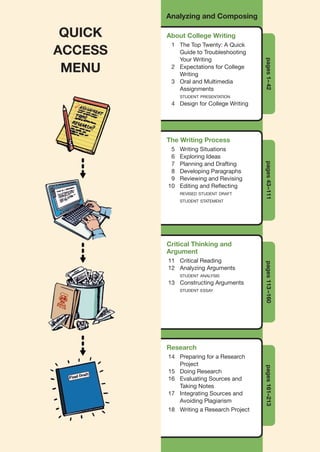
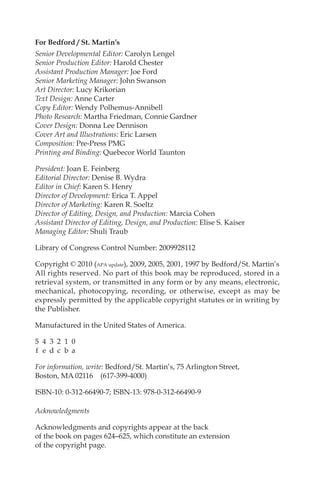
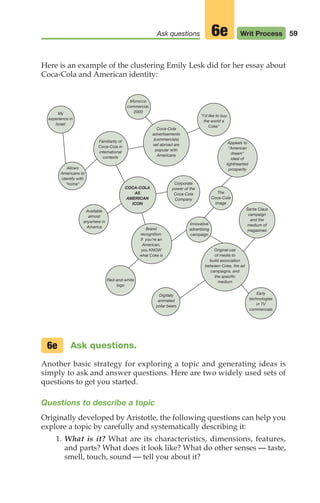
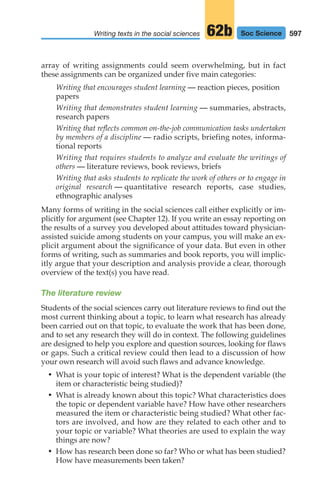
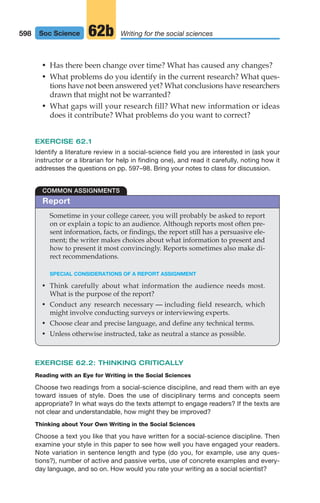
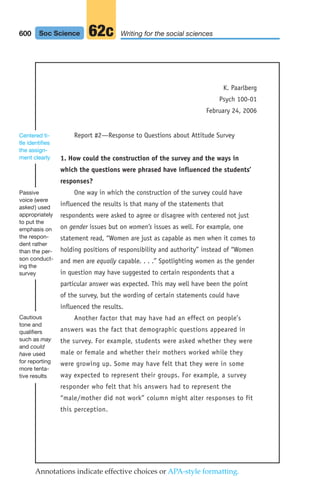
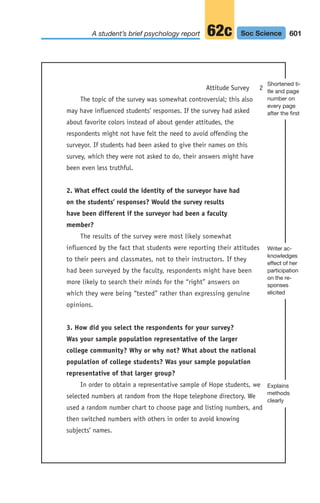
Analyzing and Composing
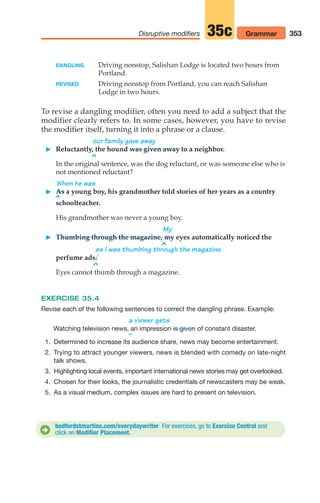
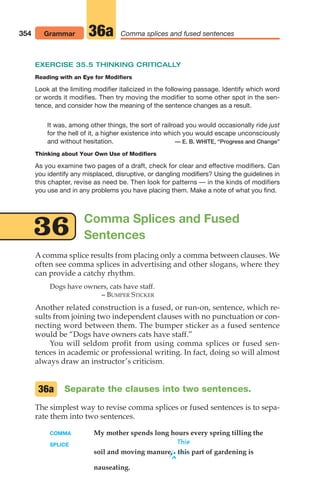
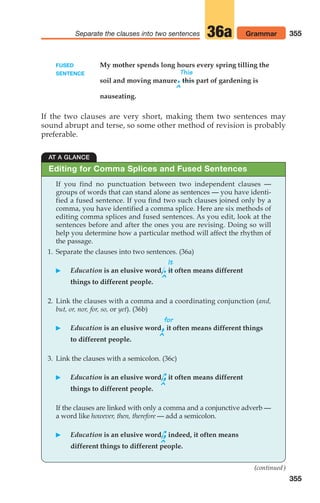
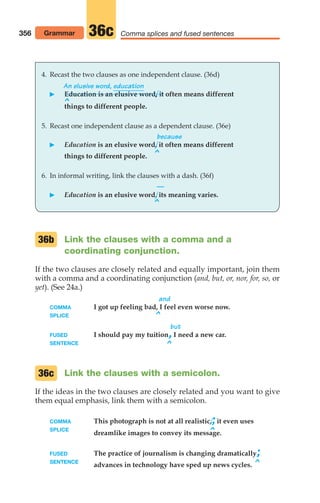
About College Writing
1 The Top Twenty: A Quick
Guide to Troubleshooting
Your Writing
2 Expectations for College
Writing
3 Oral and Multimedia
Assignments
		 student presentation
4 Design for College Writing
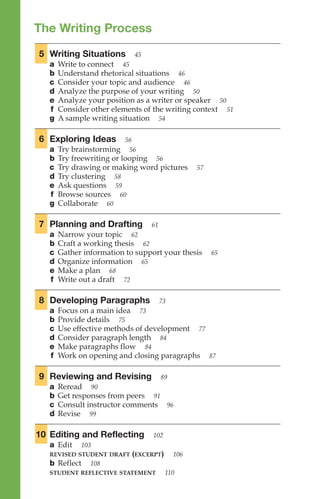
The Writing Process
5 Writing Situations
6 Exploring Ideas
7 Planning and Drafting
8 Developing Paragraphs
9 Reviewing and Revising
10 Editing and Reflecting
		
revised student draft
		
student statement
Critical Thinking and
Argument
11 Critical Reading
12 Analyzing Arguments
		
student analysis
13 Constructing Arguments
		
student essay
Research
14 Preparing for a Research
Project
15 Doing Research
16 Evaluating Sources and
Taking Notes
17 Integrating Sources and
Avoiding Plagiarism
18 Writing a Research Project
pages
161–213
pages
43  
–
111
pages
1–
42
pages
113
–160
QUICK
ACCESS
MENU
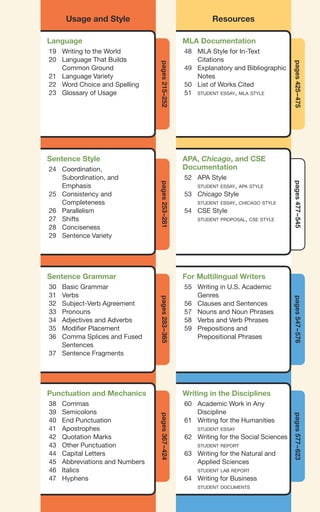
Resources
MLA Documentation
48 MLA Style for In-Text
Citations
49 Explanatory and Bibliographic
Notes
50 List of Works Cited
51 student essay, mla style
APA, Chicago, and CSE
Documentation
52 APA Style
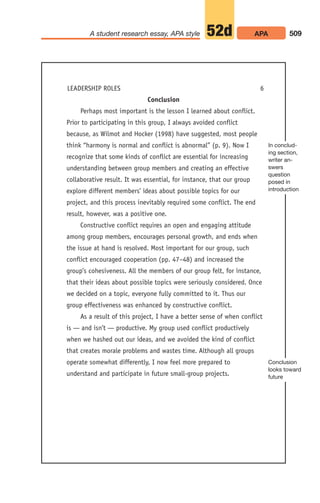
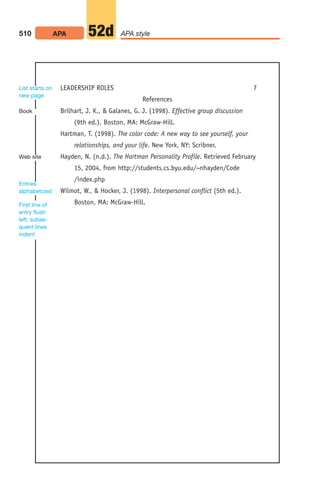
		 student essay, apa style
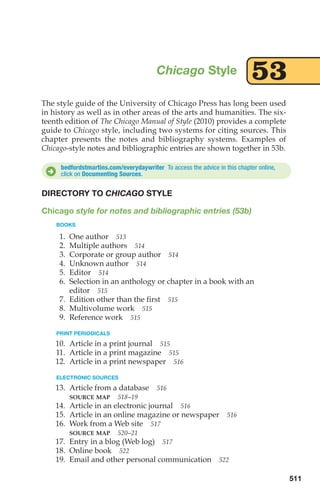
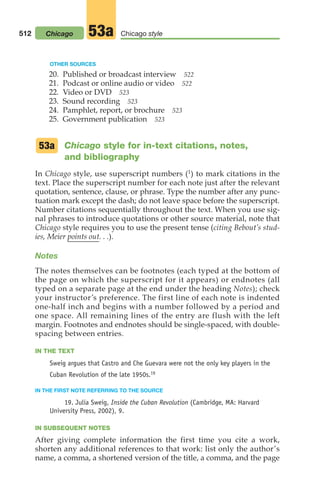
53 Chicago Style
		 student essay, chicago style
54 CSE Style
		 student proposal, cse style
For Multilingual Writers
55 Writing in U.S. Academic
Genres
56 Clauses and Sentences
57 Nouns and Noun Phrases
58 Verbs and Verb Phrases
59 Prepositions and
Prepositional Phrases
Writing in the Disciplines
60 Academic Work in Any
Discipline
61 Writing for the Humanities
		 student essay
62 Writing for the Social Sciences
		 student report
63 Writing for the Natural and
Applied Sciences
		 student lab report
64 Writing for Business
		 student documents
pages
577  
–
  
6
23
pages
477  
–
  
5
45
pages
425  
–
  
4
75
pages
547  
–
  
5
76
Usage and Style
Language
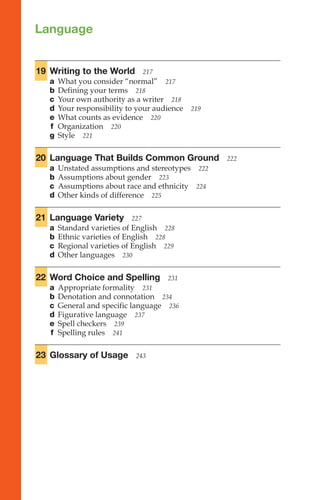
19 Writing to the World
20 Language That Builds
Common Ground
21 Language Variety
22 Word Choice and Spelling
23 Glossary of Usage
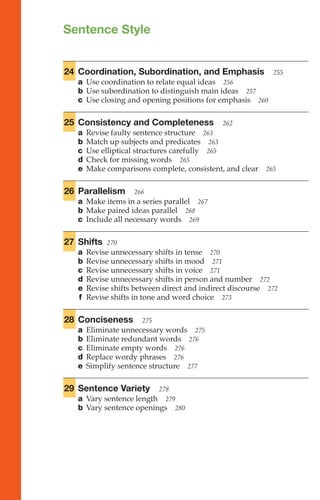
Sentence Style
24 Coordination,
Subordination, and
Emphasis
25 Consistency and
Completeness
26 Parallelism
27 Shifts
28 Conciseness
29 Sentence Variety
Sentence Grammar
30 Basic Grammar
31 Verbs
32 Subject-Verb Agreement
33 Pronouns
34 Adjectives and Adverbs
35 Modifier Placement
36 Comma Splices and Fused
Sentences
37 Sentence Fragments
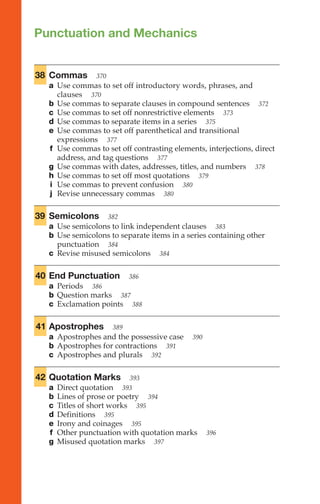
Punctuation and Mechanics
38 Commas
39 Semicolons
40 End Punctuation
41 Apostrophes
42 Quotation Marks
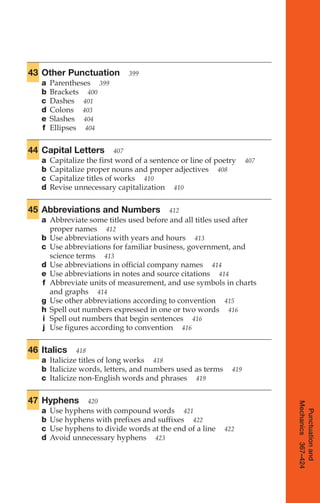
43 Other Punctuation
44 Capital Letters
45 Abbreviations and Numbers
46 Italics
47 Hyphens
pages
367  
–
  
4
24
pages
253  
–
281
pages
215
–252
pages
283  
–
  
3
65
Luns.EverywiEx4.1st page.110508.indd 1 11/12/08 5:45:54 PM
This page intentionally left blank
The
EVERYDAY
Writer
With Exercises
00_LUN_66490_FM_(i-xx)_00_LUN_66490_FM_i-xx.qxd 11/30/11 1:54 PM Page i
00_LUN_66490_FM_(i-xx)_00_LUN_66490_FM_i-xx.qxd 11/30/11 1:54 PM Page ii
this page left intentionally blank
The
EVERYDAY
Writer
With Exercises
Fourth Edition
BEDFORD / ST. MARTIN’S
Boston ◆ New York
Andrea A. Lunsford
STANFORD UNIVERSITY
A section for multilingual writers with
Paul Kei Matsuda
ARIZONA STATE UNIVERSITY
Christine M. Tardy
DEPAUL UNIVERSITY
00_LUN_66490_FM_(i-xx)_00_LUN_66490_FM_i-xx.qxd 11/30/11 1:54 PM Page iii
For Bedford / St. Martin’s
Senior Developmental Editor: Carolyn Lengel
Senior Production Editor: Harold Chester
Assistant Production Manager: Joe Ford
Senior Marketing Manager: John Swanson
Art Director: Lucy Krikorian
Text Design: Anne Carter
Copy Editor: Wendy Polhemus-Annibell
Photo Research: Martha Friedman, Connie Gardner
Cover Design: Donna Lee Dennison
Cover Art and Illustrations: Eric Larsen
Composition: Pre-Press PMG
Printing and Binding: Quebecor World Taunton
President: Joan E. Feinberg
Editorial Director: Denise B. Wydra
Editor in Chief: Karen S. Henry
Director of Development: Erica T. Appel
Director of Marketing: Karen R. Soeltz
Director of Editing, Design, and Production: Marcia Cohen
Assistant Director of Editing, Design, and Production: Elise S. Kaiser
Managing Editor: Shuli Traub
Library of Congress Control Number: 2009928112
Copyright © 2010 (APA update), 2009, 2005, 2001, 1997 by Bedford/St. Martin’s
All rights reserved. No part of this book may be reproduced, stored in a
retrieval system, or transmitted in any form or by any means, electronic,
mechanical, photocopying, recording, or otherwise, except as may be
expressly permitted by the applicable copyright statutes or in writing by
the Publisher.
Manufactured in the United States of America.
5 4 3 2 1 0
f e d c b a
For information, write: Bedford/St. Martin’s, 75 Arlington Street,
Boston, MA 02116 (617-399-4000)
ISBN-10: 0-312-66490-7; ISBN-13: 978-0-312-66490-9
Acknowledgments
Acknowledgments and copyrights appear at the back
of the book on pages 624–625, which constitute an extension
of the copyright page.
00_LUN_66490_FM_(i-xx)_00_LUN_66490_FM_i-xx.qxd 11/30/11 1:54 PM Page iv
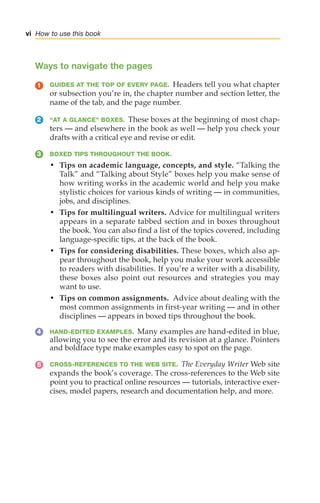
How to Use This Book
The Everyday Writer provides a “short and sweet” writing reference you
can use easily on your own — at work, in class, even on the run. Small
enough to tuck into a backpack or briefcase, this text has been designed
to help you find information quickly, efficiently, and easily. I hope that
this book will prove to be an everyday reference — and that the follow-
ing tips will lead you to any information you need.
Ways into the book
QUICK ACCESS MENU. Inside the front cover you’ll find a list of the
book’s contents. Once you locate a general topic on the quick access
menu, flip to the tabbed section of the book that contains information on
the topic, and check the menu on the tabbed divider for the exact page.
USER-FRIENDLY INDEX. The index lists everything covered in the book.
You can look up a topic either by its formal name (ellipses, for example)
or, if you’re not sure what the formal name is, by a familiar word you
use to describe it (such as dots).
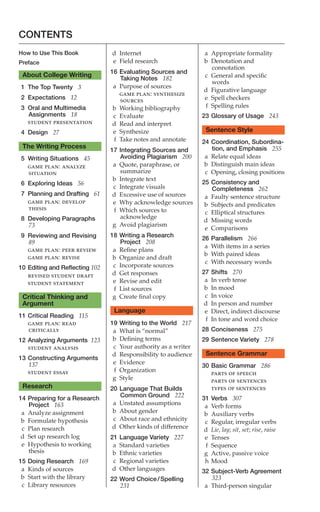
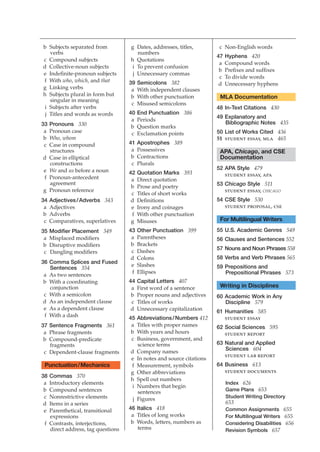
BRIEF CONTENTS. Inside the back cover, a brief but detailed table of con-
tents lists chapter titles and major headings.
GUIDE TO THE TOP TWENTY. The first tabbed section provides guidelines
for recognizing, understanding, and editing the most common errors in
student writing today. This section includes brief explanations, hand-
edited examples, and cross-references to other places in the book where
you’ll find more detail.
CLEAR ADVICE ON RESEARCH AND DOCUMENTATION. Easy-to-follow
source maps walk you step-by-step through the processes of selecting,
evaluating, using, and citing sources. Documentation models appear in
two tabbed sections — gold for MLA style and white for APA, Chicago,
and CSE styles — with the different documentation styles color-coded
in these sections.
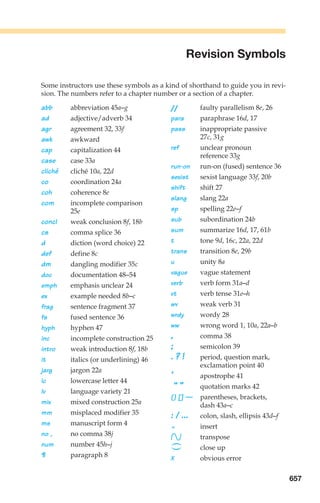
REVISION SYMBOLS. If your instructor uses revision symbols to mark your
drafts, you can consult the list of symbols at the back of the book and its
cross-references to places in the book where you’ll find more help.
GLOSSARY OF USAGE. Chapter 19 gives quick advice on commonly con-
fused and misused words.
v
00_LUN_66490_FM_(i-xx)_00_LUN_66490_FM_i-xx.qxd 11/30/11 1:54 PM Page v
vi How to use this book
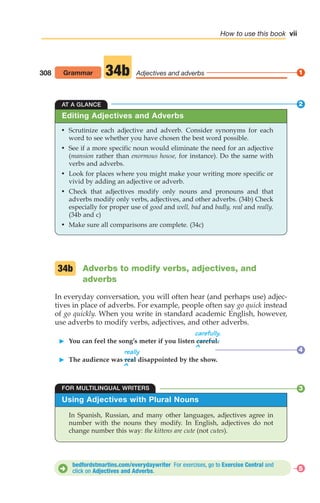
Ways to navigate the pages
GUIDES AT THE TOP OF EVERY PAGE. Headers tell you what chapter
or subsection you’re in, the chapter number and section letter, the
name of the tab, and the page number.
“AT A GLANCE” BOXES. These boxes at the beginning of most chap-
ters — and elsewhere in the book as well — help you check your
drafts with a critical eye and revise or edit.
BOXED TIPS THROUGHOUT THE BOOK.
• Tips on academic language, concepts, and style. “Talking the
Talk” and “Talking about Style” boxes help you make sense of
how writing works in the academic world and help you make
stylistic choices for various kinds of writing — in communities,
jobs, and disciplines.
• Tips for multilingual writers. Advice for multilingual writers
appears in a separate tabbed section and in boxes throughout
the book. You can also find a list of the topics covered, including
language-specific tips, at the back of the book.
• Tips for considering disabilities. These boxes, which also ap-
pear throughout the book, help you make your work accessible
to readers with disabilities. If you’re a writer with a disability,
these boxes also point out resources and strategies you may
want to use.
• Tips on common assignments. Advice about dealing with the
most common assignments in first-year writing — and in other
disciplines — appears in boxed tips throughout the book.
HAND-EDITED EXAMPLES. Many examples are hand-edited in blue,
allowing you to see the error and its revision at a glance. Pointers
and boldface type make examples easy to spot on the page.
CROSS-REFERENCES TO THE WEB SITE. The Everyday Writer Web site
expands the book’s coverage. The cross-references to the Web site
point you to practical online resources — tutorials, interactive exer-
cises, model papers, research and documentation help, and more.
5
4
3
2
1
00_LUN_66490_FM_(i-xx)_00_LUN_66490_FM_i-xx.qxd 11/30/11 1:54 PM Page vi
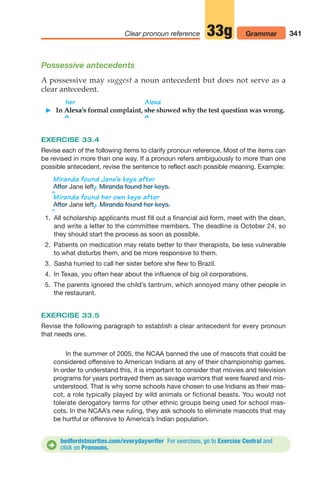
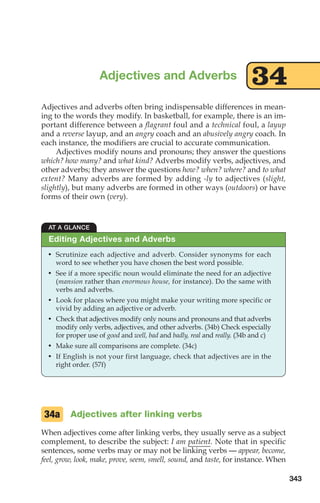
308 Grammar Adjectives and adverbs
34b
AT A GLANCE
• Scrutinize each adjective and adverb. Consider synonyms for each
word to see whether you have chosen the best word possible.
• See if a more specific noun would eliminate the need for an adjective
(mansion rather than enormous house, for instance). Do the same with
verbs and adverbs.
• Look for places where you might make your writing more specific or
vivid by adding an adjective or adverb.
• Check that adjectives modify only nouns and pronouns and that
adverbs modify only verbs, adjectives, and other adverbs. (34b) Check
especially for proper use of good and well, bad and badly, real and really.
(34b and c)
• Make sure all comparisons are complete. (34c)
Editing Adjectives and Adverbs
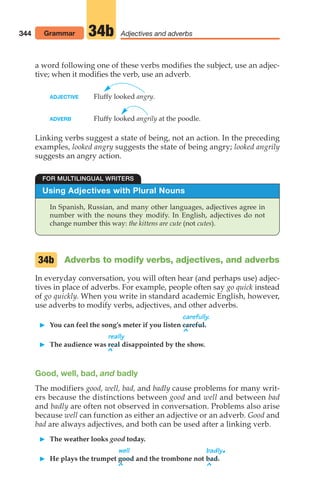
Adverbs to modify verbs, adjectives, and
adverbs
In everyday conversation, you will often hear (and perhaps use) adjec-
tives in place of adverbs. For example, people often say go quick instead
of go quickly. When you write in standard academic English, however,
use adverbs to modify verbs, adjectives, and other adverbs.
carefully.
䊳 You can feel the song’s meter if you listen careful.
^
really
䊳 The audience was real disappointed by the show.
^
34b
Using Adjectives with Plural Nouns
In Spanish, Russian, and many other languages, adjectives agree in
number with the nouns they modify. In English, adjectives do not
change number this way: the kittens are cute (not cutes).
FOR MULTILINGUAL WRITERS
bedfordstmartins.com/everydaywriter For exercises, go to Exercise Central and
click on Adjectives and Adverbs.
D
vii
How to use this book
1
2
3
4
5
00_LUN_66490_FM_(i-xx)_00_LUN_66490_FM_i-xx.qxd 11/30/11 1:54 PM Page vii
Preface
Today, perhaps more than ever before, everyone can be a writer — every
day. From contributing entries to Wikipedia to blogging, texting, and
posting to YouTube and Facebook, student writers are participating
widely in what philosopher Kenneth Burke calls “the conversation of
humankind.” As access to new writing spaces grows, so too do the po-
tential audiences: many writers, for example, are in daily contact with
people around the world, and their work goes out to millions. In such a
time, writers need to think more carefully than ever about how to craft
effective messages and how best to represent themselves to others.
These ever-expanding opportunities for writers, as well as the chal-
lenges that inevitably come with them, have inspired this edition of The
Everyday Writer — from the focus on thinking carefully about audience
and purposes for writing and on attending to the “look” of writing, to
the emphasis on the ways writing works across disciplines, to the ques-
tions that new genres and forms of writing raise about citing and docu-
menting sources and about understanding and avoiding plagiarism.
What remains constant is the focus on the “everydayness” of writing
and on down-to-earth, practical advice for how to write well in a multi-
tude of situations.
What also remains constant is the focus on rhetorical concerns. In a
time of such challenging possibilities, taking a rhetorical perspective is
particularly important. Why? Because a rhetorical perspective rejects
either/or, right/wrong, black/white approaches to writing in favor of
asking what choices will be most appropriate, effective, and ethical in a
given writing situation. A rhetorical perspective also means paying
careful attention to the purposes we want to achieve and the audiences
we want to address. Writers today need to maintain such a rhetorical
perspective every single day, and The Everyday Writer, Fourth Edition,
provides writers with the tools for doing so.
A note about MLA style
As you may know, the Modern Language Association publishes two
different sets of guidelines: the MLA Handbook for Writers of Research
Papers, Sixth Edition (2003), for student writers; and the MLA Style
Manual, Third Edition (2008), for scholars and professional writers.
MLA has recommended that undergraduate writers continue to fol-
low the guidelines outlined in the sixth edition of the MLA Handbook
until the seventh edition is published in 2009. The Everyday Writer fol-
lows that recommendation.
However, if you wish to follow the MLA Style Manual’s guidelines,
you can request free copies of Documenting Sources: Supplement for Lunsford
viii
00_LUN_66490_FM_(i-xx)_00_LUN_66490_FM_i-xx.qxd 11/30/11 1:54 PM Page viii
Handbooks (ISBN-10: 0-312-55455-9 or ISBN-13: 978-0-312-55455-2).
Students and instructors can also download a free .pdf file of this
booklet at bedfordstmartins.com/everydaywriter.
Highlights
ATTENTION TO GOOD WRITING, NOT JUST TO SURFACE CORRECTNESS.
The Everyday Writer helps students understand that effective texts
follow conventions that always depend on their audience, situation,
and discipline.
HELP FOR THE MOST COMMON WRITING PROBLEMS. A new nationwide
study that I conducted with Karen Lunsford — revisiting the original
1986 research that Bob Connors and I conducted on student writing —
shows the problems U.S. college students are most likely to have in
their writing today. This book’s first chapter presents a quick guide to
troubleshooting the Top Twenty — with examples, explanations, and
information on where to turn in the handbook for more detailed infor-
mation. Additional findings from the study inform advice throughout
the book.
UP-TO-DATE ADVICE ON RESEARCH AND DOCUMENTATION. As best prac-
tices for research continue to evolve, so does The Everyday Writer. In this
edition, you’ll find integrated coverage of library and online research to
help students find authoritative and credible information in any
medium, plus advice on integrating sources, avoiding plagiarism, us-
ing social bookmarking tools for research, and citing sources in MLA,
APA, Chicago, and CSE documentation styles. Visual source maps in all
four documentation sections show students how to evaluate, use, and
document print and online sources.
COMPREHENSIVE COVERAGE OF CRITICAL THINKING AND ARGUMENT. My
work on Everything’s an Argument has strengthened my belief that argu-
ment is integral to many kinds of writing, and I have expanded the cov-
erage of critical thinking and argument in this edition and placed them
in a separate tab to make the information even easier to find and use.
Chapters 11–13 offer extensive advice on critical reading and analysis
of both visual and verbal arguments, instruction on composing argu-
ments, and two complete student essays.
EXPANDED HELP FOR WRITING IN THE DISCIPLINES. Along with strategies
for understanding discipline-specific assignments, vocabulary, style,
and use of evidence, this edition offers more student writing samples
than ever before, including research projects in MLA, APA, Chicago, and
CSE styles, business documents, and sample writing from introductory
humanities, social sciences, and natural sciences courses.
ix
Preface
00_LUN_66490_FM_(i-xx)_00_LUN_66490_FM_i-xx.qxd 11/30/11 1:54 PM Page ix
New to this edition
New advice based on Andrea Lunsford’s teaching and research
UNIQUE COVERAGE OF LANGUAGE AND STYLE. Unique chapters on lan-
guage help students think about language in context and about the con-
sequences that language choices have on writers and readers. Boxed
tips throughout the book help students communicate effectively across
cultures — and use varieties of language both wisely and well.
INTEGRATED EXERCISES. Exercises to help students practice writing, re-
vising, thinking critically, and editing appear throughout the book. (An
answer key appears in the Instructor’s Notes.)
AN INVITING DESIGN. The Everyday Writer makes information easy to find
and appealing to read.
x Preface
• New “Talking the Talk”
boxes answer real
questions students ask
about academic
concepts.
• New “Common
Assignments” boxes
provide tips for
succeeding with the
kinds of writing projects
and assignments that
research shows
students today are
most likely to encounter
in their classes.
• A new chapter on expectations for college writing helps students
grapple with academic work.
Conventions
TALKING THE TALK
“Aren’t conventions really just rules with another name?” Not entirely.
Conventions — agreed-on language practices of grammar, punctuation,
and style — convey a kind of shorthand information from writer to read-
er. In college writing, you will want to follow the conventions of standard
academic English unless you have a good reason to do otherwise. But
unlike hard-and-fast rules, conventions are flexible; a convention appro-
priate for one time or situation may be inappropriate for another. You
may even choose to ignore conventions to achieve a particular effect. (You
might, for example, write a sentence fragment rather than a full sentence,
such as the Not entirely at the beginning of this box.) As you become more
experienced and confident in your writing, you will develop a sense of
which conventions to apply in different writing situations.
You are almost certain to get some form of analysis assignment during
your first year of college. One common variety is the rhetorical analy-
sis assignment, which essentially answers two big questions — What
is the purpose of the text you are analyzing? How is that purpose
achieved? — and focuses on how the text gets its meaning across.
SPECIAL CONSIDERATIONS OF A RHETORICAL ANALYSIS ASSIGNMENT
• Identify the purpose or purposes of the text. If the text has multiple
purposes, point out any conflicts.
• Identify the primary audience for the text and any secondary au-
diences, and explore how the text meets audience expectations
or needs.
• Examine the author’s stance or attitude toward the topic: is it favor-
able, critical, suspicious, neutral, or mocking? Identify parts of the
text where such attitudes are evident, and show how they work to
appeal to the audience.
• Explain how the text uses deliberate strategies (such as tone, word
choice, sentence structure, design, special effects, choice of medium,
choice of evidence, and so on) to achieve its purposes.
COMMON ASSIGNMENTS
Rhetorical Analysis
00_LUN_66490_FM_(i-xx)_00_LUN_66490_FM_i-xx.qxd 11/30/11 1:54 PM Page x
xi
Preface
• New and expanded
coverage of reviewing
and revising clarifies
the relationship between
review and revision, with
advice on how to offer
useful comments on
peers’ writing and how
to benefit from com-
ments from both peers
and instructors.
• A new section on
reflecting on writing
guides students in
thinking back on their
completed writing
projects. A student
reflective essay models
the writing students
are often asked to
do for portfolio
assessment.
9 Reviewing and Revising 82
a Reread 82
b Get responses from peers 84
c Consult instructor comments 88
d Revise 91
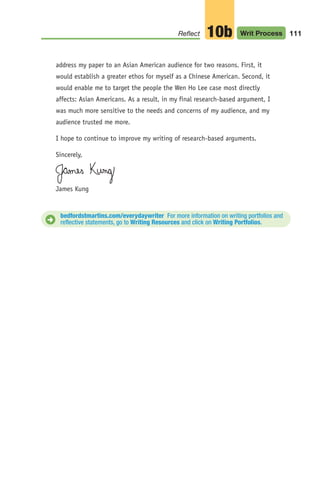
A student’s reflective statement
Here is a shortened version of the cover letter that
James Kung wrote to accompany his first-year writing
portfolio.
December 6, 2007
Dear Professor Ashdown:
“Writing is difficult and takes a long time.” This simple yet powerful
statement has been uttered so many times in our class that it has
essentially become our motto. During this class, my persuasive writing
skills have improved dramatically, thanks to many hours spent writing,
revising, polishing, and thinking about my topic. The various drafts,
revisions, and other materials in my portfolio show this improvement.
101
Reflect Writ Process
10b
James Kung
Student Writer
Reflective Statements
Research done for this book shows that one of the most common writ-
ing assignments in college today is a reflective statement — in the form
of a letter, a memo, or a home page — that explains and analyzes the
contents of a portfolio.
SPECIAL CONSIDERATIONS OF A REFLECTIVE ASSIGNMENT
• Think carefully about the overall impression you want the portfolio
to create, and make sure that the tone and style of your reflective
statement set the stage for the entire portfolio.
• Unless otherwise instructed, include in your cover letter a descrip-
tion of what the portfolio contains and explain the purpose of each
piece of writing you have chosen.
• Reflect on the strengths and weaknesses of your writing, using spe-
cific passages from assignments in your portfolio to provide evi-
dence for each point you make.
• Reflect on the most important things you have learned about writ-
ing and about yourself as a writer.
• Conclude with plans for ongoing improvement in your writing.
COMMON ASSIGNMENTS
00_LUN_66490_FM_(i-xx)_00_LUN_66490_FM_i-xx.qxd 11/30/11 1:54 PM Page xi
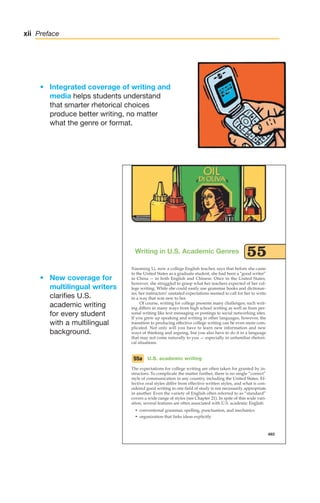
• Integrated coverage of writing and
media helps students understand
that smarter rhetorical choices
produce better writing, no matter
what the genre or format.
xii Preface
• New coverage for
multilingual writers
clarifies U.S.
academic writing
for every student
with a multilingual
background.
493
Xiaoming Li, now a college English teacher, says that before she came
to the United States as a graduate student, she had been a “good writer”
in China — in both English and Chinese. Once in the United States,
however, she struggled to grasp what her teachers expected of her col-
lege writing. While she could easily use grammar books and dictionar-
ies, her instructors’ unstated expectations seemed to call for her to write
in a way that was new to her.
Of course, writing for college presents many challenges; such writ-
ing differs in many ways from high school writing as well as from per-
sonal writing like text messaging or postings to social networking sites.
If you grew up speaking and writing in other languages, however, the
transition to producing effective college writing can be even more com-
plicated. Not only will you have to learn new information and new
ways of thinking and arguing, but you also have to do it in a language
that may not come naturally to you — especially in unfamiliar rhetori-
cal situations.
U.S. academic writing
The expectations for college writing are often taken for granted by in-
structors. To complicate the matter further, there is no single “correct”
style of communication in any country, including the United States. Ef-
fective oral styles differ from effective written styles, and what is con-
sidered good writing in one field of study is not necessarily appropriate
in another. Even the variety of English often referred to as “standard”
covers a wide range of styles (see Chapter 21). In spite of this wide vari-
ation, several features are often associated with U.S. academic English:
• conventional grammar, spelling, punctuation, and mechanics
• organization that links ideas explicitly
55a
Writing in U.S. Academic Genres 55
00_LUN_66490_FM_(i-xx)_00_LUN_66490_FM_i-xx.qxd 11/30/11 1:54 PM Page xii
xiii
Preface
• Advice from the new
research study is in-
tegrated throughout
the text, giving stu-
dents the benefit of
the most up-to-date
information available
on how college
writing works.
A new Top Twenty based on new research
• The 2006 Lunsford and
Lunsford study’s
results show an
increasing emphasis
on researched and
documented writing in
college — a major
change from the kinds
of assignments given
in the past. The new
Top Twenty reflects this
change as well as
students’ evolving use
of technology (including
spell checkers).
allergy
䊳 The child suffered from a severe allegory to peanuts.
^
Allegory is a spell checker’s replacement for a misspelling of allergy.
of
䊳 The panel discussed the ethical implications on the situation.
^
Wrong-word errors can involve using a word with the wrong shade of
meaning, using a word with a completely wrong meaning, or using
a wrong preposition or another wrong word in an idiom. Selecting a
word from a thesaurus without knowing its meaning or allowing a
spell checker to correct spelling automatically can lead to wrong-word
errors, so use these tools with care. If you have trouble with preposi-
tions and idioms, memorize the standard usage. (See Chapter 22 on
word choice and spelling and Chapter 59 on prepositions and idioms.)
Missing comma after an introductory element
䊳 Determined to get the job done,we worked all weekend.
䊳 Although the study was flawed,the results may still be useful.
Readers usually need a small pause — signaled by a comma —
between an introductory word, phrase, or clause and the main part of
the sentence. Use a comma after every introductory element. When the
introductory element is very short, you don‘t always need a comma,
but including it is never wrong. (See 38a.)
Incomplete or missing documentation
(263).”
䊳 Satrapi says, “When we’re afraid, we lose all sense of analysis and reflection.’’
The page number of the print source for this quotation must be included.
䊳 According to one source, James Joyce wrote two of the five best novels
(Modern Library 100 Best).
of all time.
^
The source mentioned should be indentified (this online source has no page
numbers).
Cite each source you refer to in the text, following the guidelines of the doc-
umentation style you are using. (The preceding examples follow MLA
style — see Chapters 48–51; for other styles, see Chapters 52–54.) Omitting
documentation can result in charges of plagiarism (see Chapter 17).
3
2
5
Incomplete or missing documentation Top Twenty
3
^
^
^
among U.S. college students today, listed here in order of frequency. A
brief explanation and examples of each error are provided in the fol-
lowing sections, and each error pattern is cross-referenced to other
places in this book where you can find more detailed information and
additional examples.
4 Top Twenty A quick guide
1
D
Wrong word
precedence
䊳 Religious texts, for them, take prescience over other kinds of sources.
^
Prescience means “foresight,” and precedence means “priority.”
1
AT A GLANCE
1. Wrong word
2. Missing comma after an introductory element
3. Incomplete or missing documentation
4. Vague pronoun reference
5. Spelling (including homonyms)
6. Mechanical error with a quotation
7. Unnecessary comma
8. Unnecessary or missing capitalization
9. Missing word
10. Faulty sentence structure
11. Missing comma with a nonrestrictive element
12. Unnecessary shift in verb tense
13. Missing comma in a compound sentence
14. Unnecessary or missing apostrophe (including its/it’s)
15. Fused (run-on) sentence
16. Comma splice
17. Lack of pronoun-antecedent agreement
18. Poorly integrated quotation
19. Unnecessary or missing hyphen
20. Sentence fragment
The Top Twenty
bedfordstmartins.com/everydaywriter For advice on learning from your own most
common writing problems, go to Writing Resources and click on Taking a Writing
Inventory.
1
2
4
3
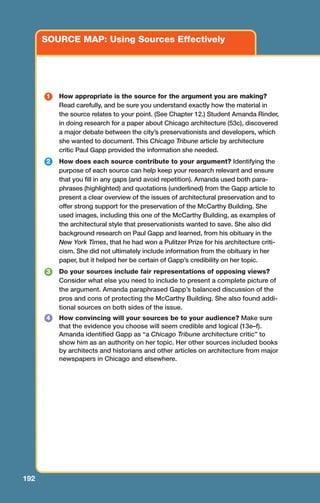
SOURCE MAP: Using Sources Effectively
How appropriate is the source for the argument you are making?
Read carefully, and be sure you understand exactly how the material in
the source relates to your point. (See Chapter 12.) Student Amanda Rinder,
in doing research for a paper about Chicago architecture (see p. 469),
discovered a major debate between the city’s preservationists and devel-
opers, which she wanted to document. This Chicago Tribune article by
architecture critic Paul Gapp provided the information she needed.
How does each source contribute to your argument? Identifying the
purpose of each source can help keep your research relevant and ensure
that you fill in any gaps (and avoid repetition). Amanda used both para-
phrases (highlighted) and quotations (underlined) from the Gapp article to
present a clear overview of the issues of architectural preservation and to
offer strong support for the preservation of the McCarthy Building. She
used images, including this one of the McCarthy Building, as examples of
the architectural style that preservationists wanted to save. She also did
background research on Paul Gapp and learned, from his obituary in the
New York Times, that he had won a Pulitzer Prize for his architecture criti-
cism. She did not ultimately include information from the obituary in her
paper, but it helped her be certain of Gapp’s credibility on her topic.
Do your sources include fair representations of opposing views?
Consider what else you need to include to present a complete picture of
the argument. Amanda paraphrased Gapp’s balanced discussion of the
pros and cons of protecting the McCarthy Building. She also found addi-
tional sources on both sides of the issue.
How convincing will your sources be to your audience? Make sure
that the evidence you choose will seem credible and logical (13e–f).
Amanda identified Gapp as “a Chicago Tribune architecture critic” to
show him as an authority on her topic. Her other sources included books
by architects and historians and other articles on architecture from major
newspapers in Chicago and elsewhere.
4
3
2
1
Indeed, that sort of restoration was originally envisioned by real estate developers when
the city--acting under its renewal powers--tentatively decided in 1983 to accept a bid of
$12.6 million for the full block of land on which the McCarthy stands. The McCarthy
and two other old buildings were to have been linked to a glass enclosed shopping arcade
connecting Dearborn and State Streets.
Late last summer, however, the city was notified of a change of mind by the development
group consisting of the Levy Organization, JMB Realty and Metropolitan Structures. The
group said it wanted to tear down the buildings and construct an office high-rise in their
place.
To make up for the McCarthy's loss, the developers offered to contribute $2 million to
the city for development of a "Theater Row" project in the North Loop, tied to existing
theatrical venues.
When the LPC said it might not oppose such a deal, it was attacked by the City Club of
Chicago and restoration authority John Vinci, among others. "The developer's offer is
tantamount to a civic shakedown," said Larry P. Horist, the City Club's executive
director. Vinci said the LPC's vacillation "destroys its integrity."
Today, City Hall is trapped and squirming in the middle.
If it stands fast in favor of the McCarthy, it risks queering the land sale in an important
urban renewal area whose upgrading has already been plagued by political, legal, tax
assessment and other problems.
If it rescinds the McCarthy's landmark status and allows demolition, the city will have
gone on record as favoring the allure of the dollar over Chicago's architectural heritage.
(Moving the McCarthy to another site, which has also been suggested, would amount to
the same kind of surrender and set a dangerous precedent).
It's a tough decision, and the politicians will be faulted in either case. Yet anyone who
cares for the irreplaceable historical and cultural fabric of the city can hardly take
anything but the long view:
The McCarthy and most of Chicago's other official architecture landmarks were in place
long before any of today's politicians and real estate developers (or you and I) were born.
Is it too much to hope that they will continue to grace our ravaged but still great city long
after all of us are gone?
forgotten that the state building, designed by Helmut Jahn, was always intended to be the
anchor of the redevelopment area.
Municipal planners finally decided to spare seven historic buildings in the renewal district
by making them landmarks, and the city council gave the designation to:
-- The McCarthy, designed in 1872 by John M. Van Osdel.
-- The Chicago Theater, 175 N. State St., a Rapp & Rapp-designed masterpiece built in
1921.
-- The Page Brothers Building, just north of the Chicago Theater, another Van Osdel
building constructed in 1872 and notable chiefly for its full cast iron north facade--the
only surviving example of its kind here.
-- The handsome Harris and Selwyn Theaters at 180 and 190 N. Dearborn St., built in
1922 on designs by H. Kenneth Franzheim and C. Howard Crane.
-- The Oliver Building at 159 N. Dearborn St., a good-looking Chicago- style office
structure designed by Holabird & Roche in 1907.
-- The Delaware Building, 36 W. Randolph St., an 1872 structure by Wheelock and
Thomas. Its Italianate style and corner location give it a strong resemblance to the
McCarthy.
When the Chicago Theater and Page Brothers buildings were almost destroyed by their
previous owners a couple of years ago, it was a reminder that landmark designation is no
guarantee of preservation. It can only delay demolition while potential ways of saving a
building are explored. (The Chicago and the Page, rescued after lengthy litigation, are
now well on the way to extended lives under new ownership and an ambitious restoration
program).
And so we consider the present McCarthy Building situation, which might be described
as an impasse on its way to becoming a brouhaha.
The city council gave the McCarthy landmark status because it is a rare and distinguished
example of work by Van Osdel, who was Chicago's first professional architect. Created in
an Italianate style just a year after the Great Chicago Fire of 1871, the McCarthy's
carefully detailed masonry and iron facades reflect the same look Van Osdel selected
when he designed the third Palmer House hotel a few years later.
If the garish signs that degrade the McCarthy were simply removed, that alone would
reveal the building as a stunningly appealing relic from Chicago's 19th Century
renaissance era. Replacing the little five-story building's lost cornice and restoring its
base would present no technical problems.
MCCARTHY BUILDING PUTS LANDMARK LAW
ON A COLLISION COURSE WITH DEVELOPERS
[FINAL EDITION, C]
Chicago Tribune (pre-1997 Fulltext) - Chicago, Ill.
Author: Paul Gapp, Architecture critic
Date: Apr 20, 1986
Section: ARTS
Text Word Count: 1142
Document Text
Chicago's commitment to saving municipally designated landmarks is undergoing one of
its most crucial tests. If a little gem of a structure called the McCarthy Building is torn
down, the city's landmarks protection ordinance will be devalued almost to the vanishing
point.
The McCarthy stands at the northeast corner of Dearborn and Washington Streets, just
across from Daley Civic Center. Its dignified facades are defaced by so many ugly signs
that most pedestrians see the building only as a rude smear on the streetscape. Yet the
McCarthy's esthetic and historical value is undeniable, which is why the city council
gave the building landmark status in the first place.
Now, however, a real estate development group wants to demolish the McCarthy to make
room for an office tower. Because the building stands on municipally controlled urban
renewal land, the city has both the leverage to save it and a reason for allowing its
destruction. This landmark scenario is unprecedented and could hardly be stickier.
The McCarthy and several other important old buildings first appeared threatened in the
early 1970s when the city began drafting the North Loop urban renewal plan. In 1973,
the private Landmarks Preservation Council (LPC) asked officials to spare such
buildings, but the city brushed aside the plea.
Under an early version of the North Loop urban renewal program announced in 1978,
more than 50 buildings--including all nine movie houses then extant --were to be
destroyed in a seven-block area.
Among structures marked for demolition were seven--including the McCarthy --already
listed on the federal National Register of Historic Places. Preservation officials in
Washington warned that their destruction could mean a loss of federal renewal money,
and City Hall began reshuffling its plans.
The tangle of events that followed into the 1980s found the city repeatedly changing its
mind about what should and should not be saved from destruction.
While this was going on, demolition in the renewal area began with the Sherman House
hotel, which fell to make way for the new State of Illinois Center. Most people have
Au
gu
st
11
, 19
92
Paul Gapp, 64, Journalist, Dies;
Architectu
re Critic
W
on Pulitzer
By
HE
RB
ER
T M
US
CH
AM
P
Pa
ul
Ga
pp
, the
Pu
litze
r Pr
ize
wi
nn
ing
arc
hit
ec
tur
e cri
tic
for Th
e Ch
ica
go
Tr
ibu
ne
, die
d on
Ju
ly
30
at
No
rth
we
st
M
em
orial
Ho
sp
ita
l in
Ch
ica
go
. He
wa
s 64
ye
ars
old
an
d liv
ed
in
Ch
ica
go
.
He
die
d of
lun
g ca
nc
er
co
mp
lic
ate
d by
em
ph
ys
em
a,
his
offic
e said.
M
r. Ga
pp
wa
s bo
rn
in
Cl
ev
ela
nd
in
19
28
. He
be
ga
n his
ca
ree
r in
jou
rnali
sm
wi
th
Th
e
Co
lum
bu
s (O
hio
) Di
sp
atc
h aft
er
grad
ua
tin
g fro
m
Oh
io
Un
ive
rsi
ty
in
19
50
. Six ye
ars
lat
er,
he
joi
ne
d Th
e Ch
ica
go
Da
ily
Ne
ws
, wh
ere
he
wo
rked
as
a rep
orter
, ed
ito
ria
l wr
ite
r
an
d fea
tur
es
ed
ito
r. In
19
72
, M
r. Ga
pp
joi
ne
d Th
e Ch
ica
go
Tr
ibu
ne
as
assis
tan
t cit
y
ed
ito
r for urba
n aff
air
s.
He
wa
s ap
po
int
ed
arc
hit
ec
tur
e cri
tic
in
19
74
an
d wo
n the
Pu
litze
r
Pr
ize
for cri
tic
ism
in
19
79
.
M
r. Ga
pp
's int
ere
st
in
arc
hit
ec
tur
e grew
ou
t of
his
lov
e for Ch
ica
go
, wh
ich
he
on
ce
de
scrib
ed
as
"th
e las
t of
the
grea
t Am
eri
ca
n cit
ies
, a cit
y of
grea
t ele
ga
nc
e an
d grea
t
ch
arm
."
Hi
s wr
iting
s on
arc
hit
ec
tur
e he
lpe
d rea
de
rs
grasp the
role
of
bu
ild
ing
s in
Ch
ica
go
's so
cia
l an
d po
litica
l lif
e.
179
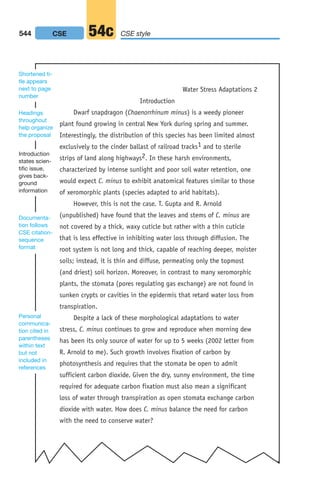
178
3
4
2
1
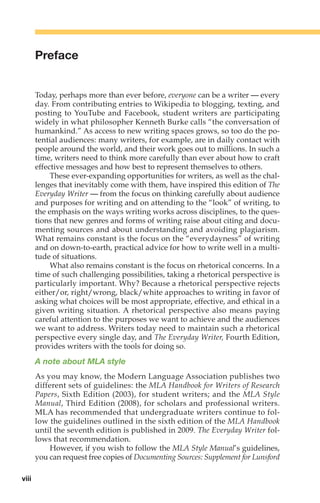
Spell Checkers and Wrong-Word Errors
TALKING THE TALK
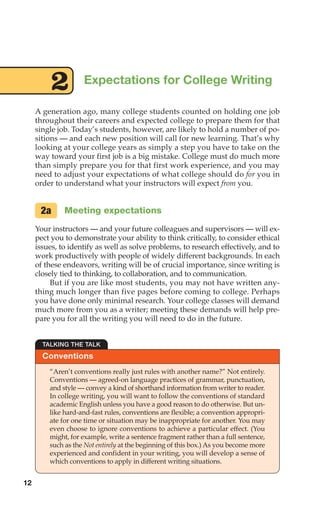
“Can I trust spell checkers to correct a word I’ve spelled wrong?” In a
word, no. The spell checker may suggest bizarre substitutes for many
proper names and specialized terms (even when you spell them cor-
rectly) and for certain typographical errors, thus introducing wrong
words into your paper if you accept its suggestions automatically. For
example, a student who had typed fantic instead of frantic found that
the spell checker’s first choice was to substitute fanatic — a replacement
that made no sense. Wrong-word errors are the most common surface
error in college writing today (see Chapter 1), and spell checkers are
partly to blame. So be careful not to take a spell checker’s recommen-
dation without paying careful attention to the replacement word.
00_LUN_66490_FM_(i-xx)_00_LUN_66490_FM_i-xx.qxd 11/30/11 1:54 PM Page xiii
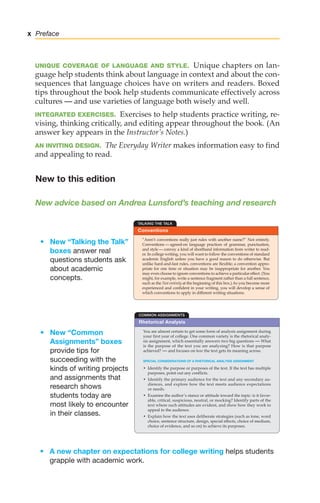
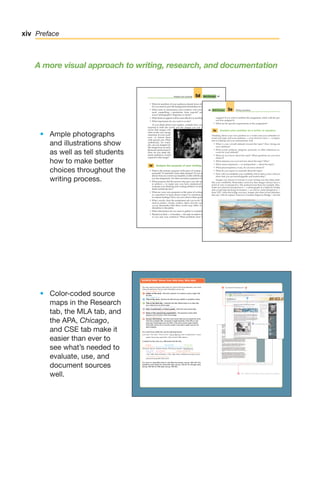
A more visual approach to writing, research, and documentation
• Ample photographs
and illustrations show
as well as tell students
how to make better
choices throughout the
writing process.
xiv Preface
• Color-coded source
maps in the Research
tab, the MLA tab, and
the APA, Chicago,
and CSE tab make it
easier than ever to
see what’s needed to
evaluate, use, and
document sources
well.
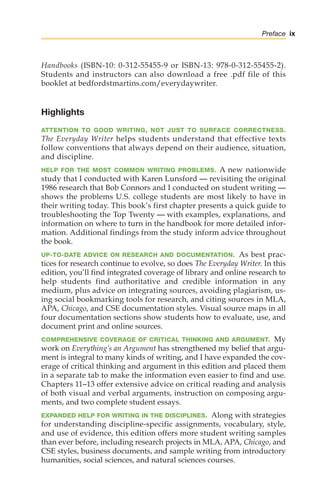
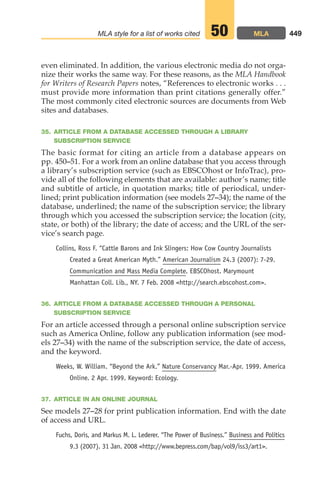
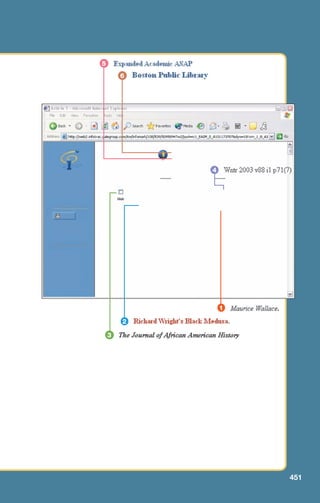
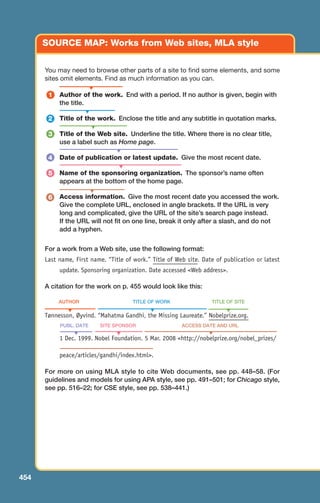
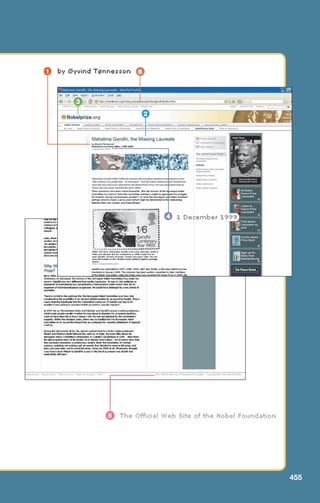
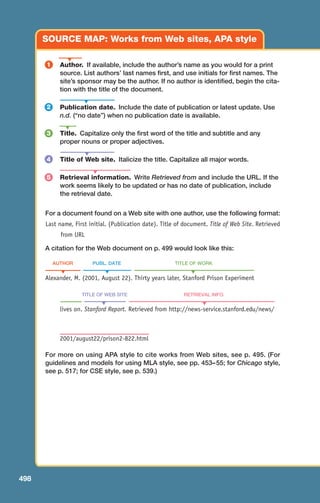
SOURCE MAP: Works from Web sites, MLA style
You may need to browse other parts of a site to find some elements, and some
sites omit elements. Find as much information as you can.
Author of the work. End with a period. If no author is given, begin with
the title.
Title of the work. Enclose the title and any subtitle in quotation marks.
Title of the Web site. Underline the title. Where there is no clear title,
use a label such as Home page.
Date of publication or latest update. Give the most recent date.
Name of the sponsoring organization. The sponsor’s name often
appears at the bottom of the home page.
Access information. Give the most recent date you accessed the work.
Give the complete URL, enclosed in angle brackets. If the URL is very
long and complicated, give the URL of the site’s search page instead.
If the URL will not fit on one line, break it only after a slash, and do not
add a hyphen.
For a work from a Web site, use the following format:
Last name, First name. “Title of work.” Title of Web site. Date of publication or latest
update. Sponsoring organization. Date accessed <Web address>.
A citation for the work on p. 399 would look like this:
AUTHOR TITLE OF WORK TITLE OF SITE
Tønnesson, Øyvind. “Mahatma Gandhi, the Missing Laureate.” Nobelprize.org.
PUBL. DATE SITE SPONSOR ACCESS DATE AND URL
1 Dec. 1999. Nobel Foundation. 5 Mar. 2008 <http://nobelprize.org/nobel_prizes/
peace/articles/gandhi/index.html>.
For more on using MLA style to cite Web documents, see pp. 392–402. (For
guidelines and models for using APA style, see pp. 435–45; for Chicago style,
see pp. 460–66; for CSE style, see pp. 482–85.)
6
5
4
3
2
1
1
2
3
4
5
6
• What do members of your audience already know about your topic?
Do you need to provide background information or to define terms?
• What sorts of information and evidence will your audience find
most compelling — quotations from experts? personal experi-
ences? photographs? diagrams or charts?
• What kinds of appeals will be most effective in reaching this audience?
• What response(s) do you want to evoke?
As you think about your readers, consider how you want them to
respond to both the words and the images you use. Be particularly
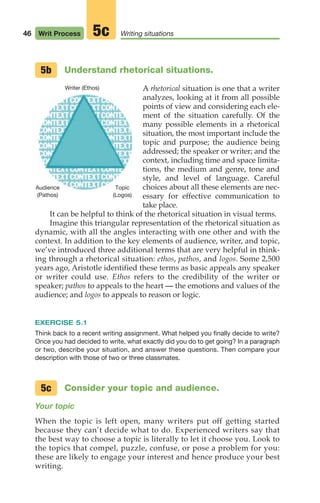
aware that images will
often evoke very strong
responses in your audi-
ence, so choose them
with special care. What
audience(s), for exam-
ple, can you imagine for
this image from an early
Ramones performance?
How do you think dif-
ferent audiences would
respond to this image?
Analyze the purpose of your writing.
• What is the primary purpose of the piece of writing — to explain? to
persuade? to entertain? some other purpose? If you aren’t sure, think
about what you want to accomplish, or talk with the person who gave
you the assignment. Are there secondary purposes to keep in mind?
• What purpose did the person who gave you the assignment want
to achieve — to make sure you have understood something? to
evaluate your thinking and writing abilities? to test your ability to
think outside the box?
• What are your own purposes in this piece of writing — to respond
to a question? to learn about a topic? to communicate your ideas?
to express feelings? How can you achieve these goals?
• What, exactly, does the assignment ask you to do? Look for words
such as analyze, classify, compare, define, describe, explain, prove, and
survey. Remember that these words may differ in meaning from
discipline to discipline.
• What information do you need to gather to complete the task?
• Should you limit –– or broaden –– the topic to make it more compelling
to you and your audience? What problems does the assignment
5d
47
Analyze your purpose Writ Process
5d
suggest? If you wish to redefine the assignment, check with the per-
son who assigned it.
• What are the specific requirements of the assignment?
Analyze your position as a writer or speaker.
Thinking about your own position as a writer and your attitudes to-
ward your topic and your audience — your rhetorical stance — is impor-
tant to making sure you communicate well.
• What is your overall attitude toward the topic? How strong are
your opinions?
• What social, political, religious, personal, or other influences ac-
count for your attitude?
• What do you know about the topic? What questions do you have
about it?
• What interests you most and least about the topic? Why?
• What seems important — or unimportant — about the topic?
• What preconceptions, if any, do you have about it?
• What do you expect to conclude about the topic?
• How will you establish your credibility (ethos); that is, how will you
show that you are knowledgeable and trustworthy?
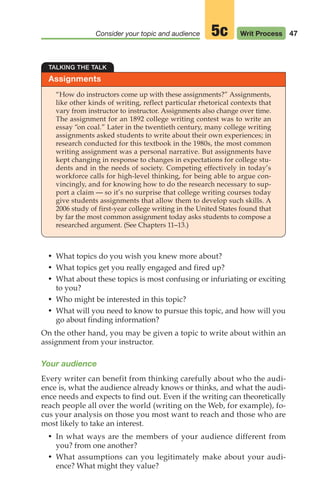
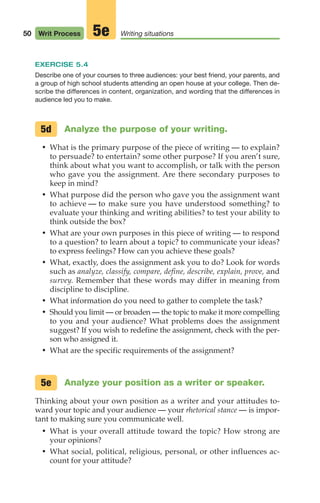
Images you choose to include in your writing can also help estab-
lish your credibility. Remember, however, that images always have a
point of view or perspective. The postcard seen here, for example, illus-
trates two physical perspectives — a photograph of a highway bridge
and a road map showing its location — as well as a time perspective —
from 1927, when the bridge was new. Images also often reveal attitudes;
this one, with its caption “
America’s Greatest Highway Bridge,” sees the
5e
48 Writ Process Writing situations
5e
00_LUN_66490_FM_(i-xx)_00_LUN_66490_FM_i-xx.qxd 11/30/11 1:54 PM Page xiv
xv
Preface
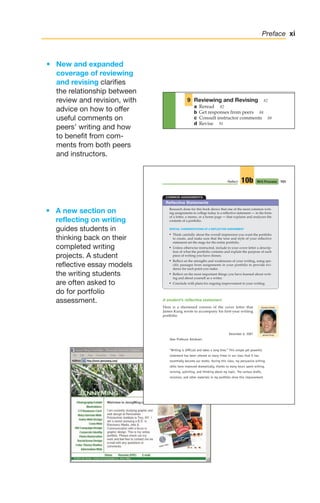
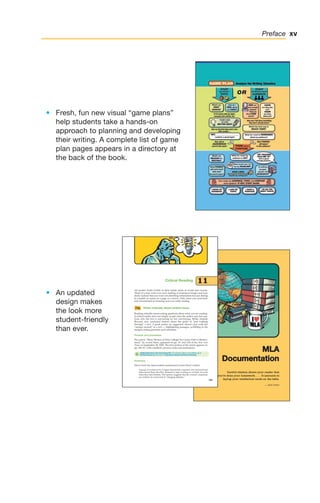
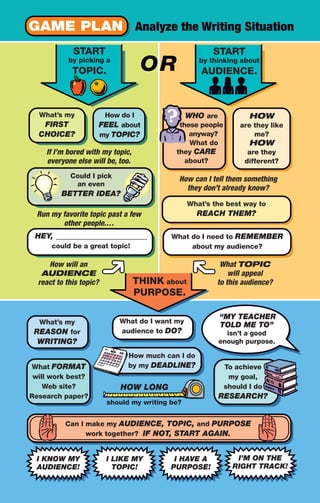
• Fresh, fun new visual “game plans”
help students take a hands-on
approach to planning and developing
their writing. A complete list of game
plan pages appears in a directory at
the back of the book.
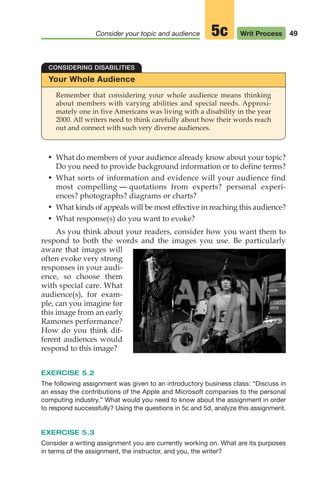
• An updated
design makes
the look more
student-friendly
than ever.
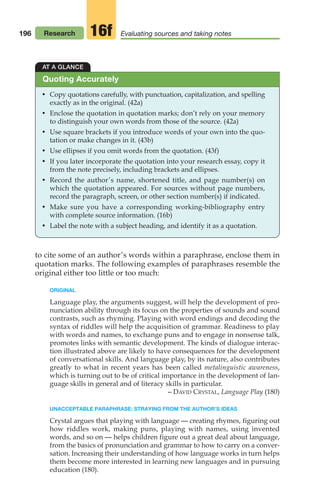
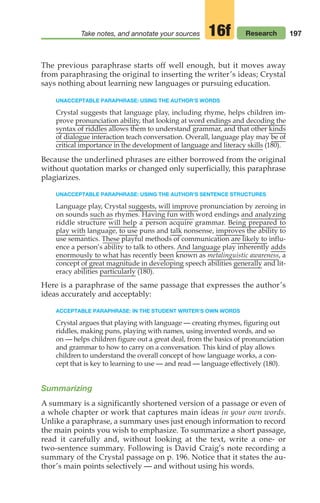
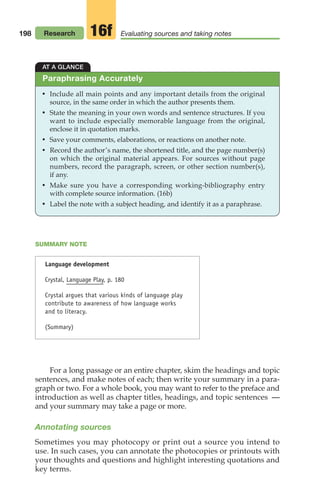
Careful citation shows your reader that
you’ve done your homework. . . . It amounts to
laying your intellectual cards on the table.
— JACK LYNCH
M
ML
LA
A
D
Do
oc
cu
um
me
en
nt
ta
at
ti
io
on
n
All readers build worlds in their minds made of words and visuals.
Think of a time when you were reading or looking at images and sud-
denly realized that you were not absorbing information but just staring
at a jumble of marks on a page or a screen. Only when you went back
and concentrated on meaning were you really reading.
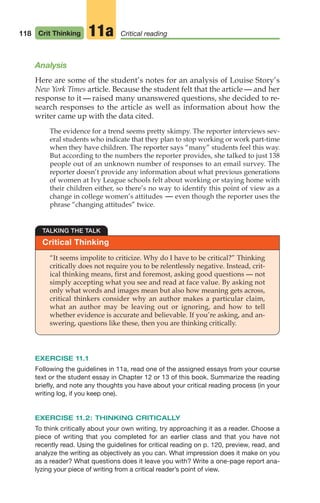
Think critically about written texts.
Reading critically means asking questions about what you are reading.
A critical reader does not simply accept what the author says but ana-
lyzes why the text is convincing (or not convincing). Writer Anatole
Broyard once cautioned readers about the perils of “just walking
through” a text. A good reader, he suggested, doesn’t just walk but
“stomps around” in a text — highlighting passages, scribbling in the
margins, jotting questions and comments.
Preview and annotation
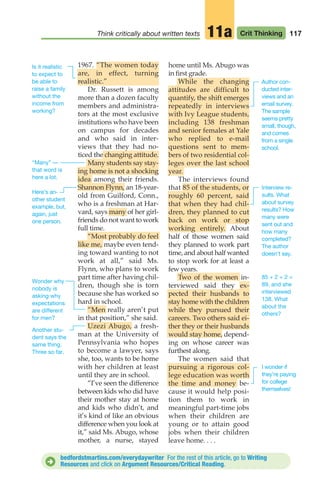
The article “Many Women at Elite Colleges Set Career Path to Mother-
hood,” by Louise Story, appeared on pp. A1 and A18 of the New York
Times on September 20, 2005. The first portion of the article appears on
pp. 106–07, with a student’s preview notes and annotations.
11a
Critical Reading 11
105
bedfordstmartins.com/everydaywriter To read the article in its entirety, go to
Writing Resources and click on Argument Resources/Critical Reading.
D
Summary
Here is how the same student summarized Louise Story’s article.
A group of women at Ivy League schools told a reporter who surveyed and
interviewed them that they planned to stop working or cut back on work
when they had children. The reporter suggests that the women’s responses
are evidence of a trend and of “changing attitudes.”
00_LUN_66490_FM_(i-xx)_00_LUN_66490_FM_i-xx.qxd 11/30/11 1:54 PM Page xv
A wide array of ancillaries
NEW MEDIA RESOURCES
CompClass with The Everyday Writer e-Book
bedfordstmartins.com/compclass
Online Student Center for The Everyday Writer (free book-specific
resources and premium content, including The Everyday Writer
e-Book)
bedfordstmartins.com/everydaywriter
Exercise Central 3.0 bedfordstmartins.com/exercisecentral
Electronic Diagnostic Tests bedfordstmartins.com/lunsforddiagnostics
Just-in-Time Teaching bedfordstmartins.com/justintime
Exercise Central to Go for Handbooks by Andrea A. Lunsford CD-ROM
ISBN-10: 0-312-43114-7
ISBN-13: 978-0-312-43114-3
PRINT RESOURCES
Instructor’s Notes, Andrea Lunsford, Alyssa O’Brien, and Lisa Dresdner
(includes answer key for exercises in The Everyday Writer with Exercises)
ISBN-10: 0-312-48861-0
ISBN-13: 978-0-312-48861-1
Exercises to Accompany THE EVERYDAY WRITER, Fourth Edition,
Lex Runciman, Carolyn Lengel, and Kate Silverstein
ISBN-10: 0-312-38653-2
ISBN-13: 978-0-312-38653-5
Answer Key to Exercises to Accompany THE EVERYDAY WRITER,
Fourth Edition
ISBN-10: 0-312-48858-0
ISBN-13: 978-0-312-48858-1
xvi Preface
00_LUN_66490_FM_(i-xx)_00_LUN_66490_FM_i-xx.qxd 11/30/11 1:54 PM Page xvi
xvii
Preface
OTHER COMPOSITION RESOURCES FROM BEDFORD/ST. MARTIN’S
ix visual exercises CD-ROM
ISBN-10: 0-312-41562-1
ISBN-13: 978-0-312-41562-4
i-cite visualizing sources CD-ROM
ISBN-10: 0-312-44179-7
ISBN-13: 978-0-312-44179-1
i-claim visualizing argument CD-ROM
ISBN-10: 0-312-44015-4
ISBN-13: 978-0-312-44015-2
COURSE MANAGEMENT CONTENT
Resources developed for The Everyday Writer are available for use in
course management systems.
00_LUN_66490_FM_(i-xx)_00_LUN_66490_FM_i-xx.qxd 11/30/11 1:54 PM Page xvii
Acknowledgments
I owe an ongoing debt of gratitude to Carolyn Lengel, my editor for this
and two other books as well: her patience, fortitude, and sheer hard
work, her astute judgment, her wellspring of good ideas, her meticu-
lous attention to detail, and her great good humor are gifts that just
keep on giving. I am also very fortunate to have had the advice and
help of Fran Weinberg, who has made invaluable and ongoing contri-
butions to this text; to Stephanie Butler, for her outstanding work on the
ancillaries to this text, including the Instructor’s Notes; to Wendy Anni-
bell for her meticulous copyediting; to Mara Weible for huge contribu-
tions to our online handbook tutorials; to Sarah Ferguson for her work
on the book’s new media components; to Anne Carter and Anna
Palchik for their brilliant contributions to art and design; to Donna
Dennison for cover art; to Eric Larsen for his imaginative illustrations;
and to Harold Chester, project editor par excellence.
Many thanks, also, to the unfailingly generous and supportive
members of the Bedford/St. Martin’s team: Erica Appel, Kristin Bowen,
Nick Carbone, Joan Feinberg, Jimmy Fleming, Joe Ford, Karen Henry,
Nancy Perry, Katie Schooling, Karen Soeltz, John Swanson, Shuli Traub,
Kim White, and Denise Wydra.
I am especially indebted to Paul Kei Matsuda and Christine Tardy
for their extraordinarily helpful additions to the Multilingual Writer sec-
tions of this book; to Lisa Ede for her ongoing support and advice, par-
ticularly about writing across the disciplines; to Lisa Dresdner at
Norwalk Community College for her fine work on updating the
Instructors’ Notes; and to Dànielle Nicole DeVoss at Michigan State Univer-
sity for her help in making this a more visual book. I have also benefited
greatly from the excellent advice of some very special colleagues: Colin
Gifford Brooke, Syracuse University; Barbara Fister, Gustavus Adolphus
College; Patrick Clauss, Butler University; Arnold Zwicky, Stanford
University; Beverly Moss, Ohio State University; and Marilyn Moller.
I owe special thanks to the group of student writers whose work
appears in and enriches this book and its companion Web site: Michelle
Abbott, Carina Abernathy, Milena Ateyea, Julie Baird, Jennifer Bernal,
Valerie Bredin, Taurean Brown, Tessa Cabello, Ben Canning, Leah Clen-
dening, David Craig, Kelly Darr, Allyson Goldberg, Tara Gupta, Joanna
Hays, Dana Hornbeak, Ajani Husbands, Bory Kea, James Kung, Emily
Lesk, Nastassia Lopez, Heather Mackintosh-Sims, Merlla McLaughlin,
Jenny Ming, Laura Montgomery, Elva Negrete, Katie Paarlberg, Shan-
nan Palma, Teal Pfeifer, Amrit K. Rao, Heather Ricker, Amanda Rinder,
Dawn Rodney, Rudy Rubio, Melissa Schraeder, Bonnie Sillay, Jessica
Thrower, and Dennis Tyler.
Once again, I have been guided by a group of hard-working and
meticulous reviewers, including Thomas Amorose, Seattle Pacific
xviii Preface
00_LUN_66490_FM_(i-xx)_00_LUN_66490_FM_i-xx.qxd 11/30/11 1:54 PM Page xviii
xix
Preface
University; Heidi R. Anderson, University of Minnesota Duluth;
Dominic Ashby, West Virginia University; Susan Bailor, Front Range
Community College; Peggy Beck, Kent State University Stark; Judy
Bennett, University of Louisiana at Monroe; Mona Diane Benton, Eastern
Michigan University; Monica Bosson, City College of San Francisco;
Domenic Bruni, University of Wisconsin Oshkosh; Jo Anne R. Bryant,
Troy University; Jennifer Castillo, Eastern Michigan University; Christian
M. Clark, Community College of Southern Nevada; Barbara Cole, The
State University of New York at Buffalo; Teresa Cordova, California
State University, Sacramento; Margaret Cotter-Lynch, Southeastern
Oklahoma State University; Cynthia Cox, Belmont University; Charles
DiDomenico, Middlesex County College; Sid Dobrin, University of
Florida; Doug Downs, Utah Valley State College; Lisa Dresdner,
Norwalk Community College; Anne-Marie Drew, United States Naval
Academy; Violet A. Dutcher, Eastern Mennonite University; Heidi
Estrem, Boise State University; Diana Fernandez, Florida International
University; Patricia Rowe Geenen, Alverno College; Holly Geil, Kent
State University; Nathan Gorelick, State University of New York at Buf-
falo; Andrew Green, University of Miami; Eric Gunnink, University of
St. Francis; Kim Gunter, The University of North Carolina at Pembroke;
Scot Hanson, Texas Christian University; Christopher S. Harris, Univer-
sity of Louisiana at Monroe; Kimberly Harrison, Florida International
University–Biscayne Bay; Anneliese Homan, State Fair Community
College; Cynthia Lewiecki-Wilson, Miami University of Ohio; Jon
A. Leydens, Colorado School of Mines; Meredith A. Love-Steinmetz,
Francis Marion University; Suzanne Blum Malley, Columbia College
Chicago; Patricia Mandia, Kent State University Stark; Jessica
Matthews, George Mason University; Cynthia Maxson, Rio Salado Col-
lege; Kathy Mendt, Front Range Community College; Kerri Mitchell,
Front Range Community College; Winifred Morgan, Edgewood Col-
lege; Roxanne Munch, Joliet Junior College; Kim Murray, University of
Southern Florida; Beverly A. Neiderman, Kent State University; Jerry L.
Nelson, Lincoln University; Troy D. Nordman, Butler Community Col-
lege; Shelley Harper Palmer, Rowan-Cabarrus Community College;
Cherri Porter, American River College and Woodland Community Col-
lege; Carolee Ritter, Southeast Community College; Deidre Farrington
Schoolcraft, Pikes Peak Community College; Shawna Shapiro, Univer-
sity of Washington; Mary Beth Simmons, Villanova University; Kim-
berly Skeen, College of Southern Idaho; Wayne Stein, University of
Central Oklahoma; Jane VanderVelde, University of Kansas; Megan
Ward, Miami University of Ohio; Elizabeth Wardle, University of Day-
ton; Peggy Woods, University of Massachusetts, Amherst; Susan Dara
Wright, William Paterson University; and Sarah L. Yoder, Texas Christian
University.
00_LUN_66490_FM_(i-xx)_00_LUN_66490_FM_i-xx.qxd 11/30/11 1:54 PM Page xix
For offering advice and perspectives from disciplines other than
composition, I would like to extend particular thanks to the following
reviewers: Carole Anderson, The Ohio State University; Robert Bulman,
St. Mary’s College of California; Patrick J. Castle, United States Air
Force Academy; Rosemary Cunningham, Agnes Scott College; Bridget
Drinka, University of Texas at San Antonio; John Hnida, Peru State Col-
lege; Kareem J. Johnson, Temple University; Steve Naragon, Manches-
ter College; Tracy Ann Robinson, Oregon State University; and Timothy
J. Shannon, Gettysburg College.
Finally, and always, I continue to learn—from my students, who
serve as the major inspiration for just about everything I do; from the
very best sisters, nieces, and nephews anyone has ever had; and from
my spectacular great-nieces, Audrey and Lila: this book is for all of you.
–Andrea A. Lunsford
xx Preface
00_LUN_66490_FM_(i-xx)_00_LUN_66490_FM_i-xx.qxd 11/30/11 1:55 PM Page xx
A mind that is stretched by a new experience can
never go back to its old dimensions.
— OLIVER WENDELL HOLMES
About College
Writing
About
College
Writing
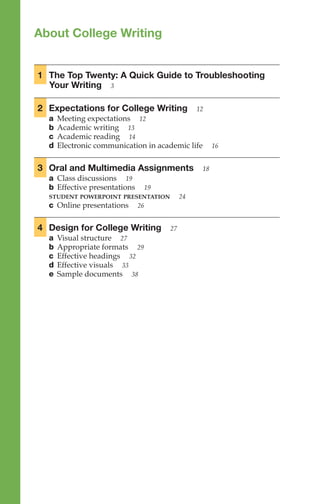
About College Writing
1 The Top Twenty: A Quick Guide to Troubleshooting
Your Writing 3
2 Expectations for College Writing 12
a Meeting expectations 12
b Academic writing 13
c Academic reading 14
d Electronic communication in academic life 16
3 Oral and Multimedia Assignments 18
a Class discussions 19
b Effective presentations 19
STUDENT POWERPOINT PRESENTATION 24
c Online presentations 26
4 Design for College Writing 27
a Visual structure 27
b Appropriate formats 29
c Effective headings 32
d Effective visuals 33
e Sample documents 38
About
College
Writing
1–42
The Top Twenty: A Quick Guide
to Troubleshooting Your Writing
Surface errors — grammar, punctuation, word choice, and other small-
scale matters — don’t always disturb readers. Whether your instructor
marks an error in any particular assignment will depend on personal
judgments about how serious and distracting it is and about what you
should be focusing on in the draft. In addition, not all surface errors are
consistently viewed as errors: some of the patterns identified in the re-
search for this book are considered errors by some instructors but as
stylistic options by others. Such differing opinions don’t mean that
there is no such thing as correctness in writing — only that correctness
always depends on some context, on whether the choices a writer makes
seem appropriate to readers.
Research for this book reveals a number of changes that have oc-
curred in student writing over the past twenty-plus years. First, writing
assignments in first-year composition classes now focus less on per-
sonal narrative and much more on research essays and argument. As a
result, students are now writing longer essays than they did twenty
years ago and working much more often with sources, both print and
nonprint. Thus it’s no surprise that students today are struggling with
the conventions for using and citing sources, a problem that did not
show up in most earlier studies of student writing.
What else has changed? For starters, wrong-word errors are by far
the most common errors among first-year student writers today. Twenty
years ago, spelling errors were most common by a factor of more than
three to one. The use of spell checkers has reduced the number of
spelling errors in student writing — but spell checkers’ suggestions
may also be responsible for some (or many) of the wrong words stu-
dents are using.
All writers want to be considered competent and careful. You
know that your readers judge you by your control of the conventions
you have agreed to use, even if the conventions change from time to
time. To help you in producing writing that is conventionally correct,
you should become familiar with the twenty most common error patterns
3
1
02_LUN_66490_Pt01_(003-042)_02_LUN_66490_Pt01_(003-042).qxd 11/30/11 2:04 PM Page 3
among U.S. college students today, listed here in order of frequency. A
brief explanation and examples of each error are provided in the fol-
lowing sections, and each error pattern is cross-referenced to other
places in this book where you can find more detailed information and
additional examples.
4 Top Twenty A quick guide
1
D
Wrong word
precedence
䊳 Religious texts, for them, take prescience over other kinds of sources.
^
Prescience means “foresight,” and precedence means “priority.”
1
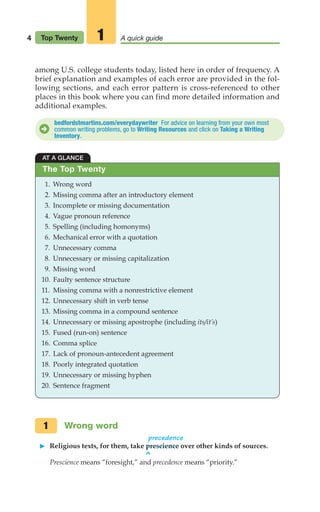
AT A GLANCE
1. Wrong word
2. Missing comma after an introductory element
3. Incomplete or missing documentation
4. Vague pronoun reference
5. Spelling (including homonyms)
6. Mechanical error with a quotation
7. Unnecessary comma
8. Unnecessary or missing capitalization
9. Missing word
10. Faulty sentence structure
11. Missing comma with a nonrestrictive element
12. Unnecessary shift in verb tense
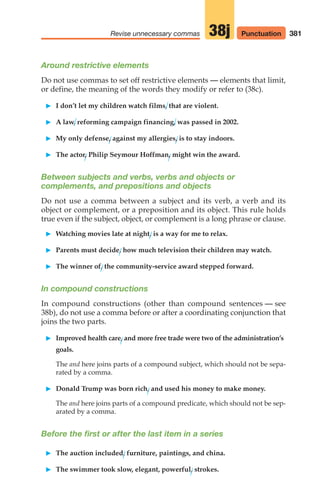
13. Missing comma in a compound sentence
14. Unnecessary or missing apostrophe (including its/it’s)
15. Fused (run-on) sentence
16. Comma splice
17. Lack of pronoun-antecedent agreement
18. Poorly integrated quotation
19. Unnecessary or missing hyphen
20. Sentence fragment
The Top Twenty
bedfordstmartins.com/everydaywriter For advice on learning from your own most
common writing problems, go to Writing Resources and click on Taking a Writing
Inventory.
02_LUN_66490_Pt01_(003-042)_02_LUN_66490_Pt01_(003-042).qxd 11/30/11 2:04 PM Page 4
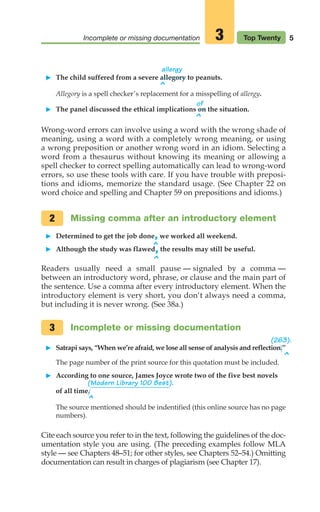
allergy
䊳 The child suffered from a severe allegory to peanuts.
^
Allegory is a spell checker’s replacement for a misspelling of allergy.
of
䊳 The panel discussed the ethical implications on the situation.
^
Wrong-word errors can involve using a word with the wrong shade of
meaning, using a word with a completely wrong meaning, or using
a wrong preposition or another wrong word in an idiom. Selecting a
word from a thesaurus without knowing its meaning or allowing a
spell checker to correct spelling automatically can lead to wrong-word
errors, so use these tools with care. If you have trouble with preposi-
tions and idioms, memorize the standard usage. (See Chapter 22 on
word choice and spelling and Chapter 59 on prepositions and idioms.)
Missing comma after an introductory element
䊳 Determined to get the job done,we worked all weekend.
䊳 Although the study was flawed,the results may still be useful.
Readers usually need a small pause — signaled by a comma —
between an introductory word, phrase, or clause and the main part of
the sentence. Use a comma after every introductory element. When the
introductory element is very short, you don‘t always need a comma,
but including it is never wrong. (See 38a.)
Incomplete or missing documentation
䊳 Satrapi says, “When we’re afraid, we lose all sense of analysis and reflection.’’
The page number of the print source for this quotation must be included.
䊳 According to one source, James Joyce wrote two of the five best novels
(Modern Library 100 Best).
of all time.
^
The source mentioned should be indentified (this online source has no page
numbers).
Cite each source you refer to in the text, following the guidelines of the doc-
umentation style you are using. (The preceding examples follow MLA
style — see Chapters 48–51; for other styles, see Chapters 52–54.) Omitting
documentation can result in charges of plagiarism (see Chapter 17).
3
2
5
Incomplete or missing documentation Top Twenty
3
^
^
^
(263).
02_LUN_66490_Pt01_(003-042)_02_LUN_66490_Pt01_(003-042).qxd 11/30/11 2:04 PM Page 5
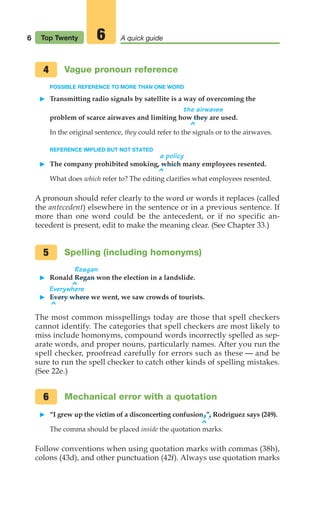
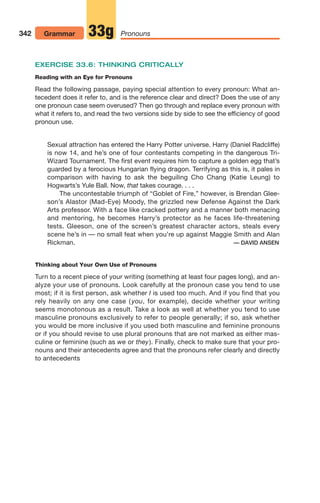
Vague pronoun reference
POSSIBLE REFERENCE TO MORE THAN ONE WORD
䊳 Transmitting radio signals by satellite is a way of overcoming the
the airwaves
problem of scarce airwaves and limiting how they are used.
In the original sentence, they could refer to the signals or to the airwaves.
REFERENCE IMPLIED BUT NOT STATED
a policy
䊳 The company prohibited smoking, which many employees resented.
What does which refer to? The editing clarifies what employees resented.
A pronoun should refer clearly to the word or words it replaces (called
the antecedent) elsewhere in the sentence or in a previous sentence. If
more than one word could be the antecedent, or if no specific an-
tecedent is present, edit to make the meaning clear. (See Chapter 33.)
Spelling (including homonyms)
Reagan
䊳 Ronald Regan won the election in a landslide.
Everywhere
䊳 Every where we went, we saw crowds of tourists.
^
The most common misspellings today are those that spell checkers
cannot identify. The categories that spell checkers are most likely to
miss include homonyms, compound words incorrectly spelled as sep-
arate words, and proper nouns, particularly names. After you run the
spell checker, proofread carefully for errors such as these — and be
sure to run the spell checker to catch other kinds of spelling mistakes.
(See 22e.)
Mechanical error with a quotation
䊳 “I grew up the victim of a disconcerting confusion,”, Rodriguez says (249).
The comma should be placed inside the quotation marks.
Follow conventions when using quotation marks with commas (38h),
colons (43d), and other punctuation (42f). Always use quotation marks
6
5
4
6 Top Twenty A quick guide
6
^
^
^
^
02_LUN_66490_Pt01_(003-042)_02_LUN_66490_Pt01_(003-042).qxd 11/30/11 2:04 PM Page 6
in pairs, and follow the guidelines of your documentation style for
block quotations (42b). Use quotation marks for titles of short works
(42c), but use italics for titles of long works (46a).
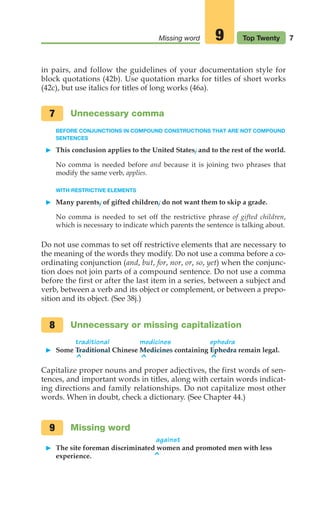
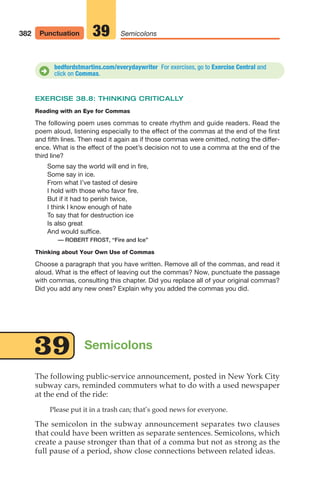
Unnecessary comma
BEFORE CONJUNCTIONS IN COMPOUND CONSTRUCTIONS THAT ARE NOT COMPOUND
SENTENCES
䊳 This conclusion applies to the United States, and to the rest of the world.
No comma is needed before and because it is joining two phrases that
modify the same verb, applies.
WITH RESTRICTIVE ELEMENTS
䊳 Many parents, of gifted children, do not want them to skip a grade.
No comma is needed to set off the restrictive phrase of gifted children,
which is necessary to indicate which parents the sentence is talking about.
Do not use commas to set off restrictive elements that are necessary to
the meaning of the words they modify. Do not use a comma before a co-
ordinating conjunction (and, but, for, nor, or, so, yet) when the conjunc-
tion does not join parts of a compound sentence. Do not use a comma
before the first or after the last item in a series, between a subject and
verb, between a verb and its object or complement, or between a prepo-
sition and its object. (See 38j.)
Unnecessary or missing capitalization
traditional medicines ephedra
䊳 Some Traditional Chinese Medicines containing Ephedra remain legal.
^ ^ ^
Capitalize proper nouns and proper adjectives, the first words of sen-
tences, and important words in titles, along with certain words indicat-
ing directions and family relationships. Do not capitalize most other
words. When in doubt, check a dictionary. (See Chapter 44.)
Missing word
against
䊳 The site foreman discriminated women and promoted men with less
experience.
9
8
7
7
Missing word Top Twenty
9
^
02_LUN_66490_Pt01_(003-042)_02_LUN_66490_Pt01_(003-042).qxd 11/30/11 2:04 PM Page 7
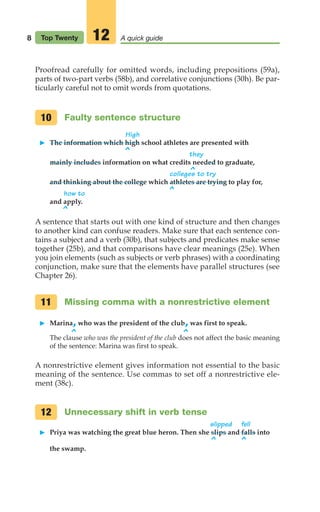
Proofread carefully for omitted words, including prepositions (59a),
parts of two-part verbs (58b), and correlative conjunctions (30h). Be par-
ticularly careful not to omit words from quotations.
Faulty sentence structure
High
䊳 The information which high school athletes are presented with
^ they
mainly includes information on what credits needed to graduate,
^
colleges to try
and thinking about the college which athletes are trying to play for,
^
how to
and apply.
^
A sentence that starts out with one kind of structure and then changes
to another kind can confuse readers. Make sure that each sentence con-
tains a subject and a verb (30b), that subjects and predicates make sense
together (25b), and that comparisons have clear meanings (25e). When
you join elements (such as subjects or verb phrases) with a coordinating
conjunction, make sure that the elements have parallel structures (see
Chapter 26).
Missing comma with a nonrestrictive element
䊳 Marina,who was the president of the club,was first to speak.
The clause who was the president of the club does not affect the basic meaning
of the sentence: Marina was first to speak.
A nonrestrictive element gives information not essential to the basic
meaning of the sentence. Use commas to set off a nonrestrictive ele-
ment (38c).
Unnecessary shift in verb tense
slipped fell
䊳 Priya was watching the great blue heron. Then she slips and falls into
^ ^
the swamp.
12
11
10
8 Top Twenty A quick guide
12
^ ^
02_LUN_66490_Pt01_(003-042)_02_LUN_66490_Pt01_(003-042).qxd 11/30/11 2:04 PM Page 8
Verbs that shift from one tense to another with no clear reason can con-
fuse readers (27a).
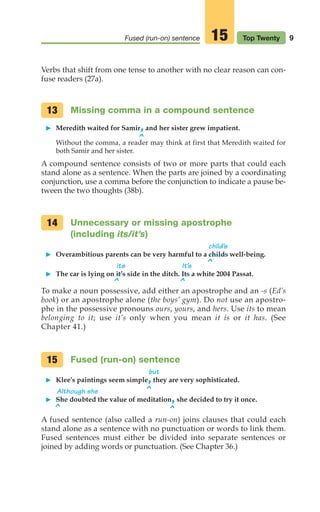
Missing comma in a compound sentence
䊳 Meredith waited for Samir,and her sister grew impatient.
Without the comma, a reader may think at first that Meredith waited for
both Samir and her sister.
A compound sentence consists of two or more parts that could each
stand alone as a sentence. When the parts are joined by a coordinating
conjunction, use a comma before the conjunction to indicate a pause be-
tween the two thoughts (38b).
Unnecessary or missing apostrophe
(including its/it’s)
child’s
䊳 Overambitious parents can be very harmful to a childs well-being.
its It’s
䊳 The car is lying on it’s side in the ditch. Its a white 2004 Passat.
^ ^
To make a noun possessive, add either an apostrophe and an -s (Ed’s
book) or an apostrophe alone (the boys’ gym). Do not use an apostro-
phe in the possessive pronouns ours, yours, and hers. Use its to mean
belonging to it; use it’s only when you mean it is or it has. (See
Chapter 41.)
Fused (run-on) sentence
but
䊳 Klee’s paintings seem simple,they are very sophisticated.
Although she
䊳 She doubted the value of meditation,she decided to try it once.
^ ^
A fused sentence (also called a run-on) joins clauses that could each
stand alone as a sentence with no punctuation or words to link them.
Fused sentences must either be divided into separate sentences or
joined by adding words or punctuation. (See Chapter 36.)
14
15
13
9
Fused (run-on) sentence Top Twenty
15
^
^
^
02_LUN_66490_Pt01_(003-042)_02_LUN_66490_Pt01_(003-042).qxd 11/30/11 2:04 PM Page 9
Comma splice
for
䊳 I was strongly attracted to her, she was beautiful and funny.
that
䊳 We hated the meat loaf, the cafeteria served it every Friday.
^
A comma splice occurs when only a comma separates clauses that could
each stand alone as a sentence. To correct a comma splice, you can in-
sert a semicolon or period, connect the clauses with a word such as and
or because, or restructure the sentence. (See Chapter 36.)
Lack of pronoun-antecedent agreement
All students uniforms.
䊳 Every student must provide their own uniform.
its
䊳 Each of the puppies thrived in their new home.
^
Pronouns must agree with their antecedents in gender (male or female)
and in number (singular or plural). Many indefinite pronouns, such as
everyone and each, are always singular. When a singular antecedent can
refer to a man or a woman, either rewrite the sentence to make the an-
tecedent plural or to eliminate the pronoun, or use his or her, he or she,
and so on. When antecedents are joined by or or nor, the pronoun must
agree with the closer antecedent. A collective noun such as team can be
either singular or plural, depending on whether the members are seen
as a group or as individuals. (See 33f.)
Poorly integrated quotation
showed how color affects taste:
䊳 A 1970s study of what makes food appetizing “Once it became apparent
^
that the steak was actually blue and the fries were green, some people
became ill” (Schlosser 565).
According to Lars Eighner,
䊳 “Dumpster diving has serious drawbacks as a way of life” (Eighner 383).
^
Finding edible food is especially tricky.
18
17
16
10 Top Twenty A quick guide
18
^
^ ^
02_LUN_66490_Pt01_(003-042)_02_LUN_66490_Pt01_(003-042).qxd 11/30/11 2:04 PM Page 10
Quotations should fit smoothly into the surrounding sentence structure.
They should be linked clearly to the writing around them (usually with
a signal phrase) rather than dropped abruptly into the writing. (See 17b.)
Unnecessary or missing hyphen
䊳 This paper looks at fictional and real life examples.
A compound adjective modifying a noun that follows it requires a hyphen.
䊳 The buyers want to fix-up the house and resell it.
A two-word verb should not be hyphenated.
A compound adjective that appears before a noun needs a hyphen.
However, be careful not to hypenate two-word verbs or word groups
that serve as subject complements. (See Chapter 47.)
Sentence fragment
NO SUBJECT
䊳 Marie Antoinette spent huge sums of money on herself and her favorites.
Her extravagance
And helped bring on the French Revolution.
NO COMPLETE VERB
䊳 The old aluminum boat sitting on its trailer.
BEGINNING WITH A SUBORDINATING WORD
䊳 We returned to the drugstore.,Where we waited for our buddies.
A sentence fragment is part of a sentence that is written as if it were
a complete sentence. Reading your draft out loud, backwards, sen-
tence by sentence, will help you spot sentence fragments. (See
Chapter 37.)
20
19
11
Sentence fragment Top Twenty
20
^
^
^
^
was
where
bedfordstmartins.com/everydaywriter For practice identifying and correcting these
writing problems, click on The Top Twenty. For additional exercises, click on Exercises.
D
-
02_LUN_66490_Pt01_(003-042)_02_LUN_66490_Pt01_(003-042).qxd 11/30/11 2:04 PM Page 11
A generation ago, many college students counted on holding one job
throughout their careers and expected college to prepare them for that
single job. Today’s students, however, are likely to hold a number of po-
sitions — and each new position will call for new learning. That’s why
looking at your college years as simply a step you have to take on the
way toward your first job is a big mistake. College must do much more
than simply prepare you for that first work experience, and you may
need to adjust your expectations of what college should do for you in
order to understand what your instructors will expect from you.
Meeting expectations
Your instructors — and your future colleagues and supervisors — will ex-
pect you to demonstrate your ability to think critically, to consider ethical
issues, to identify as well as solve problems, to research effectively, and to
work productively with people of widely different backgrounds. In each
of these endeavors, writing will be of crucial importance, since writing is
closely tied to thinking, to collaboration, and to communication.
But if you are like most students, you may not have written any-
thing much longer than five pages before coming to college. Perhaps
you have done only minimal research. Your college classes will demand
much more from you as a writer; meeting these demands will help pre-
pare you for all the writing you will need to do in the future.
2a
Expectations for College Writing
2
Conventions
TALKING THE TALK
“Aren’t conventions really just rules with another name?” Not entirely.
Conventions — agreed-on language practices of grammar, punctuation,
and style — convey a kind of shorthand information from writer to reader.
In college writing, you will want to follow the conventions of standard
academic English unless you have a good reason to do otherwise. But un-
like hard-and-fast rules, conventions are flexible; a convention appropri-
ate for one time or situation may be inappropriate for another. You may
even choose to ignore conventions to achieve a particular effect. (You
might, for example, write a sentence fragment rather than a full sentence,
such as the Not entirely at the beginning of this box.) As you become more
experienced and confident in your writing, you will develop a sense of
which conventions to apply in different writing situations.
12
02_LUN_66490_Pt01_(003-042)_02_LUN_66490_Pt01_(003-042).qxd 11/30/11 2:04 PM Page 12
Academic writing
You can begin the process of learning by
considering what your instructors expect
you to be able to do. Of course, expecta-
tions about academic writing vary consid-
erably from field to field (see Chapters
60–64), but becoming familiar with wide-
spread conventions will prepare you well
for most academic situations.
Establishing authority
In the United States, most college instructors expect student writers to
begin to establish their own authority — to become constructive critics
who can analyze and interpret the work of others. But what does estab-
lishing authority mean in practice?
• Assume that your opinions count (as long as they are informed
rather than tossed out with little thought) and that your audience
expects you to present them in a well-reasoned manner.
• Show your familiarity with the ideas and works of others, both
from the assigned course reading and from good points your in-
structor and classmates have made.
Being direct and clear
Your instructors will most often expect you to get to the point
quickly and to be direct throughout an essay or other project. Re-
search for this book confirms that readers depend on writers to or-
ganize and present their material — using sections, paragraphs,
sentences, arguments, details, and source citations — in ways that
aid understanding. Good academic writing prepares readers for
what is coming next, provides definitions, and includes topic sen-
tences. (See 19f for a description of the organization that instructors
often prefer in student essays.) To achieve directness in your writing,
try the following strategies:
• State your main point early and clearly.
• Avoid overqualifying your statements. Instead of writing I think the
facts reveal, come right out and say The facts reveal.
• Avoid digressions. If you use an anecdote or example from personal
experience, be sure it relates directly to the point you are making.
• Use appropriate evidence, such as examples and concrete details,
to support each point.
2b
13
Academic writing Expectations
2b
02_LUN_66490_Pt01_(003-042)_02_LUN_66490_Pt01_(003-042).qxd 11/30/11 2:04 PM Page 13
Academic reading
Your instructors expect you to be an active reader — to offer informed
opinions on what readings say. Stating your opinion doesn’t require you to
2c
• Make transitions from point to point obvious and clear. The first
sentence of a new paragraph should reach back to the para-
graph before and then look forward to what is to come (see
Chapter 8).
• Follow logical organizational patterns (see Chapter 8).
• Design and format the project appropriately for the audience and
purpose you have in mind (see Chapter 4).
• If your essay or project is longer than four or five pages, you may
also want to use brief summary statements between sections, but
avoid unnecessary repetition.
EXERCISE 2.1: THINKING CRITICALLY
How do you define good college writing? List the characteristics you come up
with. Then list what you think your instructors’ expectations are for good college
writing, and note how they may differ from yours. What might account for the dif-
ferences — and the similarities — in the two lists? Do you need to alter your
ideas about good college writing to meet your instructors’ expectations? Why, or
why not?
14 Expectations Expectations for college writing
2c
AT A GLANCE
• Consider your purpose and audience carefully, making sure that your
topic is appropriate to both. (Chapter 5)
• State your claim or thesis explicitly, and support it with examples, sta-
tistics, anecdotes, and authorities of various kinds. (Chapter 7)
• Carefully document all of your sources. (Chapters 48–54)
• Make explicit links between ideas. (Chapter 8)
• Consistently use the appropriate level of formality. (Chapter 22)
• Use conventional formats for academic genres. (Chapters 3–4 and
60–63)
• Use conventional grammar, spelling, punctuation, and mechanics.
(Chapters 30–47)
• Use an easy-to-read type size and typeface, conventional margins, and
double spacing. (Chapter 4)
U.S. Academic Style
02_LUN_66490_Pt01_(003-042)_02_LUN_66490_Pt01_(003-042).qxd 11/30/11 2:04 PM Page 14
15
Academic reading Expectations
2c
be negative or combative, just engaged with
the class and the text. The following strate-
gies will help you read actively:
• Note the name of the author and the
date and place of publication; these
items can give you clues to the writer’s
purpose and intended audience.
• Understand the overall content of a
piece well enough to summarize it.
• Formulate critical questions about the
text, and bring these questions up in class.
• Understand each sentence, and make direct connections between
sentences and paragraphs. Keep track of repeated themes or images,
and figure out how they contribute to the entire piece.
• Note the author’s attitude toward and assumptions about the topic.
Then you can speculate on how the attitude and assumptions may
have affected the author’s thinking.
• Distinguish between the author’s stance and the author’s reporting
on the stances of others. Watch for key phrases an author uses to
signal an opposing argument: while some have argued that, in the past,
and so on.
• Go beyond content to notice organizational patterns, use of sources,
and choice of words.
• Consider annotating your readings, especially if they are very im-
portant. Make notes in the margins that record your questions,
challenges, or counter-examples to the text.
EXERCISE 2.2
One of the best ways to improve your writing process is to analyze it from time to
time in a writing log. Answer the following questions about your writing:
• How do you typically go about preparing for a writing assignment?
• When and where do your best ideas often come to you?
• Where do you usually write? Are you usually alone and in a quiet place, or is
there music, conversation, or other sound in the background?
• What materials do you use? What do you find most and least helpful about your
materials?
• What audience do most assignments ask you to address? How much thought
do you typically give to your audience?
• What strategies do you typically use to explore a topic?
02_LUN_66490_Pt01_(003-042)_02_LUN_66490_Pt01_(003-042).qxd 11/30/11 2:04 PM Page 15
• How do you usually write a first draft? Do you finish in one sitting, or do you
prefer to work in sections?
• How do you typically revise, and what do you pay most attention to as you
revise?
• If you get stuck while writing, what do you usually do to get moving again?
• What is most effective about your writing and your writing process?
• What about your writing and your writing process worries you? What specific
steps can you take to address these worries?
• What is your favorite part of your writing process — and why?
You can also use the log to jot down your thoughts about a writing project while you
are working on it and after you have completed it. Studying your notes on your writ-
ing process will help you identify patterns of strength and weakness in your writing
and allow you to see how your writing process changes over time and for different
writing assignments or situations.
Electronic communication in academic life
Your instructors will probably expect you to
communicate both in and out of class using
a variety of media. You may be asked to post
your work to course management systems,
lists, blogs, and wikis, and you may respond
to the work of others on such sites. In addi-
tion, you will probably write email and text
messages to your instructors and other stu-
dents. Many people communicate electroni-
cally so quickly and so often that their
writing tends to be very informal or to take
shortcuts. As always, remember to consider your audience and your situ-
ation: you can write informally in a quick text message to a classmate, but
when contacting your instructor, you should stick to the conventions of
formal academic English unless invited to do otherwise.
Email
• Use a subject line that states your purpose accurately and clearly.
• Take care not to offend or irritate your reader. Tone is difficult to
convey in online messages: what you intend as a joke may come
across as an insult. Avoid writing messages in ALL CAPS.
• Be pertinent. Instructors generally expect short and to-the-point
messages.
2d
16 Expectations Expectations for college writing
2d
02_LUN_66490_Pt01_(003-042)_02_LUN_66490_Pt01_(003-042).qxd 11/30/11 2:04 PM Page 16
17
Electronic communication in academic life Expectations
2d
• Use a more formal tone along with a formal greeting and closing
when posting a message to an instructor (Dear Ms. Aulie rather
than Hi).
• Except in very informal situations, use the conventions of academic
English. Proofread email messages just as you would other writing.
• Consider your email messages permanent and always findable,
even if you delete them. Many people have been embarrassed (or
worse, prosecuted) because of email trails.
• Conclude your message with your name and email address.
• Make sure that the username on the email account you use for con-
tacting instructors and other authority figures does not present a
poor impression. If your username is Party2Nite, consider chang-
ing it, or use your school email account for academic and profes-
sional communication.
Lists and discussion forums
Discussion forums are used in many college courses as a way for stu-
dents to communicate with one another and the instructor about the
course. Academic lists and forums are an extension of class discussions;
remember to treat all participants with respect.
• Avoid unnecessary criticism of spelling or other errors. If a message
is unclear, ask politely for a clarification. If you disagree with an as-
sertion of fact, offer what you believe to be the correct information,
but don’t insult the writer.
• If you think you’ve been insulted (flamed), give the writer the ben-
efit of the doubt. Replying with patience establishes your credibil-
ity and helps you seem mature and fair.
• Reply off-list to the sender of a message if the whole group does not
need to read your reply.
• Keep in mind that many discussion forums and listservs are archived
and that more people than you think may be reading your messages.
Your postings create an impression of you, so make it a good one.
Web logs (blogs) and social networking spaces
Blogs and social networking sites such as Facebook allow users to
say almost anything about themselves and to comment freely on the
postings of others. Such online spaces can also be useful for academic
discussion or for posting writing for others’ comments.
• These sites may feel private, but most aren’t — don’t post anything
you don’t want everyone (including instructors and potential em-
ployers) to see.
02_LUN_66490_Pt01_(003-042)_02_LUN_66490_Pt01_(003-042).qxd 11/30/11 2:04 PM Page 17
18 Media Oral and multimedia assignments
3
• To comment, follow the same conventions you would for com-
menting on a discussion-list posting. It’s wise to become familiar
with the conversation before you add a comment of your own and
to avoid commenting on entries that are several days old.
bedfordstmartins.com/everydaywriter For more information on effective electronic
communication, go to Writing Resources and click on Online Writing.
D
AT A GLANCE
• How effectively do you contribute to class discussions? (3a)
• How does your presentation fulfill your purpose, including the goals
of the assignment? (3b)
• How do the introduction and conclusion hold the audience’s atten-
tion? (3b)
• Is your organizational structure crystal clear? How do you guide
listeners? Are your transitions and signpost language explicit? Do
you effectively repeat key words or ideas? (3b)
• Have you practiced your presentation and gotten response to it? (3b)
• Have you marked the text you are using for pauses and emphasis? (3b)
• Have you prepared all necessary visuals, including presentation slides
and other multimedia? Are they large enough to be seen? Would other
visuals be helpful? (3b)
Preparing for Presentations
EXERCISE 2.3
Choose several email messages you have sent recently — at least one of which is
more formal than the others. Take a critical look at the messages you have chosen,
noting differences and similarities and thinking about how easily readers could fol-
low them. Bring your findings to class for discussion.
When the Gallup Poll reports on what U.S. citizens say they fear most,
the findings are always the same: public speaking is apparently more
frightening to us than almost anything else, even scarier than an attack
from outer space. This chapter aims to allay any such fears you may
have by offering guidelines that can help you prepare and deliver suc-
cessful presentations.
Oral and Multimedia
Assignments
3
02_LUN_66490_Pt01_(003-042)_02_LUN_66490_Pt01_(003-042).qxd 11/30/11 2:04 PM Page 18
Class discussions
The contributions you make to class discussions
are mini-presentations. Make sure your contribu-
tions are effective by following these guidelines:
• Be prepared.
• Listen purposefully, following the flow of
conversation and perhaps taking notes.
• Make sure your comments are relevant. Ask
a key question, take the conversation in a new direction, or summa-
rize or analyze what others have said.
• Be specific in your comments: The passage in the middle of page 42
backs up what you’re saying is more useful than I agree.
3a
19
Effective presentations 3b
Speaking Up in Class
Speaking up in class is viewed as inappropriate or even rude in some
cultures. In the United States, however, doing so is expected and encour-
aged. Some instructors even assign credit for such class participation.
FOR MULTILINGUAL WRITERS
Effective presentations
More and more students report that formal presentations are becoming
part of their work both in and out of class. As you begin to plan for such
a presentation, you should consider a number of issues.
Considering your task, purpose, and audience
Think about how much time you have to prepare; where the presenta-
tion will take place; how long the presentation should run; whether you
will use written-out text or note cards; whether visual aids, handouts,
or other accompanying materials are necessary; and what equipment
you will need. If you are making a group presentation, you will need
time to divide duties and to practice with your classmates.
As with any writing assignment, consider the purpose of your
presentation. Are you to lead a discussion? teach a lesson? give a report?
engage a group in an activity? Also consider your audience. What do
they know about your topic, what opinions do they already hold about
it, and what do they need to know to follow your presentation and
perhaps accept your point of view?
3b
Media
02_LUN_66490_Pt01_(003-042)_02_LUN_66490_Pt01_(003-042).qxd 11/30/11 2:04 PM Page 19
20 Media Oral and multimedia assignments
3b
Making your introduction and conclusion memorable
Listeners tend to remember beginnings and endings most readily, so try
to make these sections memorable. Consider, for example, using a star-
tling statement, opinion, or question; a vivid anecdote; or a powerful
quotation.
Using explicit structure and signpost language
Organize your presentation clearly and carefully, and give an overview
of the main points at the outset. (You may want to recall these points to-
ward the end of the talk.) Then, throughout your presentation, call atten-
tion to a new point by pausing before it and by using signpost language
as an explicit transition: The second crisis point in the breakup of the Soviet
Union occurred shortly after the first is more explicit than Another thing
went wrong. (For a list of transitions, see 8e.) Repeated key words and
ideas work as signposts, too.
Turning writing into a script for presentation
If you will be using a full script in your presentation, double- or triple-
space it, and use fairly large print so that it will be easy for you to see. Try
to end each page with the end of a sentence so that you won’t have to
pause while you turn a page. You may prefer to work from a detailed
topic outline or from note cards. In any case, be sure to mark the places
where you want to pause and to highlight the words you want to empha-
size. To help listeners follow you, shorten long, complicated sentences,
and use action verbs and concrete nouns.
The first example that follows is from an essay that the writer ex-
pects the audience to read. The second example contains the same in-
formation, but its writer plans to deliver it orally. Note how this second
version uses explicit structure, signpost language, and repetition to
make it easy to follow by ear. Note also how the student writer has
rewritten complex sentences, marked his text for emphasis and pauses,
and asked questions to involve the audience.
Accessible Presentations
Do all you can to make your presentations accessible.
• Do not rely on color or visuals alone to get across information — some
individuals may be unable to pick up such cues.
• If you use video, provide captions to explain any sounds that won’t be
audible to some audience members.
CONSIDERING DISABILITIES
02_LUN_66490_Pt01_(003-042)_02_LUN_66490_Pt01_(003-042).qxd 11/30/11 2:04 PM Page 20
TEXT FROM A WRITTEN ESSAY
The Simpson family has occasionally been described as a “nuclear” family,
which obviously has a double meaning: first, the family consists of two parents
and three children, and, second, Homer works at a nuclear power plant with very
relaxed safety codes. The overused label dysfunctional, when applied to the
Simpsons, suddenly takes on new meaning. Every episode seems to include a scene
in which son Bart is being choked by his father; the baby is being neglected; or
Homer, transfixed by the television screen, is sitting in a drunken stupor. The
comedy in these scenes comes from the exaggeration of commonplace household
events (although some talk shows and news programs would have us believe that
these exaggerations are not confined to the madcap world of cartoons).
TEXT REVISED FOR ORAL PRESENTATION
What does it mean to pick an overused label and to describe the Simpsons
as a nuclear family? Clearly, a double meaning is at work. First, the Simpsons fit
the dictionary meaning--a family unit consisting of two parents and some
children. The second meaning, however, packs more of a punch. You see, Homer
works at a nuclear power plant [pause here] with VERY relaxed safety codes!
Besides nuclear, another overused family label describes the Simpsons. Did
everyone guess the label is dysfunctional? And like nuclear, when it comes to the
Simpsons, dysfunctional takes on a whole new meaning.
Remember the scenes when Bart is choked by his father?
How about the many times the baby is neglected?
Or the classic view--Homer, transfixed by the TV screen, sitting in a drunken
stupor!
My point here is that the comedy in these scenes often comes from double
meanings--and from a lot of exaggeration of everyday household events.
Speaking from notes
Here are tips for speaking from notes rather than from a full script:
• In general, use one note card for each point in your presentation.
• Number the cards in case they get scrambled.
• On each card, start with the major point you want to make, in large
bold text. Include subpoints in a bulleted list below, printed large
enough for you to see easily.
• Include signpost language on each note, and use it to guide your
listeners.
21
Effective presentations Media
3b
02_LUN_66490_Pt01_(003-042)_02_LUN_66490_Pt01_(003-042).qxd 11/30/11 2:04 PM Page 21
22 Media Oral and multimedia assignments
3b
• Use color or brackets to mark material that you can skip if you run
out of time.
The following note card for an introduction reminds the speaker to
emphasize her title and her three points. She has highlighted signpost
language and the card’s number.
Integrating visuals
Visual information displayed on PowerPoint slides, posters, or other
media during an oral presentation can add interest, clarify points, keep
the speaker on track, and help members of the audience who learn bet-
ter by listening and looking. For any visual information you display, re-
member to follow basic design principles (see Chapter 4), avoiding
clutter and making information as legible as possible. In addition, be
sure that all the information you show is clear, well organized, and rele-
vant to your presentation. The following tips will ensure that your vi-
suals work for rather than against your presentation.
DISPLAYING WRITTEN INFORMATION
• Ensure that your audience can read any written information you
display with your presentation. Choose background and type col-
ors that contrast well for easy reading. A poster heading should be
at least 2 inches high; for text on a PowerPoint slide, use 44- to 50-
point type for headings, and 30- to 34-point type for subheads.
• Use bulleted lists, not paragraphs, to guide your audience through
your main points. Less is more when it comes to displaying
writing.
USING POWERPOINT SLIDES
• Don’t put too much information on one slide. Use no more than
five bullet points (or no more than fifty words) — and don’t sim-
ply read the bullet points. Instead, say something that will enhance
the material on the slide.
Title: The Rise of the Graphic Novel
Graphic novels are everywhere — but where do they come from?
• from “funnies” in early American newspapers
• from comics, esp. great-adventure comic books
• from focus on images and visuals throughout
society
[1]
Finally,
Second,
First,
NOTE CARD FOR AN ORAL PRESENTATION
02_LUN_66490_Pt01_(003-042)_02_LUN_66490_Pt01_(003-042).qxd 11/30/11 2:04 PM Page 22
23
Effective presentations Media
3b
• Use light backgrounds in a darkened room, and dark backgrounds
in a lighted one.
• If you include audio or video clips, make sure they are audible.
GIVING POSTER PRESENTATIONS
• Include important text and at least one striking image, table, or figure.
• Near the bottom of the poster, ask a provocative question that hints
at your conclusion.
• Include your name and other identifying or contact information.
USING HANDOUTS
• Use handouts for text too extensive to be presented during your talk.
• Unless you want the audience to look at handouts while you are
speaking, distribute them at the end of your presentation.
Practicing your presentation
Prepare a draft of your presentation far enough in advance to allow for
several run-throughs. Some speakers record their rehearsals and then re-
vise based on the taped performance. Others practice in front of a mirror
or in front of colleagues or friends, who can comment on content and style.
Make sure you will be heard clearly. If you are soft-spoken, concen-
trate on projecting your voice; if your voice tends to rise when you’re in
the spotlight, practice lowering the pitch. If you speak rapidly, practice
slowing down. It’s usually best to avoid sarcasm in favor of a tone that
conveys interest in your topic and listeners.
Timing your run-throughs will tell you whether you need to cut (or
expand) material to make the presentation an appropriate length.
Making your presentation
To calm your nerves and get off to a good start, know your material
thoroughly and use the following strategies to good advantage before,
during, and after your presentation:
• Visualize your presentation with the aim of feeling comfortable
during it.
• Consider doing some deep-breathing exercises before the presenta-
tion, and concentrate on relaxing; avoid too much caffeine.
• Pause before you begin, concentrating on your opening lines.
• If possible, stand up. Most speakers make a stronger impression
standing rather than sitting.
• Face your audience at all times, and make eye contact as much as
possible.
02_LUN_66490_Pt01_(003-042)_02_LUN_66490_Pt01_(003-042).qxd 11/30/11 2:04 PM Page 23
24 Media Oral and multimedia assignments
3b
• Allow time for the audience to respond and ask questions.
• Thank your audience at the end of your presentation.
SLIDES AND SCRIPT FROM A STUDENT’S
POWERPOINT PRESENTATION
Following is a portion of a PowerPoint presentation
prepared by student Jennifer Bernal in response to an
assignment to analyze a graphic novel. The excerpts
from her script show highlights that cue slides or re-
mind her what to point out. Note that she cites each
source on the slides; her list of sources appears on her
final slide, not shown here.
[slide 1] Hello, I’m Jennifer Bernal. And I’ve been thinking about the voice
of the child narrator in the graphic novel Persepolis by Marjane Satrapi, an
autobiographical narrative of a young girl’s coming of age in Iran during the
Islamic revolution. My research questions seemed fitting for a child: what? how?
why? What is the “child’s voice“? How is it achieved? Why is it effective? The
child’s voice in this book is characterized by internal conflict: the character
sometimes sounds like a child and sometimes like an adult. She truly is a child on
the threshold of adulthood. I’m going to show how Satrapi expresses the duality of
this child’s voice, not only through content but also through her visual style.
Student Writer
Jennifer Bernal
02_LUN_66490_Pt01_(003-042)_02_LUN_66490_Pt01_(003-042).qxd 11/30/11 2:04 PM Page 24
25
Effective presentations Media
3b
[slide 2] The main character, Marjane, faces a constant conflict between childhood
and adulthood. But the struggle takes place not only between the child and the
adults in her society but also between the child and the adult within Marjane herself.
For example, Marjane is exposed to many ideas and experiences as she tries to
understand the world around her. Here [first image] we see her suprising an adult by
discussing Marx. But we also see her being a kid. Sometimes, like all children, she is
unthinkingly cruel: here [second image] we see her upsetting another little girl with
the horrifying (and, as it turns out, incorrect) “truth” about her father’s absence.
[slide 3] In her review of Persepolis for the Village Voice, Joy Press says that
“Satrapi’s supernaive style . . . persuasively communicates confusion and horror
through the eyes of a precocious preteen.” It seems to me that this simple visual
style is achieved through repetition and filtering. Let’s take a look at this.
[point to slide] First, there’s repetition of elements. We often see the same
images being used over and over. Sometimes [point to first image] the repetition
suggests the sameness imposed by the repressive government. At other times
similar images are repeated throughout the book for emphasis. For example
[point to examples], on several occasions we see her raising her finger and
speaking directly to the reader to make an emphatic point. The repetition
throughout Persepolis makes it look and feel more like a children’s book. . . .
02_LUN_66490_Pt01_(003-042)_02_LUN_66490_Pt01_(003-042).qxd 11/30/11 2:04 PM Page 25
26 Media Oral and multimedia assignments
3c
EXERCISE 3.1
Attend a lecture or presentation on your campus, and analyze its effectiveness. How
does the speaker capture and hold your interest? What signpost language and other
guides to listening can you detect? How well are visuals integrated into the presen-
tation? How do the speaker’s tone of voice, dress, and eye contact affect your
understanding and appreciation (or lack of it)? What is most memorable about the
presentation, and why? Bring your analysis to class, and report your findings.
Online presentations
You may have the opportunity to make a presentation online by speak-
ing into a camera that captures your presentation and relays it, via the
Internet, to viewers anywhere in the world. Most strategies for online
presentations are the same as for other multimedia presentations, but
keep these special considerations in mind:
• Practice extensively, since viewers and listeners expect online pre-
sentations to be polished and accurately timed. Be especially cer-
tain that you can immediately access everything you need online.
3c
bedfordstmartins.com/everydaywriter For other examples of effective presentations,
click on Student Writing Models.
D
02_LUN_66490_Pt01_(003-042)_02_LUN_66490_Pt01_(003-042).qxd 11/30/11 2:04 PM Page 26
27
Visual structure Design
4a
• Speak clearly and enunciate your words carefully; it is often diffi-
cult to hear what people are saying online.
• Remember to look into the camera. This allows your audience eye
contact with you, whether you can see them or not.
• Assume that your microphone is always live, so don’t say anything
that you don’t want your audience to hear.
EXERCISE 3.2: THINKING CRITICALLY
Study the text of an oral or multimedia presentation you’ve prepared or given. Using
the advice in this chapter, see how well your presentation appeals to your audience.
Look in particular at how well you catch and hold their attention. How effective is
your use of signpost language or other structures that help guide your listeners?
How helpful are the visuals (PowerPoint slides, posters) in conveying your message?
What would you do to improve this presentation?
Design for College Writing 4
Because visual and design elements such as headings, lists, fonts,
images, and graphics can help us get and keep a reader’s attention, they
bring a whole new dimension to writing — what some refer to as visual
rhetoric. This chapter will help you design your documents and use
visual elements effectively.
Visual structure
Effective writers consider the visual structure of any text they create
and guide readers by making design decisions that are easy on the eyes
and easy to understand.
Print and electronic options
One of your first document design decisions will be choosing between
print delivery and electronic delivery. In general, print documents are
easily portable and relatively fast to produce. In addition, the tools for
producing print texts are highly developed and stable. Electronic docu-
ments, on the other hand, can include sound, animation, and video; up-
dates are easy to make; distribution is fast and efficient; and feedback
can be swift. In many writing situations, the assignment will tell you
whether to create a print or electronic text. Whether you are working to
produce a document to be read in print or on a screen, however, you
should rely on some basic design principles.
4a
02_LUN_66490_Pt01_(003-042)_02_LUN_66490_Pt01_(003-042).qxd 11/30/11 2:05 PM Page 27
28 Design Design for college writing
4a
Design principles
Most design experts begin with several very simple principles that
guide the design of all texts. These principles are illustrated in the
documents shown on pp. 28–30. (For more on the design of nonprint
documents, see Chapter 3.)
• Contrast. The contrast in a design attracts and guides readers
around the document. You may achieve contrast through color,
icons, boldface or large type, white space (areas without type or
graphics), and so on. Begin with a focal point — the dominant vi-
sual or words on the page or screen — and structure the flow of all
your other information from this point.
• Proximity. Whether they are text or visuals, parts of a document
that are topically related should be physically close (proximate to
one another).
• Repetition. Readers are guided in large part by the repetition of key
words or design elements. You can take advantage of this principle
by using color, type style, and other visual elements consistently
throughout the document.
• Alignment. This principle refers to how visuals and text on a page
are lined up, both horizontally and vertically. The headline, title, or
banner on a document, for example, should be carefully aligned
horizontally so that the reader’s eye is drawn easily along one line
from left to right. Vertical alignment is equally important. In gen-
eral, you can choose to align things with the left side, the right side,
The Centers for Disease Control and Prevention site uses contrasting colors
effectively by placing white type against a dark blue background and dark type
against lighter-colored backgrounds. The site also demonstrates proximity,
placing each image above its label and supporting text.
02_LUN_66490_Pt01_(003-042)_02_LUN_66490_Pt01_(003-042).qxd 11/30/11 2:05 PM Page 28
29
Appropriate formats Design
4b
or the center of a page or screen. If you begin with left alignment,
stick with it. The result will be a cleaner and more organized look.
• Overall impression. Aim for a design that creates the appropriate
overall impression or mood for your document. For an academic
essay, you will probably make conservative choices that strike a se-
rious scholarly note. In a newsletter for a campus group, you might
choose bright colors and arresting images.
Appropriate formats
Because writers have so many design possibilities to choose from, it’s
important to spend some time thinking about the most appropriate for-
mat for a document. Although the following basic formatting guidelines
often apply, remember that print documents, Web pages, multimedia
presentations, videos, and other genres all have their own formatting
conventions.
Margins and white space
The margins and other areas of white space in a print or electronic
document guide readers around the page. Since the eye takes in only so
4b
The U.S. Postal Service site repeats the red and blue horizontals from the home
page, shown here, on many other screens. The site also makes the content’s
alignment clear by placing information in boxes under three major headings.
02_LUN_66490_Pt01_(003-042)_02_LUN_66490_Pt01_(003-042).qxd 11/30/11 2:05 PM Page 29
30 Design Design for college writing
4b
much data in one movement, very long lines can be hard to read. Set
margins so that the average line includes about twelve words (or sixty-
five characters). Use white space around graphics, headings, or lists to
make them stand out.
Color
Your use of color should relate to the purpose(s) of your document and
its intended audience. As you design documents, keep in mind that
some colors (red, for example) can evoke powerful responses, so take
care that the colors you use match the message you want to send and
the mood you want to create. Here are some other tips for using color:
A BROCHURE USING WHITE SPACE EFFECTIVELY
The inviting white space on the cover of this brochure sets off the title
dramatically. On interior pages, white space sets off the images, marks
section breaks, and frames the text for a clean, readable look.
02_LUN_66490_Pt01_(003-042)_02_LUN_66490_Pt01_(003-042).qxd 11/30/11 2:05 PM Page 30
Paper
The quality of the paper and the readability of the type affect the overall
look and feel of print documents. Although inexpensive paper is fine for
your earlier drafts, use 8 0 3 110 good-quality white paper for your final
drafts. For résumés, you may wish to use parchment or cream-colored pa-
per. For brochures and posters, colored paper may be most appropriate.
Try to use the best-quality printer available to you for your final product.
Pagination
Your instructor may ask you to follow a particular format (see Chapters
48–54 for format preferences in well-known documentation styles); if
1
—
2
31
Appropriate formats Design
4b
Color for Contrast
CONSIDERING DISABILITIES
Remember that not everyone will see color as you do. Some individu-
als don’t perceive color at all. When putting colors next to one another,
then, try to use those that reside on opposite sides of the color
spectrum, such as purple and yellow, in order to achieve high contrast.
Doing so will allow readers to see the contrast between, if not the
nuances of, colors.
Certain color combinations
clash and are hard to read.
Other combinations are easier
on the eyes.
• Use color to draw attention to elements you want to emphasize:
headings and subheadings, bullets, text boxes, parts of charts or
graphs, and other visuals.
• Be consistent in your use of color; use the same color for all main
headings, for example.
• For most documents, keep the number of colors fairly small; too
many colors can create a jumbled or confused look. In addition,
avoid colors that clash or that are hard on the eyes (certain shades
of yellow, for example). Check to make sure that all color visuals
and text are legible.
• Remember that when colors are printed or projected, they may not
look the same as they do on your computer screen.
• Look for examples of effective use of color. Find color combinations
that you think look especially good — and then try them out.
02_LUN_66490_Pt01_(003-042)_02_LUN_66490_Pt01_(003-042).qxd 11/30/11 2:05 PM Page 31
not, beginning with the first page of text, place your last name and the
page number in the upper-right-hand corner of the page.
Type
Computers allow writers to choose among a great variety of type sizes
and typefaces, or fonts. For most college writing to be printed or read
on a screen, 10- to 12-point type sizes are best. A serif font (as used in
the main text of this book) is generally easier to read than a sans serif
font. And although unusual fonts might seem attractive at first glance,
readers may find such fonts distracting and hard to read over long
stretches of material.
Remember that typefaces help you create the tone of a document,
so consider your audience and purpose when selecting type.
Different fonts convey different feelings.
DIFFERENT FONTS CONVEY DIFFERENT FEELINGS.
Different fonts convey different feelings.
Most important, be consistent in the size and style of type you choose.
Unless you are striving for some special effect, shifting sizes and fonts
can give an appearance of disorderliness.
Spacing
Final drafts for most print documents in college should be double-
spaced, with the first line of paragraphs indented one-half inch or five
spaces. Other documents, however, may call for different spacing.
Letters, memos, lab reports, and Web texts, for example, are usually
single-spaced, with no paragraph indentation; instead, single-spaced
documents usually add extra space between paragraphs to make the
text easier to read. Other kinds of documents, such as flyers and
newsletters, may call for multiple columns of text. Consult a style
guide (such as the MLA Handbook), or ask your instructor about appro-
priate spacing.
Effective headings
In longer documents, headings call attention to the organization of the
text and thus aid comprehension. Some kinds of reports have standard
headings (like Abstract or Summary), which readers expect (and writers
therefore should provide). If you use headings, you need to decide on
type size and style, wording, and placement.
4c
32 Design Design for college writing
4c
02_LUN_66490_Pt01_(003-042)_02_LUN_66490_Pt01_(003-042).qxd 11/30/11 2:05 PM Page 32
33
Effective visuals Design
4d
Type size and style
This book uses multiple levels of headings distinguished by different type
sizes and fonts as well as by color. In a college paper, you will usually dis-
tinguish levels of headings using only type — for example, all capitals for
the first-level headings, capitals and lowercase boldface for the second
level, capitals and lowercase italics for the third level, and so on.
FIRST-LEVEL HEADING
Second-Level Heading
Third-Level Heading
On page 32, “4c Effective headings” is a first-level head; “Type size and
style” above is a second-level head.
Consistent headings
Look for the most succinct and informative way to word your headings.
Most often, state the topic in a single word, usually a noun (Toxicity); in
a phrase, usually a noun phrase (Levels of Toxicity) or a gerund phrase
(Measuring Toxicity); in a question that will be answered in the text (How
Can Toxicity Be Measured?); or in an imperative that tells readers what
steps to take (Measure the Toxicity). Whichever structure you choose,
make sure you use it consistently for all headings of the same level.
Remember also to position each level of heading consistently through-
out your paper.
Effective visuals
Creating a visual design is more likely than ever before to be part of
your process of planning for a completed writing project. Visuals can
help make a point more vividly and succinctly than words alone. In
some cases, visuals may even be your primary text.
Selecting visuals
Consider carefully what you want visuals to do for your writing before
making your selections. What will your audience want or need you to
show? Try to choose visuals that will enhance your credibility, allow
you to make your points more emphatically, and clarify your overall
text. (See the following table for advice on which visuals are best for
particular situations.)
Effective visuals can come from many sources — your own draw-
ings or photographs, charts or graphs you create on a computer, or
4d
02_LUN_66490_Pt01_(003-042)_02_LUN_66490_Pt01_(003-042).qxd 11/30/11 2:05 PM Page 33
34 Design Design for college writing
4d
materials created by others. If you are using a visual from another source,
be sure to give appropriate credit and to get permission before using any
visual that will be posted online or otherwise available to the public.
Other Hispanic
7.3%
Central or South American
14.3%
Cuban
4.0%
Puerto Rican
11.0%
Mexican
63.4%
1.7
18-19
2.0
Men
Age
1.5
20-21
1.6
1.2
22-24
1.3
1.0
25-29
1.2
0.5
30-34
0.7
1.0
35+
1.7
Women
(continued)
TABLE 10: Commuter Rail Schedule: Reading/
Haverhill Line, Boston 2004
Train 223 Train 227 Train 231
North Station 3:00 PM 4:36 PM 5:15 PM
Reading 3:38 PM 4:54 PM 5:42 PM
Haverhill 4:04 PM 5:31 PM 6:21 PM
Red, White,
and
Everywhere
Recognizing
the message
Early images
of Americana
Pioneering
advertising
strategies
Coke and
American
identity
Less than 5.0
5.0 to 9.9
10.0 to 14.9
15.0 to 19.9
20.0 or more
U.S. Average = 11.5 percent
Percent of all residents
UT
7.08
ID
7.4
MT
1.8
WY
6.1
KS
5.6
NE
4.6
SD
1.2
ND
1.2 MN
1.9
IA
2.2
MO
1.67
AR
2.1
AL
1.0
VA
3.9
WV
0.6
ME
0.7
SC
1.4
TN 1.2
KY 0.9
VT 0.9
NH 1.6
LA
2.7
HI
8.1
AK
4.0
NM
40.7
CA
31.6
NV
16.3
AZ
22.7
TX
30.2
OK
4.1
MS
0.9
IL
10.5
PA
2.7
NY
14.6
OH
1.6
CT 8.5
IN
2.6
WI
2.7
CO
14.9
OR
6.4
WA
6.5
MA 6.3
RI 6.9
NJ 12.6
DE 3.7
MD 3.9
DC 7.4
FL
15.5
GA
3.9
NC
2.3
MI
2.8
Type of Visual When to Use It
Pie Chart Use pie charts to compare parts to
the whole.
Bar Graph Use bar graphs and line graphs
to compare one element with
another, to compare elements
over time, or to show correlations
and frequency.
Table Use tables to draw attention to
detailed numerical information.
Diagram Use diagrams to illustrate textual
information or to point out details
of objects or places described.
Map Use maps to show geographical
locations and to emphasize spatial
relationships.
02_LUN_66490_Pt01_(003-042)_02_LUN_66490_Pt01_(003-042).qxd 11/30/11 2:05 PM Page 34
35
Effective visuals Design
4d
Identifying visuals in your writing
Position visuals alongside or after the text that refers to them. Number
your visuals (number tables separately from other visuals), and give
them informative titles. In some instances, you may need to provide
captions to give readers additional data such as source information.
Figure 1. College Enrollment for Men and Women by Age, 2007 (in millions)
Table 1. Word Choice by Race: Seesaw and Teeter-totter, Chicago, 1986
Analyzing and altering visuals
Technical tools available to writers and designers today make it rela-
tively easy to manipulate visuals. For example, the image below on the
far left was circulated widely via email as a National Geographic Photo of
the Year. Instead, the photograph was a collage that a digital artist had
made of two separate pictures — the photo in the middle, from National
Geographic, and the photo on the right, from the U.S. Air Force Web site.
Type of Visual When to Use It
Cartoon Use cartoons to illustrate
a point dramatically or comically.
Photo Use photographs or illustrations
to show particular people, places,
objects, and situations described
in the text or to help readers find
or understand types of content.
02_LUN_66490_Pt01_(003-042)_02_LUN_66490_Pt01_(003-042).qxd 11/30/11 2:05 PM Page 35
36 Design Design for college writing
4d
Combining photos can sometimes be an appropriate choice.
This composite photo conveys the setting more effectively than the individual
images.
As you would with any source material, carefully assess any visu-
als you find for effectiveness, appropriateness, and validity. Here are
additional tips for evaluating visuals:
• Check the context in which the visual appears. Is it part of an offi-
cial government, school, or library site?
• If the visual is a photograph, are the date, time, place, and setting
shown or explained? Is the information about the photo believable?
• If the visual is a chart, graph, or diagram, are the numbers and la-
bels explained? Are the sources of the data given? Will the visual
representation help readers make sense of the information, or could
it mislead them? (See 12f.)
• Is biographical and contact information for the designer, artist, or
photographer given?
At times, you may make certain changes to visuals that you use, such
as cropping an image to show the most important detail or digitally bright-
ening a dark image. Here, for example, are separate photos of a mountain-
top cabin and a composite that digitally combines the originals into a single
panoramic image to convey the setting more accurately. As long as the
photograph is identified as a composite, the alteration is ethical.
02_LUN_66490_Pt01_(003-042)_02_LUN_66490_Pt01_(003-042).qxd 11/30/11 2:05 PM Page 36
37
Effective visuals Design
4d
EXERCISE 4.1: THINKING CRITICALLY
Examine a piece of writing you have done recently — an essay, a report, or a term
project. First, look at the layout of the text: How visually appealing is it? Is the text
easy to read? Do you use subheadings, color, or type size and font in ways that
help convey your message? Do you include visuals in this piece of writing? Why, or
why not? Consider how visuals (or additional visuals) could be helpful in presenting
the information in the most memorable and readable way, and note any other
changes that would enhance how your intended audience will perceive this piece
of writing.
AT A GLANCE
• Use visual elements for a specific purpose in your text — to illustrate
something, to help prove a point, or to guide readers, for example.
• Tell the audience explicitly what the visual demonstrates, especially if
it presents complex information. Do not assume readers will “read”
the visual the way you do; your commentary on it is important.
• Number and title all visuals. Number and label tables and figures
separately.
• Refer to each visual before it appears.
• Follow established conventions for documenting visual sources, and
ask permission for use if your work will become available to the
public. (17c and e)
• Get responses to your visuals in an early draft. If readers can’t follow
them or are distracted by them, revise accordingly.
• If you crop, brighten, or otherwise alter visuals to include them in
your writing, be sure to do so ethically. (4d)
Using Visuals Effectively
To ensure that alterations to images are ethical, follow these guidelines:
• Do not attempt to mislead readers. Show things as accurately as
possible.
• Tell your audience what changes you have made.
• Include all relevant information about the visual, including the
source.
bedfordstmartins.com/everydaywriter For more on effective design, go to Writing
Resources and click on Design Tutorials.
D
02_LUN_66490_Pt01_(003-042)_02_LUN_66490_Pt01_(003-042).qxd 11/30/11 2:05 PM Page 37
38 Design Design for college writing
4e
Sample documents
A group of annotated documents collected from college students and
others follow; these samples should help you create similar docu-
ments of your own. (For examples of academic essays, see Chapters 13
and 51–54.)
4e
bedfordstmartins.com/everydaywriter For more sample documents, click on
Student Writing Models.
D
02_LUN_66490_Pt01_(003-042)_02_LUN_66490_Pt01_(003-042).qxd 11/30/11 2:05 PM Page 38
39
Sample documents Design
4e
FIRST PAGE OF A REPORT (ON THE WEB)
Action-group sponsor
clearly identified
Logo in distinctive font
Color used only in
headings, visuals, and
links
Structure of overall
report clearly
presented
Informative section
heading appears in
large type
Sources clearly cited
in text
Visual suggests extent
of problem
Double spacing
between paragraphs
Pull-quote emphasizes
possible solution
02_LUN_66490_Pt01_(003-042)_02_LUN_66490_Pt01_(003-042).qxd 11/30/11 2:05 PM Page 39
40 Design Design for college writing
4e
NEWSLETTER
Organization logo
uses distinctive
visual
Sponsoring
organization
identified
Question used as
attention-getting
title
Italics signal
overview of
problem
Text wraps around
appropriate visual
Double spacing
between sections
of text
Bullets call out
important
statistics
Visuals indicate
what’s coming
up inside the
newsletter
02_LUN_66490_Pt01_(003-042)_02_LUN_66490_Pt01_(003-042).qxd 11/30/11 2:05 PM Page 40
41
Sample documents Design
4e
FLYER
Light
background
with starkly
contrasting visual
gets attention
Central image
draws attention
and alludes to
well-known film,
The Usual
Suspects
Typefaces and
sizes used
consistently to
differentiate
sections of the
flyer
Related
information
grouped together
for easy reading
Web site
address featured
prominently
for further
information
02_LUN_66490_Pt01_(003-042)_02_LUN_66490_Pt01_(003-042).qxd 11/30/11 2:05 PM Page 41
42 Design Design for college writing
4e
HOME PAGE
Eye-catching
graphic makes
attractive
background
Menu shows
portfolio pieces
Link to résumé
clarifies site’s purpose
Clear, simple text introduces
student and her work
02_LUN_66490_Pt01_(003-042)_02_LUN_66490_Pt01_(003-042).qxd 11/30/11 2:05 PM Page 42
There may be people who like various aspects of the writing
process. For some, it may be the excitement of facing a blank page.
(Hate them!) For others, it could be a sense of getting a sentence
just right. (Jerks!) There may be those who like the revision
process, who can go over what they’ve produced with a cold eye
and a keen ear and feel a satisfaction in making it better. (Liars!)
— RACHEL TOOR
The Writing
Process
The
Writing
Process
The Writing Process
5 Writing Situations 45
a Write to connect 45
b Understand rhetorical situations 46
c Consider your topic and audience 46
d Analyze the purpose of your writing 50
e Analyze your position as a writer or speaker 50
f Consider other elements of the writing context 51
g A sample writing situation 54
6 Exploring Ideas 56
a Try brainstorming 56
b Try freewriting or looping 56
c Try drawing or making word pictures 57
d Try clustering 58
e Ask questions 59
f Browse sources 60
g Collaborate 60
7 Planning and Drafting 61
a Narrow your topic 62
b Craft a working thesis 62
c Gather information to support your thesis 65
d Organize information 65
e Make a plan 68
f Write out a draft 72
8 Developing Paragraphs 73
a Focus on a main idea 73
b Provide details 75
c Use effective methods of development 77
d Consider paragraph length 84
e Make paragraphs flow 84
f Work on opening and closing paragraphs 87
9 Reviewing and Revising 89
a Reread 90
b Get responses from peers 91
c Consult instructor comments 96
d Revise 99
10 Editing and Reflecting 102
a Edit 103
REVISED STUDENT DRAFT (EXCERPT) 106
b Reflect 108
STUDENT REFLECTIVE STATEMENT 110
The
Writing
Process
43
–
111
What do a magazine article on stem-cell research, a blog about home-
schooling, an email to an Internet service provider about spam filtering,
and an engineering report on a proposed dam site all have in common?
To succeed, the writers of all four must analyze a complex situation and
respond to it effectively.
Write to connect.
If it is true that “no man [or woman!] is an island,” then it is equally true
that no piece of writing is an island, isolated and alone. Instead, writing
is connected to a web of other writings as a writer extends, responds to,
or challenges what others say. This has always been the case, but now
that messages can circle the globe in seconds, it’s especially important
to remember this principle: all writing exists within a rich and broad
context in which every writer says or writes something to others for a
purpose. As a writer today, you need to remember several key points:
• Writing can use a wide range of tools — from pencils to software
and video — to convey messages.
• Writing is visual as well as verbal; design elements are key to the
success of many documents.
• Writing is often collaborative — from planning to designing and
producing the final product.
• Writing increasingly involves global communication and includes
multiple languages and cultures.
• Writing has the potential to reach massive audiences in a very, very
short time.
• Writing today is increasingly public; once on the Web, it can take on
a life of its own. As a result, writers need to consider their own —
and others’ — privacy.
5a
Writing Situations 5
45
04_LUN_66490_Pt02_(045-112)_04_LUN_66490_Pt02_(045-112).qxd 11/30/11 2:09 PM Page 45
Understand rhetorical situations.
A rhetorical situation is one that a writer
analyzes, looking at it from all possible
points of view and considering each ele-
ment of the situation carefully. Of the
many possible elements in a rhetorical
situation, the most important include the
topic and purpose; the audience being
addressed; the speaker or writer; and the
context, including time and space limita-
tions, the medium and genre, tone and
style, and level of language. Careful
choices about all these elements are nec-
essary for effective communication to
take place.
It can be helpful to think of the rhetorical situation in visual terms.
Imagine this triangular representation of the rhetorical situation as
dynamic, with all the angles interacting with one other and with the
context. In addition to the key elements of audience, writer, and topic,
we’ve introduced three additional terms that are very helpful in think-
ing through a rhetorical situation: ethos, pathos, and logos. Some 2,500
years ago, Aristotle identified these terms as basic appeals any speaker
or writer could use. Ethos refers to the credibility of the writer or
speaker; pathos to appeals to the heart — the emotions and values of the
audience; and logos to appeals to reason or logic.
EXERCISE 5.1
Think back to a recent writing assignment. What helped you finally decide to write?
Once you had decided to write, what exactly did you do to get going? In a paragraph
or two, describe your situation, and answer these questions. Then compare your
description with those of two or three classmates.
Consider your topic and audience.
Your topic
When the topic is left open, many writers put off getting started
because they can’t decide what to do. Experienced writers say that
the best way to choose a topic is literally to let it choose you. Look to
the topics that compel, puzzle, confuse, or pose a problem for you:
these are likely to engage your interest and hence produce your best
writing.
5c
5b
46 Writ Process Writing situations
5c
Writer (Ethos)
Audience
(Pathos)
Topic
(Logos)
04_LUN_66490_Pt02_(045-112)_04_LUN_66490_Pt02_(045-112).qxd 11/30/11 2:09 PM Page 46
47
Consider your topic and audience Writ Process
5c
Assignments
TALKING THE TALK
“How do instructors come up with these assignments?” Assignments,
like other kinds of writing, reflect particular rhetorical contexts that
vary from instructor to instructor. Assignments also change over time.
The assignment for an 1892 college writing contest was to write an
essay “on coal.” Later in the twentieth century, many college writing
assignments asked students to write about their own experiences; in
research conducted for this textbook in the 1980s, the most common
writing assignment was a personal narrative. But assignments have
kept changing in response to changes in expectations for college stu-
dents and in the needs of society. Competing effectively in today’s
workforce calls for high-level thinking, for being able to argue con-
vincingly, and for knowing how to do the research necessary to sup-
port a claim — so it’s no surprise that college writing courses today
give students assignments that allow them to develop such skills. A
2006 study of first-year college writing in the United States found that
by far the most common assignment today asks students to compose a
researched argument. (See Chapters 11–13.)
• What topics do you wish you knew more about?
• What topics get you really engaged and fired up?
• What about these topics is most confusing or infuriating or exciting
to you?
• Who might be interested in this topic?
• What will you need to know to pursue this topic, and how will you
go about finding information?
On the other hand, you may be given a topic to write about within an
assignment from your instructor.
Your audience
Every writer can benefit from thinking carefully about who the audi-
ence is, what the audience already knows or thinks, and what the audi-
ence needs and expects to find out. Even if the writing can theoretically
reach people all over the world (writing on the Web, for example), fo-
cus your analysis on those you most want to reach and those who are
most likely to take an interest.
• In what ways are the members of your audience different from
you? from one another?
• What assumptions can you legitimately make about your audi-
ence? What might they value?
04_LUN_66490_Pt02_(045-112)_04_LUN_66490_Pt02_(045-112).qxd 11/30/11 2:09 PM Page 47
OR
THINK about
PURPOSE.
What’s my
FIRST
CHOICE?
What’s my
REASON for
WRITING?
What FORMAT
will work best?
Web site?
Research paper?
How much can I do
by my DEADLINE?
I KNOW MY
AUDIENCE!
I LIKE MY
TOPIC!
I HAVE A
PURPOSE!
I’M ON THE
RIGHT TRACK!
To achieve
my goal,
should I do
RESEARCH?
What do I want my
audience to DO?
“MY TEACHER
TOLD ME TO”
isn’t a good
enough purpose.
Can I make my AUDIENCE, TOPIC, and PURPOSE
work together? IF NOT, START AGAIN.
HOW LONG
should my writing be?
Could I pick
an even
BETTER IDEA?
HEY, ______________________
could be a great topic!
What do I need to REMEMBER
about my audience?
What’s the best way to
REACH THEM?
How do I
FEEL about
my TOPIC?
WHO are
these people
anyway?
What do
they CARE
about?
HOW
are they like
me?
HOW
are they
different?
Run my favorite topic past a few
other people.…
What TOPIC
will appeal
to this audience?
If I’m bored with my topic,
everyone else will be, too.
GAME PLAN Analyze the Writing Situation
How can I tell them something
they don’t already know?
START
by picking a
TOPIC.
START
by thinking about
AUDIENCE.
How will an
AUDIENCE
react to this topic?
04_LUN_66490_Pt02_(045-112)_04_LUN_66490_Pt02_(045-112).qxd 11/30/11 2:09 PM Page 48
49
Consider your topic and audience Writ Process
5c
Your Whole Audience
Remember that considering your whole audience means thinking
about members with varying abilities and special needs. Approxi-
mately one in five Americans was living with a disability in the year
2000. All writers need to think carefully about how their words reach
out and connect with such very diverse audiences.
CONSIDERING DISABILITIES
• What do members of your audience already know about your topic?
Do you need to provide background information or to define terms?
• What sorts of information and evidence will your audience find
most compelling — quotations from experts? personal experi-
ences? photographs? diagrams or charts?
• What kinds of appeals will be most effective in reaching this audience?
• What response(s) do you want to evoke?
As you think about your readers, consider how you want them to
respond to both the words and the images you use. Be particularly
aware that images will
often evoke very strong
responses in your audi-
ence, so choose them
with special care. What
audience(s), for exam-
ple, can you imagine for
this image from an early
Ramones performance?
How do you think dif-
ferent audiences would
respond to this image?
EXERCISE 5.2
The following assignment was given to an introductory business class: “Discuss in
an essay the contributions of the Apple and Microsoft companies to the personal
computing industry.” What would you need to know about the assignment in order
to respond successfully? Using the questions in 5c and 5d, analyze this assignment.
EXERCISE 5.3
Consider a writing assignment you are currently working on. What are its purposes
in terms of the assignment, the instructor, and you, the writer?
04_LUN_66490_Pt02_(045-112)_04_LUN_66490_Pt02_(045-112).qxd 11/30/11 2:09 PM Page 49
EXERCISE 5.4
Describe one of your courses to three audiences: your best friend, your parents, and
a group of high school students attending an open house at your college. Then de-
scribe the differences in content, organization, and wording that the differences in
audience led you to make.
Analyze the purpose of your writing.
• What is the primary purpose of the piece of writing — to explain?
to persuade? to entertain? some other purpose? If you aren’t sure,
think about what you want to accomplish, or talk with the person
who gave you the assignment. Are there secondary purposes to
keep in mind?
• What purpose did the person who gave you the assignment want
to achieve — to make sure you have understood something? to
evaluate your thinking and writing abilities? to test your ability to
think outside the box?
• What are your own purposes in this piece of writing — to respond
to a question? to learn about a topic? to communicate your ideas?
to express feelings? How can you achieve these goals?
• What, exactly, does the assignment ask you to do? Look for words
such as analyze, classify, compare, define, describe, explain, prove, and
survey. Remember that these words may differ in meaning from
discipline to discipline.
• What information do you need to gather to complete the task?
• Should you limit –– or broaden –– the topic to make it more compelling
to you and your audience? What problems does the assignment
suggest? If you wish to redefine the assignment, check with the per-
son who assigned it.
• What are the specific requirements of the assignment?
Analyze your position as a writer or speaker.
Thinking about your own position as a writer and your attitudes to-
ward your topic and your audience — your rhetorical stance — is impor-
tant to making sure you communicate well.
• What is your overall attitude toward the topic? How strong are
your opinions?
• What social, political, religious, personal, or other influences ac-
count for your attitude?
5d
5e
50 Writ Process Writing situations
5e
04_LUN_66490_Pt02_(045-112)_04_LUN_66490_Pt02_(045-112).qxd 11/30/11 2:09 PM Page 50
51
Consider other elements of the writing context Writ Process
5f
• What do you know about the topic? What questions do you have
about it?
• What interests you most and least about the topic? Why?
• What seems important — or unimportant — about the topic?
• What preconceptions, if any, do you have about it?
• What do you expect to conclude about the topic?
• How will you establish your credibility (ethos); that is, how will you
show that you are knowledgeable and trustworthy?
Images you choose to include in your writing can also help estab-
lish your credibility. Remember, however, that images always have a
point of view or perspective. The postcard seen here, for example,
illustrates two physical perspectives — a photograph of a highway
bridge and a road map showing its location — as well as a time per-
spective — from 1927, when the bridge was new. Images also often re-
veal attitudes; this one, with its caption “
America’s Greatest Highway
Bridge,” sees the construction of the bridge as a triumph of modern
technology. So when you choose an image, think hard about its perspec-
tive and about how well it fits in with your topic and purpose. Does the
image have an attitude, and does that attitude serve the purpose of
your writing?
Consider other elements of the writing context.
As a writer, you‘ll want to consider a number of contextual elements that
will help you determine the form and scope of your project. In any writing
you do, be sure to make choices that suit your topic, purpose, and audience.
5f
04_LUN_66490_Pt02_(045-112)_04_LUN_66490_Pt02_(045-112).qxd 11/30/11 2:09 PM Page 51
52 Writ Process Writing situations
5f
Time and length
• How much time do you have to complete the writing? Do you need
to schedule research? Be sure to allow time for revision and editing.
• How long is the finished draft of the writing supposed to be?
How much space or bandwidth is available for your work? If you
are writing a presentation, what time limits do you face for de-
livering it?
Medium and genre
You may be assigned — or able to choose — to work in a medium other
than print, or in a genre other than a straightforward essay.
• What genre, or form, of writing does your task call for — a report?
a review? an essay? a poem? a letter? a poster? a brochure? a Web
site? a speech?
• Where and how will the writing appear — on the Internet? on a
password-protected Web site? in a paper submitted to your instruc-
tor? in a spoken presentation? How will this affect the writing
choices you make?
• Does the genre or medium require a particular format or method of
organization? (See Chapter 7.)
• What design considerations should you keep in mind? Will your
audience expect (or be interested in) visuals, such as illustrations,
photographs, tables, or graphs? (See Chapter 4.)
Language and clarity
• Is the language as clear as it needs to be for the audience? If your
readers can’t understand what you mean, they’re not likely to ac-
cept your points.
• If you need to produce academic writing, should you use any spe-
cialized varieties of English along with standard academic English?
any occupational, professional, regional, or ethnic varieties? any
words from a language other than English? any dialogue?
• Do the visuals and text make sense together?
Tone and style
• What tone do you want to achieve — humorous? serious? impas-
sioned? ironic?
• What words, sentence structures, and visuals will help you achieve
this tone?
04_LUN_66490_Pt02_(045-112)_04_LUN_66490_Pt02_(045-112).qxd 11/30/11 2:09 PM Page 52
53
Consider other elements of the writing context Writ Process
Bringing In Other Languages
Even when you write in English, you may want or need to include words,
phrases, or whole passages in another language. If so, consider whether
your readers will understand that language and whether you need to
provide a translation. See 21d for more on bringing in other languages.
FOR MULTILINGUAL WRITERS
Remember that vi-
sual elements can have
as much influence on the
tone of your writing as
the words you choose.
Visuals create associa-
tions in viewers’ minds:
one reader may react
much more positively
than another to this Wal-
Mart logo, for example, based on experiences shopping there or views
about the company’s business practices.
However, writers can influence how an image is perceived by
carefully analyzing their audience and choosing visuals with a tone
appropriate to the point they want to make. For example, in a serious
academic essay about Albert Einstein, you would probably choose
the first of the images below rather than the second or third — unless
you were trying to make a point about Einstein’s ability to poke fun
at himself.
5f
• Is the tone of the writing appropriate to your audience and topic?
Do the words or visuals you choose have the connotations you
intend?
04_LUN_66490_Pt02_(045-112)_04_LUN_66490_Pt02_(045-112).qxd 11/30/11 2:09 PM Page 53
EXERCISE 5.5
Use a search engine to find a Web page you haven’t visited before but that ad-
dresses a topic you know something about. Consider the following questions: What
is the purpose of the Web page? Who is its intended audience? What rhetorical
stance does it take? What overall impression does the page create, and how are
color, visuals, and multimedia used to create that impression?
A sample writing situation
Let’s take an example of how one writer analyzes a rhetorical situa-
tion. Emily Lesk, a student in a first-year English course, gets an as-
signment that asks her to “explore the ways in which one or more
media have affected an aspect of American identity.” (More examples
of Emily’s work appear in the following chapters.) Because Emily is in-
terested in advertising, she plans first to investigate how advertising
might help shape American identity. Deciding that such a broad topic
is not manageable in the time she has available, however, she shifts
her focus to advertising for one company that seems particularly
“American,” Coca-Cola.
Since Emily’s primary audience includes her instructor and her
classmates, she needs to find ways to connect with them on an emo-
tional as well as a logical level. She will do so, she decides, first by
telling a story about being drawn into buying Coca-Cola products (even
though she didn’t really like the soft drink) because of the power of the
advertising. She thinks that others in her audience may have had simi-
lar experiences. Here is a portion of her story and the visual she chose
to illustrate it:
Even before setting foot in the Promised Land three years ago, I knew
exactly where I could find the Coke T-shirt. The shop in the central block of
Jerusalem’s Ben Yehuda Street did offer other shirt designs, but the one with the
bright white “Drink Coca-Cola Classic” written in Hebrew cursive across the chest
was what drew in most of the dollar-carrying
tourists. While waiting almost twenty minutes
for my shirt (depicted in Fig. 1), I watched
nearly everyone ahead of me say “the Coke
shirt, todah rabah [thank you very much].”
At the time, I never thought it strange
that I wanted one, too. Yet, I had absorbed
sixteen years of Coca-Cola propaganda.
5g
54 Writ Process Writing situations
5g
Fig. 1. Hebrew Coca-Cola
T-shirt. Personal photograph.
04_LUN_66490_Pt02_(045-112)_04_LUN_66490_Pt02_(045-112).qxd 11/30/11 2:09 PM Page 54
Thinking about how she relates to her audience brings Emily to re-
flect more deeply on herself as the writer: Why has she chosen this
topic? What does it say about her beliefs and values? What is her atti-
tude toward her topic and toward her audience? What does she need to
do to establish her credentials to write on this topic and to this audience?
Finally, Emily knows she will need to pay careful attention to the
context in which she is writing: the assignment is due in two weeks,
so she needs to work fast; the assignment calls for an essay written in
academic English, though she plans to include some dialogue and a
number of visuals to keep it lively; and since she knows she tends to
sound like a know-it-all, she determines to work carefully on her tone
and style.
EXERCISE 5.6: THINKING CRITICALLY
Reading with an Eye for Purpose and Audience
Advertisements provide good examples of writing that is tailored carefully for spe-
cific audiences. Find two ads for the same product that appeal to different audi-
ences. You might compare ads in a men’s magazine to those in a women’s magazine
to see what differences there are in the messages and photography. Take a look, for
example, at advertisements for various kinds of drinks: Which seem designed to ap-
peal primarily to men and which to women? What conclusions can you draw about
ways of appealing to specific audiences?
Thinking about Your Own Attention to Purpose and Audience
Analyze a text you have written or are working on right now.
• Can you state its purpose(s) clearly and succinctly? If not, what can you do to
clarify its purpose(s)?
• What other purposes for this piece of writing can you imagine? How would ful-
filling some other purpose change the writing?
• Can you tell from reading the piece who the intended audience is? If so, what in
your text clearly relates to that audience? If not, what can you add that will
strengthen your appeal to this audience?
• What other audiences can you imagine? How would the writing change if you
were to address a different audience? How would it change if you were writing
to a largely unknown audience, such as people on the Web?
• Does your writing follow the conventions of standard academic English — and if
not, how should you revise so that it will?
Note your conclusions about purpose and audience in your own writing.
55
A sample writing situation Writ Process
5g
04_LUN_66490_Pt02_(045-112)_04_LUN_66490_Pt02_(045-112).qxd 11/30/11 2:09 PM Page 55
The point is so simple that we often forget it: we write best about topics
we know well. So among the most important parts of the entire writing
process are choosing a topic that will engage your interest, exploring
that topic by surveying what you know about it, and determining what
you need to find out. You can explore a topic in many ways; the goal is
to find strategies that work well for you.
Try brainstorming.
One of the best ways to begin exploring a topic is also the most famil-
iar: talk it over with others. Consider beginning with a brainstorming
session. Brainstorming means tossing out ideas — often with other peo-
ple, either in person or online. You can also brainstorm by yourself.
1. Within a time limit of five or ten minutes, list every word or
phrase that comes to mind about the topic. Jot down key words
and phrases, not sentences. No one has to understand the list
but you. Don’t worry about whether or not something will be
useful — just list as much as you can in this brief span of time.
2. If little occurs to you, try coming up with thoughts about the op-
posite side of your topic. If you are trying, for instance, to think
of reasons to reduce tuition and are coming up blank, try concen-
trating on reasons to increase tuition. Once you start generating
ideas in one direction, you’ll find that you can usually move
back to the other side fairly easily.
3. When the time is up, stop and read over the lists you have made.
If anything else comes to mind, add it to your list. Then reread the
list, looking for patterns of interesting ideas or one central idea.
Try freewriting or looping.
Freewriting is a method of exploring a topic by writing about it for a pe-
riod of time without stopping.
1. Write for ten minutes or so. Think about your topic, and let your
mind wander; write down whatever occurs to you. Don’t worry
about grammar or spelling. If you get stuck, write anything —
just don’t stop.
2. When the time is up, look at what you have written. You may
discover some important insights and ideas.
6a
6b
Exploring Ideas
6
56
04_LUN_66490_Pt02_(045-112)_04_LUN_66490_Pt02_(045-112).qxd 11/30/11 2:09 PM Page 56
57
Try drawing or making word pictures Writ Process
6c
If you like, you can continue the process by looping: find the cen-
tral or most intriguing thought from your freewriting, and summarize
it in a single sentence. Freewrite for five more minutes on the summary
sentence, and then find and summarize the central thought from the
second “loop.” Keep this process going until you discover a clear angle
or something about the topic that you can pursue.
Freespeaking
If you are better at talking out than writing out your ideas, try
freespeaking, which is basically the talking version of freewriting.
Speak into a tape recorder or into a computer with voice-recognition
software, and keep talking about your topic for at least seven to ten
minutes. Say whatever comes to your mind — don’t stop talking. You
can then listen to or read the results of your freespeaking and look for
an idea to pursue at greater length.
CONSIDERING DISABILITIES
Try drawing or making word pictures.
If you‘re someone who prefers visual thinking, you might either create
a drawing about the topic or use figurative language — such as similes
and metaphors — to describe what the topic resembles. Working with
pictures or verbal imagery can sometimes also help illuminate the topic
or uncover some of your unconscious ideas or preconceptions about it.
1. If you like to draw, try sketching your topic. What images do
you come up with? What details of the drawing attract you
most? What would you most
like to expand on? A student
planning to write an essay on
her college experience began
by thinking with pencils and
pen in hand. Soon she found
that she had drawn a vending
machine several times, with
different products and differ-
ent ways of inserting money
to extract them (one of her
drawings appears here). Her
sketches led her to think
about what it might mean to
see an education as a product.
Even abstract doodling can
6c
04_LUN_66490_Pt02_(045-112)_04_LUN_66490_Pt02_(045-112).qxd 11/30/11 2:09 PM Page 57
58 Writ Process Exploring ideas
6d
lead you to important insights about the topic and to focus your
topic productively.
2. Look for figurative language — metaphors and similes — that
your topic resembles. Try jotting down three or four possibilities,
beginning with “My subject is ” or “My subject is like
.” A student working on the subject of genetically modi-
fied crops came up with this: “Genetically modified foods are
like empty calories: they do more harm than good.” This exercise
made one thing clear to this student writer: she already had a
very strong bias that she would need to watch out for while
developing her topic.
Try clustering.
Clustering is a way of generating ideas using a visual scheme or
chart. It is especially helpful for understanding the relationships
among the parts of a broad topic and for developing subtopics. If you
have a software program for clustering, put it to use. If not, follow
these steps:
1. Write down your topic in the middle of a blank piece of paper or
screen and circle it.
2. In a ring around the topic circle, write what you see as the main
parts of the topic. Circle each part, and then draw a line from it
to the topic.
3. Think of more ideas, examples, facts, or other details relating to
each main part. Write each of these near the appropriate part, cir-
cle each one, and draw a line from it to the part.
4. Repeat this process with each new circle until you can’t think of
any more details. Some trails may lead to dead ends, but you
will still have many useful connections among ideas.
6d
Using Your Native Language to Explore Ideas
For generating and exploring ideas — the work of much brainstorm-
ing, freewriting, looping, and clustering — you may be most success-
ful at coming up with good ideas quickly and spontaneously if you
work in your native language. Later in the process of writing, you
can choose the best of these ideas and begin working with them in
English.
FOR MULTILINGUAL WRITERS
04_LUN_66490_Pt02_(045-112)_04_LUN_66490_Pt02_(045-112).qxd 11/30/11 2:09 PM Page 58
59
Ask questions Writ Process
6e
Here is an example of the clustering Emily Lesk did for her essay about
Coca-Cola and American identity:
My
experience in
Israel
Familiarity of
Coca-Cola in
international
contexts
Coca-Cola
advertisements
(commercials)
set abroad are
popular with
Americans
Original use
of media to
build association
between Coke, the ad
campaigns, and
the specific
medium
"I'd like to buy
the world a
Coke"
Allows
Americans to
identify with
"home"
Red-and-white
logo
The
Coca-Cola
image
Innovative
advertising
campaign
Santa Claus
campaign
and the
medium of
magazines
Brand
recognition:
If you're an
American,
you KNOW
what Coke is
Morocco
commercial,
2000
Digitally
animated
polar bears
Corporate
power of the
Coca-Cola
Company
Early
technologies
in TV
commercials
Appeals to
"American
dream"
ideal of
lighthearted
prosperity
Available
almost
anywhere in
America
COCA-COLA
AS
AMERICAN
ICON
Ask questions.
Another basic strategy for exploring a topic and generating ideas is
simply to ask and answer questions. Here are two widely used sets of
questions to get you started.
Questions to describe a topic
Originally developed by Aristotle, the following questions can help you
explore a topic by carefully and systematically describing it:
1. What is it? What are its characteristics, dimensions, features,
and parts? What does it look like? What do other senses — taste,
smell, touch, sound — tell you about it?
6e
04_LUN_66490_Pt02_(045-112)_04_LUN_66490_Pt02_(045-112).qxd 11/30/11 2:09 PM Page 59
60 Writ Process Exploring ideas
6g
2. What caused it? What changes occurred to create your topic?
How is it changing? How will it change?
3. What is it like or unlike? What features make your topic different
from others? What comparisons can you make about your topic?
4. What larger system is your topic a part of? How does your topic
fit into this system?
5. What do people say about it? What reactions does your topic
arouse? What about the topic causes those reactions?
Questions to explain a topic
The well-known questions who, what, when, where, why, and how, widely
used by news reporters, are especially helpful for explaining a topic.
1. Who is doing it?
2. What is at issue?
3. When does it begin and end?
4. Where is it taking place?
5. Why does it occur?
6. How is it done?
EXERCISE 6.1
Choose a topic that interests you, and explore it by using two of the strategies de-
scribed in Chapter 6. When you have generated some material, you might try com-
paring your results with those of other members of the class to see how effective or
helpful each strategy was. If you have trouble choosing a topic, use one of the pre-
liminary working theses in Exercise 7.1.
Browse sources.
Look around in your library or on the Internet for a topic you want to
learn more about. Many search engines have directories organized by
topic that you can browse for ideas and sources. Some advanced searches
allow you to search for only visual images, current events, and govern-
ment sites and to otherwise specify your results.
6f
bedfordstmartins.com/everydaywriter For more on exploring topics, go to Writing
Resources and click on Links to find useful directories online.
D
Collaborate.
The texts you write are shaped in part by conversations with others. You
might also consider using online tools that facilitate collaborative writ-
ing, such as wikis, to gather ideas and generate drafts. Writers often
work together to come up with ideas, to respond to one another’s drafts,
6g
04_LUN_66490_Pt02_(045-112)_04_LUN_66490_Pt02_(045-112).qxd 11/30/11 2:09 PM Page 60
61
Planning and drafting Writ Process
7
Some writers just plunge right into their work and develop it as they go
along. Others find that they work more effectively by making detailed
blueprints before they begin drafting. Your planning and drafting may
fall anywhere along this spectrum. As you plan and draft, you narrow
Planning and Drafting 7
or even to coauthor something. Here are some strategies for working
with others:
1. Establish a regular meeting time and exchange contact information.
2. Establish ground rules for the group. Be sure every member has
an equal opportunity — and responsibility — to contribute.
3. With final deadlines in mind, set an agenda for each group meeting.
4. Listen carefully to what each person says. If disagreements arise,
try paraphrasing to see if everyone is hearing the same thing.
5. Use group meetings to work together on particularly difficult
problems. If an assignment is complex, have each member explain
one section to all the others. If the group has trouble understand-
ing part of the task, check with whoever made the assignment.
6. Expect disagreement, and remember that the goal is not for
everyone just to “go along.” The challenge is to get a really spir-
ited debate going and to argue through all possibilities.
7. If you are preparing a group-written document, divide up the
drafting duties. Set reasonable deadlines for each stage of work.
Schedule at least two meetings to iron out the final draft by read-
ing it aloud and working for consistency of tone. Have everyone
proofread the final draft, with one person making the corrections.
8. If the group will be making a presentation, be sure you know ex-
actly how much time you will have. Decide how each member
will contribute to the presentation. Leave time for at least two
practice sessions.
9. Make a point of assessing the group’s effectiveness. What has the
group accomplished? What has it done best? What has it been
least successful at? What has each member contributed? How
could the group function more effectively?
EXERCISE 6.2: THINKING CRITICALLY
Begin by making a list of all the ways in which you collaborate with others. Then reflect
on the kinds of collaboration you find most effective. Finally, take an example of a
recent collaboration you have been part of, and examine how well it worked by answer-
ing the following questions: What did I contribute to the collaboration? What worked
well and did not work well? What could I have done to improve the collaboration?
04_LUN_66490_Pt02_(045-112)_04_LUN_66490_Pt02_(045-112).qxd 11/30/11 2:09 PM Page 61
62 Writ Process Planning and drafting
7b
your topic, decide on your thesis, organize materials to support that cen-
tral idea, and sketch out a plan for your writing. As one student said,
this is the time in the writing process “when the rubber meets the road.”
Narrow your topic.
After exploring ideas, you may have found a topic that interests you
and would also be interesting to your readers. The topic, however, may
be too large to be manageable. If that is the case, narrow your topic in
order to focus on a more workable idea. Emily Lesk narrowed her orig-
inal vast topic (American advertising) by asking herself questions.
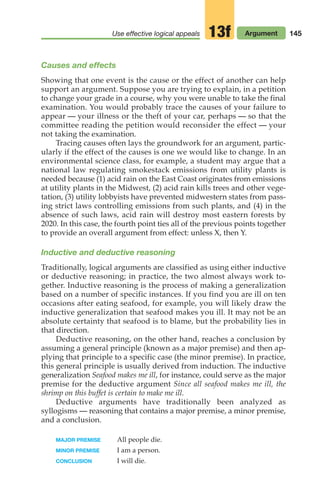
TOPIC American advertising
Okay, what do I most want to know about this
topic? How powerful is advertising? Could adver-
tising be related to how we define “American”?
FIRST FOCUS ATTEMPT American advertising and national identity
Ah, I may be onto something. How about por-
trayals of women and how they affect U.S.
identity? Better yet, how about choosing a
particular company that might be linked to
American identity: McDonald’s? Weight Watch-
ers? Coca-Cola? Chevrolet?
SECOND FOCUS ATTEMPT Advertising icons that shape American identity
Yes, but how many icons are there? LOTS —
and I just named a few. Better choose one.
NARROWED TOPIC Coca-Cola as a cultural icon that shapes
American identity
Craft a working thesis.
Most academic or professional writing contains a thesis statement, of-
ten near the beginning. The thesis functions as a promise to readers, let-
ting them know what the writer will discuss. You should establish a
tentative working thesis early on in your writing process.
The word working is important here because the thesis may well
change as you write — your final thesis may be very different from the
working thesis you begin with. Even so, a working thesis focuses your
thinking and research, and helps keep you on track.
7b
7a
04_LUN_66490_Pt02_(045-112)_04_LUN_66490_Pt02_(045-112).qxd 11/30/11 2:09 PM Page 62
I’VE MADE A
COMMENT ON
MY TOPIC!
IT’S INTERESTING,
SPECIFIC, AND
MANAGEABLE!
I HAVE A
WORKING
THESIS!
GAME PLAN Develop a Working Thesis
Not sure what to
say about the topic?
START HERE.
TEST THE
SENTENCE.
…stay
focused…
Got something to
say about the topic?
START HERE.
about my personal
connection to the topic.
WHAT
INTERESTS
me about
it?
WHAT
do I know
about my
topic?
Can I write a sentence
that DESCRIBES my topic
and comments on it?
WHAT
do I need
to find out?
WHAT is the most important
thing to tell my audience?
Maybe I’ve got a
WORKING
THESIS!
WHAT
POINT do I
want to
make?
OKAY! I CAN COMMENT ON MY TOPIC.
If I’m just
STATING FACTS,
I don’t have
a thesis yet.
Can I cover this topic in
the TIME and SPACE
I have, or would I have
to write a book?
REWRITE
until I have a sentence to
work with.
Will it GRAB
my audience's
attention?
A
thesis is a boring
thesis.
An
thesis is a boring
thesis, too.
(SO FAR I’ve thought about my purpose, audience, and topic….)
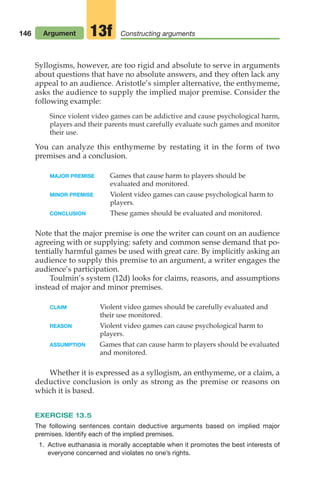
(and I can refine it—or change it—as I go)
04_LUN_66490_Pt02_(045-112)_04_LUN_66490_Pt02_(045-112).qxd 11/30/11 2:09 PM Page 63
64 Writ Process Planning and drafting
7b
A working thesis should have two parts: a topic, which indicates
the subject matter the writing is about, and a comment, which makes an
important point about the topic.
TOPIC COMMENT
䊳 The current health care crisis arises from three major causes.
A successful working thesis has three characteristics:
1. It is potentially interesting to the intended audience.
2. It is as specific as possible.
3. It limits the topic enough to make it manageable.
You can evaluate a working thesis by checking it against each of these
characteristics, as in the following example:
PRELIMINARY WORKING THESIS
䊳 Theories about global warming are being debated around the world.
INTERESTING? The topic itself holds interest, but it seems to have no
real comment attached to it. The thesis merely states a
bare fact, and the only place to go from here is to more
bare facts.
SPECIFIC? The thesis is not specific. Who is debating these theories?
What is at issue in this debate?
MANAGEABLE? The thesis is not manageable; it would require research
on global warming in many countries.
ASSESSMENT: This thesis can be narrowed by the addition of a stronger
comment and a sharper focus.
REVISED WORKING THESIS
䊳 Working independently, scientists from several countries have now
confirmed that global warming is demonstrably caused by humans.
Stating a Thesis
In some cultures, it is considered rude to state an opinion outright. In
the United States, however, academic and business practices require
writers to make key positions explicitly clear.
FOR MULTILINGUAL WRITERS
EXERCISE 7.1
Choose one of the following preliminary working theses, and after specifying an
audience, evaluate the thesis in terms of its interest, specificity, and manageability.
Revise the working thesis as necessary to meet these criteria.
04_LUN_66490_Pt02_(045-112)_04_LUN_66490_Pt02_(045-112).qxd 11/30/11 2:09 PM Page 64
65
Organize information Writ Process
7d
1. Homeland security presents the United States with an ongoing problem.
2. Vaccinations are dangerous.
3. Too many American parents try to micromanage their children’s college education.
4. White-collar crime poses greater danger to the economy than street crime, even
though the latter is more obvious.
5. An educated public is the key to a successful democracy.
EXERCISE 7.2
Using the topic you chose in Exercise 6.1, write a preliminary working thesis. Evaluate
the thesis in terms of its interest, specificity, and manageability. Revise it as necessary
to create a satisfactory working thesis.
Gather information to support your thesis.
Once you have a working thesis, consider whether you need to do re-
search for your writing project. Your assignment may require research,
or you may decide on your own to find out more about your topic or to
locate visuals that will enhance your writing. You may even need to do
research at more than one stage of the writing process as you define,
narrow, and perhaps change your topic. Library research, online re-
search, and field research can all help you find the information and vi-
suals you need. (For more on conducting research and working with
sources, see Chapters 15 and 16. For more on organizing your support
into paragraphs, see Chapter 8.)
Organize information.
Remember to consider your audience, purpose, and topic as you think
about how you will organize information to make it accessible and per-
suasive to your audience. At the simplest level, writers most often
group information according to four principles — space, time, logic,
and association.
Organizing according to space
The organizational principle of space refers to where bits of information
occur within a setting. If the information you have gathered is descrip-
tive, you may choose to organize it spatially. Using spatial organization
allows the reader to “see” your information, to fix it in space.
7d
7c
04_LUN_66490_Pt02_(045-112)_04_LUN_66490_Pt02_(045-112).qxd 11/30/11 2:09 PM Page 65
INFORMATION ORGANIZED SPATIALLY
The scene was being
filmed in a windowless build-
ing with a corrugated tin roof.
We entered through the sin-
gle side door and sat in fold-
ing chairs on a platform along
one wall, separated from the
rest of the room by beaded
red curtains. Behind us was
darkness. On the far wall,
neon lights glowed dimly,
illuminating a few unoccu-
pied barstools on the other
side of the room. But the front
of the room was ablaze with
light. Purple and white flood-
lights beamed down onto a
circular dance floor, creating
an almost supernatural glow.
The film crew in the center of the room stood silhouetted against the light like
an audience waiting for a show to begin.
Organizing according to time
The principle of time refers to when bits of information occur, usually
chronologically. Chronological organization is the basic method used in
cookbooks, lab reports, instruction manuals, and stories. Writers of
these products organize information according to when it occurs in
some process or sequence of events (narrative).
INFORMATION ORGANIZED CHRONOLOGICALLY
In July of 1877, Ead-
weard Muybridge pho-
tographed a horse in
motion with a camera
fast enough to capture
clearly the split second
when the horse’s hooves
were all off the ground —
a moment never before
caught on film. Through-
out the fall of that year,
newspapers were full of
the news of Muybridge’s
achievement. His next
goal was to photograph a
sequence of such rapid
images. In the summer of
This photo series shows the rapid passage of time,
with each image capturing an instant too fast to see
with the eye alone. The image and text together give
readers a clear idea of Muybridge’s achievement.
66 Writ Process Planning and drafting
7d
This photo shows the spatial arrangement
described, with the darkened side areas
for spectators and the brightly lighted front
of the room. The photograph and writing
together help readers see the scene
vividly.
04_LUN_66490_Pt02_(045-112)_04_LUN_66490_Pt02_(045-112).qxd 11/30/11 2:09 PM Page 66
67
Organize information Writ Process
7d
1878, he set up a series of cameras along a track and snapped successive pho-
tos of a horse as it galloped past. Muybridge’s technical achievement helped to
pave the way for the first motion pictures a decade later.
Organizing according to logic
The principle of logic refers to how bits of information are related logi-
cally. The most commonly used logical patterns include illustration, defi-
nition, division and classification, comparison and contrast, cause and effect,
problem and solution, use of analogies, and narration. The example that
follows organizes information logically, according to the principle of
division. For other examples of paragraphs organized according to
these logical patterns, see Chapter 8.
INFORMATION ORGANIZED LOGICALLY
Burns can be divided into three types based
on the severity of tissue damage: (1) Superficial,
or first-degree, burns damage only the top layer
of skin (epidermis). They are red and painful, but
not serious. (2) Partial thickness, or second-
degree, burns damage both the epidermis and
the layer just below it (dermis). Second-degree
burns, which can be very painful, are character-
ized by blistering, swelling, and redness. (3) Full
thickness, or third-degree, burns destroy both
the epidermis and the dermis and damage un-
derlying muscle and other tissues. They appear
charred and black. The burn area itself is numb,
but the surrounding area can be very painful.
Third-degree burns can be fatal if the percentage
of affected skin is sufficiently large.
Organizing according to association
The principle of association refers to how bits of information are re-
lated in terms of visuals, motifs, personal memories, and so on. Many
contemporary essays are organized through a series of associations
that grow directly out of the writer’s memory or experience. Thus, as-
sociational organization is often used in personal narrative, where
writers can use a chain of associations to render an experience vividly
for readers.
INFORMATION ORGANIZED ASSOCIATIONALLY
Flying from San Francisco to Atlanta, I looked down to see the gentle roll
of the Smoky Mountains begin to appear. Almost at once, I was back on
my Granny’s porch, sitting next to her drinking iced tea and eating
The images are logically
arranged to show burns
of increasing severity.
04_LUN_66490_Pt02_(045-112)_04_LUN_66490_Pt02_(045-112).qxd 11/30/11 2:09 PM Page 67
68 Writ Process Planning and drafting
7e
peaches. Those peaches tasted good —
picked ripe, skinned, and eaten with no
regard for the sweet juice trickling every-
where. And on special occasions, we’d
make ice cream, and Granny would
empty a bowl brimming with chopped
peaches into the creamy dish. Now — that
was the life!
In much of your writing, you will
want to use two or more principles of
organization. In addition, you may
want to include not only visuals but
sound and other multimedia effects
as well.
EXERCISE 7.3
Using the topic you chose in Exercise 6.1, identify the most effective means of organiz-
ing your information. Write a brief paragraph explaining why you chose this particular
method (or these methods) of organization.
AT A GLANCE
• Use images and visuals to capture your readers’ attention and interest
in a vivid way, to emphasize a point you make in your text, to present
information that is difficult to convey in words, or to communicate
with audiences with different language skills.
• Consider how the image works as an image and in combination with
the text, and think about how readers are likely to respond to it.
• Place each visual as near as possible to the text it illustrates.
• Introduce each visual clearly: As the map to the right depicts. . . .
• Comment on the significance or effect of the visual: Figure 1 corrobo-
rates the firefighters’ statements. . . .
• Label each visual appropriately, and cite the source.
Organizing Visuals
This image works by associ-
ation, its old-fashioned look
emphasizing the nostalgic
charm of homemade ice
cream and peaches.
Make a plan.
At this point, you will find it helpful to create an organizational plan or
outline. To do so, simply begin with your thesis; review your exploratory
notes, research materials, and visuals; and then list all the examples and
other good reasons you have to support the thesis.
7e
04_LUN_66490_Pt02_(045-112)_04_LUN_66490_Pt02_(045-112).qxd 11/30/11 2:09 PM Page 68
69
Make a plan Writ Process
7e
A sample organizational plan
One informal way to organize your ideas is to figure out what belongs
in your introduction, body paragraphs, and conclusion. Here is how
one student, who was writing about solutions to a problem, used this
kind of plan:
WORKING THESIS
䊳 Increased motorcycle use demands the reorganization of campus park-
ing lots.
INTRODUCTION
give background and overview (motorcycle use up dramatically) and use a
photograph of overcrowding in a lot
state purpose — to fulfill promise of thesis by offering solutions
BODY
describe the current situation (tell of my research at area parking lots)
describe the problem in detail (report on statistics; cars vs. cycles) and in-
clude a graph representing findings
present two possible solutions (enlarge lots or reallocate space)
CONCLUSION
recommend against first solution because of cost and space
recommend second solution, and summarize benefits of it
A formal outline
Even if you have made an informal written plan before drafting, you may
also want — or be required — to prepare a formal outline, which can help
you see exactly how the parts of your writing will fit together — how your
ideas relate, where you need examples, and what the overall structure of
your work will be. Most formal outlines follow a conventional format of
numbered and lettered headings and subheadings, using roman numer-
als, capital letters, arabic numerals, and lowercase letters to show the
levels of importance of the various ideas and their relationships. Each new
level is indented to show its subordination to the preceding level.
Thesis statement
II. First main idea
A. First subordinate idea
1. First supporting detail or point
2. Second supporting detail
3. Third supporting detail
04_LUN_66490_Pt02_(045-112)_04_LUN_66490_Pt02_(045-112).qxd 11/30/11 2:09 PM Page 69
70 Writ Process Planning and drafting
7e
Executive
Summary
Background:
the Dead Zone
Report Findings Methodology
B. Second subordinate idea
1. First supporting detail
2. Second supporting detail
II. Second main idea
A. First subordinate idea
1. First supporting detail
2. Second supporting detail
B. Second subordinate idea
1. First supporting detail
2. Second supporting detail
a. First supporting detail
b. Second supporting detail
Note that each level contains at least two parts, so there is no A without
a B, no 1 without a 2. Also keep in mind that headings should be stated
in parallel form — either all sentences or all grammatically parallel
structures.
A storyboard
The technique of storyboarding — working out a narrative or argu-
ment in visual form — can be a good way to come up with an organi-
zational plan, especially if you are developing a Web site or other
multimedia project. For such projects you can even find storyboard
templates online to help you get started. For a typical college essay,
however, you can create your own storyboard by using note cards or
even sticky notes, taking advantage of different colors to keep track
of threads of argument, subtopics, and so on. Remember that flexibil-
ity is a strong feature of storyboarding: you can move the cards and
notes around, trying out different arrangements, until you find an
organization that works well for your writing situation. Basic pat-
terns for a storyboard include linear, hierarchical, and spoke-and-hub
organization.
LINEAR ORGANIZATION
Use this when you want most readers to move in a particular order
through your material. The Web report on p. 39 uses the following lin-
ear organization:
04_LUN_66490_Pt02_(045-112)_04_LUN_66490_Pt02_(045-112).qxd 11/30/11 2:09 PM Page 70
71
Make a plan Writ Process
7e
Dog
Bite
Prevention
Tips for
Dog Owners
Educating
Children
Practicing
Caution
Restraining
Pets
Training
Tips for
Parents
HIERARCHICAL ORGANIZATION
A hierarchy puts the most important material first, with subtopics
branching out from the main idea. A multimedia presentation on dog
bite prevention might be arranged like this:
SPOKE-AND-HUB
ORGANIZATION
A spoke-and-hub organi-
zation allows readers to
move from place to place in
no particular order. Many
portfolio Web sites are ar-
ranged this way:
About Me
Recent
Presentations
Writing
Samples
Diego
Santos’s
Home Page
Diego’s
Blog
Résumé
Whatever form your plan takes, you may want or need to change
it along the way. Writing has a way of stimulating thought, and the
process of drafting may generate new ideas. Or you may find that you
need to reexamine some data or information or gather more material.
EXERCISE 7.4
Write out a plan for an essay supporting the working thesis you developed for
Exercise 7.2.
04_LUN_66490_Pt02_(045-112)_04_LUN_66490_Pt02_(045-112).qxd 11/30/11 2:09 PM Page 71
Write out a draft.
No matter how good your planning, investigating, and organizing have
been, chances are you will need to do more work as you draft. This fact
of life leads to the first principle of successful drafting: be flexible. If you
see that your plan is not working, don’t hesitate to alter it. If some infor-
mation now seems irrelevant, leave it out — even if you went to great
lengths to obtain it. Throughout the drafting process, you may need to re-
fer to points you have already written about. You may learn that you
need to do more research, that your whole thesis must be reshaped, or
that your topic is still too broad and should be narrowed further. Very of-
ten you will continue planning, investigating, and organizing through-
out the writing process.
EXERCISE 7.5
Write a draft essay from the plan you produced for Exercise 7.4.
EXERCISE 7.6: THINKING CRITICALLY
Using the following guidelines, reflect on the process you went through as you
prepared for and wrote your draft essay for Exercise 7.5. Make your answers an
entry in your writing log if you are keeping one.
1. How did you arrive at your specific topic?
2. When did you first begin to think about the assignment?
3. What kinds of exploring or planning did you do? What kinds of research did you
need to do?
4. How long did it take to complete your draft (including the time spent gathering
information)?
5. Where did you write your draft? Briefly describe the setting.
6. How did awareness of your audience help shape your draft?
7. What have you learned from your draft about your own rhetorical stance on your
topic?
8. What did you learn about your ideas for this topic by exploring, planning, and
talking with others about it?
9. What do you see as the major strengths of your draft? What is your favorite
sentence, and why?
10. What do you see as the major weaknesses of your draft? What are you most
worried about, and why?
11. What would you like to change about your process of exploring, planning, and
drafting?
7f
72 Writ Process Planning and drafting
7f
04_LUN_66490_Pt02_(045-112)_04_LUN_66490_Pt02_(045-112).qxd 11/30/11 2:09 PM Page 72
73
Focus on a main idea Writ Process
8a
AT A GLANCE
• Set up a computer folder or file for your essay. Give the file a clear and
relevant name, and save to it often. Number your drafts. If you decide
to try a new direction, save the file as a new draft — you can always
pick up with a previous one if the new version doesn’t work out.
• Have all your information close at hand and arranged according to
your organizational plan. Stopping to search for a piece of informa-
tion can break your concentration or distract you.
• Try to write in stretches of at least thirty minutes. Writing can pro-
vide momentum, and once you get going, the task becomes easier.
• Don’t let small questions bog you down. Just make a note of them in
brackets — or in all caps — or make a tentative decision and move on.
• Remember that first drafts aren’t perfect. Concentrate on getting all
your ideas down, and don’t worry about anything else.
• Stop writing at a place where you know exactly what will come next.
Doing so will help you start easily when you return to the draft.
Drafting
bedfordstmartins.com/everydaywriter To see student drafts, click on Student
Writing Models.
D
Developing Paragraphs 8
Paragraphs serve as signposts — pointers that help guide readers
through a piece of writing. A look through a popular magazine will
show paragraphs working this way: the first paragraph of an article al-
most always aims to get our attention and to persuade us to read on, and
subsequent ones often indicate a new point or a shift in focus or tone.
Put most simply, a paragraph is a group of sentences or a single
sentence set off as a unit. All the sentences in a paragraph usually re-
volve around one main idea.
Focus on a main idea.
An effective paragraph often focuses on one main idea. A good way to
achieve such paragraph unity is to state the main idea clearly in one sen-
tence and then relate all the other sentences in the paragraph to that idea.
The sentence that presents the main idea is called the topic sentence.
8a
04_LUN_66490_Pt02_(045-112)_04_LUN_66490_Pt02_(045-112).qxd 11/30/11 2:09 PM Page 73
74 Writ Process Developing paragraphs
8a
Announcing the main idea in a topic sentence
The following paragraph opens with a clear topic sentence, and the rest
of the paragraph builds on the idea stated in that sentence:
Our friendship was the source of much happiness and many memories. We
grooved on every new recording from Jay-Z. We sweated together in the
sweltering summer sun, trying to win the championship for our softball
team. I recall the taste of pepperoni pizza as we discussed the highlights of
our team’s victory. Once we even became attracted to the same person, but
luckily we were able to share his friendship.
AT A GLANCE
• Is there a topic sentence that makes the main idea of each paragraph
clear? If not, should there be? (8a)
• Does the first sentence of each paragraph let readers know what that
paragraph is about? Does the last sentence in some way conclude that
paragraph’s discussion? If not, does it need to?
• Within each paragraph, how does each sentence relate to the main
idea? Revise or eliminate any that do not. (8a)
• How completely does each paragraph develop its main idea? What
details and images are included? Are they effective? Do any paragraphs
need more detail? (8b)
• What other methods of development might be used — definition?
example? comparison and contrast? analogy? (8c)
• Is each paragraph organized in a way that is easy to follow? Are
sentences within each paragraph clearly linked? Do any of the transi-
tions try to create links between ideas that do not really exist? (8e)
• Are the paragraphs clearly linked? Do any links need to be added? Are
any of the transitions from one paragraph to another artificial? (8e)
• How does the introductory paragraph catch readers’ interest? How
does the last paragraph draw the piece to a conclusion? (8f)
Editing Paragraphs
Being Explicit
Native readers of English generally expect that paragraphs will have
an explicitly stated main idea and that the connections between points
in a paragraph will also be stated explicitly. Such step-by-step explicit-
ness may strike you as unnecessary or ineffective, but it follows the
traditional paragraph conventions of English.
FOR MULTILINGUAL WRITERS
04_LUN_66490_Pt02_(045-112)_04_LUN_66490_Pt02_(045-112).qxd 11/30/11 2:09 PM Page 74
75
Provide details Writ Process
8b
A topic sentence does not always come at the beginning of a paragraph;
it may come at the end. Occasionally a paragraph’s main idea is so ob-
vious that it need not be stated explicitly in a topic sentence.
EXERCISE 8.1
Choose an essay you have written, and identify the topic sentence of each paragraph,
noting where in the paragraph the topic sentence appears or whether it is implied
rather than stated. Experiment with one paragraph, positioning its topic sentence in at
least two different places. What difference does the change make? If you have any
implied topic sentences, try stating them explicitly. Does the paragraph become
easier to read?
Relating each sentence to the main idea
Whether the main idea of a paragraph is stated in a topic sentence or is
implied, make sure that all other sentences in the paragraph contribute
to the main idea. In the preceding example about friendship, all of the
sentences clearly relate to the point that is made in the first sentence.
The result is a unified paragraph.
TALKING THE TALK
Paragraph Length
“How long should a paragraph be?” In college writing, paragraphs
should address a specific topic or idea and develop that idea with
examples and evidence. There is no set rule about how many sen-
tences are required to make a complete paragraph. So write as many
sentences as you need — and no more.
Provide details.
An effective paragraph develops its main idea by providing enough
details — including visual details — to hold the reader’s interest. With-
out such development, a paragraph may seem lifeless and abstract.
A POORLY DEVELOPED PARAGRAPH
No such thing as human nature compels people to behave, think, or react
in certain ways. Rather, from our infancy to our death, we are constantly being
taught, by the society that surrounds us, the customs, norms, and mores of a
distinct culture. Everything in culture is learned, not genetically transmitted.
This paragraph is boring. Although its main idea is clear and its sentences
hold together, it fails to gain our interest or hold our attention because it
8b
04_LUN_66490_Pt02_(045-112)_04_LUN_66490_Pt02_(045-112).qxd 11/30/11 2:09 PM Page 75
lacks any specific examples or details. Now look at the paragraph revised
to include needed specifics.
THE SAME PARAGRAPH, REVISED
A child in Los Angeles decorates a Christ-
mas tree with shiny red ornaments and sparkling
tinsel. A few weeks later, a child in Beijing cele-
brates the Chinese New Year with feasting, fire-
crackers, and gift money in lucky red envelopes.
It is not by instinct that one child knows how to
decorate the tree while the other knows how to
celebrate the New Year. No such thing as human
nature compels people to behave, think, or react
in certain ways. Rather, from the time of our in-
fancy to our death, we are constantly being
taught, by the society that surrounds us, the cus-
toms, norms, and mores of one or more distinct cultures. Everything in cul-
ture is learned, not genetically transmitted.
Though both paragraphs present the same point, only the second one
comes to life. It does so by bringing in specific details from life, including
images that show readers what the paragraph describes. We want to read
this paragraph because it appeals to our senses (shiny red ornaments, fire-
crackers) and our curiosity (why are red envelopes considered lucky?).
Details are important not only in written texts but in visual ones as
well. If you decide to use an image because of a particular detail, for in-
stance, make sure that your readers will notice the detail you want them
to see — crop out any unnecessary information and clarify what’s im-
portant about the image with a caption.
EXERCISE 8.2
Choose one of the following topic sentences, and spend some time exploring the
topic (see Chapter 6). Then write a paragraph that includes the topic sentence.
Make sure that each of the other sentences relates to it. Assume that the paragraph
will be part of a letter you are writing to an acquaintance.
1. I found out quickly that college life was not quite what I had expected.
2. Being part of the “in crowd” used to be essential to me.
3. My work experience has taught me several important lessons.
4. Until recently, I never appreciated my parents fully.
5. I expect my college education to do more than assure me of a job.
EXERCISE 8.3
Choose an essay you have written recently, and examine the second, third, and
fourth paragraphs. Does each have a topic sentence or strongly imply one? Do all
the other sentences in the paragraph focus on its main idea? Would you now revise
any of these paragraphs — and, if so, how?
76 Writ Process Developing paragraphs
8b
04_LUN_66490_Pt02_(045-112)_04_LUN_66490_Pt02_(045-112).qxd 11/30/11 2:09 PM Page 76
77
Use effective methods of development Writ Process
8c
Fig.1. Venetians have worn masks like these during Carnival for centuries.
Use effective methods of development.
As noted in Chapter 7, there are several common methods of develop-
ment. You can use them to develop paragraphs.
Narrative
A narrative paragraph uses the chronological elements of a story to de-
velop a main idea. The following is one student’s narrative paragraph
that tells a personal story to support a point about the dangers of racing
bicycles with flimsy alloy frames:
People who have been exposed to the risk of dangerously designed bi-
cycle frames have paid too high a price. I saw this danger myself in last
year’s Putney Race. An expensive graphite frame failed, and the rider was
catapulted onto Vermont pavement at fifty miles per hour. The pack of rid-
ers behind him was so dense that other racers crashed into a tangled, slid-
ing heap. The aftermath: four hospitalizations. I got off with some stitches,
a bad road rash, and severely pulled tendons. My Italian racing bike was
8c
PHOTO CROPPED TO SHOW DETAIL
04_LUN_66490_Pt02_(045-112)_04_LUN_66490_Pt02_(045-112).qxd 11/30/11 2:09 PM Page 77
pretzeled, and my racing was over for that summer. Others were not so
lucky. An Olympic hopeful, Brian Stone of the Northstar team, woke up in
a hospital bed to find that his cycling was over — and not just for that sum-
mer. His kneecap had been surgically removed. He couldn’t even walk.
78 Writ Process Developing paragraphs
8c
Narrative Essay
Personal narratives — the most common assignment of all some twenty
years ago — are assigned less often today. But variations of the genre,
such as literacy narratives, are still very common. Writing about yourself
can be more difficult than it sounds, requiring a major point you want to
make, clear organization, vivid description, and some kind of conclusion
that ties the narrative together and highlights its significance.
SPECIAL CONSIDERATIONS OF A NARRATIVE ASSIGNMENT
• Make your story engaging and meaningful to your audience.
• Brainstorm a list of memories, concentrating on capturing them as
vividly as possible. Use your senses: how did things look, smell,
feel, taste, and sound?
• Use specific details and concrete words to create pictures in your
readers’ minds. You may want to include photos or other illustra-
tions as well.
• Consider organization: chronological order may be the most natural
way to tell your story, but you might want to use flashbacks or
flash-forwards, too.
• Try using dialogue to bring the voices of characters to life.
• Think carefully about the overall point you want to make. When
you have a clear sense of the major point, make sure that each part
of the narrative leads up to that point.
• Don’t just dump memories onto paper. Craft and organize your
work carefully to lead to the insights or points you want to make.
COMMON ASSIGNMENTS
Description
A descriptive paragraph uses specific details to create a clear impres-
sion. Notice how the following paragraph includes details about an old
schoolroom; they convey a strong impression of a room where “time
had taken its toll.” Notice as well how the writer uses spatial organiza-
tion, moving from the ceiling to the floor.
The professor’s voice began to fade into the background as my eyes
wandered around the classroom in the old administration building. The
water-stained ceiling was cracked and peeling, and the splitting wooden
beams played host to a variety of lead pipes and coils. My eyes followed
these pipes down the walls and around corners until I eventually saw the
04_LUN_66490_Pt02_(045-112)_04_LUN_66490_Pt02_(045-112).qxd 11/30/11 2:09 PM Page 78
79
Use effective methods of development Writ Process
8c
electric outlets. I thought it was strange
that they were exposed, and not built in,
until I realized that there probably had
been no electricity when the building was
built. Below the outlets the sunshine was
falling in bright rays across the hardwood
floor, and I noticed how smoothly the
floor was worn. Time had taken its toll on
this building.
Definition
You may often need to write an entire paragraph in order to define a
word or concept, as in the following example:
Economics is the study of how people choose among the alternatives
available to them. It’s the study of little choices (“Should I take the choco-
late or the strawberry?”) and big choices (“Should we require a reduction
in energy consumption in order to protect the environment?”). It’s the
study of individual choices, choices by firms, and choices by govern-
ments. Life presents each of us with a wide range of alternative uses of
our time and other resources; economists examine how we choose among
those alternatives. – TIMOTHY TREGARTHEN, Economics
Example
One of the most common ways of developing a paragraph is by illus-
trating a point with one or more examples.
The Indians made names for us children in their teasing way. Because
our very busy mother kept my hair cut short, like my brothers’, they called
me Short Furred One, pointing to their hair and making the sign for short,
the right hand with fingers pressed close together, held upward, back out,
at the height intended. With me this was about two feet tall, the Indians
laughing gently at my abashed face. I am told that I was given a pair of
small moccasins that first time, to clear up my unhappiness at being picked
out from the dusk behind the fire and my two unhappy shortcomings
made conspicuous. – MARI SANDOZ, “The Go-Along Ones”
Division and classification
Division breaks a single item into parts. Classification groups many
separate items according to their similarities. A paragraph evaluating
one history course might divide the course into several segments —
textbooks, lectures, assignments — and examine each one in turn.
A paragraph giving an overview of many history courses might classify
the courses in a number of ways — by time periods, by geographic
areas, by the kinds of assignments demanded, by the number of stu-
dents enrolled, or by some other principle.
04_LUN_66490_Pt02_(045-112)_04_LUN_66490_Pt02_(045-112).qxd 11/30/11 2:09 PM Page 79
DIVISION
We all listen to music according to our separate capacities. But, for the
sake of analysis, the whole listening process may become clearer if we break
it up into its component parts, so to speak. In a certain sense, we all listen to
music on three separate planes. For lack of a better terminology, one might
name these: (1) the sensuous plane, (2) the expressive plane, (3) the sheerly
musical plane. The only advantage to be gained from mechanically splitting
up the listening process into these hypothetical planes is the clearer view to
be had of the way in which we listen.
– AARON COPLAND, What to Listen For in Music
CLASSIFICATION
Two types of people are seduced
by fad diets. Those who have always
been overweight turn to them out of
despair; they have tried everything,
and yet nothing seems to work. A
second group of people to succumb
appear perfectly healthy but are
baited by slogans such as “look good,
feel good.” These slogans prompt
self-questioning and insecurity — do
I really look good and feel good? —
and as a direct result, many healthy
people fall prey to fad diets. With
both types of people, however, the problems surrounding such diets are
numerous and dangerous. In fact, these diets provide neither intelligent nor
effective answers to weight control.
Comparison and contrast
When you compare two things, you look at their similarities; when you
contrast two things, you focus on their differences. You can structure
paragraphs that compare or contrast in two basic ways. One way is to
present all the information about one item and then all the information
about the other item, as in the following paragraph:
You could tell the veterans from the rookies by the way they were
dressed. The knowledgeable ones had their heads covered by kerchiefs, so
that if they were hired, tobacco dust wouldn’t get in their hair; they had on
clean dresses that by now were faded and shapeless, so that if they were
hired they wouldn’t get tobacco dust and grime on their best clothes. Those
who were trying for the first time had their hair freshly done and wore at-
tractive dresses; they wanted to make a good impression. But the dresses
couldn’t be seen at the distance that many were standing from the employ-
ment office, and they were crumpled in the crush.
– MARY MEBANE, “Summer Job”
80 Writ Process Developing paragraphs
8c
04_LUN_66490_Pt02_(045-112)_04_LUN_66490_Pt02_(045-112).qxd 11/30/11 2:09 PM Page 80
81
Use effective methods of development Writ Process
8c
Or you can switch back and forth between the two items, focusing on
particular characteristics of each in turn.
Malcolm X emphasized the use of
violence in his movement and employed
the biblical principle of “an eye for an
eye and a tooth for a tooth.” King, on the
other hand, felt that blacks should use
nonviolent civil disobedience and em-
ployed the theme “turning the other
cheek,” which Malcolm X rejected as
“beggarly” and “feeble.” The philoso-
phy of Malcolm X was one of revenge,
and often it broke the unity of black
Americans. More radical blacks sup-
ported him, while more conservative
ones supported King. King thought that
blacks should transcend their humanity.
In contrast, Malcolm X thought they
should embrace it and reserve their love
for one another, regarding whites as
“devils” and the “enemy.” The distance between Martin Luther King Jr.’s
thinking and Malcolm X’s was the distance between growing up in the semi-
nary and growing up on the streets, between the American dream and the
American reality.
EXERCISE 8.4
Outline the preceding paragraph on Martin Luther King Jr. and Malcolm X, noting its
alternating pattern. Then rewrite the paragraph using block organization: the first
part of the paragraph devoted to King, the second to Malcolm X. Finally, write a brief
analysis of the two paragraphs, explaining which seems more coherent and easier
to follow — and why.
Analogy
Analogies (comparisons that explain an unfamiliar thing in terms of
a familiar one) can also help develop paragraphs. In the following
paragraph, the writer draws an unlikely analogy — between the hu-
man genome and Thanksgiving dinner — to help readers understand
what scientists know about the human genome.
Think of the human genome as the ingredients list for a massive
Thanksgiving dinner. Scientists long have had a general understanding of
how the feast is cooked. They knew where the ovens were. Now, they also
have a list of every ingredient. Yet much remains to be discovered. In most
cases, no one knows exactly which ingredients are necessary for making,
for example, the pumpkin pie as opposed to the cornbread. Indeed, many,
if not most, of the recipes that use the genomic ingredients are missing, and
04_LUN_66490_Pt02_(045-112)_04_LUN_66490_Pt02_(045-112).qxd 11/30/11 2:09 PM Page 81
there’s little understanding why small variations in the quality of the ingre-
dients can “cook up” diseases in one person but not in another.
– USA TODAY, “Cracking of Life’s Genetic Code Carries Weighty Potential”
Cause and effect
You can often develop paragraphs by explaining the causes of something
or the effects that something brings about. The following paragraph dis-
cusses how our desire for food that tastes good has affected history:
The human craving for flavor has
been a largely unacknowledged and un-
examined force in history. For millenia
royal empires have been built, unex-
plored lands traversed, and great reli-
gions and philosophies changed by the
spice trade. In 1492 Christopher Colum-
bus set sail to find seasoning. Today the
influence of flavor in the world market-
place is no less decisive. The rise and fall of corporate empires — of soft-
drink companies, snack-food companies, and fast-food chains — is often
determined by how their products taste.
– ERIC SCHLOSSER, Fast Food Nation
Process
Paragraphs that explain a process often use the principle of time or
chronology to order the stages in the process.
By the late 20s, most people notice the first signs of aging in their physi-
cal appearance. Slight losses of elasticity in facial skin produce the first wrin-
kles, usually in those areas most involved in their characteristic facial
expressions. As the skin continues to lose elasticity and fat deposits build up,
the face sags a bit with age. Indeed, some people have drooping eyelids, sag-
ging cheeks, and the hint of a double chin by age 40 (Whitbourne, 1985).
Other parts of the body sag a bit as well, so as the years pass, adults need to
exercise regularly if they want to maintain their muscle tone and body shape.
Another harbinger of aging, the first gray hairs, is usually noticed in the 20s
and can be explained by a reduction in the number of pigment-producing
cells. Hair may become a bit less plentiful, too, because of hormonal changes
and reduced blood supply to the skin.
– KATHLEEN STASSEN BERGER, The Developing Person through the Life Span
Problem and solution
Another way to develop a paragraph is to open with a topic sentence
that states a problem or asks a question about a problem and then to
offer a solution or answers in the sentences that follow — a technique
82 Writ Process Developing paragraphs
8c
04_LUN_66490_Pt02_(045-112)_04_LUN_66490_Pt02_(045-112).qxd 11/30/11 2:09 PM Page 82
used in this paragraph from a review of Ted Nordhaus and Michael
Shellenberger’s book Break Through: From the Death of Environmentalism
to the Politics of Possibility:
Unfortunately, at the moment growth
means burning more fossil fuel. . . . How
can that fact be faced? How to have growth
that Americans want, but without limits
that they instinctively oppose, and still re-
duce carbon emissions? [Nordhaus and
Shellenberger’s] answer is: investments in
new technology. Acknowledge that America
“is great at imagining, experimenting, and
inventing the future,” and then start spend-
ing. They cite examples ranging from the
nuclear weapons program to the invention
of the Internet to show what government
money can do, and argue that too many clean-energy advocates focus on
caps instead.
– BILL MCKIBBEN, “Can Anyone Stop It?”
Reiterating
Increasingly an important method of development, reiterating calls for
an early statement of the main point of a paragraph. The paragraph
then goes on to restate the point, hammering home the point and often
building in intensity as well.
We are on the move now. The burning of our churches will not deter us.
We are on the move now. The bombing of our homes will not dissuade us. We
are on the move now. The beating and killing of our clergymen and young
people will not divert us. We are on the move now. The arrest and release of
known murderers will not discourage us. We are on the move now. Like an
idea whose time has come, not even the marching of mighty armies can
halt us. We are moving to the land of freedom.
– MARTIN LUTHER KING JR., “Our God Is Marching On”
EXERCISE 8.5
Choose two of the following topics or two others that interest you, and brainstorm
or freewrite about each one for ten minutes (6a and 6b). Then use the information
you have produced to determine what method(s) of development would be most ap-
propriate for each topic.
1. the pleasure a hobby has given you
2. the different images of two noted athletes
3. an average Saturday morning
4. why the game Monopoly is (or is not) an appropriate metaphor for U.S. society
5. the best course you’ve ever taken
83
Use effective methods of development Writ Process
8c
04_LUN_66490_Pt02_(045-112)_04_LUN_66490_Pt02_(045-112).qxd 11/30/11 2:09 PM Page 83
EXERCISE 8.6
Take an assignment you have written recently, and study the ways you developed
each paragraph. For one of the paragraphs, write a brief evaluation of its develop-
ment. How would you expand or otherwise improve the development?
Consider paragraph length.
Paragraph length is determined by content and purpose. Paragraphs
should develop an idea, create any desired effects (such as suspense or hu-
mor), and advance the larger piece of writing. Fulfilling these aims will
sometimes require short paragraphs, sometimes long ones. For example,
if you are writing a persuasive piece, you may put all your evidence into
one long paragraph to create the impression of a solid, overwhelmingly
convincing argument. In a story about an exciting event, on the other
hand, you may use a series of short paragraphs to create suspense, to keep
the reader rushing to each new paragraph to find out what happens next.
REASONS TO START A NEW PARAGRAPH
• to turn to a new idea
• to emphasize something (such as an idea or an example)
• to change speakers (in dialogue)
• to get readers to pause
• to take up a subtopic
• to start the conclusion
EXERCISE 8.7
Examine the paragraph breaks in something you have written recently. Explain
briefly in writing why you decided on each of the breaks. Would you change any of
them now? If so, how and why?
Make paragraphs flow.
A paragraph has coherence — or flows — if its details fit together clearly
in a way that readers can easily follow. When you arrange information
in a particular order (as described in 7d and 8c), you help readers move
from one point to another. Regardless of your organization, however, be
aware of several other ways to achieve paragraph coherence.
Repeating key words and phrases
Weaving in repeated key words and phrases — or pronouns that point to
them — not only links sentences but also alerts readers to the importance
8d
8e
84 Writ Process Developing paragraphs
8e
04_LUN_66490_Pt02_(045-112)_04_LUN_66490_Pt02_(045-112).qxd 11/30/11 2:09 PM Page 84
of those words or phrases in the larger piece of writing. Notice in the fol-
lowing example how the repetition of the italicized key words and the use
of pronouns that refer to those words help hold the paragraph together:
Over the centuries, shopping has changed in function as well as in style.
Before the Industrial Revolution, most consumer goods were sold in open-
air markets, customers who went into an actual shop were expected to buy
something, and shoppers were always expected to bargain for the best possi-
ble price. In the nineteenth century, however, the development of the de-
partment store changed the relationship between buyers and sellers.
Instead of visiting several market stalls or small shops, customers could now
buy a variety of merchandise under the same roof; instead of feeling ex-
pected to buy, they were welcome just to look; and instead of bargaining
with several merchants, they paid a fixed price for each item. In addition,
they could return an item to the store and exchange it for a different one or
get their money back. All of these changes helped transform shopping from
serious requirement to psychological recreation.
EXERCISE 8.8
Read the following paragraph. Then identify the places where the author uses repeti-
tion of key words and phrases, and explain how they bring coherence to the paragraph.
In our time it is broadly true that political writing is bad writing. Where it is not
true, it will generally be found that the writer is some kind of rebel, expressing his
private opinions and not a “party line.” Orthodoxy, of whatever color, seems to de-
mand a lifeless, imitative style. The political dialects to be found in pamphlets,
leading articles, manifestos, white papers, and the speeches of under-secretaries
do, of course, vary from party to party, but they are all alike in that one almost
never finds in them a fresh, vivid, homemade turn of speech. When one watches
some tired hack on the platform mechanically repeating the familiar phrases —
bestial atrocities, iron heel, bloodstained tyranny, free peoples of the world, stand
shoulder to shoulder — one often has a curious feeling that one is not watching a
live human being but some kind of dummy. . . . And this is not altogether fanciful.
A speaker who uses that kind of phraseology has gone some distance toward
turning himself into a machine. The appropriate noises are coming out of his lar-
ynx, but his brain is not involved as it would be if he were choosing his words for
himself. If the speech he is making is one that he is accustomed to make over and
over again, he may be almost unconscious of what he is saying, as one is when
one utters the responses in church. And this reduced state of consciousness, if
not indispensable, is at any rate favorable to political conformity.
— GEORGE ORWELL, “Politics and the English Language”
Using parallelism
Parallel structures can help connect the sentences within a paragraph.
As readers, we feel pulled along by the force of the parallel structures
in the example on the following page:
85
Make paragraphs flow Writ Process
8e
04_LUN_66490_Pt02_(045-112)_04_LUN_66490_Pt02_(045-112).qxd 11/30/11 2:09 PM Page 85
William Faulkner’s “Barn Burning” tells the story of a young boy
trapped in a no-win situation. If he betrays his father, he loses his family. If
he betrays justice, he becomes a fugitive. In trying to free himself from his
trap, he does both.
Using transitions
Transitions are words such as so, however, and thus that signal relation-
ships between sentences and paragraphs. Transitions help guide the
reader from one idea to another. To understand how important transi-
tions are in directing readers, try reading the following paragraph, from
which all transitions have been removed.
A PARAGRAPH WITH NO TRANSITIONS
In “The Fly,” Katherine Mansfield tries to show us the real personality
of the boss beneath his exterior. The fly helps her to portray this real self.
The boss goes through a range of emotions and feelings. He expresses these
feelings to a small but determined fly, whom the reader realizes he uncon-
sciously relates to his son. The author basically splits up the story into three
parts, with the boss’s emotions and actions changing quite measurably.
With old Woodifield, with himself, and with the fly, we see the boss’s mani-
pulativeness. Our understanding of him as a hard and cruel man grows.
If we work at it, we can figure out the relationship of these sentences to
one another, for this paragraph is essentially unified by one major idea.
But the lack of transitions results in an abrupt, choppy rhythm; the
paragraph lurches from one detail to the next, dragging the confused
reader behind. See how much easier the passage is to read and under-
stand with transitions added.
THE SAME PARAGRAPH WITH TRANSITIONS
In “The Fly,” Katherine Mansfield tries to show us the real personality
of the boss beneath his exterior. The fly in the story’s title helps her to por-
tray this real self. In the course of the story, the boss goes through a range
of emotions. At the end, he finally expresses these feelings to a small but
determined fly, whom the reader realizes he unconsciously relates to his
son. To accomplish her goal, the author basically splits up the story into
three parts, with the boss’s emotions and actions changing measurably
throughout. First with old Woodifield, then with himself, and last with the
fly, we see the boss’s manipulativeness. With each part, our understanding
of him as a hard and cruel man grows.
Commonly used transitions
TO SIGNAL SEQUENCE
again, also, and, and then, besides, finally, first . . . second . . . third, further-
more, last, moreover, next, still, too
86 Writ Process Developing paragraphs
8e
04_LUN_66490_Pt02_(045-112)_04_LUN_66490_Pt02_(045-112).qxd 11/30/11 2:09 PM Page 86
TO SIGNAL TIME
after a few days, after a while, afterward, as long as, as soon as, at last, at
that time, before, earlier, immediately, in the meantime, in the past, lately,
later, meanwhile, now, presently, simultaneously, since, so far, soon, then,
thereafter, until, when
TO SIGNAL COMPARISON
again, also, in the same way, likewise, once more, similarly
TO SIGNAL CONTRAST
although, but, despite, even though, however, in contrast, in spite of, in-
stead, nevertheless, nonetheless, on the contrary, on the one hand . . . on the
other hand, regardless, still, though, yet
TO SIGNAL EXAMPLES
after all, for example, for instance, indeed, in fact, of course, specifically,
such as, the following example, to illustrate
TO SIGNAL CAUSE AND EFFECT
accordingly, as a result, because, consequently, for this purpose, hence, so,
then, therefore, thereupon, thus, to this end
TO SIGNAL PLACE
above, adjacent to, below, beyond, closer to, elsewhere, far, farther on, here,
near, nearby, opposite to, there, to the left, to the right
TO SIGNAL CONCESSION
although it is true that, granted that, I admit that, it may appear that, natu-
rally, of course
TO SIGNAL SUMMARY, REPETITION, OR CONCLUSION
as a result, as has been noted, as I have said, as mentioned earlier, as we
have seen, in any event, in conclusion, in other words, in short, on the
whole, therefore, to summarize
Work on opening and closing paragraphs.
Opening paragraphs
Even a good piece of writing may remain unread if it has a weak open-
ing paragraph. In addition to announcing your topic, an introductory
paragraph must engage readers’ interest and focus their attention on
what is to follow. One common kind of opening paragraph follows a
general-to-specific sequence, in which the writer opens with a general
8f
87
Work on opening and closing paragraphs Writ Process
8f
04_LUN_66490_Pt02_(045-112)_04_LUN_66490_Pt02_(045-112).qxd 11/30/11 2:09 PM Page 87
statement and then gets more and more specific, concluding with the
thesis. The following paragraph illustrates such an opening:
Throughout Western civilization, places such as the ancient Greek
agora, the New England town hall, the local church, the coffeehouse, the
village square, and even the street corner have been arenas for debate on
public affairs and society. Out of thousands of such encounters, “public
opinion” slowly formed and became the context in which politics was
framed. Although the public sphere never included everyone, and by itself
did not determine the outcome of all parliamentary actions, it contributed
to the spirit of dissent found in a healthy representative democracy. Many
of these public spaces remain, but they are no longer centers for political
discussion and action. They have largely been replaced by television and
other forms of media — forms that arguably isolate citizens from one an-
other rather than bringing them together.
– MARK POSTER, “The Net as a Public Sphere”
In this paragraph, the opening sentence introduces a general subject —
sites of public debate throughout history; subsequent sentences focus
more specifically on political discussion; and the last sentence presents
the thesis, which the rest of the essay will develop.
OTHER EFFECTIVE WAYS OF OPENING
• with a quotation: There is a bumper sticker that reads, “Too bad igno-
rance isn’t painful.” – NIKKI GIOVANNI, “Racism 101”
• with an anecdote: I first met Angela Carter at a dinner in honor of the
Chilean writer José Donoso at the home of Liz Calder, who then published
all of us. – SALMAN RUSHDIE, “Angela Carter”
• with a question: Why are Americans terrified of using nuclear power as
a source of energy?
• with a strong opinion: Men need a men’s movement about as much as
women need chest hair. – JOHN RUSZKIEWICZ, The Presence of Others
Concluding paragraphs
A good conclusion wraps up a piece of writing in a satisfying and mem-
orable way. A common and effective strategy for concluding is to restate
the central idea (but not word for word), perhaps specifying it in several
sentences, and then ending with a much more general statement.
Lastly, and perhaps greatest of all, there was the ability, at the end,
to turn quickly from war to peace once the fighting was over. Out of the
way these two men [Generals Grant and Lee] behaved at Appomattox
came the possibility of a peace of reconciliation. It was a possibility not
wholly realized, in the years to come, but which did, in the end, help the
88 Writ Process Developing paragraphs
8f
04_LUN_66490_Pt02_(045-112)_04_LUN_66490_Pt02_(045-112).qxd 11/30/11 2:09 PM Page 88
89
Reviewing and revising Writ Process
9
bedfordstmartins.com/everydaywriter For more help with writing, go to Writing
Resources and click on Links.
D
The ancient Roman poet Horace advised aspiring writers to get dis-
tance from their work by putting it away for nine years. Although im-
practical for most college writers, this advice still holds a nugget of
truth: putting the draft away even for a day or two will clear your
mind and give you more objectivity about your writing.
Reviewing and Revising
two sections to become one nation again . . . after a war whose bitterness
might have seemed to make such a reunion wholly impossible. No part
of either man’s life became him more than the part he played in this brief
meeting in the McLean house at Appomattox. Their behavior there put
all succeeding generations of Americans in their debt. Two great Americans,
Grant and Lee — very different, yet under everything very much alike.
Their encounter at Appomattox was one of the great moments of American
history.
– BRUCE CATTON, “Grant and Lee: A Study in Contrasts”
OTHER EFFECTIVE WAYS OF CONCLUDING
• with a quotation
• with a question
• with a vivid image
• with a call for action
• with a warning
EXERCISE 8.9: THINKING CRITICALLY
Reading with an Eye for Paragraphs
Read something by a writer you admire. Find one or two paragraphs that impress
you in some way, and analyze them, using the guidelines on p. 74. Try to decide
what makes them effective paragraphs.
Thinking about Your Own Use of Paragraphs
Examine two or three paragraphs you have written, using the guidelines on p. 74, to
evaluate the unity, coherence, and development of each one. Identify the topic of
each paragraph, the topic sentence (if one is explicitly stated), any patterns of
development, and any means used to create coherence. Decide whether or not each
paragraph successfully guides your readers, and explain your reasons. Then choose
one paragraph, and revise it.
9
04_LUN_66490_Pt02_(045-112)_04_LUN_66490_Pt02_(045-112).qxd 11/30/11 2:09 PM Page 89
90 Writ Process Reviewing and revising
9a
Reread.
After giving yourself and your draft a rest, review the draft by reread-
ing it carefully for meaning; recalling your purpose and audience; re-
considering your stance; and evaluating your organization and use of
visuals.
Meaning
When you pick up the draft again, don’t sweat the small stuff. Instead,
concentrate on your message and on whether you have expressed it
clearly. Note any places where the meaning seems unclear.
Purpose
If you responded to an assignment, make sure that you have produced
what was asked for. If you set out to prove something, have you suc-
ceeded? If you intended to propose a solution to a problem, have you
set forth a well-supported solution rather than just an analysis of the
problem?
Audience
How appropriately do you address your audience members, given their
experiences and expectations? Will you catch their interest, and will
they be able to follow your discussion?
Stance
Ask yourself one central question: where are you coming from in this
draft? Consider whether your stance appropriately matches the
stance you started out with, or whether your stance has legitimately
evolved.
Organization
One way to check the organization of your draft is to outline it. After
numbering the paragraphs, read through each one, jotting down its
main idea. Do the main ideas clearly relate to the thesis and to one
another? Can you identify any confusing leaps from point to point?
Have you left out any important points?
9a
04_LUN_66490_Pt02_(045-112)_04_LUN_66490_Pt02_(045-112).qxd 11/30/11 2:09 PM Page 90
Asking an Experienced Writer to Review Your Draft
One good way to make sure that your writing is easy to follow is to
have someone else read it. You might find it especially helpful to ask
someone who is experienced in the kind of writing you are working
on to read over your draft and to point out any words or patterns that
are unclear or ineffective.
FOR MULTILINGUAL WRITERS
Use of visuals
If you’ve used visuals, do they help make a point? Are all visuals
clearly labeled and the sources appropriately credited? Are they re-
ferred to in the text? Consider whether there is information in your
draft that would be better presented as a visual.
EXERCISE 9.1
Take twenty to thirty minutes to look critically at the draft you prepared for Exercise
7.5. Reread it carefully, check to see how well the purpose is accomplished, and
consider how appropriate the draft is for the audience. Then write a paragraph about
how you would go about revising the draft.
Get responses from peers.
In addition to your own critical appraisal and that of an instructor,
you may want to get responses to your draft from friends, classmates,
or colleagues. Use the questions here to respond to someone else’s
draft or to analyze your own. If you ask other people to evaluate your
draft, be sure that they know your assignment, intended audience,
and purpose.
EXERCISE 9.2
To prepare for a peer review, write a description of your purpose, rhetorical stance,
and audience for your reviewer(s) to consider. For example, Emily Lesk might write,
“I want to figure out why Coca-Cola seems so American and how the company
achieves this effect. My audience is primarily college students like me, learning to
analyze their own cultures. I want to sound knowledgeable, and I want this essay to
be fun and interesting to read.” This type of summary statement can help your re-
viewers keep your goals in mind as they give you feedback.
9b
91
Get responses from peers Writ Process
9b
04_LUN_66490_Pt02_(045-112)_04_LUN_66490_Pt02_(045-112).qxd 11/30/11 2:09 PM Page 91
What should I
look at FIRST?
(ASK if I’m not
sure….)
What’s the
draft doing?
Do I get the
MAIN POINTS?
Should I ASK
more
questions?
Are my
markings
CLEAR?
What
PROBLEMS
do I see in this
draft?
Does this
WORK? What’s
wrong here?
TELL readers
what I want
them to do
first.
START
to work with others
on a DRAFT.
WHAT SHOULD
WE FOCUS ON?
Big picture, development,
sentence-level questions?
IT DOESN'T MATTER
if this writer has more
or less experience than I do
—we can still help each other....
REVIEWERS
READ CAREFULLY. GUIDE MY READERS.
MARK UP THE WRITING.
Compliment what’s good.
Criticize constructively.
SUGGEST NEXT STEPS.
What changes could make
the next draft stronger?
Be specific….
CONFIRM SUGGESTIONS.
Have I gotten FEEDBACK
on what to do next?
Do I UNDERSTAND what my
REVIEWERS think?
ACCEPT HELP.
Remember that all writing
can be improved—
EVEN MINE!
WRITERS
If the comments don’t seem helpful,
ask for better ones….
Is the writer on the
RIGHT TRACK?
GAME PLAN Work with Peer Reviewers
I’M ASKING
GOOD
QUESTIONS…
I’M HELPING
OTHER WRITERS
THINK…
I KNOW WHERE
THIS WRITING
SHOULD GO FROM
HERE!
04_LUN_66490_Pt02_(045-112)_04_LUN_66490_Pt02_(045-112).qxd 11/30/11 2:09 PM Page 92
93
Get responses from peers Writ Process
9b
AT A GLANCE
• Initial thoughts. What are the main strengths and weaknesses of the
draft? What might confuse readers? What is the most important thing
the writer says in the draft? What will readers want to know more about?
• Assignment. Does the draft carry out the assignment?
• Title and introduction. Do the title and introduction tell what the draft
is about and catch readers’ interest? How else might the draft begin?
• Thesis and purpose. Paraphrase the thesis: In this paper, the writer
will. . . . Does the draft fulfill that promise?
• Audience. How does the draft interest and appeal to its audience?
• Rhetorical stance. Where does the writer stand? What words indicate
the stance?
• Supporting points. List the main points, and review them one by one.
How well does each point support the thesis? Do any need more
explanation? Do any seem confusing or boring?
• Visuals and design. Do visuals, if any, add to the key points? Is the de-
sign clear and effective?
• Organization and flow. Is the writing easy to follow? How effective
are transitions within sentences, between sentences, and between
paragraphs?
• Conclusion. Does the draft conclude memorably? Is there another way
it might end?
Guidelines for Peer Response
Tools for peer review
One of the main goals of a peer reviewer is to help the writer see his or
her draft differently. When you review a draft, you want to show the
writer what does and doesn’t work about particular aspects of the draft.
Visually marking the draft can help the writer absorb at a glance the re-
visions you suggest.
REVIEWING A PRINT DRAFT
When working with a hard copy of a draft, write compliments in the
left margin and critiques, questions, and suggestions in the right mar-
gin. As long as you explain what your symbols mean, you can also use
boxes, circles, single and double underlining, highlighting, or other vi-
sual annotations as shorthand for what you have to say about the draft.
REVIEWING A COMPUTER DRAFT
If the draft is an electronic file, the reviewer should save the document
in a peer-review folder under an easy-to-recognize name. It’s wise to
04_LUN_66490_Pt02_(045-112)_04_LUN_66490_Pt02_(045-112).qxd 11/30/11 2:09 PM Page 93
94 Writ Process Reviewing and revising
9b
Understanding Peer Review
If you are not used to giving or receiving criticisms directly, you may
be uneasy with a classmate’s challenges to your work. However, con-
structive criticism is appropriate to peer review. Your peers will also
expect you to offer your questions, suggestions, and insights.
FOR MULTILINGUAL WRITERS
include the writer’s name, the assignment, the number of the draft,
and the reviewer’s initials. For example, the reviewer Ann G. Smith
might name the file for the first draft of Javier Jabari’s first essay
jabari.essay1.d1.ags.
The reviewer can then use the word-processing program to add
comments, questions, and suggestions to the text. In Microsoft Word,
the REVIEWING toolbar appears as an option after the reviewer selects
TOOLBARS in the VIEW menu.
THE REVIEWING TOOLBAR IN MICROSOFT WORD
Moving a mouse over the icons on the REVIEWING toolbar will reveal
their functions. The critical functions for peer reviewers are TRACK
CHANGES and the COMMENT tool. TRACK CHANGES will show a reviewer’s
changes to the document in a different color. The COMMENT function
(which you can also find on the INSERT menu) allows you to type a note
in the margin. If your word processor doesn’t have a COMMENT function,
you can comment in footnotes instead.
EXERCISE 9.3
Using the questions for reviewers on p. 92 as a guide, analyze the draft you wrote for
Exercise 7.5, trying to imagine it through a reviewer’s eyes.
Reviews of Emily Lesk’s draft
On page 95 are the first three paragraphs of Emily Lesk’s draft, as
reviewed electronically by two students, Beatrice Kim and Nastassia
Lopez. (You’ll find earlier appearances of Emily’s work in 5g, 6d, and 7a.)
Beatrice and Nastassia decided to use highlighting for particular pur-
poses: green for material they found effective, yellow for language that
seemed unclear, blue for material that could be expanded, and gray for
material that could be deleted.
TRACK CHANGES
INSERT COMMENT
04_LUN_66490_Pt02_(045-112)_04_LUN_66490_Pt02_(045-112).qxd 11/30/11 2:09 PM Page 94
95
Get responses from peers Writ Process
9b
As this review shows, Nastassia and Bea agree on some of the ma-
jor problems — and good points — in Emily’s draft. The comments on
the draft, however, reveal their different responses. You, too, will find
that different readers do not always agree on what is effective or inef-
fective. In addition, you may find that you simply do not agree with
their advice.
You can often proceed efficiently by looking first for areas of
agreement (everyone was confused by this sentence — I’d better review it)
or strong disagreement (one person said my conclusion was “perfect,” and
someone else said it “didn’t conclude” — better look carefully at that para-
graph again).
bedfordstmartins.com/everydaywriter To explore tools for peer review, go to Writing
Resources and click on Working Online. If you’re using Comment in your course, you
and your classmates can take part in peer-review activities online.
D
All-Powerful Coke
Comment: I’m not sure your title
says enough about what your essay
will argue.
Comment: This opening sentence is
a good attention-getter. Wonder what
will come next?
Comment: The beginning seems
pretty abrupt.
Comment: What does this mean??
Will other members of your audience
know?
Comment: Repeating the phrase
“call me” is good, but I don’t think the
first three “call me” statements have
much to do with the rest of the paper.
Comment: It would be cool to show
this.
Comment: Not sure you need all
these details.
Comment: One of what? a doll or
horse?
Comment: Say it in Hebrew?
Comment: This transition works
really well. I wasn’t sure where this
was going, but the beginning of the
paragraph here starts to clue me in.
I don’t drink Coke. Call me picky for dislikingthe soda’s saccharine aftertaste.
Call me cheap for choosing a water fountain over a twelve-ounce aluminum can that
costs a dollar from a vending machine but only pennies to produce. Even call me
unpatriotic for rejecting the potable god that over the last century has come to represent
all the enjoyment and ease to be found in our American way of life. But don’t call me a
hypocrite when I admit that I still identify with Cokeand the Coca-Cola culture.
I have a favorite T-shirt that says “Drink Coca-Cola Classic” in Hebrew. It’s
Israel’s standard tourist fare, like little nested dolls in Russia or painted horses in
Scandinavia, and before setting foot in the Promised Land three years ago, I knew where
I could find one. The T-shirt shop in the central blockof a Jerusalem shopping center did
offer other shirt designs (“Macabee Beer” was a favorite), but that Coca-Cola shirt was
what drew in most of the dollar-carrying tourists. I waited almost twenty minutes for
mine, and I watched nearly everyone ahead of me say “the Coke shirt” (and “thanks” in
Hebrew).
At the time, I never asked why I wanted the shirt. I do know, though, that the
reason I wear it often, despite a hole in the right sleeve, has to do with its power as a
conversation piece. Few people notice it without asking something like, “Does that say
Coke?” I usually smile and nod. They mumble a compliment and we go our separate
ways. But rarely does anyone want to know what language the world’s most famous logo
is written in. And why should they? Perhaps because Coca-Cola is a cultural icon that
shapes American identity.
Comment: Good detail!
Comment: I like the question—but is
your next sentence really the answer?
Comment: Is this the thesis? Kind of
comes out of nowhere.
04_LUN_66490_Pt02_(045-112)_04_LUN_66490_Pt02_(045-112).qxd 11/30/11 2:09 PM Page 95
96 Writ Process Reviewing and revising
9c
Getting the most from reviewers’ comments
Consider your peer reviewers coaches, not judges. You, not the re-
viewers, will decide which suggestions to follow and which to disre-
gard. After reading reviewers’ comments — and, if necessary, giving
yourself some distance from those comments — make a revision plan
consisting of two lists: (1) areas in which reviewers agree on needed
changes, and (2) areas in which they disagree. Make choices about
which suggestions to take, and rank those suggestions. Concentrate
first on changes having to do with purpose, audience, stance, thesis,
and support. Later you can tackle changes to sentences, words, punc-
tuation, and format.
If you received an electronically marked-up file from reviewers,
you can use that file as the starting point for your next draft, titling it
clearly. (For example, Javier Jabari might rename the file as jabari.es-
say1.d2.) Use the arrows in the REVIEWING toolbar to move through
comments, changes, and highlighting. Decide what to do about each
item by clicking the ACCEPT CHANGE or REJECT CHANGE icon. Remove
comments as you deal with them by clicking the DELETE COMMENT
icon.
THE REVIEWING TOOLBAR IN MICROSOFT WORD
Based on her own review of her work as well as on the responses she
received, Emily decided to (1) make her thesis more explicit, (2) delete
some extraneous information and examples, and (3) work especially hard
on the tone and length of her introduction (see p. 104).
bedfordstmartins.com/everydaywriter To see Emily Lesk’s complete first draft, click
on Student Writing Models.
D
Consult instructor comments.
Instructor comments on any work that you have done can help you
identify mistakes, particularly ones that you make repeatedly, and can
point you toward larger issues that prevent your writing from being as
effective as it could be. Whether or not you will have an opportunity to
revise a particular piece of writing, you should look closely at the com-
ments from your instructor.
In responding to student writing, however, instructors sometimes
use phrases or comments that are a kind of shorthand — comments that
are perfectly clear to the instructor but may be less clear to the students
9c
NEXT CHANGE
PREVIOUS CHANGE
04_LUN_66490_Pt02_(045-112)_04_LUN_66490_Pt02_(045-112).qxd 11/30/11 2:09 PM Page 96
97
Consult instructor comments Writ Process
9c
reading them. The instructor comments in the following chart, culled
from over a thousand first-year student essays, are among those that
you may find most puzzling. Alongside each comment you’ll find in-
formation intended to make the comment clearer to you — and to allow
you to revise as your instructor recommends. If your paper includes a
puzzling comment that is not listed here, be sure to ask your instructor
what the comment means and how you can fix the problem.
Instructor Comment Possible Meaning(s) Actions to Take
in Response
“thesis not clear” Your main point is hard to
find or understand.
Make sure that you have a
main point, and state it di-
rectly. (7b) The rest of the
paper will need to support
the main point, too — this
problem cannot be cor-
rected by adding a sentence
or two.
“trying to do too much”
“covers too much ground”
Your main point is too broad. Focus your main point more
narrowly so that you can say
everything that you need to
in a project of the assigned
length. (5f) You may need to
cut back on some material
and then expand what
remains.
“hard to follow”
“not logical”
“incoherent”
“jumps around”
“parts not connected”
“transition”
The writing is not clearly or
not logically organized, or
the writing lacks transitions,
explanations, or other signals
the reader needs to under-
stand it.
If overall organization is un-
clear, try mapping or outlin-
ing and rearranging your
work. (7d) See if transitions
and signals (8e) or additional
explanation will solve the
problem.
“too general”
“vague”
You need to be more
specific.
Use concrete language and
details (22c), and make sure
that you have something
specific and interesting to
say. (7b) If not, reconsider
your topic.
“underdeveloped”
“thin”
“sparse”
You do not give enough
information, examples, or
details, or you have not con-
sidered the topic from
enough angles.
Add examples and details
and be as specific as pos-
sible. (22c) You may need
to do more research.
(Chapters 14–16)
(continued)
04_LUN_66490_Pt02_(045-112)_04_LUN_66490_Pt02_(045-112).qxd 11/30/11 2:09 PM Page 97
98 Writ Process Reviewing and revising
9c
Instructor Comment Possible Meaning(s) Actions to Take
in Response
“what about the
opposition?”
“one-sided”
“condescending”
“overbearing”
You misrepresent or do not
include information on op-
posing arguments, or you
imply that your opinion is the
only reasonable one.
Indicate that some people dis-
agree with you, and represent
their views fairly before you re-
fute them. Recognize that rea-
sonable people may hold
views that differ from yours.
(Chapter 13)
“repetitive”
“you’ve already said this”
You repeat arguments or
reuse evidence, or you have
a tendency to overuse cer-
tain words or phrases in your
writing.
Revise any parts of your
writing that repeat an argu-
ment, point, word, or phrase;
avoid using the same evi-
dence over and over. If your
paper is too short without
the repetition, develop
your ideas more fully.
(Chapter 8)
“awk”
“awkward”
You have chosen an inappro-
priate word, or your sen-
tence is confusing.
Ask a peer or your instructor
for suggestions about revis-
ing awkward sentences.
(Chapters 24–28)
“syntax”
“awkward syntax”
“convoluted”
Your sentence is too long, or
the parts of the sentence are
not clearly related.
Read the sentence aloud to
identify the problem; revise
or replace the sentence.
(Chapters 24–28)
“unclear” Your reader does not
understand your point.
Find another way to explain
what you mean; add any
background information
or examples that your audi-
ence needs to follow your
reasoning.
“tone too conversational”
“not an academic voice”
“too informal”
“colloquial”
“slang”
You use slang or colloquial
terms inappropriately, or you
do not show enough respect
for your readers.
Eliminate overly informal
words and phrases. Revise
material that addresses or
refers to your audience
too familiarly or
informally. (22a)
“pompous”
“stilted”
“stiff”
You use inappropriately
stuffy, strange, or showy
language.
Check the connotations of the
words you use, and revise
any language or syntax that
contributes to a pompous,
old-fashioned, or peculiar
tone. (22a–b)
(continued)
04_LUN_66490_Pt02_(045-112)_04_LUN_66490_Pt02_(045-112).qxd 11/30/11 2:09 PM Page 98
99
Revise Writ Process
9d
Instructor Comment Possible Meaning(s) Actions to Take
in Response
“set up quotation”
“integrate quotation”
You neglect to introduce a
quotation or to explain its
significance, or you use a
quotation that does not fit
into the words around it.
Introduce every quotation
with information about the
source. Explain each quota-
tion’s importance to your
work. Read the sentence
containing the quotation
aloud; revise it if the entire
sentence does not make
sense. (Chapter 17)
“your words?”
“source?”
“cite”
You use someone else’s
words or ideas without citing
the source.
Mark all quotations clearly.
Acknowledge paraphrases
and summaries of others’
ideas. Give credit for help
from others, and remember
that you are responsible
for your own work.
(Chapter 17)
“doc” You omit all or part of the
source information required
by the documentation style
you are using, or you make
punctuation or other errors in
your in-text citations.
Check the citations to be
sure that you include all of
the required information, that
you punctuate correctly, and
that you omit information not
required by the documenta-
tion style. (Chapters 48–54)
Revise.
Once you have sufficient advice on your draft from your instructor and
classmates, review that advice and then read your work once more, mak-
ing notes on what you want to change, add, or delete. In addition, take
time to look at the “big picture” of your draft: does it get across the main
points effectively? Then begin revising, making the changes you need to
the following elements. And don’t be afraid to make really substantial re-
visions: sometimes that’s the only way to achieve the best results.
Thesis
Make sure that your thesis states the topic clearly and comments on what
is particularly significant about the topic (7b). In addition, ask yourself
whether the thesis is narrowed and focused enough to be thoroughly
proven. If not, take time now to refine and/or limit your thesis further.
9d
04_LUN_66490_Pt02_(045-112)_04_LUN_66490_Pt02_(045-112).qxd 11/30/11 2:09 PM Page 99
100 Writ Process Reviewing and Revising
9d
Revision
TALKING THE TALK
“I thought I had revised my assignment, but my instructor said I’d just
corrected the typos.” It’s always a good idea to clarify what revision
means with a particular instructor. Generally, though, when a writing
teacher asks for a revision, minor corrections will not be enough. Plan
to review your entire draft, and be prepared to make major changes if
necessary. Look for sentence-level errors and typos later, during the
editing stage, since these may disappear or change as you revise.
WORKING THESIS The current health care crisis stems from several
related problems.
REFINED THESIS The current health care crisis in America is most
directly the result of government reluctance to
negotiate with large insurance and pharmaceutical
companies.
When you revise your thesis, remember also to revise the rest of the
draft accordingly.
EXERCISE 9.4
After rereading the draft you wrote for Exercise 7.5, evaluate the revised working the-
sis you produced for Exercise 7.2. Then evaluate its support in the draft. Identify points
that need further support, and list those things you must do to provide that support.
Support
Make sure that each paragraph relates to or supports the thesis and that
each paragraph has sufficient detail to support the point it is making.
Eliminate unnecessary material, and identify sections that need further
details or examples.
Organization
Should any sections or paragraphs be moved to clarify your point or
support your thesis more logically? Are there any paragraphs or parts
of paragraphs that don’t fit with the essay now or that are unnecessary?
Look for confusing leaps or omissions, and identify places where tran-
sitions would make the writing easier to follow.
Title, introduction, and conclusion
Does the title give information and draw readers in? Does the introduction
attract their interest and present the topic in a way that makes them want
04_LUN_66490_Pt02_(045-112)_04_LUN_66490_Pt02_(045-112).qxd 11/30/11 2:09 PM Page 100
GAME PLAN Revise with Reviewer Comments
START HERE
if the comment is
GET READY TO REVISE
START HERE
if the meaning is
How does this
APPLY to what
I wrote?
How
IMPORTANT
is this
suggestion?
How should I RESPOND?
Did the
READER
misunderstand
me?
I don’t want to START
AGAIN, but sometimes that’s
the way it goes….
What changes
will CLARIFY
my writing?
What
should I
ASK the
person who
made the
comment? DO OTHER READERS SAY
THE SAME THING?
WHAT WILL HAPPEN IF I DON’T
MAKE THIS CHANGE?
HOW MUCH REVISION DO I
NEED? A FEW TWEAKS, A WHOLE NEW
TEXT, OR SOMETHING IN BETWEEN?
I’VE
REVIEWED THE
COMMENTS
I’VE
THOUGHT ABOUT
CHANGES
I CAN MAKE
THIS WRITING
BETTER!
I’LL LOOK UP
KEYWORDS
IN MY BOOK.
If I’m still STUCK,
I can stop by the
WRITING CENTER….
Based on my most
useful comments,
WHAT’S MY GOAL
for this revision?
I THINK I’VE GOT IT NOW.
REPEAT UNTIL ALL
COMMENTS ARE
CONSIDERED….
WHAT’S THE MOST
IMPORTANT THING I CAN DO
TO IMPROVE THIS WRITING IN THE TIME I HAVE?
04_LUN_66490_Pt02_(045-112)_04_LUN_66490_Pt02_(045-112).qxd 11/30/11 2:09 PM Page 101
102 Writ Process Editing and reflecting
10
to keep reading? Does the conclusion leave readers satisfied? Because read-
ers notice beginnings and endings more than other parts of a piece of writ-
ing, pay special attention to how you introduce and conclude your work.
Design
Take a final close look at the design of your essay or project. Do you use
visuals or images effectively throughout? Is each one numbered, la-
beled, and commented on in the essay? Do you use font size, color, and
other design elements to best advantage in terms of making your point?
Do you use consistent formatting throughout? What could you do now
to make your essay look better?
EXERCISE 9.5
Using the guidelines on p. 101, reread the draft you wrote for Exercise 7.5 with an
eye for revising. Try to do this at least one day after you completed the draft. List the
things you need or want to address in your revision.
EXERCISE 9.6
Revise the draft you wrote for Exercise 7.5.
EXERCISE 9.7: THINKING CRITICALLY
Answer the following questions about your reviewing and revising process.
1. How did you begin reviewing your draft?
2. What kinds of comments on or responses to your draft did you have? How
helpful were they, and why?
3. How long did revising take? How many drafts did you produce?
4. What kinds of changes did you tend to make? in organization, paragraphs, sen-
tence structure, wording, adding or deleting information? in the use of visuals?
5. What gave you the most trouble as you were revising?
6. What pleased you most? What is your very favorite sentence or passage in the
draft, and why?
7. What would you most like to change about your process of revising, and how
do you plan to go about doing so?
Editing and Reflecting
10
Whether you are writing a wedding invitation, an email to a client, or a
history essay, make time to edit and proofread what you write. Editing
involves fine-tuning the details of sentence structure, grammar, usage,
04_LUN_66490_Pt02_(045-112)_04_LUN_66490_Pt02_(045-112).qxd 11/30/11 2:09 PM Page 102
103
Edit Writ Process
10a
punctuation, and spelling. Finally, careful proofreading aims at a per-
fect copy. For important writing, reflecting on how you accomplished
the task can prepare you to achieve future writing goals.
Edit.
Once you have revised a draft for content and organization, look
closely at your sentences and words. Turning a “blah” sentence into
a memorable one — or finding exactly the right word to express a
thought — can result in writing that is really worth reading. As with
life, variety is the spice of sentences. You can add variety to your
sentences by looking closely at their length, structure, and opening
patterns.
Sentence length
Too many short sentences, especially one following another, can
sound like a series of blasts on a car horn, whereas a steady stream of
long sentences may tire or confuse readers. Most writers aim for some
variety in length, breaking up a series of fairly long sentences with a
very brief one.
In examining the following paragraph from her essay, Emily Lesk
discovered that the sentences were all fairly long. In editing, she de-
cided to shorten the second sentence, thereby offering a shorter sen-
tence between two long ones.
In other words, Coca-Cola has hammered itself into our perceptions--both
conscious and subconscious--of an American cultural identity by equating
As
itself with media that define American culture. When the omnipresent general
gave way to
magazine that marked the earlier part of the century fell by the wayside under
television’s power, Coke was there from the beginning. In its 1996 recap of
the previous fifty years in industry history, the publication Beverage Industry
cites Coca-Cola as a frontrunner in the very first form of television
advertising: sponsorship of entire programs such as, in the case of Coke, The
Bob Dixon Show and The Adventures of Kit Carson.
10a
^
^
^
,
04_LUN_66490_Pt02_(045-112)_04_LUN_66490_Pt02_(045-112).qxd 11/30/11 2:09 PM Page 103
104 Writ Process Editing and reflecting
10a
Sentence openings
Opening sentence after sentence in the same way results in a jerky, abrupt,
or choppy rhythm. You can vary sentence openings by beginning with a
dependent clause, a phrase, an adverb, a conjunctive adverb, or a coordi-
nating conjunction (29b). Another paragraph in Emily Lesk’s essay tells
the story of how she got her Coke T-shirt in Israel. Before she revised,
every sentence in the paragraph opened with the subject, so Emily decided
to delete some examples and vary her sentence openings. The final version
(which also appears in 5g) is a dramatic and easy-to-read paragraph.
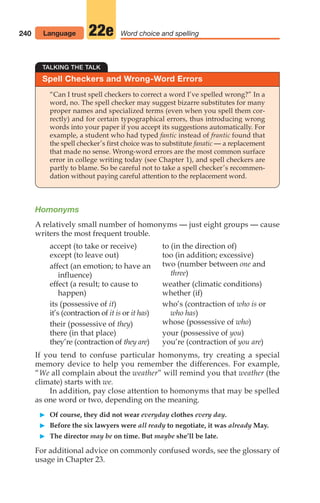
I have a favorite T-shirt that says “Drink Coca-Cola Classic” in Hebrew. It’s
Israel’s standard tourist fare, like little nested dolls in Russia or painted horses in
Even Israel
Seandinavia, and before setting foot in the Promised Land three years ago, I
exactly the Coke shirt. ’s Ben Yehuda Street
knew where I could find it. The shop in the central block of a Jerusalem
shopping center did offer other shirt designs (“Macabee Beer” was a favorite),
but that Coca Cola shirt was what drew in most of the dollar-carrying tourists.
While waiting my shirt,
I waited almost twenty minutes for mine, and I watched nearly everyone
todah rabah [thank you very much].”
ahead of me say “the Coke shirt,” (and “thanks“ in Hebrew).
the one with a bright white “Drink Coca-Cola Classic”
written in Hebrew cursive across the chest
Opening with it and there
As you go over the opening sentences of your draft, look especially at
those beginning with it or there. Sometimes these words can create a
special emphasis, as in It was a dark and stormy night. But they can also
appear too often. Another, more subtle problem with these openings is
that they may be used to avoid taking responsibility for a statement.
The following sentence can be improved by editing:
The university must
䊳 It is necessary to raise student fees.
Tone
Tone refers to the attitude that a writer’s language conveys toward the
topic and the audience. In examining the tone of your draft, think about
^
^
^
^
^
^
,
^
^ ^
^
^
04_LUN_66490_Pt02_(045-112)_04_LUN_66490_Pt02_(045-112).qxd 11/30/11 2:09 PM Page 104
105
Edit Writ Process
10a
the nature of the topic, your own attitude toward it, and that of your in-
tended audience. Does your language create the tone you want to
achieve (humorous, serious, impassioned, and so on), and is that tone
an appropriate one, given your audience and topic?
Word choice
Word choice — or diction — offers writers an opportunity to put their
personal stamp on a piece of writing. Becoming aware of the kinds of
words you use should help you get the most mileage out of each word.
Check for connotations, or associations, of words and make sure you
consider how any use of slang, jargon, or emotional language may af-
fect your audience (see 22a–b).
AT A GLANCE
• Are the nouns primarily abstract and general or concrete and
specific? Too many abstract and general nouns can result in boring
prose.
• Are there too many nouns in relation to the number of verbs? This sen-
tence is heavy and boring: The effect of the overuse of nouns in writing is
the placement of strain on the verbs. Instead, say this: Overusing nouns
places a strain on the verbs.
• How many verbs are forms of be — be, am, is, are, was, were, being, been?
If be verbs account for more than about a third of your total verbs, you
are probably overusing them.
• Are verbs active wherever possible? Passive verbs are harder to read
and remember than active ones. Although the passive voice has many
uses, your writing will gain strength and energy if you use active
verbs.
• Are your words appropriate? Check to be sure they are not too fancy —
or too casual.
Word Choice
Spell checkers
While these software tools won’t catch every spelling error or identify
all problems of style, they can be very useful. Most professional writers
use their spell checkers religiously. Remember, however, that spell
checkers are limited; they don’t recognize most proper names, foreign
words, or specialized language, and they do not recognize homonym
errors (misspelling there as their, for example). (See 22e.)
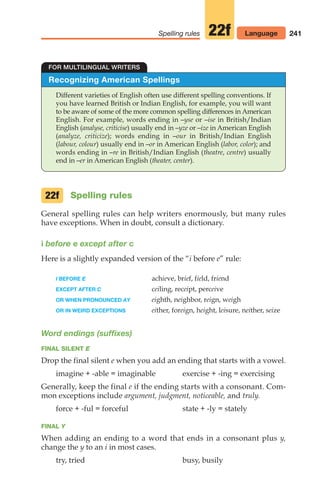
04_LUN_66490_Pt02_(045-112)_04_LUN_66490_Pt02_(045-112).qxd 11/30/11 2:09 PM Page 105
106 Writ Process Editing and reflecting
10a
Emily Lesk
Student Writer
Document design
Before you produce a copy for final proofreading, reconsider one last
time the format and the “look” you want your document to have.
This is one last opportunity to think carefully about the visual ap-
pearance of your final draft. (For more on document design, see
Chapter 4. For more on the design conventions of different disci-
plines, see Chapters 60–64.)
Proofreading the final draft
Take time for one last, careful proofreading, which means reading to
correct any typographical errors or other inconsistencies in spelling
and punctuation. To proofread most effectively, read through the
copy aloud, making sure that you’ve used punctuation marks cor-
rectly and consistently, that all sentences are complete (unless you’ve
used intentional fragments or run-ons for special effects) — and that
no words are missing. Then go through the copy again, this time
reading backward so that you can focus on each individual word and
its spelling.
EXERCISE 10.1
Find a paragraph in your own writing that lacks variety in sentence length, sentence
openings, or sentence structure. Then write a revised version.
EXERCISE 10.2
Edit and proofread the draft you revised in Exercise 9.7.
EXERCISE 10.3
Using several essays you have written, establish your own editing checklist.
A student’s revised draft
Following are the first three paragraphs from Emily Lesk’s edited and
proofread draft that she submitted to her instructor. Compare these
paragraphs with those from her reviewed draft in 9b.
04_LUN_66490_Pt02_(045-112)_04_LUN_66490_Pt02_(045-112).qxd 11/30/11 2:09 PM Page 106
107
Edit Writ Process
10a
Red, White, and Everywhere
America, I have a confession to make: I don’t drink Coke. But don’t call me
a hypocrite just because I am still the proud owner of a bright red shirt that
advertises it. Just call me an American.
Even before setting foot in Israel
three years ago, I knew exactly where I
could find the Coke shirt. The shop in
the central block of Jerusalem’s Ben
Yehuda Street did offer other shirt
designs, but the one with a bright white
“Drink Coca-Cola Classic” written in
Hebrew cursive across the chest was
what drew in most of the dollar-carrying
tourists. While waiting almost twenty minutes for my shirt (depicted in Fig. 1), I
watched nearly everyone ahead of me say “the Coke shirt, todah rabah [thank
you very much].”
At the time, I never thought it strange that I wanted one, too. After having
absorbed sixteen years of Coca-Cola propaganda through everything from NBC’s
Saturday morning cartoon lineup to the concession stand at Camden Yards (the
Baltimore Orioles’ ballpark), I associated the shirt with singing along to the “Just
for the Taste of It” jingle and with America’s favorite pastime, not with a brown
fizzy beverage I refused to consume. When I later realized the immensity of Coke’s
corporate power, I felt somewhat manipulated, but that didn’t stop me from
wearing the shirt. I still don it often, despite the growing hole in the right sleeve,
because of its power as a conversation piece. Few Americans notice it without
asking something like “Does that say Coke?” I usually smile and nod. Then they
mumble a one-word compliment, and we go our separate ways. But rarely do they
want to know what language the internationally recognized logo is written in. And
why should they? They are interested in what they can relate to as Americans: a
familiar red-and-white logo, not a foreign language. Through nearly a century of
brilliant advertising strategies, the Coca-Cola Company has given Americans not
only a thirst-quenching beverage but a cultural icon that we have come to claim as
our own.
Fig. 1. Hebrew Coca-Cola T-shirt.
Personal photograph.
bedfordstmartins.com/everydaywriter To see Emily Lesk’s complete final draft, click
on Student Writing Models.
D
04_LUN_66490_Pt02_(045-112)_04_LUN_66490_Pt02_(045-112).qxd 11/30/11 2:09 PM Page 107
108 Writ Process Editing and reflecting
10b
Reflect.
Research demonstrates a connection between careful reflection and learn-
ing: thinking back on what you’ve learned and assessing it help make that
learning stick. As a result, first-year college writing courses are increas-
ingly encouraging students to take time for such reflection. Whether or not
your instructor asks you to write a formal reflection, whenever you finish
a major piece of writing or a writing course, you should make time to
think back over the experience and see what lessons you can learn from it.
Reflecting on your development as a writer
Here are some questions to get you started reflecting productively on
your writing:
• What lessons have you learned from writing — from an individual
piece of writing or from an entire writing course?
• From what you have learned, what can you apply to the work you
will do in other classes?
• What about your writing do you feel most confident about — and
why? When did you begin to develop this confidence?
• What about your writing do you find needs additional work, and
what plans do you have for improving?
• What confusions did you have while writing, and what did you do
to resolve them?
• What major questions do you still have about writing or about an
individual piece of writing?
• How has writing helped to clarify your thinking, extend your
knowledge, or deepen your understanding?
• Identify a favorite passage of your writing, and then try to articu-
late what about it pleases you. Can you apply what you learn from
this analysis to other writing situations?
• How would you describe your development as a writer?
Portfolios
You may find it useful — or you may be required — to select samples
for inclusion in a print or online portfolio of your written work. In
preparing a portfolio, use these tips:
• Consider your purpose and audience. Do you want to fulfill course re-
quirements for an instructor, show work to a prospective employer,
keep a record of what you‘ve done for personal reasons, or something
else? Answering these questions will help you decide what to include
in the portfolio and whether it should be in print or electronic form.
10b
04_LUN_66490_Pt02_(045-112)_04_LUN_66490_Pt02_(045-112).qxd 11/30/11 2:10 PM Page 108
• Based on the portfolio’s purpose, decide on the number of entries.
You may decide to include a wide range of materials — from es-
says, problem sets, and photos to Web texts, multimedia presenta-
tions, a résumé, or anything else that is relevant — if readers can
select only the pieces that interest them. For a portfolio that will be
read from beginning to end, however, you should limit yourself to
five to seven examples of your writing. You might include an acad-
emic essay that argues a claim, a personal essay, a brief report, writ-
ing based on research, significant correspondence, timed writing,
or other work that you think shows your strengths as a writer.
• Consider organization. What arrangement — in chronological or-
der, by genre, by topic — will make most sense to readers?
• Think carefully about layout and design. Will you include a table
of contents or appendices? How will you use color, font and type
size, and other elements of graphic design to enhance your portfo-
lio (see Chapter 4)? Remember to label and date each piece of writ-
ing in the portfolio to help readers follow along easily. For print
portfolios, number pages in consecutive order.
• Edit and proofread each piece in your portfolio and the reflective
statement (see box below). Ask for responses from peers or an in-
structor.
109
Reflect Writ Process
10b
Reflective Statements
Research done for this book shows that one of the most common writ-
ing assignments in college today is a reflective statement — in the form
of a letter, a memo, or a home page — that explains and analyzes the
contents of a portfolio.
SPECIAL CONSIDERATIONS OF A REFLECTIVE ASSIGNMENT
• Think carefully about the overall impression you want the portfolio
to create, and make sure that the tone and style of your reflective
statement set the stage for the entire portfolio.
• Unless otherwise instructed, include in your cover letter a descrip-
tion of what the portfolio contains and explain the purpose of each
piece of writing you have chosen.
• Reflect on the strengths and weaknesses of your writing, using spe-
cific passages from assignments in your portfolio to provide evi-
dence for each point you make.
• Reflect on the most important things you have learned about writ-
ing and about yourself as a writer.
• Conclude with plans for ongoing improvement in your writing.
COMMON ASSIGNMENTS
04_LUN_66490_Pt02_(045-112)_04_LUN_66490_Pt02_(045-112).qxd 11/30/11 2:10 PM Page 109
110 Writ Process Editing and reflecting
10b
A student’s reflective statement
Here is a shortened version of the cover letter that
James Kung wrote to accompany his first-year writing
portfolio.
December 6, 2007
Dear Professor Ashdown:
“Writing is difficult and takes a long time.” This simple yet powerful
statement has been uttered so many times in our class that it has
essentially become our motto. During this class, my persuasive writing
skills have improved dramatically, thanks to many hours spent writing,
revising, polishing, and thinking about my topic. The various drafts,
revisions, and other materials in my portfolio show this improvement.
I entered this first-quarter Writing and Rhetoric class with both strengths
and weaknesses. I have always written fairly well-organized essays.
However, despite this strength, I struggled throughout the term to narrow
and define the various aspects of my research-based argument.
The first aspect of my essay that I had trouble narrowing and defining was
my major claim, or my thesis statement. In my “Proposal for Research-Based
Argument,” I proposed to argue about the case of Wen Ho Lee, the Los
Alamos scientist accused of copying restricted government documents. I
stated, “The Wen Ho Lee incident deals with the persecution of not only one
man, but of a whole ethnic group.” You commented that the statement was
a “sweeping claim” that would be “hard to support.”
I spent weeks trying to rework that claim. Finally, as seen in my “Writer’s
Notebook 10/16/07,” I realized that I had chosen the Lee case because of
my belief that the political inactivity of Asian Americans contributed to the
case against Lee. Therefore, I decided to focus on this issue in my thesis.
Later I once again revised my claim, stating that the political inactivity did
not cause but rather contributed to racial profiling in the Wen Ho Lee case.
I also had trouble defining my audience. I briefly alluded to the fact that
my audience was a “typical American reader.” However, I later decided to
James Kung
Student Writer
04_LUN_66490_Pt02_(045-112)_04_LUN_66490_Pt02_(045-112).qxd 11/30/11 2:10 PM Page 110
address my paper to an Asian American audience for two reasons. First, it
would establish a greater ethos for myself as a Chinese American. Second, it
would enable me to target the people the Wen Ho Lee case most directly
affects: Asian Americans. As a result, in my final research-based argument, I
was much more sensitive to the needs and concerns of my audience, and my
audience trusted me more.
I hope to continue to improve my writing of research-based arguments.
Sincerely,
James Kung
111
Reflect Writ Process
10b
bedfordstmartins.com/everydaywriter For more information on writing portfolios and
reflective statements, go to Writing Resources and click on Writing Portfolios.
D
04_LUN_66490_Pt02_(045-112)_04_LUN_66490_Pt02_(045-112).qxd 11/30/11 2:10 PM Page 111
00_LUN_66490_FM_(i-xx)_00_LUN_66490_FM_i-xx.qxd 11/30/11 1:54 PM Page ii
this page left intentionally blank
To repeat what others have said requires education;
to challenge it requires brains.
— MARY PETTIBONE POOLE
Critical Thinking
and Argument
Critical
Thinking
and
Argument
11 Critical Reading 115
a Think critically about written texts 115
b Think critically about visuals 119
12 Analyzing Arguments 123
a Think critically about argument 124
b Recognize cultural contexts 125
c Identify an argument’s basic appeals 125
d Analyze the elements of an argument 126
e Analyze visual arguments 127
f Think critically about fallacies 129
g STUDENT RHETORICAL ANALYSIS 134
13 Constructing Arguments 137
a Understand what counts as argument 138
b Make a claim and formulate a working thesis 140
c Examine your assumptions 140
d Shape your appeal to your audience 141
e Establish credibility through ethical appeals 141
f Use effective logical appeals 143
g Use appropriate emotional appeals 147
h Consult sources 150
i Organize your argument 151
j Consider design issues 153
k STUDENT ARGUMENT ESSAY 154
Critical Thinking and Argument
Critical
Thinking
and
Argument
113–160
All readers build worlds in their minds made of words and visuals.
Think of a time when you were reading or looking at images and sud-
denly realized that you were not absorbing information but just staring
at a jumble of marks on a page or a screen. Only when you went back
and concentrated on meaning were you really reading.
Think critically about written texts.
Reading critically means asking questions about what you are reading.
A critical reader does not simply accept what the author says but ana-
lyzes why the text is convincing (or not convincing). Writer Anatole
Broyard once cautioned readers about the perils of “just walking
through” a text. A good reader, he suggested, doesn’t just walk but
“stomps around” in a text — highlighting passages, scribbling in the
margins, jotting questions and comments.
Preview and annotation
The article “Many Women at Elite Colleges Set Career Path to Mother-
hood,” by Louise Story, appeared on pp. A1 and A18 of the New York
Times on September 20, 2005. The first portion of the article appears on
pp. 116–17, with a student’s preview notes and annotations.
11a
Critical Reading 11
115
bedfordstmartins.com/everydaywriter To read the article in its entirety, go to
Writing Resources and click on Argument Resources/Critical Reading.
D
Summary
Here is how the same student summarized Louise Story’s article.
A group of women at Ivy League schools told a reporter who surveyed and
interviewed them that they planned to stop working or cut back on work
when they had children. The reporter suggests that the women’s responses
are evidence of a trend and of “changing attitudes.”
06_LUN_66490_Pt03_(115-160)_06_LUN_66490_Pt03_(115-160).qxd 11/30/11 2:16 PM Page 115
116 Crit Thinking Critical reading
11a
Cynthia Liu is precisely
the kind of high achiever
Yale wants: smart (1510
SAT), disciplined (4.0 grade
point average), competitive
(finalist in Texas oratory
competition), musical (pi-
anist), athletic (runner) and
altruistic (hospital volun-
teer). And at the start of her
sophomore year at Yale,
Ms. Liu is full of ambition,
planning to go to law
school.
So will she join the
long tradition of famous
Ivy League graduates? Not
likely. By the time she
is 30, this accomplished
19-year-old expects to be a
stay-at-home mom.
“My mother’s always
told me you can’t be the
best career woman and the
best mother at the same
time,’’ Ms. Liu said matter-
of-factly. “You always have
to choose one over the
other.”
At Yale and other top
colleges, women are being
groomed to take their place
in an ever more diverse
professional elite. It is al-
most taken for granted
that, just as they make up
half the students at these
institutions, they will move
into leadership roles on an
equal basis with their male
classmates.
There is just one prob-
lem with this scenario:
many of these women say
that is not what they
want.
Many women at the
nation’s most elite col-
leges say they have al-
ready decided that they
will put aside their careers
in favor of raising children.
Though some of these stu-
dents are not planning to
have children and some
hope to have a family and
work full time, many
others, like Ms. Liu, say
they will happily play a
traditional female role,
with motherhood their
main commitment.
Much attention has
been focused on career
women who leave the
work force to rear chil-
dren. What seems to be
changing is that while
many women in college
two or three decades ago
expected to have full-time
careers, their daughters,
while still in college, say
they have already decided
to suspend or end their
careers when they have
children.
“At the height of the
women’s movement and
shortly thereafter, women
were much more firm in
their expectation that they
could somehow combine
full-time work with child
rearing,” said Cynthia E.
Russett, a professor of
American history who
has taught at Yale since
Many Women at Elite Colleges
Set Career Path to Motherhood
BY LOUISE STORY
Title suggests
author’s con-
clusion. A
new trend?
Why is it on
the front
page?
Is Cynthia Liu
a typical fe-
male student?
How can I
tell?
Main point,
as expected
from the title.
But she’s
only one
example —
how many
are like her?
Generalizations
about how
women are
“groomed” —
but no
evidence.
Who is
Louise
Story?
See if her ar-
ticle gener-
ated any
response.
Is “many”
more than
“some”?
Who did the
writer talk
to? Whose
stories did
she leave
out — and
why?
Who says?
Where are
the sources
for these
claims?
Expert
source — her
quotation
underscores
the main
point. Do
other
experts
disagree?
How many is
“many”? The
same word
appears in
the title.
06_LUN_66490_Pt03_(115-160)_06_LUN_66490_Pt03_(115-160).qxd 11/30/11 2:16 PM Page 116
117
Think critically about written texts Crit Thinking
11a
1967. “The women today
are, in effect, turning
realistic.”
Dr. Russett is among
more than a dozen faculty
members and administra-
tors at the most exclusive
institutions who have been
on campus for decades
and who said in inter-
views that they had no-
ticed the changing attitude.
Many students say stay-
ing home is not a shocking
idea among their friends.
Shannon Flynn, an 18-year-
old from Guilford, Conn.,
who is a freshman at Har-
vard, says many of her girl-
friends do not want to work
full time.
“Most probably do feel
like me, maybe even tend-
ing toward wanting to not
work at all,” said Ms.
Flynn, who plans to work
part time after having chil-
dren, though she is torn
because she has worked so
hard in school.
“Men really aren’t put
in that position,” she said.
Uzezi Abugo, a fresh-
man at the University of
Pennsylvania who hopes
to become a lawyer, says
she, too, wants to be home
with her children at least
until they are in school.
“I’ve seen the difference
between kids who did have
their mother stay at home
and kids who didn’t, and
it’s kind of like an obvious
difference when you look at
it,” said Ms. Abugo, whose
mother, a nurse, stayed
home until Ms. Abugo was
in first grade.
While the changing
attitudes are difficult to
quantify, the shift emerges
repeatedly in interviews
with Ivy League students,
including 138 freshman
and senior females at Yale
who replied to e-mail
questions sent to mem-
bers of two residential col-
leges over the last school
year.
The interviews found
that 85 of the students, or
roughly 60 percent, said
that when they had chil-
dren, they planned to cut
back on work or stop
working entirely. About
half of those women said
they planned to work part
time, and about half wanted
to stop work for at least a
few years.
Two of the women in-
terviewed said they ex-
pected their husbands to
stay home with the children
while they pursued their
careers. Two others said ei-
ther they or their husbands
would stay home, depend-
ing on whose career was
furthest along.
The women said that
pursuing a rigorous col-
lege education was worth
the time and money be-
cause it would help posi-
tion them to work in
meaningful part-time jobs
when their children are
young or to attain good
jobs when their children
leave home. . . .
“Many” —
that word is
here a lot.
Wonder why
nobody is
asking why
expectations
are different
for men?
Here’s an-
other student
example, but,
again, just
one person.
Another stu-
dent says the
same thing.
Three so far.
Author con-
ducted inter-
views and an
email survey.
The sample
seems pretty
small, though,
and comes
from a single
school.
Interview re-
sults. What
about survey
results? How
many were
sent out and
how many
completed?
The author
doesn’t say.
I wonder if
they’re paying
for college
themselves!
85 + 2 + 2 =
89, and she
interviewed
138. What
about the
others?
Is it realistic
to expect to
be able to
raise a family
without the
income from
working?
bedfordstmartins.com/everydaywriter For the rest of this article, go to Writing
Resources and click on Argument Resources/Critical Reading.
D
06_LUN_66490_Pt03_(115-160)_06_LUN_66490_Pt03_(115-160).qxd 11/30/11 2:16 PM Page 117
Analysis
Here are some of the student’s notes for an analysis of Louise Story’s
New York Times article. Because the student felt that the article — and her
response to it — raised many unanswered questions, she decided to re-
search responses to the article as well as information about how the
writer came up with the data cited.
The evidence for a trend seems pretty skimpy. The reporter interviews sev-
eral students who indicate that they plan to stop working or work part-time
when they have children. The reporter says “many” students feel this way.
But according to the numbers the reporter provides, she talked to just 138
people out of an unknown number of responses to an email survey. The
reporter doesn’t provide any information about what previous generations
of women at Ivy League schools felt about working or staying home with
their children either, so there’s no way to identify this point of view as a
change in college women’s attitudes — even though the reporter uses the
phrase “changing attitudes” twice.
Critical Thinking
TALKING THE TALK
“It seems impolite to criticize. Why do I have to be critical?” Thinking
critically does not require you to be relentlessly negative. Instead, crit-
ical thinking means, first and foremost, asking good questions — not
simply accepting what you see and read at face value. By asking not
only what words and images mean but also how meaning gets across,
critical thinkers consider why an author makes a particular claim,
what an author may be leaving out or ignoring, and how to tell
whether evidence is accurate and believable. If you’re asking, and an-
swering, questions like these, then you are thinking critically.
EXERCISE 11.1
Following the guidelines in 11a, read one of the assigned essays from your course
text or the student essay in Chapter 12 or 13 of this book. Summarize the reading
briefly, and note any thoughts you have about your critical reading process (in your
writing log, if you keep one).
EXERCISE 11.2: THINKING CRITICALLY
To think critically about your own writing, try approaching it as a reader. Choose a
piece of writing that you completed for an earlier class and that you have not
recently read. Using the guidelines for critical reading on p. 120, preview, read, and
analyze the writing as objectively as you can. What impression does it make on you
as a reader? What questions does it leave you with? Write a one-page report ana-
lyzing your piece of writing from a critical reader’s point of view.
118 Crit Thinking Critical reading
11a
06_LUN_66490_Pt03_(115-160)_06_LUN_66490_Pt03_(115-160).qxd 11/30/11 2:16 PM Page 118
119
Think critically about visuals Crit Thinking
11b
Think critically about visuals.
Visual images now shape our lives at least as much as words do. The im-
ages that bombard us daily influence us to think and behave in certain
ways, and images profoundly affect the way we see ourselves and oth-
ers. So being visually literate — being able to read an image and under-
stand how it aims to persuade or manipulate — is crucial to becoming a
critical thinker.
Visual literacy requires you to analyze images and the arguments
they contain — in the same way that you think critically about words
that you read. You ask questions and think about the message the visual
conveys and the context in which it was presented. You consider the
creator(s) of the image and think about why it was created and for
whom. You also look at the design as another way of communicating
with readers, considering, for example, how color, size, shape, texture,
layout, sound, and other design elements influence the viewer.
11b
Visual Texts
TALKING THE TALK
“How can a picture be a text?” In its traditional sense, a text involves
printed words on paper. But in our media-saturated age, we spend at
least as much time reading and analyzing images — including mov-
ing images — as we spend on printed words. So it makes sense to
broaden the definition of text to refer to almost anything that sends a
message. That’s why images are often called visual texts.
QUESTIONS ABOUT DESIGN
• Detail. What do you notice first? Why is your attention drawn to
that spot, and what effect does this have on your response?
• Composition. How does the composition of the image affect the
message? What is in the foreground, and what is in the background?
What is in the middle, at the top, and at the bottom of the image?
Why might the composition be arranged as it is? What effect do the
designer’s choices have on how you feel about what you see?
• Color. Does the use of color enhance or conflict with the images and
words? Are some parts of the image highlighted with brighter or
lighter colors? If so, why? How do you explain the color choices? If
the visual is black and white, is that choice appropriate?
• Words. If the visual contains both words and images, what is the re-
lationship between the two? How well do they work together? If no
words appear, is the message clear without them? Why, or why not?
• Repetition. Are any words or images repeated? If so, what is the
effect of the repetition?
06_LUN_66490_Pt03_(115-160)_06_LUN_66490_Pt03_(115-160).qxd 11/30/11 2:16 PM Page 119
GAME PLAN Read Critically
READ
CAREFULLY.
WHAT
do I
think
about the
topic?
WHAT
do I
know?
What
does the
TITLE
tell me?
The
MAIN
idea
is....
Supporting
IDEAS
are….
Look up anything that’s
Have I gotten
what I
expected out of
this text?
Do the parts WORK
together?
WHAT ELSE
do I need to
KNOW?
Was the text’s
PURPOSE
accomplished?
What do
I LIKE most?
What purpose does
this text serve?
What’s assumed? Do the assumptions make sense?
REREAD and CHECK UNDERSTANDING.
Who’s the
AUDIENCE
supposed to be?
Am I part of it?
Think about context:
WHEN, WHERE, and HOW
was this first published?
Have I got it?
TELL A FRIEND
in my own
words.
WHERE did
this information come from?
WHO’S THIS AUTHOR, ANYWAY?
I’VE KEPT
AN OPEN
MIND….
I’VE READ
CAREFULLY….
I’VE ASKED
QUESTIONS….
I HAVE A CRITICAL
PERSPECTIVE ON
THIS TEXT!
SUMMARIZE
THE TEXT.
START
with a
PREVIEW.
ANALYZE
the
text.
06_LUN_66490_Pt03_(115-160)_06_LUN_66490_Pt03_(115-160).qxd 11/30/11 2:16 PM Page 120
QUESTIONS ABOUT THE CREATOR
• Who created this visual text? What other work has he or she done?
• What does the creator’s attitude seem to be toward the visual?
What effects do you think the creator intends the image to have on
viewers?
QUESTIONS ABOUT CONTENT
• What is the subject?
• How well do visuals explain the subject?
QUESTIONS ABOUT CONTEXT
• Where and in what form was the visual originally seen — in a mag-
azine, on television, online, or somewhere else?
• What can you infer about the message from the place where the vi-
sual first appeared?
QUESTIONS ABOUT AUDIENCE
• Who is the intended audience? Are you part of the group the creator
is trying to reach? If so, does the visual affect you as the creator(s)
intended?
121
Think critically about visuals Crit Thinking
11b
You are almost certain to get some form of analysis assignment during
your first year of college. One common variety is the rhetorical analy-
sis assignment, which essentially answers two big questions — What
is the purpose of the text you are analyzing? How is that purpose
achieved? — and focuses on how the text gets its meaning across.
SPECIAL CONSIDERATIONS OF A RHETORICAL ANALYSIS ASSIGNMENT
• Identify the purpose or purposes of the text. If the text has multiple
purposes, point out any conflicts.
• Identify the primary audience for the text and any secondary au-
diences, and explore how the text meets audience expectations
or needs.
• Examine the author’s stance or attitude toward the topic: is it favor-
able, critical, suspicious, neutral, or mocking? Identify parts of the
text where such attitudes are evident, and show how they work to
appeal to the audience.
• Explain how the text uses deliberate strategies (such as tone, word
choice, sentence structure, design, special effects, choice of medium,
choice of evidence, and so on) to achieve its purposes.
COMMON ASSIGNMENTS
Rhetorical Analysis
06_LUN_66490_Pt03_(115-160)_06_LUN_66490_Pt03_(115-160).qxd 11/30/11 2:16 PM Page 121
Face is second-largest
circle — and the first
thing that shows this is
a child. Big, round
eyes — blank and
empty? scared?
“Cycle” relates to the
circles shown in the
image. The “cycle of
violence” happens
when abused children
become abusive
adults.
Bull’s-eye gets
attention — target is
what designer wants
viewer to notice.
Words in large head-
line at the top contra-
dict what the picture
shows — a child who
literally is a target.
Colors are warm skin
tones, emphasizing
that this is a person.
Circles for arms
and legs make child
look like a doll or
marionette.
Composition uses
nothing but circles.
They look nonthreat-
ening and friendly.
• What assumptions does the visual make about the audience’s
values?
QUESTIONS ABOUT PURPOSE
• Why do you think the visual was created? Does it achieve its
purpose?
OVERALL IMPRESSION
• What works and doesn’t work about the text?
• What overall impression does the visual text create?
How an image is designed and formatted affects how others will
receive it. Look at the striking image on this page, from TurnAround, an
122 Crit Thinking Critical reading
11b
06_LUN_66490_Pt03_(115-160)_06_LUN_66490_Pt03_(115-160).qxd 11/30/11 2:16 PM Page 122
In one important sense, all language use has an argumentative edge.
When you greet friends warmly, you wish to convince them that you
are genuinely glad to see them, that you value their presence. Even
Analyzing Arguments 12
123
Analyzing arguments Argument
12
organization devoted to helping victims of domestic violence. The image
builds on an analogy between a child and a target. Note that the design
pulls the viewer’s eye toward the bull’s-eye at the center while also taking
advantage of the top left-hand position (where readers of English begin)
for the caption: “A child is not a target.” The dramatic combination of
words and image draws viewers’ eyes back over the child-as-bull’s-eye
target and leads to the demand at the bottom: “Stop the cycle of domestic
violence.” According to TurnAround, the poster is “intended to strike a
chord with abusers as well as their victims.” The tension between the
words and the image — the child is, in fact, depicted as a target — can
make a close look at this poster an unsettling experience.
06_LUN_66490_Pt03_(115-160)_06_LUN_66490_Pt03_(115-160).qxd 11/30/11 2:16 PM Page 123
124 Argument Analyzing arguments
12a
apparently objective news reporting has strong argumentative over-
tones. By putting a particular story on the front page, for example, a
paper argues that this subject is more important than others; by using
emotional language or by focusing on certain details, news writers try
to persuade us to view an event in a particular way. Consider the dif-
ferent ways reporters might describe the image below, such as an out-
pouring of support for our troops or a pro-war rally.
It’s possible, then, to read any message or text, verbal or visual, as an
argument, even if argument is not its primary purpose. In much acade-
mic writing, however, argument is more narrowly defined as a text that
makes a claim (usually in the form of an arguable statement) and sup-
ports it fully.
AT A GLANCE
• What cultural contexts inform the argument — and what do they tell
you about where the writer or creator is coming from? (12b)
• What emotional, ethical, and logical appeals does the argument make?
(12c)
• How does the writer or creator establish credibility? (12c)
• What sources does the argument rely on? How current and reliable are
they? Are some perspectives left out? What effect does this exclusion
have on the argument? (12c)
• What claim does the verbal or visual argument make? What reasons
and assumptions support and underlie the claim? What additional ev-
idence backs up the assumptions and claim? (12d)
• Does the thesis reflect the claim accurately?
• What fallacies can you identify, and what effect do they have on the ar-
gument’s persuasiveness? (12f)
• What overall impression does the argument create? Are you convinced?
Analyzing Arguments
Think critically about argument.
Critical thinking is a crucial component of argument, for it guides us in
recognizing, formulating, and examining arguments. Here are some
ways to think critically about argument:
• Check understanding. First, make sure you understand what is be-
ing argued and why. If you need to find out more about an unfa-
miliar subject to grasp the argument, do the research.
• Play the believing — and the doubting — game. Begin by playing
the believing game: put yourself in the position of the person creating
12a
06_LUN_66490_Pt03_(115-160)_06_LUN_66490_Pt03_(115-160).qxd 11/30/11 2:16 PM Page 124
the argument to see the topic from that person’s point of view as
much as possible. Once you have given the argument sympathetic
attention, play the doubting game: look skeptically at each claim, and
examine each piece of evidence to see how well (or poorly) it sup-
ports the claim. Eventually, this process of believing and doubting
will become natural.
• Ask pertinent questions. Whether you are thinking about others’
ideas or your own, you should question unstated purposes and
assumptions, the writer’s qualifications, the context, the goal of
the argument, and the evidence presented. What objections might
be made to the argument?
• Interpret and assess information. All information that comes to us
has a perspective — a spin. Your job is to identify the perspective
and assess it, examining its sources and finding out what you can
about its context.
• Assess your own arguments. The ultimate goal of all critical think-
ing is to reach your own conclusions. These, too, you must question
and assess.
Recognize cultural contexts.
To understand as fully as possible the arguments of others, pay atten-
tion to clues to cultural context and to where the writer or creator is
coming from. Put yourself in the position of the person creating the ar-
gument before looking skeptically at every claim and examining every
piece of evidence. Above all, watch out for your own assumptions as
you analyze what you read or see. For example, just because you as-
sume that the use of statistics as support for your argument holds more
water than, say, precedent drawn from religious belief, you can’t as-
sume that all writers agree with you. Take a writer’s cultural beliefs into
account before you begin to analyze an argument. (See Chapter 19.)
Identify an argument’s basic appeals.
Aristotle categorized argumentative appeals into three types: emotional
appeals that speak to readers’ hearts and values (known to the ancient
Greeks as pathos), ethical appeals that support the writer’s character
(ethos), and logical appeals that use facts and evidence (logos).
Emotional appeals
Emotional appeals stir our emotions and remind us of deeply held val-
ues. When politicians argue that the country needs more tax relief, they
12c
12b
125
Identify an argument’s basic appeals Argument
12c
06_LUN_66490_Pt03_(115-160)_06_LUN_66490_Pt03_(115-160).qxd 11/30/11 2:16 PM Page 125
126 Argument Analyzing arguments
12d
almost always use an emotional appeal by including examples of one
or more families they have met, stressing the concrete ways in which a
tax cut would improve the quality of their lives. Although emotional
appeals can sometimes manipulate or mislead an audience, they are an
important part of almost every argument. Critical readers can judge the
effectiveness of emotional appeals and then combat any unfair emo-
tional appeals by analyzing them carefully.
Ethical appeals
Ethical appeals support the credibility, moral character, and goodwill of
the argument’s creator. These appeals are especially important for criti-
cal readers to recognize and evaluate. We may respect and admire an
athlete, for example, but should we invest in the mutual funds the ath-
lete promotes? To identify ethical appeals in arguments, ask yourself
these questions: How does the creator of the argument show that he or
she has really done the homework on the subject and is knowledgeable
and credible about it? What sort of character does he or she build, and
how? More important, is that character trustworthy? What does the cre-
ator of the argument do to show that he or she has the best interests of
an audience in mind? Do those best interests match your own, and, if
not, how does that alter the effectiveness of the argument?
Logical appeals
Logical appeals are viewed as especially trustworthy: “The facts don’t
lie,” some say. Of course, facts are not the only type of logical appeals,
which also include firsthand evidence drawn from observations, inter-
views, surveys and questionnaires, experiments, and personal experi-
ence; and secondhand evidence drawn from authorities, the testimony of
others, statistics, and other print and online sources. Critical readers need
to examine logical appeals just as carefully as emotional and ethical ones.
What is the source of the logical appeal — and is that source trustwor-
thy? Are all terms defined clearly? Has the logical evidence presented
been taken out of context, and, if so, does that change its meaning?
Analyze the elements of an argument.
According to philosopher Stephen Toulmin’s framework for analyzing
arguments, most arguments contain common features: a claim or claims;
reasons for the claim; stated or unstated assumptions that underlie the ar-
gument (Toulmin calls these “warrants”); evidence such as facts, author-
itative opinion, examples, and statistics; and qualifiers that limit the
claim in some way. The figure on p. 127 shows how these elements
might be applied to an argument about sex education.
12d
06_LUN_66490_Pt03_(115-160)_06_LUN_66490_Pt03_(115-160).qxd 11/30/11 2:16 PM Page 126
Analyze visual arguments.
You analyze a visual argument in much the same way that you ana-
lyze any argument. You look closely at the argument’s creator, subject,
audience, context, and purpose (11b) and consider cultural values
(12b); emotional, ethical, and logical appeals (12c); and claims, rea-
sons, and assumptions (12d). For visual arguments, you must also
consider the effects of design and composition.
The advertising parody shown on this page contains few words,
yet it makes a series of subtle arguments.
First, look at the illustration’s de-
sign elements. Where is your eye first
drawn — to the box, the woman, or the
text? What does the box design
resemble, and why? What argument do
the woman’s clothing and stance make,
and what era of American life does the
image evoke? What can you learn about
the ad’s creator, the nonprofit group
Adbusters? What is the ad making fun
of? What audience does it aim to reach?
What purpose might this parody serve?
One group of students discussed
this ad and came up with several possi-
ble claims that it might be making, as
seen on page 128.
12e
127
Analyze visual arguments Argument
12e
ELEMENTS OF A TOULMIN ARGUMENT ON SEX-EDUCATION
Claim: Parents should provide sex
education at home and encourage
additional education in schools and
community centers.
Reasons: More than a million
teenagers get pregnant every year,
almost all unintentionally.
Assumptions: Understanding sex
helps prevent unwanted pregnancy.
Teenagers are not ready to
become parents.
Evidence: Studies in Sweden, the
Netherlands, France, and Canada
demonstrate that extensive sex education
results in reduced numbers of teen
pregnancies.
Qualifiers: The sex education
provided should take into
consideration the culture and faith
of families involved.
06_LUN_66490_Pt03_(115-160)_06_LUN_66490_Pt03_(115-160).qxd 11/30/11 2:16 PM Page 127
POSSIBLE CLAIM Pharmaceutical companies want to convince con-
sumers that taking drugs to cure depression is no more
serious than trying a new detergent.
POSSIBLE CLAIM Consumers should beware of drug advertisements that
make hard-to-prove claims aimed at getting customers
to ask for a prescription.
POSSIBLE CLAIM Buying products will not lead to greater happiness.
All of these claims can be supported by the ad. If you were to choose the
first claim, for instance, you might word a reason like this: This parody of
a Prozac ad looks like a detergent commercial from the 1960s, but the product
is a chemical that promises to “wash your blues away.” With some research
into the actual dangers and benefits of antidepressants, you might find
evidence that ads for such drugs sometimes minimize their downside
and exaggerate their promise. You might also note that the ad’s design
takes viewers back to a decades-old scene of domestic happiness, sug-
gesting that Prozac could return its users to some mythically perfect,
brightly colored time in the past — and you would be well on your way
to an analysis of this visual argument.
128 Argument Analyzing arguments
12e
AT A GLANCE
• How does the design of the visual enhance or hinder the argument? (12e)
• What emotional appeals does the argument elicit, and how? (12c)
• What ethical appeals make the visual argument credible? Does it call
on any authorities or symbols to establish character or credibility? (12c)
• How does the visual argument make logical appeals? Do words and
images work together to create a logical cause-effect relationship?
How are any examples used? (12c)
• What claim(s) does the visual argument make? (12d)
• What reasons are attached to the claim, and how well are they sup-
ported by evidence? (12d)
• What assumption(s) underlie the claim and the reasons? (12d)
Analyzing Visual Arguments
EXERCISE 12.1: THINKING CRITICALLY
Take a look at a piece of your writing (an essay, a Web document, a report, a poster,
a brochure, and so on) that uses visuals to make an argument. Using the guidelines
offered in this chapter, evaluate the effectiveness of your own visual argument. If you
have not created such a piece of writing, take a project that does not use visuals to
advance its argument and reread it, noting ways that visuals could make the argu-
ment more effective.
06_LUN_66490_Pt03_(115-160)_06_LUN_66490_Pt03_(115-160).qxd 11/30/11 2:16 PM Page 128
129
Think critically about fallacies Argument
12f
Think critically about fallacies.
Fallacies, which are often quite convincing at first glance, can create
serious flaws in an argument. But arguments are ordinarily fairly
complex and occur in specific rhetorical situations, so what looks like
a fallacy in one argument may not be a fallacy in another. Learn to
identify fallacies, but be cautious in jumping to quick conclusions
about them. Rather than thinking of them as errors you can use to dis-
credit an arguer, you might think of them as barriers to common
ground, honest debate, and understanding.
Verbal fallacies
AD HOMINEM
Ad hominem charges make a personal attack rather than focusing on
the issue at hand.
䊳 Who cares what that fat loudmouth says about the health care system?
GUILT BY ASSOCIATION
Guilt by association attacks someone’s credibility by linking that per-
son with a person or activity the audience considers bad, suspicious, or
untrustworthy.
䊳 She does not deserve reelection; her husband had a gambling addiction.
FALSE AUTHORITY
False authority is often used by advertisers who show famous actors or
athletes testifying to the greatness of a product about which they may
know very little.
䊳 He’s today’s greatest NASCAR driver — and he banks at National Mutual!
BANDWAGON APPEAL
Bandwagon appeal suggests that a great movement is under way and
the reader will be a fool or a traitor not to join it.
䊳 This new phone is everyone’s must-have item. Where’s yours?
FLATTERY
Flattery tries to persuade readers by suggesting that they are thought-
ful, intelligent, or perceptive enough to agree with the writer.
䊳 You have the taste to recognize the superlative artistry of Bling diamond
jewelry.
12f
06_LUN_66490_Pt03_(115-160)_06_LUN_66490_Pt03_(115-160).qxd 11/30/11 2:16 PM Page 129
130 Argument Analyzing arguments
12f
IN-CROWD APPEAL
In-crowd appeal, a special kind of flattery, invites readers to identify
with an admired and select group.
䊳 Want to know a secret that more and more of Middletown’s successful
young professionals are finding out about? It’s Mountainbrook Manor
condominiums.
VEILED THREAT
Veiled threats try to frighten readers into agreement by hinting that
they will suffer adverse consequences if they don’t agree.
䊳 If Public Service Electric Company does not get an immediate 15 percent
rate increase, its services to you may be seriously affected.
FALSE ANALOGY
False analogies make comparisons between two situations that are not
alike in important respects.
䊳 The volleyball team’s sudden descent in the rankings resembled the
sinking of the Titanic.
BEGGING THE QUESTION
Begging the question is a kind of circular argument that treats a debat-
able statement as if it had been proved true.
䊳 Television news covered that story well; I learned all I know about it by
watching TV.
POST HOC FALLACY
The post hoc fallacy (from the Latin post hoc, ergo propter hoc, which
means “after this, therefore caused by this”) assumes that just because
B happened after A, it must have been caused by A.
䊳 We should not rebuild the town docks because every time we do, a big
hurricane comes along and damages them.
NON SEQUITUR
A non sequitur (Latin for “it does not follow”) attempts to tie together
two or more logically unrelated ideas as if they were related.
䊳 If we can send a spaceship to Mars, then we can discover a cure for
cancer.
06_LUN_66490_Pt03_(115-160)_06_LUN_66490_Pt03_(115-160).qxd 11/30/11 2:16 PM Page 130
131
Think critically about fallacies Argument
12f
EITHER-OR FALLACY
The either-or fallacy insists that a complex situation can have only two
possible outcomes.
䊳 If we do not build the new highway, businesses downtown will be
forced to close.
HASTY GENERALIZATION
A hasty generalization bases a conclusion on too little evidence or on
bad or misunderstood evidence.
䊳 I couldn’t understand the lecture today, so I’m sure this course will be
impossible.
OVERSIMPLIFICATION
Oversimplification claims an overly direct relationship between a cause
and an effect.
䊳 If we prohibit the sale of alcohol, we will get rid of binge drinking.
STRAW MAN
A straw-man argument misrepresents the opposition by pretending
that opponents agree with something that few reasonable people would
support.
䊳 My opponent believes that we should offer therapy to the terrorists. I
disagree.
Visual fallacies
Fallacies can also take the form of misleading images. The sheer power
of images can make them especially difficult to analyze — people tend
to believe what they see. Nevertheless, photographs and other visuals
can be manipulated to present a false impression.
MISLEADING PHOTOGRAPHS
Faked or altered photos have existed since the invention of photogra-
phy. On the following page, for example, is a photograph of Joseph
Stalin, the Soviet Union’s leader from 1929 to 1953, with his commis-
sar Nikolai Yezhov. Stalin and the commissar had a political disagree-
ment that resulted in Yezhov’s execution in 1940. The second image
shows the same photo after Stalin had it doctored to rewrite history.
Today’s technology makes such photo alterations easier than
ever. But photographs need not be altered to try to fool viewers.
Think of all the photos that make a politician look misleadingly bad
06_LUN_66490_Pt03_(115-160)_06_LUN_66490_Pt03_(115-160).qxd 11/30/11 2:16 PM Page 131
132 Argument Analyzing arguments
12f
or good. In these cases, you should closely examine the motives of
those responsible for publishing the images.
MISLEADING CHARTS AND GRAPHS
Facts and statistics, too, can be presented in ways that mislead readers.
For example, the following bar graph purports to deliver an argument
about how differently Democrats, on the one hand, and Republicans
and Independents, on the other, felt about an issue:
62%
58
59
60
61
62
63
57
56
55
54
53
54% 54%
Democrats
Agree
Republicans Independents
SAMPLING ERROR: +/– 7% pts
DATA PRESENTED MISLEADINGLY
Look closely and you’ll see a visual fallacy: the vertical axis starts not at
zero but at 53 percent, so the apparently large difference between the
groups is misleading. In fact, a majority of all respondents agree about
the issue, and only eight percentage points separate Democrats from
Republicans and Independents (in a poll with a margin of error of +/2
06_LUN_66490_Pt03_(115-160)_06_LUN_66490_Pt03_(115-160).qxd 11/30/11 2:16 PM Page 132
133
Think critically about fallacies Argument
12f
62%
100%
90
80
70
60
50
40
30
20
10
0
54% 54%
Democrats
Agree
Republicans Independents
DATA PRESENTED MORE ACCURATELY
seven percentage points). Here’s how the graph would look if the verti-
cal axis began at zero:
EXERCISE 12.2
Read the following brief essay by Derek Bok, which argues that college administra-
tors should seek to educate and persuade rather than censor students who use
speech or symbols that others find deeply offensive. Then carry out an analysis of
the argument, beginning with identifying the audience and the author’s purpose,
then moving to identifying the claim, reason(s), assumption(s), evidence, and quali-
fiers (if any). As you work, be sure also to identify the emotional, ethical, and logical
appeals as well as any fallacies put forward by Bok. You may want to compare your
own analysis to the one written by Milena Ateyea in 12g.
For several years, universities have been struggling with the problem of trying
to reconcile the rights of free speech with the desire to avoid racial tension. In
recent weeks, such a controversy has sprung up at Harvard. Two students hung
Confederate flags in public view, upsetting students who equate the Confederacy
with slavery. A third student tried to protest the flags by displaying a swastika.
These incidents have provoked much discussion and disagreement. Some
students have urged that Harvard require the removal of symbols that offend
many members of the community. Others reply that such symbols are a form of
free speech and should be protected.
Different universities have resolved similar conflicts in different ways. Some
have enacted codes to protect their communities from forms of speech that are
deemed to be insensitive to the feelings of other groups. Some have refused to
impose such restrictions.
Rather than prohibit such communications, with all the resulting risks, it
would be better to ignore them, since students would then have little reason to
create such displays and would soon abandon them. If this response is not
possible — and one can understand why — the wisest course is to speak with
06_LUN_66490_Pt03_(115-160)_06_LUN_66490_Pt03_(115-160).qxd 11/30/11 2:16 PM Page 133
134 Argument Analyzing arguments
12g
A student’s rhetorical analysis of an argument
For a class assignment, Milena Ateyea was asked to
analyze the emotional, ethical, and logical appeals in
“Protecting Freedom of Expression at Harvard,” an
essay by Harvard president Derek Bok arguing that
colleges should seek to persuade rather than to cen-
sor students who use speech or symbols that offend
others.
12g
A Curse and a Blessing
In 1991, when Derek Bok’s essay “Protecting Freedom
of Expression at Harvard” was first published in the Boston
Globe, I had just come to America to escape the oppressive
Communist regime in Bulgaria. Perhaps my background
explains why I support Bok’s argument that we should not
put arbitrary limits on freedom of expression. Bok wrote the
essay in response to a public display of Confederate flags
and a swastika at Harvard, a situation that created a heated
controversy among the students. As Bok notes, universities
have struggled to achieve a balance between maintaining
students’ right of free speech and avoiding racist attacks.
When choices must be made, however, Bok argues for
preserving freedom of expression.
In order to support his claim and bridge the
controversy, Bok uses a variety of rhetorical strategies. The
author first immerses the reader in the controversy by
Provocative title
suggests Ateyea’s
mixed response to
Bok
Connects article to
her own experience
to build credibility
(ethical appeal)
Milena Ateyea
Student Writer
those who perform insensitive acts and try to help them understand the effects
of their actions on others.
Appropriate officials and faculty members should take the lead, as the Har-
vard House Masters have already done in this case. In talking with students, they
should seek to educate and persuade, rather than resort to ridicule or intimi-
dation, recognizing that only persuasion is likely to produce a lasting, beneficial
effect. Through such effects, I believe that we act in the manner most consistent
with our ideals as an educational institution and most calculated to help us cre-
ate a truly understanding, supportive community.
— DEREK BOK, “Protecting Freedom of Expression at Harvard”
Provides brief
overview of Bok’s
argument
Transition sentence
links Bok’s claim to
strategies he uses
to support it
Identifies and
states Bok’s cen-
tral claim
06_LUN_66490_Pt03_(115-160)_06_LUN_66490_Pt03_(115-160).qxd 11/30/11 2:16 PM Page 134
135
A student’s rhetorical analysis of an argument Argument
12g
Direct quotations
show how Bok ap-
peals to emotions
through vivid de-
scription
vividly describing the incident: two Harvard students had
hung Confederate flags in public view, thereby “upsetting
students who equate the Confederacy with slavery” (51).
Another student, protesting the flags, decided to display an
even more offensive symbol--the swastika. These actions
provoked heated discussions among students. Some students
believed that school officials should remove the offensive
symbols, whereas others suggested that the symbols “are a
form of free speech and should be protected” (51). Bok
establishes common ground between the factions: he regrets
the actions of the offenders but does not believe we should
prohibit such actions just because we disagree with them.
The author earns the reader’s respect because of his
knowledge and through his logical presentation of the issue.
In partial support of his position, Bok refers to U.S.
Supreme Court rulings, which remind us that “the display of
swastikas or Confederate flags clearly falls within the
protection of the free-speech clause of the First
Amendment” (52). The author also emphasizes the danger of
the slippery slope of censorship when he warns the reader,
“If we begin to forbid flags, it is only a short step to
prohibiting offensive speakers” (52). Overall, however, Bok’s
work lacks the kinds of evidence that statistics, interviews
with students, and other representative examples of
controversial conduct could provide. Thus, his essay may not
be strong enough to persuade all readers to make the leap
from this specific situation to his general conclusion.
Throughout, Bok’s personal feelings are implied but not
stated directly. As a lawyer who was president of Harvard for
twenty years, Bok knows how to present his opinions
respectfully without offending the feelings of the students.
However, qualifying phrases like “I suspect that” and “Under
the Supreme Court’s rulings, as I read them” could weaken
the effectiveness of his position. Furthemore, Bok’s attempt
to be fair to all seems to dilute the strength of his proposed
Shows how Bok
establishes com-
mon ground be-
tween two
positions
Emphasizes Bok’s
credibility and her
respect for him
(ethical appeal)
Links Bok’s credi-
bility to use of logi-
cal appeals
Reference to First
Amendment
serves as assump-
tion to Bok’s claim
Comments criti-
cally on kinds of
evidence Bok’s
argument lacks
Reiterates Bok’s
credibility
Identifies qualify-
ing phrases that
may weaken claim
06_LUN_66490_Pt03_(115-160)_06_LUN_66490_Pt03_(115-160).qxd 11/30/11 2:16 PM Page 135
solution. He suggests that one should either ignore the
insensitive deeds in the hope that students might change
their behavior, or talk to the offending students to help them
comprehend how their behavior is affecting other students.
Nevertheless, although Bok's proposed solution to the
controversy does not appear at first reading to be very
strong, it may ultimately be effective. There is enough
flexibility in his approach to withstand various tests, and
Bok's solution is general enough that it can change with the
times and adapt to community standards.
In writing this essay, Bok faced a challenging task: to
write a short response to a specific situation that represents
a very broad and controversial issue. Some people may find
that freedom of expression is both a curse and a blessing
because of the difficulties it creates. As one who has lived
under a regime that permitted very limited, censored
expression, I am all too aware that I could not have written
this response in 1991 in Bulgaria. As a result, I feel, like
Derek Bok, that freedom of expression is a blessing, in spite
of any temporary problems associated with it.
Work Cited
Bok, Derek, “Protecting Freedom of Expression on the
Campus.” Current Issues and Enduring Questions. Ed.
Sylvan Barnet and Hugo Bedau. 6th ed. Boston:
Bedford, 2002. 51–52. Rpt. of “Protecting Freedom of
Expression at Harvard.” Boston Globe 25 May 1991.
136 Argument Analyzing arguments
12g
Summarizes Bok’s
task
Provides reasons
why Bok’s solution
may succeed
Ties conclusion
back to title
Concludes by re-
turning to personal
experience with
censorship and
oppression, which
argues for accept-
ing Bok’s solution
Analyzes weak-
nesses of Bok’s
proposed solution
Raises possibility
that Bok’s imper-
fect solution may
work
bedfordstmartins.com/everydaywriter To read other sample argument essays, click
on Student Writing Models.
D
EXERCISE 12.3: THINKING CRITICALLY
For the following brief review for Rolling Stone, music critic James Hunter recaps
five CDs that reissue ten Merle Haggard albums from early in the country star’s ca-
reer. What central claim(s) does Hunter make in this review? What emotional, ethical,
and logical appeals does he present in support of his claim, and how effective are
these appeals?
06_LUN_66490_Pt03_(115-160)_06_LUN_66490_Pt03_(115-160).qxd 11/30/11 2:16 PM Page 136
137
Constructing arguments Argument
13
Outlaw Classics: The Albums That Kept Nashville Real in the Sixties and Seventies
By James Hunter
Merle Haggard — Capitol Nashville/EMI
Merle Haggard wasn’t the first outsider to rebuke Nashville prissiness in the
Sixties — Johnny Cash, who arrived from Sun Records in Memphis, deserves that
honor — but Hag was the most down-to-earth soul that the Music City had seen
for some time when he loped onto the scene in the mid- to late Sixties. An ex-con
from California with Oklahoma roots, he sang eloquently about booze and prison
life. His beginnings were in honky-tonk Bakersfield, where he learned first-class
musical directness from guys like the great Buck Owens and Wynn Stewart.
For years, Haggard’s Sixties and early-Seventies work has been represented
chiefly on compilations. This bunch of reissues restores ten of those albums, all
with interesting bonus tracks; four of the ten albums have never appeared before
on CD. Each showcases Haggard’s awesome gifts and inextricable orneriness:
There is no Tennessee gothic or flashy Texas ego to this outsider; Haggard was
more about subtlety and West Coast calm. A hummable, elastic honky-tonk tune
can convey everything he wants to say. His melodies carry a broad range of top-
ics, from cranky love songs (“I’m Gonna Break Every Heart I Can”) to prison tunes
(“Bring Me Back Home”) to perfectly wrought whiskey-and-wine songs, to looks
back at his parents’ lives. Sometimes, as on the scarily good “I Can’t Be Myself,”
Haggard seems to want to jump out of his own skin; other times, as on “I Threw
Away the Rose,” he’s as centered in his own smooth, crusty tenor as any singer
has ever been. In all cases, Haggard sounds like country’s coolest customer.
These reissues underscore how Haggard’s music far exceeds “Okie from
Muskogee,” the anti-hippie 1969 smash that made him internationally famous.
Cash rocked country up and then went on to become his world’s black-clad cul-
tural ambassador. George Jones showed how the field needs at least one opera
star, and Willie Nelson yoked local songwriting to American poetry. Haggard
proved how crucial it was for a country guy to say what was on his mind — and
because he was such a sublime recording artist, he was able to make it stick,
right from the start.
We respond to arguments all the time. When we see a STOP sign, for ex-
ample, and dutifully come to a halt, we’ve agreed to accept the argu-
ment that stopping at such signs is a sensible thing to do. Unfortunately,
constructing an effective argument of your own is not as easy as putting
up a stop sign. In fact, it’s often remarkably difficult to create a thor-
ough and convincing argument. It is especially hard to present argu-
ments to complete strangers in cyberspace. This chapter guides you in
taking up the challenges of crafting effective arguments.
Constructing Arguments 13
06_LUN_66490_Pt03_(115-160)_06_LUN_66490_Pt03_(115-160).qxd 11/30/11 2:16 PM Page 137
138 Argument Constructing arguments
13a
AT A GLANCE
• What is the purpose of your argument — to win? to convince others?
to explore an issue? (13a)
• Is the point you want to make arguable? (13a)
• Have you formulated a strong working thesis that includes a clear
claim and good reasons? (13b)
• Have you considered your audience in shaping your appeals? (13d)
• How have you established your own credibility in the argument? (13e)
• How have you incorporated logical and emotional appeals into your
argument? (13f and g)
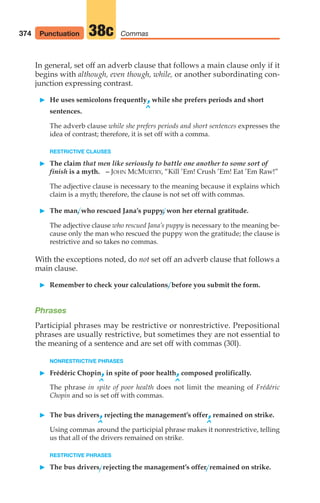
• If you use visuals, do they help make your argument convincing?
(13e, f, and g)
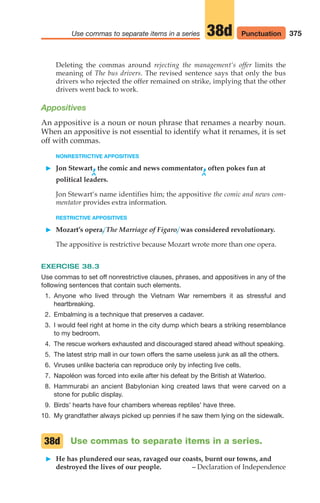
• If you use sources, how effectively are they integrated into your
argument? (13h)
• How is your argument organized? (13i)
• What design elements help you make your argument? (13j)
Reviewing Your Argument
Understand what counts as argument.
Although winning is an important purpose of argument, it is by no
means the only purpose.
TO WIN The most traditional purpose of academic argument, arguing to
win, is common in campus debating societies, in political debates, in tri-
als, and often in business. The writer or speaker aims to present a
position that will prevail over some other position.
TO CONVINCE Often, out-and-out defeat of another’s position is not only
unrealistic but undesirable. Instead, the goal might be to convince
another person to change his or her mind. Doing so calls on a writer to
provide compelling reasons for an audience to accept some or all of the
writer’s conclusions.
TO EXPLORE AN ISSUE Argument to explore an issue or reach a decision seeks
a sharing of information and perspectives in order to make informed
choices.
Checking whether a statement can be argued
At school, at home, or on the job, you will often need to convince some-
one or decide something. To do so, start with an arguable statement,
which should meet the three criteria on the following page.
13a
06_LUN_66490_Pt03_(115-160)_06_LUN_66490_Pt03_(115-160).qxd 11/30/11 2:16 PM Page 138
139
Understand what counts as argument Argument
13a
ARGUABLE Readers should reject women’s magazines with advertising
that presents impossibly thin models.
This statement seeks to convince readers of a position that not all will
agree with.
UNARGUABLE Women’s magazines earn millions of dollars every year
from advertising that presents impossibly thin models.
This statement can easily be verified and thus does not offer a basis for
argument.
EXERCISE 13.1
Using the three characteristics just listed, decide which of the following statements
are arguable and which are not.
1. The Lord of the Rings was the best movie of the last decade.
2. The climate of the earth is gradually getting warmer.
3. The United States must further reduce social spending in order to balance the
budget.
4. Shakespeare died in 1616.
5. Marlowe really wrote the plays of Shakespeare.
6. Water boils at 212 degrees Fahrenheit.
7. Van Gogh’s paintings are the work of a madman.
Arguments
TALKING THE TALK
“Argument seems so negative — I don’t want to attack anybody or
contradict what someone else says.” Sometimes — in law courts, for
example — argument may call for attacking an opponent’s credibility,
and you may have used the word argument to describe a conversation
in which the speakers said little more than “I did not!” and “You did,
too!” But in college writing, argument usually means something much
broader. Instead of attacking or contradicting, you will be expected to
explore ideas and to work toward convincing yourself as well as oth-
ers that these ideas are valuable.
1. It attempts to convince readers of something, change their minds
about something, to urge them to do something — or it explores
a topic in order to make a wise decision.
2. It addresses a problem for which no easily acceptable solution
exists or asks a question to which no absolute answer exists.
3. It presents a position that readers might realistically have vary-
ing perspectives on.
06_LUN_66490_Pt03_(115-160)_06_LUN_66490_Pt03_(115-160).qxd 11/30/11 2:16 PM Page 139
140 Argument Constructing arguments
13c
8. The incidence of breast cancer has risen in the last ten years.
9. The Federal Emergency Management Agency’s response to disasters must be
radically improved.
10. A fifty-five-mile-per-hour speed limit lowers accident rates.
Make a claim and formulate a working thesis.
Although the preceding arguable statement does make a kind of claim —
that readers should reject certain magazines — it offers no reason for
doing so. To develop a claim that can become the working thesis for an
argument, you need to include at least one good reason to support the
arguable statement.
REASON Excessive dieting can cause psychological problems.
WORKING THESIS Because excessive dieting causes psychological
(CLAIM WITH REASON problems, we should reject women’s magazines with
ATTACHED) advertising that presents impossibly thin models.
EXERCISE 13.2
Using two arguable statements from Exercise 13.1 or two that you create, formulate
two working theses, identifying the claim, reason(s), and assumption(s) for each.
Examine your assumptions.
Once you have your working thesis (see also 7b), examine the assump-
tions that underlie it. Doing so will help test your reasoning and
strengthen your argument.
WORKING THESIS Because excessive dieting causes psychological
problems, we should reject women’s magazines
with advertising that presents impossibly thin
models.
ASSUMPTION 1 Girls and women want to look like the models
in ads.
ASSUMPTION 2 Girls and women who don’t look like the models
in ads go on excessive diets.
Having come up with a working thesis, you may want to use quali-
fiers to make it more precise and thus less susceptible to criticism. The
preceding thesis might be qualified this way:
13b
13c
06_LUN_66490_Pt03_(115-160)_06_LUN_66490_Pt03_(115-160).qxd 11/30/11 2:16 PM Page 140
Establish credibility through ethical appeals Argument
13e 141
䊳 Because excessive dieting can sometimes cause psychological problems,
we should reject magazines with advertising that presents impossibly
thin models.
EXERCISE 13.3
Formulate an arguable statement, and create a working thesis, for two of the follow-
ing general topics.
1. the Palestinian-Israeli conflict
2. mandatory HIV testing for prison inmates
3. raising the minimum wage
4. reinstatement of a U.S. military draft
5. music downloading
Shape your appeal to your audience.
Arguments and the claims they make are effective only if they appeal
to the appropriate audience. For example, if you want to argue for
increased lighting in parking garages on campus, you might appeal to
students by citing examples drawn from their experiences of the safety
problems in such dimly lit garages. If you are writing to university
administrators, however, you might focus on the negative publicity as-
sociated with past attacks in campus garages and evoke the anger that
such attacks cause in parents, alumni, and other influential groups.
Establish credibility through ethical appeals.
To make your argument convincing, you must first gain the respect and
trust of your readers, or establish credibility with them. In general,
writers can establish credibility by making ethical appeals (12c) in four
ways.
Demonstrating knowledge
A writer can establish credibility first by establishing credentials. To
decide whether you know enough to argue an issue credibly, consider
the following questions:
• Can you provide information about your topic from sources other
than your own knowledge?
• What are the sources of your information, and how reliable are they?
13d
13e
06_LUN_66490_Pt03_(115-160)_06_LUN_66490_Pt03_(115-160).qxd 11/30/11 2:16 PM Page 141
142
• If sources contradict one another, can you account for or resolve the
contradictions?
• Would a personal experience relating to the issue help support
your claim?
These questions may well show that you must do more research, check
sources, resolve contradictions, refocus your working thesis, or even
change your topic.
Establishing common ground
Many arguments between people or groups are doomed to end without
resolution because the two sides seem to occupy no starting point of
agreement. The following questions can help you find common ground
in presenting an argument. (See also Chapter 20.)
• On this issue, how can you discover opinions that differ from your
own?
• What are the differing perspectives on the issue?
• What aspects of the issue can all sides agree on?
• How can you express such common ground clearly to all sides?
Can you use other languages or varieties of English to establish
common ground with those you address? (See Chapter 21.)
Argument Constructing arguments
13e
Counting Your Own Experience
You may have been told that your personal experience doesn’t count
in making academic arguments. If so, reconsider this advice, for show-
ing an audience that you have relevant personal experience with a
topic can carry strong persuasive appeal with many English-speaking
readers.
FOR MULTILINGUAL WRITERS
Demonstrating fairness
In arguing a position, writers must deal fairly with opposing arguments
(also called counterarguments). Audiences are more inclined to listen to
writers who seem to consider their opponents’ views fairly than to
those who ignore or distort such views.
Using visuals that make ethical appeals
Many universities, nonprofit organizations, and government agencies
have followed the lead of business by creating branding images for
themselves. A logo, seal, or slogan (such as the logo shown here of the
06_LUN_66490_Pt03_(115-160)_06_LUN_66490_Pt03_(115-160).qxd 11/30/11 2:16 PM Page 142
Use effective logical appeals Argument
13f 143
A VISUAL THAT MAKES AN ETHICAL APPEAL
Environmental Protection Agency) may be used to give a government
agency’s reports, documents, and Web sites an air of strength and be-
lievability. The EPA logo suggests that the agency’s publications are
backed by the full authority of the federal government. It’s worth re-
membering, however, that a logo or other visual appeal can be only as
credible as the organization that the visual represents.
EXERCISE 13.4
Using a working thesis you drafted for Exercise 13.2 or 13.3, write a paragraph or two
describing how you would go about establishing your credibility in arguing that thesis.
Use effective logical appeals.
Credibility alone cannot and should not carry the full burden of
persuading readers. Indeed, many view the logic of the argument —
the reasoning behind it — as equally, if not more, important.
Examples, precedents, and narratives
Just as a picture can be worth a thousand words, a well-conceived ex-
ample can be valuable in arguing a point. Examples can support gener-
alizations or bring abstractions to life. In making the general claim that
video games equate violence with fun, you might include this example:
䊳 For instance, the makers of Grand Theft Auto present their “thou shalt
kill” theme in the name of entertainment.
Precedents are examples taken from the past. If, as part of a proposal
for increased lighting in the library garage, you point out that the uni-
versity has increased the lighting in four similar garages in the past
year, you’re arguing on the basis of precedent.
Narratives are examples that tell a story — and because storytelling is
universal, they can be very persuasive in helping readers understand and
accept an argument. In arguing for increased funding for the homeless,
for instance, you might include a brief narrative about a day in the life of
a homeless person to dramatize the issue and help readers see the need
for more funding.
13f
06_LUN_66490_Pt03_(115-160)_06_LUN_66490_Pt03_(115-160).qxd 11/30/11 2:16 PM Page 143
144 Argument Constructing arguments
13f
The following questions can help you check any example, prece-
dent, or narrative that you use as supporting evidence:
• How representative is the example?
• Is it sufficient to lead to a generalization?
• In what ways does it support your claim?
• How well does the example relate to the claim you’re making? Are
the situations really similar?
• How timely is the example? (What was applicable in 1990 is not
necessarily applicable today.)
• Will its significance be clear to your readers?
• Is the example one of several logical appeals, or does it have to
carry the whole burden of the argument?
Authority and testimony
Another way to support an argument logically is to cite an authority. The
use of authority has figured prominently in the controversy over smok-
ing. Since the U.S. surgeon general’s 1964 announcement that smoking is
hazardous to health, many Americans have quit smoking, largely per-
suaded by the authority of the scientists offering the evidence.
Ask the following questions to be sure you are using authorities ef-
fectively:
• Is the authority timely? (The argument that the United States should
pursue a policy just because it was supported by Thomas Jefferson
will probably fail since Jefferson’s time was so radically different
from ours.)
• Is the authority qualified to judge the topic at hand? (To cite a movie
star in an essay on linguistics may not help your argument.)
• Is the authority likely to be known and respected by readers? (To cite
an unfamiliar authority without identification will reduce the im-
pact of the evidence.)
• Are the authority’s credentials clearly stated and verifiable? (Espe-
cially with Web-based sources, it is crucial to know whose author-
ity guarantees the reliability of the information.)
Testimony — the evidence that an authority presents in support of
a claim — is a feature of much contemporary argument. If testimony is
timely, accurate, representative, and provided by a respected authority,
then it, like authority itself, can add powerful support.
In research writing (see Chapters 14 –18), you should cite your
sources for authority and for testimony not based on your own
knowledge.
06_LUN_66490_Pt03_(115-160)_06_LUN_66490_Pt03_(115-160).qxd 11/30/11 2:16 PM Page 144
Use effective logical appeals Argument
13f 145
Causes and effects
Showing that one event is the cause or the effect of another can help
support an argument. Suppose you are trying to explain, in a petition
to change your grade in a course, why you were unable to take the final
examination. You would probably trace the causes of your failure to
appear — your illness or the theft of your car, perhaps — so that the
committee reading the petition would reconsider the effect — your
not taking the examination.
Tracing causes often lays the groundwork for an argument, partic-
ularly if the effect of the causes is one we would like to change. In an
environmental science class, for example, a student may argue that a
national law regulating smokestack emissions from utility plants is
needed because (1) acid rain on the East Coast originates from emissions
at utility plants in the Midwest, (2) acid rain kills trees and other vege-
tation, (3) utility lobbyists have prevented midwestern states from pass-
ing strict laws controlling emissions from such plants, and (4) in the
absence of such laws, acid rain will destroy most eastern forests by
2020. In this case, the fourth point ties all of the previous points together
to provide an overall argument from effect: unless X, then Y.
Inductive and deductive reasoning
Traditionally, logical arguments are classified as using either inductive
or deductive reasoning; in practice, the two almost always work to-
gether. Inductive reasoning is the process of making a generalization
based on a number of specific instances. If you find you are ill on ten
occasions after eating seafood, for example, you will likely draw the
inductive generalization that seafood makes you ill. It may not be an
absolute certainty that seafood is to blame, but the probability lies in
that direction.
Deductive reasoning, on the other hand, reaches a conclusion by
assuming a general principle (known as a major premise) and then ap-
plying that principle to a specific case (the minor premise). In practice,
this general principle is usually derived from induction. The inductive
generalization Seafood makes me ill, for instance, could serve as the major
premise for the deductive argument Since all seafood makes me ill, the
shrimp on this buffet is certain to make me ill.
Deductive arguments have traditionally been analyzed as
syllogisms — reasoning that contains a major premise, a minor premise,
and a conclusion.
MAJOR PREMISE All people die.
MINOR PREMISE I am a person.
CONCLUSION I will die.
06_LUN_66490_Pt03_(115-160)_06_LUN_66490_Pt03_(115-160).qxd 11/30/11 2:16 PM Page 145
146
Syllogisms, however, are too rigid and absolute to serve in arguments
about questions that have no absolute answers, and they often lack any
appeal to an audience. Aristotle’s simpler alternative, the enthymeme,
asks the audience to supply the implied major premise. Consider the
following example:
Since violent video games can be addictive and cause psychological harm,
players and their parents must carefully evaluate such games and monitor
their use.
You can analyze this enthymeme by restating it in the form of two
premises and a conclusion.
MAJOR PREMISE Games that cause harm to players should be
evaluated and monitored.
MINOR PREMISE Violent video games can cause psychological harm to
players.
CONCLUSION These games should be evaluated and monitored.
Note that the major premise is one the writer can count on an audience
agreeing with or supplying: safety and common sense demand that po-
tentially harmful games be used with great care. By implicitly asking an
audience to supply this premise to an argument, a writer engages the
audience’s participation.
Toulmin’s system (12d) looks for claims, reasons, and assumptions
instead of major and minor premises.
CLAIM Violent video games should be carefully evaluated and
their use monitored.
REASON Violent video games can cause psychological harm to
players.
ASSUMPTION Games that can cause harm to players should be evaluated
and monitored.
Whether it is expressed as a syllogism, an enthymeme, or a claim, a
deductive conclusion is only as strong as the premise or reasons on
which it is based.
EXERCISE 13.5
The following sentences contain deductive arguments based on implied major
premises. Identify each of the implied premises.
1. Active euthanasia is morally acceptable when it promotes the best interests of
everyone concerned and violates no one’s rights.
Argument Constructing arguments
13f
06_LUN_66490_Pt03_(115-160)_06_LUN_66490_Pt03_(115-160).qxd 11/30/11 2:16 PM Page 146
Use appropriate emotional appeals Argument
13g 147
2. Women should not serve in combat positions because doing so would expose
them to a much higher risk of death.
3. Animals can’t talk; therefore they can’t feel pain as humans do.
Visuals that make logical appeals
Visuals that make logical appeals can be especially useful in arguments,
since they present factual information that can be taken in at a glance. As
shown on this page, Business Week used a simple bar graph to carry a big
message about equality of pay for men and women. Consider how long it
would take to explain all the information in this graph with words alone.
A VISUAL THAT MAKES A LOGICAL APPEAL
EXERCISE 13.6
Using a working thesis you drafted for Exercise 13.2 or 13.3, write a paragraph
describing the logical appeals you would use to support the thesis.
Use appropriate emotional appeals.
Most successful arguments appeal to our hearts as well as to our
minds — as is vividly demonstrated by the campaign to curb the AIDS
epidemic in Africa. Facts and figures (logical appeals) convince us that
the problem is real and serious. What elicits an outpouring of support,
however, is the arresting emotional power of stories and images of peo-
ple living with the disease. But credible writers take particular care
when they use emotional appeals; audiences can easily begin to feel
13g
06_LUN_66490_Pt03_(115-160)_06_LUN_66490_Pt03_(115-160).qxd 11/30/11 2:16 PM Page 147
manipulated when an argument tries too hard to appeal to their pity,
anger, or fear.
Concrete descriptive details
Like photographs, vivid words can bring a moving immediacy to any
argument. A student may amass facts and figures, including diagrams
and maps, to illustrate the problem of wheelchair access to the library.
But only when the student asks a friend who uses a wheelchair to ac-
company her to the library does the student writer discover the con-
crete details necessary to move readers. The student can then write,
“Marie inched her heavy wheelchair up the narrow, steep entrance
ramp, her arms straining to pull up the last twenty feet, her face
pinched with the sheer effort.”
Figurative language
Figurative language, or figures of speech, paint a detailed and vivid pic-
ture by making striking comparisons between something you are writ-
ing about and something else that helps a reader visualize, identify
with, or understand it (22d).
Figures of speech include metaphors, similes, and analogies. Most
simply, metaphors compare two things directly: Richard the Lion-
Hearted; old age is the evening of life. Similes make comparisons using like
or as: Richard is as brave as a lion; old age is like the evening of life. Analo-
gies are extended metaphors or similes that compare an unfamiliar con-
cept or process to a more familiar one (see p. 81).
Visuals that make emotional appeals
Visuals that make emotional appeals can also add substance to your
argument. To make sure that such visual appeals will enhance your ar-
gument, test them out with several potential readers to see how they
interpret the appeal. Consider, for example, the photograph on p. 149 of
coffins returning from Iraq. Some readers might see this image as mak-
ing an antiwar argument — but others may well view this image as ar-
guing instead (or also) for patriotism or for respect for sacrifices made
in the line of duty.
EXERCISE 13.7
Make a list of common human emotions that might be attached to each of the
following topics, and suggest appropriate ways to appeal to those emotions in a
specific audience you choose to address.
148 Argument Constructing arguments
13g
06_LUN_66490_Pt03_(115-160)_06_LUN_66490_Pt03_(115-160).qxd 11/30/11 2:16 PM Page 148
1. banning drinking on campus
2. airport security
3. disarming land mines
4. attacks on places of worship
5. steroid use among athletes
149
Use appropriate emotional appeals Argument
13g
A VISUAL THAT MAKES AN EMOTIONAL APPEAL
06_LUN_66490_Pt03_(115-160)_06_LUN_66490_Pt03_(115-160).qxd 11/30/11 2:16 PM Page 149
150 Argument Constructing arguments
13h
EXERCISE 13.8
Using a working thesis you formulated for Exercise 13.2 or 13.3, make a list of the
emotional appeals most appropriate to your topic and audience. Then spend ten to
fifteen minutes brainstorming, looking for descriptive and figurative language to
carry out the appeals.
EXERCISE 13.9
Working with two or three classmates, read the following paragraph, and then write
a paragraph evaluating its use of description and figurative language as well as its
appeal to various audiences.
In 1973, all women in the United States became legally entitled to have
abortions performed in hospitals by licensed physicians. Earlier, abortions were
frequently performed by persons who bore more resemblance to butchers than
to doctors. The all-too-common result was serious complications or death for
the woman. If the 1973 Supreme Court decision is completely reversed, abor-
tion will not end. Instead, women will again resort to illegal abortions, and there
will be a return to the slaughterhouse. Since abortions are going to take place
no matter what the law says, why not have them done safely and legally in hos-
pitals instead of in basements and back alleys? The decision to have an abor-
tion is not an easy one to make, and I believe that a woman who makes it
deserves to have her wish carried out in the very safest way possible. Critics of
abortion stress the importance of the unborn child’s life. At the very least, they
should also take the woman’s life and safety into consideration.
Consult sources.
In constructing a written argument, it is usually necessary — and often
essential — to use sources. The key to persuading people to accept your
argument is good reasons; and even if your assignment doesn’t specify
that you must consult outside sources, they are often the most effective
way of finding and establishing these reasons. Sources can help you do
the following:
• provide background information on your topic
• demonstrate your knowledge of the topic to readers
• cite authority and testimony in support of your thesis
• find opinions that differ from your own, which can help you
sharpen your thinking, qualify your thesis if necessary, and demon-
strate fairness to opposing arguments
13h
06_LUN_66490_Pt03_(115-160)_06_LUN_66490_Pt03_(115-160).qxd 11/30/11 2:16 PM Page 150
Organize your argument Argument
13i 151
College writing classes concentrate on preparing you to make strong ar-
guments, on asking you to make claims and support them well; in fact,
arguments are the most common assignment in composition today.
Such assignments almost always either give you a claim to support or
refute or ask you to come up with a claim that has no easy solution and
that might cause reasonable people to disagree. You may or may not be
asked to do research to find evidence to support your argument.
SPECIAL CONSIDERATIONS OF AN ARGUMENT ASSIGNMENT
• Make sure that your introduction makes your purpose clear, shows
that you are fair and credible, and introduces your claim, usually in
the form of an explicit thesis statement.
• Support your claim with good reasoning, solid evidence from reli-
able sources (if you are using research), and effective appeals to
your audience.
• Take counterarguments and alternative points of view into
consideration.
• Make the organization straightforward so that readers can follow
along easily.
• Conclude by summarizing the argument, elaborating on the impli-
cations of your claim or thesis, and ending with a strong appeal to
your audience.
COMMON ASSIGNMENTS
Organize your argument.
Once you have assembled good reasons in support of a working thesis,
you must present your material convincingly. Although there is no uni-
versally favored organizational framework for an argument, you may
find one of the following systems useful.
The classical system
The system of argument often followed by ancient Greek and Roman
orators is now referred to as classical. You can adapt the ancient format
to written arguments as follows:
1. Introduction
• Gain readers’ attention and interest.
• Establish your qualifications to write about your topic.
• Establish common ground with readers.
13i
Argument
06_LUN_66490_Pt03_(115-160)_06_LUN_66490_Pt03_(115-160).qxd 11/30/11 2:16 PM Page 151
152
• Demonstrate fairness.
• State or imply your thesis.
2. Background
• Present any necessary background information, including rele-
vant personal narrative.
3. Lines of argument
• Present good reasons (including logical and emotional ap-
peals) in support of your thesis.
• Present reasons in order of importance, with the most impor-
tant ones generally saved for last.
• Demonstrate ways your argument may be in readers’ best interest.
4. Alternative arguments
• Examine alternative points of view.
• Note advantages and disadvantages of alternative views.
• Explain why one view is better than other(s).
5. Conclusion
• Summarize the argument if you choose.
• Elaborate on the implication of your thesis.
• Make clear what you want readers to think or do.
• Reinforce your credibility.
The Toulmin system
This simplified form of the Toulmin system (12d and 13f) can help you
organize an argumentative essay:
1. Make your claim (arguable statement).
䊳 The federal government should ban smoking.
2. Qualify your claim if necessary.
䊳 The ban would be limited to public places.
3. Present good reasons to support your claim.
䊳 Smoking causes serious diseases in smokers.
䊳 Nonsmokers are endangered by others’ smoke.
4. Explain the assumptions that underlie your claim and your rea-
sons. Provide additional explanations for any controversial as-
sumptions.
Argument Constructing arguments
13i
06_LUN_66490_Pt03_(115-160)_06_LUN_66490_Pt03_(115-160).qxd 11/30/11 2:16 PM Page 152
Consider design issues Argument
13j 153
ASSUMPTION The Constitution was established to “promote the general
welfare.”
ASSUMPTION Citizens are entitled to protection from harmful actions
by others.
ADDITIONAL The United States is based on a political system that is
EXPLANATION supposed to serve the basic needs of its people, including
their health.
5. Provide additional evidence to support your claim (facts, statis-
tics, testimony, and other logical, ethical, or emotional appeals).
STATISTICS Cite the incidence of deaths attributed to secondhand
smoke.
FACTS Cite lawsuits won recently against large tobacco companies,
including one that awarded billions of dollars to states in
reparation for smoking-related health care costs.
FACTS Cite bans on smoking already imposed on indoor public
spaces in many cities.
AUTHORITY Cite the surgeon general.
6. Acknowledge and respond to possible counterarguments.
COUNTER- Smokers have rights, too.
ARGUMENT
RESPONSE The suggested ban applies only to public places; smokers
are free to smoke in private.
7. Finally, draw your conclusion, stated in the strongest way possible.
Consider design issues.
Most arguments today are carefully designed to make the best use of
space, font style and type size, color, and visuals. The following tips
will help you produce and design a document that will add to the ethi-
cal, logical, and emotional appeals you are making:
• Before you begin, check out any conventions that may be expected
in the kind of argument you are writing. Look for examples of sim-
ilar arguments, or ask your instructor for information about such
conventions.
• To emphasize an important part of your argument, consider using
a special design element. For example, you might put a list of
essential evidence in a carefully labeled box.
13j
06_LUN_66490_Pt03_(115-160)_06_LUN_66490_Pt03_(115-160).qxd 11/30/11 2:16 PM Page 153
• Choose colors carefully, keeping in mind that colors call up many
responses: red for war, for example, or blue for purity.
For more on document design, see Chapter 4.
EXERCISE 13.10
Using the guidelines in this chapter, draft an argument in support of one of the work-
ing theses you formulated in Exercise 13.2 or 13.3.
EXERCISE 13.11: THINKING CRITICALLY
Using the guidelines in Chapter 9, analyze an argument you’ve recently written or the
draft you wrote for Exercise 13.10. Decide what you need to do to revise your argu-
ment, and write out a brief plan for revision.
A student’s argument essay
In this essay, Teal Pfeifer argues that images in the me-
dia affect how women see themselves, and she offers a
solution to a problem. Her essay has been annotated to
point out the various parts of her argument as well as
her use of good reasons, evidence, and appeals to logic
and emotion.
13k
Teal Pfeifer
Student Writer
154 Argument Constructing arguments
13k
bedfordstmartins.com/everydaywriter For additional help with argumentation, go to
Writing Resources and click on Argument Resources. To read other sample argument
essays, click on Student Writing Models.
D
06_LUN_66490_Pt03_(115-160)_06_LUN_66490_Pt03_(115-160).qxd 11/30/11 2:16 PM Page 154
A student’s argument essay Argument
13k 155
Pfeifer 1
Teal Pfeifer
Professor Rashad
English 102
April 13, 2006
Devastating Beauty
Collarbones, hipbones, cheekbones--so many bones. She looks at
the camera with sunken eyes, smiling, acting beautiful. Her dress is
Versace, or Gucci, or Dior, and it is revealing, revealing every bone and
joint in her thin, thin body. She looks fragile and beautiful, as if I could
snap her in two. I look at her and feel the soft cushion of flesh that
surrounds my own joints, my own shoulders and hips that are broad, my
own ribs surrounded by skin and muscle and fat. I am not nearly as
fragile or graceful or thin. I look away and wonder what kind of self-
discipline it takes to become beautiful like the model in my magazine.
By age seventeen a young woman has seen an average of
250,000 ads featuring a severely underweight woman whose body
type is, for the most part, unattainable by any means, including
extreme ones such as anorexia, bulimia, and drug use, according to
Allison LaVoie. The media promote clothing, cigarettes, fragrances,
and even food with images like these. In a culture that has become
increasingly visual, the images put out for public consumption
feature women that are a smaller size than ever before. In 1950, the
White Rock Mineral Water girl was 5’4” tall and weighed 140 pounds;
now she is 5’10” tall and weighs only 110 pounds, signifying the
growing deviation between the weight of models and that of the
normal female population (Pipher 184).
This media phenomenon has had a major effect on the female
population as a whole, both young and old. Five to ten million women
in America today suffer from an eating disorder related to poor self-
image, and yet advertisements continue to prey on insecurities fueled
by a woman’s desire to be thin. Current research shows that “80 percent
Title uses
play on
words to
pique
interest
Opening
uses emo-
tional ap-
peals and
tries to
establish
common
ground with
readers
Presents
background
information
on the
problem
and cites
sources
Introduces
problem:
ads en-
courage
women’s
poor body
image
06_LUN_66490_Pt03_(115-160)_06_LUN_66490_Pt03_(115-160).qxd 11/30/11 2:16 PM Page 155
156 Argument Constructing arguments
13k
of American women are dissatisfied with their appearance” and that
“45 percent of those are on a diet on any given day” (“Statistics”).
Yet even the most stringent dieting will generally fail to create the
paper-thin body so valued in the media, and continuing efforts to do
so can lead to serious psychological problems such as depression.
While many women express dissatisfaction with their bodies,
they are not the only victims of the emaciated images so frequently
presented to them. Young girls are equally affected by these images, if
not more so. Eighty percent of girls under age ten have already been
on a diet and expressed the desire to be thinner and more beautiful
(Slim Hopes). Thus, from a young age, beauty is equated with a
specific size. The message girls get is an insidious one: in order to be
your best self, you should wear size 0 or 1. The pressure only grows
more intense as girls grow up. According to results from the Kaiser
Family Foundation Survey “Reflections of Girls in the Media,” 16
percent of ten- to seventeen-year-old girls reported that they had
dieted or exercised to look like a TV character. Yet two-thirds of
teenage girls acknowledged that these thin characters were not an
accurate reflection of “real life” (qtd. in Dittrich, “Children”).
It is tragic to see so much of the American population obsessed
with weight and reaching an ideal that is, for the most part, ultimately
unattainable. Equally troubling is the role magazines play in feeding this
obsession. When a researcher asked female students from Stanford
University to flip through several magazines containing images of
glamorized, super-thin models (see Fig. 1), 68 percent of the women felt
significantly worse about themselves after viewing the magazine models
(qtd. in Dittrich, “Media”). Another study showed that looking at models
on a long-term basis leads to stress, depression, guilt, and lowered self-
worth (qtd. in Dittrich, “Media”). As Naomi Wolfe points out in The
Beauty Myth, thinking obsessively about fat and dieting has actually
been shown to change thought patterns and brain chemistry.
Pfeifer 2
Good rea-
son for
thesis:
stringent
dieting can
cause psy-
chological
problems
Provides
statistical
evidence
that prob-
lem extends
across age
groups
Good rea-
son for
thesis:
magazines
feed ob-
session
with
dieting
Uses logi-
cal appeals
Backs up
reasons
with re-
search and
expert
opinion
06_LUN_66490_Pt03_(115-160)_06_LUN_66490_Pt03_(115-160).qxd 11/30/11 2:16 PM Page 156
A student’s argument essay Argument
13k 157
Pfeifer 3
Fig. 1. Young woman reading magazine. Personal photograph.
How do we reject images that are so harmful to the women and
young girls who view them? Legislation regarding what can be
printed and distributed is not an option because of First Amendment
rights. Equally untenable is the idea of appealing to the industries
that hire emaciated models. As long as the beauty and clothing
industries are making a profit from the physically insecure girls and
women who view their ads, nothing will change.
What, however, might happen if those females stopped buying
the magazines that print such destructive images? A boycott is the
most effective way to rid the print medium of emaciated models and
eliminate the harmful effects they cause. If women stopped buying
magazines that target them with such harmful advertising, magazines
would be forced to change the kinds of ads they print. Such a boycott
would send a clear message: women and girls reject the victimization
that takes place every time they look at a skeletally thin model and
Considers
and rejects
alternative
solutions
States
working
thesis: a
boycott
would ef-
fectively
solve
problem
06_LUN_66490_Pt03_(115-160)_06_LUN_66490_Pt03_(115-160).qxd 11/30/11 2:16 PM Page 157
158 Argument Constructing arguments
13k
then feel worse about themselves. Consumers can ultimately control
what is put on the market: if we don’t buy, funding for such ads will
dry up fast.
In the past, boycotts have been effective tools for social change.
Rosa Parks, often identified as the mother of the modern-day civil rights
movement, played a pivotal role in the Montgomery bus boycott in
December 1955. When Parks refused to give up her seat to a white bus
rider, she was arrested, and this incident inspired the boycott. For more
than a year, the vast majority of African Americans in Montgomery
chose to walk instead of ride the buses. Many of them were terrorized or
harassed, but the boycott was eventually successful: segregation on
buses was declared illegal by the U.S. Supreme Court.
Between 1965 and 1973, Cesar Chavez also used boycotts
successfully to change wage policies and working conditions for
millions of Mexicans and Mexican Americans who were being exploited
by growers of grapes and lettuce. In his boycott efforts, Chavez moved
on two fronts simultaneously: he asked the workers to withhold their
labor, and he asked consumers to refrain from purchasing table grapes
(and later, lettuce) in order to show their support for the workers. In
this situation, not only did the boycott force an industry to improve
existing conditions, but it also made the public aware of pressing
labor issues. Thus a bond was formed between the workers and the
community their labor was benefiting.
As a society, we have much to learn from boycotts of the past,
and their lessons can help us confront contemporary social ills. As I
have shown, body-image dissatisfaction and eating disorders are
rising at an alarming rate among young girls and women in American
society. This growing desire for an unrealistically thin body affects
our minds and our spirits, especially when we are pummeled dozens
of times a day with glamorized images of emaciated and unhealthy
women. The resulting anorexia and bulimia that women suffer from
Pfeifer 4
Good rea-
son: boy-
cotts have
been
effective
Presents a
precedent/
example as
evidence
Presents a
second
precedent/
example as
evidence
Reinforces
severity of
problem
and appeals
to emotion
Appeals di-
rectly to
audience
by using
“we” in
conclusion
06_LUN_66490_Pt03_(115-160)_06_LUN_66490_Pt03_(115-160).qxd 11/30/11 2:16 PM Page 158
A student’s argument essay Argument
13k 159
are not only diseases that can be cured; they are also ones that
can be prevented--if women will take a solid stand against such
advertisements and the magazines that publish them. While we are
not the publishers or advertisers who choose the pictures of starving
women represented in magazines, we are the ones who decide
whether or not these images will be purchased. This is where power
lies--in the hands of those who hand over the dollars that support
the glorification of unhealthy and unrealistic bodies. It is our choice
to exert this power and to reject magazines that promote such
images.
Pfeifer 5
Restates
thesis as
a call to
action
06_LUN_66490_Pt03_(115-160)_06_LUN_66490_Pt03_(115-160).qxd 11/30/11 2:16 PM Page 159
Works Cited
Dittrich, Liz. “About-Face Facts on the Children and the Media.”
About-Face. 10 Mar. 2006 <http://www.about-face.org/r/facts/
childrenmedia.shtml>.
---. “About-Face Facts on the Media.” About-Face. 10 Mar. 2006
<http://www.about-face.org/r/facts/media.shtml>.
LaVoie, Allison. “Media Influence on Teens.” The Green Ladies. 11 Mar.
2006 <http://kidsnrg.simplenet.com/grit.dev/london/g2_jan12/
green_ladies/media/>.
Pipher, Mary. Reviving Ophelia: Saving the Selves of Adolescent Girls.
New York: Ballantine, 1994.
Slim Hopes. Dir. Sut Jhally. Prod. Jean Kilbourne. Videocassette.
Media Education Foundation, 1995.
“Statistics.” National Eating Disorders Association. 2002. 14 Mar.
2006 <http://www.nationaleatingdisorders.org>.
Wolfe, Naomi. The Beauty Myth. New York: Harper, 2002.
Young woman reading magazine. Personal photograph by author.
14 Mar. 2006.
160 Argument Constructing arguments
13k
Pfeifer 6
06_LUN_66490_Pt03_(115-160)_06_LUN_66490_Pt03_(115-160).qxd 11/30/11 2:16 PM Page 160
Research
Research is formalized curiosity. It is poking
and prying with a purpose.
— ZORA NEALE HURSTON
Research
14 Preparing for a Research Project 163
a Analyze the research assignment 163
b Formulate a research question and hypothesis 165
c Plan your research 167
d Set up a research log 167
e Move from hypothesis to working thesis 168
15 Doing Research 169
a Understand different kinds of sources 169
b Use the library to get started 171
c Find library resources 172
d Search the Internet 178
e Conduct field research 179
16 Evaluating Sources and Taking Notes 182
a Understand why you should use sources 182
b Create a working bibliography 182
c Evaluate a source’s usefulness and credibility 184
d Read critically and interpret sources 185
e Synthesize sources 190
f Take notes, and annotate your sources 194
17 Integrating Sources and Avoiding Plagiarism 200
a Decide whether to quote, paraphrase, or summarize 200
b Integrate quotations, paraphrases, and summaries
effectively 200
c Integrate visuals effectively 203
d Check for excessive use of source material 204
e Understand why you should acknowledge your sources 205
f Know which sources to acknowledge 205
g Uphold your academic integrity, and avoid plagiarism 206
18 Writing a Research Project 208
a Refine your writing plans 209
b Organize and draft 210
c Incorporate source materials 212
d Review and get responses to your draft 212
e Revise and edit your draft 212
f Prepare a list of sources 213
g Prepare and proofread your final copy 213
Research
Research
161–213
Your employer asks you to recommend the best software for a particular
project. You want to plan a week’s vacation in Montreal. Your
instructor assigns a term paper about a musician. Each of these situa-
tions calls for research, for examining various kinds of sources. Prepar-
ing to begin your research means taking a long look at what you already
know, the best way to proceed, and the amount of time you have to find
out what you need to know. For success in college and beyond, you need
to understand how to start the process of academic research.
Analyze the research assignment.
In an introductory writing course, you might receive an assignment like
this one:
Choose a subject of interest to you, and use it as the basis for a research
essay of approximately two thousand words that makes and substantiates
a claim. You should use a minimum of five sources, including at least three
print sources.
Topic
If your assignment doesn’t specify a topic, consider the following
questions (see also 5c):
• What subjects do you already know something about? Which of
them would you like to explore more fully?
• What subjects do you care about? What might you like to become
an expert on?
• What subjects evoke a strong reaction from you, whether positive
or negative?
Be sure to get responses about your possible topic from your instructor,
classmates, and friends. Ask them whether they would be interested in
14a
Preparing for a Research Project 14
163
08_LUN_66490_Pt04_(163-214)_08_LUN_66490_Pt04_(163-214).qxd 11/30/11 2:19 PM Page 163
reading about the topic, whether it seems manageable, and whether
they know of any good sources for information on the topic.
Situation
Be sure to consider the rhetorical situation (context) of any research pro-
ject. Here are detailed questions to think about:
AUDIENCE
• Who will be the audience for your research project (5c)?
• Who will be interested in the information you gather, and why?
What will they want to know? What will they already know?
• What do you know about their backgrounds? What assumptions
might they hold about the topic?
• What response do you want from them?
• What kinds of evidence will you need to convince them?
• What will your instructor expect?
PURPOSE
• If you can choose the purpose, what would you like to accom-
plish (5d)?
• If you have been assigned a specific research project, keep in mind
the key words in that assignment. Does the assignment ask that
you describe, survey, analyze, persuade, explain, classify, compare, or
contrast? What do such words mean in this field?
YOUR POSITION ON THE TOPIC
• What is your attitude toward your topic? Are you curious about it?
critical of it? Do you like it? dislike it? find it confusing?
• What influences have shaped your position (5e)?
SCOPE
• How long is the project supposed to be? Base your research and
writing schedule on the scale of the finished project (a short versus
a long paper or presentation, a simple versus a complex Web site)
and the amount of time you have to complete it.
• How many and what kind(s) of sources should you use (15a)? What
kind(s) of visuals — charts, maps, photographs, and so on — will
you need? Will you do any field research — interviewing, survey-
ing, or observing (15e)?
164 Research Preparing for a research project
14a
08_LUN_66490_Pt04_(163-214)_08_LUN_66490_Pt04_(163-214).qxd 11/30/11 2:19 PM Page 164
165
Formulate a research question and hypothesis Research
14b
Here is a sample schedule for a research project:
EXERCISE 14.1
Come up with at least two topics you would like to carry out research on. Then write
a brief response to some key questions about each topic: How much information do
you think is available on this topic? What sources on this topic do you know about
or have access to? Who would know about this topic — historians, doctors, film-
makers, psychologists, others?
Formulate a research question and hypothesis.
Once you have analyzed your task, chosen your topic, and narrowed
the topic to make it manageable (see 7a), formulate a research question
that you can tentatively answer with a hypothesis. The hypothesis, a
14b
Edit, FINAL
spell PROJECT
check, & DUE.
proof-
read.
Get Analyze assign- Develop research Plan
assignment. ment; choose question & search
topic. hypothesis. strategy.
Set up Find & evaluate sources; read, Start Write
research analyze, & take notes. working explicit
log. Draft Locate or biblio- thesis;
working develop graphy. plan
thesis visuals. writing.
Write first draft. Get reviewer opinions.
Do more research if
necessary.
Revise draft. Prepare list Revise draft
of works cited. again. Double-
check sources.
08_LUN_66490_Pt04_(163-214)_08_LUN_66490_Pt04_(163-214).qxd 11/30/11 2:19 PM Page 165
166 Research Preparing for a research project
14b
Proposal assignments often ask you to take on a problem and find a
solution for it. You may be asked to write a proposal as part of a larger
project, especially a major research project.
SPECIAL CONSIDERATIONS OF A PROPOSAL ASSIGNMENT
• Think of your proposal as an answer to a problem that exists. Define
or describe that problem in a way that makes it important to your
audience.
• Provide ample evidence and examples from research, personal ex-
perience, or other sources to illustrate the problem.
• Introduce your proposal as a way to address the problem effectively.
• Explain your proposal thoroughly, showing how it responds to the
problem and how it will solve it. Consider counter-proposals, and
show that yours is a better answer.
• Show that what is being proposed is in your audience’s best interest.
COMMON ASSIGNMENTS
statement of what you anticipate your research will show, needs to be
manageable, interesting, and specific (see 7c). In addition, it must be a
debatable proposition that you can prove or disprove with a reasonable
amount of research evidence.
David Craig, the student whose research paper appears in
Chapter 51, made the following move from general topic to a narrowed
topic and then to a research question and hypothesis:
TOPIC Electronic messaging
NARROWED TOPIC The language of messaging
ISSUE The effect of messaging on youth
literacy
RESEARCH QUESTION How has the popularity of messaging affected
literacy among today’s youth?
HYPOTHESIS Messaging seems to have a negative
influence on the writing skills of young people.
EXERCISE 14.2
Using the tips provided in 14b, write down as much as you can about one of the
topics you identified in Exercise 14.1. Then take some time to reread your notes,
and jot down the questions you still need to answer as well as the sources you
need to find.
Proposal
08_LUN_66490_Pt04_(163-214)_08_LUN_66490_Pt04_(163-214).qxd 11/30/11 2:19 PM Page 166
Plan your research.
Once you have formulated a hypothesis, determine what you already
know about your topic. Tap your memory for sources by listing every-
thing you can remember about where you learned about your topic: the
Internet, text messages, books, magazines, courses, conversations, tele-
vision. What you know comes from somewhere, and that somewhere
can serve as a starting point for your research. (See Chapter 6 for more
strategies for exploring ideas and getting your initial thoughts about a
topic down on paper.)
Next, develop a research plan by answering the following questions:
• What kinds of sources (books, journal articles, databases, Web sites,
government documents, reference works, and so on) will you need
to consult (15a)? How many sources should you consult?
• How current do your sources need to be? (For topical issues, espe-
cially those related to science, current sources are usually most im-
portant. For historical subjects, older sources may offer the best
information.)
• How can you determine the location and availability of the kinds
of sources you need?
One goal of your research plan is to build a strong working bibliography
(16b). Carrying out systematic research and keeping careful notes on your
sources will make developing your works-cited list or bibliography easier.
Set up a research log.
Keeping a research log will make the job of writing and documenting
your sources more efficient and accurate. Use your research log to jot
down ideas about possible sources and to keep track of materials.
When you record an online source in your log, include the URL or
other information that will help you find the source again.
Here are a few guidelines for setting up a research log:
1. Create a folder, and label it with a name that will be easy to iden-
tify, such as Research Log for Project on Instant Messaging.
2. Within this folder, create subfolders that will help you manage
your project. These subfolders might include Notes on Hypothesis
and Thesis, Background Information, Visuals, Draft 1, Working Biblio-
graphy, and so on.
You might prefer to begin a Web log (blog) for your research project.
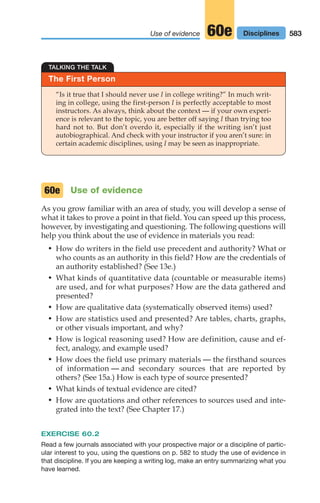
You can use it to record your thoughts on the reading you are doing and,
14c
14d
167
Set up a research log Research
14d
08_LUN_66490_Pt04_(163-214)_08_LUN_66490_Pt04_(163-214).qxd 11/30/11 2:19 PM Page 167
168 Research Preparing for a research project
14e
especially, add links from there to Web sites, documents, and articles you
have found online. (For more on blogs, see 2d.)
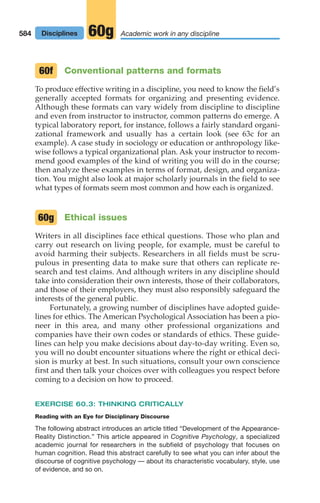
Whatever form your research log takes, you must clearly distinguish
the notes and comments you make from quoted passages you record.
Move from hypothesis to working thesis.
As you gather information, search catalogs and databases, and read
and evaluate sources, you will probably refine your research question
and change your hypothesis significantly. Only after you have explored
your hypothesis, tested it, and sharpened it by reading, writing, and
talking with others does it become a working thesis.
David Craig, the student whose hypothesis appears in 14b, did quite
a bit of research on messaging language, youth literacy, and the possible
connection between the two. The more he read, the more he felt that the
hypothesis suggested by his discussion with instructors — that messag-
ing had contributed to a decline in youth literacy — did not hold up. He
shifted his attention to the positive effects of messaging on communica-
tion skills and developed the following working thesis: “Although
some educators criticize messaging, it may aid literacy by encouraging
young people to use words and to write — even if messaging requires a
different kind of writing.”
In doing your own research, you may find that your interest shifts,
that a whole line of inquiry is unproductive, or that your hypothesis is
simply wrong. The process of research pushes you to learn more about
your hypothesis and to make it more precise.
EXERCISE 14.3: THINKING CRITICALLY
If you have done research for an essay or research project before, go back and
evaluate the work you did as a researcher and as a writer in light of the principles de-
veloped in this chapter. What was the purpose of the research? Who was your audi-
ence? How did you narrow and focus your topic? What kinds of sources did you
use? Did you use a research log? What about your research and your essay pleased
you most? What pleased you least? What would you do differently if you were to re-
vise the essay now?
EXERCISE 14.4: THINKING CRITICALLY
Begin to analyze the research project you are now working on by examining the
ways in which you conducted your research: What use did you make of primary and
secondary sources? What library, online, and field research did you carry out? What
aspect of the research process was most satisfying? What was most disappointing
or irritating? How could you do research more efficiently? Bring your answers to
these questions to class.
14e
08_LUN_66490_Pt04_(163-214)_08_LUN_66490_Pt04_(163-214).qxd 11/30/11 2:19 PM Page 168
How would you find out where to get the best coffee in town, or how
to find sources for a Web project on a 1930s film star? Whether you
are researching pizza or Picasso, you need to be familiar with the
kinds of sources you are likely to use, the searches you can perform,
and the types of research you will do most often: library, Internet,
and field research.
Understand different kinds of sources.
Sources can include data from interviews and surveys, books and arti-
cles in print and online, Web sites, film, video, images, and more. Con-
sider these important differences among sources.
Primary and secondary sources
Primary sources provide firsthand knowledge, while secondary
sources report on or analyze the research of others. Primary sources
are basic sources of raw information, including your own field
research; films, works of art, or other objects you examine; literary
works you read; and eyewitness accounts, photographs, news
reports, and historical documents (such as letters and speeches). Sec-
ondary sources are descriptions or interpretations of primary
sources, such as researchers’ reports, reviews, biographies, and ency-
clopedia articles. Often what constitutes a primary or secondary
source depends on the purpose of your research. A critic’s evaluation
of a film, for instance, serves as a secondary source if you are writing
about the film but as a primary source if you are studying the critic’s
writing.
Scholarly and popular sources
While nonacademic sources like magazines can help you get started
on a research project, you will usually want to depend more heavily
on authorities in a field, whose work generally appears in scholarly
journals in print or online. The list on the following page will help
you distinguish scholarly and popular sources.
15a
Doing Research 15
169
08_LUN_66490_Pt04_(163-214)_08_LUN_66490_Pt04_(163-214).qxd 11/30/11 2:19 PM Page 169
170 Research Doing research
15a
Title often contains the word Journal usually does not appear in
Journal title
Source available mainly through Source generally available outside
libraries and library databases of libraries (at newsstands or from
a home Internet connection)
SCHOLARLY POPULAR
Few commercial advertisements
Authors identified with acade-
mic credentials
Summary or abstract appears
on first page of article; articles
are fairly long
Articles cite sources and provide
bibliographies
Many advertisements
Authors are usually journalists
or reporters hired by the
publication, not academics
or experts
No summary or abstract; articles
are fairly short
Articles may include quotations
but do not cite sources or provide
bibliographies
Older and more current sources
Most projects can benefit from both older, historical sources and more cur-
rent ones. Some older sources are classics, essential for understanding
later scholarship. Others are simply dated. Whether a source appeared
08_LUN_66490_Pt04_(163-214)_08_LUN_66490_Pt04_(163-214).qxd 11/30/11 2:19 PM Page 170
171
Use the library to get started Research
15b
hundreds of years ago or this morning, evaluate it carefully to determine
how useful it will be for you.
Use the library to get started.
Many beginning researchers are tempted to assume that all the in-
formation they could possibly need is readily available on the Inter-
net from a home connection. However, it is a good idea to begin
almost any research project with the sources available in your col-
lege library.
Reference librarians
One particularly valuable resource is your library staff — especially ref-
erence librarians. You can make an appointment to talk with a librarian
about your research project and get specific recommendations about
databases and other helpful places to begin your research. In addition,
many libraries have online tours and chat environments where students
can ask questions about their research.
Catalogs and databases
Your library’s computers hold many resources not accessible to stu-
dents except through the library’s system. In addition to the library’s
own catalog of books and other holdings, most college libraries also
subscribe to a large number of databases — electronic collections of
information, such as indexes to journal and magazine articles, texts
of news stories and legal cases, lists of sources on particular topics,
and compilations of statistics — that students can access for free.
15b
Wikis as Sources
TALKING THE TALK
“Why doesn’t my instructor want me to use Wikipedia as a source?”
Wikis are sites that users can add to and edit as they see fit; as a
result, their contents are not always reliable. It’s true that Wikipedia,
a hugely popular site, has such a large and enthusiastic audience
that users are likely to catch mistakes and remove deliberately false
information quickly. But you can never be certain that a wiki entry
has not been tampered with. Use wikis as sources for preliminary
research and then make sure that you double-check any information
you find there.
08_LUN_66490_Pt04_(163-214)_08_LUN_66490_Pt04_(163-214).qxd 11/30/11 2:19 PM Page 171
172 Research Doing research
15c
Reference works
Consulting general reference works is another good way to get started
on a research project that is unfamiliar to you. These works are espe-
cially helpful for getting an overview of a topic, identifying subtopics,
finding more specialized sources, and identifying useful keywords for
electronic searches.
ENCYCLOPEDIAS
Encyclopedias offer general background on a subject and often include
bibliographies that can point you to more specialized sources. Remem-
ber that encyclopedias will serve as a place to start your research — not
as major sources for a research project.
BIOGRAPHICAL RESOURCES
The lives and historical settings of famous people are the topics of bio-
graphical dictionaries and indexes.
ALMANACS, YEARBOOKS, AND ATLASES
Almanacs and yearbooks contain data on current events and statistical
information. Look in an atlas for maps and other geographic data.
Find library resources.
The library is one of a researcher’s best friends, especially in an age of
electronic communication. Your college library houses a great number
of print materials and gives you access to electronic catalogs, indexes,
and databases.
Catalogs and databases
The most important tools your library offers are its online catalog and
databases. Searching these tools will always be easier and more efficient
if you use carefully chosen words to limit the scope of your research.
SUBJECT WORD SEARCHING
Catalogs and databases usually index their contents not only by author
and title, but also by subject headings — standardized words and
phrases used to classify the subject matter of books and articles. (For
books, most U.S. academic libraries use the Library of Congress Subject
Headings, or LCSH, for this purpose.) When you search the catalog by
subject, you need to use the exact subject words.
15c
08_LUN_66490_Pt04_(163-214)_08_LUN_66490_Pt04_(163-214).qxd 11/30/11 2:19 PM Page 172
173
Find library resources Research
15c
KEYWORD SEARCHING
Searches using keywords, on the other hand, make use of the computer’s
ability to look for any term in any field of the electronic record. In article
databases, a keyword search will look in abstracts and summaries of arti-
cles as well. Keyword searching is less restrictive, but you will need to put
some thought into choosing your search terms to get the best results.
ADVANCED SEARCHING
Many library catalogs and database search engines offer advanced search
options (sometimes on a separate page) to help you combine keywords,
search for an exact phrase, or exclude items containing particular key-
words. Often they can limit your search in other ways as well.
Many catalogs and databases offer a search option using the
Boolean operators AND, OR, and NOT, and some allow you to use paren-
theses to refine your search or wildcards to expand it. Note that much
Boolean decision making is done for you when you use an advanced
search option (as on the advanced search page shown below). Note, too,
that search engines vary in the exact terms and symbols they use to re-
fine searches, so check before you search.
• AND limits your search. If you enter the terms IM AND language AND
literacy, the search engine will retrieve only those items that contain
all the terms. Some search engines use a plus sign (+) instead of AND.
• OR expands your search. If you enter the terms messaging OR lan-
guage, the computer will retrieve every item that contains the term
messaging and every item that contains the term language.
Advanced search page from a library catalog that incorporates Boolean operators
08_LUN_66490_Pt04_(163-214)_08_LUN_66490_Pt04_(163-214).qxd 11/30/11 2:19 PM Page 173
174 Research Doing research
15c
• NOT limits your search. If you enter the terms messaging NOT lan-
guage, the search engine will retrieve every item that contains mes-
saging except those that also contain the term language. Some
search engines use a minus sign (–) or AND NOT instead of NOT.
• Parentheses customize your search. Entering messaging AND (literacy
OR linguistics), for example, will locate items that mention either of
those terms in connection with messaging.
• Wildcards expand your search. Use a wildcard, usually an asterisk
(*) or a question mark (?), to find related words that begin with the
same letters. Entering messag* will locate message, messages, and
messaging.
• Quotation marks narrow your search. Most search engines interpret
words within quotation marks as a phrase that must appear with
the words in that exact order.
Books
CATALOG INFORMATION
The library catalog lists all the library’s holdings and offers multiple en-
tries (usually including entries arranged by author, title, subject, ISBN,
and so on) that users can search. You can also search the catalog by us-
ing a combination of subject headings and keywords. Such searches
may turn up several useful titles on your topic.
Following are a search page and a page of results for noted linguist
and author David Crystal:
Library catalog search page
08_LUN_66490_Pt04_(163-214)_08_LUN_66490_Pt04_(163-214).qxd 11/30/11 2:19 PM Page 174
175
Find library resources Research
15c
Catalog entries for books list a call number that indicates how the
book is classified and where it is shelved. Once you have the call num-
ber for a book, look for a library map or shelving plan to tell you where
the book is housed. Take the time to browse through the books near the
call number you are looking for. Often you will find other books related
to your topic in the immediate area.
BOOK INDEXES
Indexes can help you quickly locate complete bibliographic information
on a book when you know only one piece of it — the author’s last
name, perhaps, or the title — and can alert you to other works by a par-
ticular author or on a particular subject. If you are looking for an older
book, you may find the information you need in print volumes rather
than in an electronic database.
REVIEW INDEXES
A review index will help you find reviews of books you are interested in
so that you can check the relevance of a source or get a thumbnail sketch
of its contents before you track it down. For reviews more than ten years
old, you will generally need to consult the print version of the index.
PERIODICAL ARTICLES
Titles of periodicals held by a library appear in its catalog, but the titles
of individual articles do not. To find the contents of periodicals, you
will need to use an index source.
Results for author search in library catalog database
Total number
of items in
catalog for
author David
Crystal
Items on this
catalog page
Call number
Location
08_LUN_66490_Pt04_(163-214)_08_LUN_66490_Pt04_(163-214).qxd 11/30/11 2:19 PM Page 175
176 Research Doing research
15c
AT A GLANCE
Discipline-Specific Online Databases
PERIODICAL INDEXES
Periodical indexes are databases or print volumes that hold information
about articles published in newspapers, magazines, and scholarly jour-
nals. Different indexes cover different groups of periodicals. Ask a refer-
ence librarian for guidance about the most relevant index for your topic.
Some electronic periodical indexes offer the full text of articles and
some offer abstracts (short summaries) of the articles. Be sure not to
confuse an abstract with a complete article. Full-text databases can be
extremely convenient — you can read and print out articles directly
from the computer, without the extra step of tracking down the periodi-
cal in question. However, don’t limit yourself to full-text databases,
which may not include the sources that would benefit your research
most. Databases that offer abstracts give you an overview of the arti-
cle’s contents that can help you decide whether you need to spend time
finding and reading the full text.
GENERAL INDEXES General indexes of periodicals list articles from general-
interest magazines (such as Time or Newsweek), newspapers, or a combi-
nation of these. General indexes usually provide current sources on a
topic, but you may need to look further for in-depth articles. Frequently
used general indexes include InfoTrac and LexisNexis, which can both
be used to access a vast collection of newspapers, magazines, and
scholarly journals.
SPECIALIZED INDEXES AND ABSTRACTS Many disciplines have specialized in-
dexes and abstracts to help researchers find detailed information. To
use these resources most efficiently, ask a reference librarian to help
you. Many of the most common discipline-specific online databases
are listed in the following box.
HUMANITIES
ABC-CLIO
EBSCOhost
Humanities Index
JSTOR
MLA Bibliography
Project Muse
ProQuest
SOCIAL SCIENCES
ERIC
EBSCOhost
Government
Documents Catalog
Services (GDCS)
GPO Access
JSTOR
PAIS International
ProQuest
PsycInfo
NATURAL AND
APPLIED SCIENCES
EBSCOhost
General Science
Index
JSTOR
BUSINESS
EBSCOhost
Periodical Abstracts
ProQuest
08_LUN_66490_Pt04_(163-214)_08_LUN_66490_Pt04_(163-214).qxd 11/30/11 2:19 PM Page 176
177
Find library resources Research
15c
ACCESS TO INDEXED PERIODICAL ARTICLES
To locate an indexed article that seems promising for your research project,
you can check the library catalog to see whether the periodical is available
electronically and, if so, whether your library has access to it. Using the li-
brary computer network for access can help you avoid paying to view the
text of the article that is available online only for subscribers or for a fee.
If the periodical is not available electronically (some scholarly jour-
nals, for example, are not), the library catalog also will tell you whether a
print version is available in your library’s periodicals room. This room
probably has recent issues of hundreds or even thousands of newspa-
pers, magazines, and scholarly journals, and it may also contain bound
volumes of past issues and microfilm copies of older newspapers.
Bibliographies
Bibliographies (lists of sources) in books or articles you are using for
your research can lead you to other valuable resources. In addition,
check with a reference librarian to find out whether your library has
more extensive bibliographies devoted to the area of your research.
Other library resources
In addition to books and periodicals, libraries give you access to many
other useful materials that might be appropriate for your research.
• Special collections and archives. Your library may house archives
(collections of valuable papers) and other special materials that are
often available to student researchers.
Results of search in a specialized index
Keyword
search
box
Database
being
searched
Number
of articles
found
08_LUN_66490_Pt04_(163-214)_08_LUN_66490_Pt04_(163-214).qxd 11/30/11 2:19 PM Page 177
178 Research Doing research
15d
• Audio, video, multimedia, and art collections. Many libraries have
areas devoted to media and art, where they collect films, videos,
paintings, and sound recordings.
• Government documents. Many libraries have collections of historical
documents produced by local or state government offices. You can
also look at the online version of the U.S. Government Printing
Office (GPO Access) for electronic versions of government publica-
tions from the past decade or so.
• Interlibrary loans. To borrow books, videos, copies of journal articles,
or audio materials from another library, use an interlibrary loan.
Some loans can take time, so be sure to plan ahead.
Search the Internet.
The Internet is many college students’ favorite way of accessing infor-
mation, and it’s true that much information — including authoritative
sources identical to those your library provides — can be found online,
sometimes for free. However, information in library databases comes
from identifiable and professionally edited sources; because no one is
responsible for regulating information on the Web, you need to take
special care to find out which information online is reliable and which
is not. (See Chapter 16 for more on evaluating sources.)
Internet searches
Research using a search tool such as Google usually begins with a key-
word search. Because the Internet contains vastly more material than
the largest library catalog or database, Internet searching requires care
in the choice of keywords. For example, if you need information on le-
gal issues regarding the Internet and enter Internet and law as keywords
in a Google search, you will get over three million hits. You may find
what you need on the first page of hits, but if not, you will need to
choose new keywords that lead to more specific sources.
15d
bedfordstmartins.com/everydaywriter To find links to search engines, go to
Research Resources and click on Links.
D
Bookmarking tools
Today’s powerful bookmarking tools can help you browse, sort, and track
resources online. Social bookmarking sites, such as Del.icio.us and Digg, al-
low users to tag information and share it with others. Once you register on
a social bookmarking site, you can tag an online resource with any words
you choose. Users’ tags are visible to all other users. If you find a helpful
08_LUN_66490_Pt04_(163-214)_08_LUN_66490_Pt04_(163-214).qxd 11/30/11 2:19 PM Page 178
179
Conduct field research Research
15e
A social bookmarking tool
site, you can check to see how others have tagged it and quickly browse
similar tags to find related information. You can sort and group informa-
tion according to your tags. Fellow users whose tags you like and trust can
become part of your network so that you can follow their sites of interest.
Web browsers can also help you bookmark and return to online re-
sources that you have found. However, unlike the bookmarking tools in a
Web browser, which are tied to one machine, social bookmarking tools are
available from any computer with an Internet connection.
bedfordstmartins.com/everydaywriter To find links to online governmental
collections and sites for newspapers and other media, go to Reference Resources
and click on Links.
D
Authoritative sources online
You can find many sources online that are authoritative and reliable.
For example, the Internet enables you to enter virtual libraries that al-
low access to some collections in libraries other than your own. Online
collections housed in government sites can also be reliable and useful
sources. The Library of Congress, the National Institutes of Health, and
the U.S. Census Bureau, for example, have large online collections of ar-
ticles. For current national news, consult online versions of reputable
newspapers such as the Washington Post or the Chicago Tribune, or elec-
tronic sites for news services such as C-SPAN. To limit your searches to
scholarly works, try Google Scholar.
Some scholarly journals (such as those from Berkeley Electronic
Press) and general-interest magazines (including Slate and Salon) are
published only on the Web, and many other publications, like Newsweek,
the New Yorker, and the New Republic, make at least some of their con-
tents available online for free.
Conduct field research.
For many research projects, particularly those in the social sciences and
business, you will need to collect field data. The “field” may be many
things — a classroom, a church, a laboratory, or the corner grocery
15e
08_LUN_66490_Pt04_(163-214)_08_LUN_66490_Pt04_(163-214).qxd 11/30/11 2:19 PM Page 179
180 Research Doing research
15e
AT A GLANCE
1. Determine your purpose, and be sure it relates to your research ques-
tion and your hypothesis.
2. Set up the interview well in advance. Specify how long it will take,
and if you wish to tape-record the session, ask permission to do so.
3. Prepare a written list of factual and open-ended questions. Brain-
storming or freewriting can help you come up with questions (6a and
b). Leave plenty of space for notes after each question. If the interview
proceeds in a direction that seems fruitful, do not feel that you have to
ask all of your prepared questions.
4. Record the subject, date, time, and place of the interview.
5. Thank those you interview, either in person or in a letter or email.
Conducting an Interview
AT A GLANCE
1 Determine the purpose of the observation, and be sure it relates to
your research question and hypothesis.
2. Brainstorm about what you are looking for, but don’t be rigidly bound
to your expectations.
3. Develop an appropriate system for recording data. Consider using a
split notebook or page: on one side, record your observations directly;
on the other, record your thoughts and interpretations.
4. Record the date, time, and place of the observation.
Conducting an Observation
store. As a field researcher, you will need to discover where you can find
relevant information, how to gather it, and who might be your best
providers of information.
Interviews
Some information is best obtained by asking direct questions of other
people. If you can talk with an expert — in person, on the telephone, or
via the Internet — you might get information you could not obtain
through any other kind of research. In addition to getting an expert
opinion, you might ask for firsthand accounts or suggestions of other
places to look or other people to consult.
Observation
Trained observers report that making a faithful record of an observation
requires intense concentration and mental agility. Moreover, an ob-
08_LUN_66490_Pt04_(163-214)_08_LUN_66490_Pt04_(163-214).qxd 11/30/11 2:19 PM Page 180
181
Conduct field research Research
15e
server is never neutral — he or she always has an angle on what is be-
ing observed.
Opinion surveys
Surveys usually depend on questionnaires. On any questionnaire, the
questions should be clear and easy to understand and designed so
that you can analyze the answers easily. Questions that ask respon-
dents to say yes or no or to rank items on a scale are particularly easy
to tabulate:
The parking facilities on our campus are adequate.
Strongly Somewhat Unsure Somewhat Strongly
agree agree disagree disagree
AT A GLANCE
1. Write out your purpose, and review your research question and hypoth-
esis to determine the kinds of questions to ask.
2. Figure out how to reach the respondents you need.
3. Draft potential questions, and make sure that each question calls for a
short, specific answer.
4. Test the questions on several people, and revise questions that seem
unfair, ambiguous, too hard to answer, or too time consuming.
5. For a questionnaire that is to be mailed, draft a cover letter explaining
your purpose. Provide a self-addressed, stamped envelope, and be
sure to state a deadline.
6. On the final version of the questionnaire, leave adequate space for
answers.
7. Proofread the questionnaire carefully.
Designing a Questionnaire
Analyzing, synthesizing, and interpreting data
from field research
To make sense of your data, find a focus for your analysis, since you
can’t pay attention to everything. Then synthesize the data by looking
for recurring words or ideas that fall into patterns. Establish a system
for coding your information, labeling each pattern you identify —
a plus sign for every positive response, for example. Finally, interpret
your data by summing up the meaning of what you have found.
What is the significance of your findings? Be careful not to make big
generalizations.
08_LUN_66490_Pt04_(163-214)_08_LUN_66490_Pt04_(163-214).qxd 11/30/11 2:19 PM Page 181
All research builds on the careful and sometimes inspired use of
sources — that is, on research done by others. Whether you are doing
research to identify the most affordable laptop, to persuade your col-
lege administration to improve campus safety, or to prepare a strong
academic argument for a class, you will want to make the most of your
sources. In other words, you will want to use the insights you gain from
your sources to help you create powerful prose of your own.
Understand why you should use sources.
While all research draws on sources, it is worth thinking about why
writers decide to use one source rather than another. What specifically
can sources provide for your research projects?
• background and contextual information that sets the scene for your
project or that your audience will need to follow your argument
• explanations of concepts unfamiliar to your audience
• verbal and visual emphasis for points you are making
• authority for the claims you are making, which in turn helps you
create your own authority
• evidence to support your claims
• counter-examples or counter-evidence that you need to reflect on
and respond to in your own argument
• varying perspectives on your topic
Create a working bibliography.
A working bibliography is a list of sources that you are considering using
for your project. As you find research sources –– articles, books, Web
sites, and so on –– you should record source information for every source
you think you might use. Include everything you need to find the source
again and cite it correctly; the information you will need varies based on
the type of source, whether you found it in a library or not, and whether
you consulted it in print or online. The emphasis in a working bibliogra-
phy is on working because the list will probably include materials that end
up not being useful. For this reason, you don’t absolutely need to put all
entries into the documentation style you will use (see Chapters 48–54).
16b
16a
Evaluating Sources
and Taking Notes
16
182
08_LUN_66490_Pt04_(163-214)_08_LUN_66490_Pt04_(163-214).qxd 11/30/11 2:19 PM Page 182
If you do style your entries appropriately, however, that part of your
work will be done when you prepare the final draft.
Record the following information if it’s available:
FOR A BOOK
Call number
Author(s) or editor(s)
Title and subtitle
Place of publication
Publisher
Year of publication
Other (translator, volume,
edition)
FOR PART OF A BOOK
Call number
Author(s) of part
Title of part
Author(s) or editor(s) of book
Title of book
Place of publication
Publisher
Year of publication
Inclusive page numbers for
part you are using
FOR A PERIODICAL ARTICLE
Call number of periodical
Author(s) of article
Title of article
Name of periodical
Volume number
Issue number
Date of issue
Inclusive page numbers for
article
FOR AN ELECTRONIC SOURCE
Author(s)
Title of document
Title of site
Editor(s) of site
Sponsor of site
Publication information for
print version of source
Name of database or online
service
Date of electronic publication
or last update
Date you accessed the source
URL
Research with an Open Mind
TALKING THE TALK
“What’s wrong with looking for sources that back up what I want to
say?” When you start researching a topic, keep an open mind: investi-
gate every important source, even if you think you won’t agree with it.
If all your sources take the same position you take, you may be missing
a big part of the picture. Who knows? You may change your position
after learning more about the topic. And even if you don’t, ignoring
counterarguments and other points of view harms your credibility.
183
Create a working bibliography Research
16b
08_LUN_66490_Pt04_(163-214)_08_LUN_66490_Pt04_(163-214).qxd 11/30/11 2:19 PM Page 183
184 Research Evaluating sources and taking notes
16c
ANNOTATED BIBLIOGRAPHY
You might wish to annotate your working bibliography to include
your own description and comments as well as publishing informa-
tion. Annotations can help you understand and remember what the
source says.
ANNOTATED BIBLIOGRAPHY ENTRY
Gere, Anne Ruggles. “Kitchen Tables and Rented Rooms: The Extracurriculum of
Composition.” Literacy: A Critical Sourcebook. Ed. Ellen Cushman, Eugene R.
Kintgen, Barry M. Kroll, and Mike Rose. Boston: Bedford, 2001. 275-89.
This history of writing instruction argues that people teach writing and learn to
write--and always have--more often in informal places like kitchens than in
traditional writing classrooms. Gere presents numerous examples and comments
on their importance to the study of writing today.
bedfordstmartins.com/everydaywriter For additional examples of annotated
bibliographies, click on Student Writing Models.
D
Evaluate a source’s usefulness and credibility.
Since you want the information and ideas you glean from sources to be
reliable and persuasive, you must evaluate each potential source care-
fully. The following guidelines can help you assess the usefulness and
credibility of sources you are considering:
• Your purpose. What will this source add to your research project?
Does it help you support a major point, demonstrate that you have
thoroughly researched your topic, or help establish your own
credibility?
• Relevance. How closely related is the source to the narrowed topic
you are pursuing?
• Level of specialization and audience. General sources can be helpful
as you begin your research, but you may then need the authority or
currency of more specialized sources. On the other hand, extremely
specialized works may be very hard to understand. Who was the
source originally written for — the general public? experts in the
field? advocates or opponents? How does this fit with your concept
of your own audience?
16c
08_LUN_66490_Pt04_(163-214)_08_LUN_66490_Pt04_(163-214).qxd 11/30/11 2:19 PM Page 184
185
Read critically and interpret sources Research
16d
• Credentials of the publisher or sponsor. What can you learn about
the publisher or sponsor of the source you are using? For example,
is it a newspaper known for integrity, or is it a tabloid? Is it a pop-
ular source, or is it sponsored by a professional organization or
academic institution? If you’re evaluating a book, is the publisher
one you recognize or can find described on its own Web site?
• Credentials of the author. Note names that come up from one source
to another, since they may indicate that the author is influential in the
field. An author’s credentials may also be presented in the article,
book, or Web site, or you can search the Internet for information
about the author.
• Date of publication. Recent sources are often more useful than
older ones, particularly in the sciences or other fields that change
rapidly. However, in some fields — such as the humanities — the
most authoritative works may be older ones. The publication dates
of Internet sites can often be difficult to pin down. And even for
sites that include dates of posting, remember that the material
posted may have been composed some time earlier.
• Accuracy of the source. How accurate and complete is the informa-
tion in the source? How thorough is the bibliography or list of
works cited that accompanies the source? Can you find other
sources that corroborate what your source is saying?
• Stance of the source. Identify the source’s point of view or rhetorical
stance, and scrutinize it carefully. Does the source present facts, or
does it interpret or evaluate them? If it presents facts, what is in-
cluded and what is omitted, and why? If it interprets or evaluates
information that is not disputed, the source’s stance may be obvi-
ous, but at other times, you will need to think carefully about the
source’s goals (16d). What does the author or sponsoring group
want –– to convince you of an idea? sell you something? call you to
action in some way?
• Cross-references to the source. Is the source cited in other works? If
you see your source cited by others, notice how they cite it and
what they say about it to find additional clues to its credibility.
For more on evaluating Web sources and periodical articles, see the
source maps on pp. 186–87 and 188–89.
Read critically and interpret sources.
Reading with a critical eye can make your research process more effi-
cient. Use the tips on p. 120 to guide your critical reading.
16d
08_LUN_66490_Pt04_(163-214)_08_LUN_66490_Pt04_(163-214).qxd 11/30/11 2:19 PM Page 185
186
SOURCE MAP: Evaluating Articles
1
2
4
6
3
5
Determine the relevance of the source.
Look for an abstract, which provides a summary of the entire article. Is
this source directly related to your research? Does it provide useful infor-
mation and insights? Will your readers consider it persuasive support for
your thesis?
Determine the credibility of the publication.
Consider the publication’s title. Words in the title such as Journal,
Review, and Quarterly may indicate that the periodical is a scholarly
source. Most research essays rely on authorities in a particular field,
whose work usually appears in scholarly journals. For more on distin-
guishing between scholarly and popular sources, see 15a.
Try to determine the publisher or sponsor. This journal is published by
Johns Hopkins University Press. Academic presses such as this one
generally review articles carefully before publishing them and bear the
authority of their academic sponsors.
Determine the credibility of the author.
Evaluate the author’s credentials. In this case, they are given in a note,
which indicates that the author is a college professor and has written at
least two books on related topics.
Determine the currency of the article.
Look at the publication date and think about whether your topic and your
credibility depend on your use of very current sources.
Determine the accuracy of the article.
Look at the sources cited by the author of the article. Here, they are
documented in footnotes. Ask yourself whether the works the author
has cited seem credible and current. Are any of these works cited in
other articles you’ve considered?
In addition, consider the following questions:
• What is the article’s stance or point of view? What are the author’s
goals? What does the author want you to know or believe?
• How does this source fit in with your other sources? Does any of the
information it provides contradict or challenge other sources?
08_LUN_66490_Pt04_(163-214)_08_LUN_66490_Pt04_(163-214).qxd 11/30/11 2:19 PM Page 186
187
3 The Johns Hopkins University Press
6
1
2
© 2003
4
5
08_LUN_66490_Pt04_(163-214)_08_LUN_66490_Pt04_(163-214).qxd 11/30/11 2:19 PM Page 187
188
SOURCE MAP: Evaluating Web Sources
Determine the credibility of the sponsoring organization.
Consider the URL, specifically the top-level domain name. (For example,
.edu indicates that the sponsor is an accredited college or university; .org
indicates it’s a nonprofit organization.) Might such a sponsor be biased
about the topic you’re researching?
Look for an About page or a link to the home page for background in-
formation on the sponsor, including a mission statement. What is the
sponsoring organization’s stance or point of view? Does the mission
statement seem biased or balanced? Does the sponsor seem to take
other points of view into account? What is the intended purpose of the
site? Is this site meant to inform, or is it trying to persuade, advertise,
or accomplish something?
Determine the credibility of the author.
Evaluate the author’s credentials. On this Web page, the author appears
to be a staff writer for the site. Although the author herself may not have
a medical background, note that the article was reviewed by a physician
and that it includes findings from a respected medical journal. If you sus-
pect that an author may be biased, run a search on the author’s name to
find any affiliations with interest groups or any leaning toward one side
of an issue. Ask yourself if the author seems qualified to write about the
issue.
Look for the date that indicates when the information was posted or last
updated. Here, the date is given at the beginning of the article.
Check to see if the sources referred to are also up-to-date. Ask yourself
if, given your topic, an older source is acceptable or if only the most
recent information will do.
Determine the accuracy of the information.
How complete is the information in the source? Examine the works cited
by the author. Are sources for statistics included? Do the sources cited
seem credible? Is a list of additional resources provided? Here, the au-
thor cites the New England Journal of Medicine and the National Center
for Complementary and Alternative Medicine in addition to two of
WebMD’s own articles. In some cases, it may be necessary to track
down additional sources and corroborate what a source is saying.
1
2
4
6
3
5
08_LUN_66490_Pt04_(163-214)_08_LUN_66490_Pt04_(163-214).qxd 11/30/11 2:19 PM Page 188
189
2
4
6
3
5
1
08_LUN_66490_Pt04_(163-214)_08_LUN_66490_Pt04_(163-214).qxd 11/30/11 2:19 PM Page 189
YOUR RESEARCH QUESTION
As you read, keep your research question in mind, and ask questions.
• How does this material address your research question and hy-
pothesis?
• What quotations from this source might help support your thesis?
• Does the source include counterarguments to your hypothesis that
you will need to answer? If so, what answers can you provide?
THE AUTHOR’S STANCE AND TONE
Read with an eye for the author’s overall rhetorical stance or perspective,
for facts or explicit opinions, and for the author’s tone — the way his or
her attitude toward the topic and audience is conveyed.
THE AUTHOR’S ARGUMENT AND EVIDENCE
Look for the main point or the main argument the author is making. Try
to identify the reasons the author gives to support his or her position.
Then try to determine why the author takes this position.
• How persuasive is the evidence? Can you think of a way to refute it?
• Can you detect any questionable logic or fallacious thinking (12f)?
EXERCISE 16.1
You can practice learning to read texts critically by comparing several Web sites. To
begin, search for a site that is fairly unregulated and unedited — a fan site, for
instance, for a writer, a book, an actor, a television show, or a film. What on this site
indicates credibility? Who is responsible for the site, and how can you tell?
Next, compare it to the site of a major government agency, such as the Library
of Congress, or a national broadcaster, such as PBS or CNN. What kinds of connec-
tions do you see between the sponsoring organization and the Web site?
Finally, working alone or with another member of your class, analyze the sites
you have looked at for trust, credibility, and authority. Bring the results of your analy-
sis to class for discussion.
EXERCISE 16.2
Choose two sources that seem well suited to your topic, and evaluate their useful-
ness and credibility using the criteria presented in this chapter. If possible, analyze
one print source and one electronic source. Bring the results of your analysis to
class for discussion.
Synthesize sources.
Throughout the research process, you are synthesizing — grouping simi-
lar pieces of data together, looking for patterns or trends, and identifying
16e
190 Research Evaluating sources and taking notes
16e
08_LUN_66490_Pt04_(163-214)_08_LUN_66490_Pt04_(163-214).qxd 11/30/11 2:19 PM Page 190
GAME PLAN Synthesize Sources
START
by identifying
GOOD
SOURCES.
FIGURE OUT
what each
source SAYS.
EXAMINE
THE FIT.
What’s the MAIN IDEA?
WHAT
information
do I NEED?
HOW does
this relate to
my TOPIC?
What if one text says
ONE thing, and another says
SOMETHING ELSE?
Which source do I believe,
and WHY?
WHAT
am I trying
to SAY?
Look for COMMON
PATTERNS. What do
they suggest about
the TOPIC?
Is there a good reason
to use each source?
IF NOT, DON’T!
Does my thesis
NEED TO CHANGE?
If I need to go in a new
direction, I will.
I’VE GOT
SOMETHING
TO SAY.
(If not, rethink
this project!)
My research
should BACK ME
UP, not take over.
If I’m missing
important
pieces,
DO MORE
RESEARCH.
WHERE
can I
GET IT?
Can I trust it?
HOW will my readers
respond to it?
WHAT DO OTHER SOURCES
SAY ABOUT THIS SOURCE?
HOW DO THE PARTS OF MY RESEARCH FIT WITH WHAT I WANT TO SAY?
ADD UP MY FINDINGS AND
SEE WHERE I AM….
MY SOURCES
ARE SOLID!
THE PIECES
ADD UP!
MY RESEARCH
IS WORKING
FOR ME!
I’VE
SYNTHESIZED
MY FINDINGS!
A source
shouldn’t be too
SPECIFIC
or too GENERAL
for my thesis….
08_LUN_66490_Pt04_(163-214)_08_LUN_66490_Pt04_(163-214).qxd 11/30/11 2:19 PM Page 191
192
How appropriate is the source for the argument you are making?
Read carefully, and be sure you understand exactly how the material in
the source relates to your point. (See Chapter 12.) Student Amanda Rinder,
in doing research for a paper about Chicago architecture (53c), discovered
a major debate between the city’s preservationists and developers, which
she wanted to document. This Chicago Tribune article by architecture
critic Paul Gapp provided the information she needed.
How does each source contribute to your argument? Identifying the
purpose of each source can help keep your research relevant and ensure
that you fill in any gaps (and avoid repetition). Amanda used both para-
phrases (highlighted) and quotations (underlined) from the Gapp article to
present a clear overview of the issues of architectural preservation and to
offer strong support for the preservation of the McCarthy Building. She
used images, including this one of the McCarthy Building, as examples of
the architectural style that preservationists wanted to save. She also did
background research on Paul Gapp and learned, from his obituary in the
New York Times, that he had won a Pulitzer Prize for his architecture criti-
cism. She did not ultimately include information from the obituary in her
paper, but it helped her be certain of Gapp’s credibility on her topic.
Do your sources include fair representations of opposing views?
Consider what else you need to include to present a complete picture of
the argument. Amanda paraphrased Gapp’s balanced discussion of the
pros and cons of protecting the McCarthy Building. She also found addi-
tional sources on both sides of the issue.
How convincing will your sources be to your audience? Make sure
that the evidence you choose will seem credible and logical (13e–f).
Amanda identified Gapp as “a Chicago Tribune architecture critic” to
show him as an authority on her topic. Her other sources included books
by architects and historians and other articles on architecture from major
newspapers in Chicago and elsewhere.
4
3
2
1
SOURCE MAP: Using Sources Effectively
08_LUN_66490_Pt04_(163-214)_08_LUN_66490_Pt04_(163-214).qxd 11/30/11 2:19 PM Page 192
193
3
Indeed, that sort of restoration was originally envisioned by real estate developers when
the city--acting under its renewal powers--tentatively decided in 1983 to accept a bid of
$12.6 million for the full block of land on which the McCarthy stands. The McCarthy
and two other old buildings were to have been linked to a glass enclosed shopping arcade
connecting Dearborn and State Streets.
Late last summer, however, the city was notified of a change of mind by the development
group consisting of the Levy Organization, JMB Realty and Metropolitan Structures. The
group said it wanted to tear down the buildings and construct an office high-rise in their
place.
To make up for the McCarthy's loss, the developers offered to contribute $2 million to
the city for development of a "Theater Row" project in the North Loop, tied to existing
theatrical venues.
When the LPC said it might not oppose such a deal, it was attacked by the City Club of
Chicago and restoration authority John Vinci, among others. "The developer's offer is
tantamount to a civic shakedown," said Larry P. Horist, the City Club's executive
director. Vinci said the LPC's vacillation "destroys its integrity."
Today, City Hall is trapped and squirming in the middle.
If it stands fast in favor of the McCarthy, it risks queering the land sale in an important
urban renewal area whose upgrading has already been plagued by political, legal, tax
assessment and other problems.
If it rescinds the McCarthy's landmark status and allows demolition, the city will have
gone on record as favoring the allure of the dollar over Chicago's architectural heritage.
(Moving the McCarthy to another site, which has also been suggested, would amount to
the same kind of surrender and set a dangerous precedent).
It's a tough decision, and the politicians will be faulted in either case. Yet anyone who
cares for the irreplaceable historical and cultural fabric of the city can hardly take
anything but the long view:
The McCarthy and most of Chicago's other official architecture landmarks were in place
long before any of today's politicians and real estate developers (or you and I) were born.
Is it too much to hope that they will continue to grace our ravaged but still great city long
after all of us are gone?
forgotten that the state building, designed by Helmut Jahn, was always intended to be the
anchor of the redevelopment area.
Municipal planners finally decided to spare seven historic buildings in the renewal district
by making them landmarks, and the city council gave the designation to:
-- The McCarthy, designed in 1872 by John M. Van Osdel.
-- The Chicago Theater, 175 N. State St., a Rapp & Rapp-designed masterpiece built in
1921.
-- The Page Brothers Building, just north of the Chicago Theater, another Van Osdel
building constructed in 1872 and notable chiefly for its full cast iron north facade--the
only surviving example of its kind here.
-- The handsome Harris and Selwyn Theaters at 180 and 190 N. Dearborn St., built in
1922 on designs by H. Kenneth Franzheim and C. Howard Crane.
-- The Oliver Building at 159 N. Dearborn St., a good-looking Chicago- style office
structure designed by Holabird & Roche in 1907.
-- The Delaware Building, 36 W. Randolph St., an 1872 structure by Wheelock and
Thomas. Its Italianate style and corner location give it a strong resemblance to the
McCarthy.
When the Chicago Theater and Page Brothers buildings were almost destroyed by their
previous owners a couple of years ago, it was a reminder that landmark designation is no
guarantee of preservation. It can only delay demolition while potential ways of saving a
building are explored. (The Chicago and the Page, rescued after lengthy litigation, are
now well on the way to extended lives under new ownership and an ambitious restoration
program).
And so we consider the present McCarthy Building situation, which might be described
as an impasse on its way to becoming a brouhaha.
The city council gave the McCarthy landmark status because it is a rare and distinguished
example of work by Van Osdel, who was Chicago's first professional architect. Created in
an Italianate style just a year after the Great Chicago Fire of 1871, the McCarthy's
carefully detailed masonry and iron facades reflect the same look Van Osdel selected
when he designed the third Palmer House hotel a few years later.
If the garish signs that degrade the McCarthy were simply removed, that alone would
reveal the building as a stunningly appealing relic from Chicago's 19th Century
renaissance era. Replacing the little five-story building's lost cornice and restoring its
base would present no technical problems.
MCCARTHY BUILDING PUTS LANDMARK LAW
ON A COLLISION COURSE WITH DEVELOPERS
[FINAL EDITION, C]
Chicago Tribune (pre-1997 Fulltext) - Chicago, Ill.
Author: Paul Gapp, Architecture critic
Date: Apr 20, 1986
Section: ARTS
Text Word Count: 1142
Document Text
Chicago's commitment to saving municipally designated landmarks is undergoing one of
its most crucial tests. If a little gem of a structure called the McCarthy Building is torn
down, the city's landmarks protection ordinance will be devalued almost to the vanishing
point.
The McCarthy stands at the northeast corner of Dearborn and Washington Streets, just
across from Daley Civic Center. Its dignified facades are defaced by so many ugly signs
that most pedestrians see the building only as a rude smear on the streetscape. Yet the
McCarthy's esthetic and historical value is undeniable, which is why the city council
gave the building landmark status in the first place.
Now, however, a real estate development group wants to demolish the McCarthy to make
room for an office tower. Because the building stands on municipally controlled urban
renewal land, the city has both the leverage to save it and a reason for allowing its
destruction. This landmark scenario is unprecedented and could hardly be stickier.
The McCarthy and several other important old buildings first appeared threatened in the
early 1970s when the city began drafting the North Loop urban renewal plan. In 1973,
the private Landmarks Preservation Council (LPC) asked officials to spare such
buildings, but the city brushed aside the plea.
Under an early version of the North Loop urban renewal program announced in 1978,
more than 50 buildings--including all nine movie houses then extant --were to be
destroyed in a seven-block area.
Among structures marked for demolition were seven--including the McCarthy --already
listed on the federal National Register of Historic Places. Preservation officials in
Washington warned that their destruction could mean a loss of federal renewal money,
and City Hall began reshuffling its plans.
The tangle of events that followed into the 1980s found the city repeatedly changing its
mind about what should and should not be saved from destruction.
While this was going on, demolition in the renewal area began with the Sherman House
hotel, which fell to make way for the new State of Illinois Center. Most people have
August 11, 1992
Paul Gapp, 64, Journalist, Dies;
Architecture Critic W
on Pulitzer
By HERBERT M
USCHAM
P
Paul Gapp, the Pulitzer Prizewinning architecture critic for The Chicago Tribune, died on
July 30 at Northwest M
emorial Hospital in Chicago. He was 64 years old and lived in
Chicago.
He died of lung cancer complicated by emphysema, his office said.
M
r. Gapp was born in Cleveland in 1928. He began his career in journalism
with The
Columbus (Ohio) Dispatch after graduating from
Ohio University in 1950. Six years
later, he joined The Chicago Daily News, where he worked as a reporter, editorial writer
and features editor. In 1972, M
r. Gapp joined The Chicago Tribune as assistant city
editor for urban affairs. He was appointed architecture critic in 1974 and won the Pulitzer
Prize for criticism
in 1979.
M
r. Gapp's interest in architecture grew
out of his love for Chicago, which he once
described as "the last of the great American cities, a city of great elegance and great
charm." His writings on architecture helped readers grasp the role of buildings in
Chicago's social and political life.
4
1
2
08_LUN_66490_Pt04_(163-214)_08_LUN_66490_Pt04_(163-214).qxd 11/30/11 2:19 PM Page 193
194
the main points of the data. Doing so enables you to use your sources
effectively to pursue your research goals.
Using sources effectively in a research essay can pose challenges. A
national study of first-year college writing conducted for this book, for
example, found that student writers trying to incorporate research
sometimes used sources that were not directly relevant to their point, too
specific to support the larger claim being made, or otherwise ineffective
for their purpose. Even after you have evaluated a source and consid-
ered the author’s stance, argument, and evidence, then, it’s worth taking
time to look at how well the source works in your specific situation. (If
you change the focus of your work after you have begun doing research,
be especially careful to check whether your sources still fit.)
Take notes, and annotate your sources.
While note-taking methods vary from one researcher to another, you
should (1) record enough information to help you recall the major
points of the source; (2) put the information in the form in which you
are most likely to incorporate it into your research essay; and (3) note
all the information you will need to cite the source accurately. The fol-
lowing example shows the major items a note should include:
16f
ELEMENTS OF AN ACCURATE NOTE
Use a subject heading. Label each note with a brief but descriptive subject
heading so you can group similar subtopics together.
Identify the source. List the author’s name and a shortened title of the source.
Your working-bibliography entry (16b) for the source will contain the full biblio-
graphic information, so you don’t need to repeat it in each note.
Record exact page references (if available). For online or other sources without
page numbers, record the paragraph, screen, or other section number(s), if
indicated.
1
2
3
1
2
3
Child labor statistics
Arat, Analyzing Child Labor, p. 180
Accurate statistics are hard to gather
Between 200 and 500 million child laborers worldwide
95% are in the third world
2 million in the US and UK
(Summary)
“[0]ne in three children in Africa works, one in four in
Asia, and one in five in Latin America.”
(Quotation)
4
16f
Research Evaluating sources and taking notes
08_LUN_66490_Pt04_(163-214)_08_LUN_66490_Pt04_(163-214).qxd 11/30/11 2:19 PM Page 194
195
Take notes, and annotate your sources Research
16f
Indicate whether the note is a summary, paraphrase, or direct quotation (see the
following). Make sure quotations are copied accurately. Put square brackets
around any change you make, and use ellipses if you omit material.
Taking complete notes will help you digest the source information
as you read and incorporate the material into your text without inad-
vertently plagiarizing the source (see Chapter 17). Be sure to reread
each note carefully, and recheck it against the source to make sure quo-
tations, statistics, and specific facts are accurate.
Quoting
Quoting involves bringing a source’s exact words into your text. Use an
author’s exact words when the wording is so memorable or expresses a
point so well that you cannot improve or shorten it without weakening
it, when the author is a respected authority whose opinion supports
your own ideas, or when an author challenges or disagrees profoundly
with others in the field. Here is an example of a quotation note:
QUOTATION-STYLE NOTE
Comments from educators
Lee, “I Think,” NY Times (Web site)
Melanie Weaver was stunned by some of the term papers
she received from a 10th-grade class she recently taught
as part of an internship. “They would be trying to make
a point in a paper, [so] they would put a smiley face
in the end,” said Ms. Weaver, who teaches at Alvernia
College in Reading, Pa. “If they were presenting an
argument and they needed to present an opposite view,
they would put a frown.”
(Quotation) Indication that note is
direct quotation
Author and short title of
source (no page number
for electronic source)
Subject heading
Paraphrasing
A paraphrase accurately states all the relevant information from a pas-
sage in your own words and sentence structures, without any additional
comments or elaborations. Use a paraphrase when the main points of a
passage, their order, and some details are important but the particular
wording is not. Unlike a summary, a paraphrase always restates all the
main points of a passage in the same order and often in about the same
number of words.
To paraphrase without plagiarizing inadvertently, do not simply
substitute synonyms, and do not imitate an author’s style. If you wish
4
08_LUN_66490_Pt04_(163-214)_08_LUN_66490_Pt04_(163-214).qxd 11/30/11 2:19 PM Page 195
196
to cite some of an author’s words within a paraphrase, enclose them in
quotation marks. The following examples of paraphrases resemble the
original either too little or too much:
ORIGINAL
Language play, the arguments suggest, will help the development of pro-
nunciation ability through its focus on the properties of sounds and sound
contrasts, such as rhyming. Playing with word endings and decoding the
syntax of riddles will help the acquisition of grammar. Readiness to play
with words and names, to exchange puns and to engage in nonsense talk,
promotes links with semantic development. The kinds of dialogue interac-
tion illustrated above are likely to have consequences for the development
of conversational skills. And language play, by its nature, also contributes
greatly to what in recent years has been called metalinguistic awareness,
which is turning out to be of critical importance in the development of lan-
guage skills in general and of literacy skills in particular.
– DAVID CRYSTAL, Language Play (180)
UNACCEPTABLE PARAPHRASE: STRAYING FROM THE AUTHOR’S IDEAS
Crystal argues that playing with language — creating rhymes, figuring out
how riddles work, making puns, playing with names, using invented
words, and so on — helps children figure out a great deal about language,
from the basics of pronunciation and grammar to how to carry on a conver-
sation. Increasing their understanding of how language works in turn helps
them become more interested in learning new languages and in pursuing
education (180).
AT A GLANCE
• Copy quotations carefully, with punctuation, capitalization, and spelling
exactly as in the original. (42a)
• Enclose the quotation in quotation marks; don’t rely on your memory
to distinguish your own words from those of the source. (42a)
• Use square brackets if you introduce words of your own into the quo-
tation or make changes in it. (43b)
• Use ellipses if you omit words from the quotation. (43f)
• If you later incorporate the quotation into your research essay, copy it
from the note precisely, including brackets and ellipses.
• Record the author’s name, shortened title, and page number(s) on
which the quotation appeared. For sources without page numbers,
record the paragraph, screen, or other section number(s) if indicated.
• Make sure you have a corresponding working-bibliography entry
with complete source information. (16b)
• Label the note with a subject heading, and identify it as a quotation.
Quoting Accurately
Research Evaluating sources and taking notes
16f
08_LUN_66490_Pt04_(163-214)_08_LUN_66490_Pt04_(163-214).qxd 11/30/11 2:19 PM Page 196
197
Take notes, and annotate your sources Research
16f
The previous paraphrase starts off well enough, but it moves away
from paraphrasing the original to inserting the writer’s ideas; Crystal
says nothing about learning new languages or pursuing education.
UNACCEPTABLE PARAPHRASE: USING THE AUTHOR’S WORDS
Crystal suggests that language play, including rhyme, helps children im-
prove pronunciation ability, that looking at word endings and decoding the
syntax of riddles allows them to understand grammar, and that other kinds
of dialogue interaction teach conversation. Overall, language play may be of
critical importance in the development of language and literacy skills (180).
Because the underlined phrases are either borrowed from the original
without quotation marks or changed only superficially, this paraphrase
plagiarizes.
UNACCEPTABLE PARAPHRASE: USING THE AUTHOR’S SENTENCE STRUCTURES
Language play, Crystal suggests, will improve pronunciation by zeroing in
on sounds such as rhymes. Having fun with word endings and analyzing
riddle structure will help a person acquire grammar. Being prepared to
play with language, to use puns and talk nonsense, improves the ability to
use semantics. These playful methods of communication are likely to influ-
ence a person’s ability to talk to others. And language play inherently adds
enormously to what has recently been known as metalinguistic awareness, a
concept of great magnitude in developing speech abilities generally and lit-
eracy abilities particularly (180).
Here is a paraphrase of the same passage that expresses the author’s
ideas accurately and acceptably:
ACCEPTABLE PARAPHRASE: IN THE STUDENT WRITER’S OWN WORDS
Crystal argues that playing with language — creating rhymes, figuring out
riddles, making puns, playing with names, using invented words, and so
on — helps children figure out a great deal, from the basics of pronunciation
and grammar to how to carry on a conversation. This kind of play allows
children to understand the overall concept of how language works, a con-
cept that is key to learning to use — and read — language effectively (180).
Summarizing
A summary is a significantly shortened version of a passage or even of
a whole chapter or work that captures main ideas in your own words.
Unlike a paraphrase, a summary uses just enough information to record
the main points you wish to emphasize. To summarize a short passage,
read it carefully and, without looking at the text, write a one- or
two-sentence summary. Following is David Craig’s note recording a
summary of the Crystal passage on p. 196. Notice that it states the au-
thor’s main points selectively — and without using his words.
08_LUN_66490_Pt04_(163-214)_08_LUN_66490_Pt04_(163-214).qxd 11/30/11 2:19 PM Page 197
198
SUMMARY NOTE
Language development
Crystal, Language Play, p. 180
Crystal argues that various kinds of language play
contribute to awareness of how language works
and to literacy.
(Summary)
For a long passage or an entire chapter, skim the headings and topic
sentences, and make notes of each; then write your summary in a para-
graph or two. For a whole book, you may want to refer to the preface and
introduction as well as chapter titles, headings, and topic sentences —
and your summary may take a page or more.
Annotating sources
Sometimes you may photocopy or print out a source you intend to
use. In such cases, you can annotate the photocopies or printouts with
your thoughts and questions and highlight interesting quotations and
key terms.
AT A GLANCE
• Include all main points and any important details from the original
source, in the same order in which the author presents them.
• State the meaning in your own words and sentence structures. If you
want to include especially memorable language from the original,
enclose it in quotation marks.
• Save your comments, elaborations, or reactions on another note.
• Record the author’s name, the shortened title, and the page number(s)
on which the original material appears. For sources without page
numbers, record the paragraph, screen, or other section number(s),
if any.
• Make sure you have a corresponding working-bibliography entry
with complete source information. (16b)
• Label the note with a subject heading, and identify it as a paraphrase.
Paraphrasing Accurately
Research Evaluating sources and taking notes
16f
08_LUN_66490_Pt04_(163-214)_08_LUN_66490_Pt04_(163-214).qxd 11/30/11 2:19 PM Page 198
199
Take notes, and annotate your sources Research
16f
Identifying Sources
While some language communities and cultures expect audiences to rec-
ognize the sources of important documents and texts, thereby eliminat-
ing the need to cite them directly, conventions for writing in North
America call for careful attribution of any quoted, paraphrased, or sum-
marized material. When in doubt, explicitly identify your sources.
FOR MULTILINGUAL WRITERS
AT A GLANCE
• Include just enough information to recount the main points you want
to cite. A summary is usually far shorter than the original.
• Use your own words. If you include any language from the original,
enclose it in quotation marks.
• Record the author, shortened title, and page number(s) on which the
original material appeared. For sources without page numbers, record
the paragraph, screen, or other section number(s), if any.
• Make sure you have a corresponding working-bibliography entry
with complete source information. (16b)
• Label the note with a subject heading, and identify it as a summary.
Summarizing Accurately
You can copy online sources electronically, paste them into a computer
file, and annotate them there. Try not to rely too heavily on copying or
printing out whole pieces, however; you still need to read the material very
carefully. And resist the temptation to treat copied material as notes, an ac-
tion that could lead to inadvertent plagiarizing. (In a computer file, using a
different color for text pasted from a source will help prevent this problem.)
EXERCISE 16.3
Choose an online source you are sure you will use in your research project. Then
download and print out the source, record all essential publication information for it,
and annotate it as you read it.
EXERCISE 16.4: THINKING CRITICALLY
Take a careful look at the sources you have gathered for your research project. How
many make points that support your own point of view? How many provide
counterarguments to your point of view? Which sources are you relying on most —
and why? Which source seems most credible to you — and why? Which sources, if
any, are you suspicious of or worried about? Bring the results of this investigation to
class for discussion.
08_LUN_66490_Pt04_(163-214)_08_LUN_66490_Pt04_(163-214).qxd 11/30/11 2:19 PM Page 199
17 Integrating Sources and
Avoiding Plagiarism
In some ways, there really is nothing new under the sun, in writing and
research as well as in life. Whatever writing you do has been influenced
by what you have already read and experienced. As you work on your
research project, you will need to know how to use, integrate, and ac-
knowledge the work of others. And all writers need to understand cur-
rent definitions of plagiarism (which have changed over time and differ
from culture to culture) as well as the concept of intellectual property —
those works protected by copyright and other laws — so they can give
credit where credit is due.
Decide whether to quote, paraphrase,
or summarize.
You tentatively decided to quote, paraphrase, or summarize material
when you took notes on your sources (16f). As you choose some of
these sources for your research project and decide how to use them,
however, you may reevaluate those decisions. The following guidelines
can help you decide whether to quote, paraphrase, or summarize.
Integrate quotations, paraphrases,
and summaries effectively.
Here are some general guidelines for integrating source materials into
your writing.
Incorporating quotations
Quotations from respected authorities can help establish your credibility
and show that you are considering various perspectives. However, be-
cause your essay is primarily your own work, limit your use of quotations.
BRIEF QUOTATIONS
Short quotations should run in with your text, enclosed by quotation
marks (42a).
In Miss Eckhart, Welty recognizes a character who shares with her “the love
of her art and the love of giving it, the desire to give it until there is no more
left” (10).
17b
17a
200
08_LUN_66490_Pt04_(163-214)_08_LUN_66490_Pt04_(163-214).qxd 11/30/11 2:19 PM Page 200
201
Integrate quotations, paraphrases, and summaries Research
17b
LONG QUOTATIONS
If you are following the style of the Modern Language Association
(MLA), set off a prose quotation longer than four lines. If you are
following the style of the American Psychological Association (APA) or
the Chicago Manual of Style, set off a quotation of more than forty words
or more than one paragraph. Begin such a quotation on a new line, and
indent every line ten spaces (MLA), five to seven spaces (APA), or eight
spaces (Chicago). This indentation sets off the quotation clearly, so quo-
tation marks are unnecessary. Introduce long quotations by a signal
phrase (see the list on this page) or a sentence followed by a colon. The
following example shows MLA style:
A good seating arrangement can prevent problems; however, withitness, as
defined by Woolfolk, works even better:
Withitness is the ability to communicate to students that you are aware
of what is happening in the classroom, that you “don’t miss anything.”
With-it teachers seem to have “eyes in the back of their heads.” They
avoid becoming too absorbed with a few students, since this allows the
rest of the class to wander. (359)
This technique works, however, only if students actually believe that their
teacher will know everything that goes on.
AT A GLANCE
QUOTE
• wording that is so memorable or powerful, or expresses a point so
perfectly, that you cannot change it without weakening its meaning
• authors’ opinions you wish to emphasize
• authors’ words that show you are considering varying perspectives
• respected authorities whose opinions support your ideas
• authors whose opinions challenge or vary greatly from those of others
in the field
PARAPHRASE
• passages you do not wish to quote but that use details important to
your point
SUMMARIZE
• long passages in which the main point is important to your point but
the details are not
When to Quote, Paraphrase, or Summarize
08_LUN_66490_Pt04_(163-214)_08_LUN_66490_Pt04_(163-214).qxd 11/30/11 2:19 PM Page 201
202
INTEGRATING QUOTATIONS SMOOTHLY INTO YOUR TEXT
Carefully integrate quotations into your text so that they flow smoothly
and clearly into the surrounding sentences. Use a signal phrase or verb,
such as those underlined in the following examples and listed below.
As Eudora Welty notes, “learning stamps you with its moments. Child-
hood’s learning,” she continues, “is made up of moments. It isn’t steady.
It’s a pulse” (9).
In her essay, Haraway strongly opposes those who condemn technology
outright, arguing that we must not indulge in a “demonology of technol-
ogy” (181).
Notice that the examples alert readers to the quotations by using signal
phrases that include the author’s name. When you cite a quotation in
this way, you need put only the page number in parentheses.
SIGNAL VERBS
acknowledges
advises
agrees
allows
answers
asserts
believes
charges
claims
concludes
concurs
confirms
criticizes
declares
describes
disagrees
discusses
disputes
emphasizes
expresses
interprets
lists
objects
observes
offers
opposes
remarks
replies
reports
responds
reveals
says
states
suggests
thinks
writes
BRACKETS AND ELLIPSES
In direct quotations, enclose in brackets any words you change or add,
and indicate any deletions with ellipsis points (43f).
“There is something wrong in the [Three Mile Island] area,” one farmer
told the Nuclear Regulatory Commission after the plant accident
(“Legacy” 33).
Economist John Kenneth Galbraith has pointed out that “large corporations
cannot afford to compete with one another. . . . In a truly competitive mar-
ket someone loses” (qtd. in Key 17).
Incorporating paraphrases and summaries
Introduce paraphrases and summaries clearly, usually with a signal
phrase that includes the author of the source, as the underlined words
in the following example indicate.
Research Integrating sources and avoiding plagiarism
17b
08_LUN_66490_Pt04_(163-214)_08_LUN_66490_Pt04_(163-214).qxd 11/30/11 2:19 PM Page 202
203
Integrate visuals effectively Research
17c
Professor of linguistics Deborah Tannen says that she offers her book That’s
Not What I Meant! to “women and men everywhere who are trying their
best to talk to each other” (19). Tannen goes on to illustrate how communi-
cation between women and men breaks down and then to suggest that a
full awareness of “genderlects” can improve relationships (297).
EXERCISE 17.1
Take a source-based piece of writing you have done recently or a research project
you are working on now, and examine it to see how successfully you have integrated
quotations. Have you used accurate signal verbs and introduced the sources of the
quotations? Have you used square brackets and ellipses accurately to indicate
changes in quotations?
EXERCISE 17.2: THINKING CRITICALLY
From a research project you have finished or are drafting now, choose three pas-
sages that cite sources. Then examine how well these sources are integrated into
your text. Consider how you can make that integration smoother, and try your hand
at revising one of them.
EXERCISE 17.3
Read the brief original passage that follows, and then look closely at the five at-
tempts to quote or paraphrase it. Decide which attempts are acceptable and which
plagiarize, prepare notes on what supports your decision in each case, and bring
your notes to class for discussion.
The strange thing about plagiarism is that it’s almost always pointless. The writ-
ers who stand accused, from Laurence Sterne to Samuel Taylor Coleridge to
Susan Sontag, tend to be more talented than the writers they lift from.
— MALCOLM JONES, “Have You Read This Story Somewhere?”
1. According to Malcolm Jones, writers accused of plagiarism are always better
writers than those they are supposed to have plagiarized.
2. According to Malcolm Jones, writers accused of plagiarism “tend to be more
talented than the writers they lift from.”
3. Plagiarism is usually pointless, says writer Malcolm Jones.
4. Those who stand accused of plagiarism, such as Senator Joseph Biden, tend to
be better writers than those whose work they use.
5. According to Malcolm Jones, “plagiarism is . . . almost always pointless.”
Integrate visuals effectively.
If you are using visuals (such as graphs, cartoons, maps, pho-
tographs, charts, tables, or time lines), integrate them smoothly into
your text.
17c
08_LUN_66490_Pt04_(163-214)_08_LUN_66490_Pt04_(163-214).qxd 11/30/11 2:19 PM Page 203
204
• Make sure the graphic conveys information more efficiently than
words alone could do.
• Position the visual immediately after the text it illustrates or refers
to — or as close to it as possible.
• Refer to the visual by number in the text before it appears: As Figure 3
demonstrates.
• Explain or comment on the relevance of the visual. This can be
done after the visual.
• Label each visual clearly and consistently: Fig. 1. Photograph of the
New York Skyline.
• Check the documentation system you are using to make sure you
label visuals appropriately; MLA, for instance, asks that you
number and title tables and figures (Table 1: Average Amount of
Rainfall by Region).
• If you are posting your document or essay on a Web site, make sure
you have permission to use any visuals that are covered by copyright.
For more on using visuals, see Chapter 4.
Check for excessive use of source material.
Your text needs to synthesize your research in support of your own
argument; it should not be a patchwork of quotations, paraphrases, and
summaries from other people. You need a rhetorical stance that repre-
sents you as the author. If you cite too many sources, your own voice
will disappear, a problem the following passage demonstrates:
The United States is one of the countries with the most rapid population
growth. In fact, rapid population increase has been a “prominent feature of
American life since the founding of the republic” (Day 31). In the past, the
17d
Saying Something New
TALKING THE TALK
“What can I say about my topic that experts haven’t already said?” All
writers — no matter how experienced — face this problem. As you
read more about your topic, you will soon see areas of disagreement
among experts, who may not be as expert as they first appear. Notice
what your sources say and, especially, what they don’t say. Consider
how your own interests and experiences give you a unique perspec-
tive on the topic. Slowly but surely you will identify a claim that you
can make about the topic, one related to what others say but taking a
new angle or adding something different to the discussion.
Research Integrating sources and avoiding plagiarism
17d
08_LUN_66490_Pt04_(163-214)_08_LUN_66490_Pt04_(163-214).qxd 11/30/11 2:19 PM Page 204
205
Know which sources to acknowledge Research
17f
cause of the high rate of population growth was the combination of large-scale
immigration and a high birth rate. As Day notes, “Two facts stand out in the
demographic history of the United States: first, the single position as a receiver
of immigrants; second, our high rate of growth from natural increase” (31).
Nevertheless, American population density is not as high as in most
European countries. Day points out that the Netherlands, with a density of
906 persons per square mile, is more crowded than even the most densely
populated American states (33).
Understand why you should acknowledge
your sources.
Acknowledging sources says to your reader that you have done your
homework, that you have gained expertise on your topic, and that you are
credible. Acknowledging sources can also demonstrate fairness — that
you have considered several points of view. In addition, recognizing
your sources can help provide background for your research by placing
it in the context of other thinking. Most of all, you should acknowledge
sources to help your readers follow your thoughts, understand how
your ideas relate to the thoughts of others, and know where to go to
find more information on your topic.
Know which sources to acknowledge.
As you carry out research, it is important to understand the distinction
between materials that require acknowledgment (in in-text citations,
footnotes, or endnotes; and in the works-cited list or bibliography) and
those that do not.
Materials that do not require acknowledgment
• Common knowledge. If most readers already know a fact, you
probably do not need to cite a source for it. You do not need to
credit a source for the statement that George Bush was reelected
in 2004, for example.
• Facts available in a wide variety of sources. If a number of ency-
clopedias, almanacs, or textbooks include a certain piece of infor-
mation, you usually need not cite a specific source for it.
• Your own findings from field research. If you conduct observa-
tions or surveys, simply announce your findings as your own. Ac-
knowledge people you interview as individuals rather than as
part of a survey.
17e
17f
08_LUN_66490_Pt04_(163-214)_08_LUN_66490_Pt04_(163-214).qxd 11/30/11 2:19 PM Page 205
206 Research Integrating sources and avoiding plagiarism
17g
Materials that require acknowledgment
Some of the information you use may need to be credited to a source.
• Quotations, paraphrases, and summaries. Whenever you use another
person’s words, ideas, or opinions, credit the source. Even though the
wording of a paraphrase or summary is your own, you should still
acknowledge the source.
• Facts not widely known or claims that are arguable. If your read-
ers would be unlikely to know a fact, or if an author presents as fact
a claim that may or may not be true, cite the source. If you are not
sure whether a fact will be familiar to your readers or whether a
statement is arguable, cite the source.
• Visuals from any source. Credit all visual and statistical material not
derived from your own field research, even if you yourself create a
graph or table from the data provided in a source.
• Help provided by others. If an instructor gave you a good idea or if
friends responded to your draft or helped you conduct surveys,
give credit.
Plagiarism as a Cultural Concept
Many cultures do not recognize Western notions of plagiarism, which
rest on a belief that language and ideas can be owned by writers.
Indeed, in many countries other than the United States, and even
within some communities in the United States, using the words and
ideas of others without attribution is considered a sign of deep respect
as well as an indication of knowledge. In academic writing in the
United States, however, you should credit all materials except those
that are common knowledge, that are available in a wide variety of
sources, or that are your own creations (photographs, drawings, and
so on) or your own findings from field research.
FOR MULTILINGUAL WRITERS
Uphold your academic integrity, and avoid
plagiarism.
One of the cornerstones of intellectual work is academic integrity. This
principle accounts for our being able to trust those sources we use and
to demonstrate that our own work is equally trustworthy. While there
are many ways to damage academic integrity, two that are especially
important are inaccurate or incomplete acknowledgment of sources in
17g
08_LUN_66490_Pt04_(163-214)_08_LUN_66490_Pt04_(163-214).qxd 11/30/11 2:19 PM Page 206
citations — sometimes called unintentional plagiarism — and plagiarism
that is deliberately intended to pass off one writer’s work as another’s.
Whether it is intentional or not, plagiarism can result in serious
consequences. At some colleges, students who plagiarize fail the course
automatically; at others, they are expelled. Instructors who plagiarize,
even inadvertently, have had their degrees revoked and their books
withdrawn from publication. And outside academic life, eminent polit-
ical, business, and scientific leaders have been stripped of candidacies,
positions, and awards because of plagiarism.
Inaccurate or incomplete citation of sources
If your paraphrase is too close to the wording or sentence structure of a
source (even if you identify the source); if you do not identify the source
of a quotation (even if you include the quotation marks); or if you fail to
indicate clearly the source of an idea that you obviously did not come up
with on your own, you may be accused of plagiarism even if your intent
was not to plagiarize. Inaccurate or incomplete acknowledgment of
sources often results either from carelessness or from not learning how to
borrow material properly in the first place. Still, because the costs of even
unintentional plagiarism can be severe, it’s important to understand how
it can happen and how you can guard against it.
As a writer of academic integrity, you will want to take responsibil-
ity for your research and for acknowledging all sources accurately. One
easy way to keep track is to keep photocopies or printouts as you do your
research; then you can identify needed quotations right on the copy.
Deliberate plagiarism
Deliberate plagiarism — handing in an essay written by a friend or pur-
chased (or simply downloaded) from an essay-writing company; cutting
and pasting passages directly from source materials without marking
them with quotation marks and acknowledging your sources; failing to
credit the source of an idea or concept in your text — is what most peo-
ple think of when they hear the word plagiarism. This form of plagiarism
is particularly troubling because it represents dishonesty and deception:
those who intentionally plagiarize present the hard thinking and hard
work of someone else as their own, and they claim knowledge they really
don’t have, thus deceiving their readers.
Deliberate plagiarism is also fairly simple to spot: your instructor will
be well acquainted with your writing and likely to notice any sudden
shifts in the style or quality of your work. In addition, by typing a few
words from an essay into a search engine, your instructor can identify
“matches” very easily.
207
Uphold your academic integrity, and avoid plagiarism Research
17g
08_LUN_66490_Pt04_(163-214)_08_LUN_66490_Pt04_(163-214).qxd 11/30/11 2:19 PM Page 207
208
AT A GLANCE
• Maintain an accurate and thorough working bibliography. (16b)
• Establish a consistent note-taking system, listing sources and page
numbers and clearly identifying all quotations, paraphrases, sum-
maries, statistics, and visuals. (16f)
• Identify all quotations with quotation marks — both in your notes and
in your essay. Be sure your summaries and paraphrases use your own
words and sentence structures. (17b)
• Give a citation or note for each quotation, paraphrase, summary, ar-
guable assertion or opinion, statistic, and visual that is from a source.
(See Chapter 48, 52a, 53a, and 54a.)
• Prepare an accurate and complete list of sources cited according to the
required documentation style. (See Chapter 50, 52c, 53a and b, and 54b.)
Avoiding Plagiarism
bedfordstmartins.com/everydaywriter For additional help with avoiding plagiarism,
click on Research Resources.
D
EXERCISE 17.4: THINKING CRITICALLY
Look at a recent piece of your writing that incorporates material from sources, and
try to determine how completely and accurately you acknowledged them. Did you
properly cite every quotation, paraphrase, and summary? every opinion or other idea
from a source? every source you used to create visuals? Did you unintentionally
plagiarize someone else’s words or ideas? Make notes, and bring them to class for
discussion.
Writing a Research Project
18
Everyday decisions often call for research and writing. In trying to
choose between two jobs in different towns, for example, one person
made a long list of questions to answer: Which job location had the
lower cost of living? How did the two locations compare in terms of
schools, cultural opportunities, major league sports, and so on? After
conducting careful research, he was able to write a letter of acceptance
to one place and a letter of regret to the other. In much the same way,
when you are working on an academic project, there comes a time to
draw the strands of your research together and articulate your conclu-
sions in writing.
Research Writing a research project
18
08_LUN_66490_Pt04_(163-214)_08_LUN_66490_Pt04_(163-214).qxd 11/30/11 2:19 PM Page 208
209
Refine your writing plans Research
18a
Refine your writing plans.
For almost all research writing, drafting should begin well before the
deadline. There is a good reason for this: as your understanding of
the subject grows and as you get responses from others, you may
need to gather more information or even refine your original research
question — and thus do more drafting. Before you start to write,
reconsider your purpose, audience, stance, and working thesis (see
Chapters 5 and 7).
• What is your central purpose? What other purposes, if any, do you
have?
• What is your stance toward your topic? Are you an advocate, a
critic, a reporter, an observer?
• What audience(s) are you addressing?
• How much background information does your audience need?
• What supporting information will your readers find convincing —
examples? quotations from authorities? statistics? graphs, charts, or
other visuals? data from your own observations or from interviews?
• Should your tone be that of a colleague, an expert, a student?
• How can you establish common ground with your readers and
show them that you have considered points of view other than
your own?
• What is your working thesis trying to establish? Will your audience
accept it?
Developing an explicit thesis
At the drafting stage, try to develop your working thesis (see p. 63) into
an explicit statement that identifies your purpose and audience as well
as your topic. It might take the following form:
I plan to (explain/argue/demonstrate/analyze, and so on) for an audience
of
that
because/if .
For example, David Craig developed the following explicit thesis
statement:
I plan to demonstrate for an audience of classmates that instant messag-
ing seems to be a positive force in the development of youth literacy because
it promotes regular contact with words, the use of written communication,
and the development of an alternative form of literacy.
18a
08_LUN_66490_Pt04_(163-214)_08_LUN_66490_Pt04_(163-214).qxd 11/30/11 2:19 PM Page 209
210
Note that while David’s final draft (see Chapter 51) omits the explicit ref-
erence to his audience and purpose, including this information at the
drafting stage helped focus his writing.
Testing your thesis
Although writing out an explicit thesis will often confirm your research,
you may find that your hypothesis is invalid, inadequately supported,
or insufficiently focused. In such cases, you need to rethink your origi-
nal research question and perhaps do further research. To test your the-
sis, consider the following questions:
1. How can you state your thesis more precisely or more clearly?
Should the wording be more specific?
2. In what ways will your thesis interest your audience? What can
you do to increase that interest?
3. Will your thesis be manageable, given your limits of time
and knowledge? If not, what can you do to make it more man-
ageable?
4. What evidence from your research supports each aspect of your
thesis? What additional evidence do you need?
EXERCISE 18.1
Take the thesis from your current research project, and test it against the ques-
tions provided above. Make revisions if your analysis reveals weaknesses in your
thesis.
Considering design
As you move toward producing a draft, take some time to think about
how you want your research essay or project to look. What font size
will you use? Should you use color? Do you plan to insert text boxes
and visuals? Will you need headings and subheadings? (See Chapter 4.)
Organize and draft.
To group the many pieces of information that you have collected, exam-
ine your notes for connections. Figure out what might be combined
with what, which notes will be more useful and which less useful,
which ideas lend support to your thesis and which should be put aside,
and which visuals you will definitely use.
You can begin this process by grouping your notes and visuals into
subject categories to identify main ideas; then try to order the categories
in the most effective way. You may also want to develop a working
18b
Research Writing a research project
18b
08_LUN_66490_Pt04_(163-214)_08_LUN_66490_Pt04_(163-214).qxd 11/30/11 2:19 PM Page 210
211
Organize and draft Research
18b
outline, storyboard, or idea map from your notes, which you can revise
as you go along, or you can plot out a more detailed organization in a
formal outline (7e).
Begin drafting wherever you feel most confident. If you have an
idea for an introduction, begin there. If you are not sure how you want to
introduce the project but do know how you want to approach one point,
begin with that, and return to the introduction later.
Working title and introduction
The title and introduction play special roles, for they set the stage for
what is to come. Ideally, the title announces the subject of the research
essay or project in an intriguing or memorable way. The introduction
should draw readers in and provide any background they will need to
understand your discussion. Here are some tips for drafting an intro-
duction to a research essay:
• It is often effective to open with a question, especially your research
question. Next, you might explain what you will do to answer the
question. Then end with your explicit thesis statement — in essence,
the answer.
• Help readers by forecasting your main points.
• Establish your own credibility by revealing how you have become
knowledgeable about the topic.
• A quotation can be a good attention-getter, but you may not want
to open with a quotation if doing so will give that source too much
emphasis.
Conclusion
A good conclusion to a research project helps readers know what
they have learned. Its job is not to persuade (the body of the essay
or project should already have done that) but to contribute to the
overall effectiveness of your argument. Here are some strategies that
may help:
• Refer to your thesis, and then expand to a more general conclusion
that reminds readers of the significance of your discussion.
• If you have covered several main points, you may want to remind
readers of them. Be careful, however, to provide more than a mere
summary.
• Try to end with something that will have an impact — a provoca-
tive quotation or question, a vivid image, a call for action, or a
warning. But guard against sounding preachy.
08_LUN_66490_Pt04_(163-214)_08_LUN_66490_Pt04_(163-214).qxd 11/30/11 2:19 PM Page 211
Incorporate source materials.
When you reach the point of drafting your research project, a new task
awaits: weaving your source materials into your writing. The challenge
is to use your sources yet remain the author — to quote, paraphrase,
and summarize other voices while remaining the major voice in your
work. (See Chapter 17 for tips on integrating sources.)
Review and get responses to your draft.
Once you’ve completed your draft, reread it slowly. As you do so, answer
the following questions, and use them as a starting point for revision:
• What do you now see as its purpose? How does this compare with
your original purpose? Does the draft do what your assignment
requires?
• What audience does your essay address?
• What is your stance toward the topic?
• What is your thesis? Is it clearly stated?
• What evidence supports your thesis? Is the evidence sufficient?
Next, ask friends, classmates, and, if possible, your instructor to
read and respond to your draft. Asking specific questions of your read-
ers will result in the most helpful advice. (See Chapter 9.)
18d
18c
212 Research Writing a research project
18e
bedfordstmartins.com/everydaywriter To explore tools for peer review, go to Writing
Resources and click on Working Online. If you’re using Comment in your course, you
and your classmates can take part in peer-reviewing activities online.
D
Revise and edit your draft.
Once you get feedback, reread your draft very carefully, making notes for
necessary changes and additions. Look closely at your support for your
thesis, and gather additional verbal or visual information if necessary.
Pay particular attention to how you have used both print and visual
sources, and make sure you have full documentation for all of them. (For
more detailed information on revising, see Chapter 9.)
Check grammar, usage, spelling, punctuation, and mechanics. Con-
sider the advice of spell checkers (22e) and grammar checkers carefully
before accepting it. (For more information on editing, see 10a.)
18e
08_LUN_66490_Pt04_(163-214)_08_LUN_66490_Pt04_(163-214).qxd 11/30/11 2:19 PM Page 212
Prepare a list of sources.
Once you have your final draft and source materials in place, you are
ready to prepare a list of sources. Create an entry for each source used in
your essay. Then double-check your essay against your list of sources
cited; be sure that you have listed every source mentioned in the in-text
citations or notes and that you have not listed any sources not cited in
your essay. (For guidelines on documentation styles, see Chapters 48–54.)
Prepare and proofread your final copy.
To make sure that the final version of your essay puts your best foot for-
ward, proofread it carefully. Work with a hard copy, since reading on-
screen often leads to inaccuracies and missed typos. Proofread once for
typographical and grammatical errors and once again to make sure you
haven’t introduced new errors. (To locate examples of student writing
in this book and on the Web site, see the Student Writing Directory at
the back of this book.)
EXERCISE 18.2: THINKING CRITICALLY
Reflect on the research project you have completed. How did you go about organiz-
ing your information? What would you do to improve this process? What problems
did you encounter in drafting? How did you solve these problems? How many quota-
tions did you use, and how did you integrate them into your text? When and why did
you use summaries and paraphrases? If you used any visuals, how effective were
they in supporting your points? What did you learn from revising?
18f
18g
213
Prepare and proofread your final copy Research
18g
08_LUN_66490_Pt04_(163-214)_08_LUN_66490_Pt04_(163-214).qxd 11/30/11 2:19 PM Page 213
00_LUN_66490_FM_(i-xx)_00_LUN_66490_FM_i-xx.qxd 11/30/11 1:54 PM Page ii
this page left intentionally blank
There is nothing wrong, really, with any word––
all are good, but some are better than others.
— WILLIAM STRUNK JR. AND E. B. WHITE
Language
Language
19 Writing to the World 217
a What you consider “normal” 217
b Defining your terms 218
c Your own authority as a writer 218
d Your responsibility to your audience 219
e What counts as evidence 220
f Organization 220
g Style 221
20 Language That Builds Common Ground 222
a Unstated assumptions and stereotypes 222
b Assumptions about gender 223
c Assumptions about race and ethnicity 224
d Other kinds of difference 225
21 Language Variety 227
a Standard varieties of English 228
b Ethnic varieties of English 228
c Regional varieties of English 229
d Other languages 230
22 Word Choice and Spelling 231
a Appropriate formality 231
b Denotation and connotation 234
c General and specific language 236
d Figurative language 237
e Spell checkers 239
f Spelling rules 241
23 Glossary of Usage 243
Language
Language
215–252
People today often communicate instantaneously across cultures and
distances. Workers conduct multinational transactions, students take
online classes from distant universities, and grandparents check in with
family members across multiple time zones.
In this era of global communication, you might find yourself writ-
ing to (or with) students throughout the country or even across the
globe, and you may be in classes with people from other language
groups and countries. In business, government, and education, writers
increasingly operate on an international stage and must become world
writers, able to communicate across cultures.
Writing to the World 19
217
What you consider “normal”
How do you decide what is “normal” in a given situation? More than
likely, your judgment is based on assumptions that you are not even
aware of. Remember that behavior that is considered out of place in one
community may appear perfectly normal in another. If you want to
19a
Communicating across Cultures
AT A GLANCE
• Recognize what you consider normal. Examine your own customary
behaviors and assumptions, and think about how they may affect
what you think and say (and write). (19a)
• When writing to someone from another culture, define your terms. (19b)
• Think about your audience’s expectations. How much authority are you
expected to have? (19c) How explicit does your writing need to be? (19d)
• What kind of evidence will count most with your audience? (19e)
• Organize your writing with your audience’s expectations in mind. (19f)
• If in doubt, use formal style. (19g)
10_LUN_66490_Pt05_(217-252)_10_LUN_66490_Pt05_(217-252).qxd 11/30/11 2:22 PM Page 217
communicate with people across cultures, try to learn something about
the norms in those cultures and, even more important, be aware of the
norms that guide your own behavior.
• Remember that most of us tend to see our own way as the “nor-
mal” or right way to do things. How do your own values and as-
sumptions guide your thinking and behavior? If your ways seem
inherently right, then you may assume — even without thinking
about it — that other ways are somehow less than right.
• Know that most ways of communicating are influenced by cultural
contexts and differ widely from one culture to the next.
• Pay close attention to the ways that people from cultures other than
your own communicate, and be flexible.
• Pay attention to and respect the differences among individual peo-
ple within a given culture. Don’t assume that all members of a com-
munity behave in the same way or value the same things.
Defining your terms
When an instructor called for “originality” in his students’ essays, what
did he mean? A Filipina student thought originality meant going to an
original source and explaining it; a student from Massachusetts took
originality to mean an idea entirely her own. The professor, however, ex-
pected students to read sources and develop a critical point of their own
about the sources. This professor realized he must define originality in
class and give examples of student work that he judged original.
This brief example points to the challenges all writers face in trying
to communicate across space, across languages, across cultures. While
there are no foolproof rules, here are some tips for writing to people
from cultures other than your own:
• Don’t hesitate to ask people to explain a point if you’re not
absolutely sure you understand.
• Take care to be explicit about the meanings of the words you use.
• Invite response — ask whether you’re making yourself clear. This
kind of back-and-forth is particularly easy (and necessary) in email.
Your own authority as a writer
In the United States, students are often asked to establish authority in
their writing — by drawing on certain kinds of personal experience, by
reporting on research they or others have conducted, or by taking a po-
sition for which they can offer strong evidence and support (2b). But
this expectation about a writer’s authority is by no means universal.
19c
19b
218 Writing to the world
19c
Language
10_LUN_66490_Pt05_(217-252)_10_LUN_66490_Pt05_(217-252).qxd 11/30/11 2:22 PM Page 218
Indeed, some cultures position student writers as novices whose job is
to reflect what they learn from their teachers. One Japanese student, for
example, said he was taught that it’s rude to challenge a teacher: “Are
you ever so smart that you should challenge the wisdom of the ages?”
As this student’s comment reveals, a writer’s tone also depends on
his or her relationship with listeners and readers. As a world writer, you
need to remember that those you’re addressing may hold very different
attitudes about authority.
• What is your relationship to those you are addressing?
• What knowledge are you expected to have? Is it appropriate for or
expected of you to demonstrate that knowledge — and if so, how?
• What is your goal — to answer a question? to make a point? to
agree? something else?
• What tone is appropriate? If in doubt, show respect: politeness is
never inappropriate.
Your responsibility to your audience
In the United States and Great Britain, many audiences (and especially
those in the academic and business worlds) expect a writer to “get to the
point” as directly as possible and to take on the major responsibility of ar-
ticulating that point efficiently and unambiguously. But not all audiences
have such expectations. Thus, world writers must think carefully about
whether audience members expect the writer to make the meaning of a
text explicitly clear or, rather, expect to do some of the work themselves,
supplying some of the information necessary to the meaning.
A typical news report on British radio or television, for example,
puts the overwhelming responsibility on the writer to present an unam-
biguous message. Such a report begins with a clear overview of all the
major points to be covered, follows with an orderly discussion of each
point, and ends with a brief summary. In many other cultures, however,
writers organize information differently because they expect the audi-
ence to take more responsibility for figuring out what is being said. In
fact, readers or listeners from some cultures may be insulted if they
think they are being led by the hand through a report. Here are tips for
thinking about reader and writer responsibility:
• What general knowledge do members of your audience have about
your topic? What information do they expect — or need — you to
provide?
• Do members of your audience tend to be very direct, saying explicitly
what they mean? Or are they more subtle — less likely to call a spade
a spade? Look for cues to determine how much responsibility you
have as the writer.
19d
219
Your responsibility to your audience 19d Language
10_LUN_66490_Pt05_(217-252)_10_LUN_66490_Pt05_(217-252).qxd 11/30/11 2:22 PM Page 219
What counts as evidence
How do you decide what evidence will best support your ideas? The
answer depends, in large part, on how you define evidence. Americans
generally give great weight to factual evidence.
Every writer must think carefully about how he or she uses
evidence in writing and pay attention to what counts as evidence to
members of other cultures.
• Should you rely on facts? concrete examples? firsthand experience?
• Should you include the testimony of experts? Which experts are
valued most, and why?
• Should you cite religious or philosophical texts? proverbs or every-
day wisdom? other sources?
• Should you use analogies as support? How much do they count?
• Once you determine what counts as evidence in your own thinking
and writing, think about where you learned to use and value this
kind of evidence. You can ask these same questions about the use of
evidence by members of other cultures.
Organization
As you make choices about how to organize your writing, remember
that cultural influences are at work here as well: the patterns that you
find pleasing are likely to be those deeply embedded in your own
culture. Many U.S. instructors prefer the following structure: intro-
duction and thesis, necessary background, overview of the parts
to follow, systematic presentation of evidence, consideration of
other viewpoints, and conclusion. If a piece of writing follows this
pattern, Anglo-American readers ordinarily find it well organized
and coherent.
However, in cultures that value indirection and subtlety, writers
tend to organize materials differently. One common pattern in Ko-
rean writing, for example, includes an introduction; a topic with de-
velopment; a tangential topic, again with development; and then a
conclusion — with the thesis appearing only at the end. Other cul-
tures value repetition: Arabic listeners, for example, expect a speaker
to reiterate a major point from several different perspectives as a way
of making that point.
When writing for world audiences, then, think about how you
can organize material to get your message across effectively. One
expert in international business communication recommends, for
19e
19f
220 Writing to the world
19f
Language
10_LUN_66490_Pt05_(217-252)_10_LUN_66490_Pt05_(217-252).qxd 11/30/11 2:22 PM Page 220
example, that businesspeople writing to others in Japan should state
their requests indirectly — and only after a formal and respectful
opening. There are no hard-and-fast rules to help you organize your
writing for effectiveness across cultures, but here are a couple of
things for you to consider:
• Determine when to state your thesis — at the beginning? at the
end? somewhere else? not at all?
• Consider whether digressions are a good idea, a requirement, or a
mistake with your intended audience.
Style
As with beauty, good style is most definitely in the eye of the beholder —
and thus is always affected by language, culture, and rhetorical tradition.
In fact, what constitutes effective style varies broadly across cultures and
depends on the rhetorical situation — purpose, audience, and so on (see
Chapter 5). Even so, there is one important style question to consider
when writing across cultures: what level of formality is most appropri-
ate? In the United States, a fairly informal tone is often acceptable in both
writing and speech. Many cultures, however, tend to value a more formal
approach. When in doubt, it may be wise to err on the side of formality
in writing to people from other cultures, especially to elders or to those in
authority.
• Be careful to use proper titles:
Dr. Beverly Moss Professor Jaime Mejía
• Avoid slang (22a) and informal structures such as fragments (see
Chapter 37).
• Do not address readers by first names in correspondence (even in
email) unless invited to do so. Note, however, that an invitation to
use a first name may come indirectly; if someone signs an email
message or letter to you with his or her first name, you are implic-
itly invited to use that name.
• For international business email, avoid contractions. Open with the
salutation “Dear Mr./Ms. .” Write dates by listing the day
before the month and spelling out the name of the month rather
than using a numeral (7 June 2004).
Beyond formality, other stylistic preferences vary widely. World
writers take nothing about language for granted. To be an effective
world writer, you will want to work to recognize and respect those
differences as you interact with members of other cultures.
19g
221
Style 19g Language
10_LUN_66490_Pt05_(217-252)_10_LUN_66490_Pt05_(217-252).qxd 11/30/11 2:22 PM Page 221
222 Language Language that builds common ground
20a
EXERCISE 19.1: THINKING CRITICALLY
Choose one or two recent essays or other pieces of your writing, and examine them
carefully, noting what you assume about what counts as persuasive evidence, good
organization, and effective style. How do you represent yourself in relation to your
audience? What other unstated assumptions about good writing can you identify?
The golden rule of language use might be “Speak to others the way you
want them to speak to you.” The words we select have power: they can
praise, delight, inspire — and also hurt, offend, or even destroy. Words
that offend prevent others from identifying with you and thus damage
your credibility. Few absolute guidelines exist for using words that re-
spect differences and build common ground. Two rules, however, can
help: consider carefully the sensitivities and preferences of others, and
watch for words that betray your assumptions, even when you have
not directly stated them.
Language That Builds
Common Ground
20
Using Language That Builds Common Ground
AT A GLANCE
• Check for stereotypes and other assumptions that might come between
you and your readers. Look, for instance, for language implying
approval or disapproval and for the ways you use we, you, and they. (20a)
• Avoid potentially sexist language. (20b)
• Make sure your references to race, religion, sexual orientation, and so
on are relevant or necessary to your discussion. If they are not, leave
them out. (20c and d)
• Check that the terms you use to refer to groups are accurate and
acceptable. (20c and d)
Unstated assumptions and stereotypes
Unstated assumptions that enter into thinking and writing can destroy
common ground by ignoring important differences between others and
ourselves. For example, a student in a religion seminar who uses we to
refer to Christians and they to refer to members of other religions had
better be sure that everyone in the class is Christian, or some may feel
left out of the discussion.
20a
10_LUN_66490_Pt05_(217-252)_10_LUN_66490_Pt05_(217-252).qxd 11/30/11 2:22 PM Page 222
223
Assumptions about gender 20b Language
At the same time, don’t overgeneralize about or stereotype a group
of people. Because stereotypes are often based on half-truths, misunder-
standings, and hand-me-down prejudices, they can lead to intolerance,
bias, and bigotry.
Sometimes stereotypes and assumptions lead writers to call special
attention to a group affiliation when it is not relevant to the point, as in a
woman plumber or a white basketball player. Even positive stereotypes — for
example, Jewish doctors are the best — or neutral ones — all college students
like pizza — can hurt, for they inevitably ignore the uniqueness of an indi-
vidual. Careful writers make sure that their language doesn’t stereotype
any group or individual.
Assumptions about gender
Powerful gender-related words can subtly affect our thinking and our
behavior. For instance, at one time many young women were discouraged
from pursuing careers in medicine or engineering at least partially
because speakers commonly referred to hypothetical doctors or engineers
as he (and then labeled a woman who worked as a doctor a woman doctor,
as if to say, “She’s an exception; doctors are normally men”). Similarly, a
label like male nurse may offend by reflecting stereotyped assumptions
about proper roles for men. Equally problematic is the traditional use of
man and mankind to refer to people of both sexes and the use of he and him
to refer generally to any human being. Because such usage ignores half of
the people on earth, it hardly helps a writer build common ground.
Sexist language, those words and phrases that stereotype or ignore
members of either sex or that unnecessarily call attention to gender, can
usually be revised fairly easily. There are several alternatives to using
masculine pronouns to refer to persons whose gender is unknown to
the writer. One option is to recast the sentence using plural forms.
Lawyers they
䊳 A lawyer must pass the bar exam before he can begin to practice.
^ ^
Another option is to substitute pairs of pronouns such as he or she, him
or her, and so on.
or she
䊳 A lawyer must pass the bar exam before he can begin to practice.
^
Yet another way to revise the sentence is to eliminate the pronouns.
beginning
䊳 A lawyer must pass the bar exam before he can begin to practice.
^
Beyond the pronoun issue, try to eliminate sexist nouns from your writing.
20b
10_LUN_66490_Pt05_(217-252)_10_LUN_66490_Pt05_(217-252).qxd 11/30/11 2:22 PM Page 223
INSTEAD OF TRY USING
anchorman, anchorwoman anchor
businessman businessperson, business
executive
chairman, chairwoman chair, chairperson
congressman member of Congress,
representative
fireman firefighter
mailman mail carrier
male nurse nurse
man, mankind humans, human beings,
humanity, the human race,
humankind
manpower workers, personnel
mothering parenting
policeman, policewoman police officer
salesman salesperson, sales associate
woman engineer engineer
EXERCISE 20.1
The following excerpt is taken from the 1968 edition of Dr. Benjamin Spock’s Baby
and Child Care. Read it carefully, noting any language we might now consider sex-
ist. Then try bringing it up-to-date by revising the passage, substituting nonsexist
language as necessary.
When you suggest something that doesn’t appeal to your baby, he feels he must
assert himself. His nature tells him to. He just says No in words or actions, even
about things that he likes to do. The psychologists call it “negativism”; mothers
call it “that terrible No stage.” But stop and think what would happen to him if
he never felt like saying No. He’d become a robot, a mechanical man. You
wouldn’t be able to resist the temptation to boss him all the time, and he’d stop
learning and developing. When he was old enough to go out into the world, to
school and later to work, everybody else would take advantage of him, too. He’d
never be good for anything.
Assumptions about race and ethnicity
In building common ground, writers must watch for any words that ignore
differences not only among individual members of a race or ethnic group
but also among subgroups. Writers must be aware, for instance, of the
20c
224 Language Language that builds common ground
20c
10_LUN_66490_Pt05_(217-252)_10_LUN_66490_Pt05_(217-252).qxd 11/30/11 2:22 PM Page 224
225
Other kinds of difference 20d Language
many nations to which American Indians belong and of the diverse places
from which Americans of Spanish-speaking ancestry have emigrated.
Preferred terms
Identifying preferred terms is sometimes not an easy task, for they can
change often and vary widely.
The word colored, for example, was once widely used in the United
States to refer to Americans of African ancestry. By the 1950s, the pre-
ferred term had become Negro. This changed in the 1960s, however, as
black came to be preferred by most, though certainly not all, members of
that community. Then, in the late 1980s, some leaders of the American
black community urged that black be replaced by African American.
The word Oriental, once used to refer to people of East Asian descent,
is now often considered offensive. At the University of California at
Berkeley, the Oriental Languages Department is now known as the East
Asian Languages Department. One advocate of the change explained
that Oriental is appropriate for objects––like rugs––but not for people.
Once widely preferred, the term Native American is being challenged
by those who argue that the most appropriate way to refer to indigenous
people is by the specific name of the tribe or pueblo, such as Chippewa or
Tesuque. In Alaska and parts of Canada, many indigenous peoples once
referred to as Eskimos now prefer Inuit or a specific term such as Tlinget.
It has also become fairly common for tribal groups to refer to themselves
as Indians or Indian tribes.
Among Americans of Spanish-speaking descent, the preferred
terms of reference are many: Chicano/Chicana, Hispanic, Latin American,
Latino/Latina, Mexican American, Dominican, and Puerto Rican, to name
but a few.
Clearly, then, ethnic terminology changes often enough to chal-
lenge even the most careful writers — including writers who belong to
the groups they are writing about. The best advice may be to consider
your words carefully, to listen for the way members of groups refer to
themselves (or ask about preferences), and to check any term you’re
unsure of in a current dictionary.
Other kinds of difference
Age
Mention age if it is relevant, but be aware that age-related terms (matronly,
well-preserved, and so on) can carry derogatory connotations. Describing
Mr. Fry as elderly but still active may sound polite to you, but chances are
Mr. Fry would prefer being called an active seventy-eight-year-old — or just
20d
10_LUN_66490_Pt05_(217-252)_10_LUN_66490_Pt05_(217-252).qxd 11/30/11 2:22 PM Page 225
a seventy-eight-year-old, which eliminates the unstated assumption of sur-
prise that he is active at his age.
Class
Take special care to examine your words for assumptions about class.
As a writer, you should not assume that all your readers share your
background or values — that your classmates all own cars, for instance.
And avoid using any words — redneck, blueblood, and the like — that
might alienate members of an audience.
Geographic area
You should not assume that geography determines personality or
lifestyle. New Englanders are not all thrifty and tight-lipped; people in
“red states” may hold liberal views; midwesterners are not always
polite. Be careful not to make simplistic assumptions.
Check also that you use geographical terms accurately.
AMERICA, AMERICAN Although many people use these words to refer to the
United States alone, such usage will not necessarily be acceptable to
people from Canada, Mexico, and Central or South America.
BRITISH, ENGLISH Use British to refer to the island of Great Britain, which
includes England, Scotland, and Wales, or to the United Kingdom of
Great Britain and Northern Ireland. In general, do not use English for
these broader senses.
ARAB This term refers only to people of Arabic-speaking descent. Note
that Iran is not an Arab nation; its people speak Farsi, not Arabic. Note
also that Arab is not synonymous with Muslim or Moslem (a believer in
Islam). Most (but not all) Arabs are Muslim, but many Muslims (those
in Pakistan, for example) are not Arab.
Physical ability or health
When writing about a person with a serious illness or physical disabil-
ity, ask yourself whether mentioning the disability is relevant to your
discussion and whether the words you use carry negative connotations.
You might choose, for example, to say someone uses a wheelchair rather
than to say he or she is confined to one. Similarly, you might note a sub-
tle but meaningful difference in calling someone a person with AIDS
rather than an AIDS victim. Mentioning the person first and the disabil-
ity second, such as referring to a child with diabetes rather than a diabetic
child or a diabetic, is always a good idea.
226 Language that builds common ground
20d
Language
10_LUN_66490_Pt05_(217-252)_10_LUN_66490_Pt05_(217-252).qxd 11/30/11 2:22 PM Page 226
227
Language variety 21 Language
Knowing Your Readers
Nearly 10 percent of first-year college students — about 155,000 —
identify themselves as having one or more disabilities. That’s no small
number. Effective writers consider their own and their readers’ dis-
abilities so that they can find ways to build common ground.
CONSIDERING DISABILITIES
Religion
Assumptions about religious groups are very often inaccurate and unfair.
For example, Roman Catholics hold a wide spectrum of views on abor-
tion, Muslim women do not all wear veils, and many Baptists are not fun-
damentalists. In fact, many people do not believe in or practice a religion
at all, so be careful of such assumptions. As in other cases, do not use reli-
gious labels without considering their relevance to your point.
Sexual orientation
If you wish to build common ground, do not assume that readers all share
one sexual orientation. As with any label, reference to sexual orientation
should be governed by context. Someone writing about Representative
Barney Frank’s economic views would probably have little if any reason
to refer to his sexual orientation. On the other hand, someone writing
about diversity in U.S. government might find it important to note that
Frank has long made his homosexuality public.
bedfordstmartins.com/everydaywriter For exercises, go to Exercise Central and
click on Language That Builds Common Ground.
D
Comedian Dave Chappelle has said, “Every black American is bilingual.
We speak street vernacular, and we speak job interview.” As Chappelle
understands, English comes in many varieties that differ from one an-
other in pronunciation, vocabulary, usage, and grammar. You probably
already adjust the variety of language you use depending on how well —
and how formally — you know the audience you are addressing. Adding
Language Variety 21
10_LUN_66490_Pt05_(217-252)_10_LUN_66490_Pt05_(217-252).qxd 11/30/11 2:22 PM Page 227
228 Language variety
21b
Language Variety
AT A GLANCE
You can use different varieties of language to good effect for the following
purposes:
• to repeat someone’s exact words
• to evoke a person, place, or activity
• to establish your credibility and build common ground
• to make a strong point
• to connect with an audience
Standard varieties of English
How do writers decide when to use another language or switch from one
variety of English to another? Even writers who are perfectly fluent in sev-
eral languages must think for a moment before switching linguistic gears.
The key to shifting among varieties of English and among languages is ap-
propriateness: you need to consider when such shifts will help your audi-
ence appreciate your message and when shifts may be a mistake. Used
appropriately and wisely, any variety of English can serve a good purpose.
One variety of English, often referred to as the “standard” or “stan-
dard academic,” is that taught prescriptively in schools, represented in
this and most other textbooks, used in the national media, and written
and spoken widely by those wielding social and economic power. As
the language used in business and most public institutions, standard
English is a variety you will want to be completely familiar with. Stan-
dard English, however, is only one of many effective varieties of Eng-
lish and itself varies according to purpose and audience, from the more
formal style used in academic writing to the informal style characteris-
tic of casual conversation.
Ethnic varieties of English
Whether you are an American Indian or trace your ancestry to Europe,
Asia, Africa, Latin America, or elsewhere, you have an ethnic heritage that
probably lives on in the English language. See how one Hawaiian writer
uses an ethnic variety of English to paint a picture of young teens hearing
a scary “chicken skin” story about sharks from their grandmother.
21b
21a
Language
language variety to your writing can improve your communication with
your audience if you think carefully about the effect you want to achieve.
10_LUN_66490_Pt05_(217-252)_10_LUN_66490_Pt05_(217-252).qxd 11/30/11 2:22 PM Page 228
229
Regional varieties of english 21c Language
“— So, rather dan being rid of da shark, da people were stuck with
many little ones, for dere mistake.”
Then Grandma Wong wen’ pause, for dramatic effect, I guess, and she
wen’ add, “Dis is one of dose times. . . . Da time of da sharks.”
Those words ended another of Grandma’s chicken skin stories. The
stories she told us had been passed on to her by her grandmother, who had
heard them from her grandmother. Always skipping a generation.
– RODNEY MORALES, “When the Shark Bites”
The narrator uses both standard and ethnic varieties of English —
presenting information necessary to the story line mostly in standard
English and using a local, ethnic variety to represent spoken lan-
guage, which helps readers hear the characters talk. Another impor-
tant reason for the shift from standard English is to demonstrate that
the writer is a member of the community whose language he is repre-
senting and thus to build his credibility with others in the commu-
nity. Take care, however, in using the language of communities other
than your own. When used inappropriately, such language can have
an opposite effect, perhaps destroying credibility and alienating your
audience.
bedfordstmartins.com/everydaywriter For more on using varieties of English, go to
Links and click on Language.
D
Regional varieties of English
Using regional language is an effective way to evoke a character or place.
See how a linguistic anthropologist weaves together regional and stan-
dard academic English in writing about one Carolina community when
she lets a resident of Roadville speak her mind — and in her own words.
For Roadville, schooling is something most folks have not gotten enough
of, but everybody believes will do something toward helping an individual
“get on.” In the words of one oldtime resident, “Folks that ain’t got no
schooling don’t get to be nobody nowadays.”
– SHIRLEY BRICE HEATH, Ways with Words
EXERCISE 21.1
Identify the purpose and audience for one of this chapter’s examples of ethnic or re-
gional English. Then rewrite the passage to remove all evidence of any variety of
English other than the so-called standard. Compare your revised version with the
original and with those produced by some of your classmates. What differences do
you notice in tone (is it more formal? more distant? something else?) and in overall
impression? Which version seems most appropriate for the intended audience and
purpose? Which do you prefer — and why?
21c
10_LUN_66490_Pt05_(217-252)_10_LUN_66490_Pt05_(217-252).qxd 11/30/11 2:22 PM Page 229
230 Language variety
21d
Recognizing Global English
English is used in many countries around the world, resulting in many
global varieties. For example, British English differs from U.S. English in
certain vocabulary (bonnet for hood of a car), syntax (to hospital rather than
to the hospital), spelling (centre rather than center), and, of course, pronun-
ciation. If you have learned a British variety of English, you will want to
recognize the ways in which it differs from the U.S. standard.
FOR MULTILINGUAL WRITERS
Language
Other languages
You might use a language other than English for the same reasons you
might use different varieties of English: to represent the actual words of
a speaker, to make a point, to connect with your audience, or to get their
attention. See how Gerald Haslam uses Spanish to capture his great-
grandmother’s words and to make a point about his relationship to her.
“Expectoran su sangre!” exclaimed Great-grandma when I showed her
the small horned toad I had removed from my breast pocket. I turned
toward my mother, who translated: “They spit blood.”
“De los ojos,” Grandma added. “From their eyes,” mother explained,
herself uncomfortable in the presence of the small beast.
I grinned, “Awwwwwww.”
But my Great-grandmother did not smile. “Son muy tóxicos,” she nod-
ded with finality. Mother moved back an involuntary step, her hands sud-
denly busy at her breast. “Put that thing down,” she ordered.
“His name’s John,” I said. – GERALD HASLAM, California Childhood
21d
EXERCISE 21.2: THINKING CRITICALLY
The following description of a meal features English that is characteristic of the
Florida backwoods in the 1930s. Using this passage as an example, write a descrip-
tion of a memorable event from your daily life. Try to include some informal dialogue.
Then look at the language you used — do you use more than one variety of English?
What effect does your use of language have on your description?
Jody heard nothing; saw nothing but his plate. He had never been so hungry in
his life, and after a lean winter and a slow spring . . . his mother had cooked a
supper good enough for the preacher. There were poke-greens with bits of
white bacon buried in them; sandbuggers made of potato and onion and the
cooter he had found crawling yesterday; sour orange biscuits and at his
mother’s elbow the sweet potato pone. He was torn between his desire for
more biscuits and another sandbugger and the knowledge, born of painful ex-
perience, that if he ate them, he would suddenly have no room for pone. The
choice was plain.
— MARJORIE KINNAN RAWLINGS, The Yearling
10_LUN_66490_Pt05_(217-252)_10_LUN_66490_Pt05_(217-252).qxd 11/30/11 2:22 PM Page 230
Deciding which word is the right word can be a challenge. It’s not unusual
to find many words that have similar but subtly different meanings, and
each makes a different impression on your audience. For instance, the
“pasta with marinara sauce” presented in a restaurant may look and taste
much like the “macaroni and gravy” served at an Italian family dinner, but
the choice of one label rather than the other tells us not only about the food
but also about the people serving it and the people they expect to serve it to.
Ensuring that you choose the correct spelling for the word you
want to use is also important. Spell checkers can help you avoid some
errors, but they can also make other mistakes more likely, including
word choice errors, so use them with care.
Word Choice and Spelling 22
Editing for Appropriate Language and Spelling
AT A GLANCE
• Check to see that your language reflects the appropriate level of
formality for your audience, purpose, and topic. (22a)
• Unless you are writing for a specialized audience that will understand
jargon, either define technical terms or replace them with words that
are easy to understand. (22a)
• Consider the connotations of words carefully. If you say someone is pushy,
be sure you mean to be critical; otherwise, use a word like assertive. (22b)
• Use both general and specific words. If you are writing about the
general category beds, for example, do you give enough concrete detail
(an antique four-poster bed)? (22c)
• Look for clichés, and replace them with fresher language. (22d)
• Use spell checkers with care. (22e)
Appropriate formality
Choose a level of formality that matches your audience, purpose, and
topic. In an email or letter to a friend or close associate, informal language
is often appropriate. For most academic and professional writing, how-
ever, more formal language is appropriate because you are addressing
people you do not know well. Compare the following responses to a
request for information about a job candidate:
EMAIL TO SOMEONE YOU KNOW WELL
Maisha is great — hire her if you can!
22a
231
10_LUN_66490_Pt05_(217-252)_10_LUN_66490_Pt05_(217-252).qxd 11/30/11 2:22 PM Page 231
232
LETTER OF RECOMMENDATION TO SOMEONE YOU DO NOT KNOW
I am pleased to recommend Maisha Fisher. She will bring good ideas and
extraordinary energy to your organization.
Slang and colloquial language
Slang, or extremely informal language, is often confined to a relatively
small group and usually becomes obsolete rather quickly, though some
slang gains wide use (yuppie, duh). Colloquial language, such as a lot, in
a bind, or snooze, is less informal, more widely used, and longer lasting
than most slang.
Writers who use slang and colloquial language run the risk of not
being understood or of not being taken seriously. If you are writing for
a general audience about gun-control legislation, for example, and you
use the term gat to refer to a weapon, some readers may not know what
you mean, and others may be irritated by what they see as a frivolous
reference to a deadly serious subject.
EXERCISE 22.1
Choose something or someone to describe — a favorite cousin, a stranger on the
bus, an automobile, a musical instrument, whatever strikes your fancy. Describe
your subject using colloquial language and slang. Then rewrite the description, this
time using neither of these. Read the two passages aloud, and note what different
effects each creates.
Language Word choice and spelling
22a
Messaging Shortcuts
TALKING THE TALK
“Can I use messaging shortcuts when I contact my teacher?” Messaging
slang, such as u for you, may be second nature for many students, but
using such shortcuts when communicating with an instructor can be a
mistake. On an IM thread or in a text message, shortcuts can indeed be
conventional usage. But at least some of your instructors are likely to
view them as disrespectful, unprofessional, or simply sloppy writing.
Unless you are working to create a special effect for a special pur-
pose and audience, keep to the conventions of standard English for
college writing—and for contacting your instructor.
Jargon
Jargon is the special vocabulary of a trade or profession. Reserve tech-
nical language as much as possible for an audience that understands
your terms, and replace or define such terms for audiences that may not
share the vocabulary.
10_LUN_66490_Pt05_(217-252)_10_LUN_66490_Pt05_(217-252).qxd 11/30/11 2:22 PM Page 232
JARGON
The VDTs in composition were down last week, so we had to lay out on
dummies and crop and size the art with a wheel.
REVISED FOR A GENERAL AUDIENCE
The video display terminals were not working last week in the composing
room, where models of the newspaper pages are made up for printing, so
we had to arrange the contents of each page on a large sheet and use a
wheel, a kind of circular slide rule, to figure out the size and shape of the
illustrations.
Pompous language, euphemisms, and doublespeak
Stuffy or pompous language is unnecessarily formal for the purpose,
audience, or topic. It often gives writing an insincere or unintentionally
humorous tone, making a writer’s ideas seem insignificant or even
unbelievable.
POMPOUS
Pursuant to the August 9 memorandum regarding the increased unit-
cost of automotive fuels, it is incumbent upon us to endeavor to make
maximal utilization of electronic or telephonic communication in lieu of
personal visitation.
REVISED
As noted in the August 9 memo, higher gasoline prices require us to email
or telephone whenever possible rather than make personal visits.
As these examples illustrate, some writers use words in an attempt
to sound expert, and these puffed-up words can easily backfire.
INSTEAD OF TRY USING INSTEAD OF TRY USING
ascertain find out optimal best
commence begin parameters boundaries
finalize finish, complete peruse look at
impact (as verb) affect ramp up increase
methodology method utilize use
Euphemisms are words and phrases that make unpleasant ideas
seem less harsh. Your position is being eliminated seeks to soften the blow
of being fired or laid off. Other euphemisms include pass on or pass away
for die and sanitation engineer for garbage collector. Although euphemisms
can sometimes appeal to an audience by showing that you are consid-
erate of people’s feelings, they can also sound insincere or evasive.
233
Appropriate formality 22a Language
10_LUN_66490_Pt05_(217-252)_10_LUN_66490_Pt05_(217-252).qxd 11/30/11 2:22 PM Page 233
Doublespeak is language used to hide or distort the truth. During
massive layoffs and cutbacks in the business world, companies speak of
firings as work reengineering, employee repositioning, proactive downsizing,
deverticalization, smartsizing, and special reprogramming. The public — and
particularly those who lose their jobs — recognize these terms for what
they are.
EXERCISE 22.2
Revise each of these sentences to use formal language consistently. Example:
Although be enthusiastic as soon as
I can about writing, I sit down to write, my
blank.
mind goes
1. Desdemona is a wimp; she just lies down and dies, accepting her death as
inevitable.
2. Some people feel that “The Star-Spangled Banner,” which is kind of obsessed
with war, should be dumped as our national anthem in favor of “America the
Beautiful.”
3. Finding all that loot in King Tut’s tomb was one of the biggest archeological
scores of the twentieth century.
4. The more she freaked out about his actions, the more he rebelled and contin-
ued doing what he pleased.
5. My family lived in Trinidad for the first ten years of my life, and we went through
a lot, but when we came to the United States, we thought we had it made.
right to sleep.
and
but
get all enthused
234 Word choice and spelling
22b
Avoiding Fancy Language
In writing standard academic English, which is fairly formal, students
are often tempted to use many “big words” instead of simple lan-
guage. Although learning impressive words can be a good way to
expand your vocabulary, it is usually best to avoid flowery or fancy
language in college writing. Academic writing at U.S. universities
tends to value clear, concise prose.
FOR MULTILINGUAL WRITERS
Language
^ ^
^
^
Denotation and connotation
Thinking of a stone tossed into a pool and ripples spreading out from it
can help you understand the distinction between denotation and conno-
tation. Denotation refers to the general, or dictionary, meaning of a
word, whereas connotation refers to the associations that accompany the
word. The words enthusiasm, passion, and obsession, for instance, all carry
22b
10_LUN_66490_Pt05_(217-252)_10_LUN_66490_Pt05_(217-252).qxd 11/30/11 2:22 PM Page 234
roughly the same denotation. But the connotations are quite different: an
enthusiasm is a pleasurable and absorbing interest; a passion has a strong
emotional component and may affect someone positively or negatively;
an obsession is an unhealthy attachment that excludes other interests.
Note the differences in connotation among the following three
statements:
䊳 Students Against Racism (SAR) erected a temporary barrier on the
campus oval. They say it symbolizes “the many barriers to those
discriminated against by university policies.“
䊳 Left-wing agitators threw up an eyesore on the oval to stampede the
university into giving in to their demands.
䊳 Supporters of human rights for all students challenged the university’s
investment in racism by erecting a protest barrier on campus.
The first statement is the most neutral, merely stating facts; the second,
using words with negative connotations (agitators, eyesore, stampede), is
strongly critical; the third, using a phrase with positive connotations
(supporters of human rights) and presenting assertions as facts (the univer-
sity’s investment in racism), gives a favorable slant to the story.
EXERCISE 22.3
From the parentheses, choose the word with the denotation that makes most sense
in the context of the sentence. Use a dictionary if necessary.
1. She listened (apprehensively/attentively) to the lecture and took notes.
2. The telemarketers were told to (empathize/emphasize) more expensive items.
3. The interns were (conscientious/conscious) workers who listened carefully and
learned fast.
4. Franklin advised his readers to be (feudal/frugal) and industrious.
EXERCISE 22.4
Study the italicized words in each of the following passages, and decide what each
word’s connotations contribute to your understanding of the passage. Think of a
synonym for each word, and see if you can decide what difference the new word
would make on the effect of the passage.
1. If boxing is a sport, it is the most tragic of all sports because, more than any
human activity, it consumes the very excellence it displays: Its very drama is this
consumption. — JOYCE CAROL OATES, “On Boxing”
2. Then one evening Miss Glory told me to serve the ladies on the porch. After I set
the tray down and turned toward the kitchen, one of the women asked, “What’s
your name, girl?” — MAYA ANGELOU, I Know Why the Caged Bird Sings
3. The Kiowas are a summer people; they abide the cold and keep to themselves;
but when the season turns and the land becomes warm and vital, they cannot
hold still. — N. SCOTT MOMADAY, “The Way to Rainy Mountain”
235
Denotation and connotation 22b Language
10_LUN_66490_Pt05_(217-252)_10_LUN_66490_Pt05_(217-252).qxd 11/30/11 2:22 PM Page 235
General and specific language
Effective writers balance general words, which name or describe
groups or classes, with specific words, which identify individual and
particular things. Some general words are abstract; they refer to things
we cannot perceive through our five senses. Specific words are often
concrete; they name things we can see, hear, touch, taste, or smell. We
can seldom draw a clear-cut line between general or abstract words on
the one hand and specific or concrete words on the other. Instead, most
words fall somewhere in between.
GENERAL LESS GENERAL SPECIFIC MORE SPECIFIC
book dictionary abridged my 2004 edition
dictionary of The American
Heritage College
Dictionary
ABSTRACT LESS ABSTRACT CONCRETE MORE CONCRETE
culture visual art painting van Gogh’s
Starry Night
Strong writing usually provides readers with both an overall
picture and specific examples or concrete details to fill in that pic-
ture. In the following passage, the author might have simply made a
general statement — their breakfast was always liberal and good — or
simply given the details of the breakfast. Instead, he is both general
and specific.
There would be a brisk fire crackling in the hearth, the old smoke-gold of
morning and the smell of fog, the crisp cheerful voices of the people and
their ruddy competent morning look, and the cheerful smells of breakfast,
which was always liberal and good, the best meal that they had: kidneys
and ham and eggs and sausages and toast and marmalade and tea.
–THOMAS WOLFE, Of Time and the River
EXERCISE 22.5
Rewrite each of the following sentences to be more specific and concrete.
1. The entryway of the building was dirty.
2. The sounds at dawn are memorable.
3. Our holiday dinner tasted good.
4. The attendant came toward the car.
5. I woke up.
22c
236 Language Word choice and spelling
22c
10_LUN_66490_Pt05_(217-252)_10_LUN_66490_Pt05_(217-252).qxd 11/30/11 2:22 PM Page 236
237
Figurative language 22d Language
Figurative language
Figurative language, or figures of speech, can paint pictures in a reader’s
mind, allowing one to “see” a point readily and clearly. Far from being
merely decorative, such language can be crucial to understanding.
Similes, metaphors, and analogies
Similes use like, as, as if, or as though to make explicit the similarity be-
tween two seemingly different things.
䊳 You can tell the graphic-novels section in a bookstore from afar, by the
young bodies sprawled around it like casualties of a localized disaster.
– PETER SCHJELDAHL
䊳 The comb felt as if it was raking my skin off.
– MALCOM X, “My First Conk”
Metaphors are implicit comparisons, omitting the like, as, as if, or as
though of similes.
䊳 The Internet is the new town square. – REP. JEB HENSARLING
Mixed metaphors make comparisons that are inconsistent.
䊳 The lectures were like brilliant comets streaking through the night sky,
dazzling flashes
䊳 showering listeners with a torrential rain of insights.
^ ^
The images of streaking light and heavy precipitation are inconsistent; in
the revised sentence, all of the images relate to light.
Analogies compare similar features of two dissimilar things; they explain
something unfamiliar by relating it to something familiar.
䊳 Raised from childhood with a love for the wilderness, 63-year-old Doug
Seus is distinctly bearlike himself, with a voice that growls and a penchant
for grabbing visitors in an affectionate hug.
– ROGER TOLL, “The Claws in His Contract”
䊳 One Hundred and Twenty-fifth Street was to Harlem what the Missis-
sippi was to the South, a long traveling river always going somewhere,
carrying something. – MAYA ANGELOU, The Heart of a Woman
22d
Learning Idioms
Why do you wear a diamond on your finger but in your ear? See 59a.
FOR MULTILINGUAL WRITERS
10_LUN_66490_Pt05_(217-252)_10_LUN_66490_Pt05_(217-252).qxd 11/30/11 2:22 PM Page 237
238 Word choice and spelling
22d
Language
Clichés
A cliché is a frequently used expression such as busy as a bee. By definition,
we use clichés all the time, especially in speech, and many serve usefully
as shorthand for familiar ideas or as a way of connecting to an audience.
But if you use too many clichés in your writing, readers may conclude that
what you are saying is not very new or interesting — or true. To check for
clichés, use this rule of thumb: if you can predict exactly what the next
word in a phrase will be, the phrase stands a good chance of being a cliché.
EXERCISE 22.6
Return to the description you wrote in Exercise 22.1. Note any words that carry
strong connotations, and identify the concrete and abstract language as well as any
use of figurative language. Revise any inappropriate language you find.
EXERCISE 22.7: THINKING CRITICALLY
Read the following brief poem. What dominant feeling or impression does the
poem produce in you? Identify the specific words and phrases that help create
that impression.
What happens to a dream deferred?
Does it dry up
Like a raisin in the sun?
Or fester like a sore —
And then run?
Does it stink like rotten meat?
Or crust and sugar over —
Like a syrupy sweet?
Maybe it just sags
Like a heavy load.
Or does it explode?
— LANGSTON HUGHES, “Harlem (A Dream Deferred)”
EXERCISE 22.8
Choose the appropriate word in parentheses to fill each blank.
If (your/you’re) looking for summer fun, (accept/except) the
friendly (advice/advise) of thousands of happy adventurers: spend three
(weaks/weeks) kayaking (thorough/threw/through) the Inside Pas-
sage (to/too/two) Alaska. For ten years, Outings, Inc., has
(lead/led) groups of novice kayakers (passed/past) some of the most
breathtaking scenery in North America. The group’s goal is simple: to give partici-
pants the time of (their/there/they’re) lives and show them things they don’t
see (every day/everyday). As one of last year’s adventurers said, “
(Its/It’s) a trip that is (already/all ready) one of my favorite memories. It
(affected/effected) me powerfully.”
10_LUN_66490_Pt05_(217-252)_10_LUN_66490_Pt05_(217-252).qxd 11/30/11 2:22 PM Page 238
239
Spell checkers 22e Language
bedfordstmartins.com/everydaywriter For exercises, go to Exercise Central and
click on Appropriate Language.
D
Spell checkers
Research conducted for this textbook shows that spelling errors have
changed dramatically in the past twenty years — and the reason is spell
checkers. Although these programs have weeded out many once-common
misspellings, they are not foolproof. Spell checkers still allow typical kinds
of errors that you should look out for.
• Homonyms. Spell checkers cannot distinguish between words
such as affect and effect that sound alike but are spelled differ-
ently.
• Proper nouns. A spell checker cannot tell you when you have mis-
spelled a proper name. Proofread names with special care.
• Compound words written as two words. Spell checkers will not see
a problem if nowhere is incorrectly written as no where. When in
doubt, check a dictionary.
• Typos. The spell checker will not flag heat even if you meant to type
heart.
To make spell checkers work best for you, you need to learn to
adapt them to your own needs.
• Always proofread carefully, even after you have used the spell
checker. The more important the message or document, the more
careful you should be about its accuracy and clarity.
• Keep a dictionary near your computer or bookmark a good online
dictionary, and look up any word the spell checker highlights that
you are not sure of.
• If your spell checker‘s dictionary allows you to add new words, enter
proper names, non-English words, or specialized language you use
regularly and have trouble spelling. Be careful to enter the correct
spelling!
• If you know that you mix up certain homonyms, such as there and
their, check for them after running your spell checker.
• Remember that spell checkers are not sensitive to capitalization.
If you write “the united states,” the spell checker won’t ques-
tion it.
22e
10_LUN_66490_Pt05_(217-252)_10_LUN_66490_Pt05_(217-252).qxd 11/30/11 2:22 PM Page 239
Homonyms
A relatively small number of homonyms — just eight groups — cause
writers the most frequent trouble.
240 Word choice and spelling
22e
Spell Checkers and Wrong-Word Errors
TALKING THE TALK
“Can I trust spell checkers to correct a word I’ve spelled wrong?” In a
word, no. The spell checker may suggest bizarre substitutes for many
proper names and specialized terms (even when you spell them cor-
rectly) and for certain typographical errors, thus introducing wrong
words into your paper if you accept its suggestions automatically. For
example, a student who had typed fantic instead of frantic found that
the spell checker’s first choice was to substitute fanatic — a replacement
that made no sense. Wrong-word errors are the most common surface
error in college writing today (see Chapter 1), and spell checkers are
partly to blame. So be careful not to take a spell checker’s recommen-
dation without paying careful attention to the replacement word.
accept (to take or receive)
except (to leave out)
affect (an emotion; to have an
influence)
effect (a result; to cause to
happen)
its (possessive of it)
it’s (contraction of it is or it has)
their (possessive of they)
there (in that place)
they’re (contraction of they are)
to (in the direction of)
too (in addition; excessive)
two (number between one and
three)
weather (climatic conditions)
whether (if)
who’s (contraction of who is or
who has)
whose (possessive of who)
your (possessive of you)
you’re (contraction of you are)
If you tend to confuse particular homonyms, try creating a special
memory device to help you remember the differences. For example,
“We all complain about the weather” will remind you that weather (the
climate) starts with we.
In addition, pay close attention to homonyms that may be spelled
as one word or two, depending on the meaning.
䊳 Of course, they did not wear everyday clothes every day.
䊳 Before the six lawyers were all ready to negotiate, it was already May.
䊳 The director may be on time. But maybe she’ll be late.
For additional advice on commonly confused words, see the glossary of
usage in Chapter 23.
Language
10_LUN_66490_Pt05_(217-252)_10_LUN_66490_Pt05_(217-252).qxd 11/30/11 2:22 PM Page 240
241
Spelling rules 22f Language
Recognizing American Spellings
Different varieties of English often use different spelling conventions. If
you have learned British or Indian English, for example, you will want
to be aware of some of the more common spelling differences in American
English. For example, words ending in –yse or –ise in British/Indian
English (analyse, criticise) usually end in –yze or –ize in American English
(analyze, criticize); words ending in –our in British/Indian English
(labour, colour) usually end in –or in American English (labor, color); and
words ending in –re in British/Indian English (theatre, centre) usually
end in –er in American English (theater, center).
FOR MULTILINGUAL WRITERS
Spelling rules
General spelling rules can help writers enormously, but many rules
have exceptions. When in doubt, consult a dictionary.
i before e except after c
Here is a slightly expanded version of the “i before e” rule:
I BEFORE E achieve, brief, field, friend
EXCEPT AFTER C ceiling, receipt, perceive
OR WHEN PRONOUNCED AY eighth, neighbor, reign, weigh
OR IN WEIRD EXCEPTIONS either, foreign, height, leisure, neither, seize
Word endings (suffixes)
FINAL SILENT E
Drop the final silent e when you add an ending that starts with a vowel.
imagine + -able = imaginable exercise + -ing = exercising
Generally, keep the final e if the ending starts with a consonant. Com-
mon exceptions include argument, judgment, noticeable, and truly.
force + -ful = forceful state + -ly = stately
FINAL Y
When adding an ending to a word that ends in a consonant plus y,
change the y to an i in most cases.
try, tried busy, busily
22f
10_LUN_66490_Pt05_(217-252)_10_LUN_66490_Pt05_(217-252).qxd 11/30/11 2:22 PM Page 241
242 Word choice and spelling
22f
Keep the y if it is part of a proper name or if the ending begins with i.
Kennedy, Kennedyesque dry, drying
FINAL CONSONANTS
When adding an ending beginning with a vowel to a word that ends
with a vowel and a consonant, double the final consonant if the original
word is one syllable or if the accent is on the same syllable in both the
original and the new word.
stop, stopped begin, beginner refer, referral
Otherwise, do not double the final consonant.
bait, baiting start, started refer, reference
Plurals
ADDING –S OR -ES
For most nouns, add -s. For words ending in s, ch, sh, x, or z, add -es.
pencil, pencils church, churches bus, buses
In general, add -s to nouns ending in o if the o is preceded by a vowel.
Add -es if the o is preceded by a consonant.
rodeo, rodeos patio, patios potato, potatoes hero, heroes
For some nouns ending in f or fe, change f to v, and add -s or -es.
calf, calves life, lives hoof, hooves
For compound nouns written as separate or hyphenated words, make
the most important part plural, whether or not it is the last part of the
compound.
lieutenant governors brothers-in-law
For plurals of numbers and words used as terms, see 41c.
Spelling
Spelling is especially difficult for people who have trouble processing
letters and sounds in sequence. Technology can help: “talking pens”
can scan words and read them aloud, and voice-recognition programs
can transcribe dictated text.
CONSIDERING DISABILITIES
bedfordstmartins.com/everydaywriter For exercises, go to Exercise Central and
click on Spelling.
D
Language
10_LUN_66490_Pt05_(217-252)_10_LUN_66490_Pt05_(217-252).qxd 11/30/11 2:22 PM Page 242
Conventions of usage might be called the “good manners” of discourse.
And just as manners vary from culture to culture and time to time, so
do conventions of usage. Matters of usage, like other language choices
you must make, depend on what your purpose is and on what is appro-
priate for a particular audience at a particular time.
a, an Use a with a word that begins with a consonant (a book), a consonant sound
such as “y” or “w” (a euphoric moment, a one-sided match), or a sounded h (a hemi-
sphere). Use an with a word that begins with a vowel (an umbrella), a vowel sound
(an X-ray), or a silent h (an honor).
accept, except The verb accept means “receive” or “agree to.” Except is usually
a preposition that means “aside from” or “excluding.” All the plaintiffs except
Mr. Kim decided to accept the settlement.
advice, advise The noun advice means “opinion” or “suggestion”; the verb advise
means “offer advice.” Doctors advise everyone not to smoke, but many people
ignore the advice.
affect, effect As a verb, affect means “influence” or “move the emotions of”; as
a noun, it means “emotions” or “feelings.” Effect is a noun meaning “result”; less
commonly, it is a verb meaning “bring about.” The storm affected a large area. Its
effects included widespread power failures. The drug effected a major change in the
patient’s affect.
aggravate The formal meaning is “make worse.” Having another mouth to feed
aggravated their poverty. In academic and professional writing, avoid using aggra-
vate to mean “irritate” or “annoy.”
all ready, already All ready means “fully prepared.” Already means “previ-
ously.” We were all ready for Lucy’s party when we learned that she had already left.
all right, alright Avoid the spelling alright.
all together, altogether All together means “all in a group” or “gathered in one
place.” Altogether means “completely” or “everything considered.” When the
board members were all together, their mutual distrust was altogether obvious.
allude, elude Allude means “refer indirectly.” Elude means “avoid” or “escape
from.” The candidate did not even allude to her opponent. The suspect eluded the police
for several days.
allusion, illusion An allusion is an indirect reference. An illusion is a false or
misleading appearance. The speaker’s allusion to the Bible created an illusion of piety.
a lot Avoid the spelling alot.
already See all ready, already.
alright See all right, alright.
altogether See all together, altogether.
Glossary of Usage 23
243
10_LUN_66490_Pt05_(217-252)_10_LUN_66490_Pt05_(217-252).qxd 11/30/11 2:22 PM Page 243
among, between In referring to two things or people, use between. In referring
to three or more, use among. The relationship between the twins is different from that
among the other three children.
amount, number Use amount with quantities you cannot count; use number for
quantities you can count. A small number of volunteers cleared a large amount of
brush.
an See a, an.
and/or Avoid this term except in business or legal writing. Instead of fat and/or
protein, write fat, protein, or both.
any body, anybody, any one, anyone Anybody and anyone are pronouns meaning
“any person.” Anyone [or anybody] would enjoy this film. Any body is an adjective
modifying a noun. Any body of water has its own ecology. Any one is two adjectives or
a pronoun modified by an adjective. Customers could buy only two sale items at any
one time. The winner could choose any one of the prizes.
anyplace In academic and professional discourse, use anywhere instead.
anyway, anyways In writing, use anyway, not anyways.
apt, liable, likely Likely to means “probably will,” and apt to means “in-
clines or tends to.” In many instances, they are interchangeable. Liable often
carries a more negative sense and is also a legal term meaning “obligated” or
“responsible.”
as Avoid sentences in which it is not clear if as means “when” or “because.”
For example, does Carl left town as his father was arriving mean “at the same time
as his father was arriving” or “because his father was arriving”?
as, as if, like In academic and professional writing, use as or as if instead of like
to introduce a clause. The dog howled as if [not like] it were in pain. She did as [not
like] I suggested.
assure, ensure, insure Assure means “convince” or “promise”; its direct object
is usually a person or persons. She assured voters she would not raise taxes. Ensure
and insure both mean “make certain,” but insure usually refers specifically to
protection against financial loss. When the city rationed water to ensure that the sup-
ply would last, the Browns could no longer afford to insure their car-wash business.
as to Do not use as to as a substitute for about. Karen was unsure about [not as to]
Bruce’s intentions.
at, where See where.
awhile, a while Always use a while after a preposition such as for, in, or after.
We drove awhile and then stopped for a while.
bad, badly Use bad after a linking verb such as be, feel, or seem. Use badly to
modify an action verb, an adjective, or another verb. The hostess felt bad because
the dinner was badly prepared.
bare, bear Use bare to mean “uncovered” and bear to refer to the animal or to
mean “carry” or “endure”: The walls were bare. The emptiness was hard to bear.
because of, due to Use due to when the effect, stated as a noun, appears before
the verb be. His illness was due to malnutrition. (Illness, a noun, is the effect.) Use
244 Language Glossary of usage
23
10_LUN_66490_Pt05_(217-252)_10_LUN_66490_Pt05_(217-252).qxd 11/30/11 2:22 PM Page 244
245
Glossary of usage 23 Language
because of when the effect is stated as a clause. He was sick because of malnutrition.
(He was sick, a clause, is the effect.)
being as, being that In academic or professional writing, use because or since
instead of these expressions. Because [not being as] Romeo killed Tybalt, he was ban-
ished to Padua.
beside, besides Beside is a preposition meaning “next to.” Besides can be a prepo-
sition meaning “other than” or an adverb meaning “in addition.” No one besides
Francesca would sit beside him.
between See among, between.
brake, break Brake means “to stop” and also refers to a stopping mechanism:
Check the brakes. Break means “fracture” or an interruption: The coffee break was too
short.
breath, breathe Breath is a noun; breathe, a verb. “Breathe,” said the nurse, so June
took a deep breath.
bring, take Use bring when an object is moved from a farther to a nearer place;
use take when the opposite is true. Take the box to the post office; bring back my mail.
but, yet Do not use these words together. He is strong but [not but yet] gentle.
but that, but what Avoid using these as substitutes for that in expressions of
doubt. Hercule Poirot never doubted that [not but that] he would solve the case.
can, may Can refers to ability and may to possibility or permission. Since I can ski
the slalom well, I may win the race.
can’t hardly Hardly has a negative meaning; therefore, can’t hardly is a double
negative. This expression is commonly used in some varieties of English but is
not used in academic English. Tim can [not can’t] hardly wait.
can’t help but This expression is redundant. Use I can’t help going rather than I
can’t help but go.
censor, censure Censor means “remove that which is considered offensive.” Cen-
sure means “formally reprimand.” The newspaper censored stories that offended adver-
tisers. The legislature censured the official for misconduct.
compare to, compare with Compare to means “regard as similar.” Jamie compared
the loss to a kick in the head. Compare with means “examine to find differences or
similarities.” Compare Tim Burton’s films with David Lynch’s.
complement, compliment Complement means “go well with.” Compliment means
“praise.” Guests complimented her on how her earrings complemented her gown.
comprise, compose Comprise means “contain.” Compose means “make up.” The
class comprises twenty students. Twenty students compose the class.
conscience, conscious Conscience means “a sense of right and wrong.” Con-
scious means “awake” or “aware.” Lisa was conscious of a guilty conscience.
consensus of opinion Use consensus instead of this redundant phrase. The fam-
ily consensus was to sell the old house.
consequently, subsequently Consequently means “as a result”; subsequently
means “then.” He quit, and subsequently his wife lost her job; consequently, they had
to sell their house.
10_LUN_66490_Pt05_(217-252)_10_LUN_66490_Pt05_(217-252).qxd 11/30/11 2:22 PM Page 245
246 Glossary of usage
23
continual, continuous Continual means “repeated at regular or frequent inter-
vals.” Continuous means “continuing or connected without a break.” The damage
done by continuous erosion was increased by the continual storms.
could of Have, not of, should follow could, would, should, or might. We could have
[not of ] invited them.
criteria, criterion Criterion means “standard of judgment” or “necessary qual-
ification.” Criteria is the plural form. Image is the wrong criterion for choosing a
president.
data Data is the plural form of the Latin word datum, meaning “fact.” Al-
though data is used informally as either singular or plural, in academic or profes-
sional writing, treat data as plural. These data indicate that fewer people are smoking.
different from, different than Different from is generally preferred in academic
and professional writing, although both phrases are widely used. Her lab results were
no different from [not than] his.
discreet, discrete Discreet means “tactful” or “prudent.” Discrete means “sepa-
rate” or “distinct.” The leader’s discreet efforts kept all the discrete factions unified.
disinterested, uninterested Disinterested means “unbiased.” Uninterested
means “indifferent.” Finding disinterested jurors was difficult. She was uninterested
in the verdict.
distinct, distinctive Distinct means “separate” or “well defined.” Distinctive
means “characteristic.” Germany includes many distinct regions, each with a distinctive
accent.
doesn’t, don’t Doesn’t is the contraction for does not. Use it with he, she, it, and
singular nouns. Don’t stands for do not; use it with I, you, we, they, and plural
nouns.
due to See because of, due to.
each other, one another Use each other in sentences involving two subjects and
one another in sentences involving more than two.
effect See affect, effect.
elicit, illicit The verb elicit means “draw out.” The adjective illicit means
“illegal.” The police elicited from the criminal the names of others involved in illicit
activities.
elude See allude, elude.
emigrate from, immigrate to Emigrate from means “move away from one’s
country.” Immigrate to means “move to another country.” We emigrated from
Norway in 1999. We immigrated to the United States.
ensure See assure, ensure, insure.
enthused, enthusiastic Use enthusiastic rather than enthused in academic and
professional writing.
equally as good Replace this redundant phrase with equally good or as good.
every day, everyday Everyday is an adjective meaning “ordinary.” Every day
is an adjective and a noun, meaning “each day.” I wore everyday clothes almost
every day.
Language
10_LUN_66490_Pt05_(217-252)_10_LUN_66490_Pt05_(217-252).qxd 11/30/11 2:22 PM Page 246
247
Glossary of usage 23 Language
every one, everyone Everyone is a pronoun. Every one is an adjective and a pro-
noun, referring to each member of a group. Because he began after everyone else,
David could not finish every one of the problems.
except See accept, except.
explicit, implicit Explicit means “directly or openly expressed.” Implicit means
“indirectly expressed or implied.” The explicit message of the ad urged consumers to
buy the product, while the implicit message promised popularity if they did so.
farther, further Farther refers to physical distance. How much farther is it to
Munich? Further refers to time or degree. I want to avoid further delays.
fewer, less Use fewer with nouns that can be counted. Use less with general
amounts that you cannot count. The world needs fewer bombs and less hostility.
finalize Finalize is a pretentious way of saying “end” or “make final.” We
closed [not finalized] the deal.
firstly, secondly, etc. First, second, etc., are more common in U.S. English.
flaunt, flout Flaunt means to “show off.” Flout means to “mock” or “scorn.”
The drug dealers flouted authority by flaunting their wealth.
former, latter Former refers to the first and latter to the second of two things
previously mentioned. Kathy and Anna are athletes; the former plays tennis, and the
latter runs.
further See farther, further.
good, well Good is an adjective and should not be used as a substitute for the
adverb well. Gabriel is a good host who cooks well.
good and Good and is colloquial for “very”; avoid it in academic and profes-
sional writing.
hanged, hung Hanged refers to executions; hung is used for all other meanings.
hardly See can’t hardly.
herself, himself, myself, yourself Do not use these reflexive pronouns as sub-
jects or as objects unless they are necessary. Jane and I [not myself ] agree. They in-
vited John and me [not myself ].
he/she, his/her Better solutions for avoiding sexist language are to write out
he or she, to eliminate pronouns entirely, or to make the subject plural. Instead of
writing Everyone should carry his/her driver’s license, try Drivers should carry their
licenses or People should carry their driver’s licenses.
himself See herself, himself, myself, yourself.
hisself Use himself instead in academic or professional writing.
hopefully Hopefully is often misused to mean “it is hoped,” but its correct
meaning is “with hope.” Sam watched the roulette wheel hopefully [not Hopefully,
Sam will win].
hung See hanged, hung.
illicit See elicit, illicit.
illusion See allusion, illusion.
immigrate to See emigrate from, immigrate to.
10_LUN_66490_Pt05_(217-252)_10_LUN_66490_Pt05_(217-252).qxd 11/30/11 2:22 PM Page 247
248 Glossary of usage
23
impact Avoid the colloquial use of impact or impact on as a verb meaning
“affect.” Population control may reduce [not impact] world hunger.
implicit See explicit, implicit.
imply, infer To imply is to suggest indirectly. To infer is to guess or conclude on
the basis of an indirect suggestion. The note implied they were planning a small wed-
ding; we inferred we would not be invited.
inside of, outside of Use inside and outside instead. The class regularly met out-
side [not outside of ] the building.
insure See assure, ensure, insure.
interact, interface Interact is a vague word meaning “do something that some-
how involves another person.” Interface is computer jargon; when used as a
verb, it means “discuss” or “communicate.” Avoid both verbs in academic and
professional writing.
irregardless, regardless Irregardless is a double negative. Use regardless.
is when, is where These vague expressions are often incorrectly used in defin-
itions. Schizophrenia is a psychotic condition in which [not is when or is where] a per-
son withdraws from reality.
its, it’s Its is the possessive form of it. It’s is a contraction for it is or it has. It’s
important to observe the rat before it eats its meal.
kind, sort, type These singular nouns should be modified with this or that, not
these or those, and followed by other singular nouns, not plural nouns. Wear this
kind of dress [not those kind of dresses].
kind of, sort of Avoid these colloquialisms. Amy was somewhat [not kind of ]
tired.
know, no Use know to mean “understand.” No is the opposite of yes.
later, latter Later means “after some time.” Latter refers to the second of two
items named. Juan and Chad won all their early matches, but the latter was injured
later in the season.
latter See former, latter and later, latter.
lay, lie Lay means “place” or “put.” Its main forms are lay, laid, laid. It gener-
ally has a direct object, specifying what has been placed. She laid her books on the
desk. Lie means “recline” or “be positioned” and does not take a direct object. Its
main forms are lie, lay, lain. She lay awake until two.
leave, let Leave means “go away.” Let means “allow.” Leave alone and let alone
are interchangeable. Let me leave now, and leave [or let] me alone from now on!
lend, loan In academic and professional writing, do not use loan as a verb; use
lend instead. Please lend me your pen so that I may fill out this application for a loan.
less See fewer, less.
let See leave, let.
liable See apt, liable, likely.
lie See lay, lie.
like See as, as if, like.
likely See apt, liable, likely.
Language
10_LUN_66490_Pt05_(217-252)_10_LUN_66490_Pt05_(217-252).qxd 11/30/11 2:22 PM Page 248
249
Glossary of usage 23 Language
literally Literally means “actually” or “exactly as stated.” Use it to stress the
truth of a statement that might otherwise be understood as figurative. Do not
use literally as an intensifier in a figurative statement. Mirna was literally at the
edge of her seat may be accurate, but Mirna is so hungry that she could literally eat a
horse is not.
loan See lend, loan.
loose, lose Lose is a verb meaning “misplace.” Loose is an adjective that means
“not securely attached.” Sew on that loose button before you lose it.
lots, lots of Avoid these informal expressions meaning “much” or “many” in
academic or professional discourse.
man, mankind Replace these terms with people, humans, humankind, men and
women, or similar wording.
may See can, may.
may be, maybe May be is a verb phrase. Maybe is an adverb that means “per-
haps.” He may be the head of the organization, but maybe someone else would handle a
crisis better.
media Media is the plural form of the noun medium and takes a plural verb. The
media are [not is] obsessed with scandals.
might of See could of.
moral, morale A moral is a succinct lesson. The moral of the story is that generos-
ity is rewarded. Morale means “spirit” or “mood.” Office morale was low.
myself See herself, himself, myself, yourself.
no See know, no.
nor, or Use either with or and neither with nor.
number See amount, number.
off, of Use off without of. The spaghetti slipped off [not off of ] the plate.
OK, O.K., okay All are acceptable spellings, but avoid the term in academic
and professional discourse.
on account of Use this substitute for because of sparingly or not at all.
one another See each other, one another.
or See nor, or.
outside of See inside of, outside of.
owing to the fact that Avoid this and other wordy expressions for because.
passed, past Use passed to mean “went by” or “received a passing grade”: The
marching band passed the reviewing stand. Use past to refer to a time before the pre-
sent: Historians study the past.
per Use the Latin per only in standard technical phrases such as miles per hour.
Otherwise, find English equivalents. As mentioned in [not As per] the latest report,
the country’s average food consumption each day [not per day] is only 2,000 calories.
percent, percentage Use percent with a specific number; use percentage with an
adjective such as large or small. Last year, 80 percent of the members were female.
A large percentage of the members are women.
10_LUN_66490_Pt05_(217-252)_10_LUN_66490_Pt05_(217-252).qxd 11/30/11 2:22 PM Page 249
250 Glossary of usage
23
plenty Plenty means “enough” or “a great abundance.” They told us America
was a land of plenty. Colloquially, it is used to mean “very,” a usage you should
avoid in academic and professional writing. He was very [not plenty] tired.
plus Plus means “in addition to.” Your salary plus mine will cover our expenses. Do
not use plus to mean “besides” or “moreover.” That dress does not fit me. Besides [not
Plus], it is the wrong color.
precede, proceed Precede means “come before”; proceed means “go forward.”
Despite the storm that preceded the ceremony, the wedding proceeded on schedule.
pretty Avoid using pretty as a substitute for “rather,” “somewhat,” or “quite.”
Bill was quite [not pretty] disagreeable.
principal, principle When used as a noun, principal refers to a head official or an
amount of money; when used as an adjective, it means “most significant.” Principle
means “fundamental law or belief.” Albert went to the principal and defended himself
with the principle of free speech.
proceed See precede, proceed.
quotation, quote Quote is a verb, and quotation is a noun. He quoted the presi-
dent, and the quotation [not quote] was preserved in history books.
raise, rise Raise means “lift” or “move upward.” (Referring to children, it means
“bring up.”) It takes a direct object; someone raises something. The guests raised
their glasses to toast. Rise means “go upward.” It does not take a direct object; some-
thing rises by itself. She saw the steam rise from the pan.
rarely ever Use rarely by itself, or use hardly ever. When we were poor, we rarely
went to the movies.
real, really Real is an adjective, and really is an adverb. Do not substitute real
for really. In academic and professional writing, do not use real or really to mean
“very.” The old man walked very [not real or really] slowly.
reason is because Use either the reason is that or because — not both. The reason
the copier stopped is that [not is because] the paper jammed.
reason why This expression is redundant. The reason [not reason why] this book is
short is market demand.
regardless See irregardless, regardless.
respectfully, respectively Respectfully means “with respect.” Respectively means
“in the order given.” Karen and David are, respectively , a juggler and an acrobat. The
children treated their grandparents respectfully.
rise See raise, rise.
set, sit Set usually means “put” or “place” and takes a direct object. Sit refers
to taking a seat and does not take an object. Set your cup on the table, and sit down.
should of See could of.
since Be careful not to use since ambiguously. In Since I broke my leg, I’ve stayed
home, the word since might be understood to mean either “because” or “ever since.”
sit See set, sit.
so In academic and professional writing, avoid using so alone to mean “very.”
Instead, follow so with that to show how the intensified condition leads to a result.
Aaron was so tired that he fell asleep at the wheel.
Language
10_LUN_66490_Pt05_(217-252)_10_LUN_66490_Pt05_(217-252).qxd 11/30/11 2:22 PM Page 250
251
Glossary of usage 23
someplace Use somewhere instead in academic and professional writing.
some time, sometime, sometimes Some time refers to a length of time. Please
leave me some time to dress. Sometime means “at some indefinite later time.” Some-
time I will take you to London. Sometimes means “occasionally.” Sometimes I eat
sushi.
sort See kind, sort, type.
sort of See kind of, sort of.
stationary, stationery Stationary means “standing still”; stationery means
“writing paper.” When the bus was stationary, Pat took out stationery and wrote a
note.
subsequently See consequently, subsequently.
supposed to, used to Be careful to include the final -d in these expressions. He
is supposed to attend.
sure, surely Avoid using sure as an intensifier. Instead, use surely (or certainly
or without a doubt). I was surely glad to see you.
take See bring, take.
than, then Use than in comparative statements. The cat was bigger than the dog.
Use then when referring to a sequence of events. I won, and then I cried.
that, which A clause beginning with that singles out the item being described.
The book that is on the table is a good one specifies the book on the table as opposed
to some other book. A clause beginning with which may or may not single out
the item, although some writers use which clauses only to add more information
about an item being described. The book, which is on the table, is a good one contains
a which clause between the commas. The clause simply adds extra, nonessential
information about the book; it does not specify which book.
theirselves Use themselves instead in academic and professional writing.
then See than, then.
thorough, threw, through Thorough means “complete”: After a thorough inspec-
tion, the restaurant reopened. Threw is the past tense of throw, and through means
“in one side and out the other”: He threw the ball through a window.
to, too, two To generally shows direction. Too means “also.” Two is the number.
We, too, are going to the meeting in two hours. Avoid using to after where. Where are
you flying [not flying to]?
two See to, too, two.
type See kind, sort, type.
uninterested See disinterested, uninterested.
unique Unique means “the one and only.” Do not use it with adverbs that sug-
gest degree, such as very or most. Adora’s paintings are unique [not very unique].
used to See supposed to, used to.
very Avoid using very to intensify a weak adjective or adverb; instead, re-
place the adjective or adverb with a stronger, more precise, or more colorful
word. Instead of very nice, for example, use kind, warm, sensitive, endearing, or
friendly.
Language
10_LUN_66490_Pt05_(217-252)_10_LUN_66490_Pt05_(217-252).qxd 11/30/11 2:22 PM Page 251
way, ways When referring to distance, use way. Graduation was a long way [not
ways] off.
well See good, well.
where Use where alone, not with words such as at and to. Where are you going
[not going to]?
which See that, which.
who, whom Use who if the word is the subject of the clause and whom if the
word is the object of the clause. Monica, who smokes incessantly, is my godmother.
(Who is the subject of the clause; the verb is smokes.) Monica, whom I saw last win-
ter, lives in Tucson. (Whom is the object of the verb saw.)
who’s, whose Who’s is a contraction for who is or who has. Who’s on the patio?
Whose is a possessive form. Whose sculpture is in the garden? Whose is on the patio?
would of See could of.
yet See but, yet.
your, you’re Your shows possession. Bring your sleeping bag along. You’re is the
contraction for you are. You’re in the wrong sleeping bag.
yourself See herself, himself, myself, yourself.
252 Glossary of usage
23
Language
10_LUN_66490_Pt05_(217-252)_10_LUN_66490_Pt05_(217-252).qxd 11/30/11 2:22 PM Page 252
Look: wear your black some days, and
wear your purple others. There is no
other rule besides pulling it off.
— ZADIE SMITH
Sentence Style Sentence
Style
Sentence Style
Sentence
Style
253–281
24 Coordination, Subordination, and Emphasis 255
a Use coordination to relate equal ideas 256
b Use subordination to distinguish main ideas 257
c Use closing and opening positions for emphasis 260
25 Consistency and Completeness 262
a Revise faulty sentence structure 263
b Match up subjects and predicates 263
c Use elliptical structures carefully 265
d Check for missing words 265
e Make comparisons complete, consistent, and clear 265
26 Parallelism 266
a Make items in a series parallel 267
b Make paired ideas parallel 268
c Include all necessary words 269
27 Shifts 270
a Revise unnecessary shifts in tense 270
b Revise unnecessary shifts in mood 271
c Revise unnecessary shifts in voice 271
d Revise unnecessary shifts in person and number 272
e Revise shifts between direct and indirect discourse 272
f Revise shifts in tone and word choice 273
28 Conciseness 275
a Eliminate unnecessary words 275
b Eliminate redundant words 276
c Eliminate empty words 276
d Replace wordy phrases 276
e Simplify sentence structure 277
29 Sentence Variety 278
a Vary sentence length 279
b Vary sentence openings 280
Coordination and subordination are ways of joining ideas in sentences
that show relationships between ideas and emphasize more important
ideas. In speech, people tend to use and and so as all-purpose connectors.
He enjoys psychology, and he has to study hard.
The meaning of this sentence may be perfectly clear in speech, which
provides clues with voice, facial expressions, and gestures. But in writ-
ing, the sentence could have multiple meanings, including these:
Although he enjoys psychology, he has to study hard.
He enjoys psychology, although he has to study hard.
A coordinating conjunction such as and gives ideas equal emphasis, and
a subordinating conjunction such as although emphasizes one idea more
Coordination, Subordination,
and Emphasis
255
AT A GLANCE
How do your ideas flow from one sentence to another? Do they con-
nect smoothly and clearly? Are the more important ideas given more
emphasis than less important ones?
• Look for strings of short sentences that might be combined to join re-
lated ideas. (24a)
but it it
䊳 The report was short.,It was persuasive.;It changed my mind.
• If you use and excessively, decide whether all the ideas are equally impor-
tant. If they are not equal, edit to subordinate the less important ones. (24b)
• Make sure that the most important ideas appear in independent
clauses that can stand alone as complete sentences. (24b)
Editing for Coordination, Subordination, and Emphasis
^
^
(continued)
24
12_LUN_66590_Pt06_(255-282)_12_LUN_66590_Pt06_(255-282).qxd 11/30/11 2:26 PM Page 255
than another. Choosing appropriate conjunctions also allows a writer to
specify how the ideas are related.
Use coordination to relate equal ideas.
When you want to give equal emphasis to different ideas in a sentence,
link them with a coordinating conjunction (and, but, for, nor, or, so, yet) or
a semicolon.
䊳 They acquired horses, and their ancient nomadic spirit was suddenly
free of the ground.
䊳 There is perfect freedom in the mountains, but it belongs to the eagle
and the elk, the badger and the bear.
䊳 No longer were they slaves to the simple necessity of survival; they
were a lordly and dangerous society of fighters and thieves, hunters
and priests of the sun.
– N. SCOTT MOMADAY, The Way to Rainy Mountain
Coordination can help make explicit the relationship between two sep-
arate ideas.
forced
䊳 My son watches The Simpsons religiously,;Forced to choose, he
would probably pick Homer Simpson over his sister.
Connecting these two sentences with a semicolon strengthens the connection
between two closely related ideas.
When you connect ideas in a sentence, make sure that the relationship
between the ideas is clear.
but
䊳 Watching television is a common way to spend leisure time, and it
makes viewers apathetic.
24a
256 Coordination, subordination, and emphasis
24a
Even though the
䊳 The report was short, even though it changed my mind.
• Identify the word or words you want to receive special emphasis. If
those words are buried in the middle of a sentence, edit the sentence
to change their position. The end and the beginning are generally the
most emphatic. (24c)
• If a sentence includes a series of three or more words, phrases, or
clauses, try to arrange the items in the series in climactic order, with
the most important item last. (24c)
^
^
^
Sent Style
12_LUN_66590_Pt06_(255-282)_12_LUN_66590_Pt06_(255-282).qxd 11/30/11 2:26 PM Page 256
The relationship between the two ideas in the original sentence is unclear:
what does being a common form of leisure have to do with making viewers
apathetic? Changing and to but better relates the two ideas.
EXERCISE 24.1
Using coordination to signal equal importance or to create special effects, combine
and revise the following twelve short sentences into several longer and more effec-
tive ones. Add or delete words as necessary.
The bull-riding arena was fairly crowded. The crowd made no impression on me.
I had made a decision. It was now time to prove myself. I was scared. I walked to
the entry window. I laid my money on the counter. The clerk held up a Stetson hat
filled with slips of paper. I reached in. I picked one. The slip held the number of
the bull I was to ride. I headed toward the stock corral.
Use subordination to distinguish main ideas.
Subordination allows you to distinguish major points from minor
points or to bring in supporting details. If, for instance, you put your
main idea in an independent clause — words that could stand alone as
a sentence (30m) — you might then put any less significant ideas in de-
pendent clauses, phrases, or even single words. The following sentence
shows the subordinated point in italics:
䊳 Mrs. Viola Cullinan was a plump woman who lived in a three-bedroom
house somewhere behind the post office.
– MAYA ANGELOU, “My Name Is Margaret”
The dependent clause adds important information about Mrs. Cullinan,
but it is subordinate to the independent clause.
Notice that the choice of what to subordinate rests with the writer
and depends on the intended meaning. Angelou might have given the
same basic information differently.
䊳 Mrs. Viola Cullinan, a plump woman, lived in a three-bedroom house
somewhere behind the post office.
Subordinating the information about Mrs. Cullinan’s size to that about
her house would suggest a slightly different meaning, of course. When
you write, think carefully about what you want to emphasize and sub-
ordinate information accordingly.
Subordination also establishes logical relationships among ideas.
These relationships are often specified by relative pronouns — such as
which, who, and that — and by subordinating conjunctions.
24b
257
Use subordination to distinguish main ideas 24b Sent Style
12_LUN_66590_Pt06_(255-282)_12_LUN_66590_Pt06_(255-282).qxd 11/30/11 2:26 PM Page 257
COMMON SUBORDINATING CONJUNCTIONS
after if though
although in order that unless
as once until
as if since when
because so that where
before than while
even though
The following sentence shows the subordinate clause in italics and the
subordinating word underlined:
䊳 She usually rested her smile until late afternoon when her women
friends dropped in and Miss Glory, the cook, served them cold drinks on
the closed-in porch. – MAYA ANGELOU, “My Name Is Margaret”
Using too many coordinate structures can be monotonous and can
make it hard for readers to recognize the most important ideas. Subor-
dinating lesser ideas can help highlight the main ideas.
䊳 Many people come home tired in the evening, so they turn on the TV to
Though they
relax. They may intend to watch just the news, but then a game show
which Eventually,
comes on next, and they decide to watch it for just a short while,.and
they get too comfortable to get up, and they end up spending the
whole evening in front of the TV.
Determining what to subordinate
Although our
䊳 Our new boss can be difficult, although she has revived and maybe
even saved the division.
The editing puts the more important information — that she has saved part
of the company — in an independent clause and subordinates the rest.
Avoiding excessive subordination
When too many subordinate clauses are strung together, readers may
have trouble keeping track of the main idea.
258 Coordination, subordination, and emphasis
24b
Sent Style
^
^ ^
^
12_LUN_66590_Pt06_(255-282)_12_LUN_66590_Pt06_(255-282).qxd 11/30/11 2:26 PM Page 258
TOO MUCH SUBORDINATION
䊳 Philip II sent the Spanish Armada to conquer England, which was ruled
by Elizabeth, who had executed Mary because she was plotting to over-
throw Elizabeth, who was a Protestant, whereas Mary and Philip were
Roman Catholics.
REVISED
䊳 Philip II sent the Spanish Armada to conquer England, which was ruled
by Elizabeth, a Protestant. She had executed Mary, a Roman Catholic
like Philip, because Mary was plotting to overthrow her.
Putting the facts about Elizabeth executing Mary into an independent
clause makes key information easier to recognize.
259
Use subordination to distinguish main ideas 24b Sent Style
Subordination
TALKING ABOUT STYLE
Carefully used subordination can create powerful effects. Some partic-
ularly fine examples come from Martin Luther King Jr.
Perhaps it is easy for those who have never felt the stinging darts
of segregation to say, “Wait.” But when you have seen vicious mobs
lynch your mothers and fathers at will and drown your sisters and
brothers at whim; when you have seen hate-filled policemen curse,
kick, and even kill your black brothers and sisters; . . . when you
have to concoct an answer for a five-year-old son who is asking:
“Daddy, why do white people treat colored people so mean?”;
when you take a cross-country drive and find it necessary to sleep
night after night in the uncomfortable corners of your automobile
because no motel will accept you; . . . when your first name becomes
“nigger,” your middle name becomes “boy” (however old you are)
and your last name becomes “John,” and your wife and mother are
never given the respected title “Mrs.”; . . . when you are forever
fighting a degenerating sense of “nobodiness” — then you will un-
derstand why we find it difficult to wait.
– MARTIN LUTHER KING JR., “Letter From Birmingham Jail”
EXERCISE 24.2
Combine each of the following sets of sentences into one sentence that uses sub-
ordination to signal the relationships among ideas. Example:
I was looking through the refrigerator.
I noticed the Swiss cheese was missing.
This snack is a favorite of my roommate.
12_LUN_66590_Pt06_(255-282)_12_LUN_66590_Pt06_(255-282).qxd 11/30/11 2:26 PM Page 259
Use closing and opening positions for emphasis.
When you read a sentence, the part you are most likely to remem-
ber is the ending. This part of the sentence should move the writing
forward by providing new information, as it does in the following
example:
䊳 To protect her skin, she took along plenty of sunblock lotion.
䊳 We hear language through a powerful filter of social values and stereotypes.
A less emphatic but still important position in a sentence is the opening,
which often associates the new sentence with the meaning of what has
come before.
䊳 When Rosita went to the beach, she was anxious not to get a sunburn. So
plenty of sunblock lotion went with her.
If you place relatively unimportant information in the memorable
closing position of a sentence, you may undercut what you want to
24c
260 Coordination, subordination, and emphasis
24c
Sent Style
bedfordstmartins.com/everydaywriter For exercises, go to Exercise Central and
click on Coordination and Subordination.
D
While I was looking through the refrigerator, I noticed that the Swiss
cheese, one of my roommate’s favorite snacks, was missing.
1. The Hindenburg was gigantic.
It was an airship.
It was destroyed in an explosion.
2. Athena was the goddess of wisdom.
Ancient Greeks relied on Athena to protect the city of Athens.
Athens was named in Athena’s honor.
3. Stephen King was arrested in 1970.
He had stolen traffic cones.
His fine was one hundred dollars.
4. Flappers seemed rebellious to their parents’ generation.
They broke with 1920s social conventions.
They cut their hair short and smoked in public.
5. Skateboarding originated in Venice, California.
The time was the mid-seventies.
There was a drought.
The swimming pools were empty.
12_LUN_66590_Pt06_(255-282)_12_LUN_66590_Pt06_(255-282).qxd 11/30/11 2:26 PM Page 260
261
Use closing and opening positions for emphasis 24c Sent Style
emphasize or give more emphasis to the closing words than you
intend.
Last month, she $500,000.
䊳 She gave $500,000 to the school capital campaign last month.
Moving $500,000 to the end of the sentence emphasizes the amount.
Using climactic order to emphasize important ideas
When you arrange ideas in order of increasing importance, power, or
drama, your writing builds to a climax. By saving its most dramatic item
for last, the following sentence makes its point forcefully and memorably:
䊳 After they’ve finished with the pantry, the medicine cabinet, and the at-
tic, [neat people] will throw out the red geranium (too many leaves), sell
the dog (too many fleas), and send the children off to boarding school
(too many scuffmarks on the hardwood floors).
– SUSANNE BRITT, “Neat People vs. Sloppy People”
The original version of the next sentence fails to achieve strong empha-
sis because its verbs are not sequenced in order of increasing power; the
editing provides climactic order.
offend our ears, and
䊳 Soap operas assault our eyes, damage our brains,.and offend our ears.
^ ^ ^
^ ^
Anticlimax and Humor
TALKING ABOUT STYLE
Sometimes it’s fun to turn the principle of climactic order upside
down, opening with grand or exaggerated language only to end anti-
climactically, with everyday words.
He is a writer for the ages — the ages of four to eight.
– DOROTHY PARKER
Parker builds up high expectations at the beginning of the sentence —
only to undercut them unexpectedly by shifting the meaning of ages.
Having led readers to expect something dramatic, she makes us laugh,
or at least smile, with words that are decidedly undramatic.
EXERCISE 24.3
Revise each of the following sentences to highlight what you take to be the main or
most important ideas. Example:
hybrids of cold-bloode
^
d capabilities,
Theories about dinosaurs have run the gamut — simple lizards, fully adapted
warm-blooded creatures,
/ .
^
hybrids of cold-blooded capabilities.
12_LUN_66590_Pt06_(255-282)_12_LUN_66590_Pt06_(255-282).qxd 11/30/11 2:26 PM Page 261
In conversation, you will hear inconsistent and incomplete structures all
the time. For instance, during an interview with journalist Bill Moyers,
Jon Stewart discussed the supposed objectivity of news reporting.
But news has never been objective. It’s always . . . what does every newscast
start with? “Our top stories tonight.” That’s a list. That’s a subjective . . . some
editor made a decision: “Here’s our top stories. Number one: There’s a fire in
the Bronx.”
Because Stewart is talking casually, some of his sentences begin one
way but then move in another direction. The mixed structures pose no
problem for the viewer — they sound like conversations we hear every
day — but sentences such as these can be confusing in writing.
262 Consistency and completeness
25
Sent Style
bedfordstmartins.com/everydaywriter For exercises, go to Exercise Central and
click on Emphasis.
D
Consistency and Completeness
25
1. The president persuaded the American people, his staff, and Congress.
2. We can expect a decade of record-breaking tropical storms and hurricanes, if
meteorologists are correct in their predictions.
3. From the sightseeing boat, we saw a whale dive toward us and then, before
crashing its tail on the waves, lift itself out of the water.
4. The presence of the Indian in these movies always conjures up destructive
stereotypes of scalping, horse theft, and drunkenness.
5. Victorian women were warned that if they smoked, they would become sterile,
grow a mustache, die young, or contract tuberculosis.
EXERCISE 24.4: THINKING CRITICALLY
Reading with an Eye for Sentence Style
Look for strong, emphatic sentences in a piece by one of your favorite writers. Bring
in one or two sentences to compare with those chosen by your classmates.
Thinking about Your Own Sentences
Find two or three paragraphs you have written recently, and study them with an eye
for coordination, subordination, and emphasis. Do your sentences help readers
identify the most important ideas in your writing? Revise any sentences that do not
use coordination and subordination effectively.
12_LUN_66590_Pt06_(255-282)_12_LUN_66590_Pt06_(255-282).qxd 11/30/11 2:26 PM Page 262
263
Match up subjects and predicates 25b Sent Style
Revise faulty sentence structure.
One inconsistency that poses problems for writers and readers is a
mixed structure, which results from beginning a sentence with one
grammatical pattern and then switching to another one.
MIXED The fact that I get up at 5:00 AM, a wake-up time that ex-
plains why I’m always tired in the evening.
The sentence starts out with a subject (The fact) followed by a dependent
clause (that I get up at 5:00 AM). The sentence needs a predicate to com-
plete the independent clause, but instead it moves to another phrase
followed by a dependent clause (a wake-up time that explains why I’m al-
ways tired in the evening), and what results is a fragment.
REVISED The fact that I get up at 5:00 AM explains why I’m always
tired in the evening.
Deleting a wake-up time that changes the rest of the sentence into a predicate.
REVISED I get up at 5:00 AM, a wake-up time that explains why I’m
always tired in the evening.
Deleting The fact that turns the beginning of the sentence into an indepen-
dent clause.
(For information about subjects and predicates, see 30j and k; for infor-
mation about independent and dependent clauses, see 30m.)
Match up subjects and predicates.
Another kind of mixed structure, called faulty predication, occurs when
a subject and predicate do not fit together grammatically or simply do
not make sense together. Many cases of faulty predication result from
using forms of be when another verb would be stronger.
generosity.
䊳 A characteristic that I admire is a person who is generous.
^
A person is not a characteristic.
require
䊳 The rules of the corporation expect employees to be on time.
^
Rules cannot expect anything.
25b
25a
12_LUN_66590_Pt06_(255-282)_12_LUN_66590_Pt06_(255-282).qxd 11/30/11 2:26 PM Page 263
264 Consistency and completeness
25b
Sent Style
AT A GLANCE
• If you find an especially confusing sentence, check to see whether it
has a subject and a predicate. If not, revise as necessary. (25a) If you
find both a subject and a predicate, and you are still confused, see
whether the subject and verb make sense together. (25b)
• Revise any is when, is where, and reason . . . is because constructions. (25b)
the practice of sending
䊳 Spamming is where companies send electronic junk mail.
^
• Check all comparisons for completeness. (25e)
we like
䊳 We like Lisa better than Margaret.
^
Editing for Consistency and Completeness
Is when, is where, and reason . . . is because
Although you will often hear expressions such as home is where the heart
is in everyday use, these constructions are inappropriate in academic or
professional writing.
an unfair characterization of
䊳 A stereotype is when someone characterizes a group.unfairly.
^ ^
a place
䊳 A confluence is where two rivers join to form one.
^
䊳 The reason I like to play soccer is because it provides aerobic exercise.
EXERCISE 25.1
Revise each of the following sentences in two ways to make its structures consis-
tent in grammar and meaning. Example:
^
Because
our room was cold, we put a heater between our beds.
led us to
The fact that our room was cold,
/ put a heater between our beds.
^
we
The fact that
1. To enjoy my job, my dream in life, which has kept me in school and working
hard.
2. The reason air-pollution standards should not be relaxed is because many
people would suffer.
3. By not prosecuting white-collar crime as vigorously as violent crime encourages
white-collar criminals to think they can ignore the law.
12_LUN_66590_Pt06_(255-282)_12_LUN_66590_Pt06_(255-282).qxd 11/30/11 2:26 PM Page 264
4. Irony is when you expect one thing and get something else.
5. The best meal I’ve ever eaten was sitting by a river eating bread and cheese
from a farmers’ market.
Use elliptical structures carefully.
Sometimes writers omit a word in a compound structure. This type of
structure, known as an elliptical structure, is appropriate when the
word omitted later in the compound is exactly the same as the word
earlier in the compound.
䊳 That bell belonged to the figure of Miss Duling as though it grew di-
rectly out of her right arm, as wings grew out of an angel or a tail [grew]
out of the devil. – EUDORA WELTY, One Writer’s Beginnings
If the omitted word does not match a word in the other part of the com-
pound, readers might be confused, so the omission is inappropriate.
is
䊳 His skills are weak, and his performance only average.
^
The verb is does not match the verb in the other part of the compound (are),
so the writer needs to include it.
Check for missing words.
The best way to catch inadvertent omissions is to proofread carefully.
at
䊳 The new Web site makes it easier to look and choose from the company’s
^
inventory.
Make comparisons complete, consistent,
and clear.
When you compare two or more things, the comparison must be com-
plete, logically consistent, and clear.
from my friends’ parents.
䊳 I was embarrassed because my parents were so different.
^
Different from what? Adding from my friends’ parents tells readers with what
the comparison is being made.
25e
25d
25c
265
Make comparisons complete, consistent, and clear 25e Sent Style
12_LUN_66590_Pt06_(255-282)_12_LUN_66590_Pt06_(255-282).qxd 11/30/11 2:27 PM Page 265
the one by
䊳 Woodberry’s biography is better than Fields.
^
This sentence illogically compares a book with a person. The editing makes
the comparison logical.
UNCLEAR Aneil always felt more affection for his brother than his sister.
CLEAR Aneil always felt more affection for his brother than his
sister did.
CLEAR Aneil always felt more affection for his brother than he did
for his sister.
EXERCISE 25.2
Revise each of the following sentences to eliminate any inappropriate elliptical con-
structions; to make comparisons complete, logically consistent, and clear; and to
supply any other omitted words that are necessary for meaning. Example:
is
Most of the candidates are bright, and one brilliant.
^
266 Parallelism
26
Sent Style
bedfordstmartins.com/everydaywriter For exercises, go to Exercise Central and
click on Consistency and Completeness.
D
EXERCISE 25.3: THINKING CRITICALLY
Read over three or four paragraphs from a draft or completed essay you have writ-
ten recently. Check for mixed sentences and incomplete or missing structures. Re-
vise the paragraphs to correct any problems you find. If you find any, do you
recognize any patterns? If so, make a note of them for future reference.
Parallel grammatical structures show up in many familiar
phrases: sink or swim, rise and shine, shape up or ship out. If you
look and listen for these structures, you will see parallelism in
everyday use. Bumper stickers often use parallel grammatical
Parallelism
26
1. Convection ovens cook more quickly and with less power.
2. Argentina and Peru were colonized by Spain, and Brazil by Portugal.
3. She argued that children are even more important for men than women.
4. Were the traffic jams in Texas any worse than many other states?
5. The equipment in our new warehouse is guaranteed to last longer than our cur-
rent facility.
12_LUN_66590_Pt06_(255-282)_12_LUN_66590_Pt06_(255-282).qxd 11/30/11 2:27 PM Page 266
structures to make their messages memorable (Minds are like
parachutes; both work best when open), but the pleasing effects of
parallel structures can benefit any kind of writing.
267
Make items in a series parallel 26a Sent Style
AT A GLANCE
• Look for any series of three or more items, and make all of the items
parallel in structure. (26a)
• Be sure items in lists and in related headings are parallel. (26a)
• Check for places where two ideas are paired in the same sentence. Of-
ten these ideas will appear on either side of and, but, or, nor, for, so, or
yet, or after each part of both . . . and, either . . . or, neither . . . nor, not only
. . . but also, whether . . . or, or just as . . . so. Edit to make the two ideas
parallel in structure. (26b)
• Check parallel structures to be sure that you have included all neces-
sary words — prepositions, the to of the infinitive, and so on. (26c)
Editing for Parallelism
Make items in a series parallel.
Parallelism makes a series both graceful and easy to follow.
䊳 In the eighteenth century, armed forces could fight in open fields and on
the high seas. Today, they can clash on the ground anywhere, on the sea,
under the sea, and in the air.
– DONALD SNOW AND EUGENE BROWN, The Contours of Power
The parallel phrases, as well as the parallel structure of the sentences
themselves, highlight the contrast between warfare in the eighteenth
century and warfare today.
In the following sentences, note how the revisions make all items in
the series parallel:
sashayed.
䊳 The quarter horse skipped, pranced, and was sashaying.
jumped
䊳 The children ran down the hill, skipped over the lawn, and into the
swimming pool.
䊳 The duties of the job include babysitting, housecleaning, and
preparing
preparation of meals.
^
Items in a list, on a formal outline (p. 69), and in headings in a paper (p. 33)
should be parallel.
26a
^
^
12_LUN_66590_Pt06_(255-282)_12_LUN_66590_Pt06_(255-282).qxd 11/30/11 2:27 PM Page 267
268 Parallelism
26b
Sent Style
䊳 Kitchen rules: (1) Coffee to be made only by library staff. (2) Coffee
service to be closed at 4:00 PM. (3) Doughnuts to be kept in cabinet.
Coffee materials not to be handled by faculty.
(4) No faculty members should handle coffee materials.
^
Make paired ideas parallel.
Parallel structures can help you pair two ideas effectively. The more
nearly parallel the two structures are, the stronger the connection be-
tween the ideas will be.
䊳 History became popular, and historians became alarmed.
– WILL DURANT
䊳 I type in one place, but I write all over the house.
– TONI MORRISON
the flesh.
䊳 Writers are often more interesting on the page than they are in person.
^
In these examples, the parallel structures help readers see an important
contrast between two ideas or acts.
With coordinating conjunctions
When you link ideas with a coordinating conjunction — and, but, or, nor,
for, so, or yet — try to make the ideas parallel in structure.
who is
䊳 Consult a friend in your class or who is good at math.
^ accepts
䊳 The wise politician promises the possible and should accept the
^
inevitable.
In both sentences, the editing links the two ideas by making them parallel.
With correlative conjunctions
Use the same structure after both parts of a correlative conjunction:
either . . . or, both . . . and, neither . . . nor, not . . . but, not only . . . but also,
just as . . . so, and whether . . . or.
live in
䊳 I wanted not only to go away to school but also to New England.
^
Balancing to go with to live links the two ideas and makes the sentence
easier to read.
26b
12_LUN_66590_Pt06_(255-282)_12_LUN_66590_Pt06_(255-282).qxd 11/30/11 2:27 PM Page 268
269
Include all necessary words 26c Sent Style
Include all necessary words.
In addition to making parallel elements grammatically similar, be sure
to include any words — prepositions, articles, verb forms, and so on —
that are necessary for clarity, grammar, or idiom.
in
䊳 We’ll move to a town in the Southwest or Mexico.
^
To a town in Mexico or to Mexico in general? The editing makes the mean-
ing clear.
26c
EXERCISE 26.1
Complete the following sentences, using parallel words or phrases in each case.
Example:
The wise politician promises the possible, faces the unavoidable, and accepts
the inevitable.
1. Before buying a used car, you should , , and .
2. My favorite pastimes include , , and .
3. Working in a restaurant taught me not only but also .
4. We must either or .
5. Graduates find that the job market , , and .
EXERCISE 26.2
Revise the following sentences as necessary to eliminate any errors in parallel struc-
ture. Example:
texting
I enjoy skiing, playing the guitar, and text to my friends.
^
I send
bedfordstmartins.com/everydaywriter For exercises, go to Exercise Central and
click on Parallelism.
D
1. I remember watching it the first time, realizing I’d never seen anything like it, and
immediately vowed never to miss an episode of The Daily Show.
2. A crowd stood outside the school and were watching as the graduates
paraded by.
3. An effective Web site is well designed, provides useful information, and links are
given to other relevant sites.
4. It is impossible to watch The Simpsons and not seeing a little of yourself in one
of the characters.
5. TV networks now face the question of either coming up with new situations, or
they’ll have to acknowledge the death of the sitcom.
12_LUN_66590_Pt06_(255-282)_12_LUN_66590_Pt06_(255-282).qxd 11/30/11 2:27 PM Page 269
Shifts
27
270 Shifts
27a
Sent Style
EXERCISE 26.3: THINKING CRITICALLY
Reading with an Eye for Parallelism
Read the following paragraph about a bareback rider practicing her circus act, and
identify all the parallel structures. Consider what effect they create on you as a reader,
and try to decide why the author chose to put his ideas in such overtly parallel form.
Try imitating the next-to-last sentence, the one beginning In a week or two.
The richness of the scene was in its plainness, its natural condition — of horse,
of ring, of girl, even to the girl’s bare feet that gripped the bare back of her proud
and ridiculous mount. The enchantment grew not out of anything that happened
or was performed but out of something that seemed to go round and around and
around with the girl, attending her, a steady gleam in the shape of a circle — a
ring of ambition, of happiness, of youth. (And the positive pleasures of equilib-
rium under difficulties.) In a week or two, all would be changed, all (or almost all)
lost: the girl would wear makeup, the horse would wear gold, the ring would be
painted, the bark would be clean for the feet of the horse, the girl’s feet would
be clean for the slippers that she’d wear. All, all would be lost.
— E. B. WHITE, “The Ring of Time”
Thinking about Your Own Use of Parallelism
Read carefully several paragraphs from a draft you have recently written, noting any se-
ries of words, phrases, or clauses. Using the guidelines in this chapter, determine
whether the series are parallel, and if not, revise them for parallelism. Then reread the
paragraphs, looking for places where parallel structures would add emphasis or clarity,
and revise accordingly. Can you draw any conclusions about your use of parallelism?
A shift in writing is an abrupt change that results in inconsistency.
Sometimes a writer will shift deliberately, as Dave Barry does in noting
he “would have to say that the greatest single achievement of the Amer-
ican medical establishment is nasal spray.” Barry’s shift in tone from the
serious (the American medical establishment) to the banal (nasal spray)
makes us laugh. Although writers sometimes make shifts for good rea-
sons, unintentional shifts in verb tenses, pronouns, and tone can be jolt-
ing and confusing to readers.
Revise unnecessary shifts in tense.
If the verbs in a passage refer to actions occurring at different times,
they may require different tenses. Be careful, however, not to change
tenses for no reason.
27a
12_LUN_66590_Pt06_(255-282)_12_LUN_66590_Pt06_(255-282).qxd 11/30/11 2:27 PM Page 270
271
Revise unnecessary shifts in voice 27c
䊳 A few countries produce almost all of the world’s illegal drugs, but
affects
addiction affected many countries.
Revise unnecessary shifts in mood.
Be careful not to shift from one mood to another without good reason.
The mood of a verb can be indicative (he closes the door), imperative
(close the door), or subjunctive (if the door were closed) (31h).
䊳 Keep your eye on the ball, and you should bend your knees.
The sentence shifts from the imperative to the indicative; the editing makes
both verbs imperative since the writer’s purpose is to give orders.
Revise unnecessary shifts in voice.
Do not shift without reason between the active voice (she sold it) and the
passive voice (it was sold). Sometimes a shift in voice is justified, but
often it only confuses readers (31g).
me
䊳 Two youths approached me, and I was asked for my wallet.
27c
27b
^
Sent Style
^
• Make sure you have a reason for shifting from one verb tense to
another. (27a)
• Revise any shifts in mood — perhaps from an indicative statement to
an imperative — that are not necessary. (27b)
• Check for shifts from active (She asks questions) to passive voice (Ques-
tions are asked). Are they intentional? (27c)
• Make sure you have good reasons for any shifts in person or number —
from we to you, for example. (27d)
• Check your writing for consistency in tone and word choice. (27f)
AT A GLANCE
Confusing Shifts
The original sentence shifts from the active (youths approached) to the pas-
sive (I was asked), so it is unclear who asked for the wallet. Making both
verbs active clears up the confusion.
12_LUN_66590_Pt06_(255-282)_12_LUN_66590_Pt06_(255-282).qxd 11/30/11 2:27 PM Page 271
Revise unnecessary shifts in person and
number.
Unnecessary shifts between first-person point of view (I, we), second-
person (you), and third-person (he, she, it, one, or they), or between singu-
lar and plural subjects can be very confusing to readers.
You
䊳 One can do well on this job if you budget your time.
It was not clear whether the writer was making a general statement or
giving advice to someone. Eliminating the shift eliminates this confusion.
nurses have
䊳 Nurses receive much less pay than doctors, even though a nurse has
the primary responsibility for daily patient care.
The writer had no reason to shift from third-person plural (nurses) to third-
person singular (a nurse).
Revise shifts between direct and
indirect discourse.
When you quote someone’s exact words, you are using direct discourse:
She said, “I’m an editor.” When you report what someone says without
repeating the exact words, you are using indirect discourse: She says she
is an editor. Shifting between direct and indirect discourse in the same
sentence can cause problems, especially with questions.
27d
27e
^
^
Shifting Tenses in Reported Speech
If Al said to Maria, “I will marry you,” why did she then correctly tell her
mom, “He said that he would marry me”? For guidelines on reporting
speech, see 58b.
FOR MULTILINGUAL WRITERS
^ ^
he
䊳 Viet asked what could he do to help?.
The editing eliminates an awkward shift by reporting Viet’s question indirectly.
It could also be edited to quote Viet directly: Viet asked, “What can I do to help?”
272 Shifts
27e
Sent Style
12_LUN_66590_Pt06_(255-282)_12_LUN_66590_Pt06_(255-282).qxd 11/30/11 2:27 PM Page 272
273
Revise shifts in tone and word choice 27f Sent Style
EXERCISE 27.1
Revise the following sentences to eliminate unnecessary shifts in tense, mood,
voice, or person and number and between direct and indirect discourse. Most of the
items can be revised in more than one way. Examples:
When a person goes to college, you face many new situations.
When a goes to college, faces many new situations.
When go to college, face many new situations.
1. The greed of the 1980s gave way to the occupational insecurity of the 1990s,
which in turn gives way to reinforced family ties in the early 2000s.
2. The building inspector suggested that we apply for a construction permit and
that we should check with his office again when the plans are complete.
3. She studied the package, wondered what could it be, and tore off the wrapping.
4. Suddenly, we heard an explosion of wings off to our right, and you could see a
hundred or more ducks lifting off from the water.
5. In my previous job, I sold the most advertising spots and was given a sales
excellence award.
6. A cloud of snow powder rose as skis and poles fly in every direction.
7. The flight attendant said, “Please turn off all electronic devices,” but that we
could use them again after takeoff.
8. Workers with computer skills were in great demand, and a programmer could
almost name their salary.
9. When in Florence, be sure to see the city’s famed cathedral, and many tourists
also visit Michelangelo’s statue David.
10. The aroma, which wafts through the house, lured the adults from their beds.
Revise shifts in tone and word choice.
Tone, a writer’s attitude toward a topic or audience, is related to word
choice, and to overall formality or informality. Watch out for tone or
diction shifts that can confuse readers and leave them wondering what
your real attitude is (5f).
INCONSISTENT TONE
The question of child care forces a society to make profound decisions
about its economic values. Can most families with young children actually
live adequately on only one salary? If some conservatives had their way,
June Cleaver would still be stuck in the kitchen baking cookies for Wally
and the Beaver and waiting for Ward to bring home the bacon, except that,
with only one income, the Cleavers would be lucky to afford hot dogs.
In this version, the first two sentences set a serious, formal tone by
discussing child care in fairly general, abstract terms. But in the third
27f
they
people
he or she
person
12_LUN_66590_Pt06_(255-282)_12_LUN_66590_Pt06_(255-282).qxd 11/30/11 2:27 PM Page 273
274 Shifts
27f
Sent Style
sentence, the writer shifts suddenly to sarcasm, to references to tele-
vision characters of an earlier era, and to informal language like stuck
and bring home the bacon. Readers cannot tell whether the writer is
presenting a serious analysis or preparing for a humorous satire. The
revision makes the tone consistently formal.
REVISED
The question of child care forces a society to make profound decisions about
its economic values. Can most families with young children actually live ad-
equately on only one salary? Some conservatives believe that women with
young children should not work outside the home, but many mothers are
forced to do so for financial reasons.
bedfordstmartins.com/everydaywriter For exercises, go to Exercise Central and
click on Shifts.
D
EXERCISE 27.2: THINKING CRITICALLY
Reading with an Eye for Shifts
The following paragraph includes several necessary shifts in person and number.
Read the paragraph carefully, marking all such shifts. Notice how careful the author
must be as he shifts back and forth among pronouns.
It has been one of the great errors of our time to think that by thinking about
thinking, and then talking about it, we could possibly straighten out and tidy up
our minds. There is no delusion more damaging than to get the idea in your head
that you understand the functioning of your own brain. Once you acquire such a
notion, you run the danger of moving in to take charge, guiding your thoughts,
shepherding your mind from place to place, controlling it, making lists of regula-
tions. The human mind is not meant to be governed, certainly not by any book
of rules yet written; it is supposed to run itself, and we are obliged to follow it
along, trying to keep up with it as best we can. It is all very well to be aware of
your awareness, even proud of it, but never try to operate it. You are not up to
the job. — LEWIS THOMAS, “The Attic of the Brain”
Thinking about Any Shifts in Your Own Writing
Find an article about a well-known person you admire. Then write a paragraph or
two about him or her, making a point of using both direct and indirect discourse.
Check your writing for any inappropriate shifts between direct and indirect dis-
course, and revise as necessary.
12_LUN_66590_Pt06_(255-282)_12_LUN_66590_Pt06_(255-282).qxd 11/30/11 2:27 PM Page 274
You can see the importance of conciseness in directions, particularly
those on medicines.
Take one tablet daily. Some nonprescription drugs may aggravate your
condition, so read all labels carefully. If any include a warning, check with
your doctor.
Squeezing words onto a three-inch label is probably not your ordinary
writing situation, but you will want to write as concisely as you can.
Eliminate unnecessary words.
Usually you’ll want to make your point in the fewest possible words.
䊳 One thing that her constant and continual use of vulgar expressions or
four-letter words indicated to the day-care workers was that she might
really have a great deal of trouble in terms of her ability to get along
in a successful manner with other four-year-olds in her age group.
Why write that sentence when you could instead write the following?
䊳 Her constant use of four-letter words told the day-care workers she
might have trouble getting along with other four-year-olds.
28a
Conciseness 28
AT A GLANCE
• Look for redundant words. If you are unsure about a word, read the
sentence without it; if meaning is not affected, leave the word out. (28a
and b)
• Take out empty words — words like aspect or factor, definitely or
very. (28c)
• Replace wordy phrases with a single word. Instead of because of the fact
that, try because. (28d)
• Reconsider any sentences that begin with it is or there is/are. Unless
they create special emphasis, try recasting the sentences without these
words. (28e)
Editing for Conciseness
275
12_LUN_66590_Pt06_(255-282)_12_LUN_66590_Pt06_(255-282).qxd 11/30/11 2:27 PM Page 275
276 Conciseness
28d
Sent Style
Eliminate redundant words.
Sometimes writers say that something is large in size or red in color or that
two ingredients should be combined together. Such words are redundant,
or unnecessary for meaning, as are the deleted words in these examples:
Attendance
䊳 Compulsory attendance at assemblies is required.
䊳 Many different forms of hazing occur, such as physical abuse and
mental abuse.
Eliminate empty words.
Empty words are so general or overused that they contribute no real
meaning to a sentence.
EMPTY WORDS
angle, area, aspect, case, character, element, factor, field, kind, nature,
scope, situation, thing, type
Many modifiers are so common that they have become empty words.
MEANINGLESS MODIFIERS
absolutely, awesome, awfully, central, definitely, fine, great, literally, major,
quite, really, very
When you cannot simply delete empty words, think of a more specific
way to say what you mean.
Housing strongly influence
䊳 The housing situation can have a really significant impact on the
^ ^
social
social aspect of a student’s life.
^
Replace wordy phrases.
Wordy phrases can be reduced to a word or two with no loss in meaning.
WORDY CONCISE
at all times always
at the present time now/today
28d
28c
28b
^
12_LUN_66590_Pt06_(255-282)_12_LUN_66590_Pt06_(255-282).qxd 11/30/11 2:27 PM Page 276
277
Simplify sentence structure 28e Sent Style
at that point in time then
due to the fact that because
for the purpose of for
in order to to
in spite of the fact that although
in the event that if
EXERCISE 28.1
Revise the following paragraph to eliminate weak verbs, unnecessary nominaliza-
tions and expletives, and inappropriate use of the passive voice.
As dogs became domesticated by humans over many thousands of years,
the canine species evolved into hundreds of breeds designed to perform specific
tasks such as pulling sleds and guarding sheep. Over time, the need for many
breeds decreased. For example, as humans evolved from hunter-gatherers into
farmers, it was no longer necessary for them to own hunting dogs. Later, as farm-
ing societies became industrialized, shepherds were rarely needed. But by this
time humans had grown accustomed to dogs’ companionship, and breeding con-
tinued. Today, most dogs are kept by their owners simply as companions, but
some dogs still do the work they were intentionally bred for, such as following a
scent, guarding a home, or leading the blind.
^ ^
Simplify sentence structure.
Using the simplest grammatical structures possible can tighten and
strengthen your sentences considerably.
䊳 Hurricane Katrina, which was certainly one of the most powerful storms
widespread
ever to hit the Gulf Coast, caused damage.to a very wide area.
Reducing a clause to an appositive, deleting unnecessary words, and replac-
ing five words with one tighten the sentence and make it easier to read.
Using strong verbs
Be verbs (is, are, was, were, been) often result in wordiness.
harms
䊳 A high-fat, high-cholesterol diet is bad for your heart.
^
28e
12_LUN_66590_Pt06_(255-282)_12_LUN_66590_Pt06_(255-282).qxd 11/30/11 2:27 PM Page 277
bedfordstmartins.com/everydaywriter For exercises, go to Exercise Central and
click on Conciseness.
D
Row upon row of trees identical in size and shape may appeal to our
sense of orderliness, but in spite of that appeal, the rows soon become
boring. Constant uniformity in anything, in fact, soon gets tiresome.
Variety is important in sentence structures because too much unifor-
mity results in dull, listless prose. This chapter examines ways to revise
sentences by creating variety in length and in openings.
Sentence Variety
29
Avoiding there is, there are, and it is
Sometimes expletive constructions — there is, there are, and it is — are an
effective way to introduce a topic; often, however, your writing will be
better without them.
Many
䊳 There are many people who fear success because they believe they do
not deserve it.
Presidential need
䊳 It is necessary for presidential candidates to perform well on television.
^ ^
Using active voice
Some writing situations call for the passive voice (31g), but it is always
wordier than the active — and often makes for dull or even difficult
reading.
Gower
䊳 In Gower’s research, it was found that pythons often dwell in trees.
^
EXERCISE 28.2: THINKING CRITICALLY
Find two or three paragraphs you have written recently, and study them with an eye
for empty words. Eliminate meaningless words such as aspect, factor, quite, and
very. Compare notes with one or two classmates to see what empty words, if any,
you all tend to use. Finally, make a note of empty words you use, and try to avoid
them in the future.
278 Sentence variety
29
Sent Style
12_LUN_66590_Pt06_(255-282)_12_LUN_66590_Pt06_(255-282).qxd 11/30/11 2:27 PM Page 278
Editing for Sentence Variety
AT A GLANCE
• Count the words in each of your sentences. If the difference between
the longest and shortest sentences is fairly small — say, five words or
fewer — try revising your sentences to create greater variety. (29a)
• If many sentences have fewer than ten words, consider whether any of
them need more detail or should be combined with other sentences.
• How do your sentences open? If all or most of them open with a sub-
ject, try recasting some sentences to begin with a transition, a phrase,
or a dependent clause. (29b)
Vary sentence length.
Is there a “just right” length for a particular sentence or idea? The an-
swer depends partly on your purpose, intended audience, and topic.
But note that after one or more long sentences with complex ideas or
images, the punch of a short sentence can be refreshing.
29a
279
Vary sentence length Sent Style
29a
Technical Writing
TALKING ABOUT STYLE
For some types of writing, varying sentence structure and length is not
always appropriate. Many technical writers, particularly those who
write manuals that will be translated into other languages, must fol-
low stringent rules for sentence structure and length. One computer
company, for example, requires writers to adhere to a strict subject-
verb-object order and limit all sentences to no more than fifteen words.
Learn the style conventions of your field as fully as possible, and bring
them to bear on your own sentence revisions.
䊳 To become a doctor, you spend so much time in the tunnels of prepara-
tion—head down, trying not to screw up, just going from one day to the
next—that it is a shock to find yourself at the other end, with someone
offering you a job. But the day comes. – ATUL GAWANDE, Better
EXERCISE 29.1
The following paragraph can be improved by varying sentence length. Read it aloud to
get a sense of how it sounds. Then revise it, creating some short, emphatic sentences
12_LUN_66590_Pt06_(255-282)_12_LUN_66590_Pt06_(255-282).qxd 11/30/11 2:27 PM Page 279
and combining other sentences to create more effective long sentences. Add words
or change punctuation as you need to.
Before planting a tree, a gardener needs to choose a good location and dig a
deep enough hole. The location should have the right kind of soil, sufficient
drainage, and enough light for the type of tree chosen. The hole should be slightly
deeper than the root-ball and about twice as wide. The gardener must unwrap the
root-ball, for even burlap, which is biodegradable, may be treated with chemicals
that will eventually damage the roots. The roots may have grown into a compact
ball if the tree has been in a pot for some time, and they should be separated or
cut apart in this case. The gardener should set the root-ball into the hole and then
begin to fill the hole with loose dirt. After filling the hole completely, he or she
should make sure to water the tree thoroughly. New plantings require extra water
and extra care for about three years before they are well rooted.
Vary sentence openings.
If sentence after sentence begins with a subject, a passage may become
monotonous or hard to read.
䊳 The way football and basketball are played is as interesting as the
Because football each
players. Football is a game of precision.,Each play is diagrammed to
however,
accomplish a certain goal. Basketball,is a game of endurance.
In fact, a
A basketball game looks like a track meet; the team that drops of
^
exhaustion first, loses. Basketball players are often compared to artists.;
their
The players’ moves and slam dunks are their masterpieces.
^
The editing adds variety by using a subordinating word (Because) and a
prepositional phrase (In fact) and by linking sentences. Varying sentence
openings prevents the passage from seeming to jerk or lurch along.
You can add variety to your sentence openings by using transitions,
various kinds of phrases, and dependent clauses.
TRANSITIONAL EXPRESSIONS
䊳 In contrast, our approach will save time and money.
䊳 Nevertheless, the show must go on.
29b
^
^
^
^
280 Sentence variety
29b
Sent Style
12_LUN_66590_Pt06_(255-282)_12_LUN_66590_Pt06_(255-282).qxd 11/30/11 2:27 PM Page 280
PHRASES
䊳 Before dawn, tired commuters drink their first cups of coffee.
䊳 Frustrated by the delays, the drivers started honking their horns.
䊳 To qualify for flight training, one must be in good physical condition.
䊳 Our hopes for victory dashed, we started home.
DEPENDENT CLAUSES
䊳 What they want is a place to call home.
䊳 Because the hills were dry, the fire spread rapidly.
bedfordstmartins.com/everydaywriter For exercises, go to Exercise Central and
click on Sentence Variety.
D
281
Vary sentence openings Sent Style
29b
EXERCISE 29.2: THINKING CRITICALLY
Reading with an Eye for Sentence Variety
Read something by an author you admire. Analyze two paragraphs for sentence
length, opening, and type. Compare the sentence variety in these paragraphs with
that in one of your paragraphs. What similarities or differences do you recognize,
and what conclusions can you draw about sentence variety?
Thinking about Your Own Sentence Variety
Choose a piece of writing you have recently completed, and analyze two or three
pages for sentence variety. Note sentence length, opening, and type (grammatical,
functional, and rhetorical). Choose a passage you think can be improved for variety,
and make those revisions.
12_LUN_66590_Pt06_(255-282)_12_LUN_66590_Pt06_(255-282).qxd 11/30/11 2:27 PM Page 281
00_LUN_66490_FM_(i-xx)_00_LUN_66490_FM_i-xx.qxd 11/30/11 1:54 PM Page ii
this page left intentionally blank
Most of us don’t know a gerund from a gerbil
and don’t care, but we’d like to speak
and write as though we did.
— PATRICIA T. O’CONNER
Sentence Grammar Sentence
Grammar
Sentence Grammar
Sentence
Grammar
283–365
30 Basic Grammar 286
a The basic grammar of sentences 286
PARTS OF SPEECH
b Verbs 288
c Nouns 288
d Pronouns 289
e Adjectives 291
f Adverbs 292
g Prepositions 293
h Conjunctions 294
i Interjections 296
PARTS OF SENTENCES
j Subjects 297
k Predicates 298
l Phrases 301
m Clauses 303
TYPES OF SENTENCES
n Grammatical classifications 305
o Functional classifications 306
31 Verbs 307
a The five forms of verbs 308
b Auxiliary verbs 309
c Regular and irregular verb forms 310
d Lie and lay, sit and set, rise and raise 314
e Verb tenses 315
f Sequence of verb tenses 318
g Active voice and passive voice 320
h Mood 321
32 Subject-Verb Agreement 323
a Third-person singular subjects 323
b Subjects and verbs separated by other words 324
c Compound subjects 325
d Collective-noun subjects 326
e Indefinite-pronoun subjects 327
f Antecedents of who, which, and that 328
g Linking verbs 328
h Subjects that are plural in form but singular in meaning 328
i Subjects that follow verbs 329
j Titles and words used as words 329
33 Pronouns 330
a Pronoun case 331
b Who, whoever, whom, and whomever 333
c Case in compound structures 335
d Case in elliptical constructions 336
e We and us before a noun 336
f Pronoun-antecedent agreement 337
g Clear pronoun reference 339
34 Adjectives and Adverbs 343
a Adjectives after linking verbs 343
b Adverbs to modify verbs, adjectives, and adverbs 344
c Comparatives and superlatives 346
35 Modifier Placement 349
a Misplaced modifiers 349
b Disruptive modifiers 351
c Dangling modifiers 352
36 Comma Splices and Fused Sentences 354
a Separate the clauses into two sentences 354
b Link the clauses with a comma and a coordinating conjunction 356
c Link the clauses with a semicolon 356
d Rewrite the clauses as one independent clause 358
e Rewrite one independent clause as a dependent clause 358
f Link the two clauses with a dash 359
37 Sentence Fragments 361
a Phrase fragments 361
b Compound-predicate fragments 363
c Dependent-clause fragments 364
Sentence
Grammar
283–365
14_LUN_66490_Pt07_(285-366)_14_LUN_66490_Pt07_(285-366).qxd 11/30/11 2:31 PM Page 285
The grammar of our first language comes to us almost automatically,
without our thinking much about it or even being aware of it. Listen in,
for instance, on a conversation between a six-year-old and her sister.
AUDREY: My new bike that Daddy got me has a pink basket and a loud
horn, and I love it.
LILA: Can I ride it?
AUDREY: Sure, as soon as you get big enough.
This simple conversation features sophisticated grammar — the subor-
dination of one clause to another, a compound object, and a number of
adjectives — used effortlessly. Though native speakers know the basic
grammatical rules, these rules can produce a broad range of sentences,
some more effective and artful than others. Understanding the gram-
matical structures presented in this chapter can help you produce sen-
tences that are grammatical — and appropriate and effective as well.
The basic grammar of sentences
A sentence is a grammatically complete group of words that expresses
a thought. To be grammatically complete, a group of words must con-
tain a subject, which identifies what the sentence is about, and a predi-
cate, which says or asks something about the subject or tells the subject
to do something.
SUBJECT PREDICATE
I have a dream.
The rain in Spain stays mainly in the plain.
Stephen Colbert, pretends to be a conservative.
who hosts a cable
TV show,
30a
Basic Grammar
30
286
14_LUN_66490_Pt07_(285-366)_14_LUN_66490_Pt07_(285-366).qxd 11/30/11 2:31 PM Page 286
Some sentences have only a one-word predicate with an implied, or un-
derstood, subject (for example, Stop!). Most sentences, however, contain
additional words that expand the basic subject and predicate. In the
preceding example, for instance, the subject might have been simply
Stephen Colbert; the words who hosts a cable TV show tell us more about
the subject. Similarly, the predicate of that sentence could grammati-
cally be pretends; the words to be a conservative expand the predicate by
telling us what Colbert pretends.
EXERCISE 30.1
Identify the subject and the predicate in each of the following sentences, underlining
the subject once and the predicate twice. Example:
.
1. My foot got tangled in the computer cord.
2. Her first afternoon as a kindergarten teacher had left her exhausted.
3. The Croatian news media is almost entirely owned by the state.
4. Our office manager, a stern taskmaster with a fondness for Chanel suits, has
been terrifying interns since 1992.
5. Making bread on a dreary winter day always cheers me up.
Parts of Speech
All English words belong to one or more of eight grammatical categories
called parts of speech: verbs, nouns, pronouns, adjectives, adverbs,
prepositions, conjunctions, and interjections. Many English words regu-
larly function as more than one part of speech. Take the word book, for
example: when you book a flight, it is a verb; when you take a good book to
the beach, it is a noun; and when you have book knowledge, it is an adjective.
is part of movie history
The roaring lion at the beginning of old MGM films
287
The basic grammar of sentences Grammar
30a
Grammatical Terms
TALKING THE TALK
“I never learned any grammar.” You may lack conscious knowledge
of grammar and grammatical terms (and if so, you are not alone —
American students today rarely study English grammar). But you
probably understand the ideas that grammatical terms such as auxil-
iary verb and direct object represent, even if the terms themselves are
unfamiliar. Brushing up on the terms commonly used to talk about
grammar will make it easier for you and your instructor — as well as
other readers and reviewers — to share a common language when
you want to discuss the best ways to get your ideas across clearly
and with few distractions.
14_LUN_66490_Pt07_(285-366)_14_LUN_66490_Pt07_(285-366).qxd 11/30/11 2:31 PM Page 287
288 Grammar Basic grammar
30c
Verbs
Verbs are among the most important words because they move the
meanings of sentences along. Verbs show actions of body or mind (skip,
speculate), occurrences (become, happen), or states of being (be, seem).
They can also change form to show time, person, number, voice, and mood.
TIME we work, we worked
PERSON I work, she works
NUMBER one person works, two people work
VOICE she asks, she is asked
MOOD we see, if we saw
Auxiliary verbs (also called helping verbs) combine with other verbs
(often called main verbs) to create verb phrases. Auxiliaries include the
various forms of be, do, and have (which can also function as main verbs)
and the words can, could, may, might, must, shall, should, will, and would.
 You do need some sleep tonight!
 I could have danced all night.
 She would prefer to learn Italian rather than Spanish.
See Chapters 31 and 32 for a complete discussion of verbs.
EXERCISE 30.2
Underline each verb or verb phrase in the following sentences. Example:
Terence well in Sunday’s performance.
1. After the holidays, I will ask for a pay raise.
2. The faucet had been leaking all day.
3. I agree; the office does need a new copy machine.
4. Ideally, you should drink eight cups of water each day.
5. A job at an animal hospital would be great.
Nouns
Nouns name persons (aviator, child), places (lake, library), things (truck,
suitcase), and concepts (happiness, balance). Proper nouns name specific
persons, places, things, and concepts: Bill, Iowa, Supreme Court, Buddhism.
Collective nouns name groups: team, flock, jury (32d).
You can change most nouns from singular (one) to plural (more than
one) by adding -s or -es: horse, horses; kiss, kisses. Some nouns, however,
30c
should sing
30b
14_LUN_66490_Pt07_(285-366)_14_LUN_66490_Pt07_(285-366).qxd 11/30/11 2:31 PM Page 288
have irregular plural forms: woman, women; alumnus, alumni; mouse, mice;
deer, deer. Noncount nouns — such as dust, peace, and prosperity — do not
have a plural form because they name something that cannot easily be
counted (22c and 57a).
To show ownership, nouns take the possessive form by adding an
apostrophe plus -s to a singular noun or just an apostrophe to a plural
noun: the horse’s owner, the boys’ dilemma (41a).
Often the article a, an, or the precedes a noun: a rocket, an astronaut,
the launch (57e). Articles, a kind of adjective, are also known as noun
markers or determiners.
289
Pronouns Grammar
30d
Using Count and Noncount Nouns
Do people conduct research or researches? See 57a for a discussion of
count and noncount nouns.
FOR MULTILINGUAL WRITERS
EXERCISE 30.3
Identify the nouns and the articles in each of the following sentences. Underline the
nouns once and the articles twice. Example:
hoped for different , but regained his
.
1. After Halloween, the children got sick from eating too much candy.
2. Although June is technically the driest month, severe flooding has occurred in
the late spring.
3. Manuel, an avid gardener, has a vegetable garden with tomatoes, lettuce, and
sweet corn.
4. A sudden frost turned the ground into a field of ice.
5. In the front row sat two people, a man with slightly graying hair and a young
woman in jeans.
Pronouns
Pronouns often take the place of nouns, other pronouns, or other words
functioning as a noun. Pronouns serve as short forms so that you do not
have to repeat a word or group of words you have already mentioned.
A word or group of words that a pronoun replaces or refers to is called
the antecedent of the pronoun. (See Chapter 33.)
ANTECEDENT PRONOUN
 Caitlin refused the invitation even though she wanted to go.
30d
throne
father’s
Charles II
king
a
Puritans
The
14_LUN_66490_Pt07_(285-366)_14_LUN_66490_Pt07_(285-366).qxd 11/30/11 2:31 PM Page 289
290 Grammar Basic grammar
30d
Here are the categories of pronouns:
PERSONAL PRONOUNS
Personal pronouns refer to specific persons or things.
I, me, you, he, she, him, her, it, we, us, they, them
 When Keisha saw the dogs, she called them, and they ran to her.
POSSESSIVE PRONOUNS
Possessive pronouns are personal pronouns that indicate ownership.
my, mine, your, yours, her, hers, his, its, our, ours, their, theirs
 My roommate lost her keys.
REFLEXIVE PRONOUNS
Reflexive pronouns refer to the subject of the sentence or clause in
which they appear. They end in -self or -selves.
myself, yourself, himself, herself, itself, oneself, ourselves, yourselves, themselves
 The seals sunned themselves on the warm rocks.
INTENSIVE PRONOUNS
Intensive pronouns have the same form as reflexive pronouns. They
emphasize a noun or another pronoun.
 He decided to paint the apartment himself.
INDEFINITE PRONOUNS
Indefinite pronouns do not refer to specific nouns, although they
may refer to identifiable persons or things. The following is a partial
list:
all, another, anybody, both, each, either, everything, few, many, most,
neither, none, no one, nothing, one, some, something
 Everybody screamed, and someone fainted, when the lights went out.
DEMONSTRATIVE PRONOUNS
Demonstrative pronouns identify or point to specific nouns.
this, that, these, those
 These are Peter’s books.
14_LUN_66490_Pt07_(285-366)_14_LUN_66490_Pt07_(285-366).qxd 11/30/11 2:31 PM Page 290
291
Adjectives Grammar
30e
INTERROGATIVE PRONOUNS
Interrogative pronouns are used to ask questions.
who, which, what
 Who can help set up the chairs for the meeting?
RELATIVE PRONOUNS
Relative pronouns introduce dependent clauses and relate the depen-
dent clause to the rest of the sentence (30m). The interrogative pronoun
who and the relative pronouns who and whoever have different forms
depending on how they are used in a sentence (33b).
who, which, that, what, whoever, whichever, whatever
 Maya, who hires interns, is the manager whom you should contact.
RECIPROCAL PRONOUNS
Reciprocal pronouns refer to individual parts of a plural antecedent.
each other, one another
 The business failed because the partners distrusted each other.
EXERCISE 30.4
Identify the pronouns and any antecedents in each of the following sentences,
underlining the pronouns once and any antecedents twice. Example:
As identical , really do understand .
1. He told the volunteers to help themselves to the leftovers.
2. Kiah is the only one who understands the telephone system, and she is on vacation.
3. Who is going to buy the jeans and wear them if the designer himself finds them
uncomfortable?
4. They have only themselves to blame.
5. Those people who claim they don’t have to study for exams aren’t fooling anyone.
Adjectives
Adjectives modify (limit the meaning of) nouns and pronouns, usually
by describing, identifying, or quantifying those words. Some people
refer to the identifying or quantifying adjectives as determiners (57d).
 The red Corvette ran off the road. [describes]
 That Corvette needs to be repaired. [identifies]
 We saw several Corvettes race by. [quantifies]
30e
each other
they
twins
14_LUN_66490_Pt07_(285-366)_14_LUN_66490_Pt07_(285-366).qxd 11/30/11 2:31 PM Page 291
In addition to their basic forms, most descriptive adjectives have
other forms that allow you to make comparisons: small, smaller, small-
est; foolish, more foolish, most foolish, less foolish, least foolish (34c). Many
of the words that function in some sentences as pronouns (30d) can
function as identifying adjectives (or determiners) when they are fol-
lowed by a noun.
 That is a dangerous intersection. [pronoun]
 That intersection is dangerous. [identifying adjective]
Adjectives usually precede the words they modify, though they may
follow linking verbs: The car was defective.
Other kinds of identifying or quantifying adjectives are articles (a,
an, the) and numbers (three, sixty-fifth).
Proper adjectives are adjectives formed from or related to proper
nouns (British, Emersonian). Proper adjectives are capitalized (44b).
292 Grammar Basic grammar
30f
Adverbs
Adverbs modify verbs, adjectives, other adverbs, or entire clauses. Many
adverbs have an -ly ending, though some do not (always, never, very, well),
and some words that end in -ly are not adverbs but adjectives (scholarly,
lovely). One of the most common adverbs is not.
 Jabari recently visited his roommate’s family in Maine. [modifies the
verb visited]
 It was an unexpectedly exciting trip. [modifies the adjective exciting]
 He very soon discovered lobster. [modifies the adverb soon]
 Frankly, he would have liked to stay another month. [modifies the inde-
pendent clause that makes up the rest of the sentence]
Many adverbs, like many adjectives, take other forms when mak-
ing comparisons: forcefully, more forcefully, most forcefully, less forcefully,
least forcefully (34c).
30f
Deciding When Articles Are Necessary
Do you say “I’m working on a paper” or “I’m working on the paper”?
Deciding when to use the articles a, an, and the can be challenging for
multilingual writers since many languages have nothing directly com-
parable to them. For help using articles, see 57e.
FOR MULTILINGUAL WRITERS
14_LUN_66490_Pt07_(285-366)_14_LUN_66490_Pt07_(285-366).qxd 11/30/11 2:31 PM Page 292
293
Prepositions Grammar
30g
Conjunctive adverbs modify an entire clause and help connect the
meaning between that clause and the preceding clause (or sentence).
Examples of conjunctive adverbs include however, furthermore, therefore,
and likewise (30h).
EXERCISE 30.5
Identify the adjectives and adverbs in each of the following sentences, underlining
the adjectives once and the adverbs twice. Remember that articles and some pro-
nouns are used as adjectives. Example:
, agents misquoted client.
1. An empty subject line and a somewhat familiar sender’s name tricked me into
opening the seemingly innocent email.
2. Nevertheless, her teenage son eventually overcame his poor study habits.
3. Koalas are generally quiet creatures that make loud grunting noises during mat-
ing season.
4. The huge red tomatoes looked lovely, but they tasted disappointingly like
cardboard.
5. The youngest dancer in the troupe performed a brilliant solo.
Prepositions
Prepositions are important structural words that express relationships —
in time, space, or other senses — between nouns or pronouns and other
words in a sentence.
 We did not want to leave during the game.
 The contestants waited nervously for the announcement.
 Drive across the bridge, and go down the avenue past three stoplights.
SOME COMMON PREPOSITIONS
about at down near since
above before during of through
across behind except off toward
after below for on under
against beneath from onto until
along beside in out up
among between inside over upon
around beyond into past with
as by like regarding without
their major
the two
Inadvertently
30g
14_LUN_66490_Pt07_(285-366)_14_LUN_66490_Pt07_(285-366).qxd 11/30/11 2:31 PM Page 293
SOME COMPOUND PREPOSITIONS
according to except for instead of
as well as in addition to next to
because of in front of out of
by way of in place of with regard to
due to in spite of
Research for this book shows that many writers today—including
native speakers of English—have trouble using prepositions correctly.
For more information on choosing prepositions, see p. 4 and Chapter 59.
EXERCISE 30.6
Identify and underline the prepositions in the following sentences. Example:
the dim interior the hut crouched an old man.
1. The transportation board of the county is planning to add limited bus service
from midnight until 5:00 AM.
2. He ran swiftly through the brush, across the beach, and into the sea.
3. Instead of creating a peaceful new beginning, the tribunal factions are con-
stantly fighting among themselves.
4. After some hard thinking on a weeklong camping trip, I decided to quit my job
and join the Peace Corps for two years.
5. The nuclear power plant about ten miles from the city has the worst safety
record of any plant in the country.
Conjunctions
Conjunctions connect words or groups of words to each other and tell
something about the relationship between these words.
Coordinating conjunctions
Coordinating conjunctions (24a) join equivalent structures — two or
more nouns, pronouns, verbs, adjectives, adverbs, prepositions, con-
junctions, phrases, or clauses.
 A strong but warm breeze blew across the desert.
 Please print or type the information on the application form.
 Taiwo worked two shifts today, so she is tired tonight.
COORDINATING CONJUNCTIONS
and for or yet
but nor so
30h
of
In
294 Grammar Basic grammar
30h
14_LUN_66490_Pt07_(285-366)_14_LUN_66490_Pt07_(285-366).qxd 11/30/11 2:31 PM Page 294
295
Conjunctions Grammar
30h
Correlative conjunctions
Correlative conjunctions join equal elements, and they come in pairs.
 Both Bechtel and Kaiser submitted bids on the project.
 Jeff not only sent a card but also visited me in the hospital.
CORRELATIVE CONJUNCTIONS
both . . . and just as . . . so not only . . . but also
either . . . or neither . . . nor whether . . . or
Subordinating conjunctions
Subordinating conjunctions introduce adverb clauses and signal the rela-
tionship between an adverb clause and another clause, usually an inde-
pendent clause (24b and 30m). For instance, in the following sentence, the
subordinating conjunction while signals a time relationship, letting us
know that the two events in the sentence happened simultaneously:
 Sweat ran down my face while I frantically searched for my child.
SOME SUBORDINATING CONJUNCTIONS
after if unless
although in order that until
as once when
as if since where
because so that whether
before than while
even though though
Conjunctive adverbs
Conjunctive adverbs signal a logical relationship between parts of a
sentence and, when used with a semicolon, can link independent
clauses (30m).
 The cider tasted bitter; however, each of us drank a tall glass of it.
 The cider tasted bitter; each of us, however, drank a tall glass of it.
SOME CONJUNCTIVE ADVERBS
also certainly however instead
anyway finally incidentally likewise
besides furthermore indeed meanwhile
14_LUN_66490_Pt07_(285-366)_14_LUN_66490_Pt07_(285-366).qxd 11/30/11 2:31 PM Page 295
moreover next similarly therefore
namely now still thus
nevertheless otherwise then undoubtedly
EXERCISE 30.7
Underline the coordinating, correlative, and subordinating conjunctions as well as
the conjunctive adverbs in each of the following sentences. Example:
We used sleeping bags, the cabin had sheets blankets.
1. After waiting for an hour and a half, both Jenny and I were disgruntled, so we
went home.
2. The facilities were not only uncomfortable but also dangerous.
3. We were going to have a yard sale because we had so much junk in our
garage and needed more space; however, we decided to donate everything to
charity.
4. Although I live in a big city, my neighborhood has enough trees and raccoons to
make me feel as if I live in the suburbs.
5. Enrique was not qualified for the job because he knew one of the programming
languages but not the other; still, the interview encouraged him.
Interjections
Interjections express surprise or emotion: oh, ouch, ah, hey. Interjec-
tions often stand alone, as fragments. Even when interjections are
part of a sentence, they do not relate grammatically to the rest of the
sentence.
 Hey, no one suggested that we would find an easy solution.
Parts of Sentences
Knowing a word’s part of speech helps you understand how to use that
word. But you also need to look at the part the word plays in a particu-
lar sentence. Consider, for instance, the word description.
SUBJECT
 This description conveys the ecology of the Everglades.
DIRECT OBJECT
 I read a description of the ecology of the Everglades.
Description is a noun in both sentences, yet in the first it serves as the subject
of the verb conveys, while in the second it serves as the direct object of the
verb read.
and
even though
30i
296 Grammar Basic grammar
30i
14_LUN_66490_Pt07_(285-366)_14_LUN_66490_Pt07_(285-366).qxd 11/30/11 2:31 PM Page 296
297
Subjects Grammar
30j
AT A GLANCE
1. SUBJECT/VERB
S V
 Babies drool.
2. SUBJECT/VERB/SUBJECT COMPLEMENT
S V SC
 Babies smell sweet.
3. SUBJECT/VERB/DIRECT OBJECT
S V DO
 Babies drink milk.
4. SUBJECT/VERB/INDIRECT OBJECT/DIRECT OBJECT
S V IO DO
 Babies give grandparents pleasure.
5. SUBJECT/VERB/DIRECT OBJECT/OBJECT COMPLEMENT
S V DO OC
 Babies keep parents awake.
Basic Sentence Patterns
Subjects
The subject of a sentence identifies what the sentence is about. The sim-
ple subject consists of one or more nouns or pronouns; the complete
subject consists of the simple subject (SS) with all its modifiers.
SS
 Baseball is a summer game.
COMPLETE SUBJECT
SS
 Sailing over the fence, the ball crashed through Mr. Wilson’s window.
COMPLETE SUBJECT
SS
 Those who sit in the bleachers have the most fun.
A compound subject contains two or more simple subjects joined with
a coordinating conjunction (and, but, or) or a correlative conjunction
(both . . . and, either . . . or, neither . . . nor). (See 30h.)
30j
14_LUN_66490_Pt07_(285-366)_14_LUN_66490_Pt07_(285-366).qxd 11/30/11 2:31 PM Page 297
Baseball and softball developed from cricket.
 Both baseball and softball developed from cricket.
The subject usually comes before the predicate, or verb, but sometimes
writers reverse this order to achieve a particular effect.
 Up to the plate stepped Casey.
In imperative sentences, which express requests or commands, the sub-
ject you is usually implied but not stated.
 (You) Keep your eye on the ball.
In questions and certain other constructions, the subject usually appears
between the auxiliary verb (30b) and the main verb.
 Did Casey save the game?
In sentences beginning with there or here followed by a form of be, the
subject always follows the verb. There and here are never the subject.
 There was no joy in Mudville.
EXERCISE 30.8
Identify the complete subject and the simple subject in each sentence. Underline the
complete subject once and the simple subject twice. Example:
defiantly blocked the doorway.
1. That container of fried rice has spent six weeks in the back of the refrigerator.
2. Did the new tour guide remember to stop in the ancient Greek gallery?
3. There goes my favorite car.
4. Japanese animation, with its cutting-edge graphics and futuristic plots, has
earned many American admirers.
5. Some women worried about osteoporosis take calcium supplements.
Predicates
In addition to a subject, every sentence has a predicate, which asserts or
asks something about the subject or tells the subject to do something.
The hinge, or key word, of a predicate is the verb. The simple predicate
(SP) of a sentence consists of the main verb and any auxiliaries (30b); the
complete predicate includes the simple predicate plus any modifiers of
the verb and any objects or complements and their modifiers.
COMPLETE PREDICATE
SP
 Both of us are planning to major in history.
woman
The tall, powerful
30k
298 Grammar Basic grammar
30k
14_LUN_66490_Pt07_(285-366)_14_LUN_66490_Pt07_(285-366).qxd 11/30/11 2:31 PM Page 298
299
Predicates Grammar
30k
A compound predicate contains two or more verbs that have the same
subject, usually joined by a coordinating or a correlative conjunction.
S COMPOUND PREDICATE
 Omar shut the book, put it back on the shelf, and sighed.
S COMPOUND PREDICATE
 The Amish neither drive cars nor use electricity.
On the basis of how they function in predicates, verbs can be divided
into three categories: linking, transitive, and intransitive.
Linking verbs
A linking verb links, or joins, a subject with a subject complement (SC),
a word or group of words that identifies or describes the subject.
S V SC
 Nastassia is a single mother.
S V SC
 She is patient.
If it identifies the subject, the complement is a noun or pronoun (a single
mother). If it describes the subject, the complement is an adjective (patient).
The forms of be, when used as main verbs rather than as auxil-
iary verbs, are linking verbs (like are in this sentence). Other verbs —
such as appear, become, feel, grow, look, make, seem, smell, and sound — can
also function as linking verbs, depending on the sense of the
sentence.
Transitive verbs
A transitive verb expresses action that is directed toward a noun or pro-
noun, called the direct object of the verb.
S V DO
 He peeled all the rutabagas.
In the preceding example, the subject and verb do not express a com-
plete thought. The direct object completes the thought by saying what
he peeled.
A direct object may be followed by an object complement, a word
or word group that describes or identifies the direct object. Object com-
plements may be adjectives, as in the next example, or nouns, as in the
second example.
S V DO OC
 I find cell-phone conversations in restaurants very annoying.
S V DO OC
 Alana considers Keyshawn her best friend.
14_LUN_66490_Pt07_(285-366)_14_LUN_66490_Pt07_(285-366).qxd 11/30/11 2:31 PM Page 299
A transitive verb may also be followed by an indirect object, which
tells to whom or what, or for whom or what, the verb’s action is
done. You might say the indirect object is the recipient of the direct
object.
S V IO DO
 The sound of the traffic gave me a splitting headache.
Intransitive verbs
An intransitive verb expresses action that is not directed toward an ob-
ject. Therefore, an intransitive verb does not have a direct object.
S V
 The Red Sox persevered.
S V
 Their fans watched anxiously.
The verb persevered has no object (it makes no sense to ask, persevered
what? or persevered whom?), and the verb watched has an object that is
implied but not expressed.
Some verbs that express action can be only transitive or only in-
transitive, but most can be used either way, with or without a direct
object.
S V DO
 A maid wearing a uniform opened the door.
The verb opened is transitive here.
S V
 The door opened silently.
The verb opened is intransitive here.
EXERCISE 30.9
Underline the predicate in each of the following sentences. Then label each verb as
linking (LV), transitive (TV), or intransitive (IV). Finally, label all subject and object com-
plements (SC, OC) and all direct and indirect objects (DO, IO). Example:
TV DO OC
We .
1. He is proud of his heritage.
2. The horrifying news story made me angry.
3. A hung jury seems likely in this case.
4. Rock and roll will never die.
5. Advertisers promise consumers the world.
considered city life unbearable
300 Grammar Basic grammar
30k
14_LUN_66490_Pt07_(285-366)_14_LUN_66490_Pt07_(285-366).qxd 11/30/11 2:31 PM Page 300
301
Phrases Grammar
30l
Phrases
A phrase is a group of words that lacks either a subject or a predicate or
both.
Noun phrases
A noun phrase consists of a noun and all its modifiers. In a sentence, a
noun phrase can play the role of a subject, object, or complement.
SUBJECT
 Delicious, gooey peanut butter is surprisingly healthful.
OBJECT
 Dieters prefer green salad.
COMPLEMENT
 A tuna sandwich is a popular lunch.
Verb phrases
A main verb and its auxiliary verbs make up a verb phrase, which can
function only one way in a sentence: as a predicate.
 I can swim for a long time.
 His headaches might have been caused by tension.
Prepositional phrases
A prepositional phrase includes a preposition, a noun or pronoun
(called the object of the preposition), and any modifiers of the object.
Prepositional phrases usually serve as adjectives or adverbs.
ADJECTIVE Our house in Maine is a cabin.
ADVERB From Cadillac Mountain, you can see the Northern Lights.
Verbal phrases
Verbals are verb forms that do not function as verbs. Instead, they stand
in for nouns, adjectives, or adverbs. A verbal phrase is made up of a
verbal and any modifiers, objects, or complements. There are three
kinds of verbals: participles, gerunds, and infinitives.
PARTICIPIAL PHRASES
A participial phrase always functions as an adjective and can include ei-
ther a present participle (the crying child) or a past participle (the spoken
word).
30l
14_LUN_66490_Pt07_(285-366)_14_LUN_66490_Pt07_(285-366).qxd 11/30/11 2:31 PM Page 301
A dog howling at the moon kept me awake.
 Irritated by the delay, Louise complained.
GERUND PHRASES
A gerund has the same form as a present participle, ending in -ing. But
gerunds and gerund phrases always function as nouns.
SUBJECT
 Recycling is not always easy.
 He ignored the loud wailing from the sandbox.
INFINITIVE PHRASES
An infinitive phrase can function as a noun, adjective, or adverb. The
infinitive is the to form of a verb: to be, to write.
ADJECTIVE
 A vote would be a good way to end the meeting.
ADVERB
 To perfect a draft, always proofread carefully.
NOUN
 My goal is to be a biology teacher.
Absolute phrases
An absolute phrase usually includes a noun or pronoun and a partici-
ple. It modifies an entire sentence rather than a particular word and is
usually set off from the rest of the sentence with commas (38a).
 I stood on the deck, the wind whipping my hair.
 My fears laid to rest, I climbed into the plane for my first solo flight.
Appositive phrases
A noun phrase that renames the noun or pronoun immediately preced-
ing it is called an appositive phrase.
 The report, a hefty three-volume work, included sixty recommendations.
 A single desire, to change the corporation’s policies, guided our actions.
302 Grammar Basic grammar
30l
DIRECT OBJECT
14_LUN_66490_Pt07_(285-366)_14_LUN_66490_Pt07_(285-366).qxd 11/30/11 2:31 PM Page 302
303
Clauses Grammar
30m
EXERCISE 30.10
Read the following sentences, and identify and label all of the prepositional, verbal,
absolute, and appositive phrases. Notice that one kind of phrase may appear within
another kind. Example:
ABSOLUTE PREP
His voice breaking with emotion, Ed thanked us for the award.
PREP
1. Chantelle, the motel clerk, hopes to be certified as a river guide.
2. Countertops made of granite will last the longest.
3. My stomach doing flips, I answered the door.
4. Floating on my back, I ignored my practice requirements.
5. Learning to drive a car with a manual transmission takes time and patience.
Clauses
A clause is a group of words containing a subject and a predicate. There
are two kinds of clauses: independent and dependent.
Independent clauses (also known as main clauses) can stand alone
as complete sentences: The window is open. Pairs of independent clauses
may be joined with a comma and a coordinating conjunction (and, but,
for, or, nor, so, or yet).
 The window is open, so we’d better be quiet.
Like independent clauses, dependent clauses (also known as subordi-
nate clauses) contain a subject and a predicate. They cannot stand alone
as complete sentences, however, for they begin with a subordinating
word (24b). Dependent clauses function as nouns, adjectives, or adverbs.
 Because the window is open, the room feels cool.
In this combination, the subordinating conjunction because transforms
the independent clause the window is open into a dependent clause. In
doing so, it indicates a causal relationship between the two clauses.
Noun clauses
Noun clauses can function as subjects, direct objects, subject complements,
or objects of prepositions. Thus a noun clause does not stand alone but is
always contained within another clause. Noun clauses usually begin with
a relative pronoun (that, which, what, who, whom, whose, whatever, whoever,
whomever, whichever) or with when, where, whether, why, or how.
30m
14_LUN_66490_Pt07_(285-366)_14_LUN_66490_Pt07_(285-366).qxd 11/30/11 2:31 PM Page 303
S
 That she had a good job was important to him.
DO
 He asked where she went to college.
SC
 The real question was why he wanted to know.
OBJ OF PREP
 He was looking for whatever information was available.
Notice that in each of these sentences the noun clause is an integral part
of the independent clause that makes up the sentence. For example, in
the second sentence, the independent clause is not just he asked but he
asked where she went to college.
Adjective clauses
Adjective clauses modify nouns and pronouns in other clauses. Usually
adjective clauses immediately follow the words they modify. Most of
these clauses begin with the relative pronoun who, whom, whose, that, or
which. Some begin with when, where, or why.
 The surgery, which took three hours, was a complete success.
 It was performed by the surgeon who had developed the procedure.
 The hospital was the one where I was born.
Sometimes the relative pronoun introducing an adjective clause may be
omitted.
 That is one book [that] I intend to read.
Adverb clauses
Adverb clauses modify verbs, adjectives, or other adverbs. They begin
with a subordinating conjunction (30h) and, like adverbs, they usually
tell when, where, why, how, or to what extent.
 We hiked where there were few other hikers.
 My backpack felt heavier than it ever had.
 I climbed as swiftly as I could under the weight of my backpack.
304 Grammar Basic grammar
30m
14_LUN_66490_Pt07_(285-366)_14_LUN_66490_Pt07_(285-366).qxd 11/30/11 2:31 PM Page 304
EXERCISE 30.11
Identify the independent and dependent clauses and any subordinating conjunc-
tions and relative pronouns in each of the following sentences. Example:
DEPENDENT CLAUSE INDEPENDENT CLAUSE
If I were going on a really long hike, I would carry a lightweight stove.
If is a subordinating conjunction.
1. The hockey game was postponed because one of the players collapsed on the
bench.
2. She immediately recognized the officer who walked into the coffee shop.
3. After completing three advanced drawing classes, Jason was admitted into the
fine arts program, and he immediately rented a small studio space.
4. The trip was longer than I had remembered.
5. I could see that he was very tired, but I had to ask him a few questions.
EXERCISE 30.12
Expand each of the following sentences by adding at least one dependent clause to
it. Be prepared to explain how your addition improves the sentence. Example:
As the earth continued to shake, the
books tumbled from the shelves.
^
1. News of the virus was beginning to frighten the public.
2. Simone waited nervously by the phone.
3. The new computer made a strange noise.
4. Rob always borrowed money from friends.
5. The crowd grew louder and more disorderly.
Types of Sentences
Like words, sentences can be classified in different ways: grammatically
and functionally.
Grammatical classifications
Grammatically, sentences may be classified as simple, compound, com-
plex, and compound-complex.
Simple sentences
A simple sentence consists of one independent clause and no depen-
dent clause.
INDEPENDENT CLAUSE
 The trailer is surrounded by a wooden deck.
INDEPENDENT CLAUSE
 Both my roommate and I left our keys in the room.
The
30n
305
Grammatical classifications Grammar
30n
14_LUN_66490_Pt07_(285-366)_14_LUN_66490_Pt07_(285-366).qxd 11/30/11 2:31 PM Page 305
Compound sentences
A compound sentence consists of two or more independent clauses and
no dependent clause. The clauses may be joined by a comma and a co-
ordinating conjunction (and, but, or, nor, for, so, yet) or by a semicolon.
IND CLAUSE IND CLAUSE
 Occasionally, a car goes up the dirt trail, and dust flies everywhere.
IND CLAUSE IND CLAUSE
 Angelo is obsessed with soccer; he eats, breathes, and lives the game.
Complex sentences
A complex sentence consists of one independent clause and at least one
dependent clause.
IND CLAUSE DEP CLAUSE
 Many people believe that anyone can earn a living.
Compound-complex sentences
A compound-complex sentence consists of two or more independent
clauses and at least one dependent clause.
IND CLAUSE DEP CLAUSE IND CLAUSE
 I complimented Luis when he finished the job, and he seemed pleased.
IND CLAUSE IND CLAUSE
 Sister Lucy tried her best to help Martin, but he was an undisciplined
DEP CLAUSE
boy who drove many teachers to despair.
Functional classifications
In terms of function, sentences can be classified as declarative (making
a statement), interrogative (asking a question), imperative (giving a
command), or exclamatory (expressing strong feeling).
DECLARATIVE He sings with the Grace Church Boys‘ Choir.
INTERROGATIVE How long has he sung with them?
IMPERATIVE Comb his hair before the performance starts.
EXCLAMATORY What voices those boys have!
EXERCISE 30.13
Classify each of the following sentences as simple, compound, complex, or
compound-complex. In addition, note any sentence that may be classified as inter-
rogative, imperative, or exclamatory.
30o
306 Grammar Basic grammar
30o
14_LUN_66490_Pt07_(285-366)_14_LUN_66490_Pt07_(285-366).qxd 11/30/11 2:31 PM Page 306
1. The boat rocked and lurched over the rough surf as the passengers groaned in
agony.
2. How long would he have to wait for help, or should he try to change the tire
himself?
3. Hoping for an end to the rain, we huddled together in the shop doorway, unwill-
ing to get drenched.
4. Keeping in mind the terrain, the weather, and the length of the hike, decide what
you need to take.
5. The former prisoner, who was cleared by DNA evidence, has lost six years of
his life, and he needs a job right away.
307
Verbs Grammar
31
bedfordstmartins.com/everydaywriter For exercises, go to Exercise Central and
click on Basic Grammar.
D
EXERCISE 30.14: THINKING CRITICALLY
The following sentences come from the openings of well-known works. Identify the
independent and dependent clauses in each sentence. Then choose one sentence,
and write a sentence of your own imitating its structure, clause for clause and phrase
for phrase. Example:
Ten days after the war ended, my sister Laura drove a car off a bridge.
— MARGARET ATWOOD, The Blind Assassin
A few minutes before the detectives arrived, our friend Nastassia found
a passageway behind the wall.
1. We observe today not a victory of party but a celebration of freedom, symboliz-
ing an end as well as a beginning, signifying renewal as well as change.
— JOHN F. KENNEDY, Inaugural Address
2. Once in a long while, four times so far for me, my mother brings out the metal
tube that holds her medical diploma.
— MAXINE HONG KINGSTON, “Photographs of My Parents”
Restaurant menus often spotlight verbs in action. One famous place in
Boston, for instance, offers to bake, broil, pan-fry, deep-fry, poach, sauté,
fricassée, blacken, or scallop any of the fish entrées on its menu. To
someone ordering — or cooking — at this restaurant, the important dis-
tinctions lie entirely in the verbs.
When used skillfully, verbs can be the heartbeat of prose, moving it
along, enlivening it, carrying its action. (See Chapter 32 for advice on
subject-verb agreement and Chapter 58 for more about verbs for multi-
lingual writers.)
Verbs 31
14_LUN_66490_Pt07_(285-366)_14_LUN_66490_Pt07_(285-366).qxd 11/30/11 2:31 PM Page 307
308 Grammar Verbs
31a
AT A GLANCE
• Check verb endings that cause you trouble. (31a and c)
• Double-check forms of lie and lay, sit and set, rise and raise. See that the
words you use are appropriate for your meaning. (31d)
• If you are writing about a literary work, remember to refer to the ac-
tion in the work in the present tense. (31e)
• If you have problems with verb tenses, use the guidelines on p. 288 to
check your verbs.
• Check all uses of the passive voice for appropriateness. (31g)
• Check all verbs used to introduce quotations, paraphrases, and sum-
maries. If you rely on say, write, and other very general verbs, try substi-
tuting more vivid, specific verbs (claim, insist, and wonder, for instance).
Editing the Verbs in Your Own Writing
The five forms of verbs
Except for be, all English verbs have five forms.
BASE PAST PAST PRESENT -S
FORM TENSE PARTICIPLE PARTICIPLE FORM
talk talked talked talking talks
adore adored adored adoring adores
BASE FORM We often go to Legal Sea Foods.
PAST TENSE Grandpa always ordered bluefish.
PAST PARTICIPLE Grandma has tried the oyster stew.
PRESENT PARTICIPLE Juanita is getting the shrimp platter.
-S FORM The chowder needs salt and pepper.
-s and -es endings
Except with be and have, the -s form consists of the base form plus -s or
-es. In standard English, this form indicates action in the present for
third-person singular subjects. All singular nouns; the personal pro-
nouns he, she, and it; and many other pronouns (such as this, anyone,
everything, and someone) are third-person singular.
SINGULAR PLURAL
FIRST PERSON I wish we wish
SECOND PERSON you wish you wish
31a
14_LUN_66490_Pt07_(285-366)_14_LUN_66490_Pt07_(285-366).qxd 11/30/11 2:31 PM Page 308
THIRD PERSON he/she/it wishes they wish
Joe wishes children wish
someone wishes many wish
Forms of be
Be has three forms in the present tense and two in the past tense.
BASE FORM be
PAST PARTICIPLE been
PRESENT PARTICIPLE being
PRESENT TENSE I am, he/she/it is, we/you/they are
PAST TENSE I/he/she/it was, we/you/they were
Everyday Use of Be
TALKING ABOUT STYLE
The rules for the use of be in spoken varieties of English may differ
from the rules in standard English. For instance, you may have heard
speakers say sentences like “She ain’t here now” (instead of the stan-
dard English She isn’t here now) or “He be at work every Saturday”
(instead of the standard English He is at work every Saturday). You may
sometimes want to quote dialogue featuring such spoken usages of be
when you write. In most academic and professional writing, however,
you will want to follow the conventions of standard English. (For help
on using varieties of English appropriately, see Chapter 21.)
Auxiliary verbs
Use auxiliary verbs with a base form, present participle, or past partici-
ple to form verb tenses, questions, and negatives. The most common
auxiliaries are forms of be, do, and have.
 We have considered all viewpoints.
 The problem is ranking them fairly.
 Do you know the answer? No, I do not know it.
Modal auxiliaries — can, could, might, may, must, ought to, shall, will,
should, would — indicate future actions, possibility, necessity, obligation,
and so on.
 You can see three states from the top of the mountain.
 She should visit this spot more often.
31b
309
Auxiliary verbs Grammar
31b
14_LUN_66490_Pt07_(285-366)_14_LUN_66490_Pt07_(285-366).qxd 11/30/11 2:31 PM Page 309
310 Grammar Verbs
31c
Using Modal Auxiliaries
Why do we not say “Alice can to read Latin”? For a discussion of can
and other modal auxiliaries, see 58a.
FOR MULTILINGUAL WRITERS
Regular and irregular verb forms
A verb is regular when its past tense and past participle are formed by
adding -ed or -d to the base form.
BASE FORM PAST TENSE PAST PARTICIPLE
love loved loved
honor honored honored
obey obeyed obeyed
A verb is irregular when it does not follow the -ed or -d pattern. If you
are not sure whether a verb form is regular or irregular, or what the cor-
rect form is, consult the following list or a dictionary. Dictionaries list
any irregular forms under the entry for the base form.
31c
Some common irregular verbs
BASE FORM PAST TENSE PAST PARTICIPLE
arise arose arisen
be was/were been
beat beat beaten
become became become
begin began begun
bite bit bitten, bit
blow blew blown
break broke broken
bring brought brought
broadcast broadcast broadcast
build built built
14_LUN_66490_Pt07_(285-366)_14_LUN_66490_Pt07_(285-366).qxd 11/30/11 2:31 PM Page 310
311
Regular and irregular verb forms Grammar
31c
BASE FORM PAST TENSE PAST PARTICIPLE
burn burned, burnt burned, burnt
burst burst burst
buy bought bought
catch caught caught
choose chose chosen
come came come
cost cost cost
dig dug dug
dive dived, dove dived
do did done
draw drew drawn
dream dreamed, dreamt dreamed, dreamt
drink drank drunk
drive drove driven
eat ate eaten
fall fell fallen
feel felt felt
fight fought fought
find found found
fly flew flown
forget forgot forgotten, forgot
freeze froze frozen
get got gotten, got
give gave given
go went gone
grow grew grown
hang (suspend)1 hung hung
have had had
hear heard heard
hide hid hidden
1Hang meaning “execute by hanging” is regular: hang, hanged, hanged.
14_LUN_66490_Pt07_(285-366)_14_LUN_66490_Pt07_(285-366).qxd 11/30/11 2:31 PM Page 311
312 Grammar Verbs
31c
2Lie meaning “tell a falsehood” is regular: lie, lied, lied.
BASE FORM PAST TENSE PAST PARTICIPLE
hit hit hit
keep kept kept
know knew known
lay laid laid
lead led led
leave left left
lend lent lent
let let let
lie (recline)2 lay lain
lose lost lost
make made made
mean meant meant
meet met met
prove proved proved, proven
put put put
read read read
ride rode ridden
ring rang rung
rise rose risen
run ran run
say said said
see saw seen
send sent sent
set set set
shake shook shaken
shoot shot shot
show showed showed, shown
shrink shrank shrunk
sing sang sung
sink sank sunk
14_LUN_66490_Pt07_(285-366)_14_LUN_66490_Pt07_(285-366).qxd 11/30/11 2:31 PM Page 312
313
Regular and irregular verb forms Grammar
31c
BASE FORM PAST TENSE PAST PARTICIPLE
sit sat sat
sleep slept slept
speak spoke spoken
spend spent spent
spring sprang, sprung sprung
stand stood stood
steal stole stolen
strike struck struck, stricken
swim swam swum
swing swung swung
take took taken
tear tore torn
throw threw thrown
wake woke, waked waked, woken
wear wore worn
write wrote written
EXERCISE 31.1
Complete each of the following sentences by filling in each blank with the past tense
or past participle of the verb listed in parentheses. Example:
They had already (eat) the entrée; later they (eat) the dessert.
1. The babysitter (let) the children play with my schoolbooks, and before I
(come) home, they had (tear) out several pages.
2. After she had (make) her decision, she (find) that her constant
anxiety was gone.
3. The process of hazing (begin) soon after fraternities were formed.
4. My parents (plant) a tree for me in the town where I was born, but I
have never (go) back to see it.
5. Some residents (know) that the levee was leaking long before the
storms, but public officials (ignore) the complaints.
6. I (wake) up with a start because I was convinced that something had
(fly) through the window.
7. When the buzzer sounded, the racers (spring) into the water and
(swim) toward the far end of the pool.
8. We had (assume) for some time that surgery was a possibility, and we
had (find) an excellent facility.
ate
eaten
14_LUN_66490_Pt07_(285-366)_14_LUN_66490_Pt07_(285-366).qxd 11/30/11 2:31 PM Page 313
9. Once the storm had (pass), we could see that the old oak tree had
(fall).
10. Some high-level employees (decide) to speak publicly about the cover-
up before the company’s official story had (be) released to the media.
Lie and lay, sit and set, rise and raise
These pairs of verbs cause confusion because both verbs in each pair have
similar-sounding forms and somewhat related meanings. In each pair,
one of the verbs is transitive, meaning that it is followed by a direct object
(I laid the cloth on the table). The other is intransitive, meaning that it does
not have an object (He lay on the floor when his back ached). The best way to
avoid confusing these verbs is to memorize their forms and meanings.
BASE PAST PAST PRESENT -S
FORM TENSE PARTICIPLE PARTICIPLE FORM
lie (recline) lay lain lying lies
lay (put) laid laid laying lays
sit (be seated) sat sat sitting sits
set (put) set set setting sets
rise (get up) rose risen rising rises
raise (lift) raised raised raising raises
lie
 The doctor asked the patient to lay on his side.
^
set
 She sat the vase on the table.
^
rose
 He raised up in bed and glared at us.
^
EXERCISE 31.2
Underline the appropriate verb form in each of the following sentences. Example:
The guests ( /rose) their glasses to the happy couple.
1. Sometimes she just (lies/lays) and stares at the ceiling.
2. The chef (lay/laid) his knives carefully on the counter.
3. The two-year-old walked carefully across the room and (set/sat) the glass vase
on the table.
4. Grandpa used to love (sitting/setting) on the front porch and telling stories of his
childhood.
5. The submarine began to (raise/rise) to the surface.
raised
31d
314 Grammar Verbs
31d
14_LUN_66490_Pt07_(285-366)_14_LUN_66490_Pt07_(285-366).qxd 11/30/11 2:31 PM Page 314
315
Verb tenses Grammar
31e
Verb tenses
Tenses show when the action expressed by a verb takes place. The three
simple tenses are the present tense, the past tense, and the future tense.
PRESENT TENSE I ask, write
PAST TENSE I asked, wrote
FUTURE TENSE I will ask, will write
More complex aspects of time are expressed through progressive, per-
fect, and perfect progressive forms of the simple tenses.
PRESENT PROGRESSIVE she is asking, is writing
PAST PROGRESSIVE she was asking, was writing
FUTURE PROGRESSIVE she will be asking, will be writing
PRESENT PERFECT she has asked, has written
PAST PERFECT she had asked, had written
FUTURE PERFECT she will have asked, will have written
PRESENT PERFECT she has been asking, has been writing
PROGRESSIVE
PAST PERFECT she had been asking, had been writing
PROGRESSIVE
FUTURE PERFECT she will have been asking, will have been writing
PROGRESSIVE
The simple tenses locate an action only within the three basic time frames
of present, past, and future. Progressive forms express continuing ac-
tions; perfect forms express actions completed before another action or
time in the present, past, or future; perfect progressive forms express ac-
tions that continue up to some point in the present, past, or future.
Present tense
SIMPLE PRESENT
Use the simple present to indicate actions occurring now and those oc-
curring habitually.
 I eat breakfast every day at 8:00 AM.
 Love conquers all.
Use the simple present when writing about action in literary works.
realizes is
 Ishmael slowly realized all that was at stake in the search for
^ ^
the white whale.
31e
14_LUN_66490_Pt07_(285-366)_14_LUN_66490_Pt07_(285-366).qxd 11/30/11 2:31 PM Page 315
General truths or scientific facts should be in the simple present, even
when the predicate of the sentence is in the past tense.
makes
 Pasteur demonstrated that his boiling process made milk safe.
^
When you are quoting, summarizing, or paraphrasing a work, in gen-
eral use the present tense.
writes
 Keith Walters wrote that the “reputed consequences and promised
^
blessings of literacy are legion.”
But in an essay using APA (American Psychological Association) style,
the reporting of your experiments or another researcher’s work should
be in the past tense (wrote, noted) or the present perfect (has reported).
(See Chapter 52.)
noted
 Comer (1995) notes that protesters who deprive themselves of food
^
(for example, Gandhi) are seen not as dysfunctional but rather as
“caring, sacrificing, even heroic” (p. 5).
PRESENT PROGRESSIVE
Use the present progressive to indicate actions that are ongoing in the
present: You are driving too fast.
PRESENT PERFECT
Use the present perfect to indicate actions begun in the past and either
completed at some unspecified time in the past or continuing into the
present: Uncontrolled logging has destroyed many forests.
PRESENT PERFECT PROGRESSIVE
Use the present perfect progressive to indicate an ongoing action begun
in the past and continuing into the present: The two sides have been trying
to settle the case out of court.
Past tense
SIMPLE PAST
Use the simple past to indicate actions that occurred at a specific time
and do not extend into the present: Germany invaded Poland on September
1, 1939.
316 Grammar Verbs
31e
14_LUN_66490_Pt07_(285-366)_14_LUN_66490_Pt07_(285-366).qxd 11/30/11 2:31 PM Page 316
317
Verb tenses Grammar
31e
PAST PROGRESSIVE
Use the past progressive to indicate continuing actions in the past: Lenin
was living in exile in Zurich when the tsar was overthrown.
PAST PERFECT
Use the past perfect to indicate actions that were completed by a spe-
cific time in the past or before some other past action occurred: By the
fourth century, Christianity had become the state religion.
PAST PERFECT PROGRESSIVE
Use the past perfect progressive to indicate continuing actions in the
past that began before a specific time or before some other past action
began: Carter had been planning a naval career until his father died.
Future tense
SIMPLE FUTURE
Use the simple future to indicate actions that have yet to begin: The
Vermeer show will come to Washington in September.
FUTURE PROGRESSIVE
Use the future progressive to indicate continuing actions in the future:
The loans will be coming due over the next two years.
FUTURE PERFECT
Use the future perfect to indicate actions that will be completed by a
specified time in the future: In ten years, your investment will have doubled.
FUTURE PERFECT PROGRESSIVE
Use the future perfect progressive to indicate continuing actions that
will be completed by some specified time in the future: In May, I will
have been working at IBM for five years.
EXERCISE 31.3
Complete each of the following sentences by filling in the blank with an appropriate
form of the verb listed in parentheses. Since more than one form will sometimes be
possible, be prepared to explain the reasons for your choices. Example:
The supply of a product (rise) when the demand is great.
1. History (show) that physical torture does not make prisoners tell the truth.
2. Ever since the first nuclear power plants were built, opponents (fear)
disaster.
rises
14_LUN_66490_Pt07_(285-366)_14_LUN_66490_Pt07_(285-366).qxd 11/30/11 2:31 PM Page 317
3. Thousands of Irish peasants (emigrate) to America after the potato
famine of the 1840s.
4. The Da Vinci Code (be) on the bestseller list for 138 weeks.
5. Olivia (direct) the play next year.
6. While they (eat) in a neighborhood restaurant, they witnessed a minor
accident.
7. By this time next week, each of your clients (receive) an invitation to the
opening.
8. By the time a child born today enters first grade, he or she (watch)
thousands of television commercials.
9. In one of the novel’s most famous scenes, Huck (express) his willing-
ness to go to hell rather than report Jim as an escaped slave.
10. Traffic jams usually (last) longer in August, when many tourists come to
the area.
AT A GLANCE
If you have trouble with verb tenses, make a point of checking for
these common errors as you proofread.
• Errors of verb form: writing seen for saw, for example, which confuses
the past-participle and past-tense forms. (31c)
• Errors in tense: using the simple past (Uncle Charlie arrived) when
meaning requires the present perfect (Uncle Charlie has arrived). (31e)
• Other errors result from using a regional or ethnic variety of English
(she nervous) in situations calling for standard academic English (she is
nervous). (See Chapter 21.)
Editing Verb Tenses
Sequence of verb tenses
Careful and accurate use of tenses is important for clear writing. Even
the simplest narrative describes actions that take place at different
times; when you use the appropriate tense for each action, readers can
follow such time changes easily.
 By the time he lent her the money, she had declared bankruptcy.
Use an infinitive (to plus a base form: to go) to indicate actions occurring
at the same time as or later than the action of the predicate verb.
31f
318 Grammar Verbs
31f
14_LUN_66490_Pt07_(285-366)_14_LUN_66490_Pt07_(285-366).qxd 11/30/11 2:31 PM Page 318
319
Sequence of verb tenses Grammar
31f
 Each couple hopes to win the dance contest.
The hoping is in the present; the winning is in the future.
Use a present participle (base form plus -ing) to indicate actions occur-
ring at the same time as that of the predicate verb.
 Seeking to relieve unemployment, Roosevelt established several public
works programs.
A past participle or a present-perfect participle (having plus a past
participle) indicates actions occurring before that of the predicate
verb.
Flown
 Flying to the front, the troops joined their hard-pressed comrades.
^
The past participle flown shows that the flying occurred before the
joining.
Having crushed
 Crushing all opposition at home, he launched a war of conquest.
^
He launched the war after he crushed the opposition.
One common error is to use would in both clauses of a sentence with an
if clause. Use would only in one clause.
had
 If I would have played harder, I would have won.
^
EXERCISE 31.4
Edit each of the following sentences to create the appropriate sequence of tenses.
Example:
have sent
He needs to in his application before today.
^
1. When she saw Chicago, it had made her want to become an actress even
more.
2. Leaving England in December, the settlers arrived in Virginia in May.
3. I hoped to finish reading the book before today.
4. Working with great dedication as a summer intern at the magazine, Mohan
called his former supervisor in the fall to ask about a permanent position.
5. When we walked home from school, we would often stop for ice cream.
send
14_LUN_66490_Pt07_(285-366)_14_LUN_66490_Pt07_(285-366).qxd 11/30/11 2:31 PM Page 319
Active voice and passive voice
Voice tells whether a subject is acting (He questions us) or being acted
upon (He is questioned). When the subject is acting, the verb is in the ac-
tive voice; when the subject is being acted upon, the verb is in the pas-
sive voice. Most contemporary writers use the active voice as much as
possible because it livens up their writing.
PASSIVE Huge pine trees were uprooted by the storm.
ACTIVE The storm uprooted huge pine trees.
The passive voice can work to good advantage in some situa-
tions. Newspaper reporters often use the passive voice to protect the
confidentiality of their sources, as in the familiar expression it is re-
ported that. You can also use the passive voice when you want to em-
phasize the recipient of an action rather than the performer of the
action.
DALLAS, NOV. 22 — President John Fitzgerald Kennedy was shot and killed
by an assassin today. – TOM WICKER, New York Times
Wicker uses the passive voice with good reason: to focus on Kennedy,
not on who killed him.
To shift a sentence from passive to active voice, make the performer
of the action the subject of the sentence.
destroyed his acting career.
 His acting career was destroyed by his unprofessional behavior on the set.
^
EXERCISE 31.5
Convert each sentence from active to passive voice or from passive to active, and
note the differences in emphasis these changes make. Example:
The is advised by Machiavelli
prince to gain the friendship of the people.
^ ^
Machiavelli advises the
31g
320 Grammar Verbs
31g
1. The surfers were informed by the lifeguard of a shark sighting.
2. The comic-book artist drew a superhero with amazing crime-fighting powers.
3. For months, the baby kangaroo is protected, fed, and taught how to survive by
its mother.
4. The lawns and rooftops were covered with the first snow of winter.
5. A new advertising company was chosen by the board members.
14_LUN_66490_Pt07_(285-366)_14_LUN_66490_Pt07_(285-366).qxd 11/30/11 2:31 PM Page 320
TALKING ABOUT STYLE
Technical and Scientific Writing
Much technical and scientific writing uses the passive voice effectively to
highlight what is being studied rather than who is doing the studying.
The Earth’s plates are created where they separate and are recy-
cled where they collide, in a continuous process of creation and
destruction.
– FRANK PRESS AND RAYMOND SIEVER, Understanding Earth
321
Mood Grammar
31h
Mood
The mood of a verb indicates the attitude of the writer. The indicative
mood states facts or opinions and asks questions: I did the right thing.
The imperative mood gives commands and instructions: Do the right
thing. The subjunctive mood (used primarily in dependent clauses be-
ginning with that or if ) expresses wishes and conditions that are con-
trary to fact: If I were doing the right thing, I’d know it.
Forming and using the subjunctive
The present subjunctive uses the base form of the verb with all subjects.
 It is important that children be psychologically ready for a new sibling.
The past subjunctive is the same as the simple past except for the verb
be, which uses were for all subjects.
 He spent money as if he had infinite credit.
 If the store were better located, it would attract more customers.
Because the subjunctive creates a rather formal tone, many people to-
day tend to substitute the indicative mood in informal conversation.
 If the store was better located, it would attract more customers.
For academic or professional writing, use the subjunctive in the follow-
ing contexts:
CLAUSES EXPRESSING A WISH
were
 He wished that his mother was still living nearby.
^
31h
14_LUN_66490_Pt07_(285-366)_14_LUN_66490_Pt07_(285-366).qxd 11/30/11 2:31 PM Page 321
THAT CLAUSES EXPRESSING A REQUEST OR DEMAND
be
 The job demands that employees are in good physical condition.
^
IF CLAUSES EXPRESSING A CONDITION THAT DOES NOT EXIST
were
 If the federal government was to ban the sale of tobacco, tobacco
^
companies and distributors would suffer a great loss.
EXERCISE 31.6
Revise any of the following sentences that do not use the appropriate subjunctive
verb forms required in formal writing. Example:
were
I saw how carefully he moved, as if he holding an infant.
^
was
322 Grammar Verbs
31h
Using the Subjunctive
“If you were to practice writing every day, it would eventually seem
much easier to you.” For a discussion of this and other uses of the sub-
junctive, see 58g.
FOR MULTILINGUAL WRITERS
bedfordstmartins.com/everydaywriter For exercises, go to Exercise Central and
click on Verbs.
D
EXERCISE 31.7: THINKING CRITICALLY
Reading with an Eye for Verbs
Some years ago a newspaper in San Francisco ran the headline “Giants Crush Car-
dinals, 3–1,” provoking the following friendly advice from John Updike about the art
of sports-headline verbs:
1. Her stepsisters treated Cinderella as though she was a servant.
2. Marvina wished that she was able to take her daughter along on the business
trip.
3. Protesters demanded that the senator resign from her post.
4. If more money was available, we would be able to offer more scholarships.
5. It is critical that the liquid remains at room temperature for at least seven hours.
14_LUN_66490_Pt07_(285-366)_14_LUN_66490_Pt07_(285-366).qxd 11/30/11 2:31 PM Page 322
323
Third-person singular subjects Grammar
32a
Subject-Verb Agreement
In everyday terms, the word agreement refers to an accord of some sort:
you reach an agreement with your boss about salary; friends agree to go
to a movie; the members of a family agree to share household chores.
This meaning covers grammatical agreement as well. In the present
tense, verbs agree with their subjects in number (singular or plural) and
in person (first, second, or third).
Third-person singular subjects
To make a verb in the present tense agree with a third-person singular
subject, add -s or -es to the base form.
 A vegetarian diet lowers the risk of heart disease.
 What you eat affects your health.
In the preceding example, the subject is the noun clause what you eat. The
clause is singular, so the base form of the verb affect takes an -s.
To make a verb in the present tense agree with any other subject, use the
base form of the verb.
 I miss my family.
 They live in another state.
32a
32
The correct verb, San Francisco, is whip. Notice the vigor, force, and scorn
obtained. . . . [These examples] may prove helpful: 3–1 — whip; 3–2 — shade;
2–1 — edge. 4–1 gets the coveted verb vanquish. Rule: Any three-run margin,
provided the winning total does not exceed ten, may be described as a
vanquishing.
Take the time to study a newspaper with an eye for its verbs. Copy down several ex-
amples of strong verbs as well as a few examples of weak or overused verbs. For
the weak ones, try to come up with better choices.
Thinking about Your Own Use of Verbs
Writing that relies too heavily on the verbs be, do, and have almost always bores
readers. Look at something you’ve written recently to see whether you rely too heav-
ily on these verbs, and revise accordingly.
14_LUN_66490_Pt07_(285-366)_14_LUN_66490_Pt07_(285-366).qxd 11/30/11 2:31 PM Page 323
AT A GLANCE
• Identify the subject that goes with each verb. Cover up any words be-
tween the subject and the verb to identify agreement problems more
easily. (32b)
• Check compound subjects. Those joined by and usually take a plural
verb. With those subjects joined by or or nor, however, the verb agrees
with the part of the subject closer or closest to the verb. (32c)
• Check collective-noun subjects. These nouns take a singular verb
when they refer to a group as a single unit, but they take a plural verb
when they refer to the multiple members of a group. (32d)
• Check indefinite-pronoun subjects. Most take a singular verb. Both,
few, many, others, and several take a plural verb, and all, any, enough,
more, most, none, and some can be either singular or plural. (32e)
Editing for Subject-Verb Agreement
Have and be do not follow the -s or -es pattern with third-person singu-
lar subjects. Have changes to has; be has irregular forms in both the pre-
sent and past tenses (31a).
 War is hell.
 The soldier was brave beyond the call of duty.
Subjects and verbs separated by other words
Make sure the verb agrees with the subject and not with another noun
that falls in between.
 A vase of flowers makes a room attractive.
have
 Many books on the best-seller list has little literary value.
^
The simple subject is books, not list.
Be careful when you use phrases beginning with as well as, along with, in
addition to, together with, and similar prepositions. They do not make a
singular subject plural.
was
 A passenger, as well as the driver, were injured in the accident.
^
Though this sentence has a grammatically singular subject, it suggests a
plural subject. The sentence makes better sense with a compound subject:
The driver and a passenger were injured in the accident.
32b
324 Grammar Subject-verb agreement
32b
14_LUN_66490_Pt07_(285-366)_14_LUN_66490_Pt07_(285-366).qxd 11/30/11 2:31 PM Page 324
325
Compound subjects Grammar
32c
EXERCISE 32.1
Underline the appropriate verb form in each of the following sentences. Example:
The benefits of family planning (is/ ) not apparent to many peasants.
1. Soldiers who are injured while fighting for their country (deserves/deserve) com-
plete medical coverage.
2. The dog, followed by his owner, (races/race) wildly down the street every
afternoon.
3. Just when I think I can go home, another pile of invoices (appears/appear) on
my desk.
4. The system of sororities and fraternities (supplies/supply) much of the social life
on some college campuses.
5. The buck (stops/stop) here.
6. The police officer, in addition to a couple of pedestrians, (was/were) pinned to
the wall as the crowd rushed by.
7. Garlic’s therapeutic value as well as its flavor (comes/come) from sulfur
compounds.
8. The fiber content of cereal (contributes/contribute) to its nutritional value.
9. The graphics on this computer game often (causes/cause) my system to
crash.
10. Current research on AIDS, in spite of the best efforts of hundreds of scientists,
(leaves/leave) serious questions unanswered.
are
Compound subjects
Subjects joined by and generally require a plural verb form.
were
 A backpack, a canteen, and a rifle was issued to each recruit.
^
When subjects joined by and are considered a single unit or refer to the
same person or thing, they take a singular verb form.
 George W. Bush’s older brother and political ally was the governor of Florida.
remains
 Drinking and driving remain a major cause of highway accidents
^
and fatalities.
In this sentence, drinking and driving is considered a single activity, and a
singular verb is used.
32c
14_LUN_66490_Pt07_(285-366)_14_LUN_66490_Pt07_(285-366).qxd 11/30/11 2:31 PM Page 325
If the word each or every precedes subjects joined by and, the verb form
is singular.
 Each boy and girl chooses one gift to take home.
With subjects joined by or or nor, the verb agrees with the part closer or
closest to the verb.
 Either the witnesses or the defendant is lying.
If you find this sentence awkward, put the plural noun closer to the verb:
Either the defendant or the witnesses are lying.
Collective-noun subjects
Collective nouns — such as family, team, audience, group, jury, crowd,
band, class, and committee — refer to a group. Collective nouns can
take either singular or plural verbs, depending on whether they refer
to the group as a single unit or to the multiple members of the group.
The meaning of a sentence as a whole is your guide to whether a col-
lective noun refers to a unit or to the multiple parts of a unit.
 After deliberating, the jury reports its verdict.
The jury acts as a single unit.
 The jury still disagree on a number of counts.
The members of the jury act as multiple individuals.
scatter
 The family of ducklings scatters when the cat approaches.
^
Family here refers to the many ducks; they cannot scatter as one.
Treat fractions that refer to singular nouns as singular and those
that refer to plural nouns as plural.
 Two-thirds of the park has burned.
Two-thirds refers to the single portion of the park that burned.
 Two-thirds of the students were commuters.
Two-thirds here refers to the students who commuted as many in-
dividuals.
32d
326 Grammar Subject-verb agreement
32d
14_LUN_66490_Pt07_(285-366)_14_LUN_66490_Pt07_(285-366).qxd 11/30/11 2:31 PM Page 326
327
Indefinite-pronoun subjects Grammar
32e
Even though eyeglasses, scissors, pants, and other such words refer
to single items, they take plural verbs because they are made up of
pairs.
 Where are my reading glasses?
Treat phrases starting with the number of as singular and with a
number of as plural.
SINGULAR The number of applicants for the internship was amazing.
PLURAL A number of applicants were put on the waiting list.
Indefinite-pronoun subjects
Indefinite pronouns do not refer to specific persons or things. Most take
singular verb forms.
SOME COMMON INDEFINITE PRONOUNS
another each much one
any either neither other
anybody everybody nobody somebody
anyone everyone no one someone
anything everything nothing something
 Of the two jobs, neither holds much appeal.
depicts
 Each of the plays depict a hero undone by a tragic flaw.
^
Both, few, many, others, and several are plural.
 Though many apply, few are chosen.
All, any, enough, more, most, none, and some can be singular or plural,
depending on the noun they refer to.
 All of the cake was eaten.
 All of the candidates promise to improve the schools.
32e
14_LUN_66490_Pt07_(285-366)_14_LUN_66490_Pt07_(285-366).qxd 11/30/11 2:31 PM Page 327
Antecedents of who, which, and that
When the relative pronouns who, which, and that are used as a subject,
the verb agrees with the antecedent of the pronoun (see 30d and 33f).
 Fear is an ingredient that goes into creating stereotypes.
 Guilt and fear are ingredients that go into creating stereotypes.
Problems often occur with the words one of the. In general, one of the
takes a plural verb, while the only one of the takes a singular verb.
work
 Carla is one of the employees who always works overtime.
^
Some employees always work overtime. Carla is among them. Thus who
refers to employees, and the verb is plural.
works
 Ming is the only one of the employees who always work overtime.
^
Only one employee always works overtime, and that employee is Ming. Thus
one, not employees, is the antecedent of who, and the verb form is singular.
Linking verbs
A linking verb (30k) should agree with its subject, which usually pre-
cedes the verb, not with the subject complement, that follows it.
are
 The three key treaties is the topic of my talk.
^
The subject is treaties, not topic.
was
 Nero Wolfe’s passion were orchids.
^
The subject is passion, not orchids.
Subjects that are plural in form but singular
in meaning
Some words that end in -s appear plural but are singular in meaning
and thus take singular verb forms.
strikes
 Measles still strike many Americans.
^
32f
32h
32g
328 Grammar Subject-verb agreement
32h
14_LUN_66490_Pt07_(285-366)_14_LUN_66490_Pt07_(285-366).qxd 11/30/11 2:31 PM Page 328
329
Titles and words used as words Grammar
32j
Some nouns of this kind (such as statistics and politics) may be either
singular or plural, depending on context.
SINGULAR Statistics is a course I really dread.
PLURAL The statistics in that study are highly questionable.
Subjects that follow verbs
In English, verbs usually follow subjects. When this order is reversed,
make the verb agree with the subject, not with a noun that happens to
precede it.
stand
 Beside the barn stands silos filled with grain.
^
The subject is silos; it is plural, so the verb must be stand.
In sentences beginning with there is or there are (or there was or were),
there serves only as an introductory word; the subject follows the verb.
 There are five basic positions in classical ballet.
The subject, positions, is plural, so the verb must also be plural.
Titles and words used as words
describes
 One Writer’s Beginnings describe Eudora Welty’s childhood.
^
is
 Steroids are a little word that packs a big punch in the world of sports.
^
EXERCISE 32.2
Revise any of the following sentences as necessary to establish subject-verb agree-
ment. (Some of the sentences do not require any change.) Example:
darts
Into the shadows the frightened raccoon.
^
1. If rhythm and blues is your kind of music, try Mary Lou’s.
2. Green Eggs and Ham are one of Dr. Suess’s best-loved children’s books.
3. At the intersection is four gas stations.
4. Most of the students oppose the shortened dining hall hours.
dart
32i
32j
14_LUN_66490_Pt07_(285-366)_14_LUN_66490_Pt07_(285-366).qxd 11/30/11 2:31 PM Page 329
5. Each of the security workers are considered trained after viewing a twenty-
minute videotape.
6. Neither his charm nor his expensive wardrobe were enough to get him the job.
7. A jury rarely make a decision based on evidence alone.
8. My grandmother is the only one of my relatives who still goes to church.
9. Sweden was one of the few European countries that was neutral in 1943.
10. Economics involve the study of the distribution of goods and services.
330 Grammar Pronouns
33
bedfordstmartins.com/everydaywriter For exercises, go to Exercise Central and
click on Subject-Verb Agreement.
D
EXERCISE 32.3: THINKING CRITICALLY
Reading with an Eye for Subject-Verb Agreement
The following passage, from a 1990 essay questioning a “traditional” view of mar-
riage, includes several instances of complicated subject-verb agreement. Note the
rules governing subject-verb agreement in each case.
Marriage seems to me more conflict-ridden than ever, and the divorce rate —
with or without new babies in the house — remains constant. The fabric of men-
and-women-as-they-once-were is so thin in places no amount of patching can
weave that cloth together again. The longing for connection may be strong, but
even stronger is the growing perception that only people who are real to them-
selves can connect. Two shall be as one is over, no matter how lonely we get.
— VIVIAN GORNICK, “Who Says We Haven’t Made a Revolution?”
Thinking about Your Own Use of Subject-Verb Agreement
Visiting relatives is/are treacherous. Either verb makes a grammatically acceptable
sentence, yet the verbs result in two very different statements. Write a brief explana-
tion of the two possible meanings. Then write a paragraph or two about visiting rela-
tives. Using the information in this chapter, examine each subject and its verb. Do
you maintain subject-verb agreement throughout? Revise to correct any errors you
find. If you find any patterns, make a note to yourself of things to look for routinely
as you revise your writing.
As words that stand in for nouns, pronouns carry a lot of weight in
everyday language. These directions show one of the reasons why it’s
important to use pronouns clearly:
33 Pronouns
14_LUN_66490_Pt07_(285-366)_14_LUN_66490_Pt07_(285-366).qxd 11/30/11 2:31 PM Page 330
331
Pronoun case Grammar
33a
When you see a dirt road turning left off Winston Lane, follow it for two
more miles.
The word it could mean either the dirt road or Winston Lane. Pronouns
can improve understanding, but only when they’re used carefully and
accurately.
Pronoun case
Most speakers of English know intuitively when to use I, me, and my. Our
choices reflect differences in case, the form a pronoun takes to indicate
how it acts in a sentence. Pronouns acting as subjects are in the subjective
case (I); those acting as objects are in the objective case (me); those acting
as possessives are in the possessive case (my).
33a
AT A GLANCE
• Are all pronouns after forms of the verb be in the subjective case? It’s
me is common in spoken English, but in writing use It is I. (33a)
• To check for correct use of who and whom (and whoever and whomever),
try substituting he or him. If he is correct, use who (or whoever); if him,
use whom or whomever. (33b)
• In compound structures, make sure any pronouns are in the same case
they would be in if used alone (She and Jake were living in Spain). (33c)
• When a pronoun follows than or as, complete the sentence mentally. If
the pronoun is the subject of an unstated verb, it should be subjective
(I like her better than he [likes her]). If it is the object of an unstated verb,
make it objective (I like her better than [I like] him). (33d)
• If you have used he, his, or him to refer to everyone or another singular
indefinite pronoun that includes both males and females, revise the
sentence. If you have used they to refer to a singular indefinite pro-
noun, rewrite the sentence. (33f)
• For each pronoun, identify a specific word that it refers to. If you can-
not find one specific word, supply one. If the pronoun refers to more
than one word, revise the sentence. (33g)
• Check each use of it, this, that, and which to be sure the pronoun refers
to a specific word. (33g)
• Be sure that any use of you refers to your specific reader or readers. (33g)
Editing Pronouns
14_LUN_66490_Pt07_(285-366)_14_LUN_66490_Pt07_(285-366).qxd 11/30/11 2:31 PM Page 331
332 Pronouns
33a
SUBJECTIVE OBJECTIVE POSSESSIVE
PRONOUNS PRONOUNS PRONOUNS
I me my/mine
we us our/ours
you you your/yours
he/she/it him/her/it his/her/hers/its
they them their/theirs
who/whoever whom/whomever whose
Subjective case
A pronoun should be in the subjective case (I, we, you, he/she/it, they, who,
whoever) when it is a subject, a subject complement, or an appositive re-
naming a subject or subject complement.
SUBJECT
She was passionate about recycling.
SUBJECT COMPLEMENT
The main supporter of the recycling program was she.
APPOSITIVE RENAMING A SUBJECT OR SUBJECT COMPLEMENT
Three colleagues—Peter, John, and she—worked on the program.
Americans routinely use the objective case for subject complements, es-
pecially in conversation: Who’s there? It’s me. If the subjective case for a
subject complement sounds stilted or awkward (It’s I), try rewriting the
sentence using the pronoun as the subject (I’m here).
She was the
 The first person to see Kishore after the awards.was she.
^ ^
Objective case
Use the objective case (me, us, you, him/her/it, them) when a pronoun
functions as a direct or indirect object, an object of a preposition, an ap-
positive renaming an object, or a subject of an infinitive.
DIRECT OBJECT
The boss surprised her with a big raise.
INDIRECT OBJECT
The owner gave him a reward.
Grammar
14_LUN_66490_Pt07_(285-366)_14_LUN_66490_Pt07_(285-366).qxd 11/30/11 2:31 PM Page 332
333
Who, whoever, whom, and whomever 33b Grammar
OBJECT OF A PREPOSITION
Several friends went with me.
APPOSITIVE RENAMING AN OBJECT
The students elected two representatives, Joan and me.
SUBJECT OF AN INFINITIVE
The students convinced him to vote for the school bond.
Possessive case
Use the possessive case when a pronoun shows possession or ownership.
The adjective forms of possessive pronouns (my, our, your, his/her/its, their,
whose) are used before nouns or gerunds, and noun forms (mine, ours,
yours, his/hers/its, theirs, whose) take the place of a possessive noun. Pos-
sessive pronouns do not include apostrophes (41a).
BEFORE A NOUN
The sound of her voice came right through the walls.
IN PLACE OF A POSSESSIVE NOUN
The responsibility is hers.
Pronouns before a gerund should be in the possessive case.
his
 I remember him singing.
^
His modifies the gerund singing.
Who, whoever, whom, and whomever
A common problem with pronoun case is deciding whether to use who
or whom. Use who and whoever, which act as subjects, for subjects or sub-
ject complements. Use whom and whomever, to act as objects. The most
common confusion with who and whom occurs when they begin a ques-
tion and when they introduce a dependent clause.
In questions
You can determine whether to use who or whom at the beginning of a
question by answering the question using a personal pronoun. If the an-
swer is he, she, or they, use who; if it is him, her, or them, use whom.
33b
14_LUN_66490_Pt07_(285-366)_14_LUN_66490_Pt07_(285-366).qxd 11/30/11 2:31 PM Page 333
334 Pronouns
33b
TALKING THE TALK
Correctness or Stuffiness?
“Everyone has their opinion sounds a lot better than Everyone has his or
her opinion. And I’ve never said whom in my life. Why should I write
that way?” Over time, the conventions governing certain usages —
such as who versus whom, or their versus his or her to refer to an indefi-
nite pronoun like everyone — have become much more relaxed. To
many people, Whom did you talk to? and No one finished his or her test —
both of which are technically “correct”— sound unpleasantly fussy.
However, others object to less formal constructions such as Who did
you talk to? and No one finished their test. How can you please everyone?
Unfortunately, you can’t. Make comfortable choices in informal speak-
ing and writing, but be more careful in formal situations. If you don’t
know whether your audience will prefer more or less formality, try re-
casting your sentence to avoid such constructions.
Whom
 Who did you visit?
^
I visited them. Them is objective; thus whom is correct.
Who
 Whom do you think wrote the story?
^
I think she wrote the story. She is subjective; thus who is correct.
In dependent clauses
The case of a pronoun in a dependent clause is determined by its pur-
pose in the clause, no matter how that clause functions in the sentence.
If the pronoun acts as a subject or subject complement in the clause, use
who or whoever. If the pronoun acts as an object in the clause, use whom
or whomever.
Grammar
who
 Anyone can hypnotize someone whom wants to be hypnotized.
^
The verb of the clause is wants, and its subject is who.
Whomever
 Whoever the party suspected of disloyalty was executed.
^
Whomever is the object of suspected in the clause whomever the party suspected
of disloyalty.
If you are not sure, try separating the dependent clause from the rest of
the sentence and looking at it in isolation. Then rewrite the clause as a
new sentence, and substitute a personal pronoun for who(ever) or
14_LUN_66490_Pt07_(285-366)_14_LUN_66490_Pt07_(285-366).qxd 11/30/11 2:31 PM Page 334
335
Case in compound structures 33c Grammar
whom(ever). If you substitute he, she, or they, use who or whoever; if him,
her, or them is correct, use whom or whomever.
 The minister grimaced at (whoever/whomever) made any noise.
Isolate the clause whoever/whomever made any noise. Substituting a personal
pronoun gives you they made any noise. They acts as the subject; therefore,
The minister grimaced at whoever made any noise.
 The minister smiled at (whoever/whomever) she greeted.
Isolate and rearrange the clause to get she greeted whoever/whomever. Substi-
tuting a personal pronoun gives you she greeted them. Them acts as an object;
therefore, The minister smiled at whomever she greeted.
 The minister grimaced at whoever she thought made the noise.
Ignore such expressions as he thinks and she says when you isolate the clause.
EXERCISE 33.1
Insert who, whoever, whom, or whomever appropriately in the blank in each of the
following sentences. Example:
She is someone will go far.
1. did you say was our most likely suspect?
2. the committee recommends is likely to receive a job offer.
3. The manager promised to reward sold the most cars.
4. Professor Quiñones asked we wanted to collaborate with.
5. received the highest score?
Case in compound structures
When a pronoun is part of a compound subject, complement, object, or ap-
positive, put it in the same case you would use if the pronoun were alone.
he
 When him and Zelda were first married, they lived in New York.
^ her
 The boss invited she and her family to dinner.
^ me.
 This morning saw yet another conflict between my sister and I.
^
I
 Both panelists— Javonne and me, —were stumped.
^
To decide whether to use the subjective or objective case in a compound
structure, mentally delete the rest of the compound and try the pronoun
alone.
who
33c
14_LUN_66490_Pt07_(285-366)_14_LUN_66490_Pt07_(285-366).qxd 11/30/11 2:31 PM Page 335
me.
 Come to the park with Anh and I.
^
Mentally deleting Anh and results in Come to the park with I. Rewrite as
Come to the park with Anh and me.
Case in elliptical constructions
In elliptical constructions, some words are understood but left out.
When an elliptical construction ends in a pronoun, put the pronoun in
the case it would be in if the construction were complete.
 His sister has always been more athletic than he [is].
In some elliptical constructions, the case of the pronoun depends on the
meaning intended.
 Willie likes Lily more than she [likes Lily].
She is the subject of the omitted verb likes.
 Willie likes Lily more than [he likes] her.
Her is the object of the omitted verb likes.
We and us before a noun
If you are unsure about whether to use we or us before a noun, recast the
sentence without the noun. Use whichever pronoun would be correct if
the noun were omitted.
We
 Us fans never give up hope.
^
Without fans, we would be the subject.
us
 The Rangers depend on we fans.
^
Without fans, us would be the object of a preposition.
EXERCISE 33.2
Underline the appropriate pronoun from the pair in parentheses in each of the fol-
lowing sentences. Example:
The possibility of ( /them) succeeding never occurred to me.
1. Max has had more car accidents than Ruby, but he still insists he is a better
driver than (she/her).
their
33e
33d
336 Pronouns
33e
Grammar
14_LUN_66490_Pt07_(285-366)_14_LUN_66490_Pt07_(285-366).qxd 11/30/11 2:31 PM Page 336
2. Going to the ballpark with Uncle Henry and (they/them) made everyone feel ten
years younger.
3. The coach gave honorable-mention ribbons to the two who didn’t win any
races — Aiden and (I/me).
4. We tried to think of an explanation for (them/their) winning the game against all
odds.
5. Tomorrow (we/us) recruits will have our first on-the-job test.
Pronoun-antecedent agreement
The antecedent of a pronoun is the word the pronoun refers to. The an-
tecedent usually appears before the pronoun — earlier in the sentence
or in the prior sentence. Pronouns and antecedents are said to agree
when they match up in person, number, and gender.
SINGULAR The choirmaster raised his baton.
PLURAL The boys picked up their music.
Compound antecedents
Compound antecedents joined by and require plural pronouns.
 My parents and I tried to resolve our disagreement.
When each or every precedes a compound antecedent, however, it takes
a singular pronoun.
Every plant and animal has its own ecological niche.
With a compound antecedent joined by or or nor, the pronoun agrees
with the nearer or nearest antecedent. If the parts of the antecedent are
of different genders, however, this kind of sentence can be awkward or
ambiguous and may need to be revised.
AWKWARD Neither Annie nor Barry got his work done.
REVISED Annie didn’t get her work done, and neither did Barry.
When a compound antecedent contains both singular and plural
parts, the sentence may sound awkward unless the plural part comes
last.
 Neither the newspaper nor the radio stations would reveal their sources.
33f
337
Pronoun-antecedent agreement 33f Grammar
14_LUN_66490_Pt07_(285-366)_14_LUN_66490_Pt07_(285-366).qxd 11/30/11 2:31 PM Page 337
Collective-noun antecedents
A collective noun that refers to a single unit (herd, team, audience) re-
quires a singular pronoun.
 The audience fixed its attention on center stage.
When such an antecedent refers to the multiple parts of a unit, however,
it requires a plural pronoun.
 The director chose this cast for the play because they had experience in
the roles.
Indefinite-pronoun antecedents
Indefinite pronouns are those that do not refer to specific persons or
things. Most indefinite pronouns are always singular; a few are al-
ways plural. Some can be singular or plural depending on the con-
text.
 One of the ballerinas lost her balance.
 Many in the audience jumped to their feet.
SINGULAR Some of the furniture was showing its age.
PLURAL Some of the farmers abandoned their land.
Sexist pronouns
Indefinite pronouns often serve as antecedents that may be either male
or female. Writers used to use a masculine pronoun, known as the
generic he, to refer to such indefinite pronouns. However, such wording
ignores or even excludes females.
When the antecedent is anybody, each, or everyone, some people
avoid the generic he by using a plural pronoun.
 Everyone should know their legal rights.
You will hear such sentences in conversation and even see them in
writing, but many people in academic contexts still consider anybody,
each, and everyone singular, and they think using their with singular an-
tecedents is too informal. They prefer one of the solutions in the box.
338 Pronouns
33f
Grammar
14_LUN_66490_Pt07_(285-366)_14_LUN_66490_Pt07_(285-366).qxd 11/30/11 2:31 PM Page 338
339
Clear pronoun reference 33g Grammar
EXERCISE 33.3
Revise the following sentences as needed to create pronoun-antecedent agreement
and to eliminate the generic he and any awkward pronoun references. Some can be
revised in more than one way. Example:
or her
Every graduate submitted his diploma card.
^
All graduates their cards.
submitted diploma
^ ^ ^
1. With tuition on the rise, a student has to save money wherever they can.
2. Congress usually resists a president’s attempt to encroach on what they con-
sider their authority.
3. Marco and Ellen were each given a chance to voice their opinion.
4. Although a firefighter spends most of his days reading and watching television,
he is ready to answer an urgent call at a moment’s notice.
5. Every dog and cat has their own personality.
Clear pronoun reference
The antecedent of a pronoun is the word the pronoun substitutes for.
If a pronoun is too far from its antecedent, readers will have trouble
making the connection between the two.
card.
his
Every graduate
33g
AT A GLANCE
Everyone should know his legal rights.
Here are three ways to express the same idea without his:
1. Revise to make the antecedent a plural noun.
All citizens should know their legal rights.
2. Revise the sentence altogether.
Everyone should have some knowledge of basic legal rights.
3. Use both masculine and feminine pronouns.
Everyone should know his or her legal rights.
This third option, using both masculine and feminine pronouns, can
be awkward, especially when repeated several times in a passage.
Editing Out Sexist Pronouns
14_LUN_66490_Pt07_(285-366)_14_LUN_66490_Pt07_(285-366).qxd 11/30/11 2:31 PM Page 339
Ambiguous antecedents
Readers have trouble when a pronoun can refer to more than one
antecedent.
the bridge
 The car went over the bridge just before it fell into the water.
^
What fell into the water—the car or the bridge? The revision makes the
meaning clear.
“I
 Kerry told Ellen,she should be ready soon.”
^ ^
Reporting Kerry’s words directly, in quotation marks, eliminates the ambiguity.
Vague use of it, this, that, and which
The words it, this, that, and which often function as a shortcut for
referring to something mentioned earlier. But such shortcuts can
cause confusion. Like other pronouns, each must refer to a specific
antecedent.
 When the senators realized the bill would be defeated, they tried to
The entire effort
postpone the vote but failed. It was a fiasco.
^ and that news
 Nancy just found out that she won the lottery, which explains her
^
sudden resignation from her job.
Indefinite use of you, it, and they
In conversation, we frequently use you, it, and they in an indefinite
sense in such expressions as you never know; in the paper, it said; and
they say. In academic and professional writing, however, use you only
to mean “you, the reader,” and they or it only to refer to a clear
antecedent.
people
 Commercials try to make you buy without thinking.
^
The
 On the Weather Channel, it reported that an earthquake devastated parts
^
of Pakistan.
Many restaurants in France
 In France, they allow dogs.in many restaurants.
^ ^
340 Pronouns
33g
Grammar
14_LUN_66490_Pt07_(285-366)_14_LUN_66490_Pt07_(285-366).qxd 11/30/11 2:31 PM Page 340
Possessive antecedents
A possessive may suggest a noun antecedent but does not serve as a
clear antecedent.
341
Clear pronoun reference Grammar
33g
bedfordstmartins.com/everydaywriter For exercises, go to Exercise Central and
click on Pronouns.
D
her Alexa
 In Alexa’s formal complaint, she showed why the test question was wrong.
^ ^
EXERCISE 33.4
Revise each of the following items to clarify pronoun reference. Most of the items can
be revised in more than one way. If a pronoun refers ambiguously to more than one
possible antecedent, revise the sentence to reflect each possible meaning. Example:
Miranda found Jane’s keys after
Jane left,
/.
^
Miranda found her own keys after
Jane left,
/.
^
1. All scholarship applicants must fill out a financial aid form, meet with the dean,
and write a letter to the committee members. The deadline is October 24, so
they should start the process as soon as possible.
2. Patients on medication may relate better to their therapists, be less vulnerable
to what disturbs them, and be more responsive to them.
3. Sasha hurried to call her sister before she flew to Brazil.
4. In Texas, you often hear about the influence of big oil corporations.
5. The parents ignored the child’s tantrum, which annoyed many other people in
the restaurant.
EXERCISE 33.5
Revise the following paragraph to establish a clear antecedent for every pronoun
that needs one.
In the summer of 2005, the NCAA banned the use of mascots that could be
considered offensive to American Indians at any of their championship games.
In order to understand this, it is important to consider that movies and television
programs for years portrayed them as savage warriors that were feared and mis-
understood. That is why some schools have chosen to use Indians as their mas-
cot, a role typically played by wild animals or fictional beasts. You would not
tolerate derogatory terms for other ethnic groups being used for school mas-
cots. In the NCAA’s new ruling, they ask schools to eliminate mascots that may
be hurtful or offensive to America’s Indian population.
After Miranda found her keys.
14_LUN_66490_Pt07_(285-366)_14_LUN_66490_Pt07_(285-366).qxd 11/30/11 2:31 PM Page 341
EXERCISE 33.6: THINKING CRITICALLY
Reading with an Eye for Pronouns
Read the following passage, paying special attention to every pronoun: What an-
tecedent does it refer to, and is the reference clear and direct? Does the use of any
one pronoun case seem overused? Then go through and replace every pronoun with
what it refers to, and read the two versions side by side to see the efficiency of good
pronoun use.
Sexual attraction has entered the Harry Potter universe. Harry (Daniel Radcliffe)
is now 14, and he’s one of four contestants competing in the dangerous Tri-
Wizard Tournament. The first event requires him to capture a golden egg that’s
guarded by a ferocious Hungarian flying dragon. Terrifying as this is, it pales in
comparison with having to ask the beguiling Cho Chang (Katie Leung) to
Hogwarts’s Yule Ball. Now, that takes courage. . . .
The uncontestable triumph of “Goblet of Fire,” however, is Brendan Glee-
son’s Alastor (Mad-Eye) Moody, the grizzled new Defense Against the Dark
Arts professor. With a face like cracked pottery and a manner both menacing
and mentoring, he becomes Harry’s protector as he faces life-threatening
tests. Gleeson, one of the screen’s greatest character actors, steals every
scene he’s in — no small feat when you’re up against Maggie Smith and Alan
Rickman. — DAVID ANSEN
Thinking about Your Own Use of Pronouns
Turn to a recent piece of your writing (something at least four pages long), and an-
alyze your use of pronouns. Look carefully at the pronoun case you tend to use
most; if it is first person, ask whether I is used too much. And if you find that you
rely heavily on any one case ( you, for example), decide whether your writing
seems monotonous as a result. Take a look as well at whether you tend to use
masculine pronouns exclusively to refer to people generally; if so, ask whether
you would be more inclusive if you used both masculine and feminine pronouns
or if you should revise to use plural pronouns that are not marked as either mas-
culine or feminine (such as we or they). Finally, check to make sure that your pro-
nouns and their antecedents agree and that the pronouns refer clearly and directly
to antecedents
342 Grammar Pronouns
33g
14_LUN_66490_Pt07_(285-366)_14_LUN_66490_Pt07_(285-366).qxd 11/30/11 2:31 PM Page 342
Adjectives and adverbs often bring indispensable differences in mean-
ing to the words they modify. In basketball, for example, there is an im-
portant difference between a flagrant foul and a technical foul, a layup
and a reverse layup, and an angry coach and an abusively angry coach. In
each instance, the modifiers are crucial to accurate communication.
Adjectives modify nouns and pronouns; they answer the questions
which? how many? and what kind? Adverbs modify verbs, adjectives, and
other adverbs; they answer the questions how? when? where? and to what
extent? Many adverbs are formed by adding -ly to adjectives (slight,
slightly), but many adverbs are formed in other ways (outdoors) or have
forms of their own (very).
Adjectives and Adverbs
AT A GLANCE
• Scrutinize each adjective and adverb. Consider synonyms for each
word to see whether you have chosen the best word possible.
• See if a more specific noun would eliminate the need for an adjective
(mansion rather than enormous house, for instance). Do the same with
verbs and adverbs.
• Look for places where you might make your writing more specific or
vivid by adding an adjective or adverb.
• Check that adjectives modify only nouns and pronouns and that adverbs
modify only verbs, adjectives, and other adverbs. (34b) Check especially
for proper use of good and well, bad and badly, real and really. (34b and c)
• Make sure all comparisons are complete. (34c)
• If English is not your first language, check that adjectives are in the
right order. (57f)
Editing Adjectives and Adverbs
Adjectives after linking verbs
When adjectives come after linking verbs, they usually serve as a subject
complement, to describe the subject: I am patient. Note that in specific
sentences, some verbs may or may not be linking verbs — appear, become,
feel, grow, look, make, prove, seem, smell, sound, and taste, for instance. When
34a
34
343
14_LUN_66490_Pt07_(285-366)_14_LUN_66490_Pt07_(285-366).qxd 11/30/11 2:31 PM Page 343
344 Adjectives and adverbs
34b
a word following one of these verbs modifies the subject, use an adjec-
tive; when it modifies the verb, use an adverb.
ADJECTIVE Fluffy looked angry.
ADVERB Fluffy looked angrily at the poodle.
Linking verbs suggest a state of being, not an action. In the preceding
examples, looked angry suggests the state of being angry; looked angrily
suggests an angry action.
Using Adjectives with Plural Nouns
In Spanish, Russian, and many other languages, adjectives agree in
number with the nouns they modify. In English, adjectives do not
change number this way: the kittens are cute (not cutes).
FOR MULTILINGUAL WRITERS
Adverbs to modify verbs, adjectives, and adverbs
In everyday conversation, you will often hear (and perhaps use) adjec-
tives in place of adverbs. For example, people often say go quick instead
of go quickly. When you write in standard academic English, however,
use adverbs to modify verbs, adjectives, and other adverbs.
carefully.
 You can feel the song’s meter if you listen careful.
^
really
 The audience was real disappointed by the show.
^
Good, well, bad, and badly
The modifiers good, well, bad, and badly cause problems for many writ-
ers because the distinctions between good and well and between bad
and badly are often not observed in conversation. Problems also arise
because well can function as either an adjective or an adverb. Good and
bad are always adjectives, and both can be used after a linking verb.
 The weather looks good today.
well badly.
 He plays the trumpet good and the trombone not bad.
^ ^
34b
Grammar
14_LUN_66490_Pt07_(285-366)_14_LUN_66490_Pt07_(285-366).qxd 11/30/11 2:31 PM Page 344
345
Adverbs to modify verbs, adjectives, and adverbs 34b Grammar
Badly is an adverb and can modify a verb, an adjective, or another ad-
verb. After a linking verb, use bad instead.
bad
 I feel badly for the Toronto fans.
^
The linking verb feel requires the adjective bad.
As an adjective, well means “in good health”; as an adverb, it means “in
a good way” or “thoroughly.”
ADJECTIVE After a week of rest, Julio felt well again.
ADVERB She plays well enough to make the team.
EXERCISE 34.1
Revise each of the following sentences to correct adverb and adjective use. Then
identify each adjective or adverb that you have revised, and point out the word each
modifies. Example:
superbly
The attorney delivered a conceived summation.
^
superb
Determining Adjective Sequence
Should you write these beautiful blue kitchen tiles or these blue beautiful
kitchen tiles? See 57f for guidelines on adjective sequence.
FOR MULTILINGUAL WRITERS
1. Getting tickets at this late date is near impossible.
2. Derek apologized for behaving so immature on the football field.
3. Nora felt badly that the package would arrive one week later than promised.
4. The summers are real hot and humid here.
5. He talked loud about volunteering, but he was not really interested.
6. Paramedics rushed to help the victim, who was bleeding bad from the head.
7. The skater performed good despite the intense competition.
8. Arjun felt terrifically about his discussion with Professor Greene.
9. After we added cinnamon, the stew tasted really well.
10. Scientists measured the crater as accurate as possible.
14_LUN_66490_Pt07_(285-366)_14_LUN_66490_Pt07_(285-366).qxd 11/30/11 2:31 PM Page 345
346 Adjectives and adverbs
34c
Comparatives and superlatives
Most adjectives and adverbs have three forms: positive, comparative,
and superlative.
POSITIVE COMPARATIVE SUPERLATIVE
large larger largest
early earlier earliest
careful more careful most careful
happily more happily most happily
 Canada is larger than the United States.
 My son needs to be more careful with his money.
 They are the most happily married couple I know.
Form the comparative and superlative of most one- or two-syllable
adjectives by adding -er and -est. With some two-syllable adjectives,
longer adjectives, and most adverbs, use more and most: scientific, more
scientific, most scientific; elegantly, more elegantly, most elegantly. If you
are not sure, consult the dictionary entry for the simple form.
Irregular adjectives and adverbs
Some short adjectives and adverbs have irregular comparative and
superlative forms.
POSITIVE COMPARATIVE SUPERLATIVE
good, well better best
bad, badly worse worst
little (quantity) less least
many, much, some more most
Comparatives vs. superlatives
Use the comparative to compare two things; use the superlative to com-
pare three or more.
 Rome is a much older city than New York.
oldest
 Damascus is one of the older cities in the world.
^
34c
Grammar
14_LUN_66490_Pt07_(285-366)_14_LUN_66490_Pt07_(285-366).qxd 11/30/11 2:31 PM Page 346
347
Comparatives and superlatives 34c Grammar
Double comparatives and superlatives
Double comparatives and superlatives are those that unnecessarily use
both the -er or -est ending and more or most. Occasionally, these forms
can act to build a special emphasis, as in the title of Spike Lee’s movie
Mo’ Better Blues. In academic and professional writing, however, do not
use more or most before adjectives or adverbs ending in -er or -est.
 Paris is the most loveliest city in the world.
Incomplete comparisons
In speaking, we sometimes state only part of a comparison because
the context makes the meaning clear. For example, you might tell a
friend “Your car is better,” but the context makes it clear that you
mean “Your car is better than mine.” In writing, take the time to check
for incomplete comparisons — and to complete them if they are
unclear.
than those receiving a placebo.
 The patients taking the drug appeared healthier.
^
Absolute concepts
Some adjectives and adverbs — such as perfect, final, and unique — are
absolute concepts, so it is illogical to form comparatives or superlatives
of these words.
a
 Anne has the most unique sense of humor.
^
EXERCISE 34.2
Revise each of the following sentences to use modifiers correctly, clearly, and effec-
tively. Many of the sentences can be revised in more than one way. Example:
bill to approve a financial plan for the
He is sponsoring a housing project.
^ ^
1. Alicia speaks both Russian and German, but she speaks Russian best.
2. People in Rome are more friendlier to children than people in Paris are.
3. The crown is set with some of the preciousest gemstones in the world.
4. Most of the elderly are women because women tend to live longer.
5. Minneapolis is the largest of the Twin Cities.
finance plan approval bill.
14_LUN_66490_Pt07_(285-366)_14_LUN_66490_Pt07_(285-366).qxd 11/30/11 2:31 PM Page 347
EXERCISE 34.3: THINKING CRITICALLY
Reading with an Eye for Adjectives and Adverbs
They came back to camp wonderfully refreshed, glad-hearted, and ravenous;
and they soon had the camp-fire blazing up again. Huck found a spring of clear
cold water close by, and the boys made cups of broad oak or hickory leaves,
and felt that water, sweetened with such a wildwood charm as that, would be a
good enough substitute for coffee. — MARK TWAIN, Tom Sawyer
Identify the adjectives and adverbs in the preceding passage, and comment on what
they add to the writing. What would be lost if they were removed?
Thinking about Your Own Use of Adjectives and Adverbs
Take a few minutes to study something you can observe or examine closely. In a
paragraph or two, describe your subject for someone who has never seen it. Using
the guidelines in this chapter, check your use of adjectives and adverbs, and revise
your paragraphs. How would you characterize your use of adjectives and adverbs?
348 Grammar Adjectives and adverbs
34c
6. She came up with the most perfect plan for revenge.
7. We think you will be pleased with our very unique design proposal.
8. The student cafeteria is operated by a college food service system chain.
9. It is safer to jog in daylight.
10. Evan argued that subtitled films are boringer to watch than films dubbed in
English.
Multiple Negation
TALKING ABOUT STYLE
Speakers of English sometimes use more than one negative at a time
(I can’t hardly see you). Multiple negatives, in fact, have a long history
in English and can be found in the works of Chaucer and Shakespeare.
It was only in the eighteenth century, in an effort to make English more
uniform, that double negatives came to be seen as incorrect. Emphatic
double negatives — and triple, quadruple, and more — are used in
many varieties of spoken English (Don’t none of you know nothing at all).
Even though multiple negatives occur in many varieties of English
(and in many other languages), in academic or professional writing
you will play it safe if you avoid them — unless you are quoting dia-
logue or creating a special effect.
bedfordstmartins.com/everydaywriter For exercises, go to Exercise Central and
click on Adjectives and Adverbs.
D
14_LUN_66490_Pt07_(285-366)_14_LUN_66490_Pt07_(285-366).qxd 11/30/11 2:31 PM Page 348
Modifiers enrich writing by making it more concrete or vivid, often
adding important or even essential details. To be effective, modifiers
should refer clearly to the words they modify and be positioned close
to those words. Consider, for example, a sign seen recently in a hotel:
DO NOT USE THE ELEVATORS IN CASE OF FIRE.
Should we really avoid the elevators altogether for fear of causing a fire?
Repositioning the modifier in case of fire eliminates such confusion — and
makes clear that we are to avoid the elevators only if there is a fire: IN CASE
OF FIRE, DO NOT USE THE ELEV
ATORS. This chapter reviews the conventions of
accurate modifier placement.
Modifier Placement
35
Editing Misplaced or Dangling Modifiers
AT A GLANCE
1. Identify all the modifiers in each sentence, and draw an arrow from
each modifier to the word it modifies.
2. If a modifier is far from the word it modifies, try to move the two
closer together. (35a)
3. Does any modifier seem to refer to a word other than the one it is in-
tended to modify? If so, move the modifier so that it refers clearly to
only the intended word. (35a)
4. If you cannot find the word to which a modifier refers, revise the sen-
tence: supply such a word, or revise the modifier itself so that it clearly
refers to a word already in the sentence. (35c)
Misplaced modifiers
Modifiers can cause confusion or ambiguity if they are not close enough
to the words they modify or if they seem to modify more than one word
in the sentence.
on voodoo
 She teaches a seminar this term on voodoo at Skyline College.
^
The voodoo was not at the college; the seminar is.
He billowing from every window.
 Billowing from every window, he saw clouds of smoke.
^ ^
People cannot billow from windows.
35a
349
14_LUN_66490_Pt07_(285-366)_14_LUN_66490_Pt07_(285-366).qxd 11/30/11 2:31 PM Page 349
350 Modifier placement
35a
Grammar
After he lost the 1962 gubernatorial race,
 Nixon told reporters that he planned to get out of politics.after he lost
^ ^
the 1962 gubernatorial race.
The unedited sentence implies that Nixon planned to lose the race.
EXERCISE 35.1
Revise each of the following sentences by moving any misplaced modifiers so that
they clearly modify the words they should. Example:
When they propose sensible plans, politicians
earn support from the people.
^ ^
1. The comedian had the audience doubled over with laughter relating her stories
in a deadpan voice.
2. News reports can increase a listener’s irrational fears that emphasize random
crime or rare diseases.
3. Studying legal documents and court records from hundreds of years ago, ordi-
nary people in the Middle Ages teach us about everyday life at that time.
4. Risking their lives in war zones, civilians learn about the conflict from the first-
hand accounts of journalists abroad.
5. We recorded a wolf pack at play with our new digital camera while we were
camping last summer.
6. Doctors recommend a new test for cancer, which is painless.
7. Every afternoon I find flyers for free pizza on my windshield.
8. I knew that the investment would pay off in a dramatic way before I decided to
buy the stock.
9. The bank offered flood insurance to the homeowners underwritten by the fed-
eral government.
10. Revolving out of control, the maintenance worker shut down the turbine.
Limiting modifiers
Be especially careful with the placement of limiting modifiers such as
almost, even, just, merely, and only. In general, these modifiers should be
placed right before or after the words they modify. Putting them in
other positions may produce not just ambiguity but a completely differ-
ent meaning.
AMBIGUOUS The court only hears civil cases on Tuesdays.
CLEAR The court hears only civil cases on Tuesdays.
CLEAR The court hears civil cases on Tuesdays only.
when they propose sensible plans.
Politicians
14_LUN_66490_Pt07_(285-366)_14_LUN_66490_Pt07_(285-366).qxd 11/30/11 2:31 PM Page 350
In the first sentence, placing only before hears makes the meaning am-
biguous. Does the writer mean that civil cases are the only cases heard
on Tuesdays or that those are the only days when civil cases are heard?
almost
 The city almost spent $20 million on the new stadium.
^
The original sentence suggests the money was almost spent; moving almost
makes clear that the amount spent was almost $20 million.
Squinting modifiers
If a modifier can refer to either the word before it or the word after it, it
is a squinting modifier. Put the modifier where it clearly relates to only
a single word.
SQUINTING Students who practice writing often will benefit.
REVISED Students who often practice writing will benefit.
REVISED Students who practice writing will often benefit.
EXERCISE 35.2
Revise each of the following sentences in at least two ways. Move the limiting or
squinting modifier so that it unambiguously modifies one word or phrase in the sen-
tence. Example:
^
completely
The course we hoped would engross us bored us.
^
completely.
The course we hoped would engross us bored us.
/
1. The administrator promised quickly to reduce class size.
2. The soldier was apparently injured by friendly fire.
3. The collector who owned the painting originally planned to leave it to a
museum.
4. Doctors can now restore limbs that have been severed partially to a functioning
condition.
5. Ever since I was a child, I have only liked green peas with ham.
Disruptive modifiers
Disruptive modifiers interrupt the connections between parts of a gram-
matical structure or a sentence, making it hard for readers to follow the
progress of the thought.
completely
completely
35b
351
Disruptive modifiers 35b Grammar
14_LUN_66490_Pt07_(285-366)_14_LUN_66490_Pt07_(285-366).qxd 11/30/11 2:31 PM Page 351
352 Modifier placement
35c
If they are cooked too long, vegetables will
 Vegetables will, if they are cooked too long, lose most of their
^
nutritional value.
In general, do not place a modifier between the to and the verb of
an infinitive (to often complain). Doing so makes it hard for readers to
recognize that the two go together.
surrender
 Hitler expected the British to fairly quickly.surrender.
^ ^
In some sentences, however, a modifier sounds awkward if it does not
split the infinitive. In such cases, it may be best to reword the sentence
to eliminate the infinitive altogether.
SPLIT I hope to almost equal my last year’s income.
REVISED I hope that I will earn almost as much as I did last year.
EXERCISE 35.3
Revise each of the following sentences by moving the disruptive modifier so that the
sentence reads smoothly. Example:
^
During the recent economic depression, many
unemployed college graduates
attended graduate school.
1. Strong economic times have, statistics tell us, led to increases in the college
dropout rate.
2. Sometimes in negotiations a radical proposal, due to its shock value, stimulates
creative thinking by labor and management.
3. The court’s ruling allows cities to lawfully seize private property and sell it to the
highest bidder.
4. Michael Jordan earned, at the pinnacle of his career, roughly $40 million a year
in endorsements.
5. The stock exchange became, because of the sudden trading, a chaotic
circus.
Dangling modifiers
Dangling modifiers modify nothing in particular in the rest of a sen-
tence. They often seem to modify something that is implied but not ac-
tually present in the sentence. Dangling modifiers frequently appear at
the beginnings or ends of sentences.
during the recent economic depression
Many
35c
Grammar
14_LUN_66490_Pt07_(285-366)_14_LUN_66490_Pt07_(285-366).qxd 11/30/11 2:31 PM Page 352
DANGLING Driving nonstop, Salishan Lodge is located two hours from
Portland.
REVISED Driving nonstop from Portland, you can reach Salishan
Lodge in two hours.
To revise a dangling modifier, often you need to add a subject that the
modifier clearly refers to. In some cases, however, you have to revise
the modifier itself, turning it into a phrase or a clause.
our family gave away
 Reluctantly, the hound was given away to a neighbor.
^
In the original sentence, was the dog reluctant, or was someone else who is
not mentioned reluctant?
When he was
 As a young boy, his grandmother told stories of her years as a country
^
schoolteacher.
His grandmother was never a young boy.
My
 Thumbing through the magazine, my eyes automatically noticed the
^
as I was thumbing through the magazine.
perfume ads.
^
Eyes cannot thumb through a magazine.
EXERCISE 35.4
Revise each of the following sentences to correct the dangling phrase. Example:
a viewer gets
Watching television news, an impression of constant disaster.
^
1. Determined to increase its audience share, news may become entertainment.
2. Trying to attract younger viewers, news is blended with comedy on late-night
talk shows.
3. Highlighting local events, important international news stories may get overlooked.
4. Chosen for their looks, the journalistic credentials of newscasters may be weak.
5. As a visual medium, complex issues are hard to present on television.
is given
353
Disruptive modifiers Grammar
35c
bedfordstmartins.com/everydaywriter For exercises, go to Exercise Central and
click on Modifier Placement.
D
14_LUN_66490_Pt07_(285-366)_14_LUN_66490_Pt07_(285-366).qxd 11/30/11 2:31 PM Page 353
Comma Splices and Fused
Sentences
EXERCISE 35.5 THINKING CRITICALLY
Reading with an Eye for Modifiers
Look at the limiting modifier italicized in the following passage. Identify which word
or words it modifies. Then try moving the modifier to some other spot in the sen-
tence, and consider how the meaning of the sentence changes as a result.
It was, among other things, the sort of railroad you would occasionally ride just
for the hell of it, a higher existence into which you would escape unconsciously
and without hesitation. — E. B. WHITE, “Progress and Change”
Thinking about Your Own Use of Modifiers
As you examine two pages of a draft, check for clear and effective modifiers. Can
you identify any misplaced, disruptive, or dangling modifiers? Using the guidelines in
this chapter, revise as need be. Then look for patterns — in the kinds of modifiers
you use and in any problems you have placing them. Make a note of what you find.
354 Grammar Comma splices and fused sentences
36a
A comma splice results from placing only a comma between clauses. We
often see comma splices in advertising and other slogans, where they
can provide a catchy rhythm.
Dogs have owners, cats have staff.
– BUMPER STICKER
Another related construction is a fused, or run-on, sentence, which re-
sults from joining two independent clauses with no punctuation or con-
necting word between them. The bumper sticker as a fused sentence
would be “Dogs have owners cats have staff.”
You will seldom profit from using comma splices or fused sen-
tences in academic or professional writing. In fact, doing so will almost
always draw an instructor’s criticism.
Separate the clauses into two sentences.
The simplest way to revise comma splices or fused sentences is to sepa-
rate them into two sentences.
COMMA My mother spends long hours every spring tilling the
SPLICE This
soil and moving manure,.this part of gardening is
^
nauseating.
36a
36
14_LUN_66490_Pt07_(285-366)_14_LUN_66490_Pt07_(285-366).qxd 11/30/11 2:31 PM Page 354
355
Separate the clauses into two sentences Grammar
36a
355
FUSED My mother spends long hours every spring tilling the
SENTENCE This
soil and moving manure.this part of gardening is
^
nauseating.
If the two clauses are very short, making them two sentences may
sound abrupt and terse, so some other method of revision is probably
preferable.
AT A GLANCE
If you find no punctuation between two independent clauses —
groups of words that can stand alone as sentences — you have identi-
fied a fused sentence. If you find two such clauses joined only by a
comma, you have identified a comma splice. Here are six methods of
editing comma splices and fused sentences. As you edit, look at the
sentences before and after the ones you are revising. Doing so will
help you determine how a particular method will affect the rhythm of
the passage.
1. Separate the clauses into two sentences. (36a)
It
 Education is an elusive word,.it often means different
^
things to different people.
2. Link the clauses with a comma and a coordinating conjunction (and,
but, or, nor, for, so, or yet). (36b)
for
 Education is an elusive word,it often means different things
^
to different people.
3. Link the clauses with a semicolon. (36c)
 Education is an elusive word,;it often means different
^
things to different people.
If the clauses are linked with only a comma and a conjunctive adverb —
a word like however, then, therefore — add a semicolon.
 Education is an elusive word,;indeed, it often means
^
different things to different people.
Editing for Comma Splices and Fused Sentences
(continued)
14_LUN_66490_Pt07_(285-366)_14_LUN_66490_Pt07_(285-366).qxd 11/30/11 2:31 PM Page 355
Comma splices and fused sentences
Link the clauses with a comma and a
coordinating conjunction.
If the two clauses are closely related and equally important, join them
with a comma and a coordinating conjunction (and, but, or, nor, for, so, or
yet). (See 24a.)
and
COMMA I got up feeling bad, I feel even worse now.
SPLICE ^
but
FUSED I should pay my tuition,I need a new car.
SENTENCE ^
Link the clauses with a semicolon.
If the ideas in the two clauses are closely related and you want to give
them equal emphasis, link them with a semicolon.
COMMA This photograph is not at all realistic,;it even uses
SPLICE ^
dreamlike images to convey its message.
FUSED The practice of journalism is changing dramatically;
SENTENCE ^
advances in technology have sped up news cycles.
36c
36b
4. Recast the two clauses as one independent clause. (36d)
An elusive word, education
 Education is an elusive word, it often means different
^
things to different people.
5. Recast one independent clause as a dependent clause. (36e)
because
 Education is an elusive word, it often means different
^
things to different people.
6. In informal writing, link the clauses with a dash. (36f)
—
 Education is an elusive word, its meaning varies.
^
356 Grammar 36c
14_LUN_66490_Pt07_(285-366)_14_LUN_66490_Pt07_(285-366).qxd 11/30/11 2:31 PM Page 356
Link the clauses with a comma and a . . . 357
Grammar
36c
Be careful when you link clauses with a conjunctive adverb or a transi-
tional phrase. You must precede such words and phrases with a semicolon
(see Chapter 39), with a period, or with a comma combined with a coordi-
nating conjunction (24a).
COMMA Many Third World countries have very high birthrates,;
SPLICE ^
therefore,most of their citizens are young.
^
FUSED Many Third World countries have very high birthrates.
T ^
SENTENCE
therefore,most of their citizens are young.
^ and,
FUSED Many Third World countries have very high birthrates,
^
SENTENCE
therefore,most of their citizens are young.
^
SOME CONJUNCTIVE ADVERBS AND TRANSITIONAL PHRASES
also in contrast next
anyway indeed now
besides in fact otherwise
certainly instead similarly
finally likewise still
furthermore meanwhile then
however moreover therefore
in addition namely thus
incidentally nevertheless undoubtedly
Judging Sentence Length
In U.S. academic contexts, readers sometimes find a series of short sen-
tences “choppy” and undesirable. If you want to connect two indepen-
dent clauses into one sentence, be sure to join them using one of the
methods discussed in this chapter so that you avoid creating a comma
splice or fused sentence. Another useful tip for writing in American
English is to avoid writing several very long sentences in a row. If you
find this pattern in your writing, try breaking it up by including a
shorter sentence occasionally. (See Chapter 29.)
FOR MULTILINGUAL WRITERS
14_LUN_66490_Pt07_(285-366)_14_LUN_66490_Pt07_(285-366).qxd 11/30/11 2:31 PM Page 357
Comma splices and fused sentences
Rewrite one independent clause as a
dependent clause.
When one independent clause is more important than the other, try
converting the less important one to a dependent clause (24b).
which reacted against mass production,
COMMA The arts and crafts movement,called for handmade
SPLICE ^
objects,.it reacted against mass production.
^
In the revision, the writer chooses to emphasize the first clause, the one
describing what the movement advocated, and to make the second clause,
the one describing what it reacted against, into a dependent clause.
Although
FUSED Zora Neale Hurston is regarded as one of America’s
SENTENCE ^major novelists,she died in obscurity.
^
36e
TALKING ABOUT STYLE
Comma Splices in Context
Spliced and fused sentences appear frequently in literary and journal-
istic writing, where they can create momentum with a rush of details:
Bald eagles are common, ospreys abound, we have herons and
mergansers and kingfishers, we have logging with Percherons and
Belgians, we have park land and nature trails, we have enough
oddballs, weirdos, and loons to satisfy anybody.
– ANNE CAMERON
Context is critical. Depending on the audience, purpose, and situation,
many structures commonly considered errors can be appropriate and
effective.
Rewrite the clauses as one independent clause.
Sometimes you can reduce two spliced or fused independent clauses to
a single independent clause.
Most and
COMMA A large part of my mail is advertisements, most of the
SPLICE ^ ^
rest is bills.
36d
358 Grammar 36e
14_LUN_66490_Pt07_(285-366)_14_LUN_66490_Pt07_(285-366).qxd 11/30/11 2:31 PM Page 358
Link the two clauses with a dash 359
Grammar
36f
In the revision, the writer chooses to emphasize the second clause and
to make the first one into a dependent clause by adding the subordinat-
ing conjunction although.
Link the two clauses with a dash.
In informal writing, you can use a dash to join the two clauses, espe-
cially when the second clause elaborates on the first clause.
—
COMMA Exercise trends come and go, this year yoga is hot.
SPLICE ^
EXERCISE 36.1
Using two of the methods in this chapter, revise each item to correct its comma
splice or fused sentence. Use each of the methods at least once. Example:
^
so
I had misgivings about the marriage, I did not attend the ceremony.
Because
I had misgivings about the marriage, I did not attend the ceremony.
^
36f
1. Listeners prefer talk shows to classical music, the radio station is changing its
programming.
2. The tallest human on record was Robert Wadlow he reached an amazing height
of eight feet, eleven inches.
3. Some students read more online than in print, some do the opposite.
4. The number of vaccine manufacturers has plummeted the industry has been hit
with a flood of lawsuits.
5. Most crustaceans live in the ocean, some also live on land or in freshwater
habitats.
6. She inherited some tribal customs from her grandmother, she knows the sewing
technique called Seminole patchwork.
7. Don’t throw your soda cans in the trash recycle them.
8. My West Indian neighbor has lived in New England for years, nevertheless, she
always feels betrayed by winter.
9. The Hope diamond in the Smithsonian Institution is impressive in fact, it looks
even larger in person than online.
10. You adopted the puppy now you’ll have to train him.
EXERCISE 36.2
Revise the following paragraph, eliminating all comma splices by using a period or a
semicolon. Then revise the paragraph again, this time using any of the other methods
14_LUN_66490_Pt07_(285-366)_14_LUN_66490_Pt07_(285-366).qxd 11/30/11 2:31 PM Page 359
360 Grammar Comma splices and fused sentences
36f
in this chapter. Comment on the two revisions. What differences in rhythm do you
detect? Which version do you prefer, and why?
My sister Maria decided to paint her house last summer, thus, she had to
buy some paint. She wanted inexpensive paint, at the same time, it had to go on
easily and cover well, that combination was unrealistic to start with. She was a
complete beginner, on the other hand, she was a hard worker and willing to
learn. Maria went out and bought “dark green” paint for $6.99 a gallon, it must
have been mostly water, in fact, you could almost see through it. She put one
coat of this paint on the house, as a result, her white house turned a streaky light
green. Maria was forced to buy all new paint, the job ended up costing more than
it would have if she had bought good paint at the start.
360
bedfordstmartins.com/everydaywriter For exercises, go to Exercise Central and
click on Comma Splices and Fused Sentences.
D
EXERCISE 36.3: THINKING CRITICALLY
Reading with an Eye for Special Effects
Roger Angell is known as a careful and correct stylist, yet he often deviates from the
“correct” to create special effects, as in this passage about pitcher David Cone:
And then he won. Next time out, on August 10th, handed a seven-run lead
against the A’s, he gave up two runs over six innings, with eight strike-outs. He
had tempo, he had poise. — ROGER ANGELL, “Before the Fall”
Angell uses a comma splice in the last sentence to emphasize parallel ideas; any
conjunction, even and, would change the causal relationship he wishes to show.
Because the splice is unexpected, it attracts just the attention that Angell wants for
his statement.
Look through some stories or essays to find comma splices and fused sen-
tences. Copy down one or two and enough of the surrounding text to show context,
and comment in writing on the effects they create.
Thinking about Any Comma Splices and Fused Sentences in Your Own Writing
Go through some essays you have written, checking for comma splices and fused
sentences. Revise any you find, using one of the methods in this chapter. Comment
on your chosen methods.
14_LUN_66490_Pt07_(285-366)_14_LUN_66490_Pt07_(285-366).qxd 11/30/11 2:31 PM Page 360
In advertisements you will find sentence fragments in frequent use.
Our Lifetime Guarantee may come as a shock. Or a strut. Or a muffler. Be-
cause once you pay to replace them, Toyota’s Lifetime Guarantee covers
parts and labor on any dealer-installed muffler, shock, or strut for as long
as you own your Toyota! So if anything should ever go wrong, your Toyota
dealer will fix it. Absolutely free. – TOYOTA ADVERTISEMENT
The three fragments (italicized here) grab our attention, the first two by
creating a play on words and the third by emphasizing that something
is free.
As this ad illustrates, sentence fragments are groups of words that
are punctuated as sentences but lack either a subject or a verb or form
only a dependent clause. Although you will often see and hear frag-
ments, you will seldom want to use them in academic or professional
writing, where some readers might regard them as errors.
Phrase fragments
Phrases are groups of words that lack a subject, a verb, or both (30l).
When verbal phrases, prepositional phrases, noun phrases, and apposi-
tive phrases are punctuated like sentences, they become fragments. To
revise these fragments, attach them to an independent clause, or make
them a separate sentence.
with
 NBC is broadcasting the debates. With discussions afterward.
^
With discussions afterward is a prepositional phrase, not a sentence. The edit-
ing combines the phrase with an independent clause.
a
 The town’s growth is controlled by zoning laws.,A strict set of
^
regulations for builders and corporations.
A strict set of regulations for builders and corporations is an appositive phrase
renaming the noun zoning laws. The editing attaches the fragment to the
sentence containing that noun.
37a
Sentence Fragments
37
361
14_LUN_66490_Pt07_(285-366)_14_LUN_66490_Pt07_(285-366).qxd 11/30/11 2:31 PM Page 361
362 Grammar Sentence fragments
37a
 Kamika stayed out of school for three months after Linda was born.
She did so to
To recuperate and to take care of the baby.
^
To recuperate and to take care of the baby includes verbals, not verbs. The
revision — adding a subject (she) and a verb (did) — turns the fragment
into a separate sentence.
Fragments beginning with transitions
If you introduce an example or explanation with one of the following
transitions, be certain you write a sentence, not a fragment.
also for example like
as a result for instance such as
besides instead that is
AT A GLANCE
A group of words must meet three criteria to form a complete sen-
tence. If it does not meet all three, it is a fragment. Revise a fragment
by combining it with a nearby sentence or by rewriting it as a complete
sentence.
1. A sentence must have a subject. (30j)
2. A sentence must have a verb, not just a verbal. A verbal cannot func-
tion as a sentence’s verb without an auxiliary verb. (30k and l)
VERB The terrier is barking.
VERBAL The terrier barking.
3. Unless it is a question, a sentence must have at least one clause that
does not begin with a subordinating word. (30h) Following are some
common subordinating words:
although if when
as since where
because that whether
before though which
how unless who
Editing for Sentence Fragments
14_LUN_66490_Pt07_(285-366)_14_LUN_66490_Pt07_(285-366).qxd 11/30/11 2:31 PM Page 362
363
Compound-predicate fragments Grammar
37b
such
 Joan Didion has written on many subjects.,Such as the Hoover Dam
^
and migraine headaches.
The second word group is a phrase, not a sentence. The editing combines it
with an independent clause.
Compound-predicate fragments
A compound predicate consists of two or more verbs, along with their
modifiers and objects, that have the same subject. Fragments occur
when one part of a compound predicate lacks a subject but is punctu-
ated as a separate sentence. These fragments usually begin with and,
but, or or. You can revise them by attaching them to the independent
clause that contains the rest of the predicate.
and
 They sold their house. And moved into an apartment.
^
EXERCISE 37.1
Revise each of the following items to eliminate any sentence fragments, either by
combining fragments with independent clauses or by rewriting them as separate
sentences. Example:
Zoe looked close to tears.
Standing with her head bowed.
/,
^
^
She was standing
Zoe looked close to tears.
37b
Zoe looked close to tears. with her head bowed.
1. Long stretches of white beaches and shady palm trees. Give tourists the
impression of an island paradise.
2. Being a celebrity. That is what many Americans yearn for.
3. Much of New Orleans is below sea level. Which makes it susceptible to flooding.
4. Uncle Ron forgot to bring his clarinet to the party. Fortunately for us.
5. Oscar night is an occasion for celebrating the film industry. And criticizing the
fashion industry.
6. Diners in Creole restaurants might try shrimp gumbo. Or order turtle soup.
7. Tupperware parties go back to the late 1940s. Parties where the hosts are sales-
persons.
8. Attempting to lose ten pounds in less than a week. I ate only cottage cheese
and grapefruit.
9. None of the adults realized that we were hiding there. Under the porch.
10. Thomas Edison was famous for his inventions. As well as for his entrepreneurial
skills.
Standing
14_LUN_66490_Pt07_(285-366)_14_LUN_66490_Pt07_(285-366).qxd 11/30/11 2:31 PM Page 363
Dependent-clause fragments
Dependent clauses contain both a subject and a verb, but they cannot
stand alone as sentences; they depend on an independent clause to
complete their meaning. Dependent clauses usually begin with words
such as after, because, before, if, since, though, unless, until, when, where,
while, who, which, and that. You can usually combine dependent-clause
fragments with a nearby independent clause.
 When I decided to work part-time.,I gave up a lot of my earning
^
potential.
If you cannot smoothly attach a clause to a nearby independent clause,
try deleting the opening subordinating word and turning the depen-
dent clause into a sentence.
 The majority of injuries in automobile accidents occur in two ways.
An
When an occupant either is hurt by something inside the car or is
^
thrown from the car.
37c
364 Grammar Sentence fragments
37c
EXERCISE 37.2
Identify all the sentence fragments in the following items, and explain why each is
grammatically incomplete. Then revise each one in at least two ways. Example:
Controlling my temper.
/ has been one of my goals this year.
One of my goals this year has been controlling
my temper.
^
1. As soon as the seventy-five-year-old cellist walked onstage. The audience burst
into applause.
2. The patient has only one intention. To smoke behind the doctor’s back.
3. Fishing for Alaskan king crab, one of the most dangerous professions there is.
4. After writing and rewriting for almost three years. She finally felt that her novel
was complete.
5. In the wake of the earthquake. Relief workers tried to provide food and shelter
to victims.
6. Forster stopped writing novels after A Passage to India. Which is one of the
greatest novels of the twentieth century.
7. Because the speaker’s fee was astronomical. The student organization invited
someone else.
8. The jury found the defendant guilty. And recommended the maximum sentence.
That has been one of my goals this year.
Controlling
That
14_LUN_66490_Pt07_(285-366)_14_LUN_66490_Pt07_(285-366).qxd 11/30/11 2:31 PM Page 364
EXERCISE 37.3: THINKING CRITICALLY
Reading with an Eye for Fragments
Identify the fragments in the following passage. What effect does the writer achieve
by using fragments rather than complete sentences?
On Sundays, for religion, we went up on the hill. Skipping along the hexagon-
shaped tile in Colonial Park. Darting up the steps to Edgecomb Avenue. Stop-
ping in the candy store on St. Nicholas to load up. Leaning forward for leverage
to finish the climb up to the church. I was always impressed by this particular
house of the Lord. — KEITH GILYARD, Voices of the Self
Thinking about Any Fragments in Your Own Writing
Read through some essays you have written. Using the guidelines in this chapter,
see whether you find any sentence fragments. If so, do you recognize any patterns?
Do you write fragments when you’re attempting to add emphasis? Are they all
dependent clauses? phrases? Note any patterns you discover, and make a point of
routinely checking your writing for fragments. Finally, revise any fragments to form
complete sentences.
365
Dependent-clause fragments Grammar
37c
bedfordstmartins.com/everydaywriter For exercises, go to Exercise Central and
click on Sentence Fragments.
D
9. Production began in late September. Four months ahead of schedule.
10. Her parents simply could not understand. Why she hated her childhood
nickname.
14_LUN_66490_Pt07_(285-366)_14_LUN_66490_Pt07_(285-366).qxd 11/30/11 2:31 PM Page 365
00_LUN_66490_FM_(i-xx)_00_LUN_66490_FM_i-xx.qxd 11/30/11 1:54 PM Page ii
this page left intentionally blank
You can show a lot with
a look. . . . It’s punctuation.
— CLINT EASTWOOD
Punctuation and
Mechanics
Punctuation
and
Mechanics
Punctuation and Mechanics
38 Commas 370
a Use commas to set off introductory words, phrases, and
clauses 370
b Use commas to separate clauses in compound sentences 372
c Use commas to set off nonrestrictive elements 373
d Use commas to separate items in a series 375
e Use commas to set off parenthetical and transitional
expressions 377
f Use commas to set off contrasting elements, interjections, direct
address, and tag questions 377
g Use commas with dates, addresses, titles, and numbers 378
h Use commas to set off most quotations 379
i Use commas to prevent confusion 380
j Revise unnecessary commas 380
39 Semicolons 382
a Use semicolons to link independent clauses 383
b Use semicolons to separate items in a series containing other
punctuation 384
c Revise misused semicolons 384
40 End Punctuation 386
a Periods 386
b Question marks 387
c Exclamation points 388
41 Apostrophes 389
a Apostrophes and the possessive case 390
b Apostrophes for contractions 391
c Apostrophes and plurals 392
42 Quotation Marks 393
a Direct quotation 393
b Lines of prose or poetry 394
c Titles of short works 395
d Definitions 395
e Irony and coinages 395
f Other punctuation with quotation marks 396
g Misused quotation marks 397
Punctuation
and
Mechanics
367–424
43 Other Punctuation 399
a Parentheses 399
b Brackets 400
c Dashes 401
d Colons 403
e Slashes 404
f Ellipses 404
44 Capital Letters 407
a Capitalize the first word of a sentence or line of poetry 407
b Capitalize proper nouns and proper adjectives 408
c Capitalize titles of works 410
d Revise unnecessary capitalization 410
45 Abbreviations and Numbers 412
a Abbreviate some titles used before and all titles used after
proper names 412
b Use abbreviations with years and hours 413
c Use abbreviations for familiar business, government, and
science terms 413
d Use abbreviations in official company names 414
e Use abbreviations in notes and source citations 414
f Abbreviate units of measurement, and use symbols in charts
and graphs 414
g Use other abbreviations according to convention 415
h Spell out numbers expressed in one or two words 416
i Spell out numbers that begin sentences 416
j Use figures according to convention 416
46 Italics 418
a Italicize titles of long works 418
b Italicize words, letters, and numbers used as terms 419
c Italicize non-English words and phrases 419
47 Hyphens 420
a Use hyphens with compound words 421
b Use hyphens with prefixes and suffixes 422
c Use hyphens to divide words at the end of a line 422
d Avoid unnecessary hyphens 423
Punctuation
and
Mechanics
367–424
16_LUN_66490_Pt08_(369-424)_16_LUN_66490_Pt08_(369-424).qxd 11/30/11 2:40 PM Page 369
Commas often play a crucial role in meaning. See how important the
comma is in the following directions for making hot cereal:
Add Cream of Wheat slowly, stirring constantly.
That sentence tells the cook to add the cereal slowly. If the comma came
before the word slowly, however, the cook might add all of the cereal at
once and stir slowly. Using commas correctly can help you communicate
more effectively.
Use commas to set off introductory words,
phrases, and clauses.
䊳 Slowly,she became conscious of her predicament.
^
䊳 In fact,health care costs keep rising.
^
䊳 In Fitzgerald’s novel,the color green takes on great symbolic qualities.
^
䊳 Wearing new running shoes,Brendan prepared for the race.
^
䊳 To win the game,Connor needed skill and luck.
^
䊳 Pen poised in anticipation,Logan waited for the test to be distributed.
^
䊳 While the storm was raging,we read by candlelight.
^
Note that some writers omit the comma after an introductory element if
it is short and does not seem to require a pause after it. However, you
will seldom be wrong if you use a comma. (See also 38i.)
38a
Commas
38
370
16_LUN_66490_Pt08_(369-424)_16_LUN_66490_Pt08_(369-424).qxd 11/30/11 2:40 PM Page 370
EXERCISE 38.1
In the following sentences, add any commas that are needed after the introductory
element. Example:
To find a good day-care provider, parents usually need both time and money.
^
1. At the worst possible moment a computer crash made me lose my document.
2. To our surprise the charity auction raised enough money to build a new technol-
ogy center.
3. Unaware that the microphone was on the candidate made an offensive comment.
4. Whenever someone rings the doorbell her dog goes berserk.
5. Therefore answering the seemingly simple question is very difficult.
6. With the fifth century came the fall of the Roman Empire.
7. A tray of shrimp in one hand and a pile of napkins in the other the waiter
avoided me.
8. Toward the rapids floated an empty rubber raft.
9. When they woke up the exhausted campers no longer wanted to hike.
10. Covered in glitter the children proudly displayed their art project.
371
Use commas to set off introductory . . . Punctuation
38a
AT A GLANCE
Research for this book shows that five of the most common errors in
college writing involve commas. Check your writing for these errors:
1. Check every sentence that doesn’t begin with the subject to see whether
it opens with an introductory element (a word, phrase, or clause that
describes the subject or tells when, where, how, or why the main ac-
tion of the sentence occurs). Use a comma to separate the introductory
material from the main part of the sentence. (38a)
2. Look at every sentence that contains one of the conjunctions and, but,
or, nor, for, so, or yet. If the groups of words before and after the con-
junction both function as complete sentences, you have a compound
sentence. Make sure to use a comma before the conjunction. (38b)
3. Look at each adjective clause beginning with which, who, whom,
whose, when, or where, and at each phrase and appositive. (28m)
Decide whether the element is essential to the meaning of the sen-
tence. If the rest of the sentence would be unclear without it, you
should not set off the element with commas. (38c)
4. Make sure that adjective clauses beginning with that are not set off
with commas. (38c and j) Do not use commas between subjects and
verbs, verbs and objects or complements, or prepositions and objects;
to separate parts of compound constructions other than compound
sentences; to set off restrictive clauses; or before the first or after the
last item in a series. (38j)
5. Do not use a comma alone to separate sentences (see Chapter 36).
Editing for Commas
16_LUN_66490_Pt08_(369-424)_16_LUN_66490_Pt08_(369-424).qxd 11/30/11 2:40 PM Page 371
372 Punctuation Commas
38b
Use commas to separate clauses in compound
sentences.
A comma usually precedes a coordinating conjunction (and, but, or, nor,
for, so, or yet) that joins two independent clauses in a compound sen-
tence (30m).
䊳 The title sounds impressive,but administrative clerk is just another word
^
for photocopier.
䊳 The show started at last,and the crowd grew quiet.
^
With very short clauses, you can sometimes omit the comma.
䊳 She saw her chance and she took it.
Always use the comma if there is any chance the sentence will be mis-
read without it.
䊳 I opened the junk drawer,and the cabinet door jammed.
^
Use a semicolon rather than a comma when the clauses are long and
complex or contain their own commas.
䊳 When these early migrations took place, the ice was still confined to the
lands in the far north; but eight hundred thousand years ago, when man
was already established in the temperate latitudes, the ice moved south-
ward until it covered large parts of Europe and Asia.
– ROBERT JASTROW, Until the Sun Dies
EXERCISE 38.2
Use a comma and a coordinating conjunction (and, but, for, nor, or, so, or yet) to
combine each of the following pairs of sentences into one sentence. Delete or re-
arrange words if necessary. Example:
so
I had finished studying for the test.
/, I went to bed.
^
1. The chef did not want to serve a heavy dessert. She was planning to have a rich
stew for the main course.
2. My mother rarely allowed us to eat sweets. Halloween was a special exception.
3. Scientists have mapped the human genome. They learn more every day about
how genes affect an individual’s health.
4. The playwright disliked arguing with directors. She avoided rehearsals.
5. Tropical fish do not bark. They are not cuddly pets.
38b
16_LUN_66490_Pt08_(369-424)_16_LUN_66490_Pt08_(369-424).qxd 11/30/11 2:40 PM Page 372
Use commas to set off nonrestrictive elements.
Nonrestrictive elements are clauses, phrases, and words that do not
limit, or restrict, the meaning of the words they modify. Since such ele-
ments are not essential to the meaning of a sentence, they should be set
off with commas. Restrictive elements, on the other hand, are essential
to meaning and should not be set off with commas.
RESTRICTIVE Drivers who have been convicted of drunken driving
should lose their licenses.
In the preceding sentence, the clause who have been convicted of drunken
driving is essential because it explains that only drivers who have been
convicted of drunken driving should lose their licenses. Therefore, it is
not set off with commas.
NONRESTRICTIVE The two drivers involved in the accident, who have been
convicted of drunken driving, should lose their licenses.
In the second sentence, however, the clause who have been convicted of
drunken driving is not essential to the meaning because it merely pro-
vides more information about what it modifies, The two drivers involved
in the accident. Therefore, the clause is set off with commas.
To decide whether an element is restrictive or nonrestrictive, read
the sentence without the element, and see if the deletion changes the
meaning of the rest of the sentence. If the deletion does change the
meaning, the element is probably restrictive, and you should not set it
off with commas. If it does not change the meaning, the element is prob-
ably nonrestrictive and requires commas.
Adjective and adverb clauses
An adjective clause that begins with that is always restrictive; do not set
it off with commas. An adjective clause beginning with which may be ei-
ther restrictive or nonrestrictive; however, some writers prefer to use
which only for nonrestrictive clauses, which they set off with commas.
NONRESTRICTIVE CLAUSES
䊳 I borrowed books from the rental library of Shakespeare and Company,
which was the library and bookstore of Sylvia Beach at 12 rue de l’Odeon.
– ERNEST HEMINGWAY, A Moveable Feast
The adjective clause describing Shakespeare and Company is not neces-
sary to the meaning of the independent clause and therefore is set off with
a comma.
38c
373
Use commas to set off nonrestrictive elements 38c Punctuation
16_LUN_66490_Pt08_(369-424)_16_LUN_66490_Pt08_(369-424).qxd 11/30/11 2:41 PM Page 373
In general, set off an adverb clause that follows a main clause only if it
begins with although, even though, while, or another subordinating con-
junction expressing contrast.
䊳 He uses semicolons frequently,while she prefers periods and short
^
sentences.
The adverb clause while she prefers periods and short sentences expresses the
idea of contrast; therefore, it is set off with a comma.
RESTRICTIVE CLAUSES
䊳 The claim that men like seriously to battle one another to some sort of
finish is a myth. – JOHN MCMURTRY, “Kill ’Em! Crush ’Em! Eat ’Em Raw!”
The adjective clause is necessary to the meaning because it explains which
claim is a myth; therefore, the clause is not set off with commas.
䊳 The man, who rescued Jana’s puppy, won her eternal gratitude.
The adjective clause who rescued Jana’s puppy is necessary to the meaning be-
cause only the man who rescued the puppy won the gratitude; the clause is
restrictive and so takes no commas.
With the exceptions noted, do not set off an adverb clause that follows a
main clause.
䊳 Remember to check your calculations, before you submit the form.
Phrases
Participial phrases may be restrictive or nonrestrictive. Prepositional
phrases are usually restrictive, but sometimes they are not essential to
the meaning of a sentence and are set off with commas (30l).
NONRESTRICTIVE PHRASES
䊳 Frédéric Chopin,in spite of poor health,composed prolifically.
^ ^
The phrase in spite of poor health does not limit the meaning of Frédéric
Chopin and so is set off with commas.
䊳 The bus drivers,rejecting the management’s offer,remained on strike.
^ ^
Using commas around the participial phrase makes it nonrestrictive, telling
us that all of the drivers remained on strike.
RESTRICTIVE PHRASES
䊳 The bus drivers, rejecting the management’s offer, remained on strike.
374 Punctuation Commas
38c
16_LUN_66490_Pt08_(369-424)_16_LUN_66490_Pt08_(369-424).qxd 11/30/11 2:41 PM Page 374
375
Use commas to separate items in a series Punctuation
38d
Deleting the commas around rejecting the management‘s offer limits the
meaning of The bus drivers. The revised sentence says that only the bus
drivers who rejected the offer remained on strike, implying that the other
drivers went back to work.
Appositives
An appositive is a noun or noun phrase that renames a nearby noun.
When an appositive is not essential to identify what it renames, it is set
off with commas.
NONRESTRICTIVE APPOSITIVES
䊳 Jon Stewart,the comic and news commentator,often pokes fun at
^ ^
political leaders.
Jon Stewart‘s name identifies him; the appositive the comic and news com-
mentator provides extra information.
RESTRICTIVE APPOSITIVES
䊳 Mozart’s opera, The Marriage of Figaro, was considered revolutionary.
The appositive is restrictive because Mozart wrote more than one opera.
EXERCISE 38.3
Use commas to set off nonrestrictive clauses, phrases, and appositives in any of the
following sentences that contain such elements.
1. Anyone who lived through the Vietnam War remembers it as stressful and
heartbreaking.
2. Embalming is a technique that preserves a cadaver.
3. I would feel right at home in the city dump which bears a striking resemblance
to my bedroom.
4. The rescue workers exhausted and discouraged stared ahead without speaking.
5. The latest strip mall in our town offers the same useless junk as all the others.
6. Viruses unlike bacteria can reproduce only by infecting live cells.
7. Napoléon was forced into exile after his defeat by the British at Waterloo.
8. Hammurabi an ancient Babylonian king created laws that were carved on a
stone for public display.
9. Birds’ hearts have four chambers whereas reptiles’ have three.
10. My grandfather always picked up pennies if he saw them lying on the sidewalk.
Use commas to separate items in a series.
䊳 He has plundered our seas, ravaged our coasts, burnt our towns, and
destroyed the lives of our people. – Declaration of Independence
38d
16_LUN_66490_Pt08_(369-424)_16_LUN_66490_Pt08_(369-424).qxd 11/30/11 2:41 PM Page 375
You may see a series with no comma after the next-to-last item, particu-
larly in newspaper writing. Occasionally, however, omitting the comma
can cause confusion.
䊳 All the cafeteria‘s vegetables — broccoli, green beans, peas,and carrots —
^
were cooked to a gray mush.
Without the comma after peas, you wouldn’t know if there were three
choices (the third being a mixture of peas and carrots) or four.
When the items in a series contain commas of their own or other
punctuation, separate them with semicolons rather than commas.
䊳 Should I serve kidney beans, which are red; cranberry beans, which are
white and red; or chickpeas, which are tan?
Coordinate adjectives, those that relate equally to the noun they
modify, should be separated by commas.
䊳 The long,twisting,muddy road led to a shack in the woods.
^ ^
In a sentence like The cracked bathroom mirror reflected his face, however,
cracked and bathroom are not coordinate because bathroom mirror is the
equivalent of a single word, which is modified by cracked. Hence, they
are not separated by commas.
You can usually determine whether adjectives are coordinate by in-
serting and between them. If the sentence makes sense with the and, the
adjectives are coordinate and should be separated by commas.
䊳 They are sincere and talented and inquisitive researchers.
The sentence makes sense with the ands, so the adjectives should be sepa-
rated by commas: They are sincere, talented, inquisitive researchers.
䊳 Byron carried an elegant and pocket watch.
The sentence does not make sense with and, so the adjectives elegant and pocket
should not be separated by commas: Byron carried an elegant pocket watch.
EXERCISE 38.4
Revise any of the following sentences that require commas to set off words,
phrases, or clauses in a series.
1. The students donated clothing school supplies and nonperishable food.
2. The tiny brown-eyed Lafayette twins were the only children in the kindergarten
class who could already read.
3. Landscape architects need to consider many aspects of a plant: how often it
blooms how much sunlight it needs and how tall it will grow.
376 Commas
38d
Punctuation
16_LUN_66490_Pt08_(369-424)_16_LUN_66490_Pt08_(369-424).qxd 11/30/11 2:41 PM Page 376
377
Use commas to set off contrasting elements . . . 38f
4. Several art historians inspected the Chinese terra-cotta figures.
5. The young athletes’ parents insist on calling every play judging every move and
telling everyone within earshot exactly what is wrong with the team.
Use commas to set off parenthetical and
transitional expressions.
Parenthetical expressions add comments or information. Because they
often interrupt the flow of a sentence or digress, they are usually set off
with commas.
䊳 Some studies,incidentally,have shown that chocolate,of all
^ ^ ^
things,helps to prevent tooth decay.
^
䊳 Roald Dahl’s stories,it turns out,were often inspired by his own
^ ^
childhood.
Transitional expressions, conjunctive adverbs (words such as however
and furthermore), and other words and phrases used to connect parts of
sentences are usually set off with commas (8e).
䊳 Ozone is a by-product of dry cleaning,for example.
^
䊳 Ceiling fans are,moreover,less expensive than air conditioners.
^ ^
Use commas to set off contrasting elements,
interjections, direct address, and tag questions.
CONTRASTING ELEMENTS
䊳 On official business it was she, not my father, one would usually hear on
the phone or in stores.
– RICHARD RODRIGUEZ, “Aria: A Memoir of a Bilingual Childhood”
INTERJECTIONS
䊳 My God, who wouldn’t want a wife? – JUDY BRADY, “I Want a Wife”
DIRECT ADDRESS
䊳 Remember, sir, that you are under oath.
TAG QUESTIONS
䊳 The governor did not veto the unemployment bill, did she?
38e
38f
Punctuation
16_LUN_66490_Pt08_(369-424)_16_LUN_66490_Pt08_(369-424).qxd 11/30/11 2:41 PM Page 377
EXERCISE 38.5
Revise each of the following sentences, using commas to set off parenthetical and
transitional expressions, contrasting elements, interjections, words used in direct
address, and tag questions.
1. One must consider the society as a whole not just its parts.
2. Many of the parents and students did in fact support the position of the teacher
who resigned.
3. You don’t expect me to read this speech do you?
4. Coming in ahead of schedule and under budget it appears is the only way to
keep this client happy.
5. Ladies and gentlemen I bid you farewell.
Use commas with dates, addresses, titles, and
numbers.
Dates
Use a comma between the day of the week and the month, between the
day of the month and the year, and between the year and the rest of the
sentence, if any.
䊳 The attacks on the morning of Tuesday,September 11,2001,took the
^ ^ ^
United States by surprise.
Do not use commas with dates in inverted order or with dates consist-
ing of only the month and the year.
䊳 She dated the letter 26 August 2008.
䊳 Thousands of Germans swarmed over the wall in November 1989.
Addresses and place-names
Use a comma after each part of an address or place-name, including
the state if there is no ZIP code. Do not precede a ZIP code with a
comma.
䊳 Forward my mail to the Department of English,The Ohio State
^
University,Columbus,Ohio 43210.
^ ^
䊳 Portland,Oregon,is much larger than Portland,Maine.
^ ^ ^
38g
378 Commas
38g
Punctuation
16_LUN_66490_Pt08_(369-424)_16_LUN_66490_Pt08_(369-424).qxd 11/30/11 2:41 PM Page 378
379
Use commas to set off most quotations 38h
Titles
Use commas to set off a title such as MD and PhD from the name pre-
ceding it and from the rest of the sentence. The titles Jr. and Sr., how-
ever, often appear without commas.
䊳 Oliver Sacks,MD,has written about the way the mind works.
^ ^
䊳 Martin Luther King Jr. was one of the twentieth century’s greatest orators.
Numbers
In numerals of five digits or more, use a comma between each group of
three, starting from the right.
䊳 The city’s population rose to 158,000 in the 2000 census.
The comma is optional within numerals of four digits but never occurs
in four-digit dates, street addresses, or page numbers.
䊳 The college had an enrollment of 1,789 [or 1789] in the fall of 2008.
䊳 My grandparents live at 2428 Loring Place.
䊳 Turn to page 1566.
EXERCISE 38.6
Revise each of the following sentences, using commas appropriately with dates, ad-
dresses, place-names, titles, and numbers.
1. The abridged version of the assigned novel is 1200 pages long.
2. More than 350000 people gathered for the protest on the Washington Mall.
3. New Delhi India and Islamabad Pakistan became the capitals of two indepen-
dent nations at midnight on August 15 1947.
4. MLA headquarters are at 26 Broadway New York New York 10004.
5. I was convinced that the nameplate I. M. Well MD was one of my sister’s pranks.
Use commas to set off most quotations.
Commas set off a quotation from words used to introduce or identify
the source of the quotation. A comma following a quotation goes inside
the closing quotation mark. (See 43d for advice about using colons in-
stead of commas to introduce quotations.)
38h
Punctuation
16_LUN_66490_Pt08_(369-424)_16_LUN_66490_Pt08_(369-424).qxd 11/30/11 2:41 PM Page 379
䊳 A German proverb warns,“Go to law for a sheep, and lose your cow.”
^
䊳 “All I know about grammar,” said Joan Didion,“is its infinite power.”
^ ^
Do not use a comma after a question mark or exclamation point.
䊳 “What’s a thousand dollars?,” asks Groucho Marx in Cocoanuts.
“Mere chicken feed. A poultry matter.”
䊳 “Out, damned spot!,” cries Lady Macbeth.
Do not use a comma when you introduce a quotation with that.
䊳 The writer of Ecclesiastes concludes that, “all is vanity.”
Do not use a comma before an indirect quotation — one that does not
use the speaker’s exact words.
䊳 Patrick Henry declared, that he wanted either liberty or death.
EXERCISE 38.7
Insert a comma in any of the following sentences that require one.
1. “The public be damned!” William Henry Vanderbilt was reported to have said.
“I’m working for my stockholders.”
2. My professor insisted “The cutting edge gets dull very quickly.”
3. Who remarked that “youth is wasted on the young”?
4. “Learning without thought is labor lost; thought without learning is perilous”
Confucius argued.
5. “Do you have any idea who I am?” the well-dressed man asked belligerently.
Use commas to prevent confusion.
Sometimes commas are necessary to make sentences easier to read or
understand.
䊳 The members of the dance troupe strutted in,in matching costumes.
^
䊳 Before,I had planned to major in biology.
^
Revise unnecessary commas.
Excessive use of commas can spoil an otherwise fine sentence.
38j
38i
380 Commas
38j
Punctuation
16_LUN_66490_Pt08_(369-424)_16_LUN_66490_Pt08_(369-424).qxd 11/30/11 2:41 PM Page 380
381
Revise unnecessary commas 38j
Around restrictive elements
Do not use commas to set off restrictive elements — elements that limit,
or define, the meaning of the words they modify or refer to (38c).
䊳 I don’t let my children watch films, that are violent.
䊳 A law, reforming campaign financing, was passed in 2002.
䊳 My only defense, against my allergies, is to stay indoors.
䊳 The actor, Philip Seymour Hoffman, might win the award.
Between subjects and verbs, verbs and objects or
complements, and prepositions and objects
Do not use a comma between a subject and its verb, a verb and its
object or complement, or a preposition and its object. This rule holds
true even if the subject, object, or complement is a long phrase or clause.
䊳 Watching movies late at night, is a way for me to relax.
䊳 Parents must decide, how much television their children may watch.
䊳 The winner of, the community-service award stepped forward.
In compound constructions
In compound constructions (other than compound sentences — see
38b), do not use a comma before or after a coordinating conjunction that
joins the two parts.
䊳 Improved health care, and more free trade were two of the administration’s
goals.
The and here joins parts of a compound subject, which should not be sepa-
rated by a comma.
䊳 Donald Trump was born rich, and used his money to make money.
The and here joins parts of a compound predicate, which should not be sep-
arated by a comma.
Before the first or after the last item in a series
䊳 The auction included, furniture, paintings, and china.
䊳 The swimmer took slow, elegant, powerful, strokes.
Punctuation
16_LUN_66490_Pt08_(369-424)_16_LUN_66490_Pt08_(369-424).qxd 11/30/11 2:41 PM Page 381
EXERCISE 38.8: THINKING CRITICALLY
Reading with an Eye for Commas
The following poem uses commas to create rhythm and guide readers. Read the
poem aloud, listening especially to the effect of the commas at the end of the first
and fifth lines. Then read it again as if those commas were omitted, noting the differ-
ence. What is the effect of the poet’s decision not to use a comma at the end of the
third line?
Some say the world will end in fire,
Some say in ice.
From what I’ve tasted of desire
I hold with those who favor fire.
But if it had to perish twice,
I think I know enough of hate
To say that for destruction ice
Is also great
And would suffice.
— ROBERT FROST, “Fire and Ice”
Thinking about Your Own Use of Commas
Choose a paragraph that you have written. Remove all of the commas, and read it
aloud. What is the effect of leaving out the commas? Now, punctuate the passage
with commas, consulting this chapter. Did you replace all of your original commas?
Did you add any new ones? Explain why you added the commas you did.
382 Punctuation Semicolons
39
The following public-service announcement, posted in New York City
subway cars, reminded commuters what to do with a used newspaper
at the end of the ride:
Please put it in a trash can; that’s good news for everyone.
The semicolon in the subway announcement separates two clauses
that could have been written as separate sentences. Semicolons, which
create a pause stronger than that of a comma but not as strong as the
full pause of a period, show close connections between related ideas.
Semicolons
39
bedfordstmartins.com/everydaywriter For exercises, go to Exercise Central and
click on Commas.
D
16_LUN_66490_Pt08_(369-424)_16_LUN_66490_Pt08_(369-424).qxd 11/30/11 2:41 PM Page 382
383
Use semicolons to link independent clauses Punctuation
39a
AT A GLANCE
• If you use semicolons, be sure they appear only between independent
clauses — groups of words that can stand alone as sentences (39a and
b) — or between items in a series. (39b)
• If you find few or no semicolons in your writing, ask yourself whether
you should add some. Would any closely related ideas in two sentences
be better expressed in one sentence with a semicolon? (39a)
Editing for Semicolons
Use semicolons to link independent clauses.
Though a comma and a coordinating conjunction often join indepen-
dent clauses, semicolons provide writers with subtler ways of signaling
closely related clauses. The clause following a semicolon often restates
an idea expressed in the first clause; it sometimes expands on or pre-
sents a contrast to the first.
䊳 Immigration acts were passed; newcomers had to prove, besides moral
correctness and financial solvency, their ability to read.
– MARY GORDON, “More than Just a Shrine”
Gordon uses a semicolon to join the two clauses, giving the sentence an
abrupt rhythm that suits the topic: laws that imposed strict requirements.
A semicolon should link independent clauses joined by conjunctive
adverbs such as therefore, however, and indeed or transitional expressions
such as in fact, in addition, and for example (30h).
䊳 The circus comes as close to being the world in microcosm as anything I
know; in a way, it puts all the rest of show business in the shade.
– E. B. WHITE, “The Ring of Time”
If two independent clauses joined by a coordinating conjunction con-
tain commas, you may use a semicolon instead of a comma before the
conjunction to make the sentence easier to read.
䊳 Every year, whether the Republican or the Democratic party is in office,
more and more power drains away from the individual to feed vast
reservoirs in far-off places; and we have less and less say about the
shape of events which shape our future.
– WILLIAM F. BUCKLEY JR., “Why Don’t We Complain?”
39a
16_LUN_66490_Pt08_(369-424)_16_LUN_66490_Pt08_(369-424).qxd 11/30/11 2:41 PM Page 383
EXERCISE 39.1
Combine each of the following pairs of sentences into one sentence by using a
semicolon. Example:
meet
Take the bus to Henderson Street.
/; me under the clock.
^
1. Joining the chorus was a great experience for Will. It helped him express his
musical talent and gave him a social life.
2. City life offers many advantages. In many ways, however, life in a small town is
much more pleasant.
3. The door contains an inflatable slide to be used in an emergency. In addition,
each seat can become a flotation device.
4. Most car accidents occur within twenty-five miles of the home. Therefore, you
should wear a seat belt on every trip.
5. The debate over political correctness affects more than the curriculum. It also
affects students’ social relationships.
Use semicolons to separate items in a series
containing other punctuation.
Ordinarily, commas separate items in a series (38d). But when the items
themselves contain commas or other marks of punctuation, using semi-
colons to separate the items will make the sentence clearer and easier
to read.
䊳 Anthropology encompasses archaeology, the study of ancient civiliza-
tions through artifacts; linguistics, the study of the structure and devel-
opment of language; and cultural anthropology, the study of language,
customs, and behavior.
Revise misused semicolons.
A comma, not a semicolon, should separate an independent clause from
a dependent clause or phrase.
䊳 The police found fingerprints;,which they used to identify the thief.
^
䊳 The new system would encourage students to register for courses
online;,thus streamlining registration.
^
A colon, not a semicolon, should introduce a series or list.
39c
Meet
39b
384 Punctuation Semicolons
39c
16_LUN_66490_Pt08_(369-424)_16_LUN_66490_Pt08_(369-424).qxd 11/30/11 2:41 PM Page 384
385
Revise misused semicolons 39c Punctuation
䊳 The tour includes visits to the following art museums;:the Prado, in
^
Madrid; the Louvre, in Paris; and the Van Gogh, in Amsterdam.
EXERCISE 39.2
Revise the following passage, eliminating any misused or overused semicolons and,
if necessary, replacing them with other punctuation.
Hosting your first dinner party can be very stressful; but careful planning and
preparation can make it a success. The guest list must contain the right mix of
people; everyone should feel comfortable; good talkers and good listeners are
both important; while they don’t need to agree on everything, you don’t want
them to have fistfights, either. Then you need to plan the menu; which should
steer clear of problem areas; for vegans; no pork chops; for guests with shellfish
allergies, no lobster; for teetotallers; no tequila. In addition; make sure your home
is clean and neat, and check that you have enough chairs; dishes; glasses; nap-
kins; and silverware. Leave enough time to socialize with your guests; and save a
little energy to clean up when it’s over!
bedfordstmartins.com/everydaywriter For exercises, go to Exercise Central and
click on Semicolons.
D
EXERCISE 39.3: THINKING CRITICALLY
Reading with an Eye for Semicolons
Read the following paragraph, which describes a solar eclipse, with attention to the
use of semicolons. What different effect would the paragraph have if the author had
used periods instead of semicolons? What if she had used commas and coordinat-
ing conjunctions? What is the effect of all the semicolons?
You see the wide world swaddled in darkness; you see a vast breadth of hilly
land, and an enormous, distant, blackened valley; you see towns’ lights, a river’s
path, and blurred portions of your hat and scarf; you see your husband’s face
looking like an early black-and-white film; and you see a sprawl of black sky and
blue sky together, with unfamiliar stars in it, some barely visible bands of cloud,
and over there, a small white ring. The ring is as small as one goose in a flock of
migrating geese — if you happen to notice a flock of migrating geese. It is one
360th part of the visible sky. The sun we see is less than half the diameter of a
dime held at arms’ length. — ANNIE DILLARD, “Solar Eclipse”
Thinking about Your Own Use of Semicolons
Think of something you might take five or ten minutes to observe — a football game,
a brewing storm, an argument between friends — and write a paragraph describing
your observations point by point and using semicolons to separate each point, as
Annie Dillard does in the preceding paragraph. Then, look at the way you used semi-
colons. Are there places where a period or a comma and a coordinating conjunction
would better serve your meaning? Revise appropriately. What can you conclude
about effective ways of using semicolons?
16_LUN_66490_Pt08_(369-424)_16_LUN_66490_Pt08_(369-424).qxd 11/30/11 2:41 PM Page 385
Periods, question marks, and exclamation points often appear in adver-
tising to create special effects or draw readers along from line to line.
You have a choice to make.
Where can you turn for advice?
Ask our experts today!
End punctuation tells us how to read each sentence — as a matter-of-
fact statement, a query, or an emphatic request. Making appropriate
choices with end punctuation allows readers to understand exactly
what you mean.
End Punctuation
AT A GLANCE
• If all or almost all of your sentences end with periods, see if some of
them might be phrased more effectively as questions or exclamations.
(40a, b, and c)
• Check to be sure you use question marks appropriately. (40b)
• If you use exclamation points, consider whether each is justified.
Does the sentence call for extra emphasis? If in doubt, use a period
instead. (40c)
Editing for End Punctuation
Periods
Use a period to close sentences that make statements or give mild
commands.
䊳 All books are either dreams or swords. – AMY LOWELL
䊳 Don’t use a fancy word if a simpler word will do.
– GEORGE ORWELL, “Politics and the English Language”
䊳 Please close the door.
A period also closes indirect questions, which report rather than ask
questions.
40a
40
386
16_LUN_66490_Pt08_(369-424)_16_LUN_66490_Pt08_(369-424).qxd 11/30/11 2:41 PM Page 386
387
Question marks 40b
䊳 I asked how old the child was.
䊳 We all wonder who will win the election.
Until recently, periods have been used with most abbreviations in
American English (see Chapter 45). However, more and more abbrevia-
tions are appearing without periods.
Mr. MD BC or B.C.
Ms. PhD BCE or B.C.E.
Mrs. MBA AD or A.D.
Jr. RN AM or a.m.
Dr. Sen. PM or p.m.
Some abbreviations rarely if ever appear with periods. These include
the postal abbreviations of state names, such as FL and TN (though the
traditional abbreviations, such as Fla. and Tenn., do call for periods),
and most groups of initials (GE, CIA, AIDS, UNICEF). If you are not
sure whether a particular abbreviation should include periods, check a
dictionary, or follow the style guidelines (such as those of the Modern
Language Association) you are using in a research paper.
Question marks
Use question marks to close sentences that ask direct questions (42a).
䊳 How is the human mind like a computer, and how is it different?
– KATHLEEN STASSEN BERGER AND ROSS A. THOMPSON,
The Developing Person through Childhood and Adolescence
Question marks do not close indirect questions, which report rather than
ask questions.
䊳 She asked whether I opposed his nomination.
Do not use a comma or a period immediately after a question mark that
ends a direct quotation.
䊳 “Am I my brother’s keeper?,” Cain asked.
䊳 Cain asked, “Am I my brother’s keeper?.”
Questions in a series may have question marks even when they are not
separate sentences.
䊳 I often confront a difficult choice: should I go to practice? finish my
homework? spend time with my friends?
40b
Punctuation
16_LUN_66490_Pt08_(369-424)_16_LUN_66490_Pt08_(369-424).qxd 11/30/11 2:41 PM Page 387
A question mark in parentheses indicates that a writer is unsure of a
date, a figure, or a word.
䊳 Quintilian died in AD 96 (?).
Exclamation points
Use an exclamation point to show surprise or strong emotion.
䊳 In those few moments of geologic time will be the story of all that has
happened since we became a nation. And what a story it will be!
– JAMES RETTIE, “But a Watch in the Night”
Use exclamation points very sparingly because they can distract your
readers or suggest that you are exaggerating.
䊳 This university is so large, so varied, that attempting to tell someone
everything about it would take three years!.
^
Do not use a comma or a period immediately after an exclamation point
that ends a direct quotation.
䊳 On my last visit, I looked out the sliding glass doors and ran breath-
lessly to Connor in the kitchen: “There’s a huge black pig in the back-
yard!”. – ELLEN ASHDOWN, “Living by the Dead”
EXERCISE 40.1
Revise each of the following sentences, adding appropriate punctuation and delet-
ing any unnecessary punctuation you find. Example:
She asked the travel agent, “What is the airfare to Greece.
/?”
1. Social scientists face difficult questions: should they use their knowledge to
shape society, merely describe human behavior, or try to do both.
2. The court denied a New Jersey woman’s petition to continue raising tigers in her
backyard!
3. I screamed at Jamie, “You rat. You tricked me.”
4. The reporter wondered whether anything more could have been done to save
lives?
5. Trish asked the receptionist if Dr Margolies had office hours that afternoon
6. “Have you seen the new Spielberg film?,” Mia asked casually.
40c
388 End punctuation
40c
bedfordstmartins.com/everydaywriter For exercises, go to Exercise Central and
click on End Punctuation.
D
Punctuation
16_LUN_66490_Pt08_(369-424)_16_LUN_66490_Pt08_(369-424).qxd 11/30/11 2:41 PM Page 388
EXERCISE 40.2: THINKING CRITICALLY
Reading with an Eye for End Punctuation
Consider the use of end punctuation in the following paragraph. Then experiment
with the end punctuation. What would be the effect of deleting the exclamation point
from the quotation by Cicero or of changing it to a question mark? What would be
the effect of changing Cicero’s question to a statement?
To be admired and praised, especially by the young, is an autumnal plea-
sure enjoyed by the lucky ones (who are not always the most deserving). “What
is more charming,” Cicero observes in his famous essay De Senectute, “than an
old age surrounded by the enthusiasm of youth! . . . Attentions which seem
trivial and conventional are marks of honor — the morning call, being sought
after, precedence, having people rise for you, being escorted to and from the
forum. . . . What pleasures of the body can be compared to the prerogatives of
influence?” But there are also pleasures of the body, or the mind, that are enjoyed
by a greater number of older persons. — MALCOLM COWLEY, The View from 80
Thinking about Your Own Use of End Punctuation
Look through something you have written recently, noting its end punctuation. Using
the guidelines in this chapter, see if your use of end punctuation follows any pat-
terns. Try revising the end punctuation in a paragraph or two to emphasize (or de-
emphasize) some point. What conclusions can you draw about ways of using end
punctuation to draw attention to (or away from) a sentence?
389
Apostrophes Punctuation
41
The little apostrophe can make a big difference in meaning. The follow-
ing sign at a neighborhood swimming pool, for instance, says some-
thing different from what the writer probably intended:
Please deposit your garbage (and your guests) in the trash receptacles be-
fore leaving the pool area.
The sign indicates that guests should be deposited in trash receptacles.
Adding a single apostrophe would offer a more neighborly statement:
Please deposit your garbage (and your guests’) in the trash receptacles before
leaving the pool area asks that the guests’ garbage, not the guests them-
selves, be thrown away.
Apostrophes 41
16_LUN_66490_Pt08_(369-424)_16_LUN_66490_Pt08_(369-424).qxd 11/30/11 2:41 PM Page 389
390 Punctuation Apostrophes
41a
AT A GLANCE
• Check each noun that ends in -s and shows possession. Is the apostro-
phe in the right place, either before or after the -s? (41a)
• Check the possessive form of each indefinite pronoun, such as some-
one’s. Be sure the apostrophe comes before the -s. (41a)
• Check each personal pronoun that ends with -s (yours, his, hers, its,
ours, theirs) to make sure it does not include an apostrophe. (41a)
• Check each it’s. Does it mean it is or it has? If not, remove the apos-
trophe. (41b)
• Check other contractions to make sure the apostrophe is used cor-
rectly. (41b)
Editing for Apostrophes
Apostrophes and the possessive case
The possessive case denotes ownership or possession of one thing by
another.
Singular nouns and indefinite pronouns
Add an apostrophe and -s to form the possessive of most singular
nouns, including those that end in -s, and of indefinite pronouns (30d).
The possessive forms of personal pronouns do not take apostrophes:
yours, his, hers, its, ours, theirs.
䊳 The bus’s fumes overpowered her.
䊳 Star Wars made George Lucas’s fortune.
䊳 Anyone’s guess is as good as mine.
Plural nouns
To form the possessive case of plural nouns not ending in -s, add an
apostrophe and -s.
䊳 The men’s department sells business attire.
For plural nouns ending in -s, add only the apostrophe.
䊳 The three clowns’ costumes were bright green and orange.
Compound nouns
For compound nouns, make the last word in the group possessive.
41a
16_LUN_66490_Pt08_(369-424)_16_LUN_66490_Pt08_(369-424).qxd 11/30/11 2:41 PM Page 390
䊳 The secretary of state’s speech was televised.
䊳 Both her daughters-in-law’s birthdays fall in July.
䊳 My in-laws’ disapproval dampened our enthusiasm for the new house.
Two or more nouns
To signal individual possession by two or more owners, make each
noun possessive.
䊳 Great differences exist between Jerry Bruckheimer’s and Ridley Scott’s
films.
Bruckheimer and Scott have produced different films.
To signal joint possession, make only the last noun possessive.
䊳 Wallace and Gromit’s creator is Nick Park.
Wallace and Gromit have the same creator.
EXERCISE 41.1
Complete each of the following sentences by inserting ’s or an apostrophe alone to
form the possessive case of the italicized words. Example:
A.J.’s older brother’s name is Griffin.
^ ^
1. Grammar is everybody favorite subject.
2. An ibis wingspan is about half as long as a flamingo.
3. Charles and Camilla first visit to the United States as a married couple included
a stop at the White House.
4. The owners couldn’t fulfill all the general manager wishes.
5. Stephen King and Nicholas Sparks writing styles couldn’t be more different.
Apostrophes for contractions
Contractions are two-word combinations formed by leaving out certain
letters, which are indicated by an apostrophe.
it is, it has/it’s I would, I had/I’d will not/won’t
was not/wasn’t he would, he had/he’d let us/let’s
I am/I’m would not/wouldn’t who is, who
has/who’s
he is, he has/he’s do not/don’t cannot/can’t
you will/you’ll does not/doesn’t
41b
391
Apostrophes for contractions Punctuation
41b
16_LUN_66490_Pt08_(369-424)_16_LUN_66490_Pt08_(369-424).qxd 11/30/11 2:41 PM Page 391
Contractions are common in conversation and informal writing. Acade-
mic and professional work, however, often calls for greater formality.
Distinguishing it’s and its
Its is the possessive form of it. It’s is a contraction for it is or it has.
䊳 This disease is unusual; its symptoms vary from person to person.
䊳 It’s a difficult disease to diagnose.
Apostrophes and plurals
Many style guides now advise against using apostrophes for any
plurals.
䊳 The gymnasts need marks of 8s and 9s to qualify for the finals.
Others use an apostrophe and –s to form the plural of numbers, letters,
and words referred to as terms.
䊳 The five Shakespeare’s in the essay were spelled five different ways.
Check your instructor’s preference.
EXERCISE 41.2
The following sentences, from which all apostrophes have been deleted, appear in
Langston Hughes’s “Salvation.” Insert apostrophes where appropriate. Example:
“Sister Reed, what is this child’s name?”
^
1. There was a big revival at my Auntie Reeds church.
2. I heard the songs and the minister saying: “Why dont you come?”
3. Finally Westley said to me in a whisper: . . . “Im tired o sitting here. Lets get up
and be saved.”
4. So I decided that maybe to save further trouble, Id better lie. . . .
5. That night . . . I cried, in bed alone, and couldnt stop.
41c
bedfordstmartins.com/everydaywriter For exercises, go to Exercise Central and
click on Apostrophes.
D
392 Apostrophes
41c
Punctuation
EXERCISE 41.3: THINKING CRITICALLY
Write a brief paragraph, beginning “I’ve always been amused by my neighbor’s (or
roommate’s) .” Then note every use of an apostrophe. Use the guidelines in
this chapter to check that you have used apostrophes correctly.
16_LUN_66490_Pt08_(369-424)_16_LUN_66490_Pt08_(369-424).qxd 11/30/11 2:41 PM Page 392
As a way of bringing other people’s words into your own, quotations
can be a powerful writing tool.
Mrs. Macken encourages parents to get books for their children, to read to
them when they are “li’l,” and when they start school to make certain they
attend regularly. She holds herself up as an example of “a millhand’s daugh-
ter who wanted to be a schoolteacher and did it through sheer hard work.”
– SHIRLEY BRICE HEATH, Ways with Words
The writer lets her subject speak for herself — and lets readers hear
Mrs. Macken’s voice.
Direct quotation
䊳 President Bush referred to an “axis of evil” in his speech.
䊳 She smiled and said, “Son, this is one incident that I will never forget.”
Use quotation marks to enclose the words of each speaker within run-
ning dialogue. Mark each shift in speaker with a new paragraph.
42a
Quotation Marks 42
AT A GLANCE
• Use quotation marks around direct quotations and titles of short
works. (42a and c)
• Do not use quotation marks around set-off quotations of more than
four lines of prose or more than three lines of poetry, or around titles
of long works. Consult a style guide, such as that of the Modern Lan-
guage Association (MLA), for guidelines. (42b and c)
• Use quotation marks to signal irony and coinages, but do so sparingly.
(42e)
• Check other punctuation used with closing quotation marks. (42f)
Periods and commas should be inside the quotation marks.
Colons, semicolons, and footnote numbers should be outside.
Question marks, exclamation points, and dashes should be inside if
they are part of the quoted material, outside if they are not.
• Never use quotation marks around indirect quotations. (42g)
• Do not use quotation marks just to add emphasis to words. (42g)
Editing for Quotation Marks
393
16_LUN_66490_Pt08_(369-424)_16_LUN_66490_Pt08_(369-424).qxd 11/30/11 2:41 PM Page 393
“I want no proof of their affection,” said Elinor; “but of their engage-
ment I do.”
“I am perfectly satisfied of both.”
“Yet not a syllable has been said to you on the subject, by either of
them.” –JANE AUSTEN, Sense and Sensibility
Single quotation marks
Single quotation marks enclose a quotation within a quotation. Open
and close the quoted passage with double quotation marks, and change
any quotation marks that appear within the quotation to single quota-
tion marks.
䊳 Baldwin says, “The title ‘The Uses of the Blues’ does not refer to music; I
don’t know anything about music.”
Lines of prose or poetry
If the prose passage you wish to quote is more than four typed lines, set
the quotation off by starting it on a new line and indenting it one inch
from the left margin. This format, known as block quotation, does not
require quotation marks.
In “Suspended,” Joy Harjo tells of her first awareness of jazz as a child:
My rite of passage into the world of humanity occurred then, via jazz. The
music made a startling bridge between the familiar and strange lands, an
appropriate vehicle, for . . . we were there when jazz was born. I
recognized it, that humid afternoon in my formative years, as a way to
speak beyond the confines of ordinary language. I still hear it. (84)
This block quotation, including the ellipsis dots and the page number
in parentheses at the end, follows the style of the Modern Language As-
sociation (MLA). The American Psychological Association (APA) has
different guidelines for setting off block quotations. (See Chapters 48
and 52.)
When quoting poetry, if the quotation is brief (fewer than four
lines), include it within your text. Separate the lines of the poem with
slashes, each preceded and followed by a space, in order to tell the
reader where one line of the poem ends and the next begins.
In one of his best-known poems, Robert Frost remarks, “Two roads diverged
in a yellow wood, and I — / I took the one less traveled by / And that has
made all the difference.”
42b
394 Quotation marks
42b
Punctuation
16_LUN_66490_Pt08_(369-424)_16_LUN_66490_Pt08_(369-424).qxd 11/30/11 2:41 PM Page 394
To quote more than three lines of poetry, indent the block one inch from
the left margin. Do not use quotation marks. Take care to follow the
spacing, capitalization, punctuation, and other features of the original
poem.
The duke in Robert Browning’s poem “My Last Duchess” is clearly a jeal-
ous, vain person, whose arrogance is illustrated through this statement:
She thanked men — good! but thanked
Somehow — I know not how — as if she ranked
My gift of a nine-hundred-years-old name
With anybody’s gift.
Titles of short works
Quotation marks are used to enclose the titles of short poems, short sto-
ries, articles, essays, songs, sections of books, and episodes of television
and radio programs.
䊳 “Dover Beach” moves from calmness to sadness. [poem]
䊳 Alice Walker’s “Everyday Use” is about more than just quilts. [short story]
䊳 The Atlantic published an article entitled “Illiberal Education.” [article]
䊳 In “Photography,” Susan Sontag considers the role of photography in
our society. [essay]
䊳 The Nature episode “Echo of the Elephants” portrays ivory hunters un-
favorably. [television series episode]
Use italics rather than quotation marks for the titles of television series,
magazines, movies, and other long works (see 46a).
Definitions
䊳 In social science, the term sample size means “the number of individuals
being studied in a research project.”
– KATHLEEN STASSEN BERGER AND ROSS A. THOMPSON,
The Developing Person through Childhood and Adolescence
Use italics for words used as a term, like sample size above (see 46b).
Irony and coinages
To show readers that you are using a word or phrase ironically or that
you made it up, enclose it in quotation marks.
42e
42d
42c
395
Irony and coinages 42e Punctuation
16_LUN_66490_Pt08_(369-424)_16_LUN_66490_Pt08_(369-424).qxd 11/30/11 2:41 PM Page 395
䊳 The “banquet” consisted of dried-out chicken and canned vegetables.
The quotation marks suggest that the meal was anything but a banquet.
䊳 Your whole first paragraph or first page may have to be guillotined in
any case after your piece is finished: it is a kind of “forebirth.”
– JACQUES BARZUN, “A Writer’s Discipline”
The writer made up the term forebirth.
EXERCISE 42.1
Revise each of the following sentences, using quotation marks appropriately to sig-
nal titles, definitions, irony, or invented terms.
1. Stephen Colbert introduced Americans to the concept he calls truthiness on the
first episode of The Colbert Report.
2. In his article Race against Time, Anthony S. Fauci warns of the critical threat
posed by the potent avian flu virus.
3. “The little that is known about gorillas certainly makes you want to know more,”
writes Alan Moorehead in his essay A Most Forgiving Ape.
4. The fun of surgery begins before the operation ever takes place.
5. Should America the Beautiful replace The Star-Spangled Banner as the national
anthem?
6. In the chapter called The Last to See Them Alive, Truman Capote shows the ut-
terly ordinary life of the Kansas family.
7. A special Simpsons episode called The Treehouse of Horror airs each Halloween.
8. A remix of Elvis Presley’s A Little Less Conversation reached number one on the
charts twenty-five years after the superstar had died.
9. My dictionary defines isolation as the quality or state of being alone.
10. In his poem The Shield of Achilles, W. H. Auden depicts the horror of modern
warfare.
Other punctuation with quotation marks
Periods and commas go inside closing quotation marks.
䊳 “Don’t compromise yourself,” said Janis Joplin. “You are all you’ve got.”
EXCEPTION When you follow MLA style for documenting a short quotation,
place the period after the parentheses with source information (see 48).
䊳 In places, de Beauvoir “sees Marxists as believing in subjectivity”
(Whitmarsh 63).
For more information on using a comma before or after a quotation, see
38h.
42f
396 Quotation marks
42f
Punctuation
16_LUN_66490_Pt08_(369-424)_16_LUN_66490_Pt08_(369-424).qxd 11/30/11 2:41 PM Page 396
Colons, semicolons, and footnote numbers go outside closing quo-
tation marks.
䊳 I felt one emotion after finishing “Eveline”: sorrow.
䊳 Everything is dark, and “a visionary light settles in her eyes”; this
vision, this light, is her salvation.
䊳 Tragedy is defined by Aristotle as “an imitation of an action that is seri-
ous and of a certain magnitude.”1
Question marks, exclamation points, and dashes go inside if they are
part of the quoted material, outside if they are not.
PART OF THE QUOTATION
䊳 The cashier asked, “Would you like to super-size that?”
䊳 “Jump!” one of the firefighters shouted.
NOT PART OF THE QUOTATION
䊳 What is the theme of “The Birth-Mark”?
䊳 “Break a leg” — that phrase is supposed to bring good luck.
Misused quotation marks
Do not use quotation marks for indirect quotations — those that do not
use someone’s exact words.
䊳 Mother said that ‘‘she was sure she would never forget the incident.’’
Do not use quotation marks just to add emphasis to particular words or
phrases.
䊳 Michael said that his views might not be ‘‘politically correct’’ but that he
wasn’t going to change them for anything.
䊳 Much time was spent speculating about their ‘‘relationship.’’
Do not use quotation marks around slang or colloquial language; they
create the impression that you are apologizing for using those words. If
you have a good reason to use slang or a colloquial term, use it without
quotation marks.
䊳 After our twenty-mile hike, we were ready to“turn in.”
42g
397
Misused quotation marks 42g Punctuation
16_LUN_66490_Pt08_(369-424)_16_LUN_66490_Pt08_(369-424).qxd 11/30/11 2:41 PM Page 397
Quoting in American English
Remember that the way you mark quotations in American English (“ ”)
may not be the same as in other languages. In French, for example, quo-
tations are marked with guillemets (« »), while in German, quotations
take split-level marks (
). Writers of British English use single quota-
tion marks first and, when necessary, double quotation marks for quo-
tations within quotations. If you are writing for an American audience,
be careful to follow the U.S. conventions governing quotation marks.
FOR MULTILINGUAL WRITERS
bedfordstmartins.com/everydaywriter For exercises, go to Exercise Central and
click on Quotation Marks.
D
398 Quotation marks
42g
Punctuation
EXERCISE 42.2: THINKING CRITICALLY
Reading with an Eye for Quotation Marks
Read the following passage about the painter Georgia O’Keeffe, and pay particular
attention to the use of quotation marks. What effect is created by the author’s use of
quotation marks with hardness, crustiness, and crusty? How do the quotations by
O’Keeffe help support the author’s description of her?
“Hardness” has not been in our century a quality much admired in women,
nor in the past twenty years has it even been in official favor for men. When
hardness surfaces in the very old we tend to transform it into “crustiness” or ec-
centricity, some tonic pepperiness to be indulged at a distance. On the evidence
of her work and what she has said about it, Georgia O’Keeffe is neither “crusty”
nor eccentric. She is simply hard, a straight shooter, a woman clean of received
wisdom and open to what she sees. This is a woman who could early on dismiss
most of her contemporaries as “dreamy,” and would later single out one she
liked as “a very poor painter.” (And then add, apparently by way of softening the
judgment: “I guess he wasn’t a painter at all. He had no courage and I believe
that to create one’s own world in any of the arts takes courage.”) This is a
woman who in 1939 could advise her admirers that they were missing her point,
that their appreciation of her famous flowers was merely sentimental. “When I
paint a red hill,” she observed coolly in the catalogue for an exhibition that year,
“you say it is too bad that I don’t always paint flowers. A flower touches almost
everyone’s heart. A red hill doesn’t touch everyone’s heart.”
— JOAN DIDION, “Georgia O’Keeffe”
Thinking about Your Own Use of Quotation Marks
Choose a topic that is of interest on your campus, and interview one of your friends
about it. On the basis of your notes from the interview, write two or three paragraphs
about your friend’s views, using several direct quotations that support the points you
are making. Then see how closely you followed the conventions for quotation marks
explained in this chapter. Note any usages that caused you problems.
16_LUN_66490_Pt08_(369-424)_16_LUN_66490_Pt08_(369-424).qxd 11/30/11 2:41 PM Page 398
Parentheses, brackets, dashes, colons, slashes, and ellipses are all
around. Pick up the television listings, for instance, and you will find
these punctuation marks in abundance, helping viewers preview pro-
grams in a clear and efficient way.
7 8 College Football 3:30 501019/592361 — Northwestern Wildcats at
Ohio State Buckeyes. The Buckeyes are looking for their 20th straight win
over Northwestern. (Live) [Time approximate.]
You can use these marks of punctuation to signal relationships among
sentence parts, to create particular rhythms, and to help readers follow
your thoughts.
Other Punctuation 43
AT A GLANCE
• Be sure that any material enclosed in parentheses or set off with dashes
requires special treatment — and that the parentheses or dashes don’t
make the sentence difficult to follow. Use parentheses to de-emphasize
material they enclose and dashes to add emphasis. (43a and c)
• Use brackets to enclose parenthetical elements in material that is al-
ready within parentheses and to enclose words or comments inserted
into a quotation. (43b)
• Use colons to introduce explanations, series, lists, and some quota-
tions. Do not put a colon between a verb and its object or complement,
between a preposition and its object, or after expressions like such
as. (43d)
• Use slashes to mark line divisions in poetry quoted within your own
text. (43e)
• Use ellipses (three equally spaced dots) to indicate omissions from
quoted passages. (43f)
Editing for Effective Use of Punctuation
Parentheses
Use parentheses to enclose material that is of minor or secondary im-
portance in a sentence — material that supplements, clarifies, com-
ments on, or illustrates what precedes or follows it.
43a
399
16_LUN_66490_Pt08_(369-424)_16_LUN_66490_Pt08_(369-424).qxd 11/30/11 2:41 PM Page 399
䊳 Inventors and men of genius have almost always been regarded as fools
at the beginning (and very often at the end) of their careers.
– FYODOR DOSTOYEVSKY
䊳 During my research, I found problems with the flat-rate income tax (a
single-rate tax with no deductions).
Enclosing textual citations
䊳 Freud and his followers have had a most significant impact on the ways
abnormal functioning is understood and treated (Joseph, 1991).
– RONALD J. COMER, Abnormal Psychology
䊳 Zamora notes that Kahlo referred to her first self-portrait, given to a
close friend, as “your Botticelli” (110).
The first in-text citation shows the style of the American Psychological
Association (APA); the second, the style of the Modern Language Asso-
ciation (MLA).
Enclosing numbers or letters in a list
䊳 Five distinct styles can be distinguished: (1) Old New England,
(2) Deep South, (3) Middle American, (4) Wild West, and (5) Far West
or Californian. – ALISON LURIE, The Language of Clothes
With other marks of punctuation
A period may be placed either inside or outside a closing parenthesis,
depending on whether the parenthetical text is part of a larger sentence.
A comma, if needed, is always placed outside a closing parenthesis (and
never before an opening one).
䊳 Gene Tunney’s single defeat in an eleven-year career was to a flamboy-
ant and dangerous fighter named Harry Greb (“The Human Windmill”),
who seems to have been, judging from boxing literature, the dirtiest
fighter in history. – JOYCE CAROL OATES, “On Boxing”
Choosing among parentheses, commas, and dashes
In general, use commas when the material to be set off is least interrup-
tive (38c, e, and f), parentheses when it is more interruptive, and dashes
when it is the most interruptive (43c).
Brackets
Use brackets to enclose parenthetical elements in material that is itself
within parentheses and to enclose explanatory words or comments that
you are inserting into a quotation.
43b
400 Punctuation Other punctuation
43b
16_LUN_66490_Pt08_(369-424)_16_LUN_66490_Pt08_(369-424).qxd 11/30/11 2:41 PM Page 400
Setting off material within parentheses
䊳 Eventually the investigation had to examine the major agencies
(including the previously sacrosanct National Security Agency [NSA])
that were conducting covert operations.
Inserting material within quotations
䊳 Massing notes that “on average, it [Fox News] attracts more than eight
million people daily — more than double the number who watch CNN.”
The bracketed words clarify it in the original quotation.
In the quotation in the following sentence, the artist Gauguin’s name is
misspelled. The bracketed word sic, which means “so,” tells readers
that the person being quoted — not the writer who has picked up the
quotation — made the mistake.
䊳 One admirer wrote, “She was the most striking woman I’d ever seen — a
sort of wonderful combination of Mia Farrow and one of Gaugin’s [sic]
Polynesian nymphs.”
EXERCISE 43.1
Revise the following sentences, using parentheses and brackets correctly. Example:
She was in fourth grade (or was it third?) when she became blind.
^ ^
1. The committee was presented with three options to pay for the new park:
1 increase vehicle registration fees, 2 install parking meters downtown, or
3 borrow money from the reserve fund.
2. The FISA statute authorizes government wiretapping only under certain circum-
stances for instance, the government has to obtain a warrant.
3. The health care expert informed readers that “as we progress through middle
age, we experience intimations of our own morality sic.”
4. Some hospitals train nurses in a pseudoscientific technique called therapeutic
touch TT that has been discredited by many rigorous studies.
5. The obnoxious actions of one marcher who, as it turned out, was an undercover
police officer marred the otherwise peaceful protest.
Dashes
Dashes give more emphasis than parentheses to the material they enclose.
With most word-processing software, a dash is made with two hyphens (--)
with no spaces before, between, or after. Many word-processing programs
automatically convert two typed hyphens into a solid dash.
43c
401
Dashes 43c Punctuation
16_LUN_66490_Pt08_(369-424)_16_LUN_66490_Pt08_(369-424).qxd 11/30/11 2:41 PM Page 401
䊳 The pleasures of reading itself — who doesn’t remember? — were like
those of Christmas cake, a sweet devouring.
– EUDORA WELTY, “
A Sweet Devouring”
Emphasizing explanatory material
䊳 Indeed, several of modern India’s greatest scholars — such as the
Mughal historian Muzaffar Alam of the University of Chicago — are
madrasa graduates. – WILLIAM DALRYMPLE
Emphasizing material at the end of a sentence
䊳 In the twentieth century it has become almost impossible to moralize
about epidemics — except those which are transmitted sexually.
– SUSAN SONTAG, AIDS and Its Metaphors
Marking a sudden change in tone
䊳 New York is a catastrophe — but a magnificent catastrophe.
– LE CORBUSIER
Indicating hesitation in speech
䊳 As the officer approached his car, the driver stammered, “What — what
have I done?”
Introducing a summary or explanation
䊳 In walking, the average adult person employs a motor mechanism that
weighs about eighty pounds — sixty pounds of muscle and twenty
pounds of bone. – EDWIN WAY TEALE
EXERCISE 43.2
Punctuate the following sentences with dashes where appropriate. Example:
He is quick, violent, and mean — they don’t call him Dirty Harry for nothing — but
appealing nonetheless. ^ ^
1. Many people would have ignored the children’s taunts but not Ace.
2. Even if marijuana is dangerous an assertion disputed by many studies it is cer-
tainly no more harmful to human health than alcohol and cigarettes, which
remain legal.
3. If too much exposure to negative news stories makes you feel depressed or
anxious and why wouldn’t it? try going on a media fast.
4. Union Carbide’s plant in Bhopal, India, sprang a leak that killed more than 2,000
people and injured an additional 200,000.
5. Hybrid vehicles especially those that require no external electric power continue
to grow more popular.
402 Other punctuation
43c
Punctuation
16_LUN_66490_Pt08_(369-424)_16_LUN_66490_Pt08_(369-424).qxd 11/30/11 2:41 PM Page 402
Colons
Use a colon to introduce explanations or examples and to separate some
elements from one another.
Introducing an explanation, an example, or an appositive
䊳 The men may also wear the getup known as Sun Belt Cool: a pale beige
suit, open-collared shirt (often in a darker shade than the suit), cream-
colored loafers and aviator sunglasses.
– ALISON LURIE, The Language of Clothes
Introducing a series, a list, or a quotation
䊳 At the baby’s one-month birthday party, Ah Po gave him the Four Valu-
able Things: ink, inkslab, paper, and brush.
– MAXINE HONG KINGSTON, China Men
䊳 The teachers wondered: “Do boys and girls really learn differently?”
The preceding example could have taken a comma instead of a colon
(see 38h). Use a colon rather than a comma to introduce a quotation
when the lead-in is a complete sentence on its own.
䊳 The State of the Union address contained one surprising statement:
“America is addicted to oil.”
Separating elements
SALUTATIONS IN FORMAL LETTERS BIBLICAL CHAPTERS AND VERSES
䊳 Dear Dr. Chapman: 䊳 I Corinthians 3:3–5
HOURS, MINUTES, AND SECONDS TITLES AND SUBTITLES
䊳 4:59 PM 䊳 The Joy of Insight:
䊳 2:15:06 Passions of a Physicist
RATIOS CITIES AND PUBLISHERS IN
䊳 a ratio of 5:1
BIBLIOGRAPHIC ENTRIES
䊳 Boston: Bedford, 2008
Editing for colons
Do not put a colon between a verb and its object or complement — unless
the object is a quotation.
䊳 Some natural fibers are: cotton, wool, silk, and linen.
43d
403
Colons 43d Punctuation
16_LUN_66490_Pt08_(369-424)_16_LUN_66490_Pt08_(369-424).qxd 11/30/11 2:41 PM Page 403
Do not put a colon between a preposition and its object or after such ex-
pressions as such as, especially, and including.
䊳 In poetry, additional power may come from devices such as: simile,
metaphor, and alliteration.
EXERCISE 43.3
In the following items, insert a colon in any sentence that needs one and delete any
unnecessary colons. Some sentences may be correct as written. Example:
Images: My Life in Film includes revealing material written by Ingmar Bergman.
^
1. The article made one point forcefully and repeatedly the United States must end
its dependence on foreign oil.
2. Another example is taken from Psalm 139 16.
3. Roberto tried to make healthier choices, such as: eating organic food, walking
to work, and getting plenty of rest.
4. A number of quotable movie lines come from Casablanca, including “Round up
the usual suspects.”
5. Sofi rushed to catch the 5 45 express but had to wait for the 6 19.
Slashes
Use slashes to mark line divisions between two or three lines of poetry
quoted within running text. When using a slash to separate lines of
poetry, precede and follow it with a space (42b).
䊳 In Sonnet 29, the persona states, “For thy sweet love rememb’red such
wealth brings / That then I scorn to change my state with kings.”
Use a slash to separate alternatives.
䊳 Then there was Daryl, the cabdriver/bartender.
– JOHN L’HEUREUX, The Handmaid of Desire
Use slashes to separate parts of fractions and Internet addresses.
䊳 1381/2
䊳 bedfordstmartins.com/everydaywriter
Ellipses
Ellipses, or ellipsis points, are three equally spaced dots. Ellipses usu-
ally indicate that something has been omitted from a quoted passage,
43f
43e
404 Other punctuation
43f
Punctuation
16_LUN_66490_Pt08_(369-424)_16_LUN_66490_Pt08_(369-424).qxd 11/30/11 2:41 PM Page 404
but they can also signal a pause or hesitation in speech in the same way
that a dash can.
Indicating omissions
Just as you should carefully use quotation marks around any material
that you quote directly from a source, so you should carefully use el-
lipses to indicate that you have left out part of a quotation that other-
wise appears to be a complete sentence.
The ellipses in the following example indicate two omissions —
one in the middle of the sentence and one at the end. When you omit
the last part of a quoted sentence, add a period after the ellipses, for a
total of four dots. Be sure a complete sentence comes before and after
the four points. If you are adding your own ellipses to a quotation that
already has other ellipses, enclose yours in brackets.
405
Ellipses 43f Punctuation
ORIGINAL TEXT
䊳 The quasi-official division of the population into three economic classes
called high-, middle-, and low-income groups rather misses the point,
because as a class indicator the amount of money is not as important as
the source. – PAUL FUSSELL, “Notes on Class”
WITH ELLIPSES
䊳 As Paul Fussell argues, “The quasi-official division of the population
into three economic classes . . . rather misses the point. . . .”
If your shortened quotation ends with a source (such as a page
number, a name, or a title), follow these steps:
1. Use three ellipsis points but no period after the quotation.
2. Add the closing quotation mark, closed up to the third ellipsis
point.
3. Add the source documentation in parentheses.
4. Use a period to indicate the end of the sentence.
䊳 Packer argues, “The Administration is right to reconsider its strategy . . .”
(34).
Indicating hesitation
䊳 Then the voice, husky and familiar, came to wash over us — “The win-
nah, and still heavyweight champeen of the world . . . Joe Louis.”
– MAYA ANGELOU, I Know Why the Caged Bird Sings
16_LUN_66490_Pt08_(369-424)_16_LUN_66490_Pt08_(369-424).qxd 11/30/11 2:41 PM Page 405
406 Mechanics Other punctuation
43f
bedfordstmartins.com/everydaywriter For exercises, go to Exercise Central and
click on Other Punctuation.
D
EXERCISE 43.4
The following sentences use the punctuation marks presented in this chapter very
effectively. Read the sentences carefully; then choose one, and use it as a model for
writing a sentence of your own, making sure to use the punctuation marks in the
same way in your sentence.
1. The dad was — how can you put this gracefully? — a real blimp, a wide load,
and the white polyester stretch-pants only emphasized the cargo.
— GARRISON KEILLOR, “Happy to Be Here”
2. Not only are the distinctions we draw between male nature and female nature
largely arbitrary and often pure superstition: they are completely beside the
point. — BRIGID BROPHY, “Women”
3. If no one, including you, liked the soup the first time round (and that’s why
you’ve got so much left over), there is no point in freezing it for some hopeful fu-
ture date when, miraculously, it will taste delicious. But bagging leftovers — say,
stews — in single portions can be useful for those evenings when you’re eating
alone. — NIGELLA LAWSON, How to Eat
EXERCISE 43.5: THINKING CRITICALLY
Reading with an Eye for Punctuation
In the following passage, Tom Wolfe uses dashes, parentheses, ellipses, and a
colon to create rhythm and build momentum in a very long (178-word) sentence.
The editorial comment inserted in brackets calls attention to the fact that the “right
stuff” was, in the world Wolfe describes here, always male. Look carefully at how
Wolfe and the editors use these punctuation marks, and then try writing a descrip-
tion of something that effectively uses as many of them as possible. Your descrip-
tion should be about the same length as Wolfe’s passage, but it need not be all one
sentence.
Likewise, “hassling” — mock dogfighting — was strictly forbidden, and so natu-
rally young fighter jocks could hardly wait to go up in, say, a pair of F-100s
and start the duel by making a pass at each other at 800 miles an hour, the
winner being the pilot who could slip in behind the other one and get locked
in on his [never her or his or her!] tail (“wax his tail”), and it was not uncom-
mon for some eager jock to try too tight an outside turn and have his engine
flame out, whereupon, unable to restart it, he has to eject . . . and he shakes
his fist at the victor as he floats down by parachute and his million-dollar air-
craft goes kaboom! on the palmetto grass or the desert floor, and he starts
thinking about how he can get together with the other guy back at the base in
time for the two of them to get their stories straight before the investigation:
“I don’t know what happened, sir. I was pulling up after a target run, and it just
flamed out on me.” — TOM WOLFE, The Right Stuff
16_LUN_66490_Pt08_(369-424)_16_LUN_66490_Pt08_(369-424).qxd 11/30/11 2:41 PM Page 406
407
Capitalize the first word of a sentence . . . Mechanics
44a
Capital letters are a key signal in everyday life. Look around any store
to see their importance: you can shop for Levi’s or any blue jeans, for
Coca-Cola or any cola, for Kleenex or any tissue. In each of these in-
stances, the capital letter indicates a particular brand. This chapter will
help you use capitals appropriately.
Capital Letters
Thinking about Your Own Use of Punctuation
Look through a draft you have recently written or are working on, and check your
use of parentheses, brackets, dashes, colons, slashes, and ellipses. Do you follow
the conventions presented in this chapter? If not, revise accordingly. Check the ma-
terial in parentheses to see if it could use more emphasis and thus be set off instead
with dashes. Then check any material in dashes to see if it could do with less em-
phasis and thus be punctuated with commas or parentheses.
44
AT A GLANCE
• Capitalize the first word of each sentence. If you quote a poem, follow
its original capitalization. (44a)
• Check to make sure you have appropriately capitalized proper nouns
and proper adjectives. (44b)
• Review where you have used titles of people or of works to be sure
you have capitalized them correctly. (44b and c)
• Double-check the capitalization of geographical directions (north or
North?), family relationships (dad or Dad?), and seasons of the year
(winter, not Winter). (44d)
• In email, check to see that you have not capitalized whole words or
phrases. (44d)
Editing for Capitalization
Capitalize the first word of a sentence
or line of poetry.
Capitalize the first word of a sentence. If you are quoting a full sen-
tence, capitalize its first word.
䊳 Kennedy said, “Let us never negotiate out of fear.”
44a
16_LUN_66490_Pt08_(369-424)_16_LUN_66490_Pt08_(369-424).qxd 11/30/11 2:41 PM Page 407
Capitalization of a sentence following a colon is optional.
䊳 Gould cites the work of Darwin: The [or the] theory of natural
selection incorporates the principle of evolutionary ties among
all animals.
Capitalize a sentence within parentheses unless the parenthetical sen-
tence is inserted into another sentence.
䊳 Gould cites the work of Darwin. (Other researchers cite more recent
evolutionary theorists.)
䊳 Gould cites the work of Darwin (see page 150).
When citing poetry, follow the capitalization of the original poem.
Though most poets capitalize the first word of each line in a poem,
some poets do not.
䊳 Morning sun heats up the young beech tree
leaves and almost lights them into fireflies
– JUNE JORDAN, “Aftermath”
Capitalize proper nouns and proper adjectives.
Capitalize proper nouns (those naming specific persons, places, and
things) and most proper adjectives (those formed from proper nouns).
All other nouns are common nouns and are not capitalized unless they
begin a sentence or are used as part of a proper noun: a street or the
street where you live, but Elm Street. The following list shows proper
nouns and adjectives on the left and related common nouns and adjec-
tives on the right.
PEOPLE
Ang Lee the film’s director
Nixonian political
NATIONS, NATIONALITIES, ETHNIC GROUPS, AND LANGUAGES
Brazil, Brazilian their native country, his citizenship
Italian American an ethnic group
PLACES
Pacific Ocean an ocean
Hawaiian Islands tropical islands
44b
408 Mechanics Capital letters
44b
16_LUN_66490_Pt08_(369-424)_16_LUN_66490_Pt08_(369-424).qxd 11/30/11 2:41 PM Page 408
409
Capitalize proper nouns and proper adjectives Mechanics
44b
STRUCTURES AND MONUMENTS
the Lincoln Memorial a monument
the Eiffel Tower a landmark
SHIPS, TRAINS, AIRCRAFT, AND SPACECRAFT
the Queen Mary a cruise ship
the City of New Orleans the 6:00 train
ORGANIZATIONS, BUSINESSES, AND GOVERNMENT INSTITUTIONS
United Auto Workers a trade union
Library of Congress certain federal agencies
ACADEMIC INSTITUTIONS AND COURSES
University of Maryland a state university
Political Science 102 my political science course
HISTORICAL EVENTS AND ERAS
the Easter Uprising a rebellion
the Renaissance the fifteenth century
RELIGIONS AND RELIGIOUS TERMS
God a deity
the Qur’
an a holy book
Catholicism, Catholic a religion, their religious affiliation
TRADE NAMES
Nike running shoes
Cheerios cereal
Some contemporary companies use capitals called InterCaps in the mid-
dle of their own or their product’s names. Follow the style you see in
company advertising or on the product itself — eBay, FedEx, iTunes.
Titles of individuals
Capitalize titles used before a proper name. When used alone or follow-
ing a proper name, most titles are not capitalized. One common excep-
tion is the word president, which many writers capitalize whenever it
refers to the president of the United States.
16_LUN_66490_Pt08_(369-424)_16_LUN_66490_Pt08_(369-424).qxd 11/30/11 2:41 PM Page 409
Chief Justice Roberts John Roberts, the chief justice
Professor Lisa Ede my English professor
Dr. Edward A. Davies Edward A. Davies, our doctor
Capitalize titles of works.
Capitalize most words in titles of books, articles, stories, speeches,
essays, plays, poems, documents, films, paintings, and musical compo-
sitions. Do not capitalize an article (a, an, the), a preposition, a conjunc-
tion, or the to in an infinitive unless it is the first or last word in a title or
subtitle.
Walt Whitman: A Life Declaration of Independence
“As Time Goes By” Charlie and the Chocolate Factory
“Shooting an Elephant” Rebel without a Cause
Revise unnecessary capitalization.
Do not capitalize a compass direction unless the word designates a spe-
cific geographic region.
䊳 Voters in the South and much of the West tend to favor socially
conservative candidates.
west,
䊳 John Muir headed West, motivated by the need to explore.
^
Do not capitalize a word indicating a family relationship unless the
word is used as part of the name or as a substitute for the name.
䊳 I could always tell when Mother was annoyed with Aunt Rose.
mother aunt.
䊳 When she was a child, my Mother shared a room with my Aunt.
^ ^
Do not capitalize seasons of the year and parts of the academic or finan-
cial year.
spring fall semester
winter winter term
autumn third-quarter earnings
44d
44c
410 Mechanics Capital letters
44d
16_LUN_66490_Pt08_(369-424)_16_LUN_66490_Pt08_(369-424).qxd 11/30/11 2:41 PM Page 410
411
Revise unnecessary capitalization Mechanics
44d
Learning English Capitalization
Capitalization systems vary considerably among languages, and some
languages (Arabic, Chinese, Hindi, and Hebrew, for example) do not
use capital letters at all. English may be the only language to capitalize
the first-person singular pronoun (I), but Dutch and German capital-
ize some forms of the second-person pronoun (you). German capital-
izes all nouns; English used to capitalize more nouns that it does now
(see, for instance, the Declaration of Independence).
FOR MULTILINGUAL WRITERS
Do not capitalize whole words or phrases for emphasis in email,
which comes across to readers as SHOUTING. Use italics, underlining,
or asterisks to add emphasis.
䊳 Sorry for the abrupt response, but I am *very* busy.
EXERCISE 44.1
Capitalize words as needed in the following sentences. Example:
T. S. Eliot, The Waste Land, Faber Faber.
who wrote was an editor at and
^ ^ ^ ^
1. the town in the south where i was raised had a statue of a civil war soldier in the
center of main street.
2. reporters speculated about the secret location where vice president cheney had
remained for several weeks.
3. the corporation for public broadcasting relies on donations as well as on grants
from the national endowment for the arts.
4. every artist on a major label seems to want a lexus or a lincoln navigator and a
chauffeur to drive it.
5. many americans remember where they were when they heard about the columbia
disaster.
6. accepting an award for his score for the john wayne film the high and the mighty,
dmitri tiomkin thanked beethoven, brahms, wagner, and strauss.
faber faber.
the waste land,
t.s. eliot,
bedfordstmartins.com/everydaywriter For exercises on using capitalization, go to
Exercise Central and click on Capitalization.
D
EXERCISE 44.2: THINKING CRITICALLY
The following poem uses unconventional capitalization. Read it over a few times, at
least once aloud. What effect does the capitalization have? Why do you think the
poet chose to use capitals as she did?
16_LUN_66490_Pt08_(369-424)_16_LUN_66490_Pt08_(369-424).qxd 11/30/11 2:41 PM Page 411
Abbreviations and Numbers
Any time you open up a telephone book, you see an abundance of ab-
breviations and numbers, as in the following movie theater listing from
the Berkeley, California, telephone book:
Oaks Theater 1875 Solano Av Brk
AT A GLANCE
• Use abbreviations and numbers according to the conventions of a spe-
cific field (see p. 415): for example, 57% might be acceptable in a math
paper, but 57 percent may be more appropriate in a sociology essay. (45f)
• If you use an abbreviation readers might not understand, spell out the term
the first time you use it, and give the abbreviation in parentheses. (45c)
Editing Abbreviations and Numbers
412 Mechanics Abbreviations and numbers
45a
A little Madness in the Spring
Is wholesome even for the King,
But God be with the Clown —
Who ponders this tremendous scene —
This whole Experiment of Green —
As if it were his own!
— EMILY DICKINSON
45
Abbreviations and numbers allow writers to present detailed informa-
tion in a small amount of space. This chapter explains the conventions for
using abbreviations and figures in academic and professional writing.
Abbreviate some titles used before and all
titles used after proper names.
Ms. Susanna Moller Henry Louis Gates Jr.
Mr. Aaron Oforlea Karen Lancry, MD
Dr. Cheryl Gold Samuel Cohen, PhD
Other titles — including religious, academic, and government titles —
should be spelled out in academic writing. In other writing, they can be
45a
16_LUN_66490_Pt08_(369-424)_16_LUN_66490_Pt08_(369-424).qxd 11/30/11 2:41 PM Page 412
abbreviated before a full name but should be written out when used with
only a last name.
Rev. Fleming Rutledge Reverend Rutledge
Prof. Jaime Mejía Professor Mejía
Gen. Colin Powell General Powell
Do not use both a title and an academic degree with a person’s name.
Use one or the other. Instead of Dr. Beverly Moss, PhD, write Dr. Beverly
Moss or Beverly Moss, PhD. (Note that academic degrees such as RN and
PhD often appear without periods; see 40a.)
Use abbreviations with years and hours.
You can use the following abbreviations with numerals. Notice that AD
precedes the numeral; all other abbreviations follow the numeral. To-
day, BCE and CE are generally preferred over BC and AD, and periods in
all four of these abbreviations are optional.
399 BCE (“before the common era”) or 399 BC (“before Christ”)
49 CE (“common era”) or AD 49 (anno Domini, Latin for “year of our
Lord”)
11:15 AM (or a.m.)
9:00 PM (or p.m.)
For abbreviations, you may use full-size capital letters or small caps, a
typographical option in word-processing programs.
Use abbreviations for familiar business,
government, and science terms.
As long as you can be sure your readers will understand them, use
common abbreviations such as PBS, NASA, DNA, and CIA. If an abbre-
viation may be unfamiliar, however, spell out the full term the first time
you use it, and give the abbreviation in parentheses. After that, you can
use the abbreviation by itself.
䊳 The Comprehensive Test Ban (CTB) Treaty was first proposed in the
1950s. For those nations signing it, the CTB would bring to a halt all
nuclear weapons testing.
45c
45b
413
Use abbreviations for familiar business . . . Mechanics
45c
16_LUN_66490_Pt08_(369-424)_16_LUN_66490_Pt08_(369-424).qxd 11/30/11 2:41 PM Page 413
et al. and others (et alia)
etc. and so forth (et cetera)
i.e. that is (id est)
N.B. note well (nota bene)
P.S. postscript (postscriptum)
for example,
䊳 Many firms have policies to help working parents — e.g., flexible hours,
^
parental leave, and day care.
䊳 Before the conference began, Haivan unpacked the name tags, programs,
and so forth.
pens, etc.
^
Abbreviate units of measurement, and use
symbols in charts and graphs.
Symbols such as %, +, $, and = are acceptable in charts and graphs.
Dollar signs are acceptable with figures: $11 (but not with words: eleven
dollars). Units of measurement can be abbreviated in charts and graphs
(4 in.) but not in the body of a paper ( four inches).
45f
Use abbreviations in official company names.
Use such abbreviations as Co., Inc., Corp., and  if they are part of a
company’s official name. Do not, however, use these abbreviations in
most other contexts.
corporation
䊳 Sears, Roebuck  Co. was the only large corp. in town.
^
Bros.
䊳 Paola has a part-time job at the Warner Brothers store in the mall.
^
Use abbreviations in notes and source citations.
In general, avoid these Latin abbreviations except when citing sources:
cf. compare (confer)
e.g. for example (exempli gratia)
45d
45e
414 Mechanics Abbreviations and numbers
45f
16_LUN_66490_Pt08_(369-424)_16_LUN_66490_Pt08_(369-424).qxd 11/30/11 2:41 PM Page 414
Abbreviations and Numbers in Different Fields
TALKING ABOUT STYLE
Use of abbreviations and numbers varies in different fields. See a typi-
cal example from a biochemistry textbook:
The energy of a green photon . . . is 57 kilocalories per mole
(kcal/mol). An alternative unit of energy is the joule (J), which is
equal to 0.239 calorie; 1 kcal/mol is equal to 4.184 kJ/mol.
– LUBERT STRYER, Biochemistry
These two sentences demonstrate how useful figures and abbrevia-
tions can be; reading the same sentences would be very difficult if the
numbers and units of measurement were all written out.
Become familiar with the conventions governing abbreviations
and numbers in your field. The following reference books provide
guidelines:
MLA Handbook for Writers of Research Papers for literature and the
humanities
Publication Manual of the American Psychological Association for the
social sciences
Scientific Style and Format: The CSE Manual for Authors, Editors, and
Publishers for the natural sciences
The Chicago Manual of Style for the humanities
AIP Style Manual for physics and the applied sciences
415
Use other abbreviations according to convention Mechanics
45g
Use other abbreviations according to convention.
Some abbreviations required in notes and in source citations are not ap-
propriate in the body of a paper.
CHAPTER AND PAGES chapter, page, pages (not ch., p., pp.)
MONTHS January, February (not Jan., Feb.)
STATES AND NATIONS California, Mexico (not Calif., Mex.)
Two exceptions are Washington, D.C., and U.S.
EXERCISE 45.1
Revise each of the following sentences to eliminate any abbreviations that would be
inappropriate in most academic writing. Example:
United States
The population of the grew considerably in the 1980s.
^
U.S.
45g
16_LUN_66490_Pt08_(369-424)_16_LUN_66490_Pt08_(369-424).qxd 11/30/11 2:41 PM Page 415
416 Mechanics Abbreviations and numbers
45j
1. Every Fri., my grandmother would walk a mi. to the P.O. and send a care pack-
age to her brother in Tenn.
2. An MX missile, which is 71 ft. long and 92 in. around, weighs 190,000 lbs.
3. Enron officials met with the V.P. of the U.S. to discuss the admin.’s energy policy,
but soon afterward the Tex. co. declared bankruptcy.
4. A large corp. like ATT may help finance an employee’s M.B.A.
5. Rosie always began by saying, “If you want my two ¢,” but she never waited to
see if I wanted it or not.
Spell out numbers expressed in one or
two words.
If you can write out a number in one or two words, do so. Use figures
for longer numbers.
thirty-eight
䊳 Her screams were heard by 38 people, none of whom called the police.
^ 216
䊳 A baseball is held together by two hundred sixteen red stitches.
^
If one of several numbers of the same kind in the same sentence requires
a figure, you should use figures for all the numbers in that sentence.
$100
䊳 An audio system can range in cost from one hundred dollars to $2,599.
^
Spell out numbers that begin sentences.
When a sentence begins with a number, either spell out the number or
rewrite the sentence.
One hundred nineteen
䊳 119 years of CIA labor cost taxpayers sixteen million dollars.
^
Most readers find it easier to read figures than three-word numbers; thus
the best solution may be to rewrite this sentence: Taxpayers spent sixteen
million dollars for 119 years of CIA labor.
Use figures according to convention.
ADDRESSES 23 Main Street; 175 Fifth Avenue
DATES September 17, 1951; 6 June 1983; 4 BCE;
the 1860s
45j
45i
45h
16_LUN_66490_Pt08_(369-424)_16_LUN_66490_Pt08_(369-424).qxd 11/30/11 2:41 PM Page 416
DECIMALS AND FRACTIONS 65.34; 81/2
PERCENTAGES 77 percent (or 77%)
EXACT AMOUNTS OF MONEY $7,348; $1.46 trillion; $2.50; thirty-five
(or 35) cents
SCORES AND STATISTICS an 8–3 Red Sox victory; a verbal score
of 600; an average age of 22; a mean
of 53
TIME OF DAY 6:00 AM (or a.m.)
Using the Term Hundred
The term hundred is used idiomatically in English. When it is linked
with numbers like two, eight, and so on, the word hundred remains sin-
gular: Eight hundred years have passed and still old animosities run deep.
Add the plural -s to hundred only when no number precedes the term:
Hundreds of priceless books were lost in the fire.
FOR MULTILINGUAL WRITERS
417
Use figures according to convention Mechanics
45j
bedfordstmartins.com/everydaywriter For exercises, go to Exercise Central and
click on Abbreviations and Numbers.
D
EXERCISE 45.2
Revise the numbers in the following sentences as necessary for correctness and
consistency. Some sentences may be correct as written. Example:
twenty-first
Did the century begin in 2000 or 2001?
^
1. Al Gore won the popular vote with 50,996,116 votes, but he was still short by
5 electoral votes.
2. 2500 people wanted tickets, but the arena held only 1800.
3. The senator who voted against the measure received 6817 angry emails and
only twelve in support of her decision.
4. Walker signed a three-year, $4.5-million contract.
5. In that age group, the risk is estimated to be about one in 2,500.
21st
EXERCISE 45.3: THINKING CRITICALLY
Reading with an Eye for Abbreviations and Numbers
The paragraph by Roger Angell in Exercise 47.2, at the end of Chapter 47, follows
the style of the New Yorker magazine, which often spells out numbers in situations
where this chapter recommends using figures. Read the paragraph carefully, and
then consider whether it would have been easier to read if figures had been used for
16_LUN_66490_Pt08_(369-424)_16_LUN_66490_Pt08_(369-424).qxd 11/30/11 2:41 PM Page 417
some of the numbers. If so, which ones? Then consider how the paragraph would
have been different if Angell had used semi-professional instead of semi-pro. What
effect does the abbreviated form create?
Thinking about Your Own Use of Abbreviations and Numbers
Look over an essay that you have written, noting all abbreviations and numbers.
Check your usage for correctness, consistency, and appropriateness. If you discover
a problem with abbreviations or numbers, make a note of it so that you can avoid
the error in the future.
418 Mechanics Italics
46a
The slanted type known as italics is more than just a pretty typeface. In-
deed, italics give words special meaning or emphasis. In the sentence
“Many people read People on the subway every day,” the italics (and the
capital letter) tell us that People is a publication. You may use your com-
puter to produce italic type; if not, underline words that you would oth-
erwise italicize.
Italics
46
AT A GLANCE
• Check that all titles of long works are italicized. (46a)
• If you use any words, letters, or numbers as terms, make sure they are
in italics. (46b)
• Italicize any non-English words or phrases that are not in an English
dictionary. (46c)
Editing for Italics
Italicize titles of long works.
In general, use italics for titles of long works; use quotation marks for
shorter works (42c).
BOOKS Fun Home: A Family Tragicomic
CHOREOGRAPHIC WORKS Agnes de Mille’s Rodeo
FILMS AND VIDEOS Juno
LONG MUSICAL WORKS Brandenburg Concertos
46a
16_LUN_66490_Pt08_(369-424)_16_LUN_66490_Pt08_(369-424).qxd 11/30/11 2:41 PM Page 418
419
Italicize non-English words and phrases Punctuation
46c
LONG POEMS Bhagavad Gita
MAGAZINES AND JOURNALS Ebony, the New England Journal of Medicine
NEWSPAPERS the Cleveland Plain Dealer
PAINTINGS AND SCULPTURE Georgia O’Keeffe’s Black Iris
PAMPHLETS Thomas Paine’s Common Sense
PLAYS Sweeney Todd
RADIO SERIES All Things Considered
RECORDINGS Slade Alive!
SOFTWARE Dreamweaver
TELEVISION SERIES The Wire
WEB SITES Voice of the Shuttle
Italicize words, letters, and numbers used
as terms.
䊳 On the back of his jersey was the famous 24.
䊳 One characteristic of some New York speech is the absence of
postvocalic r — for example, pronouncing the word four as “fouh.”
Italicize non-English words and phrases.
Italicize words from other languages unless they have become part of
English — like the French “bourgeois” or the Italian “pasta,” for exam-
ple. If a word is in an English dictionary, it does not need italics.
䊳 At last one of the phantom sleighs gliding along the street would come
to a stop, and with gawky haste Mr. Burness in his fox-furred shapka
would make for our door. – VLADIMIR NABOKOV, Speak, Memory
EXERCISE 46.1
In each of the following sentences, underline any words that should be italicized,
and circle any italicized words that should not be. Example:
The film tells the story of a CBS newsman
who helped to end the career of Senator Joseph McCarthy.
1. One critic claimed that few people listened to The Velvet Underground and Nico
when the record was issued but that everyone who did formed a band.
2. Homemade sushi can be dangerous, but so can deviled eggs kept too long in a
picnic basket.
Good Night, and Good Luck
46c
46b
16_LUN_66490_Pt08_(369-424)_16_LUN_66490_Pt08_(369-424).qxd 11/30/11 2:41 PM Page 419
Hyphens
Hyphens are undoubtedly confusing to many people — hyphen problems
are now one of the twenty most common surface errors in student writing.
The confusion is understandable. Over time, the conventions for hyphen
use in a given word can change (tomorrow was once spelled to-morrow).
3. The Web site Poisonous Plants and Animals lists tobacco (Nicotiana tobacum)
as one of the most popular poisons in the world.
4. The monster in the Old English epic Beowulf got to tell his own side of the story
in John Gardner’s novel Grendel.
5. In Ray, Jamie Foxx looks as if he is actually singing Ray Charles’s songs.
EXERCISE 46.2: THINKING CRITICALLY
Reading with an Eye for Italics
Read the following passage about a graduate English seminar carefully, particularly
noting the effects created by the italics. How would it differ without any italic empha-
sis? What other words or phrases might the author have italicized?
There were four big tables arranged in a square, with everyone’s feet stick-
ing out into the open middle of the square. You could tell who was nervous, and
how much, by watching the pairs of feet twist around each other. The Great Man
presided awesomely from the high bar of the square. His head was a majestic
granite-gray, like a centurion in command; he looked famous. His clean shoes
twitched only slightly, and only when he was angry.
It turned out he was angry at me a lot of the time. He was angry because he
thought me a disrupter, a rioter, a provocateur, and a fool; also crazy. And this
was twenty years ago, before these things were de rigueur in the universities.
Everything was very quiet in those days: there were only the Cold War and Ko-
rea and Joe McCarthy and the Old Old Nixon, and the only revolutionaries
around were in Henry James’s The Princess Casamassima.
— CYNTHIA OZICK, “We Are the Crazy Lady”
Thinking about Your Own Use of Italics
Write a paragraph or two describing the most eccentric person you know, italicizing
some words for special emphasis. Read your passage aloud to hear the effect of the
italics. Now explain each use of italics. If you find yourself unable to give a reason,
ask yourself whether the word should be italicized at all.
Then revise the passage to eliminate all but one use of italics. Try revising sen-
tences and choosing more precise words to convey emphasis. Decide which version
is more effective. Can you reach any conclusions about using italics for emphasis?
47
420 Mechanics Hyphens
47
16_LUN_66490_Pt08_(369-424)_16_LUN_66490_Pt08_(369-424).qxd 11/30/11 2:41 PM Page 420
421
Use hyphens with compound words Mechanics
47a
New words, even compounds such as firewall, generally don’t use hy-
phens, but controversy continues to rage over whether to hyphenate email
(or is it e-mail?) And some words are hyphenated when they serve one kind
of purpose in a sentence and not when they serve another.
Use hyphens with compound words.
Some compounds are one word (rowboat), some are separate words
(hard drive), and some require hyphens (sister-in-law). You should con-
sult a dictionary to be sure. However, the following conventions can
help you decide when to use hyphens with compound words.
Compound adjectives
Hyphenate most compound adjectives that precede a noun but not
those that follow a noun.
a well-liked boss My boss is well liked.
a six-foot plank The plank is six feet long.
In general, the reason for hyphenating compound adjectives is to facili-
tate reading.
䊳 Designers often use potted plants as living-room dividers.
^
Without the hyphen living may seem to modify room dividers.
Never hyphenate an -ly adverb and an adjective.
䊳 They used a widely-distributed mailing list.
47a
AT A GLANCE
• Double-check compound words to be sure they are properly closed
up, separated, or hyphenated. If in doubt, consult a dictionary. (47a)
• Check all terms that have prefixes or suffixes to see whether you need
hyphens. (47b)
• If you break words at the end of a line, make sure they are divided at
an appropriate point (47c)
• Do not hyphenate two-word verbs or word groups that serve as sub-
ject complements. (47d)
Editing for Hyphens
16_LUN_66490_Pt08_(369-424)_16_LUN_66490_Pt08_(369-424).qxd 11/30/11 2:41 PM Page 421
422 Mechanics Hyphens
47c
Fractions and compound numbers
Use a hyphen to write out fractions and to spell out compound num-
bers from twenty-one to ninety-nine.
one-seventh thirty-seven
two and seven-sixteenths three hundred fifty-four
thousand
Use hyphens with prefixes and suffixes.
Most words containing prefixes or suffixes are written without hy-
phens: antiwar, gorillalike. Here are some exceptions:
BEFORE CAPITALIZED un-American, non-Catholic
BASE WORDS
WITH FIGURES pre-1960, post-1945
WITH CERTAIN PREFIXES all-state, ex-partner, self-possessed,
AND SUFFIXES quasi-legislative, mayor-elect, fifty-odd
WITH COMPOUND pre-high school, post-cold war
BASE WORDS
FOR CLARITY OR EASE re-cover, anti-inflation, troll-like
OF READING
Re-cover means “cover again”; the hyphen distinguishes it from recover,
meaning “get well.” In anti-inflation and troll-like, the hyphens separate
confusing clusters of vowels and consonants.
Use hyphens to divide words at the end
of a line.
Word-processing programs generally wrap a word to the next line
instead of breaking it with a hyphen. If you wish to divide a word at
the end of a line, however, follow certain conventions.
• Break words between syllables only. All dictionaries show syllable
breaks, so to divide words correctly, simply look them up.
• Never divide one-syllable words or abbreviations, contractions, or
figures.
• Leave at least two letters on each line when dividing a word. Do
not divide words such as acorn (a-corn) and scratchy (scratch-y) at all,
and break a word such as Americana (A-mer-i-can-a) only after the r
or the i.
47c
47b
16_LUN_66490_Pt08_(369-424)_16_LUN_66490_Pt08_(369-424).qxd 11/30/11 2:41 PM Page 422
• Divide compound words, such as anklebone and mother-in-law, only
between their parts (ankle-bone) or after their hyphens.
• Divide words with prefixes or suffixes after the prefix (dis-appearance)
or before the suffix (disappear-ance). Divide prefixed words that
include a hyphen, such as self-righteous, after the hyphen.
Avoid unnecessary hyphens.
Unnecessary hyphens are at least as common a problem as omitted
ones. Do not hyphenate the parts of a two-word verb such as depend on,
turn off, or tune out (59b).
䊳 Player must pick-up a medical form before football tryouts.
The words pick up act as a verb and should not be hyphenated.
However, be careful to check that two words do indeed function as a
verb in the sentence; if they function as an adjective, a hyphen may be
needed (30b).
䊳 Let’s sign up for the early class.
The verb sign up should not have a hyphen.
䊳 Where is the sign-up sheet?
The compound adjective sign-up, which modifies the noun sheet, needs a
hyphen.
Do not hyphenate a subject complement—a word group that fol-
lows a linking verb (such as a form of be or seem) and describes the
subject (30k).
䊳 Audrey is almost three-years-old.
EXERCISE 47.1
Insert or delete hyphens as necessary in the following sentences. Use your dictio-
nary if you are not sure whether or where to hyphenate a word. Example:
The governor elect joked about the polls.
^
1. She insisted that the line workers pick-up the pace.
2. Line-up quietly and wait for my signal.
3. Her ability to convey her ideas clearly has made her well-respected in the office.
4. After he spent four weeks in an alcohol re-habilitation program, he apologized
to his wife for twenty two years of heavy drinking.
-
47d
423
Avoid unnecessary hyphens Mechanics
47d
16_LUN_66490_Pt08_(369-424)_16_LUN_66490_Pt08_(369-424).qxd 11/30/11 2:41 PM Page 423
424 Mechanics Hyphens
47d
5. Having an ignore the customer attitude may actually make a service-industry job
less pleasant.
6. Both pro and antiState Department groups registered complaints.
7. At a yard sale, I found a 1964 pre CBS Fender Stratocaster in mint condition.
8. Applicants who are over fifty-years-old may face age discrimination.
9. Neil Armstrong, a selfproclaimed “nerdy engineer,” was the first person to set
foot on the moon.
10. Carefully-marketed children’s safety products suggest to new parents that the
more they spend, the safer their kids will be.
bedfordstmartins.com/everdaywriter For exercises, go to Exercise Central and click
on Hyphens.
D
EXERCISE 47.2: THINKING CRITICALLY
The following paragraph uses many hyphens. Read it carefully, and note how the
hyphens make the paragraph easier to read. Why do you think semi-pro is hyphen-
ated? Why is junior-college hyphenated in the last sentence?
All semi-pro leagues, it should be understood, are self-sustaining, and have
no farm affiliation or other connection with the twenty-six major-league clubs, or
with the seventeen leagues and hundred and fifty-two teams . . . that make up
the National Association — the minors, that is. There is no central body of semi-
pro teams, and semi-pro players are not included among the six hundred and
fifty major-leaguers, the twenty-five-hundred-odd minor-leaguers, plus all the
managers, coaches, presidents, commissioners, front-office people, and scouts,
who, taken together, constitute the great tent called organized ball. (A much
diminished tent, at that; back in 1949, the minors included fifty-nine leagues,
about four hundred and forty-eight teams, and perhaps ten thousand players.)
Also outside the tent, but perhaps within its shade, are five college leagues,
ranging across the country from Cape Cod to Alaska, where the most promising
freshman, sophomore, and junior-college ballplayers . . . compete against each
other. . . . — ROGER ANGELL, “In the Country”
16_LUN_66490_Pt08_(369-424)_16_LUN_66490_Pt08_(369-424).qxd 11/30/11 2:41 PM Page 424
Careful citation shows your reader that
you’ve done your homework. . . . It amounts to
laying your intellectual cards on the table.
— JACK LYNCH
MLA
Documentation
MLA
Documentation
MLA Documentation
48 MLA Style for In-Text Citations 430
49 MLA Style for Explanatory and Bibliographic
Notes 435
50 MLA Style for a List of Works Cited 436
Guidelines for author listings 436
Books 439
Print periodicals 444
Electronic sources 448
Multimedia sources (including online versions) 458
Other sources (including online versions) 463
51 A Student Research Essay, MLA style 465
MLA
Documentation
425–475
This part of The Everyday Writer discusses the basic format for the Mod-
ern Language Association (MLA) style and provides examples of vari-
ous kinds of sources. MLA style is widely used to document sources in
writing that deals with literature, languages, and other fields in the hu-
manities. For further reference, consult the MLA Handbook for Writers of
Research Papers, Sixth Edition (2003).
D
DIRECTORY TO MLA STYLE
MLA style for in-text citations (Chapter 48)
1. Citation using a signal phrase 430
2. Parenthetical citation 430
3. Author named in a signal phrase 430
4. Author named in a parenthetical reference 431
5. Two or three authors 431
6. Four or more authors 431
7. Organization as author 431
8. Unknown author 431
9. Author of two or more works cited in the same project 431
10. Two or more authors with the same last name 432
11. Indirect source (author quoting someone else) 432
12. Multivolume work 432
13. Literary work 432
14. Work in an anthology or collection 433
15. Sacred text 433
16. Encyclopedia or dictionary entry 433
17. Electronic or nonprint source 433
18. Entire work 434
19. Two or more sources in one parenthetical reference 434
20. Visuals included in the text 434
MLA style for a list of works cited (Chapter 50)
GUIDELINES FOR AUTHOR LISTINGS
1. One author 437
2. Multiple authors 438
3. Organization or group author 438
4. Unknown author 438
5. Two or more works by the same author 438
bedfordstmartins.com/everydaywriter To access this advice online, click on
Documenting Sources.
427
18_LUN_66490_Pt09_(427-476)_18_LUN_66490_Pt09_(427-476).qxd 11/30/11 2:44 PM Page 427
BOOKS
6. Basic format for a book 439
SOURCE MAP 440–41
7. Author and editor both named 439
8. Editor, no author named 439
9. Anthology 439
10. Work in an anthology or chapter in a book with an editor 439
11. Two or more items from the same anthology 442
12. Translation 442
13. Book with both translator and editor 442
14. Translation of a section of a book 442
15. Translation of a book by an unknown author 442
16. Book in a language other than English 442
17. Edition other than the first 443
18. One volume of a multivolume work 443
19. Two or more volumes of a multivolume work 443
20. Preface, foreword, introduction, or afterword 443
21. Entry in a reference book 443
22. Book that is part of a series 443
23. Republication (modern edition of an older book) 443
24. Publisher’s imprint 443
25. Book with a title within the title 444
26. Sacred text 444
PRINT PERIODICALS
27. Article in a journal paginated by volume 445
28. Article in a journal paginated by issue 445
29. Article in a magazine 445
SOURCE MAP 446–47
30. Article in a newspaper 445
31. Article in a collection of reprinted articles 445
32. Editorial or letter to the editor 445
33. Review 448
34. Unsigned article 448
ELECTRONIC SOURCES
35. Article from a database accessed through a library subscription
service 449
36. Article from a database accessed through a personal subscrip-
tion service 449
SOURCE MAP 450–51
37. Article in an online journal 449
38. Article in an online magazine 452
39. Article in an online newspaper 452
428 MLA Directory to MLA style
18_LUN_66490_Pt09_(427-476)_18_LUN_66490_Pt09_(427-476).qxd 11/30/11 2:44 PM Page 428
40. Online book 452
41. Online poem 452
42. Online editorial or letter 452
43. Online review 453
44. Entry in an online reference work 453
45. Work from a Web site 453
SOURCE MAP 454–55
46. Entire Web site 453
47. Academic course or department Web site 456
48. Entire Web log (blog) 456
49. Post or comment on a Web log (blog) 456
50. Entry in a wiki 456
51. Posting to a discussion group, newsgroup, or social
networking site 457
52. Email 457
53. Real-time communication 457
54. Computer software or game 458
55. CD-ROM 458
MULTIMEDIA SOURCES (INCLUDING ONLINE VERSIONS)
56. Film, video, or DVD 458
57. Television or radio program 459
58. Broadcast interview 459
59. Unpublished or personal interview 460
60. Sound recording 460
61. Musical composition 460
62. Lecture or speech 460
63. Live performance 461
64. Podcast 461
65. Work of art or photograph 461
66. Map or chart 462
67. Cartoon or comic strip 462
68. Advertisement 462
OTHER SOURCES (INCLUDING ONLINE VERSIONS)
69. Report or pamphlet 463
70. Government publication 463
71. Published proceedings of a conference 463
72. Dissertation 464
73. Dissertation abstract 464
74. Published interview 464
75. Unpublished letter 464
76. Manuscript or other unpublished work 464
77. Legal source 465
429
Directory to MLA style MLA
18_LUN_66490_Pt09_(427-476)_18_LUN_66490_Pt09_(427-476).qxd 11/30/11 2:44 PM Page 429
MLA Style for In-Text Citations
48
430
MLA style requires documentation in the text of an essay for every
quotation, paraphrase, summary, or other material requiring docu-
mentation (see 17f). In-text citations document material from other
sources with both signal phrases and parenthetical references. Paren-
thetical references should include the information your readers need
to locate the full reference in the list of works cited at the end of the
text. (See Chapter 50.) An in-text citation in MLA style gives the reader
two kinds of information: (1) it indicates which source on the works-
cited page the writer is referring to, and (2) it explains where in the
source the material quoted, paraphrased, or summarized can be found.
The basic MLA in-text citation includes the author’s last name ei-
ther in a signal phrase introducing the source material (see 17b) or in
parentheses at the end of the sentence. It also includes the page number
in parentheses at the end of the sentence.
1. CITATION USING A SIGNAL PHRASE
In his discussion of Monty Python routines, Crystal notes that the group relished
“breaking the normal rules” of language (107).
2. PARENTHETICAL CITATION
A noted linguist explains that Monty Python humor often relied on “bizarre
linguistic interactions” (Crystal 108).
Note in the following examples where punctuation is placed in re-
lation to the parentheses.
3. AUTHOR NAMED IN A SIGNAL PHRASE
The MLA recommends using the author’s name in a signal phrase to in-
troduce the material and citing the page number(s) in parentheses.
Lee claims that his comic-book creation, Thor, was “the first regularly published
superhero to speak in a consistently archaic manner” (199).
18_LUN_66490_Pt09_(427-476)_18_LUN_66490_Pt09_(427-476).qxd 11/30/11 2:44 PM Page 430
4. AUTHOR NAMED IN A PARENTHETICAL REFERENCE
When you do not mention the author in a signal phrase, include the au-
thor’s last name before the page number(s) in the parentheses. Use no
punctuation between the author’s name and the page number(s).
The word Bollywood is sometimes considered an insult because it implies
that Indian movies are merely “a derivative of the American film industry”
(Chopra 9).
5. TWO OR THREE AUTHORS
Use all the authors’ last names in a signal phrase or in parentheses.
Gortner, Hebrun, and Nicolson maintain that “opinion leaders” influence other
people in an organization because they are respected, not because they hold
high positions (175).
6. FOUR OR MORE AUTHORS
Use the first author’s name and et al. (“and others”), or name all the au-
thors in a signal phrase or in parentheses.
Similarly, as Belenky et al. assert, examining the lives of women expands our
understanding of human development (7).
Similarly, as Belenky, Clinchy, Tarule, and Goldberger assert, examining the lives
of women expands our understanding of human development (7).
7. ORGANIZATION AS AUTHOR
Give the group’s full name or a shortened form of it in a signal phrase
or in parentheses.
Any study of social welfare involves a close analysis of “the impacts, the
benefits, and the costs” of its policies (Social Research Corporation iii).
8. UNKNOWN AUTHOR
Use the full title, if it is brief, in your text — or a shortened version of
the title in parentheses.
One analysis defines hype as “an artificially engendered atmosphere of hysteria”
(“Today’s Marketplace” 51).
9. AUTHOR OF TWO OR MORE WORKS CITED IN THE SAME PROJECT
If your list of works cited has more than one work by the same author,
include a shortened version of the title of the work you are citing in a
signal phrase or in parentheses to prevent reader confusion.
431
MLA style for in-text citations MLA
48
18_LUN_66490_Pt09_(427-476)_18_LUN_66490_Pt09_(427-476).qxd 11/30/11 2:44 PM Page 431
Gardner shows readers their own silliness in his description of a “pointless,
ridiculous monster, crouched in the shadows, stinking of dead men, murdered
children, and martyred cows” (Grendel 2).
10. TWO OR MORE AUTHORS WITH THE SAME LAST NAME
Include the author’s first and last names in a signal phrase or first initial
and last name in a parenthetical reference.
Children will learn to write if they are allowed to choose their own subjects,
James Britton asserts, citing the Schools Council study of the 1960s (37-42).
11. INDIRECT SOURCE (AUTHOR QUOTING SOMEONE ELSE)
Use the abbreviation qtd. in to indicate that you are quoting from some-
one else’s report of a source.
As Arthur Miller says, “When somebody is destroyed everybody finally contributes
to it, but in Willy’s case, the end product would be virtually the same” (qtd. in
Martin and Meyer 375).
12. MULTIVOLUME WORK
In a parenthetical reference, note the volume number first and then the
page number(s), with a colon and one space between them.
Modernist writers prized experimentation and gradually even sought to blur the
line between poetry and prose, according to Forster (3: 150).
If you name only one volume of the work in your list of works cited, in-
clude only the page number in the parentheses.
13. LITERARY WORK
Because literary works are often available in many different editions,
cite the page number(s) from the edition you used followed by a semi-
colon, and then give other identifying information that will lead read-
ers to the passage in any edition. Indicate the act and/or scene in a play
(37; sc. 1). For a novel, indicate the part or chapter (175; ch. 4).
In utter despair, Dostoyevsky’s character Mitya wonders aloud about the “terrible
tragedies realism inflicts on people” (376; bk. 8, ch. 2).
For a poem, cite the part (if there is one) and line(s), separated by a
period. If you are citing only line numbers, use the word line(s) in the
first reference (lines 33–34).
432 MLA MLA style for in-text citations
48
18_LUN_66490_Pt09_(427-476)_18_LUN_66490_Pt09_(427-476).qxd 11/30/11 2:44 PM Page 432
Whitman speculates, “All goes onward and outward, nothing collapses, / And to
die is different from what anyone supposed, and luckier” (6.129-30).
For a verse play, give only the act, scene, and line numbers, separated
by periods.
The witches greet Banquo as “Lesser than Macbeth, and greater” (1.3.65).
14. WORK IN AN ANTHOLOGY OR COLLECTION
For an essay, short story, or other piece of prose reprinted in an anthol-
ogy, use the name of the author of the work, not the editor of the anthol-
ogy, but use the page number(s) from the anthology.
Narratives of captivity play a major role in early writing by women in the United
States, as demonstrated by Silko (219).
15. SACRED TEXT
To cite a sacred text such as the Qur’an or the Bible, give the title of the
edition you used, the book, and the chapter and verse (or their equiva-
lent) separated by a period. In your text, spell out the names of books.
In parenthetical references, use abbreviations for books with names of
five or more letters (Gen. for Genesis).
He ignored the admonition “Pride goes before destruction, and a haughty spirit
before a fall” (New Oxford Annotated Bible, Prov. 16.18).
16. ENCYCLOPEDIA OR DICTIONARY ENTRY
An entry from a reference work — such as an encyclopedia or dictio-
nary — without an author will appear on the works-cited list under the
entry’s title. Enclose the title in quotation marks and place it in paren-
theses. Omit the page number for reference works that arrange entries
alphabetically.
The term prion was coined by Stanley B. Prusiner from the words proteinaceous
and infectious and a suffix meaning particle (“Prion”).
17. ELECTRONIC OR NONPRINT SOURCE
Give enough information in a signal phrase or in parentheses for read-
ers to locate the source in your list of works cited. Many works found
online or in electronic databases lack stable page numbers; you can
omit the page number in such cases. However, if you are citing a work
433
MLA style for in-text citations MLA
48
18_LUN_66490_Pt09_(427-476)_18_LUN_66490_Pt09_(427-476).qxd 11/30/11 2:44 PM Page 433
with stable pagination, such as an article in PDF format, include the
page number in parentheses.
As a Slate analysis has noted, “Prominent sports psychologists get praised for
their successes and don’t get grief for their failures” (Engber).
The source, an article on a Web site, does not have stable pagination.
According to Whitmarsh, the British military had experimented with using
balloons for observation as far back as 1879 (328).
The source, an online PDF of a print article, includes stable page numbers.
If the source includes numbered sections, paragraphs, or screens, in-
clude the abbreviation (sec.), paragraph (par.), or screen (scr.) number in
parentheses.
Sherman notes that the “immediate, interactive, and on-the-spot” nature of
Internet information can make nondigital media seem outdated (sec. 32).
18. ENTIRE WORK
Include the reference in the text, without any page numbers.
Jon Krakauer’s Into the Wild both criticizes and admires the solitary impulses of
its young hero, which end up killing him.
19. TWO OR MORE SOURCES IN ONE PARENTHETICAL REFERENCE
Separate the information with semicolons.
Economists recommend that employment be redefined to include unpaid domestic
labor (Clark 148; Nevins 39).
20. VISUALS INCLUDED IN THE TEXT
When you include an image in your text, number it and include a par-
enthetical reference in your text (see Fig. 2). Number figures (photos,
drawings, cartoons, maps, graphs, and charts) and tables separately.
Each visual should include a caption with the figure or table number
and information about the source. (See 4d.)
This trend is illustrated in a chart distributed by the College Board as part of its
2002 analysis of aggregate SAT data (see Fig. 1).
434 MLA MLA style for in-text citations
48
18_LUN_66490_Pt09_(427-476)_18_LUN_66490_Pt09_(427-476).qxd 11/30/11 2:44 PM Page 434
An image that you create might appear with a caption like this:
Fig. 4. Young woman reading a magazine. Personal photograph.
Soon after the preceding sentence, readers find the following figure and
caption (see Chapter 51 to read the student’s entire research paper):
435
MLA style for explanatory and bibliographic notes MLA
49
1992
7-year math score trend
7-year verbal score trend
Math Scores Verbal Scores
1993 1994 1995 1996 1997 1998 1999 2000 2001 2002
490
495
500
505
510
515
520
MLA style recommends explanatory notes for information or commen-
tary that does not readily fit into your text but is needed for clarification
or further explanation. In addition, MLA style permits bibliographic
notes for citing several sources for one point and for offering thanks to,
information about, or evaluation of a source. Use superscript numbers
in the text to refer readers to the notes, which may appear as endnotes
(typed under the heading Notes on a separate page after the text but be-
fore the list of works cited) or as footnotes at the bottom of the page.
MLA Style for Explanatory and
Bibliographic Notes 49
Fig. 1. Comparison of SAT math and verbal scores (1992-2002), from
Kristin Carnahan and Chiara Coletti, Ten-Year Trend in SAT Scores
Indicates Increased Emphasis on Math Is Yielding Results; Reading
and Writing Are Causes for Concern (New York: College Board, 2002)
9. Trend lines added.
18_LUN_66490_Pt09_(427-476)_18_LUN_66490_Pt09_(427-476).qxd 11/30/11 2:44 PM Page 435
1. SUPERSCRIPT NUMBER IN TEXT
Stewart emphasizes the existence of social contacts in Hawthorne’s life so that
the audience will accept a different Hawthorne, one more attuned to modern
times than the figure in Woodberry.3
2. NOTE
3 Woodberry does, however, show that Hawthorne was often an unsociable
individual. He emphasizes the seclusion of Hawthorne’s mother, who separated
herself from her family after the death of her husband, often even taking meals
alone (28). Woodberry seems to imply that Mrs. Hawthorne’s isolation rubbed off
onto her son.
436 MLA MLA style for a list of works cited
50
A list of works cited is an alphabetical list of the sources you have re-
ferred to in your essay. (If your instructor asks you to list everything
you have read as background, call the list Works Consulted.)
Guidelines for author listings
The list of works cited is arranged alphabetically. The in-text citations
in your writing point readers toward particular sources on the list (see
Chapter 48).
NAME CITED IN SIGNAL PHRASE IN TEXT
Crystal explains. . . .
NAME IN PARENTHETICAL CITATION IN TEXT
. . . (Crystal 107).
BEGINNING OF ENTRY ON LIST OF WORKS CITED
Crystal, David.
MLA Style for a List
of Works Cited
50
18_LUN_66490_Pt09_(427-476)_18_LUN_66490_Pt09_(427-476).qxd 11/30/11 2:44 PM Page 436
Models 1–5 below explain how to arrange author names. The informa-
tion that follows the name of the author depends on the type of work
you are citing — a book (models 6–26); a print periodical (models
27–34); a written text from an electronic source, such as an article from a
Web site or database (models 35–55): sources from art, film, radio, or
other media, including online versions (models 56–68); and other kinds
of sources (models 69–77). Consult the model that most closely resem-
bles the kind of source you are using.
1. ONE AUTHOR
Put the last name first, followed by a comma, the first name (and initial,
if any), and a period.
Crystal, David.
437
MLA style for a list of works cited MLA
50
Formatting a List of Works Cited
AT A GLANCE
• Start your list on a separate page after the text of your essay and any notes.
• Continue the consecutive numbering of pages.
• Center the heading Works Cited (not underlined, italicized, or in quota-
tion marks) one inch from the top of the page.
• Start each entry flush with the left margin; indent subsequent lines for
the entry one-half inch. Double-space the entire list.
• List sources alphabetically by the first word. Start with the author’s
name, if available; if not, use the editor’s name, if available. If no au-
thor or editor is given, start with the title.
• List the author’s last name first, followed by a comma and the first
name. If a source has multiple authors, subsequent authors’ names ap-
pear first name first (see model 2).
• Underline words that would appear in italics in print. (If you wish to
use italics instead, check with your instructor.)
• In general, use a period and a space after each element of the entry;
look at the models in this chapter for information on punctuating par-
ticular kinds of entries.
• List the city of publication without a state or country. Follow it with a
colon and a shortened form of the publisher’s name—omit Co. or Inc.,
shorten names such as HarperCollins to Harper or Simon  Schuster to
Simon, and abbreviate University Press to UP.
• List inclusive page numbers for a part of a larger work. For numbers
1–99, give all digits in the second number. For numbers larger than 99,
give the last two digits of the second number (115–18, 1378–79) and
any other digits that change in the second number (296–301).
18_LUN_66490_Pt09_(427-476)_18_LUN_66490_Pt09_(427-476).qxd 11/30/11 2:44 PM Page 437
2. MULTIPLE AUTHORS
List the first author with the last name first (see model 1). Give the names
of any other authors with the first name first. Separate authors’ names with
commas, and include the word and before the last person’s name.
Martineau, Jane, Desmond Shawe-Taylor, and Jonathan Bate.
For four or more authors, either list all the names, or list the first author
followed by a comma and et al. (“and others”).
Lupton, Ellen, Jennifer Tobias, Alicia Imperiale, Grace Jeffers, and Randi Mates.
Lupton, Ellen, et al.
3. ORGANIZATION OR GROUP AUTHOR
Give the name of the group, government agency, corporation, or other
organization listed as the author.
Getty Trust.
United States. Government Accountability Office.
4. UNKNOWN AUTHOR
When the author is not identified, begin the entry with the title, and al-
phabetize by the first important word. Underline titles of books and long
works, but put titles of articles and other short works in quotation marks.
“California Sues EPA over Emissions.”
New Concise World Atlas.
5. TWO OR MORE WORKS BY THE SAME AUTHOR
Arrange the entries alphabetically by title. Include the author’s name in
the first entry, but in subsequent entries, use three hyphens followed by
a period. (For the basic format for citing a book, see model 6. For the ba-
sic format for citing an article from an online newspaper, see model 39.)
Chopra, Anupama. “Bollywood Princess, Hollywood Hopeful.” New York Times
10 Feb. 2008. 13 Feb. 2008. http://www.nytimes.com/2008/02/10/
movies/10chop.html.
---. King of Bollywood: Shah Rukh Khan and the Seductive World of Indian
Cinema. New York: Warner, 2007.
Note: Use three hyphens only when the work is by exactly the same
author(s) as the previous entry.
438 MLA MLA style for a list of works cited
50
18_LUN_66490_Pt09_(427-476)_18_LUN_66490_Pt09_(427-476).qxd 11/30/11 2:44 PM Page 438
Books
6. BASIC FORMAT FOR A BOOK
Begin with the author name(s). (See models 1–5.) Then include the title
and subtitle, the city of publication, the publisher, and the publication
date. The source map on pp. 440–41 shows where to find this informa-
tion in a typical book.
Crystal, David. Language Play. Chicago: U of Chicago P, 1998.
Note: Place a period and a space after the name, title, and date. Place a
colon after the city and a comma after the publisher, and shorten the pub-
lisher’s name — omit Co. or Inc., and abbreviate University Press to UP.
7. AUTHOR AND EDITOR BOTH NAMED
Bangs, Lester. Psychotic Reactions and Carburetor Dung. Ed. Greil Marcus.
New York: Knopf, 1988.
Note: To cite the editor’s contribution instead, begin the entry with the
editor’s name.
Marcus, Greil, ed. Psychotic Reactions and Carburetor Dung. By Lester Bangs.
New York: Knopf, 1988.
8. EDITOR, NO AUTHOR NAMED
Wall, Cheryl A., ed. Changing Our Own Words: Essays on Criticism, Theory, and
Writing by Black Women. New Brunswick: Rutgers UP, 1989.
9. ANTHOLOGY
Cite an entire anthology the same way you would cite a book with an
editor and no named author (see model 8).
Walker, Dale L., ed. Westward: A Fictional History of the American West.
New York: Forge, 2003.
10. WORK IN AN ANTHOLOGY OR CHAPTER IN A BOOK WITH AN EDITOR
List the author(s) of the selection or chapter; its title, in quotation
marks; the title of the book, underlined; Ed. and the name(s) of the edi-
tor(s); publication information; and the selection’s page numbers.
Komunyakaa, Yusef. “Facing It.” The Seagull Reader. Ed. Joseph Kelly. New York:
Norton, 2000. 126-27.
439
MLA style for a list of works cited MLA
50
18_LUN_66490_Pt09_(427-476)_18_LUN_66490_Pt09_(427-476).qxd 11/30/11 2:44 PM Page 439
SOURCE MAP: Books, MLA style
▼
▼
▼
▼
▲
Take information from the book’s title page and copyright page (on the reverse
side of the title page), not from the book’s cover or a library catalog.
Author. List the last name first, followed by a comma, the first name,
and the middle initial (if given). End with a period. For multiple authors,
see model 2.
Title. Underline or (if your instructor permits) italicize the title and any
subtitle; capitalize all major words. End with a period. (See 44c for more
on capitalizing titles.)
City of publication. If more than one city is given, use the first one
listed. For foreign cities that may be unfamiliar to your readers, add an
abbreviation of the country or province (Cork, Ire.). Follow it with a colon.
Publisher. Give a shortened version of the publisher’s name (Harper for
HarperCollins Publishers; Harcourt for Harcourt Brace; Oxford UP for
Oxford University Press). Follow it with a comma.
Year of publication. Consult the copyright page. If more than one
copyright date is given, use the most recent one. End with a period.
For a book by one author, use the following format:
Last name, First name. Title of book. City: Publisher, Year.
A citation for the book on p. 385 would look like this:
AUTHOR TITLE AND SUBTITLE CITY
Twitchell, James B. Living It Up: America’s Love Affair with Luxury. New York:
PUBL. YEAR
Simon, 2002.
For more on using MLA style to cite books, see pp. 436–44. (For guidelines and
models for using APA style, see pp. 486–90; for Chicago style, see pp. 514–16; for
CSE style, see pp. 532–34.)
▼
▼
▼ ▼
▼
440
2
1
3
4
5
18_LUN_66490_Pt09_(427-476)_18_LUN_66490_Pt09_(427-476).qxd 11/30/11 2:44 PM Page 440
3
4
5
441
1
2
18_LUN_66490_Pt09_(427-476)_18_LUN_66490_Pt09_(427-476).qxd 11/30/11 2:44 PM Page 441
Note: Use the following format to provide original publication informa-
tion for a reprinted selection:
Byatt, A. S. “The Thing in the Forest.” New Yorker 3 June 2002: 80-89. Rpt. in The
O. Henry Prize Stories 2003. Ed. Laura Furman. New York: Anchor, 2003. 3-22.
11. TWO OR MORE ITEMS FROM THE SAME ANTHOLOGY
List the anthology as one entry (see model 9). Also list each selection
separately with a cross-reference to the anthology.
Estleman, Loren D. “Big Tim Magoon and the Wild West.” Walker 391-404.
Salzer, Susan K. “Miss Libbie Tells All.” Walker 199-212.
12. TRANSLATION
Boethius, Anicius M. S. The Consolation of Philosophy. Trans. V. E. Watts. London:
Penguin, 1969.
13. BOOK WITH BOTH TRANSLATOR AND EDITOR
List the editor’s and translator’s names after the title, in the order they
appear on the title page.
Kant, Immanuel. “Toward Perpetual Peace” and Other Writings on Politics, Peace,
and History. Ed. Pauline Kleingeld. Trans. David L. Colclasure. New Haven:
Yale UP, 2006.
14. TRANSLATION OF A SECTION OF A BOOK
If different translators have worked on various parts of the book, iden-
tify the translator of the part you are citing.
García Lorca, Federico. “The Little Mad Boy.” Trans. W. S. Merwin. The Selected
Poems of Federico García Lorca. Ed. Francisco García Lorca and Donald M.
Allen. London: Penguin, 1969.
15. TRANSLATION OF A BOOK BY AN UNKNOWN AUTHOR
Grettir’s Saga. Trans. Denton Fox and Hermann Palsson. Toronto: U of Toronto P, 1974.
16. BOOK IN A LANGUAGE OTHER THAN ENGLISH
Include a translation of the title in brackets, if necessary.
Benedetti, Mario. La borra del café [The Coffee Grind]. Buenos Aires:
Sudamericana, 2000.
442 MLA MLA style for a list of works cited
50
18_LUN_66490_Pt09_(427-476)_18_LUN_66490_Pt09_(427-476).qxd 11/30/11 2:44 PM Page 442
17. EDITION OTHER THAN THE FIRST
Walker, John A. Art in the Age of Mass Media. 3rd ed. London: Pluto, 2001.
18. ONE VOLUME OF A MULTIVOLUME WORK
Give the number of the volume cited after the title. Including the total
number of volumes after the publication date is optional.
Ch’oe, Yong-Ho, Peter Lee, and William Theodore De Barry, eds. Sources of Korean
Tradition. Vol. 2. New York: Columbia UP, 2000. 2 vols.
19. TWO OR MORE VOLUMES OF A MULTIVOLUME WORK
Ch’oe, Yong-Ho, Peter Lee, and William Theodore De Barry, eds. Sources of Korean
Tradition. 2 vols. New York: Columbia UP, 2000.
20. PREFACE, FOREWORD, INTRODUCTION, OR AFTERWORD
After the writer’s name, describe the contribution. After the title, indi-
cate the book’s author (with By) or editor (with Ed.).
Atwan, Robert. Foreword. The Best American Essays 2002. Ed. Stephen Jay Gould.
Boston: Houghton, 2002. viii-xii.
Moore, Thurston. Introduction. Confusion Is Next: The Sonic Youth Story. By Alec
Foege. New York: St. Martin’s, 1994. xi.
21. ENTRY IN A REFERENCE BOOK
For a well-known encyclopedia, note the edition (if identified) and year
of publication. If the entries are alphabetized, omit publication informa-
tion and page number.
Kettering, Alison McNeil. “Art Nouveau.” World Book Encyclopedia. 2002 ed.
22. BOOK THAT IS PART OF A SERIES
Cite the series name (and number, if any) from the title page.
Nichanian, Marc, and Vartan Matiossian, eds. Yeghishe Charents: Poet of the
Revolution. Armenian Studies Ser. 5. Costa Mesa: Mazda, 2003.
23. REPUBLICATION (MODERN EDITION OF AN OLDER BOOK)
Indicate the original publication date after the title.
Austen, Jane. Sense and Sensibility. 1813. New York: Dover, 1996.
24. PUBLISHER’S IMPRINT
If the title page gives a publisher’s imprint, hyphenate the imprint and
the publisher’s name.
Hornby, Nick. About a Boy. New York: Riverhead-Penguin Putnam, 1998.
443
MLA style for a list of works cited MLA
50
18_LUN_66490_Pt09_(427-476)_18_LUN_66490_Pt09_(427-476).qxd 11/30/11 2:44 PM Page 443
25. BOOK WITH A TITLE WITHIN THE TITLE
Do not underline a book title within a title. For an article title within a
title, underline as usual and place the article title in quotation marks.
Mullaney, Julie. Arundhati Roy’s The God of Small Things: A Reader’s Guide.
New York: Continuum, 2002.
Rhynes, Martha. “I, Too, Sing America”: The Story of Langston Hughes.
Greensboro: Morgan, 2002.
26. SACRED TEXT
To cite individual published editions of sacred books, begin the entry
with the title. If you are not citing a particular edition, sacred texts
should not appear in the works-cited list.
Qur’an: The Final Testament (Authorized English Version) with Arabic Text. Trans.
Rashad Khalifa. Fremont: Universal Unity, 2000.
Print periodicals
Begin with the author name(s). (See models 1–5.) Then include the arti-
cle title, the title of the periodical, the date or volume information, and
the page numbers. The source map on pp. 446–47 shows where to find
this information in a sample periodical.
444 MLA MLA style for a list of works cited
50
Formatting Periodical Entries
AT A GLANCE
• Put titles of articles from periodicals in quotation marks. Place the pe-
riod inside the closing quotation mark.
• Give the title of the periodical as it appears on the magazine’s or jour-
nal’s cover or newspaper’s front page; omit any initial A, An, or The.
Underline (or italicize) the title.
• For journals, include the volume number (and issue number, if every
issue begins with page 1). Put the year in parentheses after the volume
or issue number.
• For magazines and newspapers, give the date in this order: day (if
given), month, year. Abbreviate months except for May, June, and July.
• List inclusive page numbers if the article appears on consecutive pages.
If it skips pages, give only the first page number and a plus sign.
• If you accessed the article electronically, add electronic publication
information—the title of the site or database, underlined; the date of pub-
lication or latest update; the name of any sponsoring institution or
organization—and access information, including the most recent date
you accessed the source (in day, month, year order) and the URL, in angle
brackets. (See models 35–39 and the box on p. 448) End with a period.
18_LUN_66490_Pt09_(427-476)_18_LUN_66490_Pt09_(427-476).qxd 11/30/11 2:44 PM Page 444
27. ARTICLE IN A JOURNAL PAGINATED BY VOLUME
Give the volume number after the journal title; put the year in parentheses.
Hall, Meredith. “Crossroads.” Southern Review 42 (2006): 749-61.
28. ARTICLE IN A JOURNAL PAGINATED BY ISSUE
If each issue begins with page 1, include the issue number after the vol-
ume number.
Zivley, Sherry Lutz. “Sylvia Plath’s Transformations of Modernist Paintings.”
College Literature 29.3 (2002): 35-56.
29. ARTICLE IN A MAGAZINE
Provide the date from the magazine cover instead of volume or issue numbers.
Surowiecki, James. “The Stimulus Strategy.” New Yorker 25 Feb. 2008: 29.
Taubin, Amy. “All Talk?” Film Comment Nov.-Dec. 2007: 45-47.
Tyrnauer, Matthew. “Empire by Martha.” Vanity Fair Sept. 2002: 364+.
30. ARTICLE IN A NEWSPAPER
Include the edition (if listed) and the section number or letter (if listed).
Bernstein, Nina. “On Lucille Avenue, the Immigration Debate.” New York Times
26 June 2006, late ed.: A1+.
Note: For locally published newspapers, add the city in brackets after
the name if it is not part of the name: Globe and Mail [Toronto].
31. ARTICLE IN A COLLECTION OF REPRINTED ARTICLES
First give the citation for the original publication. Then give the citation
for the collection in which the article is reprinted (see model 10). Indi-
cate a compiler with Comp.
Quindlen, Anna. “Playing God on No Sleep.” Newsweek 2 July 2001: 64. Rpt. in
The Best American Magazine Writing 2002. Comp. Amer. Soc. of Magazine
Eds. New York: Perennial, 2002. 458-62.
32. EDITORIAL OR LETTER TO THE EDITOR
Include the writer’s name, if given, and the title, if any, followed by a
label for the work.
“California Dreaming.” Editorial. Nation 25 Feb. 2008: 4.
Galbraith, James K. “JFK’s Plans to Withdraw.” Letter to the Editor. New York
Review of Books 6 Dec. 2007: 77–78.
445
MLA style for a list of works cited MLA
50
18_LUN_66490_Pt09_(427-476)_18_LUN_66490_Pt09_(427-476).qxd 11/30/11 2:44 PM Page 445
SOURCE MAP: Articles from periodicals, MLA style
▼
Author. List the last name first, followed by a comma, the first name,
and the middle initial (if given). End with a period.
Article title. Enclose the title and any subtitle in quotation marks, and
capitalize all major words. The closing period goes inside the closing
quotation mark. (See 44c for more on capitalizing titles.)
Periodical title. Underline or italicize the periodical title (omit initial
A, An, or The), and capitalize major words. For journals, give the vol-
ume number; if each issue starts with page 1, also include the issue
number after the volume number, separated by a period.
Date of publication. For journals, list the year in parentheses, followed
by a colon. For magazines and newspapers, list the day (if given), month,
and year.
Page numbers. List inclusive page numbers unless the article skips
pages; then use the first page number and a plus sign. For numbers up
to 99, note all digits. For numbers above 99, note the last two digits and
any other digits that change in the second number (115–18, 296–301).
Include section letters for newspapers. End with a period.
For a journal article, use the following format:
Last name, First name. “Title of article.” Journal Volume number (year): Page
number(s).
For a newspaper article, use the following format:
Last name, First name. “Title.” Newspaper Date, Edition (if any): Page number(s) (includ-
ing section letter, if any).
For a magazine article, use the following format:
Last name, First name. “Title of article.” Magazine Date: Page number(s).
A citation for the magazine article on p. 447 would look like this:
AUTHOR ARTICLE TITLE AND SUBTITLE
Conniff, Richard. “Counting Carbons: How Much Greenhouse Gas Does Your Family
Produce?” Discover Aug. 2005: 54-61.
PERIODICAL DATE PAGE NOS.
For more on using MLA style to cite periodical articles, see pp. 444–45. (For
guidelines and models for using APA style, see pp. 490–93, for Chicago style,
see p. 516; for CSE style, see pp. 534–37.)
5
4
3
2
1
▼ ▼
▲
446
▼
▼
▼
▲
▲ ▲
18_LUN_66490_Pt09_(427-476)_18_LUN_66490_Pt09_(427-476).qxd 11/30/11 2:44 PM Page 446
1
4
3
5
2
447
18_LUN_66490_Pt09_(427-476)_18_LUN_66490_Pt09_(427-476).qxd 11/30/11 2:44 PM Page 447
33. REVIEW
Franklin, Nancy. “Dead On.” Rev. of Deadwood, by David Milch. New Yorker
12 June 2006: 158–59.
Schwarz, Benjamin. Rev. of The Second World War: A Short History, by R. A. C.
Parker. Atlantic Monthly May 2002: 110–11.
34. UNSIGNED ARTICLE
“Performance of the Week.” Time 6 Oct. 2003: 18.
Electronic sources
Electronic sources such as Web sites differ from print sources in the ease
with which they can be — and frequently are — changed, updated, or
448 MLA MLA style for a list of works cited
50
Citing Electronic Sources
AT A GLANCE
Look for the following five basic elements for an entry for an electronic
source:
• Author. (For variations on author, see models 1–5.)
• Title. Underline titles of books or entire sites; put titles of shorter
works in quotation marks.
• Print publication information, if the work appeared in print as well as
electronically (see models 6–34).
• Electronic publication information. List all of the following items that
you can find: the title; the site’s editor(s), preceded by Ed.; the date of
electronic publication or latest update; and the name of any sponsor-
ing institution or organization, if the sponsor is not listed as the author
or included in the title of the site.
• Access information. Give the most recent date you accessed the
source; the URL, in angle brackets; and a period after the closing
bracket. In general, give the complete URL. If the URL is very long and
complicated, however, substitute the URL of the home page and infor-
mation about the path readers can follow to the source. If you must
break a URL at the end of a line, break it after a slash; do not insert a
hyphen.
Note: In your entry, you may omit author, title, and print publication
information if it is unavailable, but you must include information
about electronic publication and access.
18_LUN_66490_Pt09_(427-476)_18_LUN_66490_Pt09_(427-476).qxd 11/30/11 2:44 PM Page 448
even eliminated. In addition, the various electronic media do not orga-
nize their works the same way. For these reasons, as the MLA Handbook
for Writers of Research Papers notes, “References to electronic works . . .
must provide more information than print citations generally offer.”
The most commonly cited electronic sources are documents from Web
sites and databases.
35. ARTICLE FROM A DATABASE ACCESSED THROUGH A LIBRARY
SUBSCRIPTION SERVICE
The basic format for citing an article from a database appears on
pp. 450–51. For a work from an online database that you access through
a library’s subscription service (such as EBSCOhost or InfoTrac), pro-
vide all of the following elements that are available: author’s name; title
and subtitle of article, in quotation marks; title of periodical, under-
lined; print publication information (see models 27–34); the name of the
database, underlined; the name of the subscription service; the library
through which you accessed the subscription service; the location (city,
state, or both) of the library; the date of access; and the URL of the ser-
vice’s search page.
Collins, Ross F. “Cattle Barons and Ink Slingers: How Cow Country Journalists
Created a Great American Myth.” American Journalism 24.3 (2007): 7-29.
Communication and Mass Media Complete. EBSCOhost. Marymount
Manhattan Coll. Lib., NY. 7 Feb. 2008 http://search.ebscohost.com.
36. ARTICLE FROM A DATABASE ACCESSED THROUGH A PERSONAL
SUBSCRIPTION SERVICE
For an article accessed through a personal online subscription service
such as America Online, follow any publication information (see mod-
els 27–34) with the name of the subscription service, the date of access,
and the keyword.
Weeks, W. William. “Beyond the Ark.” Nature Conservancy Mar.-Apr. 1999. America
Online. 2 Apr. 1999. Keyword: Ecology.
37. ARTICLE IN AN ONLINE JOURNAL
See models 27–28 for print publication information. End with the date
of access and URL.
Fuchs, Doris, and Markus M. L. Lederer. “The Power of Business.” Business and Politics
9.3 (2007). 31 Jan. 2008 http://www.bepress.com/bap/vol9/iss3/art1.
449
MLA style for a list of works cited MLA
50
18_LUN_66490_Pt09_(427-476)_18_LUN_66490_Pt09_(427-476).qxd 11/30/11 2:44 PM Page 449
SOURCE MAP: Articles from databases, MLA style
Library subscriptions — such as InfoTrac, EBSCOhost, ProQuest, and LexisNexis —
provide access to huge databases of articles.
Author. List the last name first.
Article title. Enclose the title and any subtitle in quotation marks.
Periodical title. Underline or italicize it. Exclude any initial A, An, or The.
Print publication information. List the volume number (and issue
number, if each issue begins with page 1); the date of publication, includ-
ing the day (if given), month, and year, in that order; and the inclusive
page numbers.
Electronic publication information. Provide the name of the data-
base, underlined; and the name of the subscription service, if any.
Access information. Give the name of the library through which you
accessed the article and its city (and, if necessary, an abbreviation for
the state); the date of access; and a brief URL for the database.
For an article from a database, use the following format:
[Citation format for journal, magazine, or newspaper article — see pp. 444–48].
Name of database. Name of service. Library name, Location. Date accessed
Brief Web address.
A citation for the article on p. 451 would look like this:
AUTHOR ARTICLE TITLE PERIODICAL
Wallace, Maurice. “Richard Wright’s Black Medusa.” Journal of African
PRINT PUBL. INFO. ELECTRONIC PUBL. INFO.
American History 88.1 (2003): 71- . Expanded Academic ASAP.
ACCESS INFO.
InfoTrac. Boston Public Lib., Boston. 28 July 2005 http://infotrac.galegroup.com.
For more on using MLA style to cite articles from databases, see pages 448–49.
(For guidelines and models for using APA style, see pp. 494–95; for Chicago
style, see p. 516; for CSE style, see pp. 538–39.)
6
5
4
3
2
1
▼
▼
▼
▼
▼
▼
▼ ▼ ▼
▲
▼
▼
450
18_LUN_66490_Pt09_(427-476)_18_LUN_66490_Pt09_(427-476).qxd 11/30/11 2:44 PM Page 450
5
6
1
2
3
4
451
18_LUN_66490_Pt09_(427-476)_18_LUN_66490_Pt09_(427-476).qxd 11/30/11 2:44 PM Page 451
38. ARTICLE IN AN ONLINE MAGAZINE
See model 29 for print publication information if the article appears in
print. End with the date of access and URL.
Shapiro, Walter. “The Quest for Universal Healthcare.” Salon 21 Feb. 2008.
2 Mar. 2008 http://www.salon.com/news/feature/2008/02/21/healthcare/.
39. ARTICLE IN AN ONLINE NEWSPAPER
See model 30 for print publication information if the article appears in
print. End with the date of access and URL.
Bustillo, Miguel, and Carol J. Williams. “Old Guard in Cuba Keeps Reins.” Los Angeles
Times 25 Feb. 2008. 26 Feb. 2008 http://www.latimes.com/search.html.
40. ONLINE BOOK
Provide information as for a print book (see models 6–26); then give the
electronic publication information, date of access, and URL.
Euripides. The Trojan Women. Trans. Gilbert Murray. New York: Oxford UP, 1915.
12 Oct. 2003 http://www.sacred-texts.com/cla/eurip/trojan.htm.
Note: Cite a part of an online book as you would a part of a print book
(see models 10 and 20). Give the print (if any) and electronic publication
information, date of access, and URL.
Riis, Jacob. “The Genesis of the Gang.” The Battle with the Slum. New York:
Macmillan, 1902. Bartleby.com: Great Books Online. 2000. 31 Mar. 2005
http://www.bartleby.com/175/9.html.
41. ONLINE POEM
Include the poet’s name, the title of the poem, and the print publication
information (if any). End with the electronic publication information,
date of access, and URL.
Dickinson, Emily. “The Grass.” Poems: Emily Dickinson. Boston, 1891. Humanities
Text Initiative American Verse Project. Ed. Nancy Kushigian. 1995. U of
Michigan. 6 Jan. 2006 http://www.hti.umich.edu.
42. ONLINE EDITORIAL OR LETTER
Include the word Editorial or Letter after the author (if given) and title (if
any). End with the site name, date of electronic publication, date of ac-
cess, and URL.
“The Funding Gap.” Editorial. Washingtonpost.com 5 Nov. 2003. 9 Oct. 2006
http://www.washingtonpost.com/wp-dyn/articles/A1087-2003Nov5.html.
Moore, Paula. “Go Vegetarian.” Letter. New York Times 25 Feb. 2008. 25 Feb. 2008
http://www.nytimes.com/2008/02/25/opinion/125food.html.
452 MLA MLA style for a list of works cited
50
18_LUN_66490_Pt09_(427-476)_18_LUN_66490_Pt09_(427-476).qxd 11/30/11 2:44 PM Page 452
43. ONLINE REVIEW
Cite an online review as you would a print review (see model 33). End
with the name of the Web site, the sponsor, the date of electronic publi-
cation, the medium, and the date of access.
O’Hehir, Andrew. “The Nightmare in Iraq.” Rev. of Gunner Palace, dir. Michael Tucker
and Petra Epperlein. Salon. Salon Media Group, 4 Mar. 2005. Web. 24 May 2008.
44. ENTRY IN AN ONLINE REFERENCE WORK
Cite the entry as you would an entry from a print reference work (see
model 21). Follow with the n ame of the Web site, the sponsor, date of
publication, medium, and date of access.
“Tour de France.” Encyclopaedia Britannica Online. Encyclopaedia Britannica.
2006. Web. 21 May 2006.
45. WORK FROM A WEB SITE
For basic information on citing a work from a Web site, see pp. 454–55.
Include all of the following elements that are available: the author, the
title of the document in quotation marks; the name of the Web site, itali-
cized; the name of the publisher or sponsor (if none is available, use
N.p.); the date of publication (if not available, use n.d.); the medium
consulted (Web); and the date of access..
“Hands Off Public Broadcasting.” Media Matters for America. Media Matters for
America, 24 May 2005. Web. 31 May 2005.
Stauder, Ellen Keck. “Darkness Audible: Negative Capability and Mark Doty’s
‘Nocturne in Black and Gold.’” Romantic Circles Praxis Series. U of Maryland,
2003. Web. 28 Sept. 2003..
46. ENTIRE WEB SITE
Follow the guidelines for a specific work from the Web, beginning with
the name of the author, editor, compiler, director, narrator, or translator,
followed by the title of the Web site, italicized; the name of the sponsor
or publisher (if none, use N.p.); the date of publication or last update;
the medium of publication (Web); and the date of access.
Bernstein, Charles, Kenneth Goldsmith, Martin Spinelli, and Patrick Durgin, eds.
Electronic Poetry Corner. SUNY Buffalo, 2003. Web. 26 Sept. 2006.
Weather.com. Weather Channel Interactive, 2006. Web. 13 Mar. 2006.
453
MLA style for a list of works cited MLA
50
18_LUN_66490_Pt09_(427-476)_18_LUN_66490_Pt09_(427-476).qxd 11/30/11 2:44 PM Page 453
SOURCE MAP: Works from Web sites, MLA style
You may need to browse other parts of a site to find some elements, and some
sites omit elements. Find as much information as you can.
Author of the work. End with a period. If no author is given, begin with
the title.
Title of the work. Enclose the title and any subtitle in quotation marks.
Title of the Web site. Underline the title. Where there is no clear title,
use a label such as Home page.
Date of publication or latest update. Give the most recent date.
Name of the sponsoring organization. The sponsor’s name often
appears at the bottom of the home page.
Access information. Give the most recent date you accessed the work.
Give the complete URL, enclosed in angle brackets. If the URL is very
long and complicated, give the URL of the site’s search page instead.
If the URL will not fit on one line, break it only after a slash, and do not
add a hyphen.
For a work from a Web site, use the following format:
Last name, First name. “Title of work.” Title of Web site. Date of publication or latest
update. Sponsoring organization. Date accessed Web address.
A citation for the work on p. 455 would look like this:
AUTHOR TITLE OF WORK TITLE OF SITE
Tønnesson, Øyvind. “Mahatma Gandhi, the Missing Laureate.” Nobelprize.org.
PUBL. DATE SITE SPONSOR ACCESS DATE AND URL
1 Dec. 1999. Nobel Foundation. 5 Mar. 2008 http://nobelprize.org/nobel_prizes/
peace/articles/gandhi/index.html.
For more on using MLA style to cite Web documents, see pp. 448–58. (For
guidelines and models for using APA style, see pp. 491–501; for Chicago style,
see pp. 516–22; for CSE style, see pp. 538–441.)
6
5
4
3
2
1
▼
▼
▼
▼
▼
▼
▲
▼ ▼
▼
▲
▼
454
18_LUN_66490_Pt09_(427-476)_18_LUN_66490_Pt09_(427-476).qxd 11/30/11 2:44 PM Page 454
1
2
3
4
5
6
455
18_LUN_66490_Pt09_(427-476)_18_LUN_66490_Pt09_(427-476).qxd 11/30/11 2:44 PM Page 455
Creekmur, Corey K., and Philip Lutgendorf. Topics in Asian Cinema: Popular Hindi
Cinema. Course home page. Fall 2004. Depts. of English, Cinema, and
Comparative Literature, U of Iowa. 26 Feb. 2007 http://www.uiowa.edu/
~incinema/Syllabus.htm.
Note: For a department site, give the department name, a description
such as Dept. home page, the institution, and the access information.
English. Dept. home page. Amherst Coll. 5 Apr. 2006
http://www.amherst.edu/~english/.
48. ENTIRE WEB LOG (BLOG)
For an entire Web log, give the author’s name or pseudonym; the blog’s
title; the description Web log; the date of most recent update; the sponsor
of the site, if any; the date of access; and the URL. (Because the MLA cur-
rently provides no guidelines for documenting a blog, these models are
based on MLA guidelines for Web sites and short works from Web sites.)
Atrios. Eschaton. Web log. 20 June 2007. 20 June 2007
http://www.atrios.blogspot.com/.
49. POST OR COMMENT ON A WEB LOG (BLOG)
Give the author’s name; the title, if any; a description such as Web log
post; and the publication and access information.
Parker, Randall. “Growth Rate for Electric Hybrid Vehicle Market Debated.” Web
log post. FuturePundit. 20 May 2005. 24 May 2005
http://www.futurepundit.com/archives/002783.html.
50. ENTRY IN A WIKI
Because wiki content is collectively edited, do not include an author. In-
456 MLA MLA style for a list of works cited
50
18_LUN_66490_Pt09_(427-476)_18_LUN_66490_Pt09_(427-476).qxd 11/30/11 2:44 PM Page 456
clude the title of the entry; the name of the wiki, italicized; the sponsor
or publisher of the wiki (use N.p. if there is no sponsor); the date of the
latest update; the medium (Web); and the date of access. Check with
your instructor before using a wiki as a source.
“Fédération Internationale de Football Association.” Wikipedia. Wikimedia
Foundation. 27 June 2006. Web. 27 June 2006.
51. POSTING TO A DISCUSSION GROUP OR NEWSGROUP
Begin with the author’s name and the title of the posting in quotation
marks (or the words Online posting). Follow with the name of the Web
site, the sponsor or publisher of the site (use N.p. if there is no sponsor),
the date of publication, the medium (Web), and the date of access.
Daly, Catherine. “Poetry Slams.” Poetics Discussion List. SUNY Buffalo,
29 Aug. 2003. Web. 1 Oct. 2003.
52. POSTING TO A SOCIAL NETWORKING SITE
To cite a message on Facebook or another social networking site, in-
clude the writer’s name, a description of the posting that mentions the
recipient, the date of the message, and the medium of delivery. (The
MLA does not provide guidelines for citing postings on such sites; this
model is based on the MLA’s guidelines for citing email.)
Ferguson, Sarah. Posting on author’s wall. 6 Mar. 2008. Facebook posting.
53. EMAIL
Include the writer’s name; the subject line, in quotation marks; Mes-
sage to (not italicized or in quotation marks) followed by the recipi-
ent’s name; the date of the message; and the medium of delivery
(E-mail). (MLA style hyphenates e-mail.)
Harris, Jay. “Thoughts on Impromptu Stage Productions.” Message to the
author. 16 July 2006. E-Mail.
54. COMPUTER SOFTWARE OR GAME
Include the title, italicized, version number (if given), and publication
information. If you are citing downloaded software, replace the publi-
cation information with the medium and the date of access.
The Sims 2. Redwood City: Electronic Arts, 2004. CD-ROM.
Web Cache Illuminator. Vers. 4.02. North Star Solutions, n.d. Web. 12 Nov.
2003.
457
MLA style for a list of works cited MLA
50
18_LUN_66490_Pt09_(427-476)_18_LUN_66490_Pt09_(427-476).qxd 11/30/11 2:44 PM Page 457
55. CD-ROM OR DVD-ROM
Include the medium.
Cambridge Advanced Learner’s Dictionary. 3rd ed. Cambridge: Cambridge UP, 2008.
CD-ROM.
Multimedia sources (including online versions)
56. FILM, VIDEO, OR DVD
If you cite a particular person’s work, start with that name. If not, start
with the title; then name the director, distributor, and year of release.
Other contributors, such as writers or performers, may follow the
director. If you cite a DVD or video instead of a theatrical release, in-
clude the original film release date and the label DVD or Videocassette.
For material found on a Web site, give the name of the site or database,
the medium (Web), and access date.
Jenkins, Tamara, dir. The Savages. Perf. Laura Linney and Philip Seymour Hoffman.
Fox Searchlight, 2007. Fox Searchlight. Web. 4 Mar. 2008.
Spirited Away. Dir. Hayao Miyazaki. 2001. DVD. Walt Disney Video, 2003. DVD.
There Will Be Blood. Dir. Paul Thomas Anderson. Perf. Daniel Day-Lewis.
Paramount Vantage/Miramax, 2007. Film.
458 MLA MLA style for a list of works cited
50
Citing Sources without Models in MLA Style
AT A GLANCE
To cite a source for which you cannot find a model, collect as much
information as you can find – about the creator, title, sponsor, date
of posting or latest update, the date you accessed the site and its loca-
tion – with the goal of helping your readers find the source for them-
selves, if possible. Then look at the models in this section to see which
one most closely matches the type of source you are using.
In an academic writing project, before citing an electronic source
for which you have no model, also be sure to ask your instructor for
help.
18_LUN_66490_Pt09_(427-476)_18_LUN_66490_Pt09_(427-476).qxd 11/30/11 2:44 PM Page 458
57. TELEVISION OR RADIO PROGRAM
In general, begin with the title of the program, underlined. Then list im-
portant contributors (narrator, writer, director, actors); the network; the
local station and city, if any; the broadcast date; and the medium. To cite
a particular person’s work, begin with that name. To cite a particular
episode from a series, begin with the episode title, in quotation marks.
The American Experience: Buffalo Bill. Writ., Dir., Prod. Rob Rapley. PBS. WNET,
New York, 25 Feb. 2008. Television.
“The Fleshy Part of the Thigh.” The Sopranos. Writ. Diane Frolov and Andrew
Schneider. Dir. Alan Taylor. HBO, 2 Apr. 2006. Television.
Note: For an online version, give the name of the Web site, italicized.
Then give the publisher or sponsor, a comma, and the date posted. End
with the medium (Web) and the access date.
Komando, Kim. “E-mail Hacking and the Law.” CBS Radio.com CBS Radio, 28 Oct.
2003. Web. 11 Nov. 2003.
58. BROADCAST INTERVIEW
List the person interviewed and then the title, if any. If the interview has
no title, use the label Interview and name the interviewer, if relevant.
Then identify the source. To cite a broadcast interview, end with infor-
mation about the program, the date(s) the interview took place, and the
medium.
Revkin, Andrew. Interview with Terry Gross. Fresh Air. Natl. Public Radio. WNYC,
New York. 14 June 2006. Radio.
Note: If you listened to an archived version online, provide the site’s
sponsor (if known), the date of the interview, the medium (Web), and
the access date. For a podcast interview, see model 64.
Revkin, Andrew. Interview with Terry Gross. Fresh Air. NPR.org. 14 June 2006.
Web. 12 Jan. 2009.
59. UNPUBLISHED OR PERSONAL INTERVIEW
List the person interviewed; the label Telephone interview, Personal inter-
view, or Email interview; and the date the interview took place.
Freedman, Sasha. Personal interview. 10 Nov. 2006.
459
MLA style for a list of works cited MLA
50
18_LUN_66490_Pt09_(427-476)_18_LUN_66490_Pt09_(427-476).qxd 11/30/11 2:44 PM Page 459
60. SOUND RECORDING
List the name of the person or group you wish to emphasize (such as
the composer, conductor, or band); the title of the recording or composi-
tion; the artist, if appropriate; the manufacturer; and the year of issue.
If you are not citing a CD, give the medium (such as MP3 file or LP)
before the manufacturer. If you are citing a particular song or selection,
include its title, in quotation marks, before the title of the recording.
Bach, Johann Sebastian. Bach: Violin Concertos. Perf. Itzhak Perlman and
Pinchas Zukerman. English Chamber Orchestra. EMI, 2002.
Sonic Youth. “Incinerate.” Rather Ripped. MP3 file. Geffen, 2006. 18 June 2006
http://www.sonicyouth.com/alt-main/rippedpop.html.
Note: If you are citing instrumental music that is identified only by
form, number, and key, do not underline, italicize, or enclose it in quo-
tation marks.
Grieg, Edvard. Concerto in A minor, op. 16. Cond. Eugene Ormandy. Philadelphia
Orch. LP. RCA, 1989.
61. MUSICAL COMPOSITION
When you are not citing a specific published version, first give the com-
poser’s name, followed by the title.
Mozart, Wolfgang Amadeus. Don Giovanni, K527.
Mozart, Wolfgang Amadeus. Symphony no. 41 in C major, K551.
Note: Cite a published score as you would a book. If you include the
date the composition was written, do so immediately after the title.
Schoenberg, Arnold. Chamber Symphony No. 1 for 15 Solo Instruments, Op. 9.
1906. New York: Dover, 2002.
62. LECTURE OR SPEECH
List the speaker; title, in quotation marks; sponsoring institution or group;
place; and date. If the speech is untitled, use a label such as Lecture.
Colbert, Stephen. Speech. White House Correspondents’ Association Dinner.
Washington Hilton, Washington, DC. 29 Apr. 2006. 20 May 2006
http://video.google.com/videoplay?docid=-869183917758574879.
460 MLA MLA style for a list of works cited
50
18_LUN_66490_Pt09_(427-476)_18_LUN_66490_Pt09_(427-476).qxd 11/30/11 2:44 PM Page 460
Eugenides, Jeffrey. Lecture. Portland Arts and Lectures. Arlene Schnitzer Concert
Hall, Portland, OR. 30 Sept. 2003.
63. LIVE PERFORMANCE
List the title, appropriate names (such as writer or performer), the place,
and the date. To cite a particular person’s work, begin the entry with
that name.
Anything Goes. By Cole Porter. Perf. Klea Blackhurst. Shubert Theater,
New Haven. 7 Oct. 2003.
64. PODCAST
Include all of the following that are relevant and available: the speaker,
the title of the podcast, the title of the program, the word Podcast, the
host or performers, the title of the site, the date of posting, the site’s
sponsor, the access date, and the URL. (Because the MLA currently pro-
vides no guidelines for documenting a podcast, this model is based on
MLA guidelines for a short work from a Web site.)
O’Brien, Kelly. “Developing Countries.” KUSP’s Life in the Fast Lane. Podcast.
Writ. Kelly O’Brien. 31 Jan. 2008. Central Coast Public Radio. 5 Feb. 2008
http://www.kusp.org/shows/fast.html.
65. WORK OF ART OR PHOTOGRAPH
List the artist or photographer; the work’s title, underlined; the name of
the museum or other location; and the city. Add publication informa-
tion for works you did not see in person. You may include the date the
work was created after the title.
Chagall, Marc. The Poet with the Birds. 1911. Minneapolis Inst. of Arts. 6 Oct.
2003 http://www.artsmia.org/collection/search/art.cfm?id=1427.
Kahlo, Frida. Self-Portrait with Cropped Hair. 1940. Museum of Mod. Art,
New York.
Note: To cite a personal photograph or artwork, start with a description
of the subject. Indicate who created the work and when.
Young woman reading a magazine. Personal photograph by author. 14 Mar. 2006.
66. MAP OR CHART
Include the appropriate label.
461
MLA style for a list of works cited MLA
50
18_LUN_66490_Pt09_(427-476)_18_LUN_66490_Pt09_(427-476).qxd 11/30/11 2:44 PM Page 461
Australia. Map. Perry-Castañeda Library Map Collection. 4 Nov. 2003
http://www.lib.utexas.edu/maps/australia/australia_rel99.jpg.
California. Map. Chicago: Rand, 2002.
67. CARTOON OR COMIC STRIP
List the artist’s name; the title (if any), in quotation marks; the label
Cartoon or Comic strip; and publication information.
Johnston, Lynn. “For Better or for Worse.” Comic strip. 30 June 2006. 20 July
2006 http://www.fborfw.com/strip_fix/archives/001879.php.
Lewis, Eric. “The Unpublished Freud.” Cartoon. New Yorker 11 Mar. 2002: 80.
68. ADVERTISEMENT
Include the label Advertisement after the name of the item or organiza-
tion being advertised.
Microsoft. Advertisement. Harper’s Oct. 2003: 2–3.
Microsoft. Advertisement. New York Times 11 Nov. 2003. 11 Nov. 2003
http://www.nytimes.com/.
Other sources (including online versions)
462 MLA MLA style for a list of works cited
50
Citing Visuals That Appear in Your Text
AT A GLANCE
If you choose to include images in your text, you need to cite and cap-
tion them correctly in the text (see p. 434). If you include images that
you created, or if you reproduce a visual from another source, include
information about the visual in your list of works cited.
• For a work that you have created, the works-cited entry should begin
with the descriptive phrase from the image’s caption and include the
label and the date. (For an example, see p. 160.)
• For a visual reproduced from another source, the works-cited entry
should list the source as it is identified in the caption. (For an example,
see p. 475.)
18_LUN_66490_Pt09_(427-476)_18_LUN_66490_Pt09_(427-476).qxd 11/30/11 2:44 PM Page 462
If an online version is not shown here, use the appropriate model for
the source and then end with the date of access and the URL.
69. REPORT OR PAMPHLET
Follow the guidelines for a print book (models 6–26) or an online book
(model 40).
Allen, Katherine, and Lee Rainie. Parents Online. Washington: Pew Internet and
Amer. Life Project, 2002.
Environmental Working Group. Dead in the Water. 2006. Environmental Working
Group. 24 Apr. 2007 http://www.ewg.org/reports/deadzone/.
70. GOVERNMENT PUBLICATION
Begin with the author, if identified. Otherwise, start with the name
of the government, followed by the agency. For congressional docu-
ments, cite the number, session, and house of Congress (S for Sen-
ate, H for House of Representatives); the type (Report, Resolution,
Document) in abbreviated form; and the number. End with the pub-
lication information. The print publisher is often the Government
Printing Office (GPO). For online versions, include as much publi-
cation information as you can find and end with the date of access
and the URL.
Gregg, Judd. Report to Accompany the Genetic Information Act of 2003. US
108th Cong., 1st sess. S. Rept. 108–22. Washington: GPO, 2003.
Kinsella, Kevin, and Victoria Velkoff. An Aging World: 2001. US Bureau of the
Census. Washington: GPO, 2001.
United States. EPA. Office of Emergency and Remedial Response. This Is
Superfund. Jan. 2000. 16 Aug. 2002 http://www.epa.gov/superfund/
whatissf/sfguide.htm.
71. PUBLISHED PROCEEDINGS OF A CONFERENCE
Cite proceedings as you would a book.
Cleary, John, and Gary Gurtler, eds. Proceedings of the Boston Area Colloquium in
Ancient Philosophy 2002. Boston: Brill Academic, 2003.
463
MLA style for a list of works cited MLA
50
18_LUN_66490_Pt09_(427-476)_18_LUN_66490_Pt09_(427-476).qxd 11/30/11 2:44 PM Page 463
72. DISSERTATION
Enclose the title in quotation marks. Add the label Diss., the school, and
the year the work was accepted.
Paris, Django. “Our Culture: Difference, Division, and Unity in Multicultural Youth
Space.” Diss. Stanford U, 2008.
Note: Cite a published dissertation as a book, adding the identification
Diss. and the university after the title.
73. DISSERTATION ABSTRACT
Cite as you would an unpublished dissertation (see model 72). For the
abstract of a dissertation using Dissertation Abstracts International (DAI),
include the DAI volume, year, and page number.
Huang-Tiller, Gillian C. “The Power of the Meta-Genre: Cultural, Sexual, and Racial
Politics of the American Modernist Sonnet.” Diss. U of Notre Dame, 2000.
DAI 61 (2000): 1401.
74. PUBLISHED INTERVIEW
List the person interviewed; the title of the interview (if any) or the
label Interview and the interviewer’s name, if relevant; the print publi-
cation information, if any; the date of access; and the URL.
Paretsky, Sarah. Interview. Progressive. 14 Jan. 2008. 12 Feb. 2008
http://www.progressive.org/radio_paretsky08.
Taylor, Max. “Max Taylor on Winning.” Time 13 Nov. 2000: 66.
75. UNPUBLISHED LETTER
Cite a published letter as a work in an anthology (see model 10). If the
letter is unpublished, follow this form:
Anzaldúa, Gloria. Letter to the author. 10 Sept. 2002.
76. MANUSCRIPT OR OTHER UNPUBLISHED WORK
List the author’s name; the title (if any) or a description of the material;
the form of the material (such as ms. for manuscript) and any identify-
ing numbers; and the name and location of the library or research insti-
tution housing the material, if applicable.
Woolf, Virginia. “The Searchlight.” Ts. Ser. III, Box 4, Item 184. Papers of
Virginia Woolf, 1902-1956. Smith Coll., Northampton.
464 MLA MLA style for a list of works cited
50
18_LUN_66490_Pt09_(427-476)_18_LUN_66490_Pt09_(427-476).qxd 11/30/11 2:44 PM Page 464
A brief research essay by David Craig appears on the
following pages. David followed the MLA guidelines
described in the preceding chapters. Note that this
essay has been reproduced in a narrow format to allow
for annotation.
465
A student research essay, MLA style MLA
51
A Student Research Essay,
MLA Style 51
D
David Craig
Student Writer
77. LEGAL SOURCE
To cite a court case, give the names of the first plaintiff and defendant,
the case number, the name of the court, and the date of the decision. To
cite an act, give the name of the act followed by its Public Law (Pub. L.)
number, the date the act was enacted, and its Statutes at Large (Stat.)
cataloging number.
Eldred v. Ashcroft. No. 01-618. Supreme Ct. of the US. 15 Jan. 2003.
Museum and Library Services Act of 2003. Pub. L. 108-81. 25 Sept. 2003. Stat.
117.991.
Note: You do not need an entry on the list of works cited when you cite
articles of the U.S. Constitution and laws in the U.S. Code.
bedfordstmartins.com/everydaywriter To read the unabridged essay, click on
Student Writing.
18_LUN_66490_Pt09_(427-476)_18_LUN_66490_Pt09_(427-476).qxd 11/30/11 2:45 PM Page 465
David Craig
Professor Turkman
English 219
8 December 2003
Instant Messaging: The Language of Youth Literacy
The English language is under attack. At least, that is what
many people seem to believe. From concerned parents to local
librarians, everybody seems to have a negative comment on the state
of youth literacy today, and many pin the blame on new technology.
They say that the current generation of grade school students will
graduate with an extremely low level of literacy and that although
language education hasn’t changed much, kids are having more
trouble reading and writing. Slang is more pervasive than ever, and
teachers often must struggle with students who refuse to learn the
conventionally correct way to use language.
In the Chronicle of Higher Education, for instance, Wendy
Leibowitz quotes Sven Birkerts of Mount Holyoke College as saying
“[Students] read more casually. They strip-mine what they read” on
the Internet. Those casual reading habits, in turn, produce “quickly
generated, casual prose” (A67). When asked about the causes of this
situation, many point to instant messaging (IMing), which coincides
with new computer technology.
Instant messaging allows two individuals who are separated by
any distance to engage in real-time, written communication.
Although IMing relies on the written word, many messagers disregard
standard writing conventions. For example, here is a snippet from an
IM conversation between two teenage girls:1
1This transcript of an IM conversation was collected on 20 Nov.
2003. The teenagers’ names are concealed to protect privacy.
466 A student research essay, MLA style
51
Opens with
attention-
getting
statement
Title
centered;
engages
readers’
interest
Name,
instructor,
course, and
date aligned
at left margin
and double-
spaced
Definition
and example
of IMing
Quotation
used as
evidence
Background
on the prob-
lem of youth
literacy
Craig 1
Annotations indicate effective choices or MLA-style formatting.
Explanatory
note; see
Chapter 49
1 1/2
MLA
18_LUN_66490_Pt09_(427-476)_18_LUN_66490_Pt09_(427-476).qxd 11/30/11 2:45 PM Page 466
Teen One: sorry im talkinto like 10 ppl at a time
Teen Two: u izzyful person
Teen Two: kwel
Teen One: hey i g2g
As this brief conversation shows, participants must use words to
communicate via IMing, but their words do not have to be in standard
English.
Instant messaging, according to many, threatens youth literacy
because it creates and compounds undesirable reading and writing
habits and discourages students from learning standard literacy skills.
Passionate or not, however, the critics’ arguments don’t hold up. In fact,
IMing seems to be a beneficial force in the development of youth
literacy because it promotes regular contact with words, the use of a
written medium for communication, and the development of an
alternative form of literacy. Perhaps most important, IMing can actually
help students learn conventional English. Before turning to the pros and
cons of IMing, however, I wish to look more closely at two background
issues: the current state of literacy and the prevalence of IMing.
Regardless of one’s views on IMing, the issue of youth literacy
does demand attention because standardized test scores for language
assessments, such as the verbal section of the College Board’s SAT,
have declined in recent years. This trend is illustrated in a chart
distributed by the College Board as part of its 2002 analysis of
aggregate SAT data (see Fig. 1).
The trend lines, which I added to the original chart, illustrate a
significant pattern that may lead to the conclusion that youth literacy
is on the decline. These lines display the seven-year paths (from 1995 to
2002) of math and verbal scores, respectively. Within this time period,
the average SAT math score jumped more than ten points. The average
verbal score, however, actually dropped a few points--and appears to
be headed toward a further decline in the future. Corroborating this
467
A student research essay, MLA style 51
Craig 2
Figure
explained in
text and
cited in par-
enthetical
reference
Writer con-
siders argu-
ment that
youth literacy
is in decline
Transition to
discussion of
background
information
Last name
and page
number in
upper right-
hand corner
Explicit
thesis
Overview of
criticism of
IMing
Discussion
of Fig. 1
MLA
18_LUN_66490_Pt09_(427-476)_18_LUN_66490_Pt09_(427-476).qxd 11/30/11 2:45 PM Page 467
evidence is a report from the United States Department of Education’s
National Center for Education Statistics. According to this agency’s study,
the percentage of twelfth graders whose writing ability was “at or above
the basic level” of performance dropped from 78 to 74 percent between
1998 and 2002 (Persky, Daane, and Jin 21).
Based on the preceding statistics, parents and educators appear
to be right about the decline in youth literacy. And this trend is
occurring while IM usage is on the rise. According to the Pew Internet
and American Life Project, 54 percent of American youths aged twelve
to seventeen have used IMing (qtd. in Lenhart and Lewis 20). This
figure translates to a pool of some thirteen million young instant
messagers. Of this group, Pew reports, half send instant messages
every time they go online, with 46 percent spending between thirty
and sixty minutes messaging and another 21 percent spending more
468 A student research essay, MLA style
51
Fig. 1. Comparison of SAT math and verbal scores (1992–2002), from
Kristin Carnahan and Chiara Coletti, Ten-Year Trend in SAT Scores
Indicates Increased Emphasis on Math Is Yielding Results; Reading
and Writing Are Causes for Concern (New York: College Board, 2002)
9. Trend lines added.
Statistical
evidence
cited
Writer ac-
knowledges
part of critics’
argument;
transition to
next point
Government
source cited
for statistical
evidence
Figure
labeled (as
Fig. 1), titled,
and credited
to source;
inserted at
appropriate
point in text
Craig 3
1992
7-year math score trend
7-year verbal score trend
Math Scores Verbal Scores
1993 1994 1995 1996 1997 1998 1999 2000 2001 2002
490
495
500
505
510
515
520
MLA
18_LUN_66490_Pt09_(427-476)_18_LUN_66490_Pt09_(427-476).qxd 11/30/11 2:45 PM Page 468
than an hour. The most conservative estimate indicates that American
youths spend, at a minimum, nearly three million hours per day on
IMing. What’s more, they seem to be using a new vocabulary, and this
is one of the things that bothers critics. In order to have an effect on
youth literacy, however, this new vocabulary must actually exist, so I
set out to determine if it did.
In the interest of establishing the existence of an IM language, I
analyzed 11,341 lines of text from IM conversations between youths in
my target demographic: US residents aged twelve to seventeen. Young
messagers voluntarily sent me chat logs, but they were unaware of the
exact nature of my research. Once all of the logs had been gathered, I
went through them, recording the number of times IM language was
used in place of conventional words and phrases. Then I generated
graphs to display how often these replacements were used.
During the course of my study, I identified four types of IM
language: phonetic replacements, acronyms, abbreviations, and inanities.
An example of phonetic replacement is using ur for you are. Another
popular type of IM language is the acronym; for a majority of the people
in my study, the most common acronym was lol, a construction that
means laughing out loud. Abbreviations are also common in IMing, but I
discovered that typical IM abbreviations, such as etc., are not new to the
English language. Finally, I found a class of words that I call “inanities.”
These words include completely new words or expressions, combinations
of several slang categories, or simply nonsensical variations of other
words. My favorite from this category is lolz, an inanity that translates
directly to lol yet includes a terminating z for no obvious reason.
In the chat transcripts that I analyzed, the best display of
typical IM lingo came from the conversations between two thirteen-
year-old Texan girls, who are avid IM users. Figure 2 is a graph
showing how often they used certain phonetic replacements and
abbreviations. On the y-axis, frequency of replacement is plotted, a
469
A student research essay, MLA style 51
Craig 4
Findings of
field research
presented
Writer’s field
research
introduced
MLA
18_LUN_66490_Pt09_(427-476)_18_LUN_66490_Pt09_(427-476).qxd 11/30/11 2:45 PM Page 469
calculation that compares the number of times a word or phrase is
used in IM language with the total number of times that it is
communicated in any form. On the x-axis, specific IM words and
phrases are listed.
My research shows that the Texan girls use the first ten
phonetic replacements or abbreviations at least 50 percent of the
time in their normal IM writing. For example, every time one of them
writes see, there is a parallel time when c is used in its place. In
light of this finding, it appears that the popular IM culture contains
at least some elements of its own language. It also seems that much
of this language is new: no formal dictionary yet identifies the most
common IM words and phrases. Only in the heyday of the telegraph
or on the rolls of a stenographer would you find a similar situation,
but these “languages” were never a popular medium of youth
communication. Instant messaging, however, is very popular among
young people and continues to generate attention and debate in
academic circles.
My research shows that messaging is certainly widespread, and
it does seem to have its own particular vocabulary, yet these two
factors alone do not mean it has a damaging influence on youth
literacy. As noted earlier, however, some people claim that the new
470 A student research essay, MLA style
51
Craig 5
Discussion
of findings
presented in
Fig. 2
Figure
labeled and
titled
Fig. 2. Usage of phonetic replacements and abbreviations in IMing.
p
p
l
c
u
z
,
b
c
u
r
t
h
a
n
x
,
t
h
n
x
,
t
h
x
u
y
s
u
m
r
4
c
l
u
v
,
l
u
b
w
u
t
n
2
0%
100%
Instance
Frequency
80%
60%
40%
20%
Figure intro-
duced and
explained
MLA
Writer returns
to opposition
argument
18_LUN_66490_Pt09_(427-476)_18_LUN_66490_Pt09_(427-476).qxd 11/30/11 2:45 PM Page 470
technology is a threat to the English language, as revealed in the
following passage:
Abbreviations commonly used in online instant messages
are creeping into formal essays that students write for
credit, said Debbie Frost, who teaches language arts and
social studies to sixth-graders. . . . “You would be shocked
at the writing I see. It’s pretty scary. I don’t get cohesive
thoughts, I don’t get sentences, they don’t capitalize, and
they have a lot of misspellings and bad grammar,” she
said. “With all those glaring mistakes, it’s hard to see the
content.” (“Young Messagers”)
Echoing Frost’s concerns is Melanie Weaver, a professor at Alvernia College,
who taught a tenth-grade English class as part of an internship. In an
interview with the New York Times, she said, “[When] they would be trying
to make a point in a paper, they would put a smiley face in the end
[:)]. . . . If they were presenting an argument and they needed to present
an opposite view, they would put a frown [:(]” (qtd. in Lee).
The critics of instant messaging are numerous. But if we look to the
field of linguistics, a central concept--metalinguistics--challenges these
criticisms and leads to a more reasonable conclusion--that IMing has no
negative impact on a student’s development of or proficiency with
traditional literacy.
Scholars of metalinguistics offer support for the claim that
IMing is not damaging to those who use it. As noted earlier, one of
the most prominent components of IM language is phonetic
replacement, in which a word such as everyone becomes every1.
This type of wordplay has a special importance in the development
of an advanced literacy, and for good reason. According to David
Crystal, an internationally recognized scholar of linguistics at the
University of Wales, as young children develop and learn how words
string together to express ideas, they go through many phases of
471
A student research essay, MLA style 51
Craig 6
Linguistic
authority
cited in
support of
thesis
Transition to
support of
thesis and
refutation of
critics
Parenthetical
reference
uses brief
title, author
unknown
Block quota-
tion for a
quotation
more than
four lines
long
Signal verb
introduces
quotation
MLA
18_LUN_66490_Pt09_(427-476)_18_LUN_66490_Pt09_(427-476).qxd 11/30/11 2:45 PM Page 471
language play. The singsong rhymes and nonsensical chants of
preschoolers are vital to their learning language, and a healthy
appetite for such wordplay leads to a better command of language
later in life (182).
As justification for his view of the connection between
language play and advanced literacy, Crystal presents an argument
for metalinguistic awareness. According to Crystal, metalinguistics
refers to the ability to “step back” and use words to analyze how
language works. “If we are good at stepping back,” he says, “at
thinking in a more abstract way about what we hear and what we
say, then we are more likely to be good at acquiring those skills
which depend on just such a stepping back in order to be
successful--and this means, chiefly, reading and writing. . . .
[T]he greater our ability to play with language, . . . the more
advanced will be our command of language as a whole” (181).
If we accept the findings of linguists such as Crystal that
metalinguistic awareness leads to increased literacy, then it seems
reasonable to argue that the phonetic language of IMing can also lead
to increased metalinguistic awareness and, therefore, increases in
overall literacy. As instant messagers develop proficiency with a
variety of phonetic replacements and other types of IM words, they
should increase their subconscious knowledge of metalinguistics.
Metalinguistics also involves our ability to write in a variety of
distinct styles and tones. Yet in the debate over instant messaging
and literacy, many critics assume that either IMing or academic
literacy will eventually win out in a person and that the two modes
cannot exist side by side. This assumption is, however, false. Human
beings ordinarily develop a large range of language abilities, from the
formal to the relaxed and from the mainstream to the subcultural.
Mark Twain, for example, had an understanding of local speech that
he employed when writing dialogue for Huckleberry Finn. Yet few
472 A student research essay, MLA style
51
Craig 7
Another
refutation
of critics’
assumptions
Writer links
Crystal’s
views to
thesis
Ellipses
indicate
omissions in
quotation
Example
from well-
known work
of literature
used as
support
MLA
18_LUN_66490_Pt09_(427-476)_18_LUN_66490_Pt09_(427-476).qxd 11/30/11 2:45 PM Page 472
people would argue that Twain’s knowledge of this form of English
had a negative impact on his ability to write in standard English.
However, just as Mark Twain used dialects carefully in dialogue,
writers must pay careful attention to the kind of language they use
in any setting. The owner of the language Web site The Discouraging
Word, who is an anonymous English literature graduate student at
the University of Chicago, backs up this idea in an e-mail to me:
What is necessary, we feel, is that students learn how to
shift between different styles of writing--that, in other
words, the abbreviations and shortcuts of IM should be
used online . . . but that they should not be used in an
essay submitted to a teacher. . . . IM might even be
considered . . . a different way of reading and writing, one
that requires specific and unique skills shared by certain
communities.
The analytical ability that is necessary for writers to choose an
appropriate tone and style in their writing is, of course, metalinguistic
in nature because it involves the comparison of two or more language
systems. Thus, youths who grasp multiple languages will have a greater
natural understanding of metalinguistics. More specifically, young
people who possess both IM and traditional skills stand to be better
off than their peers who have been trained only in traditional or
conventional systems. Far from being hurt by their online pastime,
instant messagers can be aided in standard writing by their experience
with IM language.
The fact remains, however, that youth literacy seems to be
declining. What, if not IMing, is the main cause of this phenomenon?
According to the College Board, which collects data on several
questions from its test takers, enrollment in English composition and
grammar classes has decreased in the last decade by 14 percent
(Carnahan and Coletti 11). The possibility of instant messaging
473
A student research essay, MLA style 51
Transition to
final point
Writer
synthesizes
evidence for
claim
Email corre-
spondence
cited in
support of
claim
Craig 8
Alternate
explanation
for decline in
literacy
MLA
18_LUN_66490_Pt09_(427-476)_18_LUN_66490_Pt09_(427-476).qxd 11/30/11 2:45 PM Page 473
causing a decline in literacy seems inadequate when statistics on
English education for US youths provide other evidence of the
possible causes. Simply put, schools in the United States are not
teaching English as much as they used to. Rather than blaming IMing
alone for the decline in literacy and test scores, we must also look
toward our schools’ lack of focus on the teaching of standard English
skills.
I found that the use of instant messaging poses virtually no
threat to the development or maintenance of formal language skills
among American youths aged twelve to seventeen. Diverse language
skills tend to increase a person’s metalinguistic awareness and,
thereby, his or her ability to use language effectively to achieve a
desired purpose in a particular situation. The current decline in youth
literacy is not due to the rise of instant messaging. Rather, fewer
young students seem to be receiving an adequate education in the
use of conventional English. Unfortunately, it may always be
fashionable to blame new tools for old problems, but in the case of
instant messaging, that blame is not warranted. Although IMing may
expose literacy problems, it does not create them.
474 MLA A student research essay, MLA style
51
Transition to
conclusion
Concluding
paragraph
sums up
argument
and reiter-
ates thesis
Craig 9
18_LUN_66490_Pt09_(427-476)_18_LUN_66490_Pt09_(427-476).qxd 11/30/11 2:45 PM Page 474
Works Cited
Carnahan, Kristin, and Chiara Coletti. Ten-Year Trend in SAT Scores
Indicates Increased Emphasis on Math Is Yielding Results;
Reading and Writing Are Causes for Concern. New York: College
Board, 2002.
Crystal, David. Language Play. Chicago: U of Chicago P, 1998.
The Discouraging Word. “Re: Instant Messaging and Literacy.” E-mail
to the author. 13 Nov. 2003.
Lee, Jennifer 8. “I Think, Therefore IM.” New York Times 19 Sept.
2002. 14 Nov. 2003 http://www.nytimes.com/2002/09/19/
technology/circuits.
Leibowitz, Wendy R. “Technology Transforms Writing and the Teaching
of Writing.” Chronicle of Higher Education 26 Nov. 1999:
A67–68.
Lenhart, Amanda, and Oliver Lewis. Teenage Life Online: The Rise of
the Instant-Message Generation and the Internet’s Impact on
Friendships and Family Relationships. Washington: Pew Internet
and Amer. Life Project, 2001.
Persky, Hilary R., Mary C. Daane, and Ying Jin. The Nation’s Report
Card: Writing 2002. NCES 529. Washington: GPO, 2003.
“Young Messagers Ask: Why Spell It Out?” Associated Press State and
Local Wire 11 Nov. 2002. Lexis-Nexis. 14 Nov. 2003
http://www.lexis-nexis.com.
475
A student research essay, MLA style 51
Craig 10
Report
Book
Email
First line of
each entry
flush with
left margin;
subsequent
lines
indented
Works-
cited entries
double-
spaced
Government
document
Article from
an online
database
Online
newspaper
article
Heading
centered
Article in a
newspaper
MLA
18_LUN_66490_Pt09_(427-476)_18_LUN_66490_Pt09_(427-476).qxd 11/30/11 2:45 PM Page 475
00_LUN_66490_FM_(i-xx)_00_LUN_66490_FM_i-xx.qxd 11/30/11 1:54 PM Page ii
this page left intentionally blank
Documentation styles in different disciplines vary according to what
information is valued most highly. Thus in the sciences and social
sciences, where timeliness of publication is crucial, the date of
publication comes up front, right after the author’s name.
— ANDREA A. LUNSFORD
APA, Chicago, and
CSE Documentation
APA,
Chicago,
and
CSE
Documentation
APA, Chicago, and CSE Documentation
APA,
Chicago,
and
CSE
Documentation
477–
545
52 APA Style 479
a APA style for in-text citations 481
b APA style for content notes 484
c APA style for a list of references 485
Guidelines for author listings 486
Books 487
Print periodicals 490
Electronic sources 491
Other sources (including online versions) 501
d STUDENT RESEARCH ESSAY, APA STYLE (ABRIDGED) 503
53 Chicago Style 511
a Chicago style for in-text citations, notes, and bibliography 512
b Chicago style for notes and bibliographic entries 514
Books 514
Periodicals 516
Electronic sources 516
Other sources 522
c STUDENT RESEARCH ESSAY, CHICAGO STYLE (EXCERPT) 523
54 CSE Style 530
a CSE style for in-text citations 531
b CSE style for a list of references 532
Books 532
Periodicals 534
Electronic sources 538
c STUDENT RESEARCH PROPOSAL, CSE STYLE (EXCERPT) 542
479
Chapter 52 discusses the basic formats prescribed by the American Psy-
chological Association (APA), guidelines that are widely used in the so-
cial sciences. For further reference, consult the Publication Manual of the
American Psychological Association, Sixth Edition (2010).
APA Style 52
bedfordstmartins.com/everydaywriter To access this advice online, click on
Documenting Sources.
D
DIRECTORY TO APA STYLE
APA style for in-text citations (52a)
1. Basic format for a quotation 481
2. Basic format for a paraphrase or summary 482
3. Two authors 482
4. Three to five authors 482
5. Six or more authors 482
6. Corporate or group author 483
7. Unknown author 483
8. Two or more authors with the same last name 483
9. Two or more works by an author in a single year 483
10. Two or more sources in one parenthetical reference 483
11. Indirect source 483
12. Personal communication 484
13. Electronic document 484
APA style for a list of references (52c)
GUIDELINES FOR AUTHOR LISTINGS
1. One author 486
2. Multiple authors 486
20_LUN_66490_Pt10_(479-546)_20_LUN_66490_Pt10_(479-546).qxd 11/30/11 2:48 PM Page 479
3. Corporate or group author 486
4. Unknown author 486
5. Two or more works by the same author 487
BOOKS
6. Basic format for a book 487
SOURCE MAP 488–89
7. Editor 487
8. Selection in a book with an editor 487
9. Translation 490
10. Edition other than the first 490
11. Multivolume work 490
12. Article in a reference work 490
13. Republished book 490
PRINT PERIODICALS
14. Article in a journal paginated by volume 490
15. Article in a journal paginated by issue 490
16. Article in a magazine 491
17. Article in a newspaper 491
SOURCE MAP 492–93
18. Editorial or letter to the editor 491
19. Unsigned article 491
20. Review 491
21. Published interview 491
ELECTRONIC SOURCES
22. Article from an online periodical 491
23. Article from a database 494
SOURCE MAP 496–97
24. Document from a Web site 495
SOURCE MAP 498–99
25. Chapter or section of a Web document 495
26. Email message or real-time communication 495
27. Online posting 500
28. Web log (blog) post 500
29. Wiki entry 500
30. Software 501
OTHER SOURCES (INCLUDING ONLINE VERSIONS)
31. Government publication 501
32. Dissertation 501
480 APA APA style
52
20_LUN_66490_Pt10_(479-546)_20_LUN_66490_Pt10_(479-546).qxd 11/30/11 2:48 PM Page 480
33. Technical or research report 501
34. Conference proceedings 502
35. Paper presented at a meeting or symposium,
unpublished 502
36. Poster session 502
37. Film, video, or DVD 502
38. Television program, single episode 502
39. Television feature, podcast 502
40. Audio podcast 503
41. Video Web post 503
42. Recording 503
APA style for in-text citations
APA style requires parenthetical references in the text to document quo-
tations, paraphrases, summaries, and other material from a source.
These citations correspond to full bibliographic entries in a list of refer-
ences at the end of the text.
Note that APA style generally calls for using the past tense or
present perfect tense for signal verbs: Baker (2003) showed or Baker
(2003) has shown. Use the present tense only to discuss results (the ex-
periment demonstrates) or widely accepted information (researchers
agree).
An in-text citation in APA style always indicates which source on the
references page the writer is referring to, and it explains in what year the
material was published; for quoted material, the in-text citation also in-
dicates where in the source the quotation can be found.
1. BASIC FORMAT FOR A QUOTATION
Generally, use the author’s name in a signal phrase to introduce the
cited material, and place the date, in parentheses, immediately after the
author’s name. The page number, preceded by p., appears in parenthe-
ses after the quotation.
Gitlin (2001) pointed out that “political critics, convinced that the media are
rigged against them, are often blind to other substantial reasons why their
causes are unpersuasive” (p. 141).
If the author is not named in a signal phrase, place the author’s name,
the year, and the page number in parentheses after the quotation:
(Gitlin, 2001, p. 141).
52a
481
APA style for in-text citations APA
52a
20_LUN_66490_Pt10_(479-546)_20_LUN_66490_Pt10_(479-546).qxd 11/30/11 2:48 PM Page 481
For electronic texts or other works without page numbers, you
may use paragraph numbers, if the source includes them, preceded
by the abbreviation para.
Driver (2007) has noticed “an increasing focus on the role of land” in policy
debates over the past decade (para. 1).
2. BASIC FORMAT FOR A PARAPHRASE OR SUMMARY
Include the author’s last name and the year as in model 1, but omit the
page or paragraph number unless the reader will need it to find the ma-
terial in a long work.
Gitlin (2001) has argued that critics sometimes overestimate the influence of the
media on modern life.
3. TWO AUTHORS
Use both names in all citations. Use and in a signal phrase, but use an
ampersand () in parentheses.
Babcock and Laschever (2003) have suggested that many women do not
negotiate their salaries and pay raises as vigorously as their male counterparts do.
A recent study has suggested that many women do not negotiate their salaries
and pay raises as vigorously as their male counterparts do (Babcock  Laschever,
2003).
4. THREE TO FIVE AUTHORS
List all the authors’ names for the first reference.
Safer, Voccola, Hurd, and Goodwin (2003) reached somewhat different
conclusions by designing a study that was less dependent on subjective judgment
than were previous studies.
In subsequent references, use just the first author’s name plus et al.
Based on the results, Safer et al. (2003) determined that the apes took
significant steps toward self-expression.
5. SIX OR MORE AUTHORS
Use only the first author’s name and et al. in every citation.
As Soleim et al. (2002) demonstrated, advertising holds the potential for
distorting and manipulating “free-willed” consumers.
482 APA APA style
52a
20_LUN_66490_Pt10_(479-546)_20_LUN_66490_Pt10_(479-546).qxd 11/30/11 2:48 PM Page 482
483
APA style for in-text citations APA
52a
6. CORPORATE OR GROUP AUTHOR
If the name of the organization or corporation is long, spell it out the
first time you use it, followed by an abbreviation in brackets. In later
references, use the abbreviation only.
FIRST CITATION (Centers for Disease Control and Prevention [CDC], 2006)
LATER CITATIONS (CDC, 2006)
7. UNKNOWN AUTHOR
Use the title or its first few words in a signal phrase or in parentheses.
A book’s title is italicized, as in the following example; an article’s title
is placed in quotation marks.
The employment profiles for this time period substantiated this trend (Federal
Employment, 2001).
8. TWO OR MORE AUTHORS WITH THE SAME LAST NAME
If your list of references includes works by different authors with the
same last name, include the authors’ initials in each citation.
S. Bartolomeo (2000) conducted the groundbreaking study on teenage
childbearing.
9. TWO OR MORE WORKS BY AN AUTHOR IN A SINGLE YEAR
Assign lowercase letters (a, b, and so on) alphabetically by title, and in-
clude the letters after the year.
Gordon (2004b) examined this trend in more detail.
10. TWO OR MORE SOURCES IN ONE PARENTHETICAL REFERENCE
List sources by different authors in alphabetical order by authors’ last
names, separated by semicolons: (Cardone, 1998; Lai, 2002). List works by
the same author in chronological order, separated by commas: (Lai,
2000, 2002).
11. INDIRECT SOURCE
Use the phrase as cited in to indicate that you are reporting information
from a secondary source. Name the original source in a signal phrase,
but list the secondary source in your list of references.
Amartya Sen developed the influential concept that land reform was necessary for
“promoting opportunity” among the poor (as cited in Driver, 2007, para. 2).
20_LUN_66490_Pt10_(479-546)_20_LUN_66490_Pt10_(479-546).qxd 11/30/11 2:48 PM Page 483
12. PERSONAL COMMUNICATION
Cite any personal letters, email messages, electronic postings, telephone
conversations, or interviews as shown. Do not include personal com-
munications in the reference list.
R. Tobin (personal communication, November 4, 2006) supported his claims
about music therapy with new evidence.
13. ELECTRONIC DOCUMENT
Cite a Web or electronic document as you would a print source, using
the author’s name and date.
Link and Phelan (2005) argued for broader interventions in public health that
would be accessible to anyone, regardless of individual wealth.
The APA recommends the following for electronic sources without
names, dates, or page numbers:
AUTHOR UNKNOWN
Use a shortened form of the title in a signal phrase or in parentheses
(see model 7). If an organization is the author, see model 6.
DATE UNKNOWN
Use the abbreviation n.d. (for “no date”) in place of the year: (Hopkins, n.d.).
NO PAGE NUMBERS
Many works found online or in electronic databases lack stable page
numbers. (Use the page numbers for an electronic work in a format, such
as PDF, that has stable pagination.) If paragraph numbers are included in
such a source, use the abbreviation para: (Giambetti, 2006, para. 7). If no
paragraph numbers are included but the source includes headings, give
the heading and identify the paragraph in the section:
Jacobs and Johnson (2007) have argued that “the South African media is still
highly concentrated and not very diverse in terms of race and class” (South
African Media after Apartheid, para. 3).
APA style for content notes
APA style allows you to use content notes to expand or supplement
your text. Indicate such notes in your text by superscript numerals.
Type the notes themselves on a separate page after the last page of the
52b
484 APA APA style
52b
20_LUN_66490_Pt10_(479-546)_20_LUN_66490_Pt10_(479-546).qxd 11/30/11 2:48 PM Page 484
text, under the heading Footnotes, centered at the top of the page. Double-
space all entries. Indent the first line of each note five spaces, but begin
subsequent lines at the left margin.
SUPERSCRIPT NUMERAL IN TEXT
The age of the children involved was an important factor in the selection of
items for the questionnaire.1
FOOTNOTE
1Marjorie Youngston Forman and William Cole of the Child Study Team
provided great assistance in identifying appropriate items for the questionnaire.
APA style for a list of references
The alphabetical list of the sources cited in your document is called Ref-
erences. If your instructor asks that you list everything you have read —
not just the sources you cite — call the list Bibliography.
All the entries in this section of the book use hanging indent for-
mat, in which the first line aligns on the left and the subsequent lines in-
dent one-half inch or five spaces. This is the customary APA format
both for final copy and for manuscripts.
52c
485
APA style for a list of references APA
52c
AT A GLANCE
• Start your list on a separate page after the text of your document but
before appendices or notes. Continue to number pages consecutively.
• Center the heading References one inch from the top of the page.
• Begin each entry flush with the left margin, but indent subsequent
lines one-half inch or five spaces. Double-space the entire list.
• List sources alphabetically by authors’ (or editors’) last names. If no
author is given, alphabetize the source by the first word of the title
other than A, An, or The. If the list includes two or more works by the
same author, alphabetize them by title. (For two or more works by the
same author in the same year, see model 5 in 52c.)
• Italicize titles and subtitles of books and periodicals. Do not italicize
titles of articles, and do not enclose them in quotation marks.
• For titles of books and articles, capitalize only the first word of the title
and the subtitle and any proper nouns or proper adjectives.
• For titles of periodicals, capitalize all major words.
• Follow guidelines in 52c for punctuating an entry.
Formatting a List of References
20_LUN_66490_Pt10_(479-546)_20_LUN_66490_Pt10_(479-546).qxd 11/30/11 2:48 PM Page 485
486 APA APA style
52c
Guidelines for author listings
List authors’ last names first, and use only initials for first and middle
names. The in-text citations in your text point readers toward particular
sources in your list of references (see 52a).
NAME CITED IN SIGNAL PHRASE IN TEXT
Driver (2007) has noted. . . .
NAME IN PARENTHETICAL CITATION IN TEXT
. . . (Driver, 2007).
BEGINNING OF ENTRY IN LIST OF REFERENCES
Driver, T. (2007).
Models 1–5 below explain how to arrange author names. The infor-
mation that follows the name of the author depends on the type of work
you are citing — a book (models 6–13); a print periodical (models
14–21); an electronic source (models 22–30); or another kind of source
(models 31–42). Consult the model that most closely resembles the kind
of source you are using.
1. ONE AUTHOR
Give the last name, a comma, the initial(s), and the date in parentheses.
Lightman, A. P. (2002).
2. MULTIPLE AUTHORS
List up to seven authors, last name first, with commas separating au-
thors’ names and an ampersand () before the last author’s name.
Walsh, M. E.,  Murphy, J. A. (2003).
Note: For a work with more than seven authors, list the first six, then an
ellipsis (. . .), then the final author’s name.
3. CORPORATE OR GROUP AUTHOR
Resources for Rehabilitation. (2003).
4. UNKNOWN AUTHOR
Begin with the work’s title. Italicize book titles, but do not italicize arti-
cle titles or enclose them in quotation marks. Capitalize only the first
word of the title and subtitle (if any) and proper nouns and proper
adjectives.
National Geographic atlas of the Middle East. (2003).
20_LUN_66490_Pt10_(479-546)_20_LUN_66490_Pt10_(479-546).qxd 11/30/11 2:48 PM Page 486
5. TWO OR MORE WORKS BY THE SAME AUTHOR
List two or more works by the same author in chronological order.
Repeat the author’s name in each entry.
Goodall, J. (1999).
Goodall, J. (2002).
If the works appeared in the same year, list them alphabetically by title,
and assign lowercase letters (a, b, etc.) after the dates.
Shermer, M. (2002a). On estimating the lifetime of civilizations. Scientific
American, 287(2), 33.
Shermer, M. (2002b). Readers who question evolution. Scientific American, 287(1), 37.
Books
6. BASIC FORMAT FOR A BOOK
Begin with the author name(s). (See models 1–5.) Then include the pub-
lication year, the title and subtitle, the city and state (or country) of publi-
cation, and the publisher. The source map on pp. 488–89 shows where
to find this information in a typical book.
Levick, S. E. (2003). Clone being: Exploring the psychological and social
dimensions. Lanham, MD: Rowman  Littlefield.
7. EDITOR
For a book with an editor but no author, list the source under the edi-
tor’s name.
Dickens, J. (Ed.). (1995). Family outing: A guide for parents of gays, lesbians and
bisexuals. London, England: Peter Owen.
To cite a book with an author and an editor, place the editor’s name, fol-
lowed by a comma and the abbreviation Ed., in parentheses after the title.
Austin, J. (1995). The province of jurisprudence determined (W. E. Rumble, Ed.).
Cambridge, England: Cambridge University Press.
8. SELECTION IN A BOOK WITH AN EDITOR
Burke, W. W.,  Nourmair, D. A. (2001). The role of personality assessment in
organization development. In J. Waclawski  A. H. Church (Eds.),
Organization development: A data-driven approach to organizational change
(pp. 55–77). San Francisco, CA: Jossey-Bass.
487
APA style for a list of references APA
52c
20_LUN_66490_Pt10_(479-546)_20_LUN_66490_Pt10_(479-546).qxd 11/30/11 2:48 PM Page 487
SOURCE MAP: Books, APA style
Take information from the book’s title page and copyright page (on the reverse
side of the title page), not from the book’s cover or a library catalog.
Author. List all authors’ last names first, and use only initials for first and
middle names. Separate the names of multiple authors with commas,
and use an ampersand () before the last author’s name.
Publication year. Enclose the year of publication in parentheses.
Title. Italicize the title and subtitle. Capitalize only the first word of the
title and the subtitle and any proper nouns or proper adjectives.
City of publication. List the city and state (or country) of publication
followed by a colon.
Publisher. Give the publisher’s name, dropping any Inc., Co., or Publishers.
For a book by one author, use the following format:
Last name, initial(s). (Year). Title of book: Subtitle. City, ST: Publisher.
A citation for the book on p. 489 would look like this:
AUTHOR YEAR TITLE AND SUBTITLE
Tsutsui, W. (2004). Godzilla on my mind: Fifty years of the king of monsters.
CITY PUBLISHER
New York, NY: Palgrave Macmillan.
For more on using APA style to cite books, see pp. 487–90. (For guidelines and
models for using MLA style, see pp. 438–44; for Chicago style, see pp. 514–15;
for CSE style, see pp. 532–34.)
5
4
3
2
1
▼
▼
▼
▼
▲
▼ ▼ ▼
▼
▲
488
20_LUN_66490_Pt10_(479-546)_20_LUN_66490_Pt10_(479-546).qxd 11/30/11 2:48 PM Page 488
489
New York, N.Y.
2004
20_LUN_66490_Pt10_(479-546)_20_LUN_66490_Pt10_(479-546).qxd 11/30/11 2:48 PM Page 489
9. TRANSLATION
Al-Farabi, A. N. (1998). On the perfect state (R. Walzer, Trans.). Chicago, IL: Kazi.
10. EDITION OTHER THAN THE FIRST
Moore, G. S. (2002). Living with the earth: Concepts in environmental health
science (2nd ed.). New York, NY: Lewis.
11. MULTIVOLUME WORK
Barnes, J. (Ed.). (1995). Complete works of Aristotle (Vols. 1-2). Princeton, NJ:
Princeton University Press.
Note: If you cite just one volume of a multivolume work, list the volume
used, instead of the complete span of volumes, in parentheses after the
title.
12. ARTICLE IN A REFERENCE WORK
Dean, C. (1994). Jaws and teeth. In The Cambridge encyclopedia of human
evolution (pp. 56–59). Cambridge, England: Cambridge University Press.
If no author is listed, begin with the title.
13. REPUBLISHED BOOK
Piaget, J. (1952). The language and thought of the child. London, England:
Routledge  Kegan Paul. (Original work published 1932)
Print periodicals
Begin with the author name(s). (See models 1–5.) Then include the pub-
lication date (year only for journals, and year, month, and day for other
periodicals); the article title; the periodical title; the volume and issue
numbers, if any; and the page numbers. The source map on pp. 492–93
shows where to find this information in a sample periodical.
14. ARTICLE IN A JOURNAL PAGINATED BY VOLUME
O’Connell, D. C.,  Kowal, S. (2003). Psycholinguistics: A half century of
monologism. The American Journal of Psychology, 116, 191–212.
15. ARTICLE IN A JOURNAL PAGINATED BY ISSUE
If each issue begins with page 1, include the issue number after the
volume number.
490 APA APA style
52c
20_LUN_66490_Pt10_(479-546)_20_LUN_66490_Pt10_(479-546).qxd 11/30/11 2:48 PM Page 490
Hall, R. E. (2000). Marriage as vehicle of racism among women of color.
Psychology: A Journal of Human Behavior, 37(2), 29–40.
16. ARTICLE IN A MAGAZINE
Ricciardi, S. (2003, August 5). Enabling the mobile work force. PC Magazine, 22, 46.
17. ARTICLE IN A NEWSPAPER
Faler, B. (2003, August 29). Primary colors: Race and fundraising. The Washington
Post, p. A5.
18. EDITORIAL OR LETTER TO THE EDITOR
Zelneck, B. (2003, July 18). Serving the public at public universities [Letter to
the editor]. The Chronicle Review, p. B18.
19. UNSIGNED ARTICLE
Annual meeting announcement. (2003, March). Cognitive Psychology, 46, 227.
20. REVIEW
Ringel, S. (2003). [Review of the book Multiculturalism and the therapeutic
process]. Clinical Social Work Journal, 31, 212–213.
21. PUBLISHED INTERVIEW
Smith, H. (2002, October). [Interview with A. Thompson]. The Sun, pp. 4–7.
Electronic sources
The APA Style Guide to Electronic References (2007) includes guidelines
for citing various kinds of electronic resources. Updated guidelines are
maintained at the APA’s Web site (www.apa.org).
22. ARTICLE FROM AN ONLINE PERIODICAL
Give the author, date, title, and publication information as you would
for a print document. Include both the volume and issue numbers for
all journal articles. If the article has a digital object identifier (DOI), in-
clude it. If there is no DOI, include the URL for the periodical’s home
page or for the article (if the article is difficult to find from the home
page). For newspaper articles accessible from a searchable Web site,
give the site URL only.
491
APA style for a list of references APA
52c
20_LUN_66490_Pt10_(479-546)_20_LUN_66490_Pt10_(479-546).qxd 11/30/11 2:48 PM Page 491
Author. List all authors’ last names first, and use only initials for first
and middle names. Separate the names of multiple authors with com-
mas, and use an ampersand () before the last author’s name.
Publication date. Enclose the date in parentheses. For journals, use
only the year. For magazines and newspapers, use the year, a comma,
the month (spelled out), and the day, if given.
Article title. Do not italicize or enclose article titles in quotation marks.
Capitalize only the first word of the article title and subtitle and any
proper nouns or proper adjectives.
Periodical title. Italicize the periodical title (and subtitle, if any), and
capitalize all major words.
Publication information. Follow the periodical title with a comma, and
then give the volume number (italicized) and, without a space in between,
the issue number (if given) in parentheses.
Page numbers. Give the inclusive page numbers of the article. For
newspapers only, include the abbreviation p. (“page”) or pp. (“pages”)
before the page numbers. End the citation with a period.
For a basic periodical article, use the following format:
Last name, First initial. (Year, month day, or year alone for journal). Title of article. Title
of Periodical, Volume number(Issue number), Page number(s).
A citation for the periodical article on p. 493 would look like this:
AUTHORS PUBLICATION DATE ARTICLE TITLE
Luers, W., Pickering, T.,  Walsh, J. (2008, March 20). A solution for the US-
PERIODICAL TITLE
Iran nuclear standoff. The New York Review of Books, 55(4), 19–22.
For more on using APA style to cite periodicals, see pp. 490–91. (For guide-
lines and models for using MLA style, see pp. 444–48; for Chicago style, see
p. 516; for CSE style, see pp. 534–37.)
SOURCE MAP: Articles from periodicals, APA style
▼
▼
▼
▼
▼
▲
▼
▼ ▼
▼ ▼
▼
PUB.
INFO.
PAGE
NOS.
492
1
2
3
4
5
6
20_LUN_66490_Pt10_(479-546)_20_LUN_66490_Pt10_(479-546).qxd 11/30/11 2:48 PM Page 492
1
2
3
4
5
493
6
20_LUN_66490_Pt10_(479-546)_20_LUN_66490_Pt10_(479-546).qxd 11/30/11 2:48 PM Page 493
Barringer, F. (2008, February 7). In many communities, it’s not easy going green.
The New York Times. Retrieved from http://www.nytimes.com
Cleary, J. M.,  Crafti, N. (2007). Basic need satisfaction, emotional eating, and
dietary restraint as risk factors for recurrent overeating in a community
sample. E-Journal of Applied Psychology, 2(3), 27–39. Retrieved from
http://ojs.lib.swin.edu.au/index.php/ejap/article/view/90/116
23. ARTICLE FROM A DATABASE
Give the author, date, title, and publication information as you would
for a print document. Include both the volume and issue numbers for
all journal articles. If the article has a DOI, include it. If there is no
DOI, write Retrieved from and the URL of the journal’s home page (not
the URL of the database). The source map on pp. 496–97 shows
where to find this information for a typical article from a database.
494 APA APA style
52c
AT A GLANCE
When citing sources accessed online or from an electronic database, in-
clude as many of the following elements as you can find:
• Author. Give the author’s name, if available.
• Publication date. Include the date of electronic publication or of the
latest update, if available. When no publication date is available, use
n.d. (“no date”). You will need to include the date you accessed the
source in your retrieval information.
• Title. List the document title, neither italicized nor in quotation marks.
• Print publication information. For articles from online journals,
newspapers, or reference databases, give the publication title and
other publishing information as you would for a print periodical. (See
models 14–17.)
• Retrieval information. For a work from a database, do the following:
if the article has a DOI (digital object identifier), include that number
after the publication information; do not include the name of the data-
base. If there is no DOI, write Retrieved from followed by the URL for
the journal’s home page (not the database URL). For a work found on
a Web site, write Retrieved from and include the URL. If the work seems
likely to be updated or has no date of publication, include the retrieval
date. If the URL is longer than one line, break it only before a punctua-
tion mark; do not break http: //.
Citing Electronic Sources
20_LUN_66490_Pt10_(479-546)_20_LUN_66490_Pt10_(479-546).qxd 11/30/11 2:48 PM Page 494
Hazleden, R. (2003, December). Love yourself: The relationship of the self with
itself in popular self-help texts. Journal of Sociology, 39(4), 413–428.
Retrieved from http://jos.sagepub.com
Morley, N. J., Ball, L. J.,  Ormerod, T. C. (2006). How the detection of insurance
fraud succeeds and fails. Psychology, Crime,  Law, 12(2), 163–180.
doi:10.1080/10683160512331316325
24. DOCUMENT FROM A WEB SITE
The APA refers to works that are not peer reviewed, such as reports,
press releases, brochures, and presentation slides, as “gray literature.”
Include all of the following information that you can find: the author’s
name; the publication date (or n.d. if no date is available); the title of the
document; the title of the site or larger work, if any; any publication in-
formation available in addition to the date; Retrieved from and the URL.
Provide your date of access only if no publication date is given. The
source map on pp. 498–99 shows where to find this information for an
article from a Web site.
Behnke, P. C. (2006, February 22). The homeless are everyone’s problem. Authors’
Den. Retrieved from http://www.authorsden.com/visit/viewArticle.asp?id=21017
Hacker, J. S. (2006). The privatization of risk and the growing economic
insecurity of Americans. Items and Issues, 5(4), 16–23. Retrieved from
http://publications.ssrc.org/items/items5.4/Hacker.pdf
What parents should know about treatment of behavioral and emotional disorders
in preschool children. (2006). APA Online. Retrieved from
http://www.apa.org/releases/kidsmed.html
25. CHAPTER OR SECTION OF A WEB DOCUMENT
Follow model 24. After the chapter or section title, type In and give the
document title, with identifying information, if any, in parentheses. End
with the date of access and the URL.
Salamon, Andrew. (n.d.). War in Europe. In Childhood in times of war (chap. 2).
Retrieved April 11, 2008, from http://remember.org/jean
26. EMAIL MESSAGE OR REAL-TIME COMMUNICATION
Because the APA stresses that any sources cited in your list of references
be retrievable by your readers, you should not include entries for email
messages, real-time communications (such as IMs), or any other post-
ings that are not archived. Instead, cite these sources in your text as
forms of personal communication (see p. 484).
495
APA style for a list of references APA
52c
20_LUN_66490_Pt10_(479-546)_20_LUN_66490_Pt10_(479-546).qxd 11/30/11 2:48 PM Page 495
Author. Include the author’s name as you would for a print source. List
all authors’ last names first, and use initials for first and middle names.
Publication date. Enclose the date in parentheses. For journals, use
only the year. For magazines and newspapers, use the year, a comma,
the month, and the day if given.
Article title. Capitalize only the first word of the article title and the sub-
title and any proper nouns or proper adjectives.
Periodical title. Italicize the periodical title.
Print publication information. Give the volume number (italicized), the
issue number (in parentheses), and the inclusive page numbers. For
newspapers, include the abbreviation p. or pp. before the page numbers.
Retrieval information. If the article has a DOI (digital object identifier),
include that number after the publication information; do not include the
name of the database. If there is no DOI, write Retrieved from followed
by the URL of the home page of the journal (not the database URL).
For a journal article retrieved from a database, use the following format:
Last name, First initial. (Year). Title of article. Title of Journal, Volume number(Issue number),
Page number(s). doi:number OR Retrieved from journal home page URL
A citation for the article on p. 497 would look like this:
AUTHORS PUB. DATE ARTICLE TITLE
Chory-Assad, R. M.,  Tamborini, R. (2004). Television sitcom exposure and aggressive
PERIODICAL TITLE
communication: A priming perspective. North American Journal of Psychology,
PRINT PUB. INFO. RETRIEVAL INFO.
6(3), 415–422. Retrieved from http://najp.8m.com
For more on using APA style to cite articles retrieved from databases, see
pp. 494–95. (For guidelines and models for using MLA style, see pp. 449–51;
for Chicago style, see p. 516; for CSE style, see pp. 538–41.)
SOURCE MAP: Articles from databases, APA style
1
2
▼
▼
▼
▼
▼
▲
4
6
3
5
▼
▼ ▼
▼ ▼
▼
496
20_LUN_66490_Pt10_(479-546)_20_LUN_66490_Pt10_(479-546).qxd 11/30/11 2:48 PM Page 496
497
3
2
1
4
5
20_LUN_66490_Pt10_(479-546)_20_LUN_66490_Pt10_(479-546).qxd 11/30/11 2:48 PM Page 497
Author. If available, include the author’s name as you would for a print
source. List authors’ last names first, and use initials for first names. The
site’s sponsor may be the author. If no author is identified, begin the cita-
tion with the title of the document.
Publication date. Include the date of publication or latest update. Use
n.d. (“no date”) when no publication date is available.
Title. Capitalize only the first word of the title and subtitle and any
proper nouns or proper adjectives.
Title of Web site. Italicize the title. Capitalize all major words.
Retrieval information. Write Retrieved from and include the URL. If the
work seems likely to be updated or has no date of publication, include
the retrieval date.
For a document found on a Web site with one author, use the following format:
Last name, First initial. (Publication date). Title of document. Title of Web Site. Retrieved
from URL
A citation for the Web document on p. 499 would look like this:
AUTHOR PUBL. DATE TITLE OF WORK
Alexander, M. (2001, August 22). Thirty years later, Stanford Prison Experiment
TITLE OF WEB SITE RETRIEVAL INFO.
lives on. Stanford Report. Retrieved from http://news-service.stanford.edu/news/
2001/august22/prison2-822.html
For more on using APA style to cite works from Web sites, see p. 495. (For
guidelines and models for using MLA style, see pp. 453–55; for Chicago style,
see p. 517; for CSE style, see p. 539.)
SOURCE MAP: Works from Web sites, APA style
▼
▼
▼
▼
▲
▼ ▼ ▼
▼ ▼
498
1
2
4
3
5
20_LUN_66490_Pt10_(479-546)_20_LUN_66490_Pt10_(479-546).qxd 11/30/11 2:48 PM Page 498
1
2
499
3
4
5
20_LUN_66490_Pt10_(479-546)_20_LUN_66490_Pt10_(479-546).qxd 11/30/11 2:48 PM Page 499
27. ONLINE POSTING
List an online posting in the references list only if you are able to re-
trieve the message from an archive. Provide the author’s name, the date
of posting, and the subject line. Include other identifying information
in square brackets. End with the retrieval statement, including the name
of the newsgroup, online forum, or discussion group, if any, and the
URL of the archived message.
Troike, R. C. (2001, June 21). Buttercups and primroses [Electronic mailing list
message]. Retrieved from http://listserv.linguistlist.org/archives/ads-l.html
Wittenberg, E. (2001, July 11). Gender and the Internet [Newsgroup message].
Retrieved from news://comp.edu.composition
28. WEB LOG (BLOG) POST
Spaulding, P. (2008, April 16). I did laundry rather than watch tonight’s
debate [Web log post]. Retrieved from http://pandagon.blogsome.com/
29. WIKI ENTRY
Use the date of posting, if there is one, or n.d. for “no date” if there is
none. Include the retrieval date because wiki content can change fre-
quently.
Happiness. (2007, June 14). Retrieved March 24, 2008, from PsychWiki:
http://www.psychwiki.com/wiki/Happiness
500 APA APA style
52c
AT A GLANCE
You may sometimes need to cite a source for which you cannot find a
model in APA style. To do so, collect as much information you can find —
about the creator, title, sponsor, date of creation or update — with the goal
of helping your readers find the source for themselves, if possible. Then
look at the models in this section to see which one most closely matches
the type of source you are using. For example, you might consider
whether the source is most like an article (look for the appropriate print
or electronic model), a work taken from a Web site (model 24), an online
posting (model 27), a video (models 37 and 41), a podcast (models 39–40),
or some other kind of source.
In an academic writing project, before citing an electronic source for
which you have no model, also be sure to ask your instructor’s advice.
Citing Sources without Models in APA style
20_LUN_66490_Pt10_(479-546)_20_LUN_66490_Pt10_(479-546).qxd 11/30/11 2:48 PM Page 500
30. SOFTWARE
PsychMate [Computer software]. (2003). Available from Psychology Software
Tools: http://pstnet.com/products/psychmate
Other sources (including online versions)
31. GOVERNMENT PUBLICATION
Office of the Federal Register. (2003). The United States government manual
2003/2004. Washington, DC: U.S. Government Printing Office.
Cite an online government document as you would a printed government
work, adding the date of access and the URL. If there is no date, use n.d.
U.S. Public Health Service. (1999). The surgeon general’s call to action to prevent
suicide. Retrieved November 5, 2003, from http://www.mentalhealth.org
/suicideprevention/calltoaction.asp
32. DISSERTATION
If you retrieved the dissertation from a database, give the database
name and the accession number, if one is assigned.
Lengel, L. L. (1968). The righteous cause: Some religious aspects of Kansas
populism. Retrieved from ProQuest Digital Dissertations. (6900033)
If you retrieve a dissertation from a Web site, give the type of disserta-
tion, the institution, and year after the title, and provide a retrieval
statement.
Meeks, M. G. (2006). Between abolition and reform: First-year writing programs,
e-literacies, and institutional change (doctoral dissertation, University of
North Carolina, 2006). Retrieved from http://dc.lib.unc.edu/etd
33. TECHNICAL OR RESEARCH REPORT
Give the report number, if available, in parentheses after the title.
McCool, R., Fikes, R.,  McGuinness, D. (2003). Semantic Web tools for enhanced
authoring (Report No. KSL-03–07). Stanford, CA: Knowledge Systems Laboratory.
501
APA style for a list of references APA
52c
20_LUN_66490_Pt10_(479-546)_20_LUN_66490_Pt10_(479-546).qxd 11/30/11 2:48 PM Page 501
34. CONFERENCE PROCEEDINGS
Mama, A. (2001). Challenging subjects: Gender and power in African contexts. In
Proceedings of Nordic African Institute Conference: Rethinking power in Africa.
Uppsala, Sweden, 9–18.
35. PAPER PRESENTED AT A MEETING OR SYMPOSIUM, UNPUBLISHED
Cite the month of the meeting if it is available.
Jones, J. G. (1999, February). Mental health intervention in mass casualty
disasters. Paper presented at the Rocky Mountain Region Disaster Mental
Health Conference, Laramie, WY.
36. POSTER SESSION
Barnes Young, L. L. (2003, August). Cognition, aging, and dementia. Poster
session presented at the 2003 Division 40 APA Convention, Toronto, Ontario,
Canada.
37. FILM, VIDEO, OR DVD
Mottola, G. (Director). (2007). Superbad [Motion picture]. United States: Sony.
38. TELEVISION PROGRAM, SINGLE EPISODE
Imperioli, M. (Writer),  Buscemi, S. (Director). (2002). Everybody hurts
[Television series episode]. In D. Chase (Executive Producer), The Sopranos.
New York, NY: Home Box Office.
39. TELEVISION FEATURE, PODCAST
Include as much of the following information as you can find: the
writer or producer; the date produced or posted; the title of the podcast;
identifying information, if necessary, in brackets; the title of the series,
if any; and the retrieval information.
Allen, D. (Producer). (2005). Deep jungle: New frontiers [Television series
episode]. In F. Kaufman (Executive Producer), Nature. Retrieved from
http://www.pbs.org/wnet/nature/podcasts.html
502 APA APA style
52c
20_LUN_66490_Pt10_(479-546)_20_LUN_66490_Pt10_(479-546).qxd 11/30/11 2:48 PM Page 502
40. AUDIO PODCAST
Include as much information as you can find, as for a video podcast (see
model 39).
O’Brien, K. (Writer). (2008, January 31). Developing countries. KUSP’s life in the
fast lane. Podcast retrieved from http://www.kusp.org/shows/fast.html
41. VIDEO WEB POST
Klusman, P. (2008, February 13). An engineer’s guide to cats [Video file]. Video
posted to http://www.youtube.com/watch?v=mHXBL6bzAR4
42. RECORDING
The Avalanches. (2001). Frontier psychiatrist. On Since I left you [CD]. Los
Angeles, CA: Elektra/Asylum Records.
An abridged student research essay, APA style
An abridged version of an essay by Merlla McLaughlin
appears on the following pages. It conforms to the APA
guidelines described in this chapter. Note that this es-
say has been reproduced in a narrow format to allow
for annotation.
52d
503
An abridged student research essay, APA style APA
52d
bedfordstmartins.com/everydaywriter To read this essay in its entirety, click on
Student Writing.
D
20_LUN_66490_Pt10_(479-546)_20_LUN_66490_Pt10_(479-546).qxd 11/30/11 2:48 PM Page 503
504 APA APA style
52d
Running Head: LEADERSHIP ROLES 1
Leadership Roles in a Small-Group Project
Merlla McLaughlin
Oregon State University
Shortened
title and page
number,
separated by
five spaces,
appear on
every page
Title, name,
and affiliation
centered and
double-
spaced
Annotations indicate effective choices or APA-style formatting.
20_LUN_66490_Pt10_(479-546)_20_LUN_66490_Pt10_(479-546).qxd 11/30/11 2:48 PM Page 504
505
A student research essay, APA style APA
52d
LEADERSHIP ROLES 2
Abstract
Using the interpersonal communications research of J. K. Brilhart and
G. J. Galanes as well as that of W. Wilmot and J. Hocker, along with
T. Hartman’s Personality Assessment, I observed and analyzed the
leadership roles and group dynamics of my project collaborators in a
communications course. Based on results of the Hartman Personality
Assessment, I predicted that a single leader would emerge. However,
complementary individual strengths and gender differences
encouraged a distributed leadership style, in which the group
experienced little confrontation. Conflict, because it was handled
positively, was crucial to the group’s progress.
Heading
centered
Double
spacing used
Study
described
Key points
of report
discussed
No indenta-
tion
20_LUN_66490_Pt10_(479-546)_20_LUN_66490_Pt10_(479-546).qxd 11/30/11 2:48 PM Page 505
506 APA APA style
52d
LEADERSHIP ROLES 3
Leadership Roles in a Small-Group Project
Although classroom lectures provide students with volumes of
information, many experiences can be understood only by living
them. So it is with the workings of a small, task-focused group. What
observations can I make after working with a group of peers on a
class project? And what have I learned as a result?
Leadership Expectations and Emergence
The six members of this group were selected by the instructor;
half were male and half were female. By performing the Hartman
Personality Assessment (Hartman, 1998) in class, we learned that
Hartman has associated key personality traits with the colors red,
blue, white, and yellow (see Table 1). The assessment identified most
of us as “Blues,” concerned with intimacy and caring. Because of the
bold qualities associated with “Reds,” I expected that Nate, our only
“Red” member, might become our leader. (Kaari, the only “White,”
seemed poised to become the peacekeeper.) However, after Nate
missed the first two meetings, it seemed that Pat, who contributed
often during our first three meetings, might emerge as leader. Pat has
strong communications skills, a commanding presence, and displays
Full title,
centered
Paragraphs
indented
Questions
indicate the
focus of the
essay
Headings
help organize
the report
APA-style
parenthetical
reference
Background
information
about team
members’
personality
types
Chart
displays
information
concisely
Chart re-
ferred to in
preceding
text
Source of
table listed
Table 1
Hartman’s Key Personality Traits
Trait Color
category Red Blue White Yellow
Motive Power Intimacy Peace Fun
Strengths Loyal to Loyal to Tolerant Positive
tasks people
Limitations Arrogant Self-righteous Timid Uncommitted
Note. Table is adapted from information found at The Hartman
Personality Profile, by N. Hayden. Retrieved February 15, 2004,
from http://students.cs.byu.edu/~nhayden/Code/index.php
20_LUN_66490_Pt10_(479-546)_20_LUN_66490_Pt10_(479-546).qxd 11/30/11 2:48 PM Page 506
507
A student research essay, APA style APA
52d
LEADERSHIP ROLES 4
sensitivity to others. I was surprised, then, when our group
developed a distributed style of leadership (Brilhart  Galanes, 1998).
The longer we worked together, however, the more I was convinced
that this approach to leadership was best for our group.
As Brilhart and Galanes have noted, “distributed leadership
explicitly acknowledges that the leadership of a group is spread
among members, with each member expected to move the group
toward its goal” (p. 175). These researchers divide positive
communicative actions into two types: task functions that affect a
group’s productivity and maintenance functions that influence the
interactions of group members. One of our group’s most immediate
task-function needs was decision making, and as we made our first
major decision — what topic to pursue — our group’s distributed-
leadership style began to emerge.
Decision-Making Methods
Our choice of topic — the parking services at Oregon State
University (OSU) — was the result not of a majority vote but of
negotiated consensus. During this decision-making meeting, several
of us argued that a presentation on parking services at OSU would
interest most students, and after considerable discussion, the other
group members agreed. Once we had a topic, other decisions came
naturally.
Roles Played
Thanks in part to the distributed leadership that our group
developed, the strengths of individual group members became
increasingly apparent. Although early in our project Pat was the key
initiator and Nate was largely an information seeker, all group
members eventually took on these functions in addition to serving as
recorders, gathering information, and working on our questionnaire.
First obser-
vations
about leader-
ship roles
Source cited
to define key
term for this
study
Minimum
of one-inch
margin on
all sides
Discussion
of the
group’s deci-
sion making
supports
claim of dis-
tributed
leadership
style
Another
example of
distributed
leadership
style
20_LUN_66490_Pt10_(479-546)_20_LUN_66490_Pt10_(479-546).qxd 11/30/11 2:48 PM Page 507
Every member coordinated the group’s work at some point; several
made sure that everyone could speak and be heard, and one member
was especially good at catching important details the rest of us were
apt to miss. Joe, McKenzie, Kaari, and I frequently clarified or
elaborated on information, whereas Pat, Kaari, and Nate were good at
contributing ideas during brainstorming sessions. Nate, Joe, and
McKenzie brought tension-relieving humor to the group.
Just as each member brought individual strengths to the group,
gender differences also made us effective. For example, the women
took a holistic approach to the project, looking at the big picture and
making intuitive leaps in ways that the men generally did not. The
men preferred a more systematic process. Brilhart and Galanes have
suggested that men working in groups dominated by women may
display “subtle forms of resistance to a dominant presence of women”
(p. 98). Although the men in our group did not attend all the
meetings and the women did, I did not find that the men’s
nonattendance implied male resistance any more than the women’s
attendance implied female dominance. Rather, our differing qualities
complemented each other and enabled us to work together effectively.
Social Environment
As previously noted, most of our group members were Blues on
the Hartman scale, valuing altruism, intimacy, appreciation, and having
a moral conscience (Hayden). At least three of the four Blues had
White as their secondary color, signifying the importance of peace,
kindness, independence, and sacrifice (Hayden). The presence of these
traits may explain why our group experienced little confrontation and
conflict. Nate (a Red) was most likely to speak bluntly. The one time
that Nate seemed put off, it was not his words but his body language
that expressed his discomfort. This was an awkward moment, but a rare
one given our group’s generally positive handling of conflict.
508 APA APA style
52d
LEADERSHIP ROLES 5
Transition
to gender
influences
Essay
double-
spaced
throughout
Writer returns
to categories
defined
earlier
20_LUN_66490_Pt10_(479-546)_20_LUN_66490_Pt10_(479-546).qxd 11/30/11 2:48 PM Page 508
Conclusion
Perhaps most important is the lesson I learned about conflict.
Prior to participating in this group, I always avoided conflict
because, as Wilmot and Hocker (1998) have suggested, most people
think “harmony is normal and conflict is abnormal” (p. 9). Now I
recognize that some kinds of conflict are essential for increasing
understanding between group members and creating an effective
collaborative result. It was essential, for instance, that our group
explore different members’ ideas about possible topics for our
project, and this process inevitably required some conflict. The end
result, however, was a positive one.
Constructive conflict requires an open and engaging attitude
among group members, encourages personal growth, and ends when
the issue at hand is resolved. Most important for our group, such
conflict encouraged cooperation (pp. 47–48) and increased the
group’s cohesiveness. All the members of our group felt, for instance,
that their ideas about possible topics were seriously considered. Once
we decided on a topic, everyone fully committed to it. Thus our
group effectiveness was enhanced by constructive conflict.
As a result of this project, I have a better sense of when conflict
is — and isn’t — productive. My group used conflict productively
when we hashed out our ideas, and we avoided the kind of conflict
that creates morale problems and wastes time. Although all groups
operate somewhat differently, I now feel more prepared to
understand and participate in future small-group projects.
509
A student research essay, APA style APA
52d
LEADERSHIP ROLES 6
In conclud-
ing section,
writer an-
swers
question
posed in
introduction
Conclusion
looks toward
future
20_LUN_66490_Pt10_(479-546)_20_LUN_66490_Pt10_(479-546).qxd 11/30/11 2:48 PM Page 509
510 APA APA style
52d
LEADERSHIP ROLES 7
References
Brilhart, J. K.,  Galanes, G. J. (1998). Effective group discussion
(9th ed.). Boston, MA: McGraw-Hill.
Hartman, T. (1998). The color code: A new way to see yourself, your
relationships, and your life. New York, NY: Scribner.
Hayden, N. (n.d.). The Hartman Personality Profile. Retrieved February
15, 2004, from http://students.cs.byu.edu/~nhayden/Code
/index.php
Wilmot, W.,  Hocker, J. (1998). Interpersonal conflict (5th ed.).
Boston, MA: McGraw-Hill.
1
List starts on
new page
Entries
alphabetized
First line of
entry flush
left; subse-
quent lines
indent
Book
Web site
20_LUN_66490_Pt10_(479-546)_20_LUN_66490_Pt10_(479-546).qxd 11/30/11 2:48 PM Page 510
The style guide of the University of Chicago Press has long been used
in history as well as in other areas of the arts and humanities. The six-
teenth edition of The Chicago Manual of Style (2010) provides a complete
guide to Chicago style, including two systems for citing sources. This
chapter presents the notes and bibliography systems. Examples of
Chicago-style notes and bibliographic entries are shown together in 53b.
Chicago Style 53
bedfordstmartins.com/everydaywriter To access the advice in this chapter online,
click on Documenting Sources.
D
511
DIRECTORY TO CHICAGO STYLE
Chicago style for notes and bibliographic entries (53b)
BOOKS
1. One author 513
2. Multiple authors 514
3. Corporate or group author 514
4. Unknown author 514
5. Editor 514
6. Selection in an anthology or chapter in a book with an
editor 515
7. Edition other than the first 515
8. Multivolume work 515
9. Reference work 515
PRINT PERIODICALS
10. Article in a print journal 515
11. Article in a print magazine 515
12. Article in a print newspaper 516
ELECTRONIC SOURCES
13. Article from a database 516
SOURCE MAP 518–19
14. Article in an electronic journal 516
15. Article in an online magazine or newspaper 516
16. Work from a Web site 517
SOURCE MAP 520–21
17. Entry in a blog (Web log) 517
18. Online book 522
19. Email and other personal communication 522
20_LUN_66490_Pt10_(479-546)_20_LUN_66490_Pt10_(479-546).qxd 11/30/11 2:48 PM Page 511
OTHER SOURCES
20. Published or broadcast interview 522
21. Podcast or online audio or video 522
22. Video or DVD 523
23. Sound recording 523
24. Pamphlet, report, or brochure 523
25. Government publication 523
Chicago style for in-text citations, notes,
and bibliography
In Chicago style, use superscript numbers (1) to mark citations in the
text. Place the superscript number for each note just after the relevant
quotation, sentence, clause, or phrase. Type the number after any punc-
tuation mark except the dash; do not leave space before the superscript.
Number citations sequentially throughout the text. When you use sig-
nal phrases to introduce quotations or other source material, note that
Chicago style requires you to use the present tense (citing Bebout’s stud-
ies, Meier points out. . .).
Notes
The notes themselves can be footnotes (each typed at the bottom of
the page on which the superscript for it appears) or endnotes (all
typed on a separate page at the end under the heading Notes); check
your instructor’s preference. The first line of each note is indented
one-half inch and begins with a number followed by a period and
one space. All remaining lines of the entry are flush with the left
margin. Footnotes and endnotes should be single-spaced, with double-
spacing between entries.
IN THE TEXT
Sweig argues that Castro and Che Guevara were not the only key players in the
Cuban Revolution of the late 1950s.19
IN THE FIRST NOTE REFERRING TO THE SOURCE
19. Julia Sweig, Inside the Cuban Revolution (Cambridge, MA: Harvard
University Press, 2002), 9.
IN SUBSEQUENT NOTES
After giving complete information the first time you cite a work,
shorten any additional references to that work: list only the author’s
name, a comma, a shortened version of the title, a comma, and the page
53a
512 Chicago Chicago style
53a
20_LUN_66490_Pt10_(479-546)_20_LUN_66490_Pt10_(479-546).qxd 11/30/11 2:48 PM Page 512
number. If the reference is to the same source cited in the previous note,
you can use the Latin abbreviation Ibid. (for “in the same place”) instead
of the name and title.
19. Julia Sweig, Inside the Cuban Revolution (Cambridge, MA: Harvard
University Press, 2002), 9.
20. Ibid., 13.
21. Foner and Lewis, Black Worker, 138–39.
22. Ferguson, “Comfort of Being Sad,” 63.
23. Sweig, Cuban Revolution, 21.
Bibliography
The alphabetical list of the sources used is usually titled Bibliography
in Chicago style. If Sources Consulted or Works Cited better describes
your list, however, either of these titles is acceptable.
In the bibliographic entry for a source, include the same informa-
tion as in the first note for that source, but omit the page reference.
However, give the first author’s last name first, followed by a comma
and the first name; separate the elements of the entry with periods
rather than commas; and do not enclose the publication information
for books in parentheses. List sources alphabetically by authors’ last
names (or by the first major word in the title if the author is unknown).
IN THE BIBLIOGRAPHY
Sweig, Julia. Inside the Cuban Revolution. Cambridge, MA: Harvard University
Press, 2002.
Start the bibliography on a separate page after the main text and any
endnotes. Continue the consecutive numbering of pages. Center the
title Bibliography (without italics or quotation marks). Begin each en-
try at the left margin. Indent subsequent lines of each entry one-half
inch. Single-space entries and double-space between entries.
Chicago style for notes and bibliographic entries
For easy reference, the following examples demonstrate how to format
both notes and bibliographic entries according to Chicago style.
Books
1. ONE AUTHOR
1. James S. Hirsch, Riot and Remembrance: The Tulsa Race War and Its
Legacy (Boston: Houghton Mifflin, 2002), 119.
53b
513
In-text citations, notes, and bibliography Chicago
53a
20_LUN_66490_Pt10_(479-546)_20_LUN_66490_Pt10_(479-546).qxd 11/30/11 2:48 PM Page 513
Hirsch, James S. Riot and Remembrance: The Tulsa Race War and Its Legacy.
Boston: Houghton Mifflin, 2002.
2. MULTIPLE AUTHORS
2. Margaret Macmillan and Richard Holbrooke, Paris 1919: Six Months That
Changed the World (New York: Random House, 2003), 384.
Macmillan, Margaret, and Richard Holbrooke. Paris 1919: Six Months That Changed
the World. New York: Random House, 2003.
When there are more than three authors, you may list the first author
followed by et al. or and others in the note. In the bibliography, however,
list all the authors’ names.
2. Stephen J. Blank and others, Conflict, Culture, and History: Regional
Dimensions (Miami: University Press of the Pacific, 2002), 276.
Blank, Stephen J., Lawrence E. Grinter, Karl P. Magyar, Lewis B. Ware, and Bynum
E. Weathers. Conflict, Culture, and History: Regional Dimensions. Miami:
University Press of the Pacific, 2002.
3. CORPORATE OR GROUP AUTHOR
3. World Intellectual Property Organization, Intellectual Property Profile of
the Least Developed Countries (Geneva: World Intellectual Property Organization,
2002), 43.
World Intellectual Property Organization. Intellectual Property Profile of the Least
Developed Countries. Geneva: World Intellectual Property Organization,
2002.
4. UNKNOWN AUTHOR
4. Broad Stripes and Bright Stars (Kansas City, MO: Andrews McMeel, 2002), 10.
Broad Stripes and Bright Stars. Kansas City, MO: Andrews McMeel, 2002.
5. EDITOR
5. James H. Fetzer, ed., The Great Zapruder Film Hoax: Deceit and Deception
in the Death of JFK (Chicago: Open Court, 2003), 56.
Fetzer, James H., ed. The Great Zapruder Film Hoax: Deceit and Deception in the
Death of JFK. Chicago: Open Court, 2003.
Note: Books with both an author and an editor follow this model:
5. Leopold von Ranke, The Theory and Practice of History, ed. Georg G.
Iggers (New York: Routledge, 2010), 135.
von Ranke, Leopold. The Theory and Practice of History. Edited by Georg G.
Iggers. New York: Routledge, 2010.
514 Chicago style
53b
Chicago
20_LUN_66490_Pt10_(479-546)_20_LUN_66490_Pt10_(479-546).qxd 11/30/11 2:48 PM Page 514
6. SELECTION IN AN ANTHOLOGY OR CHAPTER IN A BOOK WITH AN EDITOR
6. Denise Little, “Born in Blood,” in Alternate Gettysburgs, ed. Brian
Thomsen and Martin H. Greenberg (New York: Berkley Publishing Group, 2002),
245.
Little, Denise. “Born in Blood.” In Alternate Gettysburgs, edited by Brian
Thomsen and Martin H. Greenberg, 242–55. New York: Berkley Publishing
Group, 2002.
7. EDITION OTHER THAN THE FIRST
7. Charles G. Beaudette, Excess Heat: Why Cold Fusion Research Prevailed,
2nd ed. (South Bristol, ME: Oak Grove Press, 2002), 313.
Beaudette, Charles G. Excess Heat: Why Cold Fusion Research Prevailed. 2nd ed.
South Bristol, ME: Oak Grove Press, 2002.
8. MULTIVOLUME WORK
8. John Watson, Annals of Philadelphia and Pennsylvania in the Olden Time,
vol. 2 (Washington, DC: Ross  Perry, 2003), 514.
Watson, John. Annals of Philadelphia and Pennsylvania in the Olden Time. Vol. 2.
Washington, DC: Ross  Perry, 2003.
9. REFERENCE WORK
Cite well-known reference works in your notes, but do not list them in
your bibliography. Use s.v., the abbreviation for the Latin sub verbo
(“under the word”) to help your reader find the entry.
9. Encyclopedia Britannica, s.v. “carpetbagger.”
Print periodicals
10. ARTICLE IN A PRINT JOURNAL
10. Karin Lützen, “The Female World: Viewed from Denmark,” Journal of
Women’s History 12, no. 3 (2000): 36.
Lützen, Karin. “The Female World: Viewed from Denmark.” Journal of Women’s
History 12, no. 3 (2000): 34–38.
11. ARTICLE IN A PRINT MAGAZINE
11. Douglas Brinkley and Anne Brinkley, “Lawyers and Lizard-Heads,”
Atlantic Monthly, May 2002, 56.
Brinkley, Douglas, and Anne Brinkley. “Lawyers and Lizard-Heads.” Atlantic
Monthly, May 2002, 55–61.
515
Chicago style for notes and bibliographic entries 53b Chicago
20_LUN_66490_Pt10_(479-546)_20_LUN_66490_Pt10_(479-546).qxd 11/30/11 2:48 PM Page 515
12. ARTICLE IN A PRINT NEWSPAPER
12. Caroline E. Mayer, “Wireless Industry to Adopt Voluntary Standards,”
Washington Post, September 9, 2003, sec. E.
Mayer, Caroline E. “Wireless Industry to Adopt Voluntary Standards.” Washington
Post, September 9, 2003, sec. E.
Electronic sources
13. ARTICLE FROM A DATABASE
Give the DOI if available. The source map on pp. 518–19 indicates
where to find information for citing an article from a database.
13. W. Trent Foley and Nicholas J. Higham, “Bede on the Britons,” Early
Medieval Europe 17, no. 2 (2009): 157, doi: 10.1111/j.1468-0254.2009.00258.x.
Foley, W. Trent, and Nicholas J. Higham. “Bede on the Britons.” Early Medieval
Europe 17, no. 2 (2009): 154–85. doi: 10.1111/j.1468-0254.2009.00258.x.
If no DOI is available, include the name of the database and the acces-
sion number. If neither is available, give a “stable” URL for the article.
13. Sami Yousafzai and Ron Moreau, “Twisting Arms in Afghanistan,”
Newsweek, November 9, 2009, 8, Academic Search Premier (44962900).
Yousafzai, Sami, and Ron Moreau. “Twisting Arms in Afghanistan.” Newsweek,
November 9, 2009, 8. Academic Search Premier (44962900).
14. ARTICLE IN AN ELECTRONIC JOURNAL
Give the DOI if there is one. If not, include the article URL. If page num-
bers are provided, include them as well.
14. Jeffrey J. Schott, “America, Europe, and the New Trade Order,” Business
and Politics 11, no. 3 (2009), doi: 10.2202/1469-3569.1263.
Schott, Jeffrey J. “America, Europe, and the New Trade Order.” Business and
Politics 11, no. 3 (2009). doi: 10.2202/1469-3569.1263.
15. ARTICLE IN AN ONLINE MAGAZINE OR NEWSPAPER
15. Tracy Clark-Flory, “Educating Women Saves Kids’ Lives,” Salon, September
17, 2010, http://www.salon.com/life/broadsheet/2010/09/17/education_women
/index.html.
Clark-Flory, Tracy. “Educating Women Saves Kids’ Lives.” Salon, September 17, 2010.
http://www.salon.com/life/broadsheet/2010/09/17/education_women/index
.html.
If the URL for the article is long, use the URL for its home page.
516 Chicago style
53b
Chicago
20_LUN_66490_Pt10_(479-546)_20_LUN_66490_Pt10_(479-546).qxd 11/30/11 2:48 PM Page 516
15. Andrew C. Revkin, “Arctic Melt Unnerves the Experts,” New York Times, Oc-
tober 2, 2007, http://www.nytimes.com/2007/10/02/science/earth/02arct.html.
Revkin, Andrew C. “Arctic Melt Unnerves the Experts.” New York Times, October 2,
2007. http://www.nytimes.com/2007/10/02/science/earth/02arct.html.
517
Chicago style for notes and bibliographic entries 53b
16. WORK FROM A WEB SITE
Include the author (if given); the title of the work (in quotation marks);
the name of the site (in italics, if the site is an online publication, but
otherwise neither italicized nor in quotation marks); the site’s sponsor,
if different from the name of the site or name of the author; the date
of publication or most recent update; and a URL. The source map on
pp. 520–21 shows where to find information for a work from a Web site.
16. Quentin James, “South Carolina Voter ID Bill Discourages Voter
Participation,” NAACP.org, May 6, 2010, http://www.naacp.org/blog/entry
/south-carolina-voter-id-bill-discourages-voter-participation/.
James, Quentin. “South Carolina Voter ID Bill Discourages Voter Participation.”
NAACP.org. May 6, 2010. http://www.naacp.org/blog/entry
/south-carolina-voter-id-bill-discourages-voter-participation/.
To cite an entire Web site:
16. Rutgers School of Arts and Sciences, The Rutgers Oral History Archive,
2010, accessed September 17, 2010, http://oralhistory.rutgers.edu/.
Rutgers School of Arts and Sciences. The Rutgers Oral History Archive. 2010.
Accessed September 17, 2010. http://oralhistory.rutgers.edu/.
17. ENTRY IN A WEB LOG (BLOG)
17. Jai Arjun Singh, “On the Road in the USSR,” Jabberwock (blog), Novem-
ber 29, 2007, http://jaiarjun.blogspot.com/2007/11/on-the-road-in-ussr.html.
Chicago recommends that blog posts appear in the notes section only,
not in the bibliography, unless the blog is cited frequently. Check your
instructor's preference. A bibliography reference to an entire blog
would look like this:
Singh, Jai Arjun. Jabberwock (blog). http://jaiarjun.blogspot.com/.
Chicago
AT A GLANCE
To cite a source for which you cannot find a model, collect as much in-
formation as you can find — about the creator, title, sponsor, date of
creation or update — with the goal of helping your readers find the
source for themselves. Then look at the models in this section to see
which one most closely matches the type of source you are using.
Citing Sources without Models in Chicago Style
20_LUN_66490_Pt10_(479-546)_20_LUN_66490_Pt10_(479-546).qxd 11/30/11 2:48 PM Page 517
SOURCE MAP: Articles from databases, Chicago style
518
Author. In a note, list author first name first. In the bibliographic entry,
list the first author last name first; list other authors first name first.
Article title. Enclose title and subtitle (if any) in quotation marks, and
capitalize major words. In the notes section, put a comma before and
after the title. In the bibliography, put a period before and after.
Periodical title. Italicize the title and subtitle, and capitalize all major
words. For a magazine or a newspaper, follow with a comma.
Publication information. For journals, follow the title with the volume
number, a comma, the abbreviation no., and the issue number; enclose
the publication year in parentheses and follow with a comma (in a note)
or a period (in a bibliography). For other periodicals, give the month and
year or month, day, and year, followed by a comma.
Retrieval information. Provide the article’s DOI, if given. Otherwise,
give the database name and an accession number, or a “stable” URL for
the article.
For a journal article from a database, use the following formats:
Endnote
1. First name Last name, “Title of Article,” Periodical Title Volume no., Issue (Year),
DOI or Database name (Accession number) or URL.
Bibliographic entry
Last name, First name. “Title of Article.” Periodical Title Volume no., Issue (Year). DOI or
Database name (Accession number) or URL.
Citations for the article on p. 519 would look like this:
Endnote
NOTE NO. AUTHORS ARTICLE TITLE
1. Howard Schuman, Barry Schwartz, and Hannah D’Arcy, “Elite Revisionists and
PERIODICAL TITLE
Popular Beliefs: Christopher Columbus, Hero or Villain?” Public Opinion Quarterly
PUB. INFO. RETRIEVAL INFO.
69, no. 1 (2005), doi: 10.1093/poq/nfi001.
Bibliographic entry
Schuman, Howard, Barry Schwartz, and Hannah D’Arcy. “Elite Revisionists and
Popular Beliefs: Christopher Columbus, Hero or Villain?” Public Opinion Quarterly
69, no. 1 (2005). doi: 10.1093/poq/nfi001.
For more on using Chicago style to cite articles from databases, see p. 516. (For
guidelines and models for using MLA style, see pp. 449–51; for APA style, see
pp. 494–95; for CSE style, see pp. 538–39.)
1
3
4
5
▼
▼
▼
▼
▲
▼ ▼ ▼
▼
▲ ▲
2
5
20_LUN_66490_Pt10_(479-546)_20_LUN_66490_Pt10_(479-546).qxd 11/30/11 2:48 PM Page 518
519
1
2
3
4
5
20_LUN_66490_Pt10_(479-546)_20_LUN_66490_Pt10_(479-546).qxd 11/30/11 2:48 PM Page 519
SOURCE MAP: Works from Web sites, Chicago style
520
Author. In a note, list author first name first. In a bibliographic entry, list
the first author last name first and additional authors first name first.
Note that the host may serve as the author.
Document title. Enclose the title in quotation marks, and capitalize all
major words. In a note, put a comma before and after the title. In the
bibliography, put a period before and after.
Title of Web site. If the title is analogous to a book or periodical title,
italicize it. Capitalize all major words. In the note, put a comma after the
title. In the bibliography, put a period after the title.
Sponsor of site. If the sponsor is the same as the author or site title,
you may omit it. End with a comma (in a note) or a period (in a biblio-
graphic entry).
Date of publication or last modification. If no date is provided, or
if your instructor requests it, include your date of access (with the word
accessed).
Retrieval information. Give the URL for the Web site, followed, in paren-
theses, by the word accessed and the access date. End with a period.
When citing works from Web sites, use the following formats:
Endnote
1. First name Last name, “Title of Document,” Title of Web Site, Publication date, URL.
Bibliographic entry
Last name, First name. “Title of Document.” Title of Web Site, Publication date. URL.
Citations for the Web site on p. 521 would look like this:
Endnote
NOTE TITLE OF
NO. AUTHOR DOCUMENT TITLE WEB SITE
1. Douglas Linder, “The Scopes Trial: An Introduction,” Famous Trials,
SPONSOR OF SITE PUB. DATE RETRIEVAL INFO.
University of Missouri–Kansas City School of Law, 2006, http://www.law.umkc.edu
/faculty/projects/FTrials/scopes/scopes.htm.
Bibliographic entry
Linder, Douglas. “The Scopes Trial: An Introduction.” Famous Trials. University of Missouri–
Kansas City School of Law, 2006. http://www.law.umkc.edu/faculty/projects/FTrials
/scopes/scopes.htm.
For more on using Chicago style to cite works from Web sites, see p. 517. (For
guidelines and models for using MLA style, see pp. 453–55; for APA style, see
p. 495; for CSE style, see p. 539.)
1
2
▼
▼
▼
▼
4
3
5
6
▼
▼
▼ ▼ ▼ ▼
▼ ▼ ▼
20_LUN_66490_Pt10_(479-546)_20_LUN_66490_Pt10_(479-546).qxd 11/30/11 2:48 PM Page 520
521
1
2
3
6
4
5
20_LUN_66490_Pt10_(479-546)_20_LUN_66490_Pt10_(479-546).qxd 11/30/11 2:48 PM Page 521
18. ONLINE BOOK
18. Dorothy Richardson, Long Day: The Story of a New York Working Girl, as
Told by Herself (New York: Century, 1906), 159, http://quod.lib.umich.edu/cgi/t
/text/text-idx?c=moa;idno=AFS7156.0001.001.
Richardson, Dorothy. Long Day: The Story of a New York Working Girl, as Told by
Herself. New York: Century, 1906. http://quod.lib.umich.edu/cgi/t/text
/text-idx?c=moa;idno=AFS7156.0001.001.
19. EMAIL AND OTHER PERSONAL COMMUNICATION
Cite email messages and other personal communications (letters, text
messages, postings on social networking sites such as Facebook, tele-
phone calls, personal interviews, and so on) in the text or in a note. Do
not cite personal communications in the bibliography.
19. Kareem Adas, e-mail message to author, February 11, 2008.
Other sources
20. PUBLISHED OR BROADCAST INTERVIEW
20. Warren Buffett, interview by Charlie Rose, The Charlie Rose Show, PBS,
June 26, 2006.
Buffett, Warren. Interview by Charlie Rose. The Charlie Rose Show. PBS, June 26, 2006.
21. PODCAST OR ONLINE AUDIO OR VIDEO
Treat a podcast or an online audio or video like a work from a Web site
(model 16). Give as much of the following information as you can find:
the author or speaker, the title of the work, the name of the site, the site
sponsor, the medium, the date (if any) of publication or access, and the
URL. When citing a podcast, use podcast audio or video as the medium.
21. Barack Obama, “Weekly Address: A Solar Recovery,” The White House,
podcast video, July 3, 2010, http://www.whitehouse.gov/photos-and-video
/video/weekly-address-a-solar-recovery.
Obama, Barack. “Weekly Address: A Solar Recovery.” The White House. Podcast
video. July 3, 2010. http://www.whitehouse.gov/photos-and-video/video
/weekly-address-a-solar-recovery.
Provide any information necessary to help readers identify a streaming
audio or video file, especially on sites (such as YouTube) where mul-
tiple versions of a work may exist or where different works may have
the same name.
21. Alyssa Katz, “Did the Mortgage Crisis Kill the American Dream?,”
YouTube video, 4:32, posted by “NYCRadio,” June 24, 2009, http://www.youtube
.com/watch?v=uivtwjwd_Qw.
522 Chicago style
53b
Chicago
20_LUN_66490_Pt10_(479-546)_20_LUN_66490_Pt10_(479-546).qxd 11/30/11 2:48 PM Page 522
Katz, Alyssa. “Did the Mortgage Crisis Kill the American Dream?” YouTube video,
4:32. Posted by “NYCRadio,” June 24, 2009. http://www.youtube.com
/watch?v=uivtwjwd_Qw.
22. VIDEO OR DVD
22. Denzel Washington and Forest Whitaker, The Great Debaters,
directed by Denzel Washington (2007; Los Angeles: MGM, 2008), DVD.
Washington, Denzel, and Forest Whitaker. The Great Debaters. Directed by
Denzel Washington, 2007. Los Angeles: MGM, 2008. DVD.
23. SOUND RECORDING
23. Paul Robeson, The Collector’s Paul Robeson, recorded 1959, Monitor
MCD-61580, 1989, compact disc.
Robeson, Paul. The Collector’s Paul Robeson. Recorded 1959. Monitor MCD-61580,
1989, compact disc.
24. PAMPHLET, REPORT, OR BROCHURE
24. Jamie McCarthy, Who Is David Irving? (San Antonio, TX: Holocaust
History Project, 1998).
McCarthy, Jamie. Who Is David Irving? San Antonio, TX: Holocaust History Project,
1998.
25. GOVERNMENT PUBLICATION
25. U.S. House Committee on Ways and Means, Report on Trade Mission to
Sub-Saharan Africa, 108th Cong., 1st sess. (Washington, DC: Government Printing
Office, 2003), 28.
U.S. House Committee on Ways and Means. Report on Trade Mission to Sub-
Saharan Africa. 108th Cong., 1st sess. Washington, DC: Government Printing
Office, 2003.
An excerpt from a student
research essay, Chicago style
On the following pages are portions of an essay by
Amanda Rinder that conform to the Chicago guidelines
described in this chapter. Note that this essay has been
reproduced in a narrow format to allow for annotation.
bedfordstmartins.com/everydaywriter To read the entire paper, click on Student
Writing.
D
523
A student research essay, Chicago style 53c
Amanda Rinder
Student Writer
Chicago
53c
20_LUN_66490_Pt10_(479-546)_20_LUN_66490_Pt10_(479-546).qxd 11/30/11 2:48 PM Page 523
Sweet Home Chicago: Preserving the Past,
Protecting the Future of the Windy City
Amanda Rinder
Twentieth-Century U.S. History
Professor Goldberg
November 27, 2006
Title page
not num-
bered
Title an-
nounces
topic clearly
Course title,
instructor’s
name, and
date cen-
tered at bot-
tom of
title page
Title and
writer’s
name cen-
tered
Annotations indicate effective choices or Chicago-style formatting.
524 Chicago style
53c
Chicago
20_LUN_66490_Pt10_(479-546)_20_LUN_66490_Pt10_(479-546).qxd 11/30/11 2:48 PM Page 524
Rinder 1
Only one city has the “Big Shoulders” described by Carl Sandburg:
Chicago (fig. 1). So renowned are its skyscrapers and celebrated building
style that an entire school of architecture is named for Chicago.
Presently, however, the place that Frank Sinatra called “my kind of
town” is beginning to lose sight of exactly what kind of town it is. Many
of the buildings that give Chicago its distinctive character are being
torn down in order to make room for new growth. Both preserving the
classics and encouraging new creation are important; the combination of
these elements gives Chicago architecture its unique flavor. Witold
Rybczynski, a professor of urbanism, told Tracie Rozhon of the New York
Times, “Of all the cities we can think of . . . we associate Chicago with
new things, with building new. Combining that with preservation is a
difficult task, a tricky thing. It’s hard to find the middle ground in
Chicago.”1 Yet finding a middle ground is essential if the city is to
Figure
caption
includes
number,
short title,
source
Double-
spaced text
Thesis in-
troduced
Paper refers
to each
figure by
number
First page
of body
text is p. 1
Fig. 1. Chicago skyline, circa 1940s. (Postcard courtesy of Minnie Dangburg.)
Source
cited using
superscript
numeral
525
A student research essay, Chicago style 53c Chicago
20_LUN_66490_Pt10_(479-546)_20_LUN_66490_Pt10_(479-546).qxd 11/30/11 2:48 PM Page 525
Rinder 2
retain the original character that sets it apart from the rest. In order
to maintain Chicago’s distinctive identity and its delicate balance
between the old and the new, the city government must provide a
comprehensive urban plan that not only directs growth, but calls for
the preservation of landmarks and historic districts as well.
Chicago is a city for the working man. Nowhere is this more
evident than in its architecture. David Garrard Lowe, author of Lost
Chicago, notes that early Chicagoans “sought reality, not fantasy, and
the reality of America as seen from the heartland did not include the
pavilions of princes or the castles of kings.”2 The inclination toward
unadorned, sturdy buildings began in the late nineteenth century with
the aptly named Chicago School, a movement led by Louis Sullivan,
John Wellborn Root, and Daniel Burnham and based on Sullivan’s
adage, “Form follows function.”3 Burnham and Root’s Reliance Building
(fig. 2) epitomizes this vision: simple, yet possessing a unique angular
beauty.4 The early skyscraper, the very symbol of the Chicago style,
represents the triumph of function and utility over sentiment, America
over Europe, and perhaps even the frontier over the civilization of the
East Coast.5 These ideals of the original Chicago School were expanded
upon by architects of the Second Chicago School. Frank Lloyd Wright’s
legendary organic style and the famed glass and steel constructions of
Mies van der Rohe are often the first images that spring to mind when
one thinks of Chicago.
Yet the architecture that is the city’s defining attribute is being
threatened by the increasing tendency toward development. The root
of Chicago’s preservation problem lies in the enormous drive toward
economic expansion and the potential in Chicago for such growth. The
highly competitive market for land in the city means that properties
sell for the highest price if the buildings on them can be obliterated
Opening
paragraph
concludes
with thesis
statement
Second
paragraph
provides
background
Clear transi-
tion from
previous
paragraph
526 Chicago style
53c
Chicago
20_LUN_66490_Pt10_(479-546)_20_LUN_66490_Pt10_(479-546).qxd 11/30/11 2:48 PM Page 526
to make room for newer, larger developments. Because of this
preference on the part of potential buyers, the label “landmark” has
become a stigma for property owners. “In other cities, landmark
status is sought after — in Chicago, it’s avoided at all costs,” notes
Alan J. Shannon of the Chicago Tribune.6 Even if owners wish to keep
their property’s original structure, designation as a landmark is still
undesirable as it limits the renovations that can be made to a. . . .
Fig. 2. The Reliance Building. (Photo
courtesy of The Art Institute of Chicago.)
Rinder 3
527
A student research essay, Chicago style 53c
Signal verb
“notes”
introduces
quotation
Chicago
20_LUN_66490_Pt10_(479-546)_20_LUN_66490_Pt10_(479-546).qxd 11/30/11 2:48 PM Page 527
Notes
1. Tracie Rozhon, “Chicago Girds for Big Battle over Its Skyline,”
New York Times, November 12, 2000, Academic Search Premier
(28896783).
2. David Garrard Lowe, Lost Chicago (New York: Watson-Guptill
Publications, 2000), 112.
3. Columbia Encyclopedia, 6th ed., s.v. “Sullivan, Louis.”
4. Lowe, Lost Chicago, 123.
5. Daniel Bluestone, Constructing Chicago (New Haven: Yale
University Press, 1991), 105.
6. Alan J. Shannon, “When Will It End?,” Chicago Tribune,
September 11, 1987, quoted in Karen J. Dilibert, From Landmark to
Landfill (Chicago: Chicago Architectural Foundation, 2000), 11.
7. Steve Kerch, “Landmark Decisions,” Chicago Tribune, March 18,
1990, sec. 16.
8. Patrick T. Reardon, “‘No’ Vote Makes It a Landmark Day for the
Berghoff,” Chicago Tribune, April 5, 1991, sec 1.
9. Ibid.
10. John W. Stamper, Chicago’s North Michigan Avenue
(Chicago: University of Chicago Press, 1991), 215.
11. Alf Siewers, “Success Spoiling the Magnificent Mile?” Chicago
Sun-Times, April 9, 1995, http://www.sun-times.com/.
12. Stamper, North Michigan Avenue, 215.
Rinder 12
Encyclopedia
entry appears
in notes
but not in
bibliography
Second
reference to
source
Reference to
preceding
source
Note number
indented;
subsequent
lines
flush left
528 Chicago style
53c
Chicago
20_LUN_66490_Pt10_(479-546)_20_LUN_66490_Pt10_(479-546).qxd 11/30/11 2:48 PM Page 528
Bibliography
Bluestone, Daniel. Constructing Chicago. New Haven: Yale University
Press, 1991.
Dilibert, Karen J. From Landmark to Landfill. Chicago: Chicago
Architectural Foundation, 2000.
Kerch, Steve. “Landmark Decisions.” Chicago Tribune, March 18, 1990,
sec. 16.
Lowe, David Garrard. Lost Chicago. New York: Watson-Guptill Publications,
2000.
Reardon, Patrick T. “‘No’ Vote Makes It a Landmark Day for the
Berghoff.” Chicago Tribune, April 5, 1991, sec. 1.
Rozhon, Tracie. “Chicago Girds for Big Battle over Its Skyline.” New
York Times, November 12, 2000. Academic Search Premier
(28896783).
Stamper, John W. Chicago’s North Michigan Avenue. Chicago:
University of Chicago Press, 1991.
Siewers, Alf. “Success Spoiling the Magnificent Mile?” Chicago
Sun-Times, April 9, 1995. http://www.sun-times.com/.
Rinder 14
Bibliography
starts on
new page
529
A student research essay, Chicago style 53c Chicago
Book
Pamphlet
Article from
database
Newspaper
article
Bibliography
entries use
hanging
indent and
are not
numbered
20_LUN_66490_Pt10_(479-546)_20_LUN_66490_Pt10_(479-546).qxd 11/30/11 2:48 PM Page 529
Writers in the physical sciences, the life sciences, and mathematics use
the documentation and format style of the Council of Science Editors
(CSE). Guidelines for citing print and electronic sources can be found
in Scientific Style and Format: The CSE Manual for Authors, Editors, and
Publishers, Seventh Edition (2006).
CSE Style
54
bedfordstmartins.com/everydaywriter To access the advice in this chapter online,
click on Documenting Sources.
D
DIRECTORY TO CSE STYLE
CSE style for in-text citations (54a)
1. Citation-sequence or citation-name format 531
2. Name-year format 531
CSE style for a list of references (54b)
BOOKS
1. One author 532
2. Two or more authors 533
3. Corporate or group author 533
4. Book prepared by editor(s) 533
5. Section of a book with an editor 534
6. Chapter of a book 534
7. Paper or abstract in conference proceedings 534
PERIODICALS
8. Article in a journal 535
SOURCE MAP 536–37
9. Article in a weekly journal 535
10. Article in a magazine 535
11. Article in a newspaper 535
ELECTRONIC SOURCES
12. Material from an online database 538
SOURCE MAP 540–41
530
20_LUN_66490_Pt10_(479-546)_20_LUN_66490_Pt10_(479-546).qxd 11/30/11 2:48 PM Page 530
13. Article in an online journal 539
14. Article in an online newspaper 539
15. Online book 539
16. Web site 539
17. Government Web site 539
CSE style for in-text citations
In CSE style, citations within an essay follow one of three formats.
• The citation-sequence format calls for a superscript number or a num-
ber in parentheses after any mention of a source. The sources are
numbered in the order they appear. Each number refers to the same
source every time it is used. The first source mentioned in the
paper is numbered 1, the second source is numbered 2, and so on.
• The citation-name format also calls for a superscript number or a
number in parentheses after any mention of a source. The numbers
are added after the list of references is completed and alphabetized,
so that the source numbered 1 is alphabetically first in the list of ref-
erences, 2 is alphabetically second, and so on.
• The name-year format calls for the last name of the author and the
year of publication in parentheses after any mention of a source. If
the last name appears in a signal phrase, the name-year format
allows for giving only the year of publication in parentheses.
Before deciding which system to use, ask your instructor’s preference.
1. CITATION-SEQUENCE OR CITATION-NAME FORMAT
VonBergen12 provides the most complete discussion of this phenomenon.
For the citation-sequence and citation-name formats, you would use
the same superscript (12) for each subsequent citation of this work by
VonBergen.
2. NAME-YEAR FORMAT
VonBergen (2003) provides the most complete discussion of this phenomenon.
Hussar’s two earlier studies of juvenile obesity (1995, 1999) examined only
children with diabetes.
The classic examples of such investigations (Morrow 1968; Bridger et al. 1971;
Franklin and Wayson 1972) still shape the assumptions of current studies.
54a
531
CSE style for in-text citations CSE
54a
20_LUN_66490_Pt10_(479-546)_20_LUN_66490_Pt10_(479-546).qxd 11/30/11 2:48 PM Page 531
CSE style for a list of references
The citations in the text of an essay correspond to items on a list titled
References, which starts on a new page at the end of the essay. Continue
to number the pages consecutively, center the title References one inch
from the top of the page, and double-space before beginning the first
entry.
The order of the entries depends on which format you follow:
• Citation-sequence format: number and list the references in the or-
der the references are first cited in the text.
• Citation-name format: list and number the references in alphabeti-
cal order.
• Name-year format: list the references, unnumbered, in alphabetical
order.
In the following examples, you will see that the citation-sequence
and citation-name formats call for listing the date after the publisher’s
name in references for books and after the periodical name in references
for articles. The name-year format calls for listing the date immedi-
ately after the author’s name in any kind of reference.
CSE style also specifies the treatment and placement of the follow-
ing basic elements in the list of references:
• Author. List all authors last name first, and use only initials for first
and middle names. Do not place a comma after the author’s last
name, and do not place periods after or spaces between the initials.
Use a period after the last initial of the last author listed.
• Title. Do not italicize or underline titles and subtitles of books and
titles of periodicals. Do not enclose titles of articles in quotation
marks. For books and articles, capitalize only the first word of the
title and any proper nouns or proper adjectives. Abbreviate and
capitalize all major words in a periodical title.
As you refer to these examples, pay attention to how publication
information (publishers for books, details about periodicals for articles)
and other specific elements are styled and punctuated.
Books
1. ONE AUTHOR
CITATION-SEQUENCE AND CITATION-NAME
1. Buchanan M. Nexus: small worlds and the groundbreaking theory of networks.
New York: Norton; 2003.
54b
532 CSE CSE style
54b
20_LUN_66490_Pt10_(479-546)_20_LUN_66490_Pt10_(479-546).qxd 11/30/11 2:48 PM Page 532
NAME-YEAR
Buchanan M. 2003. Nexus: small worlds and the groundbreaking theory of
networks. New York: Norton.
2. TWO OR MORE AUTHORS
CITATION-SEQUENCE AND CITATION-NAME
2. Wojciechowski BW, Rice NM. Experimental methods in kinetic studies. 2nd ed.
St. Louis (MO): Elsevier Science; 2003.
NAME-YEAR
Wojciechowski BW, Rice NM. 2003. Experimental methods in kinetic studies. 2nd
ed. St. Louis (MO): Elsevier Science.
3. CORPORATE OR GROUP AUTHOR
CITATION-SEQUENCE AND CITATION-NAME
3. World Health Organization. The world health report 2002: reducing
risks, promoting healthy life. Geneva (Switzerland): The Organization;
2002.
Place the organization’s abbreviation at the beginning of the name-
year entry, and use the abbreviation in the corresponding in-text cita-
tion. Alphabetize the entry by the first word of the full name, not by
the abbreviation.
NAME-YEAR
[WHO] World Health Organization. 2002. The world health report 2002: reducing
risks, promoting healthy life. Geneva (Switzerland): The Organization.
4. BOOK PREPARED BY EDITOR(S)
CITATION-SEQUENCE AND CITATION-NAME
4. Torrence ME, Issacson RE, editors. Microbial food safety in animal agriculture:
current topics. Ames: Iowa State University Press; 2003.
NAME-YEAR
Torrence ME, Isaacson RE, editors. 2003. Microbial safety in animal agriculture:
current topics. Ames: Iowa State University Press.
533
CSE style for a list of references CSE
54b
20_LUN_66490_Pt10_(479-546)_20_LUN_66490_Pt10_(479-546).qxd 11/30/11 2:48 PM Page 533
5. SECTION OF A BOOK WITH AN EDITOR
CITATION-SEQUENCE AND CITATION-NAME
5. Kawamura A. Plankton. In: Perrin MF, Wursig B, Thewissen JGM, editors.
Encyclopedia of marine mammals. San Diego: Academic Press; 2002. p. 939–942.
NAME-YEAR
Kawamura A. 2002. Plankton. In: Perrin MF, Wursig B, Thewissen JGM, editors.
Encyclopedia of marine mammals. San Diego: Academic Press. p. 939–942.
6. CHAPTER OF A BOOK
CITATION-SEQUENCE AND CITATION-NAME
6. Honigsbaum M. The fever trail: in search of the cure for malaria. New York:
Picador; 2003. Chapter 2, The cure; p. 19–38.
NAME-YEAR
Honigsbaum M. 2003. The fever trail: in search of the cure for malaria. New York:
Picador. Chapter 2, The cure; p. 19–38.
7. PAPER OR ABSTRACT IN CONFERENCE PROCEEDINGS
CITATION-SEQUENCE AND CITATION-NAME
7. Gutierrez AP. Integrating biological and environmental factors in crop system
models [abstract]. In: Integrated Biological Systems Conference; 2003 Apr
14–16; San Antonio, TX. Beaumont (TX): Agroeconomics Research Group; 2003.
p. 14–15.
NAME-YEAR
Gutierrez AP. 2003. Integrating biological and environmental factors in crop
system models [abstract]. In: Integrated Biological Systems Conference; 2003
Apr 14–16; San Antonio, TX. Beaumont (TX): Agroeconomics Research Group.
p. 14–15.
Periodicals
For the basic format for an article from a periodical, see pp. 536–37. For
newspaper and magazine articles, include the section designation and
column number, if any, in addition to the date and the inclusive page
numbers. For rules on abbreviating journal titles, consult the CSE man-
ual, or ask an instructor to suggest other examples.
534 CSE style
54b
CSE
20_LUN_66490_Pt10_(479-546)_20_LUN_66490_Pt10_(479-546).qxd 11/30/11 2:48 PM Page 534
8. ARTICLE IN A JOURNAL
CITATION-SEQUENCE AND CITATION-NAME
8. Mahmud K, Vance ML. Human growth hormone and aging. New Engl J Med.
2003;348(2):2256–2257.
NAME-YEAR
Mahmud K, Vance ML. 2003. Human growth hormone and aging. New Engl J Med.
348(2):2256–2257.
9. ARTICLE IN A WEEKLY JOURNAL
CITATION-SEQUENCE AND CITATION-NAME
9. Holden C. Future brightening for depression treatments. Science. 2003 Oct
31:810–813.
NAME-YEAR
Holden C. 2003. Future brightening for depression treatments. Science. Oct
31:810–813.
10. ARTICLE IN A MAGAZINE
CITATION-SEQUENCE AND CITATION-NAME
10. Livio M. Moving right along: the accelerating universe holds secrets to dark
energy, the Big Bang, and the ultimate beauty of nature. Astronomy. 2002
Jul:34–39.
NAME-YEAR
Livio M. 2002 Jul. Moving right along: the accelerating universe holds secrets to dark
energy, the Big Bang, and the ultimate beauty of nature. Astronomy. 34–39.
11. ARTICLE IN A NEWSPAPER
CITATION-SEQUENCE AND CITATION-NAME
11. Kolata G. Bone diagnosis gives new data but no answers. New York Times
(National Ed.). 2003 Sep 28;Sect. 1:1 (col. 1).
NAME-YEAR
Kolata G. 2003 Sep 28. Bone diagnosis gives new data but no answers. New York
Times (National Ed.). Sect. 1:1 (col. 1).
535
CSE style for a list of references 54b CSE
20_LUN_66490_Pt10_(479-546)_20_LUN_66490_Pt10_(479-546).qxd 11/30/11 2:48 PM Page 535
SOURCE MAP: Articles from periodicals, CSE style
Note that date placement will vary, depending on whether you are using the citation-
sequence or citation-name format or the name-year format.
Author. List all authors’ last names first, and use only initials for first and
middle names. Do not place periods after or spaces between the initials.
Use a period after the last initial of the last author.
, Publication date. In name-year format, put the publication date after
the author name(s). In citation-sequence or citation-name format, put the
publication date after the periodical title. For journals, use only the year; use
the year and month (and day) for publications without volume numbers.
Title and subtitle of article. Capitalize only the first word of the title
and any proper nouns or proper adjectives.
Title of periodical. Capitalize all major words and end with a period.
Follow the guidelines in the CSE manual for abbreviating journal titles.
Publication information. For articles from scholarly journals, give the
volume number, the issue number if available (in parentheses), and then
a colon. Give the inclusive page numbers, and end with a period.
For an article in a scholarly journal, use one of the following formats:
Citation-sequence or citation-name format
1. Last name first initial. Title of article. Journal abbreviation. Year;Volume(Issue):Pages.
Name-year format
Last name first initial. Year. Title of article. Journal abbreviation. Volume(Issue):Pages.
Citations for the article on p. 537 would look like this:
Citation-sequence or citation-name format
NOTE
NO. AUTHOR ARTICLE TITLE
1. Narechania A. Hearing is believing: ivory-billed sightings leave field biologists
wanting to hear more. Am Scholar. 2005;74(3):84–97.
JOURNAL DATE PUB. INFO.
TITLE
▼
▼
▼
▼
▼
1
4
3
▼
2 5
▼ ▼
▲ ▲
▲
536
6
20_LUN_66490_Pt10_(479-546)_20_LUN_66490_Pt10_(479-546).qxd 11/30/11 2:48 PM Page 536
Name-year format
Narechania A. 2005. Hearing is believing: ivory-billed sightings leave field
biologists wanting to hear more. Am Scholar. 74(3):84–97.
For more on using CSE style to cite articles in periodicals, see pp. 534–35. (For
guidelines and models for using MLA style, see pp. 444–48; for APA style, see
pp. 490–93; for Chicago style, see p. 516)
1
3
4
5
537
2
6
6
20_LUN_66490_Pt10_(479-546)_20_LUN_66490_Pt10_(479-546).qxd 11/30/11 2:48 PM Page 537
Electronic sources
These examples use the citation-sequence or citation-name system. To
adapt them to the name-year system, delete the note number and place
the update date immediately after the author’s name.
The basic entry for most sources accessed through the Internet
should include the following elements:
• Author. Give the author’s name, if available, last name first, fol-
lowed by the initial(s) and a period.
• Title. For book, journal, and article titles, follow the style for print
materials. For all other types of electronic material, reproduce the
title that appears on the screen.
• Medium. Indicate, in brackets, that the source is not in print format
by using designations such as [Internet].
• Place of publication. The city usually should be followed by the two-
letter abbreviation for state. No state abbreviation is necessary for
well-known cities such as New York, Chicago, Boston, and London
or for a publisher whose location is part of its name (for example,
University of Oklahoma Press). If the city is inferred, put the city and
state in brackets. It the city cannot be inferred, use the words place
unknown in brackets.
• Publisher. For Web sites, pages on Web sites, and online databases,
include the individual or organization that produces or sponsors
the site. If no publisher can be determined, use the words publisher
unknown in brackets. No publisher is necessary for online journals
or journals accessed online.
• Dates. Cite three important dates if possible: the date the publication
was placed on the Internet or the copyright date; the latest date of any
update or revision; and the date the publication was accessed by you.
• Page, document, volume, and issue numbers. When citing a portion of a
larger work or site, list the inclusive page numbers or document num-
bers of the specific item being cited. For journals or journal articles,
include volume and issue numbers. If exact page numbers are not
available, include in brackets the approximate length in computer
screens, paragraphs, or bytes: [2 screens], [10 paragraphs], [332K bytes].
• Address. Include the URL or other electronic address; use the
phrase Available from: to introduce the address. Only URLs that end
with a slash are followed by a period.
12. MATERIAL FROM AN ONLINE DATABASE
For the basic format for citing an article from a database, see pp. 540–41.
(Because CSE does not provide guidelines for citing an article from an
538 CSE style
54b
CSE
20_LUN_66490_Pt10_(479-546)_20_LUN_66490_Pt10_(479-546).qxd 11/30/11 2:48 PM Page 538
online database, this model has been adapted from CSE guidelines for
citing an online journal article.)
12. Shilts E. Water wanderers. Can Geographic [Internet]. 2002 [cited 2004 Jan
27]; 122(3):72–77. Expanded Academic ASAP. Farmington Hills (MI): Thomson
Gale. Available from: http://web4.infotrac.galegroup.com/itw/
Document No.: A86207443.
13. ARTICLE IN AN ONLINE JOURNAL
13. Perez P, Calonge TM. Yeast protein kinase C. J Biochem [Internet]. 2002 Oct
[cited 2003 Nov 3];132(4):513–517. Available from: http://edpex104.bcasj.or
.jp/jb-pdf/132-4/jb132-4-513.pdf
14. ARTICLE IN AN ONLINE NEWSPAPER
14. Brody JE. Reasons, and remedies, for morning sickness. New York Times
[Internet]. 2004 Apr 27 [cited 2004 Apr 30]. Available from:
http://www.nytimes.com/2004/04/27/health/27BROD.html
15. ONLINE BOOK
15. Patrick TS, Allison JR, Krakow GA. Protected plants of Georgia [Internet].
Social Circle (GA): Georgia Department of Natural Resources; c1995 [cited 2003
Dec 3]. Available from: http://www.georgiawildlife.com/content/
displaycontent.asp?txtDocument=89txtPage=9
To cite a portion of an online book, give the name of the part after the
publication information: Chapter 6, Encouraging germination. See
model 6.
16. WEB SITE
16. Geology and public policy [Internet]. Boulder (CO): Geological Society of
America; c2003 [updated 2003 Apr 8; cited 2003 Apr 13]. Available from:
http://www.geosociety.org/science/govpolicy.htm
17. GOVERNMENT WEB SITE
17. Health disparities: minority cancer awareness [Internet]. Atlanta (GA):
Centers for Disease Control and Prevention (US); [updated 2004 Apr 27; cited
2005 May 1]. Available from: http://www.cdc.gov/cancer/minorityawareness.htm
539
CSE style for a list of references 54b CSE
20_LUN_66490_Pt10_(479-546)_20_LUN_66490_Pt10_(479-546).qxd 11/30/11 2:48 PM Page 539
Note that date placement will vary depending on whether you are using the
citation-sequence or citation-name format or the name-year format.
Author. List all authors’ last names first, and use only initials for first and
middle names.
, Publication date. For name-year format, put the publication date af-
ter the author name(s). For citation-sequence or citation-name format,
put it after the periodical title. Use the year only (for journals) or the year
month day (for other periodicals).
Title of article. Capitalize the first word and any proper nouns/adjectives.
Title of periodical. Capitalize major words. Abbreviate journal titles.
Follow with [Internet] and a period.
Date of access. In brackets, write cited and the year, month, and day.
End with a semicolon.
Print publication information for article. Give the volume number, issue
number (in parentheses), a colon, and page numbers. End with a period.
Name of database. End with a period.
Publication information for database. Include the city, the state ab-
breviation in parentheses, a colon, the publisher’s name, and a period.
Web address. Write Available from and give the brief URL.
Document number. Write Document no. and identifying number.
(Adapted from the CSE guidelines for citing an online journal.)
For an article in a database, use the following formats:
Citation-sequence or citation-name format
1. Last name first initial(s). Title of article. Journal abbreviation [Internet]. Year [cited
year month day]; Volume(Issue):Pages. Name of database. City of database publication:
Database Publisher. Available from: URL Document No.: number.
Name-year format
Last name first initial(s). Year. Title of article. Journal abbreviation [Internet]. [cited
year month day]; Volume(Issue):Pages. Name of database. City of database publication:
Database Publisher. Available from: URL Document No.: number.
A citation for the article on p. 541 would look like this:
SOURCE MAP: Articles from databases, CSE style
1
2
▼
▼
▼
▼
4
3
5
▼
6
▼
▼
8
▼
9
▼
10
▼
11
7
540
20_LUN_66490_Pt10_(479-546)_20_LUN_66490_Pt10_(479-546).qxd 11/30/11 2:48 PM Page 540
Citation-sequence or citation-name format
NOTE
NO. AUTHOR ARTICLE TITLE
1. Miller AL. Epidemiology, etiology, and natural treatment of seasonal affective disorder.
PUB. PRINT
JOURNAL YEAR DATE OF ACCESS PUB. INFO. NAME OF DATABASE
Altern Med Rev [Internet]. 2005 [cited 2006 Aug 9]; 10(1):5–13. Expanded Academic
DATABASE PUBL. INFO. URL
ASAP. Farmington Hills (MI): Thomson Gale. Available from: http://find.galegroup.com
DOCUMENT NUMBER
Document No.: A131086129.
Name-year format
Miller AL. 2005. Epidemiology, etiology, and natural treatment of seasonal affective dis-
order. Altern Med Rev [Internet]. [cited 2006 Aug 9]; 10(1):5–13. Expanded Academic
ASAP. Farmington Hills (MI): Thomson Gale. Available from: http://find.galegroup.com
Document No.: A131086129.
For more on using CSE style to cite articles in a database, see pp. 538–39. (For
guidelines and models for using MLA style, see pp. 449–51; for APA style,
see pp. 494–97; for Chicago style, see p. 516.)
▼
▼
▼
▼
▼
▼
▼
▼ ▼
▼
▼
9
10
7
5
3
4
8
11
541
2
1
20_LUN_66490_Pt10_(479-546)_20_LUN_66490_Pt10_(479-546).qxd 11/30/11 2:48 PM Page 541
An excerpt from a student research proposal,
CSE style
The following excerpt from a research proposal by Tara
Gupta conforms to the citation-sequence format in the
CSE guidelines described in this chapter. Note that
these pages have been reproduced in a narrow format to
allow for annotation.
54c
Tara Gupta
Student Writer
bedfordstmartins.com/everydaywriter To read the entire paper, click on Student
Writing.
D
542 CSE style
54c
CSE
20_LUN_66490_Pt10_(479-546)_20_LUN_66490_Pt10_(479-546).qxd 11/30/11 2:48 PM Page 542
Field Measurements of
Photosynthesis and Transpiration
Rates in Dwarf Snapdragon
(Chaenorrhinum minus Lange):
An Investigation of Water Stress
Adaptations
Tara Gupta
Proposal for a
Summer Research Fellowship
Colgate University
February 25, 2004
Specific and
informative
title, name,
and other
relevant in-
formation
centered on
title page
Annotations indicate effective choices or CSE-style formatting.
543
A student research proposal, CSE style 54c CSE
20_LUN_66490_Pt10_(479-546)_20_LUN_66490_Pt10_(479-546).qxd 11/30/11 2:48 PM Page 543
Introduction
Dwarf snapdragon (Chaenorrhinum minus) is a weedy pioneer
plant found growing in central New York during spring and summer.
Interestingly, the distribution of this species has been limited almost
exclusively to the cinder ballast of railroad tracks1 and to sterile
strips of land along highways2. In these harsh environments,
characterized by intense sunlight and poor soil water retention, one
would expect C. minus to exhibit anatomical features similar to those
of xeromorphic plants (species adapted to arid habitats).
However, this is not the case. T. Gupta and R. Arnold
(unpublished) have found that the leaves and stems of C. minus are
not covered by a thick, waxy cuticle but rather with a thin cuticle
that is less effective in inhibiting water loss through diffusion. The
root system is not long and thick, capable of reaching deeper, moister
soils; instead, it is thin and diffuse, permeating only the topmost
(and driest) soil horizon. Moreover, in contrast to many xeromorphic
plants, the stomata (pores regulating gas exchange) are not found in
sunken crypts or cavities in the epidermis that retard water loss from
transpiration.
Despite a lack of these morphological adaptations to water
stress, C. minus continues to grow and reproduce when morning dew
has been its only source of water for up to 5 weeks (2002 letter from
R. Arnold to me). Such growth involves fixation of carbon by
photosynthesis and requires that the stomata be open to admit
sufficient carbon dioxide. Given the dry, sunny environment, the time
required for adequate carbon fixation must also mean a significant
loss of water through transpiration as open stomata exchange carbon
dioxide with water. How does C. minus balance the need for carbon
with the need to conserve water?
Water Stress Adaptations 2
Personal
communica-
tion cited in
parentheses
within text
but not
included in
references
Introduction
states scien-
tific issue,
gives back-
ground
information
Documenta-
tion follows
CSE citation-
sequence
format
Headings
throughout
help organize
the proposal
Shortened ti-
tle appears
next to page
number
544 CSE style
54c
CSE
20_LUN_66490_Pt10_(479-546)_20_LUN_66490_Pt10_(479-546).qxd 11/30/11 2:48 PM Page 544
References
1. Wildrlechner MP. Historical and phenological observations of the
spread of Chaenorrhinum minus across North America. Can J Bot.
1983;61(1):179–187.
2. Dwarf Snapdragon [Internet]. Olympia (WA): Washington State
Noxious Weed Control Board; 2001 [updated 2001 Jul 7; cited 2003
Jan 25]. Available from: http://www.wa.gov/agr/weedboard/
weed_info/dwarfsnapdragon.html
3. Boyer JS. Plant productivity and environment. Science. 1982 Nov
6:443–448.
4. Manhas JG, Sukumaran NP. Diurnal changes in net photosynthetic
rate in potato in two environments. Potato Res. 1988;31:375–378.
5. Doley DG, Unwin GL, Yates DJ. Spatial and temporal distribution of
photosynthesis and transpiration by single leaves in a rainforest tree,
Argyrodendron peralatum. Aust J Plant Physiol. 1988;15(3):317–326.
6. Kallarackal J, Milburn JA, Baker DA. Water relations of the banana.
III. Effects of controlled water stress on water potential,
transpiration, photosynthesis and leaf growth. Aust J Plant Physiol.
1990;17(1):79–90.
7. Idso SB, Allen SG, Kimball BA, Choudhury BJ. Problems with
porometry: measuring net photosynthesis by leaf chamber techniques.
Agron. 1989;81(4):475–479.
Water Stress Adaptations 5
Article for
government
Web site
Article in
journal
Article in
weekly
journal
545
A student research proposal, CSE style 54c CSE
Includes all
published
works cited;
numbers
correspond
to order in
which
sources
are first
mentioned
20_LUN_66490_Pt10_(479-546)_20_LUN_66490_Pt10_(479-546).qxd 11/30/11 2:49 PM Page 545
00_LUN_66490_FM_(i-xx)_00_LUN_66490_FM_i-xx.qxd 11/30/11 1:54 PM Page ii
this page left intentionally blank
We’re all imported.
— DEREK WALCOTT
For Multilingual
Writers
For
Multilingual
Writers
For Multilingual Writers
55 Writing in U.S. Academic Genres 549
a U.S. academic writing 549
b Genre conventions 550
c Adapting structures and phrases from a genre 550
d Checking usage with search engines 552
56 Clauses and Sentences 552
a Explicit subjects and objects 552
b Word order 553
c Noun clauses 553
d Infinitives and gerunds 554
e Adjective clauses 556
f Conditional sentences 556
57 Nouns and Noun Phrases 558
a Count and noncount nouns 558
b Plural forms 559
c Proper nouns 559
d Determiners 559
e Articles 560
f Modifiers 563
58 Verbs and Verb Phrases 565
a Forming verb phrases 565
b Modals 568
c Present and past tenses 569
d Perfect and progressive verb phrases 570
e Parti
The EVERYDAY Writer ( PDFDrive ).pdf

The EVERYDAY Writer ( PDFDrive ).pdf

  • 2.
    Analyzing and Composing AboutCollege Writing 1 The Top Twenty: A Quick Guide to Troubleshooting Your Writing 2 Expectations for College Writing 3 Oral and Multimedia Assignments student presentation 4 Design for College Writing The Writing Process 5 Writing Situations 6 Exploring Ideas 7 Planning and Drafting 8 Developing Paragraphs 9 Reviewing and Revising 10 Editing and Reflecting revised student draft student statement Critical Thinking and Argument 11 Critical Reading 12 Analyzing Arguments student analysis 13 Constructing Arguments student essay Research 14 Preparing for a Research Project 15 Doing Research 16 Evaluating Sources and Taking Notes 17 Integrating Sources and Avoiding Plagiarism 18 Writing a Research Project pages 161–213 pages 43   – 111 pages 1– 42 pages 113 –160 QUICK ACCESS MENU
  • 3.
    Resources MLA Documentation 48 MLAStyle for In-Text Citations 49 Explanatory and Bibliographic Notes 50 List of Works Cited 51 student essay, mla style APA, Chicago, and CSE Documentation 52 APA Style student essay, apa style 53 Chicago Style student essay, chicago style 54 CSE Style student proposal, cse style For Multilingual Writers 55 Writing in U.S. Academic Genres 56 Clauses and Sentences 57 Nouns and Noun Phrases 58 Verbs and Verb Phrases 59 Prepositions and Prepositional Phrases Writing in the Disciplines 60 Academic Work in Any Discipline 61 Writing for the Humanities student essay 62 Writing for the Social Sciences student report 63 Writing for the Natural and Applied Sciences student lab report 64 Writing for Business student documents pages 577   –    6 23 pages 477   –    5 45 pages 425   –    4 75 pages 547   –    5 76 Usage and Style Language 19 Writing to the World 20 Language That Builds Common Ground 21 Language Variety 22 Word Choice and Spelling 23 Glossary of Usage Sentence Style 24 Coordination, Subordination, and Emphasis 25 Consistency and Completeness 26 Parallelism 27 Shifts 28 Conciseness 29 Sentence Variety Sentence Grammar 30 Basic Grammar 31 Verbs 32 Subject-Verb Agreement 33 Pronouns 34 Adjectives and Adverbs 35 Modifier Placement 36 Comma Splices and Fused Sentences 37 Sentence Fragments Punctuation and Mechanics 38 Commas 39 Semicolons 40 End Punctuation 41 Apostrophes 42 Quotation Marks 43 Other Punctuation 44 Capital Letters 45 Abbreviations and Numbers 46 Italics 47 Hyphens pages 367   –    4 24 pages 253   – 281 pages 215 –252 pages 283   –    3 65 Luns.EverywiEx4.1st page.110508.indd 1 11/12/08 5:45:54 PM
  • 4.
  • 5.
  • 6.
    00_LUN_66490_FM_(i-xx)_00_LUN_66490_FM_i-xx.qxd 11/30/11 1:54PM Page ii this page left intentionally blank
  • 7.
    The EVERYDAY Writer With Exercises Fourth Edition BEDFORD/ ST. MARTIN’S Boston ◆ New York Andrea A. Lunsford STANFORD UNIVERSITY A section for multilingual writers with Paul Kei Matsuda ARIZONA STATE UNIVERSITY Christine M. Tardy DEPAUL UNIVERSITY 00_LUN_66490_FM_(i-xx)_00_LUN_66490_FM_i-xx.qxd 11/30/11 1:54 PM Page iii
  • 8.
    For Bedford /St. Martin’s Senior Developmental Editor: Carolyn Lengel Senior Production Editor: Harold Chester Assistant Production Manager: Joe Ford Senior Marketing Manager: John Swanson Art Director: Lucy Krikorian Text Design: Anne Carter Copy Editor: Wendy Polhemus-Annibell Photo Research: Martha Friedman, Connie Gardner Cover Design: Donna Lee Dennison Cover Art and Illustrations: Eric Larsen Composition: Pre-Press PMG Printing and Binding: Quebecor World Taunton President: Joan E. Feinberg Editorial Director: Denise B. Wydra Editor in Chief: Karen S. Henry Director of Development: Erica T. Appel Director of Marketing: Karen R. Soeltz Director of Editing, Design, and Production: Marcia Cohen Assistant Director of Editing, Design, and Production: Elise S. Kaiser Managing Editor: Shuli Traub Library of Congress Control Number: 2009928112 Copyright © 2010 (APA update), 2009, 2005, 2001, 1997 by Bedford/St. Martin’s All rights reserved. No part of this book may be reproduced, stored in a retrieval system, or transmitted in any form or by any means, electronic, mechanical, photocopying, recording, or otherwise, except as may be expressly permitted by the applicable copyright statutes or in writing by the Publisher. Manufactured in the United States of America. 5 4 3 2 1 0 f e d c b a For information, write: Bedford/St. Martin’s, 75 Arlington Street, Boston, MA 02116 (617-399-4000) ISBN-10: 0-312-66490-7; ISBN-13: 978-0-312-66490-9 Acknowledgments Acknowledgments and copyrights appear at the back of the book on pages 624–625, which constitute an extension of the copyright page. 00_LUN_66490_FM_(i-xx)_00_LUN_66490_FM_i-xx.qxd 11/30/11 1:54 PM Page iv
  • 9.
    How to UseThis Book The Everyday Writer provides a “short and sweet” writing reference you can use easily on your own — at work, in class, even on the run. Small enough to tuck into a backpack or briefcase, this text has been designed to help you find information quickly, efficiently, and easily. I hope that this book will prove to be an everyday reference — and that the follow- ing tips will lead you to any information you need. Ways into the book QUICK ACCESS MENU. Inside the front cover you’ll find a list of the book’s contents. Once you locate a general topic on the quick access menu, flip to the tabbed section of the book that contains information on the topic, and check the menu on the tabbed divider for the exact page. USER-FRIENDLY INDEX. The index lists everything covered in the book. You can look up a topic either by its formal name (ellipses, for example) or, if you’re not sure what the formal name is, by a familiar word you use to describe it (such as dots). BRIEF CONTENTS. Inside the back cover, a brief but detailed table of con- tents lists chapter titles and major headings. GUIDE TO THE TOP TWENTY. The first tabbed section provides guidelines for recognizing, understanding, and editing the most common errors in student writing today. This section includes brief explanations, hand- edited examples, and cross-references to other places in the book where you’ll find more detail. CLEAR ADVICE ON RESEARCH AND DOCUMENTATION. Easy-to-follow source maps walk you step-by-step through the processes of selecting, evaluating, using, and citing sources. Documentation models appear in two tabbed sections — gold for MLA style and white for APA, Chicago, and CSE styles — with the different documentation styles color-coded in these sections. REVISION SYMBOLS. If your instructor uses revision symbols to mark your drafts, you can consult the list of symbols at the back of the book and its cross-references to places in the book where you’ll find more help. GLOSSARY OF USAGE. Chapter 19 gives quick advice on commonly con- fused and misused words. v 00_LUN_66490_FM_(i-xx)_00_LUN_66490_FM_i-xx.qxd 11/30/11 1:54 PM Page v
  • 10.
    vi How touse this book Ways to navigate the pages GUIDES AT THE TOP OF EVERY PAGE. Headers tell you what chapter or subsection you’re in, the chapter number and section letter, the name of the tab, and the page number. “AT A GLANCE” BOXES. These boxes at the beginning of most chap- ters — and elsewhere in the book as well — help you check your drafts with a critical eye and revise or edit. BOXED TIPS THROUGHOUT THE BOOK. • Tips on academic language, concepts, and style. “Talking the Talk” and “Talking about Style” boxes help you make sense of how writing works in the academic world and help you make stylistic choices for various kinds of writing — in communities, jobs, and disciplines. • Tips for multilingual writers. Advice for multilingual writers appears in a separate tabbed section and in boxes throughout the book. You can also find a list of the topics covered, including language-specific tips, at the back of the book. • Tips for considering disabilities. These boxes, which also ap- pear throughout the book, help you make your work accessible to readers with disabilities. If you’re a writer with a disability, these boxes also point out resources and strategies you may want to use. • Tips on common assignments. Advice about dealing with the most common assignments in first-year writing — and in other disciplines — appears in boxed tips throughout the book. HAND-EDITED EXAMPLES. Many examples are hand-edited in blue, allowing you to see the error and its revision at a glance. Pointers and boldface type make examples easy to spot on the page. CROSS-REFERENCES TO THE WEB SITE. The Everyday Writer Web site expands the book’s coverage. The cross-references to the Web site point you to practical online resources — tutorials, interactive exer- cises, model papers, research and documentation help, and more. 5 4 3 2 1 00_LUN_66490_FM_(i-xx)_00_LUN_66490_FM_i-xx.qxd 11/30/11 1:54 PM Page vi
  • 11.
    308 Grammar Adjectivesand adverbs 34b AT A GLANCE • Scrutinize each adjective and adverb. Consider synonyms for each word to see whether you have chosen the best word possible. • See if a more specific noun would eliminate the need for an adjective (mansion rather than enormous house, for instance). Do the same with verbs and adverbs. • Look for places where you might make your writing more specific or vivid by adding an adjective or adverb. • Check that adjectives modify only nouns and pronouns and that adverbs modify only verbs, adjectives, and other adverbs. (34b) Check especially for proper use of good and well, bad and badly, real and really. (34b and c) • Make sure all comparisons are complete. (34c) Editing Adjectives and Adverbs Adverbs to modify verbs, adjectives, and adverbs In everyday conversation, you will often hear (and perhaps use) adjec- tives in place of adverbs. For example, people often say go quick instead of go quickly. When you write in standard academic English, however, use adverbs to modify verbs, adjectives, and other adverbs. carefully. 䊳 You can feel the song’s meter if you listen careful. ^ really 䊳 The audience was real disappointed by the show. ^ 34b Using Adjectives with Plural Nouns In Spanish, Russian, and many other languages, adjectives agree in number with the nouns they modify. In English, adjectives do not change number this way: the kittens are cute (not cutes). FOR MULTILINGUAL WRITERS bedfordstmartins.com/everydaywriter For exercises, go to Exercise Central and click on Adjectives and Adverbs. D vii How to use this book 1 2 3 4 5 00_LUN_66490_FM_(i-xx)_00_LUN_66490_FM_i-xx.qxd 11/30/11 1:54 PM Page vii
  • 12.
    Preface Today, perhaps morethan ever before, everyone can be a writer — every day. From contributing entries to Wikipedia to blogging, texting, and posting to YouTube and Facebook, student writers are participating widely in what philosopher Kenneth Burke calls “the conversation of humankind.” As access to new writing spaces grows, so too do the po- tential audiences: many writers, for example, are in daily contact with people around the world, and their work goes out to millions. In such a time, writers need to think more carefully than ever about how to craft effective messages and how best to represent themselves to others. These ever-expanding opportunities for writers, as well as the chal- lenges that inevitably come with them, have inspired this edition of The Everyday Writer — from the focus on thinking carefully about audience and purposes for writing and on attending to the “look” of writing, to the emphasis on the ways writing works across disciplines, to the ques- tions that new genres and forms of writing raise about citing and docu- menting sources and about understanding and avoiding plagiarism. What remains constant is the focus on the “everydayness” of writing and on down-to-earth, practical advice for how to write well in a multi- tude of situations. What also remains constant is the focus on rhetorical concerns. In a time of such challenging possibilities, taking a rhetorical perspective is particularly important. Why? Because a rhetorical perspective rejects either/or, right/wrong, black/white approaches to writing in favor of asking what choices will be most appropriate, effective, and ethical in a given writing situation. A rhetorical perspective also means paying careful attention to the purposes we want to achieve and the audiences we want to address. Writers today need to maintain such a rhetorical perspective every single day, and The Everyday Writer, Fourth Edition, provides writers with the tools for doing so. A note about MLA style As you may know, the Modern Language Association publishes two different sets of guidelines: the MLA Handbook for Writers of Research Papers, Sixth Edition (2003), for student writers; and the MLA Style Manual, Third Edition (2008), for scholars and professional writers. MLA has recommended that undergraduate writers continue to fol- low the guidelines outlined in the sixth edition of the MLA Handbook until the seventh edition is published in 2009. The Everyday Writer fol- lows that recommendation. However, if you wish to follow the MLA Style Manual’s guidelines, you can request free copies of Documenting Sources: Supplement for Lunsford viii 00_LUN_66490_FM_(i-xx)_00_LUN_66490_FM_i-xx.qxd 11/30/11 1:54 PM Page viii
  • 13.
    Handbooks (ISBN-10: 0-312-55455-9or ISBN-13: 978-0-312-55455-2). Students and instructors can also download a free .pdf file of this booklet at bedfordstmartins.com/everydaywriter. Highlights ATTENTION TO GOOD WRITING, NOT JUST TO SURFACE CORRECTNESS. The Everyday Writer helps students understand that effective texts follow conventions that always depend on their audience, situation, and discipline. HELP FOR THE MOST COMMON WRITING PROBLEMS. A new nationwide study that I conducted with Karen Lunsford — revisiting the original 1986 research that Bob Connors and I conducted on student writing — shows the problems U.S. college students are most likely to have in their writing today. This book’s first chapter presents a quick guide to troubleshooting the Top Twenty — with examples, explanations, and information on where to turn in the handbook for more detailed infor- mation. Additional findings from the study inform advice throughout the book. UP-TO-DATE ADVICE ON RESEARCH AND DOCUMENTATION. As best prac- tices for research continue to evolve, so does The Everyday Writer. In this edition, you’ll find integrated coverage of library and online research to help students find authoritative and credible information in any medium, plus advice on integrating sources, avoiding plagiarism, us- ing social bookmarking tools for research, and citing sources in MLA, APA, Chicago, and CSE documentation styles. Visual source maps in all four documentation sections show students how to evaluate, use, and document print and online sources. COMPREHENSIVE COVERAGE OF CRITICAL THINKING AND ARGUMENT. My work on Everything’s an Argument has strengthened my belief that argu- ment is integral to many kinds of writing, and I have expanded the cov- erage of critical thinking and argument in this edition and placed them in a separate tab to make the information even easier to find and use. Chapters 11–13 offer extensive advice on critical reading and analysis of both visual and verbal arguments, instruction on composing argu- ments, and two complete student essays. EXPANDED HELP FOR WRITING IN THE DISCIPLINES. Along with strategies for understanding discipline-specific assignments, vocabulary, style, and use of evidence, this edition offers more student writing samples than ever before, including research projects in MLA, APA, Chicago, and CSE styles, business documents, and sample writing from introductory humanities, social sciences, and natural sciences courses. ix Preface 00_LUN_66490_FM_(i-xx)_00_LUN_66490_FM_i-xx.qxd 11/30/11 1:54 PM Page ix
  • 14.
    New to thisedition New advice based on Andrea Lunsford’s teaching and research UNIQUE COVERAGE OF LANGUAGE AND STYLE. Unique chapters on lan- guage help students think about language in context and about the con- sequences that language choices have on writers and readers. Boxed tips throughout the book help students communicate effectively across cultures — and use varieties of language both wisely and well. INTEGRATED EXERCISES. Exercises to help students practice writing, re- vising, thinking critically, and editing appear throughout the book. (An answer key appears in the Instructor’s Notes.) AN INVITING DESIGN. The Everyday Writer makes information easy to find and appealing to read. x Preface • New “Talking the Talk” boxes answer real questions students ask about academic concepts. • New “Common Assignments” boxes provide tips for succeeding with the kinds of writing projects and assignments that research shows students today are most likely to encounter in their classes. • A new chapter on expectations for college writing helps students grapple with academic work. Conventions TALKING THE TALK “Aren’t conventions really just rules with another name?” Not entirely. Conventions — agreed-on language practices of grammar, punctuation, and style — convey a kind of shorthand information from writer to read- er. In college writing, you will want to follow the conventions of standard academic English unless you have a good reason to do otherwise. But unlike hard-and-fast rules, conventions are flexible; a convention appro- priate for one time or situation may be inappropriate for another. You may even choose to ignore conventions to achieve a particular effect. (You might, for example, write a sentence fragment rather than a full sentence, such as the Not entirely at the beginning of this box.) As you become more experienced and confident in your writing, you will develop a sense of which conventions to apply in different writing situations. You are almost certain to get some form of analysis assignment during your first year of college. One common variety is the rhetorical analy- sis assignment, which essentially answers two big questions — What is the purpose of the text you are analyzing? How is that purpose achieved? — and focuses on how the text gets its meaning across. SPECIAL CONSIDERATIONS OF A RHETORICAL ANALYSIS ASSIGNMENT • Identify the purpose or purposes of the text. If the text has multiple purposes, point out any conflicts. • Identify the primary audience for the text and any secondary au- diences, and explore how the text meets audience expectations or needs. • Examine the author’s stance or attitude toward the topic: is it favor- able, critical, suspicious, neutral, or mocking? Identify parts of the text where such attitudes are evident, and show how they work to appeal to the audience. • Explain how the text uses deliberate strategies (such as tone, word choice, sentence structure, design, special effects, choice of medium, choice of evidence, and so on) to achieve its purposes. COMMON ASSIGNMENTS Rhetorical Analysis 00_LUN_66490_FM_(i-xx)_00_LUN_66490_FM_i-xx.qxd 11/30/11 1:54 PM Page x
  • 15.
    xi Preface • New andexpanded coverage of reviewing and revising clarifies the relationship between review and revision, with advice on how to offer useful comments on peers’ writing and how to benefit from com- ments from both peers and instructors. • A new section on reflecting on writing guides students in thinking back on their completed writing projects. A student reflective essay models the writing students are often asked to do for portfolio assessment. 9 Reviewing and Revising 82 a Reread 82 b Get responses from peers 84 c Consult instructor comments 88 d Revise 91 A student’s reflective statement Here is a shortened version of the cover letter that James Kung wrote to accompany his first-year writing portfolio. December 6, 2007 Dear Professor Ashdown: “Writing is difficult and takes a long time.” This simple yet powerful statement has been uttered so many times in our class that it has essentially become our motto. During this class, my persuasive writing skills have improved dramatically, thanks to many hours spent writing, revising, polishing, and thinking about my topic. The various drafts, revisions, and other materials in my portfolio show this improvement. 101 Reflect Writ Process 10b James Kung Student Writer Reflective Statements Research done for this book shows that one of the most common writ- ing assignments in college today is a reflective statement — in the form of a letter, a memo, or a home page — that explains and analyzes the contents of a portfolio. SPECIAL CONSIDERATIONS OF A REFLECTIVE ASSIGNMENT • Think carefully about the overall impression you want the portfolio to create, and make sure that the tone and style of your reflective statement set the stage for the entire portfolio. • Unless otherwise instructed, include in your cover letter a descrip- tion of what the portfolio contains and explain the purpose of each piece of writing you have chosen. • Reflect on the strengths and weaknesses of your writing, using spe- cific passages from assignments in your portfolio to provide evi- dence for each point you make. • Reflect on the most important things you have learned about writ- ing and about yourself as a writer. • Conclude with plans for ongoing improvement in your writing. COMMON ASSIGNMENTS 00_LUN_66490_FM_(i-xx)_00_LUN_66490_FM_i-xx.qxd 11/30/11 1:54 PM Page xi
  • 16.
    • Integrated coverageof writing and media helps students understand that smarter rhetorical choices produce better writing, no matter what the genre or format. xii Preface • New coverage for multilingual writers clarifies U.S. academic writing for every student with a multilingual background. 493 Xiaoming Li, now a college English teacher, says that before she came to the United States as a graduate student, she had been a “good writer” in China — in both English and Chinese. Once in the United States, however, she struggled to grasp what her teachers expected of her col- lege writing. While she could easily use grammar books and dictionar- ies, her instructors’ unstated expectations seemed to call for her to write in a way that was new to her. Of course, writing for college presents many challenges; such writ- ing differs in many ways from high school writing as well as from per- sonal writing like text messaging or postings to social networking sites. If you grew up speaking and writing in other languages, however, the transition to producing effective college writing can be even more com- plicated. Not only will you have to learn new information and new ways of thinking and arguing, but you also have to do it in a language that may not come naturally to you — especially in unfamiliar rhetori- cal situations. U.S. academic writing The expectations for college writing are often taken for granted by in- structors. To complicate the matter further, there is no single “correct” style of communication in any country, including the United States. Ef- fective oral styles differ from effective written styles, and what is con- sidered good writing in one field of study is not necessarily appropriate in another. Even the variety of English often referred to as “standard” covers a wide range of styles (see Chapter 21). In spite of this wide vari- ation, several features are often associated with U.S. academic English: • conventional grammar, spelling, punctuation, and mechanics • organization that links ideas explicitly 55a Writing in U.S. Academic Genres 55 00_LUN_66490_FM_(i-xx)_00_LUN_66490_FM_i-xx.qxd 11/30/11 1:54 PM Page xii
  • 17.
    xiii Preface • Advice fromthe new research study is in- tegrated throughout the text, giving stu- dents the benefit of the most up-to-date information available on how college writing works. A new Top Twenty based on new research • The 2006 Lunsford and Lunsford study’s results show an increasing emphasis on researched and documented writing in college — a major change from the kinds of assignments given in the past. The new Top Twenty reflects this change as well as students’ evolving use of technology (including spell checkers). allergy 䊳 The child suffered from a severe allegory to peanuts. ^ Allegory is a spell checker’s replacement for a misspelling of allergy. of 䊳 The panel discussed the ethical implications on the situation. ^ Wrong-word errors can involve using a word with the wrong shade of meaning, using a word with a completely wrong meaning, or using a wrong preposition or another wrong word in an idiom. Selecting a word from a thesaurus without knowing its meaning or allowing a spell checker to correct spelling automatically can lead to wrong-word errors, so use these tools with care. If you have trouble with preposi- tions and idioms, memorize the standard usage. (See Chapter 22 on word choice and spelling and Chapter 59 on prepositions and idioms.) Missing comma after an introductory element 䊳 Determined to get the job done,we worked all weekend. 䊳 Although the study was flawed,the results may still be useful. Readers usually need a small pause — signaled by a comma — between an introductory word, phrase, or clause and the main part of the sentence. Use a comma after every introductory element. When the introductory element is very short, you don‘t always need a comma, but including it is never wrong. (See 38a.) Incomplete or missing documentation (263).” 䊳 Satrapi says, “When we’re afraid, we lose all sense of analysis and reflection.’’ The page number of the print source for this quotation must be included. 䊳 According to one source, James Joyce wrote two of the five best novels (Modern Library 100 Best). of all time. ^ The source mentioned should be indentified (this online source has no page numbers). Cite each source you refer to in the text, following the guidelines of the doc- umentation style you are using. (The preceding examples follow MLA style — see Chapters 48–51; for other styles, see Chapters 52–54.) Omitting documentation can result in charges of plagiarism (see Chapter 17). 3 2 5 Incomplete or missing documentation Top Twenty 3 ^ ^ ^ among U.S. college students today, listed here in order of frequency. A brief explanation and examples of each error are provided in the fol- lowing sections, and each error pattern is cross-referenced to other places in this book where you can find more detailed information and additional examples. 4 Top Twenty A quick guide 1 D Wrong word precedence 䊳 Religious texts, for them, take prescience over other kinds of sources. ^ Prescience means “foresight,” and precedence means “priority.” 1 AT A GLANCE 1. Wrong word 2. Missing comma after an introductory element 3. Incomplete or missing documentation 4. Vague pronoun reference 5. Spelling (including homonyms) 6. Mechanical error with a quotation 7. Unnecessary comma 8. Unnecessary or missing capitalization 9. Missing word 10. Faulty sentence structure 11. Missing comma with a nonrestrictive element 12. Unnecessary shift in verb tense 13. Missing comma in a compound sentence 14. Unnecessary or missing apostrophe (including its/it’s) 15. Fused (run-on) sentence 16. Comma splice 17. Lack of pronoun-antecedent agreement 18. Poorly integrated quotation 19. Unnecessary or missing hyphen 20. Sentence fragment The Top Twenty bedfordstmartins.com/everydaywriter For advice on learning from your own most common writing problems, go to Writing Resources and click on Taking a Writing Inventory. 1 2 4 3 SOURCE MAP: Using Sources Effectively How appropriate is the source for the argument you are making? Read carefully, and be sure you understand exactly how the material in the source relates to your point. (See Chapter 12.) Student Amanda Rinder, in doing research for a paper about Chicago architecture (see p. 469), discovered a major debate between the city’s preservationists and devel- opers, which she wanted to document. This Chicago Tribune article by architecture critic Paul Gapp provided the information she needed. How does each source contribute to your argument? Identifying the purpose of each source can help keep your research relevant and ensure that you fill in any gaps (and avoid repetition). Amanda used both para- phrases (highlighted) and quotations (underlined) from the Gapp article to present a clear overview of the issues of architectural preservation and to offer strong support for the preservation of the McCarthy Building. She used images, including this one of the McCarthy Building, as examples of the architectural style that preservationists wanted to save. She also did background research on Paul Gapp and learned, from his obituary in the New York Times, that he had won a Pulitzer Prize for his architecture criti- cism. She did not ultimately include information from the obituary in her paper, but it helped her be certain of Gapp’s credibility on her topic. Do your sources include fair representations of opposing views? Consider what else you need to include to present a complete picture of the argument. Amanda paraphrased Gapp’s balanced discussion of the pros and cons of protecting the McCarthy Building. She also found addi- tional sources on both sides of the issue. How convincing will your sources be to your audience? Make sure that the evidence you choose will seem credible and logical (13e–f). Amanda identified Gapp as “a Chicago Tribune architecture critic” to show him as an authority on her topic. Her other sources included books by architects and historians and other articles on architecture from major newspapers in Chicago and elsewhere. 4 3 2 1 Indeed, that sort of restoration was originally envisioned by real estate developers when the city--acting under its renewal powers--tentatively decided in 1983 to accept a bid of $12.6 million for the full block of land on which the McCarthy stands. The McCarthy and two other old buildings were to have been linked to a glass enclosed shopping arcade connecting Dearborn and State Streets. Late last summer, however, the city was notified of a change of mind by the development group consisting of the Levy Organization, JMB Realty and Metropolitan Structures. The group said it wanted to tear down the buildings and construct an office high-rise in their place. To make up for the McCarthy's loss, the developers offered to contribute $2 million to the city for development of a "Theater Row" project in the North Loop, tied to existing theatrical venues. When the LPC said it might not oppose such a deal, it was attacked by the City Club of Chicago and restoration authority John Vinci, among others. "The developer's offer is tantamount to a civic shakedown," said Larry P. Horist, the City Club's executive director. Vinci said the LPC's vacillation "destroys its integrity." Today, City Hall is trapped and squirming in the middle. If it stands fast in favor of the McCarthy, it risks queering the land sale in an important urban renewal area whose upgrading has already been plagued by political, legal, tax assessment and other problems. If it rescinds the McCarthy's landmark status and allows demolition, the city will have gone on record as favoring the allure of the dollar over Chicago's architectural heritage. (Moving the McCarthy to another site, which has also been suggested, would amount to the same kind of surrender and set a dangerous precedent). It's a tough decision, and the politicians will be faulted in either case. Yet anyone who cares for the irreplaceable historical and cultural fabric of the city can hardly take anything but the long view: The McCarthy and most of Chicago's other official architecture landmarks were in place long before any of today's politicians and real estate developers (or you and I) were born. Is it too much to hope that they will continue to grace our ravaged but still great city long after all of us are gone? forgotten that the state building, designed by Helmut Jahn, was always intended to be the anchor of the redevelopment area. Municipal planners finally decided to spare seven historic buildings in the renewal district by making them landmarks, and the city council gave the designation to: -- The McCarthy, designed in 1872 by John M. Van Osdel. -- The Chicago Theater, 175 N. State St., a Rapp & Rapp-designed masterpiece built in 1921. -- The Page Brothers Building, just north of the Chicago Theater, another Van Osdel building constructed in 1872 and notable chiefly for its full cast iron north facade--the only surviving example of its kind here. -- The handsome Harris and Selwyn Theaters at 180 and 190 N. Dearborn St., built in 1922 on designs by H. Kenneth Franzheim and C. Howard Crane. -- The Oliver Building at 159 N. Dearborn St., a good-looking Chicago- style office structure designed by Holabird & Roche in 1907. -- The Delaware Building, 36 W. Randolph St., an 1872 structure by Wheelock and Thomas. Its Italianate style and corner location give it a strong resemblance to the McCarthy. When the Chicago Theater and Page Brothers buildings were almost destroyed by their previous owners a couple of years ago, it was a reminder that landmark designation is no guarantee of preservation. It can only delay demolition while potential ways of saving a building are explored. (The Chicago and the Page, rescued after lengthy litigation, are now well on the way to extended lives under new ownership and an ambitious restoration program). And so we consider the present McCarthy Building situation, which might be described as an impasse on its way to becoming a brouhaha. The city council gave the McCarthy landmark status because it is a rare and distinguished example of work by Van Osdel, who was Chicago's first professional architect. Created in an Italianate style just a year after the Great Chicago Fire of 1871, the McCarthy's carefully detailed masonry and iron facades reflect the same look Van Osdel selected when he designed the third Palmer House hotel a few years later. If the garish signs that degrade the McCarthy were simply removed, that alone would reveal the building as a stunningly appealing relic from Chicago's 19th Century renaissance era. Replacing the little five-story building's lost cornice and restoring its base would present no technical problems. MCCARTHY BUILDING PUTS LANDMARK LAW ON A COLLISION COURSE WITH DEVELOPERS [FINAL EDITION, C] Chicago Tribune (pre-1997 Fulltext) - Chicago, Ill. Author: Paul Gapp, Architecture critic Date: Apr 20, 1986 Section: ARTS Text Word Count: 1142 Document Text Chicago's commitment to saving municipally designated landmarks is undergoing one of its most crucial tests. If a little gem of a structure called the McCarthy Building is torn down, the city's landmarks protection ordinance will be devalued almost to the vanishing point. The McCarthy stands at the northeast corner of Dearborn and Washington Streets, just across from Daley Civic Center. Its dignified facades are defaced by so many ugly signs that most pedestrians see the building only as a rude smear on the streetscape. Yet the McCarthy's esthetic and historical value is undeniable, which is why the city council gave the building landmark status in the first place. Now, however, a real estate development group wants to demolish the McCarthy to make room for an office tower. Because the building stands on municipally controlled urban renewal land, the city has both the leverage to save it and a reason for allowing its destruction. This landmark scenario is unprecedented and could hardly be stickier. The McCarthy and several other important old buildings first appeared threatened in the early 1970s when the city began drafting the North Loop urban renewal plan. In 1973, the private Landmarks Preservation Council (LPC) asked officials to spare such buildings, but the city brushed aside the plea. Under an early version of the North Loop urban renewal program announced in 1978, more than 50 buildings--including all nine movie houses then extant --were to be destroyed in a seven-block area. Among structures marked for demolition were seven--including the McCarthy --already listed on the federal National Register of Historic Places. Preservation officials in Washington warned that their destruction could mean a loss of federal renewal money, and City Hall began reshuffling its plans. The tangle of events that followed into the 1980s found the city repeatedly changing its mind about what should and should not be saved from destruction. While this was going on, demolition in the renewal area began with the Sherman House hotel, which fell to make way for the new State of Illinois Center. Most people have Au gu st 11 , 19 92 Paul Gapp, 64, Journalist, Dies; Architectu re Critic W on Pulitzer By HE RB ER T M US CH AM P Pa ul Ga pp , the Pu litze r Pr ize wi nn ing arc hit ec tur e cri tic for Th e Ch ica go Tr ibu ne , die d on Ju ly 30 at No rth we st M em orial Ho sp ita l in Ch ica go . He wa s 64 ye ars old an d liv ed in Ch ica go . He die d of lun g ca nc er co mp lic ate d by em ph ys em a, his offic e said. M r. Ga pp wa s bo rn in Cl ev ela nd in 19 28 . He be ga n his ca ree r in jou rnali sm wi th Th e Co lum bu s (O hio ) Di sp atc h aft er grad ua tin g fro m Oh io Un ive rsi ty in 19 50 . Six ye ars lat er, he joi ne d Th e Ch ica go Da ily Ne ws , wh ere he wo rked as a rep orter , ed ito ria l wr ite r an d fea tur es ed ito r. In 19 72 , M r. Ga pp joi ne d Th e Ch ica go Tr ibu ne as assis tan t cit y ed ito r for urba n aff air s. He wa s ap po int ed arc hit ec tur e cri tic in 19 74 an d wo n the Pu litze r Pr ize for cri tic ism in 19 79 . M r. Ga pp 's int ere st in arc hit ec tur e grew ou t of his lov e for Ch ica go , wh ich he on ce de scrib ed as "th e las t of the grea t Am eri ca n cit ies , a cit y of grea t ele ga nc e an d grea t ch arm ." Hi s wr iting s on arc hit ec tur e he lpe d rea de rs grasp the role of bu ild ing s in Ch ica go 's so cia l an d po litica l lif e. 179 178 3 4 2 1 Spell Checkers and Wrong-Word Errors TALKING THE TALK “Can I trust spell checkers to correct a word I’ve spelled wrong?” In a word, no. The spell checker may suggest bizarre substitutes for many proper names and specialized terms (even when you spell them cor- rectly) and for certain typographical errors, thus introducing wrong words into your paper if you accept its suggestions automatically. For example, a student who had typed fantic instead of frantic found that the spell checker’s first choice was to substitute fanatic — a replacement that made no sense. Wrong-word errors are the most common surface error in college writing today (see Chapter 1), and spell checkers are partly to blame. So be careful not to take a spell checker’s recommen- dation without paying careful attention to the replacement word. 00_LUN_66490_FM_(i-xx)_00_LUN_66490_FM_i-xx.qxd 11/30/11 1:54 PM Page xiii
  • 18.
    A more visualapproach to writing, research, and documentation • Ample photographs and illustrations show as well as tell students how to make better choices throughout the writing process. xiv Preface • Color-coded source maps in the Research tab, the MLA tab, and the APA, Chicago, and CSE tab make it easier than ever to see what’s needed to evaluate, use, and document sources well. SOURCE MAP: Works from Web sites, MLA style You may need to browse other parts of a site to find some elements, and some sites omit elements. Find as much information as you can. Author of the work. End with a period. If no author is given, begin with the title. Title of the work. Enclose the title and any subtitle in quotation marks. Title of the Web site. Underline the title. Where there is no clear title, use a label such as Home page. Date of publication or latest update. Give the most recent date. Name of the sponsoring organization. The sponsor’s name often appears at the bottom of the home page. Access information. Give the most recent date you accessed the work. Give the complete URL, enclosed in angle brackets. If the URL is very long and complicated, give the URL of the site’s search page instead. If the URL will not fit on one line, break it only after a slash, and do not add a hyphen. For a work from a Web site, use the following format: Last name, First name. “Title of work.” Title of Web site. Date of publication or latest update. Sponsoring organization. Date accessed <Web address>. A citation for the work on p. 399 would look like this: AUTHOR TITLE OF WORK TITLE OF SITE Tønnesson, Øyvind. “Mahatma Gandhi, the Missing Laureate.” Nobelprize.org. PUBL. DATE SITE SPONSOR ACCESS DATE AND URL 1 Dec. 1999. Nobel Foundation. 5 Mar. 2008 <http://nobelprize.org/nobel_prizes/ peace/articles/gandhi/index.html>. For more on using MLA style to cite Web documents, see pp. 392–402. (For guidelines and models for using APA style, see pp. 435–45; for Chicago style, see pp. 460–66; for CSE style, see pp. 482–85.) 6 5 4 3 2 1 1 2 3 4 5 6 • What do members of your audience already know about your topic? Do you need to provide background information or to define terms? • What sorts of information and evidence will your audience find most compelling — quotations from experts? personal experi- ences? photographs? diagrams or charts? • What kinds of appeals will be most effective in reaching this audience? • What response(s) do you want to evoke? As you think about your readers, consider how you want them to respond to both the words and the images you use. Be particularly aware that images will often evoke very strong responses in your audi- ence, so choose them with special care. What audience(s), for exam- ple, can you imagine for this image from an early Ramones performance? How do you think dif- ferent audiences would respond to this image? Analyze the purpose of your writing. • What is the primary purpose of the piece of writing — to explain? to persuade? to entertain? some other purpose? If you aren’t sure, think about what you want to accomplish, or talk with the person who gave you the assignment. Are there secondary purposes to keep in mind? • What purpose did the person who gave you the assignment want to achieve — to make sure you have understood something? to evaluate your thinking and writing abilities? to test your ability to think outside the box? • What are your own purposes in this piece of writing — to respond to a question? to learn about a topic? to communicate your ideas? to express feelings? How can you achieve these goals? • What, exactly, does the assignment ask you to do? Look for words such as analyze, classify, compare, define, describe, explain, prove, and survey. Remember that these words may differ in meaning from discipline to discipline. • What information do you need to gather to complete the task? • Should you limit –– or broaden –– the topic to make it more compelling to you and your audience? What problems does the assignment 5d 47 Analyze your purpose Writ Process 5d suggest? If you wish to redefine the assignment, check with the per- son who assigned it. • What are the specific requirements of the assignment? Analyze your position as a writer or speaker. Thinking about your own position as a writer and your attitudes to- ward your topic and your audience — your rhetorical stance — is impor- tant to making sure you communicate well. • What is your overall attitude toward the topic? How strong are your opinions? • What social, political, religious, personal, or other influences ac- count for your attitude? • What do you know about the topic? What questions do you have about it? • What interests you most and least about the topic? Why? • What seems important — or unimportant — about the topic? • What preconceptions, if any, do you have about it? • What do you expect to conclude about the topic? • How will you establish your credibility (ethos); that is, how will you show that you are knowledgeable and trustworthy? Images you choose to include in your writing can also help estab- lish your credibility. Remember, however, that images always have a point of view or perspective. The postcard seen here, for example, illus- trates two physical perspectives — a photograph of a highway bridge and a road map showing its location — as well as a time perspective — from 1927, when the bridge was new. Images also often reveal attitudes; this one, with its caption “ America’s Greatest Highway Bridge,” sees the 5e 48 Writ Process Writing situations 5e 00_LUN_66490_FM_(i-xx)_00_LUN_66490_FM_i-xx.qxd 11/30/11 1:54 PM Page xiv
  • 19.
    xv Preface • Fresh, funnew visual “game plans” help students take a hands-on approach to planning and developing their writing. A complete list of game plan pages appears in a directory at the back of the book. • An updated design makes the look more student-friendly than ever. Careful citation shows your reader that you’ve done your homework. . . . It amounts to laying your intellectual cards on the table. — JACK LYNCH M ML LA A D Do oc cu um me en nt ta at ti io on n All readers build worlds in their minds made of words and visuals. Think of a time when you were reading or looking at images and sud- denly realized that you were not absorbing information but just staring at a jumble of marks on a page or a screen. Only when you went back and concentrated on meaning were you really reading. Think critically about written texts. Reading critically means asking questions about what you are reading. A critical reader does not simply accept what the author says but ana- lyzes why the text is convincing (or not convincing). Writer Anatole Broyard once cautioned readers about the perils of “just walking through” a text. A good reader, he suggested, doesn’t just walk but “stomps around” in a text — highlighting passages, scribbling in the margins, jotting questions and comments. Preview and annotation The article “Many Women at Elite Colleges Set Career Path to Mother- hood,” by Louise Story, appeared on pp. A1 and A18 of the New York Times on September 20, 2005. The first portion of the article appears on pp. 106–07, with a student’s preview notes and annotations. 11a Critical Reading 11 105 bedfordstmartins.com/everydaywriter To read the article in its entirety, go to Writing Resources and click on Argument Resources/Critical Reading. D Summary Here is how the same student summarized Louise Story’s article. A group of women at Ivy League schools told a reporter who surveyed and interviewed them that they planned to stop working or cut back on work when they had children. The reporter suggests that the women’s responses are evidence of a trend and of “changing attitudes.” 00_LUN_66490_FM_(i-xx)_00_LUN_66490_FM_i-xx.qxd 11/30/11 1:54 PM Page xv
  • 20.
    A wide arrayof ancillaries NEW MEDIA RESOURCES CompClass with The Everyday Writer e-Book bedfordstmartins.com/compclass Online Student Center for The Everyday Writer (free book-specific resources and premium content, including The Everyday Writer e-Book) bedfordstmartins.com/everydaywriter Exercise Central 3.0 bedfordstmartins.com/exercisecentral Electronic Diagnostic Tests bedfordstmartins.com/lunsforddiagnostics Just-in-Time Teaching bedfordstmartins.com/justintime Exercise Central to Go for Handbooks by Andrea A. Lunsford CD-ROM ISBN-10: 0-312-43114-7 ISBN-13: 978-0-312-43114-3 PRINT RESOURCES Instructor’s Notes, Andrea Lunsford, Alyssa O’Brien, and Lisa Dresdner (includes answer key for exercises in The Everyday Writer with Exercises) ISBN-10: 0-312-48861-0 ISBN-13: 978-0-312-48861-1 Exercises to Accompany THE EVERYDAY WRITER, Fourth Edition, Lex Runciman, Carolyn Lengel, and Kate Silverstein ISBN-10: 0-312-38653-2 ISBN-13: 978-0-312-38653-5 Answer Key to Exercises to Accompany THE EVERYDAY WRITER, Fourth Edition ISBN-10: 0-312-48858-0 ISBN-13: 978-0-312-48858-1 xvi Preface 00_LUN_66490_FM_(i-xx)_00_LUN_66490_FM_i-xx.qxd 11/30/11 1:54 PM Page xvi
  • 21.
    xvii Preface OTHER COMPOSITION RESOURCESFROM BEDFORD/ST. MARTIN’S ix visual exercises CD-ROM ISBN-10: 0-312-41562-1 ISBN-13: 978-0-312-41562-4 i-cite visualizing sources CD-ROM ISBN-10: 0-312-44179-7 ISBN-13: 978-0-312-44179-1 i-claim visualizing argument CD-ROM ISBN-10: 0-312-44015-4 ISBN-13: 978-0-312-44015-2 COURSE MANAGEMENT CONTENT Resources developed for The Everyday Writer are available for use in course management systems. 00_LUN_66490_FM_(i-xx)_00_LUN_66490_FM_i-xx.qxd 11/30/11 1:54 PM Page xvii
  • 22.
    Acknowledgments I owe anongoing debt of gratitude to Carolyn Lengel, my editor for this and two other books as well: her patience, fortitude, and sheer hard work, her astute judgment, her wellspring of good ideas, her meticu- lous attention to detail, and her great good humor are gifts that just keep on giving. I am also very fortunate to have had the advice and help of Fran Weinberg, who has made invaluable and ongoing contri- butions to this text; to Stephanie Butler, for her outstanding work on the ancillaries to this text, including the Instructor’s Notes; to Wendy Anni- bell for her meticulous copyediting; to Mara Weible for huge contribu- tions to our online handbook tutorials; to Sarah Ferguson for her work on the book’s new media components; to Anne Carter and Anna Palchik for their brilliant contributions to art and design; to Donna Dennison for cover art; to Eric Larsen for his imaginative illustrations; and to Harold Chester, project editor par excellence. Many thanks, also, to the unfailingly generous and supportive members of the Bedford/St. Martin’s team: Erica Appel, Kristin Bowen, Nick Carbone, Joan Feinberg, Jimmy Fleming, Joe Ford, Karen Henry, Nancy Perry, Katie Schooling, Karen Soeltz, John Swanson, Shuli Traub, Kim White, and Denise Wydra. I am especially indebted to Paul Kei Matsuda and Christine Tardy for their extraordinarily helpful additions to the Multilingual Writer sec- tions of this book; to Lisa Ede for her ongoing support and advice, par- ticularly about writing across the disciplines; to Lisa Dresdner at Norwalk Community College for her fine work on updating the Instructors’ Notes; and to Dànielle Nicole DeVoss at Michigan State Univer- sity for her help in making this a more visual book. I have also benefited greatly from the excellent advice of some very special colleagues: Colin Gifford Brooke, Syracuse University; Barbara Fister, Gustavus Adolphus College; Patrick Clauss, Butler University; Arnold Zwicky, Stanford University; Beverly Moss, Ohio State University; and Marilyn Moller. I owe special thanks to the group of student writers whose work appears in and enriches this book and its companion Web site: Michelle Abbott, Carina Abernathy, Milena Ateyea, Julie Baird, Jennifer Bernal, Valerie Bredin, Taurean Brown, Tessa Cabello, Ben Canning, Leah Clen- dening, David Craig, Kelly Darr, Allyson Goldberg, Tara Gupta, Joanna Hays, Dana Hornbeak, Ajani Husbands, Bory Kea, James Kung, Emily Lesk, Nastassia Lopez, Heather Mackintosh-Sims, Merlla McLaughlin, Jenny Ming, Laura Montgomery, Elva Negrete, Katie Paarlberg, Shan- nan Palma, Teal Pfeifer, Amrit K. Rao, Heather Ricker, Amanda Rinder, Dawn Rodney, Rudy Rubio, Melissa Schraeder, Bonnie Sillay, Jessica Thrower, and Dennis Tyler. Once again, I have been guided by a group of hard-working and meticulous reviewers, including Thomas Amorose, Seattle Pacific xviii Preface 00_LUN_66490_FM_(i-xx)_00_LUN_66490_FM_i-xx.qxd 11/30/11 1:54 PM Page xviii
  • 23.
    xix Preface University; Heidi R.Anderson, University of Minnesota Duluth; Dominic Ashby, West Virginia University; Susan Bailor, Front Range Community College; Peggy Beck, Kent State University Stark; Judy Bennett, University of Louisiana at Monroe; Mona Diane Benton, Eastern Michigan University; Monica Bosson, City College of San Francisco; Domenic Bruni, University of Wisconsin Oshkosh; Jo Anne R. Bryant, Troy University; Jennifer Castillo, Eastern Michigan University; Christian M. Clark, Community College of Southern Nevada; Barbara Cole, The State University of New York at Buffalo; Teresa Cordova, California State University, Sacramento; Margaret Cotter-Lynch, Southeastern Oklahoma State University; Cynthia Cox, Belmont University; Charles DiDomenico, Middlesex County College; Sid Dobrin, University of Florida; Doug Downs, Utah Valley State College; Lisa Dresdner, Norwalk Community College; Anne-Marie Drew, United States Naval Academy; Violet A. Dutcher, Eastern Mennonite University; Heidi Estrem, Boise State University; Diana Fernandez, Florida International University; Patricia Rowe Geenen, Alverno College; Holly Geil, Kent State University; Nathan Gorelick, State University of New York at Buf- falo; Andrew Green, University of Miami; Eric Gunnink, University of St. Francis; Kim Gunter, The University of North Carolina at Pembroke; Scot Hanson, Texas Christian University; Christopher S. Harris, Univer- sity of Louisiana at Monroe; Kimberly Harrison, Florida International University–Biscayne Bay; Anneliese Homan, State Fair Community College; Cynthia Lewiecki-Wilson, Miami University of Ohio; Jon A. Leydens, Colorado School of Mines; Meredith A. Love-Steinmetz, Francis Marion University; Suzanne Blum Malley, Columbia College Chicago; Patricia Mandia, Kent State University Stark; Jessica Matthews, George Mason University; Cynthia Maxson, Rio Salado Col- lege; Kathy Mendt, Front Range Community College; Kerri Mitchell, Front Range Community College; Winifred Morgan, Edgewood Col- lege; Roxanne Munch, Joliet Junior College; Kim Murray, University of Southern Florida; Beverly A. Neiderman, Kent State University; Jerry L. Nelson, Lincoln University; Troy D. Nordman, Butler Community Col- lege; Shelley Harper Palmer, Rowan-Cabarrus Community College; Cherri Porter, American River College and Woodland Community Col- lege; Carolee Ritter, Southeast Community College; Deidre Farrington Schoolcraft, Pikes Peak Community College; Shawna Shapiro, Univer- sity of Washington; Mary Beth Simmons, Villanova University; Kim- berly Skeen, College of Southern Idaho; Wayne Stein, University of Central Oklahoma; Jane VanderVelde, University of Kansas; Megan Ward, Miami University of Ohio; Elizabeth Wardle, University of Day- ton; Peggy Woods, University of Massachusetts, Amherst; Susan Dara Wright, William Paterson University; and Sarah L. Yoder, Texas Christian University. 00_LUN_66490_FM_(i-xx)_00_LUN_66490_FM_i-xx.qxd 11/30/11 1:54 PM Page xix
  • 24.
    For offering adviceand perspectives from disciplines other than composition, I would like to extend particular thanks to the following reviewers: Carole Anderson, The Ohio State University; Robert Bulman, St. Mary’s College of California; Patrick J. Castle, United States Air Force Academy; Rosemary Cunningham, Agnes Scott College; Bridget Drinka, University of Texas at San Antonio; John Hnida, Peru State Col- lege; Kareem J. Johnson, Temple University; Steve Naragon, Manches- ter College; Tracy Ann Robinson, Oregon State University; and Timothy J. Shannon, Gettysburg College. Finally, and always, I continue to learn—from my students, who serve as the major inspiration for just about everything I do; from the very best sisters, nieces, and nephews anyone has ever had; and from my spectacular great-nieces, Audrey and Lila: this book is for all of you. –Andrea A. Lunsford xx Preface 00_LUN_66490_FM_(i-xx)_00_LUN_66490_FM_i-xx.qxd 11/30/11 1:55 PM Page xx
  • 25.
    A mind thatis stretched by a new experience can never go back to its old dimensions. — OLIVER WENDELL HOLMES About College Writing About College Writing
  • 26.
    About College Writing 1The Top Twenty: A Quick Guide to Troubleshooting Your Writing 3 2 Expectations for College Writing 12 a Meeting expectations 12 b Academic writing 13 c Academic reading 14 d Electronic communication in academic life 16 3 Oral and Multimedia Assignments 18 a Class discussions 19 b Effective presentations 19 STUDENT POWERPOINT PRESENTATION 24 c Online presentations 26 4 Design for College Writing 27 a Visual structure 27 b Appropriate formats 29 c Effective headings 32 d Effective visuals 33 e Sample documents 38 About College Writing 1–42
  • 27.
    The Top Twenty:A Quick Guide to Troubleshooting Your Writing Surface errors — grammar, punctuation, word choice, and other small- scale matters — don’t always disturb readers. Whether your instructor marks an error in any particular assignment will depend on personal judgments about how serious and distracting it is and about what you should be focusing on in the draft. In addition, not all surface errors are consistently viewed as errors: some of the patterns identified in the re- search for this book are considered errors by some instructors but as stylistic options by others. Such differing opinions don’t mean that there is no such thing as correctness in writing — only that correctness always depends on some context, on whether the choices a writer makes seem appropriate to readers. Research for this book reveals a number of changes that have oc- curred in student writing over the past twenty-plus years. First, writing assignments in first-year composition classes now focus less on per- sonal narrative and much more on research essays and argument. As a result, students are now writing longer essays than they did twenty years ago and working much more often with sources, both print and nonprint. Thus it’s no surprise that students today are struggling with the conventions for using and citing sources, a problem that did not show up in most earlier studies of student writing. What else has changed? For starters, wrong-word errors are by far the most common errors among first-year student writers today. Twenty years ago, spelling errors were most common by a factor of more than three to one. The use of spell checkers has reduced the number of spelling errors in student writing — but spell checkers’ suggestions may also be responsible for some (or many) of the wrong words stu- dents are using. All writers want to be considered competent and careful. You know that your readers judge you by your control of the conventions you have agreed to use, even if the conventions change from time to time. To help you in producing writing that is conventionally correct, you should become familiar with the twenty most common error patterns 3 1 02_LUN_66490_Pt01_(003-042)_02_LUN_66490_Pt01_(003-042).qxd 11/30/11 2:04 PM Page 3
  • 28.
    among U.S. collegestudents today, listed here in order of frequency. A brief explanation and examples of each error are provided in the fol- lowing sections, and each error pattern is cross-referenced to other places in this book where you can find more detailed information and additional examples. 4 Top Twenty A quick guide 1 D Wrong word precedence 䊳 Religious texts, for them, take prescience over other kinds of sources. ^ Prescience means “foresight,” and precedence means “priority.” 1 AT A GLANCE 1. Wrong word 2. Missing comma after an introductory element 3. Incomplete or missing documentation 4. Vague pronoun reference 5. Spelling (including homonyms) 6. Mechanical error with a quotation 7. Unnecessary comma 8. Unnecessary or missing capitalization 9. Missing word 10. Faulty sentence structure 11. Missing comma with a nonrestrictive element 12. Unnecessary shift in verb tense 13. Missing comma in a compound sentence 14. Unnecessary or missing apostrophe (including its/it’s) 15. Fused (run-on) sentence 16. Comma splice 17. Lack of pronoun-antecedent agreement 18. Poorly integrated quotation 19. Unnecessary or missing hyphen 20. Sentence fragment The Top Twenty bedfordstmartins.com/everydaywriter For advice on learning from your own most common writing problems, go to Writing Resources and click on Taking a Writing Inventory. 02_LUN_66490_Pt01_(003-042)_02_LUN_66490_Pt01_(003-042).qxd 11/30/11 2:04 PM Page 4
  • 29.
    allergy 䊳 The childsuffered from a severe allegory to peanuts. ^ Allegory is a spell checker’s replacement for a misspelling of allergy. of 䊳 The panel discussed the ethical implications on the situation. ^ Wrong-word errors can involve using a word with the wrong shade of meaning, using a word with a completely wrong meaning, or using a wrong preposition or another wrong word in an idiom. Selecting a word from a thesaurus without knowing its meaning or allowing a spell checker to correct spelling automatically can lead to wrong-word errors, so use these tools with care. If you have trouble with preposi- tions and idioms, memorize the standard usage. (See Chapter 22 on word choice and spelling and Chapter 59 on prepositions and idioms.) Missing comma after an introductory element 䊳 Determined to get the job done,we worked all weekend. 䊳 Although the study was flawed,the results may still be useful. Readers usually need a small pause — signaled by a comma — between an introductory word, phrase, or clause and the main part of the sentence. Use a comma after every introductory element. When the introductory element is very short, you don‘t always need a comma, but including it is never wrong. (See 38a.) Incomplete or missing documentation 䊳 Satrapi says, “When we’re afraid, we lose all sense of analysis and reflection.’’ The page number of the print source for this quotation must be included. 䊳 According to one source, James Joyce wrote two of the five best novels (Modern Library 100 Best). of all time. ^ The source mentioned should be indentified (this online source has no page numbers). Cite each source you refer to in the text, following the guidelines of the doc- umentation style you are using. (The preceding examples follow MLA style — see Chapters 48–51; for other styles, see Chapters 52–54.) Omitting documentation can result in charges of plagiarism (see Chapter 17). 3 2 5 Incomplete or missing documentation Top Twenty 3 ^ ^ ^ (263). 02_LUN_66490_Pt01_(003-042)_02_LUN_66490_Pt01_(003-042).qxd 11/30/11 2:04 PM Page 5
  • 30.
    Vague pronoun reference POSSIBLEREFERENCE TO MORE THAN ONE WORD 䊳 Transmitting radio signals by satellite is a way of overcoming the the airwaves problem of scarce airwaves and limiting how they are used. In the original sentence, they could refer to the signals or to the airwaves. REFERENCE IMPLIED BUT NOT STATED a policy 䊳 The company prohibited smoking, which many employees resented. What does which refer to? The editing clarifies what employees resented. A pronoun should refer clearly to the word or words it replaces (called the antecedent) elsewhere in the sentence or in a previous sentence. If more than one word could be the antecedent, or if no specific an- tecedent is present, edit to make the meaning clear. (See Chapter 33.) Spelling (including homonyms) Reagan 䊳 Ronald Regan won the election in a landslide. Everywhere 䊳 Every where we went, we saw crowds of tourists. ^ The most common misspellings today are those that spell checkers cannot identify. The categories that spell checkers are most likely to miss include homonyms, compound words incorrectly spelled as sep- arate words, and proper nouns, particularly names. After you run the spell checker, proofread carefully for errors such as these — and be sure to run the spell checker to catch other kinds of spelling mistakes. (See 22e.) Mechanical error with a quotation 䊳 “I grew up the victim of a disconcerting confusion,”, Rodriguez says (249). The comma should be placed inside the quotation marks. Follow conventions when using quotation marks with commas (38h), colons (43d), and other punctuation (42f). Always use quotation marks 6 5 4 6 Top Twenty A quick guide 6 ^ ^ ^ ^ 02_LUN_66490_Pt01_(003-042)_02_LUN_66490_Pt01_(003-042).qxd 11/30/11 2:04 PM Page 6
  • 31.
    in pairs, andfollow the guidelines of your documentation style for block quotations (42b). Use quotation marks for titles of short works (42c), but use italics for titles of long works (46a). Unnecessary comma BEFORE CONJUNCTIONS IN COMPOUND CONSTRUCTIONS THAT ARE NOT COMPOUND SENTENCES 䊳 This conclusion applies to the United States, and to the rest of the world. No comma is needed before and because it is joining two phrases that modify the same verb, applies. WITH RESTRICTIVE ELEMENTS 䊳 Many parents, of gifted children, do not want them to skip a grade. No comma is needed to set off the restrictive phrase of gifted children, which is necessary to indicate which parents the sentence is talking about. Do not use commas to set off restrictive elements that are necessary to the meaning of the words they modify. Do not use a comma before a co- ordinating conjunction (and, but, for, nor, or, so, yet) when the conjunc- tion does not join parts of a compound sentence. Do not use a comma before the first or after the last item in a series, between a subject and verb, between a verb and its object or complement, or between a prepo- sition and its object. (See 38j.) Unnecessary or missing capitalization traditional medicines ephedra 䊳 Some Traditional Chinese Medicines containing Ephedra remain legal. ^ ^ ^ Capitalize proper nouns and proper adjectives, the first words of sen- tences, and important words in titles, along with certain words indicat- ing directions and family relationships. Do not capitalize most other words. When in doubt, check a dictionary. (See Chapter 44.) Missing word against 䊳 The site foreman discriminated women and promoted men with less experience. 9 8 7 7 Missing word Top Twenty 9 ^ 02_LUN_66490_Pt01_(003-042)_02_LUN_66490_Pt01_(003-042).qxd 11/30/11 2:04 PM Page 7
  • 32.
    Proofread carefully foromitted words, including prepositions (59a), parts of two-part verbs (58b), and correlative conjunctions (30h). Be par- ticularly careful not to omit words from quotations. Faulty sentence structure High 䊳 The information which high school athletes are presented with ^ they mainly includes information on what credits needed to graduate, ^ colleges to try and thinking about the college which athletes are trying to play for, ^ how to and apply. ^ A sentence that starts out with one kind of structure and then changes to another kind can confuse readers. Make sure that each sentence con- tains a subject and a verb (30b), that subjects and predicates make sense together (25b), and that comparisons have clear meanings (25e). When you join elements (such as subjects or verb phrases) with a coordinating conjunction, make sure that the elements have parallel structures (see Chapter 26). Missing comma with a nonrestrictive element 䊳 Marina,who was the president of the club,was first to speak. The clause who was the president of the club does not affect the basic meaning of the sentence: Marina was first to speak. A nonrestrictive element gives information not essential to the basic meaning of the sentence. Use commas to set off a nonrestrictive ele- ment (38c). Unnecessary shift in verb tense slipped fell 䊳 Priya was watching the great blue heron. Then she slips and falls into ^ ^ the swamp. 12 11 10 8 Top Twenty A quick guide 12 ^ ^ 02_LUN_66490_Pt01_(003-042)_02_LUN_66490_Pt01_(003-042).qxd 11/30/11 2:04 PM Page 8
  • 33.
    Verbs that shiftfrom one tense to another with no clear reason can con- fuse readers (27a). Missing comma in a compound sentence 䊳 Meredith waited for Samir,and her sister grew impatient. Without the comma, a reader may think at first that Meredith waited for both Samir and her sister. A compound sentence consists of two or more parts that could each stand alone as a sentence. When the parts are joined by a coordinating conjunction, use a comma before the conjunction to indicate a pause be- tween the two thoughts (38b). Unnecessary or missing apostrophe (including its/it’s) child’s 䊳 Overambitious parents can be very harmful to a childs well-being. its It’s 䊳 The car is lying on it’s side in the ditch. Its a white 2004 Passat. ^ ^ To make a noun possessive, add either an apostrophe and an -s (Ed’s book) or an apostrophe alone (the boys’ gym). Do not use an apostro- phe in the possessive pronouns ours, yours, and hers. Use its to mean belonging to it; use it’s only when you mean it is or it has. (See Chapter 41.) Fused (run-on) sentence but 䊳 Klee’s paintings seem simple,they are very sophisticated. Although she 䊳 She doubted the value of meditation,she decided to try it once. ^ ^ A fused sentence (also called a run-on) joins clauses that could each stand alone as a sentence with no punctuation or words to link them. Fused sentences must either be divided into separate sentences or joined by adding words or punctuation. (See Chapter 36.) 14 15 13 9 Fused (run-on) sentence Top Twenty 15 ^ ^ ^ 02_LUN_66490_Pt01_(003-042)_02_LUN_66490_Pt01_(003-042).qxd 11/30/11 2:04 PM Page 9
  • 34.
    Comma splice for 䊳 Iwas strongly attracted to her, she was beautiful and funny. that 䊳 We hated the meat loaf, the cafeteria served it every Friday. ^ A comma splice occurs when only a comma separates clauses that could each stand alone as a sentence. To correct a comma splice, you can in- sert a semicolon or period, connect the clauses with a word such as and or because, or restructure the sentence. (See Chapter 36.) Lack of pronoun-antecedent agreement All students uniforms. 䊳 Every student must provide their own uniform. its 䊳 Each of the puppies thrived in their new home. ^ Pronouns must agree with their antecedents in gender (male or female) and in number (singular or plural). Many indefinite pronouns, such as everyone and each, are always singular. When a singular antecedent can refer to a man or a woman, either rewrite the sentence to make the an- tecedent plural or to eliminate the pronoun, or use his or her, he or she, and so on. When antecedents are joined by or or nor, the pronoun must agree with the closer antecedent. A collective noun such as team can be either singular or plural, depending on whether the members are seen as a group or as individuals. (See 33f.) Poorly integrated quotation showed how color affects taste: 䊳 A 1970s study of what makes food appetizing “Once it became apparent ^ that the steak was actually blue and the fries were green, some people became ill” (Schlosser 565). According to Lars Eighner, 䊳 “Dumpster diving has serious drawbacks as a way of life” (Eighner 383). ^ Finding edible food is especially tricky. 18 17 16 10 Top Twenty A quick guide 18 ^ ^ ^ 02_LUN_66490_Pt01_(003-042)_02_LUN_66490_Pt01_(003-042).qxd 11/30/11 2:04 PM Page 10
  • 35.
    Quotations should fitsmoothly into the surrounding sentence structure. They should be linked clearly to the writing around them (usually with a signal phrase) rather than dropped abruptly into the writing. (See 17b.) Unnecessary or missing hyphen 䊳 This paper looks at fictional and real life examples. A compound adjective modifying a noun that follows it requires a hyphen. 䊳 The buyers want to fix-up the house and resell it. A two-word verb should not be hyphenated. A compound adjective that appears before a noun needs a hyphen. However, be careful not to hypenate two-word verbs or word groups that serve as subject complements. (See Chapter 47.) Sentence fragment NO SUBJECT 䊳 Marie Antoinette spent huge sums of money on herself and her favorites. Her extravagance And helped bring on the French Revolution. NO COMPLETE VERB 䊳 The old aluminum boat sitting on its trailer. BEGINNING WITH A SUBORDINATING WORD 䊳 We returned to the drugstore.,Where we waited for our buddies. A sentence fragment is part of a sentence that is written as if it were a complete sentence. Reading your draft out loud, backwards, sen- tence by sentence, will help you spot sentence fragments. (See Chapter 37.) 20 19 11 Sentence fragment Top Twenty 20 ^ ^ ^ ^ was where bedfordstmartins.com/everydaywriter For practice identifying and correcting these writing problems, click on The Top Twenty. For additional exercises, click on Exercises. D - 02_LUN_66490_Pt01_(003-042)_02_LUN_66490_Pt01_(003-042).qxd 11/30/11 2:04 PM Page 11
  • 36.
    A generation ago,many college students counted on holding one job throughout their careers and expected college to prepare them for that single job. Today’s students, however, are likely to hold a number of po- sitions — and each new position will call for new learning. That’s why looking at your college years as simply a step you have to take on the way toward your first job is a big mistake. College must do much more than simply prepare you for that first work experience, and you may need to adjust your expectations of what college should do for you in order to understand what your instructors will expect from you. Meeting expectations Your instructors — and your future colleagues and supervisors — will ex- pect you to demonstrate your ability to think critically, to consider ethical issues, to identify as well as solve problems, to research effectively, and to work productively with people of widely different backgrounds. In each of these endeavors, writing will be of crucial importance, since writing is closely tied to thinking, to collaboration, and to communication. But if you are like most students, you may not have written any- thing much longer than five pages before coming to college. Perhaps you have done only minimal research. Your college classes will demand much more from you as a writer; meeting these demands will help pre- pare you for all the writing you will need to do in the future. 2a Expectations for College Writing 2 Conventions TALKING THE TALK “Aren’t conventions really just rules with another name?” Not entirely. Conventions — agreed-on language practices of grammar, punctuation, and style — convey a kind of shorthand information from writer to reader. In college writing, you will want to follow the conventions of standard academic English unless you have a good reason to do otherwise. But un- like hard-and-fast rules, conventions are flexible; a convention appropri- ate for one time or situation may be inappropriate for another. You may even choose to ignore conventions to achieve a particular effect. (You might, for example, write a sentence fragment rather than a full sentence, such as the Not entirely at the beginning of this box.) As you become more experienced and confident in your writing, you will develop a sense of which conventions to apply in different writing situations. 12 02_LUN_66490_Pt01_(003-042)_02_LUN_66490_Pt01_(003-042).qxd 11/30/11 2:04 PM Page 12
  • 37.
    Academic writing You canbegin the process of learning by considering what your instructors expect you to be able to do. Of course, expecta- tions about academic writing vary consid- erably from field to field (see Chapters 60–64), but becoming familiar with wide- spread conventions will prepare you well for most academic situations. Establishing authority In the United States, most college instructors expect student writers to begin to establish their own authority — to become constructive critics who can analyze and interpret the work of others. But what does estab- lishing authority mean in practice? • Assume that your opinions count (as long as they are informed rather than tossed out with little thought) and that your audience expects you to present them in a well-reasoned manner. • Show your familiarity with the ideas and works of others, both from the assigned course reading and from good points your in- structor and classmates have made. Being direct and clear Your instructors will most often expect you to get to the point quickly and to be direct throughout an essay or other project. Re- search for this book confirms that readers depend on writers to or- ganize and present their material — using sections, paragraphs, sentences, arguments, details, and source citations — in ways that aid understanding. Good academic writing prepares readers for what is coming next, provides definitions, and includes topic sen- tences. (See 19f for a description of the organization that instructors often prefer in student essays.) To achieve directness in your writing, try the following strategies: • State your main point early and clearly. • Avoid overqualifying your statements. Instead of writing I think the facts reveal, come right out and say The facts reveal. • Avoid digressions. If you use an anecdote or example from personal experience, be sure it relates directly to the point you are making. • Use appropriate evidence, such as examples and concrete details, to support each point. 2b 13 Academic writing Expectations 2b 02_LUN_66490_Pt01_(003-042)_02_LUN_66490_Pt01_(003-042).qxd 11/30/11 2:04 PM Page 13
  • 38.
    Academic reading Your instructorsexpect you to be an active reader — to offer informed opinions on what readings say. Stating your opinion doesn’t require you to 2c • Make transitions from point to point obvious and clear. The first sentence of a new paragraph should reach back to the para- graph before and then look forward to what is to come (see Chapter 8). • Follow logical organizational patterns (see Chapter 8). • Design and format the project appropriately for the audience and purpose you have in mind (see Chapter 4). • If your essay or project is longer than four or five pages, you may also want to use brief summary statements between sections, but avoid unnecessary repetition. EXERCISE 2.1: THINKING CRITICALLY How do you define good college writing? List the characteristics you come up with. Then list what you think your instructors’ expectations are for good college writing, and note how they may differ from yours. What might account for the dif- ferences — and the similarities — in the two lists? Do you need to alter your ideas about good college writing to meet your instructors’ expectations? Why, or why not? 14 Expectations Expectations for college writing 2c AT A GLANCE • Consider your purpose and audience carefully, making sure that your topic is appropriate to both. (Chapter 5) • State your claim or thesis explicitly, and support it with examples, sta- tistics, anecdotes, and authorities of various kinds. (Chapter 7) • Carefully document all of your sources. (Chapters 48–54) • Make explicit links between ideas. (Chapter 8) • Consistently use the appropriate level of formality. (Chapter 22) • Use conventional formats for academic genres. (Chapters 3–4 and 60–63) • Use conventional grammar, spelling, punctuation, and mechanics. (Chapters 30–47) • Use an easy-to-read type size and typeface, conventional margins, and double spacing. (Chapter 4) U.S. Academic Style 02_LUN_66490_Pt01_(003-042)_02_LUN_66490_Pt01_(003-042).qxd 11/30/11 2:04 PM Page 14
  • 39.
    15 Academic reading Expectations 2c benegative or combative, just engaged with the class and the text. The following strate- gies will help you read actively: • Note the name of the author and the date and place of publication; these items can give you clues to the writer’s purpose and intended audience. • Understand the overall content of a piece well enough to summarize it. • Formulate critical questions about the text, and bring these questions up in class. • Understand each sentence, and make direct connections between sentences and paragraphs. Keep track of repeated themes or images, and figure out how they contribute to the entire piece. • Note the author’s attitude toward and assumptions about the topic. Then you can speculate on how the attitude and assumptions may have affected the author’s thinking. • Distinguish between the author’s stance and the author’s reporting on the stances of others. Watch for key phrases an author uses to signal an opposing argument: while some have argued that, in the past, and so on. • Go beyond content to notice organizational patterns, use of sources, and choice of words. • Consider annotating your readings, especially if they are very im- portant. Make notes in the margins that record your questions, challenges, or counter-examples to the text. EXERCISE 2.2 One of the best ways to improve your writing process is to analyze it from time to time in a writing log. Answer the following questions about your writing: • How do you typically go about preparing for a writing assignment? • When and where do your best ideas often come to you? • Where do you usually write? Are you usually alone and in a quiet place, or is there music, conversation, or other sound in the background? • What materials do you use? What do you find most and least helpful about your materials? • What audience do most assignments ask you to address? How much thought do you typically give to your audience? • What strategies do you typically use to explore a topic? 02_LUN_66490_Pt01_(003-042)_02_LUN_66490_Pt01_(003-042).qxd 11/30/11 2:04 PM Page 15
  • 40.
    • How doyou usually write a first draft? Do you finish in one sitting, or do you prefer to work in sections? • How do you typically revise, and what do you pay most attention to as you revise? • If you get stuck while writing, what do you usually do to get moving again? • What is most effective about your writing and your writing process? • What about your writing and your writing process worries you? What specific steps can you take to address these worries? • What is your favorite part of your writing process — and why? You can also use the log to jot down your thoughts about a writing project while you are working on it and after you have completed it. Studying your notes on your writ- ing process will help you identify patterns of strength and weakness in your writing and allow you to see how your writing process changes over time and for different writing assignments or situations. Electronic communication in academic life Your instructors will probably expect you to communicate both in and out of class using a variety of media. You may be asked to post your work to course management systems, lists, blogs, and wikis, and you may respond to the work of others on such sites. In addi- tion, you will probably write email and text messages to your instructors and other stu- dents. Many people communicate electroni- cally so quickly and so often that their writing tends to be very informal or to take shortcuts. As always, remember to consider your audience and your situ- ation: you can write informally in a quick text message to a classmate, but when contacting your instructor, you should stick to the conventions of formal academic English unless invited to do otherwise. Email • Use a subject line that states your purpose accurately and clearly. • Take care not to offend or irritate your reader. Tone is difficult to convey in online messages: what you intend as a joke may come across as an insult. Avoid writing messages in ALL CAPS. • Be pertinent. Instructors generally expect short and to-the-point messages. 2d 16 Expectations Expectations for college writing 2d 02_LUN_66490_Pt01_(003-042)_02_LUN_66490_Pt01_(003-042).qxd 11/30/11 2:04 PM Page 16
  • 41.
    17 Electronic communication inacademic life Expectations 2d • Use a more formal tone along with a formal greeting and closing when posting a message to an instructor (Dear Ms. Aulie rather than Hi). • Except in very informal situations, use the conventions of academic English. Proofread email messages just as you would other writing. • Consider your email messages permanent and always findable, even if you delete them. Many people have been embarrassed (or worse, prosecuted) because of email trails. • Conclude your message with your name and email address. • Make sure that the username on the email account you use for con- tacting instructors and other authority figures does not present a poor impression. If your username is Party2Nite, consider chang- ing it, or use your school email account for academic and profes- sional communication. Lists and discussion forums Discussion forums are used in many college courses as a way for stu- dents to communicate with one another and the instructor about the course. Academic lists and forums are an extension of class discussions; remember to treat all participants with respect. • Avoid unnecessary criticism of spelling or other errors. If a message is unclear, ask politely for a clarification. If you disagree with an as- sertion of fact, offer what you believe to be the correct information, but don’t insult the writer. • If you think you’ve been insulted (flamed), give the writer the ben- efit of the doubt. Replying with patience establishes your credibil- ity and helps you seem mature and fair. • Reply off-list to the sender of a message if the whole group does not need to read your reply. • Keep in mind that many discussion forums and listservs are archived and that more people than you think may be reading your messages. Your postings create an impression of you, so make it a good one. Web logs (blogs) and social networking spaces Blogs and social networking sites such as Facebook allow users to say almost anything about themselves and to comment freely on the postings of others. Such online spaces can also be useful for academic discussion or for posting writing for others’ comments. • These sites may feel private, but most aren’t — don’t post anything you don’t want everyone (including instructors and potential em- ployers) to see. 02_LUN_66490_Pt01_(003-042)_02_LUN_66490_Pt01_(003-042).qxd 11/30/11 2:04 PM Page 17
  • 42.
    18 Media Oraland multimedia assignments 3 • To comment, follow the same conventions you would for com- menting on a discussion-list posting. It’s wise to become familiar with the conversation before you add a comment of your own and to avoid commenting on entries that are several days old. bedfordstmartins.com/everydaywriter For more information on effective electronic communication, go to Writing Resources and click on Online Writing. D AT A GLANCE • How effectively do you contribute to class discussions? (3a) • How does your presentation fulfill your purpose, including the goals of the assignment? (3b) • How do the introduction and conclusion hold the audience’s atten- tion? (3b) • Is your organizational structure crystal clear? How do you guide listeners? Are your transitions and signpost language explicit? Do you effectively repeat key words or ideas? (3b) • Have you practiced your presentation and gotten response to it? (3b) • Have you marked the text you are using for pauses and emphasis? (3b) • Have you prepared all necessary visuals, including presentation slides and other multimedia? Are they large enough to be seen? Would other visuals be helpful? (3b) Preparing for Presentations EXERCISE 2.3 Choose several email messages you have sent recently — at least one of which is more formal than the others. Take a critical look at the messages you have chosen, noting differences and similarities and thinking about how easily readers could fol- low them. Bring your findings to class for discussion. When the Gallup Poll reports on what U.S. citizens say they fear most, the findings are always the same: public speaking is apparently more frightening to us than almost anything else, even scarier than an attack from outer space. This chapter aims to allay any such fears you may have by offering guidelines that can help you prepare and deliver suc- cessful presentations. Oral and Multimedia Assignments 3 02_LUN_66490_Pt01_(003-042)_02_LUN_66490_Pt01_(003-042).qxd 11/30/11 2:04 PM Page 18
  • 43.
    Class discussions The contributionsyou make to class discussions are mini-presentations. Make sure your contribu- tions are effective by following these guidelines: • Be prepared. • Listen purposefully, following the flow of conversation and perhaps taking notes. • Make sure your comments are relevant. Ask a key question, take the conversation in a new direction, or summa- rize or analyze what others have said. • Be specific in your comments: The passage in the middle of page 42 backs up what you’re saying is more useful than I agree. 3a 19 Effective presentations 3b Speaking Up in Class Speaking up in class is viewed as inappropriate or even rude in some cultures. In the United States, however, doing so is expected and encour- aged. Some instructors even assign credit for such class participation. FOR MULTILINGUAL WRITERS Effective presentations More and more students report that formal presentations are becoming part of their work both in and out of class. As you begin to plan for such a presentation, you should consider a number of issues. Considering your task, purpose, and audience Think about how much time you have to prepare; where the presenta- tion will take place; how long the presentation should run; whether you will use written-out text or note cards; whether visual aids, handouts, or other accompanying materials are necessary; and what equipment you will need. If you are making a group presentation, you will need time to divide duties and to practice with your classmates. As with any writing assignment, consider the purpose of your presentation. Are you to lead a discussion? teach a lesson? give a report? engage a group in an activity? Also consider your audience. What do they know about your topic, what opinions do they already hold about it, and what do they need to know to follow your presentation and perhaps accept your point of view? 3b Media 02_LUN_66490_Pt01_(003-042)_02_LUN_66490_Pt01_(003-042).qxd 11/30/11 2:04 PM Page 19
  • 44.
    20 Media Oraland multimedia assignments 3b Making your introduction and conclusion memorable Listeners tend to remember beginnings and endings most readily, so try to make these sections memorable. Consider, for example, using a star- tling statement, opinion, or question; a vivid anecdote; or a powerful quotation. Using explicit structure and signpost language Organize your presentation clearly and carefully, and give an overview of the main points at the outset. (You may want to recall these points to- ward the end of the talk.) Then, throughout your presentation, call atten- tion to a new point by pausing before it and by using signpost language as an explicit transition: The second crisis point in the breakup of the Soviet Union occurred shortly after the first is more explicit than Another thing went wrong. (For a list of transitions, see 8e.) Repeated key words and ideas work as signposts, too. Turning writing into a script for presentation If you will be using a full script in your presentation, double- or triple- space it, and use fairly large print so that it will be easy for you to see. Try to end each page with the end of a sentence so that you won’t have to pause while you turn a page. You may prefer to work from a detailed topic outline or from note cards. In any case, be sure to mark the places where you want to pause and to highlight the words you want to empha- size. To help listeners follow you, shorten long, complicated sentences, and use action verbs and concrete nouns. The first example that follows is from an essay that the writer ex- pects the audience to read. The second example contains the same in- formation, but its writer plans to deliver it orally. Note how this second version uses explicit structure, signpost language, and repetition to make it easy to follow by ear. Note also how the student writer has rewritten complex sentences, marked his text for emphasis and pauses, and asked questions to involve the audience. Accessible Presentations Do all you can to make your presentations accessible. • Do not rely on color or visuals alone to get across information — some individuals may be unable to pick up such cues. • If you use video, provide captions to explain any sounds that won’t be audible to some audience members. CONSIDERING DISABILITIES 02_LUN_66490_Pt01_(003-042)_02_LUN_66490_Pt01_(003-042).qxd 11/30/11 2:04 PM Page 20
  • 45.
    TEXT FROM AWRITTEN ESSAY The Simpson family has occasionally been described as a “nuclear” family, which obviously has a double meaning: first, the family consists of two parents and three children, and, second, Homer works at a nuclear power plant with very relaxed safety codes. The overused label dysfunctional, when applied to the Simpsons, suddenly takes on new meaning. Every episode seems to include a scene in which son Bart is being choked by his father; the baby is being neglected; or Homer, transfixed by the television screen, is sitting in a drunken stupor. The comedy in these scenes comes from the exaggeration of commonplace household events (although some talk shows and news programs would have us believe that these exaggerations are not confined to the madcap world of cartoons). TEXT REVISED FOR ORAL PRESENTATION What does it mean to pick an overused label and to describe the Simpsons as a nuclear family? Clearly, a double meaning is at work. First, the Simpsons fit the dictionary meaning--a family unit consisting of two parents and some children. The second meaning, however, packs more of a punch. You see, Homer works at a nuclear power plant [pause here] with VERY relaxed safety codes! Besides nuclear, another overused family label describes the Simpsons. Did everyone guess the label is dysfunctional? And like nuclear, when it comes to the Simpsons, dysfunctional takes on a whole new meaning. Remember the scenes when Bart is choked by his father? How about the many times the baby is neglected? Or the classic view--Homer, transfixed by the TV screen, sitting in a drunken stupor! My point here is that the comedy in these scenes often comes from double meanings--and from a lot of exaggeration of everyday household events. Speaking from notes Here are tips for speaking from notes rather than from a full script: • In general, use one note card for each point in your presentation. • Number the cards in case they get scrambled. • On each card, start with the major point you want to make, in large bold text. Include subpoints in a bulleted list below, printed large enough for you to see easily. • Include signpost language on each note, and use it to guide your listeners. 21 Effective presentations Media 3b 02_LUN_66490_Pt01_(003-042)_02_LUN_66490_Pt01_(003-042).qxd 11/30/11 2:04 PM Page 21
  • 46.
    22 Media Oraland multimedia assignments 3b • Use color or brackets to mark material that you can skip if you run out of time. The following note card for an introduction reminds the speaker to emphasize her title and her three points. She has highlighted signpost language and the card’s number. Integrating visuals Visual information displayed on PowerPoint slides, posters, or other media during an oral presentation can add interest, clarify points, keep the speaker on track, and help members of the audience who learn bet- ter by listening and looking. For any visual information you display, re- member to follow basic design principles (see Chapter 4), avoiding clutter and making information as legible as possible. In addition, be sure that all the information you show is clear, well organized, and rele- vant to your presentation. The following tips will ensure that your vi- suals work for rather than against your presentation. DISPLAYING WRITTEN INFORMATION • Ensure that your audience can read any written information you display with your presentation. Choose background and type col- ors that contrast well for easy reading. A poster heading should be at least 2 inches high; for text on a PowerPoint slide, use 44- to 50- point type for headings, and 30- to 34-point type for subheads. • Use bulleted lists, not paragraphs, to guide your audience through your main points. Less is more when it comes to displaying writing. USING POWERPOINT SLIDES • Don’t put too much information on one slide. Use no more than five bullet points (or no more than fifty words) — and don’t sim- ply read the bullet points. Instead, say something that will enhance the material on the slide. Title: The Rise of the Graphic Novel Graphic novels are everywhere — but where do they come from? • from “funnies” in early American newspapers • from comics, esp. great-adventure comic books • from focus on images and visuals throughout society [1] Finally, Second, First, NOTE CARD FOR AN ORAL PRESENTATION 02_LUN_66490_Pt01_(003-042)_02_LUN_66490_Pt01_(003-042).qxd 11/30/11 2:04 PM Page 22
  • 47.
    23 Effective presentations Media 3b •Use light backgrounds in a darkened room, and dark backgrounds in a lighted one. • If you include audio or video clips, make sure they are audible. GIVING POSTER PRESENTATIONS • Include important text and at least one striking image, table, or figure. • Near the bottom of the poster, ask a provocative question that hints at your conclusion. • Include your name and other identifying or contact information. USING HANDOUTS • Use handouts for text too extensive to be presented during your talk. • Unless you want the audience to look at handouts while you are speaking, distribute them at the end of your presentation. Practicing your presentation Prepare a draft of your presentation far enough in advance to allow for several run-throughs. Some speakers record their rehearsals and then re- vise based on the taped performance. Others practice in front of a mirror or in front of colleagues or friends, who can comment on content and style. Make sure you will be heard clearly. If you are soft-spoken, concen- trate on projecting your voice; if your voice tends to rise when you’re in the spotlight, practice lowering the pitch. If you speak rapidly, practice slowing down. It’s usually best to avoid sarcasm in favor of a tone that conveys interest in your topic and listeners. Timing your run-throughs will tell you whether you need to cut (or expand) material to make the presentation an appropriate length. Making your presentation To calm your nerves and get off to a good start, know your material thoroughly and use the following strategies to good advantage before, during, and after your presentation: • Visualize your presentation with the aim of feeling comfortable during it. • Consider doing some deep-breathing exercises before the presenta- tion, and concentrate on relaxing; avoid too much caffeine. • Pause before you begin, concentrating on your opening lines. • If possible, stand up. Most speakers make a stronger impression standing rather than sitting. • Face your audience at all times, and make eye contact as much as possible. 02_LUN_66490_Pt01_(003-042)_02_LUN_66490_Pt01_(003-042).qxd 11/30/11 2:04 PM Page 23
  • 48.
    24 Media Oraland multimedia assignments 3b • Allow time for the audience to respond and ask questions. • Thank your audience at the end of your presentation. SLIDES AND SCRIPT FROM A STUDENT’S POWERPOINT PRESENTATION Following is a portion of a PowerPoint presentation prepared by student Jennifer Bernal in response to an assignment to analyze a graphic novel. The excerpts from her script show highlights that cue slides or re- mind her what to point out. Note that she cites each source on the slides; her list of sources appears on her final slide, not shown here. [slide 1] Hello, I’m Jennifer Bernal. And I’ve been thinking about the voice of the child narrator in the graphic novel Persepolis by Marjane Satrapi, an autobiographical narrative of a young girl’s coming of age in Iran during the Islamic revolution. My research questions seemed fitting for a child: what? how? why? What is the “child’s voice“? How is it achieved? Why is it effective? The child’s voice in this book is characterized by internal conflict: the character sometimes sounds like a child and sometimes like an adult. She truly is a child on the threshold of adulthood. I’m going to show how Satrapi expresses the duality of this child’s voice, not only through content but also through her visual style. Student Writer Jennifer Bernal 02_LUN_66490_Pt01_(003-042)_02_LUN_66490_Pt01_(003-042).qxd 11/30/11 2:04 PM Page 24
  • 49.
    25 Effective presentations Media 3b [slide2] The main character, Marjane, faces a constant conflict between childhood and adulthood. But the struggle takes place not only between the child and the adults in her society but also between the child and the adult within Marjane herself. For example, Marjane is exposed to many ideas and experiences as she tries to understand the world around her. Here [first image] we see her suprising an adult by discussing Marx. But we also see her being a kid. Sometimes, like all children, she is unthinkingly cruel: here [second image] we see her upsetting another little girl with the horrifying (and, as it turns out, incorrect) “truth” about her father’s absence. [slide 3] In her review of Persepolis for the Village Voice, Joy Press says that “Satrapi’s supernaive style . . . persuasively communicates confusion and horror through the eyes of a precocious preteen.” It seems to me that this simple visual style is achieved through repetition and filtering. Let’s take a look at this. [point to slide] First, there’s repetition of elements. We often see the same images being used over and over. Sometimes [point to first image] the repetition suggests the sameness imposed by the repressive government. At other times similar images are repeated throughout the book for emphasis. For example [point to examples], on several occasions we see her raising her finger and speaking directly to the reader to make an emphatic point. The repetition throughout Persepolis makes it look and feel more like a children’s book. . . . 02_LUN_66490_Pt01_(003-042)_02_LUN_66490_Pt01_(003-042).qxd 11/30/11 2:04 PM Page 25
  • 50.
    26 Media Oraland multimedia assignments 3c EXERCISE 3.1 Attend a lecture or presentation on your campus, and analyze its effectiveness. How does the speaker capture and hold your interest? What signpost language and other guides to listening can you detect? How well are visuals integrated into the presen- tation? How do the speaker’s tone of voice, dress, and eye contact affect your understanding and appreciation (or lack of it)? What is most memorable about the presentation, and why? Bring your analysis to class, and report your findings. Online presentations You may have the opportunity to make a presentation online by speak- ing into a camera that captures your presentation and relays it, via the Internet, to viewers anywhere in the world. Most strategies for online presentations are the same as for other multimedia presentations, but keep these special considerations in mind: • Practice extensively, since viewers and listeners expect online pre- sentations to be polished and accurately timed. Be especially cer- tain that you can immediately access everything you need online. 3c bedfordstmartins.com/everydaywriter For other examples of effective presentations, click on Student Writing Models. D 02_LUN_66490_Pt01_(003-042)_02_LUN_66490_Pt01_(003-042).qxd 11/30/11 2:04 PM Page 26
  • 51.
    27 Visual structure Design 4a •Speak clearly and enunciate your words carefully; it is often diffi- cult to hear what people are saying online. • Remember to look into the camera. This allows your audience eye contact with you, whether you can see them or not. • Assume that your microphone is always live, so don’t say anything that you don’t want your audience to hear. EXERCISE 3.2: THINKING CRITICALLY Study the text of an oral or multimedia presentation you’ve prepared or given. Using the advice in this chapter, see how well your presentation appeals to your audience. Look in particular at how well you catch and hold their attention. How effective is your use of signpost language or other structures that help guide your listeners? How helpful are the visuals (PowerPoint slides, posters) in conveying your message? What would you do to improve this presentation? Design for College Writing 4 Because visual and design elements such as headings, lists, fonts, images, and graphics can help us get and keep a reader’s attention, they bring a whole new dimension to writing — what some refer to as visual rhetoric. This chapter will help you design your documents and use visual elements effectively. Visual structure Effective writers consider the visual structure of any text they create and guide readers by making design decisions that are easy on the eyes and easy to understand. Print and electronic options One of your first document design decisions will be choosing between print delivery and electronic delivery. In general, print documents are easily portable and relatively fast to produce. In addition, the tools for producing print texts are highly developed and stable. Electronic docu- ments, on the other hand, can include sound, animation, and video; up- dates are easy to make; distribution is fast and efficient; and feedback can be swift. In many writing situations, the assignment will tell you whether to create a print or electronic text. Whether you are working to produce a document to be read in print or on a screen, however, you should rely on some basic design principles. 4a 02_LUN_66490_Pt01_(003-042)_02_LUN_66490_Pt01_(003-042).qxd 11/30/11 2:05 PM Page 27
  • 52.
    28 Design Designfor college writing 4a Design principles Most design experts begin with several very simple principles that guide the design of all texts. These principles are illustrated in the documents shown on pp. 28–30. (For more on the design of nonprint documents, see Chapter 3.) • Contrast. The contrast in a design attracts and guides readers around the document. You may achieve contrast through color, icons, boldface or large type, white space (areas without type or graphics), and so on. Begin with a focal point — the dominant vi- sual or words on the page or screen — and structure the flow of all your other information from this point. • Proximity. Whether they are text or visuals, parts of a document that are topically related should be physically close (proximate to one another). • Repetition. Readers are guided in large part by the repetition of key words or design elements. You can take advantage of this principle by using color, type style, and other visual elements consistently throughout the document. • Alignment. This principle refers to how visuals and text on a page are lined up, both horizontally and vertically. The headline, title, or banner on a document, for example, should be carefully aligned horizontally so that the reader’s eye is drawn easily along one line from left to right. Vertical alignment is equally important. In gen- eral, you can choose to align things with the left side, the right side, The Centers for Disease Control and Prevention site uses contrasting colors effectively by placing white type against a dark blue background and dark type against lighter-colored backgrounds. The site also demonstrates proximity, placing each image above its label and supporting text. 02_LUN_66490_Pt01_(003-042)_02_LUN_66490_Pt01_(003-042).qxd 11/30/11 2:05 PM Page 28
  • 53.
    29 Appropriate formats Design 4b orthe center of a page or screen. If you begin with left alignment, stick with it. The result will be a cleaner and more organized look. • Overall impression. Aim for a design that creates the appropriate overall impression or mood for your document. For an academic essay, you will probably make conservative choices that strike a se- rious scholarly note. In a newsletter for a campus group, you might choose bright colors and arresting images. Appropriate formats Because writers have so many design possibilities to choose from, it’s important to spend some time thinking about the most appropriate for- mat for a document. Although the following basic formatting guidelines often apply, remember that print documents, Web pages, multimedia presentations, videos, and other genres all have their own formatting conventions. Margins and white space The margins and other areas of white space in a print or electronic document guide readers around the page. Since the eye takes in only so 4b The U.S. Postal Service site repeats the red and blue horizontals from the home page, shown here, on many other screens. The site also makes the content’s alignment clear by placing information in boxes under three major headings. 02_LUN_66490_Pt01_(003-042)_02_LUN_66490_Pt01_(003-042).qxd 11/30/11 2:05 PM Page 29
  • 54.
    30 Design Designfor college writing 4b much data in one movement, very long lines can be hard to read. Set margins so that the average line includes about twelve words (or sixty- five characters). Use white space around graphics, headings, or lists to make them stand out. Color Your use of color should relate to the purpose(s) of your document and its intended audience. As you design documents, keep in mind that some colors (red, for example) can evoke powerful responses, so take care that the colors you use match the message you want to send and the mood you want to create. Here are some other tips for using color: A BROCHURE USING WHITE SPACE EFFECTIVELY The inviting white space on the cover of this brochure sets off the title dramatically. On interior pages, white space sets off the images, marks section breaks, and frames the text for a clean, readable look. 02_LUN_66490_Pt01_(003-042)_02_LUN_66490_Pt01_(003-042).qxd 11/30/11 2:05 PM Page 30
  • 55.
    Paper The quality ofthe paper and the readability of the type affect the overall look and feel of print documents. Although inexpensive paper is fine for your earlier drafts, use 8 0 3 110 good-quality white paper for your final drafts. For résumés, you may wish to use parchment or cream-colored pa- per. For brochures and posters, colored paper may be most appropriate. Try to use the best-quality printer available to you for your final product. Pagination Your instructor may ask you to follow a particular format (see Chapters 48–54 for format preferences in well-known documentation styles); if 1 — 2 31 Appropriate formats Design 4b Color for Contrast CONSIDERING DISABILITIES Remember that not everyone will see color as you do. Some individu- als don’t perceive color at all. When putting colors next to one another, then, try to use those that reside on opposite sides of the color spectrum, such as purple and yellow, in order to achieve high contrast. Doing so will allow readers to see the contrast between, if not the nuances of, colors. Certain color combinations clash and are hard to read. Other combinations are easier on the eyes. • Use color to draw attention to elements you want to emphasize: headings and subheadings, bullets, text boxes, parts of charts or graphs, and other visuals. • Be consistent in your use of color; use the same color for all main headings, for example. • For most documents, keep the number of colors fairly small; too many colors can create a jumbled or confused look. In addition, avoid colors that clash or that are hard on the eyes (certain shades of yellow, for example). Check to make sure that all color visuals and text are legible. • Remember that when colors are printed or projected, they may not look the same as they do on your computer screen. • Look for examples of effective use of color. Find color combinations that you think look especially good — and then try them out. 02_LUN_66490_Pt01_(003-042)_02_LUN_66490_Pt01_(003-042).qxd 11/30/11 2:05 PM Page 31
  • 56.
    not, beginning withthe first page of text, place your last name and the page number in the upper-right-hand corner of the page. Type Computers allow writers to choose among a great variety of type sizes and typefaces, or fonts. For most college writing to be printed or read on a screen, 10- to 12-point type sizes are best. A serif font (as used in the main text of this book) is generally easier to read than a sans serif font. And although unusual fonts might seem attractive at first glance, readers may find such fonts distracting and hard to read over long stretches of material. Remember that typefaces help you create the tone of a document, so consider your audience and purpose when selecting type. Different fonts convey different feelings. Different fonts convey different feelings. DIFFERENT FONTS CONVEY DIFFERENT FEELINGS. Different fonts convey different feelings. Most important, be consistent in the size and style of type you choose. Unless you are striving for some special effect, shifting sizes and fonts can give an appearance of disorderliness. Spacing Final drafts for most print documents in college should be double- spaced, with the first line of paragraphs indented one-half inch or five spaces. Other documents, however, may call for different spacing. Letters, memos, lab reports, and Web texts, for example, are usually single-spaced, with no paragraph indentation; instead, single-spaced documents usually add extra space between paragraphs to make the text easier to read. Other kinds of documents, such as flyers and newsletters, may call for multiple columns of text. Consult a style guide (such as the MLA Handbook), or ask your instructor about appro- priate spacing. Effective headings In longer documents, headings call attention to the organization of the text and thus aid comprehension. Some kinds of reports have standard headings (like Abstract or Summary), which readers expect (and writers therefore should provide). If you use headings, you need to decide on type size and style, wording, and placement. 4c 32 Design Design for college writing 4c 02_LUN_66490_Pt01_(003-042)_02_LUN_66490_Pt01_(003-042).qxd 11/30/11 2:05 PM Page 32
  • 57.
    33 Effective visuals Design 4d Typesize and style This book uses multiple levels of headings distinguished by different type sizes and fonts as well as by color. In a college paper, you will usually dis- tinguish levels of headings using only type — for example, all capitals for the first-level headings, capitals and lowercase boldface for the second level, capitals and lowercase italics for the third level, and so on. FIRST-LEVEL HEADING Second-Level Heading Third-Level Heading On page 32, “4c Effective headings” is a first-level head; “Type size and style” above is a second-level head. Consistent headings Look for the most succinct and informative way to word your headings. Most often, state the topic in a single word, usually a noun (Toxicity); in a phrase, usually a noun phrase (Levels of Toxicity) or a gerund phrase (Measuring Toxicity); in a question that will be answered in the text (How Can Toxicity Be Measured?); or in an imperative that tells readers what steps to take (Measure the Toxicity). Whichever structure you choose, make sure you use it consistently for all headings of the same level. Remember also to position each level of heading consistently through- out your paper. Effective visuals Creating a visual design is more likely than ever before to be part of your process of planning for a completed writing project. Visuals can help make a point more vividly and succinctly than words alone. In some cases, visuals may even be your primary text. Selecting visuals Consider carefully what you want visuals to do for your writing before making your selections. What will your audience want or need you to show? Try to choose visuals that will enhance your credibility, allow you to make your points more emphatically, and clarify your overall text. (See the following table for advice on which visuals are best for particular situations.) Effective visuals can come from many sources — your own draw- ings or photographs, charts or graphs you create on a computer, or 4d 02_LUN_66490_Pt01_(003-042)_02_LUN_66490_Pt01_(003-042).qxd 11/30/11 2:05 PM Page 33
  • 58.
    34 Design Designfor college writing 4d materials created by others. If you are using a visual from another source, be sure to give appropriate credit and to get permission before using any visual that will be posted online or otherwise available to the public. Other Hispanic 7.3% Central or South American 14.3% Cuban 4.0% Puerto Rican 11.0% Mexican 63.4% 1.7 18-19 2.0 Men Age 1.5 20-21 1.6 1.2 22-24 1.3 1.0 25-29 1.2 0.5 30-34 0.7 1.0 35+ 1.7 Women (continued) TABLE 10: Commuter Rail Schedule: Reading/ Haverhill Line, Boston 2004 Train 223 Train 227 Train 231 North Station 3:00 PM 4:36 PM 5:15 PM Reading 3:38 PM 4:54 PM 5:42 PM Haverhill 4:04 PM 5:31 PM 6:21 PM Red, White, and Everywhere Recognizing the message Early images of Americana Pioneering advertising strategies Coke and American identity Less than 5.0 5.0 to 9.9 10.0 to 14.9 15.0 to 19.9 20.0 or more U.S. Average = 11.5 percent Percent of all residents UT 7.08 ID 7.4 MT 1.8 WY 6.1 KS 5.6 NE 4.6 SD 1.2 ND 1.2 MN 1.9 IA 2.2 MO 1.67 AR 2.1 AL 1.0 VA 3.9 WV 0.6 ME 0.7 SC 1.4 TN 1.2 KY 0.9 VT 0.9 NH 1.6 LA 2.7 HI 8.1 AK 4.0 NM 40.7 CA 31.6 NV 16.3 AZ 22.7 TX 30.2 OK 4.1 MS 0.9 IL 10.5 PA 2.7 NY 14.6 OH 1.6 CT 8.5 IN 2.6 WI 2.7 CO 14.9 OR 6.4 WA 6.5 MA 6.3 RI 6.9 NJ 12.6 DE 3.7 MD 3.9 DC 7.4 FL 15.5 GA 3.9 NC 2.3 MI 2.8 Type of Visual When to Use It Pie Chart Use pie charts to compare parts to the whole. Bar Graph Use bar graphs and line graphs to compare one element with another, to compare elements over time, or to show correlations and frequency. Table Use tables to draw attention to detailed numerical information. Diagram Use diagrams to illustrate textual information or to point out details of objects or places described. Map Use maps to show geographical locations and to emphasize spatial relationships. 02_LUN_66490_Pt01_(003-042)_02_LUN_66490_Pt01_(003-042).qxd 11/30/11 2:05 PM Page 34
  • 59.
    35 Effective visuals Design 4d Identifyingvisuals in your writing Position visuals alongside or after the text that refers to them. Number your visuals (number tables separately from other visuals), and give them informative titles. In some instances, you may need to provide captions to give readers additional data such as source information. Figure 1. College Enrollment for Men and Women by Age, 2007 (in millions) Table 1. Word Choice by Race: Seesaw and Teeter-totter, Chicago, 1986 Analyzing and altering visuals Technical tools available to writers and designers today make it rela- tively easy to manipulate visuals. For example, the image below on the far left was circulated widely via email as a National Geographic Photo of the Year. Instead, the photograph was a collage that a digital artist had made of two separate pictures — the photo in the middle, from National Geographic, and the photo on the right, from the U.S. Air Force Web site. Type of Visual When to Use It Cartoon Use cartoons to illustrate a point dramatically or comically. Photo Use photographs or illustrations to show particular people, places, objects, and situations described in the text or to help readers find or understand types of content. 02_LUN_66490_Pt01_(003-042)_02_LUN_66490_Pt01_(003-042).qxd 11/30/11 2:05 PM Page 35
  • 60.
    36 Design Designfor college writing 4d Combining photos can sometimes be an appropriate choice. This composite photo conveys the setting more effectively than the individual images. As you would with any source material, carefully assess any visu- als you find for effectiveness, appropriateness, and validity. Here are additional tips for evaluating visuals: • Check the context in which the visual appears. Is it part of an offi- cial government, school, or library site? • If the visual is a photograph, are the date, time, place, and setting shown or explained? Is the information about the photo believable? • If the visual is a chart, graph, or diagram, are the numbers and la- bels explained? Are the sources of the data given? Will the visual representation help readers make sense of the information, or could it mislead them? (See 12f.) • Is biographical and contact information for the designer, artist, or photographer given? At times, you may make certain changes to visuals that you use, such as cropping an image to show the most important detail or digitally bright- ening a dark image. Here, for example, are separate photos of a mountain- top cabin and a composite that digitally combines the originals into a single panoramic image to convey the setting more accurately. As long as the photograph is identified as a composite, the alteration is ethical. 02_LUN_66490_Pt01_(003-042)_02_LUN_66490_Pt01_(003-042).qxd 11/30/11 2:05 PM Page 36
  • 61.
    37 Effective visuals Design 4d EXERCISE4.1: THINKING CRITICALLY Examine a piece of writing you have done recently — an essay, a report, or a term project. First, look at the layout of the text: How visually appealing is it? Is the text easy to read? Do you use subheadings, color, or type size and font in ways that help convey your message? Do you include visuals in this piece of writing? Why, or why not? Consider how visuals (or additional visuals) could be helpful in presenting the information in the most memorable and readable way, and note any other changes that would enhance how your intended audience will perceive this piece of writing. AT A GLANCE • Use visual elements for a specific purpose in your text — to illustrate something, to help prove a point, or to guide readers, for example. • Tell the audience explicitly what the visual demonstrates, especially if it presents complex information. Do not assume readers will “read” the visual the way you do; your commentary on it is important. • Number and title all visuals. Number and label tables and figures separately. • Refer to each visual before it appears. • Follow established conventions for documenting visual sources, and ask permission for use if your work will become available to the public. (17c and e) • Get responses to your visuals in an early draft. If readers can’t follow them or are distracted by them, revise accordingly. • If you crop, brighten, or otherwise alter visuals to include them in your writing, be sure to do so ethically. (4d) Using Visuals Effectively To ensure that alterations to images are ethical, follow these guidelines: • Do not attempt to mislead readers. Show things as accurately as possible. • Tell your audience what changes you have made. • Include all relevant information about the visual, including the source. bedfordstmartins.com/everydaywriter For more on effective design, go to Writing Resources and click on Design Tutorials. D 02_LUN_66490_Pt01_(003-042)_02_LUN_66490_Pt01_(003-042).qxd 11/30/11 2:05 PM Page 37
  • 62.
    38 Design Designfor college writing 4e Sample documents A group of annotated documents collected from college students and others follow; these samples should help you create similar docu- ments of your own. (For examples of academic essays, see Chapters 13 and 51–54.) 4e bedfordstmartins.com/everydaywriter For more sample documents, click on Student Writing Models. D 02_LUN_66490_Pt01_(003-042)_02_LUN_66490_Pt01_(003-042).qxd 11/30/11 2:05 PM Page 38
  • 63.
    39 Sample documents Design 4e FIRSTPAGE OF A REPORT (ON THE WEB) Action-group sponsor clearly identified Logo in distinctive font Color used only in headings, visuals, and links Structure of overall report clearly presented Informative section heading appears in large type Sources clearly cited in text Visual suggests extent of problem Double spacing between paragraphs Pull-quote emphasizes possible solution 02_LUN_66490_Pt01_(003-042)_02_LUN_66490_Pt01_(003-042).qxd 11/30/11 2:05 PM Page 39
  • 64.
    40 Design Designfor college writing 4e NEWSLETTER Organization logo uses distinctive visual Sponsoring organization identified Question used as attention-getting title Italics signal overview of problem Text wraps around appropriate visual Double spacing between sections of text Bullets call out important statistics Visuals indicate what’s coming up inside the newsletter 02_LUN_66490_Pt01_(003-042)_02_LUN_66490_Pt01_(003-042).qxd 11/30/11 2:05 PM Page 40
  • 65.
    41 Sample documents Design 4e FLYER Light background withstarkly contrasting visual gets attention Central image draws attention and alludes to well-known film, The Usual Suspects Typefaces and sizes used consistently to differentiate sections of the flyer Related information grouped together for easy reading Web site address featured prominently for further information 02_LUN_66490_Pt01_(003-042)_02_LUN_66490_Pt01_(003-042).qxd 11/30/11 2:05 PM Page 41
  • 66.
    42 Design Designfor college writing 4e HOME PAGE Eye-catching graphic makes attractive background Menu shows portfolio pieces Link to résumé clarifies site’s purpose Clear, simple text introduces student and her work 02_LUN_66490_Pt01_(003-042)_02_LUN_66490_Pt01_(003-042).qxd 11/30/11 2:05 PM Page 42
  • 67.
    There may bepeople who like various aspects of the writing process. For some, it may be the excitement of facing a blank page. (Hate them!) For others, it could be a sense of getting a sentence just right. (Jerks!) There may be those who like the revision process, who can go over what they’ve produced with a cold eye and a keen ear and feel a satisfaction in making it better. (Liars!) — RACHEL TOOR The Writing Process The Writing Process
  • 68.
    The Writing Process 5Writing Situations 45 a Write to connect 45 b Understand rhetorical situations 46 c Consider your topic and audience 46 d Analyze the purpose of your writing 50 e Analyze your position as a writer or speaker 50 f Consider other elements of the writing context 51 g A sample writing situation 54 6 Exploring Ideas 56 a Try brainstorming 56 b Try freewriting or looping 56 c Try drawing or making word pictures 57 d Try clustering 58 e Ask questions 59 f Browse sources 60 g Collaborate 60 7 Planning and Drafting 61 a Narrow your topic 62 b Craft a working thesis 62 c Gather information to support your thesis 65 d Organize information 65 e Make a plan 68 f Write out a draft 72 8 Developing Paragraphs 73 a Focus on a main idea 73 b Provide details 75 c Use effective methods of development 77 d Consider paragraph length 84 e Make paragraphs flow 84 f Work on opening and closing paragraphs 87 9 Reviewing and Revising 89 a Reread 90 b Get responses from peers 91 c Consult instructor comments 96 d Revise 99 10 Editing and Reflecting 102 a Edit 103 REVISED STUDENT DRAFT (EXCERPT) 106 b Reflect 108 STUDENT REFLECTIVE STATEMENT 110 The Writing Process 43 – 111
  • 69.
    What do amagazine article on stem-cell research, a blog about home- schooling, an email to an Internet service provider about spam filtering, and an engineering report on a proposed dam site all have in common? To succeed, the writers of all four must analyze a complex situation and respond to it effectively. Write to connect. If it is true that “no man [or woman!] is an island,” then it is equally true that no piece of writing is an island, isolated and alone. Instead, writing is connected to a web of other writings as a writer extends, responds to, or challenges what others say. This has always been the case, but now that messages can circle the globe in seconds, it’s especially important to remember this principle: all writing exists within a rich and broad context in which every writer says or writes something to others for a purpose. As a writer today, you need to remember several key points: • Writing can use a wide range of tools — from pencils to software and video — to convey messages. • Writing is visual as well as verbal; design elements are key to the success of many documents. • Writing is often collaborative — from planning to designing and producing the final product. • Writing increasingly involves global communication and includes multiple languages and cultures. • Writing has the potential to reach massive audiences in a very, very short time. • Writing today is increasingly public; once on the Web, it can take on a life of its own. As a result, writers need to consider their own — and others’ — privacy. 5a Writing Situations 5 45 04_LUN_66490_Pt02_(045-112)_04_LUN_66490_Pt02_(045-112).qxd 11/30/11 2:09 PM Page 45
  • 70.
    Understand rhetorical situations. Arhetorical situation is one that a writer analyzes, looking at it from all possible points of view and considering each ele- ment of the situation carefully. Of the many possible elements in a rhetorical situation, the most important include the topic and purpose; the audience being addressed; the speaker or writer; and the context, including time and space limita- tions, the medium and genre, tone and style, and level of language. Careful choices about all these elements are nec- essary for effective communication to take place. It can be helpful to think of the rhetorical situation in visual terms. Imagine this triangular representation of the rhetorical situation as dynamic, with all the angles interacting with one other and with the context. In addition to the key elements of audience, writer, and topic, we’ve introduced three additional terms that are very helpful in think- ing through a rhetorical situation: ethos, pathos, and logos. Some 2,500 years ago, Aristotle identified these terms as basic appeals any speaker or writer could use. Ethos refers to the credibility of the writer or speaker; pathos to appeals to the heart — the emotions and values of the audience; and logos to appeals to reason or logic. EXERCISE 5.1 Think back to a recent writing assignment. What helped you finally decide to write? Once you had decided to write, what exactly did you do to get going? In a paragraph or two, describe your situation, and answer these questions. Then compare your description with those of two or three classmates. Consider your topic and audience. Your topic When the topic is left open, many writers put off getting started because they can’t decide what to do. Experienced writers say that the best way to choose a topic is literally to let it choose you. Look to the topics that compel, puzzle, confuse, or pose a problem for you: these are likely to engage your interest and hence produce your best writing. 5c 5b 46 Writ Process Writing situations 5c Writer (Ethos) Audience (Pathos) Topic (Logos) 04_LUN_66490_Pt02_(045-112)_04_LUN_66490_Pt02_(045-112).qxd 11/30/11 2:09 PM Page 46
  • 71.
    47 Consider your topicand audience Writ Process 5c Assignments TALKING THE TALK “How do instructors come up with these assignments?” Assignments, like other kinds of writing, reflect particular rhetorical contexts that vary from instructor to instructor. Assignments also change over time. The assignment for an 1892 college writing contest was to write an essay “on coal.” Later in the twentieth century, many college writing assignments asked students to write about their own experiences; in research conducted for this textbook in the 1980s, the most common writing assignment was a personal narrative. But assignments have kept changing in response to changes in expectations for college stu- dents and in the needs of society. Competing effectively in today’s workforce calls for high-level thinking, for being able to argue con- vincingly, and for knowing how to do the research necessary to sup- port a claim — so it’s no surprise that college writing courses today give students assignments that allow them to develop such skills. A 2006 study of first-year college writing in the United States found that by far the most common assignment today asks students to compose a researched argument. (See Chapters 11–13.) • What topics do you wish you knew more about? • What topics get you really engaged and fired up? • What about these topics is most confusing or infuriating or exciting to you? • Who might be interested in this topic? • What will you need to know to pursue this topic, and how will you go about finding information? On the other hand, you may be given a topic to write about within an assignment from your instructor. Your audience Every writer can benefit from thinking carefully about who the audi- ence is, what the audience already knows or thinks, and what the audi- ence needs and expects to find out. Even if the writing can theoretically reach people all over the world (writing on the Web, for example), fo- cus your analysis on those you most want to reach and those who are most likely to take an interest. • In what ways are the members of your audience different from you? from one another? • What assumptions can you legitimately make about your audi- ence? What might they value? 04_LUN_66490_Pt02_(045-112)_04_LUN_66490_Pt02_(045-112).qxd 11/30/11 2:09 PM Page 47
  • 72.
    OR THINK about PURPOSE. What’s my FIRST CHOICE? What’smy REASON for WRITING? What FORMAT will work best? Web site? Research paper? How much can I do by my DEADLINE? I KNOW MY AUDIENCE! I LIKE MY TOPIC! I HAVE A PURPOSE! I’M ON THE RIGHT TRACK! To achieve my goal, should I do RESEARCH? What do I want my audience to DO? “MY TEACHER TOLD ME TO” isn’t a good enough purpose. Can I make my AUDIENCE, TOPIC, and PURPOSE work together? IF NOT, START AGAIN. HOW LONG should my writing be? Could I pick an even BETTER IDEA? HEY, ______________________ could be a great topic! What do I need to REMEMBER about my audience? What’s the best way to REACH THEM? How do I FEEL about my TOPIC? WHO are these people anyway? What do they CARE about? HOW are they like me? HOW are they different? Run my favorite topic past a few other people.… What TOPIC will appeal to this audience? If I’m bored with my topic, everyone else will be, too. GAME PLAN Analyze the Writing Situation How can I tell them something they don’t already know? START by picking a TOPIC. START by thinking about AUDIENCE. How will an AUDIENCE react to this topic? 04_LUN_66490_Pt02_(045-112)_04_LUN_66490_Pt02_(045-112).qxd 11/30/11 2:09 PM Page 48
  • 73.
    49 Consider your topicand audience Writ Process 5c Your Whole Audience Remember that considering your whole audience means thinking about members with varying abilities and special needs. Approxi- mately one in five Americans was living with a disability in the year 2000. All writers need to think carefully about how their words reach out and connect with such very diverse audiences. CONSIDERING DISABILITIES • What do members of your audience already know about your topic? Do you need to provide background information or to define terms? • What sorts of information and evidence will your audience find most compelling — quotations from experts? personal experi- ences? photographs? diagrams or charts? • What kinds of appeals will be most effective in reaching this audience? • What response(s) do you want to evoke? As you think about your readers, consider how you want them to respond to both the words and the images you use. Be particularly aware that images will often evoke very strong responses in your audi- ence, so choose them with special care. What audience(s), for exam- ple, can you imagine for this image from an early Ramones performance? How do you think dif- ferent audiences would respond to this image? EXERCISE 5.2 The following assignment was given to an introductory business class: “Discuss in an essay the contributions of the Apple and Microsoft companies to the personal computing industry.” What would you need to know about the assignment in order to respond successfully? Using the questions in 5c and 5d, analyze this assignment. EXERCISE 5.3 Consider a writing assignment you are currently working on. What are its purposes in terms of the assignment, the instructor, and you, the writer? 04_LUN_66490_Pt02_(045-112)_04_LUN_66490_Pt02_(045-112).qxd 11/30/11 2:09 PM Page 49
  • 74.
    EXERCISE 5.4 Describe oneof your courses to three audiences: your best friend, your parents, and a group of high school students attending an open house at your college. Then de- scribe the differences in content, organization, and wording that the differences in audience led you to make. Analyze the purpose of your writing. • What is the primary purpose of the piece of writing — to explain? to persuade? to entertain? some other purpose? If you aren’t sure, think about what you want to accomplish, or talk with the person who gave you the assignment. Are there secondary purposes to keep in mind? • What purpose did the person who gave you the assignment want to achieve — to make sure you have understood something? to evaluate your thinking and writing abilities? to test your ability to think outside the box? • What are your own purposes in this piece of writing — to respond to a question? to learn about a topic? to communicate your ideas? to express feelings? How can you achieve these goals? • What, exactly, does the assignment ask you to do? Look for words such as analyze, classify, compare, define, describe, explain, prove, and survey. Remember that these words may differ in meaning from discipline to discipline. • What information do you need to gather to complete the task? • Should you limit –– or broaden –– the topic to make it more compelling to you and your audience? What problems does the assignment suggest? If you wish to redefine the assignment, check with the per- son who assigned it. • What are the specific requirements of the assignment? Analyze your position as a writer or speaker. Thinking about your own position as a writer and your attitudes to- ward your topic and your audience — your rhetorical stance — is impor- tant to making sure you communicate well. • What is your overall attitude toward the topic? How strong are your opinions? • What social, political, religious, personal, or other influences ac- count for your attitude? 5d 5e 50 Writ Process Writing situations 5e 04_LUN_66490_Pt02_(045-112)_04_LUN_66490_Pt02_(045-112).qxd 11/30/11 2:09 PM Page 50
  • 75.
    51 Consider other elementsof the writing context Writ Process 5f • What do you know about the topic? What questions do you have about it? • What interests you most and least about the topic? Why? • What seems important — or unimportant — about the topic? • What preconceptions, if any, do you have about it? • What do you expect to conclude about the topic? • How will you establish your credibility (ethos); that is, how will you show that you are knowledgeable and trustworthy? Images you choose to include in your writing can also help estab- lish your credibility. Remember, however, that images always have a point of view or perspective. The postcard seen here, for example, illustrates two physical perspectives — a photograph of a highway bridge and a road map showing its location — as well as a time per- spective — from 1927, when the bridge was new. Images also often re- veal attitudes; this one, with its caption “ America’s Greatest Highway Bridge,” sees the construction of the bridge as a triumph of modern technology. So when you choose an image, think hard about its perspec- tive and about how well it fits in with your topic and purpose. Does the image have an attitude, and does that attitude serve the purpose of your writing? Consider other elements of the writing context. As a writer, you‘ll want to consider a number of contextual elements that will help you determine the form and scope of your project. In any writing you do, be sure to make choices that suit your topic, purpose, and audience. 5f 04_LUN_66490_Pt02_(045-112)_04_LUN_66490_Pt02_(045-112).qxd 11/30/11 2:09 PM Page 51
  • 76.
    52 Writ ProcessWriting situations 5f Time and length • How much time do you have to complete the writing? Do you need to schedule research? Be sure to allow time for revision and editing. • How long is the finished draft of the writing supposed to be? How much space or bandwidth is available for your work? If you are writing a presentation, what time limits do you face for de- livering it? Medium and genre You may be assigned — or able to choose — to work in a medium other than print, or in a genre other than a straightforward essay. • What genre, or form, of writing does your task call for — a report? a review? an essay? a poem? a letter? a poster? a brochure? a Web site? a speech? • Where and how will the writing appear — on the Internet? on a password-protected Web site? in a paper submitted to your instruc- tor? in a spoken presentation? How will this affect the writing choices you make? • Does the genre or medium require a particular format or method of organization? (See Chapter 7.) • What design considerations should you keep in mind? Will your audience expect (or be interested in) visuals, such as illustrations, photographs, tables, or graphs? (See Chapter 4.) Language and clarity • Is the language as clear as it needs to be for the audience? If your readers can’t understand what you mean, they’re not likely to ac- cept your points. • If you need to produce academic writing, should you use any spe- cialized varieties of English along with standard academic English? any occupational, professional, regional, or ethnic varieties? any words from a language other than English? any dialogue? • Do the visuals and text make sense together? Tone and style • What tone do you want to achieve — humorous? serious? impas- sioned? ironic? • What words, sentence structures, and visuals will help you achieve this tone? 04_LUN_66490_Pt02_(045-112)_04_LUN_66490_Pt02_(045-112).qxd 11/30/11 2:09 PM Page 52
  • 77.
    53 Consider other elementsof the writing context Writ Process Bringing In Other Languages Even when you write in English, you may want or need to include words, phrases, or whole passages in another language. If so, consider whether your readers will understand that language and whether you need to provide a translation. See 21d for more on bringing in other languages. FOR MULTILINGUAL WRITERS Remember that vi- sual elements can have as much influence on the tone of your writing as the words you choose. Visuals create associa- tions in viewers’ minds: one reader may react much more positively than another to this Wal- Mart logo, for example, based on experiences shopping there or views about the company’s business practices. However, writers can influence how an image is perceived by carefully analyzing their audience and choosing visuals with a tone appropriate to the point they want to make. For example, in a serious academic essay about Albert Einstein, you would probably choose the first of the images below rather than the second or third — unless you were trying to make a point about Einstein’s ability to poke fun at himself. 5f • Is the tone of the writing appropriate to your audience and topic? Do the words or visuals you choose have the connotations you intend? 04_LUN_66490_Pt02_(045-112)_04_LUN_66490_Pt02_(045-112).qxd 11/30/11 2:09 PM Page 53
  • 78.
    EXERCISE 5.5 Use asearch engine to find a Web page you haven’t visited before but that ad- dresses a topic you know something about. Consider the following questions: What is the purpose of the Web page? Who is its intended audience? What rhetorical stance does it take? What overall impression does the page create, and how are color, visuals, and multimedia used to create that impression? A sample writing situation Let’s take an example of how one writer analyzes a rhetorical situa- tion. Emily Lesk, a student in a first-year English course, gets an as- signment that asks her to “explore the ways in which one or more media have affected an aspect of American identity.” (More examples of Emily’s work appear in the following chapters.) Because Emily is in- terested in advertising, she plans first to investigate how advertising might help shape American identity. Deciding that such a broad topic is not manageable in the time she has available, however, she shifts her focus to advertising for one company that seems particularly “American,” Coca-Cola. Since Emily’s primary audience includes her instructor and her classmates, she needs to find ways to connect with them on an emo- tional as well as a logical level. She will do so, she decides, first by telling a story about being drawn into buying Coca-Cola products (even though she didn’t really like the soft drink) because of the power of the advertising. She thinks that others in her audience may have had simi- lar experiences. Here is a portion of her story and the visual she chose to illustrate it: Even before setting foot in the Promised Land three years ago, I knew exactly where I could find the Coke T-shirt. The shop in the central block of Jerusalem’s Ben Yehuda Street did offer other shirt designs, but the one with the bright white “Drink Coca-Cola Classic” written in Hebrew cursive across the chest was what drew in most of the dollar-carrying tourists. While waiting almost twenty minutes for my shirt (depicted in Fig. 1), I watched nearly everyone ahead of me say “the Coke shirt, todah rabah [thank you very much].” At the time, I never thought it strange that I wanted one, too. Yet, I had absorbed sixteen years of Coca-Cola propaganda. 5g 54 Writ Process Writing situations 5g Fig. 1. Hebrew Coca-Cola T-shirt. Personal photograph. 04_LUN_66490_Pt02_(045-112)_04_LUN_66490_Pt02_(045-112).qxd 11/30/11 2:09 PM Page 54
  • 79.
    Thinking about howshe relates to her audience brings Emily to re- flect more deeply on herself as the writer: Why has she chosen this topic? What does it say about her beliefs and values? What is her atti- tude toward her topic and toward her audience? What does she need to do to establish her credentials to write on this topic and to this audience? Finally, Emily knows she will need to pay careful attention to the context in which she is writing: the assignment is due in two weeks, so she needs to work fast; the assignment calls for an essay written in academic English, though she plans to include some dialogue and a number of visuals to keep it lively; and since she knows she tends to sound like a know-it-all, she determines to work carefully on her tone and style. EXERCISE 5.6: THINKING CRITICALLY Reading with an Eye for Purpose and Audience Advertisements provide good examples of writing that is tailored carefully for spe- cific audiences. Find two ads for the same product that appeal to different audi- ences. You might compare ads in a men’s magazine to those in a women’s magazine to see what differences there are in the messages and photography. Take a look, for example, at advertisements for various kinds of drinks: Which seem designed to ap- peal primarily to men and which to women? What conclusions can you draw about ways of appealing to specific audiences? Thinking about Your Own Attention to Purpose and Audience Analyze a text you have written or are working on right now. • Can you state its purpose(s) clearly and succinctly? If not, what can you do to clarify its purpose(s)? • What other purposes for this piece of writing can you imagine? How would ful- filling some other purpose change the writing? • Can you tell from reading the piece who the intended audience is? If so, what in your text clearly relates to that audience? If not, what can you add that will strengthen your appeal to this audience? • What other audiences can you imagine? How would the writing change if you were to address a different audience? How would it change if you were writing to a largely unknown audience, such as people on the Web? • Does your writing follow the conventions of standard academic English — and if not, how should you revise so that it will? Note your conclusions about purpose and audience in your own writing. 55 A sample writing situation Writ Process 5g 04_LUN_66490_Pt02_(045-112)_04_LUN_66490_Pt02_(045-112).qxd 11/30/11 2:09 PM Page 55
  • 80.
    The point isso simple that we often forget it: we write best about topics we know well. So among the most important parts of the entire writing process are choosing a topic that will engage your interest, exploring that topic by surveying what you know about it, and determining what you need to find out. You can explore a topic in many ways; the goal is to find strategies that work well for you. Try brainstorming. One of the best ways to begin exploring a topic is also the most famil- iar: talk it over with others. Consider beginning with a brainstorming session. Brainstorming means tossing out ideas — often with other peo- ple, either in person or online. You can also brainstorm by yourself. 1. Within a time limit of five or ten minutes, list every word or phrase that comes to mind about the topic. Jot down key words and phrases, not sentences. No one has to understand the list but you. Don’t worry about whether or not something will be useful — just list as much as you can in this brief span of time. 2. If little occurs to you, try coming up with thoughts about the op- posite side of your topic. If you are trying, for instance, to think of reasons to reduce tuition and are coming up blank, try concen- trating on reasons to increase tuition. Once you start generating ideas in one direction, you’ll find that you can usually move back to the other side fairly easily. 3. When the time is up, stop and read over the lists you have made. If anything else comes to mind, add it to your list. Then reread the list, looking for patterns of interesting ideas or one central idea. Try freewriting or looping. Freewriting is a method of exploring a topic by writing about it for a pe- riod of time without stopping. 1. Write for ten minutes or so. Think about your topic, and let your mind wander; write down whatever occurs to you. Don’t worry about grammar or spelling. If you get stuck, write anything — just don’t stop. 2. When the time is up, look at what you have written. You may discover some important insights and ideas. 6a 6b Exploring Ideas 6 56 04_LUN_66490_Pt02_(045-112)_04_LUN_66490_Pt02_(045-112).qxd 11/30/11 2:09 PM Page 56
  • 81.
    57 Try drawing ormaking word pictures Writ Process 6c If you like, you can continue the process by looping: find the cen- tral or most intriguing thought from your freewriting, and summarize it in a single sentence. Freewrite for five more minutes on the summary sentence, and then find and summarize the central thought from the second “loop.” Keep this process going until you discover a clear angle or something about the topic that you can pursue. Freespeaking If you are better at talking out than writing out your ideas, try freespeaking, which is basically the talking version of freewriting. Speak into a tape recorder or into a computer with voice-recognition software, and keep talking about your topic for at least seven to ten minutes. Say whatever comes to your mind — don’t stop talking. You can then listen to or read the results of your freespeaking and look for an idea to pursue at greater length. CONSIDERING DISABILITIES Try drawing or making word pictures. If you‘re someone who prefers visual thinking, you might either create a drawing about the topic or use figurative language — such as similes and metaphors — to describe what the topic resembles. Working with pictures or verbal imagery can sometimes also help illuminate the topic or uncover some of your unconscious ideas or preconceptions about it. 1. If you like to draw, try sketching your topic. What images do you come up with? What details of the drawing attract you most? What would you most like to expand on? A student planning to write an essay on her college experience began by thinking with pencils and pen in hand. Soon she found that she had drawn a vending machine several times, with different products and differ- ent ways of inserting money to extract them (one of her drawings appears here). Her sketches led her to think about what it might mean to see an education as a product. Even abstract doodling can 6c 04_LUN_66490_Pt02_(045-112)_04_LUN_66490_Pt02_(045-112).qxd 11/30/11 2:09 PM Page 57
  • 82.
    58 Writ ProcessExploring ideas 6d lead you to important insights about the topic and to focus your topic productively. 2. Look for figurative language — metaphors and similes — that your topic resembles. Try jotting down three or four possibilities, beginning with “My subject is ” or “My subject is like .” A student working on the subject of genetically modi- fied crops came up with this: “Genetically modified foods are like empty calories: they do more harm than good.” This exercise made one thing clear to this student writer: she already had a very strong bias that she would need to watch out for while developing her topic. Try clustering. Clustering is a way of generating ideas using a visual scheme or chart. It is especially helpful for understanding the relationships among the parts of a broad topic and for developing subtopics. If you have a software program for clustering, put it to use. If not, follow these steps: 1. Write down your topic in the middle of a blank piece of paper or screen and circle it. 2. In a ring around the topic circle, write what you see as the main parts of the topic. Circle each part, and then draw a line from it to the topic. 3. Think of more ideas, examples, facts, or other details relating to each main part. Write each of these near the appropriate part, cir- cle each one, and draw a line from it to the part. 4. Repeat this process with each new circle until you can’t think of any more details. Some trails may lead to dead ends, but you will still have many useful connections among ideas. 6d Using Your Native Language to Explore Ideas For generating and exploring ideas — the work of much brainstorm- ing, freewriting, looping, and clustering — you may be most success- ful at coming up with good ideas quickly and spontaneously if you work in your native language. Later in the process of writing, you can choose the best of these ideas and begin working with them in English. FOR MULTILINGUAL WRITERS 04_LUN_66490_Pt02_(045-112)_04_LUN_66490_Pt02_(045-112).qxd 11/30/11 2:09 PM Page 58
  • 83.
    59 Ask questions WritProcess 6e Here is an example of the clustering Emily Lesk did for her essay about Coca-Cola and American identity: My experience in Israel Familiarity of Coca-Cola in international contexts Coca-Cola advertisements (commercials) set abroad are popular with Americans Original use of media to build association between Coke, the ad campaigns, and the specific medium "I'd like to buy the world a Coke" Allows Americans to identify with "home" Red-and-white logo The Coca-Cola image Innovative advertising campaign Santa Claus campaign and the medium of magazines Brand recognition: If you're an American, you KNOW what Coke is Morocco commercial, 2000 Digitally animated polar bears Corporate power of the Coca-Cola Company Early technologies in TV commercials Appeals to "American dream" ideal of lighthearted prosperity Available almost anywhere in America COCA-COLA AS AMERICAN ICON Ask questions. Another basic strategy for exploring a topic and generating ideas is simply to ask and answer questions. Here are two widely used sets of questions to get you started. Questions to describe a topic Originally developed by Aristotle, the following questions can help you explore a topic by carefully and systematically describing it: 1. What is it? What are its characteristics, dimensions, features, and parts? What does it look like? What do other senses — taste, smell, touch, sound — tell you about it? 6e 04_LUN_66490_Pt02_(045-112)_04_LUN_66490_Pt02_(045-112).qxd 11/30/11 2:09 PM Page 59
  • 84.
    60 Writ ProcessExploring ideas 6g 2. What caused it? What changes occurred to create your topic? How is it changing? How will it change? 3. What is it like or unlike? What features make your topic different from others? What comparisons can you make about your topic? 4. What larger system is your topic a part of? How does your topic fit into this system? 5. What do people say about it? What reactions does your topic arouse? What about the topic causes those reactions? Questions to explain a topic The well-known questions who, what, when, where, why, and how, widely used by news reporters, are especially helpful for explaining a topic. 1. Who is doing it? 2. What is at issue? 3. When does it begin and end? 4. Where is it taking place? 5. Why does it occur? 6. How is it done? EXERCISE 6.1 Choose a topic that interests you, and explore it by using two of the strategies de- scribed in Chapter 6. When you have generated some material, you might try com- paring your results with those of other members of the class to see how effective or helpful each strategy was. If you have trouble choosing a topic, use one of the pre- liminary working theses in Exercise 7.1. Browse sources. Look around in your library or on the Internet for a topic you want to learn more about. Many search engines have directories organized by topic that you can browse for ideas and sources. Some advanced searches allow you to search for only visual images, current events, and govern- ment sites and to otherwise specify your results. 6f bedfordstmartins.com/everydaywriter For more on exploring topics, go to Writing Resources and click on Links to find useful directories online. D Collaborate. The texts you write are shaped in part by conversations with others. You might also consider using online tools that facilitate collaborative writ- ing, such as wikis, to gather ideas and generate drafts. Writers often work together to come up with ideas, to respond to one another’s drafts, 6g 04_LUN_66490_Pt02_(045-112)_04_LUN_66490_Pt02_(045-112).qxd 11/30/11 2:09 PM Page 60
  • 85.
    61 Planning and draftingWrit Process 7 Some writers just plunge right into their work and develop it as they go along. Others find that they work more effectively by making detailed blueprints before they begin drafting. Your planning and drafting may fall anywhere along this spectrum. As you plan and draft, you narrow Planning and Drafting 7 or even to coauthor something. Here are some strategies for working with others: 1. Establish a regular meeting time and exchange contact information. 2. Establish ground rules for the group. Be sure every member has an equal opportunity — and responsibility — to contribute. 3. With final deadlines in mind, set an agenda for each group meeting. 4. Listen carefully to what each person says. If disagreements arise, try paraphrasing to see if everyone is hearing the same thing. 5. Use group meetings to work together on particularly difficult problems. If an assignment is complex, have each member explain one section to all the others. If the group has trouble understand- ing part of the task, check with whoever made the assignment. 6. Expect disagreement, and remember that the goal is not for everyone just to “go along.” The challenge is to get a really spir- ited debate going and to argue through all possibilities. 7. If you are preparing a group-written document, divide up the drafting duties. Set reasonable deadlines for each stage of work. Schedule at least two meetings to iron out the final draft by read- ing it aloud and working for consistency of tone. Have everyone proofread the final draft, with one person making the corrections. 8. If the group will be making a presentation, be sure you know ex- actly how much time you will have. Decide how each member will contribute to the presentation. Leave time for at least two practice sessions. 9. Make a point of assessing the group’s effectiveness. What has the group accomplished? What has it done best? What has it been least successful at? What has each member contributed? How could the group function more effectively? EXERCISE 6.2: THINKING CRITICALLY Begin by making a list of all the ways in which you collaborate with others. Then reflect on the kinds of collaboration you find most effective. Finally, take an example of a recent collaboration you have been part of, and examine how well it worked by answer- ing the following questions: What did I contribute to the collaboration? What worked well and did not work well? What could I have done to improve the collaboration? 04_LUN_66490_Pt02_(045-112)_04_LUN_66490_Pt02_(045-112).qxd 11/30/11 2:09 PM Page 61
  • 86.
    62 Writ ProcessPlanning and drafting 7b your topic, decide on your thesis, organize materials to support that cen- tral idea, and sketch out a plan for your writing. As one student said, this is the time in the writing process “when the rubber meets the road.” Narrow your topic. After exploring ideas, you may have found a topic that interests you and would also be interesting to your readers. The topic, however, may be too large to be manageable. If that is the case, narrow your topic in order to focus on a more workable idea. Emily Lesk narrowed her orig- inal vast topic (American advertising) by asking herself questions. TOPIC American advertising Okay, what do I most want to know about this topic? How powerful is advertising? Could adver- tising be related to how we define “American”? FIRST FOCUS ATTEMPT American advertising and national identity Ah, I may be onto something. How about por- trayals of women and how they affect U.S. identity? Better yet, how about choosing a particular company that might be linked to American identity: McDonald’s? Weight Watch- ers? Coca-Cola? Chevrolet? SECOND FOCUS ATTEMPT Advertising icons that shape American identity Yes, but how many icons are there? LOTS — and I just named a few. Better choose one. NARROWED TOPIC Coca-Cola as a cultural icon that shapes American identity Craft a working thesis. Most academic or professional writing contains a thesis statement, of- ten near the beginning. The thesis functions as a promise to readers, let- ting them know what the writer will discuss. You should establish a tentative working thesis early on in your writing process. The word working is important here because the thesis may well change as you write — your final thesis may be very different from the working thesis you begin with. Even so, a working thesis focuses your thinking and research, and helps keep you on track. 7b 7a 04_LUN_66490_Pt02_(045-112)_04_LUN_66490_Pt02_(045-112).qxd 11/30/11 2:09 PM Page 62
  • 87.
    I’VE MADE A COMMENTON MY TOPIC! IT’S INTERESTING, SPECIFIC, AND MANAGEABLE! I HAVE A WORKING THESIS! GAME PLAN Develop a Working Thesis Not sure what to say about the topic? START HERE. TEST THE SENTENCE. …stay focused… Got something to say about the topic? START HERE. about my personal connection to the topic. WHAT INTERESTS me about it? WHAT do I know about my topic? Can I write a sentence that DESCRIBES my topic and comments on it? WHAT do I need to find out? WHAT is the most important thing to tell my audience? Maybe I’ve got a WORKING THESIS! WHAT POINT do I want to make? OKAY! I CAN COMMENT ON MY TOPIC. If I’m just STATING FACTS, I don’t have a thesis yet. Can I cover this topic in the TIME and SPACE I have, or would I have to write a book? REWRITE until I have a sentence to work with. Will it GRAB my audience's attention? A thesis is a boring thesis. An thesis is a boring thesis, too. (SO FAR I’ve thought about my purpose, audience, and topic….) (and I can refine it—or change it—as I go) 04_LUN_66490_Pt02_(045-112)_04_LUN_66490_Pt02_(045-112).qxd 11/30/11 2:09 PM Page 63
  • 88.
    64 Writ ProcessPlanning and drafting 7b A working thesis should have two parts: a topic, which indicates the subject matter the writing is about, and a comment, which makes an important point about the topic. TOPIC COMMENT 䊳 The current health care crisis arises from three major causes. A successful working thesis has three characteristics: 1. It is potentially interesting to the intended audience. 2. It is as specific as possible. 3. It limits the topic enough to make it manageable. You can evaluate a working thesis by checking it against each of these characteristics, as in the following example: PRELIMINARY WORKING THESIS 䊳 Theories about global warming are being debated around the world. INTERESTING? The topic itself holds interest, but it seems to have no real comment attached to it. The thesis merely states a bare fact, and the only place to go from here is to more bare facts. SPECIFIC? The thesis is not specific. Who is debating these theories? What is at issue in this debate? MANAGEABLE? The thesis is not manageable; it would require research on global warming in many countries. ASSESSMENT: This thesis can be narrowed by the addition of a stronger comment and a sharper focus. REVISED WORKING THESIS 䊳 Working independently, scientists from several countries have now confirmed that global warming is demonstrably caused by humans. Stating a Thesis In some cultures, it is considered rude to state an opinion outright. In the United States, however, academic and business practices require writers to make key positions explicitly clear. FOR MULTILINGUAL WRITERS EXERCISE 7.1 Choose one of the following preliminary working theses, and after specifying an audience, evaluate the thesis in terms of its interest, specificity, and manageability. Revise the working thesis as necessary to meet these criteria. 04_LUN_66490_Pt02_(045-112)_04_LUN_66490_Pt02_(045-112).qxd 11/30/11 2:09 PM Page 64
  • 89.
    65 Organize information WritProcess 7d 1. Homeland security presents the United States with an ongoing problem. 2. Vaccinations are dangerous. 3. Too many American parents try to micromanage their children’s college education. 4. White-collar crime poses greater danger to the economy than street crime, even though the latter is more obvious. 5. An educated public is the key to a successful democracy. EXERCISE 7.2 Using the topic you chose in Exercise 6.1, write a preliminary working thesis. Evaluate the thesis in terms of its interest, specificity, and manageability. Revise it as necessary to create a satisfactory working thesis. Gather information to support your thesis. Once you have a working thesis, consider whether you need to do re- search for your writing project. Your assignment may require research, or you may decide on your own to find out more about your topic or to locate visuals that will enhance your writing. You may even need to do research at more than one stage of the writing process as you define, narrow, and perhaps change your topic. Library research, online re- search, and field research can all help you find the information and vi- suals you need. (For more on conducting research and working with sources, see Chapters 15 and 16. For more on organizing your support into paragraphs, see Chapter 8.) Organize information. Remember to consider your audience, purpose, and topic as you think about how you will organize information to make it accessible and per- suasive to your audience. At the simplest level, writers most often group information according to four principles — space, time, logic, and association. Organizing according to space The organizational principle of space refers to where bits of information occur within a setting. If the information you have gathered is descrip- tive, you may choose to organize it spatially. Using spatial organization allows the reader to “see” your information, to fix it in space. 7d 7c 04_LUN_66490_Pt02_(045-112)_04_LUN_66490_Pt02_(045-112).qxd 11/30/11 2:09 PM Page 65
  • 90.
    INFORMATION ORGANIZED SPATIALLY Thescene was being filmed in a windowless build- ing with a corrugated tin roof. We entered through the sin- gle side door and sat in fold- ing chairs on a platform along one wall, separated from the rest of the room by beaded red curtains. Behind us was darkness. On the far wall, neon lights glowed dimly, illuminating a few unoccu- pied barstools on the other side of the room. But the front of the room was ablaze with light. Purple and white flood- lights beamed down onto a circular dance floor, creating an almost supernatural glow. The film crew in the center of the room stood silhouetted against the light like an audience waiting for a show to begin. Organizing according to time The principle of time refers to when bits of information occur, usually chronologically. Chronological organization is the basic method used in cookbooks, lab reports, instruction manuals, and stories. Writers of these products organize information according to when it occurs in some process or sequence of events (narrative). INFORMATION ORGANIZED CHRONOLOGICALLY In July of 1877, Ead- weard Muybridge pho- tographed a horse in motion with a camera fast enough to capture clearly the split second when the horse’s hooves were all off the ground — a moment never before caught on film. Through- out the fall of that year, newspapers were full of the news of Muybridge’s achievement. His next goal was to photograph a sequence of such rapid images. In the summer of This photo series shows the rapid passage of time, with each image capturing an instant too fast to see with the eye alone. The image and text together give readers a clear idea of Muybridge’s achievement. 66 Writ Process Planning and drafting 7d This photo shows the spatial arrangement described, with the darkened side areas for spectators and the brightly lighted front of the room. The photograph and writing together help readers see the scene vividly. 04_LUN_66490_Pt02_(045-112)_04_LUN_66490_Pt02_(045-112).qxd 11/30/11 2:09 PM Page 66
  • 91.
    67 Organize information WritProcess 7d 1878, he set up a series of cameras along a track and snapped successive pho- tos of a horse as it galloped past. Muybridge’s technical achievement helped to pave the way for the first motion pictures a decade later. Organizing according to logic The principle of logic refers to how bits of information are related logi- cally. The most commonly used logical patterns include illustration, defi- nition, division and classification, comparison and contrast, cause and effect, problem and solution, use of analogies, and narration. The example that follows organizes information logically, according to the principle of division. For other examples of paragraphs organized according to these logical patterns, see Chapter 8. INFORMATION ORGANIZED LOGICALLY Burns can be divided into three types based on the severity of tissue damage: (1) Superficial, or first-degree, burns damage only the top layer of skin (epidermis). They are red and painful, but not serious. (2) Partial thickness, or second- degree, burns damage both the epidermis and the layer just below it (dermis). Second-degree burns, which can be very painful, are character- ized by blistering, swelling, and redness. (3) Full thickness, or third-degree, burns destroy both the epidermis and the dermis and damage un- derlying muscle and other tissues. They appear charred and black. The burn area itself is numb, but the surrounding area can be very painful. Third-degree burns can be fatal if the percentage of affected skin is sufficiently large. Organizing according to association The principle of association refers to how bits of information are re- lated in terms of visuals, motifs, personal memories, and so on. Many contemporary essays are organized through a series of associations that grow directly out of the writer’s memory or experience. Thus, as- sociational organization is often used in personal narrative, where writers can use a chain of associations to render an experience vividly for readers. INFORMATION ORGANIZED ASSOCIATIONALLY Flying from San Francisco to Atlanta, I looked down to see the gentle roll of the Smoky Mountains begin to appear. Almost at once, I was back on my Granny’s porch, sitting next to her drinking iced tea and eating The images are logically arranged to show burns of increasing severity. 04_LUN_66490_Pt02_(045-112)_04_LUN_66490_Pt02_(045-112).qxd 11/30/11 2:09 PM Page 67
  • 92.
    68 Writ ProcessPlanning and drafting 7e peaches. Those peaches tasted good — picked ripe, skinned, and eaten with no regard for the sweet juice trickling every- where. And on special occasions, we’d make ice cream, and Granny would empty a bowl brimming with chopped peaches into the creamy dish. Now — that was the life! In much of your writing, you will want to use two or more principles of organization. In addition, you may want to include not only visuals but sound and other multimedia effects as well. EXERCISE 7.3 Using the topic you chose in Exercise 6.1, identify the most effective means of organiz- ing your information. Write a brief paragraph explaining why you chose this particular method (or these methods) of organization. AT A GLANCE • Use images and visuals to capture your readers’ attention and interest in a vivid way, to emphasize a point you make in your text, to present information that is difficult to convey in words, or to communicate with audiences with different language skills. • Consider how the image works as an image and in combination with the text, and think about how readers are likely to respond to it. • Place each visual as near as possible to the text it illustrates. • Introduce each visual clearly: As the map to the right depicts. . . . • Comment on the significance or effect of the visual: Figure 1 corrobo- rates the firefighters’ statements. . . . • Label each visual appropriately, and cite the source. Organizing Visuals This image works by associ- ation, its old-fashioned look emphasizing the nostalgic charm of homemade ice cream and peaches. Make a plan. At this point, you will find it helpful to create an organizational plan or outline. To do so, simply begin with your thesis; review your exploratory notes, research materials, and visuals; and then list all the examples and other good reasons you have to support the thesis. 7e 04_LUN_66490_Pt02_(045-112)_04_LUN_66490_Pt02_(045-112).qxd 11/30/11 2:09 PM Page 68
  • 93.
    69 Make a planWrit Process 7e A sample organizational plan One informal way to organize your ideas is to figure out what belongs in your introduction, body paragraphs, and conclusion. Here is how one student, who was writing about solutions to a problem, used this kind of plan: WORKING THESIS 䊳 Increased motorcycle use demands the reorganization of campus park- ing lots. INTRODUCTION give background and overview (motorcycle use up dramatically) and use a photograph of overcrowding in a lot state purpose — to fulfill promise of thesis by offering solutions BODY describe the current situation (tell of my research at area parking lots) describe the problem in detail (report on statistics; cars vs. cycles) and in- clude a graph representing findings present two possible solutions (enlarge lots or reallocate space) CONCLUSION recommend against first solution because of cost and space recommend second solution, and summarize benefits of it A formal outline Even if you have made an informal written plan before drafting, you may also want — or be required — to prepare a formal outline, which can help you see exactly how the parts of your writing will fit together — how your ideas relate, where you need examples, and what the overall structure of your work will be. Most formal outlines follow a conventional format of numbered and lettered headings and subheadings, using roman numer- als, capital letters, arabic numerals, and lowercase letters to show the levels of importance of the various ideas and their relationships. Each new level is indented to show its subordination to the preceding level. Thesis statement II. First main idea A. First subordinate idea 1. First supporting detail or point 2. Second supporting detail 3. Third supporting detail 04_LUN_66490_Pt02_(045-112)_04_LUN_66490_Pt02_(045-112).qxd 11/30/11 2:09 PM Page 69
  • 94.
    70 Writ ProcessPlanning and drafting 7e Executive Summary Background: the Dead Zone Report Findings Methodology B. Second subordinate idea 1. First supporting detail 2. Second supporting detail II. Second main idea A. First subordinate idea 1. First supporting detail 2. Second supporting detail B. Second subordinate idea 1. First supporting detail 2. Second supporting detail a. First supporting detail b. Second supporting detail Note that each level contains at least two parts, so there is no A without a B, no 1 without a 2. Also keep in mind that headings should be stated in parallel form — either all sentences or all grammatically parallel structures. A storyboard The technique of storyboarding — working out a narrative or argu- ment in visual form — can be a good way to come up with an organi- zational plan, especially if you are developing a Web site or other multimedia project. For such projects you can even find storyboard templates online to help you get started. For a typical college essay, however, you can create your own storyboard by using note cards or even sticky notes, taking advantage of different colors to keep track of threads of argument, subtopics, and so on. Remember that flexibil- ity is a strong feature of storyboarding: you can move the cards and notes around, trying out different arrangements, until you find an organization that works well for your writing situation. Basic pat- terns for a storyboard include linear, hierarchical, and spoke-and-hub organization. LINEAR ORGANIZATION Use this when you want most readers to move in a particular order through your material. The Web report on p. 39 uses the following lin- ear organization: 04_LUN_66490_Pt02_(045-112)_04_LUN_66490_Pt02_(045-112).qxd 11/30/11 2:09 PM Page 70
  • 95.
    71 Make a planWrit Process 7e Dog Bite Prevention Tips for Dog Owners Educating Children Practicing Caution Restraining Pets Training Tips for Parents HIERARCHICAL ORGANIZATION A hierarchy puts the most important material first, with subtopics branching out from the main idea. A multimedia presentation on dog bite prevention might be arranged like this: SPOKE-AND-HUB ORGANIZATION A spoke-and-hub organi- zation allows readers to move from place to place in no particular order. Many portfolio Web sites are ar- ranged this way: About Me Recent Presentations Writing Samples Diego Santos’s Home Page Diego’s Blog Résumé Whatever form your plan takes, you may want or need to change it along the way. Writing has a way of stimulating thought, and the process of drafting may generate new ideas. Or you may find that you need to reexamine some data or information or gather more material. EXERCISE 7.4 Write out a plan for an essay supporting the working thesis you developed for Exercise 7.2. 04_LUN_66490_Pt02_(045-112)_04_LUN_66490_Pt02_(045-112).qxd 11/30/11 2:09 PM Page 71
  • 96.
    Write out adraft. No matter how good your planning, investigating, and organizing have been, chances are you will need to do more work as you draft. This fact of life leads to the first principle of successful drafting: be flexible. If you see that your plan is not working, don’t hesitate to alter it. If some infor- mation now seems irrelevant, leave it out — even if you went to great lengths to obtain it. Throughout the drafting process, you may need to re- fer to points you have already written about. You may learn that you need to do more research, that your whole thesis must be reshaped, or that your topic is still too broad and should be narrowed further. Very of- ten you will continue planning, investigating, and organizing through- out the writing process. EXERCISE 7.5 Write a draft essay from the plan you produced for Exercise 7.4. EXERCISE 7.6: THINKING CRITICALLY Using the following guidelines, reflect on the process you went through as you prepared for and wrote your draft essay for Exercise 7.5. Make your answers an entry in your writing log if you are keeping one. 1. How did you arrive at your specific topic? 2. When did you first begin to think about the assignment? 3. What kinds of exploring or planning did you do? What kinds of research did you need to do? 4. How long did it take to complete your draft (including the time spent gathering information)? 5. Where did you write your draft? Briefly describe the setting. 6. How did awareness of your audience help shape your draft? 7. What have you learned from your draft about your own rhetorical stance on your topic? 8. What did you learn about your ideas for this topic by exploring, planning, and talking with others about it? 9. What do you see as the major strengths of your draft? What is your favorite sentence, and why? 10. What do you see as the major weaknesses of your draft? What are you most worried about, and why? 11. What would you like to change about your process of exploring, planning, and drafting? 7f 72 Writ Process Planning and drafting 7f 04_LUN_66490_Pt02_(045-112)_04_LUN_66490_Pt02_(045-112).qxd 11/30/11 2:09 PM Page 72
  • 97.
    73 Focus on amain idea Writ Process 8a AT A GLANCE • Set up a computer folder or file for your essay. Give the file a clear and relevant name, and save to it often. Number your drafts. If you decide to try a new direction, save the file as a new draft — you can always pick up with a previous one if the new version doesn’t work out. • Have all your information close at hand and arranged according to your organizational plan. Stopping to search for a piece of informa- tion can break your concentration or distract you. • Try to write in stretches of at least thirty minutes. Writing can pro- vide momentum, and once you get going, the task becomes easier. • Don’t let small questions bog you down. Just make a note of them in brackets — or in all caps — or make a tentative decision and move on. • Remember that first drafts aren’t perfect. Concentrate on getting all your ideas down, and don’t worry about anything else. • Stop writing at a place where you know exactly what will come next. Doing so will help you start easily when you return to the draft. Drafting bedfordstmartins.com/everydaywriter To see student drafts, click on Student Writing Models. D Developing Paragraphs 8 Paragraphs serve as signposts — pointers that help guide readers through a piece of writing. A look through a popular magazine will show paragraphs working this way: the first paragraph of an article al- most always aims to get our attention and to persuade us to read on, and subsequent ones often indicate a new point or a shift in focus or tone. Put most simply, a paragraph is a group of sentences or a single sentence set off as a unit. All the sentences in a paragraph usually re- volve around one main idea. Focus on a main idea. An effective paragraph often focuses on one main idea. A good way to achieve such paragraph unity is to state the main idea clearly in one sen- tence and then relate all the other sentences in the paragraph to that idea. The sentence that presents the main idea is called the topic sentence. 8a 04_LUN_66490_Pt02_(045-112)_04_LUN_66490_Pt02_(045-112).qxd 11/30/11 2:09 PM Page 73
  • 98.
    74 Writ ProcessDeveloping paragraphs 8a Announcing the main idea in a topic sentence The following paragraph opens with a clear topic sentence, and the rest of the paragraph builds on the idea stated in that sentence: Our friendship was the source of much happiness and many memories. We grooved on every new recording from Jay-Z. We sweated together in the sweltering summer sun, trying to win the championship for our softball team. I recall the taste of pepperoni pizza as we discussed the highlights of our team’s victory. Once we even became attracted to the same person, but luckily we were able to share his friendship. AT A GLANCE • Is there a topic sentence that makes the main idea of each paragraph clear? If not, should there be? (8a) • Does the first sentence of each paragraph let readers know what that paragraph is about? Does the last sentence in some way conclude that paragraph’s discussion? If not, does it need to? • Within each paragraph, how does each sentence relate to the main idea? Revise or eliminate any that do not. (8a) • How completely does each paragraph develop its main idea? What details and images are included? Are they effective? Do any paragraphs need more detail? (8b) • What other methods of development might be used — definition? example? comparison and contrast? analogy? (8c) • Is each paragraph organized in a way that is easy to follow? Are sentences within each paragraph clearly linked? Do any of the transi- tions try to create links between ideas that do not really exist? (8e) • Are the paragraphs clearly linked? Do any links need to be added? Are any of the transitions from one paragraph to another artificial? (8e) • How does the introductory paragraph catch readers’ interest? How does the last paragraph draw the piece to a conclusion? (8f) Editing Paragraphs Being Explicit Native readers of English generally expect that paragraphs will have an explicitly stated main idea and that the connections between points in a paragraph will also be stated explicitly. Such step-by-step explicit- ness may strike you as unnecessary or ineffective, but it follows the traditional paragraph conventions of English. FOR MULTILINGUAL WRITERS 04_LUN_66490_Pt02_(045-112)_04_LUN_66490_Pt02_(045-112).qxd 11/30/11 2:09 PM Page 74
  • 99.
    75 Provide details WritProcess 8b A topic sentence does not always come at the beginning of a paragraph; it may come at the end. Occasionally a paragraph’s main idea is so ob- vious that it need not be stated explicitly in a topic sentence. EXERCISE 8.1 Choose an essay you have written, and identify the topic sentence of each paragraph, noting where in the paragraph the topic sentence appears or whether it is implied rather than stated. Experiment with one paragraph, positioning its topic sentence in at least two different places. What difference does the change make? If you have any implied topic sentences, try stating them explicitly. Does the paragraph become easier to read? Relating each sentence to the main idea Whether the main idea of a paragraph is stated in a topic sentence or is implied, make sure that all other sentences in the paragraph contribute to the main idea. In the preceding example about friendship, all of the sentences clearly relate to the point that is made in the first sentence. The result is a unified paragraph. TALKING THE TALK Paragraph Length “How long should a paragraph be?” In college writing, paragraphs should address a specific topic or idea and develop that idea with examples and evidence. There is no set rule about how many sen- tences are required to make a complete paragraph. So write as many sentences as you need — and no more. Provide details. An effective paragraph develops its main idea by providing enough details — including visual details — to hold the reader’s interest. With- out such development, a paragraph may seem lifeless and abstract. A POORLY DEVELOPED PARAGRAPH No such thing as human nature compels people to behave, think, or react in certain ways. Rather, from our infancy to our death, we are constantly being taught, by the society that surrounds us, the customs, norms, and mores of a distinct culture. Everything in culture is learned, not genetically transmitted. This paragraph is boring. Although its main idea is clear and its sentences hold together, it fails to gain our interest or hold our attention because it 8b 04_LUN_66490_Pt02_(045-112)_04_LUN_66490_Pt02_(045-112).qxd 11/30/11 2:09 PM Page 75
  • 100.
    lacks any specificexamples or details. Now look at the paragraph revised to include needed specifics. THE SAME PARAGRAPH, REVISED A child in Los Angeles decorates a Christ- mas tree with shiny red ornaments and sparkling tinsel. A few weeks later, a child in Beijing cele- brates the Chinese New Year with feasting, fire- crackers, and gift money in lucky red envelopes. It is not by instinct that one child knows how to decorate the tree while the other knows how to celebrate the New Year. No such thing as human nature compels people to behave, think, or react in certain ways. Rather, from the time of our in- fancy to our death, we are constantly being taught, by the society that surrounds us, the cus- toms, norms, and mores of one or more distinct cultures. Everything in cul- ture is learned, not genetically transmitted. Though both paragraphs present the same point, only the second one comes to life. It does so by bringing in specific details from life, including images that show readers what the paragraph describes. We want to read this paragraph because it appeals to our senses (shiny red ornaments, fire- crackers) and our curiosity (why are red envelopes considered lucky?). Details are important not only in written texts but in visual ones as well. If you decide to use an image because of a particular detail, for in- stance, make sure that your readers will notice the detail you want them to see — crop out any unnecessary information and clarify what’s im- portant about the image with a caption. EXERCISE 8.2 Choose one of the following topic sentences, and spend some time exploring the topic (see Chapter 6). Then write a paragraph that includes the topic sentence. Make sure that each of the other sentences relates to it. Assume that the paragraph will be part of a letter you are writing to an acquaintance. 1. I found out quickly that college life was not quite what I had expected. 2. Being part of the “in crowd” used to be essential to me. 3. My work experience has taught me several important lessons. 4. Until recently, I never appreciated my parents fully. 5. I expect my college education to do more than assure me of a job. EXERCISE 8.3 Choose an essay you have written recently, and examine the second, third, and fourth paragraphs. Does each have a topic sentence or strongly imply one? Do all the other sentences in the paragraph focus on its main idea? Would you now revise any of these paragraphs — and, if so, how? 76 Writ Process Developing paragraphs 8b 04_LUN_66490_Pt02_(045-112)_04_LUN_66490_Pt02_(045-112).qxd 11/30/11 2:09 PM Page 76
  • 101.
    77 Use effective methodsof development Writ Process 8c Fig.1. Venetians have worn masks like these during Carnival for centuries. Use effective methods of development. As noted in Chapter 7, there are several common methods of develop- ment. You can use them to develop paragraphs. Narrative A narrative paragraph uses the chronological elements of a story to de- velop a main idea. The following is one student’s narrative paragraph that tells a personal story to support a point about the dangers of racing bicycles with flimsy alloy frames: People who have been exposed to the risk of dangerously designed bi- cycle frames have paid too high a price. I saw this danger myself in last year’s Putney Race. An expensive graphite frame failed, and the rider was catapulted onto Vermont pavement at fifty miles per hour. The pack of rid- ers behind him was so dense that other racers crashed into a tangled, slid- ing heap. The aftermath: four hospitalizations. I got off with some stitches, a bad road rash, and severely pulled tendons. My Italian racing bike was 8c PHOTO CROPPED TO SHOW DETAIL 04_LUN_66490_Pt02_(045-112)_04_LUN_66490_Pt02_(045-112).qxd 11/30/11 2:09 PM Page 77
  • 102.
    pretzeled, and myracing was over for that summer. Others were not so lucky. An Olympic hopeful, Brian Stone of the Northstar team, woke up in a hospital bed to find that his cycling was over — and not just for that sum- mer. His kneecap had been surgically removed. He couldn’t even walk. 78 Writ Process Developing paragraphs 8c Narrative Essay Personal narratives — the most common assignment of all some twenty years ago — are assigned less often today. But variations of the genre, such as literacy narratives, are still very common. Writing about yourself can be more difficult than it sounds, requiring a major point you want to make, clear organization, vivid description, and some kind of conclusion that ties the narrative together and highlights its significance. SPECIAL CONSIDERATIONS OF A NARRATIVE ASSIGNMENT • Make your story engaging and meaningful to your audience. • Brainstorm a list of memories, concentrating on capturing them as vividly as possible. Use your senses: how did things look, smell, feel, taste, and sound? • Use specific details and concrete words to create pictures in your readers’ minds. You may want to include photos or other illustra- tions as well. • Consider organization: chronological order may be the most natural way to tell your story, but you might want to use flashbacks or flash-forwards, too. • Try using dialogue to bring the voices of characters to life. • Think carefully about the overall point you want to make. When you have a clear sense of the major point, make sure that each part of the narrative leads up to that point. • Don’t just dump memories onto paper. Craft and organize your work carefully to lead to the insights or points you want to make. COMMON ASSIGNMENTS Description A descriptive paragraph uses specific details to create a clear impres- sion. Notice how the following paragraph includes details about an old schoolroom; they convey a strong impression of a room where “time had taken its toll.” Notice as well how the writer uses spatial organiza- tion, moving from the ceiling to the floor. The professor’s voice began to fade into the background as my eyes wandered around the classroom in the old administration building. The water-stained ceiling was cracked and peeling, and the splitting wooden beams played host to a variety of lead pipes and coils. My eyes followed these pipes down the walls and around corners until I eventually saw the 04_LUN_66490_Pt02_(045-112)_04_LUN_66490_Pt02_(045-112).qxd 11/30/11 2:09 PM Page 78
  • 103.
    79 Use effective methodsof development Writ Process 8c electric outlets. I thought it was strange that they were exposed, and not built in, until I realized that there probably had been no electricity when the building was built. Below the outlets the sunshine was falling in bright rays across the hardwood floor, and I noticed how smoothly the floor was worn. Time had taken its toll on this building. Definition You may often need to write an entire paragraph in order to define a word or concept, as in the following example: Economics is the study of how people choose among the alternatives available to them. It’s the study of little choices (“Should I take the choco- late or the strawberry?”) and big choices (“Should we require a reduction in energy consumption in order to protect the environment?”). It’s the study of individual choices, choices by firms, and choices by govern- ments. Life presents each of us with a wide range of alternative uses of our time and other resources; economists examine how we choose among those alternatives. – TIMOTHY TREGARTHEN, Economics Example One of the most common ways of developing a paragraph is by illus- trating a point with one or more examples. The Indians made names for us children in their teasing way. Because our very busy mother kept my hair cut short, like my brothers’, they called me Short Furred One, pointing to their hair and making the sign for short, the right hand with fingers pressed close together, held upward, back out, at the height intended. With me this was about two feet tall, the Indians laughing gently at my abashed face. I am told that I was given a pair of small moccasins that first time, to clear up my unhappiness at being picked out from the dusk behind the fire and my two unhappy shortcomings made conspicuous. – MARI SANDOZ, “The Go-Along Ones” Division and classification Division breaks a single item into parts. Classification groups many separate items according to their similarities. A paragraph evaluating one history course might divide the course into several segments — textbooks, lectures, assignments — and examine each one in turn. A paragraph giving an overview of many history courses might classify the courses in a number of ways — by time periods, by geographic areas, by the kinds of assignments demanded, by the number of stu- dents enrolled, or by some other principle. 04_LUN_66490_Pt02_(045-112)_04_LUN_66490_Pt02_(045-112).qxd 11/30/11 2:09 PM Page 79
  • 104.
    DIVISION We all listento music according to our separate capacities. But, for the sake of analysis, the whole listening process may become clearer if we break it up into its component parts, so to speak. In a certain sense, we all listen to music on three separate planes. For lack of a better terminology, one might name these: (1) the sensuous plane, (2) the expressive plane, (3) the sheerly musical plane. The only advantage to be gained from mechanically splitting up the listening process into these hypothetical planes is the clearer view to be had of the way in which we listen. – AARON COPLAND, What to Listen For in Music CLASSIFICATION Two types of people are seduced by fad diets. Those who have always been overweight turn to them out of despair; they have tried everything, and yet nothing seems to work. A second group of people to succumb appear perfectly healthy but are baited by slogans such as “look good, feel good.” These slogans prompt self-questioning and insecurity — do I really look good and feel good? — and as a direct result, many healthy people fall prey to fad diets. With both types of people, however, the problems surrounding such diets are numerous and dangerous. In fact, these diets provide neither intelligent nor effective answers to weight control. Comparison and contrast When you compare two things, you look at their similarities; when you contrast two things, you focus on their differences. You can structure paragraphs that compare or contrast in two basic ways. One way is to present all the information about one item and then all the information about the other item, as in the following paragraph: You could tell the veterans from the rookies by the way they were dressed. The knowledgeable ones had their heads covered by kerchiefs, so that if they were hired, tobacco dust wouldn’t get in their hair; they had on clean dresses that by now were faded and shapeless, so that if they were hired they wouldn’t get tobacco dust and grime on their best clothes. Those who were trying for the first time had their hair freshly done and wore at- tractive dresses; they wanted to make a good impression. But the dresses couldn’t be seen at the distance that many were standing from the employ- ment office, and they were crumpled in the crush. – MARY MEBANE, “Summer Job” 80 Writ Process Developing paragraphs 8c 04_LUN_66490_Pt02_(045-112)_04_LUN_66490_Pt02_(045-112).qxd 11/30/11 2:09 PM Page 80
  • 105.
    81 Use effective methodsof development Writ Process 8c Or you can switch back and forth between the two items, focusing on particular characteristics of each in turn. Malcolm X emphasized the use of violence in his movement and employed the biblical principle of “an eye for an eye and a tooth for a tooth.” King, on the other hand, felt that blacks should use nonviolent civil disobedience and em- ployed the theme “turning the other cheek,” which Malcolm X rejected as “beggarly” and “feeble.” The philoso- phy of Malcolm X was one of revenge, and often it broke the unity of black Americans. More radical blacks sup- ported him, while more conservative ones supported King. King thought that blacks should transcend their humanity. In contrast, Malcolm X thought they should embrace it and reserve their love for one another, regarding whites as “devils” and the “enemy.” The distance between Martin Luther King Jr.’s thinking and Malcolm X’s was the distance between growing up in the semi- nary and growing up on the streets, between the American dream and the American reality. EXERCISE 8.4 Outline the preceding paragraph on Martin Luther King Jr. and Malcolm X, noting its alternating pattern. Then rewrite the paragraph using block organization: the first part of the paragraph devoted to King, the second to Malcolm X. Finally, write a brief analysis of the two paragraphs, explaining which seems more coherent and easier to follow — and why. Analogy Analogies (comparisons that explain an unfamiliar thing in terms of a familiar one) can also help develop paragraphs. In the following paragraph, the writer draws an unlikely analogy — between the hu- man genome and Thanksgiving dinner — to help readers understand what scientists know about the human genome. Think of the human genome as the ingredients list for a massive Thanksgiving dinner. Scientists long have had a general understanding of how the feast is cooked. They knew where the ovens were. Now, they also have a list of every ingredient. Yet much remains to be discovered. In most cases, no one knows exactly which ingredients are necessary for making, for example, the pumpkin pie as opposed to the cornbread. Indeed, many, if not most, of the recipes that use the genomic ingredients are missing, and 04_LUN_66490_Pt02_(045-112)_04_LUN_66490_Pt02_(045-112).qxd 11/30/11 2:09 PM Page 81
  • 106.
    there’s little understandingwhy small variations in the quality of the ingre- dients can “cook up” diseases in one person but not in another. – USA TODAY, “Cracking of Life’s Genetic Code Carries Weighty Potential” Cause and effect You can often develop paragraphs by explaining the causes of something or the effects that something brings about. The following paragraph dis- cusses how our desire for food that tastes good has affected history: The human craving for flavor has been a largely unacknowledged and un- examined force in history. For millenia royal empires have been built, unex- plored lands traversed, and great reli- gions and philosophies changed by the spice trade. In 1492 Christopher Colum- bus set sail to find seasoning. Today the influence of flavor in the world market- place is no less decisive. The rise and fall of corporate empires — of soft- drink companies, snack-food companies, and fast-food chains — is often determined by how their products taste. – ERIC SCHLOSSER, Fast Food Nation Process Paragraphs that explain a process often use the principle of time or chronology to order the stages in the process. By the late 20s, most people notice the first signs of aging in their physi- cal appearance. Slight losses of elasticity in facial skin produce the first wrin- kles, usually in those areas most involved in their characteristic facial expressions. As the skin continues to lose elasticity and fat deposits build up, the face sags a bit with age. Indeed, some people have drooping eyelids, sag- ging cheeks, and the hint of a double chin by age 40 (Whitbourne, 1985). Other parts of the body sag a bit as well, so as the years pass, adults need to exercise regularly if they want to maintain their muscle tone and body shape. Another harbinger of aging, the first gray hairs, is usually noticed in the 20s and can be explained by a reduction in the number of pigment-producing cells. Hair may become a bit less plentiful, too, because of hormonal changes and reduced blood supply to the skin. – KATHLEEN STASSEN BERGER, The Developing Person through the Life Span Problem and solution Another way to develop a paragraph is to open with a topic sentence that states a problem or asks a question about a problem and then to offer a solution or answers in the sentences that follow — a technique 82 Writ Process Developing paragraphs 8c 04_LUN_66490_Pt02_(045-112)_04_LUN_66490_Pt02_(045-112).qxd 11/30/11 2:09 PM Page 82
  • 107.
    used in thisparagraph from a review of Ted Nordhaus and Michael Shellenberger’s book Break Through: From the Death of Environmentalism to the Politics of Possibility: Unfortunately, at the moment growth means burning more fossil fuel. . . . How can that fact be faced? How to have growth that Americans want, but without limits that they instinctively oppose, and still re- duce carbon emissions? [Nordhaus and Shellenberger’s] answer is: investments in new technology. Acknowledge that America “is great at imagining, experimenting, and inventing the future,” and then start spend- ing. They cite examples ranging from the nuclear weapons program to the invention of the Internet to show what government money can do, and argue that too many clean-energy advocates focus on caps instead. – BILL MCKIBBEN, “Can Anyone Stop It?” Reiterating Increasingly an important method of development, reiterating calls for an early statement of the main point of a paragraph. The paragraph then goes on to restate the point, hammering home the point and often building in intensity as well. We are on the move now. The burning of our churches will not deter us. We are on the move now. The bombing of our homes will not dissuade us. We are on the move now. The beating and killing of our clergymen and young people will not divert us. We are on the move now. The arrest and release of known murderers will not discourage us. We are on the move now. Like an idea whose time has come, not even the marching of mighty armies can halt us. We are moving to the land of freedom. – MARTIN LUTHER KING JR., “Our God Is Marching On” EXERCISE 8.5 Choose two of the following topics or two others that interest you, and brainstorm or freewrite about each one for ten minutes (6a and 6b). Then use the information you have produced to determine what method(s) of development would be most ap- propriate for each topic. 1. the pleasure a hobby has given you 2. the different images of two noted athletes 3. an average Saturday morning 4. why the game Monopoly is (or is not) an appropriate metaphor for U.S. society 5. the best course you’ve ever taken 83 Use effective methods of development Writ Process 8c 04_LUN_66490_Pt02_(045-112)_04_LUN_66490_Pt02_(045-112).qxd 11/30/11 2:09 PM Page 83
  • 108.
    EXERCISE 8.6 Take anassignment you have written recently, and study the ways you developed each paragraph. For one of the paragraphs, write a brief evaluation of its develop- ment. How would you expand or otherwise improve the development? Consider paragraph length. Paragraph length is determined by content and purpose. Paragraphs should develop an idea, create any desired effects (such as suspense or hu- mor), and advance the larger piece of writing. Fulfilling these aims will sometimes require short paragraphs, sometimes long ones. For example, if you are writing a persuasive piece, you may put all your evidence into one long paragraph to create the impression of a solid, overwhelmingly convincing argument. In a story about an exciting event, on the other hand, you may use a series of short paragraphs to create suspense, to keep the reader rushing to each new paragraph to find out what happens next. REASONS TO START A NEW PARAGRAPH • to turn to a new idea • to emphasize something (such as an idea or an example) • to change speakers (in dialogue) • to get readers to pause • to take up a subtopic • to start the conclusion EXERCISE 8.7 Examine the paragraph breaks in something you have written recently. Explain briefly in writing why you decided on each of the breaks. Would you change any of them now? If so, how and why? Make paragraphs flow. A paragraph has coherence — or flows — if its details fit together clearly in a way that readers can easily follow. When you arrange information in a particular order (as described in 7d and 8c), you help readers move from one point to another. Regardless of your organization, however, be aware of several other ways to achieve paragraph coherence. Repeating key words and phrases Weaving in repeated key words and phrases — or pronouns that point to them — not only links sentences but also alerts readers to the importance 8d 8e 84 Writ Process Developing paragraphs 8e 04_LUN_66490_Pt02_(045-112)_04_LUN_66490_Pt02_(045-112).qxd 11/30/11 2:09 PM Page 84
  • 109.
    of those wordsor phrases in the larger piece of writing. Notice in the fol- lowing example how the repetition of the italicized key words and the use of pronouns that refer to those words help hold the paragraph together: Over the centuries, shopping has changed in function as well as in style. Before the Industrial Revolution, most consumer goods were sold in open- air markets, customers who went into an actual shop were expected to buy something, and shoppers were always expected to bargain for the best possi- ble price. In the nineteenth century, however, the development of the de- partment store changed the relationship between buyers and sellers. Instead of visiting several market stalls or small shops, customers could now buy a variety of merchandise under the same roof; instead of feeling ex- pected to buy, they were welcome just to look; and instead of bargaining with several merchants, they paid a fixed price for each item. In addition, they could return an item to the store and exchange it for a different one or get their money back. All of these changes helped transform shopping from serious requirement to psychological recreation. EXERCISE 8.8 Read the following paragraph. Then identify the places where the author uses repeti- tion of key words and phrases, and explain how they bring coherence to the paragraph. In our time it is broadly true that political writing is bad writing. Where it is not true, it will generally be found that the writer is some kind of rebel, expressing his private opinions and not a “party line.” Orthodoxy, of whatever color, seems to de- mand a lifeless, imitative style. The political dialects to be found in pamphlets, leading articles, manifestos, white papers, and the speeches of under-secretaries do, of course, vary from party to party, but they are all alike in that one almost never finds in them a fresh, vivid, homemade turn of speech. When one watches some tired hack on the platform mechanically repeating the familiar phrases — bestial atrocities, iron heel, bloodstained tyranny, free peoples of the world, stand shoulder to shoulder — one often has a curious feeling that one is not watching a live human being but some kind of dummy. . . . And this is not altogether fanciful. A speaker who uses that kind of phraseology has gone some distance toward turning himself into a machine. The appropriate noises are coming out of his lar- ynx, but his brain is not involved as it would be if he were choosing his words for himself. If the speech he is making is one that he is accustomed to make over and over again, he may be almost unconscious of what he is saying, as one is when one utters the responses in church. And this reduced state of consciousness, if not indispensable, is at any rate favorable to political conformity. — GEORGE ORWELL, “Politics and the English Language” Using parallelism Parallel structures can help connect the sentences within a paragraph. As readers, we feel pulled along by the force of the parallel structures in the example on the following page: 85 Make paragraphs flow Writ Process 8e 04_LUN_66490_Pt02_(045-112)_04_LUN_66490_Pt02_(045-112).qxd 11/30/11 2:09 PM Page 85
  • 110.
    William Faulkner’s “BarnBurning” tells the story of a young boy trapped in a no-win situation. If he betrays his father, he loses his family. If he betrays justice, he becomes a fugitive. In trying to free himself from his trap, he does both. Using transitions Transitions are words such as so, however, and thus that signal relation- ships between sentences and paragraphs. Transitions help guide the reader from one idea to another. To understand how important transi- tions are in directing readers, try reading the following paragraph, from which all transitions have been removed. A PARAGRAPH WITH NO TRANSITIONS In “The Fly,” Katherine Mansfield tries to show us the real personality of the boss beneath his exterior. The fly helps her to portray this real self. The boss goes through a range of emotions and feelings. He expresses these feelings to a small but determined fly, whom the reader realizes he uncon- sciously relates to his son. The author basically splits up the story into three parts, with the boss’s emotions and actions changing quite measurably. With old Woodifield, with himself, and with the fly, we see the boss’s mani- pulativeness. Our understanding of him as a hard and cruel man grows. If we work at it, we can figure out the relationship of these sentences to one another, for this paragraph is essentially unified by one major idea. But the lack of transitions results in an abrupt, choppy rhythm; the paragraph lurches from one detail to the next, dragging the confused reader behind. See how much easier the passage is to read and under- stand with transitions added. THE SAME PARAGRAPH WITH TRANSITIONS In “The Fly,” Katherine Mansfield tries to show us the real personality of the boss beneath his exterior. The fly in the story’s title helps her to por- tray this real self. In the course of the story, the boss goes through a range of emotions. At the end, he finally expresses these feelings to a small but determined fly, whom the reader realizes he unconsciously relates to his son. To accomplish her goal, the author basically splits up the story into three parts, with the boss’s emotions and actions changing measurably throughout. First with old Woodifield, then with himself, and last with the fly, we see the boss’s manipulativeness. With each part, our understanding of him as a hard and cruel man grows. Commonly used transitions TO SIGNAL SEQUENCE again, also, and, and then, besides, finally, first . . . second . . . third, further- more, last, moreover, next, still, too 86 Writ Process Developing paragraphs 8e 04_LUN_66490_Pt02_(045-112)_04_LUN_66490_Pt02_(045-112).qxd 11/30/11 2:09 PM Page 86
  • 111.
    TO SIGNAL TIME aftera few days, after a while, afterward, as long as, as soon as, at last, at that time, before, earlier, immediately, in the meantime, in the past, lately, later, meanwhile, now, presently, simultaneously, since, so far, soon, then, thereafter, until, when TO SIGNAL COMPARISON again, also, in the same way, likewise, once more, similarly TO SIGNAL CONTRAST although, but, despite, even though, however, in contrast, in spite of, in- stead, nevertheless, nonetheless, on the contrary, on the one hand . . . on the other hand, regardless, still, though, yet TO SIGNAL EXAMPLES after all, for example, for instance, indeed, in fact, of course, specifically, such as, the following example, to illustrate TO SIGNAL CAUSE AND EFFECT accordingly, as a result, because, consequently, for this purpose, hence, so, then, therefore, thereupon, thus, to this end TO SIGNAL PLACE above, adjacent to, below, beyond, closer to, elsewhere, far, farther on, here, near, nearby, opposite to, there, to the left, to the right TO SIGNAL CONCESSION although it is true that, granted that, I admit that, it may appear that, natu- rally, of course TO SIGNAL SUMMARY, REPETITION, OR CONCLUSION as a result, as has been noted, as I have said, as mentioned earlier, as we have seen, in any event, in conclusion, in other words, in short, on the whole, therefore, to summarize Work on opening and closing paragraphs. Opening paragraphs Even a good piece of writing may remain unread if it has a weak open- ing paragraph. In addition to announcing your topic, an introductory paragraph must engage readers’ interest and focus their attention on what is to follow. One common kind of opening paragraph follows a general-to-specific sequence, in which the writer opens with a general 8f 87 Work on opening and closing paragraphs Writ Process 8f 04_LUN_66490_Pt02_(045-112)_04_LUN_66490_Pt02_(045-112).qxd 11/30/11 2:09 PM Page 87
  • 112.
    statement and thengets more and more specific, concluding with the thesis. The following paragraph illustrates such an opening: Throughout Western civilization, places such as the ancient Greek agora, the New England town hall, the local church, the coffeehouse, the village square, and even the street corner have been arenas for debate on public affairs and society. Out of thousands of such encounters, “public opinion” slowly formed and became the context in which politics was framed. Although the public sphere never included everyone, and by itself did not determine the outcome of all parliamentary actions, it contributed to the spirit of dissent found in a healthy representative democracy. Many of these public spaces remain, but they are no longer centers for political discussion and action. They have largely been replaced by television and other forms of media — forms that arguably isolate citizens from one an- other rather than bringing them together. – MARK POSTER, “The Net as a Public Sphere” In this paragraph, the opening sentence introduces a general subject — sites of public debate throughout history; subsequent sentences focus more specifically on political discussion; and the last sentence presents the thesis, which the rest of the essay will develop. OTHER EFFECTIVE WAYS OF OPENING • with a quotation: There is a bumper sticker that reads, “Too bad igno- rance isn’t painful.” – NIKKI GIOVANNI, “Racism 101” • with an anecdote: I first met Angela Carter at a dinner in honor of the Chilean writer José Donoso at the home of Liz Calder, who then published all of us. – SALMAN RUSHDIE, “Angela Carter” • with a question: Why are Americans terrified of using nuclear power as a source of energy? • with a strong opinion: Men need a men’s movement about as much as women need chest hair. – JOHN RUSZKIEWICZ, The Presence of Others Concluding paragraphs A good conclusion wraps up a piece of writing in a satisfying and mem- orable way. A common and effective strategy for concluding is to restate the central idea (but not word for word), perhaps specifying it in several sentences, and then ending with a much more general statement. Lastly, and perhaps greatest of all, there was the ability, at the end, to turn quickly from war to peace once the fighting was over. Out of the way these two men [Generals Grant and Lee] behaved at Appomattox came the possibility of a peace of reconciliation. It was a possibility not wholly realized, in the years to come, but which did, in the end, help the 88 Writ Process Developing paragraphs 8f 04_LUN_66490_Pt02_(045-112)_04_LUN_66490_Pt02_(045-112).qxd 11/30/11 2:09 PM Page 88
  • 113.
    89 Reviewing and revisingWrit Process 9 bedfordstmartins.com/everydaywriter For more help with writing, go to Writing Resources and click on Links. D The ancient Roman poet Horace advised aspiring writers to get dis- tance from their work by putting it away for nine years. Although im- practical for most college writers, this advice still holds a nugget of truth: putting the draft away even for a day or two will clear your mind and give you more objectivity about your writing. Reviewing and Revising two sections to become one nation again . . . after a war whose bitterness might have seemed to make such a reunion wholly impossible. No part of either man’s life became him more than the part he played in this brief meeting in the McLean house at Appomattox. Their behavior there put all succeeding generations of Americans in their debt. Two great Americans, Grant and Lee — very different, yet under everything very much alike. Their encounter at Appomattox was one of the great moments of American history. – BRUCE CATTON, “Grant and Lee: A Study in Contrasts” OTHER EFFECTIVE WAYS OF CONCLUDING • with a quotation • with a question • with a vivid image • with a call for action • with a warning EXERCISE 8.9: THINKING CRITICALLY Reading with an Eye for Paragraphs Read something by a writer you admire. Find one or two paragraphs that impress you in some way, and analyze them, using the guidelines on p. 74. Try to decide what makes them effective paragraphs. Thinking about Your Own Use of Paragraphs Examine two or three paragraphs you have written, using the guidelines on p. 74, to evaluate the unity, coherence, and development of each one. Identify the topic of each paragraph, the topic sentence (if one is explicitly stated), any patterns of development, and any means used to create coherence. Decide whether or not each paragraph successfully guides your readers, and explain your reasons. Then choose one paragraph, and revise it. 9 04_LUN_66490_Pt02_(045-112)_04_LUN_66490_Pt02_(045-112).qxd 11/30/11 2:09 PM Page 89
  • 114.
    90 Writ ProcessReviewing and revising 9a Reread. After giving yourself and your draft a rest, review the draft by reread- ing it carefully for meaning; recalling your purpose and audience; re- considering your stance; and evaluating your organization and use of visuals. Meaning When you pick up the draft again, don’t sweat the small stuff. Instead, concentrate on your message and on whether you have expressed it clearly. Note any places where the meaning seems unclear. Purpose If you responded to an assignment, make sure that you have produced what was asked for. If you set out to prove something, have you suc- ceeded? If you intended to propose a solution to a problem, have you set forth a well-supported solution rather than just an analysis of the problem? Audience How appropriately do you address your audience members, given their experiences and expectations? Will you catch their interest, and will they be able to follow your discussion? Stance Ask yourself one central question: where are you coming from in this draft? Consider whether your stance appropriately matches the stance you started out with, or whether your stance has legitimately evolved. Organization One way to check the organization of your draft is to outline it. After numbering the paragraphs, read through each one, jotting down its main idea. Do the main ideas clearly relate to the thesis and to one another? Can you identify any confusing leaps from point to point? Have you left out any important points? 9a 04_LUN_66490_Pt02_(045-112)_04_LUN_66490_Pt02_(045-112).qxd 11/30/11 2:09 PM Page 90
  • 115.
    Asking an ExperiencedWriter to Review Your Draft One good way to make sure that your writing is easy to follow is to have someone else read it. You might find it especially helpful to ask someone who is experienced in the kind of writing you are working on to read over your draft and to point out any words or patterns that are unclear or ineffective. FOR MULTILINGUAL WRITERS Use of visuals If you’ve used visuals, do they help make a point? Are all visuals clearly labeled and the sources appropriately credited? Are they re- ferred to in the text? Consider whether there is information in your draft that would be better presented as a visual. EXERCISE 9.1 Take twenty to thirty minutes to look critically at the draft you prepared for Exercise 7.5. Reread it carefully, check to see how well the purpose is accomplished, and consider how appropriate the draft is for the audience. Then write a paragraph about how you would go about revising the draft. Get responses from peers. In addition to your own critical appraisal and that of an instructor, you may want to get responses to your draft from friends, classmates, or colleagues. Use the questions here to respond to someone else’s draft or to analyze your own. If you ask other people to evaluate your draft, be sure that they know your assignment, intended audience, and purpose. EXERCISE 9.2 To prepare for a peer review, write a description of your purpose, rhetorical stance, and audience for your reviewer(s) to consider. For example, Emily Lesk might write, “I want to figure out why Coca-Cola seems so American and how the company achieves this effect. My audience is primarily college students like me, learning to analyze their own cultures. I want to sound knowledgeable, and I want this essay to be fun and interesting to read.” This type of summary statement can help your re- viewers keep your goals in mind as they give you feedback. 9b 91 Get responses from peers Writ Process 9b 04_LUN_66490_Pt02_(045-112)_04_LUN_66490_Pt02_(045-112).qxd 11/30/11 2:09 PM Page 91
  • 116.
    What should I lookat FIRST? (ASK if I’m not sure….) What’s the draft doing? Do I get the MAIN POINTS? Should I ASK more questions? Are my markings CLEAR? What PROBLEMS do I see in this draft? Does this WORK? What’s wrong here? TELL readers what I want them to do first. START to work with others on a DRAFT. WHAT SHOULD WE FOCUS ON? Big picture, development, sentence-level questions? IT DOESN'T MATTER if this writer has more or less experience than I do —we can still help each other.... REVIEWERS READ CAREFULLY. GUIDE MY READERS. MARK UP THE WRITING. Compliment what’s good. Criticize constructively. SUGGEST NEXT STEPS. What changes could make the next draft stronger? Be specific…. CONFIRM SUGGESTIONS. Have I gotten FEEDBACK on what to do next? Do I UNDERSTAND what my REVIEWERS think? ACCEPT HELP. Remember that all writing can be improved— EVEN MINE! WRITERS If the comments don’t seem helpful, ask for better ones…. Is the writer on the RIGHT TRACK? GAME PLAN Work with Peer Reviewers I’M ASKING GOOD QUESTIONS… I’M HELPING OTHER WRITERS THINK… I KNOW WHERE THIS WRITING SHOULD GO FROM HERE! 04_LUN_66490_Pt02_(045-112)_04_LUN_66490_Pt02_(045-112).qxd 11/30/11 2:09 PM Page 92
  • 117.
    93 Get responses frompeers Writ Process 9b AT A GLANCE • Initial thoughts. What are the main strengths and weaknesses of the draft? What might confuse readers? What is the most important thing the writer says in the draft? What will readers want to know more about? • Assignment. Does the draft carry out the assignment? • Title and introduction. Do the title and introduction tell what the draft is about and catch readers’ interest? How else might the draft begin? • Thesis and purpose. Paraphrase the thesis: In this paper, the writer will. . . . Does the draft fulfill that promise? • Audience. How does the draft interest and appeal to its audience? • Rhetorical stance. Where does the writer stand? What words indicate the stance? • Supporting points. List the main points, and review them one by one. How well does each point support the thesis? Do any need more explanation? Do any seem confusing or boring? • Visuals and design. Do visuals, if any, add to the key points? Is the de- sign clear and effective? • Organization and flow. Is the writing easy to follow? How effective are transitions within sentences, between sentences, and between paragraphs? • Conclusion. Does the draft conclude memorably? Is there another way it might end? Guidelines for Peer Response Tools for peer review One of the main goals of a peer reviewer is to help the writer see his or her draft differently. When you review a draft, you want to show the writer what does and doesn’t work about particular aspects of the draft. Visually marking the draft can help the writer absorb at a glance the re- visions you suggest. REVIEWING A PRINT DRAFT When working with a hard copy of a draft, write compliments in the left margin and critiques, questions, and suggestions in the right mar- gin. As long as you explain what your symbols mean, you can also use boxes, circles, single and double underlining, highlighting, or other vi- sual annotations as shorthand for what you have to say about the draft. REVIEWING A COMPUTER DRAFT If the draft is an electronic file, the reviewer should save the document in a peer-review folder under an easy-to-recognize name. It’s wise to 04_LUN_66490_Pt02_(045-112)_04_LUN_66490_Pt02_(045-112).qxd 11/30/11 2:09 PM Page 93
  • 118.
    94 Writ ProcessReviewing and revising 9b Understanding Peer Review If you are not used to giving or receiving criticisms directly, you may be uneasy with a classmate’s challenges to your work. However, con- structive criticism is appropriate to peer review. Your peers will also expect you to offer your questions, suggestions, and insights. FOR MULTILINGUAL WRITERS include the writer’s name, the assignment, the number of the draft, and the reviewer’s initials. For example, the reviewer Ann G. Smith might name the file for the first draft of Javier Jabari’s first essay jabari.essay1.d1.ags. The reviewer can then use the word-processing program to add comments, questions, and suggestions to the text. In Microsoft Word, the REVIEWING toolbar appears as an option after the reviewer selects TOOLBARS in the VIEW menu. THE REVIEWING TOOLBAR IN MICROSOFT WORD Moving a mouse over the icons on the REVIEWING toolbar will reveal their functions. The critical functions for peer reviewers are TRACK CHANGES and the COMMENT tool. TRACK CHANGES will show a reviewer’s changes to the document in a different color. The COMMENT function (which you can also find on the INSERT menu) allows you to type a note in the margin. If your word processor doesn’t have a COMMENT function, you can comment in footnotes instead. EXERCISE 9.3 Using the questions for reviewers on p. 92 as a guide, analyze the draft you wrote for Exercise 7.5, trying to imagine it through a reviewer’s eyes. Reviews of Emily Lesk’s draft On page 95 are the first three paragraphs of Emily Lesk’s draft, as reviewed electronically by two students, Beatrice Kim and Nastassia Lopez. (You’ll find earlier appearances of Emily’s work in 5g, 6d, and 7a.) Beatrice and Nastassia decided to use highlighting for particular pur- poses: green for material they found effective, yellow for language that seemed unclear, blue for material that could be expanded, and gray for material that could be deleted. TRACK CHANGES INSERT COMMENT 04_LUN_66490_Pt02_(045-112)_04_LUN_66490_Pt02_(045-112).qxd 11/30/11 2:09 PM Page 94
  • 119.
    95 Get responses frompeers Writ Process 9b As this review shows, Nastassia and Bea agree on some of the ma- jor problems — and good points — in Emily’s draft. The comments on the draft, however, reveal their different responses. You, too, will find that different readers do not always agree on what is effective or inef- fective. In addition, you may find that you simply do not agree with their advice. You can often proceed efficiently by looking first for areas of agreement (everyone was confused by this sentence — I’d better review it) or strong disagreement (one person said my conclusion was “perfect,” and someone else said it “didn’t conclude” — better look carefully at that para- graph again). bedfordstmartins.com/everydaywriter To explore tools for peer review, go to Writing Resources and click on Working Online. If you’re using Comment in your course, you and your classmates can take part in peer-review activities online. D All-Powerful Coke Comment: I’m not sure your title says enough about what your essay will argue. Comment: This opening sentence is a good attention-getter. Wonder what will come next? Comment: The beginning seems pretty abrupt. Comment: What does this mean?? Will other members of your audience know? Comment: Repeating the phrase “call me” is good, but I don’t think the first three “call me” statements have much to do with the rest of the paper. Comment: It would be cool to show this. Comment: Not sure you need all these details. Comment: One of what? a doll or horse? Comment: Say it in Hebrew? Comment: This transition works really well. I wasn’t sure where this was going, but the beginning of the paragraph here starts to clue me in. I don’t drink Coke. Call me picky for dislikingthe soda’s saccharine aftertaste. Call me cheap for choosing a water fountain over a twelve-ounce aluminum can that costs a dollar from a vending machine but only pennies to produce. Even call me unpatriotic for rejecting the potable god that over the last century has come to represent all the enjoyment and ease to be found in our American way of life. But don’t call me a hypocrite when I admit that I still identify with Cokeand the Coca-Cola culture. I have a favorite T-shirt that says “Drink Coca-Cola Classic” in Hebrew. It’s Israel’s standard tourist fare, like little nested dolls in Russia or painted horses in Scandinavia, and before setting foot in the Promised Land three years ago, I knew where I could find one. The T-shirt shop in the central blockof a Jerusalem shopping center did offer other shirt designs (“Macabee Beer” was a favorite), but that Coca-Cola shirt was what drew in most of the dollar-carrying tourists. I waited almost twenty minutes for mine, and I watched nearly everyone ahead of me say “the Coke shirt” (and “thanks” in Hebrew). At the time, I never asked why I wanted the shirt. I do know, though, that the reason I wear it often, despite a hole in the right sleeve, has to do with its power as a conversation piece. Few people notice it without asking something like, “Does that say Coke?” I usually smile and nod. They mumble a compliment and we go our separate ways. But rarely does anyone want to know what language the world’s most famous logo is written in. And why should they? Perhaps because Coca-Cola is a cultural icon that shapes American identity. Comment: Good detail! Comment: I like the question—but is your next sentence really the answer? Comment: Is this the thesis? Kind of comes out of nowhere. 04_LUN_66490_Pt02_(045-112)_04_LUN_66490_Pt02_(045-112).qxd 11/30/11 2:09 PM Page 95
  • 120.
    96 Writ ProcessReviewing and revising 9c Getting the most from reviewers’ comments Consider your peer reviewers coaches, not judges. You, not the re- viewers, will decide which suggestions to follow and which to disre- gard. After reading reviewers’ comments — and, if necessary, giving yourself some distance from those comments — make a revision plan consisting of two lists: (1) areas in which reviewers agree on needed changes, and (2) areas in which they disagree. Make choices about which suggestions to take, and rank those suggestions. Concentrate first on changes having to do with purpose, audience, stance, thesis, and support. Later you can tackle changes to sentences, words, punc- tuation, and format. If you received an electronically marked-up file from reviewers, you can use that file as the starting point for your next draft, titling it clearly. (For example, Javier Jabari might rename the file as jabari.es- say1.d2.) Use the arrows in the REVIEWING toolbar to move through comments, changes, and highlighting. Decide what to do about each item by clicking the ACCEPT CHANGE or REJECT CHANGE icon. Remove comments as you deal with them by clicking the DELETE COMMENT icon. THE REVIEWING TOOLBAR IN MICROSOFT WORD Based on her own review of her work as well as on the responses she received, Emily decided to (1) make her thesis more explicit, (2) delete some extraneous information and examples, and (3) work especially hard on the tone and length of her introduction (see p. 104). bedfordstmartins.com/everydaywriter To see Emily Lesk’s complete first draft, click on Student Writing Models. D Consult instructor comments. Instructor comments on any work that you have done can help you identify mistakes, particularly ones that you make repeatedly, and can point you toward larger issues that prevent your writing from being as effective as it could be. Whether or not you will have an opportunity to revise a particular piece of writing, you should look closely at the com- ments from your instructor. In responding to student writing, however, instructors sometimes use phrases or comments that are a kind of shorthand — comments that are perfectly clear to the instructor but may be less clear to the students 9c NEXT CHANGE PREVIOUS CHANGE 04_LUN_66490_Pt02_(045-112)_04_LUN_66490_Pt02_(045-112).qxd 11/30/11 2:09 PM Page 96
  • 121.
    97 Consult instructor commentsWrit Process 9c reading them. The instructor comments in the following chart, culled from over a thousand first-year student essays, are among those that you may find most puzzling. Alongside each comment you’ll find in- formation intended to make the comment clearer to you — and to allow you to revise as your instructor recommends. If your paper includes a puzzling comment that is not listed here, be sure to ask your instructor what the comment means and how you can fix the problem. Instructor Comment Possible Meaning(s) Actions to Take in Response “thesis not clear” Your main point is hard to find or understand. Make sure that you have a main point, and state it di- rectly. (7b) The rest of the paper will need to support the main point, too — this problem cannot be cor- rected by adding a sentence or two. “trying to do too much” “covers too much ground” Your main point is too broad. Focus your main point more narrowly so that you can say everything that you need to in a project of the assigned length. (5f) You may need to cut back on some material and then expand what remains. “hard to follow” “not logical” “incoherent” “jumps around” “parts not connected” “transition” The writing is not clearly or not logically organized, or the writing lacks transitions, explanations, or other signals the reader needs to under- stand it. If overall organization is un- clear, try mapping or outlin- ing and rearranging your work. (7d) See if transitions and signals (8e) or additional explanation will solve the problem. “too general” “vague” You need to be more specific. Use concrete language and details (22c), and make sure that you have something specific and interesting to say. (7b) If not, reconsider your topic. “underdeveloped” “thin” “sparse” You do not give enough information, examples, or details, or you have not con- sidered the topic from enough angles. Add examples and details and be as specific as pos- sible. (22c) You may need to do more research. (Chapters 14–16) (continued) 04_LUN_66490_Pt02_(045-112)_04_LUN_66490_Pt02_(045-112).qxd 11/30/11 2:09 PM Page 97
  • 122.
    98 Writ ProcessReviewing and revising 9c Instructor Comment Possible Meaning(s) Actions to Take in Response “what about the opposition?” “one-sided” “condescending” “overbearing” You misrepresent or do not include information on op- posing arguments, or you imply that your opinion is the only reasonable one. Indicate that some people dis- agree with you, and represent their views fairly before you re- fute them. Recognize that rea- sonable people may hold views that differ from yours. (Chapter 13) “repetitive” “you’ve already said this” You repeat arguments or reuse evidence, or you have a tendency to overuse cer- tain words or phrases in your writing. Revise any parts of your writing that repeat an argu- ment, point, word, or phrase; avoid using the same evi- dence over and over. If your paper is too short without the repetition, develop your ideas more fully. (Chapter 8) “awk” “awkward” You have chosen an inappro- priate word, or your sen- tence is confusing. Ask a peer or your instructor for suggestions about revis- ing awkward sentences. (Chapters 24–28) “syntax” “awkward syntax” “convoluted” Your sentence is too long, or the parts of the sentence are not clearly related. Read the sentence aloud to identify the problem; revise or replace the sentence. (Chapters 24–28) “unclear” Your reader does not understand your point. Find another way to explain what you mean; add any background information or examples that your audi- ence needs to follow your reasoning. “tone too conversational” “not an academic voice” “too informal” “colloquial” “slang” You use slang or colloquial terms inappropriately, or you do not show enough respect for your readers. Eliminate overly informal words and phrases. Revise material that addresses or refers to your audience too familiarly or informally. (22a) “pompous” “stilted” “stiff” You use inappropriately stuffy, strange, or showy language. Check the connotations of the words you use, and revise any language or syntax that contributes to a pompous, old-fashioned, or peculiar tone. (22a–b) (continued) 04_LUN_66490_Pt02_(045-112)_04_LUN_66490_Pt02_(045-112).qxd 11/30/11 2:09 PM Page 98
  • 123.
    99 Revise Writ Process 9d InstructorComment Possible Meaning(s) Actions to Take in Response “set up quotation” “integrate quotation” You neglect to introduce a quotation or to explain its significance, or you use a quotation that does not fit into the words around it. Introduce every quotation with information about the source. Explain each quota- tion’s importance to your work. Read the sentence containing the quotation aloud; revise it if the entire sentence does not make sense. (Chapter 17) “your words?” “source?” “cite” You use someone else’s words or ideas without citing the source. Mark all quotations clearly. Acknowledge paraphrases and summaries of others’ ideas. Give credit for help from others, and remember that you are responsible for your own work. (Chapter 17) “doc” You omit all or part of the source information required by the documentation style you are using, or you make punctuation or other errors in your in-text citations. Check the citations to be sure that you include all of the required information, that you punctuate correctly, and that you omit information not required by the documenta- tion style. (Chapters 48–54) Revise. Once you have sufficient advice on your draft from your instructor and classmates, review that advice and then read your work once more, mak- ing notes on what you want to change, add, or delete. In addition, take time to look at the “big picture” of your draft: does it get across the main points effectively? Then begin revising, making the changes you need to the following elements. And don’t be afraid to make really substantial re- visions: sometimes that’s the only way to achieve the best results. Thesis Make sure that your thesis states the topic clearly and comments on what is particularly significant about the topic (7b). In addition, ask yourself whether the thesis is narrowed and focused enough to be thoroughly proven. If not, take time now to refine and/or limit your thesis further. 9d 04_LUN_66490_Pt02_(045-112)_04_LUN_66490_Pt02_(045-112).qxd 11/30/11 2:09 PM Page 99
  • 124.
    100 Writ ProcessReviewing and Revising 9d Revision TALKING THE TALK “I thought I had revised my assignment, but my instructor said I’d just corrected the typos.” It’s always a good idea to clarify what revision means with a particular instructor. Generally, though, when a writing teacher asks for a revision, minor corrections will not be enough. Plan to review your entire draft, and be prepared to make major changes if necessary. Look for sentence-level errors and typos later, during the editing stage, since these may disappear or change as you revise. WORKING THESIS The current health care crisis stems from several related problems. REFINED THESIS The current health care crisis in America is most directly the result of government reluctance to negotiate with large insurance and pharmaceutical companies. When you revise your thesis, remember also to revise the rest of the draft accordingly. EXERCISE 9.4 After rereading the draft you wrote for Exercise 7.5, evaluate the revised working the- sis you produced for Exercise 7.2. Then evaluate its support in the draft. Identify points that need further support, and list those things you must do to provide that support. Support Make sure that each paragraph relates to or supports the thesis and that each paragraph has sufficient detail to support the point it is making. Eliminate unnecessary material, and identify sections that need further details or examples. Organization Should any sections or paragraphs be moved to clarify your point or support your thesis more logically? Are there any paragraphs or parts of paragraphs that don’t fit with the essay now or that are unnecessary? Look for confusing leaps or omissions, and identify places where tran- sitions would make the writing easier to follow. Title, introduction, and conclusion Does the title give information and draw readers in? Does the introduction attract their interest and present the topic in a way that makes them want 04_LUN_66490_Pt02_(045-112)_04_LUN_66490_Pt02_(045-112).qxd 11/30/11 2:09 PM Page 100
  • 125.
    GAME PLAN Revisewith Reviewer Comments START HERE if the comment is GET READY TO REVISE START HERE if the meaning is How does this APPLY to what I wrote? How IMPORTANT is this suggestion? How should I RESPOND? Did the READER misunderstand me? I don’t want to START AGAIN, but sometimes that’s the way it goes…. What changes will CLARIFY my writing? What should I ASK the person who made the comment? DO OTHER READERS SAY THE SAME THING? WHAT WILL HAPPEN IF I DON’T MAKE THIS CHANGE? HOW MUCH REVISION DO I NEED? A FEW TWEAKS, A WHOLE NEW TEXT, OR SOMETHING IN BETWEEN? I’VE REVIEWED THE COMMENTS I’VE THOUGHT ABOUT CHANGES I CAN MAKE THIS WRITING BETTER! I’LL LOOK UP KEYWORDS IN MY BOOK. If I’m still STUCK, I can stop by the WRITING CENTER…. Based on my most useful comments, WHAT’S MY GOAL for this revision? I THINK I’VE GOT IT NOW. REPEAT UNTIL ALL COMMENTS ARE CONSIDERED…. WHAT’S THE MOST IMPORTANT THING I CAN DO TO IMPROVE THIS WRITING IN THE TIME I HAVE? 04_LUN_66490_Pt02_(045-112)_04_LUN_66490_Pt02_(045-112).qxd 11/30/11 2:09 PM Page 101
  • 126.
    102 Writ ProcessEditing and reflecting 10 to keep reading? Does the conclusion leave readers satisfied? Because read- ers notice beginnings and endings more than other parts of a piece of writ- ing, pay special attention to how you introduce and conclude your work. Design Take a final close look at the design of your essay or project. Do you use visuals or images effectively throughout? Is each one numbered, la- beled, and commented on in the essay? Do you use font size, color, and other design elements to best advantage in terms of making your point? Do you use consistent formatting throughout? What could you do now to make your essay look better? EXERCISE 9.5 Using the guidelines on p. 101, reread the draft you wrote for Exercise 7.5 with an eye for revising. Try to do this at least one day after you completed the draft. List the things you need or want to address in your revision. EXERCISE 9.6 Revise the draft you wrote for Exercise 7.5. EXERCISE 9.7: THINKING CRITICALLY Answer the following questions about your reviewing and revising process. 1. How did you begin reviewing your draft? 2. What kinds of comments on or responses to your draft did you have? How helpful were they, and why? 3. How long did revising take? How many drafts did you produce? 4. What kinds of changes did you tend to make? in organization, paragraphs, sen- tence structure, wording, adding or deleting information? in the use of visuals? 5. What gave you the most trouble as you were revising? 6. What pleased you most? What is your very favorite sentence or passage in the draft, and why? 7. What would you most like to change about your process of revising, and how do you plan to go about doing so? Editing and Reflecting 10 Whether you are writing a wedding invitation, an email to a client, or a history essay, make time to edit and proofread what you write. Editing involves fine-tuning the details of sentence structure, grammar, usage, 04_LUN_66490_Pt02_(045-112)_04_LUN_66490_Pt02_(045-112).qxd 11/30/11 2:09 PM Page 102
  • 127.
    103 Edit Writ Process 10a punctuation,and spelling. Finally, careful proofreading aims at a per- fect copy. For important writing, reflecting on how you accomplished the task can prepare you to achieve future writing goals. Edit. Once you have revised a draft for content and organization, look closely at your sentences and words. Turning a “blah” sentence into a memorable one — or finding exactly the right word to express a thought — can result in writing that is really worth reading. As with life, variety is the spice of sentences. You can add variety to your sentences by looking closely at their length, structure, and opening patterns. Sentence length Too many short sentences, especially one following another, can sound like a series of blasts on a car horn, whereas a steady stream of long sentences may tire or confuse readers. Most writers aim for some variety in length, breaking up a series of fairly long sentences with a very brief one. In examining the following paragraph from her essay, Emily Lesk discovered that the sentences were all fairly long. In editing, she de- cided to shorten the second sentence, thereby offering a shorter sen- tence between two long ones. In other words, Coca-Cola has hammered itself into our perceptions--both conscious and subconscious--of an American cultural identity by equating As itself with media that define American culture. When the omnipresent general gave way to magazine that marked the earlier part of the century fell by the wayside under television’s power, Coke was there from the beginning. In its 1996 recap of the previous fifty years in industry history, the publication Beverage Industry cites Coca-Cola as a frontrunner in the very first form of television advertising: sponsorship of entire programs such as, in the case of Coke, The Bob Dixon Show and The Adventures of Kit Carson. 10a ^ ^ ^ , 04_LUN_66490_Pt02_(045-112)_04_LUN_66490_Pt02_(045-112).qxd 11/30/11 2:09 PM Page 103
  • 128.
    104 Writ ProcessEditing and reflecting 10a Sentence openings Opening sentence after sentence in the same way results in a jerky, abrupt, or choppy rhythm. You can vary sentence openings by beginning with a dependent clause, a phrase, an adverb, a conjunctive adverb, or a coordi- nating conjunction (29b). Another paragraph in Emily Lesk’s essay tells the story of how she got her Coke T-shirt in Israel. Before she revised, every sentence in the paragraph opened with the subject, so Emily decided to delete some examples and vary her sentence openings. The final version (which also appears in 5g) is a dramatic and easy-to-read paragraph. I have a favorite T-shirt that says “Drink Coca-Cola Classic” in Hebrew. It’s Israel’s standard tourist fare, like little nested dolls in Russia or painted horses in Even Israel Seandinavia, and before setting foot in the Promised Land three years ago, I exactly the Coke shirt. ’s Ben Yehuda Street knew where I could find it. The shop in the central block of a Jerusalem shopping center did offer other shirt designs (“Macabee Beer” was a favorite), but that Coca Cola shirt was what drew in most of the dollar-carrying tourists. While waiting my shirt, I waited almost twenty minutes for mine, and I watched nearly everyone todah rabah [thank you very much].” ahead of me say “the Coke shirt,” (and “thanks“ in Hebrew). the one with a bright white “Drink Coca-Cola Classic” written in Hebrew cursive across the chest Opening with it and there As you go over the opening sentences of your draft, look especially at those beginning with it or there. Sometimes these words can create a special emphasis, as in It was a dark and stormy night. But they can also appear too often. Another, more subtle problem with these openings is that they may be used to avoid taking responsibility for a statement. The following sentence can be improved by editing: The university must 䊳 It is necessary to raise student fees. Tone Tone refers to the attitude that a writer’s language conveys toward the topic and the audience. In examining the tone of your draft, think about ^ ^ ^ ^ ^ ^ , ^ ^ ^ ^ ^ 04_LUN_66490_Pt02_(045-112)_04_LUN_66490_Pt02_(045-112).qxd 11/30/11 2:09 PM Page 104
  • 129.
    105 Edit Writ Process 10a thenature of the topic, your own attitude toward it, and that of your in- tended audience. Does your language create the tone you want to achieve (humorous, serious, impassioned, and so on), and is that tone an appropriate one, given your audience and topic? Word choice Word choice — or diction — offers writers an opportunity to put their personal stamp on a piece of writing. Becoming aware of the kinds of words you use should help you get the most mileage out of each word. Check for connotations, or associations, of words and make sure you consider how any use of slang, jargon, or emotional language may af- fect your audience (see 22a–b). AT A GLANCE • Are the nouns primarily abstract and general or concrete and specific? Too many abstract and general nouns can result in boring prose. • Are there too many nouns in relation to the number of verbs? This sen- tence is heavy and boring: The effect of the overuse of nouns in writing is the placement of strain on the verbs. Instead, say this: Overusing nouns places a strain on the verbs. • How many verbs are forms of be — be, am, is, are, was, were, being, been? If be verbs account for more than about a third of your total verbs, you are probably overusing them. • Are verbs active wherever possible? Passive verbs are harder to read and remember than active ones. Although the passive voice has many uses, your writing will gain strength and energy if you use active verbs. • Are your words appropriate? Check to be sure they are not too fancy — or too casual. Word Choice Spell checkers While these software tools won’t catch every spelling error or identify all problems of style, they can be very useful. Most professional writers use their spell checkers religiously. Remember, however, that spell checkers are limited; they don’t recognize most proper names, foreign words, or specialized language, and they do not recognize homonym errors (misspelling there as their, for example). (See 22e.) 04_LUN_66490_Pt02_(045-112)_04_LUN_66490_Pt02_(045-112).qxd 11/30/11 2:09 PM Page 105
  • 130.
    106 Writ ProcessEditing and reflecting 10a Emily Lesk Student Writer Document design Before you produce a copy for final proofreading, reconsider one last time the format and the “look” you want your document to have. This is one last opportunity to think carefully about the visual ap- pearance of your final draft. (For more on document design, see Chapter 4. For more on the design conventions of different disci- plines, see Chapters 60–64.) Proofreading the final draft Take time for one last, careful proofreading, which means reading to correct any typographical errors or other inconsistencies in spelling and punctuation. To proofread most effectively, read through the copy aloud, making sure that you’ve used punctuation marks cor- rectly and consistently, that all sentences are complete (unless you’ve used intentional fragments or run-ons for special effects) — and that no words are missing. Then go through the copy again, this time reading backward so that you can focus on each individual word and its spelling. EXERCISE 10.1 Find a paragraph in your own writing that lacks variety in sentence length, sentence openings, or sentence structure. Then write a revised version. EXERCISE 10.2 Edit and proofread the draft you revised in Exercise 9.7. EXERCISE 10.3 Using several essays you have written, establish your own editing checklist. A student’s revised draft Following are the first three paragraphs from Emily Lesk’s edited and proofread draft that she submitted to her instructor. Compare these paragraphs with those from her reviewed draft in 9b. 04_LUN_66490_Pt02_(045-112)_04_LUN_66490_Pt02_(045-112).qxd 11/30/11 2:09 PM Page 106
  • 131.
    107 Edit Writ Process 10a Red,White, and Everywhere America, I have a confession to make: I don’t drink Coke. But don’t call me a hypocrite just because I am still the proud owner of a bright red shirt that advertises it. Just call me an American. Even before setting foot in Israel three years ago, I knew exactly where I could find the Coke shirt. The shop in the central block of Jerusalem’s Ben Yehuda Street did offer other shirt designs, but the one with a bright white “Drink Coca-Cola Classic” written in Hebrew cursive across the chest was what drew in most of the dollar-carrying tourists. While waiting almost twenty minutes for my shirt (depicted in Fig. 1), I watched nearly everyone ahead of me say “the Coke shirt, todah rabah [thank you very much].” At the time, I never thought it strange that I wanted one, too. After having absorbed sixteen years of Coca-Cola propaganda through everything from NBC’s Saturday morning cartoon lineup to the concession stand at Camden Yards (the Baltimore Orioles’ ballpark), I associated the shirt with singing along to the “Just for the Taste of It” jingle and with America’s favorite pastime, not with a brown fizzy beverage I refused to consume. When I later realized the immensity of Coke’s corporate power, I felt somewhat manipulated, but that didn’t stop me from wearing the shirt. I still don it often, despite the growing hole in the right sleeve, because of its power as a conversation piece. Few Americans notice it without asking something like “Does that say Coke?” I usually smile and nod. Then they mumble a one-word compliment, and we go our separate ways. But rarely do they want to know what language the internationally recognized logo is written in. And why should they? They are interested in what they can relate to as Americans: a familiar red-and-white logo, not a foreign language. Through nearly a century of brilliant advertising strategies, the Coca-Cola Company has given Americans not only a thirst-quenching beverage but a cultural icon that we have come to claim as our own. Fig. 1. Hebrew Coca-Cola T-shirt. Personal photograph. bedfordstmartins.com/everydaywriter To see Emily Lesk’s complete final draft, click on Student Writing Models. D 04_LUN_66490_Pt02_(045-112)_04_LUN_66490_Pt02_(045-112).qxd 11/30/11 2:09 PM Page 107
  • 132.
    108 Writ ProcessEditing and reflecting 10b Reflect. Research demonstrates a connection between careful reflection and learn- ing: thinking back on what you’ve learned and assessing it help make that learning stick. As a result, first-year college writing courses are increas- ingly encouraging students to take time for such reflection. Whether or not your instructor asks you to write a formal reflection, whenever you finish a major piece of writing or a writing course, you should make time to think back over the experience and see what lessons you can learn from it. Reflecting on your development as a writer Here are some questions to get you started reflecting productively on your writing: • What lessons have you learned from writing — from an individual piece of writing or from an entire writing course? • From what you have learned, what can you apply to the work you will do in other classes? • What about your writing do you feel most confident about — and why? When did you begin to develop this confidence? • What about your writing do you find needs additional work, and what plans do you have for improving? • What confusions did you have while writing, and what did you do to resolve them? • What major questions do you still have about writing or about an individual piece of writing? • How has writing helped to clarify your thinking, extend your knowledge, or deepen your understanding? • Identify a favorite passage of your writing, and then try to articu- late what about it pleases you. Can you apply what you learn from this analysis to other writing situations? • How would you describe your development as a writer? Portfolios You may find it useful — or you may be required — to select samples for inclusion in a print or online portfolio of your written work. In preparing a portfolio, use these tips: • Consider your purpose and audience. Do you want to fulfill course re- quirements for an instructor, show work to a prospective employer, keep a record of what you‘ve done for personal reasons, or something else? Answering these questions will help you decide what to include in the portfolio and whether it should be in print or electronic form. 10b 04_LUN_66490_Pt02_(045-112)_04_LUN_66490_Pt02_(045-112).qxd 11/30/11 2:10 PM Page 108
  • 133.
    • Based onthe portfolio’s purpose, decide on the number of entries. You may decide to include a wide range of materials — from es- says, problem sets, and photos to Web texts, multimedia presenta- tions, a résumé, or anything else that is relevant — if readers can select only the pieces that interest them. For a portfolio that will be read from beginning to end, however, you should limit yourself to five to seven examples of your writing. You might include an acad- emic essay that argues a claim, a personal essay, a brief report, writ- ing based on research, significant correspondence, timed writing, or other work that you think shows your strengths as a writer. • Consider organization. What arrangement — in chronological or- der, by genre, by topic — will make most sense to readers? • Think carefully about layout and design. Will you include a table of contents or appendices? How will you use color, font and type size, and other elements of graphic design to enhance your portfo- lio (see Chapter 4)? Remember to label and date each piece of writ- ing in the portfolio to help readers follow along easily. For print portfolios, number pages in consecutive order. • Edit and proofread each piece in your portfolio and the reflective statement (see box below). Ask for responses from peers or an in- structor. 109 Reflect Writ Process 10b Reflective Statements Research done for this book shows that one of the most common writ- ing assignments in college today is a reflective statement — in the form of a letter, a memo, or a home page — that explains and analyzes the contents of a portfolio. SPECIAL CONSIDERATIONS OF A REFLECTIVE ASSIGNMENT • Think carefully about the overall impression you want the portfolio to create, and make sure that the tone and style of your reflective statement set the stage for the entire portfolio. • Unless otherwise instructed, include in your cover letter a descrip- tion of what the portfolio contains and explain the purpose of each piece of writing you have chosen. • Reflect on the strengths and weaknesses of your writing, using spe- cific passages from assignments in your portfolio to provide evi- dence for each point you make. • Reflect on the most important things you have learned about writ- ing and about yourself as a writer. • Conclude with plans for ongoing improvement in your writing. COMMON ASSIGNMENTS 04_LUN_66490_Pt02_(045-112)_04_LUN_66490_Pt02_(045-112).qxd 11/30/11 2:10 PM Page 109
  • 134.
    110 Writ ProcessEditing and reflecting 10b A student’s reflective statement Here is a shortened version of the cover letter that James Kung wrote to accompany his first-year writing portfolio. December 6, 2007 Dear Professor Ashdown: “Writing is difficult and takes a long time.” This simple yet powerful statement has been uttered so many times in our class that it has essentially become our motto. During this class, my persuasive writing skills have improved dramatically, thanks to many hours spent writing, revising, polishing, and thinking about my topic. The various drafts, revisions, and other materials in my portfolio show this improvement. I entered this first-quarter Writing and Rhetoric class with both strengths and weaknesses. I have always written fairly well-organized essays. However, despite this strength, I struggled throughout the term to narrow and define the various aspects of my research-based argument. The first aspect of my essay that I had trouble narrowing and defining was my major claim, or my thesis statement. In my “Proposal for Research-Based Argument,” I proposed to argue about the case of Wen Ho Lee, the Los Alamos scientist accused of copying restricted government documents. I stated, “The Wen Ho Lee incident deals with the persecution of not only one man, but of a whole ethnic group.” You commented that the statement was a “sweeping claim” that would be “hard to support.” I spent weeks trying to rework that claim. Finally, as seen in my “Writer’s Notebook 10/16/07,” I realized that I had chosen the Lee case because of my belief that the political inactivity of Asian Americans contributed to the case against Lee. Therefore, I decided to focus on this issue in my thesis. Later I once again revised my claim, stating that the political inactivity did not cause but rather contributed to racial profiling in the Wen Ho Lee case. I also had trouble defining my audience. I briefly alluded to the fact that my audience was a “typical American reader.” However, I later decided to James Kung Student Writer 04_LUN_66490_Pt02_(045-112)_04_LUN_66490_Pt02_(045-112).qxd 11/30/11 2:10 PM Page 110
  • 135.
    address my paperto an Asian American audience for two reasons. First, it would establish a greater ethos for myself as a Chinese American. Second, it would enable me to target the people the Wen Ho Lee case most directly affects: Asian Americans. As a result, in my final research-based argument, I was much more sensitive to the needs and concerns of my audience, and my audience trusted me more. I hope to continue to improve my writing of research-based arguments. Sincerely, James Kung 111 Reflect Writ Process 10b bedfordstmartins.com/everydaywriter For more information on writing portfolios and reflective statements, go to Writing Resources and click on Writing Portfolios. D 04_LUN_66490_Pt02_(045-112)_04_LUN_66490_Pt02_(045-112).qxd 11/30/11 2:10 PM Page 111
  • 136.
    00_LUN_66490_FM_(i-xx)_00_LUN_66490_FM_i-xx.qxd 11/30/11 1:54PM Page ii this page left intentionally blank
  • 137.
    To repeat whatothers have said requires education; to challenge it requires brains. — MARY PETTIBONE POOLE Critical Thinking and Argument Critical Thinking and Argument
  • 138.
    11 Critical Reading115 a Think critically about written texts 115 b Think critically about visuals 119 12 Analyzing Arguments 123 a Think critically about argument 124 b Recognize cultural contexts 125 c Identify an argument’s basic appeals 125 d Analyze the elements of an argument 126 e Analyze visual arguments 127 f Think critically about fallacies 129 g STUDENT RHETORICAL ANALYSIS 134 13 Constructing Arguments 137 a Understand what counts as argument 138 b Make a claim and formulate a working thesis 140 c Examine your assumptions 140 d Shape your appeal to your audience 141 e Establish credibility through ethical appeals 141 f Use effective logical appeals 143 g Use appropriate emotional appeals 147 h Consult sources 150 i Organize your argument 151 j Consider design issues 153 k STUDENT ARGUMENT ESSAY 154 Critical Thinking and Argument Critical Thinking and Argument 113–160
  • 139.
    All readers buildworlds in their minds made of words and visuals. Think of a time when you were reading or looking at images and sud- denly realized that you were not absorbing information but just staring at a jumble of marks on a page or a screen. Only when you went back and concentrated on meaning were you really reading. Think critically about written texts. Reading critically means asking questions about what you are reading. A critical reader does not simply accept what the author says but ana- lyzes why the text is convincing (or not convincing). Writer Anatole Broyard once cautioned readers about the perils of “just walking through” a text. A good reader, he suggested, doesn’t just walk but “stomps around” in a text — highlighting passages, scribbling in the margins, jotting questions and comments. Preview and annotation The article “Many Women at Elite Colleges Set Career Path to Mother- hood,” by Louise Story, appeared on pp. A1 and A18 of the New York Times on September 20, 2005. The first portion of the article appears on pp. 116–17, with a student’s preview notes and annotations. 11a Critical Reading 11 115 bedfordstmartins.com/everydaywriter To read the article in its entirety, go to Writing Resources and click on Argument Resources/Critical Reading. D Summary Here is how the same student summarized Louise Story’s article. A group of women at Ivy League schools told a reporter who surveyed and interviewed them that they planned to stop working or cut back on work when they had children. The reporter suggests that the women’s responses are evidence of a trend and of “changing attitudes.” 06_LUN_66490_Pt03_(115-160)_06_LUN_66490_Pt03_(115-160).qxd 11/30/11 2:16 PM Page 115
  • 140.
    116 Crit ThinkingCritical reading 11a Cynthia Liu is precisely the kind of high achiever Yale wants: smart (1510 SAT), disciplined (4.0 grade point average), competitive (finalist in Texas oratory competition), musical (pi- anist), athletic (runner) and altruistic (hospital volun- teer). And at the start of her sophomore year at Yale, Ms. Liu is full of ambition, planning to go to law school. So will she join the long tradition of famous Ivy League graduates? Not likely. By the time she is 30, this accomplished 19-year-old expects to be a stay-at-home mom. “My mother’s always told me you can’t be the best career woman and the best mother at the same time,’’ Ms. Liu said matter- of-factly. “You always have to choose one over the other.” At Yale and other top colleges, women are being groomed to take their place in an ever more diverse professional elite. It is al- most taken for granted that, just as they make up half the students at these institutions, they will move into leadership roles on an equal basis with their male classmates. There is just one prob- lem with this scenario: many of these women say that is not what they want. Many women at the nation’s most elite col- leges say they have al- ready decided that they will put aside their careers in favor of raising children. Though some of these stu- dents are not planning to have children and some hope to have a family and work full time, many others, like Ms. Liu, say they will happily play a traditional female role, with motherhood their main commitment. Much attention has been focused on career women who leave the work force to rear chil- dren. What seems to be changing is that while many women in college two or three decades ago expected to have full-time careers, their daughters, while still in college, say they have already decided to suspend or end their careers when they have children. “At the height of the women’s movement and shortly thereafter, women were much more firm in their expectation that they could somehow combine full-time work with child rearing,” said Cynthia E. Russett, a professor of American history who has taught at Yale since Many Women at Elite Colleges Set Career Path to Motherhood BY LOUISE STORY Title suggests author’s con- clusion. A new trend? Why is it on the front page? Is Cynthia Liu a typical fe- male student? How can I tell? Main point, as expected from the title. But she’s only one example — how many are like her? Generalizations about how women are “groomed” — but no evidence. Who is Louise Story? See if her ar- ticle gener- ated any response. Is “many” more than “some”? Who did the writer talk to? Whose stories did she leave out — and why? Who says? Where are the sources for these claims? Expert source — her quotation underscores the main point. Do other experts disagree? How many is “many”? The same word appears in the title. 06_LUN_66490_Pt03_(115-160)_06_LUN_66490_Pt03_(115-160).qxd 11/30/11 2:16 PM Page 116
  • 141.
    117 Think critically aboutwritten texts Crit Thinking 11a 1967. “The women today are, in effect, turning realistic.” Dr. Russett is among more than a dozen faculty members and administra- tors at the most exclusive institutions who have been on campus for decades and who said in inter- views that they had no- ticed the changing attitude. Many students say stay- ing home is not a shocking idea among their friends. Shannon Flynn, an 18-year- old from Guilford, Conn., who is a freshman at Har- vard, says many of her girl- friends do not want to work full time. “Most probably do feel like me, maybe even tend- ing toward wanting to not work at all,” said Ms. Flynn, who plans to work part time after having chil- dren, though she is torn because she has worked so hard in school. “Men really aren’t put in that position,” she said. Uzezi Abugo, a fresh- man at the University of Pennsylvania who hopes to become a lawyer, says she, too, wants to be home with her children at least until they are in school. “I’ve seen the difference between kids who did have their mother stay at home and kids who didn’t, and it’s kind of like an obvious difference when you look at it,” said Ms. Abugo, whose mother, a nurse, stayed home until Ms. Abugo was in first grade. While the changing attitudes are difficult to quantify, the shift emerges repeatedly in interviews with Ivy League students, including 138 freshman and senior females at Yale who replied to e-mail questions sent to mem- bers of two residential col- leges over the last school year. The interviews found that 85 of the students, or roughly 60 percent, said that when they had chil- dren, they planned to cut back on work or stop working entirely. About half of those women said they planned to work part time, and about half wanted to stop work for at least a few years. Two of the women in- terviewed said they ex- pected their husbands to stay home with the children while they pursued their careers. Two others said ei- ther they or their husbands would stay home, depend- ing on whose career was furthest along. The women said that pursuing a rigorous col- lege education was worth the time and money be- cause it would help posi- tion them to work in meaningful part-time jobs when their children are young or to attain good jobs when their children leave home. . . . “Many” — that word is here a lot. Wonder why nobody is asking why expectations are different for men? Here’s an- other student example, but, again, just one person. Another stu- dent says the same thing. Three so far. Author con- ducted inter- views and an email survey. The sample seems pretty small, though, and comes from a single school. Interview re- sults. What about survey results? How many were sent out and how many completed? The author doesn’t say. I wonder if they’re paying for college themselves! 85 + 2 + 2 = 89, and she interviewed 138. What about the others? Is it realistic to expect to be able to raise a family without the income from working? bedfordstmartins.com/everydaywriter For the rest of this article, go to Writing Resources and click on Argument Resources/Critical Reading. D 06_LUN_66490_Pt03_(115-160)_06_LUN_66490_Pt03_(115-160).qxd 11/30/11 2:16 PM Page 117
  • 142.
    Analysis Here are someof the student’s notes for an analysis of Louise Story’s New York Times article. Because the student felt that the article — and her response to it — raised many unanswered questions, she decided to re- search responses to the article as well as information about how the writer came up with the data cited. The evidence for a trend seems pretty skimpy. The reporter interviews sev- eral students who indicate that they plan to stop working or work part-time when they have children. The reporter says “many” students feel this way. But according to the numbers the reporter provides, she talked to just 138 people out of an unknown number of responses to an email survey. The reporter doesn’t provide any information about what previous generations of women at Ivy League schools felt about working or staying home with their children either, so there’s no way to identify this point of view as a change in college women’s attitudes — even though the reporter uses the phrase “changing attitudes” twice. Critical Thinking TALKING THE TALK “It seems impolite to criticize. Why do I have to be critical?” Thinking critically does not require you to be relentlessly negative. Instead, crit- ical thinking means, first and foremost, asking good questions — not simply accepting what you see and read at face value. By asking not only what words and images mean but also how meaning gets across, critical thinkers consider why an author makes a particular claim, what an author may be leaving out or ignoring, and how to tell whether evidence is accurate and believable. If you’re asking, and an- swering, questions like these, then you are thinking critically. EXERCISE 11.1 Following the guidelines in 11a, read one of the assigned essays from your course text or the student essay in Chapter 12 or 13 of this book. Summarize the reading briefly, and note any thoughts you have about your critical reading process (in your writing log, if you keep one). EXERCISE 11.2: THINKING CRITICALLY To think critically about your own writing, try approaching it as a reader. Choose a piece of writing that you completed for an earlier class and that you have not recently read. Using the guidelines for critical reading on p. 120, preview, read, and analyze the writing as objectively as you can. What impression does it make on you as a reader? What questions does it leave you with? Write a one-page report ana- lyzing your piece of writing from a critical reader’s point of view. 118 Crit Thinking Critical reading 11a 06_LUN_66490_Pt03_(115-160)_06_LUN_66490_Pt03_(115-160).qxd 11/30/11 2:16 PM Page 118
  • 143.
    119 Think critically aboutvisuals Crit Thinking 11b Think critically about visuals. Visual images now shape our lives at least as much as words do. The im- ages that bombard us daily influence us to think and behave in certain ways, and images profoundly affect the way we see ourselves and oth- ers. So being visually literate — being able to read an image and under- stand how it aims to persuade or manipulate — is crucial to becoming a critical thinker. Visual literacy requires you to analyze images and the arguments they contain — in the same way that you think critically about words that you read. You ask questions and think about the message the visual conveys and the context in which it was presented. You consider the creator(s) of the image and think about why it was created and for whom. You also look at the design as another way of communicating with readers, considering, for example, how color, size, shape, texture, layout, sound, and other design elements influence the viewer. 11b Visual Texts TALKING THE TALK “How can a picture be a text?” In its traditional sense, a text involves printed words on paper. But in our media-saturated age, we spend at least as much time reading and analyzing images — including mov- ing images — as we spend on printed words. So it makes sense to broaden the definition of text to refer to almost anything that sends a message. That’s why images are often called visual texts. QUESTIONS ABOUT DESIGN • Detail. What do you notice first? Why is your attention drawn to that spot, and what effect does this have on your response? • Composition. How does the composition of the image affect the message? What is in the foreground, and what is in the background? What is in the middle, at the top, and at the bottom of the image? Why might the composition be arranged as it is? What effect do the designer’s choices have on how you feel about what you see? • Color. Does the use of color enhance or conflict with the images and words? Are some parts of the image highlighted with brighter or lighter colors? If so, why? How do you explain the color choices? If the visual is black and white, is that choice appropriate? • Words. If the visual contains both words and images, what is the re- lationship between the two? How well do they work together? If no words appear, is the message clear without them? Why, or why not? • Repetition. Are any words or images repeated? If so, what is the effect of the repetition? 06_LUN_66490_Pt03_(115-160)_06_LUN_66490_Pt03_(115-160).qxd 11/30/11 2:16 PM Page 119
  • 144.
    GAME PLAN ReadCritically READ CAREFULLY. WHAT do I think about the topic? WHAT do I know? What does the TITLE tell me? The MAIN idea is.... Supporting IDEAS are…. Look up anything that’s Have I gotten what I expected out of this text? Do the parts WORK together? WHAT ELSE do I need to KNOW? Was the text’s PURPOSE accomplished? What do I LIKE most? What purpose does this text serve? What’s assumed? Do the assumptions make sense? REREAD and CHECK UNDERSTANDING. Who’s the AUDIENCE supposed to be? Am I part of it? Think about context: WHEN, WHERE, and HOW was this first published? Have I got it? TELL A FRIEND in my own words. WHERE did this information come from? WHO’S THIS AUTHOR, ANYWAY? I’VE KEPT AN OPEN MIND…. I’VE READ CAREFULLY…. I’VE ASKED QUESTIONS…. I HAVE A CRITICAL PERSPECTIVE ON THIS TEXT! SUMMARIZE THE TEXT. START with a PREVIEW. ANALYZE the text. 06_LUN_66490_Pt03_(115-160)_06_LUN_66490_Pt03_(115-160).qxd 11/30/11 2:16 PM Page 120
  • 145.
    QUESTIONS ABOUT THECREATOR • Who created this visual text? What other work has he or she done? • What does the creator’s attitude seem to be toward the visual? What effects do you think the creator intends the image to have on viewers? QUESTIONS ABOUT CONTENT • What is the subject? • How well do visuals explain the subject? QUESTIONS ABOUT CONTEXT • Where and in what form was the visual originally seen — in a mag- azine, on television, online, or somewhere else? • What can you infer about the message from the place where the vi- sual first appeared? QUESTIONS ABOUT AUDIENCE • Who is the intended audience? Are you part of the group the creator is trying to reach? If so, does the visual affect you as the creator(s) intended? 121 Think critically about visuals Crit Thinking 11b You are almost certain to get some form of analysis assignment during your first year of college. One common variety is the rhetorical analy- sis assignment, which essentially answers two big questions — What is the purpose of the text you are analyzing? How is that purpose achieved? — and focuses on how the text gets its meaning across. SPECIAL CONSIDERATIONS OF A RHETORICAL ANALYSIS ASSIGNMENT • Identify the purpose or purposes of the text. If the text has multiple purposes, point out any conflicts. • Identify the primary audience for the text and any secondary au- diences, and explore how the text meets audience expectations or needs. • Examine the author’s stance or attitude toward the topic: is it favor- able, critical, suspicious, neutral, or mocking? Identify parts of the text where such attitudes are evident, and show how they work to appeal to the audience. • Explain how the text uses deliberate strategies (such as tone, word choice, sentence structure, design, special effects, choice of medium, choice of evidence, and so on) to achieve its purposes. COMMON ASSIGNMENTS Rhetorical Analysis 06_LUN_66490_Pt03_(115-160)_06_LUN_66490_Pt03_(115-160).qxd 11/30/11 2:16 PM Page 121
  • 146.
    Face is second-largest circle— and the first thing that shows this is a child. Big, round eyes — blank and empty? scared? “Cycle” relates to the circles shown in the image. The “cycle of violence” happens when abused children become abusive adults. Bull’s-eye gets attention — target is what designer wants viewer to notice. Words in large head- line at the top contra- dict what the picture shows — a child who literally is a target. Colors are warm skin tones, emphasizing that this is a person. Circles for arms and legs make child look like a doll or marionette. Composition uses nothing but circles. They look nonthreat- ening and friendly. • What assumptions does the visual make about the audience’s values? QUESTIONS ABOUT PURPOSE • Why do you think the visual was created? Does it achieve its purpose? OVERALL IMPRESSION • What works and doesn’t work about the text? • What overall impression does the visual text create? How an image is designed and formatted affects how others will receive it. Look at the striking image on this page, from TurnAround, an 122 Crit Thinking Critical reading 11b 06_LUN_66490_Pt03_(115-160)_06_LUN_66490_Pt03_(115-160).qxd 11/30/11 2:16 PM Page 122
  • 147.
    In one importantsense, all language use has an argumentative edge. When you greet friends warmly, you wish to convince them that you are genuinely glad to see them, that you value their presence. Even Analyzing Arguments 12 123 Analyzing arguments Argument 12 organization devoted to helping victims of domestic violence. The image builds on an analogy between a child and a target. Note that the design pulls the viewer’s eye toward the bull’s-eye at the center while also taking advantage of the top left-hand position (where readers of English begin) for the caption: “A child is not a target.” The dramatic combination of words and image draws viewers’ eyes back over the child-as-bull’s-eye target and leads to the demand at the bottom: “Stop the cycle of domestic violence.” According to TurnAround, the poster is “intended to strike a chord with abusers as well as their victims.” The tension between the words and the image — the child is, in fact, depicted as a target — can make a close look at this poster an unsettling experience. 06_LUN_66490_Pt03_(115-160)_06_LUN_66490_Pt03_(115-160).qxd 11/30/11 2:16 PM Page 123
  • 148.
    124 Argument Analyzingarguments 12a apparently objective news reporting has strong argumentative over- tones. By putting a particular story on the front page, for example, a paper argues that this subject is more important than others; by using emotional language or by focusing on certain details, news writers try to persuade us to view an event in a particular way. Consider the dif- ferent ways reporters might describe the image below, such as an out- pouring of support for our troops or a pro-war rally. It’s possible, then, to read any message or text, verbal or visual, as an argument, even if argument is not its primary purpose. In much acade- mic writing, however, argument is more narrowly defined as a text that makes a claim (usually in the form of an arguable statement) and sup- ports it fully. AT A GLANCE • What cultural contexts inform the argument — and what do they tell you about where the writer or creator is coming from? (12b) • What emotional, ethical, and logical appeals does the argument make? (12c) • How does the writer or creator establish credibility? (12c) • What sources does the argument rely on? How current and reliable are they? Are some perspectives left out? What effect does this exclusion have on the argument? (12c) • What claim does the verbal or visual argument make? What reasons and assumptions support and underlie the claim? What additional ev- idence backs up the assumptions and claim? (12d) • Does the thesis reflect the claim accurately? • What fallacies can you identify, and what effect do they have on the ar- gument’s persuasiveness? (12f) • What overall impression does the argument create? Are you convinced? Analyzing Arguments Think critically about argument. Critical thinking is a crucial component of argument, for it guides us in recognizing, formulating, and examining arguments. Here are some ways to think critically about argument: • Check understanding. First, make sure you understand what is be- ing argued and why. If you need to find out more about an unfa- miliar subject to grasp the argument, do the research. • Play the believing — and the doubting — game. Begin by playing the believing game: put yourself in the position of the person creating 12a 06_LUN_66490_Pt03_(115-160)_06_LUN_66490_Pt03_(115-160).qxd 11/30/11 2:16 PM Page 124
  • 149.
    the argument tosee the topic from that person’s point of view as much as possible. Once you have given the argument sympathetic attention, play the doubting game: look skeptically at each claim, and examine each piece of evidence to see how well (or poorly) it sup- ports the claim. Eventually, this process of believing and doubting will become natural. • Ask pertinent questions. Whether you are thinking about others’ ideas or your own, you should question unstated purposes and assumptions, the writer’s qualifications, the context, the goal of the argument, and the evidence presented. What objections might be made to the argument? • Interpret and assess information. All information that comes to us has a perspective — a spin. Your job is to identify the perspective and assess it, examining its sources and finding out what you can about its context. • Assess your own arguments. The ultimate goal of all critical think- ing is to reach your own conclusions. These, too, you must question and assess. Recognize cultural contexts. To understand as fully as possible the arguments of others, pay atten- tion to clues to cultural context and to where the writer or creator is coming from. Put yourself in the position of the person creating the ar- gument before looking skeptically at every claim and examining every piece of evidence. Above all, watch out for your own assumptions as you analyze what you read or see. For example, just because you as- sume that the use of statistics as support for your argument holds more water than, say, precedent drawn from religious belief, you can’t as- sume that all writers agree with you. Take a writer’s cultural beliefs into account before you begin to analyze an argument. (See Chapter 19.) Identify an argument’s basic appeals. Aristotle categorized argumentative appeals into three types: emotional appeals that speak to readers’ hearts and values (known to the ancient Greeks as pathos), ethical appeals that support the writer’s character (ethos), and logical appeals that use facts and evidence (logos). Emotional appeals Emotional appeals stir our emotions and remind us of deeply held val- ues. When politicians argue that the country needs more tax relief, they 12c 12b 125 Identify an argument’s basic appeals Argument 12c 06_LUN_66490_Pt03_(115-160)_06_LUN_66490_Pt03_(115-160).qxd 11/30/11 2:16 PM Page 125
  • 150.
    126 Argument Analyzingarguments 12d almost always use an emotional appeal by including examples of one or more families they have met, stressing the concrete ways in which a tax cut would improve the quality of their lives. Although emotional appeals can sometimes manipulate or mislead an audience, they are an important part of almost every argument. Critical readers can judge the effectiveness of emotional appeals and then combat any unfair emo- tional appeals by analyzing them carefully. Ethical appeals Ethical appeals support the credibility, moral character, and goodwill of the argument’s creator. These appeals are especially important for criti- cal readers to recognize and evaluate. We may respect and admire an athlete, for example, but should we invest in the mutual funds the ath- lete promotes? To identify ethical appeals in arguments, ask yourself these questions: How does the creator of the argument show that he or she has really done the homework on the subject and is knowledgeable and credible about it? What sort of character does he or she build, and how? More important, is that character trustworthy? What does the cre- ator of the argument do to show that he or she has the best interests of an audience in mind? Do those best interests match your own, and, if not, how does that alter the effectiveness of the argument? Logical appeals Logical appeals are viewed as especially trustworthy: “The facts don’t lie,” some say. Of course, facts are not the only type of logical appeals, which also include firsthand evidence drawn from observations, inter- views, surveys and questionnaires, experiments, and personal experi- ence; and secondhand evidence drawn from authorities, the testimony of others, statistics, and other print and online sources. Critical readers need to examine logical appeals just as carefully as emotional and ethical ones. What is the source of the logical appeal — and is that source trustwor- thy? Are all terms defined clearly? Has the logical evidence presented been taken out of context, and, if so, does that change its meaning? Analyze the elements of an argument. According to philosopher Stephen Toulmin’s framework for analyzing arguments, most arguments contain common features: a claim or claims; reasons for the claim; stated or unstated assumptions that underlie the ar- gument (Toulmin calls these “warrants”); evidence such as facts, author- itative opinion, examples, and statistics; and qualifiers that limit the claim in some way. The figure on p. 127 shows how these elements might be applied to an argument about sex education. 12d 06_LUN_66490_Pt03_(115-160)_06_LUN_66490_Pt03_(115-160).qxd 11/30/11 2:16 PM Page 126
  • 151.
    Analyze visual arguments. Youanalyze a visual argument in much the same way that you ana- lyze any argument. You look closely at the argument’s creator, subject, audience, context, and purpose (11b) and consider cultural values (12b); emotional, ethical, and logical appeals (12c); and claims, rea- sons, and assumptions (12d). For visual arguments, you must also consider the effects of design and composition. The advertising parody shown on this page contains few words, yet it makes a series of subtle arguments. First, look at the illustration’s de- sign elements. Where is your eye first drawn — to the box, the woman, or the text? What does the box design resemble, and why? What argument do the woman’s clothing and stance make, and what era of American life does the image evoke? What can you learn about the ad’s creator, the nonprofit group Adbusters? What is the ad making fun of? What audience does it aim to reach? What purpose might this parody serve? One group of students discussed this ad and came up with several possi- ble claims that it might be making, as seen on page 128. 12e 127 Analyze visual arguments Argument 12e ELEMENTS OF A TOULMIN ARGUMENT ON SEX-EDUCATION Claim: Parents should provide sex education at home and encourage additional education in schools and community centers. Reasons: More than a million teenagers get pregnant every year, almost all unintentionally. Assumptions: Understanding sex helps prevent unwanted pregnancy. Teenagers are not ready to become parents. Evidence: Studies in Sweden, the Netherlands, France, and Canada demonstrate that extensive sex education results in reduced numbers of teen pregnancies. Qualifiers: The sex education provided should take into consideration the culture and faith of families involved. 06_LUN_66490_Pt03_(115-160)_06_LUN_66490_Pt03_(115-160).qxd 11/30/11 2:16 PM Page 127
  • 152.
    POSSIBLE CLAIM Pharmaceuticalcompanies want to convince con- sumers that taking drugs to cure depression is no more serious than trying a new detergent. POSSIBLE CLAIM Consumers should beware of drug advertisements that make hard-to-prove claims aimed at getting customers to ask for a prescription. POSSIBLE CLAIM Buying products will not lead to greater happiness. All of these claims can be supported by the ad. If you were to choose the first claim, for instance, you might word a reason like this: This parody of a Prozac ad looks like a detergent commercial from the 1960s, but the product is a chemical that promises to “wash your blues away.” With some research into the actual dangers and benefits of antidepressants, you might find evidence that ads for such drugs sometimes minimize their downside and exaggerate their promise. You might also note that the ad’s design takes viewers back to a decades-old scene of domestic happiness, sug- gesting that Prozac could return its users to some mythically perfect, brightly colored time in the past — and you would be well on your way to an analysis of this visual argument. 128 Argument Analyzing arguments 12e AT A GLANCE • How does the design of the visual enhance or hinder the argument? (12e) • What emotional appeals does the argument elicit, and how? (12c) • What ethical appeals make the visual argument credible? Does it call on any authorities or symbols to establish character or credibility? (12c) • How does the visual argument make logical appeals? Do words and images work together to create a logical cause-effect relationship? How are any examples used? (12c) • What claim(s) does the visual argument make? (12d) • What reasons are attached to the claim, and how well are they sup- ported by evidence? (12d) • What assumption(s) underlie the claim and the reasons? (12d) Analyzing Visual Arguments EXERCISE 12.1: THINKING CRITICALLY Take a look at a piece of your writing (an essay, a Web document, a report, a poster, a brochure, and so on) that uses visuals to make an argument. Using the guidelines offered in this chapter, evaluate the effectiveness of your own visual argument. If you have not created such a piece of writing, take a project that does not use visuals to advance its argument and reread it, noting ways that visuals could make the argu- ment more effective. 06_LUN_66490_Pt03_(115-160)_06_LUN_66490_Pt03_(115-160).qxd 11/30/11 2:16 PM Page 128
  • 153.
    129 Think critically aboutfallacies Argument 12f Think critically about fallacies. Fallacies, which are often quite convincing at first glance, can create serious flaws in an argument. But arguments are ordinarily fairly complex and occur in specific rhetorical situations, so what looks like a fallacy in one argument may not be a fallacy in another. Learn to identify fallacies, but be cautious in jumping to quick conclusions about them. Rather than thinking of them as errors you can use to dis- credit an arguer, you might think of them as barriers to common ground, honest debate, and understanding. Verbal fallacies AD HOMINEM Ad hominem charges make a personal attack rather than focusing on the issue at hand. 䊳 Who cares what that fat loudmouth says about the health care system? GUILT BY ASSOCIATION Guilt by association attacks someone’s credibility by linking that per- son with a person or activity the audience considers bad, suspicious, or untrustworthy. 䊳 She does not deserve reelection; her husband had a gambling addiction. FALSE AUTHORITY False authority is often used by advertisers who show famous actors or athletes testifying to the greatness of a product about which they may know very little. 䊳 He’s today’s greatest NASCAR driver — and he banks at National Mutual! BANDWAGON APPEAL Bandwagon appeal suggests that a great movement is under way and the reader will be a fool or a traitor not to join it. 䊳 This new phone is everyone’s must-have item. Where’s yours? FLATTERY Flattery tries to persuade readers by suggesting that they are thought- ful, intelligent, or perceptive enough to agree with the writer. 䊳 You have the taste to recognize the superlative artistry of Bling diamond jewelry. 12f 06_LUN_66490_Pt03_(115-160)_06_LUN_66490_Pt03_(115-160).qxd 11/30/11 2:16 PM Page 129
  • 154.
    130 Argument Analyzingarguments 12f IN-CROWD APPEAL In-crowd appeal, a special kind of flattery, invites readers to identify with an admired and select group. 䊳 Want to know a secret that more and more of Middletown’s successful young professionals are finding out about? It’s Mountainbrook Manor condominiums. VEILED THREAT Veiled threats try to frighten readers into agreement by hinting that they will suffer adverse consequences if they don’t agree. 䊳 If Public Service Electric Company does not get an immediate 15 percent rate increase, its services to you may be seriously affected. FALSE ANALOGY False analogies make comparisons between two situations that are not alike in important respects. 䊳 The volleyball team’s sudden descent in the rankings resembled the sinking of the Titanic. BEGGING THE QUESTION Begging the question is a kind of circular argument that treats a debat- able statement as if it had been proved true. 䊳 Television news covered that story well; I learned all I know about it by watching TV. POST HOC FALLACY The post hoc fallacy (from the Latin post hoc, ergo propter hoc, which means “after this, therefore caused by this”) assumes that just because B happened after A, it must have been caused by A. 䊳 We should not rebuild the town docks because every time we do, a big hurricane comes along and damages them. NON SEQUITUR A non sequitur (Latin for “it does not follow”) attempts to tie together two or more logically unrelated ideas as if they were related. 䊳 If we can send a spaceship to Mars, then we can discover a cure for cancer. 06_LUN_66490_Pt03_(115-160)_06_LUN_66490_Pt03_(115-160).qxd 11/30/11 2:16 PM Page 130
  • 155.
    131 Think critically aboutfallacies Argument 12f EITHER-OR FALLACY The either-or fallacy insists that a complex situation can have only two possible outcomes. 䊳 If we do not build the new highway, businesses downtown will be forced to close. HASTY GENERALIZATION A hasty generalization bases a conclusion on too little evidence or on bad or misunderstood evidence. 䊳 I couldn’t understand the lecture today, so I’m sure this course will be impossible. OVERSIMPLIFICATION Oversimplification claims an overly direct relationship between a cause and an effect. 䊳 If we prohibit the sale of alcohol, we will get rid of binge drinking. STRAW MAN A straw-man argument misrepresents the opposition by pretending that opponents agree with something that few reasonable people would support. 䊳 My opponent believes that we should offer therapy to the terrorists. I disagree. Visual fallacies Fallacies can also take the form of misleading images. The sheer power of images can make them especially difficult to analyze — people tend to believe what they see. Nevertheless, photographs and other visuals can be manipulated to present a false impression. MISLEADING PHOTOGRAPHS Faked or altered photos have existed since the invention of photogra- phy. On the following page, for example, is a photograph of Joseph Stalin, the Soviet Union’s leader from 1929 to 1953, with his commis- sar Nikolai Yezhov. Stalin and the commissar had a political disagree- ment that resulted in Yezhov’s execution in 1940. The second image shows the same photo after Stalin had it doctored to rewrite history. Today’s technology makes such photo alterations easier than ever. But photographs need not be altered to try to fool viewers. Think of all the photos that make a politician look misleadingly bad 06_LUN_66490_Pt03_(115-160)_06_LUN_66490_Pt03_(115-160).qxd 11/30/11 2:16 PM Page 131
  • 156.
    132 Argument Analyzingarguments 12f or good. In these cases, you should closely examine the motives of those responsible for publishing the images. MISLEADING CHARTS AND GRAPHS Facts and statistics, too, can be presented in ways that mislead readers. For example, the following bar graph purports to deliver an argument about how differently Democrats, on the one hand, and Republicans and Independents, on the other, felt about an issue: 62% 58 59 60 61 62 63 57 56 55 54 53 54% 54% Democrats Agree Republicans Independents SAMPLING ERROR: +/– 7% pts DATA PRESENTED MISLEADINGLY Look closely and you’ll see a visual fallacy: the vertical axis starts not at zero but at 53 percent, so the apparently large difference between the groups is misleading. In fact, a majority of all respondents agree about the issue, and only eight percentage points separate Democrats from Republicans and Independents (in a poll with a margin of error of +/2 06_LUN_66490_Pt03_(115-160)_06_LUN_66490_Pt03_(115-160).qxd 11/30/11 2:16 PM Page 132
  • 157.
    133 Think critically aboutfallacies Argument 12f 62% 100% 90 80 70 60 50 40 30 20 10 0 54% 54% Democrats Agree Republicans Independents DATA PRESENTED MORE ACCURATELY seven percentage points). Here’s how the graph would look if the verti- cal axis began at zero: EXERCISE 12.2 Read the following brief essay by Derek Bok, which argues that college administra- tors should seek to educate and persuade rather than censor students who use speech or symbols that others find deeply offensive. Then carry out an analysis of the argument, beginning with identifying the audience and the author’s purpose, then moving to identifying the claim, reason(s), assumption(s), evidence, and quali- fiers (if any). As you work, be sure also to identify the emotional, ethical, and logical appeals as well as any fallacies put forward by Bok. You may want to compare your own analysis to the one written by Milena Ateyea in 12g. For several years, universities have been struggling with the problem of trying to reconcile the rights of free speech with the desire to avoid racial tension. In recent weeks, such a controversy has sprung up at Harvard. Two students hung Confederate flags in public view, upsetting students who equate the Confederacy with slavery. A third student tried to protest the flags by displaying a swastika. These incidents have provoked much discussion and disagreement. Some students have urged that Harvard require the removal of symbols that offend many members of the community. Others reply that such symbols are a form of free speech and should be protected. Different universities have resolved similar conflicts in different ways. Some have enacted codes to protect their communities from forms of speech that are deemed to be insensitive to the feelings of other groups. Some have refused to impose such restrictions. Rather than prohibit such communications, with all the resulting risks, it would be better to ignore them, since students would then have little reason to create such displays and would soon abandon them. If this response is not possible — and one can understand why — the wisest course is to speak with 06_LUN_66490_Pt03_(115-160)_06_LUN_66490_Pt03_(115-160).qxd 11/30/11 2:16 PM Page 133
  • 158.
    134 Argument Analyzingarguments 12g A student’s rhetorical analysis of an argument For a class assignment, Milena Ateyea was asked to analyze the emotional, ethical, and logical appeals in “Protecting Freedom of Expression at Harvard,” an essay by Harvard president Derek Bok arguing that colleges should seek to persuade rather than to cen- sor students who use speech or symbols that offend others. 12g A Curse and a Blessing In 1991, when Derek Bok’s essay “Protecting Freedom of Expression at Harvard” was first published in the Boston Globe, I had just come to America to escape the oppressive Communist regime in Bulgaria. Perhaps my background explains why I support Bok’s argument that we should not put arbitrary limits on freedom of expression. Bok wrote the essay in response to a public display of Confederate flags and a swastika at Harvard, a situation that created a heated controversy among the students. As Bok notes, universities have struggled to achieve a balance between maintaining students’ right of free speech and avoiding racist attacks. When choices must be made, however, Bok argues for preserving freedom of expression. In order to support his claim and bridge the controversy, Bok uses a variety of rhetorical strategies. The author first immerses the reader in the controversy by Provocative title suggests Ateyea’s mixed response to Bok Connects article to her own experience to build credibility (ethical appeal) Milena Ateyea Student Writer those who perform insensitive acts and try to help them understand the effects of their actions on others. Appropriate officials and faculty members should take the lead, as the Har- vard House Masters have already done in this case. In talking with students, they should seek to educate and persuade, rather than resort to ridicule or intimi- dation, recognizing that only persuasion is likely to produce a lasting, beneficial effect. Through such effects, I believe that we act in the manner most consistent with our ideals as an educational institution and most calculated to help us cre- ate a truly understanding, supportive community. — DEREK BOK, “Protecting Freedom of Expression at Harvard” Provides brief overview of Bok’s argument Transition sentence links Bok’s claim to strategies he uses to support it Identifies and states Bok’s cen- tral claim 06_LUN_66490_Pt03_(115-160)_06_LUN_66490_Pt03_(115-160).qxd 11/30/11 2:16 PM Page 134
  • 159.
    135 A student’s rhetoricalanalysis of an argument Argument 12g Direct quotations show how Bok ap- peals to emotions through vivid de- scription vividly describing the incident: two Harvard students had hung Confederate flags in public view, thereby “upsetting students who equate the Confederacy with slavery” (51). Another student, protesting the flags, decided to display an even more offensive symbol--the swastika. These actions provoked heated discussions among students. Some students believed that school officials should remove the offensive symbols, whereas others suggested that the symbols “are a form of free speech and should be protected” (51). Bok establishes common ground between the factions: he regrets the actions of the offenders but does not believe we should prohibit such actions just because we disagree with them. The author earns the reader’s respect because of his knowledge and through his logical presentation of the issue. In partial support of his position, Bok refers to U.S. Supreme Court rulings, which remind us that “the display of swastikas or Confederate flags clearly falls within the protection of the free-speech clause of the First Amendment” (52). The author also emphasizes the danger of the slippery slope of censorship when he warns the reader, “If we begin to forbid flags, it is only a short step to prohibiting offensive speakers” (52). Overall, however, Bok’s work lacks the kinds of evidence that statistics, interviews with students, and other representative examples of controversial conduct could provide. Thus, his essay may not be strong enough to persuade all readers to make the leap from this specific situation to his general conclusion. Throughout, Bok’s personal feelings are implied but not stated directly. As a lawyer who was president of Harvard for twenty years, Bok knows how to present his opinions respectfully without offending the feelings of the students. However, qualifying phrases like “I suspect that” and “Under the Supreme Court’s rulings, as I read them” could weaken the effectiveness of his position. Furthemore, Bok’s attempt to be fair to all seems to dilute the strength of his proposed Shows how Bok establishes com- mon ground be- tween two positions Emphasizes Bok’s credibility and her respect for him (ethical appeal) Links Bok’s credi- bility to use of logi- cal appeals Reference to First Amendment serves as assump- tion to Bok’s claim Comments criti- cally on kinds of evidence Bok’s argument lacks Reiterates Bok’s credibility Identifies qualify- ing phrases that may weaken claim 06_LUN_66490_Pt03_(115-160)_06_LUN_66490_Pt03_(115-160).qxd 11/30/11 2:16 PM Page 135
  • 160.
    solution. He suggeststhat one should either ignore the insensitive deeds in the hope that students might change their behavior, or talk to the offending students to help them comprehend how their behavior is affecting other students. Nevertheless, although Bok's proposed solution to the controversy does not appear at first reading to be very strong, it may ultimately be effective. There is enough flexibility in his approach to withstand various tests, and Bok's solution is general enough that it can change with the times and adapt to community standards. In writing this essay, Bok faced a challenging task: to write a short response to a specific situation that represents a very broad and controversial issue. Some people may find that freedom of expression is both a curse and a blessing because of the difficulties it creates. As one who has lived under a regime that permitted very limited, censored expression, I am all too aware that I could not have written this response in 1991 in Bulgaria. As a result, I feel, like Derek Bok, that freedom of expression is a blessing, in spite of any temporary problems associated with it. Work Cited Bok, Derek, “Protecting Freedom of Expression on the Campus.” Current Issues and Enduring Questions. Ed. Sylvan Barnet and Hugo Bedau. 6th ed. Boston: Bedford, 2002. 51–52. Rpt. of “Protecting Freedom of Expression at Harvard.” Boston Globe 25 May 1991. 136 Argument Analyzing arguments 12g Summarizes Bok’s task Provides reasons why Bok’s solution may succeed Ties conclusion back to title Concludes by re- turning to personal experience with censorship and oppression, which argues for accept- ing Bok’s solution Analyzes weak- nesses of Bok’s proposed solution Raises possibility that Bok’s imper- fect solution may work bedfordstmartins.com/everydaywriter To read other sample argument essays, click on Student Writing Models. D EXERCISE 12.3: THINKING CRITICALLY For the following brief review for Rolling Stone, music critic James Hunter recaps five CDs that reissue ten Merle Haggard albums from early in the country star’s ca- reer. What central claim(s) does Hunter make in this review? What emotional, ethical, and logical appeals does he present in support of his claim, and how effective are these appeals? 06_LUN_66490_Pt03_(115-160)_06_LUN_66490_Pt03_(115-160).qxd 11/30/11 2:16 PM Page 136
  • 161.
    137 Constructing arguments Argument 13 OutlawClassics: The Albums That Kept Nashville Real in the Sixties and Seventies By James Hunter Merle Haggard — Capitol Nashville/EMI Merle Haggard wasn’t the first outsider to rebuke Nashville prissiness in the Sixties — Johnny Cash, who arrived from Sun Records in Memphis, deserves that honor — but Hag was the most down-to-earth soul that the Music City had seen for some time when he loped onto the scene in the mid- to late Sixties. An ex-con from California with Oklahoma roots, he sang eloquently about booze and prison life. His beginnings were in honky-tonk Bakersfield, where he learned first-class musical directness from guys like the great Buck Owens and Wynn Stewart. For years, Haggard’s Sixties and early-Seventies work has been represented chiefly on compilations. This bunch of reissues restores ten of those albums, all with interesting bonus tracks; four of the ten albums have never appeared before on CD. Each showcases Haggard’s awesome gifts and inextricable orneriness: There is no Tennessee gothic or flashy Texas ego to this outsider; Haggard was more about subtlety and West Coast calm. A hummable, elastic honky-tonk tune can convey everything he wants to say. His melodies carry a broad range of top- ics, from cranky love songs (“I’m Gonna Break Every Heart I Can”) to prison tunes (“Bring Me Back Home”) to perfectly wrought whiskey-and-wine songs, to looks back at his parents’ lives. Sometimes, as on the scarily good “I Can’t Be Myself,” Haggard seems to want to jump out of his own skin; other times, as on “I Threw Away the Rose,” he’s as centered in his own smooth, crusty tenor as any singer has ever been. In all cases, Haggard sounds like country’s coolest customer. These reissues underscore how Haggard’s music far exceeds “Okie from Muskogee,” the anti-hippie 1969 smash that made him internationally famous. Cash rocked country up and then went on to become his world’s black-clad cul- tural ambassador. George Jones showed how the field needs at least one opera star, and Willie Nelson yoked local songwriting to American poetry. Haggard proved how crucial it was for a country guy to say what was on his mind — and because he was such a sublime recording artist, he was able to make it stick, right from the start. We respond to arguments all the time. When we see a STOP sign, for ex- ample, and dutifully come to a halt, we’ve agreed to accept the argu- ment that stopping at such signs is a sensible thing to do. Unfortunately, constructing an effective argument of your own is not as easy as putting up a stop sign. In fact, it’s often remarkably difficult to create a thor- ough and convincing argument. It is especially hard to present argu- ments to complete strangers in cyberspace. This chapter guides you in taking up the challenges of crafting effective arguments. Constructing Arguments 13 06_LUN_66490_Pt03_(115-160)_06_LUN_66490_Pt03_(115-160).qxd 11/30/11 2:16 PM Page 137
  • 162.
    138 Argument Constructingarguments 13a AT A GLANCE • What is the purpose of your argument — to win? to convince others? to explore an issue? (13a) • Is the point you want to make arguable? (13a) • Have you formulated a strong working thesis that includes a clear claim and good reasons? (13b) • Have you considered your audience in shaping your appeals? (13d) • How have you established your own credibility in the argument? (13e) • How have you incorporated logical and emotional appeals into your argument? (13f and g) • If you use visuals, do they help make your argument convincing? (13e, f, and g) • If you use sources, how effectively are they integrated into your argument? (13h) • How is your argument organized? (13i) • What design elements help you make your argument? (13j) Reviewing Your Argument Understand what counts as argument. Although winning is an important purpose of argument, it is by no means the only purpose. TO WIN The most traditional purpose of academic argument, arguing to win, is common in campus debating societies, in political debates, in tri- als, and often in business. The writer or speaker aims to present a position that will prevail over some other position. TO CONVINCE Often, out-and-out defeat of another’s position is not only unrealistic but undesirable. Instead, the goal might be to convince another person to change his or her mind. Doing so calls on a writer to provide compelling reasons for an audience to accept some or all of the writer’s conclusions. TO EXPLORE AN ISSUE Argument to explore an issue or reach a decision seeks a sharing of information and perspectives in order to make informed choices. Checking whether a statement can be argued At school, at home, or on the job, you will often need to convince some- one or decide something. To do so, start with an arguable statement, which should meet the three criteria on the following page. 13a 06_LUN_66490_Pt03_(115-160)_06_LUN_66490_Pt03_(115-160).qxd 11/30/11 2:16 PM Page 138
  • 163.
    139 Understand what countsas argument Argument 13a ARGUABLE Readers should reject women’s magazines with advertising that presents impossibly thin models. This statement seeks to convince readers of a position that not all will agree with. UNARGUABLE Women’s magazines earn millions of dollars every year from advertising that presents impossibly thin models. This statement can easily be verified and thus does not offer a basis for argument. EXERCISE 13.1 Using the three characteristics just listed, decide which of the following statements are arguable and which are not. 1. The Lord of the Rings was the best movie of the last decade. 2. The climate of the earth is gradually getting warmer. 3. The United States must further reduce social spending in order to balance the budget. 4. Shakespeare died in 1616. 5. Marlowe really wrote the plays of Shakespeare. 6. Water boils at 212 degrees Fahrenheit. 7. Van Gogh’s paintings are the work of a madman. Arguments TALKING THE TALK “Argument seems so negative — I don’t want to attack anybody or contradict what someone else says.” Sometimes — in law courts, for example — argument may call for attacking an opponent’s credibility, and you may have used the word argument to describe a conversation in which the speakers said little more than “I did not!” and “You did, too!” But in college writing, argument usually means something much broader. Instead of attacking or contradicting, you will be expected to explore ideas and to work toward convincing yourself as well as oth- ers that these ideas are valuable. 1. It attempts to convince readers of something, change their minds about something, to urge them to do something — or it explores a topic in order to make a wise decision. 2. It addresses a problem for which no easily acceptable solution exists or asks a question to which no absolute answer exists. 3. It presents a position that readers might realistically have vary- ing perspectives on. 06_LUN_66490_Pt03_(115-160)_06_LUN_66490_Pt03_(115-160).qxd 11/30/11 2:16 PM Page 139
  • 164.
    140 Argument Constructingarguments 13c 8. The incidence of breast cancer has risen in the last ten years. 9. The Federal Emergency Management Agency’s response to disasters must be radically improved. 10. A fifty-five-mile-per-hour speed limit lowers accident rates. Make a claim and formulate a working thesis. Although the preceding arguable statement does make a kind of claim — that readers should reject certain magazines — it offers no reason for doing so. To develop a claim that can become the working thesis for an argument, you need to include at least one good reason to support the arguable statement. REASON Excessive dieting can cause psychological problems. WORKING THESIS Because excessive dieting causes psychological (CLAIM WITH REASON problems, we should reject women’s magazines with ATTACHED) advertising that presents impossibly thin models. EXERCISE 13.2 Using two arguable statements from Exercise 13.1 or two that you create, formulate two working theses, identifying the claim, reason(s), and assumption(s) for each. Examine your assumptions. Once you have your working thesis (see also 7b), examine the assump- tions that underlie it. Doing so will help test your reasoning and strengthen your argument. WORKING THESIS Because excessive dieting causes psychological problems, we should reject women’s magazines with advertising that presents impossibly thin models. ASSUMPTION 1 Girls and women want to look like the models in ads. ASSUMPTION 2 Girls and women who don’t look like the models in ads go on excessive diets. Having come up with a working thesis, you may want to use quali- fiers to make it more precise and thus less susceptible to criticism. The preceding thesis might be qualified this way: 13b 13c 06_LUN_66490_Pt03_(115-160)_06_LUN_66490_Pt03_(115-160).qxd 11/30/11 2:16 PM Page 140
  • 165.
    Establish credibility throughethical appeals Argument 13e 141 䊳 Because excessive dieting can sometimes cause psychological problems, we should reject magazines with advertising that presents impossibly thin models. EXERCISE 13.3 Formulate an arguable statement, and create a working thesis, for two of the follow- ing general topics. 1. the Palestinian-Israeli conflict 2. mandatory HIV testing for prison inmates 3. raising the minimum wage 4. reinstatement of a U.S. military draft 5. music downloading Shape your appeal to your audience. Arguments and the claims they make are effective only if they appeal to the appropriate audience. For example, if you want to argue for increased lighting in parking garages on campus, you might appeal to students by citing examples drawn from their experiences of the safety problems in such dimly lit garages. If you are writing to university administrators, however, you might focus on the negative publicity as- sociated with past attacks in campus garages and evoke the anger that such attacks cause in parents, alumni, and other influential groups. Establish credibility through ethical appeals. To make your argument convincing, you must first gain the respect and trust of your readers, or establish credibility with them. In general, writers can establish credibility by making ethical appeals (12c) in four ways. Demonstrating knowledge A writer can establish credibility first by establishing credentials. To decide whether you know enough to argue an issue credibly, consider the following questions: • Can you provide information about your topic from sources other than your own knowledge? • What are the sources of your information, and how reliable are they? 13d 13e 06_LUN_66490_Pt03_(115-160)_06_LUN_66490_Pt03_(115-160).qxd 11/30/11 2:16 PM Page 141
  • 166.
    142 • If sourcescontradict one another, can you account for or resolve the contradictions? • Would a personal experience relating to the issue help support your claim? These questions may well show that you must do more research, check sources, resolve contradictions, refocus your working thesis, or even change your topic. Establishing common ground Many arguments between people or groups are doomed to end without resolution because the two sides seem to occupy no starting point of agreement. The following questions can help you find common ground in presenting an argument. (See also Chapter 20.) • On this issue, how can you discover opinions that differ from your own? • What are the differing perspectives on the issue? • What aspects of the issue can all sides agree on? • How can you express such common ground clearly to all sides? Can you use other languages or varieties of English to establish common ground with those you address? (See Chapter 21.) Argument Constructing arguments 13e Counting Your Own Experience You may have been told that your personal experience doesn’t count in making academic arguments. If so, reconsider this advice, for show- ing an audience that you have relevant personal experience with a topic can carry strong persuasive appeal with many English-speaking readers. FOR MULTILINGUAL WRITERS Demonstrating fairness In arguing a position, writers must deal fairly with opposing arguments (also called counterarguments). Audiences are more inclined to listen to writers who seem to consider their opponents’ views fairly than to those who ignore or distort such views. Using visuals that make ethical appeals Many universities, nonprofit organizations, and government agencies have followed the lead of business by creating branding images for themselves. A logo, seal, or slogan (such as the logo shown here of the 06_LUN_66490_Pt03_(115-160)_06_LUN_66490_Pt03_(115-160).qxd 11/30/11 2:16 PM Page 142
  • 167.
    Use effective logicalappeals Argument 13f 143 A VISUAL THAT MAKES AN ETHICAL APPEAL Environmental Protection Agency) may be used to give a government agency’s reports, documents, and Web sites an air of strength and be- lievability. The EPA logo suggests that the agency’s publications are backed by the full authority of the federal government. It’s worth re- membering, however, that a logo or other visual appeal can be only as credible as the organization that the visual represents. EXERCISE 13.4 Using a working thesis you drafted for Exercise 13.2 or 13.3, write a paragraph or two describing how you would go about establishing your credibility in arguing that thesis. Use effective logical appeals. Credibility alone cannot and should not carry the full burden of persuading readers. Indeed, many view the logic of the argument — the reasoning behind it — as equally, if not more, important. Examples, precedents, and narratives Just as a picture can be worth a thousand words, a well-conceived ex- ample can be valuable in arguing a point. Examples can support gener- alizations or bring abstractions to life. In making the general claim that video games equate violence with fun, you might include this example: 䊳 For instance, the makers of Grand Theft Auto present their “thou shalt kill” theme in the name of entertainment. Precedents are examples taken from the past. If, as part of a proposal for increased lighting in the library garage, you point out that the uni- versity has increased the lighting in four similar garages in the past year, you’re arguing on the basis of precedent. Narratives are examples that tell a story — and because storytelling is universal, they can be very persuasive in helping readers understand and accept an argument. In arguing for increased funding for the homeless, for instance, you might include a brief narrative about a day in the life of a homeless person to dramatize the issue and help readers see the need for more funding. 13f 06_LUN_66490_Pt03_(115-160)_06_LUN_66490_Pt03_(115-160).qxd 11/30/11 2:16 PM Page 143
  • 168.
    144 Argument Constructingarguments 13f The following questions can help you check any example, prece- dent, or narrative that you use as supporting evidence: • How representative is the example? • Is it sufficient to lead to a generalization? • In what ways does it support your claim? • How well does the example relate to the claim you’re making? Are the situations really similar? • How timely is the example? (What was applicable in 1990 is not necessarily applicable today.) • Will its significance be clear to your readers? • Is the example one of several logical appeals, or does it have to carry the whole burden of the argument? Authority and testimony Another way to support an argument logically is to cite an authority. The use of authority has figured prominently in the controversy over smok- ing. Since the U.S. surgeon general’s 1964 announcement that smoking is hazardous to health, many Americans have quit smoking, largely per- suaded by the authority of the scientists offering the evidence. Ask the following questions to be sure you are using authorities ef- fectively: • Is the authority timely? (The argument that the United States should pursue a policy just because it was supported by Thomas Jefferson will probably fail since Jefferson’s time was so radically different from ours.) • Is the authority qualified to judge the topic at hand? (To cite a movie star in an essay on linguistics may not help your argument.) • Is the authority likely to be known and respected by readers? (To cite an unfamiliar authority without identification will reduce the im- pact of the evidence.) • Are the authority’s credentials clearly stated and verifiable? (Espe- cially with Web-based sources, it is crucial to know whose author- ity guarantees the reliability of the information.) Testimony — the evidence that an authority presents in support of a claim — is a feature of much contemporary argument. If testimony is timely, accurate, representative, and provided by a respected authority, then it, like authority itself, can add powerful support. In research writing (see Chapters 14 –18), you should cite your sources for authority and for testimony not based on your own knowledge. 06_LUN_66490_Pt03_(115-160)_06_LUN_66490_Pt03_(115-160).qxd 11/30/11 2:16 PM Page 144
  • 169.
    Use effective logicalappeals Argument 13f 145 Causes and effects Showing that one event is the cause or the effect of another can help support an argument. Suppose you are trying to explain, in a petition to change your grade in a course, why you were unable to take the final examination. You would probably trace the causes of your failure to appear — your illness or the theft of your car, perhaps — so that the committee reading the petition would reconsider the effect — your not taking the examination. Tracing causes often lays the groundwork for an argument, partic- ularly if the effect of the causes is one we would like to change. In an environmental science class, for example, a student may argue that a national law regulating smokestack emissions from utility plants is needed because (1) acid rain on the East Coast originates from emissions at utility plants in the Midwest, (2) acid rain kills trees and other vege- tation, (3) utility lobbyists have prevented midwestern states from pass- ing strict laws controlling emissions from such plants, and (4) in the absence of such laws, acid rain will destroy most eastern forests by 2020. In this case, the fourth point ties all of the previous points together to provide an overall argument from effect: unless X, then Y. Inductive and deductive reasoning Traditionally, logical arguments are classified as using either inductive or deductive reasoning; in practice, the two almost always work to- gether. Inductive reasoning is the process of making a generalization based on a number of specific instances. If you find you are ill on ten occasions after eating seafood, for example, you will likely draw the inductive generalization that seafood makes you ill. It may not be an absolute certainty that seafood is to blame, but the probability lies in that direction. Deductive reasoning, on the other hand, reaches a conclusion by assuming a general principle (known as a major premise) and then ap- plying that principle to a specific case (the minor premise). In practice, this general principle is usually derived from induction. The inductive generalization Seafood makes me ill, for instance, could serve as the major premise for the deductive argument Since all seafood makes me ill, the shrimp on this buffet is certain to make me ill. Deductive arguments have traditionally been analyzed as syllogisms — reasoning that contains a major premise, a minor premise, and a conclusion. MAJOR PREMISE All people die. MINOR PREMISE I am a person. CONCLUSION I will die. 06_LUN_66490_Pt03_(115-160)_06_LUN_66490_Pt03_(115-160).qxd 11/30/11 2:16 PM Page 145
  • 170.
    146 Syllogisms, however, aretoo rigid and absolute to serve in arguments about questions that have no absolute answers, and they often lack any appeal to an audience. Aristotle’s simpler alternative, the enthymeme, asks the audience to supply the implied major premise. Consider the following example: Since violent video games can be addictive and cause psychological harm, players and their parents must carefully evaluate such games and monitor their use. You can analyze this enthymeme by restating it in the form of two premises and a conclusion. MAJOR PREMISE Games that cause harm to players should be evaluated and monitored. MINOR PREMISE Violent video games can cause psychological harm to players. CONCLUSION These games should be evaluated and monitored. Note that the major premise is one the writer can count on an audience agreeing with or supplying: safety and common sense demand that po- tentially harmful games be used with great care. By implicitly asking an audience to supply this premise to an argument, a writer engages the audience’s participation. Toulmin’s system (12d) looks for claims, reasons, and assumptions instead of major and minor premises. CLAIM Violent video games should be carefully evaluated and their use monitored. REASON Violent video games can cause psychological harm to players. ASSUMPTION Games that can cause harm to players should be evaluated and monitored. Whether it is expressed as a syllogism, an enthymeme, or a claim, a deductive conclusion is only as strong as the premise or reasons on which it is based. EXERCISE 13.5 The following sentences contain deductive arguments based on implied major premises. Identify each of the implied premises. 1. Active euthanasia is morally acceptable when it promotes the best interests of everyone concerned and violates no one’s rights. Argument Constructing arguments 13f 06_LUN_66490_Pt03_(115-160)_06_LUN_66490_Pt03_(115-160).qxd 11/30/11 2:16 PM Page 146
  • 171.
    Use appropriate emotionalappeals Argument 13g 147 2. Women should not serve in combat positions because doing so would expose them to a much higher risk of death. 3. Animals can’t talk; therefore they can’t feel pain as humans do. Visuals that make logical appeals Visuals that make logical appeals can be especially useful in arguments, since they present factual information that can be taken in at a glance. As shown on this page, Business Week used a simple bar graph to carry a big message about equality of pay for men and women. Consider how long it would take to explain all the information in this graph with words alone. A VISUAL THAT MAKES A LOGICAL APPEAL EXERCISE 13.6 Using a working thesis you drafted for Exercise 13.2 or 13.3, write a paragraph describing the logical appeals you would use to support the thesis. Use appropriate emotional appeals. Most successful arguments appeal to our hearts as well as to our minds — as is vividly demonstrated by the campaign to curb the AIDS epidemic in Africa. Facts and figures (logical appeals) convince us that the problem is real and serious. What elicits an outpouring of support, however, is the arresting emotional power of stories and images of peo- ple living with the disease. But credible writers take particular care when they use emotional appeals; audiences can easily begin to feel 13g 06_LUN_66490_Pt03_(115-160)_06_LUN_66490_Pt03_(115-160).qxd 11/30/11 2:16 PM Page 147
  • 172.
    manipulated when anargument tries too hard to appeal to their pity, anger, or fear. Concrete descriptive details Like photographs, vivid words can bring a moving immediacy to any argument. A student may amass facts and figures, including diagrams and maps, to illustrate the problem of wheelchair access to the library. But only when the student asks a friend who uses a wheelchair to ac- company her to the library does the student writer discover the con- crete details necessary to move readers. The student can then write, “Marie inched her heavy wheelchair up the narrow, steep entrance ramp, her arms straining to pull up the last twenty feet, her face pinched with the sheer effort.” Figurative language Figurative language, or figures of speech, paint a detailed and vivid pic- ture by making striking comparisons between something you are writ- ing about and something else that helps a reader visualize, identify with, or understand it (22d). Figures of speech include metaphors, similes, and analogies. Most simply, metaphors compare two things directly: Richard the Lion- Hearted; old age is the evening of life. Similes make comparisons using like or as: Richard is as brave as a lion; old age is like the evening of life. Analo- gies are extended metaphors or similes that compare an unfamiliar con- cept or process to a more familiar one (see p. 81). Visuals that make emotional appeals Visuals that make emotional appeals can also add substance to your argument. To make sure that such visual appeals will enhance your ar- gument, test them out with several potential readers to see how they interpret the appeal. Consider, for example, the photograph on p. 149 of coffins returning from Iraq. Some readers might see this image as mak- ing an antiwar argument — but others may well view this image as ar- guing instead (or also) for patriotism or for respect for sacrifices made in the line of duty. EXERCISE 13.7 Make a list of common human emotions that might be attached to each of the following topics, and suggest appropriate ways to appeal to those emotions in a specific audience you choose to address. 148 Argument Constructing arguments 13g 06_LUN_66490_Pt03_(115-160)_06_LUN_66490_Pt03_(115-160).qxd 11/30/11 2:16 PM Page 148
  • 173.
    1. banning drinkingon campus 2. airport security 3. disarming land mines 4. attacks on places of worship 5. steroid use among athletes 149 Use appropriate emotional appeals Argument 13g A VISUAL THAT MAKES AN EMOTIONAL APPEAL 06_LUN_66490_Pt03_(115-160)_06_LUN_66490_Pt03_(115-160).qxd 11/30/11 2:16 PM Page 149
  • 174.
    150 Argument Constructingarguments 13h EXERCISE 13.8 Using a working thesis you formulated for Exercise 13.2 or 13.3, make a list of the emotional appeals most appropriate to your topic and audience. Then spend ten to fifteen minutes brainstorming, looking for descriptive and figurative language to carry out the appeals. EXERCISE 13.9 Working with two or three classmates, read the following paragraph, and then write a paragraph evaluating its use of description and figurative language as well as its appeal to various audiences. In 1973, all women in the United States became legally entitled to have abortions performed in hospitals by licensed physicians. Earlier, abortions were frequently performed by persons who bore more resemblance to butchers than to doctors. The all-too-common result was serious complications or death for the woman. If the 1973 Supreme Court decision is completely reversed, abor- tion will not end. Instead, women will again resort to illegal abortions, and there will be a return to the slaughterhouse. Since abortions are going to take place no matter what the law says, why not have them done safely and legally in hos- pitals instead of in basements and back alleys? The decision to have an abor- tion is not an easy one to make, and I believe that a woman who makes it deserves to have her wish carried out in the very safest way possible. Critics of abortion stress the importance of the unborn child’s life. At the very least, they should also take the woman’s life and safety into consideration. Consult sources. In constructing a written argument, it is usually necessary — and often essential — to use sources. The key to persuading people to accept your argument is good reasons; and even if your assignment doesn’t specify that you must consult outside sources, they are often the most effective way of finding and establishing these reasons. Sources can help you do the following: • provide background information on your topic • demonstrate your knowledge of the topic to readers • cite authority and testimony in support of your thesis • find opinions that differ from your own, which can help you sharpen your thinking, qualify your thesis if necessary, and demon- strate fairness to opposing arguments 13h 06_LUN_66490_Pt03_(115-160)_06_LUN_66490_Pt03_(115-160).qxd 11/30/11 2:16 PM Page 150
  • 175.
    Organize your argumentArgument 13i 151 College writing classes concentrate on preparing you to make strong ar- guments, on asking you to make claims and support them well; in fact, arguments are the most common assignment in composition today. Such assignments almost always either give you a claim to support or refute or ask you to come up with a claim that has no easy solution and that might cause reasonable people to disagree. You may or may not be asked to do research to find evidence to support your argument. SPECIAL CONSIDERATIONS OF AN ARGUMENT ASSIGNMENT • Make sure that your introduction makes your purpose clear, shows that you are fair and credible, and introduces your claim, usually in the form of an explicit thesis statement. • Support your claim with good reasoning, solid evidence from reli- able sources (if you are using research), and effective appeals to your audience. • Take counterarguments and alternative points of view into consideration. • Make the organization straightforward so that readers can follow along easily. • Conclude by summarizing the argument, elaborating on the impli- cations of your claim or thesis, and ending with a strong appeal to your audience. COMMON ASSIGNMENTS Organize your argument. Once you have assembled good reasons in support of a working thesis, you must present your material convincingly. Although there is no uni- versally favored organizational framework for an argument, you may find one of the following systems useful. The classical system The system of argument often followed by ancient Greek and Roman orators is now referred to as classical. You can adapt the ancient format to written arguments as follows: 1. Introduction • Gain readers’ attention and interest. • Establish your qualifications to write about your topic. • Establish common ground with readers. 13i Argument 06_LUN_66490_Pt03_(115-160)_06_LUN_66490_Pt03_(115-160).qxd 11/30/11 2:16 PM Page 151
  • 176.
    152 • Demonstrate fairness. •State or imply your thesis. 2. Background • Present any necessary background information, including rele- vant personal narrative. 3. Lines of argument • Present good reasons (including logical and emotional ap- peals) in support of your thesis. • Present reasons in order of importance, with the most impor- tant ones generally saved for last. • Demonstrate ways your argument may be in readers’ best interest. 4. Alternative arguments • Examine alternative points of view. • Note advantages and disadvantages of alternative views. • Explain why one view is better than other(s). 5. Conclusion • Summarize the argument if you choose. • Elaborate on the implication of your thesis. • Make clear what you want readers to think or do. • Reinforce your credibility. The Toulmin system This simplified form of the Toulmin system (12d and 13f) can help you organize an argumentative essay: 1. Make your claim (arguable statement). 䊳 The federal government should ban smoking. 2. Qualify your claim if necessary. 䊳 The ban would be limited to public places. 3. Present good reasons to support your claim. 䊳 Smoking causes serious diseases in smokers. 䊳 Nonsmokers are endangered by others’ smoke. 4. Explain the assumptions that underlie your claim and your rea- sons. Provide additional explanations for any controversial as- sumptions. Argument Constructing arguments 13i 06_LUN_66490_Pt03_(115-160)_06_LUN_66490_Pt03_(115-160).qxd 11/30/11 2:16 PM Page 152
  • 177.
    Consider design issuesArgument 13j 153 ASSUMPTION The Constitution was established to “promote the general welfare.” ASSUMPTION Citizens are entitled to protection from harmful actions by others. ADDITIONAL The United States is based on a political system that is EXPLANATION supposed to serve the basic needs of its people, including their health. 5. Provide additional evidence to support your claim (facts, statis- tics, testimony, and other logical, ethical, or emotional appeals). STATISTICS Cite the incidence of deaths attributed to secondhand smoke. FACTS Cite lawsuits won recently against large tobacco companies, including one that awarded billions of dollars to states in reparation for smoking-related health care costs. FACTS Cite bans on smoking already imposed on indoor public spaces in many cities. AUTHORITY Cite the surgeon general. 6. Acknowledge and respond to possible counterarguments. COUNTER- Smokers have rights, too. ARGUMENT RESPONSE The suggested ban applies only to public places; smokers are free to smoke in private. 7. Finally, draw your conclusion, stated in the strongest way possible. Consider design issues. Most arguments today are carefully designed to make the best use of space, font style and type size, color, and visuals. The following tips will help you produce and design a document that will add to the ethi- cal, logical, and emotional appeals you are making: • Before you begin, check out any conventions that may be expected in the kind of argument you are writing. Look for examples of sim- ilar arguments, or ask your instructor for information about such conventions. • To emphasize an important part of your argument, consider using a special design element. For example, you might put a list of essential evidence in a carefully labeled box. 13j 06_LUN_66490_Pt03_(115-160)_06_LUN_66490_Pt03_(115-160).qxd 11/30/11 2:16 PM Page 153
  • 178.
    • Choose colorscarefully, keeping in mind that colors call up many responses: red for war, for example, or blue for purity. For more on document design, see Chapter 4. EXERCISE 13.10 Using the guidelines in this chapter, draft an argument in support of one of the work- ing theses you formulated in Exercise 13.2 or 13.3. EXERCISE 13.11: THINKING CRITICALLY Using the guidelines in Chapter 9, analyze an argument you’ve recently written or the draft you wrote for Exercise 13.10. Decide what you need to do to revise your argu- ment, and write out a brief plan for revision. A student’s argument essay In this essay, Teal Pfeifer argues that images in the me- dia affect how women see themselves, and she offers a solution to a problem. Her essay has been annotated to point out the various parts of her argument as well as her use of good reasons, evidence, and appeals to logic and emotion. 13k Teal Pfeifer Student Writer 154 Argument Constructing arguments 13k bedfordstmartins.com/everydaywriter For additional help with argumentation, go to Writing Resources and click on Argument Resources. To read other sample argument essays, click on Student Writing Models. D 06_LUN_66490_Pt03_(115-160)_06_LUN_66490_Pt03_(115-160).qxd 11/30/11 2:16 PM Page 154
  • 179.
    A student’s argumentessay Argument 13k 155 Pfeifer 1 Teal Pfeifer Professor Rashad English 102 April 13, 2006 Devastating Beauty Collarbones, hipbones, cheekbones--so many bones. She looks at the camera with sunken eyes, smiling, acting beautiful. Her dress is Versace, or Gucci, or Dior, and it is revealing, revealing every bone and joint in her thin, thin body. She looks fragile and beautiful, as if I could snap her in two. I look at her and feel the soft cushion of flesh that surrounds my own joints, my own shoulders and hips that are broad, my own ribs surrounded by skin and muscle and fat. I am not nearly as fragile or graceful or thin. I look away and wonder what kind of self- discipline it takes to become beautiful like the model in my magazine. By age seventeen a young woman has seen an average of 250,000 ads featuring a severely underweight woman whose body type is, for the most part, unattainable by any means, including extreme ones such as anorexia, bulimia, and drug use, according to Allison LaVoie. The media promote clothing, cigarettes, fragrances, and even food with images like these. In a culture that has become increasingly visual, the images put out for public consumption feature women that are a smaller size than ever before. In 1950, the White Rock Mineral Water girl was 5’4” tall and weighed 140 pounds; now she is 5’10” tall and weighs only 110 pounds, signifying the growing deviation between the weight of models and that of the normal female population (Pipher 184). This media phenomenon has had a major effect on the female population as a whole, both young and old. Five to ten million women in America today suffer from an eating disorder related to poor self- image, and yet advertisements continue to prey on insecurities fueled by a woman’s desire to be thin. Current research shows that “80 percent Title uses play on words to pique interest Opening uses emo- tional ap- peals and tries to establish common ground with readers Presents background information on the problem and cites sources Introduces problem: ads en- courage women’s poor body image 06_LUN_66490_Pt03_(115-160)_06_LUN_66490_Pt03_(115-160).qxd 11/30/11 2:16 PM Page 155
  • 180.
    156 Argument Constructingarguments 13k of American women are dissatisfied with their appearance” and that “45 percent of those are on a diet on any given day” (“Statistics”). Yet even the most stringent dieting will generally fail to create the paper-thin body so valued in the media, and continuing efforts to do so can lead to serious psychological problems such as depression. While many women express dissatisfaction with their bodies, they are not the only victims of the emaciated images so frequently presented to them. Young girls are equally affected by these images, if not more so. Eighty percent of girls under age ten have already been on a diet and expressed the desire to be thinner and more beautiful (Slim Hopes). Thus, from a young age, beauty is equated with a specific size. The message girls get is an insidious one: in order to be your best self, you should wear size 0 or 1. The pressure only grows more intense as girls grow up. According to results from the Kaiser Family Foundation Survey “Reflections of Girls in the Media,” 16 percent of ten- to seventeen-year-old girls reported that they had dieted or exercised to look like a TV character. Yet two-thirds of teenage girls acknowledged that these thin characters were not an accurate reflection of “real life” (qtd. in Dittrich, “Children”). It is tragic to see so much of the American population obsessed with weight and reaching an ideal that is, for the most part, ultimately unattainable. Equally troubling is the role magazines play in feeding this obsession. When a researcher asked female students from Stanford University to flip through several magazines containing images of glamorized, super-thin models (see Fig. 1), 68 percent of the women felt significantly worse about themselves after viewing the magazine models (qtd. in Dittrich, “Media”). Another study showed that looking at models on a long-term basis leads to stress, depression, guilt, and lowered self- worth (qtd. in Dittrich, “Media”). As Naomi Wolfe points out in The Beauty Myth, thinking obsessively about fat and dieting has actually been shown to change thought patterns and brain chemistry. Pfeifer 2 Good rea- son for thesis: stringent dieting can cause psy- chological problems Provides statistical evidence that prob- lem extends across age groups Good rea- son for thesis: magazines feed ob- session with dieting Uses logi- cal appeals Backs up reasons with re- search and expert opinion 06_LUN_66490_Pt03_(115-160)_06_LUN_66490_Pt03_(115-160).qxd 11/30/11 2:16 PM Page 156
  • 181.
    A student’s argumentessay Argument 13k 157 Pfeifer 3 Fig. 1. Young woman reading magazine. Personal photograph. How do we reject images that are so harmful to the women and young girls who view them? Legislation regarding what can be printed and distributed is not an option because of First Amendment rights. Equally untenable is the idea of appealing to the industries that hire emaciated models. As long as the beauty and clothing industries are making a profit from the physically insecure girls and women who view their ads, nothing will change. What, however, might happen if those females stopped buying the magazines that print such destructive images? A boycott is the most effective way to rid the print medium of emaciated models and eliminate the harmful effects they cause. If women stopped buying magazines that target them with such harmful advertising, magazines would be forced to change the kinds of ads they print. Such a boycott would send a clear message: women and girls reject the victimization that takes place every time they look at a skeletally thin model and Considers and rejects alternative solutions States working thesis: a boycott would ef- fectively solve problem 06_LUN_66490_Pt03_(115-160)_06_LUN_66490_Pt03_(115-160).qxd 11/30/11 2:16 PM Page 157
  • 182.
    158 Argument Constructingarguments 13k then feel worse about themselves. Consumers can ultimately control what is put on the market: if we don’t buy, funding for such ads will dry up fast. In the past, boycotts have been effective tools for social change. Rosa Parks, often identified as the mother of the modern-day civil rights movement, played a pivotal role in the Montgomery bus boycott in December 1955. When Parks refused to give up her seat to a white bus rider, she was arrested, and this incident inspired the boycott. For more than a year, the vast majority of African Americans in Montgomery chose to walk instead of ride the buses. Many of them were terrorized or harassed, but the boycott was eventually successful: segregation on buses was declared illegal by the U.S. Supreme Court. Between 1965 and 1973, Cesar Chavez also used boycotts successfully to change wage policies and working conditions for millions of Mexicans and Mexican Americans who were being exploited by growers of grapes and lettuce. In his boycott efforts, Chavez moved on two fronts simultaneously: he asked the workers to withhold their labor, and he asked consumers to refrain from purchasing table grapes (and later, lettuce) in order to show their support for the workers. In this situation, not only did the boycott force an industry to improve existing conditions, but it also made the public aware of pressing labor issues. Thus a bond was formed between the workers and the community their labor was benefiting. As a society, we have much to learn from boycotts of the past, and their lessons can help us confront contemporary social ills. As I have shown, body-image dissatisfaction and eating disorders are rising at an alarming rate among young girls and women in American society. This growing desire for an unrealistically thin body affects our minds and our spirits, especially when we are pummeled dozens of times a day with glamorized images of emaciated and unhealthy women. The resulting anorexia and bulimia that women suffer from Pfeifer 4 Good rea- son: boy- cotts have been effective Presents a precedent/ example as evidence Presents a second precedent/ example as evidence Reinforces severity of problem and appeals to emotion Appeals di- rectly to audience by using “we” in conclusion 06_LUN_66490_Pt03_(115-160)_06_LUN_66490_Pt03_(115-160).qxd 11/30/11 2:16 PM Page 158
  • 183.
    A student’s argumentessay Argument 13k 159 are not only diseases that can be cured; they are also ones that can be prevented--if women will take a solid stand against such advertisements and the magazines that publish them. While we are not the publishers or advertisers who choose the pictures of starving women represented in magazines, we are the ones who decide whether or not these images will be purchased. This is where power lies--in the hands of those who hand over the dollars that support the glorification of unhealthy and unrealistic bodies. It is our choice to exert this power and to reject magazines that promote such images. Pfeifer 5 Restates thesis as a call to action 06_LUN_66490_Pt03_(115-160)_06_LUN_66490_Pt03_(115-160).qxd 11/30/11 2:16 PM Page 159
  • 184.
    Works Cited Dittrich, Liz.“About-Face Facts on the Children and the Media.” About-Face. 10 Mar. 2006 <http://www.about-face.org/r/facts/ childrenmedia.shtml>. ---. “About-Face Facts on the Media.” About-Face. 10 Mar. 2006 <http://www.about-face.org/r/facts/media.shtml>. LaVoie, Allison. “Media Influence on Teens.” The Green Ladies. 11 Mar. 2006 <http://kidsnrg.simplenet.com/grit.dev/london/g2_jan12/ green_ladies/media/>. Pipher, Mary. Reviving Ophelia: Saving the Selves of Adolescent Girls. New York: Ballantine, 1994. Slim Hopes. Dir. Sut Jhally. Prod. Jean Kilbourne. Videocassette. Media Education Foundation, 1995. “Statistics.” National Eating Disorders Association. 2002. 14 Mar. 2006 <http://www.nationaleatingdisorders.org>. Wolfe, Naomi. The Beauty Myth. New York: Harper, 2002. Young woman reading magazine. Personal photograph by author. 14 Mar. 2006. 160 Argument Constructing arguments 13k Pfeifer 6 06_LUN_66490_Pt03_(115-160)_06_LUN_66490_Pt03_(115-160).qxd 11/30/11 2:16 PM Page 160
  • 185.
    Research Research is formalizedcuriosity. It is poking and prying with a purpose. — ZORA NEALE HURSTON Research
  • 186.
    14 Preparing fora Research Project 163 a Analyze the research assignment 163 b Formulate a research question and hypothesis 165 c Plan your research 167 d Set up a research log 167 e Move from hypothesis to working thesis 168 15 Doing Research 169 a Understand different kinds of sources 169 b Use the library to get started 171 c Find library resources 172 d Search the Internet 178 e Conduct field research 179 16 Evaluating Sources and Taking Notes 182 a Understand why you should use sources 182 b Create a working bibliography 182 c Evaluate a source’s usefulness and credibility 184 d Read critically and interpret sources 185 e Synthesize sources 190 f Take notes, and annotate your sources 194 17 Integrating Sources and Avoiding Plagiarism 200 a Decide whether to quote, paraphrase, or summarize 200 b Integrate quotations, paraphrases, and summaries effectively 200 c Integrate visuals effectively 203 d Check for excessive use of source material 204 e Understand why you should acknowledge your sources 205 f Know which sources to acknowledge 205 g Uphold your academic integrity, and avoid plagiarism 206 18 Writing a Research Project 208 a Refine your writing plans 209 b Organize and draft 210 c Incorporate source materials 212 d Review and get responses to your draft 212 e Revise and edit your draft 212 f Prepare a list of sources 213 g Prepare and proofread your final copy 213 Research Research 161–213
  • 187.
    Your employer asksyou to recommend the best software for a particular project. You want to plan a week’s vacation in Montreal. Your instructor assigns a term paper about a musician. Each of these situa- tions calls for research, for examining various kinds of sources. Prepar- ing to begin your research means taking a long look at what you already know, the best way to proceed, and the amount of time you have to find out what you need to know. For success in college and beyond, you need to understand how to start the process of academic research. Analyze the research assignment. In an introductory writing course, you might receive an assignment like this one: Choose a subject of interest to you, and use it as the basis for a research essay of approximately two thousand words that makes and substantiates a claim. You should use a minimum of five sources, including at least three print sources. Topic If your assignment doesn’t specify a topic, consider the following questions (see also 5c): • What subjects do you already know something about? Which of them would you like to explore more fully? • What subjects do you care about? What might you like to become an expert on? • What subjects evoke a strong reaction from you, whether positive or negative? Be sure to get responses about your possible topic from your instructor, classmates, and friends. Ask them whether they would be interested in 14a Preparing for a Research Project 14 163 08_LUN_66490_Pt04_(163-214)_08_LUN_66490_Pt04_(163-214).qxd 11/30/11 2:19 PM Page 163
  • 188.
    reading about thetopic, whether it seems manageable, and whether they know of any good sources for information on the topic. Situation Be sure to consider the rhetorical situation (context) of any research pro- ject. Here are detailed questions to think about: AUDIENCE • Who will be the audience for your research project (5c)? • Who will be interested in the information you gather, and why? What will they want to know? What will they already know? • What do you know about their backgrounds? What assumptions might they hold about the topic? • What response do you want from them? • What kinds of evidence will you need to convince them? • What will your instructor expect? PURPOSE • If you can choose the purpose, what would you like to accom- plish (5d)? • If you have been assigned a specific research project, keep in mind the key words in that assignment. Does the assignment ask that you describe, survey, analyze, persuade, explain, classify, compare, or contrast? What do such words mean in this field? YOUR POSITION ON THE TOPIC • What is your attitude toward your topic? Are you curious about it? critical of it? Do you like it? dislike it? find it confusing? • What influences have shaped your position (5e)? SCOPE • How long is the project supposed to be? Base your research and writing schedule on the scale of the finished project (a short versus a long paper or presentation, a simple versus a complex Web site) and the amount of time you have to complete it. • How many and what kind(s) of sources should you use (15a)? What kind(s) of visuals — charts, maps, photographs, and so on — will you need? Will you do any field research — interviewing, survey- ing, or observing (15e)? 164 Research Preparing for a research project 14a 08_LUN_66490_Pt04_(163-214)_08_LUN_66490_Pt04_(163-214).qxd 11/30/11 2:19 PM Page 164
  • 189.
    165 Formulate a researchquestion and hypothesis Research 14b Here is a sample schedule for a research project: EXERCISE 14.1 Come up with at least two topics you would like to carry out research on. Then write a brief response to some key questions about each topic: How much information do you think is available on this topic? What sources on this topic do you know about or have access to? Who would know about this topic — historians, doctors, film- makers, psychologists, others? Formulate a research question and hypothesis. Once you have analyzed your task, chosen your topic, and narrowed the topic to make it manageable (see 7a), formulate a research question that you can tentatively answer with a hypothesis. The hypothesis, a 14b Edit, FINAL spell PROJECT check, & DUE. proof- read. Get Analyze assign- Develop research Plan assignment. ment; choose question & search topic. hypothesis. strategy. Set up Find & evaluate sources; read, Start Write research analyze, & take notes. working explicit log. Draft Locate or biblio- thesis; working develop graphy. plan thesis visuals. writing. Write first draft. Get reviewer opinions. Do more research if necessary. Revise draft. Prepare list Revise draft of works cited. again. Double- check sources. 08_LUN_66490_Pt04_(163-214)_08_LUN_66490_Pt04_(163-214).qxd 11/30/11 2:19 PM Page 165
  • 190.
    166 Research Preparingfor a research project 14b Proposal assignments often ask you to take on a problem and find a solution for it. You may be asked to write a proposal as part of a larger project, especially a major research project. SPECIAL CONSIDERATIONS OF A PROPOSAL ASSIGNMENT • Think of your proposal as an answer to a problem that exists. Define or describe that problem in a way that makes it important to your audience. • Provide ample evidence and examples from research, personal ex- perience, or other sources to illustrate the problem. • Introduce your proposal as a way to address the problem effectively. • Explain your proposal thoroughly, showing how it responds to the problem and how it will solve it. Consider counter-proposals, and show that yours is a better answer. • Show that what is being proposed is in your audience’s best interest. COMMON ASSIGNMENTS statement of what you anticipate your research will show, needs to be manageable, interesting, and specific (see 7c). In addition, it must be a debatable proposition that you can prove or disprove with a reasonable amount of research evidence. David Craig, the student whose research paper appears in Chapter 51, made the following move from general topic to a narrowed topic and then to a research question and hypothesis: TOPIC Electronic messaging NARROWED TOPIC The language of messaging ISSUE The effect of messaging on youth literacy RESEARCH QUESTION How has the popularity of messaging affected literacy among today’s youth? HYPOTHESIS Messaging seems to have a negative influence on the writing skills of young people. EXERCISE 14.2 Using the tips provided in 14b, write down as much as you can about one of the topics you identified in Exercise 14.1. Then take some time to reread your notes, and jot down the questions you still need to answer as well as the sources you need to find. Proposal 08_LUN_66490_Pt04_(163-214)_08_LUN_66490_Pt04_(163-214).qxd 11/30/11 2:19 PM Page 166
  • 191.
    Plan your research. Onceyou have formulated a hypothesis, determine what you already know about your topic. Tap your memory for sources by listing every- thing you can remember about where you learned about your topic: the Internet, text messages, books, magazines, courses, conversations, tele- vision. What you know comes from somewhere, and that somewhere can serve as a starting point for your research. (See Chapter 6 for more strategies for exploring ideas and getting your initial thoughts about a topic down on paper.) Next, develop a research plan by answering the following questions: • What kinds of sources (books, journal articles, databases, Web sites, government documents, reference works, and so on) will you need to consult (15a)? How many sources should you consult? • How current do your sources need to be? (For topical issues, espe- cially those related to science, current sources are usually most im- portant. For historical subjects, older sources may offer the best information.) • How can you determine the location and availability of the kinds of sources you need? One goal of your research plan is to build a strong working bibliography (16b). Carrying out systematic research and keeping careful notes on your sources will make developing your works-cited list or bibliography easier. Set up a research log. Keeping a research log will make the job of writing and documenting your sources more efficient and accurate. Use your research log to jot down ideas about possible sources and to keep track of materials. When you record an online source in your log, include the URL or other information that will help you find the source again. Here are a few guidelines for setting up a research log: 1. Create a folder, and label it with a name that will be easy to iden- tify, such as Research Log for Project on Instant Messaging. 2. Within this folder, create subfolders that will help you manage your project. These subfolders might include Notes on Hypothesis and Thesis, Background Information, Visuals, Draft 1, Working Biblio- graphy, and so on. You might prefer to begin a Web log (blog) for your research project. You can use it to record your thoughts on the reading you are doing and, 14c 14d 167 Set up a research log Research 14d 08_LUN_66490_Pt04_(163-214)_08_LUN_66490_Pt04_(163-214).qxd 11/30/11 2:19 PM Page 167
  • 192.
    168 Research Preparingfor a research project 14e especially, add links from there to Web sites, documents, and articles you have found online. (For more on blogs, see 2d.) Whatever form your research log takes, you must clearly distinguish the notes and comments you make from quoted passages you record. Move from hypothesis to working thesis. As you gather information, search catalogs and databases, and read and evaluate sources, you will probably refine your research question and change your hypothesis significantly. Only after you have explored your hypothesis, tested it, and sharpened it by reading, writing, and talking with others does it become a working thesis. David Craig, the student whose hypothesis appears in 14b, did quite a bit of research on messaging language, youth literacy, and the possible connection between the two. The more he read, the more he felt that the hypothesis suggested by his discussion with instructors — that messag- ing had contributed to a decline in youth literacy — did not hold up. He shifted his attention to the positive effects of messaging on communica- tion skills and developed the following working thesis: “Although some educators criticize messaging, it may aid literacy by encouraging young people to use words and to write — even if messaging requires a different kind of writing.” In doing your own research, you may find that your interest shifts, that a whole line of inquiry is unproductive, or that your hypothesis is simply wrong. The process of research pushes you to learn more about your hypothesis and to make it more precise. EXERCISE 14.3: THINKING CRITICALLY If you have done research for an essay or research project before, go back and evaluate the work you did as a researcher and as a writer in light of the principles de- veloped in this chapter. What was the purpose of the research? Who was your audi- ence? How did you narrow and focus your topic? What kinds of sources did you use? Did you use a research log? What about your research and your essay pleased you most? What pleased you least? What would you do differently if you were to re- vise the essay now? EXERCISE 14.4: THINKING CRITICALLY Begin to analyze the research project you are now working on by examining the ways in which you conducted your research: What use did you make of primary and secondary sources? What library, online, and field research did you carry out? What aspect of the research process was most satisfying? What was most disappointing or irritating? How could you do research more efficiently? Bring your answers to these questions to class. 14e 08_LUN_66490_Pt04_(163-214)_08_LUN_66490_Pt04_(163-214).qxd 11/30/11 2:19 PM Page 168
  • 193.
    How would youfind out where to get the best coffee in town, or how to find sources for a Web project on a 1930s film star? Whether you are researching pizza or Picasso, you need to be familiar with the kinds of sources you are likely to use, the searches you can perform, and the types of research you will do most often: library, Internet, and field research. Understand different kinds of sources. Sources can include data from interviews and surveys, books and arti- cles in print and online, Web sites, film, video, images, and more. Con- sider these important differences among sources. Primary and secondary sources Primary sources provide firsthand knowledge, while secondary sources report on or analyze the research of others. Primary sources are basic sources of raw information, including your own field research; films, works of art, or other objects you examine; literary works you read; and eyewitness accounts, photographs, news reports, and historical documents (such as letters and speeches). Sec- ondary sources are descriptions or interpretations of primary sources, such as researchers’ reports, reviews, biographies, and ency- clopedia articles. Often what constitutes a primary or secondary source depends on the purpose of your research. A critic’s evaluation of a film, for instance, serves as a secondary source if you are writing about the film but as a primary source if you are studying the critic’s writing. Scholarly and popular sources While nonacademic sources like magazines can help you get started on a research project, you will usually want to depend more heavily on authorities in a field, whose work generally appears in scholarly journals in print or online. The list on the following page will help you distinguish scholarly and popular sources. 15a Doing Research 15 169 08_LUN_66490_Pt04_(163-214)_08_LUN_66490_Pt04_(163-214).qxd 11/30/11 2:19 PM Page 169
  • 194.
    170 Research Doingresearch 15a Title often contains the word Journal usually does not appear in Journal title Source available mainly through Source generally available outside libraries and library databases of libraries (at newsstands or from a home Internet connection) SCHOLARLY POPULAR Few commercial advertisements Authors identified with acade- mic credentials Summary or abstract appears on first page of article; articles are fairly long Articles cite sources and provide bibliographies Many advertisements Authors are usually journalists or reporters hired by the publication, not academics or experts No summary or abstract; articles are fairly short Articles may include quotations but do not cite sources or provide bibliographies Older and more current sources Most projects can benefit from both older, historical sources and more cur- rent ones. Some older sources are classics, essential for understanding later scholarship. Others are simply dated. Whether a source appeared 08_LUN_66490_Pt04_(163-214)_08_LUN_66490_Pt04_(163-214).qxd 11/30/11 2:19 PM Page 170
  • 195.
    171 Use the libraryto get started Research 15b hundreds of years ago or this morning, evaluate it carefully to determine how useful it will be for you. Use the library to get started. Many beginning researchers are tempted to assume that all the in- formation they could possibly need is readily available on the Inter- net from a home connection. However, it is a good idea to begin almost any research project with the sources available in your col- lege library. Reference librarians One particularly valuable resource is your library staff — especially ref- erence librarians. You can make an appointment to talk with a librarian about your research project and get specific recommendations about databases and other helpful places to begin your research. In addition, many libraries have online tours and chat environments where students can ask questions about their research. Catalogs and databases Your library’s computers hold many resources not accessible to stu- dents except through the library’s system. In addition to the library’s own catalog of books and other holdings, most college libraries also subscribe to a large number of databases — electronic collections of information, such as indexes to journal and magazine articles, texts of news stories and legal cases, lists of sources on particular topics, and compilations of statistics — that students can access for free. 15b Wikis as Sources TALKING THE TALK “Why doesn’t my instructor want me to use Wikipedia as a source?” Wikis are sites that users can add to and edit as they see fit; as a result, their contents are not always reliable. It’s true that Wikipedia, a hugely popular site, has such a large and enthusiastic audience that users are likely to catch mistakes and remove deliberately false information quickly. But you can never be certain that a wiki entry has not been tampered with. Use wikis as sources for preliminary research and then make sure that you double-check any information you find there. 08_LUN_66490_Pt04_(163-214)_08_LUN_66490_Pt04_(163-214).qxd 11/30/11 2:19 PM Page 171
  • 196.
    172 Research Doingresearch 15c Reference works Consulting general reference works is another good way to get started on a research project that is unfamiliar to you. These works are espe- cially helpful for getting an overview of a topic, identifying subtopics, finding more specialized sources, and identifying useful keywords for electronic searches. ENCYCLOPEDIAS Encyclopedias offer general background on a subject and often include bibliographies that can point you to more specialized sources. Remem- ber that encyclopedias will serve as a place to start your research — not as major sources for a research project. BIOGRAPHICAL RESOURCES The lives and historical settings of famous people are the topics of bio- graphical dictionaries and indexes. ALMANACS, YEARBOOKS, AND ATLASES Almanacs and yearbooks contain data on current events and statistical information. Look in an atlas for maps and other geographic data. Find library resources. The library is one of a researcher’s best friends, especially in an age of electronic communication. Your college library houses a great number of print materials and gives you access to electronic catalogs, indexes, and databases. Catalogs and databases The most important tools your library offers are its online catalog and databases. Searching these tools will always be easier and more efficient if you use carefully chosen words to limit the scope of your research. SUBJECT WORD SEARCHING Catalogs and databases usually index their contents not only by author and title, but also by subject headings — standardized words and phrases used to classify the subject matter of books and articles. (For books, most U.S. academic libraries use the Library of Congress Subject Headings, or LCSH, for this purpose.) When you search the catalog by subject, you need to use the exact subject words. 15c 08_LUN_66490_Pt04_(163-214)_08_LUN_66490_Pt04_(163-214).qxd 11/30/11 2:19 PM Page 172
  • 197.
    173 Find library resourcesResearch 15c KEYWORD SEARCHING Searches using keywords, on the other hand, make use of the computer’s ability to look for any term in any field of the electronic record. In article databases, a keyword search will look in abstracts and summaries of arti- cles as well. Keyword searching is less restrictive, but you will need to put some thought into choosing your search terms to get the best results. ADVANCED SEARCHING Many library catalogs and database search engines offer advanced search options (sometimes on a separate page) to help you combine keywords, search for an exact phrase, or exclude items containing particular key- words. Often they can limit your search in other ways as well. Many catalogs and databases offer a search option using the Boolean operators AND, OR, and NOT, and some allow you to use paren- theses to refine your search or wildcards to expand it. Note that much Boolean decision making is done for you when you use an advanced search option (as on the advanced search page shown below). Note, too, that search engines vary in the exact terms and symbols they use to re- fine searches, so check before you search. • AND limits your search. If you enter the terms IM AND language AND literacy, the search engine will retrieve only those items that contain all the terms. Some search engines use a plus sign (+) instead of AND. • OR expands your search. If you enter the terms messaging OR lan- guage, the computer will retrieve every item that contains the term messaging and every item that contains the term language. Advanced search page from a library catalog that incorporates Boolean operators 08_LUN_66490_Pt04_(163-214)_08_LUN_66490_Pt04_(163-214).qxd 11/30/11 2:19 PM Page 173
  • 198.
    174 Research Doingresearch 15c • NOT limits your search. If you enter the terms messaging NOT lan- guage, the search engine will retrieve every item that contains mes- saging except those that also contain the term language. Some search engines use a minus sign (–) or AND NOT instead of NOT. • Parentheses customize your search. Entering messaging AND (literacy OR linguistics), for example, will locate items that mention either of those terms in connection with messaging. • Wildcards expand your search. Use a wildcard, usually an asterisk (*) or a question mark (?), to find related words that begin with the same letters. Entering messag* will locate message, messages, and messaging. • Quotation marks narrow your search. Most search engines interpret words within quotation marks as a phrase that must appear with the words in that exact order. Books CATALOG INFORMATION The library catalog lists all the library’s holdings and offers multiple en- tries (usually including entries arranged by author, title, subject, ISBN, and so on) that users can search. You can also search the catalog by us- ing a combination of subject headings and keywords. Such searches may turn up several useful titles on your topic. Following are a search page and a page of results for noted linguist and author David Crystal: Library catalog search page 08_LUN_66490_Pt04_(163-214)_08_LUN_66490_Pt04_(163-214).qxd 11/30/11 2:19 PM Page 174
  • 199.
    175 Find library resourcesResearch 15c Catalog entries for books list a call number that indicates how the book is classified and where it is shelved. Once you have the call num- ber for a book, look for a library map or shelving plan to tell you where the book is housed. Take the time to browse through the books near the call number you are looking for. Often you will find other books related to your topic in the immediate area. BOOK INDEXES Indexes can help you quickly locate complete bibliographic information on a book when you know only one piece of it — the author’s last name, perhaps, or the title — and can alert you to other works by a par- ticular author or on a particular subject. If you are looking for an older book, you may find the information you need in print volumes rather than in an electronic database. REVIEW INDEXES A review index will help you find reviews of books you are interested in so that you can check the relevance of a source or get a thumbnail sketch of its contents before you track it down. For reviews more than ten years old, you will generally need to consult the print version of the index. PERIODICAL ARTICLES Titles of periodicals held by a library appear in its catalog, but the titles of individual articles do not. To find the contents of periodicals, you will need to use an index source. Results for author search in library catalog database Total number of items in catalog for author David Crystal Items on this catalog page Call number Location 08_LUN_66490_Pt04_(163-214)_08_LUN_66490_Pt04_(163-214).qxd 11/30/11 2:19 PM Page 175
  • 200.
    176 Research Doingresearch 15c AT A GLANCE Discipline-Specific Online Databases PERIODICAL INDEXES Periodical indexes are databases or print volumes that hold information about articles published in newspapers, magazines, and scholarly jour- nals. Different indexes cover different groups of periodicals. Ask a refer- ence librarian for guidance about the most relevant index for your topic. Some electronic periodical indexes offer the full text of articles and some offer abstracts (short summaries) of the articles. Be sure not to confuse an abstract with a complete article. Full-text databases can be extremely convenient — you can read and print out articles directly from the computer, without the extra step of tracking down the periodi- cal in question. However, don’t limit yourself to full-text databases, which may not include the sources that would benefit your research most. Databases that offer abstracts give you an overview of the arti- cle’s contents that can help you decide whether you need to spend time finding and reading the full text. GENERAL INDEXES General indexes of periodicals list articles from general- interest magazines (such as Time or Newsweek), newspapers, or a combi- nation of these. General indexes usually provide current sources on a topic, but you may need to look further for in-depth articles. Frequently used general indexes include InfoTrac and LexisNexis, which can both be used to access a vast collection of newspapers, magazines, and scholarly journals. SPECIALIZED INDEXES AND ABSTRACTS Many disciplines have specialized in- dexes and abstracts to help researchers find detailed information. To use these resources most efficiently, ask a reference librarian to help you. Many of the most common discipline-specific online databases are listed in the following box. HUMANITIES ABC-CLIO EBSCOhost Humanities Index JSTOR MLA Bibliography Project Muse ProQuest SOCIAL SCIENCES ERIC EBSCOhost Government Documents Catalog Services (GDCS) GPO Access JSTOR PAIS International ProQuest PsycInfo NATURAL AND APPLIED SCIENCES EBSCOhost General Science Index JSTOR BUSINESS EBSCOhost Periodical Abstracts ProQuest 08_LUN_66490_Pt04_(163-214)_08_LUN_66490_Pt04_(163-214).qxd 11/30/11 2:19 PM Page 176
  • 201.
    177 Find library resourcesResearch 15c ACCESS TO INDEXED PERIODICAL ARTICLES To locate an indexed article that seems promising for your research project, you can check the library catalog to see whether the periodical is available electronically and, if so, whether your library has access to it. Using the li- brary computer network for access can help you avoid paying to view the text of the article that is available online only for subscribers or for a fee. If the periodical is not available electronically (some scholarly jour- nals, for example, are not), the library catalog also will tell you whether a print version is available in your library’s periodicals room. This room probably has recent issues of hundreds or even thousands of newspa- pers, magazines, and scholarly journals, and it may also contain bound volumes of past issues and microfilm copies of older newspapers. Bibliographies Bibliographies (lists of sources) in books or articles you are using for your research can lead you to other valuable resources. In addition, check with a reference librarian to find out whether your library has more extensive bibliographies devoted to the area of your research. Other library resources In addition to books and periodicals, libraries give you access to many other useful materials that might be appropriate for your research. • Special collections and archives. Your library may house archives (collections of valuable papers) and other special materials that are often available to student researchers. Results of search in a specialized index Keyword search box Database being searched Number of articles found 08_LUN_66490_Pt04_(163-214)_08_LUN_66490_Pt04_(163-214).qxd 11/30/11 2:19 PM Page 177
  • 202.
    178 Research Doingresearch 15d • Audio, video, multimedia, and art collections. Many libraries have areas devoted to media and art, where they collect films, videos, paintings, and sound recordings. • Government documents. Many libraries have collections of historical documents produced by local or state government offices. You can also look at the online version of the U.S. Government Printing Office (GPO Access) for electronic versions of government publica- tions from the past decade or so. • Interlibrary loans. To borrow books, videos, copies of journal articles, or audio materials from another library, use an interlibrary loan. Some loans can take time, so be sure to plan ahead. Search the Internet. The Internet is many college students’ favorite way of accessing infor- mation, and it’s true that much information — including authoritative sources identical to those your library provides — can be found online, sometimes for free. However, information in library databases comes from identifiable and professionally edited sources; because no one is responsible for regulating information on the Web, you need to take special care to find out which information online is reliable and which is not. (See Chapter 16 for more on evaluating sources.) Internet searches Research using a search tool such as Google usually begins with a key- word search. Because the Internet contains vastly more material than the largest library catalog or database, Internet searching requires care in the choice of keywords. For example, if you need information on le- gal issues regarding the Internet and enter Internet and law as keywords in a Google search, you will get over three million hits. You may find what you need on the first page of hits, but if not, you will need to choose new keywords that lead to more specific sources. 15d bedfordstmartins.com/everydaywriter To find links to search engines, go to Research Resources and click on Links. D Bookmarking tools Today’s powerful bookmarking tools can help you browse, sort, and track resources online. Social bookmarking sites, such as Del.icio.us and Digg, al- low users to tag information and share it with others. Once you register on a social bookmarking site, you can tag an online resource with any words you choose. Users’ tags are visible to all other users. If you find a helpful 08_LUN_66490_Pt04_(163-214)_08_LUN_66490_Pt04_(163-214).qxd 11/30/11 2:19 PM Page 178
  • 203.
    179 Conduct field researchResearch 15e A social bookmarking tool site, you can check to see how others have tagged it and quickly browse similar tags to find related information. You can sort and group informa- tion according to your tags. Fellow users whose tags you like and trust can become part of your network so that you can follow their sites of interest. Web browsers can also help you bookmark and return to online re- sources that you have found. However, unlike the bookmarking tools in a Web browser, which are tied to one machine, social bookmarking tools are available from any computer with an Internet connection. bedfordstmartins.com/everydaywriter To find links to online governmental collections and sites for newspapers and other media, go to Reference Resources and click on Links. D Authoritative sources online You can find many sources online that are authoritative and reliable. For example, the Internet enables you to enter virtual libraries that al- low access to some collections in libraries other than your own. Online collections housed in government sites can also be reliable and useful sources. The Library of Congress, the National Institutes of Health, and the U.S. Census Bureau, for example, have large online collections of ar- ticles. For current national news, consult online versions of reputable newspapers such as the Washington Post or the Chicago Tribune, or elec- tronic sites for news services such as C-SPAN. To limit your searches to scholarly works, try Google Scholar. Some scholarly journals (such as those from Berkeley Electronic Press) and general-interest magazines (including Slate and Salon) are published only on the Web, and many other publications, like Newsweek, the New Yorker, and the New Republic, make at least some of their con- tents available online for free. Conduct field research. For many research projects, particularly those in the social sciences and business, you will need to collect field data. The “field” may be many things — a classroom, a church, a laboratory, or the corner grocery 15e 08_LUN_66490_Pt04_(163-214)_08_LUN_66490_Pt04_(163-214).qxd 11/30/11 2:19 PM Page 179
  • 204.
    180 Research Doingresearch 15e AT A GLANCE 1. Determine your purpose, and be sure it relates to your research ques- tion and your hypothesis. 2. Set up the interview well in advance. Specify how long it will take, and if you wish to tape-record the session, ask permission to do so. 3. Prepare a written list of factual and open-ended questions. Brain- storming or freewriting can help you come up with questions (6a and b). Leave plenty of space for notes after each question. If the interview proceeds in a direction that seems fruitful, do not feel that you have to ask all of your prepared questions. 4. Record the subject, date, time, and place of the interview. 5. Thank those you interview, either in person or in a letter or email. Conducting an Interview AT A GLANCE 1 Determine the purpose of the observation, and be sure it relates to your research question and hypothesis. 2. Brainstorm about what you are looking for, but don’t be rigidly bound to your expectations. 3. Develop an appropriate system for recording data. Consider using a split notebook or page: on one side, record your observations directly; on the other, record your thoughts and interpretations. 4. Record the date, time, and place of the observation. Conducting an Observation store. As a field researcher, you will need to discover where you can find relevant information, how to gather it, and who might be your best providers of information. Interviews Some information is best obtained by asking direct questions of other people. If you can talk with an expert — in person, on the telephone, or via the Internet — you might get information you could not obtain through any other kind of research. In addition to getting an expert opinion, you might ask for firsthand accounts or suggestions of other places to look or other people to consult. Observation Trained observers report that making a faithful record of an observation requires intense concentration and mental agility. Moreover, an ob- 08_LUN_66490_Pt04_(163-214)_08_LUN_66490_Pt04_(163-214).qxd 11/30/11 2:19 PM Page 180
  • 205.
    181 Conduct field researchResearch 15e server is never neutral — he or she always has an angle on what is be- ing observed. Opinion surveys Surveys usually depend on questionnaires. On any questionnaire, the questions should be clear and easy to understand and designed so that you can analyze the answers easily. Questions that ask respon- dents to say yes or no or to rank items on a scale are particularly easy to tabulate: The parking facilities on our campus are adequate. Strongly Somewhat Unsure Somewhat Strongly agree agree disagree disagree AT A GLANCE 1. Write out your purpose, and review your research question and hypoth- esis to determine the kinds of questions to ask. 2. Figure out how to reach the respondents you need. 3. Draft potential questions, and make sure that each question calls for a short, specific answer. 4. Test the questions on several people, and revise questions that seem unfair, ambiguous, too hard to answer, or too time consuming. 5. For a questionnaire that is to be mailed, draft a cover letter explaining your purpose. Provide a self-addressed, stamped envelope, and be sure to state a deadline. 6. On the final version of the questionnaire, leave adequate space for answers. 7. Proofread the questionnaire carefully. Designing a Questionnaire Analyzing, synthesizing, and interpreting data from field research To make sense of your data, find a focus for your analysis, since you can’t pay attention to everything. Then synthesize the data by looking for recurring words or ideas that fall into patterns. Establish a system for coding your information, labeling each pattern you identify — a plus sign for every positive response, for example. Finally, interpret your data by summing up the meaning of what you have found. What is the significance of your findings? Be careful not to make big generalizations. 08_LUN_66490_Pt04_(163-214)_08_LUN_66490_Pt04_(163-214).qxd 11/30/11 2:19 PM Page 181
  • 206.
    All research buildson the careful and sometimes inspired use of sources — that is, on research done by others. Whether you are doing research to identify the most affordable laptop, to persuade your col- lege administration to improve campus safety, or to prepare a strong academic argument for a class, you will want to make the most of your sources. In other words, you will want to use the insights you gain from your sources to help you create powerful prose of your own. Understand why you should use sources. While all research draws on sources, it is worth thinking about why writers decide to use one source rather than another. What specifically can sources provide for your research projects? • background and contextual information that sets the scene for your project or that your audience will need to follow your argument • explanations of concepts unfamiliar to your audience • verbal and visual emphasis for points you are making • authority for the claims you are making, which in turn helps you create your own authority • evidence to support your claims • counter-examples or counter-evidence that you need to reflect on and respond to in your own argument • varying perspectives on your topic Create a working bibliography. A working bibliography is a list of sources that you are considering using for your project. As you find research sources –– articles, books, Web sites, and so on –– you should record source information for every source you think you might use. Include everything you need to find the source again and cite it correctly; the information you will need varies based on the type of source, whether you found it in a library or not, and whether you consulted it in print or online. The emphasis in a working bibliogra- phy is on working because the list will probably include materials that end up not being useful. For this reason, you don’t absolutely need to put all entries into the documentation style you will use (see Chapters 48–54). 16b 16a Evaluating Sources and Taking Notes 16 182 08_LUN_66490_Pt04_(163-214)_08_LUN_66490_Pt04_(163-214).qxd 11/30/11 2:19 PM Page 182
  • 207.
    If you dostyle your entries appropriately, however, that part of your work will be done when you prepare the final draft. Record the following information if it’s available: FOR A BOOK Call number Author(s) or editor(s) Title and subtitle Place of publication Publisher Year of publication Other (translator, volume, edition) FOR PART OF A BOOK Call number Author(s) of part Title of part Author(s) or editor(s) of book Title of book Place of publication Publisher Year of publication Inclusive page numbers for part you are using FOR A PERIODICAL ARTICLE Call number of periodical Author(s) of article Title of article Name of periodical Volume number Issue number Date of issue Inclusive page numbers for article FOR AN ELECTRONIC SOURCE Author(s) Title of document Title of site Editor(s) of site Sponsor of site Publication information for print version of source Name of database or online service Date of electronic publication or last update Date you accessed the source URL Research with an Open Mind TALKING THE TALK “What’s wrong with looking for sources that back up what I want to say?” When you start researching a topic, keep an open mind: investi- gate every important source, even if you think you won’t agree with it. If all your sources take the same position you take, you may be missing a big part of the picture. Who knows? You may change your position after learning more about the topic. And even if you don’t, ignoring counterarguments and other points of view harms your credibility. 183 Create a working bibliography Research 16b 08_LUN_66490_Pt04_(163-214)_08_LUN_66490_Pt04_(163-214).qxd 11/30/11 2:19 PM Page 183
  • 208.
    184 Research Evaluatingsources and taking notes 16c ANNOTATED BIBLIOGRAPHY You might wish to annotate your working bibliography to include your own description and comments as well as publishing informa- tion. Annotations can help you understand and remember what the source says. ANNOTATED BIBLIOGRAPHY ENTRY Gere, Anne Ruggles. “Kitchen Tables and Rented Rooms: The Extracurriculum of Composition.” Literacy: A Critical Sourcebook. Ed. Ellen Cushman, Eugene R. Kintgen, Barry M. Kroll, and Mike Rose. Boston: Bedford, 2001. 275-89. This history of writing instruction argues that people teach writing and learn to write--and always have--more often in informal places like kitchens than in traditional writing classrooms. Gere presents numerous examples and comments on their importance to the study of writing today. bedfordstmartins.com/everydaywriter For additional examples of annotated bibliographies, click on Student Writing Models. D Evaluate a source’s usefulness and credibility. Since you want the information and ideas you glean from sources to be reliable and persuasive, you must evaluate each potential source care- fully. The following guidelines can help you assess the usefulness and credibility of sources you are considering: • Your purpose. What will this source add to your research project? Does it help you support a major point, demonstrate that you have thoroughly researched your topic, or help establish your own credibility? • Relevance. How closely related is the source to the narrowed topic you are pursuing? • Level of specialization and audience. General sources can be helpful as you begin your research, but you may then need the authority or currency of more specialized sources. On the other hand, extremely specialized works may be very hard to understand. Who was the source originally written for — the general public? experts in the field? advocates or opponents? How does this fit with your concept of your own audience? 16c 08_LUN_66490_Pt04_(163-214)_08_LUN_66490_Pt04_(163-214).qxd 11/30/11 2:19 PM Page 184
  • 209.
    185 Read critically andinterpret sources Research 16d • Credentials of the publisher or sponsor. What can you learn about the publisher or sponsor of the source you are using? For example, is it a newspaper known for integrity, or is it a tabloid? Is it a pop- ular source, or is it sponsored by a professional organization or academic institution? If you’re evaluating a book, is the publisher one you recognize or can find described on its own Web site? • Credentials of the author. Note names that come up from one source to another, since they may indicate that the author is influential in the field. An author’s credentials may also be presented in the article, book, or Web site, or you can search the Internet for information about the author. • Date of publication. Recent sources are often more useful than older ones, particularly in the sciences or other fields that change rapidly. However, in some fields — such as the humanities — the most authoritative works may be older ones. The publication dates of Internet sites can often be difficult to pin down. And even for sites that include dates of posting, remember that the material posted may have been composed some time earlier. • Accuracy of the source. How accurate and complete is the informa- tion in the source? How thorough is the bibliography or list of works cited that accompanies the source? Can you find other sources that corroborate what your source is saying? • Stance of the source. Identify the source’s point of view or rhetorical stance, and scrutinize it carefully. Does the source present facts, or does it interpret or evaluate them? If it presents facts, what is in- cluded and what is omitted, and why? If it interprets or evaluates information that is not disputed, the source’s stance may be obvi- ous, but at other times, you will need to think carefully about the source’s goals (16d). What does the author or sponsoring group want –– to convince you of an idea? sell you something? call you to action in some way? • Cross-references to the source. Is the source cited in other works? If you see your source cited by others, notice how they cite it and what they say about it to find additional clues to its credibility. For more on evaluating Web sources and periodical articles, see the source maps on pp. 186–87 and 188–89. Read critically and interpret sources. Reading with a critical eye can make your research process more effi- cient. Use the tips on p. 120 to guide your critical reading. 16d 08_LUN_66490_Pt04_(163-214)_08_LUN_66490_Pt04_(163-214).qxd 11/30/11 2:19 PM Page 185
  • 210.
    186 SOURCE MAP: EvaluatingArticles 1 2 4 6 3 5 Determine the relevance of the source. Look for an abstract, which provides a summary of the entire article. Is this source directly related to your research? Does it provide useful infor- mation and insights? Will your readers consider it persuasive support for your thesis? Determine the credibility of the publication. Consider the publication’s title. Words in the title such as Journal, Review, and Quarterly may indicate that the periodical is a scholarly source. Most research essays rely on authorities in a particular field, whose work usually appears in scholarly journals. For more on distin- guishing between scholarly and popular sources, see 15a. Try to determine the publisher or sponsor. This journal is published by Johns Hopkins University Press. Academic presses such as this one generally review articles carefully before publishing them and bear the authority of their academic sponsors. Determine the credibility of the author. Evaluate the author’s credentials. In this case, they are given in a note, which indicates that the author is a college professor and has written at least two books on related topics. Determine the currency of the article. Look at the publication date and think about whether your topic and your credibility depend on your use of very current sources. Determine the accuracy of the article. Look at the sources cited by the author of the article. Here, they are documented in footnotes. Ask yourself whether the works the author has cited seem credible and current. Are any of these works cited in other articles you’ve considered? In addition, consider the following questions: • What is the article’s stance or point of view? What are the author’s goals? What does the author want you to know or believe? • How does this source fit in with your other sources? Does any of the information it provides contradict or challenge other sources? 08_LUN_66490_Pt04_(163-214)_08_LUN_66490_Pt04_(163-214).qxd 11/30/11 2:19 PM Page 186
  • 211.
    187 3 The JohnsHopkins University Press 6 1 2 © 2003 4 5 08_LUN_66490_Pt04_(163-214)_08_LUN_66490_Pt04_(163-214).qxd 11/30/11 2:19 PM Page 187
  • 212.
    188 SOURCE MAP: EvaluatingWeb Sources Determine the credibility of the sponsoring organization. Consider the URL, specifically the top-level domain name. (For example, .edu indicates that the sponsor is an accredited college or university; .org indicates it’s a nonprofit organization.) Might such a sponsor be biased about the topic you’re researching? Look for an About page or a link to the home page for background in- formation on the sponsor, including a mission statement. What is the sponsoring organization’s stance or point of view? Does the mission statement seem biased or balanced? Does the sponsor seem to take other points of view into account? What is the intended purpose of the site? Is this site meant to inform, or is it trying to persuade, advertise, or accomplish something? Determine the credibility of the author. Evaluate the author’s credentials. On this Web page, the author appears to be a staff writer for the site. Although the author herself may not have a medical background, note that the article was reviewed by a physician and that it includes findings from a respected medical journal. If you sus- pect that an author may be biased, run a search on the author’s name to find any affiliations with interest groups or any leaning toward one side of an issue. Ask yourself if the author seems qualified to write about the issue. Look for the date that indicates when the information was posted or last updated. Here, the date is given at the beginning of the article. Check to see if the sources referred to are also up-to-date. Ask yourself if, given your topic, an older source is acceptable or if only the most recent information will do. Determine the accuracy of the information. How complete is the information in the source? Examine the works cited by the author. Are sources for statistics included? Do the sources cited seem credible? Is a list of additional resources provided? Here, the au- thor cites the New England Journal of Medicine and the National Center for Complementary and Alternative Medicine in addition to two of WebMD’s own articles. In some cases, it may be necessary to track down additional sources and corroborate what a source is saying. 1 2 4 6 3 5 08_LUN_66490_Pt04_(163-214)_08_LUN_66490_Pt04_(163-214).qxd 11/30/11 2:19 PM Page 188
  • 213.
  • 214.
    YOUR RESEARCH QUESTION Asyou read, keep your research question in mind, and ask questions. • How does this material address your research question and hy- pothesis? • What quotations from this source might help support your thesis? • Does the source include counterarguments to your hypothesis that you will need to answer? If so, what answers can you provide? THE AUTHOR’S STANCE AND TONE Read with an eye for the author’s overall rhetorical stance or perspective, for facts or explicit opinions, and for the author’s tone — the way his or her attitude toward the topic and audience is conveyed. THE AUTHOR’S ARGUMENT AND EVIDENCE Look for the main point or the main argument the author is making. Try to identify the reasons the author gives to support his or her position. Then try to determine why the author takes this position. • How persuasive is the evidence? Can you think of a way to refute it? • Can you detect any questionable logic or fallacious thinking (12f)? EXERCISE 16.1 You can practice learning to read texts critically by comparing several Web sites. To begin, search for a site that is fairly unregulated and unedited — a fan site, for instance, for a writer, a book, an actor, a television show, or a film. What on this site indicates credibility? Who is responsible for the site, and how can you tell? Next, compare it to the site of a major government agency, such as the Library of Congress, or a national broadcaster, such as PBS or CNN. What kinds of connec- tions do you see between the sponsoring organization and the Web site? Finally, working alone or with another member of your class, analyze the sites you have looked at for trust, credibility, and authority. Bring the results of your analy- sis to class for discussion. EXERCISE 16.2 Choose two sources that seem well suited to your topic, and evaluate their useful- ness and credibility using the criteria presented in this chapter. If possible, analyze one print source and one electronic source. Bring the results of your analysis to class for discussion. Synthesize sources. Throughout the research process, you are synthesizing — grouping simi- lar pieces of data together, looking for patterns or trends, and identifying 16e 190 Research Evaluating sources and taking notes 16e 08_LUN_66490_Pt04_(163-214)_08_LUN_66490_Pt04_(163-214).qxd 11/30/11 2:19 PM Page 190
  • 215.
    GAME PLAN SynthesizeSources START by identifying GOOD SOURCES. FIGURE OUT what each source SAYS. EXAMINE THE FIT. What’s the MAIN IDEA? WHAT information do I NEED? HOW does this relate to my TOPIC? What if one text says ONE thing, and another says SOMETHING ELSE? Which source do I believe, and WHY? WHAT am I trying to SAY? Look for COMMON PATTERNS. What do they suggest about the TOPIC? Is there a good reason to use each source? IF NOT, DON’T! Does my thesis NEED TO CHANGE? If I need to go in a new direction, I will. I’VE GOT SOMETHING TO SAY. (If not, rethink this project!) My research should BACK ME UP, not take over. If I’m missing important pieces, DO MORE RESEARCH. WHERE can I GET IT? Can I trust it? HOW will my readers respond to it? WHAT DO OTHER SOURCES SAY ABOUT THIS SOURCE? HOW DO THE PARTS OF MY RESEARCH FIT WITH WHAT I WANT TO SAY? ADD UP MY FINDINGS AND SEE WHERE I AM…. MY SOURCES ARE SOLID! THE PIECES ADD UP! MY RESEARCH IS WORKING FOR ME! I’VE SYNTHESIZED MY FINDINGS! A source shouldn’t be too SPECIFIC or too GENERAL for my thesis…. 08_LUN_66490_Pt04_(163-214)_08_LUN_66490_Pt04_(163-214).qxd 11/30/11 2:19 PM Page 191
  • 216.
    192 How appropriate isthe source for the argument you are making? Read carefully, and be sure you understand exactly how the material in the source relates to your point. (See Chapter 12.) Student Amanda Rinder, in doing research for a paper about Chicago architecture (53c), discovered a major debate between the city’s preservationists and developers, which she wanted to document. This Chicago Tribune article by architecture critic Paul Gapp provided the information she needed. How does each source contribute to your argument? Identifying the purpose of each source can help keep your research relevant and ensure that you fill in any gaps (and avoid repetition). Amanda used both para- phrases (highlighted) and quotations (underlined) from the Gapp article to present a clear overview of the issues of architectural preservation and to offer strong support for the preservation of the McCarthy Building. She used images, including this one of the McCarthy Building, as examples of the architectural style that preservationists wanted to save. She also did background research on Paul Gapp and learned, from his obituary in the New York Times, that he had won a Pulitzer Prize for his architecture criti- cism. She did not ultimately include information from the obituary in her paper, but it helped her be certain of Gapp’s credibility on her topic. Do your sources include fair representations of opposing views? Consider what else you need to include to present a complete picture of the argument. Amanda paraphrased Gapp’s balanced discussion of the pros and cons of protecting the McCarthy Building. She also found addi- tional sources on both sides of the issue. How convincing will your sources be to your audience? Make sure that the evidence you choose will seem credible and logical (13e–f). Amanda identified Gapp as “a Chicago Tribune architecture critic” to show him as an authority on her topic. Her other sources included books by architects and historians and other articles on architecture from major newspapers in Chicago and elsewhere. 4 3 2 1 SOURCE MAP: Using Sources Effectively 08_LUN_66490_Pt04_(163-214)_08_LUN_66490_Pt04_(163-214).qxd 11/30/11 2:19 PM Page 192
  • 217.
    193 3 Indeed, that sortof restoration was originally envisioned by real estate developers when the city--acting under its renewal powers--tentatively decided in 1983 to accept a bid of $12.6 million for the full block of land on which the McCarthy stands. The McCarthy and two other old buildings were to have been linked to a glass enclosed shopping arcade connecting Dearborn and State Streets. Late last summer, however, the city was notified of a change of mind by the development group consisting of the Levy Organization, JMB Realty and Metropolitan Structures. The group said it wanted to tear down the buildings and construct an office high-rise in their place. To make up for the McCarthy's loss, the developers offered to contribute $2 million to the city for development of a "Theater Row" project in the North Loop, tied to existing theatrical venues. When the LPC said it might not oppose such a deal, it was attacked by the City Club of Chicago and restoration authority John Vinci, among others. "The developer's offer is tantamount to a civic shakedown," said Larry P. Horist, the City Club's executive director. Vinci said the LPC's vacillation "destroys its integrity." Today, City Hall is trapped and squirming in the middle. If it stands fast in favor of the McCarthy, it risks queering the land sale in an important urban renewal area whose upgrading has already been plagued by political, legal, tax assessment and other problems. If it rescinds the McCarthy's landmark status and allows demolition, the city will have gone on record as favoring the allure of the dollar over Chicago's architectural heritage. (Moving the McCarthy to another site, which has also been suggested, would amount to the same kind of surrender and set a dangerous precedent). It's a tough decision, and the politicians will be faulted in either case. Yet anyone who cares for the irreplaceable historical and cultural fabric of the city can hardly take anything but the long view: The McCarthy and most of Chicago's other official architecture landmarks were in place long before any of today's politicians and real estate developers (or you and I) were born. Is it too much to hope that they will continue to grace our ravaged but still great city long after all of us are gone? forgotten that the state building, designed by Helmut Jahn, was always intended to be the anchor of the redevelopment area. Municipal planners finally decided to spare seven historic buildings in the renewal district by making them landmarks, and the city council gave the designation to: -- The McCarthy, designed in 1872 by John M. Van Osdel. -- The Chicago Theater, 175 N. State St., a Rapp & Rapp-designed masterpiece built in 1921. -- The Page Brothers Building, just north of the Chicago Theater, another Van Osdel building constructed in 1872 and notable chiefly for its full cast iron north facade--the only surviving example of its kind here. -- The handsome Harris and Selwyn Theaters at 180 and 190 N. Dearborn St., built in 1922 on designs by H. Kenneth Franzheim and C. Howard Crane. -- The Oliver Building at 159 N. Dearborn St., a good-looking Chicago- style office structure designed by Holabird & Roche in 1907. -- The Delaware Building, 36 W. Randolph St., an 1872 structure by Wheelock and Thomas. Its Italianate style and corner location give it a strong resemblance to the McCarthy. When the Chicago Theater and Page Brothers buildings were almost destroyed by their previous owners a couple of years ago, it was a reminder that landmark designation is no guarantee of preservation. It can only delay demolition while potential ways of saving a building are explored. (The Chicago and the Page, rescued after lengthy litigation, are now well on the way to extended lives under new ownership and an ambitious restoration program). And so we consider the present McCarthy Building situation, which might be described as an impasse on its way to becoming a brouhaha. The city council gave the McCarthy landmark status because it is a rare and distinguished example of work by Van Osdel, who was Chicago's first professional architect. Created in an Italianate style just a year after the Great Chicago Fire of 1871, the McCarthy's carefully detailed masonry and iron facades reflect the same look Van Osdel selected when he designed the third Palmer House hotel a few years later. If the garish signs that degrade the McCarthy were simply removed, that alone would reveal the building as a stunningly appealing relic from Chicago's 19th Century renaissance era. Replacing the little five-story building's lost cornice and restoring its base would present no technical problems. MCCARTHY BUILDING PUTS LANDMARK LAW ON A COLLISION COURSE WITH DEVELOPERS [FINAL EDITION, C] Chicago Tribune (pre-1997 Fulltext) - Chicago, Ill. Author: Paul Gapp, Architecture critic Date: Apr 20, 1986 Section: ARTS Text Word Count: 1142 Document Text Chicago's commitment to saving municipally designated landmarks is undergoing one of its most crucial tests. If a little gem of a structure called the McCarthy Building is torn down, the city's landmarks protection ordinance will be devalued almost to the vanishing point. The McCarthy stands at the northeast corner of Dearborn and Washington Streets, just across from Daley Civic Center. Its dignified facades are defaced by so many ugly signs that most pedestrians see the building only as a rude smear on the streetscape. Yet the McCarthy's esthetic and historical value is undeniable, which is why the city council gave the building landmark status in the first place. Now, however, a real estate development group wants to demolish the McCarthy to make room for an office tower. Because the building stands on municipally controlled urban renewal land, the city has both the leverage to save it and a reason for allowing its destruction. This landmark scenario is unprecedented and could hardly be stickier. The McCarthy and several other important old buildings first appeared threatened in the early 1970s when the city began drafting the North Loop urban renewal plan. In 1973, the private Landmarks Preservation Council (LPC) asked officials to spare such buildings, but the city brushed aside the plea. Under an early version of the North Loop urban renewal program announced in 1978, more than 50 buildings--including all nine movie houses then extant --were to be destroyed in a seven-block area. Among structures marked for demolition were seven--including the McCarthy --already listed on the federal National Register of Historic Places. Preservation officials in Washington warned that their destruction could mean a loss of federal renewal money, and City Hall began reshuffling its plans. The tangle of events that followed into the 1980s found the city repeatedly changing its mind about what should and should not be saved from destruction. While this was going on, demolition in the renewal area began with the Sherman House hotel, which fell to make way for the new State of Illinois Center. Most people have August 11, 1992 Paul Gapp, 64, Journalist, Dies; Architecture Critic W on Pulitzer By HERBERT M USCHAM P Paul Gapp, the Pulitzer Prizewinning architecture critic for The Chicago Tribune, died on July 30 at Northwest M emorial Hospital in Chicago. He was 64 years old and lived in Chicago. He died of lung cancer complicated by emphysema, his office said. M r. Gapp was born in Cleveland in 1928. He began his career in journalism with The Columbus (Ohio) Dispatch after graduating from Ohio University in 1950. Six years later, he joined The Chicago Daily News, where he worked as a reporter, editorial writer and features editor. In 1972, M r. Gapp joined The Chicago Tribune as assistant city editor for urban affairs. He was appointed architecture critic in 1974 and won the Pulitzer Prize for criticism in 1979. M r. Gapp's interest in architecture grew out of his love for Chicago, which he once described as "the last of the great American cities, a city of great elegance and great charm." His writings on architecture helped readers grasp the role of buildings in Chicago's social and political life. 4 1 2 08_LUN_66490_Pt04_(163-214)_08_LUN_66490_Pt04_(163-214).qxd 11/30/11 2:19 PM Page 193
  • 218.
    194 the main pointsof the data. Doing so enables you to use your sources effectively to pursue your research goals. Using sources effectively in a research essay can pose challenges. A national study of first-year college writing conducted for this book, for example, found that student writers trying to incorporate research sometimes used sources that were not directly relevant to their point, too specific to support the larger claim being made, or otherwise ineffective for their purpose. Even after you have evaluated a source and consid- ered the author’s stance, argument, and evidence, then, it’s worth taking time to look at how well the source works in your specific situation. (If you change the focus of your work after you have begun doing research, be especially careful to check whether your sources still fit.) Take notes, and annotate your sources. While note-taking methods vary from one researcher to another, you should (1) record enough information to help you recall the major points of the source; (2) put the information in the form in which you are most likely to incorporate it into your research essay; and (3) note all the information you will need to cite the source accurately. The fol- lowing example shows the major items a note should include: 16f ELEMENTS OF AN ACCURATE NOTE Use a subject heading. Label each note with a brief but descriptive subject heading so you can group similar subtopics together. Identify the source. List the author’s name and a shortened title of the source. Your working-bibliography entry (16b) for the source will contain the full biblio- graphic information, so you don’t need to repeat it in each note. Record exact page references (if available). For online or other sources without page numbers, record the paragraph, screen, or other section number(s), if indicated. 1 2 3 1 2 3 Child labor statistics Arat, Analyzing Child Labor, p. 180 Accurate statistics are hard to gather Between 200 and 500 million child laborers worldwide 95% are in the third world 2 million in the US and UK (Summary) “[0]ne in three children in Africa works, one in four in Asia, and one in five in Latin America.” (Quotation) 4 16f Research Evaluating sources and taking notes 08_LUN_66490_Pt04_(163-214)_08_LUN_66490_Pt04_(163-214).qxd 11/30/11 2:19 PM Page 194
  • 219.
    195 Take notes, andannotate your sources Research 16f Indicate whether the note is a summary, paraphrase, or direct quotation (see the following). Make sure quotations are copied accurately. Put square brackets around any change you make, and use ellipses if you omit material. Taking complete notes will help you digest the source information as you read and incorporate the material into your text without inad- vertently plagiarizing the source (see Chapter 17). Be sure to reread each note carefully, and recheck it against the source to make sure quo- tations, statistics, and specific facts are accurate. Quoting Quoting involves bringing a source’s exact words into your text. Use an author’s exact words when the wording is so memorable or expresses a point so well that you cannot improve or shorten it without weakening it, when the author is a respected authority whose opinion supports your own ideas, or when an author challenges or disagrees profoundly with others in the field. Here is an example of a quotation note: QUOTATION-STYLE NOTE Comments from educators Lee, “I Think,” NY Times (Web site) Melanie Weaver was stunned by some of the term papers she received from a 10th-grade class she recently taught as part of an internship. “They would be trying to make a point in a paper, [so] they would put a smiley face in the end,” said Ms. Weaver, who teaches at Alvernia College in Reading, Pa. “If they were presenting an argument and they needed to present an opposite view, they would put a frown.” (Quotation) Indication that note is direct quotation Author and short title of source (no page number for electronic source) Subject heading Paraphrasing A paraphrase accurately states all the relevant information from a pas- sage in your own words and sentence structures, without any additional comments or elaborations. Use a paraphrase when the main points of a passage, their order, and some details are important but the particular wording is not. Unlike a summary, a paraphrase always restates all the main points of a passage in the same order and often in about the same number of words. To paraphrase without plagiarizing inadvertently, do not simply substitute synonyms, and do not imitate an author’s style. If you wish 4 08_LUN_66490_Pt04_(163-214)_08_LUN_66490_Pt04_(163-214).qxd 11/30/11 2:19 PM Page 195
  • 220.
    196 to cite someof an author’s words within a paraphrase, enclose them in quotation marks. The following examples of paraphrases resemble the original either too little or too much: ORIGINAL Language play, the arguments suggest, will help the development of pro- nunciation ability through its focus on the properties of sounds and sound contrasts, such as rhyming. Playing with word endings and decoding the syntax of riddles will help the acquisition of grammar. Readiness to play with words and names, to exchange puns and to engage in nonsense talk, promotes links with semantic development. The kinds of dialogue interac- tion illustrated above are likely to have consequences for the development of conversational skills. And language play, by its nature, also contributes greatly to what in recent years has been called metalinguistic awareness, which is turning out to be of critical importance in the development of lan- guage skills in general and of literacy skills in particular. – DAVID CRYSTAL, Language Play (180) UNACCEPTABLE PARAPHRASE: STRAYING FROM THE AUTHOR’S IDEAS Crystal argues that playing with language — creating rhymes, figuring out how riddles work, making puns, playing with names, using invented words, and so on — helps children figure out a great deal about language, from the basics of pronunciation and grammar to how to carry on a conver- sation. Increasing their understanding of how language works in turn helps them become more interested in learning new languages and in pursuing education (180). AT A GLANCE • Copy quotations carefully, with punctuation, capitalization, and spelling exactly as in the original. (42a) • Enclose the quotation in quotation marks; don’t rely on your memory to distinguish your own words from those of the source. (42a) • Use square brackets if you introduce words of your own into the quo- tation or make changes in it. (43b) • Use ellipses if you omit words from the quotation. (43f) • If you later incorporate the quotation into your research essay, copy it from the note precisely, including brackets and ellipses. • Record the author’s name, shortened title, and page number(s) on which the quotation appeared. For sources without page numbers, record the paragraph, screen, or other section number(s) if indicated. • Make sure you have a corresponding working-bibliography entry with complete source information. (16b) • Label the note with a subject heading, and identify it as a quotation. Quoting Accurately Research Evaluating sources and taking notes 16f 08_LUN_66490_Pt04_(163-214)_08_LUN_66490_Pt04_(163-214).qxd 11/30/11 2:19 PM Page 196
  • 221.
    197 Take notes, andannotate your sources Research 16f The previous paraphrase starts off well enough, but it moves away from paraphrasing the original to inserting the writer’s ideas; Crystal says nothing about learning new languages or pursuing education. UNACCEPTABLE PARAPHRASE: USING THE AUTHOR’S WORDS Crystal suggests that language play, including rhyme, helps children im- prove pronunciation ability, that looking at word endings and decoding the syntax of riddles allows them to understand grammar, and that other kinds of dialogue interaction teach conversation. Overall, language play may be of critical importance in the development of language and literacy skills (180). Because the underlined phrases are either borrowed from the original without quotation marks or changed only superficially, this paraphrase plagiarizes. UNACCEPTABLE PARAPHRASE: USING THE AUTHOR’S SENTENCE STRUCTURES Language play, Crystal suggests, will improve pronunciation by zeroing in on sounds such as rhymes. Having fun with word endings and analyzing riddle structure will help a person acquire grammar. Being prepared to play with language, to use puns and talk nonsense, improves the ability to use semantics. These playful methods of communication are likely to influ- ence a person’s ability to talk to others. And language play inherently adds enormously to what has recently been known as metalinguistic awareness, a concept of great magnitude in developing speech abilities generally and lit- eracy abilities particularly (180). Here is a paraphrase of the same passage that expresses the author’s ideas accurately and acceptably: ACCEPTABLE PARAPHRASE: IN THE STUDENT WRITER’S OWN WORDS Crystal argues that playing with language — creating rhymes, figuring out riddles, making puns, playing with names, using invented words, and so on — helps children figure out a great deal, from the basics of pronunciation and grammar to how to carry on a conversation. This kind of play allows children to understand the overall concept of how language works, a con- cept that is key to learning to use — and read — language effectively (180). Summarizing A summary is a significantly shortened version of a passage or even of a whole chapter or work that captures main ideas in your own words. Unlike a paraphrase, a summary uses just enough information to record the main points you wish to emphasize. To summarize a short passage, read it carefully and, without looking at the text, write a one- or two-sentence summary. Following is David Craig’s note recording a summary of the Crystal passage on p. 196. Notice that it states the au- thor’s main points selectively — and without using his words. 08_LUN_66490_Pt04_(163-214)_08_LUN_66490_Pt04_(163-214).qxd 11/30/11 2:19 PM Page 197
  • 222.
    198 SUMMARY NOTE Language development Crystal,Language Play, p. 180 Crystal argues that various kinds of language play contribute to awareness of how language works and to literacy. (Summary) For a long passage or an entire chapter, skim the headings and topic sentences, and make notes of each; then write your summary in a para- graph or two. For a whole book, you may want to refer to the preface and introduction as well as chapter titles, headings, and topic sentences — and your summary may take a page or more. Annotating sources Sometimes you may photocopy or print out a source you intend to use. In such cases, you can annotate the photocopies or printouts with your thoughts and questions and highlight interesting quotations and key terms. AT A GLANCE • Include all main points and any important details from the original source, in the same order in which the author presents them. • State the meaning in your own words and sentence structures. If you want to include especially memorable language from the original, enclose it in quotation marks. • Save your comments, elaborations, or reactions on another note. • Record the author’s name, the shortened title, and the page number(s) on which the original material appears. For sources without page numbers, record the paragraph, screen, or other section number(s), if any. • Make sure you have a corresponding working-bibliography entry with complete source information. (16b) • Label the note with a subject heading, and identify it as a paraphrase. Paraphrasing Accurately Research Evaluating sources and taking notes 16f 08_LUN_66490_Pt04_(163-214)_08_LUN_66490_Pt04_(163-214).qxd 11/30/11 2:19 PM Page 198
  • 223.
    199 Take notes, andannotate your sources Research 16f Identifying Sources While some language communities and cultures expect audiences to rec- ognize the sources of important documents and texts, thereby eliminat- ing the need to cite them directly, conventions for writing in North America call for careful attribution of any quoted, paraphrased, or sum- marized material. When in doubt, explicitly identify your sources. FOR MULTILINGUAL WRITERS AT A GLANCE • Include just enough information to recount the main points you want to cite. A summary is usually far shorter than the original. • Use your own words. If you include any language from the original, enclose it in quotation marks. • Record the author, shortened title, and page number(s) on which the original material appeared. For sources without page numbers, record the paragraph, screen, or other section number(s), if any. • Make sure you have a corresponding working-bibliography entry with complete source information. (16b) • Label the note with a subject heading, and identify it as a summary. Summarizing Accurately You can copy online sources electronically, paste them into a computer file, and annotate them there. Try not to rely too heavily on copying or printing out whole pieces, however; you still need to read the material very carefully. And resist the temptation to treat copied material as notes, an ac- tion that could lead to inadvertent plagiarizing. (In a computer file, using a different color for text pasted from a source will help prevent this problem.) EXERCISE 16.3 Choose an online source you are sure you will use in your research project. Then download and print out the source, record all essential publication information for it, and annotate it as you read it. EXERCISE 16.4: THINKING CRITICALLY Take a careful look at the sources you have gathered for your research project. How many make points that support your own point of view? How many provide counterarguments to your point of view? Which sources are you relying on most — and why? Which source seems most credible to you — and why? Which sources, if any, are you suspicious of or worried about? Bring the results of this investigation to class for discussion. 08_LUN_66490_Pt04_(163-214)_08_LUN_66490_Pt04_(163-214).qxd 11/30/11 2:19 PM Page 199
  • 224.
    17 Integrating Sourcesand Avoiding Plagiarism In some ways, there really is nothing new under the sun, in writing and research as well as in life. Whatever writing you do has been influenced by what you have already read and experienced. As you work on your research project, you will need to know how to use, integrate, and ac- knowledge the work of others. And all writers need to understand cur- rent definitions of plagiarism (which have changed over time and differ from culture to culture) as well as the concept of intellectual property — those works protected by copyright and other laws — so they can give credit where credit is due. Decide whether to quote, paraphrase, or summarize. You tentatively decided to quote, paraphrase, or summarize material when you took notes on your sources (16f). As you choose some of these sources for your research project and decide how to use them, however, you may reevaluate those decisions. The following guidelines can help you decide whether to quote, paraphrase, or summarize. Integrate quotations, paraphrases, and summaries effectively. Here are some general guidelines for integrating source materials into your writing. Incorporating quotations Quotations from respected authorities can help establish your credibility and show that you are considering various perspectives. However, be- cause your essay is primarily your own work, limit your use of quotations. BRIEF QUOTATIONS Short quotations should run in with your text, enclosed by quotation marks (42a). In Miss Eckhart, Welty recognizes a character who shares with her “the love of her art and the love of giving it, the desire to give it until there is no more left” (10). 17b 17a 200 08_LUN_66490_Pt04_(163-214)_08_LUN_66490_Pt04_(163-214).qxd 11/30/11 2:19 PM Page 200
  • 225.
    201 Integrate quotations, paraphrases,and summaries Research 17b LONG QUOTATIONS If you are following the style of the Modern Language Association (MLA), set off a prose quotation longer than four lines. If you are following the style of the American Psychological Association (APA) or the Chicago Manual of Style, set off a quotation of more than forty words or more than one paragraph. Begin such a quotation on a new line, and indent every line ten spaces (MLA), five to seven spaces (APA), or eight spaces (Chicago). This indentation sets off the quotation clearly, so quo- tation marks are unnecessary. Introduce long quotations by a signal phrase (see the list on this page) or a sentence followed by a colon. The following example shows MLA style: A good seating arrangement can prevent problems; however, withitness, as defined by Woolfolk, works even better: Withitness is the ability to communicate to students that you are aware of what is happening in the classroom, that you “don’t miss anything.” With-it teachers seem to have “eyes in the back of their heads.” They avoid becoming too absorbed with a few students, since this allows the rest of the class to wander. (359) This technique works, however, only if students actually believe that their teacher will know everything that goes on. AT A GLANCE QUOTE • wording that is so memorable or powerful, or expresses a point so perfectly, that you cannot change it without weakening its meaning • authors’ opinions you wish to emphasize • authors’ words that show you are considering varying perspectives • respected authorities whose opinions support your ideas • authors whose opinions challenge or vary greatly from those of others in the field PARAPHRASE • passages you do not wish to quote but that use details important to your point SUMMARIZE • long passages in which the main point is important to your point but the details are not When to Quote, Paraphrase, or Summarize 08_LUN_66490_Pt04_(163-214)_08_LUN_66490_Pt04_(163-214).qxd 11/30/11 2:19 PM Page 201
  • 226.
    202 INTEGRATING QUOTATIONS SMOOTHLYINTO YOUR TEXT Carefully integrate quotations into your text so that they flow smoothly and clearly into the surrounding sentences. Use a signal phrase or verb, such as those underlined in the following examples and listed below. As Eudora Welty notes, “learning stamps you with its moments. Child- hood’s learning,” she continues, “is made up of moments. It isn’t steady. It’s a pulse” (9). In her essay, Haraway strongly opposes those who condemn technology outright, arguing that we must not indulge in a “demonology of technol- ogy” (181). Notice that the examples alert readers to the quotations by using signal phrases that include the author’s name. When you cite a quotation in this way, you need put only the page number in parentheses. SIGNAL VERBS acknowledges advises agrees allows answers asserts believes charges claims concludes concurs confirms criticizes declares describes disagrees discusses disputes emphasizes expresses interprets lists objects observes offers opposes remarks replies reports responds reveals says states suggests thinks writes BRACKETS AND ELLIPSES In direct quotations, enclose in brackets any words you change or add, and indicate any deletions with ellipsis points (43f). “There is something wrong in the [Three Mile Island] area,” one farmer told the Nuclear Regulatory Commission after the plant accident (“Legacy” 33). Economist John Kenneth Galbraith has pointed out that “large corporations cannot afford to compete with one another. . . . In a truly competitive mar- ket someone loses” (qtd. in Key 17). Incorporating paraphrases and summaries Introduce paraphrases and summaries clearly, usually with a signal phrase that includes the author of the source, as the underlined words in the following example indicate. Research Integrating sources and avoiding plagiarism 17b 08_LUN_66490_Pt04_(163-214)_08_LUN_66490_Pt04_(163-214).qxd 11/30/11 2:19 PM Page 202
  • 227.
    203 Integrate visuals effectivelyResearch 17c Professor of linguistics Deborah Tannen says that she offers her book That’s Not What I Meant! to “women and men everywhere who are trying their best to talk to each other” (19). Tannen goes on to illustrate how communi- cation between women and men breaks down and then to suggest that a full awareness of “genderlects” can improve relationships (297). EXERCISE 17.1 Take a source-based piece of writing you have done recently or a research project you are working on now, and examine it to see how successfully you have integrated quotations. Have you used accurate signal verbs and introduced the sources of the quotations? Have you used square brackets and ellipses accurately to indicate changes in quotations? EXERCISE 17.2: THINKING CRITICALLY From a research project you have finished or are drafting now, choose three pas- sages that cite sources. Then examine how well these sources are integrated into your text. Consider how you can make that integration smoother, and try your hand at revising one of them. EXERCISE 17.3 Read the brief original passage that follows, and then look closely at the five at- tempts to quote or paraphrase it. Decide which attempts are acceptable and which plagiarize, prepare notes on what supports your decision in each case, and bring your notes to class for discussion. The strange thing about plagiarism is that it’s almost always pointless. The writ- ers who stand accused, from Laurence Sterne to Samuel Taylor Coleridge to Susan Sontag, tend to be more talented than the writers they lift from. — MALCOLM JONES, “Have You Read This Story Somewhere?” 1. According to Malcolm Jones, writers accused of plagiarism are always better writers than those they are supposed to have plagiarized. 2. According to Malcolm Jones, writers accused of plagiarism “tend to be more talented than the writers they lift from.” 3. Plagiarism is usually pointless, says writer Malcolm Jones. 4. Those who stand accused of plagiarism, such as Senator Joseph Biden, tend to be better writers than those whose work they use. 5. According to Malcolm Jones, “plagiarism is . . . almost always pointless.” Integrate visuals effectively. If you are using visuals (such as graphs, cartoons, maps, pho- tographs, charts, tables, or time lines), integrate them smoothly into your text. 17c 08_LUN_66490_Pt04_(163-214)_08_LUN_66490_Pt04_(163-214).qxd 11/30/11 2:19 PM Page 203
  • 228.
    204 • Make surethe graphic conveys information more efficiently than words alone could do. • Position the visual immediately after the text it illustrates or refers to — or as close to it as possible. • Refer to the visual by number in the text before it appears: As Figure 3 demonstrates. • Explain or comment on the relevance of the visual. This can be done after the visual. • Label each visual clearly and consistently: Fig. 1. Photograph of the New York Skyline. • Check the documentation system you are using to make sure you label visuals appropriately; MLA, for instance, asks that you number and title tables and figures (Table 1: Average Amount of Rainfall by Region). • If you are posting your document or essay on a Web site, make sure you have permission to use any visuals that are covered by copyright. For more on using visuals, see Chapter 4. Check for excessive use of source material. Your text needs to synthesize your research in support of your own argument; it should not be a patchwork of quotations, paraphrases, and summaries from other people. You need a rhetorical stance that repre- sents you as the author. If you cite too many sources, your own voice will disappear, a problem the following passage demonstrates: The United States is one of the countries with the most rapid population growth. In fact, rapid population increase has been a “prominent feature of American life since the founding of the republic” (Day 31). In the past, the 17d Saying Something New TALKING THE TALK “What can I say about my topic that experts haven’t already said?” All writers — no matter how experienced — face this problem. As you read more about your topic, you will soon see areas of disagreement among experts, who may not be as expert as they first appear. Notice what your sources say and, especially, what they don’t say. Consider how your own interests and experiences give you a unique perspec- tive on the topic. Slowly but surely you will identify a claim that you can make about the topic, one related to what others say but taking a new angle or adding something different to the discussion. Research Integrating sources and avoiding plagiarism 17d 08_LUN_66490_Pt04_(163-214)_08_LUN_66490_Pt04_(163-214).qxd 11/30/11 2:19 PM Page 204
  • 229.
    205 Know which sourcesto acknowledge Research 17f cause of the high rate of population growth was the combination of large-scale immigration and a high birth rate. As Day notes, “Two facts stand out in the demographic history of the United States: first, the single position as a receiver of immigrants; second, our high rate of growth from natural increase” (31). Nevertheless, American population density is not as high as in most European countries. Day points out that the Netherlands, with a density of 906 persons per square mile, is more crowded than even the most densely populated American states (33). Understand why you should acknowledge your sources. Acknowledging sources says to your reader that you have done your homework, that you have gained expertise on your topic, and that you are credible. Acknowledging sources can also demonstrate fairness — that you have considered several points of view. In addition, recognizing your sources can help provide background for your research by placing it in the context of other thinking. Most of all, you should acknowledge sources to help your readers follow your thoughts, understand how your ideas relate to the thoughts of others, and know where to go to find more information on your topic. Know which sources to acknowledge. As you carry out research, it is important to understand the distinction between materials that require acknowledgment (in in-text citations, footnotes, or endnotes; and in the works-cited list or bibliography) and those that do not. Materials that do not require acknowledgment • Common knowledge. If most readers already know a fact, you probably do not need to cite a source for it. You do not need to credit a source for the statement that George Bush was reelected in 2004, for example. • Facts available in a wide variety of sources. If a number of ency- clopedias, almanacs, or textbooks include a certain piece of infor- mation, you usually need not cite a specific source for it. • Your own findings from field research. If you conduct observa- tions or surveys, simply announce your findings as your own. Ac- knowledge people you interview as individuals rather than as part of a survey. 17e 17f 08_LUN_66490_Pt04_(163-214)_08_LUN_66490_Pt04_(163-214).qxd 11/30/11 2:19 PM Page 205
  • 230.
    206 Research Integratingsources and avoiding plagiarism 17g Materials that require acknowledgment Some of the information you use may need to be credited to a source. • Quotations, paraphrases, and summaries. Whenever you use another person’s words, ideas, or opinions, credit the source. Even though the wording of a paraphrase or summary is your own, you should still acknowledge the source. • Facts not widely known or claims that are arguable. If your read- ers would be unlikely to know a fact, or if an author presents as fact a claim that may or may not be true, cite the source. If you are not sure whether a fact will be familiar to your readers or whether a statement is arguable, cite the source. • Visuals from any source. Credit all visual and statistical material not derived from your own field research, even if you yourself create a graph or table from the data provided in a source. • Help provided by others. If an instructor gave you a good idea or if friends responded to your draft or helped you conduct surveys, give credit. Plagiarism as a Cultural Concept Many cultures do not recognize Western notions of plagiarism, which rest on a belief that language and ideas can be owned by writers. Indeed, in many countries other than the United States, and even within some communities in the United States, using the words and ideas of others without attribution is considered a sign of deep respect as well as an indication of knowledge. In academic writing in the United States, however, you should credit all materials except those that are common knowledge, that are available in a wide variety of sources, or that are your own creations (photographs, drawings, and so on) or your own findings from field research. FOR MULTILINGUAL WRITERS Uphold your academic integrity, and avoid plagiarism. One of the cornerstones of intellectual work is academic integrity. This principle accounts for our being able to trust those sources we use and to demonstrate that our own work is equally trustworthy. While there are many ways to damage academic integrity, two that are especially important are inaccurate or incomplete acknowledgment of sources in 17g 08_LUN_66490_Pt04_(163-214)_08_LUN_66490_Pt04_(163-214).qxd 11/30/11 2:19 PM Page 206
  • 231.
    citations — sometimescalled unintentional plagiarism — and plagiarism that is deliberately intended to pass off one writer’s work as another’s. Whether it is intentional or not, plagiarism can result in serious consequences. At some colleges, students who plagiarize fail the course automatically; at others, they are expelled. Instructors who plagiarize, even inadvertently, have had their degrees revoked and their books withdrawn from publication. And outside academic life, eminent polit- ical, business, and scientific leaders have been stripped of candidacies, positions, and awards because of plagiarism. Inaccurate or incomplete citation of sources If your paraphrase is too close to the wording or sentence structure of a source (even if you identify the source); if you do not identify the source of a quotation (even if you include the quotation marks); or if you fail to indicate clearly the source of an idea that you obviously did not come up with on your own, you may be accused of plagiarism even if your intent was not to plagiarize. Inaccurate or incomplete acknowledgment of sources often results either from carelessness or from not learning how to borrow material properly in the first place. Still, because the costs of even unintentional plagiarism can be severe, it’s important to understand how it can happen and how you can guard against it. As a writer of academic integrity, you will want to take responsibil- ity for your research and for acknowledging all sources accurately. One easy way to keep track is to keep photocopies or printouts as you do your research; then you can identify needed quotations right on the copy. Deliberate plagiarism Deliberate plagiarism — handing in an essay written by a friend or pur- chased (or simply downloaded) from an essay-writing company; cutting and pasting passages directly from source materials without marking them with quotation marks and acknowledging your sources; failing to credit the source of an idea or concept in your text — is what most peo- ple think of when they hear the word plagiarism. This form of plagiarism is particularly troubling because it represents dishonesty and deception: those who intentionally plagiarize present the hard thinking and hard work of someone else as their own, and they claim knowledge they really don’t have, thus deceiving their readers. Deliberate plagiarism is also fairly simple to spot: your instructor will be well acquainted with your writing and likely to notice any sudden shifts in the style or quality of your work. In addition, by typing a few words from an essay into a search engine, your instructor can identify “matches” very easily. 207 Uphold your academic integrity, and avoid plagiarism Research 17g 08_LUN_66490_Pt04_(163-214)_08_LUN_66490_Pt04_(163-214).qxd 11/30/11 2:19 PM Page 207
  • 232.
    208 AT A GLANCE •Maintain an accurate and thorough working bibliography. (16b) • Establish a consistent note-taking system, listing sources and page numbers and clearly identifying all quotations, paraphrases, sum- maries, statistics, and visuals. (16f) • Identify all quotations with quotation marks — both in your notes and in your essay. Be sure your summaries and paraphrases use your own words and sentence structures. (17b) • Give a citation or note for each quotation, paraphrase, summary, ar- guable assertion or opinion, statistic, and visual that is from a source. (See Chapter 48, 52a, 53a, and 54a.) • Prepare an accurate and complete list of sources cited according to the required documentation style. (See Chapter 50, 52c, 53a and b, and 54b.) Avoiding Plagiarism bedfordstmartins.com/everydaywriter For additional help with avoiding plagiarism, click on Research Resources. D EXERCISE 17.4: THINKING CRITICALLY Look at a recent piece of your writing that incorporates material from sources, and try to determine how completely and accurately you acknowledged them. Did you properly cite every quotation, paraphrase, and summary? every opinion or other idea from a source? every source you used to create visuals? Did you unintentionally plagiarize someone else’s words or ideas? Make notes, and bring them to class for discussion. Writing a Research Project 18 Everyday decisions often call for research and writing. In trying to choose between two jobs in different towns, for example, one person made a long list of questions to answer: Which job location had the lower cost of living? How did the two locations compare in terms of schools, cultural opportunities, major league sports, and so on? After conducting careful research, he was able to write a letter of acceptance to one place and a letter of regret to the other. In much the same way, when you are working on an academic project, there comes a time to draw the strands of your research together and articulate your conclu- sions in writing. Research Writing a research project 18 08_LUN_66490_Pt04_(163-214)_08_LUN_66490_Pt04_(163-214).qxd 11/30/11 2:19 PM Page 208
  • 233.
    209 Refine your writingplans Research 18a Refine your writing plans. For almost all research writing, drafting should begin well before the deadline. There is a good reason for this: as your understanding of the subject grows and as you get responses from others, you may need to gather more information or even refine your original research question — and thus do more drafting. Before you start to write, reconsider your purpose, audience, stance, and working thesis (see Chapters 5 and 7). • What is your central purpose? What other purposes, if any, do you have? • What is your stance toward your topic? Are you an advocate, a critic, a reporter, an observer? • What audience(s) are you addressing? • How much background information does your audience need? • What supporting information will your readers find convincing — examples? quotations from authorities? statistics? graphs, charts, or other visuals? data from your own observations or from interviews? • Should your tone be that of a colleague, an expert, a student? • How can you establish common ground with your readers and show them that you have considered points of view other than your own? • What is your working thesis trying to establish? Will your audience accept it? Developing an explicit thesis At the drafting stage, try to develop your working thesis (see p. 63) into an explicit statement that identifies your purpose and audience as well as your topic. It might take the following form: I plan to (explain/argue/demonstrate/analyze, and so on) for an audience of that because/if . For example, David Craig developed the following explicit thesis statement: I plan to demonstrate for an audience of classmates that instant messag- ing seems to be a positive force in the development of youth literacy because it promotes regular contact with words, the use of written communication, and the development of an alternative form of literacy. 18a 08_LUN_66490_Pt04_(163-214)_08_LUN_66490_Pt04_(163-214).qxd 11/30/11 2:19 PM Page 209
  • 234.
    210 Note that whileDavid’s final draft (see Chapter 51) omits the explicit ref- erence to his audience and purpose, including this information at the drafting stage helped focus his writing. Testing your thesis Although writing out an explicit thesis will often confirm your research, you may find that your hypothesis is invalid, inadequately supported, or insufficiently focused. In such cases, you need to rethink your origi- nal research question and perhaps do further research. To test your the- sis, consider the following questions: 1. How can you state your thesis more precisely or more clearly? Should the wording be more specific? 2. In what ways will your thesis interest your audience? What can you do to increase that interest? 3. Will your thesis be manageable, given your limits of time and knowledge? If not, what can you do to make it more man- ageable? 4. What evidence from your research supports each aspect of your thesis? What additional evidence do you need? EXERCISE 18.1 Take the thesis from your current research project, and test it against the ques- tions provided above. Make revisions if your analysis reveals weaknesses in your thesis. Considering design As you move toward producing a draft, take some time to think about how you want your research essay or project to look. What font size will you use? Should you use color? Do you plan to insert text boxes and visuals? Will you need headings and subheadings? (See Chapter 4.) Organize and draft. To group the many pieces of information that you have collected, exam- ine your notes for connections. Figure out what might be combined with what, which notes will be more useful and which less useful, which ideas lend support to your thesis and which should be put aside, and which visuals you will definitely use. You can begin this process by grouping your notes and visuals into subject categories to identify main ideas; then try to order the categories in the most effective way. You may also want to develop a working 18b Research Writing a research project 18b 08_LUN_66490_Pt04_(163-214)_08_LUN_66490_Pt04_(163-214).qxd 11/30/11 2:19 PM Page 210
  • 235.
    211 Organize and draftResearch 18b outline, storyboard, or idea map from your notes, which you can revise as you go along, or you can plot out a more detailed organization in a formal outline (7e). Begin drafting wherever you feel most confident. If you have an idea for an introduction, begin there. If you are not sure how you want to introduce the project but do know how you want to approach one point, begin with that, and return to the introduction later. Working title and introduction The title and introduction play special roles, for they set the stage for what is to come. Ideally, the title announces the subject of the research essay or project in an intriguing or memorable way. The introduction should draw readers in and provide any background they will need to understand your discussion. Here are some tips for drafting an intro- duction to a research essay: • It is often effective to open with a question, especially your research question. Next, you might explain what you will do to answer the question. Then end with your explicit thesis statement — in essence, the answer. • Help readers by forecasting your main points. • Establish your own credibility by revealing how you have become knowledgeable about the topic. • A quotation can be a good attention-getter, but you may not want to open with a quotation if doing so will give that source too much emphasis. Conclusion A good conclusion to a research project helps readers know what they have learned. Its job is not to persuade (the body of the essay or project should already have done that) but to contribute to the overall effectiveness of your argument. Here are some strategies that may help: • Refer to your thesis, and then expand to a more general conclusion that reminds readers of the significance of your discussion. • If you have covered several main points, you may want to remind readers of them. Be careful, however, to provide more than a mere summary. • Try to end with something that will have an impact — a provoca- tive quotation or question, a vivid image, a call for action, or a warning. But guard against sounding preachy. 08_LUN_66490_Pt04_(163-214)_08_LUN_66490_Pt04_(163-214).qxd 11/30/11 2:19 PM Page 211
  • 236.
    Incorporate source materials. Whenyou reach the point of drafting your research project, a new task awaits: weaving your source materials into your writing. The challenge is to use your sources yet remain the author — to quote, paraphrase, and summarize other voices while remaining the major voice in your work. (See Chapter 17 for tips on integrating sources.) Review and get responses to your draft. Once you’ve completed your draft, reread it slowly. As you do so, answer the following questions, and use them as a starting point for revision: • What do you now see as its purpose? How does this compare with your original purpose? Does the draft do what your assignment requires? • What audience does your essay address? • What is your stance toward the topic? • What is your thesis? Is it clearly stated? • What evidence supports your thesis? Is the evidence sufficient? Next, ask friends, classmates, and, if possible, your instructor to read and respond to your draft. Asking specific questions of your read- ers will result in the most helpful advice. (See Chapter 9.) 18d 18c 212 Research Writing a research project 18e bedfordstmartins.com/everydaywriter To explore tools for peer review, go to Writing Resources and click on Working Online. If you’re using Comment in your course, you and your classmates can take part in peer-reviewing activities online. D Revise and edit your draft. Once you get feedback, reread your draft very carefully, making notes for necessary changes and additions. Look closely at your support for your thesis, and gather additional verbal or visual information if necessary. Pay particular attention to how you have used both print and visual sources, and make sure you have full documentation for all of them. (For more detailed information on revising, see Chapter 9.) Check grammar, usage, spelling, punctuation, and mechanics. Con- sider the advice of spell checkers (22e) and grammar checkers carefully before accepting it. (For more information on editing, see 10a.) 18e 08_LUN_66490_Pt04_(163-214)_08_LUN_66490_Pt04_(163-214).qxd 11/30/11 2:19 PM Page 212
  • 237.
    Prepare a listof sources. Once you have your final draft and source materials in place, you are ready to prepare a list of sources. Create an entry for each source used in your essay. Then double-check your essay against your list of sources cited; be sure that you have listed every source mentioned in the in-text citations or notes and that you have not listed any sources not cited in your essay. (For guidelines on documentation styles, see Chapters 48–54.) Prepare and proofread your final copy. To make sure that the final version of your essay puts your best foot for- ward, proofread it carefully. Work with a hard copy, since reading on- screen often leads to inaccuracies and missed typos. Proofread once for typographical and grammatical errors and once again to make sure you haven’t introduced new errors. (To locate examples of student writing in this book and on the Web site, see the Student Writing Directory at the back of this book.) EXERCISE 18.2: THINKING CRITICALLY Reflect on the research project you have completed. How did you go about organiz- ing your information? What would you do to improve this process? What problems did you encounter in drafting? How did you solve these problems? How many quota- tions did you use, and how did you integrate them into your text? When and why did you use summaries and paraphrases? If you used any visuals, how effective were they in supporting your points? What did you learn from revising? 18f 18g 213 Prepare and proofread your final copy Research 18g 08_LUN_66490_Pt04_(163-214)_08_LUN_66490_Pt04_(163-214).qxd 11/30/11 2:19 PM Page 213
  • 238.
    00_LUN_66490_FM_(i-xx)_00_LUN_66490_FM_i-xx.qxd 11/30/11 1:54PM Page ii this page left intentionally blank
  • 239.
    There is nothingwrong, really, with any word–– all are good, but some are better than others. — WILLIAM STRUNK JR. AND E. B. WHITE Language Language
  • 240.
    19 Writing tothe World 217 a What you consider “normal” 217 b Defining your terms 218 c Your own authority as a writer 218 d Your responsibility to your audience 219 e What counts as evidence 220 f Organization 220 g Style 221 20 Language That Builds Common Ground 222 a Unstated assumptions and stereotypes 222 b Assumptions about gender 223 c Assumptions about race and ethnicity 224 d Other kinds of difference 225 21 Language Variety 227 a Standard varieties of English 228 b Ethnic varieties of English 228 c Regional varieties of English 229 d Other languages 230 22 Word Choice and Spelling 231 a Appropriate formality 231 b Denotation and connotation 234 c General and specific language 236 d Figurative language 237 e Spell checkers 239 f Spelling rules 241 23 Glossary of Usage 243 Language Language 215–252
  • 241.
    People today oftencommunicate instantaneously across cultures and distances. Workers conduct multinational transactions, students take online classes from distant universities, and grandparents check in with family members across multiple time zones. In this era of global communication, you might find yourself writ- ing to (or with) students throughout the country or even across the globe, and you may be in classes with people from other language groups and countries. In business, government, and education, writers increasingly operate on an international stage and must become world writers, able to communicate across cultures. Writing to the World 19 217 What you consider “normal” How do you decide what is “normal” in a given situation? More than likely, your judgment is based on assumptions that you are not even aware of. Remember that behavior that is considered out of place in one community may appear perfectly normal in another. If you want to 19a Communicating across Cultures AT A GLANCE • Recognize what you consider normal. Examine your own customary behaviors and assumptions, and think about how they may affect what you think and say (and write). (19a) • When writing to someone from another culture, define your terms. (19b) • Think about your audience’s expectations. How much authority are you expected to have? (19c) How explicit does your writing need to be? (19d) • What kind of evidence will count most with your audience? (19e) • Organize your writing with your audience’s expectations in mind. (19f) • If in doubt, use formal style. (19g) 10_LUN_66490_Pt05_(217-252)_10_LUN_66490_Pt05_(217-252).qxd 11/30/11 2:22 PM Page 217
  • 242.
    communicate with peopleacross cultures, try to learn something about the norms in those cultures and, even more important, be aware of the norms that guide your own behavior. • Remember that most of us tend to see our own way as the “nor- mal” or right way to do things. How do your own values and as- sumptions guide your thinking and behavior? If your ways seem inherently right, then you may assume — even without thinking about it — that other ways are somehow less than right. • Know that most ways of communicating are influenced by cultural contexts and differ widely from one culture to the next. • Pay close attention to the ways that people from cultures other than your own communicate, and be flexible. • Pay attention to and respect the differences among individual peo- ple within a given culture. Don’t assume that all members of a com- munity behave in the same way or value the same things. Defining your terms When an instructor called for “originality” in his students’ essays, what did he mean? A Filipina student thought originality meant going to an original source and explaining it; a student from Massachusetts took originality to mean an idea entirely her own. The professor, however, ex- pected students to read sources and develop a critical point of their own about the sources. This professor realized he must define originality in class and give examples of student work that he judged original. This brief example points to the challenges all writers face in trying to communicate across space, across languages, across cultures. While there are no foolproof rules, here are some tips for writing to people from cultures other than your own: • Don’t hesitate to ask people to explain a point if you’re not absolutely sure you understand. • Take care to be explicit about the meanings of the words you use. • Invite response — ask whether you’re making yourself clear. This kind of back-and-forth is particularly easy (and necessary) in email. Your own authority as a writer In the United States, students are often asked to establish authority in their writing — by drawing on certain kinds of personal experience, by reporting on research they or others have conducted, or by taking a po- sition for which they can offer strong evidence and support (2b). But this expectation about a writer’s authority is by no means universal. 19c 19b 218 Writing to the world 19c Language 10_LUN_66490_Pt05_(217-252)_10_LUN_66490_Pt05_(217-252).qxd 11/30/11 2:22 PM Page 218
  • 243.
    Indeed, some culturesposition student writers as novices whose job is to reflect what they learn from their teachers. One Japanese student, for example, said he was taught that it’s rude to challenge a teacher: “Are you ever so smart that you should challenge the wisdom of the ages?” As this student’s comment reveals, a writer’s tone also depends on his or her relationship with listeners and readers. As a world writer, you need to remember that those you’re addressing may hold very different attitudes about authority. • What is your relationship to those you are addressing? • What knowledge are you expected to have? Is it appropriate for or expected of you to demonstrate that knowledge — and if so, how? • What is your goal — to answer a question? to make a point? to agree? something else? • What tone is appropriate? If in doubt, show respect: politeness is never inappropriate. Your responsibility to your audience In the United States and Great Britain, many audiences (and especially those in the academic and business worlds) expect a writer to “get to the point” as directly as possible and to take on the major responsibility of ar- ticulating that point efficiently and unambiguously. But not all audiences have such expectations. Thus, world writers must think carefully about whether audience members expect the writer to make the meaning of a text explicitly clear or, rather, expect to do some of the work themselves, supplying some of the information necessary to the meaning. A typical news report on British radio or television, for example, puts the overwhelming responsibility on the writer to present an unam- biguous message. Such a report begins with a clear overview of all the major points to be covered, follows with an orderly discussion of each point, and ends with a brief summary. In many other cultures, however, writers organize information differently because they expect the audi- ence to take more responsibility for figuring out what is being said. In fact, readers or listeners from some cultures may be insulted if they think they are being led by the hand through a report. Here are tips for thinking about reader and writer responsibility: • What general knowledge do members of your audience have about your topic? What information do they expect — or need — you to provide? • Do members of your audience tend to be very direct, saying explicitly what they mean? Or are they more subtle — less likely to call a spade a spade? Look for cues to determine how much responsibility you have as the writer. 19d 219 Your responsibility to your audience 19d Language 10_LUN_66490_Pt05_(217-252)_10_LUN_66490_Pt05_(217-252).qxd 11/30/11 2:22 PM Page 219
  • 244.
    What counts asevidence How do you decide what evidence will best support your ideas? The answer depends, in large part, on how you define evidence. Americans generally give great weight to factual evidence. Every writer must think carefully about how he or she uses evidence in writing and pay attention to what counts as evidence to members of other cultures. • Should you rely on facts? concrete examples? firsthand experience? • Should you include the testimony of experts? Which experts are valued most, and why? • Should you cite religious or philosophical texts? proverbs or every- day wisdom? other sources? • Should you use analogies as support? How much do they count? • Once you determine what counts as evidence in your own thinking and writing, think about where you learned to use and value this kind of evidence. You can ask these same questions about the use of evidence by members of other cultures. Organization As you make choices about how to organize your writing, remember that cultural influences are at work here as well: the patterns that you find pleasing are likely to be those deeply embedded in your own culture. Many U.S. instructors prefer the following structure: intro- duction and thesis, necessary background, overview of the parts to follow, systematic presentation of evidence, consideration of other viewpoints, and conclusion. If a piece of writing follows this pattern, Anglo-American readers ordinarily find it well organized and coherent. However, in cultures that value indirection and subtlety, writers tend to organize materials differently. One common pattern in Ko- rean writing, for example, includes an introduction; a topic with de- velopment; a tangential topic, again with development; and then a conclusion — with the thesis appearing only at the end. Other cul- tures value repetition: Arabic listeners, for example, expect a speaker to reiterate a major point from several different perspectives as a way of making that point. When writing for world audiences, then, think about how you can organize material to get your message across effectively. One expert in international business communication recommends, for 19e 19f 220 Writing to the world 19f Language 10_LUN_66490_Pt05_(217-252)_10_LUN_66490_Pt05_(217-252).qxd 11/30/11 2:22 PM Page 220
  • 245.
    example, that businesspeoplewriting to others in Japan should state their requests indirectly — and only after a formal and respectful opening. There are no hard-and-fast rules to help you organize your writing for effectiveness across cultures, but here are a couple of things for you to consider: • Determine when to state your thesis — at the beginning? at the end? somewhere else? not at all? • Consider whether digressions are a good idea, a requirement, or a mistake with your intended audience. Style As with beauty, good style is most definitely in the eye of the beholder — and thus is always affected by language, culture, and rhetorical tradition. In fact, what constitutes effective style varies broadly across cultures and depends on the rhetorical situation — purpose, audience, and so on (see Chapter 5). Even so, there is one important style question to consider when writing across cultures: what level of formality is most appropri- ate? In the United States, a fairly informal tone is often acceptable in both writing and speech. Many cultures, however, tend to value a more formal approach. When in doubt, it may be wise to err on the side of formality in writing to people from other cultures, especially to elders or to those in authority. • Be careful to use proper titles: Dr. Beverly Moss Professor Jaime Mejía • Avoid slang (22a) and informal structures such as fragments (see Chapter 37). • Do not address readers by first names in correspondence (even in email) unless invited to do so. Note, however, that an invitation to use a first name may come indirectly; if someone signs an email message or letter to you with his or her first name, you are implic- itly invited to use that name. • For international business email, avoid contractions. Open with the salutation “Dear Mr./Ms. .” Write dates by listing the day before the month and spelling out the name of the month rather than using a numeral (7 June 2004). Beyond formality, other stylistic preferences vary widely. World writers take nothing about language for granted. To be an effective world writer, you will want to work to recognize and respect those differences as you interact with members of other cultures. 19g 221 Style 19g Language 10_LUN_66490_Pt05_(217-252)_10_LUN_66490_Pt05_(217-252).qxd 11/30/11 2:22 PM Page 221
  • 246.
    222 Language Languagethat builds common ground 20a EXERCISE 19.1: THINKING CRITICALLY Choose one or two recent essays or other pieces of your writing, and examine them carefully, noting what you assume about what counts as persuasive evidence, good organization, and effective style. How do you represent yourself in relation to your audience? What other unstated assumptions about good writing can you identify? The golden rule of language use might be “Speak to others the way you want them to speak to you.” The words we select have power: they can praise, delight, inspire — and also hurt, offend, or even destroy. Words that offend prevent others from identifying with you and thus damage your credibility. Few absolute guidelines exist for using words that re- spect differences and build common ground. Two rules, however, can help: consider carefully the sensitivities and preferences of others, and watch for words that betray your assumptions, even when you have not directly stated them. Language That Builds Common Ground 20 Using Language That Builds Common Ground AT A GLANCE • Check for stereotypes and other assumptions that might come between you and your readers. Look, for instance, for language implying approval or disapproval and for the ways you use we, you, and they. (20a) • Avoid potentially sexist language. (20b) • Make sure your references to race, religion, sexual orientation, and so on are relevant or necessary to your discussion. If they are not, leave them out. (20c and d) • Check that the terms you use to refer to groups are accurate and acceptable. (20c and d) Unstated assumptions and stereotypes Unstated assumptions that enter into thinking and writing can destroy common ground by ignoring important differences between others and ourselves. For example, a student in a religion seminar who uses we to refer to Christians and they to refer to members of other religions had better be sure that everyone in the class is Christian, or some may feel left out of the discussion. 20a 10_LUN_66490_Pt05_(217-252)_10_LUN_66490_Pt05_(217-252).qxd 11/30/11 2:22 PM Page 222
  • 247.
    223 Assumptions about gender20b Language At the same time, don’t overgeneralize about or stereotype a group of people. Because stereotypes are often based on half-truths, misunder- standings, and hand-me-down prejudices, they can lead to intolerance, bias, and bigotry. Sometimes stereotypes and assumptions lead writers to call special attention to a group affiliation when it is not relevant to the point, as in a woman plumber or a white basketball player. Even positive stereotypes — for example, Jewish doctors are the best — or neutral ones — all college students like pizza — can hurt, for they inevitably ignore the uniqueness of an indi- vidual. Careful writers make sure that their language doesn’t stereotype any group or individual. Assumptions about gender Powerful gender-related words can subtly affect our thinking and our behavior. For instance, at one time many young women were discouraged from pursuing careers in medicine or engineering at least partially because speakers commonly referred to hypothetical doctors or engineers as he (and then labeled a woman who worked as a doctor a woman doctor, as if to say, “She’s an exception; doctors are normally men”). Similarly, a label like male nurse may offend by reflecting stereotyped assumptions about proper roles for men. Equally problematic is the traditional use of man and mankind to refer to people of both sexes and the use of he and him to refer generally to any human being. Because such usage ignores half of the people on earth, it hardly helps a writer build common ground. Sexist language, those words and phrases that stereotype or ignore members of either sex or that unnecessarily call attention to gender, can usually be revised fairly easily. There are several alternatives to using masculine pronouns to refer to persons whose gender is unknown to the writer. One option is to recast the sentence using plural forms. Lawyers they 䊳 A lawyer must pass the bar exam before he can begin to practice. ^ ^ Another option is to substitute pairs of pronouns such as he or she, him or her, and so on. or she 䊳 A lawyer must pass the bar exam before he can begin to practice. ^ Yet another way to revise the sentence is to eliminate the pronouns. beginning 䊳 A lawyer must pass the bar exam before he can begin to practice. ^ Beyond the pronoun issue, try to eliminate sexist nouns from your writing. 20b 10_LUN_66490_Pt05_(217-252)_10_LUN_66490_Pt05_(217-252).qxd 11/30/11 2:22 PM Page 223
  • 248.
    INSTEAD OF TRYUSING anchorman, anchorwoman anchor businessman businessperson, business executive chairman, chairwoman chair, chairperson congressman member of Congress, representative fireman firefighter mailman mail carrier male nurse nurse man, mankind humans, human beings, humanity, the human race, humankind manpower workers, personnel mothering parenting policeman, policewoman police officer salesman salesperson, sales associate woman engineer engineer EXERCISE 20.1 The following excerpt is taken from the 1968 edition of Dr. Benjamin Spock’s Baby and Child Care. Read it carefully, noting any language we might now consider sex- ist. Then try bringing it up-to-date by revising the passage, substituting nonsexist language as necessary. When you suggest something that doesn’t appeal to your baby, he feels he must assert himself. His nature tells him to. He just says No in words or actions, even about things that he likes to do. The psychologists call it “negativism”; mothers call it “that terrible No stage.” But stop and think what would happen to him if he never felt like saying No. He’d become a robot, a mechanical man. You wouldn’t be able to resist the temptation to boss him all the time, and he’d stop learning and developing. When he was old enough to go out into the world, to school and later to work, everybody else would take advantage of him, too. He’d never be good for anything. Assumptions about race and ethnicity In building common ground, writers must watch for any words that ignore differences not only among individual members of a race or ethnic group but also among subgroups. Writers must be aware, for instance, of the 20c 224 Language Language that builds common ground 20c 10_LUN_66490_Pt05_(217-252)_10_LUN_66490_Pt05_(217-252).qxd 11/30/11 2:22 PM Page 224
  • 249.
    225 Other kinds ofdifference 20d Language many nations to which American Indians belong and of the diverse places from which Americans of Spanish-speaking ancestry have emigrated. Preferred terms Identifying preferred terms is sometimes not an easy task, for they can change often and vary widely. The word colored, for example, was once widely used in the United States to refer to Americans of African ancestry. By the 1950s, the pre- ferred term had become Negro. This changed in the 1960s, however, as black came to be preferred by most, though certainly not all, members of that community. Then, in the late 1980s, some leaders of the American black community urged that black be replaced by African American. The word Oriental, once used to refer to people of East Asian descent, is now often considered offensive. At the University of California at Berkeley, the Oriental Languages Department is now known as the East Asian Languages Department. One advocate of the change explained that Oriental is appropriate for objects––like rugs––but not for people. Once widely preferred, the term Native American is being challenged by those who argue that the most appropriate way to refer to indigenous people is by the specific name of the tribe or pueblo, such as Chippewa or Tesuque. In Alaska and parts of Canada, many indigenous peoples once referred to as Eskimos now prefer Inuit or a specific term such as Tlinget. It has also become fairly common for tribal groups to refer to themselves as Indians or Indian tribes. Among Americans of Spanish-speaking descent, the preferred terms of reference are many: Chicano/Chicana, Hispanic, Latin American, Latino/Latina, Mexican American, Dominican, and Puerto Rican, to name but a few. Clearly, then, ethnic terminology changes often enough to chal- lenge even the most careful writers — including writers who belong to the groups they are writing about. The best advice may be to consider your words carefully, to listen for the way members of groups refer to themselves (or ask about preferences), and to check any term you’re unsure of in a current dictionary. Other kinds of difference Age Mention age if it is relevant, but be aware that age-related terms (matronly, well-preserved, and so on) can carry derogatory connotations. Describing Mr. Fry as elderly but still active may sound polite to you, but chances are Mr. Fry would prefer being called an active seventy-eight-year-old — or just 20d 10_LUN_66490_Pt05_(217-252)_10_LUN_66490_Pt05_(217-252).qxd 11/30/11 2:22 PM Page 225
  • 250.
    a seventy-eight-year-old, whicheliminates the unstated assumption of sur- prise that he is active at his age. Class Take special care to examine your words for assumptions about class. As a writer, you should not assume that all your readers share your background or values — that your classmates all own cars, for instance. And avoid using any words — redneck, blueblood, and the like — that might alienate members of an audience. Geographic area You should not assume that geography determines personality or lifestyle. New Englanders are not all thrifty and tight-lipped; people in “red states” may hold liberal views; midwesterners are not always polite. Be careful not to make simplistic assumptions. Check also that you use geographical terms accurately. AMERICA, AMERICAN Although many people use these words to refer to the United States alone, such usage will not necessarily be acceptable to people from Canada, Mexico, and Central or South America. BRITISH, ENGLISH Use British to refer to the island of Great Britain, which includes England, Scotland, and Wales, or to the United Kingdom of Great Britain and Northern Ireland. In general, do not use English for these broader senses. ARAB This term refers only to people of Arabic-speaking descent. Note that Iran is not an Arab nation; its people speak Farsi, not Arabic. Note also that Arab is not synonymous with Muslim or Moslem (a believer in Islam). Most (but not all) Arabs are Muslim, but many Muslims (those in Pakistan, for example) are not Arab. Physical ability or health When writing about a person with a serious illness or physical disabil- ity, ask yourself whether mentioning the disability is relevant to your discussion and whether the words you use carry negative connotations. You might choose, for example, to say someone uses a wheelchair rather than to say he or she is confined to one. Similarly, you might note a sub- tle but meaningful difference in calling someone a person with AIDS rather than an AIDS victim. Mentioning the person first and the disabil- ity second, such as referring to a child with diabetes rather than a diabetic child or a diabetic, is always a good idea. 226 Language that builds common ground 20d Language 10_LUN_66490_Pt05_(217-252)_10_LUN_66490_Pt05_(217-252).qxd 11/30/11 2:22 PM Page 226
  • 251.
    227 Language variety 21Language Knowing Your Readers Nearly 10 percent of first-year college students — about 155,000 — identify themselves as having one or more disabilities. That’s no small number. Effective writers consider their own and their readers’ dis- abilities so that they can find ways to build common ground. CONSIDERING DISABILITIES Religion Assumptions about religious groups are very often inaccurate and unfair. For example, Roman Catholics hold a wide spectrum of views on abor- tion, Muslim women do not all wear veils, and many Baptists are not fun- damentalists. In fact, many people do not believe in or practice a religion at all, so be careful of such assumptions. As in other cases, do not use reli- gious labels without considering their relevance to your point. Sexual orientation If you wish to build common ground, do not assume that readers all share one sexual orientation. As with any label, reference to sexual orientation should be governed by context. Someone writing about Representative Barney Frank’s economic views would probably have little if any reason to refer to his sexual orientation. On the other hand, someone writing about diversity in U.S. government might find it important to note that Frank has long made his homosexuality public. bedfordstmartins.com/everydaywriter For exercises, go to Exercise Central and click on Language That Builds Common Ground. D Comedian Dave Chappelle has said, “Every black American is bilingual. We speak street vernacular, and we speak job interview.” As Chappelle understands, English comes in many varieties that differ from one an- other in pronunciation, vocabulary, usage, and grammar. You probably already adjust the variety of language you use depending on how well — and how formally — you know the audience you are addressing. Adding Language Variety 21 10_LUN_66490_Pt05_(217-252)_10_LUN_66490_Pt05_(217-252).qxd 11/30/11 2:22 PM Page 227
  • 252.
    228 Language variety 21b LanguageVariety AT A GLANCE You can use different varieties of language to good effect for the following purposes: • to repeat someone’s exact words • to evoke a person, place, or activity • to establish your credibility and build common ground • to make a strong point • to connect with an audience Standard varieties of English How do writers decide when to use another language or switch from one variety of English to another? Even writers who are perfectly fluent in sev- eral languages must think for a moment before switching linguistic gears. The key to shifting among varieties of English and among languages is ap- propriateness: you need to consider when such shifts will help your audi- ence appreciate your message and when shifts may be a mistake. Used appropriately and wisely, any variety of English can serve a good purpose. One variety of English, often referred to as the “standard” or “stan- dard academic,” is that taught prescriptively in schools, represented in this and most other textbooks, used in the national media, and written and spoken widely by those wielding social and economic power. As the language used in business and most public institutions, standard English is a variety you will want to be completely familiar with. Stan- dard English, however, is only one of many effective varieties of Eng- lish and itself varies according to purpose and audience, from the more formal style used in academic writing to the informal style characteris- tic of casual conversation. Ethnic varieties of English Whether you are an American Indian or trace your ancestry to Europe, Asia, Africa, Latin America, or elsewhere, you have an ethnic heritage that probably lives on in the English language. See how one Hawaiian writer uses an ethnic variety of English to paint a picture of young teens hearing a scary “chicken skin” story about sharks from their grandmother. 21b 21a Language language variety to your writing can improve your communication with your audience if you think carefully about the effect you want to achieve. 10_LUN_66490_Pt05_(217-252)_10_LUN_66490_Pt05_(217-252).qxd 11/30/11 2:22 PM Page 228
  • 253.
    229 Regional varieties ofenglish 21c Language “— So, rather dan being rid of da shark, da people were stuck with many little ones, for dere mistake.” Then Grandma Wong wen’ pause, for dramatic effect, I guess, and she wen’ add, “Dis is one of dose times. . . . Da time of da sharks.” Those words ended another of Grandma’s chicken skin stories. The stories she told us had been passed on to her by her grandmother, who had heard them from her grandmother. Always skipping a generation. – RODNEY MORALES, “When the Shark Bites” The narrator uses both standard and ethnic varieties of English — presenting information necessary to the story line mostly in standard English and using a local, ethnic variety to represent spoken lan- guage, which helps readers hear the characters talk. Another impor- tant reason for the shift from standard English is to demonstrate that the writer is a member of the community whose language he is repre- senting and thus to build his credibility with others in the commu- nity. Take care, however, in using the language of communities other than your own. When used inappropriately, such language can have an opposite effect, perhaps destroying credibility and alienating your audience. bedfordstmartins.com/everydaywriter For more on using varieties of English, go to Links and click on Language. D Regional varieties of English Using regional language is an effective way to evoke a character or place. See how a linguistic anthropologist weaves together regional and stan- dard academic English in writing about one Carolina community when she lets a resident of Roadville speak her mind — and in her own words. For Roadville, schooling is something most folks have not gotten enough of, but everybody believes will do something toward helping an individual “get on.” In the words of one oldtime resident, “Folks that ain’t got no schooling don’t get to be nobody nowadays.” – SHIRLEY BRICE HEATH, Ways with Words EXERCISE 21.1 Identify the purpose and audience for one of this chapter’s examples of ethnic or re- gional English. Then rewrite the passage to remove all evidence of any variety of English other than the so-called standard. Compare your revised version with the original and with those produced by some of your classmates. What differences do you notice in tone (is it more formal? more distant? something else?) and in overall impression? Which version seems most appropriate for the intended audience and purpose? Which do you prefer — and why? 21c 10_LUN_66490_Pt05_(217-252)_10_LUN_66490_Pt05_(217-252).qxd 11/30/11 2:22 PM Page 229
  • 254.
    230 Language variety 21d RecognizingGlobal English English is used in many countries around the world, resulting in many global varieties. For example, British English differs from U.S. English in certain vocabulary (bonnet for hood of a car), syntax (to hospital rather than to the hospital), spelling (centre rather than center), and, of course, pronun- ciation. If you have learned a British variety of English, you will want to recognize the ways in which it differs from the U.S. standard. FOR MULTILINGUAL WRITERS Language Other languages You might use a language other than English for the same reasons you might use different varieties of English: to represent the actual words of a speaker, to make a point, to connect with your audience, or to get their attention. See how Gerald Haslam uses Spanish to capture his great- grandmother’s words and to make a point about his relationship to her. “Expectoran su sangre!” exclaimed Great-grandma when I showed her the small horned toad I had removed from my breast pocket. I turned toward my mother, who translated: “They spit blood.” “De los ojos,” Grandma added. “From their eyes,” mother explained, herself uncomfortable in the presence of the small beast. I grinned, “Awwwwwww.” But my Great-grandmother did not smile. “Son muy tóxicos,” she nod- ded with finality. Mother moved back an involuntary step, her hands sud- denly busy at her breast. “Put that thing down,” she ordered. “His name’s John,” I said. – GERALD HASLAM, California Childhood 21d EXERCISE 21.2: THINKING CRITICALLY The following description of a meal features English that is characteristic of the Florida backwoods in the 1930s. Using this passage as an example, write a descrip- tion of a memorable event from your daily life. Try to include some informal dialogue. Then look at the language you used — do you use more than one variety of English? What effect does your use of language have on your description? Jody heard nothing; saw nothing but his plate. He had never been so hungry in his life, and after a lean winter and a slow spring . . . his mother had cooked a supper good enough for the preacher. There were poke-greens with bits of white bacon buried in them; sandbuggers made of potato and onion and the cooter he had found crawling yesterday; sour orange biscuits and at his mother’s elbow the sweet potato pone. He was torn between his desire for more biscuits and another sandbugger and the knowledge, born of painful ex- perience, that if he ate them, he would suddenly have no room for pone. The choice was plain. — MARJORIE KINNAN RAWLINGS, The Yearling 10_LUN_66490_Pt05_(217-252)_10_LUN_66490_Pt05_(217-252).qxd 11/30/11 2:22 PM Page 230
  • 255.
    Deciding which wordis the right word can be a challenge. It’s not unusual to find many words that have similar but subtly different meanings, and each makes a different impression on your audience. For instance, the “pasta with marinara sauce” presented in a restaurant may look and taste much like the “macaroni and gravy” served at an Italian family dinner, but the choice of one label rather than the other tells us not only about the food but also about the people serving it and the people they expect to serve it to. Ensuring that you choose the correct spelling for the word you want to use is also important. Spell checkers can help you avoid some errors, but they can also make other mistakes more likely, including word choice errors, so use them with care. Word Choice and Spelling 22 Editing for Appropriate Language and Spelling AT A GLANCE • Check to see that your language reflects the appropriate level of formality for your audience, purpose, and topic. (22a) • Unless you are writing for a specialized audience that will understand jargon, either define technical terms or replace them with words that are easy to understand. (22a) • Consider the connotations of words carefully. If you say someone is pushy, be sure you mean to be critical; otherwise, use a word like assertive. (22b) • Use both general and specific words. If you are writing about the general category beds, for example, do you give enough concrete detail (an antique four-poster bed)? (22c) • Look for clichés, and replace them with fresher language. (22d) • Use spell checkers with care. (22e) Appropriate formality Choose a level of formality that matches your audience, purpose, and topic. In an email or letter to a friend or close associate, informal language is often appropriate. For most academic and professional writing, how- ever, more formal language is appropriate because you are addressing people you do not know well. Compare the following responses to a request for information about a job candidate: EMAIL TO SOMEONE YOU KNOW WELL Maisha is great — hire her if you can! 22a 231 10_LUN_66490_Pt05_(217-252)_10_LUN_66490_Pt05_(217-252).qxd 11/30/11 2:22 PM Page 231
  • 256.
    232 LETTER OF RECOMMENDATIONTO SOMEONE YOU DO NOT KNOW I am pleased to recommend Maisha Fisher. She will bring good ideas and extraordinary energy to your organization. Slang and colloquial language Slang, or extremely informal language, is often confined to a relatively small group and usually becomes obsolete rather quickly, though some slang gains wide use (yuppie, duh). Colloquial language, such as a lot, in a bind, or snooze, is less informal, more widely used, and longer lasting than most slang. Writers who use slang and colloquial language run the risk of not being understood or of not being taken seriously. If you are writing for a general audience about gun-control legislation, for example, and you use the term gat to refer to a weapon, some readers may not know what you mean, and others may be irritated by what they see as a frivolous reference to a deadly serious subject. EXERCISE 22.1 Choose something or someone to describe — a favorite cousin, a stranger on the bus, an automobile, a musical instrument, whatever strikes your fancy. Describe your subject using colloquial language and slang. Then rewrite the description, this time using neither of these. Read the two passages aloud, and note what different effects each creates. Language Word choice and spelling 22a Messaging Shortcuts TALKING THE TALK “Can I use messaging shortcuts when I contact my teacher?” Messaging slang, such as u for you, may be second nature for many students, but using such shortcuts when communicating with an instructor can be a mistake. On an IM thread or in a text message, shortcuts can indeed be conventional usage. But at least some of your instructors are likely to view them as disrespectful, unprofessional, or simply sloppy writing. Unless you are working to create a special effect for a special pur- pose and audience, keep to the conventions of standard English for college writing—and for contacting your instructor. Jargon Jargon is the special vocabulary of a trade or profession. Reserve tech- nical language as much as possible for an audience that understands your terms, and replace or define such terms for audiences that may not share the vocabulary. 10_LUN_66490_Pt05_(217-252)_10_LUN_66490_Pt05_(217-252).qxd 11/30/11 2:22 PM Page 232
  • 257.
    JARGON The VDTs incomposition were down last week, so we had to lay out on dummies and crop and size the art with a wheel. REVISED FOR A GENERAL AUDIENCE The video display terminals were not working last week in the composing room, where models of the newspaper pages are made up for printing, so we had to arrange the contents of each page on a large sheet and use a wheel, a kind of circular slide rule, to figure out the size and shape of the illustrations. Pompous language, euphemisms, and doublespeak Stuffy or pompous language is unnecessarily formal for the purpose, audience, or topic. It often gives writing an insincere or unintentionally humorous tone, making a writer’s ideas seem insignificant or even unbelievable. POMPOUS Pursuant to the August 9 memorandum regarding the increased unit- cost of automotive fuels, it is incumbent upon us to endeavor to make maximal utilization of electronic or telephonic communication in lieu of personal visitation. REVISED As noted in the August 9 memo, higher gasoline prices require us to email or telephone whenever possible rather than make personal visits. As these examples illustrate, some writers use words in an attempt to sound expert, and these puffed-up words can easily backfire. INSTEAD OF TRY USING INSTEAD OF TRY USING ascertain find out optimal best commence begin parameters boundaries finalize finish, complete peruse look at impact (as verb) affect ramp up increase methodology method utilize use Euphemisms are words and phrases that make unpleasant ideas seem less harsh. Your position is being eliminated seeks to soften the blow of being fired or laid off. Other euphemisms include pass on or pass away for die and sanitation engineer for garbage collector. Although euphemisms can sometimes appeal to an audience by showing that you are consid- erate of people’s feelings, they can also sound insincere or evasive. 233 Appropriate formality 22a Language 10_LUN_66490_Pt05_(217-252)_10_LUN_66490_Pt05_(217-252).qxd 11/30/11 2:22 PM Page 233
  • 258.
    Doublespeak is languageused to hide or distort the truth. During massive layoffs and cutbacks in the business world, companies speak of firings as work reengineering, employee repositioning, proactive downsizing, deverticalization, smartsizing, and special reprogramming. The public — and particularly those who lose their jobs — recognize these terms for what they are. EXERCISE 22.2 Revise each of these sentences to use formal language consistently. Example: Although be enthusiastic as soon as I can about writing, I sit down to write, my blank. mind goes 1. Desdemona is a wimp; she just lies down and dies, accepting her death as inevitable. 2. Some people feel that “The Star-Spangled Banner,” which is kind of obsessed with war, should be dumped as our national anthem in favor of “America the Beautiful.” 3. Finding all that loot in King Tut’s tomb was one of the biggest archeological scores of the twentieth century. 4. The more she freaked out about his actions, the more he rebelled and contin- ued doing what he pleased. 5. My family lived in Trinidad for the first ten years of my life, and we went through a lot, but when we came to the United States, we thought we had it made. right to sleep. and but get all enthused 234 Word choice and spelling 22b Avoiding Fancy Language In writing standard academic English, which is fairly formal, students are often tempted to use many “big words” instead of simple lan- guage. Although learning impressive words can be a good way to expand your vocabulary, it is usually best to avoid flowery or fancy language in college writing. Academic writing at U.S. universities tends to value clear, concise prose. FOR MULTILINGUAL WRITERS Language ^ ^ ^ ^ Denotation and connotation Thinking of a stone tossed into a pool and ripples spreading out from it can help you understand the distinction between denotation and conno- tation. Denotation refers to the general, or dictionary, meaning of a word, whereas connotation refers to the associations that accompany the word. The words enthusiasm, passion, and obsession, for instance, all carry 22b 10_LUN_66490_Pt05_(217-252)_10_LUN_66490_Pt05_(217-252).qxd 11/30/11 2:22 PM Page 234
  • 259.
    roughly the samedenotation. But the connotations are quite different: an enthusiasm is a pleasurable and absorbing interest; a passion has a strong emotional component and may affect someone positively or negatively; an obsession is an unhealthy attachment that excludes other interests. Note the differences in connotation among the following three statements: 䊳 Students Against Racism (SAR) erected a temporary barrier on the campus oval. They say it symbolizes “the many barriers to those discriminated against by university policies.“ 䊳 Left-wing agitators threw up an eyesore on the oval to stampede the university into giving in to their demands. 䊳 Supporters of human rights for all students challenged the university’s investment in racism by erecting a protest barrier on campus. The first statement is the most neutral, merely stating facts; the second, using words with negative connotations (agitators, eyesore, stampede), is strongly critical; the third, using a phrase with positive connotations (supporters of human rights) and presenting assertions as facts (the univer- sity’s investment in racism), gives a favorable slant to the story. EXERCISE 22.3 From the parentheses, choose the word with the denotation that makes most sense in the context of the sentence. Use a dictionary if necessary. 1. She listened (apprehensively/attentively) to the lecture and took notes. 2. The telemarketers were told to (empathize/emphasize) more expensive items. 3. The interns were (conscientious/conscious) workers who listened carefully and learned fast. 4. Franklin advised his readers to be (feudal/frugal) and industrious. EXERCISE 22.4 Study the italicized words in each of the following passages, and decide what each word’s connotations contribute to your understanding of the passage. Think of a synonym for each word, and see if you can decide what difference the new word would make on the effect of the passage. 1. If boxing is a sport, it is the most tragic of all sports because, more than any human activity, it consumes the very excellence it displays: Its very drama is this consumption. — JOYCE CAROL OATES, “On Boxing” 2. Then one evening Miss Glory told me to serve the ladies on the porch. After I set the tray down and turned toward the kitchen, one of the women asked, “What’s your name, girl?” — MAYA ANGELOU, I Know Why the Caged Bird Sings 3. The Kiowas are a summer people; they abide the cold and keep to themselves; but when the season turns and the land becomes warm and vital, they cannot hold still. — N. SCOTT MOMADAY, “The Way to Rainy Mountain” 235 Denotation and connotation 22b Language 10_LUN_66490_Pt05_(217-252)_10_LUN_66490_Pt05_(217-252).qxd 11/30/11 2:22 PM Page 235
  • 260.
    General and specificlanguage Effective writers balance general words, which name or describe groups or classes, with specific words, which identify individual and particular things. Some general words are abstract; they refer to things we cannot perceive through our five senses. Specific words are often concrete; they name things we can see, hear, touch, taste, or smell. We can seldom draw a clear-cut line between general or abstract words on the one hand and specific or concrete words on the other. Instead, most words fall somewhere in between. GENERAL LESS GENERAL SPECIFIC MORE SPECIFIC book dictionary abridged my 2004 edition dictionary of The American Heritage College Dictionary ABSTRACT LESS ABSTRACT CONCRETE MORE CONCRETE culture visual art painting van Gogh’s Starry Night Strong writing usually provides readers with both an overall picture and specific examples or concrete details to fill in that pic- ture. In the following passage, the author might have simply made a general statement — their breakfast was always liberal and good — or simply given the details of the breakfast. Instead, he is both general and specific. There would be a brisk fire crackling in the hearth, the old smoke-gold of morning and the smell of fog, the crisp cheerful voices of the people and their ruddy competent morning look, and the cheerful smells of breakfast, which was always liberal and good, the best meal that they had: kidneys and ham and eggs and sausages and toast and marmalade and tea. –THOMAS WOLFE, Of Time and the River EXERCISE 22.5 Rewrite each of the following sentences to be more specific and concrete. 1. The entryway of the building was dirty. 2. The sounds at dawn are memorable. 3. Our holiday dinner tasted good. 4. The attendant came toward the car. 5. I woke up. 22c 236 Language Word choice and spelling 22c 10_LUN_66490_Pt05_(217-252)_10_LUN_66490_Pt05_(217-252).qxd 11/30/11 2:22 PM Page 236
  • 261.
    237 Figurative language 22dLanguage Figurative language Figurative language, or figures of speech, can paint pictures in a reader’s mind, allowing one to “see” a point readily and clearly. Far from being merely decorative, such language can be crucial to understanding. Similes, metaphors, and analogies Similes use like, as, as if, or as though to make explicit the similarity be- tween two seemingly different things. 䊳 You can tell the graphic-novels section in a bookstore from afar, by the young bodies sprawled around it like casualties of a localized disaster. – PETER SCHJELDAHL 䊳 The comb felt as if it was raking my skin off. – MALCOM X, “My First Conk” Metaphors are implicit comparisons, omitting the like, as, as if, or as though of similes. 䊳 The Internet is the new town square. – REP. JEB HENSARLING Mixed metaphors make comparisons that are inconsistent. 䊳 The lectures were like brilliant comets streaking through the night sky, dazzling flashes 䊳 showering listeners with a torrential rain of insights. ^ ^ The images of streaking light and heavy precipitation are inconsistent; in the revised sentence, all of the images relate to light. Analogies compare similar features of two dissimilar things; they explain something unfamiliar by relating it to something familiar. 䊳 Raised from childhood with a love for the wilderness, 63-year-old Doug Seus is distinctly bearlike himself, with a voice that growls and a penchant for grabbing visitors in an affectionate hug. – ROGER TOLL, “The Claws in His Contract” 䊳 One Hundred and Twenty-fifth Street was to Harlem what the Missis- sippi was to the South, a long traveling river always going somewhere, carrying something. – MAYA ANGELOU, The Heart of a Woman 22d Learning Idioms Why do you wear a diamond on your finger but in your ear? See 59a. FOR MULTILINGUAL WRITERS 10_LUN_66490_Pt05_(217-252)_10_LUN_66490_Pt05_(217-252).qxd 11/30/11 2:22 PM Page 237
  • 262.
    238 Word choiceand spelling 22d Language Clichés A cliché is a frequently used expression such as busy as a bee. By definition, we use clichés all the time, especially in speech, and many serve usefully as shorthand for familiar ideas or as a way of connecting to an audience. But if you use too many clichés in your writing, readers may conclude that what you are saying is not very new or interesting — or true. To check for clichés, use this rule of thumb: if you can predict exactly what the next word in a phrase will be, the phrase stands a good chance of being a cliché. EXERCISE 22.6 Return to the description you wrote in Exercise 22.1. Note any words that carry strong connotations, and identify the concrete and abstract language as well as any use of figurative language. Revise any inappropriate language you find. EXERCISE 22.7: THINKING CRITICALLY Read the following brief poem. What dominant feeling or impression does the poem produce in you? Identify the specific words and phrases that help create that impression. What happens to a dream deferred? Does it dry up Like a raisin in the sun? Or fester like a sore — And then run? Does it stink like rotten meat? Or crust and sugar over — Like a syrupy sweet? Maybe it just sags Like a heavy load. Or does it explode? — LANGSTON HUGHES, “Harlem (A Dream Deferred)” EXERCISE 22.8 Choose the appropriate word in parentheses to fill each blank. If (your/you’re) looking for summer fun, (accept/except) the friendly (advice/advise) of thousands of happy adventurers: spend three (weaks/weeks) kayaking (thorough/threw/through) the Inside Pas- sage (to/too/two) Alaska. For ten years, Outings, Inc., has (lead/led) groups of novice kayakers (passed/past) some of the most breathtaking scenery in North America. The group’s goal is simple: to give partici- pants the time of (their/there/they’re) lives and show them things they don’t see (every day/everyday). As one of last year’s adventurers said, “ (Its/It’s) a trip that is (already/all ready) one of my favorite memories. It (affected/effected) me powerfully.” 10_LUN_66490_Pt05_(217-252)_10_LUN_66490_Pt05_(217-252).qxd 11/30/11 2:22 PM Page 238
  • 263.
    239 Spell checkers 22eLanguage bedfordstmartins.com/everydaywriter For exercises, go to Exercise Central and click on Appropriate Language. D Spell checkers Research conducted for this textbook shows that spelling errors have changed dramatically in the past twenty years — and the reason is spell checkers. Although these programs have weeded out many once-common misspellings, they are not foolproof. Spell checkers still allow typical kinds of errors that you should look out for. • Homonyms. Spell checkers cannot distinguish between words such as affect and effect that sound alike but are spelled differ- ently. • Proper nouns. A spell checker cannot tell you when you have mis- spelled a proper name. Proofread names with special care. • Compound words written as two words. Spell checkers will not see a problem if nowhere is incorrectly written as no where. When in doubt, check a dictionary. • Typos. The spell checker will not flag heat even if you meant to type heart. To make spell checkers work best for you, you need to learn to adapt them to your own needs. • Always proofread carefully, even after you have used the spell checker. The more important the message or document, the more careful you should be about its accuracy and clarity. • Keep a dictionary near your computer or bookmark a good online dictionary, and look up any word the spell checker highlights that you are not sure of. • If your spell checker‘s dictionary allows you to add new words, enter proper names, non-English words, or specialized language you use regularly and have trouble spelling. Be careful to enter the correct spelling! • If you know that you mix up certain homonyms, such as there and their, check for them after running your spell checker. • Remember that spell checkers are not sensitive to capitalization. If you write “the united states,” the spell checker won’t ques- tion it. 22e 10_LUN_66490_Pt05_(217-252)_10_LUN_66490_Pt05_(217-252).qxd 11/30/11 2:22 PM Page 239
  • 264.
    Homonyms A relatively smallnumber of homonyms — just eight groups — cause writers the most frequent trouble. 240 Word choice and spelling 22e Spell Checkers and Wrong-Word Errors TALKING THE TALK “Can I trust spell checkers to correct a word I’ve spelled wrong?” In a word, no. The spell checker may suggest bizarre substitutes for many proper names and specialized terms (even when you spell them cor- rectly) and for certain typographical errors, thus introducing wrong words into your paper if you accept its suggestions automatically. For example, a student who had typed fantic instead of frantic found that the spell checker’s first choice was to substitute fanatic — a replacement that made no sense. Wrong-word errors are the most common surface error in college writing today (see Chapter 1), and spell checkers are partly to blame. So be careful not to take a spell checker’s recommen- dation without paying careful attention to the replacement word. accept (to take or receive) except (to leave out) affect (an emotion; to have an influence) effect (a result; to cause to happen) its (possessive of it) it’s (contraction of it is or it has) their (possessive of they) there (in that place) they’re (contraction of they are) to (in the direction of) too (in addition; excessive) two (number between one and three) weather (climatic conditions) whether (if) who’s (contraction of who is or who has) whose (possessive of who) your (possessive of you) you’re (contraction of you are) If you tend to confuse particular homonyms, try creating a special memory device to help you remember the differences. For example, “We all complain about the weather” will remind you that weather (the climate) starts with we. In addition, pay close attention to homonyms that may be spelled as one word or two, depending on the meaning. 䊳 Of course, they did not wear everyday clothes every day. 䊳 Before the six lawyers were all ready to negotiate, it was already May. 䊳 The director may be on time. But maybe she’ll be late. For additional advice on commonly confused words, see the glossary of usage in Chapter 23. Language 10_LUN_66490_Pt05_(217-252)_10_LUN_66490_Pt05_(217-252).qxd 11/30/11 2:22 PM Page 240
  • 265.
    241 Spelling rules 22fLanguage Recognizing American Spellings Different varieties of English often use different spelling conventions. If you have learned British or Indian English, for example, you will want to be aware of some of the more common spelling differences in American English. For example, words ending in –yse or –ise in British/Indian English (analyse, criticise) usually end in –yze or –ize in American English (analyze, criticize); words ending in –our in British/Indian English (labour, colour) usually end in –or in American English (labor, color); and words ending in –re in British/Indian English (theatre, centre) usually end in –er in American English (theater, center). FOR MULTILINGUAL WRITERS Spelling rules General spelling rules can help writers enormously, but many rules have exceptions. When in doubt, consult a dictionary. i before e except after c Here is a slightly expanded version of the “i before e” rule: I BEFORE E achieve, brief, field, friend EXCEPT AFTER C ceiling, receipt, perceive OR WHEN PRONOUNCED AY eighth, neighbor, reign, weigh OR IN WEIRD EXCEPTIONS either, foreign, height, leisure, neither, seize Word endings (suffixes) FINAL SILENT E Drop the final silent e when you add an ending that starts with a vowel. imagine + -able = imaginable exercise + -ing = exercising Generally, keep the final e if the ending starts with a consonant. Com- mon exceptions include argument, judgment, noticeable, and truly. force + -ful = forceful state + -ly = stately FINAL Y When adding an ending to a word that ends in a consonant plus y, change the y to an i in most cases. try, tried busy, busily 22f 10_LUN_66490_Pt05_(217-252)_10_LUN_66490_Pt05_(217-252).qxd 11/30/11 2:22 PM Page 241
  • 266.
    242 Word choiceand spelling 22f Keep the y if it is part of a proper name or if the ending begins with i. Kennedy, Kennedyesque dry, drying FINAL CONSONANTS When adding an ending beginning with a vowel to a word that ends with a vowel and a consonant, double the final consonant if the original word is one syllable or if the accent is on the same syllable in both the original and the new word. stop, stopped begin, beginner refer, referral Otherwise, do not double the final consonant. bait, baiting start, started refer, reference Plurals ADDING –S OR -ES For most nouns, add -s. For words ending in s, ch, sh, x, or z, add -es. pencil, pencils church, churches bus, buses In general, add -s to nouns ending in o if the o is preceded by a vowel. Add -es if the o is preceded by a consonant. rodeo, rodeos patio, patios potato, potatoes hero, heroes For some nouns ending in f or fe, change f to v, and add -s or -es. calf, calves life, lives hoof, hooves For compound nouns written as separate or hyphenated words, make the most important part plural, whether or not it is the last part of the compound. lieutenant governors brothers-in-law For plurals of numbers and words used as terms, see 41c. Spelling Spelling is especially difficult for people who have trouble processing letters and sounds in sequence. Technology can help: “talking pens” can scan words and read them aloud, and voice-recognition programs can transcribe dictated text. CONSIDERING DISABILITIES bedfordstmartins.com/everydaywriter For exercises, go to Exercise Central and click on Spelling. D Language 10_LUN_66490_Pt05_(217-252)_10_LUN_66490_Pt05_(217-252).qxd 11/30/11 2:22 PM Page 242
  • 267.
    Conventions of usagemight be called the “good manners” of discourse. And just as manners vary from culture to culture and time to time, so do conventions of usage. Matters of usage, like other language choices you must make, depend on what your purpose is and on what is appro- priate for a particular audience at a particular time. a, an Use a with a word that begins with a consonant (a book), a consonant sound such as “y” or “w” (a euphoric moment, a one-sided match), or a sounded h (a hemi- sphere). Use an with a word that begins with a vowel (an umbrella), a vowel sound (an X-ray), or a silent h (an honor). accept, except The verb accept means “receive” or “agree to.” Except is usually a preposition that means “aside from” or “excluding.” All the plaintiffs except Mr. Kim decided to accept the settlement. advice, advise The noun advice means “opinion” or “suggestion”; the verb advise means “offer advice.” Doctors advise everyone not to smoke, but many people ignore the advice. affect, effect As a verb, affect means “influence” or “move the emotions of”; as a noun, it means “emotions” or “feelings.” Effect is a noun meaning “result”; less commonly, it is a verb meaning “bring about.” The storm affected a large area. Its effects included widespread power failures. The drug effected a major change in the patient’s affect. aggravate The formal meaning is “make worse.” Having another mouth to feed aggravated their poverty. In academic and professional writing, avoid using aggra- vate to mean “irritate” or “annoy.” all ready, already All ready means “fully prepared.” Already means “previ- ously.” We were all ready for Lucy’s party when we learned that she had already left. all right, alright Avoid the spelling alright. all together, altogether All together means “all in a group” or “gathered in one place.” Altogether means “completely” or “everything considered.” When the board members were all together, their mutual distrust was altogether obvious. allude, elude Allude means “refer indirectly.” Elude means “avoid” or “escape from.” The candidate did not even allude to her opponent. The suspect eluded the police for several days. allusion, illusion An allusion is an indirect reference. An illusion is a false or misleading appearance. The speaker’s allusion to the Bible created an illusion of piety. a lot Avoid the spelling alot. already See all ready, already. alright See all right, alright. altogether See all together, altogether. Glossary of Usage 23 243 10_LUN_66490_Pt05_(217-252)_10_LUN_66490_Pt05_(217-252).qxd 11/30/11 2:22 PM Page 243
  • 268.
    among, between Inreferring to two things or people, use between. In referring to three or more, use among. The relationship between the twins is different from that among the other three children. amount, number Use amount with quantities you cannot count; use number for quantities you can count. A small number of volunteers cleared a large amount of brush. an See a, an. and/or Avoid this term except in business or legal writing. Instead of fat and/or protein, write fat, protein, or both. any body, anybody, any one, anyone Anybody and anyone are pronouns meaning “any person.” Anyone [or anybody] would enjoy this film. Any body is an adjective modifying a noun. Any body of water has its own ecology. Any one is two adjectives or a pronoun modified by an adjective. Customers could buy only two sale items at any one time. The winner could choose any one of the prizes. anyplace In academic and professional discourse, use anywhere instead. anyway, anyways In writing, use anyway, not anyways. apt, liable, likely Likely to means “probably will,” and apt to means “in- clines or tends to.” In many instances, they are interchangeable. Liable often carries a more negative sense and is also a legal term meaning “obligated” or “responsible.” as Avoid sentences in which it is not clear if as means “when” or “because.” For example, does Carl left town as his father was arriving mean “at the same time as his father was arriving” or “because his father was arriving”? as, as if, like In academic and professional writing, use as or as if instead of like to introduce a clause. The dog howled as if [not like] it were in pain. She did as [not like] I suggested. assure, ensure, insure Assure means “convince” or “promise”; its direct object is usually a person or persons. She assured voters she would not raise taxes. Ensure and insure both mean “make certain,” but insure usually refers specifically to protection against financial loss. When the city rationed water to ensure that the sup- ply would last, the Browns could no longer afford to insure their car-wash business. as to Do not use as to as a substitute for about. Karen was unsure about [not as to] Bruce’s intentions. at, where See where. awhile, a while Always use a while after a preposition such as for, in, or after. We drove awhile and then stopped for a while. bad, badly Use bad after a linking verb such as be, feel, or seem. Use badly to modify an action verb, an adjective, or another verb. The hostess felt bad because the dinner was badly prepared. bare, bear Use bare to mean “uncovered” and bear to refer to the animal or to mean “carry” or “endure”: The walls were bare. The emptiness was hard to bear. because of, due to Use due to when the effect, stated as a noun, appears before the verb be. His illness was due to malnutrition. (Illness, a noun, is the effect.) Use 244 Language Glossary of usage 23 10_LUN_66490_Pt05_(217-252)_10_LUN_66490_Pt05_(217-252).qxd 11/30/11 2:22 PM Page 244
  • 269.
    245 Glossary of usage23 Language because of when the effect is stated as a clause. He was sick because of malnutrition. (He was sick, a clause, is the effect.) being as, being that In academic or professional writing, use because or since instead of these expressions. Because [not being as] Romeo killed Tybalt, he was ban- ished to Padua. beside, besides Beside is a preposition meaning “next to.” Besides can be a prepo- sition meaning “other than” or an adverb meaning “in addition.” No one besides Francesca would sit beside him. between See among, between. brake, break Brake means “to stop” and also refers to a stopping mechanism: Check the brakes. Break means “fracture” or an interruption: The coffee break was too short. breath, breathe Breath is a noun; breathe, a verb. “Breathe,” said the nurse, so June took a deep breath. bring, take Use bring when an object is moved from a farther to a nearer place; use take when the opposite is true. Take the box to the post office; bring back my mail. but, yet Do not use these words together. He is strong but [not but yet] gentle. but that, but what Avoid using these as substitutes for that in expressions of doubt. Hercule Poirot never doubted that [not but that] he would solve the case. can, may Can refers to ability and may to possibility or permission. Since I can ski the slalom well, I may win the race. can’t hardly Hardly has a negative meaning; therefore, can’t hardly is a double negative. This expression is commonly used in some varieties of English but is not used in academic English. Tim can [not can’t] hardly wait. can’t help but This expression is redundant. Use I can’t help going rather than I can’t help but go. censor, censure Censor means “remove that which is considered offensive.” Cen- sure means “formally reprimand.” The newspaper censored stories that offended adver- tisers. The legislature censured the official for misconduct. compare to, compare with Compare to means “regard as similar.” Jamie compared the loss to a kick in the head. Compare with means “examine to find differences or similarities.” Compare Tim Burton’s films with David Lynch’s. complement, compliment Complement means “go well with.” Compliment means “praise.” Guests complimented her on how her earrings complemented her gown. comprise, compose Comprise means “contain.” Compose means “make up.” The class comprises twenty students. Twenty students compose the class. conscience, conscious Conscience means “a sense of right and wrong.” Con- scious means “awake” or “aware.” Lisa was conscious of a guilty conscience. consensus of opinion Use consensus instead of this redundant phrase. The fam- ily consensus was to sell the old house. consequently, subsequently Consequently means “as a result”; subsequently means “then.” He quit, and subsequently his wife lost her job; consequently, they had to sell their house. 10_LUN_66490_Pt05_(217-252)_10_LUN_66490_Pt05_(217-252).qxd 11/30/11 2:22 PM Page 245
  • 270.
    246 Glossary ofusage 23 continual, continuous Continual means “repeated at regular or frequent inter- vals.” Continuous means “continuing or connected without a break.” The damage done by continuous erosion was increased by the continual storms. could of Have, not of, should follow could, would, should, or might. We could have [not of ] invited them. criteria, criterion Criterion means “standard of judgment” or “necessary qual- ification.” Criteria is the plural form. Image is the wrong criterion for choosing a president. data Data is the plural form of the Latin word datum, meaning “fact.” Al- though data is used informally as either singular or plural, in academic or profes- sional writing, treat data as plural. These data indicate that fewer people are smoking. different from, different than Different from is generally preferred in academic and professional writing, although both phrases are widely used. Her lab results were no different from [not than] his. discreet, discrete Discreet means “tactful” or “prudent.” Discrete means “sepa- rate” or “distinct.” The leader’s discreet efforts kept all the discrete factions unified. disinterested, uninterested Disinterested means “unbiased.” Uninterested means “indifferent.” Finding disinterested jurors was difficult. She was uninterested in the verdict. distinct, distinctive Distinct means “separate” or “well defined.” Distinctive means “characteristic.” Germany includes many distinct regions, each with a distinctive accent. doesn’t, don’t Doesn’t is the contraction for does not. Use it with he, she, it, and singular nouns. Don’t stands for do not; use it with I, you, we, they, and plural nouns. due to See because of, due to. each other, one another Use each other in sentences involving two subjects and one another in sentences involving more than two. effect See affect, effect. elicit, illicit The verb elicit means “draw out.” The adjective illicit means “illegal.” The police elicited from the criminal the names of others involved in illicit activities. elude See allude, elude. emigrate from, immigrate to Emigrate from means “move away from one’s country.” Immigrate to means “move to another country.” We emigrated from Norway in 1999. We immigrated to the United States. ensure See assure, ensure, insure. enthused, enthusiastic Use enthusiastic rather than enthused in academic and professional writing. equally as good Replace this redundant phrase with equally good or as good. every day, everyday Everyday is an adjective meaning “ordinary.” Every day is an adjective and a noun, meaning “each day.” I wore everyday clothes almost every day. Language 10_LUN_66490_Pt05_(217-252)_10_LUN_66490_Pt05_(217-252).qxd 11/30/11 2:22 PM Page 246
  • 271.
    247 Glossary of usage23 Language every one, everyone Everyone is a pronoun. Every one is an adjective and a pro- noun, referring to each member of a group. Because he began after everyone else, David could not finish every one of the problems. except See accept, except. explicit, implicit Explicit means “directly or openly expressed.” Implicit means “indirectly expressed or implied.” The explicit message of the ad urged consumers to buy the product, while the implicit message promised popularity if they did so. farther, further Farther refers to physical distance. How much farther is it to Munich? Further refers to time or degree. I want to avoid further delays. fewer, less Use fewer with nouns that can be counted. Use less with general amounts that you cannot count. The world needs fewer bombs and less hostility. finalize Finalize is a pretentious way of saying “end” or “make final.” We closed [not finalized] the deal. firstly, secondly, etc. First, second, etc., are more common in U.S. English. flaunt, flout Flaunt means to “show off.” Flout means to “mock” or “scorn.” The drug dealers flouted authority by flaunting their wealth. former, latter Former refers to the first and latter to the second of two things previously mentioned. Kathy and Anna are athletes; the former plays tennis, and the latter runs. further See farther, further. good, well Good is an adjective and should not be used as a substitute for the adverb well. Gabriel is a good host who cooks well. good and Good and is colloquial for “very”; avoid it in academic and profes- sional writing. hanged, hung Hanged refers to executions; hung is used for all other meanings. hardly See can’t hardly. herself, himself, myself, yourself Do not use these reflexive pronouns as sub- jects or as objects unless they are necessary. Jane and I [not myself ] agree. They in- vited John and me [not myself ]. he/she, his/her Better solutions for avoiding sexist language are to write out he or she, to eliminate pronouns entirely, or to make the subject plural. Instead of writing Everyone should carry his/her driver’s license, try Drivers should carry their licenses or People should carry their driver’s licenses. himself See herself, himself, myself, yourself. hisself Use himself instead in academic or professional writing. hopefully Hopefully is often misused to mean “it is hoped,” but its correct meaning is “with hope.” Sam watched the roulette wheel hopefully [not Hopefully, Sam will win]. hung See hanged, hung. illicit See elicit, illicit. illusion See allusion, illusion. immigrate to See emigrate from, immigrate to. 10_LUN_66490_Pt05_(217-252)_10_LUN_66490_Pt05_(217-252).qxd 11/30/11 2:22 PM Page 247
  • 272.
    248 Glossary ofusage 23 impact Avoid the colloquial use of impact or impact on as a verb meaning “affect.” Population control may reduce [not impact] world hunger. implicit See explicit, implicit. imply, infer To imply is to suggest indirectly. To infer is to guess or conclude on the basis of an indirect suggestion. The note implied they were planning a small wed- ding; we inferred we would not be invited. inside of, outside of Use inside and outside instead. The class regularly met out- side [not outside of ] the building. insure See assure, ensure, insure. interact, interface Interact is a vague word meaning “do something that some- how involves another person.” Interface is computer jargon; when used as a verb, it means “discuss” or “communicate.” Avoid both verbs in academic and professional writing. irregardless, regardless Irregardless is a double negative. Use regardless. is when, is where These vague expressions are often incorrectly used in defin- itions. Schizophrenia is a psychotic condition in which [not is when or is where] a per- son withdraws from reality. its, it’s Its is the possessive form of it. It’s is a contraction for it is or it has. It’s important to observe the rat before it eats its meal. kind, sort, type These singular nouns should be modified with this or that, not these or those, and followed by other singular nouns, not plural nouns. Wear this kind of dress [not those kind of dresses]. kind of, sort of Avoid these colloquialisms. Amy was somewhat [not kind of ] tired. know, no Use know to mean “understand.” No is the opposite of yes. later, latter Later means “after some time.” Latter refers to the second of two items named. Juan and Chad won all their early matches, but the latter was injured later in the season. latter See former, latter and later, latter. lay, lie Lay means “place” or “put.” Its main forms are lay, laid, laid. It gener- ally has a direct object, specifying what has been placed. She laid her books on the desk. Lie means “recline” or “be positioned” and does not take a direct object. Its main forms are lie, lay, lain. She lay awake until two. leave, let Leave means “go away.” Let means “allow.” Leave alone and let alone are interchangeable. Let me leave now, and leave [or let] me alone from now on! lend, loan In academic and professional writing, do not use loan as a verb; use lend instead. Please lend me your pen so that I may fill out this application for a loan. less See fewer, less. let See leave, let. liable See apt, liable, likely. lie See lay, lie. like See as, as if, like. likely See apt, liable, likely. Language 10_LUN_66490_Pt05_(217-252)_10_LUN_66490_Pt05_(217-252).qxd 11/30/11 2:22 PM Page 248
  • 273.
    249 Glossary of usage23 Language literally Literally means “actually” or “exactly as stated.” Use it to stress the truth of a statement that might otherwise be understood as figurative. Do not use literally as an intensifier in a figurative statement. Mirna was literally at the edge of her seat may be accurate, but Mirna is so hungry that she could literally eat a horse is not. loan See lend, loan. loose, lose Lose is a verb meaning “misplace.” Loose is an adjective that means “not securely attached.” Sew on that loose button before you lose it. lots, lots of Avoid these informal expressions meaning “much” or “many” in academic or professional discourse. man, mankind Replace these terms with people, humans, humankind, men and women, or similar wording. may See can, may. may be, maybe May be is a verb phrase. Maybe is an adverb that means “per- haps.” He may be the head of the organization, but maybe someone else would handle a crisis better. media Media is the plural form of the noun medium and takes a plural verb. The media are [not is] obsessed with scandals. might of See could of. moral, morale A moral is a succinct lesson. The moral of the story is that generos- ity is rewarded. Morale means “spirit” or “mood.” Office morale was low. myself See herself, himself, myself, yourself. no See know, no. nor, or Use either with or and neither with nor. number See amount, number. off, of Use off without of. The spaghetti slipped off [not off of ] the plate. OK, O.K., okay All are acceptable spellings, but avoid the term in academic and professional discourse. on account of Use this substitute for because of sparingly or not at all. one another See each other, one another. or See nor, or. outside of See inside of, outside of. owing to the fact that Avoid this and other wordy expressions for because. passed, past Use passed to mean “went by” or “received a passing grade”: The marching band passed the reviewing stand. Use past to refer to a time before the pre- sent: Historians study the past. per Use the Latin per only in standard technical phrases such as miles per hour. Otherwise, find English equivalents. As mentioned in [not As per] the latest report, the country’s average food consumption each day [not per day] is only 2,000 calories. percent, percentage Use percent with a specific number; use percentage with an adjective such as large or small. Last year, 80 percent of the members were female. A large percentage of the members are women. 10_LUN_66490_Pt05_(217-252)_10_LUN_66490_Pt05_(217-252).qxd 11/30/11 2:22 PM Page 249
  • 274.
    250 Glossary ofusage 23 plenty Plenty means “enough” or “a great abundance.” They told us America was a land of plenty. Colloquially, it is used to mean “very,” a usage you should avoid in academic and professional writing. He was very [not plenty] tired. plus Plus means “in addition to.” Your salary plus mine will cover our expenses. Do not use plus to mean “besides” or “moreover.” That dress does not fit me. Besides [not Plus], it is the wrong color. precede, proceed Precede means “come before”; proceed means “go forward.” Despite the storm that preceded the ceremony, the wedding proceeded on schedule. pretty Avoid using pretty as a substitute for “rather,” “somewhat,” or “quite.” Bill was quite [not pretty] disagreeable. principal, principle When used as a noun, principal refers to a head official or an amount of money; when used as an adjective, it means “most significant.” Principle means “fundamental law or belief.” Albert went to the principal and defended himself with the principle of free speech. proceed See precede, proceed. quotation, quote Quote is a verb, and quotation is a noun. He quoted the presi- dent, and the quotation [not quote] was preserved in history books. raise, rise Raise means “lift” or “move upward.” (Referring to children, it means “bring up.”) It takes a direct object; someone raises something. The guests raised their glasses to toast. Rise means “go upward.” It does not take a direct object; some- thing rises by itself. She saw the steam rise from the pan. rarely ever Use rarely by itself, or use hardly ever. When we were poor, we rarely went to the movies. real, really Real is an adjective, and really is an adverb. Do not substitute real for really. In academic and professional writing, do not use real or really to mean “very.” The old man walked very [not real or really] slowly. reason is because Use either the reason is that or because — not both. The reason the copier stopped is that [not is because] the paper jammed. reason why This expression is redundant. The reason [not reason why] this book is short is market demand. regardless See irregardless, regardless. respectfully, respectively Respectfully means “with respect.” Respectively means “in the order given.” Karen and David are, respectively , a juggler and an acrobat. The children treated their grandparents respectfully. rise See raise, rise. set, sit Set usually means “put” or “place” and takes a direct object. Sit refers to taking a seat and does not take an object. Set your cup on the table, and sit down. should of See could of. since Be careful not to use since ambiguously. In Since I broke my leg, I’ve stayed home, the word since might be understood to mean either “because” or “ever since.” sit See set, sit. so In academic and professional writing, avoid using so alone to mean “very.” Instead, follow so with that to show how the intensified condition leads to a result. Aaron was so tired that he fell asleep at the wheel. Language 10_LUN_66490_Pt05_(217-252)_10_LUN_66490_Pt05_(217-252).qxd 11/30/11 2:22 PM Page 250
  • 275.
    251 Glossary of usage23 someplace Use somewhere instead in academic and professional writing. some time, sometime, sometimes Some time refers to a length of time. Please leave me some time to dress. Sometime means “at some indefinite later time.” Some- time I will take you to London. Sometimes means “occasionally.” Sometimes I eat sushi. sort See kind, sort, type. sort of See kind of, sort of. stationary, stationery Stationary means “standing still”; stationery means “writing paper.” When the bus was stationary, Pat took out stationery and wrote a note. subsequently See consequently, subsequently. supposed to, used to Be careful to include the final -d in these expressions. He is supposed to attend. sure, surely Avoid using sure as an intensifier. Instead, use surely (or certainly or without a doubt). I was surely glad to see you. take See bring, take. than, then Use than in comparative statements. The cat was bigger than the dog. Use then when referring to a sequence of events. I won, and then I cried. that, which A clause beginning with that singles out the item being described. The book that is on the table is a good one specifies the book on the table as opposed to some other book. A clause beginning with which may or may not single out the item, although some writers use which clauses only to add more information about an item being described. The book, which is on the table, is a good one contains a which clause between the commas. The clause simply adds extra, nonessential information about the book; it does not specify which book. theirselves Use themselves instead in academic and professional writing. then See than, then. thorough, threw, through Thorough means “complete”: After a thorough inspec- tion, the restaurant reopened. Threw is the past tense of throw, and through means “in one side and out the other”: He threw the ball through a window. to, too, two To generally shows direction. Too means “also.” Two is the number. We, too, are going to the meeting in two hours. Avoid using to after where. Where are you flying [not flying to]? two See to, too, two. type See kind, sort, type. uninterested See disinterested, uninterested. unique Unique means “the one and only.” Do not use it with adverbs that sug- gest degree, such as very or most. Adora’s paintings are unique [not very unique]. used to See supposed to, used to. very Avoid using very to intensify a weak adjective or adverb; instead, re- place the adjective or adverb with a stronger, more precise, or more colorful word. Instead of very nice, for example, use kind, warm, sensitive, endearing, or friendly. Language 10_LUN_66490_Pt05_(217-252)_10_LUN_66490_Pt05_(217-252).qxd 11/30/11 2:22 PM Page 251
  • 276.
    way, ways Whenreferring to distance, use way. Graduation was a long way [not ways] off. well See good, well. where Use where alone, not with words such as at and to. Where are you going [not going to]? which See that, which. who, whom Use who if the word is the subject of the clause and whom if the word is the object of the clause. Monica, who smokes incessantly, is my godmother. (Who is the subject of the clause; the verb is smokes.) Monica, whom I saw last win- ter, lives in Tucson. (Whom is the object of the verb saw.) who’s, whose Who’s is a contraction for who is or who has. Who’s on the patio? Whose is a possessive form. Whose sculpture is in the garden? Whose is on the patio? would of See could of. yet See but, yet. your, you’re Your shows possession. Bring your sleeping bag along. You’re is the contraction for you are. You’re in the wrong sleeping bag. yourself See herself, himself, myself, yourself. 252 Glossary of usage 23 Language 10_LUN_66490_Pt05_(217-252)_10_LUN_66490_Pt05_(217-252).qxd 11/30/11 2:22 PM Page 252
  • 277.
    Look: wear yourblack some days, and wear your purple others. There is no other rule besides pulling it off. — ZADIE SMITH Sentence Style Sentence Style
  • 278.
    Sentence Style Sentence Style 253–281 24 Coordination,Subordination, and Emphasis 255 a Use coordination to relate equal ideas 256 b Use subordination to distinguish main ideas 257 c Use closing and opening positions for emphasis 260 25 Consistency and Completeness 262 a Revise faulty sentence structure 263 b Match up subjects and predicates 263 c Use elliptical structures carefully 265 d Check for missing words 265 e Make comparisons complete, consistent, and clear 265 26 Parallelism 266 a Make items in a series parallel 267 b Make paired ideas parallel 268 c Include all necessary words 269 27 Shifts 270 a Revise unnecessary shifts in tense 270 b Revise unnecessary shifts in mood 271 c Revise unnecessary shifts in voice 271 d Revise unnecessary shifts in person and number 272 e Revise shifts between direct and indirect discourse 272 f Revise shifts in tone and word choice 273 28 Conciseness 275 a Eliminate unnecessary words 275 b Eliminate redundant words 276 c Eliminate empty words 276 d Replace wordy phrases 276 e Simplify sentence structure 277 29 Sentence Variety 278 a Vary sentence length 279 b Vary sentence openings 280
  • 279.
    Coordination and subordinationare ways of joining ideas in sentences that show relationships between ideas and emphasize more important ideas. In speech, people tend to use and and so as all-purpose connectors. He enjoys psychology, and he has to study hard. The meaning of this sentence may be perfectly clear in speech, which provides clues with voice, facial expressions, and gestures. But in writ- ing, the sentence could have multiple meanings, including these: Although he enjoys psychology, he has to study hard. He enjoys psychology, although he has to study hard. A coordinating conjunction such as and gives ideas equal emphasis, and a subordinating conjunction such as although emphasizes one idea more Coordination, Subordination, and Emphasis 255 AT A GLANCE How do your ideas flow from one sentence to another? Do they con- nect smoothly and clearly? Are the more important ideas given more emphasis than less important ones? • Look for strings of short sentences that might be combined to join re- lated ideas. (24a) but it it 䊳 The report was short.,It was persuasive.;It changed my mind. • If you use and excessively, decide whether all the ideas are equally impor- tant. If they are not equal, edit to subordinate the less important ones. (24b) • Make sure that the most important ideas appear in independent clauses that can stand alone as complete sentences. (24b) Editing for Coordination, Subordination, and Emphasis ^ ^ (continued) 24 12_LUN_66590_Pt06_(255-282)_12_LUN_66590_Pt06_(255-282).qxd 11/30/11 2:26 PM Page 255
  • 280.
    than another. Choosingappropriate conjunctions also allows a writer to specify how the ideas are related. Use coordination to relate equal ideas. When you want to give equal emphasis to different ideas in a sentence, link them with a coordinating conjunction (and, but, for, nor, or, so, yet) or a semicolon. 䊳 They acquired horses, and their ancient nomadic spirit was suddenly free of the ground. 䊳 There is perfect freedom in the mountains, but it belongs to the eagle and the elk, the badger and the bear. 䊳 No longer were they slaves to the simple necessity of survival; they were a lordly and dangerous society of fighters and thieves, hunters and priests of the sun. – N. SCOTT MOMADAY, The Way to Rainy Mountain Coordination can help make explicit the relationship between two sep- arate ideas. forced 䊳 My son watches The Simpsons religiously,;Forced to choose, he would probably pick Homer Simpson over his sister. Connecting these two sentences with a semicolon strengthens the connection between two closely related ideas. When you connect ideas in a sentence, make sure that the relationship between the ideas is clear. but 䊳 Watching television is a common way to spend leisure time, and it makes viewers apathetic. 24a 256 Coordination, subordination, and emphasis 24a Even though the 䊳 The report was short, even though it changed my mind. • Identify the word or words you want to receive special emphasis. If those words are buried in the middle of a sentence, edit the sentence to change their position. The end and the beginning are generally the most emphatic. (24c) • If a sentence includes a series of three or more words, phrases, or clauses, try to arrange the items in the series in climactic order, with the most important item last. (24c) ^ ^ ^ Sent Style 12_LUN_66590_Pt06_(255-282)_12_LUN_66590_Pt06_(255-282).qxd 11/30/11 2:26 PM Page 256
  • 281.
    The relationship betweenthe two ideas in the original sentence is unclear: what does being a common form of leisure have to do with making viewers apathetic? Changing and to but better relates the two ideas. EXERCISE 24.1 Using coordination to signal equal importance or to create special effects, combine and revise the following twelve short sentences into several longer and more effec- tive ones. Add or delete words as necessary. The bull-riding arena was fairly crowded. The crowd made no impression on me. I had made a decision. It was now time to prove myself. I was scared. I walked to the entry window. I laid my money on the counter. The clerk held up a Stetson hat filled with slips of paper. I reached in. I picked one. The slip held the number of the bull I was to ride. I headed toward the stock corral. Use subordination to distinguish main ideas. Subordination allows you to distinguish major points from minor points or to bring in supporting details. If, for instance, you put your main idea in an independent clause — words that could stand alone as a sentence (30m) — you might then put any less significant ideas in de- pendent clauses, phrases, or even single words. The following sentence shows the subordinated point in italics: 䊳 Mrs. Viola Cullinan was a plump woman who lived in a three-bedroom house somewhere behind the post office. – MAYA ANGELOU, “My Name Is Margaret” The dependent clause adds important information about Mrs. Cullinan, but it is subordinate to the independent clause. Notice that the choice of what to subordinate rests with the writer and depends on the intended meaning. Angelou might have given the same basic information differently. 䊳 Mrs. Viola Cullinan, a plump woman, lived in a three-bedroom house somewhere behind the post office. Subordinating the information about Mrs. Cullinan’s size to that about her house would suggest a slightly different meaning, of course. When you write, think carefully about what you want to emphasize and sub- ordinate information accordingly. Subordination also establishes logical relationships among ideas. These relationships are often specified by relative pronouns — such as which, who, and that — and by subordinating conjunctions. 24b 257 Use subordination to distinguish main ideas 24b Sent Style 12_LUN_66590_Pt06_(255-282)_12_LUN_66590_Pt06_(255-282).qxd 11/30/11 2:26 PM Page 257
  • 282.
    COMMON SUBORDINATING CONJUNCTIONS afterif though although in order that unless as once until as if since when because so that where before than while even though The following sentence shows the subordinate clause in italics and the subordinating word underlined: 䊳 She usually rested her smile until late afternoon when her women friends dropped in and Miss Glory, the cook, served them cold drinks on the closed-in porch. – MAYA ANGELOU, “My Name Is Margaret” Using too many coordinate structures can be monotonous and can make it hard for readers to recognize the most important ideas. Subor- dinating lesser ideas can help highlight the main ideas. 䊳 Many people come home tired in the evening, so they turn on the TV to Though they relax. They may intend to watch just the news, but then a game show which Eventually, comes on next, and they decide to watch it for just a short while,.and they get too comfortable to get up, and they end up spending the whole evening in front of the TV. Determining what to subordinate Although our 䊳 Our new boss can be difficult, although she has revived and maybe even saved the division. The editing puts the more important information — that she has saved part of the company — in an independent clause and subordinates the rest. Avoiding excessive subordination When too many subordinate clauses are strung together, readers may have trouble keeping track of the main idea. 258 Coordination, subordination, and emphasis 24b Sent Style ^ ^ ^ ^ 12_LUN_66590_Pt06_(255-282)_12_LUN_66590_Pt06_(255-282).qxd 11/30/11 2:26 PM Page 258
  • 283.
    TOO MUCH SUBORDINATION 䊳Philip II sent the Spanish Armada to conquer England, which was ruled by Elizabeth, who had executed Mary because she was plotting to over- throw Elizabeth, who was a Protestant, whereas Mary and Philip were Roman Catholics. REVISED 䊳 Philip II sent the Spanish Armada to conquer England, which was ruled by Elizabeth, a Protestant. She had executed Mary, a Roman Catholic like Philip, because Mary was plotting to overthrow her. Putting the facts about Elizabeth executing Mary into an independent clause makes key information easier to recognize. 259 Use subordination to distinguish main ideas 24b Sent Style Subordination TALKING ABOUT STYLE Carefully used subordination can create powerful effects. Some partic- ularly fine examples come from Martin Luther King Jr. Perhaps it is easy for those who have never felt the stinging darts of segregation to say, “Wait.” But when you have seen vicious mobs lynch your mothers and fathers at will and drown your sisters and brothers at whim; when you have seen hate-filled policemen curse, kick, and even kill your black brothers and sisters; . . . when you have to concoct an answer for a five-year-old son who is asking: “Daddy, why do white people treat colored people so mean?”; when you take a cross-country drive and find it necessary to sleep night after night in the uncomfortable corners of your automobile because no motel will accept you; . . . when your first name becomes “nigger,” your middle name becomes “boy” (however old you are) and your last name becomes “John,” and your wife and mother are never given the respected title “Mrs.”; . . . when you are forever fighting a degenerating sense of “nobodiness” — then you will un- derstand why we find it difficult to wait. – MARTIN LUTHER KING JR., “Letter From Birmingham Jail” EXERCISE 24.2 Combine each of the following sets of sentences into one sentence that uses sub- ordination to signal the relationships among ideas. Example: I was looking through the refrigerator. I noticed the Swiss cheese was missing. This snack is a favorite of my roommate. 12_LUN_66590_Pt06_(255-282)_12_LUN_66590_Pt06_(255-282).qxd 11/30/11 2:26 PM Page 259
  • 284.
    Use closing andopening positions for emphasis. When you read a sentence, the part you are most likely to remem- ber is the ending. This part of the sentence should move the writing forward by providing new information, as it does in the following example: 䊳 To protect her skin, she took along plenty of sunblock lotion. 䊳 We hear language through a powerful filter of social values and stereotypes. A less emphatic but still important position in a sentence is the opening, which often associates the new sentence with the meaning of what has come before. 䊳 When Rosita went to the beach, she was anxious not to get a sunburn. So plenty of sunblock lotion went with her. If you place relatively unimportant information in the memorable closing position of a sentence, you may undercut what you want to 24c 260 Coordination, subordination, and emphasis 24c Sent Style bedfordstmartins.com/everydaywriter For exercises, go to Exercise Central and click on Coordination and Subordination. D While I was looking through the refrigerator, I noticed that the Swiss cheese, one of my roommate’s favorite snacks, was missing. 1. The Hindenburg was gigantic. It was an airship. It was destroyed in an explosion. 2. Athena was the goddess of wisdom. Ancient Greeks relied on Athena to protect the city of Athens. Athens was named in Athena’s honor. 3. Stephen King was arrested in 1970. He had stolen traffic cones. His fine was one hundred dollars. 4. Flappers seemed rebellious to their parents’ generation. They broke with 1920s social conventions. They cut their hair short and smoked in public. 5. Skateboarding originated in Venice, California. The time was the mid-seventies. There was a drought. The swimming pools were empty. 12_LUN_66590_Pt06_(255-282)_12_LUN_66590_Pt06_(255-282).qxd 11/30/11 2:26 PM Page 260
  • 285.
    261 Use closing andopening positions for emphasis 24c Sent Style emphasize or give more emphasis to the closing words than you intend. Last month, she $500,000. 䊳 She gave $500,000 to the school capital campaign last month. Moving $500,000 to the end of the sentence emphasizes the amount. Using climactic order to emphasize important ideas When you arrange ideas in order of increasing importance, power, or drama, your writing builds to a climax. By saving its most dramatic item for last, the following sentence makes its point forcefully and memorably: 䊳 After they’ve finished with the pantry, the medicine cabinet, and the at- tic, [neat people] will throw out the red geranium (too many leaves), sell the dog (too many fleas), and send the children off to boarding school (too many scuffmarks on the hardwood floors). – SUSANNE BRITT, “Neat People vs. Sloppy People” The original version of the next sentence fails to achieve strong empha- sis because its verbs are not sequenced in order of increasing power; the editing provides climactic order. offend our ears, and 䊳 Soap operas assault our eyes, damage our brains,.and offend our ears. ^ ^ ^ ^ ^ Anticlimax and Humor TALKING ABOUT STYLE Sometimes it’s fun to turn the principle of climactic order upside down, opening with grand or exaggerated language only to end anti- climactically, with everyday words. He is a writer for the ages — the ages of four to eight. – DOROTHY PARKER Parker builds up high expectations at the beginning of the sentence — only to undercut them unexpectedly by shifting the meaning of ages. Having led readers to expect something dramatic, she makes us laugh, or at least smile, with words that are decidedly undramatic. EXERCISE 24.3 Revise each of the following sentences to highlight what you take to be the main or most important ideas. Example: hybrids of cold-bloode ^ d capabilities, Theories about dinosaurs have run the gamut — simple lizards, fully adapted warm-blooded creatures, / . ^ hybrids of cold-blooded capabilities. 12_LUN_66590_Pt06_(255-282)_12_LUN_66590_Pt06_(255-282).qxd 11/30/11 2:26 PM Page 261
  • 286.
    In conversation, youwill hear inconsistent and incomplete structures all the time. For instance, during an interview with journalist Bill Moyers, Jon Stewart discussed the supposed objectivity of news reporting. But news has never been objective. It’s always . . . what does every newscast start with? “Our top stories tonight.” That’s a list. That’s a subjective . . . some editor made a decision: “Here’s our top stories. Number one: There’s a fire in the Bronx.” Because Stewart is talking casually, some of his sentences begin one way but then move in another direction. The mixed structures pose no problem for the viewer — they sound like conversations we hear every day — but sentences such as these can be confusing in writing. 262 Consistency and completeness 25 Sent Style bedfordstmartins.com/everydaywriter For exercises, go to Exercise Central and click on Emphasis. D Consistency and Completeness 25 1. The president persuaded the American people, his staff, and Congress. 2. We can expect a decade of record-breaking tropical storms and hurricanes, if meteorologists are correct in their predictions. 3. From the sightseeing boat, we saw a whale dive toward us and then, before crashing its tail on the waves, lift itself out of the water. 4. The presence of the Indian in these movies always conjures up destructive stereotypes of scalping, horse theft, and drunkenness. 5. Victorian women were warned that if they smoked, they would become sterile, grow a mustache, die young, or contract tuberculosis. EXERCISE 24.4: THINKING CRITICALLY Reading with an Eye for Sentence Style Look for strong, emphatic sentences in a piece by one of your favorite writers. Bring in one or two sentences to compare with those chosen by your classmates. Thinking about Your Own Sentences Find two or three paragraphs you have written recently, and study them with an eye for coordination, subordination, and emphasis. Do your sentences help readers identify the most important ideas in your writing? Revise any sentences that do not use coordination and subordination effectively. 12_LUN_66590_Pt06_(255-282)_12_LUN_66590_Pt06_(255-282).qxd 11/30/11 2:26 PM Page 262
  • 287.
    263 Match up subjectsand predicates 25b Sent Style Revise faulty sentence structure. One inconsistency that poses problems for writers and readers is a mixed structure, which results from beginning a sentence with one grammatical pattern and then switching to another one. MIXED The fact that I get up at 5:00 AM, a wake-up time that ex- plains why I’m always tired in the evening. The sentence starts out with a subject (The fact) followed by a dependent clause (that I get up at 5:00 AM). The sentence needs a predicate to com- plete the independent clause, but instead it moves to another phrase followed by a dependent clause (a wake-up time that explains why I’m al- ways tired in the evening), and what results is a fragment. REVISED The fact that I get up at 5:00 AM explains why I’m always tired in the evening. Deleting a wake-up time that changes the rest of the sentence into a predicate. REVISED I get up at 5:00 AM, a wake-up time that explains why I’m always tired in the evening. Deleting The fact that turns the beginning of the sentence into an indepen- dent clause. (For information about subjects and predicates, see 30j and k; for infor- mation about independent and dependent clauses, see 30m.) Match up subjects and predicates. Another kind of mixed structure, called faulty predication, occurs when a subject and predicate do not fit together grammatically or simply do not make sense together. Many cases of faulty predication result from using forms of be when another verb would be stronger. generosity. 䊳 A characteristic that I admire is a person who is generous. ^ A person is not a characteristic. require 䊳 The rules of the corporation expect employees to be on time. ^ Rules cannot expect anything. 25b 25a 12_LUN_66590_Pt06_(255-282)_12_LUN_66590_Pt06_(255-282).qxd 11/30/11 2:26 PM Page 263
  • 288.
    264 Consistency andcompleteness 25b Sent Style AT A GLANCE • If you find an especially confusing sentence, check to see whether it has a subject and a predicate. If not, revise as necessary. (25a) If you find both a subject and a predicate, and you are still confused, see whether the subject and verb make sense together. (25b) • Revise any is when, is where, and reason . . . is because constructions. (25b) the practice of sending 䊳 Spamming is where companies send electronic junk mail. ^ • Check all comparisons for completeness. (25e) we like 䊳 We like Lisa better than Margaret. ^ Editing for Consistency and Completeness Is when, is where, and reason . . . is because Although you will often hear expressions such as home is where the heart is in everyday use, these constructions are inappropriate in academic or professional writing. an unfair characterization of 䊳 A stereotype is when someone characterizes a group.unfairly. ^ ^ a place 䊳 A confluence is where two rivers join to form one. ^ 䊳 The reason I like to play soccer is because it provides aerobic exercise. EXERCISE 25.1 Revise each of the following sentences in two ways to make its structures consis- tent in grammar and meaning. Example: ^ Because our room was cold, we put a heater between our beds. led us to The fact that our room was cold, / put a heater between our beds. ^ we The fact that 1. To enjoy my job, my dream in life, which has kept me in school and working hard. 2. The reason air-pollution standards should not be relaxed is because many people would suffer. 3. By not prosecuting white-collar crime as vigorously as violent crime encourages white-collar criminals to think they can ignore the law. 12_LUN_66590_Pt06_(255-282)_12_LUN_66590_Pt06_(255-282).qxd 11/30/11 2:26 PM Page 264
  • 289.
    4. Irony iswhen you expect one thing and get something else. 5. The best meal I’ve ever eaten was sitting by a river eating bread and cheese from a farmers’ market. Use elliptical structures carefully. Sometimes writers omit a word in a compound structure. This type of structure, known as an elliptical structure, is appropriate when the word omitted later in the compound is exactly the same as the word earlier in the compound. 䊳 That bell belonged to the figure of Miss Duling as though it grew di- rectly out of her right arm, as wings grew out of an angel or a tail [grew] out of the devil. – EUDORA WELTY, One Writer’s Beginnings If the omitted word does not match a word in the other part of the com- pound, readers might be confused, so the omission is inappropriate. is 䊳 His skills are weak, and his performance only average. ^ The verb is does not match the verb in the other part of the compound (are), so the writer needs to include it. Check for missing words. The best way to catch inadvertent omissions is to proofread carefully. at 䊳 The new Web site makes it easier to look and choose from the company’s ^ inventory. Make comparisons complete, consistent, and clear. When you compare two or more things, the comparison must be com- plete, logically consistent, and clear. from my friends’ parents. 䊳 I was embarrassed because my parents were so different. ^ Different from what? Adding from my friends’ parents tells readers with what the comparison is being made. 25e 25d 25c 265 Make comparisons complete, consistent, and clear 25e Sent Style 12_LUN_66590_Pt06_(255-282)_12_LUN_66590_Pt06_(255-282).qxd 11/30/11 2:27 PM Page 265
  • 290.
    the one by 䊳Woodberry’s biography is better than Fields. ^ This sentence illogically compares a book with a person. The editing makes the comparison logical. UNCLEAR Aneil always felt more affection for his brother than his sister. CLEAR Aneil always felt more affection for his brother than his sister did. CLEAR Aneil always felt more affection for his brother than he did for his sister. EXERCISE 25.2 Revise each of the following sentences to eliminate any inappropriate elliptical con- structions; to make comparisons complete, logically consistent, and clear; and to supply any other omitted words that are necessary for meaning. Example: is Most of the candidates are bright, and one brilliant. ^ 266 Parallelism 26 Sent Style bedfordstmartins.com/everydaywriter For exercises, go to Exercise Central and click on Consistency and Completeness. D EXERCISE 25.3: THINKING CRITICALLY Read over three or four paragraphs from a draft or completed essay you have writ- ten recently. Check for mixed sentences and incomplete or missing structures. Re- vise the paragraphs to correct any problems you find. If you find any, do you recognize any patterns? If so, make a note of them for future reference. Parallel grammatical structures show up in many familiar phrases: sink or swim, rise and shine, shape up or ship out. If you look and listen for these structures, you will see parallelism in everyday use. Bumper stickers often use parallel grammatical Parallelism 26 1. Convection ovens cook more quickly and with less power. 2. Argentina and Peru were colonized by Spain, and Brazil by Portugal. 3. She argued that children are even more important for men than women. 4. Were the traffic jams in Texas any worse than many other states? 5. The equipment in our new warehouse is guaranteed to last longer than our cur- rent facility. 12_LUN_66590_Pt06_(255-282)_12_LUN_66590_Pt06_(255-282).qxd 11/30/11 2:27 PM Page 266
  • 291.
    structures to maketheir messages memorable (Minds are like parachutes; both work best when open), but the pleasing effects of parallel structures can benefit any kind of writing. 267 Make items in a series parallel 26a Sent Style AT A GLANCE • Look for any series of three or more items, and make all of the items parallel in structure. (26a) • Be sure items in lists and in related headings are parallel. (26a) • Check for places where two ideas are paired in the same sentence. Of- ten these ideas will appear on either side of and, but, or, nor, for, so, or yet, or after each part of both . . . and, either . . . or, neither . . . nor, not only . . . but also, whether . . . or, or just as . . . so. Edit to make the two ideas parallel in structure. (26b) • Check parallel structures to be sure that you have included all neces- sary words — prepositions, the to of the infinitive, and so on. (26c) Editing for Parallelism Make items in a series parallel. Parallelism makes a series both graceful and easy to follow. 䊳 In the eighteenth century, armed forces could fight in open fields and on the high seas. Today, they can clash on the ground anywhere, on the sea, under the sea, and in the air. – DONALD SNOW AND EUGENE BROWN, The Contours of Power The parallel phrases, as well as the parallel structure of the sentences themselves, highlight the contrast between warfare in the eighteenth century and warfare today. In the following sentences, note how the revisions make all items in the series parallel: sashayed. 䊳 The quarter horse skipped, pranced, and was sashaying. jumped 䊳 The children ran down the hill, skipped over the lawn, and into the swimming pool. 䊳 The duties of the job include babysitting, housecleaning, and preparing preparation of meals. ^ Items in a list, on a formal outline (p. 69), and in headings in a paper (p. 33) should be parallel. 26a ^ ^ 12_LUN_66590_Pt06_(255-282)_12_LUN_66590_Pt06_(255-282).qxd 11/30/11 2:27 PM Page 267
  • 292.
    268 Parallelism 26b Sent Style 䊳Kitchen rules: (1) Coffee to be made only by library staff. (2) Coffee service to be closed at 4:00 PM. (3) Doughnuts to be kept in cabinet. Coffee materials not to be handled by faculty. (4) No faculty members should handle coffee materials. ^ Make paired ideas parallel. Parallel structures can help you pair two ideas effectively. The more nearly parallel the two structures are, the stronger the connection be- tween the ideas will be. 䊳 History became popular, and historians became alarmed. – WILL DURANT 䊳 I type in one place, but I write all over the house. – TONI MORRISON the flesh. 䊳 Writers are often more interesting on the page than they are in person. ^ In these examples, the parallel structures help readers see an important contrast between two ideas or acts. With coordinating conjunctions When you link ideas with a coordinating conjunction — and, but, or, nor, for, so, or yet — try to make the ideas parallel in structure. who is 䊳 Consult a friend in your class or who is good at math. ^ accepts 䊳 The wise politician promises the possible and should accept the ^ inevitable. In both sentences, the editing links the two ideas by making them parallel. With correlative conjunctions Use the same structure after both parts of a correlative conjunction: either . . . or, both . . . and, neither . . . nor, not . . . but, not only . . . but also, just as . . . so, and whether . . . or. live in 䊳 I wanted not only to go away to school but also to New England. ^ Balancing to go with to live links the two ideas and makes the sentence easier to read. 26b 12_LUN_66590_Pt06_(255-282)_12_LUN_66590_Pt06_(255-282).qxd 11/30/11 2:27 PM Page 268
  • 293.
    269 Include all necessarywords 26c Sent Style Include all necessary words. In addition to making parallel elements grammatically similar, be sure to include any words — prepositions, articles, verb forms, and so on — that are necessary for clarity, grammar, or idiom. in 䊳 We’ll move to a town in the Southwest or Mexico. ^ To a town in Mexico or to Mexico in general? The editing makes the mean- ing clear. 26c EXERCISE 26.1 Complete the following sentences, using parallel words or phrases in each case. Example: The wise politician promises the possible, faces the unavoidable, and accepts the inevitable. 1. Before buying a used car, you should , , and . 2. My favorite pastimes include , , and . 3. Working in a restaurant taught me not only but also . 4. We must either or . 5. Graduates find that the job market , , and . EXERCISE 26.2 Revise the following sentences as necessary to eliminate any errors in parallel struc- ture. Example: texting I enjoy skiing, playing the guitar, and text to my friends. ^ I send bedfordstmartins.com/everydaywriter For exercises, go to Exercise Central and click on Parallelism. D 1. I remember watching it the first time, realizing I’d never seen anything like it, and immediately vowed never to miss an episode of The Daily Show. 2. A crowd stood outside the school and were watching as the graduates paraded by. 3. An effective Web site is well designed, provides useful information, and links are given to other relevant sites. 4. It is impossible to watch The Simpsons and not seeing a little of yourself in one of the characters. 5. TV networks now face the question of either coming up with new situations, or they’ll have to acknowledge the death of the sitcom. 12_LUN_66590_Pt06_(255-282)_12_LUN_66590_Pt06_(255-282).qxd 11/30/11 2:27 PM Page 269
  • 294.
    Shifts 27 270 Shifts 27a Sent Style EXERCISE26.3: THINKING CRITICALLY Reading with an Eye for Parallelism Read the following paragraph about a bareback rider practicing her circus act, and identify all the parallel structures. Consider what effect they create on you as a reader, and try to decide why the author chose to put his ideas in such overtly parallel form. Try imitating the next-to-last sentence, the one beginning In a week or two. The richness of the scene was in its plainness, its natural condition — of horse, of ring, of girl, even to the girl’s bare feet that gripped the bare back of her proud and ridiculous mount. The enchantment grew not out of anything that happened or was performed but out of something that seemed to go round and around and around with the girl, attending her, a steady gleam in the shape of a circle — a ring of ambition, of happiness, of youth. (And the positive pleasures of equilib- rium under difficulties.) In a week or two, all would be changed, all (or almost all) lost: the girl would wear makeup, the horse would wear gold, the ring would be painted, the bark would be clean for the feet of the horse, the girl’s feet would be clean for the slippers that she’d wear. All, all would be lost. — E. B. WHITE, “The Ring of Time” Thinking about Your Own Use of Parallelism Read carefully several paragraphs from a draft you have recently written, noting any se- ries of words, phrases, or clauses. Using the guidelines in this chapter, determine whether the series are parallel, and if not, revise them for parallelism. Then reread the paragraphs, looking for places where parallel structures would add emphasis or clarity, and revise accordingly. Can you draw any conclusions about your use of parallelism? A shift in writing is an abrupt change that results in inconsistency. Sometimes a writer will shift deliberately, as Dave Barry does in noting he “would have to say that the greatest single achievement of the Amer- ican medical establishment is nasal spray.” Barry’s shift in tone from the serious (the American medical establishment) to the banal (nasal spray) makes us laugh. Although writers sometimes make shifts for good rea- sons, unintentional shifts in verb tenses, pronouns, and tone can be jolt- ing and confusing to readers. Revise unnecessary shifts in tense. If the verbs in a passage refer to actions occurring at different times, they may require different tenses. Be careful, however, not to change tenses for no reason. 27a 12_LUN_66590_Pt06_(255-282)_12_LUN_66590_Pt06_(255-282).qxd 11/30/11 2:27 PM Page 270
  • 295.
    271 Revise unnecessary shiftsin voice 27c 䊳 A few countries produce almost all of the world’s illegal drugs, but affects addiction affected many countries. Revise unnecessary shifts in mood. Be careful not to shift from one mood to another without good reason. The mood of a verb can be indicative (he closes the door), imperative (close the door), or subjunctive (if the door were closed) (31h). 䊳 Keep your eye on the ball, and you should bend your knees. The sentence shifts from the imperative to the indicative; the editing makes both verbs imperative since the writer’s purpose is to give orders. Revise unnecessary shifts in voice. Do not shift without reason between the active voice (she sold it) and the passive voice (it was sold). Sometimes a shift in voice is justified, but often it only confuses readers (31g). me 䊳 Two youths approached me, and I was asked for my wallet. 27c 27b ^ Sent Style ^ • Make sure you have a reason for shifting from one verb tense to another. (27a) • Revise any shifts in mood — perhaps from an indicative statement to an imperative — that are not necessary. (27b) • Check for shifts from active (She asks questions) to passive voice (Ques- tions are asked). Are they intentional? (27c) • Make sure you have good reasons for any shifts in person or number — from we to you, for example. (27d) • Check your writing for consistency in tone and word choice. (27f) AT A GLANCE Confusing Shifts The original sentence shifts from the active (youths approached) to the pas- sive (I was asked), so it is unclear who asked for the wallet. Making both verbs active clears up the confusion. 12_LUN_66590_Pt06_(255-282)_12_LUN_66590_Pt06_(255-282).qxd 11/30/11 2:27 PM Page 271
  • 296.
    Revise unnecessary shiftsin person and number. Unnecessary shifts between first-person point of view (I, we), second- person (you), and third-person (he, she, it, one, or they), or between singu- lar and plural subjects can be very confusing to readers. You 䊳 One can do well on this job if you budget your time. It was not clear whether the writer was making a general statement or giving advice to someone. Eliminating the shift eliminates this confusion. nurses have 䊳 Nurses receive much less pay than doctors, even though a nurse has the primary responsibility for daily patient care. The writer had no reason to shift from third-person plural (nurses) to third- person singular (a nurse). Revise shifts between direct and indirect discourse. When you quote someone’s exact words, you are using direct discourse: She said, “I’m an editor.” When you report what someone says without repeating the exact words, you are using indirect discourse: She says she is an editor. Shifting between direct and indirect discourse in the same sentence can cause problems, especially with questions. 27d 27e ^ ^ Shifting Tenses in Reported Speech If Al said to Maria, “I will marry you,” why did she then correctly tell her mom, “He said that he would marry me”? For guidelines on reporting speech, see 58b. FOR MULTILINGUAL WRITERS ^ ^ he 䊳 Viet asked what could he do to help?. The editing eliminates an awkward shift by reporting Viet’s question indirectly. It could also be edited to quote Viet directly: Viet asked, “What can I do to help?” 272 Shifts 27e Sent Style 12_LUN_66590_Pt06_(255-282)_12_LUN_66590_Pt06_(255-282).qxd 11/30/11 2:27 PM Page 272
  • 297.
    273 Revise shifts intone and word choice 27f Sent Style EXERCISE 27.1 Revise the following sentences to eliminate unnecessary shifts in tense, mood, voice, or person and number and between direct and indirect discourse. Most of the items can be revised in more than one way. Examples: When a person goes to college, you face many new situations. When a goes to college, faces many new situations. When go to college, face many new situations. 1. The greed of the 1980s gave way to the occupational insecurity of the 1990s, which in turn gives way to reinforced family ties in the early 2000s. 2. The building inspector suggested that we apply for a construction permit and that we should check with his office again when the plans are complete. 3. She studied the package, wondered what could it be, and tore off the wrapping. 4. Suddenly, we heard an explosion of wings off to our right, and you could see a hundred or more ducks lifting off from the water. 5. In my previous job, I sold the most advertising spots and was given a sales excellence award. 6. A cloud of snow powder rose as skis and poles fly in every direction. 7. The flight attendant said, “Please turn off all electronic devices,” but that we could use them again after takeoff. 8. Workers with computer skills were in great demand, and a programmer could almost name their salary. 9. When in Florence, be sure to see the city’s famed cathedral, and many tourists also visit Michelangelo’s statue David. 10. The aroma, which wafts through the house, lured the adults from their beds. Revise shifts in tone and word choice. Tone, a writer’s attitude toward a topic or audience, is related to word choice, and to overall formality or informality. Watch out for tone or diction shifts that can confuse readers and leave them wondering what your real attitude is (5f). INCONSISTENT TONE The question of child care forces a society to make profound decisions about its economic values. Can most families with young children actually live adequately on only one salary? If some conservatives had their way, June Cleaver would still be stuck in the kitchen baking cookies for Wally and the Beaver and waiting for Ward to bring home the bacon, except that, with only one income, the Cleavers would be lucky to afford hot dogs. In this version, the first two sentences set a serious, formal tone by discussing child care in fairly general, abstract terms. But in the third 27f they people he or she person 12_LUN_66590_Pt06_(255-282)_12_LUN_66590_Pt06_(255-282).qxd 11/30/11 2:27 PM Page 273
  • 298.
    274 Shifts 27f Sent Style sentence,the writer shifts suddenly to sarcasm, to references to tele- vision characters of an earlier era, and to informal language like stuck and bring home the bacon. Readers cannot tell whether the writer is presenting a serious analysis or preparing for a humorous satire. The revision makes the tone consistently formal. REVISED The question of child care forces a society to make profound decisions about its economic values. Can most families with young children actually live ad- equately on only one salary? Some conservatives believe that women with young children should not work outside the home, but many mothers are forced to do so for financial reasons. bedfordstmartins.com/everydaywriter For exercises, go to Exercise Central and click on Shifts. D EXERCISE 27.2: THINKING CRITICALLY Reading with an Eye for Shifts The following paragraph includes several necessary shifts in person and number. Read the paragraph carefully, marking all such shifts. Notice how careful the author must be as he shifts back and forth among pronouns. It has been one of the great errors of our time to think that by thinking about thinking, and then talking about it, we could possibly straighten out and tidy up our minds. There is no delusion more damaging than to get the idea in your head that you understand the functioning of your own brain. Once you acquire such a notion, you run the danger of moving in to take charge, guiding your thoughts, shepherding your mind from place to place, controlling it, making lists of regula- tions. The human mind is not meant to be governed, certainly not by any book of rules yet written; it is supposed to run itself, and we are obliged to follow it along, trying to keep up with it as best we can. It is all very well to be aware of your awareness, even proud of it, but never try to operate it. You are not up to the job. — LEWIS THOMAS, “The Attic of the Brain” Thinking about Any Shifts in Your Own Writing Find an article about a well-known person you admire. Then write a paragraph or two about him or her, making a point of using both direct and indirect discourse. Check your writing for any inappropriate shifts between direct and indirect dis- course, and revise as necessary. 12_LUN_66590_Pt06_(255-282)_12_LUN_66590_Pt06_(255-282).qxd 11/30/11 2:27 PM Page 274
  • 299.
    You can seethe importance of conciseness in directions, particularly those on medicines. Take one tablet daily. Some nonprescription drugs may aggravate your condition, so read all labels carefully. If any include a warning, check with your doctor. Squeezing words onto a three-inch label is probably not your ordinary writing situation, but you will want to write as concisely as you can. Eliminate unnecessary words. Usually you’ll want to make your point in the fewest possible words. 䊳 One thing that her constant and continual use of vulgar expressions or four-letter words indicated to the day-care workers was that she might really have a great deal of trouble in terms of her ability to get along in a successful manner with other four-year-olds in her age group. Why write that sentence when you could instead write the following? 䊳 Her constant use of four-letter words told the day-care workers she might have trouble getting along with other four-year-olds. 28a Conciseness 28 AT A GLANCE • Look for redundant words. If you are unsure about a word, read the sentence without it; if meaning is not affected, leave the word out. (28a and b) • Take out empty words — words like aspect or factor, definitely or very. (28c) • Replace wordy phrases with a single word. Instead of because of the fact that, try because. (28d) • Reconsider any sentences that begin with it is or there is/are. Unless they create special emphasis, try recasting the sentences without these words. (28e) Editing for Conciseness 275 12_LUN_66590_Pt06_(255-282)_12_LUN_66590_Pt06_(255-282).qxd 11/30/11 2:27 PM Page 275
  • 300.
    276 Conciseness 28d Sent Style Eliminateredundant words. Sometimes writers say that something is large in size or red in color or that two ingredients should be combined together. Such words are redundant, or unnecessary for meaning, as are the deleted words in these examples: Attendance 䊳 Compulsory attendance at assemblies is required. 䊳 Many different forms of hazing occur, such as physical abuse and mental abuse. Eliminate empty words. Empty words are so general or overused that they contribute no real meaning to a sentence. EMPTY WORDS angle, area, aspect, case, character, element, factor, field, kind, nature, scope, situation, thing, type Many modifiers are so common that they have become empty words. MEANINGLESS MODIFIERS absolutely, awesome, awfully, central, definitely, fine, great, literally, major, quite, really, very When you cannot simply delete empty words, think of a more specific way to say what you mean. Housing strongly influence 䊳 The housing situation can have a really significant impact on the ^ ^ social social aspect of a student’s life. ^ Replace wordy phrases. Wordy phrases can be reduced to a word or two with no loss in meaning. WORDY CONCISE at all times always at the present time now/today 28d 28c 28b ^ 12_LUN_66590_Pt06_(255-282)_12_LUN_66590_Pt06_(255-282).qxd 11/30/11 2:27 PM Page 276
  • 301.
    277 Simplify sentence structure28e Sent Style at that point in time then due to the fact that because for the purpose of for in order to to in spite of the fact that although in the event that if EXERCISE 28.1 Revise the following paragraph to eliminate weak verbs, unnecessary nominaliza- tions and expletives, and inappropriate use of the passive voice. As dogs became domesticated by humans over many thousands of years, the canine species evolved into hundreds of breeds designed to perform specific tasks such as pulling sleds and guarding sheep. Over time, the need for many breeds decreased. For example, as humans evolved from hunter-gatherers into farmers, it was no longer necessary for them to own hunting dogs. Later, as farm- ing societies became industrialized, shepherds were rarely needed. But by this time humans had grown accustomed to dogs’ companionship, and breeding con- tinued. Today, most dogs are kept by their owners simply as companions, but some dogs still do the work they were intentionally bred for, such as following a scent, guarding a home, or leading the blind. ^ ^ Simplify sentence structure. Using the simplest grammatical structures possible can tighten and strengthen your sentences considerably. 䊳 Hurricane Katrina, which was certainly one of the most powerful storms widespread ever to hit the Gulf Coast, caused damage.to a very wide area. Reducing a clause to an appositive, deleting unnecessary words, and replac- ing five words with one tighten the sentence and make it easier to read. Using strong verbs Be verbs (is, are, was, were, been) often result in wordiness. harms 䊳 A high-fat, high-cholesterol diet is bad for your heart. ^ 28e 12_LUN_66590_Pt06_(255-282)_12_LUN_66590_Pt06_(255-282).qxd 11/30/11 2:27 PM Page 277
  • 302.
    bedfordstmartins.com/everydaywriter For exercises,go to Exercise Central and click on Conciseness. D Row upon row of trees identical in size and shape may appeal to our sense of orderliness, but in spite of that appeal, the rows soon become boring. Constant uniformity in anything, in fact, soon gets tiresome. Variety is important in sentence structures because too much unifor- mity results in dull, listless prose. This chapter examines ways to revise sentences by creating variety in length and in openings. Sentence Variety 29 Avoiding there is, there are, and it is Sometimes expletive constructions — there is, there are, and it is — are an effective way to introduce a topic; often, however, your writing will be better without them. Many 䊳 There are many people who fear success because they believe they do not deserve it. Presidential need 䊳 It is necessary for presidential candidates to perform well on television. ^ ^ Using active voice Some writing situations call for the passive voice (31g), but it is always wordier than the active — and often makes for dull or even difficult reading. Gower 䊳 In Gower’s research, it was found that pythons often dwell in trees. ^ EXERCISE 28.2: THINKING CRITICALLY Find two or three paragraphs you have written recently, and study them with an eye for empty words. Eliminate meaningless words such as aspect, factor, quite, and very. Compare notes with one or two classmates to see what empty words, if any, you all tend to use. Finally, make a note of empty words you use, and try to avoid them in the future. 278 Sentence variety 29 Sent Style 12_LUN_66590_Pt06_(255-282)_12_LUN_66590_Pt06_(255-282).qxd 11/30/11 2:27 PM Page 278
  • 303.
    Editing for SentenceVariety AT A GLANCE • Count the words in each of your sentences. If the difference between the longest and shortest sentences is fairly small — say, five words or fewer — try revising your sentences to create greater variety. (29a) • If many sentences have fewer than ten words, consider whether any of them need more detail or should be combined with other sentences. • How do your sentences open? If all or most of them open with a sub- ject, try recasting some sentences to begin with a transition, a phrase, or a dependent clause. (29b) Vary sentence length. Is there a “just right” length for a particular sentence or idea? The an- swer depends partly on your purpose, intended audience, and topic. But note that after one or more long sentences with complex ideas or images, the punch of a short sentence can be refreshing. 29a 279 Vary sentence length Sent Style 29a Technical Writing TALKING ABOUT STYLE For some types of writing, varying sentence structure and length is not always appropriate. Many technical writers, particularly those who write manuals that will be translated into other languages, must fol- low stringent rules for sentence structure and length. One computer company, for example, requires writers to adhere to a strict subject- verb-object order and limit all sentences to no more than fifteen words. Learn the style conventions of your field as fully as possible, and bring them to bear on your own sentence revisions. 䊳 To become a doctor, you spend so much time in the tunnels of prepara- tion—head down, trying not to screw up, just going from one day to the next—that it is a shock to find yourself at the other end, with someone offering you a job. But the day comes. – ATUL GAWANDE, Better EXERCISE 29.1 The following paragraph can be improved by varying sentence length. Read it aloud to get a sense of how it sounds. Then revise it, creating some short, emphatic sentences 12_LUN_66590_Pt06_(255-282)_12_LUN_66590_Pt06_(255-282).qxd 11/30/11 2:27 PM Page 279
  • 304.
    and combining othersentences to create more effective long sentences. Add words or change punctuation as you need to. Before planting a tree, a gardener needs to choose a good location and dig a deep enough hole. The location should have the right kind of soil, sufficient drainage, and enough light for the type of tree chosen. The hole should be slightly deeper than the root-ball and about twice as wide. The gardener must unwrap the root-ball, for even burlap, which is biodegradable, may be treated with chemicals that will eventually damage the roots. The roots may have grown into a compact ball if the tree has been in a pot for some time, and they should be separated or cut apart in this case. The gardener should set the root-ball into the hole and then begin to fill the hole with loose dirt. After filling the hole completely, he or she should make sure to water the tree thoroughly. New plantings require extra water and extra care for about three years before they are well rooted. Vary sentence openings. If sentence after sentence begins with a subject, a passage may become monotonous or hard to read. 䊳 The way football and basketball are played is as interesting as the Because football each players. Football is a game of precision.,Each play is diagrammed to however, accomplish a certain goal. Basketball,is a game of endurance. In fact, a A basketball game looks like a track meet; the team that drops of ^ exhaustion first, loses. Basketball players are often compared to artists.; their The players’ moves and slam dunks are their masterpieces. ^ The editing adds variety by using a subordinating word (Because) and a prepositional phrase (In fact) and by linking sentences. Varying sentence openings prevents the passage from seeming to jerk or lurch along. You can add variety to your sentence openings by using transitions, various kinds of phrases, and dependent clauses. TRANSITIONAL EXPRESSIONS 䊳 In contrast, our approach will save time and money. 䊳 Nevertheless, the show must go on. 29b ^ ^ ^ ^ 280 Sentence variety 29b Sent Style 12_LUN_66590_Pt06_(255-282)_12_LUN_66590_Pt06_(255-282).qxd 11/30/11 2:27 PM Page 280
  • 305.
    PHRASES 䊳 Before dawn,tired commuters drink their first cups of coffee. 䊳 Frustrated by the delays, the drivers started honking their horns. 䊳 To qualify for flight training, one must be in good physical condition. 䊳 Our hopes for victory dashed, we started home. DEPENDENT CLAUSES 䊳 What they want is a place to call home. 䊳 Because the hills were dry, the fire spread rapidly. bedfordstmartins.com/everydaywriter For exercises, go to Exercise Central and click on Sentence Variety. D 281 Vary sentence openings Sent Style 29b EXERCISE 29.2: THINKING CRITICALLY Reading with an Eye for Sentence Variety Read something by an author you admire. Analyze two paragraphs for sentence length, opening, and type. Compare the sentence variety in these paragraphs with that in one of your paragraphs. What similarities or differences do you recognize, and what conclusions can you draw about sentence variety? Thinking about Your Own Sentence Variety Choose a piece of writing you have recently completed, and analyze two or three pages for sentence variety. Note sentence length, opening, and type (grammatical, functional, and rhetorical). Choose a passage you think can be improved for variety, and make those revisions. 12_LUN_66590_Pt06_(255-282)_12_LUN_66590_Pt06_(255-282).qxd 11/30/11 2:27 PM Page 281
  • 306.
    00_LUN_66490_FM_(i-xx)_00_LUN_66490_FM_i-xx.qxd 11/30/11 1:54PM Page ii this page left intentionally blank
  • 307.
    Most of usdon’t know a gerund from a gerbil and don’t care, but we’d like to speak and write as though we did. — PATRICIA T. O’CONNER Sentence Grammar Sentence Grammar
  • 308.
    Sentence Grammar Sentence Grammar 283–365 30 BasicGrammar 286 a The basic grammar of sentences 286 PARTS OF SPEECH b Verbs 288 c Nouns 288 d Pronouns 289 e Adjectives 291 f Adverbs 292 g Prepositions 293 h Conjunctions 294 i Interjections 296 PARTS OF SENTENCES j Subjects 297 k Predicates 298 l Phrases 301 m Clauses 303 TYPES OF SENTENCES n Grammatical classifications 305 o Functional classifications 306 31 Verbs 307 a The five forms of verbs 308 b Auxiliary verbs 309 c Regular and irregular verb forms 310 d Lie and lay, sit and set, rise and raise 314 e Verb tenses 315 f Sequence of verb tenses 318 g Active voice and passive voice 320 h Mood 321 32 Subject-Verb Agreement 323 a Third-person singular subjects 323 b Subjects and verbs separated by other words 324 c Compound subjects 325 d Collective-noun subjects 326 e Indefinite-pronoun subjects 327 f Antecedents of who, which, and that 328 g Linking verbs 328 h Subjects that are plural in form but singular in meaning 328 i Subjects that follow verbs 329 j Titles and words used as words 329
  • 309.
    33 Pronouns 330 aPronoun case 331 b Who, whoever, whom, and whomever 333 c Case in compound structures 335 d Case in elliptical constructions 336 e We and us before a noun 336 f Pronoun-antecedent agreement 337 g Clear pronoun reference 339 34 Adjectives and Adverbs 343 a Adjectives after linking verbs 343 b Adverbs to modify verbs, adjectives, and adverbs 344 c Comparatives and superlatives 346 35 Modifier Placement 349 a Misplaced modifiers 349 b Disruptive modifiers 351 c Dangling modifiers 352 36 Comma Splices and Fused Sentences 354 a Separate the clauses into two sentences 354 b Link the clauses with a comma and a coordinating conjunction 356 c Link the clauses with a semicolon 356 d Rewrite the clauses as one independent clause 358 e Rewrite one independent clause as a dependent clause 358 f Link the two clauses with a dash 359 37 Sentence Fragments 361 a Phrase fragments 361 b Compound-predicate fragments 363 c Dependent-clause fragments 364 Sentence Grammar 283–365 14_LUN_66490_Pt07_(285-366)_14_LUN_66490_Pt07_(285-366).qxd 11/30/11 2:31 PM Page 285
  • 310.
    The grammar ofour first language comes to us almost automatically, without our thinking much about it or even being aware of it. Listen in, for instance, on a conversation between a six-year-old and her sister. AUDREY: My new bike that Daddy got me has a pink basket and a loud horn, and I love it. LILA: Can I ride it? AUDREY: Sure, as soon as you get big enough. This simple conversation features sophisticated grammar — the subor- dination of one clause to another, a compound object, and a number of adjectives — used effortlessly. Though native speakers know the basic grammatical rules, these rules can produce a broad range of sentences, some more effective and artful than others. Understanding the gram- matical structures presented in this chapter can help you produce sen- tences that are grammatical — and appropriate and effective as well. The basic grammar of sentences A sentence is a grammatically complete group of words that expresses a thought. To be grammatically complete, a group of words must con- tain a subject, which identifies what the sentence is about, and a predi- cate, which says or asks something about the subject or tells the subject to do something. SUBJECT PREDICATE I have a dream. The rain in Spain stays mainly in the plain. Stephen Colbert, pretends to be a conservative. who hosts a cable TV show, 30a Basic Grammar 30 286 14_LUN_66490_Pt07_(285-366)_14_LUN_66490_Pt07_(285-366).qxd 11/30/11 2:31 PM Page 286
  • 311.
    Some sentences haveonly a one-word predicate with an implied, or un- derstood, subject (for example, Stop!). Most sentences, however, contain additional words that expand the basic subject and predicate. In the preceding example, for instance, the subject might have been simply Stephen Colbert; the words who hosts a cable TV show tell us more about the subject. Similarly, the predicate of that sentence could grammati- cally be pretends; the words to be a conservative expand the predicate by telling us what Colbert pretends. EXERCISE 30.1 Identify the subject and the predicate in each of the following sentences, underlining the subject once and the predicate twice. Example: . 1. My foot got tangled in the computer cord. 2. Her first afternoon as a kindergarten teacher had left her exhausted. 3. The Croatian news media is almost entirely owned by the state. 4. Our office manager, a stern taskmaster with a fondness for Chanel suits, has been terrifying interns since 1992. 5. Making bread on a dreary winter day always cheers me up. Parts of Speech All English words belong to one or more of eight grammatical categories called parts of speech: verbs, nouns, pronouns, adjectives, adverbs, prepositions, conjunctions, and interjections. Many English words regu- larly function as more than one part of speech. Take the word book, for example: when you book a flight, it is a verb; when you take a good book to the beach, it is a noun; and when you have book knowledge, it is an adjective. is part of movie history The roaring lion at the beginning of old MGM films 287 The basic grammar of sentences Grammar 30a Grammatical Terms TALKING THE TALK “I never learned any grammar.” You may lack conscious knowledge of grammar and grammatical terms (and if so, you are not alone — American students today rarely study English grammar). But you probably understand the ideas that grammatical terms such as auxil- iary verb and direct object represent, even if the terms themselves are unfamiliar. Brushing up on the terms commonly used to talk about grammar will make it easier for you and your instructor — as well as other readers and reviewers — to share a common language when you want to discuss the best ways to get your ideas across clearly and with few distractions. 14_LUN_66490_Pt07_(285-366)_14_LUN_66490_Pt07_(285-366).qxd 11/30/11 2:31 PM Page 287
  • 312.
    288 Grammar Basicgrammar 30c Verbs Verbs are among the most important words because they move the meanings of sentences along. Verbs show actions of body or mind (skip, speculate), occurrences (become, happen), or states of being (be, seem). They can also change form to show time, person, number, voice, and mood. TIME we work, we worked PERSON I work, she works NUMBER one person works, two people work VOICE she asks, she is asked MOOD we see, if we saw Auxiliary verbs (also called helping verbs) combine with other verbs (often called main verbs) to create verb phrases. Auxiliaries include the various forms of be, do, and have (which can also function as main verbs) and the words can, could, may, might, must, shall, should, will, and would. You do need some sleep tonight! I could have danced all night. She would prefer to learn Italian rather than Spanish. See Chapters 31 and 32 for a complete discussion of verbs. EXERCISE 30.2 Underline each verb or verb phrase in the following sentences. Example: Terence well in Sunday’s performance. 1. After the holidays, I will ask for a pay raise. 2. The faucet had been leaking all day. 3. I agree; the office does need a new copy machine. 4. Ideally, you should drink eight cups of water each day. 5. A job at an animal hospital would be great. Nouns Nouns name persons (aviator, child), places (lake, library), things (truck, suitcase), and concepts (happiness, balance). Proper nouns name specific persons, places, things, and concepts: Bill, Iowa, Supreme Court, Buddhism. Collective nouns name groups: team, flock, jury (32d). You can change most nouns from singular (one) to plural (more than one) by adding -s or -es: horse, horses; kiss, kisses. Some nouns, however, 30c should sing 30b 14_LUN_66490_Pt07_(285-366)_14_LUN_66490_Pt07_(285-366).qxd 11/30/11 2:31 PM Page 288
  • 313.
    have irregular pluralforms: woman, women; alumnus, alumni; mouse, mice; deer, deer. Noncount nouns — such as dust, peace, and prosperity — do not have a plural form because they name something that cannot easily be counted (22c and 57a). To show ownership, nouns take the possessive form by adding an apostrophe plus -s to a singular noun or just an apostrophe to a plural noun: the horse’s owner, the boys’ dilemma (41a). Often the article a, an, or the precedes a noun: a rocket, an astronaut, the launch (57e). Articles, a kind of adjective, are also known as noun markers or determiners. 289 Pronouns Grammar 30d Using Count and Noncount Nouns Do people conduct research or researches? See 57a for a discussion of count and noncount nouns. FOR MULTILINGUAL WRITERS EXERCISE 30.3 Identify the nouns and the articles in each of the following sentences. Underline the nouns once and the articles twice. Example: hoped for different , but regained his . 1. After Halloween, the children got sick from eating too much candy. 2. Although June is technically the driest month, severe flooding has occurred in the late spring. 3. Manuel, an avid gardener, has a vegetable garden with tomatoes, lettuce, and sweet corn. 4. A sudden frost turned the ground into a field of ice. 5. In the front row sat two people, a man with slightly graying hair and a young woman in jeans. Pronouns Pronouns often take the place of nouns, other pronouns, or other words functioning as a noun. Pronouns serve as short forms so that you do not have to repeat a word or group of words you have already mentioned. A word or group of words that a pronoun replaces or refers to is called the antecedent of the pronoun. (See Chapter 33.) ANTECEDENT PRONOUN Caitlin refused the invitation even though she wanted to go. 30d throne father’s Charles II king a Puritans The 14_LUN_66490_Pt07_(285-366)_14_LUN_66490_Pt07_(285-366).qxd 11/30/11 2:31 PM Page 289
  • 314.
    290 Grammar Basicgrammar 30d Here are the categories of pronouns: PERSONAL PRONOUNS Personal pronouns refer to specific persons or things. I, me, you, he, she, him, her, it, we, us, they, them When Keisha saw the dogs, she called them, and they ran to her. POSSESSIVE PRONOUNS Possessive pronouns are personal pronouns that indicate ownership. my, mine, your, yours, her, hers, his, its, our, ours, their, theirs My roommate lost her keys. REFLEXIVE PRONOUNS Reflexive pronouns refer to the subject of the sentence or clause in which they appear. They end in -self or -selves. myself, yourself, himself, herself, itself, oneself, ourselves, yourselves, themselves The seals sunned themselves on the warm rocks. INTENSIVE PRONOUNS Intensive pronouns have the same form as reflexive pronouns. They emphasize a noun or another pronoun. He decided to paint the apartment himself. INDEFINITE PRONOUNS Indefinite pronouns do not refer to specific nouns, although they may refer to identifiable persons or things. The following is a partial list: all, another, anybody, both, each, either, everything, few, many, most, neither, none, no one, nothing, one, some, something Everybody screamed, and someone fainted, when the lights went out. DEMONSTRATIVE PRONOUNS Demonstrative pronouns identify or point to specific nouns. this, that, these, those These are Peter’s books. 14_LUN_66490_Pt07_(285-366)_14_LUN_66490_Pt07_(285-366).qxd 11/30/11 2:31 PM Page 290
  • 315.
    291 Adjectives Grammar 30e INTERROGATIVE PRONOUNS Interrogativepronouns are used to ask questions. who, which, what Who can help set up the chairs for the meeting? RELATIVE PRONOUNS Relative pronouns introduce dependent clauses and relate the depen- dent clause to the rest of the sentence (30m). The interrogative pronoun who and the relative pronouns who and whoever have different forms depending on how they are used in a sentence (33b). who, which, that, what, whoever, whichever, whatever Maya, who hires interns, is the manager whom you should contact. RECIPROCAL PRONOUNS Reciprocal pronouns refer to individual parts of a plural antecedent. each other, one another The business failed because the partners distrusted each other. EXERCISE 30.4 Identify the pronouns and any antecedents in each of the following sentences, underlining the pronouns once and any antecedents twice. Example: As identical , really do understand . 1. He told the volunteers to help themselves to the leftovers. 2. Kiah is the only one who understands the telephone system, and she is on vacation. 3. Who is going to buy the jeans and wear them if the designer himself finds them uncomfortable? 4. They have only themselves to blame. 5. Those people who claim they don’t have to study for exams aren’t fooling anyone. Adjectives Adjectives modify (limit the meaning of) nouns and pronouns, usually by describing, identifying, or quantifying those words. Some people refer to the identifying or quantifying adjectives as determiners (57d). The red Corvette ran off the road. [describes] That Corvette needs to be repaired. [identifies] We saw several Corvettes race by. [quantifies] 30e each other they twins 14_LUN_66490_Pt07_(285-366)_14_LUN_66490_Pt07_(285-366).qxd 11/30/11 2:31 PM Page 291
  • 316.
    In addition totheir basic forms, most descriptive adjectives have other forms that allow you to make comparisons: small, smaller, small- est; foolish, more foolish, most foolish, less foolish, least foolish (34c). Many of the words that function in some sentences as pronouns (30d) can function as identifying adjectives (or determiners) when they are fol- lowed by a noun. That is a dangerous intersection. [pronoun] That intersection is dangerous. [identifying adjective] Adjectives usually precede the words they modify, though they may follow linking verbs: The car was defective. Other kinds of identifying or quantifying adjectives are articles (a, an, the) and numbers (three, sixty-fifth). Proper adjectives are adjectives formed from or related to proper nouns (British, Emersonian). Proper adjectives are capitalized (44b). 292 Grammar Basic grammar 30f Adverbs Adverbs modify verbs, adjectives, other adverbs, or entire clauses. Many adverbs have an -ly ending, though some do not (always, never, very, well), and some words that end in -ly are not adverbs but adjectives (scholarly, lovely). One of the most common adverbs is not. Jabari recently visited his roommate’s family in Maine. [modifies the verb visited] It was an unexpectedly exciting trip. [modifies the adjective exciting] He very soon discovered lobster. [modifies the adverb soon] Frankly, he would have liked to stay another month. [modifies the inde- pendent clause that makes up the rest of the sentence] Many adverbs, like many adjectives, take other forms when mak- ing comparisons: forcefully, more forcefully, most forcefully, less forcefully, least forcefully (34c). 30f Deciding When Articles Are Necessary Do you say “I’m working on a paper” or “I’m working on the paper”? Deciding when to use the articles a, an, and the can be challenging for multilingual writers since many languages have nothing directly com- parable to them. For help using articles, see 57e. FOR MULTILINGUAL WRITERS 14_LUN_66490_Pt07_(285-366)_14_LUN_66490_Pt07_(285-366).qxd 11/30/11 2:31 PM Page 292
  • 317.
    293 Prepositions Grammar 30g Conjunctive adverbsmodify an entire clause and help connect the meaning between that clause and the preceding clause (or sentence). Examples of conjunctive adverbs include however, furthermore, therefore, and likewise (30h). EXERCISE 30.5 Identify the adjectives and adverbs in each of the following sentences, underlining the adjectives once and the adverbs twice. Remember that articles and some pro- nouns are used as adjectives. Example: , agents misquoted client. 1. An empty subject line and a somewhat familiar sender’s name tricked me into opening the seemingly innocent email. 2. Nevertheless, her teenage son eventually overcame his poor study habits. 3. Koalas are generally quiet creatures that make loud grunting noises during mat- ing season. 4. The huge red tomatoes looked lovely, but they tasted disappointingly like cardboard. 5. The youngest dancer in the troupe performed a brilliant solo. Prepositions Prepositions are important structural words that express relationships — in time, space, or other senses — between nouns or pronouns and other words in a sentence. We did not want to leave during the game. The contestants waited nervously for the announcement. Drive across the bridge, and go down the avenue past three stoplights. SOME COMMON PREPOSITIONS about at down near since above before during of through across behind except off toward after below for on under against beneath from onto until along beside in out up among between inside over upon around beyond into past with as by like regarding without their major the two Inadvertently 30g 14_LUN_66490_Pt07_(285-366)_14_LUN_66490_Pt07_(285-366).qxd 11/30/11 2:31 PM Page 293
  • 318.
    SOME COMPOUND PREPOSITIONS accordingto except for instead of as well as in addition to next to because of in front of out of by way of in place of with regard to due to in spite of Research for this book shows that many writers today—including native speakers of English—have trouble using prepositions correctly. For more information on choosing prepositions, see p. 4 and Chapter 59. EXERCISE 30.6 Identify and underline the prepositions in the following sentences. Example: the dim interior the hut crouched an old man. 1. The transportation board of the county is planning to add limited bus service from midnight until 5:00 AM. 2. He ran swiftly through the brush, across the beach, and into the sea. 3. Instead of creating a peaceful new beginning, the tribunal factions are con- stantly fighting among themselves. 4. After some hard thinking on a weeklong camping trip, I decided to quit my job and join the Peace Corps for two years. 5. The nuclear power plant about ten miles from the city has the worst safety record of any plant in the country. Conjunctions Conjunctions connect words or groups of words to each other and tell something about the relationship between these words. Coordinating conjunctions Coordinating conjunctions (24a) join equivalent structures — two or more nouns, pronouns, verbs, adjectives, adverbs, prepositions, con- junctions, phrases, or clauses. A strong but warm breeze blew across the desert. Please print or type the information on the application form. Taiwo worked two shifts today, so she is tired tonight. COORDINATING CONJUNCTIONS and for or yet but nor so 30h of In 294 Grammar Basic grammar 30h 14_LUN_66490_Pt07_(285-366)_14_LUN_66490_Pt07_(285-366).qxd 11/30/11 2:31 PM Page 294
  • 319.
    295 Conjunctions Grammar 30h Correlative conjunctions Correlativeconjunctions join equal elements, and they come in pairs. Both Bechtel and Kaiser submitted bids on the project. Jeff not only sent a card but also visited me in the hospital. CORRELATIVE CONJUNCTIONS both . . . and just as . . . so not only . . . but also either . . . or neither . . . nor whether . . . or Subordinating conjunctions Subordinating conjunctions introduce adverb clauses and signal the rela- tionship between an adverb clause and another clause, usually an inde- pendent clause (24b and 30m). For instance, in the following sentence, the subordinating conjunction while signals a time relationship, letting us know that the two events in the sentence happened simultaneously: Sweat ran down my face while I frantically searched for my child. SOME SUBORDINATING CONJUNCTIONS after if unless although in order that until as once when as if since where because so that whether before than while even though though Conjunctive adverbs Conjunctive adverbs signal a logical relationship between parts of a sentence and, when used with a semicolon, can link independent clauses (30m). The cider tasted bitter; however, each of us drank a tall glass of it. The cider tasted bitter; each of us, however, drank a tall glass of it. SOME CONJUNCTIVE ADVERBS also certainly however instead anyway finally incidentally likewise besides furthermore indeed meanwhile 14_LUN_66490_Pt07_(285-366)_14_LUN_66490_Pt07_(285-366).qxd 11/30/11 2:31 PM Page 295
  • 320.
    moreover next similarlytherefore namely now still thus nevertheless otherwise then undoubtedly EXERCISE 30.7 Underline the coordinating, correlative, and subordinating conjunctions as well as the conjunctive adverbs in each of the following sentences. Example: We used sleeping bags, the cabin had sheets blankets. 1. After waiting for an hour and a half, both Jenny and I were disgruntled, so we went home. 2. The facilities were not only uncomfortable but also dangerous. 3. We were going to have a yard sale because we had so much junk in our garage and needed more space; however, we decided to donate everything to charity. 4. Although I live in a big city, my neighborhood has enough trees and raccoons to make me feel as if I live in the suburbs. 5. Enrique was not qualified for the job because he knew one of the programming languages but not the other; still, the interview encouraged him. Interjections Interjections express surprise or emotion: oh, ouch, ah, hey. Interjec- tions often stand alone, as fragments. Even when interjections are part of a sentence, they do not relate grammatically to the rest of the sentence. Hey, no one suggested that we would find an easy solution. Parts of Sentences Knowing a word’s part of speech helps you understand how to use that word. But you also need to look at the part the word plays in a particu- lar sentence. Consider, for instance, the word description. SUBJECT This description conveys the ecology of the Everglades. DIRECT OBJECT I read a description of the ecology of the Everglades. Description is a noun in both sentences, yet in the first it serves as the subject of the verb conveys, while in the second it serves as the direct object of the verb read. and even though 30i 296 Grammar Basic grammar 30i 14_LUN_66490_Pt07_(285-366)_14_LUN_66490_Pt07_(285-366).qxd 11/30/11 2:31 PM Page 296
  • 321.
    297 Subjects Grammar 30j AT AGLANCE 1. SUBJECT/VERB S V Babies drool. 2. SUBJECT/VERB/SUBJECT COMPLEMENT S V SC Babies smell sweet. 3. SUBJECT/VERB/DIRECT OBJECT S V DO Babies drink milk. 4. SUBJECT/VERB/INDIRECT OBJECT/DIRECT OBJECT S V IO DO Babies give grandparents pleasure. 5. SUBJECT/VERB/DIRECT OBJECT/OBJECT COMPLEMENT S V DO OC Babies keep parents awake. Basic Sentence Patterns Subjects The subject of a sentence identifies what the sentence is about. The sim- ple subject consists of one or more nouns or pronouns; the complete subject consists of the simple subject (SS) with all its modifiers. SS Baseball is a summer game. COMPLETE SUBJECT SS Sailing over the fence, the ball crashed through Mr. Wilson’s window. COMPLETE SUBJECT SS Those who sit in the bleachers have the most fun. A compound subject contains two or more simple subjects joined with a coordinating conjunction (and, but, or) or a correlative conjunction (both . . . and, either . . . or, neither . . . nor). (See 30h.) 30j 14_LUN_66490_Pt07_(285-366)_14_LUN_66490_Pt07_(285-366).qxd 11/30/11 2:31 PM Page 297
  • 322.
    Baseball and softballdeveloped from cricket. Both baseball and softball developed from cricket. The subject usually comes before the predicate, or verb, but sometimes writers reverse this order to achieve a particular effect. Up to the plate stepped Casey. In imperative sentences, which express requests or commands, the sub- ject you is usually implied but not stated. (You) Keep your eye on the ball. In questions and certain other constructions, the subject usually appears between the auxiliary verb (30b) and the main verb. Did Casey save the game? In sentences beginning with there or here followed by a form of be, the subject always follows the verb. There and here are never the subject. There was no joy in Mudville. EXERCISE 30.8 Identify the complete subject and the simple subject in each sentence. Underline the complete subject once and the simple subject twice. Example: defiantly blocked the doorway. 1. That container of fried rice has spent six weeks in the back of the refrigerator. 2. Did the new tour guide remember to stop in the ancient Greek gallery? 3. There goes my favorite car. 4. Japanese animation, with its cutting-edge graphics and futuristic plots, has earned many American admirers. 5. Some women worried about osteoporosis take calcium supplements. Predicates In addition to a subject, every sentence has a predicate, which asserts or asks something about the subject or tells the subject to do something. The hinge, or key word, of a predicate is the verb. The simple predicate (SP) of a sentence consists of the main verb and any auxiliaries (30b); the complete predicate includes the simple predicate plus any modifiers of the verb and any objects or complements and their modifiers. COMPLETE PREDICATE SP Both of us are planning to major in history. woman The tall, powerful 30k 298 Grammar Basic grammar 30k 14_LUN_66490_Pt07_(285-366)_14_LUN_66490_Pt07_(285-366).qxd 11/30/11 2:31 PM Page 298
  • 323.
    299 Predicates Grammar 30k A compoundpredicate contains two or more verbs that have the same subject, usually joined by a coordinating or a correlative conjunction. S COMPOUND PREDICATE Omar shut the book, put it back on the shelf, and sighed. S COMPOUND PREDICATE The Amish neither drive cars nor use electricity. On the basis of how they function in predicates, verbs can be divided into three categories: linking, transitive, and intransitive. Linking verbs A linking verb links, or joins, a subject with a subject complement (SC), a word or group of words that identifies or describes the subject. S V SC Nastassia is a single mother. S V SC She is patient. If it identifies the subject, the complement is a noun or pronoun (a single mother). If it describes the subject, the complement is an adjective (patient). The forms of be, when used as main verbs rather than as auxil- iary verbs, are linking verbs (like are in this sentence). Other verbs — such as appear, become, feel, grow, look, make, seem, smell, and sound — can also function as linking verbs, depending on the sense of the sentence. Transitive verbs A transitive verb expresses action that is directed toward a noun or pro- noun, called the direct object of the verb. S V DO He peeled all the rutabagas. In the preceding example, the subject and verb do not express a com- plete thought. The direct object completes the thought by saying what he peeled. A direct object may be followed by an object complement, a word or word group that describes or identifies the direct object. Object com- plements may be adjectives, as in the next example, or nouns, as in the second example. S V DO OC I find cell-phone conversations in restaurants very annoying. S V DO OC Alana considers Keyshawn her best friend. 14_LUN_66490_Pt07_(285-366)_14_LUN_66490_Pt07_(285-366).qxd 11/30/11 2:31 PM Page 299
  • 324.
    A transitive verbmay also be followed by an indirect object, which tells to whom or what, or for whom or what, the verb’s action is done. You might say the indirect object is the recipient of the direct object. S V IO DO The sound of the traffic gave me a splitting headache. Intransitive verbs An intransitive verb expresses action that is not directed toward an ob- ject. Therefore, an intransitive verb does not have a direct object. S V The Red Sox persevered. S V Their fans watched anxiously. The verb persevered has no object (it makes no sense to ask, persevered what? or persevered whom?), and the verb watched has an object that is implied but not expressed. Some verbs that express action can be only transitive or only in- transitive, but most can be used either way, with or without a direct object. S V DO A maid wearing a uniform opened the door. The verb opened is transitive here. S V The door opened silently. The verb opened is intransitive here. EXERCISE 30.9 Underline the predicate in each of the following sentences. Then label each verb as linking (LV), transitive (TV), or intransitive (IV). Finally, label all subject and object com- plements (SC, OC) and all direct and indirect objects (DO, IO). Example: TV DO OC We . 1. He is proud of his heritage. 2. The horrifying news story made me angry. 3. A hung jury seems likely in this case. 4. Rock and roll will never die. 5. Advertisers promise consumers the world. considered city life unbearable 300 Grammar Basic grammar 30k 14_LUN_66490_Pt07_(285-366)_14_LUN_66490_Pt07_(285-366).qxd 11/30/11 2:31 PM Page 300
  • 325.
    301 Phrases Grammar 30l Phrases A phraseis a group of words that lacks either a subject or a predicate or both. Noun phrases A noun phrase consists of a noun and all its modifiers. In a sentence, a noun phrase can play the role of a subject, object, or complement. SUBJECT Delicious, gooey peanut butter is surprisingly healthful. OBJECT Dieters prefer green salad. COMPLEMENT A tuna sandwich is a popular lunch. Verb phrases A main verb and its auxiliary verbs make up a verb phrase, which can function only one way in a sentence: as a predicate. I can swim for a long time. His headaches might have been caused by tension. Prepositional phrases A prepositional phrase includes a preposition, a noun or pronoun (called the object of the preposition), and any modifiers of the object. Prepositional phrases usually serve as adjectives or adverbs. ADJECTIVE Our house in Maine is a cabin. ADVERB From Cadillac Mountain, you can see the Northern Lights. Verbal phrases Verbals are verb forms that do not function as verbs. Instead, they stand in for nouns, adjectives, or adverbs. A verbal phrase is made up of a verbal and any modifiers, objects, or complements. There are three kinds of verbals: participles, gerunds, and infinitives. PARTICIPIAL PHRASES A participial phrase always functions as an adjective and can include ei- ther a present participle (the crying child) or a past participle (the spoken word). 30l 14_LUN_66490_Pt07_(285-366)_14_LUN_66490_Pt07_(285-366).qxd 11/30/11 2:31 PM Page 301
  • 326.
    A dog howlingat the moon kept me awake. Irritated by the delay, Louise complained. GERUND PHRASES A gerund has the same form as a present participle, ending in -ing. But gerunds and gerund phrases always function as nouns. SUBJECT Recycling is not always easy. He ignored the loud wailing from the sandbox. INFINITIVE PHRASES An infinitive phrase can function as a noun, adjective, or adverb. The infinitive is the to form of a verb: to be, to write. ADJECTIVE A vote would be a good way to end the meeting. ADVERB To perfect a draft, always proofread carefully. NOUN My goal is to be a biology teacher. Absolute phrases An absolute phrase usually includes a noun or pronoun and a partici- ple. It modifies an entire sentence rather than a particular word and is usually set off from the rest of the sentence with commas (38a). I stood on the deck, the wind whipping my hair. My fears laid to rest, I climbed into the plane for my first solo flight. Appositive phrases A noun phrase that renames the noun or pronoun immediately preced- ing it is called an appositive phrase. The report, a hefty three-volume work, included sixty recommendations. A single desire, to change the corporation’s policies, guided our actions. 302 Grammar Basic grammar 30l DIRECT OBJECT 14_LUN_66490_Pt07_(285-366)_14_LUN_66490_Pt07_(285-366).qxd 11/30/11 2:31 PM Page 302
  • 327.
    303 Clauses Grammar 30m EXERCISE 30.10 Readthe following sentences, and identify and label all of the prepositional, verbal, absolute, and appositive phrases. Notice that one kind of phrase may appear within another kind. Example: ABSOLUTE PREP His voice breaking with emotion, Ed thanked us for the award. PREP 1. Chantelle, the motel clerk, hopes to be certified as a river guide. 2. Countertops made of granite will last the longest. 3. My stomach doing flips, I answered the door. 4. Floating on my back, I ignored my practice requirements. 5. Learning to drive a car with a manual transmission takes time and patience. Clauses A clause is a group of words containing a subject and a predicate. There are two kinds of clauses: independent and dependent. Independent clauses (also known as main clauses) can stand alone as complete sentences: The window is open. Pairs of independent clauses may be joined with a comma and a coordinating conjunction (and, but, for, or, nor, so, or yet). The window is open, so we’d better be quiet. Like independent clauses, dependent clauses (also known as subordi- nate clauses) contain a subject and a predicate. They cannot stand alone as complete sentences, however, for they begin with a subordinating word (24b). Dependent clauses function as nouns, adjectives, or adverbs. Because the window is open, the room feels cool. In this combination, the subordinating conjunction because transforms the independent clause the window is open into a dependent clause. In doing so, it indicates a causal relationship between the two clauses. Noun clauses Noun clauses can function as subjects, direct objects, subject complements, or objects of prepositions. Thus a noun clause does not stand alone but is always contained within another clause. Noun clauses usually begin with a relative pronoun (that, which, what, who, whom, whose, whatever, whoever, whomever, whichever) or with when, where, whether, why, or how. 30m 14_LUN_66490_Pt07_(285-366)_14_LUN_66490_Pt07_(285-366).qxd 11/30/11 2:31 PM Page 303
  • 328.
    S That shehad a good job was important to him. DO He asked where she went to college. SC The real question was why he wanted to know. OBJ OF PREP He was looking for whatever information was available. Notice that in each of these sentences the noun clause is an integral part of the independent clause that makes up the sentence. For example, in the second sentence, the independent clause is not just he asked but he asked where she went to college. Adjective clauses Adjective clauses modify nouns and pronouns in other clauses. Usually adjective clauses immediately follow the words they modify. Most of these clauses begin with the relative pronoun who, whom, whose, that, or which. Some begin with when, where, or why. The surgery, which took three hours, was a complete success. It was performed by the surgeon who had developed the procedure. The hospital was the one where I was born. Sometimes the relative pronoun introducing an adjective clause may be omitted. That is one book [that] I intend to read. Adverb clauses Adverb clauses modify verbs, adjectives, or other adverbs. They begin with a subordinating conjunction (30h) and, like adverbs, they usually tell when, where, why, how, or to what extent. We hiked where there were few other hikers. My backpack felt heavier than it ever had. I climbed as swiftly as I could under the weight of my backpack. 304 Grammar Basic grammar 30m 14_LUN_66490_Pt07_(285-366)_14_LUN_66490_Pt07_(285-366).qxd 11/30/11 2:31 PM Page 304
  • 329.
    EXERCISE 30.11 Identify theindependent and dependent clauses and any subordinating conjunc- tions and relative pronouns in each of the following sentences. Example: DEPENDENT CLAUSE INDEPENDENT CLAUSE If I were going on a really long hike, I would carry a lightweight stove. If is a subordinating conjunction. 1. The hockey game was postponed because one of the players collapsed on the bench. 2. She immediately recognized the officer who walked into the coffee shop. 3. After completing three advanced drawing classes, Jason was admitted into the fine arts program, and he immediately rented a small studio space. 4. The trip was longer than I had remembered. 5. I could see that he was very tired, but I had to ask him a few questions. EXERCISE 30.12 Expand each of the following sentences by adding at least one dependent clause to it. Be prepared to explain how your addition improves the sentence. Example: As the earth continued to shake, the books tumbled from the shelves. ^ 1. News of the virus was beginning to frighten the public. 2. Simone waited nervously by the phone. 3. The new computer made a strange noise. 4. Rob always borrowed money from friends. 5. The crowd grew louder and more disorderly. Types of Sentences Like words, sentences can be classified in different ways: grammatically and functionally. Grammatical classifications Grammatically, sentences may be classified as simple, compound, com- plex, and compound-complex. Simple sentences A simple sentence consists of one independent clause and no depen- dent clause. INDEPENDENT CLAUSE The trailer is surrounded by a wooden deck. INDEPENDENT CLAUSE Both my roommate and I left our keys in the room. The 30n 305 Grammatical classifications Grammar 30n 14_LUN_66490_Pt07_(285-366)_14_LUN_66490_Pt07_(285-366).qxd 11/30/11 2:31 PM Page 305
  • 330.
    Compound sentences A compoundsentence consists of two or more independent clauses and no dependent clause. The clauses may be joined by a comma and a co- ordinating conjunction (and, but, or, nor, for, so, yet) or by a semicolon. IND CLAUSE IND CLAUSE Occasionally, a car goes up the dirt trail, and dust flies everywhere. IND CLAUSE IND CLAUSE Angelo is obsessed with soccer; he eats, breathes, and lives the game. Complex sentences A complex sentence consists of one independent clause and at least one dependent clause. IND CLAUSE DEP CLAUSE Many people believe that anyone can earn a living. Compound-complex sentences A compound-complex sentence consists of two or more independent clauses and at least one dependent clause. IND CLAUSE DEP CLAUSE IND CLAUSE I complimented Luis when he finished the job, and he seemed pleased. IND CLAUSE IND CLAUSE Sister Lucy tried her best to help Martin, but he was an undisciplined DEP CLAUSE boy who drove many teachers to despair. Functional classifications In terms of function, sentences can be classified as declarative (making a statement), interrogative (asking a question), imperative (giving a command), or exclamatory (expressing strong feeling). DECLARATIVE He sings with the Grace Church Boys‘ Choir. INTERROGATIVE How long has he sung with them? IMPERATIVE Comb his hair before the performance starts. EXCLAMATORY What voices those boys have! EXERCISE 30.13 Classify each of the following sentences as simple, compound, complex, or compound-complex. In addition, note any sentence that may be classified as inter- rogative, imperative, or exclamatory. 30o 306 Grammar Basic grammar 30o 14_LUN_66490_Pt07_(285-366)_14_LUN_66490_Pt07_(285-366).qxd 11/30/11 2:31 PM Page 306
  • 331.
    1. The boatrocked and lurched over the rough surf as the passengers groaned in agony. 2. How long would he have to wait for help, or should he try to change the tire himself? 3. Hoping for an end to the rain, we huddled together in the shop doorway, unwill- ing to get drenched. 4. Keeping in mind the terrain, the weather, and the length of the hike, decide what you need to take. 5. The former prisoner, who was cleared by DNA evidence, has lost six years of his life, and he needs a job right away. 307 Verbs Grammar 31 bedfordstmartins.com/everydaywriter For exercises, go to Exercise Central and click on Basic Grammar. D EXERCISE 30.14: THINKING CRITICALLY The following sentences come from the openings of well-known works. Identify the independent and dependent clauses in each sentence. Then choose one sentence, and write a sentence of your own imitating its structure, clause for clause and phrase for phrase. Example: Ten days after the war ended, my sister Laura drove a car off a bridge. — MARGARET ATWOOD, The Blind Assassin A few minutes before the detectives arrived, our friend Nastassia found a passageway behind the wall. 1. We observe today not a victory of party but a celebration of freedom, symboliz- ing an end as well as a beginning, signifying renewal as well as change. — JOHN F. KENNEDY, Inaugural Address 2. Once in a long while, four times so far for me, my mother brings out the metal tube that holds her medical diploma. — MAXINE HONG KINGSTON, “Photographs of My Parents” Restaurant menus often spotlight verbs in action. One famous place in Boston, for instance, offers to bake, broil, pan-fry, deep-fry, poach, sauté, fricassée, blacken, or scallop any of the fish entrées on its menu. To someone ordering — or cooking — at this restaurant, the important dis- tinctions lie entirely in the verbs. When used skillfully, verbs can be the heartbeat of prose, moving it along, enlivening it, carrying its action. (See Chapter 32 for advice on subject-verb agreement and Chapter 58 for more about verbs for multi- lingual writers.) Verbs 31 14_LUN_66490_Pt07_(285-366)_14_LUN_66490_Pt07_(285-366).qxd 11/30/11 2:31 PM Page 307
  • 332.
    308 Grammar Verbs 31a ATA GLANCE • Check verb endings that cause you trouble. (31a and c) • Double-check forms of lie and lay, sit and set, rise and raise. See that the words you use are appropriate for your meaning. (31d) • If you are writing about a literary work, remember to refer to the ac- tion in the work in the present tense. (31e) • If you have problems with verb tenses, use the guidelines on p. 288 to check your verbs. • Check all uses of the passive voice for appropriateness. (31g) • Check all verbs used to introduce quotations, paraphrases, and sum- maries. If you rely on say, write, and other very general verbs, try substi- tuting more vivid, specific verbs (claim, insist, and wonder, for instance). Editing the Verbs in Your Own Writing The five forms of verbs Except for be, all English verbs have five forms. BASE PAST PAST PRESENT -S FORM TENSE PARTICIPLE PARTICIPLE FORM talk talked talked talking talks adore adored adored adoring adores BASE FORM We often go to Legal Sea Foods. PAST TENSE Grandpa always ordered bluefish. PAST PARTICIPLE Grandma has tried the oyster stew. PRESENT PARTICIPLE Juanita is getting the shrimp platter. -S FORM The chowder needs salt and pepper. -s and -es endings Except with be and have, the -s form consists of the base form plus -s or -es. In standard English, this form indicates action in the present for third-person singular subjects. All singular nouns; the personal pro- nouns he, she, and it; and many other pronouns (such as this, anyone, everything, and someone) are third-person singular. SINGULAR PLURAL FIRST PERSON I wish we wish SECOND PERSON you wish you wish 31a 14_LUN_66490_Pt07_(285-366)_14_LUN_66490_Pt07_(285-366).qxd 11/30/11 2:31 PM Page 308
  • 333.
    THIRD PERSON he/she/itwishes they wish Joe wishes children wish someone wishes many wish Forms of be Be has three forms in the present tense and two in the past tense. BASE FORM be PAST PARTICIPLE been PRESENT PARTICIPLE being PRESENT TENSE I am, he/she/it is, we/you/they are PAST TENSE I/he/she/it was, we/you/they were Everyday Use of Be TALKING ABOUT STYLE The rules for the use of be in spoken varieties of English may differ from the rules in standard English. For instance, you may have heard speakers say sentences like “She ain’t here now” (instead of the stan- dard English She isn’t here now) or “He be at work every Saturday” (instead of the standard English He is at work every Saturday). You may sometimes want to quote dialogue featuring such spoken usages of be when you write. In most academic and professional writing, however, you will want to follow the conventions of standard English. (For help on using varieties of English appropriately, see Chapter 21.) Auxiliary verbs Use auxiliary verbs with a base form, present participle, or past partici- ple to form verb tenses, questions, and negatives. The most common auxiliaries are forms of be, do, and have. We have considered all viewpoints. The problem is ranking them fairly. Do you know the answer? No, I do not know it. Modal auxiliaries — can, could, might, may, must, ought to, shall, will, should, would — indicate future actions, possibility, necessity, obligation, and so on. You can see three states from the top of the mountain. She should visit this spot more often. 31b 309 Auxiliary verbs Grammar 31b 14_LUN_66490_Pt07_(285-366)_14_LUN_66490_Pt07_(285-366).qxd 11/30/11 2:31 PM Page 309
  • 334.
    310 Grammar Verbs 31c UsingModal Auxiliaries Why do we not say “Alice can to read Latin”? For a discussion of can and other modal auxiliaries, see 58a. FOR MULTILINGUAL WRITERS Regular and irregular verb forms A verb is regular when its past tense and past participle are formed by adding -ed or -d to the base form. BASE FORM PAST TENSE PAST PARTICIPLE love loved loved honor honored honored obey obeyed obeyed A verb is irregular when it does not follow the -ed or -d pattern. If you are not sure whether a verb form is regular or irregular, or what the cor- rect form is, consult the following list or a dictionary. Dictionaries list any irregular forms under the entry for the base form. 31c Some common irregular verbs BASE FORM PAST TENSE PAST PARTICIPLE arise arose arisen be was/were been beat beat beaten become became become begin began begun bite bit bitten, bit blow blew blown break broke broken bring brought brought broadcast broadcast broadcast build built built 14_LUN_66490_Pt07_(285-366)_14_LUN_66490_Pt07_(285-366).qxd 11/30/11 2:31 PM Page 310
  • 335.
    311 Regular and irregularverb forms Grammar 31c BASE FORM PAST TENSE PAST PARTICIPLE burn burned, burnt burned, burnt burst burst burst buy bought bought catch caught caught choose chose chosen come came come cost cost cost dig dug dug dive dived, dove dived do did done draw drew drawn dream dreamed, dreamt dreamed, dreamt drink drank drunk drive drove driven eat ate eaten fall fell fallen feel felt felt fight fought fought find found found fly flew flown forget forgot forgotten, forgot freeze froze frozen get got gotten, got give gave given go went gone grow grew grown hang (suspend)1 hung hung have had had hear heard heard hide hid hidden 1Hang meaning “execute by hanging” is regular: hang, hanged, hanged. 14_LUN_66490_Pt07_(285-366)_14_LUN_66490_Pt07_(285-366).qxd 11/30/11 2:31 PM Page 311
  • 336.
    312 Grammar Verbs 31c 2Liemeaning “tell a falsehood” is regular: lie, lied, lied. BASE FORM PAST TENSE PAST PARTICIPLE hit hit hit keep kept kept know knew known lay laid laid lead led led leave left left lend lent lent let let let lie (recline)2 lay lain lose lost lost make made made mean meant meant meet met met prove proved proved, proven put put put read read read ride rode ridden ring rang rung rise rose risen run ran run say said said see saw seen send sent sent set set set shake shook shaken shoot shot shot show showed showed, shown shrink shrank shrunk sing sang sung sink sank sunk 14_LUN_66490_Pt07_(285-366)_14_LUN_66490_Pt07_(285-366).qxd 11/30/11 2:31 PM Page 312
  • 337.
    313 Regular and irregularverb forms Grammar 31c BASE FORM PAST TENSE PAST PARTICIPLE sit sat sat sleep slept slept speak spoke spoken spend spent spent spring sprang, sprung sprung stand stood stood steal stole stolen strike struck struck, stricken swim swam swum swing swung swung take took taken tear tore torn throw threw thrown wake woke, waked waked, woken wear wore worn write wrote written EXERCISE 31.1 Complete each of the following sentences by filling in each blank with the past tense or past participle of the verb listed in parentheses. Example: They had already (eat) the entrée; later they (eat) the dessert. 1. The babysitter (let) the children play with my schoolbooks, and before I (come) home, they had (tear) out several pages. 2. After she had (make) her decision, she (find) that her constant anxiety was gone. 3. The process of hazing (begin) soon after fraternities were formed. 4. My parents (plant) a tree for me in the town where I was born, but I have never (go) back to see it. 5. Some residents (know) that the levee was leaking long before the storms, but public officials (ignore) the complaints. 6. I (wake) up with a start because I was convinced that something had (fly) through the window. 7. When the buzzer sounded, the racers (spring) into the water and (swim) toward the far end of the pool. 8. We had (assume) for some time that surgery was a possibility, and we had (find) an excellent facility. ate eaten 14_LUN_66490_Pt07_(285-366)_14_LUN_66490_Pt07_(285-366).qxd 11/30/11 2:31 PM Page 313
  • 338.
    9. Once thestorm had (pass), we could see that the old oak tree had (fall). 10. Some high-level employees (decide) to speak publicly about the cover- up before the company’s official story had (be) released to the media. Lie and lay, sit and set, rise and raise These pairs of verbs cause confusion because both verbs in each pair have similar-sounding forms and somewhat related meanings. In each pair, one of the verbs is transitive, meaning that it is followed by a direct object (I laid the cloth on the table). The other is intransitive, meaning that it does not have an object (He lay on the floor when his back ached). The best way to avoid confusing these verbs is to memorize their forms and meanings. BASE PAST PAST PRESENT -S FORM TENSE PARTICIPLE PARTICIPLE FORM lie (recline) lay lain lying lies lay (put) laid laid laying lays sit (be seated) sat sat sitting sits set (put) set set setting sets rise (get up) rose risen rising rises raise (lift) raised raised raising raises lie The doctor asked the patient to lay on his side. ^ set She sat the vase on the table. ^ rose He raised up in bed and glared at us. ^ EXERCISE 31.2 Underline the appropriate verb form in each of the following sentences. Example: The guests ( /rose) their glasses to the happy couple. 1. Sometimes she just (lies/lays) and stares at the ceiling. 2. The chef (lay/laid) his knives carefully on the counter. 3. The two-year-old walked carefully across the room and (set/sat) the glass vase on the table. 4. Grandpa used to love (sitting/setting) on the front porch and telling stories of his childhood. 5. The submarine began to (raise/rise) to the surface. raised 31d 314 Grammar Verbs 31d 14_LUN_66490_Pt07_(285-366)_14_LUN_66490_Pt07_(285-366).qxd 11/30/11 2:31 PM Page 314
  • 339.
    315 Verb tenses Grammar 31e Verbtenses Tenses show when the action expressed by a verb takes place. The three simple tenses are the present tense, the past tense, and the future tense. PRESENT TENSE I ask, write PAST TENSE I asked, wrote FUTURE TENSE I will ask, will write More complex aspects of time are expressed through progressive, per- fect, and perfect progressive forms of the simple tenses. PRESENT PROGRESSIVE she is asking, is writing PAST PROGRESSIVE she was asking, was writing FUTURE PROGRESSIVE she will be asking, will be writing PRESENT PERFECT she has asked, has written PAST PERFECT she had asked, had written FUTURE PERFECT she will have asked, will have written PRESENT PERFECT she has been asking, has been writing PROGRESSIVE PAST PERFECT she had been asking, had been writing PROGRESSIVE FUTURE PERFECT she will have been asking, will have been writing PROGRESSIVE The simple tenses locate an action only within the three basic time frames of present, past, and future. Progressive forms express continuing ac- tions; perfect forms express actions completed before another action or time in the present, past, or future; perfect progressive forms express ac- tions that continue up to some point in the present, past, or future. Present tense SIMPLE PRESENT Use the simple present to indicate actions occurring now and those oc- curring habitually. I eat breakfast every day at 8:00 AM. Love conquers all. Use the simple present when writing about action in literary works. realizes is Ishmael slowly realized all that was at stake in the search for ^ ^ the white whale. 31e 14_LUN_66490_Pt07_(285-366)_14_LUN_66490_Pt07_(285-366).qxd 11/30/11 2:31 PM Page 315
  • 340.
    General truths orscientific facts should be in the simple present, even when the predicate of the sentence is in the past tense. makes Pasteur demonstrated that his boiling process made milk safe. ^ When you are quoting, summarizing, or paraphrasing a work, in gen- eral use the present tense. writes Keith Walters wrote that the “reputed consequences and promised ^ blessings of literacy are legion.” But in an essay using APA (American Psychological Association) style, the reporting of your experiments or another researcher’s work should be in the past tense (wrote, noted) or the present perfect (has reported). (See Chapter 52.) noted Comer (1995) notes that protesters who deprive themselves of food ^ (for example, Gandhi) are seen not as dysfunctional but rather as “caring, sacrificing, even heroic” (p. 5). PRESENT PROGRESSIVE Use the present progressive to indicate actions that are ongoing in the present: You are driving too fast. PRESENT PERFECT Use the present perfect to indicate actions begun in the past and either completed at some unspecified time in the past or continuing into the present: Uncontrolled logging has destroyed many forests. PRESENT PERFECT PROGRESSIVE Use the present perfect progressive to indicate an ongoing action begun in the past and continuing into the present: The two sides have been trying to settle the case out of court. Past tense SIMPLE PAST Use the simple past to indicate actions that occurred at a specific time and do not extend into the present: Germany invaded Poland on September 1, 1939. 316 Grammar Verbs 31e 14_LUN_66490_Pt07_(285-366)_14_LUN_66490_Pt07_(285-366).qxd 11/30/11 2:31 PM Page 316
  • 341.
    317 Verb tenses Grammar 31e PASTPROGRESSIVE Use the past progressive to indicate continuing actions in the past: Lenin was living in exile in Zurich when the tsar was overthrown. PAST PERFECT Use the past perfect to indicate actions that were completed by a spe- cific time in the past or before some other past action occurred: By the fourth century, Christianity had become the state religion. PAST PERFECT PROGRESSIVE Use the past perfect progressive to indicate continuing actions in the past that began before a specific time or before some other past action began: Carter had been planning a naval career until his father died. Future tense SIMPLE FUTURE Use the simple future to indicate actions that have yet to begin: The Vermeer show will come to Washington in September. FUTURE PROGRESSIVE Use the future progressive to indicate continuing actions in the future: The loans will be coming due over the next two years. FUTURE PERFECT Use the future perfect to indicate actions that will be completed by a specified time in the future: In ten years, your investment will have doubled. FUTURE PERFECT PROGRESSIVE Use the future perfect progressive to indicate continuing actions that will be completed by some specified time in the future: In May, I will have been working at IBM for five years. EXERCISE 31.3 Complete each of the following sentences by filling in the blank with an appropriate form of the verb listed in parentheses. Since more than one form will sometimes be possible, be prepared to explain the reasons for your choices. Example: The supply of a product (rise) when the demand is great. 1. History (show) that physical torture does not make prisoners tell the truth. 2. Ever since the first nuclear power plants were built, opponents (fear) disaster. rises 14_LUN_66490_Pt07_(285-366)_14_LUN_66490_Pt07_(285-366).qxd 11/30/11 2:31 PM Page 317
  • 342.
    3. Thousands ofIrish peasants (emigrate) to America after the potato famine of the 1840s. 4. The Da Vinci Code (be) on the bestseller list for 138 weeks. 5. Olivia (direct) the play next year. 6. While they (eat) in a neighborhood restaurant, they witnessed a minor accident. 7. By this time next week, each of your clients (receive) an invitation to the opening. 8. By the time a child born today enters first grade, he or she (watch) thousands of television commercials. 9. In one of the novel’s most famous scenes, Huck (express) his willing- ness to go to hell rather than report Jim as an escaped slave. 10. Traffic jams usually (last) longer in August, when many tourists come to the area. AT A GLANCE If you have trouble with verb tenses, make a point of checking for these common errors as you proofread. • Errors of verb form: writing seen for saw, for example, which confuses the past-participle and past-tense forms. (31c) • Errors in tense: using the simple past (Uncle Charlie arrived) when meaning requires the present perfect (Uncle Charlie has arrived). (31e) • Other errors result from using a regional or ethnic variety of English (she nervous) in situations calling for standard academic English (she is nervous). (See Chapter 21.) Editing Verb Tenses Sequence of verb tenses Careful and accurate use of tenses is important for clear writing. Even the simplest narrative describes actions that take place at different times; when you use the appropriate tense for each action, readers can follow such time changes easily. By the time he lent her the money, she had declared bankruptcy. Use an infinitive (to plus a base form: to go) to indicate actions occurring at the same time as or later than the action of the predicate verb. 31f 318 Grammar Verbs 31f 14_LUN_66490_Pt07_(285-366)_14_LUN_66490_Pt07_(285-366).qxd 11/30/11 2:31 PM Page 318
  • 343.
    319 Sequence of verbtenses Grammar 31f Each couple hopes to win the dance contest. The hoping is in the present; the winning is in the future. Use a present participle (base form plus -ing) to indicate actions occur- ring at the same time as that of the predicate verb. Seeking to relieve unemployment, Roosevelt established several public works programs. A past participle or a present-perfect participle (having plus a past participle) indicates actions occurring before that of the predicate verb. Flown Flying to the front, the troops joined their hard-pressed comrades. ^ The past participle flown shows that the flying occurred before the joining. Having crushed Crushing all opposition at home, he launched a war of conquest. ^ He launched the war after he crushed the opposition. One common error is to use would in both clauses of a sentence with an if clause. Use would only in one clause. had If I would have played harder, I would have won. ^ EXERCISE 31.4 Edit each of the following sentences to create the appropriate sequence of tenses. Example: have sent He needs to in his application before today. ^ 1. When she saw Chicago, it had made her want to become an actress even more. 2. Leaving England in December, the settlers arrived in Virginia in May. 3. I hoped to finish reading the book before today. 4. Working with great dedication as a summer intern at the magazine, Mohan called his former supervisor in the fall to ask about a permanent position. 5. When we walked home from school, we would often stop for ice cream. send 14_LUN_66490_Pt07_(285-366)_14_LUN_66490_Pt07_(285-366).qxd 11/30/11 2:31 PM Page 319
  • 344.
    Active voice andpassive voice Voice tells whether a subject is acting (He questions us) or being acted upon (He is questioned). When the subject is acting, the verb is in the ac- tive voice; when the subject is being acted upon, the verb is in the pas- sive voice. Most contemporary writers use the active voice as much as possible because it livens up their writing. PASSIVE Huge pine trees were uprooted by the storm. ACTIVE The storm uprooted huge pine trees. The passive voice can work to good advantage in some situa- tions. Newspaper reporters often use the passive voice to protect the confidentiality of their sources, as in the familiar expression it is re- ported that. You can also use the passive voice when you want to em- phasize the recipient of an action rather than the performer of the action. DALLAS, NOV. 22 — President John Fitzgerald Kennedy was shot and killed by an assassin today. – TOM WICKER, New York Times Wicker uses the passive voice with good reason: to focus on Kennedy, not on who killed him. To shift a sentence from passive to active voice, make the performer of the action the subject of the sentence. destroyed his acting career. His acting career was destroyed by his unprofessional behavior on the set. ^ EXERCISE 31.5 Convert each sentence from active to passive voice or from passive to active, and note the differences in emphasis these changes make. Example: The is advised by Machiavelli prince to gain the friendship of the people. ^ ^ Machiavelli advises the 31g 320 Grammar Verbs 31g 1. The surfers were informed by the lifeguard of a shark sighting. 2. The comic-book artist drew a superhero with amazing crime-fighting powers. 3. For months, the baby kangaroo is protected, fed, and taught how to survive by its mother. 4. The lawns and rooftops were covered with the first snow of winter. 5. A new advertising company was chosen by the board members. 14_LUN_66490_Pt07_(285-366)_14_LUN_66490_Pt07_(285-366).qxd 11/30/11 2:31 PM Page 320
  • 345.
    TALKING ABOUT STYLE Technicaland Scientific Writing Much technical and scientific writing uses the passive voice effectively to highlight what is being studied rather than who is doing the studying. The Earth’s plates are created where they separate and are recy- cled where they collide, in a continuous process of creation and destruction. – FRANK PRESS AND RAYMOND SIEVER, Understanding Earth 321 Mood Grammar 31h Mood The mood of a verb indicates the attitude of the writer. The indicative mood states facts or opinions and asks questions: I did the right thing. The imperative mood gives commands and instructions: Do the right thing. The subjunctive mood (used primarily in dependent clauses be- ginning with that or if ) expresses wishes and conditions that are con- trary to fact: If I were doing the right thing, I’d know it. Forming and using the subjunctive The present subjunctive uses the base form of the verb with all subjects. It is important that children be psychologically ready for a new sibling. The past subjunctive is the same as the simple past except for the verb be, which uses were for all subjects. He spent money as if he had infinite credit. If the store were better located, it would attract more customers. Because the subjunctive creates a rather formal tone, many people to- day tend to substitute the indicative mood in informal conversation. If the store was better located, it would attract more customers. For academic or professional writing, use the subjunctive in the follow- ing contexts: CLAUSES EXPRESSING A WISH were He wished that his mother was still living nearby. ^ 31h 14_LUN_66490_Pt07_(285-366)_14_LUN_66490_Pt07_(285-366).qxd 11/30/11 2:31 PM Page 321
  • 346.
    THAT CLAUSES EXPRESSINGA REQUEST OR DEMAND be The job demands that employees are in good physical condition. ^ IF CLAUSES EXPRESSING A CONDITION THAT DOES NOT EXIST were If the federal government was to ban the sale of tobacco, tobacco ^ companies and distributors would suffer a great loss. EXERCISE 31.6 Revise any of the following sentences that do not use the appropriate subjunctive verb forms required in formal writing. Example: were I saw how carefully he moved, as if he holding an infant. ^ was 322 Grammar Verbs 31h Using the Subjunctive “If you were to practice writing every day, it would eventually seem much easier to you.” For a discussion of this and other uses of the sub- junctive, see 58g. FOR MULTILINGUAL WRITERS bedfordstmartins.com/everydaywriter For exercises, go to Exercise Central and click on Verbs. D EXERCISE 31.7: THINKING CRITICALLY Reading with an Eye for Verbs Some years ago a newspaper in San Francisco ran the headline “Giants Crush Car- dinals, 3–1,” provoking the following friendly advice from John Updike about the art of sports-headline verbs: 1. Her stepsisters treated Cinderella as though she was a servant. 2. Marvina wished that she was able to take her daughter along on the business trip. 3. Protesters demanded that the senator resign from her post. 4. If more money was available, we would be able to offer more scholarships. 5. It is critical that the liquid remains at room temperature for at least seven hours. 14_LUN_66490_Pt07_(285-366)_14_LUN_66490_Pt07_(285-366).qxd 11/30/11 2:31 PM Page 322
  • 347.
    323 Third-person singular subjectsGrammar 32a Subject-Verb Agreement In everyday terms, the word agreement refers to an accord of some sort: you reach an agreement with your boss about salary; friends agree to go to a movie; the members of a family agree to share household chores. This meaning covers grammatical agreement as well. In the present tense, verbs agree with their subjects in number (singular or plural) and in person (first, second, or third). Third-person singular subjects To make a verb in the present tense agree with a third-person singular subject, add -s or -es to the base form. A vegetarian diet lowers the risk of heart disease. What you eat affects your health. In the preceding example, the subject is the noun clause what you eat. The clause is singular, so the base form of the verb affect takes an -s. To make a verb in the present tense agree with any other subject, use the base form of the verb. I miss my family. They live in another state. 32a 32 The correct verb, San Francisco, is whip. Notice the vigor, force, and scorn obtained. . . . [These examples] may prove helpful: 3–1 — whip; 3–2 — shade; 2–1 — edge. 4–1 gets the coveted verb vanquish. Rule: Any three-run margin, provided the winning total does not exceed ten, may be described as a vanquishing. Take the time to study a newspaper with an eye for its verbs. Copy down several ex- amples of strong verbs as well as a few examples of weak or overused verbs. For the weak ones, try to come up with better choices. Thinking about Your Own Use of Verbs Writing that relies too heavily on the verbs be, do, and have almost always bores readers. Look at something you’ve written recently to see whether you rely too heav- ily on these verbs, and revise accordingly. 14_LUN_66490_Pt07_(285-366)_14_LUN_66490_Pt07_(285-366).qxd 11/30/11 2:31 PM Page 323
  • 348.
    AT A GLANCE •Identify the subject that goes with each verb. Cover up any words be- tween the subject and the verb to identify agreement problems more easily. (32b) • Check compound subjects. Those joined by and usually take a plural verb. With those subjects joined by or or nor, however, the verb agrees with the part of the subject closer or closest to the verb. (32c) • Check collective-noun subjects. These nouns take a singular verb when they refer to a group as a single unit, but they take a plural verb when they refer to the multiple members of a group. (32d) • Check indefinite-pronoun subjects. Most take a singular verb. Both, few, many, others, and several take a plural verb, and all, any, enough, more, most, none, and some can be either singular or plural. (32e) Editing for Subject-Verb Agreement Have and be do not follow the -s or -es pattern with third-person singu- lar subjects. Have changes to has; be has irregular forms in both the pre- sent and past tenses (31a). War is hell. The soldier was brave beyond the call of duty. Subjects and verbs separated by other words Make sure the verb agrees with the subject and not with another noun that falls in between. A vase of flowers makes a room attractive. have Many books on the best-seller list has little literary value. ^ The simple subject is books, not list. Be careful when you use phrases beginning with as well as, along with, in addition to, together with, and similar prepositions. They do not make a singular subject plural. was A passenger, as well as the driver, were injured in the accident. ^ Though this sentence has a grammatically singular subject, it suggests a plural subject. The sentence makes better sense with a compound subject: The driver and a passenger were injured in the accident. 32b 324 Grammar Subject-verb agreement 32b 14_LUN_66490_Pt07_(285-366)_14_LUN_66490_Pt07_(285-366).qxd 11/30/11 2:31 PM Page 324
  • 349.
    325 Compound subjects Grammar 32c EXERCISE32.1 Underline the appropriate verb form in each of the following sentences. Example: The benefits of family planning (is/ ) not apparent to many peasants. 1. Soldiers who are injured while fighting for their country (deserves/deserve) com- plete medical coverage. 2. The dog, followed by his owner, (races/race) wildly down the street every afternoon. 3. Just when I think I can go home, another pile of invoices (appears/appear) on my desk. 4. The system of sororities and fraternities (supplies/supply) much of the social life on some college campuses. 5. The buck (stops/stop) here. 6. The police officer, in addition to a couple of pedestrians, (was/were) pinned to the wall as the crowd rushed by. 7. Garlic’s therapeutic value as well as its flavor (comes/come) from sulfur compounds. 8. The fiber content of cereal (contributes/contribute) to its nutritional value. 9. The graphics on this computer game often (causes/cause) my system to crash. 10. Current research on AIDS, in spite of the best efforts of hundreds of scientists, (leaves/leave) serious questions unanswered. are Compound subjects Subjects joined by and generally require a plural verb form. were A backpack, a canteen, and a rifle was issued to each recruit. ^ When subjects joined by and are considered a single unit or refer to the same person or thing, they take a singular verb form. George W. Bush’s older brother and political ally was the governor of Florida. remains Drinking and driving remain a major cause of highway accidents ^ and fatalities. In this sentence, drinking and driving is considered a single activity, and a singular verb is used. 32c 14_LUN_66490_Pt07_(285-366)_14_LUN_66490_Pt07_(285-366).qxd 11/30/11 2:31 PM Page 325
  • 350.
    If the wordeach or every precedes subjects joined by and, the verb form is singular. Each boy and girl chooses one gift to take home. With subjects joined by or or nor, the verb agrees with the part closer or closest to the verb. Either the witnesses or the defendant is lying. If you find this sentence awkward, put the plural noun closer to the verb: Either the defendant or the witnesses are lying. Collective-noun subjects Collective nouns — such as family, team, audience, group, jury, crowd, band, class, and committee — refer to a group. Collective nouns can take either singular or plural verbs, depending on whether they refer to the group as a single unit or to the multiple members of the group. The meaning of a sentence as a whole is your guide to whether a col- lective noun refers to a unit or to the multiple parts of a unit. After deliberating, the jury reports its verdict. The jury acts as a single unit. The jury still disagree on a number of counts. The members of the jury act as multiple individuals. scatter The family of ducklings scatters when the cat approaches. ^ Family here refers to the many ducks; they cannot scatter as one. Treat fractions that refer to singular nouns as singular and those that refer to plural nouns as plural. Two-thirds of the park has burned. Two-thirds refers to the single portion of the park that burned. Two-thirds of the students were commuters. Two-thirds here refers to the students who commuted as many in- dividuals. 32d 326 Grammar Subject-verb agreement 32d 14_LUN_66490_Pt07_(285-366)_14_LUN_66490_Pt07_(285-366).qxd 11/30/11 2:31 PM Page 326
  • 351.
    327 Indefinite-pronoun subjects Grammar 32e Eventhough eyeglasses, scissors, pants, and other such words refer to single items, they take plural verbs because they are made up of pairs. Where are my reading glasses? Treat phrases starting with the number of as singular and with a number of as plural. SINGULAR The number of applicants for the internship was amazing. PLURAL A number of applicants were put on the waiting list. Indefinite-pronoun subjects Indefinite pronouns do not refer to specific persons or things. Most take singular verb forms. SOME COMMON INDEFINITE PRONOUNS another each much one any either neither other anybody everybody nobody somebody anyone everyone no one someone anything everything nothing something Of the two jobs, neither holds much appeal. depicts Each of the plays depict a hero undone by a tragic flaw. ^ Both, few, many, others, and several are plural. Though many apply, few are chosen. All, any, enough, more, most, none, and some can be singular or plural, depending on the noun they refer to. All of the cake was eaten. All of the candidates promise to improve the schools. 32e 14_LUN_66490_Pt07_(285-366)_14_LUN_66490_Pt07_(285-366).qxd 11/30/11 2:31 PM Page 327
  • 352.
    Antecedents of who,which, and that When the relative pronouns who, which, and that are used as a subject, the verb agrees with the antecedent of the pronoun (see 30d and 33f). Fear is an ingredient that goes into creating stereotypes. Guilt and fear are ingredients that go into creating stereotypes. Problems often occur with the words one of the. In general, one of the takes a plural verb, while the only one of the takes a singular verb. work Carla is one of the employees who always works overtime. ^ Some employees always work overtime. Carla is among them. Thus who refers to employees, and the verb is plural. works Ming is the only one of the employees who always work overtime. ^ Only one employee always works overtime, and that employee is Ming. Thus one, not employees, is the antecedent of who, and the verb form is singular. Linking verbs A linking verb (30k) should agree with its subject, which usually pre- cedes the verb, not with the subject complement, that follows it. are The three key treaties is the topic of my talk. ^ The subject is treaties, not topic. was Nero Wolfe’s passion were orchids. ^ The subject is passion, not orchids. Subjects that are plural in form but singular in meaning Some words that end in -s appear plural but are singular in meaning and thus take singular verb forms. strikes Measles still strike many Americans. ^ 32f 32h 32g 328 Grammar Subject-verb agreement 32h 14_LUN_66490_Pt07_(285-366)_14_LUN_66490_Pt07_(285-366).qxd 11/30/11 2:31 PM Page 328
  • 353.
    329 Titles and wordsused as words Grammar 32j Some nouns of this kind (such as statistics and politics) may be either singular or plural, depending on context. SINGULAR Statistics is a course I really dread. PLURAL The statistics in that study are highly questionable. Subjects that follow verbs In English, verbs usually follow subjects. When this order is reversed, make the verb agree with the subject, not with a noun that happens to precede it. stand Beside the barn stands silos filled with grain. ^ The subject is silos; it is plural, so the verb must be stand. In sentences beginning with there is or there are (or there was or were), there serves only as an introductory word; the subject follows the verb. There are five basic positions in classical ballet. The subject, positions, is plural, so the verb must also be plural. Titles and words used as words describes One Writer’s Beginnings describe Eudora Welty’s childhood. ^ is Steroids are a little word that packs a big punch in the world of sports. ^ EXERCISE 32.2 Revise any of the following sentences as necessary to establish subject-verb agree- ment. (Some of the sentences do not require any change.) Example: darts Into the shadows the frightened raccoon. ^ 1. If rhythm and blues is your kind of music, try Mary Lou’s. 2. Green Eggs and Ham are one of Dr. Suess’s best-loved children’s books. 3. At the intersection is four gas stations. 4. Most of the students oppose the shortened dining hall hours. dart 32i 32j 14_LUN_66490_Pt07_(285-366)_14_LUN_66490_Pt07_(285-366).qxd 11/30/11 2:31 PM Page 329
  • 354.
    5. Each ofthe security workers are considered trained after viewing a twenty- minute videotape. 6. Neither his charm nor his expensive wardrobe were enough to get him the job. 7. A jury rarely make a decision based on evidence alone. 8. My grandmother is the only one of my relatives who still goes to church. 9. Sweden was one of the few European countries that was neutral in 1943. 10. Economics involve the study of the distribution of goods and services. 330 Grammar Pronouns 33 bedfordstmartins.com/everydaywriter For exercises, go to Exercise Central and click on Subject-Verb Agreement. D EXERCISE 32.3: THINKING CRITICALLY Reading with an Eye for Subject-Verb Agreement The following passage, from a 1990 essay questioning a “traditional” view of mar- riage, includes several instances of complicated subject-verb agreement. Note the rules governing subject-verb agreement in each case. Marriage seems to me more conflict-ridden than ever, and the divorce rate — with or without new babies in the house — remains constant. The fabric of men- and-women-as-they-once-were is so thin in places no amount of patching can weave that cloth together again. The longing for connection may be strong, but even stronger is the growing perception that only people who are real to them- selves can connect. Two shall be as one is over, no matter how lonely we get. — VIVIAN GORNICK, “Who Says We Haven’t Made a Revolution?” Thinking about Your Own Use of Subject-Verb Agreement Visiting relatives is/are treacherous. Either verb makes a grammatically acceptable sentence, yet the verbs result in two very different statements. Write a brief explana- tion of the two possible meanings. Then write a paragraph or two about visiting rela- tives. Using the information in this chapter, examine each subject and its verb. Do you maintain subject-verb agreement throughout? Revise to correct any errors you find. If you find any patterns, make a note to yourself of things to look for routinely as you revise your writing. As words that stand in for nouns, pronouns carry a lot of weight in everyday language. These directions show one of the reasons why it’s important to use pronouns clearly: 33 Pronouns 14_LUN_66490_Pt07_(285-366)_14_LUN_66490_Pt07_(285-366).qxd 11/30/11 2:31 PM Page 330
  • 355.
    331 Pronoun case Grammar 33a Whenyou see a dirt road turning left off Winston Lane, follow it for two more miles. The word it could mean either the dirt road or Winston Lane. Pronouns can improve understanding, but only when they’re used carefully and accurately. Pronoun case Most speakers of English know intuitively when to use I, me, and my. Our choices reflect differences in case, the form a pronoun takes to indicate how it acts in a sentence. Pronouns acting as subjects are in the subjective case (I); those acting as objects are in the objective case (me); those acting as possessives are in the possessive case (my). 33a AT A GLANCE • Are all pronouns after forms of the verb be in the subjective case? It’s me is common in spoken English, but in writing use It is I. (33a) • To check for correct use of who and whom (and whoever and whomever), try substituting he or him. If he is correct, use who (or whoever); if him, use whom or whomever. (33b) • In compound structures, make sure any pronouns are in the same case they would be in if used alone (She and Jake were living in Spain). (33c) • When a pronoun follows than or as, complete the sentence mentally. If the pronoun is the subject of an unstated verb, it should be subjective (I like her better than he [likes her]). If it is the object of an unstated verb, make it objective (I like her better than [I like] him). (33d) • If you have used he, his, or him to refer to everyone or another singular indefinite pronoun that includes both males and females, revise the sentence. If you have used they to refer to a singular indefinite pro- noun, rewrite the sentence. (33f) • For each pronoun, identify a specific word that it refers to. If you can- not find one specific word, supply one. If the pronoun refers to more than one word, revise the sentence. (33g) • Check each use of it, this, that, and which to be sure the pronoun refers to a specific word. (33g) • Be sure that any use of you refers to your specific reader or readers. (33g) Editing Pronouns 14_LUN_66490_Pt07_(285-366)_14_LUN_66490_Pt07_(285-366).qxd 11/30/11 2:31 PM Page 331
  • 356.
    332 Pronouns 33a SUBJECTIVE OBJECTIVEPOSSESSIVE PRONOUNS PRONOUNS PRONOUNS I me my/mine we us our/ours you you your/yours he/she/it him/her/it his/her/hers/its they them their/theirs who/whoever whom/whomever whose Subjective case A pronoun should be in the subjective case (I, we, you, he/she/it, they, who, whoever) when it is a subject, a subject complement, or an appositive re- naming a subject or subject complement. SUBJECT She was passionate about recycling. SUBJECT COMPLEMENT The main supporter of the recycling program was she. APPOSITIVE RENAMING A SUBJECT OR SUBJECT COMPLEMENT Three colleagues—Peter, John, and she—worked on the program. Americans routinely use the objective case for subject complements, es- pecially in conversation: Who’s there? It’s me. If the subjective case for a subject complement sounds stilted or awkward (It’s I), try rewriting the sentence using the pronoun as the subject (I’m here). She was the The first person to see Kishore after the awards.was she. ^ ^ Objective case Use the objective case (me, us, you, him/her/it, them) when a pronoun functions as a direct or indirect object, an object of a preposition, an ap- positive renaming an object, or a subject of an infinitive. DIRECT OBJECT The boss surprised her with a big raise. INDIRECT OBJECT The owner gave him a reward. Grammar 14_LUN_66490_Pt07_(285-366)_14_LUN_66490_Pt07_(285-366).qxd 11/30/11 2:31 PM Page 332
  • 357.
    333 Who, whoever, whom,and whomever 33b Grammar OBJECT OF A PREPOSITION Several friends went with me. APPOSITIVE RENAMING AN OBJECT The students elected two representatives, Joan and me. SUBJECT OF AN INFINITIVE The students convinced him to vote for the school bond. Possessive case Use the possessive case when a pronoun shows possession or ownership. The adjective forms of possessive pronouns (my, our, your, his/her/its, their, whose) are used before nouns or gerunds, and noun forms (mine, ours, yours, his/hers/its, theirs, whose) take the place of a possessive noun. Pos- sessive pronouns do not include apostrophes (41a). BEFORE A NOUN The sound of her voice came right through the walls. IN PLACE OF A POSSESSIVE NOUN The responsibility is hers. Pronouns before a gerund should be in the possessive case. his I remember him singing. ^ His modifies the gerund singing. Who, whoever, whom, and whomever A common problem with pronoun case is deciding whether to use who or whom. Use who and whoever, which act as subjects, for subjects or sub- ject complements. Use whom and whomever, to act as objects. The most common confusion with who and whom occurs when they begin a ques- tion and when they introduce a dependent clause. In questions You can determine whether to use who or whom at the beginning of a question by answering the question using a personal pronoun. If the an- swer is he, she, or they, use who; if it is him, her, or them, use whom. 33b 14_LUN_66490_Pt07_(285-366)_14_LUN_66490_Pt07_(285-366).qxd 11/30/11 2:31 PM Page 333
  • 358.
    334 Pronouns 33b TALKING THETALK Correctness or Stuffiness? “Everyone has their opinion sounds a lot better than Everyone has his or her opinion. And I’ve never said whom in my life. Why should I write that way?” Over time, the conventions governing certain usages — such as who versus whom, or their versus his or her to refer to an indefi- nite pronoun like everyone — have become much more relaxed. To many people, Whom did you talk to? and No one finished his or her test — both of which are technically “correct”— sound unpleasantly fussy. However, others object to less formal constructions such as Who did you talk to? and No one finished their test. How can you please everyone? Unfortunately, you can’t. Make comfortable choices in informal speak- ing and writing, but be more careful in formal situations. If you don’t know whether your audience will prefer more or less formality, try re- casting your sentence to avoid such constructions. Whom Who did you visit? ^ I visited them. Them is objective; thus whom is correct. Who Whom do you think wrote the story? ^ I think she wrote the story. She is subjective; thus who is correct. In dependent clauses The case of a pronoun in a dependent clause is determined by its pur- pose in the clause, no matter how that clause functions in the sentence. If the pronoun acts as a subject or subject complement in the clause, use who or whoever. If the pronoun acts as an object in the clause, use whom or whomever. Grammar who Anyone can hypnotize someone whom wants to be hypnotized. ^ The verb of the clause is wants, and its subject is who. Whomever Whoever the party suspected of disloyalty was executed. ^ Whomever is the object of suspected in the clause whomever the party suspected of disloyalty. If you are not sure, try separating the dependent clause from the rest of the sentence and looking at it in isolation. Then rewrite the clause as a new sentence, and substitute a personal pronoun for who(ever) or 14_LUN_66490_Pt07_(285-366)_14_LUN_66490_Pt07_(285-366).qxd 11/30/11 2:31 PM Page 334
  • 359.
    335 Case in compoundstructures 33c Grammar whom(ever). If you substitute he, she, or they, use who or whoever; if him, her, or them is correct, use whom or whomever. The minister grimaced at (whoever/whomever) made any noise. Isolate the clause whoever/whomever made any noise. Substituting a personal pronoun gives you they made any noise. They acts as the subject; therefore, The minister grimaced at whoever made any noise. The minister smiled at (whoever/whomever) she greeted. Isolate and rearrange the clause to get she greeted whoever/whomever. Substi- tuting a personal pronoun gives you she greeted them. Them acts as an object; therefore, The minister smiled at whomever she greeted. The minister grimaced at whoever she thought made the noise. Ignore such expressions as he thinks and she says when you isolate the clause. EXERCISE 33.1 Insert who, whoever, whom, or whomever appropriately in the blank in each of the following sentences. Example: She is someone will go far. 1. did you say was our most likely suspect? 2. the committee recommends is likely to receive a job offer. 3. The manager promised to reward sold the most cars. 4. Professor Quiñones asked we wanted to collaborate with. 5. received the highest score? Case in compound structures When a pronoun is part of a compound subject, complement, object, or ap- positive, put it in the same case you would use if the pronoun were alone. he When him and Zelda were first married, they lived in New York. ^ her The boss invited she and her family to dinner. ^ me. This morning saw yet another conflict between my sister and I. ^ I Both panelists— Javonne and me, —were stumped. ^ To decide whether to use the subjective or objective case in a compound structure, mentally delete the rest of the compound and try the pronoun alone. who 33c 14_LUN_66490_Pt07_(285-366)_14_LUN_66490_Pt07_(285-366).qxd 11/30/11 2:31 PM Page 335
  • 360.
    me. Come tothe park with Anh and I. ^ Mentally deleting Anh and results in Come to the park with I. Rewrite as Come to the park with Anh and me. Case in elliptical constructions In elliptical constructions, some words are understood but left out. When an elliptical construction ends in a pronoun, put the pronoun in the case it would be in if the construction were complete. His sister has always been more athletic than he [is]. In some elliptical constructions, the case of the pronoun depends on the meaning intended. Willie likes Lily more than she [likes Lily]. She is the subject of the omitted verb likes. Willie likes Lily more than [he likes] her. Her is the object of the omitted verb likes. We and us before a noun If you are unsure about whether to use we or us before a noun, recast the sentence without the noun. Use whichever pronoun would be correct if the noun were omitted. We Us fans never give up hope. ^ Without fans, we would be the subject. us The Rangers depend on we fans. ^ Without fans, us would be the object of a preposition. EXERCISE 33.2 Underline the appropriate pronoun from the pair in parentheses in each of the fol- lowing sentences. Example: The possibility of ( /them) succeeding never occurred to me. 1. Max has had more car accidents than Ruby, but he still insists he is a better driver than (she/her). their 33e 33d 336 Pronouns 33e Grammar 14_LUN_66490_Pt07_(285-366)_14_LUN_66490_Pt07_(285-366).qxd 11/30/11 2:31 PM Page 336
  • 361.
    2. Going tothe ballpark with Uncle Henry and (they/them) made everyone feel ten years younger. 3. The coach gave honorable-mention ribbons to the two who didn’t win any races — Aiden and (I/me). 4. We tried to think of an explanation for (them/their) winning the game against all odds. 5. Tomorrow (we/us) recruits will have our first on-the-job test. Pronoun-antecedent agreement The antecedent of a pronoun is the word the pronoun refers to. The an- tecedent usually appears before the pronoun — earlier in the sentence or in the prior sentence. Pronouns and antecedents are said to agree when they match up in person, number, and gender. SINGULAR The choirmaster raised his baton. PLURAL The boys picked up their music. Compound antecedents Compound antecedents joined by and require plural pronouns. My parents and I tried to resolve our disagreement. When each or every precedes a compound antecedent, however, it takes a singular pronoun. Every plant and animal has its own ecological niche. With a compound antecedent joined by or or nor, the pronoun agrees with the nearer or nearest antecedent. If the parts of the antecedent are of different genders, however, this kind of sentence can be awkward or ambiguous and may need to be revised. AWKWARD Neither Annie nor Barry got his work done. REVISED Annie didn’t get her work done, and neither did Barry. When a compound antecedent contains both singular and plural parts, the sentence may sound awkward unless the plural part comes last. Neither the newspaper nor the radio stations would reveal their sources. 33f 337 Pronoun-antecedent agreement 33f Grammar 14_LUN_66490_Pt07_(285-366)_14_LUN_66490_Pt07_(285-366).qxd 11/30/11 2:31 PM Page 337
  • 362.
    Collective-noun antecedents A collectivenoun that refers to a single unit (herd, team, audience) re- quires a singular pronoun. The audience fixed its attention on center stage. When such an antecedent refers to the multiple parts of a unit, however, it requires a plural pronoun. The director chose this cast for the play because they had experience in the roles. Indefinite-pronoun antecedents Indefinite pronouns are those that do not refer to specific persons or things. Most indefinite pronouns are always singular; a few are al- ways plural. Some can be singular or plural depending on the con- text. One of the ballerinas lost her balance. Many in the audience jumped to their feet. SINGULAR Some of the furniture was showing its age. PLURAL Some of the farmers abandoned their land. Sexist pronouns Indefinite pronouns often serve as antecedents that may be either male or female. Writers used to use a masculine pronoun, known as the generic he, to refer to such indefinite pronouns. However, such wording ignores or even excludes females. When the antecedent is anybody, each, or everyone, some people avoid the generic he by using a plural pronoun. Everyone should know their legal rights. You will hear such sentences in conversation and even see them in writing, but many people in academic contexts still consider anybody, each, and everyone singular, and they think using their with singular an- tecedents is too informal. They prefer one of the solutions in the box. 338 Pronouns 33f Grammar 14_LUN_66490_Pt07_(285-366)_14_LUN_66490_Pt07_(285-366).qxd 11/30/11 2:31 PM Page 338
  • 363.
    339 Clear pronoun reference33g Grammar EXERCISE 33.3 Revise the following sentences as needed to create pronoun-antecedent agreement and to eliminate the generic he and any awkward pronoun references. Some can be revised in more than one way. Example: or her Every graduate submitted his diploma card. ^ All graduates their cards. submitted diploma ^ ^ ^ 1. With tuition on the rise, a student has to save money wherever they can. 2. Congress usually resists a president’s attempt to encroach on what they con- sider their authority. 3. Marco and Ellen were each given a chance to voice their opinion. 4. Although a firefighter spends most of his days reading and watching television, he is ready to answer an urgent call at a moment’s notice. 5. Every dog and cat has their own personality. Clear pronoun reference The antecedent of a pronoun is the word the pronoun substitutes for. If a pronoun is too far from its antecedent, readers will have trouble making the connection between the two. card. his Every graduate 33g AT A GLANCE Everyone should know his legal rights. Here are three ways to express the same idea without his: 1. Revise to make the antecedent a plural noun. All citizens should know their legal rights. 2. Revise the sentence altogether. Everyone should have some knowledge of basic legal rights. 3. Use both masculine and feminine pronouns. Everyone should know his or her legal rights. This third option, using both masculine and feminine pronouns, can be awkward, especially when repeated several times in a passage. Editing Out Sexist Pronouns 14_LUN_66490_Pt07_(285-366)_14_LUN_66490_Pt07_(285-366).qxd 11/30/11 2:31 PM Page 339
  • 364.
    Ambiguous antecedents Readers havetrouble when a pronoun can refer to more than one antecedent. the bridge The car went over the bridge just before it fell into the water. ^ What fell into the water—the car or the bridge? The revision makes the meaning clear. “I Kerry told Ellen,she should be ready soon.” ^ ^ Reporting Kerry’s words directly, in quotation marks, eliminates the ambiguity. Vague use of it, this, that, and which The words it, this, that, and which often function as a shortcut for referring to something mentioned earlier. But such shortcuts can cause confusion. Like other pronouns, each must refer to a specific antecedent. When the senators realized the bill would be defeated, they tried to The entire effort postpone the vote but failed. It was a fiasco. ^ and that news Nancy just found out that she won the lottery, which explains her ^ sudden resignation from her job. Indefinite use of you, it, and they In conversation, we frequently use you, it, and they in an indefinite sense in such expressions as you never know; in the paper, it said; and they say. In academic and professional writing, however, use you only to mean “you, the reader,” and they or it only to refer to a clear antecedent. people Commercials try to make you buy without thinking. ^ The On the Weather Channel, it reported that an earthquake devastated parts ^ of Pakistan. Many restaurants in France In France, they allow dogs.in many restaurants. ^ ^ 340 Pronouns 33g Grammar 14_LUN_66490_Pt07_(285-366)_14_LUN_66490_Pt07_(285-366).qxd 11/30/11 2:31 PM Page 340
  • 365.
    Possessive antecedents A possessivemay suggest a noun antecedent but does not serve as a clear antecedent. 341 Clear pronoun reference Grammar 33g bedfordstmartins.com/everydaywriter For exercises, go to Exercise Central and click on Pronouns. D her Alexa In Alexa’s formal complaint, she showed why the test question was wrong. ^ ^ EXERCISE 33.4 Revise each of the following items to clarify pronoun reference. Most of the items can be revised in more than one way. If a pronoun refers ambiguously to more than one possible antecedent, revise the sentence to reflect each possible meaning. Example: Miranda found Jane’s keys after Jane left, /. ^ Miranda found her own keys after Jane left, /. ^ 1. All scholarship applicants must fill out a financial aid form, meet with the dean, and write a letter to the committee members. The deadline is October 24, so they should start the process as soon as possible. 2. Patients on medication may relate better to their therapists, be less vulnerable to what disturbs them, and be more responsive to them. 3. Sasha hurried to call her sister before she flew to Brazil. 4. In Texas, you often hear about the influence of big oil corporations. 5. The parents ignored the child’s tantrum, which annoyed many other people in the restaurant. EXERCISE 33.5 Revise the following paragraph to establish a clear antecedent for every pronoun that needs one. In the summer of 2005, the NCAA banned the use of mascots that could be considered offensive to American Indians at any of their championship games. In order to understand this, it is important to consider that movies and television programs for years portrayed them as savage warriors that were feared and mis- understood. That is why some schools have chosen to use Indians as their mas- cot, a role typically played by wild animals or fictional beasts. You would not tolerate derogatory terms for other ethnic groups being used for school mas- cots. In the NCAA’s new ruling, they ask schools to eliminate mascots that may be hurtful or offensive to America’s Indian population. After Miranda found her keys. After Miranda found her keys. 14_LUN_66490_Pt07_(285-366)_14_LUN_66490_Pt07_(285-366).qxd 11/30/11 2:31 PM Page 341
  • 366.
    EXERCISE 33.6: THINKINGCRITICALLY Reading with an Eye for Pronouns Read the following passage, paying special attention to every pronoun: What an- tecedent does it refer to, and is the reference clear and direct? Does the use of any one pronoun case seem overused? Then go through and replace every pronoun with what it refers to, and read the two versions side by side to see the efficiency of good pronoun use. Sexual attraction has entered the Harry Potter universe. Harry (Daniel Radcliffe) is now 14, and he’s one of four contestants competing in the dangerous Tri- Wizard Tournament. The first event requires him to capture a golden egg that’s guarded by a ferocious Hungarian flying dragon. Terrifying as this is, it pales in comparison with having to ask the beguiling Cho Chang (Katie Leung) to Hogwarts’s Yule Ball. Now, that takes courage. . . . The uncontestable triumph of “Goblet of Fire,” however, is Brendan Glee- son’s Alastor (Mad-Eye) Moody, the grizzled new Defense Against the Dark Arts professor. With a face like cracked pottery and a manner both menacing and mentoring, he becomes Harry’s protector as he faces life-threatening tests. Gleeson, one of the screen’s greatest character actors, steals every scene he’s in — no small feat when you’re up against Maggie Smith and Alan Rickman. — DAVID ANSEN Thinking about Your Own Use of Pronouns Turn to a recent piece of your writing (something at least four pages long), and an- alyze your use of pronouns. Look carefully at the pronoun case you tend to use most; if it is first person, ask whether I is used too much. And if you find that you rely heavily on any one case ( you, for example), decide whether your writing seems monotonous as a result. Take a look as well at whether you tend to use masculine pronouns exclusively to refer to people generally; if so, ask whether you would be more inclusive if you used both masculine and feminine pronouns or if you should revise to use plural pronouns that are not marked as either mas- culine or feminine (such as we or they). Finally, check to make sure that your pro- nouns and their antecedents agree and that the pronouns refer clearly and directly to antecedents 342 Grammar Pronouns 33g 14_LUN_66490_Pt07_(285-366)_14_LUN_66490_Pt07_(285-366).qxd 11/30/11 2:31 PM Page 342
  • 367.
    Adjectives and adverbsoften bring indispensable differences in mean- ing to the words they modify. In basketball, for example, there is an im- portant difference between a flagrant foul and a technical foul, a layup and a reverse layup, and an angry coach and an abusively angry coach. In each instance, the modifiers are crucial to accurate communication. Adjectives modify nouns and pronouns; they answer the questions which? how many? and what kind? Adverbs modify verbs, adjectives, and other adverbs; they answer the questions how? when? where? and to what extent? Many adverbs are formed by adding -ly to adjectives (slight, slightly), but many adverbs are formed in other ways (outdoors) or have forms of their own (very). Adjectives and Adverbs AT A GLANCE • Scrutinize each adjective and adverb. Consider synonyms for each word to see whether you have chosen the best word possible. • See if a more specific noun would eliminate the need for an adjective (mansion rather than enormous house, for instance). Do the same with verbs and adverbs. • Look for places where you might make your writing more specific or vivid by adding an adjective or adverb. • Check that adjectives modify only nouns and pronouns and that adverbs modify only verbs, adjectives, and other adverbs. (34b) Check especially for proper use of good and well, bad and badly, real and really. (34b and c) • Make sure all comparisons are complete. (34c) • If English is not your first language, check that adjectives are in the right order. (57f) Editing Adjectives and Adverbs Adjectives after linking verbs When adjectives come after linking verbs, they usually serve as a subject complement, to describe the subject: I am patient. Note that in specific sentences, some verbs may or may not be linking verbs — appear, become, feel, grow, look, make, prove, seem, smell, sound, and taste, for instance. When 34a 34 343 14_LUN_66490_Pt07_(285-366)_14_LUN_66490_Pt07_(285-366).qxd 11/30/11 2:31 PM Page 343
  • 368.
    344 Adjectives andadverbs 34b a word following one of these verbs modifies the subject, use an adjec- tive; when it modifies the verb, use an adverb. ADJECTIVE Fluffy looked angry. ADVERB Fluffy looked angrily at the poodle. Linking verbs suggest a state of being, not an action. In the preceding examples, looked angry suggests the state of being angry; looked angrily suggests an angry action. Using Adjectives with Plural Nouns In Spanish, Russian, and many other languages, adjectives agree in number with the nouns they modify. In English, adjectives do not change number this way: the kittens are cute (not cutes). FOR MULTILINGUAL WRITERS Adverbs to modify verbs, adjectives, and adverbs In everyday conversation, you will often hear (and perhaps use) adjec- tives in place of adverbs. For example, people often say go quick instead of go quickly. When you write in standard academic English, however, use adverbs to modify verbs, adjectives, and other adverbs. carefully. You can feel the song’s meter if you listen careful. ^ really The audience was real disappointed by the show. ^ Good, well, bad, and badly The modifiers good, well, bad, and badly cause problems for many writ- ers because the distinctions between good and well and between bad and badly are often not observed in conversation. Problems also arise because well can function as either an adjective or an adverb. Good and bad are always adjectives, and both can be used after a linking verb. The weather looks good today. well badly. He plays the trumpet good and the trombone not bad. ^ ^ 34b Grammar 14_LUN_66490_Pt07_(285-366)_14_LUN_66490_Pt07_(285-366).qxd 11/30/11 2:31 PM Page 344
  • 369.
    345 Adverbs to modifyverbs, adjectives, and adverbs 34b Grammar Badly is an adverb and can modify a verb, an adjective, or another ad- verb. After a linking verb, use bad instead. bad I feel badly for the Toronto fans. ^ The linking verb feel requires the adjective bad. As an adjective, well means “in good health”; as an adverb, it means “in a good way” or “thoroughly.” ADJECTIVE After a week of rest, Julio felt well again. ADVERB She plays well enough to make the team. EXERCISE 34.1 Revise each of the following sentences to correct adverb and adjective use. Then identify each adjective or adverb that you have revised, and point out the word each modifies. Example: superbly The attorney delivered a conceived summation. ^ superb Determining Adjective Sequence Should you write these beautiful blue kitchen tiles or these blue beautiful kitchen tiles? See 57f for guidelines on adjective sequence. FOR MULTILINGUAL WRITERS 1. Getting tickets at this late date is near impossible. 2. Derek apologized for behaving so immature on the football field. 3. Nora felt badly that the package would arrive one week later than promised. 4. The summers are real hot and humid here. 5. He talked loud about volunteering, but he was not really interested. 6. Paramedics rushed to help the victim, who was bleeding bad from the head. 7. The skater performed good despite the intense competition. 8. Arjun felt terrifically about his discussion with Professor Greene. 9. After we added cinnamon, the stew tasted really well. 10. Scientists measured the crater as accurate as possible. 14_LUN_66490_Pt07_(285-366)_14_LUN_66490_Pt07_(285-366).qxd 11/30/11 2:31 PM Page 345
  • 370.
    346 Adjectives andadverbs 34c Comparatives and superlatives Most adjectives and adverbs have three forms: positive, comparative, and superlative. POSITIVE COMPARATIVE SUPERLATIVE large larger largest early earlier earliest careful more careful most careful happily more happily most happily Canada is larger than the United States. My son needs to be more careful with his money. They are the most happily married couple I know. Form the comparative and superlative of most one- or two-syllable adjectives by adding -er and -est. With some two-syllable adjectives, longer adjectives, and most adverbs, use more and most: scientific, more scientific, most scientific; elegantly, more elegantly, most elegantly. If you are not sure, consult the dictionary entry for the simple form. Irregular adjectives and adverbs Some short adjectives and adverbs have irregular comparative and superlative forms. POSITIVE COMPARATIVE SUPERLATIVE good, well better best bad, badly worse worst little (quantity) less least many, much, some more most Comparatives vs. superlatives Use the comparative to compare two things; use the superlative to com- pare three or more. Rome is a much older city than New York. oldest Damascus is one of the older cities in the world. ^ 34c Grammar 14_LUN_66490_Pt07_(285-366)_14_LUN_66490_Pt07_(285-366).qxd 11/30/11 2:31 PM Page 346
  • 371.
    347 Comparatives and superlatives34c Grammar Double comparatives and superlatives Double comparatives and superlatives are those that unnecessarily use both the -er or -est ending and more or most. Occasionally, these forms can act to build a special emphasis, as in the title of Spike Lee’s movie Mo’ Better Blues. In academic and professional writing, however, do not use more or most before adjectives or adverbs ending in -er or -est. Paris is the most loveliest city in the world. Incomplete comparisons In speaking, we sometimes state only part of a comparison because the context makes the meaning clear. For example, you might tell a friend “Your car is better,” but the context makes it clear that you mean “Your car is better than mine.” In writing, take the time to check for incomplete comparisons — and to complete them if they are unclear. than those receiving a placebo. The patients taking the drug appeared healthier. ^ Absolute concepts Some adjectives and adverbs — such as perfect, final, and unique — are absolute concepts, so it is illogical to form comparatives or superlatives of these words. a Anne has the most unique sense of humor. ^ EXERCISE 34.2 Revise each of the following sentences to use modifiers correctly, clearly, and effec- tively. Many of the sentences can be revised in more than one way. Example: bill to approve a financial plan for the He is sponsoring a housing project. ^ ^ 1. Alicia speaks both Russian and German, but she speaks Russian best. 2. People in Rome are more friendlier to children than people in Paris are. 3. The crown is set with some of the preciousest gemstones in the world. 4. Most of the elderly are women because women tend to live longer. 5. Minneapolis is the largest of the Twin Cities. finance plan approval bill. 14_LUN_66490_Pt07_(285-366)_14_LUN_66490_Pt07_(285-366).qxd 11/30/11 2:31 PM Page 347
  • 372.
    EXERCISE 34.3: THINKINGCRITICALLY Reading with an Eye for Adjectives and Adverbs They came back to camp wonderfully refreshed, glad-hearted, and ravenous; and they soon had the camp-fire blazing up again. Huck found a spring of clear cold water close by, and the boys made cups of broad oak or hickory leaves, and felt that water, sweetened with such a wildwood charm as that, would be a good enough substitute for coffee. — MARK TWAIN, Tom Sawyer Identify the adjectives and adverbs in the preceding passage, and comment on what they add to the writing. What would be lost if they were removed? Thinking about Your Own Use of Adjectives and Adverbs Take a few minutes to study something you can observe or examine closely. In a paragraph or two, describe your subject for someone who has never seen it. Using the guidelines in this chapter, check your use of adjectives and adverbs, and revise your paragraphs. How would you characterize your use of adjectives and adverbs? 348 Grammar Adjectives and adverbs 34c 6. She came up with the most perfect plan for revenge. 7. We think you will be pleased with our very unique design proposal. 8. The student cafeteria is operated by a college food service system chain. 9. It is safer to jog in daylight. 10. Evan argued that subtitled films are boringer to watch than films dubbed in English. Multiple Negation TALKING ABOUT STYLE Speakers of English sometimes use more than one negative at a time (I can’t hardly see you). Multiple negatives, in fact, have a long history in English and can be found in the works of Chaucer and Shakespeare. It was only in the eighteenth century, in an effort to make English more uniform, that double negatives came to be seen as incorrect. Emphatic double negatives — and triple, quadruple, and more — are used in many varieties of spoken English (Don’t none of you know nothing at all). Even though multiple negatives occur in many varieties of English (and in many other languages), in academic or professional writing you will play it safe if you avoid them — unless you are quoting dia- logue or creating a special effect. bedfordstmartins.com/everydaywriter For exercises, go to Exercise Central and click on Adjectives and Adverbs. D 14_LUN_66490_Pt07_(285-366)_14_LUN_66490_Pt07_(285-366).qxd 11/30/11 2:31 PM Page 348
  • 373.
    Modifiers enrich writingby making it more concrete or vivid, often adding important or even essential details. To be effective, modifiers should refer clearly to the words they modify and be positioned close to those words. Consider, for example, a sign seen recently in a hotel: DO NOT USE THE ELEVATORS IN CASE OF FIRE. Should we really avoid the elevators altogether for fear of causing a fire? Repositioning the modifier in case of fire eliminates such confusion — and makes clear that we are to avoid the elevators only if there is a fire: IN CASE OF FIRE, DO NOT USE THE ELEV ATORS. This chapter reviews the conventions of accurate modifier placement. Modifier Placement 35 Editing Misplaced or Dangling Modifiers AT A GLANCE 1. Identify all the modifiers in each sentence, and draw an arrow from each modifier to the word it modifies. 2. If a modifier is far from the word it modifies, try to move the two closer together. (35a) 3. Does any modifier seem to refer to a word other than the one it is in- tended to modify? If so, move the modifier so that it refers clearly to only the intended word. (35a) 4. If you cannot find the word to which a modifier refers, revise the sen- tence: supply such a word, or revise the modifier itself so that it clearly refers to a word already in the sentence. (35c) Misplaced modifiers Modifiers can cause confusion or ambiguity if they are not close enough to the words they modify or if they seem to modify more than one word in the sentence. on voodoo She teaches a seminar this term on voodoo at Skyline College. ^ The voodoo was not at the college; the seminar is. He billowing from every window. Billowing from every window, he saw clouds of smoke. ^ ^ People cannot billow from windows. 35a 349 14_LUN_66490_Pt07_(285-366)_14_LUN_66490_Pt07_(285-366).qxd 11/30/11 2:31 PM Page 349
  • 374.
    350 Modifier placement 35a Grammar Afterhe lost the 1962 gubernatorial race, Nixon told reporters that he planned to get out of politics.after he lost ^ ^ the 1962 gubernatorial race. The unedited sentence implies that Nixon planned to lose the race. EXERCISE 35.1 Revise each of the following sentences by moving any misplaced modifiers so that they clearly modify the words they should. Example: When they propose sensible plans, politicians earn support from the people. ^ ^ 1. The comedian had the audience doubled over with laughter relating her stories in a deadpan voice. 2. News reports can increase a listener’s irrational fears that emphasize random crime or rare diseases. 3. Studying legal documents and court records from hundreds of years ago, ordi- nary people in the Middle Ages teach us about everyday life at that time. 4. Risking their lives in war zones, civilians learn about the conflict from the first- hand accounts of journalists abroad. 5. We recorded a wolf pack at play with our new digital camera while we were camping last summer. 6. Doctors recommend a new test for cancer, which is painless. 7. Every afternoon I find flyers for free pizza on my windshield. 8. I knew that the investment would pay off in a dramatic way before I decided to buy the stock. 9. The bank offered flood insurance to the homeowners underwritten by the fed- eral government. 10. Revolving out of control, the maintenance worker shut down the turbine. Limiting modifiers Be especially careful with the placement of limiting modifiers such as almost, even, just, merely, and only. In general, these modifiers should be placed right before or after the words they modify. Putting them in other positions may produce not just ambiguity but a completely differ- ent meaning. AMBIGUOUS The court only hears civil cases on Tuesdays. CLEAR The court hears only civil cases on Tuesdays. CLEAR The court hears civil cases on Tuesdays only. when they propose sensible plans. Politicians 14_LUN_66490_Pt07_(285-366)_14_LUN_66490_Pt07_(285-366).qxd 11/30/11 2:31 PM Page 350
  • 375.
    In the firstsentence, placing only before hears makes the meaning am- biguous. Does the writer mean that civil cases are the only cases heard on Tuesdays or that those are the only days when civil cases are heard? almost The city almost spent $20 million on the new stadium. ^ The original sentence suggests the money was almost spent; moving almost makes clear that the amount spent was almost $20 million. Squinting modifiers If a modifier can refer to either the word before it or the word after it, it is a squinting modifier. Put the modifier where it clearly relates to only a single word. SQUINTING Students who practice writing often will benefit. REVISED Students who often practice writing will benefit. REVISED Students who practice writing will often benefit. EXERCISE 35.2 Revise each of the following sentences in at least two ways. Move the limiting or squinting modifier so that it unambiguously modifies one word or phrase in the sen- tence. Example: ^ completely The course we hoped would engross us bored us. ^ completely. The course we hoped would engross us bored us. / 1. The administrator promised quickly to reduce class size. 2. The soldier was apparently injured by friendly fire. 3. The collector who owned the painting originally planned to leave it to a museum. 4. Doctors can now restore limbs that have been severed partially to a functioning condition. 5. Ever since I was a child, I have only liked green peas with ham. Disruptive modifiers Disruptive modifiers interrupt the connections between parts of a gram- matical structure or a sentence, making it hard for readers to follow the progress of the thought. completely completely 35b 351 Disruptive modifiers 35b Grammar 14_LUN_66490_Pt07_(285-366)_14_LUN_66490_Pt07_(285-366).qxd 11/30/11 2:31 PM Page 351
  • 376.
    352 Modifier placement 35c Ifthey are cooked too long, vegetables will Vegetables will, if they are cooked too long, lose most of their ^ nutritional value. In general, do not place a modifier between the to and the verb of an infinitive (to often complain). Doing so makes it hard for readers to recognize that the two go together. surrender Hitler expected the British to fairly quickly.surrender. ^ ^ In some sentences, however, a modifier sounds awkward if it does not split the infinitive. In such cases, it may be best to reword the sentence to eliminate the infinitive altogether. SPLIT I hope to almost equal my last year’s income. REVISED I hope that I will earn almost as much as I did last year. EXERCISE 35.3 Revise each of the following sentences by moving the disruptive modifier so that the sentence reads smoothly. Example: ^ During the recent economic depression, many unemployed college graduates attended graduate school. 1. Strong economic times have, statistics tell us, led to increases in the college dropout rate. 2. Sometimes in negotiations a radical proposal, due to its shock value, stimulates creative thinking by labor and management. 3. The court’s ruling allows cities to lawfully seize private property and sell it to the highest bidder. 4. Michael Jordan earned, at the pinnacle of his career, roughly $40 million a year in endorsements. 5. The stock exchange became, because of the sudden trading, a chaotic circus. Dangling modifiers Dangling modifiers modify nothing in particular in the rest of a sen- tence. They often seem to modify something that is implied but not ac- tually present in the sentence. Dangling modifiers frequently appear at the beginnings or ends of sentences. during the recent economic depression Many 35c Grammar 14_LUN_66490_Pt07_(285-366)_14_LUN_66490_Pt07_(285-366).qxd 11/30/11 2:31 PM Page 352
  • 377.
    DANGLING Driving nonstop,Salishan Lodge is located two hours from Portland. REVISED Driving nonstop from Portland, you can reach Salishan Lodge in two hours. To revise a dangling modifier, often you need to add a subject that the modifier clearly refers to. In some cases, however, you have to revise the modifier itself, turning it into a phrase or a clause. our family gave away Reluctantly, the hound was given away to a neighbor. ^ In the original sentence, was the dog reluctant, or was someone else who is not mentioned reluctant? When he was As a young boy, his grandmother told stories of her years as a country ^ schoolteacher. His grandmother was never a young boy. My Thumbing through the magazine, my eyes automatically noticed the ^ as I was thumbing through the magazine. perfume ads. ^ Eyes cannot thumb through a magazine. EXERCISE 35.4 Revise each of the following sentences to correct the dangling phrase. Example: a viewer gets Watching television news, an impression of constant disaster. ^ 1. Determined to increase its audience share, news may become entertainment. 2. Trying to attract younger viewers, news is blended with comedy on late-night talk shows. 3. Highlighting local events, important international news stories may get overlooked. 4. Chosen for their looks, the journalistic credentials of newscasters may be weak. 5. As a visual medium, complex issues are hard to present on television. is given 353 Disruptive modifiers Grammar 35c bedfordstmartins.com/everydaywriter For exercises, go to Exercise Central and click on Modifier Placement. D 14_LUN_66490_Pt07_(285-366)_14_LUN_66490_Pt07_(285-366).qxd 11/30/11 2:31 PM Page 353
  • 378.
    Comma Splices andFused Sentences EXERCISE 35.5 THINKING CRITICALLY Reading with an Eye for Modifiers Look at the limiting modifier italicized in the following passage. Identify which word or words it modifies. Then try moving the modifier to some other spot in the sen- tence, and consider how the meaning of the sentence changes as a result. It was, among other things, the sort of railroad you would occasionally ride just for the hell of it, a higher existence into which you would escape unconsciously and without hesitation. — E. B. WHITE, “Progress and Change” Thinking about Your Own Use of Modifiers As you examine two pages of a draft, check for clear and effective modifiers. Can you identify any misplaced, disruptive, or dangling modifiers? Using the guidelines in this chapter, revise as need be. Then look for patterns — in the kinds of modifiers you use and in any problems you have placing them. Make a note of what you find. 354 Grammar Comma splices and fused sentences 36a A comma splice results from placing only a comma between clauses. We often see comma splices in advertising and other slogans, where they can provide a catchy rhythm. Dogs have owners, cats have staff. – BUMPER STICKER Another related construction is a fused, or run-on, sentence, which re- sults from joining two independent clauses with no punctuation or con- necting word between them. The bumper sticker as a fused sentence would be “Dogs have owners cats have staff.” You will seldom profit from using comma splices or fused sen- tences in academic or professional writing. In fact, doing so will almost always draw an instructor’s criticism. Separate the clauses into two sentences. The simplest way to revise comma splices or fused sentences is to sepa- rate them into two sentences. COMMA My mother spends long hours every spring tilling the SPLICE This soil and moving manure,.this part of gardening is ^ nauseating. 36a 36 14_LUN_66490_Pt07_(285-366)_14_LUN_66490_Pt07_(285-366).qxd 11/30/11 2:31 PM Page 354
  • 379.
    355 Separate the clausesinto two sentences Grammar 36a 355 FUSED My mother spends long hours every spring tilling the SENTENCE This soil and moving manure.this part of gardening is ^ nauseating. If the two clauses are very short, making them two sentences may sound abrupt and terse, so some other method of revision is probably preferable. AT A GLANCE If you find no punctuation between two independent clauses — groups of words that can stand alone as sentences — you have identi- fied a fused sentence. If you find two such clauses joined only by a comma, you have identified a comma splice. Here are six methods of editing comma splices and fused sentences. As you edit, look at the sentences before and after the ones you are revising. Doing so will help you determine how a particular method will affect the rhythm of the passage. 1. Separate the clauses into two sentences. (36a) It Education is an elusive word,.it often means different ^ things to different people. 2. Link the clauses with a comma and a coordinating conjunction (and, but, or, nor, for, so, or yet). (36b) for Education is an elusive word,it often means different things ^ to different people. 3. Link the clauses with a semicolon. (36c) Education is an elusive word,;it often means different ^ things to different people. If the clauses are linked with only a comma and a conjunctive adverb — a word like however, then, therefore — add a semicolon. Education is an elusive word,;indeed, it often means ^ different things to different people. Editing for Comma Splices and Fused Sentences (continued) 14_LUN_66490_Pt07_(285-366)_14_LUN_66490_Pt07_(285-366).qxd 11/30/11 2:31 PM Page 355
  • 380.
    Comma splices andfused sentences Link the clauses with a comma and a coordinating conjunction. If the two clauses are closely related and equally important, join them with a comma and a coordinating conjunction (and, but, or, nor, for, so, or yet). (See 24a.) and COMMA I got up feeling bad, I feel even worse now. SPLICE ^ but FUSED I should pay my tuition,I need a new car. SENTENCE ^ Link the clauses with a semicolon. If the ideas in the two clauses are closely related and you want to give them equal emphasis, link them with a semicolon. COMMA This photograph is not at all realistic,;it even uses SPLICE ^ dreamlike images to convey its message. FUSED The practice of journalism is changing dramatically; SENTENCE ^ advances in technology have sped up news cycles. 36c 36b 4. Recast the two clauses as one independent clause. (36d) An elusive word, education Education is an elusive word, it often means different ^ things to different people. 5. Recast one independent clause as a dependent clause. (36e) because Education is an elusive word, it often means different ^ things to different people. 6. In informal writing, link the clauses with a dash. (36f) — Education is an elusive word, its meaning varies. ^ 356 Grammar 36c 14_LUN_66490_Pt07_(285-366)_14_LUN_66490_Pt07_(285-366).qxd 11/30/11 2:31 PM Page 356
  • 381.
    Link the clauseswith a comma and a . . . 357 Grammar 36c Be careful when you link clauses with a conjunctive adverb or a transi- tional phrase. You must precede such words and phrases with a semicolon (see Chapter 39), with a period, or with a comma combined with a coordi- nating conjunction (24a). COMMA Many Third World countries have very high birthrates,; SPLICE ^ therefore,most of their citizens are young. ^ FUSED Many Third World countries have very high birthrates. T ^ SENTENCE therefore,most of their citizens are young. ^ and, FUSED Many Third World countries have very high birthrates, ^ SENTENCE therefore,most of their citizens are young. ^ SOME CONJUNCTIVE ADVERBS AND TRANSITIONAL PHRASES also in contrast next anyway indeed now besides in fact otherwise certainly instead similarly finally likewise still furthermore meanwhile then however moreover therefore in addition namely thus incidentally nevertheless undoubtedly Judging Sentence Length In U.S. academic contexts, readers sometimes find a series of short sen- tences “choppy” and undesirable. If you want to connect two indepen- dent clauses into one sentence, be sure to join them using one of the methods discussed in this chapter so that you avoid creating a comma splice or fused sentence. Another useful tip for writing in American English is to avoid writing several very long sentences in a row. If you find this pattern in your writing, try breaking it up by including a shorter sentence occasionally. (See Chapter 29.) FOR MULTILINGUAL WRITERS 14_LUN_66490_Pt07_(285-366)_14_LUN_66490_Pt07_(285-366).qxd 11/30/11 2:31 PM Page 357
  • 382.
    Comma splices andfused sentences Rewrite one independent clause as a dependent clause. When one independent clause is more important than the other, try converting the less important one to a dependent clause (24b). which reacted against mass production, COMMA The arts and crafts movement,called for handmade SPLICE ^ objects,.it reacted against mass production. ^ In the revision, the writer chooses to emphasize the first clause, the one describing what the movement advocated, and to make the second clause, the one describing what it reacted against, into a dependent clause. Although FUSED Zora Neale Hurston is regarded as one of America’s SENTENCE ^major novelists,she died in obscurity. ^ 36e TALKING ABOUT STYLE Comma Splices in Context Spliced and fused sentences appear frequently in literary and journal- istic writing, where they can create momentum with a rush of details: Bald eagles are common, ospreys abound, we have herons and mergansers and kingfishers, we have logging with Percherons and Belgians, we have park land and nature trails, we have enough oddballs, weirdos, and loons to satisfy anybody. – ANNE CAMERON Context is critical. Depending on the audience, purpose, and situation, many structures commonly considered errors can be appropriate and effective. Rewrite the clauses as one independent clause. Sometimes you can reduce two spliced or fused independent clauses to a single independent clause. Most and COMMA A large part of my mail is advertisements, most of the SPLICE ^ ^ rest is bills. 36d 358 Grammar 36e 14_LUN_66490_Pt07_(285-366)_14_LUN_66490_Pt07_(285-366).qxd 11/30/11 2:31 PM Page 358
  • 383.
    Link the twoclauses with a dash 359 Grammar 36f In the revision, the writer chooses to emphasize the second clause and to make the first one into a dependent clause by adding the subordinat- ing conjunction although. Link the two clauses with a dash. In informal writing, you can use a dash to join the two clauses, espe- cially when the second clause elaborates on the first clause. — COMMA Exercise trends come and go, this year yoga is hot. SPLICE ^ EXERCISE 36.1 Using two of the methods in this chapter, revise each item to correct its comma splice or fused sentence. Use each of the methods at least once. Example: ^ so I had misgivings about the marriage, I did not attend the ceremony. Because I had misgivings about the marriage, I did not attend the ceremony. ^ 36f 1. Listeners prefer talk shows to classical music, the radio station is changing its programming. 2. The tallest human on record was Robert Wadlow he reached an amazing height of eight feet, eleven inches. 3. Some students read more online than in print, some do the opposite. 4. The number of vaccine manufacturers has plummeted the industry has been hit with a flood of lawsuits. 5. Most crustaceans live in the ocean, some also live on land or in freshwater habitats. 6. She inherited some tribal customs from her grandmother, she knows the sewing technique called Seminole patchwork. 7. Don’t throw your soda cans in the trash recycle them. 8. My West Indian neighbor has lived in New England for years, nevertheless, she always feels betrayed by winter. 9. The Hope diamond in the Smithsonian Institution is impressive in fact, it looks even larger in person than online. 10. You adopted the puppy now you’ll have to train him. EXERCISE 36.2 Revise the following paragraph, eliminating all comma splices by using a period or a semicolon. Then revise the paragraph again, this time using any of the other methods 14_LUN_66490_Pt07_(285-366)_14_LUN_66490_Pt07_(285-366).qxd 11/30/11 2:31 PM Page 359
  • 384.
    360 Grammar Commasplices and fused sentences 36f in this chapter. Comment on the two revisions. What differences in rhythm do you detect? Which version do you prefer, and why? My sister Maria decided to paint her house last summer, thus, she had to buy some paint. She wanted inexpensive paint, at the same time, it had to go on easily and cover well, that combination was unrealistic to start with. She was a complete beginner, on the other hand, she was a hard worker and willing to learn. Maria went out and bought “dark green” paint for $6.99 a gallon, it must have been mostly water, in fact, you could almost see through it. She put one coat of this paint on the house, as a result, her white house turned a streaky light green. Maria was forced to buy all new paint, the job ended up costing more than it would have if she had bought good paint at the start. 360 bedfordstmartins.com/everydaywriter For exercises, go to Exercise Central and click on Comma Splices and Fused Sentences. D EXERCISE 36.3: THINKING CRITICALLY Reading with an Eye for Special Effects Roger Angell is known as a careful and correct stylist, yet he often deviates from the “correct” to create special effects, as in this passage about pitcher David Cone: And then he won. Next time out, on August 10th, handed a seven-run lead against the A’s, he gave up two runs over six innings, with eight strike-outs. He had tempo, he had poise. — ROGER ANGELL, “Before the Fall” Angell uses a comma splice in the last sentence to emphasize parallel ideas; any conjunction, even and, would change the causal relationship he wishes to show. Because the splice is unexpected, it attracts just the attention that Angell wants for his statement. Look through some stories or essays to find comma splices and fused sen- tences. Copy down one or two and enough of the surrounding text to show context, and comment in writing on the effects they create. Thinking about Any Comma Splices and Fused Sentences in Your Own Writing Go through some essays you have written, checking for comma splices and fused sentences. Revise any you find, using one of the methods in this chapter. Comment on your chosen methods. 14_LUN_66490_Pt07_(285-366)_14_LUN_66490_Pt07_(285-366).qxd 11/30/11 2:31 PM Page 360
  • 385.
    In advertisements youwill find sentence fragments in frequent use. Our Lifetime Guarantee may come as a shock. Or a strut. Or a muffler. Be- cause once you pay to replace them, Toyota’s Lifetime Guarantee covers parts and labor on any dealer-installed muffler, shock, or strut for as long as you own your Toyota! So if anything should ever go wrong, your Toyota dealer will fix it. Absolutely free. – TOYOTA ADVERTISEMENT The three fragments (italicized here) grab our attention, the first two by creating a play on words and the third by emphasizing that something is free. As this ad illustrates, sentence fragments are groups of words that are punctuated as sentences but lack either a subject or a verb or form only a dependent clause. Although you will often see and hear frag- ments, you will seldom want to use them in academic or professional writing, where some readers might regard them as errors. Phrase fragments Phrases are groups of words that lack a subject, a verb, or both (30l). When verbal phrases, prepositional phrases, noun phrases, and apposi- tive phrases are punctuated like sentences, they become fragments. To revise these fragments, attach them to an independent clause, or make them a separate sentence. with NBC is broadcasting the debates. With discussions afterward. ^ With discussions afterward is a prepositional phrase, not a sentence. The edit- ing combines the phrase with an independent clause. a The town’s growth is controlled by zoning laws.,A strict set of ^ regulations for builders and corporations. A strict set of regulations for builders and corporations is an appositive phrase renaming the noun zoning laws. The editing attaches the fragment to the sentence containing that noun. 37a Sentence Fragments 37 361 14_LUN_66490_Pt07_(285-366)_14_LUN_66490_Pt07_(285-366).qxd 11/30/11 2:31 PM Page 361
  • 386.
    362 Grammar Sentencefragments 37a Kamika stayed out of school for three months after Linda was born. She did so to To recuperate and to take care of the baby. ^ To recuperate and to take care of the baby includes verbals, not verbs. The revision — adding a subject (she) and a verb (did) — turns the fragment into a separate sentence. Fragments beginning with transitions If you introduce an example or explanation with one of the following transitions, be certain you write a sentence, not a fragment. also for example like as a result for instance such as besides instead that is AT A GLANCE A group of words must meet three criteria to form a complete sen- tence. If it does not meet all three, it is a fragment. Revise a fragment by combining it with a nearby sentence or by rewriting it as a complete sentence. 1. A sentence must have a subject. (30j) 2. A sentence must have a verb, not just a verbal. A verbal cannot func- tion as a sentence’s verb without an auxiliary verb. (30k and l) VERB The terrier is barking. VERBAL The terrier barking. 3. Unless it is a question, a sentence must have at least one clause that does not begin with a subordinating word. (30h) Following are some common subordinating words: although if when as since where because that whether before though which how unless who Editing for Sentence Fragments 14_LUN_66490_Pt07_(285-366)_14_LUN_66490_Pt07_(285-366).qxd 11/30/11 2:31 PM Page 362
  • 387.
    363 Compound-predicate fragments Grammar 37b such Joan Didion has written on many subjects.,Such as the Hoover Dam ^ and migraine headaches. The second word group is a phrase, not a sentence. The editing combines it with an independent clause. Compound-predicate fragments A compound predicate consists of two or more verbs, along with their modifiers and objects, that have the same subject. Fragments occur when one part of a compound predicate lacks a subject but is punctu- ated as a separate sentence. These fragments usually begin with and, but, or or. You can revise them by attaching them to the independent clause that contains the rest of the predicate. and They sold their house. And moved into an apartment. ^ EXERCISE 37.1 Revise each of the following items to eliminate any sentence fragments, either by combining fragments with independent clauses or by rewriting them as separate sentences. Example: Zoe looked close to tears. Standing with her head bowed. /, ^ ^ She was standing Zoe looked close to tears. 37b Zoe looked close to tears. with her head bowed. 1. Long stretches of white beaches and shady palm trees. Give tourists the impression of an island paradise. 2. Being a celebrity. That is what many Americans yearn for. 3. Much of New Orleans is below sea level. Which makes it susceptible to flooding. 4. Uncle Ron forgot to bring his clarinet to the party. Fortunately for us. 5. Oscar night is an occasion for celebrating the film industry. And criticizing the fashion industry. 6. Diners in Creole restaurants might try shrimp gumbo. Or order turtle soup. 7. Tupperware parties go back to the late 1940s. Parties where the hosts are sales- persons. 8. Attempting to lose ten pounds in less than a week. I ate only cottage cheese and grapefruit. 9. None of the adults realized that we were hiding there. Under the porch. 10. Thomas Edison was famous for his inventions. As well as for his entrepreneurial skills. Standing 14_LUN_66490_Pt07_(285-366)_14_LUN_66490_Pt07_(285-366).qxd 11/30/11 2:31 PM Page 363
  • 388.
    Dependent-clause fragments Dependent clausescontain both a subject and a verb, but they cannot stand alone as sentences; they depend on an independent clause to complete their meaning. Dependent clauses usually begin with words such as after, because, before, if, since, though, unless, until, when, where, while, who, which, and that. You can usually combine dependent-clause fragments with a nearby independent clause. When I decided to work part-time.,I gave up a lot of my earning ^ potential. If you cannot smoothly attach a clause to a nearby independent clause, try deleting the opening subordinating word and turning the depen- dent clause into a sentence. The majority of injuries in automobile accidents occur in two ways. An When an occupant either is hurt by something inside the car or is ^ thrown from the car. 37c 364 Grammar Sentence fragments 37c EXERCISE 37.2 Identify all the sentence fragments in the following items, and explain why each is grammatically incomplete. Then revise each one in at least two ways. Example: Controlling my temper. / has been one of my goals this year. One of my goals this year has been controlling my temper. ^ 1. As soon as the seventy-five-year-old cellist walked onstage. The audience burst into applause. 2. The patient has only one intention. To smoke behind the doctor’s back. 3. Fishing for Alaskan king crab, one of the most dangerous professions there is. 4. After writing and rewriting for almost three years. She finally felt that her novel was complete. 5. In the wake of the earthquake. Relief workers tried to provide food and shelter to victims. 6. Forster stopped writing novels after A Passage to India. Which is one of the greatest novels of the twentieth century. 7. Because the speaker’s fee was astronomical. The student organization invited someone else. 8. The jury found the defendant guilty. And recommended the maximum sentence. That has been one of my goals this year. Controlling That 14_LUN_66490_Pt07_(285-366)_14_LUN_66490_Pt07_(285-366).qxd 11/30/11 2:31 PM Page 364
  • 389.
    EXERCISE 37.3: THINKINGCRITICALLY Reading with an Eye for Fragments Identify the fragments in the following passage. What effect does the writer achieve by using fragments rather than complete sentences? On Sundays, for religion, we went up on the hill. Skipping along the hexagon- shaped tile in Colonial Park. Darting up the steps to Edgecomb Avenue. Stop- ping in the candy store on St. Nicholas to load up. Leaning forward for leverage to finish the climb up to the church. I was always impressed by this particular house of the Lord. — KEITH GILYARD, Voices of the Self Thinking about Any Fragments in Your Own Writing Read through some essays you have written. Using the guidelines in this chapter, see whether you find any sentence fragments. If so, do you recognize any patterns? Do you write fragments when you’re attempting to add emphasis? Are they all dependent clauses? phrases? Note any patterns you discover, and make a point of routinely checking your writing for fragments. Finally, revise any fragments to form complete sentences. 365 Dependent-clause fragments Grammar 37c bedfordstmartins.com/everydaywriter For exercises, go to Exercise Central and click on Sentence Fragments. D 9. Production began in late September. Four months ahead of schedule. 10. Her parents simply could not understand. Why she hated her childhood nickname. 14_LUN_66490_Pt07_(285-366)_14_LUN_66490_Pt07_(285-366).qxd 11/30/11 2:31 PM Page 365
  • 390.
    00_LUN_66490_FM_(i-xx)_00_LUN_66490_FM_i-xx.qxd 11/30/11 1:54PM Page ii this page left intentionally blank
  • 391.
    You can showa lot with a look. . . . It’s punctuation. — CLINT EASTWOOD Punctuation and Mechanics Punctuation and Mechanics
  • 392.
    Punctuation and Mechanics 38Commas 370 a Use commas to set off introductory words, phrases, and clauses 370 b Use commas to separate clauses in compound sentences 372 c Use commas to set off nonrestrictive elements 373 d Use commas to separate items in a series 375 e Use commas to set off parenthetical and transitional expressions 377 f Use commas to set off contrasting elements, interjections, direct address, and tag questions 377 g Use commas with dates, addresses, titles, and numbers 378 h Use commas to set off most quotations 379 i Use commas to prevent confusion 380 j Revise unnecessary commas 380 39 Semicolons 382 a Use semicolons to link independent clauses 383 b Use semicolons to separate items in a series containing other punctuation 384 c Revise misused semicolons 384 40 End Punctuation 386 a Periods 386 b Question marks 387 c Exclamation points 388 41 Apostrophes 389 a Apostrophes and the possessive case 390 b Apostrophes for contractions 391 c Apostrophes and plurals 392 42 Quotation Marks 393 a Direct quotation 393 b Lines of prose or poetry 394 c Titles of short works 395 d Definitions 395 e Irony and coinages 395 f Other punctuation with quotation marks 396 g Misused quotation marks 397 Punctuation and Mechanics 367–424
  • 393.
    43 Other Punctuation399 a Parentheses 399 b Brackets 400 c Dashes 401 d Colons 403 e Slashes 404 f Ellipses 404 44 Capital Letters 407 a Capitalize the first word of a sentence or line of poetry 407 b Capitalize proper nouns and proper adjectives 408 c Capitalize titles of works 410 d Revise unnecessary capitalization 410 45 Abbreviations and Numbers 412 a Abbreviate some titles used before and all titles used after proper names 412 b Use abbreviations with years and hours 413 c Use abbreviations for familiar business, government, and science terms 413 d Use abbreviations in official company names 414 e Use abbreviations in notes and source citations 414 f Abbreviate units of measurement, and use symbols in charts and graphs 414 g Use other abbreviations according to convention 415 h Spell out numbers expressed in one or two words 416 i Spell out numbers that begin sentences 416 j Use figures according to convention 416 46 Italics 418 a Italicize titles of long works 418 b Italicize words, letters, and numbers used as terms 419 c Italicize non-English words and phrases 419 47 Hyphens 420 a Use hyphens with compound words 421 b Use hyphens with prefixes and suffixes 422 c Use hyphens to divide words at the end of a line 422 d Avoid unnecessary hyphens 423 Punctuation and Mechanics 367–424 16_LUN_66490_Pt08_(369-424)_16_LUN_66490_Pt08_(369-424).qxd 11/30/11 2:40 PM Page 369
  • 394.
    Commas often playa crucial role in meaning. See how important the comma is in the following directions for making hot cereal: Add Cream of Wheat slowly, stirring constantly. That sentence tells the cook to add the cereal slowly. If the comma came before the word slowly, however, the cook might add all of the cereal at once and stir slowly. Using commas correctly can help you communicate more effectively. Use commas to set off introductory words, phrases, and clauses. 䊳 Slowly,she became conscious of her predicament. ^ 䊳 In fact,health care costs keep rising. ^ 䊳 In Fitzgerald’s novel,the color green takes on great symbolic qualities. ^ 䊳 Wearing new running shoes,Brendan prepared for the race. ^ 䊳 To win the game,Connor needed skill and luck. ^ 䊳 Pen poised in anticipation,Logan waited for the test to be distributed. ^ 䊳 While the storm was raging,we read by candlelight. ^ Note that some writers omit the comma after an introductory element if it is short and does not seem to require a pause after it. However, you will seldom be wrong if you use a comma. (See also 38i.) 38a Commas 38 370 16_LUN_66490_Pt08_(369-424)_16_LUN_66490_Pt08_(369-424).qxd 11/30/11 2:40 PM Page 370
  • 395.
    EXERCISE 38.1 In thefollowing sentences, add any commas that are needed after the introductory element. Example: To find a good day-care provider, parents usually need both time and money. ^ 1. At the worst possible moment a computer crash made me lose my document. 2. To our surprise the charity auction raised enough money to build a new technol- ogy center. 3. Unaware that the microphone was on the candidate made an offensive comment. 4. Whenever someone rings the doorbell her dog goes berserk. 5. Therefore answering the seemingly simple question is very difficult. 6. With the fifth century came the fall of the Roman Empire. 7. A tray of shrimp in one hand and a pile of napkins in the other the waiter avoided me. 8. Toward the rapids floated an empty rubber raft. 9. When they woke up the exhausted campers no longer wanted to hike. 10. Covered in glitter the children proudly displayed their art project. 371 Use commas to set off introductory . . . Punctuation 38a AT A GLANCE Research for this book shows that five of the most common errors in college writing involve commas. Check your writing for these errors: 1. Check every sentence that doesn’t begin with the subject to see whether it opens with an introductory element (a word, phrase, or clause that describes the subject or tells when, where, how, or why the main ac- tion of the sentence occurs). Use a comma to separate the introductory material from the main part of the sentence. (38a) 2. Look at every sentence that contains one of the conjunctions and, but, or, nor, for, so, or yet. If the groups of words before and after the con- junction both function as complete sentences, you have a compound sentence. Make sure to use a comma before the conjunction. (38b) 3. Look at each adjective clause beginning with which, who, whom, whose, when, or where, and at each phrase and appositive. (28m) Decide whether the element is essential to the meaning of the sen- tence. If the rest of the sentence would be unclear without it, you should not set off the element with commas. (38c) 4. Make sure that adjective clauses beginning with that are not set off with commas. (38c and j) Do not use commas between subjects and verbs, verbs and objects or complements, or prepositions and objects; to separate parts of compound constructions other than compound sentences; to set off restrictive clauses; or before the first or after the last item in a series. (38j) 5. Do not use a comma alone to separate sentences (see Chapter 36). Editing for Commas 16_LUN_66490_Pt08_(369-424)_16_LUN_66490_Pt08_(369-424).qxd 11/30/11 2:40 PM Page 371
  • 396.
    372 Punctuation Commas 38b Usecommas to separate clauses in compound sentences. A comma usually precedes a coordinating conjunction (and, but, or, nor, for, so, or yet) that joins two independent clauses in a compound sen- tence (30m). 䊳 The title sounds impressive,but administrative clerk is just another word ^ for photocopier. 䊳 The show started at last,and the crowd grew quiet. ^ With very short clauses, you can sometimes omit the comma. 䊳 She saw her chance and she took it. Always use the comma if there is any chance the sentence will be mis- read without it. 䊳 I opened the junk drawer,and the cabinet door jammed. ^ Use a semicolon rather than a comma when the clauses are long and complex or contain their own commas. 䊳 When these early migrations took place, the ice was still confined to the lands in the far north; but eight hundred thousand years ago, when man was already established in the temperate latitudes, the ice moved south- ward until it covered large parts of Europe and Asia. – ROBERT JASTROW, Until the Sun Dies EXERCISE 38.2 Use a comma and a coordinating conjunction (and, but, for, nor, or, so, or yet) to combine each of the following pairs of sentences into one sentence. Delete or re- arrange words if necessary. Example: so I had finished studying for the test. /, I went to bed. ^ 1. The chef did not want to serve a heavy dessert. She was planning to have a rich stew for the main course. 2. My mother rarely allowed us to eat sweets. Halloween was a special exception. 3. Scientists have mapped the human genome. They learn more every day about how genes affect an individual’s health. 4. The playwright disliked arguing with directors. She avoided rehearsals. 5. Tropical fish do not bark. They are not cuddly pets. 38b 16_LUN_66490_Pt08_(369-424)_16_LUN_66490_Pt08_(369-424).qxd 11/30/11 2:40 PM Page 372
  • 397.
    Use commas toset off nonrestrictive elements. Nonrestrictive elements are clauses, phrases, and words that do not limit, or restrict, the meaning of the words they modify. Since such ele- ments are not essential to the meaning of a sentence, they should be set off with commas. Restrictive elements, on the other hand, are essential to meaning and should not be set off with commas. RESTRICTIVE Drivers who have been convicted of drunken driving should lose their licenses. In the preceding sentence, the clause who have been convicted of drunken driving is essential because it explains that only drivers who have been convicted of drunken driving should lose their licenses. Therefore, it is not set off with commas. NONRESTRICTIVE The two drivers involved in the accident, who have been convicted of drunken driving, should lose their licenses. In the second sentence, however, the clause who have been convicted of drunken driving is not essential to the meaning because it merely pro- vides more information about what it modifies, The two drivers involved in the accident. Therefore, the clause is set off with commas. To decide whether an element is restrictive or nonrestrictive, read the sentence without the element, and see if the deletion changes the meaning of the rest of the sentence. If the deletion does change the meaning, the element is probably restrictive, and you should not set it off with commas. If it does not change the meaning, the element is prob- ably nonrestrictive and requires commas. Adjective and adverb clauses An adjective clause that begins with that is always restrictive; do not set it off with commas. An adjective clause beginning with which may be ei- ther restrictive or nonrestrictive; however, some writers prefer to use which only for nonrestrictive clauses, which they set off with commas. NONRESTRICTIVE CLAUSES 䊳 I borrowed books from the rental library of Shakespeare and Company, which was the library and bookstore of Sylvia Beach at 12 rue de l’Odeon. – ERNEST HEMINGWAY, A Moveable Feast The adjective clause describing Shakespeare and Company is not neces- sary to the meaning of the independent clause and therefore is set off with a comma. 38c 373 Use commas to set off nonrestrictive elements 38c Punctuation 16_LUN_66490_Pt08_(369-424)_16_LUN_66490_Pt08_(369-424).qxd 11/30/11 2:41 PM Page 373
  • 398.
    In general, setoff an adverb clause that follows a main clause only if it begins with although, even though, while, or another subordinating con- junction expressing contrast. 䊳 He uses semicolons frequently,while she prefers periods and short ^ sentences. The adverb clause while she prefers periods and short sentences expresses the idea of contrast; therefore, it is set off with a comma. RESTRICTIVE CLAUSES 䊳 The claim that men like seriously to battle one another to some sort of finish is a myth. – JOHN MCMURTRY, “Kill ’Em! Crush ’Em! Eat ’Em Raw!” The adjective clause is necessary to the meaning because it explains which claim is a myth; therefore, the clause is not set off with commas. 䊳 The man, who rescued Jana’s puppy, won her eternal gratitude. The adjective clause who rescued Jana’s puppy is necessary to the meaning be- cause only the man who rescued the puppy won the gratitude; the clause is restrictive and so takes no commas. With the exceptions noted, do not set off an adverb clause that follows a main clause. 䊳 Remember to check your calculations, before you submit the form. Phrases Participial phrases may be restrictive or nonrestrictive. Prepositional phrases are usually restrictive, but sometimes they are not essential to the meaning of a sentence and are set off with commas (30l). NONRESTRICTIVE PHRASES 䊳 Frédéric Chopin,in spite of poor health,composed prolifically. ^ ^ The phrase in spite of poor health does not limit the meaning of Frédéric Chopin and so is set off with commas. 䊳 The bus drivers,rejecting the management’s offer,remained on strike. ^ ^ Using commas around the participial phrase makes it nonrestrictive, telling us that all of the drivers remained on strike. RESTRICTIVE PHRASES 䊳 The bus drivers, rejecting the management’s offer, remained on strike. 374 Punctuation Commas 38c 16_LUN_66490_Pt08_(369-424)_16_LUN_66490_Pt08_(369-424).qxd 11/30/11 2:41 PM Page 374
  • 399.
    375 Use commas toseparate items in a series Punctuation 38d Deleting the commas around rejecting the management‘s offer limits the meaning of The bus drivers. The revised sentence says that only the bus drivers who rejected the offer remained on strike, implying that the other drivers went back to work. Appositives An appositive is a noun or noun phrase that renames a nearby noun. When an appositive is not essential to identify what it renames, it is set off with commas. NONRESTRICTIVE APPOSITIVES 䊳 Jon Stewart,the comic and news commentator,often pokes fun at ^ ^ political leaders. Jon Stewart‘s name identifies him; the appositive the comic and news com- mentator provides extra information. RESTRICTIVE APPOSITIVES 䊳 Mozart’s opera, The Marriage of Figaro, was considered revolutionary. The appositive is restrictive because Mozart wrote more than one opera. EXERCISE 38.3 Use commas to set off nonrestrictive clauses, phrases, and appositives in any of the following sentences that contain such elements. 1. Anyone who lived through the Vietnam War remembers it as stressful and heartbreaking. 2. Embalming is a technique that preserves a cadaver. 3. I would feel right at home in the city dump which bears a striking resemblance to my bedroom. 4. The rescue workers exhausted and discouraged stared ahead without speaking. 5. The latest strip mall in our town offers the same useless junk as all the others. 6. Viruses unlike bacteria can reproduce only by infecting live cells. 7. Napoléon was forced into exile after his defeat by the British at Waterloo. 8. Hammurabi an ancient Babylonian king created laws that were carved on a stone for public display. 9. Birds’ hearts have four chambers whereas reptiles’ have three. 10. My grandfather always picked up pennies if he saw them lying on the sidewalk. Use commas to separate items in a series. 䊳 He has plundered our seas, ravaged our coasts, burnt our towns, and destroyed the lives of our people. – Declaration of Independence 38d 16_LUN_66490_Pt08_(369-424)_16_LUN_66490_Pt08_(369-424).qxd 11/30/11 2:41 PM Page 375
  • 400.
    You may seea series with no comma after the next-to-last item, particu- larly in newspaper writing. Occasionally, however, omitting the comma can cause confusion. 䊳 All the cafeteria‘s vegetables — broccoli, green beans, peas,and carrots — ^ were cooked to a gray mush. Without the comma after peas, you wouldn’t know if there were three choices (the third being a mixture of peas and carrots) or four. When the items in a series contain commas of their own or other punctuation, separate them with semicolons rather than commas. 䊳 Should I serve kidney beans, which are red; cranberry beans, which are white and red; or chickpeas, which are tan? Coordinate adjectives, those that relate equally to the noun they modify, should be separated by commas. 䊳 The long,twisting,muddy road led to a shack in the woods. ^ ^ In a sentence like The cracked bathroom mirror reflected his face, however, cracked and bathroom are not coordinate because bathroom mirror is the equivalent of a single word, which is modified by cracked. Hence, they are not separated by commas. You can usually determine whether adjectives are coordinate by in- serting and between them. If the sentence makes sense with the and, the adjectives are coordinate and should be separated by commas. 䊳 They are sincere and talented and inquisitive researchers. The sentence makes sense with the ands, so the adjectives should be sepa- rated by commas: They are sincere, talented, inquisitive researchers. 䊳 Byron carried an elegant and pocket watch. The sentence does not make sense with and, so the adjectives elegant and pocket should not be separated by commas: Byron carried an elegant pocket watch. EXERCISE 38.4 Revise any of the following sentences that require commas to set off words, phrases, or clauses in a series. 1. The students donated clothing school supplies and nonperishable food. 2. The tiny brown-eyed Lafayette twins were the only children in the kindergarten class who could already read. 3. Landscape architects need to consider many aspects of a plant: how often it blooms how much sunlight it needs and how tall it will grow. 376 Commas 38d Punctuation 16_LUN_66490_Pt08_(369-424)_16_LUN_66490_Pt08_(369-424).qxd 11/30/11 2:41 PM Page 376
  • 401.
    377 Use commas toset off contrasting elements . . . 38f 4. Several art historians inspected the Chinese terra-cotta figures. 5. The young athletes’ parents insist on calling every play judging every move and telling everyone within earshot exactly what is wrong with the team. Use commas to set off parenthetical and transitional expressions. Parenthetical expressions add comments or information. Because they often interrupt the flow of a sentence or digress, they are usually set off with commas. 䊳 Some studies,incidentally,have shown that chocolate,of all ^ ^ ^ things,helps to prevent tooth decay. ^ 䊳 Roald Dahl’s stories,it turns out,were often inspired by his own ^ ^ childhood. Transitional expressions, conjunctive adverbs (words such as however and furthermore), and other words and phrases used to connect parts of sentences are usually set off with commas (8e). 䊳 Ozone is a by-product of dry cleaning,for example. ^ 䊳 Ceiling fans are,moreover,less expensive than air conditioners. ^ ^ Use commas to set off contrasting elements, interjections, direct address, and tag questions. CONTRASTING ELEMENTS 䊳 On official business it was she, not my father, one would usually hear on the phone or in stores. – RICHARD RODRIGUEZ, “Aria: A Memoir of a Bilingual Childhood” INTERJECTIONS 䊳 My God, who wouldn’t want a wife? – JUDY BRADY, “I Want a Wife” DIRECT ADDRESS 䊳 Remember, sir, that you are under oath. TAG QUESTIONS 䊳 The governor did not veto the unemployment bill, did she? 38e 38f Punctuation 16_LUN_66490_Pt08_(369-424)_16_LUN_66490_Pt08_(369-424).qxd 11/30/11 2:41 PM Page 377
  • 402.
    EXERCISE 38.5 Revise eachof the following sentences, using commas to set off parenthetical and transitional expressions, contrasting elements, interjections, words used in direct address, and tag questions. 1. One must consider the society as a whole not just its parts. 2. Many of the parents and students did in fact support the position of the teacher who resigned. 3. You don’t expect me to read this speech do you? 4. Coming in ahead of schedule and under budget it appears is the only way to keep this client happy. 5. Ladies and gentlemen I bid you farewell. Use commas with dates, addresses, titles, and numbers. Dates Use a comma between the day of the week and the month, between the day of the month and the year, and between the year and the rest of the sentence, if any. 䊳 The attacks on the morning of Tuesday,September 11,2001,took the ^ ^ ^ United States by surprise. Do not use commas with dates in inverted order or with dates consist- ing of only the month and the year. 䊳 She dated the letter 26 August 2008. 䊳 Thousands of Germans swarmed over the wall in November 1989. Addresses and place-names Use a comma after each part of an address or place-name, including the state if there is no ZIP code. Do not precede a ZIP code with a comma. 䊳 Forward my mail to the Department of English,The Ohio State ^ University,Columbus,Ohio 43210. ^ ^ 䊳 Portland,Oregon,is much larger than Portland,Maine. ^ ^ ^ 38g 378 Commas 38g Punctuation 16_LUN_66490_Pt08_(369-424)_16_LUN_66490_Pt08_(369-424).qxd 11/30/11 2:41 PM Page 378
  • 403.
    379 Use commas toset off most quotations 38h Titles Use commas to set off a title such as MD and PhD from the name pre- ceding it and from the rest of the sentence. The titles Jr. and Sr., how- ever, often appear without commas. 䊳 Oliver Sacks,MD,has written about the way the mind works. ^ ^ 䊳 Martin Luther King Jr. was one of the twentieth century’s greatest orators. Numbers In numerals of five digits or more, use a comma between each group of three, starting from the right. 䊳 The city’s population rose to 158,000 in the 2000 census. The comma is optional within numerals of four digits but never occurs in four-digit dates, street addresses, or page numbers. 䊳 The college had an enrollment of 1,789 [or 1789] in the fall of 2008. 䊳 My grandparents live at 2428 Loring Place. 䊳 Turn to page 1566. EXERCISE 38.6 Revise each of the following sentences, using commas appropriately with dates, ad- dresses, place-names, titles, and numbers. 1. The abridged version of the assigned novel is 1200 pages long. 2. More than 350000 people gathered for the protest on the Washington Mall. 3. New Delhi India and Islamabad Pakistan became the capitals of two indepen- dent nations at midnight on August 15 1947. 4. MLA headquarters are at 26 Broadway New York New York 10004. 5. I was convinced that the nameplate I. M. Well MD was one of my sister’s pranks. Use commas to set off most quotations. Commas set off a quotation from words used to introduce or identify the source of the quotation. A comma following a quotation goes inside the closing quotation mark. (See 43d for advice about using colons in- stead of commas to introduce quotations.) 38h Punctuation 16_LUN_66490_Pt08_(369-424)_16_LUN_66490_Pt08_(369-424).qxd 11/30/11 2:41 PM Page 379
  • 404.
    䊳 A Germanproverb warns,“Go to law for a sheep, and lose your cow.” ^ 䊳 “All I know about grammar,” said Joan Didion,“is its infinite power.” ^ ^ Do not use a comma after a question mark or exclamation point. 䊳 “What’s a thousand dollars?,” asks Groucho Marx in Cocoanuts. “Mere chicken feed. A poultry matter.” 䊳 “Out, damned spot!,” cries Lady Macbeth. Do not use a comma when you introduce a quotation with that. 䊳 The writer of Ecclesiastes concludes that, “all is vanity.” Do not use a comma before an indirect quotation — one that does not use the speaker’s exact words. 䊳 Patrick Henry declared, that he wanted either liberty or death. EXERCISE 38.7 Insert a comma in any of the following sentences that require one. 1. “The public be damned!” William Henry Vanderbilt was reported to have said. “I’m working for my stockholders.” 2. My professor insisted “The cutting edge gets dull very quickly.” 3. Who remarked that “youth is wasted on the young”? 4. “Learning without thought is labor lost; thought without learning is perilous” Confucius argued. 5. “Do you have any idea who I am?” the well-dressed man asked belligerently. Use commas to prevent confusion. Sometimes commas are necessary to make sentences easier to read or understand. 䊳 The members of the dance troupe strutted in,in matching costumes. ^ 䊳 Before,I had planned to major in biology. ^ Revise unnecessary commas. Excessive use of commas can spoil an otherwise fine sentence. 38j 38i 380 Commas 38j Punctuation 16_LUN_66490_Pt08_(369-424)_16_LUN_66490_Pt08_(369-424).qxd 11/30/11 2:41 PM Page 380
  • 405.
    381 Revise unnecessary commas38j Around restrictive elements Do not use commas to set off restrictive elements — elements that limit, or define, the meaning of the words they modify or refer to (38c). 䊳 I don’t let my children watch films, that are violent. 䊳 A law, reforming campaign financing, was passed in 2002. 䊳 My only defense, against my allergies, is to stay indoors. 䊳 The actor, Philip Seymour Hoffman, might win the award. Between subjects and verbs, verbs and objects or complements, and prepositions and objects Do not use a comma between a subject and its verb, a verb and its object or complement, or a preposition and its object. This rule holds true even if the subject, object, or complement is a long phrase or clause. 䊳 Watching movies late at night, is a way for me to relax. 䊳 Parents must decide, how much television their children may watch. 䊳 The winner of, the community-service award stepped forward. In compound constructions In compound constructions (other than compound sentences — see 38b), do not use a comma before or after a coordinating conjunction that joins the two parts. 䊳 Improved health care, and more free trade were two of the administration’s goals. The and here joins parts of a compound subject, which should not be sepa- rated by a comma. 䊳 Donald Trump was born rich, and used his money to make money. The and here joins parts of a compound predicate, which should not be sep- arated by a comma. Before the first or after the last item in a series 䊳 The auction included, furniture, paintings, and china. 䊳 The swimmer took slow, elegant, powerful, strokes. Punctuation 16_LUN_66490_Pt08_(369-424)_16_LUN_66490_Pt08_(369-424).qxd 11/30/11 2:41 PM Page 381
  • 406.
    EXERCISE 38.8: THINKINGCRITICALLY Reading with an Eye for Commas The following poem uses commas to create rhythm and guide readers. Read the poem aloud, listening especially to the effect of the commas at the end of the first and fifth lines. Then read it again as if those commas were omitted, noting the differ- ence. What is the effect of the poet’s decision not to use a comma at the end of the third line? Some say the world will end in fire, Some say in ice. From what I’ve tasted of desire I hold with those who favor fire. But if it had to perish twice, I think I know enough of hate To say that for destruction ice Is also great And would suffice. — ROBERT FROST, “Fire and Ice” Thinking about Your Own Use of Commas Choose a paragraph that you have written. Remove all of the commas, and read it aloud. What is the effect of leaving out the commas? Now, punctuate the passage with commas, consulting this chapter. Did you replace all of your original commas? Did you add any new ones? Explain why you added the commas you did. 382 Punctuation Semicolons 39 The following public-service announcement, posted in New York City subway cars, reminded commuters what to do with a used newspaper at the end of the ride: Please put it in a trash can; that’s good news for everyone. The semicolon in the subway announcement separates two clauses that could have been written as separate sentences. Semicolons, which create a pause stronger than that of a comma but not as strong as the full pause of a period, show close connections between related ideas. Semicolons 39 bedfordstmartins.com/everydaywriter For exercises, go to Exercise Central and click on Commas. D 16_LUN_66490_Pt08_(369-424)_16_LUN_66490_Pt08_(369-424).qxd 11/30/11 2:41 PM Page 382
  • 407.
    383 Use semicolons tolink independent clauses Punctuation 39a AT A GLANCE • If you use semicolons, be sure they appear only between independent clauses — groups of words that can stand alone as sentences (39a and b) — or between items in a series. (39b) • If you find few or no semicolons in your writing, ask yourself whether you should add some. Would any closely related ideas in two sentences be better expressed in one sentence with a semicolon? (39a) Editing for Semicolons Use semicolons to link independent clauses. Though a comma and a coordinating conjunction often join indepen- dent clauses, semicolons provide writers with subtler ways of signaling closely related clauses. The clause following a semicolon often restates an idea expressed in the first clause; it sometimes expands on or pre- sents a contrast to the first. 䊳 Immigration acts were passed; newcomers had to prove, besides moral correctness and financial solvency, their ability to read. – MARY GORDON, “More than Just a Shrine” Gordon uses a semicolon to join the two clauses, giving the sentence an abrupt rhythm that suits the topic: laws that imposed strict requirements. A semicolon should link independent clauses joined by conjunctive adverbs such as therefore, however, and indeed or transitional expressions such as in fact, in addition, and for example (30h). 䊳 The circus comes as close to being the world in microcosm as anything I know; in a way, it puts all the rest of show business in the shade. – E. B. WHITE, “The Ring of Time” If two independent clauses joined by a coordinating conjunction con- tain commas, you may use a semicolon instead of a comma before the conjunction to make the sentence easier to read. 䊳 Every year, whether the Republican or the Democratic party is in office, more and more power drains away from the individual to feed vast reservoirs in far-off places; and we have less and less say about the shape of events which shape our future. – WILLIAM F. BUCKLEY JR., “Why Don’t We Complain?” 39a 16_LUN_66490_Pt08_(369-424)_16_LUN_66490_Pt08_(369-424).qxd 11/30/11 2:41 PM Page 383
  • 408.
    EXERCISE 39.1 Combine eachof the following pairs of sentences into one sentence by using a semicolon. Example: meet Take the bus to Henderson Street. /; me under the clock. ^ 1. Joining the chorus was a great experience for Will. It helped him express his musical talent and gave him a social life. 2. City life offers many advantages. In many ways, however, life in a small town is much more pleasant. 3. The door contains an inflatable slide to be used in an emergency. In addition, each seat can become a flotation device. 4. Most car accidents occur within twenty-five miles of the home. Therefore, you should wear a seat belt on every trip. 5. The debate over political correctness affects more than the curriculum. It also affects students’ social relationships. Use semicolons to separate items in a series containing other punctuation. Ordinarily, commas separate items in a series (38d). But when the items themselves contain commas or other marks of punctuation, using semi- colons to separate the items will make the sentence clearer and easier to read. 䊳 Anthropology encompasses archaeology, the study of ancient civiliza- tions through artifacts; linguistics, the study of the structure and devel- opment of language; and cultural anthropology, the study of language, customs, and behavior. Revise misused semicolons. A comma, not a semicolon, should separate an independent clause from a dependent clause or phrase. 䊳 The police found fingerprints;,which they used to identify the thief. ^ 䊳 The new system would encourage students to register for courses online;,thus streamlining registration. ^ A colon, not a semicolon, should introduce a series or list. 39c Meet 39b 384 Punctuation Semicolons 39c 16_LUN_66490_Pt08_(369-424)_16_LUN_66490_Pt08_(369-424).qxd 11/30/11 2:41 PM Page 384
  • 409.
    385 Revise misused semicolons39c Punctuation 䊳 The tour includes visits to the following art museums;:the Prado, in ^ Madrid; the Louvre, in Paris; and the Van Gogh, in Amsterdam. EXERCISE 39.2 Revise the following passage, eliminating any misused or overused semicolons and, if necessary, replacing them with other punctuation. Hosting your first dinner party can be very stressful; but careful planning and preparation can make it a success. The guest list must contain the right mix of people; everyone should feel comfortable; good talkers and good listeners are both important; while they don’t need to agree on everything, you don’t want them to have fistfights, either. Then you need to plan the menu; which should steer clear of problem areas; for vegans; no pork chops; for guests with shellfish allergies, no lobster; for teetotallers; no tequila. In addition; make sure your home is clean and neat, and check that you have enough chairs; dishes; glasses; nap- kins; and silverware. Leave enough time to socialize with your guests; and save a little energy to clean up when it’s over! bedfordstmartins.com/everydaywriter For exercises, go to Exercise Central and click on Semicolons. D EXERCISE 39.3: THINKING CRITICALLY Reading with an Eye for Semicolons Read the following paragraph, which describes a solar eclipse, with attention to the use of semicolons. What different effect would the paragraph have if the author had used periods instead of semicolons? What if she had used commas and coordinat- ing conjunctions? What is the effect of all the semicolons? You see the wide world swaddled in darkness; you see a vast breadth of hilly land, and an enormous, distant, blackened valley; you see towns’ lights, a river’s path, and blurred portions of your hat and scarf; you see your husband’s face looking like an early black-and-white film; and you see a sprawl of black sky and blue sky together, with unfamiliar stars in it, some barely visible bands of cloud, and over there, a small white ring. The ring is as small as one goose in a flock of migrating geese — if you happen to notice a flock of migrating geese. It is one 360th part of the visible sky. The sun we see is less than half the diameter of a dime held at arms’ length. — ANNIE DILLARD, “Solar Eclipse” Thinking about Your Own Use of Semicolons Think of something you might take five or ten minutes to observe — a football game, a brewing storm, an argument between friends — and write a paragraph describing your observations point by point and using semicolons to separate each point, as Annie Dillard does in the preceding paragraph. Then, look at the way you used semi- colons. Are there places where a period or a comma and a coordinating conjunction would better serve your meaning? Revise appropriately. What can you conclude about effective ways of using semicolons? 16_LUN_66490_Pt08_(369-424)_16_LUN_66490_Pt08_(369-424).qxd 11/30/11 2:41 PM Page 385
  • 410.
    Periods, question marks,and exclamation points often appear in adver- tising to create special effects or draw readers along from line to line. You have a choice to make. Where can you turn for advice? Ask our experts today! End punctuation tells us how to read each sentence — as a matter-of- fact statement, a query, or an emphatic request. Making appropriate choices with end punctuation allows readers to understand exactly what you mean. End Punctuation AT A GLANCE • If all or almost all of your sentences end with periods, see if some of them might be phrased more effectively as questions or exclamations. (40a, b, and c) • Check to be sure you use question marks appropriately. (40b) • If you use exclamation points, consider whether each is justified. Does the sentence call for extra emphasis? If in doubt, use a period instead. (40c) Editing for End Punctuation Periods Use a period to close sentences that make statements or give mild commands. 䊳 All books are either dreams or swords. – AMY LOWELL 䊳 Don’t use a fancy word if a simpler word will do. – GEORGE ORWELL, “Politics and the English Language” 䊳 Please close the door. A period also closes indirect questions, which report rather than ask questions. 40a 40 386 16_LUN_66490_Pt08_(369-424)_16_LUN_66490_Pt08_(369-424).qxd 11/30/11 2:41 PM Page 386
  • 411.
    387 Question marks 40b 䊳I asked how old the child was. 䊳 We all wonder who will win the election. Until recently, periods have been used with most abbreviations in American English (see Chapter 45). However, more and more abbrevia- tions are appearing without periods. Mr. MD BC or B.C. Ms. PhD BCE or B.C.E. Mrs. MBA AD or A.D. Jr. RN AM or a.m. Dr. Sen. PM or p.m. Some abbreviations rarely if ever appear with periods. These include the postal abbreviations of state names, such as FL and TN (though the traditional abbreviations, such as Fla. and Tenn., do call for periods), and most groups of initials (GE, CIA, AIDS, UNICEF). If you are not sure whether a particular abbreviation should include periods, check a dictionary, or follow the style guidelines (such as those of the Modern Language Association) you are using in a research paper. Question marks Use question marks to close sentences that ask direct questions (42a). 䊳 How is the human mind like a computer, and how is it different? – KATHLEEN STASSEN BERGER AND ROSS A. THOMPSON, The Developing Person through Childhood and Adolescence Question marks do not close indirect questions, which report rather than ask questions. 䊳 She asked whether I opposed his nomination. Do not use a comma or a period immediately after a question mark that ends a direct quotation. 䊳 “Am I my brother’s keeper?,” Cain asked. 䊳 Cain asked, “Am I my brother’s keeper?.” Questions in a series may have question marks even when they are not separate sentences. 䊳 I often confront a difficult choice: should I go to practice? finish my homework? spend time with my friends? 40b Punctuation 16_LUN_66490_Pt08_(369-424)_16_LUN_66490_Pt08_(369-424).qxd 11/30/11 2:41 PM Page 387
  • 412.
    A question markin parentheses indicates that a writer is unsure of a date, a figure, or a word. 䊳 Quintilian died in AD 96 (?). Exclamation points Use an exclamation point to show surprise or strong emotion. 䊳 In those few moments of geologic time will be the story of all that has happened since we became a nation. And what a story it will be! – JAMES RETTIE, “But a Watch in the Night” Use exclamation points very sparingly because they can distract your readers or suggest that you are exaggerating. 䊳 This university is so large, so varied, that attempting to tell someone everything about it would take three years!. ^ Do not use a comma or a period immediately after an exclamation point that ends a direct quotation. 䊳 On my last visit, I looked out the sliding glass doors and ran breath- lessly to Connor in the kitchen: “There’s a huge black pig in the back- yard!”. – ELLEN ASHDOWN, “Living by the Dead” EXERCISE 40.1 Revise each of the following sentences, adding appropriate punctuation and delet- ing any unnecessary punctuation you find. Example: She asked the travel agent, “What is the airfare to Greece. /?” 1. Social scientists face difficult questions: should they use their knowledge to shape society, merely describe human behavior, or try to do both. 2. The court denied a New Jersey woman’s petition to continue raising tigers in her backyard! 3. I screamed at Jamie, “You rat. You tricked me.” 4. The reporter wondered whether anything more could have been done to save lives? 5. Trish asked the receptionist if Dr Margolies had office hours that afternoon 6. “Have you seen the new Spielberg film?,” Mia asked casually. 40c 388 End punctuation 40c bedfordstmartins.com/everydaywriter For exercises, go to Exercise Central and click on End Punctuation. D Punctuation 16_LUN_66490_Pt08_(369-424)_16_LUN_66490_Pt08_(369-424).qxd 11/30/11 2:41 PM Page 388
  • 413.
    EXERCISE 40.2: THINKINGCRITICALLY Reading with an Eye for End Punctuation Consider the use of end punctuation in the following paragraph. Then experiment with the end punctuation. What would be the effect of deleting the exclamation point from the quotation by Cicero or of changing it to a question mark? What would be the effect of changing Cicero’s question to a statement? To be admired and praised, especially by the young, is an autumnal plea- sure enjoyed by the lucky ones (who are not always the most deserving). “What is more charming,” Cicero observes in his famous essay De Senectute, “than an old age surrounded by the enthusiasm of youth! . . . Attentions which seem trivial and conventional are marks of honor — the morning call, being sought after, precedence, having people rise for you, being escorted to and from the forum. . . . What pleasures of the body can be compared to the prerogatives of influence?” But there are also pleasures of the body, or the mind, that are enjoyed by a greater number of older persons. — MALCOLM COWLEY, The View from 80 Thinking about Your Own Use of End Punctuation Look through something you have written recently, noting its end punctuation. Using the guidelines in this chapter, see if your use of end punctuation follows any pat- terns. Try revising the end punctuation in a paragraph or two to emphasize (or de- emphasize) some point. What conclusions can you draw about ways of using end punctuation to draw attention to (or away from) a sentence? 389 Apostrophes Punctuation 41 The little apostrophe can make a big difference in meaning. The follow- ing sign at a neighborhood swimming pool, for instance, says some- thing different from what the writer probably intended: Please deposit your garbage (and your guests) in the trash receptacles be- fore leaving the pool area. The sign indicates that guests should be deposited in trash receptacles. Adding a single apostrophe would offer a more neighborly statement: Please deposit your garbage (and your guests’) in the trash receptacles before leaving the pool area asks that the guests’ garbage, not the guests them- selves, be thrown away. Apostrophes 41 16_LUN_66490_Pt08_(369-424)_16_LUN_66490_Pt08_(369-424).qxd 11/30/11 2:41 PM Page 389
  • 414.
    390 Punctuation Apostrophes 41a ATA GLANCE • Check each noun that ends in -s and shows possession. Is the apostro- phe in the right place, either before or after the -s? (41a) • Check the possessive form of each indefinite pronoun, such as some- one’s. Be sure the apostrophe comes before the -s. (41a) • Check each personal pronoun that ends with -s (yours, his, hers, its, ours, theirs) to make sure it does not include an apostrophe. (41a) • Check each it’s. Does it mean it is or it has? If not, remove the apos- trophe. (41b) • Check other contractions to make sure the apostrophe is used cor- rectly. (41b) Editing for Apostrophes Apostrophes and the possessive case The possessive case denotes ownership or possession of one thing by another. Singular nouns and indefinite pronouns Add an apostrophe and -s to form the possessive of most singular nouns, including those that end in -s, and of indefinite pronouns (30d). The possessive forms of personal pronouns do not take apostrophes: yours, his, hers, its, ours, theirs. 䊳 The bus’s fumes overpowered her. 䊳 Star Wars made George Lucas’s fortune. 䊳 Anyone’s guess is as good as mine. Plural nouns To form the possessive case of plural nouns not ending in -s, add an apostrophe and -s. 䊳 The men’s department sells business attire. For plural nouns ending in -s, add only the apostrophe. 䊳 The three clowns’ costumes were bright green and orange. Compound nouns For compound nouns, make the last word in the group possessive. 41a 16_LUN_66490_Pt08_(369-424)_16_LUN_66490_Pt08_(369-424).qxd 11/30/11 2:41 PM Page 390
  • 415.
    䊳 The secretaryof state’s speech was televised. 䊳 Both her daughters-in-law’s birthdays fall in July. 䊳 My in-laws’ disapproval dampened our enthusiasm for the new house. Two or more nouns To signal individual possession by two or more owners, make each noun possessive. 䊳 Great differences exist between Jerry Bruckheimer’s and Ridley Scott’s films. Bruckheimer and Scott have produced different films. To signal joint possession, make only the last noun possessive. 䊳 Wallace and Gromit’s creator is Nick Park. Wallace and Gromit have the same creator. EXERCISE 41.1 Complete each of the following sentences by inserting ’s or an apostrophe alone to form the possessive case of the italicized words. Example: A.J.’s older brother’s name is Griffin. ^ ^ 1. Grammar is everybody favorite subject. 2. An ibis wingspan is about half as long as a flamingo. 3. Charles and Camilla first visit to the United States as a married couple included a stop at the White House. 4. The owners couldn’t fulfill all the general manager wishes. 5. Stephen King and Nicholas Sparks writing styles couldn’t be more different. Apostrophes for contractions Contractions are two-word combinations formed by leaving out certain letters, which are indicated by an apostrophe. it is, it has/it’s I would, I had/I’d will not/won’t was not/wasn’t he would, he had/he’d let us/let’s I am/I’m would not/wouldn’t who is, who has/who’s he is, he has/he’s do not/don’t cannot/can’t you will/you’ll does not/doesn’t 41b 391 Apostrophes for contractions Punctuation 41b 16_LUN_66490_Pt08_(369-424)_16_LUN_66490_Pt08_(369-424).qxd 11/30/11 2:41 PM Page 391
  • 416.
    Contractions are commonin conversation and informal writing. Acade- mic and professional work, however, often calls for greater formality. Distinguishing it’s and its Its is the possessive form of it. It’s is a contraction for it is or it has. 䊳 This disease is unusual; its symptoms vary from person to person. 䊳 It’s a difficult disease to diagnose. Apostrophes and plurals Many style guides now advise against using apostrophes for any plurals. 䊳 The gymnasts need marks of 8s and 9s to qualify for the finals. Others use an apostrophe and –s to form the plural of numbers, letters, and words referred to as terms. 䊳 The five Shakespeare’s in the essay were spelled five different ways. Check your instructor’s preference. EXERCISE 41.2 The following sentences, from which all apostrophes have been deleted, appear in Langston Hughes’s “Salvation.” Insert apostrophes where appropriate. Example: “Sister Reed, what is this child’s name?” ^ 1. There was a big revival at my Auntie Reeds church. 2. I heard the songs and the minister saying: “Why dont you come?” 3. Finally Westley said to me in a whisper: . . . “Im tired o sitting here. Lets get up and be saved.” 4. So I decided that maybe to save further trouble, Id better lie. . . . 5. That night . . . I cried, in bed alone, and couldnt stop. 41c bedfordstmartins.com/everydaywriter For exercises, go to Exercise Central and click on Apostrophes. D 392 Apostrophes 41c Punctuation EXERCISE 41.3: THINKING CRITICALLY Write a brief paragraph, beginning “I’ve always been amused by my neighbor’s (or roommate’s) .” Then note every use of an apostrophe. Use the guidelines in this chapter to check that you have used apostrophes correctly. 16_LUN_66490_Pt08_(369-424)_16_LUN_66490_Pt08_(369-424).qxd 11/30/11 2:41 PM Page 392
  • 417.
    As a wayof bringing other people’s words into your own, quotations can be a powerful writing tool. Mrs. Macken encourages parents to get books for their children, to read to them when they are “li’l,” and when they start school to make certain they attend regularly. She holds herself up as an example of “a millhand’s daugh- ter who wanted to be a schoolteacher and did it through sheer hard work.” – SHIRLEY BRICE HEATH, Ways with Words The writer lets her subject speak for herself — and lets readers hear Mrs. Macken’s voice. Direct quotation 䊳 President Bush referred to an “axis of evil” in his speech. 䊳 She smiled and said, “Son, this is one incident that I will never forget.” Use quotation marks to enclose the words of each speaker within run- ning dialogue. Mark each shift in speaker with a new paragraph. 42a Quotation Marks 42 AT A GLANCE • Use quotation marks around direct quotations and titles of short works. (42a and c) • Do not use quotation marks around set-off quotations of more than four lines of prose or more than three lines of poetry, or around titles of long works. Consult a style guide, such as that of the Modern Lan- guage Association (MLA), for guidelines. (42b and c) • Use quotation marks to signal irony and coinages, but do so sparingly. (42e) • Check other punctuation used with closing quotation marks. (42f) Periods and commas should be inside the quotation marks. Colons, semicolons, and footnote numbers should be outside. Question marks, exclamation points, and dashes should be inside if they are part of the quoted material, outside if they are not. • Never use quotation marks around indirect quotations. (42g) • Do not use quotation marks just to add emphasis to words. (42g) Editing for Quotation Marks 393 16_LUN_66490_Pt08_(369-424)_16_LUN_66490_Pt08_(369-424).qxd 11/30/11 2:41 PM Page 393
  • 418.
    “I want noproof of their affection,” said Elinor; “but of their engage- ment I do.” “I am perfectly satisfied of both.” “Yet not a syllable has been said to you on the subject, by either of them.” –JANE AUSTEN, Sense and Sensibility Single quotation marks Single quotation marks enclose a quotation within a quotation. Open and close the quoted passage with double quotation marks, and change any quotation marks that appear within the quotation to single quota- tion marks. 䊳 Baldwin says, “The title ‘The Uses of the Blues’ does not refer to music; I don’t know anything about music.” Lines of prose or poetry If the prose passage you wish to quote is more than four typed lines, set the quotation off by starting it on a new line and indenting it one inch from the left margin. This format, known as block quotation, does not require quotation marks. In “Suspended,” Joy Harjo tells of her first awareness of jazz as a child: My rite of passage into the world of humanity occurred then, via jazz. The music made a startling bridge between the familiar and strange lands, an appropriate vehicle, for . . . we were there when jazz was born. I recognized it, that humid afternoon in my formative years, as a way to speak beyond the confines of ordinary language. I still hear it. (84) This block quotation, including the ellipsis dots and the page number in parentheses at the end, follows the style of the Modern Language As- sociation (MLA). The American Psychological Association (APA) has different guidelines for setting off block quotations. (See Chapters 48 and 52.) When quoting poetry, if the quotation is brief (fewer than four lines), include it within your text. Separate the lines of the poem with slashes, each preceded and followed by a space, in order to tell the reader where one line of the poem ends and the next begins. In one of his best-known poems, Robert Frost remarks, “Two roads diverged in a yellow wood, and I — / I took the one less traveled by / And that has made all the difference.” 42b 394 Quotation marks 42b Punctuation 16_LUN_66490_Pt08_(369-424)_16_LUN_66490_Pt08_(369-424).qxd 11/30/11 2:41 PM Page 394
  • 419.
    To quote morethan three lines of poetry, indent the block one inch from the left margin. Do not use quotation marks. Take care to follow the spacing, capitalization, punctuation, and other features of the original poem. The duke in Robert Browning’s poem “My Last Duchess” is clearly a jeal- ous, vain person, whose arrogance is illustrated through this statement: She thanked men — good! but thanked Somehow — I know not how — as if she ranked My gift of a nine-hundred-years-old name With anybody’s gift. Titles of short works Quotation marks are used to enclose the titles of short poems, short sto- ries, articles, essays, songs, sections of books, and episodes of television and radio programs. 䊳 “Dover Beach” moves from calmness to sadness. [poem] 䊳 Alice Walker’s “Everyday Use” is about more than just quilts. [short story] 䊳 The Atlantic published an article entitled “Illiberal Education.” [article] 䊳 In “Photography,” Susan Sontag considers the role of photography in our society. [essay] 䊳 The Nature episode “Echo of the Elephants” portrays ivory hunters un- favorably. [television series episode] Use italics rather than quotation marks for the titles of television series, magazines, movies, and other long works (see 46a). Definitions 䊳 In social science, the term sample size means “the number of individuals being studied in a research project.” – KATHLEEN STASSEN BERGER AND ROSS A. THOMPSON, The Developing Person through Childhood and Adolescence Use italics for words used as a term, like sample size above (see 46b). Irony and coinages To show readers that you are using a word or phrase ironically or that you made it up, enclose it in quotation marks. 42e 42d 42c 395 Irony and coinages 42e Punctuation 16_LUN_66490_Pt08_(369-424)_16_LUN_66490_Pt08_(369-424).qxd 11/30/11 2:41 PM Page 395
  • 420.
    䊳 The “banquet”consisted of dried-out chicken and canned vegetables. The quotation marks suggest that the meal was anything but a banquet. 䊳 Your whole first paragraph or first page may have to be guillotined in any case after your piece is finished: it is a kind of “forebirth.” – JACQUES BARZUN, “A Writer’s Discipline” The writer made up the term forebirth. EXERCISE 42.1 Revise each of the following sentences, using quotation marks appropriately to sig- nal titles, definitions, irony, or invented terms. 1. Stephen Colbert introduced Americans to the concept he calls truthiness on the first episode of The Colbert Report. 2. In his article Race against Time, Anthony S. Fauci warns of the critical threat posed by the potent avian flu virus. 3. “The little that is known about gorillas certainly makes you want to know more,” writes Alan Moorehead in his essay A Most Forgiving Ape. 4. The fun of surgery begins before the operation ever takes place. 5. Should America the Beautiful replace The Star-Spangled Banner as the national anthem? 6. In the chapter called The Last to See Them Alive, Truman Capote shows the ut- terly ordinary life of the Kansas family. 7. A special Simpsons episode called The Treehouse of Horror airs each Halloween. 8. A remix of Elvis Presley’s A Little Less Conversation reached number one on the charts twenty-five years after the superstar had died. 9. My dictionary defines isolation as the quality or state of being alone. 10. In his poem The Shield of Achilles, W. H. Auden depicts the horror of modern warfare. Other punctuation with quotation marks Periods and commas go inside closing quotation marks. 䊳 “Don’t compromise yourself,” said Janis Joplin. “You are all you’ve got.” EXCEPTION When you follow MLA style for documenting a short quotation, place the period after the parentheses with source information (see 48). 䊳 In places, de Beauvoir “sees Marxists as believing in subjectivity” (Whitmarsh 63). For more information on using a comma before or after a quotation, see 38h. 42f 396 Quotation marks 42f Punctuation 16_LUN_66490_Pt08_(369-424)_16_LUN_66490_Pt08_(369-424).qxd 11/30/11 2:41 PM Page 396
  • 421.
    Colons, semicolons, andfootnote numbers go outside closing quo- tation marks. 䊳 I felt one emotion after finishing “Eveline”: sorrow. 䊳 Everything is dark, and “a visionary light settles in her eyes”; this vision, this light, is her salvation. 䊳 Tragedy is defined by Aristotle as “an imitation of an action that is seri- ous and of a certain magnitude.”1 Question marks, exclamation points, and dashes go inside if they are part of the quoted material, outside if they are not. PART OF THE QUOTATION 䊳 The cashier asked, “Would you like to super-size that?” 䊳 “Jump!” one of the firefighters shouted. NOT PART OF THE QUOTATION 䊳 What is the theme of “The Birth-Mark”? 䊳 “Break a leg” — that phrase is supposed to bring good luck. Misused quotation marks Do not use quotation marks for indirect quotations — those that do not use someone’s exact words. 䊳 Mother said that ‘‘she was sure she would never forget the incident.’’ Do not use quotation marks just to add emphasis to particular words or phrases. 䊳 Michael said that his views might not be ‘‘politically correct’’ but that he wasn’t going to change them for anything. 䊳 Much time was spent speculating about their ‘‘relationship.’’ Do not use quotation marks around slang or colloquial language; they create the impression that you are apologizing for using those words. If you have a good reason to use slang or a colloquial term, use it without quotation marks. 䊳 After our twenty-mile hike, we were ready to“turn in.” 42g 397 Misused quotation marks 42g Punctuation 16_LUN_66490_Pt08_(369-424)_16_LUN_66490_Pt08_(369-424).qxd 11/30/11 2:41 PM Page 397
  • 422.
    Quoting in AmericanEnglish Remember that the way you mark quotations in American English (“ ”) may not be the same as in other languages. In French, for example, quo- tations are marked with guillemets (« »), while in German, quotations take split-level marks ( ). Writers of British English use single quota- tion marks first and, when necessary, double quotation marks for quo- tations within quotations. If you are writing for an American audience, be careful to follow the U.S. conventions governing quotation marks. FOR MULTILINGUAL WRITERS bedfordstmartins.com/everydaywriter For exercises, go to Exercise Central and click on Quotation Marks. D 398 Quotation marks 42g Punctuation EXERCISE 42.2: THINKING CRITICALLY Reading with an Eye for Quotation Marks Read the following passage about the painter Georgia O’Keeffe, and pay particular attention to the use of quotation marks. What effect is created by the author’s use of quotation marks with hardness, crustiness, and crusty? How do the quotations by O’Keeffe help support the author’s description of her? “Hardness” has not been in our century a quality much admired in women, nor in the past twenty years has it even been in official favor for men. When hardness surfaces in the very old we tend to transform it into “crustiness” or ec- centricity, some tonic pepperiness to be indulged at a distance. On the evidence of her work and what she has said about it, Georgia O’Keeffe is neither “crusty” nor eccentric. She is simply hard, a straight shooter, a woman clean of received wisdom and open to what she sees. This is a woman who could early on dismiss most of her contemporaries as “dreamy,” and would later single out one she liked as “a very poor painter.” (And then add, apparently by way of softening the judgment: “I guess he wasn’t a painter at all. He had no courage and I believe that to create one’s own world in any of the arts takes courage.”) This is a woman who in 1939 could advise her admirers that they were missing her point, that their appreciation of her famous flowers was merely sentimental. “When I paint a red hill,” she observed coolly in the catalogue for an exhibition that year, “you say it is too bad that I don’t always paint flowers. A flower touches almost everyone’s heart. A red hill doesn’t touch everyone’s heart.” — JOAN DIDION, “Georgia O’Keeffe” Thinking about Your Own Use of Quotation Marks Choose a topic that is of interest on your campus, and interview one of your friends about it. On the basis of your notes from the interview, write two or three paragraphs about your friend’s views, using several direct quotations that support the points you are making. Then see how closely you followed the conventions for quotation marks explained in this chapter. Note any usages that caused you problems. 16_LUN_66490_Pt08_(369-424)_16_LUN_66490_Pt08_(369-424).qxd 11/30/11 2:41 PM Page 398
  • 423.
    Parentheses, brackets, dashes,colons, slashes, and ellipses are all around. Pick up the television listings, for instance, and you will find these punctuation marks in abundance, helping viewers preview pro- grams in a clear and efficient way. 7 8 College Football 3:30 501019/592361 — Northwestern Wildcats at Ohio State Buckeyes. The Buckeyes are looking for their 20th straight win over Northwestern. (Live) [Time approximate.] You can use these marks of punctuation to signal relationships among sentence parts, to create particular rhythms, and to help readers follow your thoughts. Other Punctuation 43 AT A GLANCE • Be sure that any material enclosed in parentheses or set off with dashes requires special treatment — and that the parentheses or dashes don’t make the sentence difficult to follow. Use parentheses to de-emphasize material they enclose and dashes to add emphasis. (43a and c) • Use brackets to enclose parenthetical elements in material that is al- ready within parentheses and to enclose words or comments inserted into a quotation. (43b) • Use colons to introduce explanations, series, lists, and some quota- tions. Do not put a colon between a verb and its object or complement, between a preposition and its object, or after expressions like such as. (43d) • Use slashes to mark line divisions in poetry quoted within your own text. (43e) • Use ellipses (three equally spaced dots) to indicate omissions from quoted passages. (43f) Editing for Effective Use of Punctuation Parentheses Use parentheses to enclose material that is of minor or secondary im- portance in a sentence — material that supplements, clarifies, com- ments on, or illustrates what precedes or follows it. 43a 399 16_LUN_66490_Pt08_(369-424)_16_LUN_66490_Pt08_(369-424).qxd 11/30/11 2:41 PM Page 399
  • 424.
    䊳 Inventors andmen of genius have almost always been regarded as fools at the beginning (and very often at the end) of their careers. – FYODOR DOSTOYEVSKY 䊳 During my research, I found problems with the flat-rate income tax (a single-rate tax with no deductions). Enclosing textual citations 䊳 Freud and his followers have had a most significant impact on the ways abnormal functioning is understood and treated (Joseph, 1991). – RONALD J. COMER, Abnormal Psychology 䊳 Zamora notes that Kahlo referred to her first self-portrait, given to a close friend, as “your Botticelli” (110). The first in-text citation shows the style of the American Psychological Association (APA); the second, the style of the Modern Language Asso- ciation (MLA). Enclosing numbers or letters in a list 䊳 Five distinct styles can be distinguished: (1) Old New England, (2) Deep South, (3) Middle American, (4) Wild West, and (5) Far West or Californian. – ALISON LURIE, The Language of Clothes With other marks of punctuation A period may be placed either inside or outside a closing parenthesis, depending on whether the parenthetical text is part of a larger sentence. A comma, if needed, is always placed outside a closing parenthesis (and never before an opening one). 䊳 Gene Tunney’s single defeat in an eleven-year career was to a flamboy- ant and dangerous fighter named Harry Greb (“The Human Windmill”), who seems to have been, judging from boxing literature, the dirtiest fighter in history. – JOYCE CAROL OATES, “On Boxing” Choosing among parentheses, commas, and dashes In general, use commas when the material to be set off is least interrup- tive (38c, e, and f), parentheses when it is more interruptive, and dashes when it is the most interruptive (43c). Brackets Use brackets to enclose parenthetical elements in material that is itself within parentheses and to enclose explanatory words or comments that you are inserting into a quotation. 43b 400 Punctuation Other punctuation 43b 16_LUN_66490_Pt08_(369-424)_16_LUN_66490_Pt08_(369-424).qxd 11/30/11 2:41 PM Page 400
  • 425.
    Setting off materialwithin parentheses 䊳 Eventually the investigation had to examine the major agencies (including the previously sacrosanct National Security Agency [NSA]) that were conducting covert operations. Inserting material within quotations 䊳 Massing notes that “on average, it [Fox News] attracts more than eight million people daily — more than double the number who watch CNN.” The bracketed words clarify it in the original quotation. In the quotation in the following sentence, the artist Gauguin’s name is misspelled. The bracketed word sic, which means “so,” tells readers that the person being quoted — not the writer who has picked up the quotation — made the mistake. 䊳 One admirer wrote, “She was the most striking woman I’d ever seen — a sort of wonderful combination of Mia Farrow and one of Gaugin’s [sic] Polynesian nymphs.” EXERCISE 43.1 Revise the following sentences, using parentheses and brackets correctly. Example: She was in fourth grade (or was it third?) when she became blind. ^ ^ 1. The committee was presented with three options to pay for the new park: 1 increase vehicle registration fees, 2 install parking meters downtown, or 3 borrow money from the reserve fund. 2. The FISA statute authorizes government wiretapping only under certain circum- stances for instance, the government has to obtain a warrant. 3. The health care expert informed readers that “as we progress through middle age, we experience intimations of our own morality sic.” 4. Some hospitals train nurses in a pseudoscientific technique called therapeutic touch TT that has been discredited by many rigorous studies. 5. The obnoxious actions of one marcher who, as it turned out, was an undercover police officer marred the otherwise peaceful protest. Dashes Dashes give more emphasis than parentheses to the material they enclose. With most word-processing software, a dash is made with two hyphens (--) with no spaces before, between, or after. Many word-processing programs automatically convert two typed hyphens into a solid dash. 43c 401 Dashes 43c Punctuation 16_LUN_66490_Pt08_(369-424)_16_LUN_66490_Pt08_(369-424).qxd 11/30/11 2:41 PM Page 401
  • 426.
    䊳 The pleasuresof reading itself — who doesn’t remember? — were like those of Christmas cake, a sweet devouring. – EUDORA WELTY, “ A Sweet Devouring” Emphasizing explanatory material 䊳 Indeed, several of modern India’s greatest scholars — such as the Mughal historian Muzaffar Alam of the University of Chicago — are madrasa graduates. – WILLIAM DALRYMPLE Emphasizing material at the end of a sentence 䊳 In the twentieth century it has become almost impossible to moralize about epidemics — except those which are transmitted sexually. – SUSAN SONTAG, AIDS and Its Metaphors Marking a sudden change in tone 䊳 New York is a catastrophe — but a magnificent catastrophe. – LE CORBUSIER Indicating hesitation in speech 䊳 As the officer approached his car, the driver stammered, “What — what have I done?” Introducing a summary or explanation 䊳 In walking, the average adult person employs a motor mechanism that weighs about eighty pounds — sixty pounds of muscle and twenty pounds of bone. – EDWIN WAY TEALE EXERCISE 43.2 Punctuate the following sentences with dashes where appropriate. Example: He is quick, violent, and mean — they don’t call him Dirty Harry for nothing — but appealing nonetheless. ^ ^ 1. Many people would have ignored the children’s taunts but not Ace. 2. Even if marijuana is dangerous an assertion disputed by many studies it is cer- tainly no more harmful to human health than alcohol and cigarettes, which remain legal. 3. If too much exposure to negative news stories makes you feel depressed or anxious and why wouldn’t it? try going on a media fast. 4. Union Carbide’s plant in Bhopal, India, sprang a leak that killed more than 2,000 people and injured an additional 200,000. 5. Hybrid vehicles especially those that require no external electric power continue to grow more popular. 402 Other punctuation 43c Punctuation 16_LUN_66490_Pt08_(369-424)_16_LUN_66490_Pt08_(369-424).qxd 11/30/11 2:41 PM Page 402
  • 427.
    Colons Use a colonto introduce explanations or examples and to separate some elements from one another. Introducing an explanation, an example, or an appositive 䊳 The men may also wear the getup known as Sun Belt Cool: a pale beige suit, open-collared shirt (often in a darker shade than the suit), cream- colored loafers and aviator sunglasses. – ALISON LURIE, The Language of Clothes Introducing a series, a list, or a quotation 䊳 At the baby’s one-month birthday party, Ah Po gave him the Four Valu- able Things: ink, inkslab, paper, and brush. – MAXINE HONG KINGSTON, China Men 䊳 The teachers wondered: “Do boys and girls really learn differently?” The preceding example could have taken a comma instead of a colon (see 38h). Use a colon rather than a comma to introduce a quotation when the lead-in is a complete sentence on its own. 䊳 The State of the Union address contained one surprising statement: “America is addicted to oil.” Separating elements SALUTATIONS IN FORMAL LETTERS BIBLICAL CHAPTERS AND VERSES 䊳 Dear Dr. Chapman: 䊳 I Corinthians 3:3–5 HOURS, MINUTES, AND SECONDS TITLES AND SUBTITLES 䊳 4:59 PM 䊳 The Joy of Insight: 䊳 2:15:06 Passions of a Physicist RATIOS CITIES AND PUBLISHERS IN 䊳 a ratio of 5:1 BIBLIOGRAPHIC ENTRIES 䊳 Boston: Bedford, 2008 Editing for colons Do not put a colon between a verb and its object or complement — unless the object is a quotation. 䊳 Some natural fibers are: cotton, wool, silk, and linen. 43d 403 Colons 43d Punctuation 16_LUN_66490_Pt08_(369-424)_16_LUN_66490_Pt08_(369-424).qxd 11/30/11 2:41 PM Page 403
  • 428.
    Do not puta colon between a preposition and its object or after such ex- pressions as such as, especially, and including. 䊳 In poetry, additional power may come from devices such as: simile, metaphor, and alliteration. EXERCISE 43.3 In the following items, insert a colon in any sentence that needs one and delete any unnecessary colons. Some sentences may be correct as written. Example: Images: My Life in Film includes revealing material written by Ingmar Bergman. ^ 1. The article made one point forcefully and repeatedly the United States must end its dependence on foreign oil. 2. Another example is taken from Psalm 139 16. 3. Roberto tried to make healthier choices, such as: eating organic food, walking to work, and getting plenty of rest. 4. A number of quotable movie lines come from Casablanca, including “Round up the usual suspects.” 5. Sofi rushed to catch the 5 45 express but had to wait for the 6 19. Slashes Use slashes to mark line divisions between two or three lines of poetry quoted within running text. When using a slash to separate lines of poetry, precede and follow it with a space (42b). 䊳 In Sonnet 29, the persona states, “For thy sweet love rememb’red such wealth brings / That then I scorn to change my state with kings.” Use a slash to separate alternatives. 䊳 Then there was Daryl, the cabdriver/bartender. – JOHN L’HEUREUX, The Handmaid of Desire Use slashes to separate parts of fractions and Internet addresses. 䊳 1381/2 䊳 bedfordstmartins.com/everydaywriter Ellipses Ellipses, or ellipsis points, are three equally spaced dots. Ellipses usu- ally indicate that something has been omitted from a quoted passage, 43f 43e 404 Other punctuation 43f Punctuation 16_LUN_66490_Pt08_(369-424)_16_LUN_66490_Pt08_(369-424).qxd 11/30/11 2:41 PM Page 404
  • 429.
    but they canalso signal a pause or hesitation in speech in the same way that a dash can. Indicating omissions Just as you should carefully use quotation marks around any material that you quote directly from a source, so you should carefully use el- lipses to indicate that you have left out part of a quotation that other- wise appears to be a complete sentence. The ellipses in the following example indicate two omissions — one in the middle of the sentence and one at the end. When you omit the last part of a quoted sentence, add a period after the ellipses, for a total of four dots. Be sure a complete sentence comes before and after the four points. If you are adding your own ellipses to a quotation that already has other ellipses, enclose yours in brackets. 405 Ellipses 43f Punctuation ORIGINAL TEXT 䊳 The quasi-official division of the population into three economic classes called high-, middle-, and low-income groups rather misses the point, because as a class indicator the amount of money is not as important as the source. – PAUL FUSSELL, “Notes on Class” WITH ELLIPSES 䊳 As Paul Fussell argues, “The quasi-official division of the population into three economic classes . . . rather misses the point. . . .” If your shortened quotation ends with a source (such as a page number, a name, or a title), follow these steps: 1. Use three ellipsis points but no period after the quotation. 2. Add the closing quotation mark, closed up to the third ellipsis point. 3. Add the source documentation in parentheses. 4. Use a period to indicate the end of the sentence. 䊳 Packer argues, “The Administration is right to reconsider its strategy . . .” (34). Indicating hesitation 䊳 Then the voice, husky and familiar, came to wash over us — “The win- nah, and still heavyweight champeen of the world . . . Joe Louis.” – MAYA ANGELOU, I Know Why the Caged Bird Sings 16_LUN_66490_Pt08_(369-424)_16_LUN_66490_Pt08_(369-424).qxd 11/30/11 2:41 PM Page 405
  • 430.
    406 Mechanics Otherpunctuation 43f bedfordstmartins.com/everydaywriter For exercises, go to Exercise Central and click on Other Punctuation. D EXERCISE 43.4 The following sentences use the punctuation marks presented in this chapter very effectively. Read the sentences carefully; then choose one, and use it as a model for writing a sentence of your own, making sure to use the punctuation marks in the same way in your sentence. 1. The dad was — how can you put this gracefully? — a real blimp, a wide load, and the white polyester stretch-pants only emphasized the cargo. — GARRISON KEILLOR, “Happy to Be Here” 2. Not only are the distinctions we draw between male nature and female nature largely arbitrary and often pure superstition: they are completely beside the point. — BRIGID BROPHY, “Women” 3. If no one, including you, liked the soup the first time round (and that’s why you’ve got so much left over), there is no point in freezing it for some hopeful fu- ture date when, miraculously, it will taste delicious. But bagging leftovers — say, stews — in single portions can be useful for those evenings when you’re eating alone. — NIGELLA LAWSON, How to Eat EXERCISE 43.5: THINKING CRITICALLY Reading with an Eye for Punctuation In the following passage, Tom Wolfe uses dashes, parentheses, ellipses, and a colon to create rhythm and build momentum in a very long (178-word) sentence. The editorial comment inserted in brackets calls attention to the fact that the “right stuff” was, in the world Wolfe describes here, always male. Look carefully at how Wolfe and the editors use these punctuation marks, and then try writing a descrip- tion of something that effectively uses as many of them as possible. Your descrip- tion should be about the same length as Wolfe’s passage, but it need not be all one sentence. Likewise, “hassling” — mock dogfighting — was strictly forbidden, and so natu- rally young fighter jocks could hardly wait to go up in, say, a pair of F-100s and start the duel by making a pass at each other at 800 miles an hour, the winner being the pilot who could slip in behind the other one and get locked in on his [never her or his or her!] tail (“wax his tail”), and it was not uncom- mon for some eager jock to try too tight an outside turn and have his engine flame out, whereupon, unable to restart it, he has to eject . . . and he shakes his fist at the victor as he floats down by parachute and his million-dollar air- craft goes kaboom! on the palmetto grass or the desert floor, and he starts thinking about how he can get together with the other guy back at the base in time for the two of them to get their stories straight before the investigation: “I don’t know what happened, sir. I was pulling up after a target run, and it just flamed out on me.” — TOM WOLFE, The Right Stuff 16_LUN_66490_Pt08_(369-424)_16_LUN_66490_Pt08_(369-424).qxd 11/30/11 2:41 PM Page 406
  • 431.
    407 Capitalize the firstword of a sentence . . . Mechanics 44a Capital letters are a key signal in everyday life. Look around any store to see their importance: you can shop for Levi’s or any blue jeans, for Coca-Cola or any cola, for Kleenex or any tissue. In each of these in- stances, the capital letter indicates a particular brand. This chapter will help you use capitals appropriately. Capital Letters Thinking about Your Own Use of Punctuation Look through a draft you have recently written or are working on, and check your use of parentheses, brackets, dashes, colons, slashes, and ellipses. Do you follow the conventions presented in this chapter? If not, revise accordingly. Check the ma- terial in parentheses to see if it could use more emphasis and thus be set off instead with dashes. Then check any material in dashes to see if it could do with less em- phasis and thus be punctuated with commas or parentheses. 44 AT A GLANCE • Capitalize the first word of each sentence. If you quote a poem, follow its original capitalization. (44a) • Check to make sure you have appropriately capitalized proper nouns and proper adjectives. (44b) • Review where you have used titles of people or of works to be sure you have capitalized them correctly. (44b and c) • Double-check the capitalization of geographical directions (north or North?), family relationships (dad or Dad?), and seasons of the year (winter, not Winter). (44d) • In email, check to see that you have not capitalized whole words or phrases. (44d) Editing for Capitalization Capitalize the first word of a sentence or line of poetry. Capitalize the first word of a sentence. If you are quoting a full sen- tence, capitalize its first word. 䊳 Kennedy said, “Let us never negotiate out of fear.” 44a 16_LUN_66490_Pt08_(369-424)_16_LUN_66490_Pt08_(369-424).qxd 11/30/11 2:41 PM Page 407
  • 432.
    Capitalization of asentence following a colon is optional. 䊳 Gould cites the work of Darwin: The [or the] theory of natural selection incorporates the principle of evolutionary ties among all animals. Capitalize a sentence within parentheses unless the parenthetical sen- tence is inserted into another sentence. 䊳 Gould cites the work of Darwin. (Other researchers cite more recent evolutionary theorists.) 䊳 Gould cites the work of Darwin (see page 150). When citing poetry, follow the capitalization of the original poem. Though most poets capitalize the first word of each line in a poem, some poets do not. 䊳 Morning sun heats up the young beech tree leaves and almost lights them into fireflies – JUNE JORDAN, “Aftermath” Capitalize proper nouns and proper adjectives. Capitalize proper nouns (those naming specific persons, places, and things) and most proper adjectives (those formed from proper nouns). All other nouns are common nouns and are not capitalized unless they begin a sentence or are used as part of a proper noun: a street or the street where you live, but Elm Street. The following list shows proper nouns and adjectives on the left and related common nouns and adjec- tives on the right. PEOPLE Ang Lee the film’s director Nixonian political NATIONS, NATIONALITIES, ETHNIC GROUPS, AND LANGUAGES Brazil, Brazilian their native country, his citizenship Italian American an ethnic group PLACES Pacific Ocean an ocean Hawaiian Islands tropical islands 44b 408 Mechanics Capital letters 44b 16_LUN_66490_Pt08_(369-424)_16_LUN_66490_Pt08_(369-424).qxd 11/30/11 2:41 PM Page 408
  • 433.
    409 Capitalize proper nounsand proper adjectives Mechanics 44b STRUCTURES AND MONUMENTS the Lincoln Memorial a monument the Eiffel Tower a landmark SHIPS, TRAINS, AIRCRAFT, AND SPACECRAFT the Queen Mary a cruise ship the City of New Orleans the 6:00 train ORGANIZATIONS, BUSINESSES, AND GOVERNMENT INSTITUTIONS United Auto Workers a trade union Library of Congress certain federal agencies ACADEMIC INSTITUTIONS AND COURSES University of Maryland a state university Political Science 102 my political science course HISTORICAL EVENTS AND ERAS the Easter Uprising a rebellion the Renaissance the fifteenth century RELIGIONS AND RELIGIOUS TERMS God a deity the Qur’ an a holy book Catholicism, Catholic a religion, their religious affiliation TRADE NAMES Nike running shoes Cheerios cereal Some contemporary companies use capitals called InterCaps in the mid- dle of their own or their product’s names. Follow the style you see in company advertising or on the product itself — eBay, FedEx, iTunes. Titles of individuals Capitalize titles used before a proper name. When used alone or follow- ing a proper name, most titles are not capitalized. One common excep- tion is the word president, which many writers capitalize whenever it refers to the president of the United States. 16_LUN_66490_Pt08_(369-424)_16_LUN_66490_Pt08_(369-424).qxd 11/30/11 2:41 PM Page 409
  • 434.
    Chief Justice RobertsJohn Roberts, the chief justice Professor Lisa Ede my English professor Dr. Edward A. Davies Edward A. Davies, our doctor Capitalize titles of works. Capitalize most words in titles of books, articles, stories, speeches, essays, plays, poems, documents, films, paintings, and musical compo- sitions. Do not capitalize an article (a, an, the), a preposition, a conjunc- tion, or the to in an infinitive unless it is the first or last word in a title or subtitle. Walt Whitman: A Life Declaration of Independence “As Time Goes By” Charlie and the Chocolate Factory “Shooting an Elephant” Rebel without a Cause Revise unnecessary capitalization. Do not capitalize a compass direction unless the word designates a spe- cific geographic region. 䊳 Voters in the South and much of the West tend to favor socially conservative candidates. west, 䊳 John Muir headed West, motivated by the need to explore. ^ Do not capitalize a word indicating a family relationship unless the word is used as part of the name or as a substitute for the name. 䊳 I could always tell when Mother was annoyed with Aunt Rose. mother aunt. 䊳 When she was a child, my Mother shared a room with my Aunt. ^ ^ Do not capitalize seasons of the year and parts of the academic or finan- cial year. spring fall semester winter winter term autumn third-quarter earnings 44d 44c 410 Mechanics Capital letters 44d 16_LUN_66490_Pt08_(369-424)_16_LUN_66490_Pt08_(369-424).qxd 11/30/11 2:41 PM Page 410
  • 435.
    411 Revise unnecessary capitalizationMechanics 44d Learning English Capitalization Capitalization systems vary considerably among languages, and some languages (Arabic, Chinese, Hindi, and Hebrew, for example) do not use capital letters at all. English may be the only language to capitalize the first-person singular pronoun (I), but Dutch and German capital- ize some forms of the second-person pronoun (you). German capital- izes all nouns; English used to capitalize more nouns that it does now (see, for instance, the Declaration of Independence). FOR MULTILINGUAL WRITERS Do not capitalize whole words or phrases for emphasis in email, which comes across to readers as SHOUTING. Use italics, underlining, or asterisks to add emphasis. 䊳 Sorry for the abrupt response, but I am *very* busy. EXERCISE 44.1 Capitalize words as needed in the following sentences. Example: T. S. Eliot, The Waste Land, Faber Faber. who wrote was an editor at and ^ ^ ^ ^ 1. the town in the south where i was raised had a statue of a civil war soldier in the center of main street. 2. reporters speculated about the secret location where vice president cheney had remained for several weeks. 3. the corporation for public broadcasting relies on donations as well as on grants from the national endowment for the arts. 4. every artist on a major label seems to want a lexus or a lincoln navigator and a chauffeur to drive it. 5. many americans remember where they were when they heard about the columbia disaster. 6. accepting an award for his score for the john wayne film the high and the mighty, dmitri tiomkin thanked beethoven, brahms, wagner, and strauss. faber faber. the waste land, t.s. eliot, bedfordstmartins.com/everydaywriter For exercises on using capitalization, go to Exercise Central and click on Capitalization. D EXERCISE 44.2: THINKING CRITICALLY The following poem uses unconventional capitalization. Read it over a few times, at least once aloud. What effect does the capitalization have? Why do you think the poet chose to use capitals as she did? 16_LUN_66490_Pt08_(369-424)_16_LUN_66490_Pt08_(369-424).qxd 11/30/11 2:41 PM Page 411
  • 436.
    Abbreviations and Numbers Anytime you open up a telephone book, you see an abundance of ab- breviations and numbers, as in the following movie theater listing from the Berkeley, California, telephone book: Oaks Theater 1875 Solano Av Brk AT A GLANCE • Use abbreviations and numbers according to the conventions of a spe- cific field (see p. 415): for example, 57% might be acceptable in a math paper, but 57 percent may be more appropriate in a sociology essay. (45f) • If you use an abbreviation readers might not understand, spell out the term the first time you use it, and give the abbreviation in parentheses. (45c) Editing Abbreviations and Numbers 412 Mechanics Abbreviations and numbers 45a A little Madness in the Spring Is wholesome even for the King, But God be with the Clown — Who ponders this tremendous scene — This whole Experiment of Green — As if it were his own! — EMILY DICKINSON 45 Abbreviations and numbers allow writers to present detailed informa- tion in a small amount of space. This chapter explains the conventions for using abbreviations and figures in academic and professional writing. Abbreviate some titles used before and all titles used after proper names. Ms. Susanna Moller Henry Louis Gates Jr. Mr. Aaron Oforlea Karen Lancry, MD Dr. Cheryl Gold Samuel Cohen, PhD Other titles — including religious, academic, and government titles — should be spelled out in academic writing. In other writing, they can be 45a 16_LUN_66490_Pt08_(369-424)_16_LUN_66490_Pt08_(369-424).qxd 11/30/11 2:41 PM Page 412
  • 437.
    abbreviated before afull name but should be written out when used with only a last name. Rev. Fleming Rutledge Reverend Rutledge Prof. Jaime Mejía Professor Mejía Gen. Colin Powell General Powell Do not use both a title and an academic degree with a person’s name. Use one or the other. Instead of Dr. Beverly Moss, PhD, write Dr. Beverly Moss or Beverly Moss, PhD. (Note that academic degrees such as RN and PhD often appear without periods; see 40a.) Use abbreviations with years and hours. You can use the following abbreviations with numerals. Notice that AD precedes the numeral; all other abbreviations follow the numeral. To- day, BCE and CE are generally preferred over BC and AD, and periods in all four of these abbreviations are optional. 399 BCE (“before the common era”) or 399 BC (“before Christ”) 49 CE (“common era”) or AD 49 (anno Domini, Latin for “year of our Lord”) 11:15 AM (or a.m.) 9:00 PM (or p.m.) For abbreviations, you may use full-size capital letters or small caps, a typographical option in word-processing programs. Use abbreviations for familiar business, government, and science terms. As long as you can be sure your readers will understand them, use common abbreviations such as PBS, NASA, DNA, and CIA. If an abbre- viation may be unfamiliar, however, spell out the full term the first time you use it, and give the abbreviation in parentheses. After that, you can use the abbreviation by itself. 䊳 The Comprehensive Test Ban (CTB) Treaty was first proposed in the 1950s. For those nations signing it, the CTB would bring to a halt all nuclear weapons testing. 45c 45b 413 Use abbreviations for familiar business . . . Mechanics 45c 16_LUN_66490_Pt08_(369-424)_16_LUN_66490_Pt08_(369-424).qxd 11/30/11 2:41 PM Page 413
  • 438.
    et al. andothers (et alia) etc. and so forth (et cetera) i.e. that is (id est) N.B. note well (nota bene) P.S. postscript (postscriptum) for example, 䊳 Many firms have policies to help working parents — e.g., flexible hours, ^ parental leave, and day care. 䊳 Before the conference began, Haivan unpacked the name tags, programs, and so forth. pens, etc. ^ Abbreviate units of measurement, and use symbols in charts and graphs. Symbols such as %, +, $, and = are acceptable in charts and graphs. Dollar signs are acceptable with figures: $11 (but not with words: eleven dollars). Units of measurement can be abbreviated in charts and graphs (4 in.) but not in the body of a paper ( four inches). 45f Use abbreviations in official company names. Use such abbreviations as Co., Inc., Corp., and if they are part of a company’s official name. Do not, however, use these abbreviations in most other contexts. corporation 䊳 Sears, Roebuck Co. was the only large corp. in town. ^ Bros. 䊳 Paola has a part-time job at the Warner Brothers store in the mall. ^ Use abbreviations in notes and source citations. In general, avoid these Latin abbreviations except when citing sources: cf. compare (confer) e.g. for example (exempli gratia) 45d 45e 414 Mechanics Abbreviations and numbers 45f 16_LUN_66490_Pt08_(369-424)_16_LUN_66490_Pt08_(369-424).qxd 11/30/11 2:41 PM Page 414
  • 439.
    Abbreviations and Numbersin Different Fields TALKING ABOUT STYLE Use of abbreviations and numbers varies in different fields. See a typi- cal example from a biochemistry textbook: The energy of a green photon . . . is 57 kilocalories per mole (kcal/mol). An alternative unit of energy is the joule (J), which is equal to 0.239 calorie; 1 kcal/mol is equal to 4.184 kJ/mol. – LUBERT STRYER, Biochemistry These two sentences demonstrate how useful figures and abbrevia- tions can be; reading the same sentences would be very difficult if the numbers and units of measurement were all written out. Become familiar with the conventions governing abbreviations and numbers in your field. The following reference books provide guidelines: MLA Handbook for Writers of Research Papers for literature and the humanities Publication Manual of the American Psychological Association for the social sciences Scientific Style and Format: The CSE Manual for Authors, Editors, and Publishers for the natural sciences The Chicago Manual of Style for the humanities AIP Style Manual for physics and the applied sciences 415 Use other abbreviations according to convention Mechanics 45g Use other abbreviations according to convention. Some abbreviations required in notes and in source citations are not ap- propriate in the body of a paper. CHAPTER AND PAGES chapter, page, pages (not ch., p., pp.) MONTHS January, February (not Jan., Feb.) STATES AND NATIONS California, Mexico (not Calif., Mex.) Two exceptions are Washington, D.C., and U.S. EXERCISE 45.1 Revise each of the following sentences to eliminate any abbreviations that would be inappropriate in most academic writing. Example: United States The population of the grew considerably in the 1980s. ^ U.S. 45g 16_LUN_66490_Pt08_(369-424)_16_LUN_66490_Pt08_(369-424).qxd 11/30/11 2:41 PM Page 415
  • 440.
    416 Mechanics Abbreviationsand numbers 45j 1. Every Fri., my grandmother would walk a mi. to the P.O. and send a care pack- age to her brother in Tenn. 2. An MX missile, which is 71 ft. long and 92 in. around, weighs 190,000 lbs. 3. Enron officials met with the V.P. of the U.S. to discuss the admin.’s energy policy, but soon afterward the Tex. co. declared bankruptcy. 4. A large corp. like ATT may help finance an employee’s M.B.A. 5. Rosie always began by saying, “If you want my two ¢,” but she never waited to see if I wanted it or not. Spell out numbers expressed in one or two words. If you can write out a number in one or two words, do so. Use figures for longer numbers. thirty-eight 䊳 Her screams were heard by 38 people, none of whom called the police. ^ 216 䊳 A baseball is held together by two hundred sixteen red stitches. ^ If one of several numbers of the same kind in the same sentence requires a figure, you should use figures for all the numbers in that sentence. $100 䊳 An audio system can range in cost from one hundred dollars to $2,599. ^ Spell out numbers that begin sentences. When a sentence begins with a number, either spell out the number or rewrite the sentence. One hundred nineteen 䊳 119 years of CIA labor cost taxpayers sixteen million dollars. ^ Most readers find it easier to read figures than three-word numbers; thus the best solution may be to rewrite this sentence: Taxpayers spent sixteen million dollars for 119 years of CIA labor. Use figures according to convention. ADDRESSES 23 Main Street; 175 Fifth Avenue DATES September 17, 1951; 6 June 1983; 4 BCE; the 1860s 45j 45i 45h 16_LUN_66490_Pt08_(369-424)_16_LUN_66490_Pt08_(369-424).qxd 11/30/11 2:41 PM Page 416
  • 441.
    DECIMALS AND FRACTIONS65.34; 81/2 PERCENTAGES 77 percent (or 77%) EXACT AMOUNTS OF MONEY $7,348; $1.46 trillion; $2.50; thirty-five (or 35) cents SCORES AND STATISTICS an 8–3 Red Sox victory; a verbal score of 600; an average age of 22; a mean of 53 TIME OF DAY 6:00 AM (or a.m.) Using the Term Hundred The term hundred is used idiomatically in English. When it is linked with numbers like two, eight, and so on, the word hundred remains sin- gular: Eight hundred years have passed and still old animosities run deep. Add the plural -s to hundred only when no number precedes the term: Hundreds of priceless books were lost in the fire. FOR MULTILINGUAL WRITERS 417 Use figures according to convention Mechanics 45j bedfordstmartins.com/everydaywriter For exercises, go to Exercise Central and click on Abbreviations and Numbers. D EXERCISE 45.2 Revise the numbers in the following sentences as necessary for correctness and consistency. Some sentences may be correct as written. Example: twenty-first Did the century begin in 2000 or 2001? ^ 1. Al Gore won the popular vote with 50,996,116 votes, but he was still short by 5 electoral votes. 2. 2500 people wanted tickets, but the arena held only 1800. 3. The senator who voted against the measure received 6817 angry emails and only twelve in support of her decision. 4. Walker signed a three-year, $4.5-million contract. 5. In that age group, the risk is estimated to be about one in 2,500. 21st EXERCISE 45.3: THINKING CRITICALLY Reading with an Eye for Abbreviations and Numbers The paragraph by Roger Angell in Exercise 47.2, at the end of Chapter 47, follows the style of the New Yorker magazine, which often spells out numbers in situations where this chapter recommends using figures. Read the paragraph carefully, and then consider whether it would have been easier to read if figures had been used for 16_LUN_66490_Pt08_(369-424)_16_LUN_66490_Pt08_(369-424).qxd 11/30/11 2:41 PM Page 417
  • 442.
    some of thenumbers. If so, which ones? Then consider how the paragraph would have been different if Angell had used semi-professional instead of semi-pro. What effect does the abbreviated form create? Thinking about Your Own Use of Abbreviations and Numbers Look over an essay that you have written, noting all abbreviations and numbers. Check your usage for correctness, consistency, and appropriateness. If you discover a problem with abbreviations or numbers, make a note of it so that you can avoid the error in the future. 418 Mechanics Italics 46a The slanted type known as italics is more than just a pretty typeface. In- deed, italics give words special meaning or emphasis. In the sentence “Many people read People on the subway every day,” the italics (and the capital letter) tell us that People is a publication. You may use your com- puter to produce italic type; if not, underline words that you would oth- erwise italicize. Italics 46 AT A GLANCE • Check that all titles of long works are italicized. (46a) • If you use any words, letters, or numbers as terms, make sure they are in italics. (46b) • Italicize any non-English words or phrases that are not in an English dictionary. (46c) Editing for Italics Italicize titles of long works. In general, use italics for titles of long works; use quotation marks for shorter works (42c). BOOKS Fun Home: A Family Tragicomic CHOREOGRAPHIC WORKS Agnes de Mille’s Rodeo FILMS AND VIDEOS Juno LONG MUSICAL WORKS Brandenburg Concertos 46a 16_LUN_66490_Pt08_(369-424)_16_LUN_66490_Pt08_(369-424).qxd 11/30/11 2:41 PM Page 418
  • 443.
    419 Italicize non-English wordsand phrases Punctuation 46c LONG POEMS Bhagavad Gita MAGAZINES AND JOURNALS Ebony, the New England Journal of Medicine NEWSPAPERS the Cleveland Plain Dealer PAINTINGS AND SCULPTURE Georgia O’Keeffe’s Black Iris PAMPHLETS Thomas Paine’s Common Sense PLAYS Sweeney Todd RADIO SERIES All Things Considered RECORDINGS Slade Alive! SOFTWARE Dreamweaver TELEVISION SERIES The Wire WEB SITES Voice of the Shuttle Italicize words, letters, and numbers used as terms. 䊳 On the back of his jersey was the famous 24. 䊳 One characteristic of some New York speech is the absence of postvocalic r — for example, pronouncing the word four as “fouh.” Italicize non-English words and phrases. Italicize words from other languages unless they have become part of English — like the French “bourgeois” or the Italian “pasta,” for exam- ple. If a word is in an English dictionary, it does not need italics. 䊳 At last one of the phantom sleighs gliding along the street would come to a stop, and with gawky haste Mr. Burness in his fox-furred shapka would make for our door. – VLADIMIR NABOKOV, Speak, Memory EXERCISE 46.1 In each of the following sentences, underline any words that should be italicized, and circle any italicized words that should not be. Example: The film tells the story of a CBS newsman who helped to end the career of Senator Joseph McCarthy. 1. One critic claimed that few people listened to The Velvet Underground and Nico when the record was issued but that everyone who did formed a band. 2. Homemade sushi can be dangerous, but so can deviled eggs kept too long in a picnic basket. Good Night, and Good Luck 46c 46b 16_LUN_66490_Pt08_(369-424)_16_LUN_66490_Pt08_(369-424).qxd 11/30/11 2:41 PM Page 419
  • 444.
    Hyphens Hyphens are undoubtedlyconfusing to many people — hyphen problems are now one of the twenty most common surface errors in student writing. The confusion is understandable. Over time, the conventions for hyphen use in a given word can change (tomorrow was once spelled to-morrow). 3. The Web site Poisonous Plants and Animals lists tobacco (Nicotiana tobacum) as one of the most popular poisons in the world. 4. The monster in the Old English epic Beowulf got to tell his own side of the story in John Gardner’s novel Grendel. 5. In Ray, Jamie Foxx looks as if he is actually singing Ray Charles’s songs. EXERCISE 46.2: THINKING CRITICALLY Reading with an Eye for Italics Read the following passage about a graduate English seminar carefully, particularly noting the effects created by the italics. How would it differ without any italic empha- sis? What other words or phrases might the author have italicized? There were four big tables arranged in a square, with everyone’s feet stick- ing out into the open middle of the square. You could tell who was nervous, and how much, by watching the pairs of feet twist around each other. The Great Man presided awesomely from the high bar of the square. His head was a majestic granite-gray, like a centurion in command; he looked famous. His clean shoes twitched only slightly, and only when he was angry. It turned out he was angry at me a lot of the time. He was angry because he thought me a disrupter, a rioter, a provocateur, and a fool; also crazy. And this was twenty years ago, before these things were de rigueur in the universities. Everything was very quiet in those days: there were only the Cold War and Ko- rea and Joe McCarthy and the Old Old Nixon, and the only revolutionaries around were in Henry James’s The Princess Casamassima. — CYNTHIA OZICK, “We Are the Crazy Lady” Thinking about Your Own Use of Italics Write a paragraph or two describing the most eccentric person you know, italicizing some words for special emphasis. Read your passage aloud to hear the effect of the italics. Now explain each use of italics. If you find yourself unable to give a reason, ask yourself whether the word should be italicized at all. Then revise the passage to eliminate all but one use of italics. Try revising sen- tences and choosing more precise words to convey emphasis. Decide which version is more effective. Can you reach any conclusions about using italics for emphasis? 47 420 Mechanics Hyphens 47 16_LUN_66490_Pt08_(369-424)_16_LUN_66490_Pt08_(369-424).qxd 11/30/11 2:41 PM Page 420
  • 445.
    421 Use hyphens withcompound words Mechanics 47a New words, even compounds such as firewall, generally don’t use hy- phens, but controversy continues to rage over whether to hyphenate email (or is it e-mail?) And some words are hyphenated when they serve one kind of purpose in a sentence and not when they serve another. Use hyphens with compound words. Some compounds are one word (rowboat), some are separate words (hard drive), and some require hyphens (sister-in-law). You should con- sult a dictionary to be sure. However, the following conventions can help you decide when to use hyphens with compound words. Compound adjectives Hyphenate most compound adjectives that precede a noun but not those that follow a noun. a well-liked boss My boss is well liked. a six-foot plank The plank is six feet long. In general, the reason for hyphenating compound adjectives is to facili- tate reading. 䊳 Designers often use potted plants as living-room dividers. ^ Without the hyphen living may seem to modify room dividers. Never hyphenate an -ly adverb and an adjective. 䊳 They used a widely-distributed mailing list. 47a AT A GLANCE • Double-check compound words to be sure they are properly closed up, separated, or hyphenated. If in doubt, consult a dictionary. (47a) • Check all terms that have prefixes or suffixes to see whether you need hyphens. (47b) • If you break words at the end of a line, make sure they are divided at an appropriate point (47c) • Do not hyphenate two-word verbs or word groups that serve as sub- ject complements. (47d) Editing for Hyphens 16_LUN_66490_Pt08_(369-424)_16_LUN_66490_Pt08_(369-424).qxd 11/30/11 2:41 PM Page 421
  • 446.
    422 Mechanics Hyphens 47c Fractionsand compound numbers Use a hyphen to write out fractions and to spell out compound num- bers from twenty-one to ninety-nine. one-seventh thirty-seven two and seven-sixteenths three hundred fifty-four thousand Use hyphens with prefixes and suffixes. Most words containing prefixes or suffixes are written without hy- phens: antiwar, gorillalike. Here are some exceptions: BEFORE CAPITALIZED un-American, non-Catholic BASE WORDS WITH FIGURES pre-1960, post-1945 WITH CERTAIN PREFIXES all-state, ex-partner, self-possessed, AND SUFFIXES quasi-legislative, mayor-elect, fifty-odd WITH COMPOUND pre-high school, post-cold war BASE WORDS FOR CLARITY OR EASE re-cover, anti-inflation, troll-like OF READING Re-cover means “cover again”; the hyphen distinguishes it from recover, meaning “get well.” In anti-inflation and troll-like, the hyphens separate confusing clusters of vowels and consonants. Use hyphens to divide words at the end of a line. Word-processing programs generally wrap a word to the next line instead of breaking it with a hyphen. If you wish to divide a word at the end of a line, however, follow certain conventions. • Break words between syllables only. All dictionaries show syllable breaks, so to divide words correctly, simply look them up. • Never divide one-syllable words or abbreviations, contractions, or figures. • Leave at least two letters on each line when dividing a word. Do not divide words such as acorn (a-corn) and scratchy (scratch-y) at all, and break a word such as Americana (A-mer-i-can-a) only after the r or the i. 47c 47b 16_LUN_66490_Pt08_(369-424)_16_LUN_66490_Pt08_(369-424).qxd 11/30/11 2:41 PM Page 422
  • 447.
    • Divide compoundwords, such as anklebone and mother-in-law, only between their parts (ankle-bone) or after their hyphens. • Divide words with prefixes or suffixes after the prefix (dis-appearance) or before the suffix (disappear-ance). Divide prefixed words that include a hyphen, such as self-righteous, after the hyphen. Avoid unnecessary hyphens. Unnecessary hyphens are at least as common a problem as omitted ones. Do not hyphenate the parts of a two-word verb such as depend on, turn off, or tune out (59b). 䊳 Player must pick-up a medical form before football tryouts. The words pick up act as a verb and should not be hyphenated. However, be careful to check that two words do indeed function as a verb in the sentence; if they function as an adjective, a hyphen may be needed (30b). 䊳 Let’s sign up for the early class. The verb sign up should not have a hyphen. 䊳 Where is the sign-up sheet? The compound adjective sign-up, which modifies the noun sheet, needs a hyphen. Do not hyphenate a subject complement—a word group that fol- lows a linking verb (such as a form of be or seem) and describes the subject (30k). 䊳 Audrey is almost three-years-old. EXERCISE 47.1 Insert or delete hyphens as necessary in the following sentences. Use your dictio- nary if you are not sure whether or where to hyphenate a word. Example: The governor elect joked about the polls. ^ 1. She insisted that the line workers pick-up the pace. 2. Line-up quietly and wait for my signal. 3. Her ability to convey her ideas clearly has made her well-respected in the office. 4. After he spent four weeks in an alcohol re-habilitation program, he apologized to his wife for twenty two years of heavy drinking. - 47d 423 Avoid unnecessary hyphens Mechanics 47d 16_LUN_66490_Pt08_(369-424)_16_LUN_66490_Pt08_(369-424).qxd 11/30/11 2:41 PM Page 423
  • 448.
    424 Mechanics Hyphens 47d 5.Having an ignore the customer attitude may actually make a service-industry job less pleasant. 6. Both pro and antiState Department groups registered complaints. 7. At a yard sale, I found a 1964 pre CBS Fender Stratocaster in mint condition. 8. Applicants who are over fifty-years-old may face age discrimination. 9. Neil Armstrong, a selfproclaimed “nerdy engineer,” was the first person to set foot on the moon. 10. Carefully-marketed children’s safety products suggest to new parents that the more they spend, the safer their kids will be. bedfordstmartins.com/everdaywriter For exercises, go to Exercise Central and click on Hyphens. D EXERCISE 47.2: THINKING CRITICALLY The following paragraph uses many hyphens. Read it carefully, and note how the hyphens make the paragraph easier to read. Why do you think semi-pro is hyphen- ated? Why is junior-college hyphenated in the last sentence? All semi-pro leagues, it should be understood, are self-sustaining, and have no farm affiliation or other connection with the twenty-six major-league clubs, or with the seventeen leagues and hundred and fifty-two teams . . . that make up the National Association — the minors, that is. There is no central body of semi- pro teams, and semi-pro players are not included among the six hundred and fifty major-leaguers, the twenty-five-hundred-odd minor-leaguers, plus all the managers, coaches, presidents, commissioners, front-office people, and scouts, who, taken together, constitute the great tent called organized ball. (A much diminished tent, at that; back in 1949, the minors included fifty-nine leagues, about four hundred and forty-eight teams, and perhaps ten thousand players.) Also outside the tent, but perhaps within its shade, are five college leagues, ranging across the country from Cape Cod to Alaska, where the most promising freshman, sophomore, and junior-college ballplayers . . . compete against each other. . . . — ROGER ANGELL, “In the Country” 16_LUN_66490_Pt08_(369-424)_16_LUN_66490_Pt08_(369-424).qxd 11/30/11 2:41 PM Page 424
  • 449.
    Careful citation showsyour reader that you’ve done your homework. . . . It amounts to laying your intellectual cards on the table. — JACK LYNCH MLA Documentation MLA Documentation
  • 450.
    MLA Documentation 48 MLAStyle for In-Text Citations 430 49 MLA Style for Explanatory and Bibliographic Notes 435 50 MLA Style for a List of Works Cited 436 Guidelines for author listings 436 Books 439 Print periodicals 444 Electronic sources 448 Multimedia sources (including online versions) 458 Other sources (including online versions) 463 51 A Student Research Essay, MLA style 465 MLA Documentation 425–475
  • 451.
    This part ofThe Everyday Writer discusses the basic format for the Mod- ern Language Association (MLA) style and provides examples of vari- ous kinds of sources. MLA style is widely used to document sources in writing that deals with literature, languages, and other fields in the hu- manities. For further reference, consult the MLA Handbook for Writers of Research Papers, Sixth Edition (2003). D DIRECTORY TO MLA STYLE MLA style for in-text citations (Chapter 48) 1. Citation using a signal phrase 430 2. Parenthetical citation 430 3. Author named in a signal phrase 430 4. Author named in a parenthetical reference 431 5. Two or three authors 431 6. Four or more authors 431 7. Organization as author 431 8. Unknown author 431 9. Author of two or more works cited in the same project 431 10. Two or more authors with the same last name 432 11. Indirect source (author quoting someone else) 432 12. Multivolume work 432 13. Literary work 432 14. Work in an anthology or collection 433 15. Sacred text 433 16. Encyclopedia or dictionary entry 433 17. Electronic or nonprint source 433 18. Entire work 434 19. Two or more sources in one parenthetical reference 434 20. Visuals included in the text 434 MLA style for a list of works cited (Chapter 50) GUIDELINES FOR AUTHOR LISTINGS 1. One author 437 2. Multiple authors 438 3. Organization or group author 438 4. Unknown author 438 5. Two or more works by the same author 438 bedfordstmartins.com/everydaywriter To access this advice online, click on Documenting Sources. 427 18_LUN_66490_Pt09_(427-476)_18_LUN_66490_Pt09_(427-476).qxd 11/30/11 2:44 PM Page 427
  • 452.
    BOOKS 6. Basic formatfor a book 439 SOURCE MAP 440–41 7. Author and editor both named 439 8. Editor, no author named 439 9. Anthology 439 10. Work in an anthology or chapter in a book with an editor 439 11. Two or more items from the same anthology 442 12. Translation 442 13. Book with both translator and editor 442 14. Translation of a section of a book 442 15. Translation of a book by an unknown author 442 16. Book in a language other than English 442 17. Edition other than the first 443 18. One volume of a multivolume work 443 19. Two or more volumes of a multivolume work 443 20. Preface, foreword, introduction, or afterword 443 21. Entry in a reference book 443 22. Book that is part of a series 443 23. Republication (modern edition of an older book) 443 24. Publisher’s imprint 443 25. Book with a title within the title 444 26. Sacred text 444 PRINT PERIODICALS 27. Article in a journal paginated by volume 445 28. Article in a journal paginated by issue 445 29. Article in a magazine 445 SOURCE MAP 446–47 30. Article in a newspaper 445 31. Article in a collection of reprinted articles 445 32. Editorial or letter to the editor 445 33. Review 448 34. Unsigned article 448 ELECTRONIC SOURCES 35. Article from a database accessed through a library subscription service 449 36. Article from a database accessed through a personal subscrip- tion service 449 SOURCE MAP 450–51 37. Article in an online journal 449 38. Article in an online magazine 452 39. Article in an online newspaper 452 428 MLA Directory to MLA style 18_LUN_66490_Pt09_(427-476)_18_LUN_66490_Pt09_(427-476).qxd 11/30/11 2:44 PM Page 428
  • 453.
    40. Online book452 41. Online poem 452 42. Online editorial or letter 452 43. Online review 453 44. Entry in an online reference work 453 45. Work from a Web site 453 SOURCE MAP 454–55 46. Entire Web site 453 47. Academic course or department Web site 456 48. Entire Web log (blog) 456 49. Post or comment on a Web log (blog) 456 50. Entry in a wiki 456 51. Posting to a discussion group, newsgroup, or social networking site 457 52. Email 457 53. Real-time communication 457 54. Computer software or game 458 55. CD-ROM 458 MULTIMEDIA SOURCES (INCLUDING ONLINE VERSIONS) 56. Film, video, or DVD 458 57. Television or radio program 459 58. Broadcast interview 459 59. Unpublished or personal interview 460 60. Sound recording 460 61. Musical composition 460 62. Lecture or speech 460 63. Live performance 461 64. Podcast 461 65. Work of art or photograph 461 66. Map or chart 462 67. Cartoon or comic strip 462 68. Advertisement 462 OTHER SOURCES (INCLUDING ONLINE VERSIONS) 69. Report or pamphlet 463 70. Government publication 463 71. Published proceedings of a conference 463 72. Dissertation 464 73. Dissertation abstract 464 74. Published interview 464 75. Unpublished letter 464 76. Manuscript or other unpublished work 464 77. Legal source 465 429 Directory to MLA style MLA 18_LUN_66490_Pt09_(427-476)_18_LUN_66490_Pt09_(427-476).qxd 11/30/11 2:44 PM Page 429
  • 454.
    MLA Style forIn-Text Citations 48 430 MLA style requires documentation in the text of an essay for every quotation, paraphrase, summary, or other material requiring docu- mentation (see 17f). In-text citations document material from other sources with both signal phrases and parenthetical references. Paren- thetical references should include the information your readers need to locate the full reference in the list of works cited at the end of the text. (See Chapter 50.) An in-text citation in MLA style gives the reader two kinds of information: (1) it indicates which source on the works- cited page the writer is referring to, and (2) it explains where in the source the material quoted, paraphrased, or summarized can be found. The basic MLA in-text citation includes the author’s last name ei- ther in a signal phrase introducing the source material (see 17b) or in parentheses at the end of the sentence. It also includes the page number in parentheses at the end of the sentence. 1. CITATION USING A SIGNAL PHRASE In his discussion of Monty Python routines, Crystal notes that the group relished “breaking the normal rules” of language (107). 2. PARENTHETICAL CITATION A noted linguist explains that Monty Python humor often relied on “bizarre linguistic interactions” (Crystal 108). Note in the following examples where punctuation is placed in re- lation to the parentheses. 3. AUTHOR NAMED IN A SIGNAL PHRASE The MLA recommends using the author’s name in a signal phrase to in- troduce the material and citing the page number(s) in parentheses. Lee claims that his comic-book creation, Thor, was “the first regularly published superhero to speak in a consistently archaic manner” (199). 18_LUN_66490_Pt09_(427-476)_18_LUN_66490_Pt09_(427-476).qxd 11/30/11 2:44 PM Page 430
  • 455.
    4. AUTHOR NAMEDIN A PARENTHETICAL REFERENCE When you do not mention the author in a signal phrase, include the au- thor’s last name before the page number(s) in the parentheses. Use no punctuation between the author’s name and the page number(s). The word Bollywood is sometimes considered an insult because it implies that Indian movies are merely “a derivative of the American film industry” (Chopra 9). 5. TWO OR THREE AUTHORS Use all the authors’ last names in a signal phrase or in parentheses. Gortner, Hebrun, and Nicolson maintain that “opinion leaders” influence other people in an organization because they are respected, not because they hold high positions (175). 6. FOUR OR MORE AUTHORS Use the first author’s name and et al. (“and others”), or name all the au- thors in a signal phrase or in parentheses. Similarly, as Belenky et al. assert, examining the lives of women expands our understanding of human development (7). Similarly, as Belenky, Clinchy, Tarule, and Goldberger assert, examining the lives of women expands our understanding of human development (7). 7. ORGANIZATION AS AUTHOR Give the group’s full name or a shortened form of it in a signal phrase or in parentheses. Any study of social welfare involves a close analysis of “the impacts, the benefits, and the costs” of its policies (Social Research Corporation iii). 8. UNKNOWN AUTHOR Use the full title, if it is brief, in your text — or a shortened version of the title in parentheses. One analysis defines hype as “an artificially engendered atmosphere of hysteria” (“Today’s Marketplace” 51). 9. AUTHOR OF TWO OR MORE WORKS CITED IN THE SAME PROJECT If your list of works cited has more than one work by the same author, include a shortened version of the title of the work you are citing in a signal phrase or in parentheses to prevent reader confusion. 431 MLA style for in-text citations MLA 48 18_LUN_66490_Pt09_(427-476)_18_LUN_66490_Pt09_(427-476).qxd 11/30/11 2:44 PM Page 431
  • 456.
    Gardner shows readerstheir own silliness in his description of a “pointless, ridiculous monster, crouched in the shadows, stinking of dead men, murdered children, and martyred cows” (Grendel 2). 10. TWO OR MORE AUTHORS WITH THE SAME LAST NAME Include the author’s first and last names in a signal phrase or first initial and last name in a parenthetical reference. Children will learn to write if they are allowed to choose their own subjects, James Britton asserts, citing the Schools Council study of the 1960s (37-42). 11. INDIRECT SOURCE (AUTHOR QUOTING SOMEONE ELSE) Use the abbreviation qtd. in to indicate that you are quoting from some- one else’s report of a source. As Arthur Miller says, “When somebody is destroyed everybody finally contributes to it, but in Willy’s case, the end product would be virtually the same” (qtd. in Martin and Meyer 375). 12. MULTIVOLUME WORK In a parenthetical reference, note the volume number first and then the page number(s), with a colon and one space between them. Modernist writers prized experimentation and gradually even sought to blur the line between poetry and prose, according to Forster (3: 150). If you name only one volume of the work in your list of works cited, in- clude only the page number in the parentheses. 13. LITERARY WORK Because literary works are often available in many different editions, cite the page number(s) from the edition you used followed by a semi- colon, and then give other identifying information that will lead read- ers to the passage in any edition. Indicate the act and/or scene in a play (37; sc. 1). For a novel, indicate the part or chapter (175; ch. 4). In utter despair, Dostoyevsky’s character Mitya wonders aloud about the “terrible tragedies realism inflicts on people” (376; bk. 8, ch. 2). For a poem, cite the part (if there is one) and line(s), separated by a period. If you are citing only line numbers, use the word line(s) in the first reference (lines 33–34). 432 MLA MLA style for in-text citations 48 18_LUN_66490_Pt09_(427-476)_18_LUN_66490_Pt09_(427-476).qxd 11/30/11 2:44 PM Page 432
  • 457.
    Whitman speculates, “Allgoes onward and outward, nothing collapses, / And to die is different from what anyone supposed, and luckier” (6.129-30). For a verse play, give only the act, scene, and line numbers, separated by periods. The witches greet Banquo as “Lesser than Macbeth, and greater” (1.3.65). 14. WORK IN AN ANTHOLOGY OR COLLECTION For an essay, short story, or other piece of prose reprinted in an anthol- ogy, use the name of the author of the work, not the editor of the anthol- ogy, but use the page number(s) from the anthology. Narratives of captivity play a major role in early writing by women in the United States, as demonstrated by Silko (219). 15. SACRED TEXT To cite a sacred text such as the Qur’an or the Bible, give the title of the edition you used, the book, and the chapter and verse (or their equiva- lent) separated by a period. In your text, spell out the names of books. In parenthetical references, use abbreviations for books with names of five or more letters (Gen. for Genesis). He ignored the admonition “Pride goes before destruction, and a haughty spirit before a fall” (New Oxford Annotated Bible, Prov. 16.18). 16. ENCYCLOPEDIA OR DICTIONARY ENTRY An entry from a reference work — such as an encyclopedia or dictio- nary — without an author will appear on the works-cited list under the entry’s title. Enclose the title in quotation marks and place it in paren- theses. Omit the page number for reference works that arrange entries alphabetically. The term prion was coined by Stanley B. Prusiner from the words proteinaceous and infectious and a suffix meaning particle (“Prion”). 17. ELECTRONIC OR NONPRINT SOURCE Give enough information in a signal phrase or in parentheses for read- ers to locate the source in your list of works cited. Many works found online or in electronic databases lack stable page numbers; you can omit the page number in such cases. However, if you are citing a work 433 MLA style for in-text citations MLA 48 18_LUN_66490_Pt09_(427-476)_18_LUN_66490_Pt09_(427-476).qxd 11/30/11 2:44 PM Page 433
  • 458.
    with stable pagination,such as an article in PDF format, include the page number in parentheses. As a Slate analysis has noted, “Prominent sports psychologists get praised for their successes and don’t get grief for their failures” (Engber). The source, an article on a Web site, does not have stable pagination. According to Whitmarsh, the British military had experimented with using balloons for observation as far back as 1879 (328). The source, an online PDF of a print article, includes stable page numbers. If the source includes numbered sections, paragraphs, or screens, in- clude the abbreviation (sec.), paragraph (par.), or screen (scr.) number in parentheses. Sherman notes that the “immediate, interactive, and on-the-spot” nature of Internet information can make nondigital media seem outdated (sec. 32). 18. ENTIRE WORK Include the reference in the text, without any page numbers. Jon Krakauer’s Into the Wild both criticizes and admires the solitary impulses of its young hero, which end up killing him. 19. TWO OR MORE SOURCES IN ONE PARENTHETICAL REFERENCE Separate the information with semicolons. Economists recommend that employment be redefined to include unpaid domestic labor (Clark 148; Nevins 39). 20. VISUALS INCLUDED IN THE TEXT When you include an image in your text, number it and include a par- enthetical reference in your text (see Fig. 2). Number figures (photos, drawings, cartoons, maps, graphs, and charts) and tables separately. Each visual should include a caption with the figure or table number and information about the source. (See 4d.) This trend is illustrated in a chart distributed by the College Board as part of its 2002 analysis of aggregate SAT data (see Fig. 1). 434 MLA MLA style for in-text citations 48 18_LUN_66490_Pt09_(427-476)_18_LUN_66490_Pt09_(427-476).qxd 11/30/11 2:44 PM Page 434
  • 459.
    An image thatyou create might appear with a caption like this: Fig. 4. Young woman reading a magazine. Personal photograph. Soon after the preceding sentence, readers find the following figure and caption (see Chapter 51 to read the student’s entire research paper): 435 MLA style for explanatory and bibliographic notes MLA 49 1992 7-year math score trend 7-year verbal score trend Math Scores Verbal Scores 1993 1994 1995 1996 1997 1998 1999 2000 2001 2002 490 495 500 505 510 515 520 MLA style recommends explanatory notes for information or commen- tary that does not readily fit into your text but is needed for clarification or further explanation. In addition, MLA style permits bibliographic notes for citing several sources for one point and for offering thanks to, information about, or evaluation of a source. Use superscript numbers in the text to refer readers to the notes, which may appear as endnotes (typed under the heading Notes on a separate page after the text but be- fore the list of works cited) or as footnotes at the bottom of the page. MLA Style for Explanatory and Bibliographic Notes 49 Fig. 1. Comparison of SAT math and verbal scores (1992-2002), from Kristin Carnahan and Chiara Coletti, Ten-Year Trend in SAT Scores Indicates Increased Emphasis on Math Is Yielding Results; Reading and Writing Are Causes for Concern (New York: College Board, 2002) 9. Trend lines added. 18_LUN_66490_Pt09_(427-476)_18_LUN_66490_Pt09_(427-476).qxd 11/30/11 2:44 PM Page 435
  • 460.
    1. SUPERSCRIPT NUMBERIN TEXT Stewart emphasizes the existence of social contacts in Hawthorne’s life so that the audience will accept a different Hawthorne, one more attuned to modern times than the figure in Woodberry.3 2. NOTE 3 Woodberry does, however, show that Hawthorne was often an unsociable individual. He emphasizes the seclusion of Hawthorne’s mother, who separated herself from her family after the death of her husband, often even taking meals alone (28). Woodberry seems to imply that Mrs. Hawthorne’s isolation rubbed off onto her son. 436 MLA MLA style for a list of works cited 50 A list of works cited is an alphabetical list of the sources you have re- ferred to in your essay. (If your instructor asks you to list everything you have read as background, call the list Works Consulted.) Guidelines for author listings The list of works cited is arranged alphabetically. The in-text citations in your writing point readers toward particular sources on the list (see Chapter 48). NAME CITED IN SIGNAL PHRASE IN TEXT Crystal explains. . . . NAME IN PARENTHETICAL CITATION IN TEXT . . . (Crystal 107). BEGINNING OF ENTRY ON LIST OF WORKS CITED Crystal, David. MLA Style for a List of Works Cited 50 18_LUN_66490_Pt09_(427-476)_18_LUN_66490_Pt09_(427-476).qxd 11/30/11 2:44 PM Page 436
  • 461.
    Models 1–5 belowexplain how to arrange author names. The informa- tion that follows the name of the author depends on the type of work you are citing — a book (models 6–26); a print periodical (models 27–34); a written text from an electronic source, such as an article from a Web site or database (models 35–55): sources from art, film, radio, or other media, including online versions (models 56–68); and other kinds of sources (models 69–77). Consult the model that most closely resem- bles the kind of source you are using. 1. ONE AUTHOR Put the last name first, followed by a comma, the first name (and initial, if any), and a period. Crystal, David. 437 MLA style for a list of works cited MLA 50 Formatting a List of Works Cited AT A GLANCE • Start your list on a separate page after the text of your essay and any notes. • Continue the consecutive numbering of pages. • Center the heading Works Cited (not underlined, italicized, or in quota- tion marks) one inch from the top of the page. • Start each entry flush with the left margin; indent subsequent lines for the entry one-half inch. Double-space the entire list. • List sources alphabetically by the first word. Start with the author’s name, if available; if not, use the editor’s name, if available. If no au- thor or editor is given, start with the title. • List the author’s last name first, followed by a comma and the first name. If a source has multiple authors, subsequent authors’ names ap- pear first name first (see model 2). • Underline words that would appear in italics in print. (If you wish to use italics instead, check with your instructor.) • In general, use a period and a space after each element of the entry; look at the models in this chapter for information on punctuating par- ticular kinds of entries. • List the city of publication without a state or country. Follow it with a colon and a shortened form of the publisher’s name—omit Co. or Inc., shorten names such as HarperCollins to Harper or Simon Schuster to Simon, and abbreviate University Press to UP. • List inclusive page numbers for a part of a larger work. For numbers 1–99, give all digits in the second number. For numbers larger than 99, give the last two digits of the second number (115–18, 1378–79) and any other digits that change in the second number (296–301). 18_LUN_66490_Pt09_(427-476)_18_LUN_66490_Pt09_(427-476).qxd 11/30/11 2:44 PM Page 437
  • 462.
    2. MULTIPLE AUTHORS Listthe first author with the last name first (see model 1). Give the names of any other authors with the first name first. Separate authors’ names with commas, and include the word and before the last person’s name. Martineau, Jane, Desmond Shawe-Taylor, and Jonathan Bate. For four or more authors, either list all the names, or list the first author followed by a comma and et al. (“and others”). Lupton, Ellen, Jennifer Tobias, Alicia Imperiale, Grace Jeffers, and Randi Mates. Lupton, Ellen, et al. 3. ORGANIZATION OR GROUP AUTHOR Give the name of the group, government agency, corporation, or other organization listed as the author. Getty Trust. United States. Government Accountability Office. 4. UNKNOWN AUTHOR When the author is not identified, begin the entry with the title, and al- phabetize by the first important word. Underline titles of books and long works, but put titles of articles and other short works in quotation marks. “California Sues EPA over Emissions.” New Concise World Atlas. 5. TWO OR MORE WORKS BY THE SAME AUTHOR Arrange the entries alphabetically by title. Include the author’s name in the first entry, but in subsequent entries, use three hyphens followed by a period. (For the basic format for citing a book, see model 6. For the ba- sic format for citing an article from an online newspaper, see model 39.) Chopra, Anupama. “Bollywood Princess, Hollywood Hopeful.” New York Times 10 Feb. 2008. 13 Feb. 2008. http://www.nytimes.com/2008/02/10/ movies/10chop.html. ---. King of Bollywood: Shah Rukh Khan and the Seductive World of Indian Cinema. New York: Warner, 2007. Note: Use three hyphens only when the work is by exactly the same author(s) as the previous entry. 438 MLA MLA style for a list of works cited 50 18_LUN_66490_Pt09_(427-476)_18_LUN_66490_Pt09_(427-476).qxd 11/30/11 2:44 PM Page 438
  • 463.
    Books 6. BASIC FORMATFOR A BOOK Begin with the author name(s). (See models 1–5.) Then include the title and subtitle, the city of publication, the publisher, and the publication date. The source map on pp. 440–41 shows where to find this informa- tion in a typical book. Crystal, David. Language Play. Chicago: U of Chicago P, 1998. Note: Place a period and a space after the name, title, and date. Place a colon after the city and a comma after the publisher, and shorten the pub- lisher’s name — omit Co. or Inc., and abbreviate University Press to UP. 7. AUTHOR AND EDITOR BOTH NAMED Bangs, Lester. Psychotic Reactions and Carburetor Dung. Ed. Greil Marcus. New York: Knopf, 1988. Note: To cite the editor’s contribution instead, begin the entry with the editor’s name. Marcus, Greil, ed. Psychotic Reactions and Carburetor Dung. By Lester Bangs. New York: Knopf, 1988. 8. EDITOR, NO AUTHOR NAMED Wall, Cheryl A., ed. Changing Our Own Words: Essays on Criticism, Theory, and Writing by Black Women. New Brunswick: Rutgers UP, 1989. 9. ANTHOLOGY Cite an entire anthology the same way you would cite a book with an editor and no named author (see model 8). Walker, Dale L., ed. Westward: A Fictional History of the American West. New York: Forge, 2003. 10. WORK IN AN ANTHOLOGY OR CHAPTER IN A BOOK WITH AN EDITOR List the author(s) of the selection or chapter; its title, in quotation marks; the title of the book, underlined; Ed. and the name(s) of the edi- tor(s); publication information; and the selection’s page numbers. Komunyakaa, Yusef. “Facing It.” The Seagull Reader. Ed. Joseph Kelly. New York: Norton, 2000. 126-27. 439 MLA style for a list of works cited MLA 50 18_LUN_66490_Pt09_(427-476)_18_LUN_66490_Pt09_(427-476).qxd 11/30/11 2:44 PM Page 439
  • 464.
    SOURCE MAP: Books,MLA style ▼ ▼ ▼ ▼ ▲ Take information from the book’s title page and copyright page (on the reverse side of the title page), not from the book’s cover or a library catalog. Author. List the last name first, followed by a comma, the first name, and the middle initial (if given). End with a period. For multiple authors, see model 2. Title. Underline or (if your instructor permits) italicize the title and any subtitle; capitalize all major words. End with a period. (See 44c for more on capitalizing titles.) City of publication. If more than one city is given, use the first one listed. For foreign cities that may be unfamiliar to your readers, add an abbreviation of the country or province (Cork, Ire.). Follow it with a colon. Publisher. Give a shortened version of the publisher’s name (Harper for HarperCollins Publishers; Harcourt for Harcourt Brace; Oxford UP for Oxford University Press). Follow it with a comma. Year of publication. Consult the copyright page. If more than one copyright date is given, use the most recent one. End with a period. For a book by one author, use the following format: Last name, First name. Title of book. City: Publisher, Year. A citation for the book on p. 385 would look like this: AUTHOR TITLE AND SUBTITLE CITY Twitchell, James B. Living It Up: America’s Love Affair with Luxury. New York: PUBL. YEAR Simon, 2002. For more on using MLA style to cite books, see pp. 436–44. (For guidelines and models for using APA style, see pp. 486–90; for Chicago style, see pp. 514–16; for CSE style, see pp. 532–34.) ▼ ▼ ▼ ▼ ▼ 440 2 1 3 4 5 18_LUN_66490_Pt09_(427-476)_18_LUN_66490_Pt09_(427-476).qxd 11/30/11 2:44 PM Page 440
  • 465.
  • 466.
    Note: Use thefollowing format to provide original publication informa- tion for a reprinted selection: Byatt, A. S. “The Thing in the Forest.” New Yorker 3 June 2002: 80-89. Rpt. in The O. Henry Prize Stories 2003. Ed. Laura Furman. New York: Anchor, 2003. 3-22. 11. TWO OR MORE ITEMS FROM THE SAME ANTHOLOGY List the anthology as one entry (see model 9). Also list each selection separately with a cross-reference to the anthology. Estleman, Loren D. “Big Tim Magoon and the Wild West.” Walker 391-404. Salzer, Susan K. “Miss Libbie Tells All.” Walker 199-212. 12. TRANSLATION Boethius, Anicius M. S. The Consolation of Philosophy. Trans. V. E. Watts. London: Penguin, 1969. 13. BOOK WITH BOTH TRANSLATOR AND EDITOR List the editor’s and translator’s names after the title, in the order they appear on the title page. Kant, Immanuel. “Toward Perpetual Peace” and Other Writings on Politics, Peace, and History. Ed. Pauline Kleingeld. Trans. David L. Colclasure. New Haven: Yale UP, 2006. 14. TRANSLATION OF A SECTION OF A BOOK If different translators have worked on various parts of the book, iden- tify the translator of the part you are citing. García Lorca, Federico. “The Little Mad Boy.” Trans. W. S. Merwin. The Selected Poems of Federico García Lorca. Ed. Francisco García Lorca and Donald M. Allen. London: Penguin, 1969. 15. TRANSLATION OF A BOOK BY AN UNKNOWN AUTHOR Grettir’s Saga. Trans. Denton Fox and Hermann Palsson. Toronto: U of Toronto P, 1974. 16. BOOK IN A LANGUAGE OTHER THAN ENGLISH Include a translation of the title in brackets, if necessary. Benedetti, Mario. La borra del café [The Coffee Grind]. Buenos Aires: Sudamericana, 2000. 442 MLA MLA style for a list of works cited 50 18_LUN_66490_Pt09_(427-476)_18_LUN_66490_Pt09_(427-476).qxd 11/30/11 2:44 PM Page 442
  • 467.
    17. EDITION OTHERTHAN THE FIRST Walker, John A. Art in the Age of Mass Media. 3rd ed. London: Pluto, 2001. 18. ONE VOLUME OF A MULTIVOLUME WORK Give the number of the volume cited after the title. Including the total number of volumes after the publication date is optional. Ch’oe, Yong-Ho, Peter Lee, and William Theodore De Barry, eds. Sources of Korean Tradition. Vol. 2. New York: Columbia UP, 2000. 2 vols. 19. TWO OR MORE VOLUMES OF A MULTIVOLUME WORK Ch’oe, Yong-Ho, Peter Lee, and William Theodore De Barry, eds. Sources of Korean Tradition. 2 vols. New York: Columbia UP, 2000. 20. PREFACE, FOREWORD, INTRODUCTION, OR AFTERWORD After the writer’s name, describe the contribution. After the title, indi- cate the book’s author (with By) or editor (with Ed.). Atwan, Robert. Foreword. The Best American Essays 2002. Ed. Stephen Jay Gould. Boston: Houghton, 2002. viii-xii. Moore, Thurston. Introduction. Confusion Is Next: The Sonic Youth Story. By Alec Foege. New York: St. Martin’s, 1994. xi. 21. ENTRY IN A REFERENCE BOOK For a well-known encyclopedia, note the edition (if identified) and year of publication. If the entries are alphabetized, omit publication informa- tion and page number. Kettering, Alison McNeil. “Art Nouveau.” World Book Encyclopedia. 2002 ed. 22. BOOK THAT IS PART OF A SERIES Cite the series name (and number, if any) from the title page. Nichanian, Marc, and Vartan Matiossian, eds. Yeghishe Charents: Poet of the Revolution. Armenian Studies Ser. 5. Costa Mesa: Mazda, 2003. 23. REPUBLICATION (MODERN EDITION OF AN OLDER BOOK) Indicate the original publication date after the title. Austen, Jane. Sense and Sensibility. 1813. New York: Dover, 1996. 24. PUBLISHER’S IMPRINT If the title page gives a publisher’s imprint, hyphenate the imprint and the publisher’s name. Hornby, Nick. About a Boy. New York: Riverhead-Penguin Putnam, 1998. 443 MLA style for a list of works cited MLA 50 18_LUN_66490_Pt09_(427-476)_18_LUN_66490_Pt09_(427-476).qxd 11/30/11 2:44 PM Page 443
  • 468.
    25. BOOK WITHA TITLE WITHIN THE TITLE Do not underline a book title within a title. For an article title within a title, underline as usual and place the article title in quotation marks. Mullaney, Julie. Arundhati Roy’s The God of Small Things: A Reader’s Guide. New York: Continuum, 2002. Rhynes, Martha. “I, Too, Sing America”: The Story of Langston Hughes. Greensboro: Morgan, 2002. 26. SACRED TEXT To cite individual published editions of sacred books, begin the entry with the title. If you are not citing a particular edition, sacred texts should not appear in the works-cited list. Qur’an: The Final Testament (Authorized English Version) with Arabic Text. Trans. Rashad Khalifa. Fremont: Universal Unity, 2000. Print periodicals Begin with the author name(s). (See models 1–5.) Then include the arti- cle title, the title of the periodical, the date or volume information, and the page numbers. The source map on pp. 446–47 shows where to find this information in a sample periodical. 444 MLA MLA style for a list of works cited 50 Formatting Periodical Entries AT A GLANCE • Put titles of articles from periodicals in quotation marks. Place the pe- riod inside the closing quotation mark. • Give the title of the periodical as it appears on the magazine’s or jour- nal’s cover or newspaper’s front page; omit any initial A, An, or The. Underline (or italicize) the title. • For journals, include the volume number (and issue number, if every issue begins with page 1). Put the year in parentheses after the volume or issue number. • For magazines and newspapers, give the date in this order: day (if given), month, year. Abbreviate months except for May, June, and July. • List inclusive page numbers if the article appears on consecutive pages. If it skips pages, give only the first page number and a plus sign. • If you accessed the article electronically, add electronic publication information—the title of the site or database, underlined; the date of pub- lication or latest update; the name of any sponsoring institution or organization—and access information, including the most recent date you accessed the source (in day, month, year order) and the URL, in angle brackets. (See models 35–39 and the box on p. 448) End with a period. 18_LUN_66490_Pt09_(427-476)_18_LUN_66490_Pt09_(427-476).qxd 11/30/11 2:44 PM Page 444
  • 469.
    27. ARTICLE INA JOURNAL PAGINATED BY VOLUME Give the volume number after the journal title; put the year in parentheses. Hall, Meredith. “Crossroads.” Southern Review 42 (2006): 749-61. 28. ARTICLE IN A JOURNAL PAGINATED BY ISSUE If each issue begins with page 1, include the issue number after the vol- ume number. Zivley, Sherry Lutz. “Sylvia Plath’s Transformations of Modernist Paintings.” College Literature 29.3 (2002): 35-56. 29. ARTICLE IN A MAGAZINE Provide the date from the magazine cover instead of volume or issue numbers. Surowiecki, James. “The Stimulus Strategy.” New Yorker 25 Feb. 2008: 29. Taubin, Amy. “All Talk?” Film Comment Nov.-Dec. 2007: 45-47. Tyrnauer, Matthew. “Empire by Martha.” Vanity Fair Sept. 2002: 364+. 30. ARTICLE IN A NEWSPAPER Include the edition (if listed) and the section number or letter (if listed). Bernstein, Nina. “On Lucille Avenue, the Immigration Debate.” New York Times 26 June 2006, late ed.: A1+. Note: For locally published newspapers, add the city in brackets after the name if it is not part of the name: Globe and Mail [Toronto]. 31. ARTICLE IN A COLLECTION OF REPRINTED ARTICLES First give the citation for the original publication. Then give the citation for the collection in which the article is reprinted (see model 10). Indi- cate a compiler with Comp. Quindlen, Anna. “Playing God on No Sleep.” Newsweek 2 July 2001: 64. Rpt. in The Best American Magazine Writing 2002. Comp. Amer. Soc. of Magazine Eds. New York: Perennial, 2002. 458-62. 32. EDITORIAL OR LETTER TO THE EDITOR Include the writer’s name, if given, and the title, if any, followed by a label for the work. “California Dreaming.” Editorial. Nation 25 Feb. 2008: 4. Galbraith, James K. “JFK’s Plans to Withdraw.” Letter to the Editor. New York Review of Books 6 Dec. 2007: 77–78. 445 MLA style for a list of works cited MLA 50 18_LUN_66490_Pt09_(427-476)_18_LUN_66490_Pt09_(427-476).qxd 11/30/11 2:44 PM Page 445
  • 470.
    SOURCE MAP: Articlesfrom periodicals, MLA style ▼ Author. List the last name first, followed by a comma, the first name, and the middle initial (if given). End with a period. Article title. Enclose the title and any subtitle in quotation marks, and capitalize all major words. The closing period goes inside the closing quotation mark. (See 44c for more on capitalizing titles.) Periodical title. Underline or italicize the periodical title (omit initial A, An, or The), and capitalize major words. For journals, give the vol- ume number; if each issue starts with page 1, also include the issue number after the volume number, separated by a period. Date of publication. For journals, list the year in parentheses, followed by a colon. For magazines and newspapers, list the day (if given), month, and year. Page numbers. List inclusive page numbers unless the article skips pages; then use the first page number and a plus sign. For numbers up to 99, note all digits. For numbers above 99, note the last two digits and any other digits that change in the second number (115–18, 296–301). Include section letters for newspapers. End with a period. For a journal article, use the following format: Last name, First name. “Title of article.” Journal Volume number (year): Page number(s). For a newspaper article, use the following format: Last name, First name. “Title.” Newspaper Date, Edition (if any): Page number(s) (includ- ing section letter, if any). For a magazine article, use the following format: Last name, First name. “Title of article.” Magazine Date: Page number(s). A citation for the magazine article on p. 447 would look like this: AUTHOR ARTICLE TITLE AND SUBTITLE Conniff, Richard. “Counting Carbons: How Much Greenhouse Gas Does Your Family Produce?” Discover Aug. 2005: 54-61. PERIODICAL DATE PAGE NOS. For more on using MLA style to cite periodical articles, see pp. 444–45. (For guidelines and models for using APA style, see pp. 490–93, for Chicago style, see p. 516; for CSE style, see pp. 534–37.) 5 4 3 2 1 ▼ ▼ ▲ 446 ▼ ▼ ▼ ▲ ▲ ▲ 18_LUN_66490_Pt09_(427-476)_18_LUN_66490_Pt09_(427-476).qxd 11/30/11 2:44 PM Page 446
  • 471.
  • 472.
    33. REVIEW Franklin, Nancy.“Dead On.” Rev. of Deadwood, by David Milch. New Yorker 12 June 2006: 158–59. Schwarz, Benjamin. Rev. of The Second World War: A Short History, by R. A. C. Parker. Atlantic Monthly May 2002: 110–11. 34. UNSIGNED ARTICLE “Performance of the Week.” Time 6 Oct. 2003: 18. Electronic sources Electronic sources such as Web sites differ from print sources in the ease with which they can be — and frequently are — changed, updated, or 448 MLA MLA style for a list of works cited 50 Citing Electronic Sources AT A GLANCE Look for the following five basic elements for an entry for an electronic source: • Author. (For variations on author, see models 1–5.) • Title. Underline titles of books or entire sites; put titles of shorter works in quotation marks. • Print publication information, if the work appeared in print as well as electronically (see models 6–34). • Electronic publication information. List all of the following items that you can find: the title; the site’s editor(s), preceded by Ed.; the date of electronic publication or latest update; and the name of any sponsor- ing institution or organization, if the sponsor is not listed as the author or included in the title of the site. • Access information. Give the most recent date you accessed the source; the URL, in angle brackets; and a period after the closing bracket. In general, give the complete URL. If the URL is very long and complicated, however, substitute the URL of the home page and infor- mation about the path readers can follow to the source. If you must break a URL at the end of a line, break it after a slash; do not insert a hyphen. Note: In your entry, you may omit author, title, and print publication information if it is unavailable, but you must include information about electronic publication and access. 18_LUN_66490_Pt09_(427-476)_18_LUN_66490_Pt09_(427-476).qxd 11/30/11 2:44 PM Page 448
  • 473.
    even eliminated. Inaddition, the various electronic media do not orga- nize their works the same way. For these reasons, as the MLA Handbook for Writers of Research Papers notes, “References to electronic works . . . must provide more information than print citations generally offer.” The most commonly cited electronic sources are documents from Web sites and databases. 35. ARTICLE FROM A DATABASE ACCESSED THROUGH A LIBRARY SUBSCRIPTION SERVICE The basic format for citing an article from a database appears on pp. 450–51. For a work from an online database that you access through a library’s subscription service (such as EBSCOhost or InfoTrac), pro- vide all of the following elements that are available: author’s name; title and subtitle of article, in quotation marks; title of periodical, under- lined; print publication information (see models 27–34); the name of the database, underlined; the name of the subscription service; the library through which you accessed the subscription service; the location (city, state, or both) of the library; the date of access; and the URL of the ser- vice’s search page. Collins, Ross F. “Cattle Barons and Ink Slingers: How Cow Country Journalists Created a Great American Myth.” American Journalism 24.3 (2007): 7-29. Communication and Mass Media Complete. EBSCOhost. Marymount Manhattan Coll. Lib., NY. 7 Feb. 2008 http://search.ebscohost.com. 36. ARTICLE FROM A DATABASE ACCESSED THROUGH A PERSONAL SUBSCRIPTION SERVICE For an article accessed through a personal online subscription service such as America Online, follow any publication information (see mod- els 27–34) with the name of the subscription service, the date of access, and the keyword. Weeks, W. William. “Beyond the Ark.” Nature Conservancy Mar.-Apr. 1999. America Online. 2 Apr. 1999. Keyword: Ecology. 37. ARTICLE IN AN ONLINE JOURNAL See models 27–28 for print publication information. End with the date of access and URL. Fuchs, Doris, and Markus M. L. Lederer. “The Power of Business.” Business and Politics 9.3 (2007). 31 Jan. 2008 http://www.bepress.com/bap/vol9/iss3/art1. 449 MLA style for a list of works cited MLA 50 18_LUN_66490_Pt09_(427-476)_18_LUN_66490_Pt09_(427-476).qxd 11/30/11 2:44 PM Page 449
  • 474.
    SOURCE MAP: Articlesfrom databases, MLA style Library subscriptions — such as InfoTrac, EBSCOhost, ProQuest, and LexisNexis — provide access to huge databases of articles. Author. List the last name first. Article title. Enclose the title and any subtitle in quotation marks. Periodical title. Underline or italicize it. Exclude any initial A, An, or The. Print publication information. List the volume number (and issue number, if each issue begins with page 1); the date of publication, includ- ing the day (if given), month, and year, in that order; and the inclusive page numbers. Electronic publication information. Provide the name of the data- base, underlined; and the name of the subscription service, if any. Access information. Give the name of the library through which you accessed the article and its city (and, if necessary, an abbreviation for the state); the date of access; and a brief URL for the database. For an article from a database, use the following format: [Citation format for journal, magazine, or newspaper article — see pp. 444–48]. Name of database. Name of service. Library name, Location. Date accessed Brief Web address. A citation for the article on p. 451 would look like this: AUTHOR ARTICLE TITLE PERIODICAL Wallace, Maurice. “Richard Wright’s Black Medusa.” Journal of African PRINT PUBL. INFO. ELECTRONIC PUBL. INFO. American History 88.1 (2003): 71- . Expanded Academic ASAP. ACCESS INFO. InfoTrac. Boston Public Lib., Boston. 28 July 2005 http://infotrac.galegroup.com. For more on using MLA style to cite articles from databases, see pages 448–49. (For guidelines and models for using APA style, see pp. 494–95; for Chicago style, see p. 516; for CSE style, see pp. 538–39.) 6 5 4 3 2 1 ▼ ▼ ▼ ▼ ▼ ▼ ▼ ▼ ▼ ▲ ▼ ▼ 450 18_LUN_66490_Pt09_(427-476)_18_LUN_66490_Pt09_(427-476).qxd 11/30/11 2:44 PM Page 450
  • 475.
  • 476.
    38. ARTICLE INAN ONLINE MAGAZINE See model 29 for print publication information if the article appears in print. End with the date of access and URL. Shapiro, Walter. “The Quest for Universal Healthcare.” Salon 21 Feb. 2008. 2 Mar. 2008 http://www.salon.com/news/feature/2008/02/21/healthcare/. 39. ARTICLE IN AN ONLINE NEWSPAPER See model 30 for print publication information if the article appears in print. End with the date of access and URL. Bustillo, Miguel, and Carol J. Williams. “Old Guard in Cuba Keeps Reins.” Los Angeles Times 25 Feb. 2008. 26 Feb. 2008 http://www.latimes.com/search.html. 40. ONLINE BOOK Provide information as for a print book (see models 6–26); then give the electronic publication information, date of access, and URL. Euripides. The Trojan Women. Trans. Gilbert Murray. New York: Oxford UP, 1915. 12 Oct. 2003 http://www.sacred-texts.com/cla/eurip/trojan.htm. Note: Cite a part of an online book as you would a part of a print book (see models 10 and 20). Give the print (if any) and electronic publication information, date of access, and URL. Riis, Jacob. “The Genesis of the Gang.” The Battle with the Slum. New York: Macmillan, 1902. Bartleby.com: Great Books Online. 2000. 31 Mar. 2005 http://www.bartleby.com/175/9.html. 41. ONLINE POEM Include the poet’s name, the title of the poem, and the print publication information (if any). End with the electronic publication information, date of access, and URL. Dickinson, Emily. “The Grass.” Poems: Emily Dickinson. Boston, 1891. Humanities Text Initiative American Verse Project. Ed. Nancy Kushigian. 1995. U of Michigan. 6 Jan. 2006 http://www.hti.umich.edu. 42. ONLINE EDITORIAL OR LETTER Include the word Editorial or Letter after the author (if given) and title (if any). End with the site name, date of electronic publication, date of ac- cess, and URL. “The Funding Gap.” Editorial. Washingtonpost.com 5 Nov. 2003. 9 Oct. 2006 http://www.washingtonpost.com/wp-dyn/articles/A1087-2003Nov5.html. Moore, Paula. “Go Vegetarian.” Letter. New York Times 25 Feb. 2008. 25 Feb. 2008 http://www.nytimes.com/2008/02/25/opinion/125food.html. 452 MLA MLA style for a list of works cited 50 18_LUN_66490_Pt09_(427-476)_18_LUN_66490_Pt09_(427-476).qxd 11/30/11 2:44 PM Page 452
  • 477.
    43. ONLINE REVIEW Citean online review as you would a print review (see model 33). End with the name of the Web site, the sponsor, the date of electronic publi- cation, the medium, and the date of access. O’Hehir, Andrew. “The Nightmare in Iraq.” Rev. of Gunner Palace, dir. Michael Tucker and Petra Epperlein. Salon. Salon Media Group, 4 Mar. 2005. Web. 24 May 2008. 44. ENTRY IN AN ONLINE REFERENCE WORK Cite the entry as you would an entry from a print reference work (see model 21). Follow with the n ame of the Web site, the sponsor, date of publication, medium, and date of access. “Tour de France.” Encyclopaedia Britannica Online. Encyclopaedia Britannica. 2006. Web. 21 May 2006. 45. WORK FROM A WEB SITE For basic information on citing a work from a Web site, see pp. 454–55. Include all of the following elements that are available: the author, the title of the document in quotation marks; the name of the Web site, itali- cized; the name of the publisher or sponsor (if none is available, use N.p.); the date of publication (if not available, use n.d.); the medium consulted (Web); and the date of access.. “Hands Off Public Broadcasting.” Media Matters for America. Media Matters for America, 24 May 2005. Web. 31 May 2005. Stauder, Ellen Keck. “Darkness Audible: Negative Capability and Mark Doty’s ‘Nocturne in Black and Gold.’” Romantic Circles Praxis Series. U of Maryland, 2003. Web. 28 Sept. 2003.. 46. ENTIRE WEB SITE Follow the guidelines for a specific work from the Web, beginning with the name of the author, editor, compiler, director, narrator, or translator, followed by the title of the Web site, italicized; the name of the sponsor or publisher (if none, use N.p.); the date of publication or last update; the medium of publication (Web); and the date of access. Bernstein, Charles, Kenneth Goldsmith, Martin Spinelli, and Patrick Durgin, eds. Electronic Poetry Corner. SUNY Buffalo, 2003. Web. 26 Sept. 2006. Weather.com. Weather Channel Interactive, 2006. Web. 13 Mar. 2006. 453 MLA style for a list of works cited MLA 50 18_LUN_66490_Pt09_(427-476)_18_LUN_66490_Pt09_(427-476).qxd 11/30/11 2:44 PM Page 453
  • 478.
    SOURCE MAP: Worksfrom Web sites, MLA style You may need to browse other parts of a site to find some elements, and some sites omit elements. Find as much information as you can. Author of the work. End with a period. If no author is given, begin with the title. Title of the work. Enclose the title and any subtitle in quotation marks. Title of the Web site. Underline the title. Where there is no clear title, use a label such as Home page. Date of publication or latest update. Give the most recent date. Name of the sponsoring organization. The sponsor’s name often appears at the bottom of the home page. Access information. Give the most recent date you accessed the work. Give the complete URL, enclosed in angle brackets. If the URL is very long and complicated, give the URL of the site’s search page instead. If the URL will not fit on one line, break it only after a slash, and do not add a hyphen. For a work from a Web site, use the following format: Last name, First name. “Title of work.” Title of Web site. Date of publication or latest update. Sponsoring organization. Date accessed Web address. A citation for the work on p. 455 would look like this: AUTHOR TITLE OF WORK TITLE OF SITE Tønnesson, Øyvind. “Mahatma Gandhi, the Missing Laureate.” Nobelprize.org. PUBL. DATE SITE SPONSOR ACCESS DATE AND URL 1 Dec. 1999. Nobel Foundation. 5 Mar. 2008 http://nobelprize.org/nobel_prizes/ peace/articles/gandhi/index.html. For more on using MLA style to cite Web documents, see pp. 448–58. (For guidelines and models for using APA style, see pp. 491–501; for Chicago style, see pp. 516–22; for CSE style, see pp. 538–441.) 6 5 4 3 2 1 ▼ ▼ ▼ ▼ ▼ ▼ ▲ ▼ ▼ ▼ ▲ ▼ 454 18_LUN_66490_Pt09_(427-476)_18_LUN_66490_Pt09_(427-476).qxd 11/30/11 2:44 PM Page 454
  • 479.
  • 480.
    Creekmur, Corey K.,and Philip Lutgendorf. Topics in Asian Cinema: Popular Hindi Cinema. Course home page. Fall 2004. Depts. of English, Cinema, and Comparative Literature, U of Iowa. 26 Feb. 2007 http://www.uiowa.edu/ ~incinema/Syllabus.htm. Note: For a department site, give the department name, a description such as Dept. home page, the institution, and the access information. English. Dept. home page. Amherst Coll. 5 Apr. 2006 http://www.amherst.edu/~english/. 48. ENTIRE WEB LOG (BLOG) For an entire Web log, give the author’s name or pseudonym; the blog’s title; the description Web log; the date of most recent update; the sponsor of the site, if any; the date of access; and the URL. (Because the MLA cur- rently provides no guidelines for documenting a blog, these models are based on MLA guidelines for Web sites and short works from Web sites.) Atrios. Eschaton. Web log. 20 June 2007. 20 June 2007 http://www.atrios.blogspot.com/. 49. POST OR COMMENT ON A WEB LOG (BLOG) Give the author’s name; the title, if any; a description such as Web log post; and the publication and access information. Parker, Randall. “Growth Rate for Electric Hybrid Vehicle Market Debated.” Web log post. FuturePundit. 20 May 2005. 24 May 2005 http://www.futurepundit.com/archives/002783.html. 50. ENTRY IN A WIKI Because wiki content is collectively edited, do not include an author. In- 456 MLA MLA style for a list of works cited 50 18_LUN_66490_Pt09_(427-476)_18_LUN_66490_Pt09_(427-476).qxd 11/30/11 2:44 PM Page 456
  • 481.
    clude the titleof the entry; the name of the wiki, italicized; the sponsor or publisher of the wiki (use N.p. if there is no sponsor); the date of the latest update; the medium (Web); and the date of access. Check with your instructor before using a wiki as a source. “Fédération Internationale de Football Association.” Wikipedia. Wikimedia Foundation. 27 June 2006. Web. 27 June 2006. 51. POSTING TO A DISCUSSION GROUP OR NEWSGROUP Begin with the author’s name and the title of the posting in quotation marks (or the words Online posting). Follow with the name of the Web site, the sponsor or publisher of the site (use N.p. if there is no sponsor), the date of publication, the medium (Web), and the date of access. Daly, Catherine. “Poetry Slams.” Poetics Discussion List. SUNY Buffalo, 29 Aug. 2003. Web. 1 Oct. 2003. 52. POSTING TO A SOCIAL NETWORKING SITE To cite a message on Facebook or another social networking site, in- clude the writer’s name, a description of the posting that mentions the recipient, the date of the message, and the medium of delivery. (The MLA does not provide guidelines for citing postings on such sites; this model is based on the MLA’s guidelines for citing email.) Ferguson, Sarah. Posting on author’s wall. 6 Mar. 2008. Facebook posting. 53. EMAIL Include the writer’s name; the subject line, in quotation marks; Mes- sage to (not italicized or in quotation marks) followed by the recipi- ent’s name; the date of the message; and the medium of delivery (E-mail). (MLA style hyphenates e-mail.) Harris, Jay. “Thoughts on Impromptu Stage Productions.” Message to the author. 16 July 2006. E-Mail. 54. COMPUTER SOFTWARE OR GAME Include the title, italicized, version number (if given), and publication information. If you are citing downloaded software, replace the publi- cation information with the medium and the date of access. The Sims 2. Redwood City: Electronic Arts, 2004. CD-ROM. Web Cache Illuminator. Vers. 4.02. North Star Solutions, n.d. Web. 12 Nov. 2003. 457 MLA style for a list of works cited MLA 50 18_LUN_66490_Pt09_(427-476)_18_LUN_66490_Pt09_(427-476).qxd 11/30/11 2:44 PM Page 457
  • 482.
    55. CD-ROM ORDVD-ROM Include the medium. Cambridge Advanced Learner’s Dictionary. 3rd ed. Cambridge: Cambridge UP, 2008. CD-ROM. Multimedia sources (including online versions) 56. FILM, VIDEO, OR DVD If you cite a particular person’s work, start with that name. If not, start with the title; then name the director, distributor, and year of release. Other contributors, such as writers or performers, may follow the director. If you cite a DVD or video instead of a theatrical release, in- clude the original film release date and the label DVD or Videocassette. For material found on a Web site, give the name of the site or database, the medium (Web), and access date. Jenkins, Tamara, dir. The Savages. Perf. Laura Linney and Philip Seymour Hoffman. Fox Searchlight, 2007. Fox Searchlight. Web. 4 Mar. 2008. Spirited Away. Dir. Hayao Miyazaki. 2001. DVD. Walt Disney Video, 2003. DVD. There Will Be Blood. Dir. Paul Thomas Anderson. Perf. Daniel Day-Lewis. Paramount Vantage/Miramax, 2007. Film. 458 MLA MLA style for a list of works cited 50 Citing Sources without Models in MLA Style AT A GLANCE To cite a source for which you cannot find a model, collect as much information as you can find – about the creator, title, sponsor, date of posting or latest update, the date you accessed the site and its loca- tion – with the goal of helping your readers find the source for them- selves, if possible. Then look at the models in this section to see which one most closely matches the type of source you are using. In an academic writing project, before citing an electronic source for which you have no model, also be sure to ask your instructor for help. 18_LUN_66490_Pt09_(427-476)_18_LUN_66490_Pt09_(427-476).qxd 11/30/11 2:44 PM Page 458
  • 483.
    57. TELEVISION ORRADIO PROGRAM In general, begin with the title of the program, underlined. Then list im- portant contributors (narrator, writer, director, actors); the network; the local station and city, if any; the broadcast date; and the medium. To cite a particular person’s work, begin with that name. To cite a particular episode from a series, begin with the episode title, in quotation marks. The American Experience: Buffalo Bill. Writ., Dir., Prod. Rob Rapley. PBS. WNET, New York, 25 Feb. 2008. Television. “The Fleshy Part of the Thigh.” The Sopranos. Writ. Diane Frolov and Andrew Schneider. Dir. Alan Taylor. HBO, 2 Apr. 2006. Television. Note: For an online version, give the name of the Web site, italicized. Then give the publisher or sponsor, a comma, and the date posted. End with the medium (Web) and the access date. Komando, Kim. “E-mail Hacking and the Law.” CBS Radio.com CBS Radio, 28 Oct. 2003. Web. 11 Nov. 2003. 58. BROADCAST INTERVIEW List the person interviewed and then the title, if any. If the interview has no title, use the label Interview and name the interviewer, if relevant. Then identify the source. To cite a broadcast interview, end with infor- mation about the program, the date(s) the interview took place, and the medium. Revkin, Andrew. Interview with Terry Gross. Fresh Air. Natl. Public Radio. WNYC, New York. 14 June 2006. Radio. Note: If you listened to an archived version online, provide the site’s sponsor (if known), the date of the interview, the medium (Web), and the access date. For a podcast interview, see model 64. Revkin, Andrew. Interview with Terry Gross. Fresh Air. NPR.org. 14 June 2006. Web. 12 Jan. 2009. 59. UNPUBLISHED OR PERSONAL INTERVIEW List the person interviewed; the label Telephone interview, Personal inter- view, or Email interview; and the date the interview took place. Freedman, Sasha. Personal interview. 10 Nov. 2006. 459 MLA style for a list of works cited MLA 50 18_LUN_66490_Pt09_(427-476)_18_LUN_66490_Pt09_(427-476).qxd 11/30/11 2:44 PM Page 459
  • 484.
    60. SOUND RECORDING Listthe name of the person or group you wish to emphasize (such as the composer, conductor, or band); the title of the recording or composi- tion; the artist, if appropriate; the manufacturer; and the year of issue. If you are not citing a CD, give the medium (such as MP3 file or LP) before the manufacturer. If you are citing a particular song or selection, include its title, in quotation marks, before the title of the recording. Bach, Johann Sebastian. Bach: Violin Concertos. Perf. Itzhak Perlman and Pinchas Zukerman. English Chamber Orchestra. EMI, 2002. Sonic Youth. “Incinerate.” Rather Ripped. MP3 file. Geffen, 2006. 18 June 2006 http://www.sonicyouth.com/alt-main/rippedpop.html. Note: If you are citing instrumental music that is identified only by form, number, and key, do not underline, italicize, or enclose it in quo- tation marks. Grieg, Edvard. Concerto in A minor, op. 16. Cond. Eugene Ormandy. Philadelphia Orch. LP. RCA, 1989. 61. MUSICAL COMPOSITION When you are not citing a specific published version, first give the com- poser’s name, followed by the title. Mozart, Wolfgang Amadeus. Don Giovanni, K527. Mozart, Wolfgang Amadeus. Symphony no. 41 in C major, K551. Note: Cite a published score as you would a book. If you include the date the composition was written, do so immediately after the title. Schoenberg, Arnold. Chamber Symphony No. 1 for 15 Solo Instruments, Op. 9. 1906. New York: Dover, 2002. 62. LECTURE OR SPEECH List the speaker; title, in quotation marks; sponsoring institution or group; place; and date. If the speech is untitled, use a label such as Lecture. Colbert, Stephen. Speech. White House Correspondents’ Association Dinner. Washington Hilton, Washington, DC. 29 Apr. 2006. 20 May 2006 http://video.google.com/videoplay?docid=-869183917758574879. 460 MLA MLA style for a list of works cited 50 18_LUN_66490_Pt09_(427-476)_18_LUN_66490_Pt09_(427-476).qxd 11/30/11 2:44 PM Page 460
  • 485.
    Eugenides, Jeffrey. Lecture.Portland Arts and Lectures. Arlene Schnitzer Concert Hall, Portland, OR. 30 Sept. 2003. 63. LIVE PERFORMANCE List the title, appropriate names (such as writer or performer), the place, and the date. To cite a particular person’s work, begin the entry with that name. Anything Goes. By Cole Porter. Perf. Klea Blackhurst. Shubert Theater, New Haven. 7 Oct. 2003. 64. PODCAST Include all of the following that are relevant and available: the speaker, the title of the podcast, the title of the program, the word Podcast, the host or performers, the title of the site, the date of posting, the site’s sponsor, the access date, and the URL. (Because the MLA currently pro- vides no guidelines for documenting a podcast, this model is based on MLA guidelines for a short work from a Web site.) O’Brien, Kelly. “Developing Countries.” KUSP’s Life in the Fast Lane. Podcast. Writ. Kelly O’Brien. 31 Jan. 2008. Central Coast Public Radio. 5 Feb. 2008 http://www.kusp.org/shows/fast.html. 65. WORK OF ART OR PHOTOGRAPH List the artist or photographer; the work’s title, underlined; the name of the museum or other location; and the city. Add publication informa- tion for works you did not see in person. You may include the date the work was created after the title. Chagall, Marc. The Poet with the Birds. 1911. Minneapolis Inst. of Arts. 6 Oct. 2003 http://www.artsmia.org/collection/search/art.cfm?id=1427. Kahlo, Frida. Self-Portrait with Cropped Hair. 1940. Museum of Mod. Art, New York. Note: To cite a personal photograph or artwork, start with a description of the subject. Indicate who created the work and when. Young woman reading a magazine. Personal photograph by author. 14 Mar. 2006. 66. MAP OR CHART Include the appropriate label. 461 MLA style for a list of works cited MLA 50 18_LUN_66490_Pt09_(427-476)_18_LUN_66490_Pt09_(427-476).qxd 11/30/11 2:44 PM Page 461
  • 486.
    Australia. Map. Perry-CastañedaLibrary Map Collection. 4 Nov. 2003 http://www.lib.utexas.edu/maps/australia/australia_rel99.jpg. California. Map. Chicago: Rand, 2002. 67. CARTOON OR COMIC STRIP List the artist’s name; the title (if any), in quotation marks; the label Cartoon or Comic strip; and publication information. Johnston, Lynn. “For Better or for Worse.” Comic strip. 30 June 2006. 20 July 2006 http://www.fborfw.com/strip_fix/archives/001879.php. Lewis, Eric. “The Unpublished Freud.” Cartoon. New Yorker 11 Mar. 2002: 80. 68. ADVERTISEMENT Include the label Advertisement after the name of the item or organiza- tion being advertised. Microsoft. Advertisement. Harper’s Oct. 2003: 2–3. Microsoft. Advertisement. New York Times 11 Nov. 2003. 11 Nov. 2003 http://www.nytimes.com/. Other sources (including online versions) 462 MLA MLA style for a list of works cited 50 Citing Visuals That Appear in Your Text AT A GLANCE If you choose to include images in your text, you need to cite and cap- tion them correctly in the text (see p. 434). If you include images that you created, or if you reproduce a visual from another source, include information about the visual in your list of works cited. • For a work that you have created, the works-cited entry should begin with the descriptive phrase from the image’s caption and include the label and the date. (For an example, see p. 160.) • For a visual reproduced from another source, the works-cited entry should list the source as it is identified in the caption. (For an example, see p. 475.) 18_LUN_66490_Pt09_(427-476)_18_LUN_66490_Pt09_(427-476).qxd 11/30/11 2:44 PM Page 462
  • 487.
    If an onlineversion is not shown here, use the appropriate model for the source and then end with the date of access and the URL. 69. REPORT OR PAMPHLET Follow the guidelines for a print book (models 6–26) or an online book (model 40). Allen, Katherine, and Lee Rainie. Parents Online. Washington: Pew Internet and Amer. Life Project, 2002. Environmental Working Group. Dead in the Water. 2006. Environmental Working Group. 24 Apr. 2007 http://www.ewg.org/reports/deadzone/. 70. GOVERNMENT PUBLICATION Begin with the author, if identified. Otherwise, start with the name of the government, followed by the agency. For congressional docu- ments, cite the number, session, and house of Congress (S for Sen- ate, H for House of Representatives); the type (Report, Resolution, Document) in abbreviated form; and the number. End with the pub- lication information. The print publisher is often the Government Printing Office (GPO). For online versions, include as much publi- cation information as you can find and end with the date of access and the URL. Gregg, Judd. Report to Accompany the Genetic Information Act of 2003. US 108th Cong., 1st sess. S. Rept. 108–22. Washington: GPO, 2003. Kinsella, Kevin, and Victoria Velkoff. An Aging World: 2001. US Bureau of the Census. Washington: GPO, 2001. United States. EPA. Office of Emergency and Remedial Response. This Is Superfund. Jan. 2000. 16 Aug. 2002 http://www.epa.gov/superfund/ whatissf/sfguide.htm. 71. PUBLISHED PROCEEDINGS OF A CONFERENCE Cite proceedings as you would a book. Cleary, John, and Gary Gurtler, eds. Proceedings of the Boston Area Colloquium in Ancient Philosophy 2002. Boston: Brill Academic, 2003. 463 MLA style for a list of works cited MLA 50 18_LUN_66490_Pt09_(427-476)_18_LUN_66490_Pt09_(427-476).qxd 11/30/11 2:44 PM Page 463
  • 488.
    72. DISSERTATION Enclose thetitle in quotation marks. Add the label Diss., the school, and the year the work was accepted. Paris, Django. “Our Culture: Difference, Division, and Unity in Multicultural Youth Space.” Diss. Stanford U, 2008. Note: Cite a published dissertation as a book, adding the identification Diss. and the university after the title. 73. DISSERTATION ABSTRACT Cite as you would an unpublished dissertation (see model 72). For the abstract of a dissertation using Dissertation Abstracts International (DAI), include the DAI volume, year, and page number. Huang-Tiller, Gillian C. “The Power of the Meta-Genre: Cultural, Sexual, and Racial Politics of the American Modernist Sonnet.” Diss. U of Notre Dame, 2000. DAI 61 (2000): 1401. 74. PUBLISHED INTERVIEW List the person interviewed; the title of the interview (if any) or the label Interview and the interviewer’s name, if relevant; the print publi- cation information, if any; the date of access; and the URL. Paretsky, Sarah. Interview. Progressive. 14 Jan. 2008. 12 Feb. 2008 http://www.progressive.org/radio_paretsky08. Taylor, Max. “Max Taylor on Winning.” Time 13 Nov. 2000: 66. 75. UNPUBLISHED LETTER Cite a published letter as a work in an anthology (see model 10). If the letter is unpublished, follow this form: Anzaldúa, Gloria. Letter to the author. 10 Sept. 2002. 76. MANUSCRIPT OR OTHER UNPUBLISHED WORK List the author’s name; the title (if any) or a description of the material; the form of the material (such as ms. for manuscript) and any identify- ing numbers; and the name and location of the library or research insti- tution housing the material, if applicable. Woolf, Virginia. “The Searchlight.” Ts. Ser. III, Box 4, Item 184. Papers of Virginia Woolf, 1902-1956. Smith Coll., Northampton. 464 MLA MLA style for a list of works cited 50 18_LUN_66490_Pt09_(427-476)_18_LUN_66490_Pt09_(427-476).qxd 11/30/11 2:44 PM Page 464
  • 489.
    A brief researchessay by David Craig appears on the following pages. David followed the MLA guidelines described in the preceding chapters. Note that this essay has been reproduced in a narrow format to allow for annotation. 465 A student research essay, MLA style MLA 51 A Student Research Essay, MLA Style 51 D David Craig Student Writer 77. LEGAL SOURCE To cite a court case, give the names of the first plaintiff and defendant, the case number, the name of the court, and the date of the decision. To cite an act, give the name of the act followed by its Public Law (Pub. L.) number, the date the act was enacted, and its Statutes at Large (Stat.) cataloging number. Eldred v. Ashcroft. No. 01-618. Supreme Ct. of the US. 15 Jan. 2003. Museum and Library Services Act of 2003. Pub. L. 108-81. 25 Sept. 2003. Stat. 117.991. Note: You do not need an entry on the list of works cited when you cite articles of the U.S. Constitution and laws in the U.S. Code. bedfordstmartins.com/everydaywriter To read the unabridged essay, click on Student Writing. 18_LUN_66490_Pt09_(427-476)_18_LUN_66490_Pt09_(427-476).qxd 11/30/11 2:45 PM Page 465
  • 490.
    David Craig Professor Turkman English219 8 December 2003 Instant Messaging: The Language of Youth Literacy The English language is under attack. At least, that is what many people seem to believe. From concerned parents to local librarians, everybody seems to have a negative comment on the state of youth literacy today, and many pin the blame on new technology. They say that the current generation of grade school students will graduate with an extremely low level of literacy and that although language education hasn’t changed much, kids are having more trouble reading and writing. Slang is more pervasive than ever, and teachers often must struggle with students who refuse to learn the conventionally correct way to use language. In the Chronicle of Higher Education, for instance, Wendy Leibowitz quotes Sven Birkerts of Mount Holyoke College as saying “[Students] read more casually. They strip-mine what they read” on the Internet. Those casual reading habits, in turn, produce “quickly generated, casual prose” (A67). When asked about the causes of this situation, many point to instant messaging (IMing), which coincides with new computer technology. Instant messaging allows two individuals who are separated by any distance to engage in real-time, written communication. Although IMing relies on the written word, many messagers disregard standard writing conventions. For example, here is a snippet from an IM conversation between two teenage girls:1 1This transcript of an IM conversation was collected on 20 Nov. 2003. The teenagers’ names are concealed to protect privacy. 466 A student research essay, MLA style 51 Opens with attention- getting statement Title centered; engages readers’ interest Name, instructor, course, and date aligned at left margin and double- spaced Definition and example of IMing Quotation used as evidence Background on the prob- lem of youth literacy Craig 1 Annotations indicate effective choices or MLA-style formatting. Explanatory note; see Chapter 49 1 1/2 MLA 18_LUN_66490_Pt09_(427-476)_18_LUN_66490_Pt09_(427-476).qxd 11/30/11 2:45 PM Page 466
  • 491.
    Teen One: sorryim talkinto like 10 ppl at a time Teen Two: u izzyful person Teen Two: kwel Teen One: hey i g2g As this brief conversation shows, participants must use words to communicate via IMing, but their words do not have to be in standard English. Instant messaging, according to many, threatens youth literacy because it creates and compounds undesirable reading and writing habits and discourages students from learning standard literacy skills. Passionate or not, however, the critics’ arguments don’t hold up. In fact, IMing seems to be a beneficial force in the development of youth literacy because it promotes regular contact with words, the use of a written medium for communication, and the development of an alternative form of literacy. Perhaps most important, IMing can actually help students learn conventional English. Before turning to the pros and cons of IMing, however, I wish to look more closely at two background issues: the current state of literacy and the prevalence of IMing. Regardless of one’s views on IMing, the issue of youth literacy does demand attention because standardized test scores for language assessments, such as the verbal section of the College Board’s SAT, have declined in recent years. This trend is illustrated in a chart distributed by the College Board as part of its 2002 analysis of aggregate SAT data (see Fig. 1). The trend lines, which I added to the original chart, illustrate a significant pattern that may lead to the conclusion that youth literacy is on the decline. These lines display the seven-year paths (from 1995 to 2002) of math and verbal scores, respectively. Within this time period, the average SAT math score jumped more than ten points. The average verbal score, however, actually dropped a few points--and appears to be headed toward a further decline in the future. Corroborating this 467 A student research essay, MLA style 51 Craig 2 Figure explained in text and cited in par- enthetical reference Writer con- siders argu- ment that youth literacy is in decline Transition to discussion of background information Last name and page number in upper right- hand corner Explicit thesis Overview of criticism of IMing Discussion of Fig. 1 MLA 18_LUN_66490_Pt09_(427-476)_18_LUN_66490_Pt09_(427-476).qxd 11/30/11 2:45 PM Page 467
  • 492.
    evidence is areport from the United States Department of Education’s National Center for Education Statistics. According to this agency’s study, the percentage of twelfth graders whose writing ability was “at or above the basic level” of performance dropped from 78 to 74 percent between 1998 and 2002 (Persky, Daane, and Jin 21). Based on the preceding statistics, parents and educators appear to be right about the decline in youth literacy. And this trend is occurring while IM usage is on the rise. According to the Pew Internet and American Life Project, 54 percent of American youths aged twelve to seventeen have used IMing (qtd. in Lenhart and Lewis 20). This figure translates to a pool of some thirteen million young instant messagers. Of this group, Pew reports, half send instant messages every time they go online, with 46 percent spending between thirty and sixty minutes messaging and another 21 percent spending more 468 A student research essay, MLA style 51 Fig. 1. Comparison of SAT math and verbal scores (1992–2002), from Kristin Carnahan and Chiara Coletti, Ten-Year Trend in SAT Scores Indicates Increased Emphasis on Math Is Yielding Results; Reading and Writing Are Causes for Concern (New York: College Board, 2002) 9. Trend lines added. Statistical evidence cited Writer ac- knowledges part of critics’ argument; transition to next point Government source cited for statistical evidence Figure labeled (as Fig. 1), titled, and credited to source; inserted at appropriate point in text Craig 3 1992 7-year math score trend 7-year verbal score trend Math Scores Verbal Scores 1993 1994 1995 1996 1997 1998 1999 2000 2001 2002 490 495 500 505 510 515 520 MLA 18_LUN_66490_Pt09_(427-476)_18_LUN_66490_Pt09_(427-476).qxd 11/30/11 2:45 PM Page 468
  • 493.
    than an hour.The most conservative estimate indicates that American youths spend, at a minimum, nearly three million hours per day on IMing. What’s more, they seem to be using a new vocabulary, and this is one of the things that bothers critics. In order to have an effect on youth literacy, however, this new vocabulary must actually exist, so I set out to determine if it did. In the interest of establishing the existence of an IM language, I analyzed 11,341 lines of text from IM conversations between youths in my target demographic: US residents aged twelve to seventeen. Young messagers voluntarily sent me chat logs, but they were unaware of the exact nature of my research. Once all of the logs had been gathered, I went through them, recording the number of times IM language was used in place of conventional words and phrases. Then I generated graphs to display how often these replacements were used. During the course of my study, I identified four types of IM language: phonetic replacements, acronyms, abbreviations, and inanities. An example of phonetic replacement is using ur for you are. Another popular type of IM language is the acronym; for a majority of the people in my study, the most common acronym was lol, a construction that means laughing out loud. Abbreviations are also common in IMing, but I discovered that typical IM abbreviations, such as etc., are not new to the English language. Finally, I found a class of words that I call “inanities.” These words include completely new words or expressions, combinations of several slang categories, or simply nonsensical variations of other words. My favorite from this category is lolz, an inanity that translates directly to lol yet includes a terminating z for no obvious reason. In the chat transcripts that I analyzed, the best display of typical IM lingo came from the conversations between two thirteen- year-old Texan girls, who are avid IM users. Figure 2 is a graph showing how often they used certain phonetic replacements and abbreviations. On the y-axis, frequency of replacement is plotted, a 469 A student research essay, MLA style 51 Craig 4 Findings of field research presented Writer’s field research introduced MLA 18_LUN_66490_Pt09_(427-476)_18_LUN_66490_Pt09_(427-476).qxd 11/30/11 2:45 PM Page 469
  • 494.
    calculation that comparesthe number of times a word or phrase is used in IM language with the total number of times that it is communicated in any form. On the x-axis, specific IM words and phrases are listed. My research shows that the Texan girls use the first ten phonetic replacements or abbreviations at least 50 percent of the time in their normal IM writing. For example, every time one of them writes see, there is a parallel time when c is used in its place. In light of this finding, it appears that the popular IM culture contains at least some elements of its own language. It also seems that much of this language is new: no formal dictionary yet identifies the most common IM words and phrases. Only in the heyday of the telegraph or on the rolls of a stenographer would you find a similar situation, but these “languages” were never a popular medium of youth communication. Instant messaging, however, is very popular among young people and continues to generate attention and debate in academic circles. My research shows that messaging is certainly widespread, and it does seem to have its own particular vocabulary, yet these two factors alone do not mean it has a damaging influence on youth literacy. As noted earlier, however, some people claim that the new 470 A student research essay, MLA style 51 Craig 5 Discussion of findings presented in Fig. 2 Figure labeled and titled Fig. 2. Usage of phonetic replacements and abbreviations in IMing. p p l c u z , b c u r t h a n x , t h n x , t h x u y s u m r 4 c l u v , l u b w u t n 2 0% 100% Instance Frequency 80% 60% 40% 20% Figure intro- duced and explained MLA Writer returns to opposition argument 18_LUN_66490_Pt09_(427-476)_18_LUN_66490_Pt09_(427-476).qxd 11/30/11 2:45 PM Page 470
  • 495.
    technology is athreat to the English language, as revealed in the following passage: Abbreviations commonly used in online instant messages are creeping into formal essays that students write for credit, said Debbie Frost, who teaches language arts and social studies to sixth-graders. . . . “You would be shocked at the writing I see. It’s pretty scary. I don’t get cohesive thoughts, I don’t get sentences, they don’t capitalize, and they have a lot of misspellings and bad grammar,” she said. “With all those glaring mistakes, it’s hard to see the content.” (“Young Messagers”) Echoing Frost’s concerns is Melanie Weaver, a professor at Alvernia College, who taught a tenth-grade English class as part of an internship. In an interview with the New York Times, she said, “[When] they would be trying to make a point in a paper, they would put a smiley face in the end [:)]. . . . If they were presenting an argument and they needed to present an opposite view, they would put a frown [:(]” (qtd. in Lee). The critics of instant messaging are numerous. But if we look to the field of linguistics, a central concept--metalinguistics--challenges these criticisms and leads to a more reasonable conclusion--that IMing has no negative impact on a student’s development of or proficiency with traditional literacy. Scholars of metalinguistics offer support for the claim that IMing is not damaging to those who use it. As noted earlier, one of the most prominent components of IM language is phonetic replacement, in which a word such as everyone becomes every1. This type of wordplay has a special importance in the development of an advanced literacy, and for good reason. According to David Crystal, an internationally recognized scholar of linguistics at the University of Wales, as young children develop and learn how words string together to express ideas, they go through many phases of 471 A student research essay, MLA style 51 Craig 6 Linguistic authority cited in support of thesis Transition to support of thesis and refutation of critics Parenthetical reference uses brief title, author unknown Block quota- tion for a quotation more than four lines long Signal verb introduces quotation MLA 18_LUN_66490_Pt09_(427-476)_18_LUN_66490_Pt09_(427-476).qxd 11/30/11 2:45 PM Page 471
  • 496.
    language play. Thesingsong rhymes and nonsensical chants of preschoolers are vital to their learning language, and a healthy appetite for such wordplay leads to a better command of language later in life (182). As justification for his view of the connection between language play and advanced literacy, Crystal presents an argument for metalinguistic awareness. According to Crystal, metalinguistics refers to the ability to “step back” and use words to analyze how language works. “If we are good at stepping back,” he says, “at thinking in a more abstract way about what we hear and what we say, then we are more likely to be good at acquiring those skills which depend on just such a stepping back in order to be successful--and this means, chiefly, reading and writing. . . . [T]he greater our ability to play with language, . . . the more advanced will be our command of language as a whole” (181). If we accept the findings of linguists such as Crystal that metalinguistic awareness leads to increased literacy, then it seems reasonable to argue that the phonetic language of IMing can also lead to increased metalinguistic awareness and, therefore, increases in overall literacy. As instant messagers develop proficiency with a variety of phonetic replacements and other types of IM words, they should increase their subconscious knowledge of metalinguistics. Metalinguistics also involves our ability to write in a variety of distinct styles and tones. Yet in the debate over instant messaging and literacy, many critics assume that either IMing or academic literacy will eventually win out in a person and that the two modes cannot exist side by side. This assumption is, however, false. Human beings ordinarily develop a large range of language abilities, from the formal to the relaxed and from the mainstream to the subcultural. Mark Twain, for example, had an understanding of local speech that he employed when writing dialogue for Huckleberry Finn. Yet few 472 A student research essay, MLA style 51 Craig 7 Another refutation of critics’ assumptions Writer links Crystal’s views to thesis Ellipses indicate omissions in quotation Example from well- known work of literature used as support MLA 18_LUN_66490_Pt09_(427-476)_18_LUN_66490_Pt09_(427-476).qxd 11/30/11 2:45 PM Page 472
  • 497.
    people would arguethat Twain’s knowledge of this form of English had a negative impact on his ability to write in standard English. However, just as Mark Twain used dialects carefully in dialogue, writers must pay careful attention to the kind of language they use in any setting. The owner of the language Web site The Discouraging Word, who is an anonymous English literature graduate student at the University of Chicago, backs up this idea in an e-mail to me: What is necessary, we feel, is that students learn how to shift between different styles of writing--that, in other words, the abbreviations and shortcuts of IM should be used online . . . but that they should not be used in an essay submitted to a teacher. . . . IM might even be considered . . . a different way of reading and writing, one that requires specific and unique skills shared by certain communities. The analytical ability that is necessary for writers to choose an appropriate tone and style in their writing is, of course, metalinguistic in nature because it involves the comparison of two or more language systems. Thus, youths who grasp multiple languages will have a greater natural understanding of metalinguistics. More specifically, young people who possess both IM and traditional skills stand to be better off than their peers who have been trained only in traditional or conventional systems. Far from being hurt by their online pastime, instant messagers can be aided in standard writing by their experience with IM language. The fact remains, however, that youth literacy seems to be declining. What, if not IMing, is the main cause of this phenomenon? According to the College Board, which collects data on several questions from its test takers, enrollment in English composition and grammar classes has decreased in the last decade by 14 percent (Carnahan and Coletti 11). The possibility of instant messaging 473 A student research essay, MLA style 51 Transition to final point Writer synthesizes evidence for claim Email corre- spondence cited in support of claim Craig 8 Alternate explanation for decline in literacy MLA 18_LUN_66490_Pt09_(427-476)_18_LUN_66490_Pt09_(427-476).qxd 11/30/11 2:45 PM Page 473
  • 498.
    causing a declinein literacy seems inadequate when statistics on English education for US youths provide other evidence of the possible causes. Simply put, schools in the United States are not teaching English as much as they used to. Rather than blaming IMing alone for the decline in literacy and test scores, we must also look toward our schools’ lack of focus on the teaching of standard English skills. I found that the use of instant messaging poses virtually no threat to the development or maintenance of formal language skills among American youths aged twelve to seventeen. Diverse language skills tend to increase a person’s metalinguistic awareness and, thereby, his or her ability to use language effectively to achieve a desired purpose in a particular situation. The current decline in youth literacy is not due to the rise of instant messaging. Rather, fewer young students seem to be receiving an adequate education in the use of conventional English. Unfortunately, it may always be fashionable to blame new tools for old problems, but in the case of instant messaging, that blame is not warranted. Although IMing may expose literacy problems, it does not create them. 474 MLA A student research essay, MLA style 51 Transition to conclusion Concluding paragraph sums up argument and reiter- ates thesis Craig 9 18_LUN_66490_Pt09_(427-476)_18_LUN_66490_Pt09_(427-476).qxd 11/30/11 2:45 PM Page 474
  • 499.
    Works Cited Carnahan, Kristin,and Chiara Coletti. Ten-Year Trend in SAT Scores Indicates Increased Emphasis on Math Is Yielding Results; Reading and Writing Are Causes for Concern. New York: College Board, 2002. Crystal, David. Language Play. Chicago: U of Chicago P, 1998. The Discouraging Word. “Re: Instant Messaging and Literacy.” E-mail to the author. 13 Nov. 2003. Lee, Jennifer 8. “I Think, Therefore IM.” New York Times 19 Sept. 2002. 14 Nov. 2003 http://www.nytimes.com/2002/09/19/ technology/circuits. Leibowitz, Wendy R. “Technology Transforms Writing and the Teaching of Writing.” Chronicle of Higher Education 26 Nov. 1999: A67–68. Lenhart, Amanda, and Oliver Lewis. Teenage Life Online: The Rise of the Instant-Message Generation and the Internet’s Impact on Friendships and Family Relationships. Washington: Pew Internet and Amer. Life Project, 2001. Persky, Hilary R., Mary C. Daane, and Ying Jin. The Nation’s Report Card: Writing 2002. NCES 529. Washington: GPO, 2003. “Young Messagers Ask: Why Spell It Out?” Associated Press State and Local Wire 11 Nov. 2002. Lexis-Nexis. 14 Nov. 2003 http://www.lexis-nexis.com. 475 A student research essay, MLA style 51 Craig 10 Report Book Email First line of each entry flush with left margin; subsequent lines indented Works- cited entries double- spaced Government document Article from an online database Online newspaper article Heading centered Article in a newspaper MLA 18_LUN_66490_Pt09_(427-476)_18_LUN_66490_Pt09_(427-476).qxd 11/30/11 2:45 PM Page 475
  • 500.
    00_LUN_66490_FM_(i-xx)_00_LUN_66490_FM_i-xx.qxd 11/30/11 1:54PM Page ii this page left intentionally blank
  • 501.
    Documentation styles indifferent disciplines vary according to what information is valued most highly. Thus in the sciences and social sciences, where timeliness of publication is crucial, the date of publication comes up front, right after the author’s name. — ANDREA A. LUNSFORD APA, Chicago, and CSE Documentation APA, Chicago, and CSE Documentation
  • 502.
    APA, Chicago, andCSE Documentation APA, Chicago, and CSE Documentation 477– 545 52 APA Style 479 a APA style for in-text citations 481 b APA style for content notes 484 c APA style for a list of references 485 Guidelines for author listings 486 Books 487 Print periodicals 490 Electronic sources 491 Other sources (including online versions) 501 d STUDENT RESEARCH ESSAY, APA STYLE (ABRIDGED) 503 53 Chicago Style 511 a Chicago style for in-text citations, notes, and bibliography 512 b Chicago style for notes and bibliographic entries 514 Books 514 Periodicals 516 Electronic sources 516 Other sources 522 c STUDENT RESEARCH ESSAY, CHICAGO STYLE (EXCERPT) 523 54 CSE Style 530 a CSE style for in-text citations 531 b CSE style for a list of references 532 Books 532 Periodicals 534 Electronic sources 538 c STUDENT RESEARCH PROPOSAL, CSE STYLE (EXCERPT) 542
  • 503.
    479 Chapter 52 discussesthe basic formats prescribed by the American Psy- chological Association (APA), guidelines that are widely used in the so- cial sciences. For further reference, consult the Publication Manual of the American Psychological Association, Sixth Edition (2010). APA Style 52 bedfordstmartins.com/everydaywriter To access this advice online, click on Documenting Sources. D DIRECTORY TO APA STYLE APA style for in-text citations (52a) 1. Basic format for a quotation 481 2. Basic format for a paraphrase or summary 482 3. Two authors 482 4. Three to five authors 482 5. Six or more authors 482 6. Corporate or group author 483 7. Unknown author 483 8. Two or more authors with the same last name 483 9. Two or more works by an author in a single year 483 10. Two or more sources in one parenthetical reference 483 11. Indirect source 483 12. Personal communication 484 13. Electronic document 484 APA style for a list of references (52c) GUIDELINES FOR AUTHOR LISTINGS 1. One author 486 2. Multiple authors 486 20_LUN_66490_Pt10_(479-546)_20_LUN_66490_Pt10_(479-546).qxd 11/30/11 2:48 PM Page 479
  • 504.
    3. Corporate orgroup author 486 4. Unknown author 486 5. Two or more works by the same author 487 BOOKS 6. Basic format for a book 487 SOURCE MAP 488–89 7. Editor 487 8. Selection in a book with an editor 487 9. Translation 490 10. Edition other than the first 490 11. Multivolume work 490 12. Article in a reference work 490 13. Republished book 490 PRINT PERIODICALS 14. Article in a journal paginated by volume 490 15. Article in a journal paginated by issue 490 16. Article in a magazine 491 17. Article in a newspaper 491 SOURCE MAP 492–93 18. Editorial or letter to the editor 491 19. Unsigned article 491 20. Review 491 21. Published interview 491 ELECTRONIC SOURCES 22. Article from an online periodical 491 23. Article from a database 494 SOURCE MAP 496–97 24. Document from a Web site 495 SOURCE MAP 498–99 25. Chapter or section of a Web document 495 26. Email message or real-time communication 495 27. Online posting 500 28. Web log (blog) post 500 29. Wiki entry 500 30. Software 501 OTHER SOURCES (INCLUDING ONLINE VERSIONS) 31. Government publication 501 32. Dissertation 501 480 APA APA style 52 20_LUN_66490_Pt10_(479-546)_20_LUN_66490_Pt10_(479-546).qxd 11/30/11 2:48 PM Page 480
  • 505.
    33. Technical orresearch report 501 34. Conference proceedings 502 35. Paper presented at a meeting or symposium, unpublished 502 36. Poster session 502 37. Film, video, or DVD 502 38. Television program, single episode 502 39. Television feature, podcast 502 40. Audio podcast 503 41. Video Web post 503 42. Recording 503 APA style for in-text citations APA style requires parenthetical references in the text to document quo- tations, paraphrases, summaries, and other material from a source. These citations correspond to full bibliographic entries in a list of refer- ences at the end of the text. Note that APA style generally calls for using the past tense or present perfect tense for signal verbs: Baker (2003) showed or Baker (2003) has shown. Use the present tense only to discuss results (the ex- periment demonstrates) or widely accepted information (researchers agree). An in-text citation in APA style always indicates which source on the references page the writer is referring to, and it explains in what year the material was published; for quoted material, the in-text citation also in- dicates where in the source the quotation can be found. 1. BASIC FORMAT FOR A QUOTATION Generally, use the author’s name in a signal phrase to introduce the cited material, and place the date, in parentheses, immediately after the author’s name. The page number, preceded by p., appears in parenthe- ses after the quotation. Gitlin (2001) pointed out that “political critics, convinced that the media are rigged against them, are often blind to other substantial reasons why their causes are unpersuasive” (p. 141). If the author is not named in a signal phrase, place the author’s name, the year, and the page number in parentheses after the quotation: (Gitlin, 2001, p. 141). 52a 481 APA style for in-text citations APA 52a 20_LUN_66490_Pt10_(479-546)_20_LUN_66490_Pt10_(479-546).qxd 11/30/11 2:48 PM Page 481
  • 506.
    For electronic textsor other works without page numbers, you may use paragraph numbers, if the source includes them, preceded by the abbreviation para. Driver (2007) has noticed “an increasing focus on the role of land” in policy debates over the past decade (para. 1). 2. BASIC FORMAT FOR A PARAPHRASE OR SUMMARY Include the author’s last name and the year as in model 1, but omit the page or paragraph number unless the reader will need it to find the ma- terial in a long work. Gitlin (2001) has argued that critics sometimes overestimate the influence of the media on modern life. 3. TWO AUTHORS Use both names in all citations. Use and in a signal phrase, but use an ampersand () in parentheses. Babcock and Laschever (2003) have suggested that many women do not negotiate their salaries and pay raises as vigorously as their male counterparts do. A recent study has suggested that many women do not negotiate their salaries and pay raises as vigorously as their male counterparts do (Babcock Laschever, 2003). 4. THREE TO FIVE AUTHORS List all the authors’ names for the first reference. Safer, Voccola, Hurd, and Goodwin (2003) reached somewhat different conclusions by designing a study that was less dependent on subjective judgment than were previous studies. In subsequent references, use just the first author’s name plus et al. Based on the results, Safer et al. (2003) determined that the apes took significant steps toward self-expression. 5. SIX OR MORE AUTHORS Use only the first author’s name and et al. in every citation. As Soleim et al. (2002) demonstrated, advertising holds the potential for distorting and manipulating “free-willed” consumers. 482 APA APA style 52a 20_LUN_66490_Pt10_(479-546)_20_LUN_66490_Pt10_(479-546).qxd 11/30/11 2:48 PM Page 482
  • 507.
    483 APA style forin-text citations APA 52a 6. CORPORATE OR GROUP AUTHOR If the name of the organization or corporation is long, spell it out the first time you use it, followed by an abbreviation in brackets. In later references, use the abbreviation only. FIRST CITATION (Centers for Disease Control and Prevention [CDC], 2006) LATER CITATIONS (CDC, 2006) 7. UNKNOWN AUTHOR Use the title or its first few words in a signal phrase or in parentheses. A book’s title is italicized, as in the following example; an article’s title is placed in quotation marks. The employment profiles for this time period substantiated this trend (Federal Employment, 2001). 8. TWO OR MORE AUTHORS WITH THE SAME LAST NAME If your list of references includes works by different authors with the same last name, include the authors’ initials in each citation. S. Bartolomeo (2000) conducted the groundbreaking study on teenage childbearing. 9. TWO OR MORE WORKS BY AN AUTHOR IN A SINGLE YEAR Assign lowercase letters (a, b, and so on) alphabetically by title, and in- clude the letters after the year. Gordon (2004b) examined this trend in more detail. 10. TWO OR MORE SOURCES IN ONE PARENTHETICAL REFERENCE List sources by different authors in alphabetical order by authors’ last names, separated by semicolons: (Cardone, 1998; Lai, 2002). List works by the same author in chronological order, separated by commas: (Lai, 2000, 2002). 11. INDIRECT SOURCE Use the phrase as cited in to indicate that you are reporting information from a secondary source. Name the original source in a signal phrase, but list the secondary source in your list of references. Amartya Sen developed the influential concept that land reform was necessary for “promoting opportunity” among the poor (as cited in Driver, 2007, para. 2). 20_LUN_66490_Pt10_(479-546)_20_LUN_66490_Pt10_(479-546).qxd 11/30/11 2:48 PM Page 483
  • 508.
    12. PERSONAL COMMUNICATION Citeany personal letters, email messages, electronic postings, telephone conversations, or interviews as shown. Do not include personal com- munications in the reference list. R. Tobin (personal communication, November 4, 2006) supported his claims about music therapy with new evidence. 13. ELECTRONIC DOCUMENT Cite a Web or electronic document as you would a print source, using the author’s name and date. Link and Phelan (2005) argued for broader interventions in public health that would be accessible to anyone, regardless of individual wealth. The APA recommends the following for electronic sources without names, dates, or page numbers: AUTHOR UNKNOWN Use a shortened form of the title in a signal phrase or in parentheses (see model 7). If an organization is the author, see model 6. DATE UNKNOWN Use the abbreviation n.d. (for “no date”) in place of the year: (Hopkins, n.d.). NO PAGE NUMBERS Many works found online or in electronic databases lack stable page numbers. (Use the page numbers for an electronic work in a format, such as PDF, that has stable pagination.) If paragraph numbers are included in such a source, use the abbreviation para: (Giambetti, 2006, para. 7). If no paragraph numbers are included but the source includes headings, give the heading and identify the paragraph in the section: Jacobs and Johnson (2007) have argued that “the South African media is still highly concentrated and not very diverse in terms of race and class” (South African Media after Apartheid, para. 3). APA style for content notes APA style allows you to use content notes to expand or supplement your text. Indicate such notes in your text by superscript numerals. Type the notes themselves on a separate page after the last page of the 52b 484 APA APA style 52b 20_LUN_66490_Pt10_(479-546)_20_LUN_66490_Pt10_(479-546).qxd 11/30/11 2:48 PM Page 484
  • 509.
    text, under theheading Footnotes, centered at the top of the page. Double- space all entries. Indent the first line of each note five spaces, but begin subsequent lines at the left margin. SUPERSCRIPT NUMERAL IN TEXT The age of the children involved was an important factor in the selection of items for the questionnaire.1 FOOTNOTE 1Marjorie Youngston Forman and William Cole of the Child Study Team provided great assistance in identifying appropriate items for the questionnaire. APA style for a list of references The alphabetical list of the sources cited in your document is called Ref- erences. If your instructor asks that you list everything you have read — not just the sources you cite — call the list Bibliography. All the entries in this section of the book use hanging indent for- mat, in which the first line aligns on the left and the subsequent lines in- dent one-half inch or five spaces. This is the customary APA format both for final copy and for manuscripts. 52c 485 APA style for a list of references APA 52c AT A GLANCE • Start your list on a separate page after the text of your document but before appendices or notes. Continue to number pages consecutively. • Center the heading References one inch from the top of the page. • Begin each entry flush with the left margin, but indent subsequent lines one-half inch or five spaces. Double-space the entire list. • List sources alphabetically by authors’ (or editors’) last names. If no author is given, alphabetize the source by the first word of the title other than A, An, or The. If the list includes two or more works by the same author, alphabetize them by title. (For two or more works by the same author in the same year, see model 5 in 52c.) • Italicize titles and subtitles of books and periodicals. Do not italicize titles of articles, and do not enclose them in quotation marks. • For titles of books and articles, capitalize only the first word of the title and the subtitle and any proper nouns or proper adjectives. • For titles of periodicals, capitalize all major words. • Follow guidelines in 52c for punctuating an entry. Formatting a List of References 20_LUN_66490_Pt10_(479-546)_20_LUN_66490_Pt10_(479-546).qxd 11/30/11 2:48 PM Page 485
  • 510.
    486 APA APAstyle 52c Guidelines for author listings List authors’ last names first, and use only initials for first and middle names. The in-text citations in your text point readers toward particular sources in your list of references (see 52a). NAME CITED IN SIGNAL PHRASE IN TEXT Driver (2007) has noted. . . . NAME IN PARENTHETICAL CITATION IN TEXT . . . (Driver, 2007). BEGINNING OF ENTRY IN LIST OF REFERENCES Driver, T. (2007). Models 1–5 below explain how to arrange author names. The infor- mation that follows the name of the author depends on the type of work you are citing — a book (models 6–13); a print periodical (models 14–21); an electronic source (models 22–30); or another kind of source (models 31–42). Consult the model that most closely resembles the kind of source you are using. 1. ONE AUTHOR Give the last name, a comma, the initial(s), and the date in parentheses. Lightman, A. P. (2002). 2. MULTIPLE AUTHORS List up to seven authors, last name first, with commas separating au- thors’ names and an ampersand () before the last author’s name. Walsh, M. E., Murphy, J. A. (2003). Note: For a work with more than seven authors, list the first six, then an ellipsis (. . .), then the final author’s name. 3. CORPORATE OR GROUP AUTHOR Resources for Rehabilitation. (2003). 4. UNKNOWN AUTHOR Begin with the work’s title. Italicize book titles, but do not italicize arti- cle titles or enclose them in quotation marks. Capitalize only the first word of the title and subtitle (if any) and proper nouns and proper adjectives. National Geographic atlas of the Middle East. (2003). 20_LUN_66490_Pt10_(479-546)_20_LUN_66490_Pt10_(479-546).qxd 11/30/11 2:48 PM Page 486
  • 511.
    5. TWO ORMORE WORKS BY THE SAME AUTHOR List two or more works by the same author in chronological order. Repeat the author’s name in each entry. Goodall, J. (1999). Goodall, J. (2002). If the works appeared in the same year, list them alphabetically by title, and assign lowercase letters (a, b, etc.) after the dates. Shermer, M. (2002a). On estimating the lifetime of civilizations. Scientific American, 287(2), 33. Shermer, M. (2002b). Readers who question evolution. Scientific American, 287(1), 37. Books 6. BASIC FORMAT FOR A BOOK Begin with the author name(s). (See models 1–5.) Then include the pub- lication year, the title and subtitle, the city and state (or country) of publi- cation, and the publisher. The source map on pp. 488–89 shows where to find this information in a typical book. Levick, S. E. (2003). Clone being: Exploring the psychological and social dimensions. Lanham, MD: Rowman Littlefield. 7. EDITOR For a book with an editor but no author, list the source under the edi- tor’s name. Dickens, J. (Ed.). (1995). Family outing: A guide for parents of gays, lesbians and bisexuals. London, England: Peter Owen. To cite a book with an author and an editor, place the editor’s name, fol- lowed by a comma and the abbreviation Ed., in parentheses after the title. Austin, J. (1995). The province of jurisprudence determined (W. E. Rumble, Ed.). Cambridge, England: Cambridge University Press. 8. SELECTION IN A BOOK WITH AN EDITOR Burke, W. W., Nourmair, D. A. (2001). The role of personality assessment in organization development. In J. Waclawski A. H. Church (Eds.), Organization development: A data-driven approach to organizational change (pp. 55–77). San Francisco, CA: Jossey-Bass. 487 APA style for a list of references APA 52c 20_LUN_66490_Pt10_(479-546)_20_LUN_66490_Pt10_(479-546).qxd 11/30/11 2:48 PM Page 487
  • 512.
    SOURCE MAP: Books,APA style Take information from the book’s title page and copyright page (on the reverse side of the title page), not from the book’s cover or a library catalog. Author. List all authors’ last names first, and use only initials for first and middle names. Separate the names of multiple authors with commas, and use an ampersand () before the last author’s name. Publication year. Enclose the year of publication in parentheses. Title. Italicize the title and subtitle. Capitalize only the first word of the title and the subtitle and any proper nouns or proper adjectives. City of publication. List the city and state (or country) of publication followed by a colon. Publisher. Give the publisher’s name, dropping any Inc., Co., or Publishers. For a book by one author, use the following format: Last name, initial(s). (Year). Title of book: Subtitle. City, ST: Publisher. A citation for the book on p. 489 would look like this: AUTHOR YEAR TITLE AND SUBTITLE Tsutsui, W. (2004). Godzilla on my mind: Fifty years of the king of monsters. CITY PUBLISHER New York, NY: Palgrave Macmillan. For more on using APA style to cite books, see pp. 487–90. (For guidelines and models for using MLA style, see pp. 438–44; for Chicago style, see pp. 514–15; for CSE style, see pp. 532–34.) 5 4 3 2 1 ▼ ▼ ▼ ▼ ▲ ▼ ▼ ▼ ▼ ▲ 488 20_LUN_66490_Pt10_(479-546)_20_LUN_66490_Pt10_(479-546).qxd 11/30/11 2:48 PM Page 488
  • 513.
  • 514.
    9. TRANSLATION Al-Farabi, A.N. (1998). On the perfect state (R. Walzer, Trans.). Chicago, IL: Kazi. 10. EDITION OTHER THAN THE FIRST Moore, G. S. (2002). Living with the earth: Concepts in environmental health science (2nd ed.). New York, NY: Lewis. 11. MULTIVOLUME WORK Barnes, J. (Ed.). (1995). Complete works of Aristotle (Vols. 1-2). Princeton, NJ: Princeton University Press. Note: If you cite just one volume of a multivolume work, list the volume used, instead of the complete span of volumes, in parentheses after the title. 12. ARTICLE IN A REFERENCE WORK Dean, C. (1994). Jaws and teeth. In The Cambridge encyclopedia of human evolution (pp. 56–59). Cambridge, England: Cambridge University Press. If no author is listed, begin with the title. 13. REPUBLISHED BOOK Piaget, J. (1952). The language and thought of the child. London, England: Routledge Kegan Paul. (Original work published 1932) Print periodicals Begin with the author name(s). (See models 1–5.) Then include the pub- lication date (year only for journals, and year, month, and day for other periodicals); the article title; the periodical title; the volume and issue numbers, if any; and the page numbers. The source map on pp. 492–93 shows where to find this information in a sample periodical. 14. ARTICLE IN A JOURNAL PAGINATED BY VOLUME O’Connell, D. C., Kowal, S. (2003). Psycholinguistics: A half century of monologism. The American Journal of Psychology, 116, 191–212. 15. ARTICLE IN A JOURNAL PAGINATED BY ISSUE If each issue begins with page 1, include the issue number after the volume number. 490 APA APA style 52c 20_LUN_66490_Pt10_(479-546)_20_LUN_66490_Pt10_(479-546).qxd 11/30/11 2:48 PM Page 490
  • 515.
    Hall, R. E.(2000). Marriage as vehicle of racism among women of color. Psychology: A Journal of Human Behavior, 37(2), 29–40. 16. ARTICLE IN A MAGAZINE Ricciardi, S. (2003, August 5). Enabling the mobile work force. PC Magazine, 22, 46. 17. ARTICLE IN A NEWSPAPER Faler, B. (2003, August 29). Primary colors: Race and fundraising. The Washington Post, p. A5. 18. EDITORIAL OR LETTER TO THE EDITOR Zelneck, B. (2003, July 18). Serving the public at public universities [Letter to the editor]. The Chronicle Review, p. B18. 19. UNSIGNED ARTICLE Annual meeting announcement. (2003, March). Cognitive Psychology, 46, 227. 20. REVIEW Ringel, S. (2003). [Review of the book Multiculturalism and the therapeutic process]. Clinical Social Work Journal, 31, 212–213. 21. PUBLISHED INTERVIEW Smith, H. (2002, October). [Interview with A. Thompson]. The Sun, pp. 4–7. Electronic sources The APA Style Guide to Electronic References (2007) includes guidelines for citing various kinds of electronic resources. Updated guidelines are maintained at the APA’s Web site (www.apa.org). 22. ARTICLE FROM AN ONLINE PERIODICAL Give the author, date, title, and publication information as you would for a print document. Include both the volume and issue numbers for all journal articles. If the article has a digital object identifier (DOI), in- clude it. If there is no DOI, include the URL for the periodical’s home page or for the article (if the article is difficult to find from the home page). For newspaper articles accessible from a searchable Web site, give the site URL only. 491 APA style for a list of references APA 52c 20_LUN_66490_Pt10_(479-546)_20_LUN_66490_Pt10_(479-546).qxd 11/30/11 2:48 PM Page 491
  • 516.
    Author. List allauthors’ last names first, and use only initials for first and middle names. Separate the names of multiple authors with com- mas, and use an ampersand () before the last author’s name. Publication date. Enclose the date in parentheses. For journals, use only the year. For magazines and newspapers, use the year, a comma, the month (spelled out), and the day, if given. Article title. Do not italicize or enclose article titles in quotation marks. Capitalize only the first word of the article title and subtitle and any proper nouns or proper adjectives. Periodical title. Italicize the periodical title (and subtitle, if any), and capitalize all major words. Publication information. Follow the periodical title with a comma, and then give the volume number (italicized) and, without a space in between, the issue number (if given) in parentheses. Page numbers. Give the inclusive page numbers of the article. For newspapers only, include the abbreviation p. (“page”) or pp. (“pages”) before the page numbers. End the citation with a period. For a basic periodical article, use the following format: Last name, First initial. (Year, month day, or year alone for journal). Title of article. Title of Periodical, Volume number(Issue number), Page number(s). A citation for the periodical article on p. 493 would look like this: AUTHORS PUBLICATION DATE ARTICLE TITLE Luers, W., Pickering, T., Walsh, J. (2008, March 20). A solution for the US- PERIODICAL TITLE Iran nuclear standoff. The New York Review of Books, 55(4), 19–22. For more on using APA style to cite periodicals, see pp. 490–91. (For guide- lines and models for using MLA style, see pp. 444–48; for Chicago style, see p. 516; for CSE style, see pp. 534–37.) SOURCE MAP: Articles from periodicals, APA style ▼ ▼ ▼ ▼ ▼ ▲ ▼ ▼ ▼ ▼ ▼ ▼ PUB. INFO. PAGE NOS. 492 1 2 3 4 5 6 20_LUN_66490_Pt10_(479-546)_20_LUN_66490_Pt10_(479-546).qxd 11/30/11 2:48 PM Page 492
  • 517.
  • 518.
    Barringer, F. (2008,February 7). In many communities, it’s not easy going green. The New York Times. Retrieved from http://www.nytimes.com Cleary, J. M., Crafti, N. (2007). Basic need satisfaction, emotional eating, and dietary restraint as risk factors for recurrent overeating in a community sample. E-Journal of Applied Psychology, 2(3), 27–39. Retrieved from http://ojs.lib.swin.edu.au/index.php/ejap/article/view/90/116 23. ARTICLE FROM A DATABASE Give the author, date, title, and publication information as you would for a print document. Include both the volume and issue numbers for all journal articles. If the article has a DOI, include it. If there is no DOI, write Retrieved from and the URL of the journal’s home page (not the URL of the database). The source map on pp. 496–97 shows where to find this information for a typical article from a database. 494 APA APA style 52c AT A GLANCE When citing sources accessed online or from an electronic database, in- clude as many of the following elements as you can find: • Author. Give the author’s name, if available. • Publication date. Include the date of electronic publication or of the latest update, if available. When no publication date is available, use n.d. (“no date”). You will need to include the date you accessed the source in your retrieval information. • Title. List the document title, neither italicized nor in quotation marks. • Print publication information. For articles from online journals, newspapers, or reference databases, give the publication title and other publishing information as you would for a print periodical. (See models 14–17.) • Retrieval information. For a work from a database, do the following: if the article has a DOI (digital object identifier), include that number after the publication information; do not include the name of the data- base. If there is no DOI, write Retrieved from followed by the URL for the journal’s home page (not the database URL). For a work found on a Web site, write Retrieved from and include the URL. If the work seems likely to be updated or has no date of publication, include the retrieval date. If the URL is longer than one line, break it only before a punctua- tion mark; do not break http: //. Citing Electronic Sources 20_LUN_66490_Pt10_(479-546)_20_LUN_66490_Pt10_(479-546).qxd 11/30/11 2:48 PM Page 494
  • 519.
    Hazleden, R. (2003,December). Love yourself: The relationship of the self with itself in popular self-help texts. Journal of Sociology, 39(4), 413–428. Retrieved from http://jos.sagepub.com Morley, N. J., Ball, L. J., Ormerod, T. C. (2006). How the detection of insurance fraud succeeds and fails. Psychology, Crime, Law, 12(2), 163–180. doi:10.1080/10683160512331316325 24. DOCUMENT FROM A WEB SITE The APA refers to works that are not peer reviewed, such as reports, press releases, brochures, and presentation slides, as “gray literature.” Include all of the following information that you can find: the author’s name; the publication date (or n.d. if no date is available); the title of the document; the title of the site or larger work, if any; any publication in- formation available in addition to the date; Retrieved from and the URL. Provide your date of access only if no publication date is given. The source map on pp. 498–99 shows where to find this information for an article from a Web site. Behnke, P. C. (2006, February 22). The homeless are everyone’s problem. Authors’ Den. Retrieved from http://www.authorsden.com/visit/viewArticle.asp?id=21017 Hacker, J. S. (2006). The privatization of risk and the growing economic insecurity of Americans. Items and Issues, 5(4), 16–23. Retrieved from http://publications.ssrc.org/items/items5.4/Hacker.pdf What parents should know about treatment of behavioral and emotional disorders in preschool children. (2006). APA Online. Retrieved from http://www.apa.org/releases/kidsmed.html 25. CHAPTER OR SECTION OF A WEB DOCUMENT Follow model 24. After the chapter or section title, type In and give the document title, with identifying information, if any, in parentheses. End with the date of access and the URL. Salamon, Andrew. (n.d.). War in Europe. In Childhood in times of war (chap. 2). Retrieved April 11, 2008, from http://remember.org/jean 26. EMAIL MESSAGE OR REAL-TIME COMMUNICATION Because the APA stresses that any sources cited in your list of references be retrievable by your readers, you should not include entries for email messages, real-time communications (such as IMs), or any other post- ings that are not archived. Instead, cite these sources in your text as forms of personal communication (see p. 484). 495 APA style for a list of references APA 52c 20_LUN_66490_Pt10_(479-546)_20_LUN_66490_Pt10_(479-546).qxd 11/30/11 2:48 PM Page 495
  • 520.
    Author. Include theauthor’s name as you would for a print source. List all authors’ last names first, and use initials for first and middle names. Publication date. Enclose the date in parentheses. For journals, use only the year. For magazines and newspapers, use the year, a comma, the month, and the day if given. Article title. Capitalize only the first word of the article title and the sub- title and any proper nouns or proper adjectives. Periodical title. Italicize the periodical title. Print publication information. Give the volume number (italicized), the issue number (in parentheses), and the inclusive page numbers. For newspapers, include the abbreviation p. or pp. before the page numbers. Retrieval information. If the article has a DOI (digital object identifier), include that number after the publication information; do not include the name of the database. If there is no DOI, write Retrieved from followed by the URL of the home page of the journal (not the database URL). For a journal article retrieved from a database, use the following format: Last name, First initial. (Year). Title of article. Title of Journal, Volume number(Issue number), Page number(s). doi:number OR Retrieved from journal home page URL A citation for the article on p. 497 would look like this: AUTHORS PUB. DATE ARTICLE TITLE Chory-Assad, R. M., Tamborini, R. (2004). Television sitcom exposure and aggressive PERIODICAL TITLE communication: A priming perspective. North American Journal of Psychology, PRINT PUB. INFO. RETRIEVAL INFO. 6(3), 415–422. Retrieved from http://najp.8m.com For more on using APA style to cite articles retrieved from databases, see pp. 494–95. (For guidelines and models for using MLA style, see pp. 449–51; for Chicago style, see p. 516; for CSE style, see pp. 538–41.) SOURCE MAP: Articles from databases, APA style 1 2 ▼ ▼ ▼ ▼ ▼ ▲ 4 6 3 5 ▼ ▼ ▼ ▼ ▼ ▼ 496 20_LUN_66490_Pt10_(479-546)_20_LUN_66490_Pt10_(479-546).qxd 11/30/11 2:48 PM Page 496
  • 521.
  • 522.
    Author. If available,include the author’s name as you would for a print source. List authors’ last names first, and use initials for first names. The site’s sponsor may be the author. If no author is identified, begin the cita- tion with the title of the document. Publication date. Include the date of publication or latest update. Use n.d. (“no date”) when no publication date is available. Title. Capitalize only the first word of the title and subtitle and any proper nouns or proper adjectives. Title of Web site. Italicize the title. Capitalize all major words. Retrieval information. Write Retrieved from and include the URL. If the work seems likely to be updated or has no date of publication, include the retrieval date. For a document found on a Web site with one author, use the following format: Last name, First initial. (Publication date). Title of document. Title of Web Site. Retrieved from URL A citation for the Web document on p. 499 would look like this: AUTHOR PUBL. DATE TITLE OF WORK Alexander, M. (2001, August 22). Thirty years later, Stanford Prison Experiment TITLE OF WEB SITE RETRIEVAL INFO. lives on. Stanford Report. Retrieved from http://news-service.stanford.edu/news/ 2001/august22/prison2-822.html For more on using APA style to cite works from Web sites, see p. 495. (For guidelines and models for using MLA style, see pp. 453–55; for Chicago style, see p. 517; for CSE style, see p. 539.) SOURCE MAP: Works from Web sites, APA style ▼ ▼ ▼ ▼ ▲ ▼ ▼ ▼ ▼ ▼ 498 1 2 4 3 5 20_LUN_66490_Pt10_(479-546)_20_LUN_66490_Pt10_(479-546).qxd 11/30/11 2:48 PM Page 498
  • 523.
  • 524.
    27. ONLINE POSTING Listan online posting in the references list only if you are able to re- trieve the message from an archive. Provide the author’s name, the date of posting, and the subject line. Include other identifying information in square brackets. End with the retrieval statement, including the name of the newsgroup, online forum, or discussion group, if any, and the URL of the archived message. Troike, R. C. (2001, June 21). Buttercups and primroses [Electronic mailing list message]. Retrieved from http://listserv.linguistlist.org/archives/ads-l.html Wittenberg, E. (2001, July 11). Gender and the Internet [Newsgroup message]. Retrieved from news://comp.edu.composition 28. WEB LOG (BLOG) POST Spaulding, P. (2008, April 16). I did laundry rather than watch tonight’s debate [Web log post]. Retrieved from http://pandagon.blogsome.com/ 29. WIKI ENTRY Use the date of posting, if there is one, or n.d. for “no date” if there is none. Include the retrieval date because wiki content can change fre- quently. Happiness. (2007, June 14). Retrieved March 24, 2008, from PsychWiki: http://www.psychwiki.com/wiki/Happiness 500 APA APA style 52c AT A GLANCE You may sometimes need to cite a source for which you cannot find a model in APA style. To do so, collect as much information you can find — about the creator, title, sponsor, date of creation or update — with the goal of helping your readers find the source for themselves, if possible. Then look at the models in this section to see which one most closely matches the type of source you are using. For example, you might consider whether the source is most like an article (look for the appropriate print or electronic model), a work taken from a Web site (model 24), an online posting (model 27), a video (models 37 and 41), a podcast (models 39–40), or some other kind of source. In an academic writing project, before citing an electronic source for which you have no model, also be sure to ask your instructor’s advice. Citing Sources without Models in APA style 20_LUN_66490_Pt10_(479-546)_20_LUN_66490_Pt10_(479-546).qxd 11/30/11 2:48 PM Page 500
  • 525.
    30. SOFTWARE PsychMate [Computersoftware]. (2003). Available from Psychology Software Tools: http://pstnet.com/products/psychmate Other sources (including online versions) 31. GOVERNMENT PUBLICATION Office of the Federal Register. (2003). The United States government manual 2003/2004. Washington, DC: U.S. Government Printing Office. Cite an online government document as you would a printed government work, adding the date of access and the URL. If there is no date, use n.d. U.S. Public Health Service. (1999). The surgeon general’s call to action to prevent suicide. Retrieved November 5, 2003, from http://www.mentalhealth.org /suicideprevention/calltoaction.asp 32. DISSERTATION If you retrieved the dissertation from a database, give the database name and the accession number, if one is assigned. Lengel, L. L. (1968). The righteous cause: Some religious aspects of Kansas populism. Retrieved from ProQuest Digital Dissertations. (6900033) If you retrieve a dissertation from a Web site, give the type of disserta- tion, the institution, and year after the title, and provide a retrieval statement. Meeks, M. G. (2006). Between abolition and reform: First-year writing programs, e-literacies, and institutional change (doctoral dissertation, University of North Carolina, 2006). Retrieved from http://dc.lib.unc.edu/etd 33. TECHNICAL OR RESEARCH REPORT Give the report number, if available, in parentheses after the title. McCool, R., Fikes, R., McGuinness, D. (2003). Semantic Web tools for enhanced authoring (Report No. KSL-03–07). Stanford, CA: Knowledge Systems Laboratory. 501 APA style for a list of references APA 52c 20_LUN_66490_Pt10_(479-546)_20_LUN_66490_Pt10_(479-546).qxd 11/30/11 2:48 PM Page 501
  • 526.
    34. CONFERENCE PROCEEDINGS Mama,A. (2001). Challenging subjects: Gender and power in African contexts. In Proceedings of Nordic African Institute Conference: Rethinking power in Africa. Uppsala, Sweden, 9–18. 35. PAPER PRESENTED AT A MEETING OR SYMPOSIUM, UNPUBLISHED Cite the month of the meeting if it is available. Jones, J. G. (1999, February). Mental health intervention in mass casualty disasters. Paper presented at the Rocky Mountain Region Disaster Mental Health Conference, Laramie, WY. 36. POSTER SESSION Barnes Young, L. L. (2003, August). Cognition, aging, and dementia. Poster session presented at the 2003 Division 40 APA Convention, Toronto, Ontario, Canada. 37. FILM, VIDEO, OR DVD Mottola, G. (Director). (2007). Superbad [Motion picture]. United States: Sony. 38. TELEVISION PROGRAM, SINGLE EPISODE Imperioli, M. (Writer), Buscemi, S. (Director). (2002). Everybody hurts [Television series episode]. In D. Chase (Executive Producer), The Sopranos. New York, NY: Home Box Office. 39. TELEVISION FEATURE, PODCAST Include as much of the following information as you can find: the writer or producer; the date produced or posted; the title of the podcast; identifying information, if necessary, in brackets; the title of the series, if any; and the retrieval information. Allen, D. (Producer). (2005). Deep jungle: New frontiers [Television series episode]. In F. Kaufman (Executive Producer), Nature. Retrieved from http://www.pbs.org/wnet/nature/podcasts.html 502 APA APA style 52c 20_LUN_66490_Pt10_(479-546)_20_LUN_66490_Pt10_(479-546).qxd 11/30/11 2:48 PM Page 502
  • 527.
    40. AUDIO PODCAST Includeas much information as you can find, as for a video podcast (see model 39). O’Brien, K. (Writer). (2008, January 31). Developing countries. KUSP’s life in the fast lane. Podcast retrieved from http://www.kusp.org/shows/fast.html 41. VIDEO WEB POST Klusman, P. (2008, February 13). An engineer’s guide to cats [Video file]. Video posted to http://www.youtube.com/watch?v=mHXBL6bzAR4 42. RECORDING The Avalanches. (2001). Frontier psychiatrist. On Since I left you [CD]. Los Angeles, CA: Elektra/Asylum Records. An abridged student research essay, APA style An abridged version of an essay by Merlla McLaughlin appears on the following pages. It conforms to the APA guidelines described in this chapter. Note that this es- say has been reproduced in a narrow format to allow for annotation. 52d 503 An abridged student research essay, APA style APA 52d bedfordstmartins.com/everydaywriter To read this essay in its entirety, click on Student Writing. D 20_LUN_66490_Pt10_(479-546)_20_LUN_66490_Pt10_(479-546).qxd 11/30/11 2:48 PM Page 503
  • 528.
    504 APA APAstyle 52d Running Head: LEADERSHIP ROLES 1 Leadership Roles in a Small-Group Project Merlla McLaughlin Oregon State University Shortened title and page number, separated by five spaces, appear on every page Title, name, and affiliation centered and double- spaced Annotations indicate effective choices or APA-style formatting. 20_LUN_66490_Pt10_(479-546)_20_LUN_66490_Pt10_(479-546).qxd 11/30/11 2:48 PM Page 504
  • 529.
    505 A student researchessay, APA style APA 52d LEADERSHIP ROLES 2 Abstract Using the interpersonal communications research of J. K. Brilhart and G. J. Galanes as well as that of W. Wilmot and J. Hocker, along with T. Hartman’s Personality Assessment, I observed and analyzed the leadership roles and group dynamics of my project collaborators in a communications course. Based on results of the Hartman Personality Assessment, I predicted that a single leader would emerge. However, complementary individual strengths and gender differences encouraged a distributed leadership style, in which the group experienced little confrontation. Conflict, because it was handled positively, was crucial to the group’s progress. Heading centered Double spacing used Study described Key points of report discussed No indenta- tion 20_LUN_66490_Pt10_(479-546)_20_LUN_66490_Pt10_(479-546).qxd 11/30/11 2:48 PM Page 505
  • 530.
    506 APA APAstyle 52d LEADERSHIP ROLES 3 Leadership Roles in a Small-Group Project Although classroom lectures provide students with volumes of information, many experiences can be understood only by living them. So it is with the workings of a small, task-focused group. What observations can I make after working with a group of peers on a class project? And what have I learned as a result? Leadership Expectations and Emergence The six members of this group were selected by the instructor; half were male and half were female. By performing the Hartman Personality Assessment (Hartman, 1998) in class, we learned that Hartman has associated key personality traits with the colors red, blue, white, and yellow (see Table 1). The assessment identified most of us as “Blues,” concerned with intimacy and caring. Because of the bold qualities associated with “Reds,” I expected that Nate, our only “Red” member, might become our leader. (Kaari, the only “White,” seemed poised to become the peacekeeper.) However, after Nate missed the first two meetings, it seemed that Pat, who contributed often during our first three meetings, might emerge as leader. Pat has strong communications skills, a commanding presence, and displays Full title, centered Paragraphs indented Questions indicate the focus of the essay Headings help organize the report APA-style parenthetical reference Background information about team members’ personality types Chart displays information concisely Chart re- ferred to in preceding text Source of table listed Table 1 Hartman’s Key Personality Traits Trait Color category Red Blue White Yellow Motive Power Intimacy Peace Fun Strengths Loyal to Loyal to Tolerant Positive tasks people Limitations Arrogant Self-righteous Timid Uncommitted Note. Table is adapted from information found at The Hartman Personality Profile, by N. Hayden. Retrieved February 15, 2004, from http://students.cs.byu.edu/~nhayden/Code/index.php 20_LUN_66490_Pt10_(479-546)_20_LUN_66490_Pt10_(479-546).qxd 11/30/11 2:48 PM Page 506
  • 531.
    507 A student researchessay, APA style APA 52d LEADERSHIP ROLES 4 sensitivity to others. I was surprised, then, when our group developed a distributed style of leadership (Brilhart Galanes, 1998). The longer we worked together, however, the more I was convinced that this approach to leadership was best for our group. As Brilhart and Galanes have noted, “distributed leadership explicitly acknowledges that the leadership of a group is spread among members, with each member expected to move the group toward its goal” (p. 175). These researchers divide positive communicative actions into two types: task functions that affect a group’s productivity and maintenance functions that influence the interactions of group members. One of our group’s most immediate task-function needs was decision making, and as we made our first major decision — what topic to pursue — our group’s distributed- leadership style began to emerge. Decision-Making Methods Our choice of topic — the parking services at Oregon State University (OSU) — was the result not of a majority vote but of negotiated consensus. During this decision-making meeting, several of us argued that a presentation on parking services at OSU would interest most students, and after considerable discussion, the other group members agreed. Once we had a topic, other decisions came naturally. Roles Played Thanks in part to the distributed leadership that our group developed, the strengths of individual group members became increasingly apparent. Although early in our project Pat was the key initiator and Nate was largely an information seeker, all group members eventually took on these functions in addition to serving as recorders, gathering information, and working on our questionnaire. First obser- vations about leader- ship roles Source cited to define key term for this study Minimum of one-inch margin on all sides Discussion of the group’s deci- sion making supports claim of dis- tributed leadership style Another example of distributed leadership style 20_LUN_66490_Pt10_(479-546)_20_LUN_66490_Pt10_(479-546).qxd 11/30/11 2:48 PM Page 507
  • 532.
    Every member coordinatedthe group’s work at some point; several made sure that everyone could speak and be heard, and one member was especially good at catching important details the rest of us were apt to miss. Joe, McKenzie, Kaari, and I frequently clarified or elaborated on information, whereas Pat, Kaari, and Nate were good at contributing ideas during brainstorming sessions. Nate, Joe, and McKenzie brought tension-relieving humor to the group. Just as each member brought individual strengths to the group, gender differences also made us effective. For example, the women took a holistic approach to the project, looking at the big picture and making intuitive leaps in ways that the men generally did not. The men preferred a more systematic process. Brilhart and Galanes have suggested that men working in groups dominated by women may display “subtle forms of resistance to a dominant presence of women” (p. 98). Although the men in our group did not attend all the meetings and the women did, I did not find that the men’s nonattendance implied male resistance any more than the women’s attendance implied female dominance. Rather, our differing qualities complemented each other and enabled us to work together effectively. Social Environment As previously noted, most of our group members were Blues on the Hartman scale, valuing altruism, intimacy, appreciation, and having a moral conscience (Hayden). At least three of the four Blues had White as their secondary color, signifying the importance of peace, kindness, independence, and sacrifice (Hayden). The presence of these traits may explain why our group experienced little confrontation and conflict. Nate (a Red) was most likely to speak bluntly. The one time that Nate seemed put off, it was not his words but his body language that expressed his discomfort. This was an awkward moment, but a rare one given our group’s generally positive handling of conflict. 508 APA APA style 52d LEADERSHIP ROLES 5 Transition to gender influences Essay double- spaced throughout Writer returns to categories defined earlier 20_LUN_66490_Pt10_(479-546)_20_LUN_66490_Pt10_(479-546).qxd 11/30/11 2:48 PM Page 508
  • 533.
    Conclusion Perhaps most importantis the lesson I learned about conflict. Prior to participating in this group, I always avoided conflict because, as Wilmot and Hocker (1998) have suggested, most people think “harmony is normal and conflict is abnormal” (p. 9). Now I recognize that some kinds of conflict are essential for increasing understanding between group members and creating an effective collaborative result. It was essential, for instance, that our group explore different members’ ideas about possible topics for our project, and this process inevitably required some conflict. The end result, however, was a positive one. Constructive conflict requires an open and engaging attitude among group members, encourages personal growth, and ends when the issue at hand is resolved. Most important for our group, such conflict encouraged cooperation (pp. 47–48) and increased the group’s cohesiveness. All the members of our group felt, for instance, that their ideas about possible topics were seriously considered. Once we decided on a topic, everyone fully committed to it. Thus our group effectiveness was enhanced by constructive conflict. As a result of this project, I have a better sense of when conflict is — and isn’t — productive. My group used conflict productively when we hashed out our ideas, and we avoided the kind of conflict that creates morale problems and wastes time. Although all groups operate somewhat differently, I now feel more prepared to understand and participate in future small-group projects. 509 A student research essay, APA style APA 52d LEADERSHIP ROLES 6 In conclud- ing section, writer an- swers question posed in introduction Conclusion looks toward future 20_LUN_66490_Pt10_(479-546)_20_LUN_66490_Pt10_(479-546).qxd 11/30/11 2:48 PM Page 509
  • 534.
    510 APA APAstyle 52d LEADERSHIP ROLES 7 References Brilhart, J. K., Galanes, G. J. (1998). Effective group discussion (9th ed.). Boston, MA: McGraw-Hill. Hartman, T. (1998). The color code: A new way to see yourself, your relationships, and your life. New York, NY: Scribner. Hayden, N. (n.d.). The Hartman Personality Profile. Retrieved February 15, 2004, from http://students.cs.byu.edu/~nhayden/Code /index.php Wilmot, W., Hocker, J. (1998). Interpersonal conflict (5th ed.). Boston, MA: McGraw-Hill. 1 List starts on new page Entries alphabetized First line of entry flush left; subse- quent lines indent Book Web site 20_LUN_66490_Pt10_(479-546)_20_LUN_66490_Pt10_(479-546).qxd 11/30/11 2:48 PM Page 510
  • 535.
    The style guideof the University of Chicago Press has long been used in history as well as in other areas of the arts and humanities. The six- teenth edition of The Chicago Manual of Style (2010) provides a complete guide to Chicago style, including two systems for citing sources. This chapter presents the notes and bibliography systems. Examples of Chicago-style notes and bibliographic entries are shown together in 53b. Chicago Style 53 bedfordstmartins.com/everydaywriter To access the advice in this chapter online, click on Documenting Sources. D 511 DIRECTORY TO CHICAGO STYLE Chicago style for notes and bibliographic entries (53b) BOOKS 1. One author 513 2. Multiple authors 514 3. Corporate or group author 514 4. Unknown author 514 5. Editor 514 6. Selection in an anthology or chapter in a book with an editor 515 7. Edition other than the first 515 8. Multivolume work 515 9. Reference work 515 PRINT PERIODICALS 10. Article in a print journal 515 11. Article in a print magazine 515 12. Article in a print newspaper 516 ELECTRONIC SOURCES 13. Article from a database 516 SOURCE MAP 518–19 14. Article in an electronic journal 516 15. Article in an online magazine or newspaper 516 16. Work from a Web site 517 SOURCE MAP 520–21 17. Entry in a blog (Web log) 517 18. Online book 522 19. Email and other personal communication 522 20_LUN_66490_Pt10_(479-546)_20_LUN_66490_Pt10_(479-546).qxd 11/30/11 2:48 PM Page 511
  • 536.
    OTHER SOURCES 20. Publishedor broadcast interview 522 21. Podcast or online audio or video 522 22. Video or DVD 523 23. Sound recording 523 24. Pamphlet, report, or brochure 523 25. Government publication 523 Chicago style for in-text citations, notes, and bibliography In Chicago style, use superscript numbers (1) to mark citations in the text. Place the superscript number for each note just after the relevant quotation, sentence, clause, or phrase. Type the number after any punc- tuation mark except the dash; do not leave space before the superscript. Number citations sequentially throughout the text. When you use sig- nal phrases to introduce quotations or other source material, note that Chicago style requires you to use the present tense (citing Bebout’s stud- ies, Meier points out. . .). Notes The notes themselves can be footnotes (each typed at the bottom of the page on which the superscript for it appears) or endnotes (all typed on a separate page at the end under the heading Notes); check your instructor’s preference. The first line of each note is indented one-half inch and begins with a number followed by a period and one space. All remaining lines of the entry are flush with the left margin. Footnotes and endnotes should be single-spaced, with double- spacing between entries. IN THE TEXT Sweig argues that Castro and Che Guevara were not the only key players in the Cuban Revolution of the late 1950s.19 IN THE FIRST NOTE REFERRING TO THE SOURCE 19. Julia Sweig, Inside the Cuban Revolution (Cambridge, MA: Harvard University Press, 2002), 9. IN SUBSEQUENT NOTES After giving complete information the first time you cite a work, shorten any additional references to that work: list only the author’s name, a comma, a shortened version of the title, a comma, and the page 53a 512 Chicago Chicago style 53a 20_LUN_66490_Pt10_(479-546)_20_LUN_66490_Pt10_(479-546).qxd 11/30/11 2:48 PM Page 512
  • 537.
    number. If thereference is to the same source cited in the previous note, you can use the Latin abbreviation Ibid. (for “in the same place”) instead of the name and title. 19. Julia Sweig, Inside the Cuban Revolution (Cambridge, MA: Harvard University Press, 2002), 9. 20. Ibid., 13. 21. Foner and Lewis, Black Worker, 138–39. 22. Ferguson, “Comfort of Being Sad,” 63. 23. Sweig, Cuban Revolution, 21. Bibliography The alphabetical list of the sources used is usually titled Bibliography in Chicago style. If Sources Consulted or Works Cited better describes your list, however, either of these titles is acceptable. In the bibliographic entry for a source, include the same informa- tion as in the first note for that source, but omit the page reference. However, give the first author’s last name first, followed by a comma and the first name; separate the elements of the entry with periods rather than commas; and do not enclose the publication information for books in parentheses. List sources alphabetically by authors’ last names (or by the first major word in the title if the author is unknown). IN THE BIBLIOGRAPHY Sweig, Julia. Inside the Cuban Revolution. Cambridge, MA: Harvard University Press, 2002. Start the bibliography on a separate page after the main text and any endnotes. Continue the consecutive numbering of pages. Center the title Bibliography (without italics or quotation marks). Begin each en- try at the left margin. Indent subsequent lines of each entry one-half inch. Single-space entries and double-space between entries. Chicago style for notes and bibliographic entries For easy reference, the following examples demonstrate how to format both notes and bibliographic entries according to Chicago style. Books 1. ONE AUTHOR 1. James S. Hirsch, Riot and Remembrance: The Tulsa Race War and Its Legacy (Boston: Houghton Mifflin, 2002), 119. 53b 513 In-text citations, notes, and bibliography Chicago 53a 20_LUN_66490_Pt10_(479-546)_20_LUN_66490_Pt10_(479-546).qxd 11/30/11 2:48 PM Page 513
  • 538.
    Hirsch, James S.Riot and Remembrance: The Tulsa Race War and Its Legacy. Boston: Houghton Mifflin, 2002. 2. MULTIPLE AUTHORS 2. Margaret Macmillan and Richard Holbrooke, Paris 1919: Six Months That Changed the World (New York: Random House, 2003), 384. Macmillan, Margaret, and Richard Holbrooke. Paris 1919: Six Months That Changed the World. New York: Random House, 2003. When there are more than three authors, you may list the first author followed by et al. or and others in the note. In the bibliography, however, list all the authors’ names. 2. Stephen J. Blank and others, Conflict, Culture, and History: Regional Dimensions (Miami: University Press of the Pacific, 2002), 276. Blank, Stephen J., Lawrence E. Grinter, Karl P. Magyar, Lewis B. Ware, and Bynum E. Weathers. Conflict, Culture, and History: Regional Dimensions. Miami: University Press of the Pacific, 2002. 3. CORPORATE OR GROUP AUTHOR 3. World Intellectual Property Organization, Intellectual Property Profile of the Least Developed Countries (Geneva: World Intellectual Property Organization, 2002), 43. World Intellectual Property Organization. Intellectual Property Profile of the Least Developed Countries. Geneva: World Intellectual Property Organization, 2002. 4. UNKNOWN AUTHOR 4. Broad Stripes and Bright Stars (Kansas City, MO: Andrews McMeel, 2002), 10. Broad Stripes and Bright Stars. Kansas City, MO: Andrews McMeel, 2002. 5. EDITOR 5. James H. Fetzer, ed., The Great Zapruder Film Hoax: Deceit and Deception in the Death of JFK (Chicago: Open Court, 2003), 56. Fetzer, James H., ed. The Great Zapruder Film Hoax: Deceit and Deception in the Death of JFK. Chicago: Open Court, 2003. Note: Books with both an author and an editor follow this model: 5. Leopold von Ranke, The Theory and Practice of History, ed. Georg G. Iggers (New York: Routledge, 2010), 135. von Ranke, Leopold. The Theory and Practice of History. Edited by Georg G. Iggers. New York: Routledge, 2010. 514 Chicago style 53b Chicago 20_LUN_66490_Pt10_(479-546)_20_LUN_66490_Pt10_(479-546).qxd 11/30/11 2:48 PM Page 514
  • 539.
    6. SELECTION INAN ANTHOLOGY OR CHAPTER IN A BOOK WITH AN EDITOR 6. Denise Little, “Born in Blood,” in Alternate Gettysburgs, ed. Brian Thomsen and Martin H. Greenberg (New York: Berkley Publishing Group, 2002), 245. Little, Denise. “Born in Blood.” In Alternate Gettysburgs, edited by Brian Thomsen and Martin H. Greenberg, 242–55. New York: Berkley Publishing Group, 2002. 7. EDITION OTHER THAN THE FIRST 7. Charles G. Beaudette, Excess Heat: Why Cold Fusion Research Prevailed, 2nd ed. (South Bristol, ME: Oak Grove Press, 2002), 313. Beaudette, Charles G. Excess Heat: Why Cold Fusion Research Prevailed. 2nd ed. South Bristol, ME: Oak Grove Press, 2002. 8. MULTIVOLUME WORK 8. John Watson, Annals of Philadelphia and Pennsylvania in the Olden Time, vol. 2 (Washington, DC: Ross Perry, 2003), 514. Watson, John. Annals of Philadelphia and Pennsylvania in the Olden Time. Vol. 2. Washington, DC: Ross Perry, 2003. 9. REFERENCE WORK Cite well-known reference works in your notes, but do not list them in your bibliography. Use s.v., the abbreviation for the Latin sub verbo (“under the word”) to help your reader find the entry. 9. Encyclopedia Britannica, s.v. “carpetbagger.” Print periodicals 10. ARTICLE IN A PRINT JOURNAL 10. Karin Lützen, “The Female World: Viewed from Denmark,” Journal of Women’s History 12, no. 3 (2000): 36. Lützen, Karin. “The Female World: Viewed from Denmark.” Journal of Women’s History 12, no. 3 (2000): 34–38. 11. ARTICLE IN A PRINT MAGAZINE 11. Douglas Brinkley and Anne Brinkley, “Lawyers and Lizard-Heads,” Atlantic Monthly, May 2002, 56. Brinkley, Douglas, and Anne Brinkley. “Lawyers and Lizard-Heads.” Atlantic Monthly, May 2002, 55–61. 515 Chicago style for notes and bibliographic entries 53b Chicago 20_LUN_66490_Pt10_(479-546)_20_LUN_66490_Pt10_(479-546).qxd 11/30/11 2:48 PM Page 515
  • 540.
    12. ARTICLE INA PRINT NEWSPAPER 12. Caroline E. Mayer, “Wireless Industry to Adopt Voluntary Standards,” Washington Post, September 9, 2003, sec. E. Mayer, Caroline E. “Wireless Industry to Adopt Voluntary Standards.” Washington Post, September 9, 2003, sec. E. Electronic sources 13. ARTICLE FROM A DATABASE Give the DOI if available. The source map on pp. 518–19 indicates where to find information for citing an article from a database. 13. W. Trent Foley and Nicholas J. Higham, “Bede on the Britons,” Early Medieval Europe 17, no. 2 (2009): 157, doi: 10.1111/j.1468-0254.2009.00258.x. Foley, W. Trent, and Nicholas J. Higham. “Bede on the Britons.” Early Medieval Europe 17, no. 2 (2009): 154–85. doi: 10.1111/j.1468-0254.2009.00258.x. If no DOI is available, include the name of the database and the acces- sion number. If neither is available, give a “stable” URL for the article. 13. Sami Yousafzai and Ron Moreau, “Twisting Arms in Afghanistan,” Newsweek, November 9, 2009, 8, Academic Search Premier (44962900). Yousafzai, Sami, and Ron Moreau. “Twisting Arms in Afghanistan.” Newsweek, November 9, 2009, 8. Academic Search Premier (44962900). 14. ARTICLE IN AN ELECTRONIC JOURNAL Give the DOI if there is one. If not, include the article URL. If page num- bers are provided, include them as well. 14. Jeffrey J. Schott, “America, Europe, and the New Trade Order,” Business and Politics 11, no. 3 (2009), doi: 10.2202/1469-3569.1263. Schott, Jeffrey J. “America, Europe, and the New Trade Order.” Business and Politics 11, no. 3 (2009). doi: 10.2202/1469-3569.1263. 15. ARTICLE IN AN ONLINE MAGAZINE OR NEWSPAPER 15. Tracy Clark-Flory, “Educating Women Saves Kids’ Lives,” Salon, September 17, 2010, http://www.salon.com/life/broadsheet/2010/09/17/education_women /index.html. Clark-Flory, Tracy. “Educating Women Saves Kids’ Lives.” Salon, September 17, 2010. http://www.salon.com/life/broadsheet/2010/09/17/education_women/index .html. If the URL for the article is long, use the URL for its home page. 516 Chicago style 53b Chicago 20_LUN_66490_Pt10_(479-546)_20_LUN_66490_Pt10_(479-546).qxd 11/30/11 2:48 PM Page 516
  • 541.
    15. Andrew C.Revkin, “Arctic Melt Unnerves the Experts,” New York Times, Oc- tober 2, 2007, http://www.nytimes.com/2007/10/02/science/earth/02arct.html. Revkin, Andrew C. “Arctic Melt Unnerves the Experts.” New York Times, October 2, 2007. http://www.nytimes.com/2007/10/02/science/earth/02arct.html. 517 Chicago style for notes and bibliographic entries 53b 16. WORK FROM A WEB SITE Include the author (if given); the title of the work (in quotation marks); the name of the site (in italics, if the site is an online publication, but otherwise neither italicized nor in quotation marks); the site’s sponsor, if different from the name of the site or name of the author; the date of publication or most recent update; and a URL. The source map on pp. 520–21 shows where to find information for a work from a Web site. 16. Quentin James, “South Carolina Voter ID Bill Discourages Voter Participation,” NAACP.org, May 6, 2010, http://www.naacp.org/blog/entry /south-carolina-voter-id-bill-discourages-voter-participation/. James, Quentin. “South Carolina Voter ID Bill Discourages Voter Participation.” NAACP.org. May 6, 2010. http://www.naacp.org/blog/entry /south-carolina-voter-id-bill-discourages-voter-participation/. To cite an entire Web site: 16. Rutgers School of Arts and Sciences, The Rutgers Oral History Archive, 2010, accessed September 17, 2010, http://oralhistory.rutgers.edu/. Rutgers School of Arts and Sciences. The Rutgers Oral History Archive. 2010. Accessed September 17, 2010. http://oralhistory.rutgers.edu/. 17. ENTRY IN A WEB LOG (BLOG) 17. Jai Arjun Singh, “On the Road in the USSR,” Jabberwock (blog), Novem- ber 29, 2007, http://jaiarjun.blogspot.com/2007/11/on-the-road-in-ussr.html. Chicago recommends that blog posts appear in the notes section only, not in the bibliography, unless the blog is cited frequently. Check your instructor's preference. A bibliography reference to an entire blog would look like this: Singh, Jai Arjun. Jabberwock (blog). http://jaiarjun.blogspot.com/. Chicago AT A GLANCE To cite a source for which you cannot find a model, collect as much in- formation as you can find — about the creator, title, sponsor, date of creation or update — with the goal of helping your readers find the source for themselves. Then look at the models in this section to see which one most closely matches the type of source you are using. Citing Sources without Models in Chicago Style 20_LUN_66490_Pt10_(479-546)_20_LUN_66490_Pt10_(479-546).qxd 11/30/11 2:48 PM Page 517
  • 542.
    SOURCE MAP: Articlesfrom databases, Chicago style 518 Author. In a note, list author first name first. In the bibliographic entry, list the first author last name first; list other authors first name first. Article title. Enclose title and subtitle (if any) in quotation marks, and capitalize major words. In the notes section, put a comma before and after the title. In the bibliography, put a period before and after. Periodical title. Italicize the title and subtitle, and capitalize all major words. For a magazine or a newspaper, follow with a comma. Publication information. For journals, follow the title with the volume number, a comma, the abbreviation no., and the issue number; enclose the publication year in parentheses and follow with a comma (in a note) or a period (in a bibliography). For other periodicals, give the month and year or month, day, and year, followed by a comma. Retrieval information. Provide the article’s DOI, if given. Otherwise, give the database name and an accession number, or a “stable” URL for the article. For a journal article from a database, use the following formats: Endnote 1. First name Last name, “Title of Article,” Periodical Title Volume no., Issue (Year), DOI or Database name (Accession number) or URL. Bibliographic entry Last name, First name. “Title of Article.” Periodical Title Volume no., Issue (Year). DOI or Database name (Accession number) or URL. Citations for the article on p. 519 would look like this: Endnote NOTE NO. AUTHORS ARTICLE TITLE 1. Howard Schuman, Barry Schwartz, and Hannah D’Arcy, “Elite Revisionists and PERIODICAL TITLE Popular Beliefs: Christopher Columbus, Hero or Villain?” Public Opinion Quarterly PUB. INFO. RETRIEVAL INFO. 69, no. 1 (2005), doi: 10.1093/poq/nfi001. Bibliographic entry Schuman, Howard, Barry Schwartz, and Hannah D’Arcy. “Elite Revisionists and Popular Beliefs: Christopher Columbus, Hero or Villain?” Public Opinion Quarterly 69, no. 1 (2005). doi: 10.1093/poq/nfi001. For more on using Chicago style to cite articles from databases, see p. 516. (For guidelines and models for using MLA style, see pp. 449–51; for APA style, see pp. 494–95; for CSE style, see pp. 538–39.) 1 3 4 5 ▼ ▼ ▼ ▼ ▲ ▼ ▼ ▼ ▼ ▲ ▲ 2 5 20_LUN_66490_Pt10_(479-546)_20_LUN_66490_Pt10_(479-546).qxd 11/30/11 2:48 PM Page 518
  • 543.
  • 544.
    SOURCE MAP: Worksfrom Web sites, Chicago style 520 Author. In a note, list author first name first. In a bibliographic entry, list the first author last name first and additional authors first name first. Note that the host may serve as the author. Document title. Enclose the title in quotation marks, and capitalize all major words. In a note, put a comma before and after the title. In the bibliography, put a period before and after. Title of Web site. If the title is analogous to a book or periodical title, italicize it. Capitalize all major words. In the note, put a comma after the title. In the bibliography, put a period after the title. Sponsor of site. If the sponsor is the same as the author or site title, you may omit it. End with a comma (in a note) or a period (in a biblio- graphic entry). Date of publication or last modification. If no date is provided, or if your instructor requests it, include your date of access (with the word accessed). Retrieval information. Give the URL for the Web site, followed, in paren- theses, by the word accessed and the access date. End with a period. When citing works from Web sites, use the following formats: Endnote 1. First name Last name, “Title of Document,” Title of Web Site, Publication date, URL. Bibliographic entry Last name, First name. “Title of Document.” Title of Web Site, Publication date. URL. Citations for the Web site on p. 521 would look like this: Endnote NOTE TITLE OF NO. AUTHOR DOCUMENT TITLE WEB SITE 1. Douglas Linder, “The Scopes Trial: An Introduction,” Famous Trials, SPONSOR OF SITE PUB. DATE RETRIEVAL INFO. University of Missouri–Kansas City School of Law, 2006, http://www.law.umkc.edu /faculty/projects/FTrials/scopes/scopes.htm. Bibliographic entry Linder, Douglas. “The Scopes Trial: An Introduction.” Famous Trials. University of Missouri– Kansas City School of Law, 2006. http://www.law.umkc.edu/faculty/projects/FTrials /scopes/scopes.htm. For more on using Chicago style to cite works from Web sites, see p. 517. (For guidelines and models for using MLA style, see pp. 453–55; for APA style, see p. 495; for CSE style, see p. 539.) 1 2 ▼ ▼ ▼ ▼ 4 3 5 6 ▼ ▼ ▼ ▼ ▼ ▼ ▼ ▼ ▼ 20_LUN_66490_Pt10_(479-546)_20_LUN_66490_Pt10_(479-546).qxd 11/30/11 2:48 PM Page 520
  • 545.
  • 546.
    18. ONLINE BOOK 18.Dorothy Richardson, Long Day: The Story of a New York Working Girl, as Told by Herself (New York: Century, 1906), 159, http://quod.lib.umich.edu/cgi/t /text/text-idx?c=moa;idno=AFS7156.0001.001. Richardson, Dorothy. Long Day: The Story of a New York Working Girl, as Told by Herself. New York: Century, 1906. http://quod.lib.umich.edu/cgi/t/text /text-idx?c=moa;idno=AFS7156.0001.001. 19. EMAIL AND OTHER PERSONAL COMMUNICATION Cite email messages and other personal communications (letters, text messages, postings on social networking sites such as Facebook, tele- phone calls, personal interviews, and so on) in the text or in a note. Do not cite personal communications in the bibliography. 19. Kareem Adas, e-mail message to author, February 11, 2008. Other sources 20. PUBLISHED OR BROADCAST INTERVIEW 20. Warren Buffett, interview by Charlie Rose, The Charlie Rose Show, PBS, June 26, 2006. Buffett, Warren. Interview by Charlie Rose. The Charlie Rose Show. PBS, June 26, 2006. 21. PODCAST OR ONLINE AUDIO OR VIDEO Treat a podcast or an online audio or video like a work from a Web site (model 16). Give as much of the following information as you can find: the author or speaker, the title of the work, the name of the site, the site sponsor, the medium, the date (if any) of publication or access, and the URL. When citing a podcast, use podcast audio or video as the medium. 21. Barack Obama, “Weekly Address: A Solar Recovery,” The White House, podcast video, July 3, 2010, http://www.whitehouse.gov/photos-and-video /video/weekly-address-a-solar-recovery. Obama, Barack. “Weekly Address: A Solar Recovery.” The White House. Podcast video. July 3, 2010. http://www.whitehouse.gov/photos-and-video/video /weekly-address-a-solar-recovery. Provide any information necessary to help readers identify a streaming audio or video file, especially on sites (such as YouTube) where mul- tiple versions of a work may exist or where different works may have the same name. 21. Alyssa Katz, “Did the Mortgage Crisis Kill the American Dream?,” YouTube video, 4:32, posted by “NYCRadio,” June 24, 2009, http://www.youtube .com/watch?v=uivtwjwd_Qw. 522 Chicago style 53b Chicago 20_LUN_66490_Pt10_(479-546)_20_LUN_66490_Pt10_(479-546).qxd 11/30/11 2:48 PM Page 522
  • 547.
    Katz, Alyssa. “Didthe Mortgage Crisis Kill the American Dream?” YouTube video, 4:32. Posted by “NYCRadio,” June 24, 2009. http://www.youtube.com /watch?v=uivtwjwd_Qw. 22. VIDEO OR DVD 22. Denzel Washington and Forest Whitaker, The Great Debaters, directed by Denzel Washington (2007; Los Angeles: MGM, 2008), DVD. Washington, Denzel, and Forest Whitaker. The Great Debaters. Directed by Denzel Washington, 2007. Los Angeles: MGM, 2008. DVD. 23. SOUND RECORDING 23. Paul Robeson, The Collector’s Paul Robeson, recorded 1959, Monitor MCD-61580, 1989, compact disc. Robeson, Paul. The Collector’s Paul Robeson. Recorded 1959. Monitor MCD-61580, 1989, compact disc. 24. PAMPHLET, REPORT, OR BROCHURE 24. Jamie McCarthy, Who Is David Irving? (San Antonio, TX: Holocaust History Project, 1998). McCarthy, Jamie. Who Is David Irving? San Antonio, TX: Holocaust History Project, 1998. 25. GOVERNMENT PUBLICATION 25. U.S. House Committee on Ways and Means, Report on Trade Mission to Sub-Saharan Africa, 108th Cong., 1st sess. (Washington, DC: Government Printing Office, 2003), 28. U.S. House Committee on Ways and Means. Report on Trade Mission to Sub- Saharan Africa. 108th Cong., 1st sess. Washington, DC: Government Printing Office, 2003. An excerpt from a student research essay, Chicago style On the following pages are portions of an essay by Amanda Rinder that conform to the Chicago guidelines described in this chapter. Note that this essay has been reproduced in a narrow format to allow for annotation. bedfordstmartins.com/everydaywriter To read the entire paper, click on Student Writing. D 523 A student research essay, Chicago style 53c Amanda Rinder Student Writer Chicago 53c 20_LUN_66490_Pt10_(479-546)_20_LUN_66490_Pt10_(479-546).qxd 11/30/11 2:48 PM Page 523
  • 548.
    Sweet Home Chicago:Preserving the Past, Protecting the Future of the Windy City Amanda Rinder Twentieth-Century U.S. History Professor Goldberg November 27, 2006 Title page not num- bered Title an- nounces topic clearly Course title, instructor’s name, and date cen- tered at bot- tom of title page Title and writer’s name cen- tered Annotations indicate effective choices or Chicago-style formatting. 524 Chicago style 53c Chicago 20_LUN_66490_Pt10_(479-546)_20_LUN_66490_Pt10_(479-546).qxd 11/30/11 2:48 PM Page 524
  • 549.
    Rinder 1 Only onecity has the “Big Shoulders” described by Carl Sandburg: Chicago (fig. 1). So renowned are its skyscrapers and celebrated building style that an entire school of architecture is named for Chicago. Presently, however, the place that Frank Sinatra called “my kind of town” is beginning to lose sight of exactly what kind of town it is. Many of the buildings that give Chicago its distinctive character are being torn down in order to make room for new growth. Both preserving the classics and encouraging new creation are important; the combination of these elements gives Chicago architecture its unique flavor. Witold Rybczynski, a professor of urbanism, told Tracie Rozhon of the New York Times, “Of all the cities we can think of . . . we associate Chicago with new things, with building new. Combining that with preservation is a difficult task, a tricky thing. It’s hard to find the middle ground in Chicago.”1 Yet finding a middle ground is essential if the city is to Figure caption includes number, short title, source Double- spaced text Thesis in- troduced Paper refers to each figure by number First page of body text is p. 1 Fig. 1. Chicago skyline, circa 1940s. (Postcard courtesy of Minnie Dangburg.) Source cited using superscript numeral 525 A student research essay, Chicago style 53c Chicago 20_LUN_66490_Pt10_(479-546)_20_LUN_66490_Pt10_(479-546).qxd 11/30/11 2:48 PM Page 525
  • 550.
    Rinder 2 retain theoriginal character that sets it apart from the rest. In order to maintain Chicago’s distinctive identity and its delicate balance between the old and the new, the city government must provide a comprehensive urban plan that not only directs growth, but calls for the preservation of landmarks and historic districts as well. Chicago is a city for the working man. Nowhere is this more evident than in its architecture. David Garrard Lowe, author of Lost Chicago, notes that early Chicagoans “sought reality, not fantasy, and the reality of America as seen from the heartland did not include the pavilions of princes or the castles of kings.”2 The inclination toward unadorned, sturdy buildings began in the late nineteenth century with the aptly named Chicago School, a movement led by Louis Sullivan, John Wellborn Root, and Daniel Burnham and based on Sullivan’s adage, “Form follows function.”3 Burnham and Root’s Reliance Building (fig. 2) epitomizes this vision: simple, yet possessing a unique angular beauty.4 The early skyscraper, the very symbol of the Chicago style, represents the triumph of function and utility over sentiment, America over Europe, and perhaps even the frontier over the civilization of the East Coast.5 These ideals of the original Chicago School were expanded upon by architects of the Second Chicago School. Frank Lloyd Wright’s legendary organic style and the famed glass and steel constructions of Mies van der Rohe are often the first images that spring to mind when one thinks of Chicago. Yet the architecture that is the city’s defining attribute is being threatened by the increasing tendency toward development. The root of Chicago’s preservation problem lies in the enormous drive toward economic expansion and the potential in Chicago for such growth. The highly competitive market for land in the city means that properties sell for the highest price if the buildings on them can be obliterated Opening paragraph concludes with thesis statement Second paragraph provides background Clear transi- tion from previous paragraph 526 Chicago style 53c Chicago 20_LUN_66490_Pt10_(479-546)_20_LUN_66490_Pt10_(479-546).qxd 11/30/11 2:48 PM Page 526
  • 551.
    to make roomfor newer, larger developments. Because of this preference on the part of potential buyers, the label “landmark” has become a stigma for property owners. “In other cities, landmark status is sought after — in Chicago, it’s avoided at all costs,” notes Alan J. Shannon of the Chicago Tribune.6 Even if owners wish to keep their property’s original structure, designation as a landmark is still undesirable as it limits the renovations that can be made to a. . . . Fig. 2. The Reliance Building. (Photo courtesy of The Art Institute of Chicago.) Rinder 3 527 A student research essay, Chicago style 53c Signal verb “notes” introduces quotation Chicago 20_LUN_66490_Pt10_(479-546)_20_LUN_66490_Pt10_(479-546).qxd 11/30/11 2:48 PM Page 527
  • 552.
    Notes 1. Tracie Rozhon,“Chicago Girds for Big Battle over Its Skyline,” New York Times, November 12, 2000, Academic Search Premier (28896783). 2. David Garrard Lowe, Lost Chicago (New York: Watson-Guptill Publications, 2000), 112. 3. Columbia Encyclopedia, 6th ed., s.v. “Sullivan, Louis.” 4. Lowe, Lost Chicago, 123. 5. Daniel Bluestone, Constructing Chicago (New Haven: Yale University Press, 1991), 105. 6. Alan J. Shannon, “When Will It End?,” Chicago Tribune, September 11, 1987, quoted in Karen J. Dilibert, From Landmark to Landfill (Chicago: Chicago Architectural Foundation, 2000), 11. 7. Steve Kerch, “Landmark Decisions,” Chicago Tribune, March 18, 1990, sec. 16. 8. Patrick T. Reardon, “‘No’ Vote Makes It a Landmark Day for the Berghoff,” Chicago Tribune, April 5, 1991, sec 1. 9. Ibid. 10. John W. Stamper, Chicago’s North Michigan Avenue (Chicago: University of Chicago Press, 1991), 215. 11. Alf Siewers, “Success Spoiling the Magnificent Mile?” Chicago Sun-Times, April 9, 1995, http://www.sun-times.com/. 12. Stamper, North Michigan Avenue, 215. Rinder 12 Encyclopedia entry appears in notes but not in bibliography Second reference to source Reference to preceding source Note number indented; subsequent lines flush left 528 Chicago style 53c Chicago 20_LUN_66490_Pt10_(479-546)_20_LUN_66490_Pt10_(479-546).qxd 11/30/11 2:48 PM Page 528
  • 553.
    Bibliography Bluestone, Daniel. ConstructingChicago. New Haven: Yale University Press, 1991. Dilibert, Karen J. From Landmark to Landfill. Chicago: Chicago Architectural Foundation, 2000. Kerch, Steve. “Landmark Decisions.” Chicago Tribune, March 18, 1990, sec. 16. Lowe, David Garrard. Lost Chicago. New York: Watson-Guptill Publications, 2000. Reardon, Patrick T. “‘No’ Vote Makes It a Landmark Day for the Berghoff.” Chicago Tribune, April 5, 1991, sec. 1. Rozhon, Tracie. “Chicago Girds for Big Battle over Its Skyline.” New York Times, November 12, 2000. Academic Search Premier (28896783). Stamper, John W. Chicago’s North Michigan Avenue. Chicago: University of Chicago Press, 1991. Siewers, Alf. “Success Spoiling the Magnificent Mile?” Chicago Sun-Times, April 9, 1995. http://www.sun-times.com/. Rinder 14 Bibliography starts on new page 529 A student research essay, Chicago style 53c Chicago Book Pamphlet Article from database Newspaper article Bibliography entries use hanging indent and are not numbered 20_LUN_66490_Pt10_(479-546)_20_LUN_66490_Pt10_(479-546).qxd 11/30/11 2:48 PM Page 529
  • 554.
    Writers in thephysical sciences, the life sciences, and mathematics use the documentation and format style of the Council of Science Editors (CSE). Guidelines for citing print and electronic sources can be found in Scientific Style and Format: The CSE Manual for Authors, Editors, and Publishers, Seventh Edition (2006). CSE Style 54 bedfordstmartins.com/everydaywriter To access the advice in this chapter online, click on Documenting Sources. D DIRECTORY TO CSE STYLE CSE style for in-text citations (54a) 1. Citation-sequence or citation-name format 531 2. Name-year format 531 CSE style for a list of references (54b) BOOKS 1. One author 532 2. Two or more authors 533 3. Corporate or group author 533 4. Book prepared by editor(s) 533 5. Section of a book with an editor 534 6. Chapter of a book 534 7. Paper or abstract in conference proceedings 534 PERIODICALS 8. Article in a journal 535 SOURCE MAP 536–37 9. Article in a weekly journal 535 10. Article in a magazine 535 11. Article in a newspaper 535 ELECTRONIC SOURCES 12. Material from an online database 538 SOURCE MAP 540–41 530 20_LUN_66490_Pt10_(479-546)_20_LUN_66490_Pt10_(479-546).qxd 11/30/11 2:48 PM Page 530
  • 555.
    13. Article inan online journal 539 14. Article in an online newspaper 539 15. Online book 539 16. Web site 539 17. Government Web site 539 CSE style for in-text citations In CSE style, citations within an essay follow one of three formats. • The citation-sequence format calls for a superscript number or a num- ber in parentheses after any mention of a source. The sources are numbered in the order they appear. Each number refers to the same source every time it is used. The first source mentioned in the paper is numbered 1, the second source is numbered 2, and so on. • The citation-name format also calls for a superscript number or a number in parentheses after any mention of a source. The numbers are added after the list of references is completed and alphabetized, so that the source numbered 1 is alphabetically first in the list of ref- erences, 2 is alphabetically second, and so on. • The name-year format calls for the last name of the author and the year of publication in parentheses after any mention of a source. If the last name appears in a signal phrase, the name-year format allows for giving only the year of publication in parentheses. Before deciding which system to use, ask your instructor’s preference. 1. CITATION-SEQUENCE OR CITATION-NAME FORMAT VonBergen12 provides the most complete discussion of this phenomenon. For the citation-sequence and citation-name formats, you would use the same superscript (12) for each subsequent citation of this work by VonBergen. 2. NAME-YEAR FORMAT VonBergen (2003) provides the most complete discussion of this phenomenon. Hussar’s two earlier studies of juvenile obesity (1995, 1999) examined only children with diabetes. The classic examples of such investigations (Morrow 1968; Bridger et al. 1971; Franklin and Wayson 1972) still shape the assumptions of current studies. 54a 531 CSE style for in-text citations CSE 54a 20_LUN_66490_Pt10_(479-546)_20_LUN_66490_Pt10_(479-546).qxd 11/30/11 2:48 PM Page 531
  • 556.
    CSE style fora list of references The citations in the text of an essay correspond to items on a list titled References, which starts on a new page at the end of the essay. Continue to number the pages consecutively, center the title References one inch from the top of the page, and double-space before beginning the first entry. The order of the entries depends on which format you follow: • Citation-sequence format: number and list the references in the or- der the references are first cited in the text. • Citation-name format: list and number the references in alphabeti- cal order. • Name-year format: list the references, unnumbered, in alphabetical order. In the following examples, you will see that the citation-sequence and citation-name formats call for listing the date after the publisher’s name in references for books and after the periodical name in references for articles. The name-year format calls for listing the date immedi- ately after the author’s name in any kind of reference. CSE style also specifies the treatment and placement of the follow- ing basic elements in the list of references: • Author. List all authors last name first, and use only initials for first and middle names. Do not place a comma after the author’s last name, and do not place periods after or spaces between the initials. Use a period after the last initial of the last author listed. • Title. Do not italicize or underline titles and subtitles of books and titles of periodicals. Do not enclose titles of articles in quotation marks. For books and articles, capitalize only the first word of the title and any proper nouns or proper adjectives. Abbreviate and capitalize all major words in a periodical title. As you refer to these examples, pay attention to how publication information (publishers for books, details about periodicals for articles) and other specific elements are styled and punctuated. Books 1. ONE AUTHOR CITATION-SEQUENCE AND CITATION-NAME 1. Buchanan M. Nexus: small worlds and the groundbreaking theory of networks. New York: Norton; 2003. 54b 532 CSE CSE style 54b 20_LUN_66490_Pt10_(479-546)_20_LUN_66490_Pt10_(479-546).qxd 11/30/11 2:48 PM Page 532
  • 557.
    NAME-YEAR Buchanan M. 2003.Nexus: small worlds and the groundbreaking theory of networks. New York: Norton. 2. TWO OR MORE AUTHORS CITATION-SEQUENCE AND CITATION-NAME 2. Wojciechowski BW, Rice NM. Experimental methods in kinetic studies. 2nd ed. St. Louis (MO): Elsevier Science; 2003. NAME-YEAR Wojciechowski BW, Rice NM. 2003. Experimental methods in kinetic studies. 2nd ed. St. Louis (MO): Elsevier Science. 3. CORPORATE OR GROUP AUTHOR CITATION-SEQUENCE AND CITATION-NAME 3. World Health Organization. The world health report 2002: reducing risks, promoting healthy life. Geneva (Switzerland): The Organization; 2002. Place the organization’s abbreviation at the beginning of the name- year entry, and use the abbreviation in the corresponding in-text cita- tion. Alphabetize the entry by the first word of the full name, not by the abbreviation. NAME-YEAR [WHO] World Health Organization. 2002. The world health report 2002: reducing risks, promoting healthy life. Geneva (Switzerland): The Organization. 4. BOOK PREPARED BY EDITOR(S) CITATION-SEQUENCE AND CITATION-NAME 4. Torrence ME, Issacson RE, editors. Microbial food safety in animal agriculture: current topics. Ames: Iowa State University Press; 2003. NAME-YEAR Torrence ME, Isaacson RE, editors. 2003. Microbial safety in animal agriculture: current topics. Ames: Iowa State University Press. 533 CSE style for a list of references CSE 54b 20_LUN_66490_Pt10_(479-546)_20_LUN_66490_Pt10_(479-546).qxd 11/30/11 2:48 PM Page 533
  • 558.
    5. SECTION OFA BOOK WITH AN EDITOR CITATION-SEQUENCE AND CITATION-NAME 5. Kawamura A. Plankton. In: Perrin MF, Wursig B, Thewissen JGM, editors. Encyclopedia of marine mammals. San Diego: Academic Press; 2002. p. 939–942. NAME-YEAR Kawamura A. 2002. Plankton. In: Perrin MF, Wursig B, Thewissen JGM, editors. Encyclopedia of marine mammals. San Diego: Academic Press. p. 939–942. 6. CHAPTER OF A BOOK CITATION-SEQUENCE AND CITATION-NAME 6. Honigsbaum M. The fever trail: in search of the cure for malaria. New York: Picador; 2003. Chapter 2, The cure; p. 19–38. NAME-YEAR Honigsbaum M. 2003. The fever trail: in search of the cure for malaria. New York: Picador. Chapter 2, The cure; p. 19–38. 7. PAPER OR ABSTRACT IN CONFERENCE PROCEEDINGS CITATION-SEQUENCE AND CITATION-NAME 7. Gutierrez AP. Integrating biological and environmental factors in crop system models [abstract]. In: Integrated Biological Systems Conference; 2003 Apr 14–16; San Antonio, TX. Beaumont (TX): Agroeconomics Research Group; 2003. p. 14–15. NAME-YEAR Gutierrez AP. 2003. Integrating biological and environmental factors in crop system models [abstract]. In: Integrated Biological Systems Conference; 2003 Apr 14–16; San Antonio, TX. Beaumont (TX): Agroeconomics Research Group. p. 14–15. Periodicals For the basic format for an article from a periodical, see pp. 536–37. For newspaper and magazine articles, include the section designation and column number, if any, in addition to the date and the inclusive page numbers. For rules on abbreviating journal titles, consult the CSE man- ual, or ask an instructor to suggest other examples. 534 CSE style 54b CSE 20_LUN_66490_Pt10_(479-546)_20_LUN_66490_Pt10_(479-546).qxd 11/30/11 2:48 PM Page 534
  • 559.
    8. ARTICLE INA JOURNAL CITATION-SEQUENCE AND CITATION-NAME 8. Mahmud K, Vance ML. Human growth hormone and aging. New Engl J Med. 2003;348(2):2256–2257. NAME-YEAR Mahmud K, Vance ML. 2003. Human growth hormone and aging. New Engl J Med. 348(2):2256–2257. 9. ARTICLE IN A WEEKLY JOURNAL CITATION-SEQUENCE AND CITATION-NAME 9. Holden C. Future brightening for depression treatments. Science. 2003 Oct 31:810–813. NAME-YEAR Holden C. 2003. Future brightening for depression treatments. Science. Oct 31:810–813. 10. ARTICLE IN A MAGAZINE CITATION-SEQUENCE AND CITATION-NAME 10. Livio M. Moving right along: the accelerating universe holds secrets to dark energy, the Big Bang, and the ultimate beauty of nature. Astronomy. 2002 Jul:34–39. NAME-YEAR Livio M. 2002 Jul. Moving right along: the accelerating universe holds secrets to dark energy, the Big Bang, and the ultimate beauty of nature. Astronomy. 34–39. 11. ARTICLE IN A NEWSPAPER CITATION-SEQUENCE AND CITATION-NAME 11. Kolata G. Bone diagnosis gives new data but no answers. New York Times (National Ed.). 2003 Sep 28;Sect. 1:1 (col. 1). NAME-YEAR Kolata G. 2003 Sep 28. Bone diagnosis gives new data but no answers. New York Times (National Ed.). Sect. 1:1 (col. 1). 535 CSE style for a list of references 54b CSE 20_LUN_66490_Pt10_(479-546)_20_LUN_66490_Pt10_(479-546).qxd 11/30/11 2:48 PM Page 535
  • 560.
    SOURCE MAP: Articlesfrom periodicals, CSE style Note that date placement will vary, depending on whether you are using the citation- sequence or citation-name format or the name-year format. Author. List all authors’ last names first, and use only initials for first and middle names. Do not place periods after or spaces between the initials. Use a period after the last initial of the last author. , Publication date. In name-year format, put the publication date after the author name(s). In citation-sequence or citation-name format, put the publication date after the periodical title. For journals, use only the year; use the year and month (and day) for publications without volume numbers. Title and subtitle of article. Capitalize only the first word of the title and any proper nouns or proper adjectives. Title of periodical. Capitalize all major words and end with a period. Follow the guidelines in the CSE manual for abbreviating journal titles. Publication information. For articles from scholarly journals, give the volume number, the issue number if available (in parentheses), and then a colon. Give the inclusive page numbers, and end with a period. For an article in a scholarly journal, use one of the following formats: Citation-sequence or citation-name format 1. Last name first initial. Title of article. Journal abbreviation. Year;Volume(Issue):Pages. Name-year format Last name first initial. Year. Title of article. Journal abbreviation. Volume(Issue):Pages. Citations for the article on p. 537 would look like this: Citation-sequence or citation-name format NOTE NO. AUTHOR ARTICLE TITLE 1. Narechania A. Hearing is believing: ivory-billed sightings leave field biologists wanting to hear more. Am Scholar. 2005;74(3):84–97. JOURNAL DATE PUB. INFO. TITLE ▼ ▼ ▼ ▼ ▼ 1 4 3 ▼ 2 5 ▼ ▼ ▲ ▲ ▲ 536 6 20_LUN_66490_Pt10_(479-546)_20_LUN_66490_Pt10_(479-546).qxd 11/30/11 2:48 PM Page 536
  • 561.
    Name-year format Narechania A.2005. Hearing is believing: ivory-billed sightings leave field biologists wanting to hear more. Am Scholar. 74(3):84–97. For more on using CSE style to cite articles in periodicals, see pp. 534–35. (For guidelines and models for using MLA style, see pp. 444–48; for APA style, see pp. 490–93; for Chicago style, see p. 516) 1 3 4 5 537 2 6 6 20_LUN_66490_Pt10_(479-546)_20_LUN_66490_Pt10_(479-546).qxd 11/30/11 2:48 PM Page 537
  • 562.
    Electronic sources These examplesuse the citation-sequence or citation-name system. To adapt them to the name-year system, delete the note number and place the update date immediately after the author’s name. The basic entry for most sources accessed through the Internet should include the following elements: • Author. Give the author’s name, if available, last name first, fol- lowed by the initial(s) and a period. • Title. For book, journal, and article titles, follow the style for print materials. For all other types of electronic material, reproduce the title that appears on the screen. • Medium. Indicate, in brackets, that the source is not in print format by using designations such as [Internet]. • Place of publication. The city usually should be followed by the two- letter abbreviation for state. No state abbreviation is necessary for well-known cities such as New York, Chicago, Boston, and London or for a publisher whose location is part of its name (for example, University of Oklahoma Press). If the city is inferred, put the city and state in brackets. It the city cannot be inferred, use the words place unknown in brackets. • Publisher. For Web sites, pages on Web sites, and online databases, include the individual or organization that produces or sponsors the site. If no publisher can be determined, use the words publisher unknown in brackets. No publisher is necessary for online journals or journals accessed online. • Dates. Cite three important dates if possible: the date the publication was placed on the Internet or the copyright date; the latest date of any update or revision; and the date the publication was accessed by you. • Page, document, volume, and issue numbers. When citing a portion of a larger work or site, list the inclusive page numbers or document num- bers of the specific item being cited. For journals or journal articles, include volume and issue numbers. If exact page numbers are not available, include in brackets the approximate length in computer screens, paragraphs, or bytes: [2 screens], [10 paragraphs], [332K bytes]. • Address. Include the URL or other electronic address; use the phrase Available from: to introduce the address. Only URLs that end with a slash are followed by a period. 12. MATERIAL FROM AN ONLINE DATABASE For the basic format for citing an article from a database, see pp. 540–41. (Because CSE does not provide guidelines for citing an article from an 538 CSE style 54b CSE 20_LUN_66490_Pt10_(479-546)_20_LUN_66490_Pt10_(479-546).qxd 11/30/11 2:48 PM Page 538
  • 563.
    online database, thismodel has been adapted from CSE guidelines for citing an online journal article.) 12. Shilts E. Water wanderers. Can Geographic [Internet]. 2002 [cited 2004 Jan 27]; 122(3):72–77. Expanded Academic ASAP. Farmington Hills (MI): Thomson Gale. Available from: http://web4.infotrac.galegroup.com/itw/ Document No.: A86207443. 13. ARTICLE IN AN ONLINE JOURNAL 13. Perez P, Calonge TM. Yeast protein kinase C. J Biochem [Internet]. 2002 Oct [cited 2003 Nov 3];132(4):513–517. Available from: http://edpex104.bcasj.or .jp/jb-pdf/132-4/jb132-4-513.pdf 14. ARTICLE IN AN ONLINE NEWSPAPER 14. Brody JE. Reasons, and remedies, for morning sickness. New York Times [Internet]. 2004 Apr 27 [cited 2004 Apr 30]. Available from: http://www.nytimes.com/2004/04/27/health/27BROD.html 15. ONLINE BOOK 15. Patrick TS, Allison JR, Krakow GA. Protected plants of Georgia [Internet]. Social Circle (GA): Georgia Department of Natural Resources; c1995 [cited 2003 Dec 3]. Available from: http://www.georgiawildlife.com/content/ displaycontent.asp?txtDocument=89txtPage=9 To cite a portion of an online book, give the name of the part after the publication information: Chapter 6, Encouraging germination. See model 6. 16. WEB SITE 16. Geology and public policy [Internet]. Boulder (CO): Geological Society of America; c2003 [updated 2003 Apr 8; cited 2003 Apr 13]. Available from: http://www.geosociety.org/science/govpolicy.htm 17. GOVERNMENT WEB SITE 17. Health disparities: minority cancer awareness [Internet]. Atlanta (GA): Centers for Disease Control and Prevention (US); [updated 2004 Apr 27; cited 2005 May 1]. Available from: http://www.cdc.gov/cancer/minorityawareness.htm 539 CSE style for a list of references 54b CSE 20_LUN_66490_Pt10_(479-546)_20_LUN_66490_Pt10_(479-546).qxd 11/30/11 2:48 PM Page 539
  • 564.
    Note that dateplacement will vary depending on whether you are using the citation-sequence or citation-name format or the name-year format. Author. List all authors’ last names first, and use only initials for first and middle names. , Publication date. For name-year format, put the publication date af- ter the author name(s). For citation-sequence or citation-name format, put it after the periodical title. Use the year only (for journals) or the year month day (for other periodicals). Title of article. Capitalize the first word and any proper nouns/adjectives. Title of periodical. Capitalize major words. Abbreviate journal titles. Follow with [Internet] and a period. Date of access. In brackets, write cited and the year, month, and day. End with a semicolon. Print publication information for article. Give the volume number, issue number (in parentheses), a colon, and page numbers. End with a period. Name of database. End with a period. Publication information for database. Include the city, the state ab- breviation in parentheses, a colon, the publisher’s name, and a period. Web address. Write Available from and give the brief URL. Document number. Write Document no. and identifying number. (Adapted from the CSE guidelines for citing an online journal.) For an article in a database, use the following formats: Citation-sequence or citation-name format 1. Last name first initial(s). Title of article. Journal abbreviation [Internet]. Year [cited year month day]; Volume(Issue):Pages. Name of database. City of database publication: Database Publisher. Available from: URL Document No.: number. Name-year format Last name first initial(s). Year. Title of article. Journal abbreviation [Internet]. [cited year month day]; Volume(Issue):Pages. Name of database. City of database publication: Database Publisher. Available from: URL Document No.: number. A citation for the article on p. 541 would look like this: SOURCE MAP: Articles from databases, CSE style 1 2 ▼ ▼ ▼ ▼ 4 3 5 ▼ 6 ▼ ▼ 8 ▼ 9 ▼ 10 ▼ 11 7 540 20_LUN_66490_Pt10_(479-546)_20_LUN_66490_Pt10_(479-546).qxd 11/30/11 2:48 PM Page 540
  • 565.
    Citation-sequence or citation-nameformat NOTE NO. AUTHOR ARTICLE TITLE 1. Miller AL. Epidemiology, etiology, and natural treatment of seasonal affective disorder. PUB. PRINT JOURNAL YEAR DATE OF ACCESS PUB. INFO. NAME OF DATABASE Altern Med Rev [Internet]. 2005 [cited 2006 Aug 9]; 10(1):5–13. Expanded Academic DATABASE PUBL. INFO. URL ASAP. Farmington Hills (MI): Thomson Gale. Available from: http://find.galegroup.com DOCUMENT NUMBER Document No.: A131086129. Name-year format Miller AL. 2005. Epidemiology, etiology, and natural treatment of seasonal affective dis- order. Altern Med Rev [Internet]. [cited 2006 Aug 9]; 10(1):5–13. Expanded Academic ASAP. Farmington Hills (MI): Thomson Gale. Available from: http://find.galegroup.com Document No.: A131086129. For more on using CSE style to cite articles in a database, see pp. 538–39. (For guidelines and models for using MLA style, see pp. 449–51; for APA style, see pp. 494–97; for Chicago style, see p. 516.) ▼ ▼ ▼ ▼ ▼ ▼ ▼ ▼ ▼ ▼ ▼ 9 10 7 5 3 4 8 11 541 2 1 20_LUN_66490_Pt10_(479-546)_20_LUN_66490_Pt10_(479-546).qxd 11/30/11 2:48 PM Page 541
  • 566.
    An excerpt froma student research proposal, CSE style The following excerpt from a research proposal by Tara Gupta conforms to the citation-sequence format in the CSE guidelines described in this chapter. Note that these pages have been reproduced in a narrow format to allow for annotation. 54c Tara Gupta Student Writer bedfordstmartins.com/everydaywriter To read the entire paper, click on Student Writing. D 542 CSE style 54c CSE 20_LUN_66490_Pt10_(479-546)_20_LUN_66490_Pt10_(479-546).qxd 11/30/11 2:48 PM Page 542
  • 567.
    Field Measurements of Photosynthesisand Transpiration Rates in Dwarf Snapdragon (Chaenorrhinum minus Lange): An Investigation of Water Stress Adaptations Tara Gupta Proposal for a Summer Research Fellowship Colgate University February 25, 2004 Specific and informative title, name, and other relevant in- formation centered on title page Annotations indicate effective choices or CSE-style formatting. 543 A student research proposal, CSE style 54c CSE 20_LUN_66490_Pt10_(479-546)_20_LUN_66490_Pt10_(479-546).qxd 11/30/11 2:48 PM Page 543
  • 568.
    Introduction Dwarf snapdragon (Chaenorrhinumminus) is a weedy pioneer plant found growing in central New York during spring and summer. Interestingly, the distribution of this species has been limited almost exclusively to the cinder ballast of railroad tracks1 and to sterile strips of land along highways2. In these harsh environments, characterized by intense sunlight and poor soil water retention, one would expect C. minus to exhibit anatomical features similar to those of xeromorphic plants (species adapted to arid habitats). However, this is not the case. T. Gupta and R. Arnold (unpublished) have found that the leaves and stems of C. minus are not covered by a thick, waxy cuticle but rather with a thin cuticle that is less effective in inhibiting water loss through diffusion. The root system is not long and thick, capable of reaching deeper, moister soils; instead, it is thin and diffuse, permeating only the topmost (and driest) soil horizon. Moreover, in contrast to many xeromorphic plants, the stomata (pores regulating gas exchange) are not found in sunken crypts or cavities in the epidermis that retard water loss from transpiration. Despite a lack of these morphological adaptations to water stress, C. minus continues to grow and reproduce when morning dew has been its only source of water for up to 5 weeks (2002 letter from R. Arnold to me). Such growth involves fixation of carbon by photosynthesis and requires that the stomata be open to admit sufficient carbon dioxide. Given the dry, sunny environment, the time required for adequate carbon fixation must also mean a significant loss of water through transpiration as open stomata exchange carbon dioxide with water. How does C. minus balance the need for carbon with the need to conserve water? Water Stress Adaptations 2 Personal communica- tion cited in parentheses within text but not included in references Introduction states scien- tific issue, gives back- ground information Documenta- tion follows CSE citation- sequence format Headings throughout help organize the proposal Shortened ti- tle appears next to page number 544 CSE style 54c CSE 20_LUN_66490_Pt10_(479-546)_20_LUN_66490_Pt10_(479-546).qxd 11/30/11 2:48 PM Page 544
  • 569.
    References 1. Wildrlechner MP.Historical and phenological observations of the spread of Chaenorrhinum minus across North America. Can J Bot. 1983;61(1):179–187. 2. Dwarf Snapdragon [Internet]. Olympia (WA): Washington State Noxious Weed Control Board; 2001 [updated 2001 Jul 7; cited 2003 Jan 25]. Available from: http://www.wa.gov/agr/weedboard/ weed_info/dwarfsnapdragon.html 3. Boyer JS. Plant productivity and environment. Science. 1982 Nov 6:443–448. 4. Manhas JG, Sukumaran NP. Diurnal changes in net photosynthetic rate in potato in two environments. Potato Res. 1988;31:375–378. 5. Doley DG, Unwin GL, Yates DJ. Spatial and temporal distribution of photosynthesis and transpiration by single leaves in a rainforest tree, Argyrodendron peralatum. Aust J Plant Physiol. 1988;15(3):317–326. 6. Kallarackal J, Milburn JA, Baker DA. Water relations of the banana. III. Effects of controlled water stress on water potential, transpiration, photosynthesis and leaf growth. Aust J Plant Physiol. 1990;17(1):79–90. 7. Idso SB, Allen SG, Kimball BA, Choudhury BJ. Problems with porometry: measuring net photosynthesis by leaf chamber techniques. Agron. 1989;81(4):475–479. Water Stress Adaptations 5 Article for government Web site Article in journal Article in weekly journal 545 A student research proposal, CSE style 54c CSE Includes all published works cited; numbers correspond to order in which sources are first mentioned 20_LUN_66490_Pt10_(479-546)_20_LUN_66490_Pt10_(479-546).qxd 11/30/11 2:49 PM Page 545
  • 570.
    00_LUN_66490_FM_(i-xx)_00_LUN_66490_FM_i-xx.qxd 11/30/11 1:54PM Page ii this page left intentionally blank
  • 571.
    We’re all imported. —DEREK WALCOTT For Multilingual Writers For Multilingual Writers
  • 572.
    For Multilingual Writers 55Writing in U.S. Academic Genres 549 a U.S. academic writing 549 b Genre conventions 550 c Adapting structures and phrases from a genre 550 d Checking usage with search engines 552 56 Clauses and Sentences 552 a Explicit subjects and objects 552 b Word order 553 c Noun clauses 553 d Infinitives and gerunds 554 e Adjective clauses 556 f Conditional sentences 556 57 Nouns and Noun Phrases 558 a Count and noncount nouns 558 b Plural forms 559 c Proper nouns 559 d Determiners 559 e Articles 560 f Modifiers 563 58 Verbs and Verb Phrases 565 a Forming verb phrases 565 b Modals 568 c Present and past tenses 569 d Perfect and progressive verb phrases 570 e Parti