1
The Divide - Agile/Non-Agile -
A first taste!
Right – The debate in
one picture: Do these
rafters need to be able
to maneuver fast
based on what they
see immediately
ahead? Or, do they
need a correct plan of
the river and a design
for how to accomplish
each stage?
CSSE 579
Week 1
Slide set 3
2
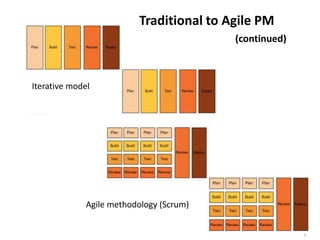
Waterfall model
Iterative model
The Basics: From Traditional to Agile PM
3
Iterative model
Agile methodology (Scrum)
Traditional to Agile PM
(continued)
4
Who would you like to manage you?
• A collaborator who spends a lot of time
getting your input, and blends that at the time
with what the customer wants to do? Or,
• A technical / managerial leader who knows
what to tell you to do next, based on a plan?
What are you used to?
5
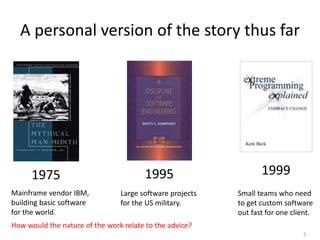
A personal version of the story thus far
1975 1995 1999
How would the nature of the work relate to the advice?
Mainframe vendor IBM,
building basic software
for the world.
Large software projects
for the US military.
Small teams who need
to get custom software
out fast for one client.
6
“Old School” is not…
• Non-iterative
• Requirements never change
• Process is always good
Focus on the differences described in the Agile manifesto
• Individuals and interactions over processes and tools
• Working software over comprehensive documentation
• Customer collaboration over contract negotiation
• Responding to change over following a plan
Is the customer collaboration essential to Agile?
7
Visibility
• What is Philips saying?
• Is he right?
How does it relate to:
• Individuals and interactions over processes and
tools
• Working software over comprehensive
documentation
• Customer collaboration over contract negotiation
What if the project lasts 20 years, like Adobe Acrobat?
8
What is CM?
• Software Configuration Management, but let
me say slightly more than just that:
– It’s managing all the artifacts that add value to the
project (for you or for the customer).
– That especially includes managing the code.
– It also includes managing other artifacts key to
success of the product, like design, tests,
requirements.
Why is configuration management easier with Agile development?
9
Configuration Management
• Relates to: Responding to change, over
following a plan.
• Also relates to: Doing development like OO
software is supposed to be designed:
– Work on one set of related things at a time.
– Things that “mean something” to you and to the
customer.
Is this an advantage, even if you have to maintain other documents besides the code?
10
Phillips’ CM Scheme
• “Configuration Control Boards” (CCB’s) agree
on “baselines” at each project stage.
• Everyone works off those artifacts as “what
we should be doing.”
• Perfecting and preserving the documents has
high value.
The other meaning of CCB is “Change Control Board.” How would that differ?
11
What do the agile and old school
methods agree on?
• We need to deliver a product with value for
the customer(s).
– In a competitive situation, more value, sooner.
• That delivery is (usually) part of a larger
marketing strategy.
– To keep a stable group of customers happy, and
– To attract new customers in some market niche.
12
12 Agile Principles
• Our highest priority is to satisfy the customer
through early and continuous delivery
of valuable software.
• Welcome changing requirements, even late
in development. Agile processes harness
change for the customer's competitive
advantage.
• Deliver working software frequently, from a
couple of weeks to a couple of months, with
a preference to the shorter timescale.
• Business people and developers must work
together daily throughout the project.
• Build projects around motivated individuals.
Give them the environment and support
they need, and trust them to get the job
done.
• At regular intervals, the team reflects on how
to become more effective, then tunes and
adjusts its behavior accordingly.
• The most efficient and effective method of
conveying information to and within a
development team is face-to-face
conversation.
• Working software is the primary measure of
progress.
• Agile processes promote sustainable
development. The sponsors, developers, and
users should be able to maintain a constant
pace indefinitely.
• Continuous attention to technical excellence
and good design enhances agility.
• Simplicity--the art of maximizing the amount
of work not done--is essential.
• The best architectures, requirements, and
designs emerge from self-organizing teams.
What does “self-organizing” mean?
13
Where each is stronger – my list
Agile:
• Building off close collaboration
with one customer.
• Getting a product with
significant value out faster.
• Building with a small team
working closely together.
• Iterative delivery by a single
organization who come to have
the knowledge in their heads.
• What’s important can only be
discovered incrementally.
• What’s a “perfect example” of
an Agile-friendly project?
Old school:
• Building a general product to
address a wide customer base.
• Building off standards and
consistent design principles.
• Managing a large project with
lots of interdependent pieces.
• Product releases over a long
period of time, by rotating staff
who rely on documentation.
• Goals and rules well known at
the start.
• What’s a “perfect example” of
an Old-school-friendly project?
Do it when the cost of rework is low.
Dealing with things “ad hoc” mostly
works. We call it “refactoring.”
Do it when the cost of rework is high.
Big surprises would be awful. We’d be
starting over.
14
One summary of differences
15
What I want you to take away
• Agile and non-agile approaches have some of the
same goals and techniques
• And they also have some really key disconnects:
– The extent to which design and documentation is
prized over face to face communication OR code
– The amount of control/review that’s deemed
important in the process
• Scaling and difficulty is a big question here: How
far can an ad hoc process take you?
16
And… This isn’t just about
Agile vs Old School
• Every software organization you will ever work in
thinks their entire software process is “right,” or
“right for what we do.”
• At Lucent, we did a large study, discovering that,
for us, creating a detailed design before coding
didn’t improve the quality of the product.
– So, after decades, we finally stopped doing that step.
– It saved a lot of time on each project.
Even after the study, was there resistance to that change?
17
Homework and Reading Reminders
• Think about a term project / presentation – See course
web site!
• Let’s vote on Week 3! 
• Four readings for next week –
– See Moodle for the readings and their quizzes
• Goal will be to compare theories and actual practices!
• Please add to the “last questions” on each quiz – what
would be most valuable for you to talk about!
• The following set of slides here is an intro…
This is a “Week 1” thing, to put this info in a slide deck!
Normally – See the schedule on the course web site.
18
Our learning outcomes
1. Key principles of agile project management
2. Agile software life cycle processes
3. Agile software project estimation
4. Software risk planning and management
5. Agile software project planning
6. Managing software projects to a plan
7. Forming and managing project teams
8. Progress, Program/Portfolio Management
9. Adv. Topics: Earned Value, Critical Chain
Re-repeated
This week &
Next week
What for
Week 3?

The Divide.pptx

  • 1.
    1 The Divide -Agile/Non-Agile - A first taste! Right – The debate in one picture: Do these rafters need to be able to maneuver fast based on what they see immediately ahead? Or, do they need a correct plan of the river and a design for how to accomplish each stage? CSSE 579 Week 1 Slide set 3
  • 2.
    2 Waterfall model Iterative model TheBasics: From Traditional to Agile PM
  • 3.
    3 Iterative model Agile methodology(Scrum) Traditional to Agile PM (continued)
  • 4.
    4 Who would youlike to manage you? • A collaborator who spends a lot of time getting your input, and blends that at the time with what the customer wants to do? Or, • A technical / managerial leader who knows what to tell you to do next, based on a plan? What are you used to?
  • 5.
    5 A personal versionof the story thus far 1975 1995 1999 How would the nature of the work relate to the advice? Mainframe vendor IBM, building basic software for the world. Large software projects for the US military. Small teams who need to get custom software out fast for one client.
  • 6.
    6 “Old School” isnot… • Non-iterative • Requirements never change • Process is always good Focus on the differences described in the Agile manifesto • Individuals and interactions over processes and tools • Working software over comprehensive documentation • Customer collaboration over contract negotiation • Responding to change over following a plan Is the customer collaboration essential to Agile?
  • 7.
    7 Visibility • What isPhilips saying? • Is he right? How does it relate to: • Individuals and interactions over processes and tools • Working software over comprehensive documentation • Customer collaboration over contract negotiation What if the project lasts 20 years, like Adobe Acrobat?
  • 8.
    8 What is CM? •Software Configuration Management, but let me say slightly more than just that: – It’s managing all the artifacts that add value to the project (for you or for the customer). – That especially includes managing the code. – It also includes managing other artifacts key to success of the product, like design, tests, requirements. Why is configuration management easier with Agile development?
  • 9.
    9 Configuration Management • Relatesto: Responding to change, over following a plan. • Also relates to: Doing development like OO software is supposed to be designed: – Work on one set of related things at a time. – Things that “mean something” to you and to the customer. Is this an advantage, even if you have to maintain other documents besides the code?
  • 10.
    10 Phillips’ CM Scheme •“Configuration Control Boards” (CCB’s) agree on “baselines” at each project stage. • Everyone works off those artifacts as “what we should be doing.” • Perfecting and preserving the documents has high value. The other meaning of CCB is “Change Control Board.” How would that differ?
  • 11.
    11 What do theagile and old school methods agree on? • We need to deliver a product with value for the customer(s). – In a competitive situation, more value, sooner. • That delivery is (usually) part of a larger marketing strategy. – To keep a stable group of customers happy, and – To attract new customers in some market niche.
  • 12.
    12 12 Agile Principles •Our highest priority is to satisfy the customer through early and continuous delivery of valuable software. • Welcome changing requirements, even late in development. Agile processes harness change for the customer's competitive advantage. • Deliver working software frequently, from a couple of weeks to a couple of months, with a preference to the shorter timescale. • Business people and developers must work together daily throughout the project. • Build projects around motivated individuals. Give them the environment and support they need, and trust them to get the job done. • At regular intervals, the team reflects on how to become more effective, then tunes and adjusts its behavior accordingly. • The most efficient and effective method of conveying information to and within a development team is face-to-face conversation. • Working software is the primary measure of progress. • Agile processes promote sustainable development. The sponsors, developers, and users should be able to maintain a constant pace indefinitely. • Continuous attention to technical excellence and good design enhances agility. • Simplicity--the art of maximizing the amount of work not done--is essential. • The best architectures, requirements, and designs emerge from self-organizing teams. What does “self-organizing” mean?
  • 13.
    13 Where each isstronger – my list Agile: • Building off close collaboration with one customer. • Getting a product with significant value out faster. • Building with a small team working closely together. • Iterative delivery by a single organization who come to have the knowledge in their heads. • What’s important can only be discovered incrementally. • What’s a “perfect example” of an Agile-friendly project? Old school: • Building a general product to address a wide customer base. • Building off standards and consistent design principles. • Managing a large project with lots of interdependent pieces. • Product releases over a long period of time, by rotating staff who rely on documentation. • Goals and rules well known at the start. • What’s a “perfect example” of an Old-school-friendly project? Do it when the cost of rework is low. Dealing with things “ad hoc” mostly works. We call it “refactoring.” Do it when the cost of rework is high. Big surprises would be awful. We’d be starting over.
  • 14.
    14 One summary ofdifferences
  • 15.
    15 What I wantyou to take away • Agile and non-agile approaches have some of the same goals and techniques • And they also have some really key disconnects: – The extent to which design and documentation is prized over face to face communication OR code – The amount of control/review that’s deemed important in the process • Scaling and difficulty is a big question here: How far can an ad hoc process take you?
  • 16.
    16 And… This isn’tjust about Agile vs Old School • Every software organization you will ever work in thinks their entire software process is “right,” or “right for what we do.” • At Lucent, we did a large study, discovering that, for us, creating a detailed design before coding didn’t improve the quality of the product. – So, after decades, we finally stopped doing that step. – It saved a lot of time on each project. Even after the study, was there resistance to that change?
  • 17.
    17 Homework and ReadingReminders • Think about a term project / presentation – See course web site! • Let’s vote on Week 3!  • Four readings for next week – – See Moodle for the readings and their quizzes • Goal will be to compare theories and actual practices! • Please add to the “last questions” on each quiz – what would be most valuable for you to talk about! • The following set of slides here is an intro… This is a “Week 1” thing, to put this info in a slide deck! Normally – See the schedule on the course web site.
  • 18.
    18 Our learning outcomes 1.Key principles of agile project management 2. Agile software life cycle processes 3. Agile software project estimation 4. Software risk planning and management 5. Agile software project planning 6. Managing software projects to a plan 7. Forming and managing project teams 8. Progress, Program/Portfolio Management 9. Adv. Topics: Earned Value, Critical Chain Re-repeated This week & Next week What for Week 3?

Editor's Notes

  • #2 Image from http://epam-systems.blogspot.com/2012/05/introduction-to-agile-epam-systems.html./
  • #3 It is all in how you slice it…
  • #15 From a 2005 Communications of the ACM article, http://cacm.acm.org/magazines/2005/5/6219-challenges-of-migrating-to-agile-methodologies/abstract.
  • #17 Cat from http://www.indiandownunder.com.au/2011/08/superstitions/.