Listen, please!
Human and Animal Differences in the Use of
Language
Duality of Patterning
HUMAN ANIMAL
Distinctive sounds, called
phonemes are arbitrary and
have no meaning but humans
can string these sounds in an
infinite numbers of ways to
create meaning via words and
sentences.
Animals do not communicate by
arranging arbitrary sounds which
limits the number of messages
they can create.
Creativity
HUMAN ANIMAL
New words can be
invented easily.
Animals have to
evolve in order for
their signs to
change.
Human and Animal Differences in the Use of
Language
Human and Animal Differences in the Use of
Language
Displacememnt
HUMAN ANIMAL
Humans can talk about
remote, abstract, or
imaginary things that
aren't happening in their
immediate environments.
Animal communication is
context driver, they react
to stimuli or indexes.
Interchangeablity
HUMAN ANIMAL
Any gender of human can
use the same languages.
Certain animal
communications in the
animal world can only be
used by one gender of
that animal.
Human and Animal Differences in the Use of
Language
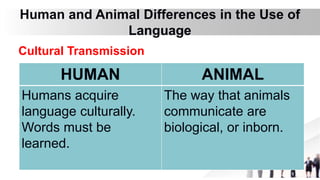
Cultural Transmission
HUMAN ANIMAL
Humans acquire
language culturally.
Words must be
learned.
The way that animals
communicate are
biological, or inborn.
Human and Animal Differences in the Use of
Language
Biology
HUMAN ANIMAL
The human voice box
and tongue are very
unique and are required
to make the sounds we
recognized as language.
Other animals have
different biological
structures, which impact
the way they make
sounds.
Human and Animal Differences in the Use of
Language
Ambiguity
HUMAN ANIMAL
A word, or sign, can
have several
meanings.
Every sign has only
one meaning.
Human and Animal Differences in the Use of
Language
Similarities Between Human and Animal
Communication
Emotions
The fear emotion, humans and animals
have similar responses; widened eyes,
open mouth,rapid heartbeat, hair stands on
end, muscles tremble and so on.
Similarities Between Human and Animal
Communication
Sound
Humans convey emotion through the use
of words and tone in much the same way
as animals communicate emotion through
sound.
Similarities Between Human and Animal
Communication
Odor
Odor communication in humans contribute to
family recognition, maternal bonding, and mate
selection. Similar behaviour has been observed
in animals, as odor is used to mark territorial
boundaries, warn of intruders and to proclaim a
readiness to mate.
Thank you for listening!

THE different ANIMAL LANGUAGE presentations

  • 2.
  • 3.
    Human and AnimalDifferences in the Use of Language Duality of Patterning HUMAN ANIMAL Distinctive sounds, called phonemes are arbitrary and have no meaning but humans can string these sounds in an infinite numbers of ways to create meaning via words and sentences. Animals do not communicate by arranging arbitrary sounds which limits the number of messages they can create.
  • 5.
    Creativity HUMAN ANIMAL New wordscan be invented easily. Animals have to evolve in order for their signs to change. Human and Animal Differences in the Use of Language
  • 7.
    Human and AnimalDifferences in the Use of Language Displacememnt HUMAN ANIMAL Humans can talk about remote, abstract, or imaginary things that aren't happening in their immediate environments. Animal communication is context driver, they react to stimuli or indexes.
  • 9.
    Interchangeablity HUMAN ANIMAL Any genderof human can use the same languages. Certain animal communications in the animal world can only be used by one gender of that animal. Human and Animal Differences in the Use of Language
  • 11.
    Cultural Transmission HUMAN ANIMAL Humansacquire language culturally. Words must be learned. The way that animals communicate are biological, or inborn. Human and Animal Differences in the Use of Language
  • 13.
    Biology HUMAN ANIMAL The humanvoice box and tongue are very unique and are required to make the sounds we recognized as language. Other animals have different biological structures, which impact the way they make sounds. Human and Animal Differences in the Use of Language
  • 15.
    Ambiguity HUMAN ANIMAL A word,or sign, can have several meanings. Every sign has only one meaning. Human and Animal Differences in the Use of Language
  • 17.
    Similarities Between Humanand Animal Communication Emotions The fear emotion, humans and animals have similar responses; widened eyes, open mouth,rapid heartbeat, hair stands on end, muscles tremble and so on.
  • 19.
    Similarities Between Humanand Animal Communication Sound Humans convey emotion through the use of words and tone in much the same way as animals communicate emotion through sound.
  • 21.
    Similarities Between Humanand Animal Communication Odor Odor communication in humans contribute to family recognition, maternal bonding, and mate selection. Similar behaviour has been observed in animals, as odor is used to mark territorial boundaries, warn of intruders and to proclaim a readiness to mate.
  • 24.
    Thank you forlistening!