A Primer in Performance Psychology
for Practitioner Psychologists
The Culture of Ballet
August 7, 2016
Acknowledgment:
Discussant
Dr. Nadine Kaslow,
past president of APA,
for her unwavering
support of dance.
The Ailey School’s weekly workshop on
dancer stress run by Linda Hamilton, with
renowned guest Nadine Kaslow, 2015.
Translations from Athletes to Dancers:
What Works and What Doesn’t
Kate F. Hays, Ph.D.
The Performing Edge
Toronto
August 7, 2016
Denver, CO
Outline
• A brief history of “performance psychology”
• The sport-->performance psychology
connection
• Model of practitioner development in
performance psychology
– Applications to dance
A very brief history of performance
psychology—1990s
• “Performance psychology” term first used
• L. Hamilton: The Person Behind the Mask:
A Guide to Performing Arts Psychology
• Positive psychology
• Umbrella perspective in sport psychology
• although AAASP rejects re-naming to include “performance”
A very brief history of performance
psychology—2000s
• Term gains traction
• Army “Ready & Resilience” training applying sport
psychology to military
• Definitions, books, articles, conference programming
• Div. 47 Practice Committee: “Defining the Practice of Sport and
Performance Psychology “
A very brief history of performance
psychology—2010s
• Language of discourse
• Division 47:
• Journal: Sport, Exercise, & Performance Psychology
• Recent name change
• Section on Performance Psychology
• Books, courses, workshops
• M.A. degrees in Performance Psychology
• ACSM-sponsored: www.athletesandthearts.com
From sport psychology
performance psychology
• Mental Skills
• The Body-Mind Connection
• Relevant Research Base
• Direct Applications: Translations from sport to
performance
Developing Competence in
Performance Psychology
Hays & Brown, in preparation
Foundational skills for performance
psychology [Tier 1]
• Relationship or clinical/counseling skills
• Change skills
• Knowledge of performance excellence
• Knowledge of the physiological aspects of
performance
• Knowledge of systems and systems
consultation
Common Characteristics
across Performance Domains [Tier 2]
• Mental preparation
• Pre-performance/performance arousal
• Striving for perfection
• Competition [explicit/implicit]
• Performance limits [overtraining, burnout,
injury, retirement]
• Individual in context [coach/teacher/supervisor,
team, organization, societal assumptions]
• Confidence
Domain-Specific Issues re Dance [Tier 2]
• “Butterfly” profession
• Early start
• Away from home
• Identity foreclosure
• Retirement
• History, tradition
• Perfectionism
• Closed shop
• Physicality/physical intelligence
• Weight/eating
• Substance use
• Injury
• Competition
• Aesthetic judgment
Contextual Intelligence [Tier 3]
(Brown, Gould, & Foster, 2007)
• Language re dance x locale
• Merde
• Break a leg
• Chookas!
Kate F. Hays, PhD, CPsych, CC-AASP
The Performing Edge
Toronto, ON, Canada
www.theperformingedge.com
drhays@theperformingedge.com
Performance Psychologists:
Understanding the Culture and Language
of Ballet
Linda H. Hamilton, Ph.D.
New York City Ballet Wellness Consultant
August 7, 2016
Denver, CO
• To highlight ballet’s unique culture & mindset
• To provide language that reflects this
knowledge
• To help psychologists engage dancers in
treatment
Objectives:
The Ballet Culture*
Selects perfectionists for 9 years of disciplined
training (similar to the military), starting at 8yo.
Creates a hierarchy, based on constant competition
for elite schools, jobs, roles and promotions.
Prizes stoicism in the face of physical & mental
stress, equating problems with weakness.
*Hamilton & Robson, 2007; Hays & Brown, 2004
The Ballet Dancer’s Mindset*
Dancers, who spend thousands of hours developing
this expertise, feel passionate about their work.
They often report substantial periods of ‘flow’ that
override typical needs, such as pain & fatigue.
An all-consuming work ethic prevails despite failure:
65% are not hired, although 90% aspire to this goal.
*Hamilton, 1997, 1998
• Injuries
• Burnout
• Mental Stress
• Weight Management
• Performance Anxiety
• Maladaptive Perfectionism
Occupational Stresses*
*Hamilton & NYCB, 2008
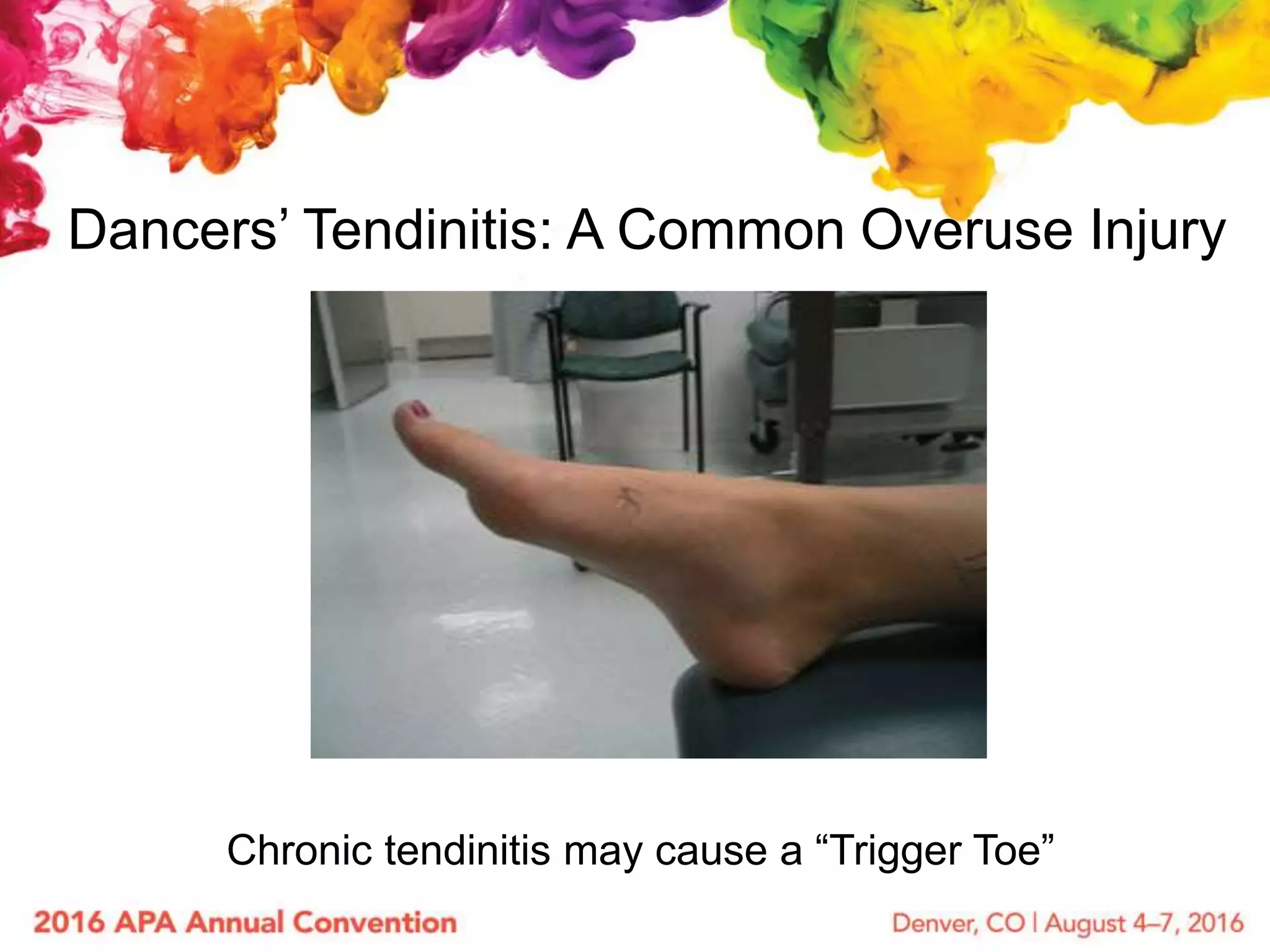
Dancers’ Tendinitis: A Common Overuse Injury
Chronic tendinitis may cause a “Trigger Toe”
Dancers’ tendonitis often
requires surgery to release
the sheath surrounding the
FHL tendon so the lump
doesn’t catch while
moving.
©William Hamilton, M.D.
Language Reflects Knowledge of Ballet
Injuries: “Being ‘out’ is tough, but medical help gives you
a competitive edge to cross-train & focus on your artistry.”
(caters to dancers’ need to excel)
Weight Management: “Your potential dance wt requires a
unique program of aerobics, wt training & nutrition.”
Burnout: “You can your strength, stamina, memory &
reaction time with > 8 hrs. of sleep & 1 day off p/wk.
Language (continued)
Performance Anxiety: “Nerves are normal; you need a
moderate amount of arousal to “dance.”
Maladaptive Perfectionism: “No one is perfect; yet
you never lose by learning from mistakes.”
Stress Management: “Fight-or-flight” hormones can be
controlled by using tools similar to Olympic athletes.”
• Interactive
• Educational
• Solution-Oriented
• Emotional Support
• Focus on Strengths
• Mental Skills Training
Engaging Dancers in Treatment*
*Hamilton & Robson, 2007; Hays & Brown, 2004
• International Assoc. of Dance Medicine & Science
(membership, position papers, referrals; iadms.org)
• American Dietetic Association
(dietary guidelines, tips, referrals; eatright.org)
• Renfrew Center Eating Disorder Treatment Facility
(nationwide programs, referrals; renfrewcenter.com)
• Career Transition for Dancers
(testing, counseling & grants; careertransition.org)
Resources
Thank You
www.drlindahamilton.com
talk2me@wellness4performers.com
©Paul Kolnik
From Butterflies to Bouquets to Resumés
Sharon A. Chirban, Ph.D., CC-AASP
Consultant, Boston Ballet
Clinical Sport Psychologist,
Boston Children’s Hospital/Harvard Medical School
August 7, 2016
Denver, CO
Goals For This Talk
• Reiterate ubiquitous dancer traits that relate to
both success and challenge for the dancer from
youth ballet through principal
• Issues related to seeking treatment for injuries
(Krasnow, Kerr, & Manwaring, 1994)
• Psychological risk factors associated with injury
• High Commitment Eating vs. Eating Disorder
• Harmonious vs. Obsessive Passion
• Present a detailed case
• Excellence vs. Perfectionism
• Anxiety about time away due to
injury (12 y old example)
• Concerns about body composition
and ballet biomechanics
• High Commitment Eating vs. Eating
Disorder (19 y old example)
• The rewards and disadvantages of
compliance (20 y old example)
• Performance anxiety
Ubiquitous Traits
Case Presentation
28 year-old Company Dancer
• Career Achievement – 10 years Boston
Ballet
• Stakes of proving oneself
• “I have what it takes, no, maybe I don’t”
• Stress of learning choreography and
remembering it under pressure
• Navigating the marathon of the
Nutcracker Season
• New challenges with body image and
body comparison on a national stage
• Navigating Haglund’s deformity/achilles
tendon surgery and management of post-
op pain
• Graduated from college – B.S. Sociology
• When is it time to stop?
• Not having fun anymore
• If I stop what do I do next…. I know I will do something
meaningful, but what?
• I’m tired of the pain
• If I am not a Boston Ballet ballerina, who am I?
• Will my boyfriend still want to be with me, if I am no
longer a professional ballet dancer?
• Eat/Pray/Love trip
Case Continued
Harmonious Passion
passion is defined as a strong inclination toward a self-defining activity
that people like (or even love), find important, and in which they invest
time and energy on a regular basis
Obsessive Passion
characterized by intra- or interpersonal pressures that push obsessively
passionate people to partake in their activity
OP not expected to produce positive effects and may facilitate negative
affect, conflict with other life activities, and psychological ill-being
Vallerand, et al. (2003).On Obsessive and Harmonious Passion Journal of Personality and Social
Psychology, Vol. 85, No. 4, 756-767
Dance Medicine
• A high prevalence of lower extremity and back injuries, with soft
tissue and over use predominating
• Lifetime prevalence injury in professional ballet dancers ranged
between 40% and 85% (Hincapie, et al)
• Adolescent dancers account for most of the ballet injuries
• Haglund deformity is chronic irritation from the shoe on the
posterosuperior surface of the calcaneus (training relevé and
jumps)
Weber, B. (2011). Dance Medicine of the Foot and Ankle: A Review Clin
Podiatr Med Surg 28, 137-154.
Sharon A. Chirban, PhD, CC-AASP
Consultant, Boston Ballet
Clinical Sport Psychologist, Boston Children’s
Hospital/Harvard Medical School
Amplifying Performance Consulting, LLC
www.amplifyingperformance.com
Discussant: Dr. Nadine Kaslow

The Culture of Ballet

  • 2.
    A Primer inPerformance Psychology for Practitioner Psychologists The Culture of Ballet August 7, 2016
  • 3.
    Acknowledgment: Discussant Dr. Nadine Kaslow, pastpresident of APA, for her unwavering support of dance. The Ailey School’s weekly workshop on dancer stress run by Linda Hamilton, with renowned guest Nadine Kaslow, 2015.
  • 4.
    Translations from Athletesto Dancers: What Works and What Doesn’t Kate F. Hays, Ph.D. The Performing Edge Toronto August 7, 2016 Denver, CO
  • 5.
    Outline • A briefhistory of “performance psychology” • The sport-->performance psychology connection • Model of practitioner development in performance psychology – Applications to dance
  • 6.
    A very briefhistory of performance psychology—1990s • “Performance psychology” term first used • L. Hamilton: The Person Behind the Mask: A Guide to Performing Arts Psychology • Positive psychology • Umbrella perspective in sport psychology • although AAASP rejects re-naming to include “performance”
  • 7.
    A very briefhistory of performance psychology—2000s • Term gains traction • Army “Ready & Resilience” training applying sport psychology to military • Definitions, books, articles, conference programming • Div. 47 Practice Committee: “Defining the Practice of Sport and Performance Psychology “
  • 8.
    A very briefhistory of performance psychology—2010s • Language of discourse • Division 47: • Journal: Sport, Exercise, & Performance Psychology • Recent name change • Section on Performance Psychology • Books, courses, workshops • M.A. degrees in Performance Psychology • ACSM-sponsored: www.athletesandthearts.com
  • 9.
    From sport psychology performancepsychology • Mental Skills • The Body-Mind Connection • Relevant Research Base • Direct Applications: Translations from sport to performance
  • 10.
    Developing Competence in PerformancePsychology Hays & Brown, in preparation
  • 11.
    Foundational skills forperformance psychology [Tier 1] • Relationship or clinical/counseling skills • Change skills • Knowledge of performance excellence • Knowledge of the physiological aspects of performance • Knowledge of systems and systems consultation
  • 12.
    Common Characteristics across PerformanceDomains [Tier 2] • Mental preparation • Pre-performance/performance arousal • Striving for perfection • Competition [explicit/implicit] • Performance limits [overtraining, burnout, injury, retirement] • Individual in context [coach/teacher/supervisor, team, organization, societal assumptions] • Confidence
  • 13.
    Domain-Specific Issues reDance [Tier 2] • “Butterfly” profession • Early start • Away from home • Identity foreclosure • Retirement • History, tradition • Perfectionism • Closed shop • Physicality/physical intelligence • Weight/eating • Substance use • Injury • Competition • Aesthetic judgment
  • 14.
    Contextual Intelligence [Tier3] (Brown, Gould, & Foster, 2007) • Language re dance x locale • Merde • Break a leg • Chookas!
  • 15.
    Kate F. Hays,PhD, CPsych, CC-AASP The Performing Edge Toronto, ON, Canada www.theperformingedge.com drhays@theperformingedge.com
  • 16.
    Performance Psychologists: Understanding theCulture and Language of Ballet Linda H. Hamilton, Ph.D. New York City Ballet Wellness Consultant August 7, 2016 Denver, CO
  • 17.
    • To highlightballet’s unique culture & mindset • To provide language that reflects this knowledge • To help psychologists engage dancers in treatment Objectives:
  • 18.
    The Ballet Culture* Selectsperfectionists for 9 years of disciplined training (similar to the military), starting at 8yo. Creates a hierarchy, based on constant competition for elite schools, jobs, roles and promotions. Prizes stoicism in the face of physical & mental stress, equating problems with weakness. *Hamilton & Robson, 2007; Hays & Brown, 2004
  • 19.
    The Ballet Dancer’sMindset* Dancers, who spend thousands of hours developing this expertise, feel passionate about their work. They often report substantial periods of ‘flow’ that override typical needs, such as pain & fatigue. An all-consuming work ethic prevails despite failure: 65% are not hired, although 90% aspire to this goal. *Hamilton, 1997, 1998
  • 20.
    • Injuries • Burnout •Mental Stress • Weight Management • Performance Anxiety • Maladaptive Perfectionism Occupational Stresses* *Hamilton & NYCB, 2008
  • 21.
    Dancers’ Tendinitis: ACommon Overuse Injury Chronic tendinitis may cause a “Trigger Toe”
  • 22.
    Dancers’ tendonitis often requiressurgery to release the sheath surrounding the FHL tendon so the lump doesn’t catch while moving. ©William Hamilton, M.D.
  • 23.
    Language Reflects Knowledgeof Ballet Injuries: “Being ‘out’ is tough, but medical help gives you a competitive edge to cross-train & focus on your artistry.” (caters to dancers’ need to excel) Weight Management: “Your potential dance wt requires a unique program of aerobics, wt training & nutrition.” Burnout: “You can your strength, stamina, memory & reaction time with > 8 hrs. of sleep & 1 day off p/wk.
  • 24.
    Language (continued) Performance Anxiety:“Nerves are normal; you need a moderate amount of arousal to “dance.” Maladaptive Perfectionism: “No one is perfect; yet you never lose by learning from mistakes.” Stress Management: “Fight-or-flight” hormones can be controlled by using tools similar to Olympic athletes.”
  • 25.
    • Interactive • Educational •Solution-Oriented • Emotional Support • Focus on Strengths • Mental Skills Training Engaging Dancers in Treatment* *Hamilton & Robson, 2007; Hays & Brown, 2004
  • 26.
    • International Assoc.of Dance Medicine & Science (membership, position papers, referrals; iadms.org) • American Dietetic Association (dietary guidelines, tips, referrals; eatright.org) • Renfrew Center Eating Disorder Treatment Facility (nationwide programs, referrals; renfrewcenter.com) • Career Transition for Dancers (testing, counseling & grants; careertransition.org) Resources
  • 27.
  • 28.
    From Butterflies toBouquets to Resumés Sharon A. Chirban, Ph.D., CC-AASP Consultant, Boston Ballet Clinical Sport Psychologist, Boston Children’s Hospital/Harvard Medical School August 7, 2016 Denver, CO
  • 29.
    Goals For ThisTalk • Reiterate ubiquitous dancer traits that relate to both success and challenge for the dancer from youth ballet through principal • Issues related to seeking treatment for injuries (Krasnow, Kerr, & Manwaring, 1994) • Psychological risk factors associated with injury • High Commitment Eating vs. Eating Disorder • Harmonious vs. Obsessive Passion • Present a detailed case
  • 30.
    • Excellence vs.Perfectionism • Anxiety about time away due to injury (12 y old example) • Concerns about body composition and ballet biomechanics • High Commitment Eating vs. Eating Disorder (19 y old example) • The rewards and disadvantages of compliance (20 y old example) • Performance anxiety Ubiquitous Traits
  • 31.
    Case Presentation 28 year-oldCompany Dancer • Career Achievement – 10 years Boston Ballet • Stakes of proving oneself • “I have what it takes, no, maybe I don’t” • Stress of learning choreography and remembering it under pressure • Navigating the marathon of the Nutcracker Season • New challenges with body image and body comparison on a national stage • Navigating Haglund’s deformity/achilles tendon surgery and management of post- op pain • Graduated from college – B.S. Sociology
  • 32.
    • When isit time to stop? • Not having fun anymore • If I stop what do I do next…. I know I will do something meaningful, but what? • I’m tired of the pain • If I am not a Boston Ballet ballerina, who am I? • Will my boyfriend still want to be with me, if I am no longer a professional ballet dancer? • Eat/Pray/Love trip Case Continued
  • 33.
    Harmonious Passion passion isdefined as a strong inclination toward a self-defining activity that people like (or even love), find important, and in which they invest time and energy on a regular basis Obsessive Passion characterized by intra- or interpersonal pressures that push obsessively passionate people to partake in their activity OP not expected to produce positive effects and may facilitate negative affect, conflict with other life activities, and psychological ill-being Vallerand, et al. (2003).On Obsessive and Harmonious Passion Journal of Personality and Social Psychology, Vol. 85, No. 4, 756-767
  • 34.
    Dance Medicine • Ahigh prevalence of lower extremity and back injuries, with soft tissue and over use predominating • Lifetime prevalence injury in professional ballet dancers ranged between 40% and 85% (Hincapie, et al) • Adolescent dancers account for most of the ballet injuries • Haglund deformity is chronic irritation from the shoe on the posterosuperior surface of the calcaneus (training relevé and jumps) Weber, B. (2011). Dance Medicine of the Foot and Ankle: A Review Clin Podiatr Med Surg 28, 137-154.
  • 35.
    Sharon A. Chirban,PhD, CC-AASP Consultant, Boston Ballet Clinical Sport Psychologist, Boston Children’s Hospital/Harvard Medical School Amplifying Performance Consulting, LLC www.amplifyingperformance.com
  • 36.

Editor's Notes

  • #35 While there are pluses to early retirement (i.e., you have more time to invest in a 2nd career), the minuses are that dancers often have no idea what they want to do, especially if they've been let go or have a debilitating injury---in other words, "pushed" out of the profession. In contrast, principals often have trouble transitioning because they've hit the top of the profession Most leave dance in their mid-40's due to age & end up teaching or being a ballet mistress (not exactly dream jobs) resulting in bursa formation and then chronic pain on the posterosuperior aspect of the heal