The Community College
System in Ontario
Dr. Marilyn Herie PhD RSW
Dean, Learning, Teaching and Scholarship
Centre for Organizational Learning and Teaching
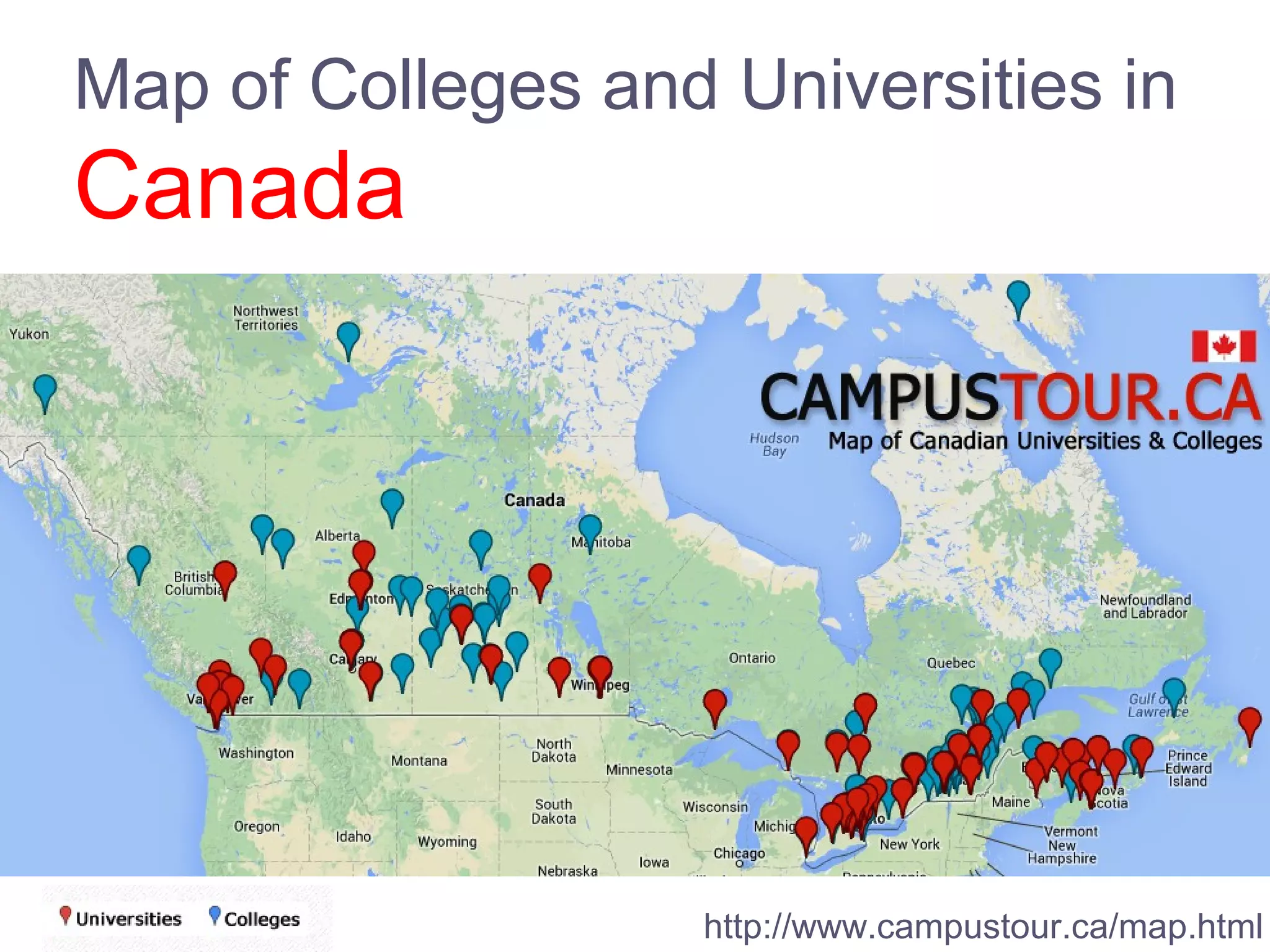
http://www.campustour.ca/map.html
Map of Colleges and Universities in
Canada
http://www.investinontario.com/business-advantages
Map of Colleges and Universities in
Ontario
50 years
http://www.collegesontario.org/news/fact-sheets/General-2014.pdf
600 programs
http://www.collegesontario.org/news/fact-sheets/General-2014.pdf
220,000 full time
300,000 part time
http://www.collegesontario.org/news/fact-sheets/General-2014.pdf
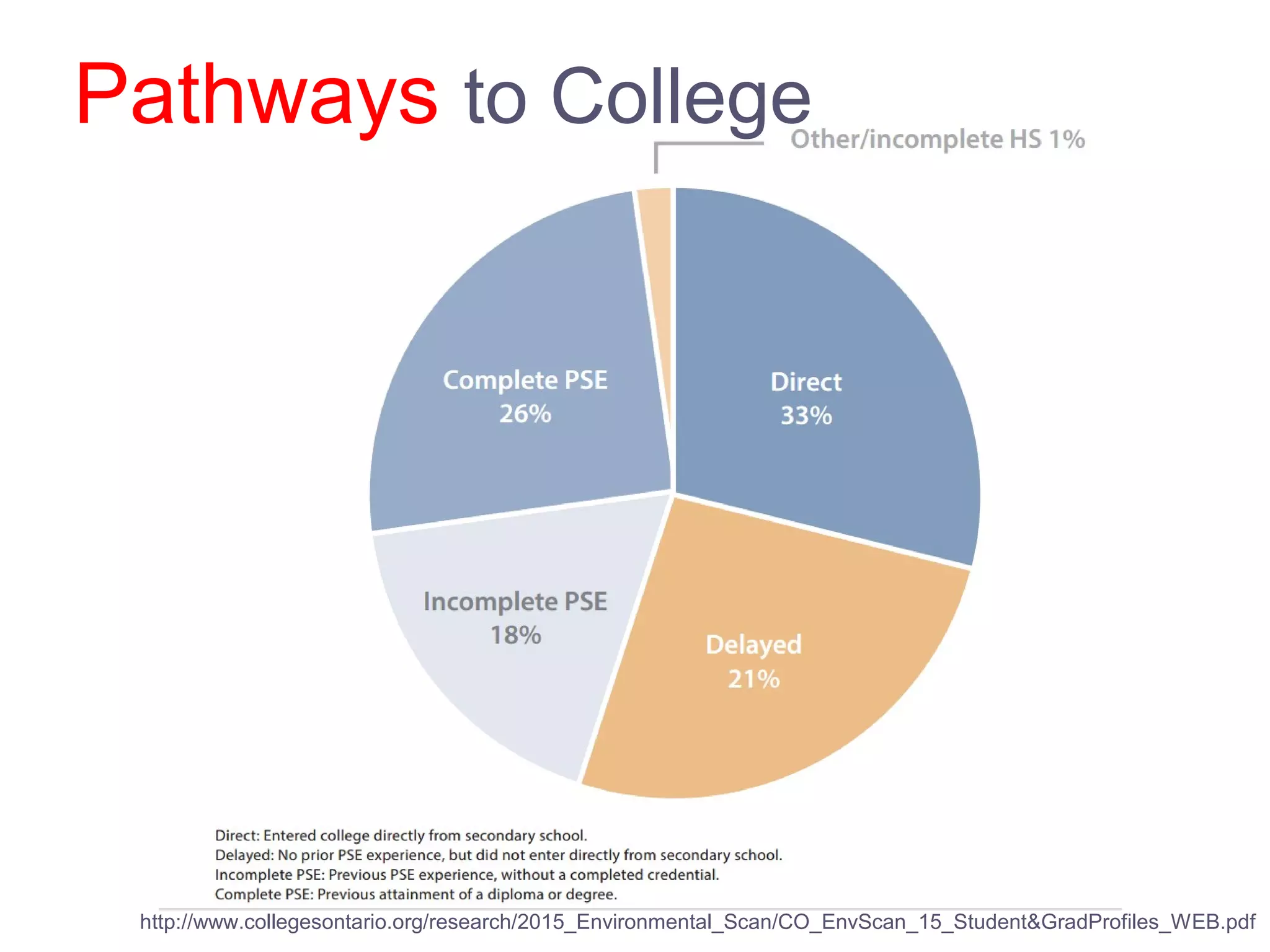
Pathways to College
http://www.collegesontario.org/research/2015_Environmental_Scan/CO_EnvScan_15_Student&GradProfiles_WEB.pdf
Why do students come?
http://www.collegesontario.org/research/2015_Environmental_Scan/CO_EnvScan_15_Student&GradProfiles_WEB.pdf
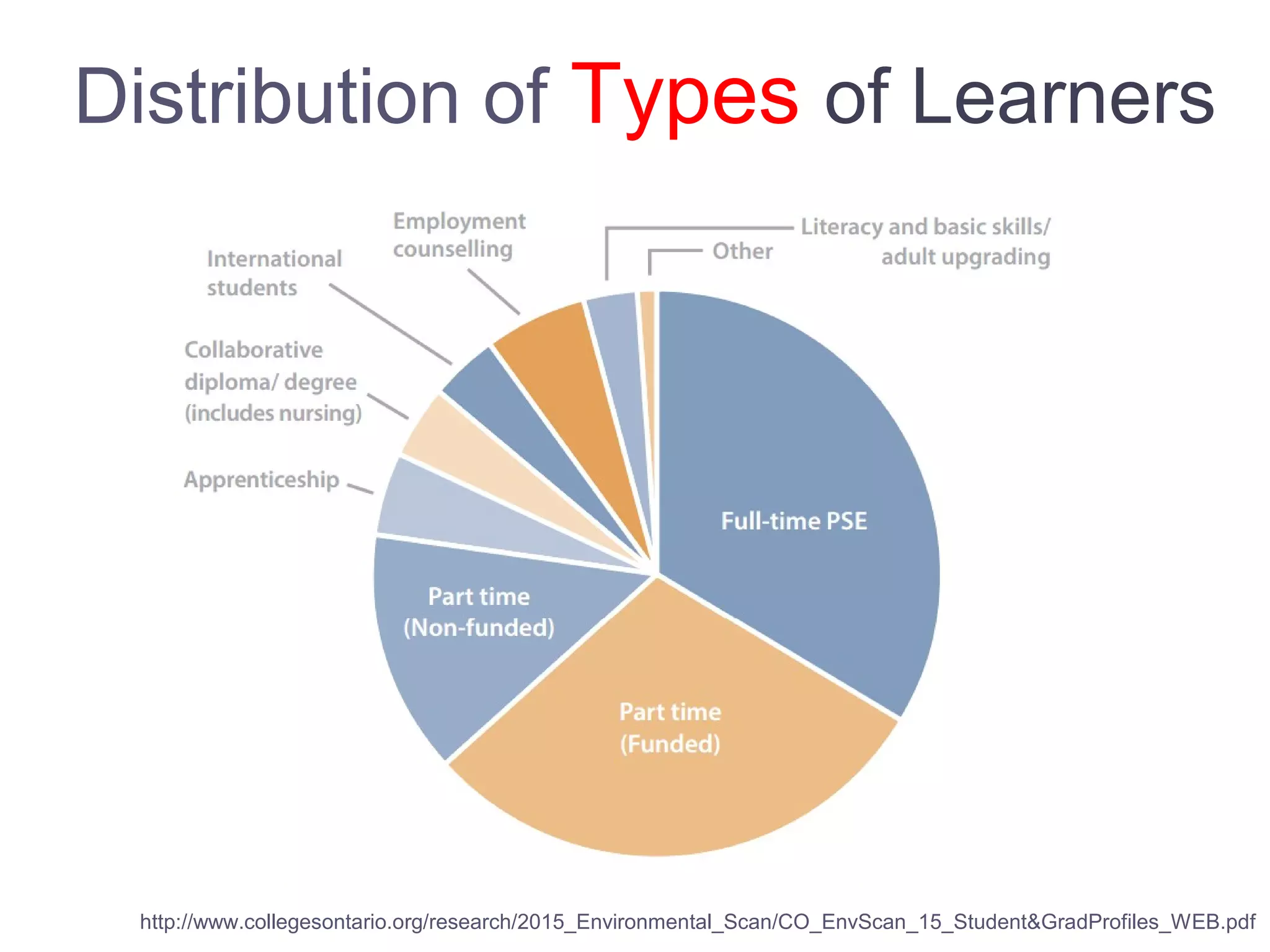
Distribution of Types of Learners
International Enrolment by
Category
http://www.collegesontario.org/research/2015_Environmental_Scan/CO_EnvScan_15_Student&GradProfiles_WEB.pdf
Innovation
http://www.collegesontario.org/news/fact-sheets/General-2014.pdf
Diversity
http://www.collegesontario.org/news/fact-sheets/General-2014.pdf
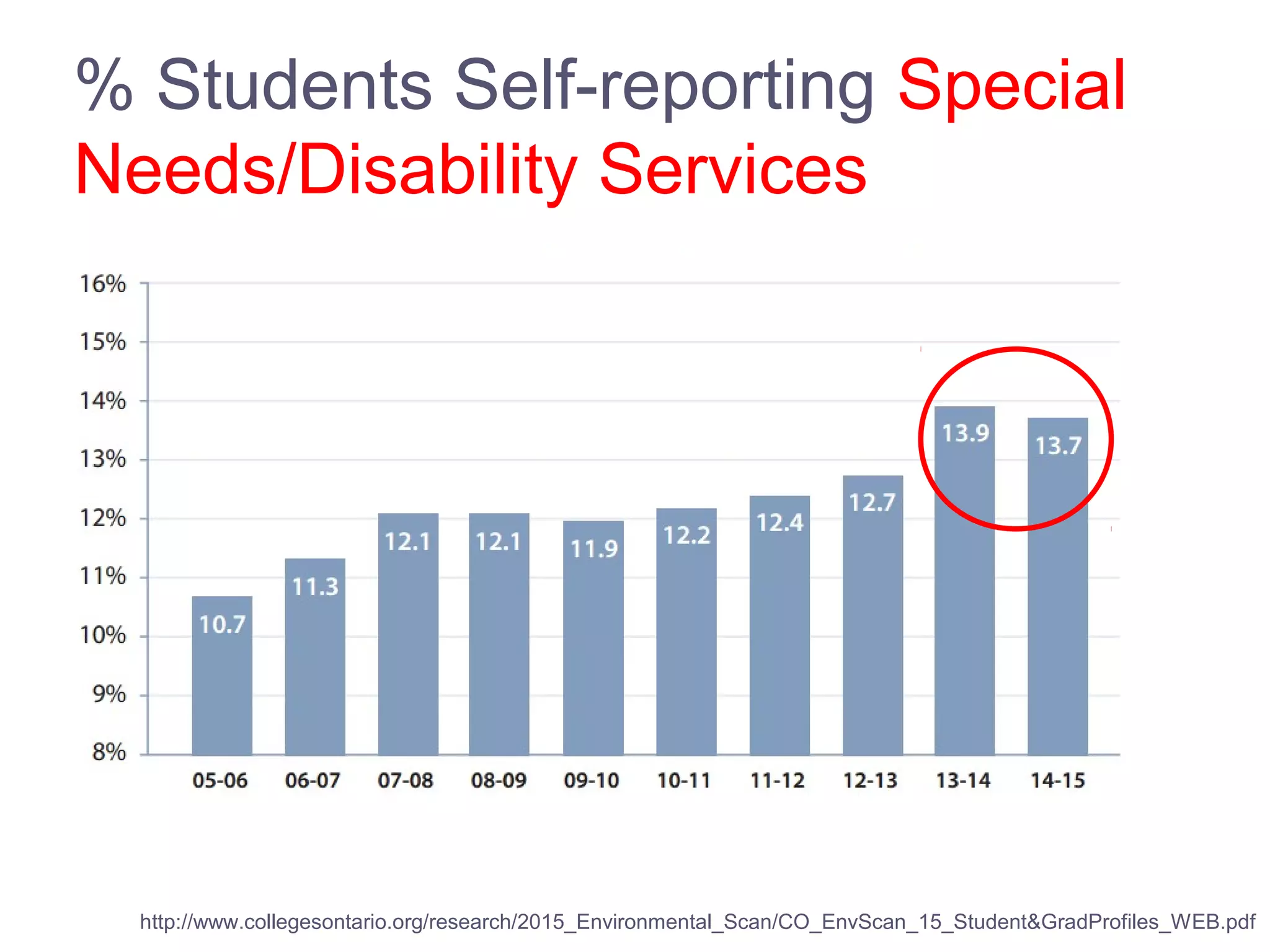
% Students Self-reporting Special
Needs/Disability Services
http://www.collegesontario.org/research/2015_Environmental_Scan/CO_EnvScan_15_Student&GradProfiles_WEB.pdf
College-University
http://www.collegesontario.org/news/fact-sheets/General-2014.pdf
Partnerships
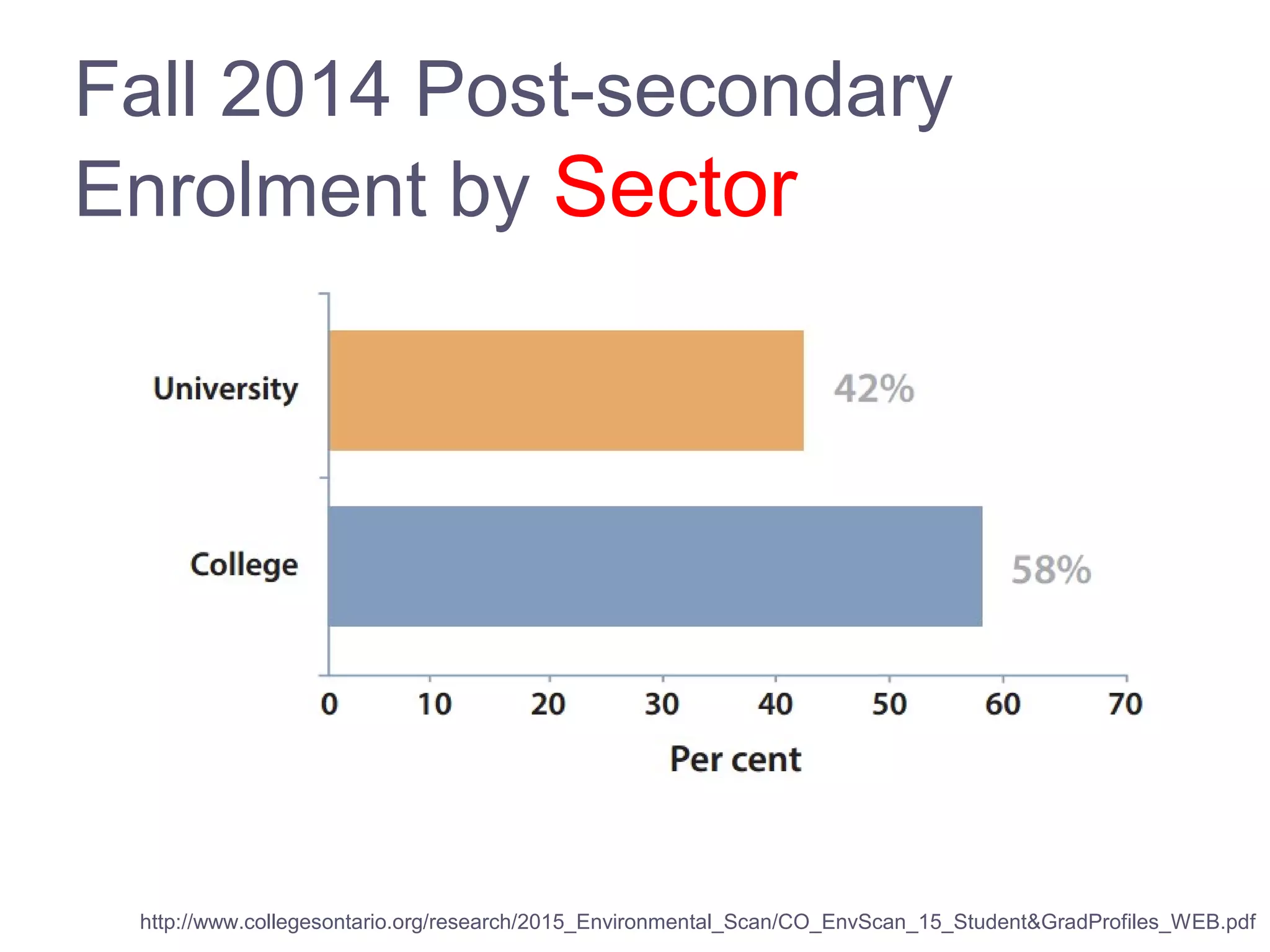
Fall 2014 Post-secondary
Enrolment by Sector
http://www.collegesontario.org/research/2015_Environmental_Scan/CO_EnvScan_15_Student&GradProfiles_WEB.pdf
http://www.collegesontario.org/news/fact-sheets/Degrees-2014.pdf
Degree Programs
83% find employment
http://www.collegesontario.org/news/fact-sheets/General-2014.pdf
40% university grads enrolled
Industry partners
http://www.collegesontario.org/news/fact-sheets/General-2014.pdf
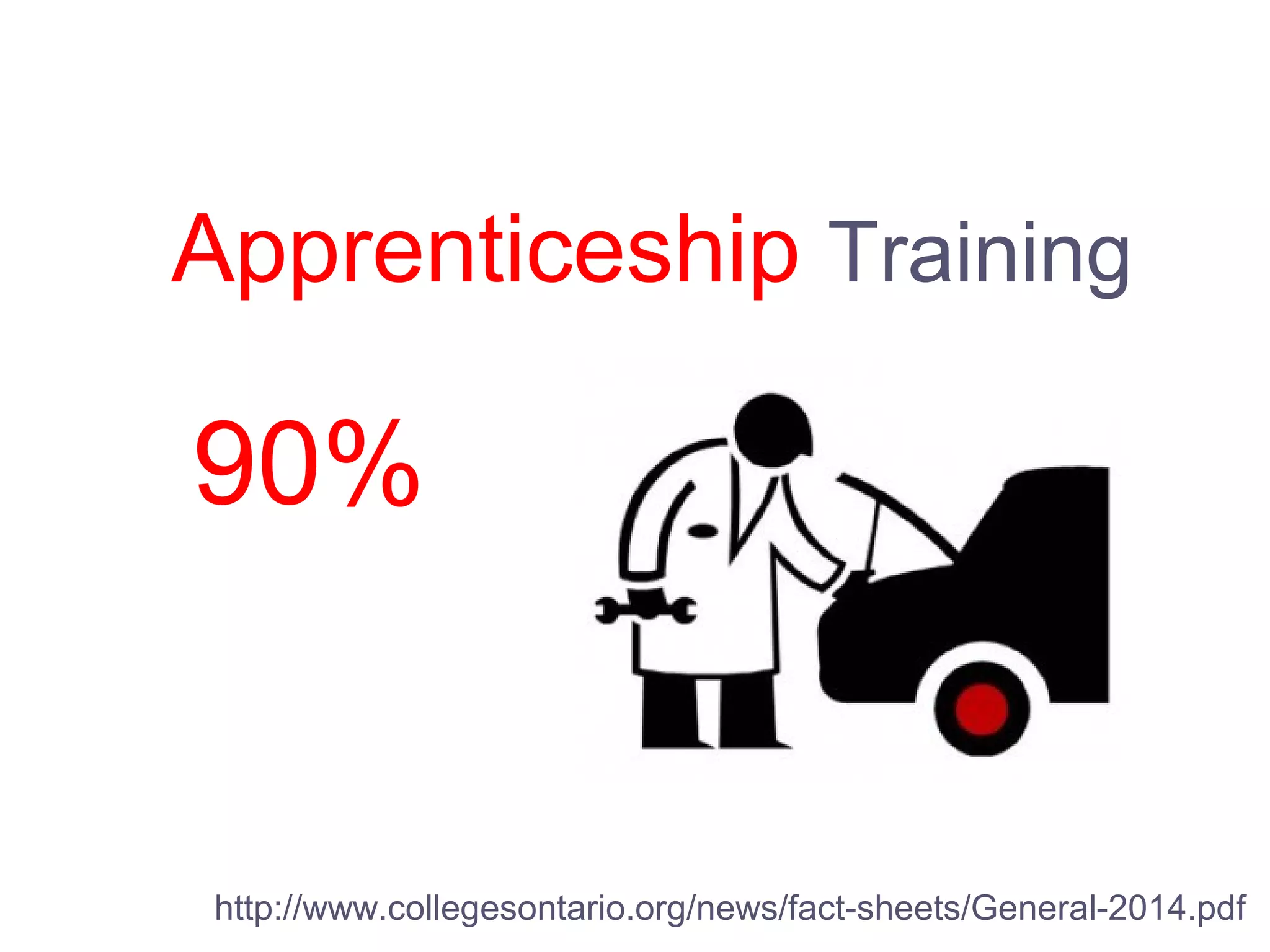
Apprenticeship Training
http://www.collegesontario.org/news/fact-sheets/General-2014.pdf
90%
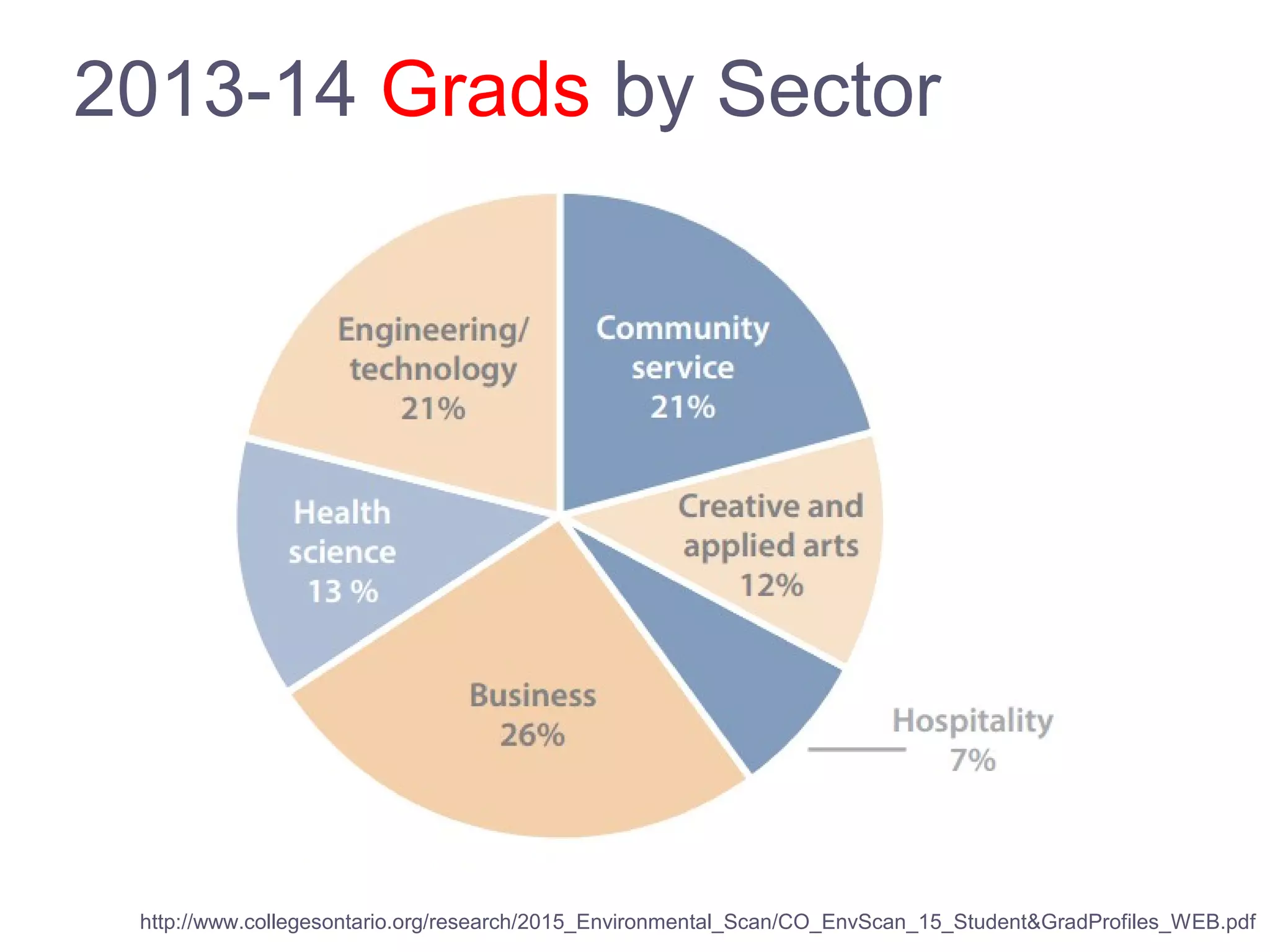
2013-14 Grads by Sector
http://www.collegesontario.org/research/2015_Environmental_Scan/CO_EnvScan_15_Student&GradProfiles_WEB.pdf
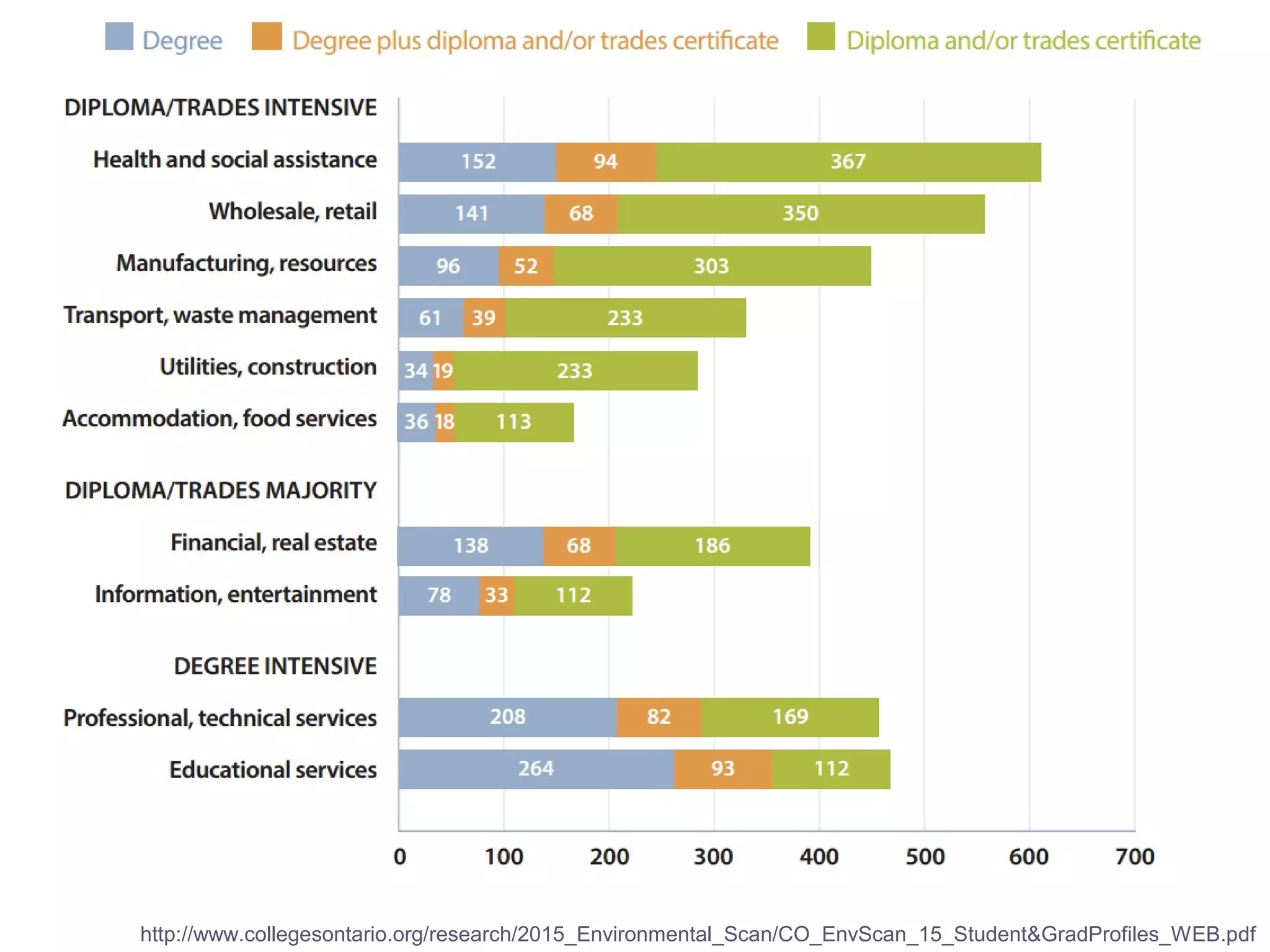
2014 Post-secondary
Attainment (ages 25-34)
mherie@centennialcollege.ca

The community college system in ontario

Editor's Notes

  • #3 Centennial College is Ontario’s first community college, established in 1966, and named to honour and celebrate Canada’s centennial year, 1967. Centennial primarily serves the eastern portion of the Greater Toronto Area through four campuses and seven satellite locations. Seven Academic Schools Diverse student body 57% born outside Canada 41% English not 1st lang. 80 languages on campus 100+ ethno-cultural groups on campus http://www.centennialcollege.ca/
  • #4 For more information: http://www.collegesinstitutes.ca/ http://www.univcan.ca/ http://www.cmec.ca/en/
  • #5 Ontario has 20 public universities, 24 colleges and 400+ registered private career colleges In most cases, students need a high school diploma to go to college or university in Ontario. 19 or older, without a diploma: students can still apply to most, if not all, schools. All schools set their own admission requirements. These differ for international students. Colleges offer certificate programs, diplomas, apprenticeships and degrees. Universities offer under-graduate and graduate degrees and other professional programs. All programs vary in length and prerequisites — the pre-work or qualifications students need to be eligible for a program. http://www.investinontario.com/business-advantages
  • #6 Established nearly 50 years ago, Ontario’s colleges have become leaders in cutting-edge post-secondary education for the new economy. Centennial is poised to celebrate our 50th anniversary, as Ontario’s first college. http://www.collegesontario.org/news/fact-sheets/General-2014.pdf
  • #7 Today’s colleges offer more than 600 programs in everything from business, IT, paramedicine, aviation, tourism and hospitality, advertising and the skilled trades to animation, film, game development, biotechnology and much more. http://www.collegesontario.org/news/fact-sheets/General-2014.pdf
  • #8 More than 220,000 full-time students and 300,000 part-time students and learners are enrolled in Ontario’s colleges. http://www.collegesontario.org/news/fact-sheets/General-2014.pdf
  • #13 Colleges are flexible and innovative, incorporating technological advancements into programs that are uniquely tailored to today’s students http://www.collegesontario.org/news/fact-sheets/General-2014.pdf
  • #14 With campuses throughout the province, the colleges’ student population mirrors the diversity of the Ontario population. The colleges also have many strong supports to help the provinces’ most vulnerable students pursue and complete a college education. Each year, more than 500,000 students and clients are served by Ontario’s colleges of applied arts and technology (CAATs). Of this group, more than 200,000 are full-time students. • There were 199,998 distinct applicants for the 2013-14 academic year. • Fifty-eight per cent of new fall 2014 entrants to Ontario post-secondary institutions enrolled in a college. • Fifteen per cent of surveyed college applicants were born outside Canada; 22 per cent of these individuals came to Canada between 2003 and 2007, while another 36 per cent arrived since 2008. • More than one-quarter of college applicants reported a household income of less than $30,000 and 55 per cent had incomes of less than $60,000. • Total funded full-time equivalent (FTE) post-secondary enrolment in the colleges was 226,869 (including funded full-time, part-time and tuition-short programs). • More than 28,000 international students enrolled in Ontario colleges in 2014. • Fourteen per cent of Ontario college students indicated use of special needs/disability services, almost half of whom reported high usage. • Colleges delivered 86 per cent of the apprenticeship in-school training in 2013-14. • Last year, more than 87,000 students graduated from post-secondary programs, representing a six per cent increase over the previous year. • Eighty-four per cent of 2012-13 graduates in the labour force were working six months after graduation. • Twenty-five per cent of graduates continued their education with full- or part-time studies within six months of graduation. http://www.collegesontario.org/research/2015_Environmental_Scan/CO_EnvScan_15_Student&GradProfiles_WEB.pdf
  • #15 Most young adults who are aboriginal or are identified as persons with disabilities and have attained a post-secondary education were educated in the colleges. http://www.collegesontario.org/research/2015_Environmental_Scan/CO_EnvScan_15_GradsintheEconomy_WEB.pdf
  • #16 Colleges work collaboratively with universities to help increasing numbers of students acquire a combination of university and college credentials. http://www.collegesontario.org/news/fact-sheets/General-2014.pdf
  • #18 While most college programs award diplomas and certificates, a number of Ontario colleges offer four-year degrees, and independent research for the provincial government has confirmed the four-year degree programs are successful. These degrees align with the colleges’ mission to provide applied education that leads to good jobs. http://www.collegesontario.org/news/fact-sheets/Degrees-2014.pdf
  • #19 More than 83 per cent of college graduates find employment within six months of graduation. The number of university graduates enrolled in colleges has increased more than 40 per cent over five years. The OECD says Canada leads the world in post-secondary attainment rates because of the accessibility of college education. http://www.collegesontario.org/news/fact-sheets/General-2014.pdf
  • #20 Working closely with business leaders and industry partners throughout the province, colleges provide an effective combination of theoretical learning and state-of-the-art training. http://www.collegesontario.org/news/fact-sheets/General-2014.pdf
  • #21 Colleges deliver about 90 per cent of the in-class training for apprenticeship programs. Note that some apprenticeships are nationally regulated (for example, aviation), while others fall under provincial regulation. The latter may be required to certify in Ontario in order to work in this province. http://www.collegesontario.org/news/fact-sheets/General-2014.pdf
  • #25 Questions and discussion
  • #26 Thank you for listening and contributing. Please feel free to contact me directly if there is more information that I can provide. I sincerely hope that you enjoy your time at Centennial College, and in Toronto, Canada.