INTRODUCTION TO CPU
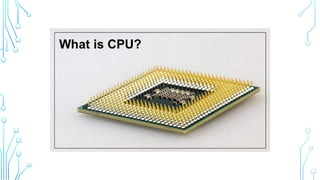
A CPU is, essentially, the active brain of the computer. The CPU is the invisible manager inside the
computer where data input is transformed into information output. It stores and executes
program instructions through its vast networks of circuitry.
Like the human brain, the CPU can multitask. This means it is also the part of the computer that
simultaneously regulates the computer’s internal functions, oversees power consumption,
allocates computing resources and interfaces with various apps, programs and networks.
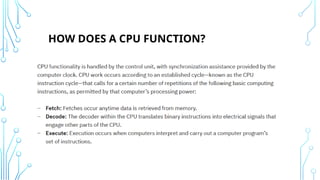
HOW DOES A CPU FUNCTION?
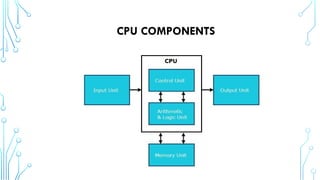
CPU COMPONENTS
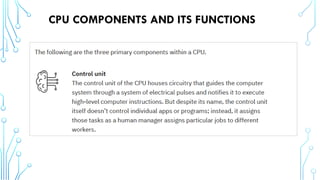
CPU COMPONENTS AND ITS FUNCTIONS
CPU FUNCTIONS AND PROCESSES
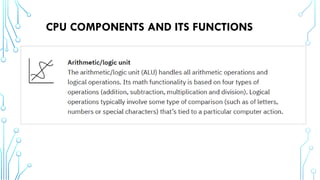
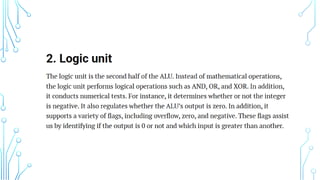
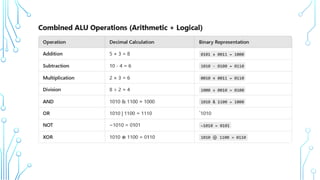
ALU (ARITHMETIC & LOGIC UNIT)
ALU is a main component of the central processing unit, which stands for arithmetic logic unit and performs
arithmetic and logic operations. It is also known as an integer unit (IU) that is an integrated circuit within a
CPU or GPU, which is the last component to perform calculations in the processor. It has the ability to
perform all processes related to arithmetic and logic operations such as addition, subtraction, and shifting
operations, including Boolean comparisons (XOR, OR, AND, and NOT operations). Also, binary numbers can
accomplish mathematical and bitwise operations. The arithmetic logic unit is split into AU (arithmetic unit) and
LU (logic unit). The operands and code used by the ALU tell it which operations have to perform according
to input data. When the ALU completes the processing of input, the information is sent to the computer's
memory.
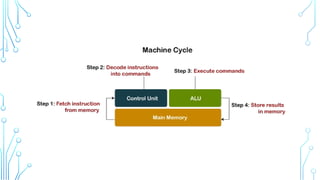
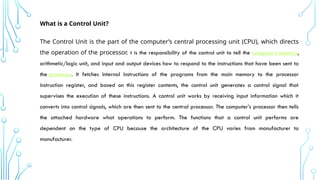
What is a Control Unit?
The Control Unit is the part of the computer’s central processing unit (CPU), which directs
the operation of the processor. t is the responsibility of the control unit to tell the computer’s memory,
arithmetic/logic unit, and input and output devices how to respond to the instructions that have been sent to
the processor. It fetches internal instructions of the programs from the main memory to the processor
instruction register, and based on this register contents, the control unit generates a control signal that
supervises the execution of these instructions. A control unit works by receiving input information which it
converts into control signals, which are then sent to the central processor. The computer’s processor then tells
the attached hardware what operations to perform. The functions that a control unit performs are
dependent on the type of CPU because the architecture of the CPU varies from manufacturer to
manufacturer.
CPU REGISTERS
• CPU registers are high-speed memory units essential for efficient program
execution, enabling quick access to frequently used values involved in
processing. They play a crucial role in data manipulation, memory addressing,
and tracking processor status. While accessing instructions from RAM is faster
than from a hard drive, it’s still not quick enough for the CPU, which is why
registers are used to store and retrieve data faster. They work in coordination
with the CPU’s memory to optimize processing, with cache memory being the
next step in speed, though still slower than registers. Each class of CPU registers,
from general-purpose to status and control registers, supports specific tasks to
ensure smooth and rapid execution of operations.
RELATIONSHIP BETWEEN CONTROL UNIT AND OTHER CPU
COMPONENTS
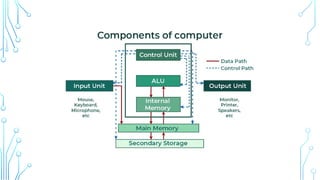
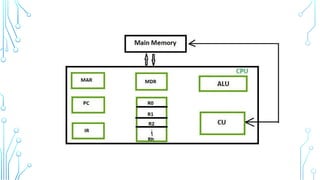
• The control unit within a CPU acts as the "director" by sending control signals
to other components like the Arithmetic Logic Unit (ALU) and memory,
essentially coordinating their operations, managing data flow between them,
and ensuring all instructions are executed in the correct sequence, effectively
acting as the brain of the CPU that directs all other components to perform
their tasks.
RELATIONSHIP OF ALU AND REGISTER
• An ALU (Arithmetic Logic Unit) is a circuit within a CPU that performs arithmetic
and logical operations, while a register is a small, high-speed storage location
within the CPU where data is temporarily held; essentially, the ALU takes data
from registers as input, performs calculations on it, and then stores the result
back into a register

The Central Processing Unit (CPU) is the brain of the computer

  • 1.
  • 4.
    A CPU is,essentially, the active brain of the computer. The CPU is the invisible manager inside the computer where data input is transformed into information output. It stores and executes program instructions through its vast networks of circuitry. Like the human brain, the CPU can multitask. This means it is also the part of the computer that simultaneously regulates the computer’s internal functions, oversees power consumption, allocates computing resources and interfaces with various apps, programs and networks.
  • 5.
    HOW DOES ACPU FUNCTION?
  • 6.
  • 7.
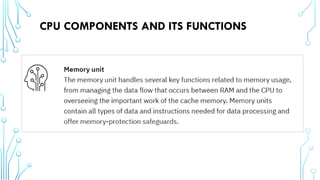
    CPU COMPONENTS ANDITS FUNCTIONS
  • 8.
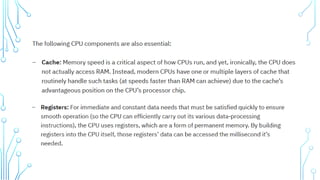
    CPU COMPONENTS ANDITS FUNCTIONS
  • 9.
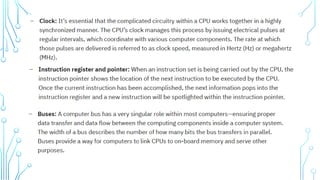
    CPU COMPONENTS ANDITS FUNCTIONS
  • 15.
  • 16.
    ALU (ARITHMETIC &LOGIC UNIT) ALU is a main component of the central processing unit, which stands for arithmetic logic unit and performs arithmetic and logic operations. It is also known as an integer unit (IU) that is an integrated circuit within a CPU or GPU, which is the last component to perform calculations in the processor. It has the ability to perform all processes related to arithmetic and logic operations such as addition, subtraction, and shifting operations, including Boolean comparisons (XOR, OR, AND, and NOT operations). Also, binary numbers can accomplish mathematical and bitwise operations. The arithmetic logic unit is split into AU (arithmetic unit) and LU (logic unit). The operands and code used by the ALU tell it which operations have to perform according to input data. When the ALU completes the processing of input, the information is sent to the computer's memory.
  • 21.
    What is aControl Unit? The Control Unit is the part of the computer’s central processing unit (CPU), which directs the operation of the processor. t is the responsibility of the control unit to tell the computer’s memory, arithmetic/logic unit, and input and output devices how to respond to the instructions that have been sent to the processor. It fetches internal instructions of the programs from the main memory to the processor instruction register, and based on this register contents, the control unit generates a control signal that supervises the execution of these instructions. A control unit works by receiving input information which it converts into control signals, which are then sent to the central processor. The computer’s processor then tells the attached hardware what operations to perform. The functions that a control unit performs are dependent on the type of CPU because the architecture of the CPU varies from manufacturer to manufacturer.
  • 22.
    CPU REGISTERS • CPUregisters are high-speed memory units essential for efficient program execution, enabling quick access to frequently used values involved in processing. They play a crucial role in data manipulation, memory addressing, and tracking processor status. While accessing instructions from RAM is faster than from a hard drive, it’s still not quick enough for the CPU, which is why registers are used to store and retrieve data faster. They work in coordination with the CPU’s memory to optimize processing, with cache memory being the next step in speed, though still slower than registers. Each class of CPU registers, from general-purpose to status and control registers, supports specific tasks to ensure smooth and rapid execution of operations.
  • 29.
    RELATIONSHIP BETWEEN CONTROLUNIT AND OTHER CPU COMPONENTS • The control unit within a CPU acts as the "director" by sending control signals to other components like the Arithmetic Logic Unit (ALU) and memory, essentially coordinating their operations, managing data flow between them, and ensuring all instructions are executed in the correct sequence, effectively acting as the brain of the CPU that directs all other components to perform their tasks.
  • 30.
    RELATIONSHIP OF ALUAND REGISTER • An ALU (Arithmetic Logic Unit) is a circuit within a CPU that performs arithmetic and logical operations, while a register is a small, high-speed storage location within the CPU where data is temporarily held; essentially, the ALU takes data from registers as input, performs calculations on it, and then stores the result back into a register