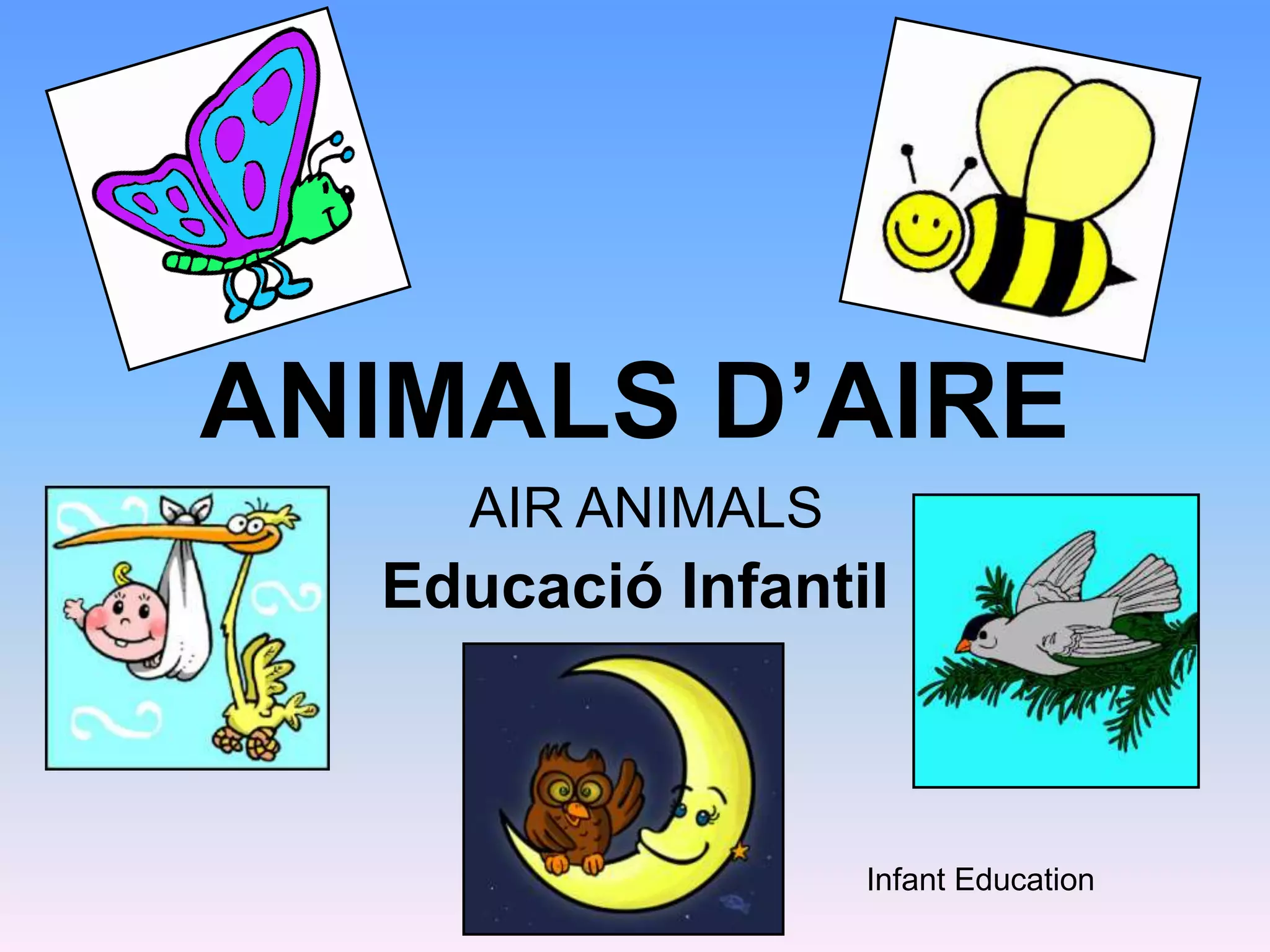
ANIMALS D’AIREEducació InfantilAIR ANIMALSInfant Education
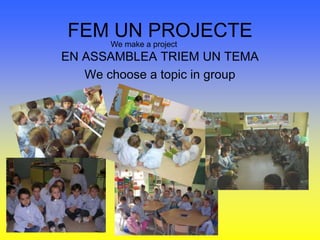
FEM UN PROJECTEWe make a projectEN ASSAMBLEA TRIEM UN TEMAWe choose a topic in group
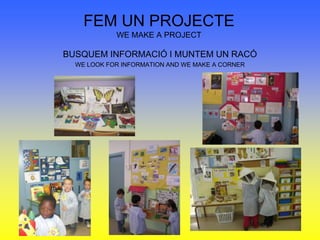
FEM UN PROJECTEWE MAKE A PROJECTBUSQUEM INFORMACIÓ I MUNTEM UN RACÓWE LOOK FOR INFORMATION AND WE MAKE A CORNER
FEM UN PROJECTEPartim sempre de les tres grans preguntes tot fent assamblea: Three important questionsQuè en sabem? Detectem els coneixements previs del nostre alumnat. What do we know?Què volem saber? Fem una recerca a partir de la seva motivació respecte el tema. What do we want to know?Què hem aprés? Fem un dossier amb totes aquelles coses que finalment sabem del tema. What we have learn?HO VOLEU VEURE??? Do you want to see?
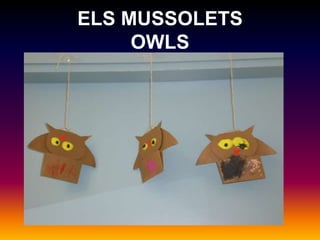
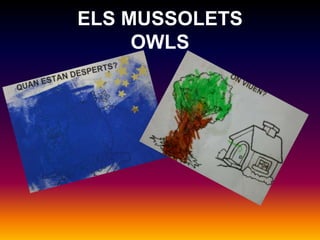
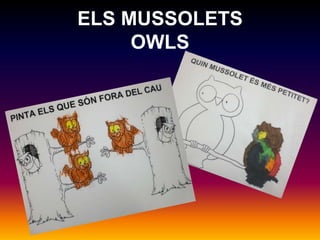
ELS MUSSOLETSOWLS
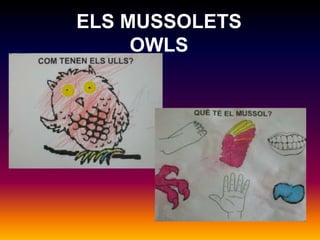
ELS MUSSOLETSOWLS
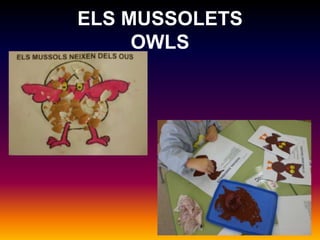
ELS MUSSOLETSOWLS
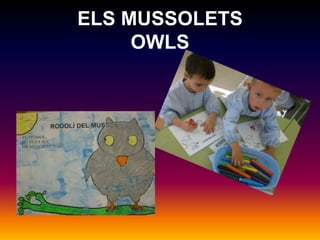
ELS MUSSOLETSOWLS
ELS MUSSOLETSOWLS
ELS MUSSOLETSOWLS
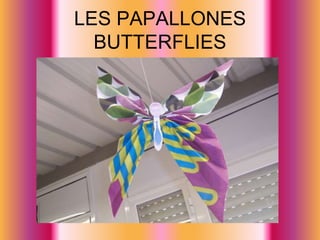
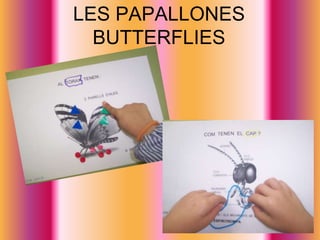
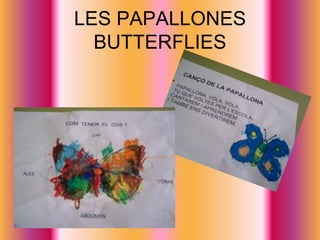
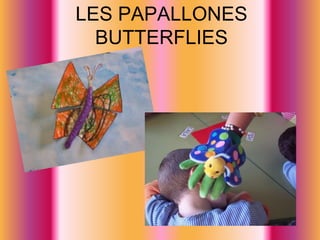
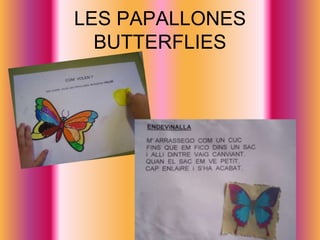
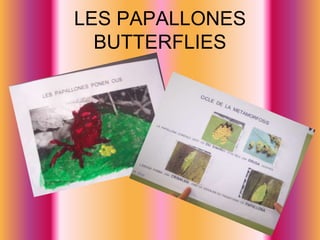
LES PAPALLONESBUTTERFLIES
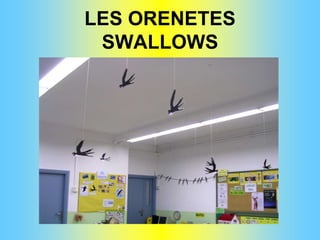
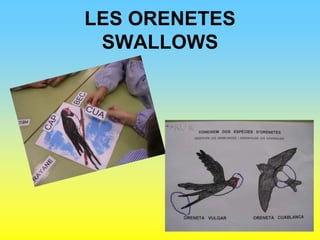
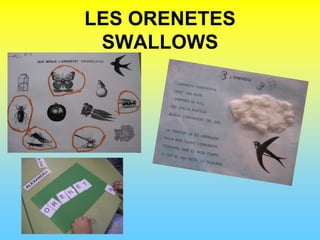
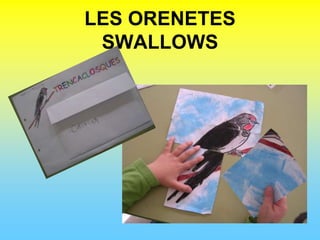
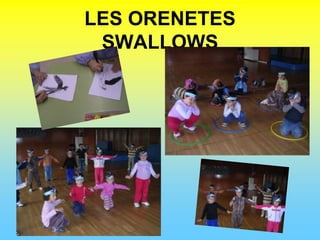
LES ORENETESSWALLOWS
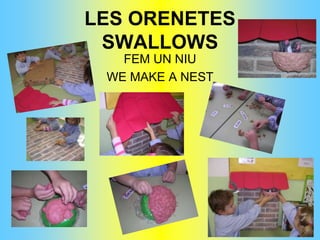
LES ORENETESSWALLOWSFEM UN NIUWE MAKE A NEST
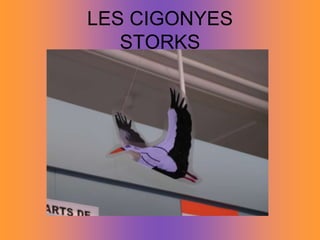
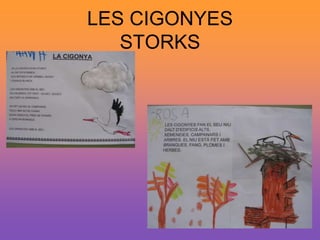
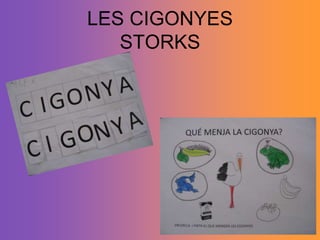
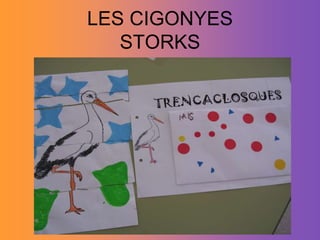
LES CIGONYESSTORKS
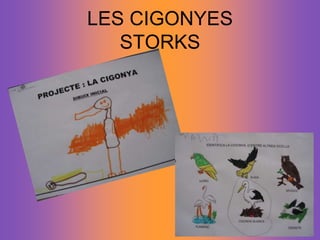
LES CIGONYESSTORKS
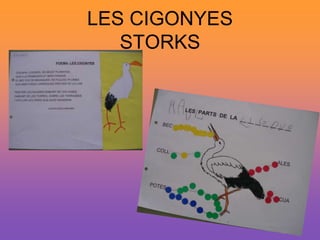
LES CIGONYESSTORKS
LES CIGONYESSTORKS
LES CIGONYESSTORKS
LES CIGONYESSTORKS
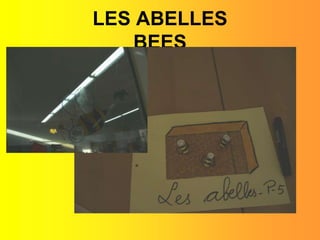
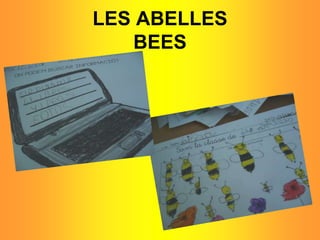
LES ABELLESBEES
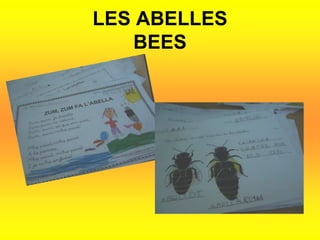
LES ABELLESBEES
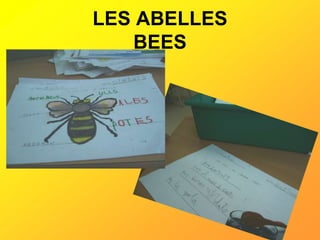
LES ABELLESBEES
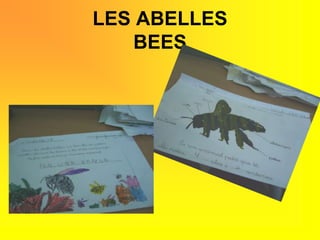
LES ABELLESBEES
LES ABELLESBEES
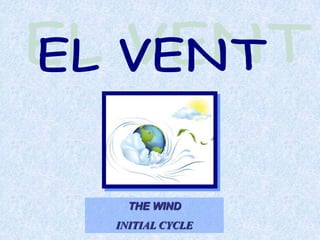
EL VENTTHE WINDINITIAL CYCLE
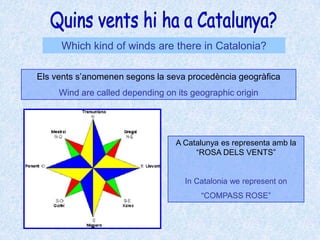
Quins vents hi ha a Catalunya?Which kind of winds are there in Catalonia?Els vents s’anomenen segons la seva procedència geogràficaWind are called depending on its geographic originA Catalunya es representa amb la “ROSA DELS VENTS”In Catalonia we represent on “COMPASS ROSE”
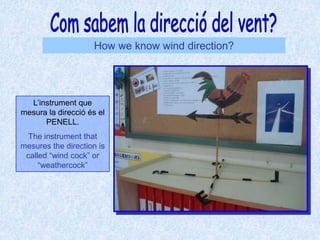
Com sabem la direcció del vent?How we know wind direction?L’instrument que mesura la direcció és el PENELL.The instrument that mesures the direction is called “wind cock” or “weathercock”
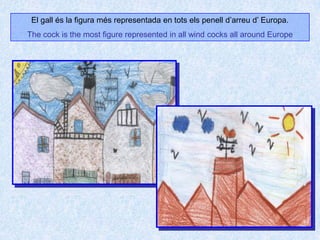
El gall és la figura més representada en tots els penell d’arreu d’ Europa.The cock is the most figure represented in all wind cocks all around Europe
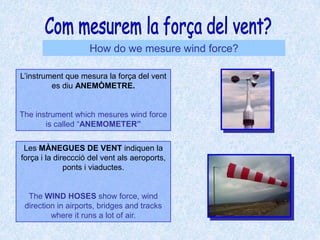
Com mesurem la força del vent?How do we mesure wind force?L’instrument que mesura la força del vent es diu ANEMÒMETRE.The instrument which mesures wind force is called “ANEMOMETER”Les MÀNEGUES DE VENT indiquen la força i la direccció del vent als aeroports, ponts i viaductes.The WIND HOSES show force, wind direction in airports, bridges and tracks where it runs a lot of air.
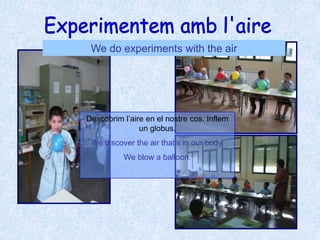
Experimentem amb l'aireWe do experiments with the airDescobrim l’aire en el nostre cos. Inflem un globus.We discover the air that’s in our body.We blow a balloon.
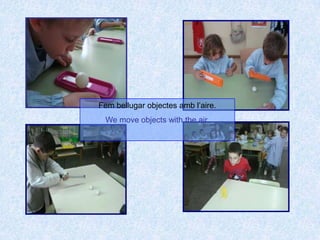
Fem bellugar objectes amb l’aire.We move objects with the air.
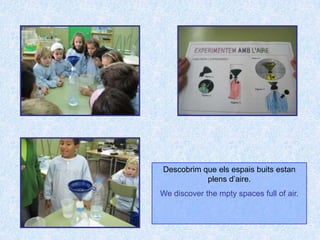
Descobrim que els espais buits estan plens d’aire.We discover the mpty spaces full of air.
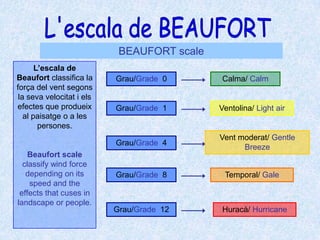
L'escala de BEAUFORTBEAUFORT scaleL’escala de Beaufort classifica la força del vent segons la seva velocitat i els efectes que produeix al paisatge o a les persones.Beaufort scale classify wind force depending on its speed and the effects that cuses in landscape or people.Grau/Grade  0Calma/ CalmGrau/Grade  1Ventolina/ Light airVent moderat/ Gentle BreezeGrau/Grade  4Grau/Grade  8Temporal/ GaleGrau/Grade  12Huracà/ Hurricane
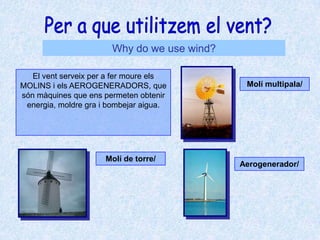
Per a que utilitzem el vent?Why do we use wind?El vent serveix per a fer moure els MOLINS i els AEROGENERADORS, que són màquines que ens permeten obtenir energia, moldre gra i bombejar aigua.Molí multipala/ Molí de torre/ Aerogenerador/
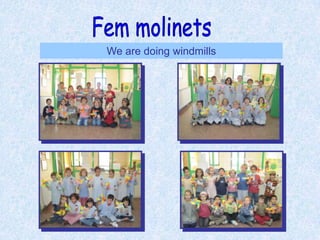
Fem molinetsWe are doing windmills
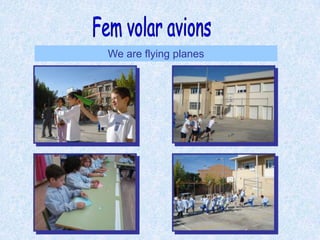
Fem volar avionsWe are flying planes
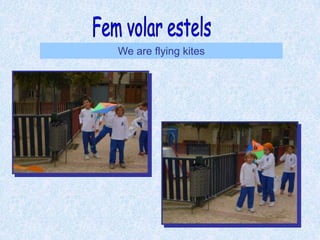
Fem volar estelsWe are flying kites
“L’AIRE” THE AIRCicle Mitjà (Medium Cycle)
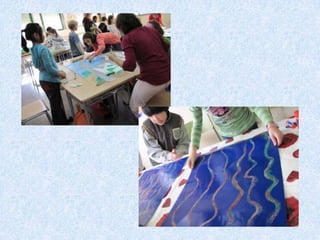
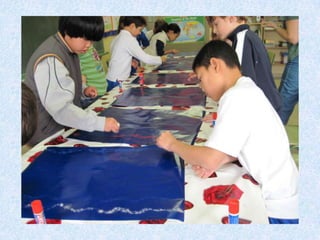
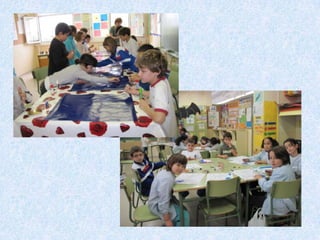
Procés d’elaboració dels treballs sobre l’aire .CM : 3r i 4tProcess of making the air workshopMedium cycle 3rd and 4th gradesTHE AIRL'AIREPòsters :Parcs eòlicsLa Rosa dels ventsEl penellLa ventadaPosters, wind power parks, wind instrument, wind cock,blizzard.
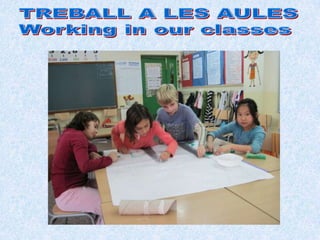
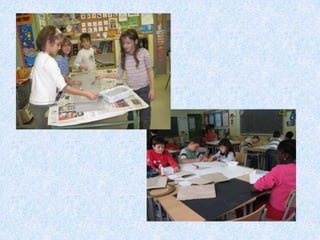
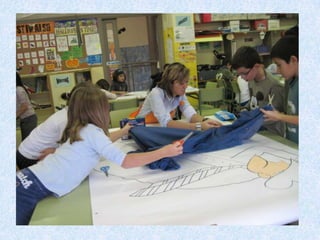
TREBALL A LES AULESWorking in our classes
PÒSTERS ELABORATS PELS ALUMNES DE 3r i 4tPosters made by 3rd and 4th grade studentsEL VENT L’AIRE EN MOVIMENTWind, air in movement
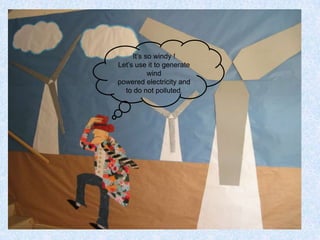
It’s so windy !Let’s use it to generate windpowered electricity and to do not polluted.
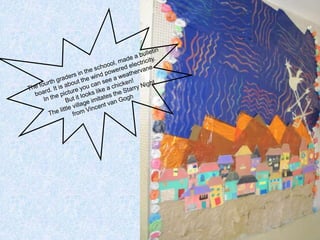
The fourth graders in the schoool, made a bulletinboard. It is about the wind powered electricity. In the picture you can see a weathervaneBut it looks like a chicken!The little village imitates the Starry Nightfrom Vincent van Gogh
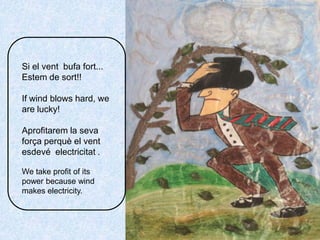
Si el vent  bufa fort...Estem de sort!!Ifwindblowshard, we are lucky!Aprofitarem la sevaforçaperquè el ventesdevéelectricitat.Wetakeprofit of itspowerbecausewindmakeselectricity.
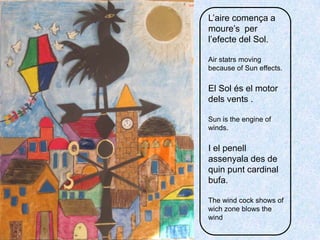
L’airecomença a moure’s  per l’efecte del Sol.Air statrsmovingbecause of Suneffects.El Sol és el motor delsvents.Sunistheengine of winds.I el penellassenyala des de quinpunt cardinal bufa.Thewindcock shows of wichzoneblowsthewind
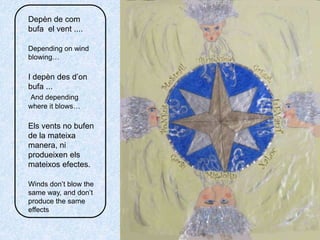
Depèn de com bufa  el vent .... Dependingonwindblowing…I depèn des d’on bufa ...And dependingwhereitblows…Elsvents no bufen de la mateixa manera, ni produeixenelsmateixosefectes.Windsdon’tblowthesameway, and don’t produce thesameeffects
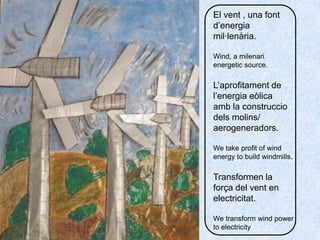
El vent , una fontd’energiamil·lenària. Wind, a milenarienergeticsource.L’aprofitament de l’energiaeòlicaamb la construcciodelsmolins/ aerogeneradors.Wetakeprofit of windenergytobuildwindmills.Transformen la força del vent en electricitat. Wetransformwindpowertoelectricity
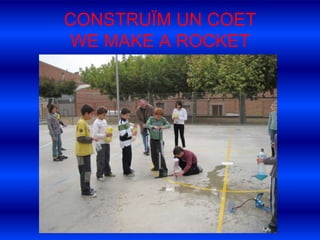
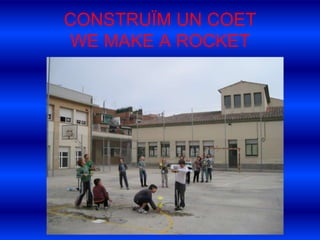
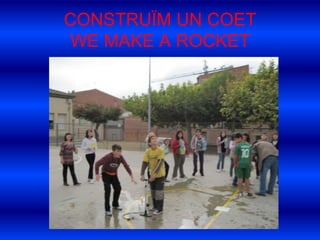
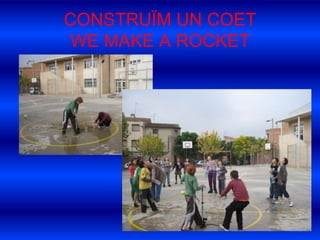
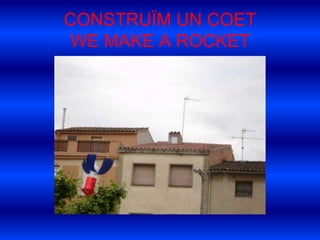
CONSTRUÏM UN COETWe make a rocket
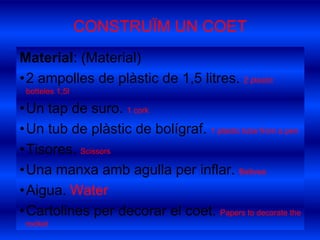
CONSTRUÏM UN COETMaterial: (Material)2 ampolles de plàstic de 1,5 litres. 2 plasticbotteles 1,5lUn tap de suro. 1 corkUn tub de plàstic de bolígraf. 1 plastictubefrom a penTisores. ScissorsUna manxa amb agulla per inflar. BellowsAigua. WaterCartolines per decorar el coet. Papers to decoratetherocket
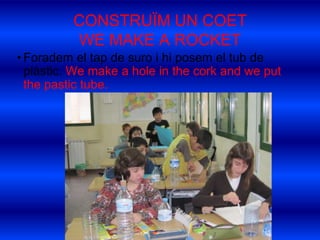
CONSTRUÏM UN COETWE MAKE A ROCKETForadem el tap de suro i hi posem el tub de plàstic. Wemake a hole in thecork and we put thepastictube.
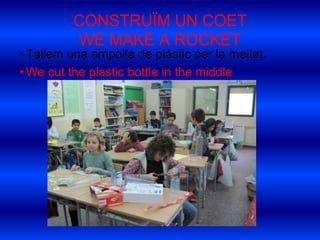
CONSTRUÏM UN COETWE MAKE A ROCKETTallem una ampolla de plàstic per la meitat.Wecuttheplasticbottle in themiddle
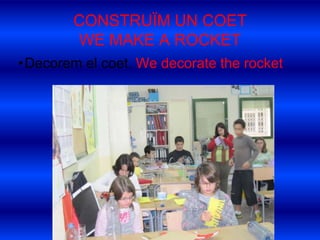
CONSTRUÏM UN COETWE MAKE A ROCKETDecorem el coet. Wedecoratetherocket
CONSTRUÏM UN COETWE MAKE A ROCKETOmplim d’aigua 1/3 de l’ampolla.We put water in a waterbottleSituem el coet sobre l’ampolla que hem tallat. We put therocket on thebottlethatwecutbeforeIntroduïm aire a l’ampolla pel tub de plàstic amb la manxa. We put air in thebottlethroughtheplastic tub and bellows.  I ... A volar and fly!!
CONSTRUÏM UN COETWE MAKE A ROCKET
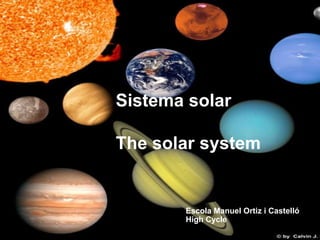
Sistema solarSistema solarThe solar systemEscola Manuel Ortiz i CastellóHigh CycleEscola Manuel Ortiz i Castelló
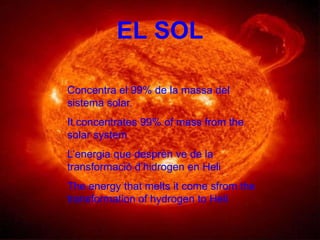
EL SOLConcentra el 99% de la massa del sistema solar.Itconcentrates 99% of massfromthe solar systemL’energia que desprèn ve de la transformació d’hidrogen en HeliThe energythatmeltsitcomesfromthetransformation of hydrogen to Heli
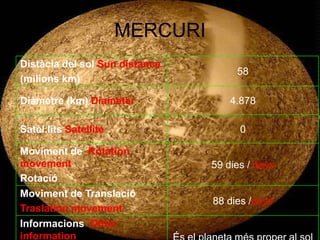
MERCURI
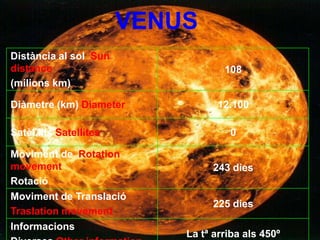
VENUS
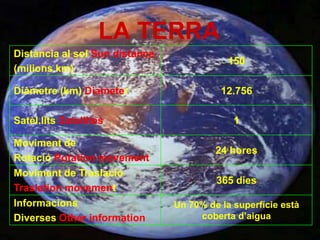
LA TERRA
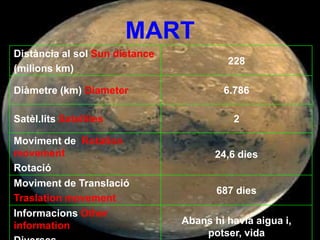
MART
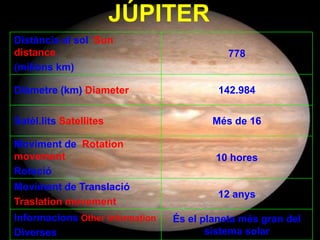
JÚPITER
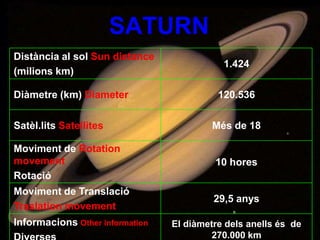
SATURN
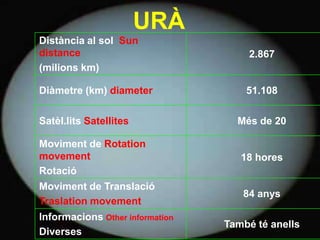
URÀ
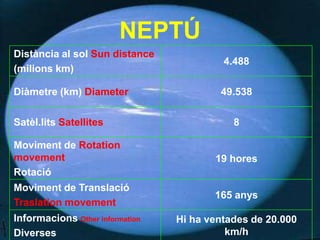
NEPTÚ
LA NECESSITAT DE L'AIRE I LA LLUM EN ELS ÈSSERS VIUSTHE NEED OF AIR AND LIGHT IN THE HUMAN BEING.Cicle superiorHighCycle
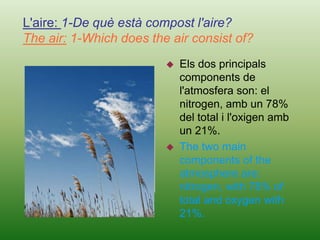
L'aire: 1-De què està compost l'aire?The air: 1-Which does the air consist of?Els dos principals components de l'atmosfera son: el nitrogen, amb un 78% del total i l'oxigen amb un 21%.
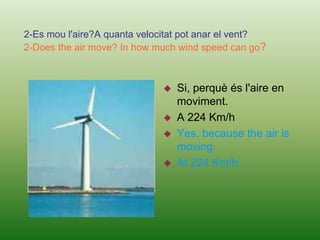
The two main components of the atmosphere are: nitrogen, with 78% of total and oxygen with 21%.2-Es mou l'aire?A quanta velocitat pot anar el vent?2-Does the air move? In how much wind speed can go?Si, perquè és l'aire en moviment.
A 224 Km/h
Yes, because the air is moving.
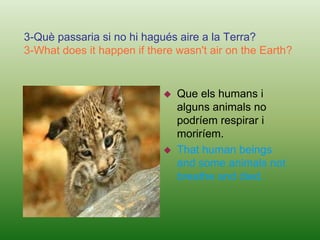
At 224 Km/h.3-Què passaria si no hi hagués aire a la Terra? 3-What does it happen if there wasn't air on the Earth?Que els humans i alguns animals no podríem respirar i moriríem.
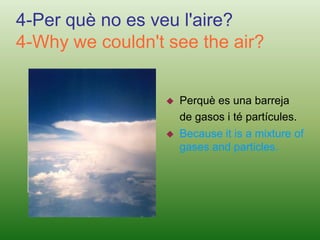
That human beings and some animals not breathe and died.4-Per què no es veu l'aire?4-Why we couldn't see the air?Perquè es una barreja de gasos i té partícules.
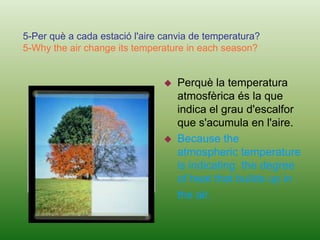
Because it is a mixture of gases and particles.5-Per què a cada estació l'aire canvia de temperatura?5-Why the air change its temperature in each season?Perquè la temperatura atmosfèrica és la que indica el grau d'escalfor que s'acumula en l'aire.
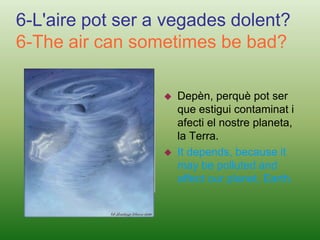
Because the atmospheric temperature is indicating  the degree of heat that builds up in the air.6-L'aire pot ser a vegades dolent?6-The air can sometimes be bad?Depèn, perquè pot ser que estigui contaminat i afecti el nostre planeta, la Terra.
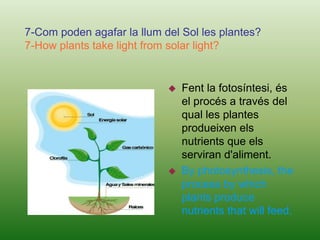
It depends, because it  may be polluted and affect our planet, Earth.7-Com poden agafar la llum del Sol les plantes?7-How plants take light from solar light?Fent la fotosíntesi, és el procés a través del qual les plantes produeixen els nutrients que els serviran d'aliment.
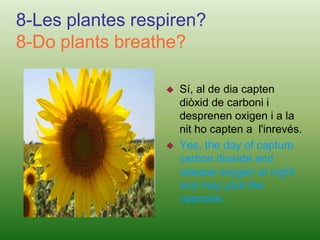
By photosynthesis, the process by which plants produce nutrients that will feed.8-Les plantes respiren?8-Do plants breathe?Sí, al de dia capten diòxid de carboni i desprenen oxigen i a la nit ho capten a  l'inrevés.
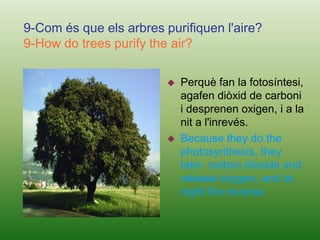
Yes, the day of capture carbon dioxide and release oxygen at night and may pick the opposite.9-Com és que els arbres purifiquen l'aire?9-How do trees purify the air?Perquè fan la fotosíntesi, agafen diòxid de carboni i desprenen oxigen, i a la nit a l'inrevés.
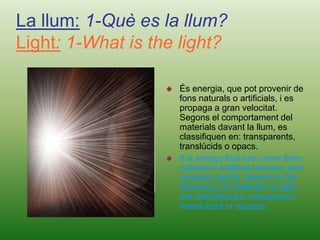
Because they do the photosynthesis, they take  carbon dioxide and release oxygen, and at night the reverse.La llum:1-Què es la llum?Light: 1-What is the light?És energia, que pot provenir de fons naturals o artificials, i es propaga a gran velocitat. Segons el comportament del materials davant la llum, es classifiquen en: transparents, translúcids o opacs.
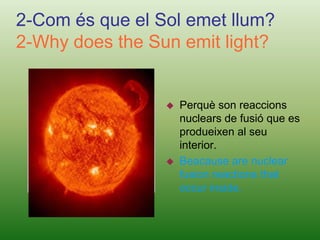
It is energy that can come from natural or artificial sources, and  spreads rapidly. Based on the behaviour of materials to light, are classified as: transparent, translucent or opaque.2-Com és que el Sol emet llum?2-Why does the Sun emit light?Perquè son reaccions nuclears de fusió que es produeixen al seu interior.
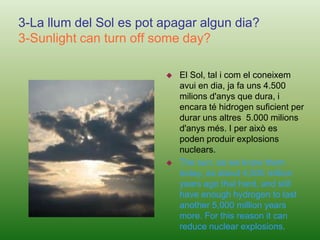
Beacause are nuclear fusion reactions that occur inside.3-La llum del Sol es pot apagar algun dia?3-Sunlight can turn off some day?El Sol, tal i com el coneixem avui en dia, ja fa uns 4.500 milions d'anys que dura, i encara té hidrogen suficient per durar uns altres  5.000 milions d'anys més. I per això es poden produir explosions nuclears.
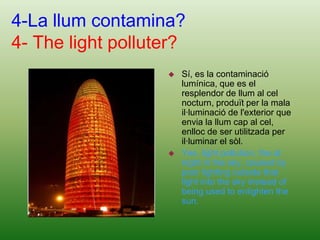
The sun, as we know them today, as about 4,500 million years ago that hard, and still have enough hydrogen to last another 5,000 million years more. For this reason it can reduce nuclear explosions.4-La llum contamina?4- The light polluter?Sí, es la contaminació lumínica, que es el resplendor de llum al cel nocturn, produït per la mala il·luminació de l'exterior que envia la llum cap al cel, enlloc de ser utilitzada per il·luminar el sòl.
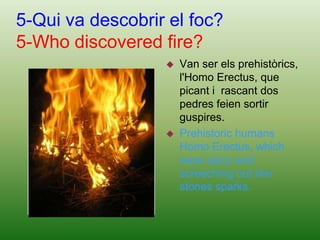
Yes, light pollution, the at night in the sky, caused by poor lighting outside that light into the sky instead of being used to enlighten the sun.5-Qui va descobrir el foc?5-Who discovered fire?Van ser els prehistòrics, l'Homo Erectus, que picant i  rascant dos pedres feien sortir guspires.
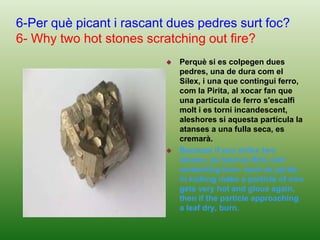
Prehistoric humans Homo Erectus, which were spicy and screeching out two stones sparks.6-Per què picant i rascant dues pedres surt foc?6- Why two hot stones scratching out fire?Perquè si es colpegen dues pedres, una de dura com el Sílex, i una que contingui ferro, com la Pirita, al xocar fan que una partícula de ferro s'escalfi molt i es torni incandescent, aleshores si aquesta partícula la atanses a una fulla seca, es cremarà.
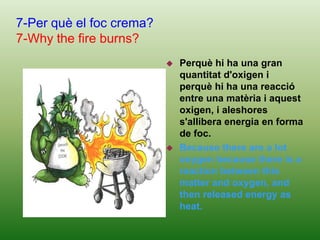
Because if you strike two stones, as hard as flint, and containing icon, such as pyrite, in kicking make a particle of iron gets very hot and glous again, then if the particle approaching a leaf dry, burn.7-Per què el foc crema?7-Why the fire burns?Perquè hi ha una gran quantitat d'oxigen i perquè hi ha una reacció entre una matèria i aquest oxigen, i aleshores s'allibera energia en forma de foc.
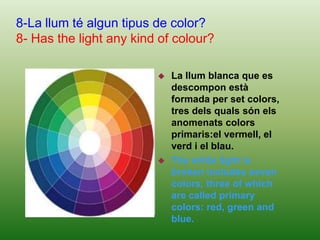
Because there are a lot oxygen because there is a reaction between this matter and oxygen, and then released energy as heat.8-La llum té algun tipus de color?8- Has the light any kind of colour?La llum blanca que es descompon està formada per set colors, tres dels quals són els anomenats colors primaris:el vermell, el verd i el blau.
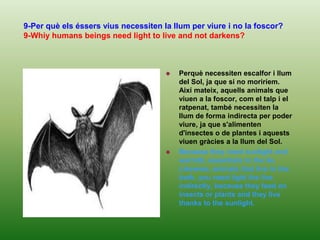
The white light is broken includes seven colors, three of which are called primary colors: red, green and blue.9-Per què els éssers vius necessiten la llum per viure i no la foscor?9-Whiy humans beings need light to live and not darkens?Perquè necessiten escalfor i llum del Sol, ja que si no moriríem. Així mateix, aquells animals que viuen a la foscor, com el talp i el ratpenat, també necessiten la llum de forma indirecta per poder viure, ja que s'alimenten d'insectes o de plantes i aquests viuen gràcies a la llum del Sol.
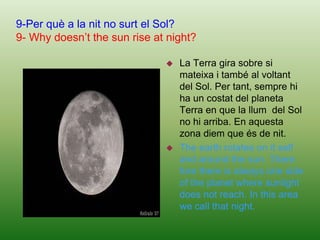
Because they need sunlight and warmth, essentials to the lie. Likewise, animals that live in the both, you need light the live indirectly, because they feed on insects or plants and they live thanks to the sunlight.9-Per què a la nit no surt el Sol?9- Why doesn’t the sun rise at night?La Terra gira sobre si mateixa i també al voltant del Sol. Per tant, sempre hi ha un costat del planeta Terra en que la llum  del Sol no hi arriba. En aquesta zona diem que és de nit.
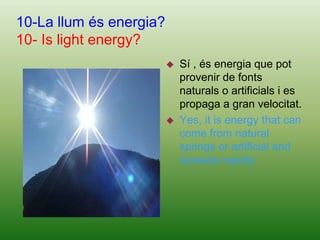
The earth rotates on it self and around the sun. There fore there is always one side of the planet where sunlight does not reach. In this area we call that night.10-La llum és energia?10- Is light energy?Sí , és energia que pot provenir de fonts naturals o artificials i es propaga a gran velocitat.
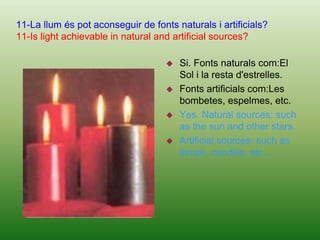
Yes, it is energy that can come from natural springs or artificial and spreads rapidly.11-La llum és pot aconseguir de fonts naturals i artificials?11-Is light achievable in natural and artificial sources? Si. Fonts naturals com:El Sol i la resta d'estrelles.

The Air Spain

  • 1.
  • 2.
    FEM UN PROJECTEWemake a projectEN ASSAMBLEA TRIEM UN TEMAWe choose a topic in group
  • 3.
    FEM UN PROJECTEWEMAKE A PROJECTBUSQUEM INFORMACIÓ I MUNTEM UN RACÓWE LOOK FOR INFORMATION AND WE MAKE A CORNER
  • 4.
    FEM UN PROJECTEPartimsempre de les tres grans preguntes tot fent assamblea: Three important questionsQuè en sabem? Detectem els coneixements previs del nostre alumnat. What do we know?Què volem saber? Fem una recerca a partir de la seva motivació respecte el tema. What do we want to know?Què hem aprés? Fem un dossier amb totes aquelles coses que finalment sabem del tema. What we have learn?HO VOLEU VEURE??? Do you want to see?
  • 5.
  • 6.
  • 7.
  • 8.
  • 9.
  • 10.
  • 11.
  • 12.
  • 13.
  • 14.
  • 15.
  • 16.
  • 17.
  • 18.
  • 19.
  • 20.
  • 21.
  • 22.
  • 23.
  • 24.
  • 25.
  • 26.
  • 27.
  • 28.
  • 29.
  • 30.
  • 31.
  • 32.
  • 33.
  • 34.
  • 35.
    Quins vents hiha a Catalunya?Which kind of winds are there in Catalonia?Els vents s’anomenen segons la seva procedència geogràficaWind are called depending on its geographic originA Catalunya es representa amb la “ROSA DELS VENTS”In Catalonia we represent on “COMPASS ROSE”
  • 36.
    Com sabem ladirecció del vent?How we know wind direction?L’instrument que mesura la direcció és el PENELL.The instrument that mesures the direction is called “wind cock” or “weathercock”
  • 37.
    El gall ésla figura més representada en tots els penell d’arreu d’ Europa.The cock is the most figure represented in all wind cocks all around Europe
  • 38.
    Com mesurem laforça del vent?How do we mesure wind force?L’instrument que mesura la força del vent es diu ANEMÒMETRE.The instrument which mesures wind force is called “ANEMOMETER”Les MÀNEGUES DE VENT indiquen la força i la direccció del vent als aeroports, ponts i viaductes.The WIND HOSES show force, wind direction in airports, bridges and tracks where it runs a lot of air.
  • 39.
    Experimentem amb l'aireWedo experiments with the airDescobrim l’aire en el nostre cos. Inflem un globus.We discover the air that’s in our body.We blow a balloon.
  • 40.
    Fem bellugar objectesamb l’aire.We move objects with the air.
  • 41.
    Descobrim que elsespais buits estan plens d’aire.We discover the mpty spaces full of air.
  • 42.
    L'escala de BEAUFORTBEAUFORTscaleL’escala de Beaufort classifica la força del vent segons la seva velocitat i els efectes que produeix al paisatge o a les persones.Beaufort scale classify wind force depending on its speed and the effects that cuses in landscape or people.Grau/Grade 0Calma/ CalmGrau/Grade 1Ventolina/ Light airVent moderat/ Gentle BreezeGrau/Grade 4Grau/Grade 8Temporal/ GaleGrau/Grade 12Huracà/ Hurricane
  • 44.
    Per a queutilitzem el vent?Why do we use wind?El vent serveix per a fer moure els MOLINS i els AEROGENERADORS, que són màquines que ens permeten obtenir energia, moldre gra i bombejar aigua.Molí multipala/ Molí de torre/ Aerogenerador/
  • 45.
    Fem molinetsWe aredoing windmills
  • 46.
    Fem volar avionsWeare flying planes
  • 47.
    Fem volar estelsWeare flying kites
  • 48.
    “L’AIRE” THE AIRCicleMitjà (Medium Cycle)
  • 49.
    Procés d’elaboració delstreballs sobre l’aire .CM : 3r i 4tProcess of making the air workshopMedium cycle 3rd and 4th gradesTHE AIRL'AIREPòsters :Parcs eòlicsLa Rosa dels ventsEl penellLa ventadaPosters, wind power parks, wind instrument, wind cock,blizzard.
  • 50.
    TREBALL A LESAULESWorking in our classes
  • 56.
    PÒSTERS ELABORATS PELSALUMNES DE 3r i 4tPosters made by 3rd and 4th grade studentsEL VENT L’AIRE EN MOVIMENTWind, air in movement
  • 57.
    It’s so windy !Let’suse it to generate windpowered electricity and to do not polluted.
  • 58.
    The fourth gradersin the schoool, made a bulletinboard. It is about the wind powered electricity. In the picture you can see a weathervaneBut it looks like a chicken!The little village imitates the Starry Nightfrom Vincent van Gogh
  • 59.
    Si el vent bufa fort...Estem de sort!!Ifwindblowshard, we are lucky!Aprofitarem la sevaforçaperquè el ventesdevéelectricitat.Wetakeprofit of itspowerbecausewindmakeselectricity.
  • 60.
    L’airecomença a moure’s per l’efecte del Sol.Air statrsmovingbecause of Suneffects.El Sol és el motor delsvents.Sunistheengine of winds.I el penellassenyala des de quinpunt cardinal bufa.Thewindcock shows of wichzoneblowsthewind
  • 61.
    Depèn de combufa el vent .... Dependingonwindblowing…I depèn des d’on bufa ...And dependingwhereitblows…Elsvents no bufen de la mateixa manera, ni produeixenelsmateixosefectes.Windsdon’tblowthesameway, and don’t produce thesameeffects
  • 62.
    El vent ,una fontd’energiamil·lenària. Wind, a milenarienergeticsource.L’aprofitament de l’energiaeòlicaamb la construcciodelsmolins/ aerogeneradors.Wetakeprofit of windenergytobuildwindmills.Transformen la força del vent en electricitat. Wetransformwindpowertoelectricity
  • 63.
  • 64.
    CONSTRUÏM UN COETMaterial:(Material)2 ampolles de plàstic de 1,5 litres. 2 plasticbotteles 1,5lUn tap de suro. 1 corkUn tub de plàstic de bolígraf. 1 plastictubefrom a penTisores. ScissorsUna manxa amb agulla per inflar. BellowsAigua. WaterCartolines per decorar el coet. Papers to decoratetherocket
  • 65.
    CONSTRUÏM UN COETWEMAKE A ROCKETForadem el tap de suro i hi posem el tub de plàstic. Wemake a hole in thecork and we put thepastictube.
  • 66.
    CONSTRUÏM UN COETWEMAKE A ROCKETTallem una ampolla de plàstic per la meitat.Wecuttheplasticbottle in themiddle
  • 67.
    CONSTRUÏM UN COETWEMAKE A ROCKETDecorem el coet. Wedecoratetherocket
  • 68.
    CONSTRUÏM UN COETWEMAKE A ROCKETOmplim d’aigua 1/3 de l’ampolla.We put water in a waterbottleSituem el coet sobre l’ampolla que hem tallat. We put therocket on thebottlethatwecutbeforeIntroduïm aire a l’ampolla pel tub de plàstic amb la manxa. We put air in thebottlethroughtheplastic tub and bellows. I ... A volar and fly!!
  • 69.
  • 70.
  • 71.
  • 72.
  • 73.
  • 74.
    Sistema solarSistema solarThesolar systemEscola Manuel Ortiz i CastellóHigh CycleEscola Manuel Ortiz i Castelló
  • 75.
    EL SOLConcentra el99% de la massa del sistema solar.Itconcentrates 99% of massfromthe solar systemL’energia que desprèn ve de la transformació d’hidrogen en HeliThe energythatmeltsitcomesfromthetransformation of hydrogen to Heli
  • 76.
  • 77.
  • 78.
  • 79.
  • 80.
  • 81.
  • 82.
  • 83.
  • 84.
    LA NECESSITAT DEL'AIRE I LA LLUM EN ELS ÈSSERS VIUSTHE NEED OF AIR AND LIGHT IN THE HUMAN BEING.Cicle superiorHighCycle
  • 85.
    L'aire: 1-De quèestà compost l'aire?The air: 1-Which does the air consist of?Els dos principals components de l'atmosfera son: el nitrogen, amb un 78% del total i l'oxigen amb un 21%.
  • 86.
    The two maincomponents of the atmosphere are: nitrogen, with 78% of total and oxygen with 21%.2-Es mou l'aire?A quanta velocitat pot anar el vent?2-Does the air move? In how much wind speed can go?Si, perquè és l'aire en moviment.
  • 87.
  • 88.
    Yes, because theair is moving.
  • 89.
    At 224 Km/h.3-Quèpassaria si no hi hagués aire a la Terra? 3-What does it happen if there wasn't air on the Earth?Que els humans i alguns animals no podríem respirar i moriríem.
  • 90.
    That human beingsand some animals not breathe and died.4-Per què no es veu l'aire?4-Why we couldn't see the air?Perquè es una barreja de gasos i té partícules.
  • 91.
    Because it isa mixture of gases and particles.5-Per què a cada estació l'aire canvia de temperatura?5-Why the air change its temperature in each season?Perquè la temperatura atmosfèrica és la que indica el grau d'escalfor que s'acumula en l'aire.
  • 92.
    Because the atmospherictemperature is indicating the degree of heat that builds up in the air.6-L'aire pot ser a vegades dolent?6-The air can sometimes be bad?Depèn, perquè pot ser que estigui contaminat i afecti el nostre planeta, la Terra.
  • 93.
    It depends, becauseit may be polluted and affect our planet, Earth.7-Com poden agafar la llum del Sol les plantes?7-How plants take light from solar light?Fent la fotosíntesi, és el procés a través del qual les plantes produeixen els nutrients que els serviran d'aliment.
  • 94.
    By photosynthesis, theprocess by which plants produce nutrients that will feed.8-Les plantes respiren?8-Do plants breathe?Sí, al de dia capten diòxid de carboni i desprenen oxigen i a la nit ho capten a l'inrevés.
  • 95.
    Yes, the dayof capture carbon dioxide and release oxygen at night and may pick the opposite.9-Com és que els arbres purifiquen l'aire?9-How do trees purify the air?Perquè fan la fotosíntesi, agafen diòxid de carboni i desprenen oxigen, i a la nit a l'inrevés.
  • 96.
    Because they dothe photosynthesis, they take carbon dioxide and release oxygen, and at night the reverse.La llum:1-Què es la llum?Light: 1-What is the light?És energia, que pot provenir de fons naturals o artificials, i es propaga a gran velocitat. Segons el comportament del materials davant la llum, es classifiquen en: transparents, translúcids o opacs.
  • 97.
    It is energythat can come from natural or artificial sources, and spreads rapidly. Based on the behaviour of materials to light, are classified as: transparent, translucent or opaque.2-Com és que el Sol emet llum?2-Why does the Sun emit light?Perquè son reaccions nuclears de fusió que es produeixen al seu interior.
  • 98.
    Beacause are nuclearfusion reactions that occur inside.3-La llum del Sol es pot apagar algun dia?3-Sunlight can turn off some day?El Sol, tal i com el coneixem avui en dia, ja fa uns 4.500 milions d'anys que dura, i encara té hidrogen suficient per durar uns altres 5.000 milions d'anys més. I per això es poden produir explosions nuclears.
  • 99.
    The sun, aswe know them today, as about 4,500 million years ago that hard, and still have enough hydrogen to last another 5,000 million years more. For this reason it can reduce nuclear explosions.4-La llum contamina?4- The light polluter?Sí, es la contaminació lumínica, que es el resplendor de llum al cel nocturn, produït per la mala il·luminació de l'exterior que envia la llum cap al cel, enlloc de ser utilitzada per il·luminar el sòl.
  • 100.
    Yes, light pollution,the at night in the sky, caused by poor lighting outside that light into the sky instead of being used to enlighten the sun.5-Qui va descobrir el foc?5-Who discovered fire?Van ser els prehistòrics, l'Homo Erectus, que picant i rascant dos pedres feien sortir guspires.
  • 101.
    Prehistoric humans HomoErectus, which were spicy and screeching out two stones sparks.6-Per què picant i rascant dues pedres surt foc?6- Why two hot stones scratching out fire?Perquè si es colpegen dues pedres, una de dura com el Sílex, i una que contingui ferro, com la Pirita, al xocar fan que una partícula de ferro s'escalfi molt i es torni incandescent, aleshores si aquesta partícula la atanses a una fulla seca, es cremarà.
  • 102.
    Because if youstrike two stones, as hard as flint, and containing icon, such as pyrite, in kicking make a particle of iron gets very hot and glous again, then if the particle approaching a leaf dry, burn.7-Per què el foc crema?7-Why the fire burns?Perquè hi ha una gran quantitat d'oxigen i perquè hi ha una reacció entre una matèria i aquest oxigen, i aleshores s'allibera energia en forma de foc.
  • 103.
    Because there area lot oxygen because there is a reaction between this matter and oxygen, and then released energy as heat.8-La llum té algun tipus de color?8- Has the light any kind of colour?La llum blanca que es descompon està formada per set colors, tres dels quals són els anomenats colors primaris:el vermell, el verd i el blau.
  • 104.
    The white lightis broken includes seven colors, three of which are called primary colors: red, green and blue.9-Per què els éssers vius necessiten la llum per viure i no la foscor?9-Whiy humans beings need light to live and not darkens?Perquè necessiten escalfor i llum del Sol, ja que si no moriríem. Així mateix, aquells animals que viuen a la foscor, com el talp i el ratpenat, també necessiten la llum de forma indirecta per poder viure, ja que s'alimenten d'insectes o de plantes i aquests viuen gràcies a la llum del Sol.
  • 105.
    Because they needsunlight and warmth, essentials to the lie. Likewise, animals that live in the both, you need light the live indirectly, because they feed on insects or plants and they live thanks to the sunlight.9-Per què a la nit no surt el Sol?9- Why doesn’t the sun rise at night?La Terra gira sobre si mateixa i també al voltant del Sol. Per tant, sempre hi ha un costat del planeta Terra en que la llum del Sol no hi arriba. En aquesta zona diem que és de nit.
  • 106.
    The earth rotateson it self and around the sun. There fore there is always one side of the planet where sunlight does not reach. In this area we call that night.10-La llum és energia?10- Is light energy?Sí , és energia que pot provenir de fonts naturals o artificials i es propaga a gran velocitat.
  • 107.
    Yes, it isenergy that can come from natural springs or artificial and spreads rapidly.11-La llum és pot aconseguir de fonts naturals i artificials?11-Is light achievable in natural and artificial sources? Si. Fonts naturals com:El Sol i la resta d'estrelles.