The 8-hour Tide in the Mesosphere and Lower Thermosphere over the UK Charlotte Beldon Centre for Space, Atmospheric & Oceanic Science University of Bath [email_address] 12/9/5/05
Outline Introduction to mesosphere and lower thermosphere Atmospheric tides The UK meteor radar The 8-hour tide over the UK Comparisons with other latitudes Conclusions
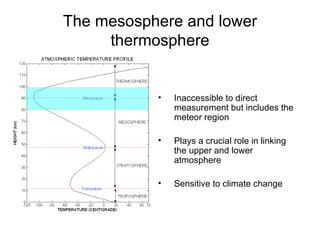
The mesosphere and lower thermosphere Inaccessible to direct measurement but includes the meteor region Plays a crucial role in linking the upper and lower atmosphere Sensitive to climate change
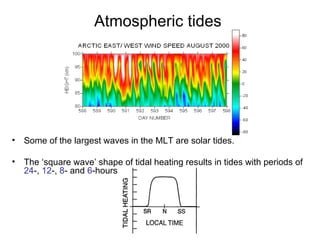
Atmospheric tides Some of the largest waves in the MLT are solar tides. The ‘square wave’ shape of tidal heating results in tides with periods of  24 -,  12 -,  8 - and  6 -hours
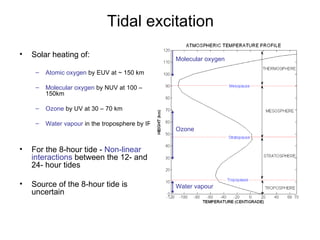
Tidal excitation Solar heating of: Atomic oxygen  by EUV at ~ 150 km Molecular oxygen  by NUV at 100 – 150km Ozone  by UV at 30 – 70 km Water vapour  in the troposphere by IR For the 8-hour tide -  Non-linear interactions  between the 12- and 24- hour tides Source of the 8-hour tide is uncertain Water vapour Ozone Molecular oxygen
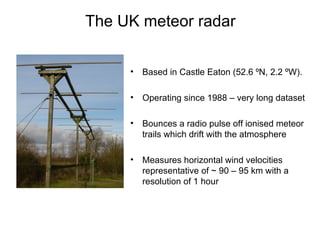
The UK meteor radar Based in Castle Eaton (52.6  ºN, 2.2 ºW ). Operating since 1988 – very long dataset  Bounces a radio pulse off ionised meteor trails which drift with the atmosphere Measures horizontal wind velocities representative of ~ 90 – 95 km with a resolution of 1 hour
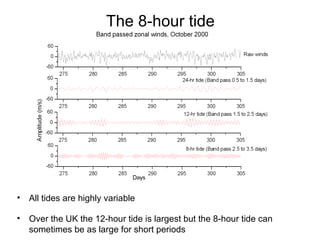
The 8-hour tide All tides are highly variable Over the UK the 12-hour tide is largest but the 8-hour tide can sometimes be as large for short periods
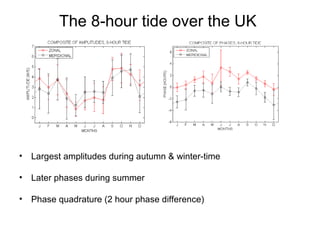
The 8-hour tide over the UK Largest amplitudes during autumn & winter-time  Later phases during summer Phase quadrature (2 hour phase difference)
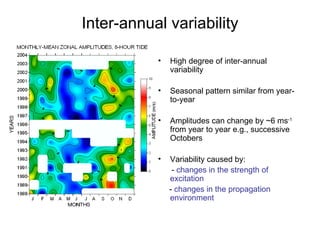
Inter-annual variability High degree of inter-annual variability  Seasonal pattern similar from year-to-year Amplitudes can change by ~6 ms -1  from year to year e.g., successive Octobers Variability caused by:  -  changes in the strength of excitation -  changes in the propagation environment
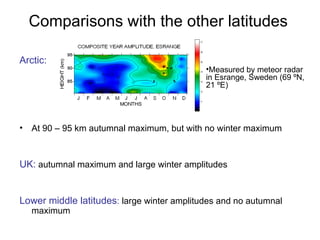
Comparisons with the other latitudes  At 90 – 95 km autumnal maximum, but with no winter maximum UK:  autumnal maximum and large winter amplitudes Lower middle latitudes :  large winter amplitudes and no autumnal maximum Arctic: Measured by meteor radar in Esrange, Sweden (69  ºN, 21 ºE )
Conclusions The 8-hour tide is a persistent feature of the MLT over the UK Climatology: amplitudes largest in autumn, smallest in summer High inter-annual variability -  although general seasonal structure remains the same Seasonal behaviour changes from UK to Arctic latitudes Future work : vertical wavelengths as diagnostic of tidal excitation Higher frequency tides e.g., the 6-hour tide
Charlotte Beldon Centre for Space, Atmosphere and Oceanic Science, Dept. Electronic and Electrical Engineering  University of Bath Thank you  [email_address]

The 8-hour tide in the MLT

  • 1.
    The 8-hour Tidein the Mesosphere and Lower Thermosphere over the UK Charlotte Beldon Centre for Space, Atmospheric & Oceanic Science University of Bath [email_address] 12/9/5/05
  • 2.
    Outline Introduction tomesosphere and lower thermosphere Atmospheric tides The UK meteor radar The 8-hour tide over the UK Comparisons with other latitudes Conclusions
  • 3.
    The mesosphere andlower thermosphere Inaccessible to direct measurement but includes the meteor region Plays a crucial role in linking the upper and lower atmosphere Sensitive to climate change
  • 4.
    Atmospheric tides Someof the largest waves in the MLT are solar tides. The ‘square wave’ shape of tidal heating results in tides with periods of 24 -, 12 -, 8 - and 6 -hours
  • 5.
    Tidal excitation Solarheating of: Atomic oxygen by EUV at ~ 150 km Molecular oxygen by NUV at 100 – 150km Ozone by UV at 30 – 70 km Water vapour in the troposphere by IR For the 8-hour tide - Non-linear interactions between the 12- and 24- hour tides Source of the 8-hour tide is uncertain Water vapour Ozone Molecular oxygen
  • 6.
    The UK meteorradar Based in Castle Eaton (52.6 ºN, 2.2 ºW ). Operating since 1988 – very long dataset Bounces a radio pulse off ionised meteor trails which drift with the atmosphere Measures horizontal wind velocities representative of ~ 90 – 95 km with a resolution of 1 hour
  • 7.
    The 8-hour tideAll tides are highly variable Over the UK the 12-hour tide is largest but the 8-hour tide can sometimes be as large for short periods
  • 8.
    The 8-hour tideover the UK Largest amplitudes during autumn & winter-time Later phases during summer Phase quadrature (2 hour phase difference)
  • 9.
    Inter-annual variability Highdegree of inter-annual variability Seasonal pattern similar from year-to-year Amplitudes can change by ~6 ms -1 from year to year e.g., successive Octobers Variability caused by: - changes in the strength of excitation - changes in the propagation environment
  • 10.
    Comparisons with theother latitudes At 90 – 95 km autumnal maximum, but with no winter maximum UK: autumnal maximum and large winter amplitudes Lower middle latitudes : large winter amplitudes and no autumnal maximum Arctic: Measured by meteor radar in Esrange, Sweden (69 ºN, 21 ºE )
  • 11.
    Conclusions The 8-hourtide is a persistent feature of the MLT over the UK Climatology: amplitudes largest in autumn, smallest in summer High inter-annual variability - although general seasonal structure remains the same Seasonal behaviour changes from UK to Arctic latitudes Future work : vertical wavelengths as diagnostic of tidal excitation Higher frequency tides e.g., the 6-hour tide
  • 12.
    Charlotte Beldon Centrefor Space, Atmosphere and Oceanic Science, Dept. Electronic and Electrical Engineering University of Bath Thank you [email_address]