The 6 Post-Secondary  Destinations Jillian Glasgow Junior Administrative Assistant The Work Room, 2008
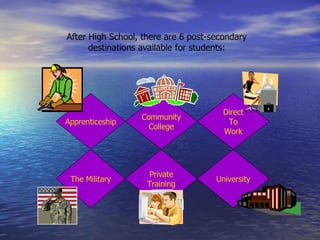
After High School, there are 6 post-secondary destinations available for students: Apprenticeship Community College The Military University Direct To Work Private Training
Apprenticeship Jillian Glasgow Junior Administrative Assistant  The Work Room, 2008
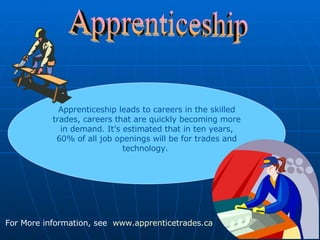
Apprenticeship Apprenticeship leads to careers in the skilled trades, careers that are quickly becoming more in demand. It’s estimated that in ten years, 60% of all job openings will be for trades and technology.  For More information, see  www.apprenticetrades.ca
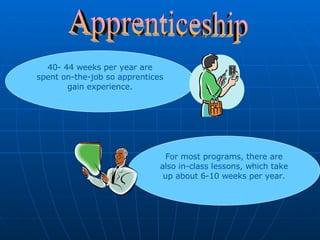
40- 44 weeks per year are spent on-the-job so apprentices gain experience. For most programs, there are also in-class lessons, which take up about 6-10 weeks per year. Apprenticeship
Apprentices also “earn while they learn”. While the apprentices learn by doing their chosen trade, they’re also paid 50%-90% of a certified journeypersons salary. Tuition costs are low, too, only about $200-$800 dollars a year.   Money Matters
Applying To get into the Apprenticeship program, you only need to have completed grade twelve. To select a trade you think you would like to study, visit  www.gnb.ca/0381/index-e.asp . Then, you need to find an employer (suggested websites:  www. workopolis.com  or  www. working.canada.com ). However, keep in mind that about 80% of all job openings are never advertised. Once you’ve found an employer, register with Apprenticeship and Occupational Certification. 2-5 years later, you’ll be a certified journeyperson!
Possible Careers... Painter Roofer Cook Welder Locksmith Baker Plumber
Community College Jillian Glasgow Junior Administrative Assistant  The Work Room, 2008
Community College There are 11 New Brunswick Community College (NBCC: see  www.nbcc.ca )  campuses spread all across New Brunswick which offer specialized training for the workplace of tomorrow. For more information, visit  www.accc.ca ,  www.canlearn.ca
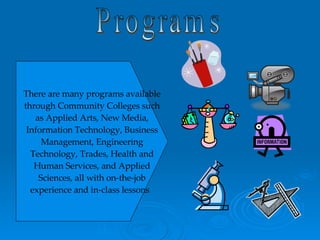
There are many programs available through Community Colleges such as Applied Arts, New Media, Information Technology, Business Management, Engineering Technology, Trades, Health and Human Services, and Applied Sciences, all with on-the-job experience and in-class lessons .   Programs
Tuition Tuition to Community colleges is much lower than that of Universities. For NBCC, tuition is $2,500 per year for a 40 week program. However, you can take out a student loan ( www.studentaid.gnb.ca  or  www.debtfreegrad.com ) or apply for scholarships ( www.scholarshipscanada.com ) to help support the cost of tuition.
Advantages Approximately eight out of nine graduates of NBCC are working, so your chances of getting a job are pretty good. NBCC has smaller classes so each individual student gets more attention, and all graduates get an advanced standing at several Canadian universities.

Possible Careers... Computer Technician Journalist Graphic Design Artist Photographer Administrative Assistant Laboratory Technician Artist Computer Programmer
Direct to Work Jillian Glasgow Junior Administrative Assistant The Work Room, 2008
Direct to Work After Graduation, some students will go directly to work. For these people there are two options available: Get a job OR Start a business
Getting a Job If you decide to look for a job, then update your resume and start going around to local employers. Or you can visit these websites for possible job openings in your community:  www.jobbank.gc.ca ,  www.careerbeacon.com ,  www.monster.ca , and  w ww.careerjet.ca . Remember, though, that 80% of all job openings are never advertised.
Entrepreneur The second option, becoming an entrepreneur, enables you to get paid for doing what you love. You get to be your own boss and provide jobs for your community.
Start Your Business If you’re thinking of starting your own business or expanding an existing one, you can contact your local Enterprise Agency Office which provides access to financial support and assists in preparing a business plan. If you have business questions, you can also contact the Business Service Centre ( www.cbsc.org ) which will answer your questions free of charge and provide access to business-related materials.
   If you are between the ages of 18 and 29, you are eligible for the SEED Capital ConneXion Program ( www.acoa.gc.ca/seed ). This program helps start or expand businesses and provides business counseling and training. Up to $20,000 is available in the form of a repayable, unsecured personal loan and up to $2,000 is available in a non-repayable grant for specialized training. To qualify for this program you must be the majority owner of the business and a resident of Canada.  SEED Program
Possible Careers... Entrepreneur Cashier Mover
The Military Jillian Glasgow Junior Administrative Assistant  The Work Room, 2008
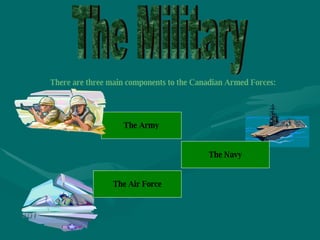
The Military There are three main components to the Canadian Armed Forces:   The   Army The Navy The Air Force
The Army assists civil authorities within Canada and provides humanitarian assistance and peace support abroad.   The Army
The Navy The Navy patrols Canada’s oceans and supports federal departments with environmental protection, Search and Rescue, international operations and humanitarian relief.
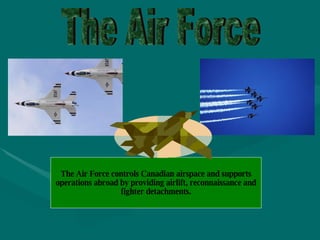
The Air Force The Air Force controls Canadian airspace and supports operations abroad by providing airlift, reconnaissance and fighter detachments.
Benefits Second language training Education subsidies Full health and dental coverage Comprehensive pension program 20 days of paid leave Access to fitness programs and facilities Opportunities for career advancement
must be a Canadian citizen (18 or older) must have completed at least grade ten   must be clear of any judicial obligations for a period of 6 months prior to application  must meet medical and enrollment standards  must have passed the pre-enrollment fitness evaluation  must have 20/20 vision (uncorrected) and a recognized University degree (for Air Force only) Requirements For more information, see  www.forces.gc.ca
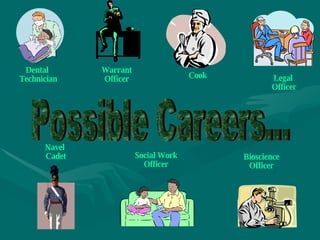
Possible Careers... Dental  Technician Warrant Officer Cook Legal  Officer Navel  Cadet Social Work Officer Bioscience Officer
Private Training Jillian Glasgow Junior Administrative Assistant  The Work Room, 2008
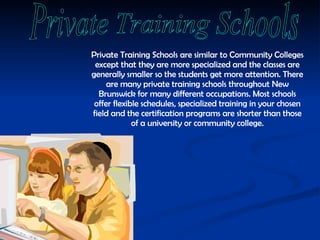
Private Training Schools are similar to Community Colleges except that they are more specialized and the classes are generally smaller so the students get more attention. There are many private training schools throughout New Brunswick for many different occupations.  Most schools offer flexible schedules, specialized training in your chosen field and the certification programs are shorter than those of a university or community college. Private Training Schools
Before you register at any schools, make sure they are registered with the government of New Brunswick under the New Brunswick Private Occupational Training Act:  www.gnb.ca/0368/pota-lst.pdf  For a list of Canadian private training schools, visit  http://www.canadian-universities.net .  Registered Schools
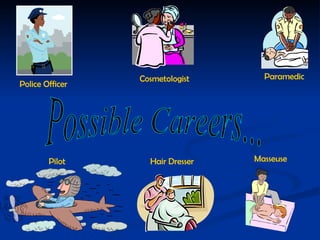
Possible Careers... Police Officer Cosmetologist Paramedic Pilot Hair Dresser Masseuse
University Jillian Glasgow Junior Administrative Assistant  The Work Room, 2008
University University allows you to further your education after High School. Many jobs require a University degree or at least some level of specialized training. To find a specific University or one that may be right for you, visit  http://www.aucc.ca/can_uni/our_universities/index_e.html  or  www.schoolfinder.com .  For more information, visit  www.macleans.ca/universities/


Campus Tours Before you apply at any University, it’s a good idea to visit the campus and see if it would be right for you. Click  here  to see links for booking tours to the most popular universities in the Maritimes.
Student Loans Money, however, may be an issue as tuition is generally at least five thousand dollars per year, depending on the program and university. There are student loans available to help cover the cost ( www.studentaid.gnb.ca  or  www.debtfreegrad.com ).
Scholarships For students with high academic standings or who excel in extracurricular activities, there are thousands of scholarships available ( www.studentawards.com  or  www.scholarshipscanada.com ).
Getting a job If neither of these options is available to you, you could also get a job to help pay tuition (suggested websites:  www.jobbank.gc.ca ,  www.careerbeacon.com ,  www.monster.ca ).
Possible careers... Psychiatrist Teacher Doctor Pharmacist Meteorologist Chemist Accountant

The 6 Desinations

  • 1.
    The 6 Post-Secondary Destinations Jillian Glasgow Junior Administrative Assistant The Work Room, 2008
  • 2.
    After High School,there are 6 post-secondary destinations available for students: Apprenticeship Community College The Military University Direct To Work Private Training
  • 3.
    Apprenticeship Jillian GlasgowJunior Administrative Assistant The Work Room, 2008
  • 4.
    Apprenticeship Apprenticeship leadsto careers in the skilled trades, careers that are quickly becoming more in demand. It’s estimated that in ten years, 60% of all job openings will be for trades and technology. For More information, see www.apprenticetrades.ca
  • 5.
    40- 44 weeksper year are spent on-the-job so apprentices gain experience. For most programs, there are also in-class lessons, which take up about 6-10 weeks per year. Apprenticeship
  • 6.
    Apprentices also “earnwhile they learn”. While the apprentices learn by doing their chosen trade, they’re also paid 50%-90% of a certified journeypersons salary. Tuition costs are low, too, only about $200-$800 dollars a year. Money Matters
  • 7.
    Applying To getinto the Apprenticeship program, you only need to have completed grade twelve. To select a trade you think you would like to study, visit www.gnb.ca/0381/index-e.asp . Then, you need to find an employer (suggested websites: www. workopolis.com or www. working.canada.com ). However, keep in mind that about 80% of all job openings are never advertised. Once you’ve found an employer, register with Apprenticeship and Occupational Certification. 2-5 years later, you’ll be a certified journeyperson!
  • 8.
    Possible Careers... PainterRoofer Cook Welder Locksmith Baker Plumber
  • 9.
    Community College JillianGlasgow Junior Administrative Assistant The Work Room, 2008
  • 10.
    Community College Thereare 11 New Brunswick Community College (NBCC: see www.nbcc.ca ) campuses spread all across New Brunswick which offer specialized training for the workplace of tomorrow. For more information, visit www.accc.ca , www.canlearn.ca
  • 11.
    There are manyprograms available through Community Colleges such as Applied Arts, New Media, Information Technology, Business Management, Engineering Technology, Trades, Health and Human Services, and Applied Sciences, all with on-the-job experience and in-class lessons . Programs
  • 12.
    Tuition Tuition toCommunity colleges is much lower than that of Universities. For NBCC, tuition is $2,500 per year for a 40 week program. However, you can take out a student loan ( www.studentaid.gnb.ca or www.debtfreegrad.com ) or apply for scholarships ( www.scholarshipscanada.com ) to help support the cost of tuition.
  • 13.
    Advantages Approximately eightout of nine graduates of NBCC are working, so your chances of getting a job are pretty good. NBCC has smaller classes so each individual student gets more attention, and all graduates get an advanced standing at several Canadian universities.
  • 14.
    Possible Careers... ComputerTechnician Journalist Graphic Design Artist Photographer Administrative Assistant Laboratory Technician Artist Computer Programmer
  • 15.
    Direct to WorkJillian Glasgow Junior Administrative Assistant The Work Room, 2008
  • 16.
    Direct to WorkAfter Graduation, some students will go directly to work. For these people there are two options available: Get a job OR Start a business
  • 17.
    Getting a JobIf you decide to look for a job, then update your resume and start going around to local employers. Or you can visit these websites for possible job openings in your community: www.jobbank.gc.ca , www.careerbeacon.com , www.monster.ca , and w ww.careerjet.ca . Remember, though, that 80% of all job openings are never advertised.
  • 18.
    Entrepreneur The secondoption, becoming an entrepreneur, enables you to get paid for doing what you love. You get to be your own boss and provide jobs for your community.
  • 19.
    Start Your BusinessIf you’re thinking of starting your own business or expanding an existing one, you can contact your local Enterprise Agency Office which provides access to financial support and assists in preparing a business plan. If you have business questions, you can also contact the Business Service Centre ( www.cbsc.org ) which will answer your questions free of charge and provide access to business-related materials.
  • 20.
       If you arebetween the ages of 18 and 29, you are eligible for the SEED Capital ConneXion Program ( www.acoa.gc.ca/seed ). This program helps start or expand businesses and provides business counseling and training. Up to $20,000 is available in the form of a repayable, unsecured personal loan and up to $2,000 is available in a non-repayable grant for specialized training. To qualify for this program you must be the majority owner of the business and a resident of Canada. SEED Program
  • 21.
  • 22.
    The Military JillianGlasgow Junior Administrative Assistant The Work Room, 2008
  • 23.
    The Military Thereare three main components to the Canadian Armed Forces: The Army The Navy The Air Force
  • 24.
    The Army assistscivil authorities within Canada and provides humanitarian assistance and peace support abroad. The Army
  • 25.
    The Navy TheNavy patrols Canada’s oceans and supports federal departments with environmental protection, Search and Rescue, international operations and humanitarian relief.
  • 26.
    The Air ForceThe Air Force controls Canadian airspace and supports operations abroad by providing airlift, reconnaissance and fighter detachments.
  • 27.
    Benefits Second languagetraining Education subsidies Full health and dental coverage Comprehensive pension program 20 days of paid leave Access to fitness programs and facilities Opportunities for career advancement
  • 28.
    must be aCanadian citizen (18 or older) must have completed at least grade ten must be clear of any judicial obligations for a period of 6 months prior to application must meet medical and enrollment standards must have passed the pre-enrollment fitness evaluation must have 20/20 vision (uncorrected) and a recognized University degree (for Air Force only) Requirements For more information, see www.forces.gc.ca
  • 29.
    Possible Careers... Dental Technician Warrant Officer Cook Legal Officer Navel Cadet Social Work Officer Bioscience Officer
  • 30.
    Private Training JillianGlasgow Junior Administrative Assistant The Work Room, 2008
  • 31.
    Private Training Schoolsare similar to Community Colleges except that they are more specialized and the classes are generally smaller so the students get more attention. There are many private training schools throughout New Brunswick for many different occupations. Most schools offer flexible schedules, specialized training in your chosen field and the certification programs are shorter than those of a university or community college. Private Training Schools
  • 32.
    Before you registerat any schools, make sure they are registered with the government of New Brunswick under the New Brunswick Private Occupational Training Act: www.gnb.ca/0368/pota-lst.pdf For a list of Canadian private training schools, visit http://www.canadian-universities.net . Registered Schools
  • 33.
    Possible Careers... PoliceOfficer Cosmetologist Paramedic Pilot Hair Dresser Masseuse
  • 34.
    University Jillian GlasgowJunior Administrative Assistant The Work Room, 2008
  • 35.
    University University allowsyou to further your education after High School. Many jobs require a University degree or at least some level of specialized training. To find a specific University or one that may be right for you, visit http://www.aucc.ca/can_uni/our_universities/index_e.html or www.schoolfinder.com . For more information, visit www.macleans.ca/universities/
  • 36.
    Campus Tours Beforeyou apply at any University, it’s a good idea to visit the campus and see if it would be right for you. Click here to see links for booking tours to the most popular universities in the Maritimes.
  • 37.
    Student Loans Money,however, may be an issue as tuition is generally at least five thousand dollars per year, depending on the program and university. There are student loans available to help cover the cost ( www.studentaid.gnb.ca or www.debtfreegrad.com ).
  • 38.
    Scholarships For studentswith high academic standings or who excel in extracurricular activities, there are thousands of scholarships available ( www.studentawards.com or www.scholarshipscanada.com ).
  • 39.
    Getting a jobIf neither of these options is available to you, you could also get a job to help pay tuition (suggested websites: www.jobbank.gc.ca , www.careerbeacon.com , www.monster.ca ).
  • 40.
    Possible careers... PsychiatristTeacher Doctor Pharmacist Meteorologist Chemist Accountant