Addis Ababa University
Aklilu Lemma Institute Of Pathobiology
Department of Tropical and Infectious Diseases
Mini presentation
on
T-Helper Cell 9: A relatively new member in the Th cell
family.
By
Dr. Tekalign Tadesse (Doctor of Veterinary Medicine)
February, 2020
Addis Ababa, Ethiopia
Outlines of Presentation
1. Introduction
2. Differentiation of T cell
3. Cytokines and T Factors for Th-9 cell
4. Protective Role of Th-9 cell
5. Detrimental Role of Th-9 cell
6. Therapeutic role of Th-9 cell
7. Conclusion and a way forward
8. References
1. Introduction
 Unlike that of B lymphocytes, T lymphocytes are originated from
Bone marrow and take their ways to thymus to mature and get
educated.
 Upon recognition of Ag presented by antigen presenting cells
bearing MHC-II, this cell will be differentiated into T-helper cell.
 Naïve CD4+ T-helper cells differentiate into T-helper cell
subsets in the presence, cytokines, co-stimulatory factors and
other factors (Veldhoen et al., 2008).
 Differentiated T helper cells play a myriad of functions in
obliterating the infecting pathogens.
 However, when these cell-mediated responses are not properly
regulated, unrestrained CD4+ T helper cell responses lead to
chronic inflammation and tissue damage.
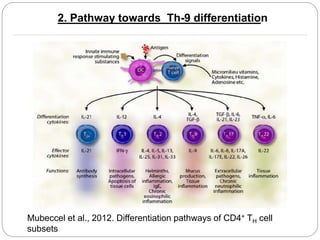
2. Pathway towards Th-9 differentiation
Mubeccel et al., 2012. Differentiation pathways of CD4+ TH cell
subsets
3. Cytokines and transcription factors
 Differentiating cytokines, TGF-β) and IL-4 promotes the
differentiation into effector Th-9 cells.
 TGF-β signal induce expression of Foxp3 and PU.1
transcription factors, PU.1 directly bind to Il9 gene
promoter.
 IL-4 is secreted from Th-2 cells and mast cells and has
a function of activating the transcription factor STAT6.
 Transcription factors that include;
 STAT6 (signal transducer and activator of transcription
6),
 PU.1, IRF4 (interferon response factor 4), and GATA3
 Th-9 secret prominently IL-9 and other IL-10, IL-21 as
effectors cytokine, involved allergy, autoimmunity, infections,
cancer and immunodeficiency
 However, some cytokines, including IFN-g, IL-12, IL-18 and
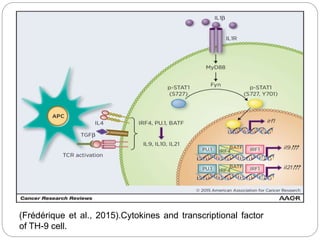
(Frédérique et al., 2015).Cytokines and transcriptional factor
of TH-9 cell.
4. Role of Th-9 cells
Role in Allergy
• In experimental study in the lungs of transgenic mice,
increased IL-9 expression resulted in airway
inflammation, hypertrophy of epithelial cells, increased
mucus generation (Rukhsana Jabeen et al., 2012).
• Deficiency of Th-9 cell transcription factors, such as
PU.1, IRF4, and BATF, mice developed lower level
inflammatory symptom.
• Serum levels of IL-9 have a moderate positive
correlation with symptom severity including itching,
sneezing, and rhinorrhea in patients with allergic rhinitis
suggesting a role of IL-9 in acute allergic reactions.
• In addition, Th-9 cells was also involved in the effect of
Role in Parasite expulsion
 Experimentally mice was infected with nematode Trichuris
muris and given IL-9, and caused eosinophilia, increased
intestinal permeability and contractility, which leads to
parasite expulsion (Rukhsana Jabeen et al., 2012).
 It has been identified that the deficiency of TGF-B in mice is
also associated with impaired IL-9 production, elevated
worm burden and diminished mast cells in the cecum
(Veldhoen et al., 2008).
 In a study Mice were infected by Leishmania major (L.
major), then levels of IL-9 were evaluated. Lymphocytes in
lymph nodes and spleens of L. major-infected produced
higher levels of IL-9 during an acute immune response
(Gesnner et al.,1993) .
 Indeed, adoptive transfer of Th-9 cells into Rag-1 deficient
Role in Autoimmune diseases
 High expression of IL-9 were detected in patients with IBD,
especially in those with ulcerative colitis (Weigmann and
Neurath, 2017).
 Th-9 cells play prominent roles in the pathogenesis of
Rheumatoid Arthritis with serum levels of IL-9 being
increased in RA patients compared with healthy controls
(Dantas et al., 2015).
 It has also been revealed that the expression of both the
mRNA and protein of IL-4, and TGF-B are elevated in RA
synovial tissue, indicating a possible role of TH-9 and IL-9
in the development of RA(Ciccia et al., 2015).
 Again increased serum concentrations of mRNA transcripts
Role in Tumor diseases
 The high secretion of IL-9 and IL-21 in the tumor bed
activate and attract dendritic cells, mast cells, NK cell, and
CD8 T-cells to mount an antitumor immune response.
 Th-9 cells have anticancer properties via granzyme B
release (Purwaw et al., 2012).
 It has been recently described that Ag-specific Th-9 cells
are able to inhibit squamous cancer (SQC) growth and also
promote apoptosis in both in vivo and in vitro (Miao et al.,
2017).
 Reverse function of IL-9 in promoting human malignant
Role in Tuberculosis
The frequency of Th-9 cells detected in tuberculous pleural
effusion increases during Mycobacterium tuberculosis
infection.
Moreover, pleural mesothelial cells, acting as antigen
presenting cells, promote Th-9 cell differentiation by
presenting antigen.
whereas IL-9 promotes the pleural mesothelial cell repairing
(Sabat, 2010).
Role in transplant tolerance
High levels of IL-9 in the tolerant grafts, which boosted the
Therapeutic Roles
 Administration of Th-9 cells, as a therapeutic strategy, leads to
stimulation of CD8+ T cells and DCs recruitment into tumor
site, which mediates antitumor immunity.
 Direct administration of Th-9 cells leads to specific homing of
transferred T cells to the tumor site and more cytokine
production compared with systemic injection of IL-21(Vegran et
al., 2015).
 Recombinant IL-21 was investigated in a phase II study of
patients with metastatic melanoma and a 22.5% response rate
was achieved in the first-line treatment(Petrella et al., 2012).
 Th-9 cells promote over expression of anti-apoptotic protein
Bcl-xL and activation of p38, ERK, and STAT5 signaling
pathways in DCs (park et al., 2014).
Summary
 Th-9 cells develop in response to combined signal from TGF-
β and IL-4
 Has transcription factors with complex transduction network
including IRF4, PU.1, GATA3.
 Th-9 cells play a notable role in immune responses by the
acquisition of IL-9 production.
 Th-9 cells and IL-9 play harmful roles in the pathogenesis of
asthma and other allergic diseases and in autoimmune
diseases .
 In microbial, parasite infections,TH-9 cells and IL-9 have
broadly protective roles,
 Cell-derived IL-9 suppresses melanoma growth and
Unanswered question and the way forward
1. The exact mechanism of action in invivo (Human
disease) is not well elucidated.
2. The exact cross-linkage with other Th subset is not
well described
3. The role of Th-9 cell may not be universal in all
models
 Taken together, various functions and the different
presence of Th-9 cells and IL-9 in the mentioned
diseases, show the need for more studies to approve
the administration of IL-9 and Th-9 cells as an
immuno-therapeutic strategy in different conditions.
References (Thanks to Elsevier journals)
1. Veldhoen M, Uyttenhove C, van Snick J, Helmby H, WestendorfA, Buer J, et al. Transforming growth factor-beta
‘repro-grams’ the differentiation of T helper 2 cells and promotes an interleukin 9-producing subset. Nat
Immunol. 2008;9:1341-
2. Rukhsana, J., and Kaplan, M.H. (2012). The symphony of the ninth: the development and function of Th9 cells.
Current Opinion in Immunology, 24: 303–307.
3. Chang, H., Han, L., Jabeen, R., Carotta, S., Nutt, S.L. and Kaplan, M.K. (2009). PU.1 regulates TCR expression
by modulating GATA-3 activity. Journal of Immunology, 183: 4887–4894.
4. Gessner A, Blum H, Röllinghoff M. Differential regulation ofIL-9-expression after infection with Leishmania major
in sus-ceptible and resistant mice. Immunobiology. 1993;189:419---35.
5. Licona-Limón P, Henao-Mejia J, Temann AU, Gagliani N,Licona-Limón I, Ishigame H, et al. Th9 cells drive
hostimmunity against gastrointestinal worm infection. Immunity.2013;39:744---57.
6. B. Weigmann, M.F. Neurath, Th9 cells in inflammatory bowel diseases, Semin. Immunopathol. 39 (2017) 89–95.
7. Dantas AT, Marques CDL, da Rocha Junior LF, CavalcantiMB, Gonc¸alves SMC, Cardoso PRG, et al. Increased
seruminterleukin-9 levels in rheumatoid arthritis and systemic lupuserythematosus: pathogenic role or just an
epiphenomenon? DisMarkers. 2015;2015:519638.
8. Purwar R, Schlapbach C, Xiao S, Kang HS, Elyaman W,Jiang X, et al. Robust tumor immunity to melanoma
medi-ated by interleukin-9-producing T cells. Nat Med. 2012;18:1248---53.
9. Miao B-P, Zhang R-S, Sun H-J, Yu Y-P, Chen T, Li L-J, et al.Inhibition of squamous cancer growth in a mouse
model byStaphylococcal enterotoxin B-triggered Th9 cell expansion.Cell Mol Immunol. 2017;14:371---9.
10. Merz H, Houssiau F, Orscheschek K, Renauld J-C, Fliedner A,Herin M, et al. Interleukin-9 expression in human
malignantlymphomas: unique association with Hodgkin’s disease andlarge cell anaplastic lymphoma. Blood.
1991;78:1311.
11. Ciccia F, Guggino G, Rizzo A, Manzo A, Vitolo B, La MannaMP, et al. Potential involvement of IL-9 and Th9 cells
in thepathogenesis of rheumatoid arthritis. Rheumatology (Oxford).2015;54:2264---72.
12. W. Elyaman, E.M. Bradshaw, C. Uyttenhove, V. Dardalhon, A. Awasthi, J. Imitola, et al., IL-9 induces
differentiation of TH17 cells and enhances function of FoxP3 + natural regulatory T cells, Proc. Natl. Acad. Sci.
U. S. A. 106 (2009) 12885–12890.
13. Petrella TM, Tozer R, Belanger K, Savage KJ, Wong R, SmylieM, et al. Interleukin-21 has activity in patients
with metastaticmelanoma: a phase II study. J Clin Oncol. 2012;30:3396---401.
14. Végran F, Apetoh L, Ghiringhelli F. Th9 cells: a novel CD4 T-cell subset in the immune war against cancer.
Cancer Res.2015;75:475---9
15. Park J, Li H, Zhang M, Lu Y, Hong B, Zheng Y, et al.Murine Th9 cells promote the survival of myeloid
This is all what I have and Up to my
ability
Thank you !!!

Immunological Role of Th-9 cell

  • 1.
    Addis Ababa University AkliluLemma Institute Of Pathobiology Department of Tropical and Infectious Diseases Mini presentation on T-Helper Cell 9: A relatively new member in the Th cell family. By Dr. Tekalign Tadesse (Doctor of Veterinary Medicine) February, 2020 Addis Ababa, Ethiopia
  • 2.
    Outlines of Presentation 1.Introduction 2. Differentiation of T cell 3. Cytokines and T Factors for Th-9 cell 4. Protective Role of Th-9 cell 5. Detrimental Role of Th-9 cell 6. Therapeutic role of Th-9 cell 7. Conclusion and a way forward 8. References
  • 3.
    1. Introduction  Unlikethat of B lymphocytes, T lymphocytes are originated from Bone marrow and take their ways to thymus to mature and get educated.  Upon recognition of Ag presented by antigen presenting cells bearing MHC-II, this cell will be differentiated into T-helper cell.  Naïve CD4+ T-helper cells differentiate into T-helper cell subsets in the presence, cytokines, co-stimulatory factors and other factors (Veldhoen et al., 2008).  Differentiated T helper cells play a myriad of functions in obliterating the infecting pathogens.  However, when these cell-mediated responses are not properly regulated, unrestrained CD4+ T helper cell responses lead to chronic inflammation and tissue damage.
  • 4.
    2. Pathway towardsTh-9 differentiation Mubeccel et al., 2012. Differentiation pathways of CD4+ TH cell subsets
  • 5.
    3. Cytokines andtranscription factors  Differentiating cytokines, TGF-β) and IL-4 promotes the differentiation into effector Th-9 cells.  TGF-β signal induce expression of Foxp3 and PU.1 transcription factors, PU.1 directly bind to Il9 gene promoter.  IL-4 is secreted from Th-2 cells and mast cells and has a function of activating the transcription factor STAT6.  Transcription factors that include;  STAT6 (signal transducer and activator of transcription 6),  PU.1, IRF4 (interferon response factor 4), and GATA3  Th-9 secret prominently IL-9 and other IL-10, IL-21 as effectors cytokine, involved allergy, autoimmunity, infections, cancer and immunodeficiency  However, some cytokines, including IFN-g, IL-12, IL-18 and
  • 6.
    (Frédérique et al.,2015).Cytokines and transcriptional factor of TH-9 cell.
  • 7.
    4. Role ofTh-9 cells Role in Allergy • In experimental study in the lungs of transgenic mice, increased IL-9 expression resulted in airway inflammation, hypertrophy of epithelial cells, increased mucus generation (Rukhsana Jabeen et al., 2012). • Deficiency of Th-9 cell transcription factors, such as PU.1, IRF4, and BATF, mice developed lower level inflammatory symptom. • Serum levels of IL-9 have a moderate positive correlation with symptom severity including itching, sneezing, and rhinorrhea in patients with allergic rhinitis suggesting a role of IL-9 in acute allergic reactions. • In addition, Th-9 cells was also involved in the effect of
  • 8.
    Role in Parasiteexpulsion  Experimentally mice was infected with nematode Trichuris muris and given IL-9, and caused eosinophilia, increased intestinal permeability and contractility, which leads to parasite expulsion (Rukhsana Jabeen et al., 2012).  It has been identified that the deficiency of TGF-B in mice is also associated with impaired IL-9 production, elevated worm burden and diminished mast cells in the cecum (Veldhoen et al., 2008).  In a study Mice were infected by Leishmania major (L. major), then levels of IL-9 were evaluated. Lymphocytes in lymph nodes and spleens of L. major-infected produced higher levels of IL-9 during an acute immune response (Gesnner et al.,1993) .  Indeed, adoptive transfer of Th-9 cells into Rag-1 deficient
  • 9.
    Role in Autoimmunediseases  High expression of IL-9 were detected in patients with IBD, especially in those with ulcerative colitis (Weigmann and Neurath, 2017).  Th-9 cells play prominent roles in the pathogenesis of Rheumatoid Arthritis with serum levels of IL-9 being increased in RA patients compared with healthy controls (Dantas et al., 2015).  It has also been revealed that the expression of both the mRNA and protein of IL-4, and TGF-B are elevated in RA synovial tissue, indicating a possible role of TH-9 and IL-9 in the development of RA(Ciccia et al., 2015).  Again increased serum concentrations of mRNA transcripts
  • 10.
    Role in Tumordiseases  The high secretion of IL-9 and IL-21 in the tumor bed activate and attract dendritic cells, mast cells, NK cell, and CD8 T-cells to mount an antitumor immune response.  Th-9 cells have anticancer properties via granzyme B release (Purwaw et al., 2012).  It has been recently described that Ag-specific Th-9 cells are able to inhibit squamous cancer (SQC) growth and also promote apoptosis in both in vivo and in vitro (Miao et al., 2017).  Reverse function of IL-9 in promoting human malignant
  • 11.
    Role in Tuberculosis Thefrequency of Th-9 cells detected in tuberculous pleural effusion increases during Mycobacterium tuberculosis infection. Moreover, pleural mesothelial cells, acting as antigen presenting cells, promote Th-9 cell differentiation by presenting antigen. whereas IL-9 promotes the pleural mesothelial cell repairing (Sabat, 2010). Role in transplant tolerance High levels of IL-9 in the tolerant grafts, which boosted the
  • 12.
    Therapeutic Roles  Administrationof Th-9 cells, as a therapeutic strategy, leads to stimulation of CD8+ T cells and DCs recruitment into tumor site, which mediates antitumor immunity.  Direct administration of Th-9 cells leads to specific homing of transferred T cells to the tumor site and more cytokine production compared with systemic injection of IL-21(Vegran et al., 2015).  Recombinant IL-21 was investigated in a phase II study of patients with metastatic melanoma and a 22.5% response rate was achieved in the first-line treatment(Petrella et al., 2012).  Th-9 cells promote over expression of anti-apoptotic protein Bcl-xL and activation of p38, ERK, and STAT5 signaling pathways in DCs (park et al., 2014).
  • 13.
    Summary  Th-9 cellsdevelop in response to combined signal from TGF- β and IL-4  Has transcription factors with complex transduction network including IRF4, PU.1, GATA3.  Th-9 cells play a notable role in immune responses by the acquisition of IL-9 production.  Th-9 cells and IL-9 play harmful roles in the pathogenesis of asthma and other allergic diseases and in autoimmune diseases .  In microbial, parasite infections,TH-9 cells and IL-9 have broadly protective roles,  Cell-derived IL-9 suppresses melanoma growth and
  • 14.
    Unanswered question andthe way forward 1. The exact mechanism of action in invivo (Human disease) is not well elucidated. 2. The exact cross-linkage with other Th subset is not well described 3. The role of Th-9 cell may not be universal in all models  Taken together, various functions and the different presence of Th-9 cells and IL-9 in the mentioned diseases, show the need for more studies to approve the administration of IL-9 and Th-9 cells as an immuno-therapeutic strategy in different conditions.
  • 15.
    References (Thanks toElsevier journals) 1. Veldhoen M, Uyttenhove C, van Snick J, Helmby H, WestendorfA, Buer J, et al. Transforming growth factor-beta ‘repro-grams’ the differentiation of T helper 2 cells and promotes an interleukin 9-producing subset. Nat Immunol. 2008;9:1341- 2. Rukhsana, J., and Kaplan, M.H. (2012). The symphony of the ninth: the development and function of Th9 cells. Current Opinion in Immunology, 24: 303–307. 3. Chang, H., Han, L., Jabeen, R., Carotta, S., Nutt, S.L. and Kaplan, M.K. (2009). PU.1 regulates TCR expression by modulating GATA-3 activity. Journal of Immunology, 183: 4887–4894. 4. Gessner A, Blum H, Röllinghoff M. Differential regulation ofIL-9-expression after infection with Leishmania major in sus-ceptible and resistant mice. Immunobiology. 1993;189:419---35. 5. Licona-Limón P, Henao-Mejia J, Temann AU, Gagliani N,Licona-Limón I, Ishigame H, et al. Th9 cells drive hostimmunity against gastrointestinal worm infection. Immunity.2013;39:744---57. 6. B. Weigmann, M.F. Neurath, Th9 cells in inflammatory bowel diseases, Semin. Immunopathol. 39 (2017) 89–95. 7. Dantas AT, Marques CDL, da Rocha Junior LF, CavalcantiMB, Gonc¸alves SMC, Cardoso PRG, et al. Increased seruminterleukin-9 levels in rheumatoid arthritis and systemic lupuserythematosus: pathogenic role or just an epiphenomenon? DisMarkers. 2015;2015:519638. 8. Purwar R, Schlapbach C, Xiao S, Kang HS, Elyaman W,Jiang X, et al. Robust tumor immunity to melanoma medi-ated by interleukin-9-producing T cells. Nat Med. 2012;18:1248---53. 9. Miao B-P, Zhang R-S, Sun H-J, Yu Y-P, Chen T, Li L-J, et al.Inhibition of squamous cancer growth in a mouse model byStaphylococcal enterotoxin B-triggered Th9 cell expansion.Cell Mol Immunol. 2017;14:371---9. 10. Merz H, Houssiau F, Orscheschek K, Renauld J-C, Fliedner A,Herin M, et al. Interleukin-9 expression in human malignantlymphomas: unique association with Hodgkin’s disease andlarge cell anaplastic lymphoma. Blood. 1991;78:1311. 11. Ciccia F, Guggino G, Rizzo A, Manzo A, Vitolo B, La MannaMP, et al. Potential involvement of IL-9 and Th9 cells in thepathogenesis of rheumatoid arthritis. Rheumatology (Oxford).2015;54:2264---72. 12. W. Elyaman, E.M. Bradshaw, C. Uyttenhove, V. Dardalhon, A. Awasthi, J. Imitola, et al., IL-9 induces differentiation of TH17 cells and enhances function of FoxP3 + natural regulatory T cells, Proc. Natl. Acad. Sci. U. S. A. 106 (2009) 12885–12890. 13. Petrella TM, Tozer R, Belanger K, Savage KJ, Wong R, SmylieM, et al. Interleukin-21 has activity in patients with metastaticmelanoma: a phase II study. J Clin Oncol. 2012;30:3396---401. 14. Végran F, Apetoh L, Ghiringhelli F. Th9 cells: a novel CD4 T-cell subset in the immune war against cancer. Cancer Res.2015;75:475---9 15. Park J, Li H, Zhang M, Lu Y, Hong B, Zheng Y, et al.Murine Th9 cells promote the survival of myeloid
  • 16.
    This is allwhat I have and Up to my ability Thank you !!!