LECTURE 6
What Is Fiat Good For?
1. Government finance
Discussed extensively in Chapter 3, as well as
chapters 6 and 7 of The Bitcoin Standard
1. Salability across space
1. Bank profitability
1
2
2. Salability across space
● Menger: Money is the most salable good
● Salability is a function of the spread between the bid
and ask for an asset.
● Bid: maximum price a buyer is willing to pay
Ask: minimum price a seller is willing to accepts
● All goods have a diminishing marginal utility: The more
you have of a good, the lower your valuation of the next
good.
● Ex: Your first cup of water in a day is the most valuable,
your twentierh
● If you bring a large quantity of a good to market, the
buyers' utility from increasing quantities of the good
declines.
● Similarly applies to traders buying the good to resell it. The
more their stockpiles grow, the more they would offer for
the marginal unit added to the stockpiles.
● As you need more buyers to buy, you need buyers with a
lower marginal valuation, who offer a lower bid, increasing
the spread between bid and ask
3
● Salability: The degree to which the good does not lose
value as it is brought to market by its owner.
● A highly salable good can be reliably sold at very
close to market price
● A good with low salability will lose significant value, or
require plenty of time to be sold
4
● Salability can be assessed across three axes, as discussed
in The Bitcoin Standard: Time, scales, and space
● Time: How much a good loses value as its held across time
● Salability across time was the central analytical of The
Bitcoin Standard: The good with the highest stock-to-flow
will be accumulated the most as a store of value, and will
face the least diminishing marginal demand as its
quantities increase.
● If you wanted to sell anything else, people would value it
according to its own marginal utility, which quickly
diminishes.
5
6
● But given gold's high stock-to-flow, and its resistance to
debasement, people don't value it only for its own use
marginal utility, as an ornament or industrial metal, but as
something that can be exchanged for other goods.
● Market participants are happy to accumulate gold more
than anything else, because they expect to be able to
resell it for the least loss of value in the future, given its
resistance of dilution. Over time, this is the best thing to
accumulate, as it is the thing theat can be exchanged
most easily to other in the future.
● Scales:
● How much a good loses in value as you transact across scales
● If you wanted to sell small quantities of gold to make a small
purchase, you would incur significant loss chopping off small
pieces and weighing them.
● Historically, silver maintained a monetary role as gold was not
highly salable across small scales.
● As banking allowed for the use of banknotes and checks
across all transaction sizes, silver's monetary role was
obviated.
● Silver has never recovered
7
● Space: How much a good loses in its value as it is
transported across space
● Why metals beat cattle and crops
● Why gold beat other metals
● Standardized increased salability across space
by making the coins immediately recognizable
8
● But the invention of modern transportation made
gold's salability across space decline
● Banking fixed this through clearance and settlements
● With time, as people took physical delivery less and
less, money increasingly became a liability of the
financial institution settling payments.
9
● Although banks could honor their promises to redeem
any of their obligations for gold, they could issue more
gold liabilities than the gold they had on hand, thanks to
its limited spatial salability.
● There was no easy and convenient place for bank clients
to redeem their gold and still use it for settling the
increasingly global trades they conducted. With only
one monopoly bank in a town, or one central bank in a
country, your gold coin had very little spatial salability
while it was in your physical possession.
10
● The gold standard’s monetary medium was not just the
gold underlying it but also the payment and settlement
rails that allowed it sufficient spatial salability to move
around the world.
● Gold in the bank effectively carried a spatial salability
premium over gold in individual physical possession.
11
12
● Although gold is highly salable across time, its salability
across space is very low compared to fiat. This is as
significant a flaw as having a low stock-to-flow ratio.
Whereas a low stock-to-flow ratio leads to a loss in
value when trading the good across time, a high cost of
transportation results in a significant loss of value when
transacting the good across space.
● A hard money that requires brick-and-mortar banks in
order to clear it is always liable to government seizure or
being replaced with government fiat. Political and
engineering realities mean that the low spatial salability
of gold and physical monies needs to be considered a
feature, not a bug.
● One can point to government restrictions on the free
movement of gold as the reason for fiat’s rise, but that
misses the point: if gold had high salability across space,
it would not need governments to ensure its monetary
role.
13
14
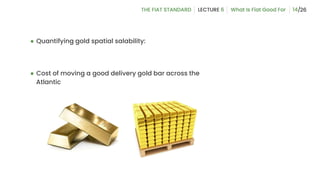
● Quantifying gold spatial salability:
● Cost of moving a good delivery gold bar across the
Atlantic
15
● In 1919: ~0.2% of face value
● A sunk boat cost 2-3% of face value to salvage
● In 2013-2017: ~0.05-0.1% of face value for German central
bank to repatriate its gold from US Fed, including
verifying
● The process took four years
● Takes around 1-2 weeks just to ship the gold
16
● Today, single gold bar costs around 0.5%
● Takes around 2-3 days
17
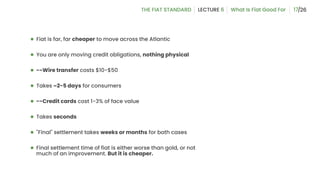
● Fiat is far, far cheaper to move across the Atlantic
● You are only moving credit obligations, nothing physical
● --Wire transfer costs $10-$50
● Takes ~2-5 days for consumers
● --Credit cards cost 1-3% of face value
● Takes seconds
● "Final" settlement takes weeks or months for both cases
● Final settlement time of fiat is either worse than gold, or not
much of an improvement. But it is cheaper.
● As gold standard payments increasingly became
credit payments and not cash settlements, the
payment rails of banks and central banks became
an increasingly important part of the monetary
infrastructure that made payments possible.
18
● The Faustian bargain of fiat money appears
inevitable this way, as the ability to save for the future
was compromised to transact quickly across space.
The technology of fiat strongly benefits governments
and banks, as will be discussed below, but it was the
spatial salability of fiat that allowed them to take
advantage of it to their own ends.
19
20
3. Bank Profitability
● Fiat allows banks to engage in fractional reserve banking
with little restraint, because it allows government to bail
them out whenever they face liquidity (i.e solvency)
crises.
● Under the gold standard, banks could still engage in
fractional reserve banking, because they provided gold
with the superior salability.
● But they were limited because once a bank run
happened, the bank could not print gold. Other banks
could perhaps bail it out, but they would be risking their
own solvency. There was a constant churn of banks going
bankrupt ensuring that inflationary fractional reserve
banking did not get too out of hand.
21
● Then in 1913 the Federal Reserve Act as a response to the
financial crisis of 1907. This way, government could
stabilize the financial system when panics happen. The
Fed was not the cure to the disease of insolvent banks;
insolvency was the cure, and the Fed was the antidote to
the cure.
● The Fed's rationale: Stabilize the dollar, and protect the
banking system from bank runs and financial crises.
● These goals are inevitably contradictory, as Hayek
explains. You can only protect the banks from bank runs
by printing money, which destroys the value of the dollar.
● Over the last century the banks won and the dollar lost.
22
● Is fractional reserve banking necessary for an economy
to grow
● No, and you have to be Keynesian to believe so.
● Money and credit, by themselves, are not productive
assets. They merely represent receipts that allow their
holders to purchase productive assets. An increase in
the supply of money or credit will no more increase the
stock of productive assets in an economy than an
increase in printed football stadium tickets will increase
the capacity of the stadium itself
23
● Fractional reserve banking does not magically create more
capital, labor, or resources; it merely entrusts their
allocation to central banks rather than the productive
conscientious people who produce and save them.
● Fiat central banking is what makes fractional reserve
banking viable.
24
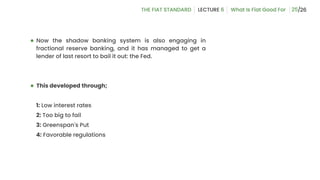
● Shadow fractional reserve banking
● Retail banking was separated from investment banking in
1930s.
● Retail banking would be tightly regulated in its ability to
create credit, and would have FDIC insurance.
● Investment banking would have the freedom to take risks
but gets no guarantee.
● As fiat progressed, the line between the two blurred.
25
● Now the shadow banking system is also engaging in
fractional reserve banking, and it has managed to get a
lender of last resort to bail it out: the Fed.
● This developed through;
1: Low interest rates
2: Too big to fail
3: Greenspan's Put
4: Favorable regulations
26
● The vast majority of money is today created by the
shadow financial system. It is credit creation without a
formal lender of last resort and little regulatory
oversight.

TFS-Lecture 6.pptx

  • 1.
    LECTURE 6 What IsFiat Good For?
  • 2.
    1. Government finance Discussedextensively in Chapter 3, as well as chapters 6 and 7 of The Bitcoin Standard 1. Salability across space 1. Bank profitability 1
  • 3.
    2 2. Salability acrossspace ● Menger: Money is the most salable good ● Salability is a function of the spread between the bid and ask for an asset. ● Bid: maximum price a buyer is willing to pay Ask: minimum price a seller is willing to accepts ● All goods have a diminishing marginal utility: The more you have of a good, the lower your valuation of the next good. ● Ex: Your first cup of water in a day is the most valuable, your twentierh
  • 4.
    ● If youbring a large quantity of a good to market, the buyers' utility from increasing quantities of the good declines. ● Similarly applies to traders buying the good to resell it. The more their stockpiles grow, the more they would offer for the marginal unit added to the stockpiles. ● As you need more buyers to buy, you need buyers with a lower marginal valuation, who offer a lower bid, increasing the spread between bid and ask 3
  • 5.
    ● Salability: Thedegree to which the good does not lose value as it is brought to market by its owner. ● A highly salable good can be reliably sold at very close to market price ● A good with low salability will lose significant value, or require plenty of time to be sold 4
  • 6.
    ● Salability canbe assessed across three axes, as discussed in The Bitcoin Standard: Time, scales, and space ● Time: How much a good loses value as its held across time ● Salability across time was the central analytical of The Bitcoin Standard: The good with the highest stock-to-flow will be accumulated the most as a store of value, and will face the least diminishing marginal demand as its quantities increase. ● If you wanted to sell anything else, people would value it according to its own marginal utility, which quickly diminishes. 5
  • 7.
    6 ● But givengold's high stock-to-flow, and its resistance to debasement, people don't value it only for its own use marginal utility, as an ornament or industrial metal, but as something that can be exchanged for other goods. ● Market participants are happy to accumulate gold more than anything else, because they expect to be able to resell it for the least loss of value in the future, given its resistance of dilution. Over time, this is the best thing to accumulate, as it is the thing theat can be exchanged most easily to other in the future.
  • 8.
    ● Scales: ● Howmuch a good loses in value as you transact across scales ● If you wanted to sell small quantities of gold to make a small purchase, you would incur significant loss chopping off small pieces and weighing them. ● Historically, silver maintained a monetary role as gold was not highly salable across small scales. ● As banking allowed for the use of banknotes and checks across all transaction sizes, silver's monetary role was obviated. ● Silver has never recovered 7
  • 9.
    ● Space: Howmuch a good loses in its value as it is transported across space ● Why metals beat cattle and crops ● Why gold beat other metals ● Standardized increased salability across space by making the coins immediately recognizable 8
  • 10.
    ● But theinvention of modern transportation made gold's salability across space decline ● Banking fixed this through clearance and settlements ● With time, as people took physical delivery less and less, money increasingly became a liability of the financial institution settling payments. 9
  • 11.
    ● Although bankscould honor their promises to redeem any of their obligations for gold, they could issue more gold liabilities than the gold they had on hand, thanks to its limited spatial salability. ● There was no easy and convenient place for bank clients to redeem their gold and still use it for settling the increasingly global trades they conducted. With only one monopoly bank in a town, or one central bank in a country, your gold coin had very little spatial salability while it was in your physical possession. 10
  • 12.
    ● The goldstandard’s monetary medium was not just the gold underlying it but also the payment and settlement rails that allowed it sufficient spatial salability to move around the world. ● Gold in the bank effectively carried a spatial salability premium over gold in individual physical possession. 11
  • 13.
    12 ● Although goldis highly salable across time, its salability across space is very low compared to fiat. This is as significant a flaw as having a low stock-to-flow ratio. Whereas a low stock-to-flow ratio leads to a loss in value when trading the good across time, a high cost of transportation results in a significant loss of value when transacting the good across space.
  • 14.
    ● A hardmoney that requires brick-and-mortar banks in order to clear it is always liable to government seizure or being replaced with government fiat. Political and engineering realities mean that the low spatial salability of gold and physical monies needs to be considered a feature, not a bug. ● One can point to government restrictions on the free movement of gold as the reason for fiat’s rise, but that misses the point: if gold had high salability across space, it would not need governments to ensure its monetary role. 13
  • 15.
    14 ● Quantifying goldspatial salability: ● Cost of moving a good delivery gold bar across the Atlantic
  • 16.
    15 ● In 1919:~0.2% of face value ● A sunk boat cost 2-3% of face value to salvage ● In 2013-2017: ~0.05-0.1% of face value for German central bank to repatriate its gold from US Fed, including verifying ● The process took four years ● Takes around 1-2 weeks just to ship the gold
  • 17.
    16 ● Today, singlegold bar costs around 0.5% ● Takes around 2-3 days
  • 18.
    17 ● Fiat isfar, far cheaper to move across the Atlantic ● You are only moving credit obligations, nothing physical ● --Wire transfer costs $10-$50 ● Takes ~2-5 days for consumers ● --Credit cards cost 1-3% of face value ● Takes seconds ● "Final" settlement takes weeks or months for both cases ● Final settlement time of fiat is either worse than gold, or not much of an improvement. But it is cheaper.
  • 19.
    ● As goldstandard payments increasingly became credit payments and not cash settlements, the payment rails of banks and central banks became an increasingly important part of the monetary infrastructure that made payments possible. 18
  • 20.
    ● The Faustianbargain of fiat money appears inevitable this way, as the ability to save for the future was compromised to transact quickly across space. The technology of fiat strongly benefits governments and banks, as will be discussed below, but it was the spatial salability of fiat that allowed them to take advantage of it to their own ends. 19
  • 21.
    20 3. Bank Profitability ●Fiat allows banks to engage in fractional reserve banking with little restraint, because it allows government to bail them out whenever they face liquidity (i.e solvency) crises. ● Under the gold standard, banks could still engage in fractional reserve banking, because they provided gold with the superior salability. ● But they were limited because once a bank run happened, the bank could not print gold. Other banks could perhaps bail it out, but they would be risking their own solvency. There was a constant churn of banks going bankrupt ensuring that inflationary fractional reserve banking did not get too out of hand.
  • 22.
    21 ● Then in1913 the Federal Reserve Act as a response to the financial crisis of 1907. This way, government could stabilize the financial system when panics happen. The Fed was not the cure to the disease of insolvent banks; insolvency was the cure, and the Fed was the antidote to the cure. ● The Fed's rationale: Stabilize the dollar, and protect the banking system from bank runs and financial crises. ● These goals are inevitably contradictory, as Hayek explains. You can only protect the banks from bank runs by printing money, which destroys the value of the dollar. ● Over the last century the banks won and the dollar lost.
  • 23.
    22 ● Is fractionalreserve banking necessary for an economy to grow ● No, and you have to be Keynesian to believe so. ● Money and credit, by themselves, are not productive assets. They merely represent receipts that allow their holders to purchase productive assets. An increase in the supply of money or credit will no more increase the stock of productive assets in an economy than an increase in printed football stadium tickets will increase the capacity of the stadium itself
  • 24.
    23 ● Fractional reservebanking does not magically create more capital, labor, or resources; it merely entrusts their allocation to central banks rather than the productive conscientious people who produce and save them. ● Fiat central banking is what makes fractional reserve banking viable.
  • 25.
    24 ● Shadow fractionalreserve banking ● Retail banking was separated from investment banking in 1930s. ● Retail banking would be tightly regulated in its ability to create credit, and would have FDIC insurance. ● Investment banking would have the freedom to take risks but gets no guarantee. ● As fiat progressed, the line between the two blurred.
  • 26.
    25 ● Now theshadow banking system is also engaging in fractional reserve banking, and it has managed to get a lender of last resort to bail it out: the Fed. ● This developed through; 1: Low interest rates 2: Too big to fail 3: Greenspan's Put 4: Favorable regulations
  • 27.
    26 ● The vastmajority of money is today created by the shadow financial system. It is credit creation without a formal lender of last resort and little regulatory oversight.