Testing in
Production
make your testing process more efficient
without the risks
Istvan Marhefka
Independent Agile Coach, Software Architect
https://istvanmarhefka.com
hello@istvanmarhefka.com
PalinQA meetup, 26/2/2019
About the project
❖ Dropbox-clone
❖ 120k+ monthly active users
❖ Product development
❖ International team, startup-like organisation in a large enterprise
❖ Agile software development (TDD, XP, CI/CD, SCRUM)
Technology stack
❖ Desktop client (Win & Mac)
❖ Electron (Angular, Typescript)
❖ Java (Sprint Boot, Maven)
❖ Backend: CloudFoundry (PaaS), MongoDB
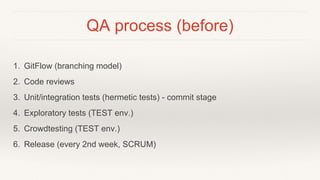
QA process (before)
1. GitFlow (branching model)
2. Code reviews
3. Unit/integration tests (hermetic tests) - commit stage
4. Exploratory tests (TEST env.)
5. Crowdtesting (TEST env.)
6. Release (every 2nd week, SCRUM)
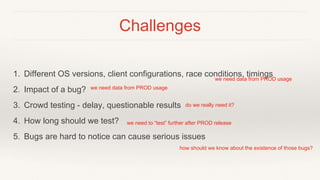
Challenges
1. Different OS versions, client configurations, race conditions, timings
2. Impact of a bug?
3. Crowd testing - delay, questionable results
4. How long should we test?
5. Bugs are hard to notice can cause serious issues
we need data from PROD usage
do we really need it?
how should we know about the existence of those bugs?
we need to “test” further after PROD release
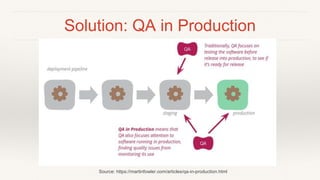
Solution: QA in Production
Source: https://martinfowler.com/articles/qa-in-production.html
Preparations
for QA in Production
❖ Being able to quickly deploy a new version
❖ Shortening delivery cycle from 2 weeks to 1 week
❖ Automated silent updates
❖ Trunk-based development (no more Gitflow)
❖ Testing against production systems
Implementation of
QA in Production
Canary releasing
“… slowly rolling out the change to a small
subset of users before … making it
available to everybody.”
Source: https://martinfowler.com/bliki/CanaryRelease.html
Canary releasing
❖ Each commit is a release candidate
❖ every commit: employees, friendly users (automatically, if tests passed)
❖ every release:
❖ first 1% of the users (manual trigger)
❖ full rollout (manual trigger)
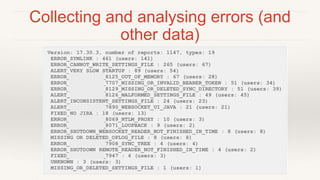
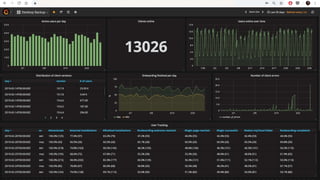
Collecting and analysing errors (and
other data)
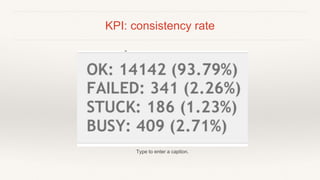
KPI: consistency rate
Type to enter a caption.
Data-driven bugfixing
❖ Impact is known, no more guesses
❖ prioritization is clear
Results
❖ Consistency rate goes up to 97% (from 60%)
❖ release cycle of 1 week
❖ stable releases
❖ much more confidence on existing bugs, no more guessing
❖ clear prioritization, less stress
❖ SCRUM: reviews had less importance
Change in mindset
❖ Convincing management (Testing in Production??)
❖ Trust is needed towards the development team
❖ Traditional QA
❖ Different release process than in other products (Gitflow, weekly releases)
❖ More responsibility from team members (monitoring & analyzing production
app, implementing custom tools)
❖ Discipline within the team
Can you apply it in your situation?
❖ How do you know if your application works as expected in PROD?
❖ What could be your key metrics?
❖ What could you learn from QA in production?
What do you think?
Istvan Marhefka
Independent Agile Coach, Software Architect
https://istvanmarhefka.com
hello@istvanmarhefka.com

Testing in Production

  • 1.
    Testing in Production make yourtesting process more efficient without the risks Istvan Marhefka Independent Agile Coach, Software Architect https://istvanmarhefka.com hello@istvanmarhefka.com PalinQA meetup, 26/2/2019
  • 2.
    About the project ❖Dropbox-clone ❖ 120k+ monthly active users ❖ Product development ❖ International team, startup-like organisation in a large enterprise ❖ Agile software development (TDD, XP, CI/CD, SCRUM)
  • 3.
    Technology stack ❖ Desktopclient (Win & Mac) ❖ Electron (Angular, Typescript) ❖ Java (Sprint Boot, Maven) ❖ Backend: CloudFoundry (PaaS), MongoDB
  • 4.
    QA process (before) 1.GitFlow (branching model) 2. Code reviews 3. Unit/integration tests (hermetic tests) - commit stage 4. Exploratory tests (TEST env.) 5. Crowdtesting (TEST env.) 6. Release (every 2nd week, SCRUM)
  • 5.
    Challenges 1. Different OSversions, client configurations, race conditions, timings 2. Impact of a bug? 3. Crowd testing - delay, questionable results 4. How long should we test? 5. Bugs are hard to notice can cause serious issues we need data from PROD usage we need data from PROD usage do we really need it? how should we know about the existence of those bugs? we need to “test” further after PROD release
  • 6.
    Solution: QA inProduction Source: https://martinfowler.com/articles/qa-in-production.html
  • 7.
    Preparations for QA inProduction ❖ Being able to quickly deploy a new version ❖ Shortening delivery cycle from 2 weeks to 1 week ❖ Automated silent updates ❖ Trunk-based development (no more Gitflow) ❖ Testing against production systems
  • 8.
  • 9.
    Canary releasing “… slowlyrolling out the change to a small subset of users before … making it available to everybody.” Source: https://martinfowler.com/bliki/CanaryRelease.html
  • 10.
    Canary releasing ❖ Eachcommit is a release candidate ❖ every commit: employees, friendly users (automatically, if tests passed) ❖ every release: ❖ first 1% of the users (manual trigger) ❖ full rollout (manual trigger)
  • 11.
    Collecting and analysingerrors (and other data)
  • 12.
    KPI: consistency rate Typeto enter a caption.
  • 14.
    Data-driven bugfixing ❖ Impactis known, no more guesses ❖ prioritization is clear
  • 15.
    Results ❖ Consistency rategoes up to 97% (from 60%) ❖ release cycle of 1 week ❖ stable releases ❖ much more confidence on existing bugs, no more guessing ❖ clear prioritization, less stress ❖ SCRUM: reviews had less importance
  • 16.
    Change in mindset ❖Convincing management (Testing in Production??) ❖ Trust is needed towards the development team ❖ Traditional QA ❖ Different release process than in other products (Gitflow, weekly releases) ❖ More responsibility from team members (monitoring & analyzing production app, implementing custom tools) ❖ Discipline within the team
  • 17.
    Can you applyit in your situation? ❖ How do you know if your application works as expected in PROD? ❖ What could be your key metrics? ❖ What could you learn from QA in production?
  • 18.
    What do youthink? Istvan Marhefka Independent Agile Coach, Software Architect https://istvanmarhefka.com hello@istvanmarhefka.com