Testcontainers:
Simplifying
Integration Testing in
a Containerized World
Reliable, Isolated, and Reproducible Testing for
External Dependencies
Why Do API Tests Fail?
• - Works locally but fails in CI/CD ❌
• - Mocks don't always behave like real APIs
• - Network issues and unreliable test environments
• - Shared test servers cause conflicts
What is Testcontainers?
• - A library that provides lightweight, throwaway containers
for testing
• - Supports real dependencies like databases, message
brokers, and APIs
• - Works across Java, Python, Node.js, and .NET
API Testing with Testcontainers
• - Spin up real API dependencies (e.g., WireMock, Postgres,
Kafka)
• - Ensure integration tests run in isolated environments
• - Make tests reliable, fast, and production-like
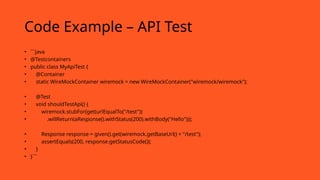
Code Example – API Test
• ```java
• @Testcontainers
• public class MyApiTest {
• @Container
• static WireMockContainer wiremock = new WireMockContainer("wiremock/wiremock");
• @Test
• void shouldTestApi() {
• wiremock.stubFor(get(urlEqualTo("/test"))
• .willReturn(aResponse().withStatus(200).withBody("Hello")));
• Response response = given().get(wiremock.getBaseUrl() + "/test");
• assertEquals(200, response.getStatusCode());
• }
• }```
Best Practices
• ✅ Use lightweight images (Alpine-based)
• ✅ Clean up containers after tests
• ✅ Parallelize tests smartly to avoid slow execution
• ✅ Avoid shared test servers – make tests self-contained
Key Takeaways
• ✅ Testcontainers provides realistic, isolated, and reliable API
testing
• ✅ Works across different programming languages
• ✅ Helps eliminate flaky tests and CI/CD failures
• 🚀 Use real dependencies, not mocks, for better API tests!
Q&A
• Let's discuss your API testing challenges!

Testcontainers: Reliable, Isolated, and Reproducible Testing for External Dependencies

  • 1.
    Testcontainers: Simplifying Integration Testing in aContainerized World Reliable, Isolated, and Reproducible Testing for External Dependencies
  • 2.
    Why Do APITests Fail? • - Works locally but fails in CI/CD ❌ • - Mocks don't always behave like real APIs • - Network issues and unreliable test environments • - Shared test servers cause conflicts
  • 3.
    What is Testcontainers? •- A library that provides lightweight, throwaway containers for testing • - Supports real dependencies like databases, message brokers, and APIs • - Works across Java, Python, Node.js, and .NET
  • 4.
    API Testing withTestcontainers • - Spin up real API dependencies (e.g., WireMock, Postgres, Kafka) • - Ensure integration tests run in isolated environments • - Make tests reliable, fast, and production-like
  • 5.
    Code Example –API Test • ```java • @Testcontainers • public class MyApiTest { • @Container • static WireMockContainer wiremock = new WireMockContainer("wiremock/wiremock"); • @Test • void shouldTestApi() { • wiremock.stubFor(get(urlEqualTo("/test")) • .willReturn(aResponse().withStatus(200).withBody("Hello"))); • Response response = given().get(wiremock.getBaseUrl() + "/test"); • assertEquals(200, response.getStatusCode()); • } • }```
  • 6.
    Best Practices • ✅Use lightweight images (Alpine-based) • ✅ Clean up containers after tests • ✅ Parallelize tests smartly to avoid slow execution • ✅ Avoid shared test servers – make tests self-contained
  • 7.
    Key Takeaways • ✅Testcontainers provides realistic, isolated, and reliable API testing • ✅ Works across different programming languages • ✅ Helps eliminate flaky tests and CI/CD failures • 🚀 Use real dependencies, not mocks, for better API tests!
  • 8.
    Q&A • Let's discussyour API testing challenges!