Measuring Coverage From
e2e Tests
@BagmarAnand
Anand Bagmar
Software Quality Evangelist, Essence Of Testing
About Me
Anand Bagmar
EssenceOfTesting.com
@BagmarAnand
Criteria of Automated Tests
@BagmarAnand
• Tests are “testing” the “right functionality / behavior”!
• Tests give quick feedback
• IF Tests fail, the correct reason of failure is provided
• Tests are optimized & efficient
@BagmarAnand
Criteria of Automated Tests
https://i.pinimg.com/474x/ec/8a/17/ec8a176036490a3338f806172a23e4b3.jpg
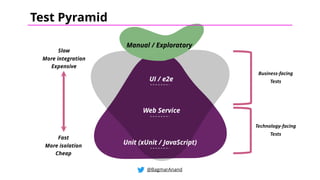
Test Automation Pyramid
@BagmarAnand
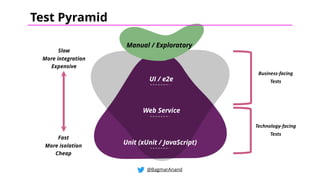
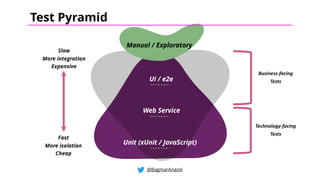
Unit (xUnit / JavaScript)
Manual / Exploratory
Web Service
UI / e2e
Business-facing
Tests
Technology-facing
Tests
@BagmarAnand
Test Pyramid
Slow
More integration
Expensive
Fast
More isolation
Cheap
@BagmarAnand
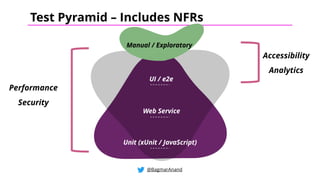
Test Pyramid – Includes NFRs
Unit (xUnit / JavaScript)
Manual / Exploratory
Web Service
UI / e2e
Performance
Security
Accessibility
Analytics
Given you have all these
tests….
@BagmarAnand
How do you measure
quality of your product?
@BagmarAnand
Test Metrics
@BagmarAnand
• Gives understanding of current state
• Provides indication of potential problems / issues
• Ability to make educated, data-driven decisions, quickly!
@BagmarAnand
Why are Metrics important?
However ….
@BagmarAnand
• Abused
• Taken out of context & proportion
• Seem to be set in stone!
@BagmarAnand
(Sad) Reality of Metrics
https://i.pinimg.com/474x/ec/8a/17/ec8a176036490a3338f806172a23e4b3.jpg
@BagmarAnand
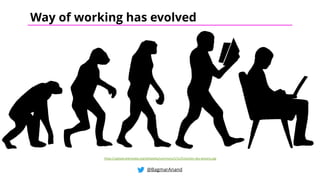
Way of working has evolved
https://upload.wikimedia.org/wikipedia/commons/1/1c/Evolution-des-wissens.jpg
@BagmarAnand
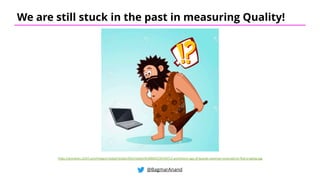
We are still stuck in the past in measuring Quality!
https://previews.123rf.com/images/riedjal/riedjal1403/riedjal140300005/26549722-prehistoric-age-of-beardy-caveman-surprised-to-find-a-laptop.jpg
(Traditional) Test Metrics
@BagmarAnand
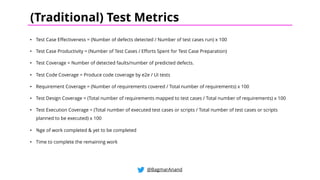
• Test Case Effectiveness = (Number of defects detected / Number of test cases run) x 100
• Test Case Productivity = (Number of Test Cases / Efforts Spent for Test Case Preparation)
• Test Coverage = Number of detected faults/number of predicted defects.
• Test Code Coverage = Produce code coverage by e2e / UI tests
• Requirement Coverage = (Number of requirements covered / Total number of requirements) x 100
• Test Design Coverage = (Total number of requirements mapped to test cases / Total number of requirements) x 100
• Test Execution Coverage = (Total number of executed test cases or scripts / Total number of test cases or scripts
planned to be executed) x 100
• %ge of work completed & yet to be completed
• Time to complete the remaining work
@BagmarAnand
(Traditional) Test Metrics
• There is a lot of work required to capture these metrics
• The result of these metrics does not necessarily tell how can I make
the product quality better
• How do these metrics (capturing, measuring and analyzing) work in
the Agile way of working?
Hence, such metrics add very limited value to teams!
@BagmarAnand
Traditional Test Metrics
Metrics that add very limited value to teams should be
avoided!
They seem to be more for managers than for teams to
build a high-quality product!
@BagmarAnand
Traditional Test Metrics
@BagmarAnand
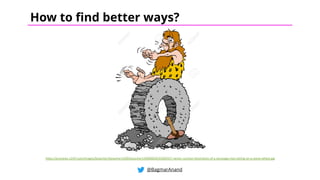
How to find better ways?
https://previews.123rf.com/images/bosecher/bosecher1509/bosecher150900020/45695557-vector-cartoon-illustration-of-a-stoneage-man-sitting-on-a-stone-wheel.jpg
It’s a challenge
@BagmarAnand
• Ways of working has evolved, but people are still the
same!
• Roles / Titles have changed, but people are still the same!
• We still need to measure quality, so we end up using
techniques what we knew before!
@BagmarAnand
Why is it a challenge?
• Metrics should be easy and quick to capture
• Use practices that will allow metrics to be captured
automatically
• Generate meaningful & visual reports to infer Quality
@BagmarAnand
Evolved way of thinking about Metrics
@BagmarAnand
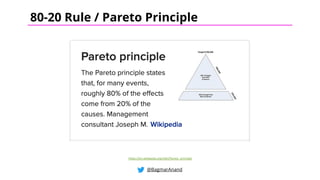
80-20 Rule / Pareto Principle
https://en.wikipedia.org/wiki/Pareto_principle
http://textbook.stpauls.br/Business_Organization/images/pic311.jpg
@BagmarAnand
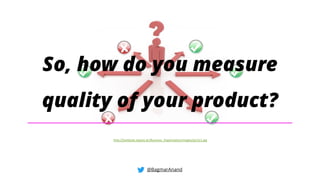
So, how do you measure
quality of your product?
Test Metrics
@BagmarAnand
Quality
What indicates quality of
your product?
@BagmarAnand
Quality is the Teams’
Responsibility!
@BagmarAnand
Unit (xUnit / JavaScript)
Manual / Exploratory
Web Service
UI / e2e
Business-facing
Tests
Technology-facing
Tests
@BagmarAnand
Test Pyramid
Slow
More integration
Expensive
Fast
More isolation
Cheap
Unit (xUnit / JavaScript)
Manual / Exploratory
Web Service
UI / e2e
@BagmarAnand
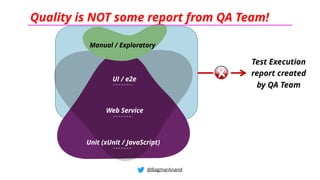
Quality is NOT some report from QA Team!
Test Execution
report created
by QA Team
@BagmarAnand
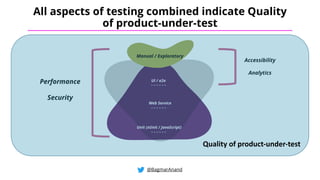
All aspects of testing combined indicate Quality
of product-under-test
Unit (xUnit / JavaScript)
Manual / Exploratory
Web Service
UI / e2ePerformance
Security
Accessibility
Analytics
Quality of product-under-test
Let's get specific!
@BagmarAnand
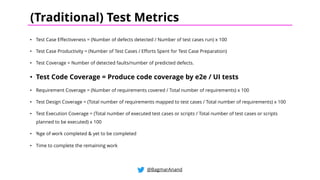
• Test Case Effectiveness = (Number of defects detected / Number of test cases run) x 100
• Test Case Productivity = (Number of Test Cases / Efforts Spent for Test Case Preparation)
• Test Coverage = Number of detected faults/number of predicted defects.
• Test Code Coverage = Produce code coverage by e2e / UI tests
• Requirement Coverage = (Number of requirements covered / Total number of requirements) x 100
• Test Design Coverage = (Total number of requirements mapped to test cases / Total number of requirements) x 100
• Test Execution Coverage = (Total number of executed test cases or scripts / Total number of test cases or scripts
planned to be executed) x 100
• %ge of work completed & yet to be completed
• Time to complete the remaining work
@BagmarAnand
(Traditional) Test Metrics
I often get asked ….
@BagmarAnand
https://lh3.googleusercontent.com/proxy/3JFWJGTlmTym_g9xCZpHIFNLN3rQZu3js8f7iJDHFc6CCeTDb4hpLJaaQm1YCe2BfxyuA_7Lv3B4Clt7MpICbe_Ay09TY8k
How can you capture code
coverage from e2e / UI tests?
@BagmarAnand
https://lh3.googleusercontent.com/proxy/3JFWJGTlmTym_g9xCZpHIFNLN3rQZu3js8f7iJDHFc6CCeTDb4hpLJaaQm1YCe2BfxyuA_7Lv3B4Clt7MpICbe_Ay09TY8k
Let us first understand
Code Coverage?
@BagmarAnand
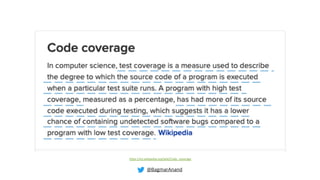
What is Code Coverage?
@BagmarAnand
https://en.wikipedia.org/wiki/Code_coverage
@BagmarAnand
https://w0.pngwave.com/png/522/439/quail-eggs-hot-pot-common-quail-quail-eggs-png-clip-art.png
@BagmarAnand
We want to have high code coverage
for all types of tests!
But, does it really make sense?
@BagmarAnand
https://lh3.googleusercontent.com/proxy/3JFWJGTlmTym_g9xCZpHIFNLN3rQZu3js8f7iJDHFc6CCeTDb4hpLJaaQm1YCe2BfxyuA_7Lv3B4Clt7MpICbe_Ay09TY8k
How is Code Coverage
measured?
@BagmarAnand
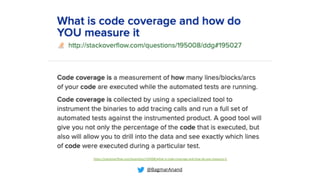
https://stackoverflow.com/questions/195008/what-is-code-coverage-and-how-do-you-measure-it
@BagmarAnand
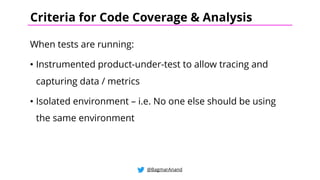
When tests are running:
• Instrumented product-under-test to allow tracing and
capturing data / metrics
• Isolated environment – i.e. No one else should be using
the same environment
@BagmarAnand
Criteria for Code Coverage & Analysis
@BagmarAnand
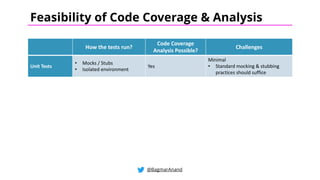
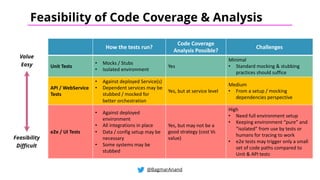
Feasibility of Code Coverage & Analysis
How the tests run?
Code Coverage
Analysis Possible?
Challenges
Unit Tests
• Mocks / Stubs
• Isolated environment
Yes
Minimal
• Standard mocking & stubbing
practices should suffice
@BagmarAnand
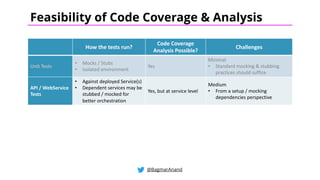
Feasibility of Code Coverage & Analysis
How the tests run?
Code Coverage
Analysis Possible?
Challenges
Unit Tests
• Mocks / Stubs
• Isolated environment
Yes
Minimal
• Standard mocking & stubbing
practices should suffice
API / WebService
Tests
• Against deployed Service(s)
• Dependent services may be
stubbed / mocked for
better orchestration
Yes, but at service level
Medium
• From a setup / mocking
dependencies perspective
@BagmarAnand
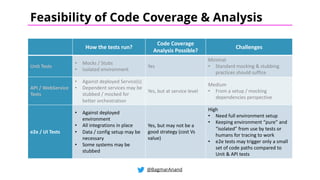
Feasibility of Code Coverage & Analysis
How the tests run?
Code Coverage
Analysis Possible?
Challenges
Unit Tests
• Mocks / Stubs
• Isolated environment
Yes
Minimal
• Standard mocking & stubbing
practices should suffice
API / WebService
Tests
• Against deployed Service(s)
• Dependent services may be
stubbed / mocked for
better orchestration
Yes, but at service level
Medium
• From a setup / mocking
dependencies perspective
e2e / UI Tests
• Against deployed
environment
• All integrations in place
• Data / config setup may be
necessary
• Some systems may be
stubbed
Yes, but may not be a
good strategy (cost Vs
value)
High
• Need full environment setup
• Keeping environment “pure” and
“isolated” from use by tests or
humans for tracing to work
• e2e tests may trigger only a small
set of code paths compared to
Unit & API tests
Unit (xUnit / JavaScript)
Manual / Exploratory
Web Service
UI / e2e
Business-facing
Tests
Technology-facing
Tests
@BagmarAnand
Test Pyramid
Slow
More integration
Expensive
Fast
More isolation
Cheap
@BagmarAnand
Feasibility of Code Coverage & Analysis
How the tests run?
Code Coverage
Analysis Possible?
Challenges
Unit Tests
• Mocks / Stubs
• Isolated environment
Yes
Minimal
• Standard mocking & stubbing
practices should suffice
API / WebService
Tests
• Against deployed Service(s)
• Dependent services may be
stubbed / mocked for
better orchestration
Yes, but at service level
Medium
• From a setup / mocking
dependencies perspective
e2e / UI Tests
• Against deployed
environment
• All integrations in place
• Data / config setup may be
necessary
• Some systems may be
stubbed
Yes, but may not be a
good strategy (cost Vs
value)
High
• Need full environment setup
• Keeping environment “pure” and
“isolated” from use by tests or
humans for tracing to work
• e2e tests may trigger only a small
set of code paths compared to
Unit & API tests
Value
Easy
Feasibility
Difficult
How to measure quality?
@BagmarAnand
Unit (xUnit / JavaScript)
Manual / Exploratory
Web Service
UI / e2e
@BagmarAnand
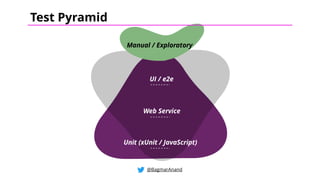
Test Pyramid
Unit (xUnit / JavaScript)
Manual / Exploratory
Web Service
UI / e2e
@BagmarAnand
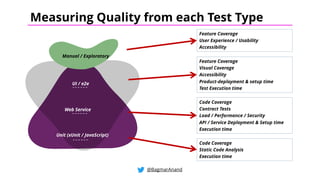
Measuring Quality from each Test Type
Feature Coverage
User Experience / Usability
Accessibility
Feature Coverage
Visual Coverage
Accessibility
Product-deployment & setup time
Test Execution time
Code Coverage
Contract Tests
Load / Performance / Security
API / Service Deployment & Setup time
Execution time
Code Coverage
Static Code Analysis
Execution time
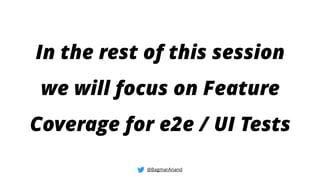
In the rest of this session
we will focus on Feature
Coverage for e2e / UI Tests
@BagmarAnand
Feature Coverage
@BagmarAnand
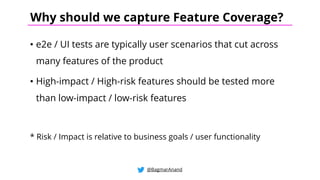
• e2e / UI tests are typically user scenarios that cut across
many features of the product
• High-impact / High-risk features should be tested more
than low-impact / low-risk features
* Risk / Impact is relative to business goals / user functionality
@BagmarAnand
Why should we capture Feature Coverage?
The ability to know which features are
covered, and how many times, as part of
execution of the e2e / UI Tests!
@BagmarAnand
Feature Coverage - Objective
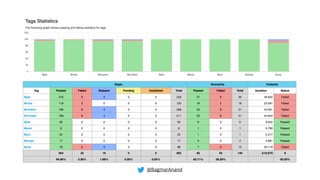
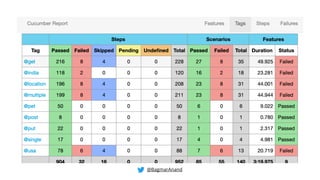
Visualizing the feature coverage can give –
• confidence of the automated e2e tests,
• provide data where to focus next
@BagmarAnand
Feature Coverage – how will it help?
• Add appropriate ‘tags’ to automated e2e / UI tests
• Gherkin-based tools (ex: Cucumber, Karate, etc.) make it easy to add tags
• Test runners have different ways to provide custom Annotations
• Ex: TestNG, Junit, etc.
@BagmarAnand
Capturing Feature Coverage
• Approach #1: Update your reports to include ‘tags’ for the tests
• Create visualization based on the ’tags’ added in test reports
• Ex: Cucumber-reporting gives you ‘tag’ analysis out-of-the-box
• Uses json report files as input to create report
• Approach #2: Benchmark tag data (if #1 is not feasible)
• Update test framework to “log” all tags & and its test name to a common csv
file
• Post test execution, open csv file in a spreadsheet, and create chart to
visualize Feature Coverage
@BagmarAnand
Visualizing Feature Coverage
https://cdnb.artstation.com/p/assets/images/images/020/039/203/large/wesam-ab-img-20190814-163328-163.jpg?1566108077
@BagmarAnand
Demo
@BagmarAnand
@BagmarAnand
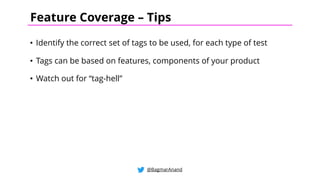
• Identify the correct set of tags to be used, for each type of test
• Tags can be based on features, components of your product
• Watch out for “tag-hell”
@BagmarAnand
Feature Coverage – Tips
Tracking feature coverage from your api / functional UI (e2e) tests
https://essenceoftesting.blogspot.com/2020/03/tracking-functional-coverage.html
Sample repo using cucumber-reports with karate:
https://github.com/anandbagmar/karate-sample
Cucumber-reporting
https://github.com/damianszczepanik/cucumber-reporting
@BagmarAnand
References
Thank you!
Anand Bagmar
EssenceOfTesting.com
@BagmarAnand

Measuring Coverage From E2E Tests

  • 1.
    Measuring Coverage From e2eTests @BagmarAnand Anand Bagmar Software Quality Evangelist, Essence Of Testing
  • 2.
  • 3.
    Criteria of AutomatedTests @BagmarAnand
  • 4.
    • Tests are“testing” the “right functionality / behavior”! • Tests give quick feedback • IF Tests fail, the correct reason of failure is provided • Tests are optimized & efficient @BagmarAnand Criteria of Automated Tests https://i.pinimg.com/474x/ec/8a/17/ec8a176036490a3338f806172a23e4b3.jpg
  • 5.
  • 6.
    Unit (xUnit /JavaScript) Manual / Exploratory Web Service UI / e2e Business-facing Tests Technology-facing Tests @BagmarAnand Test Pyramid Slow More integration Expensive Fast More isolation Cheap
  • 7.
    @BagmarAnand Test Pyramid –Includes NFRs Unit (xUnit / JavaScript) Manual / Exploratory Web Service UI / e2e Performance Security Accessibility Analytics
  • 8.
    Given you haveall these tests…. @BagmarAnand
  • 9.
    How do youmeasure quality of your product? @BagmarAnand
  • 10.
  • 11.
    • Gives understandingof current state • Provides indication of potential problems / issues • Ability to make educated, data-driven decisions, quickly! @BagmarAnand Why are Metrics important?
  • 12.
  • 13.
    • Abused • Takenout of context & proportion • Seem to be set in stone! @BagmarAnand (Sad) Reality of Metrics https://i.pinimg.com/474x/ec/8a/17/ec8a176036490a3338f806172a23e4b3.jpg
  • 14.
    @BagmarAnand Way of workinghas evolved https://upload.wikimedia.org/wikipedia/commons/1/1c/Evolution-des-wissens.jpg
  • 15.
    @BagmarAnand We are stillstuck in the past in measuring Quality! https://previews.123rf.com/images/riedjal/riedjal1403/riedjal140300005/26549722-prehistoric-age-of-beardy-caveman-surprised-to-find-a-laptop.jpg
  • 16.
  • 17.
    • Test CaseEffectiveness = (Number of defects detected / Number of test cases run) x 100 • Test Case Productivity = (Number of Test Cases / Efforts Spent for Test Case Preparation) • Test Coverage = Number of detected faults/number of predicted defects. • Test Code Coverage = Produce code coverage by e2e / UI tests • Requirement Coverage = (Number of requirements covered / Total number of requirements) x 100 • Test Design Coverage = (Total number of requirements mapped to test cases / Total number of requirements) x 100 • Test Execution Coverage = (Total number of executed test cases or scripts / Total number of test cases or scripts planned to be executed) x 100 • %ge of work completed & yet to be completed • Time to complete the remaining work @BagmarAnand (Traditional) Test Metrics
  • 18.
    • There isa lot of work required to capture these metrics • The result of these metrics does not necessarily tell how can I make the product quality better • How do these metrics (capturing, measuring and analyzing) work in the Agile way of working? Hence, such metrics add very limited value to teams! @BagmarAnand Traditional Test Metrics
  • 19.
    Metrics that addvery limited value to teams should be avoided! They seem to be more for managers than for teams to build a high-quality product! @BagmarAnand Traditional Test Metrics
  • 20.
    @BagmarAnand How to findbetter ways? https://previews.123rf.com/images/bosecher/bosecher1509/bosecher150900020/45695557-vector-cartoon-illustration-of-a-stoneage-man-sitting-on-a-stone-wheel.jpg
  • 21.
  • 22.
    • Ways ofworking has evolved, but people are still the same! • Roles / Titles have changed, but people are still the same! • We still need to measure quality, so we end up using techniques what we knew before! @BagmarAnand Why is it a challenge?
  • 23.
    • Metrics shouldbe easy and quick to capture • Use practices that will allow metrics to be captured automatically • Generate meaningful & visual reports to infer Quality @BagmarAnand Evolved way of thinking about Metrics
  • 24.
    @BagmarAnand 80-20 Rule /Pareto Principle https://en.wikipedia.org/wiki/Pareto_principle
  • 25.
  • 26.
  • 27.
    What indicates qualityof your product? @BagmarAnand
  • 28.
    Quality is theTeams’ Responsibility! @BagmarAnand
  • 29.
    Unit (xUnit /JavaScript) Manual / Exploratory Web Service UI / e2e Business-facing Tests Technology-facing Tests @BagmarAnand Test Pyramid Slow More integration Expensive Fast More isolation Cheap
  • 30.
    Unit (xUnit /JavaScript) Manual / Exploratory Web Service UI / e2e @BagmarAnand Quality is NOT some report from QA Team! Test Execution report created by QA Team
  • 31.
    @BagmarAnand All aspects oftesting combined indicate Quality of product-under-test Unit (xUnit / JavaScript) Manual / Exploratory Web Service UI / e2ePerformance Security Accessibility Analytics Quality of product-under-test
  • 32.
  • 33.
    • Test CaseEffectiveness = (Number of defects detected / Number of test cases run) x 100 • Test Case Productivity = (Number of Test Cases / Efforts Spent for Test Case Preparation) • Test Coverage = Number of detected faults/number of predicted defects. • Test Code Coverage = Produce code coverage by e2e / UI tests • Requirement Coverage = (Number of requirements covered / Total number of requirements) x 100 • Test Design Coverage = (Total number of requirements mapped to test cases / Total number of requirements) x 100 • Test Execution Coverage = (Total number of executed test cases or scripts / Total number of test cases or scripts planned to be executed) x 100 • %ge of work completed & yet to be completed • Time to complete the remaining work @BagmarAnand (Traditional) Test Metrics
  • 34.
    I often getasked …. @BagmarAnand https://lh3.googleusercontent.com/proxy/3JFWJGTlmTym_g9xCZpHIFNLN3rQZu3js8f7iJDHFc6CCeTDb4hpLJaaQm1YCe2BfxyuA_7Lv3B4Clt7MpICbe_Ay09TY8k
  • 35.
    How can youcapture code coverage from e2e / UI tests? @BagmarAnand https://lh3.googleusercontent.com/proxy/3JFWJGTlmTym_g9xCZpHIFNLN3rQZu3js8f7iJDHFc6CCeTDb4hpLJaaQm1YCe2BfxyuA_7Lv3B4Clt7MpICbe_Ay09TY8k
  • 36.
    Let us firstunderstand Code Coverage? @BagmarAnand
  • 37.
    What is CodeCoverage? @BagmarAnand
  • 38.
  • 39.
  • 40.
    But, does itreally make sense? @BagmarAnand https://lh3.googleusercontent.com/proxy/3JFWJGTlmTym_g9xCZpHIFNLN3rQZu3js8f7iJDHFc6CCeTDb4hpLJaaQm1YCe2BfxyuA_7Lv3B4Clt7MpICbe_Ay09TY8k
  • 41.
    How is CodeCoverage measured? @BagmarAnand
  • 42.
  • 43.
    When tests arerunning: • Instrumented product-under-test to allow tracing and capturing data / metrics • Isolated environment – i.e. No one else should be using the same environment @BagmarAnand Criteria for Code Coverage & Analysis
  • 44.
    @BagmarAnand Feasibility of CodeCoverage & Analysis How the tests run? Code Coverage Analysis Possible? Challenges Unit Tests • Mocks / Stubs • Isolated environment Yes Minimal • Standard mocking & stubbing practices should suffice
  • 45.
    @BagmarAnand Feasibility of CodeCoverage & Analysis How the tests run? Code Coverage Analysis Possible? Challenges Unit Tests • Mocks / Stubs • Isolated environment Yes Minimal • Standard mocking & stubbing practices should suffice API / WebService Tests • Against deployed Service(s) • Dependent services may be stubbed / mocked for better orchestration Yes, but at service level Medium • From a setup / mocking dependencies perspective
  • 46.
    @BagmarAnand Feasibility of CodeCoverage & Analysis How the tests run? Code Coverage Analysis Possible? Challenges Unit Tests • Mocks / Stubs • Isolated environment Yes Minimal • Standard mocking & stubbing practices should suffice API / WebService Tests • Against deployed Service(s) • Dependent services may be stubbed / mocked for better orchestration Yes, but at service level Medium • From a setup / mocking dependencies perspective e2e / UI Tests • Against deployed environment • All integrations in place • Data / config setup may be necessary • Some systems may be stubbed Yes, but may not be a good strategy (cost Vs value) High • Need full environment setup • Keeping environment “pure” and “isolated” from use by tests or humans for tracing to work • e2e tests may trigger only a small set of code paths compared to Unit & API tests
  • 47.
    Unit (xUnit /JavaScript) Manual / Exploratory Web Service UI / e2e Business-facing Tests Technology-facing Tests @BagmarAnand Test Pyramid Slow More integration Expensive Fast More isolation Cheap
  • 48.
    @BagmarAnand Feasibility of CodeCoverage & Analysis How the tests run? Code Coverage Analysis Possible? Challenges Unit Tests • Mocks / Stubs • Isolated environment Yes Minimal • Standard mocking & stubbing practices should suffice API / WebService Tests • Against deployed Service(s) • Dependent services may be stubbed / mocked for better orchestration Yes, but at service level Medium • From a setup / mocking dependencies perspective e2e / UI Tests • Against deployed environment • All integrations in place • Data / config setup may be necessary • Some systems may be stubbed Yes, but may not be a good strategy (cost Vs value) High • Need full environment setup • Keeping environment “pure” and “isolated” from use by tests or humans for tracing to work • e2e tests may trigger only a small set of code paths compared to Unit & API tests Value Easy Feasibility Difficult
  • 49.
    How to measurequality? @BagmarAnand
  • 50.
    Unit (xUnit /JavaScript) Manual / Exploratory Web Service UI / e2e @BagmarAnand Test Pyramid
  • 51.
    Unit (xUnit /JavaScript) Manual / Exploratory Web Service UI / e2e @BagmarAnand Measuring Quality from each Test Type Feature Coverage User Experience / Usability Accessibility Feature Coverage Visual Coverage Accessibility Product-deployment & setup time Test Execution time Code Coverage Contract Tests Load / Performance / Security API / Service Deployment & Setup time Execution time Code Coverage Static Code Analysis Execution time
  • 52.
    In the restof this session we will focus on Feature Coverage for e2e / UI Tests @BagmarAnand
  • 53.
  • 54.
    • e2e /UI tests are typically user scenarios that cut across many features of the product • High-impact / High-risk features should be tested more than low-impact / low-risk features * Risk / Impact is relative to business goals / user functionality @BagmarAnand Why should we capture Feature Coverage?
  • 55.
    The ability toknow which features are covered, and how many times, as part of execution of the e2e / UI Tests! @BagmarAnand Feature Coverage - Objective
  • 56.
    Visualizing the featurecoverage can give – • confidence of the automated e2e tests, • provide data where to focus next @BagmarAnand Feature Coverage – how will it help?
  • 57.
    • Add appropriate‘tags’ to automated e2e / UI tests • Gherkin-based tools (ex: Cucumber, Karate, etc.) make it easy to add tags • Test runners have different ways to provide custom Annotations • Ex: TestNG, Junit, etc. @BagmarAnand Capturing Feature Coverage
  • 58.
    • Approach #1:Update your reports to include ‘tags’ for the tests • Create visualization based on the ’tags’ added in test reports • Ex: Cucumber-reporting gives you ‘tag’ analysis out-of-the-box • Uses json report files as input to create report • Approach #2: Benchmark tag data (if #1 is not feasible) • Update test framework to “log” all tags & and its test name to a common csv file • Post test execution, open csv file in a spreadsheet, and create chart to visualize Feature Coverage @BagmarAnand Visualizing Feature Coverage
  • 59.
  • 60.
  • 61.
  • 62.
    • Identify thecorrect set of tags to be used, for each type of test • Tags can be based on features, components of your product • Watch out for “tag-hell” @BagmarAnand Feature Coverage – Tips
  • 63.
    Tracking feature coveragefrom your api / functional UI (e2e) tests https://essenceoftesting.blogspot.com/2020/03/tracking-functional-coverage.html Sample repo using cucumber-reports with karate: https://github.com/anandbagmar/karate-sample Cucumber-reporting https://github.com/damianszczepanik/cucumber-reporting @BagmarAnand References
  • 64.