INTRODUCTI
ON
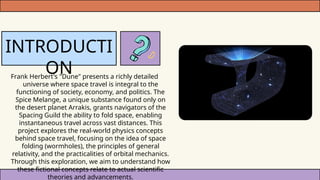
Frank Herbert's "Dune"presents a richly detailed
universe where space travel is integral to the
functioning of society, economy, and politics. The
Spice Melange, a unique substance found only on
the desert planet Arrakis, grants navigators of the
Spacing Guild the ability to fold space, enabling
instantaneous travel across vast distances. This
project explores the real-world physics concepts
behind space travel, focusing on the idea of space
folding (wormholes), the principles of general
relativity, and the practicalities of orbital mechanics.
Through this exploration, we aim to understand how
these fictional concepts relate to actual scientific
theories and advancements.
5.
Lets Find KeyScientific Concepts in Space Travel
Key Scientific
Concepts in Space
Travel
0
2
6.
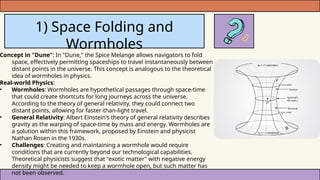
1) Space Foldingand
Wormholes
Concept in "Dune": In "Dune," the Spice Melange allows navigators to fold
space, effectively permitting spaceships to travel instantaneously between
distant points in the universe. This concept is analogous to the theoretical
idea of wormholes in physics.
Real-world Physics:
• Wormholes: Wormholes are hypothetical passages through space-time
that could create shortcuts for long journeys across the universe.
According to the theory of general relativity, they could connect two
distant points, allowing for faster-than-light travel.
• General Relativity: Albert Einstein's theory of general relativity describes
gravity as the warping of space-time by mass and energy. Wormholes are
a solution within this framework, proposed by Einstein and physicist
Nathan Rosen in the 1930s.
• Challenges: Creating and maintaining a wormhole would require
conditions that are currently beyond our technological capabilities.
Theoretical physicists suggest that "exotic matter" with negative energy
density might be needed to keep a wormhole open, but such matter has
not been observed.
7.
2. Delta-v andOrbital
Mechanics
Concept in "Dune": While the intricacies of space travel mechanics are
not explicitly detailed in "Dune," understanding the changes in
velocity (delta-v) is essential for real-world space travel and
maneuvering spacecraft.
Real-world Physics:
• Delta-v (Δv): Delta-v is a measure of the change in velocity needed
to perform specific maneuvers, such as changing orbits or escaping
a planet's gravity.
• Orbital Mechanics: This field studies how objects move in space
under the influence of gravitational forces. It involves planning and
executing spacecraft trajectories and maneuvers.
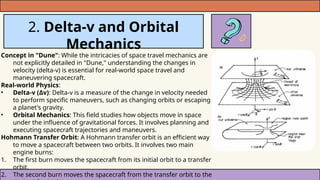
Hohmann Transfer Orbit: A Hohmann transfer orbit is an efficient way
to move a spacecraft between two orbits. It involves two main
engine burns:
1. The first burn moves the spacecraft from its initial orbit to a transfer
orbit.
2. The second burn moves the spacecraft from the transfer orbit to the
8.
3. Interstellar Travel
Challenges
Conceptin "Dune": Interstellar travel in "Dune" is made possible by the Spice Melange, allowing navigators to safely
guide spaceships across vast distances.
Real-world Physics:
• Distance: The nearest star, Proxima Centauri, is about 4.24 light-years away. Even traveling at the speed of light,
it would take over four years to reach.
• Energy Requirements: Accelerating a spacecraft to a significant fraction of the speed of light would require
enormous amounts of energy.
• Life Support: Long-duration space travel necessitates sustainable life support systems to provide air, water,
food, and waste management.
Current Technologies:
• Chemical Rockets: Current rockets use chemical propulsion, which is insufficient for interstellar travel due to
low efficiency and high fuel consumption.
• Ion Thrusters: These engines provide efficient propulsion but generate very low thrust, making them unsuitable
for fast travel over large distances.
• Nuclear Propulsion: Concepts like nuclear thermal and nuclear electric propulsion offer higher efficiency but are
still in the experimental stage.
9.
4. Faster-than-Light
Travel
Concept in"Dune": The ability to fold space effectively allows faster-than-light travel,
bypassing the limitations of speed.
Real-world Physics:
• Speed of Light: According to Einstein's theory of relativity, the speed of light
(approximately 299,792 kilometers per second) is the universal speed limit. Nothing
can travel faster than light in a vacuum.
• Alcubierre Drive: Theoretical physicist Miguel Alcubierre proposed a concept for
faster-than-light travel using a "warp bubble" that contracts space in front of a
spacecraft and expands it behind, allowing the craft to move faster than light
relative to the space outside the bubble.
• Challenges: Creating a warp bubble would require negative energy density, which is
not currently understood or achievable with existing technology.
Potential: If technologies like the Alcubierre drive could be developed, they might allow
for faster-than-light travel, opening up the possibility of exploring distant star
systems within a human lifetime.
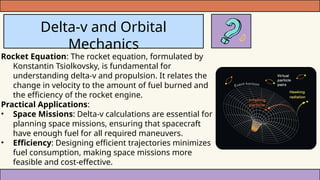
Delta-v and Orbital
Mechanics
RocketEquation: The rocket equation, formulated by
Konstantin Tsiolkovsky, is fundamental for
understanding delta-v and propulsion. It relates the
change in velocity to the amount of fuel burned and
the efficiency of the rocket engine.
Practical Applications:
• Space Missions: Delta-v calculations are essential for
planning space missions, ensuring that spacecraft
have enough fuel for all required maneuvers.
• Efficiency: Designing efficient trajectories minimizes
fuel consumption, making space missions more
feasible and cost-effective.
12.
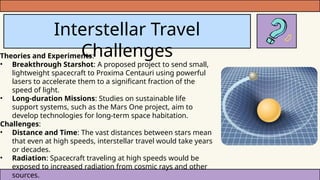
Interstellar Travel
Challenges
Theories andExperiments:
• Breakthrough Starshot: A proposed project to send small,
lightweight spacecraft to Proxima Centauri using powerful
lasers to accelerate them to a significant fraction of the
speed of light.
• Long-duration Missions: Studies on sustainable life
support systems, such as the Mars One project, aim to
develop technologies for long-term space habitation.
Challenges:
• Distance and Time: The vast distances between stars mean
that even at high speeds, interstellar travel would take years
or decades.
• Radiation: Spacecraft traveling at high speeds would be
exposed to increased radiation from cosmic rays and other
sources.
13.
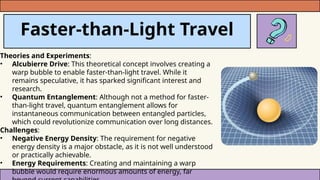
Faster-than-Light Travel
Theories andExperiments:
• Alcubierre Drive: This theoretical concept involves creating a
warp bubble to enable faster-than-light travel. While it
remains speculative, it has sparked significant interest and
research.
• Quantum Entanglement: Although not a method for faster-
than-light travel, quantum entanglement allows for
instantaneous communication between entangled particles,
which could revolutionize communication over long distances.
Challenges:
• Negative Energy Density: The requirement for negative
energy density is a major obstacle, as it is not well understood
or practically achievable.
• Energy Requirements: Creating and maintaining a warp
bubble would require enormous amounts of energy, far
14.
Here are someExperimental Evidence and Technological Challenges!!
Experimental Evidence
and Technological
Challenges
0
4
15.
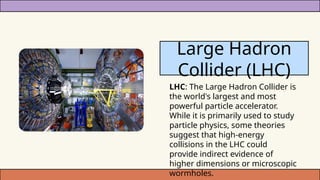
LHC: The LargeHadron Collider is
the world's largest and most
powerful particle accelerator.
While it is primarily used to study
particle physics, some theories
suggest that high-energy
collisions in the LHC could
provide indirect evidence of
higher dimensions or microscopic
wormholes.
Large Hadron
Collider (LHC)
16.
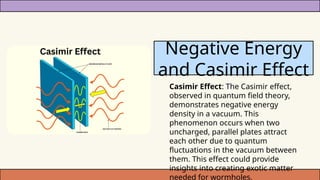
Casimir Effect: TheCasimir effect,
observed in quantum field theory,
demonstrates negative energy
density in a vacuum. This
phenomenon occurs when two
uncharged, parallel plates attract
each other due to quantum
fluctuations in the vacuum between
them. This effect could provide
insights into creating exotic matter
needed for wormholes.
Negative Energy
and Casimir Effect
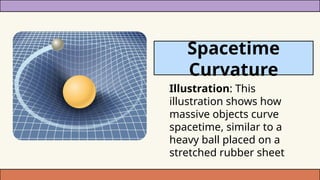
Illustration: This
illustration showshow
massive objects curve
spacetime, similar to a
heavy ball placed on a
stretched rubber sheet
Spacetime
Curvature
19.
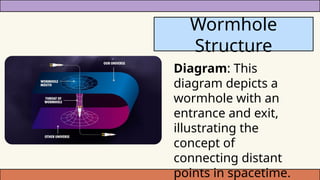
Diagram: This
diagram depictsa
wormhole with an
entrance and exit,
illustrating the
concept of
connecting distant
points in spacetime.
Wormhole
Structure
20.
Here are someKey Principles and Examples!!!!
Key Principles and
Examples
0
6
21.
Einstein's Field Equations
Description:Einstein's field equations are the core
of general relativity. They describe how matter
and energy influence the curvature of spacetime.
Example: These equations can predict the orbit of
planets and the bending of light around massive
objects, a phenomenon known as gravitational
lensing.
22.
Black Holes andEvent
Horizons
Black Holes: Regions of spacetime where gravity is so
strong that not even light can escape. The event horizon is
the boundary beyond which nothing can return.
Example: The detection of gravitational waves from colliding
black holes by LIGO (Laser Interferometer Gravitational-
Wave Observatory) has provided significant evidence for
the existence of black holes and their properties.
Conclusion
In "Dune," theconcept of space folding through the use of
the Spice Melange represents a fascinating blend of
science fiction and theoretical physics. While the idea
remains speculative, real-world physics provides a
foundation for understanding such phenomena through
general relativity, wormholes, and advanced propulsion
theories. By exploring these scientific principles, we gain
insights into the challenges and possibilities of interstellar
travel. Bridging the gap between fiction and reality, this
References
1. Frank Herbert,"Dune"
2. Albert Einstein, "The Foundation of the General Theory of
Relativity"
3. Kip Thorne, "Wormholes in Spacetime and Their Use for Interstellar
Travel: A Tool for Teaching General Relativity"
4. Miguel Alcubierre, "The Warp Drive: Hyper-Fast Travel Within
General Relativity"
5. NASA, ESA, and other space agencies' publications on advanced
propulsion and space exploration concepts.
● These references provide foundational knowledge and insights into
the theoretical and practical aspects of space travel, wormholes,
and faster-than-light travel, as explored in the context of "Dune."
INTRODUCTI
ON
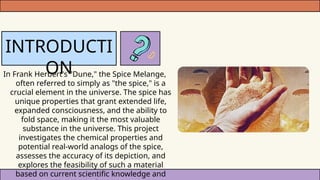
In Frank Herbert's"Dune," the Spice Melange,
often referred to simply as "the spice," is a
crucial element in the universe. The spice has
unique properties that grant extended life,
expanded consciousness, and the ability to
fold space, making it the most valuable
substance in the universe. This project
investigates the chemical properties and
potential real-world analogs of the spice,
assesses the accuracy of its depiction, and
explores the feasibility of such a material
based on current scientific knowledge and
30.
Chemical Properties ofthe Spice
Melange in Fiction
•Life Extension: The spice prolongs life and enhances vitality.
•Enhanced Cognitive Abilities: It grants users expanded
consciousness and precognition.
•Space Travel: It enables the navigators of the Spacing Guild
to fold space, allowing for instantaneous travel across vast
distances.
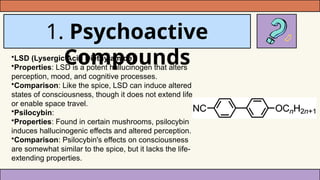
1. Psychoactive
Compounds
•LSD (LysergicAcid Diethylamide):
•Properties: LSD is a potent hallucinogen that alters
perception, mood, and cognitive processes.
•Comparison: Like the spice, LSD can induce altered
states of consciousness, though it does not extend life
or enable space travel.
•Psilocybin:
•Properties: Found in certain mushrooms, psilocybin
induces hallucinogenic effects and altered perception.
•Comparison: Psilocybin's effects on consciousness
are somewhat similar to the spice, but it lacks the life-
extending properties.
33.
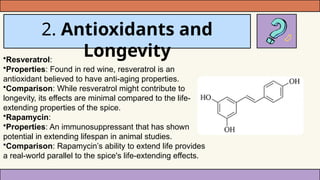
2. Antioxidants and
Longevity
•Resveratrol:
•Properties:Found in red wine, resveratrol is an
antioxidant believed to have anti-aging properties.
•Comparison: While resveratrol might contribute to
longevity, its effects are minimal compared to the life-
extending properties of the spice.
•Rapamycin:
•Properties: An immunosuppressant that has shown
potential in extending lifespan in animal studies.
•Comparison: Rapamycin’s ability to extend life provides
a real-world parallel to the spice's life-extending effects.
34.
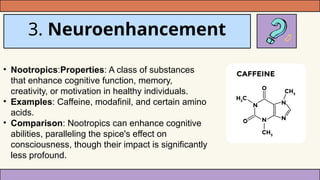
3. Neuroenhancement
• Nootropics:Properties:A class of substances
that enhance cognitive function, memory,
creativity, or motivation in healthy individuals.
• Examples: Caffeine, modafinil, and certain amino
acids.
• Comparison: Nootropics can enhance cognitive
abilities, paralleling the spice's effect on
consciousness, though their impact is significantly
less profound.
Accuracy of Depiction
•The spice in "Dune" combines properties that
are distributed among various real-world
compounds. While psychoactive drugs can alter
consciousness and certain substances may
have longevity benefits, no single compound
matches the spice's full range of effects.
37.
Potential Real-World
Applications
•Longevity Research:The study of compounds like
resveratrol and rapamycin could lead to
breakthroughs in extending human life.
•Cognitive Enhancement: Nootropics and
psychoactive compounds are actively researched for
their potential to enhance cognitive function and treat
neurological disorders.
Conclution
•While the SpiceMelange of "Dune" is a fictional
substance with extraordinary properties, real-world
research into psychoactive compounds, antioxidants,
and nootropics shows that some aspects of its effects
are grounded in science. The spice remains a
fascinating blend of various chemical properties,
inspiring ongoing scientific exploration into enhancing
human health and cognition.
40.
References
•Frank Herbert, "Dune"
•NationalInstitute on Drug Abuse,
"Hallucinogens"
•Harvard Health Publishing, "The truth behind
the latest anti-aging supplement trends"
•Journal of Clinical Investigation, "Rapamycin
Extends Life Span in Mice"
INTRODUCTION
• In FrankHerbert's "Dune," space travel plays a pivotal role
facilitated by the Spice Melange, enabling instantaneous travel
across vast distances through space folding. This project delves
into the mathematical principles underlying space travel as
depicted in "Dune," focusing on concepts such as space folding,
delta-v calculations, and the Hohmann transfer orbit. By
applying mathematical reasoning and problem-solving skills, we
aim to analyze the feasibility and implications of these concepts
within the narrative.
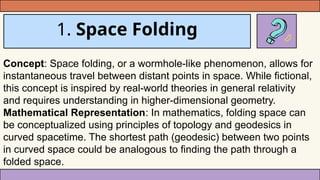
1. Space Folding
Concept:Space folding, or a wormhole-like phenomenon, allows for
instantaneous travel between distant points in space. While fictional,
this concept is inspired by real-world theories in general relativity
and requires understanding in higher-dimensional geometry.
Mathematical Representation: In mathematics, folding space can
be conceptualized using principles of topology and geodesics in
curved spacetime. The shortest path (geodesic) between two points
in curved space could be analogous to finding the path through a
folded space.
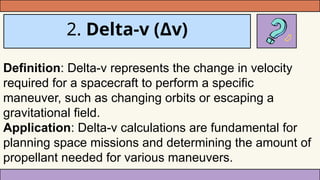
46.
2. Delta-v (Δv)
Definition:Delta-v represents the change in velocity
required for a spacecraft to perform a specific
maneuver, such as changing orbits or escaping a
gravitational field.
Application: Delta-v calculations are fundamental for
planning space missions and determining the amount of
propellant needed for various maneuvers.
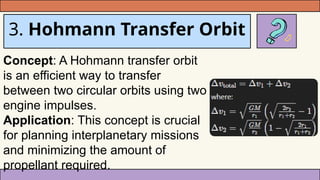
47.
3. Hohmann TransferOrbit
Concept: A Hohmann transfer orbit
is an efficient way to transfer
between two circular orbits using two
engine impulses.
Application: This concept is crucial
for planning interplanetary missions
and minimizing the amount of
propellant required.
Analysis and Interpretation
•Feasibilityin Reality: While space folding remains purely speculative,
concepts like delta-v and Hohmann transfers are grounded in real-world
orbital mechanics. Understanding these principles helps in evaluating the
plausibility of futuristic space travel methods.
•Implications in Fiction: In "Dune," the Spice Melange enables space
folding, providing a unique narrative device. Analyzing the mathematics
behind it enhances our appreciation of the narrative's scientific
underpinnings.
•Comparative Analysis: Compare the theoretical concepts in "Dune" with
current advancements in theoretical physics, such as wormhole theories and
exotic matter considerations.
Conclusion
•Through this detailedproject, we have explored the
mathematical foundations of space travel as depicted in "Dune,"
focusing on space folding, delta-v calculations, and Hohmann
transfer orbits. These mathematical principles provide insights
into the feasibility and implications of futuristic space travel
concepts within the narrative context. By applying mathematical
reasoning and problem-solving skills, we gain a deeper
understanding of the scientific elements intertwined with the
fictional universe of "Dune."
52.
References
● References
1. FrankHerbert, "Dune"
2. Curtis, H. D. (1997). Orbital Mechanics for
Engineering Students. Butterworth-
Heinemann.
3. Vallado, D. A. (2007). Fundamentals of
Astrodynamics and Applications. Microcosm
Press.
4. Carroll, S. M. (2004). Spacetime and Geometry: