Strategies for Taking
 Standardized Tests
‘Twas the Night Before
         Testing
• Go to bed on time.
•Put a few number 2 pencils
with erasers in your backpack.

•Solve family/friend problems before
the testing date.
•Talk to your parents about any
concerns that you might have about the
test.
The Morning of Testing
• Start your day as you always
  do.
• Eat a good breakfast.
• Think of what you will do to
  relax after you get home from
  school.
• Think Positive!
Multiple Choice Questions

• If you do not understand the
  directions, ask for help.
• Read the question and all
  answer choices before
  marking anything.
Pace Yourself
• Don’t spend too much time on
  any one question. Do your best
  and then move on.
• Answers the easiest questions
  first, but be sure to go back to
  those questions you skipped.
Multiple Choice Questions
• Do not change your answers
  unless you are very uncertain
  about your first answer choice.
• Try to answer every question.
  Make the most intelligent
  guess you can.
The Process of Elimination
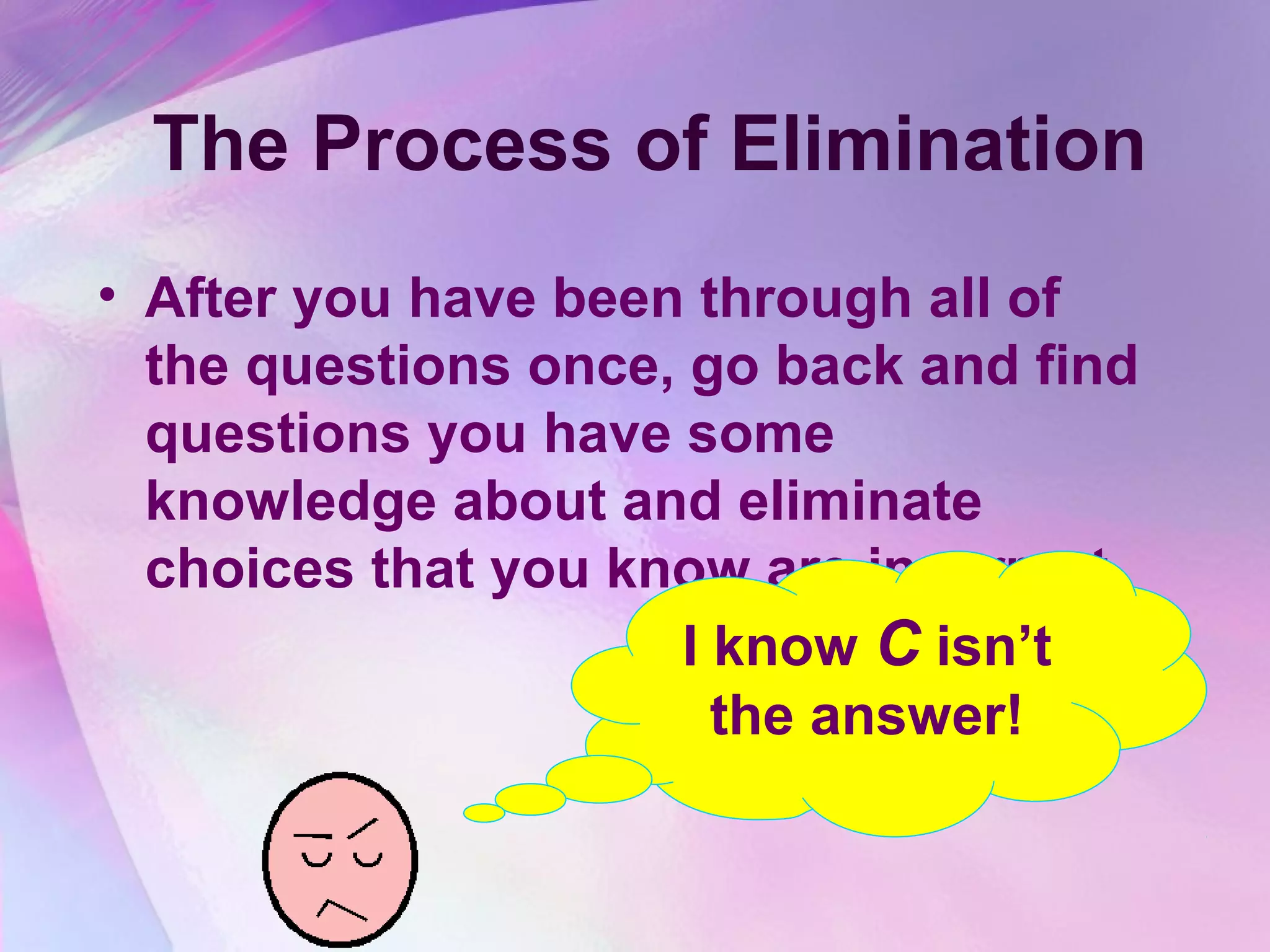
• After you have been through all of
  the questions once, go back and find
  questions you have some
  knowledge about and eliminate
  choices that you know are incorrect.
                     I know C isn’t
                       the answer!
The Process of Elimination
• If you can eliminate two wrong
  answers, your chance of
  choosing the right answer is
  greater.
Answering Questions
• Don't guess blindly, but if you
  have time to think about the
  best answer choice, make it!
Skip, Return, Check
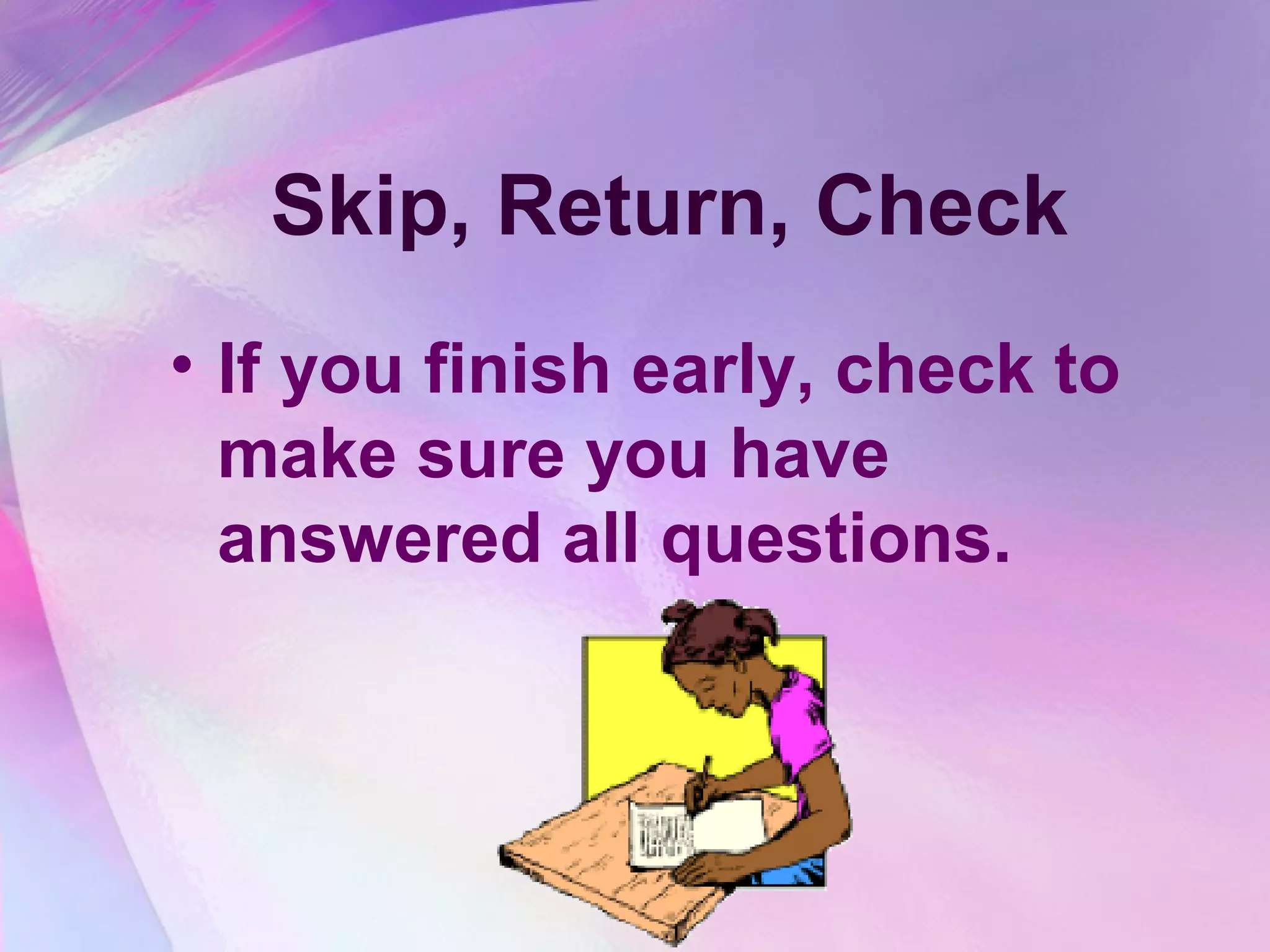
• If you finish early, check to
  make sure you have
  answered all questions.
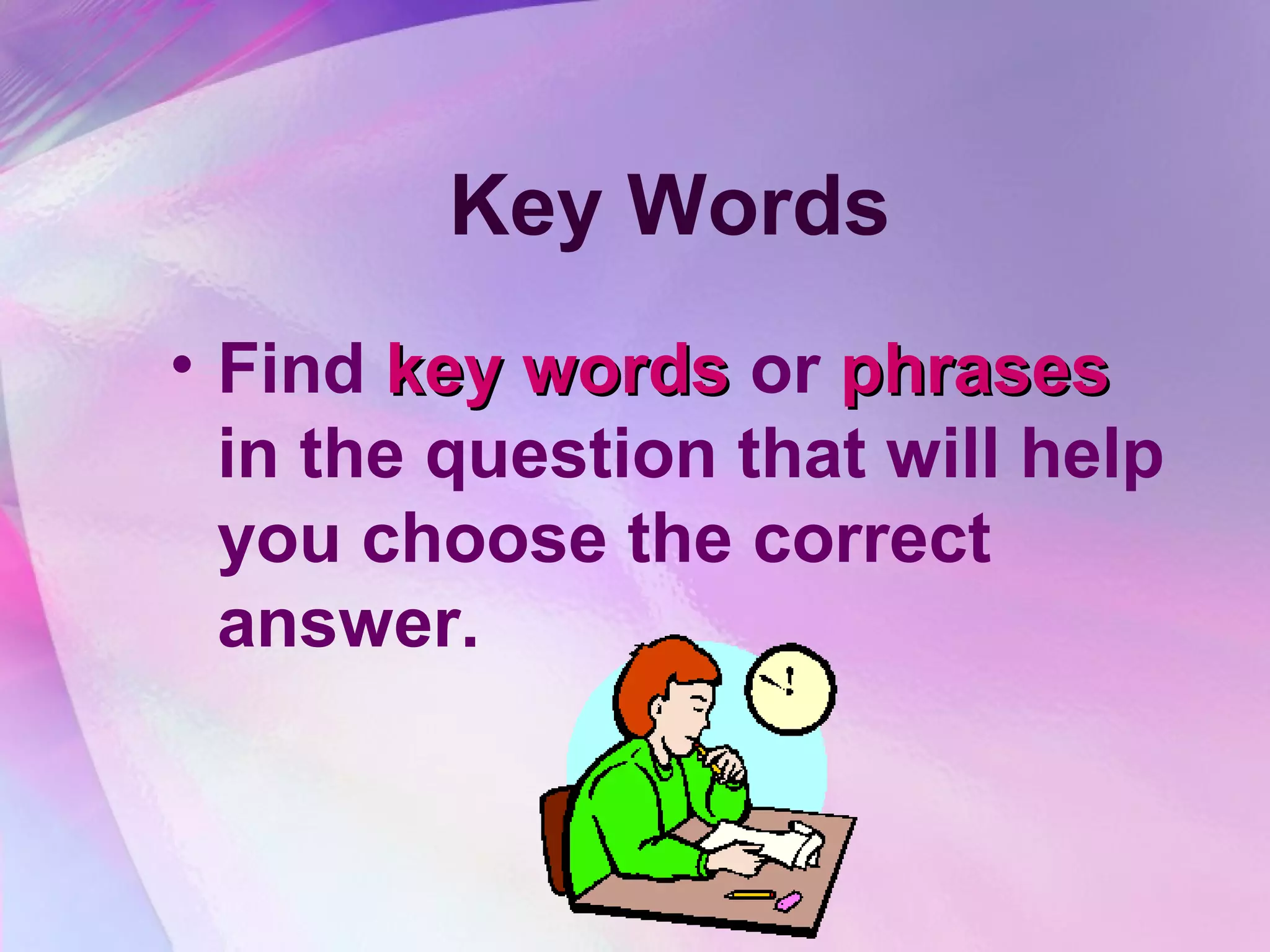
Key Words
• Find key words or phrases
  in the question that will help
  you choose the correct
  answer.
Are we communicating?
• Make sure you understand
  what the question is asking.
• Be sure you are responding to
  the question that is being
  asked.
Reading Passages
• If the test requires you to read
  passages and then answer
  questions about what you read,
  read the questions first.
•By doing this, you will know what
you are looking for as you read.
This also helps you go faster on
the test.
Reading Passages
• When there are several
  questions about a reading
  passage or chart, look for
  clues in other questions that
  will help you with those items
  about which you are unsure.
Math Computation
• When using scratch paper on a math
  test, double check to make sure that
  you have copied the problem
  correctly from the test booklet!
Math Computation
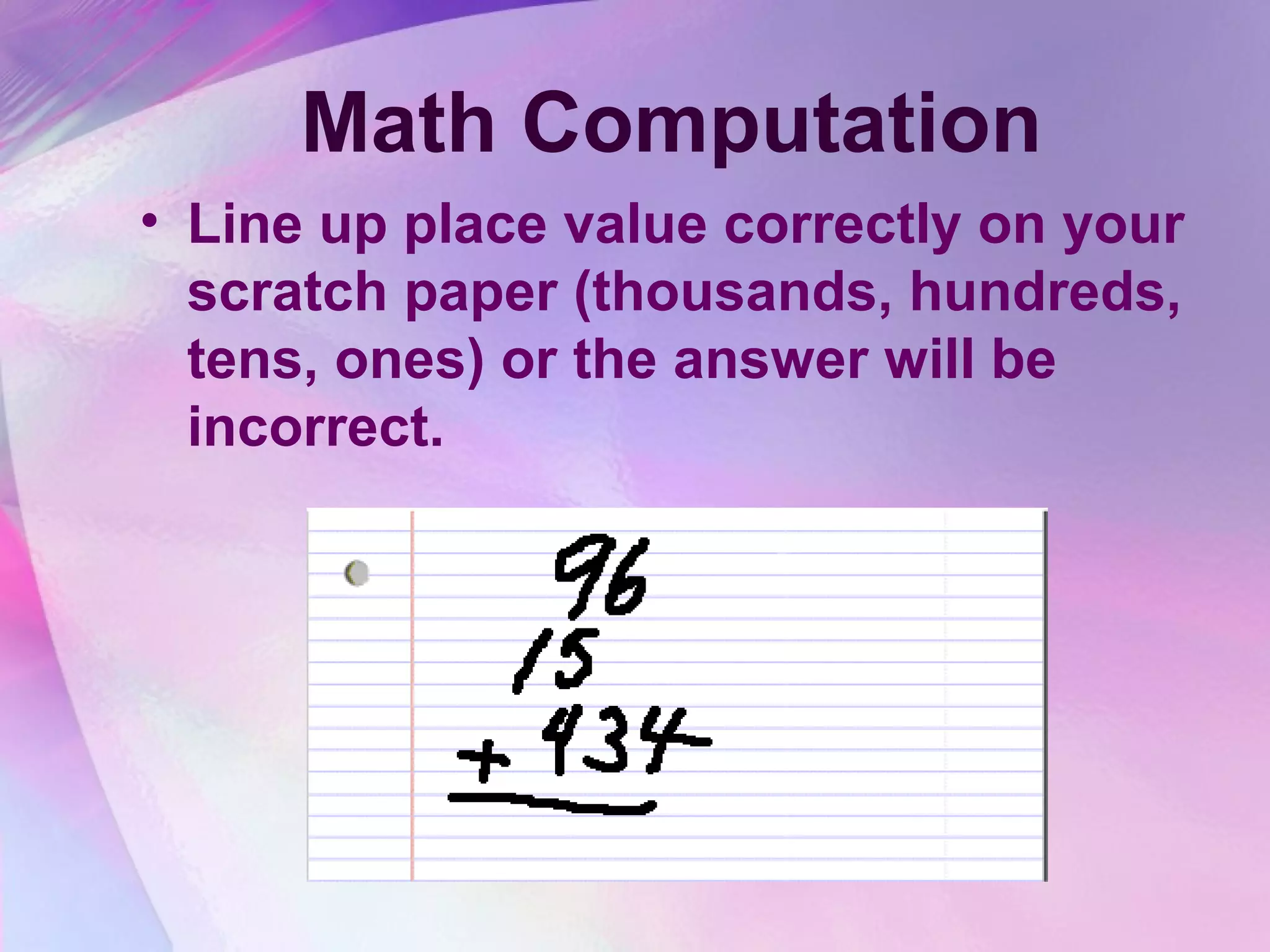
• Line up place value correctly on your
  scratch paper (thousands, hundreds,
  tens, ones) or the answer will be
  incorrect.
Math Computation
• If your answer does not match one
  of the choices, reread the problem,
  recopy the numbers, and try
  solving it again.
A Matter of Time
• If any time remains, spend it on
  those questions about which you
  know nothing or almost nothing.
• As you go back through, do not
  change all answers.
• Remember: Your first
  guess is usually right.
It’s About Time
• Don’t spend too much
  time rewriting or
  obsessing about
  neatness.
• Don’t worry if you run
  out of time.
Final Tips
• Fill in bubbles fully, write neatly,
  and erase stray marks.
• Double-check the test number in
  your test booklet against the
  answer sheet every few questions
  to be sure you haven’t gotten on
  the wrong number.
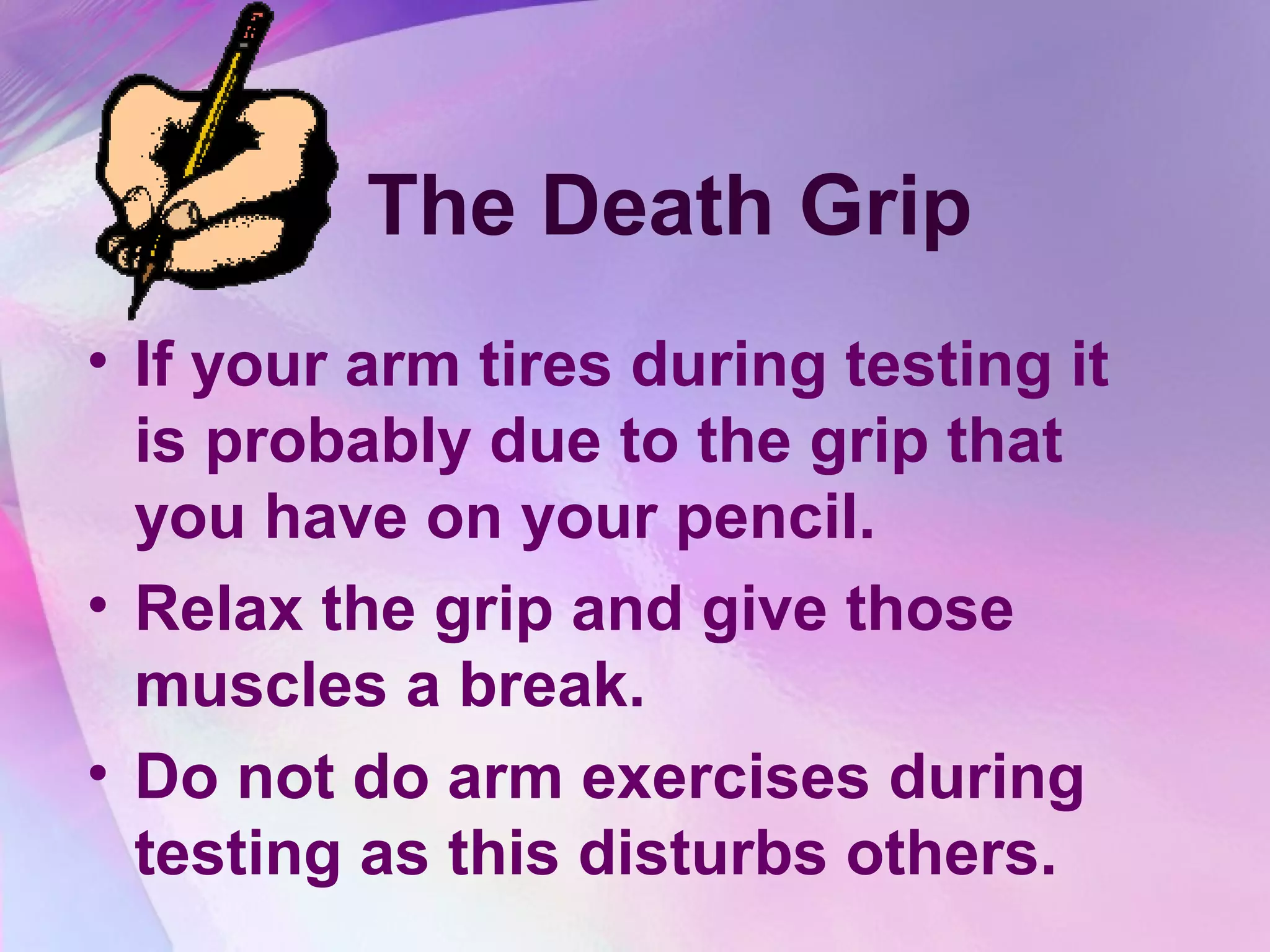
The Death Grip
• If your arm tires during testing it
  is probably due to the grip that
  you have on your pencil.
• Relax the grip and give those
  muscles a break.
• Do not do arm exercises during
  testing as this disturbs others.
Thank you, Mr. Know-it-all!
• Remember it's okay not to
  know everything — unlike
  class tests, these tests will
  have some questions designed
  to challenge the limits of your
  knowledge at a grade level
  above your current grade.
For Teachers
• Test the Best! Lesson plans
  and activities to prepare
  students for standardized
  tests.

Test strategies

  • 1.
    Strategies for Taking Standardized Tests
  • 2.
    ‘Twas the NightBefore Testing • Go to bed on time. •Put a few number 2 pencils with erasers in your backpack. •Solve family/friend problems before the testing date. •Talk to your parents about any concerns that you might have about the test.
  • 3.
    The Morning ofTesting • Start your day as you always do. • Eat a good breakfast. • Think of what you will do to relax after you get home from school. • Think Positive!
  • 4.
    Multiple Choice Questions •If you do not understand the directions, ask for help. • Read the question and all answer choices before marking anything.
  • 5.
    Pace Yourself • Don’tspend too much time on any one question. Do your best and then move on. • Answers the easiest questions first, but be sure to go back to those questions you skipped.
  • 6.
    Multiple Choice Questions •Do not change your answers unless you are very uncertain about your first answer choice. • Try to answer every question. Make the most intelligent guess you can.
  • 7.
    The Process ofElimination • After you have been through all of the questions once, go back and find questions you have some knowledge about and eliminate choices that you know are incorrect. I know C isn’t the answer!
  • 8.
    The Process ofElimination • If you can eliminate two wrong answers, your chance of choosing the right answer is greater.
  • 9.
    Answering Questions • Don'tguess blindly, but if you have time to think about the best answer choice, make it!
  • 10.
    Skip, Return, Check •If you finish early, check to make sure you have answered all questions.
  • 11.
    Key Words • Findkey words or phrases in the question that will help you choose the correct answer.
  • 12.
    Are we communicating? •Make sure you understand what the question is asking. • Be sure you are responding to the question that is being asked.
  • 13.
    Reading Passages • Ifthe test requires you to read passages and then answer questions about what you read, read the questions first. •By doing this, you will know what you are looking for as you read. This also helps you go faster on the test.
  • 14.
    Reading Passages • Whenthere are several questions about a reading passage or chart, look for clues in other questions that will help you with those items about which you are unsure.
  • 15.
    Math Computation • Whenusing scratch paper on a math test, double check to make sure that you have copied the problem correctly from the test booklet!
  • 16.
    Math Computation • Lineup place value correctly on your scratch paper (thousands, hundreds, tens, ones) or the answer will be incorrect.
  • 17.
    Math Computation • Ifyour answer does not match one of the choices, reread the problem, recopy the numbers, and try solving it again.
  • 18.
    A Matter ofTime • If any time remains, spend it on those questions about which you know nothing or almost nothing. • As you go back through, do not change all answers. • Remember: Your first guess is usually right.
  • 19.
    It’s About Time •Don’t spend too much time rewriting or obsessing about neatness. • Don’t worry if you run out of time.
  • 20.
    Final Tips • Fillin bubbles fully, write neatly, and erase stray marks. • Double-check the test number in your test booklet against the answer sheet every few questions to be sure you haven’t gotten on the wrong number.
  • 21.
    The Death Grip •If your arm tires during testing it is probably due to the grip that you have on your pencil. • Relax the grip and give those muscles a break. • Do not do arm exercises during testing as this disturbs others.
  • 22.
    Thank you, Mr.Know-it-all! • Remember it's okay not to know everything — unlike class tests, these tests will have some questions designed to challenge the limits of your knowledge at a grade level above your current grade.
  • 23.
    For Teachers • Testthe Best! Lesson plans and activities to prepare students for standardized tests.