
American Board of Pathology  and  Co-operating Societies Meeting May 3, 2011 Modules revised November 2008
Maintenance of Board Certification (MOC) ABP MOC is part of ABMS-wide MOC process  All certificates beginning in 2006 are time limited (10 yrs) MOC is a continuous process with specific deadlines; failure to comply results in a warning
Requirements For MOC  Part I:  Professional Standing Part II:  Life-Long Learning and Self-Assessment Part III:  Cognitive Expertise Part IV:  Evaluation of Performance in Practice
Part I Professional Standing Maintenance of a full and unrestricted license  Foreign license accepted with English translation Documentation of medical staff membership and privileges
Part II Life Long Learning-Self-Assessment Intersociety AP and CP Content Committees produce “Content Specifications” outlines available on line and updated annually   Outlines emphasize fundamental information for daily practice and important, validated new knowledge Outlines should not be construed as templates for exam or endorsements of certain authors These will:  Serve as a template for CME and self-assessment Assist pathologists to prepare for MOC exam Direct MOC test question development Focus on practical “need to know” information that is used in daily practice and required for competence Cover all disciplines of pathology
Part II Life Long Learning- Self-Assessment 70 Category 1 CME credits / 2 year cycle  20 CME credits / 2 yr cycle must be SAMs  80% CME related to individual’s practice   A fellowship fulfills Part II requirements for 2 year period
Self-Assessment Modules (SAMs) Elements of SAMs Educational product Self-administered exam Minimum performance level Feedback All SAMs count as CMEs, but not all CMEs are SAMs
Part III Cognitive Expertise Exam may be taken beginning year 8 of 10 year cycle  (first exam 2014) AP/CP diplomates may maintain their certification in AP/CP, AP only,  CP only  Diplomates with subspecialty boards may maintain certification in subspecialty only
Part III Cognitive Expertise MOC exam Tailor exam by selecting modules Consists of 6 modules of 25 questions  (150 total questions) 80% practical (virtual microscopy, case-based questions, etc.); 20% written  Blends and grades modules as one exam
Part IV Performance in Practice Four personal attestations  (4 th  and 8 th  year)   Lab accreditation  (4 th  and 8 th  year) except forensic labs Laboratory participation in inter-laboratory PI programs  (2 yrs) Individual participation at least 1 laboratory PI-QA program/yr.  (2 yrs)
Part IV Performance in Practice Programs may be society-sponsored or created by departments/institutions All programs must be ABP-approved Programs
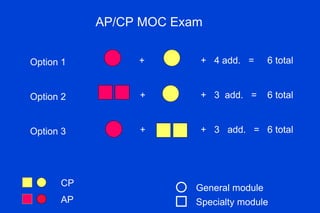
AP/CP MOC Exam General module Specialty module +  + + +  4 add.  =  6 total +  3  add.  =  6 total +  3  add.  =  6 total AP CP Option 1 Option 2 Option 3
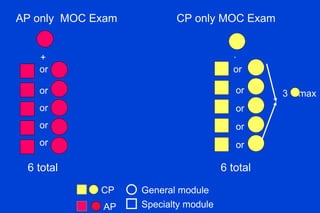
AP only  MOC Exam    CP only MOC Exam   General module Specialty module AP CP 6 total   6 total or   or or or or or or or or or 3  max + +
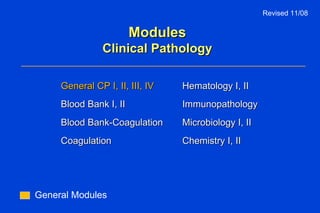
Modules Clinical Pathology General Modules Revised 11/08 General CP I, II, III, IV Hematology I, II Blood Bank I, II Immunopathology  Blood Bank-Coagulation  Microbiology I, II Coagulation Chemistry I, II
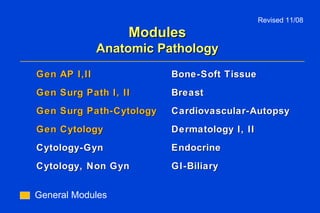
Modules Anatomic Pathology Gen AP I,II Gen Surg Path I, II Gen Surg Path-Cytology Gen Cytology Cytology-Gyn Cytology, Non Gyn   Bone-Soft Tissue Breast Cardiovascular-Autopsy Dermatology I, II Endocrine  GI-Biliary Revised 11/08 General Modules
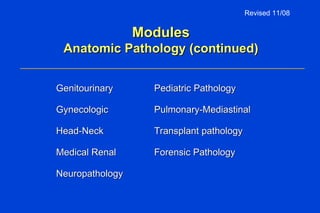
Modules Anatomic Pathology (continued) Revised 11/08 Genitourinary Pediatric Pathology Gynecologic Pulmonary-Mediastinal Head-Neck Transplant pathology Medical Renal Forensic Pathology  Neuropathology
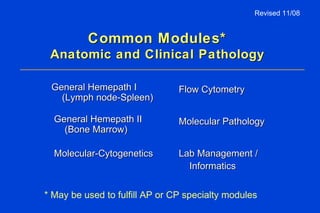
Common Modules* Anatomic and Clinical Pathology * May be used to fulfill AP or CP specialty modules Revised 11/08 General Hemepath I (Lymph node-Spleen) Flow Cytometry  General Hemepath II (Bone Marrow) Molecular Pathology  Molecular-Cytogenetics Lab Management / Informatics
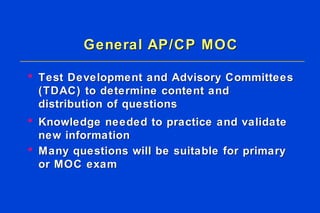
General AP/CP MOC Test Development and Advisory Committees (TDAC) to determine content and distribution of questions Knowledge needed to practice and validate new information Many questions will be suitable for primary or MOC exam
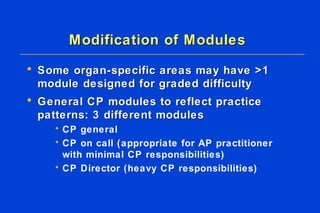
Modification of Modules Some organ-specific areas may have >1 module designed for graded difficulty  General CP modules to reflect practice patterns: 3 different modules CP general CP on call (appropriate for AP practitioner with minimal CP responsibilities) CP Director (heavy CP responsibilities)
Subspecialty MOC Exam Subspecialty TDACs will: Determine content and distribution of questions Decide on modular vs. non modular exam Write MOC questions
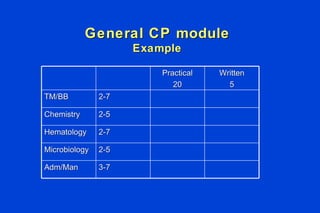
General CP module Example Practical 20 Written 5 TM/BB 2-7 Chemistry 2-5 Hematology 2-7 Microbiology 2-5 Adm/Man 3-7
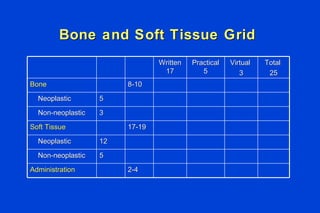
Bone and Soft Tissue Grid Written 17 Practical 5 Virtual  3 Total  25 Bone 8-10 Neoplastic 5 Non-neoplastic  3 Soft Tissue 17-19 Neoplastic 12 Non-neoplastic  5 Administration 2-4
Decertification Failure to report for two cycles Letter giving 60-90 days to comply Announcement of revocations in journals
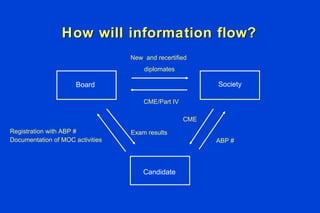
How will information flow? Candidate Board Society Exam results New  and recertified  diplomates Registration with ABP # Documentation of MOC activities CME CME/Part IV ABP #
Frequently Asked Questions
Are these the final modules? Not necessarily Changes will reflect practice patterns   Example: academic pathologist with subspecialty practice only
May candidates synchronize their reporting and testing cycles ? Yes, if they occur within two years of one another 2006 AP/CP could be synchronized with 2007 subspecialty board Supporting documentation in 2008, 2010, etc. MOC exam eligibility from 2014-2016 Second MOC period begins in 2016
Is there a definition for “credits related to practice” for CME/SAMs? Broad interpretation Use good judgment
When does the second MOC cycle start? From the date of the examination From January of the following year
What about diplomates practicing in foreign countries who are unable to maintain a US license? Official license accepted if accompanied by an  English translation
How will Board communicate changes to MOC? ABP Website Spring meeting of co-operating societies Announcements in journals
How do we make MOC more relevant? PQRI will incentivize MOC Maintenance of licensure = MOC Diplomates with time-unlimited certificates enroll in MOC

Test Power Point

  • 1.
  • 2.
    American Board ofPathology and Co-operating Societies Meeting May 3, 2011 Modules revised November 2008
  • 3.
    Maintenance of BoardCertification (MOC) ABP MOC is part of ABMS-wide MOC process All certificates beginning in 2006 are time limited (10 yrs) MOC is a continuous process with specific deadlines; failure to comply results in a warning
  • 4.
    Requirements For MOC Part I: Professional Standing Part II: Life-Long Learning and Self-Assessment Part III: Cognitive Expertise Part IV: Evaluation of Performance in Practice
  • 5.
    Part I ProfessionalStanding Maintenance of a full and unrestricted license Foreign license accepted with English translation Documentation of medical staff membership and privileges
  • 6.
    Part II LifeLong Learning-Self-Assessment Intersociety AP and CP Content Committees produce “Content Specifications” outlines available on line and updated annually Outlines emphasize fundamental information for daily practice and important, validated new knowledge Outlines should not be construed as templates for exam or endorsements of certain authors These will: Serve as a template for CME and self-assessment Assist pathologists to prepare for MOC exam Direct MOC test question development Focus on practical “need to know” information that is used in daily practice and required for competence Cover all disciplines of pathology
  • 7.
    Part II LifeLong Learning- Self-Assessment 70 Category 1 CME credits / 2 year cycle 20 CME credits / 2 yr cycle must be SAMs 80% CME related to individual’s practice A fellowship fulfills Part II requirements for 2 year period
  • 8.
    Self-Assessment Modules (SAMs)Elements of SAMs Educational product Self-administered exam Minimum performance level Feedback All SAMs count as CMEs, but not all CMEs are SAMs
  • 9.
    Part III CognitiveExpertise Exam may be taken beginning year 8 of 10 year cycle (first exam 2014) AP/CP diplomates may maintain their certification in AP/CP, AP only, CP only Diplomates with subspecialty boards may maintain certification in subspecialty only
  • 10.
    Part III CognitiveExpertise MOC exam Tailor exam by selecting modules Consists of 6 modules of 25 questions (150 total questions) 80% practical (virtual microscopy, case-based questions, etc.); 20% written Blends and grades modules as one exam
  • 11.
    Part IV Performancein Practice Four personal attestations (4 th and 8 th year) Lab accreditation (4 th and 8 th year) except forensic labs Laboratory participation in inter-laboratory PI programs (2 yrs) Individual participation at least 1 laboratory PI-QA program/yr. (2 yrs)
  • 12.
    Part IV Performancein Practice Programs may be society-sponsored or created by departments/institutions All programs must be ABP-approved Programs
  • 13.
    AP/CP MOC ExamGeneral module Specialty module + + + + 4 add. = 6 total + 3 add. = 6 total + 3 add. = 6 total AP CP Option 1 Option 2 Option 3
  • 14.
    AP only MOC Exam CP only MOC Exam General module Specialty module AP CP 6 total 6 total or or or or or or or or or or 3 max + +
  • 15.
    Modules Clinical PathologyGeneral Modules Revised 11/08 General CP I, II, III, IV Hematology I, II Blood Bank I, II Immunopathology Blood Bank-Coagulation Microbiology I, II Coagulation Chemistry I, II
  • 16.
    Modules Anatomic PathologyGen AP I,II Gen Surg Path I, II Gen Surg Path-Cytology Gen Cytology Cytology-Gyn Cytology, Non Gyn Bone-Soft Tissue Breast Cardiovascular-Autopsy Dermatology I, II Endocrine GI-Biliary Revised 11/08 General Modules
  • 17.
    Modules Anatomic Pathology(continued) Revised 11/08 Genitourinary Pediatric Pathology Gynecologic Pulmonary-Mediastinal Head-Neck Transplant pathology Medical Renal Forensic Pathology Neuropathology
  • 18.
    Common Modules* Anatomicand Clinical Pathology * May be used to fulfill AP or CP specialty modules Revised 11/08 General Hemepath I (Lymph node-Spleen) Flow Cytometry General Hemepath II (Bone Marrow) Molecular Pathology Molecular-Cytogenetics Lab Management / Informatics
  • 19.
    General AP/CP MOCTest Development and Advisory Committees (TDAC) to determine content and distribution of questions Knowledge needed to practice and validate new information Many questions will be suitable for primary or MOC exam
  • 20.
    Modification of ModulesSome organ-specific areas may have >1 module designed for graded difficulty General CP modules to reflect practice patterns: 3 different modules CP general CP on call (appropriate for AP practitioner with minimal CP responsibilities) CP Director (heavy CP responsibilities)
  • 21.
    Subspecialty MOC ExamSubspecialty TDACs will: Determine content and distribution of questions Decide on modular vs. non modular exam Write MOC questions
  • 22.
    General CP moduleExample Practical 20 Written 5 TM/BB 2-7 Chemistry 2-5 Hematology 2-7 Microbiology 2-5 Adm/Man 3-7
  • 23.
    Bone and SoftTissue Grid Written 17 Practical 5 Virtual 3 Total 25 Bone 8-10 Neoplastic 5 Non-neoplastic 3 Soft Tissue 17-19 Neoplastic 12 Non-neoplastic 5 Administration 2-4
  • 24.
    Decertification Failure toreport for two cycles Letter giving 60-90 days to comply Announcement of revocations in journals
  • 25.
    How will informationflow? Candidate Board Society Exam results New and recertified diplomates Registration with ABP # Documentation of MOC activities CME CME/Part IV ABP #
  • 26.
  • 27.
    Are these thefinal modules? Not necessarily Changes will reflect practice patterns Example: academic pathologist with subspecialty practice only
  • 28.
    May candidates synchronizetheir reporting and testing cycles ? Yes, if they occur within two years of one another 2006 AP/CP could be synchronized with 2007 subspecialty board Supporting documentation in 2008, 2010, etc. MOC exam eligibility from 2014-2016 Second MOC period begins in 2016
  • 29.
    Is there adefinition for “credits related to practice” for CME/SAMs? Broad interpretation Use good judgment
  • 30.
    When does thesecond MOC cycle start? From the date of the examination From January of the following year
  • 31.
    What about diplomatespracticing in foreign countries who are unable to maintain a US license? Official license accepted if accompanied by an English translation
  • 32.
    How will Boardcommunicate changes to MOC? ABP Website Spring meeting of co-operating societies Announcements in journals
  • 33.
    How do wemake MOC more relevant? PQRI will incentivize MOC Maintenance of licensure = MOC Diplomates with time-unlimited certificates enroll in MOC

Editor's Notes

  • #3 Part I mainating an unrestricted license and hospital credentialing Part II SAM/CME 70 year period/ 20 in SAMS CME III cognitive exam at end o f 10 years but as eaparly as 8 years Part IV-peer attestation Participation in an approved PI/QA Laboratory accreditation Laboratory particpation in a
  • #11 Menu of multiple modules allows nuancin g of practice.large bodies of inforamtion can have more than one module
  • #12 Boarded pathologist, physician in another specialty, member of credentialing committee, PA Q Track programs: specmen identifcation, specimen contamination Individual: Check Path, Departmentally sposored: satisfaction survey May fulfill SAMs CME
  • #14 Principa at least one general module must be taken in either AP or CP with the remainder of modules left to your discretion
  • #16 Desiure a practice survery to asssit us in modular development